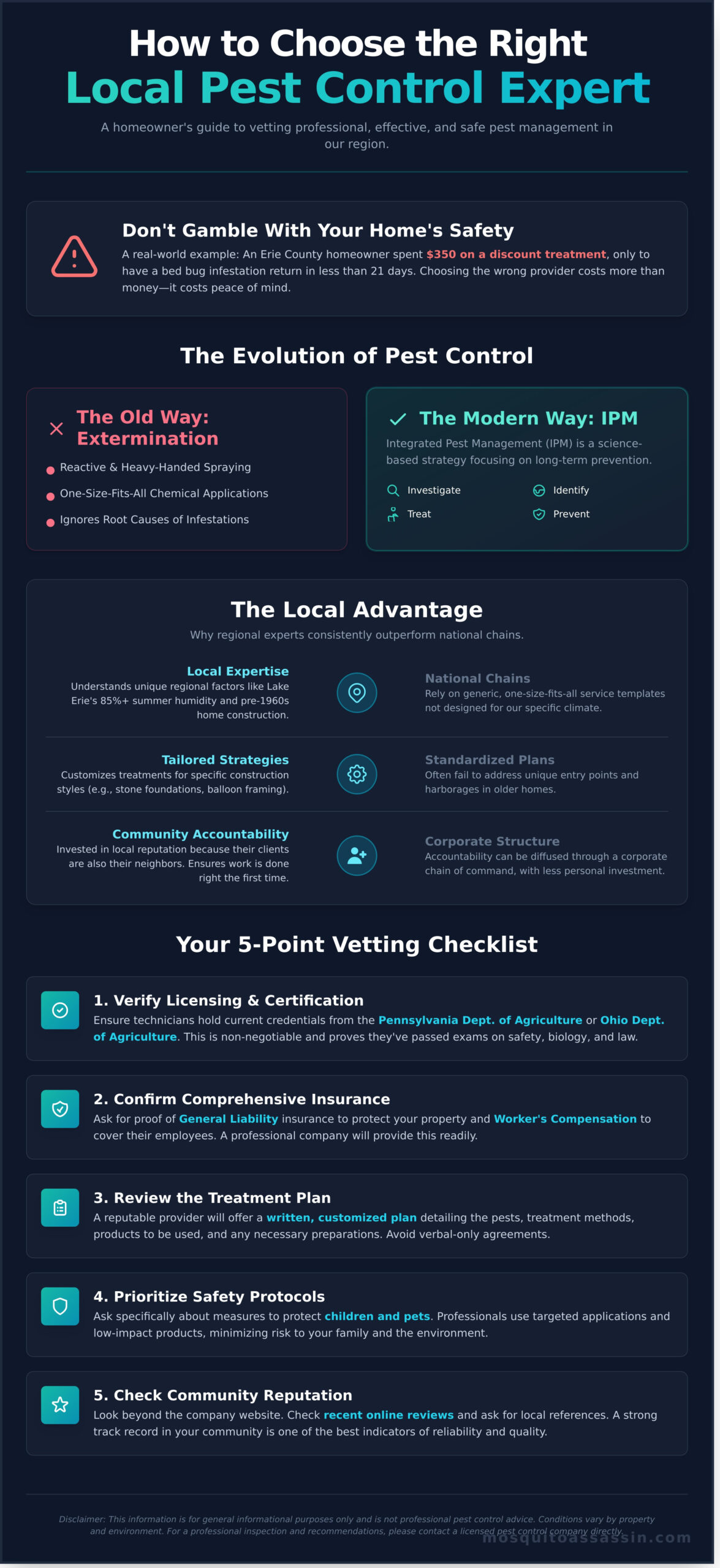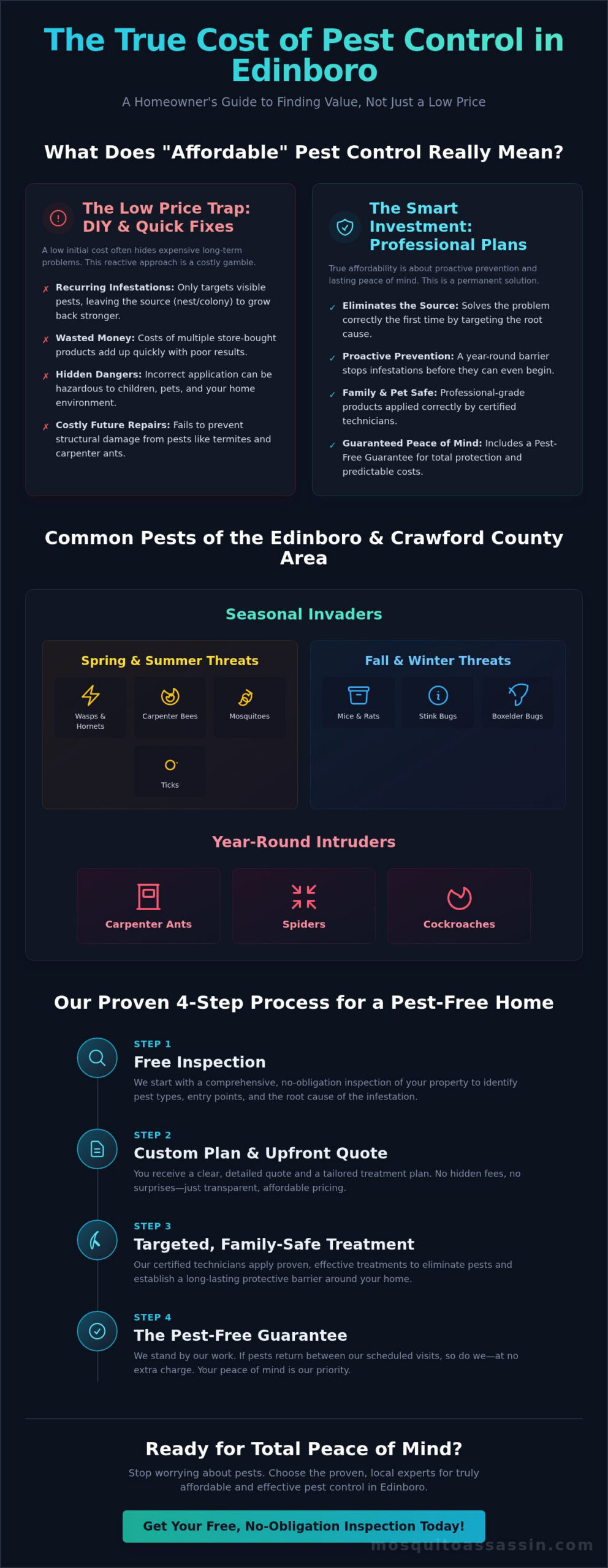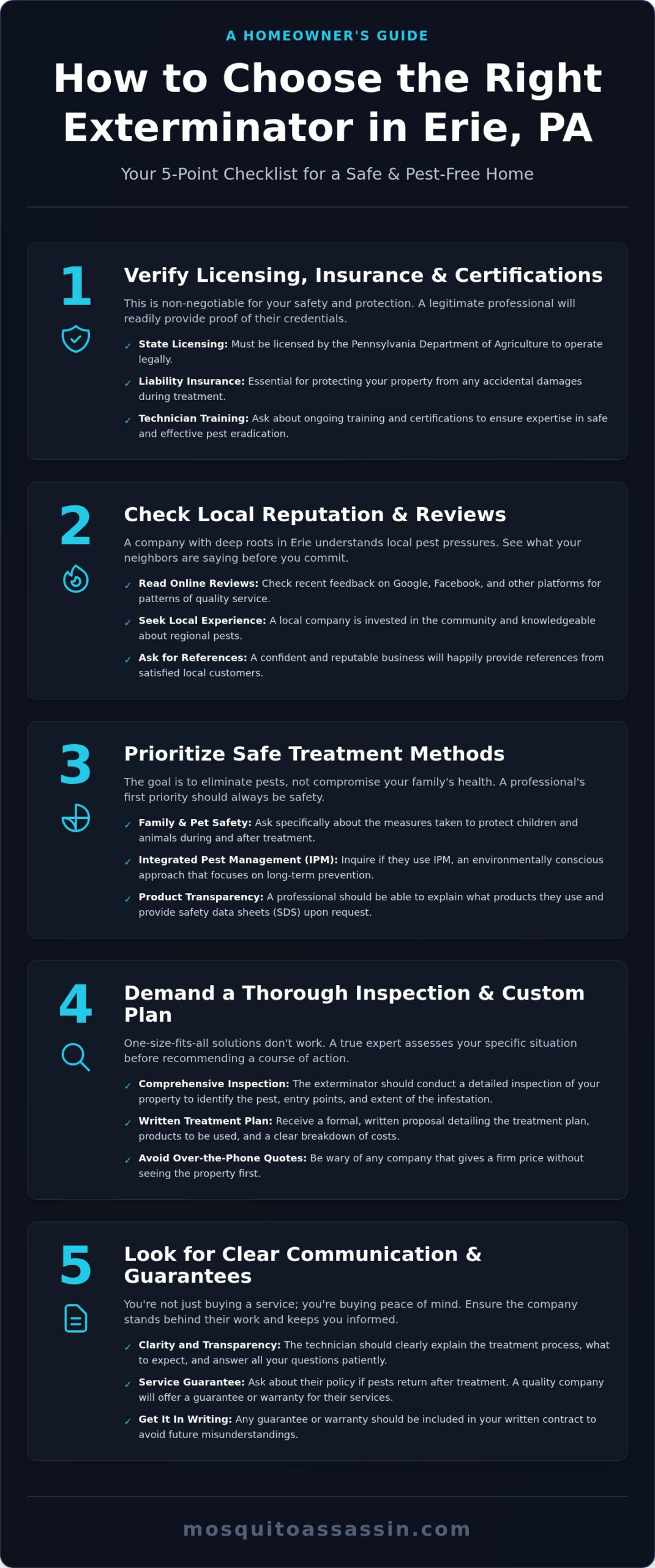
When choosing an exterminator near Ashtabula Harbor, start with a few practical questions rather than a bold promise. A provider may serve Ashtabula County without covering every address or handling every pest concern. Confirming those details first can save time and help you find a professional whose services fit your property.
It’s understandable to want clear answers when you’ve spotted pests but aren’t sure what a service visit involves. A useful evaluation should clarify which pests the provider handles, what an inspection is intended to establish, and what information will help assess the issue. Claims alone can’t tell you whether a company is a good fit.
This guide offers a practical checklist for comparing coverage, pest expertise, service approach, and communication before you make contact. You’ll also learn what to share when requesting an inspection, including what you observed, where and when activity occurs, and relevant details about the property. With those points in hand, you can ask focused questions and compare your options more confidently.
Key Takeaways
- Ashtabula Harbor is within the stated Ashtabula County service area, but confirm coverage for your specific address when contacting an exterminator near ashtabula harbor.
- Compare providers by whether their services match your pest concern, not by broad claims alone.
- Ask what an inspection involves and how the professional will explain potential service options.
- Before requesting an inspection, note where and when you observed pest activity.
- Clarify communication and follow-up expectations so you know what to expect after the initial assessment.
How to confirm an exterminator serves Ashtabula Harbor
Finding a suitable local pest professional is a practical first step when you’ve noticed activity at home or work. Before comparing service options, confirm that the provider can serve your address and handles the pest concern. An exterminator near Ashtabula Harbor may cover the area, but geographic coverage alone doesn’t confirm current availability or service fit.
Ashtabula Harbor is within Mosquito Assassin Pest Control LLC’s stated service area of Ashtabula County, Ohio. Availability can vary by address and service, so confirm both directly before arranging an inspection. The company’s service area information describes its regional coverage.
For general context on how pest professionals may assess and manage a pest issue, this video discusses recurring service:
What to confirm about service near Ashtabula Harbor
Share the property’s exact address and describe what you’ve observed. Ask whether the address is currently within the provider’s service area and whether the company handles that specific concern. These questions distinguish general geographic coverage from a service that may suit your property. Don’t assume coverage, scheduling, or availability is identical across nearby locations.
Why local coverage is only the first check
A provider may work in Ashtabula County but not offer a service that fits your situation. The right questions depend on the pest concern, property type, and what you expect from an inspection or follow-up. Ask how the professional will explain the assessment and potential options. An approach informed by Integrated Pest Management (IPM) considers the pest issue and its conditions rather than relying on a single blanket approach.
When comparing providers, look for clear answers about service scope and next steps, not absolute claims about outcomes. If you’re unsure what you’ve seen, describe where and when you noticed activity and ask whether an inspection is appropriate. Confirming location and service fit first makes the conversation more focused and helps you decide whether to proceed.
How to evaluate an exterminator near Ashtabula Harbor
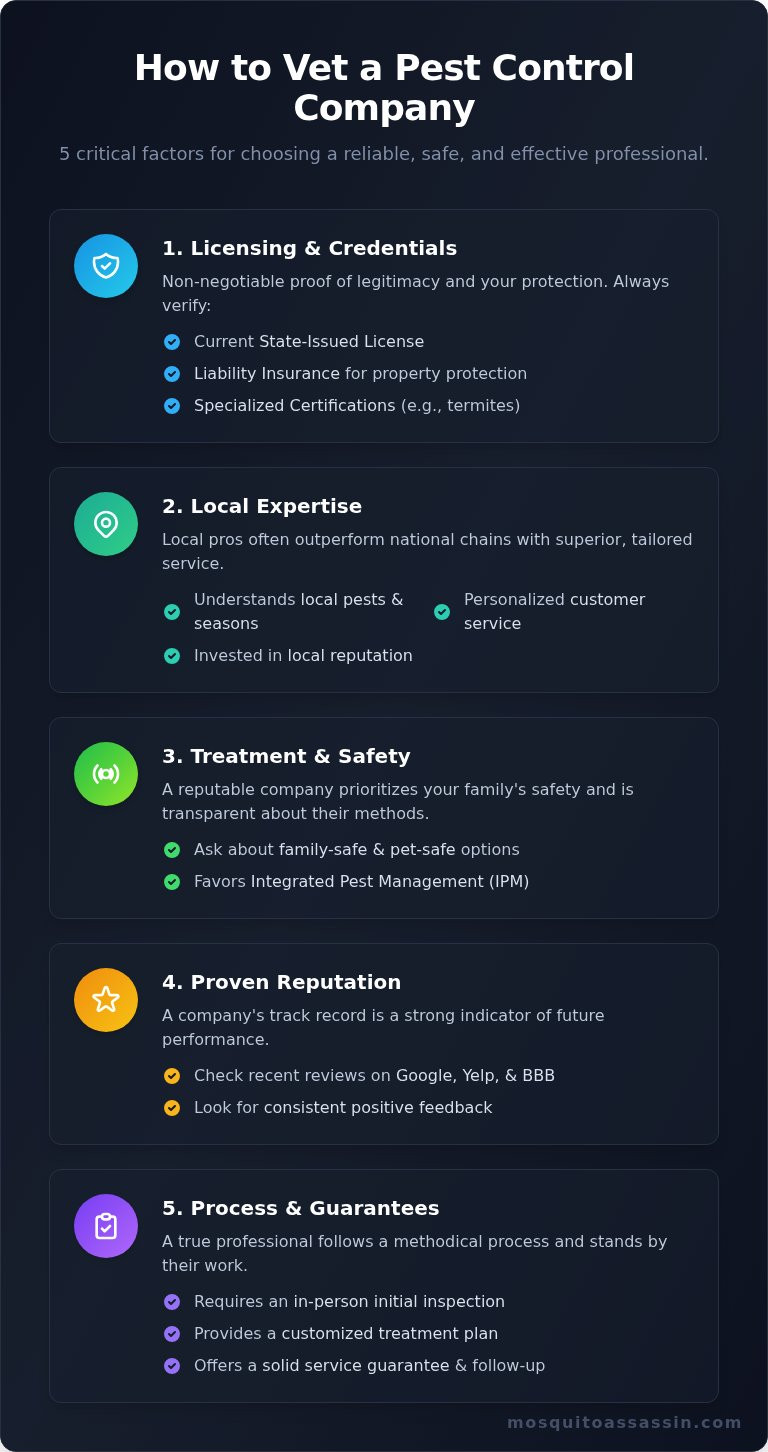
Once you’ve confirmed that a provider serves your address, compare how the service is assessed and explained. A clear process helps you understand whether the proposed service relates to the pest concern, the property, and the conditions observed. Ask questions before scheduling, and note whether the answers are specific and easy to follow.
Use this comparison guide when speaking with providers:
| What to compare | Questions to ask | What clear communication looks like |
|---|---|---|
| Service fit | Do you handle this pest concern and property type? | The provider explains whether the requested service is relevant or needs further assessment. |
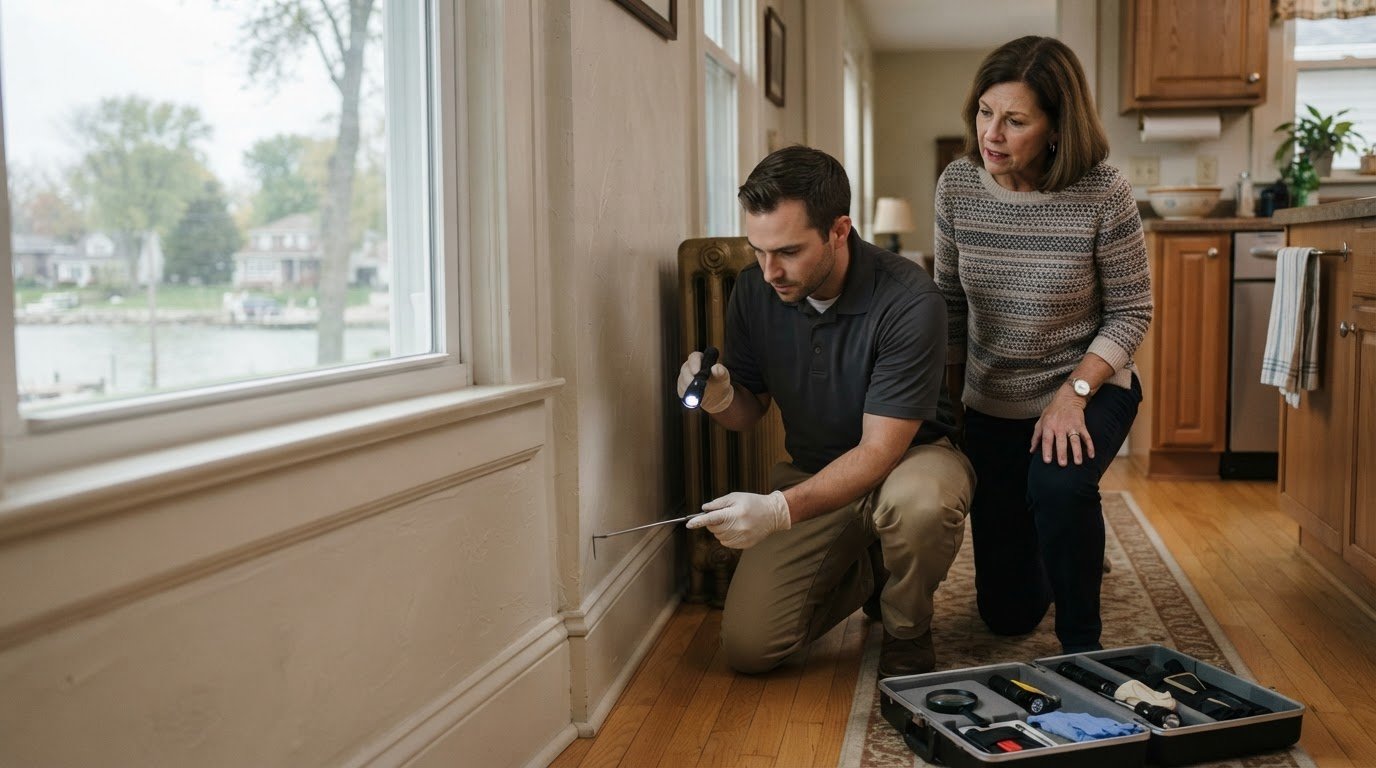
| Inspection process | What is an inspection or initial discussion intended to establish? | You’re told what information or observations will help assess the concern. |
| Recommendations | How will recommendations account for the property and reported conditions? | Proposed next steps connect to the details you shared, rather than a one-size-fits-all pitch. |
| Communication and follow-up | How will recommendations be explained, and what follow-up should I expect? | The provider describes how you’ll receive information and what may happen next. |
Questions that reveal whether the service fits
Describe the pest concern and property type, then ask which services may apply. An initial conversation can establish what the provider needs to learn, but it may not be enough to determine the right approach. Ask how recommendations will be shared and whether follow-up expectations depend on the findings. The answers should make the process understandable without promising a particular result.
How to assess a clear, professional process
Look for explanations in plain language. If a recommendation is unclear, ask which reported activity or property condition it addresses. A proposed next step should relate to the concern, not rely only on broad claims about being the “best” or guaranteeing an outcome. Absolute promises aren’t a substitute for an explanation of the assessment and service scope.
For additional consumer pest information, the National Pest Management Association provides educational resources. You can also review the provider’s company background to learn more about its business. Consider both sources alongside direct answers about the service you need. A property-specific discussion is more useful than a sales pitch that skips the details.
To discuss your observations and ask about possible next steps, contact a pest professional.
Match the pest concern to the right service near Ashtabula Harbor
A useful service conversation starts with the pest concern, not with choosing a treatment before the issue is understood. General pest control and targeted services address different categories of concern. An exterminator near Ashtabula Harbor should ask what you’ve observed and about the property before discussing which service, if any, may be suitable.
When a general pest service may be relevant
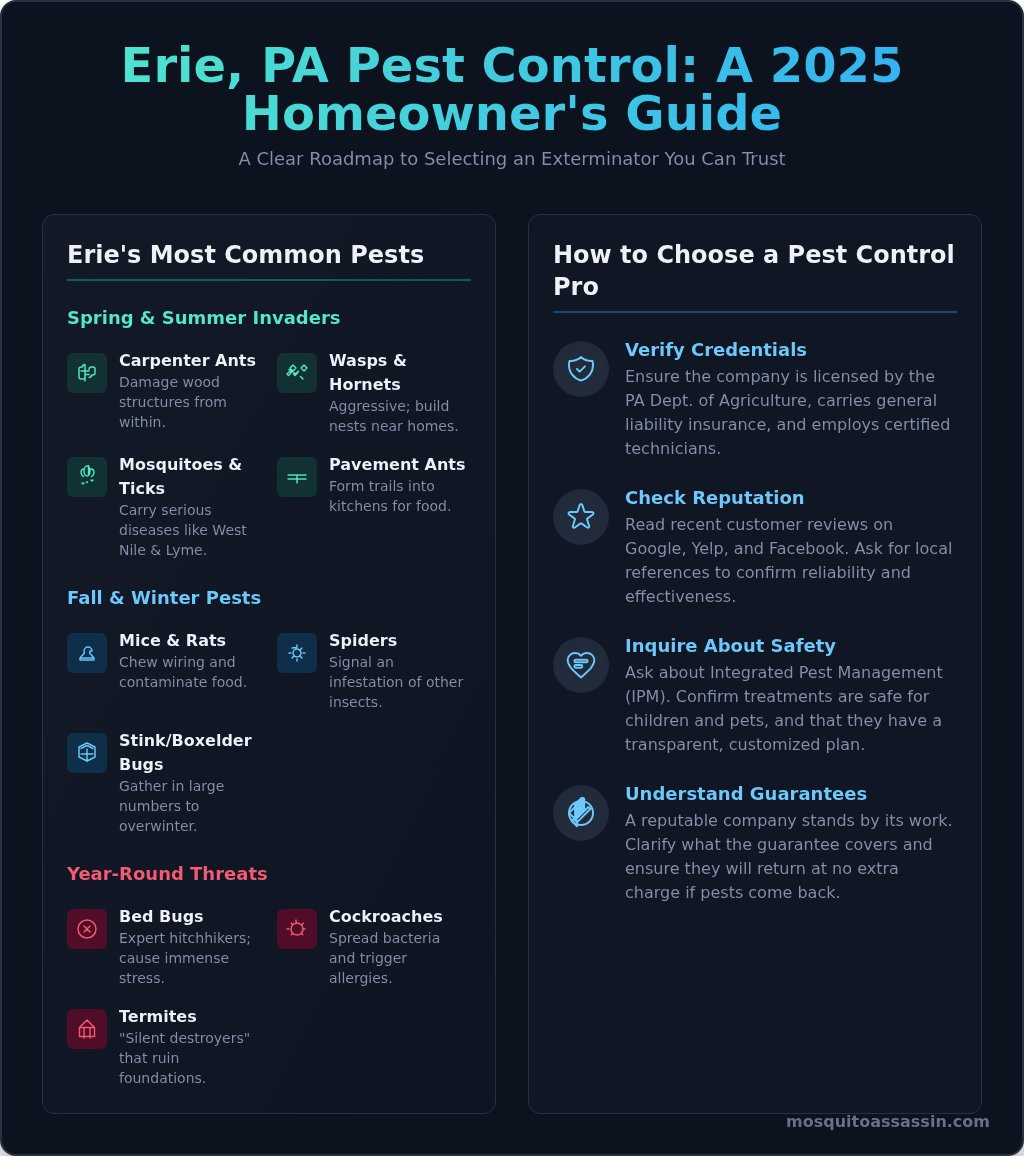
General pest control may be relevant for concerns involving common pests such as ants, spiders, wasps, or hornets. These examples can help you describe what you’re seeing, but a brief description alone doesn’t confirm a pest’s identity or determine which service is appropriate. Share where and when you noticed activity, and ask the provider to clarify the service scope. Review the company’s available pest control services for its stated categories.
General pest control isn’t automatically the right fit for every pest issue. The type of pest, where activity occurs, and the property’s circumstances all matter. If you’re unsure what you’ve seen, report the details without trying to identify or handle the pest yourself. A professional can explain whether more information or an inspection is needed before discussing next steps.
When a targeted pest service may be more appropriate
Some concerns align with a specific service category, such as rodent control, bed bug treatment, or termite inspections and treatment. These are distinct offerings, not interchangeable versions of general pest control. Explain the signs you’ve noticed and where they appear, then ask the provider which category may fit. The company’s service information can help you review its stated options, but it can’t determine what’s happening at your property.
For a broader perspective, compare the provider’s service descriptions with the concern you’ve observed. The U.S. Environmental Protection Agency’s Tips for Selecting a Pest Control Service also offers questions to consider when evaluating a pest professional.
Before settling on a service, ask the provider to explain why it fits the concern and what the assessment is meant to establish. Recommendations should reflect the reported activity and property conditions, not assumptions based on a short description. If the right category isn’t clear yet, ask for clarification rather than guessing at a diagnosis or treatment.
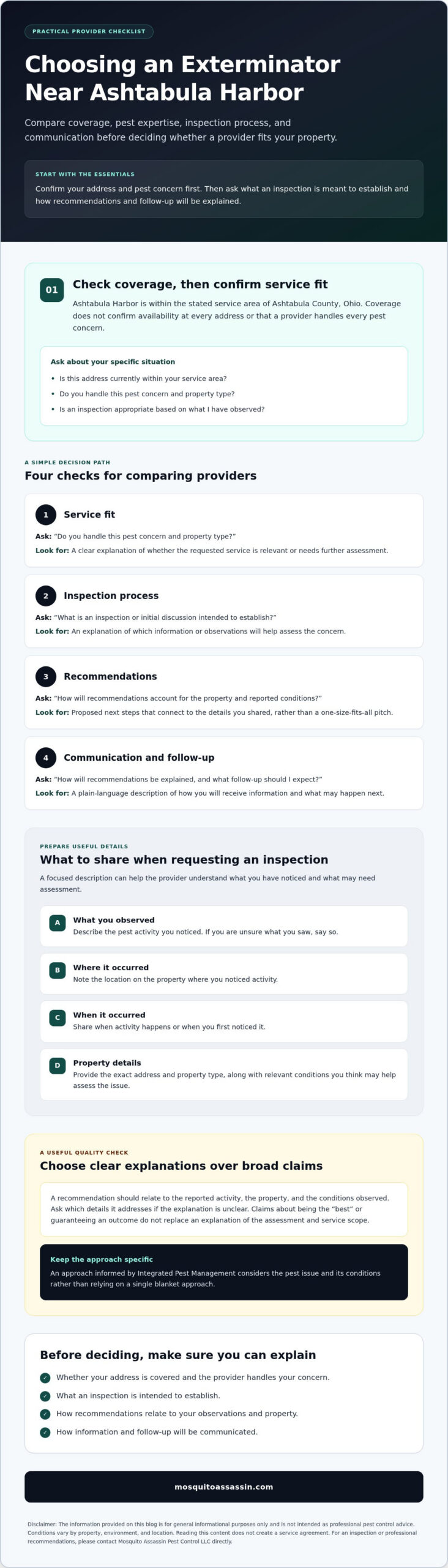
What to ask before scheduling an exterminator in Ashtabula County
A focused conversation can help you understand whether a service fits your concern and what to expect from an inspection or visit. Before contacting an exterminator near Ashtabula Harbor, jot down what you’ve noticed and prepare a few questions. You don’t need to identify or handle a pest to describe the issue clearly.
Information to share when describing the concern
Report what you observed, where it appeared, and when you first noticed it. For example, explain whether activity has been seen in one room or several areas, and whether it occurs at a particular time. Relevant property details, such as whether the concern is inside or outside, may also help the provider understand the situation. Share observations only; don’t collect or handle pests based on information in an article.
Questions about service expectations and follow-up
Ask direct questions before arranging a visit. Clear answers can help you understand the service scope and how recommendations will be made.
- Service scope: Does the provider handle this pest concern and property type, and what does the proposed service include?
- Inspection: What is an inspection or initial discussion intended to establish?
- Recommendations: How will findings and suggested next steps be explained?
- Service format: Is a one-time treatment or an ongoing plan being considered, and why might either suit the property?
- Follow-up: Whom should you contact with questions after the inspection or service, and what follow-up should you expect?
One-time and ongoing options can serve different needs. The appropriate fit depends on the pest concern, the property, and what an assessment indicates. Ask the provider to explain the reason for a recommendation in terms you understand. Be cautious of claims that promise a specific outcome without first considering the reported activity and property conditions.
Keep your notes handy during the conversation. If important details are uncertain, say so rather than guessing. The provider can explain what additional information is useful and whether an inspection is appropriate. Confirming the service scope, communication plan, and follow-up expectations helps set clear expectations without assuming every property needs the same approach.
For property-specific guidance, contact a pest professional with your observations and questions.
Choosing a local exterminator: practical next steps for Ashtabula Harbor
Choosing a pest professional comes down to three checks: confirm the provider serves your address, ask whether the service fits the pest concern, and clarify what to expect from the inspection and follow-up. A company’s general coverage doesn’t confirm that every address or service is currently available. Direct communication can resolve those details before you decide how to proceed.
Prepare a focused request for an inspection
Before contacting an exterminator near Ashtabula Harbor, have a few basic details ready. Share the property address, what you’ve observed, where activity appears, and when you first noticed it. These observations give the provider useful context without requiring you to identify or handle a pest.
Use the conversation to clarify the next steps. Ask whether the provider currently serves the address and handles the relevant service category. Then ask what an inspection is intended to establish and how recommendations will be explained. If you’re uncertain about what you saw, describe the signs rather than guessing at the pest’s identity. A pest professional can tell you whether more information or an inspection is needed.
How to make a considered provider decision
After gathering answers, compare how clearly each provider addresses your particular concern. Focus on whether the service scope makes sense for the reported activity and property, whether the inspection process is explained in understandable terms, and whether communication and follow-up expectations are clear. Dramatic claims don’t replace a reasoned explanation. Be cautious of guaranteed outcomes, especially when a provider hasn’t yet considered the property-specific details.
The right recommendation depends on the concern and conditions at the property, so a general article or service description can’t replace a direct assessment. If you’re ready to discuss your observations, you can request an inspection or professional recommendations. Confirm current address coverage and service availability during that conversation.
Disclaimer: The information provided on this blog is for general informational purposes only and is not intended as professional pest control advice. Conditions vary by property, environment, and location. Reading this content does not create a service agreement. For an inspection or professional recommendations, please contact Mosquito Assassin Pest Control LLC directly.
Make your next pest-control decision with confidence
Start with the basics: confirm that a provider serves your exact address, check that its services fit the pest concern, and ask how an inspection and follow-up will be handled. Clear, property-specific explanations are more useful than broad claims about results.
Mosquito Assassin Pest Control LLC lists Ashtabula County, Ohio, in its service area and provides general pest control alongside targeted services. One-time treatments and customized ongoing plans are available, but the appropriate fit depends on the concern and property. Confirm current availability and discuss your situation directly before deciding.
If you’re ready to share your observations and ask about next steps, request an inspection or professional recommendations. A clear conversation can help you understand your options.
Disclaimer: The information provided on this blog is for general informational purposes only and is not intended as professional pest control advice. Conditions vary by property, environment, and location. Reading this content does not create a service agreement. For an inspection or professional recommendations, please contact Mosquito Assassin Pest Control LLC directly.
Frequently Asked Questions
Is an exterminator near Ashtabula Harbor able to serve my address?
Possibly, but confirm coverage for your exact property before arranging service. Mosquito Assassin Pest Control LLC lists Ashtabula County, Ohio, within its service area, though availability may vary by address and service need. When contacting a provider, share the property address and describe the pest concern. This helps the provider check whether the location is covered and whether the relevant service may be a fit.
What pests can an exterminator near Ashtabula Harbor help with?
Available pest services vary by provider. Mosquito Assassin Pest Control LLC lists general pest control for concerns such as ants, spiders, wasps, and hornets, along with rodent control, bed bug treatment, and termite inspections and treatment. An exterminator near ashtabula harbor can confirm whether a specific concern is covered. Describe what you’ve observed rather than relying on a brief description to identify a pest or determine what service is appropriate.
How do I choose between general pest control and a targeted service?
Start by describing the pest concern and asking which service category may fit. General pest control covers several common pest categories, while providers may offer distinct services for rodents, bed bugs, or termites. The right fit depends on the property and reported conditions. Ask a pest professional to explain the options after hearing your observations. You don’t need to identify every pest yourself, and this guidance doesn’t determine a treatment.
What should I ask an exterminator before scheduling an inspection?
Ask whether your property is in the service area and whether the provider handles your pest concern. Find out what an inspection is intended to establish and how recommendations will be communicated. You can also ask what follow-up to expect and whom to contact with questions afterward. Clear answers help you understand the service process before scheduling, without relying on promises or assuming every property needs the same approach.
Can I choose a one-time pest treatment instead of an ongoing plan?
Some providers offer both one-time treatments and ongoing plans, but availability and suitability depend on the pest concern and property. Share what you’ve observed, then ask the professional to explain the differences between the options available for your situation. Neither approach is right for every household, and the choice shouldn’t be based on a general promise of results. Ask how the recommendation relates to the conditions at your property.
What information should I share when contacting a local exterminator?
Share the property address, the pest or signs you’ve observed, where activity appeared, and when you first noticed the concern. These details help the provider consider whether the location and service category may be a fit. Include relevant property information if it helps describe the situation. Don’t handle or collect a pest to identify it. A professional can explain whether an inspection or further discussion is appropriate.
What happens after I contact an exterminator near Ashtabula Harbor?
The provider can first ask about your property and pest concern, then confirm whether the address is within the service area. If the service may be relevant, ask what an inspection involves and how recommendations will be explained. The process can vary with the provider and property. A conversation doesn’t establish a specific appointment time, treatment, or result, so clarify the next steps directly before deciding how to proceed.
Disclaimer: The information provided on this blog is for general informational purposes only and is not intended as professional pest control advice. For an inspection or professional recommendations, please contact Mosquito Assassin Pest Control LLC.