Blog

  • Pet Safe Mosquito Control in Erie, PA: A Homeowner Guide

    Pet Safe Mosquito Control in Erie, PA: A Homeowner Guide

    What if the backyard you built for your dog’s safety is actually the place where they are most at risk? For many homeowners in Northwest Pennsylvania, the summer months bring a difficult choice between avoiding the outdoors or worrying about heartworm and West Nile virus. It’s natural to feel anxious about the trade-off between using pest treatments and protecting your animals from disease-carrying insects. This guide explains how professional pet safe mosquito control Erie PA residents utilize can effectively manage local infestations while prioritizing the security of your household.

    You deserve to feel confident that your pets can play outside without exposure to unnecessary risks. This article explores the latest data on mosquito-borne diseases in Erie and Crawford counties, the science behind professional application standards, and how a methodical approach can help you reclaim your property. By understanding the local pest landscape and the behavior of Northwest Pennsylvania mosquito species, you can ensure a mosquito-free environment that remains a sanctuary for every member of your family.

    Key Takeaways

    • Understand the specific mosquito-borne disease risks, such as heartworm and West Nile virus, that impact pets in the humid climate of Northwest Pennsylvania.
    • Learn how professional pet safe mosquito control Erie PA residents trust utilizes EPA-registered products and expert application methods to minimize exposure risks.
    • Discover why professional management is safer than DIY alternatives, which often carry risks of improper concentration or accidental exposure.
    • Follow a practical checklist to prepare your property and keep your animals secure before and during a scheduled treatment.
    • Explore how habitat modification and integrated pest management can reduce breeding grounds and the need for frequent chemical intervention.

    Understanding Mosquito and Disease Risks for Pets in Northwest Pennsylvania

    Living along the shores of Lake Erie offers beautiful summers, but the region’s unique environment also creates a perfect breeding ground for pests. For dog and cat owners, the sound of a buzzing mosquito isn’t just a minor annoyance. It represents a genuine health risk. In Northwest Pennsylvania, the threat of heartworm disease and West Nile virus is a reality that pet owners must face every season; West Nile remains the most common mosquito-borne disease in the United States. Utilizing professional pet safe mosquito control Erie PA homeowners rely on helps bridge the gap between indoor safety and outdoor enjoyment.

    The humidity from the lake and the frequent rainfall in Crawford and Ashtabula counties fuel the mosquito life cycle, allowing populations to explode within days of a summer storm. These insects thrive in the moist, shaded areas common in our local neighborhoods. To better understand how these pests can be managed around your property, watch this helpful video:

    Heartworm and Other Mosquito-Borne Risks

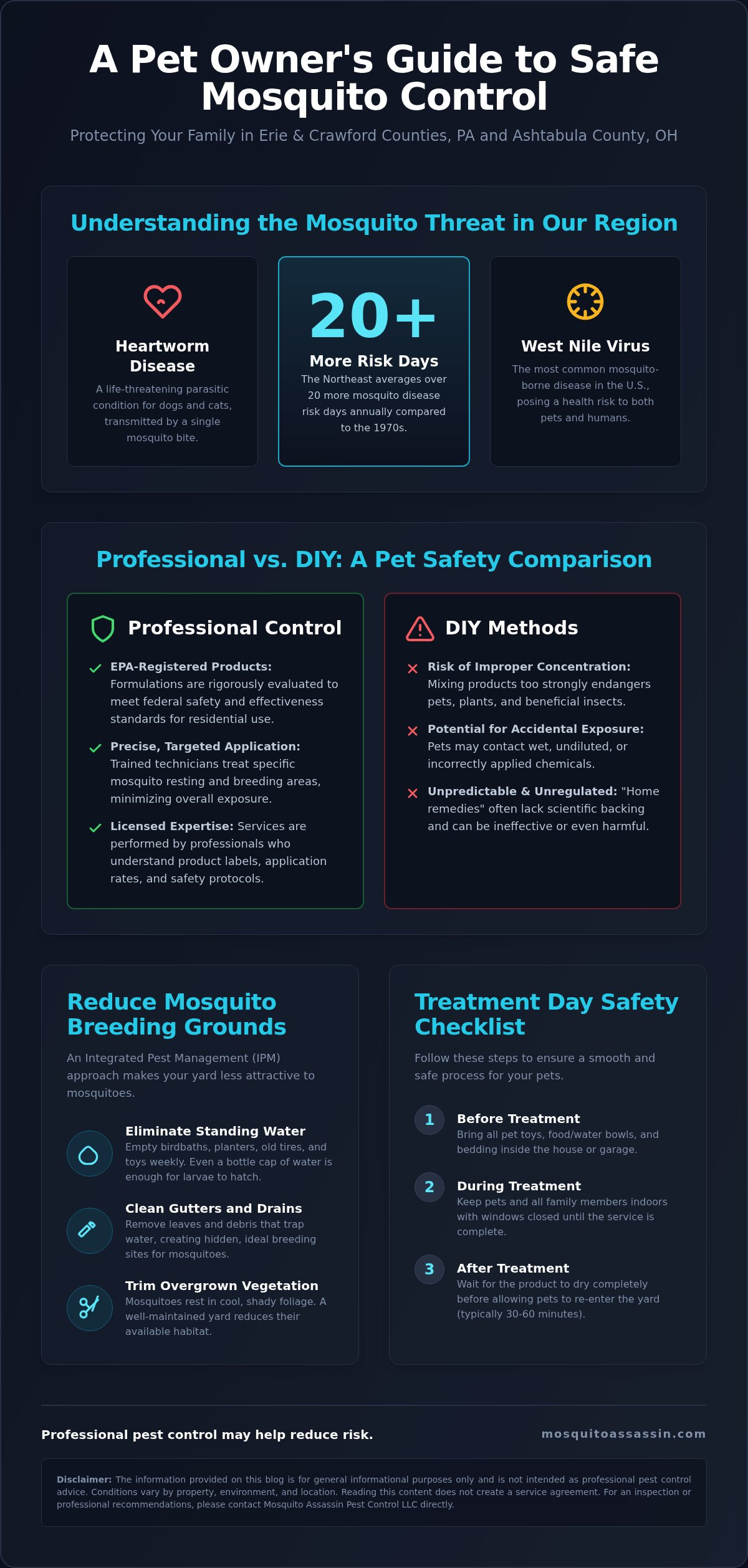
    Heartworm disease is a life-threatening condition caused by parasitic worms that live in the heart, lungs, and blood vessels of affected pets. Transmission occurs when an infected mosquito bites a dog or cat, injecting microscopic larvae into the bloodstream. While modern veterinary medicine offers effective preventatives, these treatments work best when combined with environmental management. You should always speak with a veterinarian about year-round heartworm prevention, especially as local weather patterns shift. Our region has seen an increase in “mosquito disease days” since the 1970s, with the Northeast experiencing an average of 20 more risk days annually. Investing in pet safe mosquito control Erie PA services ensures that your backyard remains a recovery zone rather than a risk zone.

    Local Environmental Factors in Erie and Ashtabula

    The tri-state geography of Pennsylvania and Ohio presents specific challenges for pest management. Wooded residential lots in Erie and the rural expanses of Crawford County often contain hidden pockets of standing water. Old tires, clogged gutters, or even a small depression in the lawn can host hundreds of larvae. Professional mosquito control services address these environmental factors by identifying breeding sites that are often overlooked by homeowners. By treating the areas where mosquitoes rest and breed, you create a safer perimeter for your animals. This proactive layer of defense is essential because even the most diligent pet owner can’t monitor their pet every second they’re in the yard. Protecting the property itself reduces the frequency of bites and the anxiety that comes with every trip outside.

    What Defines Pet Safe Mosquito Control?

    Safety in pest management is not a vague concept; it is a standard defined by federal regulations and professional accountability. When homeowners investigate pet safe mosquito control Erie PA residents often look for products that balance effectiveness with the well-being of their animals. True safety is achieved through a combination of science-backed formulations and disciplined application methods. It isn’t just about the liquid in the tank. It’s about how, when, and where that product is applied to your property.

    The Role of EPA-Registered Formulations

    The foundation of a secure treatment plan is the use of products registered by the Environmental Protection Agency (EPA). Registration means a product has undergone extensive evaluation to ensure it meets federal safety standards for residential use. These formulations are specifically designed to target pests like mosquitoes and ticks while breaking down quickly in the environment. Unlike unregulated or experimental “home remedies,” professional-grade products come with strict label instructions that dictate exactly how they must be handled around pets and families. This scientific oversight provides a level of predictability that DIY methods simply cannot match. For those interested in the broader principles of safety, the National Pesticide Information Center offers extensive data on integrated pest management for mosquitoes and how these strategies protect public health.

    Professional Application Protocols

    The person behind the equipment is just as important as the product itself. In Pennsylvania and Ohio, licensed technicians receive specialized training to identify mosquito harborage areas, such as the underside of leaves and dense brush, while avoiding sensitive zones. A professional approach ensures that treatments stay away from pet food bowls, water dishes, and flowering plants where pollinators congregate. One of the most critical safety standards is the dry time rule. According to guidelines from the Pennsylvania Department of Environmental Protection, pets should be kept indoors during the application and remain inside for at least 30 minutes until the product has completely dried. Once dry, the treatment binds to the foliage, significantly reducing the risk of accidental transfer to your pet’s fur or paws.

    By following these methodical steps, experts can create a barrier that manages pest populations without compromising the backyard sanctuary your pets enjoy. Understanding these professional standards is the first step toward a worry-free summer. If you are ready to secure your property, exploring mosquito control services can provide the professional oversight necessary for a safe and effective result. This disciplined strategy ensures that pet safe mosquito control Erie PA homeowners expect remains the top priority throughout the season.

    Professional Treatments vs. DIY Mosquito Control for Pet Owners

    Choosing between a store-bought spray and a professional service involves more than just comparing price tags. It’s a decisive choice about the precision of the application and the safety of the environment your pets inhabit. Many off-the-shelf products are designed as broad-spectrum solutions, which can lead to unnecessary chemical exposure for non-target species like bees and butterflies. Professional pest control focuses on the specific biology of the mosquito, ensuring that the treatment hits the pest where it lives without saturating the entire yard in a high-concentration mist. This methodical approach targets the underside of leaves and dense brush where pests hide, rather than just treating the surface of the lawn.

    The Dangers of Misapplication

    One of the most frequent errors in DIY pest management is the “more is better” mentality. Homeowners often increase the concentration of store-bought concentrates, thinking it will provide better results. This practice significantly increases the risk of chemical runoff into pet water dishes, outdoor toys, or even the puddles where dogs might drink. A licensed technician understands the exact dosage required to be effective while maintaining high standards for mosquito spraying safety for pets. Professional application also avoids the common DIY mistake of spraying in windy conditions, which can carry the product into areas where pets sleep or play. By using specialized equipment, experts can achieve a precise droplet size that adheres to foliage, minimizing the chance of accidental transfer to a pet’s fur.

    Long-Term Efficacy and Safety

    Consistency is the key to a mosquito-free season in Northwest Pennsylvania. Reactive DIY spraying only addresses the adults present at that exact moment, often leading to a cycle of repeated treatments that keeps your pets indoors more than necessary. In contrast, implementing the pet safe mosquito control Erie PA homeowners prefer involves a proactive, bi-monthly protection plan. This schedule targets the population before it peaks, reducing the total amount of product needed over the course of the summer. Having a local expert monitor your property allows for adjustments based on recent rainfall or temperature spikes, providing a level of oversight that a one-size-fits-all bottle from a big-box store cannot provide. This systematic strategy ensures that pet safe mosquito control Erie PA residents expect is delivered with scientific accuracy. For those looking to protect their property from a wider range of invaders, you can Learn more about general pest control for homeowners to see how a holistic strategy keeps your yard secure year-round.
    Pet Safe Mosquito Control in Erie, PA: A Homeowner Guide

    A Pet Owner Checklist for Mosquito Treatment Days

    A successful treatment is a collaborative effort between the homeowner and the technician. While professional products are designed for safety, following a disciplined routine on service days maximizes the protection of your animals. Preparation begins before the technician even arrives at your property in Erie, Crawford, or Ashtabula county. By taking a few practical steps, you ensure that the application is precise and that your pets remain undisturbed throughout the process. This partnership is what makes pet safe mosquito control Erie PA services so effective for local families.

    Pre-Treatment Preparation

    Start by clearing the yard of any items your pet interacts with regularly. This includes food and water bowls, chew toys, and outdoor bedding. Moving these items inside or into a sealed garage prevents any accidental contact with the treatment mist. You should also ensure that all gates are unlocked and accessible so the technician can reach every harborage area without delay. Most importantly, all pets must be securely indoors before the service begins. Even the most friendly dog can become startled by equipment or try to slip through an open gate during the application. If you have concerns about other family members, you can read about whether professional pest control is safe for pets and kids to understand the broader safety protocols in place.

    Post-Treatment Best Practices

    The most critical rule for pet safety is allowing the product to dry completely. Under standard weather conditions in Northwest Pennsylvania, this typically takes between 30 and 60 minutes. A dry surface is the primary indicator that it’s safe for your pet to return to the yard. Once the liquid has dried on the foliage, it binds to the plant material and is significantly less likely to be transferred to a pet’s paws or fur. Before releasing your dog, do a quick walk-through of the property. Check shaded or heavily wooded areas, as these spots may take slightly longer to dry than sections of the lawn in direct sunlight.

    Maintaining a pet-friendly property also involves reducing the factors that attract mosquitoes between professional visits. Regularly emptying birdbaths, cleaning gutters, and removing piles of damp leaves helps disrupt the breeding cycle. This holistic approach, combined with the pet safe mosquito control Erie PA families rely on, creates a lasting defense against pests. If you’re ready to establish a routine for your home, viewing available mosquito control services can help you plan your next service day with confidence. Professional oversight ensures that every application follows strict safety guidelines, giving you peace of mind while your pets enjoy the outdoors.

    Integrated Pest Management for a Pet-Friendly Property

    Integrated Pest Management (IPM) is the gold standard for maintaining a healthy, pet-friendly yard. It moves beyond simple reactive spraying to create a comprehensive strategy that targets pests at every stage of their life cycle. For homeowners seeking pet safe mosquito control Erie PA residents often find that reducing the environmental factors that attract insects is the most effective long-term solution. By combining habitat modification with precise, professional treatments, you can achieve a significant reduction in pest populations while minimizing the amount of product applied to your property. You can Explore our mosquito control program to understand how these strategies work together to protect your outdoor space.

    Managing Standing Water and Harborage

    Mosquitoes only need a small amount of water to breed. In the humid climate of Northwest Pennsylvania, identifying these hidden nurseries is a critical part of a professional inspection. Common culprits include clogged gutters, low spots in the lawn that collect lake-effect rain, and even the saucers under outdoor flowerpots. Keeping the lawn manicured and removing dense leaf litter also serves a dual purpose; it eliminates the damp environments where both mosquitoes and ticks thrive. A professional eye can spot these risks during a routine visit, offering practical advice on how to make your yard less hospitable to invaders. This proactive approach ensures that pet safe mosquito control Erie PA homeowners expect remains a sustainable, year-round priority.

    Choosing a Local Partner for Pest Management

    The geography of the tri-state area creates specific pest pressures that vary from the lakefront to the inland wooded areas of Crawford County. Choosing a local partner who lives and works in these same communities ensures that your technician understands these regional nuances. Ongoing maintenance plans provide a steady cadence of protection, preventing population surges before they become unmanageable. This consistency is particularly valuable for pet owners who want the freedom to use their backyard at any time without worrying about heartworm or other disease vectors. A structured, bi-monthly schedule allows for constant monitoring of your property’s changing needs as the seasons transition from the wet spring into the peak summer heat. Professional pest control may help reduce risk on your property by providing the expert oversight necessary for a truly secure environment.

    Disclaimer: The information provided on this blog is for general informational purposes only and is not intended as professional pest control advice. Conditions vary by property, environment, and location. Reading this content does not create a service agreement. For an inspection or professional recommendations, please contact Mosquito Assassin Pest Control LLC directly.

    Securing Your Backyard Sanctuary

    Protecting your pets from mosquito-borne risks like heartworm requires a methodical strategy that extends beyond veterinary preventatives. By combining habitat modification with professional application standards, you can effectively manage pest populations while maintaining the safety of your household. Utilizing the pet safe mosquito control Erie PA homeowners trust ensures that treatments are applied with scientific precision by licensed technicians in PA and OH. A family-owned and locally operated approach provides the neighborly oversight necessary to address the unique environmental challenges of Northwest Pennsylvania.

    Comprehensive bi-monthly protection plans offer a consistent layer of defense; this allows you to focus on enjoying the summer months rather than worrying about disease vectors. Taking proactive steps today creates a safer environment for every member of your family to play and relax outside. For an inspection or professional recommendations, contact Mosquito Assassin Pest Control LLC. Reclaiming your yard is a practical way to ensure your pets remain healthy and active throughout the peak mosquito season.

    Disclaimer: The information provided on this blog is for general informational purposes only and is not intended as professional pest control advice. Conditions vary by property, environment, and location. Reading this content does not create a service agreement. For an inspection or professional recommendations, please contact Mosquito Assassin Pest Control LLC directly.

    Frequently Asked Questions

    How long should I keep my dog inside after the yard is sprayed for mosquitoes?

    You should keep your dog inside for 30 to 60 minutes until the product is completely dry. This timeframe is standard for the humid climate of Erie and Crawford counties. Once the treatment has dried on the vegetation, it’s no longer easily transferable to your pet’s paws or fur.

    Is the mosquito spray used in Erie homes toxic to cats?

    Professional treatments utilize EPA-registered products that are evaluated for residential safety when used according to label instructions. While cats can be sensitive to certain substances, the risk is significantly minimized when the application is performed by a licensed professional who avoids areas where pets frequent. Choosing pet safe mosquito control Erie PA residents trust ensures that labels are followed with scientific accuracy.

    What happens if my pet eats grass that was recently treated for mosquitoes?

    Professional mosquito treatments are formulated to bind to the surfaces of leaves and grass once they dry. If a pet consumes a small amount of treated grass after the drying period, it typically doesn’t lead to significant health issues. However, you should always monitor your pet for any unusual behavior and contact your veterinarian if you have specific concerns about ingestion.

    Can professional mosquito control help prevent heartworm in my pets?

    Reducing the population of mosquitoes on your property directly lowers the number of potential heartworm vectors. While environmental control is a powerful layer of defense, it should always be used in conjunction with year-round heartworm medication prescribed by a veterinarian. This multi-level approach provides the most comprehensive protection for animals in Northwest Pennsylvania.

    Are there natural or organic mosquito control options available in Erie, PA?

    Natural options utilizing botanical oils, such as cedar or peppermint, are available for homeowners in the tri-state area. These alternatives can be effective at repelling pests but often require a more frequent application schedule than traditional synthetic treatments. Professional pet safe mosquito control Erie PA services can help you determine which approach fits your property’s specific pest pressure and environmental needs.

    Do I need to cover my fish pond or bird cages during a mosquito treatment?

    You should cover fish ponds and move bird cages indoors during any outdoor pest treatment. Fish and aquatic life are particularly sensitive to many common pest control products. Licensed technicians are trained to identify these features on your property and will maintain a safe distance during the application to prevent any accidental drift into the water.

    How often should a pet-friendly yard be treated for mosquitoes and ticks?

    A bi-monthly schedule is typically recommended to maintain a consistent barrier throughout the active season. In Pennsylvania and Ohio, this usually means treatments every 21 to 30 days starting in late spring and continuing through the first hard frost. This frequency ensures that the product remains effective despite the frequent rainfall common in Erie and Ashtabula counties.

    What should I do if my pet accidentally enters the yard before the spray is dry?

    If your pet enters the yard before the treatment is dry, you should immediately wash their paws and any contacted fur with mild soap and water. This simple step removes any wet product before the pet has a chance to lick it off. Monitor your animal for any signs of skin irritation or digestive upset and consult a medical professional if symptoms appear.
  • Carpenter Bee Damage in Crawford County: Identification and Prevention Guide

    Carpenter Bee Damage in Crawford County: Identification and Prevention Guide

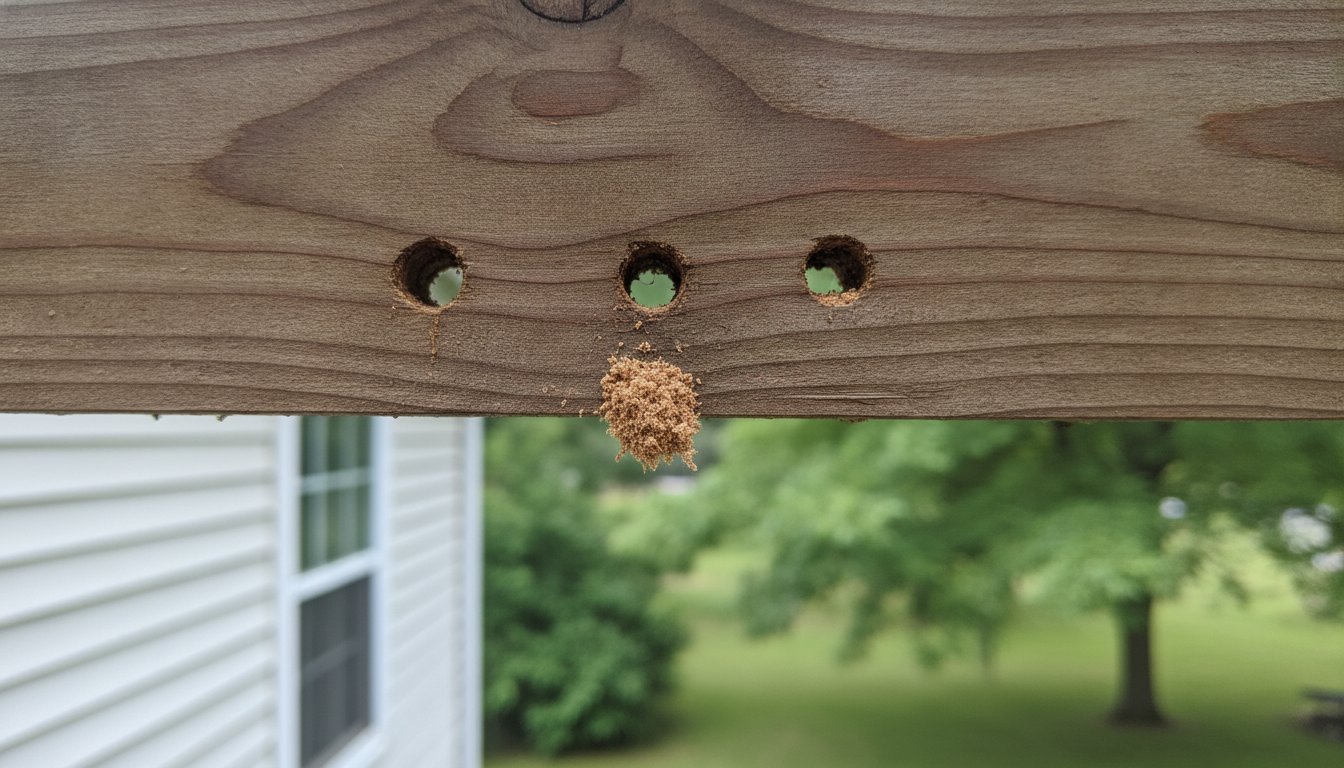
    Those perfectly round, half-inch holes appearing in your porch or fascia boards are more than just a minor eyesore. Left unchecked, carpenter bee damage in Crawford County can lead to moisture rot, structural weakening, and even secondary damage from woodpeckers searching for larvae. It’s frustrating to watch expensive wooden siding or cedar trim get riddled with tunnels while large bees hover aggressively near your entryways, but understanding the behavior of these pests is the first step toward reclaiming your home.

    It is completely normal to feel a sense of urgency when you see sawdust piles on your deck or yellow staining on your siding. This guide outlines how to accurately identify these wood-boring insects, why their hidden galleries pose a long-term threat to your property, and how to effectively manage the situation. You will find practical information on prevention strategies and how to secure professional assistance to maintain the safety and value of your wooden structures in Pennsylvania. By addressing the problem now, you can avoid costly repairs and ensure your property remains sound for years to come.

    Disclaimer: The information provided on this blog is for general informational purposes only and is not intended as professional pest control advice. Conditions vary by property, environment, and location. Reading this content does not create a service agreement. For an inspection or professional recommendations, please contact Mosquito Assassin Pest Control LLC directly.

    Key Takeaways

    • Learn how to distinguish carpenter bees from bumble bees by their hairless abdomens and recognize the specific timing of their spring emergence.
    • Identify the early warning signs of carpenter bee damage in Crawford County, such as perfectly round entry holes and piles of sawdust-like frass.
    • Understand how cumulative tunneling over several seasons can compromise structural beams and create entry points for wood rot.
    • Discover which wood types are most vulnerable and how specific finishes like polyurethane can help deter these insects from drilling.
    • Learn why professional-grade management provides more effective, long-term protection for your property than standard DIY methods.

    Understanding Carpenter Bee Behavior in Crawford County

    Understanding the habits of wood boring insects is the first step in protecting your property. In Crawford County, these bees are often mistaken for their more beneficial cousins, the bumble bee. However, their behavior is far more destructive to your home’s structural integrity. While they are technically solitary nesters, they are gregarious by nature. This means multiple females often choose to nest in the same piece of wood, leading to concentrated carpenter bee damage Crawford County homeowners find difficult to manage alone.

    One common misconception is that these bees consume wood for nutrition. They actually feed on nectar and pollen; the wood is simply a medium for their nesting galleries. They use their powerful mandibles to vibrate against the wood, creating perfectly circular entry points. These tunnels serve as nurseries for their larvae and shelter for adults. Because they don’t eat the material, you will often find piles of fresh sawdust on the ground beneath their holes.

    Carpenter Bees vs. Bumble Bees

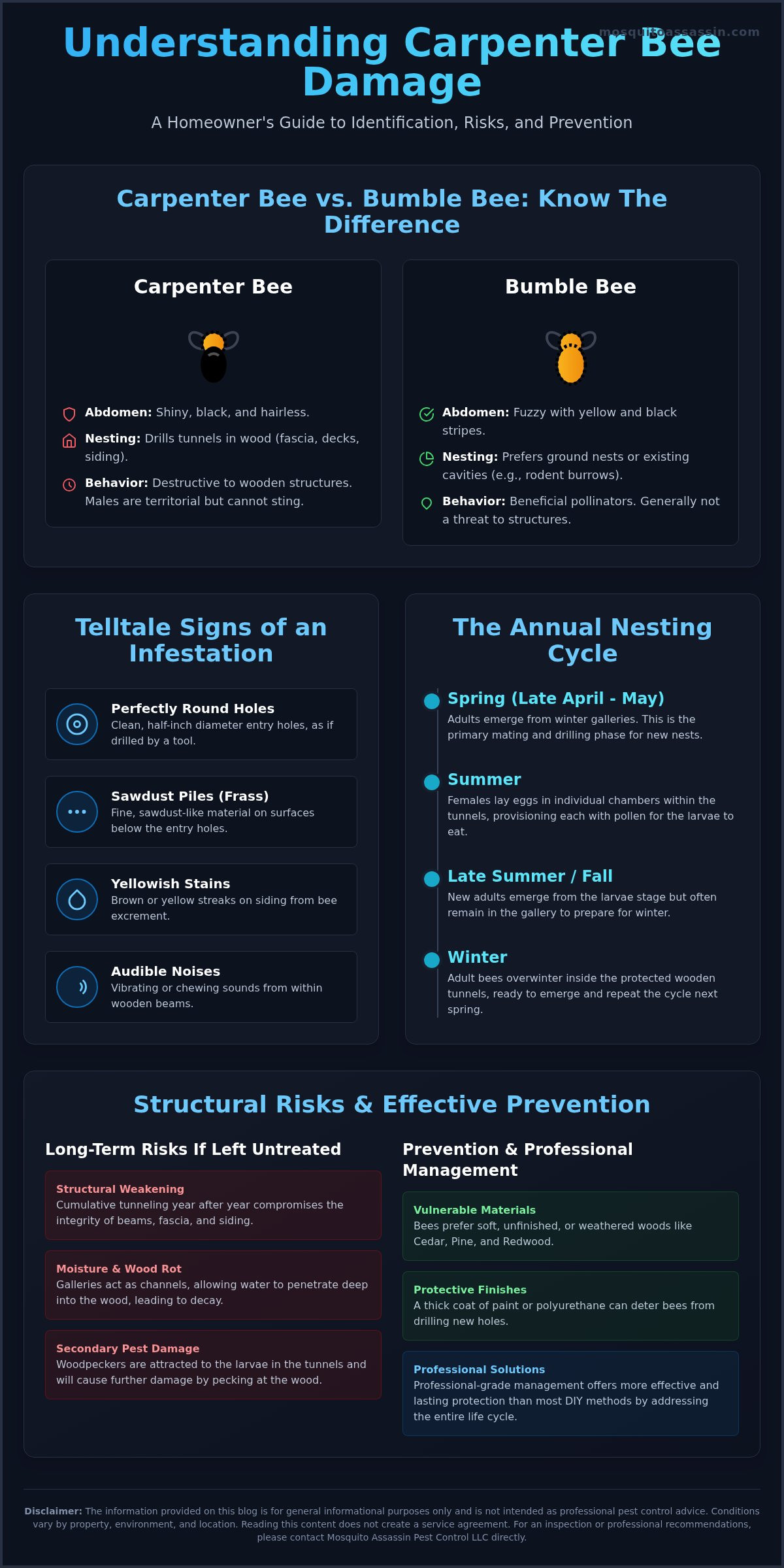
    Telling these two insects apart is vital for proper property management. The most obvious visual cue is the abdomen. A bumble bee has a fuzzy, hairy yellow and black abdomen. In contrast, the carpenter bee features a shiny, metallic black abdomen that lacks hair. Carpenter bee behavior also differs significantly when it comes to nesting sites. Bumble bees typically build nests in the ground or in existing cavities like abandoned rodent burrows. Carpenter bees are much more aggressive toward wooden structures, preferring softwoods like cedar, pine, and redwood commonly found on Pennsylvania decks and siding.

    The Nesting Cycle in Pennsylvania

    In local areas like Meadville and Titusville, the activity typically begins as the weather warms in late April or May. This is the primary mating and drilling phase. Male bees often hover near entry holes to protect the nesting females. While they look intimidating, the males lack a stinger; it’s the damage to the wood that presents the real threat. They are simply trying to deter perceived threats from the nesting site.

    Adults overwinter inside the existing galleries to survive the harsh Pennsylvania winters. When spring arrives, they emerge to either expand old tunnels or drill new ones. This cumulative activity is why carpenter bee damage Crawford County properties face often worsens year after year. If these galleries are not professionally managed, they become a permanent invitation for moisture and decay. Professional pest control may help reduce risk by addressing these cycles before they lead to structural failure.

    Disclaimer: The information provided on this blog is for general informational purposes only and is not intended as professional pest control advice. Conditions vary by property, environment, and location. Reading this content does not create a service agreement. For an inspection or professional recommendations, please contact Mosquito Assassin Pest Control LLC directly.

    Recognizing the Telltale Signs of Damage

    Identifying carpenter bee damage Crawford County homeowners might encounter starts with spotting a perfectly round hole. These entry points are approximately one-half inch in diameter, looking exactly like they were created by a professional drill bit. While the entrance itself appears clean and intentional, it is merely the gateway to a complex system of tunnels that can compromise the wood over time.

    Aside from the holes, look for “frass” on the ground or surfaces below the drilling site. This is a fine, sawdust-like material the bees kick out while excavating. Because these insects don’t consume the wood for food, the presence of fresh sawdust is a definitive sign of active construction. You should also watch for yellowish or brownish streaks on the siding or trim. This staining is bee excrement, often found directly below the entry point, and it can be difficult to remove once it bakes in the sun. If the area is quiet, you might even hear a distinct vibrating or “chewing” sound coming from inside the wooden beams as the female expands her nest.

    Common Entry Points on Residential Properties

    Nesting females are selective, but they often target the same vulnerable areas on local homes. Examine your fascia boards, soffits, and the undersides of decks first. These spots provide the overhead protection the bees prefer. Unpainted or weathered wood is particularly attractive, but carpenter bee damage Crawford County properties experience can occur even on finished wood if the seal is thin or failing. Don’t forget to inspect wooden patio furniture and fence posts, as these are often overlooked until the damage is significant.

    Internal Tunneling: What You Cannot See

    The external hole is just the beginning of the problem. Once the bee penetrates about an inch into the wood, she turns at a 90-degree angle to follow the grain. These perpendicular galleries are typically several inches long, but they can reach several feet in length over multiple seasons if the same site is reused. Each tunnel is partitioned into individual cells where the female places pollen and lays an egg. Because these galleries are hidden from view, the structural risks from carpenter bees are often underestimated until the wood begins to splinter or sag. Regular monitoring and a professional inspection can help catch these hidden issues before they require major structural repairs.

    Disclaimer: The information provided on this blog is for general informational purposes only and is not intended as professional pest control advice. Conditions vary by property, environment, and location. Reading this content does not create a service agreement. For an inspection or professional recommendations, please contact Mosquito Assassin Pest Control LLC directly.

    Structural Risks and Secondary Pest Complications

    The danger of carpenter bee damage Crawford County residents face isn’t just about the initial half-inch hole. While a single gallery might seem insignificant, the cumulative impact over several years can be devastating. These insects are creatures of habit. They often return to the same boards year after year, expanding existing tunnels and creating new branches. Over time, this internal excavation hollows out the core of load-bearing beams, rafters, and deck supports, significantly reducing their weight-bearing capacity. Ignoring these early signs often leads to an economic impact far greater than the cost of professional intervention.

    The Woodpecker Connection

    In Crawford County, the most immediate and visually destructive secondary complication is the arrival of woodpeckers. These birds possess an acute sense of hearing and can detect the vibration of bee larvae developing deep inside the wood. To reach this high-protein food source, woodpeckers will relentlessly hammer and shred the surface of your home. They don’t care about the aesthetics of your cedar siding or trim. A single woodpecker can turn a small bee hole into a jagged, several-inch-wide trench in a matter of hours. This secondary damage is often much more expensive to repair than the original bee tunnels themselves.

    Moisture Intrusion and Fungal Decay

    Beyond the threat of birds, abandoned nesting galleries serve as perfect conduits for moisture. Pennsylvania weather patterns bring significant rainfall, and these pre-drilled holes allow water to bypass the wood’s natural protective surface. Once water penetrates the internal grain, it creates an ideal environment for fungal growth and wood rot. This internal decay often goes unnoticed because it happens behind the surface, hidden from view until the wood becomes soft or structurally fails.

    The presence of these galleries also attracts other opportunistic pests including:

    • Carpenter Ants: These pests may expand existing tunnels to establish their own colonies.
    • Spiders: Many species use the holes as protected nesting sites or hunting grounds.
    • Wood-Rot Fungi: Spores thrive in the damp, dark environment provided by the galleries.

    Maintaining a comprehensive general pest control plan is a proactive way to ensure your property remains protected from various threats. By addressing the initial carpenter bee damage Crawford County homes sustain, you effectively close the door on a host of secondary issues that could compromise your property’s value and safety.

    Disclaimer: The information provided on this blog is for general informational purposes only and is not intended as professional pest control advice. Conditions vary by property, environment, and location. Reading this content does not create a service agreement. For an inspection or professional recommendations, please contact Mosquito Assassin Pest Control LLC directly.

    Carpenter Bee Damage in Crawford County: Identification and Prevention Guide

    Effective Prevention for Wooden Structures

    Preventing carpenter bee damage Crawford County properties face requires a proactive approach before the spring emergence. While these bees are persistent, they prefer the path of least resistance. Applying a high-quality polyurethane or oil-based paint is one of the most effective ways to deter nesting females. These finishes create a hard, slick surface that makes it difficult for the bees to gain the traction needed to start drilling. In contrast, bare or weathered wood is an open invitation for an infestation.

    Homeowners in Pennsylvania frequently use softwoods like cedar, pine, and redwood for decks and siding. While these materials are aesthetically pleasing, they are highly vulnerable to wood-boring insects. If you are planning a new construction project, using pressure-treated lumber can reduce nesting potential, though it does not provide a total guarantee against activity. For existing structures, maintaining the integrity of the wood’s finish is your best line of defense.

    Maintenance for Decks and Siding

    Maintaining your home’s exterior is a year-round responsibility. Conduct a thorough inspection of all wooden surfaces every spring as temperatures begin to rise. Focus on high-traffic areas such as fascia boards, soffits, and the undersides of deck joists where wood is often left untreated. Keeping these surfaces well-painted or stained significantly reduces their attractiveness to nesting females. If you notice the finish is peeling or thinning, it is time to reapply the protective layer before the bees arrive.

    Exclusion Techniques

    Sealing entry holes is a critical step, but timing is everything. The best time for exclusion is in the fall after the bees have finished their active season. If you seal a hole while a bee is still inside, she will simply drill a new exit, creating even more carpenter bee damage Crawford County structures must endure. This often results in jagged, irregular holes that are much harder to patch.

    Before applying caulk or wood putty, pack the abandoned hole with a small piece of stainless steel wool or a fitted wooden dowel. This physical barrier prevents the bee from easily clearing the tunnel in the future. For larger infestations, using “carpenter bee traps” can serve as a helpful supplemental monitoring tool to gauge activity levels, although they should not be the sole method of protection. For comprehensive property security, a professional pest control plan can provide the residual protection needed to keep your wood intact throughout the year.

    Disclaimer: The information provided on this blog is for general informational purposes only and is not intended as professional pest control advice. Conditions vary by property, environment, and location. Reading this content does not create a service agreement. For an inspection or professional recommendations, please contact Mosquito Assassin Pest Control LLC directly.

    Professional Management and Property Protection

    Managing the cumulative effects of carpenter bee damage Crawford County homes experience requires specialized knowledge and professional equipment. While a homeowner might be able to reach a few holes on a deck railing, the most significant damage often occurs high up on fascia boards and rooflines. Professional pest control may help reduce risk by utilizing specialized ladders and high-reach equipment to treat these vulnerable areas safely. Attempting to balance on a ladder while dealing with hovering insects is a significant safety hazard that property owners should avoid.

    Professional management also utilizes materials designed for long-term efficacy. Retail products often break down quickly when exposed to Pennsylvania’s UV rays and frequent rain, requiring constant reapplication to remain effective. In contrast, professional-grade materials offer a longer residual effect, ensuring that the wood remains unattractive to nesting females throughout the entire season. Implementing a comprehensive year-round protection plan is the most effective way to prevent recurring infestations and catch new activity before it leads to structural compromise.

    Why DIY Often Fails

    Retail solutions often fail because they only address the surface of the problem. Standard aerosol sprays lack the pressure and reach needed to penetrate the deep, winding galleries created by these bees. If a treatment doesn’t reach the back of the tunnel where the larvae are developing, the cycle will simply continue the following year. There is also a high risk of misidentifying the pest or applying materials in a way that is ineffective against the specific nesting habits of wood-boring insects. Professional technicians are trained to identify the exact species and apply the correct amount of material to ensure the gallery is managed thoroughly.

    The Value of Local Expertise

    Local professionals understand the specific environmental pressures unique to Crawford County. They are familiar with the regional weather patterns that trigger emergence and the specific types of wood commonly used in local home construction. Seeking a professional inspection allows for an accurate assessment of your property’s vulnerability. For those facing an active infestation, utilizing professional pest control services ensures that the treatment is thorough and scientifically sound. This neighborly expertise provides property owners with the peace of mind that their home’s structural integrity is being protected by someone who understands the local landscape.

    Disclaimer: The information provided on this blog is for general informational purposes only and is not intended as professional pest control advice. Conditions vary by property, environment, and location. Reading this content does not create a service agreement. For an inspection or professional recommendations, please contact Mosquito Assassin Pest Control LLC directly.

    Securing Your Crawford County Property

    Protecting your wooden structures requires more than a one-time fix. Identifying the early signs of activity, such as perfectly round entry holes and sawdust frass, is the first step toward preventing long-term structural failure. Because these pests return annually to expand their galleries, the threat of carpenter bee damage Crawford County homeowners face is cumulative. Addressing these issues early prevents secondary complications like woodpecker destruction and moisture rot from taking hold of your home’s exterior.

    Professional pest control may help reduce risk by providing the specialized exclusion and management techniques needed for high-reach areas. As a local neighbor licensed in Pennsylvania and Ohio, Mosquito Assassin Pest Control LLC is specialized in Crawford County regional pests and professional-grade exclusion. For an inspection or professional recommendations, please contact Mosquito Assassin Pest Control LLC directly. Taking decisive action now ensures your property remains safe and structurally sound for seasons to come.

    Disclaimer: The information provided on this blog is for general informational purposes only and is not intended as professional pest control advice. Conditions vary by property, environment, and location. Reading this content does not create a service agreement. For an inspection or professional recommendations, please contact Mosquito Assassin Pest Control LLC directly.

    Frequently Asked Questions

    Do carpenter bees actually sting?

    Female carpenter bees possess a stinger but are generally docile and only sting if handled or directly threatened. Male carpenter bees, which are frequently the ones seen hovering around entryways, don’t have a stinger and cannot cause physical harm. While the males may act aggressively to protect a nesting site, their behavior is purely a defensive display designed to intimidate perceived threats.

    How much damage can a single carpenter bee cause?

    A single female can drill a gallery several inches long in one season. While one hole might seem minor, the real issue is the cumulative nature of the tunneling. If left unaddressed, carpenter bee damage Crawford County residents observe can expand as multiple generations reuse and lengthen the same internal tunnels, eventually hollowing out the core of the structural wood.

    Why are carpenter bees hovering around my face?

    Male bees are highly territorial and will hover near humans or other animals to investigate potential threats to the nesting site. Since they lack a stinger, this hovering behavior is their only method of intimidation. They are simply trying to frighten you away from the area where the females are currently excavating galleries and laying eggs for the next generation.

    What is the best time of year to treat for carpenter bees in Crawford County?

    Treatment is most effective in early spring, typically late April or May, when adults emerge to mate and begin new galleries. A secondary treatment phase in the fall is also recommended to address bees preparing to overwinter inside existing tunnels. Professional pest control may help reduce risk by applying residual materials during these peak activity windows to prevent new drilling on your property.

    Can carpenter bees cause a deck to collapse?

    It is rare for a single season of activity to cause a total collapse, but years of unmanaged tunneling can significantly weaken structural supports. As the internal galleries grow, the wood’s load-bearing capacity decreases. This risk is compounded by moisture intrusion and secondary pests like carpenter ants or wood rot that move into abandoned bee tunnels over time.

    Do carpenter bee traps actually work?

    Traps can be effective as a supplemental monitoring tool to catch active adults, but they don’t address the larvae developing inside the wood. Relying solely on traps often allows the underlying infestation to persist beneath the surface. For a comprehensive solution, professional-grade management is necessary to treat the galleries and provide the long-term residual protection required to secure the structure.

    Will painting my house stop carpenter bees?

    Painting or staining wood surfaces is a strong deterrent because these bees prefer bare, weathered wood for their nests. A thick coat of polyurethane or oil-based paint makes it difficult for them to gain the necessary traction to begin drilling. However, even painted surfaces can be attacked if the finish is thin or if there are exposed edges on the undersides of boards.

    What should I do if I see woodpeckers pecking at my siding?

    Woodpecker activity is a definitive sign that bee larvae are developing inside your wood. You must address the underlying carpenter bee damage Crawford County properties face before repairing the bird damage. If you fix the wood without managing the bees, the woodpeckers will likely return to hunt the next generation of larvae, leading to recurring and expensive repair costs.

    Disclaimer: The information provided on this blog is for general informational purposes only and is not intended as professional pest control advice. Conditions vary by property, environment, and location. Reading this content does not create a service agreement. For an inspection or professional recommendations, please contact Mosquito Assassin Pest Control LLC directly.

  • Mosquito and Tick Prevention in Ashtabula, OH: A Complete 2026 Guide

    Mosquito and Tick Prevention in Ashtabula, OH: A Complete 2026 Guide

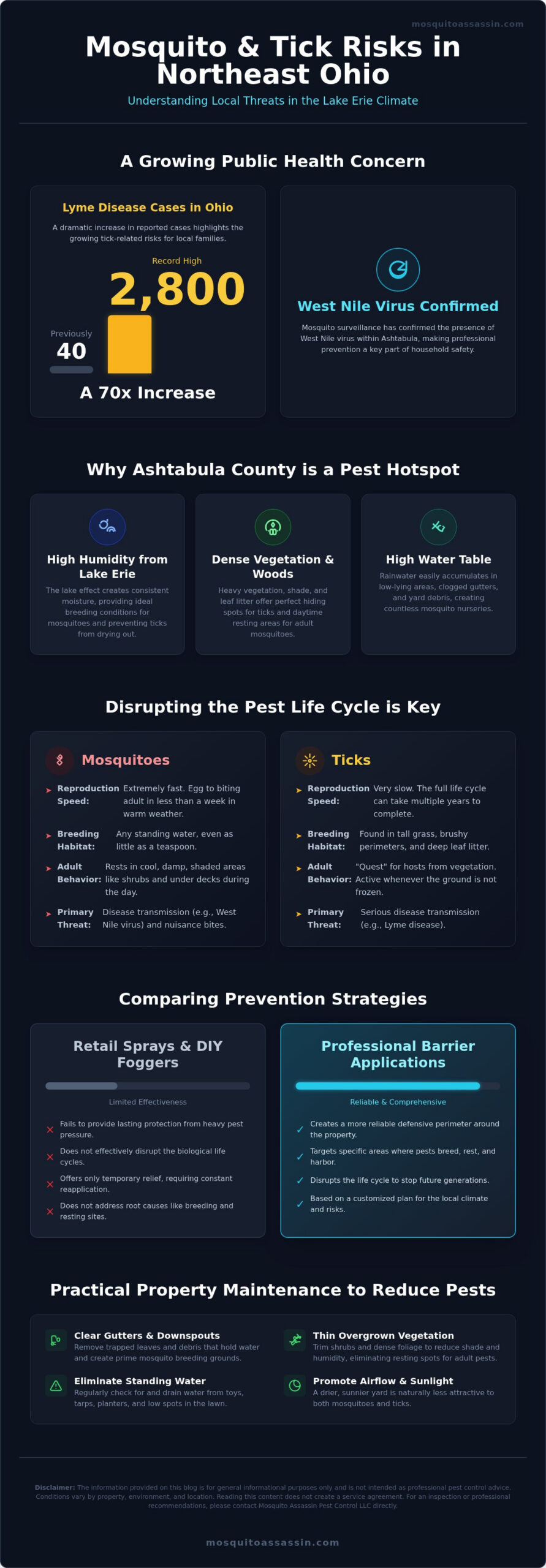
    Lyme disease cases in Ohio reached a record 2,800 in 2025, marking a significant increase from just 40 cases reported in 2010. This rising trend makes consistent mosquito and tick prevention Ashtabula OH a vital part of property maintenance for local families. Many residents find that standard retail sprays and DIY foggers fail to provide lasting protection against the heavy pest pressure found near the humid shores of Lake Erie.

    It’s easy to agree that the frustration of retreating indoors during a summer evening or the anxiety of finding a tick on a pet can ruin the outdoor experience. This guide promises to help you reclaim your yard by detailing local environmental risks, including the confirmed presence of West Nile virus in Ashtabula, and the professional prevention strategies used to disrupt pest life cycles. Readers will gain a clear understanding of regional health data, common habitat traps, and the methodical steps necessary to maintain a more comfortable environment throughout the 2026 season.

    Key Takeaways

    • Understand how the high humidity near Lake Erie creates unique breeding environments for mosquitoes and ticks in Ashtabula County.
    • Learn why disrupting the biological life cycles of local pests requires a consistent management approach throughout the year.
    • Discover why professional barrier applications provide a more reliable perimeter for mosquito and tick prevention Ashtabula OH compared to retail products.
    • Identify practical property maintenance tasks, such as vegetation thinning and moisture control, that naturally reduce pest attractions.
    • Explore the value of a customized protection plan designed specifically for the climate and environmental risks of Northeast Ohio.

    Understanding Mosquito and Tick Risks in Ashtabula County

    Ashtabula County’s unique position along the Lake Erie shoreline creates a microclimate that is exceptionally conducive to pest activity. The lake effect brings consistent humidity and moisture, which are the two primary drivers for a thriving mosquito life cycle. For property owners, this means that seasonal pest pressure often begins earlier and lasts longer than in inland regions. Effective mosquito and tick prevention Ashtabula OH requires a strategy that accounts for these environmental variables, combining consistent habitat management with professional-grade barrier applications.

    The seasonal timeline for these pests in the Ashtabula and Geneva regions typically mirrors the rise in temperatures. Mosquitoes often emerge when night temperatures consistently stay above 50 degrees Fahrenheit. Ticks, however, are a more persistent threat. They can remain active whenever the ground is not frozen, meaning property owners must remain vigilant even during the shoulder seasons of early spring and late autumn.

    The Role of Local Geography in Pest Activity

    Geography plays a significant role in how pests distribute themselves across a property. Ashtabula County is known for its heavy vegetation and wooded lots, which provide the deep shade and leaf litter that several tick species require to survive. Without the sun’s direct heat to dry them out, ticks can thrive in the tall grasses and brushy perimeters common in our local landscape.

    The high water table found in many areas near the lake also contributes to the problem. Standing water can accumulate in low-lying spots after a typical Northeast Ohio rainstorm, creating perfect nurseries for mosquito larvae. Common hot spots on residential properties include:

    • Clogged gutters and downspouts that trap organic debris.
    • Depressions in the lawn that hold water for more than 48 hours.
    • Overgrown shrubbery that limits airflow and traps humidity near the ground.

    Health Considerations for Northeast Ohio Residents

    The presence of these pests is more than a nuisance; it’s a legitimate health concern for families and pets. In 2025, Ohio recorded 2,800 cases of Lyme disease, a trend that continues to rise into 2026. Ticks brought into the home by pets can easily transfer to humans, increasing the risk of infection. Mosquito surveillance in 2025 also identified West Nile virus within the city of Ashtabula, highlighting the need for proactive management.

    Localized prevention is often more effective than broad-spectrum approaches because it targets the specific areas where pests breed and harbor. By focusing on the unique needs of a property’s location, residents can implement stronger mosquito and tick prevention Ashtabula OH to protect their households from the risks associated with regional pest populations. Professional pest control may help reduce risk by creating a defensive perimeter that interrupts the cycle of infestation.

    The Life Cycles of Pests in Northeast Ohio

    Effective mosquito and tick prevention Ashtabula OH requires more than just reacting to the pests you see during a backyard barbecue. It involves understanding the biological timelines that allow these populations to explode. While a mosquito can go from an egg to a biting adult in less than a week during a warm Ashtabula summer, ticks operate on a much slower, multi-year timeline. This difference means that a one-size-fits-all approach rarely works. Success comes from disrupting the cycle at every stage, from larvae in the water to adults resting in the shade.

    Disrupting these cycles is far more effective than simply targeting adult pests. If you only kill the adults you see, thousands of eggs and larvae are already waiting to take their place. By focusing on the environments where these pests grow and hide, you can stop the next generation before it even begins to bite.

    Mosquito Breeding and Resting Habits

    Mosquitoes are masters of efficiency. They don’t need a pond or a lake to reproduce; a single teaspoon of water trapped in a discarded bottle cap or a clogged gutter can support hundreds of larvae. In the humid environment of Northeast Ohio, temperature acts as an accelerator. When temperatures rise, the reproduction speed increases, leading to overlapping generations that can overwhelm a property in days.

    Understanding the difference between breeding grounds and resting areas is key. While they breed in water, adult mosquitoes spend the majority of their time resting in cool, damp, and shaded areas. Trees, shrubs, and dense foliage provide the perfect daytime sanctuary. By addressing these resting spots, property owners can significantly impact the local population. For those looking for more detailed guidance, the Ohio State University Extension provides excellent resources on mosquito control around Ohio homes.

    Tick Habitats and Questing Behavior

    Ticks don’t fly or jump. Instead, they utilize a behavior called questing. They climb to the tips of tall grass or low-hanging branches and wait with their front legs extended, ready to latch onto any host that brushes past. This makes the transition zones between woods and lawns particularly dangerous for children and pets.

    The multi-year life cycle of a tick means they are a persistent, year-round concern. Even in winter, a few days of thaw can bring them out of dormancy. Their survival is closely linked to local wildlife like deer and white-footed mice, which provide the blood meals necessary for them to advance to the next life stage. On your property, high-risk zones include leaf litter, woodpiles, and overgrown edges where these hosts frequently travel.

    Managing these habitats is a critical step in long-term protection. While DIY efforts help, a professional pest control plan can provide the comprehensive coverage needed to address both breeding and resting sites. Targeting the entire life cycle ensures that you aren’t just fighting today’s pests, but preventing tomorrow’s infestation as well.

    Comparing Prevention Strategies for Local Properties

    Many Ashtabula homeowners begin their defense with products found on retail shelves. Citronella candles, localized coils, and standard bug sprays offer a small measure of comfort, but they rarely provide the comprehensive coverage needed for a large backyard. These methods are often limited by wind and distance, leaving the majority of your property unprotected. For long-term mosquito and tick prevention Ashtabula OH, a more robust and scientific approach is necessary to create a truly usable outdoor space.

    Professional barrier applications differ significantly from these temporary fixes. Rather than just repelling pests for a few hours, professional treatments establish a persistent perimeter around the yard. This involves a strategic combination of liquid and granular applications. Liquid treatments are ideal for the underside of leaves and deep within foliage where mosquitoes rest during the day. Granular applications are frequently used in the thick brush and leaf litter where ticks are most likely to hide. By utilizing both, professionals can address the specific habitats of multiple pests simultaneously.

    DIY vs. Professional Prevention

    The primary reason hardware store foggers often fail to deliver lasting results is a lack of penetration. Most consumer-grade equipment cannot push the product deep enough into the dense vegetation typical of Northeast Ohio properties. Licensed professionals use high-powered equipment designed to reach the center of thick shrubs and the high canopy of trees. Additionally, professional pest control may help reduce risk because licensed technicians follow rigorous safety protocols and use products that are applied with precision, minimizing waste and maximizing effectiveness.

    Integrated Pest Management (IPM) for Ashtabula

    Effective prevention is rooted in Integrated Pest Management (IPM). This approach focuses on the science of the pest’s life cycle rather than just targeting the adults you see. A professional evaluation can identify specific risks that a homeowner might overlook, such as a hidden drainage issue or a particular species of tree that attracts pests. By understanding these variables, a customized plan can be developed to disrupt reproduction and harborages. Learn more about professional services that utilize these disciplined, multi-step procedures to maintain seasonal protection throughout the year. Ongoing management plans ensure that as weather patterns shift in Ashtabula, your property’s defenses remain strong.

    Mosquito and Tick Prevention in Ashtabula, OH: A Complete 2026 Guide

    Step-by-Step Property Maintenance for Pest Reduction

    Professional barrier applications are most effective when they’re supported by consistent yard hygiene. Establishing a routine for property maintenance is a practical way to strengthen mosquito and tick prevention Ashtabula OH. By removing the specific environmental factors that attract these pests, you create a less hospitable environment for them to thrive. Simple tasks performed weekly can significantly reduce the number of biting insects that call your backyard home.

    Homeowners who take an active role in managing their landscape often see better results from professional treatments. This dual-action approach ensures that you aren’t just killing adult pests, but also eliminating the habitats they need to reproduce. Maintaining a defensible space around high-traffic outdoor areas, such as decks and play zones, is the foundation of a pest-free summer.

    Eliminating Mosquito Breeding Sites

    Stagnant water is the primary requirement for mosquito reproduction. In Ashtabula County, frequent rainstorms can quickly fill any container left outdoors. Clearing gutters and downspouts is a critical first step. When debris traps water near the roofline, it creates a hidden nursery for larvae that many homeowners overlook. Stagnant water trapped in leaf-clogged downspouts serves as an ideal incubator, allowing populations to surge after a typical lake-effect rainstorm.

    After any significant rainfall, perform a quick sweep of the property to manage common water collectors. You should prioritize these areas:

    • Empty birdbaths and flowerpot saucers at least twice a week.
    • Store outdoor toys, wheelbarrows, and buckets in a covered area or turn them upside down.
    • Check tarps over firewood or boats for small pockets of standing water.
    • Ensure pool covers are pulled tight so water doesn’t pool in the folds.

    Addressing drainage issues in low-lying areas of the lawn is also essential. If water remains for more than 48 hours after a storm, consider regrading or installing a French drain to prevent long-term breeding grounds.

    Tick-Proofing the Landscape

    Ticks require high humidity to survive, which is why they congregate in tall grass and dense brush. Keeping the lawn mowed to a height of three inches or less helps sunlight reach the soil level, drying out the environment ticks need to stay hydrated. Short grass also makes it much harder for ticks to “quest” for passing hosts.

    Creating a physical barrier can prevent ticks from migrating from the woods into your active yard space. A three-foot-wide border of gravel or woodchips serves as a buffer zone that ticks are reluctant to cross. Additionally, removing brush piles and leaf litter is vital. These areas aren’t just tick habitats; they also attract rodents, which serve as the primary transport for ticks onto your property. Consistent vegetation management ensures your yard remains a less attractive target for pests.

    For property owners who want to supplement these efforts with expert intervention, professional mosquito and tick management can address the areas that maintenance alone cannot reach.

    Professional Pest Management and Long-Term Protection

    Professional pest control may help reduce risk of infestations by applying technical expertise that goes beyond basic yard maintenance. While clearing gutters and mowing grass are vital, the biological resilience of pests in Northeast Ohio requires a more disciplined intervention. A customized protection plan is especially valuable because Ashtabula’s climate, influenced by Lake Erie, creates high-pressure zones where pests can thrive if left unmanaged.

    For complex or large properties, professional recommendations are vital. An expert can identify micro-habitats, such as specific moisture-trapping foliage or hidden drainage issues, that property owners might overlook. This methodical approach ensures that every potential harbor is addressed, creating a comprehensive shield for your outdoor living spaces.

    The Benefits of Ongoing Protection

    Consistency is the most important factor in maintaining a pest-free yard. Populations can rebound quickly if a treatment schedule is interrupted, especially during the peak humidity of an Ashtabula summer. Ongoing mosquito and tick prevention Ashtabula OH ensures that the defensive barrier remains active, providing a steady shield against new arrivals. This managed schedule offers property owners significant peace of mind, knowing that their outdoor spaces are being monitored by experts who understand the local ecosystem. You can read about our mosquito control program to understand how these scheduled interventions work to maintain a defensive perimeter.

    Taking the Next Step for Your Property

    A professional inspection is the first step toward reclaiming your yard. During this process, a technician evaluates the specific layout of your property to determine the most effective placement for barriers and treatments. When searching for a reputable local service provider in Ashtabula County, it’s best to look for companies that demonstrate deep knowledge of the regional environment and offer transparent, methodical service procedures. Local expertise ensures that the strategies used are effective against the specific species found in Northeast Ohio.

    To ensure your home is protected from more than just outdoor pests, it’s helpful to consult the complete guide to general pest control. This broader approach helps manage a variety of seasonal challenges that property owners face in the region. If you’re ready to begin, you can find a service location near you to schedule an evaluation and establish a customized plan for your property.

    Disclaimer: The information provided on this blog is for general informational purposes only and is not intended as professional pest control advice. Conditions vary by property, environment, and location. Reading this content does not create a service agreement. For an inspection or professional recommendations, please contact Mosquito Assassin Pest Control LLC directly.

    Reclaim Your Outdoor Space for the 2026 Season

    Protecting your property requires a dual approach that addresses both the immediate threat of biting pests and the underlying environmental factors that allow them to thrive. By combining regular yard maintenance with a scientific understanding of pest life cycles, you can significantly disrupt populations in your backyard. This integrated strategy is the most reliable way to achieve long-term mosquito and tick prevention Ashtabula OH. Consistent moisture control and strategic vegetation management are essential first steps, but the lake-effect humidity of Northeast Ohio often demands more robust intervention to maintain a truly defensible perimeter.

    Licensed local professionals provide the technical expertise and high-powered equipment necessary to reach deep into the foliage where pests harbor. Serving Ashtabula, Erie, and Crawford counties, these experts use proven barrier application methods to establish a lasting shield around your home. Professional pest control may help reduce risk and ensure your family can enjoy the outdoors without anxiety. To get started on a customized protection plan, you can request a professional evaluation for your property today. Taking a proactive stance now means more comfortable evenings and worry-free weekends for the rest of the year.

    Disclaimer: The information provided on this blog is for general informational purposes only and is not intended as professional pest control advice. Conditions vary by property, environment, and location. Reading this content does not create a service agreement. For an inspection or professional recommendations, please contact Mosquito Assassin Pest Control LLC directly.

    Frequently Asked Questions

    Is mosquito and tick prevention necessary if I live in a town like Conneaut or Geneva?

    Yes, residents in Conneaut and Geneva require consistent protection because these lakefront communities provide ideal humidity for pest breeding. Proximity to Lake Erie and local wetlands means these areas often face higher pest pressure than inland regions. Effective mosquito and tick prevention Ashtabula OH is necessary for anyone living near these natural corridors to maintain a comfortable and usable backyard environment throughout the summer.

    Can I perform my own tick and mosquito spraying effectively?

    Performing your own spraying is often difficult because retail equipment lacks the power to reach deep into the dense foliage where pests harbor. While store-bought products provide temporary relief, they rarely offer the residual protection needed to disrupt biological cycles. Professional equipment is designed to provide thorough coverage that DIY foggers cannot match, ensuring the product reaches the center of thick shrubs and high canopies.

    When should I start mosquito and tick treatments in Ashtabula OH?

    Treatments should ideally begin in early spring when daytime temperatures consistently reach 50 degrees Fahrenheit. In Ashtabula County, this usually occurs in late April or early May. Starting at this time prevents the first generation of pests from establishing a foothold on your property. Early intervention is a cornerstone of successful mosquito and tick prevention Ashtabula OH and helps manage populations before they become overwhelming.

    Are professional pest control treatments safe for my pets and children?

    Licensed professionals follow strict EPA-approved labels that specify precise application methods for residential yards. Technicians typically recommend keeping children and pets indoors during the actual application and until the product has completely dried, which usually takes about an hour. Once the barrier is dry, it remains effective against pests while allowing families and animals to return to their normal outdoor activities without concern.

    How long does a professional mosquito barrier treatment last?

    A professional barrier treatment typically remains effective for approximately 21 to 30 days. Factors like heavy rainfall or extreme heat in Northeast Ohio can influence the longevity of the application. Because the product breaks down over time, regular, scheduled visits are the best way to ensure the perimeter remains strong. This consistent approach prevents pest populations from rebounding and keeps the defensive shield intact all season long.

    Do I need to be home during a professional pest control application?

    You don’t need to be present during the application as long as the technician has unobstructed access to the perimeter of your yard. Most professionals will leave a service notice or digital confirmation once the work is completed. This allows for a convenient schedule that doesn’t require you to take time off work or adjust your daily routine to accommodate the service visit.

    What should I do if I find a tick on myself or a pet after prevention steps?

    If you find a tick, remove it immediately using fine-tipped tweezers by grasping it as close to the skin as possible and pulling upward with steady pressure. While prevention steps significantly reduce the likelihood of ticks on your property, no method can eliminate the risk entirely. Monitoring remains an important habit for local residents, especially if pets frequent wooded areas or tall grasses near the property edge.

    How much does professional mosquito and tick prevention cost in Ohio?

    The cost of professional prevention varies based on the size of the property and the density of the vegetation that requires treatment. Most providers offer customized plans with per-visit rates or seasonal contracts tailored to the specific needs of your landscape. For an accurate assessment, property owners should request a professional evaluation to determine the necessary level of protection for their specific environment.

    Disclaimer: The information provided on this blog is for general informational purposes only and is not intended as professional pest control advice. Conditions vary by property, environment, and location. Reading this content does not create a service agreement. For an inspection or professional recommendations, please contact Mosquito Assassin Pest Control LLC directly.

  • Rodent Control in Edinboro, PA: A Complete Guide to Home Protection (2026)

    Rodent Control in Edinboro, PA: A Complete Guide to Home Protection (2026)

    Pennsylvania was ranked as the 6th most rat-infested state in the country in 2024, making effective rodent control Edinboro PA a vital necessity for local property owners. Hearing scratching in the walls or finding damaged insulation can be incredibly stressful, especially when traditional DIY efforts fail to stop the intrusion. It’s natural to worry about the health risks and significant property damage these pests cause to your family and your home’s infrastructure.

    You can regain control of your living space by moving beyond reactive trapping and focusing on how rodents actually enter your house. This guide explains how to identify common entry points and manage infestations using a professional framework of removal, maintenance, and exclusion. By understanding local rodent behavior and following a structured prevention plan, you’ll be able to protect your property and ensure long-term peace of mind in Erie County’s seasonal climate. Learn how to secure your home from the ground up and maintain a rodent-free environment throughout the year.

    Key Takeaways

    • Effective rodent control Edinboro PA requires understanding how the local lakeside and agricultural landscape creates high pressure for residential properties.
    • Learn to identify early warning signs like droppings and gnaw marks in pantries or attics to address infestations before they spread.
    • Discover why a structured framework of removal, maintenance, and exclusion is more effective than temporary DIY trapping for long-term success.
    • Implement practical outdoor strategies, such as managing bird feeders and firewood storage, to reduce the likelihood of rodents entering your foundation.
    • Understand how professional intervention leverages knowledge of rodent biology and commercial-grade tools for comprehensive home protection.

    Understanding Rodent Pressure in Edinboro, PA

    Rodent control Edinboro PA is a systematic management process designed to eliminate mice and rats while preventing future property damage and health risks. Edinboro’s unique geography makes it a high-pressure area for these pests. The combination of lakeside properties near Edinboro Lake and surrounding rural farmland provides rodents with ideal nesting sites and abundant food sources. When these environments overlap with residential neighborhoods, the risk of an indoor infestation increases significantly.

    As Northwest Pennsylvania moves through seasonal shifts, rodents naturally seek the warmth of indoor shelter. When temperatures drop, your home’s foundation and attic become prime targets for opportunistic pests. High moisture levels around the lake can also lead to secondary pest issues that attract rodents looking for a meal. Professional providers utilize comprehensive pest control methods to address these environmental factors before they escalate into a full-blown infestation.

    To better understand this concept, watch this helpful video:

    Common Rodent Species in Erie County

    Identifying the specific intruder is the first step in effective management. The House Mouse (Mus musculus) is the most frequent visitor, known for nesting in wall voids and insulation. Norway Rats are a more aggressive threat; these burrowing rodents often tunnel under foundations and concrete slabs, causing structural instability. In more rural parts of Edinboro, Deer Mice are common. They prefer outbuildings and crawlspaces, and they carry higher risks regarding certain pathogens compared to their urban cousins.

    Why DIY Methods Often Fail in Local Homes

    Many residents start with hardware store traps, but these often fall short against established colonies. Standard snap traps or glue boards only target the few rodents bold enough to venture out, leaving the rest of the population to continue breeding. Scent-based deterrents like peppermint oil or ultrasonic devices rarely provide long-term results because rodents quickly adapt to these minor annoyances.

    The most frustrating part of DIY efforts is the “rebound effect.” When you only remove a few visible rodents, the remaining population experiences less competition for food and space. This often triggers a spike in reproduction, meaning the infestation returns stronger than before. Professional strategies focus on the entire colony and the structural gaps that let them in, rather than just the individuals you happen to see.

    Disclaimer: The information provided on this blog is for general informational purposes only and is not intended as professional pest control advice. Conditions vary by property, environment, and location. Reading this content does not create a service agreement. For an inspection or professional recommendations, please contact Mosquito Assassin Pest Control LLC directly.

    Signs of a Rodent Infestation in Your Pennsylvania Home

    Spotting a rodent problem early can save property owners thousands of dollars in structural repairs and sanitization costs. Most homeowners first notice signs in quiet, undisturbed areas of the house where pests feel secure. Because mice and rats are nocturnal, they’re most active while you sleep, making physical evidence the most reliable way to confirm their presence. Effective rodent control Edinboro PA begins with a thorough inspection of your living spaces to identify high-activity zones.

    Beyond visual evidence, listen for scratching or scurrying sounds in walls and ceilings at night. These sounds often intensify near corners or in the attic. You may also notice “rub marks,” which are dark, greasy stains along baseboards and floorboards. These marks are caused by oils and dirt in a rodent’s fur as they repeatedly travel the same routes between their nest and food sources.

    Visual Evidence and Dropping Identification

    Identifying droppings is the most common way to confirm an infestation. Mouse droppings are typically the size of a grain of rice (about 1/4 inch) with pointed ends. Rat droppings are significantly larger, often reaching 3/4 of an inch, and have blunt ends. Look closely at the texture; fresh droppings are dark and moist, while older evidence appears grey and crumbly. High-activity areas usually include the space behind water heaters, under kitchen appliances, and inside pantries. This systematic approach to monitoring aligns with Integrated Pest Management (IPM) principles, which emphasize accurate identification before taking action.

    Structural Damage Indicators

    Rodents possess incisors that never stop growing, forcing them to chew on hard materials to keep their teeth filed down. You might recognize gnaw marks on food packaging, wooden baseboards, or plastic storage bins. A more serious concern is the fire hazard associated with chewed electrical insulation. When rodents strip the protective coating off wires, it creates a significant risk of short circuits and house fires. In the attic, rodents frequently shred fiberglass or cellulose insulation to create nesting material. This behavior doesn’t just create a mess; it actively reduces your home’s energy efficiency by creating gaps in your thermal barrier.

    If you’ve discovered damaged materials or nesting sites, understanding the full scope of the cleanup is essential. For more information on reclaiming your space after an infestation, you can explore this guide on Professional Rodent Removal. If you suspect activity but aren’t sure where they’re hiding, professional rodent control services can provide a definitive assessment of your property’s vulnerabilities.

    Disclaimer: The information provided on this blog is for general informational purposes only and is not intended as professional pest control advice. Conditions vary by property, environment, and location. Reading this content does not create a service agreement. For an inspection or professional recommendations, please contact Mosquito Assassin Pest Control LLC directly.

    Professional Rodent Control vs. DIY Approaches

    Many homeowners in Northwest Pennsylvania attempt to handle infestations using retail products found at local hardware stores. While these items might catch a single mouse, they rarely address the root of the problem. Professional rodent control Edinboro PA differs because it targets the entire population rather than just the individual pests you see. Licensed technicians apply their knowledge of rodent biology, such as their rapid reproductive cycles and “neophobia” (a natural fear of new objects), to create a strategy that outsmarts the colony. This expertise is vital in Edinboro, where older homes and lakeside cottages often have complex structural layouts that allow rodents to hide effectively.

    The long-term costs of failed DIY attempts often exceed the price of a single professional intervention. Homeowners frequently cycle through various traps, baits, and electronic repellents that fail to provide lasting relief. During these months of trial and error, the rodent population continues to grow, leading to more extensive damage to attic insulation and internal wiring. A professional approach stops this cycle of wasted spending by identifying the exact entry points and nesting sites. Professionals focus on total eradication and future prevention, whereas DIY efforts are almost always reactive.

    The Role of Professional Equipment

    Commercial-grade materials and specialized tools provide a level of precision that retail products cannot match. Tamper-resistant bait stations are a primary example; these are engineered to keep bait secure from children and pets while remaining highly attractive to rodents. Technicians also utilize advanced tracking powders and high-sensitivity monitoring devices to detect activity in hidden wall voids or crawlspaces. These tools allow for a surgical approach to removal, ensuring that every corner of the property is accounted for without the guesswork associated with DIY trapping.

    Safety Considerations for Families and Pets

    Safety remains the highest priority when managing an infestation. Unlicensed individuals often misapply rodenticides, which can lead to accidental exposure for pets, children, or local wildlife. Professionals are trained to minimize these risks by using precise application methods and secure, locked equipment. For a broader look at how professional standards protect your household, you can review this General Pest Control safety overview. Opting for professional rodent control Edinboro PA ensures that all materials are handled according to strict regulatory protocols, providing a resolution that protects the well-being of your family and animals.

    Disclaimer: The information provided on this blog is for general informational purposes only and is not intended as professional pest control advice. Conditions vary by property, environment, and location. Reading this content does not create a service agreement. For an inspection or professional recommendations, please contact Mosquito Assassin Pest Control LLC directly.

    The Three-Step Process for Rodent Eradication

    Achieving a rodent-free environment requires more than just a handful of traps scattered in the basement. Effective rodent control Edinboro PA relies on a disciplined, three-step framework: removal, maintenance, and exclusion. This systematic approach ensures that the immediate problem is resolved while building a long-term defense against future intruders. Professional pest control may help reduce risk by addressing the biological and structural factors that lead to persistent infestations.

    The first phase, removal, focuses on the immediate crisis. Technicians use strategic trapping to eliminate the current population residing within the structure. Once the active colony is managed, the process moves into the maintenance phase. This involves ongoing monitoring to detect new waves of activity early. Finally, the exclusion phase addresses the root cause by sealing the house against future entry. Without this final step, the cycle of infestation will likely repeat as new rodents discover the pheromone trails left behind by previous inhabitants.

    Structural Exclusion Techniques

    Exclusion is the most critical component for long-term success, yet it is often overlooked in DIY efforts. Mice are capable of squeezing through openings as small as a dime (roughly 1/4 inch), while rats only need a gap the size of a quarter. Identifying these tiny vulnerabilities requires a keen eye and professional experience. Technicians focus on utility penetrations where pipes and wires enter the home, as well as gaps in the foundation sills and rooflines.

    To create a lasting barrier, professionals use durable materials that rodents cannot chew through. These include:

    • Steel Wool and Copper Mesh: Used to pack into small crevices and holes.
    • Hardware Cloth: A heavy-duty wire mesh used to cover vents and larger openings.
    • Metal Flashing: Installed along baseboards or corners to prevent gnawing through wood.
    • Professional Grade Sealants: Applied to close up cracks in the foundation or siding.

    The Importance of Ongoing Maintenance

    A single visit is rarely enough for permanent control because the environmental pressures in Northwest Pennsylvania are constant. As seasons change, rodents are perpetually looking for new ways to enter warm structures. Ongoing monitoring allows for the early detection of new vulnerabilities, such as a damaged vent screen or a new crack in the foundation. Implementing year-round protection prevents re-infestation by maintaining a defensive perimeter around your property. If you have noticed signs of new activity despite previous efforts, professional rodent control service can provide the consistent oversight needed to keep your home secure.

    Disclaimer: The information provided on this blog is for general informational purposes only and is not intended as professional pest control advice. Conditions vary by property, environment, and location. Reading this content does not create a service agreement. For an inspection or professional recommendations, please contact Mosquito Assassin Pest Control LLC directly.

    Preventing Rodents in Edinboro: Homeowner Best Practices

    Establishing a defensive perimeter is the most effective way to support professional rodent control Edinboro PA. While exclusion seals the gaps in your home’s structure, sanitation and habitat modification remove the incentives for rodents to approach your property in the first place. These pests are driven by three basic needs: food, water, and shelter. By systematically eliminating these resources, you can significantly decrease the likelihood of a new infestation taking root.

    Outdoor attractants are often the primary reason rodents migrate toward a house. Edinboro’s beautiful rural and lakeside settings often include bird feeders and fruit trees, which provide high-calorie meals for mice and rats. If you use bird feeders, it’s vital to clean up spilled seed daily or use squirrel-proof designs that limit ground waste. Similarly, fallen fruit from backyard trees should be cleared immediately. Storing firewood and yard debris directly against the foundation is another common mistake; these piles create a protected “ladder” and nesting site. Keep firewood elevated and at least 20 feet away from the home.

    Inside the house, moisture management is just as important as food storage. Rodents don’t need much water to survive, so a leaky pipe under a kitchen sink or a sweating water heater provides more than enough hydration for a colony. Ensure all pantry items, especially grains and pet foods, are kept in airtight, rodent-proof containers made of glass or heavy-duty plastic. Cardboard boxes are easily chewed through and don’t provide a sufficient barrier.

    Sanitation and Habitat Modification

    Clutter provides rodents with the security they need to nest and breed undisturbed. Garages, basements, and attics are high-risk zones because they often contain cardboard boxes, old newspapers, and fabric scraps, all of which are ideal nesting materials. Transitioning your storage to plastic totes can eliminate these opportunities. Maintaining a clean perimeter around the home’s exterior is also essential. This includes keeping grass trimmed below eight inches and ensuring that trash bins have tight-fitting, secure lids that can’t be easily nudged open.

    When to Contact a Professional

    While homeowner maintenance is vital, some situations require specialized intervention. If you see a rodent during daylight hours, it often indicates that the population has grown large enough to push individuals out of their hiding spots. Similarly, if you find signs of activity shortly after a DIY trapping effort, the colony has likely outpaced your removal methods. The value of a professional inspection in Erie County lies in the ability to identify subtle entry points and behavioral patterns that an untrained eye might miss. Professional pest control may help reduce risk by implementing a comprehensive removal and exclusion plan. For professional recommendations, please contact Mosquito Assassin Pest Control LLC directly.

    Disclaimer: The information provided on this blog is for general informational purposes only and is not intended as professional pest control advice. Conditions vary by property, environment, and location. Reading this content does not create a service agreement. For an inspection or professional recommendations, please contact Mosquito Assassin Pest Control LLC directly.

    Securing Your Edinboro Home for the Future

    Protecting a property requires shifting from temporary fixes to a long-term strategy. The combination of structural exclusion and consistent sanitation addresses the root causes of infestations. By removing current populations and sealing entry points as small as a dime, homeowners can prevent the costly structural damage and health risks associated with mice and rats. Maintaining a clean perimeter and managing outdoor attractants will further discourage pests from ever approaching a foundation.

    Professional intervention provides the methodical approach needed for lasting results. Local family-owned experts who are licensed and insured in Pennsylvania and Ohio utilize a proven three-step framework of removal, maintenance, and exclusion to protect your living space. This level of oversight is essential for effective rodent control Edinboro PA; especially given the high pest pressure from local agricultural and lakeside environments. If activity is identified or there is a need to confirm structural vulnerabilities, request a professional inspection for your property. Professional pest control may help reduce risk and ensure a home remains a safe and secure environment for every family member.

    Disclaimer: The information provided on this blog is for general informational purposes only and is not intended as professional pest control advice. Conditions vary by property, environment, and location. Reading this content does not create a service agreement. For an inspection or professional recommendations, please contact Mosquito Assassin Pest Control LLC directly.

    Frequently Asked Questions

    How much does rodent control cost in Edinboro, PA?

    The cost for professional rodent management depends on several factors, including the size of your property, the severity of the infestation, and the extent of the necessary exclusion work. Property owners should consider that initial setup fees often cover a comprehensive inspection and the placement of professional equipment, while ongoing maintenance plans provide year-round protection. Factors like the Borough of Edinboro Property Nuisance Ordinance can also influence local requirements for property maintenance to prevent attracting pests.

    Can rodents in my walls cause a fire?

    Yes, rodents are a significant fire hazard because they frequently chew through the protective insulation on electrical wiring. Their incisors never stop growing, so they gnaw on hard materials like wire coatings to keep them filed down. This behavior can lead to exposed wires, short circuits, and potential ignition within wall voids or attic spaces. Addressing an infestation quickly is vital for the safety of your home’s infrastructure.

    Are the treatments safe for my dogs and cats?

    Professional rodent control Edinboro PA utilizes tamper-resistant bait stations that are specifically designed to keep materials secure and inaccessible to pets. Licensed technicians place these stations in strategic locations where your dogs and cats don’t spend time. These professional standards help mitigate the risks associated with accidental exposure, which is a common danger when using unsecure retail products at home.

    How long does it take to completely get rid of mice?

    Complete eradication typically takes between two and four weeks, though this timeline varies based on the population size and the home’s structural condition. The initial phase focuses on removing the active rodents, while the subsequent exclusion phase seals entry points to prevent new ones from moving in. A structured approach ensures that the problem is resolved permanently rather than just providing a temporary reduction in activity.

    Do I need to leave my house during a rodent treatment?

    Most residents do not need to vacate their homes during a professional rodent treatment. Because technicians primarily use localized trapping and secure bait stations rather than broad chemical applications, there is very little disruption to your daily life. Your technician will provide specific guidance if any part of your customized plan requires you to briefly step away from a specific area.

    How do mice get into my house if I keep the doors closed?

    Mice are highly opportunistic and can squeeze through gaps as small as a 1/4 inch, which is roughly the size of a dime. Common entry points include utility penetrations where pipes or wires enter the foundation, gaps under siding, and weathered door sweeps. Even if you are diligent about closing doors, these small structural vulnerabilities allow rodents to bypass your efforts and enter your living space.

    What should I do if I find a dead mouse in my home?

    Always wear rubber or plastic gloves and spray the mouse and the surrounding area with a disinfectant or a bleach solution. Use a paper towel to pick up the rodent, place it in a sealed plastic bag, and dispose of it in an outdoor trash bin with a secure lid. This process helps protect you from pathogens and prevents other pests from being attracted to the remains.

    Does homeowner’s insurance cover rodent damage?

    Most standard homeowner’s insurance policies do not cover damage caused by rodents, such as chewed wiring or soiled insulation. Insurance companies generally categorize infestations as preventable maintenance issues rather than sudden, accidental events. Investing in professional rodent control Edinboro PA and structural exclusion is the most effective way to avoid these out of pocket repair costs.

    Disclaimer: The information provided on this blog is for general informational purposes only and is not intended as professional pest control advice. Conditions vary by property, environment, and location. Reading this content does not create a service agreement. For an inspection or professional recommendations, please contact Mosquito Assassin Pest Control LLC directly.

  • Best Pest Control Reviews in Ashtabula Ohio: Homeowner Guide

    Best Pest Control Reviews in Ashtabula Ohio: Homeowner Guide

    What if the five-star rating you see online only tells half the story of a company’s actual performance? It’s common to feel a sense of uncertainty when scrolling through the best pest control reviews Ashtabula Ohio, especially when you’re concerned about the safety of children and pets or the fear of a recurring infestation. You need to know that the professional entering your home is a dependable neighbor who uses methodical, proven strategies rather than just a quick fix. Distinguishing between a paid advertisement and a genuine local reputation is the first step toward securing your property.

    This guide provides the tools to evaluate local pest control experts with confidence and clarity. You’ll discover how to verify essential Ohio Department of Agriculture licensing and what specific indicators point toward a commitment to long-term protection. By focusing on regional expertise and transparent service standards, you can move from a state of concern to a state of total resolution. This article explores how to identify authentic feedback and choose a partner who understands the unique environmental factors of Ashtabula County.

    Key Takeaways

    • Learn how to identify authentic feedback when searching for the best pest control reviews Ashtabula Ohio to ensure you’re hiring a professional with a proven track record.
    • Understand the essential licensing and systematic approach required for effective and professional pest management in Ohio.
    • Gain insights into how the unique Lake Erie climate influences local pest behavior and requires specific, seasonal management strategies.
    • Discover the benefits of proactive, year-round protection plans in preventing minor issues from escalating into major infestations.
    • Prioritize locally owned experts who understand the specific environmental pressures of Ashtabula and provide reliable, neighborly service.

    Evaluating Pest Control Reviews in Ashtabula Ohio

    Identifying a top-tier service provider requires a discerning eye. A high-quality professional review provides a window into the company’s reliability and technical proficiency. When you search for the best pest control reviews Ashtabula Ohio, the most valuable feedback identifies specific problems and the exact steps taken to resolve them. Look for detailed accounts that explain the property’s condition before and after treatment. Authentic reviews often highlight the professionalism of the staff and their respect for the homeowner’s property.

    Relying solely on the number of stars can be misleading. A company might have hundreds of ratings, but if they lack substance, they don’t offer much security. Diverse Pest control strategies require tailored applications, and reviews should reflect this complexity. You want to see mentions of specific pests like carpenter ants or rodents rather than vague compliments. Detailed feedback serves as a roadmap for what you can expect during a service visit.

    To better understand how professional reviews translate to real-world results, watch this helpful video:

    Identifying red flags in reviews is just as crucial as finding positive feedback. If you notice a pattern of repetitive, short phrases like “best service ever” without any context about the house or the pest, stay cautious. Authentic feedback usually includes a bit of the homeowner’s anxiety or relief, such as mentioning the safety of their pets or the specific area where they saw activity. Lack of detail often suggests the review wasn’t written by someone who actually experienced the service in a local Ashtabula home.

    How to Spot Authentic Customer Feedback

    Spotting authentic feedback is a skill that protects your home. Genuine customers often mention technicians by name or reference local landmarks, such as proximity to Lake Erie or specific neighborhoods in Ashtabula. They describe the professional process, noting if the technician performed a thorough inspection or explained the treatment plan clearly. Be wary of reviews that use overly generic language or sound like marketing copy. A company that engages with its feedback shows a commitment to the community. Learn more about how local roots influence service quality.

    Why Local Knowledge Matters in Reviews

    Local knowledge is the backbone of effective pest management in Northeast Ohio. A reviewer in Ashtabula deals with unique environmental pressures, such as the high moisture levels near the lake that drive mosquito and midge populations. When reading the best pest control reviews Ashtabula Ohio, prioritize feedback that mentions responsiveness to local weather-related surges. This might include a sudden influx of ticks in the spring or rodents seeking shelter as the lake winds turn cold in the autumn. Reviews that highlight a company’s familiarity with these regional cycles prove they are more than just a distant contractor. They are experts rooted in the local landscape.

    Disclaimer: The information provided on this blog is for general informational purposes only and is not intended as professional pest control advice. Conditions vary by property, environment, and location. Reading this content does not create a service agreement. For an inspection or professional recommendations, please contact Mosquito Assassin Pest Control LLC directly.

    Criteria for Selecting the Best Local Exterminator

    Selecting an expert requires looking past the surface of the best pest control reviews Ashtabula Ohio. While positive feedback is a starting point, the underlying criteria for success involve technical proficiency and a methodical mindset. A professional must adhere to a systematic approach that prioritizes long-term exclusion over temporary fixes. This often involves the principles of Integrated Pest Management (IPM), which focuses on understanding pest biology and environmental factors to reduce reliance on chemical-only solutions. Professionals who follow these standards look for the root cause of an infestation rather than just treating the symptoms.

    Clear communication serves as a hallmark of a top-rated professional. You should expect an exterminator to explain their findings in plain language, detailing how pests entered the home and what steps will prevent their return. Ongoing training is equally vital. The pest control industry evolves with new technologies and regulatory changes, such as the 2026 expansion of the Box Tree Moth quarantine into Ashtabula County. Professionals who stay informed on these local trends provide a higher level of protection for your property and understand the specific pressures of the Northeast Ohio climate.

    A neighborly and professional demeanor matters. Since technicians enter your private living space, they should act as trusted advisors rather than distant contractors. This community-focused approach ensures that the safety of your family and pets remains the top priority throughout the treatment process. When a company treats you like a neighbor, the quality of work reflects a personal investment in the community’s health.

    Professional Standards and Licensing

    In Ohio, pest control companies are regulated by the Ohio Department of Agriculture. Every legitimate business must hold a pesticide business license, which requires an annual registration fee of $35. Individual commercial applicators must also pass examinations and maintain their own annual licenses. Choosing a locally owned and operated business ensures that the staff is personally invested in the community’s well-being. These professionals follow state-mandated safety protocols and application standards designed to protect the local environment while delivering effective results.

    Comprehensive Service Offerings

    The best providers don’t limit themselves to one type of pest. Effective protection covers a wide range of pressures, including rodents, bed bugs, and stinging insects. Customized treatment plans are essential because every home in Ashtabula has a different layout and risk profile. Homeowners should review available services to ensure their specific needs are met. A professional inspection can help determine which plan best fits your property. For those seeking immediate assistance, reaching out for professional pest control may help reduce risk.

    Disclaimer: The information provided on this blog is for general informational purposes only and is not intended as professional pest control advice. Conditions vary by property, environment, and location. Reading this content does not create a service agreement. For an inspection or professional recommendations, please contact Mosquito Assassin Pest Control LLC directly.

    Common Pests and Management Strategies in Northeast Ohio

    Ashtabula’s proximity to Lake Erie dictates the unique rhythm of local pest activity. High moisture levels and dense vegetation along the shoreline create an ideal breeding ground for insects that thrive in humid conditions. When evaluating the best pest control reviews Ashtabula Ohio, it is vital to notice which companies demonstrate a deep understanding of these lake-effect cycles. Professional management involves more than just a surface-level application; it requires a scientific assessment of how local weather patterns drive pests into your living space. This professional assessment is the essential first step in establishing a secure perimeter around your property.

    Seasonal changes are the primary driver of infestations throughout Northeast Ohio. Spring rains often lead to an explosion of biting insects, while the first frost signals a frantic search for shelter among local rodent populations. A professional approach prioritizes exclusion, a technical process that involves identifying and sealing the tiny entry points pests use to invade. This proactive strategy prevents a problem before it begins rather than simply reacting to an established colony. Identifying these vulnerabilities requires a methodical eye that understands the specific structural nuances of regional homes and the behavior of the pests that target them.

    Mosquito and Tick Management

    Mosquitoes and ticks represent more than just a nuisance; they carry significant health risks in Ohio. As temperatures rise, these pests become highly active in tall grass, leaf litter, and standing water. Professional yard treatments during peak months significantly reduce these populations, allowing for safe outdoor enjoyment. Comprehensive management strategies are essential for reclaiming backyards from these aggressive biting insects during the humid summer season. Experts focus on disrupting the life cycle of these pests at the source, targeting breeding areas that are often missed by standard yard maintenance.

    Rodent Exclusion and Removal

    Mice and rats are frequent problems in local homes, especially as the lake winds turn cold in the autumn. These pests can squeeze through gaps as small as a quarter inch to find warmth and food. Professionals utilize a multi-step process involving management, exclusion, and ongoing maintenance to ensure your home remains a fortress. This methodical approach focuses on sealing entry points with durable materials and eliminating nesting sites permanently. By removing the attractants and blocking the access points, professionals provide a long-term solution that standard traps cannot achieve.

    General Pest Concerns: Ants and Spiders

    Common household pests like ants and spiders often require professional intervention because DIY methods typically fail to reach the heart of the colony. Store-bought sprays might kill the insects you see, but they do not address the queen or the hidden nests within your walls. A professional identifies the specific species and applies targeted treatments that disrupt the entire colony’s life cycle. Homeowners can explore professional pest management options to understand how systematic care differs from temporary retail solutions. This thorough approach ensures that the root of the infestation is eliminated, providing lasting protection for the entire property.

    Disclaimer: The information provided on this blog is for general informational purposes only and is not intended as professional pest control advice. Conditions vary by property, environment, and location. Reading this content does not create a service agreement. For an inspection or professional recommendations, please contact Mosquito Assassin Pest Control LLC directly.

    Benefits of Year-Round Protection Plans

    Establishing a definitive shield around your property requires more than a single visit. Year-round protection plans create a consistent barrier that prevents pests from ever gaining a foothold inside your home. While many homeowners only call a professional when they see a problem, the most effective strategy is to ensure the problem never starts. This methodical approach is a recurring theme among the best pest control reviews Ashtabula Ohio, where neighbors share their relief at not dealing with sudden infestations. A professional plan ensures that your home remains a fortress against the constant pressure of the local environment.

    A protective barrier is not just a chemical application; it’s a strategic defense system. By maintaining a steady presence, professionals can adapt their methods to the specific needs of your property as they change over time. This ongoing management covers a wide variety of pests, from common ants to more destructive rodents, providing a comprehensive safety net for your household. Establishing this level of security is the most reliable way to maintain a healthy, comfortable living environment without the fear of unexpected guests.

    The Difference Between Reactive and Proactive Care

    Reactive care often results in high-stakes situations where an infestation has already caused damage or significant stress. Emergency treatments are typically more intensive and can disrupt your daily routine. Proactive maintenance, however, allows a professional to monitor subtle signs of activity that are invisible to the untrained eye. Industry reports for 2026 suggest that rising material costs make planned maintenance a more stable choice for many homeowners. By identifying indicators early, a technician can intervene before a few stray insects become a full-scale invasion. This cumulative protection builds over time, strengthening your home’s defenses with every scheduled visit.

    Seasonal Adjustments in Protection

    Seasonal shifts in Ashtabula County demand different tactical focuses to remain effective. During the harsh winter months, professional attention pivots toward exclusion and indoor monitoring to stop rodents from seeking warmth. As spring arrives, the focus shifts to the exterior, establishing a perimeter that blocks ants, spiders, and stinging insects from entering. This adaptive strategy ensures your home remains secure regardless of the temperature outside. Scheduled visits provide the peace of mind that a local expert is looking out for your property. To learn more, exploring general pest control plans may provide additional insights into protection levels.

    Disclaimer: The information provided on this blog is for general informational purposes only and is not intended as professional pest control advice. Conditions vary by property, environment, and location. Reading this content does not create a service agreement. For an inspection or professional recommendations, please contact Mosquito Assassin Pest Control LLC directly.

    Finding a Reliable Local Professional

    Evaluating the best pest control reviews Ashtabula Ohio serves as a critical foundation for protecting your property. Once the research phase is complete, the final step involves selecting a provider who demonstrates both technical proficiency and a deep commitment to the local community. A reliable professional prioritizes transparent communication and provides clear, written service agreements. This transparency ensures that you understand the scope of the work and the specific safety protocols being followed. Prioritizing local expertise over national call centers ensures that the technician arriving at your door understands the specific environmental pressures of Northeast Ohio.

    A professional relationship should feel like a partnership with a dependable neighbor. Choosing a locally owned expert means the staff has a personal stake in the community’s well-being. These professionals stay current on regional trends, such as the 2026 expansion of the Box Tree Moth quarantine, and maintain the necessary state-mandated licensing. In Ohio, a professional business must be registered with the Department of Agriculture, a standard that separates legitimate experts from uncertified contractors. Moving from research to scheduling a service is the definitive move toward long-term peace of mind.

    Starting the Inspection Process

    A professional site assessment is the most important step in establishing an effective defense. During a thorough inspection, a technician identifies hidden entry points, nesting sites, and environmental factors that attract pests. They look for subtle indicators that a homeowner might overlook, such as specific pheromone trails or minor structural gaps. This methodical evaluation allows the professional to tailor recommendations to the specific environment of your home. Professional pest control may help reduce risks associated with infestations by addressing these vulnerabilities before they lead to significant property damage.

    Connecting with Ashtabula Experts

    For residents in Ashtabula County and surrounding regions, finding an expert who understands the unique Lake Erie climate is essential. Local professionals are familiar with the seasonal behavior of pests in this specific geography, from the spring emergence of ticks to the autumn movement of rodents. Seeking professional recommendations from a neighborly expert ensures that your home receives the highest standard of care. Establishing a year-round plan with a local provider is the most effective way to maintain a secure and comfortable living space.

    Professional pest control may help reduce risk. Contact Mosquito Assassin Pest Control LLC for an inspection.

    Disclaimer: The information provided on this blog is for general informational purposes only and is not intended as professional pest control advice. Conditions vary by property, environment, and location. Reading this content does not create a service agreement. For an inspection or professional recommendations, please contact Mosquito Assassin Pest Control LLC directly.

    Securing Your Ashtabula Home for Every Season

    Establishing long-term protection for your property starts with choosing a partner who understands the local landscape. You’ve learned that authentic feedback often highlights a technician’s familiarity with regional landmarks and specific pest behaviors. Evaluating the best pest control reviews Ashtabula Ohio ensures you select a team with a proven track record of reliability and professional standards. By prioritizing locally owned and operated experts in Ashtabula County, you gain the advantage of neighborly service and deep experience managing regional mosquitoes, ticks, and rodents.

    Comprehensive year-round protection plans provide the definitive barrier your home needs to remain secure through every seasonal shift. Moving from research to action is the most effective way to protect your household from the stress of recurring infestations. Professional pest control may help reduce risk. Contact Mosquito Assassin Pest Control LLC for an inspection. Maintaining a pest-free home is a continuous process, but it’s one that provides immense peace of mind for you and your family.

    Disclaimer: The information provided on this blog is for general informational purposes only and is not intended as professional pest control advice. Conditions vary by property, environment, and location. Reading this content does not create a service agreement. For an inspection or professional recommendations, please contact Mosquito Assassin Pest Control LLC directly.

    Frequently Asked Questions

    How do I know if a pest control review for an Ashtabula company is real?

    Authentic reviews often include specific details like technician names or the exact pest issue addressed during the visit. Look for descriptions of the professional process rather than vague or repetitive praise. The best pest control reviews Ashtabula Ohio typically come from verified customers who mention local landmarks or specific neighborhoods, which indicates the reviewer actually resides in the local area.

    What are the most common pests found in Ashtabula, Ohio homes?

    Rodents, cockroaches, ants, mosquitoes, and stinging insects are the most frequent invaders in Ashtabula homes. The proximity to Lake Erie also leads to higher populations of midges and flies during the warmer months. These pests thrive in the local humidity and moisture, making professional management essential for maintaining a clean and comfortable living environment throughout the year.

    Is year-round pest control necessary in the Northeast Ohio climate?

    Yes, year-round management is necessary because different pests present challenges in every season. While mosquitoes and ticks are summer priorities, rodents seek indoor warmth as soon as the lake winds turn cold in the autumn. A continuous plan ensures that a protective barrier remains active, preventing these seasonal surges from turning into full-scale infestations inside your property.

    Are professional pest control treatments safe for my children and pets?

    Licensed professionals prioritize the safety of all household members by using methodical application techniques and following strict state-mandated protocols. When treatments are applied correctly by a trained professional, the risk to children and pets is minimized. Experts often recommend keeping family members out of the treated area until the products have completely dried, which is a standard safety practice in the industry.

    How often should a professional pest control service visit my home?

    Most homeowners benefit from quarterly service visits to maintain a consistent protective barrier around the property. These four annual appointments allow a technician to adjust treatments based on the changing pest pressures of the Northeast Ohio climate. Regular monitoring ensures that small vulnerabilities are addressed before they can be exploited by seasonal pests like ants, spiders, or mice.

    What is the difference between a local pest control company and a national chain?

    Local companies offer specialized knowledge of regional pest trends and a higher level of community accountability. Unlike national chains that may use standardized corporate scripts, a local expert understands how Lake Erie affects insect behavior in Ashtabula. Choosing a locally owned business ensures that you are working with neighbors who have a personal interest in the community’s well-being and reputation.

    What should I do to prepare for a professional pest control inspection?

    Homeowners should clear access to areas where activity has been spotted, such as under sinks, in crawlspaces, or along basement walls. It’s helpful to note exactly where and when you saw pests to provide the technician with a clear starting point. Removing clutter from the perimeter of the home also allows for a more thorough evaluation of potential entry points and nesting sites.

    Can I handle a rodent infestation on my own or should I call a pro?

    Professional intervention is highly recommended for rodents because they reproduce quickly and can cause significant structural damage. While retail traps might catch a few individuals, they don’t address the root cause of the infestation or seal the entry points. A professional uses a three-step process of management, exclusion, and maintenance to ensure the rodents are removed and blocked from returning.

    Disclaimer: The information provided on this blog is for general informational purposes only and is not intended as professional pest control advice. Conditions vary by property, environment, and location. Reading this content does not create a service agreement. For an inspection or professional recommendations, please contact Mosquito Assassin Pest Control LLC directly.

  • 7 Clear Signs You Need Rodent Proofing for Your Erie, PA Home

    7 Clear Signs You Need Rodent Proofing for Your Erie, PA Home

    Did you know that the Northeast United States has the highest percentage of rodent infestations in the country, with approximately 35% of homes affected? In Pennsylvania, which ranks as the 12th most rodent-infested state, homeowners often find themselves in a constant battle against mice and rats as temperatures drop. It’s stressful to worry about structural damage or the health risks associated with droppings, especially when traditional traps don’t seem to solve the problem for good. Recognizing the early signs you need rodent proofing Erie PA is essential to stopping an infestation before it takes hold of your property.

    You likely already suspect that a few sightings mean there are more pests hidden out of view. This is a common concern for property owners in Erie and Crawford Counties who want a permanent solution rather than a temporary fix. This article will help you identify seven clear indicators of a rodent intrusion, ranging from subtle grease marks to unusual pet behavior. You’ll learn the critical difference between reactive trapping and proactive proofing, ensuring you have the knowledge to maintain a secure, rodent-free environment throughout the year.

    Key Takeaways

    • Understand why structural exclusion is more effective than simple trapping for achieving long-term results in Northwest Pennsylvania.
    • Learn how to identify the primary signs you need rodent proofing Erie PA, including fresh droppings and scurrying sounds in the walls.
    • Discover the common architectural weak points in local homes, such as stone foundations and garage seals, that rodents frequently exploit.
    • Explore the professional methods used to seal entry points permanently using durable materials like steel mesh and specialized sealants.
    • Gain insights into maintaining a rodent-free environment through consistent sanitation practices and year-round protection plans.

    Why Rodent Proofing is Essential in Northwest Pennsylvania

    Rodent proofing is the strategic process of sealing a structure to prevent entry, often referred to as exclusion. In Erie and Crawford Counties, this approach is vital because trapping alone only addresses the symptoms of an existing infestation. For homeowners who notice the early signs you need rodent proofing Erie PA, the goal should be a permanent structural barrier. This is a core component of nuisance wildlife management strategies, ensuring that common pests like the House Mouse and Norway Rat cannot exploit small gaps in your home’s exterior.

    Unlike reactive measures, proofing targets the root cause by identifying and closing every potential doorway. Professional rodent control services focus on using high-quality materials that mice cannot chew through, such as steel mesh and specialized sealants. This proactive method is essential for maintaining a secure environment, especially when dealing with the persistent pest pressure found in Northwest Pennsylvania. By focusing on the building’s envelope, you stop the cycle of recurring infestations that many residents face every winter.

    The Impact of Lake Erie Weather on Rodent Behavior

    The Lake Erie effect doesn’t just bring heavy snow; it dictates how rodents interact with your property. As temperatures drop in late autumn, local mice and rats begin a mass migration toward residential heat sources. Heavy snowfall can hide entry points, making early autumn proofing critical. Additionally, the high humidity of Erie summers can weaken wooden structures, creating soft spots that rodents easily exploit to gain access.

    Rodent Risks for Erie Property Owners

    Ignoring an infestation can lead to severe consequences. Rodents often gnaw on electrical wiring, which is a leading cause of house fires in older Pennsylvania homes. They also nest in attic insulation and contaminate food surfaces with droppings, posing risks like Salmonellosis. Over time, structural damage to support beams can decrease your property’s value. Professional proofing provides a definitive solution that standard DIY traps cannot match.

    Effective rodent management requires a deep understanding of local pest biology and building construction. While a few traps might catch a single mouse, they do nothing to stop the rest of the colony from entering through the same foundation crack. If you’ve spotted the signs you need rodent proofing Erie PA, it’s time to move beyond temporary fixes. By prioritizing structural exclusion, you protect your home from the inside out and ensure that your living space remains a sanctuary, regardless of the weather outside.

    Primary Signs You Need Rodent Proofing Erie PA

    Identifying an intrusion early is the key to preventing a full-blown infestation. Many homeowners overlook the subtle clues until the problem becomes severe and costly to repair. If you notice any of the following signs you need rodent proofing Erie PA, it’s time to investigate your property’s perimeter for entry points. Recognizing these indicators allows for a proactive response before the population grows beyond control.

    Fresh droppings are one of the most reliable indicators of an active problem. These pellets are usually dark and moist when new, turning grey and brittle as they age. You’ll often find them concentrated in areas where rodents forage, such as behind kitchen appliances or along the perimeter of the basement. Alongside these, look for gnaw marks on wooden trim or plastic pipes. Because rodent teeth grow continuously, they must chew on hard materials to keep them filed down. This behavior doesn’t just damage your home; it can lead to dangerous electrical shorts if they target wiring inside the walls.

    Rodents are creatures of habit and tend to follow the same paths. Over time, the oils and dirt in their fur leave dark, greasy rub marks along baseboards and floorboards. If you see these smudges, it’s a sign that a high volume of traffic is moving through that specific area. Additionally, keep an eye out for nesting materials. Mice will shred almost anything, including paper, insulation, and fabric, to create a soft environment for breeding. Finding a cluster of these materials in a dark, undisturbed corner is a clear signal that the pests have established a permanent residence.

    Visual Indicators in Basements and Attics

    Basements and attics are the primary staging grounds for rodents in Northwest Pennsylvania. Check your insulation for signs of tunneling or compression, which indicates frequent movement. Rodents can squeeze through incredibly small gaps; a hole the size of a dime is large enough for a mouse to enter. Using a high-powered flashlight, look for tracks or tail drags in dusty areas of the crawlspace. For more information on managing these risks, you can consult this university guide to non-chemical pest control to understand how sanitation and exclusion work together. Spotting these tracks is often one of the earliest signs you need rodent proofing Erie PA.

    Auditory and Olfactory Signs of Infestation

    A persistent, stale odor resembling ammonia is often the first thing people notice, especially in enclosed spaces like pantries or cabinets. This smell comes from rodent urine and usually signals a large or established colony. Your pets may also provide a warning; dogs and cats often show intense interest in specific wall sections or gaps under appliances where rodents are hiding. Night-time activity is the most common time to hear rodent movement, as they are primarily nocturnal creatures. If these indicators are present in your home, a professional rodent control service can help identify the specific entry points that need sealing.

    Common Vulnerabilities in Erie Home Architecture

    Erie’s architectural landscape is a unique mix of beautiful historic properties and modern builds, each presenting specific challenges for pest exclusion. Older homes in neighborhoods like Frontier or the historic districts often feature stone foundations. While these structures are durable, they naturally shift over time, creating small gaps that rodents easily exploit. If you notice daylight peeking through foundation cracks or crumbling mortar, these are clear signs you need rodent proofing Erie PA. These structural vulnerabilities act as open invitations for mice and rats seeking a reprieve from the elements.

    Attached garages are another frequent culprit. Many homeowners overlook the seals at the bottom of garage doors. If these seals are worn, cracked, or missing, they provide a large enough opening for a rat to squeeze through. Once inside the garage, rodents often find easy paths into the main living areas through utility penetrations. Gas, water, and electrical lines that enter the home are rarely sealed with rodent-proof materials during initial construction. Left unprotected, these gaps become highways for pests to move between the garage and the kitchen or basement.

    Foundation and Ground-Level Entry Points

    A mouse only needs a gap about a quarter-inch wide, roughly the size of a pencil, to enter a structure. In older Erie neighborhoods, cracked foundation walls and shifting masonry are common. Basement windows also represent a significant risk. If screens are damaged or frames have pulled away from the stone, rodents will find their way in. Dirt cellars and crawlspaces are particularly high-risk because they offer a dark, damp, and undisturbed environment for nesting. Regular inspections of these ground-level areas are essential for early detection before a colony establishes itself.

    Roofline and Upper-Level Vulnerabilities

    Rodents aren’t limited to the ground. Many species are excellent climbers and will use overhanging tree branches as bridges to reach your roof. Once there, they look for gaps in soffits and fascia boards. These areas are often softened by moisture from Erie’s humid summers, making them easy to gnaw through. Chimney caps and vent covers are also vital components of a secure roofline. If these are loose or missing, they provide a direct route into the attic. Professional rodent control services in Erie and Crawford Counties can identify these high-altitude entry points that are often missed during a standard walkthrough.

    Understanding the specific weaknesses of your home’s architecture is the first step toward a permanent solution. While DIY fixes might temporarily plug a hole, they rarely address the systemic vulnerabilities of older Pennsylvania structures. Structural exclusion requires a methodical approach that considers every possible entry point from the foundation to the chimney. By addressing these architectural flaws, you move beyond simple trapping and toward a truly rodent-proof home.

    The Professional Approach to Rodent Exclusion

    Professional exclusion represents a permanent shift from reactive pest control to proactive structural protection. While many homeowners focus on eliminating the rodents currently in their kitchen or basement, professional technicians prioritize the building’s envelope. By sealing every potential entry point, the cycle of recurring infestations is broken. If you have identified the signs you need rodent proofing Erie PA, a systematic approach is necessary to ensure the property remains secure throughout the changing seasons. This method transitions the home from a state of vulnerability to a state of long-term resolution.

    The process begins with a comprehensive inspection that goes far beyond a surface-level walkthrough. Licensed professionals look for subtle evidence of entry in high or hard-to-reach areas, such as rooflines, soffits, and utility penetrations. Once these vulnerabilities are identified, a multi-step plan is implemented that includes the removal of existing rodents and the definitive sealing of all gateways. This method ensures that once the current population is gone, no new pests can take their place. It’s a scientific and thorough service procedure that addresses the unique needs of properties in Northwest Pennsylvania.

    Materials and Techniques for Effective Proofing

    The choice of materials is what separates professional results from temporary DIY fixes. Many people mistakenly rely on standard expanding foam to fill gaps. However, rodents can easily chew through foam, often using it as nesting material once they’ve breached it. Professional exclusion utilizes durable, bite-proof materials such as copper mesh, stainless steel wool, or heavy-duty hardware cloth. These are paired with industrial-grade sealants that withstand the harsh Lake Erie climate. Additionally, professional-grade door sweeps and weather stripping are installed to eliminate ground-level gaps, which are some of the most common entry points for rats and mice.

    Why DIY Methods Often Fail

    Store-bought traps are designed to address the symptoms, not the cause. They only target the rodents already inside your home, leaving the external entry points wide open for the next wave of pests. Homeowners often miss the most critical entry points because they are located in difficult areas like crawlspaces or behind heavy appliances. If you’ve observed the signs you need rodent proofing Erie PA, relying on professional expertise ensures that no detail is overlooked. Professional pest control may help reduce risk by providing a thorough, systematic approach that addresses every square inch of the structure.

    For property owners who want to move beyond the frustration of temporary traps, a professional rodent control service provides the structural expertise needed for long-term security. By focusing on exclusion, you protect your home’s foundation, wiring, and health standards from future threats. This methodical approach is the most effective way to maintain a rodent-free environment in Erie and Crawford Counties.

    Maintaining a Rodent-Free Home in Erie and Crawford Counties

    Achieving a rodent-free environment is a significant victory, but the work doesn’t end once the initial exclusion is complete. Maintaining that status in Erie and Crawford Counties requires a commitment to ongoing vigilance. Homes in Northwest Pennsylvania are subject to intense freeze-thaw cycles that cause foundations to shift and building materials to expand and contract. This natural movement can create new gaps in even the most well-built structures. Staying alert for the signs you need rodent proofing Erie PA allows homeowners to catch these changes early, preventing a small crack from becoming a major entry point.

    Sanitation is another critical pillar of long-term prevention. Rodents are attracted to properties that offer easy access to food and shelter. By eliminating these attractants, you significantly reduce the likelihood of a new colony attempting to breach your home. This includes securing outdoor trash in heavy-duty containers and being mindful of how birdseed or pet food is handled. A clean perimeter makes your home a much less appealing target for pests searching for their next meal. It’s a simple but effective way to bolster your home’s defenses.

    Seasonal Checklist for Homeowners

    • Clear away debris, leaf piles, and tall grass from the foundation to eliminate hiding spots and moisture traps.
    • Ensure all food, including pet food and pantry staples, is stored in airtight metal or glass containers that rodents can’t chew through.
    • If you suspect a current population has already breached your defenses, learn more about rodent removal to address the immediate threat.

    The Role of Professional Monitoring

    Professional monitoring offers a level of security that DIY methods can’t provide. Regular service visits allow licensed technicians to perform systematic checks of the entire property, identifying the earliest signs you need rodent proofing Erie PA before they escalate. These experts provide tailored recommendations based on the specific environmental factors of your lot, such as proximity to wooded areas or agricultural fields. Year-round protection plans offer peace of mind by monitoring for seasonal pest shifts and ensuring that all exclusion materials remain intact and effective. For more information on comprehensive care, visit the Mosquito Assassin services page.

    Disclaimer: The information provided on this blog is for general informational purposes only and is not intended as professional pest control advice. Conditions vary by property, environment, and location. Reading this content does not create a service agreement. For an inspection or professional recommendations, please contact Mosquito Assassin Pest Control LLC directly.

    Secure Your Erie Home Against Rodent Intrusions

    Protecting a property from rodents requires a definitive shift from reactive trapping to proactive structural exclusion. By understanding the unique vulnerabilities of Northwest Pennsylvania architecture and recognizing the subtle signs you need rodent proofing Erie PA, homeowners can stop infestations before they cause significant damage. A comprehensive removal and exclusion process ensures that current pests are gone and new ones cannot find a way inside. This methodical approach is the most effective way to maintain a safe and sanitary environment throughout the year.

    Locally owned and operated, Mosquito Assassin Pest Control LLC is licensed and insured in PA and OH to provide the expert care your property deserves. Professional pest control may help reduce risk by identifying hidden entry points that DIY methods often miss. To protect your family and preserve your home’s value, schedule a professional inspection for your Erie property today. Taking decisive action now creates a more secure, comfortable living space for the long term.

    Disclaimer: The information provided on this blog is for general informational purposes only and is not intended as professional pest control advice. Conditions vary by property, environment, and location. Reading this content does not create a service agreement. For an inspection or professional recommendations, please contact Mosquito Assassin Pest Control LLC directly.

    Frequently Asked Questions

    How do I know if I have mice in my Erie home?

    Identifying mice involves looking for physical evidence like small, dark droppings or gnaw marks on food packaging and wooden trim. You might also hear scratching sounds in the walls at night or notice pets acting strangely around specific baseboards or under-appliance gaps. These are common signs you need rodent proofing Erie PA to address the entry points before the population grows.

    Can rodents get into my house through the roof?

    Yes, rodents like the Norway rat and house mouse are excellent climbers and frequently enter through the roofline. They use overhanging branches to reach gutters, soffits, or chimney vents. Once they find a gap as small as a dime, they can squeeze into the attic and establish a nest, often going unnoticed for weeks until the colony expands.

    What is the difference between rodent control and rodent proofing?

    Rodent control typically refers to the removal of existing pests using traps, while rodent proofing is the structural process of sealing the building. Proofing is a long-term solution that prevents future infestations by closing off every potential gateway. A comprehensive plan usually includes removal, maintenance, and exclusion to ensure the home remains secure throughout the year.

    Is rodent proofing worth the investment for an older home?

    Rodent proofing is particularly valuable for older homes in Erie because these structures often have shifting foundations and aging materials that invite pests. By sealing these vulnerabilities, you protect the home from electrical fires caused by chewed wires and prevent the accumulation of hazardous droppings. This investment helps maintain the property value and structural integrity over time.

    How long does a professional rodent proofing service take?

    The duration of a proofing service depends on the size of the home and the number of entry points that require sealing. A standard residential property in Erie or Crawford County usually takes several hours for a thorough inspection and initial exclusion work. Larger properties with complex architectural features or stone foundations may require more extensive labor to ensure every gap is secured.

    What should I do if I find rodent droppings in my kitchen?

    If you find droppings, clean the area using a disinfectant while wearing protective gear to avoid contact with bacteria. Once the area is sanitized, inspect the back of cabinets and behind appliances for holes. Finding droppings is one of the primary signs you need rodent proofing Erie PA to identify how the pests are reaching your food preparation areas.

    Can rodents cause damage to my home’s insulation?

    Rodents frequently damage insulation by tunneling through it and using the fibers for nesting material. This behavior reduces the R-value of your insulation, leading to higher heating costs during harsh Erie winters. Additionally, urine and droppings contaminate the material, which may lead to persistent odors and health risks if the insulation isn’t professionally cleaned or replaced.

    Are rodent proofing materials safe for my family and pets?

    Professional proofing primarily uses physical barriers like steel mesh, copper wool, and specialized sealants rather than chemical applications. These materials are non-toxic and installed in areas that are generally inaccessible to children and pets. This mechanical approach provides a safe and durable way to keep pests out without relying on the continuous use of pesticides inside the living space.

    Disclaimer: The information provided on this blog is for general informational purposes only and is not intended as professional pest control advice. Conditions vary by property, environment, and location. Reading this content does not create a service agreement. For an inspection or professional recommendations, please contact Mosquito Assassin Pest Control LLC directly.

  • Child-Safe Pest Removal: A Guide for Parents

    Child-Safe Pest Removal: A Guide for Parents

    You want your kids to enjoy the backyard without coming inside covered in itchy welts, but the thought of coating your lawn in harsh chemicals feels just as risky as the pests themselves. It’s a stressful balancing act that every parent in Erie and Crawford Counties understands, especially when Pennsylvania leads the nation in Lyme disease cases. You shouldn’t have to choose between protecting your family from West Nile and worrying about pesticide residue on your child’s favorite outdoor toys. Finding reliable and safe mosquito control for kids PA is about precision, not just pouring on more product.

    We believe that effective pest removal is a science of placement and exclusion, not a volume of chemicals. In this guide, you’ll learn how professional pest management balances effective elimination with rigorous safety protocols to protect your children and pets. We’ll clear up the confusion over green versus traditional labels and provide a straightforward plan for your home. By the end of this article, you’ll have the peace of mind that comes from a pest-free environment and a clear set of steps to prepare your property for professional treatment.

    Key Takeaways

    • Learn why professional child-safe pest removal relies on Integrated Pest Management (IPM) protocols rather than just choosing a specific product label.
    • Discover how targeted application methods and enclosed bait stations provide effective and safe mosquito control for kids PA by preventing accidental contact.
    • Understand the benefits of mechanical exclusion, which uses physical barriers to keep pests out and serves as the most child-safe form of management.
    • Get a clear checklist for preparing your home before a technician arrives, including how to handle toys, bedding, and food preparation areas.
    • See why local expertise in the Erie and Ashtabula regions ensures your treatment plan is tailored to the specific behavior of regional pests.

    Understanding Child-Safe Pest Removal and Integrated Management

    True child-safe pest removal isn’t just about the product label you find at a big-box store. It’s a comprehensive, protocol-driven approach that prioritizes the safety of your family and pets at every step. When families look for safe mosquito control for kids PA, they’re often searching for peace of mind as much as they’re searching for a bug-free yard. In Northwest PA, where the threat of Lyme disease is a constant reality, we believe that effective pest management is a science of placement and exclusion, not a volume of chemicals. We don’t just solve a bug problem; we protect your household’s wellbeing.

    The foundation of this approach is Integrated Pest Management (IPM). Unlike traditional methods that might rely on broad-surface sprays, IPM focuses on long-term prevention and targeted intervention. It requires a deep understanding of pest life cycles and their interaction with the environment. While ‘green’ or ‘organic’ labels are helpful indicators, they’re only one component of a truly safe plan. A product is only as safe as the person applying it. Our team carefully balances the very real risks of pests, like allergens and diseases like West Nile, against the risks of treatment to ensure your home remains a sanctuary. Using safe mosquito control for kids PA means choosing a partner who understands this delicate balance.

    The Core Principles of Integrated Pest Management

    Effective pest management starts with a professional eye. We don’t just guess; we follow a disciplined, multi-step process to eliminate threats without unnecessary exposure.

    • Inspection: This is our first line of defense. We examine your property to find specific entry points and nesting sites before any treatment begins.
    • Identification: We identify the exact pest species. This prevents the use of broad-spectrum chemicals that aren’t necessary for your specific situation.
    • Monitoring: We use professional techniques to track pest activity. This ensures that treatments are only applied when there’s a documented need, reducing the chemical footprint in your home.

    Why Professional Protocols Outperform DIY Safety Efforts

    Many parents try to handle pests themselves, but misapplying over-the-counter products can actually increase risks for children. Chemicals applied in the wrong concentration or in areas where children play or crawl can lead to accidental contact. Professional training ensures that every application is precise and methodical. We target non-living areas like wall voids, cracks, and crevices that children and pets can’t access. Establishing a baseline of general pest control through professional standards is the most reliable way to keep your home secure and your family protected year-round.

    Professional Strategies for Minimizing Exposure in Living Areas

    Professional pest management is no longer about drenching baseboards with liquid sprays. We’ve moved toward highly targeted application methods that prioritize the safety of your family. This precision is especially important when you’re looking for safe mosquito control for kids PA, as it ensures that active ingredients stay exactly where they’re needed and nowhere else. By focusing on the biology of the pest, we create a lethal environment for bugs while maintaining a secure space for your children. We use science to outsmart pests, not just volume to overwhelm them.

    The shift to targeted treatments means we focus on the specific areas where pests hide, travel, and breed. Instead of broad-surface applications, we utilize the structural nuances of your home to create barriers that pests can’t cross, but your children will never touch. This methodical approach is what separates professional standards from DIY guesswork. We take the time to inspect your property and apply treatments with surgical accuracy, ensuring total removal of the threat with minimal footprint in your living spaces.

    Targeted Baiting Systems and Enclosures

    Tamper-resistant bait stations are a cornerstone of our safety strategy. These heavy-duty enclosures are designed specifically to keep products away from curious hands and paws. Inside, the bait is secured so it cannot be shaken out, leaked, or spilled. For common indoor pests like ants or cockroaches, we use specialized gels and pastes applied deep into cracks and crevices. We place these products in areas that are physically inaccessible to children. This method provides total elimination of the colony without creating any airborne residue, keeping the air in your living areas clean and breathable.

    Wall Void Injections and Structural Barriers

    We also utilize the skeleton of your home to create invisible barriers. Wall void injections allow us to place professional-grade dusts or foams inside the structural gaps of your house. These areas have zero human traffic, making them ideal for long-term protection. This method is a key part of maintaining safe mosquito control for kids PA, ensuring your home interior stays protected without unnecessary chemical volume. By stopping pests before they ever step foot on your kitchen floor, we significantly reduce the need for traditional surface treatments. This proactive approach is a hallmark of our general pest control plans in the Erie and Crawford County areas.

    The science of residual stability provides the final layer of protection. Modern professional products are engineered to bind to surfaces once they dry, adhering to the dry-touch rule. This means that once the application has dried, the product stays put and doesn’t easily transfer to skin or clothing. Our technicians are trained to identify these high-stability zones and monitor them closely. This ensures your home remains a safe, pest-free environment from the moment we finish the job, giving you the peace of mind you deserve.

    Comparing Mechanical Exclusion with Traditional Treatment Methods

    Mechanical exclusion is a strategy of physical fortification. Instead of relying solely on reactive treatments, we focus on the structural integrity of your home to stop intruders before they ever cross the threshold. This method involves the meticulous sealing of gaps, cracks, and crevices that serve as pest highways. If the pest never makes it past your door, the need for internal treatment disappears entirely. We consider exclusion the most child-safe form of pest management because it utilizes physical barriers rather than active chemistry in your primary living areas. It’s a permanent solution that provides ongoing security without any chemical footprint.

    When we implement safe mosquito control for kids PA, we look beyond the yard and examine how these insects might find their way into your home during the humid summer months. Exclusion is a fundamental pillar of our approach in the Erie and Crawford County areas. However, it’s a proactive tool, not a reactive one. If you already have an established internal infestation, exclusion alone won’t solve the problem. In those cases, we combine physical sealing with highly targeted, minimal chemistry to ensure total removal. This hybrid approach allows us to clear out the current threat while building a long-term defense system that keeps your family protected.

    Common Household Entry Points and Sealing Techniques

    Pests are opportunistic and will exploit even the smallest oversight in your home’s exterior. We target primary entry points that most homeowners overlook during their own DIY efforts. These include:

    • Utility Line Gaps: Small openings where pipes or wires enter the home are prime real estate for rodents and insects.
    • Door Sweeps and Window Screens: Worn-out seals or tiny tears in mesh provide easy access for flying and crawling pests.
    • Foundation Cracks: We use professional-grade materials like copper mesh and high-grade silicone to seal these vulnerabilities.

    Proper sanitation is equally vital. By removing food sources and standing water, we reduce the attraction that draws pests to your perimeter in the first place. A clean, sealed home is a difficult target for any infestation.

    When Mechanical Steps Are Not Enough

    While exclusion is powerful, it has its limits. Aggressive pests like yellowjackets or hornets often require direct, professional intervention because they can be a physical danger to children playing nearby. Similarly, if you have an established population of mice or rats, sealing the holes while they are still inside will only trap them in your walls. In these high-stakes situations, professional rodent removal and specialized treatments are necessary to reclaim your space. Our team knows how to handle these threats decisively while maintaining the highest safety standards for your household. Providing safe mosquito control for kids PA means knowing exactly when to use a physical barrier and when to apply a targeted professional treatment.

    Household Preparation and Post-Treatment Safety Protocols

    Preparing your home is a critical step in the safety protocol. It ensures our technicians can apply treatments with surgical precision while keeping your children’s belongings completely secure. When we provide safe mosquito control for kids PA, we rely on a partnership with the homeowner to create the most protective environment possible. A few simple steps before we arrive make a significant difference in the long-term success of the treatment and your peace of mind. We don’t just spray; we coordinate a professional defense of your property.

    Pre-Treatment Checklist for Families

    Your goal before a service visit is to clear the path for our experts. This minimizes the risk of accidental contact and allows us to focus on the structural areas where pests actually hide. Please follow these essential steps:

    • Clear the Floors: Pick up all toys, loose clothing, and pet items. Pay special attention to water and food bowls, which should be moved to a central, untreated location like a closet or a high shelf.
    • Secure Food Items: Ensure all food is stored in airtight containers or moved into cabinets before the technician arrives.
    • Communicate Sensitive Zones: Notify your professional about specific areas of concern, such as cribs, playpens, or designated play mats. We want to know exactly where your children spend their time so we can adjust our application strategy accordingly.

    The “Wait and Dry” rule is your primary safety guideline. You should never re-enter a treated room until the product has completely dried. This usually takes a few hours, depending on humidity levels in Northwest PA. Once dry, professional-grade products bind to the surface and are no longer easily transferable to skin or clothing. This is a vital part of maintaining safe mosquito control for kids PA, as it prevents exposure during the most sensitive window immediately following an application.

    Post-Treatment Best Practices

    Once the treatment is dry, you can resume normal activity, but there are a few things to keep in mind to maintain the barrier. We recommend ventilating the home according to our specific professional suggestions to ensure fresh air circulation. While it might be tempting to deep-clean your home immediately after a visit, scrubbing treated areas like baseboards or window sills is counterproductive. This actually removes the protective barrier we just established, leaving your home vulnerable to re-infestation. We encourage you to monitor for any remaining pest activity and report your findings to us; we stand by our results and want to ensure the problem is totally eliminated. If you’re ready to secure your home, reach out to Mosquito Assassin to discuss our professional protection plans.

    Selecting a Professional Service in Northwest PA and Northeast OH

    Choosing a pest management partner is one of the most important decisions a parent makes for their home’s security. Local expertise isn’t just a marketing buzzword; it’s a safety requirement. A technician who lives in Erie or Ashtabula understands how the humid Lake Erie climate and our specific regional geography impact pest cycles. When you’re searching for safe mosquito control for kids PA, you need a team that knows exactly where regional species breed and how to neutralize them without over-applying chemicals. We don’t just treat your property; we manage it with the care and precision of a neighbor who understands the high stakes of family safety.

    A professional service agreement should be transparent and results-oriented. Parents should look for providers who prioritize a multi-step service procedure rather than just a quick spray. This includes detailed inspections, specific identification of threats, and clear communication about the “Wait and Dry” rule we discussed earlier. A dependable local expert will always be willing to explain their safety protocols and the scientific reasoning behind their placement of treatments. You deserve a partner who projects confidence and expertise to alleviate your anxieties, not one who leaves you guessing about the products used in your backyard.

    Regional Pest Challenges in Erie, Crawford, and Ashtabula

    Our wooded landscapes and proximity to the lake create unique challenges for families. We see massive seasonal surges of mosquitoes and ticks in the wooded areas of Northwest PA and Northeast OH, which carry documented risks like West Nile and Lyme disease. Beyond the yard, local indoor pests like ants and spiders frequently attempt to move into living spaces as the temperatures fluctuate. Managing these threats requires a deep understanding of our regional environmental factors. Our mosquito control program is designed specifically for these local conditions, focusing on total removal of the problem while adhering to rigorous professional standards.

    The Importance of Neighborly, Professional Support

    Choosing a local provider means your service is backed by someone who resides in the same community as you. This proximity allows for a swifter, more decisive resolution to your problems. Ongoing management through year-round protection plans is the most effective way to keep your home a fortress. These plans provide a steady, reinforcing cadence of protection that prevents the need for emergency, high-volume treatments that often cause more stress for parents. By maintaining a consistent barrier, we ensure your home remains a sanctuary regardless of the season. If you have questions about specific threats on your property, direct your inquiries to the Mosquito Assassin contact page for local assistance from people who know your neighborhood.

    We believe that effective pest removal is a science of placement and exclusion, not a volume of chemicals. Professional pest control may help reduce the risk of diseases and allergens in your home environment when handled by licensed experts who follow strict safety protocols. By selecting a partner who balances aggressive intervention against pests with a comforting tone regarding your family’s wellbeing, you can finally achieve the peace of mind you deserve. Don’t settle for guesswork when it comes to the safety of your children and pets; choose a professional standard that guarantees results.

    Secure Your Home and Reclaim Your Peace of Mind

    Protecting your family from invasive pests shouldn’t mean compromising on household safety. By prioritizing Integrated Pest Management and mechanical exclusion, you create a formidable barrier that stops intruders before they reach your living room. Effective pest control is built on professional standards and precise placement; it ensures your children play in a secure, welcoming environment. We’ve demonstrated that safe mosquito control for kids PA is achievable through expert inspection and disciplined treatment protocols that target the pest, not your living space.

    You deserve the total removal of threats and the peace of mind that comes from a pest-free home managed by a dependable local expert. Mosquito Assassin Pest Control LLC is licensed in Pennsylvania and Ohio, bringing specialized regional knowledge of Erie and Crawford counties to every property we serve. Our comprehensive year-round protection plans ensure consistent management through every seasonal shift, providing a steady cadence of security for your household. Don’t let the anxiety of infestations linger when a professional, neighborly solution is available.

    For an inspection or professional recommendations, please contact Mosquito Assassin Pest Control LLC directly. Your family’s wellbeing is our highest priority, and we’re ready to provide the decisive intervention you need to keep your home a fortress.

    Frequently Asked Questions

    Is professional pest control safer than DIY methods for homes with toddlers?

    Professional pest control is significantly safer than DIY methods because it eliminates the risk of household chemical storage and improper application. Technicians use targeted placement in areas toddlers can’t reach, whereas DIY products are often over-applied or stored in accessible cabinets. Our experts follow disciplined protocols to ensure that active ingredients stay exactly where they’re needed and away from curious hands.

    How long should children stay out of the house after a pest treatment?

    Children should remain out of the treated area until the product is completely dry, which typically takes between two and four hours. Once the application is dry to the touch, it binds to the surface and no longer poses an exposure risk through normal contact. We recommend ventilating the home according to our specific professional suggestions to ensure fresh air circulation before your family returns.

    Are the products used for mosquito and tick control safe for kids to play in the yard?

    Yard treatments are safe for children once the application has dried on the grass and foliage. For parents prioritizing safe mosquito control for kids PA, we focus on perimeter barriers and specific breeding sites rather than spraying play equipment or high-traffic play zones. This targeted approach minimizes exposure while providing a lethal environment for pests like mosquitoes and ticks.

    What should I do if my child touches a surface that was recently treated?

    If a child touches a recently treated surface, wash their hands thoroughly with soap and water immediately. Professional applications are designed to be low-volatility and highly targeted, but prompt washing is the most effective way to prevent accidental ingestion or skin irritation. Our technicians prioritize placing products in cracks and crevices to minimize the chance of this happening.

    Can pest control help with my child’s allergies or asthma?

    Pest management plays a vital role in reducing triggers for allergies and asthma by eliminating pests like cockroaches and rodents. These pests leave behind droppings and shed skins that are documented respiratory irritants; their total removal significantly improves indoor air quality. By maintaining a pest-free environment, you reduce the biological debris that often aggravates sensitive respiratory conditions.

    Do I need to wash all my child’s toys after a professional pest service?

    You don’t need to wash toys if they were cleared from the treatment area as part of your pre-service checklist. Our protocols focus on structural gaps and wall voids rather than open surfaces where toys are typically kept. If an item was accidentally exposed, a simple wash with warm, soapy water is sufficient to remove any residue and restore your peace of mind.

    Is it safe to have pest control performed while I am pregnant?

    Pest control is safe during pregnancy when technicians use targeted, non-broadcast methods like exterior barriers or enclosed gel baits. We recommend notifying your technician so they can prioritize the most conservative application protocols to ensure your comfort. By focusing on the skeleton of the home, we stop pests without impacting the air quality in your primary living spaces.

    How can I tell if a pest control company uses child-safe practices?

    A child-safe company will prioritize Integrated Pest Management (IPM) and be fully licensed in Pennsylvania or Ohio. Ask for a detailed explanation of their service protocols; a professional expert will always provide clear documentation and prioritize mechanical exclusion over chemical volume. Look for a company that views itself as a dependable local expert committed to the wellbeing of your household.

  • Commercial Pest Control in Ashtabula, Ohio: A Guide for Business Owners

    Commercial Pest Control in Ashtabula, Ohio: A Guide for Business Owners

    Could a single negative online review regarding a pest sighting do more lasting damage to your company than a week-long closure? For many local enterprises, the answer is a resounding yes. Maintaining a clean, professional environment in Northeast Ohio requires constant vigilance, and the pressure to meet strict health department standards is a heavy burden for any manager to carry.

    Most business owners in Ashtabula County agree that a reputation takes years to build but only seconds to tarnish. You’ve likely felt the stress of protecting your inventory from rodents or worrying about how seasonal mosquitoes might drive customers away from your outdoor seating. This guide explains how professional commercial pest control Ashtabula Ohio serves as a strategic investment in your property’s value and your brand’s integrity. You’ll learn how to navigate the unique climate of the Lake Erie region, ensure compliance with local regulations, and implement discreet, effective management strategies that keep your doors open and your customers coming back.

    Key Takeaways

    • Learn how Ashtabula’s lakefront climate and humidity levels influence pest behavior and increase risks for local commercial properties.
    • Identify the specific threats that rodents and seasonal insects pose to your business reputation, inventory, and health department compliance.
    • Understand the principles of Integrated Pest Management (IPM) and how proactive monitoring prevents infestations before they disrupt daily operations.
    • Discover the essential licensing and insurance requirements to look for when hiring for commercial pest control Ashtabula Ohio.
    • Explore the financial and operational advantages of transitioning from one-time reactive services to comprehensive year-round protection plans.

    The Importance of Commercial Pest Management in Ashtabula, Ohio

    Commercial pest control is a proactive, systematic strategy designed to prevent infestations within business environments rather than simply reacting to them after they occur. For local facility managers, implementing effective commercial pest control Ashtabula Ohio involves a deep understanding of how specific environmental factors influence pest activity. It’s about protecting the structural integrity of the building and ensuring that inventory remains uncontaminated and safe for public consumption.

    Maintaining a pest-free facility is directly linked to health department compliance and the long-term financial value of commercial real estate. In a competitive market, a high health rating isn’t just a legal requirement; it’s a badge of quality that customers notice. Professional management utilizes Integrated Pest Management (IPM) to create a sustainable barrier against intruders. This scientific approach prioritizes long-term prevention over temporary fixes, ensuring that property values remain stable and free from the structural damage often caused by wood-destroying insects or persistent rodent gnawing.

    To better understand the thorough nature of a professional inspection, watch this initial walkthrough video:

    Regional Pest Pressures in Northeast Ohio

    The proximity to the Lake Erie shoreline creates a unique set of challenges for local enterprises. High humidity levels along the coast can accelerate the lifecycle of many local insects, making traditional reactive methods less effective. When temperatures shift during the autumn months, rodents aggressively seek shelter within the warmth of commercial structures. Local knowledge of Ashtabula’s environment is vital because a strategy that works in a dry, inland area won’t necessarily withstand the damp, variable conditions found in Northeast Ohio. Effective prevention requires adjusting strategies based on these lakefront seasonal transitions.

    Business Reputation and the Digital Age

    In a small community, word travels fast. A single pest sighting can quickly transform into a viral social media post or a permanent negative review on a digital platform. These incidents impact long-term brand trust and can lead to a significant loss in revenue. Professional commercial pest control Ashtabula Ohio should be viewed as a core component of a comprehensive facility maintenance plan. It’s a layer of security that protects the brand’s image. Consistent prevention is often more cost-effective than the emergency remediation and public relations damage control required after an infestation goes public. By treating pest management as a routine utility rather than an emergency expense, businesses maintain a clean, professional atmosphere that welcomes customers and protects staff.

    Common Pests Affecting Ashtabula Businesses

    Commercial properties face risks that go far beyond residential concerns. While a nuisance at home is frustrating, a pest presence in a business environment threatens inventory, employee safety, and legal compliance. Effective commercial pest control Ashtabula Ohio requires a deep understanding of these specific liabilities. Maintaining a sterile environment in a medical facility or a crumb-free breakroom in an office building isn’t just about aesthetics; it’s about operational security.

    Rodents are often the most destructive force for local warehouses and food service establishments. They pose a dual threat. Rats and mice carry pathogens that compromise food safety, while their constant gnawing leads to expensive repairs. Beyond rodents, ants and cockroaches frequently invade kitchens and storage areas, often hitchhiking into buildings through supply chain shipments. Stinging insects also present a unique liability, as nests near public-facing entries can lead to customer injuries and potential legal issues.

    Rodent Challenges in Commercial Structures

    Many older commercial buildings in downtown Ashtabula feature foundations and walls with small gaps that serve as open invitations for rodents. These pests often target electrical wiring and insulation, creating fire hazards that go unnoticed until significant damage occurs. Professional exclusion, which involves sealing these entry points with durable materials, is far more effective than simple trapping. This method aligns with the EPA’s IPM Principles by addressing the root cause of the infestation rather than just the symptoms. It’s a permanent solution that keeps your infrastructure intact.

    Seasonal Mosquito Risks for Hospitality

    For businesses with outdoor seating or recreational areas, mosquitoes are more than a nuisance; they’re a threat to the customer experience. Establishments near the lake often see higher populations during the warmer months. Managing these populations involves identifying and reducing breeding sites on the grounds, such as clogged gutters or low spots in the landscape. Balancing effective control with patron comfort is essential for maintaining a welcoming atmosphere. Consistent management ensures that your outdoor spaces remain profitable throughout the summer season.

    If you’re concerned about how these pests might affect your operations, seeking an expert assessment can help identify vulnerabilities before they become liabilities. Professional commercial pest control Ashtabula Ohio provides the peace of mind that comes from knowing your business is protected from the ground up.

    Integrated Pest Management (IPM) for Commercial Properties

    Integrated Pest Management, or IPM, is a science-based decision-making process that identifies and reduces risks from pests and pest management strategies. Unlike traditional methods that rely solely on scheduled chemical applications, IPM focuses on long-term prevention. This sustainable approach is particularly vital for commercial pest control Ashtabula Ohio, where business environments require solutions that are both effective and minimally invasive.

    The transition from reactive spraying to proactive monitoring represents a significant shift in facility management. Instead of waiting for a sighting to occur, professionals use data and biological knowledge to modify the environment. By removing the food, water, and shelter that pests need to survive, the reliance on broad-spectrum treatments decreases. This is especially critical in sensitive areas like medical offices, daycare centers, or retail spaces where public health and safety are the top priorities.

    The Four Pillars of Professional IPM

    • Thorough Inspection: Every service begins with a deep dive into the facility’s perimeter and interior. Identifying the root cause, such as a gap in a loading dock seal or a moisture issue in a basement, is the first step toward a permanent solution.
    • Accurate Identification: Treating a pavement ant the same way as a carpenter ant leads to failure. Professionals ensure the strategy matches the specific biology and behavior of the intruder.
    • Exclusion and Sanitation: This pillar focuses on physical barriers. Closing entry points and implementing strict sanitation protocols removes the “invitation” for pests to enter the building in the first place.
    • Ongoing Monitoring: IPM is not a one-time event. Continuous monitoring through traps and visual checks provides the data needed to prevent future outbreaks before they become visible to customers.

    Discreet and Targeted Interventions

    Business owners often fear that pest management will disrupt daily operations or alarm customers. Professional commercial pest control Ashtabula Ohio utilizes discreet methods to manage issues without interfering with the customer experience. This includes using targeted baits in hidden areas and scheduling inspections during low-traffic periods. Low-impact strategies are prioritized to ensure the work environment remains productive and comfortable for employees.

    Documentation is another critical component of the IPM process. In Ohio, licensed commercial applicators are required to maintain application records for a minimum of three years. These detailed reports provide a paper trail for health inspectors and internal audits, proving that the facility is managed according to high professional standards. Professional-grade equipment and specialized knowledge allow for a level of precision that over-the-counter products simply cannot match, providing a higher standard of protection for commercial assets.

    Commercial Pest Control in Ashtabula, Ohio: A Guide for Business Owners

    Selecting a Commercial Pest Professional in Northeast Ohio

    Choosing a partner for commercial pest control Ashtabula Ohio is a decision that impacts your operational budget and your professional reputation. While many national chains offer generic packages, a local business requires a provider that understands the specific regulatory and environmental hurdles found in Northeast Ohio. The right professional doesn’t just apply treatments; they act as a consultant for your facility’s long-term health.

    In Ohio, the Department of Agriculture oversees the licensing of all pesticide businesses. It’s vital to verify that any company you hire holds a valid Pesticide Business License and employs licensed Commercial Pesticide Applicators. Beyond basic licensing, ensure the provider carries the state-mandated comprehensive general liability insurance. This includes a minimum of $300,000 for policy general aggregate and $300,000 per occurrence. For businesses requiring wood-destroying insect inspections, additional coverage is mandatory. These credentials provide a layer of security that protects your assets if an unexpected issue arises during service.

    Experience in your specific industry is another non-negotiable factor. A logistics warehouse in the Ashtabula industrial corridor faces different challenges than a restaurant near the harbor. Logistics firms often struggle with pests arriving via shipments, while food service establishments must adhere to strict health department codes regarding sanitation and bait placement. A customized service plan is superior to a one-size-fits-all package because it addresses the unique vulnerabilities of your specific floor plan and supply chain.

    Key Questions for Potential Providers

    • Compliance Reporting: Does the provider offer detailed service reports that meet the record-keeping requirements of Ohio law, which mandates maintaining records for at least three years?
    • Emergency Response: How does the company handle unexpected sightings between scheduled visits? A rapid response is essential to prevent a minor issue from becoming a public relations crisis.
    • Technician Credentials: What specific category certifications do the technicians hold? For example, those managing retail spaces may need different expertise than those handling large-scale industrial sites.

    The Advantage of Local Ownership

    Technicians who live and work in the Ashtabula area provide a level of contextual service that distant contractors can’t match. They’re familiar with the local weather patterns and how they drive pests indoors. Local ownership also means you have direct access to decision-makers who understand the community’s needs. There’s a natural accountability that comes with being a member of the local business community; your provider is your neighbor, not just a voice on a corporate help desk. If you’re looking for a partner rooted in your community, checking a provider’s local service area is a great place to start. This regional focus ensures that the team arrives with a deep understanding of the unique pest pressures facing Ashtabula enterprises.

    Professional commercial pest control Ashtabula Ohio is an ongoing relationship built on trust and technical proficiency. By prioritizing transparency and local expertise, you ensure your facility remains a safe, compliant, and welcoming environment for everyone who enters.

    Long-Term Protection Strategies for Ashtabula Enterprises

    Relying on one-time treatments to manage a pest problem is often a losing strategy for a growing business. While a “kill” service might address a visible infestation, it rarely tackles the underlying environmental factors that invited the pests in the first place. Transitioning to year-round protection plans ensures that a facility remains defended against every seasonal shift. This proactive approach is the gold standard for commercial pest control Ashtabula Ohio, shifting the focus from emergency remediation to consistent, reliable prevention.

    Investing in a maintenance plan is significantly more cost-effective than paying for repeated emergency visits. When a business operates without a protection plan, the total cost of ownership for that property increases due to potential structural repairs, contaminated inventory, and the risk of health department fines. Consistent maintenance identifies small vulnerabilities, like a failing door sweep or a hairline crack in the foundation, before they become expensive entry points. By maintaining a pest-free status, managers protect the long-term appraisal value of their commercial real estate.

    Successful pest management is a partnership between the facility manager and the service provider. Even the most advanced commercial pest control Ashtabula Ohio strategy requires proper sanitation and structural upkeep to be fully effective. Pests are biological opportunists; they’re always searching for food, water, and shelter. When a business owner ensures that trash is managed properly and moisture issues are resolved, they reinforce the professional treatments applied to the property. This collaborative effort creates an environment where pests simply cannot thrive.

    The Value of Continuous Monitoring

    Continuous monitoring provides the data needed to stay ahead of Northeast Ohio’s changing pest pressures. In the spring, the focus might be on preventing ant colonies from establishing themselves near the foundation. By autumn, the strategy shifts toward rodent exclusion as temperatures drop near the lake. Early detection is the primary benefit of this approach. Catching a single rodent entry in a warehouse basement is much easier to manage than dealing with an established population that has reached the retail floor. This level of vigilance provides business owners with the peace of mind that their reputation is always protected.

    Next Steps for Ashtabula Businesses

    The first step toward securing a facility is a professional assessment. This initial walkthrough establishes a baseline for pest activity and identifies the specific structural vulnerabilities of the building. Once a baseline is set, a customized protection plan can be implemented to address the unique needs of the industry and location. For professional recommendations or a commercial inspection, contact Mosquito Assassin Pest Control LLC directly. Taking this step ensures that your business is positioned for success with a clean, compliant, and professional environment.

    Disclaimer: The information provided on this blog is for general informational purposes only and is not intended as professional pest control advice. Conditions vary by property, environment, and location. Reading this content does not create a service agreement. For an inspection or professional recommendations, please contact Mosquito Assassin Pest Control LLC directly.

    Securing Your Business Reputation and Future

    Proactive facility management is the most effective way to safeguard your brand from operational risks. As discussed, Integrated Pest Management (IPM) and consistent monitoring create a sustainable barrier against intruders. By addressing the root causes of infestations and adapting to the unique seasonal pressures of the Lake Erie shoreline, business owners ensure their properties remain safe and compliant.

    Maintaining a professional environment requires a partner who understands Northeast Ohio. Choosing a locally owned and operated provider that is fully licensed and insured in Ohio ensures your facility is handled with technical proficiency. By implementing a customized strategy for commercial pest control Ashtabula Ohio, you protect your inventory and customer experience. Specialized commercial protection plans offer the long-term security needed to focus on growth without the fear of health department violations.

    To establish a baseline for your facility’s health, you may schedule a professional commercial inspection to identify vulnerabilities. Taking this step helps reduce risk and reinforces a high standard of facility maintenance. Your property deserves the protection of a dedicated expert invested in the Ashtabula community.

    Disclaimer: The information provided on this blog is for general informational purposes only and is not intended as professional pest control advice. Conditions vary by property, environment, and location. Reading this content does not create a service agreement. For an inspection or professional recommendations, please contact Mosquito Assassin Pest Control LLC directly.

    Frequently Asked Questions

    What is the difference between residential and commercial pest control?

    Commercial pest control involves significantly higher liability and stricter regulatory compliance than residential services. While residential programs focus on family comfort, commercial pest control Ashtabula Ohio prioritizes protecting brand reputations, high-value inventory, and public safety. These commercial strategies require more frequent monitoring and robust documentation to satisfy the rigorous record-keeping requirements mandated by Ohio state law for business environments.

    How often should an Ashtabula business receive pest control services?

    Most commercial properties in Northeast Ohio benefit from monthly or quarterly inspections, although the ideal frequency depends on the specific industry and risk profile. Food service establishments and logistics warehouses often require monthly visits due to high traffic and constant inventory turnover. Properties located near the Lake Erie shoreline may need more frequent monitoring during seasonal transitions to ensure that local pest pressures don’t lead to costly operational disruptions.

    Is commercial pest control safe for restaurants and food handling areas?

    Professional pest management in food handling environments focuses on non-chemical prevention and highly targeted baiting in non-contact zones. Licensed professionals follow strict safety protocols to ensure that all interventions are fully compatible with current food safety standards. Utilizing Integrated Pest Management (IPM) principles allows for effective control while minimizing the use of broad-spectrum sprays near food preparation surfaces, storage areas, or customer dining zones.

    Can professional pest management help with health department inspections?

    Professional pest control provides the systematic documentation and proof of maintenance that health inspectors require during an audit. In Ohio, commercial applicators must maintain application records for a minimum of three years. Having a professional plan in place demonstrates to regulators that the business is proactive about sanitation and public health, which often correlates with higher health department ratings and fewer violations.

    What are the most common pests found in Ashtabula commercial buildings?

    Rodents, cockroaches, and ants are the most frequent invaders in local commercial structures. Because of Ashtabula’s lakefront climate, seasonal mosquitoes and stinging insects also pose significant liability risks for businesses with outdoor seating or public entries. Structural pests like termites can also threaten the long-term value of older commercial properties in the downtown district if they aren’t monitored by a professional regularly.

    Does commercial pest control require the business to close during treatment?

    Most commercial treatments are designed to be discreet and non-disruptive, allowing the business to remain open for normal operations. Technicians often schedule visits during low-traffic hours or use targeted methods, such as gel baits and monitoring stations, that don’t interfere with customers or staff. If a specific situation requires a more intensive intervention, professionals coordinate with management to minimize operational downtime and ensure safety.

    How does professional rodent exclusion work for businesses?

    Professional rodent exclusion involves identifying and sealing physical entry points like gaps under loading dock doors, utility line penetrations, and foundation cracks. Unlike temporary trapping, exclusion is a permanent structural fix that prevents rodents from entering the building. This method is a core component of commercial pest control Ashtabula Ohio, as it addresses the root cause of infestations rather than just the visible symptoms.

    Why is year-round protection better than one-time treatments?

    Year-round protection provides continuous monitoring that catches pests before they become full-scale infestations. One-time treatments only address existing pests and don’t provide a lasting barrier against future invaders. Because pest pressures shift with the seasons in Northeast Ohio, a consistent plan ensures that the property is always defended against the specific threats present during any given month, protecting both reputation and property value.

    Disclaimer: The information provided on this blog is for general informational purposes only and is not intended as professional pest control advice. Conditions vary by property, environment, and location. Reading this content does not create a service agreement. For an inspection or professional recommendations, please contact Mosquito Assassin Pest Control LLC directly.

  • Signs of Mice Infestation in Erie, PA: A Homeowner’s Identification Guide

    Signs of Mice Infestation in Erie, PA: A Homeowner’s Identification Guide

    Did you know that the Northeast United States has the highest percentage of rodent infestations in the country, with approximately 35 percent of homes affected? While Northwest Pennsylvania is known for its beautiful seasons, the region also faces significant rodent pressure that can leave property owners feeling vulnerable. Identifying the early signs of mice infestation Erie PA homeowners often encounter is the first step toward reclaiming your peace of mind. It’s natural to feel a sense of anxiety when you hear an unidentified scratching sound behind a baseboard or discover a chewed cereal box in the pantry. You aren’t just worried about a single pest; you’re concerned about potential structural damage and the health of your household. This guide provides a definitive list of indicators to check, explains why these rodents are entering your home now, and outlines a clear path to resolving the issue. You’ll learn how to spot subtle evidence and implement professional prevention strategies tailored for the specific climate of Erie and Crawford Counties in Pennsylvania and Ashtabula County in Ohio.

    Disclaimer: The information provided on this blog is for general informational purposes only and is not intended as professional pest control advice. Conditions vary by property, environment, and location. Reading this content does not create a service agreement. For an inspection or professional recommendations, please contact Mosquito Assassin Pest Control LLC directly.

    Key Takeaways

    • Identify the specific rodent species common to Northwest Pennsylvania and Northeast Ohio to better understand their nesting habits and behaviors.
    • Recognize the primary signs of mice infestation Erie PA homeowners often overlook, including subtle nocturnal sounds and nesting materials in low-traffic areas.
    • Discover how to address structural vulnerabilities through exclusion techniques to prevent new rodents from entering the property.
    • Understand the professional three-step process of removal, maintenance, and exclusion as the standard for achieving a long-term resolution.
    • Learn why year-round management is essential for protecting homes against seasonal pest pressure in the local climate.

    Common Rodent Species in Northwest Pennsylvania and Northeast Ohio

    Identifying the specific type of rodent in your home is more than just a matter of curiosity; it dictates the most effective management strategy. In our region, the biology of these pests determines how they enter, where they hide, and how quickly they reproduce. While most property owners look for the physical House mouse, they might actually be dealing with a field-dwelling relative. Spotting the early signs of mice infestation Erie PA families deal with requires knowing which species is likely behind the activity. Understanding these biological differences helps in identifying the severity of a potential problem before it escalates.

    The House mouse is the most frequent intruder found in urban Erie environments. These pests have spent centuries adapting to human structures, making them experts at finding entry points as small as a dime. In contrast, white-footed mice are common in more rural parts of Crawford and Ashtabula counties. These rodents often move indoors when their natural food sources in fields and forests become scarce. Both species are highly adaptable and can survive harsh Pennsylvania winters by seeking indoor shelter within the safety of your walls.

    The House Mouse vs. The White-Footed Mouse

    Distinguishing between these two can be difficult for the untrained eye, but specific physical markers exist. The house mouse typically has a uniform gray or brown coat with a tail that is nearly hairless and the same color as its body. White-footed mice, however, feature a distinct white underbelly and white paws, with a tail that is noticeably more furred and bicolor, usually darker on top and lighter on the bottom.

    Their nesting preferences also differ significantly in residential settings. House mice prefer to stay close to food sources, often nesting in wall voids, kitchen cabinets, or behind appliances. White-footed mice are more likely to utilize attics, crawlspaces, or basements, bringing in outside materials like dried leaves, twigs, or grass. Identifying the specific species influences the management strategy, as it tells a professional where to look for nests and which entry points are most likely being used.

    Seasonal Activity Patterns in the Erie Region

    Our unique lake-effect weather patterns play a major role in rodent behavior. When the first frost hits Northwest Pennsylvania, it acts as a biological trigger for rodents to seek stable temperatures. This is often when homeowners first notice the signs of mice infestation Erie PA residents encounter most frequently, such as droppings in the pantry or nesting material in the garage. As the cold intensifies, these rodents move deeper into the structure to find warmth.

    Indoor activity often peaks during the mid-winter months. As temperatures drop and snow accumulates in Crawford and Ashtabula counties, rodents become entirely dependent on the warmth and resources provided by human structures. They use crawlspaces and attics as highways to move through the home undetected. Because they are nocturnal, you might hear them long before you see them. Recognizing these seasonal shifts is essential for maintaining a rodent-free environment year-round.

    Disclaimer: The information provided on this blog is for general informational purposes only and is not intended as professional pest control advice. Conditions vary by property, environment, and location. Reading this content does not create a service agreement. For an inspection or professional recommendations, please contact Mosquito Assassin Pest Control LLC directly.

    Visible Signs of a Mouse Infestation

    Confirming a rodent presence starts with a methodical search for physical evidence. In Northwest Pennsylvania, many homes feature older stone foundations or unfinished basements that provide perfect hiding spots for small intruders. Regular inspections of these low-traffic areas can reveal the first signs of mice infestation Erie PA residents often miss during their daily routines. Catching these indicators early is the key to preventing a small group of pests from establishing a permanent colony within your walls. Spotting physical evidence is almost always the first step in confirming that a problem exists.

    Identifying Rodent Droppings and Urine

    Droppings are a primary indicator and are typically found near food sources, such as pantries or pet food bowls, and along the perimeter of rooms where rodents feel safest. These pests are creatures of habit and usually follow the same paths every night. Mouse droppings resemble small grains of dark rice, usually measuring about 1/8 to 1/4 inch in length. The texture of these droppings tells a story about the timeline of the activity. Fresh evidence is dark and pliable, indicating active movement within the last 24 to 48 hours. If the droppings are gray and brittle, they may be from a previous season.

    In dusty areas like basements or crawlspaces in Crawford or Ashtabula counties, you might also notice “urine pillars.” These are small mounds consisting of grease, dirt, and urine that accumulate over time in heavily traveled areas. The U.S. Environmental Protection Agency provides a comprehensive guide on the Signs of rodent infestation to help homeowners with early detection. If you’ve discovered these indicators in your home, seeking professional rodent control can help identify the extent of the activity and prevent further damage.

    Gnaw Marks and Material Damage

    Rodents have incisors that never stop growing. To manage this growth, they must gnaw continuously on hard materials. This biological necessity leads to structural damage like gnawed baseboards, cabinet corners, and even electrical insulation. Chewed wires are particularly concerning because they create a significant fire hazard that remains hidden behind your walls until a problem occurs. Rodents also target cardboard boxes and plastic storage bins to reach food or nesting materials.

    Beyond tooth marks, look for “rub marks” or dark grease stains along floorboards and corners. Because mice have poor eyesight, they navigate by keeping their bodies in contact with walls. Over time, the oils and dirt in their fur leave dark smudges on frequently used paths. If these marks are fresh enough to smear, the infestation is likely current and active. Identifying these marks along with shredded paper or attic insulation confirms that rodents are actively building nests inside your home.

    Disclaimer: The information provided on this blog is for general informational purposes only and is not intended as professional pest control advice. Conditions vary by property, environment, and location. Reading this content does not create a service agreement. For an inspection or professional recommendations, please contact Mosquito Assassin Pest Control LLC directly.

    Sensory Indicators: Noises, Smells, and Pet Behavior

    Because rodents are primarily nocturnal, you’ll likely hear or smell them long before you ever see one. These sensory indicators are some of the most reliable signs of mice infestation Erie PA homeowners can use to gauge the severity of a problem. While droppings and gnaw marks provide definitive physical proof, the sounds and smells emanating from hidden voids offer a real-time map of where rodents are active. Recognizing these subtle cues early allows you to address the issue before a few seasonal intruders turn into a year-round colony.

    Auditory Clues in Walls and Ceilings

    The quiet of the evening often reveals the first auditory clues. Homeowners in Erie and Crawford counties frequently report hearing scratching, scurrying, or faint squeaking sounds coming from behind baseboards or inside drop ceilings. Unlike the predictable creaks of a settling house, rodent noises are erratic and purposeful. These sounds are often localized in kitchens, where food is stored, or in attics and behind large appliances where rodents find warmth and nesting materials. If the scratching sounds move across a ceiling or down a wall, it’s a strong indicator that pests are using your home’s structural channels as a highway system.

    Olfactory Signs and Pet Reactions

    As a rodent population grows, a distinct musky or ammonia-like scent often develops. This odor is caused by rodent urine and is particularly noticeable in poorly ventilated areas like pantries, closets, or basements. In more rural parts of Ashtabula County, this scent might be mistaken for dampness or old storage, but a persistent, pungent smell that doesn’t dissipate with cleaning usually points toward established nesting sites. For those looking to integrate professional advice with home maintenance, reviewing Pennsylvania rodent prevention strategies from educational institutions can provide a solid foundation for long-term control.

    Domestic pets often detect these intruders through scent or high-frequency sound long before humans do. If your dog or cat suddenly begins pawing at a specific section of the wall or stares intensely at the gap under a refrigerator, they aren’t just acting out. They are likely tracking the movement of a mouse behind the surface. A sudden change in pet behavior, such as unexplained barking at a corner or increased agitation at night, warrants a closer inspection of the home for other physical signs. Monitoring how your animals react to specific areas of your property can help you pinpoint exactly where the infestation is concentrated.

    Disclaimer: The information provided on this blog is for general informational purposes only and is not intended as professional pest control advice. Conditions vary by property, environment, and location. Reading this content does not create a service agreement. For an inspection or professional recommendations, please contact Mosquito Assassin Pest Control LLC directly.

    Signs of Mice Infestation in Erie, PA: A Homeowner’s Identification Guide

    Effective Rodent Prevention for Pennsylvania Homeowners

    Prevention is a critical component of maintaining a rodent-free environment. In the Great Lakes region, the onset of severe weather creates a unique pressure on local wildlife. As temperatures drop and Lake Erie begins to cool, rodents instinctively seek the thermal stability of residential foundations. Addressing structural vulnerabilities prevents new rodents from replacing those already removed during a treatment cycle. If you have already detected the physical signs of mice infestation Erie PA homes typically exhibit, implementing exclusion tactics is the only way to break the cycle of seasonal re-entry.

    Exclusion and Structural Sealing

    Exclusion begins with identifying every possible entry point. Rodents frequently exploit gaps in the foundation, siding, or the small spaces around utility penetrations like gas lines and dryer vents. Using durable materials like steel wool or hardware cloth is necessary; unlike wood or plastic, these materials resist the constant gnawing of determined pests. It’s also vital to check the integrity of door sweeps and window screens. A worn sweep on a garage door provides enough space for multiple rodents to enter a home in minutes. A gap as small as a quarter-inch is often enough for a house mouse to bypass your home’s exterior defenses.

    Sanitation and Habitat Modification

    Sanitation plays a major role in reducing the overall attractiveness of a property. Secure all pantry items in airtight glass or metal containers to cut off scent trails. Outdoor landscaping choices can also either deter or invite rodents toward your foundation. For instance, bird feeders and fallen fruit from trees provide easy food sources that encourage rodents to linger near your walls. Maintaining a clear perimeter is essential. Keeping firewood and debris piles at least 20 feet away from the structure removes the protective cover rodents use to move toward your home safely. These simple habitat changes significantly lower the risk of a persistent problem.

    These practical steps form a strong defense against future problems. However, if you’re currently dealing with an active population, professional intervention is often the most efficient path forward. You can book an inspection online to have a professional evaluate your property’s specific vulnerabilities and provide a tailored plan for your home.

    Disclaimer: The information provided on this blog is for general informational purposes only and is not intended as professional pest control advice. Conditions vary by property, environment, and location. Reading this content does not create a service agreement. For an inspection or professional recommendations, please contact Mosquito Assassin Pest Control LLC directly.

    Professional Rodent Management and Maintenance

    While home maintenance is a powerful tool, recurring problems often signal a deeper structural vulnerability. Professional intervention becomes necessary when the signs of mice infestation Erie PA residents observe persist despite their best efforts. A systematic approach ensures that every life cycle stage of the rodent population is addressed, from nesting adults to developing young. This methodical strategy helps reduce the long-term risk of food contamination and hidden structural damage that can occur when a population remains unchecked. Professional pest control may help reduce risk by identifying activity that is often invisible to the untrained eye.

    The Three-Step Process: Removal, Maintenance, and Exclusion

    A professional standard for total eradication involves a disciplined three-step process: removal, maintenance, and exclusion. It’s critical to remove the current rodent population before sealing the structure. Sealing entry points while rodents are still active inside can lead to them dying within the walls, causing secondary odor and pest issues. Once the interior is clear, scheduled maintenance visits ensure that any new rodent pressure is identified early, before a new colony can establish itself. Finally, exclusion serves as the only long-term solution. By permanently blocking the pathways used for re-infestation with professional-grade materials, the structural integrity of the home is restored.

    The Value of Year-Round Protection

    The shifting climates of Northwest Pennsylvania and Northeast Ohio mean that rodent pressure is never truly absent. While activity peaks in the winter, rodents are active year-round in the fields and forests of Crawford and Ashtabula counties. Integrating rodent management into a general pest control plan provides a consistent shield against seasonal invasions. These plans focus on maintaining a defensive perimeter so that rodents don’t have the opportunity to move from the landscaping into the foundation. For homeowners interested in professional options, viewing available services can provide a clearer understanding of how to maintain a rodent-free environment through every season.

    Disclaimer: The information provided on this blog is for general informational purposes only and is not intended as professional pest control advice. Conditions vary by property, environment, and location. Reading this content does not create a service agreement. For an inspection or professional recommendations, please contact Mosquito Assassin Pest Control LLC directly.

    Protecting Your Home from Seasonal Rodent Pressure

    Identifying the early signs of mice infestation Erie PA families encounter is the first step toward a secure, pest-free household. By recognizing the difference between urban house mice and rural white-footed mice, you can better understand where to look for activity. Whether you’ve noticed physical evidence like rice-shaped droppings or sensory indicators like nocturnal scratching in the walls, taking swift action prevents a few intruders from becoming a widespread problem. Year-round protection remains the professional standard for homes in Northwest Pennsylvania and Northeast Ohio, where lake-effect weather patterns constantly drive rodents indoors seeking warmth.

    Utilizing a professional three-step process that focuses on removal, maintenance, and exclusion ensures that structural vulnerabilities are permanently addressed. Licensed service in Erie and Crawford Counties provides property owners with a methodical way to resolve current activity and prevent future re-entry. Reclaiming your peace of mind starts with a thorough evaluation of your property. To understand the specific needs of your home, you may contact a professional for a rodent inspection and discover the most effective year-round protection options for your area.

    Disclaimer: The information provided on this blog is for general informational purposes only and is not intended as professional pest control advice. Conditions vary by property, environment, and location. Reading this content does not create a service agreement. For an inspection or professional recommendations, please contact Mosquito Assassin Pest Control LLC directly.

    Frequently Asked Questions

    How do I know if I have mice or rats?

    The primary difference lies in their physical size and the scale of the evidence they leave behind. Mice are small, typically three to four inches long, with thin tails and rice-sized droppings. Rats are significantly larger, often reaching ten inches in length, and produce droppings the size of an olive pit. While both species are common in the Northeast, the house mouse is the most frequent intruder in residential settings.

    Can mice enter through the roof or attic in Erie homes?

    Rodents are exceptional climbers that can easily scale brick, siding, and downspouts to reach your roofline. In Northwest Pennsylvania, overhanging tree limbs often act as a bridge to the roof, where gaps in fascia boards or soffits offer easy entry. Once they reach the attic, they utilize the insulation for nesting and move downward through wall voids to reach food sources.

    Is a single mouse sighting a sign of a larger infestation?

    Seeing a single mouse usually indicates that a larger population is hidden nearby. Because they are nocturnal and naturally secretive, a mouse spotted during the day often suggests that their nest is overcrowded or food is becoming scarce. This is one of the most common signs of mice infestation Erie PA homeowners encounter when an established colony is present.

    What smells attract mice into a clean kitchen?

    Even in a spotless kitchen, the scent of unsealed pet food, birdseed, or aromatic grains can draw rodents from a distance. They have a highly developed sense of smell and can detect grease residue on a stovetop or crumbs trapped behind a refrigerator. Securing all food in airtight glass or metal containers is the only way to effectively mask these attractants.

    Are rodent droppings dangerous to handle?

    You should never handle droppings with bare hands due to the risk of pathogens like Hantavirus or Salmonellosis. Professional standards require wearing gloves and a mask while using a disinfectant spray to wet the area before cleaning. Never sweep or vacuum dry droppings, as this can aerosolize harmful particles and increase the risk of inhalation.

    How long does it take for a professional to clear a mouse problem?

    The timeline for a total resolution depends on the scale of the infestation and the structural condition of the home. A typical professional cycle involving removal and exclusion takes approximately two to four weeks. This duration ensures that the existing population is fully removed before the final sealing of entry points prevents new rodents from entering the structure.

    Can mice survive in the walls during a Pennsylvania winter?

    Mice don’t hibernate; they thrive in the warmth and protection of wall voids throughout the coldest months. Your home’s heating system and wall insulation provide an ideal environment for them to remain active and continue reproducing. Identifying the early signs of mice infestation Erie PA residents see in the fall is essential for stopping this winter activity before it causes structural damage.

    Disclaimer: The information provided on this blog is for general informational purposes only and is not intended as professional pest control advice. Conditions vary by property, environment, and location. Reading this content does not create a service agreement. For an inspection or professional recommendations, please contact Mosquito Assassin Pest Control LLC directly.

  • Rodent Control in Ashtabula Ohio: A Comprehensive Guide to Protecting Your Home

    Rodent Control in Ashtabula Ohio: A Comprehensive Guide to Protecting Your Home

    That scratching sound in your walls at 2:00 AM isn’t just a nuisance; it’s the sound of a structural threat taking root in your home. For many residents seeking reliable rodent control Ashtabula Ohio, the discovery of chewed wiring or damaged insulation is a stressful realization that uninvited guests have moved in. It’s common to feel a sense of unease when DIY traps fail and the health of children or pets becomes a primary concern. You aren’t alone in wanting a definitive end to the cycle of recurring infestations that often plague properties throughout Northeast Ohio.

    This guide provides a clear path toward a pest-free environment by detailing the industry-standard three-step process of removal, maintenance, and exclusion. You’ll learn how to identify the specific behaviors of local mice and rats, the risks associated with certain DIY attempts, and why professional strategies are necessary for long-term protection. By understanding how to properly seal entry points and manage the property perimeter, you can restore the security and comfort of your household. The following sections break down the practical steps needed to manage these risks and prevent rodents from returning to your living space.

    Disclaimer: The information provided on this blog is for general informational purposes only and is not intended as professional pest control advice. Conditions vary by property, environment, and location. Reading this content does not create a service agreement. For an inspection or professional recommendations, please contact Mosquito Assassin Pest Control LLC directly.

    Key Takeaways

    • Learn how the high-moisture climate of Northeast Ohio contributes to rodent activity and why local identification is the first step in property protection.
    • Discover why professional rodent control Ashtabula Ohio utilizes a three-step process of removal, maintenance, and exclusion to address the root cause of infestations.
    • Understand the biological behaviors of mice and rats that lead to significant property damage, including compromised electrical wiring and insulation.
    • Identify the limitations of DIY trapping and how professional exclusion strategies create a permanent barrier against recurring infestations.
    • Gain practical insights into maintaining a rodent-free property year-round through proper sanitation and seasonal maintenance.

    Understanding Rodent Infestations in Ashtabula Ohio

    Effective rodent control Ashtabula Ohio starts with acknowledging the unique environmental factors of the region. Being situated along Lake Erie means our community experiences high humidity levels and moisture-rich environments that naturally attract rodents. These pests aren’t just looking for food; they’re seeking a stable climate to survive the volatile lake-effect weather. As temperatures drop in late autumn, a predictable seasonal migration occurs. Mice and rats move from the cooling outdoors into the warmth of residential foundations, attics, and crawl spaces. This shift is often sudden, catching homeowners off guard as the first frost arrives.

    Systematic management is necessary because rodents are prolific breeders. A small entry point can quickly lead to a significant infestation if left unaddressed. Professionals utilize various Pest control methods to disrupt these cycles, focusing on biology and behavior rather than just setting traps. Understanding whether you’re dealing with a house mouse or a Norway rat determines the strategy used for removal. Proper identification ensures that the response matches the specific habits of the intruder.

    To better understand the behavior of these pests and how they enter properties, watch this helpful video:

    Common Rodent Species in Northeast Ohio

    House mice are the most frequent residential intruders across Ashtabula County. They’re small, curious, and can fit through gaps the size of a pencil. Their ability to survive on minimal water makes them hardy indoor survivors. Norway rats are larger and more aggressive. They often frequent areas near water sources or older municipal infrastructure, favoring burrowing in lower levels like basements or under porches. Deer mice may enter homes near wooded areas, increasing risks of specific pathogens like hantavirus. Identifying these species correctly is the first step in a successful management plan.

    Why Ashtabula Homes are Vulnerable

    Older architecture in the region often contains small entry points, such as gaps in foundations or spaces around utility lines. Harsh Ohio winters force rodents to seek warmth and consistent food sources, making your pantry a prime target. Attached garages and crawl spaces serve as primary transition zones for pests. These areas provide cover while the rodents search for a way into the main living quarters. Once inside, they use insulation for nesting material and gnaw on structural components to maintain their teeth. Without a professional eye to identify these hidden vulnerabilities, DIY efforts often fail to stop the next wave of invaders.

    Disclaimer: The information provided on this blog is for general informational purposes only and is not intended as professional pest control advice. Conditions vary by property, environment, and location. Reading this content does not create a service agreement. For an inspection or professional recommendations, please contact Mosquito Assassin Pest Control LLC directly.

    The Risks of Unmanaged Rodent Activity

    Ignoring a rodent problem isn’t just a minor inconvenience; it’s a decision that allows property damage to compound daily. While the initial sighting of a mouse might seem manageable, the underlying biological behaviors of these pests create immediate hazards. Effective rodent control Ashtabula Ohio requires understanding that rodents don’t just occupy a space; they actively dismantle it. Professional intervention prevents these risks from escalating into structural failures or severe health complications for your family. Dealing with an infestation early is the most effective way to avoid the high costs of remediation later.

    Biological necessity drives much of the destruction seen in local homes. Rodents possess incisors that never stop growing, forcing them to gnaw on hard materials to keep their teeth at a functional length. This relentless chewing behavior is why homeowners often find damage in areas they rarely visit, such as behind walls or inside cabinets. Learning how to prevent rodent nesting sites is a critical part of a long-term defense strategy. Without professional oversight, these nesting areas become hubs for waste and secondary pest issues.

    Structural and Electrical Damage

    Mice and rats frequently target electrical wiring because the plastic insulation provides the perfect resistance for their gnawing needs. This behavior significantly increases the risk of house fires, as exposed wires can spark within wall voids. In the attics and crawl spaces common to Northeast Ohio homes, rodents often destroy fiberglass insulation by compacting it for nesting or contaminating it with waste. This reduces your home’s energy efficiency and leads to expensive restoration costs. Drywall, wooden supports, and even PVC piping are not immune to their persistent efforts, which can eventually compromise the integrity of your property.

    Health Concerns and Food Safety

    Beyond structural issues, rodents are vectors for various pathogens. Contamination occurs through droppings, urine, and the shedding of nesting materials. Rodents can carry pathogens like Salmonellosis or Leptospirosis, which can be transmitted through direct contact or by consuming food that pests have touched. If you find signs of activity in your pantry, all unsealed food must be discarded immediately to ensure safety. It’s also vital to consider air quality; airborne particles from dried droppings can aggravate respiratory issues for residents. Maintaining a safe environment requires a proactive approach, and professional rodent control service may help reduce these risks before they become permanent problems.

    Disclaimer: The information provided on this blog is for general informational purposes only and is not intended as professional pest control advice. Conditions vary by property, environment, and location. Reading this content does not create a service agreement. For an inspection or professional recommendations, please contact Mosquito Assassin Pest Control LLC directly.

    Professional vs. DIY Rodent Management

    The immediate reaction to seeing a mouse is often a trip to the local hardware store for a box of snap traps. While this might catch a few individuals, it rarely solves the underlying problem. Effective rodent control Ashtabula Ohio requires more than just reactive trapping; it demands a systematic understanding of how pests are accessing the structure. DIY methods typically focus on the visible symptoms of an infestation while leaving the entry points and nesting sites untouched. This leads to a cycle where homeowners catch a few mice, believe the problem is solved, and then find new activity weeks later as a second generation moves in.

    Professional services utilize a comprehensive strategy that addresses the root cause through removal, maintenance, and exclusion. This methodical approach ensures that the current population is eliminated and the building is secured against future intruders. When you factor in the time spent checking traps and the cost of damaged property, professional intervention often proves to be a more economical choice. It’s an investment in the long-term security of your home rather than a temporary fix. Professional strategies prioritize a permanent resolution over a short-term reduction in sightings.

    The Limitations of Retail Traps and Baits

    Retail traps only remove individual rodents without stopping new ones from entering the property. Rodents are intelligent creatures that often develop “trap shyness” when DIY methods are applied incorrectly or if they see another member of the colony caught. Additionally, improper placement of retail baits can pose significant risks to non-target animals, including neighborhood wildlife and stray pets. Without the specialized knowledge of rodent biology, a homeowner might place traps in areas where rodents feel unsafe, rendering the effort useless while the population continues to grow in hidden wall voids.

    Safety Standards in Professional Pest Control

    Safety standards for pets and children are a primary concern for licensed technicians. Professionals use tamper-resistant stations that prevent curious hands or paws from reaching any control materials. These application methods follow strict federal and state regulations, ensuring that treatments are targeted and secure. Technicians are also trained to identify entry points that homeowners often overlook, such as gaps in rooflines or small foundation cracks. For those concerned about property integrity, consulting a rodent control service can provide the expertise needed to secure a home without compromising household safety.

    Disclaimer: The information provided on this blog is for general informational purposes only and is not intended as professional pest control advice. Conditions vary by property, environment, and location. Reading this content does not create a service agreement. For an inspection or professional recommendations, please contact Mosquito Assassin Pest Control LLC directly.

    Rodent Control in Ashtabula Ohio: A Comprehensive Guide to Protecting Your Home

    The Three-Step Process for Long-Term Control

    Achieving total resolution for a rodent infestation requires more than a reactive approach. Comprehensive rodent control Ashtabula Ohio relies on a proven three-step methodology that transitions a property from vulnerable to secure. This framework addresses the immediate threat while establishing a long-term defense against future invasions. By following a systematic order of removal, maintenance, and exclusion, property owners can move past the cycle of recurring sightings and toward permanent results. This disciplined process is the industry standard for ensuring a household remains protected throughout every season.

    The first phase focuses on the immediate removal of the existing population. This isn’t done through random trap placement. Instead, technicians utilize strategic positioning of professional-grade tools based on identified rodent runways and nesting sites. These runways are often found along baseboards, behind appliances, or within attic rafters. Once the removal phase begins, the process shifts into maintenance. This involves scheduled inspections to verify that the population is declining and that no new activity has emerged. During these visits, professionals monitor for signs of rodent removal success, such as a lack of fresh droppings or new gnaw marks. Consistent monitoring is the only way to ensure the initial treatment was effective before moving to the final stage of protection.

    Professional Exclusion Techniques

    Exclusion is the most critical part of permanent prevention. It involves physically blocking the paths rodents use to enter a structure. Many property owners don’t realize that a mouse can squeeze through a gap as small as a dime. Professional exclusion techniques focus on sealing these vulnerabilities with durable materials that pests cannot chew through. Using steel mesh and specialized sealants, technicians reinforce the home exterior to create a lasting barrier. Common target areas for exclusion include utility line entries, foundation cracks, and complex roof intersections where different building materials meet. These high-risk zones are often overlooked during DIY inspections but are primary highways for local rodents seeking warmth.

    Effective exclusion requires a methodical eye and the right industrial materials to withstand Northeast Ohio’s harsh weather. If you’re concerned about the integrity of your home’s exterior, a professional rodent control service can identify and seal these hidden entry points for you. This proactive step is what separates a temporary fix from a long-term solution.

    Disclaimer: The information provided on this blog is for general informational purposes only and is not intended as professional pest control advice. Conditions vary by property, environment, and location. Reading this content does not create a service agreement. For an inspection or professional recommendations, please contact Mosquito Assassin Pest Control LLC directly.

    Maintaining a Rodent-Free Property Year-Round

    Eradication is only the first step in protecting a property. Establishing a perimeter that withstands the shifting seasons of the Lake Erie region requires a combination of professional expertise and diligent homeowner habits. In Northeast Ohio, the pressure from pests never truly disappears; it simply changes form as the weather fluctuates. Effective rodent control Ashtabula Ohio relies on the understanding that a home is a dynamic structure that can develop new vulnerabilities over time. Consistent management ensures that these small openings are identified and sealed before they become gateways for a new infestation.

    Professional plans provide peace of mind through regular monitoring and seasonal inspections. These visits allow technicians to check the integrity of previous exclusion work and ensure that the local environment hasn’t provided new ways for rodents to thrive. While a professional handles the technical aspects of exclusion and removal, the daily habits of the property owner are equally important. By focusing on sanitation and habitat modification, you can significantly reduce the likelihood of attracting new pests to your foundation.

    Sanitation and Habitat Modification

    Homeowners can take several practical steps to make their property less inviting to mice and rats. Simple changes to the landscape often yield significant results in pest prevention. Consider these essential maintenance tasks:

    • Manage firewood: Store all firewood piles at least twenty feet away from the home foundation. These stacks provide ideal nesting sites and cover for rodents moving toward your walls.
    • Secure trash bins: Ensure all outdoor trash containers have tight-fitting lids. Open food sources are the primary attractant for local rodent populations.
    • Trim vegetation: Cut back tree branches that overhang the roofline. These act as bridges that allow rodents to bypass ground-level defenses and enter through attic vents or roof gaps.

    The Value of Ongoing Protection

    Year-round plans are designed to address different pests as they become active during specific seasons. In the spring and summer, the focus may shift toward monitoring, while the autumn months require a more aggressive stance as rodents seek winter shelter. Consistent service prevents small issues from escalating into full-blown infestations that require more intensive remediation. Professional monitoring ensures that your home remains a fortress against uninvited guests regardless of the temperature outside. If you are concerned about your home’s current defense level, contacting professional pest control to assess long-term risks may help reduce the chance of future activity.

    Disclaimer: The information provided on this blog is for general informational purposes only and is not intended as professional pest control advice. Conditions vary by property, environment, and location. Reading this content does not create a service agreement. For an inspection or professional recommendations, please contact Mosquito Assassin Pest Control LLC directly.

    Securing Your Home Against Rodent Threats

    Protecting your property from infestations requires a disciplined approach that goes beyond temporary trapping. The high-moisture environment of Northeast Ohio creates unique pressures that demand a methodical three-step process of removal, maintenance, and exclusion. By identifying entry points and understanding the biological behaviors of local species, you can prevent structural damage and health risks. Professional expertise ensures that safety standards for children and pets are maintained while delivering a permanent resolution to recurring problems.

    Licensed and insured professionals serving Ashtabula County and Northeast Ohio utilize proven strategies to create a lasting barrier around your living space. This expertise is vital for navigating the harsh seasonal shifts that drive pests indoors. If you’re ready to resolve unmanaged activity, request an inspection for professional rodent control Ashtabula Ohio to assess your property’s specific needs. Taking proactive steps today is the most effective way to restore the security and comfort of your home.

    Disclaimer: The information provided on this blog is for general informational purposes only and is not intended as professional pest control advice. Conditions vary by property, environment, and location. Reading this content does not create a service agreement. For an inspection or professional recommendations, please contact Mosquito Assassin Pest Control LLC directly.

    Frequently Asked Questions

    How much does rodent control cost in Ashtabula Ohio?

    The cost of professional management depends on the size of the property, the severity of the infestation, and the specific species involved. A detailed inspection is usually the first step to determine the scope of the work required for a permanent solution. Plans that include both immediate removal and long-term exclusion typically offer more value than one-time visits because they address the root cause of the rodent problem. Property owners should consider that recurring service plans are often more cost-effective over time than repeated reactive treatments.

    Can I get rid of mice in my walls without professional help?

    Eliminating mice from wall voids is exceptionally difficult for homeowners because retail traps only target rodents in visible areas. Mice use wall cavities as protected highways and nesting sites, often avoiding the open spaces where DIY traps are placed. Without identifying the structural entry points, a cycle of recurring infestations is likely to continue despite your best trapping efforts. Professional tools and knowledge of rodent biology are necessary to reach the pests where they hide and breed.

    Are rodent treatments safe for my dogs and cats?

    Licensed professionals prioritize pet safety by utilizing tamper-resistant bait stations that prevent dogs and cats from accessing control materials. These stations are designed to be secure and are placed in strategic locations where pets are less likely to encounter them. Following the specific safety instructions provided by a technician after a rodent control Ashtabula Ohio visit is the best way to ensure household animals remain protected. Professional strategies focus on high safety standards to provide peace of mind for every resident.

    How do I know if I have mice or rats in my attic?

    Identification is usually based on the size of the droppings and the sounds heard overhead. Mouse droppings are small and pointed, roughly the size of a grain of rice; rat droppings are larger and more blunt, often reaching the size of an olive. Rats typically create louder scratching or thumping noises, while mice produce lighter, rapid scurrying sounds as they move through insulation. Recognizing these differences early helps in selecting the correct removal strategy for the specific species present.

    How long does it take for professional rodent control to work?

    Significant population reduction typically occurs within one to three weeks of the initial treatment. The exact timeline depends on the size of the colony and how quickly the rodents interact with the professional-grade tools. While the removal of existing pests happens relatively fast, the long-term success of the plan relies on the completion of the exclusion phase to prevent new intruders from entering. Consistent monitoring during the maintenance phase ensures that the population continues to decline as expected.

    What are the signs of a rodent infestation in a crawl space?

    Common indicators include torn or hanging fiberglass insulation and a distinct, pungent smell of ammonia from rodent waste. You might also notice clear runways or footprints in the dust on the floor of the crawl space. Because these areas are dark and rarely visited, infestations can grow significantly before they are discovered by a homeowner during a routine maintenance check. Regular inspections of these transition zones are vital for catching problems before they spread to the main living quarters.

    Do rodents come back after professional treatment?

    Rodents may attempt to return if the property’s structural integrity changes or if new entry points develop over time. This is why ongoing monitoring and seasonal inspections are essential for maintaining a pest-free environment. Professional rodent control Ashtabula Ohio strategies include a maintenance phase specifically designed to catch these new vulnerabilities before a secondary infestation can take root. Staying proactive with sanitation and property repairs is the best way to support the results of a professional treatment plan.

    What is rodent exclusion and why is it important?

    Rodent exclusion is the technical process of sealing every potential entry point on a building’s exterior to physically block pests. This is the most critical step for permanent prevention because it addresses the root cause of the problem rather than just the symptoms. Using materials like steel mesh and professional sealants ensures that mice, which can enter through holes the size of a dime, are kept out for good. Without exclusion, a property remains vulnerable to every passing rodent seeking warmth or food.

    Disclaimer: The information provided on this blog is for general informational purposes only and is not intended as professional pest control advice. Conditions vary by property, environment, and location. Reading this content does not create a service agreement. For an inspection or professional recommendations, please contact Mosquito Assassin Pest Control LLC directly.