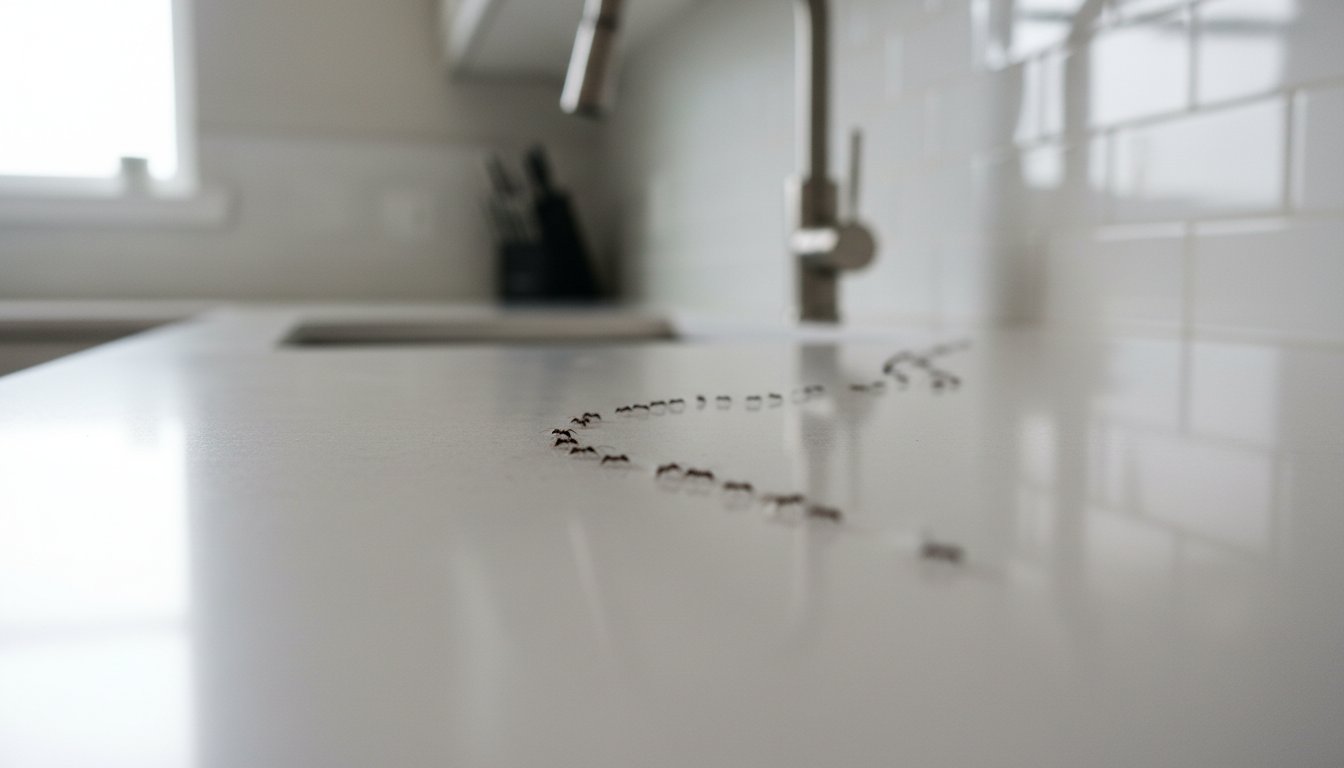
It starts with one scout. Before you know it, a determined line of ants is marching across your countertop, turning your clean kitchen into their personal buffet. That feeling of frustration-and disgust-is something no homeowner should tolerate. You’ve wiped, you’ve sprayed, but they just keep coming back, leaving you worried about using harsh chemicals around your family and pets. The good news is that you don’t have to live with these unwanted invaders. Learning how to get rid of ants in the kitchen for good is about having a proven strategy, not just reacting to the problem.
In this expert guide, we are handing you our professional, 5-step battle plan to eliminate your ant problem. We’ll show you how to identify their entry points, use powerful yet family-safe DIY methods to eradicate the entire colony, and implement simple strategies to safeguard your home against future invasions. It’s time to take back your kitchen with a clear, actionable plan that delivers fast, reliable results.
Key Takeaways
-
Before you act, identify the specific ant species in your home; a successful treatment strategy depends on knowing your enemy.
-
Your first line of defense is a deep clean. Eliminating crumbs and spills removes the ants’ food supply and disrupts their chemical trails.
-
A comprehensive plan for how to get rid of ants in the kitchen combines effective DIY treatments with sealing off entry points to prevent future invasions.
-
Learn to recognize the critical signs of a major infestation so you know when DIY methods are not enough and it’s time to call for professional eradication.
Table of Contents
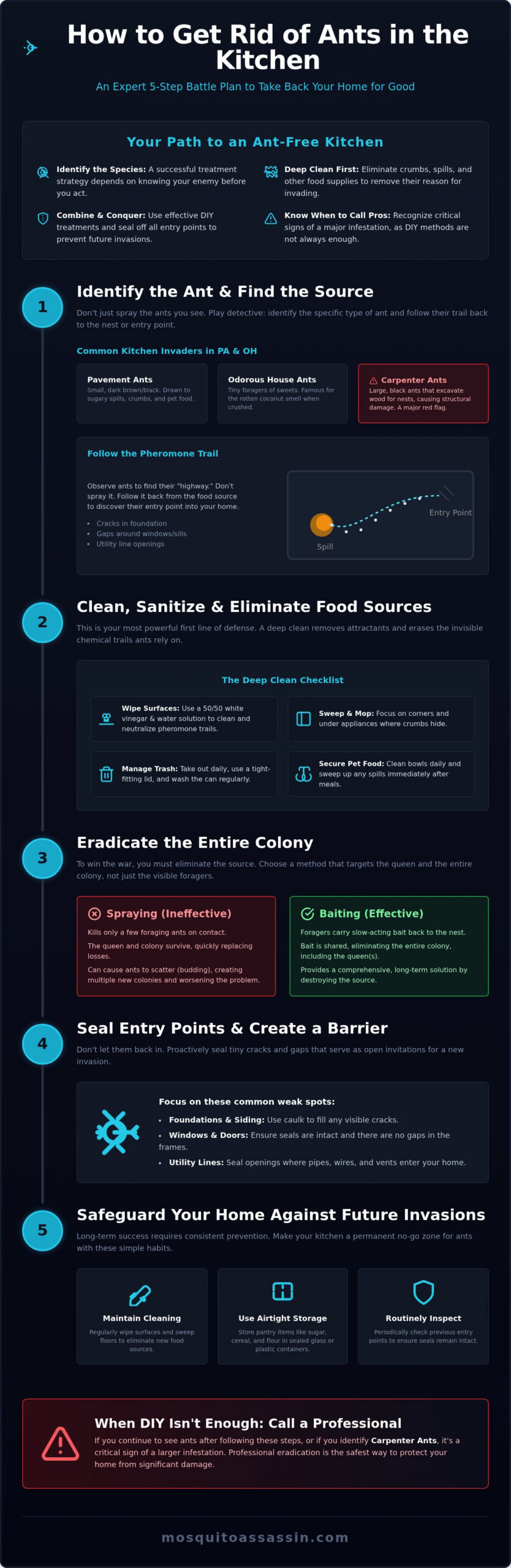
Step 1: Identify the Ant and Find the Source
Before you grab the first can of bug spray you see, stop. The first and most critical step in any effective pest eradication plan is to know your enemy. Different ant species respond to different baits and require unique strategies for complete elimination. Simply spraying the ants you see is a temporary fix that fails to address the colony, which is the true source of your problem. A professional approach always begins with proper identification.
Common Kitchen Ants in PA and OH
As your local pest control experts in Pennsylvania and Ohio, we most often see three types of ants invading kitchens. Knowing which one you’re dealing with is key to understanding how to get rid of ants in the kitchen for good.
-
Pavement Ants: These small, dark brown or black ants are a common nuisance. They are typically drawn to sugary spills, crumbs, and pet food left on the floor.
-
Odorous House Ants: Famous for the rotten coconut or blue cheese smell they emit when crushed, these tiny ants are relentless foragers of sweets and proteins.
-
Carpenter Ants: The most concerning of the three. These large, black ants don’t eat wood, but they excavate it to build their nests, which can lead to serious structural damage over time. Seeing carpenter ants is a major red flag that requires immediate attention.
How to Follow the Pheromone Trail
Ants leave behind an invisible chemical trail called a pheromone trail for others in the colony to follow to a food source. Your mission is to play detective and use this trail against them. Instead of spraying the line of ants, observe them during their peak activity times-often early morning or at dusk. Follow the consistent "highway" of ants back from the food source (like a sticky spot on the counter) to discover where they are entering your home.
Tracing this trail will lead you directly to the source of the invasion. Look for entry points in common weak spots: tiny cracks in the foundation, gaps around window and door sills, or openings where utility lines and pipes enter your home. Once you’ve identified the ant and found their entry point, you can choose from various Pest control methods to eliminate the colony at its source, not just the foragers in your kitchen.
Step 2: Clean, Sanitize, and Eliminate Food Sources
Before you deploy any baits or traps, your most powerful weapon against an ant invasion is a deep, methodical clean. Ants enter your home for one reason: to find food and water. By systematically removing their resources, you not only make your kitchen less attractive but also disrupt the chemical signals they rely on. When a scout ant finds a crumb, it lays down a pheromone trail-an invisible chemical road map-for the rest of the colony to follow. A proper cleaning eliminates both the food and the map, which is a core principle of professional Integrated Pest Management for ants. This is the foundational step for how to get rid of ants in the kitchen for good.
The Deep Clean Checklist
To effectively safeguard your kitchen, you must be more thorough than the ants are. Focus your efforts on these critical and often-missed areas to remove every potential attractant. This isn’t just a quick wipe-down; it’s a strategic operation.
-
Wipe Down All Surfaces: Use a 50/50 solution of white vinegar and water to clean countertops, backsplashes, and cabinet faces. The vinegar helps neutralize and erase the ants’ pheromone trails, preventing reinforcements from arriving.
-
Sweep and Mop Thoroughly: Pay close attention to the edges along walls, corners, and the areas under appliances like the stove and refrigerator, where crumbs love to hide.
-
Manage Your Trash: Take out the kitchen trash daily. Make sure the can has a tight-fitting lid and wash the can itself regularly with a disinfectant to eliminate sticky residues and odors.
-
Secure Pet Food: Clean your pet’s food and water bowls daily. Don’t leave food out; sweep up any kibble that spills onto the floor immediately after your pet finishes eating.
Airtight Food Storage Solutions
A deep clean is crucial, but its effects won’t last if your pantry remains an all-you-can-eat buffet. Long-term ant control is non-negotiable and requires upgrading your food storage. Cardboard boxes and thin plastic bags offer zero protection against a determined ant scout.
-
Invest in Airtight Containers: Transfer pantry staples like sugar, flour, cereal, pasta, and cookies into sealed glass or plastic containers. This creates an impenetrable barrier.
-
Wipe Down Sticky Jars: After each use, wipe down the outside of containers for honey, syrup, jam, and other sticky condiments. A tiny, unnoticed drip is a feast for an entire ant column.
-
Leave No Food Out: Never leave food, especially sweets, greasy leftovers, or ripe fruit, sitting out on the counter. Store leftovers in the refrigerator promptly.
Section 3: Use Ant Baits for Total Colony Eradication
While reaching for a repellent spray offers instant gratification, it’s a short-sighted tactic. Sprays only kill the worker ants you see, leaving the queen and the rest of the colony untouched and ready to send out more foragers. For a definitive solution to how to get rid of ants in the kitchen, you must target the source. This is where ant baits prove their superiority, offering a strategic approach to eliminate the entire nest from the inside out.
How Ant Baits Work
Ant baits are the ultimate Trojan horse. They contain a slow-acting insecticide mixed with a sweet substance that ants find irresistible. Worker ants consume this "food" and, because it doesn’t kill them immediately, they successfully carry it back to the nest. There, they share it with the other ants, larvae, and most importantly, the queen. This process, known as trophallaxis, ensures the poison spreads throughout the entire colony. Don’t be alarmed if you see more ants at first; this means the bait is working effectively.
Strategic Bait Placement
Proper placement is crucial for success and safety. You must place baits directly in the path of foraging ants without making them accessible to unintended targets. For the most effective eradication, place baits in areas where you’ve observed ant activity.
-
Along baseboards and in the corners of cabinets.
-
Under the kitchen sink, especially near plumbing lines.
-
Behind or under major appliances like the refrigerator, dishwasher, or microwave.
-
Near potential entry points like windowsills, door frames, or cracks in the wall.
Crucial Safety Note: Always place baits in locations inaccessible to children and pets. While effective, store-bought solutions still pose a risk if ingested. For a guaranteed and worry-free approach, our professional pest control services use targeted, family-safe methods to eliminate pests without compromising your family’s well-being.
Step 4: Seal Entry Points and Create a Barrier
You’ve eliminated the visible ants and removed their scent trails. Now for the most critical phase: fortifying your kitchen. Simply killing the ants you see is a temporary fix; preventing new platoons from marching in is the key to long-term victory. This proactive step is what truly separates a recurring nuisance from a permanent solution.
A successful defense strategy requires a comprehensive inspection of your kitchen’s interior and exterior. Ants are masters of exploitation, capable of squeezing through the tiniest of cracks. Your mission is to find and seal these vulnerabilities. Fortunately, this doesn’t require a major renovation-simple materials like caulk and weatherstripping are your most powerful weapons in creating an impenetrable barrier.
Interior Sealing Checklist
Your first line of defense starts inside. Grab a flashlight and a tube of sealant to meticulously inspect and secure your kitchen. Focus your efforts on these common weak points:
-
Cracks and Gaps: Use a quality caulk to seal any cracks around window frames, door frames, baseboards, and along the back of your countertops where they meet the wall.
-
Utility Lines: Check for gaps around pipes and wiring that enter your kitchen, especially under the sink. Seal these openings with caulk or expanding foam.
-
Screens: A torn window or door screen is an open invitation for pests. Repair or replace any damaged screens immediately to maintain your home’s shield.
Exterior Barrier Tactics
An ant army can’t breach your kitchen if it can’t reach the walls. Taking the fight outside is a non-negotiable part of learning how to get rid of ants in the kitchen for good. Here’s how to create a formidable exterior defense:
-
Foundation: Carefully inspect your home’s foundation for any cracks or holes, particularly near the kitchen area. Seal them with an appropriate exterior-grade sealant.
-
Doors and Windows: Ensure all exterior doors and windows have tight-fitting weatherstripping. If you can see daylight around a closed door, ants can get through.
-
Vegetation: Trim back any tree branches, shrubs, or vines that are touching your house. These act as natural bridges, giving ants easy access to your siding and windows.
While these DIY methods are highly effective, a professional inspection can uncover hidden entry points you might miss. For comprehensive, guaranteed pest protection that safeguards your home, the certified technicians at Mosquito Assassin are ready to help.
When to Call a Professional: Signs Your Ant Problem is Out of Control
While DIY sprays and bait traps can handle a few stray ants, a persistent infestation requires a professional strategy. Ignoring a serious ant problem won’t make it go away; it can lead to contaminated food, frustrated family members, and in some cases, significant property damage. When you’ve exhausted your options for how to get rid of ants in the kitchen, it’s time to call for reinforcements.
A professional pest control technician does more than just spray. We have access to specialized, more effective treatments that aren’t available to the public. More importantly, we can identify the root cause of the invasion, locate the colony’s source, and implement a targeted plan that guarantees complete elimination.
Red Flags That Demand an Expert
If you notice any of the following signs, your ant problem has likely escalated beyond a simple DIY fix. Don’t wait for the situation to worsen-these are clear indicators that you need professional help immediately.
-
You see large ants (1/4" to 1/2"). These could be Carpenter Ants, which don’t just steal food-they tunnel through and destroy wood, potentially compromising your home’s structural integrity.
-
Ants reappear consistently. If you win the battle one day only to see them marching back the next, it means you’re only eliminating foragers, not the nest itself.
-
You find multiple nests inside. Discovering ant nests in wall voids, under floors, or in insulation means the colony is well-established within your home.
-
The infestation is widespread. Seeing ants in the kitchen was bad enough, but now they’re in the bathroom, bedrooms, or basement. This signals a massive infestation that requires a comprehensive approach.
The Mosquito Assassin Advantage
When you’re facing a stubborn ant invasion in the Erie, PA area, you need a local expert you can trust. At Mosquito Assassin, we provide definitive solutions, not temporary fixes. Our certified technicians are trained to correctly identify the specific ant species plaguing your home, which is the critical first step to effective eradication. We then deploy a customized treatment plan using family-safe products and an Integrated Pest Management (IPM) approach to safeguard your home and loved ones.
As a local company, we have firsthand knowledge of the pest pressures unique to our community. We stand behind our work with a 100% satisfaction guarantee because our mission is to restore your peace of mind. Learn more about our company and our commitment to dependable results. When you’re ready to eliminate ants for good, contact Mosquito Assassin and let us take back your kitchen.
Reclaim Your Kitchen with Confidence
Knowing how to get rid of ants in the kitchen is about more than just spraying a single trail; it’s about a comprehensive strategy. By diligently identifying the source, eliminating their food and water supplies through sanitation, and sealing every potential entry point, you are taking powerful, proactive steps. This integrated approach is your first and best line of defense against these persistent invaders, disrupting their ability to thrive in your home.
However, some infestations are too widespread or stubborn for DIY methods alone. When you need to guarantee their complete eradication, it’s time to call in the professionals. As your locally owned and operated experts in PA & OH, Mosquito Assassin brings Five-Star Rated service directly to your door. We don’t just treat the problem; we eliminate it with our proven, family-safe methods, giving you a definitive solution to your ant problem.
Trust our Pest-Free Guarantee: If pests return, so do we. Tired of battling ants? Schedule your professional inspection with Mosquito Assassin today! Reclaim your space and enjoy the peace of mind that comes with a truly pest-free home.
Frequently Asked Questions About Kitchen Ants
Why do I have ants in my kitchen if it’s always clean?
This is a common frustration for homeowners. Even a spotless kitchen can have tiny, unseen crumbs or a single drop of a sugary liquid that attracts scout ants. Once a scout finds a food or water source, it leaves a pheromone trail for the rest of the colony to follow. Ants can also be seeking shelter from weather changes, and your clean kitchen provides a perfect, climate-controlled environment for them to invade and explore.
Are liquid ant baits safe to use around my pets and children?
When used according to professional guidelines, liquid ant baits are designed for maximum safety. The active ingredient is used in very small, targeted quantities and is enclosed within a durable, tamper-resistant plastic station. This design minimizes the risk of exposure to children and pets. For complete peace of mind, our certified technicians strategically place these baits in areas that are inaccessible to your family members, ensuring effective treatment without compromising their safety.
How long does it take for ant baits to work?
Patience is key for effective ant eradication. You may see an increase in ant activity for the first few days as they swarm the bait-this is a sign it’s working. The worker ants carry the slow-acting bait back to the nest, eliminating the entire colony, including the queen. Depending on the size and type of ant infestation, this process typically takes anywhere from a few days to two weeks to achieve complete control and see a significant reduction in activity.
What is the difference between an ant repellent and an ant bait?
An ant repellent, typically a spray, kills ants on contact and creates a temporary chemical barrier. However, it only affects the ants you see and can cause the colony to split into multiple new colonies-a problem called "budding." An ant bait is a far more effective, long-term solution. It uses a slow-acting poison mixed with an attractant, which ants carry back to the nest, eliminating the problem at its source for complete colony eradication.
Can ants come up through the kitchen sink drain?
Yes, kitchen sink drains are a common and often overlooked entry point for ants. The pipes contain moisture and tiny food particles that become trapped in the p-trap, creating an ideal environment for ants to thrive. They can travel through the plumbing from outside or from other areas of the building, using the drain as a hidden highway directly into your kitchen. Regular drain cleaning can help make this route less attractive to these invasive pests.
What’s the best way to get rid of ants permanently?
The most effective strategy for how to get rid of ants in the kitchen permanently involves a comprehensive, multi-step approach. This includes not only using targeted, professional-grade baits to eliminate the entire colony but also identifying and sealing all potential entry points around your home’s foundation, windows, and utility lines. A customized treatment plan from a licensed pest control professional is the most reliable way to ensure complete and lasting eradication of the infestation.