
The citronella candles are lit, the tiki torches are smoking, and yet… you’re still the main course at a mosquito buffet. It’s a frustrating scene for any homeowner who wants to protect their family without resorting to harsh chemical sprays. This endless battle sends many searching for effective natural mosquito repellents, but the internet is a minefield of DIY myths and products that simply waste your time and money, leaving you with nothing but itchy bites.
We’re here to cut through the noise. This guide separates scientific fact from fiction, giving you a clear, honest look at the plant-based repellents that are proven to work. We’ll explore which solutions offer real protection and which ones fall short. More importantly, we’ll explain why even the best of these natural options have their limits, and how a professional, family-safe treatment plan is the only guaranteed way to eliminate these pests and truly reclaim your yard for good. It’s time to stop swatting and start enjoying your summer.
Understanding Natural Mosquito Repellents vs. Chemical Options
When safeguarding your family from mosquito bites, the first choice you face is between natural and chemical repellents. The distinction is straightforward: natural mosquito repellents are derived from plant-based sources like essential oils, whereas chemical options are synthesized in a laboratory. The long-standing benchmark for chemical repellents is DEET, a highly effective compound trusted for decades. However, growing concerns about synthetic chemicals on the skin have led many people to seek out plant-derived alternatives for their peace of mind.
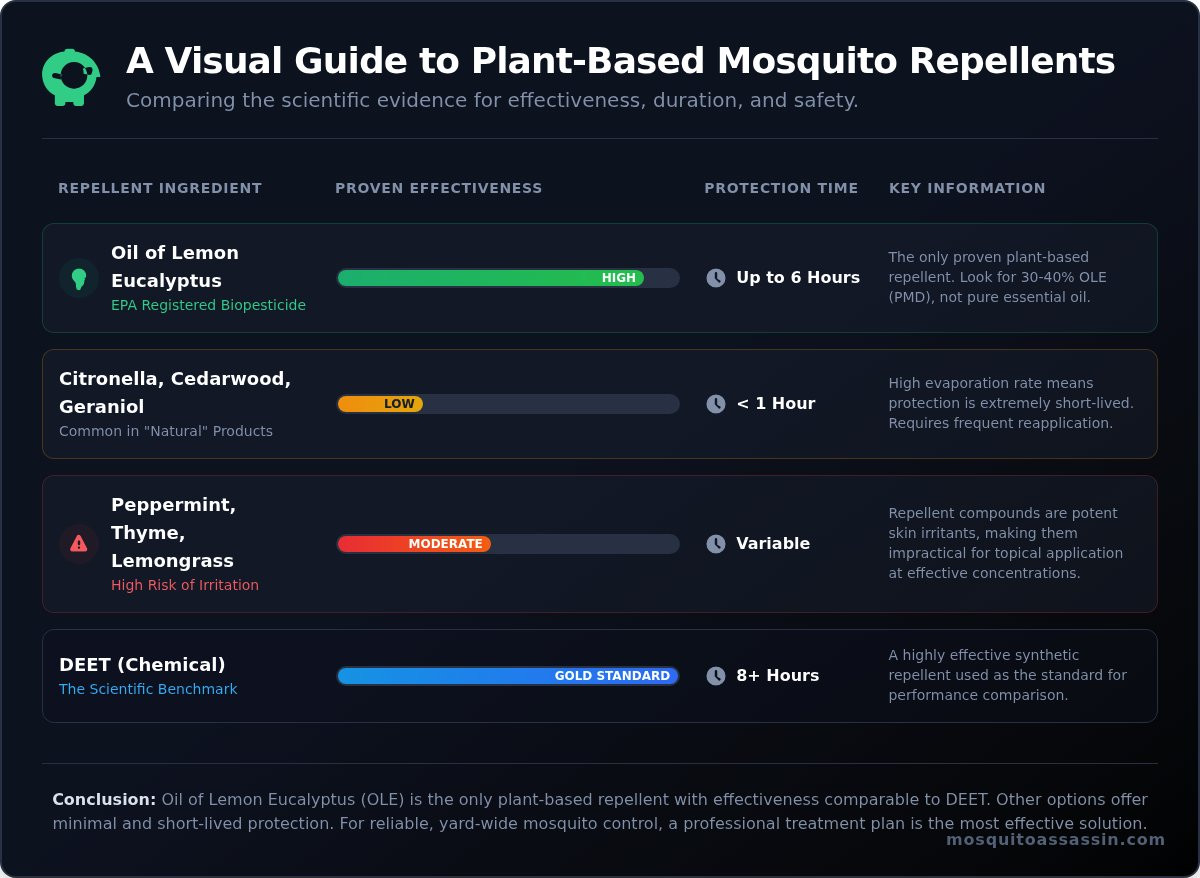
To see which products to avoid, this report offers a helpful breakdown:
It’s crucial to understand that while natural options can be effective, they often have a shorter protection window and require more frequent reapplication than their chemical counterparts. Setting realistic expectations is key to using them successfully for dependable protection.
How Repellents Actually Work
Contrary to popular belief, repellents don’t kill mosquitoes. Instead, they work by interfering with a mosquito’s ability to smell you. These pests are highly attracted to the signals our bodies emit, including:
-
Carbon dioxide (CO2) from our breath
-
Lactic acid and other compounds in our sweat
-
Body heat
An effective repellent creates an invisible barrier of scent on your skin that blocks the mosquito’s receptors, essentially making you "invisible" to them. They can’t find their target, so they move on.
The EPA’s Role in Repellent Regulation
The Environmental Protection Agency (EPA) plays a vital role in ensuring repellents are both safe and effective. Products containing ingredients like DEET or Picaridin are considered "registered repellents." This means they have undergone rigorous scientific testing to prove their claims. In contrast, many ingredients in natural mosquito repellents, such as citronella, lemongrass, or peppermint oil, fall under a category called "minimum risk pesticides." For a complete Insect Repellent Overview, you can find more details on both types. These minimum-risk products are exempt from EPA registration, meaning their effectiveness has not been officially verified by the agency. This doesn’t mean they don’t work, but it places the burden of proof on the consumer to find a reliable product.
Top Plant-Based Repellents: The Scientific Evidence
When you’re looking for effective protection, it’s crucial to separate marketing hype from scientific proof. Many plant-derived oils show repellent properties, but their effectiveness and duration vary dramatically. While some natural mosquito repellents offer a viable alternative to synthetic options, they are not all created equal. A critical factor to remember is that essential oils are highly concentrated and can cause skin irritation, so they should always be properly diluted in a carrier oil before application.
Oil of Lemon Eucalyptus (OLE): The Natural Heavyweight
This is the undisputed champion in the plant-based category. Derived from the leaves of the Corymbia citriodora tree, its active ingredient is p-menthane-3,8-diol (PMD). OLE is the only plant-based active ingredient registered by the U.S. Environmental Protection Agency as a biopesticide repellent. You can find detailed information on registered products in the official EPA Guide to Insect Repellents. Multiple studies have shown that products with 30-40% OLE can provide protection comparable to low concentrations of DEET, often lasting up to six hours. It’s vital not to confuse OLE with pure lemon eucalyptus essential oil, which has not undergone the same efficacy testing and is not registered as a repellent.
Citronella, Cedarwood, and Geraniol Oils
These oils are commonly found in commercial natural repellents, but their performance is often short-lived. Their rapid evaporation rate is their biggest weakness, demanding frequent reapplication to maintain any level of protection against determined mosquitoes.
-
Citronella Oil: Perhaps the most famous natural repellent, but its reputation outweighs its performance. Studies consistently show citronella-based products provide very short-term protection, often lasting less than one hour.
-
Cedarwood Oil: While it demonstrates repellent properties against various insects, its efficacy against mosquitoes is inconsistent across studies and depends heavily on the specific species of cedar and mosquito.
-
Geraniol: An alcohol derived from plants like geraniums, geraniol can be an effective repellent. However, like citronella, it evaporates quickly, and its protection time is limited.
Peppermint, Lemongrass, and Thyme Oils
This group contains potent compounds, but they come with significant caveats, including the need for high concentrations and a higher risk of skin irritation. These are powerful oils that must be used with extreme caution.
-
Peppermint Oil: The strong scent of menthol in peppermint can repel mosquitoes, but only at very high, often irritating, concentrations.
-
Lemongrass Oil: A close botanical relative of citronella, it contains citral and geraniol. Its repellent action is similar to citronella-initially effective but very brief.
-
Thyme Oil: Studies have identified its active compounds, carvacrol and alpha-terpinene, as highly effective repellents. Unfortunately, these same compounds are also potent skin irritants, making thyme oil impractical for widespread topical use.
Mosquito Repellent Plants: A Garden Myth Debunked
Many homeowners hope to create a mosquito-free backyard by strategically planting certain flowers and herbs. The idea of using plants as living, breathing natural mosquito repellents is appealing, but it’s a common misconception that often leads to disappointing results. The truth is, the plants themselves do not emit a protective, pest-free barrier around your property.
The repellent properties come from the essential oils locked inside the plants’ leaves. To get any real benefit, you must crush the leaves and rub the oils directly onto your skin. Simply having a few of these plants in your garden will not stop mosquitoes from finding and biting you.
Popular ‘Repellent’ Plants and The Reality
While these plants contain repellent compounds, their ambient effect is virtually zero. Here’s a professional look at the most common examples:
-
Citronella Grass: This is the source of commercial citronella oil, but the living plant releases only minuscule amounts of this oil into the air. It offers no significant protection for your patio or yard.
-
Marigolds: They contain pyrethrin, a compound used in some insecticides. However, the concentration in a living marigold is far too low to act as an effective area repellent.
-
Lavender & Basil: While their strong scents are pleasant to us, they only deter mosquitoes at extremely close range. A mosquito would practically have to land on the plant to be affected.
The Real Landscaping Solution: Eliminating Breeding Grounds
The most powerful and effective natural mosquito control has nothing to do with planting and everything to do with eliminating water. Mosquitoes require standing water to reproduce, and removing their breeding grounds is the single most important step you can take. This is a cornerstone of any professional pest management plan.
Conduct a thorough inspection of your property and eliminate all sources of stagnant water, paying close attention to:
-
Clogged gutters and downspouts
-
Birdbaths (change water every 2-3 days)
-
Flowerpot saucers and empty planters
-
Children’s toys, buckets, and wheelbarrows
-
Tarps or pool covers that collect rainwater
Remember, it takes very little water for a major problem to develop. A female mosquito can lay hundreds of eggs in a space as small as a bottle cap.
The Limitations: When Natural Repellents Aren’t Enough
While DIY and store-bought natural repellents can offer a degree of personal protection, it’s crucial to understand their boundaries. Think of them as a personal shield, not a solution for your entire property. They work by making you less attractive to mosquitoes that are already present, but they do absolutely nothing to reduce the number of pests in your yard.
This approach is simply not enough when you’re facing a significant mosquito problem. The effectiveness of even the best natural mosquito repellents plummets in areas with heavy infestations, and their defensive power is temporary at best. Constant reapplication is required, especially if you’re sweating, swimming, or spending more than an hour or two outside.
Personal Protection vs. Area Control
Topical repellents are designed for specific situations, like a hike in the woods or a fishing trip. They protect one person for a short time. Area control, on the other hand, is about reclaiming your entire property for everyone to enjoy safely. You can’t host a backyard barbecue and expect every guest to be diligent about applying and reapplying a personal spray. True comfort and safety require eliminating the threat at its source.
Ready to move from a personal shield to comprehensive property protection? Contact Mosquito Assassin for a free quote.
The Problem of a Thriving Mosquito Population
If your yard provides an ideal habitat for mosquitoes, topical repellents are a losing battle. A single female mosquito can lay hundreds of eggs in a space as small as a bottle cap filled with water. When your property, or a neighbor’s has breeding grounds, you will be constantly swarmed. A thriving population means:
-
Your repellent will be quickly overwhelmed.
-
You’re fighting a constant, regenerating swarm.
-
The risk of mosquito-borne diseases like West Nile virus increases significantly.
Safeguarding your family requires more than just a temporary fix; it demands a professional strategy to disrupt the mosquito life cycle and eliminate them from your property for good.
The Professional Solution: Integrated Mosquito Management for Your Yard
While citronella candles and various natural mosquito repellents can offer temporary relief for a small area, they don’t address the root of the problem. To truly reclaim your outdoor space and ensure your family’s comfort and safety, a professional, multi-faceted approach is the only definitive solution. At Mosquito Assassin, we deliver a comprehensive strategy designed to eliminate pests at their source and create a lasting barrier of protection around your home.
Our proven process is built on expertise and a commitment to safety, using treatments that are effective against pests but safe for your children and pets.
Step 1: Professional Inspection and Source Reduction
Our licensed technicians begin with a meticulous inspection of your property to identify all potential mosquito breeding grounds. We look beyond the obvious birdbaths and find hidden water sources you might have missed like clogged gutters, water trapped in tarps, or drainage issues. By eliminating these sources, we immediately disrupt the mosquito life cycle and drastically reduce the potential for new populations to emerge.
Step 2: Targeted Barrier Treatments
Once we’ve addressed the breeding grounds, we apply a targeted barrier treatment. This isn’t a generic fog that quickly dissipates. Our technicians apply a family-safe solution to the foliage, shrubs, and other areas where adult mosquitoes rest during the day. This creates a protective shield around your yard that is designed to be long-lasting, providing reliable protection that DIY sprays simply cannot match.
Step 3: Ongoing Protection and Guarantee
Mosquitoes are persistent, which is why a one-time treatment isn’t enough. We provide consistent service throughout the mosquito season to maintain the protective barrier and prevent pest populations from rebounding. We stand by our work with a simple promise: if the pests return, so do we. Enjoy the peace of mind that comes with a yard you and your family can actually use, all summer long.
Stop the frustrating cycle of testing ineffective natural mosquito repellents. It’s time to take back your yard for good. Contact Mosquito Assassin today to schedule your professional assessment and learn more about our guaranteed service.
Protect Your Family When Nature Isn’t Enough
While certain plant-based oils can provide short-term personal protection, the truth is that most DIY strategies and garden plants simply don’t have the power to protect your entire yard. When it comes to safeguarding your family from relentless mosquito populations, relying solely on natural mosquito repellents can be a frustrating and often ineffective battle.
You deserve to enjoy your outdoor space without worry. At Mosquito Assassin, we provide proven, family-safe treatments to eliminate mosquitoes at their source. As a locally owned and operated team serving our neighbors in PA & OH, we stand by our work with our Pest-Free Guarantee: If pests return, so do we. Stop letting mosquitoes dictate your outdoor plans and take the definitive step towards a peaceful, bite-free summer.
******Reclaim Your Yard. Get Your Free Mosquito Control Quote Today! **
Frequently Asked Questions About Natural Mosquito Control
Is oil of lemon eucalyptus as effective as DEET?
Yes, products containing oil of lemon eucalyptus (OLE) or its active ingredient, PMD, are highly effective and recommended by the CDC as an alternative to DEET. Studies show it can provide protection comparable to lower concentrations of DEET, often lasting for several hours. It is one of the most powerful plant-based repellents available, offering proven protection against mosquito bites when used as directed. Always look for EPA-registered products to ensure efficacy and safety.
Do mosquito repellent plants like citronella and marigolds actually work in a garden?
While these plants contain oils that repel mosquitoes, their effectiveness in a garden setting is minimal. The plants themselves do not create a protective barrier. To release their repellent properties, the leaves must be crushed and the oils applied to the skin. Simply planting them around your patio or deck will not be enough to deter mosquitoes from invading your space. True protection requires a more direct and comprehensive approach to yard treatment.
How often do I need to reapply natural mosquito repellents?
You must reapply natural mosquito repellents more frequently than their synthetic counterparts. A good rule of thumb is to reapply every 1 to 3 hours, but always follow the specific instructions on the product label. Factors like swimming, sweating, and high humidity can break down the repellent faster, requiring more frequent application. Consistent reapplication is the key to ensuring these products provide continuous protection while you are outdoors and exposed.
What is the most effective natural way to get rid of mosquitoes in my yard?
The single most effective natural strategy is eliminating their breeding grounds. This means diligently removing all sources of standing water. Tip over buckets, empty birdbaths weekly, clean clogged gutters, and check for water collecting in tarps or old tires. A mosquito can lay hundreds of eggs in a bottle cap of water, so being thorough is critical. This approach disrupts their life cycle and is the foundation of any successful mosquito control plan.
Are professional mosquito yard treatments safe for my children and pets?
Absolutely. At Mosquito Assassin, we prioritize the well-being of your family. Our professional treatments are designed to be family-safe. We use proven, EPA-approved products applied by licensed technicians who target mosquito resting and breeding areas precisely. Once the treatment has dried, typically within 30-60 minutes, it is safe for children and pets to return to the yard and enjoy their pest-free space with complete peace of mind.
Can I get rid of a serious mosquito problem on my own?
For minor issues, DIY methods like eliminating standing water can help. However, tackling a serious or persistent mosquito infestation on your own is extremely difficult. Professionals have the expertise to identify all potential breeding sites not just the obvious ones, and use specialized equipment for comprehensive treatment. While some store-bought solutions offer temporary relief, a customized professional plan is necessary for effective, long-term eradication and safeguarding your yard.