
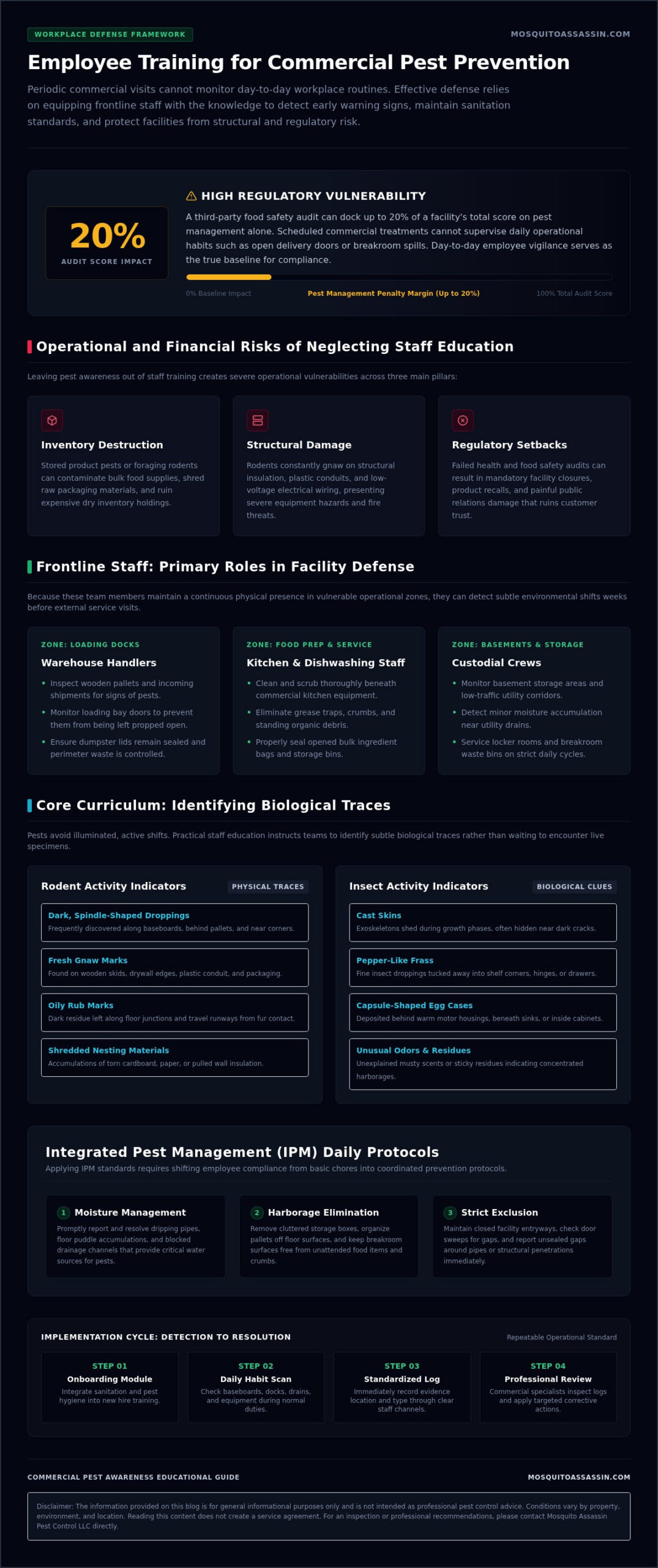
A third-party food safety audit can dock up to 20% of a facility’s total score on pest management alone, yet scheduled commercial visits cannot monitor day-to-day workplace habits. Real pest defense relies on daily staff vigilance, not just periodic treatments. Most supervisors already know the frustration of sticky breakroom counters, propped delivery doors, and employees who walk past early warning signs simply because they don’t know what to look for. Without structured employee training for pest prevention, minor sanitation lapses quickly escalate into disruptive infestations that jeopardize compliance and business reputation.
You can eliminate that vulnerability by turning your workforce into an active first line of defense. Discover how targeted training stops pest issues before they impact daily operations, inventory, or health inspections. This guide delivers a simple, repeatable staff training checklist, rapid reporting channels that minimize property risks, and year-round sanitation standards that keep commercial facilities secure.
Key Takeaways
- Establishing structured employee training for pest prevention equips frontline staff to detect subtle warning signs long before scheduled service visits.
- Effective workplace curricula teach teams to identify physical evidence such as droppings, gnaw marks, and moisture buildup rather than waiting to spot live pests.
- Standardized logging channels ensure staff observations reach facility managers immediately, minimizing inventory losses and preventing audit penalties.
- Integrating practical hygiene modules into new hire onboarding creates consistent, year-round sanitation habits across breakrooms and storage areas.
- Combining daily workplace vigilance with recurring commercial pest control provides comprehensive defense and regulatory protection.
The Essential Role of Employee Training for Pest Prevention
Pest activity rarely starts as a full-blown crisis. It begins quietly with overlooked crumbs beneath breakroom lockers, a delivery door propped open during a shift change, or minor moisture accumulation near a utility drain. While routine inspections from commercial providers establish critical defense lines, periodic visits cannot supervise daily workplace habits. Structured employee training for pest prevention bridges this operational gap. It teaches staff to recognize initial environmental attractants, log physical evidence immediately, and prevent infestations from taking root.
Modern commercial standards view sanitation as an active defense mechanism rather than basic housekeeping. Applying the core principles of Integrated Pest Management (IPM) requires workplace personnel to minimize pest risks by managing moisture, eliminating harborage sites, and maintaining strict exclusion protocols. When team members understand how everyday routines directly influence pest biology, staff compliance shifts from reluctant chore work into coordinated facility protection.
To better understand how frontline education safeguards business facilities, watch this helpful overview:
Why Frontline Staff Serve as the First Line of Defense
Frontline workers occupy the areas pests target most. Warehouse handlers inspect wooden pallets on loading docks, dishwashers scrub beneath commercial kitchen equipment, and custodial crews service basement storage zones every single day. Because these employees maintain continuous physical presence in vulnerable areas, they can detect subtle environmental changes weeks before an external technician arrives. Training empowers them to eliminate accidental attractants, such as unsealed snack boxes or loose dumpster lids, cutting off resources before pests establish nesting zones.
Operational and Financial Risks of Neglecting Staff Education
Leaving pest control out of staff onboarding creates severe operational vulnerabilities. The consequences of uninformed personnel extend far beyond dirty surfaces:
- Inventory Destruction: Stored product pests or foraging rodents can contaminate bulk food supplies, shred raw packaging materials, and ruin expensive dry inventory.
- Physical Structural Damage: Rodents constantly gnaw on structural insulation, plastic conduits, and low-voltage electrical wiring, presenting severe fire and equipment hazards.
- Severe Regulatory and Financial Setbacks: Failed health audits can result in mandatory facility closures, product recalls, and painful public relations damage that ruins customer trust.
Relying on informal assumptions leaves commercial facilities exposed. Establishing formalized commercial pest control procedures backed by continuous employee training for pest prevention stops small oversights from evolving into severe, costly infestations.
Core Curriculum: Key Topics for Workplace Pest Awareness
A successful defense plan requires practical instruction rather than vague reminders to keep areas tidy. Rather than waiting for someone to spot a live insect skittering across a hallway, comprehensive employee training for pest prevention teaches staff to detect subtle biological traces and eliminate survival resources. Much like the food safety modules emphasized in programs like the ServSafe Food Safety Certification, commercial pest awareness curriculum must link daily operating duties directly to pest biology across warehouses, office suites, and retail spaces.
Recognizing Early Warning Signs of Common Pests
Insects and rodents avoid open, illuminated spaces during active shifts. Training should focus on the physical signatures left behind during quiet periods:
- Rodent Indicators: Dark, spindle-shaped droppings along baseboards, fresh gnaw marks on wooden skids or drywall, oily rub marks along floor junctions, and shredded cardboard or paper.
- Insect Evidence: Cast skins from molting cockroaches, tiny pepper-like frass tucked into shelf corners, capsule-shaped egg cases (oothecae), and pinhole exits in paper dry goods packaging.
- Environmental Odors: Distinct, oily, or musty smells that linger in enclosed storage closets, server rooms, or ceiling plenums, often signaling an established population.
Workplace Sanitation and Eliminating Attractants
Starving pests of sustenance and moisture stops colonization before it starts. Training must outline strict sanitation rules for shared spaces:
- Refuse Management: Bagging all operational trash, wiping down interior bin liners, and ensuring outdoor dumpster lids remain shut tightly to deter foraging flies and rats.
- Breakroom Standards: Banning unsealed snack boxes in personal desks, enforcing the daily cleanup of microwave splatters, and clearing out refrigerator bins weekly.
- Moisture Mitigation: Reporting plumbing leaks immediately, clearing organic slime from floor drains, and eliminating standing water beneath ice machines or water coolers.
Facility Inspection and Exclusion Awareness
Rodents can slip through gaps as small as a quarter of an inch (roughly the diameter of a dime). Receiving personnel should carefully inspect incoming wooden pallets and corrugated shipping boxes for exterior tunneling or live stowaways before bringing inventory into core storage bays. Meanwhile, maintenance and warehouse teams need to monitor exterior doors for damaged weatherstripping, inspect foundation vents for missing mesh, and report unsealed wall penetrations around newly installed plumbing or electrical conduit lines.
While structured daily routines dramatically limit exposure, combining these habits with regular commercial inspections provides property owners with reliable, continuous perimeter security.
Establishing Clear Reporting and Documentation Procedures
Even the sharpest eye provides little defense if an employee spots droppings and tells no one. Without a standardized pathway for communication, critical sightings get lost in shift handoffs or casual verbal remarks. Effective employee training for pest prevention must establish an intuitive, frictionless reporting mechanism. When staff members know exactly where and how to record their observations, facility managers can intervene before a localized issue turns into an operational disruption.
Designing an Actionable Pest Sighting Log
Vague notifications like “saw a bug in the back” waste valuable investigative time. Standardized logs turn casual sightings into actionable intelligence. Facility logs should capture specific parameters that reveal nesting zones and travel corridors:
- Exact Timestamp and Specific Location: Note the date, precise hour, and distinct room, column, or rack identifier rather than broad department names.
- Activity Classification: Record whether the discovery involved a live pest, a dead specimen, or biological traces like chew marks, droppings, or sawdust-like frass.
- Quantity and Trajectory: Document how many pests were observed and where they fled, which pinpoints nearby wall voids or unsealed floor gaps.
Make reporting tools readily accessible across all work shifts. While digital portals work well for administrative staff, physical binder logs mounted near loading bays, custodial closets, and breakroom exits ensure frontline workers log observations immediately without disrupting their shift duties.
Designating Responsibility and Internal Communication Chains
Data collection only works when paired with designated oversight. Facilities should appoint a sanitation supervisor or shift safety coordinator to audit sighting logs every morning. If an entry involves urgent risks, such as rodent activity near packaging lines or live insects in food preparation zones, internal protocols should trigger immediate supervisor escalation rather than waiting for scheduled maintenance reviews.
Equally critical is cultivating a non-punitive reporting environment. Workers shouldn’t fear that logging pest activity in their work area reflects poorly on their personal work habits. Acknowledging staff submissions and sharing corrective steps reinforces employee training for pest prevention across the entire team. These organized internal records also provide licensed specialists with vital diagnostic trends during subsequent commercial inspections, enabling targeted interventions right at the source.
How to Implement an Effective Staff Training Program
Executing an operational shift requires an actionable framework, not just good intentions. Handing an employee a lengthy binder on their first afternoon rarely leads to long-term vigilance. Building an impactful program for employee training for pest prevention involves integrating foundational sanitation habits into standard operational routines through structured, bite-sized steps.
- Integrate modules into onboarding: Introduce sanitation basics and pest reporting procedures during an employee’s first week of work.
- Display high-visibility visual aids: Mount pest identification charts and reminder notices in breakrooms, loading bays, and janitorial stations.
- Conduct hands-on facility walkthroughs: Walk new hires past high-risk exterior doors, trash compactors, and utility lines to point out real-world exclusion risks.
- Schedule seasonal refreshers: Hold brief reviews twice a year to align staff vigilance with regional weather shifts.
- Audit internal incident logs quarterly: Review logged sightings and sanitation lapses to spot recurring patterns and address training gaps.
Onboarding Modules Versus Continuous Education
Initial onboarding sets expectations early. New hires should learn waste management rules, designated eating zones, and prompt spill cleanup during their primary facility orientation. However, a single session doesn’t create lasting retention. Brief ten-minute refresher talks during scheduled quarterly safety meetings keep standards top of mind. In spring, focus training on ants and foraging flies emerging as outdoor temperatures rise. In late autumn, shift attention toward rodents seeking indoor harborage away from freezing outdoor conditions.
Engaging Visual Aids and Practical Exercises
Visual memory drives faster recognition than abstract policies. Laminated wall charts showing high-resolution photos of regional insects and rodent droppings help workers identify species immediately. Pairing visuals with interactive drills produces the best results. Lead warehouse teams on practical storage audits, teaching them to stack inventory six inches away from exterior walls and off the bare floor on pallets. Encourage staff to take quick smartphone photos of suspected damage or unusual insects, attaching them directly to digital internal communication channels for instant supervisor verification.
Proactive internal education transforms day-to-day operations, but outside professional expertise ensures complete property defense. To support your company’s internal protocols, scheduling an evaluation with commercial pest control specialists helps identify subtle architectural vulnerabilities that daily cleaning cannot resolve.
Partnering With Professional Pest Management Services
Daily sanitation and internal vigilance build a powerful first line of defense, but basic workplace routines cannot replace specialized pest management. Frontline personnel manage the environment to deter biological attractants, whereas certified specialists deliver technical interventions, structural sealing, and ongoing regulatory documentation. Aligning internal employee training for pest prevention with regular commercial service creates a dual-layer strategy that keeps properties compliant, sanitary, and structurally secure year-round.
When to Escalate From Employee Reporting to Professional Service
Routine custodial cleanup handles occasional crumb buildup, but certain discoveries demand rapid escalation to technical specialists. Facility leadership should bring in licensed professionals whenever employees document critical indicators:
- Structural or Material Damage: Discovering chewed electrical wiring, shredded wall insulation, or hollowed wooden framework requires immediate diagnostic intervention.
- Persistent Pest Sightings: Repeatedly finding insects or rodent droppings in identical zones indicates established breeding harborage hidden deep within building voids.
- Contamination in Sensitive Areas: Pests observed near packaging lines, raw goods storage, or food preparation areas present severe public health hazards that require targeted remediation.
Partnering with commercial pest control services provides businesses with targeted perimeter defense, specialized baiting infrastructure, and detailed service records necessary for third-party facility audits.
Regional Pest Pressures in Pennsylvania and Ohio
Commercial facilities face distinct operational hurdles dictated by local climate patterns. During late autumn and early winter, dropping temperatures across Erie and Crawford Counties drive rodents to seek indoor warmth, moving directly toward heated loading bays and warehouse utility chases. Conversely, elevated summer humidity throughout Ashtabula County accelerates insect activity along building perimeters, driving perimeter invaders toward unsealed doorways and foundation vents.
Addressing these seasonal shifts requires deep familiarity with regional climate patterns and local pest behavior. Property managers can learn more about Mosquito Assassin Pest Control LLC to discover how local industry experience shapes targeted commercial protection strategies. Reviewing regional service locations helps businesses confirm localized coverage options throughout Northwest Pennsylvania and Northeast Ohio.
When staff members actively log early warning signs, external technicians can deploy precise countermeasures without costly operational delays. Routine employee training for pest prevention transforms your workforce into reliable partners alongside certified commercial specialists, ensuring comprehensive protection across every shift.
Strengthen Your Facility Defense Through Staff Vigilance
Protecting a commercial facility requires consistent daily action rather than periodic, reactive treatments. Structured employee training for pest prevention empowers frontline teams to recognize early biological traces, maintain strict sanitation standards, and log observations before minor issues escalate into costly audit penalties or physical property damage. When staff actively participate in daily prevention, workplace hygiene becomes a continuous operational shield.
Pairing internal vigilance with professional expertise ensures complete, year-round perimeter security. Backed by extensive local pest control experience across Northwest Pennsylvania and Northeast Ohio, dedicated regional technicians understand county health standards and local seasonal cycles. For professional facility inspections and customized commercial plans, contact Mosquito Assassin Pest Control LLC to keep your commercial property secure across every shift.
Disclaimer: The information provided on this blog is for general informational purposes only and is not intended as professional pest control advice. Conditions vary by property, environment, and location. Reading this content does not create a service agreement. For an inspection or professional recommendations, please contact Mosquito Assassin Pest Control LLC directly.
Frequently Asked Questions
Why is employee training for pest prevention necessary if a company has pest control?
Professional technicians visit periodically, but daily staff habits directly determine whether pests find food, water, and shelter between scheduled service calls. Even comprehensive commercial treatment plans struggle if exterior doors remain propped open or interior spills sit uncleaned. Structured employee training for pest prevention creates ongoing workplace vigilance, ensuring staff eliminate attractants and catch subtle warning signs before an infestation establishes itself inside walls or storage areas.
What are the most common pests employees should be trained to identify?
Commercial employees should be trained to spot mice, rats, cockroaches, flies, and stored-product pests like beetles or moths. Training should focus on local risks, such as house mice seeking warm interior shelter during cold Pennsylvania and Ohio winters, or filth flies congregating near outdoor dumpsters during humid summers. Staff should also recognize subtle evidence like droppings, chewed packaging, and shed insect casings rather than expecting to see live pests in the open.
How often should commercial staff receive pest prevention training?
Facilities should provide baseline pest training during new hire onboarding, followed by brief refresher sessions twice a year. Semi-annual sessions align smoothly with regional seasonal transitions, such as spring insect emergence and autumn rodent migrations seeking indoor warmth. Incorporating brief five-minute reviews during quarterly safety meetings also reinforces proper waste handling and prompt reporting protocols, keeping prevention top of mind without pulling employees away from daily operations.
What should be included in an employee pest sighting log?
An actionable pest sighting log should record the precise date, time, specific location, pest type, estimated quantity, and observed direction of travel. Noting whether the discovery was a live pest, dead specimen, or biological sign like droppings helps licensed technicians pinpoint nesting zones. Keeping physical log binders in accessible breakrooms alongside digital submission forms guarantees immediate entries from all shifts, providing maintenance teams with reliable data to guide targeted interventions.
How do employee sanitation habits influence commercial pest infestations?
Daily employee sanitation habits directly control the food, water, and harborage resources that allow pests to survive indoors. Leaving crumbs in breakroom microwaves, storing snacks in unsealed desk drawers, or failing to report a dripping utility sink creates ideal conditions for cockroaches and rodents. Consistent sanitation protocols starve opportunistic pests, making exterior barriers more effective and significantly reducing the likelihood that foraging pests will settle inside commercial buildings.
Can employee pest training help businesses pass health and safety audits?
Yes, structured employee training directly supports audit success because pest control documentation and facility sanitation account for significant portions of third-party facility evaluations. Modern regulatory frameworks, including FDA standards, expect commercial facilities to demonstrate proactive prevention rather than reactive pest extermination. Implementing comprehensive employee training for pest prevention ensures clean storage bays, documented sighting logs, and prompt structural repairs, giving inspectors clear proof of active managerial control and compliant pest management.