
The flies you swat are a clue, not the source. To learn how to find the source of a fruit fly infestation, look for moist, fermenting or decaying organic material where the insects can breed, even if adults gather somewhere else. A forgotten piece of produce, residue in a drain, or an unrinsed container may be easy to miss.
It’s frustrating when flies return after visible adults are gone. The key is to trace where they may be breeding and check what kind of small fly you’re seeing. Drain flies and fungus gnats point to different places to inspect.
This guide covers common places to check, ways to narrow your search, and clues for distinguishing fruit flies from drain flies and fungus gnats. It also explains why flies around fresh, undamaged berries may need closer identification. If activity continues after you remove likely breeding material, a professional assessment may help clarify the issue.
Key Takeaways
- Learn how to find the source of a fruit fly infestation by following activity patterns and checking nearby materials that may support breeding.
- Understand why removing visible adults may not stop activity if breeding material remains out of sight.
- Use appearance and location as preliminary clues to distinguish fruit flies from drain flies and fungus gnats.
- Know why flies around fresh, undamaged berries may call for closer identification.
- Build simple produce and food-waste checks into household routines, and recognize when recurring activity may merit professional assessment.
How to Find the Source of a Fruit Fly Infestation at Home
Seeing fruit flies after you’ve removed the adults can be frustrating. Often, the material supporting continued activity is still present. A source is fermenting or decaying organic material where fruit flies can feed and reproduce, not necessarily the surface where you see them land. Learning how to find the source of a fruit fly infestation starts with observing patterns and checking nearby clues.
The common fruit fly, Drosophila melanogaster, is associated with fermenting organic matter. A few adults near a counter or sink can draw attention to the area, but their location alone doesn’t confirm where they’re breeding.
For a visual example of fruit flies around a kitchen, watch this video:
Start where adult fruit flies gather
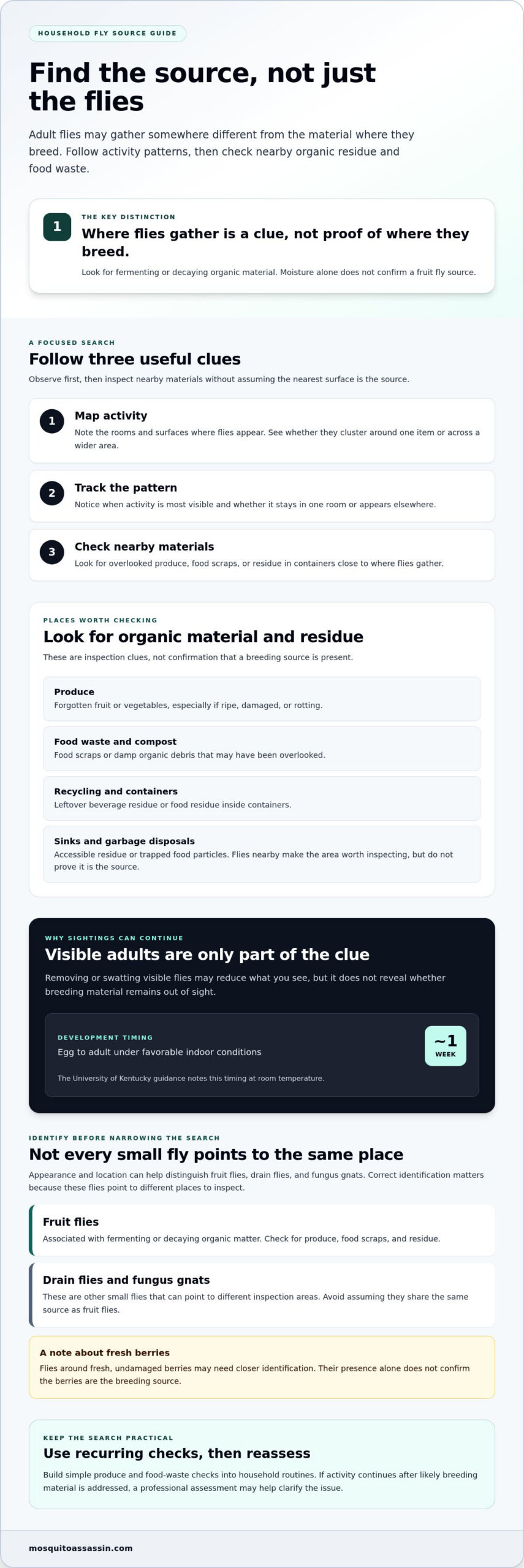
Begin by observing where flies repeatedly appear instead of changing several things at once. Check whether activity centers on produce, food scraps, beverage residue, or household waste. A group of adults makes an area worth inspecting, but they may be feeding or resting there rather than breeding.
Use this sequence to narrow the search:
- 1. Map activity. Note the rooms and surfaces where you see flies. Check whether they cluster around one item or appear across a wider area.
- 2. Track the pattern. Record when activity is most noticeable and whether it stays in one room or appears elsewhere.
- 3. Check nearby materials. Inspect overlooked produce, food scraps, and residue in containers close to the activity.
Follow nearby organic residue and moisture
Inspect likely sources near the gathering place, including forgotten fruit or vegetables, recycling containers with beverage residue, compost, and damp organic debris. Around sinks and garbage disposals, look for accessible residue or trapped food particles. Flies near a drain make it a useful place to inspect, but that observation alone doesn’t prove the drain is the breeding source.
Write down likely locations before changing multiple household conditions. This keeps the search focused and helps you notice whether activity repeatedly points to the same area. If flies appear far from food or waste, widen the search rather than assuming the nearest surface is responsible.
Why Fruit Flies Keep Appearing: Breeding Sources and Life Cycle Clues
Removing the flies you can see doesn’t necessarily remove what’s allowing more to develop. Common fruit flies are associated with fermenting or decaying organic matter. Adults may gather around food while the material supporting their continued activity is tucked into a container, food scrap, or other overlooked spot.
A fruit fly breeding source is organic material where the flies can feed and reproduce. The University of Kentucky Extension describes fruit fly development and household sources, including food residues and places where organic matter can collect. Moisture alone isn’t the key clue. Look for moisture or residue together with suitable organic material.
What makes a household material attractive to fruit flies?
Ripe, damaged, or rotting produce can begin to ferment and provide food and a breeding environment. Smaller amounts of residue may be less noticeable than a bowl of fruit, but are still worth checking if they contain organic material. Potential hiding places include food-waste containers, recycling with leftover beverage residue, and areas where sugary drinks or food scraps have collected.
Not every damp surface is a fruit fly source. A wet area without fermenting or decaying organic matter may not explain the activity. Focus on places where food residue, scraps, or produce could remain rather than treating moisture by itself as proof.
Why removing visible flies may not solve the problem
Adults are the mobile, visible part of the infestation. Removing them may temporarily reduce what you see, but it doesn’t reveal or remove the material that supports continued breeding. If suitable material remains overlooked, new adults may appear and make it seem as though the flies have returned without an obvious reason.
Fruit flies can develop quickly under favorable indoor conditions. The University of Kentucky’s guidance notes that development from egg to adult can take about a week at room temperature. This helps explain why sightings can continue as new adults emerge, even after the first group is gone. A persistent source is therefore more useful to investigate than the number of flies visible at one moment.
To understand how to find the source of a fruit fly infestation, look beyond the adults and consider what suitable material may be sustaining them. If activity continues and the source remains unclear, a professional assessment may help clarify the indoor pest issue. Residents in Erie or Crawford Counties, Pennsylvania, and Ashtabula County, Ohio, can ask about a persistent indoor pest concern.
How to Narrow Down the Source Without Guessing
A consistent observation routine is more useful than checking random corners. Look for a pattern, identify likely nearby materials, and test one explanation at a time. Location patterns are clues, not definitive identification of a breeding source. Flies may gather where food is available or where they can rest, even if the material supporting their development is elsewhere.
Use activity patterns to prioritize inspection areas
Compare where flies appear most often across rooms and at different times. Note whether activity repeatedly centers on a kitchen counter, pantry, waste area, or another location. A brief written log can help distinguish a repeated pattern from a one-time sighting.
- Record the location: Note the room and nearby surfaces or containers.
- Describe the activity: Record whether you saw one fly or several, and when you noticed them.
- Compare observations: Look for repeated activity in the same area over time.
Start inspections near the strongest pattern. If flies repeatedly gather by a kitchen counter, check nearby food storage, waste, recycling, or compost before searching farther away. If activity appears in more than one room, note that too. The source may not be obvious from the first cluster, so keep the search open rather than assuming every fly came from the nearest item.
Check hidden or easy-to-miss household sources
Look for overlooked organic residue in the areas your observations point toward. A forgotten potato or onion in a pantry, a sticky container awaiting recycling, or food residue around a waste container may be less visible than produce left on a counter. Around the sink and garbage disposal, inspect accessible areas for organic buildup. These spots are worth checking, but activity nearby doesn’t prove they’re the source.
Keep the process controlled. When you find a plausible source, record it and address that one condition before making other changes. For example, deal with a suspect container, then continue observing the same locations and times. Changing several conditions at once can make it harder to tell which clue mattered.
If activity continues, broaden the inspection to other nearby places where food scraps or residue may collect. Don’t settle on a drain as the explanation without supporting clues. A simple log of locations, timing, and inspected materials can help you refine how to find the source of a fruit fly infestation. If the pattern remains unclear, consider whether a professional assessment may help.
Fruit Flies or Another Small Fly? Clues That Change Your Search
Small indoor flies can look alike at a glance, so treat visual clues as a starting point, not a confirmed identification. Compare body shape, appearance, and where activity is concentrated. These details can help you decide what to inspect next, but location alone doesn’t prove which insect you’re seeing or where it’s breeding.
Fruit flies: Often tan or yellowish-brown, with a rounded shape and sometimes bright red eyes. They’re commonly noticed near ripe or decaying produce, food residue, and household waste.
Drain flies: Often fuzzy and dark, with a small, moth-like appearance and broad wings held over the body. They may be seen resting on walls near sinks, showers, or floor drains.
Fungus gnats: Often dark and slender, with long legs that give them a tiny mosquito-like appearance. They’re commonly noticed hovering near indoor plants or potting soil.
Fruit flies and drain flies: compare appearance and location
A cluster near a sink can have more than one explanation. Fruit flies may be drawn to organic residue or food scraps near the sink, while drain flies are associated with organic buildup in drains. Compare the fly’s appearance with the activity pattern. A fuzzy, moth-like insect near a drain points in a different direction than rounded flies near food, but neither clue is definitive on its own.
Fruit flies and fungus gnats: check plants and soil
Notice whether activity centers on potted plants or follows food and waste areas. Fungus gnats are often found around indoor plants and potting soil, while common fruit flies are more closely associated with fermenting or decaying food. Don’t identify a fly based on one feature, such as seeing it near a window or sink. Look for several matching clues.
There is also an important exception: flies associated with fresh, undamaged soft fruit, such as berries, may be spotted-wing drosophila rather than common fruit flies. This is a different kind of fruit fly. The fresh-fruit clue merits closer identification rather than an assumption that decaying material is the source.
Use these comparisons to guide your search for how to find the source of a fruit fly infestation, not as a substitute for confirming the insect. If the fly type remains unclear or activity persists, professional pest control may help assess the indoor pest issue. Ask about recurring indoor pest activity.
After You Find a Likely Source: Prevention and When to Ask for Help
Finding a likely source gives you a place to focus. Regularly checking food and waste areas can also help you notice conditions that may attract flies. No single household habit can guarantee they won’t return. The aim is to reduce overlooked organic material and recognize when the pattern needs another look.
Reduce the chance of another overlooked source
Include produce, food-waste containers, and recycling in your regular kitchen checks. Pay attention to overripe or damaged fruits and vegetables, food scraps, and beverage residue in containers. Keep these areas orderly so spills or forgotten items are easier to spot. Compost and other places where organic waste collects also merit routine attention.
Make this an ongoing habit rather than a one-time checklist. A clean counter won’t rule out residue elsewhere, and flies may continue if another suitable source remains. If you’ve identified a likely source, note what you found and keep observing the same areas. A brief record can help you determine whether activity is decreasing, shifting, or persisting.
For broader context on household pest prevention and management, see this general pest control guide.
When professional pest control may help
Consider asking for a professional assessment if small flies keep recurring after obvious sources have been addressed, or if you can’t confidently distinguish fruit flies from another indoor fly. Repeated activity may mean a source was missed, the insects were misidentified, or another condition needs attention. Share where and when you’re seeing them, along with the areas you’ve already checked.
Mosquito Assassin Pest Control LLC provides general pest control for residential and commercial properties in Erie and Crawford Counties, Pennsylvania, and Ashtabula County, Ohio. The company’s services do not confirm a dedicated fruit fly treatment, so ask whether professional pest control may be appropriate for the recurring indoor pest activity you’re observing. Details about residential and commercial pest services and the service area can help you decide whether to inquire.
Source-finding is about following evidence, not assuming that the first place you notice flies is the cause. If you’ve worked through how to find the source of a fruit fly infestation and activity still returns, you can contact the pest control team with your observations to ask whether an assessment may help.
Disclaimer: The information provided on this blog is for general informational purposes only and is not intended as professional pest control advice. Conditions vary by property, environment, and location. Reading this content does not create a service agreement. For an inspection or professional recommendations, please contact Mosquito Assassin Pest Control LLC directly.
Follow the Clues and Choose Your Next Step
Finding the source takes more than removing the flies you can see. Look for patterns, check nearby organic material, and treat location as a clue rather than proof. Keep produce, food-waste containers, recycling, and residue-prone areas in view. Compare the insects’ appearance and behavior before deciding whether they’re fruit flies or another small fly.
Understanding how to find the source of a fruit fly infestation can help you make a more focused search. If activity continues after likely sources are addressed, or you’re unsure what type of fly you’re seeing, a professional assessment may help clarify the issue.
Mosquito Assassin Pest Control LLC provides residential and commercial pest management in Erie and Crawford Counties, Pennsylvania, and Ashtabula County, Ohio. To ask whether professional pest control may help with recurring indoor pest activity, contact the pest control team.
Keep observing and follow the evidence. A careful, practical approach can help you decide what to check next.
Frequently Asked Questions
How do I find where fruit flies are coming from?
Start where adults gather and inspect nearby produce, food scraps, recycling, compost, and residue. A cluster is a clue, not proof that the closest item is the source. Note where and when you see activity, then compare observations over time. If one area doesn’t explain recurring sightings, broaden the search to other places where fermenting or decaying organic material may be present.
Can fruit flies come from a drain?
Fruit flies may be noticed near a drain, but their location alone doesn’t confirm the drain is the source. Fermenting or decaying organic material can collect near plumbing or a garbage disposal, and food scraps or residue elsewhere nearby may also attract flies. Check the surrounding area and consider whether the insects could be drain flies, which often look fuzzy or moth-like. Several clues together are more useful than location alone.
Why do I still have fruit flies after removing the fruit?
Removing visible fruit may not address other material that can support fruit flies. Check for food residue, waste containers, recycling with leftover beverage residue, compost, or forgotten produce elsewhere, such as in a pantry. Adults can continue to appear if suitable breeding material remains. Notice where activity is concentrated and revisit nearby areas before deciding the source has been eliminated. If sightings persist, consider whether the insects might be another type of small fly.
How can I tell fruit flies from drain flies?
Fruit flies are often associated with ripe or fermenting food and may be seen around produce, kitchen surfaces, or waste. Drain flies tend to look fuzzy or moth-like and are often noticed near drains. These are general identification clues, not proof. Flies near a sink could have more than one explanation, so compare appearance with activity patterns and nearby materials. If you still can’t identify the insect, a professional assessment may help clarify what you’re seeing.
Can fruit flies breed in houseplants?
Small flies around houseplants may be fungus gnats rather than fruit flies. Fungus gnats are commonly noticed around indoor plants and potting soil, while fruit flies are more often associated with fermenting food or organic waste. Check whether activity consistently centers on plants or appears near food and waste areas. A single sighting near a plant doesn’t confirm the insect or its source, so weigh several clues before drawing a conclusion.
How long does it take to find the source of a fruit fly infestation?
There isn’t a fixed timeline for finding a fruit fly source. The search may be straightforward if activity centers near visible produce or waste, but an overlooked source can take more observation to locate. Track where flies gather and when activity appears, then inspect nearby organic materials and containers. This pattern-based approach is more useful than relying on a set time estimate, especially when activity appears in more than one room.
What should I do if I cannot find the fruit fly source?
Recheck areas where flies gather and consider overlooked produce, food residue, recycling, compost, or organic material near sinks and garbage disposals. Also consider whether the insects might be drain flies or fungus gnats. If activity continues and the source remains unclear, professional pest control may help assess the issue. Mosquito Assassin Pest Control LLC serves Erie and Crawford Counties in Pennsylvania and Ashtabula County in Ohio, and provides pest management for residential and commercial properties.
Disclaimer: The information provided on this blog is for general informational purposes only and is not intended as professional pest control advice. Conditions vary by property, environment, and location. Reading this content does not create a service agreement. For an inspection or professional recommendations, please contact Mosquito Assassin Pest Control LLC directly.