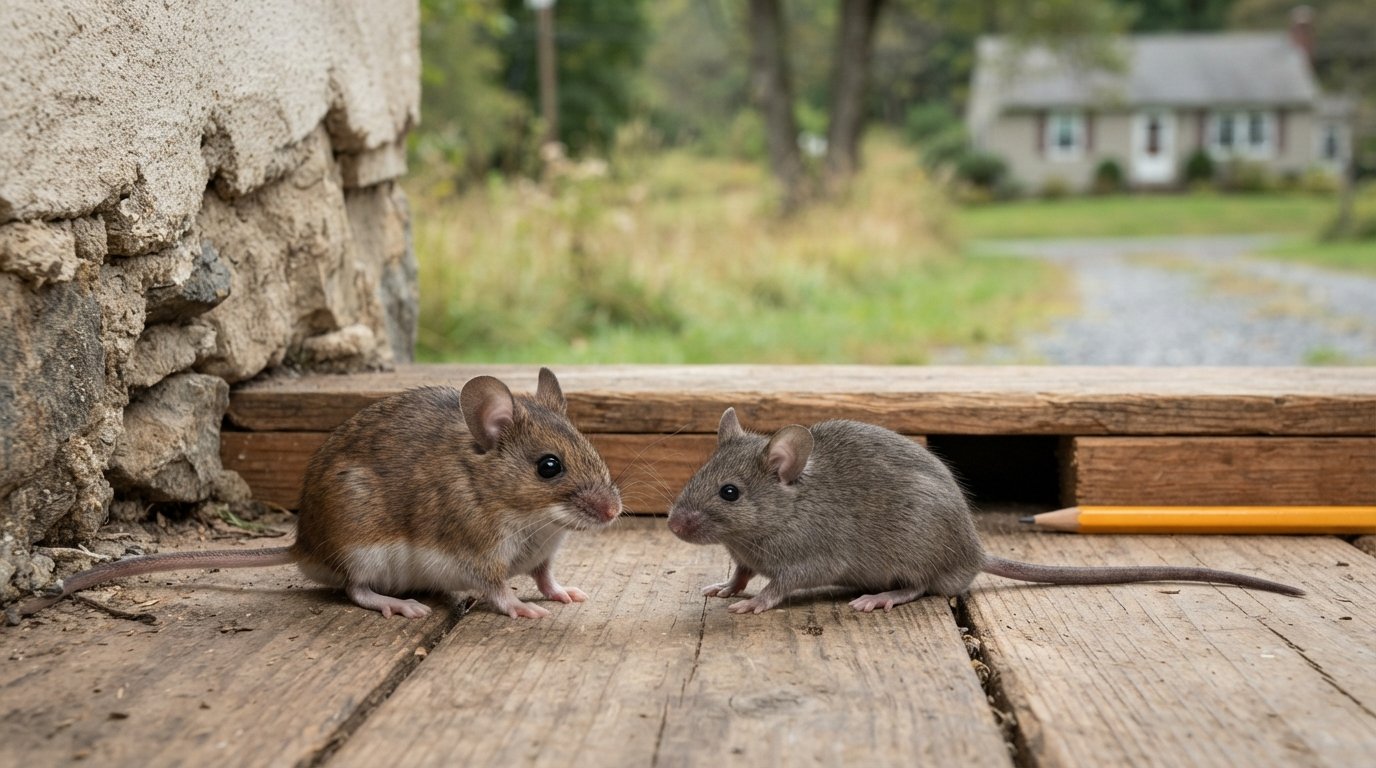
A structural gap as small as one quarter of an inch (roughly the width of a pencil) is all a rodent needs to compromise the safety of a home. For property owners in Erie and Crawford Counties in Pennsylvania or Ashtabula County in Ohio, discovering a small, furry intruder often leads to immediate anxiety about structural damage and disease transmission. It is frustrating to sort through conflicting identification tips when you simply want to know if your family is at risk or how the intruder entered.
Understanding the field mouse vs house mouse distinction is the first step in implementing a successful exclusion strategy. While they may look similar at a glance, these species have different nesting habits and carry different pathogens, such as hantavirus or lymphocytic choriomeningitis virus. This guide provides the clear, fact-based criteria needed to accurately identify common local rodents and understand the unique threats each species presents to your property.
By learning the physical markers (such as the two-toned fur of a white-footed mouse compared to the uniform gray of a house mouse) you can better protect your household. The following sections detail specific behavioral traits, regional risks in the tri-state area, and professional standards for long-term prevention and exclusion.
Disclaimer: The information provided on this blog is for general informational purposes only and is not intended as professional pest control advice. Conditions vary by property, environment, and location. Reading this content does not create a service agreement. For an inspection or professional recommendations, please contact Mosquito Assassin Pest Control LLC directly.
Key Takeaways
- Distinguish between species by observing fur coloration and tail texture to determine if you are facing a two-toned field mouse or a uniformly gray house mouse.
- Understand how the field mouse vs house mouse comparison dictates your health risks, as each rodent serves as a reservoir for different serious pathogens.
- Learn why seasonal shifts in Pennsylvania and Ohio cause specific field mouse species to migrate into attics and crawl spaces while house mice remain year-round residents.
- Discover the critical exclusion threshold of 1/4 inch and why physical barriers are more effective than temporary trapping for long-term protection.
- Identify the different ways these rodents damage property, from the large acorn caches of white-footed mice to the nesting habits of house mice near kitchen pantries.
Understanding the Basics: What Defines a Field Mouse and a House Mouse?
Distinguishing between the field mouse vs house mouse begins with understanding that these are entirely different biological families with unique survival strategies. In Northwest Pennsylvania and Northeast Ohio, homeowners frequently encounter both. While the house mouse is a specific species (Mus musculus), the term “field mouse” is a local catch-all used for the deer mouse (Peromyscus maniculatus) or the white-footed mouse (Peromyscus leucopus).
Identifying which rodent has entered a structure is critical. Their nesting habits, food preferences, and the specific pathogens they carry vary significantly. A strategy that works for a resident house mouse might not address the seasonal intrusion of a field mouse searching for winter harborage. Because these rodents respond differently to environmental changes, professional identification is the foundation of any long-term exclusion plan.
The Biology of the House Mouse
The house mouse is categorized as a commensal rodent, a term meaning “to share the table.” Having evolved alongside human civilization, these rodents are uniquely adapted to live inside climate-controlled structures. Their biology allows them to thrive without a constant source of standing water, as they can extract necessary moisture from the grains and processed foods found in residential pantries. This ability to survive entirely indoors makes them a year-round threat in Erie and Ashtabula.
According to house mouse biology and characteristics, these rodents are prolific breeders. A single female can produce between 5 and 10 litters every year, with each litter averaging 5 to 6 pups. Because they reach sexual maturity in roughly 4 to 6 weeks, an indoor population can multiply exponentially regardless of the weather outside. In a residential setting, their lifespan is often less than a year, but their rapid reproduction ensures the population remains stable.
The Biology of the Field Mouse
Unlike their commensal counterparts, field mice are primarily outdoor animals adapted for survival in the woodlands and fields of Crawford County. The deer mouse and white-footed mouse have large eyes and ears, features that help them navigate nocturnal environments and avoid predators. They are highly skilled at surviving harsh winters by caching seeds and nuts in hollow logs, stone walls, or underground burrows. Their physical adaptations are geared toward the wild rather than the kitchen cabinet.
These rodents are considered occasional invaders. They typically do not seek out human homes for food but rather for shelter when temperatures drop in the autumn. While they might nest in a crawl space or attic, they often maintain a connection to the outdoors to forage. Their reproductive cycle is also more seasonal than the house mouse, usually producing 3 to 4 litters between spring and late autumn. Understanding these distinctions is the first step in effective rodent control services.
Identification Guide: Comparing Physical Traits and Behaviors
Spotting a rodent darting across a room in the middle of the night makes identification difficult. However, observing specific physical markers is the most reliable way to settle the field mouse vs house mouse debate. Homeowners in Erie and Crawford Counties should look for distinct coloration and anatomical proportions rather than relying on size alone, as juveniles of one species can easily be mistaken for adults of another.
Visual Markers and Coloration
Coloration provides the most immediate clue for identification. A house mouse typically maintains a uniform, dusty gray or light brown color across its entire body, including its belly. In contrast, the field mouse (specifically the deer mouse and white-footed mouse) displays a sharp contrast between its tawny or reddish-brown back and its stark white underbelly. Deer mice exhibit a trait called counter-shading, where the dark upper body meets the white underside in a clean, straight line.
- Feet: Field mice have noticeably white feet, whereas house mouse feet match their gray or brown body color.
- Tail: A house mouse tail is scaly and nearly hairless. A field mouse tail is bicolored (dark on top, white on bottom) and covered in fine, short hairs.
Size and Proportions
The facial features of these rodents have evolved for different lifestyles. Field mice possess large, bulging eyes and rounded ears that appear oversized for their heads, adaptations for nocturnal life in the wooded areas of Pennsylvania and Ohio. House mice have much smaller, beady eyes and ears that are more proportional to their head size. Adult house mice typically measure between 5 and 7.5 inches in total length, while adult field mice are slightly larger, ranging from 5.5 to 8 inches from nose to tail.
Accurate identification is not just a matter of curiosity; it’s a safety requirement. The white-footed mouse is a primary reservoir for pathogens, and understanding CDC hantavirus transmission risks is essential for anyone cleaning up nesting sites. If you aren’t sure which species has moved in, professional rodent control service can help confirm the intruder’s identity and assess the risk level to your property. Beyond visual traits, homeowners can look at droppings. House mouse droppings are roughly 1/4 inch long with pointed ends, often found near human food sources. Field mouse droppings are similar in size but are frequently found near the seed caches they build in attics or crawl spaces.
Habitat and Nesting: Where These Rodents Live and Hide
In the Lake Erie region, where rural woodlands meet residential neighborhoods, understanding the field mouse vs house mouse habitat is the first step in effective exclusion. House mice are specialists in human environments, rarely venturing far from the warmth and food provided by a structure. Field mice, including the white-footed and deer mice common in Ashtabula and Erie, are primarily outdoor creatures that only utilize homes as a refuge from the elements. Identifying these hiding spots helps property owners target their prevention efforts where they matter most.
Indoor Nesting Preferences
House mice prefer nesting within 10 to 30 feet of a consistent food source. They often choose dark, secluded areas like wall voids, attic insulation, or the spaces behind kitchen appliances. These rodents are opportunistic builders, using shredded paper, fabric, and insulation to construct soft, ball-shaped nests. According to the EPA’s guidelines on identifying and preventing rodent infestations, signs of an established nest include concentrated droppings, gnaw marks on nearby surfaces, and a distinct musky odor in basements or crawlspaces. Because they reproduce so quickly, a single nest can lead to a significant population in a short time.
The Impact of Lake Effect Winters
For residents in Northwest Pennsylvania and Northeast Ohio, the onset of fall brings more than just cooler temperatures. The intense cold of Lake Effect winters forces field mice to abandon their preferred outdoor habitats, such as hollow logs, abandoned bird nests, or underground burrows. As natural food sources like seeds and acorns become scarce, these rodents transition from garden areas to garages, sheds, and eventually the interior of homes. They aren’t looking for your pantry as much as they are looking for a way to survive the freeze.
This seasonal migration reaches its peak in late September and October. Field mice exploit gaps in foundations or poorly sealed utility lines to enter. While a house mouse might live its entire life cycle within your walls, a field mouse is often a temporary visitor driven by survival. Professional rodent control service focuses on these specific regional behaviors to ensure properties remain secure against both resident and seasonal pests. Sealing these entry points before the first frost is the most effective way to prevent a winter infestation.

Health Risks and Property Damage: Why Identification Matters
Identifying the specific rodent in your home is a matter of public health. While both creatures are unsanitary, the field mouse vs house mouse distinction dictates the specific pathogens present in your living space. In rural and suburban areas of Crawford County and Ashtabula County, the risks vary based on which species has secured entry. Knowing your intruder allows you to implement the correct safety protocols for cleanup and protection.
Species-Specific Pathogens
Field mice, particularly the white-footed mouse and the deer mouse, are the primary reservoirs for hantaviruses that cause Hantavirus Pulmonary Syndrome (HPS). This respiratory disease is transmitted when humans breathe in air contaminated with the virus through the aerosolization of rodent droppings, urine, or nesting materials. It is critical to never sweep or vacuum dry droppings in areas like attics or sheds where field mice have nested, as this can launch infectious particles into the air. Professional standards require wetting these materials with disinfectant before removal to prevent illness.
In contrast, the house mouse is the primary natural reservoir for Lymphocytic Choriomeningitis Virus (LCMV). They are also frequent carriers of Salmonella and Leptospirosis, which are spread through the contamination of food surfaces and kitchen pantries. Because house mice live in closer proximity to human food preparation areas, the risk of digestive illness is significantly higher. Accurate identification ensures that homeowners follow the correct decontamination protocols for the specific threat they face.
Structural and Electrical Damage
Beyond health concerns, both species pose a severe threat to structural integrity. Rodents possess incisors that grow continuously throughout their lives, necessitating constant gnawing to keep them at a manageable length. This biological drive leads them to chew through various materials, regardless of whether they are edible. This behavior often results in high-stakes damage to critical home systems.
- Electrical wiring: Stripped insulation in attics or wall voids creates a significant fire hazard that can remain hidden for months.
- HVAC systems: Nesting in ductwork or chewing through control boards can lead to system failure and poor indoor air quality.
- Insulation: Urine and droppings saturate fiberglass or cellulose, destroying its thermal properties and requiring expensive replacement.
If you discover signs of activity, professional rodent control services can help mitigate these risks before they escalate into costly repairs or health emergencies. Addressing the problem early prevents the exponential growth of the population and the cumulative damage to your property.
Disclaimer: The information provided on this blog is for general informational purposes only and is not intended as professional pest control advice. Conditions vary by property, environment, and location. Reading this content does not create a service agreement. For an inspection or professional recommendations, please contact Mosquito Assassin Pest Control LLC directly.
Prevention Strategies: Keeping Rodents Out of Your Home
Effective prevention requires a dual strategy that addresses the unique behaviors of both species. While sanitation is the primary defense against a resident house mouse population, physical exclusion is the only way to stop the seasonal migration of field mice. In Erie, Crawford, and Ashtabula counties, the goal is to create a structural fortress that rodents cannot penetrate. Understanding the field mouse vs house mouse dynamic helps you prioritize which areas of your property require the most attention before the first frost arrives.
Exclusion and Sealing Techniques
The most critical rule of rodent prevention is the 1/4 inch threshold. Any gap, crack, or hole larger than the diameter of a standard pencil is a potential doorway for an intruder. Because rodents can compress their bodies to fit through incredibly small openings, sealing these points is more effective than any temporary trapping method. Property owners should conduct a thorough walk-around inspection of the foundation and siding to identify vulnerabilities.
- Block Entry Points: Use a combination of steel wool and high-quality silicone caulk to fill gaps around utility lines, pipes, and vents. Rodents cannot chew through the steel mesh.
- Door and Window Integrity: Install heavy-duty door sweeps on all exterior doors, including the garage. Repair or replace torn window screens immediately to prevent easy access.
- Foundation Maintenance: Inspect the area where the siding meets the foundation. Seal any visible cracks in the masonry with cement or specialized sealants.
Landscape and Perimeter Management
Field mice, particularly the white-footed mice common in Crawford County, are attracted to properties that provide ample cover and easy food sources. Managing the exterior environment reduces the likelihood that these rodents will congregate near your home’s foundation. A clean perimeter acts as a buffer zone, making your house a less attractive target for seasonal invaders seeking warmth.
Start by maintaining a clear zone of at least 12 to 18 inches between any vegetation and the house foundation. Keep grass trimmed short and remove debris piles, such as leaf litter or stacked firewood, which serve as ideal nesting sites. Additionally, manage outdoor food sources by using rodent-proof bird feeders and never leaving pet food outside overnight. These simple sanitation steps significantly decrease the local rodent pressure on your structure.
While DIY efforts provide a strong baseline, professional rodent control services may help reduce risk through systematic management and expert exclusion. Addressing the problem through a multi-step process of removal and maintenance is the most reliable way to ensure long-term protection. If you suspect an active infestation, contacting a professional for an inspection is a prudent next step. You can reach out for assistance at www.mosquitoassassin.com/contact-us to discuss your property’s specific needs.
Disclaimer: The information provided on this blog is for general informational purposes only and is not intended as professional pest control advice. For an inspection or professional recommendations, please contact Mosquito Assassin Pest Control LLC directly.
Securing Your Property Against Rodent Intrusions
Accurate identification is the first step in reclaiming your home from pests. Understanding the field mouse vs house mouse distinction allows you to address specific health risks and implement effective structural defenses. Whether you are dealing with the year-round persistence of the house mouse or the seasonal migration of white-footed mice, physical exclusion remains the most reliable long-term solution. Sealing entry points as small as one quarter of an inch prevents these rodents from compromising your wiring, insulation, and air quality. Property owners in Northwest Pennsylvania and Northeast Ohio face unique seasonal pressures, but a methodical approach to sanitation and sealing keeps families safe.
Maintaining a rodent-free environment requires diligence and regional expertise. Professional rodent control may help reduce risk by identifying hidden vulnerabilities. For a thorough inspection of your property, contact Mosquito Assassin Pest Control LLC today. Licensed and insured technicians provide specialized rodent removal and exclusion to ensure your home remains a secure sanctuary. Taking action now prevents the exponential growth of populations and protects your structural investment from costly damage.
Disclaimer: The information provided on this blog is for general informational purposes only and is not intended as professional pest control advice. For an inspection or professional recommendations, please contact Mosquito Assassin Pest Control LLC directly.
Frequently Asked Questions
Do field mice and house mice ever live together in the same house?
Yes, it is possible for both species to occupy the same structure, though they typically inhabit different areas. House mice prefer nesting near consistent food sources like kitchens and pantries. Field mice generally stick to secluded zones such as attics, crawl spaces, or basements. In Erie and Crawford Counties, a property may face a resident house mouse population while simultaneously experiencing a seasonal intrusion of field mice searching for winter shelter.
Can a field mouse survive for long periods inside a home?
Field mice are primarily outdoor rodents and usually do not survive indefinitely indoors without access to natural food sources like seeds and nuts. They often treat residential structures as temporary refuges from the cold. However, if they successfully cache food in wall voids or insulation, or find a steady supply in a garage, they can persist for several months. Their long-term survival depends entirely on their ability to secure resources.
Is it possible for a house mouse to live entirely outdoors?
House mice are commensal rodents that have evolved to live in close association with human environments. While they can survive outdoors during the warm summer months in Ohio and Pennsylvania, they lack the specialized adaptations required for true wild survival. When temperatures drop, house mice almost always migrate toward the warmth and steady food supplies found inside residential or commercial buildings to ensure their continued reproduction and survival.
How can I tell the difference between mouse droppings and rat droppings?
Size is the primary indicator used to distinguish between these types of waste. Mouse droppings are small, measuring roughly 1/4 inch long, and typically feature pointed ends. Rat droppings are significantly larger, often reaching 1/2 to 3/4 of an inch in length, and have blunt or rounded ends. Finding any droppings is a clear sign of activity that requires immediate professional attention to prevent the contamination of food surfaces.
Why do mice seem more active in my home during the winter months?
Rodents are not necessarily more active in the winter, but they are more concentrated within indoor spaces. In our region, the field mouse vs house mouse dynamic shifts in the autumn as field mice migrate indoors to escape freezing temperatures. House mice, which remain inside year-round, also become more noticeable as they forage more aggressively when natural outdoor resources disappear. This seasonal pressure makes infestations much more apparent to homeowners.
What is the most effective way to prevent mice from entering a basement?
Professional exclusion is the most effective strategy for basement protection. This process involves sealing every structural gap larger than 1/4 inch, which is roughly the diameter of a standard pencil. Property owners should use durable materials like steel wool and silicone caulk to block entry points around utility lines and foundation cracks. Ensuring that all basement windows and doors have tight-fitting seals further reduces the risk of an intrusion.
Are field mice more aggressive toward humans than house mice?
Neither species is naturally aggressive; both are timid and prefer to avoid human contact. However, field mice, such as deer mice and white-footed mice, may be more likely to bite if they are cornered or handled because they are wild animals unaccustomed to humans. The primary threat from any rodent is not physical aggression, but the transmission of serious pathogens through their droppings, urine, and contaminated nesting materials.
What should I do if I find a mouse nest in my attic?
Do not disturb the nest with a vacuum or broom, as this can aerosolize dangerous pathogens. The safest protocol is to thoroughly wet the nesting material and droppings with a disinfectant before carefully removing them with disposable gloves. Because a nest indicates an established population, professional rodent control service is often required to ensure all entry points are sealed and the population is managed through a systematic removal and maintenance process.
Disclaimer: The information provided on this blog is for general informational purposes only and is not intended as professional pest control advice. For an inspection or professional recommendations, please contact Mosquito Assassin Pest Control LLC directly.