Tag: homeowner tips

  • Identifying and Managing Active Rodent Problems in Your Home

    Identifying and Managing Active Rodent Problems in Your Home

    On October 12, a resident in Ashtabula County heard a persistent scratching inside their bedroom wall that stopped every time they tapped on the plaster. It’s incredibly unsettling to live with the suspicion that pests are moving through your home, and many homeowners struggle to tell if they’re looking at old signs or active rodent problems. It’s natural to worry about family health and the structural damage caused when pests chew through wiring or insulation.

    You’ll learn how to distinguish between historical evidence and a current infestation to get the answers you need. This article explains pest behaviors and the professional methods used to identify entry points. The following sections outline indicators of a current problem and the systematic approach required to restore your sense of security. Professional pest control may help reduce risk; visiting the online booking portal for an assessment is a practical next step for residents in Erie, Crawford, and Ashtabula Counties.

    Disclaimer: The information provided on this blog is for general informational purposes only and is not intended as professional pest control advice. Conditions vary by property, environment, and location. Reading this content does not create a service agreement. For an inspection or professional recommendations, please contact Mosquito Assassin Pest Control LLC directly.
    Key Takeaways

    • Recognize the subtle indicators of a current infestation to help prevent rapid population growth through early detection.
    • Understand how rodents utilize their nocturnal behavior and physical capabilities to enter homes through openings as small as a dime.
    • Identify the health implications and secondary pest risks, such as ticks and fleas, associated with active rodent problems.
    • Learn how sanitation and environmental modifications serve as primary tools for discouraging rodent activity on a property.
    • Discover why a professional framework of removal, maintenance, and exclusion is the industry standard for resolving established colonies.

    Identifying Active Rodent Problems in Residential Spaces

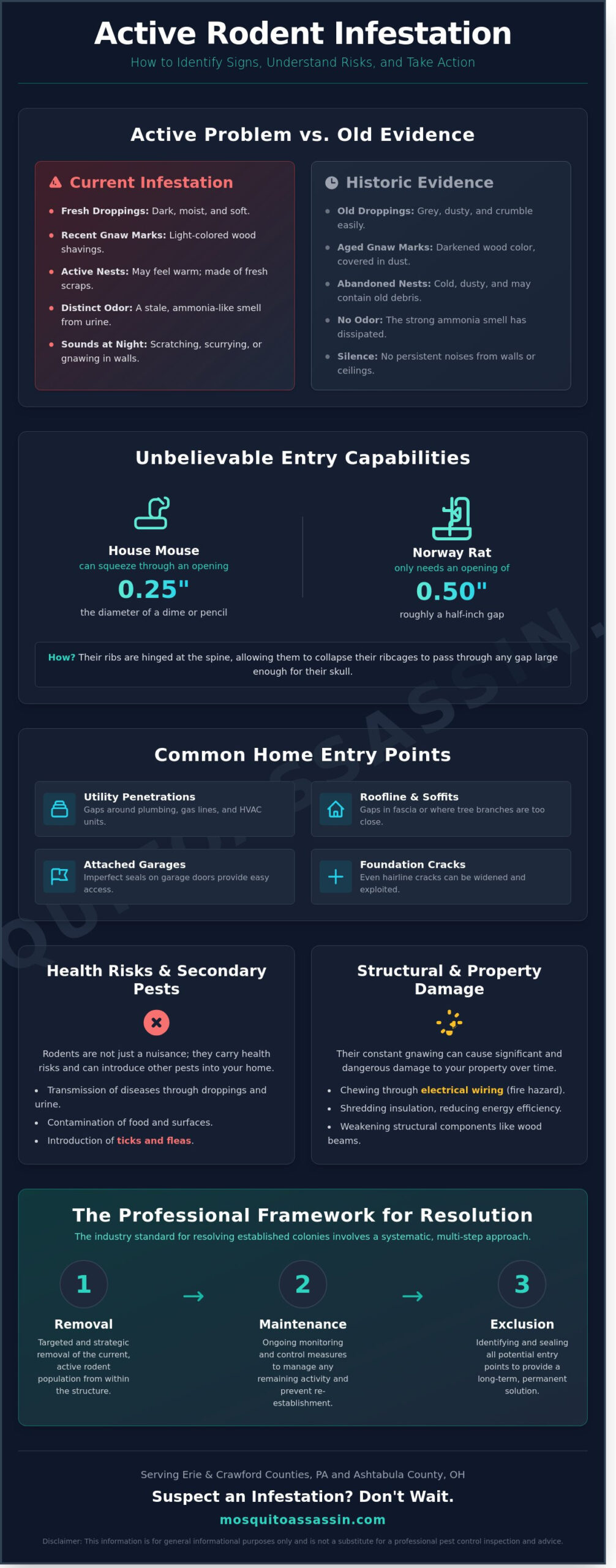
    An active rodent problem refers to current, ongoing activity from mice or rats within a home or building. It’s distinct from a historic infestation where only old, dried debris remains. Detecting these pests early is essential because a single pair of mice can produce between five and ten litters in a single year, leading to a population explosion if left unaddressed. In Erie and Crawford Counties in Pennsylvania, and Ashtabula County in Ohio, homeowners primarily encounter the House Mouse, the Deer Mouse, and the Norway Rat. While spotting a live rodent is a definitive sign, most people identify active rodent problems through secondary evidence left behind during the night.

    Visual Indicators of Current Activity

    Fresh droppings are the most reliable indicator of current activity. New droppings appear dark, moist, and have a soft consistency; old droppings turn grey, dusty, and crumble when disturbed. Homeowners should also look for fresh gnaw marks on baseboards, utility lines, or food packaging. These marks often leave behind light-colored wood shavings or small plastic fragments that haven’t yet gathered dust. Active nesting sites are typically tucked away in wall voids or behind large appliances. These nests are constructed from shredded insulation, fabric, or paper, and will often feel warm to the touch if they’ve been recently occupied.

    Auditory and Behavioral Clues

    Rodents are nocturnal, which means scratching, gnawing, or scurrying sounds inside ceilings and walls are most audible after sunset. Domestic pets often detect these movements long before humans do. If a dog or cat persistently paws at a specific wall section or stares intensely at a gap under a kitchen cabinet, it often indicates a rodent is moving behind the surface. Additionally, a distinct, stale odor similar to ammonia may persist in enclosed areas like pantries, closets, or crawlspaces. This smell is caused by accumulated urine and signifies a concentrated area of activity. Identifying these signs early allows for a faster response before the population spreads to other areas of the structure.

    If you suspect an infestation, professional pest control may help reduce risk. You can find more information at mosquitoassassin.com/services or book an inspection through the online booking portal.

    Disclaimer: The information provided on this blog is for general informational purposes only and is not intended as professional pest control advice. Conditions vary by property, environment, and location. Reading this content does not create a service agreement. For an inspection or professional recommendations, please contact Mosquito Assassin Pest Control LLC directly.
    Understanding Rodent Behavior and Seasonal Entry Points

    Rodents are remarkably discreet. Most homeowners don’t realize they have active rodent problems until a population has already established itself. Because mice and rats are nocturnal, they spend daylight hours nesting in wall voids, crawlspaces, or attic insulation. They typically emerge only when the house is quiet and dark. A single “scout” rodent often enters a structure first to assess safety and food availability. If the scout identifies a reliable heat source and accessible crumbs, it leaves pheromone trails that guide the rest of the colony directly into the home.

    These pests possess incredible physical flexibility. A house mouse can squeeze through a hole just 0.25 inches wide, which is roughly the diameter of a standard pencil. Larger Norway rats only need an opening of 0.5 inches to gain entry. Their ribs are hinged at the spine, allowing them to collapse their ribcages and pass through any gap large enough for their skull. This physical capability makes every small crack a potential gateway for an infestation.

    Common Access Points in the Home

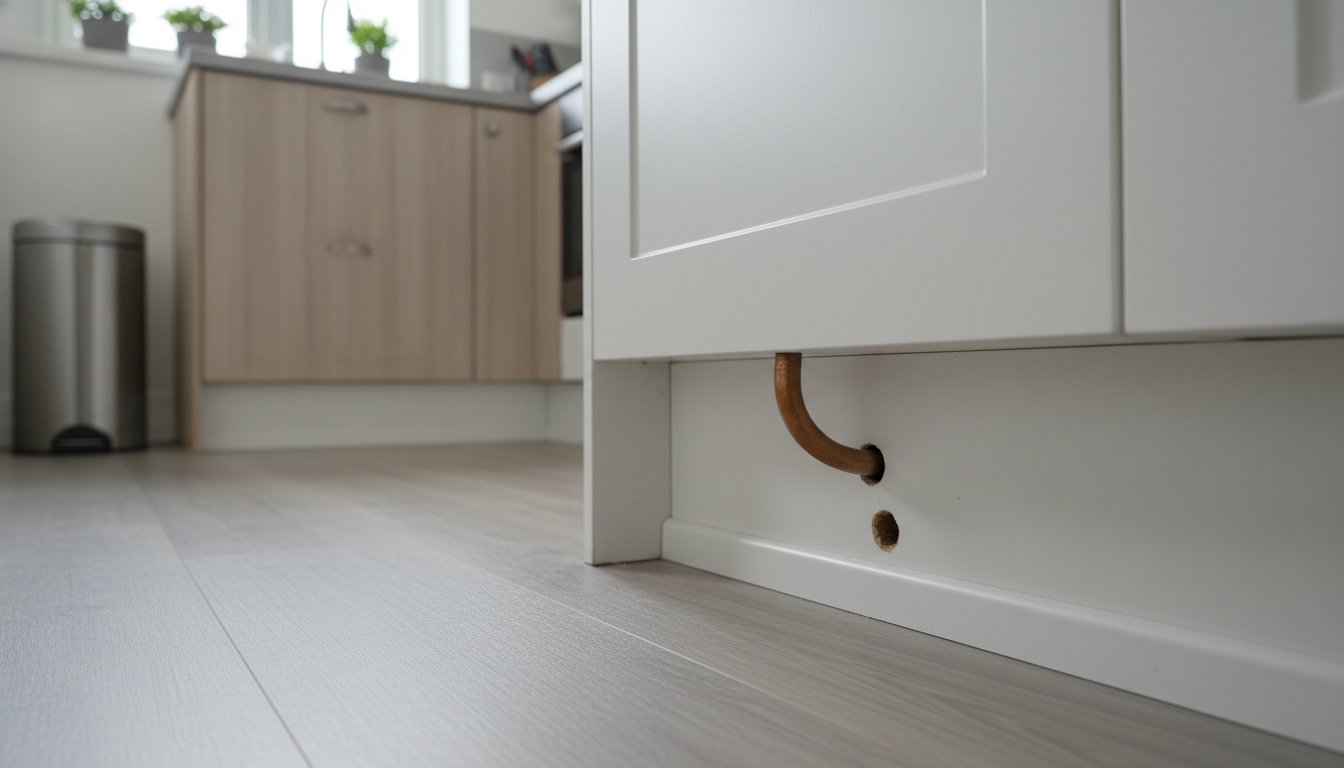
    • Utility Penetrations: Gaps around plumbing stacks, gas lines, and HVAC refrigerant lines are primary targets.
    • The Roofline: Gaps in the soffit or fascia boards allow rodents to enter attics, especially if tree branches hang within 3 feet of the gutters.
    • Attached Garages: These areas often serve as the first point of entry because garage doors rarely create a perfect seal against the pavement.
    • Foundation Cracks: Even a hairline fracture in a concrete block can be gnawed into a larger opening by a determined rat.

    The Impact of Local Climate on Infestations

    In Erie and Crawford Counties, the arrival of the first frost typically triggers a massive indoor migration. As temperatures drop below 40 degrees Fahrenheit, rodents seek the consistent 70-degree warmth of human dwellings. Fall food sources, such as fallen apples or birdseed from feeders, often draw them toward the foundation initially. During humid Ohio summers in Ashtabula County, rodents may enter homes specifically searching for water, targeting leaky pipes or condensation under kitchen sinks. Identifying these environmental triggers may help homeowners secure their properties before the weather shifts.

    Disclaimer: The information provided on this blog is for general informational purposes only and is not intended as professional pest control advice. Conditions vary by property, environment, and location. Reading this content does not create a service agreement. For an inspection or professional recommendations, please contact Mosquito Assassin Pest Control LLC directly.
    Health Risks and Property Damage Associated with Infestations

    Active rodent problems pose more than just a nuisance; they represent a significant threat to the safety of residents in Erie County and surrounding areas. Direct contact with rodent waste, including urine and saliva, can lead to serious health complications for humans and domestic animals. Beyond direct contact, these pests act as biological vehicles, carrying secondary hitchhikers like ticks, fleas, and mites into living spaces. These parasites can quickly transition to pets and family members, creating a multi-layered infestation that requires comprehensive attention. Professional pest control may help reduce risk to families and pets by identifying these hidden hazards before they spread.

    Diseases Spread by Rodents

    Rodents are known carriers of over 35 diseases worldwide according to the Centers for Disease Control and Prevention. Salmonellosis is frequently spread through contaminated food or surfaces, while Leptospirosis can be contracted through contact with water or soil contaminated by rodent urine. A particularly dangerous risk is Hantavirus Pulmonary Syndrome. This respiratory disease is transmitted when people inhale dust contaminated by rodent droppings or nesting materials. Because of these airborne risks, professional cleaning is often necessary after a significant infestation is resolved to ensure all microscopic pathogens are safely removed from the environment.

    Structural and Fire Hazards

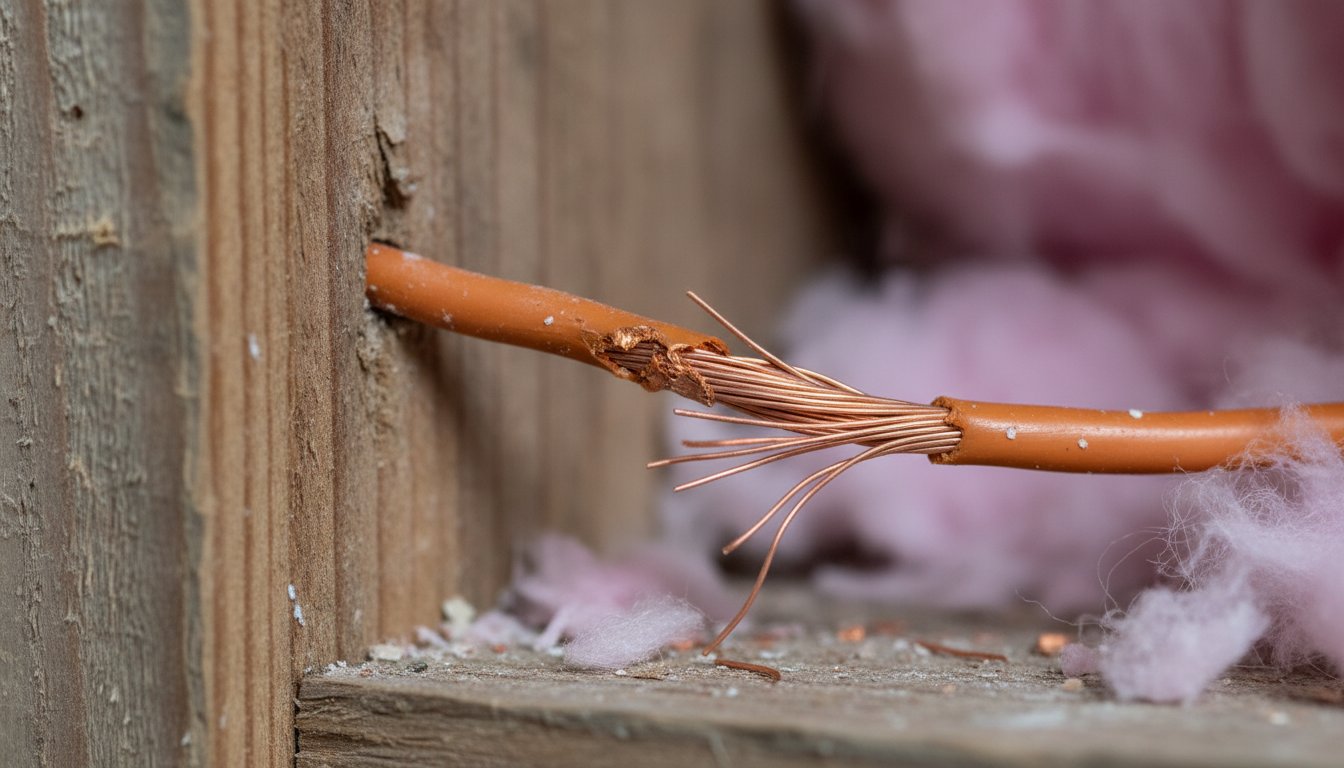
    The physical damage caused by rodents is often expensive and dangerous. Because their incisors never stop growing, rodents must gnaw on hard materials to keep them filed down. This behavior frequently targets electrical wiring inside walls and attics. The National Fire Protection Association estimates that rodents are responsible for approximately 20% of fires labeled with undetermined causes annually. Addressing active rodent problems before they escalate can prevent these catastrophic events.

    In addition to fire risks, rodents frequently destroy attic insulation to create nesting sites. This damage can reduce a home’s energy efficiency by 15% to 25%, leading to higher utility bills for homeowners in Crawford or Ashtabula counties. Their burrowing behavior also compromises the integrity of building materials like drywall, wood, and even soft metals. Professional pest control may help reduce risk by locating entry points and stopping the cycle of destruction. For more information on identifying these risks, residents can visit the contact page to speak with a professional.

    Disclaimer: The information provided on this blog is for general informational purposes only and is not intended as professional pest control advice. Conditions vary by property, environment, and location. Reading this content does not create a service agreement. For an inspection or professional recommendations, please contact Mosquito Assassin Pest Control LLC directly.
    Environmental Modifications to Discourage Rodent Activity

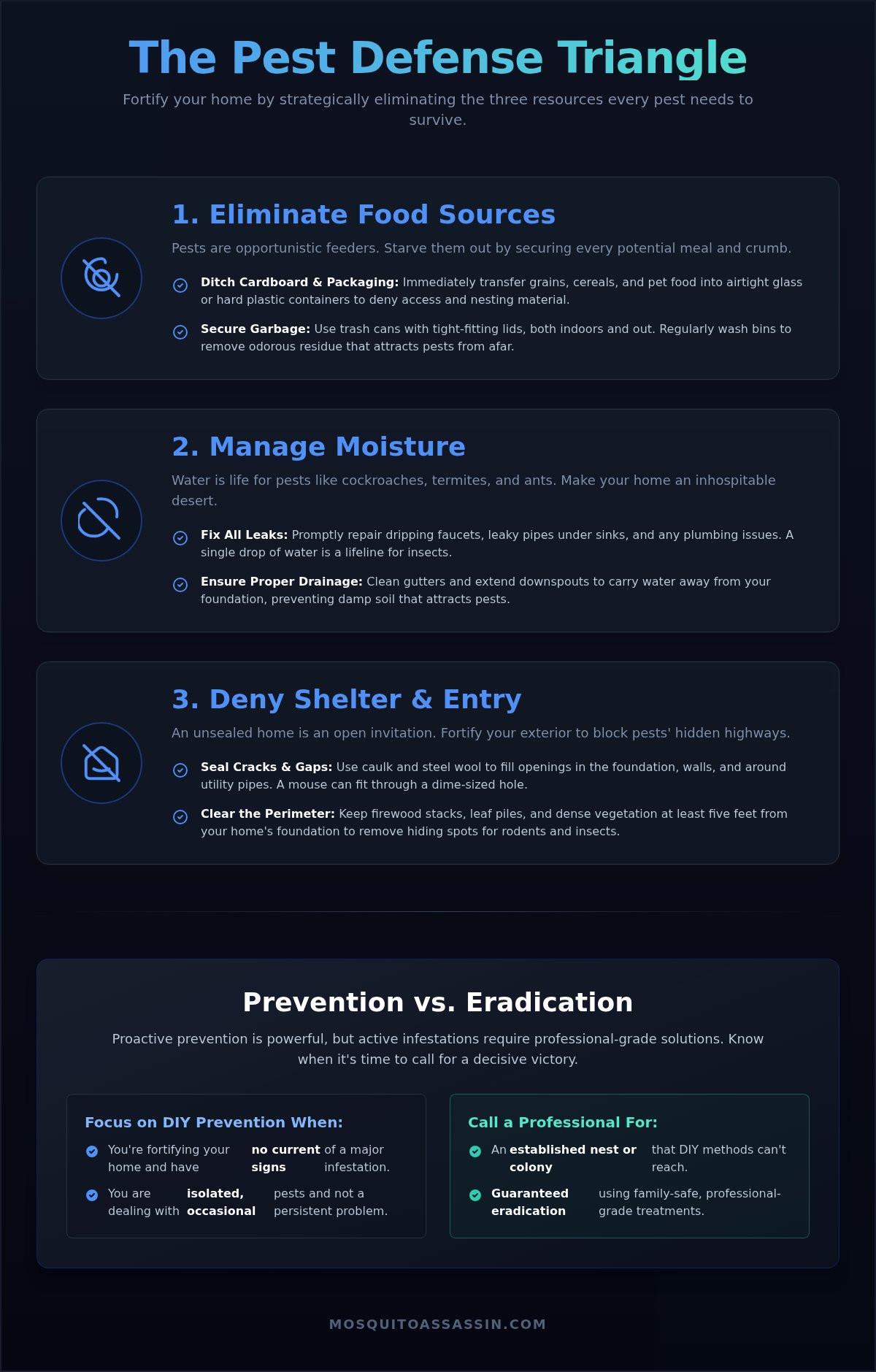
    Eliminating the resources rodents need to survive is the most effective way to address active rodent problems. When a property provides easy access to food, water, and shelter, it becomes a target for local populations in Erie and Crawford Counties. Sanitation isn’t just about cleanliness; it’s a strategic method of integrated pest management that makes your home less hospitable to intruders. By removing attractants, you force rodents to look elsewhere for their survival needs.

    Interior Sanitation and Food Storage

    Rodents possess incredibly sharp incisors that can easily penetrate cardboard boxes or thin plastic bags. To protect your supplies, store all pantry items in airtight glass or heavy plastic containers. This prevents the scent of food from attracting pests and denies them a meal if they do manage to enter. Deep cleaning is also vital for long-term management. In roughly 80% of residential kitchens, grease and crumbs accumulate behind stoves and refrigerators, providing enough calories to sustain a small colony for weeks. Additionally, homeowners should eliminate standing water in basements or under sinks. Even a small leak provides the hydration necessary for a rodent to thrive.

    Exterior Exclusion and Yard Maintenance

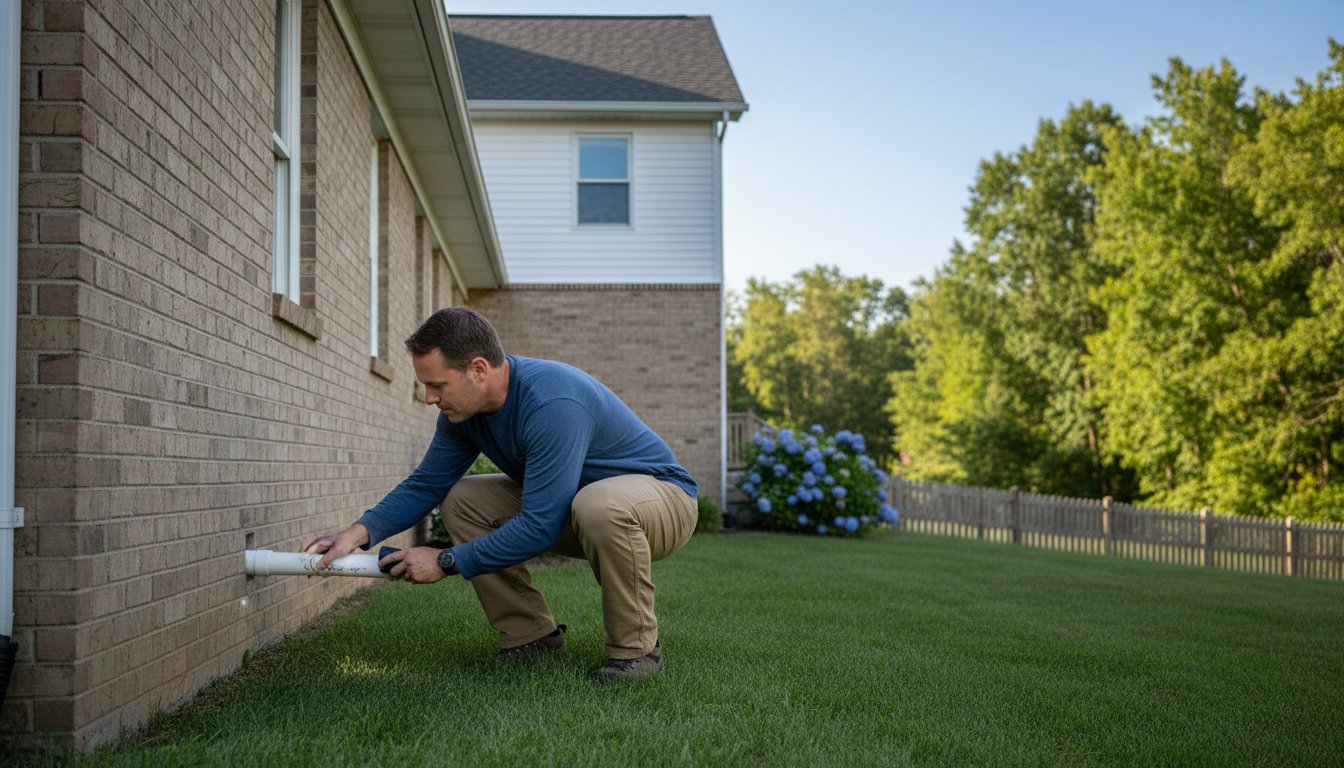
    Securing the perimeter is a primary step in preventing new arrivals from entering your living space. Mice can fit through an opening as small as 1/4 inch, which is roughly the width of a standard pencil. Seal these small gaps with steel wool and caulk; rodents cannot easily chew through metallic fibers. Maintaining the yard is equally important for long-term protection in the Ashtabula County area.

    • Trim Vegetation: Keep tree branches and shrubs at least 3 feet away from the roofline to remove “natural bridges” that allow roof rats access to your attic.
    • Manage Storage: Keep firewood stacks at least 20 feet away from the foundation and elevated off the ground to eliminate easy nesting sites.
    • Control Feeders: Bird feeders and outdoor pet bowls are major attractants. Spilled seeds can attract dozens of rodents to a yard in a single night.

    If you suspect your property has structural vulnerabilities, professional pest control may help reduce risk by identifying entry points you might’ve missed. Taking these practical steps creates a formidable barrier against active rodent problems and helps safeguard your family’s environment.

    Disclaimer: The information provided on this blog is for general informational purposes only and is not intended as professional pest control advice. Conditions vary by property, environment, and location. Reading this content does not create a service agreement. For an inspection or professional recommendations, please contact Mosquito Assassin Pest Control LLC directly.
    The Professional Framework for Resolving Active Infestations

    Resolving active rodent problems requires more than a few hardware store traps. Professionals follow a rigorous three-step protocol: removal, maintenance, and exclusion. This framework is the industry standard because it addresses the biology of the pest, not just the visible symptoms. DIY methods frequently fail because they don’t account for the rapid reproductive rate of a colony. For example, a single female mouse can produce up to 10 litters per year. Without a comprehensive strategy, the population grows faster than a homeowner can set individual traps. Licensed experts provide the necessary oversight to break this cycle effectively.

    The Inspection and Removal Phase

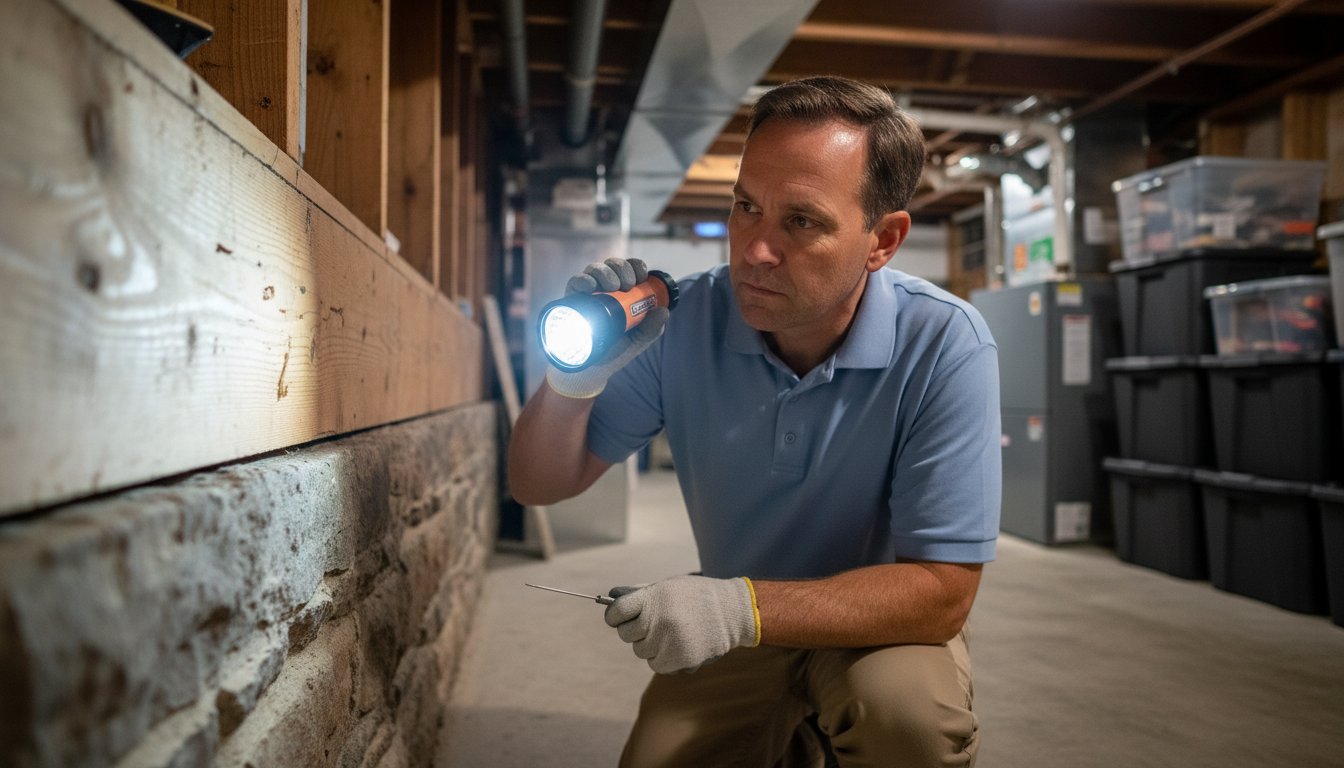
    Licensed technicians use specialized tools, such as high-intensity UV lights and borescopes, to find nests tucked deep inside wall voids. These areas are usually inaccessible to residents without professional equipment. During this phase, experts deploy strategic mechanical controls to rapidly thin the population. This isn’t a one-size-fits-all approach. Instead, professional pest control services develop customized plans based on the specific species and the layout of the structure. This data-driven method ensures that traps are placed in high-traffic runways where rodents feel safest; this increases the success rate by nearly 75% compared to random placement by an amateur.

    Maintenance and Long-Term Exclusion

    Exclusion is the most critical step for permanent relief. A mouse can squeeze through a hole the size of a dime, which is approximately 0.25 inches. Professionals identify these tiny gaps in foundations, soffits, and rooflines that the untrained eye often misses. Ongoing maintenance prevents active rodent problems from recurring after the initial clean-out. This is especially important because rodent pressure changes with the seasons.

    Local pest control experts understand that in regions like Erie and Crawford Counties, the drop in temperature during October triggers a massive migration of rodents into heated crawlspaces. To learn more about the team’s history and commitment to these communities, readers can visit the about page. Consistent monitoring ensures that if a new entry point develops due to house settling or weathering, it’s sealed before a new colony can establish itself.

    Disclaimer: The information provided on this blog is for general informational purposes only and is not intended as professional pest control advice. Conditions vary by property, environment, and location. Reading this content does not create a service agreement. For an inspection or professional recommendations, please contact Mosquito Assassin Pest Control LLC directly.
    Securing Your Property Against Future Infestations

    Rodents don’t need much space to cause significant trouble; a hole the size of a dime is often enough for a mouse to gain entry. Since a single pair of rats can produce up to 1,250 descendants in one year, ignoring early warning signs isn’t an option. Effective management of active rodent problems requires a combination of structural repairs and strategic environmental changes. Homeowners in Erie and Crawford Counties, Pennsylvania, and Ashtabula County, Ohio, can rely on professional standards to safeguard their property. Licensed and insured in both PA and OH, this five-star rated local service utilizes family-safe treatment approaches to address infestations at the source. Taking these steps protects against the 20 percent of house fires with undetermined causes that are often linked to rodent-gnawed wires. For a professional inspection or recommendations regarding this issue, please contact Mosquito Assassin Pest Control LLC directly. Maintaining a pest-free home is an achievable goal with the right professional guidance.

    Disclaimer: The information provided on this blog is for general informational purposes only and is not intended as professional pest control advice. Conditions vary by property, environment, and location. Reading this content does not create a service agreement. For an inspection or professional recommendations, please contact Mosquito Assassin Pest Control LLC directly.

    Frequently Asked Questions

    How can I tell if a mouse dropping is new or old?

    New droppings are dark and moist, while old ones appear gray, dull, and crumbly to the touch. Fresh droppings often look like black grains of rice and will glisten under a flashlight for the first 24 hours. If you find soft, pliable droppings in your Erie County home, it’s a clear indicator of active rodent problems that require immediate attention.

    Can rodents actually chew through electrical wires in the walls?

    Rodents frequently chew through electrical wires because their incisors grow about 4 to 5 inches per year and must be worn down constantly. This behavior causes roughly 20% to 25% of fires with undetermined causes in the United States every year. They target the plastic insulation on wiring in walls and attics, which can lead to short circuits or total power failure in specific rooms.

    What is the fastest way to stop rodents from entering my home?

    Sealing every exterior gap larger than 1/4 inch with steel wool and silicone caulk is the most immediate way to block access. Focus on areas where utility pipes enter the siding, as these are common bypasses for pests. While traps can remove individuals, permanent exclusion is the only way to ensure active rodent problems don’t continue through the winter months in Ashtabula County.

    Is it possible to have an active rodent problem without ever seeing a mouse?

    Yes, it’s common to have an infestation without ever seeing a live rodent because they’re nocturnal and naturally avoid humans. You’re more likely to find secondary signs like 3 to 5 millimeter grease marks along baseboards or chewed food packaging. In a typical infestation, for every one mouse seen during the day, there may be 10 to 12 others hiding nearby in wall voids.

    What diseases are most commonly spread by rodents in the United States?

    Rodents in the United States most commonly spread Hantavirus, Leptospirosis, and Salmonellosis through their waste. The CDC tracks these illnesses, noting that Hantavirus is often transmitted through the inhalation of dust contaminated with rodent urine. Maintaining a clean environment in Crawford County helps reduce the risk of the 35 different diseases that rodents can carry or spread to humans.

    How small of a hole can a rat or mouse actually fit through?

    A house mouse can squeeze through a hole the size of a dime, which is approximately 0.25 inches in diameter. Rats are larger but can still fit through any opening the size of a quarter, or about 0.5 inches wide. If a rodent can fit its skull through a gap, its flexible rib cage allows the rest of its body to follow through the opening easily.

    Why do I hear scratching noises in my walls only at night?

    You hear scratching at night because mice and rats are nocturnal, meaning their peak activity occurs between dusk and dawn. They use the cover of darkness to forage for food and gather nesting materials within wall cavities or floor joists. These sounds are often amplified by the hollow space between studs, making a single 20-gram mouse sound like a much larger animal.

    What are the most common entry points for rodents in a typical garage?

    The most frequent entry point in a garage is the bottom corners of the overhead door where the rubber weather stripping has worn away. Gaps as small as 1/4 inch allow easy access for pests seeking shelter from the cold. Other common spots include the threshold of the side entry door and unsealed holes for electrical conduits or irrigation lines that pass through the garage walls.

    Disclaimer: The information provided on this blog is for general informational purposes only and is not intended as professional pest control advice. Conditions vary by property, environment, and location. Reading this content does not create a service agreement. For an inspection or professional recommendations, please contact Mosquito Assassin Pest Control LLC directly.
  • Emergency Pest Control: Determining When Immediate Professional Intervention is Required

    Emergency Pest Control: Determining When Immediate Professional Intervention is Required

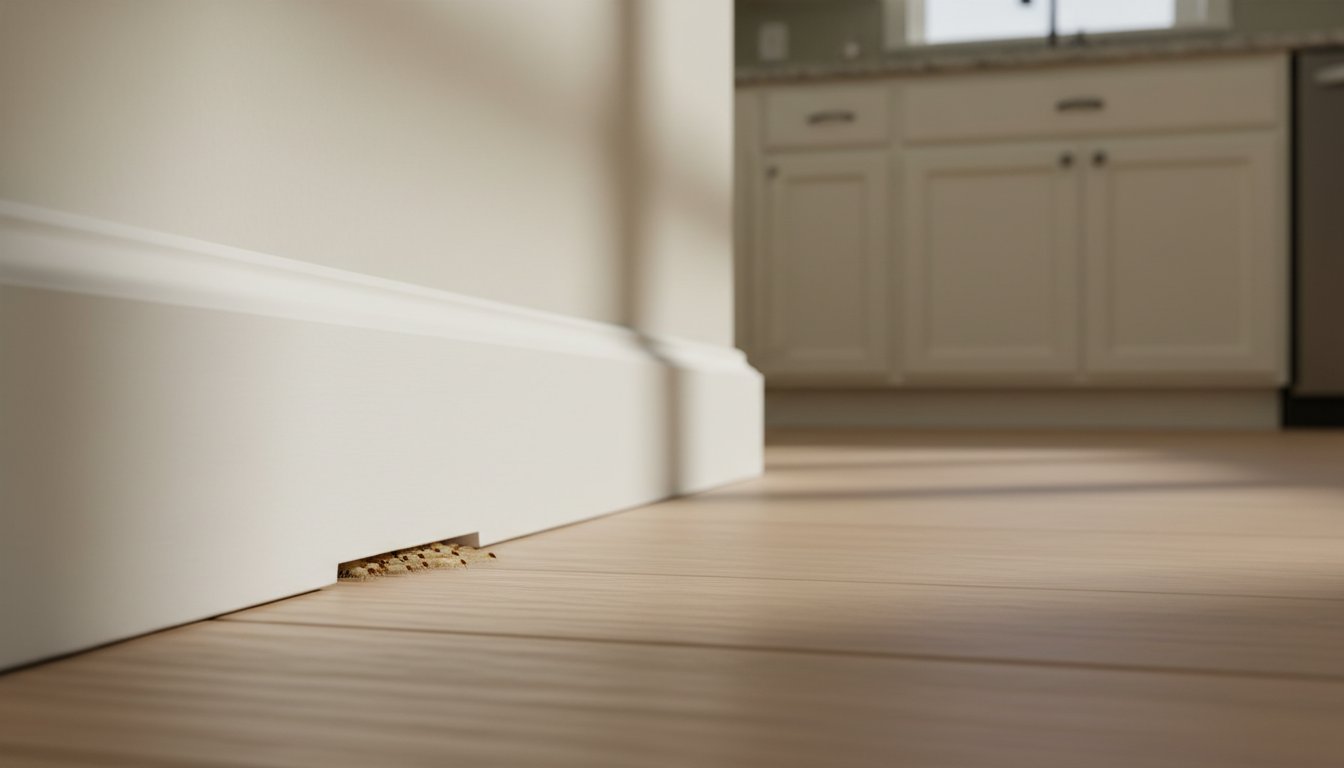
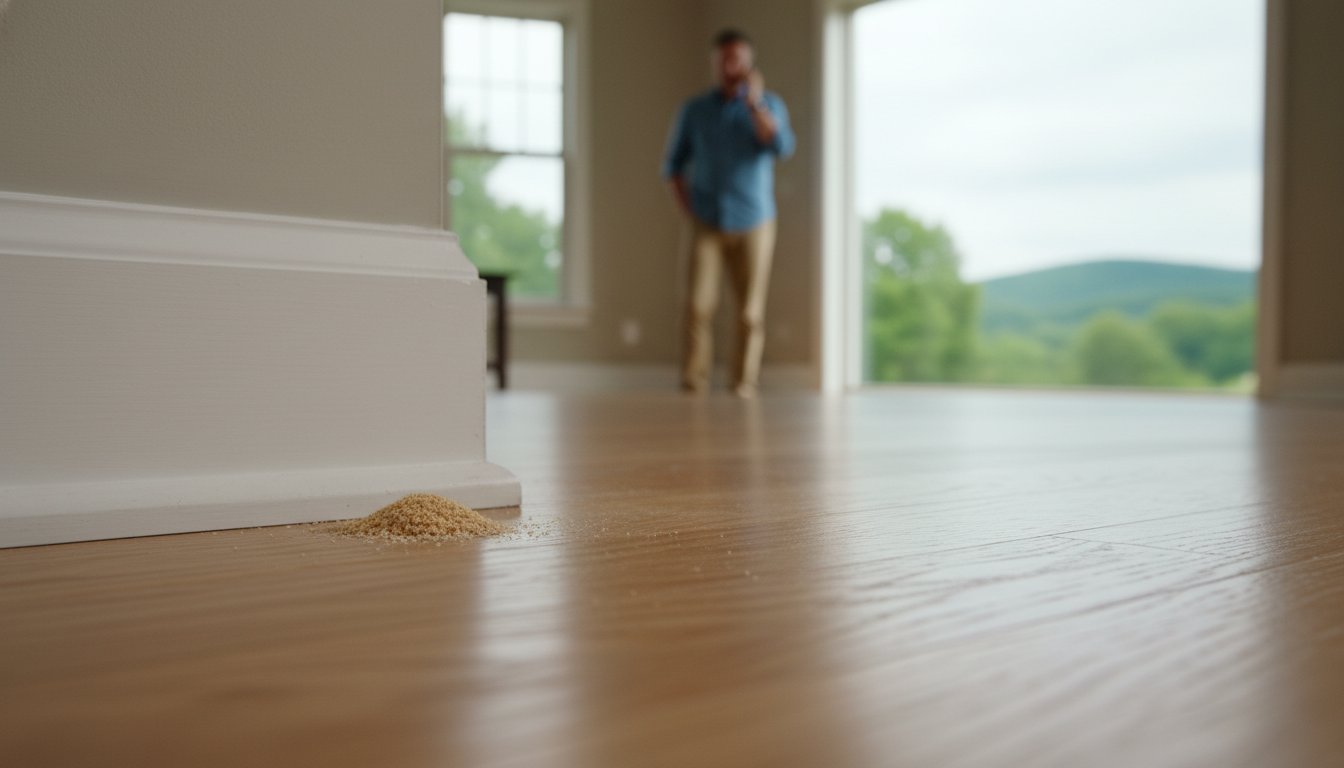
    On a humid Tuesday evening in Erie County, a homeowner discovered a massive swarm of subterranean termites emerging from a baseboard, indicating a colony that had been silently damaging the home’s structure for months. This discovery often leads to the urgent question: Q: Are you available for same-day or emergency pest control service? Most people agree that the sight of a sudden infestation triggers immediate anxiety regarding property damage and the safety of children and pets. You’ll learn how to distinguish between a routine nuisance and a genuine pest emergency that requires rapid intervention.

    This guide provides the critical steps for safeguarding your property and maintaining a safe environment before a licensed professional arrives on the scene. This article examines specific red flags like structural buzzing or nesting in electrical boxes and outlines a clear plan for immediate risk reduction and long-term prevention. Understanding these triggers ensures that the process to eliminate the threat begins the moment it is identified.

    Disclaimer: The information provided on this blog is for general informational purposes only and is not intended as professional pest control advice. Conditions vary by property, environment, and location. Reading this content does not create a service agreement. For an inspection or professional recommendations, please contact Mosquito Assassin Pest Control LLC directly.

    Key Takeaways

    • Identify the specific indicators that distinguish a minor nuisance from a true pest emergency requiring you to ask, Q: Are you available for same-day or emergency pest control service?
    • Understand the biological factors that cause certain infestations to spread rapidly, providing clarity for those asking, Q: Are you available for same-day or emergency pest control service?
    • Learn the critical safety protocols to implement to protect your household while awaiting a response to the question, Q: Are you available for same-day or emergency pest control service?
    • Evaluate the strategic differences between year-round protection and reactive treatments for those wondering, Q: Are you available for same-day or emergency pest control service? in Erie, Crawford, and Ashtabula counties.
    • Discover how delayed responses to wood-destroying organisms can lead to rapid escalation of damage, making the answer to Q: Are you available for same-day or emergency pest control service? a top priority for property owners.

    Defining a Pest Control Emergency: When to Seek Immediate Assistance

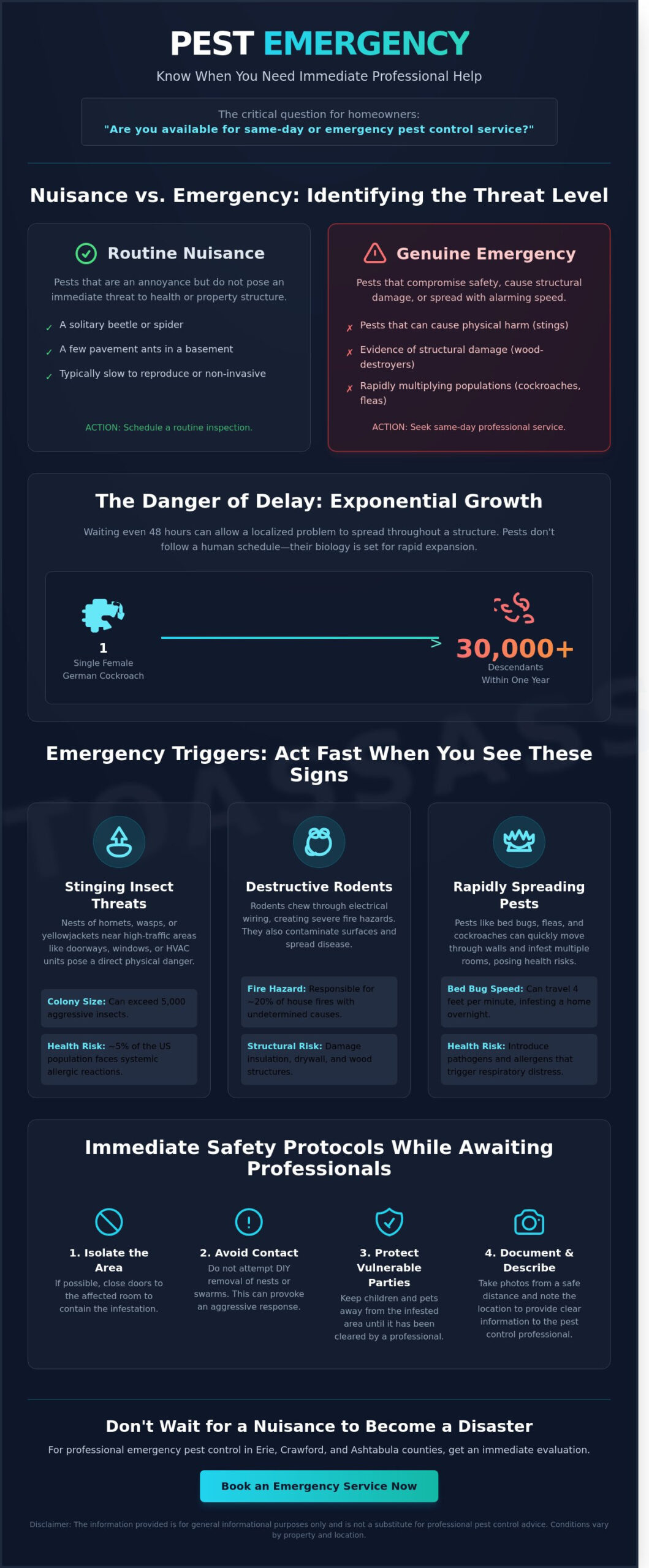
    Homeowners in Erie, Crawford, and Ashtabula counties often face situations where a pest presence shifts from a minor annoyance to a legitimate crisis. Determining when a situation requires an immediate response is critical for property protection and resident safety. A common inquiry during these high-pressure moments is, Q: Are you available for same-day or emergency pest control service? Identifying the difference between a nuisance and an emergency often comes down to the speed of reproduction and the potential for physical harm.

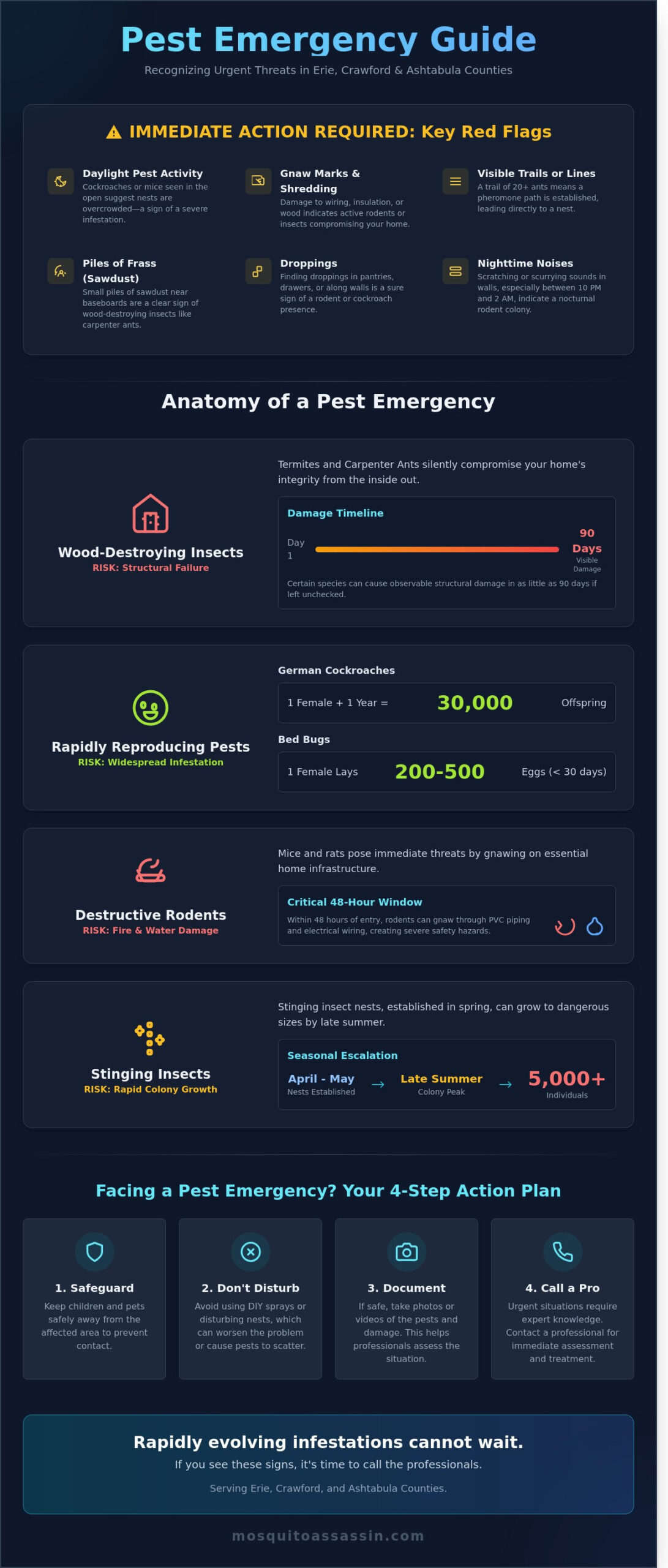
    A nuisance pest, like a solitary beetle or a few pavement ants in a basement, typically doesn’t require an hour-by-hour response. However, an emergency involves pests that compromise the safety of the inhabitants or the structural stability of the building. Rapid response is necessary because many pests follow an exponential growth curve. For example, a single German cockroach and her offspring can produce 30,000 individuals within one calendar year. Waiting even 48 hours to begin treatment can allow a localized problem to spread into wall voids and adjacent rooms. Professional intervention utilizes specialized equipment, such as high-volume injection systems and HEPA-filtered extraction tools, which aren’t available to the general public through retail channels.

    Stinging Insect Threats Near Entry Points

    When hornets, wasps, or yellowjackets establish nests directly above doorways or near HVAC units, they pose an immediate physical threat. Statistics from the Journal of Asthma and Allergy indicate that approximately 5% of the U.S. population will experience a systemic allergic reaction to insect stings in their lifetime. DIY removal is dangerous for unlicensed individuals because a single colony can contain over 5,000 aggressive insects. Professionals use protective gear and long-range application tools to ensure safety while removing the threat from high-traffic areas.

    Rapidly Spreading Indoor Infestations

    Indoor emergencies often involve pests that move quickly or cause hidden damage. Bed bugs can travel 4 feet per minute; this means they can infest multiple rooms in a single night. Rodents present a different type of emergency; they’re responsible for an estimated 20% of house fires with undetermined causes due to their habit of gnawing on electrical insulation. In residential spaces, sudden surges of fleas or cockroaches introduce pathogens and allergens that trigger respiratory distress. These situations demand a fast assessment to stop the cycle of destruction before it impacts every room in the house.

    Understanding these risks helps residents prioritize their response. When these signs appear, professional pest control may help reduce risk and prevent further escalation. Residents often ask, Q: Are you available for same-day or emergency pest control service? when they discover a nest or infestation that threatens their peace of mind. Accessing professional help quickly ensures that the right tools are deployed before the population doubles. For an evaluation in the tri-state area, visiting the online booking portal at https://portal.gorilladesk.com/mosquitoassassin is a practical first step toward resolving the issue.

    Disclaimer: The information provided on this blog is for general informational purposes only and is not intended as professional pest control advice. Conditions vary by property, environment, and location. Reading this content does not create a service agreement. For an inspection or professional recommendations, please contact Mosquito Assassin Pest Control LLC directly.
    The Risks of Delayed Response in Pest Management

    Pests don’t follow a human schedule, and their biological clocks are set for rapid expansion. A single female German cockroach can produce a lineage of 30,000 descendants within a single year if environmental conditions are favorable. This exponential growth turns a minor nuisance into a structural crisis in a matter of weeks. Homeowners often ask, Q: Are you available for same-day or emergency pest control service? because they recognize that every hour of delay allows for another cycle of reproduction. In regions like Erie and Crawford Counties, local climate shifts can accelerate these cycles during peak seasons, making immediate intervention a professional necessity.

    The correlation between response time and eradication success is absolute. Professional data suggests that treating an infestation in its early stages is 40 percent more likely to achieve total elimination with fewer intervention cycles. Waiting until a pest problem is visible to the naked eye often means the colony has already established deep roots within wall voids or foundations. Prompt action limits the biological footprint of the pests, reducing the amount of sanitization and structural repair needed after the treatment is complete. A rapid response ensures that the customized treatment plan can be implemented while the population is still manageable.

    Property and Structural Integrity Concerns

    Structural damage is rarely a sudden event; it’s a persistent erosion of a home’s value. Carpenter bees and termites are particularly destructive in the tri-county area of Pennsylvania and Ohio. Termites consume cellulose 24 hours a day, and a mature colony can eat through a significant portion of a 2×4 stud in approximately six months. Professional pest management services can help identify hidden structural risks before they require expensive contractor repairs. Beyond wood destruction, rodents pose a severe fire hazard. The National Fire Protection Association has indicated that rodents chewing through electrical insulation are responsible for a notable percentage of house fires with undetermined origins. Common property risks include:

    • Structural weakening of floor joists and support beams from wood-boring insects.
    • Damage to attic insulation and drywall from rodent nesting materials.
    • Compromised electrical systems and potential short circuits from gnawing pests.

    Public Health and Safety Considerations

    The presence of pests introduces a variety of pathogens into the living environment. In the United States, ticks and mosquitoes are the primary vectors for diseases like Lyme disease and West Nile virus. These aren’t just outdoor concerns; pests often find ways into basements and attics where they continue to shed bacteria and parasites. Pest waste, including droppings and shed skins, degrades indoor air quality. This organic debris becomes airborne, acting as a potent trigger for respiratory issues and allergic reactions. Meeting local health standards in residential properties requires a proactive approach to sanitation and pest exclusion. If an infestation is suspected, seeking an inspection through a professional booking portal can help mitigate these health risks quickly.

    Addressing an infestation immediately isn’t just about comfort; it’s about protecting the long-term viability of the asset. When residents inquire, Q: Are you available for same-day or emergency pest control service? they’re taking the first step in a methodical process to safeguard their property. Fast action prevents the physical and financial stress of a long-term battle against established colonies.

    Disclaimer: The information provided on this blog is for general informational purposes only and is not intended as professional pest control advice. Conditions vary by property, environment, and location. Reading this content does not create a service agreement. For an inspection or professional recommendations, please contact Mosquito Assassin Pest Control LLC directly.
    Emergency Intervention vs. Year-Round Protection Plans

    The tactical difference between reactive emergency service and proactive management is the difference between fighting a fire and installing a sprinkler system. Emergency interventions are designed for immediate impact; they stop the current infestation in its tracks to prevent further property damage. However, relying solely on these one-time events often leads to a cycle of “pest-and-spray” where the problem returns every few months. Homeowners in Erie County and Crawford County frequently find themselves asking, “Q: Are you available for same-day or emergency pest control service?” when a sudden swarm or sighting occurs. While immediate response is a critical tool for safety, it is only the first step in a larger strategy for property protection.

    Transitioning from an emergency state to a maintenance-free environment requires a systematic approach. Professionals use the initial emergency visit to stabilize the situation, but the real work begins with a comprehensive assessment of the property’s vulnerabilities. A 2021 industry report indicated that 65% of residential pest problems stem from structural issues like unsealed gaps or improper drainage. By identifying these factors during an emergency call, a technician can set the stage for a long-term plan that prevents the next crisis. This shift from reactive to proactive care reduces the overall volume of pesticides used on a property by focusing on targeted, strategic applications rather than broad-spectrum emergency saturation.

    The Limitations of One-Time Treatments

    One-time treatments often fail to address the complex life cycles of common pests. A single application may kill adult fleas, but it will not affect the pupae stage, which can remain dormant for 30 days. Without a scheduled follow-up, the infestation will likely resurface. Monitoring after an emergency is essential to confirm total eradication. You can learn more about the professional approach to managing these biological timelines.

    The Value of Consistent Management

    Consistent management visits, performed bi-monthly or quarterly, provide a shield for the home. These visits focus on exclusion techniques, such as sealing 1/8-inch gaps that serve as entry points. In Ashtabula County, seasonal shifts drive different pests indoors; a year-round plan anticipates these movements. This stability removes the anxiety of a 2:00 AM discovery. When residents ask, “Q: Are you available for same-day or emergency pest control service?”, they seek the peace of mind that consistent protection provides.

    The long-term benefits of integrated pest management (IPM) go beyond just killing bugs. It involves environmental modifications that make a home less attractive to pests. This includes managing moisture levels in crawlspaces and ensuring that mulch is kept at least 12 inches away from the foundation. These practical steps, combined with professional monitoring, create a barrier that emergency-only services cannot replicate. Moving away from the stress of emergency calls allows property owners to enjoy their space without the constant threat of a sudden infestation. Professional pest control may help reduce risk by maintaining these barriers year-round.

    Disclaimer: The information provided on this blog is for general informational purposes only and is not intended as professional pest control advice. Conditions vary by property, environment, and location. Reading this content does not create a service agreement. For an inspection or professional recommendations, please contact Mosquito Assassin Pest Control LLC directly.
    Emergency Pest Control: Determining When Immediate Professional Intervention is Required

    Immediate Safety Protocols While Awaiting Professional Service

    When a homeowner asks, “Q: Are you available for same-day or emergency pest control service?” the immediate goal is stabilization. While waiting for a professional to arrive at a property in Erie County, Crawford County, or Ashtabula County, taking proactive steps can limit the spread of an infestation. These initial actions don’t involve chemicals; instead, they focus on physical barriers and hazard reduction. It’s essential to treat every active infestation as a potential safety risk until a licensed technician completes a full assessment of the environment.

    Securing the Environment

    Safety starts with isolating the area of activity to protect vulnerable residents. If stinging insects like yellow jackets or hornets are spotted near an entry point, all windows and doors must remain closed. According to the American College of Allergy, Asthma & Immunology, insect stings send more than 500,000 people to emergency rooms every year. Keeping children and pets in a separate, unaffected part of the home prevents accidental encounters that could lead to injury. For indoor pests like rodents or cockroaches, sanitation is the most effective temporary deterrent. A single gram of food waste can sustain a small colony of cockroaches for an entire week, so immediate cleaning of crumbs and spills is vital. Homeowners should move all pantry items from cardboard boxes into airtight glass or heavy-duty plastic containers, as rodents can gnaw through standard paper packaging in less than 24 hours.

    Information Gathering for Technicians

    Documentation provides the technician with a roadmap for the inspection and eventual treatment. High-quality photos of the pests, or the damage they’ve caused, allow for faster identification without the need for the technician to wait for the pest to reappear. It’s also helpful to maintain a simple log of sightings. Noting the exact time and location of activity is crucial because many pests follow strict biological rhythms; for instance, roughly 80% of rodent activity occurs during nocturnal hours. This data helps the professional determine if the infestation is localized or widespread. Before the technician arrives, clearing a path to utility closets, attic hatches, and crawl space entries is a practical step. Research indicates that pre-clearing these access points can reduce the duration of an initial inspection by up to 20%, allowing the treatment phase to begin much sooner.

    Non-chemical exclusion is another temporary measure that residents can implement to manage the situation. If a clear entry point is identified, such as a gap under a door or a hole in a screen, blocking it with a heavy object or temporary sealant can slow the rate of entry. However, homeowners shouldn’t seal a hole if they suspect stinging insects are nesting inside, as this may force the insects further into the wall voids of the home. Maintaining a calm, systematic approach ensures that the environment remains controlled until expert help arrives. If there’s an active threat that requires immediate attention, professional pest control may help reduce risk.

    When residents in the tri-county area find themselves asking, “Q: Are you available for same-day or emergency pest control service?” they’re often dealing with high-stress situations. Following these protocols ensures that the household remains as safe as possible while providing the technician with the necessary tools to identify the problem efficiently. Proper preparation directly impacts the success of the eventual treatment plan and helps restore peace of mind to the household.

    Disclaimer: The information provided on this blog is for general informational purposes only and is not intended as professional pest control advice. Conditions vary by property, environment, and location. Reading this content does not create a service agreement. For an inspection or professional recommendations, please contact Mosquito Assassin Pest Control LLC directly.

    Professional Pest Resources in Pennsylvania and Ohio

    Managing pest activity in the Great Lakes region requires an understanding of the specific environmental factors found in Erie, Crawford, and Ashtabula counties. The proximity to Lake Erie creates unique humidity levels and weather patterns that influence how insects and rodents behave throughout the year. When a sudden infestation occurs, property owners often ask, Q: Are you available for same-day or emergency pest control service? Rapid intervention is often necessary to prevent minor issues from becoming structural threats. Professional technicians focus on identifying the source of the problem rather than just treating the visible symptoms.

    Hiring licensed and insured professionals is a critical step for property protection. In Pennsylvania and Ohio, technicians must meet specific state requirements to apply treatments safely and effectively. Verified professionals carry insurance that protects the property owner during the service process. This level of oversight ensures that the methods used align with Integrated Pest Management (IPM) standards, which prioritize long-term prevention and minimal environmental impact. Local expertise is invaluable because technicians who live in these communities understand the specific challenges of the 16417 or 44004 zip codes.

    Regional Pest Dynamics in Northwest PA and Northeast OH

    Crawford County frequently experiences seasonal surges of mosquitoes and ticks, particularly between May and September. Data from regional surveillance often shows higher activity in areas with dense vegetation or standing water. In Erie and Ashtabula, the presence of older residential structures built in the early 1900s provides numerous entry points for rodents during the first frost in November. Winter rodent issues require a focus on exclusion techniques to seal these historical entry points. Businesses can access commercial pest solutions to address these seasonal shifts effectively.

    Connecting with Local Expertise

    Property owners should always verify state licensing through the Pennsylvania or Ohio Department of Agriculture before starting service. Technicians who understand the local climate can better predict pest movements based on lake effect snow or spring flooding. Finding professional support in your specific location ensures the response is tailored to the local geography. Local professionals are familiar with the specific species of ants, spiders, and rodents common to the tri-county area, allowing for more accurate identification and treatment plans.

    Commercial properties face additional pressure to maintain regulatory compliance. Health departments in Erie and Ashtabula counties require strict documentation of pest management activities to ensure public safety. A professional service provides the necessary logs and reports to demonstrate that a facility meets all local health codes. This documentation is essential for restaurants, warehouses, and multi-family housing units where a single lapse in pest control can lead to significant fines or operational shutdowns. Establishing a routine inspection schedule helps businesses stay ahead of potential violations.

    The next step for any property owner dealing with an active concern is to secure a professional inspection. A thorough walkthrough identifies vulnerabilities that are not always obvious to the untrained eye. During this process, a technician might address the common inquiry, Q: Are you available for same-day or emergency pest control service? by evaluating the severity of the situation and recommending an immediate course of action. For those ready to begin, the online booking portal provides a direct way to request a professional evaluation. Taking proactive steps today can prevent the long-term costs associated with pest-related damage.

    Disclaimer: The information provided on this blog is for general informational purposes only and is not intended as professional pest control advice. Conditions vary by property, environment, and location. Reading this content does not create a service agreement. For an inspection or professional recommendations, please contact Mosquito Assassin Pest Control LLC directly.

    Securing Your Property Through Rapid Professional Assessment

    Recognizing the difference between a minor nuisance and a true emergency is vital for effective property maintenance. Immediate intervention is often necessary when pests like stinging insects or rodents threaten the safety of a household or the structural integrity of a building in Erie County, Crawford County, and Ashtabula County. Professionals licensed and insured in Pennsylvania and Ohio understand how regional pest biology affects local structures. While homeowners often wonder, Q: Are you available for same-day or emergency pest control service?, the primary focus remains on rapid assessment to prevent escalating damage. Relying on a locally owned and operated expert ensures that the specific environmental factors of the tri-county area are considered during every inspection. Addressing these issues early helps protect the long-term value of a home. For professional recommendations or to request an inspection, contact Mosquito Assassin Pest Control LLC today. Maintaining a pest-free environment starts with informed decisions and timely professional support.

    Disclaimer: The information provided on this blog is for general informational purposes only and is not intended as professional pest control advice. Conditions vary by property, environment, and location. Reading this content does not create a service agreement. For an inspection or professional recommendations, please contact Mosquito Assassin Pest Control LLC directly.
    Frequently Asked Questions

    Is same-day pest control service usually necessary for ants?

    Same-day service isn’t always required for a few nuisance ants, but it’s vital if you identify carpenter ants or a massive indoor swarm. Carpenter ants can cause structural damage to wooden beams over a period of 12 to 24 months if left unchecked. When a large infestation appears in a kitchen, homeowners often ask, “Q: Are you available for same-day or emergency pest control service?” because ants can contaminate food surfaces within 30 minutes of arrival.

    What should I do if I find a bed bug in my home late at night?

    Isolate the affected room immediately and don’t move any furniture, bedding, or clothing to other parts of the house. You should place the specimen in a sealed plastic bag or glass jar so a professional can provide a 100% accurate identification the next day. Moving items during a panic often spreads the infestation to other sleeping areas, increasing the complexity of the eventual treatment. Professional pest control may help reduce risk when contacted at the first sign of activity.

    Are emergency pest treatments safe for my indoor pets?

    Emergency treatments are safe for domestic pets when a licensed professional applies products according to strict EPA label instructions. Residents in Erie County are typically advised to keep cats and dogs out of the treated area for 2 to 4 hours until the application is completely dry. Following these standard safety protocols ensures that 0% of the treatment poses a risk to your animals once it has settled into the target surfaces.

    How can I tell if a stinging insect nest requires immediate professional removal?

    Immediate removal is necessary if the nest is located within 5 feet of a primary entrance or if a resident has a known allergy to venom. A single yellow jacket nest can house between 1,000 and 5,000 insects by the peak of the summer season. If the insects are nesting inside a wall void or attic space, they pose a constant risk of entering the living quarters, which requires a swift professional response to ensure safety.

    What qualifies as a rodent emergency in a commercial kitchen?

    Any sighting of a live rodent or fresh droppings in a food preparation area constitutes an immediate emergency for a business. Health department regulations in Crawford and Ashtabula Counties may require a facility to close if evidence of rodents is found near open food. A single pair of rats can produce 2,000 droppings in just 7 days, making it essential to address the breach before pathogens like Salmonella spread to customers.

    Can I stay in my house during an emergency pest treatment?

    Whether you can stay depends entirely on the specific application method, as exterior perimeter sprays often allow residents to remain indoors. However, for intensive interior liquid or aerosol treatments, occupants usually need to vacate the premises for 3 to 4 hours. When residents ask, “Q: Are you available for same-day or emergency pest control service?”, they should plan for a brief period of absence to ensure the total safety of the family while the products dry.

    How quickly do pests typically return after an emergency service?

    Most active pests are eliminated within 24 hours, but a follow-up visit is typically scheduled for 10 to 14 days later to address newly hatched larvae. Emergency services focus on the immediate population, yet many species have egg cycles that require a second treatment to break. Statistics show a 40% higher chance of re-infestation within the first month if a secondary inspection isn’t performed to verify the success of the initial knockdown. For more information, visit the online booking portal.

    Disclaimer: The information provided on this blog is for general informational purposes only and is not intended as professional pest control advice. Conditions vary by property, environment, and location. Reading this content does not create a service agreement. For an inspection or professional recommendations, please contact Mosquito Assassin Pest Control LLC directly.

  • Brown Recluse in PA: Identification, Facts, and Common Lookalikes

    Brown Recluse in PA: Identification, Facts, and Common Lookalikes

    Despite the thousands of “confirmed” sightings posted to community groups every summer, arachnologists at Penn State University have documented fewer than 70 actual brown recluse spiders in Pennsylvania over the last several decades. It’s completely natural to feel a surge of anxiety when you spot a fast, tan spider scurrying across your basement floor. The fear of a necrotizing bite is a heavy burden for any homeowner, especially when conflicting information on social media makes every house spider look like a threat.

    You’ll gain the clarity needed to accurately identify the brown recluse in PA by focusing on specific physical traits, like their unique eye pattern, while distinguishing them from common local species. This guide explores the actual risk level for residents in Erie and Crawford Counties and provides practical steps to reduce spider presence in your living spaces. Learning these distinctions helps separate myth from reality so you can regain your peace of mind.

    Disclaimer: The information provided on this blog is for general informational purposes only and is not intended as professional pest control advice. Conditions vary by property, environment, and location. Reading this content does not create a service agreement. For an inspection or professional recommendations, please contact Mosquito Assassin Pest Control LLC directly.
    Key Takeaways

    • Understand why the brown recluse in pa is rarely encountered in the wild and how to identify its unique violin-shaped marking.
    • Distinguish true recluses from common native lookalikes, such as wolf spiders and grass spiders, by examining leg patterns and body hair.
    • Learn about the reclusive nature of these arachnids and identify high-risk hiding spots like stored boxes and seasonal clothing.
    • Discover effective prevention techniques, such as sealing foundation cracks and using specialized outdoor lighting, to reduce spider activity around the home.

    The Reality of Brown Recluse Spiders in Pennsylvania

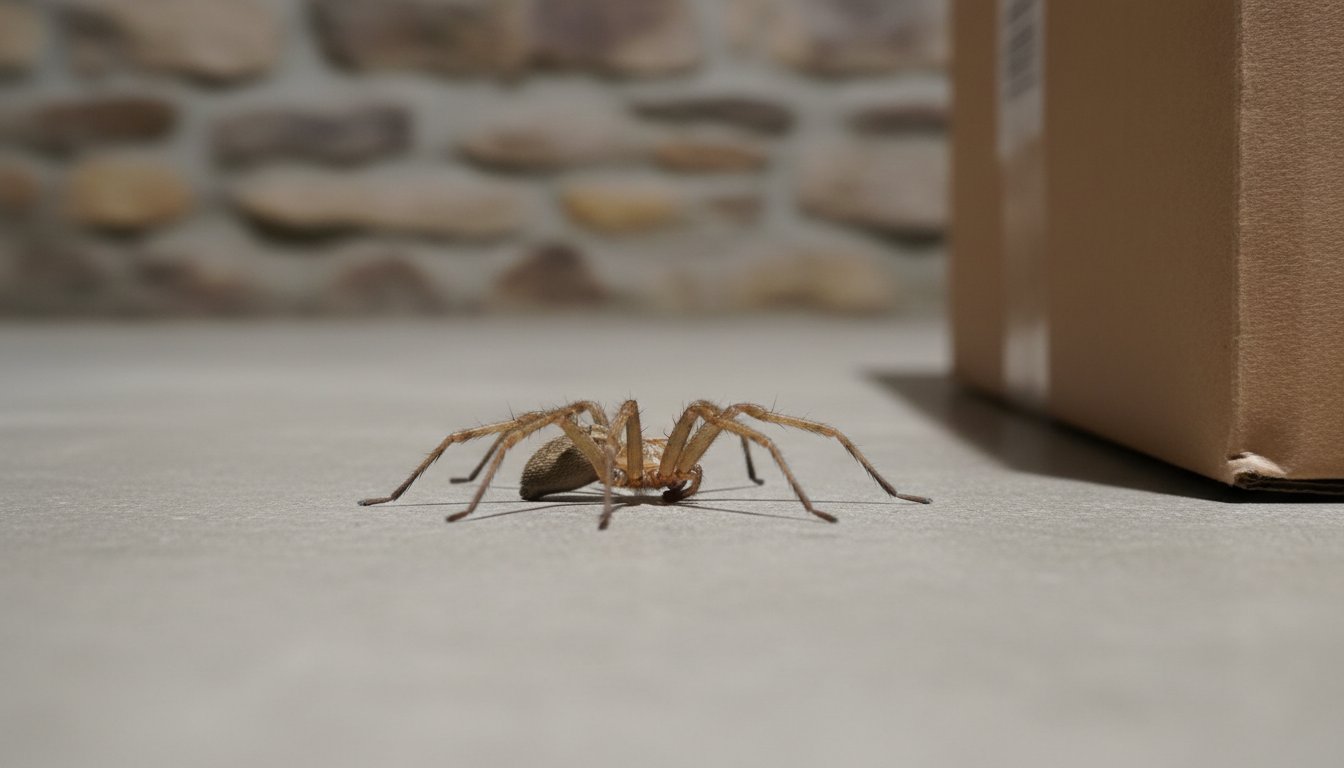
    The brown recluse (Loxosceles reclusa) isn’t a native resident of the Commonwealth of Pennsylvania. Despite frequent online reports and social media rumors, the species doesn’t naturally occur in the local ecosystem. Most reported sightings of a brown recluse in pa, particularly in northern areas like Erie and Crawford Counties, turn out to be common house spiders, wolf spiders, or grass spiders. Identifying these arachnids accurately is the first step in managing home safety and reducing unnecessary fear within the community.

    To better understand the distribution and identification of these arachnids, watch this helpful video:

    Brown recluses are widely known as “hitchhikers” because of their tendency to hide in dark, undisturbed spaces. They often travel across state lines inside corrugated cardboard boxes, moving blankets, or heavy machinery shipped from southern regions. A 2018 study highlighted that while individual spiders can be transported, they rarely establish breeding populations in the Northeast. Finding a brown recluse in pa is statistically unlikely unless the spider was recently introduced through commerce or interstate travel. These spiders can survive for six months or longer without food or water, which makes them resilient travelers during long-distance moves from the South or Midwest.

    Geographic Range and Climate Limitations

    The native range of the Brown recluse spider is centered in the Midwest and Southeast, spanning from Nebraska and Kansas down to the Gulf Coast. Pennsylvania’s climate serves as a natural barrier to their expansion. Sustained temperatures below 40 degrees Fahrenheit are often lethal to these spiders when they lack access to heated structures. Because they’re sensitive to cold, any rare established populations are strictly confined to climate-controlled buildings like warehouses or older homes. Successful breeding in the Northeast remains a biological anomaly. Most isolated cases involve homeowners who recently moved from states like Missouri, Oklahoma, or Tennessee.

    Why Misidentification is Common in the Northeast

    Public anxiety often fuels the belief that every brown spider is a dangerous threat. This confirmation bias leads residents to see the famous fiddle-back mark on spiders that don’t actually possess it. Many native species, like the cellar spider or the common nursery web spider, share similar tan or light brown color palettes. Grass spiders, which are abundant in Erie and Crawford Counties, feature dark stripes that people frequently mistake for the recluse violin pattern. Penn State Extension reports that nearly 99 percent of recluse samples submitted by the public are actually harmless native species. One key identifier is the eye pattern; a recluse has six eyes arranged in three pairs, whereas most other spiders have eight eyes. Utilizing local educational resources helps lower community stress levels. If you’re concerned about a spider in your home, professional pest control may help reduce risk and provide an accurate identification.

    Disclaimer: The information provided on this blog is for general informational purposes only and is not intended as professional pest control advice. Conditions vary by property, environment, and location. Reading this content does not create a service agreement. For an inspection or professional recommendations, please contact Mosquito Assassin Pest Control LLC directly.

    Identifying a True Brown Recluse Spider

    Misidentification is the most frequent issue when homeowners encounter spiders in Erie or Crawford Counties. Many common house spiders, such as the wolf spider or the nursery web spider, share a similar brownish hue; this often leads to unnecessary alarm. However, a genuine brown recluse in pa possesses a specific set of physical characteristics that distinguish it from harmless local species. Accuracy is essential because these spiders aren’t native to our region; they typically arrive through hitchhiking in moving boxes, shipping containers, or vintage furniture. Identification requires a close look at several distinct body features rather than just a quick glance at its color.

    The Violin Marking and Body Coloration

    The most famous identifier is the dark, violin-shaped mark located on the cephalothorax, which is the front portion of the spider where the legs attach. This “fiddle” is usually darker than the rest of the body, with the neck of the violin pointing toward the spider’s abdomen. While this mark is a strong indicator, it isn’t always foolproof. Younger spiders may have a lighter, less distinct marking, and some other species have similar patterns. To confirm an identification, you must look at the rest of the body. A true recluse has a solid color on its legs and abdomen. There are no stripes, bands, or mottling on the legs. According to The Reality of Brown Recluse Spiders in Pennsylvania, these spiders are often confused with more common species that lack these specific solid-color traits.

    The abdomen of the recluse is also a key feature. It is uniformly colored, ranging from light tan to dark brown, and it’s covered in very fine, short hairs. This gives the spider a soft, velvety texture rather than a shiny or spiked appearance. If you see a spider with a patterned abdomen or long, thick spines on its legs, it’s almost certainly not a brown recluse. The legs are smooth and lack the prominent bristles found on many other common Pennsylvania spiders.

    The Six-Eye Pattern: A Definitive Marker

    While the violin mark is famous, the eye arrangement is the most reliable feature used by professionals to confirm the species. Most spiders have eight eyes arranged in two rows of four. The brown recluse is different; it has only six eyes. These eyes are arranged in three distinct pairs, known as dyads, which form a semi-circle on the front of the head. There is one pair in the center and one pair on each side. Because these spiders are small, usually between 0.25 and 0.5 inches in body length, seeing the eyes clearly often requires a magnifying glass or a high-resolution photograph. If you’re unsure about a spider found in your home, professional pest control may help reduce risk by providing an accurate identification.

    Size is another factor to consider. Many people assume these spiders are large, but the body of an adult is rarely larger than a half-inch. With their legs extended, they might reach the size of a United States quarter. If the spider you’ve found is the size of a silver dollar or larger, you’re likely looking at a wolf spider or a common fishing spider rather than a brown recluse in pa. Understanding these minute details ensures that homeowners can react appropriately without panic. Professional technicians in Ashtabula and surrounding areas rely on these specific morphological markers to develop targeted management plans for local properties and ensure the safety of residents.

    Disclaimer: The information provided on this blog is for general informational purposes only and is not intended as professional pest control advice. Conditions vary by property, environment, and location. Reading this content does not create a service agreement. For an inspection or professional recommendations, please contact Mosquito Assassin Pest Control LLC directly.

    Common Pennsylvania Spiders Often Mistaken for the Brown Recluse

    Identifying a brown recluse in pa is frequently a case of mistaken identity. Pennsylvania is home to several native arachnids that share similar colors or sizes but lack the medically significant venom associated with the recluse. Misidentifying these spiders often leads to unnecessary anxiety for homeowners in Erie and Crawford counties. Most spiders encountered in local basements or garages are actually beneficial hunters that pose no threat to humans.

    Wolf Spiders vs. Brown Recluse

    Wolf spiders (Lycosidae) are perhaps the most common source of concern for residents. They’re large, hairy, and move with a startling level of speed and aggression when they’re disturbed. Unlike the shy, reclusive nature of the brown recluse, wolf spiders are active hunters that don’t spin webs to catch prey. You’ll often find them scurrying across basement floors or near baseboards in search of insects. A primary physical difference lies in their eyes. Wolf spiders have eight eyes arranged in three distinct rows, while a recluse has only six eyes arranged in three pairs (dyads). Utilizing professional pest control services can help property owners accurately identify these common basement dwellers and implement effective exclusion strategies to keep them outside where they belong.

    The Grass Spider Confusion

    In regions like Crawford and Ashtabula counties, grass spiders (Agelenidae) are frequently spotted near home foundations and in low-lying shrubs. These spiders are often confused with the brown recluse because of their brownish-tan hue and similar size. However, grass spiders possess two prominent, dark longitudinal stripes running down the cephalothorax (the head and thorax region). They also have notably long, visible spinnerets at the rear of their abdomen, which the brown recluse does not have. Their web style is another clear differentiator; grass spiders build neat, horizontal, funnel-shaped webs to catch prey. In contrast, a recluse creates a messy, irregular web in dry, undisturbed locations. Understanding Habitat, Behavior, and Potential Arrival Methods is essential for distinguishing between these species, especially since grass spiders are far more likely to be encountered in Pennsylvania landscapes.

    Nursery web spiders are another frequent imposter found inside Pennsylvania homes. They share a similar tan or light brown color palette with the recluse, which leads to many false reports. These spiders are usually larger and lack the distinct dark violin shape on their back. They’re commonly seen in high-moisture areas or near windows during the warmer months of June and July. While they can be intimidating due to their size, they’re not a danger to families or pets.

    Cellar spiders (Pholcidae) are ubiquitous in Erie County basements and crawlspaces. They have exceptionally long, thin legs and small, cylindrical bodies. While some people mistakenly call them daddy longlegs, their tan color sometimes causes alarm. Cellar spiders are harmless to humans and actually help control other indoor pests like flies or ants. They’re typically found hanging upside down in messy webs in dark corners. This behavior is quite different from the ground-dwelling and hiding habits typically seen with a brown recluse in pa. If you find a spider hanging in a web in the middle of a room, it’s almost certainly not a recluse.

    Disclaimer: The information provided on this blog is for general informational purposes only and is not intended as professional pest control advice. Conditions vary by property, environment, and location. Reading this content does not create a service agreement. For an inspection or professional recommendations, please contact Mosquito Assassin Pest Control LLC directly.

    Brown Recluse in PA: Identification, Facts, and Common Lookalikes

    Habitat, Behavior, and Potential Arrival Methods

    The brown recluse is defined by its avoidant behavior. Unlike many common house spiders that spin conspicuous webs to catch flying insects, this species is a hunter that prefers to stay out of sight. They are nocturnal, meaning they remain stationary during daylight hours and emerge only when the environment is dark and quiet. This reclusive nature is why most homeowners in Erie and Crawford Counties only encounter them during late-night hours or when disturbing long-forgotten storage areas. Because they avoid human activity, they rarely bite unless they are physically pressed against skin, such as when someone reaches into a box or puts on an old shoe.

    Temperature and humidity play a massive role in where these spiders settle. They prefer environments that stay between 70 and 80 degrees Fahrenheit, though they are remarkably resilient to fluctuations. In Pennsylvania, this often leads them to seek out the interior of man-made structures where the climate is controlled. Finding a brown recluse in pa is relatively uncommon compared to the Midwest, but when they do appear, they gravitate toward dark, undisturbed zones. Attics, crawlspaces, and wall voids provide the perfect low-traffic environment for them to thrive without interruption. These areas offer protection from predators and consistent temperatures, allowing the spiders to establish small, localized populations within a building.

    Arrival methods are almost always tied to human movement rather than natural migration. These spiders don’t travel long distances on their own. Instead, they are expert hitchhikers. Research indicates that approximately 90% of accidental spider introductions occur through interstate shipping or residential moves. When furniture, electronics, or bulk goods are shipped from infested regions in the South or Midwest into Ashtabula County or Western Pennsylvania, the spiders remain tucked inside the packaging. They can easily hide in the corrugated fluting of cardboard boxes or within the machinery of household appliances, making them difficult to spot during a move.

    Indoor Hiding Spots and Survival

    Once inside a home, these spiders seek out tight, compressed spaces. They often hide in the folds of linens, behind baseboards, or inside the crevices of wooden furniture. Their biological hardiness is a significant factor in their survival; a brown recluse can survive for up to 180 days without food or water in temperate conditions. This allows them to persist in vacant properties or seasonal cabins for months. Understanding local pest behavior is essential for identifying these harborages before they become a larger issue. Regular inspections of guest rooms and linen closets can help catch a stray spider before it establishes a presence.

    The Role of Clutter in Spider Presence

    Clutter is the primary invitation for any spider infestation. Cardboard is a particularly attractive material because its texture mimics the rough bark of trees where these spiders naturally hide in the wild. Basements filled with stacked boxes provide thousands of tiny crevices for a brown recluse in pa to exploit. Reducing this storage clutter is a practical way to limit hiding places. Replacing cardboard boxes with airtight plastic bins can reduce the available habitat by 75% or more. Cleaning undisturbed corners and vacuuming behind heavy furniture every 30 days disrupts their environment and deters them from settling permanently. Keeping floors clear of clothing and shoes also removes the most common locations for accidental bites.

    If you suspect these spiders have entered your home through a recent shipment or move, professional pest control may help reduce risk through a detailed inspection and targeted strategy.

    Disclaimer: The information provided on this blog is for general informational purposes only and is not intended as professional pest control advice. Conditions vary by property, environment, and location. Reading this content does not create a service agreement. For an inspection or professional recommendations, please contact Mosquito Assassin Pest Control LLC directly.

    Professional Management and Home Prevention Strategies

    Effective management of the brown recluse in pa requires a multi-layered approach centered on exclusion and habitat modification. Spiders enter homes looking for two primary resources: food and shelter. By removing these incentives, homeowners can significantly decrease the likelihood of an encounter. This process begins with a thorough inspection of the building’s exterior to identify potential entry points.

    Foundations often settle over time, creating hairline fractures that provide easy access for pests. Sealing these gaps with high-quality masonry caulk prevents entry. Windows and doors should also be inspected for gaps in the casing. A gap as small as 2 millimeters is enough for a juvenile spider to squeeze through. Using weather stripping and silicone-based sealants ensures these common entry points remain secure against unwanted visitors.

    Lighting choices play a massive role in the local ecosystem around a home. Standard white outdoor lights act as a beacon for moths, beetles, and flies. These insects serve as the primary food source for spiders. Switching to yellow “bug lights” or sodium vapor lamps reduces the volume of attracted insects by approximately 75 percent. When there’s less food near the home’s perimeter, fewer spiders are drawn to the area. This simple change creates a less hospitable environment for the entire pest food chain.

    Maintaining a dry environment is another critical factor. While the brown recluse is known for its ability to survive in dry conditions, its prey thrives in damp areas. Basements and crawlspaces with humidity levels exceeding 60 percent are prime breeding grounds for silverfish and crickets. Utilizing a dehumidifier to maintain a consistent 45 percent humidity level discourages these insects. A dry home is a less attractive home for predators looking for an easy meal.

    Exclusion Techniques for Homeowners

    Installing heavy-duty door sweeps on all exterior doors is one of the most effective ways to block pests. These sweeps must be tight enough that no light is visible from the outside when the door is closed. Homeowners should also repair any damaged window screens immediately. Utility penetrations, where pipes or wires enter the home, are often overlooked. Sealing these openings with expandable foam or copper mesh prevents spiders from using them as highways into the living space. Professional pest control may help reduce risk by eliminating the spiders’ food source through targeted perimeter treatments.

    When to Contact a Licensed Professional

    Accurate identification is the foundation of any successful pest management strategy. In Pennsylvania, many harmless species like the nursery web spider are frequently misidentified as a brown recluse in pa. If a resident finds three or more suspicious spiders within a 30-day period, it’s time to seek expert help. Professionals have the tools to conduct deep inspections in wall voids and attics where spiders hide. For those seeking information on regional pest expertise, Mosquito Assassin Pest Control LLC provides resources for residents in Erie and Crawford Counties. Licensed technicians can provide a definitive identification and develop a customized plan to safeguard the property.

    Disclaimer: The information provided on this blog is for general informational purposes only and is not intended as professional pest control advice. Conditions vary by property, environment, and location. Reading this content does not create a service agreement. For an inspection or professional recommendations, please contact Mosquito Assassin Pest Control LLC directly.

    Protecting Your Property Through Accurate Identification

    Identifying a brown recluse in pa is often difficult because several common species, such as the wolf spider or nursery web spider, share similar brown coloring. A true brown recluse is distinguished by its six eyes arranged in three pairs and a dark, violin-shaped marking on its cephalothorax. While established populations aren’t native to Pennsylvania, these spiders sometimes reach Erie or Crawford Counties via transported goods or long-distance moves. Maintaining a clean, clutter-free environment in basements and garages remains a practical strategy for reducing spider activity. Professional pest control may help reduce risk by providing an expert assessment of potential entry points and nesting sites. This locally owned and operated service is licensed and insured in PA and OH, offering five-star rated local service for homeowners seeking clarity. For a professional inspection or recommendations, contact Mosquito Assassin Pest Control LLC directly. Understanding the behavior of local pests is the first step toward a more secure home.

    Disclaimer: The information provided on this blog is for general informational purposes only and is not intended as professional pest control advice. Conditions vary by property, environment, and location. Reading this content does not create a service agreement. For an inspection or professional recommendations, please contact Mosquito Assassin Pest Control LLC directly.

    Frequently Asked Questions

    Are brown recluse spiders common in Pennsylvania?

    Brown recluse spiders aren’t native to Pennsylvania and sightings remain extremely rare. Research from Penn State Extension indicates that fewer than 10 confirmed specimens have been collected in the state over the last 50 years. While a brown recluse in pa might arrive via shipping containers or travel, they don’t have established breeding populations in Erie or Crawford Counties. Most reports of these spiders actually involve misidentified local species like the wolf spider.

    What does a brown recluse bite look like?

    A bite typically begins with a small red mark that may develop a white center or blister within 2 to 8 hours. Over the next 12 to 24 hours, the site often turns purple or blue as tissue damage occurs. While 90 percent of bites heal without medical intervention, some can lead to necrotic lesions. If you suspect a bite, seek medical attention immediately rather than attempting home remedies or waiting for symptoms to worsen.

    Can a brown recluse spider survive a PA winter?

    These spiders cannot survive sustained freezing temperatures outdoors in Pennsylvania winters. They typically require temperatures above 40 degrees Fahrenheit to remain active and healthy. However, if a brown recluse in pa finds its way into a climate controlled basement or attic, it can survive year round. Their survival depends entirely on finding a warm, undisturbed indoor environment during the colder months in Erie and Crawford Counties.

    How do I get rid of spiders in my basement safely?

    Reducing clutter is the most effective way to manage spiders, as removing cardboard boxes can eliminate 70 percent of potential nesting sites. Use a vacuum to remove webs and egg sacs from corners and floor joists regularly. Sealing cracks larger than 1/16th of an inch around foundations helps prevent entry. If activity persists, professional pest control may help reduce risk without using unnecessary household chemicals. You can book an inspection at https://portal.gorilladesk.com/mosquitoassassin.

    What is the most common spider mistaken for a brown recluse in PA?

    The wolf spider is the species most frequently confused with a recluse in Pennsylvania. These spiders share a similar brown color and size, but they lack the distinct violin shaped marking on their cephalothorax. Nursery web spiders and cellar spiders are also common culprits for mistaken identity. Unlike the recluse, these species are very common in Erie and Crawford Counties and don’t possess medically significant venom.

    Do brown recluse spiders jump or chase people?

    Brown recluse spiders don’t jump; nor do they chase humans. They’re reclusive by nature and typically run away from light or vibration. Most bites occur as a defensive reaction when the spider is accidentally trapped against a person’s skin in clothing or bedding. These spiders prefer to stay hidden in dark, quiet areas where they won’t be disturbed by human activity. They’re much more likely to hide than to interact with people.

    What should I do if I find a suspicious spider in my home?

    If you spot a suspicious spider, try to capture it in a clear glass jar for professional identification. Don’t handle the spider directly; instead, place the jar over it and slide a piece of stiff paper underneath. You can take a clear photo of the spider’s eyes and markings to show a professional. Contacting a specialist at www.mosquitoassassin.com/contact-us can provide clarity on whether the specimen is a cause for concern in your home.

    How can I tell the difference between a house spider and a recluse?

    A brown recluse has 6 eyes arranged in three pairs, whereas most common house spiders have 8 eyes. Recluses also have a uniform color on their legs and abdomen, lacking the stripes or mottling found on common house spiders. The most famous identifier is the dark, violin shaped mark on its back. If the spider has long hairs or spines on its legs, it’s likely a common house spider rather than a recluse.

    Disclaimer: The information provided on this blog is for general informational purposes only and is not intended as professional pest control advice. Conditions vary by property, environment, and location. Reading this content does not create a service agreement. For an inspection or professional recommendations, please contact Mosquito Assassin Pest Control LLC directly.

  • Dangers of Mice in Walls: Health Risks and Structural Hazards for Homeowners

    Dangers of Mice in Walls: Health Risks and Structural Hazards for Homeowners

    Did you know that rodents are responsible for approximately 25 percent of house fires with undetermined causes in the United States each year? It’s a sobering thought for any homeowner, especially when the threat is hidden behind layers of drywall and insulation. You likely already feel a sense of anxiety when you hear persistent scratching or scurrying sounds coming from your ceiling at 2:00 AM. Acknowledging the dangers of mice in walls is the first step toward safeguarding your property and your family’s health.

    This guide helps you understand the hidden health, fire, and structural risks associated with these pests and how to identify an infestation before it leads to thousands of dollars in repairs. You’ll learn about the specific pathogens mice carry, the damage they cause to electrical wiring, and how professional exclusion techniques provide lasting protection for residents in Erie, Crawford, and Ashtabula counties.

    Disclaimer: The information provided on this blog is for general informational purposes only and is not intended as professional pest control advice. Conditions vary by property, environment, and location. Reading this content does not create a service agreement. For an inspection or professional recommendations, please contact Mosquito Assassin Pest Control LLC directly.

    Key Takeaways

    • Understand how the Great Lakes climate in Pennsylvania and Ohio drives rodents to seek warmth in wall voids for winter survival.
    • Learn about the pathogens and respiratory health risks linked to aerosolized particles from rodent waste hidden inside wall cavities.
    • Identify the structural dangers of mice in walls, including the risk of electrical fires caused by constant gnawing on wiring and insulation.
    • Discover how to detect hidden activity through auditory cues, such as scratching or scurrying at night, and visual signs near baseboards.
    • Explore the importance of professional exclusion strategies to establish a long-term barrier against future rodent infestations.

    Why Mice Target Wall Voids in Pennsylvania and Ohio Homes

    The Great Lakes region experiences some of the most volatile weather shifts in the United States. In Erie County and Crawford County, Pennsylvania, the arrival of autumn brings a sharp drop in temperature that often occurs rapidly in late September or early October. This environmental shift triggers a powerful survival instinct in the House mouse. When outdoor temperatures fall toward the 40°F mark, these rodents prioritize finding a stable, climate-controlled environment. Your home represents a permanent summer to a rodent, offering a consistent heat source that allows them to survive the brutal winters common to the Rust Belt.

    To better understand the risks these pests pose once they’ve entered your home, watch this helpful video regarding the electrical risks they create:

    The structural design of residential properties in the region often includes hollow wall cavities filled with fiberglass or cellulose insulation. These materials don’t just keep your living space warm; they provide excellent nesting material for mice to burrow into. Once they’ve settled inside, the dangers of mice in walls become a reality as they begin to gnaw on structural components and leave behind pheromone trails that attract more rodents. The seasonal cycle typically peaks between October and February, when the pressure to find warmth is at its highest point for local wildlife.

    The Search for Thermal Stability

    Mice require consistent temperatures to breed and survive. Insulated walls act as a thermal buffer against the harsh lake-effect snow and wind. These wall voids are frequently located near heat-generating appliances or internal plumbing lines. A mouse will often nest behind a kitchen wall where the back of a dishwasher or oven provides supplemental warmth. Basements and crawlspaces serve as the primary gateways to these upper wall cavities. Rodents use the gaps around vertical pipe runs to climb between floors in seconds. Balloon framing, which is common in homes built before 1950, lacks internal fire stops and allows mice to move from the foundation to the attic without any physical barriers.

    Entry Points and Local Home Vulnerabilities

    Older homes in Erie and Ashtabula often have settled foundations or aging siding that creates easy access points. A mouse can squeeze through a gap only six millimeters wide, which is roughly the diameter of a dime. Common vulnerabilities include utility penetrations where gas or electric lines enter the structure. Gaps in soffits, loose mortar in brickwork, and poorly sealed basement windows are all high-risk areas. Identifying these small openings is a critical step in understanding the dangers of mice in walls and preventing a full-scale infestation. Professional pest control may help reduce risk by identifying these structural weaknesses before the winter freeze begins. For an assessment of your property, visit www.mosquitoassassin.com/contact-us to learn more.

    Disclaimer: The information provided on this blog is for general informational purposes only and is not intended as professional pest control advice. Conditions vary by property, environment, and location. Reading this content does not create a service agreement. For an inspection or professional recommendations, please contact Mosquito Assassin Pest Control LLC directly.

    Health Risks and Pathogens Associated with Rodent Activity

    Mice aren’t just a nuisance; they’re biological hazards. When they nest in wall voids, they leave behind urine, droppings, and nesting materials that accumulate over months. The Centers for Disease Control and Prevention (CDC) notes that rodents can spread over 35 diseases worldwide. In the Great Lakes region, including Erie and Crawford Counties, Hantavirus Pulmonary Syndrome is a primary concern. It’s a severe respiratory disease transmitted when humans breathe in air contaminated with rodent waste. While rare, the mortality rate for Hantavirus has historically been around 38 percent, making it a serious consideration for homeowners. Salmonellosis is another frequent risk. This bacterial infection occurs when mice track bacteria across kitchen surfaces after traveling through contaminated wall cavities. There are over 2,500 different serotypes of Salmonella, and mice are efficient vectors for several that cause intense gastrointestinal distress.

    Leptospirosis also poses a threat to residents in Pennsylvania and Ohio. This bacterial disease spreads through the urine of infected rodents. If mouse waste filters through cracks in baseboards or near plumbing fixtures, it can contaminate the living environment. The dangers of mice in walls are often compounded by the fact that these pathogens remain viable even after the urine or droppings have dried. Dusting or sweeping near infested areas can kick these pathogens into the air, leading to accidental inhalation. It’s vital to prevent rodent infestations before these biological materials reach dangerous levels within the home’s structure.

    Transmission via Air and Surfaces

    The dangers of mice in walls often stem from what’s invisible to the naked eye. As mice move, they deposit waste directly into fiberglass or cellulose insulation. This material acts like a sponge, trapping pheromones and pathogens. Over time, the waste dries and breaks down into microscopic particles. When a home’s HVAC system cycles, the resulting air pressure changes can pull these aerosolized pathogens out of the wall voids and into the ductwork. This process circulates contaminated dust through every room in the house. Cleaning visible surfaces isn’t enough if the source of the contamination remains hidden behind the drywall. Residents with asthma or chronic allergies often experience a 20 to 30 percent increase in symptom flare-ups when living in homes with active rodent colonies because of these airborne irritants. If you notice a persistent musty odor or unexplained respiratory issues, a professional pest assessment can help identify hidden nesting sites.

    Secondary Pests: Ticks, Fleas, and Mites

    Mice rarely travel alone; they act as biological transport for external parasites. Deer ticks, fleas, and mites frequently hitchhike on mice into the safety of your walls. In Northwest Pennsylvania and Northeast Ohio, deer ticks are known carriers of Lyme disease. If a mouse dies inside a wall, these parasites immediately seek a new, warm-blooded host. This often leads them through electrical outlets or light fixtures and into living areas where they encounter humans and pets. Mites, specifically the tropical rat mite or house mouse mite, can cause painful dermatitis in humans. These parasites can survive for several weeks without a host, meaning the risk persists even after the rodents are gone. Professional intervention ensures that these secondary hitchhikers are addressed through a comprehensive plan, as standard retail traps won’t eliminate the microscopic parasites left behind in the wall insulation.

    Disclaimer: The information provided on this blog is for general informational purposes only and is not intended as professional pest control advice. Conditions vary by property, environment, and location. Reading this content does not create a service agreement. For an inspection or professional recommendations, please contact Mosquito Assassin Pest Control LLC directly.

    Structural Dangers: Electrical Fires and Insulation Degradation

    Mice aren’t just looking for a warm place to sleep; they’re biologically driven to destroy the materials surrounding them. A mouse’s incisors grow continuously throughout its life, often lengthening by 4 to 5 inches per year. To prevent these teeth from growing into their own skulls, they must gnaw on hard materials to wear them down. The structural components tucked away inside a home’s walls offer a private, safe workshop for this constant grinding. This biological necessity creates one of the most hidden and severe dangers of mice in walls.

    Fire Hazards and Electrical Integrity

    Electrical wiring is a primary target for rodents because the plastic and rubber insulation provides the perfect level of resistance for dental maintenance. Once the protective coating is stripped away, the internal copper wire is left bare. This creates a high risk for electrical arcing, which occurs when electricity jumps between gaps or to a grounded surface. Arcing generates temperatures that can exceed 3,000 degrees Fahrenheit, easily igniting dry wooden studs or paper-backed insulation. When mice strip the protective sheathing from electrical lines, the resulting exposed copper allows electricity to jump across gaps, creating an intense heat source that can ignite nearby wooden studs or dry insulation.

    National fire safety data suggests that approximately 20% to 25% of house fires with “undetermined” causes are actually triggered by rodent-damaged wires. In regions like Erie County and Ashtabula County, where many homes feature older electrical systems, this risk is significantly higher. While homeowners worry about the immediate physical damage, the presence of these pests also introduces rodent-borne diseases into the air circulation of the property, complicating the safety profile of the building.

    Damage to Insulation and Vapor Barriers

    Insulation serves as a luxury building material for rodent nests, but the nesting process is highly destructive. Mice don’t simply sit on top of fiberglass or cellulose; they tunnel through it to create complex networks of runways. This activity compresses the material, which destroys its R-value and thermal resistance. A single established nest can create a permanent “cold spot” in a wall cavity that allows heat to escape during harsh Pennsylvania winters. Homeowners in Crawford County often see a 10% to 15% increase in seasonal heating costs due to compromised wall insulation that they can’t see from the living room.

    Beyond the thermal loss, these tunnels act as conduits for moisture and environmental decay. As mice urinate and defecate within the insulation, the material loses its ability to dry out. This accumulation of moisture frequently leads to localized mold growth and the eventual rotting of wooden vapor barriers and support beams. Understanding the dangers of mice in walls requires looking past the noise and focusing on the hidden structural decay that persists long after the mice are heard. Professional pest control may help reduce risk by identifying these entry points before structural damage becomes irreversible.

    For an inspection or professional recommendations, please visit www.mosquitoassassin.com/contact-us or use the online booking portal at https://portal.gorilladesk.com/mosquitoassassin.

    Disclaimer: The information provided on this blog is for general informational purposes only and is not intended as professional pest control advice. Conditions vary by property, environment, and location. Reading this content does not create a service agreement. For an inspection or professional recommendations, please contact Mosquito Assassin Pest Control LLC directly.

    Dangers of Mice in Walls: Health Risks and Structural Hazards for Homeowners

    Recognizing the Warning Signs of Mice in Wall Cavities

    Identifying an infestation early is the most effective way to mitigate the structural and health risks associated with rodents. Mice are naturally secretive, spending approximately 90% of their active hours hidden within the structural voids of a home. Because they’re nocturnal, homeowners in Erie County and Crawford County often realize there’s a problem through secondary signs rather than direct sightings. Understanding the dangers of mice in walls starts with recognizing that these pests use wall cavities as protected highways to move between nesting sites and food sources.

    One of the most reliable indicators of activity is the behavior of household pets. Dogs and cats possess up to 300 million olfactory receptors, making them far more sensitive to the scent of a rodent than humans. If a pet consistently paws at a specific section of baseboard or stares intently at a seemingly blank wall, it’s often reacting to the pheromones or sounds of a mouse moving behind the drywall. This behavior is frequently accompanied by a distinct, stale odor. Rodent urine contains high levels of ammonia; in enclosed spaces like wall cavities, this scent becomes concentrated and creates a musty, pungent smell that lingers near floor vents or electrical outlets.

    Interpreting Nocturnal Sounds

    Homeowners often confuse the sounds of a house settling with rodent activity. Building materials typically “pop” or “crack” as temperatures drop at night, but these are singular, isolated events. In contrast, mice produce rhythmic scratching, scurrying, and light tapping sounds. These noises are most prevalent between 10:00 PM and 2:00 AM when the house is quiet and the rodents are most active. You’ll likely hear these sounds in the transition points between walls and ceilings, where mice utilize the top plates of wall studs to navigate the perimeter of a room.

    Identifying Physical Evidence

    Mice leave behind clear physical markers during their nightly foraging trips. A single house mouse produces between 50 and 75 droppings every 24 hours. These droppings are typically 3 to 6 millimeters long, pointed at both ends, and resemble dark grains of rice. You’ll often find them clustered near utility pipe entries or behind kitchen appliances. Another sign is the presence of “rub marks.” These are dark, greasy stains left on baseboards or wall-floor junctions. They’re caused by the sebum and dirt in the mouse’s fur rubbing off as they follow the same paths every night. Because a mouse’s incisors grow roughly 0.3 millimeters per day, they must constantly gnaw on hard surfaces. Look for fresh wood shavings or teeth marks around the edges of cabinets and door frames.

    The dangers of mice in walls become more severe the longer the infestation remains undetected, as nesting material and waste accumulate in inaccessible areas. If you’ve noticed these warning signs in your Ashtabula County home, professional pest control may help reduce risk. Schedule a professional inspection through our online portal.

    Detecting these signs early prevents the population from expanding. A single female can produce up to 10 litters in a year, meaning a small problem can become a major infestation in under 90 days. Staying vigilant about these auditory and visual cues is the first step in safeguarding your property from long-term damage.

    Disclaimer: The information provided on this blog is for general informational purposes only and is not intended as professional pest control advice. Conditions vary by property, environment, and location. Reading this content does not create a service agreement. For an inspection or professional recommendations, please contact Mosquito Assassin Pest Control LLC directly.

    Long-Term Prevention and Professional Exclusion Strategies

    Addressing the dangers of mice in walls requires a shift from reactive trapping to proactive structural defense. While many homeowners rely on wooden snap traps or glue boards, these tools only manage the existing population without solving the underlying vulnerability. A single pair of mice can produce up to 10 litters in a single year, meaning that for every rodent caught, several more may be developing within the wall voids. Effective long-term control relies on exclusion, which is the process of physically barring entry to the home.

    Property owners in rural and suburban areas of Erie and Crawford Counties often face higher rodent pressure due to proximity to fields and wooded lots. During the peak migration months of October and November, mice seek stable temperatures and consistent food sources. Relying solely on baiting during these times can be problematic. Baits require the rodent to consume the product and then retreat into the walls, where they may expire in inaccessible locations. Professional exclusion avoids this issue by ensuring the rodents cannot enter the structure in the first place.

    The Process of Rodent Exclusion

    Exclusion is defined as the permanent sealing of potential entry points using rodent-proof materials. Technicians focus on gaps as small as 1/4 inch, which is roughly the size of a standard ink pen. Common materials include stainless steel wool, copper mesh, and hardware cloth. These materials are resistant to the constant gnawing of rodents, unlike plastic, wood, or standard spray foam. Sealing these points is significantly more effective than repeated baiting because it eliminates the “vacancy” that attracts new rodents once the old ones are gone. It’s a structural solution rather than a chemical one.

    Homeowners can support these efforts by reducing attractants around the property perimeter. Maintaining a 20-foot buffer between the home foundation and any woodpiles or heavy debris is a standard best practice. Additionally, keeping grass trimmed to a height of 3 inches or less removes the cover that mice use to scout for entry points. In Ashtabula County, where lakefront moisture can cause wood to soften, checking for rot around door frames and sill plates is vital, as softened wood is much easier for a mouse to chew through.

    Professional Management and Maintenance

    Licensed professionals play a critical role in identifying hidden nesting sites that are invisible to the untrained eye. Using specialized equipment like thermal imaging or borescope cameras, technicians can locate nests tucked deep inside fiberglass insulation. Identifying these hotspots is essential for complete eradication. Utilizing professional pest control may help reduce risk for homeowners by addressing these hidden colonies before they cause electrical damage or structural contamination.

    Maintaining a pest-free environment is not a one-time event but an ongoing process of seasonal inspections. Houses settle over time, and new gaps can open in foundations or rooflines due to the freeze-thaw cycles common in Pennsylvania and Ohio. Regular monitoring ensures that exclusion points remain intact and that no new vulnerabilities have developed. Information on local service areas can be found at our location page. Consistent oversight is the most reliable way to prevent the recurrence of an infestation and protect the long-term integrity of the home.

    Disclaimer: The information provided on this blog is for general informational purposes only and is not intended as professional pest control advice. Conditions vary by property, environment, and location. Reading this content does not create a service agreement. For an inspection or professional recommendations, please contact Mosquito Assassin Pest Control LLC directly.

    Safeguarding Your Property Against Hidden Rodent Threats

    Addressing the dangers of mice in walls requires a proactive approach to prevent electrical fires and respiratory illnesses. Research from the National Fire Protection Association indicates that rodents chewing through wiring cause approximately 20 percent of undetermined house fires in the United States. Beyond fire risks, the accumulation of droppings and urine within wall voids can lead to the spread of pathogens like Hantavirus or Salmonellosis. These hazards don’t always appear until significant damage or illness occurs.

    Homeowners in Erie, Crawford, and Ashtabula counties can mitigate these risks by identifying entry points and implementing professional exclusion strategies. Licensed and insured professionals provide the expertise needed to secure a property’s perimeter and safeguard its structural integrity. For a professional evaluation of your property, contact Mosquito Assassin Pest Control LLC directly. Taking these steps today ensures a safer, more secure environment for your family and pets.

    Disclaimer: The information provided on this blog is for general informational purposes only and is not intended as professional pest control advice. Conditions vary by property, environment, and location. Reading this content does not create a service agreement. For an inspection or professional recommendations, please contact Mosquito Assassin Pest Control LLC directly.

    Frequently Asked Questions

    How do I know if the scratching in my walls is a mouse?

    You can identify mice by high-pitched scratching or scurrying sounds that peak between 10:00 PM and 2:00 AM. These rodents are nocturnal and often concentrate their activity near kitchen walls or pantry areas. Mice can make 400 to 600 distinct scratching sounds per hour when active. If you hear heavier thumping, it’s likely a larger animal like a raccoon or squirrel rather than a mouse.

    Can mice in the walls make you sick even if you do not see them?

    Mice in the walls pose health risks because their droppings and urine release microscopic particles into the air. A single mouse can produce 50 to 75 droppings daily, which may carry pathogens like Hantavirus or Salmonellosis. These contaminants can circulate through HVAC systems or small wall gaps even if you don’t see a live rodent. Understanding the dangers of mice in walls is vital for maintaining a healthy indoor environment.

    Will mice eventually leave my walls on their own?

    Mice won’t leave your home voluntarily as long as they have access to warmth, nesting material, and food. A single female mouse can produce 10 litters per year, with each litter averaging 6 pups. This rapid reproduction means a small entry issue can become a 60-rodent infestation within months. They stay because residential walls provide a stable environment that stays 20 to 30 degrees warmer than outdoor temperatures during Pennsylvania winters.

    How much damage can a single mouse cause in a wall?

    A single mouse can cause hundreds of dollars in damage by gnawing on electrical wires and nesting in insulation. Rodent teeth grow 0.3 millimeters per day, forcing them to chew constantly on hard materials to prevent overgrowth. This behavior accounts for 25 percent of house fires with undetermined origins in the United States. They also compress fiberglass insulation, which reduces its R-value effectiveness by as much as 50 percent in localized areas.

    Do mice in walls cause smells that linger?

    Mice create a distinct, musty odor caused by the accumulation of urine and pheromones used to mark their territory. This smell is often described as a sharp ammonia scent that strengthens as the population grows. If a mouse dies within a wall cavity, the resulting decay produces a pungent odor that can persist for 14 to 21 days depending on humidity levels. These smells often require professional sanitation to fully eliminate from porous building materials.

    What is the most common entry point for mice in Pennsylvania homes?

    The most common entry points for mice in Erie and Crawford County homes are gaps around utility pipes and foundation cracks larger than 0.25 inches. Mice can squeeze through any opening the size of a standard pencil. Common problem areas include where siding meets the foundation and gaps in soffit vents. Addressing the dangers of mice in walls before the winter season begins helps prevent these rodents from gaining access to your home.

    Is it safe to use DIY chemicals for mice inside wall cavities?

    Using DIY chemicals inside wall cavities isn’t safe and is often ineffective for long-term control. These substances can seep into living spaces, posing risks to children and pets who spend 90 percent of their time indoors. Improperly applied pesticides may also cause rodents to die in inaccessible areas, leading to secondary pest issues like carpet beetles or blowflies. Professional pest control may help reduce risk; for an assessment, visit www.mosquitoassassin.com/contact-us.

    How long does a professional rodent exclusion process take?

    A professional rodent exclusion process typically takes between 2 and 5 hours for the initial sealing of entry points. After the home is secured, monitoring usually continues for 10 to 14 days to ensure no rodents remain trapped inside. This timeframe varies based on the size of the structure and the number of identified entry holes. Following a systematic approach ensures the property remains protected against future infestations. To schedule an inspection, visit https://portal.gorilladesk.com/mosquitoassassin.

    Disclaimer: The information provided on this blog is for general informational purposes only and is not intended as professional pest control advice. Conditions vary by property, environment, and location. Reading this content does not create a service agreement. For an inspection or professional recommendations, please contact Mosquito Assassin Pest Control LLC directly.

  • Pest Prevention Tips for Homeowners: The 2026 Essential Defense Guide

    Pest Prevention Tips for Homeowners: The 2026 Essential Defense Guide

    That faint scratching in the walls at night. The relentless line of ants marching toward your kitchen counter. The nagging worry about ticks every time your family enjoys the yard. Your home is your sanctuary, but it can feel like a fortress under constant siege when pests invade. Reclaiming your peace of mind starts not with panic, but with a powerful, proactive strategy. This guide delivers the essential pest prevention tips for homeowners needed to build an impenetrable defense against unwanted invaders, ensuring your home remains a safe haven for your family.

    Forget temporary fixes and ineffective store-bought sprays. We’re unlocking the professional secrets to safeguarding your property from the inside out. You’ll learn practical, low-cost methods to seal entry points, eliminate common attractants, and create an environment where pests simply can’t thrive. Master these defensive tactics to fortify your home, and discover exactly when a strategic strike is necessary-and it’s time to call in the Assassins for a swift, decisive victory. Your pest-free home is within reach.

    Key Takeaways

    • Master the “Pest Triangle” principle by systematically eliminating the food, water, and shelter sources that attract invaders to your property.
    • Fortify your home’s exterior with our step-by-step checklist for finding and sealing the tiny cracks and gaps pests use as hidden entry points.
    • Get exclusive pest prevention tips for homeowners tailored to the unique seasonal pest cycles and humidity challenges in Pennsylvania and Ohio.
    • Recognize the critical signs that a pest issue requires professional-grade, family-safe treatments for guaranteed eradication.

    Understanding Pest Prevention: More Than Just a Clean House

    Effective pest prevention is about safeguarding your home through proactive management, not just reactive cleaning. While a tidy house helps, true protection involves understanding what attracts pests in the first place. Every unwanted invader-from ants to rodents-is searching for three simple things: food, water, and shelter. This “Pest Triangle” is the foundation of nearly every infestation. By strategically removing their access to these resources, you can make your home an undesirable target. These foundational pest prevention tips for homeowners are about creating an environment that naturally repels insects and wildlife.

    To see these principles in action, watch this helpful overview for new homeowners:

    It’s crucial to distinguish between surface cleaning and deep-sanitation prevention. Wiping down counters is a daily task, but pulling out your refrigerator to clean up food debris or fixing a slow drip under the sink are the actions that eliminate critical resources for pests. This comprehensive mindset is the core of modern pest control. The gold standard for 2026 and beyond is a proven, science-based philosophy known as Integrated Pest Management (IPM), which combines environmental management, physical barriers, and targeted treatments for a sustainable, long-term solution.

    This IPM approach is adopted by leading experts globally. For example, even in Australia, the principles remain the same, as demonstrated by the comprehensive services offered by ABC Pest Control Sydney to protect local homes and businesses.

    The Psychology of a Pest: Why They Chose Your Home

    Pests are not a sign that your home is “dirty”-they are opportunistic survivalists hardwired to find resources. The first scout that finds a crumb trail or water source leaves a pheromone signal for others to follow, quickly turning a single intruder into a full-blown infestation. Common “invitation” signals you might be sending include exterior lights that attract flying insects, pet food left out overnight, or firewood stacked directly against your foundation, which provides ideal shelter for rodents and termites.

    Prevention vs. Eradication: Knowing the Difference

    Think of prevention as proactively locking your doors and windows. Eradication is the process of removing an intruder who has already broken in. While DIY pest prevention tips for homeowners are excellent for keeping your home secure, they often fail once an active nest is established. At that point, you are no longer just cleaning up-you are fighting an entrenched colony. For active infestations, the most reliable and efficient solution is to enlist professional services to eliminate the problem at its source and restore your home’s defenses.

    The Three Pillars of Home Pest Defense

    Effective, long-term pest control isn’t about just spraying chemicals; it’s about strategic environmental control. At Mosquito Assassin, our professional approach is built on safeguarding your home by systematically eliminating the three things every pest needs to survive: food, water, and shelter. By disrupting this survival triangle, you transform your property from a welcoming haven into a hostile environment for invaders. Mastering these core principles is the foundation of all effective pest prevention tips for homeowners.

    Starving the Enemy: Advanced Food Storage

    Pests are opportunistic feeders, and your home can be an all-you-can-eat buffet if you’re not careful. It goes far beyond just pantry crumbs. To truly eliminate food sources, you must think like a pest and cut off every potential meal.

    • Ditch the Cardboard: Shipping boxes and cereal packaging are not just containers; they are food and nesting material for cockroaches, silverfish, and rodents. Transfer grains, cereals, and pastas into airtight glass or hard plastic containers immediately.
    • Pet Food Protocols: A pet food bowl left out overnight is a guaranteed attractant for ants, roaches, and even rodents. For homeowners in Erie or Crawford County, it’s crucial to pick up bowls after feeding and store pet food in a sealed, chew-proof container.
    • Garbage Management: Your trash can is a primary target. Always use cans with tight-fitting lids, both indoors and out. Regularly wash your bins to remove odorous residue that signals a feast to nearby pests.

    Moisture Management: Drying Out the Invaders

    Water is life, especially for pests like termites, cockroaches, and carpenter ants that thrive in damp conditions. Controlling moisture is a non-negotiable step in safeguarding your home from these destructive and unsanitary invaders.

    • Fix Leaks Immediately: A slow drip from a pipe in your basement or under a sink creates a permanent watering hole for rodents and insects. Regular inspections and prompt repairs are critical.
    • Control Humidity: The damp crawl spaces and basements common in our PA/OH climate are ideal for pests. A dehumidifier is a powerful tool to make these areas inhospitable.
    • Maintain Your Gutters: We find that clogged gutters are the #1 cause of carpenter ant infestations. When water overflows, it soaks the fascia boards and siding, creating soft, rotted wood that is perfect for nesting.

    Finally, you must address shelter by modifying the habitat around your home. Your yard can act as a staging ground for pests preparing to invade. Create a defensive perimeter by trimming shrubs away from your foundation, clearing away leaf litter, and removing large debris. An old vehicle, for instance, is a prime nesting spot for rodents and insects. If you need to clear out an old car, a service like Cash For Junk Cars Michigan can be a useful resource. These foundational steps, detailed in nearly every professional home pest management guide, deny pests the cover they need to approach your house. When you eliminate their food, water, and shelter in tandem, you create a powerful, pest-free fortress.

    Generic advice doesn’t cut it in the Tri-State area. The “lake effect” from Lake Erie creates a unique microclimate with higher humidity, accelerating pest breeding cycles and creating distinct seasonal challenges. Effective pest prevention tips for homeowners in our region must account for these unique shifts. From the spring thaw in Erie County to the first frost in Ashtabula, pests follow a predictable, yet formidable, calendar of invasion.

    Spring and Summer: The Mosquito and Tick Surge

    As temperatures rise, our area experiences a population explosion of mosquitoes and ticks. With vector-borne diseases becoming more prevalent, peak season-typically May through September-demands proactive defense. In our location, this means focusing on eliminating breeding grounds and creating hostile environments for these dangerous pests.

    • The “Tip and Toss” Method: Once a week, walk your property and empty any standing water from buckets, tarps, birdbaths, and clogged gutters. A mosquito can breed in a bottle cap of water.
    • Landscaping for Tick Prevention: To combat the black-legged ticks common in Crawford County, create a three-foot-wide barrier of gravel or woodchips between your lawn and wooded areas. This deters ticks from migrating into your yard.

    Fall and Winter: The Great Rodent Migration

    The moment the temperature drops in Northwest PA, a different threat emerges. Rodents like mice and rats begin their relentless search for warmth, food, and shelter inside your home. They are joined by overwintering pests like stink bugs and lady beetles, which gather on sunny walls before finding their way inside. Sealing your home is the most critical step in preventing this migration.

    • The “Dime-Sized” Rule: A mouse can squeeze through an opening the size of a dime. Meticulously inspect your foundation, siding, and utility entry points for even the smallest gaps. For a comprehensive guide on finding these vulnerabilities, Clemson’s Pest Prevention Checklist offers expert-level detail.

    Understanding this seasonal cycle is why year-round protection is no longer optional. With climate projections for 2026 indicating milder winters and earlier springs, the pest activity window is expanding. This makes constant vigilance one of the most important pest prevention tips for homeowners looking to safeguard their property now and in the future.

    Pest Prevention Tips for Homeowners: The 2026 Essential Defense Guide

    The Ultimate Homeowner’s Exclusion Checklist

    Your home’s first and most effective line of defense against pests is physical exclusion. By sealing entry points, you create a fortress that keeps unwanted invaders out. Following this checklist is one of the most crucial pest prevention tips for homeowners, safeguarding your family and property from infestation before it begins.

    Step 1: The Perimeter Walk. Grab a pencil and walk the exterior of your home. Your mission is to identify every crack, gap, or hole larger than the pencil’s eraser-that’s all a mouse needs to squeeze through. Pay close attention to the foundation, where siding meets brick, and around window frames.

    Step 2: Seal the Envelope. Once you’ve identified the weak points, it’s time to seal them with the right materials. Don’t just rely on a single solution; a professional approach layers defenses:

    • Caulk: Use high-quality silicone caulk for sealing small cracks and gaps.
    • Copper Mesh & Steel Wool: For larger holes, stuff them tightly with copper mesh or steel wool, as rodents cannot chew through these materials. Then, seal over them for a permanent fix.

    Step 3: Door and Window Fortification. Check all exterior doors for worn-out weatherstripping or damaged door sweeps. A tight seal not only keeps pests out but also improves energy efficiency. Meticulously inspect every window and door screen for even the smallest tears and repair or replace them immediately.

    Step 4: Utility Entry Point Defense. Pests often use utility lines as a highway into your home. Inspect where pipes, electrical wiring, and HVAC lines enter the structure. Seal any gaps around these entry points to shut down these common pest pathways.

    Professional Sealing Techniques

    While DIY efforts are a great start, professional techniques offer guaranteed protection. Many homeowners reach for expanding foam, but rodents can and will chew right through it. A true pest professional will pack a void with chew-proof steel wool before sealing. For plumbing lines under sinks, decorative escutcheon plates provide a clean, tight seal. We also recommend screening attic vents and installing chimney caps to block entry for wildlife like squirrels and wasps.

    Landscaping for Exclusion

    Your yard can either invite pests or deter them. Keep vegetation trimmed at least 18 inches away from your foundation to eliminate hiding spots and moisture buildup. While wood mulch looks nice, it’s a playground for termites and ants; consider using stone or rubber mulch near your home. Finally, trim back tree branches that touch or overhang your roofline-these act as a bridge for rodents and insects to gain access to your attic.

    Managing large trees to ensure they don’t serve as bridges for pests is often a job for specialists. Professional arborists, like the team at We Love Trees, can help maintain a safe distance between branches and your home, which is a critical part of any pest exclusion plan.

    Implementing these pest prevention tips for homeowners is a powerful step. For a comprehensive inspection and professional exclusion services guaranteed to fortify your home, contact the experts at Mosquito Assassin today.

    When DIY Isn’t Enough: The Mosquito Assassin Advantage

    While the right DIY strategies are a great first line of defense, some pest infestations require a more definitive, professional approach. When you’ve exhausted your options, it’s time to call in a specialist. The Mosquito Assassin philosophy isn’t just about spraying chemicals; it’s about systematic eradication. We use professional-grade tools and a proven methodology to eliminate pests at their source, safeguarding your home and family.

    The principle of relying on a specialist for guaranteed results applies to many areas of life, not just pest control. For travelers, ensuring a timely and professional airport transfer is crucial, which is why services like MSP Car Service are so valued in their region. In the same way, we provide that expert-level assurance for protecting your home.

    Our Four-Step Systematic Process

    Our confidence comes from a methodical process designed for total pest elimination. We leave nothing to chance:

    • Deep Inspection: Our certified technicians identify the root of the problem, uncovering nesting sites and entry points that DIYers almost always miss.
    • Customized Treatment: We don’t use a one-size-fits-all solution. We design a targeted plan for your specific Erie or Ashtabula pest profile.
    • Execution (The Assassination): We implement the plan with precision, using advanced, family-safe treatments for a rapid knockdown of active pest populations.
    • Follow-up & Guarantee: Our job isn’t done after the first visit. We ensure the treatment is effective, backed by our simple promise: “If pests return, so do we.”

    Many homeowners worry that “family-safe” means “weak.” Modern pest control has evolved. Our targeted treatments are engineered to be highly effective against specific pests while being safe for use around your children and pets. We focus on eliminating the threat without compromising your family’s well-being.

    For true peace of mind, the most effective of all pest prevention tips for homeowners is proactive, year-round protection. Our Platinum Year-Round Protection plan is designed to stop infestations before they start, creating a permanent barrier around your property. It’s the ultimate investment in a consistently pest-free home.

    Protecting Your Family and Your Investment

    Ignoring a pest problem can lead to costly structural damage from termites, health risks from rodents, and endless stress. As your neighbors, we understand the unique challenges local pests present because we live where we work. Don’t let a small issue become a major crisis. Schedule your professional inspection with Mosquito Assassin today and take the first, definitive step toward a pest-free 2026.

    Your Ultimate Defense: From Prevention to Professional Protection

    You now have a powerful arsenal of strategies for safeguarding your home. From understanding the three pillars of defense-exclusion, sanitation, and maintenance-to implementing a detailed exclusion checklist, you’re better equipped than ever to stop pests before they start. Mastering these pest prevention tips for homeowners is the crucial first step in maintaining a secure, comfortable living space.

    However, even the most diligent homeowner can face a persistent invasion. When DIY measures fall short, or for guaranteed year-round peace of mind, it’s time to call in the professionals. The team at Mosquito Assassin is ready to provide the ultimate backup. As a 5-Star Rated local service with licensed and insured technicians, we deliver professional, family-safe solutions you can trust. We stand by our work with our signature “If Pests Return, So Do We” Guarantee. Take the final step in securing your home.

    Get Your Free Pest Protection Quote from the Best of the Best

    Your pest-free home is just a click away.

    Frequently Asked Questions About Pest Prevention

    Is professional pest control safe for my kids and pets?

    Absolutely. Your family’s safety is our number one priority. We use proven, family-safe treatments and Integrated Pest Management (IPM) techniques to minimize material use. Our certified technicians are experts at applying products strategically in areas inaccessible to children and pets, like wall voids and crawl spaces. We provide clear instructions after treatment to ensure a safe environment for everyone, giving you complete peace of mind while we safeguard your home from unwanted intruders.

    How often should a homeowner perform a pest prevention check?

    We recommend performing a thorough pest prevention check at least seasonally, especially in the spring and fall when pest activity changes. Walk your property to inspect for foundation cracks, check the seals around windows and doors, and ensure gutters are clean and directing water away from your home. Following these proactive pest prevention tips for homeowners is a crucial first step in creating a defensive barrier and keeping your home protected year-round from common invaders.

    What are the most common pests in the Erie and Ashtabula regions?

    As a locally owned and operated team, we know exactly what our neighbors in Erie County and Ashtabula County are up against. The most common pests we eliminate include carpenter ants, which can cause significant structural damage, as well as spiders, stinging insects like wasps and hornets, and rodents such as mice and rats. Our comprehensive plans are designed specifically to target and control the pests that are most prevalent right here in our community.

    Can I really get rid of mice on my own without a professional?

    While DIY traps might catch an occasional mouse, they rarely solve the entire problem. A single mouse often indicates a larger, hidden infestation. Professional technicians are trained to identify all entry points mice use to get inside and will implement a comprehensive eradication plan to eliminate the entire colony. Relying on a professional ensures the problem is handled completely, protecting your home from the property damage and health risks associated with a lingering rodent infestation.

    How much does a year-round pest protection plan cost?

    The cost of a year-round protection plan is tailored to your specific needs. Pricing depends on several factors, including the size of your home and property, the type of pests being targeted, and the level of existing infestation. We provide a comprehensive inspection to create a customized treatment plan that offers the most effective and affordable solution. Contact us today for a free, no-obligation quote to see how we can safeguard your home all year long.

    What should I do if I find a tick on my property?

    Finding a single tick often signals a larger population is hiding on your property. Due to the health risks associated with ticks, such as Lyme disease, it’s critical to take immediate action. Avoid DIY sprays, which can be ineffective. The most reliable solution is a professional yard treatment. Our technicians target tick habitats like tall grass, shrubs, and wooded areas, effectively eliminating them and providing lasting protection for your family and pets.

    Does a clean house guarantee I won’t get pests?

    A clean house is certainly less attractive to pests, but it is not a guarantee of protection. Pests need only three things to survive: food, water, and shelter. Even the most spotless home provides these resources. Pests can enter through tiny cracks in the foundation, gaps under doors, or even on packages brought inside. True protection combines a clean environment with professional pest control services that create a barrier to stop pests before they get in.

    What happens if the pests come back after a professional treatment?

    Our commitment to you is simple: if the pests return, so do we. We stand behind our work with a 100% satisfaction guarantee. If you see any pest activity between your regularly scheduled service visits, just give us a call. A certified technician will return to your home at no additional charge to assess the situation and provide further treatment. Your peace of mind is our mission, and we won’t stop until the problem is solved for good.

  • Termite Inspection Costs in Erie, PA: A Complete 2026 Pricing Guide

    Termite Inspection Costs in Erie, PA: A Complete 2026 Pricing Guide

    The thought of termites is stressful enough without the added worry of hidden fees and surprise charges from a pest control company. When you’re trying to figure out the real termite inspection costs Erie PA homeowners face, the numbers can seem all over the map. You might even be wary of those “free” inspections that often feel more like a high-pressure sales pitch than a genuine assessment of your home’s health.

    At Mosquito Assassin Pest Control LLC, we believe in eliminating pests and uncertainty. That’s why we’ve created this complete 2026 pricing guide. Here, you’ll get a clear, honest breakdown of what you can expect to pay for a professional termite inspection right here in the Erie area. We’ll uncover the key factors that influence the final price, explain what a comprehensive inspection should always include, and empower you to safeguard your most valuable asset. Consider this your roadmap to making a confident, informed decision to protect your home and family.

    Key Takeaways

    • Learn the typical price range for termite inspection costs Erie PA, so you can confidently budget for protecting your home.
    • See how factors like property size and foundation type directly impact your final price, giving you a clearer understanding of your specific termite inspection costs Erie PA.
    • Decide confidently between free and paid options by understanding how each choice affects the thoroughness and overall value of your termite inspection costs Erie PA.
    • Discover Erie County’s unique termite threats and why a local expert’s knowledge is your best defense, ensuring the termite inspection costs Erie PA you pay for result in a truly comprehensive check. Understanding these local risks is crucial when evaluating termite inspection costs Erie PA.

    Average Termite Inspection Cost in Erie, PA: What to Expect

    When evaluating termite inspection costs in Erie, PA, homeowners can expect a paid inspection from a licensed professional to typically range between $75 and $200. This price point is for a standard visual inspection of a residential property and is a crucial step in safeguarding your home. While some companies may advertise a ‘free’ inspection, it’s important to understand the terms, which we will cover in a later section.

    This modest investment offers significant peace of mind, especially when compared to the catastrophic cost of termite damage repair, which can easily run into thousands of dollars. A professional inspection is your first line of defense against these silent destroyers.

    To see what goes into determining overall pest control costs, watch this informative overview:

    Standard Visual Inspection for Homeowners

    For a homeowner who suspects a problem or simply wants a routine check-up for preventative care, a standard visual inspection typically costs between $75 and $150 in the Erie area. This comprehensive check involves a certified technician examining accessible areas of your home-including the foundation, basement, crawl spaces, and garage-for any signs of termite activity. The goal is to identify active infestations and recommend a proven treatment plan if necessary. If you want to learn more about termites and their biology, understanding their behavior is key to effective detection.

    Official WDI Reports for Real Estate Transactions

    If you are buying or selling a home, you will likely need an official Wood-Destroying Insect (WDI) report. The cost for a WDI report in Erie is generally higher, ranging from $125 to $250. This formal, multi-page document is often a requirement for securing mortgages, especially for VA and FHA loans. The increased cost reflects the detailed documentation, liability, and formal reporting required by financial institutions to certify that a property is clear of termites, carpenter ants, and other wood-destroying organisms.

    Key Factors That Influence Your Termite Inspection Price

    When you request a quote for termite services, the price you receive isn’t a random number. Several critical factors determine the final estimate, ensuring it accurately reflects the work required to safeguard your property. Understanding these variables helps you recognize a fair and comprehensive quote. The overall termite inspection costs Erie PA homeowners face are directly tied to the unique characteristics of their property.

    Property Size and Complexity

    The most straightforward factor is the size of your home. A larger square footage naturally means more ground for our certified technicians to cover, from the foundation to the attic. The complexity of the structure also plays a key role. A simple rectangular home is quicker to inspect than one with multiple additions, complex rooflines, or detached structures. We take the following into account:

    • Total Square Footage: More area requires more time and attention.
    • Outbuildings: Detached garages, sheds, or workshops must also be thoroughly checked.
    • Structural Complexity: Homes with intricate layouts require a more detailed and methodical inspection process.

    Foundation Type: Slab vs. Crawl Space

    Your home’s foundation is a significant pricing factor because it dictates the accessibility for our inspectors. Homes built on a concrete slab are generally less complex to inspect. Conversely, properties with a crawl space or basement often require a higher fee. This is because our technicians must navigate tight, dark, and often difficult-to-access areas to check for signs of termite activity. A comprehensive inspection demands expertise in all termite identification and control methods, especially in these high-risk zones.

    Commercial vs. Residential Inspections

    The scope of a commercial termite inspection is fundamentally different from a residential one. Businesses, warehouses, and multi-unit properties are typically much larger and have more complex structural elements, from extensive plumbing and electrical systems to unique foundation types. Due to this increased scale and complexity, commercial inspections require a custom quote. Our team is fully equipped to handle both residential and commercial pest control services, providing a detailed assessment tailored to your business’s specific needs.

    What’s Included in a Professional Termite Inspection?

    A professional termite inspection from Mosquito Assassin Pest Control LLC is far more than a quick look around your property. When you evaluate termite inspection costs in Erie, PA, it’s crucial to understand that you are investing in a certified technician’s expertise, advanced training, and specialized tools. Our goal is not just to find active termite infestations but to uncover hidden signs of past activity and identify conditions around your home that could attract these destructive pests in the future.

    Our meticulous process is designed to give you a complete picture of your home’s health and safeguard your investment.

    Comprehensive Interior & Exterior Examination

    Our inspection is a systematic, top-to-bottom assessment of your property. Our licensed technicians are trained to spot the subtle signs of termite presence that an untrained eye would easily miss. This process includes:

    • Foundation and Perimeter Check: We meticulously examine your home’s foundation for the tell-tale mud tubes that termites use as highways.
    • Interior Inspection: Inside, we check baseboards, walls, flooring, and window frames for signs of wood damage, bubbling paint, or hollow-sounding wood.
    • Exterior Structures: We thoroughly inspect all wooden elements connected to your home, including decks, porches, fences, and sheds.

    Inspecting Basements, Attics, and Crawl Spaces

    Termites thrive in dark, damp, and undisturbed areas, making basements, attics, and crawl spaces common hotspots for infestation. Our technicians are trained to safely access and methodically check these high-risk zones. We look for evidence left by the destructive Eastern subterranean termites in Pennsylvania, such as damaged or weakened wood, discarded wings from swarmers, and other tell-tale signs of their presence.

    Detailed Report and Treatment Plan

    Following the inspection, you won’t be left with questions. We provide a comprehensive, easy-to-understand report detailing all our findings, complete with photographs if necessary. If an active infestation is discovered, we will present a customized, no-obligation treatment plan and a clear quote to eliminate the threat and protect your home. For complete home protection, you can explore all our pest control services and safeguard your property from every angle.

    Termite Inspection Costs in Erie, PA: A Complete 2026 Pricing Guide

    Free vs. Paid Inspections in Erie: Which is Right for You?

    Many Erie homeowners wonder, “Why pay for a termite inspection when some companies offer them for free?” It’s a valid question, and the answer depends entirely on your situation. Both free and paid inspections have an important place. Understanding the distinction ensures you get the right service for your specific needs, whether you’re safeguarding your current home or navigating a real estate transaction.

    Think of it this way: a free inspection is for a solution, while a paid inspection is for a report.

    When a ‘Free’ Inspection Makes Sense

    A ‘free’ inspection is best understood as a professional consultation. It’s designed for homeowners who already suspect an active termite problem and are seeking a diagnosis and a direct quote for treatment. This is a common practice that allows a certified technician to assess the scope of an infestation and propose a definitive eradication plan. This option is right for you if:

    • You have discovered clear evidence of termites, such as mud tubes on your foundation, discarded wings near windowsills, or wood that sounds hollow when tapped.
    • You are an existing homeowner who wants an expert opinion to confirm an infestation and understand your treatment options.
    • You are ready to take action and need a comprehensive quote from a reliable, local exterminator.

    At Mosquito Assassin, our team provides these professional assessments to confirm a termite presence and outline a customized, family-safe treatment plan to eliminate the threat.

    When You Absolutely Need a Paid Inspection

    A paid inspection is non-negotiable when a formal, unbiased document is required, most commonly during a real estate transaction. This isn’t a sales tool; it’s an official assessment of the property’s condition. Understanding the components that make up termite inspection costs Erie PA is essential for buyers and sellers, as this report is a critical legal document. You must get a paid inspection in these scenarios:

    • Buying or Selling a Home: A certified Wood-Destroying Insect (WDI) report is almost always required by mortgage lenders in Pennsylvania to approve financing.
    • Legal Protection: The WDI report provides a neutral, third-party evaluation, protecting both the buyer and seller with a transparent record of any termite activity or damage.
    • Unbiased Peace of Mind: Even if not required, some buyers or homeowners choose a paid inspection simply to get an objective opinion on their property’s status without any link to a treatment proposal.

    In short, choose a free inspection when you need a problem solved, and a paid inspection when you need a problem officially documented. If you’ve seen the signs and need a definitive plan of action, contact the experts at Mosquito Assassin for a comprehensive assessment and a reliable solution.

    Why Trust a Local Erie Expert for Your Termite Inspection?

    When you’re safeguarding your home from termites, the company you choose makes all the difference. While national chains offer a one-size-fits-all approach, a local Erie-based expert provides a level of specialized knowledge and accountability they simply can’t match. Termite behavior, colony pressure, and structural vulnerabilities are heavily influenced by our unique Lake Erie climate and soil conditions. Choosing a local professional means hiring a neighbor who understands these specific challenges inside and out.

    Knowledge of Local Termite Species and Pressure

    In Pennsylvania, the primary threat to your property is the Eastern Subterranean Termite. Our certified technicians don’t just know this; we live it. We understand how Erie’s clay-heavy soil and seasonal moisture levels create ideal conditions for these pests to thrive. This local expertise allows us to perform a more accurate and effective inspection, identifying subtle signs of activity that a non-local inspector might miss. This precision ensures your investment provides true, long-lasting protection, adding significant value to your termite inspection costs in Erie, PA.

    Accountability and Reputation in the Community

    As a locally owned and operated company, our reputation in Erie, Crawford, and Ashtabula counties is everything. We aren’t an anonymous corporation; we are your neighbors, and our success is built on the trust we earn with every single service call. We stand behind our work because our customers are part of our community. We invite you to read our reviews to see what your neighbors are saying and learn about our company and our unwavering commitment to protecting local homes and families.

    Ultimately, choosing a local expert from Mosquito Assassin means you’re getting more than just a service-you’re getting a dedicated partner in protecting your most valuable asset. We combine our deep understanding of regional termite threats with a powerful sense of community responsibility. When you’re ready for a comprehensive inspection backed by local accountability, contact the proven experts your neighbors trust.

    Safeguard Your Erie Home: The Final Word on Termite Inspections

    Understanding what goes into termite inspection costs Erie PA is the first step toward protecting your most valuable asset. Remember, a professional inspection is not just an expense-it’s a critical investment in your home’s structural integrity and value. While factors like your home’s size and condition will influence the final price, opting for a certified, local expert over a quick, free check-up provides unparalleled peace of mind and definitive results.

    Don’t wait for visible signs of damage to appear. At Mosquito Assassin, our team is committed to safeguarding our community. As a Locally Owned & Operated business in Erie County, our Certified & Licensed Pest Control Technicians provide the expert eye you need. We are so confident in our comprehensive service that we back it with our signature ‘If Pests Return, So Do We’ Guarantee.

    Take decisive action to protect your property. Your home is worth it.

    Protect Your Home’s Value. Schedule Your Erie Termite Inspection Today!

    Frequently Asked Questions About Termite Inspections

    How long does a typical termite inspection take in Erie?

    A comprehensive termite inspection in Erie typically takes between 60 and 90 minutes. The exact duration depends on your home’s size, foundation type (e.g., basement vs. crawl space), and the accessibility of key areas. Our certified technicians conduct a thorough visual assessment of the interior and exterior, including the attic, garage, and foundation line, to ensure no signs of termite activity are missed. This methodical process guarantees a complete evaluation of your property.

    Do I need to be home during the termite inspection?

    We strongly recommend that you are home during the inspection. This allows our technician to access all necessary areas, including basements, crawl spaces, and attics. More importantly, it gives you the opportunity to ask questions directly and see any areas of concern firsthand. Our expert will walk you through their findings in real-time, providing immediate clarity and peace of mind about the condition of your home and any potential threats.

    Is a termite inspection required to get a mortgage in Pennsylvania?

    While not a universal state law, most lenders in Pennsylvania require a Wood-Destroying Insect (WDI) report before approving a mortgage. This is especially true for government-backed loans like FHA, VA, and USDA. Lenders mandate this inspection to protect their investment from the significant structural damage termites can cause. It has become a standard and crucial step in the home-buying process to ensure the property is sound and pest-free.

    What happens if the inspection finds termites in my home?

    If our inspection uncovers termite activity, do not panic. Our technician will provide you with a comprehensive report detailing the location and extent of the infestation. We will then present a clear, customized treatment plan designed to eliminate the colony and safeguard your home from future threats. Identifying the problem is the most critical step toward a definitive, professional solution that protects your property for the long term.

    How often should I have my home inspected for termites?

    To properly safeguard your home, we recommend a professional termite inspection annually. The climate in our region makes properties susceptible to these destructive pests. An annual check-up is a proactive and affordable measure for early detection. It helps prevent widespread structural damage and expensive repairs that far exceed typical termite inspection costs in Erie, PA. Think of it as an essential yearly health check for your most valuable investment.

    Are termite inspections disruptive or messy?

    Not at all. A professional termite inspection is a non-invasive and clean process. Our certified technicians are trained to be meticulous and respectful of your property. The inspection is primarily visual, focusing on accessible areas like your foundation, basement, and wooden structures. We do not use disruptive equipment or leave any mess behind. Our goal is to provide a thorough assessment while leaving your home exactly as we found it.

  • Ticks in Erie, PA: Your Ultimate Guide to Prevention

    Ticks in Erie, PA: Your Ultimate Guide to Prevention

    Enjoying your beautiful Erie backyard shouldn’t come with a side of anxiety. For homeowners, especially those bordering wooded areas, every outdoor moment can be clouded by the worry of unseen threats to children and pets. The rising threat of Lyme disease is serious, and the uncertainty around the best ticks in Erie PA – prevention tips can leave you feeling overwhelmed and unsure if you’re doing enough to protect your family.

    This guide is your definitive action plan. We are cutting through the confusion to provide you with expert-backed, locally-focused strategies to safeguard your home and loved ones. You will learn powerful, actionable steps to make your property a tick-free zone, gain confidence in how to properly check your family after outdoor fun, and achieve the peace of mind that comes from knowing you’re in control. It’s time to eliminate the worry and take back your yard.

    Key Takeaways

    • Understand why Erie County’s unique landscape and climate create a high-risk environment for ticks and Lyme disease.
    • Learn simple, effective personal defense strategies to safeguard yourself from tick bites while enjoying Erie’s parks, trails, and even your own backyard.
    • Discover practical ticks in Erie PA – prevention tips for your property, using strategic landscaping to create a tick-safe zone and deter the wildlife that carries them.
    • Recognize the limits of DIY methods and know when to call for professional tick control to guarantee comprehensive protection for your home and family.

    Why Erie County is a Hotspot for Ticks

    Living in Northwestern Pennsylvania means enjoying beautiful seasons and lush, green landscapes. Unfortunately, the very features that make our region beautiful-dense woodlands, sprawling parks, and humid summers-also create the perfect breeding ground for ticks. The combination of forests, fields, and moisture provides an ideal habitat where these pests can thrive, putting Erie County squarely in a high-risk zone for tick encounters and the diseases they carry.

    Statewide data consistently ranks Pennsylvania among the worst for Lyme disease cases, and our local environment is a major contributor. To understand the threat and the best prevention strategies, watch this important local report:

    Ticks are not confined to remote hiking trails. They are a persistent threat in our local parks, wooded suburban neighborhoods, and even our own backyards. They hide in tall grass, leaf litter, and overgrown shrubs, waiting for a host-a person or a pet-to pass by. This is why having effective ticks in Erie PA – prevention tips is not just a good idea; it’s an essential part of safeguarding your family’s health.

    Common Ticks to Watch For in Northwestern PA

    Knowing your enemy is the first step in protection. Here are the three most common tick species you are likely to find in Erie County:

    • Blacklegged Tick (Deer Tick): Small and hard to spot, this tick has a reddish-orange body with black legs and a black “shield” near its head. It is the primary transmitter of Lyme disease.
    • American Dog Tick: Larger than the deer tick, this species is reddish-brown with white or grayish markings on its back. It is a known carrier of Rocky Mountain spotted fever.
    • Lone Star Tick: Distinguished by its aggressive biting, the female of this reddish-brown tick has a prominent white or silvery spot (the “lone star”) on her back.

    Understanding the Risk: Tick-Borne Illnesses

    A tick bite is more than just an annoyance; it’s a direct threat to your health. These pests are vectors for several serious illnesses. While there are many common tick-borne diseases, Lyme disease is the most significant concern in our area. Early symptoms often mimic the flu and can include fever, headache, and fatigue, but the most telling sign is the classic “bull’s-eye” rash that may appear around the bite. Other local concerns include Anaplasmosis, which presents similar flu-like symptoms. When it comes to the dangers of ticks in Erie PA – prevention tips are your most powerful defense, helping you avoid these illnesses before they start.

    Personal Protection: Staying Safe Outdoors in Erie

    Enjoying a hike at Presque Isle State Park or gardening in your own backyard is part of what makes living in Erie great. However, these beautiful natural spaces are also prime habitats for ticks. Safeguarding yourself and your family requires a proactive defense strategy. Following these proven ticks in Erie PA – prevention tips is your best defense against a bite and the potential for disease.

    Before You Go Out: The Right Gear and Repellent

    Your first line of defense begins before you even step outside. Dressing smart and using the right products can dramatically reduce your risk of a tick encounter. This simple preparation is a critical step in any effective plan for dealing with ticks in Erie PA.

    • Dress Defensively: Wear light-colored clothing so you can spot ticks more easily. When in wooded or grassy areas, wear long sleeves and tuck your pants into your socks to create a barrier.
    • Use Proven Repellents: Apply an EPA-registered insect repellent containing DEET or Picaridin to exposed skin. Follow the product instructions carefully, especially for children.
    • Treat Your Gear: For long-lasting protection, treat your clothing, boots, and hiking gear with products containing 0.5% Permethrin. It remains effective through several washings.

    After Returning Home: The Critical Tick Check

    Even with the best preparation, a tick can still find its way onto your body or clothing. A thorough check immediately after coming indoors is a non-negotiable step. With tick-borne illnesses being a significant concern, as documented by the Pennsylvania Department of Health, this simple routine is your most effective safeguard.

    • Perform a Full-Body Scan: Carefully check yourself, your children, and your pets. Pay close attention to hiding spots like under the arms, in and around the ears, inside the belly button, behind the knees, and on the scalp.
    • Tumble Clothes on High Heat: Toss your outdoor clothes into a dryer on high heat for at least 10 minutes to kill any ticks that may have hitched a ride.
    • Shower Promptly: Showering within two hours of coming inside can help wash off unattached ticks and provides another opportunity to do a tick check.

    How to Properly Remove a Tick

    If you find a tick attached to your skin, it’s crucial to remove it quickly and correctly. Do not use folk remedies like nail polish or a hot match, as these can cause the tick to burrow deeper. Instead, follow this professional method:

    1. Use fine-tipped tweezers to grasp the tick as close to the skin’s surface as possible.
    2. Pull upward with steady, even pressure. Avoid twisting or jerking, which can cause the mouth-parts to break off and remain in the skin.
    3. After removing the tick, thoroughly clean the bite area and your hands with rubbing alcohol or soap and water.
    4. Note the date of the bite and monitor the area for any signs of a rash, fever, or flu-like symptoms in the coming weeks.

    Ticks in Erie, PA: Your Ultimate Guide to Prevention

    Fortify Your Property: Creating a Tick-Safe Yard

    While you can’t control the woods and fields around your home, you have complete authority over your own property. A well-maintained yard is your first and most effective line of defense against these pests. By making strategic changes, you can create a “safety zone” that significantly reduces your family’s exposure. This proactive approach is a cornerstone of our ticks in Erie PA – prevention tips, empowering you to safeguard your outdoor living space.

    Strategic Landscaping to Deter Ticks

    Ticks thrive in damp, shady, and overgrown areas. Eliminating these habitats makes your yard far less inviting and is a proven method for tick control. By implementing the following landscaping strategies, you can immediately make your property less hospitable to ticks and the animals that carry them.

    • Maintain Your Lawn: Keep your grass mowed regularly. Short grass allows more sunlight to reach the soil, creating a drier environment that ticks cannot survive in.
    • Eliminate Debris: Remove all leaf litter, brush piles, and tall weeds from your property. These are prime hiding spots for ticks awaiting a host.
    • Create a Barrier: Establish a 3-foot-wide border of wood chips or gravel between your lawn and any wooded areas. This dry, inhospitable zone acts as a “no-tick-crossing” line.
    • Position Outdoor Living Areas Wisely: Place swing sets, patios, and decks in sunny locations, away from the tree line and yard edges where ticks often congregate.

    Discourage Tick-Carrying Wildlife

    Ticks don’t travel far on their own; they hitch rides on animals. Deer, mice, and raccoons are the primary transporters that introduce ticks to your yard. By making your property less appealing to this wildlife, you cut off the tick supply line. These hosts are responsible for spreading many of the common Ticks found in Pennsylvania, including the deer tick which can transmit Lyme disease.

    • Fence Your Yard: A sturdy fence is one of the most reliable ways to keep deer from wandering through your main yard area.
    • Secure Food Sources: Keep garbage cans tightly sealed and consider removing bird feeders, as spilled seed often attracts rodents and other small mammals.
    • Choose Deer-Resistant Plants: When landscaping, opt for plants that deer find unappetizing, such as lavender, boxwood, or ornamental grasses.

    Implementing these property management techniques is a powerful step in safeguarding your family. For a comprehensive protection plan that combines these strategies with professional-grade treatments, the experts at Mosquito Assassin are ready to help fortify your yard. Visit mosquitoassassin.com to learn more.

    When DIY Isn’t Enough: Professional Tick Control for Erie Homes

    You’ve kept your lawn mowed, cleared away leaf litter, and followed all the standard landscaping advice. While these are excellent first steps, the reality is that Erie’s lush environment can be a perfect breeding ground for ticks, making even the best DIY efforts feel like an uphill battle. Store-bought products often provide only temporary relief and can easily miss the key harborage areas where ticks hide and multiply.

    When you need guaranteed protection and lasting peace of mind, it’s time to call in the experts. A professionally applied barrier treatment is one of the most effective ticks in Erie PA – prevention tips for homeowners who want to reclaim their yards from these dangerous pests.

    The Mosquito Assassin Advantage

    Our proven process goes beyond what you can achieve on your own. We provide a strategic, multi-layered defense to eliminate ticks and keep them from coming back. Here’s how we safeguard your property:

    • Targeted Application: Our licensed technicians are trained to identify tick hotspots-the wooded perimeters, tall grasses, and dense ground cover where they wait for a host. We apply treatment precisely where it will be most effective.
    • Family-Safe Treatments: We use powerful, EPA-approved products that create a protective barrier around your property. Once dry, these treatments are safe for your children and pets to be around, so you can enjoy your yard without worry.
    • Season-Long Protection: Ticks are a persistent threat. Our ongoing treatment plans are designed to provide consistent protection throughout their peak season, from spring through fall. Learn more about our comprehensive pest control services.

    Why a Local Erie Company Matters

    Successfully managing ticks in Erie PA – prevention tips and treatments requires deep local knowledge. As your neighbors, we have firsthand experience with the specific challenges Erie homeowners face. We understand the life cycles of local species like the deer tick and know exactly when and where they are most active. This insider expertise allows us to deliver more effective and timely service. We are dedicated to safeguarding the health of our community because our team lives here, too. We proudly serve homeowners throughout the Erie region.

    Don’t let the threat of ticks keep your family indoors. Take back your yard with confidence by contacting Mosquito Assassin today for a free quote and let our experts create a customized plan to protect your home.

    Safeguard Your Family and Property from Erie’s Tick Threat

    Living in Erie County doesn’t have to mean living in fear of ticks. The power to protect your loved ones is in your hands. By combining personal vigilance, like regular tick checks, with proactive yard maintenance, you create a powerful first line of defense. Following these crucial ticks in Erie PA – prevention tips is your best strategy for reducing exposure and enjoying the outdoors safely.

    But when DIY measures aren’t enough to eliminate the threat, it’s time to call in the experts. For ultimate peace of mind, trust the team at Mosquito Assassin. As a Locally Owned & Operated company dedicated to Northwestern PA, our Five-Star Rated Service provides professional, effective tick eradication. Protect Your Family from Ticks. Schedule Your Free Inspection Today!

    We stand by our work with our ‘Pest-Free Guarantee’: If pests return, so do we! Take definitive action and reclaim your yard. Enjoy a safer, more relaxing summer with the confidence that your property is protected.

    Frequently Asked Questions About Tick Control

    When is tick season in Erie, PA?

    In Erie, PA, tick season typically runs from April through October, with peak activity occurring in late spring and again in early fall. However, ticks can become active any time the temperature rises above freezing. Understanding the peak season for ticks in Erie, PA is one of the most critical prevention tips for safeguarding your family and property against the threat of tick-borne illnesses.

    Are professional tick treatments safe for my children and pets?

    Absolutely. At Mosquito Assassin, safeguarding your family is our top priority. We use professional-grade, family-safe treatments applied by licensed technicians. Our proven process requires that people and pets simply stay out of the treated area until the product has completely dried, which usually takes about 30-60 minutes. Once dry, your yard is ready for your family and pets to enjoy safely and without the threat of ticks.

    Can ticks survive the winter in Pennsylvania?

    Yes, many tick species, including the deer tick known for carrying Lyme disease, can survive our tough Pennsylvania winters. They enter a dormant state, taking shelter under leaf litter, brush, and snow cover. On warmer winter days when temperatures rise above freezing, these ticks can reemerge to search for a host. This makes year-round property maintenance and vigilance essential for comprehensive tick elimination.

    What should I do if I get a tick bite and see a rash?

    While we are experts in tick eradication, we are not medical professionals. If you have been bitten by a tick and notice any kind of rash (especially a bull’s-eye rash), skin irritation, or develop flu-like symptoms, it is crucial to contact your doctor or a healthcare provider immediately. Prompt medical attention is the most important step you can take to address potential health concerns related to tick-borne diseases.

    How often is professional tick treatment needed to be effective?

    For maximum effectiveness and continuous protection, our professional tick treatments are applied every 3 to 4 weeks throughout their active season. This regular schedule maintains a consistent barrier around your property that interrupts the tick life cycle and eliminates new ticks that enter your yard. Our customized treatment plans ensure your property is defended all season long, giving you reliable peace of mind.

    Does yard treatment also help control fleas and mosquitoes?

    Yes, our comprehensive yard treatments are formulated to be effective against a variety of nuisance biting pests. While our primary focus is eliminating ticks and mosquitoes, the same proven application also significantly reduces flea populations in your yard. This multi-pest approach provides broader protection for your property, making your outdoor spaces more comfortable and safer for your entire family and your pets.

  • 7 Signs of a Mouse Infestation in Walls: What to Listen For

    7 Signs of a Mouse Infestation in Walls: What to Listen For

    Is that faint scratching sound from inside your walls keeping you up at night? You’re not just imagining it, and you’re right to be concerned. That unsettling noise is often the first clue of a hidden problem-one that can lead to chewed electrical wires, damaged insulation, and a constant feeling of unease in your own home. When the enemy is hidden from sight, it’s easy to feel helpless, but taking action starts with knowing exactly what you’re up against.

    Hiring a qualified expert is the most reliable path forward. Companies that specialize in rodent control, such as PPM Services Pest Control, have the tools and experience to resolve the issue completely and prevent it from returning. While they are based in the UK, their approach highlights the level of expertise you should look for in any professional service.

    Ignoring these subtle clues isn’t an option for protecting your property and your family’s health. That’s why learning to identify the definitive signs of a mouse infestation in walls is the first critical step toward taking back control. This guide is your first line of defense. We’ll break down the seven tell-tale indicators you need to listen and look for, from strange sounds to mysterious odors. By the end, you’ll not only be able to confirm your suspicions but will also have a reliable action plan to eliminate the threat and restore your peace of mind for good.

    Key Takeaways

    • Listen for specific scratching and scurrying sounds, especially at night, as this is the most common first clue of mice living in your walls.
    • Beyond noises, there are definitive visual and olfactory signs of a mouse infestation in walls that you can spot by inspecting key areas inside and outside your home.
    • Understand the serious risks mice pose to your property, from chewing electrical wires to contaminating insulation, which makes prompt action essential.
    • Learn the proven action plan for eliminating mice and the critical reason you should never seal entry holes before the infestation is professionally handled.

    The First Clue: What Do Mice in Walls Sound Like?

    For most homeowners, the first clue that something is wrong is an unsettling noise coming from inside the walls, especially after dark. If you’re lying in bed wondering about faint scratching or scurrying sounds, you are not imagining things. Because mice are primarily nocturnal creatures-a key aspect of House mouse behavior and biology-their activity peaks when your home is quiet. These noises are often the earliest and most common signs of a mouse infestation in walls, and learning to identify them is the first step toward taking back your home.

    To get a better sense of what you might be hearing, listen to the examples in this helpful video:

    Scratching, Scurrying, and Scampering

    One of the most distinct sounds is a light scratching or the fast pitter-patter of tiny feet. This is the sound of mice using the voids in your walls as their personal highway system. You might hear their claws scraping against drywall, insulation, or wood studs as they travel. These scampering noises can seem to move quickly up a wall or across a ceiling as the rodent explores its territory in search of food and nesting materials.

    Gnawing and Chewing Noises

    A faint, repetitive grinding or chewing sound is a major red flag. A mouse’s incisors never stop growing, so they must constantly gnaw on hard surfaces to keep them filed down. Unfortunately, those surfaces often include your home’s structural wood, PVC pipes, and most dangerously, electrical wiring. This gnawing sound is not just an annoyance; it’s a direct indicator of potential property damage and a serious fire hazard.

    Squeaking and Chittering

    While less common than scratching or gnawing, hearing high-pitched squeaks or chittering from your walls is an undeniable sign of mice. These are vocalizations used for communication between mice. Hearing these sounds often means you are close to a nest, and it’s a strong signal that the infestation is not just a single mouse but a breeding population. These vocalizations are definitive signs of a mouse infestation in walls that is already well-established and growing.

    Beyond Sound: Visual Evidence of an Infestation

    Hearing noises is unsettling, but what you can see provides the definitive proof you need to take action. Even though mice are nesting out of sight, they must venture out for food and water, leaving a trail of physical evidence behind. A thorough inspection of your home’s quiet corners is the first step in confirming the problem. Focus your attention along baseboards, in the back of cabinets, and within your basement or attic, as these are common travel routes. Finding even one of the following clues confirms that you’re dealing with more than just a house settling; you’re seeing clear signs of a mouse infestation in walls.

    Finding Mouse Droppings

    Mouse droppings are the most common and unmistakable sign of rodent activity. Look for small, dark pellets, typically about 1/8 to 1/4 inch long, with pointed ends resembling grains of rice. You’ll find them concentrated in areas where mice feed or travel, such as along walls, in corners of pantries, under sinks, and behind appliances. The quantity can also tell a story; a few scattered droppings might indicate a lone explorer, while large accumulations point to a well-established colony. According to the University of California’s guide on identifying and managing a mouse infestation, the presence of droppings is a primary indicator that requires immediate attention.

    Unexplained Smudges and Grease Marks

    Mice have oily fur that picks up dirt and grime. As they repeatedly use the same paths, they leave behind dark, greasy smudges, known as rub marks, on the surfaces they touch. Check for these dirty streaks along baseboards, around pipes, and near any small holes or cracks in your foundation or drywall. These marks are a key giveaway, essentially highlighting a mouse “highway” between their nest inside the wall and their food sources in your home. These visual cues are some of the most overlooked but revealing signs of a mouse infestation in walls.

    Mysterious Nests and Piles of Shredded Material

    To build warm, hidden nests within your wall voids, mice will gather and shred any soft materials they can find. If you discover small, unexplained piles of shredded items like paper, fabric, cotton balls, or insulation, it’s a strong indication of nesting activity. Mice will pull these materials from your living space into the walls. Look for this debris in secluded, undisturbed areas like the back of closets, inside drawers, behind major appliances, or tucked away in the corners of your attic or basement. Finding a nest is definitive proof of an active and breeding infestation.

    The Telltale Odor: What Does a Mouse Infestation Smell Like?

    Beyond the sounds and physical damage, your nose is one of the most reliable tools for detecting mice. An unusual, persistent odor that you can’t seem to place is one of the most definitive signs of a mouse infestation in walls. While homeowners often look for droppings or gnaw marks first, the U.S. Environmental Protection Agency lists distinct smells as one of the key signs of a mouse infestation. A strong odor usually indicates that the problem is not new; it points to a well-established colony that has been living, breeding, and marking territory inside your home for some time. The smell is often more concentrated in enclosed, poorly ventilated areas like wall voids, attics, and closets.

    It’s crucial to distinguish between the two primary odors associated with mice, as they point to different stages of an infestation:

    The Stale, Musty Smell of Urine

    Live mice produce a continuous, musky odor that comes from their urine. This scent is often described as stale or similar to ammonia. Mice use urine to mark their territory and create pathways, and over time, this scent accumulates and permeates building materials like drywall and insulation. In areas with a large population, you may find “urine pillars”-small mounds of grease, dirt, and mouse urine-which create a potent and unmistakable smell. This is often the first odor-related sign you will notice.

    The Odor of a Deceased Mouse

    A far more powerful and sickeningly sweet smell is that of a deceased mouse. This foul odor of decay is an unfortunate and common consequence of DIY pest control. When a mouse consumes poison bait, it often retreats into its nest within your walls to die. The resulting stench can last for weeks and is nearly impossible to eliminate without locating and removing the carcass. This is a major reason our professional technicians focus on comprehensive trapping and exclusion strategies. A proven, professional approach is designed to eliminate the entire colony, safeguarding your home from both living pests and the secondary problems caused by improper extermination.

    7 Signs of a Mouse Infestation in Walls: What to Listen For

    The Hidden Dangers: Why Mice in Walls Are a Serious Threat

    That faint scratching or musty smell you noticed isn’t just an annoyance-it’s a critical warning. Ignoring the early signs of a mouse infestation in walls exposes your home and family to significant, often invisible, dangers. Understanding these threats moves the problem from a simple nuisance to an urgent priority, justifying the need for a swift and professional response to protect your property’s value and your family’s well-being.

    Out of sight should not mean out of mind. What happens inside your walls has a direct impact on the safety and integrity of your entire home.

    Structural and Fire Hazards

    Behind your drywall, mice are relentlessly destructive. Their constantly growing incisors compel them to gnaw on anything available, including electrical wiring. This creates a severe fire hazard, as frayed wires can spark and ignite insulation or wood framing. They also tunnel through and shred insulation to build nests, compromising your home’s thermal barrier and leading to noticeably higher energy bills. Over time, this constant burrowing can weaken wood studs, damage drywall, and even puncture plastic plumbing pipes, leading to slow, hidden leaks.

    Health Risks and Disease Transmission

    The most serious threat posed by mice is to your family’s health. These rodents are notorious carriers of dangerous pathogens. As they travel through your walls and into living spaces, they leave a trail of droppings and urine that contaminates surfaces and degrades your home’s air quality. This exposes your family to serious illnesses, including:

    • Hantavirus
    • Salmonella
    • Leptospirosis
    • Lymphocytic Choriomeningitis (LCMV)

    This is an unacceptable risk, especially for households with children, elderly members, or pets. Safeguarding your loved ones is paramount, which is why our pest control services are designed to eliminate these threats using proven, family-safe treatments. The dangers hidden within your walls are precisely why professional intervention is not a luxury-it’s a necessity.

    What to Do Now: Your Action Plan for a Mouse-Free Home

    Recognizing the signs is the first battle. Now, it’s time for a decisive plan of action. When dealing with mice inside your home’s structure, your first instinct might be to plug any hole you see. This is the single biggest mistake you can make. Sealing entry points before the colony is eliminated traps mice inside, forcing them to die, decompose, and create a lingering odor that can last for months.

    A true, lasting solution for a mouse infestation in your walls requires a professional, systematic approach. DIY traps and baits placed in your kitchen or basement rarely address the source of the problem hidden deep within your home’s voids, leading to a frustrating cycle of recurring activity.

    Step 1: Comprehensive Professional Inspection

    The first step is always a thorough inspection from a certified technician. We go beyond surface-level signs to identify the full scope of the problem. This includes locating all potential entry points, mapping out rodent travel routes, and pinpointing nesting sites within your walls and attic. A comprehensive assessment is the foundation for effective eradication when you see signs of a mouse infestation in walls.

    Step 2: Strategic Removal and Trapping

    Once we understand the infestation, we implement a customized trapping and removal plan. Our experts use targeted, family-safe methods to strategically remove mice from wall voids and other hidden areas. This proven process is designed to eliminate the entire population without the risk of mice dying inside your walls, which prevents secondary pest issues and foul odors.

    Step 3: Permanent Exclusion and Prevention

    After we have confirmed all rodent activity has ceased, we move to the final, critical step: exclusion. Our technicians permanently seal every crack, gap, and entry point using durable, rodent-proof materials like steel wool, specialized sealants, and custom flashing. As a local company, we know the common entry points for homes in our service locations and ensure your home is fully safeguarded against future invasions.

    Don’t let a few suspicious sounds turn into a major structural and health crisis. Take back your peace of mind with a professional solution that works. Contact Mosquito Assassin Pest Control LLC today for a comprehensive inspection and a guaranteed pest-free home.

    Reclaim Your Home and Eliminate Mice for Good

    Hearing scratching in your walls is more than just an annoyance-it’s a clear warning. From the telltale sounds of gnawing to the visual evidence of droppings and the serious health risks they pose, recognizing these key signs of a mouse infestation in walls is the first critical step toward safeguarding your property and your family’s health. Don’t ignore these warnings; the problem will only get worse and lead to more significant damage.

    The fastest and most effective way to eliminate the threat is to call in the professionals. At Mosquito Assassin, our team of experts is ready to restore your home’s safety. As a Five-Star Rated and Locally Owned and Operated service in PA & OH, we stand by our work with our Pest-Free Guarantee: if pests return, so do we. Take decisive action and protect what matters most.

    Don’t let mice destroy your peace of mind. Schedule your professional inspection now!

    Frequently Asked Questions About Mice in Walls

    Can mice in walls go away on their own?

    It is extremely unlikely that mice in your walls will leave on their own. Your home provides them with warmth, shelter from predators, and easy access to food and water sources. Once established, they will breed and multiply, turning a small problem into a severe infestation. Professional intervention is the only proven method to eliminate the population and safeguard your home from the health risks and damage they cause.

    How do exterminators get mice out of walls without tearing them down?

    Our licensed technicians use a strategic, non-invasive process. After a comprehensive inspection to identify entry points and rodent pathways, we utilize strategically placed, family-safe baits and traps within wall voids, attics, and basements. This method targets the mice where they live and travel, eliminating the population at its source. We then focus on sealing exterior entry points to provide lasting protection without any need for demolition.

    Is one mouse in the wall a sign of a bigger problem?

    Yes, absolutely. Hearing or seeing a single mouse is one of the clearest signs of a mouse infestation in walls. Mice are social creatures that live in colonies, so where there is one, there are almost certainly more hidden from view. That one mouse is likely a scout or simply the first one you’ve managed to detect. Taking immediate action is critical to stop the hidden colony from growing and causing widespread damage.

    How quickly can a mouse infestation in the walls get out of control?

    A mouse problem escalates with alarming speed. A single female can have 5 to 10 litters per year, with an average of six pups per litter. Those offspring can begin reproducing in as little as six weeks. This means a pair of mice can lead to a colony of dozens in just a few months. This rapid breeding cycle is why a swift, professional response is essential to prevent a minor issue from becoming overwhelming.

    Will homeowners insurance cover damage caused by mice?

    In nearly all cases, standard homeowners insurance policies do not cover damage caused by rodents. Pest infestations are typically viewed as a preventable problem that falls under the homeowner’s responsibility for routine maintenance. This leaves you to pay out-of-pocket for costly repairs to chewed electrical wires, contaminated insulation, and damaged drywall. Investing in professional pest control is your best defense against these expensive, uninsured damages.

    How long does it take to get rid of mice in walls professionally?

    The timeline for complete eradication depends on the size and complexity of the infestation. While our treatments provide a significant reduction in activity within days, it can take one to three weeks to ensure the entire population is eliminated. Our proven process includes crucial follow-up visits to monitor the situation, adjust treatments, and confirm the problem is resolved. Our Pest-Free Guarantee means we are committed to seeing the job through to completion.

  • Pet-Friendly Pest Control: A Complete Guide to Keeping Your Animals Safe

    Pet-Friendly Pest Control: A Complete Guide to Keeping Your Animals Safe

    That sinking feeling when you spot a spider scuttling across the floor is bad enough. But it’s quickly followed by a bigger worry: how do you get rid of pests without putting your furry family members at risk? The thought of spraying chemicals in a home shared with a curious dog or a cat that licks its paws can be terrifying. This common dilemma leads many homeowners to search for pet friendly pest control services, but the term itself can be confusing and leave you with more questions than answers.

    What does ‘pet-friendly’ truly mean? Are these treatments actually strong enough to eliminate the problem for good? In this complete guide, we eliminate the guesswork. We’ll break down exactly how professional pest control can be both powerful and completely safe for your animals. You’ll learn what to look for, the right questions to ask, and how to feel confident that you’re safeguarding your home and your four-legged companions. It’s time to get rid of pests without compromising on peace of mind.

    Key Takeaways

    • "Pet-friendly" is a comprehensive strategy focused on targeted application and minimizing exposure, not just the use of "natural" products.

    • Choosing the right pet friendly pest control services means asking specific questions about their methods, from baits and traps to low-toxicity treatments.

    • Your preparation is crucial for a safe and effective treatment; learn simple steps to secure your pets and their belongings before technicians arrive.

    • The safety needs of dogs, cats, birds, and reptiles are all different, so it’s vital to understand the unique precautions required for your specific pet.

    Table of Contents

    What Does ‘Pet-Friendly Pest Control’ Actually Mean?

    When homeowners hear the term ‘pet-friendly pest control,’ they often imagine solutions made from all-natural ingredients. While low-impact products are a key component, true pet safety is built on a much more comprehensive and intelligent strategy. It’s a complete shift in philosophy: moving away from reactive, widespread chemical spraying and toward a proactive, holistic system designed to safeguard your entire family, especially your curious four-legged members.

    This modern method relies on expertise and a deep understanding of pest behavior to eliminate infestations effectively while prioritizing the well-being of your household. The core of this strategy is a professional, multi-faceted methodology that puts safety first.

    The Role of Integrated Pest Management (IPM)

    The professional gold standard for this approach is Integrated Pest Management (IPM), a proven methodology that prioritizes long-term prevention. It’s a problem-solving process that always begins with a thorough inspection to identify the specific pest, its habits, and the environmental conditions that attract it. Before any products are used, the first lines of defense are non-chemical methods like exclusion (sealing cracks) and sanitation (eliminating food and water sources). Treatments are a final, strategic tool-not a first resort-applied with precision to eliminate pests directly at their source.

    Low-Impact Products vs. Application Methods

    A safe product can become unsafe if applied incorrectly. This is why the how is just as critical as the what. Unfocused liquid sprays can leave residue on floors where pets walk and play, leading to potential contact. Our pet friendly pest control services rely on smarter, more direct application methods that minimize exposure and maximize effectiveness:

    • Targeted Bait Stations: Placed in inaccessible areas like behind appliances or in wall voids to contain the product, keeping it safely away from curious pets and children.

    • Gels and Dusts: Applied directly into the cracks, crevices, and nests where pests live and breed, ensuring the treatment stays out of common living areas.

    • Strategic Application: Our certified technicians are trained to select the right product for the specific pest and apply it in a way that safeguards your home’s occupants.

    Ultimately, this combination of an IPM strategy, careful product selection, and expert application is what truly protects your home and provides lasting peace of mind.

    Common Pet-Safe Pest Control Methods Explained

    Many homeowners believe that effective pest control must involve harsh, widespread chemical sprays. This is a dangerous myth. Modern, professional pet friendly pest control services rely on a sophisticated, multi-layered strategy known as Integrated Pest Management (IPM). This proven approach prioritizes effectiveness while safeguarding your family and beloved pets by targeting pests directly and minimizing environmental impact.

    The goal is not just to eliminate pests but to do so with precision and intelligence. By combining different techniques, we create a powerful defense system for your home that doesn’t put your non-target animals at risk.

    Strategic and Physical Controls

    The first line of defense in any pet-safe pest control plan is to make your home less inviting to pests. This foundational step reduces the need for chemical treatments. Key strategies include:

    • Exclusion: We identify and seal cracks, gaps, and other potential entry points in your home’s foundation, walls, and roofline to physically block pests from getting inside.

    • Traps: When pests are already present, strategically placed snap traps, glue boards, or live traps can effectively capture them in areas away from your pets’ reach.

    • Sanitation: Our technicians will help you identify and eliminate sources of food, water, and shelter that attract pests, from leaky pipes to unsecured trash.

    Targeted Low-Toxicity Treatments

    When a pest population requires direct intervention, we use advanced products designed for maximum impact on pests and minimum exposure to your pets. Rather than broad-spectrum spraying, we utilize precise, targeted applications. These include enclosed bait stations for rodents, insecticidal gels and dusts applied deep within wall voids and crevices, and Insect Growth Regulators (IGRs) that disrupt a pest’s life cycle without affecting mammals. We also use botanical insecticides derived from plants, such as pyrethrins, for a more natural yet powerful solution.

    Why Professional Application Matters

    Choosing a professional service is the most critical step in ensuring pet safety. Our licensed technicians are experts in pest biology and behavior. They know precisely where to apply products to intercept pests where they live and travel-locations your pets can’t access. Proper dosage is key; using too much or too little of a product can be both ineffective and unsafe. Our team is rigorously trained in the latest techniques for safely using pesticides around pets, ensuring every treatment plan prioritizes your family’s well-being. This expertise is what separates professional pet friendly pest control services from risky DIY attempts. Explore our comprehensive pest control services to see how we apply these safe and effective methods to protect your home.

    How to Prepare Your Home & Pets for Treatment

    The success of any professional pest control treatment hinges on a partnership between you and your technician. Your cooperation is key to safeguarding your furry family members and ensuring our methods are as effective as possible. Following a clear plan minimizes stress for everyone involved-especially your pets-and guarantees a smooth, safe, and successful service visit. This simple checklist will prepare you for what to expect before, during, and after we arrive.

    Before the Technician Arrives

    Proper preparation is the first step toward a pest-free home. Before our certified technician knocks on your door, please take these essential steps to protect your pets and maximize treatment effectiveness:

    • Secure Your Pets: For their safety and peace of mind, place pets in a secure area like a crate, a closed-off bathroom, or have them stay with a friend or family member temporarily. This prevents them from coming into contact with our technicians or wet treatments.

    • Cover Pet Supplies: Put away or cover all food and water bowls, toys, bedding, and chew toys. This simple action prevents any accidental contact with treatment products.

    • Provide Clear Access: Our technicians need to reach the areas where pests hide. Please move furniture, toys, and other items away from walls and baseboards in the rooms being treated.

    • Communicate Health Concerns: Open communication is vital for all professional pet friendly pest control services. Be sure to inform your technician about any specific pet health issues, such as allergies or respiratory conditions. This proactive discussion is a crucial part of preventing accidental poisonings and allows us to tailor our approach for maximum safety.

    During the Treatment

    While our team works to eliminate pests, your primary role is to ensure a safe, clear environment. Keep pets and children away from the areas being treated, allowing them to remain in their designated safe room. This allows our technicians to work efficiently and thoroughly without interruption, applying our proven solutions to the necessary areas. If you have any last-minute questions, don’t hesitate to ask before the application begins.

    After the Service is Complete

    Once the treatment is done, follow these final steps to safely reintroduce your pets to the treated spaces:

    • Follow Professional Advice: Your technician will provide specific instructions on when it is safe for pets and family members to re-enter treated areas. This time frame is critical for safety.

    • Wait for Surfaces to Dry: Do not let pets walk on or lick any treated surfaces until they are completely dry. This typically takes a few hours, but your technician will confirm the exact time.

    • Ventilate Your Home: Open windows for 30-60 minutes after you return to air out your home and help speed up the drying process.

    • Monitor Your Pet: Keep an eye on your pet for the next 24 hours. While adverse reactions to our pet friendly pest control services are extremely rare, contact your veterinarian if you notice any unusual behavior.

    Pet-Friendly Pest Control: A Complete Guide to Keeping Your Animals Safe

    Special Safety Considerations for Different Pets

    When it comes to safeguarding your home, a one-size-fits-all approach simply doesn’t work-especially when you have pets. A dog’s curious nature presents different challenges than a bird’s sensitive respiratory system. True professional pet friendly pest control services recognize these distinctions and customize their treatment plan to ensure the well-being of every member of your family, no matter their species.

    At Mosquito Assassin, our certified technicians are trained to assess your home not just for pests, but for the specific safety needs of your animals. We go beyond the basics to create a comprehensive protection strategy.

    Dogs and Cats

    While the most common household pets, dogs and cats require specific precautions to keep them safe during and after treatment. Their curiosity can lead them into trouble if proper steps aren’t taken.

    • Keep pets away from treated areas until any sprays or applications are completely dry. This prevents them from licking or absorbing products through their paws.

    • Secure all bait stations and traps. Our technicians place these strategically out of reach, but it’s crucial to ensure your pet cannot access them.

    • Store pet food and water bowls away from treatment zones. Sealing food in airtight containers is the best way to prevent any accidental contamination.

    Birds

    Birds are extremely sensitive to airborne particles and chemicals, making them one of the most vulnerable pets during pest control. Their delicate respiratory systems demand extra caution. Before any interior treatment, it is essential to move them to a separate, untreated room or even temporarily to another location. If removal is impossible, cover their cage completely with a thick blanket and ensure the room is sealed off. The home must be thoroughly ventilated before your bird is returned to its normal environment.

    Fish, Reptiles, and Caged Mammals

    Aquatic life, reptiles, and small mammals like hamsters or guinea pigs are highly susceptible to changes in their immediate environment. Their enclosed habitats require diligent protection.

    • Aquariums must be completely covered with plastic wrap, and air pumps should be turned off to prevent airborne treatments from dissolving into the water.

    • Terrariums and cages should also be securely covered with a blanket or plastic sheeting.

    • Discuss specific needs with your technician. These pets are often sensitive to temperature and air quality changes, so a detailed plan is crucial for their safety.

    A customized approach is the cornerstone of effective and safe pest elimination. To discuss a tailored plan for your home and your unique pets, contact the experts at Mosquito Assassin today.

    Questions to Ask Before Hiring a Pest Control Company

    Choosing the right pest control company is about more than just eliminating pests; it’s about safeguarding your home and loved ones. To make an informed, safe choice, you need to ask the right questions. A reputable, professional company will answer confidently and transparently. Don’t be afraid to ask for details-your pet’s safety depends on it. Use this checklist to vet any potential pet friendly pest control services you consider.

    Questions About Products and Procedures

    A professional’s process is just as important as the products they use. A commitment to Integrated Pest Management (IPM) means they prioritize non-chemical solutions first. Dig into the details of their treatment plan with these critical questions:

    • What specific products do you plan to use in and around my home?

    • Can you provide a Safety Data Sheet (SDS) for each of those products?

    • What non-chemical methods, like sealing entry points or using traps, will you use first?

    • What is your specific procedure for treating homes with pets to ensure their safety during and after the service?

    Questions About the Company and Technicians

    The people entering your home matter. The best technicians combine expertise with a deep understanding of local pest pressures and a commitment to safety. Ensure the company you hire has the credentials and local knowledge to do the job right:

    • Are your technicians licensed, insured, and specifically trained in pet-safe application protocols?

    • What is your satisfaction guarantee? If pests return, what is your policy?

    • Are you a locally owned company that understands the specific pest challenges in our area?

    • Learn more about our team of local, certified experts who live in the communities we serve.

    Armed with this checklist, you can confidently evaluate any company and choose a partner you can trust to protect your home. At Mosquito Assassin, we build our reputation on transparency, proven results, and an unwavering commitment to the safety of your family and pets. We are always ready to answer your questions and provide the peace of mind you deserve. Visit mosquitoassassin.com to schedule your professional inspection today.

    Safeguard Your Home and Pets with Confidence

    Protecting your family, including your furry, feathered, or scaled members, is your top priority. As this guide has shown, true pet-safe pest control involves more than just a label-it requires understanding the methods, properly preparing your home and animals, and asking the right questions to any company you consider. This knowledge empowers you to make the best possible choice for your household’s health and well-being, ensuring peace of mind.

    When you need professional pet friendly pest control services you can trust, you don’t have to compromise on effectiveness. The experts at Mosquito Assassin offer the best of both worlds: powerful pest elimination and an unwavering commitment to safety. As a locally owned, five-star rated company, we treat your home and pets with the same care we give our own. Our Pest-Free Guarantee means we stand by our work-if the pests return, so do we!

    Don’t let pests threaten your family’s comfort and safety. Take the next step toward a secure, pest-free home today. Call the Best of the Best for a Pet-Safe Quote Today!

    Frequently Asked Questions About Pet-Friendly Pest Control

    Are pet-friendly pesticides truly as effective as traditional ones?

    Absolutely. Modern pest control has advanced significantly. Our pet-friendly treatments use professionally selected products that are precisely targeted to a pest’s biology. When applied by our licensed technicians, these solutions are just as powerful and effective at eliminating infestations as traditional methods. We don’t compromise on results; we simply prioritize the safety of your entire family, including your furry members, as a core part of our proven pest elimination process.

    How long do I need to keep my pets away from treated areas?

    For most of our interior pet-safe treatments, we recommend keeping pets out of the treated area until the product has completely dried. This typically takes about 30 to 60 minutes, but your certified technician will provide precise instructions based on the specific treatment used. Your pet’s safety is our top priority, and we ensure you have clear, simple guidelines to follow before we leave your property, giving you complete peace of mind.

    What are the signs of pesticide poisoning in dogs and cats I should watch for?

    While our methods are designed for safety, it’s crucial to recognize signs of pesticide exposure from any source. Watch for symptoms like excessive drooling, vomiting, diarrhea, muscle tremors, difficulty breathing, or seizures. If you notice any of these signs in your pet, contact your veterinarian or an emergency animal hospital immediately. Prompt professional medical attention is critical for their well-being. We are committed to safeguarding your home with responsible application techniques.

    Are there any 100% non-toxic and natural pest control options that work?

    While options like diatomaceous earth and certain essential oils can deter some pests, they often lack the power to eliminate a full-blown infestation. For guaranteed eradication, professional pet friendly pest control services are the most reliable solution. We utilize an Integrated Pest Management (IPM) approach, which can include non-chemical methods like sealing entry points alongside targeted, low-impact treatments for dependable, long-lasting results that truly eliminate the problem.

    Is pet-safe pest control more expensive than standard services?

    Not with Mosquito Assassin. We believe safeguarding your family and pets shouldn’t come at a premium. Our commitment to using family-safe products is a core part of our standard service, not an expensive add-on. We provide a customized treatment plan that is both highly effective and affordable. The price is based on the type of pest and the size of the treatment area, not on the safety of the products we choose for your home.

    Can you treat my yard for mosquitoes and ticks safely if my dog plays there?

    Yes. Protecting your yard from dangerous pests like mosquitoes and ticks is one of our specialties. Our technicians apply a proven barrier spray that is designed to be safe for pets once it has dried. We advise keeping your dog indoors during the application and for a short period afterward-typically about 30-60 minutes. Once dry, the treatment is locked in place, eliminating pests and allowing your family and pets to enjoy the yard worry-free.

  • Professional Mosquito Spray: Your Ultimate Guide to a Pest-Free Yard

    Professional Mosquito Spray: Your Ultimate Guide to a Pest-Free Yard

    The sun sets, the grill is hot, and the kids are playing in the grass… until the first buzz. Suddenly, your perfect backyard oasis becomes a swat-fest, forcing everyone back inside. You’ve tried the citronella candles and store-bought foggers, but these temporary fixes never last. It’s a frustrating cycle that leaves you wondering if you’ll ever truly get to enjoy your own yard, all while worrying if the chemicals you’re using are safe for your family and pets.

    It’s time to end the battle. A professional mosquito spray service is the definitive solution to reclaim your outdoor living space for good. In this ultimate guide, we will eliminate the guesswork and arm you with the knowledge you need. You’ll learn exactly how our proven treatment process works to eradicate mosquitoes at their source, why it’s a safer and more effective long-term strategy than any DIY method, and what you can expect when you partner with a certified expert to finally win the war against these relentless pests.

    What is a Professional Mosquito Spray Service?

    A professional mosquito spray service is a comprehensive pest control solution that goes far beyond the temporary relief offered by store-bought sprays and citronella candles. It involves a licensed and certified technician performing a thorough inspection of your property to identify mosquito breeding grounds and resting areas. This isn’t just about spraying chemicals; it’s a strategic plan designed to eliminate existing populations and create a lasting protective barrier around your yard, safeguarding your family and pets.

    The core objective is to break the entire mosquito life cycle, a critical step that DIY methods often miss. By targeting pests at every stage from egg to adult, a professional service provides a more definitive and long-lasting solution.

    To see how these targeted applications work, this video offers a detailed guide:

    This methodical approach is part of a proven strategy known as Integrated Pest Management (IPM). Rather than relying on a single tactic, IPM combines biological, physical, and chemical controls for the most effective results. This science-based process ensures that treatments are targeted, efficient, and environmentally responsible. For a comprehensive overview of mosquito control methods, it’s clear that a multi-faceted approach like IPM is the gold standard for achieving a pest-free yard. A professional mosquito spray plan is built on two key pillars: barrier sprays and larvicide treatments.

    Barrier Sprays: The Foundation of Control

    The most visible part of the service is the barrier spray. A technician uses specialized equipment to apply a fine mist to the foliage around your property where adult mosquitoes rest during the day. This includes the undersides of leaves, shrubs, and trees in shaded, dense vegetation. The treatment eliminates mosquitoes on contact and leaves behind a residue that continues to work for weeks, creating a powerful zone of protection.

    Larvicide Treatments: Stopping Mosquitoes at the Source

    True long-term control requires stopping the next generation before they can fly. Larvicide treatments are essential for this. Technicians apply these products to any sources of standing water that cannot be easily drained, such as ornamental ponds, bird baths, or low-lying drainage areas. This treatment targets mosquito larvae and pupae, preventing them from ever maturing into biting adults and effectively breaking the breeding cycle on your property.

    The Mosquito Assassin Process: How Our Professional Treatment Works

    Effective pest control isn’t about guesswork; it’s a science. At Mosquito Assassin, we don’t just show up and spray. We deploy a proven, four-step process designed to safeguard your property by targeting mosquitoes at every stage of their life cycle. Our goal is to provide lasting relief, not just a temporary fix. This methodical approach ensures that every professional mosquito spray treatment is customized to your yard’s unique challenges, focusing on both immediate elimination and long-term prevention.

    Step 1: Comprehensive Property Inspection

    Our battle plan begins with reconnaissance. A licensed Mosquito Assassin technician will conduct a thorough inspection of your entire property to identify mosquito hotspots. This isn’t a quick glance; we meticulously search for the specific conditions mosquitoes need to thrive. We are trained to spot:

    • All sources of standing water, from birdbaths to clogged gutters.

    • Dense foliage, shrubs, and other cool, damp resting areas.

    • Potential drainage issues that contribute to moisture problems.

    This critical first step allows us to build a targeted, highly effective treatment plan.

    Step 2: Customized Treatment Plan

    No two yards are the same, and neither are our treatment plans. Based on our detailed inspection, we develop a customized strategy that maps out your property’s specific vulnerabilities. We determine the precise products and application methods needed to achieve maximum impact while safeguarding your family and pets. This plan pinpoints key areas for our barrier spray and identifies where larvicides are needed to stop the next generation of mosquitoes before they can even fly.

    Step 3: Targeted, Professional Application

    With a precise plan in hand, our expert technicians get to work. Using state-of-the-art equipment, we apply a fine mist to targeted areas, focusing on the undersides of leaves, shrubs, and other common mosquito resting spots. This barrier treatment eliminates adult mosquitoes on contact and continues working for weeks. As explained by authorities like the CDC on how professional mosquito treatments work, these applications are designed to be highly effective against pests when applied correctly by a licensed professional. We also treat or eliminate all identified standing water sources to break the mosquito life cycle.

    Step 4: Communication and Follow-Up

    Our commitment to you doesn’t end when we pack up our equipment. We provide clear, simple instructions on how to get the most out of your treatment. You’ll receive a detailed service report outlining what we did and recommendations for ongoing prevention. And it’s all backed by our Pest-Free Guarantee. We are confident in our professional mosquito spray services, and our promise is simple: If the pests return, so do we.

    Professional vs. DIY Mosquito Sprays: Why Expertise Matters

    When your yard is overrun with mosquitoes, the lure of a quick-fix DIY spray from the hardware store is strong. While these products can offer a fleeting moment of peace, they rarely provide a lasting solution. Understanding the crucial differences between a store-bought can and a professional mosquito spray service helps you make an informed choice for safeguarding your family and reclaiming your outdoor space. The decision boils down to three key factors: effectiveness, safety, and long-term strategy.

    Product Efficacy and Strength

    The single biggest difference lies in the products themselves. Licensed pest control professionals have access to commercial-grade, more potent treatments that are not available to the general public. These formulations are designed to create a long-lasting residual barrier on foliage and other surfaces, eliminating mosquitoes on contact for weeks at a time. In contrast, most DIY sprays offer a temporary knockdown effect with little to no lasting power.

    Application Knowledge and Equipment

    A powerful product is useless without proper application. Our licensed technicians are trained to identify mosquito harborage areas the cool, shady spots like under decks, in dense shrubbery, and on the underside of leaves where mosquitoes rest during the day. Using specialized high-powered misters, we ensure thorough coverage in these hard-to-reach zones. Incorrect DIY application not only wastes product but can be ineffective. Professionals adhere to strict safety protocols, and as detailed in the CDC information on mosquito spraying safety, treatments applied correctly by trained personnel are effective and do not pose a risk to people or pets.

    Targeting the Full Life Cycle

    Simply killing adult mosquitoes is like fighting a battle you can never win. A truly effective professional mosquito spray program is a comprehensive strategy that attacks the problem at its source. We don’t just spray; we implement an integrated plan to disrupt the entire mosquito life cycle.

    • DIY Approach: Typically focuses only on killing active, flying adult mosquitoes.

    • Professional Strategy: Eliminates adult mosquitoes, identifies and treats breeding sites with larvicides to kill eggs and larvae, and provides recommendations to remove standing water sources.

    This integrated approach is the only way to achieve significant, long-lasting reduction in mosquito populations, ensuring your yard remains a safe and enjoyable sanctuary.

    Professional Mosquito Spray: Your Ultimate Guide to a Pest-Free Yard

    Safety First: Are Professional Mosquito Treatments Safe for Families & Pets?

    Without a doubt, this is the most important question we receive from homeowners considering a pest control service. When you invest in a solution to protect your family from mosquito-borne illnesses, you need absolute confidence that the treatment itself is safe. At Mosquito Assassin, safeguarding your family, pets, and the local environment is our highest priority. Our proven process is built on using certified products applied by licensed professionals who follow strict safety protocols, ensuring both powerful results and complete peace of mind.

    EPA-Approved, Family-Safe Products

    Our commitment to safety begins with the products we use. We utilize pyrethrin-based solutions, which are derived from the chrysanthemum flower and are a trusted tool in pest control. These products are specifically designed to target the nervous systems of insects like mosquitoes while having a very low toxicity for mammals. Every professional mosquito spray we apply is registered with the Environmental Protection Agency (EPA) for residential use and breaks down naturally with exposure to sunlight and water, leaving no harmful residue behind.

    Protecting Pollinators and Beneficial Insects

    A healthy ecosystem is a balanced one, and we take our responsibility to protect it seriously. Our certified technicians are meticulously trained to protect vital pollinators like bees and butterflies. We achieve this by strategically avoiding direct application to flowering plants, vegetable gardens, and other areas where these beneficial insects forage. Furthermore, we schedule treatments during times when pollinators are least active, such as early morning or late evening when we can to minimizing any potential impact.

    Post-Treatment Safety Instructions

    Following a treatment, we provide clear, simple guidelines to ensure a seamless and safe experience. The most important step is to allow the product to dry completely before you, your children, or your pets re-enter the treated areas of your yard.

    • We advise keeping people and pets off the lawn and out of treated foliage until the application is fully dry.

    • This typically takes about 30 to 60 minutes, though it can vary slightly based on temperature and humidity.

    • Once the product has dried, your yard is ready for you to enjoy again, free from the nuisance and danger of mosquitoes.

    Your peace of mind is our ultimate goal. A reliable professional mosquito spray service should be both effective and transparent. Have safety questions? Contact our expert team today!

    Getting the Most from Your Service: Preparation and Expectations

    Investing in a professional mosquito service is a powerful step toward reclaiming your outdoor space. At Mosquito Assassin, our goal is to eliminate these pests with maximum effectiveness and minimal disruption to your day. A little preparation on your part helps our certified technicians work efficiently and ensures the treatment has the best possible impact. Knowing what to expect on service day guarantees a smooth, simple process from start to finish.

    To get the most from your service, simply follow these proven steps before, during, and after our visit.

    Before Your Mosquito Service

    Proper preparation allows our treatment to reach every potential mosquito hiding spot. Before our technician arrives, please:

    • Mow your lawn one or two days prior. Shorter grass exposes the soil and lower foliage where mosquitoes rest during the day, allowing for better product coverage.

    • Clear away yard clutter. Pick up toys, tools, pet bowls, and other items from the lawn and patio areas. This gives our team clear access to all treatment zones.

    • Ensure full property access. Please unlock any gates to the treatment area so our technicians can service your entire yard without delay.

    During the Service

    Your family’s safety is our top priority. While our technicians are applying the treatment, we ask that you take a few simple precautions:

    • Keep children and pets inside. For their safety and to allow our team to work efficiently, please keep all family members and pets indoors during the application.

    • Close all windows and doors. This prevents any mist from drifting into your home.

    • Expect a quick visit. Our proven process is fast and thorough. A typical service takes just 20-40 minutes for an average-sized property.

    After the Treatment is Complete

    Once the service is finished, you’re just one step away from enjoying your yard again. Here’s what to do and what you can expect from our professional mosquito spray:

    • Wait for the product to dry. We recommend waiting at least 30-60 minutes before letting children or pets back into the treated areas. Once dry, it is safe to resume all normal outdoor activities.

    • Notice a dramatic reduction in mosquitoes. You should see a significant drop in mosquito activity within the first 24 hours.

    • Enjoy lasting protection. Our treatments are designed to safeguard your yard for several weeks, allowing you to enjoy peace of mind all season long.

    Ready to see the difference a professional, methodical approach can make? Contact Mosquito Assassin today to schedule your service and take back your yard for good.

    Reclaim Your Yard with the Professional Solution

    Choosing between another summer of swatting and a season of outdoor enjoyment is simple. This guide has demonstrated that a professional mosquito spray service delivers what DIY methods cannot: a comprehensive, targeted treatment that eliminates pests at their source. You gain the invaluable peace of mind that comes from knowing licensed experts are applying family-safe treatments, allowing you to relax in your yard without a second thought. It’s the definitive step toward safeguarding your family and reclaiming your property from these persistent pests.

    As your locally owned and operated team in PA & OH, Mosquito Assassin is committed to delivering dependable, expert results. We are so confident in our process that we back every service with our Pest-Free Guarantee: if the pests return, so do we. Stop letting mosquitoes ruin your evenings and start making memories in a yard you can truly enjoy. Ready to take control? Schedule Your Professional Mosquito Treatment Today!

    Frequently Asked Questions About Professional Mosquito Spray

    How long does a professional mosquito spray treatment last?

    Our professional mosquito spray is designed to create a protective barrier that lasts for approximately 21 days. This proven formula eliminates mosquitoes on contact and continues to safeguard your property by bonding to foliage. Factors like heavy rainfall and new mosquito breeding cycles can impact longevity, which is why our seasonal plans are scheduled for consistent, reliable protection all summer long.

    What happens if it rains right after my yard is sprayed?

    Our treatments are formulated to be weather-resistant once they have had about 30-60 minutes to dry. This allows the product to adhere to foliage and continue its work effectively. However, your peace of mind is our priority. If a heavy, sustained downpour occurs immediately after application, just give us a call. We stand by our guarantee: if pests return, so do we.

    How often should I schedule professional mosquito treatments?

    For maximum effectiveness and uninterrupted protection, we recommend treatments every three weeks. This 21-day cycle is strategically designed to align with the mosquito life cycle and the residual power of our barrier spray. A consistent treatment schedule ensures there are no gaps in your yard’s defenses, providing a continuous shield for your family and pets throughout the entire season.

    Will professional mosquito spray harm my vegetable garden or fruit trees?

    Your family’s safety is our top priority. Our licensed technicians are expertly trained to avoid direct application to vegetable gardens, fruit trees, and flowering plants that attract essential pollinators like bees. We strategically treat the surrounding foliage, shrubs, and common mosquito resting areas, creating a powerful barrier that eliminates pests without compromising your garden’s health or the safety of your produce.

    How much does professional mosquito spray cost?

    The cost of professional mosquito spray services is customized for each property. Pricing depends on the size of your yard and the specific treatment plan required for complete eradication. We believe in providing tailored solutions, not one-size-fits-all pricing. For a transparent and accurate quote, contact Mosquito Assassin today. We provide fast, no-obligation estimates to help you reclaim your outdoor space.

    Are your treatments effective against ticks as well?

    Absolutely. The same proven treatment we use to eliminate mosquitoes is also highly effective at controlling tick populations. Ticks often hide in the same cool, shady areas as mosquitoes, such as tall grass, shrubs, and the perimeter of wooded areas. Our comprehensive barrier spray targets these high-risk zones, providing robust protection against both of these dangerous pests and safeguarding your family and pets.