
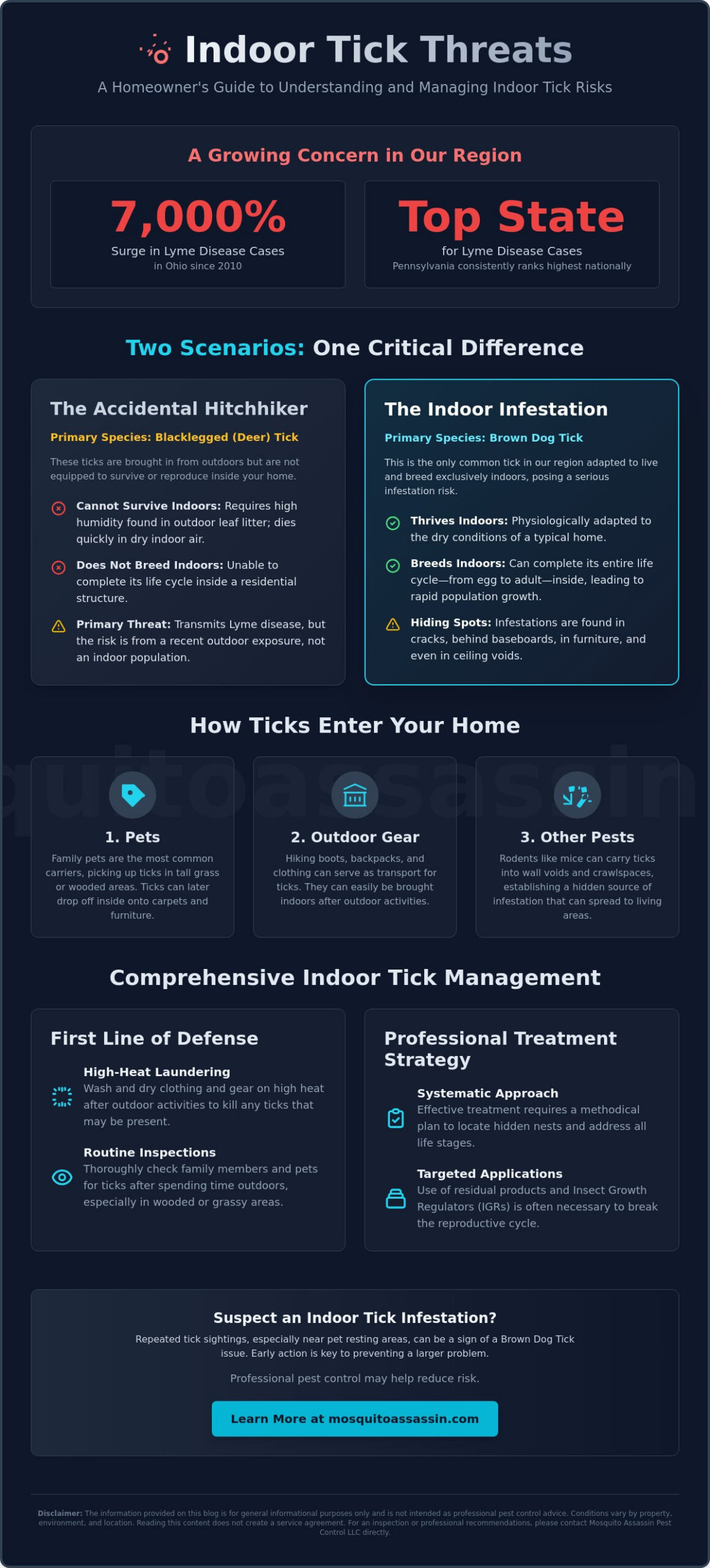
With Lyme disease cases in Ohio surging by 7,000 percent since 2010 and Pennsylvania consistently ranking at the top of national lists, finding a tick in your living room is no longer a rare occurrence. It’s natural to feel a sense of immediate anxiety when you spot a tick crawling on a child’s clothing, especially when you’re unsure if you need professional tick treatment for inside the house. The risk of tick-borne illnesses like Lyme or anaplasmosis makes the presence of these pests feel like a direct threat to the safety of your family and pets.
Transitioning from a state of worry to a state of resolution requires a clear, fact-based plan. This guide provides a professional management framework to help you identify how these pests entered your home and whether you’re dealing with an accidental hitchhiker or a species capable of breeding indoors. You’ll learn the specific behaviors of ticks common in Erie, Crawford, and Ashtabula counties, along with the methodical steps required to achieve a secure, tick-free environment.
Key Takeaways
- Differentiate between accidental deer tick hitchhikers and the brown dog tick, which is the primary species capable of establishing a breeding population inside residential structures.
- Understand why professional tick treatment for inside the house requires a systematic approach, often involving residual products and insect growth regulators to break the reproductive cycle.
- Learn how high-heat laundering and routine post-outdoor inspections serve as the first line of defense for homeowners in Erie, Crawford, and Ashtabula counties.
- Identify the specific signs that an indoor infestation has moved beyond simple prevention and requires a professional inspection to locate hidden nests.
Understanding Tick Infestations Inside the Home
Effective tick treatment for inside the house is rarely a matter of a single application or a quick cleaning session. It requires a systematic, professional approach to identify how these arachnids arrived and whether they’ve established a residency. While most ticks found indoors are accidental hitchhikers that cannot survive long in the low humidity of a home, certain species are adapted for indoor life. Understanding the biological nuances of these pests is the first step toward reclaiming your living space. For those interested in the scientific background of these parasites, a comprehensive overview of ticks details their complex life cycles and their status as significant disease vectors.
Property owners in Erie and Crawford Counties often encounter ticks after outdoor activities, but the problem becomes complex when sightings occur repeatedly in areas where pets sleep or children play. This suggests a transition from a simple “hitchhiker” scenario to a potential infestation. Standard household cleaning, while helpful for general hygiene, often misses the deep crevices and baseboard gaps where ticks hide during their molting stages. To better understand the mechanics of an infestation, watch this helpful video:
Common Entry Points for Ticks
Ticks don’t fly or jump; they rely on passive transport to enter your home. Family pets are the most frequent vehicles, as ticks latch onto fur during walks in tall grass or wooded areas and later drop off onto carpets or furniture. Outdoor gear, such as hiking boots, gardening gloves, and backpacks, also serves as a primary transport method. Additionally, rodents like mice can carry tick larvae into crawlspaces and wall voids, creating a secondary entry point that is often overlooked until the population spreads into the main living areas of the house.
The Risks of Unmanaged Indoor Ticks
The presence of ticks indoors carries significant health implications, particularly in the Northeast United States. With Pennsylvania reporting 16,624 cases of Lyme disease in 2024 and Ohio seeing a massive 7,000 percent increase in cases since 2010, the stakes for effective management are high. Beyond the physical risks of pathogens like anaplasmosis or Rocky Mountain Spotted Fever, the psychological impact of seeing ticks in private living areas causes substantial anxiety for homeowners. Certain species, like the brown dog tick, can complete their entire life cycle indoors, leading to rapid population growth if the environment is not professionally managed. Addressing these risks early through professional pest control may help reduce risk and restore peace of mind.
Identifying Tick Species Common in Pennsylvania and Ohio
Accurate identification is the cornerstone of an effective management plan. While many homeowners assume any tick found indoors is a deer tick, the specific species determines whether you are facing a solitary hitchhiker or a localized breeding population. This distinction is critical when selecting a tick treatment for inside the house. In Erie, Crawford, and Ashtabula counties, residents primarily encounter four species: the blacklegged (deer) tick, the American dog tick, the Lone star tick, and the brown dog tick. Each has distinct behaviors and habitat preferences that dictate how a professional will approach the situation.
The brown dog tick is the most significant threat regarding indoor infestations. Unlike other regional species that require the high humidity of leaf litter to survive, the brown dog tick is physiologically adapted to thrive in the drier conditions of a residential home. Guidance from the EPA on Controlling Fleas and Ticks Around Your Home highlights that understanding these species-specific traits is vital for successful intervention. While deer ticks are frequently associated with Lyme disease and are prevalent in the wooded areas of Erie County, they rarely survive more than a few days inside a climate-controlled building unless they remain attached to a host.
The Brown Dog Tick Life Cycle
This species is unique because it can complete its entire life cycle without ever stepping foot outdoors. They are notorious for hiding in structural cracks, behind baseboards, and even within dropped ceiling tiles. A single female can lay thousands of eggs in these hidden household locations. Homeowners should pay close attention to pet bedding areas, as these are primary sites for egg clusters. Because these ticks can hide so effectively, a professional inspection is often necessary to locate the source of a persistent indoor problem.
Regional Tick Activity Patterns
Peak tick activity in Crawford and Ashtabula counties typically spans from May through September, but milder winters have led to earlier starts in recent years. Ticks are often confused with other small, dark pests such as spider beetles. You can distinguish a tick by its eight legs (in adult stages) and its lack of antennae. Spider beetles, by contrast, have long antennae that can look like an extra pair of legs and a more rounded, bulbous abdomen. If you find a tick that appears silver or has ornate white markings, it is likely an American dog tick or a Lone star tick, both of which are common regional hitchhikers that usually enter the home on clothing or pets after a walk in the brush.
Evaluating Tick Treatment Methods for Indoor Spaces
Selecting the right tick treatment for inside the house involves more than just picking a product from a retail shelf. It requires a deep understanding of how different chemical classes interact with a pest’s biology. Residual insecticides play a primary role in this process because they remain active on treated surfaces long after the initial application. This longevity is essential for managing ticks, which often remain hidden for weeks between life stages. While liquid residuals provide a consistent barrier along floor-to-wall junctions, specialized dusts are frequently utilized in wall voids and behind electrical outlets where liquid applications aren’t suitable.
Insect Growth Regulators (IGRs) represent the most critical component of a professional strategy. While standard adulticides target the ticks you can see, IGRs act as a form of population control. These compounds disrupt the hormonal balance of larvae and nymphs, preventing them from molting into reproductive adults. Many over the counter foggers or “bug bombs” lack these sophisticated components. These aerosol bombs often fail because they only coat horizontal surfaces, leaving ticks safe in the vertical cracks, crevices, and deep carpet fibers where they actually reside. Improper use of these products can even cause pests to disperse deeper into the home’s structure.
Professional Grade vs. Consumer Products
Licensed technicians in Pennsylvania and Ohio utilize EPA-registered products formulated for higher efficacy and longer residual life than standard retail options. A major risk of DIY applications is the unintended dispersal of the infestation. If a homeowner uses an irritating but non-lethal chemical, the ticks may simply migrate into wall voids or attic spaces, making them harder to reach. Professional protocols prioritize safety, ensuring that treatments are applied in a targeted manner that protects children and pets while maximizing impact on the infestation. Professional pest control may help reduce risk by using these specialized tools effectively.
Targeted Application Zones
A thorough management plan doesn’t involve treating every square inch of a home. Instead, it focuses on biological “hot zones” where ticks are most likely to congregate. These include baseboards, door frames, and the edges of wall-to-wall carpeting. Since ticks often stay near where their hosts spend time, upholstered furniture and pet resting areas require specific attention. In Crawford and Ashtabula counties, professional inspections often extend to attics and crawlspaces. These areas can harbor rodents that act as secondary hosts, fueling a cycle of re-infestation that surface-level cleaning cannot reach.
Comprehensive Indoor Tick Prevention and Management Strategy
Prevention is the most effective form of tick treatment for inside the house. While professional applications eliminate active populations, environmental management ensures that new hitchhikers don’t become permanent residents. Establishing a strict routine for post-outdoor inspections is the first line of defense. Ticks often crawl for several hours before attaching, giving you a window of opportunity to remove them before they bite. When returning from wooded areas in Crawford or Ashtabula counties, place all clothing directly into the dryer on high heat for at least ten minutes. This high-heat cycle is more effective at killing ticks than a standard wash cycle, as the dry heat causes rapid desiccation of the pest.
Long-term success relies on creating a hostile environment within the home. Ticks require high humidity to survive; most species will perish within 24 hours in an environment with less than 90 percent humidity. Managing indoor moisture levels through dehumidification can significantly reduce the longevity of accidental intruders. This environmental control should be part of a broader general pest control plan that addresses all potential entry points and seasonal vulnerabilities. For properties with recurring issues, a professional inspection can help identify specific structural weaknesses.
Sanitation and Home Maintenance
Rigorous sanitation disrupts the life cycle of ticks that may have dropped off a host. Vacuuming is a powerful tool. Focus on baseboards, under furniture, and in carpeted areas where pets spend time. This physical removal targets larvae and unhatched eggs that are often resistant to surface cleanings. After vacuuming, immediately dispose of the bag or empty the canister into a sealed outdoor bin. Homeowners should also focus on sealing structural gaps. Small cracks in foundations or gaps around door frames allow ticks to enter from the exterior, especially if rodents are nesting near the home’s perimeter.
Pet Health and Tick Management
Pets are the primary bridge between the outdoors and your living room. Coordinating with a veterinarian for year-round flea and tick preventatives is essential. The milder winters in the Northeast have extended the active season for many species. Regular grooming and daily inspections, especially around the ears, paws, and neck, help catch ticks before they drop off into the home. Rotating and cleaning pet bedding weekly in hot water followed by high-heat drying removes potential harborages. If you notice signs of a persistent problem, professional pest control may help reduce risk by treating the areas where your pets are most vulnerable.
When to Seek Professional Tick Control Services
Determining when a few accidental hitchhikers have transitioned into a localized infestation is the most critical step in protecting your household. While finding a single tick after a hike is common, seeing multiple ticks of varying sizes over several days often indicates an established indoor population. This is typically the point where standard cleaning and retail sprays fail to provide relief. If you continue to find ticks in areas where pets don’t frequent, or if sightings persist after a deep cleaning of bedding and carpets, a more technical approach is required. Professional tick treatment for inside the house is designed to reach the hidden structural voids that household tools simply can’t access.
Local expertise is vital because tick activity in Erie, Crawford, and Ashtabula counties is influenced by specific regional climate shifts. With milder winters becoming more frequent, the traditional “off season” for ticks has shortened significantly. This means that a tick brought inside in late autumn could potentially survive and remain active throughout the winter months if the indoor environment provides enough warmth and a host. Professional pest control may help reduce the risk of these pests establishing a permanent presence in your living areas.
The Professional Inspection Process
A licensed technician utilizes specialized lighting and diagnostic tools to locate tick larvae and nymphs, which are often no larger than a poppy seed and nearly impossible for a homeowner to spot. These inspections go beyond surface-level checks. They involve a methodical examination of structural crevices, baseboard gaps, and even the wall voids behind electrical outlets where brown dog ticks are known to hide. A critical part of this process is identifying secondary pest issues. Since rodents often carry tick larvae into crawlspaces and attics, identifying a hidden mouse problem is frequently the key to solving a persistent tick issue. A customized plan is then developed based on your home’s unique architecture.
Securing Your Home with Mosquito Assassin
Choosing a dependable local expert ensures that your management plan is informed by the specific pest trends of the Pennsylvania and Ohio border region. Our approach emphasizes the safety and wellbeing of your family through disciplined, science-based application methods. By focusing on the biological “hot zones” identified during an inspection, we provide a definitive resolution to the problem rather than a temporary fix. Year-round protection plans are particularly effective in our community, as they mitigate the impact of seasonal spikes and prevent new introductions from becoming established. To begin the process of reclaiming your home, you can contact a professional for an inspection at mosquitoassassin.
Disclaimer: The information provided on this blog is for general informational purposes only and is not intended as professional pest control advice. Conditions vary by property, environment, and location. Reading this content does not create a service agreement. For an inspection or professional recommendations, please contact Mosquito Assassin Pest Control LLC directly.
Securing Your Home Against Indoor Tick Threats
Managing a pest issue effectively requires a shift from reactive cleaning to a systematic, professional strategy. Success begins with accurately identifying whether you are dealing with a solitary hitchhiker or a species like the brown dog tick that is capable of breeding within your walls. While sanitation and high-heat laundering provide a strong foundation, specialized tick treatment for inside the house is often the only way to reach deep-seated harborages and break the reproductive cycle.
Property owners in Erie, Crawford, and Ashtabula counties benefit from local expertise that understands regional climate shifts and pest behavior. Being licensed and insured in both Pennsylvania and Ohio, Mosquito Assassin utilizes specialized tick and mosquito management protocols to restore security to your living environment. Professional pest control may help reduce risk by addressing the root causes of an infestation. To take the next step toward a pest-free environment, you can Schedule a professional inspection for your home. Reclaiming your peace of mind is possible with a methodical approach and a dependable local partner.
Disclaimer: The information provided on this blog is for general informational purposes only and is not intended as professional pest control advice. Conditions vary by property, environment, and location. Reading this content does not create a service agreement. For an inspection or professional recommendations, please contact Mosquito Assassin Pest Control LLC directly.
Frequently Asked Questions
Can ticks live and breed inside a house?
Yes, certain species like the brown dog tick are capable of completing their entire life cycle indoors. While most ticks brought into homes in Erie or Crawford Counties are accidental hitchhikers that require high humidity to survive, the brown dog tick thrives in the drier conditions of a residential structure. They can lay eggs in cracks, crevices, or behind baseboards, leading to a localized infestation that persists without outdoor intervention.
How long can a tick survive indoors without a host?
Survival time depends heavily on the species and indoor humidity levels. Most common regional species, such as the blacklegged (deer) tick, will typically die within 24 to 48 hours in a climate-controlled home because they cannot tolerate low humidity. However, a brown dog tick can survive for several months without a blood meal. This biological resilience makes professional tick treatment for inside the house necessary if they have established a presence.
What is the best indoor tick killer for carpets?
The most effective solution for carpets involves a combination of a residual insecticide and an Insect Growth Regulator (IGR). While retail sprays might kill adult ticks on contact, they often fail to reach larvae or eggs buried deep in carpet fibers. A professional application ensures that the treatment remains active over time, breaking the reproductive cycle and providing long-term management that vacuuming alone cannot achieve for established populations.
Are indoor tick treatments safe for dogs and cats?
Professional indoor treatments are designed to be used in homes with pets when applied according to strict safety protocols. It is standard practice to keep dogs and cats out of the treated area until the product has completely dried. Licensed technicians prioritize the safety of vulnerable household members by using targeted applications rather than broad, unnecessary spraying, ensuring a secure environment for your animals while effectively managing the pest problem.
How do I know if I have a tick infestation in my house?
Identifying an infestation involves looking for repeated sightings of ticks, especially in various life stages like tiny larvae or nymphs. If you find ticks crawling on walls, curtains, or in areas where pets do not spend time, it may indicate a breeding population. Finding multiple ticks over several days after you’ve already checked your pets and gear suggests that the pests have established themselves within the home’s structure.
Does vacuuming help get rid of ticks?
Vacuuming is a helpful supplemental strategy that physically removes active ticks, larvae, and some eggs from carpets and upholstery. It is particularly effective along baseboards and under furniture where ticks often hide. Vacuuming cannot reach into the structural cracks or deep crevices where breeding populations reside. It should be integrated into a broader professional management plan to ensure that all life stages are addressed across the entire property.
Can I get Lyme disease from a tick found inside my home?
It is possible to contract Lyme disease if an infected blacklegged (deer) tick is brought inside on a pet or clothing and subsequently attaches to a human host. Ticks found crawling on furniture or floors are still seeking a blood meal and can pose a health risk. This is why routine inspections and immediate tick treatment for inside the house are important for residents in high-risk areas like Ashtabula County.
Should I use a bug bomb for ticks in my house?
Bug bombs or total release foggers are generally ineffective for tick management and are not recommended. These products only coat horizontal surfaces and fail to penetrate the vertical cracks and deep carpet fibers where ticks actually hide. The irritating chemicals in foggers can cause ticks to scatter deeper into wall voids. This makes a professional inspection and targeted treatment much more difficult to execute once the pests have dispersed.
Disclaimer: The information provided on this blog is for general informational purposes only and is not intended as professional pest control advice. Conditions vary by property, environment, and location. Reading this content does not create a service agreement. For an inspection or professional recommendations, please contact Mosquito Assassin Pest Control LLC directly.