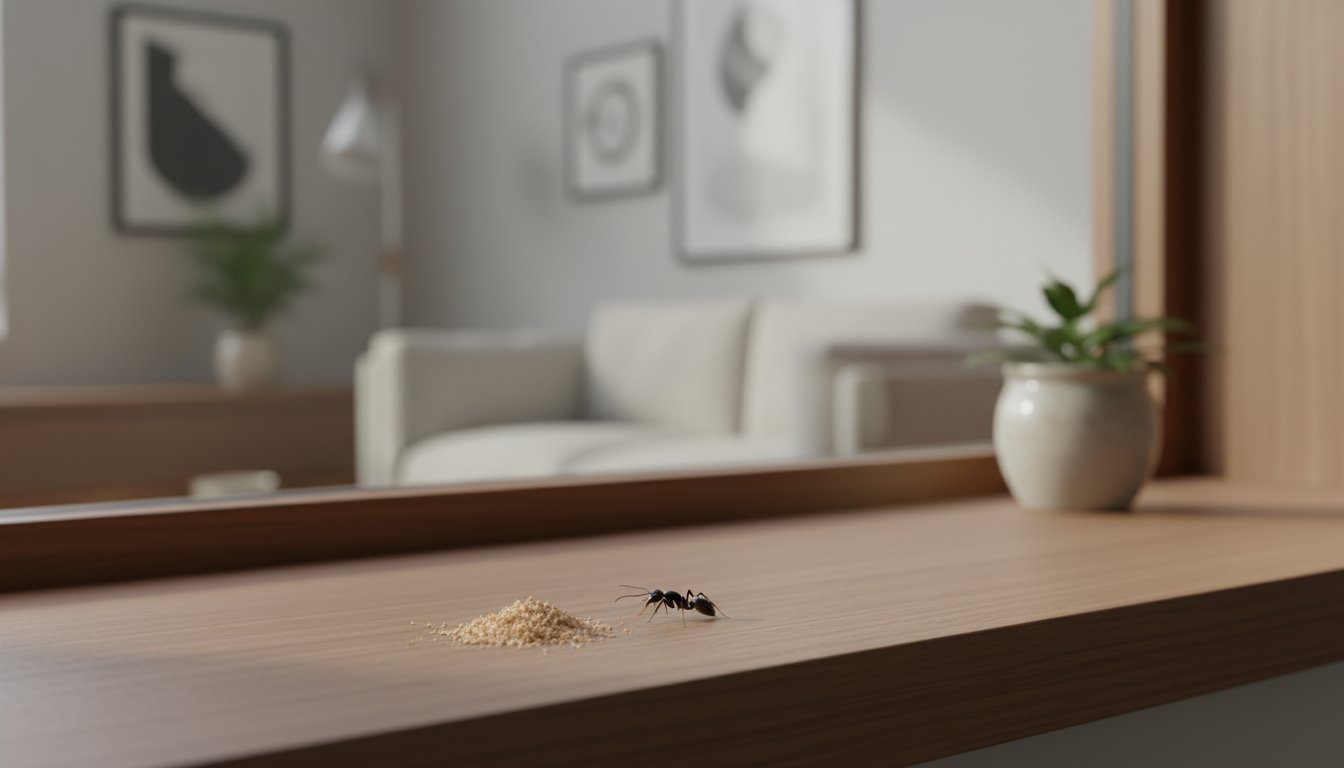
That nagging worry often starts with just a few large black ants in your kitchen. Are they simply foraging, or is something more sinister happening unseen within your walls? The fear of hidden, costly structural damage is real, and the uncertainty of whether you’re dealing with carpenter ants or termites can be paralyzing. For effective carpenter ant removal, you need more than a can of store-bought spray, which often just scatters the colony and makes the problem worse.
This is your definitive guide to safeguarding your home. We will empower you with the expert knowledge to confidently identify these wood-destroying pests, pinpoint the exact location of their hidden nests, and implement a proven plan for their complete and permanent eradication. Forget wasting time and money on solutions that don’t work. Get ready to reclaim your peace of mind and learn how to protect your home’s structure for good.
Key Takeaways
- Learn to correctly identify carpenter ants versus other pests to ensure you are targeting the right threat before any damage occurs.
- Understand how carpenter ants silently compromise your home’s structural integrity by excavating wood for their nests, not by eating it.
- Discover the most effective strategies for complete carpenter ant removal and learn why professional methods are crucial for eliminating the entire colony.
- Implement proven prevention techniques to safeguard your property and make your home a hostile environment for future infestations.
First Steps: How to Identify a Carpenter Ant Infestation
Before you can begin any treatment, positive identification is the essential first step. Misidentifying your pest can lead to ineffective solutions and wasted time, allowing the real problem to worsen. The key to successful carpenter ant removal is knowing exactly what you’re up against, from the appearance of the insect to the unique signs of damage they leave behind.
To help you visually confirm what you’re seeing, this video provides an excellent overview:
What Do Carpenter Ants Look Like?
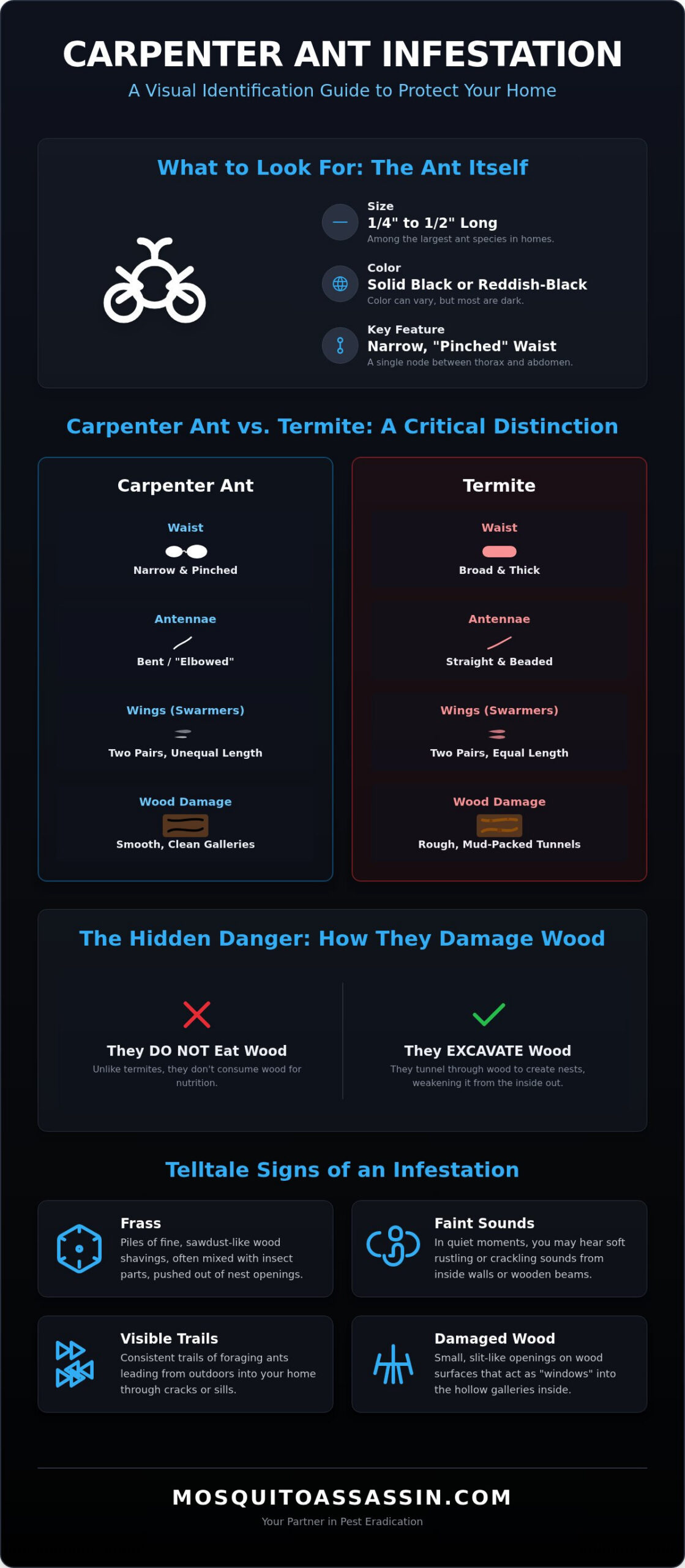
Carpenter ants are among the largest ant species you’ll find in your home, typically measuring between 1/4 and 1/2 inch long. While most are solid black, some can be reddish-black or a combination of red and black. Their most distinct feature is a single, small node between their thorax and abdomen, giving them a segmented, “pinched” waist. In the spring, you might also spot winged swarmers, which are reproductive ants leaving the nest to mate. For a more detailed Carpenter ant overview, including their life cycle and behavior, this resource is highly informative.
Carpenter Ants vs. Termites: A Critical Distinction
It’s common to confuse carpenter ants with termites, but they are very different pests requiring different treatments. Here’s how to tell them apart:
- Waist: Carpenter ants have a narrow, pinched waist. Termites have a broad, thick waist with no visible segmentation.
- Antennae: Ants possess bent or “elbowed” antennae. Termites have straight, beaded antennae.
- Wings: Winged ant swarmers have two pairs of wings of unequal length (front wings are longer than hind wings). Termite swarmers have two pairs of wings that are equal in length.
- Damage: Carpenter ants excavate wood to create nests, leaving behind smooth, clean galleries. Termites eat wood and leave behind rough tunnels packed with mud and soil.
Telltale Signs of Carpenter Ant Activity
Even if you don’t see the ants themselves, they leave behind clear evidence of their presence. Recognizing these signs is crucial for assessing the scale of your infestation and planning for carpenter ant removal. Look for:
- Frass: Piles of fine, sawdust-like wood shavings mixed with insect parts. Ants push this debris out of small holes in wood as they excavate their nests.
- Faint Sounds: In quiet moments, you may hear soft rustling or crackling sounds coming from inside your walls or wooden beams.
- Visible Trails: Watch for consistent trails of foraging ants, often leading from outdoor areas (like a tree stump or woodpile) into your home through cracks in the foundation or window sills.
- Damaged Wood: Small, slit-like openings on the surface of wood can be “windows” into the smooth, hollowed-out galleries the ants have created inside.
The Hidden Danger: How Carpenter Ants Damage Your Home
Many homeowners mistakenly believe carpenter ants are like termites, but there’s a critical difference: carpenter ants don’t eat wood. Instead, they excavate it, tunneling through beams and joists to create vast, hidden nests. This relentless excavation process systematically weakens the structural integrity of your home. They are particularly drawn to wood with existing moisture damage, turning a small leak into a major vulnerability. If left unaddressed, a single colony can cause thousands of dollars in repairs, making prompt and professional carpenter ant removal essential for safeguarding your property.
Understanding Their Nesting Habits
A carpenter ant infestation typically involves a main “parent” colony, often located outdoors in a dead tree stump or damp woodpile, and one or more “satellite” colonies inside your home. These indoor nests are where the real damage occurs. The ants create smooth, clean, and sandpaper-like galleries within the wood, a key sign that distinguishes them from the messy, mud-packed tunnels of termites. Seeing a few large black ants in your kitchen is rarely an isolated incident; it’s a warning sign of a much larger, hidden colony that requires a comprehensive approach. Correctly identifying carpenter ants and their activity is the first step toward effective eradication.
Common Nesting Spots in PA & OH Homes
As local experts serving Pennsylvania and Ohio, we know exactly where these pests love to hide. Their prime targets are areas where moisture compromises wood, providing the perfect environment for a satellite nest. Be sure to check:
- Window and door frames, especially those with poor seals.
- Attics and crawl spaces suffering from poor ventilation or roof leaks.
- Underneath siding or behind walls, particularly on the cooler, north side of a house.
- Water-damaged wood in porch columns, decks, and outdoor sheds.
The Long-Term Structural Risks
The damage from carpenter ants is slow but devastating. Over several years, their tunneling can severely weaken floor joists, wall studs, and critical support beams. The integrity of your deck, porch, or even your roof structure can be compromised, turning what was once a minor nuisance into a major structural failure. Don’t wait for sagging floors or warped window frames to appear. Effective carpenter ant removal is not just about eliminating pests-it’s about protecting the very foundation of your home.
Worried about hidden damage? Get a professional inspection from Mosquito Assassin.
Carpenter Ant Removal Methods: DIY vs. Professional Extermination
When you discover a carpenter ant infestation, you face a critical decision: attempt a do-it-yourself solution or call in the professionals. While handling it yourself might seem like a cost-saving measure, effective carpenter ant removal is more complex than simply spraying the ants you see. The right choice depends on the scale of the problem and your confidence in eliminating the entire colony, not just the visible foragers.
Popular DIY Approaches and Their Limitations
Home improvement stores offer various products, from bait stations and insecticidal sprays to boric acid dusts. These can provide temporary relief by killing worker ants, but their effectiveness is often superficial and short-lived.
- Bait Stations: These are slow-acting and can be ineffective if ants have a more attractive food source nearby, rendering the bait useless.
- Insecticidal Sprays: These products only kill ants on contact and rarely penetrate the wall voids or wood galleries where the nest and queen are hidden.
- Dusts: Boric acid can work but is only effective if applied directly into nest galleries, which are notoriously difficult for homeowners to locate.
The primary risk with DIY methods is that they create a false sense of security. You might eliminate the foraging workers, but the satellite and parent colonies remain active, continuing to damage your home’s structure. As experts in Carpenter ant prevention and control emphasize, a comprehensive approach is necessary for complete eradication.
Why Professional Treatment is More Effective
A licensed pest control professional brings expertise and tools that are unavailable to the public. We don’t just treat the symptoms; we eliminate the source. Our technicians are trained to accurately locate hidden nests by identifying subtle signs of activity. We then use specialized, non-repellent insecticides that foraging ants carry back to the colony, unknowingly poisoning the queen and other members. This targeted application into wall voids, crawlspaces, and other inaccessible areas ensures the entire infestation is destroyed from the inside out.
The Mosquito Assassin 4-Step Eradication Process
At Mosquito Assassin, we’ve developed a proven, methodical process to guarantee complete elimination and protect your home. Our approach ensures nothing is left to chance.
- Step 1: Thorough Inspection: We conduct a comprehensive assessment of your property to identify all nest locations, entry points, and the extent of any damage.
- Step 2: Customized Treatment Plan: Based on our findings, we create a tailored plan that addresses your home’s specific vulnerabilities and the unique characteristics of the infestation.
- Step 3: Targeted, Family-Safe Application: We apply our family-safe treatments directly to the source, eliminating the entire colony while safeguarding your loved ones and pets.
- Step 4: Follow-Up & Prevention: We provide follow-up service and expert advice to ensure the ants don’t return, giving you lasting peace of mind.
Don’t let a failed DIY attempt lead to costly structural repairs. Trust the proven system for complete carpenter ant removal by contacting the experts at Mosquito Assassin today.
How to Prevent Carpenter Ants From Coming Back
Successfully eliminating a carpenter ant colony is a major victory, but the battle isn’t over. Effective carpenter ant removal is only half the solution; the other half is diligent prevention. To safeguard your home for the long term, you must make it an unattractive and inaccessible fortress for these wood-destroying pests. Most preventative strategies focus on two key areas: controlling moisture and sealing potential entry points.
Eliminate Moisture Sources
Carpenter ants don’t eat wood, they excavate it to build nests. They overwhelmingly prefer wood that has been softened by water. By eliminating moisture, you remove their ideal nesting material. Focus on these critical tasks:
- Immediately repair any leaky pipes, dripping faucets, clogged gutters, or damaged roofing that could create damp conditions.
- Use dehumidifiers and fans to ensure basements, attics, and crawl spaces stay dry and well-ventilated.
- Check that the soil around your foundation is graded to slope away from the house, preventing water from pooling against your home’s structure.
Seal Up Entry Points
Think of your home’s exterior as its armor-even the smallest crack is a vulnerability that ants can exploit. A thorough inspection and sealing project can fortify your defenses and deny them access.
- Use high-quality silicone caulk to seal cracks and crevices in your foundation, around windows and door frames, and along siding.
- Pay close attention to where utility pipes, wires, and cables enter your house. Seal any gaps with caulk or expanding foam.
- Install fine-mesh screens over attic, foundation, and crawl space vents to block pests without impeding essential airflow.
Manage Wood and Landscaping
Your yard can inadvertently create a direct highway for pests to march right up to your home. Simple landscaping maintenance creates a crucial buffer zone that keeps ants at a distance.
- Keep firewood stacks at least 20 feet away from your house and elevated off the ground on a rack.
- Trim tree branches, shrubs, and overgrown vegetation so they do not make contact with your siding or roof.
- Promptly remove dead tree stumps, fallen logs, and other decaying wood from your property, as these are prime nesting sites.
These proactive measures are the most effective way to protect your home after a professional carpenter ant removal service. While these DIY steps are powerful, nothing beats a comprehensive, year-round strategy. Need ongoing protection? Explore our Year-Round Pest Control Plans.
Your Final Step to a Carpenter Ant-Free Home
Protecting your home from wood-destroying insects is a serious responsibility. You’ve learned how to identify the subtle signs of a carpenter ant infestation, from faint rustling sounds in your walls to tell-tale piles of sawdust-like frass. You also understand the hidden, structural danger they pose, silently chewing through your home’s framework. While DIY solutions can seem appealing, the only certain path to total eradication and lasting protection is professional carpenter ant removal.
Don’t leave the integrity of your biggest investment to chance. For homeowners in Erie and Crawford Counties, Mosquito Assassin is your trusted local partner in pest elimination. As a locally owned and operated team, we are committed to safeguarding our neighbors’ homes with proven, family-safe treatments. Our confidence is backed by our Pest-Free Guarantee: If the pests return, so do we!
Take decisive action against these destructive pests. Protect Your Home from Carpenter Ant Damage. Schedule Your Free Inspection Now!
Frequently Asked Questions About Carpenter Ant Removal
How much does professional carpenter ant removal cost?
The cost for professional carpenter ant removal depends on several factors, including the size of your property and the severity of the infestation. A small, localized colony will be less complex to treat than a large, established nest with multiple satellite colonies. For an accurate and transparent price, Mosquito Assassin provides a comprehensive inspection to create a customized treatment plan. This ensures you only pay for the precise services needed to safeguard your home effectively.
Are the treatments used by Mosquito Assassin safe for my children and pets?
Absolutely. The safety of your family is our top priority. We use proven, family-safe treatments and our licensed technicians apply them with precision according to strict industry standards. We will always provide clear instructions, such as keeping children and pets away from specific treated areas until they are completely dry. This methodical approach ensures we eliminate the pests while giving you total peace of mind, knowing your loved ones are protected.
Can carpenter ants return after a professional treatment?
While our treatments are designed for complete eradication, new colonies can attempt to move in if the original attracting conditions, like moisture-damaged wood, persist. However, we stand by our work with our Pest-Free Guarantee. Our comprehensive process is designed to eliminate the entire colony structure to prevent a rebound. As we always say at Mosquito Assassin, if the pests return, so do we. We’ll make it right at no extra charge.
How long does it take to completely get rid of a carpenter ant infestation?
The timeline for complete elimination varies with the infestation’s size and complexity. You will see a significant reduction in ant activity shortly after our initial treatment. However, it can take a few weeks for the treatment to be carried back to the nest and eliminate the entire colony, including the queen. Our process includes diligent follow-up and monitoring to ensure the job is done right, delivering the dependable, lasting results you expect.
What’s the difference between a big black ant and a carpenter ant?
While many large ants are black, carpenter ants have specific identifying features: a single, small node between their thorax and abdomen, an evenly rounded upper back, and a defined, pinched waist. The most definitive sign, however, is their behavior. Carpenter ants excavate wood to create nests, leaving behind piles of coarse, sawdust-like shavings called “frass.” Finding frass near wood structures is a clear sign you are dealing with destructive carpenter ants.
Do carpenter ants bite people?
Yes, carpenter ants can bite. They do not have a stinger, but if they feel their nest is threatened, they will use their strong mandibles to bite defensively. They can also spray formic acid into the wound, which creates a painful burning sensation. While the bites are not medically dangerous for most people, they are a clear sign that an infestation is uncomfortably close and requires immediate professional attention for safe and effective removal.