
Tag: Integrated Mosquito Management

  • How Effective Is Professional Mosquito Control? A Comprehensive Guide for 2026

    How Effective Is Professional Mosquito Control? A Comprehensive Guide for 2026

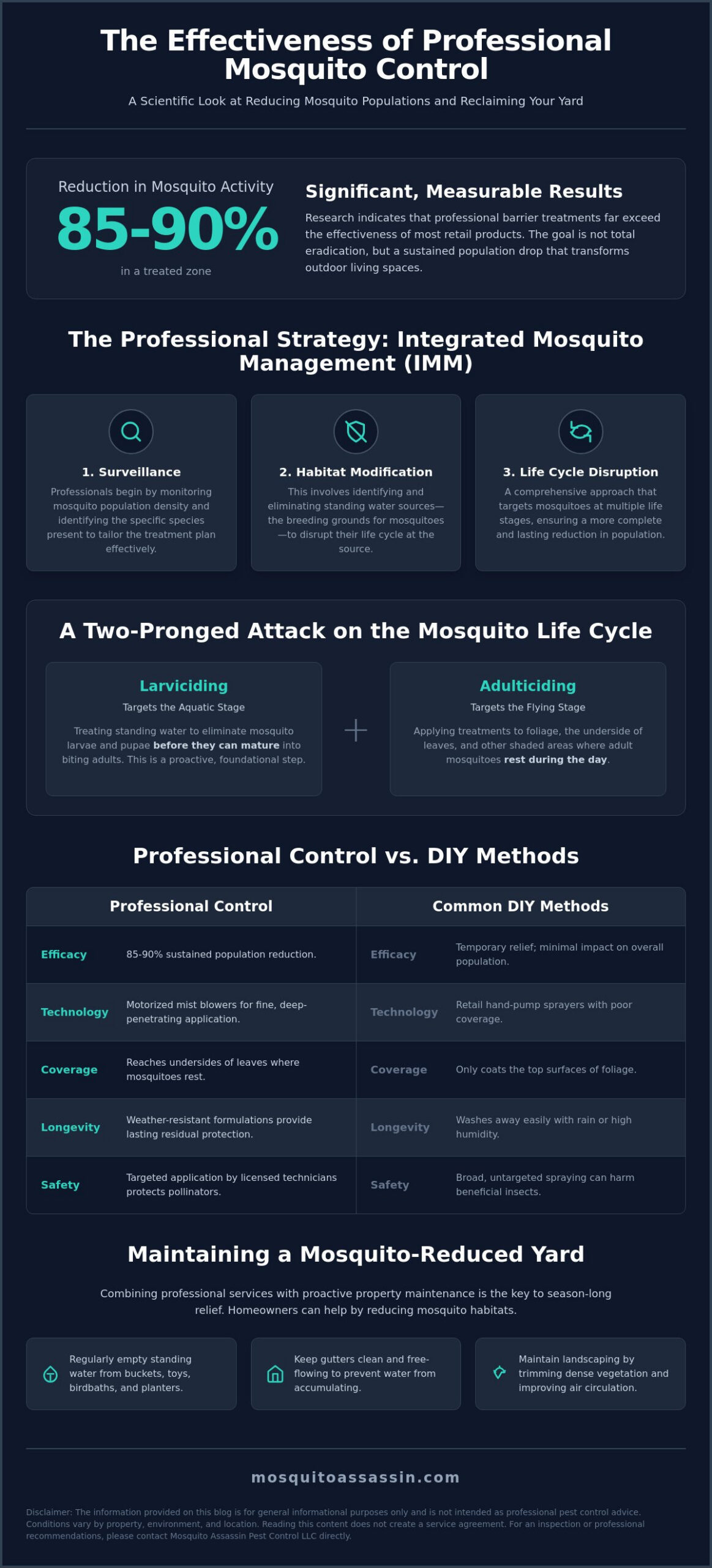
    Research indicates that professional barrier sprays can reduce mosquito activity by 85% to 90% in a treated zone, a figure that far exceeds the results of most retail products. It’s exhausting to deal with itchy bites that ruin outdoor family time, especially when you’ve already spent money on traps or candles that didn’t work. If you are wondering how effective is professional mosquito control, it’s important to look at the science rather than the marketing. This guide provides a clear look at how professional treatments work, what the results look like for properties in Erie and Crawford Counties in Pennsylvania and Ashtabula County in Ohio, and why a licensed approach is different from DIY.

    Discover the scientific reality behind modern treatments, explaining how efficacy is measured and what property owners should realistically expect from a licensed service. You’ll learn about the integrated management strategies used by experts to create a safer outdoor environment for your children and pets. This guide also provides practical knowledge on how to keep the population down all season long through 2026, ensuring your yard remains a place for relaxation rather than a source of stress.

    Disclaimer: The information provided on this blog is for general informational purposes only and is not intended as professional pest control advice. Conditions vary by property, environment, and location. Reading this content does not create a service agreement. For an inspection or professional recommendations, please contact Mosquito Assassin Pest Control LLC directly.
    Key Takeaways

    • Understand why Integrated Mosquito Management (IMM) is the scientific standard for achieving a significant, measurable reduction in local pest populations.
    • Learn how regional environmental factors like high humidity and dense vegetation in Pennsylvania and Ohio dictate the success of professional treatments.
    • Evaluate how effective is professional mosquito control compared to retail traps and foggers that often lack the residual power needed for long term relief.
    • Discover how licensed technicians use targeted application methods to protect pollinators and beneficial insects while managing mosquito activity.
    • Gain practical strategies for maintaining a mosquito free yard by combining professional services with proactive source reduction at home.

    Defining the Effectiveness of Professional Mosquito Management

    Efficacy in mosquito management is often misunderstood as the total eradication of every insect on a property. In reality, a successful program is defined by a significant and measurable reduction in the local population. Industry data shows that professional barrier treatments can reduce mosquito activity by 85% to 90% in a treated area. If you’ve been asking how effective is professional mosquito control, the answer lies in the transition from temporary relief to a sustained population drop. This results from a scientific approach known as Integrated Mosquito Management (IMM). This methodology moves beyond simple spraying to include surveillance, habitat modification, and life cycle disruption.

    Measuring this success involves tracking population density and understanding the biology of the target species. Licensed professionals utilize commercial-grade equipment that produces a much finer mist than retail hand-pump sprayers. These specialized motorized blowers use high-velocity air to move foliage, ensuring the product reaches the undersides of leaves where pests congregate. By using comprehensive Mosquito control strategies, technicians can address the problem at its source. This creates a protective environment that retail products simply cannot replicate.

    To better understand this concept, watch this helpful video:

    The Two-Pronged Attack: Larvicides vs. Adulticides

    A common mistake in DIY efforts is focusing only on the insects that are already biting. Professional mosquito control services utilize a two-pronged strategy that targets different life stages. Larviciding involves treating standing water to stop mosquitoes in their aquatic stage before they ever develop wings. Adulticiding targets the mature insects resting in your landscape. Treating only one stage is significantly less effective because new adults will constantly emerge to replace those that were eliminated. A combined approach ensures the population is suppressed from the ground up.

    The Role of Residual Protection

    The longevity of a treatment is just as important as the initial knockdown. Professional formulations are engineered to provide residual protection by adhering to the underside of leaves and other shaded resting areas. This is critical because mosquitoes spend the majority of their time resting in these cool spots to avoid dehydration. Modern products are also designed to be weather-resistant. While a heavy downpour might require a follow-up, these formulations typically maintain their efficacy through light rainfall and high humidity, which are common conditions in Erie and Crawford counties in Pennsylvania and Ashtabula County in Ohio.

    Disclaimer: The information provided on this blog is for general informational purposes only and is not intended as professional pest control advice. Conditions vary by property, environment, and location. Reading this content does not create a service agreement. For an inspection or professional recommendations, please contact Mosquito Assassin Pest Control LLC directly.

    Key Factors That Determine Treatment Success in the Great Lakes Region

    The success of any pest management program in the Great Lakes region depends heavily on localized environmental variables. In Erie and Crawford counties, along with Ashtabula County, the proximity to Lake Erie creates a unique microclimate characterized by high humidity and frequent moisture. These conditions are ideal for rapid mosquito breeding. When property owners ask how effective is professional mosquito control, they must consider that pest pressure varies significantly based on their specific surroundings. A property bordering a marsh or a wooded area will naturally face a higher volume of incoming insects than a manicured suburban lot.

    Vegetation density also plays a critical role. Thick foliage provides more surface area for mosquitoes to hide, meaning more product and specialized application techniques are required to achieve full coverage. Timing is another non-negotiable factor. For maximum efficacy, treatments should ideally begin in early spring, before the first major hatch of the season occurs. This proactive approach prevents the population from reaching unmanageable levels during the peak heat of summer. Understanding these regional nuances is key to maintaining a comfortable outdoor space. For more information on local conditions, reviewing a service area map can help determine specific needs.

    Impact of Rainfall and Temperature

    Weather is the primary driver of treatment longevity. While modern, professional formulations are designed to be weather-resistant, extreme environmental shifts can influence results. Sustained temperatures above 90 degrees Fahrenheit can accelerate the breakdown of certain active ingredients, necessitating more frequent monitoring. Conversely, while light rain is manageable and often does not disrupt the residual barrier, torrential downpours present a wash-off threshold. Licensed technicians monitor these thresholds closely, ensuring that protective barriers are reinforced if a significant weather event occurs.

    Property Size and Neighboring Habitats

    The perceived effectiveness of a treatment can be influenced by migration from adjacent, untreated properties. Mosquitoes are mobile; they don’t respect property lines. This is why establishing a larger treated buffer zone is essential for long term relief. Professional applications focus on harborage areas like tall grass, dense shrubs, and the dark spaces under decks where pests rest during the day. These areas require meticulous attention to break the cycle of infestation.

    Responsible application also accounts for the surrounding ecosystem. Licensed professionals are trained to minimize drift to protect the impact on pollinators like bees and butterflies. By targeting specific resting sites rather than using broad, indiscriminate spraying, the treatment remains effective against mosquitoes while respecting beneficial insects. This disciplined operational approach ensures that your yard remains a safe environment for your family and the local environment alike.

    Disclaimer: The information provided on this blog is for general informational purposes only and is not intended as professional pest control advice. Conditions vary by property, environment, and location. Reading this content does not create a service agreement. For an inspection or professional recommendations, please contact Mosquito Assassin Pest Control LLC directly.

    Comparing Professional Efficacy Against Common DIY Mosquito Methods

    Many homeowners spend hundreds of dollars on retail solutions only to find themselves still swatting away pests during every backyard gathering. When evaluating how effective is professional mosquito control, the comparison with DIY methods highlights a significant gap in both product chemistry and application technique. Retail foggers and aerosol sprays provide an immediate knockdown effect, but they often lack the residual power necessary to keep the population from returning within hours. Similarly, citronella candles and torches create a very small, temporary zone of protection that is easily disrupted by a slight breeze or a change in humidity.

    Mechanical traps and CO2 magnets are other popular choices, yet they often fail to lower the overall population density of a yard. While these devices may catch thousands of insects, research suggests they can actually attract more mosquitoes to the property than they successfully remove. A professional approach focuses on total population management rather than simply trapping individuals. Licensed technicians are trained to identify cryptic breeding sites that are frequently overlooked; these include clogged gutters, corrugated drain pipes, and specific types of dense vegetation common in the Great Lakes region.

    Equipment and Product Quality Differences

    The tools used in professional applications are vastly superior to standard garden sprayers or handheld foggers. Motorized backpack blowers use high velocity air to move foliage, ensuring the product reaches the undersides of leaves where 90% of mosquitoes spend their day. Additionally, commercial grade products are often micro encapsulated. This technology allows the active ingredients to be released slowly over several weeks, maintaining a consistent barrier against new arrivals. DIY applications typically miss these critical resting sites, leaving the majority of the population untouched and free to continue breeding.

    The Cost of Ineffective DIY Attempts

    The financial burden of DIY mosquito control often goes unnoticed until the end of the season. Repeatedly purchasing cans of spray, refills for heat activated repellent devices, and expensive traps adds up quickly without solving the underlying infestation. Beyond the monetary expense, there is the frustration of lost time and ruined outdoor events. Understanding pest control prices helps put the value of a professional service into perspective. A comprehensive plan provides a measurable reduction in activity, saving property owners in Erie, Crawford, and Ashtabula counties from the cycle of ineffective retail spending.

    Disclaimer: The information provided on this blog is for general informational purposes only and is not intended as professional pest control advice. Conditions vary by property, environment, and location. Reading this content does not create a service agreement. For an inspection or professional recommendations, please contact Mosquito Assassin Pest Control LLC directly.

    How Effective Is Professional Mosquito Control? A Comprehensive Guide for 2026

    Addressing the Impact on Pollinators and Beneficial Insects

    A significant concern for many property owners is whether managing pests comes at the cost of harming the local ecosystem. When discussing how effective is professional mosquito control, it’s vital to address the balance between human comfort and environmental stewardship. Responsible management isn’t about broadcast spraying everything in sight. Instead, it relies on targeted application techniques that focus on where mosquitoes actually live, rather than where beneficial insects forage. This precision ensures that the treatment remains effective against target pests while minimizing the footprint on the surrounding environment.

    Technicians are trained to identify and avoid flowering plants where bees and butterflies are most active. By focusing on the interior of dense shrubs and the undersides of non-flowering leaves, professionals hit the target pests while leaving pollinators alone. Timing also plays a crucial role in these efforts. Most applications occur during the early morning or late evening when pollinators are less active, significantly reducing the risk of direct contact. According to research cited by the American Mosquito Control Association, mosquitoes are 100 times more susceptible to the pesticides used in ultra-low volume (ULV) applications than honey bees are, allowing for effective control at very low concentrations.

    Targeted Application Techniques

    Precision is what separates a professional service from a generic DIY attempt. Technicians establish no-spray buffer zones around vegetable gardens, fruit trees, and active pollinator habitats. The formulations used are designed to dry quickly, which minimizes the window for non-target exposure. By treating the harborage areas mentioned in previous sections, such as the deep shade under decks or the center of thick hedges, the treatment remains localized where mosquitoes rest during the heat of the day. This methodical approach ensures the yard is protected without disrupting the natural foraging patterns of beneficial insects.

    Professional Standards and Licensing

    In Erie and Crawford Counties in Pennsylvania and Ashtabula County in Ohio, licensed applicators must adhere to strict EPA-approved label instructions. These regulations ensure that products are used in a way that prioritizes the safety of the household and the surrounding environment. Professional pest control may help reduce risk to families while respecting the delicate balance of the local Great Lakes ecosystem. Consulting with a dependable local expert ensures that your plan is customized to the specific layout and environmental needs of your property.

    Disclaimer: The information provided on this blog is for general informational purposes only and is not intended as professional pest control advice. Conditions vary by property, environment, and location. Reading this content does not create a service agreement. For an inspection or professional recommendations, please contact Mosquito Assassin Pest Control LLC directly.

    Strategies for Sustaining a Mosquito-Free Outdoor Space

    The longevity of a pest free yard relies on a collaborative effort between the property owner and the service provider. While earlier sections established how effective is professional mosquito control at knocking down adult populations, sustaining those results through the humid months in Erie, Crawford, and Ashtabula counties requires proactive source reduction. Eliminating standing water is the single most important action a homeowner can take to assist the professional process. Because mosquitoes can develop from egg to adult in as little as seven to ten days, removing breeding habitats prevents new generations from emerging between scheduled visits.

    Regular property maintenance is equally essential for long term success. Tall grass and overgrown brush provide the shaded harborage areas where pests rest during the heat of the day. By keeping the lawn trimmed and the landscape manicured, you reduce the available real estate for mosquitoes to congregate. Ongoing protection plans are significantly more effective than one-time treatments for seasonal pests because they provide consistent surveillance and barrier reinforcement throughout the entire breeding season. Professional pest control may help reduce risk by maintaining these barriers before population spikes occur.

    Homeowner Checklist for Source Reduction

    To maximize the impact of professional treatments, property owners should perform a weekly sweep of their grounds. Focus on these common, often overlooked problem areas:

    • Check for stagnant water in clogged gutters and corrugated drainage pipe extensions.
    • Invert wheelbarrows, buckets, and empty plant saucers immediately after every rain event.
    • Ensure pool covers are pulled tight and do not collect pockets of stagnant water.
    • Change the water in birdbaths and outdoor pet bowls at least twice a week.
    • Inspect children’s toys, tarps, and tire swings for hidden water reservoirs.

    The Value of a Professional Partnership

    A comprehensive mosquito control program offers more than just application; it provides consistent surveillance throughout the season. Technicians can identify emerging issues, such as new drainage problems or shifts in local pest pressure, before they become full blown infestations. For property owners looking for a long term population decline, professional recommendations for property modifications are invaluable. To learn more about protecting your property and the specific options available for your land, visit services. A disciplined operational approach ensures your outdoor space remains a place for relaxation rather than a source of stress.

    Disclaimer: The information provided on this blog is for general informational purposes only and is not intended as professional pest control advice. Conditions vary by property, environment, and location. Reading this content does not create a service agreement. For an inspection or professional recommendations, please contact Mosquito Assassin Pest Control LLC directly.

    Achieving Long Term Relief for Your Outdoor Space

    Reclaiming your backyard from persistent pests requires more than just luck; it demands a scientific approach. Property owners often ask how effective is professional mosquito control when compared to retail alternatives. The answer lies in the 85% to 90% reduction in activity that only a comprehensive, integrated approach can provide. By combining larval disruption with targeted adult treatments, you can break the cycle of infestation and enjoy your yard again. Success in our local Great Lakes climate depends on consistent protection schedules and proactive source reduction around the home.

    Licensed and insured professionals serving Erie, Crawford, and Ashtabula counties provide the expertise needed to manage these populations safely and effectively. Customized Integrated Mosquito Management plans tailored to local property needs ensure that every treatment is precise and impactful. It’s time to stop wasting money on ineffective traps and start investing in a proven solution that prioritizes your family’s comfort. To get started, you can request an inspection or professional recommendations from Mosquito Assassin today. You don’t have to let mosquitoes dictate your summer plans.

    Disclaimer: The information provided on this blog is for general informational purposes only and is not intended as professional pest control advice. Conditions vary by property, environment, and location. Reading this content does not create a service agreement. For an inspection or professional recommendations, please contact Mosquito Assassin Pest Control LLC directly.

    Frequently Asked Questions

    How long does a professional mosquito treatment typically last?

    A professional treatment generally provides protection for approximately three to four weeks. The residual products are engineered to adhere to the underside of vegetation, where they remain active between visits. Environmental factors like extreme heat or heavy rain can impact this timeline; however, most property owners see consistent results with a 21 to 30 day schedule. This frequency ensures the barrier remains strong enough to manage new arrivals.

    Is professional mosquito control safe for my pets and children?

    Professional applications are performed using EPA approved products that are safe for pets and children once the treatment has completely dried. This typically takes 30 to 60 minutes depending on the humidity levels in the Great Lakes area. Licensed technicians prioritize the wellbeing of your household by following strict application protocols and ensuring that all residents stay indoors during the actual spray process to prevent direct exposure.

    Can mosquitoes fly over from my neighbor’s yard after you spray?

    Yes, mosquitoes can migrate from neighboring properties; however, the professional barrier is designed to address this. Because mosquitoes must rest frequently to avoid dehydration, they will land on the treated foliage in your yard. The residual barrier eliminates them upon contact, preventing them from establishing a presence on your property even if your neighbors do not have a service plan in place.

    What happens if it rains immediately after a mosquito treatment?

    Light rain does not typically compromise a treatment once it has had time to dry. Modern formulations are designed to be weather resistant and adhere firmly to plant surfaces. If a torrential downpour occurs immediately after an application before it has dried, the effectiveness may be reduced. Professionals monitor local weather patterns in Pennsylvania and Ohio to ensure treatments are applied during optimal, dry conditions.

    Do professional mosquito sprays kill bees and butterflies?

    Targeted application techniques are used to protect beneficial insects like bees and butterflies. Technicians are trained to avoid flowering plants where pollinators forage and focus instead on the dense, non flowering vegetation where mosquitoes rest. This precision is a key factor when evaluating how effective is professional mosquito control compared to indiscriminate DIY fogging, which often lacks the control needed to protect the local ecosystem.

    How many treatments are needed for a full mosquito season in Ohio and Pennsylvania?

    A full mosquito season in the Great Lakes region typically requires seven to eight treatments. This schedule usually begins in late April or early May and continues through September or October. Consistent applications are necessary to maintain the residual barrier and disrupt the mosquito life cycle throughout the peak breeding months when humidity and temperatures are highest. Skipping treatments can allow the population to rebound quickly.

    Will professional mosquito control eliminate 100% of the mosquitoes?

    No professional service can realistically promise 100% elimination of all mosquitoes. The goal of a high quality program is a significant reduction of 85% to 90% in the local population. This level of control makes the outdoor environment comfortable for families and pets while acknowledging that mosquitoes are mobile insects that can occasionally fly in from untreated areas or nearby marshes before contacting the barrier.

    Is a one-time mosquito spray effective for a special event?

    One time treatments are highly effective for providing immediate knockdown of adult mosquitoes before a special event like a wedding or graduation. This type of service focuses on clearing the area of biting insects for a specific window of time. While it provides a temporary zone of comfort, it does not offer the long term population suppression achieved through a seasonal Integrated Mosquito Management plan that targets larvae.

    Disclaimer: The information provided on this blog is for general informational purposes only and is not intended as professional pest control advice. Conditions vary by property, environment, and location. Reading this content does not create a service agreement. For an inspection or professional recommendations, please contact Mosquito Assassin Pest Control LLC directly.

  • Commercial Mosquito Control: A Comprehensive Guide for Businesses in PA and OH

    Commercial Mosquito Control: A Comprehensive Guide for Businesses in PA and OH

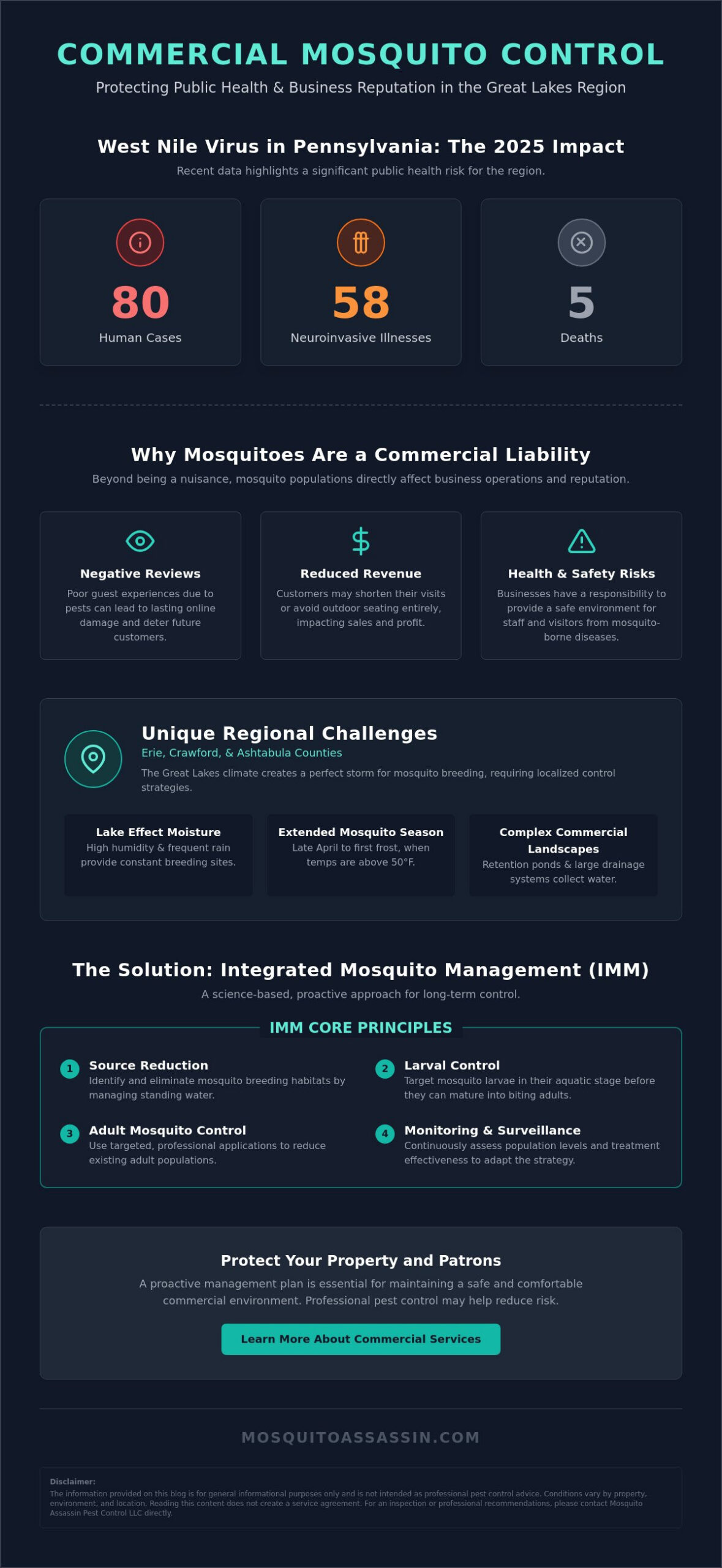
    Pennsylvania recorded 80 human cases of West Nile virus in 2025, which resulted in five deaths and 58 neuroinvasive illnesses. For business owners in Northwest Pennsylvania and Northeast Ohio, these figures represent more than just health data; they represent a significant liability and a threat to daily operations. Effective commercial mosquito control is no longer just an amenity for outdoor seating, but a necessary strategy to prevent negative customer reviews and protect the public from rising health risks.

    It’s understandable to feel frustrated when DIY treatments fail to cover large acreages or keep pests away during peak hours. This guide demonstrates how professional management protects reputations and ensures long-term customer comfort across Erie, Crawford, and Ashtabula counties. You’ll gain insights into Integrated Mosquito Management, regional disease trends, and practical prevention strategies that help maintain a safe, professional environment for every visitor.

    Disclaimer: The information provided on this blog is for general informational purposes only and is not intended as professional pest control advice. Conditions vary by property, environment, and location. Reading this content does not create a service agreement. For an inspection or professional recommendations, please contact Mosquito Assassin Pest Control LLC directly.

    Key Takeaways

    • Understand why Great Lakes properties face unique pest pressures and how mosquito populations directly impact business reputation and public health.
    • Learn the science behind Integrated Mosquito Management and why effective commercial mosquito control prioritizes proactive prevention over reactive treatments.
    • Discover how to customize management strategies for diverse environments, ranging from high-traffic outdoor seating to sensitive locations like daycares or healthcare facilities.
    • Identify practical steps property managers can take to reduce breeding sites and enhance the results of professional monitoring and maintenance.

    The Importance of Commercial Mosquito Control in the Great Lakes Region

    The Great Lakes region presents unique challenges for property management. High humidity levels and frequent rainfall near Lake Erie create ideal breeding grounds that can quickly overwhelm a business without a plan. For local enterprises, managing these pests isn’t just about comfort; it’s a critical operational requirement. Professional commercial mosquito control addresses the specific needs of large-scale properties that standard residential solutions simply cannot handle. Because commercial spaces often have higher foot traffic and larger footprints, the stakes for effective management are significantly higher.

    To better understand this concept, watch this helpful video:

    Commercial properties often feature complex landscapes, such as retention ponds, extensive parking lot drainage, and large manicured green spaces. These areas collect water differently than a standard backyard. When thousands of customers or employees move through these spaces daily, the risk of bites and the transmission of mosquito-borne illnesses increases. Effective Mosquito control strategies involve more than just reactive spraying; they require a deep understanding of how water moves across a specific commercial site. Proactive management ensures that these areas remain usable and safe throughout the season.

    Protecting Your Business Reputation

    In the age of instant feedback, a single negative experience can linger online for years. For the hospitality and outdoor dining sectors in Erie and Ashtabula, mosquitoes are more than a nuisance; they’re a threat to the bottom line. If guests are constantly swatting away pests, they aren’t enjoying their meal or the atmosphere. This often leads to shorter visit times and lower average checks. Beyond comfort, health is a major factor. With Pennsylvania reporting 80 human cases of West Nile virus in 2025, businesses have a responsibility to provide a safe environment for their staff and visitors. A professional environment is one where pests don’t dictate the customer experience.

    Regional Challenges: Erie, Crawford, and Ashtabula Counties

    The climate in Northwest Pennsylvania and Northeast Ohio dictates a specific mosquito window. Typically, activity begins as soon as temperatures consistently stay above 50 degrees, usually in late April or early May, and continues until the first hard frost. The lake effect moisture provides a steady supply of breeding sites even during drier summer months. Understanding these local patterns is essential for effective commercial mosquito control. Timing a treatment based on a generic national calendar won’t work in this specific region. Localized knowledge ensures that interventions happen before populations reach a breaking point, providing a consistent shield throughout the peak season.

    Disclaimer: The information provided on this blog is for general informational purposes only and is not intended as professional pest control advice. Conditions vary by property, environment, and location. Reading this content does not create a service agreement. For an inspection or professional recommendations, please contact Mosquito Assassin Pest Control LLC directly.

    Understanding Integrated Mosquito Management (IMM)

    Successful commercial mosquito control relies on a methodology known as Integrated Mosquito Management (IMM). This is a science-based framework that combines multiple strategies to achieve long-term suppression of pest populations. Instead of simply reacting to an infestation after it occurs, IMM focuses on understanding the life cycle of the mosquito and intervening at the most vulnerable stages. It follows the principles of integrated pest management (IPM), which balances biological, physical, and chemical control methods to protect public health while minimizing environmental impact.

    Many business owners make the mistake of waiting until customers complain before seeking help. Reactive spraying only addresses the adults currently in the air; it does nothing to stop the next generation from emerging. Professional management provides a distinct advantage over DIY methods because it involves comprehensive surveillance and a deep understanding of local regulations. In Pennsylvania and Ohio, commercial pesticide applicators must maintain specific licenses and follow strict environmental guidelines. Licensed professionals have the expertise to identify subtle breeding sites on large acreages that a property manager might overlook.

    Larval Control: Stopping the Cycle

    Identifying and treating breeding sites is the most effective way to manage populations. This process often begins with source reduction, which involves clearing blocked drainage systems or correcting grading issues that cause standing water. When water cannot be drained, targeted treatments are necessary. Larvicide is a targeted treatment for mosquito larvae. By neutralizing mosquitoes before they reach the adult stage, businesses can significantly reduce the overall pest pressure on their property.

    Adulticide and Barrier Treatments

    While larval control is vital, adulticide treatments provide the immediate relief necessary for customer comfort. Professional barrier treatments involve applying a residual spray to the foliage where adult mosquitoes rest during the day. This creates a protective perimeter around high-traffic areas like patios or entryways. Timing these applications is critical; they must be performed when pests are active but when human presence is minimal to avoid operational disruptions. For businesses managing complex landscapes, consulting with a professional for an initial property assessment may help reduce risk more effectively than off-the-shelf products.

    Disclaimer: The information provided on this blog is for general informational purposes only and is not intended as professional pest control advice. Conditions vary by property, environment, and location. Reading this content does not create a service agreement. For an inspection or professional recommendations, please contact Mosquito Assassin Pest Control LLC directly.

    Tailoring Mosquito Control to Different Commercial Environments

    Effective commercial mosquito control requires a strategy that mirrors the specific activity and footprint of the business. A golf course in Crawford County faces different biological pressures than an industrial warehouse in Ashtabula. For large-scale recreational areas, the focus often shifts toward managing vast acreages of turf and wooded borders where mosquitoes rest during the heat of the day. In contrast, industrial sites must prioritize drainage maintenance around loading docks and flat roof systems where standing water frequently accumulates unnoticed. A “one size fits all” approach fails because it doesn’t account for how people and pests interact within a specific space.

    Industrial and warehouse environments often struggle with micro-habitats. These include discarded equipment, clogged gutters, and poorly graded gravel lots that hold water after a Great Lakes storm. Because these sites are often active 24/7, treatments must be coordinated to avoid interrupting logistics chains. For healthcare facilities, the focus is on protecting vulnerable populations. This involves a rigorous inspection of HVAC condensation lines and ornamental water features that could harbor larvae. Professionals must evaluate the unique topography of every site to ensure that interventions are both effective and non-disruptive to daily operations.

    Hospitality and Outdoor Dining

    For restaurants and hotels, the priority is maintaining an invisible shield that doesn’t interfere with the guest experience. Strategic treatment focuses on patios, decks, and outdoor waiting areas where guests are most vulnerable. Scheduling these services during off-hours ensures that there is no contact between customers and the application process. Many business owners find that integrating these efforts with comprehensive commercial pest control services provides a more holistic defense against a variety of regional pests. This combined approach helps maintain the high standards expected in the hospitality industry while protecting the establishment’s reputation from negative online reviews.

    Educational and Recreational Facilities

    Facilities that serve children or the public, such as daycares and municipal parks, require the highest level of care and transparency. Safety and compliance with local regulations are the primary drivers in these environments. Management teams typically focus on playgrounds, sports fields, and common gathering areas. Following a strict Integrated Pest Management (IPM) protocol allows these facilities to reduce mosquito populations while adhering to best practices for sensitive sites. Clear communication with parents and community stakeholders regarding treatment schedules is essential for maintaining trust. It ensures everyone is informed about the property’s health and safety measures without causing unnecessary alarm.

    Disclaimer: The information provided on this blog is for general informational purposes only and is not intended as professional pest control advice. Conditions vary by property, environment, and location. Reading this content does not create a service agreement. For an inspection or professional recommendations, please contact Mosquito Assassin Pest Control LLC directly.

    Commercial Mosquito Control: A Comprehensive Guide for Businesses in PA and OH

    Preparing Your Property for Professional Treatment

    Professional commercial mosquito control works best when it’s a collaborative effort between the property manager and the service team. While technicians provide the technical expertise and specialized equipment, on-site preparation ensures those treatments reach their full potential. Success in Northwest Pennsylvania and Northeast Ohio depends on a proactive approach. By focusing on habitat modification, businesses can significantly extend the efficacy of their management plan. This partnership creates a more resilient environment that is less attractive to pests.

    Preparation begins with a thorough walkthrough of the exterior grounds. Large commercial sites often contain hidden water reservoirs that go unnoticed during daily operations. These micro-habitats can undermine even the most rigorous treatment schedules if left unaddressed. Access is key. If a technician can’t reach a utility yard or a fenced storage area, those zones become safe havens for pests. Clear paths and unlocked gates allow for a comprehensive application across the entire footprint of the business.

    Eliminating Breeding Sites

    Source reduction is the most sustainable way to lower pest pressure on a large acreage. Property managers should prioritize the inspection of flat roofs, clogged gutters, and loading dock drains where water frequently stagnates. Discarded equipment, such as old tires or plastic tarps, can collect enough rainfall to support hundreds of larvae. In parking lots, sunken catch basins or poorly graded gravel areas often hold water for days after a Great Lakes storm. Removing standing water is the most effective form of physical control. Managing these runoff issues prevents the property from serving as a nursery for the next generation of mosquitoes.

    Logistics and Scheduling

    Coordination with other facility teams is essential for a seamless experience. Landscape contractors should be informed of the treatment schedule to avoid heavy pruning or leaf blowing immediately after an application. It’s also vital to manage automatic irrigation systems. Watering the lawn or ornamental beds right after a treatment can wash away residual products before they have time to bond with the foliage. Most professionals suggest a dry time of at least 30 to 60 minutes for optimal results. Reviewing the specific details of your mosquito control program helps align these logistical needs with your operational hours.

    Effective communication with staff is the final step. Informing employees about upcoming activities ensures they don’t enter treated areas while products are still wet. This transparency builds trust and maintains a professional atmosphere. For businesses looking to establish a robust defense, investing in professional commercial mosquito control may help reduce risk and improve overall property comfort.

    Disclaimer: The information provided on this blog is for general informational purposes only and is not intended as professional pest control advice. Conditions vary by property, environment, and location. Reading this content does not create a service agreement. For an inspection or professional recommendations, please contact Mosquito Assassin Pest Control LLC directly.

    The Value of Professional Monitoring and Maintenance

    Relying on a single treatment to last an entire season is a common misconception that can leave a business vulnerable. Mosquitoes can progress from egg to adult in as little as seven to ten days depending on the heat and humidity levels of the Great Lakes region. Because of this rapid life cycle, one-time interventions provide only temporary relief. Effective commercial mosquito control requires ongoing monitoring to ensure that protective barriers remain intact and that new breeding sites are identified before they can produce a new generation of pests.

    Consistent management leads to predictable results. When a property is maintained on a regular schedule, the cumulative effect of larval control and adulticide treatments creates a significantly lower baseline population. This stability is vital for businesses that host outdoor events or provide patio dining. Instead of oscillating between pest-free days and sudden infestations, a professional program keeps activity at a manageable level throughout the peak months. This reliability allows management to focus on daily operations rather than managing customer complaints about pests.

    Surveillance and Data-Driven Adjustments

    Surveillance is the backbone of a successful long-term strategy. It involves more than just scheduled visits; it requires a detailed analysis of how local conditions affect pest behavior. For businesses in Erie and Crawford Counties, weather patterns can shift rapidly. Heavy rainfall or unseasonable heat spikes can trigger sudden population surges that require immediate attention. Professionals use regular property inspections to identify these changing pressures and adjust treatment frequencies or methods accordingly. Working with experts who are familiar with the specific climate of Northwest Pennsylvania and Northeast Ohio ensures that your management plan is responsive to the actual risks present on your acreage.

    Conclusion and Next Steps

    Protecting a commercial reputation requires a shift from reactive problem-solving to proactive management. The data from 2025, which saw 80 human West Nile virus cases in Pennsylvania, underscores the public health importance of these efforts. A comprehensive approach that includes Integrated Mosquito Management, source reduction, and professional monitoring provides the best defense for employees and customers alike. It’s about creating a safe, professional environment where visitors feel comfortable and protected from seasonal pests. For property managers looking to secure their grounds, professional pest control may help reduce risk and improve property comfort. To discuss a tailored strategy for your facility, contacting a professional for an initial property assessment is an effective first step.

    Disclaimer: The information provided on this blog is for general informational purposes only and is not intended as professional pest control advice. Conditions vary by property, environment, and location. Reading this content does not create a service agreement. For an inspection or professional recommendations, please contact Mosquito Assassin Pest Control LLC directly.

    Securing Your Property for the Season Ahead

    Effective commercial mosquito control requires more than a reactive spray; it demands a disciplined, science-based approach tailored to the unique topography of Northwest Pennsylvania and Northeast Ohio. By prioritizing Integrated Mosquito Management (IMM) and maintaining consistent monitoring, property managers protect their reputations and ensure customer comfort. Identifying hidden breeding sites and coordinating with landscape teams creates a resilient environment that discourages pest populations before they peak.

    Utilizing a licensed and insured professional service provides the localized expertise needed to navigate regional disease trends and environmental regulations. A comprehensive approach ensures that every loading dock, patio, and green space remains a safe, professional environment. For an inspection or professional recommendations, please contact Mosquito Assassin Pest Control LLC directly. Taking a proactive stance on pest management is the most effective way to maintain property standards throughout the Great Lakes summer.

    Disclaimer: The information provided on this blog is for general informational purposes only and is not intended as professional pest control advice. Conditions vary by property, environment, and location. Reading this content does not create a service agreement. For an inspection or professional recommendations, please contact Mosquito Assassin Pest Control LLC directly.

    Frequently Asked Questions

    Is commercial mosquito control effective for very large properties?

    Professional methods are highly effective for large acreages because they utilize specialized equipment and comprehensive surveillance. Technicians identify breeding sites across vast properties, such as retention ponds or drainage ditches, that standard residential tools often miss. By combining larval control with adulticide barriers, commercial mosquito control provides a scalable solution for golf courses, parks, and industrial complexes.

    How often should a commercial property be treated for mosquitoes?

    Most commercial properties require treatment every 21 to 30 days during the active season. This frequency ensures that the protective barrier remains strong and interrupts the mosquito life cycle before new adults emerge. In regions like Erie and Crawford Counties, treatments usually begin in late spring and continue through the first hard frost of autumn.

    Is professional mosquito control safe for areas where food is served?

    Professional treatments are designed for use around outdoor dining areas when applied according to strict safety protocols. Technicians focus on the surrounding foliage and resting areas rather than the tables or food preparation surfaces. Scheduling these applications during off-hours ensures that the product is dry before guests arrive, maintaining a professional and safe environment for patrons.

    Can mosquito treatments be scheduled to avoid business hours?

    Coordination with business hours is a standard part of professional service. Most providers offer early morning or late evening appointments to ensure treatments occur when customers and employees are not present. This minimizes operational disruption and allows the product sufficient time to dry before the property reopens for daily traffic.

    What is the difference between residential and commercial mosquito services?

    Commercial services address more complex environments than residential yards, focusing on large-scale drainage, parking lot runoff, and high-traffic liability. Commercial mosquito control also involves more rigorous documentation and compliance with state regulations in Pennsylvania and Ohio. While residential service focuses on a single backyard, commercial management looks at the entire ecosystem of a business footprint.

    How long does a professional mosquito treatment last on a commercial site?

    A professional treatment typically provides effective residual control for approximately three to four weeks. Environmental factors like heavy Great Lakes rainfall or extreme UV exposure can impact this duration. Ongoing monitoring allows technicians to adjust the schedule if population spikes occur between regular visits, ensuring consistent protection.

    Does commercial mosquito control also help with ticks?

    Yes, the barrier treatments used for mosquitoes are often effective against ticks as well. By treating the woodlines and tall grasses where both pests reside, businesses can reduce the risk of multiple pest-borne illnesses. This dual protection is particularly valuable for recreational facilities, schools, and businesses with large wooded borders.

    What happens if it rains shortly after a professional treatment?

    Most professional products are rain-fast once they have had 30 to 60 minutes to dry and bond with the foliage. If a light rain occurs after this window, the treatment remains effective and won’t wash away. If a significant storm occurs immediately after application, a professional provider will typically monitor the site and re-treat if the protective barrier was compromised.

    Disclaimer: The information provided on this blog is for general informational purposes only and is not intended as professional pest control advice. Conditions vary by property, environment, and location. Reading this content does not create a service agreement. For an inspection or professional recommendations, please contact Mosquito Assassin Pest Control LLC directly.