Imagine waking up on a cold January morning in Erie to find the corner of a cereal box shredded or hearing a persistent scratching behind the drywall. You aren’t alone in this frustration; data from 2024 indicates that nearly 30% of households in the Great Lakes region experience rodent activity when temperatures drop below 32 degrees Fahrenheit. It’s a stressful situation, especially when concerns about electrical fires from chewed wires or the spread of diseases like Hantavirus start to weigh on your mind. If traditional traps haven’t solved the problem, consulting an erie pa mice exterminator can provide the professional insight needed to protect your property.
You deserve the peace of mind that comes with a secure, mouse-free home. This guide explains how to identify common entry points specific to the unique architecture of Erie and Crawford counties, while also offering practical management strategies. You’ll learn about the biology of local rodent species and the most effective ways to prevent them from returning. The following sections cover everything from initial identification to long-term exclusion techniques that account for the local climate, ensuring your home remains a sanctuary throughout the year.
Disclaimer: The information provided on this blog is for general informational purposes only and is not intended as professional pest control advice. Conditions vary by property, environment, and location. Reading this content does not create a service agreement. For an inspection or professional recommendations, please contact Mosquito Assassin Pest Control LLC directly.
Key Takeaways
- Understand how the unique climate of Northwest Pennsylvania triggers seasonal rodent migrations into residential structures.
- Identify the specific structural risks and health concerns associated with unchecked mouse activity in local homes.
- Evaluate the effectiveness of DIY methods compared to the comprehensive approach used by a professional Erie PA mice exterminator.
- Learn to locate and seal common entry points (such as foundation gaps and utility penetrations) found in regional architecture.
- Discover long-term management strategies and cleaning habits that help prevent future infestations throughout the year.
Understanding Mouse Infestations in Erie, PA
Erie residents face unique pest challenges because of the region’s specific geography and historical housing. Identifying the signs of an infestation is the first step in effective management. When searching for a qualified erie pa mice exterminator, homeowners often find that local environmental factors dictate the severity of the problem. It’s not just about a single mouse; it’s about understanding how the local ecosystem interacts with residential properties.
To better understand this concept, watch this helpful video:
Common Rodent Species in the Region
The House Mouse (Mus musculus) is the most frequent indoor invader in urban Erie neighborhoods. These rodents typically nest near food sources and can fit through gaps as small as a quarter inch. In more rural parts of Erie County, the Deer Mouse is common. Unlike the House Mouse, the Deer Mouse is often associated with the transmission of Hantavirus. Distinguishing between a single invader and an established colony is critical. An established infestation usually involves multiple nesting sites and visible droppings. Utilizing professional Pest control methods helps identify these species accurately to ensure the right mitigation strategy is applied.
Seasonal Patterns and the Lake Effect
The Lake Erie climate dictates rodent behavior through distinct seasonal shifts. As temperatures drop in late September or October, rodents begin an immediate search for warmth, often moving from fields into residential crawlspaces or attics. The humid Erie summers also play a role, as high moisture levels support larger outdoor populations by providing ample vegetation.
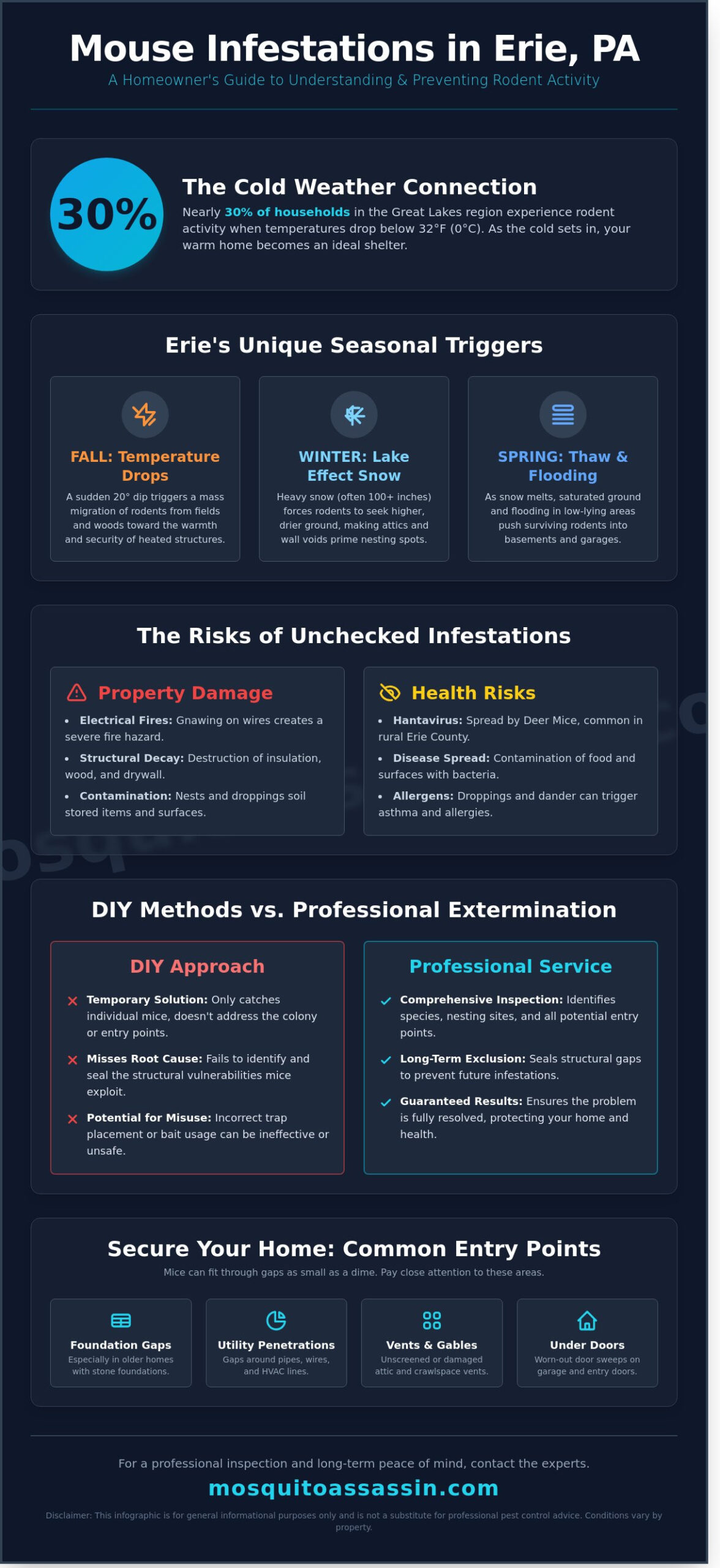
- Fall Temperature Drops: A sudden 20 degree dip in temperature can trigger a mass migration of rodents toward heated structures.
- Lake Effect Snow: Heavy snow accumulation, which can exceed 100 inches annually in parts of the snowbelt, insulates the ground. This forces rodents to seek higher, drier ground inside human dwellings.
- Spring Thaw: As snow melts, flooding in low lying areas can push rodents into basements and garages.
Erie’s architectural landscape also impacts rodent access. Many homes in the city were constructed between 1900 and 1950; these older structures often feature stone foundations or settled wooden frames that have developed small entry points over time. A professional erie pa mice exterminator understands that these historical building techniques require specific exclusion strategies. Local knowledge is essential because pest behavior in the Great Lakes region differs from that in drier or warmer climates. Professional intervention focuses on long term prevention by addressing these structural vulnerabilities. For those seeking assistance, visiting https://mosquitoassassin.com/location can provide more information on regional service areas.
Disclaimer: The information provided on this blog is for general informational purposes only and is not intended as professional pest control advice. Conditions vary by property, environment, and location. Reading this content does not create a service agreement. For an inspection or professional recommendations, please contact Mosquito Assassin Pest Control LLC directly.
The Risks of Unchecked Rodent Activity in Pennsylvania Homes
A mouse infestation in Northwest Pennsylvania is more than a minor annoyance; it’s a significant threat to property integrity and family safety. In regions like Erie and Crawford counties, the drop in temperature during late autumn drives rodents into residential spaces seeking warmth and food. When homeowners delay contacting an erie pa mice exterminator, the damage quickly compounds. Mice possess incisors that grow continuously, necessitating constant gnawing on hard materials to keep them filed down. This biological drive leads to the destruction of various household components that are often expensive and difficult to replace.
Rodents are opportunistic and will utilize any available material to establish their territory. Finding an erie pa mice exterminator early can prevent the structural decay that occurs when rodents are left to their own devices for months at a time. Because mice are nocturnal and secretive, the damage they cause is often hidden behind walls or under floorboards until the situation becomes critical.
Property and Structural Damage
Mice frequently target attic and wall insulation to create soft nesting environments. Research indicates that rodent activity can degrade insulation efficiency by up to 25% in affected areas, which directly increases home heating costs during harsh Pennsylvania winters. Beyond insulation, rodents regularly chew through PVC plumbing pipes and wooden floor joists. The most severe hazard involves electrical systems. By stripping the plastic coating off wires, mice create short circuits that are difficult to detect. The National Fire Protection Association has estimated that rodents are responsible for approximately 20% to 25% of fires where the cause is otherwise unknown. Replacing damaged wiring behind drywall often requires extensive demolition and high labor costs. Drywall itself is also at risk, as mice chew through it to create corridors between rooms.
Health Risks and Sanitation Issues
The presence of rodents introduces serious biological hazards into the home environment. Mice contaminate food preparation areas and storage pantries through their droppings, urine, and hair. This behavior facilitates the spread of Salmonellosis, a bacterial infection that causes severe gastrointestinal distress. Another concern is Hantavirus, which can be transmitted when people breathe in dust contaminated by rodent waste. Indoor air quality suffers as droppings dry out and become airborne particles, often aggravating respiratory conditions like asthma or allergies.
Mice don’t stay in one place; they traverse countertops, silverware drawers, and food containers, leaving behind invisible pathogens. Professional sanitation is necessary after an infestation to ensure these pathogens are neutralized safely without spreading them further into the air. Consulting with a professional may help reduce these risks. Homeowners can schedule an inspection online to evaluate their property’s safety and identify potential entry points.
Professional Mouse Extermination vs. DIY Methods
Homeowners often turn to hardware store shelves when they first spot a mouse. While over-the-counter snap traps or glue boards can catch individual rodents, they rarely eliminate a colony. A single female mouse can produce up to 60 offspring annually; catching one or two mice per week doesn’t keep pace with their reproductive cycle. This is why many residents in Erie and Crawford counties find themselves in a cycle of constant trapping without seeing real results. Most retail traps are designed for convenience rather than total eradication.
Electronic ultrasonic repellents are another popular DIY choice, yet research from institutions like the University of Nebraska-Lincoln shows that rodents often habituate to these sounds within days. Similarly, home remedies like peppermint oil or mothballs lack the longevity to deter a hungry mouse. These methods provide a false sense of security while the underlying infestation grows within the wall voids and insulation. Relying on these fixes often allows a small problem to become a structural crisis.
The Problem with Temporary Fixes
DIY rodent control focuses on the symptoms rather than the root cause. If a homeowner kills a mouse but leaves a 1/4 inch gap under a door or around a utility pipe, another mouse will simply take its place. This creates a revolving door effect. Common mistakes include placing traps in open areas where mice don’t travel and using too few traps for the size of the population. A professional erie pa mice exterminator understands that placement is as critical as the tool itself. Effective control requires sealing entry points with gnaw-proof materials like steel wool or hardware cloth, something simple trapping ignores.
The Professional Integrated Pest Management Approach
Professional management uses a systematic process to find hidden nests that are often located in crawlspaces or behind appliances. Technicians perform detailed inspections to identify structural vulnerabilities specific to older homes in the Great Lakes region. This approach includes ongoing monitoring to ensure that new populations don’t establish themselves during the harsh winter months. For homeowners seeking a broader shield against various invaders, general pest control strategies provide a comprehensive layer of protection for the entire property. Relying on an erie pa mice exterminator ensures that the focus remains on long-term exclusion rather than just temporary removal.
The long-term cost analysis often favors professional intervention. While a bag of traps is inexpensive, the cumulative cost of contaminated food, damaged electrical wiring, and ruined attic insulation quickly exceeds the price of a professional service plan. Addressing the problem early prevents these expensive structural repairs and maintains the value of the property.
Identifying and Sealing Common Entry Points in Erie Homes
Mice are opportunistic survivors that only need a gap of 1/4 inch, roughly the size of a dime, to enter a structure. In Erie, Pennsylvania, where older architecture is common, these small vulnerabilities are frequently found around the building envelope. Effective rodent control relies on a systematic approach to exclusion, which involves identifying and sealing every potential doorway into the living space. A professional erie pa mice exterminator typically begins this process with a detailed exterior inspection, focusing on areas where different building materials meet.
Foundation and Ground-Level Vulnerabilities
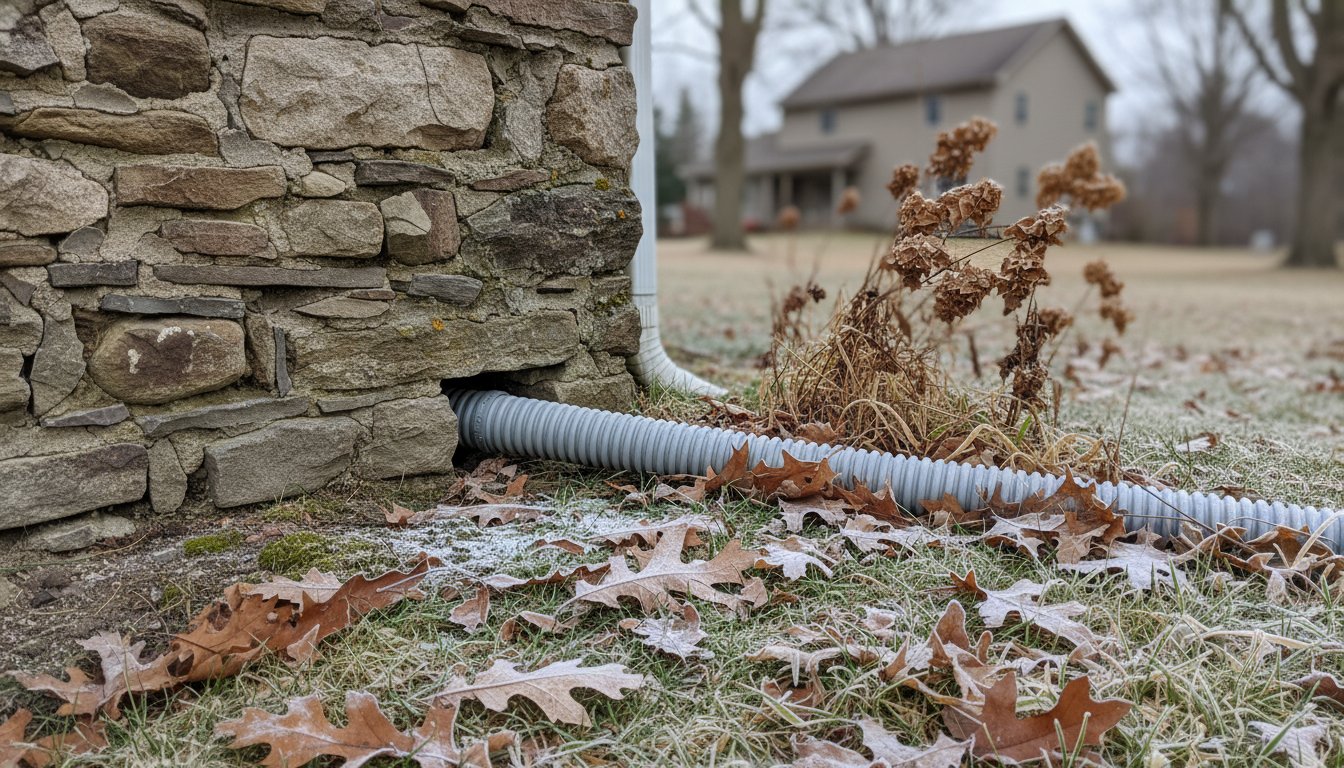
Many homes in Erie County and Crawford County feature historical fieldstone foundations. Over time, the mortar between these stones can crumble or settle, creating small tunnels that lead directly into the basement or crawlspace. It’s vital to inspect the entire perimeter at the ground level for these structural weaknesses. Door sweeps and garage door seals are also common failure points. If light is visible under a door during the day, the gap is large enough for a mouse to squeeze through. Additionally, maintaining a 12 inch clear zone between the foundation and any vegetation is a standard practice. Overgrown shrubs or stacked firewood near the home provide the necessary cover for rodents to work on entry points without being seen by predators.
Upper-Level and Structural Entry Points
Rodents are skilled climbers. They easily scale brick walls, downspouts, or overhanging tree branches to reach the roofline. Architectural gaps where different siding materials meet, such as the transition from stone veneer to vinyl siding, are prime entry spots. Chimneys and roof vents require heavy-duty galvanized hardware cloth to prevent access while still allowing for proper ventilation. Soffit gaps and warped fascia boards often provide a direct route into the attic. Identifying these high-level vulnerabilities is a core part of what an erie pa mice exterminator looks for during a comprehensive assessment. Mice often use these upper entries to nest in insulation, away from the high-traffic areas of the home.
For long-term results, the materials used for exclusion must be durable. Mice can chew through wood, plastic, and standard expanding foam. Professionals utilize specific materials to ensure the seals remain intact:
- 1/4 inch galvanized steel hardware cloth: This is used for covering vents and larger gaps where airflow is still required.
- Stainless steel wool or copper mesh: These materials are packed into small holes before being sealed with a weather-resistant sealant.
- Professional-grade caulk and mortar: These are used to finish the exclusion work, preventing moisture from entering and hiding the repair visually.
Identifying every potential entry point on a large property can be challenging for homeowners. If you suspect your home has structural gaps, scheduling a professional inspection may help identify these hidden risks.
Long-Term Rodent Management and Prevention Strategies
Long-term rodent control requires a shift from reactive trapping to proactive exclusion. While a local erie pa mice exterminator can address an immediate crisis, maintaining a rodent-free home involves consistent environmental management. Rodents are opportunistic creatures. They seek three primary resources: food, water, and shelter. Removing these elements significantly reduces the likelihood of a recurring infestation. Consistency is the most effective tool in any prevention strategy.
Environmental Modification Tips
Small changes to a property often yield the most significant results. Pet food and birdseed are high-calorie attractants that can support a colony of 20 or more mice if left in original paper bags. It’s best to use metal or heavy-duty plastic containers with airtight seals to block scent and access. Outside the home, woodpiles should sit at least 20 feet from the foundation. Piles of debris or stacked firewood provide ideal nesting sites for mice before they attempt to enter the structure. Moisture is another critical factor. Keeping humidity levels in basements and crawlspaces below 50 percent makes the environment less hospitable for rodents and the insects they prey upon.
The Value of Professional Monitoring
Professional oversight provides a layer of defense that standard DIY methods lack. Regular inspections catch structural vulnerabilities, such as a quarter-inch gap near a utility line, before it becomes a primary entry point. This level of detail is especially vital for commercial properties in Erie where health codes and business reputations are at stake. Hiring an erie pa mice exterminator for annual or quarterly monitoring ensures that the strategy evolves with the seasons.
A professional plan adapts to changing environmental pressures. In the autumn, the focus remains on sealing entry points as temperatures drop. During the spring, the strategy shifts to managing outdoor populations before they expand. For homeowners currently facing an active problem, seeking professional rodent removal can provide the necessary expertise to clear the structure safely and effectively.
Residents in Erie, Crawford, and Ashtabula counties deal with unique environmental pressures, including harsh winters that drive rodents indoors. Professional pest control may help reduce risk and ensure the property remains secure throughout the year. For an inspection or to discuss long-term prevention strategies, reaching out to a local professional is a practical next step. Information regarding service options is available at https://mosquitoassassin.com/services.
Securing Your Erie Home Against Rodent Infestations
Maintaining a rodent-free environment in Pennsylvania requires a proactive approach that combines structural exclusion with professional monitoring. Data from the National Pest Management Association suggests that a single pair of mice can produce up to 60 offspring in a 12 month period, making early detection vital for homeowners. Effective management involves identifying entry points as small as 0.25 inches and implementing long-term prevention strategies tailored to the local climate. These rodents frequently chew through electrical wiring, which presents a significant risk to residential structures.
Homeowners in the region often find that professional intervention provides more consistent results than temporary DIY fixes. When seeking a qualified erie pa mice exterminator, it’s important to choose a provider with deep local roots. Mosquito Assassin is a locally owned and operated company based in Cranesville, PA. Licensed and insured technicians provide professional oversight throughout Erie, Crawford, and Ashtabula counties. Professional pest control may help reduce the risk of rodent infestations. For an inspection, visit mosquitoassassin.com. Taking these steps today helps ensure a safer, more comfortable living space for the future.
Disclaimer: The information provided on this blog is for general informational purposes only and is not intended as professional pest control advice. Conditions vary by property, environment, and location. Reading this content does not create a service agreement. For an inspection or professional recommendations, please contact Mosquito Assassin Pest Control LLC directly.
Frequently Asked Questions
How much does a mice exterminator cost in Erie, PA?
Professional rodent control costs in Pennsylvania typically range from $200 to $600 for an initial service visit. This price variation depends on 3 main factors: the size of the infestation, the square footage of the home, and the extent of exclusion repairs needed. Hiring an Erie PA mice exterminator involves a detailed inspection to determine the specific scope of work required for a property.
Can mice get into a house through the roof in Pennsylvania?
Mice frequently enter Pennsylvania homes through roof lines by climbing nearby trees, siding, or utility lines. These rodents can squeeze through gaps as small as 6 millimeters, which are common near soffits, chimneys, and roof vents. Research shows that deer mice can jump 30 centimeters vertically, allowing them to reach low-hanging gutters or shingles with ease during the winter months.
How do I know if I have mice in my walls or just a noisy house?
Audible scratching or scurrying sounds between 10 PM and 6 AM often indicate a rodent presence rather than standard house settling. Homeowners should look for 3 to 6 millimeter dark droppings or grease marks along baseboards to confirm an infestation. An Erie PA mice exterminator uses these physical signs to differentiate between structural noises and active rodent nesting sites within the wall voids.
Are mouse treatments safe for my pets and children?
Licensed professionals use tamper-resistant bait stations designed to keep children and pets from accessing rodenticides. These heavy-duty containers are locked and often secured to the ground to prevent movement or accidental opening. Technicians follow strict EPA guidelines to ensure that all materials are placed in areas inaccessible to non-target animals, such as crawlspaces, attics, or behind heavy appliances.
How long does it take for a professional to get rid of mice?
Most residential rodent infestations are successfully eliminated within 14 to 21 days of the initial treatment. The first 7 days typically see a significant reduction in activity as mice interact with the professional treatment plan. Complete eradication requires this multi-week window to account for the life cycle of the rodents and to ensure every member of the colony is addressed.
What is the best way to prevent mice from returning in the winter?
Sealing every exterior opening larger than 6 millimeters with steel wool or hardware cloth is the most effective prevention strategy. Homeowners should focus on the foundation, utility entrances, and door sweeps before temperatures drop below 45 degrees Fahrenheit. Maintaining a 12-inch gravel border around the home perimeter also discourages rodents from nesting near the foundation during the snowy season.
Do I need to leave my home during a rodent treatment?
Residents don’t usually need to vacate their homes during a standard professional rodent treatment. Since technicians primarily use localized baiting, trapping, and exclusion techniques, there’s no airborne risk that requires evacuation. If a specific situation requires a different approach, a professional technician will provide specific instructions at least 24 hours before the service begins to ensure resident comfort.
Is it possible to totally mouse-proof an older Erie home?
Achieving a mouse-proof status in older Erie homes is possible through comprehensive exclusion and consistent structural maintenance. Many houses built before 1950 have stone foundations or settling gaps that require professional-grade sealants and metal flashing to secure. While challenging, identifying and closing every 1/4-inch gap ensures that rodents cannot find a way inside when seeking warmth. Professional pest control may help reduce risk.
Disclaimer: The information provided on this blog is for general informational purposes only and is not intended as professional pest control advice. Conditions vary by property, environment, and location. Reading this content does not create a service agreement. For an inspection or professional recommendations, please contact Mosquito Assassin Pest Control LLC directly.