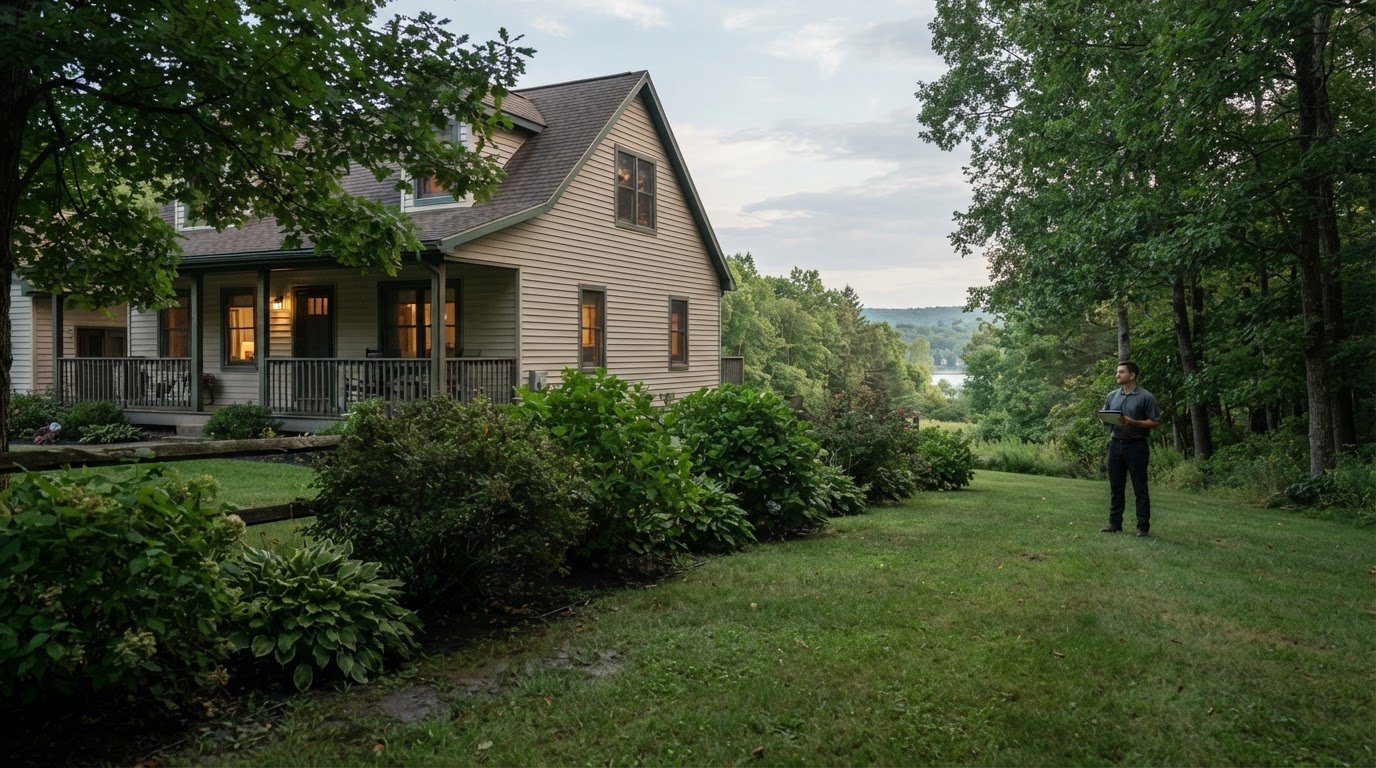
The right time to spray for mosquitoes isn’t always dawn or dusk. If you’re asking what is the best time of day to spray for mosquitoes, the answer depends on the treatment being used, the mosquitoes being targeted, and where they’re active around your property.
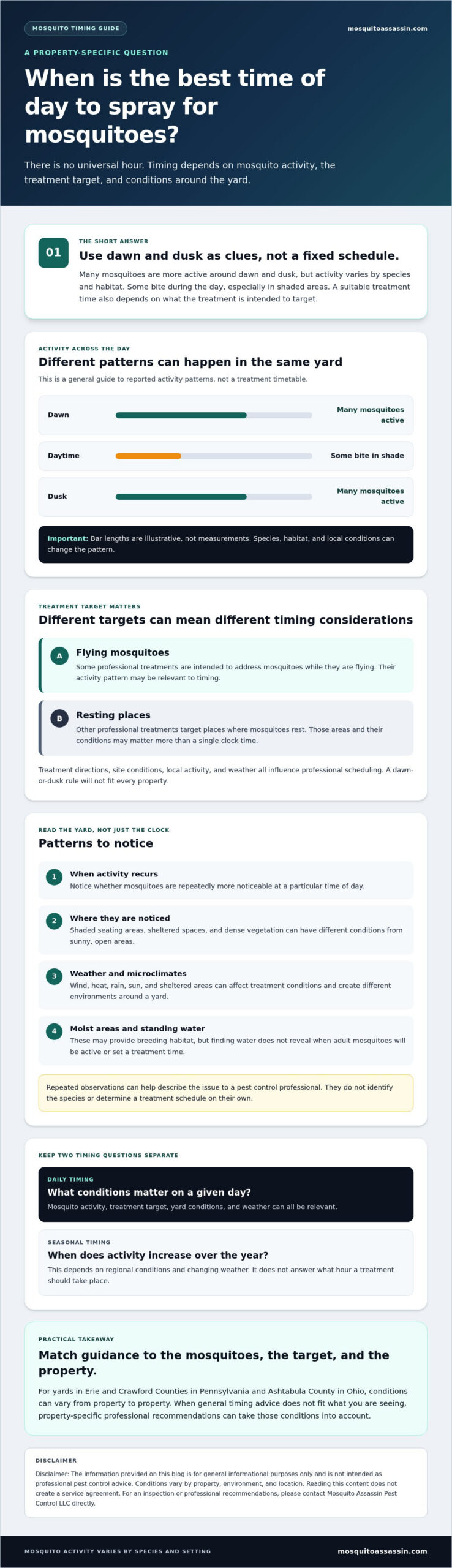
Conflicting advice is common because mosquito activity varies. Many mosquitoes are most active around dawn and dusk, while some bite during the day and rest in cool, sheltered areas. A treatment aimed at flying mosquitoes may therefore be timed differently from one applied to places where mosquitoes rest. Weather matters too: wind, heat, and rain can affect treatment conditions.
This guide explains how mosquito activity, treatment type, weather, and yard features can influence spray timing. There isn’t one universal hour for every property. In Erie and Crawford Counties in Pennsylvania and Ashtabula County in Ohio, conditions can vary from yard to yard. When general advice doesn’t fit what you’re seeing, property-specific professional recommendations can help.
Key Takeaways
- The answer to “what is the best time of day to spray for mosquitoes” depends on the treatment approach and conditions around your property, not a universal schedule.
- Compare dawn, dusk, and daytime guidance by considering when mosquitoes are active and where they tend to rest.
- Recurring activity in shaded or sheltered parts of the yard can offer useful clues about which areas may need closer attention.
- Notice how weather changes alongside mosquito activity, and consider property-specific professional recommendations if general timing advice doesn’t fit your yard.
What Is the Best Time of Day to Spray for Mosquitoes?
There isn’t one best hour for every property. The answer to “what is the best time of day to spray for mosquitoes” depends on when mosquitoes are active, the type of professional treatment, and conditions around the yard. Dawn and dusk are relevant because some mosquitoes are more active then, but neither is a universal treatment window.
A single clock-time recommendation can be misleading because mosquito species, habitats, and treatment approaches differ. Some mosquitoes are active around dawn or dusk, while others may bite during the day in shaded places. Scheduling also needs to account for the treatment’s intended target, its directions, and current weather conditions.
Daily timing is different from seasonal timing. The time of year when mosquito activity begins or increases depends on regional conditions and changing weather. That does not tell you what time of day a treatment should take place. These are related questions, but they have different answers.
Is dawn or dusk better for mosquito spraying?
Dawn and dusk are often mentioned because many mosquito species are more active during these periods. However, activity varies by species and habitat, so the pattern in one yard may not match another. A shaded area can have different conditions from an open, sunny space. Treat dawn and dusk as useful context, not a guaranteed schedule or promise of a particular result.
What you notice outdoors can help describe the issue. Recurring bites or visible activity at a particular time may reveal a pattern, but observation alone doesn’t identify the species or determine a treatment schedule.
Does the answer change by treatment type?
Yes. Some professional treatments are intended to address mosquitoes that are flying, while others target places where mosquitoes rest. Because the targets differ, the relevant timing can differ too. A comprehensive overview of mosquito control also shows that spraying is one part of a wider range of control approaches.
Product directions and site conditions can influence professional scheduling. Treatment type, local mosquito activity, and weather all matter, so a fixed dawn-or-dusk rule may not fit every property. Choosing or applying a pesticide is not simply a matter of picking an hour. Treatment decisions should follow the product’s directions and qualified professional judgment.
How Mosquito Activity and Yard Conditions Affect Spray Timing
Mosquito activity isn’t uniform across a yard or across species. Dawn and dusk are useful general reference points, but the mosquitoes you notice may be active at other times, depending on their species and the conditions around them. That variation explains why advice based only on the clock may not match what’s happening on a particular property.
Why mosquito activity may peak at different times
Many mosquitoes are most active around dawn and dusk, but this pattern isn’t universal. For example, some Culex mosquitoes are commonly active around dusk and into the night, while the Asian tiger mosquito can bite during the day, particularly in shaded areas. These are broad behavioral patterns, not a way to identify a mosquito by sight or predict activity at every property.
Local conditions can also affect when mosquitoes are noticeable. Sun, wind, temperature, and sheltered areas can create different microclimates across a yard. A sunny, exposed lawn can feel very different from a still, shaded spot beside dense vegetation. Shade, shelter, moisture, and observed activity can all influence when mosquitoes are encountered, so consider timing in the context of the property.
What the yard can tell you about timing
Look for recurring patterns rather than relying on one observation. Are mosquitoes more noticeable near a shaded seating area in the afternoon, or in a sheltered part of the yard around dusk? Noting the location and time can help you explain the issue to a pest control professional. It won’t establish the species or determine a treatment schedule on its own.
Moist areas and standing water matter for a different reason: they may provide mosquito breeding habitat. Finding water doesn’t necessarily explain when adult mosquitoes will be active, and it shouldn’t be treated as a cue for pesticide application. The CDC guidance on mosquito control discusses approaches that address mosquitoes beyond adult activity, including attention to breeding sites.
Seasonal questions are separate, too. When mosquito activity begins or increases over the year depends on regional and weather conditions. That seasonal pattern concerns when mosquitoes become active across weeks or months, not the best hour for treatment on a given day.
If activity varies across your yard, professional recommendations can take those conditions into account. For readers in Erie and Crawford Counties, Pennsylvania, and Ashtabula County, Ohio, mosquito control service information may help explain how property-specific considerations fit into professional guidance.
Dawn, Dusk, or Daytime: Which Spray Timing Advice Applies?
Dawn, dusk, and daytime advice can all be reasonable in different situations. The key is to match timing to the mosquitoes being targeted, the treatment type, and the property’s conditions. A treatment intended for active, flying mosquitoes may be scheduled differently from one focused on places where mosquitoes rest. This is why a fixed schedule can’t answer every question about what is the best time of day to spray for mosquitoes.
| Time | General consideration | What may affect the timing |
|---|---|---|
| Dawn | May overlap with activity for some mosquito types. | Local activity, treatment purpose, and product directions. |
| Dusk | Often discussed because some mosquitoes are active around this period. | Species, site conditions, weather, and treatment purpose. |
| Daytime | May be considered for certain treatments directed at resting mosquitoes. | Where mosquitoes rest, environmental conditions, and product directions. |
When dawn or dusk may be relevant
Many mosquitoes are more active around dawn or dusk, so these periods can be useful reference points when considering treatments aimed at mosquitoes in flight. Activity still differs by species and habitat. Some mosquitoes may bite during the day in shaded areas, and local weather can change what people notice. These patterns help frame the question, but they don’t establish a universal treatment window.
Why professional treatments may happen at other times
Some professional approaches target flying mosquitoes, while others focus on vegetation or other resting areas. Since the target differs, the most relevant schedule may differ as well. A treatment directed at resting mosquitoes may not need to coincide with peak flying activity, while another treatment may be more closely timed to it. Not every treatment is suitable for every time or condition.
Weather and product directions matter too. Wind, heat, or other site conditions may affect whether treatment is appropriate at a particular time. Professionals consider these factors rather than relying on the hour alone. The time mosquitoes are most noticeable and the time a treatment is scheduled can therefore differ without being contradictory.
Use dawn and dusk as general activity clues, not instructions for applying pesticides. If timing advice doesn’t seem to fit the activity in your yard, ask a pest control professional how the treatment type and property conditions inform the schedule. Property-specific recommendations are more useful than guessing from a general rule.
What to Consider Before Deciding When to Spray Mosquitoes
Before settling on a time, look for patterns in where and when mosquitoes appear. These observations can help a pest control professional understand what you’re experiencing, but they don’t replace an assessment or determine when a pesticide should be applied. The question “what is the best time of day to spray for mosquitoes” is about daily scheduling, not when mosquito season begins.
Which conditions are worth noting?
Make a simple note of recurring activity. For example, mosquitoes may be more noticeable around a shaded patio in the afternoon or near a sheltered part of the yard at dusk. Consider whether activity seems to change after shifts in weather as well. Recent conditions can inform a professional assessment, but no single weather pattern automatically indicates the right treatment time.
- When: Is activity consistently noticed in the morning, afternoon, evening, or at more than one time?
- Where: Are mosquitoes more noticeable in shaded, sheltered, or damp areas?
- What has changed: Has activity shifted with recent weather or changing outdoor conditions?
- Seasonal context: Are you asking about a treatment’s time of day, or about when mosquito activity typically starts or increases during the year?
These details describe what you’re experiencing. They aren’t a treatment checklist. Standing water and other yard features should be considered separately from pesticide decisions.
When is property-specific guidance useful?
Tailored recommendations may be useful if mosquito activity keeps returning in particular areas or if the yard has a mix of open lawn, dense shade, and sheltered outdoor spaces. In those situations, a general dawn-or-dusk rule may not tell the whole story. A professional can consider the observed pattern, the property, and the treatment approach instead of relying on a clock-time guess.
For broader context, review information about mosquito control services. For readers in Erie and Crawford Counties in Pennsylvania or Ashtabula County in Ohio, property-specific guidance may help account for local and yard-level differences. Share the conditions you’ve observed when asking about recommendations.
How to Get Reliable Mosquito Spray Timing Guidance in PA and OH
There’s no universal hour that suits every yard. The best timing depends on the mosquito activity being observed, the treatment approach, and property conditions. Dawn or dusk may be relevant in some situations, but neither determines the right schedule for every home.
What local context can and cannot tell you
Regional conditions help frame the question, but they can’t identify one exact treatment time for every property. Even within the same area, shade, shelter, moisture, and the layout of outdoor spaces can differ. General advice about mosquito season is also distinct from advice about the time of day to schedule a treatment.
For properties in Erie and Crawford Counties, Pennsylvania, and Ashtabula County, Ohio, location provides useful context, not a substitute for considering the individual yard. You can review the company’s service area information to see the regions served.
When to consult a mosquito-control professional
Professional input may be useful if activity repeatedly occurs in certain parts of the yard, if conditions vary across the property, or if you’re unsure how treatment type affects scheduling. Sharing when and where mosquitoes are noticed can help inform a property-specific discussion. It doesn’t mean a particular hour or treatment is appropriate without further assessment.
If you’re still wondering what is the best time of day to spray for mosquitoes, ask how observed activity, site conditions, and the intended treatment influence scheduling. A discussion about your property can help clarify which factors matter.
Daily treatment timing is only one part of mosquito management. Seasonal activity and other property conditions may also matter, so treat broad regional guidance as context rather than a fixed schedule.
Disclaimer: The information provided on this blog is for general informational purposes only and is not intended as professional pest control advice. Conditions vary by property, environment, and location. Reading this content does not create a service agreement. For an inspection or professional recommendations, please contact Mosquito Assassin Pest Control LLC directly.
Use Your Yard’s Conditions to Guide the Next Step
There’s no single clock time that works for every property. Dawn and dusk can be useful reference points, but mosquito activity, treatment type, and yard conditions all influence scheduling. The answer to “what is the best time of day to spray for mosquitoes” depends on how those factors come together, not on a universal hour.
Recurring activity in shaded or sheltered areas, along with changing weather, can help explain what’s happening around your home. Seasonal timing is a separate question from the best time of day for treatment. Property-specific guidance can help connect your observations to the conditions on your property.
Mosquito Assassin Pest Control LLC provides mosquito and tick control in Erie and Crawford Counties, Pennsylvania, and Ashtabula County, Ohio. Contact the company to ask about mosquito control recommendations for your property.
Disclaimer: The information provided on this blog is for general informational purposes only and is not intended as professional pest control advice. Conditions vary by property, environment, and location. Reading this content does not create a service agreement. For an inspection or professional recommendations, please contact Mosquito Assassin Pest Control LLC directly.
Frequently Asked Questions
What time of day are mosquitoes most active?
Many mosquito species are most active around dawn and dusk, but activity varies by species and habitat. Some mosquitoes may bite during the day, especially in shaded areas, while others are active into the night. Temperature, wind, and sheltered spaces can also affect when mosquitoes are noticeable. Treat these periods as general patterns, not a precise schedule that applies to every yard or mosquito.
Can mosquitoes be sprayed during the daytime?
Some professional mosquito treatments may be scheduled during the day, depending on the treatment type, its intended target, and site conditions. For example, a treatment aimed at resting mosquitoes may not need to coincide with peak flying activity. This doesn’t mean every treatment is suitable at any hour. Product directions and professional judgment guide scheduling. Don’t use general timing advice as pesticide application instructions.
Does weather affect the best time to spray for mosquitoes?
Yes. Weather can influence both mosquito activity and whether conditions are suitable for treatment. Wind may affect where spray travels, while heat can affect treatment conditions. Rain and other changing conditions may also be relevant, depending on the product directions. There isn’t one weather rule that sets the ideal hour for every property. A professional can consider current site conditions alongside the treatment approach.
Does the best time to spray vary by mosquito species?
Yes. Mosquito species don’t all follow the same activity pattern. For example, some Culex mosquitoes are commonly active around dusk and into the night, while the Asian tiger mosquito can bite during daylight in shaded areas. These are broad patterns, not a reliable way to identify a mosquito from a casual observation. Species and habitat can help explain why activity differs across properties.
Should mosquito spraying happen before mosquito season starts?
Seasonal planning and daily treatment timing are different questions. The start and level of mosquito activity vary with regional and environmental conditions, so a fixed calendar date doesn’t apply everywhere. Whether a treatment is appropriate before activity increases depends on the property, the treatment approach, and professional recommendations. Reducing standing water is a separate prevention consideration, not a reason to apply pesticide or a substitute for treatment guidance.
How do I know what spray timing is appropriate for my property?
Note where and when mosquitoes repeatedly appear, such as near a shaded seating area during the afternoon or in a sheltered spot around dusk. Consider whether activity changes with weather, and share those observations with a pest control professional. If you’re asking what is the best time of day to spray for mosquitoes, the useful answer depends on your yard, observed activity, and the treatment being considered.
Disclaimer: The information provided on this blog is for general informational purposes only and is not intended as professional pest control advice. For an inspection or professional recommendations, please contact Mosquito Assassin Pest Control LLC directly.