
Is that faint scratching sound from inside your walls keeping you up at night? You’re not just imagining it, and you’re right to be concerned. That unsettling noise is often the first clue of a hidden problem-one that can lead to chewed electrical wires, damaged insulation, and a constant feeling of unease in your own home. When the enemy is hidden from sight, it’s easy to feel helpless, but taking action starts with knowing exactly what you’re up against.
Hiring a qualified expert is the most reliable path forward. Companies that specialize in rodent control, such as PPM Services Pest Control, have the tools and experience to resolve the issue completely and prevent it from returning. While they are based in the UK, their approach highlights the level of expertise you should look for in any professional service.
Ignoring these subtle clues isn’t an option for protecting your property and your family’s health. That’s why learning to identify the definitive signs of a mouse infestation in walls is the first critical step toward taking back control. This guide is your first line of defense. We’ll break down the seven tell-tale indicators you need to listen and look for, from strange sounds to mysterious odors. By the end, you’ll not only be able to confirm your suspicions but will also have a reliable action plan to eliminate the threat and restore your peace of mind for good.
Key Takeaways
- Listen for specific scratching and scurrying sounds, especially at night, as this is the most common first clue of mice living in your walls.
- Beyond noises, there are definitive visual and olfactory signs of a mouse infestation in walls that you can spot by inspecting key areas inside and outside your home.
- Understand the serious risks mice pose to your property, from chewing electrical wires to contaminating insulation, which makes prompt action essential.
- Learn the proven action plan for eliminating mice and the critical reason you should never seal entry holes before the infestation is professionally handled.
The First Clue: What Do Mice in Walls Sound Like?
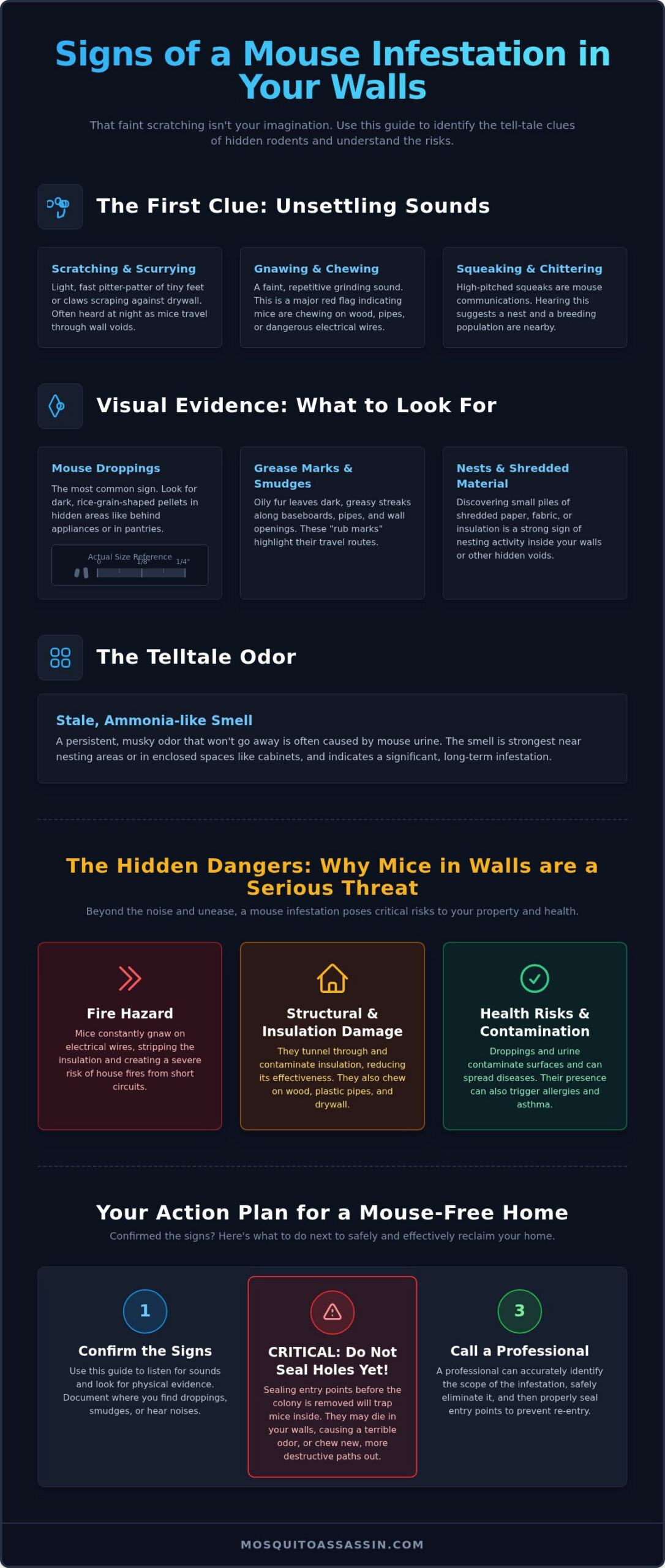
For most homeowners, the first clue that something is wrong is an unsettling noise coming from inside the walls, especially after dark. If you’re lying in bed wondering about faint scratching or scurrying sounds, you are not imagining things. Because mice are primarily nocturnal creatures-a key aspect of House mouse behavior and biology-their activity peaks when your home is quiet. These noises are often the earliest and most common signs of a mouse infestation in walls, and learning to identify them is the first step toward taking back your home.
To get a better sense of what you might be hearing, listen to the examples in this helpful video:
Scratching, Scurrying, and Scampering
One of the most distinct sounds is a light scratching or the fast pitter-patter of tiny feet. This is the sound of mice using the voids in your walls as their personal highway system. You might hear their claws scraping against drywall, insulation, or wood studs as they travel. These scampering noises can seem to move quickly up a wall or across a ceiling as the rodent explores its territory in search of food and nesting materials.
Gnawing and Chewing Noises
A faint, repetitive grinding or chewing sound is a major red flag. A mouse’s incisors never stop growing, so they must constantly gnaw on hard surfaces to keep them filed down. Unfortunately, those surfaces often include your home’s structural wood, PVC pipes, and most dangerously, electrical wiring. This gnawing sound is not just an annoyance; it’s a direct indicator of potential property damage and a serious fire hazard.
Squeaking and Chittering
While less common than scratching or gnawing, hearing high-pitched squeaks or chittering from your walls is an undeniable sign of mice. These are vocalizations used for communication between mice. Hearing these sounds often means you are close to a nest, and it’s a strong signal that the infestation is not just a single mouse but a breeding population. These vocalizations are definitive signs of a mouse infestation in walls that is already well-established and growing.
Beyond Sound: Visual Evidence of an Infestation
Hearing noises is unsettling, but what you can see provides the definitive proof you need to take action. Even though mice are nesting out of sight, they must venture out for food and water, leaving a trail of physical evidence behind. A thorough inspection of your home’s quiet corners is the first step in confirming the problem. Focus your attention along baseboards, in the back of cabinets, and within your basement or attic, as these are common travel routes. Finding even one of the following clues confirms that you’re dealing with more than just a house settling; you’re seeing clear signs of a mouse infestation in walls.
Finding Mouse Droppings
Mouse droppings are the most common and unmistakable sign of rodent activity. Look for small, dark pellets, typically about 1/8 to 1/4 inch long, with pointed ends resembling grains of rice. You’ll find them concentrated in areas where mice feed or travel, such as along walls, in corners of pantries, under sinks, and behind appliances. The quantity can also tell a story; a few scattered droppings might indicate a lone explorer, while large accumulations point to a well-established colony. According to the University of California’s guide on identifying and managing a mouse infestation, the presence of droppings is a primary indicator that requires immediate attention.
Unexplained Smudges and Grease Marks
Mice have oily fur that picks up dirt and grime. As they repeatedly use the same paths, they leave behind dark, greasy smudges, known as rub marks, on the surfaces they touch. Check for these dirty streaks along baseboards, around pipes, and near any small holes or cracks in your foundation or drywall. These marks are a key giveaway, essentially highlighting a mouse “highway” between their nest inside the wall and their food sources in your home. These visual cues are some of the most overlooked but revealing signs of a mouse infestation in walls.
Mysterious Nests and Piles of Shredded Material
To build warm, hidden nests within your wall voids, mice will gather and shred any soft materials they can find. If you discover small, unexplained piles of shredded items like paper, fabric, cotton balls, or insulation, it’s a strong indication of nesting activity. Mice will pull these materials from your living space into the walls. Look for this debris in secluded, undisturbed areas like the back of closets, inside drawers, behind major appliances, or tucked away in the corners of your attic or basement. Finding a nest is definitive proof of an active and breeding infestation.
The Telltale Odor: What Does a Mouse Infestation Smell Like?
Beyond the sounds and physical damage, your nose is one of the most reliable tools for detecting mice. An unusual, persistent odor that you can’t seem to place is one of the most definitive signs of a mouse infestation in walls. While homeowners often look for droppings or gnaw marks first, the U.S. Environmental Protection Agency lists distinct smells as one of the key signs of a mouse infestation. A strong odor usually indicates that the problem is not new; it points to a well-established colony that has been living, breeding, and marking territory inside your home for some time. The smell is often more concentrated in enclosed, poorly ventilated areas like wall voids, attics, and closets.
It’s crucial to distinguish between the two primary odors associated with mice, as they point to different stages of an infestation:
The Stale, Musty Smell of Urine
Live mice produce a continuous, musky odor that comes from their urine. This scent is often described as stale or similar to ammonia. Mice use urine to mark their territory and create pathways, and over time, this scent accumulates and permeates building materials like drywall and insulation. In areas with a large population, you may find “urine pillars”-small mounds of grease, dirt, and mouse urine-which create a potent and unmistakable smell. This is often the first odor-related sign you will notice.
The Odor of a Deceased Mouse
A far more powerful and sickeningly sweet smell is that of a deceased mouse. This foul odor of decay is an unfortunate and common consequence of DIY pest control. When a mouse consumes poison bait, it often retreats into its nest within your walls to die. The resulting stench can last for weeks and is nearly impossible to eliminate without locating and removing the carcass. This is a major reason our professional technicians focus on comprehensive trapping and exclusion strategies. A proven, professional approach is designed to eliminate the entire colony, safeguarding your home from both living pests and the secondary problems caused by improper extermination.
The Hidden Dangers: Why Mice in Walls Are a Serious Threat
That faint scratching or musty smell you noticed isn’t just an annoyance-it’s a critical warning. Ignoring the early signs of a mouse infestation in walls exposes your home and family to significant, often invisible, dangers. Understanding these threats moves the problem from a simple nuisance to an urgent priority, justifying the need for a swift and professional response to protect your property’s value and your family’s well-being.
Out of sight should not mean out of mind. What happens inside your walls has a direct impact on the safety and integrity of your entire home.
Structural and Fire Hazards
Behind your drywall, mice are relentlessly destructive. Their constantly growing incisors compel them to gnaw on anything available, including electrical wiring. This creates a severe fire hazard, as frayed wires can spark and ignite insulation or wood framing. They also tunnel through and shred insulation to build nests, compromising your home’s thermal barrier and leading to noticeably higher energy bills. Over time, this constant burrowing can weaken wood studs, damage drywall, and even puncture plastic plumbing pipes, leading to slow, hidden leaks.
Health Risks and Disease Transmission
The most serious threat posed by mice is to your family’s health. These rodents are notorious carriers of dangerous pathogens. As they travel through your walls and into living spaces, they leave a trail of droppings and urine that contaminates surfaces and degrades your home’s air quality. This exposes your family to serious illnesses, including:
- Hantavirus
- Salmonella
- Leptospirosis
- Lymphocytic Choriomeningitis (LCMV)
This is an unacceptable risk, especially for households with children, elderly members, or pets. Safeguarding your loved ones is paramount, which is why our pest control services are designed to eliminate these threats using proven, family-safe treatments. The dangers hidden within your walls are precisely why professional intervention is not a luxury-it’s a necessity.
What to Do Now: Your Action Plan for a Mouse-Free Home
Recognizing the signs is the first battle. Now, it’s time for a decisive plan of action. When dealing with mice inside your home’s structure, your first instinct might be to plug any hole you see. This is the single biggest mistake you can make. Sealing entry points before the colony is eliminated traps mice inside, forcing them to die, decompose, and create a lingering odor that can last for months.
A true, lasting solution for a mouse infestation in your walls requires a professional, systematic approach. DIY traps and baits placed in your kitchen or basement rarely address the source of the problem hidden deep within your home’s voids, leading to a frustrating cycle of recurring activity.
Step 1: Comprehensive Professional Inspection
The first step is always a thorough inspection from a certified technician. We go beyond surface-level signs to identify the full scope of the problem. This includes locating all potential entry points, mapping out rodent travel routes, and pinpointing nesting sites within your walls and attic. A comprehensive assessment is the foundation for effective eradication when you see signs of a mouse infestation in walls.
Step 2: Strategic Removal and Trapping
Once we understand the infestation, we implement a customized trapping and removal plan. Our experts use targeted, family-safe methods to strategically remove mice from wall voids and other hidden areas. This proven process is designed to eliminate the entire population without the risk of mice dying inside your walls, which prevents secondary pest issues and foul odors.
Step 3: Permanent Exclusion and Prevention
After we have confirmed all rodent activity has ceased, we move to the final, critical step: exclusion. Our technicians permanently seal every crack, gap, and entry point using durable, rodent-proof materials like steel wool, specialized sealants, and custom flashing. As a local company, we know the common entry points for homes in our service locations and ensure your home is fully safeguarded against future invasions.
Don’t let a few suspicious sounds turn into a major structural and health crisis. Take back your peace of mind with a professional solution that works. Contact Mosquito Assassin Pest Control LLC today for a comprehensive inspection and a guaranteed pest-free home.
Reclaim Your Home and Eliminate Mice for Good
Hearing scratching in your walls is more than just an annoyance-it’s a clear warning. From the telltale sounds of gnawing to the visual evidence of droppings and the serious health risks they pose, recognizing these key signs of a mouse infestation in walls is the first critical step toward safeguarding your property and your family’s health. Don’t ignore these warnings; the problem will only get worse and lead to more significant damage.
The fastest and most effective way to eliminate the threat is to call in the professionals. At Mosquito Assassin, our team of experts is ready to restore your home’s safety. As a Five-Star Rated and Locally Owned and Operated service in PA & OH, we stand by our work with our Pest-Free Guarantee: if pests return, so do we. Take decisive action and protect what matters most.
Don’t let mice destroy your peace of mind. Schedule your professional inspection now!
Frequently Asked Questions About Mice in Walls
Can mice in walls go away on their own?
It is extremely unlikely that mice in your walls will leave on their own. Your home provides them with warmth, shelter from predators, and easy access to food and water sources. Once established, they will breed and multiply, turning a small problem into a severe infestation. Professional intervention is the only proven method to eliminate the population and safeguard your home from the health risks and damage they cause.
How do exterminators get mice out of walls without tearing them down?
Our licensed technicians use a strategic, non-invasive process. After a comprehensive inspection to identify entry points and rodent pathways, we utilize strategically placed, family-safe baits and traps within wall voids, attics, and basements. This method targets the mice where they live and travel, eliminating the population at its source. We then focus on sealing exterior entry points to provide lasting protection without any need for demolition.
Is one mouse in the wall a sign of a bigger problem?
Yes, absolutely. Hearing or seeing a single mouse is one of the clearest signs of a mouse infestation in walls. Mice are social creatures that live in colonies, so where there is one, there are almost certainly more hidden from view. That one mouse is likely a scout or simply the first one you’ve managed to detect. Taking immediate action is critical to stop the hidden colony from growing and causing widespread damage.
How quickly can a mouse infestation in the walls get out of control?
A mouse problem escalates with alarming speed. A single female can have 5 to 10 litters per year, with an average of six pups per litter. Those offspring can begin reproducing in as little as six weeks. This means a pair of mice can lead to a colony of dozens in just a few months. This rapid breeding cycle is why a swift, professional response is essential to prevent a minor issue from becoming overwhelming.
Will homeowners insurance cover damage caused by mice?
In nearly all cases, standard homeowners insurance policies do not cover damage caused by rodents. Pest infestations are typically viewed as a preventable problem that falls under the homeowner’s responsibility for routine maintenance. This leaves you to pay out-of-pocket for costly repairs to chewed electrical wires, contaminated insulation, and damaged drywall. Investing in professional pest control is your best defense against these expensive, uninsured damages.
How long does it take to get rid of mice in walls professionally?
The timeline for complete eradication depends on the size and complexity of the infestation. While our treatments provide a significant reduction in activity within days, it can take one to three weeks to ensure the entire population is eliminated. Our proven process includes crucial follow-up visits to monitor the situation, adjust treatments, and confirm the problem is resolved. Our Pest-Free Guarantee means we are committed to seeing the job through to completion.