
A more frequent treatment schedule isn’t automatically the right answer for an office with pest concerns. Effective pest control for office buildings starts with identifying what may be attracting pests, where they could be entering, and how building operations affect risk. A suitable program responds to observed conditions while accounting for staff, visitors, and daily routines.
Choosing a provider can feel complicated when it’s unclear which pests need attention or how inspections, prevention, monitoring, and service visits fit together. A structured approach helps clarify what the building needs and what to ask before making a decision. It also helps you compare plans without assuming that a particular schedule or treatment suits every property.
This guide explains how to assess common office pest risks, compare management approaches, and evaluate a professional program. You’ll learn what to look for in an inspection, how maintenance and staff practices support prevention, and how to discuss service timing and scope with a provider.
Key Takeaways
- Match pest management to evidence in the building, not a preset treatment schedule.
- Use office areas and daily routines to identify where pest pressure may be developing.
- Compare pest control for office buildings by service scope, follow-up, and communication, not by promises alone.
- Record pest observations and clarify which areas and concerns a proposed plan covers.
- Choose an approach that fits building operations, and agree on how staff can share updates with the provider.
Pest Control for Office Buildings Starts with Identifying the Real Risk
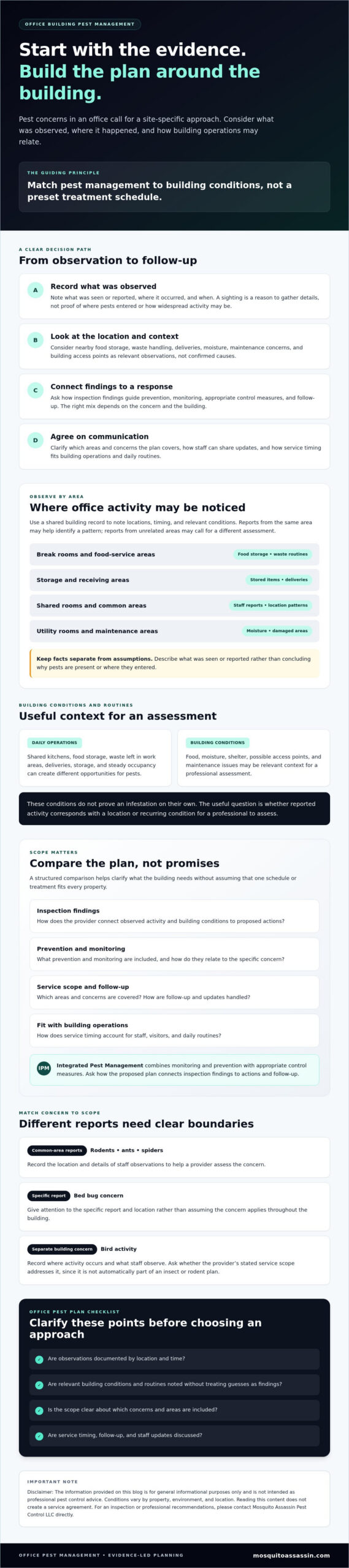
Pest control for office buildings works best when it responds to the building’s conditions rather than relying on a one-size-fits-all schedule. Shared workspaces, food areas, deliveries, storage, and steady occupancy can create different opportunities for pests than a private home. Rodents, ants, and spiders may be reported in common areas, while a bed bug concern calls for attention to the specific report and location.
Start by recording what has actually been observed. A sighting is a reason to gather details, not proof of where pests entered or how widespread an issue may be.
This video discusses regular pest management in commercial buildings:
Commercial office pest control is a site-specific process of preventing pest access, monitoring for activity, and responding to documented concerns. Evidence-based management uses observations to guide decisions and follow-up. A one-time response may address a sighting without clarifying whether the conditions that contributed to it remain.
A professional approach may draw on Integrated Pest Management (IPM), which combines monitoring and prevention with appropriate control measures. The right mix depends on the pest concern and the building. Ask how a proposed plan connects inspection findings to actions and follow-up.
Which signs should an office decision-maker document?
Keep a simple record of what staff notice, where it occurred, and when. Note whether reports recur in a kitchen, storage area, shared room, or another location. Record relevant patterns, such as deliveries or waste handling nearby, but distinguish observations from guesses about entry points or the extent of activity. These details help a provider assess the concern without treating assumptions as confirmed findings.
How does bird activity fit into an office pest plan?
Bird activity is a separate building concern and shouldn’t automatically be treated as part of an insect or rodent plan. Record where activity occurs and what effects staff observe, then ask whether a prospective provider’s service scope addresses it. If it doesn’t, seek a provider whose stated scope covers the concern. Clear boundaries help prevent confusion about what an office pest-management plan includes.
How Office Design and Daily Operations Shape Pest Pressure
Building conditions and everyday routines can influence where pests find food, moisture, shelter, or access. Food stored in shared kitchens, waste left in work areas, frequent deliveries, and maintenance issues may all be relevant observations. None proves an infestation on its own. The useful question is whether reported activity corresponds with a location or recurring condition a professional should assess.
Documented activity, paired with the conditions around it, gives a provider a clearer basis for tailoring an office pest assessment. A location-based record can help distinguish an isolated report from a pattern and identify areas that may need closer attention. For broader business context, see this commercial pest control guide.
Which office areas deserve closer observation?
Include break rooms, food-service areas, storage spaces, receiving areas, and utility rooms in facilities observations. Staff can record the location, time, and relevant conditions, such as nearby food storage or a maintenance concern. Gather reports from employees and facilities staff, but don’t disturb suspected pest sites. Keeping observations in one building record helps a provider assess whether reports point to a pattern.
Mapping reports by area can make communication more precise. Note whether separate reports come from the same shared room or from unrelated parts of the building. Describe what was seen or reported rather than concluding why pests are there.
What role do exclusion and housekeeping play?
Exclusion means addressing possible access points based on a professional assessment of the building. Maintenance observations, such as gaps or damaged areas, can help identify items for review, but a sighting alone doesn’t establish an entry route. A provider may discuss how building conditions relate to a tailored pest-management plan.
Consistent food handling and waste routines are practical prevention considerations. Store food appropriately and manage waste according to building procedures to reduce available attractants. These steps don’t replace an assessment when activity is reported. Inspection, monitoring, and assessment are also described in the National Pest Management Association’s Core Components of an IPM Plan.
For commercial pest control, review the provider’s stated service scope and ask how building observations can inform recommendations. For office-specific questions, contact a pest control professional to discuss whether the building is within the service area and what information may help guide an assessment.
Compare Office Pest Control Approaches by Scope, Not Promises
A one-time response and a recurring program serve different purposes. A focused response may suit a specific concern, while recurring prevention can support ongoing monitoring and attention to conditions identified during service. Neither approach is automatically the better fit. For pest control for office buildings, compare what the provider will inspect, address, document, and follow up on.
Service frequency alone doesn’t establish fit; the schedule should reflect site findings and the scope agreed with the provider. Compare proposals by what they cover and how they respond to new observations, not by visit frequency or broad outcome claims.
| Approach | Suitable situation | Questions to ask | Limitations |
|---|---|---|---|
| One-time response | A specific concern needs assessment and a defined response. | Which pest and areas are included? Is follow-up part of the scope? | May not include ongoing monitoring or prevention after the initial visit. |
| Recurring prevention | Ongoing monitoring and attention to documented site conditions are priorities. | How are visit timing, monitoring, and recommendations determined? | A recurring schedule doesn’t guarantee every pest or area is covered. |
What should an office pest-management plan specify?
Look for a clear description of target pests, covered areas, monitoring expectations, and how staff and the provider will communicate. Ask how observations and prevention recommendations will be recorded, and how the plan can be reviewed if building conditions change. Confirm what’s included and which concerns require another provider. The provider’s commercial pest control services page can help clarify its stated service scope.
Specific details matter. A plan that names shared work areas but leaves storage or receiving areas undefined may not match the building’s needs. Ask for exclusions or limits to be explained before selecting a service approach.
How should bird-control needs be compared with other pest services?
Assess bird-related activity separately. Before comparing proposals, ask whether bird management is within the provider’s stated scope and what areas or work it includes. Keep it distinct from services such as rodent or general pest control. Don’t assume a provider handles bird concerns just because it offers commercial pest management; confirm the scope directly.
Practical Checklist for Office Pest Control
A consistent selection process makes it easier to compare providers and avoid gaps in the proposed service. For pest control for office buildings, move from building observations to a defined scope, then confirm how service will fit daily operations.
- Record observations. Gather staff reports and relevant maintenance notes, including where and when activity was noticed. Keep observed details separate from guesses about the cause.
- Define the scope. Identify the pests and building areas that need attention, along with specific concerns the provider should assess.
- Compare plans. Review what each proposal includes, how monitoring and follow-up work, and what falls outside its scope.
- Confirm communication. Agree on how service findings, recommendations, and new reports will be shared with the appropriate building contact.
Which questions help clarify provider fit?
Ask whether the provider has experience working with buildings similar to yours, such as offices with shared kitchens, multiple tenants, or controlled-access areas. Focus on relevant experience rather than assuming credentials or expertise that haven’t been stated. Clarify which pests and areas the proposal covers, how findings and prevention recommendations will be communicated, and whether follow-up is included. If an issue falls outside the provider’s scope, ask whether a separate specialist is needed.
How can a building team prepare without attempting treatment?
Bring together existing observations and maintenance notes before requesting an assessment. Identify operating hours, access arrangements, and areas that may require coordination, such as tenant spaces or rooms with limited access. Staff should report what they’ve seen without disturbing suspected pest evidence or attempting pesticide treatment. These preparations help the provider understand the building and discuss a workable service plan.
Before agreeing to a plan, clarify what service documentation will be provided and who will receive it. Confirm how visits or assessments will be coordinated with building operations, and how staff should communicate new observations. Clear expectations can reduce confusion about access, included areas, and next steps.
Review the provider’s commercial pest control information to understand its stated commercial offerings. For questions about whether commercial pest control may fit your building’s documented needs, contact Mosquito Assassin Pest Control LLC.
Choosing a Local Office Pest-Control Partner and Next Steps
A sound decision connects documented observations to a clear service scope and a practical communication plan. Before choosing a provider, confirm which pests and areas are included, how building staff can report new concerns, and how service can be coordinated with office operations. This helps decision-makers compare what a plan actually covers instead of relying on broad promises.
To check regional availability, review service-area information for Erie and Crawford Counties in Pennsylvania and Ashtabula County in Ohio. The provider’s commercial pest control services page can also help clarify its stated service offerings.
When might professional pest control help?
Recurring observations, or reports from more than one shared area, may warrant a professional assessment. A provider can review the documented concern and explain whether it falls within the service scope. The appropriate response depends on the building and the findings. Professional pest control can help assess documented concerns and identify suitable next steps.
What should happen after the initial assessment?
Review the proposed scope in writing before deciding. Check that it identifies the concerns and areas addressed, explains relevant recommendations, and states how communication will work. Ask about anything unclear, including which issues aren’t covered. Confirm follow-up with the selected provider rather than assuming it is included. Clear answers give building decision-makers a sound basis for evaluating the plan and coordinating it with staff.
For questions about an office building’s documented concerns or whether commercial service may be appropriate, contact Mosquito Assassin Pest Control LLC.
Disclaimer: The information provided on this blog is for general informational purposes only and is not intended as professional pest control advice. Conditions vary by property, environment, and location. Reading this content does not create a service agreement. For an inspection or professional recommendations, please contact Mosquito Assassin Pest Control LLC directly.
Build an Office Pest Plan Around What the Building Needs
Effective pest control for office buildings starts with documented observations, a clear service scope, and communication that fits the way the office operates. Compare providers by which pests and areas they address, how they explain recommendations, and what follow-up is included. A schedule alone can’t show whether a program matches the building’s conditions.
Commercial pest control is an offering from Mosquito Assassin Pest Control LLC. Service is available in Erie and Crawford Counties in Pennsylvania and Ashtabula County in Ohio. Confirm that the office is within the service area and discuss the building’s needs directly.
To discuss commercial pest control for your office building, contact Mosquito Assassin Pest Control LLC with a clear record of the concerns. That information can help make the conversation more useful and support a practical next step.
With relevant observations and a well-defined scope, building decision-makers can approach pest concerns with greater clarity.
Disclaimer: The information provided on this blog is for general informational purposes only and is not intended as professional pest control advice. Conditions vary by property, environment, and location. Reading this content does not create a service agreement. For an inspection or professional recommendations, please contact Mosquito Assassin Pest Control LLC directly.
Frequently Asked Questions
What pests are commonly found in office buildings?
Office pest concerns can include rodents, ants, spiders, and bed bugs. The pests reported at a particular property depend on its conditions and observations, so a sighting shouldn’t be treated as proof of a larger issue. Note what was seen, where, and when, then share those details with the facilities contact or a pest professional. Accurate reports help guide an assessment without assuming the source or extent of activity.
How do I choose pest control for an office building?
Compare the documented needs of the building with the proposed service scope. Ask which pests and areas are covered, how findings and recommendations will be communicated, and whether follow-up is included. Consider the provider’s experience with similar building types, and clarify access arrangements and scheduling expectations. A clear written plan makes it easier to see whether the approach fits the office’s conditions and operations.
Is recurring pest control necessary for an office?
Not every office needs the same service frequency. A one-time response may address a specific concern, while recurring service may suit buildings where ongoing monitoring and prevention are part of the agreed scope. The decision should reflect observations, site conditions, and the provider’s recommendations, not frequency alone. Ask what each visit includes and how the plan can be reviewed if reports change or new concerns arise.
Can pest control be scheduled around office hours?
Scheduling options depend on the provider and the service being discussed, so confirm timing directly rather than assuming visits can happen outside office hours. Share the building’s operating schedule, access requirements, occupied areas, and any spaces that need coordination. Ask how the provider will communicate appointment details and what staff or facility contacts need to know. Clear arrangements can help limit unnecessary disruption to routine office activities.
What should an office pest-control plan include?
A plan should clearly identify the target pests, areas covered, proposed monitoring, and communication process. Ask how observations, recommendations, and follow-up will be documented, and clarify what falls outside the service scope. Prevention considerations may also be discussed in relation to building conditions and operations. Review the written plan before agreeing so staff and decision-makers understand what the provider will address and how concerns should be reported.
Does general office pest control include bird control?
Not necessarily. Bird activity is a distinct building concern, so don’t assume it’s included in a general pest-control plan. Ask the provider whether bird management falls within its stated scope and what the proposed service covers. If it doesn’t address the issue, the building may need to consult a provider whose scope includes it. Keep bird-related concerns distinct from confirmed services such as general pest or rodent control.
What should I do if staff report pest activity at work?
Record what staff observed, including the location and time, and note whether similar reports have occurred. Keep direct observations separate from assumptions about how pests entered or how widespread activity may be. Share relevant reports and maintenance notes with the appropriate facilities contact, then discuss recurring or unresolved concerns with a pest professional. Staff shouldn’t disturb suspected pest evidence or attempt treatment as part of documenting a report.