
Tag: outdoor events

  • Erie PA Mosquito Control: 2026 Event Strategy Guide

    Erie PA Mosquito Control: 2026 Event Strategy Guide

    What if the success of your 2026 summer wedding or graduation party depended more on a thermometer than a calendar? Many organizers in Northwest Pennsylvania schedule treatments based on a fixed date, only to find their guests retreating indoors once the sun sets. Effective mosquito control for outdoor events Erie PA requires a strategy built on local biology rather than just a generic checklist. It’s frustrating to invest time and money into a celebration only to have swarms or health concerns regarding West Nile and Jamestown Canyon viruses overshadow the occasion.

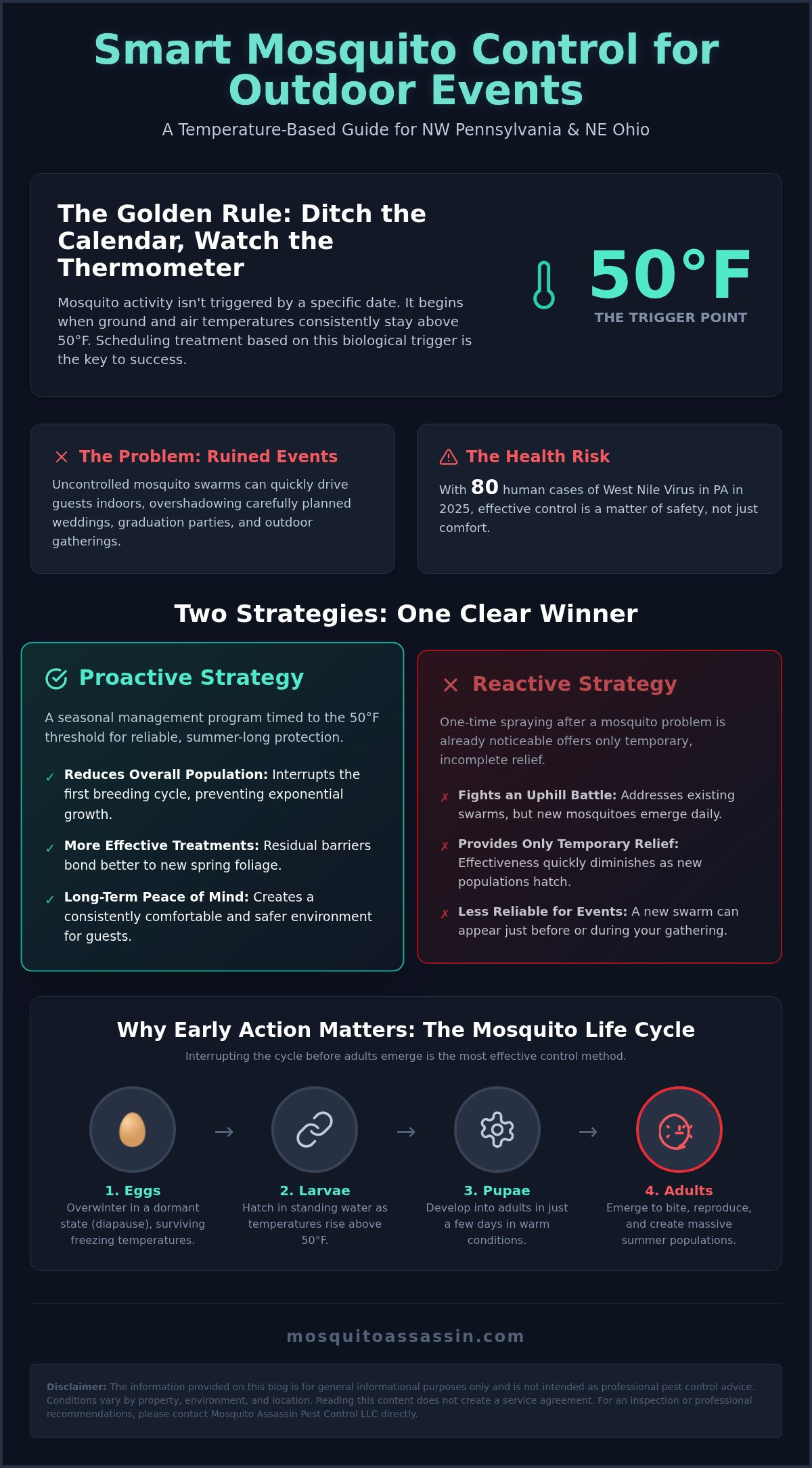
    Planning a gathering in Erie, Crawford, or Ashtabula counties means accounting for specific regional micro-climates and the 50 degree temperature thresholds that trigger pest activity. With 80 human cases of West Nile Virus reported in Pennsylvania in 2025, the stakes for outdoor safety are higher than ever. This guide explains the scientific triggers and timing strategies necessary to maintain a comfortable, bite-free environment for every guest. Readers will learn how professional residual barriers function and how to align treatment windows with the specific weather patterns of the Lake Erie shoreline for maximum protection.

    Disclaimer: The information provided on this blog is for general informational purposes only and is not intended as professional pest control advice. Conditions vary by property, environment, and location. Reading this content does not create a service agreement. For an inspection or professional recommendations, please contact Mosquito Assassin Pest Control LLC directly.
    Key Takeaways

    • Learn why monitoring the 50 degree temperature threshold is more effective for event planning than following a standard calendar date.
    • Discover the specific seasonal windows for Northwest Pennsylvania and Northeast Ohio to ensure effective mosquito control for outdoor events Erie PA.
    • Understand how professional barrier treatments provide continuous protection during peak activity periods like dusk and dawn.
    • Identify how regional weather patterns, including heavy rainfall and lakefront humidity, influence the bonding and longevity of protective treatments.
    • See why a consistent seasonal management program offers more reliable results for summer gatherings than isolated, one-time applications.

    The Science of Timing: Temperature Thresholds and Mosquito Activity

    Mosquito activity and emergence for event planning are dictated by the 50 degree rule, which states that these insects remain dormant until local temperatures consistently reach this specific thermal threshold. In Erie and Crawford counties, the arrival of spring doesn’t always signal the immediate need for treatment. If property owners schedule applications while the ground is still thawing or overnight temperatures are still dipping into the 30s, the resources are largely wasted. Mosquitoes are cold-blooded; their metabolism and reproductive cycles are essentially paused until the environment provides enough heat to sustain them. Professional event prep focuses on identifying when this biological “wake-up call” occurs to ensure treatments are active when the pests actually arrive.

    Targeting both overwintering adults and the first wave of larvae is the foundation of effective mosquito control for outdoor events Erie PA. By waiting for the consistent 50 degree mark, professionals can apply residual barriers that adhere to foliage just as the first generation of the season begins to seek out blood meals. This precision prevents the common mistake of applying products too early, where they might degrade due to late-season snow or heavy spring rains before the mosquitoes are even active.

    Understanding the Mosquito Life Cycle in the Northeast

    In Northwest Pennsylvania and Northeast Ohio, mosquito eggs are remarkably resilient. They survive freezing winters in Erie and Ashtabula by entering diapause, a physiological state of suspended development. These eggs hatch only when spring rains create standing water and the air temperature stays warm. Once they hatch, larvae develop rapidly. During the initial warm weeks of spring, a single stagnant pool can produce thousands of biting adults. Intervening at this larval stage is a critical component of professional mosquito control strategies because it stops the population before it can take flight and disrupt a planned gathering.

    Why Early Prevention Benefits Summer Events

    Proactive management is always more effective than reactive spraying. Interrupting the first breeding cycle of the year significantly reduces the baseline population for the entire summer. If the first generation is allowed to mature and reproduce unchecked, the exponential growth makes it much harder to maintain a bite-free environment in July or August. Reactive treatments applied once a swarm is already present often provide only temporary relief. In contrast, consistent property maintenance throughout the spring ensures that the pest pressure remains low, creating a safer and more comfortable environment for guests. This methodical approach is essential for successful mosquito control for outdoor events Erie PA, as it addresses the root of the infestation rather than just the visible symptoms.

    • Baseline Reduction: Fewer early-season mosquitoes mean fewer eggs laid for the summer peak.
    • Residual Efficacy: Treatments bond better to healthy, growing spring foliage.
    • Risk Mitigation: Early control reduces the presence of species known to carry regional viruses.

    Disclaimer: The information provided on this blog is for general informational purposes only and is not intended as professional pest control advice. Conditions vary by property, environment, and location. Reading this content does not create a service agreement. For an inspection or professional recommendations, please contact Mosquito Assassin Pest Control LLC directly.

    Regional Seasonal Windows for Erie, Crawford, and Ashtabula Counties

    The window for effective mosquito control for outdoor events Erie PA is a moving target that requires constant observation. While many property owners assume a standard Memorial Day start is sufficient, the biological reality of Northwest Pennsylvania and Northeast Ohio is more complex. The treatment window typically opens in late April or early May, but this can shift by up to two weeks depending on the year. Ashtabula County patterns often mirror those of Erie and Crawford counties because they share the same climate corridor along the Great Lakes. Professional monitoring of local meteorological data is required for precise event scheduling, as pests don’t follow a human calendar.

    Waiting until you see the first mosquito to act is a common mistake that allows the first generation of the season to reproduce unchecked. By the time an adult is spotted, thousands of larvae may already be developing in nearby stagnant water. A professional approach involves tracking soil temperatures and rainfall totals to predict emergence before it becomes a nuisance for your guests. This foresight is especially important for large-scale summer gatherings where guest comfort is a primary concern.

    Regional Considerations for Northwest Pennsylvania

    Micro-climates within our service area create significant differences in pest activity levels. Inland properties in Meadville or Cranesville often see earlier activity than coastal Erie locations because they lack the cooling influence of the lake. These areas warm up faster in the spring, triggering earlier emergence. Wooded areas in Crawford County are another specific concern; they retain moisture and provide shade, favoring mosquito growth much longer than open, sun-drenched fields. Local expertise is vital when assessing regional service locations to ensure the treatment plan matches the specific geography of the property. Utilizing an integrated mosquito control strategy helps identify these high-risk zones before they impact your event.

    The Impact of Lake Erie on Pest Emergence

    Lake Erie acts as a massive thermal regulator for the entire region. Cooler breezes from the water can delay mosquito activity for waterfront properties, sometimes providing a natural reprieve during the early spring. However, this effect is localized. High humidity in inland areas often fuels faster larval development in stagnant water once the sun goes down. Professional assessments must account for these specific micro-climates when planning events. A property on the lakefront may require a different timing strategy than one located just five miles south. If you are preparing for a 2026 celebration, reviewing professional service options can help you establish a protective barrier that accounts for these lake-effect variables.

    • Inland vs. Coastal: Inland areas typically reach the 50-degree threshold 7 to 10 days earlier than the immediate shoreline.
    • Moisture Retention: Low-lying areas in Crawford County may require earlier intervention due to spring runoff.
    • Humidity Factors: High lakefront humidity in mid-summer can extend the lifespan of adult mosquitoes, necessitating stronger residual barriers.

    Disclaimer: The information provided on this blog is for general informational purposes only and is not intended as professional pest control advice. Conditions vary by property, environment, and location. Reading this content does not create a service agreement. For an inspection or professional recommendations, please contact Mosquito Assassin Pest Control LLC directly.

    Optimizing Application for Peak Event Effectiveness

    Many hosts worry about the exact hour a treatment occurs. While timing matters, the strength of professional mosquito control for outdoor events Erie PA lies in the residual barrier. Unlike temporary misting that only impacts pests currently in the air, a residual treatment creates a protective zone that lasts for weeks. This ensures that even if a new swarm travels toward the property from a neighboring field, the barrier is already active and ready to intercept them. This approach is superior for multi-day events like weddings or festivals where guest comfort must be maintained over an extended period.

    Peak activity for local species in Northwest Pennsylvania usually occurs during the transition periods of dusk and dawn. However, application must happen when environmental conditions are stable. Technicians monitor wind speeds closely before starting any treatment. If winds are too high, the product cannot settle into the intended zones, leading to uneven protection. Ensuring the product reaches its target is the only way to guarantee the barrier remains effective throughout the duration of the gathering. Professional methodology prioritizes these environmental factors to ensure the maximum amount of product bonds to the property’s vegetation.

    Targeting Resting Sites for Maximum Protection

    Shaded vegetation serves as the primary resting site for mosquitoes during the heat of the day. They prefer the cool, damp undersides of leaves in tall grass and shrubbery to avoid dehydration. Professional technicians prioritize these specific areas during property inspections. By coating the undersides of leaves and dense foliage, the treatment targets pests where they spend the majority of their time. This method is far more effective than simply spraying the open air, as it creates a lethal environment for mosquitoes the moment they attempt to rest or hide. Identifying these high-risk zones is a key part of ensuring mosquito control for outdoor events Erie PA provides the necessary relief for guests.

    Safety and Re-entry Guidelines for Event Hosts

    Re-entry into the treated space is a straightforward process but requires patience for the product to set. Treated foliage must dry completely before guests, children, or pets enter the area. Drying times aren’t fixed; they fluctuate based on the high humidity common in Erie and Ashtabula or the amount of direct sunlight the property receives. Once the product is dry, it bonds to the leaves and remains active through various weather conditions. For broader context on property safety and integrated maintenance, referring to general pest control guides can provide helpful background information for homeowners preparing for a large event.

    • Drying Time: Typically ranges from 30 to 60 minutes depending on sun exposure.
    • Humidity Factors: High lakefront humidity may slightly extend the drying window.
    • Bonding: Once dry, the product is rain-fast and continues to provide protection.

    Disclaimer: The information provided on this blog is for general informational purposes only and is not intended as professional pest control advice. Conditions vary by property, environment, and location. Reading this content does not create a service agreement. For an inspection or professional recommendations, please contact Mosquito Assassin Pest Control LLC directly.

    Erie PA Mosquito Control: 2026 Event Strategy Guide

    Weather and Environmental Factors Affecting Event Protection

    Weather in Northwest Pennsylvania is notoriously fickle, and lake-effect patterns can shift a forecast in hours. Heavy rainfall immediately following an application may impact the effectiveness of the barrier, though light rain typically doesn’t wash away a treatment once it has dried. High humidity levels, a common occurrence along the Lake Erie shoreline, often extend the time required for a treatment to bond properly to foliage. Because of these regional variables, professional scheduling involves constant adjustments based on local Erie weather forecasts. This ensures the product has sufficient time to set and bond before a storm front moves through the area.

    Frequent summer storms do more than just threaten the party schedule; they create new breeding sites in clogged gutters and low-lying landscape spots. These micro-habitats can become nurseries for a new generation of pests just days before your gathering. Professional mosquito control for outdoor events Erie PA must account for these environmental shifts to maintain a reliable protective barrier. When the ground is saturated, mosquitoes find more opportunities to deposit eggs, making the timing of your professional service even more critical for guest comfort.

    Managing Standing Water Before an Event

    Property owners can significantly improve the efficacy of a professional treatment by addressing standing water within 24 hours of any rainfall. Emptying bird baths, flower pots, and tarps prevents these items from becoming active breeding grounds. It’s also vital to ensure gutters are clear of debris, as stagnant water trapped in rooflines is a primary attractant for several local species. During a property inspection, professional technicians can identify these drainage issues and offer guidance to prevent them from compromising your event comfort. If you are concerned about persistent wet spots on your lawn, professional mosquito control service can help mitigate these risks before guests arrive.

    The Role of Wind and Sunlight

    Environmental exposure is the primary reason why “one-and-done” sprays often fail. Extended exposure to direct sunlight can eventually break down certain protective products, reducing their longevity over a long summer. Wind speeds are another critical factor that professionals monitor during the application process. High winds can cause product drift, preventing the treatment from reaching the intended resting sites under leaves and in dense brush. Professional-grade application equipment utilizes high-velocity air streams to ensure precise placement on the property despite varied wind conditions. This accuracy is what separates a professional barrier from a standard consumer-grade application.

    • Rain-Fastness: Most professional products become rain-fast within an hour of application.
    • UV Stability: Modern residual barriers are designed to withstand the breakdown caused by intense summer sun.
    • Wind Limits: Applications are typically paused if sustained winds exceed 10 miles per hour to ensure guest safety and product accuracy.

    Disclaimer: The information provided on this blog is for general informational purposes only and is not intended as professional pest control advice. Conditions vary by property, environment, and location. Reading this content does not create a service agreement. For an inspection or professional recommendations, please contact Mosquito Assassin Pest Control LLC directly.

    Proactive Planning for Bite-Free Outdoor Gatherings

    Relying on a single spray just days before a major celebration is a reactive approach that often leaves property owners disappointed. While one-off treatments offer a temporary reduction in pest numbers, a consistent mosquito control program provides superior results. Seasonal management addresses new generations of pests as they emerge throughout the summer. By maintaining a continuous residual barrier, property owners ensure their outdoor spaces are always event-ready. This proactive strategy is the most reliable way to handle mosquito control for outdoor events Erie PA, especially during the peak humidity of July and August.

    Professional plans frequently include secondary benefits that go beyond just mosquitoes. For wooded properties in Crawford County or Ashtabula County, these programs often provide integrated tick protection. Ticks thrive in the same shaded, damp environments where mosquitoes rest during the day. Addressing both pests simultaneously creates a comprehensive safety net for guests. Moving from reactive to proactive management allows hosts to focus on their event logistics rather than worrying about last-minute swarms or health concerns.

    The Value of Multi-Step Professional Protection

    Comprehensive event protection requires more than just targeting adult mosquitoes. Combining larval control with adulticide barriers offers a multi-layered defense. Larvicides target mosquitoes before they reach the biting adult stage, effectively lowering the overall population on the property. Regular inspections by experienced technicians help catch environmental changes, such as new standing water after a Lake Erie storm, that favor breeding. You should consult professional services to determine the best plan for your property’s specific topography and vegetation density.

    Securing Your Outdoor Space for the 2026 Season

    Success for the 2026 season begins with early intervention. It is best to begin treatments as soon as the 50 degree threshold is met and maintain a consistent schedule until the first hard frost of autumn. This long-term commitment prevents the population spikes that often occur in late summer. Professional pest control may help reduce risk for families hosting backyard graduations and commercial venues managing wedding schedules. For those planning significant gatherings, a detailed inspection of the specific event space is the first step toward a comfortable environment. Contacting a professional early in the spring ensures your property is prioritized during the busy regional treatment window.

    • Continuous Defense: Program-based treatments prevent pest populations from rebounding between events.
    • Venue Readiness: Commercial spaces benefit from a standing schedule that accommodates rotating bookings.
    • Risk Reduction: Seasonal management is the most effective way to limit exposure to regional viruses.

    Disclaimer: The information provided on this blog is for general informational purposes only and is not intended as professional pest control advice. Conditions vary by property, environment, and location. Reading this content does not create a service agreement. For an inspection or professional recommendations, please contact Mosquito Assassin Pest Control LLC directly.

    Ensuring Success for Your 2026 Outdoor Gatherings

    Successful event planning in the Tri-State area requires moving beyond the calendar and focusing on biological triggers like the 50 degree threshold. Proactive, seasonal management remains the most reliable strategy for maintaining a comfortable space from the first spring emergence through the final frost of autumn. By utilizing professional residual barriers rather than reactive one-off sprays, hosts can effectively manage the risks associated with regional pests while ensuring their property is always ready for guests.

    Effective mosquito control for outdoor events Erie PA is achievable through customized seasonal protection plans that account for specific Great Lakes micro-climates. Licensed professionals serving PA and OH bring the regional expertise necessary to navigate local weather shifts and identify high-risk resting sites. For an inspection or professional recommendations, please contact Mosquito Assassin Pest Control LLC directly. Preparing your property now ensures every graduation, wedding, or backyard barbecue in 2026 is defined by the celebration rather than the swarms.

    Disclaimer: The information provided on this blog is for general informational purposes only and is not intended as professional pest control advice. Conditions vary by property, environment, and location. Reading this content does not create a service agreement. For an inspection or professional recommendations, please contact Mosquito Assassin Pest Control LLC directly.

    Frequently Asked Questions

    Is it too early to spray for mosquitoes in March in Erie PA?

    Yes, it is generally too early to spray for mosquitoes in March in Erie, PA. Mosquitoes remain dormant until temperatures consistently reach 50 degrees Fahrenheit. Because Northwest Pennsylvania often experiences freezing temperatures and snow well into March, any applied product would likely degrade before the pests become active. It’s more effective to monitor the local weather and begin treatments when the spring warm-up truly takes hold.

    Does rain wash away mosquito yard treatments before an event?

    Rain does not typically wash away professional treatments as long as the product has had sufficient time to dry. Most residual barriers become rain-fast within 30 to 60 minutes of application. Once the treatment bonds to the foliage on your property, it continues to provide protection through standard summer storms. However, professional mosquito control for outdoor events Erie PA often involves rescheduling if heavy, persistent downpours are forecasted during the application window.

    How often should I have my yard treated for mosquitoes during the summer?

    For continuous protection, a yard should typically be treated every 21 to 30 days throughout the summer. This schedule ensures that the residual barrier remains strong enough to intercept new generations of pests as they emerge. Maintaining this frequency is vital for property owners who host frequent gatherings, as it prevents the population from rebounding between service visits. Consistent applications keep the baseline pest pressure low across Erie, Crawford, and Ashtabula counties.

    Can I spray for mosquitoes myself or should I hire a professional for a wedding?

    While DIY products are available, hiring a professional for a wedding or large event is recommended for more reliable results. Professionals use high-volume application equipment that ensures the product reaches deep into dense vegetation and the undersides of leaves where mosquitoes hide. For high-stakes mosquito control for outdoor events Erie PA, professional-grade residual products offer a level of durability and coverage that standard consumer sprays often fail to achieve.

    What is the most effective time of day to apply mosquito spray for an event?

    The most effective time to apply mosquito spray is when wind speeds are low and the weather is dry, regardless of the specific hour. While mosquitoes are most active at dusk and dawn, the residual barrier works by coating resting sites where they hide during the day. Professional technicians prioritize these environmental factors to ensure the product settles exactly where it is needed, providing ongoing protection that lasts long after the application is finished.

    When does mosquito season officially end in Pennsylvania and Ohio?

    Mosquito season in Pennsylvania and Ohio officially ends after the first hard frost of the year. This typically occurs in late September or throughout October, depending on how close the property is to the Lake Erie shoreline. Cold temperatures eventually kill off adult mosquitoes or force them back into dormancy. Until that hard frost occurs, maintaining a protective barrier is necessary to prevent bites during fall outdoor activities.

    Are mosquito treatments safe for my flower garden and ornamental plants?

    Professional mosquito treatments are applied with care to protect the health of your flower garden and ornamental plants. Technicians target the green foliage and undersides of leaves where pests rest rather than the blooms of flowering plants. This precision helps minimize impact on beneficial insects while still creating a lethal zone for mosquitoes. Licensed professionals are trained to identify these sensitive areas during the initial property inspection.

    What happens if I start mosquito treatments late in the summer season?

    Starting treatments late in the summer can still provide relief, but it won’t address the massive population baseline established earlier in the year. By late July or August, several generations of mosquitoes have already reproduced. While a late-season treatment will kill active adults on the property, it requires more effort to manage the sheer volume of pests compared to a proactive program that began in the spring.

    Disclaimer: The information provided on this blog is for general informational purposes only and is not intended as professional pest control advice. Conditions vary by property, environment, and location. Reading this content does not create a service agreement. For an inspection or professional recommendations, please contact Mosquito Assassin Pest Control LLC directly.

  • Mosquito Treatment for Outdoor Events: A Professional Planning Guide

    Mosquito Treatment for Outdoor Events: A Professional Planning Guide

    What if the most discussed part of your outdoor wedding or graduation party isn’t the cake or the music, but the relentless swarm of biting insects? It is frustrating to spend months planning a perfect gathering only to have guests retreat indoors before the sun even sets. Most hosts in Erie and Crawford Counties recognize that a single pest can ruin the atmosphere of an otherwise flawless evening. This guide explores how professional mosquito treatment for outdoor events provides a reliable solution to eliminate the threat of pests and protect your investment. You will learn the science behind effective barrier applications, the best timing for a pre-event spray (typically 24 to 48 hours before the first guest arrives), and why professional methods are designed to be used safely around food and sensitive areas. The following sections examine why a one-time specialized application is more effective than standard retail products for keeping local pest populations at bay during your celebration. This information ensures you have the confidence to host a comfortable, pest-free event in Ashtabula County or Western Pennsylvania.

    Disclaimer: The information provided on this blog is for general informational purposes only and is not intended as professional pest control advice. Conditions vary by property, environment, and location. Reading this content does not create a service agreement. For an inspection or professional recommendations, please contact Mosquito Assassin Pest Control LLC directly.

    Key Takeaways

    • Understand the distinction between standard seasonal maintenance and a high-impact mosquito treatment for outdoor events designed for immediate results.
    • Discover how crowd factors like heat signatures and carbon dioxide levels attract pests and why specialized barriers are necessary for large gatherings.
    • Evaluate why professional-grade applications provide more comprehensive protection for expansive areas than consumer products like candles or wearable bands.
    • Learn the optimal 24 to 48 hour window for scheduling treatments to ensure the protective barrier is fully established before the event begins.
    • Identify the importance of utilizing licensed professionals who follow regional environmental regulations for pest control in Pennsylvania and Ohio.

    What is a specialized mosquito treatment for outdoor events?

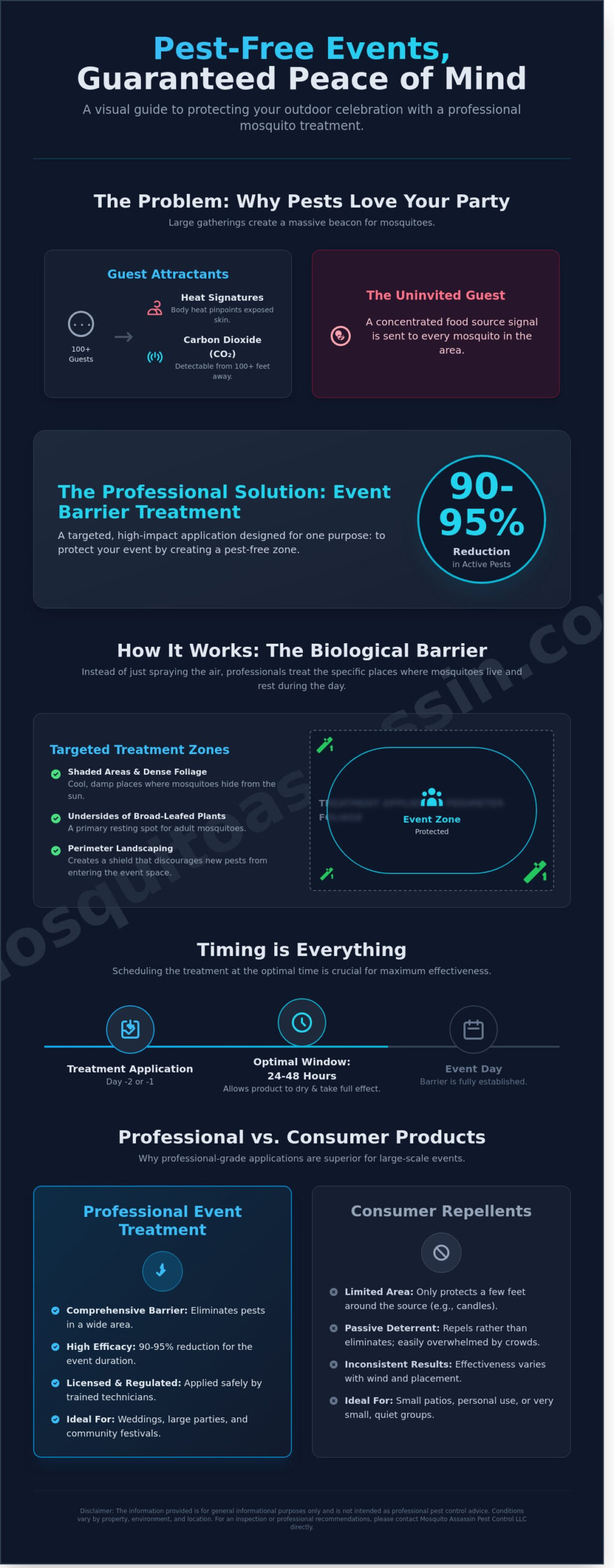
    A specialized mosquito treatment for outdoor events functions as a tactical, high-impact barrier application. Unlike seasonal maintenance, which focuses on long-term population suppression over several months, an event-specific protocol prioritizes immediate knockdown. The primary goal is to eliminate adult mosquitoes currently on the property and provide a short-term residual shield that remains effective through the duration of the gathering. Professionals typically apply these treatments 24 to 48 hours before guests arrive. This specific timing ensures the application has dried completely while achieving a 90 to 95 percent reduction in active pest populations during the event window.

    Whether it’s a lakeside wedding in Ashtabula County or a large community festival in Erie County, these treatments are essential for guest comfort. High-traffic outdoor gatherings often involve food, artificial lighting, and increased carbon dioxide from crowds; these factors act as powerful attractants for pests. A professional mosquito treatment for outdoor events creates a zone of protection that allows the focus to remain on the celebration rather than the nuisance of biting insects. It’s a definitive solution for hosts who need the property safeguarded for a specific date and time.

    The concept of the biological barrier

    Professional applications target the specific biology of the pest by focusing on mosquito resting sites rather than just open air. During the heat of the day, mosquitoes congregate in shaded areas, the undersides of broad-leafed plants, and dense foliage. By treating these specific zones, technicians create a biological barrier that discourages pest entry into the guest area. Implementing comprehensive mosquito control strategies ensures that these “cool zones” don’t become staging grounds for an evening invasion. This approach relies on the residual properties of the application to keep the area clear even as the sun sets and mosquito activity typically spikes across Pennsylvania and Ohio.

    Scope of professional event services

    The scope of professional event services begins with a detailed assessment of the property size and local pest pressure. In rural parts of Crawford County, dense woods or standing water nearby may require a wider treatment radius to be effective. These services often integrate with other pest concerns; for example, a treatment might also target ticks in tall grass or stinging insects nesting near event tents. Technicians adhere to professional pest management standards to ensure the application is precise and follows all safety guidelines for the surrounding environment. This comprehensive approach provides peace of mind, knowing that the property has been professionally managed to reduce the presence of unwanted pests before the first guest arrives.

    Disclaimer: The information provided on this blog is for general informational purposes only and is not intended as professional pest control advice. Conditions vary by property, environment, and location. Reading this content does not create a service agreement. For an inspection or professional recommendations, please contact Mosquito Assassin Pest Control LLC directly.

    The science of mosquito behavior during outdoor gatherings

    Mosquitoes are highly evolved hunters that rely on sophisticated sensory organs to locate their next meal. When a large group of people gathers for a wedding, graduation, or community festival in Erie County or Crawford County, they unintentionally create a massive biological beacon. The primary attractant is carbon dioxide (CO2), which humans exhale with every breath. Research indicates that mosquitoes can detect CO2 plumes from distances of up to 100 feet. A crowd of 50 to 100 guests concentrates this gas, signaling a high-density food source to every female mosquito in the vicinity.

    Beyond CO2, heat signatures play a vital role in how these insects navigate a crowd. Human body temperature, typically around 98.6 degrees Fahrenheit, creates a thermal contrast against the cooler evening air. This thermal radiation allows mosquitoes to pinpoint exposed skin even in low-light conditions. Effective mosquito treatment for outdoor events relies on understanding these biological triggers to disrupt the insect’s ability to settle within the event space. Even when a property has been treated, “line of sight” bites can occur. This happens because mosquitoes are visual hunters; if they see a target from a neighboring untreated property, they may fly directly toward the host, bypassing treated foliage. Professional management focuses on creating a deep enough barrier to neutralize these pests before they reach the guest of honor.

    It is important to recognize the biological limitations of any short-term pest control measure. While a mosquito treatment for outdoor events significantly reduces the local population, it does not create a permanent, impenetrable bubble. Environmental factors like heavy wind or extreme rain can influence how long a treatment remains effective. Licensed professionals focus on a high-percentage reduction, aiming to eliminate 90 percent or more of the active biting population to ensure guest comfort throughout the duration of the party.

    Environmental triggers for mosquito activity

    Mosquito activity is heavily dictated by local weather patterns in regions like Ashtabula County. When relative humidity levels rise above 70 percent, mosquito metabolic rates increase, leading to more aggressive biting behavior. Conversely, temperatures below 55 degrees Fahrenheit typically cause these insects to become lethargic. Stagnant water is the most significant environmental threat. A single discarded bottle cap holding less than 0.5 inches of water can serve as a breeding ground for 100 larvae. If a neighboring property has clogged gutters or unmaintained birdbaths, those mosquitoes will migrate to your event space once the sun begins to set. Identifying high-risk zones, such as dense English ivy or low-lying damp areas, allows for a more targeted application. Following CDC guidelines on mosquito control can help property owners identify these risks well before the event date.

    Knockdown vs. residual efficacy

    Professional event treatments utilize two distinct phases of control: knockdown and residual protection. Knockdown refers to the immediate elimination of adult mosquitoes present on the property at the time of application. This is achieved using specialized misting equipment that ensures the product reaches the underside of leaves where mosquitoes rest during the day. Residual efficacy involves the product remaining active on foliage for a set duration, often between 21 and 30 days. This ensures that any mosquitoes drifting in from nearby woods or fields are eliminated when they land on treated surfaces. Because the timing of application is critical for a one-time event, professional mosquito management is recommended 24 to 48 hours before guests arrive. This window allows the treatment to dry completely while remaining at peak potency during the celebration.

    Disclaimer: The information provided on this blog is for general informational purposes only and is not intended as professional pest control advice. Conditions vary by property, environment, and location. Reading this content does not create a service agreement. For an inspection or professional recommendations, please contact Mosquito Assassin Pest Control LLC directly.

    Comparing professional event sprays with consumer repellent products

    Choosing the right mosquito treatment for outdoor events involves weighing convenience against actual efficacy. Many planners rely on retail solutions, but these often fall short when applied to large areas. Citronella candles and torches are staples at backyard parties, yet their effective radius is surprisingly small. Most candles only provide protection within a 2-to-3-foot diameter. For an event spanning several thousand square feet, a host would need dozens of torches to create a true perimeter. This isn’t just expensive; it’s physically cluttered.

    Wearable bands and personal sprays put the burden on the guest. Expecting 100 guests to apply sticky sprays or wear plastic bands isn’t practical for formal gatherings like weddings or corporate retreats. Electronic repellent devices often promise a 15-to-20-foot “protection bubble.” While these may work on a static, enclosed patio, they rarely hold up in open fields or parks where air currents disperse the repellent molecules. According to a scientific review of vector control, environmental factors like humidity and wind speed significantly impact how these spatial repellents perform in real-world settings. Investing in a professional mosquito treatment for outdoor events is often more cost-effective than buying bulk supplies that fail under pressure.

    The failure of passive repellents

    Passive methods like coils and candles rely on a concentrated scent cloud to work. A light breeze of even 5 mph can blow that protection away instantly, leaving guests vulnerable despite the visible smoke or scent. There’s often a psychological comfort in seeing a torch, but the physical protection is minimal. Safety is another major concern. Open flames at events with children or high foot traffic create a fire hazard that most professional planners prefer to avoid. When the wind shifts, the protection disappears, making these products unreliable for scheduled ceremonies.

    Benefits of professional barrier applications

    Professional barrier treatments provide uniform coverage across the entire event space. This method doesn’t rely on guest participation or perfect weather conditions. The application is typically odorless and invisible once dry, so it won’t clash with floral arrangements or expensive decor. This level of comprehensive protection is essential for commercial and community venues in Erie and Crawford Counties. By treating the foliage where mosquitoes rest during the day, the treatment reduces the local population before the first guest arrives, ensuring a comfortable environment for the duration of the party.

    Disclaimer: The information provided on this blog is for general informational purposes only and is not intended as professional pest control advice. Conditions vary by property, environment, and location. Reading this content does not create a service agreement. For an inspection or professional recommendations, please contact Mosquito Assassin Pest Control LLC directly.

    Mosquito Treatment for Outdoor Events: A Professional Planning Guide

    Timing and preparation for a pest-free outdoor gathering

    Timing determines the success of a mosquito treatment for outdoor events. Scheduling the application too far in advance allows the elements to degrade the protective barrier, while waiting until the morning of the party creates logistical conflicts with other vendors. Professional standards in Erie and Crawford Counties suggest a 24 to 48-hour window for the most effective results. This timeframe ensures the product is fully dry and the initial knockdown of adult mosquitoes is at its peak strength when the first guest arrives.

    Coordination with the event team is the next priority. If a wedding tent is scheduled for installation at 9:00 AM on a Friday, the property should be treated by Thursday afternoon. Most professional applications require 30 to 60 minutes of drying time, depending on the humidity levels in Ashtabula County. Once the treatment has dried, it’s safe for catering staff, decorators, and florists to move through the grass and landscaping without interfering with the product’s efficacy. Managing these moving parts prevents delays and ensures the safety of everyone involved in the setup process.

    Weather plays a decisive role in the scheduling process. Wind speeds exceeding 10 miles per hour can cause the treatment to drift away from the target foliage, reducing its impact. Similarly, while many professional products are rain-fast once dry, a heavy downpour of more than 0.5 inches within two hours of application can wash away the barrier. Monitoring the local forecast and maintaining a flexible schedule allows for adjustments if a summer storm moves through the region. Professionals typically look for a clear 24-hour window to ensure the treatment adheres properly to the underside of leaves and dense brush.

    The 48-hour countdown

    Applying a mosquito treatment for outdoor events exactly two days before the gathering offers the best balance of safety and performance. Treating much earlier, such as five or six days prior, reduces the residual impact because sunlight and wind naturally break down the active ingredients over time. The 48-hour mark allows the treatment to settle and provides time for a final inspection. If a technician identifies a specific zone with high activity during this window, they can apply a targeted follow up to ensure the area is clear before the event begins.

    Property maintenance before the pros arrive

    Landscape preparation significantly improves the reach of professional equipment. Homeowners should mow their lawn to a height of 3 inches or lower at least 24 hours before the technician arrives. Tall grass serves as a primary resting site for mosquitoes, and shorter blades allow the treatment to reach the soil line where pests often hide. Pruning dense ornamental shrubs and clearing overgrown fence lines also helps. When vegetation is thinned out, the mist can penetrate the interior of the plant rather than just coating the outer leaves.

    Eliminating standing water is a critical step that property managers shouldn’t overlook. A single clogged gutter or a forgotten flowerpot can hold enough water to host 200 to 300 mosquito larvae. Clearing these water sources 72 hours before the event disrupts the breeding cycle and prevents a new generation of pests from emerging during the party. Removing leaf piles and grass clippings also eliminates the damp, dark environments where mosquitoes congregate during the heat of the day.

    To prepare your property for an upcoming event, professional pest control may help reduce risk at www.mosquitoassassin.com/contact-us.

    Disclaimer: The information provided on this blog is for general informational purposes only and is not intended as professional pest control advice. Conditions vary by property, environment, and location. Reading this content does not create a service agreement. For an inspection or professional recommendations, please contact Mosquito Assassin Pest Control LLC directly.

    Professional standards for regional event protection

    Hiring a licensed professional for mosquito treatment for outdoor events ensures compliance with state-specific mandates in Pennsylvania and Ohio. Both states require technicians to maintain updated certifications through their respective Departments of Agriculture. In Pennsylvania, Title 7, Chapter 128 regulates the application of pesticides to ensure environmental safety, especially near the sensitive ecosystems of Lake Erie. Professionals carry liability insurance that protects property owners during large gatherings, a standard that DIY methods cannot match. This level of oversight guarantees that the products used are applied according to federal EPA guidelines, minimizing risks to non-target insects like honeybees and butterflies.

    Local expertise plays a vital role in the success of pest management in Erie and Crawford Counties. A provider familiar with the specific terrain of Northwest Pennsylvania understands how drainage patterns in Meadville or the wooded outskirts of Edinboro create unique breeding habitats. This regional insight allows for a more targeted approach. Instead of a generic application, professionals focus on the biology of local species. Effective event protection requires a strategy that addresses the 90% of mosquito activity occurring in dense foliage and stagnant water pockets. Selecting a provider with a history of managing logistics for weddings, graduations, and community festivals ensures the treatment is timed perfectly for maximum impact.

    Regional climate factors in PA and OH

    The weather patterns surrounding Lake Erie significantly dictate pest behavior. High humidity levels, which often exceed 75% during July and August, create an ideal environment for rapid mosquito reproduction. In Ashtabula County and Meadville, the peak season typically begins in mid-May and extends through late September. Lake-effect moisture keeps the soil damp, sustaining larvae even during brief dry spells. Utilizing local community knowledge helps technicians predict these population surges based on recent rainfall data and temperature shifts. For instance, when night temperatures consistently stay above 50 degrees Fahrenheit, mosquito activity increases by 40%. Professionals use this data to calibrate the timing of treatments, ensuring the barrier is strongest when guests arrive.

    Choosing the right service partner

    A successful mosquito treatment for outdoor events starts with a comprehensive property inspection. A qualified partner won’t provide a quote without seeing the site; they’ll look for specific “hot zones” like low-lying grass, dense ornamental shrubs, or clogged gutters. It’s essential to verify that the provider has specialized experience in event-day logistics, which differs from standard residential maintenance. They should offer a clear timeline, typically applying the treatment 24 to 48 hours before the event to allow the product to dry and bond to the foliage. Finding a reputable provider in your specific service location ensures they can respond quickly to local weather changes. This localized presence means the technician understands the specific wind patterns and foliage types common to the tri-county area, resulting in a more durable protective barrier for your celebration.

    Disclaimer: The information provided on this blog is for general informational purposes only and is not intended as professional pest control advice. Conditions vary by property, environment, and location. Reading this content does not create a service agreement. For an inspection or professional recommendations, please contact Mosquito Assassin Pest Control LLC directly.

    Securing Your Next Outdoor Gathering

    Successful gatherings require more than just a guest list; they require a proactive strategy against local pests. A professional mosquito treatment for outdoor events focuses on the critical 24 to 48 hour window before guests arrive to ensure the area remains comfortable. While store-bought candles often fail to cover large areas, licensed and insured technicians in PA and OH apply family-safe protocols designed for regional environments like Erie and Crawford Counties. These professional standards address mosquito behavior during the 3 to 4 hours of peak activity at dusk. Property owners in Ashtabula County can rely on local expertise to identify breeding sites that consumer products often miss. It’s important to note that professional applications target specific resting areas rather than just the open air. For professional recommendations or to schedule an inspection, contact Mosquito Assassin Pest Control LLC directly. Taking these steps early ensures the focus remains on the celebration so guests don’t have to worry about biting insects. Proper planning provides peace of mind for every host.

    Disclaimer: The information provided on this blog is for general informational purposes only and is not intended as professional pest control advice. Conditions vary by property, environment, and location. Reading this content does not create a service agreement. For an inspection or professional recommendations, please contact Mosquito Assassin Pest Control LLC directly.

    Frequently Asked Questions

    Is mosquito treatment for outdoor events safe for guests and food?

    Professional mosquito treatment for outdoor events uses EPA-registered products applied directly to perimeter foliage where pests rest. Once the application dries completely, which typically takes 30 to 60 minutes depending on humidity, the area is ready for guest access. Technicians avoid food preparation zones and dining tables to ensure no direct contact occurs with catering equipment or guest refreshments during the process.

    How long does a one-time mosquito event spray last?

    A single application provides a residual barrier that remains effective for 21 to 30 days under normal weather conditions. This ensures the property remains protected throughout the setup, the actual event, and the subsequent cleanup period. By targeting the undersides of leaves and dense brush, the mosquito treatment for outdoor events maintains its potency against local pest populations for approximately three weeks.

    What happens if it rains after the property is treated for an event?

    Rain doesn’t wash away a professional application if it has had at least 60 minutes to dry and bond with the vegetation. Modern synthetic pyrethroids are designed to be water-resistant once they’ve cured on the leaf surface. If a heavy storm occurs within 2 hours of treatment, a professional assessment may be required to ensure the 90% reduction rate expected for a gathering.

    Will the mosquito spray have a strong smell during my wedding or party?

    Most modern professional products are formulated to be low-odor or virtually odorless once they’ve finished drying. Any faint scent present during the initial application typically dissipates within 2 to 4 hours. Scheduling the treatment at least 24 hours before the ceremony ensures that 100% of the scent is gone before the first guest arrives at the venue in Erie or Crawford County.

    Can a professional treatment completely eliminate all mosquitoes for the day?

    While no service can guarantee the removal of every single insect, a professional mosquito treatment for outdoor events typically reduces the local population by 85% to 95%. This significant reduction creates a comfortable environment for guests by targeting the mosquitoes currently on the property and providing a barrier against those flying in from neighboring areas. It’s an effective way to manage the pests found locally.

    When is the best time to schedule a mosquito spray for a Saturday event?

    The ideal window for treating a property is 24 to 48 hours before the event begins. For a Saturday wedding, a Thursday or Friday morning application allows the product to fully dry and begin working against the local pest population. This timing ensures the barrier is at its maximum strength when the sun sets on Saturday evening, which is peak activity time for many species.

    How much does professional mosquito treatment for an outdoor event cost?

    Pricing for event treatments depends on the total square footage of the area requiring protection and the density of the surrounding landscape. A property with 0.5 acres of manicured lawn requires a different approach than a 3-acre wooded lot. Licensed professionals evaluate these factors to determine the volume of product needed to establish a secure perimeter for the specific duration of the celebration.

    Does the treatment also work for other pests like flies or gnats?

    The products used for mosquito control often provide secondary benefits by reducing other nuisance insects like gnats, flies, and midges. Because these pests share similar habitats in cool, damp foliage, the treatment can lead to a 75% reduction in overall flying pest activity. This multi-pest approach helps safeguard the comfort of guests in Ashtabula County during the humid summer months when pests are most active.

    Disclaimer: The information provided on this blog is for general informational purposes only and is not intended as professional pest control advice. Conditions vary by property, environment, and location. Reading this content does not create a service agreement. For an inspection or professional recommendations, please contact Mosquito Assassin Pest Control LLC directly.