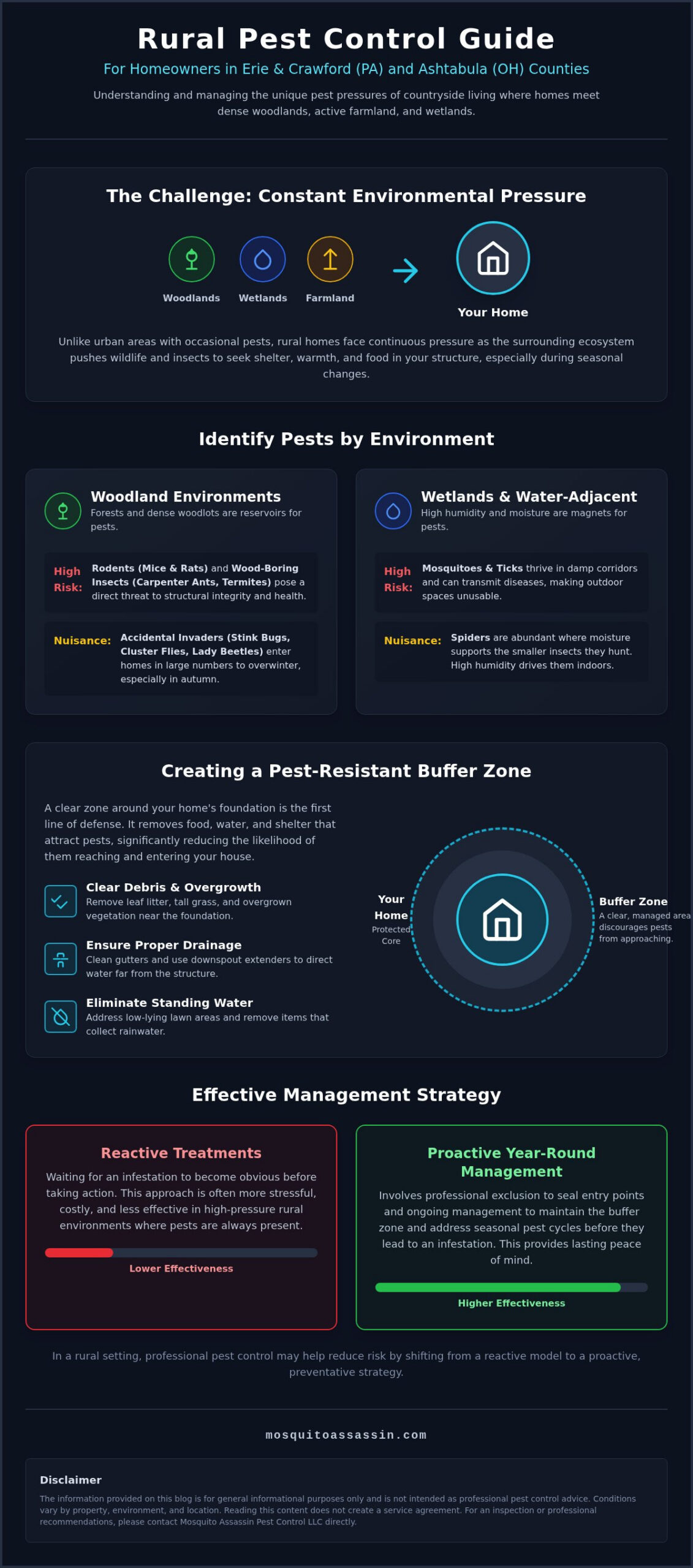
Tag: Pennsylvania Pests

  • Black Widow Spiders in Pennsylvania: Identification and Prevention Guide

    Black Widow Spiders in Pennsylvania: Identification and Prevention Guide

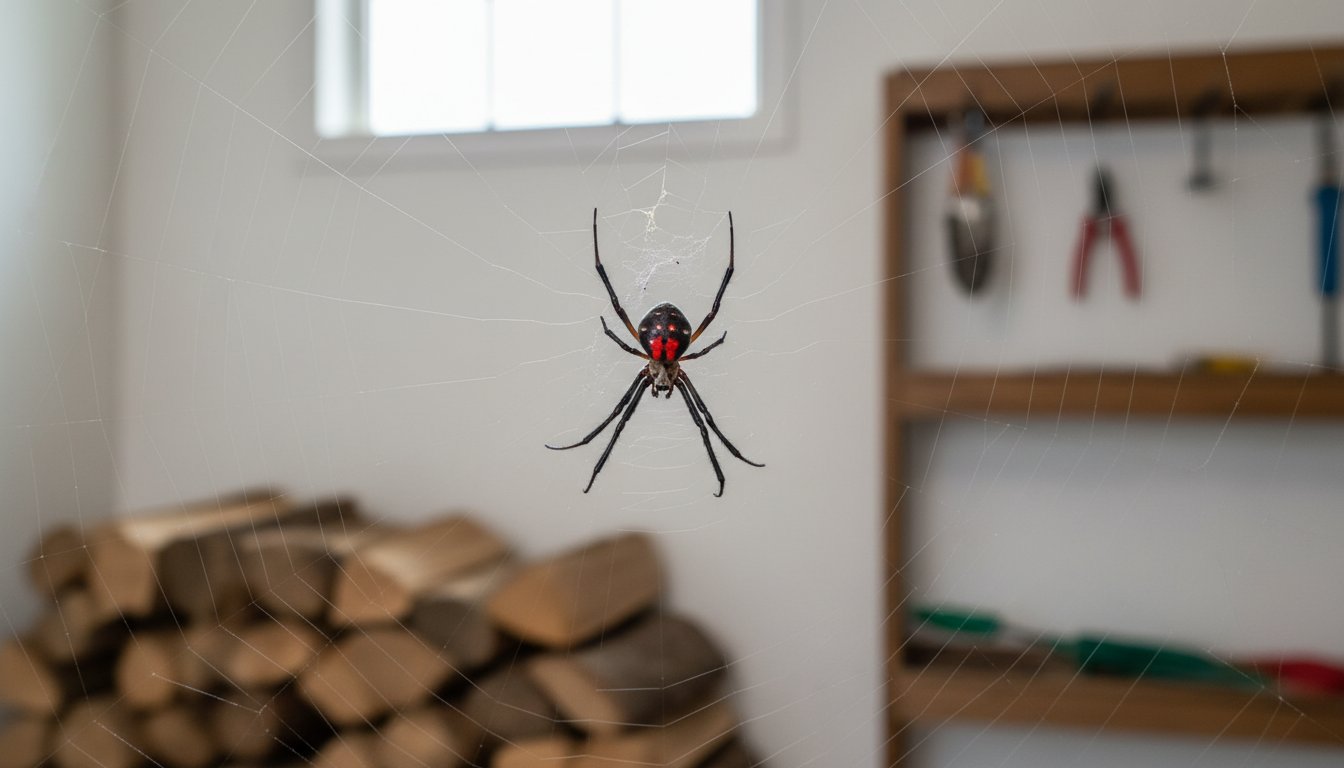
    Finding a glossy black spider with a bright red hourglass in your garage can be a heart-stopping moment for any homeowner. While approximately 2,200 people are bitten by these spiders across the United States each year, many residents don’t realize that black widow spiders in Pennsylvania are a common, native presence in local landscapes. Whether you live in Erie County, Crawford County, or Ashtabula County, understanding these arachnids is the first step toward maintaining a safe environment for your family.

    It’s understandable to feel uneasy about venomous pests lurking in undisturbed corners of your basement or shed. You want to protect your children and pets from potential bites without feeling overwhelmed by uncertainty. This guide provides the expert knowledge you need to identify local black widow species, recognize their preferred habitats, and implement professional-grade prevention strategies for your property. This article explores the specific behaviors of these spiders and provides actionable steps to minimize their presence around your home, ensuring you can manage your space with confidence and peace of mind.

    Disclaimer: The information provided on this blog is for general informational purposes only and is not intended as professional pest control advice. Conditions vary by property, environment, and location. Reading this content does not create a service agreement. For an inspection or professional recommendations, please contact Mosquito Assassin Pest Control LLC directly.
    Key Takeaways

    • Learn to distinguish between the Southern and Northern species of black widow spiders in Pennsylvania by identifying their unique physical markings.
    • Discover the specific outdoor and indoor habitats where these reclusive spiders prefer to build their webs, including woodpiles and quiet corners of garages.
    • Understand the defensive behavior of black widows and the primary risks associated with their neurotoxic venom.
    • Master effective prevention strategies, such as reducing environmental clutter and sealing entry points, to discourage spiders from nesting near your home.
    • Explore how professional pest management and Integrated Pest Management (IPM) techniques offer a comprehensive solution for long-term protection.

    Identifying Black Widow Spiders in Pennsylvania

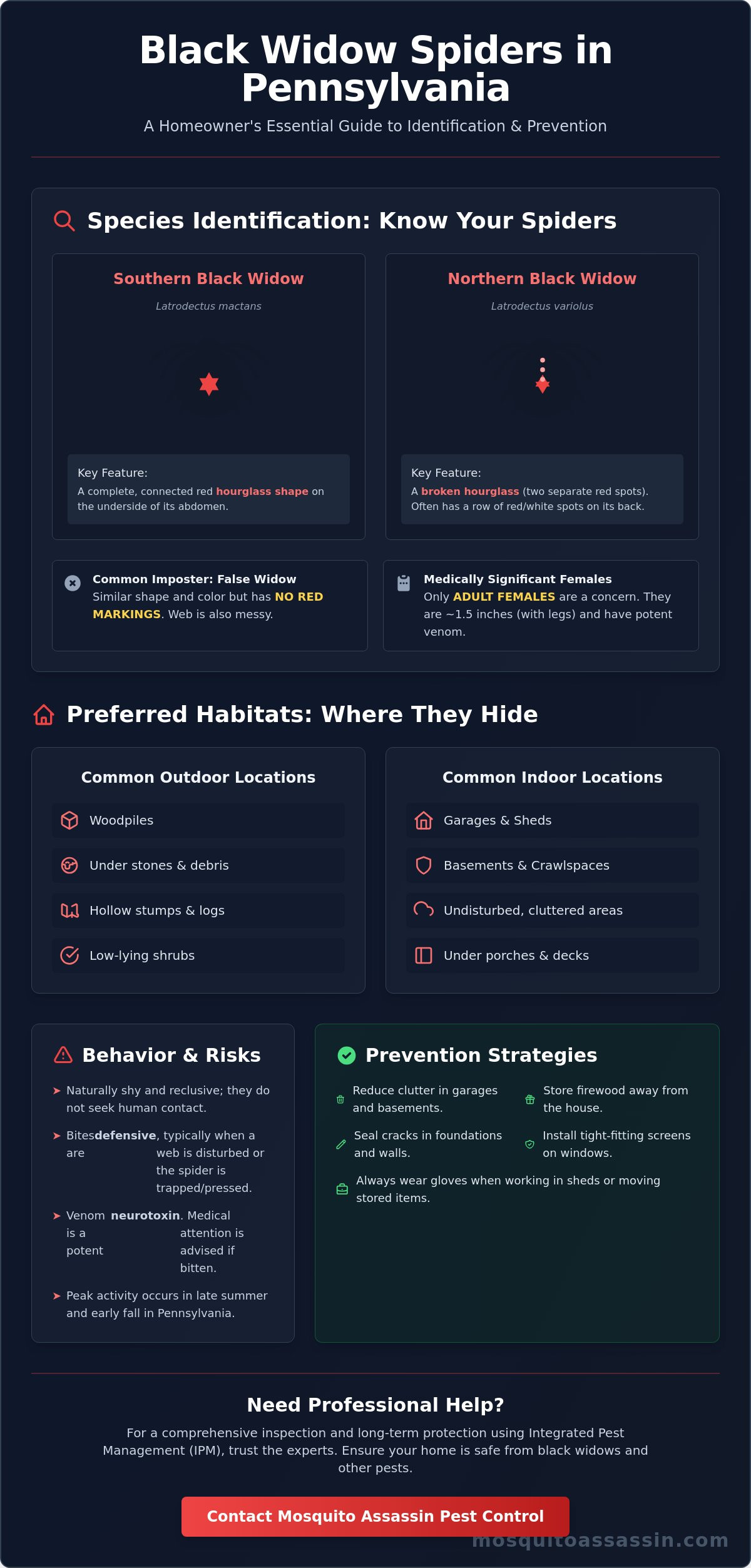
    Pennsylvania is home to two distinct species of widow spiders: the Southern black widow (Latrodectus mactans) and the less frequently discussed Northern black widow. While many people believe only one type exists, identifying black widow spiders in pennsylvania requires looking for subtle differences in their markings. Both species are members of the Theridiidae family, often called cobweb spiders due to their tangled, erratic web patterns that lack the symmetrical beauty of typical garden spider webs.

    Adult female black widows are the most recognizable. They possess a bulbous, glossy black abdomen that measures approximately 1.5 inches when the legs are extended. Males and juveniles look remarkably different; they are often smaller, brown or gray, and may feature white or yellow stripes. Only the adult females are considered medically significant to humans, as their venom is much more potent than that of the males.

    To help visualize these spiders in their natural environment, watch this helpful video:

    Southern vs. Northern Black Widow Markings

    The primary way to distinguish these two species is by examining the red markings on the underside of the abdomen. The Southern black widow features a classic, complete hourglass shape where the two triangles meet in the middle. In contrast, the Northern Black Widow (Latrodectus variolus) typically displays a broken hourglass, appearing as two separate red spots. Additionally, the Northern species often has a row of red or white spots running down the center of its back, a feature the Southern species usually loses as it matures.

    Common Spiders Mistaken for Black Widows

    Homeowners often misidentify several harmless species as black widows. The False Black Widow (Steatoda grossa) is the most frequent culprit. It shares the same dark, bulbous body but lacks any red markings. Common house spiders and other cobweb weavers also create messy webs in basements and garages, leading to unnecessary concern. The Latrodectus genus is the only medically significant cobweb weaver in Pennsylvania.

    Accurate identification is critical because it dictates the level of precaution needed. If you encounter a spider that matches these descriptions in your home or outbuildings, professional pest control may help reduce risk. Detailed inspections can confirm the species and locate nesting sites that are often overlooked. Understanding the physical differences between these species ensures you can accurately assess the presence of black widow spiders in pennsylvania on your property.

    Preferred Habitats and Seasonal Behavior in PA

    Black widows are naturally shy, reclusive arachnids. They don’t seek out human interaction; instead, they thrive in dark, sheltered environments where they can wait undisturbed for prey. In the wild, these spiders choose locations like hollow tree stumps, spaces beneath large stones, or the underside of dense shrubs. Around a residential property, they often find ideal nesting sites in woodpiles, under low-lying porches, or inside discarded equipment. While black widow spiders in pennsylvania prefer the outdoors, they frequently move into garages and crawlspaces if they find a steady supply of prey.

    According to the Penn State Extension on Black Widows, these spiders are most active during the warmer months. Sightings of black widow spiders in pennsylvania typically peak during late summer and early fall. This is when the population reaches maturity, making the adult females more visible as they guard egg sacs or expand their webs to catch larger insects before the winter freeze.

    Regional Habitat Factors in Erie and Crawford Counties

    Local environmental conditions play a significant role in where these spiders choose to settle. In Erie County, the high moisture levels near Lake Erie support large populations of flies, beetles, and other crawling insects. This abundant food source makes the region particularly attractive to black widows. In more rural areas like Crawford County, the prevalence of barns, outbuildings, and large woodpiles provides ample real estate for long-term nesting. Seasonal lakeside cottages that remain closed for several months are also prime locations for undisturbed web building, as the lack of human activity allows the spiders to establish themselves without interference.

    Understanding the Black Widow Cobweb

    One of the most effective ways to identify a potential infestation is by looking at the web itself. Unlike the symmetrical, circular webs created by orb-weaver garden spiders, a black widow’s web is erratic, messy, and lacks a discernible pattern. It often looks like a collection of tangled cobwebs rather than a functional trap. However, the silk of a black widow is notably stronger than that of most other spiders. If you poke it with a stick, you might even hear a faint “crackle” (a sound unique to the breaking of their high-tensile silk). Because they primarily hunt crawling insects, these webs are usually built near ground level, in corners, or behind stored items in garages and basements.

    If you discover these distinct webs in your storage areas, professional pest control may help reduce risk by identifying and treating active nesting sites.

    Disclaimer: The information provided on this blog is for general informational purposes only and is not intended as professional pest control advice. Conditions vary by property, environment, and location. Reading this content does not create a service agreement. For an inspection or professional recommendations, please contact Mosquito Assassin Pest Control LLC directly.
    Black Widow Spiders in Pennsylvania: Identification and Prevention Guide

    Understanding Black Widow Bites and Risks

    While the thought of a bite is intimidating, black widow spiders in Pennsylvania are not aggressive creatures. They generally avoid contact with humans and spend their lives hidden in quiet corners. Bites usually occur as a defensive reaction when a spider is physically pressed against a person’s skin. Because they don’t hunt humans, most encounters are entirely accidental. Understanding the nature of their venom and the circumstances that lead to bites can help homeowners stay safe while managing their property.

    The venom produced by these spiders is a potent neurotoxin. According to medical data on Black Widow Spider Toxicity, the venom primarily affects the nervous system of the victim. Approximately 2,200 people are bitten by black widows annually in the United States, yet there have been no recorded deaths since 1983. Symptoms often begin with immediate localized pain, similar to a pinprick, followed by slight swelling. Within an hour, symptoms can progress to muscle aches, severe abdominal cramping, or a general feeling of malaise. While these symptoms are painful, they are rarely life threatening for healthy adults.

    How Bites Typically Occur

    Most encounters happen in areas where the spiders feel safe and undisturbed. Reaching into a dark corner of a shed or picking up a piece of firewood from a stack are common ways people accidentally come into contact with them. Spiders often hide in stored items like gardening gloves, old boots, or cardboard boxes that have sat in a basement for months. Moving these items can startle the spider, leading to a bite as it tries to protect itself. Gardening in overgrown areas or cleaning out a long-neglected crawlspace also increases the likelihood of a defensive encounter.

    Safe Practices for Homeowners

    Taking simple precautions can significantly lower the chance of an accidental encounter with black widow spiders in pennsylvania. Homeowners should adopt these habits during seasonal cleaning or outdoor work:

    • Always wear heavy leather or rubber gloves when handling woodpiles or clearing debris from a garage.
    • Use a high-powered flashlight to check dark recesses of storage areas before reaching in with bare hands.
    • Shake out footwear, hats, and clothing that have been stored in outbuildings or basements before putting them on.
    • Keep outdoor storage areas organized to minimize the number of dark, tight spaces where spiders can hide.

    For households with young children, the elderly, or pets, the presence of venomous spiders is a valid concern. Professional pest management may help reduce risk by eliminating the food sources and hiding spots that attract black widow spiders in pennsylvania. A methodical approach to property maintenance ensures that these reclusive spiders don’t establish a presence near high-traffic areas like play sets or patio furniture.

    Disclaimer: The information provided on this blog is for general informational purposes only and is not intended as professional pest control advice. Conditions vary by property, environment, and location. Reading this content does not create a service agreement. For an inspection or professional recommendations, please contact Mosquito Assassin Pest Control LLC directly.
    Environmental Prevention and Exclusion Strategies

    Preventing black widow spiders in pennsylvania requires more than just removing an occasional web. It involves a systematic approach to environmental modification. Spiders are attracted to properties that provide two things: abundant prey and secure, dark hiding spots. By altering the conditions around your home, you can make the environment less hospitable to these arachnids and the insects they eat. This proactive strategy is often more effective than reactive measures because it addresses the root cause of the infestation.

    Interior Sanitation and Organization

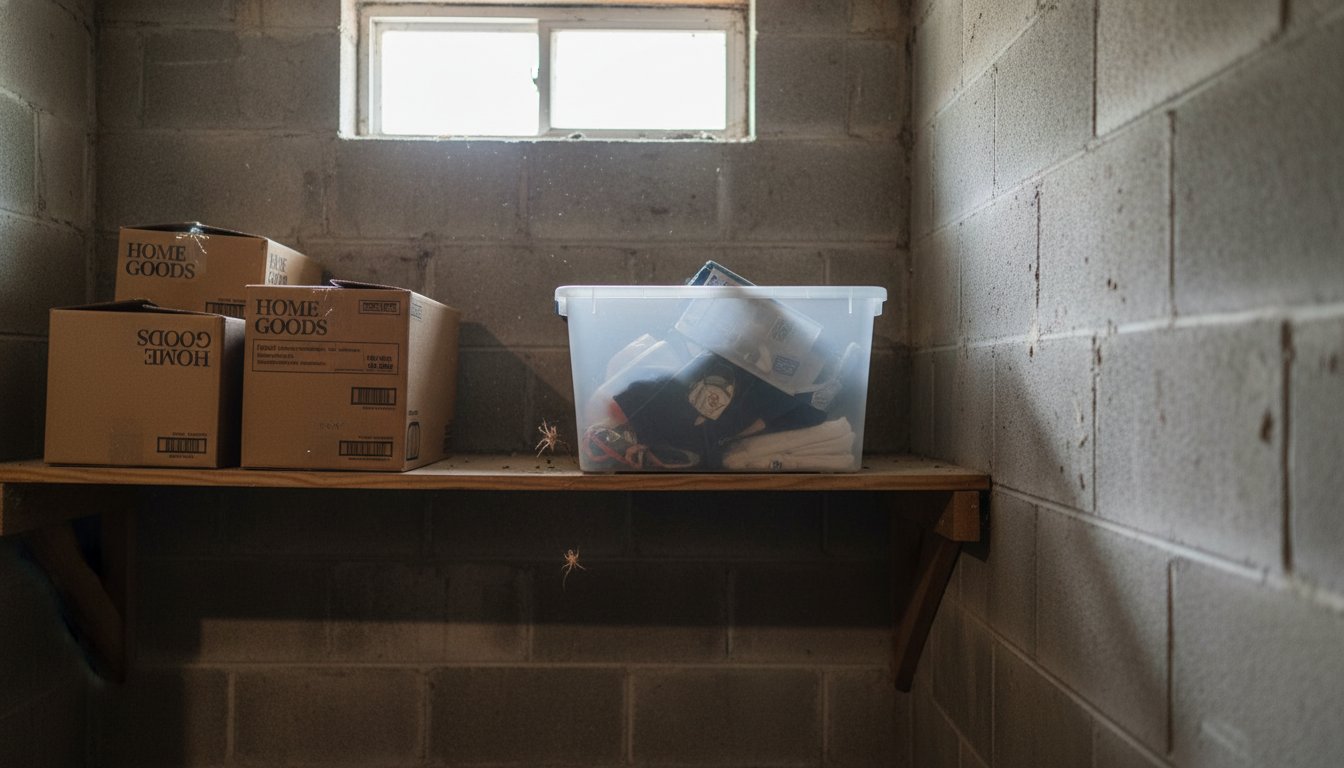
    The inside of a home, especially unfinished areas like basements and crawlspaces, can inadvertently provide perfect nesting sites. Cardboard boxes are a major risk factor because they are often stored in dark areas and provide numerous tight gaps for spiders to squeeze into. Switching to airtight plastic bins is a simple yet effective change. Plastic bins don’t provide the same easy access and are less likely to harbor silverfish or cockroaches, which are common food sources for black widows. Regularly vacuuming or sweeping corners and behind large appliances is also crucial. This physical removal destroys webs and egg sacs before the population can grow. Additionally, managing moisture levels in crawlspaces with dehumidifiers can reduce the population of moisture-loving insects that attract spiders in the first place.

    Exterior Property Maintenance

    The perimeter of your home is the first line of defense. Because black widow spiders in pennsylvania often move from outdoor woodpiles to indoor structures, location matters. Moving firewood at least 20 feet away from the foundation and keeping it elevated off the ground reduces the chance of spiders migrating toward your siding. Vegetation also plays a role; shrubs, vines, and tall grass should be trimmed so they don’t touch the house. This creates a dry zone that discourages crawling pests from crossing into your living space.

    • Seal gaps around utility pipes and wires with caulk or expandable foam to block entry points.
    • Install door sweeps on all exterior doors, including the garage door, to eliminate ground-level gaps.
    • Repair or replace damaged window screens to prevent flying and crawling prey from entering.

    Outdoor lighting is another often-overlooked factor. Standard white or blue-tinted lights attract a wide variety of nocturnal insects. By switching exterior fixtures to yellow bug lights, you can significantly decrease the number of insects gathering near your doorways. Fewer insects mean fewer reasons for spiders to build webs in those areas. If you’ve noticed an increase in spider activity around your entryways, professional pest control may help reduce risk by identifying specific vulnerabilities in your home’s exterior.

    Disclaimer: The information provided on this blog is for general informational purposes only and is not intended as professional pest control advice. Conditions vary by property, environment, and location. Reading this content does not create a service agreement. For an inspection or professional recommendations, please contact Mosquito Assassin Pest Control LLC directly.
    The Role of Professional Pest Management

    While environmental modifications are essential for long term success, professional pest management provides a level of thoroughness that is difficult to achieve through individual efforts alone. Identifying the specific species and the full extent of an infestation requires a trained eye and a systematic approach. Professional intervention focuses on the biology of black widow spiders in pennsylvania to ensure that treatments are both effective and targeted. This methodical process moves beyond reactive measures, aiming instead to disrupt the life cycle of the spiders and their prey.

    What a Professional Inspection Includes

    A comprehensive inspection is the foundation of any successful management plan. Technicians look for more than just active webs; they identify the structural vulnerabilities that allow spiders to enter a home. This includes a detailed assessment of entry points such as gaps in the foundation, poorly fitted door sweeps, or unsealed utility penetrations. A professional also evaluates the surrounding environment to identify prey populations that may be sustaining the spider presence. If a property has a high volume of beetles, crickets, or silverfish, it will naturally attract more predators. Based on these findings, professionals provide specific recommendations for structural repairs or environmental changes to deter future nesting in Erie and Crawford Counties.

    Long-Term Protection and Safety

    Licensed professionals have the specialized equipment required to access difficult areas safely. Crawlspaces, high corners of vaulted ceilings, and deep recesses of unfinished basements are prime locations for black widows, but they can be hazardous for homeowners to inspect without proper gear. Using professional-grade tools ensures that these hiding spots are thoroughly treated without putting the residents at risk. Integrated Pest Management (IPM) represents the gold standard in modern pest control, focusing on long-term prevention through a combination of biological, cultural, and physical tactics. This approach minimizes the reliance on broad-spectrum applications while maximizing the safety of the household.

    Ongoing protection plans are designed to address the unique seasonal cycles of black widow spiders in pennsylvania and neighboring Ohio. These plans often include regular monitoring to ensure that new egg sacs are identified and removed before they hatch in the spring. Consistent oversight creates a reliable barrier against invading spiders, providing peace of mind for families in rural and suburban areas alike. For more information on customized plans, visit the about page or the location services page to see how professional pest control may help reduce risk on your property.

    Disclaimer: The information provided on this blog is for general informational purposes only and is not intended as professional pest control advice. Conditions vary by property, environment, and location. Reading this content does not create a service agreement. For an inspection or professional recommendations, please contact Mosquito Assassin Pest Control LLC directly.

    Maintaining a Spider-Free Home Environment

    Understanding the unique behaviors of black widow spiders in pennsylvania allows homeowners to take control of their property’s safety. Accurate identification between the Southern and Northern species, combined with consistent clutter reduction in garages and basements, forms a strong foundation for prevention. By sealing foundation gaps and managing outdoor lighting, residents in Erie, Crawford, and Ashtabula counties can significantly decrease the likelihood of accidental encounters.

    Long-term success often relies on a methodical, professional approach. A locally owned and operated provider that is licensed and insured in both Pennsylvania and Ohio offers the expertise needed to safeguard high-risk areas like crawlspaces. With five-star rated service and a commitment to integrated pest management, expert technicians ensure that seasonal cycles are monitored and managed effectively. Residents don’t need to manage these risks alone when professional support is available. For an inspection or professional recommendations, please contact Mosquito Assassin Pest Control LLC directly. Taking these proactive steps ensures your home remains a safe haven for your family and pets.

    Disclaimer: The information provided on this blog is for general informational purposes only and is not intended as professional pest control advice. Conditions vary by property, environment, and location. Reading this content does not create a service agreement. For an inspection or professional recommendations, please contact Mosquito Assassin Pest Control LLC directly.

    Frequently Asked Questions

    How common are black widow spiders in Pennsylvania?

    Black widow spiders are a native and relatively common species found throughout the state. While they aren’t as visible as common house spiders due to their reclusive nature, their populations remain stable in both urban and rural environments. You’ll most likely encounter them in undisturbed outdoor structures, woodpiles, or rural properties where human activity is minimal and insects are plentiful.

    Can a black widow spider bite be fatal?

    A black widow bite is rarely fatal for healthy adults, though it does require careful monitoring. There haven’t been any recorded deaths from these bites in the United States since 1983. The neurotoxic venom causes painful muscle contractions and systemic symptoms, but modern medical care effectively manages these issues. High-risk individuals, including children and the elderly, should seek immediate medical evaluation following a suspected bite.

    Where do black widows hide in a typical PA home?

    These spiders typically hide in dark, low-traffic areas such as basements, crawlspaces, and the corners of garages. In a standard Pennsylvania home, they often settle behind large appliances, inside cluttered storage rooms, or within boxes of seasonal decorations. They specifically look for quiet spots where their erratic webs can remain undisturbed for weeks at a time while they wait for crawling prey to pass by.

    What should I do if I find a black widow in my garage?

    You should avoid touching the spider or its web with bare hands if you discover one in your garage. Carefully removing the spider using a vacuum with a long hose attachment or a glass and a piece of stiff cardboard is a safe way to handle a single intruder. If you notice multiple spiders or egg sacs, professional pest control may help reduce risk by identifying the source of the infestation.

    Do black widows move into houses during the winter?

    Black widows don’t typically migrate into living spaces specifically for the winter, but they often seek shelter in attached garages or basements as temperatures drop. Most black widow spiders in pennsylvania overwinter in a state of dormancy called diapause. They usually choose protected outdoor spots like woodpiles or hollow logs, but they will readily utilize a crawlspace if it provides a stable environment and protection from the elements.

    How can I tell the difference between a black widow and a false black widow?

    The presence of a bright red hourglass marking on the underside of the abdomen is the most reliable way to tell them apart. False black widows share a similar bulbous shape and dark color but completely lack any red or orange markings. False widows often have a purplish-brown tint and may feature light-colored spots or lines on their backs, which are markings that adult female black widows do not possess.

    Are black widow spiders found in Erie, PA?

    Yes, black widow spiders in pennsylvania are frequently found in Erie and the surrounding Great Lakes region. The high moisture levels near Lake Erie attract a wide variety of insects, providing an abundant and consistent food source for these spiders. They are commonly spotted in lakeside cottages, boat houses, and residential storage sheds throughout Erie County, especially in areas that remain undisturbed during the off-season.

    What do black widow spider eggs look like?

    Black widow egg sacs are small, tan or off-white spheres that have a smooth, paper-like texture. Each sac is approximately 0.5 inches in diameter and can contain between 200 and 900 eggs. These sacs are usually suspended within the messy, erratic webbing and are vigorously guarded by the female spider. This guarding behavior is when the spider is most defensive and likely to bite if the web is disturbed.

    Disclaimer: The information provided on this blog is for general informational purposes only and is not intended as professional pest control advice. Conditions vary by property, environment, and location. Reading this content does not create a service agreement. For an inspection or professional recommendations, please contact Mosquito Assassin Pest Control LLC directly.

  • Termite Swarms in PA: Identifying and Managing Spring Activity (2026)

    Termite Swarms in PA: Identifying and Managing Spring Activity (2026)

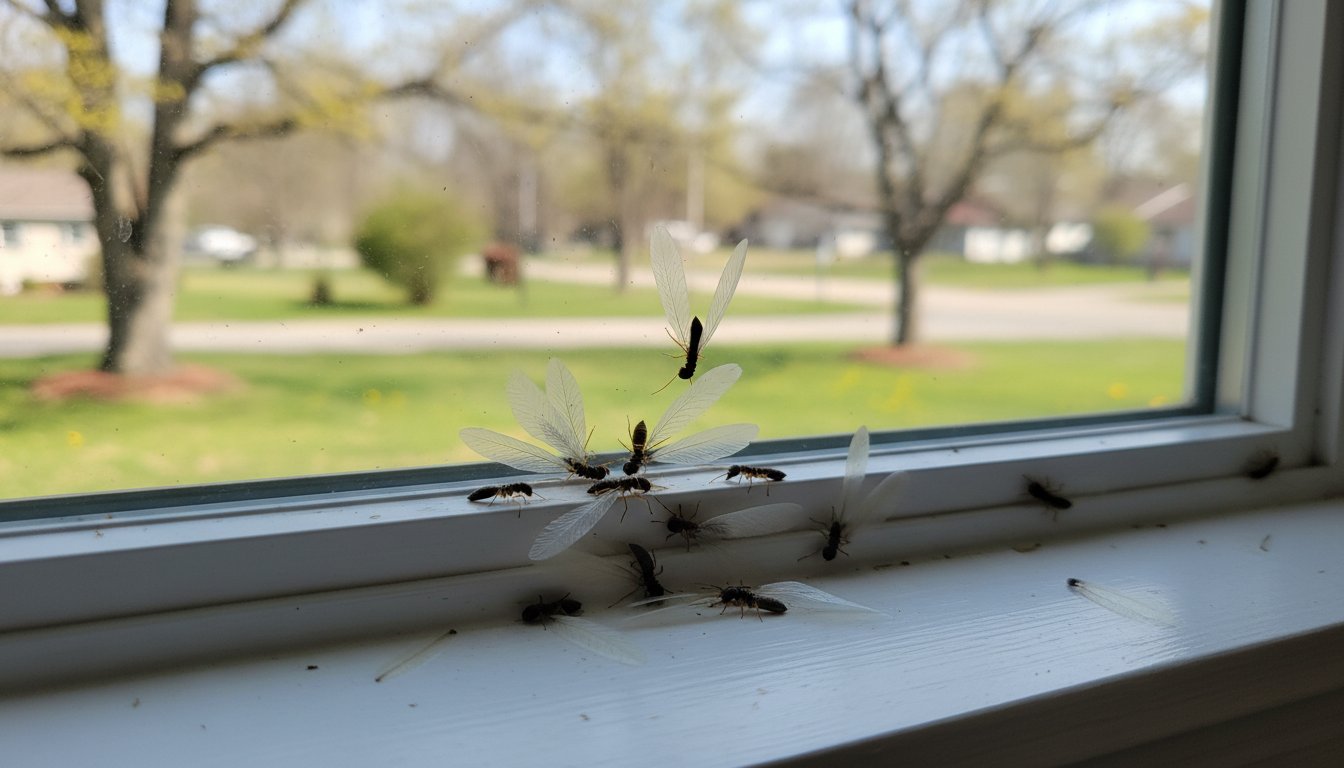
    On a warm afternoon in April, a homeowner in Erie County might notice a sudden cloud of winged insects near a window or door frame. It’s a sight that often triggers immediate concern, especially when you realize these aren’t just common houseflies. Most Pennsylvanians understand that seeing termite swarms in PA is a classic sign of a potential infestation, yet the fear of hidden structural damage can make it hard to think clearly. It’s natural to feel anxious about the integrity of your home when these pests appear without warning.

    This article promises to help you identify termite swarmers and distinguish them from look-alike flying ants with confidence. You’ll learn why the spring season in Crawford and Ashtabula Counties creates the perfect conditions for these pests to emerge and move toward residential structures. The following sections examine specific risks to local properties and outline a clear plan for professional inspection. Understanding these seasonal behaviors is the first step toward effective property protection and long-term peace of mind.

    Disclaimer: The information provided on this blog is for general informational purposes only and is not intended as professional pest control advice. Conditions vary by property, environment, and location. Reading this content does not create a service agreement. For an inspection or professional recommendations, please contact Mosquito Assassin Pest Control LLC directly.

    Key Takeaways

    • Understand how environmental triggers like soil moisture and temperature initiate seasonal dispersal flights for new colony formation.
    • Learn to identify termite swarms in PA by recognizing the physical characteristics of the Eastern Subterranean species common in the region.
    • Distinguish between termite swarmers and flying ants by comparing body shapes (straight versus pinched waists) and wing lengths.
    • Discover how to conduct a basic visual assessment for signs of activity, such as the presence of mud tubes on foundation walls.
    • Recognize why professional inspections are the most reliable method for confirming colony locations and evaluating long term property risks.

    Understanding Termite Swarms in Pennsylvania

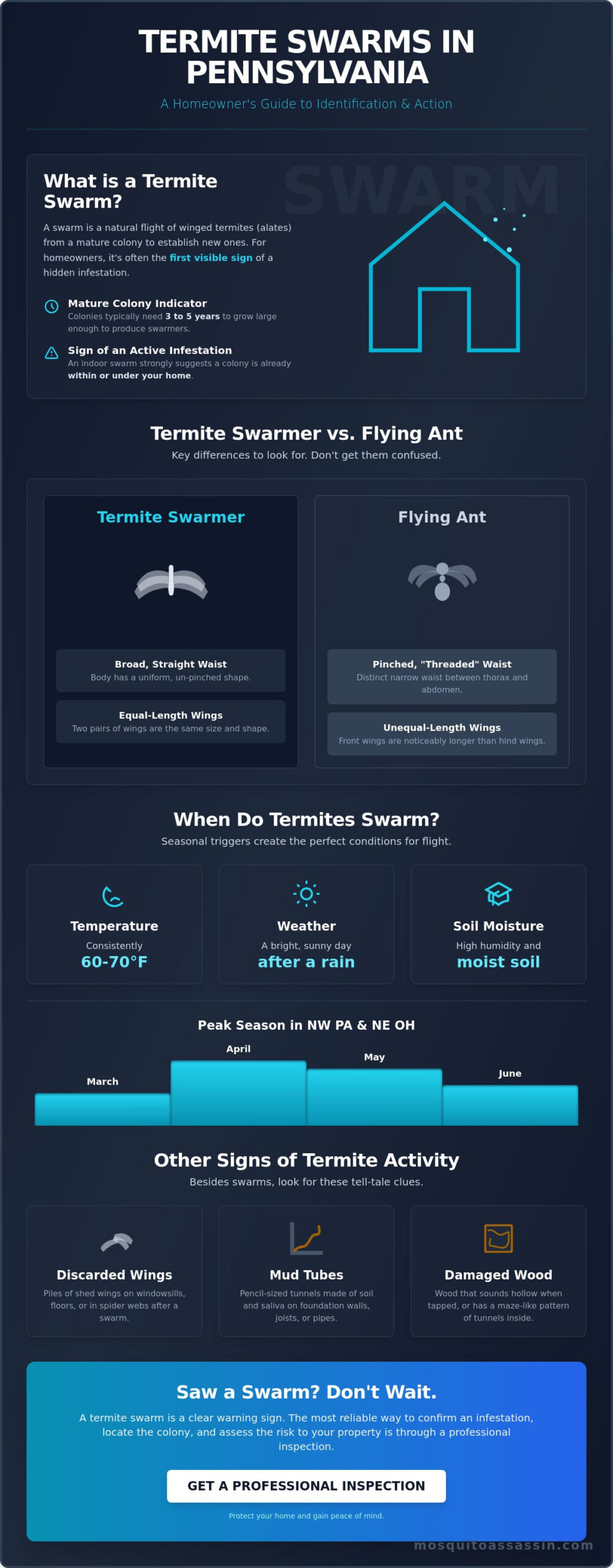
    A termite swarm is a natural dispersal flight designed for the expansion of a species. These events occur when a mature colony produces winged reproductives, also known as alates, to leave the original nest and establish new colonies. For homeowners, observing termite swarms in PA is often the first visible sign of an underlying infestation, as the majority of termite activity remains hidden underground or within wooden structures. Environmental triggers play a vital role in these flights, with most activity occurring when temperatures reach a consistent 60 to 70 degrees Fahrenheit.

    The primary species responsible for these events in the region is the Eastern Subterranean Termite (Reticulitermes flavipes). Unlike the creamy-white, wingless workers that stay hidden in the soil or wood, the alates are dark brown or black and possess two pairs of translucent wings. These wings are equal in length and often shed shortly after the flight, leaving behind piles of discarded wings on windowsills or floors.

    To better understand this concept, watch this helpful video:

    The Biological Purpose of the Swarm

    The swarm serves a specific reproductive function. A colony typically needs three to five years of growth before it reaches a maturity level capable of producing alates. These winged termites aren’t strong fliers and usually rely on wind currents to travel short distances. The flight itself is brief, often lasting less than an hour. If a swarm occurs indoors, it’s a strong indicator that a mature colony is already established within or directly underneath the structure. Because these insects require high humidity to survive, those that emerge inside a dry home usually die quickly if they cannot find a way back to the soil.

    Seasonal Timing for Northwest PA and Northeast OH

    In areas like Erie and Crawford counties, the window for termite swarms in PA typically opens in March and can extend through June. Local weather patterns heavily influence the exact day a swarm begins. The most common trigger is a bright, sunny day following a spring rain event. The moisture in the soil combined with a sudden rise in temperature signals the colony that conditions are ideal for the alates to survive their flight.

    Residents in the Tri-State area

    The Biology of Eastern Subterranean Termites

    Eastern Subterranean termites (Reticulitermes flavipes) are the primary species responsible for structural damage throughout Pennsylvania and Ohio. These insects live in highly organized colonies governed by a rigid caste system. The queen and king are the reproductive heart of the nest, while the soldiers use their enlarged mandibles to protect the colony from predators. Workers are the most numerous members, responsible for foraging, feeding the other castes, and maintaining the nest. The winged reproductives, also known as alates, are the individuals homeowners encounter during termite swarms in PA each spring.

    These termites are small, with workers typically measuring between 1/8 and 3/8 of an inch in length. Because they have thin exoskeletons, they are extremely susceptible to dehydration. To survive, they construct mud tubes, which are narrow tunnels made of soil and saliva. These tubes allow them to travel from their underground nests into the wooden structures of a home while maintaining the high humidity levels they require. Any wood-to-soil contact, such as porch lattice or door frames touching the earth, provides an easy entry point for these foragers.

    The Hidden Nature of Subterranean Colonies

    It’s rare for a homeowner to see a worker termite because they spend their lives in the dark, damp environments of the soil or inside the wood they are consuming. A single colony can be incredibly expansive, with workers foraging up to 150 feet away from the central nest to find food sources. This means the nest causing damage to a home might not even be located on the same property. In regions like Erie and Crawford Counties, these pests are resilient to the cold. When temperatures drop, they retreat three to four feet below the frost line, staying active year-round by utilizing the warmth from a building’s foundation or heated crawl space.

    Diet and Destruction: What They Eat

    The primary diet of a subterranean termite is cellulose, a complex carbohydrate found in wood, paper, and cardboard products. While they naturally break down fallen trees in the forest, they don’t distinguish between a rotting log and the structural timbers of a house. The components most at risk include sill plates, floor joists, and wall studs. Moisture issues, such as those found in damp basements or poorly ventilated crawl spaces, significantly accelerate the rate of damage. Saturated wood is much easier for termites to chew and digest. For a deeper look at termite identification and damage, local data from Penn State Extension highlights how quickly these pests can compromise a structure. Seeing termite swarms in PA inside a living space is often the first and only warning sign that a mature colony is already feeding on the home’s skeleton.

    If you notice signs of activity or mud tubes along your foundation, professional pest control may help reduce the risk of structural failure. You can find more information about protective measures for your property to help safeguard your investment.

    Disclaimer: The information provided on this blog is for general informational purposes only and is not intended as professional pest control advice. Conditions vary by property, environment, and location. Reading this content does not create a service agreement. For an inspection or professional recommendations, please contact Mosquito Assassin Pest Control LLC directly.

    Termite Swarms in PA: Identifying and Managing Spring Activity (2026)

    Differentiating Termite Swarmers from Flying Ants

    Correctly identifying the insects emerging in your home is the first step in protecting your property. Many homeowners in Northwest Pennsylvania mistake flying ants for termites, leading to unnecessary stress or, conversely, ignoring a serious structural threat. Mistaking these two can be a costly error. While ants are a nuisance, termites cause over 5 billion dollars in property damage across the United States every year. Using the Penn State Extension guide to termites can help residents understand the biology of the Eastern subterranean termite, which is the species responsible for most termite swarms in PA.

    Visual Identification Guide

    The most reliable way to distinguish these pests is by examining three specific physical traits: the waist, the antennae, and the wings. Termites have a broad, straight waist that doesn’t taper. In contrast, ants have a distinct, pinched waist that gives them a segmented appearance. When looking at the head, termite antennae are straight and look like tiny strings of beads. Ant antennae are elbowed, meaning they have a sharp bend or “joint” in the middle.

    Wing structure provides the most obvious clue during a swarm. Termites have four wings of equal length that are significantly longer than their bodies. These wings are typically translucent or slightly milky in color. Flying ants also have four wings, but they aren’t equal; the front pair is much larger than the hind pair. In Erie and Crawford Counties, carpenter ants are frequently confused with termites. Carpenter ants are generally larger, often reaching 1/2 inch in length, and have a solid black or reddish-brown color, while termite swarmers are usually about 1/4 inch long and dark brown or black.

    Behavioral Differences

    Where and how you find these insects can reveal their identity. Termites are notoriously poor fliers. They don’t travel far from their colony and often emerge from tiny cracks in walls or floorboards. Because they’re weak in the air, they shed their wings almost immediately after landing. Finding piles of discarded, identical wings on windowsills or near basement doors is a primary sign of termite activity. Ants don’t shed their wings in this manner; if you see winged insects crawling around with their wings still firmly attached, they’re more likely to be ants.

    Both species are attracted to light sources, but their patterns differ. Termite swarms in PA usually occur during the day, particularly after a warm spring rain. You’ll often find them fluttering toward windows or indoor light fixtures. Flying ants are more robust fliers and may be seen at various times of day or night. If you discover winged insects inside your living space, professional pest control may help reduce risk and determine if a treatment plan is necessary. For a professional evaluation, you can visit the contact page or use the online booking portal.

    Disclaimer: The information provided on this blog is for general informational purposes only and is not intended as professional pest control advice. Conditions vary by property, environment, and location. Reading this content does not create a service agreement. For an inspection or professional recommendations, please contact Mosquito Assassin Pest Control LLC directly.

    Recognizing Signs of Termite Activity in Northwest Pennsylvania

    Identifying termite presence requires a methodical visual assessment, especially since these pests often remain hidden within structural voids. Homeowners should begin by inspecting the foundation line and crawl spaces. Look for mud tubes, which are pencil-thick tunnels constructed from soil and saliva. These tubes allow subterranean termites to travel from the ground to the wooden components of a home without drying out. In Pennsylvania, these tubes are frequently found on concrete blocks or behind sill plates where the wood meets the foundation.

    Testing structural supports is another critical step. When wood is infested, it often appears solid on the outside but is hollowed out internally. Tapping on floor joists or support beams with a tool handle can reveal a dull, hollow thud rather than a solid ring. If a screwdriver easily penetrates the wood surface with little resistance, it indicates significant internal damage. While termite swarms in PA are the most visible indicator, these structural clues often signal an established colony that’s been active for years.

    Evidence Beyond the Swarm

    Beyond the actual termite swarms in PA, homeowners may notice small, pin-sized exit holes in drywall or wood trim. These holes are often capped with a small amount of mud. Bubbling paint or crumbling baseboards are also common red flags, frequently mistaken for simple water damage. A primary risk factor for subterranean species is wood-to-soil contact. This occurs when siding, porch steps, or deck posts touch the earth directly, providing a clear highway for termites. Maintaining a gap of at least six inches between the soil and wooden structures can significantly reduce these risks. For more on general pest threats, see this General Pest Control guide.

    Environmental Risk Factors in the Lake Erie Region

    The unique climate of the Lake Erie region creates specific vulnerabilities for properties in Erie, Crawford, and Ashtabula counties. High humidity levels, often reaching over 75 percent during the summer months, keep structural wood moist and attractive to pests. Additionally, heavy spring snowmelt in March and April saturates the soil, driving subterranean termites upward in search of drier ground. Homes in Meadville and Erie with older foundations are particularly susceptible. Over time, settling causes small cracks, even those as narrow as 1/32 of an inch, that provide easy entry points. Understanding these local factors is essential for effective property management. Homeowners can learn more about service locations and regional risks through professional resources.

    If suspicious mud tubes or hollow wood are discovered, professional pest control may help reduce risk. To request an evaluation, visit the online booking portal.

    Disclaimer: The information provided on this blog is for general informational purposes only and is not intended as professional pest control advice. Conditions vary by property, environment, and location. Reading this content does not create a service agreement. For an inspection or professional recommendations, please contact Mosquito Assassin Pest Control LLC directly.

    Professional Inspection and Long-Term Protection Strategies

    Confirming the presence of a colony requires more than just spotting a few winged insects. While termite swarms in PA are a visible indicator of an issue, the actual colony often remains hidden deep underground or within structural timbers. Professional inspections provide the only reliable method for locating the source and assessing the extent of the activity. According to the National Pest Management Association, termites cause over $5 billion in property damage annually in the United States, making early detection a financial necessity for homeowners.

    DIY identification often leads to misdiagnosis, as homeowners frequently confuse winged ants with termites. Attempting to treat a swarm with over the counter sprays only addresses the insects that are visible, leaving the main colony intact to continue feeding on the home’s infrastructure. Integrated Pest Management (IPM) offers a more effective alternative by combining biological, mechanical, and targeted chemical strategies to manage pests with minimal environmental impact. Year-round protection plans help ensure that small vulnerabilities don’t escalate into structural failures, providing a proactive defense against seasonal activity.

    What Happens During a Professional Inspection

    A licensed technician follows a methodical process to evaluate a property’s risk. This includes a detailed examination of basements, crawl spaces, and the exterior perimeter where soil meets the foundation. Professionals look for specific signs such as mud tubes, wood that sounds hollow when tapped, and discarded wings near entry points. Specialized tools, including moisture meters and thermal imaging cameras, help detect activity behind drywall or under floorboards without causing damage. The process concludes with a written report and a customized management plan tailored to the specific needs of the property.

    Preventative Measures for Homeowners

    Reducing moisture is the most effective way to make a property less attractive to subterranean termites. Preventing termite swarms in PA from establishing a foothold starts with ensuring that soil remains at least 6 to 8 inches below the top of the foundation. Homeowners should also verify that gutters direct water at least 3 feet away from the structure. Maintaining proper ventilation in crawl spaces and attics prevents the humidity buildup that these insects require to survive. Professional pest control may help reduce the risk of structural damage by identifying these environmental triggers before an infestation begins.

    Next Steps for Property Protection

    Taking action early is the best way to safeguard a home from the long-term effects of wood-destroying organisms. If you suspect activity in Erie, Crawford, or Ashtabula, consulting a licensed professional is a critical step. You can find more details on the professional services page to understand the different management options available. For those ready to schedule an evaluation, visiting the online booking portal provides a direct way to begin the process of securing your property.

    Disclaimer: The information provided on this blog is for general informational purposes only and is not intended as professional pest control advice. Conditions vary by property, environment, and location. Reading this content does not create a service agreement. For an inspection or professional recommendations, please contact Mosquito Assassin Pest Control LLC directly.

    Securing Your Property Against Termite Activity

    According to the National Pest Management Association, subterranean termites cause over $5 billion in property damage annually across the United States. Identifying termite swarms in PA is the first step in preventing structural loss. Distinguishing between flying ants and subterranean termites requires a close look at wing length and body shape. Because Eastern subterranean termites live in the soil, they often remain hidden until a swarm occurs or damage is already visible. Homeowners in Erie and Crawford Counties can benefit from Year-Round Protection plans.

    Working with a locally owned team ensures professionals are familiar with specific Pennsylvania soil conditions. Licensed and insured technicians provide the expertise needed to safeguard properties in NW PA and NE OH. It’s vital to take action before a swarm begins. For those concerned about potential activity, schedule a professional inspection through the online portal. Proactive management is the most effective way to ensure a pest-free environment throughout the year.

    Disclaimer: The information provided on this blog is for general informational purposes only and is not intended as professional pest control advice. Conditions vary by property, environment, and location. Reading this content does not create a service agreement. For an inspection or professional recommendations, please contact Mosquito Assassin Pest Control LLC directly.

    Frequently Asked Questions

    How long does a termite swarm last?

    A termite swarm typically lasts between 30 and 60 minutes from start to finish. During this brief window, the winged reproductives emerge from a mature colony to mate and find new nesting sites. While the individual flight is short, homeowners might find evidence of the event for several days afterward as the insects drop their wings near light sources.

    If I see a termite swarm outside, is my house in danger?

    Seeing a termite swarm outside indicates that a mature colony exists within approximately 100 feet of the sighting. While an outdoor swarm doesn’t guarantee an indoor infestation, it’s a clear signal that the local population is expanding. Since subterranean termites travel through soil, any structure within this radius is at a higher risk for potential entry through the foundation.

    Do termite swarmers eat wood?

    Termite swarmers don’t eat wood or cause structural damage themselves. Their sole purpose is to leave the original colony, pair up, and establish new reproductive sites. The actual damage is caused by the worker class of the colony, which can consume roughly 1 pound of wood every 2 to 3 months in a medium sized subterranean nest.

    Can I get rid of termites on my own?

    Eliminating a termite colony requires specialized equipment and soil treatments that aren’t available to the general public. DIY methods often fail to reach the queen or the deep underground tunnels where 90 percent of the population lives. Professional pest control may help reduce risk and ensure the entire colony is properly addressed. For more information, visit the online booking portal.

    What should I do if I find discarded wings on my windowsill?

    Finding discarded wings on a windowsill is a strong indicator that termite swarms in PA have occurred inside or very close to the structure. You should collect a few wings in a sealed bag for professional identification. Because swarmers are attracted to light, they often congregate near windows before shedding their wings and attempting to crawl into nearby crevices.

    Are termites active in PA during the winter?

    Termites remain active in Pennsylvania throughout the winter by retreating below the frost line, which typically reaches 36 to 48 inches deep in the region. While they don’t swarm in the cold, they continue to feed on wood if they’ve found a source of warmth, such as a heated basement or crawlspace. Activity usually remains hidden until temperatures rise above 60 degrees Fahrenheit in the spring.

    Does a termite swarm mean my house is infested?

    An indoor swarm is a definitive sign of an existing infestation, as the insects are emerging from within the building’s framework. If the swarm occurs outdoors, it confirms a colony is nearby but doesn’t always mean the house is currently infested. However, termite swarms in PA serve as a critical warning that the property is within the foraging range of a mature nest.

    How often should I have my home inspected for termites in Pennsylvania?

    Annual inspections are the industry standard for properties in Erie and Crawford Counties to detect activity before significant damage occurs. Subterranean termites cause an estimated $5 billion in property damage across the United States each year, often without showing visible signs for several seasons. Scheduling a professional evaluation every 12 months helps identify entry points and early warning signs like mud tubes. To schedule an inspection, contact www.mosquitoassassin.com/contact-us.

    Disclaimer: The information provided on this blog is for general informational purposes only and is not intended as professional pest control advice. Conditions vary by property, environment, and location. Reading this content does not create a service agreement. For an inspection or professional recommendations, please contact Mosquito Assassin Pest Control LLC directly.

  • Pennsylvania Brown Recluse Spider: Identification, Range, and Safety Guide (2026)

    Pennsylvania Brown Recluse Spider: Identification, Range, and Safety Guide (2026)

    On October 14, 2025, a resident in Crawford County reached for a storage bin in their basement and froze as a small, tan spider vanished into a dark corner. It is completely natural to feel a surge of anxiety when you spot a mysterious arachnid in your living space, especially since many people assume every brown spider is a dangerous threat. Misidentification is a frequent occurrence; research suggests that nearly 80 percent of spiders submitted for identification in the Northeast are harmless local species rather than the rare pennsylvania brown recluse spider.

    This guide provides the facts needed to identify a true brown recluse and distinguish it from the lookalikes that commonly inhabit Erie and Ashtabula Counties. You will learn the specific physical markers to look for, where these spiders are typically found, and how to maintain a safe environment for your family. Understanding the difference between a common house spider and a venomous species is the first step toward reclaiming peace of mind in your home. Professional pest control may help reduce risk if an infestation is suspected.

    Disclaimer: The information provided on this blog is for general informational purposes only and is not intended as professional pest control advice. Conditions vary by property, environment, and location. Reading this content does not create a service agreement. For an inspection or professional recommendations, please contact Mosquito Assassin Pest Control LLC directly.

    Key Takeaways

    • Clarify the status of the pennsylvania brown recluse spider as a non-native species and understand why sightings are rare in the local region.
    • Learn to identify the specific “violin” marking and other physical traits that distinguish a true brown recluse from common lookalikes found in Pennsylvania.
    • Discover the common hiding spots within regional homes, such as undisturbed storage areas and cluttered crawlspaces, to better protect your living environment.
    • Implement effective prevention techniques by establishing a perimeter of defense and controlling the insect populations that serve as a food source for spiders.
    • Recognize when spider activity warrants professional management and how Integrated Pest Management (IPM) techniques can help safeguard your property.

    Understanding the Range and Presence of Brown Recluse Spiders in Pennsylvania

    The Brown recluse spider (Loxosceles reclusa) is one of the most misunderstood pests in the United States. While its name often causes immediate concern for homeowners, it’s vital to distinguish between a spider’s native habitat and occasional, isolated sightings. In the context of the pennsylvania brown recluse spider, these arachnids aren’t considered a resident species. They’re non-native to the Northeast, and the state doesn’t have the environmental conditions required to support large, wild populations.

    Native Range vs. Pennsylvania Sightings

    The primary habitat for the brown recluse spans from southeastern Nebraska through Texas and east to the westernmost parts of Georgia. Pennsylvania falls well outside this biological boundary. There aren’t any documented, established breeding populations of the pennsylvania brown recluse spider in the state’s 67 counties. The climate in northern regions like Erie and Meadville remains a significant barrier to their survival. These spiders thrive in consistent warmth and struggle to survive the sustained freezing temperatures common in Crawford and Erie Counties. Most “recluse” sightings in the Northeast are actually misidentified wolf spiders or nursery web spiders, which share similar coloring but lack the specific characteristics of the Loxosceles genus.

    How Spiders Travel to New Regions

    While they don’t live here naturally, spiders can occasionally arrive via human activity. This process, often called “hitchhiking,” occurs when a spider or an egg sac is transported in commercial freight, moving boxes, or luggage coming from the South or Midwest. A single spider found in a warehouse or a recently moved home represents an isolated find, not an active infestation. It’s extremely rare for these individual spiders to establish a colony in a new environment. Common transport methods include:

    • Corrugated cardboard boxes stored in infested garages in the South.
    • Furniture shipped from endemic regions like Kansas or Oklahoma.
    • Commercial shipments of textiles, electronics, or heavy equipment.
    • Personal belongings moved during a relocation from the Midwest.

    Finding one spider doesn’t mean a property is infested. Because these spiders are reclusive and don’t travel far from their birth site, they rarely spread from one building to another in cold climates. If a resident suspects a sighting, professional pest control may help reduce risk through proper identification and inspection. Understanding the difference between a lone traveler and a local population helps manage expectations and reduces unnecessary anxiety for homeowners in the tri-state area.

    Disclaimer: The information provided on this blog is for general informational purposes only and is not intended as professional pest control advice. Conditions vary by property, environment, and location. Reading this content does not create a service agreement. For an inspection or professional recommendations, please contact Mosquito Assassin Pest Control LLC directly.

    Identification Guide: Distinguishing the Brown Recluse from Common PA Spiders

    Accurate identification is the first step in managing any potential pest concern. While many people fear the pennsylvania brown recluse spider, these arachnids are often confused with harmless local species. A true brown recluse (Loxosceles reclusa) possesses specific physical traits that set it apart. They’re typically 0.25 to 0.5 inches in body length, with a uniform tan to dark brown coloration. Unlike many common house spiders, their legs lack any dark bands, stripes, or prominent spines. Instead, the legs are covered in fine, velvety hairs that require close inspection to see.

    The Fiddle Mark and Eye Patterns

    The most famous identifier is the dark, violin-shaped marking on the cephalothorax (the front body segment). The neck of the “fiddle” points toward the spider’s abdomen. While this mark is a helpful indicator, it’s not foolproof. Some younger spiders have faint markings, and other species, like the pirate spider, can mimic this pattern. For a definitive identification, professionals examine the eye arrangement. Most spiders have eight eyes in two rows, but the brown recluse has only six eyes arranged in three distinct pairs (dyads) in a semi-circle pattern.

    Confirming Brown recluse presence in Pennsylvania is rare because they aren’t native to the region, though they’re occasionally transported here in moving boxes or furniture. If you find a suspect spider, don’t attempt to handle it. You can safely observe it by trapping it under a clear glass or plastic container. This allows for a detailed view of the eyes and markings without risking a bite.

    Common Lookalikes in Erie and Crawford Counties

    Residents in Erie and Crawford Counties frequently encounter several species that resemble the recluse at first glance. Distinguishing these from the pennsylvania brown recluse spider helps reduce unnecessary anxiety.

    • Wolf Spiders: These are large, hairy, and robust. The Wolf Spider is a non-web-building hunter. They’re often seen scurrying across floors or in gardens, but they have eight eyes and distinct stripes on their bodies.
    • Cellar Spiders: Often found in damp basements, these have extremely long, thin legs and tiny bodies. They’re known for “shaking” or vibrating their webs when disturbed, a behavior the brown recluse doesn’t exhibit.
    • Yellow Sac Spiders: These are common indoor residents, usually pale yellow or light green. They’re often blamed for bites, but they lack the violin marking and the specific six-eye pattern of the recluse.

    If you’re unsure about a spider in your home, professional pest control may help reduce risk by providing an expert assessment and identification. You can reach out for assistance at https://portal.gorilladesk.com/mosquitoassassin to ensure your property remains secure.

    Disclaimer: The information provided on this blog is for general informational purposes only and is not intended as professional pest control advice. Conditions vary by property, environment, and location. Reading this content does not create a service agreement. For an inspection or professional recommendations, please contact Mosquito Assassin Pest Control LLC directly.

    Pennsylvania Brown Recluse Spider: Identification, Range, and Safety Guide (2026)

    Where Spiders Hide: Common Habitats in Pennsylvania Homes

    The name of the pennsylvania brown recluse spider is a direct reflection of its biological behavior. These arachnids are naturally shy. They don’t seek out human interaction; instead, they actively look for quiet spots that remain undisturbed for months at a time. In Pennsylvania, regional home construction styles and distinct seasonal shifts create specific environments where these spiders can thrive without being noticed. Identifying these zones is a primary step in effective risk management. Utilizing professional services for a comprehensive home inspection can help homeowners pinpoint these hidden harborages before they become a larger concern.

    Pennsylvania’s climate significantly influences indoor spider activity. During the freezing winters typical of Erie and Crawford Counties, spiders often move deeper into the structural voids of a home to find stable temperatures. Activity levels often rise during the transition periods of spring and fall. When temperatures fluctuate, spiders may move from crawl spaces or attics into living areas in search of more favorable conditions or prey.

    Basements, Crawl Spaces, and Attics

    Damp, dark environments are a magnet for various pests. These areas often house many Commonly Encountered Pennsylvania Spiders because they attract the smaller insects that serve as a food source. Older homes in Meadville and Erie frequently feature stone foundations. These foundations often have small gaps, cracks, and crevices that offer perfect entry points and nesting sites. Clutter in a basement or attic provides a complex network of hiding spots. Stacks of lumber, old newspapers, or unused equipment create a protected sanctuary where the pennsylvania brown recluse spider can hide and lay egg sacs undisturbed.

    Storage Areas and Seasonal Decorations

    Cardboard boxes are one of the most common high-risk items in a home. The corrugated layers of cardboard provide narrow, dark spaces that mimic a spider’s natural habitat in the wild. When boxes sit in a garage or storage unit for a year, they become prime real estate for pests. Moving these items can lead to unexpected encounters. To reduce risks, consider these practical safety steps:

    • Wear heavy work gloves when reaching into dark corners or moving long-stored items.
    • Shake out clothing, blankets, or linens that have been stored in boxes before bringing them into bedrooms.
    • Thoroughly inspect holiday decorations and wreaths before bringing them into the main living spaces.
    • Switch from cardboard boxes to airtight plastic bins with secure lids to eliminate entry points for spiders.

    Professional pest control may help reduce risk by identifying these specific habitat markers. Maintaining a clean, organized storage area is a simple but effective way to discourage spiders from nesting in your home.

    Disclaimer: The information provided on this blog is for general informational purposes only and is not intended as professional pest control advice. Conditions vary by property, environment, and location. Reading this content does not create a service agreement. For an inspection or professional recommendations, please contact Mosquito Assassin Pest Control LLC directly.

    Practical Prevention: Reducing Spider Activity Around Your Property

    Creating a strong perimeter of defense is the most effective way to keep spiders away from your living space. Spiders are natural predators that follow their food source. If your property has a high population of ants, flies, or moths, you’ll likely see an increase in spider activity. Implementing general pest control strategies helps eliminate the insects that draw these predators to your home.

    Year-round sanitation involves more than just a seasonal cleanup. In Erie and Crawford Counties, seasonal shifts drive pests indoors as temperatures drop in the fall. Keeping storage areas organized and using plastic bins instead of cardboard boxes reduces nesting opportunities. Cardboard is particularly attractive to various pests because of the organic adhesives used in the boxes; switching to sealed plastic containers removes this attractant and protects your belongings.

    Outdoor Sanitation and Lighting

    Maintaining the area immediately surrounding your foundation is a critical step in pest management. Spiders love dark, undisturbed areas. Removing debris like old woodpiles, leaf litter, and construction materials from the home foundation is vital. These piles provide the perfect habitat for a pennsylvania brown recluse spider to hide during the day. Vegetation should be trimmed so it doesn’t touch the exterior walls; a clearance of 12 inches is recommended to prevent pests from using plants as a bridge to reach your siding.

    Lighting choices also play a significant role in activity levels. Standard white outdoor lights attract nocturnal insects like moths and beetles. Switching to yellow LED bulbs can reduce insect attraction by as much as 75 percent compared to traditional white incandescent bulbs. By reducing the number of prey insects gathering near your doors and windows, you make your home a less attractive hunting ground for spiders.

    Interior Exclusion and Sealing

    Preventing entry requires a physical barrier. Use high quality caulk or expandable foam to seal gaps around utility pipes, wires, and outdoor faucets. Gaps as small as 2 millimeters are enough for many arachnids to slip through. Repairing torn window screens and installing tight-fitting door sweeps on all exterior exits provides another layer of protection. Reducing entry points is the most effective long-term strategy for maintaining a pest-free environment.

    Sticky traps placed in dark corners or along baseboards are excellent tools for monitoring movement. They help identify which areas of the home are most vulnerable. If you find a pennsylvania brown recluse spider on a trap, it’s a clear indicator of where to focus your exclusion efforts. If you are concerned about activity in your home, professional pest control may help reduce risk.

    Disclaimer: The information provided on this blog is for general informational purposes only and is not intended as professional pest control advice. Conditions vary by property, environment, and location. Reading this content does not create a service agreement. For an inspection or professional recommendations, please contact Mosquito Assassin Pest Control LLC directly.

    Professional Management and Resident Safety

    Managing a potential pennsylvania brown recluse spider population requires a methodical approach that prioritizes household safety. When residents find multiple specimens or suspect a breeding population in secluded areas like crawlspaces or attics, professional intervention becomes necessary. Experts utilize Integrated Pest Management (IPM), a strategy that focuses on long term prevention through habitat modification and targeted treatments rather than just reactive chemical use. This scientific approach ensures that the root causes of the infestation are addressed, making the home less hospitable to arachnids over time.

    Safety for families and pets remains the primary concern during any pest management process. Professional treatments are designed to be precise, applying products only where they are needed to minimize contact with residents. Technicians provide clear guidelines on prep work and re-entry times, which typically range from two to four hours depending on the specific treatment plan. This structured process removes the guesswork and risk associated with over-the-counter solutions that may not be effective against the pennsylvania brown recluse spider.

    The Role of Professional Inspections

    Licensed technicians identify microscopic entry points, some as small as 1/16th of an inch, that homeowners usually miss. A critical component of this process involves rodent removal, as mice often create the very holes spiders use to enter a structure. By managing the broader ecosystem, including the smaller insects that serve as a food source, professional pest control significantly reduces the likelihood of spiders establishing a permanent presence. This multi-layered strategy targets the spiders’ survival needs, effectively forcing them out of the living environment.

    When to Consult a Professional

    It’s time to contact a licensed professional if you discover egg sacs, shed skins, or multiple spiders in living areas. While a solitary spider might be a transient visitor, recurring sightings suggest an established infestation. Accurate identification is vital; many harmless house spiders are often mistaken for recluse species, leading to unnecessary anxiety. An expert evaluation provides the data needed to make informed decisions about your property. For residents in Erie, Crawford, or Ashtabula counties, you can visit the location page to find help in your specific county and ensure your home remains a secure environment.

    Disclaimer: The information provided on this blog is for general informational purposes only and is not intended as professional pest control advice. Conditions vary by property, environment, and location. Reading this content does not create a service agreement. For an inspection or professional recommendations, please contact Mosquito Assassin Pest Control LLC directly.

    Protecting Your Property and Family

    Identifying a pennsylvania brown recluse spider starts with recognizing its six eyes arranged in pairs and the dark violin-shaped mark on its back. While these spiders aren’t native to the colder climates of Erie or Crawford Counties, they’re known to travel in moving boxes or furniture. Keeping storage areas organized and sealing entry points are practical steps to discourage any spider activity. Professional expertise is often necessary to distinguish these from common house spiders found throughout Northeast Ohio and Northwest Pennsylvania.

    Licensed and insured professionals possess the training to evaluate local habitat patterns and provide accurate species identification. If there’s a concern about spiders in a home or business, professional pest control may help reduce risk and offer peace of mind. For an inspection or professional recommendations, please contact Mosquito Assassin Pest Control LLC directly.

    Staying informed and proactive ensures a safer living environment for everyone in the community.

    Disclaimer: The information provided on this blog is for general informational purposes only and is not intended as professional pest control advice. Conditions vary by property, environment, and location. Reading this content does not create a service agreement. For an inspection or professional recommendations, please contact Mosquito Assassin Pest Control LLC directly.

    Frequently Asked Questions

    Are brown recluse spiders common in Pennsylvania?

    Brown recluse spiders are not common in Pennsylvania. While occasional sightings occur, usually due to hitchhiking in shipping containers or luggage, the Pennsylvania Department of Agriculture confirms there are no established breeding populations in the state. Most spiders identified as recluses are actually harmless lookalikes. If you find a suspicious spider in Erie or Crawford Counties, professional identification is the best way to ensure your safety.

    What does a brown recluse spider look like?

    A brown recluse spider is characterized by a dark brown, violin-shaped mark on its cephalothorax. These spiders are typically 0.25 to 0.5 inches long with long, thin legs that lack thick spines. Unlike most spiders that have eight eyes, the recluse has six eyes arranged in three pairs. Identifying a pennsylvania brown recluse spider requires looking for these specific physical traits rather than just the color brown.

    Can a brown recluse spider bite be fatal?

    Fatalities from brown recluse spider bites are extremely rare, with fewer than 10 deaths reported annually in the United States according to medical literature. Most bites result in minor redness or a small blister that heals within 21 days. However, approximately 10 percent of bites cause significant tissue damage or necrosis. If you suspect a bite, seek medical attention immediately rather than attempting home remedies or waiting for symptoms to worsen.

    What should I do if I find a brown spider in my house?

    If you find a brown spider, avoid touching it with your bare hands. You can safely capture the specimen in a glass jar to show a professional for identification. Reducing clutter in basements and attics removes the dark, undisturbed hiding spots these pests prefer. Because many common house spiders look similar to the pennsylvania brown recluse spider, getting an expert opinion helps provide peace of mind for your family.

    How do brown recluse spiders get into Pennsylvania homes?

    Brown recluse spiders typically enter Pennsylvania homes by hitchhiking in boxes, furniture, or equipment transported from southern and midwestern states. They aren’t native to this region and don’t migrate outdoors across state lines. Most infestations start after a resident moves belongings from an area where the spiders are endemic, such as Missouri or Arkansas. Checking cardboard boxes before bringing them into your garage or attic helps prevent an accidental introduction.

    Are there other venomous spiders in Pennsylvania?

    The northern black widow is the only other medically significant spider native to Pennsylvania. While the brown recluse is rare, the black widow is more common in woodpiles and dark outbuildings across Erie and Crawford Counties. Most other local species, such as cellar spiders or jumping spiders, possess venom for hunting but don’t pose a serious health risk to humans. Professional pest control may help reduce the risk of encountering these venomous species.

    Does professional pest control work for spiders?

    Professional pest control is highly effective when it uses an integrated approach to manage spider populations. Treatments focus on removing food sources, such as smaller insects, and applying barriers to entry points like cracks and crevices. Since spiders don’t groom themselves like insects, direct contact with treated surfaces is necessary for eradication. Expert technicians can identify high-risk areas in your home to create a customized plan that ensures long-term protection.

    Is it a brown recluse or a wolf spider?

    It’s often a wolf spider if the specimen is hairy and has large, prominent eyes. Wolf spiders are common in Pennsylvania and can grow much larger than a recluse, often reaching 1 inch in body length. While a recluse has a smooth appearance and a violin mark, a wolf spider usually has stripes on its head. If the spider is running quickly across an open floor, it’s likely a wolf spider, as recluses prefer to stay hidden.

    Disclaimer: The information provided on this blog is for general informational purposes only and is not intended as professional pest control advice. Conditions vary by property, environment, and location. Reading this content does not create a service agreement. For an inspection or professional recommendations, please contact Mosquito Assassin Pest Control LLC directly.