
Tag: pest control contracts

  • Terminix or a Local Pest Control Provider: Which to Choose

    Terminix or a Local Pest Control Provider: Which to Choose

    A national pest control company isn’t automatically the better choice. In a Mosquito Assassin Pest Control LLC-versus-local-pro comparison, the right fit depends on the pest, the service plan, and how clearly the provider explains its terms. Compare the work included and cancellation conditions, not just brand recognition.

    When pests disrupt your home, dependable help and clear expectations matter. This guide explains how to compare service costs without relying on a single quote, what to look for in customer feedback, and how local knowledge may help address pest activity in your area. It also covers differences in service and cancellation terms, with a practical guide to choosing between a national provider and a local one.

    Key Takeaways

    • Compare the service plan, visit schedule, and follow-up process, not just the company name.
    • Read customer feedback for patterns in communication, reliability, and how concerns are handled.
    • Review cancellation terms and contract length so you understand your options before enrolling.
    • Local knowledge can help connect pest activity to neighborhood conditions and seasonal patterns.
    • Consider the service’s fit over time, including the pest problem, property needs, and level of ongoing support.

    Customer feedback and cancellation concerns

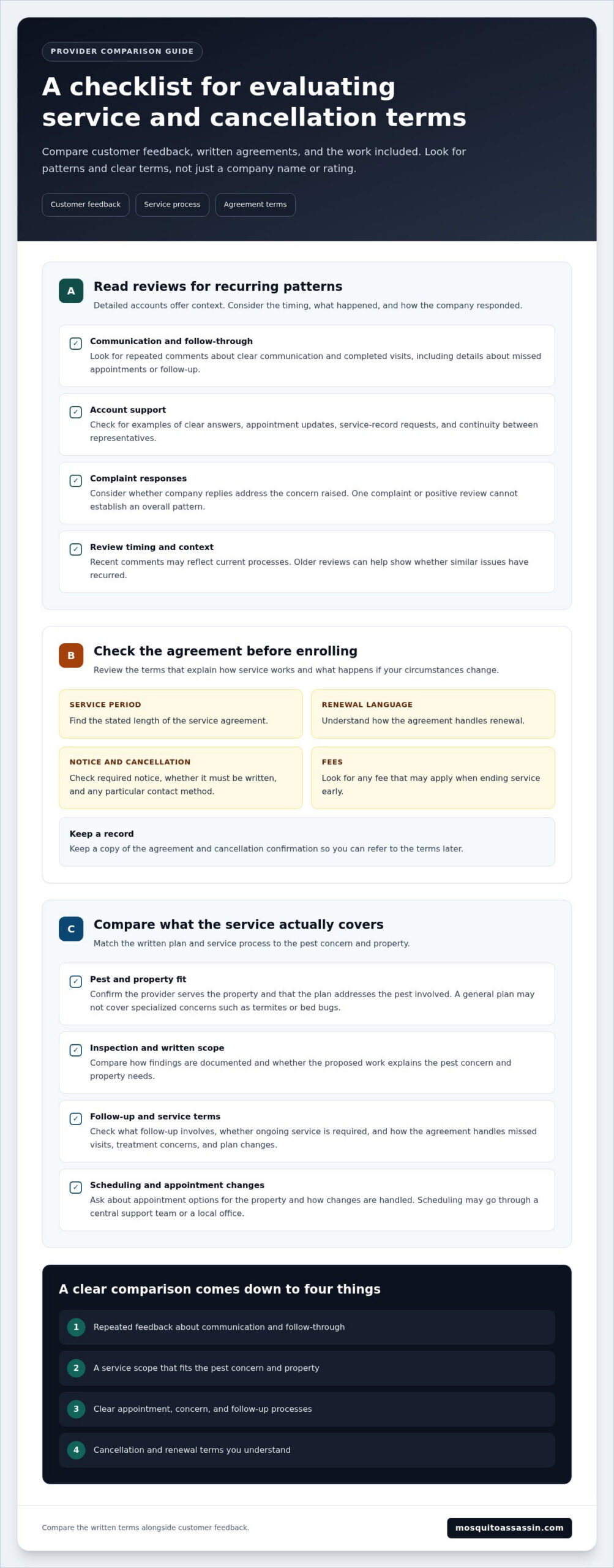
    Customer feedback can show how a pest control company handles scheduling, follow-up, account questions, and service concerns. Look for themes across multiple reviews, then compare them with the written agreement. Specific accounts are most useful, such as a review describing a missed appointment or how staff responded to continued pest activity.

    Customer Reviews and Service Reliability

    Reviews can help you assess whether customers report clear communication and completed visits. Prioritize detailed accounts that explain the context, such as whether a technician arrived as scheduled or clarified what a follow-up visit would cover. Check the dates, too. Recent comments may reflect current processes, while older reviews can show whether similar issues have recurred.

    Account Management and Customer Support

    Account support affects how easily customers manage appointments, request service records, or raise concerns. Look for examples of clear answers, appointment updates, and continuity between representatives. A detailed review might explain whether the company clarified a scheduling change. These practical details help you assess account management without treating one review as representative of every customer.

    Customer Ratings and Complaint Records

    A rating summarizes customer opinions, but written comments provide context. Look for recurring issues and whether company responses address the concern raised. Complaint records offer another perspective, particularly when they point to repeated service or communication problems. Consider the subject, timing, and response together. One complaint or positive review cannot establish the overall pattern.

    Review cancellation terms separately. Check the agreement for its service period, renewal language, required notice, and any fee for ending service early. See whether cancellation requires written notice or a particular contact method. Keep a copy of the agreement and cancellation confirmation so you can refer to the terms later.

    Agreements can differ in how they handle missed visits, treatment concerns, and plan changes. Find the section explaining each process before you enroll. For example, note whether appointment changes go through a central support team or a local office. Clear instructions make it easier to manage service if your circumstances change.

    Use the same review criteria for each company you consider:

    Criteria What to look for
    Service feedback Repeated comments about communication and follow-through
    Account support Examples of clear answers and appointment updates
    Complaint response Whether replies address the stated concern
    Cancellation terms Notice requirements, renewal terms, and applicable fees

    Choose an agreement and service process you understand, including how the company handles concerns and cancellations.

    National and Local Pest Control Service Differences

    National and local pest control providers may differ in service structure, coverage, and inspection practices. Compare the written plan with the pest concern and your property’s needs.

    Across the United States, available services depend on the address, pest, and local service offerings. A company’s broad reach doesn’t mean every location has the same appointments or pest treatments.

    Inspection and Service Guarantees

    An inspection should identify the pest, evidence of activity, and conditions that may support it. Providers may differ in how they document findings and explain proposed work. A service guarantee is defined by its written terms. Check which pests and treatments it covers, what follow-up involves, and whether ongoing service is required. Compare those details, not just the guarantee’s name.

    Response Times and Technician Availability

    Response times and technician availability depend on the address, route schedule, staffing, and pest concern. Neither a national structure nor local ownership guarantees a particular arrival time. Ask about appointment options for your property and how scheduling changes are handled. A rodent concern indoors, for example, may call for a different visit than mosquito activity outdoors.

    Availability can also vary within a provider’s service area. A larger company may coordinate through a local branch, while a smaller provider may schedule directly through its office. The appointment window and follow-up process matter more than the business model. Compare them for your address and pest problem.

    Licensing and Insurance

    Whether a provider and its technicians are licensed and insured depends on the state, service, and business. Don’t assume either status based on company size or local ownership. Review documentation relevant to the work and clarify how insurance applies to the service. This helps you understand who will do the work and what coverage the company has.

    For homeowners, start by confirming that the provider serves the property and treats the pest involved. A general plan may not cover specialized concerns such as termites or bed bugs. Read the service description alongside the inspection findings to see whether the proposed work addresses the problem at home.

    A company’s history provides context, but it doesn’t establish how a particular technician will inspect or treat your property. Focus on the team responsible for the visit, the scope of work, and follow-up terms. If you’ve seen a rodent, for example, ask how the inspection will assess activity locations and possible entry points.

    Compare the inspection process, written service scope, appointment options, and follow-up terms of providers that serve your address.

    Advantages and limitations of local providers

    A local pest control provider may know nearby property types and recurring pest conditions. That knowledge is most useful when the inspection links a specific concern, such as ants entering through a foundation gap, to a practical service plan. Local knowledge alone doesn’t determine the right treatment, so compare the inspection findings, proposed work, and follow-up terms.

    Access to a nearby office can make it easier to discuss a property’s service history with the same team. For example, a technician who has seen recurring activity around a detached garage can use that context on a later visit. A local exterminator may have a narrower service area, which matters if you manage properties in different regions.

    Service breadth matters, too. One company may focus on common household pests, while another may treat rodents, bed bugs, or termites. A provider’s name or local status doesn’t tell you which pests its plan covers. Compare the written scope with the issue, such as signs of mice in an attic or mosquitoes near outdoor living areas.

    Specialized work may require a different inspection and treatment approach. Termite treatment, for example, can involve assessing structural conditions and discussing whether bait stations or another method suits the property. Don’t assume a general pest plan includes termite work. Separate service descriptions clarify what an inspection covers and what needs its own plan.

    Local operations can have practical limits. A smaller team may have fewer appointment routes or serve a narrower area than a national company. That doesn’t mean the service is poorer, but it can affect scheduling and the ability to cover multiple properties. Compare service areas and appointment options for each address instead of judging by company size.

    • Match the pest to the scope: Check whether the proposed plan addresses the identified pest, its location, and relevant access points.
    • Separate specialized services: Confirm that termite work, bed bug treatment, or rodent control appears in the service description when needed.
    • Consider property coverage: For homes in different towns, compare whether one provider’s service area includes every address.
    • Review follow-up terms: Look for the stated process if activity continues after the initial visit.

    These criteria show where local knowledge and communication may help, while also revealing gaps in coverage or service scope. Focused local service may suit a single home with a clearly identified problem. For a portfolio spread across distant areas, consistent geographic coverage may matter more. The better fit depends on the pest, property, and documented plan, not simply the “local” label.

    When choosing between a national provider and a local one, weigh neighborhood familiarity against clear documentation and consistent service. Local knowledge may help with recurring activity, while a broader network can matter when managing homes far apart. Choose the provider whose observations, explanation, and proposed plan fit the pest problem.
    Terminix or a Local Pest Control Provider: Which to Choose

    Local technicians and neighborhood expertise

    A technician familiar with nearby properties may recognize patterns that help guide an inspection. In Erie County, for example, a home’s foundation, attached garage, and surrounding vegetation can inform questions about pest activity. Local knowledge adds context, but the inspection should identify evidence at the property before a control plan is proposed.

    Local expertise is most useful when it improves observation and communication. A technician who regularly works in an area may recognize recurring conditions, such as gaps around utility lines or pests entering near a basement window. Those observations can guide the inspection, but they don’t replace examining the home itself. Nearby properties can differ in construction, maintenance, and pest access.

    Property history matters, too. If a technician has visited before, earlier notes can help track changes in activity and location. Renewed rodent signs near a garage, for example, may draw attention to the same entry area and changes around stored materials. A new technician can build that context by reviewing service records and listening to the homeowner’s observations.

    National providers may use standardized processes across branches, while local companies may know a defined service area better. Neither structure automatically ensures a thorough inspection. Look for a technician who explains observations, distinguishes evidence from assumptions, and connects proposed removal or prevention measures to the identified pest.

    Make a local inspection more useful by sharing specific observations. Note where and when you saw activity and whether it keeps appearing in the same place. A brief record of repeated sightings near a pantry, crawl space, or patio gives the technician a clearer starting point than a general report of pests throughout the house.

    • Identify locations: Point out where you saw pest activity, such as a basement corner or window frame.
    • Describe changes: Mention recent repairs, stored items, or changes in how a room is used.
    • Ask about evidence: Request an explanation of the signs that support the inspection findings.
    • Connect findings to the plan: Check that the control plan addresses the pest and location discussed.

    Local expertise should show in the technician’s reasoning, not just the company’s address. A useful inspection links an observation, such as droppings near a utility opening, to clear next steps. This helps you understand what the service addresses and which property conditions may continue to attract pests.

    For the Terminix-versus-local-pro decision, weigh neighborhood familiarity against documentation and consistent service. A local technician’s knowledge may help with recurring activity, while an established process can organize inspections across multiple homes. The best fit is the provider whose observations, explanation, and proposed plan match the pest problem.

    Five-year cost of ownership

    A five-year comparison should include every scheduled visit, initial treatment, follow-up, and contract term. A low starting quote may cover a narrower treatment plan, while a broader plan may include recurring visits. Compare the same pest and service period across providers, then check what each written estimate includes.

    For general pest control, service frequency affects the total commitment. A monthly plan means more scheduled visits than a quarterly plan over five years. That difference matters only if both plans cover comparable pests and follow-up. Check whether routine visits, additional treatments, and appointment changes are included or billed separately.

    Compare termite protection separately. Bait-station systems and liquid-barrier treatments have different installation and monitoring needs. Check how the plan describes initial work, ongoing monitoring, and retreatment. Compare those details over the full five-year period, rather than treating an initial inspection or installation as the total cost of ownership.

    One-time services also affect long-term planning. Bed bug treatment may need a plan tailored to the affected property, while rodent control may include identifying access points alongside service visits. Mosquito service follows a different schedule. Don’t compare unlike services, such as a single targeted treatment and recurring general pest control.

    Build a consistent comparison by recording these items for Terminix and each local provider:

    • Service scope: List the pests and areas included in the plan.
    • Visit schedule: Note whether visits are monthly, quarterly, or arranged for a specific issue.
    • Initial work: Separate inspection and installation from recurring service.
    • Follow-up: Record how continued activity is addressed under the written terms.
    • Contract details: Include renewal periods, cancellation conditions, and required notice.

    For example, if you’re comparing quarterly general pest service with termite protection, assess each service on its own before considering a combined program. Treatment methods, monitoring needs, and visit schedules differ. Include customer service in the comparison: clear records and timely explanations help you understand what each visit covered and what comes next.

    Use the same five-year worksheet for every estimate. Compare total costs against the service scope, frequency, and follow-up terms, not just a promotional starting offer. If a recurring infestation changes the work required, compare the revised plan with the original scope and timeline.

    For an inspection or professional recommendations about a specific pest concern, contact Mosquito Assassin Pest Control.

    Use local price ranges to check your worksheet, not as a substitute for comparing the service scope.

    Separate recurring service costs from installation and monitoring when reviewing written estimates.

    Mosquito Assassin Pest Control: General Pest Control Plans

    Mosquito Assassin Pest Control LLC offers General Pest Control Plans for property owners seeking ongoing help with common household pests. A plan may suit recurring activity or ongoing prevention needs. For specific concerns, the company also offers Mosquito Control Service, Rodent Control Service, and Bed Bug Treatment.

    For residents of Erie and Crawford Counties in Pennsylvania and Ashtabula County in Ohio, describe the pest activity and affected areas to get started. This helps match the concern to an appropriate service and professional recommendations. Since a general plan may not cover every specialized problem, the pest and property conditions matter.

    Contact Mosquito Assassin Pest Control LLC to discuss an inspection or professional recommendations.

    Make Your Next Pest Control Decision With Confidence

    Use your next conversation with a provider to turn uncertainty into a clear plan. Describe the pest activity, where you’ve seen it, and what you want addressed. Then consider whether the proposed service fits your property and provides clear next steps. That practical approach makes choosing between Terminix and a local pro less about reputation and more about the support you need.

    For professional recommendations about pest concerns in your home, contact Mosquito Assassin Pest Control. A clear description of the problem is a useful place to begin, and informed decisions can help you move forward with greater confidence.

    Disclaimer: This blog provides general information, not professional pest control advice. Conditions vary by property, environment, and location. Reading this content does not create a service agreement. Contact Mosquito Assassin Pest Control LLC for an inspection or professional recommendations.

    Frequently Asked Questions

    What should I check before choosing a pest control company, including cancellation fees and pesticide safety?

    Review the written agreement for cancellation fees, required notice, renewal terms, and the process for ending service. For pesticide safety, ask which product is planned, where it will be applied, and what preparation or re-entry instructions apply to people and pets. Read the product information and follow the technician’s directions. If treatment is planned near a pet’s feeding area, for example, clarify how that area will be handled before service begins.

    What are Terminix’s typical pest control prices and contract terms?

    Review the agreement for its service period, renewal terms, required notice, and any early-cancellation fee.

    How do Terminix and local providers handle termite inspections, treatment, and warranties?

    A termite inspection should assess structural conditions. Treatment may involve bait stations or another approach suited to the property. Compare the written guarantee’s coverage and follow-up terms, including whether continued service is required.

  • Pest Control Service Guarantee: What Homeowners Should Expect in 2026

    Pest Control Service Guarantee: What Homeowners Should Expect in 2026

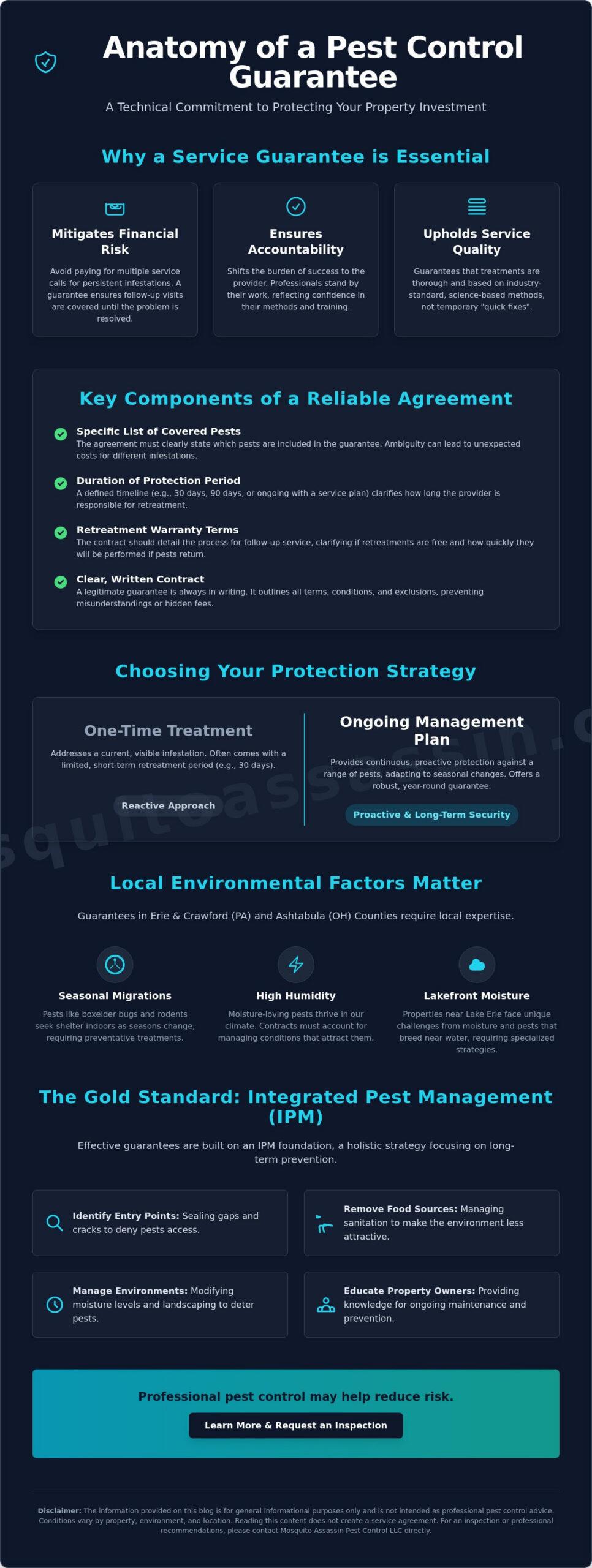
    What if the contract signed after an extermination was actually more powerful than the chemicals used around a property? For many residents in Erie, Crawford, and Ashtabula Counties, the primary concern isn’t just the pests themselves but the risk of wasting money on ineffective treatments that fail to deliver results. A legitimate pest control service guarantee should be viewed as a technical commitment to property protection rather than a vague marketing promise. It provides the necessary assurance that if pests return shortly after a visit, the professional responsibility remains until the infestation is fully addressed.

    Property owners deserve a clear understanding of contract terms to avoid the frustration of hidden fees or recurring infestations. You’ll learn how professional service guarantees protect your property investment and ensure long-term relief from common invaders in 2026. This guide covers what to expect regarding provider accountability, the total elimination of specific pest issues, and how to identify a service agreement that truly prioritizes the security of a household. Professional pest control may help reduce risk when these standards are met.

    Disclaimer: The information provided on this blog is for general informational purposes only and is not intended as professional pest control advice. Conditions vary by property, environment, and location. Reading this content does not create a service agreement. For an inspection or professional recommendations, please contact Mosquito Assassin Pest Control LLC directly.

    Key Takeaways

    • Understand how a professional pest control service guarantee establishes clear accountability and ensures treatments meet industry standards for effectiveness.
    • Learn the differences between retreatment warranties and satisfaction periods to ensure you receive follow-up care if pests persist.
    • Discover why local environmental factors in Erie, Crawford, and Ashtabula Counties require specific contract protections against high humidity and seasonal migrations.
    • Identify the essential components of a reliable service agreement, including the specific list of covered pests and the duration of the protection period.
    • Evaluate why ongoing management plans often provide more robust long-term security compared to one-time reactive treatments.

    Understanding the Value of a Pest Control Service Guarantee

    A pest control service guarantee acts as a formal contract between a property owner and a licensed provider. It signifies that the service isn’t just a one-time transaction but a commitment to a pest-free environment. For residents in Erie and Crawford Counties, where seasonal shifts can trigger sudden infestations, this accountability is vital. It establishes the professional standards that must be met during any intervention, ensuring that the methods used are both thorough and safe for the household. Understanding these standards requires a comprehensive overview of pest control methodologies, which often involve a mix of biological knowledge and precise application techniques.

    To better understand how these assurances work in practice, watch this helpful video:

    One of the most significant benefits of a strong pest control service guarantee is the mitigation of financial risk. Some infestations, like bed bugs or certain rodent species, are notoriously difficult to eradicate in a single visit. Without a clear agreement, homeowners might find themselves paying for multiple service calls without seeing a permanent resolution. A robust guarantee creates a protocol for follow-up visits if pests persist, typically at no additional cost to the client. This shifts the burden of success onto the provider, ensuring they remain accountable for the total elimination of the problem.

    Why Professional Accountability Matters

    Pests don’t follow a schedule. Their behavior is erratic and heavily influenced by moisture levels, local temperature, and structural vulnerabilities. Professional accountability means the provider stands by their work even when nature is unpredictable. It ensures that technicians use science-based methods rather than “quick fixes” that might only mask the problem temporarily. When a provider offers a clear guarantee, it reflects deep confidence in their training and the efficacy of their treatment protocols. It provides peace of mind that the job will be done right, regardless of the complexity of the infestation.

    The Role of Integrated Pest Management (IPM)

    Integrated Pest Management (IPM) is the gold standard in modern pest control. It focuses on long-term prevention by managing the environment to make it less hospitable to invaders. A pest control service guarantee is most effective when it’s part of a broader IPM strategy. This approach includes identifying entry points, removing food sources, and educating the property owner on maintenance. Residents in Ashtabula County, for instance, might need specific advice on managing lakefront moisture to support the success of their plan. Educational resources help residents understand their role in maintaining the conditions necessary for the guarantee to remain in effect.

    Disclaimer: The information provided on this blog is for general informational purposes only and is not intended as professional pest control advice. Conditions vary by property, environment, and location. Reading this content does not create a service agreement. For an inspection or professional recommendations, please contact Mosquito Assassin Pest Control LLC directly.

    Common Types of Pest Control Assurances and Warranties

    Homeowners often face a choice between a quick fix and a long-term strategy. Understanding the nuances of a pest control service guarantee is essential when making this decision. Most professional agreements fall into distinct categories based on the frequency of service and the nature of the pest. For instance, retreatment warranties are the standard for recurring plans. If pests reappear between scheduled visits, the provider returns to address the issue at no extra cost. This differs significantly from satisfaction periods, which typically last between thirty and sixty days and are usually reserved for one-time corrective services.

    When researching how to choose a pest control company, it’s helpful to look for year-round protection plans. These agreements offer continuous coverage for common household invaders. Because pest pressure fluctuates with the seasons in Erie and Crawford Counties, a continuous guarantee ensures that the property remains protected against ants in the spring and rodents in the winter. Specialized warranties are also available for high-stakes pests like termites or bed bugs, where the biological complexity requires a more rigorous follow-up schedule to ensure total removal.

    Retreatment vs. Refund Policies

    A retreatment policy is the industry standard because it focuses on the biological reality of pest management. Pests are living organisms that adapt to their environment; therefore, the goal is persistent intervention until the problem is solved. Refund policies are much rarer and generally only apply to the initial service fee if the provider fails to meet specific contractual obligations. Understanding this distinction helps property owners set realistic expectations. The primary objective is a pest-free home, not just a financial transaction. Professional accountability ensures that the focus remains on the definitive resolution of the infestation.

    Covered Pests and Service Limitations

    Every agreement should include a clearly defined list of covered species. A plan that covers spiders and crickets may not include wood-destroying organisms like termites. It’s also important to recognize that guarantees often have limitations based on property maintenance. For example, a provider might not be able to guarantee results if there are significant structural deficiencies or chronic sanitation issues that provide constant harborage for pests. Reviewing professional pest control plans can help clarify which species are included in a standard agreement. Professional pest control may help reduce risk when these limitations are understood and addressed.

    Disclaimer: The information provided on this blog is for general informational purposes only and is not intended as professional pest control advice. Conditions vary by property, environment, and location. Reading this content does not create a service agreement. For an inspection or professional recommendations, please contact Mosquito Assassin Pest Control LLC directly.

    Pest Control Service Guarantee: What Homeowners Should Expect in 2026

    Evaluating Service Guarantees in Northwest Pennsylvania and Northeast Ohio

    A generic, national guarantee often fails to account for the specific environmental stressors found in the Great Lakes region. In Northwest Pennsylvania and Northeast Ohio, the proximity to Lake Erie creates a microclimate that directly impacts pest behavior and treatment efficacy. A pest control service guarantee is only as strong as the provider’s understanding of these local variables. When high humidity levels persist near the shoreline, certain chemical barriers may degrade faster than they would in a drier, inland environment. Localized expertise allows a provider to adjust their protocols, ensuring that the protection promised in the contract actually holds up against the elements.

    Regional knowledge also extends to the biological traits of local pest populations. In Erie and Ashtabula Counties, certain mosquito and tick populations have shown specific resistance patterns to standard treatments. A provider with deep roots in the community understands these trends and utilizes targeted, science-based interventions that a distant contractor might overlook. This specialized knowledge leads to more accurate and honest guarantee terms. It ensures that the expectations set at the beginning of a service agreement are grounded in the reality of the local ecosystem rather than a corporate template designed for a different climate.

    Seasonal Challenges in Erie and Ashtabula

    The harsh winters characteristic of Northeast Ohio and Western Pennsylvania create a predictable but intense pressure on residential structures. As temperatures drop in Ashtabula, rodents aggressively seek warmth and food, often driving them into crawlspaces and attics. A reliable guarantee for rodent control must include specific provisions for exclusion and monitoring during these peak months. Conversely, the summer months in Erie and Crawford Counties bring significant surges in tick and mosquito activity. The agricultural landscape and rolling terrain of Crawford County create unique corridors for seasonal pest migration from fields to residential structures. Effective intervention during these periods requires a localized strategy that accounts for both the timing of the surge and the specific geography of the property.

    The Importance of Local Expertise

    Technicians who live and work in the same neighborhoods as their clients possess a distinct advantage when identifying vulnerabilities. They are familiar with the common architectural styles of older homes in Erie and the specific structural risks they present for pest entry. This familiarity ensures that the initial treatment is more thorough, reducing the need for the follow-up visits often promised in a pest control service guarantee. Furthermore, local companies are typically more accessible when a retreatment is required. Because they don’t have to dispatch technicians from a distant metropolitan hub, they can honor their service agreements with greater speed and efficiency. Community-based providers rely heavily on their local reputation, which serves as an additional layer of accountability for the homeowner. Professional pest control may help reduce risk when the provider is a trusted neighbor who understands the area’s unique challenges.

    Disclaimer: The information provided on this blog is for general informational purposes only and is not intended as professional pest control advice. Conditions vary by property, environment, and location. Reading this content does not create a service agreement. For an inspection or professional recommendations, please contact Mosquito Assassin Pest Control LLC directly.

    What to Look for in a Professional Service Agreement

    A professional service agreement provides the framework for a reliable pest control service guarantee. It transforms a verbal promise into a technical commitment. Reviewing the contract carefully ensures that the property owner understands the scope of work. Look for a clearly defined list of covered pests. This should include common regional invaders like ants, spiders, and rodents. If a specific species isn’t listed, it’s likely not covered under the standard protection terms. The agreement must also specify the exact duration of the protection period. Whether it’s a thirty-day window for a one-time treatment or a year-round plan, the timeframe should be unambiguous.

    Homeowners should look for a detailed description of how to trigger a follow-up visit. If activity is spotted, the protocol for reporting it should be simple and direct. A professional agreement often includes exclusions based on property maintenance. For instance, if a homeowner fails to seal structural gaps or clear debris as recommended, the provider may not be able to honor the guarantee. These requirements ensure that both parties are working toward a common goal of long-term prevention. Professional pest control may help reduce risk when these contractual expectations are met by both the technician and the client.

    Reading the Fine Print Without the Stress

    Focus on the straightforward language regarding the frequency of scheduled visits. A quarterly plan should detail exactly what happens during each seasonal inspection. Identify any specific requirements for property owners. Sealing entry points or managing moisture levels is often necessary to maintain the efficacy of the treatment. Ensure the agreement includes a clear contact method for reporting new activity. Having a direct line to a local technician in Ashtabula or Crawford County ensures a faster response time when issues arise. You can view professional pest control plans for more details on regional standards.

    Commercial Service Considerations

    Businesses in Erie County face different challenges than residential properties. Commercial agreements often require more frequent inspections to maintain guarantees, especially in the food service or hospitality industries. These contracts focus heavily on health code compliance and detailed documentation of every visit. Maintaining a pest-free environment is critical for business reputation and regulatory standing. Learn more about professional commercial services to understand how these specialized agreements support local business operations. Consistent monitoring and professional intervention are the keys to maintaining a healthy commercial environment.

    Disclaimer: The information provided on this blog is for general informational purposes only and is not intended as professional pest control advice. Conditions vary by property, environment, and location. Reading this content does not create a service agreement. For an inspection or professional recommendations, please contact Mosquito Assassin Pest Control LLC directly.

    Long-Term Protection Strategies for Residential and Commercial Properties

    Ongoing management is often more effective than reactive one-time treatments. While a single visit might address an immediate surge in activity, it does not account for the biological cycles of pests that inhabit Northwest Pennsylvania and Northeast Ohio. A year-round protection plan provides a proactive barrier against seasonal migrations. This ensures that a property is fortified before the next wave of activity begins, whether it is the spring emergence of ants or the autumn push of rodents seeking warmth. A pest control service guarantee is most robust when it is part of a continuous, disciplined program rather than a series of disconnected interventions.

    Regular inspections are the cornerstone of a successful long-term strategy. These visits allow for the early detection of wood-destroying insects or rodents, which can cause significant structural damage if left unchecked for months. By identifying these issues in their infancy, property owners can avoid the high costs and stress associated with major infestations. Professional pest control may help reduce risk when implemented as a consistent program. This methodical approach allows technicians to monitor changes in the environment, such as new structural gaps or increased moisture levels, that could invite future problems.

    The Benefits of Recurring Protection

    Consistent monitoring ensures that small issues don’t escalate into crises. When a technician visits a property regularly in Erie or Crawford County, they become familiar with its specific vulnerabilities. This historical knowledge makes the pest control service guarantee more effective because the provider can anticipate problems based on past activity. Recurring plans often provide the most comprehensive guarantee terms for homeowners. They cover a wider range of pests and include scheduled preventative maintenance that one-time services lack. Explore this general pest control guide for more details on how these programs function.

    Taking the Next Step Toward a Pest-Free Property

    Professional recommendations are essential for identifying the specific vulnerabilities of a property. No two structures are identical; factors like landscaping, age, and proximity to Lake Erie all influence pest pressure. Property owners in Ashtabula and surrounding areas should seek a thorough inspection to determine which protection plan best suits their needs. A professional assessment provides the data necessary to build a definitive defense strategy. For more information on available programs, visit www.mosquitoassassin.com/services. Taking a proactive approach today ensures the long-term security and wellbeing of everyone on the property.

    Disclaimer: The information provided on this blog is for general informational purposes only and is not intended as professional pest control advice. Conditions vary by property, environment, and location. Reading this content does not create a service agreement. For an inspection or professional recommendations, please contact Mosquito Assassin Pest Control LLC directly.

    Securing Your Property with Professional Assurance

    A reliable pest control service guarantee is more than a simple promise; it’s a technical framework that ensures long-term property protection. By choosing licensed and insured professionals who understand the unique environmental pressures of Erie, Crawford, and Ashtabula Counties, homeowners can secure their property investment against recurring infestations. These agreements prioritize accountability and rely on detailed multi-step rodent and insect exclusion processes to achieve definitive results. Locally owned and operated expertise ensures that follow-up care is accessible and grounded in the specific needs of the region.

    Transitioning from reactive treatments to proactive, year-round management provides the most consistent security for residential and commercial structures. For an inspection or professional recommendations, please contact Mosquito Assassin Pest Control LLC directly. Professional pest control may help reduce risk and ensure your home remains a safe, comfortable environment for years to come.

    Disclaimer: The information provided on this blog is for general informational purposes only and is not intended as professional pest control advice. Conditions vary by property, environment, and location. Reading this content does not create a service agreement. For an inspection or professional recommendations, please contact Mosquito Assassin Pest Control LLC directly.

    Frequently Asked Questions

    What does a typical pest control guarantee cover?

    A typical guarantee covers the specific species listed in your contract, such as ants, spiders, or common roaches. It ensures that the provider will return to retreat the property if these specific invaders reappear within the designated timeframe. It’s important to note that a general plan may not cover specialized pests like termites or bed bugs unless they are explicitly named in the agreement.

    How long does a pest control warranty usually last?

    The duration of a warranty depends on the type of service performed. For one-time corrective treatments, coverage typically ranges from 30 to 60 days. In contrast, recurring plans provide continuous protection. As long as you maintain a quarterly or monthly service schedule, the pest control service guarantee remains in effect to address any issues that arise between visits.

    What happens if I see pests after my house has been treated?

    You should contact your provider immediately if pests are spotted after the initial window of treatment. Most agreements outline a specific protocol for follow-up inspections and retreatments. It’s common to see a temporary increase in activity for a few days as pests are flushed out of hiding. If the problem persists beyond two weeks, the guarantee ensures a professional returns to resolve the issue.

    Are bed bug treatments usually guaranteed?

    Bed bug treatments are frequently guaranteed, but they often require strict adherence to preparation protocols. Because these pests are highly resilient, a guarantee may be contingent on the property owner following all pre-treatment instructions and participating in scheduled follow-up inspections. These terms ensure that the biological cycle of the infestation is fully broken through a coordinated effort between the technician and the resident.

    Can a guarantee be voided if I do not follow prevention tips?

    A guarantee can be voided if recommended structural or sanitation changes are ignored. Professional pest control is a collaborative process. If a technician identifies a leaking pipe or an unsealed crawlspace that invites infestations, the property owner must address these vulnerabilities. Failure to maintain the property according to these professional standards can make it impossible for even the best treatments to remain effective.

    Is there a difference between a warranty and a service agreement?

    A service agreement is the full contract detailing the scope of work and schedule. A warranty is the specific assurance within that contract regarding results. While the service agreement tells you what the technician will do during a visit, the warranty defines what happens if those actions don’t fully eliminate the target pests. Both components are essential for a transparent professional relationship.

    How soon can I request a follow-up visit under a guarantee?

    Most professionals recommend waiting 10 to 14 days before requesting a follow-up visit. This period allows the materials used to reach their full efficacy and disrupt the pest’s reproductive cycle. If you continue to see live activity after this window, the pest control service guarantee allows you to trigger a retreatment. Contacting the office early helps ensure a technician is dispatched as soon as the waiting period ends.

    Do commercial pest services have different guarantee terms than residential ones?

    Commercial guarantees are typically more complex and focus on regulatory compliance. Businesses in Erie County, especially in the food service sector, often have zero-tolerance policies for pest activity. These agreements may include more frequent inspections and detailed documentation to satisfy health department requirements. The terms are tailored to the high-stakes nature of commercial environments where a single sighting can impact professional reputation.

    Disclaimer: The information provided on this blog is for general informational purposes only and is not intended as professional pest control advice. Conditions vary by property, environment, and location. Reading this content does not create a service agreement. For an inspection or professional recommendations, please contact Mosquito Assassin Pest Control LLC directly.