
What if a single health department inspection could jeopardize years of hard work simply because of a missing signature on a service log? For property owners in Erie and Crawford counties in Pennsylvania and Ashtabula County in Ohio, the threat of pest-related reputation damage is a genuine concern that causes significant anxiety. It’s understandable to feel overwhelmed by complex service terms or the fear of a surprise audit, especially when civil penalties for regulatory violations can reach $10,000. Securing a comprehensive pest control contract for business is not just about addressing an immediate infestation; it’s a vital strategy for business continuity and professional protection.
This guide clarifies the critical elements of a commercial agreement so business owners can move forward with confidence. Readers will learn how to define a clear scope of service, establish a predictable maintenance schedule, and maintain the precise documentation required for state audits. This overview provides a practical roadmap for protecting a professional reputation and ensuring a facility remains compliant and secure. Professional pest control may help reduce risk and maintain a clean, professional environment for employees and customers alike.
Disclaimer: The information provided on this blog is for general informational purposes only and is not intended as professional pest control advice. Conditions vary by property, environment, and location. Reading this content does not create a service agreement. For an inspection or professional recommendations, please contact Mosquito Assassin Pest Control LLC directly.
Key Takeaways
- Understand why a formal pest control contract for business is a necessary continuity tool that differs from standard residential services by addressing high-stakes commercial risks.
- Identify the essential elements of a service agreement, including a clearly defined scope of work and a treatment frequency tailored to specific industry requirements.
- Learn why recurring protection plans are more effective than one-time visits by addressing the biological lifecycles of pests and preventing future infestations.
- Navigate local regulatory requirements in Pennsylvania and Ohio to ensure service providers meet state licensure standards and maintain proper documentation for audits.
- Discover how to integrate pest management into daily operations through effective communication protocols and proactive facility maintenance.
Understanding the Role of Pest Control Contracts for Businesses
A professional pest control contract for business is a formal, legally binding agreement that outlines a strategic approach to managing infestations within a commercial facility. Unlike residential services, which often focus on individual comfort or seasonal issues, a commercial agreement addresses high-stakes protection for entire operations. It defines the specific scope of work, the frequency of service visits, and the precise pests targeted to keep the property safe. Relying on verbal agreements is a significant risk for any modern enterprise. Without a written document, there is no verifiable proof of service for insurance claims or mandatory regulatory inspections.
Modern facility management frequently utilizes the principles of Integrated Pest Management (IPM) to maintain a sanitary and secure environment. This methodical approach prioritizes long-term prevention over reactive chemical applications. A written contract serves as the foundation for this strategy, providing a clear roadmap for both the provider and the client. This documentation is essential for passing third-party audits and maintaining a positive brand reputation in a competitive marketplace. Clear records show that a business is proactive rather than reactive.
To better understand the value and structure of these agreements, watch this helpful video:
Risk Mitigation and Liability Protection
Protecting physical assets and inventory is a primary function of a commercial agreement. Rodents can destroy expensive wiring or structural components, while insects can contaminate entire batches of product, leading to massive financial losses. Beyond property damage, businesses must mitigate the risk of employee or customer exposure to pest-borne pathogens. A formal pest control contract for business establishes a definitive paper trail. This documentation is critical when dealing with local regulatory bodies in Erie and Crawford counties in Pennsylvania or Ashtabula County in Ohio. If a health department inspector requests proof of preventative measures, a documented service history provides immediate verification of compliance. This reduces the likelihood of facing civil penalties, which can reach up to $10,000 for certain violations.
Long-Term Cost Predictability
Emergency pest treatments are notoriously expensive and often disrupt daily operations. A fixed-fee contract allows business owners to avoid these high costs by investing in scheduled maintenance. This approach makes annual facility budgeting much simpler. It’s easier to account for a predictable monthly fee than a sudden, large expense for a massive infestation. The financial impact of a pest-related business closure or a public health violation can be devastating. By maintaining a consistent service schedule, businesses protect their bottom line from the unpredictable costs of neglect. Professional commercial pest control may help reduce risk and ensure that small issues don’t escalate into catastrophic financial burdens. Maintaining structural integrity and sanitation is a shared responsibility that begins with a solid agreement.
Key Components of a Comprehensive Commercial Service Agreement
A professional pest control contract for business serves as a definitive blueprint for long-term facility protection. It must be highly specific to be effective. Generalities often lead to gaps in coverage that pests will eventually exploit. A robust agreement clarifies exactly what is being protected, which pests are included, and how often a technician will be on-site. This level of detail ensures that both the business owner and the service provider have a shared understanding of expectations and responsibilities. It’s a foundational document that supports business continuity and operational safety.
Defining the Scope of Service
Identifying target pests is the first step in building an effective agreement. Standard contracts typically cover common invaders such as ants and rodents. High-impact pests, including bed bugs or termites, often require specialized addendums because their management involves more intensive methodologies. The contract should also specify the physical boundaries of the property. This includes defining interior treatment zones and exterior perimeters. A key distinction in modern commercial agreements is the shift from purely reactive treatments to proactive exclusion. This involves identifying and sealing potential entry points to prevent infestations before they begin. Professional commercial pest control agreements should clearly outline these preventative measures.
Service frequency is determined by the specific risks of the industry. A food service establishment might require monthly visits to maintain sanitation standards, while a low-traffic warehouse might find a quarterly schedule sufficient. The agreement must also include provisions for emergency call-backs. If a pest sighting occurs between scheduled maintenance visits, the protocol for a swift response must be clearly defined to ensure the problem is resolved without delay.
Documentation and Reporting Standards
Accurate record-keeping is the backbone of regulatory compliance and successful facility management. Every service visit must generate a detailed report or service ticket. Following EPA’s IPM Principles, these reports should go beyond simply listing chemical applications. They should highlight structural deficiencies, such as gaps under loading dock doors or moisture issues, that could lead to future infestations. Addressing these root causes is essential for maintaining a pest-free environment.
Inspectors in Erie and Crawford counties in Pennsylvania, as well as Ashtabula County in Ohio, look for consistency and detail in these service logs. Digital reporting systems allow facility managers to access this history instantly during an unannounced audit. This transparency builds trust with local authorities and provides a clear paper trail for third-party auditors. Reviewing the specifics of a pest control contract for business can help clarify these documentation requirements and ensure the facility remains in good standing. Establishing clear communication between the provider and staff is the final piece of a successful management plan.
Disclaimer: The information provided on this blog is for general informational purposes only and is not intended as professional pest control advice. Conditions vary by property, environment, and location. Reading this content does not create a service agreement. For an inspection or professional recommendations, please contact Mosquito Assassin Pest Control LLC directly.
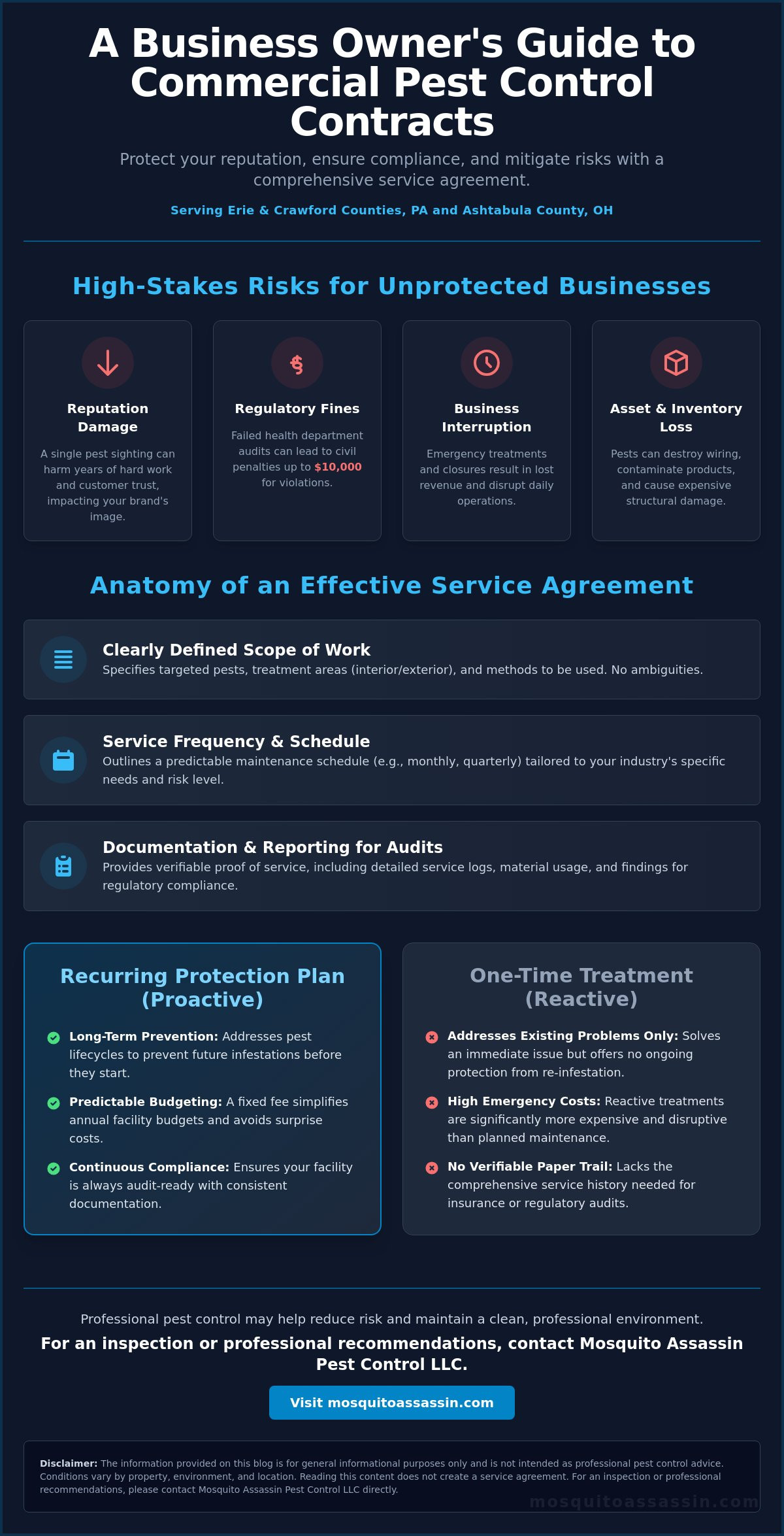
Comparing One-Time Treatments and Recurring Protection Plans
Business owners often face a choice between requesting a one-time service to resolve an immediate problem or investing in a long-term strategy. While a single visit might seem cost-effective, it often fails to address the root cause of an infestation. Pests are biological entities with complex lifecycles. A single application may eliminate adult insects, but it rarely accounts for eggs that hatch days or weeks later. Without a follow-up visit, the population quickly rebounds, leading to a cycle of recurring issues. A formal pest control contract for business shifts the focus from reactive “firefighting” to proactive prevention through the principles of Integrated Pest Management (IPM).
The annual cost of reactive services often exceeds the price of a maintenance plan. Emergency visits are frequently more intensive and can lead to higher chemical usage because the population has already reached a critical level. Proactive services, on the other hand, allow for consistent monitoring and smaller, targeted interventions. This approach makes annual facility budgeting more predictable and prevents the sudden, large expenses associated with massive infestations or health department fines. When researching providers, resources like Choosing a Qualified Pest Management Company from Penn State Extension can help business owners understand the professional standards required for effective long-term care.
The Limitations of Reactive Treatments
Relying on emergency-only service creates significant risks for a company’s reputation. If a customer or health inspector spots a pest, the damage to the brand is already done. Reactive treatments usually happen after a problem is visible, meaning structural gaps or sanitation issues have already been ignored for too long. These gaps provide a constant invitation for new pests to enter. Furthermore, emergency treatments can disrupt daily operations, potentially requiring temporary closures or staff displacement. A comprehensive pest control contract for business ensures that these vulnerabilities are identified and sealed before they become public liabilities.
Advantages of Year-Round Protection
Continuous protection is essential for managing seasonal threats in Erie and Crawford counties in Pennsylvania and Ashtabula County in Ohio. Pests don’t disappear in the winter; they simply change their behavior, often seeking warmth inside commercial structures. Year-round plans maintain a constant barrier against invaders like rodents in the colder months and mosquitoes or ticks during the summer. Continuous monitoring allows technicians to catch rodent activity early, often before the animals can damage inventory or wiring. Understanding the core General Pest Control principles for businesses helps managers create a safer environment for both employees and clients. Professional pest control may help reduce risk by providing a steady, documented defense against local pest pressures.
Disclaimer: The information provided on this blog is for general informational purposes only and is not intended as professional pest control advice. Conditions vary by property, environment, and location. Reading this content does not create a service agreement. For an inspection or professional recommendations, please contact Mosquito Assassin Pest Control LLC directly.
Evaluating Professional Standards and Local Compliance in PA and OH
Selecting a provider for a pest control contract for business is a decision that impacts legal standing and operational safety. In the Great Lakes region, regulatory requirements are specific and non-negotiable. A provider must demonstrate a deep understanding of both Pennsylvania and Ohio state laws to ensure the facility remains compliant during surprise inspections. Working with a local entity ensures that the technicians are not just distant contractors; they are neighbors who understand the specific environmental challenges of the area. This local integration is essential for maintaining a high standard of service that aligns with community values and regional expectations.
Professional standards are defined by rigorous adherence to safety protocols and chemical management. A dependable provider prioritizes the well-being of staff and customers by following established guidelines for every application. Utilizing commercial pest control services that emphasize documented compliance helps businesses avoid the severe consequences of unlicensed activity. In Pennsylvania and Ohio, the stakes are high. It’s a matter of protecting the brand from legal and financial ruin while ensuring a pest-free environment.
Licensing and Regulatory Requirements
State-specific licensure is the first thing a business owner should verify. In Pennsylvania, a pesticide business must maintain comprehensive general liability insurance of at least $100,000 for bodily injury and $100,000 for property damage per occurrence. Ohio regulations are equally strict, requiring a $35 fee for business and applicator licenses. Failure to follow these mandates is costly. Unlicensed commercial pesticide application can result in civil penalties of up to $10,000 per violation. A formal pest control contract for business should clearly state that the provider meets all state requirements and will provide the necessary documentation for health department reporting. This paper trail is the best defense during a regulatory audit.
Regional Expertise and Seasonal Pests
Local climate factors, particularly the lake effect weather patterns near Lake Erie, significantly influence pest behavior. The high humidity and rapid temperature shifts in Meadville or Ashtabula create unique breeding conditions for specific threats. Seasonal pests like Carpenter Bees and ticks require a provider who knows exactly when and where they emerge. A company with local roots understands how a wet spring in Crawford County might lead to increased rodent pressure in the fall. This geographic specialization allows for more precise interventions compared to a generic, national approach. Professional pest control may help reduce risk by anticipating these regional shifts before they impact the facility. For a detailed assessment of your property’s specific needs, contact a local professional for an inspection.
Disclaimer: The information provided on this blog is for general informational purposes only and is not intended as professional pest control advice. Conditions vary by property, environment, and location. Reading this content does not create a service agreement. For an inspection or professional recommendations, please contact Mosquito Assassin Pest Control LLC directly.
Integrating Pest Management into Business Operations
A successful pest control contract for business is a collaborative partnership rather than a standalone service. While a professional technician provides the expertise and intervention, the daily operations of a facility play a decisive role in the long-term effectiveness of the program. Establishing clear communication protocols is the first step. Designating a specific staff member as the primary point of contact ensures that pest sightings are reported immediately and that service recommendations are addressed without delay. This proactive exchange of information prevents minor issues from escalating into major operational disruptions.
Preparing a facility for the initial service is critical for a thorough assessment. Business owners should ensure that technicians have unobstructed access to utility rooms, loading docks, and storage areas. Providing a history of previous pest activity and identifying known structural vulnerabilities helps the provider tailor the approach to the specific needs of the building. This initial groundwork sets the stage for a methodical and disciplined operational strategy that protects the business reputation and ensures safety for everyone on-site.
Staff Education and Sanitation
Employees are often the first to notice early signs of pest activity. Training staff to identify and report evidence, such as droppings or structural gnawing, creates an internal monitoring network that supports professional efforts. Proper waste management is equally vital. Ensuring that outdoor bins are sealed and that indoor trash is removed daily eliminates primary attractants. Food storage areas must be kept clean, with inventory stored in airtight containers and kept off the floor whenever possible. Professional pest control may help reduce risk when combined with rigorous sanitation practices and consistent facility maintenance. These shared responsibilities form the backbone of a resilient defense against local infestations in Erie, Crawford, and Ashtabula counties.
Long-Term Partnership and Evaluation
The needs of a business can change rapidly. An annual review of pest activity logs and treatment efficacy is necessary to ensure the pest control contract for business remains aligned with current operations. If a facility expands, changes its inventory types, or experiences a shift in local environmental pressures, the contract should be updated to reflect these new realities. A dependable provider acts as a consultant, helping managers understand how structural changes might impact pest behavior. Maintaining this long-term perspective ensures that the facility remains compliant and secure year after year. For those seeking a reliable maintenance schedule, professional pest control may help reduce risk for your facility.
Disclaimer: The information provided on this blog is for general informational purposes only and is not intended as professional pest control advice. Conditions vary by property, environment, and location. Reading this content does not create a service agreement. For an inspection or professional recommendations, please contact Mosquito Assassin Pest Control LLC directly.
Securing Your Professional Future with Strategic Pest Management
Establishing a formal pest control contract for business is a decisive step toward long-term operational security. It moves a facility from a state of constant anxiety over potential health department violations to a state of documented compliance and predictable maintenance. By prioritizing specialized commercial protection plans over reactive treatments, property owners in Erie, Crawford, and Ashtabula counties ensure their reputation remains intact regardless of seasonal pest pressures. Licensed and insured professionals bring the methodical approach necessary to identify structural vulnerabilities before they lead to costly infestations. Integrating these strategies into daily operations creates a resilient environment where employees and customers feel secure.
Taking action now prevents small issues from becoming public liabilities. For those looking to establish a reliable defense, professional pest control may help reduce risk for your business. Maintaining a safe and sanitary environment is a shared goal that pays dividends in customer trust and business longevity. Strategic prevention is always more effective than emergency intervention.
Disclaimer: The information provided on this blog is for general informational purposes only and is not intended as professional pest control advice. Conditions vary by property, environment, and location. Reading this content does not create a service agreement. For an inspection or professional recommendations, please contact Mosquito Assassin Pest Control LLC directly.
Frequently Asked Questions
What is the typical duration of a commercial pest control contract?
Commercial agreements typically last for one year to provide consistent protection through all four seasons. This duration allows technicians to address the changing biological pressures of pests as the weather shifts in the Great Lakes region. Most contracts include an auto-renewal clause. However, business owners should review the terms annually to ensure the service still meets their facility’s evolving needs and operational changes.
Can a business cancel a pest control agreement if service is unsatisfactory?
Most agreements include a cancellation clause that allows termination if service standards are not met. Typically, this requires a formal written notice period, often ranging from 30 to 60 days. It’s essential to review these terms before signing a pest control contract for business to understand the specific requirements for ending the partnership and any potential associated notice fees.
Are between-service visits usually included in a professional contract?
Comprehensive commercial plans often include emergency call-backs or between-service visits at no additional cost. These visits address sudden pest sightings that occur between scheduled maintenance appointments. Including these provisions ensures that a facility remains protected and that any immediate threats to sanitation are resolved quickly by a professional technician before they can impact customer perceptions or health audits.
Does a standard contract cover all types of pests (like termites or bed bugs)?
Standard contracts usually focus on common pests like ants, spiders, and rodents that frequent commercial properties. Specialized pests, such as termites or bed bugs, typically require separate inspections and service addendums due to the intensive nature of their treatment. Business owners should verify exactly which pests are covered in their initial scope of work to avoid gaps in their facility’s protection.
How often should a professional pest control contract be reviewed or updated?
A professional agreement should be reviewed at least once every twelve months to ensure it remains effective. It’s also wise to update the contract whenever significant changes occur, such as building expansions, changes in inventory types, or modifications to food handling areas. Regular reviews ensure the service scope remains adequate for the current operational risks and structural condition of the facility.
What kind of documentation should a business expect after each service visit?
Facility managers should receive a detailed service report after every visit from their provider. This documentation typically includes the date of service, specific areas inspected, pests identified, and any structural recommendations for prevention. These records are vital for maintaining compliance with health department standards in Erie and Crawford counties or Ashtabula County and serve as proof of proactive management.
Is professional pest control safe for businesses with food handling requirements?
Professional treatments are safe for food handling environments when following Integrated Pest Management (IPM) principles. Technicians prioritize non-chemical methods, such as exclusion and sanitation, to manage pests. Any necessary applications are performed according to strict EPA guidelines to ensure the safety of employees and customers while maintaining a sanitary workspace that meets all local health department requirements.
How do local PA and OH regulations affect commercial pest control agreements?
State regulations in Pennsylvania and Ohio mandate specific licensing and insurance requirements for all commercial providers. Pennsylvania requires businesses to carry liability insurance for bodily injury and property damage per occurrence. Adhering to these local mandates in a pest control contract for business is critical, as unlicensed pesticide application can lead to civil penalties reaching up to $10,000 per violation in these jurisdictions.
Disclaimer: The information provided on this blog is for general informational purposes only and is not intended as professional pest control advice. Conditions vary by property, environment, and location. Reading this content does not create a service agreement. For an inspection or professional recommendations, please contact Mosquito Assassin Pest Control LLC directly.