Tag: Property Protection

  • Termite Treatment Cost Erie PA: Understanding the Factors in 2026

    Termite Treatment Cost Erie PA: Understanding the Factors in 2026

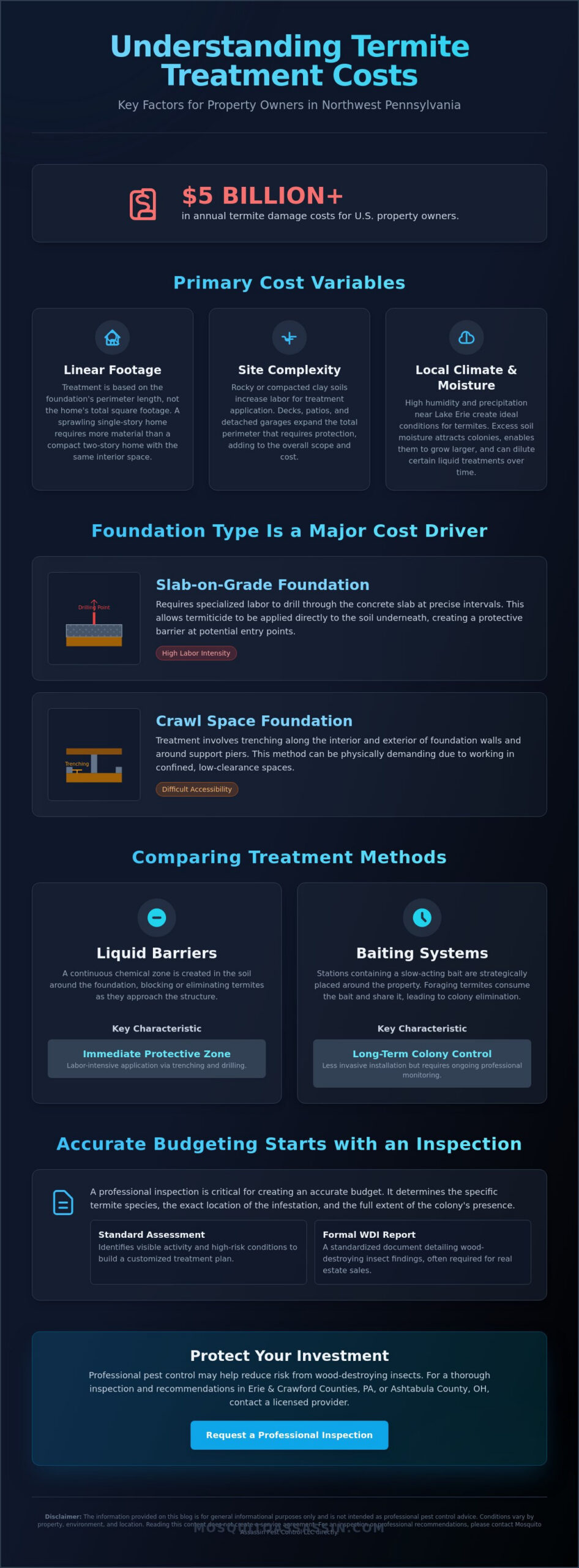
    Did you know that termite damage costs property owners across the United States more than $5 billion every single year? In Northwest Pennsylvania, the combination of high humidity near Lake Erie and the region’s moderate to heavy infestation probability makes wood-destroying insects a constant concern. It’s understandable to feel anxious about hidden structural damage or confused by the various remediation methods available on the market.

    You deserve a clear path to protecting your investment without the stress of the unknown. This guide breaks down the specific structural and environmental variables that determine the termite treatment cost Erie PA residents encounter in 2026. By understanding these factors, you can move forward with confidence in your property’s long-term security.

    The following sections explore how different foundation types impact labor requirements and why local moisture levels dictate specific professional strategies. From the challenges of slab foundations to the complexities of crawl spaces in Erie and Crawford Counties, you’ll gain the knowledge needed to evaluate a professional remediation plan effectively.

    Disclaimer: The information provided on this blog is for general informational purposes only and is not intended as professional pest control advice. Conditions vary by property, environment, and location. Reading this content does not create a service agreement. For an inspection or professional recommendations, please contact Mosquito Assassin Pest Control LLC directly.

    Key Takeaways

    • Identify how your home’s total linear footage and the specific species of wood-destroying insects dictate the overall scope of remediation.
    • Discover why certain foundation types, such as slab-on-grade or crawl spaces, require specialized labor like precision drilling or internal trenching.
    • Gain clarity on the termite treatment cost Erie PA property owners face by comparing the intensive labor of liquid barriers against the long-term monitoring of baiting systems.
    • Learn the difference between a standard assessment and a formal WDI report to ensure your budget is based on the exact location and extent of the colony.
    • Understand how integrating termite monitoring into a year-round protection plan can prevent the catastrophic financial impact of untreated structural damage.

    Primary Variables That Determine Termite Treatment Cost in Erie PA

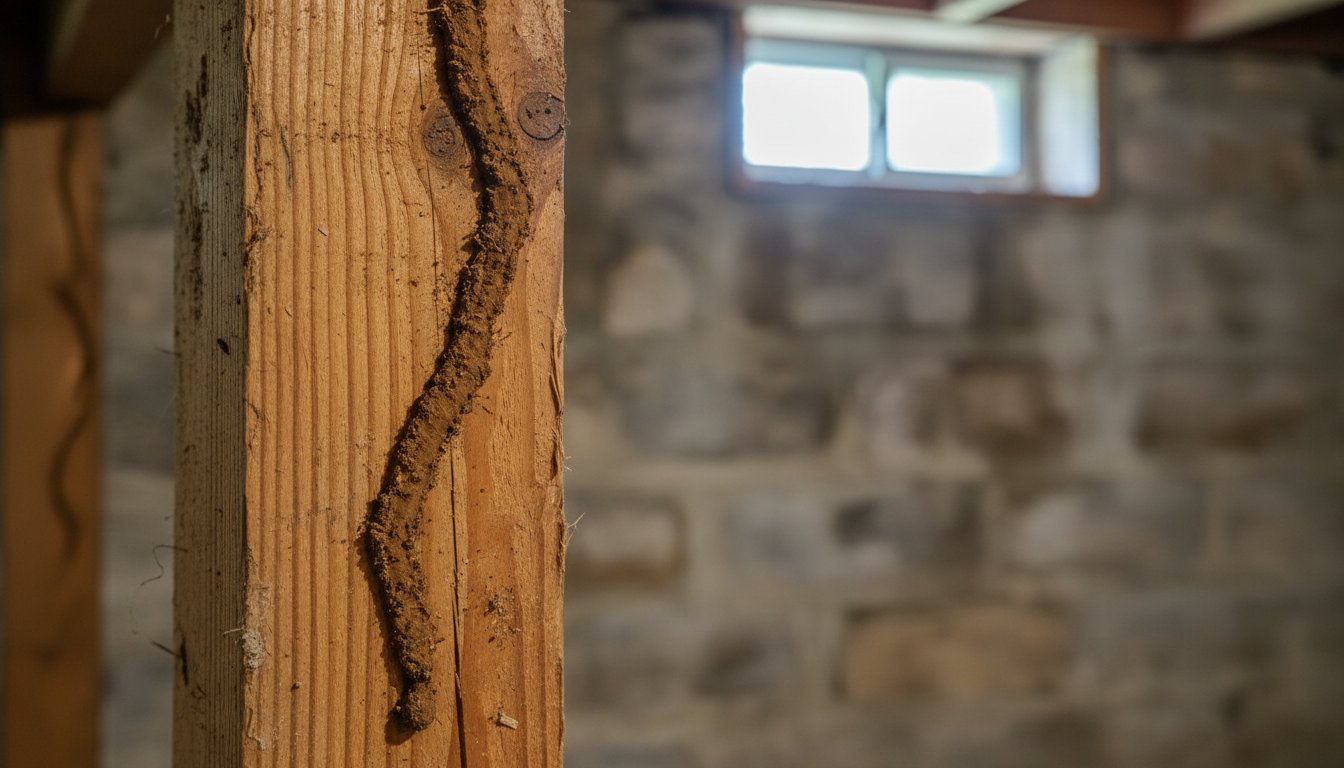
    Understanding the termite treatment cost Erie PA property owners face begins with looking at the physical footprint of the building. Most people think about square footage, but professional remediation focuses on the linear footage of the foundation perimeter. This is because subterranean termites enter from the soil, requiring a continuous protective zone around the base of the home. If there are gaps in this line, the entire structure remains vulnerable.

    Beyond size, the complexity of the site plays a major role. The depth and type of soil surrounding your structure determine how easily liquid agents can be applied. In some parts of Northwest Pennsylvania, rocky or highly compacted clay soils require more labor intensive preparation compared to looser, sandy loams. Additionally, the presence of secondary structures like decks, patios, or detached garages increases the total area that needs protection.

    To gain a clearer perspective on how these initial assessments impact your budget, watch this helpful video:

    Linear Footage vs. Total Square Footage

    Square footage tells you about the interior living space, but linear footage measures the actual path of entry. A sprawling ranch home has a much larger foundation perimeter than a multi-level colonial with the same square footage. Consequently, the ranch home requires more material and more labor to establish a complete barrier. This perimeter length directly scales the volume of treatment agents needed to ensure no gaps remain for pests to exploit. Some properties may also incorporate physical termite barriers during construction or renovation, which can alter the approach for future remediation.

    The Influence of Local Climate and Moisture

    Northwest Pennsylvania presents unique challenges due to its proximity to Lake Erie. The high humidity levels and frequent lake-effect precipitation create ideal breeding grounds for Eastern subterranean termites. These colonies thrive in moist soil; excess water near the foundation can actually dilute or wash away some liquid treatments over time. This makes the termite treatment cost Erie PA residents pay a reflection of the local environmental pressure.

    Properties in flood prone areas or those with poor drainage often require more frequent monitoring and specialized biological agents to remain effective. High soil moisture doesn’t just attract termites; it allows colonies to grow larger and more aggressive. This environmental pressure often necessitates a more robust intervention plan than what might be required in a drier climate. Professional pest control may help reduce risk by addressing these moisture concerns during the initial assessment.

    Disclaimer: The information provided on this blog is for general informational purposes only and is not intended as professional pest control advice. Conditions vary by property, environment, and location. Reading this content does not create a service agreement. For an inspection or professional recommendations, please contact Mosquito Assassin Pest Control LLC directly.

    Foundation Types and Accessibility in Northwest Pennsylvania

    The structural design of a home is often the most significant variable in determining the final termite treatment cost Erie PA property owners receive. Unlike modern construction that follows standardized codes, the architecture in Northwest Pennsylvania ranges from mid-century slab-on-grade homes to century-old structures with fieldstone foundations. Each foundation type presents unique hurdles for a remediation team, as accessibility dictates the amount of labor and specialized equipment required for a successful application.

    Slab Foundations and Precision Drilling

    Slab-on-grade foundations create a unique challenge because the wood-to-soil contact point is hidden beneath several inches of concrete. To reach the soil where Eastern subterranean termites reside, technicians must perform precision drilling. This involves creating a series of small, strategically placed holes through the floor at regular intervals along the perimeter.

    Each hole allows for the injection of liquid termiticide directly into the critical entry zones. The number of drill holes required increases both the labor hours and the wear on specialized equipment. After the application is complete, professionals carefully patch the holes to match the existing surface, ensuring the structural integrity and aesthetic of the slab remain intact. When choosing between different termite control methods, the necessity of drilling is a major factor in labor estimates.

    Crawl Space and Basement Challenges

    Crawl spaces and basements in Erie and Crawford Counties often require internal perimeter treatments to achieve total protection. Maneuvering in confined spaces is physically demanding and significantly slows the remediation process. Technicians must often perform internal trenching, which involves digging a shallow channel along the interior foundation wall to apply the treatment agents.

    During this process, existing moisture barriers or insulation may need to be temporarily moved or managed. This is particularly important in our region, where high humidity levels can lead to mold issues if barriers aren’t handled correctly. For homes with older fieldstone foundations, the porous nature of the rocks and mortar makes it easier for pests to find entry points, requiring a more meticulous and time-consuming application. Ensuring every crack and crevice is treated is essential for a definitive resolution. If you’re concerned about the specific accessibility of your home’s foundation, professional termite inspections and treatment can provide a clear assessment of the work required.

    Basement structures with finished walls add another layer of complexity. Treating these areas often requires removing sections of drywall or drilling through finished flooring, which demands a high level of precision to minimize disruption. The goal is always to create a continuous barrier that prevents termites from bypassing the treated zone through hidden gaps in the foundation. This level of technical detail is why the termite treatment cost Erie PA property owners pay is often tied directly to the time spent ensuring no entry point is overlooked.

    Disclaimer: The information provided on this blog is for general informational purposes only and is not intended as professional pest control advice. Conditions vary by property, environment, and location. Reading this content does not create a service agreement. For an inspection or professional recommendations, please contact Mosquito Assassin Pest Control LLC directly.

    Evaluating Treatment Methods and Technological Labor

    Choosing the right defense strategy is a technical decision that impacts both immediate labor and long-term property protection. The termite treatment cost Erie PA property owners evaluate often comes down to a choice between immediate, high-intensity labor and ongoing, technology-driven monitoring. Each method requires specialized equipment, such as sub-slab injectors for concrete foundations and heavy-duty trenching tools for soil applications. These tools are necessary to ensure the remediation agents reach the subterranean colonies that thrive in our moist, regional soil.

    Liquid Soil Barriers: A Labor-Intensive Approach

    Establishing a liquid barrier is a physically demanding process that involves trenching around the entire foundation. Technicians must dig a channel in the soil, usually six inches deep and six inches wide, to ensure the liquid agent reaches the footer of the foundation. This creates a continuous curtain of treated soil that termites cannot penetrate. The material costs for these applications are significant because they require high volumes of liquid to saturate the soil properly and create a reliable zone of protection.

    While the initial labor is intensive, a professionally applied liquid barrier typically maintains its effectiveness for several years. However, the durability of this barrier depends heavily on local soil composition and moisture levels. In Northwest Pennsylvania, where heavy lake-effect snow and rain are common, soil shifting or excessive saturation can occasionally disrupt the barrier’s continuity. As noted by the EPA, professional termite inspections are vital for verifying that these barriers remain intact and functional as environmental conditions change.

    Baiting Systems and Continuous Monitoring

    Baiting systems represent a shift toward non-invasive technology. Instead of trenching or drilling through concrete, technicians install monitoring stations at regular intervals around the property perimeter. This process is much faster initially but requires a commitment to recurring service visits. These visits allow professionals to check for activity and replace monitoring blocks with active bait once a colony is detected. The labor in this method is spread out over time, focusing on consistent surveillance rather than a one-time physical intervention.

    The long-term financial benefit of a baiting system lies in its ability to eliminate entire colonies rather than just blocking their path. For homeowners in Erie or Crawford Counties with complex landscaping or sensitive environments, this method provides a cleaner alternative that doesn’t require disturbing the soil or foundation. Many owners consider localized spot treatments to save money, but this approach often proves to be a false economy. Subterranean termites are highly mobile; treating one small area doesn’t address the larger colony. Without a comprehensive plan, the pests simply find a new entry point, leading to more damage. Professional termite inspections and treatment may help reduce risk by providing a total-structure solution from the start.

    Disclaimer: The information provided on this blog is for general informational purposes only and is not intended as professional pest control advice. Conditions vary by property, environment, and location. Reading this content does not create a service agreement. For an inspection or professional recommendations, please contact Mosquito Assassin Pest Control LLC directly.

    Termite Treatment Cost Erie PA: Understanding the Factors in 2026

    Professional Inspections as a Tool for Accurate Budgeting

    A professional inspection serves as the critical bridge between theoretical variables and a definitive project quote. While previous sections detailed how foundation types and environmental moisture influence labor, only a physical on-site evaluation can confirm the current state of a structure. Without this step, calculating the termite treatment cost Erie PA property owners will face is largely guesswork. An expert assessment identifies the specific species involved and the precise boundaries of the infestation, ensuring the remediation plan is neither under-engineered nor unnecessarily expensive.

    Standard Assessments vs. WDI Reports

    Homeowners often encounter two distinct types of inspections. A standard assessment is typically requested by a property owner who suspects activity and wants a remediation plan. In contrast, a Wood Destroying Insect (WDI) report is a legal document often required for real estate transactions. If you’re utilizing a VA, FHA, or conventional loan to purchase a home in Erie or Crawford County, an official WDI report is mandatory. These reports follow strict regulatory guidelines to document the presence or absence of wood-destroying organisms. Because a WDI report requires specific documentation and liability, it is a separate professional service from a standard maintenance evaluation.

    Mapping the Infestation for Precision

    Modern remediation relies on more than just a visual check of the baseboards. Professionals use specialized tools, such as moisture meters, to find active galleries hidden behind drywall or within structural timbers. Since Eastern subterranean termites require high moisture levels to survive, these tools can pinpoint exactly where the colony is most active. Mapping the infestation allows the technician to develop a site-specific plan that addresses the root cause of the problem. This precision prevents over-treatment; instead of applying high volumes of product to healthy areas, resources are concentrated where they will be most effective.

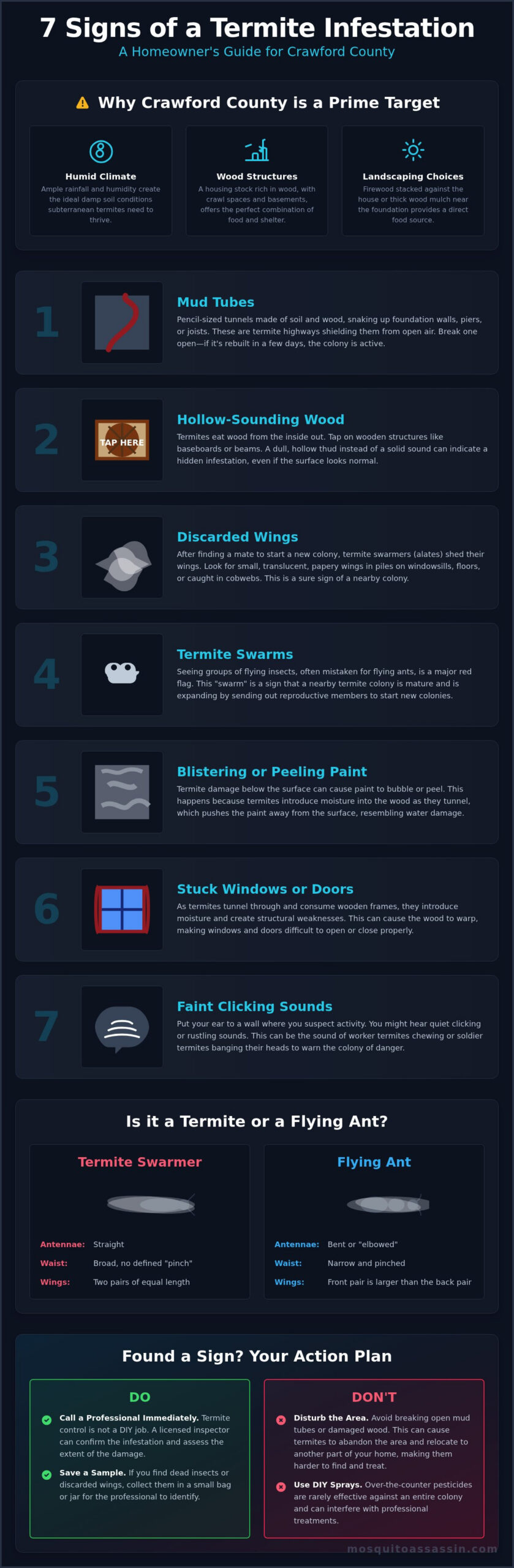
    Beyond identifying the pests, an inspection can uncover hidden structural damage that may have gone unnoticed for years. Termites often work from the inside out, leaving the exterior of a beam looking intact while the core is hollowed. Identifying these compromised areas early allows a homeowner to budget for necessary repairs alongside the treatment plan. A thorough mapping of the property ensures that every secondary structure, from a detached garage to a backyard deck, is accounted for in the final scope of work. To ensure your property is accurately evaluated before starting remediation, you can schedule professional termite inspections and treatment to get a clear understanding of your needs.

    Disclaimer: The information provided on this blog is for general informational purposes only and is not intended as professional pest control advice. Conditions vary by property, environment, and location. Reading this content does not create a service agreement. For an inspection or professional recommendations, please contact Mosquito Assassin Pest Control LLC directly.

    Long-Term Savings Through Preventative Termite Management

    Maintaining the structural integrity of a home in Northwest Pennsylvania requires a proactive approach to wood-destroying insects. While the initial termite treatment cost Erie PA homeowners face might seem like a significant line item, it is a fraction of the cost of structural reconstruction. Termites are silent destroyers. They often go undetected for years; they hollow out load-bearing timbers from the inside without leaving obvious external clues. By the time visible signs appear, the financial burden of repair has already escalated. Professional oversight provides a dependable layer of security that protects the long-term value of the property.

    The High Cost of Inaction

    The financial impact of a termite infestation extends far beyond the price of remediation. Standard homeowner’s insurance policies almost never cover the cost of termite damage or treatment. Most insurance providers categorize infestations as a preventable maintenance issue, similar to a roof leak or worn-out siding. This leaves property owners solely responsible for replacing structural members like floor joists, sills, and wall studs. According to the National Pest Management Association, termite damage accounts for over $5 billion in property losses every year across the United States.

    In our local region, the high humidity near Lake Erie increases the speed at which these colonies can grow. A small problem in the spring can become a major structural crisis by the following year. Professional remediation plans often include service assurances that provide peace of mind. Knowing that a dependable expert is monitoring the property ensures that any resurgence is handled immediately, preventing the need for another full-scale treatment. This level of professional accountability is essential for maintaining a secure and stable home environment.

    Year-Round Protection Strategies

    Integrating termite monitoring into a broader pest management strategy is one of the most effective ways to manage long-term termite treatment cost Erie PA variables. Surveillance stations allow technicians to identify early warning signs during bi-monthly or quarterly visits. This consistent oversight means that if a colony begins to move toward a structure, it can be intercepted before it crosses the foundation line. Early detection is the most reliable way to avoid the intensive labor of trenching or drilling described in previous sections.

    Combining termite surveillance with general pest control creates a comprehensive shield for the household. Regular visits allow for the identification of moisture problems or wood-to-soil contact points that might otherwise go unnoticed. Addressing these environmental risks early reduces the overall pest pressure on the structure. For those looking to understand how these strategies fit into a total home maintenance plan, reviewing a year-round protection guide can provide valuable insights. Professional pest control may help reduce risk and preserve the structural health of homes in Erie, Crawford, and Ashtabula Counties for decades to come.

    Disclaimer: The information provided on this blog is for general informational purposes only and is not intended as professional pest control advice. Conditions vary by property, environment, and location. Reading this content does not create a service agreement. For an inspection or professional recommendations, please contact Mosquito Assassin Pest Control LLC directly.

    Securing Your Property Against Structural Pests

    Protecting a home in Northwest Pennsylvania requires a clear understanding of the environmental and structural variables at play. As explored throughout this guide, the total linear footage of your foundation and the specific accessibility of your crawl space or slab are the primary drivers of labor. When evaluating the termite treatment cost Erie PA property owners encounter, it’s essential to account for the high humidity levels near Lake Erie that accelerate subterranean termite activity.

    A professional assessment serves as the only reliable tool for accurate budgeting and precise remediation. Detailed Wood Destroying Insect (WDI) inspections are available to identify the exact extent of a colony and uncover hidden damage before it becomes a structural crisis. By mapping entry points and galleries, you can ensure your remediation plan is effective and targeted without unnecessary expenses.

    Professional pest control may help reduce risk. For an inspection or professional recommendations, please contact Mosquito Assassin Pest Control LLC directly. As a licensed and insured provider in both Pennsylvania and Ohio, the team brings expert knowledge of Northwest Pennsylvania structural pests to every inspection. Taking these proactive steps today ensures your investment remains secure for years to come.

    Disclaimer: The information provided on this blog is for general informational purposes only and is not intended as professional pest control advice. Conditions vary by property, environment, and location. Reading this content does not create a service agreement. For an inspection or professional recommendations, please contact Mosquito Assassin Pest Control LLC directly.

    Frequently Asked Questions

    How much does a termite inspection typically cost in Erie?

    Termite inspection costs in the Erie area vary based on the depth of the assessment and whether an official report is needed for a real estate transaction. Factors like the size of the structure and the ease of access to crawl spaces or basements influence the final quote. Since every property in Northwest Pennsylvania has unique environmental pressures, a physical on-site evaluation is necessary to provide an accurate estimate for your specific foundation type.

    Does homeowners insurance cover the cost of termite treatment?

    Standard homeowners insurance policies typically do not cover termite treatment or the repair of structural damage caused by these pests. Insurance companies generally view wood-destroying insect infestations as a preventable maintenance issue rather than a sudden, accidental event. Because these costs are usually out-of-pocket, many property owners in Erie and Crawford Counties choose to invest in year-round monitoring to prevent small colonies from becoming expensive structural problems.

    Why is a liquid treatment more labor-intensive than baiting?

    Liquid treatments require the physical displacement of soil through trenching and often involve drilling through concrete slabs to create a continuous chemical barrier. This process is physically demanding and requires high volumes of specialized product to saturate the soil properly. In contrast, baiting systems focus on the strategic installation of monitoring stations around the perimeter, which is less invasive initially but requires consistent professional oversight to ensure the system remains active against local colonies.

    How often should an Erie home be inspected for termites?

    Annual inspections are highly recommended for property owners in Northwest Pennsylvania due to the region’s “moderate to heavy” infestation probability. Because termites work silently behind walls and under foundations, damage can accumulate for years before it becomes visible to the naked eye. Regular professional evaluations help catch activity early, which can significantly reduce the overall termite treatment cost Erie PA residents might face if an infestation were left to spread unchecked.

    Can I perform my own termite treatment to save on costs?

    While DIY products are available, professional remediation is recommended because certified technicians use professional-grade termiticides and specialized equipment not available to the general public. Effective treatment requires an understanding of subterranean termite biology and the technical skill to establish a complete barrier around complex foundations. Improperly applied DIY treatments often fail to reach the colony, leading to a false sense of security while structural damage continues to progress.

    What is a Wood Destroying Insect (WDI) report and do I need one?

    A Wood Destroying Insect (WDI) report is a specialized document required for most real estate transactions, particularly for VA, FHA, or conventional loans. This report confirms whether a licensed professional found active or previous infestations of termites, carpenter ants, or powderpost beetles. If you are buying or selling a home in Erie or Ashtabula County, you will likely need this official documentation to satisfy lender requirements and ensure the property’s structural integrity.

    Does a larger house always mean a higher termite treatment cost?

    Not necessarily. The primary factor in calculating the termite treatment cost Erie PA property owners pay is the linear footage of the foundation perimeter rather than the interior square footage. A smaller, single-story ranch home may have a larger foundation footprint than a two-story colonial with more interior living space. Additionally, the complexity of the foundation (such as a combination of slab and crawl space) can increase labor more than the size of the house alone.

    How long does a professional termite treatment last in Northwest Pennsylvania?

    The longevity of a treatment depends on the method used and local environmental conditions like soil moisture and lake-effect precipitation. Professional liquid barriers are designed to remain effective for several years, though they can be disrupted by significant landscaping changes or soil erosion. Baiting systems provide continuous protection as long as they are regularly monitored and maintained by a professional. Annual assessments are the best way to verify that your defensive barrier remains intact.

    Disclaimer: The information provided on this blog is for general informational purposes only and is not intended as professional pest control advice. Conditions vary by property, environment, and location. Reading this content does not create a service agreement. For an inspection or professional recommendations, please contact Mosquito Assassin Pest Control LLC directly.

  • Integrated Pest Management Techniques: A Science-Based Approach to Lasting Protection

    Integrated Pest Management Techniques: A Science-Based Approach to Lasting Protection

    The most effective way to stop a pest infestation isn’t actually a spray bottle; it’s a fundamental change in strategy. Many property owners in Erie and Crawford Counties in Pennsylvania, as well as Ashtabula County in Ohio, find themselves trapped in a cycle of recurring infestations despite repeated treatments. It’s a frustrating cycle. If you’re concerned about an over-reliance on chemicals or are struggling to find the root cause of a problem, you aren’t alone. Utilizing integrated pest management techniques moves the focus from reactive spraying to a science-based, proactive system of protection.

    You likely want to keep your property secure without turning your home into a chemistry lab. This article explains how these methods provide a sustainable framework for managing pests in both homes and businesses. With the U.S. pest control market projected to grow to $29.1 billion by 2026, more property owners are turning to these data-driven strategies to achieve long-term results. You’ll learn how to modify your environment to discourage pests from entering in the first place and understand the specific indicators that suggest it’s time for professional monitoring. By the end, you’ll have the knowledge needed to maintain a pest-free environment through smarter, more methodical choices.

    Disclaimer: The information provided on this blog is for general informational purposes only and is not intended as professional pest control advice. Conditions vary by property, environment, and location. Reading this content does not create a service agreement. For an inspection or professional recommendations, please contact Mosquito Assassin Pest Control LLC directly.

    Key Takeaways

    • Understand why shifting from reactive extermination to a proactive management model creates a more stable, pest-free environment for your property.
    • Discover the four pillars of integrated pest management techniques, which prioritize cultural and mechanical controls to minimize the need for chemical intervention.
    • Learn how a systematic approach prevents pest resistance and addresses the root causes of infestations rather than just treating temporary symptoms.
    • Identify simple environmental modifications you can make to your property in Pennsylvania or Ohio to reduce its attractiveness to common pests.
    • Recognize how professional monitoring and year-round protection plans provide a consistent defense against evolving seasonal pest pressures.

    Understanding Integrated Pest Management (IPM) Principles

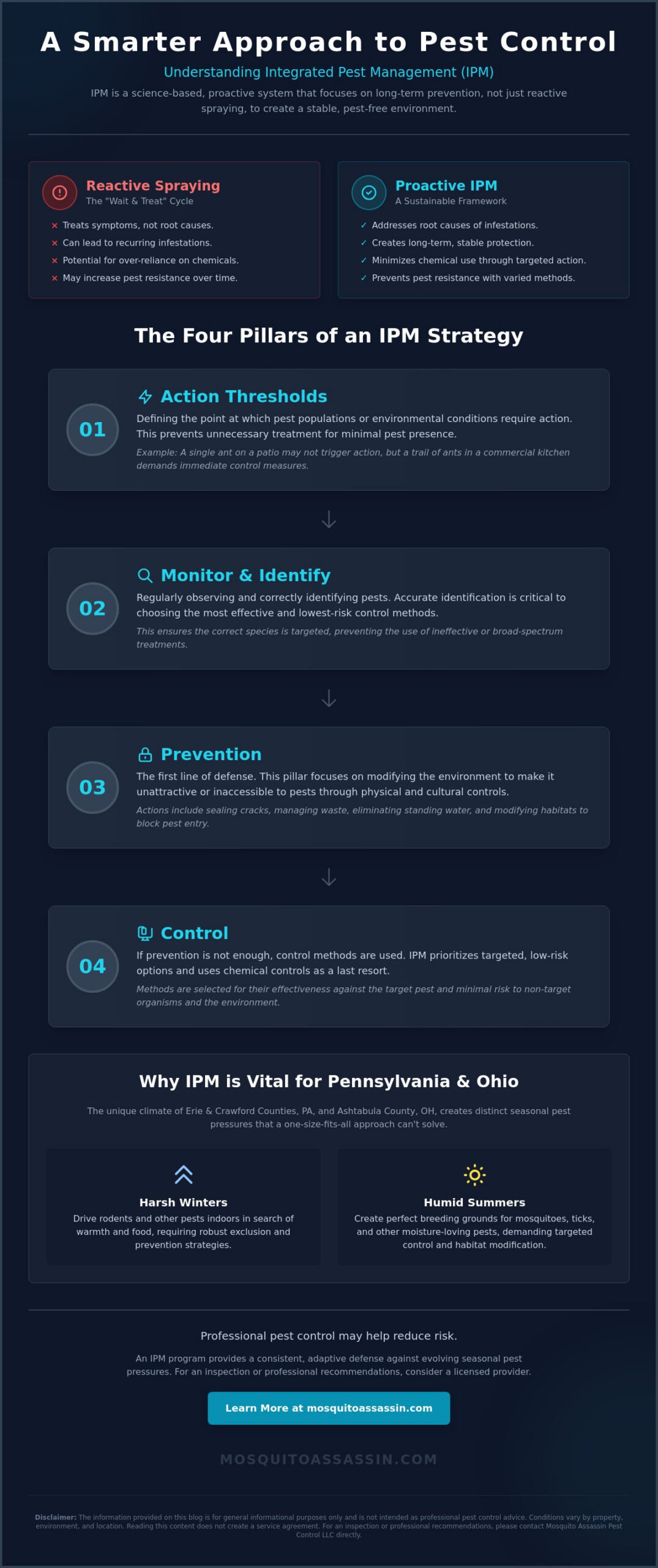
    Effective pest control requires more than just reactive measures. Integrated Pest Management (IPM) is a science-based decision-making process that identifies and reduces risks from pests and pest management tools. Instead of relying solely on routine chemical applications, this method focuses on long-term prevention. It represents a significant shift from traditional extermination, which often waits for a problem to become severe before taking action. By utilizing specific integrated pest management techniques, professionals can manage pests in a way that minimizes risks to people, pets, and the environment.

    Licensed professionals across the United States recognize IPM as the gold standard, especially as the industry prepares for the EPA’s 2026 Pesticide General Permit. This regulatory shift emphasizes the need for documented, science-based approaches. IPM is not about a single treatment; it’s about a continuous cycle of evaluation and adjustment. This methodical approach ensures that interventions are only used when necessary and are as targeted as possible.

    To better understand this concept, watch this helpful video:

    The Four-Tiered IPM Framework

    A successful strategy relies on a disciplined, four-tiered approach. This system ensures that every action taken is justified by data and observation. It begins with Action Thresholds, which is the point at which pest populations or environmental conditions indicate that pest control action must be taken. Sighting a single ant may not require chemical intervention, but a line of them in a commercial kitchen certainly does.

    The next step is to Monitor and Identify. Proper identification ensures that the correct species is targeted, preventing the use of unnecessary or ineffective treatments. Once identified, Prevention becomes the priority. This involves using physical and cultural changes (such as sealing cracks or managing waste) to block pest entry. Finally, if pests persist, Control methods are selected. These are chosen for their effectiveness and lowest risk to non-target organisms.

    Why IPM is Essential for Pennsylvania and Ohio Residents

    Regional climate factors in Erie and Crawford Counties in Pennsylvania, along with Ashtabula County in Ohio, make a proactive strategy vital. Our harsh winters often drive rodents indoors in search of warmth and food, while the humid summers create perfect breeding grounds for mosquitoes and ticks. These seasonal shifts influence pest behavior significantly. Relying on a “one size fits all” spray doesn’t account for these local variables. Using integrated pest management techniques allows for a customized plan that adapts to the specific pressures of our Great Lakes environment, ensuring your property remains protected year-round. For those living in our service area, understanding these principles is the first step toward lasting security.

    Disclaimer: The information provided on this blog is for general informational purposes only and is not intended as professional pest control advice. Conditions vary by property, environment, and location. Reading this content does not create a service agreement. For an inspection or professional recommendations, please contact Mosquito Assassin Pest Control LLC directly.

    Core Integrated Pest Management Techniques and Strategies

    A single method is rarely enough to stop a persistent infestation. By layering different integrated pest management techniques, property owners can create a hostile environment for pests while minimizing the footprint of chemical treatments. This multi-layered defense ensures that if one barrier fails, others are in place to stop the progression of an infestation. It’s a strategic approach that demands consistency and an understanding of how different methods complement each other to provide lasting security.

    The goal is to build a comprehensive shield around your property. When these methods are combined effectively, they address the root cause of the problem rather than just the visible symptoms. Professional pest control may help reduce risk by correctly identifying which combination of techniques is appropriate for the specific species and environmental conditions found in Erie or Ashtabula counties. For those looking for a comprehensive plan, reviewing available general pest control options can provide a starting point for long-term protection.

    Cultural and Mechanical Controls

    Cultural controls involve modifying human habits and the immediate environment to make it less hospitable. This starts with rigorous sanitation and removing the “three essentials” that pests require to thrive: food, water, and shelter. Simple actions like using airtight food containers, fixing leaky pipes under sinks, and managing outdoor waste bins effectively disrupt pest life cycles. These habits are the foundation of any successful management plan.

    Mechanical controls take this a step further by using physical barriers and tools to exclude or remove pests. This includes sealing gaps around foundation lines, installing door sweeps, and using traps or specialized vacuums to manage existing populations. These methods are often the most durable forms of protection because they address the structural vulnerabilities of a building. In our region, exclusion is particularly vital during the autumn months when rodents seek warmth inside local homes.

    Biological and Chemical Controls

    Biological controls utilize natural predators or pheromones to manage pest populations. While these are more common in large-scale agricultural or commercial settings, they represent a key component of the broader IPM Principles defined by the Environmental Protection Agency. These methods focus on disrupting the natural biology of the pest to prevent reproduction and growth.

    Chemical controls, which include pesticides, are reserved as a last resort in a true IPM program. When cultural and mechanical methods fail to meet the established action threshold, targeted applications may be necessary. It’s vital that any chemical used is EPA-registered and applied strictly according to label directions. This ensures the intervention is as effective as possible while maintaining the professional standards expected in a modern pest management program.

    Disclaimer: The information provided on this blog is for general informational purposes only and is not intended as professional pest control advice. Conditions vary by property, environment, and location. Reading this content does not create a service agreement. For an inspection or professional recommendations, please contact Mosquito Assassin Pest Control LLC directly.

    Integrated Pest Management Techniques: A Science-Based Approach to Lasting Protection

    The Benefits of a Proactive IPM Strategy Over Traditional Spraying

    Traditional “spray-and-pray” methods often result in a frustrating “rebound effect.” In this scenario, a property owner kills the visible pests, but the population quickly returns because the underlying environment remains welcoming. This cycle is both expensive and ineffective. By contrast, using integrated pest management techniques creates a permanent solution by addressing the biological needs of the pest. It isn’t just about temporary elimination; it’s about making the property incompatible with pest survival. This proactive approach transforms pest control from an endless chore into a manageable, predictable part of home maintenance.

    A major drawback of traditional reactive spraying is the development of pest resistance. When the same chemicals are used repeatedly, surviving pests pass on resistant traits to their offspring, eventually rendering the treatment useless. IPM prevents this by rotating various integrated pest management techniques and prioritizing non-chemical interventions. By using a variety of tools, professionals ensure that pests don’t have the opportunity to build a biological defense against any single treatment method. It’s helpful to understand how IPM works as a dynamic system that stays one step ahead of pest adaptation through constant evaluation.

    Long-Term Effectiveness and Property Protection

    Structural modifications, often referred to as exclusion, provide more permanent results than liquid barriers alone. In Ashtabula, Ohio, where older homes may have shifting foundations or weathered entry points, these physical fixes are essential for keeping rodents and insects out. Proactive monitoring also plays a critical role in protecting property value. Detecting wood-destroying insects like termites early can save thousands of dollars in structural repairs. A proactive strategy ensures that small, hidden issues don’t escalate into catastrophic damage that threatens the integrity of your investment.

    Safety for Families, Pets, and the Environment

    Modern homeowners prioritize the wellbeing of their household members and animals. IPM reduces unnecessary chemical exposure by applying treatments only where they are needed most, rather than blanket-spraying an entire living space. This targeted approach also protects beneficial insects like pollinators. Bees and butterflies are often collateral damage in broad-spectrum spraying, but IPM methods help preserve these vital parts of our ecosystem. Responsible pest management aligns with modern environmental standards, ensuring that your home is secure without negatively impacting the local community in Pennsylvania or Ohio.

    Disclaimer: The information provided on this blog is for general informational purposes only and is not intended as professional pest control advice. Conditions vary by property, environment, and location. Reading this content does not create a service agreement. For an inspection or professional recommendations, please contact Mosquito Assassin Pest Control LLC directly.

    Implementing IPM Techniques on Your Property

    Success in long-term pest prevention requires a consistent partnership between property owners and professionals. While a licensed expert provides technical intervention, your daily observations and maintenance are the first line of defense. Utilizing integrated pest management techniques at home involves a shift in how you view your surroundings. Small changes in your routine can drastically reduce the likelihood of a major infestation taking root. It’s about being proactive rather than waiting for a crisis to occur.

    Keeping a detailed log of pest sightings is one of the most valuable tools you can provide. Note the date, time, specific location, and description of any pest seen. This data allows a professional to identify patterns and determine if an action threshold has been met. It moves the conversation from guesswork to an evidence-based strategy that targets the specific problem area. This level of detail ensures that any intervention is as efficient and effective as possible.

    Inspection and Monitoring Procedures

    Regularly walk the perimeter of your home to check for signs of entry. In Erie and Crawford Counties, the regional freeze-thaw cycle often creates new gaps in siding or unsealed pipes that pests exploit. Pay close attention to damaged screens and basement windows. Monitoring for seasonal pests like carpenter bees in the spring or yellowjackets in the late summer helps you catch problems before they become structural risks. Identifying moisture issues in basements, crawlspaces, and gutters is also vital. Damp wood and standing water are primary attractants for many invasive species found in our region.

    Habitat Modification and Exclusion

    Modifying the environment around your home is a primary tool for controlling mosquitoes and ticks. Removing standing water from birdbaths, clogged gutters, and flowerpots disrupts mosquito breeding cycles before they begin. In Ashtabula County, clearing brush and tall grass near the home reduces tick habitats and creates a buffer zone. Sealing cracks and crevices with high-quality caulk or steel wool is another example of how integrated pest management techniques prevent rodent and ant entry. For those seeking comprehensive home protection, learning about general pest control strategies can help you maintain a secure property year-round.

    A professional inspection may help reduce risk by identifying hidden vulnerabilities that are easy to miss. If you are concerned about recurring issues, professional pest control services can provide the consistent monitoring needed for lasting peace of mind.

    Disclaimer: The information provided on this blog is for general informational purposes only and is not intended as professional pest control advice. Conditions vary by property, environment, and location. Reading this content does not create a service agreement. For an inspection or professional recommendations, please contact Mosquito Assassin Pest Control LLC directly.

    Professional Support for Integrated Pest Management Programs

    Implementing a complete strategy requires more than just good intentions; it demands specialized knowledge and professional-grade tools. While the habitat modifications mentioned earlier are vital, a licensed pest control professional brings the technical expertise necessary to handle complex infestations. Certain pests, such as termites or bed bugs, are notoriously difficult to detect in their early stages. Without the trained eye of an expert, these problems can grow undetected for months, leading to significant property damage or widespread infestation. Relying on professional integrated pest management techniques ensures that these hidden threats are identified before they become costly emergencies.

    A professional approach moves beyond simple reactive measures. It involves a deep understanding of pest biology and behavior, which allows for the most effective application of control methods. Professionals have access to specialized equipment that allows them to inspect areas that are typically inaccessible to property owners, such as deep within wall voids or crawlspaces. This thoroughness is what separates a temporary fix from a long-term solution. By seeking professional recommendations tailored to your specific property, you can address vulnerabilities that might otherwise be overlooked.

    Why Professional Monitoring is Essential

    Professional monitoring is the backbone of any successful long-term plan. Experts use data from inspections and monitoring devices to adjust integrated pest management techniques in real time. This ensures that interventions remain targeted and effective as environmental conditions change. Applying treatments without this data often leads to wasted effort and unnecessary chemical use. By relying on a professional, you ensure that every action taken is backed by scientific observation and regional expertise. This data-driven approach also helps in identifying the exact species present, which is crucial because a treatment that works for one type of ant may be completely ineffective for another.

    Year-Round Protection in the Tri-State Area

    The climate in Erie and Crawford Counties in Pennsylvania, along with Ashtabula County in Ohio, faces unique seasonal challenges that require a year-round approach. Bi-monthly or quarterly visits allow for consistent monitoring as pest pressures shift from summer mosquitoes to winter rodents. Ongoing management is the most effective way to remain pest-free, as it prevents the population rebounds that often follow one-time treatments. You can see this process in action by reviewing how a mosquito control program utilizes monitoring and habitat modification to provide lasting relief during the peak of the season.

    Maintaining a consistent defense is much easier and more cost-effective than trying to eliminate a massive infestation after it has already taken hold. For a professional property assessment and to learn more about consistent monitoring, please contact-us to speak with a local expert familiar with the specific needs of our community. Professional pest control may help reduce risk and provide the peace of mind that comes with knowing your property is protected by a science-based framework.

    Disclaimer: The information provided on this blog is for general informational purposes only and is not intended as professional pest control advice. Conditions vary by property, environment, and location. Reading this content does not create a service agreement. For an inspection or professional recommendations, please contact Mosquito Assassin Pest Control LLC directly.

    Secure Your Property with Proactive Protection

    Adopting a science-based strategy is the most definitive way to protect your property from invasive species. By moving away from reactive spraying and focusing on structural exclusion and habitat modification, you eliminate the root causes of infestations. This methodical approach ensures your home or business remains a hostile environment for pests while maintaining the wellbeing of your household. It’s a shift from temporary fixes to a durable, long-term defense.

    Utilizing integrated pest management techniques provides a sustainable framework that adapts to the unique seasonal shifts across Pennsylvania and Ohio. Licensed professionals serving Erie, Crawford, and Ashtabula counties provide the specialized expertise needed for effective rodent exclusion and consistent monitoring. For an inspection or professional recommendations, please visit our online booking portal. Taking these proactive steps today helps maintain a secure, pest-free environment for the future.

    Disclaimer: The information provided on this blog is for general informational purposes only and is not intended as professional pest control advice. Conditions vary by property, environment, and location. Reading this content does not create a service agreement. For an inspection or professional recommendations, please contact Mosquito Assassin Pest Control LLC directly.

    Frequently Asked Questions

    What is the primary goal of integrated pest management?

    The primary goal is to provide long-term, sustainable prevention of pest problems by managing the environment rather than just reacting to sightings. This approach identifies the biological needs of pests and removes their access to food, water, and shelter. This strategy prioritizes the safety of household members while effectively reducing pest populations to manageable levels through a science-based decision-making process.

    Is IPM more expensive than traditional pest control services?

    While the initial investment in structural repairs or professional inspections may seem higher, this strategy is generally more cost-effective in the long run. Preventing an infestation is significantly cheaper than paying for repeated emergency treatments or repairing structural damage caused by termites or rodents. By investing in prevention, you avoid the cycle of recurring service fees associated with traditional reactive spraying methods.

    Can I perform integrated pest management techniques by myself?

    Property owners can implement many basic integrated pest management techniques such as improving sanitation and sealing small entry points around the home. However, professional support is often necessary for accurate pest identification and the application of specialized treatments. A licensed expert provides the consistent monitoring and technical knowledge needed to handle difficult species or hidden vulnerabilities that are easily missed by an untrained eye.

    How does IPM help with mosquito and tick control in PA and OH?

    This approach manages mosquitoes and ticks by identifying and modifying their specific breeding and nesting habitats in Erie and Crawford Counties in Pennsylvania and Ashtabula County in Ohio. This might involve clearing specific types of brush or managing drainage issues that attract these pests. By disrupting their life cycles at the source, you reduce the reliance on broad-spectrum sprays and provide more consistent protection.

    Does an IPM approach mean that pesticides are never used?

    Pesticides are still a part of the program, but they’re used as a last resort and in a highly targeted manner. Treatments are only applied when monitoring data shows that a pest population has exceeded a specific action threshold. When chemical intervention is necessary, professionals select the most effective, lowest-risk products and apply them strictly according to EPA label directions to ensure safety.

    How long does it take for IPM techniques to show results?

    Some mechanical controls provide immediate relief, but the full impact of a prevention-based strategy typically takes several weeks to become apparent. Because this method focuses on disrupting life cycles and blocking entry points, it requires patience to see the total reduction in pest activity. It’s designed for lasting results rather than the temporary knockdown effect often seen with traditional chemical-only methods.

    Why is monitoring such a critical part of the IPM process?

    Monitoring is critical because it provides the data necessary to make informed decisions about when to intervene. Without regular inspections and data collection, it’s impossible to know if a pest population is growing or if current prevention methods are working. Consistent monitoring ensures that every action taken is justified and targeted, preventing unnecessary treatments and saving property owners time and money over the long term.

    What are some common examples of mechanical pest control?

    Common examples include installing door sweeps, sealing foundation cracks with caulk, and using specialized traps or vacuums. These integrated pest management techniques focus on creating physical barriers that prevent pests from entering a structure. By maintaining the integrity of the building envelope, you provide a durable defense that remains effective long after a traditional chemical treatment would have dissipated.

    Disclaimer: The information provided on this blog is for general informational purposes only and is not intended as professional pest control advice. Conditions vary by property, environment, and location. Reading this content does not create a service agreement. For an inspection or professional recommendations, please contact Mosquito Assassin Pest Control LLC directly.

  • Pest Control Service Guarantee: What Homeowners Should Expect in 2026

    Pest Control Service Guarantee: What Homeowners Should Expect in 2026

    What if the contract signed after an extermination was actually more powerful than the chemicals used around a property? For many residents in Erie, Crawford, and Ashtabula Counties, the primary concern isn’t just the pests themselves but the risk of wasting money on ineffective treatments that fail to deliver results. A legitimate pest control service guarantee should be viewed as a technical commitment to property protection rather than a vague marketing promise. It provides the necessary assurance that if pests return shortly after a visit, the professional responsibility remains until the infestation is fully addressed.

    Property owners deserve a clear understanding of contract terms to avoid the frustration of hidden fees or recurring infestations. You’ll learn how professional service guarantees protect your property investment and ensure long-term relief from common invaders in 2026. This guide covers what to expect regarding provider accountability, the total elimination of specific pest issues, and how to identify a service agreement that truly prioritizes the security of a household. Professional pest control may help reduce risk when these standards are met.

    Disclaimer: The information provided on this blog is for general informational purposes only and is not intended as professional pest control advice. Conditions vary by property, environment, and location. Reading this content does not create a service agreement. For an inspection or professional recommendations, please contact Mosquito Assassin Pest Control LLC directly.

    Key Takeaways

    • Understand how a professional pest control service guarantee establishes clear accountability and ensures treatments meet industry standards for effectiveness.
    • Learn the differences between retreatment warranties and satisfaction periods to ensure you receive follow-up care if pests persist.
    • Discover why local environmental factors in Erie, Crawford, and Ashtabula Counties require specific contract protections against high humidity and seasonal migrations.
    • Identify the essential components of a reliable service agreement, including the specific list of covered pests and the duration of the protection period.
    • Evaluate why ongoing management plans often provide more robust long-term security compared to one-time reactive treatments.

    Understanding the Value of a Pest Control Service Guarantee

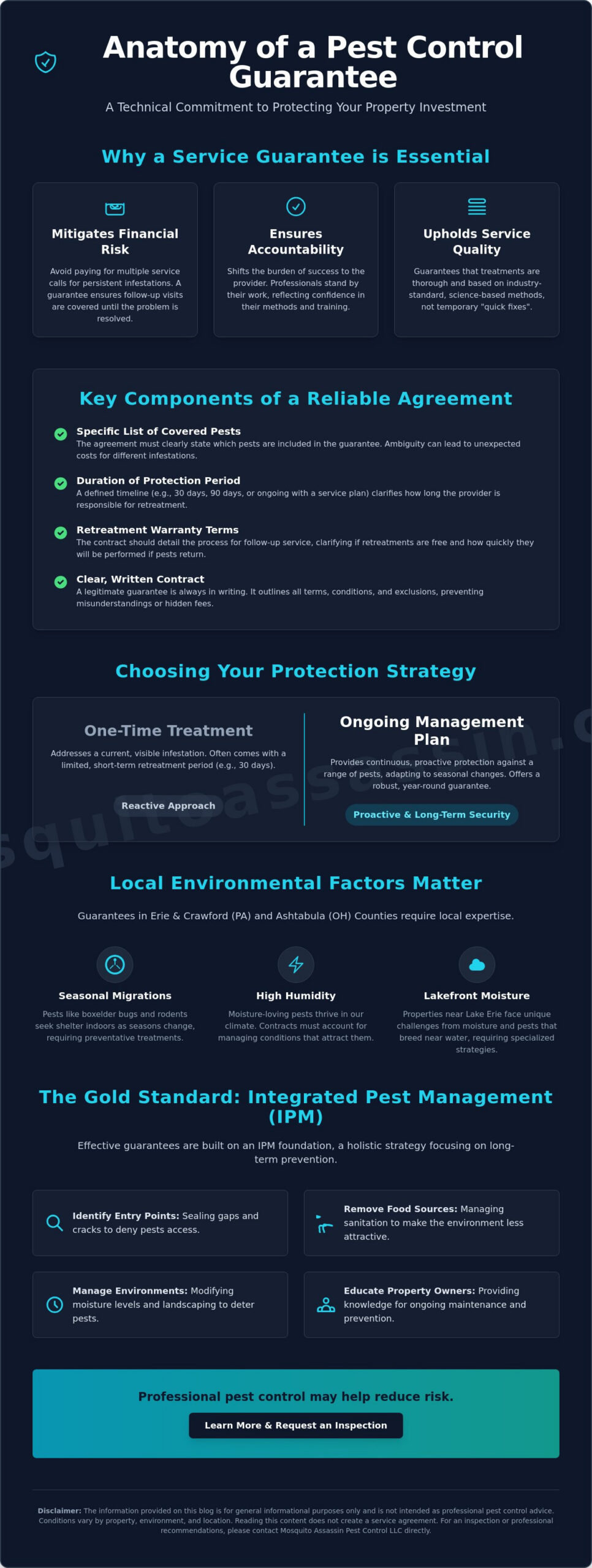
    A pest control service guarantee acts as a formal contract between a property owner and a licensed provider. It signifies that the service isn’t just a one-time transaction but a commitment to a pest-free environment. For residents in Erie and Crawford Counties, where seasonal shifts can trigger sudden infestations, this accountability is vital. It establishes the professional standards that must be met during any intervention, ensuring that the methods used are both thorough and safe for the household. Understanding these standards requires a comprehensive overview of pest control methodologies, which often involve a mix of biological knowledge and precise application techniques.

    To better understand how these assurances work in practice, watch this helpful video:

    One of the most significant benefits of a strong pest control service guarantee is the mitigation of financial risk. Some infestations, like bed bugs or certain rodent species, are notoriously difficult to eradicate in a single visit. Without a clear agreement, homeowners might find themselves paying for multiple service calls without seeing a permanent resolution. A robust guarantee creates a protocol for follow-up visits if pests persist, typically at no additional cost to the client. This shifts the burden of success onto the provider, ensuring they remain accountable for the total elimination of the problem.

    Why Professional Accountability Matters

    Pests don’t follow a schedule. Their behavior is erratic and heavily influenced by moisture levels, local temperature, and structural vulnerabilities. Professional accountability means the provider stands by their work even when nature is unpredictable. It ensures that technicians use science-based methods rather than “quick fixes” that might only mask the problem temporarily. When a provider offers a clear guarantee, it reflects deep confidence in their training and the efficacy of their treatment protocols. It provides peace of mind that the job will be done right, regardless of the complexity of the infestation.

    The Role of Integrated Pest Management (IPM)

    Integrated Pest Management (IPM) is the gold standard in modern pest control. It focuses on long-term prevention by managing the environment to make it less hospitable to invaders. A pest control service guarantee is most effective when it’s part of a broader IPM strategy. This approach includes identifying entry points, removing food sources, and educating the property owner on maintenance. Residents in Ashtabula County, for instance, might need specific advice on managing lakefront moisture to support the success of their plan. Educational resources help residents understand their role in maintaining the conditions necessary for the guarantee to remain in effect.

    Disclaimer: The information provided on this blog is for general informational purposes only and is not intended as professional pest control advice. Conditions vary by property, environment, and location. Reading this content does not create a service agreement. For an inspection or professional recommendations, please contact Mosquito Assassin Pest Control LLC directly.

    Common Types of Pest Control Assurances and Warranties

    Homeowners often face a choice between a quick fix and a long-term strategy. Understanding the nuances of a pest control service guarantee is essential when making this decision. Most professional agreements fall into distinct categories based on the frequency of service and the nature of the pest. For instance, retreatment warranties are the standard for recurring plans. If pests reappear between scheduled visits, the provider returns to address the issue at no extra cost. This differs significantly from satisfaction periods, which typically last between thirty and sixty days and are usually reserved for one-time corrective services.

    When researching how to choose a pest control company, it’s helpful to look for year-round protection plans. These agreements offer continuous coverage for common household invaders. Because pest pressure fluctuates with the seasons in Erie and Crawford Counties, a continuous guarantee ensures that the property remains protected against ants in the spring and rodents in the winter. Specialized warranties are also available for high-stakes pests like termites or bed bugs, where the biological complexity requires a more rigorous follow-up schedule to ensure total removal.

    Retreatment vs. Refund Policies

    A retreatment policy is the industry standard because it focuses on the biological reality of pest management. Pests are living organisms that adapt to their environment; therefore, the goal is persistent intervention until the problem is solved. Refund policies are much rarer and generally only apply to the initial service fee if the provider fails to meet specific contractual obligations. Understanding this distinction helps property owners set realistic expectations. The primary objective is a pest-free home, not just a financial transaction. Professional accountability ensures that the focus remains on the definitive resolution of the infestation.

    Covered Pests and Service Limitations

    Every agreement should include a clearly defined list of covered species. A plan that covers spiders and crickets may not include wood-destroying organisms like termites. It’s also important to recognize that guarantees often have limitations based on property maintenance. For example, a provider might not be able to guarantee results if there are significant structural deficiencies or chronic sanitation issues that provide constant harborage for pests. Reviewing professional pest control plans can help clarify which species are included in a standard agreement. Professional pest control may help reduce risk when these limitations are understood and addressed.

    Disclaimer: The information provided on this blog is for general informational purposes only and is not intended as professional pest control advice. Conditions vary by property, environment, and location. Reading this content does not create a service agreement. For an inspection or professional recommendations, please contact Mosquito Assassin Pest Control LLC directly.

    Pest Control Service Guarantee: What Homeowners Should Expect in 2026

    Evaluating Service Guarantees in Northwest Pennsylvania and Northeast Ohio

    A generic, national guarantee often fails to account for the specific environmental stressors found in the Great Lakes region. In Northwest Pennsylvania and Northeast Ohio, the proximity to Lake Erie creates a microclimate that directly impacts pest behavior and treatment efficacy. A pest control service guarantee is only as strong as the provider’s understanding of these local variables. When high humidity levels persist near the shoreline, certain chemical barriers may degrade faster than they would in a drier, inland environment. Localized expertise allows a provider to adjust their protocols, ensuring that the protection promised in the contract actually holds up against the elements.

    Regional knowledge also extends to the biological traits of local pest populations. In Erie and Ashtabula Counties, certain mosquito and tick populations have shown specific resistance patterns to standard treatments. A provider with deep roots in the community understands these trends and utilizes targeted, science-based interventions that a distant contractor might overlook. This specialized knowledge leads to more accurate and honest guarantee terms. It ensures that the expectations set at the beginning of a service agreement are grounded in the reality of the local ecosystem rather than a corporate template designed for a different climate.

    Seasonal Challenges in Erie and Ashtabula

    The harsh winters characteristic of Northeast Ohio and Western Pennsylvania create a predictable but intense pressure on residential structures. As temperatures drop in Ashtabula, rodents aggressively seek warmth and food, often driving them into crawlspaces and attics. A reliable guarantee for rodent control must include specific provisions for exclusion and monitoring during these peak months. Conversely, the summer months in Erie and Crawford Counties bring significant surges in tick and mosquito activity. The agricultural landscape and rolling terrain of Crawford County create unique corridors for seasonal pest migration from fields to residential structures. Effective intervention during these periods requires a localized strategy that accounts for both the timing of the surge and the specific geography of the property.

    The Importance of Local Expertise

    Technicians who live and work in the same neighborhoods as their clients possess a distinct advantage when identifying vulnerabilities. They are familiar with the common architectural styles of older homes in Erie and the specific structural risks they present for pest entry. This familiarity ensures that the initial treatment is more thorough, reducing the need for the follow-up visits often promised in a pest control service guarantee. Furthermore, local companies are typically more accessible when a retreatment is required. Because they don’t have to dispatch technicians from a distant metropolitan hub, they can honor their service agreements with greater speed and efficiency. Community-based providers rely heavily on their local reputation, which serves as an additional layer of accountability for the homeowner. Professional pest control may help reduce risk when the provider is a trusted neighbor who understands the area’s unique challenges.

    Disclaimer: The information provided on this blog is for general informational purposes only and is not intended as professional pest control advice. Conditions vary by property, environment, and location. Reading this content does not create a service agreement. For an inspection or professional recommendations, please contact Mosquito Assassin Pest Control LLC directly.

    What to Look for in a Professional Service Agreement

    A professional service agreement provides the framework for a reliable pest control service guarantee. It transforms a verbal promise into a technical commitment. Reviewing the contract carefully ensures that the property owner understands the scope of work. Look for a clearly defined list of covered pests. This should include common regional invaders like ants, spiders, and rodents. If a specific species isn’t listed, it’s likely not covered under the standard protection terms. The agreement must also specify the exact duration of the protection period. Whether it’s a thirty-day window for a one-time treatment or a year-round plan, the timeframe should be unambiguous.

    Homeowners should look for a detailed description of how to trigger a follow-up visit. If activity is spotted, the protocol for reporting it should be simple and direct. A professional agreement often includes exclusions based on property maintenance. For instance, if a homeowner fails to seal structural gaps or clear debris as recommended, the provider may not be able to honor the guarantee. These requirements ensure that both parties are working toward a common goal of long-term prevention. Professional pest control may help reduce risk when these contractual expectations are met by both the technician and the client.

    Reading the Fine Print Without the Stress

    Focus on the straightforward language regarding the frequency of scheduled visits. A quarterly plan should detail exactly what happens during each seasonal inspection. Identify any specific requirements for property owners. Sealing entry points or managing moisture levels is often necessary to maintain the efficacy of the treatment. Ensure the agreement includes a clear contact method for reporting new activity. Having a direct line to a local technician in Ashtabula or Crawford County ensures a faster response time when issues arise. You can view professional pest control plans for more details on regional standards.

    Commercial Service Considerations

    Businesses in Erie County face different challenges than residential properties. Commercial agreements often require more frequent inspections to maintain guarantees, especially in the food service or hospitality industries. These contracts focus heavily on health code compliance and detailed documentation of every visit. Maintaining a pest-free environment is critical for business reputation and regulatory standing. Learn more about professional commercial services to understand how these specialized agreements support local business operations. Consistent monitoring and professional intervention are the keys to maintaining a healthy commercial environment.

    Disclaimer: The information provided on this blog is for general informational purposes only and is not intended as professional pest control advice. Conditions vary by property, environment, and location. Reading this content does not create a service agreement. For an inspection or professional recommendations, please contact Mosquito Assassin Pest Control LLC directly.

    Long-Term Protection Strategies for Residential and Commercial Properties

    Ongoing management is often more effective than reactive one-time treatments. While a single visit might address an immediate surge in activity, it does not account for the biological cycles of pests that inhabit Northwest Pennsylvania and Northeast Ohio. A year-round protection plan provides a proactive barrier against seasonal migrations. This ensures that a property is fortified before the next wave of activity begins, whether it is the spring emergence of ants or the autumn push of rodents seeking warmth. A pest control service guarantee is most robust when it is part of a continuous, disciplined program rather than a series of disconnected interventions.

    Regular inspections are the cornerstone of a successful long-term strategy. These visits allow for the early detection of wood-destroying insects or rodents, which can cause significant structural damage if left unchecked for months. By identifying these issues in their infancy, property owners can avoid the high costs and stress associated with major infestations. Professional pest control may help reduce risk when implemented as a consistent program. This methodical approach allows technicians to monitor changes in the environment, such as new structural gaps or increased moisture levels, that could invite future problems.

    The Benefits of Recurring Protection

    Consistent monitoring ensures that small issues don’t escalate into crises. When a technician visits a property regularly in Erie or Crawford County, they become familiar with its specific vulnerabilities. This historical knowledge makes the pest control service guarantee more effective because the provider can anticipate problems based on past activity. Recurring plans often provide the most comprehensive guarantee terms for homeowners. They cover a wider range of pests and include scheduled preventative maintenance that one-time services lack. Explore this general pest control guide for more details on how these programs function.

    Taking the Next Step Toward a Pest-Free Property

    Professional recommendations are essential for identifying the specific vulnerabilities of a property. No two structures are identical; factors like landscaping, age, and proximity to Lake Erie all influence pest pressure. Property owners in Ashtabula and surrounding areas should seek a thorough inspection to determine which protection plan best suits their needs. A professional assessment provides the data necessary to build a definitive defense strategy. For more information on available programs, visit www.mosquitoassassin.com/services. Taking a proactive approach today ensures the long-term security and wellbeing of everyone on the property.

    Disclaimer: The information provided on this blog is for general informational purposes only and is not intended as professional pest control advice. Conditions vary by property, environment, and location. Reading this content does not create a service agreement. For an inspection or professional recommendations, please contact Mosquito Assassin Pest Control LLC directly.

    Securing Your Property with Professional Assurance

    A reliable pest control service guarantee is more than a simple promise; it’s a technical framework that ensures long-term property protection. By choosing licensed and insured professionals who understand the unique environmental pressures of Erie, Crawford, and Ashtabula Counties, homeowners can secure their property investment against recurring infestations. These agreements prioritize accountability and rely on detailed multi-step rodent and insect exclusion processes to achieve definitive results. Locally owned and operated expertise ensures that follow-up care is accessible and grounded in the specific needs of the region.

    Transitioning from reactive treatments to proactive, year-round management provides the most consistent security for residential and commercial structures. For an inspection or professional recommendations, please contact Mosquito Assassin Pest Control LLC directly. Professional pest control may help reduce risk and ensure your home remains a safe, comfortable environment for years to come.

    Disclaimer: The information provided on this blog is for general informational purposes only and is not intended as professional pest control advice. Conditions vary by property, environment, and location. Reading this content does not create a service agreement. For an inspection or professional recommendations, please contact Mosquito Assassin Pest Control LLC directly.

    Frequently Asked Questions

    What does a typical pest control guarantee cover?

    A typical guarantee covers the specific species listed in your contract, such as ants, spiders, or common roaches. It ensures that the provider will return to retreat the property if these specific invaders reappear within the designated timeframe. It’s important to note that a general plan may not cover specialized pests like termites or bed bugs unless they are explicitly named in the agreement.

    How long does a pest control warranty usually last?

    The duration of a warranty depends on the type of service performed. For one-time corrective treatments, coverage typically ranges from 30 to 60 days. In contrast, recurring plans provide continuous protection. As long as you maintain a quarterly or monthly service schedule, the pest control service guarantee remains in effect to address any issues that arise between visits.

    What happens if I see pests after my house has been treated?

    You should contact your provider immediately if pests are spotted after the initial window of treatment. Most agreements outline a specific protocol for follow-up inspections and retreatments. It’s common to see a temporary increase in activity for a few days as pests are flushed out of hiding. If the problem persists beyond two weeks, the guarantee ensures a professional returns to resolve the issue.

    Are bed bug treatments usually guaranteed?

    Bed bug treatments are frequently guaranteed, but they often require strict adherence to preparation protocols. Because these pests are highly resilient, a guarantee may be contingent on the property owner following all pre-treatment instructions and participating in scheduled follow-up inspections. These terms ensure that the biological cycle of the infestation is fully broken through a coordinated effort between the technician and the resident.

    Can a guarantee be voided if I do not follow prevention tips?

    A guarantee can be voided if recommended structural or sanitation changes are ignored. Professional pest control is a collaborative process. If a technician identifies a leaking pipe or an unsealed crawlspace that invites infestations, the property owner must address these vulnerabilities. Failure to maintain the property according to these professional standards can make it impossible for even the best treatments to remain effective.

    Is there a difference between a warranty and a service agreement?

    A service agreement is the full contract detailing the scope of work and schedule. A warranty is the specific assurance within that contract regarding results. While the service agreement tells you what the technician will do during a visit, the warranty defines what happens if those actions don’t fully eliminate the target pests. Both components are essential for a transparent professional relationship.

    How soon can I request a follow-up visit under a guarantee?

    Most professionals recommend waiting 10 to 14 days before requesting a follow-up visit. This period allows the materials used to reach their full efficacy and disrupt the pest’s reproductive cycle. If you continue to see live activity after this window, the pest control service guarantee allows you to trigger a retreatment. Contacting the office early helps ensure a technician is dispatched as soon as the waiting period ends.

    Do commercial pest services have different guarantee terms than residential ones?

    Commercial guarantees are typically more complex and focus on regulatory compliance. Businesses in Erie County, especially in the food service sector, often have zero-tolerance policies for pest activity. These agreements may include more frequent inspections and detailed documentation to satisfy health department requirements. The terms are tailored to the high-stakes nature of commercial environments where a single sighting can impact professional reputation.

    Disclaimer: The information provided on this blog is for general informational purposes only and is not intended as professional pest control advice. Conditions vary by property, environment, and location. Reading this content does not create a service agreement. For an inspection or professional recommendations, please contact Mosquito Assassin Pest Control LLC directly.

  • Professional Tick Prevention for Yards: A Comprehensive Guide to Property Protection

    Professional Tick Prevention for Yards: A Comprehensive Guide to Property Protection

    In April 2026, the Centers for Disease Control and Prevention (CDC) reported that weekly emergency room visits for tick bites reached their highest levels for that time of year since 2017. For homeowners in Erie and Crawford Counties in Pennsylvania and Ashtabula County in Ohio, the simple act of letting a dog outside or hosting a summer barbecue has become a source of significant anxiety. It’s frustrating to rely on store bought sprays that don’t seem to work, leaving you to perform constant, stressful tick checks on your family and pets. Professional tick prevention for yards offers a more definitive solution by combining biological habitat disruption with specialized barrier applications.

    This article provides a comprehensive look at how a scientifically backed prevention plan can significantly reduce tick populations on your property. You’ll discover the specific methods used by licensed professionals to create a protective perimeter, allowing you to regain confidence in your outdoor living spaces. From understanding tick behavior to implementing long-term property management strategies, this guide covers the essential steps for maintaining a safer environment for your household. Professional pest control may help reduce risk and ensure your yard remains a place for relaxation rather than worry.

    Disclaimer: The information provided on this blog is for general informational purposes only and is not intended as professional pest control advice. Conditions vary by property, environment, and location. Reading this content does not create a service agreement. For an inspection or professional recommendations, please contact Mosquito Assassin Pest Control LLC directly.

    Key Takeaways

    • Identify the specific “Tick Zone” on your property where lawn meets wooded areas to target prevention efforts where they matter most.
    • Understand why professional tick prevention for yards offers superior residual control compared to standard store bought foggers or pump sprayers.
    • Learn how physical landscaping barriers, such as wood chips or gravel, can create a dry transition zone that ticks are unlikely to cross.
    • Discover the role of specialized barrier treatments in maintaining a protective perimeter around your outdoor living spaces all season long.
    • Recognize the necessity of consistent professional monitoring to address tick populations as environmental conditions change throughout the year.

    Understanding Tick Habitats in Pennsylvania and Ohio

    The border region of Pennsylvania and Ohio provides a perfect environment for tick populations to flourish. In Erie and Crawford Counties, along with Ashtabula County, the proximity to Lake Erie creates a consistently humid atmosphere. This moisture is vital for survival during the tick life cycle, as these arachnids are highly susceptible to dehydration. Most encounters don’t happen in the center of a manicured lawn; instead, they occur in the “Tick Zone.” This is the transitional area where a managed yard meets woods, tall brush, or ornamental ground cover.

    Understanding these specific micro-habitats is the foundation of effective professional tick prevention for yards. Ticks rely on the insulation provided by leaf litter and dense vegetation to survive the winter and stay cool during the summer heat. Without this protection, they would quickly perish. Identifying these zones allows for a more targeted approach to property management and barrier applications.

    To better understand this concept, watch this helpful video:

    Common Tick Species in the Tri-County Area

    The primary threats in our region are the Black-legged tick, often called the Deer tick, and the American Dog tick. The Black-legged tick is particularly concerning because it’s the primary vector for Lyme disease. In 2024, Pennsylvania reported 16,624 cases of Lyme disease. The state’s Department of Environmental Protection has confirmed infected ticks in all 67 counties. These pests are active whenever temperatures are above freezing. This means the risk begins in early spring and lasts until the first hard frost. Professional identification of these species helps determine the specific timing and placement of treatments.

    Why Ticks Thrive in Residential Yards

    Residential properties often provide an ideal mix of shade, moisture, and host availability. Ticks don’t jump or fly. They use a behavior called “questing,” where they climb to the tips of tall grass or low hanging branches and wait for a host to brush past. Overgrown perimeter vegetation acts as a highway for these pests to move closer to your home. Local wildlife also plays a significant role. Mice and deer frequently carry larval and nymphal ticks into yards, dropping them into the leaf litter where they can molt and wait for their next meal. Eliminating these harborages through property management is a key component of professional tick prevention for yards.

    Disclaimer: The information provided on this blog is for general informational purposes only and is not intended as professional pest control advice. Conditions vary by property, environment, and location. Reading this content does not create a service agreement. For an inspection or professional recommendations, please contact Mosquito Assassin Pest Control LLC directly.

    The Science of Professional Tick Barrier Management

    Effective tick control isn’t just about the product used; it’s about the methodology and science behind the application. Many homeowners try store bought solutions only to find ticks returning days later. Professional tick prevention for yards relies on creating a long lasting barrier that interrupts the tick’s environment. This involves more than a simple surface spray. It requires reaching the micro-habitats where ticks congregate during the heat of the day. Professionals understand the biology of these pests and target the specific areas where they are most vulnerable, ensuring the treatment is applied where it will have the greatest impact.

    This scientific approach focuses on the areas where ticks are known to quest and hide. By understanding the local landscape in Pennsylvania and Ohio, professionals can identify high risk zones that are often overlooked by the untrained eye. Creating a defensive perimeter is a technical process that requires the right tools and the right timing to be successful.

    Specialized Equipment and Application Techniques

    Professionals use motorized mist blowers that create a fine, high velocity fog. This equipment is essential for penetrating dense brush and the thick ground cover common in our region. Unlike standard pump sprayers that produce large droplets that simply roll off leaves, mist blowers ensure the treatment reaches the undersides of foliage. Ticks often cling to the bottom of leaves to avoid desiccation, or drying out, from direct sunlight. Achieving total coverage on these vertical and hidden surfaces is what separates a professional application from a DIY attempt. Precise calibration ensures that the correct volume of treatment is dispersed across the property. This discipline provides maximum impact without the risks associated with improper dosing or incomplete coverage.

    The Importance of Residual Protection

    A critical factor in successful tick suppression is residual control. This refers to the ability of a treatment to remain active and effective on surfaces for an extended period. Professional grade concentrates are formulated with advanced surfactants that help them bond to vegetation. This allows them to withstand UV degradation and light rainfall, which often wash away consumer grade products. These applications are strategically placed to form a curtain of protection around high traffic areas like decks, play sets, and patios. Following established tick management tips, professionals also monitor local weather patterns in Erie and Crawford Counties to ensure the timing of each application maximizes this residual window. This proactive monitoring is vital for maintaining a protective perimeter throughout the humid summer months. This methodical approach transforms a yard from a high risk area into a secure outdoor living space. If you’re looking for a comprehensive plan, exploring professional pest control services can help provide the consistent coverage needed for peace of mind.

    Disclaimer: The information provided on this blog is for general informational purposes only and is not intended as professional pest control advice. Conditions vary by property, environment, and location. Reading this content does not create a service agreement. For an inspection or professional recommendations, please contact Mosquito Assassin Pest Control LLC directly.

    Professional Tick Prevention for Yards: A Comprehensive Guide to Property Protection

    Comparing DIY Methods to Professional Tick Prevention

    Many homeowners reach for store bought foggers or plastic pump sprayers when they first spot a tick in the yard. These tools seem convenient; however, they often fail to address the core of the problem. Professional tick prevention for yards differs significantly in both the chemistry used and the precision of the application. While DIY methods might provide a temporary reduction in sightings, they rarely achieve the thorough coverage necessary to disrupt the tick population permanently. The goal of a professional approach is to create a hostile environment for ticks while maintaining the integrity of your outdoor living space.

    Technical knowledge is the primary divider between a successful treatment and a failed one. Professionals don’t just spray the grass; they analyze the property to find where ticks are actually living. This includes identifying specific harborages in stone walls, wood piles, and dense ground cover that DIY enthusiasts often overlook. By targeting these specific biological needs, a professional plan provides a level of security that off the shelf products cannot match.

    Efficacy and Residual Power

    Consumer grade products are frequently formulated for immediate knockdown rather than long term suppression. This results in a cycle of frequent re-applications that can become more expensive and time consuming than a professional plan. Handheld pump sprayers lack the pressure needed to penetrate the deep thatch of a lawn or the dense interior of ornamental shrubs. Ticks often hide in these protected spots to stay moist. Professionals understand that managing the population requires addressing every stage of the life cycle. They use high volume equipment to ensure treatments reach the soil level where larvae and nymphs reside. This deep penetration is essential for breaking the reproductive cycle and ensuring the yard remains clear throughout the season.

    Safety Standards and Environmental Considerations

    Using professional services ensures that all applications adhere to strict EPA guidelines. Licensed technicians are trained to identify specific risks on a property, such as proximity to vegetable gardens or local waterways. They apply treatments with precision to minimize impact on non-target beneficial insects like bees and butterflies. This targeted approach is safer for the local ecosystem than the broad, uncalibrated spraying common with DIY attempts. Incorporating specific landscaping techniques to reduce ticks can further enhance these results without relying solely on chemical intervention. A professional assessment helps balance the need for protection with environmental responsibility. Over the long term, a managed plan is often more cost effective because it prevents the need for reactive, heavy handed treatments later in the year.

    Disclaimer: The information provided on this blog is for general informational purposes only and is not intended as professional pest control advice. Conditions vary by property, environment, and location. Reading this content does not create a service agreement. For an inspection or professional recommendations, please contact Mosquito Assassin Pest Control LLC directly.

    Landscaping Strategies to Reduce Tick Populations

    Physical modifications to your property serve as a primary defense that complements professional barrier treatments. In the humid climate of Erie, Crawford, and Ashtabula counties, moisture management is the most effective way to make a yard inhospitable to pests. Ticks are highly sensitive to dry conditions and will actively avoid areas where they risk dehydration. Professional tick prevention for yards is significantly more effective when the landscape is designed to eliminate these damp micro-habitats. By altering the environment, you force ticks to remain in the wooded perimeter rather than migrating toward your home.

    Lawn maintenance plays a crucial role in this strategy. Keeping grass mowed to a height of three inches or less reduces the questing height for ticks, making it harder for them to latch onto passing hosts. Additionally, selecting deer resistant plants can reduce the frequency of large host animals entering the property. When deer visit a yard, they often drop engorged female ticks that can lay thousands of eggs, leading to a localized population surge.

    The 3-Foot Buffer Zone Rule

    One of the most impactful changes a property owner can make is installing a three foot wide buffer zone. This border should consist of wood chips, bark mulch, or gravel placed between the lawn and any wooded or brushy areas. This creates a dry “no man’s land” that ticks are reluctant to cross because it lacks the shade and moisture they need to survive. This barrier also serves as a visual reminder for family members to stay within the safe zone of the managed lawn. For maximum protection, play sets, patios, and outdoor furniture should be placed at least ten feet away from the yard’s edge and in sunny locations whenever possible. Maintaining clear sightlines by thinning out low hanging branches also helps increase sunlight penetration to the ground level, further drying out potential tick harborages.

    Host Management and Exclusion

    Ticks don’t travel long distances on their own; they rely on hosts like mice, chipmunks, and deer for transportation. Managing these hosts is essential for long term suppression. Woodpiles and stone walls are common nesting sites for white footed mice, which are the primary reservoir for Lyme disease bacteria. Moving woodpiles away from the house and keeping stone walls clear of overgrown vegetation reduces the likelihood of rodents living near high traffic areas. Bird feeders can also be a hidden risk, as the spilled seed attracts mice and squirrels that carry larval ticks into the yard. Professional tick prevention for yards integrates these physical modifications with targeted applications to address the entire ecosystem. To see how these strategies can be applied to your property, you can explore professional pest control plans that target these specific habitat risks.

    Disclaimer: The information provided on this blog is for general informational purposes only and is not intended as professional pest control advice. Conditions vary by property, environment, and location. Reading this content does not create a service agreement. For an inspection or professional recommendations, please contact Mosquito Assassin Pest Control LLC directly.

    Long-Term Protection and Professional Monitoring

    Achieving a tick-free environment isn’t a one-time event; it’s an ongoing process that requires seasonal vigilance. While a single barrier application provides immediate relief, it rarely offers sufficient protection for the entire year. Ticks have complex life cycles that span multiple seasons, and new populations can be introduced to your property at any time by local wildlife. Professional tick prevention for yards focuses on maintaining a consistent defensive perimeter that adapts to these changing pressures. For homeowners in Erie, Crawford, and Ashtabula counties, this means recognizing that the threat persists from the first thaw of spring through the late autumn frosts.

    Consistency is the foundation of property security. When treatments are spaced correctly, they ensure that the residual barrier remains active even after heavy rains or periods of intense UV exposure. This long-term approach also allows for the integration of tick suppression into a broader general pest control strategy. By addressing multiple pests simultaneously, you create a more comprehensive shield for your household and pets. Professional monitoring ensures that as your landscape matures or environmental conditions shift, your prevention plan evolves to meet those new challenges.

    The Seasonal Treatment Cycle

    The timing of applications is just as important as the products used. Early spring treatments are critical because they target emerging nymphs. These tiny ticks are responsible for a large percentage of disease transmission because they’re extremely difficult to spot on the skin. As the season progresses into the humid summer months, the focus shifts to maintaining the barrier during peak questing activity. In the fall, adult ticks become highly active again as they seek a final blood meal before winter. A professional evaluation of your property during each visit helps identify new risks, such as a neighbor’s overgrown brush or a new woodpile, allowing for immediate adjustments to the treatment zone.

    Next Steps for Property Owners

    Taking the first step toward a safer yard begins with a professional property inspection. This assessment identifies the specific “Tick Zones” unique to your landscape and determines the most effective application schedule. To prepare for a visit, homeowners should ensure the lawn is mowed and any pet toys or children’s equipment are moved away from the perimeter. Clear communication with a licensed technician helps establish a plan tailored to your property’s specific needs. Exploring professional pest control services can help provide the technical expertise and specialized equipment necessary for consistent, high-level protection. Professional pest control may help reduce risk, giving you the confidence to enjoy your outdoor living spaces without the constant worry of tick encounters.

    Disclaimer: The information provided on this blog is for general informational purposes only and is not intended as professional pest control advice. Conditions vary by property, environment, and location. Reading this content does not create a service agreement. For an inspection or professional recommendations, please contact Mosquito Assassin Pest Control LLC directly.

    Secure Your Outdoor Living Space

    Protecting your property from the risks associated with tick-borne illnesses requires a disciplined, multi-layered approach. By combining physical landscaping modifications like the three-foot buffer zone with scientific barrier treatments, you can significantly reduce the presence of these pests. Professional tick prevention for yards provides the technical expertise and high-pressure equipment necessary to reach the deep harborages where ticks hide, offering a level of security that consumer-grade products simply can’t match. Maintaining this protection throughout the peak activity periods of spring, summer, and autumn ensures your yard remains a place for relaxation rather than worry.

    Licensed and insured professionals are ready to help homeowners in Erie, Crawford, and Ashtabula Counties establish customized year-round protection plans. These strategies are designed to adapt to the specific environmental pressures of the local region, providing consistent results as conditions change. For an inspection or professional recommendations, please visit the Mosquito Assassin booking portal. Taking proactive steps today allows you to reclaim your yard with confidence and peace of mind.

    Disclaimer: The information provided on this blog is for general informational purposes only and is not intended as professional pest control advice. Conditions vary by property, environment, and location. Reading this content does not create a service agreement. For an inspection or professional recommendations, please contact Mosquito Assassin Pest Control LLC directly.

    Frequently Asked Questions

    How often should a yard be treated for professional tick prevention?

    A consistent schedule typically involves treatments every 21 to 30 days throughout the active season. This frequency ensures that the residual barrier remains strong enough to disrupt the tick life cycle as new generations emerge. In the specific climate of Pennsylvania and Ohio, maintaining this cadence from early spring through the first hard frost provides the most reliable protection. Professional monitoring allows for adjustments based on current pest pressure and environmental changes.

    Is professional tick control safe for my dogs and cats?

    Most professional treatments are safe for pets once the application has completely dried. Technicians follow strict EPA approved labels to ensure products are applied correctly to the perimeter and transitional zones where pests congregate. It’s recommended to keep dogs and cats indoors during the application and for approximately 30 to 60 minutes afterward. This duration varies based on weather conditions but ensures the barrier has properly bonded to the vegetation.

    Can I mow my lawn immediately after a professional tick treatment?

    It’s best to wait at least 24 hours before mowing your lawn after a professional application has been performed. Mowing immediately can remove the treated tips of the grass blades before the product has had sufficient time to dry and adhere properly. Waiting a full day ensures that the barrier remains intact and effective against questing ticks that reside in the lower thatch. This simple delay helps maintain the integrity of the protective perimeter.

    Do professional tick treatments also help with mosquito control?

    Yes, many of the barrier techniques used in professional tick prevention for yards also effectively target mosquito populations. Since both pests thrive in similar damp, shaded environments, a comprehensive application to the perimeter of your property often provides dual protection. This integrated approach helps reduce the presence of both biting insects, creating a more comfortable and secure outdoor environment for your family throughout the humid summer months.

    What happens if it rains shortly after a professional application?

    Professional grade products are formulated with specialized surfactants that help them become rainfast once they have dried. If the treatment has had about 30 to 60 minutes to dry, a light rain will generally not impact its efficacy. However, if a heavy downpour occurs immediately after the application before it has dried, the barrier may be compromised. In these instances, a professional assessment is needed to determine if a re-application is necessary to ensure continued protection.

    Can ticks still enter my yard if I have a professional barrier in place?

    Ticks can still be brought into a yard by wildlife hosts like deer, mice, or birds, even with a professional barrier. While the barrier won’t stop a host from walking onto the property, the ticks that drop off into treated zones will likely be eliminated before finding a new host. Combining professional tick prevention for yards with host management strategies, such as moving woodpiles or bird feeders, further reduces the likelihood of these accidental introductions.

    When is the best time of year to start a tick prevention program in PA or OH?

    The best time to begin a prevention program in the Erie and Ashtabula regions is early spring, typically in March or April. This timing allows for the targeting of emerging nymphs as they become active following the winter thaw. Starting early ensures a protective barrier is established before the peak activity periods of summer. This proactive approach provides more consistent suppression of the local tick population throughout the entire growing season.

    Does professional tick prevention eliminate the need for personal tick checks?

    Professional treatments significantly reduce the risk of encounters, but they do not replace the need for personal tick checks. It’s still a best practice to inspect yourself, your children, and your pets after spending time outdoors, especially in wooded or transitional areas. A multi-layered strategy that includes both professional barrier management and personal vigilance offers the highest level of protection. This combination is essential for maintaining safety in regions with high tick activity.

    Disclaimer: The information provided on this blog is for general informational purposes only and is not intended as professional pest control advice. Conditions vary by property, environment, and location. Reading this content does not create a service agreement. For an inspection or professional recommendations, please contact Mosquito Assassin Pest Control LLC directly.

  • Emergency Pest Control: Determining When Immediate Professional Intervention is Required

    Emergency Pest Control: Determining When Immediate Professional Intervention is Required

    On a humid Tuesday evening in Erie County, a homeowner discovered a massive swarm of subterranean termites emerging from a baseboard, indicating a colony that had been silently damaging the home’s structure for months. This discovery often leads to the urgent question: Q: Are you available for same-day or emergency pest control service? Most people agree that the sight of a sudden infestation triggers immediate anxiety regarding property damage and the safety of children and pets. You’ll learn how to distinguish between a routine nuisance and a genuine pest emergency that requires rapid intervention.

    This guide provides the critical steps for safeguarding your property and maintaining a safe environment before a licensed professional arrives on the scene. This article examines specific red flags like structural buzzing or nesting in electrical boxes and outlines a clear plan for immediate risk reduction and long-term prevention. Understanding these triggers ensures that the process to eliminate the threat begins the moment it is identified.

    Disclaimer: The information provided on this blog is for general informational purposes only and is not intended as professional pest control advice. Conditions vary by property, environment, and location. Reading this content does not create a service agreement. For an inspection or professional recommendations, please contact Mosquito Assassin Pest Control LLC directly.

    Key Takeaways

    • Identify the specific indicators that distinguish a minor nuisance from a true pest emergency requiring you to ask, Q: Are you available for same-day or emergency pest control service?
    • Understand the biological factors that cause certain infestations to spread rapidly, providing clarity for those asking, Q: Are you available for same-day or emergency pest control service?
    • Learn the critical safety protocols to implement to protect your household while awaiting a response to the question, Q: Are you available for same-day or emergency pest control service?
    • Evaluate the strategic differences between year-round protection and reactive treatments for those wondering, Q: Are you available for same-day or emergency pest control service? in Erie, Crawford, and Ashtabula counties.
    • Discover how delayed responses to wood-destroying organisms can lead to rapid escalation of damage, making the answer to Q: Are you available for same-day or emergency pest control service? a top priority for property owners.

    Defining a Pest Control Emergency: When to Seek Immediate Assistance

    Homeowners in Erie, Crawford, and Ashtabula counties often face situations where a pest presence shifts from a minor annoyance to a legitimate crisis. Determining when a situation requires an immediate response is critical for property protection and resident safety. A common inquiry during these high-pressure moments is, Q: Are you available for same-day or emergency pest control service? Identifying the difference between a nuisance and an emergency often comes down to the speed of reproduction and the potential for physical harm.

    A nuisance pest, like a solitary beetle or a few pavement ants in a basement, typically doesn’t require an hour-by-hour response. However, an emergency involves pests that compromise the safety of the inhabitants or the structural stability of the building. Rapid response is necessary because many pests follow an exponential growth curve. For example, a single German cockroach and her offspring can produce 30,000 individuals within one calendar year. Waiting even 48 hours to begin treatment can allow a localized problem to spread into wall voids and adjacent rooms. Professional intervention utilizes specialized equipment, such as high-volume injection systems and HEPA-filtered extraction tools, which aren’t available to the general public through retail channels.

    Stinging Insect Threats Near Entry Points

    When hornets, wasps, or yellowjackets establish nests directly above doorways or near HVAC units, they pose an immediate physical threat. Statistics from the Journal of Asthma and Allergy indicate that approximately 5% of the U.S. population will experience a systemic allergic reaction to insect stings in their lifetime. DIY removal is dangerous for unlicensed individuals because a single colony can contain over 5,000 aggressive insects. Professionals use protective gear and long-range application tools to ensure safety while removing the threat from high-traffic areas.

    Rapidly Spreading Indoor Infestations

    Indoor emergencies often involve pests that move quickly or cause hidden damage. Bed bugs can travel 4 feet per minute; this means they can infest multiple rooms in a single night. Rodents present a different type of emergency; they’re responsible for an estimated 20% of house fires with undetermined causes due to their habit of gnawing on electrical insulation. In residential spaces, sudden surges of fleas or cockroaches introduce pathogens and allergens that trigger respiratory distress. These situations demand a fast assessment to stop the cycle of destruction before it impacts every room in the house.

    Understanding these risks helps residents prioritize their response. When these signs appear, professional pest control may help reduce risk and prevent further escalation. Residents often ask, Q: Are you available for same-day or emergency pest control service? when they discover a nest or infestation that threatens their peace of mind. Accessing professional help quickly ensures that the right tools are deployed before the population doubles. For an evaluation in the tri-state area, visiting the online booking portal at https://portal.gorilladesk.com/mosquitoassassin is a practical first step toward resolving the issue.

    Disclaimer: The information provided on this blog is for general informational purposes only and is not intended as professional pest control advice. Conditions vary by property, environment, and location. Reading this content does not create a service agreement. For an inspection or professional recommendations, please contact Mosquito Assassin Pest Control LLC directly.

    The Risks of Delayed Response in Pest Management

    Pests don’t follow a human schedule, and their biological clocks are set for rapid expansion. A single female German cockroach can produce a lineage of 30,000 descendants within a single year if environmental conditions are favorable. This exponential growth turns a minor nuisance into a structural crisis in a matter of weeks. Homeowners often ask, Q: Are you available for same-day or emergency pest control service? because they recognize that every hour of delay allows for another cycle of reproduction. In regions like Erie and Crawford Counties, local climate shifts can accelerate these cycles during peak seasons, making immediate intervention a professional necessity.

    The correlation between response time and eradication success is absolute. Professional data suggests that treating an infestation in its early stages is 40 percent more likely to achieve total elimination with fewer intervention cycles. Waiting until a pest problem is visible to the naked eye often means the colony has already established deep roots within wall voids or foundations. Prompt action limits the biological footprint of the pests, reducing the amount of sanitization and structural repair needed after the treatment is complete. A rapid response ensures that the customized treatment plan can be implemented while the population is still manageable.

    Property and Structural Integrity Concerns

    Structural damage is rarely a sudden event; it’s a persistent erosion of a home’s value. Carpenter bees and termites are particularly destructive in the tri-county area of Pennsylvania and Ohio. Termites consume cellulose 24 hours a day, and a mature colony can eat through a significant portion of a 2×4 stud in approximately six months. Professional pest management services can help identify hidden structural risks before they require expensive contractor repairs. Beyond wood destruction, rodents pose a severe fire hazard. The National Fire Protection Association has indicated that rodents chewing through electrical insulation are responsible for a notable percentage of house fires with undetermined origins. Common property risks include:

    • Structural weakening of floor joists and support beams from wood-boring insects.
    • Damage to attic insulation and drywall from rodent nesting materials.
    • Compromised electrical systems and potential short circuits from gnawing pests.

    Public Health and Safety Considerations

    The presence of pests introduces a variety of pathogens into the living environment. In the United States, ticks and mosquitoes are the primary vectors for diseases like Lyme disease and West Nile virus. These aren’t just outdoor concerns; pests often find ways into basements and attics where they continue to shed bacteria and parasites. Pest waste, including droppings and shed skins, degrades indoor air quality. This organic debris becomes airborne, acting as a potent trigger for respiratory issues and allergic reactions. Meeting local health standards in residential properties requires a proactive approach to sanitation and pest exclusion. If an infestation is suspected, seeking an inspection through a professional booking portal can help mitigate these health risks quickly.

    Addressing an infestation immediately isn’t just about comfort; it’s about protecting the long-term viability of the asset. When residents inquire, Q: Are you available for same-day or emergency pest control service? they’re taking the first step in a methodical process to safeguard their property. Fast action prevents the physical and financial stress of a long-term battle against established colonies.

    Disclaimer: The information provided on this blog is for general informational purposes only and is not intended as professional pest control advice. Conditions vary by property, environment, and location. Reading this content does not create a service agreement. For an inspection or professional recommendations, please contact Mosquito Assassin Pest Control LLC directly.

    Emergency Intervention vs. Year-Round Protection Plans

    The tactical difference between reactive emergency service and proactive management is the difference between fighting a fire and installing a sprinkler system. Emergency interventions are designed for immediate impact; they stop the current infestation in its tracks to prevent further property damage. However, relying solely on these one-time events often leads to a cycle of “pest-and-spray” where the problem returns every few months. Homeowners in Erie County and Crawford County frequently find themselves asking, “Q: Are you available for same-day or emergency pest control service?” when a sudden swarm or sighting occurs. While immediate response is a critical tool for safety, it is only the first step in a larger strategy for property protection.

    Transitioning from an emergency state to a maintenance-free environment requires a systematic approach. Professionals use the initial emergency visit to stabilize the situation, but the real work begins with a comprehensive assessment of the property’s vulnerabilities. A 2021 industry report indicated that 65% of residential pest problems stem from structural issues like unsealed gaps or improper drainage. By identifying these factors during an emergency call, a technician can set the stage for a long-term plan that prevents the next crisis. This shift from reactive to proactive care reduces the overall volume of pesticides used on a property by focusing on targeted, strategic applications rather than broad-spectrum emergency saturation.

    The Limitations of One-Time Treatments

    One-time treatments often fail to address the complex life cycles of common pests. A single application may kill adult fleas, but it will not affect the pupae stage, which can remain dormant for 30 days. Without a scheduled follow-up, the infestation will likely resurface. Monitoring after an emergency is essential to confirm total eradication. You can learn more about the professional approach to managing these biological timelines.

    The Value of Consistent Management

    Consistent management visits, performed bi-monthly or quarterly, provide a shield for the home. These visits focus on exclusion techniques, such as sealing 1/8-inch gaps that serve as entry points. In Ashtabula County, seasonal shifts drive different pests indoors; a year-round plan anticipates these movements. This stability removes the anxiety of a 2:00 AM discovery. When residents ask, “Q: Are you available for same-day or emergency pest control service?”, they seek the peace of mind that consistent protection provides.

    The long-term benefits of integrated pest management (IPM) go beyond just killing bugs. It involves environmental modifications that make a home less attractive to pests. This includes managing moisture levels in crawlspaces and ensuring that mulch is kept at least 12 inches away from the foundation. These practical steps, combined with professional monitoring, create a barrier that emergency-only services cannot replicate. Moving away from the stress of emergency calls allows property owners to enjoy their space without the constant threat of a sudden infestation. Professional pest control may help reduce risk by maintaining these barriers year-round.

    Disclaimer: The information provided on this blog is for general informational purposes only and is not intended as professional pest control advice. Conditions vary by property, environment, and location. Reading this content does not create a service agreement. For an inspection or professional recommendations, please contact Mosquito Assassin Pest Control LLC directly.

    Emergency Pest Control: Determining When Immediate Professional Intervention is Required

    Immediate Safety Protocols While Awaiting Professional Service

    When a homeowner asks, “Q: Are you available for same-day or emergency pest control service?” the immediate goal is stabilization. While waiting for a professional to arrive at a property in Erie County, Crawford County, or Ashtabula County, taking proactive steps can limit the spread of an infestation. These initial actions don’t involve chemicals; instead, they focus on physical barriers and hazard reduction. It’s essential to treat every active infestation as a potential safety risk until a licensed technician completes a full assessment of the environment.

    Securing the Environment

    Safety starts with isolating the area of activity to protect vulnerable residents. If stinging insects like yellow jackets or hornets are spotted near an entry point, all windows and doors must remain closed. According to the American College of Allergy, Asthma & Immunology, insect stings send more than 500,000 people to emergency rooms every year. Keeping children and pets in a separate, unaffected part of the home prevents accidental encounters that could lead to injury. For indoor pests like rodents or cockroaches, sanitation is the most effective temporary deterrent. A single gram of food waste can sustain a small colony of cockroaches for an entire week, so immediate cleaning of crumbs and spills is vital. Homeowners should move all pantry items from cardboard boxes into airtight glass or heavy-duty plastic containers, as rodents can gnaw through standard paper packaging in less than 24 hours.

    Information Gathering for Technicians

    Documentation provides the technician with a roadmap for the inspection and eventual treatment. High-quality photos of the pests, or the damage they’ve caused, allow for faster identification without the need for the technician to wait for the pest to reappear. It’s also helpful to maintain a simple log of sightings. Noting the exact time and location of activity is crucial because many pests follow strict biological rhythms; for instance, roughly 80% of rodent activity occurs during nocturnal hours. This data helps the professional determine if the infestation is localized or widespread. Before the technician arrives, clearing a path to utility closets, attic hatches, and crawl space entries is a practical step. Research indicates that pre-clearing these access points can reduce the duration of an initial inspection by up to 20%, allowing the treatment phase to begin much sooner.

    Non-chemical exclusion is another temporary measure that residents can implement to manage the situation. If a clear entry point is identified, such as a gap under a door or a hole in a screen, blocking it with a heavy object or temporary sealant can slow the rate of entry. However, homeowners shouldn’t seal a hole if they suspect stinging insects are nesting inside, as this may force the insects further into the wall voids of the home. Maintaining a calm, systematic approach ensures that the environment remains controlled until expert help arrives. If there’s an active threat that requires immediate attention, professional pest control may help reduce risk.

    When residents in the tri-county area find themselves asking, “Q: Are you available for same-day or emergency pest control service?” they’re often dealing with high-stress situations. Following these protocols ensures that the household remains as safe as possible while providing the technician with the necessary tools to identify the problem efficiently. Proper preparation directly impacts the success of the eventual treatment plan and helps restore peace of mind to the household.

    Disclaimer: The information provided on this blog is for general informational purposes only and is not intended as professional pest control advice. Conditions vary by property, environment, and location. Reading this content does not create a service agreement. For an inspection or professional recommendations, please contact Mosquito Assassin Pest Control LLC directly.

    Professional Pest Resources in Pennsylvania and Ohio

    Managing pest activity in the Great Lakes region requires an understanding of the specific environmental factors found in Erie, Crawford, and Ashtabula counties. The proximity to Lake Erie creates unique humidity levels and weather patterns that influence how insects and rodents behave throughout the year. When a sudden infestation occurs, property owners often ask, Q: Are you available for same-day or emergency pest control service? Rapid intervention is often necessary to prevent minor issues from becoming structural threats. Professional technicians focus on identifying the source of the problem rather than just treating the visible symptoms.

    Hiring licensed and insured professionals is a critical step for property protection. In Pennsylvania and Ohio, technicians must meet specific state requirements to apply treatments safely and effectively. Verified professionals carry insurance that protects the property owner during the service process. This level of oversight ensures that the methods used align with Integrated Pest Management (IPM) standards, which prioritize long-term prevention and minimal environmental impact. Local expertise is invaluable because technicians who live in these communities understand the specific challenges of the 16417 or 44004 zip codes.

    Regional Pest Dynamics in Northwest PA and Northeast OH

    Crawford County frequently experiences seasonal surges of mosquitoes and ticks, particularly between May and September. Data from regional surveillance often shows higher activity in areas with dense vegetation or standing water. In Erie and Ashtabula, the presence of older residential structures built in the early 1900s provides numerous entry points for rodents during the first frost in November. Winter rodent issues require a focus on exclusion techniques to seal these historical entry points. Businesses can access commercial pest solutions to address these seasonal shifts effectively.

    Connecting with Local Expertise

    Property owners should always verify state licensing through the Pennsylvania or Ohio Department of Agriculture before starting service. Technicians who understand the local climate can better predict pest movements based on lake effect snow or spring flooding. Finding professional support in your specific location ensures the response is tailored to the local geography. Local professionals are familiar with the specific species of ants, spiders, and rodents common to the tri-county area, allowing for more accurate identification and treatment plans.

    Commercial properties face additional pressure to maintain regulatory compliance. Health departments in Erie and Ashtabula counties require strict documentation of pest management activities to ensure public safety. A professional service provides the necessary logs and reports to demonstrate that a facility meets all local health codes. This documentation is essential for restaurants, warehouses, and multi-family housing units where a single lapse in pest control can lead to significant fines or operational shutdowns. Establishing a routine inspection schedule helps businesses stay ahead of potential violations.

    The next step for any property owner dealing with an active concern is to secure a professional inspection. A thorough walkthrough identifies vulnerabilities that are not always obvious to the untrained eye. During this process, a technician might address the common inquiry, Q: Are you available for same-day or emergency pest control service? by evaluating the severity of the situation and recommending an immediate course of action. For those ready to begin, the online booking portal provides a direct way to request a professional evaluation. Taking proactive steps today can prevent the long-term costs associated with pest-related damage.

    Disclaimer: The information provided on this blog is for general informational purposes only and is not intended as professional pest control advice. Conditions vary by property, environment, and location. Reading this content does not create a service agreement. For an inspection or professional recommendations, please contact Mosquito Assassin Pest Control LLC directly.

    Securing Your Property Through Rapid Professional Assessment

    Recognizing the difference between a minor nuisance and a true emergency is vital for effective property maintenance. Immediate intervention is often necessary when pests like stinging insects or rodents threaten the safety of a household or the structural integrity of a building in Erie County, Crawford County, and Ashtabula County. Professionals licensed and insured in Pennsylvania and Ohio understand how regional pest biology affects local structures. While homeowners often wonder, Q: Are you available for same-day or emergency pest control service?, the primary focus remains on rapid assessment to prevent escalating damage. Relying on a locally owned and operated expert ensures that the specific environmental factors of the tri-county area are considered during every inspection. Addressing these issues early helps protect the long-term value of a home. For professional recommendations or to request an inspection, contact Mosquito Assassin Pest Control LLC today. Maintaining a pest-free environment starts with informed decisions and timely professional support.

    Disclaimer: The information provided on this blog is for general informational purposes only and is not intended as professional pest control advice. Conditions vary by property, environment, and location. Reading this content does not create a service agreement. For an inspection or professional recommendations, please contact Mosquito Assassin Pest Control LLC directly.

    Frequently Asked Questions

    Is same-day pest control service usually necessary for ants?

    Same-day service isn’t always required for a few nuisance ants, but it’s vital if you identify carpenter ants or a massive indoor swarm. Carpenter ants can cause structural damage to wooden beams over a period of 12 to 24 months if left unchecked. When a large infestation appears in a kitchen, homeowners often ask, “Q: Are you available for same-day or emergency pest control service?” because ants can contaminate food surfaces within 30 minutes of arrival.

    What should I do if I find a bed bug in my home late at night?

    Isolate the affected room immediately and don’t move any furniture, bedding, or clothing to other parts of the house. You should place the specimen in a sealed plastic bag or glass jar so a professional can provide a 100% accurate identification the next day. Moving items during a panic often spreads the infestation to other sleeping areas, increasing the complexity of the eventual treatment. Professional pest control may help reduce risk when contacted at the first sign of activity.

    Are emergency pest treatments safe for my indoor pets?

    Emergency treatments are safe for domestic pets when a licensed professional applies products according to strict EPA label instructions. Residents in Erie County are typically advised to keep cats and dogs out of the treated area for 2 to 4 hours until the application is completely dry. Following these standard safety protocols ensures that 0% of the treatment poses a risk to your animals once it has settled into the target surfaces.

    How can I tell if a stinging insect nest requires immediate professional removal?

    Immediate removal is necessary if the nest is located within 5 feet of a primary entrance or if a resident has a known allergy to venom. A single yellow jacket nest can house between 1,000 and 5,000 insects by the peak of the summer season. If the insects are nesting inside a wall void or attic space, they pose a constant risk of entering the living quarters, which requires a swift professional response to ensure safety.

    What qualifies as a rodent emergency in a commercial kitchen?

    Any sighting of a live rodent or fresh droppings in a food preparation area constitutes an immediate emergency for a business. Health department regulations in Crawford and Ashtabula Counties may require a facility to close if evidence of rodents is found near open food. A single pair of rats can produce 2,000 droppings in just 7 days, making it essential to address the breach before pathogens like Salmonella spread to customers.

    Can I stay in my house during an emergency pest treatment?

    Whether you can stay depends entirely on the specific application method, as exterior perimeter sprays often allow residents to remain indoors. However, for intensive interior liquid or aerosol treatments, occupants usually need to vacate the premises for 3 to 4 hours. When residents ask, “Q: Are you available for same-day or emergency pest control service?”, they should plan for a brief period of absence to ensure the total safety of the family while the products dry.

    How quickly do pests typically return after an emergency service?

    Most active pests are eliminated within 24 hours, but a follow-up visit is typically scheduled for 10 to 14 days later to address newly hatched larvae. Emergency services focus on the immediate population, yet many species have egg cycles that require a second treatment to break. Statistics show a 40% higher chance of re-infestation within the first month if a secondary inspection isn’t performed to verify the success of the initial knockdown. For more information, visit the online booking portal.

    Disclaimer: The information provided on this blog is for general informational purposes only and is not intended as professional pest control advice. Conditions vary by property, environment, and location. Reading this content does not create a service agreement. For an inspection or professional recommendations, please contact Mosquito Assassin Pest Control LLC directly.

  • 7 Key Signs of Termite Infestation in Crawford County: A Homeowner’s Guide

    7 Key Signs of Termite Infestation in Crawford County: A Homeowner’s Guide

    There’s a silent threat that can compromise the safety and value of your home, working undetected behind your walls and beneath your floors. For homeowners here, knowing the specific signs of termite infestation Crawford County properties are vulnerable to isn’t just helpful-it’s your first line of defense. The fear of hidden, costly damage is real, especially when it’s so easy to mistake a termite swarmer for a flying ant or dismiss subtle wood damage as a minor issue. This uncertainty can leave you feeling powerless to protect your biggest investment.

    This expert guide is designed to eliminate that doubt and give you peace of mind. We will arm you with the professional knowledge to confidently identify the seven most crucial warning signs of a termite problem, from their distinctive mud tubes to discarded wings. You’ll learn exactly what to look for, how to tell termites apart from other common pests, and the immediate steps to take to safeguard your home. It’s time to take control and ensure your property is protected from these destructive invaders.

    Key Takeaways

    • Understand why Crawford County’s specific climate and housing make local homes a prime target for destructive Eastern Subterranean Termites.
    • Learn to spot the most common visible signs of termite infestation Crawford County homeowners often miss, including tell-tale mud tubes and discarded swarmer wings.
    • Go beyond the obvious to identify subtle clues of a hidden problem and confidently distinguish termites from look-alikes like flying ants.
    • Discover the critical first steps to take-and the costly mistakes to avoid-the moment you suspect termites are damaging your property.

    Why Crawford County Homes Are a Prime Target for Termites

    For homeowners in Crawford County, the threat of termites isn’t just a possibility-it’s a reality rooted in our local environment. Our region’s specific climate, with its ample rainfall and seasonal humidity, creates the ideal damp soil conditions that termites need to thrive. Combined with a housing stock rich in wooden structures, basements, and crawl spaces, our properties offer the perfect combination of shelter, moisture, and food for these destructive pests. Understanding these local risk factors is the first step in safeguarding your most valuable asset from silent destruction.

    To help you identify the damage these pests can cause, watch this video overview:

    The Eastern Subterranean Termite: Crawford County’s #1 Threat

    The primary culprit behind local infestations is the Eastern Subterranean Termite. True to their name, these pests live in massive underground colonies, sometimes numbering in the hundreds of thousands, and travel through the soil in search of food. These social insects, known broadly as Termites, feed on cellulose, a material found in wood, paper backing on drywall, and even books. They can invade your home through foundation cracks no wider than a credit card, working silently for years. Because they operate out of sight, recognizing the subtle signs of termite infestation Crawford County homeowners face often requires a professional eye.

    Local Conditions That Encourage Infestations

    Several common features of Crawford County properties can unintentionally invite termites. Being aware of these vulnerabilities is crucial for effective prevention and protection. Key risk factors include:

    • Moisture: Our humid summers and consistent rainfall create moist soil, which is essential for subterranean termite survival. Leaky pipes, poor drainage, and clogged gutters near the foundation only make matters worse.
    • Wood-to-Ground Contact: Any wooden part of your home touching the ground, like a deck post or porch step, provides a direct highway for termites to enter.
    • Common Landscaping: Piling firewood against the house or using thick layers of wood mulch near the foundation offers termites a convenient food source right next to your home.

    These same risk factors that endanger homes also threaten local businesses. Mosquito Assassin Pest Control LLC provides proven protection for commercial properties with our dedicated commercial pest services, safeguarding your investment and ensuring a pest-free environment.

    The 4 Most Obvious Signs of Termites You Can See

    Termites are masters of stealth, causing extensive damage long before they are ever noticed. However, these silent destroyers do leave behind critical evidence of their presence. For homeowners, learning to spot the most common visual clues is the first line of defense. If you know what to look for, you can catch an infestation early and prevent catastrophic damage to your property. These are the most definitive signs of termite infestation Crawford County residents should be watching for.

    Sign #1: Mud Tubes on Your Foundation

    Subterranean termites, the most common type in our region, build protective tunnels to travel from their underground colony to the wood in your home. These “mud tubes” are like highways for termites, shielding them from the open air and predators.

    • What they look like: Pencil-sized tunnels made of soil, wood particles, and termite saliva, often snaking up foundation walls or support piers.
    • Where to check: Carefully inspect your home’s exterior foundation, interior crawl space walls, support piers, sill plates, and floor joists.
    • Pro Tip: Gently break off a small section of an active-looking tube. If the tube is rebuilt within a few days, you have a live, active termite colony.

    Sign #2: Damaged or Hollow-Sounding Wood

    Termites consume wood from the inside out, leaving a very thin veneer of wood or just the paint on the surface. This means wood that looks perfectly normal on the outside can be completely compromised within. Tapping on wood structures is a simple yet effective test.

    Listen for a dull, hollow thud instead of a solid sound. Visually, infested wood may appear blistered, darkened, or cracked. If you break a piece open, you may see intricate, honeycombed galleries, which are a classic sign of termite damage. Pay close attention to floor joists, window sills, door frames, and structural beams in basements and crawl spaces.

    Sign #3: Termite Swarmers or Discarded Wings

    Perhaps the most alarming sign is a termite swarm. This occurs when a mature colony sends out winged reproductive termites, known as “swarmers” or “alates,” to establish new colonies. In Crawford County, this often happens on a warm day following a spring rain. You might see the swarm itself, or you might find the evidence it leaves behind: piles of discarded wings. These wings are all identical and look like tiny, iridescent fish scales on windowsills, floors, or caught in spider webs. Finding these wings is a definitive sign that a mature termite colony is active in or very near your home.

    Discovering even one of these signs is a clear warning that should not be ignored. A swift response is critical to safeguarding the structural integrity of your home. Understanding these indicators is the first step, but a professional inspection is essential for a complete diagnosis and effective termite prevention and control. Don’t wait for the damage to become obvious; if you see the signs, it’s time to call for backup.

    Hidden Clues: The Subtle Signs of a Termite Problem

    Termite damage doesn’t happen overnight. Long before you see a swarm or find hollowed-out wood, these silent destroyers leave behind subtle clues. Spotting these early indicators is crucial for safeguarding your property from extensive damage. Many of these symptoms are easily mistaken for common household issues like humidity or settling, which is why a professional eye is essential. Understanding these hidden warnings can mean the difference between a simple treatment and a costly structural repair.

    Sign #4: Peeling Paint or Bubbling Drywall

    If you notice paint bubbling or peeling on your walls for no apparent reason, don’t just assume it’s water damage. Subterranean termites bring moisture from the soil into the spaces where they feed. As they consume the paper backing on drywall, this moisture can push paint away from the surface, creating bubbles and blisters that look remarkably similar to a leak. Check walls and ceilings, especially those near your home’s foundation, for this unexplained symptom.

    Sign #5: Tight-Fitting Doors and Sticking Windows

    Has a door that always opened smoothly suddenly started sticking? While high humidity in Crawford County can cause wood to swell, persistent issues can point to a more serious problem. Termites tunnel through wooden frames, compromising their structural integrity and introducing moisture. This damage can cause the wood to warp, making doors and windows difficult to operate. If seasonal changes don’t explain the issue, it’s a critical warning sign that warrants a professional inspection.

    Sign #6: Tiny Pinholes in Drywall

    Small, unexplained holes in your drywall or wallpaper are easy to dismiss but should never be ignored. These tiny pinholes can be exit holes created by termites as they burrow. You might even see a small amount of dirt or frass around the opening. While not the most common of the signs of a subterranean termite infestation, these holes are a definitive red flag. Any breach in your drywall is an open invitation for a professional assessment, as it proves something is happening behind the wall. These are often the most overlooked signs of termite infestation Crawford County residents face.

    7 Key Signs of Termite Infestation in Crawford County: A Homeowner's Guide

    Termites vs. Other Pests: Don’t Mistake These Look-Alikes

    One of the biggest challenges for homeowners in Crawford County is correctly identifying the pest causing damage. Winged insects swarming in the spring or strange debris near a windowsill can trigger alarm bells, but it’s not always termites. Misidentification can lead to the wrong treatment and allow a real termite problem to grow unchecked. Knowing the key differences between termites and their common look-alikes-flying ants and carpenter ants-is your first line of defense.

    Termite Swarmers vs. Flying Ants

    During their reproductive phase, termites grow wings and “swarm” to establish new colonies. These swarmers are frequently mistaken for flying ants. A close look, however, reveals clear differences that tell you exactly what you’re dealing with.

    • Body Shape: Termites have a broad, straight waist, giving their body a uniform, capsule-like shape. Ants, in contrast, have a distinctly pinched or “cinched” waist.
    • Antennae: Termite antennae are straight and beaded. Ant antennae are noticeably bent or “elbowed.”
    • Wing Size: This is often the easiest giveaway. A termite swarmer has two pairs of wings that are equal in size and length. A flying ant has a larger pair of front wings and a smaller pair of hind wings.

    Termite Damage vs. Carpenter Ant Damage

    Both termites and carpenter ants damage wood, but for entirely different reasons, leaving behind distinct evidence. Termites consume wood for its cellulose, while carpenter ants excavate it to build their nests. This fundamental difference is clear in the damage they create, and it’s a critical part of identifying the true signs of termite infestation in Crawford County.

    • Wood Galleries: Termite tunnels are rough, jagged, and often packed with mud, soil, and feces (known as spotting). Carpenter ant galleries, however, are smooth and clean, almost like they’ve been sandpapered. They keep their nesting areas tidy.
    • Leftover Debris: Because they excavate wood instead of eating it, carpenter ants push debris out of their nests. This creates small piles of frass-a material that looks like fine sawdust. Subterranean termites consume the wood, so you won’t find these tell-tale shavings.

    If you’ve spotted any of these pests or their unique signs of damage, don’t guess. An incorrect identification can lead to costly delays and further destruction of your property. For a definitive, professional inspection, contact Mosquito Assassin today. We’ll eliminate the threat and safeguard your home with confidence.

    Found a Sign? Your Crawford County Termite Action Plan

    Discovering potential signs of a termite infestation in your Crawford County home is unsettling, but a calm, strategic response is your most powerful weapon. These silent destroyers cause significant damage precisely because they go unnoticed. If you’ve spotted any of the signs we’ve discussed, it’s time to act decisively. Follow this proven plan to safeguard your property.

    Step 1: Don’t Panic and Don’t Disturb the Area

    Your first instinct might be to break open damaged wood or scrape away a mud tube. Resist this urge. Disturbing the evidence can cause termites to retreat and relocate to another part of your home, making a professional assessment more difficult. It’s also crucial to avoid using store-bought sprays; these are ineffective against the hidden colony and can interfere with professional-grade treatments. If you see a swarmer or discarded wings, you can collect a sample in a sealed bag for our technicians to identify.

    Step 2: Document What You’ve Found

    Before you do anything else, grab your phone. Take clear, well-lit photos of the signs you’ve discovered-the mud tubes, the wood damage, or the insects themselves. Make a quick note of the exact location (e.g., “basement, along the west wall” or “under the front porch steps”). This documentation is extremely valuable, providing our experts with crucial information before they even arrive.

    Step 3: Call Your Local Termite Professionals

    The only way to confirm an infestation, identify the termite species, and understand the full extent of the problem is with a professional inspection. When you see the signs of termite infestation Crawford County homeowners fear, you need a reliable expert who understands our local environment and building practices.

    To understand what a comprehensive professional approach looks like, you can find out more about the methods used by industry experts.

    At Mosquito Assassin, our comprehensive termite inspection is the first step toward complete eradication. A certified technician will meticulously examine your property’s vulnerable areas to provide a clear and honest assessment. As a local company, our team lives in the communities we serve. We know exactly what to look for. Learn more about our local commitment.

    Don’t let termites silently threaten your biggest investment. Protect your home and your peace of mind with a professional, proven solution. Schedule your professional termite inspection in Crawford County today!

    Your Next Step to a Termite-Free Home in Crawford County

    Your home is your most significant investment, and protecting it from the silent destruction of termites is crucial. By now, you know how to identify the critical warnings, from visible mud tubes and discarded wings to more subtle clues like hollow-sounding wood and bubbling paint. Early detection is the key to preventing widespread, costly damage and safeguarding your property’s value.

    If you’ve noticed any potential signs of termite infestation Crawford County homeowners dread, the time for decisive action is now. Don’t let uncertainty lead to costly repairs. As your locally owned and operated, five-star rated neighbors, Mosquito Assassin is here to provide definitive answers and effective solutions. We stand by our work with a powerful Pest-Free Guarantee: If pests return, so do we. Protect your investment and gain total peace of mind. Think you’ve seen the signs? Don’t wait. Schedule a Professional Termite Inspection in Crawford County Now!

    Frequently Asked Questions About Termites in Crawford County

    When is termite season in Crawford County, PA?

    Termites are a year-round threat in Pennsylvania, actively damaging structures even in winter. However, their most visible period is the “swarming season” in spring, typically from March to May. During this time, winged reproductive termites leave the colony to mate and expand. Seeing a swarm is a definitive sign that a mature, destructive colony is already established nearby and requires immediate professional attention to prevent further damage to your property.

    Can I really have termites and not see them?

    Yes, absolutely. Termites are known as “silent destroyers” because they consume wood from the inside out, often within your walls, floors, or crawl spaces. They can cause extensive structural damage for years before any obvious signs become visible. This hidden nature is why you may not see a single termite while a colony is actively weakening your home’s foundation, making professional inspections essential for early detection.

    How often should I have my home inspected for termites?

    We recommend a professional termite inspection for your Crawford County home at least once a year. Annual inspections are the most effective way for a licensed technician to identify the subtle signs of termite infestation in Crawford County before they escalate into a major structural problem. This proactive approach is the best defense for safeguarding your property’s value and ensuring your family’s peace of mind from these destructive pests.

    Is termite damage covered by my homeowner’s insurance?

    Unfortunately, nearly all standard homeowner’s insurance policies do not cover termite damage. Insurance companies consider termite control to be a part of regular home maintenance, making the homeowner responsible for prevention and repair costs. This makes investing in professional termite protection not just a smart choice, but an essential step in protecting your home from potentially thousands of dollars in out-of-pocket repair bills.

    Can I treat termites myself with store-bought products?

    While DIY termite products are available, they are rarely effective for complete eradication. These treatments often only kill a small number of surface-level termites, leaving the hidden queen and the core of the colony untouched and free to continue their destruction. For a problem this serious, only a professional, comprehensive treatment plan can locate the colony and ensure it is fully eliminated. The standards for professional pest control sydney, for example, emphasize complete colony elimination, protecting your home for the long term.

    What does a professional termite treatment from Mosquito Assassin involve?

    Our proven process starts with a comprehensive inspection to identify all entry points and areas of activity. Based on our findings, we create a customized treatment plan using industry-leading, family-safe products to eliminate the entire colony. Our certified technicians apply these treatments strategically to create a protective barrier around your home, ensuring complete eradication. We back our work with a satisfaction guarantee for your total peace of mind.