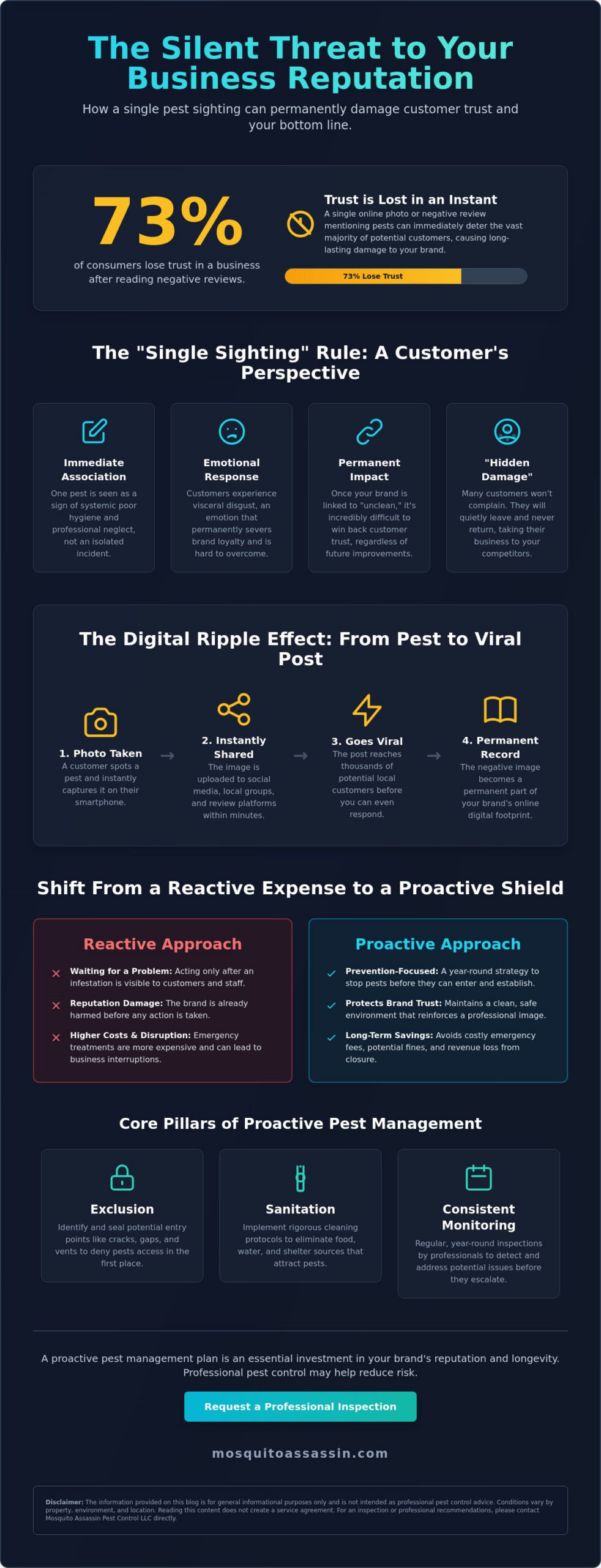
Did you know that 73% of consumers immediately lose trust in a local business after reading negative reviews? In an era where a single smartphone photo of a rodent can go viral in minutes, the stakes for commercial property owners have never been higher. Most professionals in Erie, Crawford, and Ashtabula counties understand that maintaining a clean environment is vital. However, many still view pest management as a reactive expense rather than a proactive shield. This shift in perspective is the first step in avoiding business reputation damage from pests and ensuring your brand remains a trusted name in the community.
It’s understandable to feel anxious about health department inspections or the potential loss of high-value commercial contracts. This article provides a clear strategy for shielding your brand from the catastrophic reputational and financial impacts of infestations. You’ll gain a thorough understanding of current reputation risks and a practical framework for proactive prevention. By prioritizing these professional standards, you can ensure long-term business sustainability and maintain the customer trust that keeps your doors open.
Disclaimer: The information provided on this blog is for general informational purposes only and is not intended as professional pest control advice. Conditions vary by property, environment, and location. Reading this content does not create a service agreement. For an inspection or professional recommendations, please contact Mosquito Assassin Pest Control LLC directly.
Key Takeaways
- Understand why customers view a single pest sighting as a direct reflection of your company’s hygiene and professional standards.
- Explore the long-term impact of digital footprints and how avoiding business reputation damage from pests requires monitoring viral social media trends.
- Recognize the significant financial risks involved, including the potential for structural damage and the revenue loss associated with business interruptions.
- Implement a proactive strategy centered on exclusion and sanitation to prevent pests from entering your commercial facility in the first place.
- Evaluate the benefits of consistent, year-round pest management plans compared to the risks of waiting for a visible problem to occur.
Understanding the Link Between Pests and Brand Perception
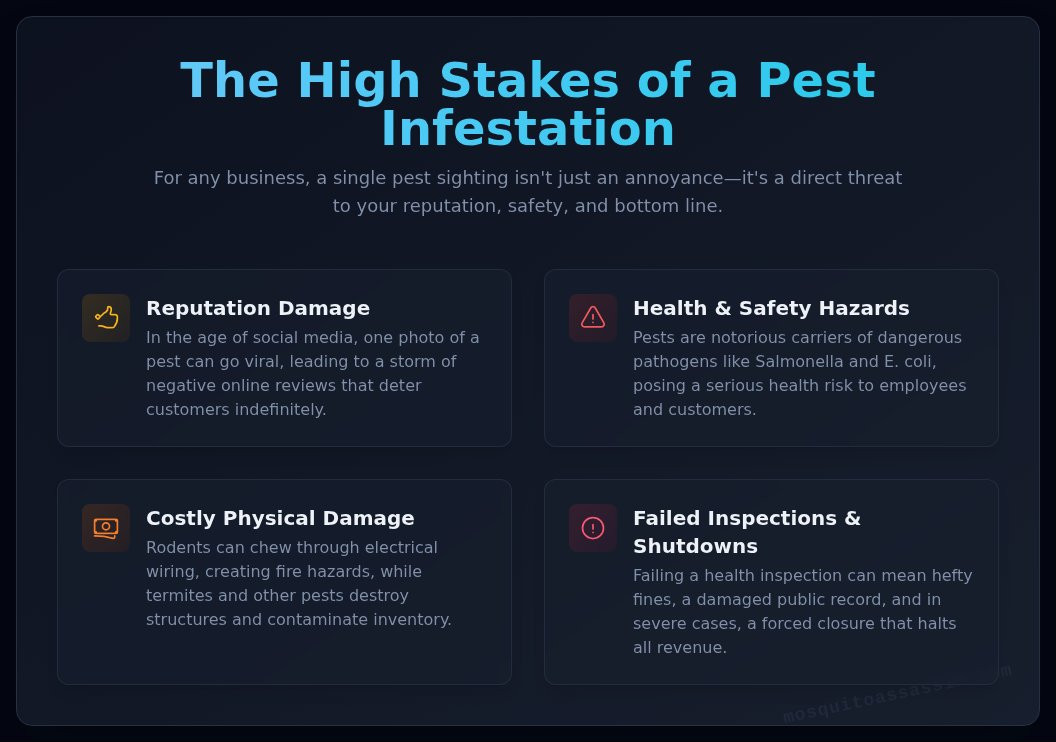
Reputation damage is more than a momentary embarrassment; it is the fundamental erosion of consumer trust that occurs immediately following a pest sighting. For local businesses in Erie and Meadville, this trust is the lifeblood of daily operations. When a customer sees a cockroach or a rodent, they don’t just see an insect; they see a proxy for your overall business hygiene. They instinctively assume that if pests are visible in public areas, the “behind the scenes” areas like kitchens or storage rooms are likely worse. This mental leap happens in seconds and can permanently alter how your brand is perceived in the community.
Many business owners overlook “hidden” damage. This occurs when a customer spots a pest and quietly decides never to return. They often take their business to a competitor without ever filing a formal complaint or speaking to a manager. For high-stakes sectors like food service, hospitality, and healthcare, the margin for error is zero. Maintaining a professional standard involves a commitment to Integrated Pest Management (IPM), which focuses on long-term prevention and environmental health. This strategic approach is essential for avoiding business reputation damage from pests in an increasingly competitive market.
To better understand how these incidents impact your bottom line, watch this helpful video:
The Psychology of the “Single Sighting” Rule
Customers rarely view a single pest as an isolated incident. Instead, psychological studies on consumer behavior suggest that one sighting triggers an immediate association with poor management and systemic neglect. The emotional response is usually one of visceral disgust. This feeling is difficult to overwrite; once a brand is associated with filth in a customer’s mind, loyalty is often permanently severed. In a local economy where word-of-mouth travels fast, one bad experience can ripple through an entire neighborhood, making it difficult to win back lost ground.
First Impressions in Commercial Environments
Entryways and lobbies set the tone for your entire facility. If these high-traffic zones are compromised, the perceived quality of your service drops instantly. Professional commercial pest control services focus on these critical areas to ensure that your first impression is one of safety and cleanliness. By securing the perimeter and maintaining common areas, businesses can project an image of total competence and care. Consistent monitoring ensures that pests are intercepted before they ever reach the eyes of a client or guest, protecting the professional atmosphere you’ve worked hard to build.
Disclaimer: The information provided on this blog is for general informational purposes only and is not intended as professional pest control advice. Conditions vary by property, environment, and location. Reading this content does not create a service agreement. For an inspection or professional recommendations, please contact Mosquito Assassin Pest Control LLC directly.
The Digital Ripple Effect: Social Media and Viral Reviews
In the digital age, news travels at the speed of a single click. A customer in Ashtabula or Erie who spots a rodent or insect doesn’t just tell a friend; they take a high-resolution photo and upload it to a local community group or a review platform. These images often go viral within hours, reaching thousands of potential patrons before a business owner even has a chance to respond. Avoiding business reputation damage from pests in 2026 requires acknowledging that your facility is always under the lens of a smartphone camera. Once an image of a pest infestation is linked to your brand online, it becomes a permanent part of your digital footprint.
Search engines like Google and Yelp index specific keywords within reviews. If terms like “roach,” “rat,” or “dirty” appear frequently, they can haunt your search results for years. This hinders customer acquisition because 76% of consumers regularly read online reviews before choosing a local service or restaurant. Digital complaints are notoriously difficult to remove, especially when they involve health concerns. These public reports often trigger immediate scrutiny regarding FDA Food Code requirements, as health inspectors frequently monitor social media for potential violations. Proactive commercial pest control is the most effective way to ensure these digital nightmares never begin.
The Anatomy of a Viral Pest Complaint
A viral complaint typically starts with a smartphone in a customer’s hand. From there, the path leads to Facebook, Instagram, or Nextdoor. Pest-related content generates exceptionally high engagement because it triggers a strong emotional response of disgust and concern for public safety. Unlike a complaint about slow service, a pest sighting is viewed as a systemic failure of management. Digital archives mean that even if you resolve the issue, the original post or review may still appear when someone searches for your business name years later. It’s a permanent record that demands a zero-tolerance approach to pest presence.
Outdoor Reputation: Mosquitoes and Ticks on the Patio
Reputation management isn’t limited to the interior of your building. For businesses with outdoor dining or recreation areas in Crawford County, seasonal pests like mosquitoes and ticks can be just as damaging to your brand. Customers often associate a high volume of biting insects with a lack of property care and general neglect. If a guest’s primary memory of your patio is being bitten, they’re unlikely to recommend your venue to others. Implementing a targeted mosquito control program helps protect the outdoor experience and ensures your brand remains associated with comfort and relaxation rather than irritation. Maintaining a pest-free exterior is a clear signal to the community that you prioritize their wellbeing in every square inch of your property.
Disclaimer: The information provided on this blog is for general informational purposes only and is not intended as professional pest control advice. Conditions vary by property, environment, and location. Reading this content does not create a service agreement. For an inspection or professional recommendations, please contact Mosquito Assassin Pest Control LLC directly.
Financial and Legal Consequences of Infestations
Financial stability for a commercial property rests on more than just revenue; it requires aggressive risk mitigation. When an infestation occurs, the immediate direct costs can be staggering. Rodents are known to gnaw through electrical wiring and insulation, while termites cause over $5 billion in property damage across the United States annually. These structural issues require expensive repairs that often interrupt daily operations. Beyond the building itself, inventory contamination in warehouses and commercial kitchens leads to total product loss. Avoiding business reputation damage from pests is, at its core, a strategy to protect your bottom line from these sudden and avoidable expenses.
Direct vs. Indirect Financial Impacts
It’s helpful to distinguish between immediate repair costs and the long-term erosion of brand equity. While fixing a structural issue has a clear price tag, the loss of customer trust is far more expensive over time. Reactive treatments are almost always more costly than consistent maintenance because they involve emergency service fees and potential revenue loss during mandatory closures. By implementing proactive IPM strategies, businesses shift from a state of crisis management to one of predictable, manageable protection. This transition is vital for maintaining the financial health of any local enterprise.
Regulatory Compliance in PA and OH
In Erie and Crawford counties, health department inspections are rigorous. Inspectors look for any sign of pest activity, from droppings to nesting materials. Documented general pest control plans are often the first thing an official asks to see during a visit. Failing to provide evidence of a professional plan can lead to heavy fines or immediate closure orders. In competitive regions like Ashtabula, a public record of a failed health inspection can be a death sentence for a small business. Professional commercial pest control provides the necessary documentation to prove you are meeting all local and state safety standards, which is a key component in avoiding business reputation damage from pests.
Employee Morale and Workplace Safety
Your staff’s productivity is directly linked to their environment. A pest-infested workplace reduces morale and can lead to increased employee absenteeism due to health concerns or general discomfort. Employers have a legal and ethical duty to provide a safe, pest-free workplace. When this duty is neglected, the risk of “insider” reputation damage grows. Disgruntled employees who witness unresolved pest issues are often the first to share photos or stories with the public. Maintaining a clean facility protects your team and ensures they remain your brand’s strongest advocates rather than its loudest critics.
Disclaimer: The information provided on this blog is for general informational purposes only and is not intended as professional pest control advice. Conditions vary by property, environment, and location. Reading this content does not create a service agreement. For an inspection or professional recommendations, please contact Mosquito Assassin Pest Control LLC directly.
Proactive Strategies for Reputation Management
Effective reputation management starts with a zero-tolerance policy for pest activity. Waiting for a customer to complain is already too late. Avoiding business reputation damage from pests requires a daily commitment to sanitation and facility maintenance that goes beyond occasional cleaning. A structured checklist for facility managers should include specific tasks to eliminate attractants. This involves removing waste from the building at the end of every shift, cleaning floor drains to prevent fly breeding, and ensuring all food materials are stored in airtight containers. By standardizing these tasks, businesses in Erie and Ashtabula create an environment that is naturally hostile to pests.
The Exclusion and Maintenance Framework
Commercial buildings often have numerous entry points that go unnoticed by staff but are easily found by pests. Loading docks, roof vents, and utility gaps are prime highways for intruders. The exclusion process focuses on physically blocking these routes with professional-grade materials. This is particularly critical for rodent removal, where sealing gaps as small as a quarter-inch is necessary to prevent entry. Additionally, managing moisture levels is a vital maintenance step. Leaky pipes or poor exterior drainage can attract termites and ants, creating long-term structural and reputational risks for the property.
Staff Training and Internal Reporting
Employees are the eyes and ears of your facility. Training them to recognize early warning signs, such as droppings, gnaw marks, or unusual odors, allows for intervention before a problem becomes public. It’s helpful to teach staff the difference between a single sighting, which might be an opportunistic pest entering through an open door, and an infestation, where pests are living and breeding on-site. Providing a clear, non-punitive internal reporting framework ensures that small issues are documented and addressed by licensed professionals immediately. This internal vigilance is your first line of defense against viral reviews.
If a pest incident does become public, transparency is the best recovery tool. Having a pre-planned communication strategy helps address concerns without appearing defensive. Acknowledge the issue, explain the corrective steps taken, and highlight your ongoing commitment to professional standards. Proactive commercial pest control services help ensure you have the documentation needed to prove your dedication to safety and cleanliness to both the public and local health officials.
Disclaimer: The information provided on this blog is for general informational purposes only and is not intended as professional pest control advice. Conditions vary by property, environment, and location. Reading this content does not create a service agreement. For an inspection or professional recommendations, please contact Mosquito Assassin Pest Control LLC directly.
The Role of Year-Round Professional Protection
Pest management is often misunderstood as a seasonal task, yet the biological reality of common intruders demands a constant defensive posture. For commercial property owners, treating a pest issue as a one-and-done event is a significant risk to brand safety. Avoiding business reputation damage from pests requires a shift from reactive crisis management to a consistent, year-round strategy. Bi-monthly protection plans provide this stability by maintaining a refreshed chemical or physical barrier around the facility. This schedule ensures that professional monitoring stations are inspected regularly, allowing for the detection of subtle signs of activity that an untrained eye would likely miss.
Professional documentation is perhaps the most undervalued asset of a recurring service plan. In the event of a health department inquiry or a customer complaint, having a detailed history of professional inspections and treatments serves as tangible proof of due diligence. It demonstrates to officials and the public that the business prioritizes hygiene and follows a disciplined operational approach. This record-keeping is a vital shield against legal liabilities and regulatory fines, positioning professional intervention as the most reliable way to remain pest-free and compliant with local standards.
Why One-Time Fixes Fail Commercial Brands
The primary reason one-time treatments fail is the rapid reproductive cycle of common pests. Cockroaches, for example, can produce dozens of offspring from a single egg casing that may be hidden in a wall void or under a heavy appliance where initial treatments might not reach. Similarly, rodents have short gestation periods, meaning a small population can explode in size within weeks. Temporary solutions often eliminate the visible adults but leave the next generation behind, leading to a “re-infestation” that surprises the business owner. Furthermore, in commercial districts where buildings are closely packed, pests constantly migrate from neighboring properties. A one-time fix provides a false sense of security that can lead to a catastrophic brand failure when the population inevitably rebounds.
Partnering with Local Licensed Professionals
Specialized knowledge of the local environment is essential for effective commercial pest control. The pests found in Northwest Pennsylvania and Northeast Ohio have specific behaviors influenced by the regional climate, such as the high moisture levels near Lake Erie that drive termite and ant activity. Local experts understand these patterns and the unique challenges faced by businesses in Erie, Crawford, and Ashtabula counties. By working with professionals who live and work in the same community, business owners gain a partner who is familiar with the specific pressures of the Tri-State area. You can learn more about Mosquito Assassin and their commitment to regional expertise, which is a key component in maintaining long-term business sustainability and customer trust.
Disclaimer: The information provided on this blog is for general informational purposes only and is not intended as professional pest control advice. Conditions vary by property, environment, and location. Reading this content does not create a service agreement. For an inspection or professional recommendations, please contact Mosquito Assassin Pest Control LLC directly.
Securing Your Commercial Legacy for 2026 and Beyond
Protecting a commercial brand requires more than just quality service; it demands a sterile and safe environment. As digital platforms continue to amplify consumer voices, the most effective method for avoiding business reputation damage from pests is moving from a reactive mindset to a proactive, year-round defensive strategy. Businesses that prioritize specialized commercial exclusion and consistent maintenance protocols ensure they’re never at the mercy of a single viral review or a failed health inspection. It’s about building a foundation of trust that can withstand the scrutiny of the modern marketplace.
Maintaining this standard is a continuous process. Licensed professionals serving Erie, Crawford, and Ashtabula counties provide the expertise needed to navigate regional pest pressures and strict regulatory requirements. Proven year-round protection plans allow facility managers to focus on growth while knowing their reputation is shielded from the financial and legal risks of an infestation. Professional pest control may help protect your business reputation. For an inspection or professional recommendations, please contact Mosquito Assassin Pest Control LLC directly.
Disclaimer: The information provided on this blog is for general informational purposes only and is not intended as professional pest control advice. Conditions vary by property, environment, and location. Reading this content does not create a service agreement. For an inspection or professional recommendations, please contact Mosquito Assassin Pest Control LLC directly.
Frequently Asked Questions
How quickly can a pest infestation damage my business reputation?
Reputation damage can occur in the time it takes to upload a photo to social media. In a connected community like Erie, a single viral post about a rodent sighting can reach thousands of people in just a few hours. This rapid spread makes proactive prevention the only reliable way of avoiding business reputation damage from pests before a digital crisis begins.
What are the most common pests that affect businesses in Pennsylvania and Ohio?
Businesses in Northwest Pennsylvania and Northeast Ohio most frequently deal with rodents, cockroaches, and flies. Seasonal challenges also include ants and mosquitoes, which can disrupt outdoor service areas. These pests are attracted to the food sources and shelter found in commercial environments, especially during the extreme temperature shifts common in the Tri-State region.
Can a single negative review about pests really hurt my sales?
A single negative review mentioning pests can have a devastating impact on customer acquisition. Research indicates that a significant majority of consumers read online reviews before visiting a local business. Because pests are associated with poor hygiene, a public complaint can deter high-value commercial contracts and individual patrons for years after the incident.
Is professional pest control required for health department compliance?
Health department regulations in Erie and Crawford counties typically require establishments to maintain a pest-free environment. While specific language varies, inspectors often demand documentation of a professional pest management plan during routine visits. Failing to provide proof of professional oversight can lead to fines, lower health scores, or immediate closure orders.
How can I tell if my business has a hidden pest problem?
Hidden infestations are often signaled by small, physical clues before a pest is actually seen. Facility managers should look for droppings in dark corners, gnaw marks on packaging, or greasy rub marks along baseboards. Unusual odors or shredded paper nesting materials in storage areas are also clear indicators that professional pest control may help reduce risk.
What should I do if a customer sees a pest in my establishment?
Immediate and professional communication is essential if a customer spots a pest. Acknowledge the situation without being defensive and explain that a professional management plan is currently in place. Following up with your service provider to document the sighting and adjust your strategy is a critical step in avoiding business reputation damage from pests.
Why is year-round pest protection better than one-time treatments?
Year-round protection is superior because it addresses the continuous reproductive cycles of pests. One-time treatments often fail to eliminate eggs or hidden colonies, allowing the population to rebound quickly. Consistent bi-monthly or monthly visits ensure that defensive barriers are maintained and that new pests migrating from neighboring properties are intercepted.
How much does professional commercial pest control typically cost?
The cost of commercial pest management depends on several factors, including the square footage of the facility and the specific industry requirements. High-risk environments like restaurants or healthcare facilities often require more frequent monitoring than standard retail spaces. Property owners should consult with a licensed professional to determine a plan that fits their specific environmental needs and budget.
Disclaimer: The information provided on this blog is for general informational purposes only and is not intended as professional pest control advice. Conditions vary by property, environment, and location. Reading this content does not create a service agreement. For an inspection or professional recommendations, please contact Mosquito Assassin Pest Control LLC directly.