
Tag: sanitation

  • How to Pass a Restaurant Health Inspection: A Comprehensive 2026 Guide

    How to Pass a Restaurant Health Inspection: A Comprehensive 2026 Guide

    With approximately 48 million people in the United States affected by foodborne illnesses every year, the stakes for commercial kitchens have never been higher. It’s natural to feel a sense of dread when an inspector walks through the door, especially when you are trying to figure out how to pass a restaurant health inspection amidst the 2026 FDA Food Code updates and new requirements for allergens like sesame. Managing staff consistency and complex local regulations in Erie, Crawford, or Ashtabula County can feel like a constant battle against potential violations. You deserve the peace of mind that comes with a high public-facing health score and a kitchen that operates at peak safety standards every day.

    Mastering food safety is not about a frantic one-day cleaning spree; it’s about building sustainable systems that make compliance automatic. This guide breaks down the core pillars of sanitation and standardized training procedures to help you achieve zero critical violations. Protect your reputation and ensure your establishment remains a safe, dependable fixture in the community by implementing these professional standards. Explore the essential protocols and documentation required to master the latest regulatory shifts and maintain a disciplined, pest-free environment.

    Disclaimer: The information provided on this blog is for general informational purposes only and is not intended as professional pest control advice. Conditions vary by property, environment, and location. Reading this content does not create a service agreement. For an inspection or professional recommendations, please contact Mosquito Assassin Pest Control LLC directly.
    Key Takeaways

    • Understand that health inspections are scientific assessments focused on protecting public safety and preventing foodborne illness.
    • Learn how to pass a restaurant health inspection by mastering the core pillars of compliance, such as temperature control and employee hygiene.
    • Identify why pest activity is classified as a critical priority violation and how rigorous cleaning protocols eliminate common environmental attractants.
    • Move toward a sustainable inspection readiness culture by implementing daily checklist systems and regular internal audits.
    • Discover the benefits of professional commercial pest control services and how Integrated Pest Management (IPM) supports long-term regulatory success.

    Understanding the Restaurant Health Inspection Process

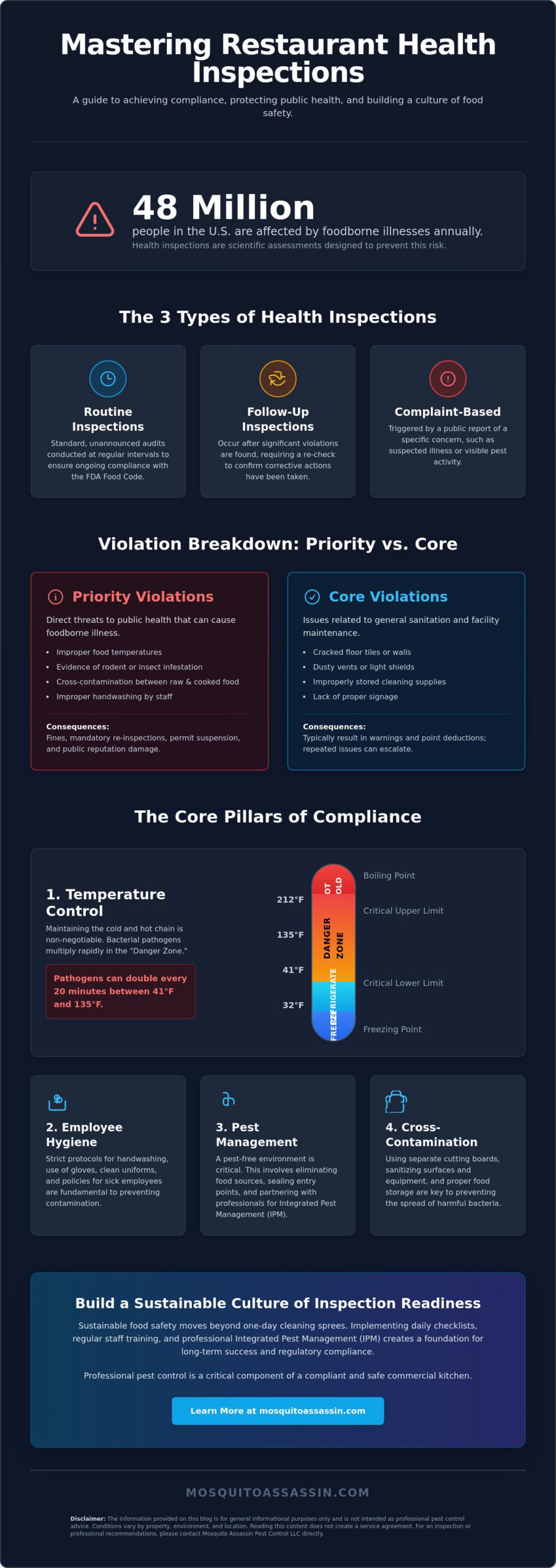
    A restaurant health inspection is a rigorous, unannounced regulatory assessment designed to evaluate how well an establishment adheres to established food safety principles. The primary objective is to protect public health by identifying and correcting behaviors that lead to foodborne illness. Understanding this process is the first step in learning how to pass a restaurant health inspection with a perfect score. Inspectors focus on high-risk factors like food temperature, cross-contamination, and personal hygiene to mitigate the risk of the 48 million foodborne illness cases reported annually in the United States.

    Establishments typically face three types of visits. Routine inspections are the standard, unannounced audits conducted at regular intervals. Follow-up inspections occur if an inspector identifies significant issues that require a re-check to confirm compliance. Complaint-based inspections are triggered when a member of the public reports a specific concern, such as a suspected illness or visible pest activity. In Erie and Crawford Counties in Pennsylvania, as well as Ashtabula County in Ohio, the frequency of these visits depends on the facility’s risk category, which is based on the complexity of the menu and the volume of customers served.

    Who Conducts the Inspections?

    In our region, the authority behind these audits varies by state. In Erie County, the Erie County Health Department manages inspections. In Crawford County, the Pennsylvania Department of Agriculture often takes the lead unless a local health department is established. Across the border in Ashtabula County, the local Health District enforces Ohio’s uniform food safety code. While the specific agency might change, all these bodies use the FDA Food Code as their scientific baseline. The 2026 FDA Food Code updates have introduced stricter requirements for allergen management and traceability, making it essential for operators to stay current on new regulations. When an inspector arrives, they will present credentials and ask to speak with the person in charge.

    Types of Violations and Their Impact

    Inspectors categorize findings into two main groups: priority violations and core violations. Priority violations (formerly called critical violations) are direct threats to health, such as improper cooling temperatures or evidence of a rodent infestation. Core violations relate to general maintenance and sanitation, like a cracked floor tile or a dusty vent. Accumulating priority violations can lead to immediate consequences, including heavy fines, mandatory re-inspections, or the temporary suspension of your operating permit. Beyond legal penalties, health scores are public records. A poor grade can cause lasting damage to your business reputation, as modern consumers frequently check online databases before deciding where to eat. Learning how to pass a restaurant health inspection is a vital business strategy to ensure long-term stability and community trust.

    Disclaimer: The information provided on this blog is for general informational purposes only and is not intended as professional pest control advice. Conditions vary by property, environment, and location. Reading this content does not create a service agreement. For an inspection or professional recommendations, please contact Mosquito Assassin Pest Control LLC directly.

    Core Compliance Pillars: Food Temperature and Employee Hygiene

    Maintaining the cold chain is a non-negotiable requirement for any commercial kitchen in Erie, Crawford, or Ashtabula County. Inspectors prioritize refrigeration because temperature abuse is a leading cause of bacterial growth. Your refrigerators must consistently hold food at 41°F or below, while freezers should keep products frozen solid. Understanding how to pass a restaurant health inspection starts with recognizing that these numbers aren’t suggestions; they are scientific safeguards. When food enters the “Danger Zone” between 41°F and 135°F, pathogens can double in number in as little as 20 minutes. Monitoring these levels requires a disciplined approach and reliable equipment.

    Proper cooking temperatures are equally vital. Different proteins require specific internal heat levels to ensure safety, such as 165°F for poultry and 155°F for ground meats. Beyond the stove, hygiene remains the most visible indicator of a kitchen’s safety culture. Standardized handwashing protocols require staff to scrub for at least 20 seconds using warm water and soap. This must only occur at dedicated hand sinks, which must be stocked with paper towels and soap at all times. If an inspector sees a staff member using a prep sink to wash their hands, it’s an immediate red flag. Maintaining a clean environment is a team effort, and professional commercial pest control can help support these sanitation goals by identifying structural gaps that lead to contamination.

    Time and Temperature Control

    Consistency relies on the use of calibrated thermometers. Staff should check and log temperatures multiple times per shift to provide a paper trail of compliance. The FDA Food Code outlines specific cooling procedures for hot foods, known as the two-stage method. Food must drop from 135°F to 70°F within two hours, and then down to 41°F within the next four hours. Thawing also requires care. Never thaw food at room temperature; use the refrigerator, cold running water, or the microwave as part of the cooking process to keep the product safe.

    Personal Hygiene and Staff Habits

    Employee habits can make or break an audit. Bare-hand contact with ready-to-eat foods is prohibited; gloves or utensils must be used instead. Staff should wear effective hair restraints and clean uniforms while avoiding most jewelry, except for a plain wedding band. It’s also critical to have a clear employee health policy. Management must exclude staff from the kitchen if they exhibit symptoms like vomiting, diarrhea, or jaundice. This protects your customers and ensures you are following the best practices of a professional food service operation.

    Disclaimer: The information provided on this blog is for general informational purposes only and is not intended as professional pest control advice. Conditions vary by property, environment, and location. Reading this content does not create a service agreement. For an inspection or professional recommendations, please contact Mosquito Assassin Pest Control LLC directly.

    How to Pass a Restaurant Health Inspection: A Comprehensive 2026 Guide

    Managing Pest Control Requirements for Health Inspections

    Pest activity is frequently classified as a critical priority violation because pests are biological vectors for dangerous pathogens. If an inspector finds live cockroaches, rodent droppings, or flies in food preparation areas, the facility faces immediate penalties. Understanding how to pass a restaurant health inspection requires a proactive approach to pest management that goes beyond simple reactive measures. A single sighting can lead to a failed audit, making it essential to treat pest prevention as a daily operational requirement.

    Sanitation is your most powerful defense. Pests are attracted to food sources like accumulated grease behind fryers or standing water in poorly maintained floor drains. By eliminating these attractants, you remove the primary reason pests enter your kitchen in the first place. Exclusion strategies are equally important for long term success. This includes installing heavy duty door sweeps, sealing gaps around utility lines, and ensuring windows have tight fitting screens. A professional pest management plan is a necessity for any commercial facility to maintain these high standards and protect public health.

    The Pest Control Logbook

    In Erie and Crawford Counties, as well as Ashtabula County, inspectors expect to see a comprehensive pest control logbook on the premises. This is not just a folder; it’s a living record of your safety commitment. It should contain detailed reports of all sightings, actions taken, and current service reports. You must also keep pesticide application records on-site for immediate review. Ensure your service provider is properly licensed in Pennsylvania or Ohio to perform commercial work. While Florida’s restaurant inspection process provides a clear example of how these records are audited at the state level, local health departments in our region follow similar rigorous documentation standards.

    Common Pest Hotspots in Commercial Kitchens

    Early detection is vital for long term compliance. Focus your internal audits on hotspots like floor drains, the areas behind heavy refrigeration units, and inside motor housings where warmth attracts insects. Dumpster areas and external waste disposal sites must be managed carefully to minimize attraction from the perimeter. Regular professional inspections help identify early signs of activity before they become a violation on a public report. Utilizing commercial pest control ensures that these vulnerable areas are monitored by experts who understand the specific pressures of the food service industry. By identifying risks before the inspector arrives, you maintain control over your establishment’s reputation.

    Disclaimer: The information provided on this blog is for general informational purposes only and is not intended as professional pest control advice. Conditions vary by property, environment, and location. Reading this content does not create a service agreement. For an inspection or professional recommendations, please contact Mosquito Assassin Pest Control LLC directly.

    Creating a Sustainable Inspection Readiness Culture

    Many kitchen managers fall into the trap of “crisis cleaning” the moment they hear an inspector is in the neighborhood. This reactive approach is exhausting and frequently leads to overlooked details that result in priority violations. Learning how to pass a restaurant health inspection is actually about shifting your mindset from a single event to a daily operational standard. When food safety becomes a core part of your team’s identity, compliance becomes an automatic byproduct of your workflow rather than a source of panic. This cultural shift requires clear expectations and a commitment to standardized training across all shifts in your Erie, Crawford, or Ashtabula County establishment.

    Empowerment is the foundation of this culture. Instead of micromanaging every task, give your staff ownership over their specific stations. When a line cook understands that they are the primary guardian of their station’s temperature logs and sanitation buckets, they take more pride in the results. Ongoing education is also vital. Encouraging or requiring food safety certifications like ServSafe ensures that every team member understands the scientific reasons behind the rules. This technical knowledge helps staff recognize risks, such as cross-contamination or improper storage, before they escalate into significant safety issues.

    The Daily and Weekly Checklist

    Consistency relies on written systems. opening and closing checklists should be non-negotiable for every shift. These lists must include verifying that all food is properly labeled and dated using the First In, First Out (FIFO) method to prevent spoilage. While daily cleaning covers the surfaces, your weekly schedule must address less accessible areas. Vents, grease filters, and floor drains require deep cleaning to prevent the buildup of organic matter that attracts pests and creates fire hazards. If you need support in maintaining a sanitary, compliant environment, commercial pest control can help you identify and manage the environmental factors that inspectors watch for most closely.

    Training for the Unexpected

    Staff should be trained on how to interact professionally with health inspectors from the moment they walk through the door. A professional, calm demeanor demonstrates confidence in your food safety systems. Every team member should know exactly where to find essential documentation, including Safety Data Sheets (SDS), employee health policies, and temperature logs. Conduct a mock inspection once a month to simulate the pressure of a real audit. These simulations allow you to identify weaknesses in your training and correct them in a low stakes environment, ensuring your team is ready for the real thing at any time.

    Disclaimer: The information provided on this blog is for general informational purposes only and is not intended as professional pest control advice. Conditions vary by property, environment, and location. Reading this content does not create a service agreement. For an inspection or professional recommendations, please contact Mosquito Assassin Pest Control LLC directly.

    Partnering with Professionals for Long-Term Compliance

    Achieving a high health score requires more than just internal diligence; it often involves strategic partnerships with experts who understand the scientific and regulatory landscape. Utilizing commercial pest control services provides a layer of protection that internal cleaning alone cannot match. Professionals bring technical proficiency to identify structural deficiencies, such as microscopic entry points or sanitation gaps in hard to reach motor housings. In regions like Erie, Meadville, and Ashtabula, local health inspectors look for evidence of a comprehensive plan rather than reactive measures. A proactive partnership ensures your facility is prepared for scrutiny from the Pennsylvania Department of Agriculture or Ohio health districts at any moment.

    Integrated Pest Management (IPM) is the gold standard for food service environments because it aligns perfectly with health department goals. Unlike basic “spraying” methods often discussed in casual forums, IPM focuses on long term prevention through sanitation, exclusion, and monitoring. This methodology reduces the reliance on chemical applications while maximizing the effectiveness of every intervention. By addressing the root causes of pest attraction, such as moisture in floor drains or grease buildup, professional services help you understand how to pass a restaurant health inspection by maintaining a fundamentally sound environment. This systematic approach transforms pest control from a recurring anxiety into a controlled, documented business process.

    The Role of Documentation in Passing

    Documentation is the bridge between doing the work and proving it to an inspector. Professional service records serve as tangible evidence of your proactive approach to food safety. These logs must show regular monitoring, identified risks, and the corrective actions taken to mitigate them. High standards in professional pest control may help reduce risk by providing the exact paper trail that local health departments require. When an inspector sees a well maintained logbook with current service reports, it signals that the establishment is managed with discipline and professional oversight.

    Selecting a Local Provider

    Choosing a provider with deep roots in Northwest Pennsylvania and Northeast Ohio is a strategic advantage. Different regions face unique pest pressures, and a local expert will be familiar with the specific behaviors of pests common to the Great Lakes area. It’s essential to verify that any partner holds the correct commercial licenses and can provide the detailed reporting necessary for modern health audits. Learning more about local pest management standards can help you select a partner that prioritizes the same community values and safety goals as your own business. A dependable expert will not only treat the property but also educate your staff on maintaining the highest levels of sanitation between visits.

    Disclaimer: The information provided on this blog is for general informational purposes only and is not intended as professional pest control advice. Conditions vary by property, environment, and location. Reading this content does not create a service agreement. For an inspection or professional recommendations, please contact Mosquito Assassin Pest Control LLC directly.

    Securing Your Reputation and Compliance

    Mastering the 2026 FDA Food Code is only half the battle. Long-term success relies on moving away from reactive cleaning and toward a disciplined culture of daily readiness. By focusing on core pillars like precise temperature monitoring and rigorous employee hygiene, you ensure your kitchen meets the highest scientific standards. Understanding how to pass a restaurant health inspection is a continuous process that protects your customers and your business reputation throughout Northwest Pennsylvania and Northeast Ohio.

    Professional support simplifies this journey by addressing structural vulnerabilities and providing the necessary paper trail for health department logs. Licensed and insured in PA and OH, Mosquito Assassin Pest Control LLC offers deep experience with regional commercial compliance standards and provides detailed documentation for every visit. To strengthen your facility’s defenses, consult with a professional regarding your commercial pest management needs. Maintaining a safe, compliant environment is entirely achievable with the right systems and expert guidance in place.

    Disclaimer: The information provided on this blog is for general informational purposes only and is not intended as professional pest control advice. Conditions vary by property, environment, and location. Reading this content does not create a service agreement. For an inspection or professional recommendations, please contact Mosquito Assassin Pest Control LLC directly.

    Frequently Asked Questions

    What is the most common reason for failing a health inspection?

    Priority violations related to time and temperature control are the leading causes of failed audits. When food stays in the Danger Zone for too long, it creates a high risk of foodborne illness. Poor employee handwashing and bare-hand contact with ready-to-eat foods also rank high. Consistent training and daily monitoring of these core pillars are the most effective ways to ensure your establishment remains compliant during an unannounced visit.

    Can a restaurant stay open if it has a pest sighting during an inspection?

    A single sighting of a non-critical pest, like a housefly, usually results in a core violation. However, evidence of a priority pest infestation, such as live cockroaches or rodent droppings, can lead to an immediate suspension of your operating permit. In Erie or Ashtabula County, inspectors prioritize public safety above all else. If an infestation is discovered, the facility must typically close until the problem is resolved and a follow-up inspection is passed.

    How often should a restaurant conduct its own self-inspections?

    Establishments should conduct comprehensive internal self-inspections at least once a month. This practice helps managers identify and correct issues before an official audit occurs. Daily checklists for opening and closing shifts provide the baseline for sanitation, but a deeper monthly review allows for a thorough assessment of equipment maintenance and structural integrity. Learning how to pass a restaurant health inspection requires this level of proactive, disciplined oversight to prevent small issues from becoming critical violations.

    What documents must be readily available for a health inspector?

    Inspectors expect to see several key documents immediately upon arrival. These include current food manager certifications, employee health policies, and daily temperature logs for refrigeration and cooking. You must also provide a detailed pest control logbook containing recent service reports and pesticide application records. Keeping these files organized in a central location demonstrates a professional commitment to safety and allows the inspection to proceed smoothly without unnecessary delays or confusion.

    Is a professional pest control contract required by law for restaurants?

    While specific local laws in Pennsylvania and Ohio may not always mandate a signed contract, they do require every food service facility to remain entirely pest-free. Having a professional commercial pest control plan is the industry standard for proving you have taken the necessary preventive measures. Professional documentation shows the inspector that you are proactive rather than reactive. This level of oversight is often the difference between a minor observation and a critical priority violation.

    What should a manager do if they disagree with an inspector’s findings?

    If you disagree with a finding, the best approach is to discuss the concern professionally during the exit interview. Ask the inspector to clarify the specific section of the food code that applies to the observation. If the issue remains unresolved, you have the right to contact a supervisor at the local health department to request a formal review. Maintaining a respectful and cooperative relationship with your inspector is vital for long-term regulatory success.

    How does the FIFO method help with health inspection compliance?

    The First In, First Out (FIFO) method ensures that older inventory is used before newer shipments, which prevents food from expiring or spoiling on the shelf. This system directly supports compliance with labeling and dating requirements. Inspectors look for clear date markings on all prepared and opened foods to confirm they are discarded within the seven-day safety window. Implementing FIFO as a standardized staff habit significantly reduces the risk of core violations related to food storage.

    Are unannounced inspections legal in Pennsylvania and Ohio?

    Yes, unannounced inspections are the legal standard in Pennsylvania and Ohio. Health departments in Erie, Crawford, and Ashtabula Counties have the authority to enter any licensed food establishment during normal business hours. This allows regulators to observe the kitchen’s true daily operations rather than a staged environment. Being prepared at all times is the only reliable strategy for how to pass a restaurant health inspection and protect the reputation of your establishment.

    Disclaimer: The information provided on this blog is for general informational purposes only and is not intended as professional pest control advice. Conditions vary by property, environment, and location. Reading this content does not create a service agreement. For an inspection or professional recommendations, please contact Mosquito Assassin Pest Control LLC directly.

  • Comprehensive Hotel Pest Management Solutions for the Hospitality Industry

    Comprehensive Hotel Pest Management Solutions for the Hospitality Industry

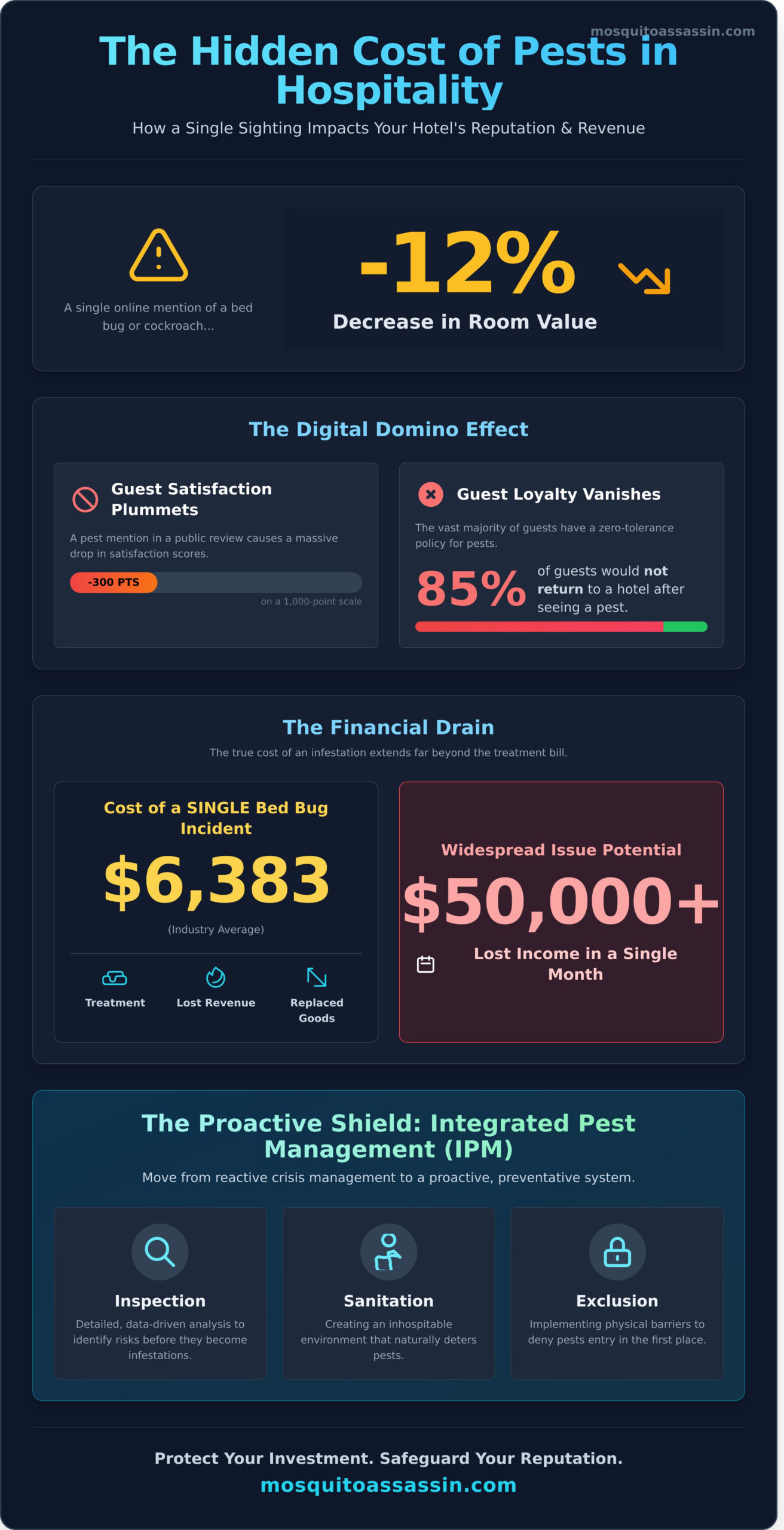
    A single online mention of a bed bug or cockroach can decrease a hotel’s room value by 12% according to research conducted by the University of Kentucky. For a 100 room facility in Erie or Crawford County, this translates to thousands in potential revenue loss before a single treatment even begins. It’s an understandable fear for hospitality managers who must balance high guest turnover with the constant demand for a spotless, sanitary environment.

    Maintaining a five star reputation requires more than just reactive spraying; it demands comprehensive hotel pest management solutions that remain invisible to the public eye. This article explains how professional integrated pest management safeguards guest experiences, ensures compliance with health standards in the PA and OH regions, and prevents the high costs associated with room closures. Readers will discover a proactive strategy for keeping pests out of the lobby and off of social media platforms.

    Disclaimer: The information provided on this blog is for general informational purposes only and is not intended as professional pest control advice. Conditions vary by property, environment, and location. Reading this content does not create a service agreement. For an inspection or professional recommendations, please contact Mosquito Assassin Pest Control LLC directly.

    Key Takeaways

    • Understand how proactive pest management prevents revenue loss and protects a hotel’s reputation from the financial impact of public pest sightings.

    • Learn how integrated hotel pest management solutions prioritize long-term prevention through sanitation and structural exclusion rather than relying solely on reactive treatments.

    • Identify the specific behaviors of bed bugs and rodents in commercial settings to better mitigate the unique risks they pose to guest safety.

    • Discover how to establish a culture of awareness among housekeeping staff and implement effective internal reporting systems for early detection.

    • Explore how the Great Lakes climate in Erie and Ashtabula influences seasonal pest pressures and why localized knowledge is vital for effective control.

    Table of Contents

    Understanding Hotel Pest Management Solutions and Brand Protection

    Professional hospitality pest management is a proactive, data-driven system designed to stop infestations before they start. It moves beyond reactive methods that only address pests after they’ve been spotted by a guest or staff member. Instead, it relies on Integrated Pest Management (IPM), which combines detailed inspection, improved sanitation, and physical barriers to create an inhospitable environment for intruders. For hotels in Erie County, Crawford County, and Ashtabula County, this systematic approach is the baseline for maintaining brand integrity. A single pest sighting isn’t just a nuisance; it’s a direct threat to the property’s financial health.

    To better understand how these systems work within a lodging environment, watch this helpful video:

    The stakes for 2026 haven’t ever been higher for the hospitality industry. Digital reviews on platforms like TripAdvisor and Google act as permanent, searchable records of a property’s hygiene. A 2024 study by J.D. Power indicated that guest satisfaction scores drop by an average of 300 points on a 1,000-point scale when a pest is mentioned in a public review. In this digital era, a single photo of a cockroach or bed bug can reach thousands of potential travelers in minutes, causing immediate booking cancellations and long-term erosion of trust. Third-party audits and health department compliance are no longer just checkboxes; they’re essential components of a hotel’s survival strategy.

    The Financial Impact of Infestations

    The true cost of an infestation far exceeds the price of a service visit. When a room is taken out of service for remediation, the hotel loses Daily Average Rate (ADR) revenue immediately. Industry data from 2023 suggests that the average cost of a single bed bug incident, including professional treatment, replaced soft goods, and lost revenue, reaches approximately $6,383. For a mid-sized hotel in Pennsylvania, a widespread issue could lead to $50,000 in lost income over a single month. Beyond these immediate expenses, legal implications for hospitality businesses can be severe. Regulatory bodies in Ohio and Pennsylvania require strict adherence to health codes; failure to comply can lead to heavy fines or forced closures. Investing in long-term hotel pest management solutions is a capital-preserving strategy compared to the high cost of reactive crisis management.

    Guest Expectations in the Modern Era

    Today’s travelers have a zero-tolerance policy for pests. In 2025, surveys showed that 85 percent of guests wouldn’t return to a hotel if they saw a pest in their room. This expectation puts immense pressure on management to implement hotel pest management solutions that work silently in the background. The speed of social media means a guest can broadcast a complaint to a global audience before they’ve even checked out of the lobby. Successful management requires balancing effective treatment with guest privacy and comfort. Treatments must be discreet, low-impact, and odor-free so that guests remain unaware of the preventative measures in place. Maintaining this invisible shield is what separates top-tier hospitality brands in Ashtabula County from those struggling with reputation damage. Professional pest control may help reduce risk and ensure that guest comfort remains the top priority.

    Disclaimer: The information provided on this blog is for general informational purposes only and is not intended as professional pest control advice. Conditions vary by property, environment, and location. Reading this content does not create a service agreement. For an inspection or professional recommendations, please contact Mosquito Assassin Pest Control LLC directly.

    Core Components of Integrated Pest Management for Hotels

    Integrated Pest Management (IPM) is the gold standard for modern hospitality. It shifts the focus from reactive methods to a science-based strategy. For a hotel manager, this means looking at the building as an ecosystem. Successful IPM practices for hotels involve a partnership between staff and pest professionals. Instead of relying on routine chemical applications, the priority is sanitation and structural integrity. Roughly 85% of pest issues can be mitigated through physical changes rather than liquid treatments. This philosophy ensures that chemical use is a last resort, which protects guest safety and environmental health.

    Customization is vital. A hotel built in 1965 in Erie County will have different structural vulnerabilities than a new build in Crawford County. A one-size-fits-all approach fails because pests exploit specific architectural flaws. Professional managers require detailed documentation. Every sighting, trap check, and structural repair must be logged. This data creates a roadmap, showing where vulnerabilities exist before a guest ever sees a pest. A 2022 study showed that facilities with robust digital reporting saw a 40% faster resolution time for localized infestations. Detailed reporting isn’t just paperwork; it’s a defensive tool that helps managers track trends and allocate resources effectively.

    Inspection and Monitoring Protocols

    Regular inspections are the backbone of effective hotel pest management solutions. High-risk zones require frequent checks to ensure small sightings don’t become full-blown infestations. Key areas include:

    • Commercial Kitchens: These provide constant food and water sources for rodents and cockroaches.

    • Laundry Rooms: High humidity and warmth attract various insects, including silverfish.

    • Loading Docks: This is the primary entry point for 75% of structural pests arriving via shipments.

    Monitoring stations, such as glue boards or pheromone traps, act as 24/7 sentries. These devices don’t just catch pests; they provide data on population trends. If a technician finds three cockroaches in a specific corner, it reveals a localized sanitation failure that needs immediate attention. Professional assessments should occur at least monthly to catch issues before they escalate into guest-facing problems.

    Exclusion and Habitat Modification

    Exclusion is about building pests out. A mouse can squeeze through a 1/4 inch gap. In aging hotel structures across Ashtabula County, sealing gaps around utility lines and door sweeps is a primary defense. Lighting also plays a massive role. Replacing standard mercury vapor bulbs with LED lights can reduce insect attraction by up to 60% in many environments. Moisture management is another pillar. Leaky HVAC units or poorly drained plumbing create water stations for pests. Addressing these mechanical issues removes the resources pests need to survive. A single dripping faucet can support a German cockroach colony for weeks. Professional oversight ensures these technical details aren’t overlooked. If you’re concerned about structural vulnerabilities, scheduling a professional assessment may help identify hidden risks.

    Disclaimer: The information provided on this blog is for general informational purposes only and is not intended as professional pest control advice. Conditions vary by property, environment, and location. Reading this content does not create a service agreement. For an inspection or professional recommendations, please contact Mosquito Assassin Pest Control LLC directly.

    Critical Threats: Bed Bugs and Rodent Management

    Bed bugs are the single greatest threat to a hotel’s reputation and bottom line. A 2017 study by the University of Kentucky found that a single mention of bed bugs in a recent online review can lower a hotel’s room value by $38 per night for business travelers and $23 for leisure travelers. These pests don’t distinguish between a budget motel and a five-star resort. They hitchhike on luggage and clothing, making every check-in a potential introduction point. Because a single female can lay 200 to 500 eggs in her lifetime, a minor introduction can escalate into a building-wide crisis within weeks.

    Rodents present a different set of challenges that impact both health and infrastructure. Mice and rats are opportunistic, entering commercial buildings through openings as small as 1/4 inch. According to industry data, 21 million homes and businesses are invaded by rodents each winter in the United States. In Erie and Crawford Counties, dropping temperatures often drive these pests indoors during the fall months seeking warmth and food. Once inside, they cause structural damage by gnawing on wires and insulation, which increases fire risks. They also carry pathogens like Salmonella, posing a direct threat to guest safety.

    Effective hotel pest management solutions rely on the distinction between preventative monitoring and active eradication. Monitoring involves placing discreet sensors and traps to catch activity before a guest ever sees a pest. Eradication is the process of removing an established population once it’s been identified. Professional intervention ensures that treatments are contained. Without a systematic approach, a small issue in one guest room can quickly migrate through shared walls and utility lines, leading to a much larger financial loss.

    Bed Bug Prevention and Rapid Response

    Early detection is vital for maintaining high occupancy rates. Housekeeping staff should perform visual inspections during every turnover, looking for dark spotting on mattresses or discarded skins in headboard crevices. Utilizing Controlling Bed Bugs strategies through Integrated Pest Management (IPM) helps reduce the need for aggressive chemical applications. Professional intervention ensures that treatments are discrete, preventing panic among other guests. Educating staff on identifying early signs of activity in guest rooms and laundry facilities can stop an infestation before it spreads to adjacent rooms.

    Commercial Rodent Control Strategies

    Managing rodents in a hospitality setting requires a rigorous three step process: removal, maintenance, and exclusion. First, existing populations must be removed using professional methods. Second, maintenance ensures that food sources are eliminated. Third, exclusion seals entry points like gaps under doors or around plumbing. Food service areas require 100% compliance with sanitation standards to prevent contamination. Refuse areas should be situated at least 50 feet from guest entrances and kept in heavy duty, sealed containers. Implementing these hotel pest management solutions reduces the attractants that draw rodents from the surrounding environment into the building. For an inspection or professional recommendations, please contact Mosquito Assassin Pest Control LLC directly by visiting www.mosquitoassin.com/contact-us.

    Disclaimer: The information provided on this blog is for general informational purposes only and is not intended as professional pest control advice. Conditions vary by property, environment, and location. Reading this content does not create a service agreement. For an inspection or professional recommendations, please contact Mosquito Assassin Pest Control LLC directly.

    Comprehensive Hotel Pest Management Solutions for the Hospitality Industry

    Operational Integration: Training and Housekeeping Roles

    Successful hotel pest management solutions are built on a foundation of daily vigilance rather than just monthly inspections. Every employee plays a part in safeguarding the facility. When a culture of awareness exists, staff members act as the eyes and ears of the property. This proactive approach identifies issues before they escalate into guest complaints. Statistics from industry audits in 2023 show that hotels with active staff reporting systems reduce their total pest-related expenses by 28% annually. It’s vital to establish a clear internal reporting system. Sightings should be documented immediately in a centralized log, including the exact location, time, and type of pest seen. This data allows for targeted treatments in specific zones, such as the kitchens or laundry facilities.

    Housekeeping staff are the primary defense against infestations. During a standard 25 minute room turn, team members can look for subtle indicators. They should check mattress seams, headboard mounts, and the undersides of luggage racks. These areas are prime hiding spots for bed bugs. If a housekeeper finds evidence, the room must be removed from the inventory immediately. Integrating hotel pest management solutions into the daily workflow transforms pest control from a reaction to a standard quality control measure. A 15 second check of the bathroom vanity for cockroach spotting can prevent a minor issue from becoming a building-wide problem.

    Effective Staff Training Programs

    Training programs must be tailored to specific roles within the hotel. Maintenance teams need to focus on exclusion techniques. This involves sealing cracks and crevices that are 1/4 inch or larger. They should also inspect door sweeps and window screens monthly to ensure they are intact. Housekeeping training centers on recognition. Staff must be able to identify the difference between common pests like ants and more destructive species like bed bugs. Empowering employees to report findings without fear of reprimand fosters a more transparent environment. In Erie and Crawford Counties in Pennsylvania, as well as Ashtabula County in Ohio, local hotels often find that quarterly refresher courses keep these skills sharp.

    Sanitation and Maintenance Best Practices

    Sanitation is the most effective way to eliminate pest food sources. Commercial kitchens should follow a 48 hour deep cleaning cycle for floor drains and grease traps. These areas are notorious for attracting fruit flies and cockroaches. Waste management protocols are also essential. Trash should be removed from the building twice daily, and dumpsters should be positioned at least 50 feet away from any guest entrance. Storage areas require organized management. Eliminating cardboard boxes, which provide both food and shelter for insects, can reduce harborage by 40%. Switching to plastic, lidded containers is a simple but effective change. Proper inventory rotation using the "first-in, first-out" method ensures that older products don’t sit long enough to attract pests.

    Maintaining a pest-free environment requires a professional partner who understands the unique needs of the hospitality industry. If your facility needs a thorough review of its current protocols, professional pest control may help reduce risk.

    Disclaimer: The information provided on this blog is for general informational purposes only and is not intended as professional pest control advice. Conditions vary by property, environment, and location. Reading this content does not create a service agreement. For an inspection or professional recommendations, please contact Mosquito Assassin Pest Control LLC directly.

    Selecting Regional Solutions for Pennsylvania and Ohio Hotels

    Great Lakes weather patterns dictate pest behavior in ways that national service models often overlook. Hotels located in Erie, Crawford, and Ashtabula counties face a unique intersection of high lakefront humidity and extreme seasonal temperature swings. Effective hotel pest management solutions must account for these regional shifts to remain successful throughout the calendar year. A strategy that works in a dry, southern climate will likely fail when confronted with the moisture-driven pest pressures of the Rust Belt.

    Local Environmental Factors in PA and OH

    Proximity to Lake Erie significantly impacts the biological timelines of common pests. During summer months, humidity levels in the region frequently exceed 75%, which accelerates the reproductive cycles of flies and cockroaches. Mosquitoes and ticks thrive in the damp environments common to Erie and Ashtabula counties, particularly for properties near the water or wooded recreation areas. As temperatures drop below 45 degrees Fahrenheit in October and November, rodent pressure intensifies. In Crawford County, hotels often experience a 30% increase in rodent sightings during late autumn as mice and rats migrate from agricultural fields into structural foundations to escape the frost.

    The Value of Local Partnerships

    Selecting a regional professional ensures a deeper understanding of local architecture and regulatory standards. Many hospitality buildings in northwestern Pennsylvania and northeastern Ohio were constructed over 50 years ago; these structures often feature stone foundations or complex crawl spaces that require specialized exclusion techniques. Local technicians typically provide response times within 24 hours, which is vital for guest satisfaction. In contrast, national conglomerates may take 48 to 72 hours to redirect a technician to rural areas. Furthermore, professional pest control may help reduce risk for hospitality brands by ensuring strict adherence to specific Pennsylvania and Ohio health codes. Knowledge of local building styles allows for more precise inspections, identifying entry points that outsiders might miss.

    Implementing comprehensive hotel pest management solutions protects a property’s reputation in an era of instant online feedback. A 2023 industry report indicated that 80% of travelers check online reviews for mentions of pests before finalizing a booking. A single sighting in a lobby or guest room can lead to a 15% drop in seasonal occupancy rates if not addressed immediately. Year round protection is a practical necessity because pest activity in the Great Lakes basin never truly ceases; it simply moves indoors. While summer focuses on stinging insects and lake flies, winter requires a focus on interior structural pests and stored product invaders. Maintaining a consistent, proactive stance prevents minor issues from escalating into institutional infestations. Professional pest control may help reduce risk for hospitality brands by providing documented proof of remediation and prevention efforts.

    For more information on establishing a localized protection plan, property managers can visit the online booking portal at https://portal.gorilladesk.com/mosquitoassassin or reach out through www.mosquitoassassin.com/contact-us.

    Disclaimer: The information provided on this blog is for general informational purposes only and is not intended as professional pest control advice. Conditions vary by property, environment, and location. Reading this content does not create a service agreement. For an inspection or professional recommendations, please contact Mosquito Assassin Pest Control LLC directly.

    Safeguarding Hospitality Standards Through Professional Oversight

    Maintaining a pest-free environment is essential for preserving a hotel’s reputation and long-term financial stability. Implementing comprehensive hotel pest management solutions allows managers to address specific threats like bed bugs and rodents through systematic monitoring and staff education. Industry research suggests that 80% of hotels encounter bed bug issues within any five-year period; it’s a statistic that highlights the need for constant vigilance. Licensed and insured professionals provide the specialized commercial expertise required to navigate these complex hospitality environments effectively.

    For properties located in Erie, Crawford, or Ashtabula counties, professional pest control may help reduce risk and ensure brand protection. Consistent training for housekeeping teams remains a primary defense against early-stage infestations. Taking these proactive steps helps create a safe, welcoming atmosphere for every guest who walks through the doors. For a professional inspection or recommendations, contact Mosquito Assassin Pest Control LLC.

    Disclaimer: The information provided on this blog is for general informational purposes only and is not intended as professional pest control advice. Conditions vary by property, environment, and location. Reading this content does not create a service agreement. For an inspection or professional recommendations, please contact Mosquito Assassin Pest Control LLC directly.

    Frequently Asked Questions

    How often should a hotel receive professional pest inspections?

    Hotels should receive professional inspections at least once per month in high-traffic areas like lobbies, laundry rooms, and kitchens. Standard guest rooms typically require a quarterly schedule to maintain effective hotel pest management solutions. Frequent assessments identify 90% of potential issues before they escalate into full-scale infestations that impact guest satisfaction scores.

    What is the most effective way to prevent bed bugs in a hotel?

    Comprehensive staff training is the most effective preventative measure against bed bugs. Housekeeping teams should inspect 100% of mattress seams and headboards during every room turnover. Utilizing high-quality mattress encasements and keeping luggage racks 6 inches away from walls reduces the risk of hitchhiking pests moving between rooms.

    Can professional pest management help a hotel pass health inspections?

    Professional pest management provides the documentation and exclusion strategies necessary to meet health department standards. Inspectors often evaluate up to 40% of their checklist based on evidence of pests or conducive conditions like gaps under doors. Maintaining a detailed logbook of sightings and treatments ensures the facility remains compliant with local regulations in Crawford County and surrounding areas.

    Are pest control treatments safe for hotel guests and pets?

    Licensed professionals use EPA-registered products that are applied according to strict safety guidelines. These treatments are designed to target specific pest biology while minimizing exposure to guests and their pets. Most modern applications allow for room re-entry within 2 to 4 hours; this ensures a safe environment without disrupting the guest experience.

    What should hotel staff do if a guest reports a pest sighting?

    Staff should immediately move the guest to a new room and isolate the affected area to prevent further spread. It’s critical to document the exact location and time of the sighting for the technician. Contacting a professional within a 24-hour window ensures a rapid inspection and prevents a single report from turning into a negative online review.

    How does integrated pest management differ from traditional extermination?

    Integrated Pest Management focuses on long-term prevention through habitat modification and exclusion rather than relying solely on chemical sprays. This methodology often results in a 70% reduction in pesticide volume by addressing the root causes of infestations. It combines biological knowledge with physical barriers to create a sustainable defense system for the entire property.

    What are the most common pests found in PA and OH hotels?

    Bed bugs, German cockroaches, and house mice are the three most frequent pests encountered in Erie and Ashtabula County hotels. During the winter months, 85% of rodent calls involve mice seeking warmth inside commercial buildings. Ants also pose a significant challenge during the spring thaw when they enter kitchens in search of moisture and food sources.

    Is it possible to manage hotel pests without closing down rooms?

    Effective hotel pest management solutions allow for 95% of treatments to be completed without closing rooms for extended periods. Most applications require only a brief vacancy of 3 to 4 hours while products dry. Proactive exclusion work, such as sealing cracks and installing door sweeps, can be performed during routine maintenance without affecting occupancy rates.

    Disclaimer: The information provided on this blog is for general informational purposes only and is not intended as professional pest control advice. Conditions vary by property, environment, and location. Reading this content does not create a service agreement. For an inspection or professional recommendations, please contact Mosquito Assassin Pest Control LLC directly.