Tag: sealing entry points

  • Preventing Pests in a New Construction Home: A Complete Guide

    Preventing Pests in a New Construction Home: A Complete Guide

    What if the construction process itself is the primary reason pests are targeting your brand-new property? It’s a common and deeply frustrating experience for homeowners across Erie, Crawford, and Ashtabula Counties to find insects or rodents in a home that was finished only weeks ago. You expect a modern, airtight build to be a fortress, but the reality of habitat disruption often leads to unexpected visitors. Successfully preventing pests in a new construction home requires a shift in perspective, focusing on how construction moisture and soil disturbance attract local wildlife and insects to your foundation.

    You likely feel a sense of urgency to protect your investment from structural threats like termites, which affect approximately 600,000 homes in the United States every year. This guide will help you understand the biological drivers that push pests toward new structures and reveal the specific entry points often overlooked during the final walk-through. By the end of this article, you’ll have the knowledge needed to create a proactive prevention plan for your first year of homeownership. This ensures your new space remains the clean, secure environment you worked so hard to build.

    Key Takeaways

    • Understand how habitat displacement and construction moisture create an immediate draw for local pests on cleared lots.
    • Learn to identify common new-build invaders like springtails and clover mites that capitalize on damp materials and fresh sod.
    • Master the art of preventing pests in a new construction home by addressing structural gaps in utility lines and brick veneers.
    • Adopt simple maintenance habits, including proper drainage and mulch placement, to keep the perimeter of your new home dry and secure.
    • Recognize why professional monitoring is vital during the first two years as your structure settles and seasonal migrations occur.

    Understanding Why New Construction Homes Attract Pests

    A new home represents a fresh start for you, but for local wildlife, it’s a massive disruption of their established environment. When a wooded or grassy lot is cleared in Erie County, Crawford County, or Ashtabula County, the existing ecosystem is stripped away in days. This creates what professionals often call a pest vacuum. Local populations of insects and rodents don’t simply vanish; they seek the nearest available shelter, which often happens to be your rising foundation. Successfully preventing pests in a new construction home starts with recognizing that your building site is an active target from the moment the first shovel hits the dirt.

    To better understand this concept, watch this helpful video:

    During the framing stage, the site becomes even more attractive. Open structures allow nocturnal insects to be drawn in by high-intensity construction lights. These pests often find permanent hiding spots within the wall voids before the drywall is even hung. It’s a scientific reality that pests are looking for warmth and security, and a house under construction provides both in abundance. The combination of easy access and artificial light makes a framing-stage house irresistible to local insect populations.

    The Role of Habitat Disruption

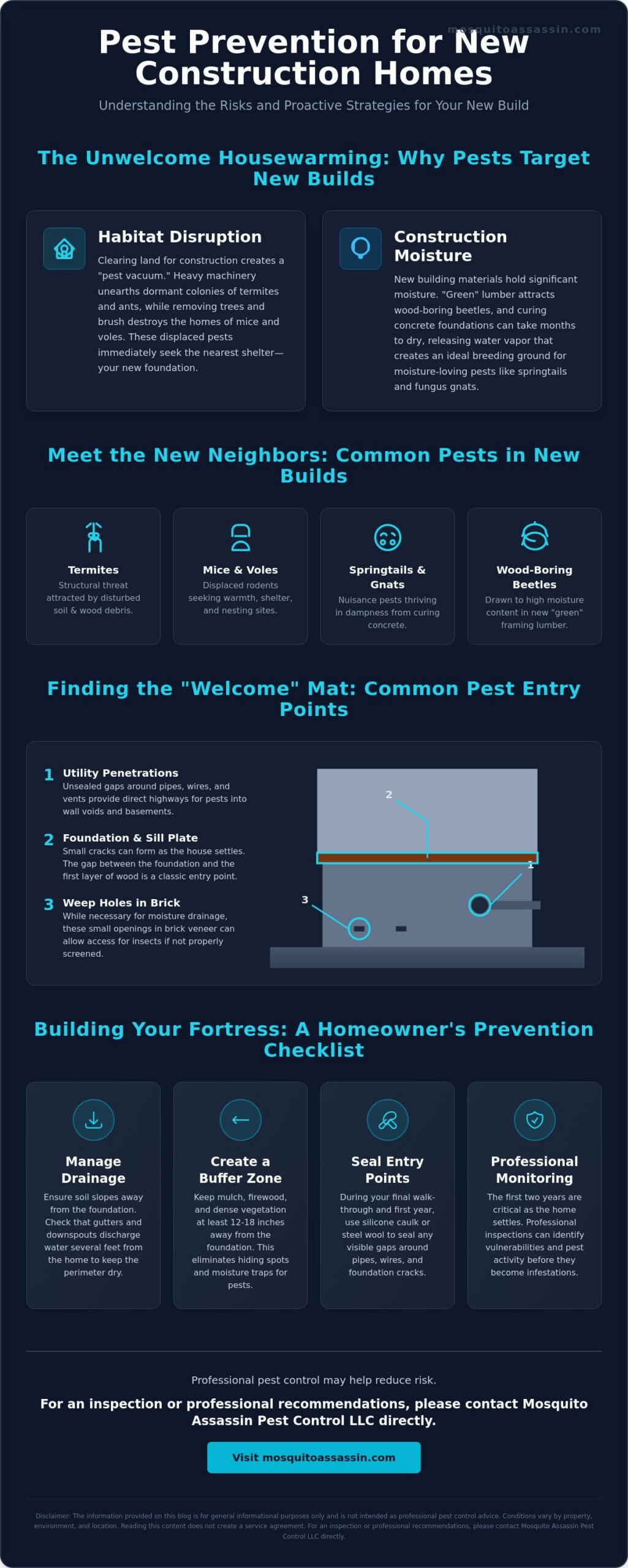
    Habitat disruption is the primary driver for early-stage infestations because it forces established colonies to relocate immediately. When heavy machinery disturbs the soil, it often unearths dormant colonies of subterranean termites or ants that have lived on that lot for years. Removing trees and brush doesn’t just clear the view; it destroys the nesting sites of mice and voles. These displaced rodents will naturally migrate toward the warmth of a new basement or crawlspace to survive. Without their original dens, your subfloor and insulation become the next best thing.

    Moisture Management in New Materials

    New construction involves a surprising amount of water. Green lumber used in the framing process often carries a high moisture content, which is a specific attractant for various wood-boring beetles. As the house dries out over its first year, these insects may emerge from the wood. Concrete foundations also play a role. A standard concrete slab or basement wall can take months to cure fully, releasing gallons of water vapor into the air. This elevated humidity creates a perfect breeding ground for moisture-loving pests like springtails and fungus gnats.

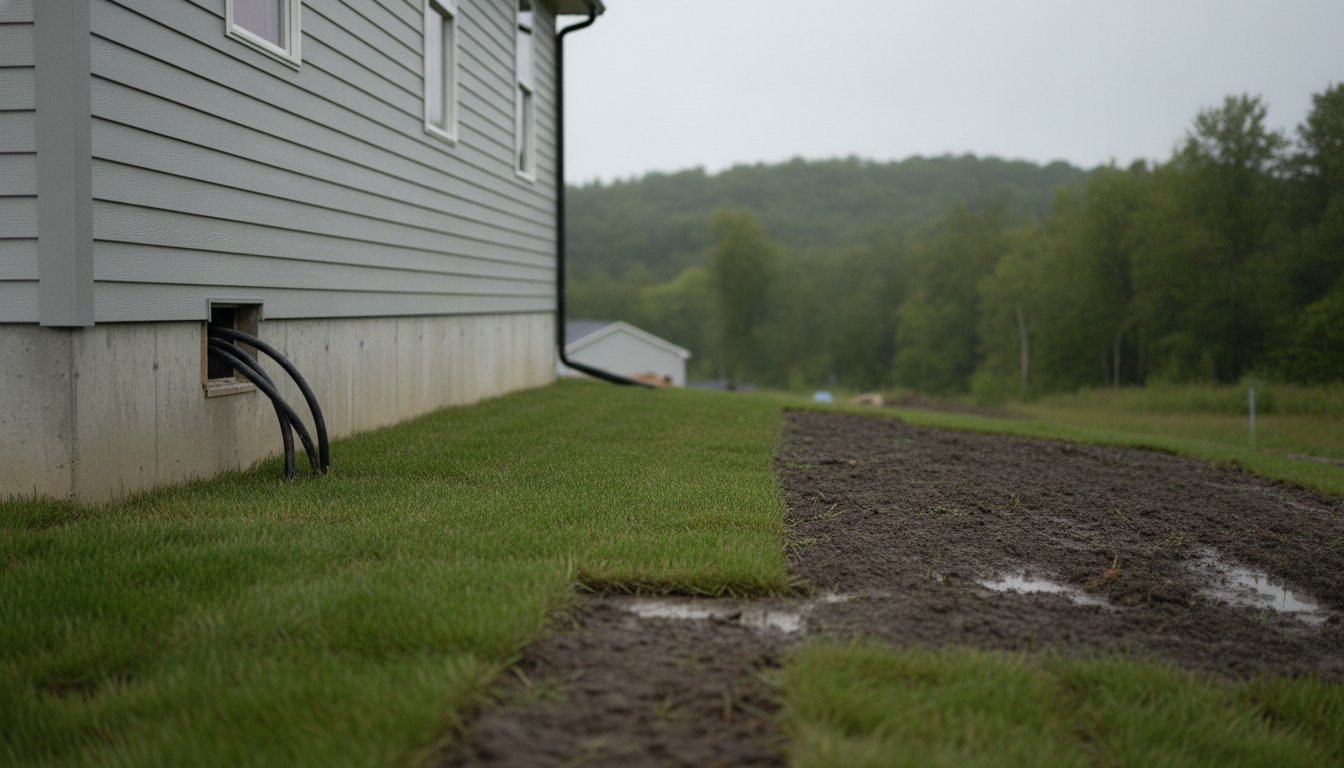
    Site grading is another critical factor. If the soil isn’t sloped away from the foundation early in the process, rainwater can pool against the new masonry. This standing water invites mosquitoes and provides the damp conditions termites require to tunnel upward. Implementing principles of Integrated Pest Management (IPM) during the early phases of homeownership helps you monitor these moisture levels and address vulnerabilities before they become permanent problems. This methodical approach ensures your new investment remains secure from the ground up.

    Disclaimer: The information provided on this blog is for general informational purposes only and is not intended as professional pest control advice. Conditions vary by property, environment, and location. Reading this content does not create a service agreement. For an inspection or professional recommendations, please contact Mosquito Assassin Pest Control LLC directly.
    Common Pests in New Builds Across Pennsylvania and Ohio

    Homeowners in Erie and Ashtabula Counties face unique environmental challenges due to the high humidity and frequent lake-effect precipitation characteristic of the Great Lakes region. These climate factors significantly increase moisture-related risks for new properties. While a house is being built, it’s often exposed to the elements for weeks. This exposure creates a perfect habitat for specific local species that thrive in damp, disturbed environments. Successfully preventing pests in a new construction home requires identifying these regional threats before they establish a permanent presence in your crawl space or wall voids.

    Moisture-Loving Nuisance Pests

    Springtails and fungus gnats are among the most common early invaders in new builds. Springtails are tiny, jumping insects that often appear by the thousands near water sources or in damp basements where concrete is still curing. Fungus gnats typically emerge from the soil of indoor plants or damp crawl spaces, drawn to the fungi that grow on moist building materials. Another frequent visitor is the clover mite. These tiny red specks often migrate from freshly laid sod into the home interior, appearing on windowsills in large numbers after the final landscaping is completed. You can find more details on common household insects in Pennsylvania through regional extension resources to help with early identification.

    Structural and Wood-Destroying Organisms

    The most serious threats to a new investment are wood-destroying organisms like subterranean termites and carpenter ants. Subterranean termites don’t need much room to enter; they can pass through cracks in the foundation as thin as a credit card or follow utility penetrations into the structure. Carpenter ants are opportunistic and often establish satellite colonies in damp wall framing that was exposed to rain during the construction process. Because these pests work behind the scenes, their presence isn’t always obvious until structural damage has already occurred. The climate in Erie and Ashtabula counties specifically encourages these pests because the consistent moisture keeps wood soft and attractive for nesting.

    Rodents are equally opportunistic, taking advantage of gaps in the building envelope before the final sealing and siding are finished. Mice and rats can squeeze through openings the size of a dime, making unsealed vents and pipe entries easy targets. Establishing general pest control plans early in the first year of homeownership can help identify these structural vulnerabilities before they lead to a full-scale infestation. Proactive monitoring ensures that small gaps don’t become permanent highways for local wildlife.

    Disclaimer: The information provided on this blog is for general informational purposes only and is not intended as professional pest control advice. Conditions vary by property, environment, and location. Reading this content does not create a service agreement. For an inspection or professional recommendations, please contact Mosquito Assassin Pest Control LLC directly.
    Identifying Structural Vulnerabilities During and After Construction

    Even the most advanced building techniques in Erie and Ashtabula Counties can leave behind tiny openings that local pests are quick to exploit. These structural vulnerabilities are rarely the result of poor craftsmanship; instead, they often stem from the complex intersection of different building systems. Successfully preventing pests in a new construction home involves looking beyond the surface to find where utilities, foundations, and rooflines provide unintended access. Addressing these gaps during the first year of homeownership is a critical part of maintaining a secure property.

    Utility and Foundation Gaps

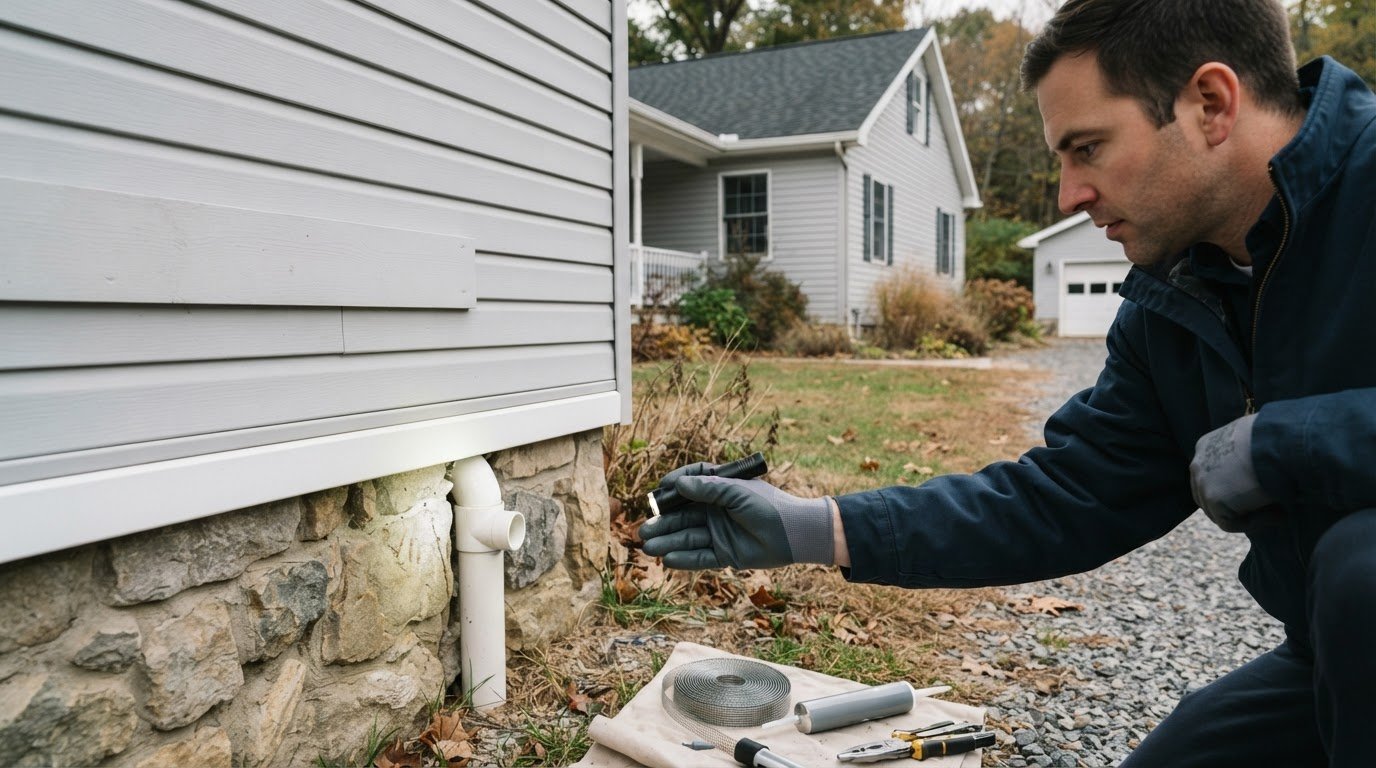
    Utility penetrations for plumbing, electricity, and HVAC systems are some of the most common entry points in new builds. Often, the holes cut for these lines are significantly larger than the pipes themselves. If these gaps aren’t properly sealed behind the wall or under the siding, they become permanent highways for insects and rodents. You should specifically check for gaps where the HVAC lines enter the exterior siding, as these are frequently overlooked during the final walk-through. A simple bead of silicone or specialized sealant can close these paths effectively.

    The foundation itself remains a dynamic part of the structure during the first year. As the house settles into the soil of Crawford or Erie County, small hairline cracks can develop in the masonry or concrete. While these are often non-structural, they are large enough for ants or spiders to navigate. It’s also vital to examine basement window wells. Ensure they are properly drained and clear of construction debris, as trapped moisture and organic matter provide a perfect staging ground for pests to move toward the foundation wall. Keeping these areas clean reduces the biological pressure on your home’s lower levels.

    The Building Envelope and Roofline

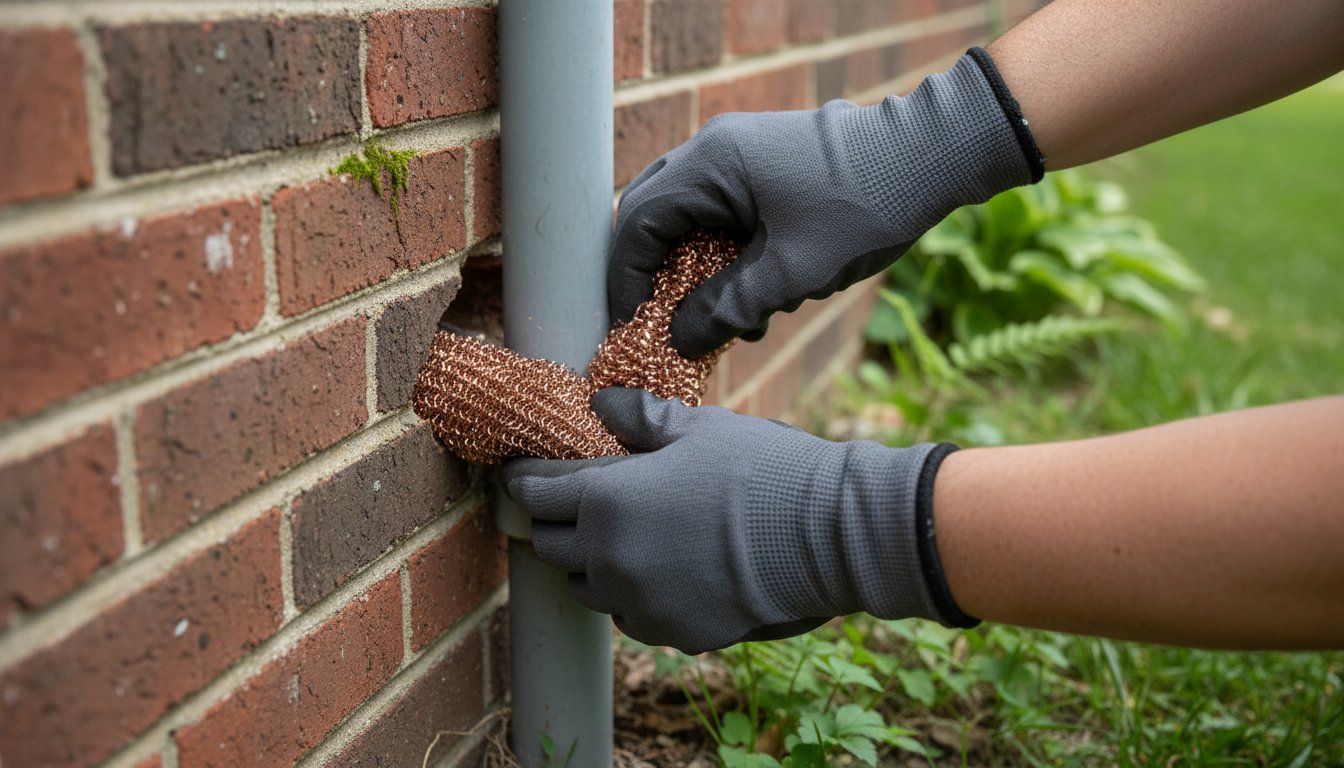
    The exterior finish of your home can also harbor hidden entries. For homes with brick veneers, weep holes are essential for moisture drainage, but they provide a direct path for insects if left unscreened. Installing specialized mesh covers allows the wall to breathe while keeping pests out. Additionally, garage door seals and thresholds often require adjustment in a settling home. If you notice light peeking through the bottom or sides of your garage door, the seal isn’t tight enough to stop a determined rodent. These seals often shift as the concrete slab cures and settles over several months.

    Higher up, the roofline presents its own set of risks. Roof eaves and soffit vents are prime targets for stinging insects, bats, and squirrels. Verify that all soffit vents are securely fastened to the structure to prevent wasps from nesting in the attic space. Inspect the seals around chimney flashing and roof peaks, as even a small gap can invite trouble. Addressing these high-altitude vulnerabilities is a key step in exclusion; otherwise, you might find yourself searching for rodent removal services sooner than expected. Taking the time to seal the building envelope completely protects your investment from the top down.

    Disclaimer: The information provided on this blog is for general informational purposes only and is not intended as professional pest control advice. Conditions vary by property, environment, and location. Reading this content does not create a service agreement. For an inspection or professional recommendations, please contact Mosquito Assassin Pest Control LLC directly.
    Preventing Pests in a New Construction Home: A Complete Guide

    Practical Prevention Strategies for New Homeowners

    Cleanliness alone does not stop invaders in a brand-new build. Many homeowners in Erie and Crawford Counties are surprised to find pests in a spotless kitchen shortly after moving in. This happens because preventing pests in a new construction home is primarily about managing environmental factors like moisture and shelter rather than food waste. Implementing a systematic approach to your property’s perimeter and interior humidity is the most effective way to protect your investment during its first year. By focusing on the structural environment, you address the biological reasons why pests are attracted to your home in the first place.

    Exterior Landscaping and Grading

    Maintaining a dry perimeter is the foundation of any exclusion strategy. Ensure that gutters are clear of construction debris and that downspouts direct water at least five to ten feet away from the home. If water saturates the soil near the foundation, it creates an inviting environment for subterranean termites. Proper grading is also essential; the soil should slope away from the foundation at a minimum grade of six inches over the first ten feet. This prevents water from pooling against the masonry. Additionally, the type of mulch you choose matters. While wood mulch is popular, it traps moisture and provides ideal cover for insects. Using gravel or stone borders in high-moisture areas creates a buffer zone that is less attractive to pests. Keep all shrubs and trees trimmed at least 12 inches away from the siding to eliminate natural bridges that ants or spiders use to bypass ground-level treatments.

    Interior Moisture and Humidity Control

    New homes go through a significant drying out phase as building materials like concrete and lumber cure. To assist this process in the climate of Ashtabula County, run dehumidifiers in basements and crawl spaces. Use a hygrometer to monitor these areas; keeping relative humidity levels below 50 percent is a standard goal for pest exclusion. High humidity attracts moisture-loving insects that have little interest in how clean your floors are. Consistently running exhaust fans in bathrooms and kitchens also helps reduce the overall moisture load. Regularly check under sinks and around water heaters for any signs of slow leaks that might go unnoticed in a new plumbing system.

    As the structure settles over the first 24 months, use high-quality caulk or expandable foam to seal any new interior or exterior gaps that appear. This is a dynamic process that requires periodic inspection as the house shifts. For those who want a professional eye to identify these shifting vulnerabilities, general pest control plans can provide the consistent monitoring necessary to catch entry points before they are exploited. Proactive maintenance ensures that your new home remains the secure environment you intended it to be.

    Disclaimer: The information provided on this blog is for general informational purposes only and is not intended as professional pest control advice. Conditions vary by property, environment, and location. Reading this content does not create a service agreement. For an inspection or professional recommendations, please contact Mosquito Assassin Pest Control LLC directly.

    Establishing a Long-Term Pest Management Plan

    The first two years of a home’s life are a period of significant transition. As the foundation settles and building materials reach their final equilibrium with the local climate in Northwest Pennsylvania and Northeast Ohio, new vulnerabilities often emerge. Successfully preventing pests in a new construction home is not a one-time event; it’s a continuous process of monitoring and adaptation. While the initial exclusion steps mentioned in previous sections provide a strong defense, a long-term strategy ensures that the natural shifting of your home doesn’t create new opportunities for local wildlife or wood-destroying insects.

    The Importance of Professional Monitoring

    A professional eye is trained to see subtle signs that most homeowners miss. Licensed professionals can identify the early tracks of subterranean termites or the specific foraging patterns of carpenter ants before they result in structural damage. This is particularly vital as your house settles, as even a hairline crack in a basement wall or a slight shift in a door frame can invite an infestation. Engaging in general pest control provides the benefit of ongoing maintenance and expert eyes on your property throughout the year. Professional pest control may help reduce risk for homeowners in Northwest Pennsylvania and Northeast Ohio by addressing these structural changes in real time.

    Year-round protection plans are designed to address the specific seasonal migrations of the Tri-State area. From the emergence of spring swarms to the late-autumn push of rodents seeking warmth, a consistent plan provides a permanent barrier that DIY methods often miss. These plans typically include regular inspections of the building envelope, foundation, and utility penetrations to ensure that previous exclusion work remains intact and effective. This methodical approach transforms your home from a target of opportunity into a secure fortress.

    Transitioning from Construction to Homeownership

    The ideal time to formalize your long-term plan is immediately after all landscaping is finalized. Fresh sod, new mulch, and newly planted shrubs significantly alter the moisture profile and pest pressure of your lot. You should schedule a thorough post-construction inspection once the heavy machinery is gone and the final grading is complete. This allows for a final check of all weep holes, soffit vents, and utility entries that may have been disturbed during the final stages of building. A customized plan can then be developed based on the specific environmental factors of your property lot, whether you are near the wooded areas of Crawford County or the humid lakefront in Ashtabula County.

    Taking this final step secures your investment and provides peace of mind as you settle into your new space. For an inspection or professional recommendations, please contact Mosquito Assassin Pest Control LLC directly. By establishing a professional partnership early, you ensure that your new home remains pest-free for years to come.

    Disclaimer: The information provided on this blog is for general informational purposes only and is not intended as professional pest control advice. Conditions vary by property, environment, and location. Reading this content does not create a service agreement. For an inspection or professional recommendations, please contact Mosquito Assassin Pest Control LLC directly.

    Protecting Your New Investment for the Long Term

    Protecting your property starts with recognizing that a new build is a dynamic structure. The combination of habitat disruption and curing building materials creates a unique environment that draws in local pests. Successfully preventing pests in a new construction home requires a methodical approach to sealing utility penetrations and managing perimeter moisture as the house settles into the landscape of Erie, Crawford, or Ashtabula County.

    If you don’t address these vulnerabilities early, minor gaps can quickly become permanent entry points. Utilizing local expertise and a detailed three-step process for rodent exclusion ensures your building envelope remains secure. For total peace of mind, Platinum year-round protection plans offer consistent monitoring during the critical first years of homeownership. Professional pest control may help reduce risk and keep your living space exactly as you intended it. Contact Mosquito Assassin Pest Control LLC for a professional evaluation to secure your new home today.

    Disclaimer: The information provided on this blog is for general informational purposes only and is not intended as professional pest control advice. Conditions vary by property, environment, and location. Reading this content does not create a service agreement. For an inspection or professional recommendations, please contact Mosquito Assassin Pest Control LLC directly.

    Frequently Asked Questions

    Is it normal to have bugs in a brand-new house?

    Yes, it is very common to see insects in a newly finished property. The construction process disrupts local habitats and uses materials like green lumber and curing concrete that are naturally high in moisture. These factors create an immediate draw for local species searching for new shelter after their original nesting sites were disturbed by heavy machinery.

    Should I get a termite inspection for a new construction home?

    You should definitely schedule a termite inspection for a new build. While many builders apply a pre-treatment to the soil, the house settling can create new cracks in the foundation that bypass these initial barriers. Additionally, many lenders for FHA and VA loans require official documentation of a termite inspection as a condition of the mortgage to protect the investment.

    How do pests get inside a newly built, airtight home?

    Pests enter through tiny gaps that are often invisible to the naked eye. Utility penetrations for HVAC and plumbing lines often have oversized openings behind the walls that aren’t fully sealed. Weep holes in brick veneers and gaps in the roof eaves also provide direct access points that allow insects to bypass the airtight seals of modern windows and doors.

    What are the tiny jumping bugs in my new basement?

    These are likely springtails, which are moisture-loving insects that thrive in damp environments. They are attracted to the high humidity levels found in new basements as concrete foundations release water vapor during the curing process. Successfully preventing pests in a new construction home involves reducing this basement humidity with dehumidifiers to make the area less hospitable to these jumping invaders.

    Does homebuilders insurance cover pest infestations?

    Most standard homebuilder warranties and insurance policies do not cover pest infestations. These policies typically focus on structural defects or appliance failures rather than biological issues like insects or rodents. It’s the homeowner’s responsibility to maintain a prevention plan to protect the property from damage caused by wood-destroying organisms or local wildlife once the keys are handed over.

    How long does it take for a new home to “dry out” and stop attracting moisture-loving pests?

    It generally takes 18 to 24 months for a new home to fully reach moisture equilibrium with its environment. During this period, concrete foundations and framing lumber are slowly releasing trapped water into the air. This extended dry out phase is why many moisture-loving pests persist through the first two years of homeownership before the environment naturally stabilizes.

    Can landscaping choices cause pest problems in a new build?

    Landscaping choices are a frequent cause of pest issues in new builds. Fresh sod can bring in clover mites, while thick layers of wood mulch against the foundation trap the moisture that termites require to thrive. Ensuring that soil and plants are kept away from the siding is a vital part of preventing pests in a new construction home as your yard matures.

    When is the best time to start a pest control plan for a new home?

    The best time to start a plan is immediately after you move in or once the final landscaping is installed. Establishing professional monitoring during the first year allows you to catch structural vulnerabilities as the house settles into the soil. Early intervention ensures that temporary construction-related issues don’t turn into long-term infestations that could damage your new space.

    Disclaimer: The information provided on this blog is for general informational purposes only and is not intended as professional pest control advice. Conditions vary by property, environment, and location. Reading this content does not create a service agreement. For an inspection or professional recommendations, please contact Mosquito Assassin Pest Control LLC directly.

  • How to Keep Mice Out of Your House: A Professional Guide to Exclusion

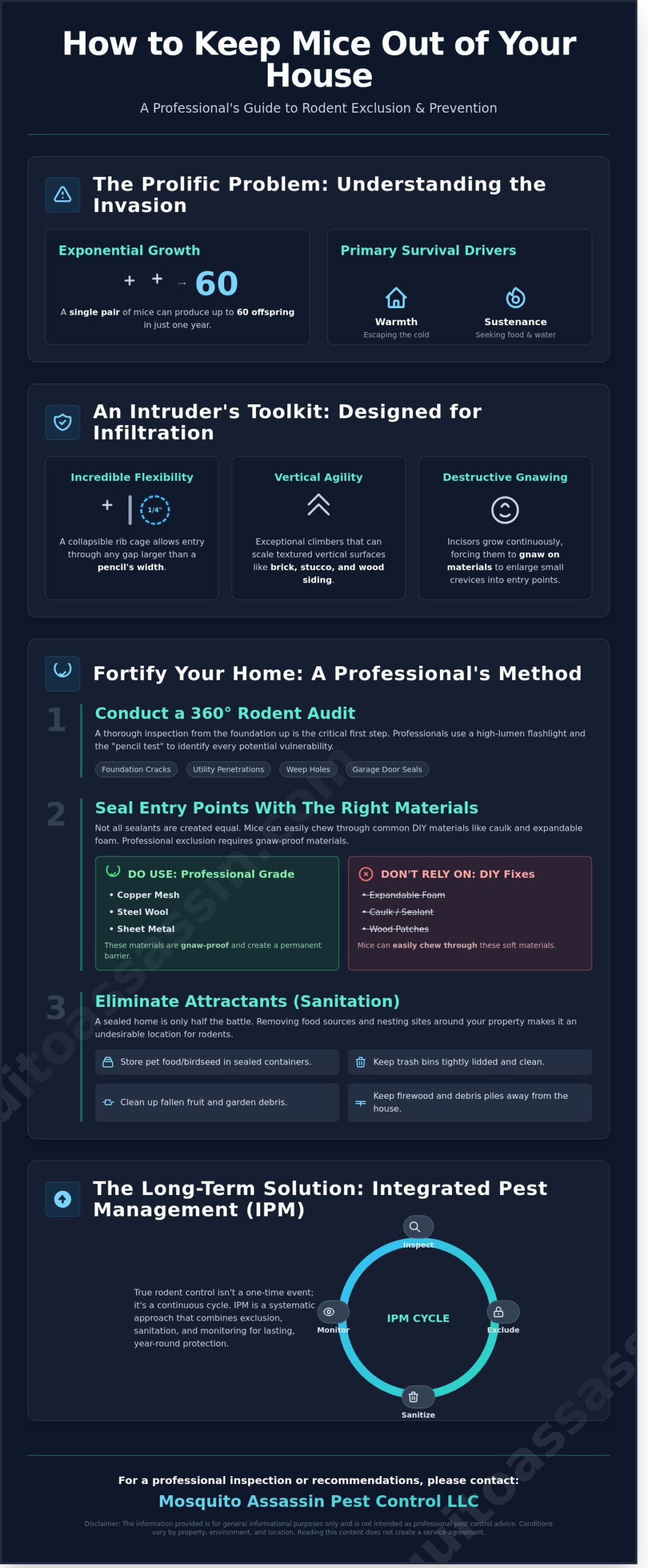
    How to Keep Mice Out of Your House: A Professional Guide to Exclusion

    Last Tuesday, a homeowner in Erie County discovered that a single pair of mice can produce up to 60 offspring in a single year, explaining why their store-bought traps weren’t solving the problem. It’s a common frustration for many residents in Crawford and Ashtabula Counties who find that catching a few rodents doesn’t stop the cycle of infestation. If you’ve spent weeks setting bait only to hear scratching in the walls at 2 AM, you’re likely searching for how to keep mice out of your house once and for all.

    It’s exhausting to deal with the constant worry of chewed wires or contaminated pantries, especially when DIY methods seem to fail. This guide provides the professional methods used to secure a home, from sealing structural vulnerabilities to removing the subtle attractants that draw rodents inside. You will learn which professional-grade materials actually stop teeth and how to maintain a rodent-free environment year-round. This overview covers structural exclusion, sanitation protocols, and long-term maintenance strategies.

    Disclaimer: The information provided on this blog is for general informational purposes only and is not intended as professional pest control advice. Conditions vary by property, environment, and location. Reading this content does not create a service agreement. For an inspection or professional recommendations, please contact Mosquito Assassin Pest Control LLC directly.

    Key Takeaways

    • Understand the biological drivers that attract rodents to a property and how their unique physiology allows them to enter through openings as small as a quarter-inch.
    • Learn how to conduct a professional-grade exterior audit to identify common structural vulnerabilities frequently found in Pennsylvania and Ohio homes.
    • Discover why professional exclusion materials like copper mesh and steel wool are more effective than expandable foam for blocking rodent entry points.
    • Identify sanitation and landscaping strategies that explain how to keep mice out of your house by reducing the availability of food and nesting sites.
    • Explore the benefits of Integrated Pest Management (IPM), a systematic approach that combines detailed inspections with long-term maintenance to prevent recurring infestations.

    Understanding Why Mice Target Your Property

    Mice do not enter homes by accident or out of simple curiosity. They are driven by powerful biological imperatives that prioritize survival above all else. In the Great Lakes region, specifically across Erie and Crawford Counties in Pennsylvania and Ashtabula County in Ohio, this behavior follows a predictable seasonal rhythm. As temperatures begin to fluctuate in late October and early November, the local rodent population experiences a massive shift in habitat. When the ground freezes and natural food sources like seeds and insects disappear, your home becomes the most viable survival pod in the area. Understanding these motivations is the first step in learning how to keep mice out of your house effectively.

    A common mistake homeowners make is assuming a single sighting is an isolated event. Biology suggests otherwise. A female House mouse can give birth to a new litter every 21 days, with each litter containing up to six pups. Because these rodents are nocturnal and naturally avoid open spaces, seeing one during daylight hours often signals that the internal nesting sites within your walls or attic have reached maximum capacity. This forced migration into living areas means a colony is likely already well established within the structure.

    The Driving Forces: Warmth and Sustenance

    Rodents are highly sensitive to thermal gradients. During the late autumn temperature drops, heat signatures leaking from a home act as a beacon. Dryer vents, gaps around outdoor faucets, and poorly sealed basement windows release plumes of warm air that rodents follow directly to the source. Once a single mouse finds a way inside, it leaves behind a pheromone trail. This chemical “roadmap” is composed of urine and body oils that guide other mice to the exact same entry point, even months later. Inside, they seek out calorie-dense resources. A single pound of spilled birdseed or an unsealed bag of dog food can sustain a colony of 15 mice for several weeks, providing the energy they need to reproduce through the winter months.

    The Physical Capabilities of the Common House Mouse

    The physical anatomy of a mouse is designed for infiltration. Their skeletons are remarkably flexible; specifically, their rib cages are collapsible. If a mouse can fit its skull through an opening, the rest of the body will follow. This means any gap larger than one-quarter inch, roughly the width of a standard pencil, is a potential doorway. They don’t require a clear path on the ground to enter, either. Mice are exceptional climbers that can scale vertical surfaces with significant texture, such as brick, wood siding, or stucco.

    Their teeth are another formidable tool. A mouse’s incisors grow at a rate of roughly 0.3 millimeters per day, requiring them to constantly gnaw on hard materials to keep the teeth at a functional length. They will instinctively target soft spots in a home’s exterior, such as weather stripping, plastic vent covers, or aging wood trim, to enlarge small crevices into functional tunnels. This combination of persistence and physical agility is why how to keep mice out of your house requires a comprehensive, structural approach rather than just setting a few traps. Professional pest control may help reduce risk by identifying these subtle vulnerabilities before the winter migration begins.

    Disclaimer: The information provided on this blog is for general informational purposes only and is not intended as professional pest control advice. Conditions vary by property, environment, and location. Reading this content does not create a service agreement. For an inspection or professional recommendations, please contact Mosquito Assassin Pest Control LLC directly.

    Conducting a Comprehensive Professional Rodent Audit

    A successful strategy for how to keep mice out of your house begins with a 360-degree inspection of the property. This process starts at the lowest point of the foundation and moves upward. In regions like Erie and Crawford Counties, older homes often feature fieldstone or stacked stone foundations. These materials naturally shift over time, creating small voids that serve as open invitations for rodents. A professional audit uses a high-lumen flashlight to hunt for “light gaps” or shadows that indicate a breach in the home’s envelope. The “pencil test” remains a gold standard for verification; if a standard #2 pencil can slide into a gap, a juvenile mouse can pass through that same space with ease. Technicians look for these openings not just at eye level, but also behind overgrown vegetation and beneath low-hanging decks where mice feel most secure.

    Exterior Vulnerabilities: The First Line of Defense

    The sill plate, which is the point where the wooden house frame meets the masonry foundation, is a primary entry zone. In Pennsylvania and Ohio, fluctuating seasonal temperatures cause building materials to expand and contract, often pulling vinyl or wood siding away from the foundation. Utility penetrations for gas lines, AC conduits, and electrical wires are frequently overlooked by homeowners. A gap of just 0.25 inches around a pipe is enough for a rodent to enter. Garage doors are another significant weak point. If the bottom weather stripping is brittle or the corner posts have even minor wood rot, mice will exploit the opening within 24 hours of discovery. Corner posts on houses with “J-channel” siding often act as hollow ladders, allowing mice to climb directly from the ground into the soffits.

    Interior Hotspots: Where Mice Hide and Travel

    Once inside, mice prioritize areas with proximity to food and nesting material. Auditing the kitchen requires looking behind heavy appliances like stoves and dishwashers where heat and crumbs accumulate. Sink cabinets often have unfinished gaps around plumbing that lead directly into wall voids. In the attic and crawl space, look for compressed or tunneled insulation. Basement rim joists provide a hidden corridor for mice to travel the perimeter of the home unseen. Floor drains without secure covers also provide access from subterranean levels. Understanding Integrated Pest Management for house mice helps clarify that these interior spaces must be addressed alongside exterior exclusion to be effective. Identifying these travel paths is a vital step in how to keep mice out of your house permanently.

    Identifying Signs of Active Infestation

    Distinguishing between an old problem and a current threat is vital for an accurate audit. Fresh droppings are dark, moist, and have the consistency of putty, while old evidence is gray, dry, and crumbles when touched. “Rub marks” are another key indicator; these are dark, oily stains left by the sebum in mouse fur as they squeeze through tight spots or run along baseboards. Professionals also look for “picket fencing,” which is a pattern of droppings along a specific trail. Nesting materials like shredded paper, bits of fiberglass insulation, or gathered string indicate a female may be preparing for a litter. If these signs are present, scheduling a professional evaluation can provide clarity on the extent of the activity. Active entry points will often have a “clean” look from frequent use, whereas old, unused gaps may be filled with cobwebs or dust.

    Disclaimer: The information provided on this blog is for general informational purposes only and is not intended as professional pest control advice. Conditions vary by property, environment, and location. Reading this content does not create a service agreement. For an inspection or professional recommendations, please contact Mosquito Assassin Pest Control LLC directly.

    Professional Exclusion Techniques and Materials

    Success in understanding how to keep mice out of your house depends entirely on the durability of the materials used. Many homeowners reach for cans of expandable spray foam, but this is rarely a permanent solution. While foam fills a void, it lacks structural integrity. Mice can chew through standard polyurethane foam in less than 60 seconds once they detect a heat signature from inside. Professional exclusion requires materials that provide a physical deterrent to gnawing rather than just a visual plug.

    Copper mesh and stainless steel wool are the industry standards for blocking small entry points. Unlike standard steel wool, which rusts and degrades when exposed to the moisture of Erie County winters, copper mesh maintains its integrity for years. When packed tightly into a crevice, the sharp fibers irritate a rodent’s mouth, causing them to abandon the entry attempt. For the best results, these materials should be paired with high-quality, weather-resistant sealants. In the Great Lakes region, temperatures can fluctuate from -10°F in January to 90°F in July. This requires elastomeric sealants that can expand and contract up to 25% without cracking or pulling away from the substrate.

    Sealing Small Gaps and Crevices

    Mice can compress their bodies to fit through openings as small as 1/4 inch, which is roughly the diameter of a standard ink pen. Focus efforts on the utility penetrations where plumbing pipes, gas lines, or electrical conduits enter the home. Behind toilets and under kitchen sinks are common hotspots. Pack these gaps with copper mesh until they’re dense, then finish with a layer of silicone caulk. In older homes across Crawford County, pay close attention to gaps where floorboards meet the baseboards.

    Securing Larger Openings and Vents

    Larger architectural gaps require 1/4 inch galvanized hardware cloth. This heavy-duty wire mesh is essential for covering crawl space vents and attic soffits. Standard plastic vent covers are easily bypassed by determined rodents. Installing 23-gauge steel mesh ensures that even the most persistent mice can’t chew their way inside. Implementing these physical barriers is a critical step in how to keep mice out of your house during the colder months. Don’t forget to inspect the roofline for damaged fascia boards.

    The Necessity of Durable Door and Window Seals

    The garage door is often the weakest link in a home’s defense. Standard rubber bottom seals become brittle and crack over time, leaving gaps at the corners. Replace these with nylon brush seals or rodent-resistant gaskets reinforced with steel fabric. Basement windows and bulkhead doors also require tight-fitting weatherstripping to eliminate light and scent cues that attract pests. While DIY efforts are a great start, professional pest control may help reduce risk by identifying obscure entry points that are easily missed by the untrained eye.

    Disclaimer: The information provided on this blog is for general informational purposes only and is not intended as professional pest control advice. Conditions vary by property, environment, and location. Reading this content does not create a service agreement. For an inspection or professional recommendations, please contact Mosquito Assassin Pest Control LLC directly.

    How to Keep Mice Out of Your House: A Professional Guide to Exclusion

    Sanitation and Habitat Modification Strategies

    Reducing the carrying capacity of a structure is a fundamental principle in professional pest management. A home’s carrying capacity is the maximum population of rodents the environment can sustain based on available food, water, and shelter. By strictly managing these resources, homeowners can significantly lower the chances of an infestation. Understanding how to keep mice out of your house starts with viewing the property through the lens of a scavenger. Mice only need about three grams of food per day to survive, which means even small lapses in sanitation can support a growing colony.

    Eliminating Indoor Food Sources

    Dry goods stored in original cardboard packaging are highly vulnerable; mice can gnaw through paper and thin plastic in seconds. Transferring flour, cereal, and grains into airtight glass or metal containers removes the scent and prevents access. Pet food is another primary attractant that is often overlooked. Storing large bags of kibble in sealed galvanized steel bins is a proven method to reduce rodent pressure. Homeowners should also pull out the stove and refrigerator at least twice a year. Crumbs and grease spills often accumulate in these hidden areas, providing enough calories to support several mice for weeks. In garages or mudrooms, spilled birdseed or grass seed should be swept up immediately, as these high-protein sources are favorites for local mice.

    Exterior Habitat Management

    The transition from the yard to the foundation is a critical zone for pest prevention. Maintaining a 12-inch pest-free perimeter by replacing organic mulch with crushed stone or gravel discourages mice from nesting directly against the house. Vegetation should be trimmed so no branches or shrubs touch the siding or roofline, as these act as natural bridges. Woodpiles and debris piles are common nesting sites and should be relocated at least 20 feet away from the foundation. Additionally, clogged gutters create moisture pockets that attract rodents looking for a water source. Ensuring downspouts direct water away from the crawlspace or basement helps keep the perimeter dry and less inviting. These simple changes are essential steps in how to keep mice out of your house over the long term.

    Waste Management Best Practices

    Standard plastic trash cans often fail to stop determined rodents. Using heavy-duty bins with locking, tight-fitting lids is essential for managing waste near the home. Outdoor bins require regular cleaning with a mild soap or degreaser to remove lingering food odors that act as beacons for local wildlife. Recycling bins should also be rinsed, as soda and juice residue are significant attractants. Composting is another factor; open compost piles can increase local rodent activity by over 35 percent in residential areas. Using elevated, fully enclosed tumblers is a safer alternative for those who wish to compost without providing a buffet for the local mouse population.

    In regions like Erie and Crawford Counties in Pennsylvania or Ashtabula County in Ohio, seasonal shifts drive mice toward human structures in search of warmth. Professional residential services focus on these environmental factors during a comprehensive inspection. Technicians identify specific habitat risks that a homeowner might overlook, such as birdseed spills in a garage or gaps near utility lines. Addressing these root causes is more effective than reactive measures alone. For those seeking a detailed evaluation of their property’s vulnerabilities, scheduling a professional pest inspection may help reduce the risk of future infestations.

    Disclaimer: The information provided on this blog is for general informational purposes only and is not intended as professional pest control advice. Conditions vary by property, environment, and location. Reading this content does not create a service agreement. For an inspection or professional recommendations, please contact Mosquito Assassin Pest Control LLC directly.

    The Role of Professional Integrated Pest Management

    DIY methods often hit a wall when dealing with established colonies. A single female mouse can produce up to 10 litters in a year, with each litter containing five to six pups. This rapid reproduction means trapping alone rarely solves the root problem. Professional Integrated Pest Management (IPM) focuses on a multi-step strategy. This includes a deep inspection, structural exclusion, and long term maintenance. In regions like Erie and Crawford Counties, the changing seasons drive rodents indoors for warmth. Local experts at Mosquito Assassin Pest Control LLC understand these regional patterns and provide solutions tailored to the specific construction of Pennsylvania and Ohio homes. Professional intervention shifts the focus from temporary fixes to a permanent barrier.

    The Limitations of Trapping Without Exclusion

    Mice are persistent and can squeeze through gaps as small as a pencil. If a homeowner sets traps but ignores a 1/4 inch gap under a garage door, the cycle continues indefinitely. Trapping only removes the mice currently inside; it doesn’t address how to keep mice out of your house in the future. Professional exclusion involves sealing these entry points with gnaw-proof materials like steel wool or specialized metal mesh. This ensures the structure stays vacated after the initial removal. Without these physical barriers, new rodents will simply follow the pheromone trails left by previous inhabitants. A professional ensures the house is sealed before the population outpaces the capacity of a few plastic traps.

    Benefits of Ongoing Pest Management Plans

    Homes are dynamic structures that change with the weather. Foundations settle and wood expands or contracts, creating new vulnerabilities over time. A 2023 study by the National Pest Management Association found that rodents are a top concern for 21 percent of homeowners. Regular monitoring identifies these new gaps before a full infestation starts. These plans often provide early detection for other common invaders like carpenter ants or spiders. Proactive safeguarding offers a level of security that reactionary DIY efforts cannot match. Consistent checkups by a technician familiar with the local climate in Ashtabula County can stop a problem before it requires expensive remediation.

    Taking the Next Step for a Mouse-Free Home

    It’s time to seek professional assistance when sightings persist despite active trapping or when you find signs of nesting in multiple rooms. A customized plan addresses the specific environmental pressures of the tri-state area. Professional pest control may help reduce risk and protect property value by preventing structural damage to insulation and electrical wiring. Rodents are known to chew through plastic coated wires, which creates a fire hazard. For those ready to secure their property, visiting the online booking portal is a practical first step. Expert intervention provides a comprehensive answer to the question of how to keep mice out of your house permanently. Protecting a home requires a combination of vigilance and professional grade materials that stand up to the elements.

    Disclaimer: The information provided on this blog is for general informational purposes only and is not intended as professional pest control advice. Conditions vary by property, environment, and location. Reading this content does not create a service agreement. For an inspection or professional recommendations, please contact Mosquito Assassin Pest Control LLC directly.

    Protecting Your Property From Rodent Intrusion

    Effective rodent exclusion requires a systematic approach that addresses both the physical structure and the surrounding environment. Professionals often cite the 0.25-inch rule; the National Pest Management Association (NPMA) notes that if a gap is large enough for a pencil to fit, a house mouse can likely enter. Understanding how to keep mice out of your house involves sealing these entry points with durable materials like 19-gauge hardware cloth or specialized metal sealants that resist persistent gnawing. It’s also vital to maintain a clean perimeter by removing debris and managing food waste, which reduces the biological cues that attract rodents. Licensed and insured technicians in Pennsylvania and Ohio follow a specialized rodent exclusion process to identify vulnerabilities that are often missed during casual inspections. For an evaluation of property vulnerabilities, contact Mosquito Assassin Pest Control LLC directly. Taking proactive steps today helps ensure a more secure and comfortable living environment for everyone in the home.

    Disclaimer: The information provided on this blog is for general informational purposes only and is not intended as professional pest control advice. Conditions vary by property, environment, and location. Reading this content does not create a service agreement. For an inspection or professional recommendations, please contact Mosquito Assassin Pest Control LLC directly.

    Frequently Asked Questions

    How much space does a mouse need to get into a house?

    A mouse can squeeze through a gap as small as 0.25 inches (6 millimeters), which is roughly the diameter of a standard number two pencil. Their skulls are the only rigid part of their bodies; if the head fits, the rest of the body follows easily. Homeowners in Erie County should inspect foundation vents and utility penetrations for any opening exceeding 0.25 inches to understand how to keep mice out of your house effectively.

    Will peppermint oil or mothballs keep mice away?

    Research from the University of Arizona indicates that peppermint oil and mothballs don’t provide long-term protection against rodent infestations. While the scent of peppermint is strong initially, it dissipates within 24 to 48 hours and loses its deterrent effect. Mothballs contain naphthalene, which is a registered pesticide that shouldn’t be used as a repellent, as it requires high concentrations to affect mice and can pose risks to indoor air quality.

    Why do I keep getting mice even though I set traps?

    Traps only address the mice already inside and don’t stop new individuals from entering through existing gaps. A single female mouse can produce up to 10 litters per year, with 5 to 6 pups per litter, leading to rapid population growth. If the exterior entry points remain unsealed, the scent of previous inhabitants often attracts new mice, making it difficult to learn how to keep mice out of your house without structural exclusion.

    Can mice climb up the sides of a house?

    Mice are excellent climbers and can scale vertical surfaces like brick, stucco, and wood siding that have even slight textures. They can jump up to 12 inches vertically and use downspouts or overhanging tree branches within 3 feet of the roofline to access upper levels. This agility allows them to enter through attic vents or gaps in the soffit that are 20 feet above the ground, making roofline inspections necessary.

    What is the best material to plug mouse holes?

    The most effective materials for sealing entry points are 19-gauge hardware cloth, stainless steel wool, or copper mesh. Mice can’t chew through these metal barriers, unlike wood, plastic, or expanding foam. For a permanent seal, professionals often pack the metal mesh into gaps and secure it with a high-quality silicone caulk or weather-resistant sealant to prevent the material from being pulled out by persistent rodents or weather conditions.

    How do I know if the mice are finally gone?

    A home is typically considered mouse-free when no new droppings, gnaw marks, or scratching sounds are detected for 14 consecutive days. You can monitor activity by placing non-toxic tracking powder or small amounts of flour in suspected travel paths to check for footprints. If no tracks or fresh 3-to-6-millimeter droppings appear after 2 weeks, the localized population has likely been eliminated. Professional pest control may help reduce risk if activity persists.

    Is it possible to mouse-proof an older home?

    It’s entirely possible to mouse-proof an older home, though structures built before 1950 often require more extensive sealing of stone foundations and sill plates. Focusing on the bottom 3 feet of the structure is critical, as this is where 80 percent of entries occur. For residents in Crawford and Ashtabula Counties, identifying structural vulnerabilities is the first step. For an inspection or professional recommendations, please contact Mosquito Assassin Pest Control LLC at www.mosquitoassassin.com/contact-us.

    Disclaimer: The information provided on this blog is for general informational purposes only and is not intended as professional pest control advice. Conditions vary by property, environment, and location. Reading this content does not create a service agreement. For an inspection or professional recommendations, please contact Mosquito Assassin Pest Control LLC directly.