Tag: Spring Pests

  • Identifying Signs of Carpenter Bees in House Structures: A Pennsylvania Homeowner Guide

    Identifying Signs of Carpenter Bees in House Structures: A Pennsylvania Homeowner Guide

    Imagine stepping onto your back deck on a sunny April afternoon in Erie only to be greeted by a large, fuzzy bee hovering inches from your face. It’s a common spring experience for many homeowners in the region, and while these “sentinel” bees rarely sting, their presence often points to a much deeper problem within your property’s wooden framework. Identifying the early signs of carpenter bees in house PA structures is the first step in preventing expensive repairs caused by hidden galleries and subsequent moisture rot.

    You likely value the integrity of your home and feel a sense of unease when you spot perfect, half-inch holes drilled into your fascia boards or cedar siding. It’s natural to feel frustrated by the confusion between these wood-boring pests and harmless bumblebees. This guide provides the clarity you need to distinguish between the two and understand the true extent of the damage lurking beneath the surface. You’ll learn how to recognize active nesting sites, interpret the behavior of hovering males, and determine exactly when the situation requires a professional inspection to safeguard your investment.

    Key Takeaways

    • Distinguish between the shiny, hairless abdomen of a carpenter bee and the fuzzy bumblebee to accurately identify the source of wood damage.
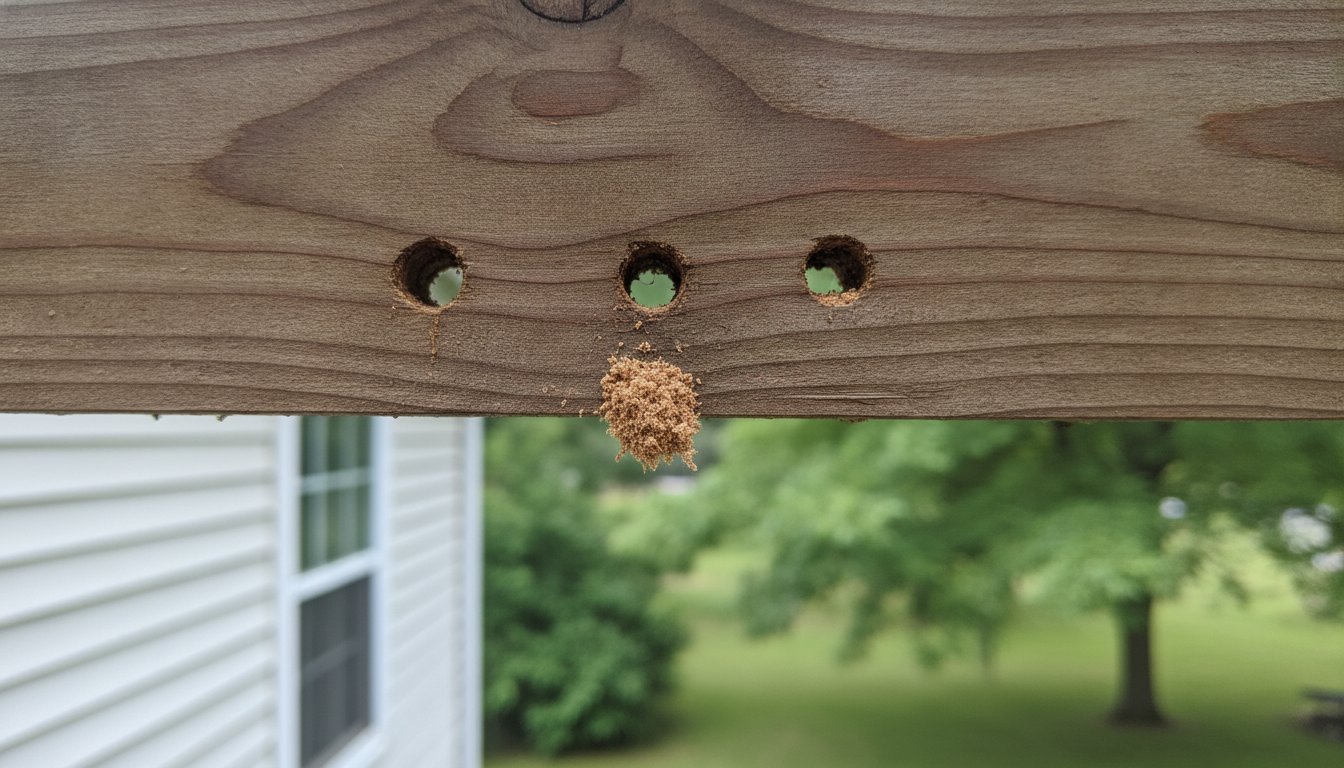
    • Locate primary signs of carpenter bees in house PA properties by searching for perfectly round, half-inch entrance holes accompanied by piles of fine sawdust.
    • Identify active infestations by listening for audible buzzing within walls and observing large bees that hover aggressively near wooden structures.
    • Recognize how secondary damage from woodpeckers indicates a deep-seated infestation that may compromise the structural integrity of your home.
    • Learn why professional evaluation is necessary to determine the extent of hidden gallery networks and stop recurring seasonal damage.

    Identifying Carpenter Bees in Pennsylvania: Appearance and Behavior

    The Eastern carpenter bee (Xylocopa virginica) is the most prevalent species encountered by property owners throughout Pennsylvania and Ohio. These insects are large and highly visible, typically measuring between 1/2 and 1 inch in length. While they play a role in the local ecosystem as pollinators, their nesting habits pose a direct threat to residential structures. Identifying the early signs of carpenter bees in house PA frameworks is essential for preventing long-term structural degradation.

    Property owners often encounter male carpenter bees first. These males are notoriously territorial and will hover aggressively near eaves, porch ceilings, or doorframes to investigate anything that moves. While this behavior is intimidating, male carpenter bees lack a stinger and cannot cause physical harm. The females, however, possess stingers but are generally docile, focusing their energy on excavating the deep galleries where they lay their eggs. This division of labor means the bee you see “guarding” your deck isn’t the one doing the drilling, but her presence confirms an active nest nearby.

    Carpenter Bees vs. Bumblebees: How to Tell

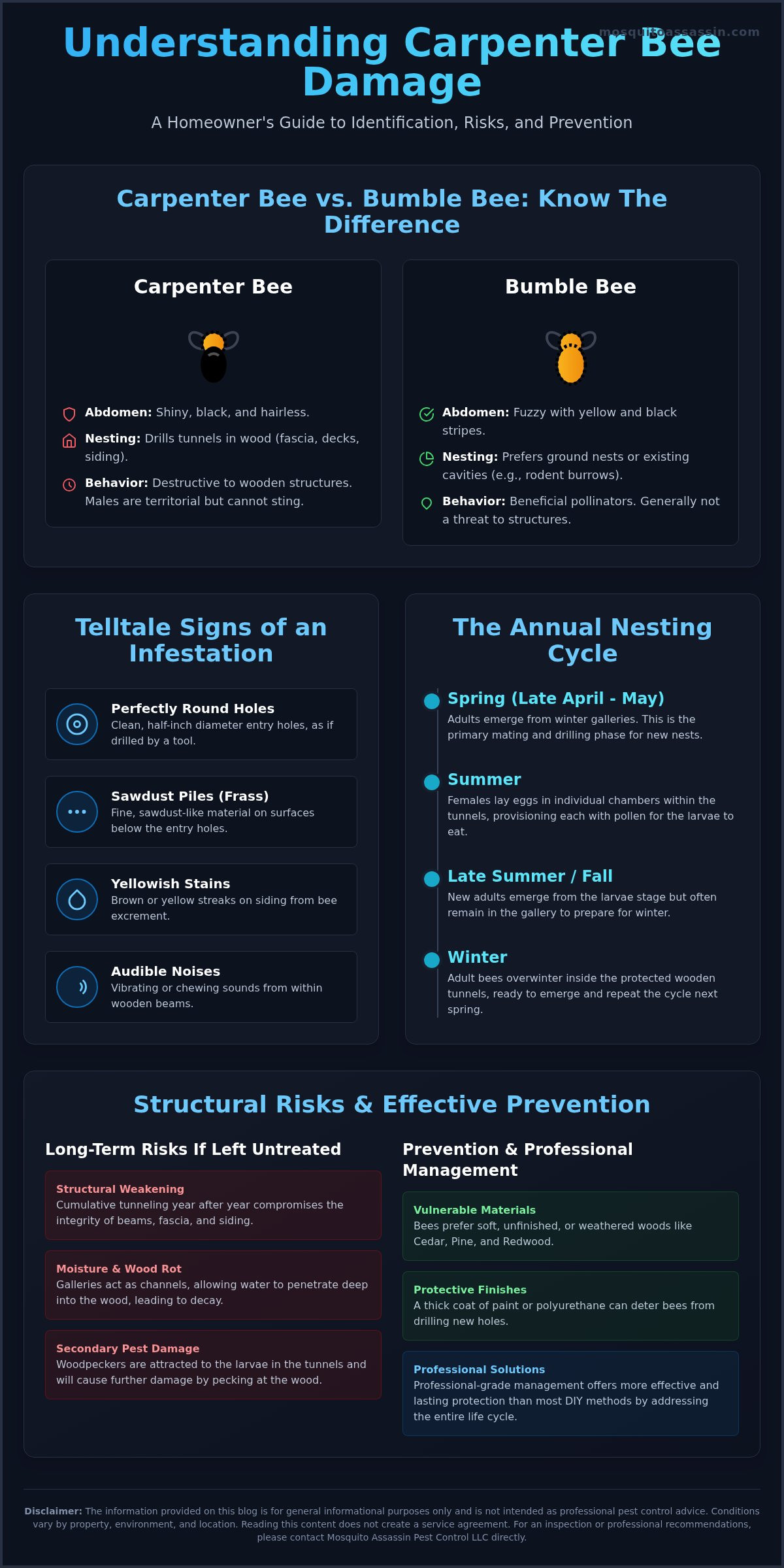
    One of the most common points of confusion for residents in Erie and Crawford Counties is the difference between carpenter bees and bumblebees. The most reliable way to distinguish them is by looking at the abdomen. Carpenter bees have a smooth, shiny, and hairless black abdomen. In contrast, bumblebees are fuzzy all over, with yellow markings extending across their rear. Their nesting habits are also distinct; bumblebees typically nest in the ground or in existing cavities, while carpenter bees specifically target solid wood. If you see a large bee entering a hole in your siding, it’s almost certainly a carpenter bee.

    The Seasonal Lifecycle in the Lake Erie Region

    In the regional climate of Northwestern Pennsylvania, activity follows a predictable seasonal pattern. Adult bees emerge from their overwintering tunnels in late April or early May once temperatures consistently rise. This is the peak period for mating and new gallery construction. By August, a new generation of adults emerges from the wood. These young bees feed on nectar before returning to the wooden galleries to shelter during the harsh winter months. Recognizing this cycle helps homeowners spot the active signs of carpenter bees in house PA properties before the next generation begins the process again. Professional pest control, such as the programs found at mosquitoassassin.com/services, may help reduce risk during these peak emergence windows.

    Visual Signs of Carpenter Bee Activity on Wooden Structures

    Identifying the visual signs of carpenter bees in house PA properties begins with a close inspection of your home’s exterior woodwork. The most unmistakable evidence is a perfectly round entrance hole, roughly 1/2 inch in diameter, which is about the width of a person’s pinky finger. Unlike the jagged damage caused by other pests, these holes are clean and precise, looking as though they were created by a power drill. You should also look for “frass,” a type of coarse sawdust that accumulates on the ground or surfaces directly below the entry point. This residue is the byproduct of the female bee excavating her nest. According to the Penn State Extension guide to carpenter bees, homeowners may also notice yellowish or brownish excrement stains streaking the wood near the entrance, marking active nesting sites.

    Before a bee commits to a full excavation, you might notice “pitting” or small, shallow indentations on the wood surface. These are test sites where the bee has evaluated the wood’s density and suitability. Finding these early signs of carpenter bees in house PA structures can prevent a full infestation if addressed quickly. These markings are often found in clusters, indicating that multiple bees are scouting your property for potential nesting locations.

    Common Target Areas for Infestation

    Carpenter bees are selective about their environment. They prioritize unpainted, weathered, or unfinished softwoods such as cedar, redwood, pine, and fir. In Pennsylvania residential areas, this often means checking your eaves, soffits, fascia boards, and porch ceilings. These areas provide the necessary thickness and protection from the elements. Don’t forget to inspect wooden playsets, fence posts, and outdoor furniture. These items are frequently targeted during the peak spring mating season and can serve as a bridge to your home’s main structure.

    Internal Gallery Structure and Hidden Damage

    While the entrance hole is small, the internal damage is often extensive. The bee drills straight into the wood for about an inch before making a sharp 90-degree turn. From there, she excavates a gallery that follows the grain of the wood. These tunnels can extend several inches in a single season. If left unaddressed for years, returning bees expand these networks into systems several feet long. Within these galleries, the female constructs multiple brood chambers, each separated by a partition of chewed wood pulp. This internal hollowing can weaken structural members over time. A professional pest control plan can help identify these hidden networks before they compromise your home’s safety.

    Behavioral Indicators: What to Listen and Look For

    The Lake Erie region’s climate dictates a specific timeline for observing the behavioral signs of carpenter bees in house PA structures. As temperatures stabilize in late April and May, homeowners in Erie and Crawford Counties often report a distinct auditory component to infestations. If you stand near a porch ceiling or an exterior wall, you might hear a low frequency vibrating or buzzing sound. This isn’t the sound of flight; it’s the female bee physically rasping against the wood fibers to excavate her gallery. These noises are most prominent during daylight hours when the bees are most active. Identifying these auditory cues is often the first step in realizing that the damage is progressing deep within the lumber.

    Observation is your most powerful tool. You’ll likely see large bees entering and exiting specific holes with rhythmic frequency. Because carpenter bees are semi-social insects, they often nest in close proximity to one another. If you spot one hole, there’s a high probability that several others exist in the same piece of trim or fascia. You’ll see them hovering in a “holding pattern” near the entrance, waiting for their turn to enter or monitoring the immediate area for threats.

    The “Sentry” Behavior of Male Bees

    The most visible behavioral indicator is the territorial hovering of the males. During the peak mating season in May, these bees become extremely defensive. They’ll hover persistently near the faces of people or pets approaching the structure, sometimes following them for several feet. While this behavior creates significant anxiety, the Penn State Extension guide to carpenter bees clarifies that males lack a stinger and are physically harmless. Their job is solely to protect the nesting site. If a bee is “staring” at you, it’s a defensive male, but his presence is a definitive sign that a female is nearby working on a nest.

    Recognizing Active vs. Abandoned Galleries

    Distinguishing between active and abandoned galleries is critical for determining the urgency of the situation. Active signs of carpenter bees in house PA homes include fresh, light colored sawdust (frass) accumulating on surfaces below the entrance. If the staining around the hole looks wet, dark, or sticky, the nest is currently in use. Abandoned holes shouldn’t be ignored, however. They’re often reused by new generations or secondary pests like leafcutter bees. Old holes also act as an invitation for next year’s bees, who prefer to expand existing tunnels rather than start new ones. Professional pest control may help reduce risk by identifying these active sites before the gallery network expands.

    Identifying Signs of Carpenter Bees in House Structures: A Pennsylvania Homeowner Guide

    Secondary Signs: Woodpeckers and Structural Weakness

    While the initial entry holes are the primary indicator, the most destructive signs of carpenter bees in house PA structures often come from local wildlife. Woodpeckers, such as the Downy and Hairy species common in Northwestern Pennsylvania, are natural predators of bee larvae. If you see large, jagged, or irregular holes that look as though the wood has been “shredded” by a heavy tool, you aren’t looking at the bees’ work alone. You’re seeing the aftermath of a woodpecker’s hunt. This secondary damage is frequently much more severe and costly than the original tunnel system itself.

    Why Woodpeckers Target Carpenter Bee Nests

    Woodpeckers possess an acute ability to hear the faint vibrations of developing larvae deep inside wooden galleries. As these larvae mature during the late summer and early fall, they become a high protein food source for birds. To reach their meal, woodpeckers hammer away at the surface, turning a clean, half-inch hole into a massive, splintered cavity. This activity often peaks in August and September as the new generation of bees prepares to emerge. Homeowners in Erie and Crawford Counties should be particularly vigilant during these months to catch this damage early before the birds compromise the wood’s integrity.

    Long term infestations can also lead to visible structural changes. You might observe sagging or warping in thinner wooden elements like fascia boards, lattice panels, or porch railings. These signs of carpenter bees in house PA properties occur because the internal gallery network has hollowed out enough of the wood’s core to compromise its strength. When the internal support is gone, the remaining wood shell is easily deformed by seasonal weight or gravity.

    The Link Between Bee Tunnels and Wood Rot

    The internal galleries act as hidden conduits for moisture. When rainwater enters an open bee hole, it travels deep into the wood grain where it cannot easily evaporate. This trapped moisture creates a breeding ground for fungal growth and “soft rot.” Over several seasons, this constant moisture penetration can turn a simple pest issue into a major structural failure. Understanding how these wood destroying organisms interact is a key part of general pest control and property maintenance. If you suspect your home has become a target, a professional inspection in Crawford or Erie County can help determine the extent of the hidden damage.

    Professional Evaluation and Prevention Strategies

    A professional evaluation is the only reliable way to accurately map the signs of carpenter bees in house PA structures. While a homeowner might spot a single hole, a trained technician understands how to probe the wood to determine the depth and direction of the hidden gallery network. This inspection process evaluates the structural integrity of the lumber, identifying whether the boring has reached critical support beams or remains limited to decorative trim. Year round management allows for the detection of new activity before it escalates into a costly repair project.

    Prevention is your most effective defense against recurring infestations. Carpenter bees prioritize weathered, unfinished wood because it’s easier to penetrate. Applying a high quality paint or a solid color stain to all exposed surfaces makes the wood significantly less attractive for boring. This maintenance step creates a surface barrier that discourages females from starting new excavations. It’s a simple yet powerful way to protect the investment you’ve made in your home’s exterior.

    Repairing existing damage requires a methodical approach. Once you’ve confirmed that a gallery is vacant, sealing the entrance holes with a durable wood filler prevents moisture from entering the interior of the board. This stops the cycle of rot and prevents secondary pests from utilizing the abandoned tunnels as nesting sites. You should never seal an active hole while a bee is inside, as they may simply bore a new exit elsewhere, causing further damage.

    Exclusion and Maintenance for PA Homes

    Long term protection often requires upgrading the materials used on your home. Replacing vulnerable softwoods like pine or cedar with composite materials or pressure treated hardwoods in high risk areas can permanently break the cycle of infestation. Ensuring that eaves and soffits are properly capped with aluminum or vinyl also provides a physical barrier that bees cannot penetrate. For property owners managing larger facilities, commercial pest control ensures that expansive wooden structures remain sound and well maintained throughout the seasons.

    When to Contact a Professional

    Homeowners should seek professional intervention if signs of carpenter bees in house PA properties involve rooflines, peaks, or other hard to reach structural areas. Attempting to manage these infestations on high ladders poses a significant safety risk that is best handled by licensed experts. Additionally, if you already see jagged woodpecker damage, the infestation is likely advanced and requires a scientific, methodical approach to stop the destruction. Integrating these inspections into a broader mosquito and tick control program allows for consistent property monitoring in Erie, Crawford, and Ashtabula counties.

    Disclaimer: The information provided on this blog is for general informational purposes only and is not intended as professional pest control advice. Conditions vary by property, environment, and location. Reading this content does not create a service agreement. For an inspection or professional recommendations, please contact Mosquito Assassin Pest Control LLC directly.
    Secure Your Home Against Wood-Boring Damage

    Protecting your property from wood-boring insects requires a combination of seasonal vigilance and professional expertise. By recognizing the early signs of carpenter bees in house PA structures, such as perfectly round entry holes or territorial hovering, you can intervene before internal galleries compromise your home’s framework. Remember that secondary damage from woodpeckers often signals an advanced infestation that needs immediate attention to prevent moisture rot and structural sagging. Proactive maintenance, including painting and sealing vacant galleries, remains your best defense against recurring seasonal cycles.

    Licensed professional pest management ensures that hidden gallery networks are properly identified and managed across the region. Homeowners in Erie, Crawford, and Ashtabula Counties can rely on expert knowledge of regional wood-destroying pests to implement effective exclusion and maintenance strategies. For a thorough inspection or to establish a long-term management plan, Contact Mosquito Assassin Pest Control LLC for a professional evaluation. Taking these definitive steps today will help secure the long-term health and safety of your home for years to come.

    Disclaimer: The information provided on this blog is for general informational purposes only and is not intended as professional pest control advice. Conditions vary by property, environment, and location. Reading this content does not create a service agreement. For an inspection or professional recommendations, please contact Mosquito Assassin Pest Control LLC directly.
    Frequently Asked Questions

    Do carpenter bees actually eat wood like termites do?

    Carpenter bees don’t consume wood for nutrition. Unlike termites that digest cellulose, these bees are strictly excavators that use their powerful mandibles to bore tunnels for nesting. They derive their energy from nectar and pollen found in local gardens. The wood they remove is pushed out of the entrance hole, which is why you see piles of sawdust below active nesting sites in your home’s structural lumber.

    Can a carpenter bee sting me if I get too close to the nest?

    It’s highly unlikely that you’ll be stung during a normal encounter. The bees you see hovering aggressively near your face are almost always males, which lack a stinger entirely. Their behavior is purely territorial and meant to intimidate threats. Female carpenter bees do possess a stinger but are remarkably docile. They typically only sting if they are directly handled or if you physically pinch them against a surface.

    Why do carpenter bees keep coming back to the same spot every year?

    These insects are creatures of habit that prioritize existing galleries over starting new ones. Adult bees often overwinter inside the wooden tunnels they were born in, emerging in the spring to mate and expand the network. Because the internal structure is already established, it requires less energy for a new generation to simply lengthen an existing tunnel than to drill a fresh entrance through a new board.

    What is the best time of year to check for carpenter bee signs in PA?

    The most critical time for inspection in Erie and Crawford Counties is late April through May. This is when adults emerge and males begin their territorial hovering. You should also conduct a secondary check in August when the new generation of adults emerges from the wood. Identifying the signs of carpenter bees in house PA during these peak windows allows you to address the infestation before woodpeckers begin their destructive hunt.

    How can I tell the difference between carpenter bee sawdust and termite frass?

    Carpenter bee residue looks exactly like fresh, light colored sawdust because that’s exactly what it is. Termite frass, specifically from drywood termites, consists of tiny, hard, six sided pellets that look more like grains of sand or salt. Subterranean termites rarely leave visible piles on the surface. If you see coarse, fibrous wood shavings accumulating on your deck boards, you are likely dealing with an active carpenter bee excavation.

    Will carpenter bees cause my porch or deck to collapse?

    A single season of activity is unlikely to cause a total structural failure. However, the cumulative effect of multiple years of boring can significantly weaken thin boards like fascia or lattice. The real danger to signs of carpenter bees in house PA properties is the combination of internal hollowing and the massive jagged holes created by woodpeckers. Over time, these openings allow moisture to penetrate the core, leading to soft rot and eventual collapse.

    Can I just use a vacuum to get rid of the bees hovering near my house?

    Using a vacuum might capture a few individual males, but it’s not a viable solution for an infestation. The hovering bees are only a small part of the population; the females and developing larvae remain protected deep inside the wooden galleries. Removing the “sentries” does nothing to stop the structural damage occurring within the wood. Professional pest control is necessary to evaluate the extent of the hidden tunnels and stop the reproductive cycle.

    Do carpenter bees only attack old or rotted wood?

    Carpenter bees actually prefer sound, solid wood that is unfinished or weathered. They frequently target high quality softwoods like cedar, redwood, and pine used in decks and eaves. While rotted wood is easier to bore through, it’s often too moist for their larvae to survive. They don’t need the wood to be decaying to start an infestation; they only need it to be unpainted or poorly maintained to begin their excavation process.

    Disclaimer: The information provided on this blog is for general informational purposes only and is not intended as professional pest control advice. Conditions vary by property, environment, and location. Reading this content does not create a service agreement. For an inspection or professional recommendations, please contact Mosquito Assassin Pest Control LLC directly.
  • Carpenter Bee Damage in Crawford County: Identification and Prevention Guide

    Carpenter Bee Damage in Crawford County: Identification and Prevention Guide

    Those perfectly round, half-inch holes appearing in your porch or fascia boards are more than just a minor eyesore. Left unchecked, carpenter bee damage in Crawford County can lead to moisture rot, structural weakening, and even secondary damage from woodpeckers searching for larvae. It’s frustrating to watch expensive wooden siding or cedar trim get riddled with tunnels while large bees hover aggressively near your entryways, but understanding the behavior of these pests is the first step toward reclaiming your home.

    It is completely normal to feel a sense of urgency when you see sawdust piles on your deck or yellow staining on your siding. This guide outlines how to accurately identify these wood-boring insects, why their hidden galleries pose a long-term threat to your property, and how to effectively manage the situation. You will find practical information on prevention strategies and how to secure professional assistance to maintain the safety and value of your wooden structures in Pennsylvania. By addressing the problem now, you can avoid costly repairs and ensure your property remains sound for years to come.

    Disclaimer: The information provided on this blog is for general informational purposes only and is not intended as professional pest control advice. Conditions vary by property, environment, and location. Reading this content does not create a service agreement. For an inspection or professional recommendations, please contact Mosquito Assassin Pest Control LLC directly.

    Key Takeaways

    • Learn how to distinguish carpenter bees from bumble bees by their hairless abdomens and recognize the specific timing of their spring emergence.
    • Identify the early warning signs of carpenter bee damage in Crawford County, such as perfectly round entry holes and piles of sawdust-like frass.
    • Understand how cumulative tunneling over several seasons can compromise structural beams and create entry points for wood rot.
    • Discover which wood types are most vulnerable and how specific finishes like polyurethane can help deter these insects from drilling.
    • Learn why professional-grade management provides more effective, long-term protection for your property than standard DIY methods.

    Understanding Carpenter Bee Behavior in Crawford County

    Understanding the habits of wood boring insects is the first step in protecting your property. In Crawford County, these bees are often mistaken for their more beneficial cousins, the bumble bee. However, their behavior is far more destructive to your home’s structural integrity. While they are technically solitary nesters, they are gregarious by nature. This means multiple females often choose to nest in the same piece of wood, leading to concentrated carpenter bee damage Crawford County homeowners find difficult to manage alone.

    One common misconception is that these bees consume wood for nutrition. They actually feed on nectar and pollen; the wood is simply a medium for their nesting galleries. They use their powerful mandibles to vibrate against the wood, creating perfectly circular entry points. These tunnels serve as nurseries for their larvae and shelter for adults. Because they don’t eat the material, you will often find piles of fresh sawdust on the ground beneath their holes.

    Carpenter Bees vs. Bumble Bees

    Telling these two insects apart is vital for proper property management. The most obvious visual cue is the abdomen. A bumble bee has a fuzzy, hairy yellow and black abdomen. In contrast, the carpenter bee features a shiny, metallic black abdomen that lacks hair. Carpenter bee behavior also differs significantly when it comes to nesting sites. Bumble bees typically build nests in the ground or in existing cavities like abandoned rodent burrows. Carpenter bees are much more aggressive toward wooden structures, preferring softwoods like cedar, pine, and redwood commonly found on Pennsylvania decks and siding.

    The Nesting Cycle in Pennsylvania

    In local areas like Meadville and Titusville, the activity typically begins as the weather warms in late April or May. This is the primary mating and drilling phase. Male bees often hover near entry holes to protect the nesting females. While they look intimidating, the males lack a stinger; it’s the damage to the wood that presents the real threat. They are simply trying to deter perceived threats from the nesting site.

    Adults overwinter inside the existing galleries to survive the harsh Pennsylvania winters. When spring arrives, they emerge to either expand old tunnels or drill new ones. This cumulative activity is why carpenter bee damage Crawford County properties face often worsens year after year. If these galleries are not professionally managed, they become a permanent invitation for moisture and decay. Professional pest control may help reduce risk by addressing these cycles before they lead to structural failure.

    Disclaimer: The information provided on this blog is for general informational purposes only and is not intended as professional pest control advice. Conditions vary by property, environment, and location. Reading this content does not create a service agreement. For an inspection or professional recommendations, please contact Mosquito Assassin Pest Control LLC directly.

    Recognizing the Telltale Signs of Damage

    Identifying carpenter bee damage Crawford County homeowners might encounter starts with spotting a perfectly round hole. These entry points are approximately one-half inch in diameter, looking exactly like they were created by a professional drill bit. While the entrance itself appears clean and intentional, it is merely the gateway to a complex system of tunnels that can compromise the wood over time.

    Aside from the holes, look for “frass” on the ground or surfaces below the drilling site. This is a fine, sawdust-like material the bees kick out while excavating. Because these insects don’t consume the wood for food, the presence of fresh sawdust is a definitive sign of active construction. You should also watch for yellowish or brownish streaks on the siding or trim. This staining is bee excrement, often found directly below the entry point, and it can be difficult to remove once it bakes in the sun. If the area is quiet, you might even hear a distinct vibrating or “chewing” sound coming from inside the wooden beams as the female expands her nest.

    Common Entry Points on Residential Properties

    Nesting females are selective, but they often target the same vulnerable areas on local homes. Examine your fascia boards, soffits, and the undersides of decks first. These spots provide the overhead protection the bees prefer. Unpainted or weathered wood is particularly attractive, but carpenter bee damage Crawford County properties experience can occur even on finished wood if the seal is thin or failing. Don’t forget to inspect wooden patio furniture and fence posts, as these are often overlooked until the damage is significant.

    Internal Tunneling: What You Cannot See

    The external hole is just the beginning of the problem. Once the bee penetrates about an inch into the wood, she turns at a 90-degree angle to follow the grain. These perpendicular galleries are typically several inches long, but they can reach several feet in length over multiple seasons if the same site is reused. Each tunnel is partitioned into individual cells where the female places pollen and lays an egg. Because these galleries are hidden from view, the structural risks from carpenter bees are often underestimated until the wood begins to splinter or sag. Regular monitoring and a professional inspection can help catch these hidden issues before they require major structural repairs.

    Disclaimer: The information provided on this blog is for general informational purposes only and is not intended as professional pest control advice. Conditions vary by property, environment, and location. Reading this content does not create a service agreement. For an inspection or professional recommendations, please contact Mosquito Assassin Pest Control LLC directly.

    Structural Risks and Secondary Pest Complications

    The danger of carpenter bee damage Crawford County residents face isn’t just about the initial half-inch hole. While a single gallery might seem insignificant, the cumulative impact over several years can be devastating. These insects are creatures of habit. They often return to the same boards year after year, expanding existing tunnels and creating new branches. Over time, this internal excavation hollows out the core of load-bearing beams, rafters, and deck supports, significantly reducing their weight-bearing capacity. Ignoring these early signs often leads to an economic impact far greater than the cost of professional intervention.

    The Woodpecker Connection

    In Crawford County, the most immediate and visually destructive secondary complication is the arrival of woodpeckers. These birds possess an acute sense of hearing and can detect the vibration of bee larvae developing deep inside the wood. To reach this high-protein food source, woodpeckers will relentlessly hammer and shred the surface of your home. They don’t care about the aesthetics of your cedar siding or trim. A single woodpecker can turn a small bee hole into a jagged, several-inch-wide trench in a matter of hours. This secondary damage is often much more expensive to repair than the original bee tunnels themselves.

    Moisture Intrusion and Fungal Decay

    Beyond the threat of birds, abandoned nesting galleries serve as perfect conduits for moisture. Pennsylvania weather patterns bring significant rainfall, and these pre-drilled holes allow water to bypass the wood’s natural protective surface. Once water penetrates the internal grain, it creates an ideal environment for fungal growth and wood rot. This internal decay often goes unnoticed because it happens behind the surface, hidden from view until the wood becomes soft or structurally fails.

    The presence of these galleries also attracts other opportunistic pests including:

    • Carpenter Ants: These pests may expand existing tunnels to establish their own colonies.
    • Spiders: Many species use the holes as protected nesting sites or hunting grounds.
    • Wood-Rot Fungi: Spores thrive in the damp, dark environment provided by the galleries.

    Maintaining a comprehensive general pest control plan is a proactive way to ensure your property remains protected from various threats. By addressing the initial carpenter bee damage Crawford County homes sustain, you effectively close the door on a host of secondary issues that could compromise your property’s value and safety.

    Disclaimer: The information provided on this blog is for general informational purposes only and is not intended as professional pest control advice. Conditions vary by property, environment, and location. Reading this content does not create a service agreement. For an inspection or professional recommendations, please contact Mosquito Assassin Pest Control LLC directly.

    Carpenter Bee Damage in Crawford County: Identification and Prevention Guide

    Effective Prevention for Wooden Structures

    Preventing carpenter bee damage Crawford County properties face requires a proactive approach before the spring emergence. While these bees are persistent, they prefer the path of least resistance. Applying a high-quality polyurethane or oil-based paint is one of the most effective ways to deter nesting females. These finishes create a hard, slick surface that makes it difficult for the bees to gain the traction needed to start drilling. In contrast, bare or weathered wood is an open invitation for an infestation.

    Homeowners in Pennsylvania frequently use softwoods like cedar, pine, and redwood for decks and siding. While these materials are aesthetically pleasing, they are highly vulnerable to wood-boring insects. If you are planning a new construction project, using pressure-treated lumber can reduce nesting potential, though it does not provide a total guarantee against activity. For existing structures, maintaining the integrity of the wood’s finish is your best line of defense.

    Maintenance for Decks and Siding

    Maintaining your home’s exterior is a year-round responsibility. Conduct a thorough inspection of all wooden surfaces every spring as temperatures begin to rise. Focus on high-traffic areas such as fascia boards, soffits, and the undersides of deck joists where wood is often left untreated. Keeping these surfaces well-painted or stained significantly reduces their attractiveness to nesting females. If you notice the finish is peeling or thinning, it is time to reapply the protective layer before the bees arrive.

    Exclusion Techniques

    Sealing entry holes is a critical step, but timing is everything. The best time for exclusion is in the fall after the bees have finished their active season. If you seal a hole while a bee is still inside, she will simply drill a new exit, creating even more carpenter bee damage Crawford County structures must endure. This often results in jagged, irregular holes that are much harder to patch.

    Before applying caulk or wood putty, pack the abandoned hole with a small piece of stainless steel wool or a fitted wooden dowel. This physical barrier prevents the bee from easily clearing the tunnel in the future. For larger infestations, using “carpenter bee traps” can serve as a helpful supplemental monitoring tool to gauge activity levels, although they should not be the sole method of protection. For comprehensive property security, a professional pest control plan can provide the residual protection needed to keep your wood intact throughout the year.

    Disclaimer: The information provided on this blog is for general informational purposes only and is not intended as professional pest control advice. Conditions vary by property, environment, and location. Reading this content does not create a service agreement. For an inspection or professional recommendations, please contact Mosquito Assassin Pest Control LLC directly.

    Professional Management and Property Protection

    Managing the cumulative effects of carpenter bee damage Crawford County homes experience requires specialized knowledge and professional equipment. While a homeowner might be able to reach a few holes on a deck railing, the most significant damage often occurs high up on fascia boards and rooflines. Professional pest control may help reduce risk by utilizing specialized ladders and high-reach equipment to treat these vulnerable areas safely. Attempting to balance on a ladder while dealing with hovering insects is a significant safety hazard that property owners should avoid.

    Professional management also utilizes materials designed for long-term efficacy. Retail products often break down quickly when exposed to Pennsylvania’s UV rays and frequent rain, requiring constant reapplication to remain effective. In contrast, professional-grade materials offer a longer residual effect, ensuring that the wood remains unattractive to nesting females throughout the entire season. Implementing a comprehensive year-round protection plan is the most effective way to prevent recurring infestations and catch new activity before it leads to structural compromise.

    Why DIY Often Fails

    Retail solutions often fail because they only address the surface of the problem. Standard aerosol sprays lack the pressure and reach needed to penetrate the deep, winding galleries created by these bees. If a treatment doesn’t reach the back of the tunnel where the larvae are developing, the cycle will simply continue the following year. There is also a high risk of misidentifying the pest or applying materials in a way that is ineffective against the specific nesting habits of wood-boring insects. Professional technicians are trained to identify the exact species and apply the correct amount of material to ensure the gallery is managed thoroughly.

    The Value of Local Expertise

    Local professionals understand the specific environmental pressures unique to Crawford County. They are familiar with the regional weather patterns that trigger emergence and the specific types of wood commonly used in local home construction. Seeking a professional inspection allows for an accurate assessment of your property’s vulnerability. For those facing an active infestation, utilizing professional pest control services ensures that the treatment is thorough and scientifically sound. This neighborly expertise provides property owners with the peace of mind that their home’s structural integrity is being protected by someone who understands the local landscape.

    Disclaimer: The information provided on this blog is for general informational purposes only and is not intended as professional pest control advice. Conditions vary by property, environment, and location. Reading this content does not create a service agreement. For an inspection or professional recommendations, please contact Mosquito Assassin Pest Control LLC directly.

    Securing Your Crawford County Property

    Protecting your wooden structures requires more than a one-time fix. Identifying the early signs of activity, such as perfectly round entry holes and sawdust frass, is the first step toward preventing long-term structural failure. Because these pests return annually to expand their galleries, the threat of carpenter bee damage Crawford County homeowners face is cumulative. Addressing these issues early prevents secondary complications like woodpecker destruction and moisture rot from taking hold of your home’s exterior.

    Professional pest control may help reduce risk by providing the specialized exclusion and management techniques needed for high-reach areas. As a local neighbor licensed in Pennsylvania and Ohio, Mosquito Assassin Pest Control LLC is specialized in Crawford County regional pests and professional-grade exclusion. For an inspection or professional recommendations, please contact Mosquito Assassin Pest Control LLC directly. Taking decisive action now ensures your property remains safe and structurally sound for seasons to come.

    Disclaimer: The information provided on this blog is for general informational purposes only and is not intended as professional pest control advice. Conditions vary by property, environment, and location. Reading this content does not create a service agreement. For an inspection or professional recommendations, please contact Mosquito Assassin Pest Control LLC directly.

    Frequently Asked Questions

    Do carpenter bees actually sting?

    Female carpenter bees possess a stinger but are generally docile and only sting if handled or directly threatened. Male carpenter bees, which are frequently the ones seen hovering around entryways, don’t have a stinger and cannot cause physical harm. While the males may act aggressively to protect a nesting site, their behavior is purely a defensive display designed to intimidate perceived threats.

    How much damage can a single carpenter bee cause?

    A single female can drill a gallery several inches long in one season. While one hole might seem minor, the real issue is the cumulative nature of the tunneling. If left unaddressed, carpenter bee damage Crawford County residents observe can expand as multiple generations reuse and lengthen the same internal tunnels, eventually hollowing out the core of the structural wood.

    Why are carpenter bees hovering around my face?

    Male bees are highly territorial and will hover near humans or other animals to investigate potential threats to the nesting site. Since they lack a stinger, this hovering behavior is their only method of intimidation. They are simply trying to frighten you away from the area where the females are currently excavating galleries and laying eggs for the next generation.

    What is the best time of year to treat for carpenter bees in Crawford County?

    Treatment is most effective in early spring, typically late April or May, when adults emerge to mate and begin new galleries. A secondary treatment phase in the fall is also recommended to address bees preparing to overwinter inside existing tunnels. Professional pest control may help reduce risk by applying residual materials during these peak activity windows to prevent new drilling on your property.

    Can carpenter bees cause a deck to collapse?

    It is rare for a single season of activity to cause a total collapse, but years of unmanaged tunneling can significantly weaken structural supports. As the internal galleries grow, the wood’s load-bearing capacity decreases. This risk is compounded by moisture intrusion and secondary pests like carpenter ants or wood rot that move into abandoned bee tunnels over time.

    Do carpenter bee traps actually work?

    Traps can be effective as a supplemental monitoring tool to catch active adults, but they don’t address the larvae developing inside the wood. Relying solely on traps often allows the underlying infestation to persist beneath the surface. For a comprehensive solution, professional-grade management is necessary to treat the galleries and provide the long-term residual protection required to secure the structure.

    Will painting my house stop carpenter bees?

    Painting or staining wood surfaces is a strong deterrent because these bees prefer bare, weathered wood for their nests. A thick coat of polyurethane or oil-based paint makes it difficult for them to gain the necessary traction to begin drilling. However, even painted surfaces can be attacked if the finish is thin or if there are exposed edges on the undersides of boards.

    What should I do if I see woodpeckers pecking at my siding?

    Woodpecker activity is a definitive sign that bee larvae are developing inside your wood. You must address the underlying carpenter bee damage Crawford County properties face before repairing the bird damage. If you fix the wood without managing the bees, the woodpeckers will likely return to hunt the next generation of larvae, leading to recurring and expensive repair costs.

    Disclaimer: The information provided on this blog is for general informational purposes only and is not intended as professional pest control advice. Conditions vary by property, environment, and location. Reading this content does not create a service agreement. For an inspection or professional recommendations, please contact Mosquito Assassin Pest Control LLC directly.

  • Termite Swarms in PA: Identifying and Managing Spring Activity (2026)

    Termite Swarms in PA: Identifying and Managing Spring Activity (2026)

    On a warm afternoon in April, a homeowner in Erie County might notice a sudden cloud of winged insects near a window or door frame. It’s a sight that often triggers immediate concern, especially when you realize these aren’t just common houseflies. Most Pennsylvanians understand that seeing termite swarms in PA is a classic sign of a potential infestation, yet the fear of hidden structural damage can make it hard to think clearly. It’s natural to feel anxious about the integrity of your home when these pests appear without warning.

    This article promises to help you identify termite swarmers and distinguish them from look-alike flying ants with confidence. You’ll learn why the spring season in Crawford and Ashtabula Counties creates the perfect conditions for these pests to emerge and move toward residential structures. The following sections examine specific risks to local properties and outline a clear plan for professional inspection. Understanding these seasonal behaviors is the first step toward effective property protection and long-term peace of mind.

    Disclaimer: The information provided on this blog is for general informational purposes only and is not intended as professional pest control advice. Conditions vary by property, environment, and location. Reading this content does not create a service agreement. For an inspection or professional recommendations, please contact Mosquito Assassin Pest Control LLC directly.

    Key Takeaways

    • Understand how environmental triggers like soil moisture and temperature initiate seasonal dispersal flights for new colony formation.
    • Learn to identify termite swarms in PA by recognizing the physical characteristics of the Eastern Subterranean species common in the region.
    • Distinguish between termite swarmers and flying ants by comparing body shapes (straight versus pinched waists) and wing lengths.
    • Discover how to conduct a basic visual assessment for signs of activity, such as the presence of mud tubes on foundation walls.
    • Recognize why professional inspections are the most reliable method for confirming colony locations and evaluating long term property risks.

    Understanding Termite Swarms in Pennsylvania

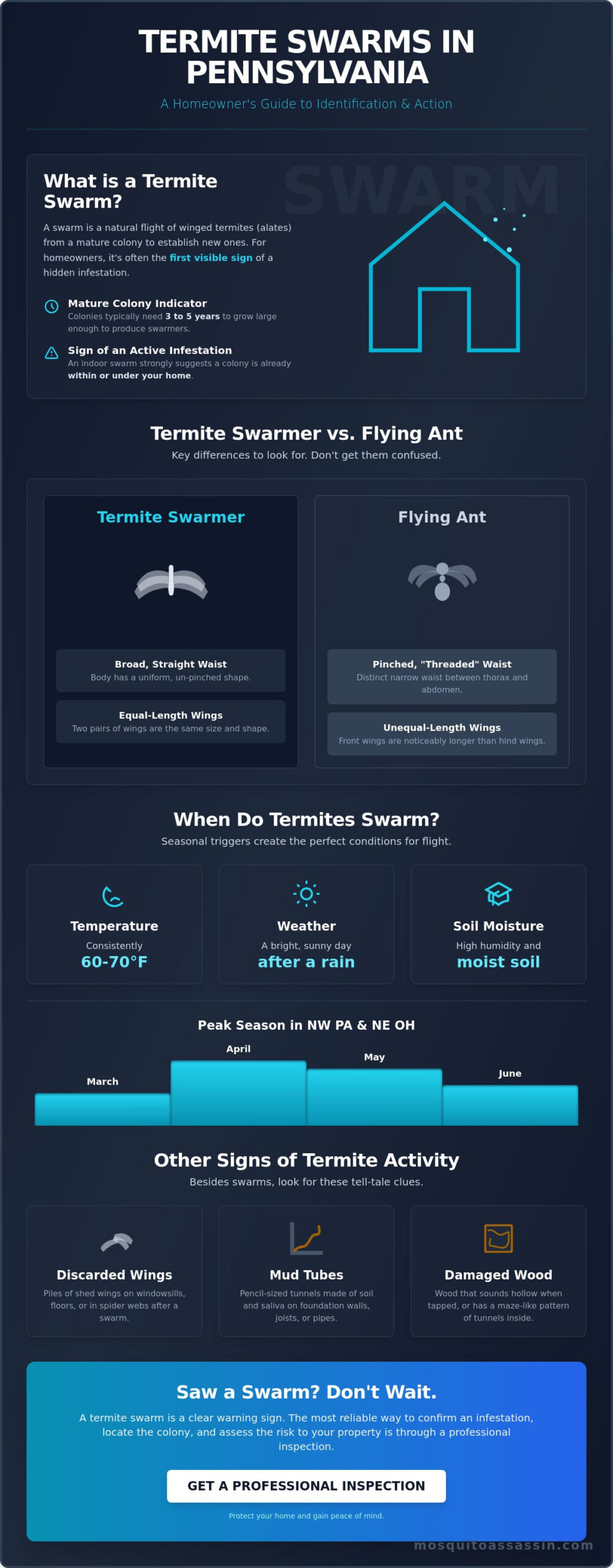
    A termite swarm is a natural dispersal flight designed for the expansion of a species. These events occur when a mature colony produces winged reproductives, also known as alates, to leave the original nest and establish new colonies. For homeowners, observing termite swarms in PA is often the first visible sign of an underlying infestation, as the majority of termite activity remains hidden underground or within wooden structures. Environmental triggers play a vital role in these flights, with most activity occurring when temperatures reach a consistent 60 to 70 degrees Fahrenheit.

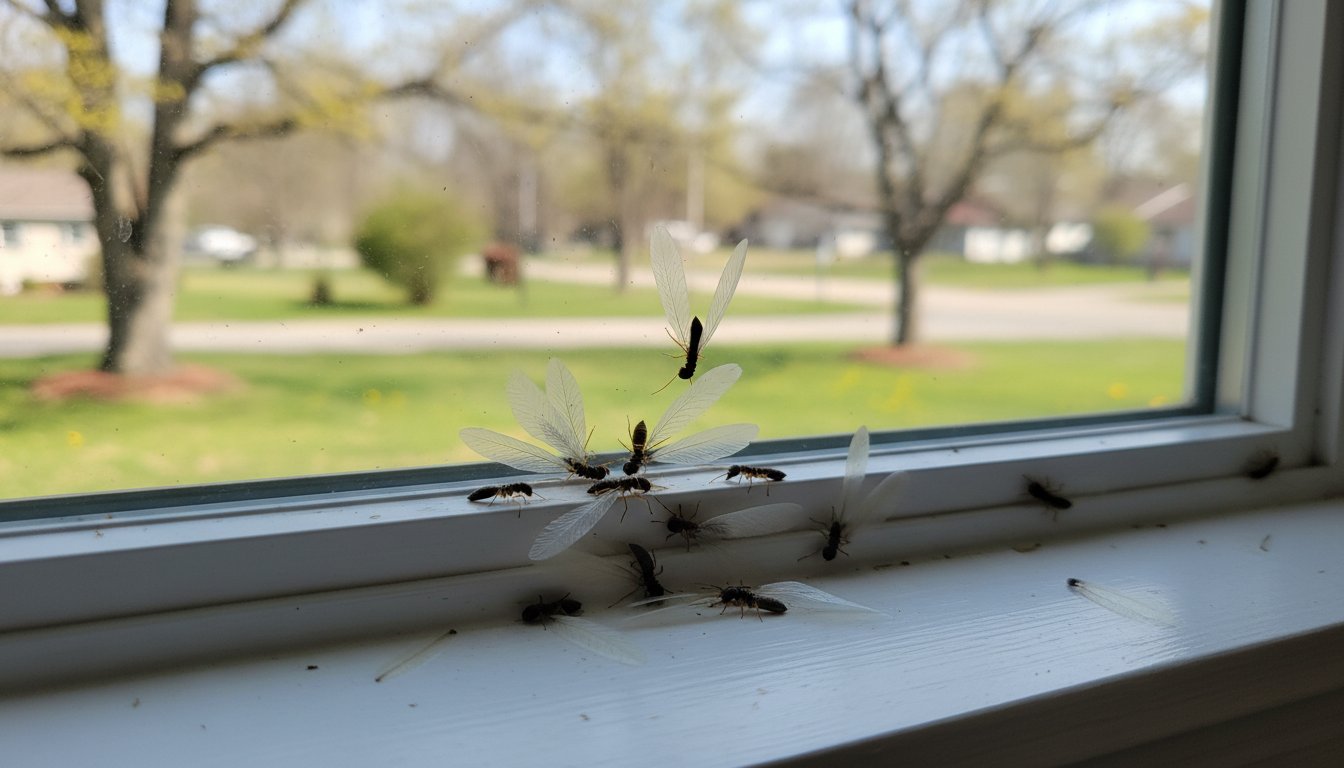
    The primary species responsible for these events in the region is the Eastern Subterranean Termite (Reticulitermes flavipes). Unlike the creamy-white, wingless workers that stay hidden in the soil or wood, the alates are dark brown or black and possess two pairs of translucent wings. These wings are equal in length and often shed shortly after the flight, leaving behind piles of discarded wings on windowsills or floors.

    To better understand this concept, watch this helpful video:

    The Biological Purpose of the Swarm

    The swarm serves a specific reproductive function. A colony typically needs three to five years of growth before it reaches a maturity level capable of producing alates. These winged termites aren’t strong fliers and usually rely on wind currents to travel short distances. The flight itself is brief, often lasting less than an hour. If a swarm occurs indoors, it’s a strong indicator that a mature colony is already established within or directly underneath the structure. Because these insects require high humidity to survive, those that emerge inside a dry home usually die quickly if they cannot find a way back to the soil.

    Seasonal Timing for Northwest PA and Northeast OH

    In areas like Erie and Crawford counties, the window for termite swarms in PA typically opens in March and can extend through June. Local weather patterns heavily influence the exact day a swarm begins. The most common trigger is a bright, sunny day following a spring rain event. The moisture in the soil combined with a sudden rise in temperature signals the colony that conditions are ideal for the alates to survive their flight.

    Residents in the Tri-State area

    The Biology of Eastern Subterranean Termites

    Eastern Subterranean termites (Reticulitermes flavipes) are the primary species responsible for structural damage throughout Pennsylvania and Ohio. These insects live in highly organized colonies governed by a rigid caste system. The queen and king are the reproductive heart of the nest, while the soldiers use their enlarged mandibles to protect the colony from predators. Workers are the most numerous members, responsible for foraging, feeding the other castes, and maintaining the nest. The winged reproductives, also known as alates, are the individuals homeowners encounter during termite swarms in PA each spring.

    These termites are small, with workers typically measuring between 1/8 and 3/8 of an inch in length. Because they have thin exoskeletons, they are extremely susceptible to dehydration. To survive, they construct mud tubes, which are narrow tunnels made of soil and saliva. These tubes allow them to travel from their underground nests into the wooden structures of a home while maintaining the high humidity levels they require. Any wood-to-soil contact, such as porch lattice or door frames touching the earth, provides an easy entry point for these foragers.

    The Hidden Nature of Subterranean Colonies

    It’s rare for a homeowner to see a worker termite because they spend their lives in the dark, damp environments of the soil or inside the wood they are consuming. A single colony can be incredibly expansive, with workers foraging up to 150 feet away from the central nest to find food sources. This means the nest causing damage to a home might not even be located on the same property. In regions like Erie and Crawford Counties, these pests are resilient to the cold. When temperatures drop, they retreat three to four feet below the frost line, staying active year-round by utilizing the warmth from a building’s foundation or heated crawl space.

    Diet and Destruction: What They Eat

    The primary diet of a subterranean termite is cellulose, a complex carbohydrate found in wood, paper, and cardboard products. While they naturally break down fallen trees in the forest, they don’t distinguish between a rotting log and the structural timbers of a house. The components most at risk include sill plates, floor joists, and wall studs. Moisture issues, such as those found in damp basements or poorly ventilated crawl spaces, significantly accelerate the rate of damage. Saturated wood is much easier for termites to chew and digest. For a deeper look at termite identification and damage, local data from Penn State Extension highlights how quickly these pests can compromise a structure. Seeing termite swarms in PA inside a living space is often the first and only warning sign that a mature colony is already feeding on the home’s skeleton.

    If you notice signs of activity or mud tubes along your foundation, professional pest control may help reduce the risk of structural failure. You can find more information about protective measures for your property to help safeguard your investment.

    Disclaimer: The information provided on this blog is for general informational purposes only and is not intended as professional pest control advice. Conditions vary by property, environment, and location. Reading this content does not create a service agreement. For an inspection or professional recommendations, please contact Mosquito Assassin Pest Control LLC directly.

    Termite Swarms in PA: Identifying and Managing Spring Activity (2026)

    Differentiating Termite Swarmers from Flying Ants

    Correctly identifying the insects emerging in your home is the first step in protecting your property. Many homeowners in Northwest Pennsylvania mistake flying ants for termites, leading to unnecessary stress or, conversely, ignoring a serious structural threat. Mistaking these two can be a costly error. While ants are a nuisance, termites cause over 5 billion dollars in property damage across the United States every year. Using the Penn State Extension guide to termites can help residents understand the biology of the Eastern subterranean termite, which is the species responsible for most termite swarms in PA.

    Visual Identification Guide

    The most reliable way to distinguish these pests is by examining three specific physical traits: the waist, the antennae, and the wings. Termites have a broad, straight waist that doesn’t taper. In contrast, ants have a distinct, pinched waist that gives them a segmented appearance. When looking at the head, termite antennae are straight and look like tiny strings of beads. Ant antennae are elbowed, meaning they have a sharp bend or “joint” in the middle.

    Wing structure provides the most obvious clue during a swarm. Termites have four wings of equal length that are significantly longer than their bodies. These wings are typically translucent or slightly milky in color. Flying ants also have four wings, but they aren’t equal; the front pair is much larger than the hind pair. In Erie and Crawford Counties, carpenter ants are frequently confused with termites. Carpenter ants are generally larger, often reaching 1/2 inch in length, and have a solid black or reddish-brown color, while termite swarmers are usually about 1/4 inch long and dark brown or black.

    Behavioral Differences

    Where and how you find these insects can reveal their identity. Termites are notoriously poor fliers. They don’t travel far from their colony and often emerge from tiny cracks in walls or floorboards. Because they’re weak in the air, they shed their wings almost immediately after landing. Finding piles of discarded, identical wings on windowsills or near basement doors is a primary sign of termite activity. Ants don’t shed their wings in this manner; if you see winged insects crawling around with their wings still firmly attached, they’re more likely to be ants.

    Both species are attracted to light sources, but their patterns differ. Termite swarms in PA usually occur during the day, particularly after a warm spring rain. You’ll often find them fluttering toward windows or indoor light fixtures. Flying ants are more robust fliers and may be seen at various times of day or night. If you discover winged insects inside your living space, professional pest control may help reduce risk and determine if a treatment plan is necessary. For a professional evaluation, you can visit the contact page or use the online booking portal.

    Disclaimer: The information provided on this blog is for general informational purposes only and is not intended as professional pest control advice. Conditions vary by property, environment, and location. Reading this content does not create a service agreement. For an inspection or professional recommendations, please contact Mosquito Assassin Pest Control LLC directly.

    Recognizing Signs of Termite Activity in Northwest Pennsylvania

    Identifying termite presence requires a methodical visual assessment, especially since these pests often remain hidden within structural voids. Homeowners should begin by inspecting the foundation line and crawl spaces. Look for mud tubes, which are pencil-thick tunnels constructed from soil and saliva. These tubes allow subterranean termites to travel from the ground to the wooden components of a home without drying out. In Pennsylvania, these tubes are frequently found on concrete blocks or behind sill plates where the wood meets the foundation.

    Testing structural supports is another critical step. When wood is infested, it often appears solid on the outside but is hollowed out internally. Tapping on floor joists or support beams with a tool handle can reveal a dull, hollow thud rather than a solid ring. If a screwdriver easily penetrates the wood surface with little resistance, it indicates significant internal damage. While termite swarms in PA are the most visible indicator, these structural clues often signal an established colony that’s been active for years.

    Evidence Beyond the Swarm

    Beyond the actual termite swarms in PA, homeowners may notice small, pin-sized exit holes in drywall or wood trim. These holes are often capped with a small amount of mud. Bubbling paint or crumbling baseboards are also common red flags, frequently mistaken for simple water damage. A primary risk factor for subterranean species is wood-to-soil contact. This occurs when siding, porch steps, or deck posts touch the earth directly, providing a clear highway for termites. Maintaining a gap of at least six inches between the soil and wooden structures can significantly reduce these risks. For more on general pest threats, see this General Pest Control guide.

    Environmental Risk Factors in the Lake Erie Region

    The unique climate of the Lake Erie region creates specific vulnerabilities for properties in Erie, Crawford, and Ashtabula counties. High humidity levels, often reaching over 75 percent during the summer months, keep structural wood moist and attractive to pests. Additionally, heavy spring snowmelt in March and April saturates the soil, driving subterranean termites upward in search of drier ground. Homes in Meadville and Erie with older foundations are particularly susceptible. Over time, settling causes small cracks, even those as narrow as 1/32 of an inch, that provide easy entry points. Understanding these local factors is essential for effective property management. Homeowners can learn more about service locations and regional risks through professional resources.

    If suspicious mud tubes or hollow wood are discovered, professional pest control may help reduce risk. To request an evaluation, visit the online booking portal.

    Disclaimer: The information provided on this blog is for general informational purposes only and is not intended as professional pest control advice. Conditions vary by property, environment, and location. Reading this content does not create a service agreement. For an inspection or professional recommendations, please contact Mosquito Assassin Pest Control LLC directly.

    Professional Inspection and Long-Term Protection Strategies

    Confirming the presence of a colony requires more than just spotting a few winged insects. While termite swarms in PA are a visible indicator of an issue, the actual colony often remains hidden deep underground or within structural timbers. Professional inspections provide the only reliable method for locating the source and assessing the extent of the activity. According to the National Pest Management Association, termites cause over $5 billion in property damage annually in the United States, making early detection a financial necessity for homeowners.

    DIY identification often leads to misdiagnosis, as homeowners frequently confuse winged ants with termites. Attempting to treat a swarm with over the counter sprays only addresses the insects that are visible, leaving the main colony intact to continue feeding on the home’s infrastructure. Integrated Pest Management (IPM) offers a more effective alternative by combining biological, mechanical, and targeted chemical strategies to manage pests with minimal environmental impact. Year-round protection plans help ensure that small vulnerabilities don’t escalate into structural failures, providing a proactive defense against seasonal activity.

    What Happens During a Professional Inspection

    A licensed technician follows a methodical process to evaluate a property’s risk. This includes a detailed examination of basements, crawl spaces, and the exterior perimeter where soil meets the foundation. Professionals look for specific signs such as mud tubes, wood that sounds hollow when tapped, and discarded wings near entry points. Specialized tools, including moisture meters and thermal imaging cameras, help detect activity behind drywall or under floorboards without causing damage. The process concludes with a written report and a customized management plan tailored to the specific needs of the property.

    Preventative Measures for Homeowners

    Reducing moisture is the most effective way to make a property less attractive to subterranean termites. Preventing termite swarms in PA from establishing a foothold starts with ensuring that soil remains at least 6 to 8 inches below the top of the foundation. Homeowners should also verify that gutters direct water at least 3 feet away from the structure. Maintaining proper ventilation in crawl spaces and attics prevents the humidity buildup that these insects require to survive. Professional pest control may help reduce the risk of structural damage by identifying these environmental triggers before an infestation begins.

    Next Steps for Property Protection

    Taking action early is the best way to safeguard a home from the long-term effects of wood-destroying organisms. If you suspect activity in Erie, Crawford, or Ashtabula, consulting a licensed professional is a critical step. You can find more details on the professional services page to understand the different management options available. For those ready to schedule an evaluation, visiting the online booking portal provides a direct way to begin the process of securing your property.

    Disclaimer: The information provided on this blog is for general informational purposes only and is not intended as professional pest control advice. Conditions vary by property, environment, and location. Reading this content does not create a service agreement. For an inspection or professional recommendations, please contact Mosquito Assassin Pest Control LLC directly.

    Securing Your Property Against Termite Activity

    According to the National Pest Management Association, subterranean termites cause over $5 billion in property damage annually across the United States. Identifying termite swarms in PA is the first step in preventing structural loss. Distinguishing between flying ants and subterranean termites requires a close look at wing length and body shape. Because Eastern subterranean termites live in the soil, they often remain hidden until a swarm occurs or damage is already visible. Homeowners in Erie and Crawford Counties can benefit from Year-Round Protection plans.

    Working with a locally owned team ensures professionals are familiar with specific Pennsylvania soil conditions. Licensed and insured technicians provide the expertise needed to safeguard properties in NW PA and NE OH. It’s vital to take action before a swarm begins. For those concerned about potential activity, schedule a professional inspection through the online portal. Proactive management is the most effective way to ensure a pest-free environment throughout the year.

    Disclaimer: The information provided on this blog is for general informational purposes only and is not intended as professional pest control advice. Conditions vary by property, environment, and location. Reading this content does not create a service agreement. For an inspection or professional recommendations, please contact Mosquito Assassin Pest Control LLC directly.

    Frequently Asked Questions

    How long does a termite swarm last?

    A termite swarm typically lasts between 30 and 60 minutes from start to finish. During this brief window, the winged reproductives emerge from a mature colony to mate and find new nesting sites. While the individual flight is short, homeowners might find evidence of the event for several days afterward as the insects drop their wings near light sources.

    If I see a termite swarm outside, is my house in danger?

    Seeing a termite swarm outside indicates that a mature colony exists within approximately 100 feet of the sighting. While an outdoor swarm doesn’t guarantee an indoor infestation, it’s a clear signal that the local population is expanding. Since subterranean termites travel through soil, any structure within this radius is at a higher risk for potential entry through the foundation.

    Do termite swarmers eat wood?

    Termite swarmers don’t eat wood or cause structural damage themselves. Their sole purpose is to leave the original colony, pair up, and establish new reproductive sites. The actual damage is caused by the worker class of the colony, which can consume roughly 1 pound of wood every 2 to 3 months in a medium sized subterranean nest.

    Can I get rid of termites on my own?

    Eliminating a termite colony requires specialized equipment and soil treatments that aren’t available to the general public. DIY methods often fail to reach the queen or the deep underground tunnels where 90 percent of the population lives. Professional pest control may help reduce risk and ensure the entire colony is properly addressed. For more information, visit the online booking portal.

    What should I do if I find discarded wings on my windowsill?

    Finding discarded wings on a windowsill is a strong indicator that termite swarms in PA have occurred inside or very close to the structure. You should collect a few wings in a sealed bag for professional identification. Because swarmers are attracted to light, they often congregate near windows before shedding their wings and attempting to crawl into nearby crevices.

    Are termites active in PA during the winter?

    Termites remain active in Pennsylvania throughout the winter by retreating below the frost line, which typically reaches 36 to 48 inches deep in the region. While they don’t swarm in the cold, they continue to feed on wood if they’ve found a source of warmth, such as a heated basement or crawlspace. Activity usually remains hidden until temperatures rise above 60 degrees Fahrenheit in the spring.

    Does a termite swarm mean my house is infested?

    An indoor swarm is a definitive sign of an existing infestation, as the insects are emerging from within the building’s framework. If the swarm occurs outdoors, it confirms a colony is nearby but doesn’t always mean the house is currently infested. However, termite swarms in PA serve as a critical warning that the property is within the foraging range of a mature nest.

    How often should I have my home inspected for termites in Pennsylvania?

    Annual inspections are the industry standard for properties in Erie and Crawford Counties to detect activity before significant damage occurs. Subterranean termites cause an estimated $5 billion in property damage across the United States each year, often without showing visible signs for several seasons. Scheduling a professional evaluation every 12 months helps identify entry points and early warning signs like mud tubes. To schedule an inspection, contact www.mosquitoassassin.com/contact-us.

    Disclaimer: The information provided on this blog is for general informational purposes only and is not intended as professional pest control advice. Conditions vary by property, environment, and location. Reading this content does not create a service agreement. For an inspection or professional recommendations, please contact Mosquito Assassin Pest Control LLC directly.