Tag: Termite Identification

  • Signs of Termites in Basement: A Homeowner’s Identification Guide

    Signs of Termites in Basement: A Homeowner’s Identification Guide

    With termites causing an estimated $5 billion to $6.8 billion in property damage across the United States every year, your home’s foundation is under a constant, invisible threat. For residents in Erie and Crawford Counties in Pennsylvania and Ashtabula County in Ohio, the basement is often the primary gateway for these destructive pests. Identifying the early signs of termites in basement is the only way to stop a colony before it compromises the structural integrity of your property.

    It’s completely normal to feel a sense of dread when you spot a mysterious mark on a floor joist or a pile of what looks like sawdust near a window sill. You might find yourself wondering if you’re looking at harmless mold, simple wood rot, or a massive repair bill in the making. This guide provides the clarity you need to distinguish between common basement issues and active infestations. You’ll learn to identify mud tubes, recognize the sound of hollowed timber, and understand the behavior of swarming insects so you can protect your home’s value and your family’s safety.

    Key Takeaways

    • Learn why the damp, dark environment of a basement provides the ideal conditions for subterranean termites to thrive.
    • Identify the most common signs of termites in basement areas, including the presence of mud tubes on foundation walls and damaged floor joists.
    • Recognize the difference between harmless insects and reproductive swarmers to confirm the presence of a nearby colony.
    • Use a structured inspection checklist to evaluate critical entry points along the exterior foundation and interior sill plates.
    • Understand the importance of a professional assessment when dealing with complex structural infestations that require specialized detection tools.

    Understanding Termite Activity in the Basement Environment

    In the Eastern United States, subterranean termites represent the primary threat to residential structures. These pests live in massive colonies deep within the soil, where they maintain the moisture levels necessary for their survival. Your basement serves as the critical intersection where the earth meets your home’s skeleton. By Understanding Termite Biology, it’s easier to see why your foundation is the most vulnerable point of entry. Termites are relentless foragers. Your basement provides the perfect dark, damp environment they crave.

    Identifying the signs of termites in basement early is essential for protecting your investment. Because subterranean termites can remain hidden for years, the damage they cause is often extensive by the time it becomes visible on upper floors. Catching them at the foundation level can save you from the staggering costs of replacing load-bearing beams or floor joists. Termites cause an estimated $5 billion to $6.8 billion in property damage in the United States each year, making the basement the most important area for regular monitoring.

    To better understand how these pests operate and what to look for, watch this helpful video:

    Why Subterranean Termites Target Your Basement

    Your basement is a natural target because of its proximity to the ground. Termites use foundation cracks or gaps around utility pipes to transition from the soil into your wood framing. High humidity levels, common in basements throughout Crawford and Erie counties in Pennsylvania and Ashtabula County in Ohio, provide the moisture these insects need to stay hydrated while they feed. The sill plate is often the first point of contact. Since this wood sits directly on the foundation, it’s the easiest meal for a colony moving upward from the earth.

    The Difference Between Active and Old Infestations

    Homeowners often find remnants of past activity and wonder if the danger has passed. Active mud tubes are typically moist to the touch and darker in color. If you find live insects while pulling back drywall or moving storage boxes, the infestation is immediate and requires attention. Old, abandoned tubes feel dry and will crumble into dust with very little pressure. Don’t assume a dry tube means the problem solved itself. Termites are experts at finding new routes; an “inactive” sign often points to a colony that has simply moved to a more secluded part of your basement. Professional pest control may help reduce risk and provide a definitive answer.

    Disclaimer: The information provided on this blog is for general informational purposes only and is not intended as professional pest control advice. Conditions vary by property, environment, and location. Reading this content does not create a service agreement. For an inspection or professional recommendations, please contact Mosquito Assassin Pest Control LLC directly.

    Physical Signs of Termite Damage on Basement Structures

    The structural components of a basement are often the first to suffer when a colony moves in from the surrounding soil. While these insects are notoriously secretive, they leave behind distinct physical calling cards that a vigilant homeowner can identify. Knowing exactly where to look along your foundation walls, support beams, and utility penetrations is the first step in uncovering a hidden infestation before it spreads to the upper levels of your home.

    Identifying Subterranean Mud Tubes

    Mud tubes are perhaps the most recognizable signs of termites in basement environments. These earthy, pencil-sized tunnels are constructed from soil and saliva to protect the insects from predators and dehydration as they travel between their colony and their food source. You’ll typically find them climbing up concrete blocks, support piers, or along plumbing lines and electrical conduits. To determine if a tube is currently in use, you can perform a “break test” by carefully removing a small section of the tunnel. If the insects repair the gap within a day or two, the infestation is active. For more detailed identification tips, this University of California guide to termites explains how these structures facilitate colony movement and survival.

    Termite Damage vs. Wood Rot

    It’s easy to confuse termite damage with standard wood rot, especially in damp basements found throughout Erie and Crawford Counties. Subterranean termites specifically hollow out galleries that follow the grain of the wood, leaving a “honeycomb” appearance inside the timber while the exterior remains seemingly intact. In contrast, wood rot usually results in a soft, spongy, or crumbly texture that often smells musty. In many Pennsylvania and Ohio homes, these two issues occur simultaneously because the same moisture that causes decay also attracts pests. If you tap a sill plate or floor joist and it sounds hollow or feels brittle, it’s a major indicator of internal structural compromise.

    Buckling and Blistering Surfaces

    Damage isn’t always limited to the main support beams. Termites often eat the paper backing of drywall, which causes the paint on the surface to bubble or blister. This can look remarkably like water damage from a leaky pipe. You might also notice sunken, winding lines in wallpaper or wood paneling that indicate tunnels just beneath the surface. Keep an eye out for “frass,” which is termite excrement that often resembles small piles of sawdust or sand. These debris piles frequently collect on windowsills or along the floor where the wall meets the foundation. Detecting these subtle changes early is the best way to prevent long-term structural failure. If you’re unsure about what you’ve found, a professional termite inspection can provide the necessary confirmation.

    Disclaimer: The information provided on this blog is for general informational purposes only and is not intended as professional pest control advice. Conditions vary by property, environment, and location. Reading this content does not create a service agreement. For an inspection or professional recommendations, please contact Mosquito Assassin Pest Control LLC directly.
    Signs of Termites in Basement: A Homeowner’s Identification Guide

    Biological Indicators: Swarmers and Wings in the Basement

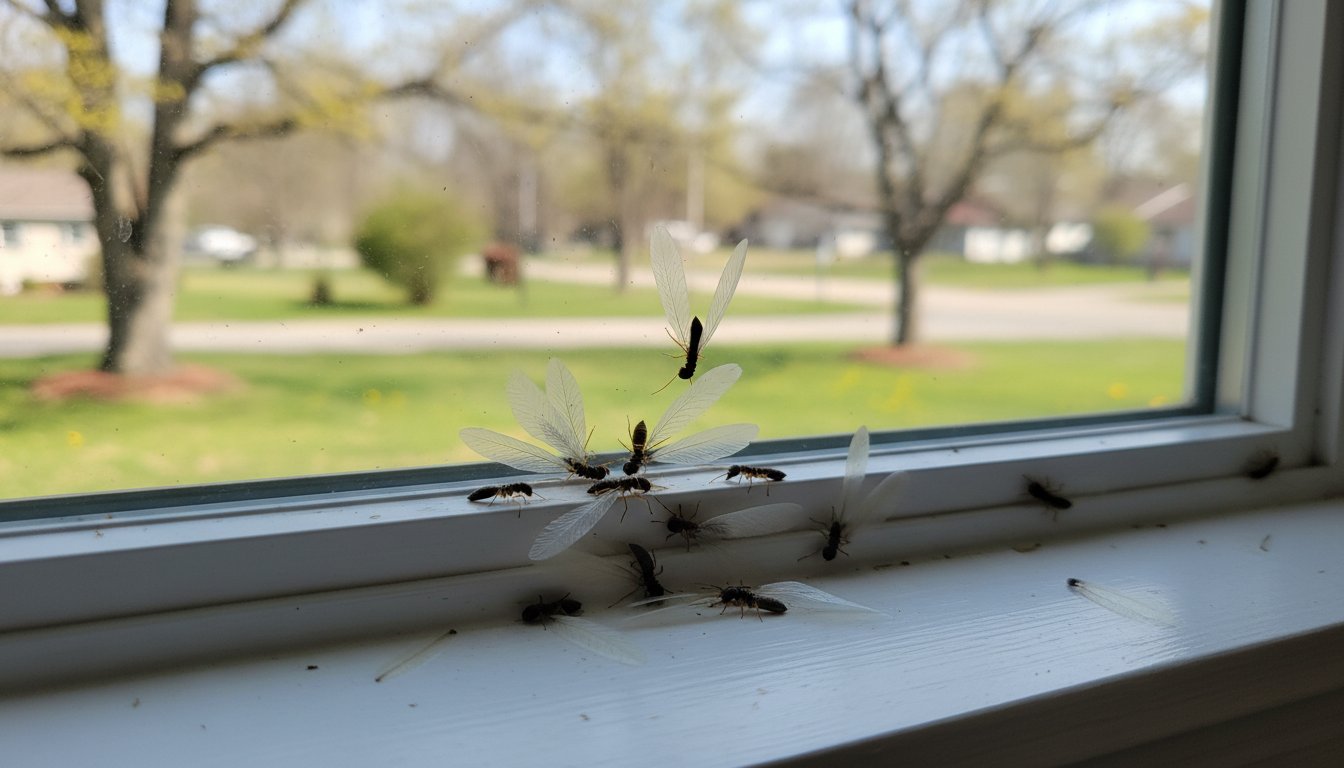
    While mud tubes provide structural evidence of an infestation, the sudden appearance of winged insects offers a clear biological confirmation of a colony’s presence. These reproductive members, known as swarmers or alates, emerge from mature colonies to mate and establish new nesting sites. Finding these insects within the lower levels of your home is one of the most undeniable signs of termites in basement structures. It signifies that a colony is not just nearby in the exterior soil, but has likely already breached the foundation and is thriving within the house itself.

    In the specific regional climate of Erie and Crawford Counties in Pennsylvania, and Ashtabula County in Ohio, swarming typically occurs during the spring months. These events usually follow the first few warm rains of the season when humidity levels are high. Because these insects are relatively weak fliers, they rely on light and air currents to guide them. Identifying these signs of termites in basement areas is critical during this window, as a swarm inside a building almost always indicates an existing infestation that requires professional attention.

    According to the EPA guide on termite control, proper identification is the essential first step in managing these pests. Homeowners often mistake swarmers for flying ants, which can lead to a false sense of security or the wrong treatment approach.

    Termite Swarmers vs. Flying Ants

    Distinguishing between these two pests is a common challenge. Termites have a thick, straight waist, while ants possess a clearly defined, pinched waist. Their antennae also differ; termites feature straight, bead like antennae, whereas ants have elbowed ones. Most noticeably, termite wings are equal in length and significantly longer than their bodies. Ant wings are unequal in size, with the front pair being larger than the back pair. If the wings are uniform and the body is straight, you are likely looking at a termite.

    Where to Find Discarded Wings

    After a brief flight, swarmers shed their wings to begin the next stage of their life cycle. These translucent, vein filled wings are often found in piles near basement windowsills or light fixtures. Finding a large accumulation of wings indoors is a strong indicator that a colony is active within the structure. While a single wing might blow in from an open door, a cluster in a subterranean space almost always points to an internal source. Professional pest control may help reduce risk once these biological markers are identified.

    Disclaimer: The information provided on this blog is for general informational purposes only and is not intended as professional pest control advice. Conditions vary by property, environment, and location. Reading this content does not create a service agreement. For an inspection or professional recommendations, please contact Mosquito Assassin Pest Control LLC directly.

    A Step-by-Step Basement Termite Inspection Checklist

    Performing a systematic walkthrough is the most effective way to catch an infestation before it leads to structural failure. Subterranean termites are masters of camouflage, but they cannot hide their entry points if you know where to look. By following a logical sequence, you can evaluate your home’s vulnerability and identify the signs of termites in basement areas. This process is especially important for residents in Erie and Crawford Counties in Pennsylvania and Ashtabula County in Ohio, where damp soil conditions often encourage colony growth near residential foundations.

    The Pencil and Screwdriver Test

    Physical probing is essential for identifying internal wood damage that isn’t visible on the surface. Use a flathead screwdriver or a heavy pencil to tap along the length of structural beams and floor joists. A healthy beam should produce a solid thud; wood infested by termites will sound hollow or thin. If you encounter a soft spot, gently press the tool into the timber. If it sinks in easily or reveals layered galleries, you’ve likely found an active feeding site. Document these locations clearly so you can share them during a professional termite inspection and treatment assessment.

    Critical Basement Areas to Monitor

    Focus your attention on three main zones that serve as the primary targets for foraging colonies:

    • Sill Plates: This is the horizontal wood that rests directly on top of your foundation wall. It’s the most common entry point for termites moving up from the soil.
    • Rim Joists: These form the perimeter of your floor framing. Because they’re often located near the exterior ground level, they’re highly susceptible to moisture and pest activity.
    • Support Columns: Pay close attention to wooden posts that rest directly on concrete floors. If the concrete has even a hairline crack, termites can move straight from the earth into the base of the post.

    External Basement Entry Points

    Your inspection shouldn’t stay strictly indoors. Walk the exterior foundation line and look for areas where the soil or mulch sits too high against the house. Any gap larger than 1/16th of an inch in your concrete or brickwork is wide enough for a termite to enter. Be particularly vigilant around basement windows and vents, as these often have wooden frames that sit close to the ground. If you find mud-like blockages around utility pipes where they enter the wall, it’s a definitive sign that a colony has established a highway into your structure. Searching for these signs of termites in basement levels twice a year can prevent long-term structural damage.

    Disclaimer: The information provided on this blog is for general informational purposes only and is not intended as professional pest control advice. Conditions vary by property, environment, and location. Reading this content does not create a service agreement. For an inspection or professional recommendations, please contact Mosquito Assassin Pest Control LLC directly.

    Next Steps: When to Seek Professional Pest Assessment

    Identifying the signs of termites in basement levels often triggers an immediate desire to solve the problem quickly. While the initial instinct might be to reach for a store-bought spray, basement infestations present unique technical challenges that typical retail products cannot address. Because subterranean termites live deep within the soil and utilize the foundation as a bridge, a surface-level approach rarely reaches the source of the colony. Professional intervention is necessary to ensure that the entire population is addressed rather than just the visible workers.

    The Limitations of DIY Basement Treatments

    Retail pesticides are generally formulated for surface contact. They might kill the few insects you see on a sill plate, but they do nothing to stop the thousands of workers still active behind concrete blocks or deep under the floor slab. Missing even a single entry point allows the colony to reroute and continue its destruction undetected. Professional pest control may help reduce risk to the home’s structure by utilizing specialized equipment designed for foundation injections. These tools allow for the precise placement of termiticides in areas where the insects actually travel, ensuring a more comprehensive barrier than any DIY method could provide. Without professional-grade delivery systems, reaching the heart of a subterranean colony is nearly impossible.

    What a Professional Termite Inspection Includes

    A licensed professional does more than just confirm the presence of pests. A thorough assessment includes detailed mapping of the infestation to identify exactly where the colony has breached the foundation. This process involves evaluating moisture levels and other conducive conditions, such as poor drainage or wood-to-ground contact, that make your basement an attractive target. By understanding the specific behavior of the colony, an expert can provide recommendations for exclusion and long-term prevention strategies that go beyond a simple one-time application. This methodical approach ensures that every potential highway into your home is accounted for and secured.

    Protecting Your Investment in PA and OH

    The regional climate in Erie, Crawford, and Ashtabula counties creates a high-pressure environment for wood-destroying organisms. Local expertise is vital because the specific soil types and construction styles in this area dictate how termites move through the earth. Comprehensive general pest control plans provide peace of mind by ensuring that your home’s most vulnerable areas remain under constant supervision. If you have identified suspicious mud tubes or damaged wood, taking swift action is the best way to safeguard your property’s value. For an inspection or professional recommendations, please contact us to secure your home’s foundation and prevent future structural compromise.

    Disclaimer: The information provided on this blog is for general informational purposes only and is not intended as professional pest control advice. Conditions vary by property, environment, and location. Reading this content does not create a service agreement. For an inspection or professional recommendations, please contact Mosquito Assassin Pest Control LLC directly.

    Securing Your Home Against Subterranean Threats

    Protecting your property starts with a vigilant eye on the foundation. By recognizing the early signs of termites in basement areas, such as the appearance of mud tubes or discarded wings, you can intervene before structural damage becomes irreversible. Remember that subterranean termites are persistent foragers that require specialized detection methods to fully eradicate. Licensed and insured professionals possess the technical expertise to map out entry points and implement effective barriers that DIY products simply can’t match. Relying on local experts who understand the specific pest pressures of our region is the most reliable way to maintain a secure household.

    Serving Erie, Crawford, and Ashtabula Counties, Mosquito Assassin Pest Control LLC provides specialized termite detection and treatment to keep your foundation sound. Taking proactive steps today ensures the long-term safety and value of your home. For an inspection or professional recommendations, please contact Mosquito Assassin Pest Control LLC directly. You don’t have to face these pests alone; expert help is just a click away to restore your peace of mind.

    Disclaimer: The information provided on this blog is for general informational purposes only and is not intended as professional pest control advice. Conditions vary by property, environment, and location. Reading this content does not create a service agreement. For an inspection or professional recommendations, please contact Mosquito Assassin Pest Control LLC directly.

    Frequently Asked Questions

    Is it termites or just wood rot in my basement?

    Termites create hollow, layered tunnels that follow the wood grain, while wood rot results in soft, crumbling fibers. In the high humidity basements of Erie and Crawford Counties, these issues often coexist. Termites are naturally attracted to wood that has already been softened by moisture or fungal decay. If the damaged wood contains soil or mud like material, it is a clear sign of pest activity rather than simple rot.

    What do termite mud tubes in a basement look like?

    Mud tubes look like narrow, earthy veins climbing up foundation walls or support piers. These structures are roughly the diameter of a pencil and are made from a mixture of soil, saliva, and fecal matter. Homeowners often find them in the dark corners of a basement or hidden behind fiberglass insulation. They provide the moisture rich environment subterranean termites need to survive while traveling from the soil to your floor joists.

    Can termites live in or eat through concrete basement walls?

    Termites cannot eat through concrete, but they are experts at navigating the smallest fissures within it. Any crack in a basement wall wider than 1/16th of an inch provides enough space for a termite to pass through. They often use the interior voids of hollow concrete blocks to move upward undetected. This makes the signs of termites in basement walls difficult to spot without a professional’s specialized detection tools.

    Should I be worried if I find swarmers in my basement?

    Finding swarmers indoors is a serious concern that indicates a mature colony is already established within or very close to your structure. These winged insects emerge specifically to mate and start new colonies. Because they are attracted to light, you will often find them or their discarded wings near basement windows and light fixtures. A swarm inside a basement is rarely an accidental entry; it’s a primary biological indicator of an active infestation.

    How fast can termites cause structural damage to a basement?

    Significant structural damage usually takes three to five years to become catastrophic, but the destruction begins the moment the colony arrives. A single colony can consume several pounds of wood per year. In a basement, this feeding often targets critical load bearing members like sill plates and rim joists. While the collapse won’t happen overnight, the silent nature of the damage means the costs of repairs grow every day the infestation remains untreated.

    Can I treat a termite infestation in my basement myself?

    Treating a basement infestation yourself is highly ineffective because retail products cannot penetrate deep foundation cracks or reach the subterranean nest. DIY sprays may kill a few workers on contact, but they often cause the colony to relocate to a different part of the home. Professional pest control may help reduce risk by using specialized pressurized equipment to inject liquid barriers directly into the soil and foundation voids where termites live.

    Where are the most common places for termites to enter a basement?

    The most frequent entry points include expansion joints, utility pipe penetrations, and the cold joint where the basement floor meets the wall. Termites also exploit gaps around basement window frames that sit close to the exterior soil line. Identifying these signs of termites in basement entry zones is the first step in a successful exclusion strategy. Any area where wood is within six inches of the soil is considered a high risk zone.

    Does homeowner’s insurance cover termite damage in the basement?

    Most standard homeowner’s insurance policies do not cover termite damage or treatment costs. Insurance companies typically classify termite infestations as a preventable maintenance issue rather than a sudden, accidental event like a fire or storm. This means the financial burden for both the treatment and the structural repairs usually falls entirely on the property owner. Regular inspections are the most cost effective way to avoid these massive out of pocket expenses.

    Disclaimer: The information provided on this blog is for general informational purposes only and is not intended as professional pest control advice. Conditions vary by property, environment, and location. Reading this content does not create a service agreement. For an inspection or professional recommendations, please contact Mosquito Assassin Pest Control LLC directly.

  • Termite Swarms in PA: Identifying and Managing Spring Activity (2026)

    Termite Swarms in PA: Identifying and Managing Spring Activity (2026)

    On a warm afternoon in April, a homeowner in Erie County might notice a sudden cloud of winged insects near a window or door frame. It’s a sight that often triggers immediate concern, especially when you realize these aren’t just common houseflies. Most Pennsylvanians understand that seeing termite swarms in PA is a classic sign of a potential infestation, yet the fear of hidden structural damage can make it hard to think clearly. It’s natural to feel anxious about the integrity of your home when these pests appear without warning.

    This article promises to help you identify termite swarmers and distinguish them from look-alike flying ants with confidence. You’ll learn why the spring season in Crawford and Ashtabula Counties creates the perfect conditions for these pests to emerge and move toward residential structures. The following sections examine specific risks to local properties and outline a clear plan for professional inspection. Understanding these seasonal behaviors is the first step toward effective property protection and long-term peace of mind.

    Disclaimer: The information provided on this blog is for general informational purposes only and is not intended as professional pest control advice. Conditions vary by property, environment, and location. Reading this content does not create a service agreement. For an inspection or professional recommendations, please contact Mosquito Assassin Pest Control LLC directly.

    Key Takeaways

    • Understand how environmental triggers like soil moisture and temperature initiate seasonal dispersal flights for new colony formation.
    • Learn to identify termite swarms in PA by recognizing the physical characteristics of the Eastern Subterranean species common in the region.
    • Distinguish between termite swarmers and flying ants by comparing body shapes (straight versus pinched waists) and wing lengths.
    • Discover how to conduct a basic visual assessment for signs of activity, such as the presence of mud tubes on foundation walls.
    • Recognize why professional inspections are the most reliable method for confirming colony locations and evaluating long term property risks.

    Understanding Termite Swarms in Pennsylvania

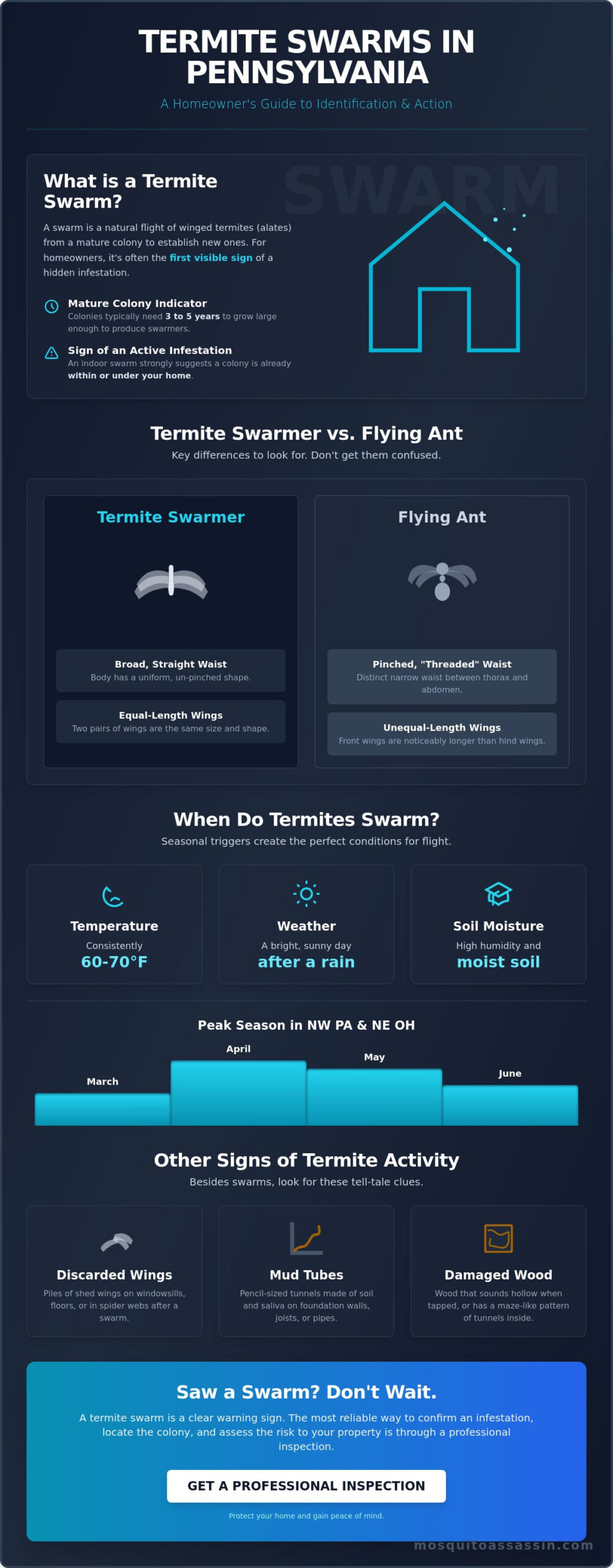
    A termite swarm is a natural dispersal flight designed for the expansion of a species. These events occur when a mature colony produces winged reproductives, also known as alates, to leave the original nest and establish new colonies. For homeowners, observing termite swarms in PA is often the first visible sign of an underlying infestation, as the majority of termite activity remains hidden underground or within wooden structures. Environmental triggers play a vital role in these flights, with most activity occurring when temperatures reach a consistent 60 to 70 degrees Fahrenheit.

    The primary species responsible for these events in the region is the Eastern Subterranean Termite (Reticulitermes flavipes). Unlike the creamy-white, wingless workers that stay hidden in the soil or wood, the alates are dark brown or black and possess two pairs of translucent wings. These wings are equal in length and often shed shortly after the flight, leaving behind piles of discarded wings on windowsills or floors.

    To better understand this concept, watch this helpful video:

    The Biological Purpose of the Swarm

    The swarm serves a specific reproductive function. A colony typically needs three to five years of growth before it reaches a maturity level capable of producing alates. These winged termites aren’t strong fliers and usually rely on wind currents to travel short distances. The flight itself is brief, often lasting less than an hour. If a swarm occurs indoors, it’s a strong indicator that a mature colony is already established within or directly underneath the structure. Because these insects require high humidity to survive, those that emerge inside a dry home usually die quickly if they cannot find a way back to the soil.

    Seasonal Timing for Northwest PA and Northeast OH

    In areas like Erie and Crawford counties, the window for termite swarms in PA typically opens in March and can extend through June. Local weather patterns heavily influence the exact day a swarm begins. The most common trigger is a bright, sunny day following a spring rain event. The moisture in the soil combined with a sudden rise in temperature signals the colony that conditions are ideal for the alates to survive their flight.

    Residents in the Tri-State area

    The Biology of Eastern Subterranean Termites

    Eastern Subterranean termites (Reticulitermes flavipes) are the primary species responsible for structural damage throughout Pennsylvania and Ohio. These insects live in highly organized colonies governed by a rigid caste system. The queen and king are the reproductive heart of the nest, while the soldiers use their enlarged mandibles to protect the colony from predators. Workers are the most numerous members, responsible for foraging, feeding the other castes, and maintaining the nest. The winged reproductives, also known as alates, are the individuals homeowners encounter during termite swarms in PA each spring.

    These termites are small, with workers typically measuring between 1/8 and 3/8 of an inch in length. Because they have thin exoskeletons, they are extremely susceptible to dehydration. To survive, they construct mud tubes, which are narrow tunnels made of soil and saliva. These tubes allow them to travel from their underground nests into the wooden structures of a home while maintaining the high humidity levels they require. Any wood-to-soil contact, such as porch lattice or door frames touching the earth, provides an easy entry point for these foragers.

    The Hidden Nature of Subterranean Colonies

    It’s rare for a homeowner to see a worker termite because they spend their lives in the dark, damp environments of the soil or inside the wood they are consuming. A single colony can be incredibly expansive, with workers foraging up to 150 feet away from the central nest to find food sources. This means the nest causing damage to a home might not even be located on the same property. In regions like Erie and Crawford Counties, these pests are resilient to the cold. When temperatures drop, they retreat three to four feet below the frost line, staying active year-round by utilizing the warmth from a building’s foundation or heated crawl space.

    Diet and Destruction: What They Eat

    The primary diet of a subterranean termite is cellulose, a complex carbohydrate found in wood, paper, and cardboard products. While they naturally break down fallen trees in the forest, they don’t distinguish between a rotting log and the structural timbers of a house. The components most at risk include sill plates, floor joists, and wall studs. Moisture issues, such as those found in damp basements or poorly ventilated crawl spaces, significantly accelerate the rate of damage. Saturated wood is much easier for termites to chew and digest. For a deeper look at termite identification and damage, local data from Penn State Extension highlights how quickly these pests can compromise a structure. Seeing termite swarms in PA inside a living space is often the first and only warning sign that a mature colony is already feeding on the home’s skeleton.

    If you notice signs of activity or mud tubes along your foundation, professional pest control may help reduce the risk of structural failure. You can find more information about protective measures for your property to help safeguard your investment.

    Disclaimer: The information provided on this blog is for general informational purposes only and is not intended as professional pest control advice. Conditions vary by property, environment, and location. Reading this content does not create a service agreement. For an inspection or professional recommendations, please contact Mosquito Assassin Pest Control LLC directly.

    Termite Swarms in PA: Identifying and Managing Spring Activity (2026)

    Differentiating Termite Swarmers from Flying Ants

    Correctly identifying the insects emerging in your home is the first step in protecting your property. Many homeowners in Northwest Pennsylvania mistake flying ants for termites, leading to unnecessary stress or, conversely, ignoring a serious structural threat. Mistaking these two can be a costly error. While ants are a nuisance, termites cause over 5 billion dollars in property damage across the United States every year. Using the Penn State Extension guide to termites can help residents understand the biology of the Eastern subterranean termite, which is the species responsible for most termite swarms in PA.

    Visual Identification Guide

    The most reliable way to distinguish these pests is by examining three specific physical traits: the waist, the antennae, and the wings. Termites have a broad, straight waist that doesn’t taper. In contrast, ants have a distinct, pinched waist that gives them a segmented appearance. When looking at the head, termite antennae are straight and look like tiny strings of beads. Ant antennae are elbowed, meaning they have a sharp bend or “joint” in the middle.

    Wing structure provides the most obvious clue during a swarm. Termites have four wings of equal length that are significantly longer than their bodies. These wings are typically translucent or slightly milky in color. Flying ants also have four wings, but they aren’t equal; the front pair is much larger than the hind pair. In Erie and Crawford Counties, carpenter ants are frequently confused with termites. Carpenter ants are generally larger, often reaching 1/2 inch in length, and have a solid black or reddish-brown color, while termite swarmers are usually about 1/4 inch long and dark brown or black.

    Behavioral Differences

    Where and how you find these insects can reveal their identity. Termites are notoriously poor fliers. They don’t travel far from their colony and often emerge from tiny cracks in walls or floorboards. Because they’re weak in the air, they shed their wings almost immediately after landing. Finding piles of discarded, identical wings on windowsills or near basement doors is a primary sign of termite activity. Ants don’t shed their wings in this manner; if you see winged insects crawling around with their wings still firmly attached, they’re more likely to be ants.

    Both species are attracted to light sources, but their patterns differ. Termite swarms in PA usually occur during the day, particularly after a warm spring rain. You’ll often find them fluttering toward windows or indoor light fixtures. Flying ants are more robust fliers and may be seen at various times of day or night. If you discover winged insects inside your living space, professional pest control may help reduce risk and determine if a treatment plan is necessary. For a professional evaluation, you can visit the contact page or use the online booking portal.

    Disclaimer: The information provided on this blog is for general informational purposes only and is not intended as professional pest control advice. Conditions vary by property, environment, and location. Reading this content does not create a service agreement. For an inspection or professional recommendations, please contact Mosquito Assassin Pest Control LLC directly.

    Recognizing Signs of Termite Activity in Northwest Pennsylvania

    Identifying termite presence requires a methodical visual assessment, especially since these pests often remain hidden within structural voids. Homeowners should begin by inspecting the foundation line and crawl spaces. Look for mud tubes, which are pencil-thick tunnels constructed from soil and saliva. These tubes allow subterranean termites to travel from the ground to the wooden components of a home without drying out. In Pennsylvania, these tubes are frequently found on concrete blocks or behind sill plates where the wood meets the foundation.

    Testing structural supports is another critical step. When wood is infested, it often appears solid on the outside but is hollowed out internally. Tapping on floor joists or support beams with a tool handle can reveal a dull, hollow thud rather than a solid ring. If a screwdriver easily penetrates the wood surface with little resistance, it indicates significant internal damage. While termite swarms in PA are the most visible indicator, these structural clues often signal an established colony that’s been active for years.

    Evidence Beyond the Swarm

    Beyond the actual termite swarms in PA, homeowners may notice small, pin-sized exit holes in drywall or wood trim. These holes are often capped with a small amount of mud. Bubbling paint or crumbling baseboards are also common red flags, frequently mistaken for simple water damage. A primary risk factor for subterranean species is wood-to-soil contact. This occurs when siding, porch steps, or deck posts touch the earth directly, providing a clear highway for termites. Maintaining a gap of at least six inches between the soil and wooden structures can significantly reduce these risks. For more on general pest threats, see this General Pest Control guide.

    Environmental Risk Factors in the Lake Erie Region

    The unique climate of the Lake Erie region creates specific vulnerabilities for properties in Erie, Crawford, and Ashtabula counties. High humidity levels, often reaching over 75 percent during the summer months, keep structural wood moist and attractive to pests. Additionally, heavy spring snowmelt in March and April saturates the soil, driving subterranean termites upward in search of drier ground. Homes in Meadville and Erie with older foundations are particularly susceptible. Over time, settling causes small cracks, even those as narrow as 1/32 of an inch, that provide easy entry points. Understanding these local factors is essential for effective property management. Homeowners can learn more about service locations and regional risks through professional resources.

    If suspicious mud tubes or hollow wood are discovered, professional pest control may help reduce risk. To request an evaluation, visit the online booking portal.

    Disclaimer: The information provided on this blog is for general informational purposes only and is not intended as professional pest control advice. Conditions vary by property, environment, and location. Reading this content does not create a service agreement. For an inspection or professional recommendations, please contact Mosquito Assassin Pest Control LLC directly.

    Professional Inspection and Long-Term Protection Strategies

    Confirming the presence of a colony requires more than just spotting a few winged insects. While termite swarms in PA are a visible indicator of an issue, the actual colony often remains hidden deep underground or within structural timbers. Professional inspections provide the only reliable method for locating the source and assessing the extent of the activity. According to the National Pest Management Association, termites cause over $5 billion in property damage annually in the United States, making early detection a financial necessity for homeowners.

    DIY identification often leads to misdiagnosis, as homeowners frequently confuse winged ants with termites. Attempting to treat a swarm with over the counter sprays only addresses the insects that are visible, leaving the main colony intact to continue feeding on the home’s infrastructure. Integrated Pest Management (IPM) offers a more effective alternative by combining biological, mechanical, and targeted chemical strategies to manage pests with minimal environmental impact. Year-round protection plans help ensure that small vulnerabilities don’t escalate into structural failures, providing a proactive defense against seasonal activity.

    What Happens During a Professional Inspection

    A licensed technician follows a methodical process to evaluate a property’s risk. This includes a detailed examination of basements, crawl spaces, and the exterior perimeter where soil meets the foundation. Professionals look for specific signs such as mud tubes, wood that sounds hollow when tapped, and discarded wings near entry points. Specialized tools, including moisture meters and thermal imaging cameras, help detect activity behind drywall or under floorboards without causing damage. The process concludes with a written report and a customized management plan tailored to the specific needs of the property.

    Preventative Measures for Homeowners

    Reducing moisture is the most effective way to make a property less attractive to subterranean termites. Preventing termite swarms in PA from establishing a foothold starts with ensuring that soil remains at least 6 to 8 inches below the top of the foundation. Homeowners should also verify that gutters direct water at least 3 feet away from the structure. Maintaining proper ventilation in crawl spaces and attics prevents the humidity buildup that these insects require to survive. Professional pest control may help reduce the risk of structural damage by identifying these environmental triggers before an infestation begins.

    Next Steps for Property Protection

    Taking action early is the best way to safeguard a home from the long-term effects of wood-destroying organisms. If you suspect activity in Erie, Crawford, or Ashtabula, consulting a licensed professional is a critical step. You can find more details on the professional services page to understand the different management options available. For those ready to schedule an evaluation, visiting the online booking portal provides a direct way to begin the process of securing your property.

    Disclaimer: The information provided on this blog is for general informational purposes only and is not intended as professional pest control advice. Conditions vary by property, environment, and location. Reading this content does not create a service agreement. For an inspection or professional recommendations, please contact Mosquito Assassin Pest Control LLC directly.

    Securing Your Property Against Termite Activity

    According to the National Pest Management Association, subterranean termites cause over $5 billion in property damage annually across the United States. Identifying termite swarms in PA is the first step in preventing structural loss. Distinguishing between flying ants and subterranean termites requires a close look at wing length and body shape. Because Eastern subterranean termites live in the soil, they often remain hidden until a swarm occurs or damage is already visible. Homeowners in Erie and Crawford Counties can benefit from Year-Round Protection plans.

    Working with a locally owned team ensures professionals are familiar with specific Pennsylvania soil conditions. Licensed and insured technicians provide the expertise needed to safeguard properties in NW PA and NE OH. It’s vital to take action before a swarm begins. For those concerned about potential activity, schedule a professional inspection through the online portal. Proactive management is the most effective way to ensure a pest-free environment throughout the year.

    Disclaimer: The information provided on this blog is for general informational purposes only and is not intended as professional pest control advice. Conditions vary by property, environment, and location. Reading this content does not create a service agreement. For an inspection or professional recommendations, please contact Mosquito Assassin Pest Control LLC directly.

    Frequently Asked Questions

    How long does a termite swarm last?

    A termite swarm typically lasts between 30 and 60 minutes from start to finish. During this brief window, the winged reproductives emerge from a mature colony to mate and find new nesting sites. While the individual flight is short, homeowners might find evidence of the event for several days afterward as the insects drop their wings near light sources.

    If I see a termite swarm outside, is my house in danger?

    Seeing a termite swarm outside indicates that a mature colony exists within approximately 100 feet of the sighting. While an outdoor swarm doesn’t guarantee an indoor infestation, it’s a clear signal that the local population is expanding. Since subterranean termites travel through soil, any structure within this radius is at a higher risk for potential entry through the foundation.

    Do termite swarmers eat wood?

    Termite swarmers don’t eat wood or cause structural damage themselves. Their sole purpose is to leave the original colony, pair up, and establish new reproductive sites. The actual damage is caused by the worker class of the colony, which can consume roughly 1 pound of wood every 2 to 3 months in a medium sized subterranean nest.

    Can I get rid of termites on my own?

    Eliminating a termite colony requires specialized equipment and soil treatments that aren’t available to the general public. DIY methods often fail to reach the queen or the deep underground tunnels where 90 percent of the population lives. Professional pest control may help reduce risk and ensure the entire colony is properly addressed. For more information, visit the online booking portal.

    What should I do if I find discarded wings on my windowsill?

    Finding discarded wings on a windowsill is a strong indicator that termite swarms in PA have occurred inside or very close to the structure. You should collect a few wings in a sealed bag for professional identification. Because swarmers are attracted to light, they often congregate near windows before shedding their wings and attempting to crawl into nearby crevices.

    Are termites active in PA during the winter?

    Termites remain active in Pennsylvania throughout the winter by retreating below the frost line, which typically reaches 36 to 48 inches deep in the region. While they don’t swarm in the cold, they continue to feed on wood if they’ve found a source of warmth, such as a heated basement or crawlspace. Activity usually remains hidden until temperatures rise above 60 degrees Fahrenheit in the spring.

    Does a termite swarm mean my house is infested?

    An indoor swarm is a definitive sign of an existing infestation, as the insects are emerging from within the building’s framework. If the swarm occurs outdoors, it confirms a colony is nearby but doesn’t always mean the house is currently infested. However, termite swarms in PA serve as a critical warning that the property is within the foraging range of a mature nest.

    How often should I have my home inspected for termites in Pennsylvania?

    Annual inspections are the industry standard for properties in Erie and Crawford Counties to detect activity before significant damage occurs. Subterranean termites cause an estimated $5 billion in property damage across the United States each year, often without showing visible signs for several seasons. Scheduling a professional evaluation every 12 months helps identify entry points and early warning signs like mud tubes. To schedule an inspection, contact www.mosquitoassassin.com/contact-us.

    Disclaimer: The information provided on this blog is for general informational purposes only and is not intended as professional pest control advice. Conditions vary by property, environment, and location. Reading this content does not create a service agreement. For an inspection or professional recommendations, please contact Mosquito Assassin Pest Control LLC directly.