Seeing a spider scurry across the floor just days after a professional service doesn’t mean the treatment failed; it often means the product is working exactly as intended. It’s natural to feel a sense of frustration when pests reappear, especially when there’s a concern that professional interventions might only be a temporary fix. Most homeowners want to know exactly how long does pest control treatment last before they need to consider a follow up visit. Understanding the timeline of effectiveness is the first step toward safeguarding a property against persistent seasonal invaders.
This guide provides a clear understanding of the expected duration of professional pest treatments and the environmental factors that influence long-term protection. You’ll learn why certain pests might reappear shortly after a technician leaves and how to distinguish between a failed treatment and a normal biological response. The following sections explore how the unique weather patterns in Erie and Crawford Counties in Pennsylvania, as well as Ashtabula County in Ohio, can impact the residual life of professional products. By the end, you’ll have the knowledge needed to maintain a pest-free home while managing expectations for seasonal pest returns.
Disclaimer: The information provided on this blog is for general informational purposes only and is not intended as professional pest control advice. Conditions vary by property, environment, and location. Reading this content does not create a service agreement. For an inspection or professional recommendations, please contact Mosquito Assassin Pest Control LLC directly.
Key Takeaways
- General professional treatments typically provide a residual barrier that remains effective for 60 to 90 days.
- Environmental factors such as heavy rainfall and UV radiation in Erie and Crawford Counties influence how long does pest control treatment last.
- Increased pest activity immediately following a service is often a result of the flushing effect, which indicates the treatment is working correctly.
- The specific life cycle and biology of different pests dictate the necessary frequency of professional visits to maintain long-term protection.
- Combining structural exclusion and proper sanitation helps extend the life of a professional treatment barrier by removing attractants.
Understanding the Standard Timeline for Pest Control Effectiveness
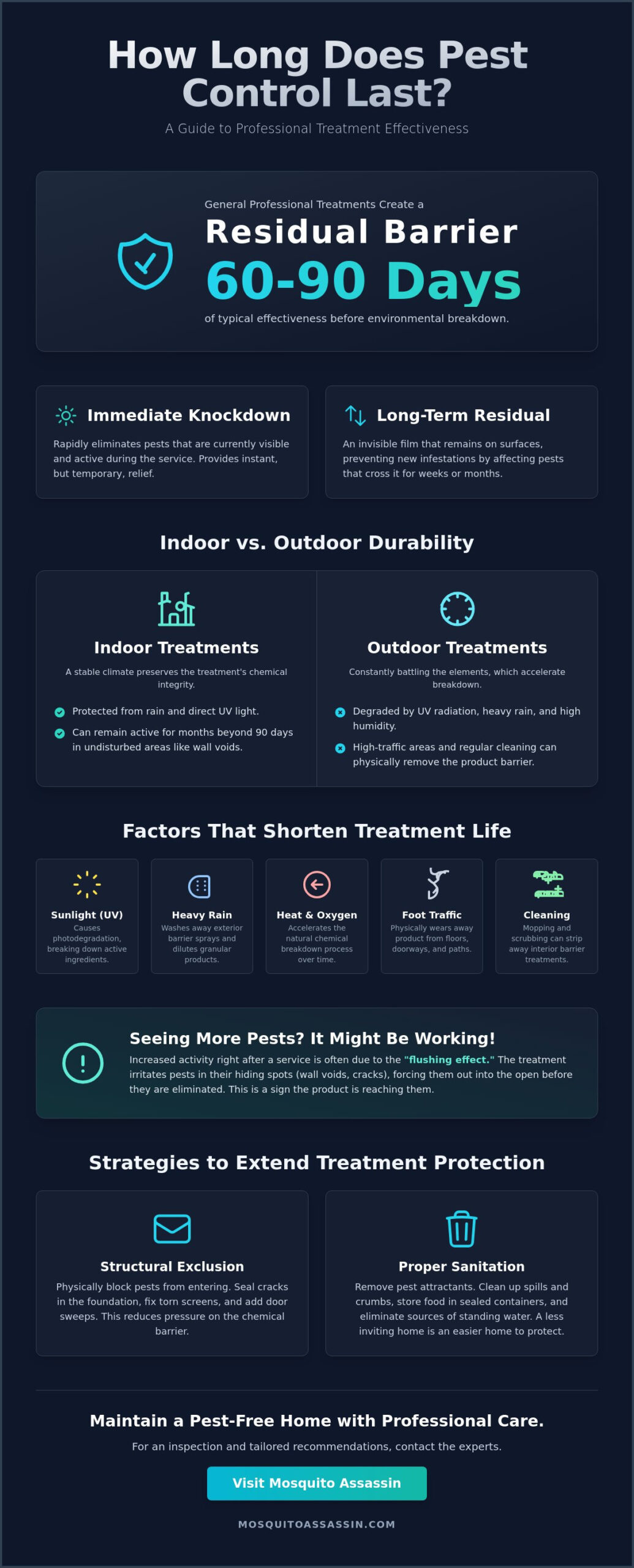
Professional pest control isn’t a single event but a cycle of protection. Most general treatments provide a protective residual barrier that stays active for 60 to 90 days. This timeline isn’t a guess; it reflects the actual biological breakdown of active ingredients when they’re exposed to the environment. When homeowners ask how long does pest control treatment last, they’re usually looking for the duration of this invisible shield.
There’s a clear distinction between the immediate knockdown effect and long-term residual protection. Knockdown refers to the rapid elimination of pests currently visible, while the residual barrier works in the background to prevent new infestations. Modern strategies rely on Integrated Pest Management (IPM) to ensure these barriers are applied precisely where pests travel, maximizing the effectiveness of every application.
To better understand the practical side of treatment timelines, watch this helpful video:
Application sites dictate how long a product remains effective. Interior treatments in undisturbed areas like wall voids can sometimes remain active for months beyond the standard 90 day window. Conversely, exterior foundation sprays face a constant battle with the elements. High traffic areas such as doorways, kitchen floors, and mudrooms often require more frequent attention because regular cleaning and physical foot traffic strip the product from the surface. Many professional pest control services focus on these vulnerable points to maintain a consistent barrier.
The Residual Life of Professional Grade Products
Professional grade products are engineered to bind to surfaces for extended periods. Liquid residuals are applied to baseboards or foundations, drying into a thin, invisible film that affects pests upon contact. Granular formulations are often used in mulch beds or lawns, designed to release active ingredients slowly as they encounter moisture. However, even the most robust formulas lose potency as they encounter oxygen and heat, which is why how long does pest control treatment last is always a variable range rather than a fixed date.
Indoor vs. Outdoor Durability Expectations
Indoor environments offer a stable climate that preserves treatment life. Without the interference of rain or extreme temperature swings, an interior treatment often maintains its integrity much longer than an exterior one. In regions like Erie and Crawford Counties in Pennsylvania, heavy rainfall and high humidity can accelerate the degradation of exterior perimeter barriers. Sunlight is another major factor; ultraviolet (UV) radiation breaks down chemical bonds on a molecular level. Shaded areas of a home’s exterior may retain protection longer than south facing walls that receive direct sun exposure throughout the day.
Environmental Factors That Influence Treatment Longevity
While professional products are chemically engineered for durability, environmental stressors are the primary reason for barrier degradation. Homeowners often ask how long does pest control treatment last when they notice a sudden change in local weather. The reality is that the answer depends heavily on external exposure. Ultraviolet (UV) radiation from the sun is a major culprit. Photodegradation occurs when intense sunlight breaks the chemical bonds of the active ingredients. This process effectively neutralizes the treatment over time, particularly on south facing walls that receive the most direct exposure throughout the day.
Weather and UV Degradation in the Great Lakes Region
In areas like Erie and Crawford Counties, humidity levels often exceed 70% during the summer months. This moisture doesn’t just make the air uncomfortable; it creates a challenging environment for surface treatments. However, modern professional products are specifically formulated to bind to surfaces once they’ve dried. This rain-fast quality means that a typical afternoon thunderstorm in Northwest Pennsylvania won’t immediately wash away a perimeter barrier. Licensed professionals use a common sense approach to pest control by timing applications around local weather patterns to ensure the product has sufficient time to bond properly.
Material Porosity and Product Absorption
The substrate of a home significantly impacts product stability. Porous materials like unpainted wood, brick, or concrete act like a sponge. They draw liquid treatments deep into the material where pests may not come into contact with them. These surfaces often require more frequent attention or specialized formulations to maintain an effective exterior shield. In contrast, smooth, non-porous surfaces like vinyl siding or painted metal allow the product to sit on the surface. This creates a more consistent and accessible barrier for crawling insects. Regular maintenance helps account for these environmental variables. Those concerned about local weather impacts may find that local pest control experts can provide more tailored advice for regional conditions.
Seasonal temperature fluctuations also play a role in how long does pest control treatment last. Extreme heat can accelerate the evaporation of certain liquid carriers, while the harsh winters in Ashtabula County can cause some products to become less effective over several months of snow cover. Additionally, the accumulation of dust and dirt on treated surfaces can create a physical shield for pests. When bugs walk over a layer of grime rather than the treated surface itself, the effectiveness of the application is compromised. Understanding these local factors allows for a more realistic expectation of when a follow up service might be necessary to reinforce the home’s defenses.
Disclaimer: The information provided on this blog is for general informational purposes only and is not intended as professional pest control advice. Conditions vary by property, environment, and location. Reading this content does not create a service agreement. For an inspection or professional recommendations, please contact Mosquito Assassin Pest Control LLC directly.
Why You Might See More Pests Immediately After Treatment
Seeing an increase in insect activity shortly after a professional application can be unsettling. It’s common for homeowners to question how long does pest control treatment last when they spot a cockroach or spider in the middle of a room just 48 hours after a technician leaves. This sudden visibility is actually a biological response known as the flushing effect. Instead of indicating a failed service, this spike in activity confirms that the active ingredients are successfully reaching the areas where pests hide.
The flushing effect occurs because professional grade products are designed to irritate the sensory organs and nervous systems of target pests. When insects encounter the treated barrier, the irritation forces them out of deep nesting sites like wall voids, cracks, and crevices. Once they’re flushed out, they’re exposed to a lethal dose of the residual product. Seeing dead or dying pests on the floor is a primary indicator that the treatment is performing exactly as intended. It’s a necessary step in the transition from an active infestation to a pest-free environment.
The Flushing Effect and Pest Irritation
Nocturnal pests, such as German cockroaches, typically avoid light and human activity at all costs. However, the irritation caused by professional residuals can disrupt their natural biological cycles, leading them to appear in the open during daylight hours. It’s vital that residents don’t use over the counter DIY sprays during this phase. Consumer products often act as repellents, which can drive pests into untreated areas or interfere with the professional products already in place. A focus on long-term prevention of pests requires patience while the initial application works through the population.
The 14-Day Observation Window
Most professional treatments require a 14 day window to achieve a significant reduction in a pest population. This period is essential for determining how long does pest control treatment last in a specific residential environment. This timeline allows enough time for insects to travel through the residual barrier and return to their colonies. For pests like ants, the process involves complex baiting cycles where workers must carry the product back to the queen to eliminate the source of the infestation. Eradication is a methodical process; it isn’t an instant event. For more information on setting realistic expectations for your home, you can consult a guide on general pest control to understand the full scope of the process.
If activity continues to increase or shows no sign of slowing after 21 days, it may indicate a persistent infestation that requires specialized follow up. However, in the communities of Erie and Crawford Counties, most standard calls follow this predictable 14 day curve. Understanding this biological response helps homeowners remain calm while the treatment takes full effect.
Disclaimer: The information provided on this blog is for general informational purposes only and is not intended as professional pest control advice. Conditions vary by property, environment, and location. Reading this content does not create a service agreement. For an inspection or professional recommendations, please contact Mosquito Assassin Pest Control LLC directly.
Longevity Variations Based on Specific Pest Types
The biology and reproductive habits of a target pest are the most significant factors in determining how long does pest control treatment last. While a general residual barrier might stay active on a surface for up to 90 days, the effective protection period varies because different insects interact with that barrier in unique ways. A single application might be sufficient for a localized spider problem, but it won’t be enough to manage pests with rapid breeding cycles or those that travel through the air rather than crawling across treated surfaces.
Crawling Insects vs. Seasonal Flying Pests
Flying pests like mosquitoes and houseflies spend very little time on treated walls or foundations, which limits their exposure to residual products. Effective protection for these insects requires a more frequent service interval. For instance, a professional mosquito control program typically operates on a 21 to 30 day cycle. This frequency ensures that new generations of mosquitoes are addressed before they can reproduce, maintaining a consistent level of suppression throughout the humid summer months in Northwest Pennsylvania.
Crawling insects like ants and spiders often see longer periods of control from a single application. Spiders are relatively sedentary; they tend to stay in corners or under eaves where products remain undisturbed. However, ants are highly social and mobile. During peak foraging months, ant colonies may send out thousands of workers to find food. If the colony is large, the sheer volume of ants can physically deplete a chemical barrier or find small gaps in the protection. In these cases, reinforcing the perimeter every 60 days is often necessary to keep foraging trails from reaching the interior of the home.
The Unique Persistence of Bed Bug and Termite Solutions
Specialized pests like bed bugs and termites require a different standard of persistence. Bed bug treatments are not about a one time barrier but about breaking a specific 14 day reproductive cycle. Because bed bug eggs are resistant to many standard residuals, professional services often involve multiple visits spaced exactly two weeks apart. This ensures that newly hatched nymphs are eliminated before they reach maturity. This methodical approach is the only way to ensure total eradication of the population.
Termite protection offers the longest duration in the industry but utilizes a different mechanism than standard sprays. While a liquid soil treatment for termites may last for several years, modern baiting systems provide ongoing, long-term monitoring. These systems stay in place year round, providing a permanent defensive line that traditional sprays cannot match. This distinction between the residual life of a spray and the longevity of a baiting system is critical for homeowners to understand. Homeowners seeking long-term protection can schedule a professional pest inspection to determine the best frequency for their specific property and pest pressure.
Disclaimer: The information provided on this blog is for general informational purposes only and is not intended as professional pest control advice. Conditions vary by property, environment, and location. Reading this content does not create a service agreement. For an inspection or professional recommendations, please contact Mosquito Assassin Pest Control LLC directly.
Strategies for Extending the Life of Professional Treatments
Extending the effectiveness of a professional application requires a partnership between the property owner and the technician. While homeowners often focus on how long does pest control treatment last, the answer is frequently tied to how well the property is maintained between visits. A professional treatment provides a robust defensive line, but its longevity is significantly enhanced when the environment is managed to discourage pest activity. Sanitation is the most critical factor in this process. By removing food sources and standing water, you force pests to travel further and interact more frequently with the treated barrier, leading to faster elimination.
Structural exclusion is another vital strategy that supports the chemical barrier. This involves sealing cracks, crevices, and gaps around utility penetrations or door frames. When physical entry points are blocked, the chemical treatment doesn’t have to work as hard to repel mass invasions. Instead, it acts as a secondary fail-safe. Combining homeowner diligence with professional pest control may help reduce risk and ensure that the home remains a fortress against seasonal invaders. This proactive approach is far more effective than waiting for an infestation to become visible before calling for assistance.
Home Maintenance and Sanitation Best Practices
Moisture management is essential for preserving the integrity of professional products. High humidity and standing water in basements or crawlspaces can accelerate the chemical breakdown of residuals. Additionally, exterior maintenance plays a significant role. Mulch should be kept at least 12 inches away from the foundation, and tree branches should be trimmed so they don’t touch the roof or siding. These steps prevent pests from bypassing the treated ground barrier. You can learn more about us and how local experts integrate these maintenance tips into a comprehensive protection strategy.
The Role of Recurring Protection Plans
There’s a significant difference in how long does pest control treatment last when comparing one-time reactive sprays to year-round maintenance. Reactive services only address the pests present at that moment. In contrast, recurring plans provide a consistent, overlapping shield. While a quarterly plan is effective for many residential properties, homes with high pest pressure often benefit from bi-monthly maintenance to ensure the barrier never fully degrades. Professional pest control in Erie, Crawford, and Ashtabula Counties often requires seasonal adjustments. These adjustments account for the specific biological shifts that occur as Northwest Pennsylvania moves from the damp spring into the harsh winter months, ensuring that the protection remains stable regardless of the outside temperature.
Disclaimer: The information provided on this blog is for general informational purposes only and is not intended as professional pest control advice. Conditions vary by property, environment, and location. Reading this content does not create a service agreement. For an inspection or professional recommendations, please contact Mosquito Assassin Pest Control LLC directly.
Maintaining Your Home’s Protective Barrier
Effective pest management is a continuous process that relies on high quality residuals and a deep understanding of local pest biology. While a professional application typically provides a shield for 60 to 90 days; variables like heavy rainfall in Erie County and UV exposure in Ashtabula County can alter the timeline. Understanding how long does pest control treatment last helps you set realistic expectations for your property’s defense. Licensed and insured professional technicians bring specialized local knowledge of Erie, Crawford, and Ashtabula County pests to every visit. This expertise ensures that every barrier is applied with precision using family safe treatment protocols.
Combining structural maintenance with recurring inspections is the most reliable way to prevent seasonal infestations before they start. For an inspection or professional recommendations, please contact Mosquito Assassin Pest Control LLC directly. Taking a proactive stance today ensures your home remains a safe and comfortable environment for the long term.
Disclaimer: The information provided on this blog is for general informational purposes only and is not intended as professional pest control advice. Conditions vary by property, environment, and location. Reading this content does not create a service agreement. For an inspection or professional recommendations, please contact Mosquito Assassin Pest Control LLC directly.
Frequently Asked Questions
Is it normal to see bugs after a pest control treatment?
It is completely normal and expected to see an increase in pest activity for up to 14 days following a professional service. This occurs because the active ingredients irritate the pests and flush them out of their hiding spots in wall voids and crevices. Seeing dead or sluggish insects is a clear sign that the treatment is successfully eliminating the population on your property.
How long should I wait to clean my house after a professional spray?
You should wait at least 48 hours before performing any deep cleaning or mopping near treated baseboards and corners. This window allows the residual barrier to fully dry and bond to the surface for maximum effectiveness. Avoiding harsh detergents or steam cleaning on these specific areas helps preserve the integrity of the application and impacts how long does pest control treatment last in your home.
Will rain wash away the pest control treatment on my home?
Professional products are designed to be rain-fast once they have completely dried, which typically takes between 30 and 60 minutes. Once the product has bonded to the foundation or siding, it won’t wash away during standard rainstorms in Erie or Crawford Counties. Technicians monitor local weather patterns to ensure that exterior applications are timed for optimal drying and long-term durability.
How many treatments are usually needed for a heavy ant infestation?
A heavy ant infestation usually requires an initial treatment to address the active foragers followed by a reinforcement visit 14 to 21 days later. This second visit is vital for ensuring the baiting cycle has reached the queen and addressed any remaining satellite colonies. Because ants are highly social, a recurring maintenance plan is often the best strategy for preventing new colonies from moving into the area.
Can I use store-bought bug spray after a professional has treated my home?
You should avoid using any over the counter sprays after a professional treatment because they can interfere with the specialized products already in place. Many DIY sprays act as repellents, which can drive pests into untreated areas or cause them to avoid professional baits entirely. This interference often complicates the eradication process and can lead to a resurgence of the pest population within a few weeks.
How long do I need to stay out of the house after a treatment?
Occupants and pets should remain out of the treated areas until the product has completely dried, which usually takes 2 to 4 hours. This timeline can vary based on the humidity levels in Northwest Pennsylvania and the specific application method used. Always follow the exact re-entry instructions provided by your licensed technician to ensure the safety of your family and pets during the drying phase.
Does pest control last longer in the winter months?
Interior treatments often maintain their potency longer during the winter because they aren’t exposed to extreme heat or UV radiation. However, the harsh winters in Ashtabula County can cause exterior barriers to degrade more quickly due to heavy snow cover and freezing cycles. While many pests are less active in the cold, winter services are essential for managing rodents and insects like spiders that seek warmth inside.
What should I do if I still see pests after two weeks?
If you continue to see active, healthy pests after the 14 day observation window, you should contact your professional provider for a follow up inspection. This continued activity might indicate a hidden nesting site or a high level of regional pest pressure that requires a specialized adjustment to your plan. Tracking these observations helps your technician determine how long does pest control treatment last on your specific property and adjust the service frequency accordingly.
Disclaimer: The information provided on this blog is for general informational purposes only and is not intended as professional pest control advice. Conditions vary by property, environment, and location. Reading this content does not create a service agreement. For an inspection or professional recommendations, please contact Mosquito Assassin Pest Control LLC directly.