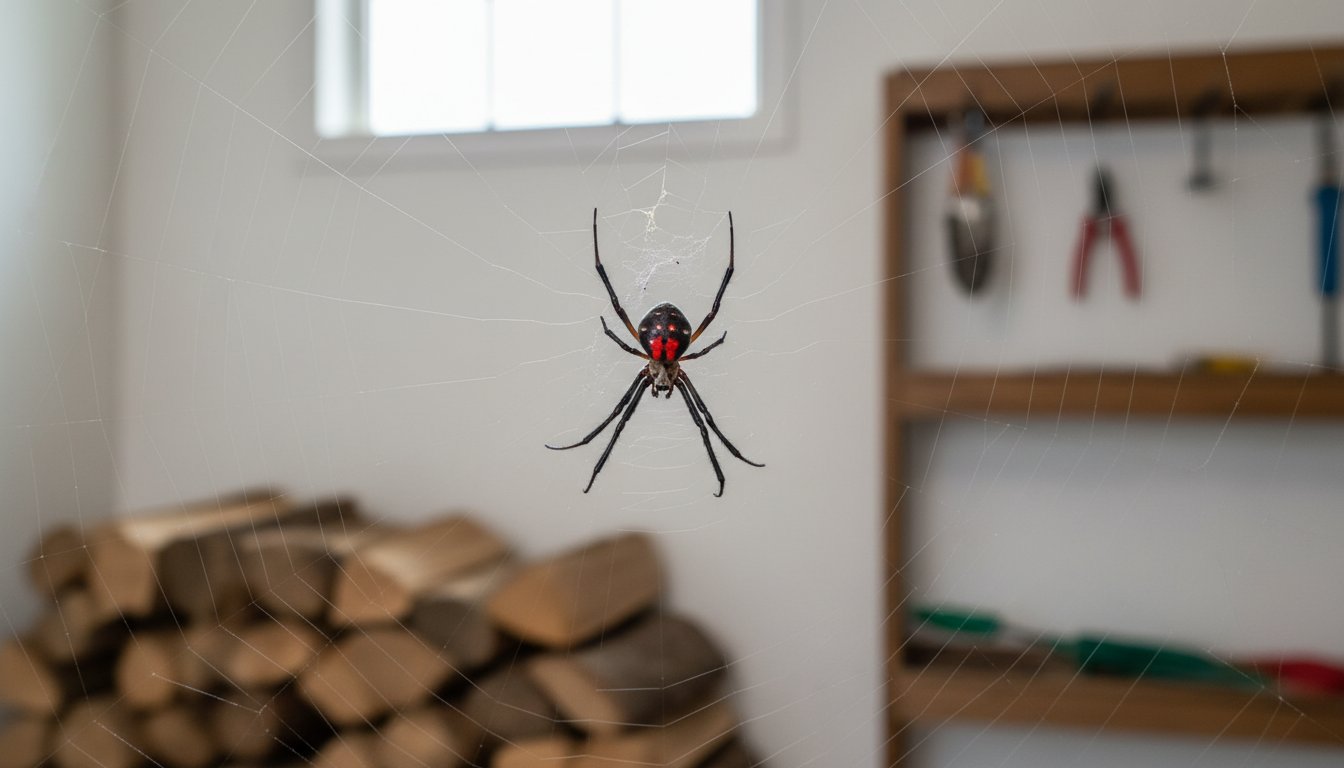
Tag: Venomous Spiders

  • Black Widow Spiders in Pennsylvania: Identification and Prevention Guide

    Black Widow Spiders in Pennsylvania: Identification and Prevention Guide

    Finding a glossy black spider with a bright red hourglass in your garage can be a heart-stopping moment for any homeowner. While approximately 2,200 people are bitten by these spiders across the United States each year, many residents don’t realize that black widow spiders in Pennsylvania are a common, native presence in local landscapes. Whether you live in Erie County, Crawford County, or Ashtabula County, understanding these arachnids is the first step toward maintaining a safe environment for your family.

    It’s understandable to feel uneasy about venomous pests lurking in undisturbed corners of your basement or shed. You want to protect your children and pets from potential bites without feeling overwhelmed by uncertainty. This guide provides the expert knowledge you need to identify local black widow species, recognize their preferred habitats, and implement professional-grade prevention strategies for your property. This article explores the specific behaviors of these spiders and provides actionable steps to minimize their presence around your home, ensuring you can manage your space with confidence and peace of mind.

    Disclaimer: The information provided on this blog is for general informational purposes only and is not intended as professional pest control advice. Conditions vary by property, environment, and location. Reading this content does not create a service agreement. For an inspection or professional recommendations, please contact Mosquito Assassin Pest Control LLC directly.
    Key Takeaways

    • Learn to distinguish between the Southern and Northern species of black widow spiders in Pennsylvania by identifying their unique physical markings.
    • Discover the specific outdoor and indoor habitats where these reclusive spiders prefer to build their webs, including woodpiles and quiet corners of garages.
    • Understand the defensive behavior of black widows and the primary risks associated with their neurotoxic venom.
    • Master effective prevention strategies, such as reducing environmental clutter and sealing entry points, to discourage spiders from nesting near your home.
    • Explore how professional pest management and Integrated Pest Management (IPM) techniques offer a comprehensive solution for long-term protection.

    Identifying Black Widow Spiders in Pennsylvania

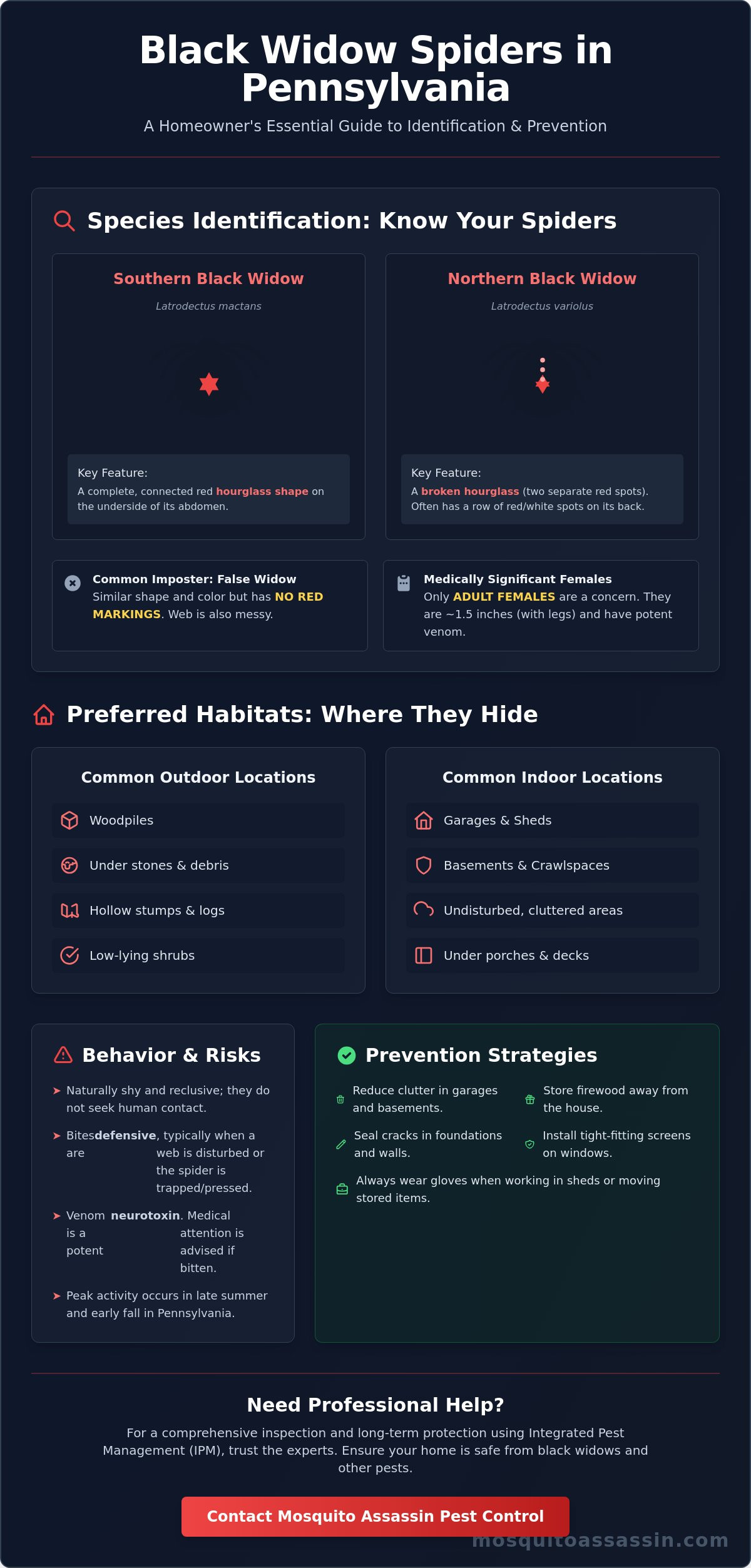
    Pennsylvania is home to two distinct species of widow spiders: the Southern black widow (Latrodectus mactans) and the less frequently discussed Northern black widow. While many people believe only one type exists, identifying black widow spiders in pennsylvania requires looking for subtle differences in their markings. Both species are members of the Theridiidae family, often called cobweb spiders due to their tangled, erratic web patterns that lack the symmetrical beauty of typical garden spider webs.

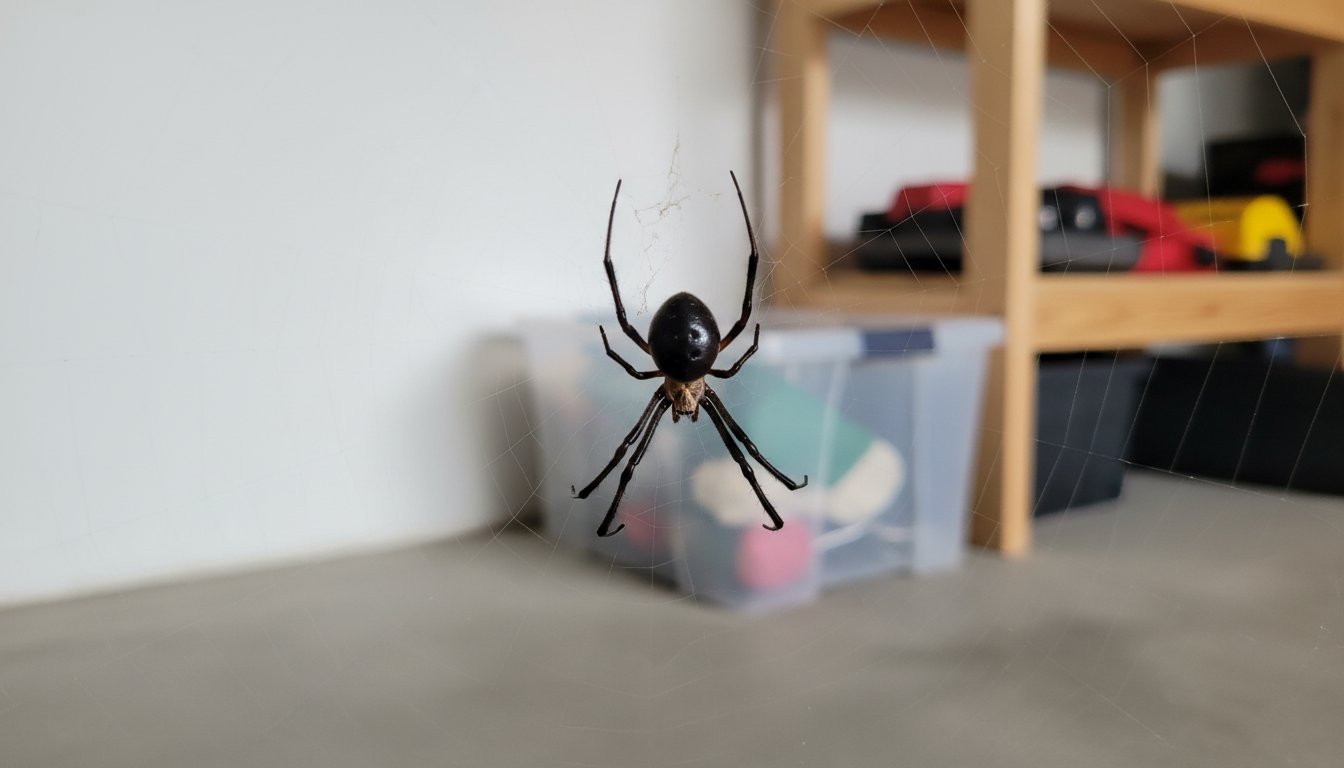
    Adult female black widows are the most recognizable. They possess a bulbous, glossy black abdomen that measures approximately 1.5 inches when the legs are extended. Males and juveniles look remarkably different; they are often smaller, brown or gray, and may feature white or yellow stripes. Only the adult females are considered medically significant to humans, as their venom is much more potent than that of the males.

    To help visualize these spiders in their natural environment, watch this helpful video:

    Southern vs. Northern Black Widow Markings

    The primary way to distinguish these two species is by examining the red markings on the underside of the abdomen. The Southern black widow features a classic, complete hourglass shape where the two triangles meet in the middle. In contrast, the Northern Black Widow (Latrodectus variolus) typically displays a broken hourglass, appearing as two separate red spots. Additionally, the Northern species often has a row of red or white spots running down the center of its back, a feature the Southern species usually loses as it matures.

    Common Spiders Mistaken for Black Widows

    Homeowners often misidentify several harmless species as black widows. The False Black Widow (Steatoda grossa) is the most frequent culprit. It shares the same dark, bulbous body but lacks any red markings. Common house spiders and other cobweb weavers also create messy webs in basements and garages, leading to unnecessary concern. The Latrodectus genus is the only medically significant cobweb weaver in Pennsylvania.

    Accurate identification is critical because it dictates the level of precaution needed. If you encounter a spider that matches these descriptions in your home or outbuildings, professional pest control may help reduce risk. Detailed inspections can confirm the species and locate nesting sites that are often overlooked. Understanding the physical differences between these species ensures you can accurately assess the presence of black widow spiders in pennsylvania on your property.

    Preferred Habitats and Seasonal Behavior in PA

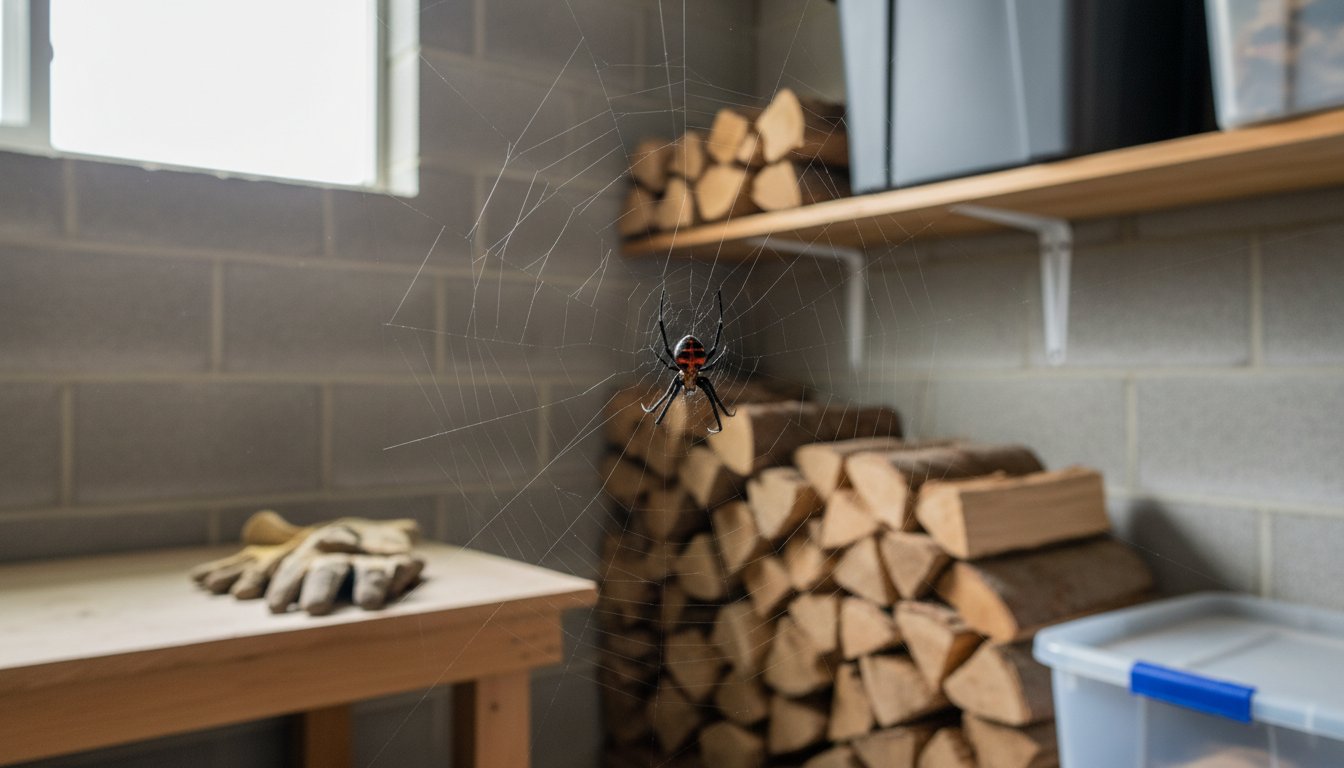
    Black widows are naturally shy, reclusive arachnids. They don’t seek out human interaction; instead, they thrive in dark, sheltered environments where they can wait undisturbed for prey. In the wild, these spiders choose locations like hollow tree stumps, spaces beneath large stones, or the underside of dense shrubs. Around a residential property, they often find ideal nesting sites in woodpiles, under low-lying porches, or inside discarded equipment. While black widow spiders in pennsylvania prefer the outdoors, they frequently move into garages and crawlspaces if they find a steady supply of prey.

    According to the Penn State Extension on Black Widows, these spiders are most active during the warmer months. Sightings of black widow spiders in pennsylvania typically peak during late summer and early fall. This is when the population reaches maturity, making the adult females more visible as they guard egg sacs or expand their webs to catch larger insects before the winter freeze.

    Regional Habitat Factors in Erie and Crawford Counties

    Local environmental conditions play a significant role in where these spiders choose to settle. In Erie County, the high moisture levels near Lake Erie support large populations of flies, beetles, and other crawling insects. This abundant food source makes the region particularly attractive to black widows. In more rural areas like Crawford County, the prevalence of barns, outbuildings, and large woodpiles provides ample real estate for long-term nesting. Seasonal lakeside cottages that remain closed for several months are also prime locations for undisturbed web building, as the lack of human activity allows the spiders to establish themselves without interference.

    Understanding the Black Widow Cobweb

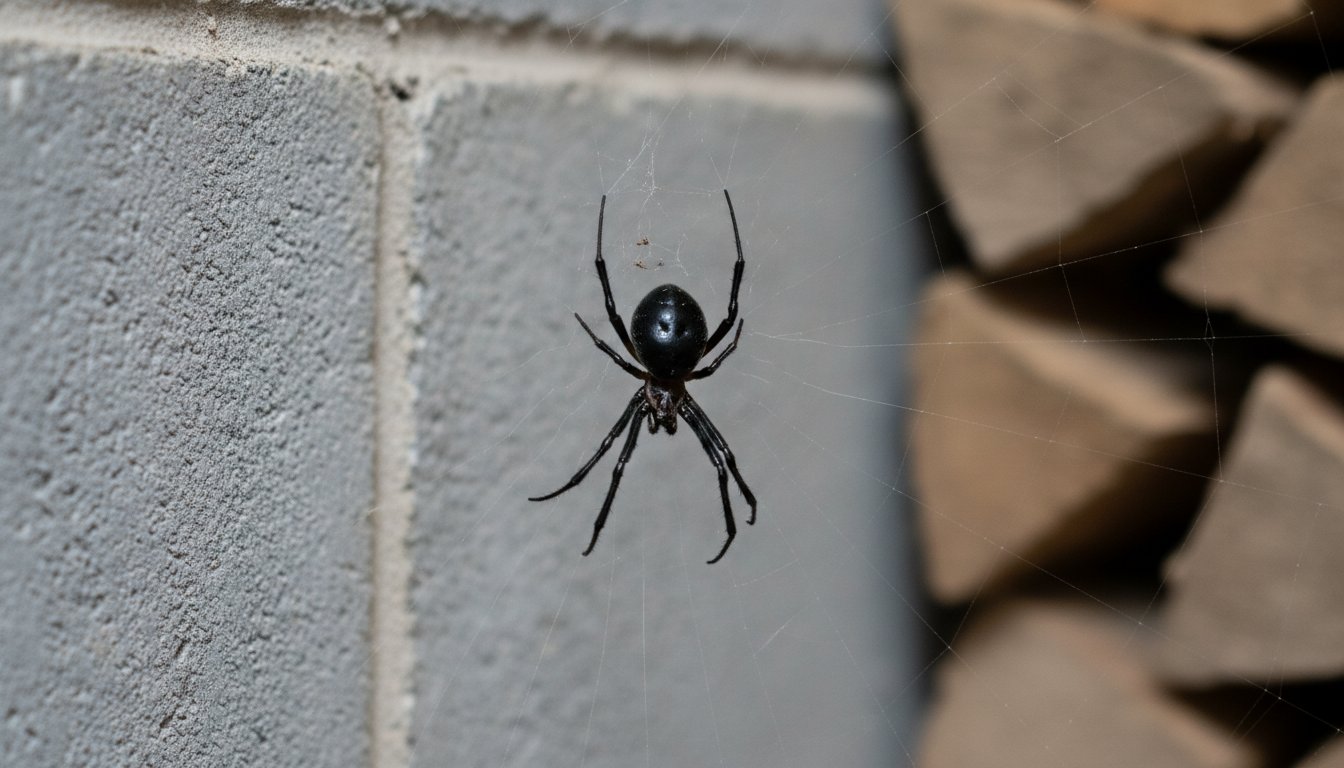
    One of the most effective ways to identify a potential infestation is by looking at the web itself. Unlike the symmetrical, circular webs created by orb-weaver garden spiders, a black widow’s web is erratic, messy, and lacks a discernible pattern. It often looks like a collection of tangled cobwebs rather than a functional trap. However, the silk of a black widow is notably stronger than that of most other spiders. If you poke it with a stick, you might even hear a faint “crackle” (a sound unique to the breaking of their high-tensile silk). Because they primarily hunt crawling insects, these webs are usually built near ground level, in corners, or behind stored items in garages and basements.

    If you discover these distinct webs in your storage areas, professional pest control may help reduce risk by identifying and treating active nesting sites.

    Disclaimer: The information provided on this blog is for general informational purposes only and is not intended as professional pest control advice. Conditions vary by property, environment, and location. Reading this content does not create a service agreement. For an inspection or professional recommendations, please contact Mosquito Assassin Pest Control LLC directly.
    Black Widow Spiders in Pennsylvania: Identification and Prevention Guide

    Understanding Black Widow Bites and Risks

    While the thought of a bite is intimidating, black widow spiders in Pennsylvania are not aggressive creatures. They generally avoid contact with humans and spend their lives hidden in quiet corners. Bites usually occur as a defensive reaction when a spider is physically pressed against a person’s skin. Because they don’t hunt humans, most encounters are entirely accidental. Understanding the nature of their venom and the circumstances that lead to bites can help homeowners stay safe while managing their property.

    The venom produced by these spiders is a potent neurotoxin. According to medical data on Black Widow Spider Toxicity, the venom primarily affects the nervous system of the victim. Approximately 2,200 people are bitten by black widows annually in the United States, yet there have been no recorded deaths since 1983. Symptoms often begin with immediate localized pain, similar to a pinprick, followed by slight swelling. Within an hour, symptoms can progress to muscle aches, severe abdominal cramping, or a general feeling of malaise. While these symptoms are painful, they are rarely life threatening for healthy adults.

    How Bites Typically Occur

    Most encounters happen in areas where the spiders feel safe and undisturbed. Reaching into a dark corner of a shed or picking up a piece of firewood from a stack are common ways people accidentally come into contact with them. Spiders often hide in stored items like gardening gloves, old boots, or cardboard boxes that have sat in a basement for months. Moving these items can startle the spider, leading to a bite as it tries to protect itself. Gardening in overgrown areas or cleaning out a long-neglected crawlspace also increases the likelihood of a defensive encounter.

    Safe Practices for Homeowners

    Taking simple precautions can significantly lower the chance of an accidental encounter with black widow spiders in pennsylvania. Homeowners should adopt these habits during seasonal cleaning or outdoor work:

    • Always wear heavy leather or rubber gloves when handling woodpiles or clearing debris from a garage.
    • Use a high-powered flashlight to check dark recesses of storage areas before reaching in with bare hands.
    • Shake out footwear, hats, and clothing that have been stored in outbuildings or basements before putting them on.
    • Keep outdoor storage areas organized to minimize the number of dark, tight spaces where spiders can hide.

    For households with young children, the elderly, or pets, the presence of venomous spiders is a valid concern. Professional pest management may help reduce risk by eliminating the food sources and hiding spots that attract black widow spiders in pennsylvania. A methodical approach to property maintenance ensures that these reclusive spiders don’t establish a presence near high-traffic areas like play sets or patio furniture.

    Disclaimer: The information provided on this blog is for general informational purposes only and is not intended as professional pest control advice. Conditions vary by property, environment, and location. Reading this content does not create a service agreement. For an inspection or professional recommendations, please contact Mosquito Assassin Pest Control LLC directly.
    Environmental Prevention and Exclusion Strategies

    Preventing black widow spiders in pennsylvania requires more than just removing an occasional web. It involves a systematic approach to environmental modification. Spiders are attracted to properties that provide two things: abundant prey and secure, dark hiding spots. By altering the conditions around your home, you can make the environment less hospitable to these arachnids and the insects they eat. This proactive strategy is often more effective than reactive measures because it addresses the root cause of the infestation.

    Interior Sanitation and Organization

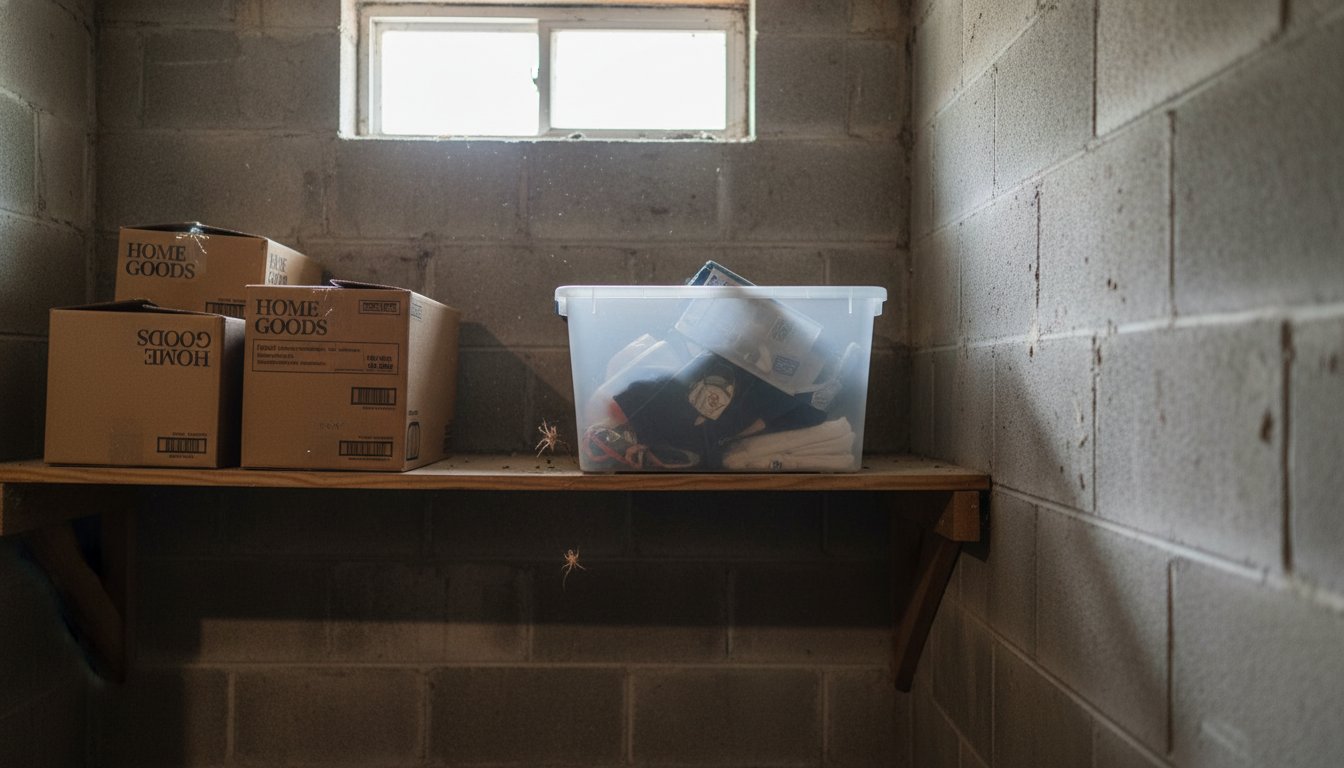
    The inside of a home, especially unfinished areas like basements and crawlspaces, can inadvertently provide perfect nesting sites. Cardboard boxes are a major risk factor because they are often stored in dark areas and provide numerous tight gaps for spiders to squeeze into. Switching to airtight plastic bins is a simple yet effective change. Plastic bins don’t provide the same easy access and are less likely to harbor silverfish or cockroaches, which are common food sources for black widows. Regularly vacuuming or sweeping corners and behind large appliances is also crucial. This physical removal destroys webs and egg sacs before the population can grow. Additionally, managing moisture levels in crawlspaces with dehumidifiers can reduce the population of moisture-loving insects that attract spiders in the first place.

    Exterior Property Maintenance

    The perimeter of your home is the first line of defense. Because black widow spiders in pennsylvania often move from outdoor woodpiles to indoor structures, location matters. Moving firewood at least 20 feet away from the foundation and keeping it elevated off the ground reduces the chance of spiders migrating toward your siding. Vegetation also plays a role; shrubs, vines, and tall grass should be trimmed so they don’t touch the house. This creates a dry zone that discourages crawling pests from crossing into your living space.

    • Seal gaps around utility pipes and wires with caulk or expandable foam to block entry points.
    • Install door sweeps on all exterior doors, including the garage door, to eliminate ground-level gaps.
    • Repair or replace damaged window screens to prevent flying and crawling prey from entering.

    Outdoor lighting is another often-overlooked factor. Standard white or blue-tinted lights attract a wide variety of nocturnal insects. By switching exterior fixtures to yellow bug lights, you can significantly decrease the number of insects gathering near your doorways. Fewer insects mean fewer reasons for spiders to build webs in those areas. If you’ve noticed an increase in spider activity around your entryways, professional pest control may help reduce risk by identifying specific vulnerabilities in your home’s exterior.

    Disclaimer: The information provided on this blog is for general informational purposes only and is not intended as professional pest control advice. Conditions vary by property, environment, and location. Reading this content does not create a service agreement. For an inspection or professional recommendations, please contact Mosquito Assassin Pest Control LLC directly.
    The Role of Professional Pest Management

    While environmental modifications are essential for long term success, professional pest management provides a level of thoroughness that is difficult to achieve through individual efforts alone. Identifying the specific species and the full extent of an infestation requires a trained eye and a systematic approach. Professional intervention focuses on the biology of black widow spiders in pennsylvania to ensure that treatments are both effective and targeted. This methodical process moves beyond reactive measures, aiming instead to disrupt the life cycle of the spiders and their prey.

    What a Professional Inspection Includes

    A comprehensive inspection is the foundation of any successful management plan. Technicians look for more than just active webs; they identify the structural vulnerabilities that allow spiders to enter a home. This includes a detailed assessment of entry points such as gaps in the foundation, poorly fitted door sweeps, or unsealed utility penetrations. A professional also evaluates the surrounding environment to identify prey populations that may be sustaining the spider presence. If a property has a high volume of beetles, crickets, or silverfish, it will naturally attract more predators. Based on these findings, professionals provide specific recommendations for structural repairs or environmental changes to deter future nesting in Erie and Crawford Counties.

    Long-Term Protection and Safety

    Licensed professionals have the specialized equipment required to access difficult areas safely. Crawlspaces, high corners of vaulted ceilings, and deep recesses of unfinished basements are prime locations for black widows, but they can be hazardous for homeowners to inspect without proper gear. Using professional-grade tools ensures that these hiding spots are thoroughly treated without putting the residents at risk. Integrated Pest Management (IPM) represents the gold standard in modern pest control, focusing on long-term prevention through a combination of biological, cultural, and physical tactics. This approach minimizes the reliance on broad-spectrum applications while maximizing the safety of the household.

    Ongoing protection plans are designed to address the unique seasonal cycles of black widow spiders in pennsylvania and neighboring Ohio. These plans often include regular monitoring to ensure that new egg sacs are identified and removed before they hatch in the spring. Consistent oversight creates a reliable barrier against invading spiders, providing peace of mind for families in rural and suburban areas alike. For more information on customized plans, visit the about page or the location services page to see how professional pest control may help reduce risk on your property.

    Disclaimer: The information provided on this blog is for general informational purposes only and is not intended as professional pest control advice. Conditions vary by property, environment, and location. Reading this content does not create a service agreement. For an inspection or professional recommendations, please contact Mosquito Assassin Pest Control LLC directly.
    Maintaining a Spider-Free Home Environment

    Understanding the unique behaviors of black widow spiders in pennsylvania allows homeowners to take control of their property’s safety. Accurate identification between the Southern and Northern species, combined with consistent clutter reduction in garages and basements, forms a strong foundation for prevention. By sealing foundation gaps and managing outdoor lighting, residents in Erie, Crawford, and Ashtabula counties can significantly decrease the likelihood of accidental encounters.

    Long-term success often relies on a methodical, professional approach. A locally owned and operated provider that is licensed and insured in both Pennsylvania and Ohio offers the expertise needed to safeguard high-risk areas like crawlspaces. With five-star rated service and a commitment to integrated pest management, expert technicians ensure that seasonal cycles are monitored and managed effectively. Residents don’t need to manage these risks alone when professional support is available. For an inspection or professional recommendations, please contact Mosquito Assassin Pest Control LLC directly. Taking these proactive steps ensures your home remains a safe haven for your family and pets.
    Disclaimer: The information provided on this blog is for general informational purposes only and is not intended as professional pest control advice. Conditions vary by property, environment, and location. Reading this content does not create a service agreement. For an inspection or professional recommendations, please contact Mosquito Assassin Pest Control LLC directly.
    Frequently Asked Questions

    How common are black widow spiders in Pennsylvania?

    Black widow spiders are a native and relatively common species found throughout the state. While they aren’t as visible as common house spiders due to their reclusive nature, their populations remain stable in both urban and rural environments. You’ll most likely encounter them in undisturbed outdoor structures, woodpiles, or rural properties where human activity is minimal and insects are plentiful.

    Can a black widow spider bite be fatal?

    A black widow bite is rarely fatal for healthy adults, though it does require careful monitoring. There haven’t been any recorded deaths from these bites in the United States since 1983. The neurotoxic venom causes painful muscle contractions and systemic symptoms, but modern medical care effectively manages these issues. High-risk individuals, including children and the elderly, should seek immediate medical evaluation following a suspected bite.

    Where do black widows hide in a typical PA home?

    These spiders typically hide in dark, low-traffic areas such as basements, crawlspaces, and the corners of garages. In a standard Pennsylvania home, they often settle behind large appliances, inside cluttered storage rooms, or within boxes of seasonal decorations. They specifically look for quiet spots where their erratic webs can remain undisturbed for weeks at a time while they wait for crawling prey to pass by.

    What should I do if I find a black widow in my garage?

    You should avoid touching the spider or its web with bare hands if you discover one in your garage. Carefully removing the spider using a vacuum with a long hose attachment or a glass and a piece of stiff cardboard is a safe way to handle a single intruder. If you notice multiple spiders or egg sacs, professional pest control may help reduce risk by identifying the source of the infestation.

    Do black widows move into houses during the winter?

    Black widows don’t typically migrate into living spaces specifically for the winter, but they often seek shelter in attached garages or basements as temperatures drop. Most black widow spiders in pennsylvania overwinter in a state of dormancy called diapause. They usually choose protected outdoor spots like woodpiles or hollow logs, but they will readily utilize a crawlspace if it provides a stable environment and protection from the elements.

    How can I tell the difference between a black widow and a false black widow?

    The presence of a bright red hourglass marking on the underside of the abdomen is the most reliable way to tell them apart. False black widows share a similar bulbous shape and dark color but completely lack any red or orange markings. False widows often have a purplish-brown tint and may feature light-colored spots or lines on their backs, which are markings that adult female black widows do not possess.

    Are black widow spiders found in Erie, PA?

    Yes, black widow spiders in pennsylvania are frequently found in Erie and the surrounding Great Lakes region. The high moisture levels near Lake Erie attract a wide variety of insects, providing an abundant and consistent food source for these spiders. They are commonly spotted in lakeside cottages, boat houses, and residential storage sheds throughout Erie County, especially in areas that remain undisturbed during the off-season.

    What do black widow spider eggs look like?

    Black widow egg sacs are small, tan or off-white spheres that have a smooth, paper-like texture. Each sac is approximately 0.5 inches in diameter and can contain between 200 and 900 eggs. These sacs are usually suspended within the messy, erratic webbing and are vigorously guarded by the female spider. This guarding behavior is when the spider is most defensive and likely to bite if the web is disturbed.

    Disclaimer: The information provided on this blog is for general informational purposes only and is not intended as professional pest control advice. Conditions vary by property, environment, and location. Reading this content does not create a service agreement. For an inspection or professional recommendations, please contact Mosquito Assassin Pest Control LLC directly.

  • Pennsylvania Black Widow Spiders: Identification, Habitat, and Safety Guide

    Pennsylvania Black Widow Spiders: Identification, Habitat, and Safety Guide

    Could a single red hourglass marking in a dark corner of your basement change how you view your home’s safety? For many residents in Erie and Crawford Counties, the sight of a pennsylvania black widow spider is a source of immediate anxiety. It’s understandable to feel a sense of dread when you encounter a pest known for its potent venom, especially when it’s hiding in areas where your family spends time. While these spiders are reclusive, their presence in residential areas across the tri-county region is a reality that requires a calm, informed approach.

    You aren’t alone in wanting to protect your household from these elusive arachnids. This guide provides the essential knowledge you need to identify local black widow species, understand their preferred habitats in Pennsylvania and Ohio, and implement professional-grade prevention strategies. You’ll learn exactly what to look for in woodpiles or crawlspaces and how to reduce the risk of an accidental encounter through simple, effective property management. From identifying messy webs to securing entry points in Ashtabula County, this article provides the facts necessary to maintain a safe environment for families and pets.

    Key Takeaways

    • Distinguish between the Southern and Northern varieties of the pennsylvania black widow spider to accurately identify the species common in local environments.
    • Pinpoint high risk areas in Erie and Crawford counties, including woodpiles and undisturbed storage spaces, where these spiders are most likely to hide.
    • Gain insight into the defensive nature of black widows and the physical symptoms that may occur following an accidental encounter.
    • Implement effective prevention strategies, such as sealing structural gaps and managing clutter, to minimize nesting opportunities around the home.
    • Learn how professional pest management provides a thorough approach to identifying hidden infestations and managing seasonal spider migrations.

    Identifying Black Widow Spiders in Pennsylvania

    Identifying the pennsylvania black widow spider requires a keen eye for specific anatomical details. These spiders belong to the Latrodectus genus of spiders, a group known for their potent venom and distinct appearances. In Pennsylvania, residents may encounter two primary species: the Southern Black Widow (Latrodectus mactans) and the Northern Black Widow (Latrodectus variolus). While both inhabit the region, they exhibit slight variations in their markings that distinguish them from one another.

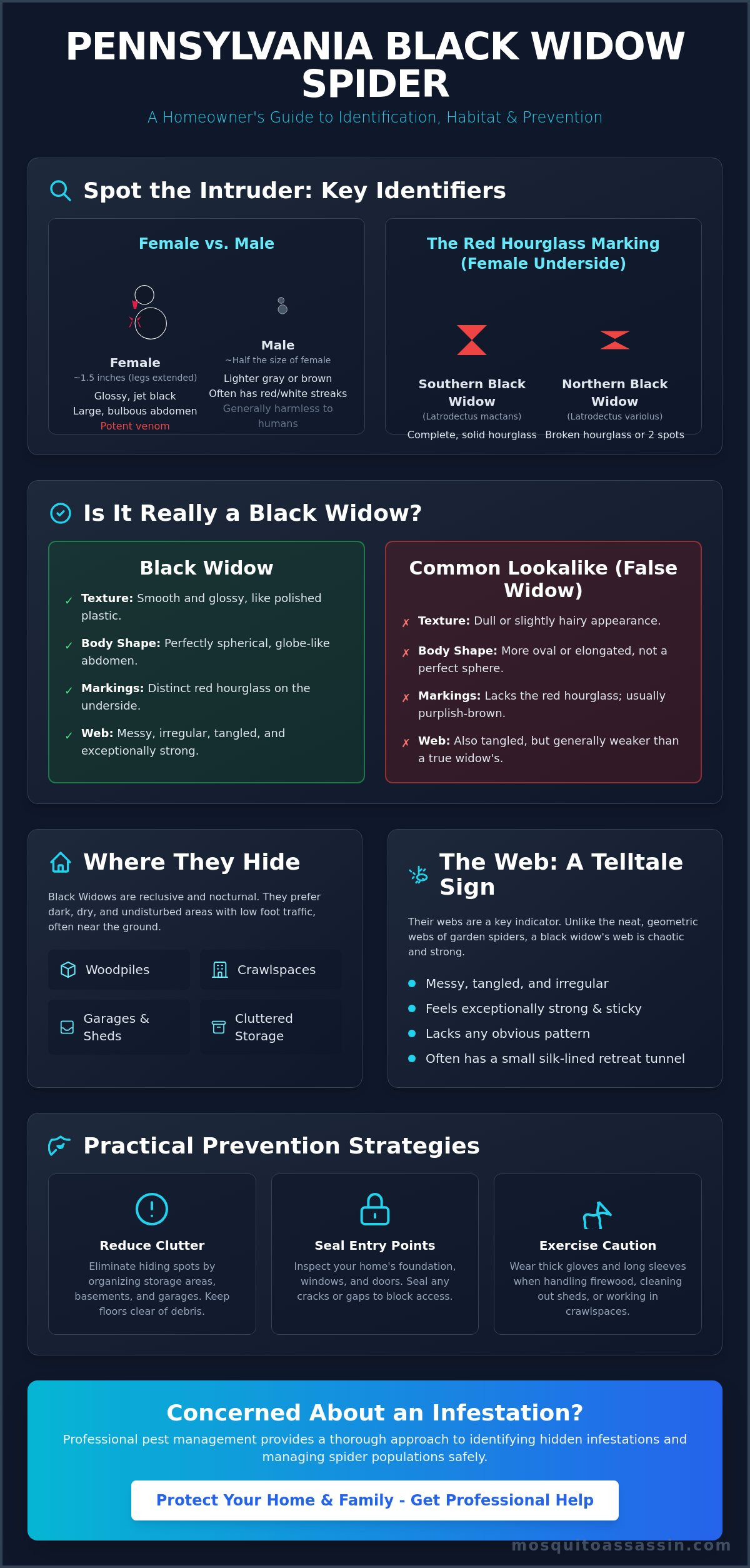
    Adult females are the most recognizable, featuring a bulbous, glossy black abdomen that measures approximately 1.5 inches in length when legs are extended. Males are significantly smaller, often reaching only half the size of females. Unlike the dark, uniform color of the females, males typically appear lighter with gray or brown tones and may have white or red streaks on their sides. They lack the dangerous reputation of their female counterparts, as their smaller mouthparts rarely penetrate human skin.

    To better understand how to spot these arachnids, watch this helpful identification guide:

    The Red Hourglass and Other Markings

    The most famous marker is the bright red hourglass on the underside of the female’s abdomen. For the Southern species, this is usually a complete, solid shape. However, the Northern pennsylvania black widow spider often displays a broken hourglass, appearing as two separate triangles or spots. Juvenile spiders present a different challenge; they often have white, orange, or red spots along their backs, which gradually disappear as they mature into their final adult form. These changing patterns can lead to confusion during different stages of the spider’s life cycle.

    Black Widow vs. Common Lookalikes

    Homeowners in Erie and Crawford Counties often mistake the False Black Widow (Steatoda grossa) for the real thing. While the False Black Widow has a similar rounded shape, it lacks the red hourglass and usually appears purplish-brown rather than jet black. Another key differentiator is the web. A widow constructs a messy, irregular web that feels exceptionally strong and sticky to the touch. These tangles lack the organized geometric patterns seen in common garden spider webs. Key physical traits to look for include:

    • Texture: Widows are smooth and glossy, while many lookalikes have a dull or slightly hairy appearance.
    • Web Location: Widows prefer dark, undisturbed areas near the ground, such as woodpiles or crawlspaces.
    • Body Shape: The female widow has a perfectly spherical abdomen, whereas cobweb spiders often have more elongated or oval shapes.

    If you suspect an infestation in your home or outbuildings, professional pest control may help reduce risk. You can learn more about the regions we serve by visiting our location page.

    Disclaimer: The information provided on this blog is for general informational purposes only and is not intended as professional pest control advice. Conditions vary by property, environment, and location. Reading this content does not create a service agreement. For an inspection or professional recommendations, please contact Mosquito Assassin Pest Control LLC directly.

    Habitat and Behavior: Where They Hide in PA and OH Homes

    The pennsylvania black widow spider is a reclusive creature. It doesn’t seek out human interaction. Instead, these spiders prioritize safety and proximity to food. They build webs in dark, low-traffic areas where they can catch crickets, beetles, and flies without being disturbed. Because they’re nocturnal, you’ll rarely see them active during the day. They spend daylight hours tucked into a “retreat,” which is a small, silk-lined tunnel at the edge of their web.

    If a web looks messy, tangled, and lacks a symmetrical pattern, it might belong to a black widow. Their silk is surprisingly strong. In fact, it’s known to be one of the strongest natural fibers. This durability allows their webs to remain intact in drafty areas like crawlspaces or barn rafters. While they’re famous for their venom, they have a shy temperament. They typically only bite when they’re squeezed or their web is directly threatened.

    Outdoor Habitats in Northwest Pennsylvania

    In Erie and Crawford counties in PA, as well as Ashtabula County in OH, outdoor environments provide plenty of real estate for these spiders. Firewood piles and hollow stumps are primary nesting sites. These locations offer tight crevices that protect the spider from predators and the elements. Stone walls and rock gardens are also common hiding spots. The gaps between stones create perfect, undisturbed voids for egg sacs.

    Detached structures are another major concern. Sheds, barns, and pool houses often sit idle for weeks. This lack of activity invites spiders to set up permanent residence. According to Penn State Extension on Black Widows, these spiders are well-adapted to various environments, often choosing spots near the ground. Homeowners should also check outdoor furniture and playground equipment. Spiders often hide underneath seats or inside plastic climbing structures that haven’t been used recently.

    Indoor Migration and Seasonal Patterns

    While they prefer the outdoors, the pennsylvania black widow spider can find its way inside. They usually enter through cracks in the foundation, gaps under doors, or through damaged window screens. This movement often happens during late summer and early autumn when activity levels peak. As temperatures drop, they look for stable environments with a steady supply of prey.

    Inside the home, they favor corners near floor level. You’ll often find them in basements, crawlspaces, and cluttered garages. They like to hide behind stored boxes or under large appliances. If you’re moving old cardboard boxes or reaching into a dark corner of the garage, it’s wise to wear gloves. Because they’re so secretive, an infestation can go unnoticed for a long time. If you suspect a presence in your storage areas, professional pest control may help reduce risk.

    Disclaimer: The information provided on this blog is for general informational purposes only and is not intended as professional pest control advice. Conditions vary by property, environment, and location. Reading this content does not create a service agreement. For an inspection or professional recommendations, please contact Mosquito Assassin Pest Control LLC directly.

    Pennsylvania Black Widow Spiders: Identification, Habitat, and Safety Guide

    Understanding the Risks: Safety and Bite Awareness

    The pennsylvania black widow spider is a reclusive creature that prioritizes hiding over confrontation. These arachnids are naturally defensive, meaning they don’t hunt humans or pets. Bites are almost always a last resort when the spider is squeezed, pinched, or otherwise provoked. While their venom is potent, the actual risk to healthy adults is often lower than public perception suggests. According to the 2021 National Poison Data System report, black widow exposures accounted for 1,005 reported cases in the United States, with a high percentage of patients requiring minimal medical intervention.

    Symptoms of a bite typically manifest within 20 to 60 minutes. Most individuals experience localized pain, swelling, and redness at the site. In more significant reactions, systemic symptoms like muscle aches, abdominal cramping, and nausea may occur. For accurate identification of these spiders and their relatives, the Penn State Extension guide to Pennsylvania spiders serves as a reliable resource for homeowners. Because of the potential for severe discomfort, professional pest control is a safer alternative to DIY removal. Attempting to clear webs or spray spiders without professional training increases the likelihood of an accidental encounter.

    When Bites Occur

    Most bites happen in transition spaces like garages, sheds, or basements. A common scenario involves reaching into a dark corner to grab a stored item or sliding a foot into an old boot that has been sitting in a mudroom. Woodpiles are another high-risk area. It’s vital to wear heavy work gloves when moving logs or cleaning out cluttered storage areas in Erie and Crawford Counties. While the venom is a neurotoxin, serious medical complications are rare for healthy adults. Most symptoms resolve within 48 to 72 hours with proper care.

    Protecting Pets and Children

    Children and small pets are more sensitive to the effects of a pennsylvania black widow spider bite due to their smaller body mass. A curious dog sniffing around a low-lying web or a child reaching under a porch can lead to an accidental bite. Keeping play areas clear of debris and regularly sweeping away webs from swing sets or patio furniture helps reduce these risks. Proactive inspections are particularly valuable for homes with toddlers who may not recognize the danger of a shiny black spider. Professional pest control may help reduce risk in residential areas across Ashtabula County and neighboring regions. If you suspect an infestation, you can reach out through the online booking portal for an expert assessment.

    Disclaimer: The information provided on this blog is for general informational purposes only and is not intended as professional pest control advice. Conditions vary by property, environment, and location. Reading this content does not create a service agreement. For an inspection or professional recommendations, please contact Mosquito Assassin Pest Control LLC directly.

    Practical Prevention Strategies for Local Homeowners

    Homeowners in Erie and Crawford Counties can significantly reduce the likelihood of an encounter with a pennsylvania black widow spider by addressing two main factors: shelter and food. These spiders are reclusive. They seek out dark, undisturbed spots where they won’t be bothered. Piles of cardboard boxes, old tires, or cluttered corners in a basement provide the perfect environment for a female to spin her web. Reducing clutter is the first step in a successful prevention plan. Pennsylvania is home to over 500 spider species, and while most are harmless, removing the hiding spots for the black widow is a priority for safety.

    Routine cleaning is equally vital. Using a vacuum or a long-handled broom to clear away webs in low-traffic areas like crawlspaces or garage rafters disrupts the spider’s habitat. If an egg sac is spotted, vacuuming it up and immediately disposing of the bag outside prevents hundreds of spiderlings from hatching inside the home. This mechanical removal is one of the most effective ways to manage populations without chemicals.

    Lighting also plays a role in spider activity. Standard incandescent bulbs attract nocturnal insects, which in turn attract spiders. Switching to yellow LED bug lights or moving outdoor light fixtures away from entryways can decrease the density of prey near the home’s foundation. Data from entomological studies suggest that yellow light spectrums attract up to 60% fewer insects than traditional white or blue-toned bulbs.

    Exclusion and Home Maintenance

    Sealing the home’s exterior is a primary defense against pests. Gaps as small as 1/16th of an inch can allow a pennsylvania black widow spider to slip inside. Homeowners should install tight-fitting door sweeps and replace worn weather stripping on all windows and doors. Outdoor maintenance is just as critical. Vegetation should be trimmed so there’s at least a 12-inch gap between plants and the house foundation. This creates a dry zone that spiders find less appealing. Additionally, firewood should be stored off the ground and at least 20 feet from the house. Always inspect logs for webs or egg sacs before bringing them indoors.

    Managing the Food Source

    Spiders thrive where prey is abundant. By controlling populations of flies, crickets, and beetles, the environment becomes less hospitable for predators. Integrated pest management strategies that target these common insects naturally discourage spiders from nesting. Implementing a consistent Mosquito Control program can also reduce the overall biomass of insects around a property in Ashtabula or Erie, leaving spiders with fewer reasons to stay. When general pest populations drop, spider populations typically follow within 14 to 30 days. For those dealing with a persistent presence of spiders or their prey, professional pest control may help reduce risk.

    Disclaimer: The information provided on this blog is for general informational purposes only and is not intended as professional pest control advice. Conditions vary by property, environment, and location. Reading this content does not create a service agreement. For an inspection or professional recommendations, please contact Mosquito Assassin Pest Control LLC directly.

    Professional Pest Management for Spiders

    Managing arachnid populations requires a systematic approach that goes beyond simple reactive measures. While many spiders are harmless, the presence of a pennsylvania black widow spider necessitates a more cautious and professional strategy. Expert pest management focuses on identifying the root causes of an infestation and implementing long-term solutions to prevent recurrence. This process relies on technical knowledge of spider biology and behavior to ensure the property remains less attractive to these pests.

    The Inspection Process

    A comprehensive inspection is the foundation of effective pest control. Licensed professionals examine the property to identify specific species and locate high-risk areas where spiders are likely to congregate. This includes checking dark, undisturbed locations such as crawl spaces, basements, and behind heavy appliances. Evaluating the severity of the spider presence is crucial; a single sighting may indicate a transient spider, while the discovery of multiple egg sacs suggests an established population.

    During this phase, technicians provide customized recommendations for exclusion and sanitation. They look for entry points like gaps around utility lines or cracks in the foundation that allow pests to enter. By addressing these structural vulnerabilities, property owners can significantly reduce the likelihood of a pennsylvania black widow spider finding its way indoors. Professionals also evaluate lighting and landscaping, as these factors often attract the insects that spiders rely on for food.

    Year-Round Protection Benefits

    Spider activity isn’t limited to a single season. In regions like Erie, Crawford, and Ashtabula counties, seasonal shifts drive spiders to seek shelter and warmth. Professional pest control may help reduce risk for homeowners by maintaining a consistent perimeter that prevents new spiders from entering. This year-round approach addresses multiple pest types simultaneously, creating a comprehensive shield for the home. Because spiders are predatory, reducing the overall insect population on a property naturally makes the environment less hospitable for them.

    The role of integrated pest management (IPM) is central to creating a long-term barrier. IPM focuses on non-chemical methods first, such as removing webs and clearing debris where spiders hide. When treatments are necessary, they are applied strategically to target specific areas of concern. This methodical approach ensures that the property is managed with safety and efficacy in mind. Those interested in the history and local commitment of the service provider can learn more About Mosquito Assassin and their role in the community. Consistent monitoring and maintenance are the most reliable ways to manage the risks associated with venomous spiders in Pennsylvania and Ohio.

    Disclaimer: The information provided on this blog is for general informational purposes only and is not intended as professional pest control advice. Conditions vary by property, environment, and location. Reading this content does not create a service agreement. For an inspection or professional recommendations, please contact Mosquito Assassin Pest Control LLC directly.

    Maintaining a Safe and Spider-Free Property

    Managing a home in Erie, Crawford, or Ashtabula County requires a proactive approach to seasonal pest safety. Identifying the pennsylvania black widow spider involves looking for the signature red hourglass marking and understanding their preference for dark, undisturbed spaces like woodpiles or cluttered basements. While these spiders aren’t typically aggressive, the potential risks associated with their bites make awareness and prevention essential for local residents. It’s helpful to maintain a clear perimeter around the home and seal small entry points to discourage nesting. When a population is established, professional intervention provides a methodical way to address the issue. Mosquito Assassin Pest Control LLC is a licensed and insured, locally owned and operated provider with a five-star rated service history. Taking steps to secure a property doesn’t have to be stressful when the right information and professional support are available. For those concerned about local spider activity, Contact Mosquito Assassin Pest Control LLC for an inspection to ensure the home remains a comfortable environment.

    Disclaimer: The information provided on this blog is for general informational purposes only and is not intended as professional pest control advice. Conditions vary by property, environment, and location. Reading this content does not create a service agreement. For an inspection or professional recommendations, please contact Mosquito Assassin Pest Control LLC directly.

    Frequently Asked Questions

    Are black widow spiders common in Pennsylvania?

    The pennsylvania black widow spider is native to the state but isn’t considered a common household pest. While they inhabit all 67 counties according to Penn State Extension, sightings remain relatively infrequent because of their reclusive nature. These spiders prefer undisturbed outdoor areas over active living spaces. Most residents will rarely encounter one during daily activities. If you see a dark spider with a red marking, it’s likely a Northern black widow, the most prevalent species in the region.

    How can I tell the difference between a black widow and a house spider?

    Identify a black widow by its shiny, jet-black body and the distinct red hourglass marking on its abdomen. Common house spiders, such as the American house spider, are typically smaller and have duller colors like tan or grey with spotted patterns. A widow’s web is also unique; it’s irregular, tangled, and much stronger than a standard cobweb. If the spider lacks the signature red mark and a glossy finish, it’s likely a harmless variety.

    Where do black widows usually hide in a garage?

    Black widows usually hide in dark, cluttered areas of a garage where they won’t be disturbed. They frequent corners near the floor, behind stacked cardboard boxes, or inside unused gardening boots. You might also find them tucked away in the back of workbenches or near woodpiles stored against the wall. Because they prefer low-traffic zones, any area that hasn’t been moved in 6 months is a prime candidate for a pennsylvania black widow spider web.

    What should I do if I find a black widow in my home?

    Keep a safe distance and don’t attempt to crush or handle the spider with your bare hands. While black widows aren’t aggressive, they’ll bite if they feel pinched or cornered. You can carefully trap it under a sturdy glass if it’s on a flat surface, but professional pest control may help reduce risk more effectively. It’s best to monitor the area for other spiders while keeping children and pets away from the immediate vicinity.

    Is it safe to remove a black widow web myself?

    Removing a web is possible if you wear heavy gloves and long sleeves to prevent accidental bites. Use a vacuum attachment or a long-handled broom rather than your hands to clear the silk. Since the spider may be hiding nearby in a crevice, avoid reaching into dark spaces blindly. If the web feels exceptionally strong or sticky like heavy-duty thread, it’s a sign of a black widow’s presence. Professional assistance is recommended for large infestations.

    Can black widows survive the winter in Pennsylvania or Ohio?

    Black widows can survive the freezing temperatures in Pennsylvania and Ohio by entering a state of dormancy called diapause. They seek shelter in protected voids, such as hollow logs or crawl spaces, where temperatures remain slightly more stable. Data from the Ohio Department of Natural Resources indicates they’re well-adapted to the local climate. Once temperatures rise above 50 degrees Fahrenheit in the spring, they become active and begin searching for prey again.

    Do black widows live in groups or are they solitary?

    Black widows are strictly solitary creatures and don’t live in colonies or groups. They’re highly territorial and will often kill other spiders that enter their space. You’ll typically only see them together during mating or when spiderlings first emerge from an egg sac. An egg sac can contain between 200 and 400 eggs, but the young quickly disperse to find their own individual hunting grounds to avoid competition and cannibalism.

    How can I prevent spiders from entering my basement?

    Prevent entry by sealing cracks in the foundation and gaps around basement windows with high-quality caulk. Reducing clutter is also vital, as it removes the hiding spots spiders crave. Since spiders follow their food source, managing moisture levels with a dehumidifier can reduce the insect population they prey upon. Keeping the perimeter of your home free of tall grass and woodpiles within 20 feet of the structure further discourages them from moving indoors.

    Disclaimer: The information provided on this blog is for general informational purposes only and is not intended as professional pest control advice. Conditions vary by property, environment, and location. Reading this content does not create a service agreement. For an inspection or professional recommendations, please contact Mosquito Assassin Pest Control LLC directly.

  • Black Widows in PA: Identification and Safety Guide for Homeowners

    Black Widows in PA: Identification and Safety Guide for Homeowners

    Last Tuesday, a homeowner in Erie County reached for an old storage bin in their garage and discovered a glossy black spider with a vibrant red hourglass. It’s completely normal to feel a surge of anxiety when encountering venomous pests in your living space. The presence of black widows in pa is a concern for many families throughout Crawford and Ashtabula Counties who want to safeguard their homes from potential bites.

    You can regain peace of mind by learning how to distinguish these spiders from common house spiders and identifying the specific environments where they thrive. This guide covers the physical characteristics of the Northern black widow, their favorite hiding spots in dark corners, and professional strategies to reduce the risk of an infestation. You’ll gain the knowledge needed to maintain a spider-free environment for your family and pets.

    Understanding spider behavior is the first step toward a more secure home. If you’re concerned about venomous spiders on your property, professional pest control may help reduce risk. Visit www.mosquitoassassin.com/contact-us for more information.

    Disclaimer: The information provided on this blog is for general informational purposes only and is not intended as professional pest control advice. Conditions vary by property, environment, and location. Reading this content does not create a service agreement. For an inspection or professional recommendations, please contact Mosquito Assassin Pest Control LLC directly.

    Key Takeaways

    • Learn to identify female black widow spiders by their glossy black bodies and the distinct red hourglass marking found on the underside of the abdomen.
    • Understand the regional differences between Northern and Southern black widows in pa, as Pennsylvania serves as a unique geographic intersection for both species.
    • Discover common hiding spots for these reclusive spiders, which typically prefer dark (undisturbed) locations such as storage areas and crawlspaces.
    • Implement effective prevention strategies such as reducing clutter and sealing exterior gaps to limit potential nesting sites around the home.
    • Explore how professional pest management may help reduce risk by identifying entry points and managing populations that a homeowner might overlook.

    Identifying Black Widow Spiders in Pennsylvania

    The black widow spider is a member of the Latrodectus genus native to Pennsylvania. While their reputation often precedes them, understanding how to recognize these arachnids is vital for homeowners in Erie and Crawford Counties. Identifying black widows in pa involves looking for specific markers that separate them from harmless local species. Only the adult females are considered medically significant due to their venom, which they use to paralyze prey. Males and juveniles are smaller, lighter in color, and don’t possess the same level of toxicity.

    To better understand this concept, watch this helpful video:

    Key Physical Characteristics

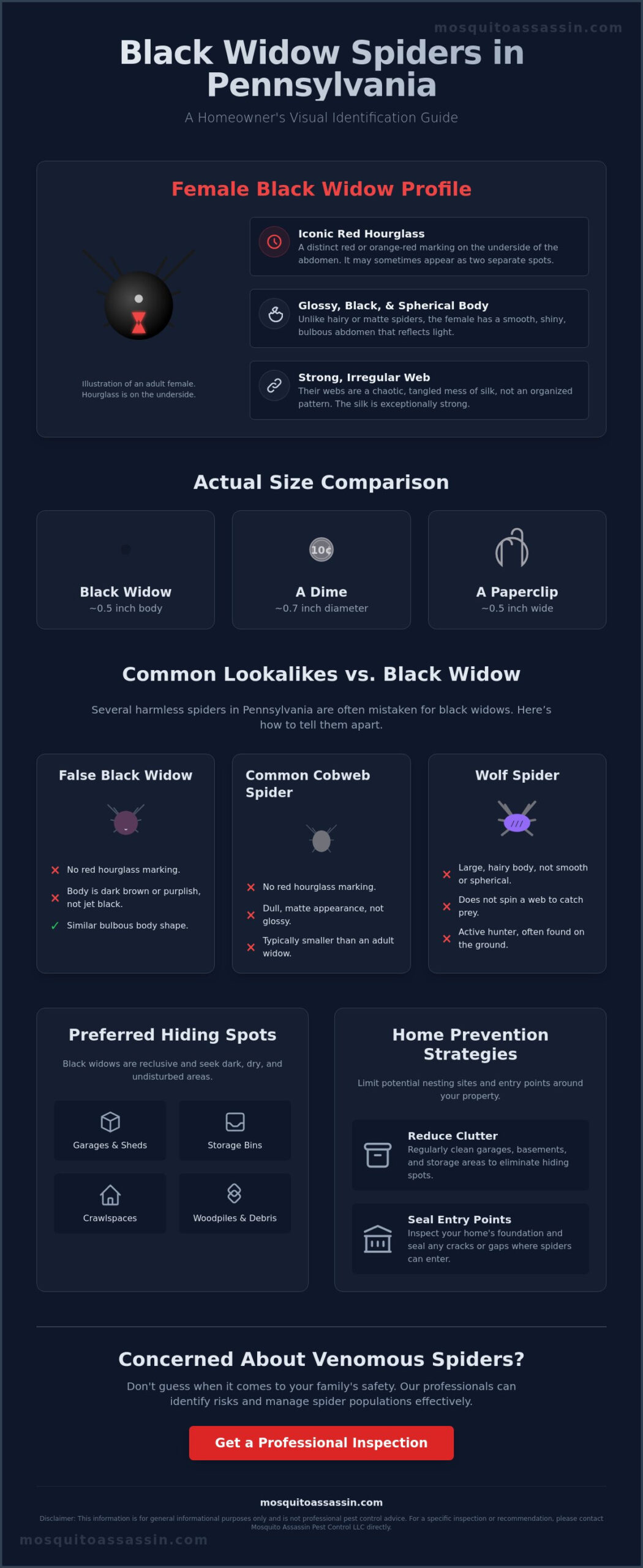
    The most recognizable feature of a female black widow is her bulbous, spherical abdomen. Unlike many other spiders that appear matte or hairy, the black widow has a distinct, glossy texture that reflects light. On the underside, or ventral side, you’ll find the iconic red or orange-red hourglass marking. This shape isn’t always a perfect hourglass; it may appear as two separate red spots or an incomplete triangle. In terms of size, an adult female’s body is about 0.5 inches long, which is roughly comparable to the diameter of a dime or a standard paperclip.

    Common Lookalike Spiders

    Several spiders in Pennsylvania are frequently mistaken for black widows in pa. Differentiating between them is key to maintaining peace of mind. Common lookalikes include:

    • False Black Widow (Steatoda grossa): These spiders have a similar bulbous shape but lack the red hourglass. Their bodies are typically dark brown or purplish rather than jet black.
    • Cobweb Spiders: Often found in damp basements, these spiders are smaller and have a duller, matte appearance compared to the glossy finish of a true widow.
    • Wolf Spiders: These are much larger, hairy, and do not spin webs. They are active hunters that stay on the floor, whereas black widow spiders prefer dark, recessed corners to build their irregular, tangled webs.

    If you encounter a spider that matches these descriptions in your home or garage, professional pest control may help reduce risk. You can find more information about our service areas in Pennsylvania and Ohio at mosquitoassassin.com/location.

    Disclaimer: The information provided on this blog is for general informational purposes only and is not intended as professional pest control advice. Conditions vary by property, environment, and location. Reading this content does not create a service agreement. For an inspection or professional recommendations, please contact Mosquito Assassin Pest Control LLC directly.

    Habitat and Behavior of Pennsylvania Black Widows

    Understanding the daily habits of black widows in pa is essential for effective property management. These spiders are notoriously reclusive; they avoid open spaces and light whenever possible. Instead, they seek out dark, cramped, and undisturbed locations to build their webs. While they remain active throughout the warmer months between May and October, they often migrate toward more permanent shelter as temperatures drop in late autumn. This seasonal shift often brings them closer to residential structures in Erie and Crawford Counties.

    A black widow web is distinct and easy to identify if you know what to look for. Unlike the symmetrical, circular patterns of common garden spiders, a widow’s web is a tangled, chaotic mess of silk. Despite its disorganized appearance, this silk is exceptionally strong. Scientific studies have shown it has a higher tensile strength than many types of steel. According to researchers at black widows in Pennsylvania usually display non-aggressive behavior toward humans. Bites typically only occur as a defensive reaction when the spider is accidentally pinched, squeezed, or pressed against a person’s skin while cleaning or gardening.

    Preferred Outdoor Locations

    In Western Pennsylvania and Ashtabula County, homeowners often find these spiders in outdoor areas that provide both protection and a steady supply of prey. Woodpiles and hollow tree stumps are primary nesting sites because they offer the humidity and darkness these arachnids crave. You should also regularly inspect the undersides of patio furniture and children’s outdoor play equipment, as these items often remain stationary for long periods. Other common spots include stone walls, rock gardens, and utility meter boxes. These structures provide the narrow crevices where a spider can retreat during daylight hours to avoid predators.

    Indoor Hiding Spots

    When black widows in pa move indoors, they gravitate toward low-traffic areas where they won’t be disturbed. Cluttered basements and crawl spaces provide ideal environments because they offer numerous hiding spots behind storage boxes or within structural gaps. Dark corners of garages are also frequent habitats, especially near seldom-used gardening tools or bins. You might find them behind large appliances or inside cardboard boxes that have remained stationary for several seasons. Reducing clutter and using sealed plastic bins instead of cardboard can lower the chances of an accidental encounter. If you suspect an infestation in your storage areas, professional pest control may help reduce risk by identifying high-pressure areas and nesting sites.

    Disclaimer: The information provided on this blog is for general informational purposes only and is not intended as professional pest control advice. Conditions vary by property, environment, and location. Reading this content does not create a service agreement. For an inspection or professional recommendations, please contact Mosquito Assassin Pest Control LLC directly.

    Black Widows in PA: Identification and Safety Guide for Homeowners

    Northern vs. Southern Black Widows: Regional Differences

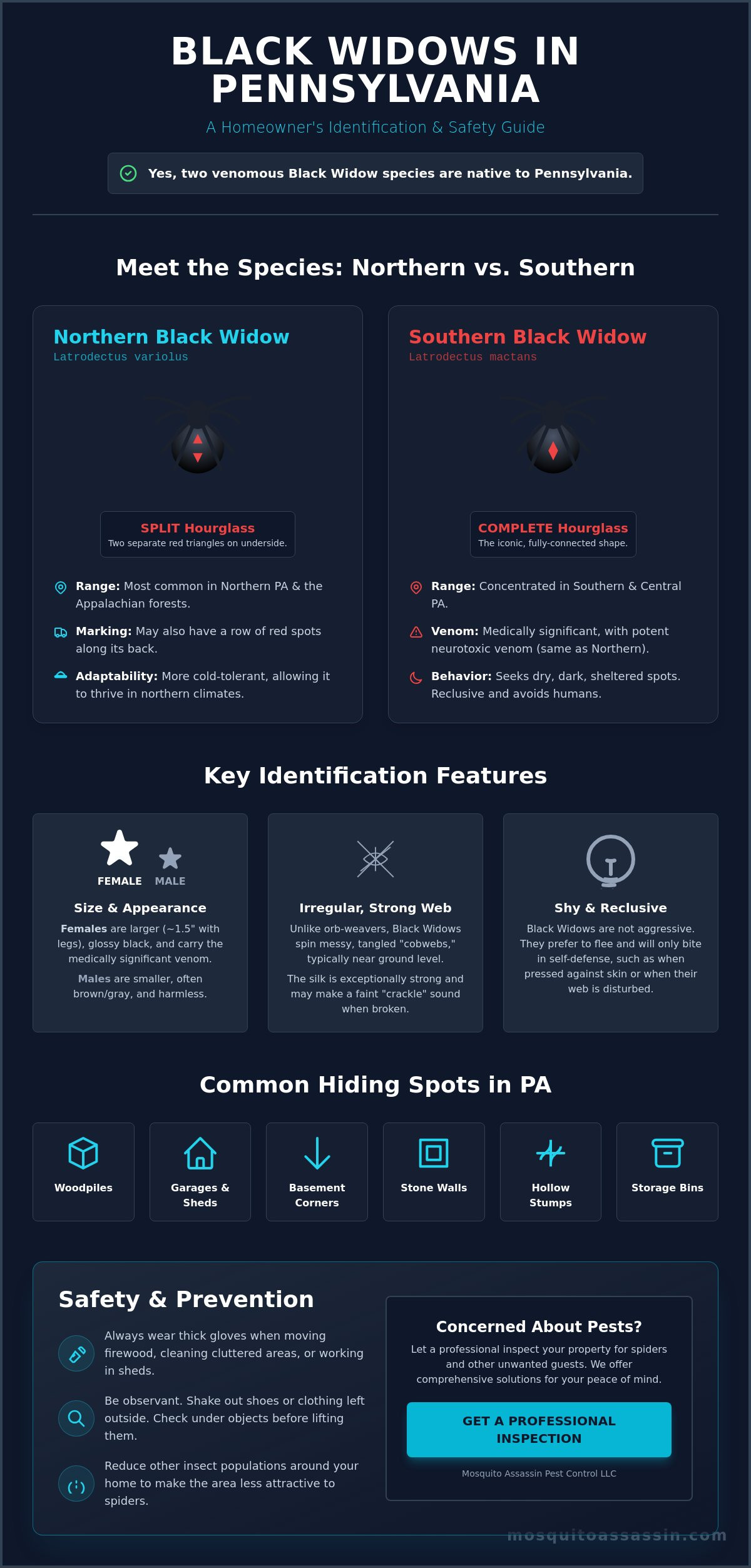
    Pennsylvania sits at a unique ecological crossroads where the natural ranges of two distinct venomous spiders overlap. Homeowners searching for information on black widows in pa should understand that the state hosts both the Northern black widow (Latrodectus variolus) and the Southern black widow (Latrodectus mactans). While their appearances are remarkably similar at first glance, their habitats and physical markings differ based on their specific lineage. In regions like Erie and Crawford Counties, the Northern variety is the most frequent encounter. Conversely, the Southern variety becomes more prevalent as you move toward the southern border of the state.

    Despite these regional differences, both species possess a potent neurotoxic venom that requires respect and caution. The biological makeup of the venom is nearly identical between the two. A bite from either spider can cause significant physical distress, including muscle aches, nausea, and localized pain. Because both species are present within the state’s borders, residents must treat any shiny black spider with red markings as a potential safety risk. Professional pest control may help reduce risk by identifying these spiders before they establish large populations near your home.

    The Northern Black Widow

    The Northern black widow is the species most commonly found in the wooded environments of northern Pennsylvania and eastern Ohio. A key trait of this variety is the “split” hourglass marking on the underside of the abdomen. Instead of a connected shape, the red marking is typically broken into two separate triangles. Many individuals also display a row of white or red spots along the midline of their back, which can make them look slightly more colorful than their southern counterparts. These spiders prefer forest edges and more wooded environments. They often hide in hollow logs, under loose tree bark, or inside stone piles where they can remain undisturbed. This Penn State Extension guide to spiders provides further details on how these physical traits help experts distinguish the species in the field.

    The Southern Black Widow

    The Southern black widow is the “classic” version of the spider often depicted in media. It features the complete, connected red hourglass shape that most people recognize instantly. This species shows a much stronger preference for locations closer to human structures. It’s common to find them in barns, sheds, garages, and under porch railings. When comparing web placement, Southern widows often build their webs much closer to the ground than Northern widows. They favor dark, recessed corners of crawlspaces or the gaps under outdoor equipment. Because they thrive in man made environments, they are frequently encountered during routine home maintenance or cleaning projects. If you notice these distinctive webs in high traffic areas, visiting www.mosquitoassassin.com/services can provide information on professional management strategies to safeguard your property.

    Disclaimer: The information provided on this blog is for general informational purposes only and is not intended as professional pest control advice. Conditions vary by property, environment, and location. Reading this content does not create a service agreement. For an inspection or professional recommendations, please contact Mosquito Assassin Pest Control LLC directly.

    Preventing Spider Infestations Around the Home

    Effective spider control starts with making your property less attractive to pests. For homeowners concerned about black widows in pa, the most successful strategy involves removing the three things spiders need: food, water, and shelter. By systematically addressing these factors, you can significantly reduce the likelihood of a dangerous encounter. Spiders are opportunistic hunters; they won’t stay where they can’t find a steady supply of insects or a quiet place to hide.

    Managing outdoor lighting is a simple but overlooked prevention step. Standard incandescent or mercury vapor lights attract moths, beetles, and other flying insects. These bugs serve as a primary food source for spiders. Switching to yellow LED “bug bulbs” or moving light fixtures away from entryways can reduce insect activity by up to 60 percent. Fewer insects near your doors mean fewer spiders building webs in those high-traffic areas.

    Safety is paramount when working in areas where spiders might hide. Always wear heavy leather gloves when handling firewood, moving stones, or reaching into dark corners of a garage. It’s common to find black widows in pa tucked away in woodpiles or behind stored items in Erie and Crawford Counties. Taking this one precaution can prevent a defensive bite if you accidentally disturb a web.

    Exterior Maintenance Tips

    • Maintain the perimeter: Keep grass mowed to a height of 3 inches or less and trim all vegetation at least 12 inches away from the home foundation. This creates a “dry zone” that spiders and their prey find difficult to cross.
    • Manage firewood correctly: Store all firewood at least 20 feet away from the house. Keep the logs elevated off the ground on a rack to prevent moisture buildup and discourage nesting.
    • Disrupt web building: Use a broom or a high-powered vacuum to clear away old webs and egg sacs every 30 days. Consistent disruption makes the area feel unsafe for spiders, forcing them to relocate.

    Interior Organization Strategies

    • Upgrade storage containers: Replace cardboard boxes with plastic storage bins that feature tight-fitting, gasket-sealed lids. Cardboard often uses starch-based adhesives that attract silverfish and other insects that spiders hunt.
    • Seal the envelope: Inspect the foundation for cracks wider than 1/16th of an inch. Use high-quality silicone caulk to seal these gaps. Ensure all window screens are free of holes and that door sweeps make firm contact with the threshold.
    • Organize secluded spaces: Keep basements and garages well-organized to minimize dark corners. Pulling shelving units 2 inches away from walls allows for better airflow and easier inspections.

    Reducing clutter in storage areas limits potential nesting sites for spiders. When items are left undisturbed for months at a time, they become ideal habitats for various species. Regular cleaning and reorganization of crawlspaces and attics ensure that you catch any potential issues before they become full-scale infestations. If you notice an increase in spider activity despite these efforts, professional pest control may help reduce risk in your home.

    Disclaimer: The information provided on this blog is for general informational purposes only and is not intended as professional pest control advice. Conditions vary by property, environment, and location. Reading this content does not create a service agreement. For an inspection or professional recommendations, please contact Mosquito Assassin Pest Control LLC directly.

    Professional Pest Management for Venomous Spiders

    Professional pest management for venomous spiders involves a systematic strategy designed to safeguard the home environment. Licensed technicians bring a level of expertise that allows them to identify subtle entry points, such as gaps in siding or unsealed utility lines, which are frequently missed during DIY inspections. When homeowners encounter black widows in pa, professional pest control may help reduce risk by addressing both the spiders and their food sources. Technicians can identify foundation cracks as small as 1/16th of an inch where these arachnids might hide.

    Integrated Pest Management (IPM) serves as the foundation for these services. Instead of just reacting to a single spider, this approach focuses on long-term prevention through habitat modification and exclusion. Technicians evaluate the property to determine why spiders are attracted to specific areas. This might include identifying high-moisture zones or excessive outdoor lighting that attracts the insects spiders prey upon. By removing the incentive for pests to stay, homeowners see more sustainable results.

    When to Seek Professional Assistance

    Certain scenarios demand the specialized tools and knowledge of a professional. If sightings become frequent within living spaces like laundry rooms or finished basements, it often indicates an established population rather than a stray individual. Professional intervention is essential when infestations are found in proximity to areas where children or pets frequently play. These groups are more vulnerable to the effects of venom, making a swift response necessary.

    Safety is the primary concern when dealing with black widows in pa. Homeowners shouldn’t attempt to clear nesting sites in confined or hazardous locations. Crawlspaces, deep corners of garages, and cluttered sheds can be dangerous to navigate without proper protective gear. A licensed technician can safely access these zones to remove egg sacs and adult spiders, preventing a new generation from emerging and spreading throughout the structure.

    The Role of Year-Round Protection

    Maintaining a consistent defense is more effective than waiting for a problem to arise. Year-round protection plans establish a reliable barrier around the home’s exterior. In Erie and Crawford Counties in Pennsylvania and Ashtabula County in Ohio, seasonal shifts trigger changes in pest behavior. Spiders often seek indoor shelter as temperatures drop in the autumn months. Consistent monitoring ensures that these shifts don’t lead to an indoor infestation.

    Treating the perimeter is a critical step in stopping spiders before they cross the threshold. This involves applying treatments to the foundation and around windows and doors to create a deterrent for pests. For those interested in a comprehensive approach to home safety, viewing a General Pest Control guide provides further insight into how these systems work together. Professional pest control may help reduce risk by providing these layers of defense, keeping the interior of the home secure regardless of the season.

    Disclaimer: The information provided on this blog is for general informational purposes only and is not intended as professional pest control advice. Conditions vary by property, environment, and location. Reading this content does not create a service agreement. For an inspection or professional recommendations, please contact Mosquito Assassin Pest Control LLC directly.

    Protecting Your Pennsylvania Property

    Recognizing the distinct red hourglass of black widows in pa is a vital step toward maintaining a secure home. These spiders typically prefer dark, low-traffic zones such as basements, crawl spaces, or outdoor woodpiles. It’s important to remember that Pennsylvania is home to two medically significant spider species, making proper identification essential for safety. Practical prevention starts with reducing outdoor clutter and sealing small entry points around the home foundation.

    Professional pest control may help reduce risk through systematic inspections and integrated management. Technicians who are licensed and insured in PA and OH provide locally owned and operated expertise across Erie, Crawford, and Ashtabula Counties. These experts utilize family-safe treatment approaches to address infestations without compromising the household environment. For an inspection or professional recommendations, contact Mosquito Assassin Pest Control LLC today. Staying proactive is an excellent way to keep your living space comfortable and spider-free.

    Disclaimer: The information provided on this blog is for general informational purposes only and is not intended as professional pest control advice. Conditions vary by property, environment, and location. Reading this content does not create a service agreement. For an inspection or professional recommendations, please contact Mosquito Assassin Pest Control LLC directly.

    Frequently Asked Questions

    How dangerous is a black widow bite?

    A black widow bite is serious because it contains latrotoxin, a potent neurotoxin that affects the nervous system. While these bites are rarely fatal, with fewer than 1 percent of reported cases resulting in death according to the American Association of Poison Control Centers, they cause significant pain. Symptoms typically include muscle aches, nausea, and localized swelling that can last for 3 to 7 days.

    Are black widows common in Pennsylvania homes?

    Black widows in pa are present but typically prefer undisturbed outdoor areas or secluded parts of a structure. You’ll most likely find them in basements, crawlspaces, or garages rather than main living areas. Data from regional entomology studies suggest they’re less common than standard house spiders, but their presence increases in properties with high levels of clutter or insect activity.

    What should I do if I find a black widow in my house?

    Keep children and pets away from the spider immediately and do not attempt to handle it with your bare hands. If you must move it, use a sturdy container with a lid, but it’s safer to leave the spider alone and monitor its location. Professional pest control may help reduce risk by identifying if a larger infestation exists within the home’s dark corners.

    Can black widow spiders live in cold Pennsylvania winters?

    Black widows survive the freezing temperatures of Pennsylvania by entering a state of dormancy called diapause. They seek shelter in protected voids, such as stone walls, hollow logs, or heated foundations, where they can remain inactive for 4 to 5 months. Once temperatures consistently rise above 50 degrees Fahrenheit in the spring, they become active and begin searching for prey again.

    How can I tell the difference between a black widow and a false widow?

    The most reliable way to identify a black widow is the bright red hourglass marking on the underside of its shiny black abdomen. False widows belong to the same family but have a more brownish hue and lack the red hourglass, often displaying pale or white markings instead. While false widows can bite, their venom is significantly less potent than the neurotoxins found in the black widow species.

    What attracts black widows to a specific property?

    Black widows in pa are primarily attracted to environments that offer both protection and a steady supply of food. Properties with outdoor woodpiles, tall grass, or heavy debris provide the 2 most critical elements for their survival: hiding spots and insect prey. Reducing outdoor clutter and managing exterior lighting, which attracts the bugs spiders eat, can help make a property less inviting.

    Is professional pest control necessary for black widows?

    Engaging a professional is the safest way to handle a black widow problem due to the risks associated with their venom. Licensed technicians have the training to locate hidden nesting sites in crawlspaces or attics that homeowners often overlook. For a thorough evaluation of your property in Erie or Crawford Counties, you can contact a specialist through the online booking portal at https://portal.gorilladesk.com/mosquitoassassin.

    Disclaimer: The information provided on this blog is for general informational purposes only and is not intended as professional pest control advice. Conditions vary by property, environment, and location. Reading this content does not create a service agreement. For an inspection or professional recommendations, please contact Mosquito Assassin Pest Control LLC directly.

  • Are Black Widows in PA? Identifying Pennsylvania’s Medically Significant Spiders

    Are Black Widows in PA? Identifying Pennsylvania’s Medically Significant Spiders

    While many homeowners assume venomous spiders are strictly a concern for southern climates, the northern black widow is a permanent resident of the Keystone State. Pennsylvania is home to over 500 spider species, yet if you’ve wondered are black widows in pa, they remain one of only two species in the region with medically significant venom. It’s natural to feel unease when you spot a dark, spindly shape scuttling across a garage floor or tucked behind storage bins. Most people struggle to tell the difference between a harmless house spider and a species that requires caution.

    This guide provides the specific visual markers you need to identify these spiders with confidence. You’ll learn exactly where these arachnids prefer to hide in Erie and Crawford Counties and discover practical, professional strategies to reduce the risk of an encounter. By understanding their behavior and habitat, you can effectively safeguard your home and family from unwanted guests.

    Disclaimer: The information provided on this blog is for general informational purposes only and is not intended as professional pest control advice. Conditions vary by property, environment, and location. Reading this content does not create a service agreement. For an inspection or professional recommendations, please contact Mosquito Assassin Pest Control LLC directly.

    Key Takeaways

    • Confirm that both Northern and Southern black widow species reside in Pennsylvania and understand their distribution across the Northeast.
    • Learn to identify the distinct red hourglass marking and physical characteristics that separate these spiders from common lookalikes.
    • Identify preferred habitats in Erie and Crawford Counties, including woodpiles and basement corners, to better recognize potential risk areas.
    • Understand the answer to are black widows in pa while exploring how Integrated Pest Management (IPM) strategies can reduce the insect populations that attract spiders.
    • Implement practical safety precautions and protective gear recommendations to prevent bites during routine yard work or home cleaning.

    Understanding Black Widow Populations in Pennsylvania

    When residents ask are black widows in pa, the answer is a definitive yes. Pennsylvania serves as a meeting ground for two specific species within the Latrodectus genus. These spiders are members of the cobweb weaver family, known for their messy, tangled webs rather than the symmetrical designs of garden spiders. While their presence often causes concern, they’re generally reclusive and avoid human interaction. Records from the Penn State Department of Entomology confirm sightings in counties across the Commonwealth, including Erie and Crawford, where local populations have been documented for decades.

    To better understand how these spiders behave and where they live, watch this helpful video:

    The Southern Black Widow in PA

    The Southern black widow (Latrodectus mactans) is the most recognizable member of the genus. These spiders are primarily concentrated in the southern and central regions of the state where temperatures remain slightly warmer. They’re famous for the bright red hourglass mark on the underside of their shiny, jet-black abdomen. The Southern black widow is a medically significant cobweb weaver common in PA. They often seek out dry, sheltered spots like stone walls, hollow stumps, or the dark corners of a garage. Because are black widows in pa, it’s helpful to know how to spot their distinctive webs, which are exceptionally strong and lack a clear pattern.

    The Northern Black Widow and its Range

    The Northern Black Widow (Latrodectus variolus) is the species most likely encountered by residents in the northern counties of Pennsylvania and into Ohio. Unlike the Southern variety, the red marking on the Northern species is often split into two distinct triangles or appears as a row of red spots along the back. This species is more cold-tolerant, allowing it to thrive in the Appalachian forests and rural landscapes of the northern tier. Both spiders possess similar neurotoxic venom, making them a concern if they establish themselves inside a home. Professional pest control may help reduce risk by managing the outdoor environments where these spiders prefer to hide. If you have concerns about spiders on your property, you can find more information at www.mosquitoassassin.com/contact-us.

    Disclaimer: The information provided on this blog is for general informational purposes only and is not intended as professional pest control advice. Conditions vary by property, environment, and location. Reading this content does not create a service agreement. For an inspection or professional recommendations, please contact Mosquito Assassin Pest Control LLC directly.

    How to Identify Black Widows and Common Lookalikes

    Understanding the physical traits of these spiders helps homeowners distinguish between a harmless visitor and a medically significant pest. While many people ask are black widows in pa, the reality is that they’re native to the region but often remain hidden. The mature female is the most recognizable, featuring a glossy, jet-black exoskeleton that reflects light. She typically measures about 1.5 inches in length when her legs are extended; meanwhile, the males are significantly smaller, often appearing brown or gray with white streaks or spots on their backs.

    The most famous marker is the red hourglass on the underside of the abdomen. In the Northern Black Widow (Latrodectus variolus), which is common in the Northeast, this hourglass is often “broken” or split into two distinct triangles. In contrast, the Southern Black Widow (Latrodectus mactans) usually displays a complete, joined hourglass. Their webs are another giveaway; they don’t spin symmetrical, circular patterns. Instead, they create irregular, tangled “cobwebs” made of incredibly strong silk that can even make a faint “crackle” sound when torn or pulled apart.

    Key Identification Markers for Homeowners

    Homeowners should look for the hourglass on the belly of the spider, as it’s rarely visible from the top. These spiders are reclusive and nocturnal; they’ll usually retreat into a corner or crevice if disturbed rather than attacking. Identification also extends to their offspring. A female widow produces smooth, tan, or white pear-shaped egg sacs that are about 0.5 inches in diameter. These sacs are distinct from the spiked or “fluffy” sacs produced by other species. If you find these markers in a garage or crawlspace, professional pest control may help reduce risk by identifying the extent of the activity.

    Common PA Spiders Mistaken for Black Widows

    Mistaken identity is frequent in Erie and Crawford counties. The False Black Widow (Steatoda grossa) is the most common lookalike. While it has a similar bulbous shape and dark color, it lacks the red hourglass and typically has a more purplish-brown or dull black hue. Common House Spiders also cause confusion because they build similar messy webs, but they’re generally smaller and much lighter in color. According to the guide on Commonly Encountered Pennsylvania Spiders, orb weavers are also frequently misidentified due to their dark bodies, though they’re easily distinguished by the large, wheel-shaped webs they build in gardens and near porch lights.

    Disclaimer: The information provided on this blog is for general informational purposes only and is not intended as professional pest control advice. Conditions vary by property, environment, and location. Reading this content does not create a service agreement. For an inspection or professional recommendations, please contact Mosquito Assassin Pest Control LLC directly.

    Are Black Widows in PA? Identifying Pennsylvania’s Medically Significant Spiders

    Typical Habitats and Seasonal Patterns in the Northeast

    While many residents wonder are black widows in pa, the reality is that these spiders are native to the region and thrive in specific, quiet environments. They’re reclusive by nature and prioritize survival by nesting in dark, low traffic areas where they’re unlikely to be stepped on or brushed away. According to the Penn State Extension, both Northern and Southern Black Widows can be found in the state, typically tucked away in spots that offer protection from both predators and the elements.

    Seasonal patterns dictate when sightings become more frequent. In Pennsylvania, activity levels usually rise as temperatures climb in late spring. However, sightings peak during the late summer and early autumn months, specifically between August and October. During this window, adult females are at their most active and their webs are more established. As the weather cools in Northwest Pennsylvania, these spiders don’t necessarily migrate into the center of homes, but they do seek more insulated crevices to survive the winter freeze.

    Outdoor Hiding Spots in PA Landscapes

    In the rural and suburban landscapes of Erie and Crawford counties, outdoor structures provide ideal nesting sites. Woodpiles are the most common hazard; spiders often hide in the gaps between logs to stay cool and damp. Stone walls, hollow tree stumps, and the undersides of porch steps also serve as prime real estate. These locations provide the perfect anchor points for their strong, irregular webbing.

    Outbuildings like sheds, barns, and detached garages are particularly attractive because they offer shelter without the constant disruption of a main residence. The climate in Northwest PA, influenced by Lake Erie humidity, provides the moisture these spiders prefer. When moving stored firewood or clearing yard debris, it’s vital to wear heavy gloves. This simple precaution prevents accidental contact with a hidden spider that may be guarding an egg sac.

    Indoor Environments and Prevention

    Understanding that are black widows in pa is just the first step in prevention. These spiders rarely wander into the middle of a kitchen or bedroom. Instead, they’re found in transition zones like garages, basements, and crawl spaces. These areas often house cluttered storage boxes or seasonal equipment that remains untouched for months. Clutter provides the undisturbed environment these reclusive species need to build their tangled webs and hunt for insects.

    Common entry points include gaps under doors, damaged window screens, or utility penetrations. Since these spiders are photophobic (light avoidant), they’re naturally deterred by bright, well lit areas. Increasing natural light in a basement or keeping storage areas organized and off the floor can significantly reduce the likelihood of a widow choosing your home for a nest. If you identify a potential habitat near your living space, professional pest control may help reduce risk.

    Disclaimer: The information provided on this blog is for general informational purposes only and is not intended as professional pest control advice. Conditions vary by property, environment, and location. Reading this content does not create a service agreement. For an inspection or professional recommendations, please contact Mosquito Assassin Pest Control LLC directly.

    Safety Precautions and Bite Prevention Strategies

    Understanding that there are black widows in pa means taking practical steps to safeguard your home and family. These spiders prefer undisturbed, dim locations, which makes garages, basements, and crawl spaces high-risk areas. When you’re cleaning out a storage space or working in the yard, always wear heavy leather gloves and long sleeves. Thin fabric gloves don’t provide enough protection against a spider’s fangs if you accidentally press against one while moving boxes.

    Before reaching into dark corners or moving storage bins, use a bright flashlight to inspect the area. Look for the characteristic messy, tangled webs that indicate a widow’s presence. It’s also vital to shake out any boots, work shoes, or gloves that have been sitting in a garage or mudroom for more than 24 hours. Spiders often crawl into these dark, enclosed spaces for shelter. If you spot a suspected black widow, don’t attempt to handle it or crush it with your hands. Use a vacuum with a long attachment to remove the spider from a safe distance, then dispose of the bag or empty the canister outside immediately.

    Reducing Risk Around the Property

    Managing the exterior of your home is the first line of defense. Keep woodpiles, rock piles, and general debris at least 20 feet away from your foundation. This removes the primary habitat for spiders and the insects they eat. You should also inspect your home’s exterior for entry points. Seal cracks in the foundation with high-quality silicone caulk and ensure door sweeps are tight against the threshold. Implementing general pest control strategies helps by reducing the population of crickets, beetles, and other insects that serve as the black widow’s food source.

    Understanding Black Widow Behavior

    While their reputation is fearsome, black widows are actually shy and non-aggressive. They spend most of their lives hanging upside down in their webs waiting for prey to stumble into their silk. Bites typically occur when a spider is accidentally squeezed or if a person reaches into a web without looking. However, a female guarding an egg sac becomes significantly more defensive. These sacs are usually round and papery, appearing white or tan. If you see one, stay away. Because children and small pets are more sensitive to venom due to their lower body mass, keeping these areas clear is a priority for household safety. Professional pest control inspections can help identify these hidden nesting sites before an accidental encounter occurs.

    Disclaimer: The information provided on this blog is for general informational purposes only and is not intended as professional pest control advice. Conditions vary by property, environment, and location. Reading this content does not create a service agreement. For an inspection or professional recommendations, please contact Mosquito Assassin Pest Control LLC directly.

    Long-Term Management and Professional Pest Control

    Integrated Pest Management (IPM) is the gold standard for maintaining a home free of medically significant pests. This method doesn’t rely on a single treatment; instead, it focuses on long-term prevention by altering the environment that attracts spiders. Spiders are opportunistic predators that thrive where food is abundant. If a garage or basement has a steady supply of crickets, flies, or moths, spiders will naturally gravitate toward those areas. Reducing the general insect population by 80% to 90% through consistent habitat modification is often the most effective way to manage spider activity. While it’s true that there are black widows in PA, they typically prefer undisturbed locations like woodpiles or dark corners of outbuildings where prey is plentiful.

    Seeking professional assistance is advisable when residents notice multiple egg sacs or see spiders in high-traffic areas of the home. Professional pest control may help reduce risk by providing a comprehensive assessment of the property’s exterior and interior. Technicians look for specific environmental triggers, such as moisture issues or structural gaps, that homeowners might overlook. Identifying the exact species is the first step in a successful management plan, as the behavior of a common house spider differs significantly from that of a northern black widow.

    Benefits of Professional Monitoring

    Consistent monitoring helps identify potential issues before they escalate into larger infestations. Professional pest control may help reduce risk through scheduled inspections that track pest activity over time. Technicians are trained to identify high-risk areas in Erie and Ashtabula counties, focusing on crawlspaces, attic eaves, and foundation perimeters. In Pennsylvania, where researchers have documented over 500 different spider species, distinguishing a harmless orb weaver from a medically significant spider requires specialized knowledge. Expert inspections provide peace of mind by confirming exactly what’s living on the property and ensuring that exclusion methods are working effectively.

    Maintaining a Pest-Free Environment

    Pennsylvania’s weather patterns significantly influence pest pressure throughout the year. High humidity levels, which often exceed 70% during the summer months in Erie and Crawford counties, create ideal breeding grounds for the insects that spiders hunt. Ongoing protection plans account for these seasonal shifts, addressing pests as they migrate indoors during cooler autumn temperatures. Proactive maintenance is a vital component of this process. Homeowners should focus on several key tasks:

    • Sealing gaps larger than 1/16th of an inch around windows, doors, and utility lines to block entry points.
    • Removing heavy mulch or dense vegetation that sits directly against the home’s foundation.
    • Using yellow “bug lights” for exterior lighting to reduce the number of flying insects attracted to the home at night.
    • Managing indoor humidity with dehumidifiers to make basements less attractive to moisture-loving prey.

    Taking a proactive approach to home maintenance ensures the property remains a less hospitable environment for pests. For a professional evaluation of your property, you can visit the online booking portal to schedule an inspection. Understanding that there are black widows in PA is the first step in staying vigilant, but consistent management is what keeps a home safe and comfortable year-round.

    Disclaimer: The information provided on this blog is for general informational purposes only and is not intended as professional pest control advice. Conditions vary by property, environment, and location. Reading this content does not create a service agreement. For an inspection or professional recommendations, please contact Mosquito Assassin Pest Control LLC directly.

    Securing Your Property Against Medically Significant Spiders

    Understanding spider behavior and identifying potential risks is the first step toward a safer home environment. While many homeowners ask are black widows in pa, these spiders are native to the state but generally avoid human activity, preferring dark, undisturbed areas like crawl spaces or woodpiles. Proper identification prevents unnecessary panic, but it also signals when professional intervention is necessary to manage a population. Focusing on long-term prevention strategies, such as sealing entry points and reducing clutter, helps minimize the chances of an encounter.

    Expertise matters when dealing with spiders that pose a health risk. Licensed and insured local professionals provide thorough inspections and reliable management plans for residents throughout Erie, Crawford, and Ashtabula Counties. Choosing a five-star rated local service ensures the job is done with precision and care for the surrounding environment. For a professional inspection or recommendations, contact Mosquito Assassin Pest Control LLC directly. Taking these practical steps today provides peace of mind for everyone in the household.

    Disclaimer: The information provided on this blog is for general informational purposes only and is not intended as professional pest control advice. Conditions vary by property, environment, and location. Reading this content does not create a service agreement. For an inspection or professional recommendations, please contact Mosquito Assassin Pest Control LLC directly.

    Frequently Asked Questions

    Are black widow spiders common in Pennsylvania?

    Black widow spiders are native to the region, and it’s a reality that are black widows in pa. While they’re present throughout the state, they aren’t as common as standard cellar spiders or wolf spiders. Residents in Erie and Crawford Counties typically encounter the Northern variety, which prefers outdoor woodpiles or undisturbed sheds over active living areas.

    How can I tell the difference between a Northern and Southern black widow?

    You should look at the hourglass marking on the belly to distinguish between these two species. A Southern black widow has a solid, connected red hourglass, while the Northern black widow has an hourglass that’s split in the middle. Northern widows also frequently display a row of red dots or white lines along the top of their abdomen, which the Southern variety lacks.

    What should I do if I find a black widow spider in my house?

    Don’t attempt to handle the spider or crush it with your bare hands. If you spot one, keep pets and children clear of the room to prevent accidental contact. Professional pest control may help reduce risk by identifying the nesting site and implementing a safe removal plan. For an expert inspection, visit https://portal.gorilladesk.com/mosquitoassassin to book a consultation.

    Are black widow spiders aggressive toward humans?

    Black widows are timid creatures that prefer flight over fight when they encounter humans. They only bite as a last resort if they’re pinched, squeezed, or stepped on. Data from the American Association of Poison Control Centers shows that while 2,500 bites are reported in the U.S. annually, the majority of these incidents occur when humans accidentally disturb a spider’s dark hiding spot.

    Where do black widows hide during the winter in PA?

    These spiders seek out dry, insulated voids to survive the freezing temperatures in Western Pennsylvania. They often tuck themselves into rock walls, wood heaps, or the gaps around a home’s foundation. In areas like Ashtabula County, they’ve been known to overwinter in barn lofts or under the siding of houses where they stay protected from snow and wind during the coldest months.

    Can black widow spiders live in garages and basements?

    Garages and basements are common spots where you might find these pests, proving that are black widows in pa is a concern even in indoor storage areas. These spiders thrive in cluttered, low-traffic zones where they can build webs near the floor. They’re often found behind stacked boxes or under heavy workbenches in Erie County homes where other insects are plentiful.

    Do black widows have any lookalike spiders in Pennsylvania?

    The False Black Widow is the most frequent lookalike found in the state. It shares the same rounded abdomen and dark color, but it doesn’t have the bright red hourglass. You might also mistake a common cobweb spider for a widow because their webs look similar, but the cobweb spider is usually smaller and lacks the glossy, jet-black finish of a true widow.

    Disclaimer: The information provided on this blog is for general informational purposes only and is not intended as professional pest control advice. Conditions vary by property, environment, and location. Reading this content does not create a service agreement. For an inspection or professional recommendations, please contact Mosquito Assassin Pest Control LLC directly.

  • Pennsylvania Brown Recluse Spider: Identification, Range, and Safety Guide (2026)

    Pennsylvania Brown Recluse Spider: Identification, Range, and Safety Guide (2026)

    On October 14, 2025, a resident in Crawford County reached for a storage bin in their basement and froze as a small, tan spider vanished into a dark corner. It is completely natural to feel a surge of anxiety when you spot a mysterious arachnid in your living space, especially since many people assume every brown spider is a dangerous threat. Misidentification is a frequent occurrence; research suggests that nearly 80 percent of spiders submitted for identification in the Northeast are harmless local species rather than the rare pennsylvania brown recluse spider.

    This guide provides the facts needed to identify a true brown recluse and distinguish it from the lookalikes that commonly inhabit Erie and Ashtabula Counties. You will learn the specific physical markers to look for, where these spiders are typically found, and how to maintain a safe environment for your family. Understanding the difference between a common house spider and a venomous species is the first step toward reclaiming peace of mind in your home. Professional pest control may help reduce risk if an infestation is suspected.

    Disclaimer: The information provided on this blog is for general informational purposes only and is not intended as professional pest control advice. Conditions vary by property, environment, and location. Reading this content does not create a service agreement. For an inspection or professional recommendations, please contact Mosquito Assassin Pest Control LLC directly.

    Key Takeaways

    • Clarify the status of the pennsylvania brown recluse spider as a non-native species and understand why sightings are rare in the local region.
    • Learn to identify the specific “violin” marking and other physical traits that distinguish a true brown recluse from common lookalikes found in Pennsylvania.
    • Discover the common hiding spots within regional homes, such as undisturbed storage areas and cluttered crawlspaces, to better protect your living environment.
    • Implement effective prevention techniques by establishing a perimeter of defense and controlling the insect populations that serve as a food source for spiders.
    • Recognize when spider activity warrants professional management and how Integrated Pest Management (IPM) techniques can help safeguard your property.

    Understanding the Range and Presence of Brown Recluse Spiders in Pennsylvania

    The Brown recluse spider (Loxosceles reclusa) is one of the most misunderstood pests in the United States. While its name often causes immediate concern for homeowners, it’s vital to distinguish between a spider’s native habitat and occasional, isolated sightings. In the context of the pennsylvania brown recluse spider, these arachnids aren’t considered a resident species. They’re non-native to the Northeast, and the state doesn’t have the environmental conditions required to support large, wild populations.

    Native Range vs. Pennsylvania Sightings

    The primary habitat for the brown recluse spans from southeastern Nebraska through Texas and east to the westernmost parts of Georgia. Pennsylvania falls well outside this biological boundary. There aren’t any documented, established breeding populations of the pennsylvania brown recluse spider in the state’s 67 counties. The climate in northern regions like Erie and Meadville remains a significant barrier to their survival. These spiders thrive in consistent warmth and struggle to survive the sustained freezing temperatures common in Crawford and Erie Counties. Most “recluse” sightings in the Northeast are actually misidentified wolf spiders or nursery web spiders, which share similar coloring but lack the specific characteristics of the Loxosceles genus.

    How Spiders Travel to New Regions

    While they don’t live here naturally, spiders can occasionally arrive via human activity. This process, often called “hitchhiking,” occurs when a spider or an egg sac is transported in commercial freight, moving boxes, or luggage coming from the South or Midwest. A single spider found in a warehouse or a recently moved home represents an isolated find, not an active infestation. It’s extremely rare for these individual spiders to establish a colony in a new environment. Common transport methods include:

    • Corrugated cardboard boxes stored in infested garages in the South.
    • Furniture shipped from endemic regions like Kansas or Oklahoma.
    • Commercial shipments of textiles, electronics, or heavy equipment.
    • Personal belongings moved during a relocation from the Midwest.

    Finding one spider doesn’t mean a property is infested. Because these spiders are reclusive and don’t travel far from their birth site, they rarely spread from one building to another in cold climates. If a resident suspects a sighting, professional pest control may help reduce risk through proper identification and inspection. Understanding the difference between a lone traveler and a local population helps manage expectations and reduces unnecessary anxiety for homeowners in the tri-state area.

    Disclaimer: The information provided on this blog is for general informational purposes only and is not intended as professional pest control advice. Conditions vary by property, environment, and location. Reading this content does not create a service agreement. For an inspection or professional recommendations, please contact Mosquito Assassin Pest Control LLC directly.

    Identification Guide: Distinguishing the Brown Recluse from Common PA Spiders

    Accurate identification is the first step in managing any potential pest concern. While many people fear the pennsylvania brown recluse spider, these arachnids are often confused with harmless local species. A true brown recluse (Loxosceles reclusa) possesses specific physical traits that set it apart. They’re typically 0.25 to 0.5 inches in body length, with a uniform tan to dark brown coloration. Unlike many common house spiders, their legs lack any dark bands, stripes, or prominent spines. Instead, the legs are covered in fine, velvety hairs that require close inspection to see.

    The Fiddle Mark and Eye Patterns

    The most famous identifier is the dark, violin-shaped marking on the cephalothorax (the front body segment). The neck of the “fiddle” points toward the spider’s abdomen. While this mark is a helpful indicator, it’s not foolproof. Some younger spiders have faint markings, and other species, like the pirate spider, can mimic this pattern. For a definitive identification, professionals examine the eye arrangement. Most spiders have eight eyes in two rows, but the brown recluse has only six eyes arranged in three distinct pairs (dyads) in a semi-circle pattern.

    Confirming Brown recluse presence in Pennsylvania is rare because they aren’t native to the region, though they’re occasionally transported here in moving boxes or furniture. If you find a suspect spider, don’t attempt to handle it. You can safely observe it by trapping it under a clear glass or plastic container. This allows for a detailed view of the eyes and markings without risking a bite.

    Common Lookalikes in Erie and Crawford Counties

    Residents in Erie and Crawford Counties frequently encounter several species that resemble the recluse at first glance. Distinguishing these from the pennsylvania brown recluse spider helps reduce unnecessary anxiety.

    • Wolf Spiders: These are large, hairy, and robust. The Wolf Spider is a non-web-building hunter. They’re often seen scurrying across floors or in gardens, but they have eight eyes and distinct stripes on their bodies.
    • Cellar Spiders: Often found in damp basements, these have extremely long, thin legs and tiny bodies. They’re known for “shaking” or vibrating their webs when disturbed, a behavior the brown recluse doesn’t exhibit.
    • Yellow Sac Spiders: These are common indoor residents, usually pale yellow or light green. They’re often blamed for bites, but they lack the violin marking and the specific six-eye pattern of the recluse.

    If you’re unsure about a spider in your home, professional pest control may help reduce risk by providing an expert assessment and identification. You can reach out for assistance at https://portal.gorilladesk.com/mosquitoassassin to ensure your property remains secure.

    Disclaimer: The information provided on this blog is for general informational purposes only and is not intended as professional pest control advice. Conditions vary by property, environment, and location. Reading this content does not create a service agreement. For an inspection or professional recommendations, please contact Mosquito Assassin Pest Control LLC directly.

    Pennsylvania Brown Recluse Spider: Identification, Range, and Safety Guide (2026)

    Where Spiders Hide: Common Habitats in Pennsylvania Homes

    The name of the pennsylvania brown recluse spider is a direct reflection of its biological behavior. These arachnids are naturally shy. They don’t seek out human interaction; instead, they actively look for quiet spots that remain undisturbed for months at a time. In Pennsylvania, regional home construction styles and distinct seasonal shifts create specific environments where these spiders can thrive without being noticed. Identifying these zones is a primary step in effective risk management. Utilizing professional services for a comprehensive home inspection can help homeowners pinpoint these hidden harborages before they become a larger concern.

    Pennsylvania’s climate significantly influences indoor spider activity. During the freezing winters typical of Erie and Crawford Counties, spiders often move deeper into the structural voids of a home to find stable temperatures. Activity levels often rise during the transition periods of spring and fall. When temperatures fluctuate, spiders may move from crawl spaces or attics into living areas in search of more favorable conditions or prey.

    Basements, Crawl Spaces, and Attics

    Damp, dark environments are a magnet for various pests. These areas often house many Commonly Encountered Pennsylvania Spiders because they attract the smaller insects that serve as a food source. Older homes in Meadville and Erie frequently feature stone foundations. These foundations often have small gaps, cracks, and crevices that offer perfect entry points and nesting sites. Clutter in a basement or attic provides a complex network of hiding spots. Stacks of lumber, old newspapers, or unused equipment create a protected sanctuary where the pennsylvania brown recluse spider can hide and lay egg sacs undisturbed.

    Storage Areas and Seasonal Decorations

    Cardboard boxes are one of the most common high-risk items in a home. The corrugated layers of cardboard provide narrow, dark spaces that mimic a spider’s natural habitat in the wild. When boxes sit in a garage or storage unit for a year, they become prime real estate for pests. Moving these items can lead to unexpected encounters. To reduce risks, consider these practical safety steps:

    • Wear heavy work gloves when reaching into dark corners or moving long-stored items.
    • Shake out clothing, blankets, or linens that have been stored in boxes before bringing them into bedrooms.
    • Thoroughly inspect holiday decorations and wreaths before bringing them into the main living spaces.
    • Switch from cardboard boxes to airtight plastic bins with secure lids to eliminate entry points for spiders.

    Professional pest control may help reduce risk by identifying these specific habitat markers. Maintaining a clean, organized storage area is a simple but effective way to discourage spiders from nesting in your home.

    Disclaimer: The information provided on this blog is for general informational purposes only and is not intended as professional pest control advice. Conditions vary by property, environment, and location. Reading this content does not create a service agreement. For an inspection or professional recommendations, please contact Mosquito Assassin Pest Control LLC directly.

    Practical Prevention: Reducing Spider Activity Around Your Property

    Creating a strong perimeter of defense is the most effective way to keep spiders away from your living space. Spiders are natural predators that follow their food source. If your property has a high population of ants, flies, or moths, you’ll likely see an increase in spider activity. Implementing general pest control strategies helps eliminate the insects that draw these predators to your home.

    Year-round sanitation involves more than just a seasonal cleanup. In Erie and Crawford Counties, seasonal shifts drive pests indoors as temperatures drop in the fall. Keeping storage areas organized and using plastic bins instead of cardboard boxes reduces nesting opportunities. Cardboard is particularly attractive to various pests because of the organic adhesives used in the boxes; switching to sealed plastic containers removes this attractant and protects your belongings.

    Outdoor Sanitation and Lighting

    Maintaining the area immediately surrounding your foundation is a critical step in pest management. Spiders love dark, undisturbed areas. Removing debris like old woodpiles, leaf litter, and construction materials from the home foundation is vital. These piles provide the perfect habitat for a pennsylvania brown recluse spider to hide during the day. Vegetation should be trimmed so it doesn’t touch the exterior walls; a clearance of 12 inches is recommended to prevent pests from using plants as a bridge to reach your siding.

    Lighting choices also play a significant role in activity levels. Standard white outdoor lights attract nocturnal insects like moths and beetles. Switching to yellow LED bulbs can reduce insect attraction by as much as 75 percent compared to traditional white incandescent bulbs. By reducing the number of prey insects gathering near your doors and windows, you make your home a less attractive hunting ground for spiders.

    Interior Exclusion and Sealing

    Preventing entry requires a physical barrier. Use high quality caulk or expandable foam to seal gaps around utility pipes, wires, and outdoor faucets. Gaps as small as 2 millimeters are enough for many arachnids to slip through. Repairing torn window screens and installing tight-fitting door sweeps on all exterior exits provides another layer of protection. Reducing entry points is the most effective long-term strategy for maintaining a pest-free environment.

    Sticky traps placed in dark corners or along baseboards are excellent tools for monitoring movement. They help identify which areas of the home are most vulnerable. If you find a pennsylvania brown recluse spider on a trap, it’s a clear indicator of where to focus your exclusion efforts. If you are concerned about activity in your home, professional pest control may help reduce risk.

    Disclaimer: The information provided on this blog is for general informational purposes only and is not intended as professional pest control advice. Conditions vary by property, environment, and location. Reading this content does not create a service agreement. For an inspection or professional recommendations, please contact Mosquito Assassin Pest Control LLC directly.

    Professional Management and Resident Safety

    Managing a potential pennsylvania brown recluse spider population requires a methodical approach that prioritizes household safety. When residents find multiple specimens or suspect a breeding population in secluded areas like crawlspaces or attics, professional intervention becomes necessary. Experts utilize Integrated Pest Management (IPM), a strategy that focuses on long term prevention through habitat modification and targeted treatments rather than just reactive chemical use. This scientific approach ensures that the root causes of the infestation are addressed, making the home less hospitable to arachnids over time.

    Safety for families and pets remains the primary concern during any pest management process. Professional treatments are designed to be precise, applying products only where they are needed to minimize contact with residents. Technicians provide clear guidelines on prep work and re-entry times, which typically range from two to four hours depending on the specific treatment plan. This structured process removes the guesswork and risk associated with over-the-counter solutions that may not be effective against the pennsylvania brown recluse spider.

    The Role of Professional Inspections

    Licensed technicians identify microscopic entry points, some as small as 1/16th of an inch, that homeowners usually miss. A critical component of this process involves rodent removal, as mice often create the very holes spiders use to enter a structure. By managing the broader ecosystem, including the smaller insects that serve as a food source, professional pest control significantly reduces the likelihood of spiders establishing a permanent presence. This multi-layered strategy targets the spiders’ survival needs, effectively forcing them out of the living environment.

    When to Consult a Professional

    It’s time to contact a licensed professional if you discover egg sacs, shed skins, or multiple spiders in living areas. While a solitary spider might be a transient visitor, recurring sightings suggest an established infestation. Accurate identification is vital; many harmless house spiders are often mistaken for recluse species, leading to unnecessary anxiety. An expert evaluation provides the data needed to make informed decisions about your property. For residents in Erie, Crawford, or Ashtabula counties, you can visit the location page to find help in your specific county and ensure your home remains a secure environment.

    Disclaimer: The information provided on this blog is for general informational purposes only and is not intended as professional pest control advice. Conditions vary by property, environment, and location. Reading this content does not create a service agreement. For an inspection or professional recommendations, please contact Mosquito Assassin Pest Control LLC directly.

    Protecting Your Property and Family

    Identifying a pennsylvania brown recluse spider starts with recognizing its six eyes arranged in pairs and the dark violin-shaped mark on its back. While these spiders aren’t native to the colder climates of Erie or Crawford Counties, they’re known to travel in moving boxes or furniture. Keeping storage areas organized and sealing entry points are practical steps to discourage any spider activity. Professional expertise is often necessary to distinguish these from common house spiders found throughout Northeast Ohio and Northwest Pennsylvania.

    Licensed and insured professionals possess the training to evaluate local habitat patterns and provide accurate species identification. If there’s a concern about spiders in a home or business, professional pest control may help reduce risk and offer peace of mind. For an inspection or professional recommendations, please contact Mosquito Assassin Pest Control LLC directly.

    Staying informed and proactive ensures a safer living environment for everyone in the community.

    Disclaimer: The information provided on this blog is for general informational purposes only and is not intended as professional pest control advice. Conditions vary by property, environment, and location. Reading this content does not create a service agreement. For an inspection or professional recommendations, please contact Mosquito Assassin Pest Control LLC directly.

    Frequently Asked Questions

    Are brown recluse spiders common in Pennsylvania?

    Brown recluse spiders are not common in Pennsylvania. While occasional sightings occur, usually due to hitchhiking in shipping containers or luggage, the Pennsylvania Department of Agriculture confirms there are no established breeding populations in the state. Most spiders identified as recluses are actually harmless lookalikes. If you find a suspicious spider in Erie or Crawford Counties, professional identification is the best way to ensure your safety.

    What does a brown recluse spider look like?

    A brown recluse spider is characterized by a dark brown, violin-shaped mark on its cephalothorax. These spiders are typically 0.25 to 0.5 inches long with long, thin legs that lack thick spines. Unlike most spiders that have eight eyes, the recluse has six eyes arranged in three pairs. Identifying a pennsylvania brown recluse spider requires looking for these specific physical traits rather than just the color brown.

    Can a brown recluse spider bite be fatal?

    Fatalities from brown recluse spider bites are extremely rare, with fewer than 10 deaths reported annually in the United States according to medical literature. Most bites result in minor redness or a small blister that heals within 21 days. However, approximately 10 percent of bites cause significant tissue damage or necrosis. If you suspect a bite, seek medical attention immediately rather than attempting home remedies or waiting for symptoms to worsen.

    What should I do if I find a brown spider in my house?

    If you find a brown spider, avoid touching it with your bare hands. You can safely capture the specimen in a glass jar to show a professional for identification. Reducing clutter in basements and attics removes the dark, undisturbed hiding spots these pests prefer. Because many common house spiders look similar to the pennsylvania brown recluse spider, getting an expert opinion helps provide peace of mind for your family.

    How do brown recluse spiders get into Pennsylvania homes?

    Brown recluse spiders typically enter Pennsylvania homes by hitchhiking in boxes, furniture, or equipment transported from southern and midwestern states. They aren’t native to this region and don’t migrate outdoors across state lines. Most infestations start after a resident moves belongings from an area where the spiders are endemic, such as Missouri or Arkansas. Checking cardboard boxes before bringing them into your garage or attic helps prevent an accidental introduction.

    Are there other venomous spiders in Pennsylvania?

    The northern black widow is the only other medically significant spider native to Pennsylvania. While the brown recluse is rare, the black widow is more common in woodpiles and dark outbuildings across Erie and Crawford Counties. Most other local species, such as cellar spiders or jumping spiders, possess venom for hunting but don’t pose a serious health risk to humans. Professional pest control may help reduce the risk of encountering these venomous species.

    Does professional pest control work for spiders?

    Professional pest control is highly effective when it uses an integrated approach to manage spider populations. Treatments focus on removing food sources, such as smaller insects, and applying barriers to entry points like cracks and crevices. Since spiders don’t groom themselves like insects, direct contact with treated surfaces is necessary for eradication. Expert technicians can identify high-risk areas in your home to create a customized plan that ensures long-term protection.

    Is it a brown recluse or a wolf spider?

    It’s often a wolf spider if the specimen is hairy and has large, prominent eyes. Wolf spiders are common in Pennsylvania and can grow much larger than a recluse, often reaching 1 inch in body length. While a recluse has a smooth appearance and a violin mark, a wolf spider usually has stripes on its head. If the spider is running quickly across an open floor, it’s likely a wolf spider, as recluses prefer to stay hidden.

    Disclaimer: The information provided on this blog is for general informational purposes only and is not intended as professional pest control advice. Conditions vary by property, environment, and location. Reading this content does not create a service agreement. For an inspection or professional recommendations, please contact Mosquito Assassin Pest Control LLC directly.