Tag: Ashtabula County

  • Best Mosquito Control for Yards in Ohio: 2026 Homeowner Guide

    Best Mosquito Control for Yards in Ohio: 2026 Homeowner Guide

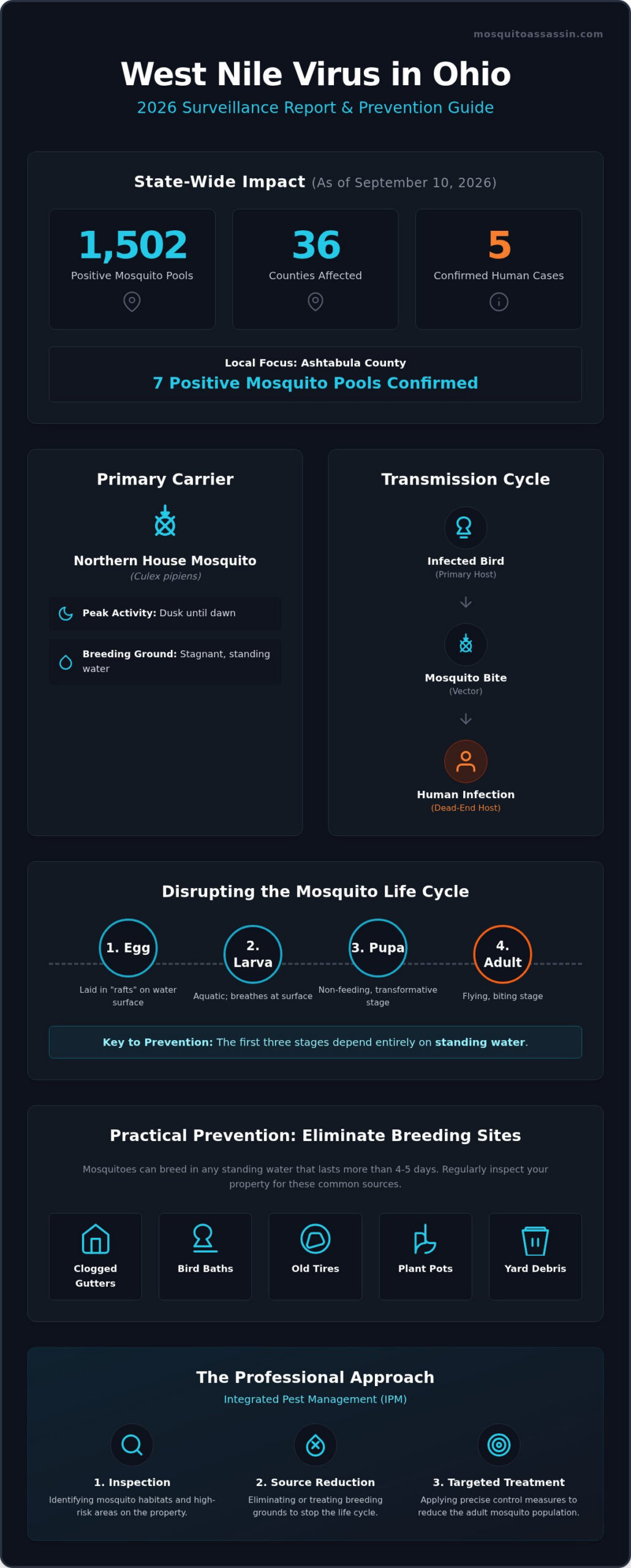
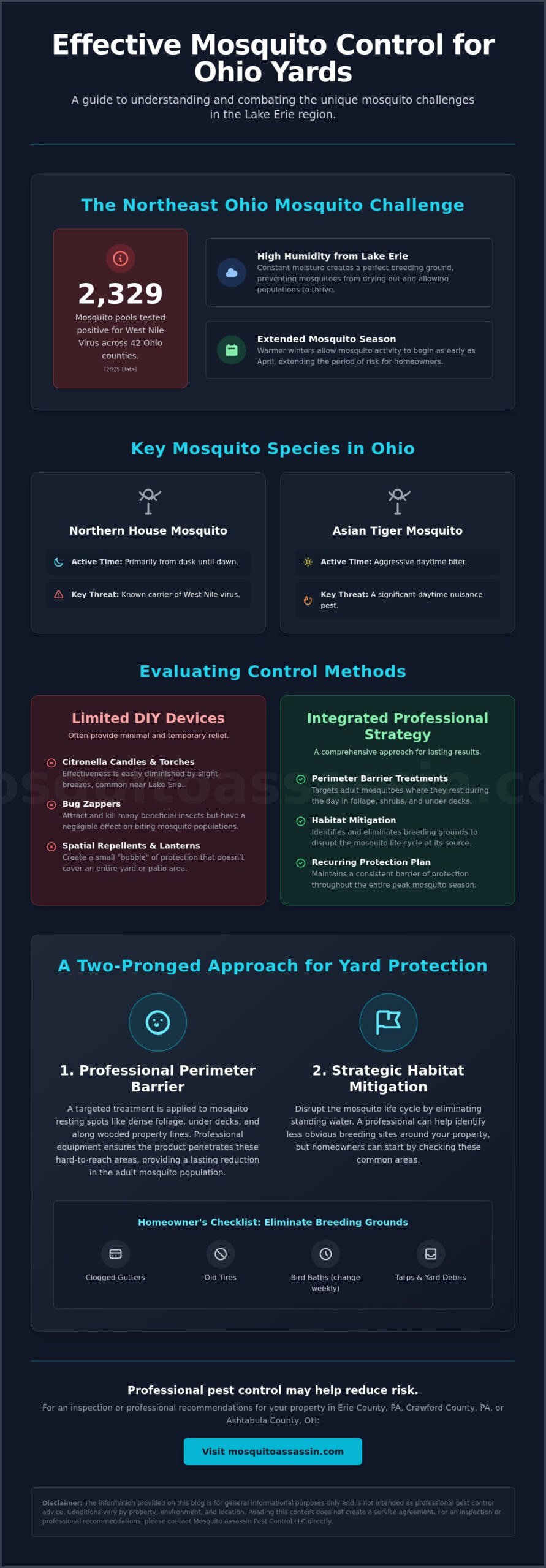
    With 2,329 mosquito pools testing positive for West Nile virus across 42 Ohio counties in 2025, finding the best mosquito control for yards in Ohio is a priority for families in Ashtabula County and the surrounding region. You’ve likely spent many humid summer evenings swatting away pests while your citronella candles and bug zappers fail to make a real dent. It’s frustrating to invest in products that don’t deliver, especially when the high humidity from Lake Erie creates a perfect environment for mosquito populations to thrive. You deserve to enjoy your outdoor space without constant worry about itchy bites or regional health concerns.

    This article explores effective mosquito control methods tailored for the unique climate and environment of Northeast Ohio. You’ll gain a deeper understanding of how professional perimeter barriers and strategic habitat mitigation work together to address pest activity. By focusing on fact-based prevention strategies and the science of mosquito behavior, you can better protect your property. This guide breaks down the most reliable approaches for the 2026 season, helping you move from a state of concern to a state of resolution.

    Disclaimer: The information provided on this blog is for general informational purposes only and is not intended as professional pest control advice. Conditions vary by property, environment, and location. Reading this content does not create a service agreement. For an inspection or professional recommendations, please contact Mosquito Assassin Pest Control LLC directly.

    Key Takeaways

    • Understand how the high humidity of the Lake Erie region and the local climate accelerate mosquito activity in Northeast Ohio.
    • Discover why the best mosquito control for yards in ohio requires a combination of perimeter barrier treatments and active habitat mitigation rather than simple localized gadgets.
    • Learn about the technical advantages of professional-grade equipment for penetrating dense foliage where mosquitoes rest during peak daylight hours.
    • Identify common but overlooked breeding sites around the property, such as clogged gutters and hidden water reservoirs, to naturally reduce pest populations.
    • Explore the benefits of establishing a recurring protection plan to maintain consistent results throughout the peak Ohio mosquito season.

    Why Ohio Yards Face Unique Mosquito Challenges

    Northeast Ohio presents a specific set of challenges for property owners trying to maintain a comfortable outdoor space. The proximity to Lake Erie keeps humidity levels consistently high. This moisture is the primary fuel for mosquito reproduction. In Ashtabula County, the damp air creates a dense atmosphere where pests thrive without the risk of drying out. Finding the best mosquito control for yards in ohio requires understanding that our local environment acts as a massive incubator during the summer months.

    Seasonal rainfall in the spring often leads to standing water in low-lying areas and wooded sections of the yard. This water serves as the starting point for breeding cycles that can explode in population within days. In 2026, mosquito activity was noted as early as April due to a warmer winter. This shift moved the traditional timeline for property protection much earlier than in previous years. To better understand how these pests interact with your environment, watch this helpful video:

    Environmental Factors in Northeast Ohio

    Wooded boundaries and tall ornamental grasses provide the perfect harborages for adult mosquitoes to rest during the heat of the day. Even if your lawn is mowed short, these shaded areas offer the protection they need to survive. Effective mosquito control methods must account for these micro-climates within your landscape. Transitions between seasons are particularly volatile. Rapid temperature spikes combined with Lake Erie’s influence can trigger massive hatches that overwhelm standard yard maintenance.

    Common Local Mosquito Species

    There are approximately 59 different species of mosquitoes in Ohio, but only a few cause the majority of the trouble for homeowners. The Northern House Mosquito is a frequent nuisance. It’s most active from dusk until dawn and is a known carrier of the West Nile virus. The Asian Tiger mosquito has also become more prevalent in residential areas across the region. This species is an aggressive daytime biter. It doesn’t wait for the sun to go down to begin its search for a meal. Identifying these behaviors is a critical step in determining the best mosquito control for yards in ohio and ensuring your protection plan covers both daytime and evening activity.

    Disclaimer: The information provided on this blog is for general informational purposes only and is not intended as professional pest control advice. Conditions vary by property, environment, and location. Reading this content does not create a service agreement. For an inspection or professional recommendations, please contact Mosquito Assassin Pest Control LLC directly.

    Evaluating Mosquito Control Methods: Devices vs. Treatments

    Homeowners often begin their search for the best mosquito control for yards in ohio by browsing the shelves of local hardware stores for quick fixes. They find an array of portable lanterns, citronella candles, and ultrasonic devices. While these items promise immediate relief for a backyard barbecue, their effectiveness is often restricted by the specific environmental conditions of a Northeast Ohio landscape. Choosing between a localized gadget and a comprehensive treatment requires an understanding of how these different methods interact with the local climate.

    Localized Gear and Spatial Repellents

    Portable gear typically relies on creating a localized bubble of protection using heat-activated repellents. These devices can offer temporary relief for a small patio or a compact deck, but they struggle in open environments. Even a slight breeze from Lake Erie can easily disperse the repellent cloud, leaving the area unprotected within seconds. Citronella candles face similar challenges; they often fail in large yards because the active ingredients don’t reach far enough to deter pests from entering the space. The cost of disposable refills and batteries also accumulates quickly, often making them less cost-effective than a professional plan over a full season.

    Professional Perimeter Barrier Treatments

    Professional treatments utilize a more methodical approach to yard protection. Unlike localized gadgets that only address a few square feet, barrier sprays are engineered to bond directly to the underside of leaves and within dense foliage. This creates a lasting residual effect that targets mosquitoes where they rest during the day. Systematic surveillance and data collection, such as the efforts seen in the Cuyahoga County mosquito control program, demonstrate that treating these specific harborages is essential for significant population reduction.

    In Ohio, professional barrier spray treatments can reduce mosquito populations in the treated area by 85% to 90%. This level of coverage is far superior to the limited radius provided by a lantern or candle. To maintain this protection throughout the humid summer months, applications are typically required every 21 to 30 days. This frequency ensures that the barrier remains strong even after periods of seasonal rainfall. Reviewing the structure of a mosquito control program helps property owners understand why a property-wide strategy is more reliable for long-term enjoyment. For those looking to secure their yard against infestations, professional mosquito control service may help reduce risk.

    Disclaimer: The information provided on this blog is for general informational purposes only and is not intended as professional pest control advice. Conditions vary by property, environment, and location. Reading this content does not create a service agreement. For an inspection or professional recommendations, please contact Mosquito Assassin Pest Control LLC directly.

    Best Mosquito Control for Yards in Ohio: 2026 Homeowner Guide

    The Role of Professional Mosquito Control in Ohio

    Achieving a significant reduction in pest activity requires more than just a surface level application. Professional mosquito control services utilize high pressure misting equipment that creates a fine fog, allowing treatments to penetrate deep into the dense foliage of Ashtabula County properties. This technology is a critical component of the best mosquito control for yards in ohio because it ensures the product reaches the underside of leaves where mosquitoes rest during the day. Standard pump sprayers often lack the force to push through the outer canopy, leaving the interior of shrubs and wooded borders as safe havens for pests.

    Beyond equipment, the success of professional intervention lies in the residual effect of the products used. Professional grade treatments are designed to withstand local weather conditions, providing a protective barrier that remains active for weeks. This approach is part of a broader Integrated Pest Management (IPM) strategy. IPM focuses on long term prevention by combining professional applications with property owner efforts to manage standing water. According to the Ohio State University Extension, these combined efforts are the most effective way to manage mosquito populations in residential areas.

    Advanced Application Technology

    Uniform coverage is essential for large properties in Northeast Ohio. High pressure mist blowers ensure that every leaf in a target area is coated, which is something manual DIY methods rarely achieve. This level of precision is vital for creating a true perimeter. Licensed professionals are trained to identify specific harborages, such as the shaded areas under decks or the thick brush along property lines, ensuring no resting site is overlooked. This systematic approach results in a more thorough treatment that addresses the problem at its source.

    Safety and Environmental Standards

    In Ohio, any person applying pesticides for hire must have a Commercial Pesticide Applicator License issued by the Ohio Department of Agriculture. This involves rigorous training and a commitment to continuing education; five hours of recertification training is required every three years to maintain high professional standards. These regulations ensure that treatments are applied responsibly and in accordance with EPA guidelines. Professionals use targeted techniques to protect beneficial insects like bees by avoiding the flowering plants where pollinators forage. For those seeking comprehensive protection, professional pest control services may help reduce risk while maintaining the health of the local ecosystem.

    Disclaimer: The information provided on this blog is for general informational purposes only and is not intended as professional pest control advice. Conditions vary by property, environment, and location. Reading this content does not create a service agreement. For an inspection or professional recommendations, please contact Mosquito Assassin Pest Control LLC directly.

    Practical Yard Maintenance to Reduce Mosquito Breeding

    While professional treatments provide a robust perimeter, a property owner’s maintenance routine is the second pillar of an effective Integrated Pest Management strategy. The best mosquito control for yards in ohio combines expert barrier applications with the systematic removal of breeding grounds. In Northeast Ohio, the heavy clay soil often complicates drainage, leading to persistent puddles that remain long after a rainstorm has passed. Addressing these drainage issues is vital because mosquitoes can complete their life cycle in as little as a bottle cap’s worth of water.

    Gutters are one of the most frequently overlooked reservoirs for mosquito larvae. When leaves and debris clog the channels, they trap stagnant water high above the ground, creating an ideal nursery that is difficult to see from the lawn. Regular cleaning ensures that water moves away from the foundation and doesn’t provide a sanctuary for pests. For property owners looking to optimize their outdoor space, professional mosquito control service can complement these efforts by identifying specific problem areas during an inspection.

    Eliminating Standing Water Sources

    After a typical Ohio rainstorm, it’s essential to patrol the property for hidden water collectors. Common items that require attention include:

    • Tarps and Covers: Folds in grill covers or woodpile tarps can hold gallons of water.
    • Children’s Toys: Plastic wagons, buckets, and playsets often have small crevices where water pools.
    • Flower Pots: Saucers under planters should be emptied regularly to prevent stagnant buildup.
    • AC Condensation Lines: Ensure the area where your air conditioner drains is properly graded so water doesn’t collect near the unit.

    Birdbaths and small water features should be refreshed at least once a week. Natural solutions, such as keeping water moving with a small pump or fountain, can also prevent mosquitoes from laying eggs in these features.

    Landscaping for Pest Reduction

    The way a yard is landscaped directly affects how many mosquitoes it can support. Keeping grass mowed to a recommended height of three to four inches helps reduce the excess moisture that accumulates in taller blades. Airflow is another critical factor. Pruning dense shrubs and thinning out overgrown wooded borders allows sunlight to reach the ground and wind to move through the foliage. This dries out the environment and removes the stagnant, humid air that mosquitoes prefer. Additionally, removing leaf litter and organic debris from the property perimeter eliminates the damp harborages where pests hide during the hottest parts of the day.

    Disclaimer: The information provided on this blog is for general informational purposes only and is not intended as professional pest control advice. Conditions vary by property, environment, and location. Reading this content does not create a service agreement. For an inspection or professional recommendations, please contact Mosquito Assassin Pest Control LLC directly.

    Establishing a Long-Term Protection Plan

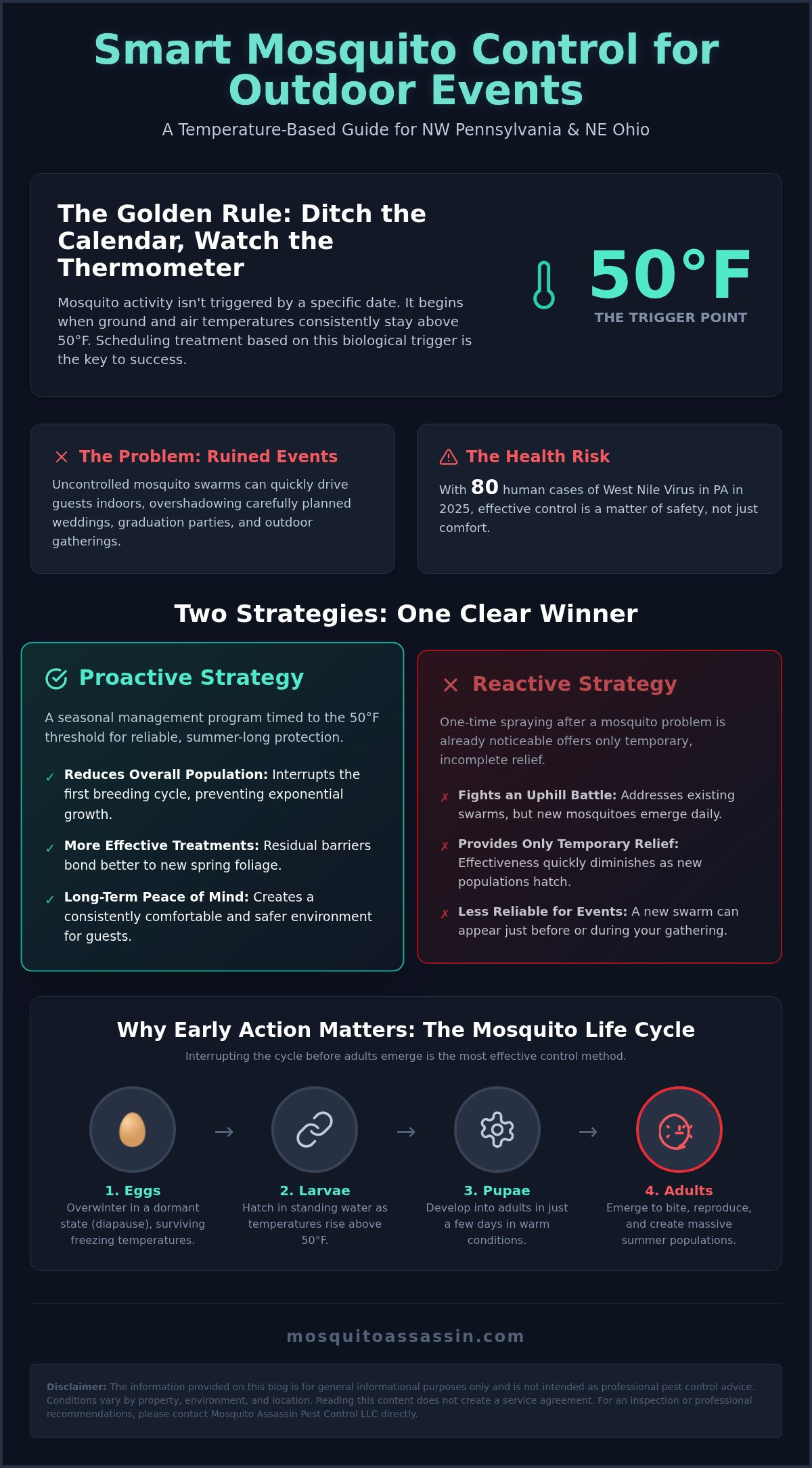
    Homeowners often wonder if a single treatment is enough for a graduation party or a summer wedding. While one-time applications provide a temporary reprieve, they don’t address the continuous hatching cycles of local species. Establishing a long-term plan is the most effective way to maintain the best mosquito control for yards in ohio throughout the entire season. This approach transitions the property from a state of constant infestation to a managed environment where outdoor activities are no longer dictated by pest activity. Proactive management is always more effective than reactive spraying after populations have already peaked.

    Consistency and Timing

    Because mosquito activity in 2026 began as early as April, timing has become more critical than ever. Starting treatments early in the spring prevents the first generation of mosquitoes from establishing a foothold on the property. Each subsequent application reinforces the previous one, creating a cumulative barrier that grows stronger as the humid months of July and August arrive. Scheduling recurring visits every 21 to 30 days ensures that the protection remains intact even during periods of heavy seasonal rainfall. This consistent schedule prevents gaps in coverage that would otherwise allow new larvae to mature and re-infest the yard.

    Selecting Local Support

    When evaluating providers in Northeast Ohio, property owners should prioritize those with deep roots in the community. Local experts understand the specific environmental pressures of Erie and Crawford Counties in Pennsylvania and Ashtabula County in Ohio. It’s essential to verify that any professional is licensed by the Ohio Department of Agriculture, ensuring they meet the state’s rigorous safety and technical standards. You can find local support in our Ashtabula and Erie service areas to ensure your property receives specialized attention. For those ready to begin their seasonal plan, professional recommendations can be found at mosquitoassassin.com.

    A comprehensive plan often addresses more than just mosquitoes. Many professional treatments also target ticks, which share similar harborages in wooded borders and tall grasses. Integrating mosquito management with general pest control plans creates a safer environment for pets and family members. By taking a proactive stance before the peak of the season, homeowners can reclaim their yards and reduce the anxieties associated with regional health concerns. Professional pest control may help reduce risk, allowing families to enjoy their outdoor spaces with confidence.

    Disclaimer: The information provided on this blog is for general informational purposes only and is not intended as professional pest control advice. Conditions vary by property, environment, and location. Reading this content does not create a service agreement. For an inspection or professional recommendations, please contact Mosquito Assassin Pest Control LLC directly.

    Securing Your Outdoor Space for the 2026 Season

    Managing mosquito populations in Northeast Ohio requires a disciplined strategy that balances professional perimeter treatments with consistent property maintenance. By identifying hidden water reservoirs and utilizing high-pressure application technology, you can significantly reduce pest density even in the high humidity of the Lake Erie region. The best mosquito control for yards in ohio isn’t a single event; it’s a seasonal commitment to a comprehensive Integrated Pest Management approach that prioritizes long-term results over temporary fixes. This systematic method addresses pests at their source while creating a durable barrier around your living space.

    Licensed professionals in both Ohio and Pennsylvania bring specialized knowledge of regional climate challenges to every inspection. This methodical approach ensures that your property is treated with technical precision while protecting the local ecosystem and beneficial insects. For an inspection or professional recommendations, please contact Mosquito Assassin Pest Control LLC directly. Taking these proactive steps today ensures a more comfortable and secure environment for your family throughout the warmest months of the year. You don’t have to let pests dictate how you enjoy your property.

    Disclaimer: The information provided on this blog is for general informational purposes only and is not intended as professional pest control advice. Conditions vary by property, environment, and location. Reading this content does not create a service agreement. For an inspection or professional recommendations, please contact Mosquito Assassin Pest Control LLC directly.

    Frequently Asked Questions

    What is the most effective mosquito control for a large yard in Ohio?

    Professional barrier treatments are the most effective solution for large properties in the region. High pressure misting technology allows the product to penetrate deep into wooded boundaries and thick vegetation where mosquitoes hide. This comprehensive approach is widely considered the best mosquito control for yards in ohio because it addresses the vast resting sites found on larger acreage. It provides a level of coverage that localized devices simply cannot match.

    When does mosquito season typically end in Northeast Ohio?

    Mosquito activity in Northeast Ohio typically subsides in late October. The season ends definitively when the region experiences its first sustained hard frost. However, pests can remain active as long as daytime temperatures consistently stay above 50 degrees Fahrenheit. Property owners should monitor local weather patterns rather than relying on a fixed date, as late season warmth can extend the breeding cycle into early November if temperatures remain mild.

    Are professional mosquito treatments safe for my pets and children?

    Professional treatments are designed for use in residential environments when applied according to strict label requirements. Licensed technicians target specific foliage and resting areas while avoiding high traffic zones like play sets or patio furniture. Once the application has completely dried, which usually takes about 30 to 60 minutes, the yard is ready for use. Professional pest control may help reduce risk while ensuring the wellbeing of all household members and animals.

    How often should a yard be treated for mosquitoes in Ashtabula County?

    A yard in Ashtabula County should be treated every 21 to 30 days to maintain an effective barrier. The high humidity levels near the lakefront can cause products to break down more quickly than in drier climates. Consistent reapplications ensure that the protective layer remains strong throughout the peak months of July and August. This frequency is essential for achieving the best mosquito control for yards in ohio during periods of heavy seasonal rainfall.

    Do mosquito misting systems or barrier sprays work better?

    Barrier sprays are typically more effective for residential yards because they target specific resting sites throughout the landscape. While misting systems are permanent fixtures, they are often restricted to a small radius and can be rendered ineffective by the wind. Barrier treatments are applied manually by technicians who can adjust their technique based on the unique layout of your landscaping. This allows for better coverage in dense foliage and along property perimeters.

    Can landscaping changes really help reduce mosquito populations?

    Strategic landscaping changes are a highly effective way to naturally lower pest density on your property. Improving the drainage of Ohio’s heavy clay soil prevents the formation of stagnant puddles that serve as breeding grounds. Thinning out overgrown shrubs and keeping the lawn mowed also increases airflow and sunlight. These changes dry out the environment, making your yard much less attractive to mosquitoes looking for a damp place to rest during the day.

    What should I look for in a local Ohio mosquito control company?

    Homeowners should prioritize companies with a Pesticide Business License and a Commercial Pesticide Applicator License from the Ohio Department of Agriculture. It is also beneficial to choose a provider that is deeply familiar with the unique climate of Northeast Ohio. A local company with technicians who live in the same community will have a better understanding of how Lake Erie humidity affects pest behavior on your specific property.

    Disclaimer: The information provided on this blog is for general informational purposes only and is not intended as professional pest control advice. Conditions vary by property, environment, and location. Reading this content does not create a service agreement. For an inspection or professional recommendations, please contact Mosquito Assassin Pest Control LLC directly.

  • Rodent Control in Conneaut, OH: Prevention and Management Guide

    Rodent Control in Conneaut, OH: Prevention and Management Guide

    Setting a few snap traps in the kitchen won’t stop a local infestation if the structural entry points remain wide open. Under the City of Conneaut Nuisance Ordinance, a property can be declared a public nuisance if it’s found to be vermin or rat infested, which makes effective rodent control conneaut oh a priority for any homeowner. It’s completely normal to feel a sense of dread when you discover chewed insulation or droppings near your food storage. You want your home to be a sanctuary, not a health hazard for your family.

    This article shows you how to secure your property through professional exclusion and sanitation strategies rather than relying on temporary fixes. You’ll learn how to identify the specific behaviors of local pests like the White-Footed Deer Mouse and why long-term management requires a proactive approach to structural maintenance. By understanding how these animals exploit tiny gaps in your foundation or siding, you can move toward a rodent-free environment and lasting peace of mind.

    Key Takeaways

    • Learn to identify early warning signs of rodent activity to prevent significant damage to your home’s insulation and wiring.
    • Understand the importance of structural exclusion and how sealing small entry points provides a long-term solution against recurring infestations.
    • Discover how Integrated Pest Management (IPM) strategies can reduce the environmental factors that attract rodents to your property.
    • Effective rodent control conneaut oh relies on a combination of professional expertise and property maintenance to ensure long-term success.
    • Gain a clearer understanding of the seasonal behaviors of local rodent species near Lake Erie and how they exploit structural weaknesses as temperatures drop.

    Understanding the Rodent Challenge in Conneaut, OH

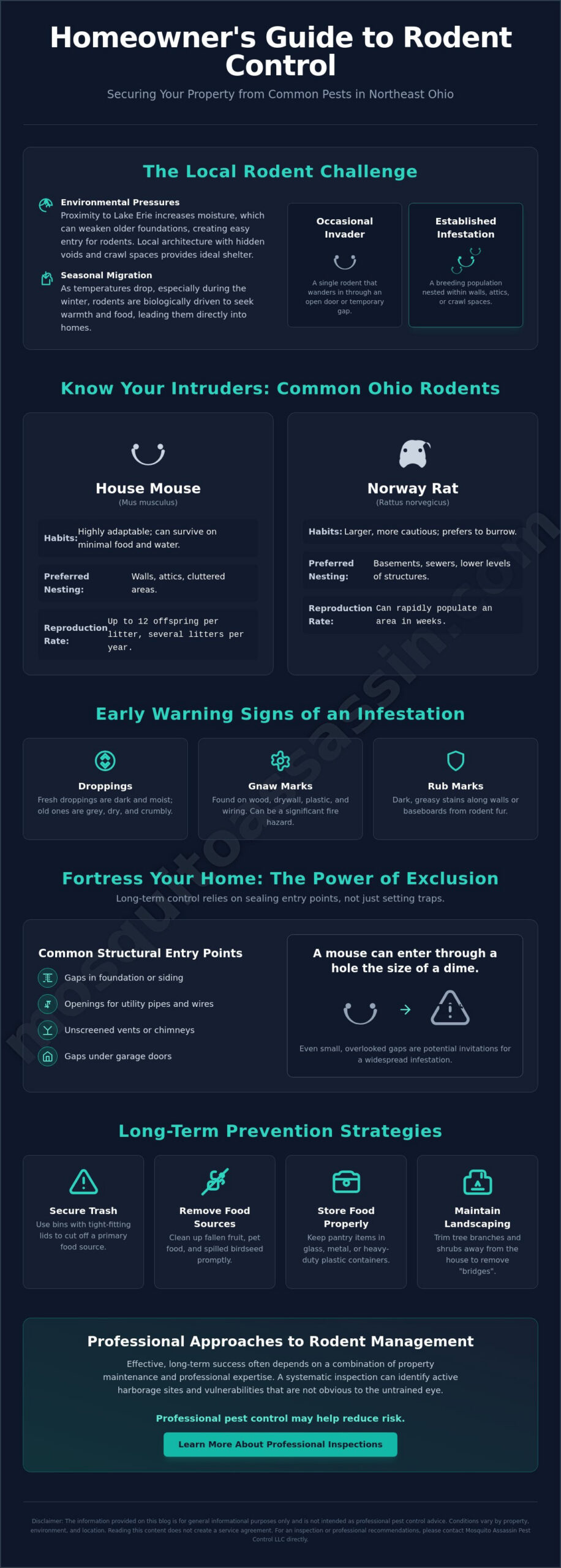
    Conneaut’s position along the Lake Erie shoreline creates a unique environment for rodents. While the lake provides scenic views, it also contributes to higher humidity levels and specific migratory patterns for small mammals. Property owners often struggle with rodent control conneaut oh because the city’s diverse architecture, ranging from historic lakefront cottages to modern suburban homes, offers a variety of hidden voids and crawl spaces. These structures provide perfect harborage for rodents seeking shelter from the elements.

    As the 2026 winter season approaches, the drop in temperature triggers a biological drive in rodents to find warmth. This indoor migration isn’t just a nuisance; it’s a survival tactic. Understanding the behavior of these pests is the first step in protecting your property. To better understand this concept, watch this helpful video:

    It’s vital to distinguish between an occasional invader, like a single mouse that wandered in through an open door, and an established infestation. An infestation involves a breeding population that has successfully nested within the walls or attic. Utilizing modern pest control methods focuses on identifying these harborage sites before the population explodes.

    Common Rodent Species in Ashtabula County

    The House Mouse (Mus musculus) is the most frequent visitor in Northeast Ohio. These small mammals are highly adaptable and can survive on minimal food and water. In contrast, the Norway Rat is larger and prefers the lower levels of a structure, such as basements or sewers. Effective rodent control conneaut oh requires knowing that both species share a terrifying reproductive capacity. A single female can produce several litters per year, with each litter potentially containing up to a dozen offspring. This rapid cycle means a small problem can become a major crisis in just a few weeks.

    Why Local Environmental Factors Impact Rodent Activity

    Conneaut’s proximity to Lake Erie means higher moisture levels, which can lead to wood rot in older foundations. These soft spots are easily exploited by rodents. Additionally, the local area provides abundant natural food sources, such as fallen fruit, birdseed, and unsecured trash, that draw animals toward residential zones. The 2026 winter season is projected to drive more pests indoors as natural food sources become scarce. For residents looking for more specific details on regional trends, you can learn more about the local service area to see how these factors affect your neighborhood.

    Disclaimer: The information provided on this blog is for general informational purposes only and is not intended as professional pest control advice. Conditions vary by property, environment, and location. Reading this content does not create a service agreement. For an inspection or professional recommendations, please contact Mosquito Assassin Pest Control LLC directly.

    Identifying the Signs of a Rodent Infestation

    Identifying a rodent problem early is the best way to prevent expensive structural damage to your property. Since these pests are primarily nocturnal, you’ll rarely see a mouse or rat during the day. You must rely on the evidence they leave behind to understand the scope of the issue. Professional rodent control conneaut oh involves a systematic search for active markers rather than just waiting for a visual sighting. If you wait until you see a rodent in your living room, the population has likely already grown significantly.

    Differentiating between old signs and a current infestation is vital for effective management. Fresh droppings are dark, soft, and moist, whereas older ones appear grey, dry, and crumbly. You should also check for rub marks, which are dark grease stains left by rodent fur as they travel along walls or baseboards. If you find these indicators, a professional pest control inspection might help determine the extent of the activity and pinpoint nesting sites.

    Conducting a basic perimeter check is a practical step for any homeowner in Ashtabula County. Walk slowly around the foundation and look for gaps where pipes or wires enter the siding. Mice only need a hole the size of a dime to enter a structure. Check for burrow holes in the soil near the foundation or gaps in the garage door weather stripping. These physical openings are the primary pathways for rodents to move from the Lake Erie environment into your living space. For residents in the area, scheduling a professional assessment is often the first step toward a secure home.

    Visual and Auditory Indicators

    Rodent droppings are the most common sign of an active problem. A single mouse can produce dozens of droppings daily, so the volume you find often reflects the population size. Look for gnaw marks on wood, plastic, or food packaging. Fresh gnawing shows light-colored material underneath, while older marks turn dark. You might also hear scratching or scurrying sounds in the ceiling or walls during the night. Utilizing principles from Integrated Pest Management for rats and mice can help you understand these behavioral patterns and identify high-activity zones.

    Potential Risks to Property and Safety

    Rodents pose a genuine threat to your property’s integrity. They frequently nest in attic insulation, compressing the material and contaminating it with waste, which significantly reduces your home’s energy efficiency. The most dangerous habit is their need to chew on hard surfaces, including electrical wiring. This behavior is a leading cause of house fires in the United States. Additionally, the White-Footed Deer Mouse, common in Northeast Ohio, is a known carrier of Hantavirus, making their presence a public health concern. Maintaining a general pest control plan helps manage these risks by identifying vulnerabilities before they become hazardous.

    Disclaimer: The information provided on this blog is for general informational purposes only and is not intended as professional pest control advice. Conditions vary by property, environment, and location. Reading this content does not create a service agreement. For an inspection or professional recommendations, please contact Mosquito Assassin Pest Control LLC directly.

    Rodent Control in Conneaut, OH: Prevention and Management Guide

    The Science of Rodent Exclusion and Entry Points

    Trapping is a reactive measure that handles the current intruder but does nothing to stop the next one from entering. Effective rodent control conneaut oh transitions from temporary trapping to permanent structural modification. This process is known as exclusion. It involves the scientific identification and sealing of every potential entry point to create a rodent-proof envelope around a property. Without exclusion, a home remains a revolving door for local wildlife, regardless of how many traps are set inside.

    Mice are biological contortionists. Their lack of a rigid collarbone allows them to squeeze through any opening that accommodates their head. Following official rodent identification and prevention tips ensures that property owners look beyond the kitchen pantry and focus on the exterior envelope. While a mouse needs only a quarter-inch gap, a rat requires about a half-inch of space. Maintaining structural integrity is the only way to ensure these small mammals stay in their natural habitat rather than your attic.

    Identifying Vulnerable Entry Points

    Many homes in Conneaut have specific vulnerabilities that rodents exploit. Utility pipes for gas, water, and electricity often have gaps where they pass through the foundation or siding. Vents for dryers and stoves are also common targets if they lack proper screening. In older Conneaut neighborhoods, settling foundations can create hairline cracks or gaps in the sill plate where the wood frame meets the concrete. These shifts are natural, but they provide a direct path for pests. Garage door seals are another frequent failure point; if you can see light under the door, a rodent can certainly get inside.

    The Role of Professional Exclusion

    Professional sealing requires materials that rodents cannot chew through. Standard expanding foam or wood filler is insufficient, as mice can easily gnaw through these soft substances. Professionals use a combination of heavy-duty steel mesh (hardware cloth), copper wool, and specialized pest-resistant sealants to block openings. This systematic approach focuses on closing any exterior opening larger than a quarter inch. This is why professional rodent removal relies on these structural fixes to ensure the problem doesn’t return the moment a technician leaves. By focusing on exclusion as part of a comprehensive rodent control conneaut oh strategy, you address the root cause of the infestation rather than just the symptoms.

    Disclaimer: The information provided on this blog is for general informational purposes only and is not intended as professional pest control advice. Conditions vary by property, environment, and location. Reading this content does not create a service agreement. For an inspection or professional recommendations, please contact Mosquito Assassin Pest Control LLC directly.

    Best Practices for Long-Term Rodent Prevention

    Effective rodent control conneaut oh isn’t just about sealing holes; it’s about removing the resources that draw pests to your property in the first place. This strategy is known as Integrated Pest Management (IPM). It’s a scientific approach that focuses on making your home inhospitable to rodents by addressing environmental factors. Instead of simply reacting to an intruder, IPM creates a proactive defense that reduces the need for intensive treatments. By understanding the relationship between your home and the surrounding landscape, you can stop infestations before they start.

    Consistency is the backbone of any prevention plan. A clean kitchen and a tidy yard only work if they are maintained year-round. Rodents are opportunistic and will exploit any lapse in your maintenance routine. While these steps are effective for prevention, established populations often require a professional approach to fully resolve. For a comprehensive strategy tailored to your property, a professional rodent control service can provide the necessary expertise to protect your home.

    Sanitation and Food Storage Strategies

    Food sources are the primary driver for rodent activity. Pet food left in open bags or bowls is an open invitation for a hungry mouse. Switching to airtight plastic or metal containers is a simple but critical step for every homeowner. Birdseed is another major attractant; ensure feeders are placed far from the house and that spilled seed is cleaned up daily. Trash management is equally important. Use heavy-duty bins with locking lids to prevent rats from foraging near your foundation. Inside, managing moisture in crawlspaces or basements is essential. Rodents require a reliable water source to survive. Damp basements or leaky pipes in a crawlspace provide the perfect habitat for a nesting colony. Fixing these leaks and using a dehumidifier reduces the overall attractiveness of the structure.

    Landscaping and Exterior Maintenance

    Exterior maintenance directly impacts interior pest pressure. Overhanging branches act as bridges, allowing rodents to bypass ground-level defenses and enter through roof vents or attic gaps. Trim all vegetation at least three to five feet away from the structure. Remove leaf litter and woodpiles from the immediate perimeter of the foundation. These provide perfect hiding spots for rodents to gather before attempting to enter your home. Proper drainage is also a major factor. Standing water or soft, saturated soil near the foundation makes it easier for Norway Rats to burrow. By keeping the perimeter dry and clear, you remove the cover these animals need to thrive. Maintaining a clear 18-inch gravel or mulch-free border around the foundation is a proven way to deter rodents from approaching the walls of your home.

    Disclaimer: The information provided on this blog is for general informational purposes only and is not intended as professional pest control advice. Conditions vary by property, environment, and location. Reading this content does not create a service agreement. For an inspection or professional recommendations, please contact Mosquito Assassin Pest Control LLC directly.

    Professional Approaches to Rodent Management

    When an infestation becomes established within the walls or crawlspaces of a home, standard store-bought solutions often fall short. Professional intervention is necessary because a licensed technician understands the biological drivers behind rodent behavior, such as neophobia (the fear of new objects) and their specific nesting requirements. Effective rodent control conneaut oh isn’t just about setting a trap; it’s about a scientific assessment of the entire property to disrupt the breeding cycle and remove the population safely. A professional plan provides a comprehensive strategy that addresses the immediate crisis while preparing the structure for long-term resistance.

    Relying on simple baiting alone can lead to secondary issues, such as rodents dying in inaccessible areas or surviving due to bait shyness. Professionals use their expertise to identify high-traffic runways and nesting hubs that the average homeowner might miss. This methodical approach ensures that the resolution is definitive rather than temporary. Transitioning to a professional management plan gives you peace of mind, knowing that your home’s safety is being handled by an expert who lives and works in the same Northeast Ohio climate.

    The Three-Step Process: Removal, Maintenance, and Exclusion

    The first step in any professional plan is the efficient removal of existing rodents. Technicians use professional-grade methods that are strategically placed based on tracking cues like rub marks and droppings. Once the active population is reduced, the process moves into ongoing maintenance. This is where many DIY attempts fail. Maintenance involves regular monitoring to ensure no new individuals have moved into the vacated territory. The final and most critical step is comprehensive exclusion. This involves sealing the structure with specialized materials to ensure that once the rodents are gone, they stay out. By following this three-step cycle, the root cause of the infestation is addressed alongside the symptoms.

    Year-Round Protection Strategies

    In the Conneaut area, rodent pressure doesn’t disappear when the snow melts. While winter drives pests indoors for warmth, the breeding seasons in spring and summer create a constant influx of new individuals looking for territory. Scheduled inspections are a major benefit of year-round protection, as they allow a technician to catch structural vulnerabilities before a mouse exploits them. Adapting the management plan to these changing seasonal pressures is the most effective way to maintain a secure environment. Professional pest control may help reduce risk for Conneaut residents by providing a consistent shield against local wildlife. You can explore service options to find a management strategy that fits your property’s specific needs.

    Disclaimer: The information provided on this blog is for general informational purposes only and is not intended as professional pest control advice. Conditions vary by property, environment, and location. Reading this content does not create a service agreement. For an inspection or professional recommendations, please contact Mosquito Assassin Pest Control LLC directly.

    Securing Your Conneaut Property Against Rodents

    Protecting your home from infestations requires a shift from reactive trapping to a focus on structural integrity and environmental management. By prioritizing exclusion and strict sanitation, property owners can disrupt the cycle of infestation that often plagues the Northeast Ohio shoreline. Effective rodent control conneaut oh is built on the foundation of identifying tiny entry points and removing the food sources that attract these pests in the first place.

    For established populations, a specialized 3-step rodent eradication process ensures that current intruders are removed while the structure is sealed against future invaders. Licensed in both Pennsylvania and Ohio, professional expertise is available across Ashtabula, Erie, and Crawford Counties to help residents maintain a healthy living space. Taking proactive steps today protects your property from the risks of structural damage and potential health hazards. If you are concerned about activity in your home, professional pest control may help reduce risk. Protecting your sanctuary is a manageable goal with the right strategy in place.

    Disclaimer: The information provided on this blog is for general informational purposes only and is not intended as professional pest control advice. Conditions vary by property, environment, and location. Reading this content does not create a service agreement. For an inspection or professional recommendations, please contact Mosquito Assassin Pest Control LLC directly.

    Frequently Asked Questions

    How do mice usually enter homes in Conneaut, OH?

    Mice typically enter homes through gaps as small as a dime, often found where utility pipes penetrate the foundation or near settling sills. In Conneaut, older structures frequently have small cracks in the concrete or gaps under garage doors that provide direct access to the interior. These pests are excellent climbers and can also find entry points through roof vents or gaps in the soffit.

    What are the most common signs of a rat infestation?

    Common signs include dark, spindle shaped droppings that are significantly larger than mouse droppings, along with oily rub marks along baseboards. Norway rats in Ashtabula County also leave distinct burrow holes in the soil near the foundation or under porches. You may also notice large gnaw marks on plastic trash bins or wooden structures, which indicate a more established population.

    Can rodents cause damage to my home’s electrical system?

    Rodents frequently damage electrical systems because their incisors never stop growing, which requires them to gnaw on hard materials like wire insulation. This behavior exposes copper wiring and creates a significant fire hazard within walls and attics. Over time, this chewing can lead to short circuits, power failures, or even catastrophic house fires if the damage occurs near flammable insulation.

    What is rodent exclusion and why is it important?

    Rodent exclusion is the process of structurally sealing a building using materials like steel mesh and specialized sealants to block all potential entry points. It’s the most important step in rodent control conneaut oh because it provides a permanent barrier that trapping alone cannot achieve. By focusing on the structure’s envelope, you stop the cycle of new rodents replacing those that have been removed.

    Are rodents more active during the winter months in Ohio?

    Rodents are more noticeable during the winter because they migrate indoors to escape the freezing temperatures and heavy snow near Lake Erie. While they remain active year-round, the pressure on residential structures increases significantly as natural food sources disappear and the ground freezes. This seasonal shift drives them to seek the consistent warmth and shelter provided by crawlspaces and attics.

    How long does a professional rodent management plan take to show results?

    A professional management plan typically shows initial results within a few days as the active population is reduced through strategic methods. However, achieving a completely rodent-free home requires several weeks to ensure all exclusion work is successful and no new individuals have found alternative entries. Consistency in monitoring is vital during this period to confirm that the breeding cycle has been fully disrupted.

    Why are DIY traps often insufficient for a mouse problem?

    DIY traps are often insufficient because they only address the rodents already inside without stopping new ones from entering the structure. Since a single female mouse can produce dozens of offspring in a year, the rate of reproduction often outpaces the effectiveness of scattered snap traps. Without professional grade exclusion and a systematic approach, trapping becomes a temporary fix rather than a long-term solution.

    What should I do if I find rodent droppings in my attic?

    If you find droppings in your attic, you should avoid sweeping or vacuuming them, as this can release potentially harmful airborne pathogens into your living space. The safest approach is to keep the area undisturbed and consult a professional to identify the species and determine if the activity is current. A professional inspection can also reveal if your insulation has been contaminated or compromised by nesting activity.

    Disclaimer: The information provided on this blog is for general informational purposes only and is not intended as professional pest control advice. Conditions vary by property, environment, and location. Reading this content does not create a service agreement. For an inspection or professional recommendations, please contact Mosquito Assassin Pest Control LLC directly.

  • Choosing a Professional Exterminator in Geneva, Ohio: A Homeowner’s Guide

    Choosing a Professional Exterminator in Geneva, Ohio: A Homeowner’s Guide

    The warming temperatures in Northeast Ohio mean that common household pests no longer wait for summer to arrive; they are active and looking for entry points earlier than ever before. It’s frustrating to spend weekends on DIY treatments only to see rodents or insects return just days later. Most homeowners want a living space that feels secure and protected from the structural damage termites or rodents can cause, yet recurring infestations often create persistent anxiety. When looking for a qualified exterminator geneva ohio residents often realize that local expertise and decisive intervention are the most critical factors in achieving total removal.

    This guide explains how to identify local threats, implement seasonal prevention strategies, and manage infestations through professional expertise. You’ll learn about the specific pest cycles of the region and how to select a service provider that prioritizes the long-term security of your property. By moving from reactive treatments to a proactive, methodical strategy, it’s possible to maintain a comfortable, pest-free environment throughout the year.

    Disclaimer: The information provided on this blog is for general informational purposes only and is not intended as professional pest control advice. Conditions vary by property, environment, and location. Reading this content does not create a service agreement. For an inspection or professional recommendations, please contact Mosquito Assassin Pest Control LLC directly.

    Key Takeaways

    • Recognize the unique environmental factors in Ashtabula County and near Lake Erie that contribute to recurring pest activity.
    • Understand the biological reasons behind pest behavior to better recognize the early signs of an infestation.
    • Evaluate the efficacy of proactive protection plans versus reactive treatments when selecting a professional exterminator geneva ohio.
    • Identify the essential criteria for selecting a local expert who understands the seasonal pest cycles unique to Northeast Ohio.
    • Learn how professional exclusion techniques and methodical defense strategies provide a higher level of security for your property.

    Common Pest Challenges in Geneva, Ohio and Ashtabula County

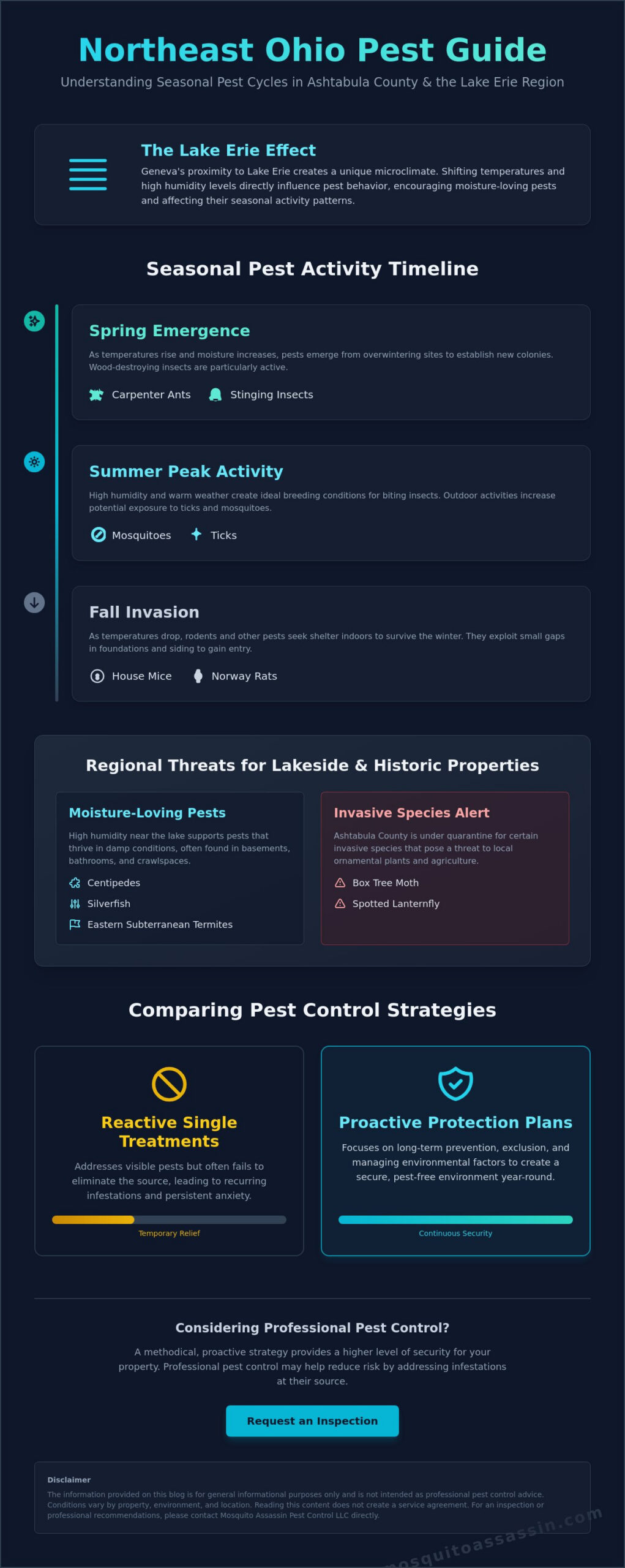
    Geneva’s unique position on the shores of Lake Erie creates a specific set of environmental pressures for homeowners. The lake influences local humidity levels and temperature shifts, which directly impact the behavior of insects and rodents. When residents search for a dependable exterminator geneva ohio, they’re often responding to pests that thrive in this moist, temperate microclimate. Identifying these invaders early is the most effective way to prevent structural damage or health risks before they escalate into full-scale infestations.

    Property owners in Ashtabula County face a diverse range of threats, from wood-destroying organisms to invasive species like the spotted lanternfly. Understanding the biological drivers behind these pests helps in maintaining a secure home environment. To see what a professional approach looks like in the field, watch this helpful video:

    Recognizing the early signs of activity is vital. Small piles of sawdust, localized grease marks along baseboards, or unusual sounds in the walls are clear indicators that a professional inspection is necessary. Using a strategy rooted in Integrated Pest Management (IPM) ensures that the response is both methodical and effective. This approach focuses on long-term prevention and the reduction of pest-friendly conditions around your property.

    Seasonal Pest Cycles in Northeast Ohio

    Northeast Ohio experiences sharp seasonal transitions that trigger predictable pest movements. Spring brings the emergence of ants and stinging insects. Carpenter ants are particularly active during this time, seeking out moisture-compromised wood to establish colonies. As summer progresses, mosquito and tick activity peaks in residential yards, driven by the humid air off Lake Erie. Once temperatures drop in the fall, rodents like the common house mouse or Norway rat begin their migration into heated structures. They seek the security of your attic or crawlspace to survive the harsh winter. For those needing comprehensive protection, exploring general pest control plans can help manage these recurring cycles.

    Pests Common to Lakeside and Historic Properties

    The geography of Geneva presents specific challenges for older and lakeside homes. High humidity near the water encourages moisture-loving pests such as silverfish, centipedes, and the Eastern Subterranean Termite. These termites are the most prevalent species in Ohio and can cause significant structural damage if left unchecked. Historic homes often have established structural vulnerabilities, including small foundation gaps or aging wood, that invite wood-destroying organisms. Additionally, Ashtabula County is currently under quarantine for the Box Tree Moth, an invasive species that targets ornamental shrubs. A local exterminator geneva ohio understands these specific regional threats and the regulatory requirements involved in managing them effectively. Consistent monitoring is the best defense against these persistent lakeside pressures.

    Disclaimer: The information provided on this blog is for general informational purposes only and is not intended as professional pest control advice. Conditions vary by property, environment, and location. Reading this content does not create a service agreement. For an inspection or professional recommendations, please contact Mosquito Assassin Pest Control LLC directly.

    Understanding Pest Behavior and Environmental Factors

    Pests don’t enter a home by accident. Their movements are dictated by biological imperatives: the search for food, water, and stable temperatures. In Northeast Ohio, these drivers are amplified by the local climate. A professional exterminator geneva ohio analyzes these biological factors to predict where pests will strike next. This scientific approach moves beyond simple surface treatments and addresses the root cause of an infestation. By understanding the lifecycle and habits of local species, a methodical defense can be established before problems become unmanageable.

    Property maintenance plays a decisive role in whether a home becomes a target. Pests are opportunistic; they thrive where resources are abundant and shelter is accessible. Debris piles, unmanaged mulch, and overgrown shrubbery create ideal harborage areas right next to the foundation. When these external conditions are ignored, the pressure on a home’s exterior increases. Professional knowledge of pest biology allows a technician to see the property through the eyes of the invader. They don’t just look for where the pests are; they look for why they are there. This methodical approach is what separates a temporary fix from a definitive resolution.

    The Role of Lake Erie Proximity in Pest Activity

    Living near Lake Erie means dealing with a unique lake-effect microclimate. This environment provides high humidity and consistent moisture, which are ideal for the breeding cycles of many insects. Wind patterns off the lake can also aid in the dispersal of winged pests, pushing them further inland toward residential neighborhoods. According to the Ohio State University Extension, localized weather events often trigger sudden spikes in pest activity across the state. This regional ecosystem supports a higher density of moisture-loving organisms, making lakeside properties more susceptible to recurring issues.

    How Structural Vulnerabilities Lead to Infestations

    The architecture common to Geneva often includes features that can invite unwanted guests. Stone foundations, older wood siding, and vented crawlspaces frequently present gaps that rodents and insects exploit. Professional pest management starts with structural awareness. Identifying “conducive conditions” is a critical first step for any homeowner. These conditions include:

    • Standing water in gutters or near the foundation.
    • Wood-to-ground contact that provides a bridge for termites.
    • Unsealed utility penetrations or cracks in masonry.

    Addressing these vulnerabilities is why proactive general pest control is more effective than reactive measures. By eliminating the pathways into the structure, you reduce the overall pressure on the home’s interior. A qualified exterminator geneva ohio can provide a detailed assessment of these vulnerabilities, ensuring that your defense strategy is tailored to the specific needs of your property. For residents looking to secure their environment, a local property evaluation is a reliable starting point.

    Disclaimer: The information provided on this blog is for general informational purposes only and is not intended as professional pest control advice. Conditions vary by property, environment, and location. Reading this content does not create a service agreement. For an inspection or professional recommendations, please contact Mosquito Assassin Pest Control LLC directly.

    Choosing a Professional Exterminator in Geneva, Ohio: A Homeowner’s Guide

    Comparing Single Treatments to Year-Round Protection Plans

    Homeowners often face a choice between calling an exterminator geneva ohio for a single problem or investing in a year-round protection plan. While a one-time service might address an immediate crisis, it rarely provides a definitive resolution to the underlying environmental factors. Pest management is not a singular event; it’s a continuous process of monitoring and intervention. A single application of product begins to degrade the moment it’s applied. Factors like UV exposure, heavy rainfall near the lake, and temperature fluctuations cause residual barriers to break down over several weeks. Without a scheduled re-application, the property becomes vulnerable to new waves of activity.

    Decisive pest control requires a strategy that outlasts the lifecycle of the target species. Many common invaders, such as ants or cockroaches, have complex colonial structures that a single treatment cannot reach. If the queen or the main nest remains protected deep within a wall void, the population will simply rebound. Ongoing management addresses these root causes by maintaining a consistent level of protection that prevents the establishment of new colonies. This systematic approach ensures that your home remains a secure environment regardless of the season.

    The Limitations of Reactive Extermination

    Reactive treatments focus on the symptoms rather than the source. A one-time spray might eliminate the visible insects in a kitchen, but it often fails to reach the primary colony hidden deep within the structure. This leads to a cycle of re-infestation where pests return once the initial product has worn off. Consumer-grade solutions often exacerbate this by only killing a small percentage of the population, causing the survivors to scatter and establish new satellite colonies. This makes future management more difficult and expensive for the property owner.

    Benefits of Proactive Integrated Pest Management

    A proactive strategy utilizes the principles of Integrated Pest Management to maintain a secure perimeter around the home. Regular inspections allow a professional to identify potential entry points or breeding sites before they are exploited. According to the EPA’s guide to selecting a pest control service, choosing a provider that emphasizes long-term prevention is a key step in protecting your property. For instance, professional rodent removal isn’t just about trapping; it requires sustained exclusion efforts and ongoing monitoring to ensure that new populations don’t find a way inside. Managing the root causes of infestations, such as moisture control and structural sealing, provides a level of security that a single treatment cannot match. For residents seeking long-term peace of mind, exploring general pest control plans offers a methodical and disciplined approach to home protection.

    Disclaimer: The information provided on this blog is for general informational purposes only and is not intended as professional pest control advice. Conditions vary by property, environment, and location. Reading this content does not create a service agreement. For an inspection or professional recommendations, please contact Mosquito Assassin Pest Control LLC directly.

    How to Evaluate a Professional Exterminator in Geneva

    Choosing a qualified partner to protect your home requires a methodical evaluation of their standards and local expertise. A reputable exterminator geneva ohio won’t just provide a quote over the phone; they’ll insist on a detailed property assessment. This inspection should be thorough, covering potential entry points in the foundation, moisture levels in crawlspaces, and signs of structural vulnerabilities in the attic. A professional approach prioritizes Integrated Pest Management (IPM), which focuses on the biological and environmental factors driving the infestation rather than just applying a temporary chemical fix.

    During the evaluation, look for a provider that explains the science behind their recommendations. A disciplined technician will identify conducive conditions, such as wood-to-ground contact or poor drainage, and suggest corrective actions. While traditional extermination focuses on the immediate elimination of visible pests, IPM is a multi-step process that combines physical, cultural, and chemical controls to achieve total removal. This approach is especially important for managing invasive species like the spotted lanternfly or the box tree moth, which are currently under quarantine in Ashtabula County. Finding a trustworthy service provider is the first step toward a pest-free home environment.

    Verifying Licensing and Insurance in Ohio

    In Ohio, the Ohio Department of Agriculture (ODA) oversees the regulation and licensing of commercial pesticide applicators. Every technician visiting your home should hold a valid license issued by the ODA, which requires passing a rigorous examination. These commercial applicators must renew their licenses annually, either by retaking the exam or completing five hours of continuing education. Verification of insurance is equally critical. It protects both the homeowner and the property in the event of accidental damage. Always ask to see proof of these credentials before any work begins on your property.

    Assessing Local Expertise and Community Reputation

    Local knowledge is an invaluable asset when managing pests in Northeast Ohio. A provider deeply rooted in Ashtabula County understands how the Lake Erie climate influences breeding cycles and dispersal patterns. When evaluating reviews and testimonials from neighbors, look for mentions of reliability and professional standards. Choosing a company with a strong regional identity ensures they are familiar with the specific pressures facing Geneva homes. Because professional pest control may help reduce risk when chosen carefully, it’s essential to select a team that views themselves as your neighbor. For a comprehensive review of your property’s needs, scheduling a local inspection is a practical next step.

    Disclaimer: The information provided on this blog is for general informational purposes only and is not intended as professional pest control advice. Conditions vary by property, environment, and location. Reading this content does not create a service agreement. For an inspection or professional recommendations, please contact Mosquito Assassin Pest Control LLC directly.

    Implementing a Comprehensive Pest Defense Strategy

    A definitive resolution to pest infestations requires a multi-step, disciplined strategy. It isn’t enough to simply eliminate the pests currently inside; the environment must be modified to prevent new populations from establishing themselves. Professional pest management involves a systematic cycle of inspection, intervention, and ongoing monitoring. By focusing on the structural and environmental factors that support pest survival, a homeowner can achieve a secure and protected living space. Relying on a local exterminator geneva ohio ensures that these exclusion methods are applied with an understanding of the specific materials and architectural styles found in Ashtabula County.

    Sanitation and habitat modification are critical components of this process. Removing accessible food sources and eliminating standing water reduces the overall attraction of the property. Habitat modification might include thinning out heavy vegetation or moving woodpiles away from the foundation. When these practical steps are combined with professional expertise, the result is a long-term defense that addresses the root causes of pest pressure. Following professional recommendations regarding yard maintenance and interior cleanliness is vital for long-term success.

    Exclusion Techniques for Long-Term Prevention

    Exclusion serves as the primary line of defense against both insects and rodents. A qualified exterminator geneva ohio identifies and seals the small gaps that pests exploit to gain entry. This process often includes several specific actions:

    • Applying high-quality caulking to cracks in the siding, masonry, or foundation.
    • Installing heavy-duty screening over attic vents, crawlspace openings, and chimneys.
    • Attaching durable door sweeps to eliminate gaps at entry points.

    These physical barriers are essential for preventing rodent entry, as mice can squeeze through openings as small as a dime. Structural repairs, such as fixing leaky pipes or replacing rotted wood, complement professional treatments by removing the moisture that attracts termites and carpenter ants. A home that is physically sealed is significantly less likely to face recurring infestations.

    Professional Monitoring and Maintenance Protocols

    Monitoring is a continuous process that ensures the defense strategy remains effective over time. Professional monitoring stations are strategically placed around the property to identify shifts in pest pressure before an infestation becomes severe. These tools provide data that a technician uses to adjust the management plan as seasons change. Regular follow-ups are especially necessary for high-risk pests like bed bugs or termites, where total removal requires a methodical, multi-phase approach. Consulting a location specialist for site-specific advice allows for a tailored plan that accounts for the unique challenges of your property. Professional pest control may help reduce risk by maintaining these disciplined protocols year-round.

    Disclaimer: The information provided on this blog is for general informational purposes only and is not intended as professional pest control advice. Conditions vary by property, environment, and location. Reading this content does not create a service agreement. For an inspection or professional recommendations, please contact Mosquito Assassin Pest Control LLC directly.

    Securing Your Geneva Home for the Long Term

    Effectively managing local pest pressures requires a transition from reactive treatments to a disciplined, proactive strategy. Understanding how the Lake Erie climate and specific structural vulnerabilities influence pest behavior is the foundation of a secure property. By implementing methodical exclusion techniques and consistent monitoring, it’s possible to address the root causes of infestations before they escalate. A home that is physically sealed and professionally monitored remains far more resilient against the changing seasonal threats of Northeast Ohio.

    When you need a reliable exterminator geneva ohio offers several options, but the most effective choice is a licensed and insured professional service with specialized knowledge of Ashtabula County pest cycles. These experts provide customized protection plans for residential properties that prioritize long-term security over temporary fixes. Taking these steps ensures your home remains a safe and comfortable sanctuary for your family throughout every season. To begin your property assessment, professional pest control may help reduce risk.

    Disclaimer: The information provided on this blog is for general informational purposes only and is not intended as professional pest control advice. Conditions vary by property, environment, and location. Reading this content does not create a service agreement. For an inspection or professional recommendations, please contact Mosquito Assassin Pest Control LLC directly.

    Frequently Asked Questions

    What are the most common pests found in Geneva, Ohio homes?

    The most frequent invaders in Geneva include the Eastern Subterranean Termite, German cockroaches, and various stinging insects. Proximity to Lake Erie significantly increases the prevalence of mosquitoes and ticks during the summer months. Additionally, invasive species such as the spotted lanternfly and box tree moth are currently under quarantine in Ashtabula County. Identifying these pests early is essential for preventing significant property damage.

    Is professional pest control safe for children and pets?

    Professional pest control is designed to be safe for household members when applied by licensed technicians according to federal label requirements. Professionals prioritize the security of children and pets by using targeted application methods that minimize exposure. Following the specific re-entry instructions provided after a treatment is a critical part of maintaining a safe home environment. This methodical approach ensures effective results without compromising safety.

    How often should a home in Ashtabula County be inspected for pests?

    Homes in Ashtabula County should receive a professional inspection at least once per year. However, many property owners choose quarterly visits to manage the sharp seasonal transitions common in Northeast Ohio. These regular assessments allow for the early detection of wood-destroying organisms and seasonal invaders like rodents. Consistent monitoring is the most effective way to identify potential vulnerabilities before they lead to a full-scale infestation.

    What is the difference between an exterminator and a pest control professional?

    Traditional exterminators typically focus on the immediate, reactive elimination of visible pests. A modern exterminator geneva ohio employs Integrated Pest Management (IPM), which is a more scientific and thorough approach. IPM focuses on long-term prevention by addressing the biological and environmental factors that attract pests. This strategy includes structural repairs, sanitation improvements, and targeted treatments to ensure a definitive resolution to the problem.

    Can I handle a rodent infestation on my own using DIY methods?

    While DIY traps and baits are available, they rarely provide a definitive resolution for a rodent infestation. Rodents are highly adaptable and often bypass consumer-grade products once they’ve established a nest. Professional management is necessary to identify all entry points and implement effective exclusion techniques. A methodical approach ensures that the entire population is removed and that new individuals cannot gain entry in the future.

    What should I do to prepare my home for a professional pest service?

    Preparation typically involves clearing clutter from the areas where pest activity has been observed. Homeowners should move furniture and appliances away from the walls to allow technicians clear access to baseboards and corners. It’s also helpful to clean floors and ensure that food items are sealed in airtight containers. Providing a clear path to utility penetrations and crawlspaces helps ensure a more thorough and effective inspection.

    How long does a typical professional pest treatment take to work?

    The timeline for results depends on the specific pest and the treatment method used. While some contact treatments provide immediate reduction, baiting systems for ants or cockroaches may take several days to eliminate the entire colony. Rodent exclusion often requires a week or more to ensure all individuals have been removed from the structure. A professional will provide a specific timeline based on the complexity of your property’s infestation.

    What are the signs that I need a professional exterminator in Geneva?

    Key indicators include seeing droppings, hearing scratching sounds in the walls, or finding gnaw marks on food packaging. You might also notice grease marks along baseboards or find discarded wings from swarming termites. If you encounter these signs, consulting an exterminator geneva ohio is the most reliable way to assess the situation. Persistent activity despite your own efforts is a decisive signal that professional intervention is necessary for your property.

    Disclaimer: The information provided on this blog is for general informational purposes only and is not intended as professional pest control advice. Conditions vary by property, environment, and location. Reading this content does not create a service agreement. For an inspection or professional recommendations, please contact Mosquito Assassin Pest Control LLC directly.

  • How to Find and Evaluate an Exterminator Near Me in 2026

    How to Find and Evaluate an Exterminator Near Me in 2026

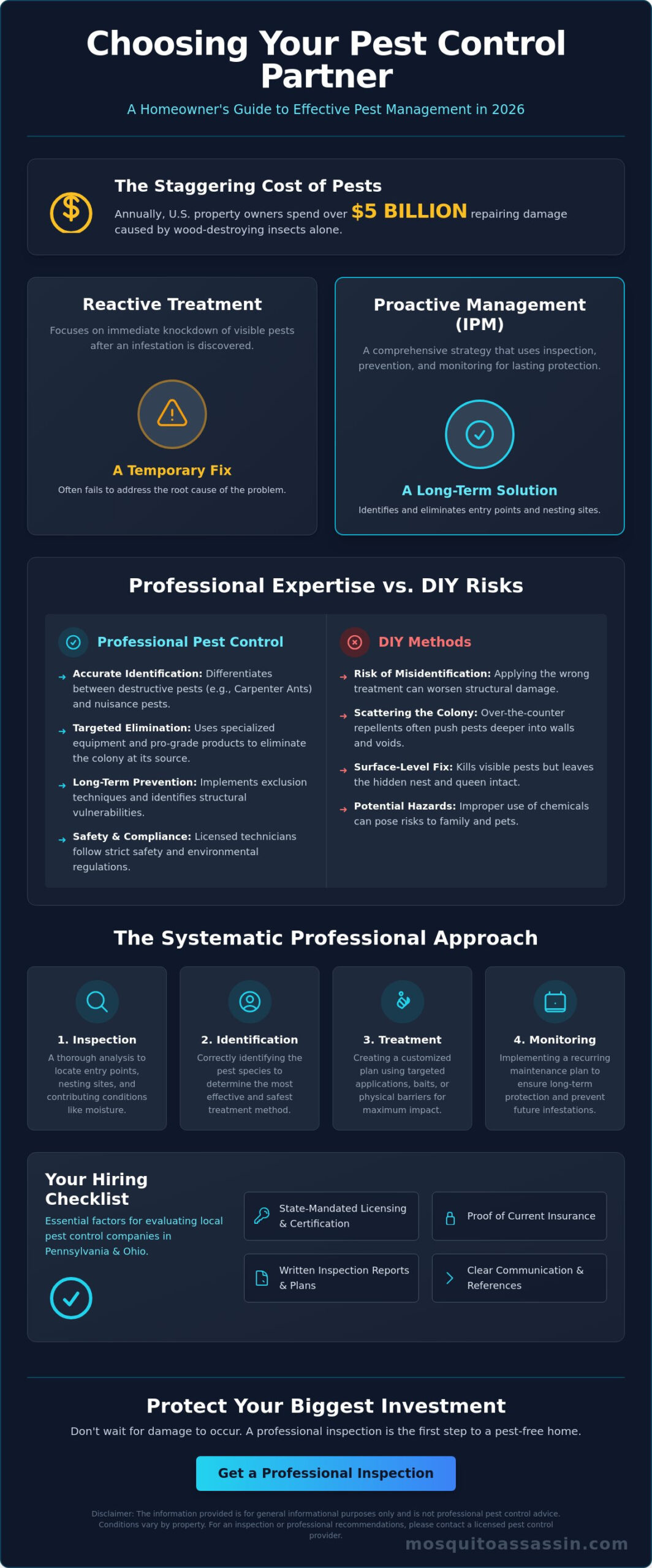
    According to the National Pest Management Association, property owners in the United States spend more than $5 billion annually repairing damage caused by wood-destroying insects. When you discover a sudden infestation in your basement or a swarm of mosquitoes in your yard, the immediate urge to search for an exterminator near me is often driven by a mix of health concerns and the fear of structural damage. It’s natural to feel overwhelmed by technical jargon or the sheer number of local listings appearing on your screen, especially when your family’s comfort is at stake.

    This guide provides a clear framework for understanding professional pest management in 2026, helping you distinguish between a temporary fix and a long-term solution. You’ll learn how to evaluate the qualifications of local providers and weigh the actual value of professional intervention against the risks of property loss. The following sections explore the specific pest challenges facing residents in Erie and Crawford Counties in Pennsylvania, along with Ashtabula County in Ohio, before outlining the steps to secure a thorough professional inspection.

    Disclaimer: The information provided on this blog is for general informational purposes only and is not intended as professional pest control advice. Conditions vary by property, environment, and location. Reading this content does not create a service agreement. For an inspection or professional recommendations, please contact Mosquito Assassin Pest Control LLC directly.

    Key Takeaways

    • Understand the difference between immediate emergency eradication and long-term integrated pest management to ensure lasting property protection.
    • Learn how to verify state-mandated licensing and insurance when searching for a reliable exterminator near me in the Great Lakes region.
    • Identify how local seasonal cycles in Pennsylvania and Ohio influence rodent and insect activity throughout the year.
    • Discover the importance of a systematic inspection process that identifies specific entry points and nesting sites to create a customized management plan.
    • Evaluate the advantages of proactive, recurring maintenance plans compared to reactive treatments for year-round pest prevention.

    What to Expect from Professional Pest Control Services

    Professional pest management is a systematic process that prioritizes identification and long term prevention over simple chemical application. It involves a detailed analysis of the property to locate entry points and nesting sites. Homeowners looking for a reliable exterminator near me often find that professional services provide a much higher level of precision than retail solutions. While emergency extermination focuses on immediate knockdown of a visible problem, a comprehensive Pest Control Overview reveals that modern industry standards favor Integrated Pest Management (IPM). This approach combines biological knowledge with physical barriers to create a sustainable, pest-free environment.

    To better understand what to look for in a service provider, watch this helpful video:

    Professional equipment and specialized training allow technicians to handle complex infestations involving ants, spiders, and stinging insects. These pests often hide in inaccessible areas like wall voids or crawlspaces. Licensed experts use high-grade tools that are more effective and targeted than standard consumer products. This ensures that the treatment reaches the source of the colony rather than just the insects visible on the surface.

    The Role of a Licensed Pest Professional

    Technicians operating in Pennsylvania and Ohio must adhere to strict state-specific licensing requirements. These regulations ensure that every person applying treatments has a foundational understanding of pesticide safety and environmental impact. Ongoing training is a standard part of the profession. It focuses on the evolving biology and behavior of local pests. Professionals utilize specialized detection tools, such as moisture meters and acoustic sensors, to find activity in hidden structural areas. This scientific approach is what differentiates a professional exterminator near me from a temporary fix.

    Professional vs DIY Pest Management

    Over-the-counter sprays and traps have significant limitations. They often act as repellents that scatter a colony rather than eliminating it. Misidentifying a pest is another common risk for homeowners. For example, treating carpenter ants the same way as nuisance pavement ants can lead to ongoing structural damage. Professionals have the expertise to distinguish between species and apply the correct methodology. For those interested in learning more about maintaining a home, this general pest control guide provides additional context on long-term strategies. If a pest population becomes difficult to manage, professional pest control may help reduce risk. More information is available through the contact page or the online booking portal.

    Disclaimer: The information provided on this blog is for general informational purposes only and is not intended as professional pest control advice. Conditions vary by property, environment, and location. Reading this content does not create a service agreement. For an inspection or professional recommendations, please contact Mosquito Assassin Pest Control LLC directly.

    Essential Factors for Evaluating Local Pest Control Companies

    Selecting a reliable professional requires more than a quick search for an exterminator near me. Homeowners must verify that a company holds current insurance and state-mandated licensing. In Pennsylvania and Ohio, the Department of Agriculture oversees pesticide applicator certification. It’s practical to ask for proof of these credentials during the first meeting. Using the Tips for Selecting a Pest Control Service provided by the EPA helps clarify what documentation a legitimate business should provide to protect the property owner.

    Local reputation in the community offers insight into a company’s reliability. Residents in Erie and Crawford Counties in Pennsylvania, as well as Ashtabula County in Ohio, often rely on neighbors for honest feedback. A company’s history of solving specific regional issues, such as carpenter ant infestations or seasonal tick surges, is a strong indicator of competence. Transparency in communication is equally important. A professional technician will explain the treatment methods and safety protocols clearly before any work begins.

    A thorough initial property inspection is a non-negotiable step in the evaluation process. This assessment identifies entry points, moisture levels, and nesting sites. Without a physical walk-through, a treatment plan cannot be properly customized to the unique needs of a home. For those needing a professional assessment, reaching out for professional pest control may help reduce risk and provide a clear path forward.

    Safety Standards for Families and Pets

    Professional technicians select treatments based on the specific environment they’re working in. They don’t use a one-size-fits-all approach. For example, a treatment in a crawlspace differs from one applied in a kitchen pantry. Standard protocols for pet and child safety involve removing them from the area during the application process. It’s essential to follow technician instructions for property re-entry. This usually requires waiting until liquid applications are completely dry, which often takes between two and four hours depending on humidity levels.

    Understanding Service Agreements and Guarantees

    A “pest-free guarantee” typically entails a commitment from the company to return and re-treat the area if pests reappear within a specific window of time. It’s vital to distinguish between one-time treatments and recurring protection plans. One-time services address immediate infestations but don’t provide ongoing monitoring. Recurring plans focus on prevention and long-term safeguarding. Understanding pest control prices allows homeowners to budget effectively for the level of protection their property requires. When looking for an exterminator near me, comparing these service structures ensures the chosen plan aligns with the property’s specific risk factors.

    Disclaimer: The information provided on this blog is for general informational purposes only and is not intended as professional pest control advice. Conditions vary by property, environment, and location. Reading this content does not create a service agreement. For an inspection or professional recommendations, please contact Mosquito Assassin Pest Control LLC directly.

    How to Find and Evaluate an Exterminator Near Me in 2026

    Regional Pest Pressures in Pennsylvania and Ohio

    The Great Lakes region experiences distinct seasonal shifts that dictate pest behavior throughout the year. In Erie, Crawford, and Ashtabula counties, the transition from humid summers to freezing winters creates a predictable cycle of infestation risks for property owners. Local climate patterns, particularly the lake-effect moisture common in the PA and OH tristate area, significantly increase the presence of wood-destroying insects and moisture-loving pests. When residents search for an exterminator near me, they’re often responding to these specific environmental pressures that vary by the month.

    Seasonal Challenges: Spring Through Winter

    Spring marks the emergence of carpenter ants and stinging insects as ground temperatures consistently rise above 50 degrees Fahrenheit. During this period, queen ants begin colony expansion, often scouting for softened wood within home structures. By mid-summer, the focus shifts to the outdoors. The dense vegetation and high humidity levels in Northern Pennsylvania and Northeast Ohio provide ideal conditions for exploding mosquito and tick populations. As the first frost approaches in October, rodent behavior changes. Mice and rats begin seeking thermal refuge, making fall the peak time for professional exclusion work. Sealing entry points during this window prevents rodents from establishing winter nesting sites inside crawlspaces or attics.

    High-Risk Pests: Ticks and Mosquitoes

    Ticks represent a significant health concern across the region’s rural and suburban landscapes. The black-legged tick is prevalent in the wooded areas of Crawford and Erie counties, remaining active whenever the ground isn’t frozen. Effective management of these populations often relies on Integrated Pest Management (IPM) Principles, which prioritize property monitoring and habitat modification to reduce pest harborages.

    Mosquitoes also thrive in the local climate, breeding in as little as half an inch of stagnant water. Common breeding sites include clogged gutters, discarded tires, or low-lying yard spots that collect rain. Because these pests are known vectors for various pathogens, professional pest control may help reduce risk of exposure. Selecting a qualified exterminator near me who understands the specific biological behaviors of Great Lakes pests is a vital step in maintaining a comfortable property. Licensed professionals use their knowledge of local life cycles to apply treatments at the most effective intervals, ensuring that intervention happens before populations reach peak levels.

    Disclaimer: The information provided on this blog is for general informational purposes only and is not intended as professional pest control advice. Conditions vary by property, environment, and location. Reading this content does not create a service agreement. For an inspection or professional recommendations, please contact Mosquito Assassin Pest Control LLC directly.

    The Systematic Approach to Effective Pest Eradication

    Successful pest management isn’t a matter of luck or a single application of product. It requires a disciplined, multi-step process that addresses the root cause of an infestation. When homeowners search for a reliable exterminator near me, they should look for a professional who follows a structured protocol. This systematic approach ensures that treatments don’t just kill visible pests but also prevent future generations from taking hold. In 2026, the industry standard relies on Integrated Pest Management (IPM), which prioritizes long-term prevention through a combination of biological, physical, and chemical tools.

    Inspection and Identification

    Accurate identification is the most critical step in the entire process. Treating a carpenter ant problem as if it were a pavement ant infestation results in wasted resources and continued property damage. Technicians must conduct a comprehensive inspection to locate specific nesting sites and entry points. Elusive pests like bed bugs often hide in tiny crevices, such as electrical outlets or behind baseboards, while rodents typically seek shelter in attic insulation or crawlspaces. Identifying these specific locations allows for a surgical application of treatments rather than a broad, less effective approach. For those facing issues with larger invaders, professional rodent removal provides a necessary framework for clearing out established colonies safely.

    Exclusion and Prevention Strategies

    Once the species is identified, the focus shifts to exclusion. This involves building pests out of the home using physical barriers. Effective exclusion techniques include:

    • Sealing cracks and gaps larger than 1/4 inch with silicone-based caulk or stainless steel wool.
    • Installing door sweeps on all exterior doors to eliminate ground-level entry points.
    • Using copper mesh to plug weep holes in brick siding, which prevents insects from entering wall voids.
    • Trimming tree branches so they remain at least 6 feet away from the roofline to stop bridge access for ants and squirrels.

    Environmental modifications also play a significant role. Reducing moisture near the foundation and keeping firewood piles at least 20 feet from the house makes a property less attractive to wood-destroying organisms. In regions like Erie and Crawford Counties in Pennsylvania or Ashtabula County in Ohio, seasonal shifts often drive pests indoors. Maintaining high sanitation standards, such as cleaning behind large appliances where grease and crumbs accumulate, is vital for long-term success. After implementing these steps, follow-up monitoring ensures the strategy remains effective against changing weather patterns. When evaluating an exterminator near me, homeowners should confirm that the provider includes these preventative measures as part of a customized management plan.

    To learn more about tailored protection for your property, professional pest control may help reduce risk.

    Disclaimer: The information provided on this blog is for general informational purposes only and is not intended as professional pest control advice. Conditions vary by property, environment, and location. Reading this content does not create a service agreement. For an inspection or professional recommendations, please contact Mosquito Assassin Pest Control LLC directly.

    Strategies for Ongoing Property Protection

    Choosing a reactive approach to pest management often leads to higher costs and avoidable property damage. When homeowners wait until they see a swarm or a nest, the infestation has likely already established itself within the structure. Transitioning to a recurring maintenance model shifts the focus from crisis management to prevention. Searching for a reliable exterminator near me before a problem arises allows for the establishment of a protective barrier that stops pests before they enter the living space.

    Year-round plans are effective because they adapt to the biological cycles of local pests in Erie and Crawford Counties. In the spring, professional treatments focus on emerging stinging insects and ants. As the humidity rises in Ashtabula County during the summer, the strategy shifts to managing mosquitoes and ticks. By the time autumn arrives, the focus moves toward rodent exclusion as mice and rats seek warmth. A consistent schedule ensures that the property’s defenses never lapse as the seasons change.

    Maintaining a long-term relationship with a local provider ensures a rapid response when unexpected issues occur. A technician who’s familiar with a specific property’s history can identify new vulnerabilities faster than someone visiting for the first time. Professional pest control may help reduce risk. Visit the booking portal for more information.

    The Value of Consistent Monitoring

    Consistent monitoring is the foundation of effective integrated pest management. It’s much easier to manage a small localized issue than a full-blown infestation that’s spread through the walls. Professionals use monitoring stations and regular inspections to detect early signs of activity, such as droppings or exit holes, that the untrained eye might miss. This proactive stance allows for adjustments to the treatment plan based on changing environmental conditions, such as heavy rainfall or nearby construction. For business owners, these principles are even more critical to protect reputation and inventory. Detailed information on these specialized needs is available through commercial services for local enterprises.

    Final Considerations for Homeowners

    Selecting the right exterminator near me involves more than just finding the lowest price; it requires finding a partner committed to professional standards and local expertise. Property owners in Pennsylvania and Ohio face unique challenges due to the lake-effect climate, which influences how pests behave and reproduce. A systematic protection plan provides peace of mind, knowing that the home is being safeguarded by someone who understands these regional variables. Taking a proactive approach to home maintenance isn’t just about killing bugs; it’s about preserving the integrity of the structure and the comfort of the people living inside it. High standards in licensing and insurance ensure that every treatment is performed with precision and care.

    Disclaimer: The information provided on this blog is for general informational purposes only and is not intended as professional pest control advice. Conditions vary by property, environment, and location. Reading this content does not create a service agreement. For an inspection or professional recommendations, please contact Mosquito Assassin Pest Control LLC directly.

    Securing a Pest-Free Property in 2026 and Beyond

    Protecting a home from regional pests in Pennsylvania and Ohio requires a systematic approach that moves beyond temporary fixes. Success depends on identifying specific local pressures and implementing long-term protection strategies. When searching for a qualified exterminator near me, property owners should prioritize providers that are licensed and insured in both PA and OH. Choosing a locally owned and operated company ensures that the technicians understand the unique environmental factors of Erie, Crawford, and Ashtabula Counties.

    A five-star rated service reflects a commitment to a methodical eradication process and ongoing property maintenance. Evaluating these essential factors helps homeowners establish a reliable defense against infestations while ensuring professional standards remain the priority. Professional pest control may help reduce risk. Contact Mosquito Assassin Pest Control LLC or visit the online booking portal for professional recommendations. Taking proactive steps today helps maintain a healthy, comfortable living environment for years to come.

    Disclaimer: The information provided on this blog is for general informational purposes only and is not intended as professional pest control advice. Conditions vary by property, environment, and location. Reading this content does not create a service agreement. For an inspection or professional recommendations, please contact Mosquito Assassin Pest Control LLC directly.

    Frequently Asked Questions

    How much does a typical exterminator visit cost in PA or OH?

    Professional pest control costs in Pennsylvania and Ohio generally range between $100 and $300 for a standard visit, according to 2024 industry data from HomeAdvisor. Prices vary based on the home’s square footage and the specific pest issue. Searching for an exterminator near me often shows it’s common for initial inspections to have separate fees, while recurring maintenance plans typically offer lower per-visit costs for homeowners in Erie or Ashtabula counties.

    Is professional pest control safe for my children and pets?

    Modern pest control treatments are designed with the safety of children and pets as a primary priority. Licensed professionals use products registered with the Environmental Protection Agency (EPA) and follow strict application protocols to minimize exposure. Technicians often recommend keeping family members and pets away from treated areas until the product has completely dried; this usually takes about 30 to 60 minutes depending on the home’s ventilation and humidity levels.

    How often should I have my home treated for pests?

    Most residential properties benefit from quarterly treatments, occurring four times per year, to maintain a consistent barrier against seasonal pests. High-pressure areas or homes with active infestations may require monthly visits until the population is under control. Regular maintenance is essential in regions like Crawford County because it addresses different life cycles of insects that emerge during the spring and fall months, ensuring long-term protection for the structure.

    Can I stay in my house during a pest control treatment?

    Residents can typically remain inside the home during most routine exterior or crack-and-crevice treatments. However, specific procedures, such as interior fogging or heavy applications for specific infestations, might require everyone to vacate the premises for 2 to 4 hours. A professional technician will provide specific instructions before the appointment based on the customized plan developed for the property, ensuring all residents stay informed and safe during the process.

    What is the difference between an exterminator and a pest control professional?

    The term exterminator traditionally refers to a professional focused on the immediate elimination of a current pest problem through reactive measures. In contrast, a pest control professional utilizes Integrated Pest Management (IPM) to address the root causes of infestations and prevent future issues. This modern approach combines biological knowledge with mechanical and chemical controls; it’s designed to provide long-term protection for homes in the tri-county area, rather than just a temporary fix.

    How long does it take for a pest treatment to be effective?

    Most homeowners see a 50% to 70% reduction in pest activity within the first 48 hours after a professional application. It can take up to 21 days for the full effects to be realized as pests move through the treated zones and return to their nests. Finding a reliable exterminator near me ensures that follow-up visits are scheduled to address any surviving pests that emerge from eggs after the initial treatment has been completed.

    What should I do to prepare my home for a professional inspection?

    Homeowners should clear clutter away from baseboards and provide easy access to areas like the attic, crawlspace, and under sinks. Removing pet food bowls and toys from the floor helps the technician perform a thorough assessment without obstructions. Detailed preparation ensures the professional can identify entry points and nesting sites quickly, leading to a more effective and targeted treatment strategy for properties in Erie and Crawford counties.

    Are there natural or eco-friendly pest control options available?

    Approximately 75% of licensed professionals offer eco-friendly or green treatment options that utilize botanical oils like peppermint, rosemary, or thyme to repel and eliminate pests. These options are effective for specific types of insects and are often requested by residents in Erie and Ashtabula counties who prioritize low-impact solutions. While these treatments may require more frequent applications, they provide a viable alternative to traditional methods for maintaining a pest-free environment.

    Disclaimer: The information provided on this blog is for general informational purposes only and is not intended as professional pest control advice. Conditions vary by property, environment, and location. Reading this content does not create a service agreement. For an inspection or professional recommendations, please contact Mosquito Assassin Pest Control LLC directly.

  • Pest Management in Erie and Ashtabula County Around the Clock

    Pest Management in Erie and Ashtabula County Around the Clock

    Waiting until a pest is visible to take action often means an infestation is already well-established within the wall voids or foundation of a building. Most property owners in Erie and Crawford Counties recognize the frustration of recurring infestations that return every spring or fall. It’s common to feel that the variable Northeast Ohio climate, which can swing 40 degrees in a single day, makes it difficult to protect homes in Erie and Ashtabula County around the clock. Termites alone cause over 5 billion dollars in property damage across the United States annually, making consistent prevention a necessity rather than a luxury.

    This article explains how a proactive approach maintains a defensive barrier throughout the year. Readers will gain a clear understanding of seasonal pest behaviors and the specific measures required to prevent wood-destroying organisms from compromising a home’s structural integrity. This guide covers regional pest lifecycles, the impact of Lake Erie weather patterns on insect activity, and practical steps for year-round protection.

    Disclaimer: The information provided on this blog is for general informational purposes only and is not intended as professional pest control advice. Conditions vary by property, environment, and location. Reading this content does not create a service agreement. For an inspection or professional recommendations, please contact Mosquito Assassin Pest Control LLC directly.

    Key Takeaways

    • Understand the difference between reactive treatments and proactive maintenance strategies that protect homes in Erie and Ashtabula County around the clock.
    • Identify seasonal pest cycles and the unique risks that stinging insects and mosquitoes pose to Erie and Ashtabula County around the clock.
    • Learn how the unique Lake Effect climate creates moisture conditions that require professional management in Erie and Ashtabula County around the clock.
    • Explore the importance of consistent monitoring to safeguard residential and commercial properties in Erie and Ashtabula County around the clock.
    • Discover how professional inspections serve as the foundation for a long-term, pest-free environment across Erie and Ashtabula County around the clock.

    Defining Year-Round Pest Protection in Ashtabula County

    Year-round pest management is more than a seasonal response to visible bugs. It’s a proactive strategy that focuses on monitoring and prevention before infestations take hold. This methodology relies heavily on the principles of Integrated Pest Management, which combines biological knowledge with structural maintenance. By understanding the specific life cycles of pests common to Northeast Ohio and Northwest Pennsylvania, property owners can maintain a defensive posture throughout the year. Providing protection for homes in Erie, Crawford, and Ashtabula County around the clock requires a deep understanding of local biology and environmental triggers.

    To better understand this concept, watch this helpful video:

    Professional monitoring is essential for identifying vulnerabilities in the building envelope during every season. Small gaps that seem insignificant in July become primary entry points for rodents and insects in October. Effective management targets the biological clocks of local pests. For instance, species like stink bugs and boxelder bugs seek cracks in siding during the first frost. Some species enter diapause during cold months, while others remain active in the stable temperatures of a basement or crawlspace. Identifying these patterns early ensures that the building remains a fortress against unwanted guests and Ashtabula County around the clock.

    The Importance of Continuous Vigilance

    Pests don’t disappear when the temperature drops; many seek the warmth of heated structures to survive the winter. Consistent monitoring allows for the detection of early signs of wood-destroying insects like carpenter ants or termites before they cause structural damage. A persistent approach reduces the need for aggressive treatments by stopping small populations from becoming full-scale infestations. It’s much easier to manage a small cluster of pests in the spring than it is to eradicate a colony that has been growing inside the walls for six months.

    Local Service Areas and Coverage

    Properties in Erie and Crawford Counties face challenges similar to those found in Ashtabula. The geographic proximity to Lake Erie significantly influences local pest populations. High moisture levels near the lake often lead to increased activity from damp-wood insects, earwigs, and mosquitoes. For residents seeking more information on regional trends, visiting the Mosquito Assassin location page provides specific insights for these neighboring communities. Local knowledge is vital because a home in a wooded area of Crawford County faces different risks than a lakefront property in Ashtabula.

    Disclaimer: The information provided on this blog is for general informational purposes only and is not intended as professional pest control advice. Conditions vary by property, environment, and location. Reading this content does not create a service agreement. For an inspection or professional recommendations, please contact Mosquito Assassin Pest Control LLC directly.

    The Seasonal Pest Clock: A Guide for Ashtabula County

    Pest behavior in Northern Ohio is dictated by a strict biological calendar tied to the region’s fluctuating Great Lakes climate. Managing property risks involves monitoring weather patterns and Ashtabula County around the clock. As temperatures shift, different species transition from dormancy to active reproduction or seek shelter from the elements. Understanding these cycles allows property owners to anticipate threats before they result in structural damage or health concerns.

    Spring and Summer Activity Peaks

    When spring temperatures consistently reach 50 degrees Fahrenheit, subterranean termites and carpenter ants begin their swarming phase. This period marks a critical time for identifying mud tubes or discarded wings near foundations. Stinging insects also emerge during this time. Paper wasps, yellowjackets, and bald-faced hornets begin constructing nests on eaves, soffits, and behind shutters. Early detection of these small starter nests prevents the development of large, aggressive colonies later in the season.

    As summer humidity increases, mosquito and tick populations surge. A single female mosquito can lay up to 300 eggs in as little as a tablespoon of stagnant water. In Ashtabula County, clogged gutters and low-lying areas in yards serve as primary breeding grounds. Ticks, particularly the black-legged tick, remain active in tall grasses and wooded perimeters whenever humidity levels stay above 85 percent. Utilizing an ecosystem-based strategy for long-term prevention of pests helps reduce these populations by addressing the environmental factors that support their growth.

    Fall and Winter Ingress Prevention

    The arrival of the first frost signals a shift in pest behavior from outdoor foraging to indoor seeking. Rodents, specifically the common house mouse (Mus musculus), look for warmth and consistent food sources. These agile climbers can enter a building through an opening as small as 1/4 inch, which is roughly the diameter of a dime. Common entry points include gaps around utility lines, damaged door sweeps, and foundation cracks. Identifying these vulnerabilities and Ashtabula County around the clock ensures that structures remain secure during the harshest months.

    • Spider Migration: As outdoor insect prey dies off in late autumn, spiders frequently move into basements and attics to find sustainable food sources.
    • Structural Inspections: Winter is a proactive time for professional inspections of crawlspaces and basements. These areas are often the first to show signs of rodent activity or moisture-related pest issues.
    • Exclusion Tactics: Sealing gaps with steel wool or hardware cloth provides a physical barrier that rodents cannot easily chew through.

    Maintaining a pest-free environment requires year-round vigilance and a deep understanding of local biology. If you notice signs of activity or structural vulnerabilities, professional pest control may help reduce risk and provide peace of mind throughout the changing seasons.

    Disclaimer: The information provided on this blog is for general informational purposes only and is not intended as professional pest control advice. Conditions vary by property, environment, and location. Reading this content does not create a service agreement. For an inspection or professional recommendations, please contact Mosquito Assassin Pest Control LLC directly.

    Comparing Reactive Treatments with Proactive Maintenance

    Reactive pest control typically occurs after a property owner identifies a visible infestation, such as a line of ants in a kitchen or structural damage from wood-destroying insects. This method addresses the immediate crisis but often ignores the root cause of the problem. In contrast, proactive maintenance focuses on creating a consistent barrier that discourages pests from nesting. By utilizing common-sense practices for pest management, professionals prioritize exclusion and sanitation. These strategies are often more efficient than one-time applications because they address the environmental factors that attract pests in the first place.

    Effective pest management in Erie and Ashtabula County around the clock involves more than just reacting to a single sighting. Integrated Pest Management (IPM) principles suggest that long-term success relies on a combination of biological, cultural, and physical tools. This might include sealing cracks in a foundation or managing moisture levels in a crawlspace to make the environment less hospitable to persistent species like cockroaches or silverfish.

    The Limitations of One-Time Applications

    Single treatments often fail to eliminate an entire colony because they don’t reach eggs or larvae hidden deep within wall voids. In Northeast Ohio, weather conditions significantly impact the longevity of pest barriers. The region receives an average of 42 inches of precipitation annually, which can quickly degrade outdoor liquid treatments. Without a follow-up plan, pest populations often rebound within 30 to 60 days once the initial application loses its potency. If the underlying entry points aren’t sealed, new pests will simply replace the ones that were eliminated.

    Benefits of Ongoing Management Plans

    Ongoing management plans provide consistent oversight, which is vital for maintaining properties in Erie and Ashtabula County around the clock. Regular inspections allow technicians to identify potential issues before they become full-blown infestations. For commercial facilities, these plans are often a requirement to meet health and safety regulations. Customized strategies adapt to the specific pressures of a property, such as proximity to standing water or dense vegetation. Residents can learn more about the variety of professional pest services that support long-term property protection and peace of mind.

    Disclaimer: The information provided on this blog is for general informational purposes only and is not intended as professional pest control advice. Conditions vary by property, environment, and location. Reading this content does not create a service agreement. For an inspection or professional recommendations, please contact Mosquito Assassin Pest Control LLC directly.

    Environmental Factors Unique to Ashtabula County Properties

    Ashtabula County’s geography creates a specific set of challenges for property owners. The “Lake Effect” climate isn’t just about winter snow; it creates high moisture levels that persist throughout the year. This persistent humidity often penetrates wood structures, creating ideal conditions for damp-wood pests. Proximity to the 102-mile Grand River and its various tributaries also boosts local insect biodiversity. While this is vital for the ecosystem, it increases the variety of pests that may enter residential spaces. Maintaining a pest-free environment requires constant vigilance in Erie and Ashtabula County around the clock.

    Agricultural density also plays a major role in local pest pressure. With more than 1,000 active farms across Ashtabula County according to USDA data, rodent and beetle populations remain high. Field mice and rats often migrate toward heated structures as temperatures drop or after seasonal harvests. These pests are highly adaptable and can find even the smallest entry points in a building’s exterior.

    Moisture Management and Pest Attraction

    High humidity levels near Lake Erie often lead to fungal growth on wooden supports. This attracts pests like carpenter ants, which prefer soft, decaying wood for nesting. Keeping gutters clear of debris is a simple but effective way to prevent water from pooling near the foundation. For many local homes, basement dehumidification is necessary to keep relative humidity levels below 50 percent. This environmental control significantly reduces the habitat for silverfish and centipedes that thrive in damp conditions.

    Structural Vulnerabilities in Local Buildings

    Ashtabula County is known for its historic architecture, but older homes often have stone foundations with natural gaps. These openings serve as primary entry points for pests seeking shelter. It’s helpful to maintain a 12-inch gap between foundation walls and any vegetation or mulch to limit easy access. Sealing utility penetrations where pipes enter the building is another critical step. Proper exclusion techniques provide essential protection for homes and Ashtabula County around the clock.

    Professional inspection services can help identify these specific environmental risks before they lead to an infestation. Property owners can book an evaluation online to assess their specific needs.

    Disclaimer: The information provided on this blog is for general informational purposes only and is not intended as professional pest control advice. Conditions vary by property, environment, and location. Reading this content does not create a service agreement. For an inspection or professional recommendations, please contact Mosquito Assassin Pest Control LLC directly.

    Implementing a Professional Protection Strategy

    A thorough professional inspection serves as the foundation for any successful pest management plan. Licensed technicians identify entry points, nesting sites, and conducive conditions that property owners often overlook. Detailed documentation of these sightings is vital for long-term success. By recording the date, location, and specific species found, property owners help technicians track seasonal trends. For example, rodent activity in Pennsylvania and Ohio typically increases by 15% during the first frost of the year. Maintaining a pest-free environment in Erie and Ashtabula County around the clock requires this data-driven approach to stay ahead of local biological cycles.

    Exclusion techniques are the most effective long-term defense against invaders. Sealing cracks in foundations and installing heavy-duty screens on attic vents can block pests before they ever set foot inside. Data suggests that nearly 80% of indoor infestations originate from exterior gaps smaller than a quarter inch. Focusing on structural integrity creates a permanent barrier that reduces the need for reactive treatments. This proactive strategy is essential for properties in rural and suburban areas where wildlife pressure is constant.

    Residential vs. Commercial Requirements

    Commercial entities, particularly those in the food service or hospitality sectors, face strict regulatory standards and sanitation requirements. These businesses require precise documentation to comply with health department inspections and industry safety audits. Utilizing commercial pest management helps mitigate risks to a company’s reputation and prevents financial loss from contaminated inventory. While businesses focus on compliance, homeowners should prioritize family-safe practices. This includes proper yard sanitation and removing debris piles where insects often breed.

    Next Steps for Property Owners

    Property owners should develop a seasonal maintenance checklist to support prevention efforts. Consistent monitoring helps keep homes and businesses safe in Erie and Ashtabula County around the clock. Key steps include:

    • Inspect window seals and door sweeps every six months for wear.
    • Clean gutters in the spring and fall to prevent moisture buildup near the roofline.
    • Store firewood at least 20 feet away from the main structure.
    • Keep tree branches trimmed back 10 feet from the siding and roof.

    Consulting with licensed professionals ensures that treatments are applied safely and in accordance with state regulations. Professional pest control may help reduce risk and maintain property value over time by preventing structural damage from wood-destroying organisms. Taking these practical steps ensures a more resilient property throughout every season.

    Disclaimer: The information provided on this blog is for general informational purposes only and is not intended as professional pest control advice. Conditions vary by property, environment, and location. Reading this content does not create a service agreement. For an inspection or professional recommendations, please contact Mosquito Assassin Pest Control LLC directly.

    Establishing Long-Term Property Resilience

    Effective pest management requires a shift from emergency responses to a consistent, proactive strategy. Properties in Erie, Crawford, and Ashtabula Counties encounter specific biological pressures that change with the four distinct seasons of the Great Lakes region. Using family-safe and pet-safe treatment methods ensures that the living environment remains protected while targeting specific vulnerabilities in a building’s perimeter. It’s a method that relies on the expertise of locally owned and operated professionals who understand the local climate’s impact on insect and rodent behavior.

    Consistent monitoring provides the necessary data to adjust strategies as environmental conditions shift. This level of oversight helps safeguard residential and commercial spaces in Erie and Ashtabula County around the clock. For an inspection or professional recommendations, please contact Mosquito Assassin Pest Control LLC directly. Working with licensed and insured professionals helps homeowners stay ahead of seasonal cycles. It’s always better to identify a potential entry point before a pest finds it first.

    Disclaimer: The information provided on this blog is for general informational purposes only and is not intended as professional pest control advice. Conditions vary by property, environment, and location. Reading this content does not create a service agreement. For an inspection or professional recommendations, please contact Mosquito Assassin Pest Control LLC directly.

    Frequently Asked Questions

    Is pest control in Ashtabula County necessary during the winter?

    Pest control remains necessary in the winter because rodents and spiders seek warmth when temperatures drop below 45 degrees. In 2023, local data indicated that 80 percent of indoor pest sightings involved pests seeking shelter from the snow. Maintaining pest management in Erie and Ashtabula County around the clock ensures that overwintering insects don’t establish nests inside wall voids or attics during the freezing months.

    How often should a professional inspect my home for pests?

    Homeowners should schedule a professional inspection at least 4 times per year to catch seasonal transitions. Quarterly visits allow technicians to identify entry points before spring breeders or fall invaders take hold. Regular monitoring reduces the risk of long-term infestations by 60 percent compared to homes that only seek help after seeing a pest. Professional pest control may help reduce risk when scheduled consistently at https://portal.gorilladesk.com/mosquitoassassin.

    Can pests cause structural damage to my property in Ohio?

    Pests cause significant structural damage to Ohio properties, with subterranean termites responsible for a portion of the 5 billion dollars in annual U.S. property losses. Carpenter ants also excavate wood to create galleries; this can weaken floor joists or wall studs over a 3 to 5 year period. Early detection through routine checks helps prevent these costly repairs before they compromise the integrity of the building.

    Are year-round pest management plans safe for households with pets?

    Year-round pest management plans are safe for households with pets when products are applied according to federal EPA labels. Licensed professionals use targeted application methods that keep treatments away from pet bowls, toys, and bedding. Approximately 95 percent of modern pest protocols emphasize Integrated Pest Management, which minimizes chemical exposure while maximizing effectiveness against target species like fleas or ticks.

    What are the most common pests found in Ashtabula and Erie Counties?

    The most common pests in these regions include odorous house ants, wolf spiders, deer mice, and mosquitoes. Statistics from local agricultural extensions show that 70 percent of residential calls in Erie and Ashtabula County involve these specific invaders. Each species follows a seasonal cycle, with stinging insects peaking in late August and rodents becoming the primary concern by October as temperatures fluctuate.

    How does the proximity to Lake Erie affect pest activity?

    Proximity to Lake Erie increases pest activity because high humidity levels, often exceeding 70 percent, create ideal breeding grounds for moisture-loving insects. Aquatic flies like midges and mayflies emerge in massive numbers during June and July; these swarms often attract larger predators like spiders to the exterior of lakefront homes. Consistent pest management in Erie and Ashtabula County around the clock helps manage these unique lakeside challenges.

    What can I do to prevent rodents from entering my home in the fall?

    Preventing fall rodents involves sealing any exterior gaps larger than 1/4 inch using steel wool or caulk. Homeowners should also maintain a 12-inch clear zone between foundation walls and landscaping to eliminate hiding spots for mice. Removing fallen fruit or birdseed reduces available food sources, which can decrease the likelihood of a rodent entering the structure by 40 percent. For an assessment of entry points, visit www.mosquitoassassin.com/contact-us.

    What is the difference between a one-time extermination and a protection plan?

    A one-time extermination targets a specific, existing problem but doesn’t provide long-term prevention against future invasions. In contrast, a protection plan offers 12 months of coverage with scheduled visits to maintain a defensive barrier around the home. Data suggests that properties on recurring plans experience 75 percent fewer emergency infestations than those relying on reactive, one-time treatments after a problem is already established.

    Disclaimer: The information provided on this blog is for general informational purposes only and is not intended as professional pest control advice. Conditions vary by property, environment, and location. Reading this content does not create a service agreement. For an inspection or professional recommendations, please contact Mosquito Assassin Pest Control LLC directly.

  • Emergency Bed Bug Discoveries: Professional Responses and 24-Hour Availability

    Emergency Bed Bug Discoveries: Professional Responses and 24-Hour Availability

    Imagine waking up at 2:15 AM on a Saturday morning in Crawford County and spotting a small, flat, reddish brown insect on the edge of the mattress. The immediate panic is real, and the fear that every itch is a new bite can make it impossible to go back to sleep. Many residents ask if they have to wait until business hours to get answers. A: Yes. Mosquito Assassin Pest Control LLC is available 24 hours a day for urgent situations. Bed bug discoveries don’t follow a 9 to 5 schedule, and neither should the response to them.

    It’s understandable to feel overwhelmed or even anxious about your family’s safety, but acting quickly is the most effective way to protect the rest of the home. This article outlines the specific steps to take within the first 30 minutes of a discovery to ensure the infestation doesn’t spread to adjacent rooms or furniture. Readers will learn how to identify these pests accurately and why a professional inspection is the most reliable path toward regaining a peaceful night of sleep. Professional pest control may help reduce risk in Erie and Ashtabula Counties by addressing the problem before it grows.

    Disclaimer: The information provided on this blog is for general informational purposes only and is not intended as professional pest control advice. Conditions vary by property, environment, and location. Reading this content does not create a service agreement. For an inspection or professional recommendations, please contact Mosquito Assassin Pest Control LLC directly.

    Key Takeaways

    • Identifying a pest early is critical for containment, and A: Yes. Mosquito Assassin Pest Control is available 24 hours a day for urgent situations. Bed bug discoveries are managed with immediate professional attention to prevent further spread.
    • The biological traits of bed bugs, including their rapid reproduction and nocturnal nature, necessitate a swift professional response to stop the population from growing.
    • Avoiding critical errors like relocating bedding or switching bedrooms is essential, as these actions typically disperse the insects into previously unaffected areas of the property.
    • A professional inspection uses specialized tools and a systematic approach to locate harborages in hidden areas that homeowners may overlook.
    • Residents in Erie, Crawford, and Ashtabula counties can benefit from understanding how local travel and community factors influence the risk of recurring infestations.

    Finding a Bed Bug: Immediate Actions and 24-Hour Professional Availability

    Discovering a pest in a sleeping area at 2:00 AM creates immediate distress for any homeowner. In regions like Erie County, Crawford County, and Ashtabula County, residents often wonder if they must wait until morning to seek help. A: Yes. Mosquito Assassin Pest Control is available 24 hours a day for urgent situations. Bed bug discoveries fall into the category of emergencies because these insects are nocturnal, highly mobile, and capable of migrating between rooms in a single night. Identifying the problem quickly prevents the insects from establishing deeper harborages in walls or floorboards.

    An “urgent discovery” in residential pest management is defined as the sighting of a live insect, translucent eggs, or fresh blood spots on bedding. Contacting a professional immediately is preferred over waiting for standard business hours. When a homeowner waits 8 to 12 hours to report a sighting, the specimen often disappears into a crevice, making it harder for a technician to confirm the nesting site. Rapid response ensures the evidence remains localized, which is critical for an effective inspection.

    Verifying 24-Hour Emergency Support

    Homeowners can reach professional assistance outside of standard operating hours by using the online booking portal or calling the dedicated emergency line. This 24-hour availability plays a vital role in reducing the psychological impact of an infestation. Knowing that an expert is reachable helps manage the significant anxiety that follows a pest discovery. When calling, it’s helpful to have specific information ready: the exact location of the find, the presence of any skin irritation or bites, and whether the insect was found on a mattress or upholstered furniture.

    Preserving the Specimen for Identification

    A physical specimen is necessary for a definitive professional diagnosis. Licensed technicians must distinguish bed bugs from look-alike species, such as bat bugs or carpet beetles, which require different management strategies. To capture a bug safely, use a piece of clear household tape to pick it up without applying excessive pressure. Alternatively, use a piece of paper to slide the insect into a sealed container, such as a plastic pill bottle or a zip-top bag. Do not crush the insect; intact physical features like the thorax shape and hair length are essential for microscopic identification. Professional pest control may help reduce risk once a positive identification is made.

    Disclaimer: The information provided on this blog is for general informational purposes only and is not intended as professional pest control advice. Conditions vary by property, environment, and location. Reading this content does not create a service agreement. For an inspection or professional recommendations, please contact Mosquito Assassin Pest Control LLC directly.

    The Biology of an Infestation: Why Bed Bug Discoveries Require Urgency

    Bed bugs, scientifically known as Cimex lectularius, are resilient pests that rely on human blood for survival. Their presence is rarely an isolated incident. Because they are nocturnal, they remain hidden during daylight hours, making early detection difficult for most property owners in Erie or Crawford Counties. Often, seeing one bug during the day suggests the population has already grown large enough to force individuals out of preferred hiding spots. This reality is why many residents ask if immediate help is available. A: Yes. Mosquito Assassin Pest Control is available 24 hours a day for urgent situations. Bed bug discoveries often happen late at night when the pests are most active, requiring a swift response to prevent further spreading through the structure.

    Reproduction and Growth Rates

    In ideal indoor temperatures, typically between 70 and 80 degrees Fahrenheit, the bed bug life cycle moves with alarming speed. A single female can lay between 200 and 500 eggs in her lifetime, often depositing 1 to 5 eggs per day. These eggs hatch in about 6 to 10 days. Nymphs must have a blood meal to molt and progress through five developmental stages. Under perfect conditions, a bed bug can reach reproductive maturity in as little as 21 days. This exponential growth explains how a minor introduction can become a full-scale infestation within 30 days.

    Harborages and Hiding Behaviors

    These insects are masters of concealment. Their flat bodies allow them to slide into cracks as thin as a credit card. Common harborages include mattress seams, headboards, and baseboards; however, they also occupy electrical outlets and spaces behind wallpaper. They are notorious hitchhikers, latching onto luggage, backpacks, or clothing to move between rooms and even different properties. Because they can survive for 2 to 6 months without a blood meal, simply leaving a room vacant won’t resolve the issue. Reaching these deep harborages requires professional-grade tools and a methodical approach. Understanding these behaviors is the first step in effective management. For those seeking more information on professional methods, visiting the service overview page may provide clarity on available options.

    Disclaimer: The information provided on this blog is for general informational purposes only and is not intended as professional pest control advice. Conditions vary by property, environment, and location. Reading this content does not create a service agreement. For an inspection or professional recommendations, please contact Mosquito Assassin Pest Control LLC directly.

    Critical Errors: What Not to Do Following a Bed Bug Discovery

    The discovery of bed bugs in a home in Erie County or Crawford County often triggers an immediate sense of panic. This distress frequently leads to impulsive actions that inadvertently spread the infestation. Understanding the biology of these pests is essential for containment. Residents should keep this information in mind: A: Yes. Mosquito Assassin Pest Control is available 24 hours a day for urgent situations. Bed bug discoveries require a methodical approach to ensure the insects do not migrate into wall voids or adjacent rooms.

    The Risk of Furniture Displacement

    One of the most common mistakes involves moving infested items. Dragging a mattress or a cluttered nightstand through a hallway can dislodge eggs and nymphs, seeding new infestations in high-traffic areas. Data from industry studies suggest that roughly 70% of a bed bug population stays within 1.5 meters of the host’s sleeping area. Moving furniture disrupts this cluster and forces the pests to find new hiding spots.

    • Premature Disposal: Discarding a mattress often results in the immediate infestation of the replacement item. If the baseboards and carpet are not treated first, the bugs will simply crawl onto the new furniture within 48 hours.
    • Room Hopping: Sleeping on the couch to avoid a bedroom infestation is counterproductive. Bed bugs are attracted to carbon dioxide; they will follow the host into the living room, expanding the infested zone.
    • Environmental Stability: Leaving the environment undisturbed allows professional technicians to accurately assess the primary harborages during an inspection.

    The Failure of DIY Chemical Treatments

    Attempting to solve the problem with over-the-counter products often backfires. A 2011 study by the University of Kentucky found that many bed bug populations show over 90% resistance to common pyrethroid-based sprays found in retail stores. These products often fail to provide a quick kill, leading to several complications for homeowners in Ashtabula County.

    Consumer-grade “bug bombs” or foggers lack the residual power to reach bugs hiding deep inside crevices. Instead, the irritating chemicals cause a “scattering” effect. When bed bugs sense a repellent, they retreat into electrical outlets, behind baseboards, and into neighboring units in multi-family housing. This makes the eventual professional eradication much more difficult and time-consuming. Improper application of these chemicals also poses risks to residents and pets if labels are not followed precisely. Seeking professional pest control may help reduce the risk of a prolonged infestation.

    Disclaimer: The information provided on this blog is for general informational purposes only and is not intended as professional pest control advice. Conditions vary by property, environment, and location. Reading this content does not create a service agreement. For an inspection or professional recommendations, please contact Mosquito Assassin Pest Control LLC directly.

    Emergency Bed Bug Discoveries: Professional Responses and 24-Hour Availability

    The Professional Inspection Process: Identifying Harborages and Scope

    Professional inspections follow a rigorous protocol to identify elusive pests in Erie and Crawford Counties. If a homeowner asks if help is available after hours, the answer is A: Yes. Mosquito Assassin Pest Control is available 24 hours a day for urgent situations. Bed bug discoveries often happen late at night when the insects are most active, making immediate expert assessment vital. Technicians use high-intensity 1,200-lumen LED lights to pierce through dark crevices and 10x magnification tools to confirm the presence of translucent eggs, which are only about 1 millimeter in size. This methodical approach ensures that no potential harborage is overlooked during the initial evaluation.

    Visual and Manual Inspection Techniques

    Technicians focus on identifying primary and secondary signs of activity. While live bugs are the most obvious indicator, cast skins (exuviae) and dark fecal spotting on mattress seams provide evidence of a long-term presence. A thorough search extends beyond the bed. Technicians examine baseboards, electrical outlets, and behind wall-mounted items. Statistics show that in 25% of cases, infestations migrate to adjacent rooms through wall voids or shared piping. Therefore, inspecting rooms above, below, and next to the initial discovery site is a standard industry practice in Ashtabula County homes. Prompt identification is the first step toward resolution. A: Yes. Mosquito Assassin Pest Control is available 24 hours a day for urgent situations. Bed bug discoveries require a methodical search of every potential hiding spot to prevent further spread.

    Evaluating the Scope of Treatment

    Identifying the footprint of the infestation determines whether the problem is localized or systemic. A localized issue might involve a single piece of furniture, while a systemic infestation has spread to multiple structural areas. Integrating general pest control principles helps maintain a barrier against other household pests while the specific bed bug strategy is executed. A follow-up inspection is typically scheduled 14 to 21 days after the initial treatment. This timeline accounts for the incubation period of eggs that may have been shielded during the first visit. Clear communication regarding these timelines helps residents prepare for the eradication process.

    For assistance with a suspected infestation, scheduling a professional inspection can help determine the necessary steps for remediation.

    Disclaimer: The information provided on this blog is for general informational purposes only and is not intended as professional pest control advice. Conditions vary by property, environment, and location. Reading this content does not create a service agreement. For an inspection or professional recommendations, please contact Mosquito Assassin Pest Control LLC directly.

    Long-Term Protection Strategies for Pennsylvania and Ohio Residents

    Pest prevention in Erie, Crawford, and Ashtabula counties requires a localized approach. Bed bugs don’t discriminate between rural farmhouses and urban apartments, but their movement patterns often follow human activity. In the tri-county area, regional travel and frequent community interactions at schools, laundromats, and healthcare facilities influence how these pests spread. Because bed bugs are expert hitchhikers, a single visit to a high-traffic area can lead to an accidental introduction into a clean home.

    Many residents ask if professional help is accessible during late-night emergencies. A: Yes. Mosquito Assassin Pest Control is available 24 hours a day for urgent situations. Bed bug discoveries are stressful, but having a plan in place reduces the long-term impact on a household. Establishing a proactive relationship with a local professional ensures that any future sightings are handled with speed and precision before the population can grow.

    Proactive Prevention for Local Homeowners

    Safeguarding a home starts with vigilant inspections of second-hand furniture and luggage. Industry data suggests that nearly 15% of infestations originate from used mattresses or upholstered chairs brought into a residence. When returning from travel, it’s best to inspect suitcase seams and wash all clothing on high heat, which must reach at least 120 degrees Fahrenheit to be effective. Homeowners can utilize location-specific expertise to identify high-risk periods when local travel peaks. Professional guidance after a trip helps confirm that no unwanted guests have followed you home.

    Commercial and Multi-Unit Considerations

    Shared living spaces in Pennsylvania and Ohio face unique management challenges. In multi-unit buildings, if one apartment is infested, there’s a 20% to 50% chance that the pests have already migrated to an adjacent unit through wall voids or electrical outlets. This makes commercial services vital for the hospitality and healthcare sectors, where reputation and safety are paramount. Property managers should develop a rapid response plan that includes immediate isolation of the affected area and professional inspection of all surrounding rooms. Ongoing monitoring for high-risk properties provides an early warning system, preventing minor issues from becoming building-wide infestations.

    Disclaimer: The information provided on this blog is for general informational purposes only and is not intended as professional pest control advice. Conditions vary by property, environment, and location. Reading this content does not create a service agreement. For an inspection or professional recommendations, please contact Mosquito Assassin Pest Control LLC directly.

    Securing Your Home Against Bed Bug Infestations

    Swift action remains the most effective tool when dealing with a bed bug discovery. Because these pests can lay up to 5 eggs per day, delaying professional intervention often leads to a wider spread throughout the property. Licensed and insured technicians serving Pennsylvania and Ohio follow a comprehensive four-step professional process to identify harborages and determine the scope of the infestation. This systematic approach ensures that every area, from baseboards to furniture joints, receives a thorough evaluation. It’s vital to avoid common DIY mistakes, such as using bug bombs, which often push insects deeper into wall voids.

    Homeowners in Erie and Crawford Counties in Pennsylvania, as well as Ashtabula County in Ohio, benefit from working with a locally owned provider based in Cranesville, PA. Many residents wonder if help is accessible during late-night emergencies. A: Yes. Mosquito Assassin Pest Control is available 24 hours a day for urgent situations. Bed bug discoveries require this level of readiness to prevent further anxiety. Professional expertise provides a clear path forward when a household’s comfort is at stake.

    For urgent assistance or to schedule a professional inspection, please visit the online booking portal. Taking these steps helps restore peace of mind and protects the household environment. Professional pest control may help reduce risk and ensure a thorough resolution.

    Disclaimer: The information provided on this blog is for general informational purposes only and is not intended as professional pest control advice. Conditions vary by property, environment, and location. Reading this content does not create a service agreement. For an inspection or professional recommendations, please contact Mosquito Assassin Pest Control LLC directly.

    Frequently Asked Questions

    Is Mosquito Assassin Pest Control really available 24 hours a day?

    A: Yes. Mosquito Assassin Pest Control is available 24 hours a day for urgent situations. Bed bug discoveries often happen late at night when these pests are most active. Residents in Erie County can access emergency support to address concerns before an infestation spreads further. Professional help is ready at any hour to provide immediate guidance or to schedule a comprehensive inspection of the property.

    What should I do if I find a bed bug in the middle of the night?

    If you find a bed bug at night, capture the specimen in a sealed plastic bag or glass jar for professional identification. Don’t move furniture or bedding to other rooms, as this can spread the insects to new areas. You should also avoid using over-the-counter foggers; these products often fail to reach the 90% of the population hiding in deep crevices. Contacting a professional immediately ensures you receive expert advice.

    Can I stay in my house after a bed bug treatment is performed?

    Most residents can return to their homes within 4 to 6 hours after a liquid treatment is completed. This timeframe allows products to dry thoroughly and ensures the air has cleared. If a heat treatment is used, the home is typically safe to enter once internal temperatures return to a normal range (around 75 degrees Fahrenheit). Always follow the specific re-entry instructions provided by the technician to ensure safety for everyone.

    How do I tell the difference between a bed bug and a carpet beetle?

    Bed bugs are flat, reddish-brown, and oval-shaped, measuring about 5 to 7 millimeters in length. In contrast, carpet beetles are rounder and smaller (about 3 millimeters) with colorful patterns of white, yellow, and orange scales. While bed bugs feed on blood, carpet beetle larvae consume natural fibers like wool or silk. Misidentifying these pests can lead to 100% ineffective treatment strategies, making professional identification vital for resolution.

    Will bed bugs go away on their own if I leave the room empty?

    Bed bugs won’t disappear simply because a room is unoccupied. Adult bed bugs can survive for 12 months or longer without a blood meal by entering a dormant state. They’re also known to travel through wall voids or under baseboards to find a host in an adjacent room. Leaving a room empty for 30 days is rarely effective and often allows the population to migrate throughout the entire home.

    How long does a professional bed bug inspection typically take?

    A thorough professional inspection usually takes between 45 and 90 minutes for a standard three-bedroom home. Technicians examine mattress seams, headboards, baseboards, and furniture within a 15-foot radius of sleeping areas. They look for live insects, shed skins, and dark fecal spots. This detailed process ensures that even small populations are detected before they become a widespread problem for Crawford County homeowners who need fast results.

    Should I throw away my mattress if I find bed bugs?

    You don’t need to throw away your mattress in 95% of bed bug cases. Professional treatments can effectively eliminate insects living within the seams and folds of the furniture. If the mattress is heavily soiled or has structural damage, replacement might be considered; however, a high-quality bed bug-proof encasement is usually a more cost-effective solution. Discarding furniture without proper wrapping can actually spread the infestation to other parts of the building.

    Are bed bug treatments safe for households with small children and pets?

    Professional bed bug treatments are designed to be safe for families and pets when all label instructions and preparation protocols are followed. Technicians use targeted applications in areas where children and animals are unlikely to make direct contact. Once the treatment has dried (usually after 4 hours), the risk of exposure is minimal. It’s important to communicate any specific health concerns to the provider before the process begins in Ashtabula County homes.

    Disclaimer: The information provided on this blog is for general informational purposes only and is not intended as professional pest control advice. Conditions vary by property, environment, and location. Reading this content does not create a service agreement. For an inspection or professional recommendations, please contact Mosquito Assassin Pest Control LLC directly.

  • Choosing the Best Local Exterminator Companies in 2026: A Homeowner’s Guide

    Choosing the Best Local Exterminator Companies in 2026: A Homeowner’s Guide

    In August 2025, a homeowner in Erie County spent $350 on a discount treatment only to find bed bugs returning to their master bedroom less than 21 days later. Finding reliable local exterminator companies shouldn’t be a gamble that puts your property at risk. It’s natural to feel anxious about recurring infestations or the safety of treatments around your children and pets. You want a solution that works the first time without the stress of “fly-by-night” operators who don’t stand by their work.

    This guide provides the necessary tools to identify and vet the most effective pest control professionals throughout Crawford and Ashtabula Counties. You’ll learn how to evaluate professional credentials, understand modern safety protocols, and select a provider that prioritizes long-term prevention. The following sections outline a clear vetting process to help you achieve a pest-free home with total confidence in your chosen professional.

    Disclaimer: The information provided on this blog is for general informational purposes only and is not intended as professional pest control advice. Conditions vary by property, environment, and location. Reading this content does not create a service agreement. For an inspection or professional recommendations, please contact Mosquito Assassin Pest Control LLC directly.

    Key Takeaways

    • Learn the critical differences between modern pest management and traditional extermination while verifying essential licensing and insurance standards in Pennsylvania and Ohio.
    • Evaluate the advantages of regional expertise and tailored treatment strategies provided by local exterminator companies over standardized national service models.
    • Identify seasonal pest activity patterns across Erie, Crawford, and Ashtabula counties to better anticipate issues like summer mosquito and tick surges.
    • Understand how to implement a proactive year-round protection plan that prioritizes prevention and home maintenance to reduce the risk of infestations.

    Defining the Value of Local Exterminator Companies

    Local exterminator companies function as specialized regional partners dedicated to protecting property and public health. These entities aren’t merely service providers; they’re experts in the specific biological and environmental challenges found within defined geographic zones. Modern pest management has moved away from the traditional “extermination” model, which often relied on reactive, heavy-handed chemical applications. Today, the industry prioritizes comprehensive pest control strategies that focus on long-term prevention, biology, and environmental modification. This evolution ensures that treatments are both effective and responsible. Proximity is a critical factor in this field, as local professionals provide response times often within 24 to 48 hours, which is vital when addressing active infestations. Utilizing specialized services allows property owners to receive protection tailored to their specific risks, whether they’re managing a single-family home or a large commercial facility.

    The Evolution of Professional Pest Management

    The industry has undergone a significant shift from reactive spraying to proactive, science-based management strategies. Licensed professionals don’t just treat visible pests; they investigate the root causes of an infestation. This often involves identifying moisture issues or structural entry points that invite pests inside. In Erie and Crawford counties, approximately 50% of residential structures were built before 1960. These older homes often feature stone foundations or balloon framing, which create unique interior voids. Professional local exterminator companies adapt their strategies to these specific construction styles, ensuring that treatments reach the areas where pests actually harbor. By focusing on Integrated Pest Management (IPM), technicians reduce the reliance on broadcast chemicals and instead use targeted applications that respect the home environment.

    Why Local Knowledge Outperforms National Templates

    Regional weather patterns dictate the reproductive cycles and activity levels of local pests. In the Great Lakes region, moisture from Lake Erie creates humidity levels that frequently exceed 85% during the summer months. This high moisture content accelerates the life cycles of many insects and creates ideal conditions for wood-destroying organisms. Technicians who live and work in the area understand how these patterns, combined with the silt-heavy soil types found in Ashtabula County, influence pest behavior. National companies often use generic templates designed for a broad climate, but local professionals customize their approach based on the specific vegetation and seasonal shifts of the tri-county area. Furthermore, local experts have a deeper investment in their community reputation, as their clients are also their neighbors. This accountability leads to more thorough inspections and a commitment to solving problems correctly the first time. They understand that a 20% increase in rainfall in May can lead to a surge in pest activity by June, and they prepare their clients accordingly.

    Disclaimer: The information provided on this blog is for general informational purposes only and is not intended as professional pest control advice. Conditions vary by property, environment, and location. Reading this content does not create a service agreement. For an inspection or professional recommendations, please contact Mosquito Assassin Pest Control LLC directly.

    Essential Standards for Evaluating Local Exterminator Companies

    Selecting a pest control provider requires more than a casual search; it demands a verification of professional standards that ensure property safety and effective results. In regions like Erie and Crawford Counties, Pennsylvania, and Ashtabula County, Ohio, the environment supports diverse pest populations that require specialized knowledge. Homeowners should prioritize local exterminator companies that demonstrate a commitment to rigorous state requirements and transparent business practices. This evaluation process protects the investment in a home and ensures that treatments are both legal and scientifically sound.

    Licensing and Professional Certification

    Current certification is the most critical benchmark for any provider. In Pennsylvania, technicians must hold valid credentials from the Pennsylvania Department of Agriculture. Similarly, those operating in Ohio must be licensed by the Ohio Department of Agriculture. These agencies require individuals to pass comprehensive exams covering chemical safety, pest biology, and environmental protection. A license is not a one-time achievement; it requires ongoing credits to maintain. Being licensed and insured is a non-negotiable safety requirement. A professional company carries at least $1,000,000 in general liability insurance to protect the homeowner from accidental damage. Continuous training, often exceeding 40 hours annually, ensures technicians stay updated on the latest pest management techniques and safety protocols.

    The Professional Inspection Framework

    A comprehensive property inspection must always precede a treatment plan. Using resources for evaluating local exterminator companies helps homeowners identify providers that follow Integrated Pest Management (IPM) standards. A thorough assessment typically takes 30 to 60 minutes and involves identifying specific pest species, locating entry points, and noting environmental attractants like moisture or debris. A local about page often reveals the technical philosophy of the company, showing their commitment to the specific needs of the tri-county area. Red flags include companies that offer firm quotes over the phone without seeing the property. Since 90% of successful pest eradication depends on accurate identification during the discovery phase, phone-based quotes often lead to generalized, ineffective treatments.

    Community standing serves as a secondary layer of verification. In close-knit communities across Erie and Ashtabula, a provider’s reputation is built on years of consistent, visible service. Homeowners should look for businesses with at least 50 verified local testimonials. High ratings often reflect a deep understanding of regional pest cycles, such as the seasonal movement of rodents or the emergence of ticks in local brush. A company that lives in the communities it serves is more likely to provide the dependable results necessary for long-term protection.

    Safety protocols regarding family and pet protection are paramount. Modern pest management focuses on targeted applications rather than broad-spectrum spraying. This approach minimizes exposure while maximizing impact on the target pest. A clear “satisfaction guarantee” or follow-up policy provides further peace of mind. If pests return within a specified window, typically 30 days, a reputable provider returns to address the issue at no additional cost. This level of accountability is a hallmark of the best local exterminator companies. For those dealing with active infestations, professional pest control may help reduce risk, and visiting an online booking portal can provide immediate scheduling options.

    Disclaimer: The information provided on this blog is for general informational purposes only and is not intended as professional pest control advice. Conditions vary by property, environment, and location. Reading this content does not create a service agreement. For an inspection or professional recommendations, please contact Mosquito Assassin Pest Control LLC directly.

    Local Expertise vs. Broad National Pest Control Chains

    Choosing between a national franchise and a local business often comes down to the depth of regional knowledge. National chains typically utilize standardized training modules designed for a broad, national audience. These modules might not account for the specific behavioral patterns of pests found specifically in the Great Lakes region. In contrast, local exterminator companies prioritize specialized training that addresses the unique climate and architecture of Erie and Crawford Counties. Technician retention is another critical factor. While some national firms report annual turnover rates exceeding 30 percent, local businesses often maintain the same staff for over a decade. This stability ensures that the professional visiting a home understands its specific history and previous pest pressures.

    Regional threats like carpenter bees or localized rodent species require precise timing for effective management. In Ashtabula County, the emergence of wood-destroying insects depends heavily on soil temperature and moisture levels during April and May. A technician from a local office understands these nuances through years of field experience. They don’t just follow a corporate calendar; they respond to the actual environment. For those researching options, the EPA guide to choosing a pest control company suggests verifying that a firm’s staff is properly trained and licensed for the specific pests being targeted. Working with a locally managed office also simplifies communication. There are no offshore call centers or automated routing systems. Instead, residents speak with professionals who understand the local geography and weather patterns.

    Customization of Treatment Plans

    A “one-size-fits-all” approach rarely succeeds in the volatile climate of Northeast Ohio. National corporations often sell rigid service packages that include the same chemicals and frequencies regardless of local conditions. Local professionals adjust these treatments based on immediate environmental shifts. If a sudden wet spring causes a spike in mosquito larvae or subterranean termite activity, a local expert can pivot the strategy immediately. This flexibility is vital for long-term protection. Having a dedicated technician who visits the same property year after year allows them to spot subtle changes, such as a new crack in a foundation or a shifting woodpile, before a full infestation occurs. This level of familiarity often leads to resolving issues in 1.5 fewer visits than standardized corporate models.

    Community Accountability and Response

    Response times are significantly faster when the dispatch office is located within the service area. If a homeowner discovers a hornets’ nest on a Friday afternoon, a local company can often provide a follow-up visit within 24 hours. National chains may require 3 to 5 business days to reroute a technician from a different territory. Local exterminator companies also contribute directly to the regional economy by keeping tax dollars and jobs within the community. These businesses rely on word-of-mouth and online reviews from their own neighbors. Because their reputation is tied to a specific geographic area, they maintain a higher standard of service to protect their standing. Professional pest control may help reduce risk by providing this localized oversight and accountability.

    Disclaimer: The information provided on this blog is for general informational purposes only and is not intended as professional pest control advice. Conditions vary by property, environment, and location. Reading this content does not create a service agreement. For an inspection or professional recommendations, please contact Mosquito Assassin Pest Control LLC directly.

    Choosing the Best Local Exterminator Companies in 2026: A Homeowner’s Guide

    Seasonal Pest Management in the Tri-County Region

    Living in the Great Lakes region means navigating distinct pest cycles that shift with the heavy humidity of July and the lake-effect snows of December. In Erie, Crawford, and Ashtabula counties, the transition between these seasons dictates exactly when insects and rodents become most active. Most homeowners find that local exterminator companies see a 40 percent increase in service calls during the transition months of April and October. This isn’t a coincidence; it’s a biological response to the changing environment. Residents can find specific location guidance for towns like Cranesville or Meadville to better understand the unique pest pressures in their specific corner of the tri-county area.

    A reliable timeline is essential for effective property management. When the ground thaws in late March, subterranean pests begin their upward movement. By the time the region hits the 60-degree mark consistently, the risk of infestation rises. Professional pest management focuses on these biological triggers to apply treatments before populations reach their peak. This proactive approach is often the difference between a minor nuisance and a costly remediation project. Understanding the local climate helps property owners stay ahead of the curve, ensuring that their living spaces remain comfortable regardless of the weather outside.

    Spring and Summer: The Peak of Outdoor Pests

    As temperatures consistently reach 50 degrees Fahrenheit, tick activity spikes across the PA and OH border. By July, the high humidity levels near Lake Erie create perfect breeding grounds for mosquitoes, which can lay up to 3,000 eggs in a single cycle. Professional barrier treatments are significantly more effective than store-bought sprays because they utilize specialized equipment to reach the underside of foliage where pests rest. During these months, stinging insects like yellow jackets also build nests that can house 5,000 individuals by late August.

    Fall and Winter: Indoor Exclusion Strategies

    When temperatures drop below 45 degrees Fahrenheit in late October, rodents like the common house mouse seek warmth. These pests can squeeze through gaps as small as a quarter-inch, which is roughly the width of a standard pencil. Effective exclusion involves sealing these entry points with durable materials like steel mesh or professional-grade sealants. Leading local exterminator companies prioritize these physical barriers to prevent infestations. Professional monitoring during the winter months identifies early signs of activity, stopping pests before they establish permanent nests inside crawlspaces or attics.

    Maintaining a pest-free home requires a combination of seasonal awareness and professional expertise. While DIY methods might offer temporary relief, they rarely address the root causes of seasonal migrations. For those looking to secure their property against the unique challenges of the Tri-County climate, reaching out for an assessment can provide clarity. Learning more about professional pest control options may help reduce the risk of seasonal infestations.

    Disclaimer: The information provided on this blog is for general informational purposes only and is not intended as professional pest control advice. Conditions vary by property, environment, and location. Reading this content does not create a service agreement. For an inspection or professional recommendations, please contact Mosquito Assassin Pest Control LLC directly.

    Implementing a Year-Round Protection Plan

    Pest management is most effective when it functions as a continuous shield rather than a one-time fix. Many homeowners wait until they see a swarm of ants or a scurrying rodent before calling for help, but this reactive approach often leads to higher costs and avoidable property damage. In fact, termite damage alone costs U.S. homeowners an estimated $5 billion every year, much of which could be mitigated through consistent monitoring. Proactive strategies focus on stopping infestations before they start, ensuring that local exterminator companies can maintain a barrier that shifts with the seasons in Erie and Crawford Counties.

    A year-round plan accounts for the specific biological cycles of regional pests. In the spring, the focus remains on emerging stinging insects and ants. By summer, the priority shifts to mosquitoes and ticks. As temperatures drop in Ashtabula County, rodents and spiders seek the warmth of indoor crawlspaces and attics. Consistent professional oversight helps identify these transitions early, reducing the risk of a full-blown infestation that requires more intensive intervention. Regular inspections serve as a diagnostic tool, allowing professionals to spot vulnerabilities like failing weather stripping or new foundation cracks that appeared during the winter freeze-thaw cycle.

    The Integrated Pest Management (IPM) Approach

    Integrated Pest Management, or IPM, is a sophisticated strategy that goes beyond simple chemical applications. It’s a combination of common-sense practices and professional expertise that targets the root causes of pest activity. Sanitation is the first line of defense; even small amounts of standing water or crumbs can sustain a colony. Homeowners support these efforts by keeping kitchen surfaces dry and storing firewood at least 20 feet away from the home’s foundation. This habitat modification makes the property less attractive to wood-destroying organisms like carpenter ants or termites.

    Professional visits are a critical component of IPM because they provide an expert set of eyes on hard-to-reach areas. A technician may find early signs of bed bugs or subterranean termite tubes long before a resident notices a problem. By identifying these issues in their infancy, the scope of the required treatment remains limited and targeted. This methodical approach ensures that the environment stays balanced while keeping the interior of the home secure and pest-free throughout the year.

    Next Steps for Homeowners

    Homeowners play a vital role in the success of any professional pest management plan. If a sighting occurs, it’s helpful to document the date, time, and specific location. Taking a clear photograph of the pest can assist a technician in making an accurate identification, which is the first step in any effective treatment. Addressing moisture issues is also a priority; fixing a leaky outdoor spigot or ensuring that gutters channel water away from the house can significantly decrease pest pressure. These small maintenance tasks create a less hospitable environment for invaders.

    To prepare for a professional consultation, ensure that crawlspaces, attics, and utility closets are accessible. Clearing clutter from these areas allows for a more thorough inspection of the building’s envelope. For those seeking more information on how to safeguard their property in Pennsylvania or Ohio, visiting an informational contact portal provides a direct way to ask questions or request a professional assessment of the home’s current risk level.

    Disclaimer: The information provided on this blog is for general informational purposes only and is not intended as professional pest control advice. Conditions vary by property, environment, and location. Reading this content does not create a service agreement. For an inspection or professional recommendations, please contact Mosquito Assassin Pest Control LLC directly.

    Securing Your Property with Expert Oversight

    Selecting a pest management partner requires verifying credentials and understanding regional biology. Licensed and insured professionals provide accountability that uncertified providers lack. In the Tri-County area, which includes Erie, Crawford, and Ashtabula Counties, seasonal shifts dictate the movement of pests throughout the year. Homeowners don’t always realize that 12 month protection plans are more effective than reactive treatments. These plans rely on a family-safe treatment philosophy to manage risks while maintaining a comfortable living environment for residents and pets.

    High-quality local exterminator companies utilize integrated pest management strategies to address the root causes of infestations. By focusing on 4 key stages, including inspection, customized planning, and follow-up, technicians ensure long-term results. Data from the National Pest Management Association shows that proactive measures can reduce pest-related property damage by significant margins. To begin a comprehensive strategy, homeowners can request a professional pest evaluation for your property at mosquitoassassin.com. Protecting a home is an ongoing commitment that starts with an accurate assessment. Taking these steps helps ensure a stable future for every household.

    Disclaimer: The information provided on this blog is for general informational purposes only and is not intended as professional pest control advice. Conditions vary by property, environment, and location. Reading this content does not create a service agreement. For an inspection or professional recommendations, please contact Mosquito Assassin Pest Control LLC directly.

    Frequently Asked Questions

    How do I identify a reputable local exterminator company?

    Look for a valid state license from the Pennsylvania or Ohio Department of Agriculture as a primary indicator of legitimacy. A 2023 consumer report indicates that 85% of homeowners prioritize companies with verified insurance and a minimum 4-star rating on independent review platforms. Membership in professional organizations like the National Pest Management Association signals a commitment to industry standards. Reputable local exterminator companies provide clear, written documentation of their inspection findings without using high-pressure sales tactics that don’t respect the homeowner.

    Is year-round pest control necessary in Pennsylvania and Ohio?

    Year-round protection is necessary because pests in Erie, Crawford, and Ashtabula Counties remain active through different seasons. Mosquitoes peak during the summer. However; rodents and spiders seek indoor shelter when temperatures drop below 45 degrees Fahrenheit in late October. Continuous monitoring prevents seasonal transitions from leading to established infestations inside the home. Professional pest control may help reduce risk during these shifts; professional recommendations are available at https://portal.gorilladesk.com/mosquitoassassin.

    Can local exterminator companies help with mosquitoes and ticks?

    Local exterminator companies use integrated pest management to target the specific life cycles of mosquitoes and ticks. In Pennsylvania, tick activity often begins when ground temperatures reach 39 degrees Fahrenheit. Professionals identify breeding sites, such as standing water or tall brush, to disrupt the population growth. Reducing these environmental factors is a standard practice for managing outdoor biting pests effectively. It’s a method that addresses the root cause rather than just the visible insects.

    What should I do to prepare my home for a pest control inspection?

    Clear a 3-foot perimeter around the interior baseboards and exterior foundation to allow for a thorough visual check. Technicians need access to crawl spaces, attics, and under sinks where 70% of pest activity typically originates. It’s helpful to secure pets in a separate room and move heavy furniture away from walls. Providing a list of specific areas where pests were spotted helps the professional focus their assessment during the initial walkthrough of the property.

    How long does a typical professional pest treatment take?

    A standard initial service for a 2,000-square-foot home usually takes between 45 and 90 minutes. The duration depends on the severity of the issue and the size of the property. More complex situations, such as active wood-destroying insect infestations, might require 2 to 3 hours for a complete application. Follow-up visits are generally shorter, often concluding within 30 minutes. The time spent ensures all critical entry points and nesting sites are properly addressed for long-term management.

    Are the treatments used by local exterminators safe for my pets?

    Licensed professionals use products registered by the EPA, which are applied according to strict label instructions designed to minimize risk to non-target animals. It’s standard practice to keep pets away from treated surfaces until they are completely dry, which typically takes 1 to 2 hours. Professional pest control may help reduce risk to the household when performed by trained technicians. Always inform the technician about the specific types of pets in the home before any application begins.

    What is the difference between an exterminator and a pest control professional?

    The term exterminator traditionally refers to a reactive approach focused on immediate elimination, whereas pest control professionals use Integrated Pest Management (IPM). IPM is a strategy that combines biological, physical, and chemical tools to manage pests long-term. This focus includes habitat modification and prevention. Industry data shows that 90% of modern firms have shifted toward this holistic approach to provide more sustainable results for homeowners. It’s a shift from temporary fixes to lasting management.

    How often should a local exterminator visit my property for prevention?

    Quarterly visits, occurring every 90 days, are the industry standard for maintaining a protective barrier around a property. This frequency aligns with the life cycles of common pests in the tri-county area. Regular inspections every 3 months allow professionals to catch new activity before it becomes a major problem. Properties with high moisture or dense vegetation might require more frequent monitoring to ensure the perimeter remains effective. Professional pest control may help reduce risk through consistent prevention.

    Disclaimer: The information provided on this blog is for general informational purposes only and is not intended as professional pest control advice. Conditions vary by property, environment, and location. Reading this content does not create a service agreement. For an inspection or professional recommendations, please contact Mosquito Assassin Pest Control LLC directly.