
Tag: Backyard Pests

  • Mosquito Barrier Spray in Erie, PA: A Homeowner’s Guide to Seasonal Protection

    Mosquito Barrier Spray in Erie, PA: A Homeowner’s Guide to Seasonal Protection

    The short window of warm weather in Northwest Pennsylvania shouldn’t be spent retreating indoors the moment the sun begins to set. For many families, the joy of a backyard barbecue or a quiet evening on the porch is frequently cut short by the persistent nuisance of local pests. It’s a common frustration to find that standard citronella candles or DIY garlic sprays provide little more than a temporary distraction for insects. When the goal is consistent relief, a professional mosquito barrier spray Erie PA offers a more methodical approach to property protection.

    Managing seasonal mosquito pressure requires more than just a reactive mindset; it demands an understanding of how these insects use a property for shelter and breeding. This guide explores how professional barrier treatments work to establish a defensive perimeter by targeting the specific areas where mosquitoes rest during the heat of the day. Readers will discover the technical differences between professional-grade applications and common retail products, along with practical considerations for planning seasonal protection in Erie and Crawford counties. By the end of this article, property owners will have a clear roadmap for reclaiming their outdoor spaces and maintaining a more comfortable environment all summer long.

    Key Takeaways

    • Understand how residual treatments create a protective perimeter around vegetation to disrupt the mosquito life cycle effectively.
    • Identify common harborage areas like dense shrubs and tall grass that serve as primary resting spots for adult mosquitoes on Erie properties.
    • Learn why professional application equipment and specific droplet sizes provide more reliable coverage than standard DIY repellents.
    • Discover why scheduling a mosquito barrier spray Erie PA based on local temperature thresholds is critical for seasonal success.
    • Explore the advantages of integrating mosquito management with tick control to provide a more comprehensive approach to seasonal property protection.

    Understanding Mosquito Barrier Sprays for Erie Properties

    Northwest Pennsylvania residents face intense pest pressure due to the unique geography surrounding Lake Erie. A mosquito barrier spray Erie PA is a specialized application designed to create a long-lasting defensive zone around a home. Unlike temporary repellents that only mask scents, this method establishes a residual layer on surfaces where mosquitoes spend the majority of their time. This treatment creates a tactical perimeter that insects must cross when they become active, providing a consistent level of protection throughout the season.

    Mosquitoes are weak fliers and easily dehydrated by direct sunlight. To survive the day, they retreat to “harborage zones,” which are cool, damp areas like the underside of broad-leafed plants, dense shrubs, and tall grass. By treating these specific resting areas, the application targets the population at its source. Various mosquito control strategies focus on different stages of the life cycle, but barrier treatments are specifically engineered to address adult populations before they can reach family gathering spaces. Erie’s proximity to large bodies of water and marshy areas makes these harborage zones particularly active, as the high local humidity supports larger populations than drier inland regions.

    The Technical Definition of a Barrier Treatment

    Professional applications differ significantly from standard knockdown sprays found in retail stores. A knockdown product provides immediate results upon contact but lacks the longevity to handle new arrivals. In contrast, a residual barrier treatment uses advanced formulations designed to adhere to the underside of foliage. This placement is critical because the underside of a leaf is protected from both UV degradation and rainfall, allowing the product to remain effective for weeks. Professional-grade misting equipment ensures uniform coverage by creating specific droplet sizes that can penetrate deep into thick vegetation. This systematic approach is a core part of a professional mosquito control service, ensuring that no gaps are left in the property’s defense.

    Why Erie’s Climate Requires Targeted Protection

    Lake Erie’s humidity acts as a constant catalyst for mosquito activity. High moisture levels in the air prevent the standing water needed for breeding from evaporating, even during the peak of summer. Additionally, Erie’s unique wind patterns frequently push mosquitoes from wooded outskirts or shoreline marshes directly into residential backyards. The lush, dense vegetation common in Erie and Crawford counties provides an ideal canopy for these pests to hide and multiply. Effective protection must account for these regional factors, focusing on the specific plant species and moisture-heavy zones that define the Northwest Pennsylvania landscape. Without a targeted barrier, a property remains vulnerable to the constant influx of pests driven by the lake’s environmental influence.

    The Science Behind Perimeter Protection and Mosquito Behavior

    Mosquitoes don’t just appear out of thin air; they follow a predictable biological path that is heavily influenced by the environment. The cycle begins when a female lays eggs in stagnant water, which can be as small as a discarded bottle cap or a clogged gutter. Within days, these hatch into larvae and pupae before emerging as biting adults. Because mosquitoes are physically fragile and easily dehydrated, they spend the vast majority of their lives resting rather than flying. A mosquito barrier spray Erie PA is designed to meet these adults where they hide. By treating the perimeter of a property, the application creates a residual shield that prevents migration from neighboring lots where pests may be breeding unchecked.

    When an adult mosquito lands on a treated surface, the contact with the residual product effectively disrupts its nervous system. This is a far more tactical approach than attempting to target flying insects in the open air. Because the treatment adheres to the surfaces mosquitoes use for rest, it provides continuous protection long after the initial application. This method acknowledges that a backyard is part of a larger ecosystem, and stopping the movement of pests into the immediate living area is the primary goal of perimeter protection.

    Interrupting the Mosquito Life Cycle

    Targeting adults before they can reproduce is the most direct way to lower the overall population density on a property. While many people focus on the insects they see flying during a sunset, those individuals represent only a small fraction of the total population. Most mosquitoes spend their time clinging to the underside of leaves or in deep shade to avoid the sun. This strategy follows the Integrated Pest Management (IPM) framework by using scientific behavior to dictate the timing and location of treatments. Professional evaluations often reveal hidden breeding sites, such as low spots in the lawn or neglected drainage areas, that provide the moisture necessary for the next generation to thrive.

    Identifying Harborage Zones in Northwest PA

    Local vegetation in Northwest PA plays a significant role in maintaining pest pressure. Properties in the region often feature dense ferns, ornamental ivy, and thick brush that provide perfect shelter from the Erie wind and summer heat. Shaded areas under elevated decks, behind sheds, or within the crawl spaces of outbuildings are high-priority targets for any barrier application. Properties situated near the marshy borders of Presque Isle or along local creek beds face unique challenges due to constant pest influx from the surrounding wilderness. Establishing a robust barrier in these high-pressure zones is essential for maintaining a clear outdoor space. A local pest professional can help pinpoint these specific environmental risks on a property.

    Professional Barrier Sprays vs. DIY Garlic and Store-Bought Options

    Homeowners often face a choice between convenient retail concentrates and professional applications. While retail shelves are lined with various concentrates and natural extracts, there is a significant technical divide between consumer products and a professional mosquito barrier spray Erie PA. The primary difference lies in the residual lifespan of the product and the precision of the application. Most over the counter options are designed for immediate knockdown but fail to provide the multi-week protection necessary to manage a property throughout the high-pressure summer months.

    The EPA and CDC joint statement on mosquito control emphasizes the importance of using scientifically backed methods to manage populations effectively. Professional treatments are engineered to withstand environmental stressors that quickly degrade DIY alternatives. Relying on a professional mosquito control service ensures that the products used are specifically formulated for the regional climate, providing a level of consistency that store-bought jugs simply cannot match.

    The Role of Residual Efficacy

    Professional barrier solutions are formulated with specialized surfactants and binding agents. These components allow the treatment to “bond” to the surface of leaves and structures, creating a film that is resistant to the light rain showers common in Erie and Crawford counties. In contrast, garlic-based sprays and other natural repellents are highly volatile. They rely almost entirely on scent to discourage pests, meaning their effectiveness drops sharply as soon as the odor dissipates or the first rain arrives. This leads to a cycle of constant re-application that often costs more in time and materials than a single professional visit.

    Limitations of Handheld DIY Equipment

    Equipment plays a decisive role in the success of any treatment. Most DIY enthusiasts use pump sprayers or garden hose attachments that produce large, heavy droplets. These droplets tend to roll off leaves and collect on the ground, wasting product and leaving the pests’ resting spots untouched. Professional technicians use high-powered backpack blowers that create a fine mist with a specific droplet size. This airflow is strong enough to flip leaves over, ensuring the treatment reaches the underside where mosquitoes actually hide.

    Without the reach and pressure of commercial equipment, achieving uniform coverage is nearly impossible. DIY methods often leave “gaps” in the perimeter, which mosquitoes quickly find and exploit. Furthermore, a professional inspection can identify non-obvious entry points or harborage zones, such as clogged gutters or dense interior brush, that a homeowner might overlook. This comprehensive approach addresses the root of the infestation rather than just treating the symptoms.

    Mosquito Barrier Spray in Erie, PA: A Homeowner’s Guide to Seasonal Protection

    Best Practices for Scheduling Treatments in Erie and Crawford Counties

    The mosquito season in Northwest Pennsylvania typically spans from late spring through early fall. While calendar dates provide a general guideline, actual treatment timing is dictated by local weather patterns. In Erie and Crawford counties, mosquito activity surges when evening temperatures consistently stay above 50 degrees Fahrenheit. This temperature threshold signals that overwintering adults are becoming active and eggs are beginning to hatch. Scheduling a mosquito barrier spray Erie PA during this initial window is essential for preventing a population explosion before the high humidity of mid summer arrives.

    Timing Your First Application of the Season

    Establishing a defensive perimeter in late April or early May allows for proactive management. Waiting until July when the air is thick with humidity often results in a reactive struggle against established populations. Starting early also coincides with the emergence of other regional pests, such as ticks, which thrive in the same damp, shaded environments. By applying a residual barrier during the transition from spring to summer, property owners can disrupt the first generation of the season. This early intervention is a cornerstone of effective mosquito control service planning in the Lake Erie region.

    Frequency and Environmental Factors

    A consistent 21 to 30 day application cycle is the standard for maintaining professional-grade protection. This interval ensures that the residual barrier remains strong enough to deter new arrivals and interrupt the life cycle of pests already on the property. Erie’s unique climate, characterized by sudden lake-effect storms and heavy rainfall, can accelerate the degradation of even the most robust formulations. If the region experiences record-breaking precipitation, a professional re-evaluation may be necessary to determine if the barrier has been compromised.

    Property owners can support the effectiveness of these treatments by practicing basic environmental hygiene. Clearing debris from gutters and ensuring that low spots in the yard are properly drained reduces the number of available breeding sites. These actions, combined with a regular service schedule, create a multi-layered defense. For those ready to begin their seasonal management, professional pest control may help reduce risk and improve outdoor comfort.

    Integrating Barrier Sprays into a Comprehensive Pest Management Plan

    Relying on a single treatment type often leaves a property vulnerable to different biological threats that emerge as the seasons change. A mosquito barrier spray Erie PA is most effective when it functions as part of a broader, multi-layered strategy. By establishing a defensive perimeter, homeowners can address multiple pest pressures simultaneously, ensuring that outdoor living spaces remain comfortable from early spring through the first frost. This holistic approach moves beyond simple suppression and focuses on long-term property security.

    Effective management also involves perimeter exclusion for crawling insects. The same residual barriers that deter flying pests can provide a secondary benefit by discouraging ants and spiders from approaching the home’s foundation. A customized plan should always account for the specific acreage and environment of the property. A heavily wooded lot in Crawford County requires a different tactical approach than a smaller residential yard in the city of Erie. Tailoring the application to the unique terrain ensures that every harborage zone is identified and treated.

    Combining Mosquito and Tick Control

    In Northwest Pennsylvania, mosquitoes and ticks often share the same ecological niches. Both pests thrive in high-humidity environments and seek shelter in tall grass, leaf litter, and dense brush. Because their harborage areas overlap so significantly, a single professional visit can often address both threats. Erie and Crawford counties have seen a high prevalence of tick activity in recent years, making simultaneous protection a practical necessity for families who spend time outdoors. Addressing these pests together reduces the need for multiple service appointments and provides a more seamless defensive shield for the entire property.

    Professional Evaluation and Property Maintenance

    A professional evaluation is the foundation of any successful management plan. Technicians are trained to look beyond the obvious and identify underlying environmental factors, such as drainage issues or hidden moisture pockets, that contribute to pest pressure. These environmental corrections support the longevity of the barrier spray by removing the conditions that attract pests in the first place. For homeowners seeking to secure the interior of their dwellings, integrating these outdoor treatments with General Pest Control strategies creates a comprehensive “Platinum” level of protection. This year-round mindset ensures that as seasonal threats like mosquitoes fade, the property remains prepared for the next cycle of pests.

    Disclaimer: The information provided on this blog is for general informational purposes only and is not intended as professional pest control advice. Conditions vary by property, environment, and location. Reading this content does not create a service agreement. For an inspection or professional recommendations, please contact Mosquito Assassin Pest Control LLC directly.

    Reclaiming Your Outdoor Lifestyle in Northwest Pennsylvania

    Maintaining a comfortable backyard in the Lake Erie region requires a proactive approach that addresses the specific habits of local pests. Effective management relies on establishing a residual perimeter that targets adult insects where they rest. As discussed, professional equipment and formulations provide a level of coverage and durability that standard retail products cannot match. By timing applications to coincide with regional temperature shifts and high humidity, homeowners can significantly disrupt the mosquito life cycle throughout the season.

    A mosquito barrier spray Erie PA works best as part of a holistic plan that includes proper drainage and the removal of standing water. Integrating these treatments with tick management provides a more secure environment for families across Erie, Crawford, and Ashtabula counties. This locally owned and operated approach ensures that property owners receive specialized mosquito and tick control tailored to the unique landscape of the North Coast.

    Professional pest control may help reduce risk. Contact Mosquito Assassin Pest Control LLC for an inspection and take the first step toward a more enjoyable summer. Reclaiming your property from persistent pests is possible with the right seasonal strategy.

    Disclaimer: The information provided on this blog is for general informational purposes only and is not intended as professional pest control advice. Conditions vary by property, environment, and location. Reading this content does not create a service agreement. For an inspection or professional recommendations, please contact Mosquito Assassin Pest Control LLC directly.

    Frequently Asked Questions

    Are mosquito barrier sprays safe for my pets and children?

    Professional barrier treatments are designed for residential use and are applied according to strict label instructions to ensure property security. Once the application has completely dried, which typically takes between 30 and 45 minutes, the yard is ready for normal activity. Technicians focus their efforts on the vegetation and harborage areas where pests rest rather than high-traffic surfaces like play sets or patio furniture. This targeted approach prioritizes the wellbeing of all household members and animals.

    How long does a professional barrier spray last on an Erie property?

    A professional mosquito barrier spray Erie PA typically remains effective for a window of 21 to 30 days. Environmental factors in Northwest Pennsylvania, including UV exposure and high humidity, gradually break down the active ingredients over time. This natural degradation is why recurring applications are necessary to maintain a consistent defensive shield. Regular service intervals ensure that the property remains protected throughout the peak of the mosquito season without gaps in coverage.

    What happens to the mosquito barrier if it rains shortly after application?

    Once the treatment has had sufficient time to dry on the foliage, it becomes rainfast and resistant to standard weather conditions. Professional formulations include specialized bonding agents that help the product adhere to the underside of leaves and structures. If a significant lake-effect storm occurs within an hour of the application, a professional re-evaluation may be necessary. Most light to moderate Erie rainfall will not compromise the integrity of the barrier once it is dry.

    Does a mosquito barrier spray also work on ticks and fleas?

    Yes, the residual barrier used for mosquito control is also highly effective against ticks and fleas. These pests share similar harborage zones, such as leaf litter, tall grass, and shaded brush. By treating these areas, a single professional visit provides a multi-threat defense for the property. This integrated approach is especially valuable in Pennsylvania, where tick populations are a significant concern for families and pets during the warmer months of the year.

    When is the best time to start mosquito spraying in Erie, PA?

    The ideal time to begin seasonal treatments in the Erie region is late spring, specifically when evening temperatures consistently stay above 50 degrees. This temperature shift signals the beginning of adult mosquito activity and the hatching of larvae. Establishing a barrier during this window prevents the population from becoming established before the peak humidity of July. Most local management plans are initiated in late April or early May to provide a proactive defense.

    Can I stay in my yard while the barrier spray is being applied?

    Residents and pets should remain indoors during the application process and stay off the treated areas until they have completely dried. This drying period usually lasts between 30 and 60 minutes depending on current weather conditions like wind and humidity. Professional technicians prioritize the safety of the household by ensuring the application is completed without interference. Once the product has dried on the vegetation, the yard is fully accessible for families to enjoy.

    Do I need to treat my entire property or just the areas I use?

    Treating the entire perimeter of the property is significantly more effective than only addressing the areas currently in use. Mosquitoes are mobile pests that can easily migrate from neighboring lots or wooded outskirts into untreated sections of a yard. A comprehensive application creates a complete shield that prevents pests from finding refuge in any part of the acreage. Targeting all potential harborage zones ensures the highest level of population suppression for the entire property.

    How much does a professional mosquito barrier treatment typically cost?

    The cost of a professional treatment is determined by several property-specific factors, including the total acreage and the density of the vegetation. Larger lots with extensive wooded borders or thick brush require more material and time to treat effectively than smaller residential yards. Because every landscape is unique, professional companies provide customized quotes based on a thorough inspection. Property owners should contact a local expert to receive an accurate assessment tailored to their specific pest management requirements.

    Disclaimer: The information provided on this blog is for general informational purposes only and is not intended as professional pest control advice. For an inspection or professional recommendations, please contact Mosquito Assassin Pest Control LLC directly.

  • Comprehensive Guide to Mosquito Control in Ashtabula, Ohio: 2026 Edition

    Comprehensive Guide to Mosquito Control in Ashtabula, Ohio: 2026 Edition

    Did you know that a mosquito pool in the City of Ashtabula tested positive for West Nile virus as recently as August 26, 2026? This discovery highlights a growing concern for homeowners who simply want to enjoy their backyards without the threat of illness or the annoyance of constant bites. It’s exhausting to watch your summer plans retreat indoors because store-bought foggers and candles failed to deliver the protection they promised. You deserve to use your outdoor space without worrying about the health of your family or the wasted cost of ineffective retail products.

    This guide provides the technical insights and practical strategies required for effective mosquito control Ashtabula Ohio property owners need to maintain a comfortable environment. By understanding the specific environmental factors of our region, including the early activity spikes seen in April 2026, you can implement a more scientific approach to pest management. We will explore the differences between professional barrier treatments and standard DIY methods, the importance of source reduction, and how a systematic maintenance plan can reduce local mosquito populations by as much as 90%.

    Key Takeaways

    • Understand how Ashtabula’s proximity to Lake Erie and local humidity levels create ideal breeding conditions for various mosquito species.
    • Identify specific areas on your property, such as clogged gutters and low-lying ground, where stagnant water supports mosquito larvae development.
    • Learn why professional-grade equipment and barrier treatments provide more consistent protection compared to standard store-bought foggers or candles.
    • Discover how a strategic approach to mosquito control Ashtabula Ohio residents use can noticeably reduce local populations throughout the Ohio summer.
    • Establish a long-term property maintenance routine to ensure lasting relief and professional standards of protection for your household.

    Understanding Mosquito Pressures in Northeast Ohio and Ashtabula

    Ashtabula County presents a unique set of challenges for property owners. Its geographic location along the shores of Lake Erie creates a microclimate that mosquitoes find irresistible. While inland counties might see populations dip during dry spells, the consistent moisture from the lake keeps local populations thriving. Effective mosquito control Ashtabula Ohio requires an understanding of these specific environmental pressures. The combination of clay-rich soil and flat lake plains means that even a minor rainstorm can leave standing water trapped for days, providing the perfect nursery for larvae.

    The Impact of Lake Erie on Local Humidity

    Coastal moisture is a primary driver of pest activity in Northeast Ohio. High humidity levels prevent mosquitoes from dehydrating, allowing them to remain active for longer periods during the day. In many inland areas, the midday sun forces mosquitoes into deep shade, but the lake breeze in Ashtabula often maintains enough moisture to sustain activity in areas that would otherwise be dry. Evening temperatures near the water also tend to stay milder, extending the window when these pests are most aggressive. For those looking for a comprehensive overview of mosquito control methods, it’s clear that addressing these humidity-driven pressures is a top priority for local property management.

    Seasonal Expectations for Ashtabula Homeowners

    The timing of mosquito emergence in Northeast Ohio is shifting. In 2026, a warmer winter led to observed activity as early as April, nearly a month ahead of historical norms. This early start means that the breeding cycle begins sooner, leading to higher population densities by the time July and August arrive. Peak activity usually coincides with the hottest weeks of the summer when humidity is at its highest. However, homeowners shouldn’t let their guard down as autumn approaches. Late-season warmth often keeps Culex mosquitoes active well into September, which is particularly concerning given that West Nile virus was detected in an Ashtabula mosquito pool on August 26, 2026. Consistent treatment schedules every 21 to 30 days are necessary to combat these overlapping generations. Understanding these local weather patterns is the first step in reclaiming a yard. For more information on the service areas, visit the location page.

    Common Mosquito Species and Seasonal Patterns in Ashtabula

    Not all mosquitoes behave the same way or prefer the same habitats. In Northern Ohio, property owners primarily contend with two distinct groups: floodwater species and permanent water breeders. Floodwater mosquitoes, such as those in the Aedes genus, lay their eggs in moist soil where they can remain dormant for years until a heavy rain triggers a hatch. In contrast, permanent water breeders like the Culex genus prefer stagnant containers and birdbaths. Identifying these species is a critical step for effective mosquito control Ashtabula Ohio. Professionals use this data to target specific habitats, ensuring that management strategies reach the actual source of the infestation rather than just the visible adults.

    The Mosquito Lifecycle and Breeding Habits

    Every mosquito follows a rigid four-stage development process: egg, larva, pupa, and adult. Water is the non-negotiable element for the first three stages. Without a liquid environment, the cycle simply cannot continue. In the peak of an Ohio summer, this transition happens with alarming speed. Under optimal conditions, a mosquito can grow from an egg to a biting adult in just seven to ten days. This rapid reproduction means that even a small puddle or a forgotten bucket can produce thousands of new pests in less than two weeks. Aligning with CDC guidelines on mosquito control, removing these water sources remains the foundation of any property management plan.

    Health Considerations and Local Concerns

    The risks associated with these pests extend far beyond itchy welts and ruined evening cookouts. In the Great Lakes region, the Culex mosquito is the primary carrier of West Nile Virus. A positive mosquito pool was identified in Ashtabula as recently as August 26, 2026, confirming that the threat is active in our local community. This isn’t just a concern for humans; pets are also at risk for heartworm, which is transmitted through infected bites. Reducing the mosquito population on your property is a proactive way to protect the wellbeing of your entire household. While homeowners can manage basic yard hygiene, a professional mosquito control service provides the technical precision needed to interrupt the breeding cycle effectively. Expert management helps mitigate these local risks by utilizing specialized equipment that reaches deep into the dense foliage where adults rest during the day.

    Professional Intervention vs. DIY Mosquito Control Methods

    Reclaiming a yard often begins with a trip to a local hardware store for foggers or repellent candles. While these products might offer a few hours of relief, they rarely address the underlying population. High-quality mosquito control Ashtabula Ohio requires more than just a temporary scent or a light mist. Professional-grade equipment, such as high-pressure backpack blowers, ensures that treatments reach the underside of leaves and deep into dense brush where mosquitoes rest during the heat of the day. These specialized tools create a fine mist that adheres to foliage, providing a durable barrier that consumer-grade handheld sprayers simply cannot replicate.

    Why DIY Methods Often Fall Short

    Consumer-grade sprays often lack the residual longevity necessary to maintain a protection barrier between applications. In the variable climate of Northeast Ohio, rain and UV exposure can break down retail products in a matter of days. This leads to a cycle of constant reapplication that is both expensive and time-consuming. According to the Ohio State University Extension guide to mosquito control, effective management requires a thorough understanding of the specific environment and the correct application of products to resting sites. DIY foggers typically produce large droplets that fall to the ground quickly, missing the vertical surfaces and high foliage where pests actually hide. Furthermore, retail products don’t always contain the professional-grade surfactants needed to ensure the treatment stays in place during a typical Lake Erie rainstorm.

    The Integrated Pest Management (IPM) Approach

    Professional services rely on Integrated Pest Management (IPM), a science-based decision-making process that identifies and reduces pest risks. This method doesn’t just focus on chemical application; it balances biological, cultural, and physical controls to achieve long-term results. A licensed professional evaluates each property to identify micro-environments that contribute to pest pressure. This evaluation includes:

    • Biological Control: Utilizing natural processes to disrupt the mosquito lifecycle in areas that are difficult to drain.
    • Cultural Control: Modifying the property environment, such as clearing debris or managing vegetation, to make it less hospitable to breeding.
    • Chemical Control: Applying targeted barrier treatments that provide lasting protection for up to 30 days.

    This comprehensive strategy is far more effective than a one-time application. For homeowners in Ashtabula, a consistent mosquito control service plan ensures that as new generations emerge, the barrier remains strong enough to intercept them. This proactive approach results in a noticeable reduction in activity throughout the entire summer season, allowing families to enjoy their outdoor spaces with confidence.

    Best Practices for Mosquito Source Reduction on Ohio Properties

    Effective mosquito control Ashtabula Ohio relies on a partnership between professional barrier treatments and diligent property maintenance. While barrier sprays target adult populations, source reduction interrupts the lifecycle before mosquitoes can emerge as biting adults. This dual approach is essential because even the most thorough treatment can be overwhelmed if a property contains dozens of active breeding sites. Homeowners should view their yards as a series of micro-habitats that require regular monitoring to keep pest populations at a manageable level.

    Eliminating Breeding Sites Around the Home

    Stagnant water is the primary catalyst for an infestation. In Ashtabula County, the heavy clay content in the soil often leads to poor drainage, creating persistent pools in low-lying areas of the yard. Homeowners should inspect their properties after a rainstorm to identify where water remains for more than 48 hours. Common culprits include clogged gutters and downspouts that trap organic debris and moisture. Corrugated drainage pipes that don’t slope correctly can also hold enough water to support hundreds of larvae. Other items to monitor include:

    • Tarps and Covers: Plastic coverings over woodpiles or boats often have folds that collect rainfall.
    • Discarded Tires: These are notorious for holding water and providing a dark, insulated environment for eggs.
    • Children’s Toys: Forgotten buckets, wagons, or playhouses can become hidden nurseries.
    • Birdbaths and Ponds: Water in these features should be agitated or replaced every three days to prevent larvae from maturing.

    Addressing these drainage issues helps reduce the overall pressure on the property. For areas with persistent standing water that can’t be easily drained, professional pest control may help reduce risk by utilizing specialized larvicides that target the water without affecting the surrounding environment.

    Maintaining Foliage to Minimize Resting Spots

    Mosquitoes spend the majority of their lives resting in cool, damp areas to avoid dehydration. Tall grass and dense, unkempt shrubbery provide the perfect sanctuary. By keeping the lawn mowed and thinning out thick vegetation, property owners can significantly improve airflow and reduce the humidity levels that mosquitoes require to survive the daylight hours. Improved sunlight penetration helps evaporate stagnant moisture more quickly, making the yard less hospitable to pests. Professional treatments specifically focus on the underside of leaves, as this is where pests cling during the day. When foliage is properly managed, these treatments can more easily reach their targets, ensuring the barrier remains effective. A professional mosquito control inspection can help identify hidden breeding sites that are often missed, such as hollow tree stumps or blocked drainage tiles.

    Comprehensive Guide to Mosquito Control in Ashtabula, Ohio: 2026 Edition

    Long-Term Management Strategies for a Mosquito-Free Yard

    Transitioning from reactive fixes to a sustainable, proactive plan is the only way to achieve lasting outdoor comfort in Northeast Ohio. For effective mosquito control Ashtabula Ohio residents should focus on maintaining a consistent barrier throughout the summer months. This systematic approach ensures that as new eggs hatch or pests migrate from neighboring properties, they encounter a treated environment before they can establish a foothold. Relying on a one-time spray is rarely enough to combat the persistent humidity and rapid breeding cycles found along the Lake Erie shoreline.

    The Importance of Treatment Consistency

    Mosquito populations grow at an exponential rate. If a treatment cycle is missed, the local population can rebound to nuisance levels in less than a week. Standard professional intervals typically fall between 21 and 30 days. This specific timing is designed to overlap with the lifecycle of local species, ensuring the barrier is replenished before the previous application breaks down. Seasonal rainfall can sometimes disrupt this schedule; heavy storms may necessitate a tighter treatment window to maintain protection. While individual property maintenance is vital, the best results often come when multiple neighbors coordinate their efforts, as reducing the overall pest pressure in a community benefits every household on the block.

    Taking the Next Step for Outdoor Comfort

    Reclaiming your property starts with a professional evaluation rather than a trip to the store. A detailed inspection provides a roadmap for control, identifying specific vulnerabilities like structural drainage issues or hidden breeding nurseries in hollow trees. Professional pest control may help reduce risk by addressing these micro-environments with precision. To prepare for a service visit, homeowners should clear toys, pet bowls, and lawn debris to ensure the applicator can reach every resting site without obstruction. Evaluating the success of your program is simple: you should see a definitive drop in activity within 24 to 48 hours of a professional application.

    If you’re ready to establish a more permanent solution for your yard, reviewing the details of a mosquito control service can help you understand the technical standards required for professional results. For those in the local area, visiting the location page will confirm service details for Ashtabula County. Taking a methodical approach today ensures that your outdoor spaces remain a place for relaxation rather than a source of stress throughout the Ohio summer.

    Disclaimer: The information provided on this blog is for general informational purposes only and is not intended as professional pest control advice. Conditions vary by property, environment, and location. Reading this content does not create a service agreement. For an inspection or professional recommendations, please contact Mosquito Assassin Pest Control LLC directly.

    Reclaiming Your Outdoor Lifestyle in Ashtabula

    Reclaiming your backyard requires a strategic combination of property maintenance and technical expertise. By addressing standing water and managing local foliage, you disrupt the breeding cycles that thrive in our humid Great Lakes microclimate. Effective mosquito control Ashtabula Ohio homeowners rely on depends on understanding these regional patterns and maintaining a consistent protection barrier throughout the summer months.

    Professional pest control may help reduce risk on your property through customized Integrated Pest Management (IPM) plans. These strategies are implemented by licensed and insured professionals who understand the specific environmental challenges of our region. As local experts serving Ashtabula County, the focus remains on technical proficiency and long-term results. For professional recommendations or to schedule an inspection, contact Mosquito Assassin Pest Control LLC directly. Taking these proactive steps today ensures your family can enjoy the outdoors with confidence all season long.

    Disclaimer: The information provided on this blog is for general informational purposes only and is not intended as professional pest control advice. Conditions vary by property, environment, and location. Reading this content does not create a service agreement. For an inspection or professional recommendations, please contact Mosquito Assassin Pest Control LLC directly.

    Frequently Asked Questions

    Is professional mosquito control safe for my children and pets?

    Professional treatments are designed for residential use and are safe for children and pets once the application has completely dried. Typically, this takes about 30 to 45 minutes depending on the humidity levels near Lake Erie. Licensed professionals apply these products specifically to the foliage and resting sites where mosquitoes congregate. Always ensure that toys and pet bowls are moved indoors before the service begins to maintain high safety standards for your household.

    How long does a typical mosquito treatment last in Ohio?

    A standard barrier treatment typically remains effective for 21 to 30 days. In Ashtabula, the duration can be influenced by local environmental factors such as heavy rainfall or high coastal humidity. Consistent intervals are necessary to prevent population rebounds, as the product naturally breaks down over time due to UV exposure and weather. Following a regular schedule ensures that the protection barrier is replenished before the previous application loses its efficacy against local species.

    Will a single treatment get rid of all mosquitoes in my yard?

    A single application will noticeably reduce the adult population but won’t provide permanent elimination. Mosquitoes are mobile and can migrate from neighboring properties, while new larvae continue to hatch in untreated water sources. Effective mosquito control Ashtabula Ohio residents utilize involves a recurring management plan. Ongoing service is the most reliable way to interrupt the breeding cycle and maintain a significant reduction in pest activity throughout the entire summer season.

    What happens if it rains shortly after my yard is treated?

    Once the treatment has had sufficient time to dry, it’s generally rain-fast and won’t wash away during a typical Ohio rainstorm. Professionals use specialized surfactants that help the product adhere to the underside of leaves and dense vegetation. If a significant weather event occurs immediately after an application before it has dried, the effectiveness might be reduced. In such cases, professional standards usually dictate a follow-up assessment to ensure the barrier remains intact.

    Do I need to be home when the pest control professional arrives?

    Homeowners don’t need to be present during the service as long as the technician has unobstructed access to the entire yard. It’s important to ensure that gates are unlocked and that pets are kept indoors for the duration of the application. Most professional services provide digital notifications or paper door hangers to confirm the completion of the treatment. This allows for a seamless experience that fits into a busy schedule without requiring a specific time commitment.

    Can mosquitoes in Ashtabula carry diseases like West Nile Virus?

    Yes, mosquitoes in this region are known carriers of West Nile Virus and other illnesses. A mosquito pool in the City of Ashtabula tested positive for West Nile Virus on August 26, 2026, confirming that the risk is present in the local environment. Reducing the population on your property through professional management and source reduction is a proactive way to mitigate these health concerns for your family and pets during peak activity months.

    Does professional mosquito control also help with ticks?

    Professional mosquito barrier treatments are highly effective at reducing tick populations on your property simultaneously. Because both pests share similar resting sites in tall grass and dense shrubbery, the application provides dual protection. This is particularly valuable in Northeast Ohio, where tick activity has remained high. Integrated Pest Management strategies often target these areas specifically to create a safer outdoor environment for children and pets who frequently play in perimeter foliage.

    What is the best time of day to have my yard treated for mosquitoes?

    The best time for treatment is typically during the day when mosquitoes are resting in the shade and pollinators are less likely to be on the target foliage. Many professional applications are scheduled for early morning or late afternoon to maximize the contact with resting pests. Following professional standards, technicians often avoid applying products during periods of high wind or active rain to ensure the most precise and effective coverage of the property micro-habitats.

    Disclaimer: The information provided on this blog is for general informational purposes only and is not intended as professional pest control advice. For an inspection or professional recommendations, please contact Mosquito Assassin Pest Control LLC directly.

  • How Often to Spray for Mosquitoes in PA? (2026 Guide)

    How Often to Spray for Mosquitoes in PA? (2026 Guide)

    What if that hardware store spray is actually missing the most critical part of the pest life cycle? It’s frustrating to watch a planned backyard gathering get cut short by aggressive swarms, especially when you’re wondering how often should you spray for mosquitoes in PA to keep your family safe. With the very high West Nile Virus risk levels reported across the state in 2026, property owners in Northwest Pennsylvania need a strategy that works. Wasting money on ineffective DIY solutions often leads to more bites and less time enjoyed in your own backyard.

    To maintain a comfortable outdoor environment from April through October, homeowners must follow a treatment frequency that accounts for the rapid eight to ten day breeding cycle of local species. This guide provides a clear seasonal timeline for properties in Erie and Crawford Counties, as well as Ashtabula County in Ohio. You’ll learn why a 21 to 30 day treatment interval is the professional standard for reducing activity and providing peace of mind regarding local pest-borne illnesses throughout the entire season.

    Disclaimer: The information provided on this blog is for general informational purposes only and is not intended as professional pest control advice. Conditions vary by property, environment, and location. Reading this content does not create a service agreement. For an inspection or professional recommendations, please contact Mosquito Assassin Pest Control LLC directly.

    Key Takeaways

    • Mosquito activity in Pennsylvania begins when temperatures consistently reach 50°F, requiring a proactive strategy that typically starts in early May.
    • Determining how often should you spray for mosquitoes in PA is critical for success, as a 21 to 30 day treatment window is necessary to disrupt the rapid reproductive cycle.
    • Local environmental variables, including heavy rainfall and dense vegetation in Northwest PA, significantly influence the longevity and efficacy of barrier treatments.
    • Professional monitoring and systematic procedures provide more reliable results than DIY foggers by identifying specific breeding zones and adapting to local weather patterns.

    Understanding the Pennsylvania Mosquito Lifecycle

    Effective mosquito control isn’t about random applications; it’s a scientific response to a biological clock. In Pennsylvania, this clock is dictated by the environment. Property owners often ask how often should you spray for mosquitoes in PA, but the answer begins with the mosquito lifecycle. Every mosquito transitions through four distinct stages: egg, larva, pupa, and adult. The first three stages occur entirely in water. In the heat of a Pennsylvania summer, this entire progression can take as little as eight to ten days. Understanding this rapid turnover is why professional monitoring is superior to sporadic DIY efforts.

    Properties in Erie and Crawford Counties face unique pest pressures due to the proximity of Lake Erie. The moisture-rich environment and frequent lake-effect weather patterns create ideal conditions for species like the Inland Floodwater Mosquito. These pests thrive after heavy rains, emerging in massive numbers that can overwhelm a backyard in days. Without a systematic approach, these overlapping generations make it nearly impossible to reclaim an outdoor space once an infestation takes hold.

    Temperature Thresholds for PA Pests

    Mosquitoes are cold-blooded organisms that remain dormant until the environment supports their survival. In 2026, the active season in Pennsylvania officially began on April 1. Activity typically starts when air and soil temperatures consistently reach 50 degrees Fahrenheit. Higher humidity levels in the Great Lakes region can accelerate these breeding cycles, causing populations to explode much faster than in drier climates. Early spring warm-ups are particularly dangerous, as they trigger premature hatching in stagnant water sources that haven’t yet been treated.

    Common Breeding Sites in Local Landscapes

    Identifying where mosquitoes hide is the first step in a professional management plan. Clogged gutters and low-lying areas with poor drainage are primary targets for egg-laying. Wooded properties in Crawford County provide ideal shaded resting spots for adult mosquitoes during the heat of the day. Because the Common House Mosquito is most active from dusk through dawn, these shaded harborages are where they gather before emerging to feed. Systematic procedures focus on these high-risk zones to break the reproductive cycle before the next generation takes flight. This targeted approach is a major factor in determining how often should you spray for mosquitoes in PA to maintain a clear perimeter.

    Determining the Ideal Mosquito Spraying Frequency

    When property owners ask how often should you spray for mosquitoes in PA, they’re usually looking for a balance between cost and effectiveness. The science reveals that a single application is insufficient for season long protection. A one time spray only addresses the adult mosquitoes present at that specific moment; it does nothing to stop the thousands of eggs and larvae waiting to emerge from nearby stagnant water. To maintain a truly comfortable outdoor environment, a systematic approach is required to provide a continuous barrier that outlasts the rapid breeding cycles discussed in the previous section.

    A professional management strategy utilizes two primary tools: adulticides and larvicides. Adulticides provide immediate relief by knocking down flying insects, while larvicides are applied to breeding zones to prevent the next generation from ever reaching maturity. This two pronged attack is much more effective than the standard hardware store fogger. For those managing larger properties or commercial spaces, professional mosquito control service ensures these applications are timed perfectly to coincide with local pest activity levels.

    The 21-Day Cycle Explained

    Most high quality professional barrier treatments are formulated to remain effective for approximately three weeks. During this window, the product adheres to the underside of leaves and other shaded harborages where mosquitoes rest. UV rays, heavy humidity, and Pennsylvania’s frequent summer rain gradually break down these products. Consistent applications every 21 to 30 days ensure that the protective shield remains strong. If you wait too long between treatments, the local population can rebound to nuisance levels in less than a week, forcing you to start the control process from scratch.

    Breaking the Breeding Loop

    Breaking the reproductive cycle is the only way to achieve long term reduction in pest activity. Regular monitoring allows professionals to identify new standing water sources that may have appeared after a storm. Integrated Pest Management (IPM) is the scientific standard for effective frequency, combining surveillance, source reduction, and precise treatments to manage pests with minimal environmental impact. This methodical approach mirrors the standards found in Pennsylvania’s mosquito control program, which focuses on protecting public health through data driven intervention. By maintaining a strict schedule, you ensure that larvae never become the biting adults that carry West Nile or EEE viruses.

    Seasonal Timing for Mosquito Control in Northwest PA

    Timing is just as critical as the product used when managing local pest populations. In Northwest Pennsylvania and Northeast Ohio, the window for effective mosquito management typically spans from early April through the first hard frost in October. Knowing how often should you spray for mosquitoes in PA depends largely on which month of the season you are in, as temperature fluctuations directly dictate how fast these insects reproduce. A strategy that works in the mild days of May might need adjustment during the humid heatwaves of August.

    By following a seasonal timeline, property owners can address mosquitoes at every stage of their activity. This methodical approach ensures that treatments are not just reactive but also preventative. Implementing Integrated Pest Management (IPM) strategies allows for a more precise application schedule that respects the local ecosystem while maintaining a strong defensive perimeter around the home.

    Spring Startup: May and June

    Early intervention is the foundation of a successful year. While the 2026 season officially began on April 1, many residents in Erie and Crawford Counties find that May is the most critical starting month. Treatments during this period focus on eliminating overwintered eggs and the first wave of emerging adults. Establishing a barrier early in the spring prevents the initial population from exploding, which makes management much easier when the weather turns truly hot. Waiting until you are already seeing swarms in June often means you are fighting an uphill battle against established colonies.

    Peak Season: July and August

    During the peak heat of mid-summer, the mosquito life cycle can accelerate significantly. When temperatures consistently stay in the 80s and 90s, a mosquito can move from an egg to a biting adult in as little as seven days. This is the period of highest risk for local pest-borne illnesses. As of July 2026, the Pennsylvania DEP assessed the statewide West Nile Virus risk level as “VERY HIGH,” with the first positive mosquito pools detected by mid-June. Because the products may break down faster in high humidity and intense sunlight, maintaining a strict 21-day interval is essential during these months to ensure no gaps in protection occur.

    Fall Conclusion: September and October

    Many property owners make the mistake of stopping their treatments as soon as the kids go back to school. However, activity continues until the first hard frost, which is defined as temperatures dropping below 32 degrees Fahrenheit. Late-season treatments in September are vital for reducing the number of eggs that will overwinter in your landscape. This “wrap-up” phase helps ensure that next year’s starting population is as low as possible. Professional monitoring typically continues until overnight temperatures drop consistently, signaling that the pests have entered their dormant phase for the winter.

    How Often to Spray for Mosquitoes in PA? (2026 Guide)

    Variables That Impact Treatment Intervals

    While the 21 to 30 day window serves as a reliable baseline, local environmental factors often dictate a more customized approach. Determining how often should you spray for mosquitoes in PA requires an assessment of your specific property’s layout and surroundings. A “one size fits all” schedule often fails in the varied terrain of Northwest Pennsylvania, where one backyard might be an open lawn while the next is a dense woodlot. Professional monitoring adapts to these shifts, ensuring your perimeter remains secure regardless of the changing season.

    Weather and Precipitation Factors

    Northwest Pennsylvania, particularly areas near Lake Erie and Ashtabula County, experiences significant precipitation and high humidity. Modern professional products are formulated to adhere to foliage once they’ve dried, making them resistant to light rainfall. However, extreme or persistent rain can eventually degrade the efficacy of these barriers. If your property in Erie County experiences a week of heavy storms, a shorter interval between service visits may be necessary to maintain total protection. Professional pest control may help reduce risk by adjusting schedules based on local forecasts and real-time environmental data.

    Landscape and Vegetation Density

    Vegetation acts as a sanctuary for mosquitoes. During the hottest parts of the day, they rest on the underside of leaves to avoid the sun. Properties with heavy brush, tall grass, or dense ornamental gardens require more frequent monitoring and more thorough applications. Thick canopies can shield these resting sites from light rain, but they also trap humidity, creating a perfect microclimate for rapid reproduction. Systematic procedures ensure these harborages are treated effectively, which is why professional mosquito control service is superior to the inconsistent results of hardware store foggers.

    The size of your property and the state of neighboring land also play critical roles in frequency. If your home is adjacent to untreated wooded areas or stagnant water sources in Crawford County, you face a constant influx of new pests. This “reservoir effect” means your barrier is under constant pressure from wandering insects. In these high pressure scenarios, a tighter 21 day schedule is often more reliable than a 30 day window. Identifying these hidden breeding zones and neighboring threats is a key part of a methodical management strategy.

    Professional inspections identify these variables before they become a problem. A technician can spot a low lying area that holds water after a storm or a neighbor’s clogged gutter that is breeding thousands of mosquitoes. Addressing these variables ensures that the answer to how often should you spray for mosquitoes in PA matches the actual pest pressure on your land rather than following a generic calendar.

    Implementing a Professional Management Strategy

    Relying on hardware store foggers or portable mister units often leads to inconsistent results and wasted weekend hours. These DIY products typically lack the residual strength required to withstand Pennsylvania’s humidity and afternoon thunderstorms. When considering how often should you spray for mosquitoes in PA, the answer is tied directly to the quality and consistency of the application. A systematic, professional approach ensures that the entire property is protected, rather than just the areas easiest to reach with a handheld sprayer.

    Professional Inspection vs. DIY Methods

    Licensed professionals utilize specialized high volume equipment designed to propel treatments deep into dense foliage and thick brush. This is a critical distinction because mosquitoes rarely rest on the top of leaves where DIY mists land; they hide in the deep, shaded interior of the landscape. Professional monitoring also identifies the specific species present on a property. Understanding whether you are dealing with the night biting Common House Mosquito or the aggressive, daytime biting Asian Tiger Mosquito allows for a more targeted treatment plan that addresses their unique habits and resting zones. Establishing a routine is vital. If you are uncertain how often should you spray for mosquitoes in PA, consulting with a local expert can provide a schedule tailored to your specific vegetation and weather patterns.

    Long-Term Protection and Monitoring

    Maintaining a mosquito free environment is an ongoing process that extends beyond the application of products. A comprehensive strategy involves regular property inspections to identify new breeding risks that emerge as the season progresses. Professional recommendations often include environmental modifications, such as addressing drainage issues in low lying areas of Crawford County or identifying specific vegetation that provides excessive harborage. This proactive stance is the most effective way to remain pest free throughout the entire year.

    For residents in Erie, Crawford, and Ashtabula Counties, the most reliable path to a comfortable backyard is a consistent schedule that adapts to the local environment. By maintaining a 21 to 30 day interval, you ensure that the barrier remains effective against new generations of pests. To learn more about the specific steps involved in a professional mosquito control program, property owners can research how these plans integrate surveillance and source reduction. Professional pest control may help reduce risk and restore the enjoyment of your outdoor living spaces.

    Disclaimer: The information provided on this blog is for general informational purposes only and is not intended as professional pest control advice. Conditions vary by property, environment, and location. Reading this content does not create a service agreement. For an inspection or professional recommendations, please contact Mosquito Assassin Pest Control LLC directly.

    Securing Your Perimeter for the Season

    Maintaining a mosquito-free property requires more than just a reactive approach; it demands a scientific understanding of the local environment. Successful management in Northwest Pennsylvania and Northeast Ohio relies on a consistent 21 to 30 day treatment interval to disrupt the rapid reproductive cycle of these pests. By accounting for variables like heavy rainfall and dense vegetation, you can ensure your outdoor spaces remain comfortable from the first spring warm-up through the final hard frost.

    Understanding how often should you spray for mosquitoes in PA is the first step toward long-term relief. Licensed pest control professionals in Pennsylvania and Ohio utilize detailed multi-step service procedures to identify hidden breeding zones that DIY methods don’t catch. As a locally owned and operated entity, the focus remains on the security of the community. To move beyond ineffective hardware store sprays, professional pest control may help reduce risk. You can request an inspection or professional recommendations through the portal at mosquitoassassin.com to secure your landscape. Reclaim your backyard and enjoy the outdoors with confidence.

    Disclaimer: The information provided on this blog is for general informational purposes only and is not intended as professional pest control advice. For an inspection or professional recommendations, please contact Mosquito Assassin Pest Control LLC directly.

    Frequently Asked Questions

    Is it worth spraying for mosquitoes if it is going to rain?

    It is worth treating your property even if rain is in the forecast, provided the application has about 30 to 60 minutes to dry. Once the product adheres to the foliage, it is resistant to light and moderate rainfall. Because heavy rain creates new stagnant water sources where larvae thrive, maintaining your barrier is essential. Professional pest control may help reduce risk by monitoring local weather patterns and adjusting schedules to ensure the barrier remains intact.

    How long do I need to wait to go outside after my yard is sprayed?

    Residents should typically wait between 30 and 60 minutes before returning to the treated outdoor areas. This allows the product to dry completely and adhere to the vegetation. Once dry, the barrier is ready for family members and pets to enjoy the yard safely. Factors like humidity and sunlight in Erie or Crawford Counties can affect drying times, so checking for visible moisture on the leaves is a practical way to ensure the area is ready for use.

    Can I just spray my yard once for a graduation party or wedding?

    A one time application is an effective way to reduce pest activity for special events like weddings or graduation parties. These treatments focus on an immediate knockdown of the adult population currently on the property. However, this does not address the underlying breeding cycle or provide long term protection. For those wondering how often should you spray for mosquitoes in PA to maintain a clear yard all summer, a recurring 21 to 30 day schedule is the only way to prevent new generations from emerging.

    Will mosquito treatments also help with ticks on my property?

    Many professional mosquito treatments are also highly effective against ticks because both pests often inhabit the same shaded, damp areas of a landscape. Ticks are a significant concern in Pennsylvania, which leads the nation in reported Lyme disease cases. Systematic procedures that target the perimeter of your property, tall grass, and wooded edges provide a dual layer of protection. This combined approach is a core part of comprehensive pest management plans designed to safeguard your family and pets from multiple pest borne illnesses.

    What is the most effective month to start mosquito control in PA?

    May is widely considered the most effective month to begin a recurring treatment plan in Pennsylvania. While the 2026 mosquito season officially began on April 1, the first major wave of activity typically follows the consistent 50 degree temperatures seen in early May. Starting at this time allows professionals to eliminate overwintered eggs and the first generation of adults. This early intervention makes it much easier to manage the high pressure populations that arrive during the peak heat of July and August.

    Do I need to be home when the pest control professional arrives?

    Property owners do not need to be present during the service as long as the technician has clear access to the entire yard. This includes ensuring that gates are unlocked and pets are secured indoors before the arrival. After the procedure is complete, the professional typically leaves a service notification or digital report detailing the areas treated and any specific breeding sites identified. This convenience allows busy families in Ashtabula or Erie to maintain their protection schedule without disrupting their daily routines.

    How does temperature affect how often I should spray for mosquitoes?

    Temperature is the primary driver of the mosquito life cycle. When temperatures consistently exceed 80 degrees Fahrenheit, the transition from egg to biting adult can accelerate to just eight to ten days. This increased reproductive speed is a major factor in how often should you spray for mosquitoes in PA to prevent a population explosion. During heatwaves, a strict 21 day interval is often necessary to ensure the barrier remains effective against the rapidly emerging generations of pests.

    Disclaimer: The information provided on this blog is for general informational purposes only and is not intended as professional pest control advice. For an inspection or professional recommendations, please contact Mosquito Assassin Pest Control LLC directly.

  • Are Professional Mosquito Treatments Worth It? A Comprehensive Value Analysis

    Are Professional Mosquito Treatments Worth It? A Comprehensive Value Analysis

    Imagine planning a Saturday evening barbecue in Crawford County, only to have your guests retreat indoors before the sun even sets because of a relentless swarm. Property owners across Northwest Pennsylvania and Northeast Ohio often feel trapped inside during the summer. You’ve likely spent money on citronella candles, bug zappers, or hardware store foggers, yet the buzzing and biting persist. This leads many homeowners to ask, are professional mosquito treatments worth it, or are these pests simply an unavoidable part of life? It’s exhausting to invest in temporary fixes that fail to provide the security and comfort your family needs.

    This guide explores the scientific differences between retail products and the systematic approach used by licensed professionals. You’ll discover how targeting specific breeding sites and disrupting the insect lifecycle can result in a significant, noticeable reduction in mosquito populations. The following sections examine the value of local expertise in managing regional concerns like the West Nile Virus and provide a framework for evaluating your property’s needs. This analysis provides the professional guidance necessary to determine the best investment for your property.

    Disclaimer: The information provided on this blog is for general informational purposes only and is not intended as professional pest control advice. Conditions vary by property, environment, and location. Reading this content does not create a service agreement. For an inspection or professional recommendations, please contact Mosquito Assassin Pest Control LLC directly.

    Key Takeaways

    • Learn how Integrated Pest Management targets the mosquito lifecycle at the larval stage to prevent the next generation from hatching on your property.
    • Determine if professional mosquito treatments are worth it by comparing the cost of specialized equipment with the significant time required for effective DIY application.
    • Understand the impact of skip oviposition and why retail repellents often fail to provide a significant, long-term reduction in the local insect population.
    • Identify how local geography and property size in Erie, Crawford, and Ashtabula counties influence the complexity of a successful mosquito mitigation strategy.
    • Explore how to combine professional expertise with proactive property maintenance to maintain a noticeable reduction in mosquito activity all season long.

    Understanding the Limits of DIY Mosquito Control

    Many homeowners start their pest control journey at the local hardware store. They buy candles, zappers, and handheld foggers, hoping for a bite-free backyard. However, these tools usually address the symptoms rather than the source. Homeowners often wonder, are professional mosquito treatments worth it when compared to the recurring cost of store-bought foggers? Most retail products are designed for temporary repellency. They push adult mosquitoes away for a short time but do nothing to reduce the actual population living on your property.

    A significant biological hurdle is a behavior called “skip oviposition.” Female mosquitoes don’t lay all their eggs in one spot. Instead, they distribute them across multiple small water sources to ensure the survival of their offspring. A homeowner might treat a single birdbath, but the mosquitoes have already utilized clogged gutters or a small depression in a tarp. Effective mosquito control strategies require identifying every potential breeding site, a task that often goes beyond the reach of consumer-grade equipment.

    To better understand the practical application of these concepts, watch this helpful video:

    Bug zappers are another common DIY failure. Research often shows these devices kill far more beneficial insects, like moths and beetles, than actual mosquitoes. Since mosquitoes are primarily attracted to the carbon dioxide and heat emitted by humans, a UV light is a poor substitute for a meal. This lack of specificity can actually disrupt the local ecosystem without providing the relief you expected.

    The Problem with Repellents and Candles

    Citronella candles and essential oil diffusers offer very localized protection. If the wind shifts slightly or the humidity levels in Erie or Crawford County rise, these scent barriers vanish instantly. They’re unable to protect an entire yard because they don’t create a persistent zone of exclusion. Relying on them for safety against illness is risky because their efficacy is entirely dependent on perfect environmental conditions.

    Why Retail Sprays Often Fall Short

    Consumer-grade sprays and foggers usually have a lower concentration of active ingredients than professional-grade solutions. This leads to poor residual efficacy, meaning the product breaks down quickly under sunlight or rain. Homeowners often make application errors, such as missing the underside of leaves where mosquitoes rest during the day. Without specialized training, it’s difficult to achieve the coverage necessary to see a significant difference in insect activity. Reviewing the technical requirements of the job is essential when determining if professional mosquito treatments are worth it for your specific landscape.

    The Science Behind Professional Mosquito Mitigation

    Professional mosquito control is far more than a simple barrier spray. It is built on the principles of Integrated Mosquito Management, which is a science-based decision-making process. This method identifies and manages mosquito populations while minimizing risks to people and the environment. When homeowners evaluate if are professional mosquito treatments worth it, they must consider the value of technical expertise. Professionals are trained to find “cryptic” breeding sites that are easily missed by the untrained eye. These hidden spots include corrugated drainage pipes, hollow tree stumps, or even the small amount of water collected in the folds of a discarded tarp.

    Targeting the Mosquito Lifecycle

    The mosquito lifecycle consists of four distinct stages: egg, larva, pupa, and adult. Most retail products only target the flying adults, which represent only a small fraction of the total population on a property. Professional methods prioritize disrupting this cycle at the larval stage. By using specialized larvicides in standing water, professionals stop mosquitoes before they ever become biting adults. This proactive approach is a major reason why professional pest control may help reduce risk across your property. Over time, consistent treatment of these developmental sites leads to a significant and noticeable decline in the local insect population.

    A professional mosquito control service can provide this level of scientific precision, ensuring that the treatment addresses the root of the infestation rather than just the symptoms.

    Professional Equipment and Application Techniques

    Reaching the areas where mosquitoes actually live requires more than a handheld pump sprayer. Professionals utilize high-volume backpack blowers that use air to push treatment deep into dense vegetation. This is critical because mosquitoes spend the heat of the day resting on the damp, shady undersides of leaves. If the treatment doesn’t reach these specific resting sites, it won’t be effective.

    The science of droplet size also plays a vital role in treatment longevity. If droplets are too large, they simply fall to the ground and are wasted. If they are too small, they drift away in the wind. Professional equipment is calibrated to produce the optimal droplet size for maximum adhesion to foliage. This ensures the product remains effective for weeks, even through the humid summers common in Erie, Crawford, and Ashtabula counties. This technical accuracy is a key factor in determining if the investment provides the long-term relief homeowners desire.

    Disclaimer: The information provided on this blog is for general informational purposes only and is not intended as professional pest control advice. Conditions vary by property, environment, and location. Reading this content does not create a service agreement. For an inspection or professional recommendations, please contact Mosquito Assassin Pest Control LLC directly.

    Professional vs. DIY: A Practical Value Comparison

    Determining the true value of a service requires looking beyond the initial price tag. For many property owners, the question of whether professional mosquito treatments are worth it comes down to a choice between a recurring weekend project and a predictable outcome. DIY efforts often involve a cycle of trial and error that consumes hours of free time without ever reaching the source of the infestation. When you factor in the cost of equipment, chemicals, and the value of your own labor, the gap between professional and DIY costs narrows significantly.

    Hidden Costs of the DIY Approach

    The financial commitment of a DIY strategy is rarely a one-time expense. You must account for the purchase of specialized sprayers or fogging equipment, which requires regular cleaning and mechanical maintenance to remain functional. Recurring chemical purchases throughout the summer also add up, especially if the products have low residual efficacy and require weekly reapplication. There is also the risk of improper application. Without professional training, it’s easy to over-saturate certain areas, which can lead to damaged landscape plants or the accidental elimination of beneficial insects like honeybees and butterflies.

    The Benefits of Professional Expertise

    Professional services provide access to commercial-grade solutions that are not available on retail shelves. These products are formulated for longer-lasting protection and better resistance to environmental factors like rain and UV light. Local expertise is also a critical component of value. Licensed professionals can identify the specific regional species active in Pennsylvania and Ohio, allowing them to tailor their approach to the specific behaviors and breeding habits of those insects.

    Efficacy rates tell a compelling story. While many DIY products might offer only 24 to 48 hours of relief, professional barrier sprays are documented to reduce mosquito activity by 85% to 90%. This level of reduction is achieved through a structured mosquito control program that ensures consistent coverage throughout the entire breeding season. Instead of spending your evenings mixing chemicals and troubleshooting equipment, you can simply enjoy your property. Professional pest control may help reduce risk while providing a level of reliability that a DIY schedule simply cannot match.

    Disclaimer: The information provided on this blog is for general informational purposes only and is not intended as professional pest control advice. Conditions vary by property, environment, and location. Reading this content does not create a service agreement. For an inspection or professional recommendations, please contact Mosquito Assassin Pest Control LLC directly.

    Are Professional Mosquito Treatments Worth It? A Comprehensive Value Analysis

    Determining if Professional Treatment is Right for Your Property

    Not every yard is the same. A small, paved urban lot has different needs than a multi-acre property bordering the woods of Crawford County. When deciding are professional mosquito treatments worth it, you must look at your specific environment. If your property includes dense foliage, heavy shade, or poor drainage, you’re likely dealing with a self-sustaining mosquito population that retail products cannot touch. Professional intervention is often the only way to manage these complex landscapes effectively.

    Regional Factors in PA and OH

    The Great Lakes region presents unique challenges for homeowners. In Erie, Crawford, and Ashtabula counties, the mosquito season typically runs from late spring through the first hard frost in autumn. High humidity and consistent rainfall patterns provide the standing water necessary for rapid reproduction. Because of these environmental pressures, many property owners find that general pest control plans often include mosquito monitoring as a baseline for property health. Evaluating regional risks is also a factor. With over 2,000 cases of West Nile Virus reported annually across the United States, professional pest control may help reduce risk for your household. Additionally, licensed professionals manage the complexities of shifting regulations, such as the EPA 2026 Pesticide General Permit (PGP), ensuring that all applications are compliant with current federal standards.

    Property Assessment Criteria

    A professional inspection identifies “hot spots” that a homeowner might miss. Tall grass, thick brush, and low-lying areas with drainage issues serve as primary resting and breeding grounds. Professionals use these findings to customize a treatment plan, determining the exact frequency of visits needed to maintain a barrier. A common concern is whether treatment is effective if a neighbor doesn’t maintain their yard. Professional barrier treatments are specifically designed to address this. They create a residual zone on your perimeter that neutralizes mosquitoes as they attempt to migrate from neighboring properties. This ensures your outdoor space remains protected regardless of the conditions next door. This perimeter protection is a major reason why professional mosquito treatments are worth it for those living in residential areas where you can’t control the standing water on a neighbor’s lot.

    To get a clear picture of your property’s specific needs, you can schedule a professional property inspection to identify potential breeding sites and resting areas.

    Disclaimer: The information provided on this blog is for general informational purposes only and is not intended as professional pest control advice. Conditions vary by property, environment, and location. Reading this content does not create a service agreement. For an inspection or professional recommendations, please contact Mosquito Assassin Pest Control LLC directly.

    Integrating Professional Services into a Long-Term Strategy

    Professional mosquito control is most effective when viewed as a multi-season commitment. It’s a strategic partnership designed to reclaim your outdoor living space. When property owners ask if are professional mosquito treatments worth it, the answer often lies in the sustainability of the results. A professional service adapts to the specific weather patterns of Northwest Pennsylvania and Northeast Ohio, adjusting application timing based on rainfall and temperature shifts. This consistent oversight ensures that the barrier remains intact even during the peak of a humid Great Lakes summer.

    Homeowner Prevention Best Practices

    Homeowners play a vital role in population suppression. Managing standing water is the most effective way to support your treatment plan. This includes cleaning gutters regularly, as even a small layer of wet leaves can host thousands of larvae. Additionally, keeping grass short and thinning out dense ornamental shrubs reduces the shady resting spots mosquitoes prefer. These proactive steps significantly enhance the efficacy of professional pest control services by removing the environmental factors that invite new infestations. By combining these efforts with professional intervention, you create an environment that is hostile to mosquito development.

    Securing Professional Assistance

    The transition from a mosquito-plagued yard to a comfortable sanctuary begins with a thorough property evaluation. A professional inspection identifies specific risks unique to your land, such as drainage issues or neighboring “hot spots” discussed in previous sections. For those ready to move beyond the frustration of ineffective DIY tools, it may be helpful to contact a licensed professional for a customized quote. This personalized approach ensures the treatment frequency matches the biological pressure on your property, providing a much higher level of protection than a generic store-bought solution.

    Modern scheduling makes maintaining this protection straightforward. Utilizing an online booking portal allows for convenient service scheduling and property inspections without the need for lengthy phone calls. By integrating professional expertise with consistent property maintenance, you create a long-term strategy that provides lasting relief. Professional pest control may help reduce risk and restore the usability of your backyard for seasons to come. Investing in a systematic approach is the most reliable way to ensure your family can enjoy the outdoors without the constant nuisance of biting insects.

    Disclaimer: The information provided on this blog is for general informational purposes only and is not intended as professional pest control advice. Conditions vary by property, environment, and location. Reading this content does not create a service agreement. For an inspection or professional recommendations, please contact Mosquito Assassin Pest Control LLC directly.

    Protecting Your Property for the Long Term

    Deciding if are professional mosquito treatments worth it depends on the level of protection you want for your family. DIY tools often provide temporary relief but fail to address the root of the population. By utilizing Integrated Pest Management and specialized equipment, licensed professionals can disrupt the insect lifecycle and manage migration from neighboring properties. This systematic approach saves property owners time and ensures a significant, noticeable reduction in mosquito activity throughout the season.

    For a professional property inspection and customized recommendations, contact Mosquito Assassin Pest Control LLC today. Serving Erie and Crawford Counties in Pennsylvania and Ashtabula County in Ohio, these licensed and insured pest control professionals provide the local expertise needed for regional challenges. You can reclaim your backyard and enjoy summer evenings without the constant nuisance of biting insects.

    Disclaimer: The information provided on this blog is for general informational purposes only and is not intended as professional pest control advice. Conditions vary by property, environment, and location. Reading this content does not create a service agreement. For an inspection or professional recommendations, please contact Mosquito Assassin Pest Control LLC directly.

    Frequently Asked Questions

    Are professional mosquito treatments safe for my pets and children?

    Professional treatments are applied according to strict label instructions by licensed professionals to ensure family safety. Once the product has dried, which typically takes 30 to 45 minutes, the area is safe for children and pets to resume outdoor activities. Professionals focus their application on the undersides of foliage and specific breeding sites rather than open lawn areas where families spend the most time.

    How long does a professional mosquito treatment typically last?

    A standard professional barrier treatment remains effective for approximately 21 days. This duration is achieved through the use of commercial-grade products with residual properties that resist breakdown from sunlight and light moisture. Regular reapplication every three weeks ensures the protective barrier remains strong throughout the peak breeding season without lapses in coverage.

    What happens if it rains shortly after a professional application?

    If the product has had sufficient time to dry, it is considered rainfast and won’t wash away in a typical rain shower. However, if a heavy downpour occurs immediately following a treatment before it has dried, the effectiveness may be reduced. Professionals monitor local weather patterns in Erie and Ashtabula counties to avoid applying products during significant rain events.

    Can professional treatments completely eliminate all mosquitoes from my yard?

    Total elimination of every single insect is biologically impossible in an open outdoor environment. However, professional barrier sprays can reduce mosquito activity by 85% to 90% on a property. While you may still see an occasional mosquito migrating from a neighboring area, the significant reduction in the local population makes the yard far more usable for your family.

    Do professional mosquito sprays also help with ticks and other pests?

    Yes, many professional mosquito treatments utilize products that are also effective against ticks and other common yard pests. When determining if are professional mosquito treatments worth it, the added benefit of tick suppression is a major factor. This dual protection helps reduce the risk of various vector-borne illnesses for both humans and pets throughout the season.

    Is it worth getting treatments if my neighbor does not treat their yard?

    Professional treatments are effective even if your neighbor does not participate in a program. The barrier spray creates a residual zone on your perimeter that neutralizes mosquitoes as they attempt to fly onto your property. While you may have higher insect pressure from the neighboring yard, the professional-grade barrier is specifically designed to mitigate this migration.

    How many treatments are usually needed for a full season in PA or OH?

    A typical mosquito season in Northwest Pennsylvania and Northeast Ohio requires between six and eight treatments to maintain consistent coverage. The season generally starts in late May and continues through September or October, depending on the arrival of the first hard frost. This frequency ensures that the protective barrier does not lapse during the peak humidity of mid-summer.

    What is the difference between a one-time event spray and a recurring program?

    A one-time event spray is designed for immediate, short-term relief before a party, while a recurring program focuses on long-term population suppression. Recurring treatments disrupt the breeding cycle by targeting larvae and adults consistently over several months. For most property owners, the cumulative effect of a full program is what makes are professional mosquito treatments worth it compared to a single application.

    Disclaimer: The information provided on this blog is for general informational purposes only and is not intended as professional pest control advice. Conditions vary by property, environment, and location. Reading this content does not create a service agreement. For an inspection or professional recommendations, please contact Mosquito Assassin Pest Control LLC directly.

  • Mosquito Control in Ashtabula, Ohio: A Comprehensive Management Guide

    Mosquito Control in Ashtabula, Ohio: A Comprehensive Management Guide

    In July 2026, the Ashtabula City Health Department confirmed the presence of West Nile virus in local mosquito traps, a sobering reminder that these pests are more than just a nuisance. It’s frustrating to invest time and money into your property only to be driven indoors by swarms that seem to ignore store-bought candles and expensive DIY sprays. Most homeowners feel the same way, tired of wasting money on temporary fixes while worrying about the health and comfort of their families. Effective mosquito control Ashtabula Ohio requires more than just a surface-level approach; it demands a professional understanding of our specific local environment.

    You can reclaim your outdoor living space by looking at the science behind why these insects thrive in our region. This guide explores the specific factors driving mosquito pressure near Lake Erie and outlines the professional strategies used to disrupt their life cycles. You’ll learn about the biology of local vectors like the Asian tiger mosquito and the systematic, multi-step management plans that keep your yard accessible throughout the humid summer months. Understanding these professional standards is the first step toward a season of worry-free backyard activities.

    Disclaimer: The information provided on this blog is for general informational purposes only and is not intended as professional pest control advice. Conditions vary by property, environment, and location. Reading this content does not create a service agreement. For an inspection or professional recommendations, please contact Mosquito Assassin Pest Control LLC directly.

    Key Takeaways

    • Understand how Ashtabula’s proximity to Lake Erie and high humidity levels create the perfect environment for mosquito populations to surge.
    • Learn why addressing the four stage life cycle is critical for effective mosquito control Ashtabula Ohio, rather than just targeting flying adults.
    • Discover why common DIY solutions like citronella candles often fail and how professional strategies target the root of the infestation.
    • Identify property maintenance tasks, such as eliminating standing water, that significantly reduce mosquito breeding on your land.
    • Explore the importance of consistent, scheduled management to prevent mosquitoes from re-colonizing your yard from neighboring properties.

    Understanding the Mosquito Challenge in Ashtabula, Ohio

    Effective mosquito control involves the systematic management of populations to reduce both the nuisance of bites and the serious health risks associated with vector-borne diseases. In Northeast Ohio, this is not a one-size-fits-all task. Ashtabula County faces unique environmental pressures that make standard DIY approaches insufficient. The combination of local geography, including significant marshy areas and dense woodlands, creates a landscape where mosquitoes can breed rapidly and thrive without interruption. Professionals often utilize comprehensive mosquito control strategies to manage these environments, focusing on source reduction and targeted treatments that address the specific needs of the region.

    To better understand how these pests can take over a property, watch this helpful video:

    In July 2026, local health officials confirmed the presence of West Nile virus in mosquito traps within Ashtabula, highlighting the importance of consistent property management. When local environmental factors lead to overwhelming populations, professional intervention becomes a practical necessity to maintain a usable outdoor space. These systematic approaches are designed to mitigate the risks associated with the high pest pressure found in our local communities along the Ashtabula County shoreline.

    The Lake Erie Effect on Local Pest Pressure

    The proximity to Lake Erie is a primary driver for pest pressure in the region. High humidity levels along the lakefront act as a catalyst, often accelerating the mosquito life cycle from egg to adult. While inland areas might dry out during a summer heatwave, the consistent moisture from lake-effect weather patterns keeps breeding sites active for longer periods. This constant supply of water in small containers, gutters, and low-lying ground makes the lakefront a high-risk zone for infestation. Additionally, local wind patterns frequently influence how mosquitoes migrate from protected, damp wooded areas directly onto residential properties, often bringing new swarms just as homeowners think they have the problem under control.

    Seasonal Timing for Northeast Ohio

    Timing is everything when implementing mosquito control Ashtabula Ohio residents can rely on for consistent results. Mosquito activity typically begins once temperatures consistently stay above 50 degrees Fahrenheit, which signals the end of their dormant phase. In Ashtabula, this peak season usually spans from late spring through the first hard frost of autumn. Understanding these biological cycles is critical because early intervention can prevent the first generation of the season from establishing a foothold on your property. Because the local climate can vary year to year, monitoring local weather patterns is a key component of a professional management plan. This ensures that protective measures are in place before the population reaches its peak density in mid-summer.

    Disclaimer: The information provided on this blog is for general informational purposes only and is not intended as professional pest control advice. Conditions vary by property, environment, and location. Reading this content does not create a service agreement. For an inspection or professional recommendations, please contact Mosquito Assassin Pest Control LLC directly.

    The Science of Local Mosquito Behavior and Breeding

    Integrated Pest Management is a science-based decision-making process that identifies and reduces pest risks through a combination of techniques. To achieve effective mosquito control Ashtabula Ohio residents must understand that these insects aren’t just flying nuisances; they are biological organisms with specific requirements. They undergo a four-stage life cycle consisting of egg, larva, pupa, and adult phases. While both males and females rely on sugar from plants for energy, only the female mosquitoes bite because they require the protein in blood meals for egg production.

    Common Species Found in Ashtabula County

    The type of mosquito in a yard dictates how it behaves. The Culex mosquito is a frequent visitor in the region, often breeding in stagnant, nutrient-rich water like clogged gutters or neglected birdbaths. This species is particularly concerning due to its known role in local disease transmission. In contrast, floodwater mosquitoes (Aedes species) often emerge in massive numbers following heavy Northeast Ohio rains. These species lay eggs in damp soil that can remain dormant for years until the next flood event. Identifying which species is present allows for a tailored management approach that addresses specific flight ranges and habitat preferences.

    Where Mosquitoes Hide on Your Property

    Mosquitoes spend the majority of their time resting rather than flying. They seek out micro-climates that protect them from the drying effects of the sun. Common resting sites include the underside of broad-leaved plants like hostas or the shaded areas of tall, unmanaged grass. Dense ornamental landscaping, while beautiful, can inadvertently provide the cool, damp shelter these pests crave. Structural areas also harbor significant populations; they are often found under decks, in crawl spaces, or behind stacked firewood. Adhering to CDC mosquito control guidelines by managing these areas is a critical component of property maintenance.

    Professional mosquito control service can provide a thorough inspection to identify these specific harborages. By understanding the biology of these pests, you can make more informed decisions regarding mosquito control Ashtabula Ohio property owners need for long term results.

    Disclaimer: The information provided on this blog is for general informational purposes only and is not intended as professional pest control advice. Conditions vary by property, environment, and location. Reading this content does not create a service agreement. For an inspection or professional recommendations, please contact Mosquito Assassin Pest Control LLC directly.

    Professional Mosquito Management vs. Common DIY Myths

    Many property owners in Northeast Ohio begin their summer by stocking up on citronella candles, coils, and handheld foggers. These products are often marketed as a total solution, but they rarely address the underlying infestation. Relying on these items creates a false sense of security while the local population continues to multiply in the shadows. Professional mosquito control Ashtabula Ohio residents invest in is fundamentally different because it treats the entire property ecosystem. While DIY methods focus on the immediate patio area, professional management targets the perimeter and breeding zones where mosquitoes actually live and reproduce.

    Understanding the difference between a temporary fix and a long-term solution is a core part of general pest control principles. Effective backyard mosquito management requires more than just masking the problem with scents; it requires disrupting the life cycle at its source. DIY methods frequently fail because they don’t address the larval stage, which is the actual root of the population. Without targeting the water-bound larvae, a new generation of biting adults will emerge every few days, regardless of how many candles are lit on the deck.

    Why Store-Bought Solutions Often Fall Short

    Retail products often lack the residual efficacy needed to withstand the frequent weather shifts along Lake Erie. Ohio’s summer rains can quickly wash away consumer-grade sprays, leaving the property vulnerable just hours after application. Furthermore, improper application by untrained individuals can lead to unintended consequences, such as pest resistance or environmental runoff into local waterways. Most consumer-grade traps are also problematic; they often utilize attractants that draw mosquitoes from neighboring yards into your space without actually reducing the local population density. This can inadvertently make the biting pressure worse for the homeowner.

    The Advantage of Professional Equipment and Training

    Licensed professionals in Ohio are required to hold certifications from the Ohio Department of Agriculture, ensuring they understand the technical requirements of pesticide application. This training allows for the precise identification of breeding sites that homeowners might easily overlook, such as blocked drainage tiles or specific types of dense groundcover. Professionals use specialized equipment, such as high-volume mist blowers, to reach deep into dense foliage and resting sites where mosquitoes hide during the day. These professional-grade products are formulated for longer-lasting protection, providing a durable barrier that remains effective for weeks rather than hours. This systematic approach ensures that mosquito control Ashtabula Ohio properties receive is thorough, disciplined, and rooted in scientific best practices.

    Disclaimer: The information provided on this blog is for general informational purposes only and is not intended as professional pest control advice. Conditions vary by property, environment, and location. Reading this content does not create a service agreement. For an inspection or professional recommendations, please contact Mosquito Assassin Pest Control LLC directly.

    Mosquito Control in Ashtabula, Ohio: A Comprehensive Management Guide

    Effective Property Management Strategies for Reducing Attraction

    Property owners in Northeast Ohio play a vital role in reducing pest pressure through consistent habitat modification. Eliminating standing water is the single most effective way to prevent new generations of mosquitoes from emerging on your land. Because many species can transition from egg to biting adult in less than a week during a humid Ohio July, identifying and removing water sources must be a routine part of property care. Professional mosquito control service may help reduce risk significantly when it’s combined with these proactive, daily steps to manage the environment.

    The Checklist for Eliminating Breeding Sites

    Mosquitoes are opportunistic and will utilize even the smallest containers for breeding. In Ashtabula, the frequent rainfall near the lakefront makes it easy for water to collect in overlooked areas. Use this checklist to disrupt the larval cycle:

    • Clean gutters: Debris traps moisture and creates stagnant pools. Clear your gutters at least twice a year to ensure proper drainage.
    • Refresh water sources: Change the water in birdbaths, pet bowls, and plant saucers every two to three days to prevent larvae from maturing.
    • Secure tarps: If you store boats or woodpiles under tarps, pull them tight. Sagging areas collect rainwater and become primary breeding grounds.
    • Manage tires: Old tires are notorious for holding water. Participate in local events like the Conneaut Health Department’s “tire take back day” to remove these hazards from your property.

    Landscaping for Pest Reduction

    Your choice of landscaping and maintenance habits directly impacts how many mosquitoes choose to stay on your property. Mosquitoes are weak fliers and easily dehydrate in the sun, so they seek out areas with high humidity and low airflow. Keeping your grass mowed short is a simple but effective way to reduce the cool, shaded areas where adults rest during the day.

    Thinning out dense shrubbery and ornamental grasses can improve airflow near the ground, which helps dry out the soil and decreases the local humidity levels that mosquitoes crave. You should also consider removing invasive plants or thick groundcovers like English ivy, which provide excessive shade and moisture retention. By creating a less hospitable environment, you make your yard less attractive to incoming swarms. For a comprehensive property evaluation and a tailored management plan, you can schedule a professional mosquito control Ashtabula Ohio assessment to identify specific trouble spots.

    Disclaimer: The information provided on this blog is for general informational purposes only and is not intended as professional pest control advice. Conditions vary by property, environment, and location. Reading this content does not create a service agreement. For an inspection or professional recommendations, please contact Mosquito Assassin Pest Control LLC directly.

    Long-Term Protection: Integrating Professional Services into Your Routine

    Achieving a mosquito-free environment isn’t a one-time event; it’s a continuous process that requires persistence. Ongoing management is essential because mosquitoes are highly mobile and can quickly re-populate your yard from surrounding unmanaged areas or nearby woodlands. In Ashtabula County, professional management typically involves bi-monthly or monthly visits throughout the peak season to maintain an effective barrier. A structured mosquito control program ensures that the protective measures remain active even as Northeast Ohio’s weather shifts from humid lakefront breezes to heavy summer storms.

    Relying on a consistent schedule prevents the local population from reaching nuisance levels where outdoor activities become impossible. When property owners integrate these services into their regular maintenance routine, they move away from reactive “damage control” toward a proactive state of prevention. This is the most reliable way to maintain effective mosquito control Ashtabula Ohio residents need to protect their families and pets from the risks of West Nile virus or other seasonal illnesses.

    What to Expect During a Professional Visit

    A professional management visit is methodical and evidence-based. It begins with a thorough inspection of the property to identify current pest activity and potential risks that may have developed since the last visit. This includes checking for new pockets of standing water or changes in foliage density. Following the inspection, a technician performs a targeted treatment of identified resting sites and breeding areas. This isn’t a generic broadcast spray; it’s a precise application designed to reach the deep harborages where mosquitoes hide. Finally, property owners receive expert recommendations for structural or landscaping changes, such as clearing a blocked drainage pipe, to improve the long-term results of the service.

    Building a Comprehensive Protection Plan

    Many homeowners find that combining seasonal mosquito management with year-round protection plans offers the highest level of security. For example, integrating mosquito control with professional rodent removal provides a more secure home environment as the seasons transition from summer to fall. These comprehensive plans are designed to be flexible, adapting to changing weather patterns and the specific pest pressures of the region. Maintaining a steady, professional presence on the property ensures that vulnerabilities are caught early, keeping your outdoor living spaces accessible and your household protected throughout the year.

    Disclaimer: The information provided on this blog is for general informational purposes only and is not intended as professional pest control advice. Conditions vary by property, environment, and location. Reading this content does not create a service agreement. For an inspection or professional recommendations, please contact Mosquito Assassin Pest Control LLC directly.

    Reclaiming Your Outdoor Freedom in Ashtabula

    Managing pests in Northeast Ohio requires a disciplined approach that accounts for our unique local geography. By eliminating standing water and modifying landscaping to reduce resting sites, you can significantly lower the pest pressure on your property. Given the high humidity and heavy rainfall patterns near the lakefront, a professional barrier is often the only way to ensure lasting relief. Professional mosquito control Ashtabula Ohio residents rely on combines these proactive steps with systematic treatments that disrupt the insect life cycle at its source.

    Licensed experts are available to provide comprehensive management across Erie, Crawford, and Ashtabula Counties. Whether you need seasonal intervention or a Platinum Year-Round Protection plan, these systematic strategies are designed to secure your home against a variety of pests. You can learn more about professional mosquito management to find a plan that fits your property’s specific needs. Reclaiming your backyard is possible with the right combination of property care and expert oversight.

    Disclaimer: The information provided on this blog is for general informational purposes only and is not intended as professional pest control advice. Conditions vary by property, environment, and location. Reading this content does not create a service agreement. For an inspection or professional recommendations, please contact Mosquito Assassin Pest Control LLC directly.

    Frequently Asked Questions

    Is professional mosquito control effective in Ashtabula given the proximity to Lake Erie?

    Yes, professional management is designed to account for the high humidity and moisture levels common in lakefront environments. Specialized equipment allows for deep penetration into dense foliage where mosquitoes rest during the day. By targeting these specific harborages and identifying local breeding sites, professional mosquito control Ashtabula Ohio residents utilize can maintain a durable barrier despite the constant pest pressure from the lake.

    How often should my yard be treated for mosquitoes during an Ohio summer?

    Most professional management programs in Northeast Ohio operate on a cycle of every 21 to 30 days during the peak season. This frequency is necessary to disrupt the rapid life cycle of local species and ensure the protective barrier remains effective. Regular visits account for the breakdown of products due to sun exposure and the heavy rainfall often seen in Ashtabula County.

    Can professional mosquito treatments also help with tick populations on my property?

    Professional mosquito control Ashtabula Ohio services often provide the added benefit of reducing tick populations. Since mosquitoes and ticks frequently share the same resting sites, such as tall grass, woodpiles, and dense groundcover, the targeted applications used for one pest often impact the other. This dual protection is a core component of comprehensive property management plans in our region.

    What happens if it rains shortly after a professional mosquito management visit?

    Professional-grade products are formulated with specialized bonding agents that allow them to adhere to foliage once they have dried. As long as the application has had approximately 30 to 60 minutes of dry time, it will typically remain effective through standard summer rain showers. If a heavy storm occurs immediately after a visit, professionals often monitor the property to ensure the barrier remains intact.

    Are the products used by professional pest control companies safe for my landscaping?

    Licensed professionals utilize products that are specifically registered for application on ornamental plants, shrubs, and turf. These treatments are applied with precision to the undersides of leaves and interior branches where pests harbor, rather than a broad broadcast across the entire lawn. This targeted approach focuses on the areas where it is most needed while respecting the health of your backyard vegetation.

    What is the best month to start mosquito management in Northeast Ohio?

    Management should typically begin in late April or early May when temperatures consistently stay above 50 degrees Fahrenheit. This is the biological threshold where mosquitoes emerge from dormancy and begin their first breeding cycle. Starting professional services early in the spring prevents the population from reaching overwhelming levels by the time the humid July and August weather arrives.

    Do I need to be home when a professional technician arrives to treat my yard?

    Homeowners do not need to be present for the service as long as the technician has unobstructed access to the exterior of the property. It is important to ensure that pets are kept indoors and that all gates are unlocked before the scheduled arrival. After the visit, the technician will typically leave a summary of the inspection and any specific recommendations for property maintenance.

    Can a professional service completely eliminate every mosquito from my property?

    No professional service can claim to eliminate every single mosquito because these insects are highly mobile and can fly in from neighboring areas. The goal of professional management is to significantly reduce the local population and create a durable barrier that makes your outdoor space usable. While you may see an occasional transient pest, the biting pressure will be substantially lower than on unmanaged properties.

    Disclaimer: The information provided on this blog is for general informational purposes only and is not intended as professional pest control advice. Conditions vary by property, environment, and location. Reading this content does not create a service agreement. For an inspection or professional recommendations, please contact Mosquito Assassin Pest Control LLC directly.

  • Professional Tick Yard Treatment in Erie, PA: A Complete Homeowner Guide

    Professional Tick Yard Treatment in Erie, PA: A Complete Homeowner Guide

    In 2024, Pennsylvania recorded 16,624 lab-confirmed cases of Lyme disease, a statistic that places the state at the forefront of the national tick crisis. For many residents in Erie and Crawford Counties, the arrival of warmer weather brings a familiar anxiety about the safety of children and pets playing in the backyard. You likely want to enjoy your outdoor space without the constant worry of tick-borne illnesses, yet the complexity of managing these pests can feel overwhelming. Implementing a professional tick yard treatment in Erie PA serves as a vital component in reducing these risks and reclaiming your property from invasive pests.

    This guide explains how professional yard treatments and strategic environmental management help disrupt the tick life cycle to protect families in Northwest Pennsylvania. You will gain insight into the behavior of local ticks, the importance of professional-grade applications, and practical steps for modifying your landscape to discourage infestations. By understanding the science-based methods used by licensed pest control experts, you can move from a state of concern to a state of resolution. This comprehensive approach ensures that your backyard remains a secure environment for relaxation and play throughout the season.

    Disclaimer: The information provided on this blog is for general informational purposes only and is not intended as professional pest control advice. Conditions vary by property, environment, and location. Reading this content does not create a service agreement. For an inspection or professional recommendations, please contact Mosquito Assassin Pest Control LLC directly.

    Key Takeaways

    • Understand why Erie and Crawford Counties experience high tick activity and how seasonal shifts affect your property’s risk level.
    • Discover why a professional tick yard treatment in Erie PA offers more thorough coverage than typical over-the-counter sprays.
    • Learn how to identify and modify tick harborages in your landscape to discourage pests from settling in your backyard.
    • Identify the differences between professional application techniques and DIY methods to help ensure your family can use outdoor spaces comfortably.
    • Explore the importance of consistent management plans to address the persistent nature of tick populations in Northwest Pennsylvania.

    Understanding Tick Risks in Erie and Crawford Counties

    Northwest Pennsylvania is a prime habitat for the Black-legged tick, commonly known as the deer tick. These pests thrive in our regional climate, particularly in the humid, wooded environments found throughout Erie and Crawford Counties. While many homeowners associate ticks with the height of summer, the Erie region actually sees significant activity peaks during the spring and fall. Ticks remain active whenever temperatures are above freezing, making year-round awareness essential for property owners. Understanding these patterns is the first step in determining the necessity of a professional intervention.

    To better understand how seasonal management works, watch this helpful video:

    Ticks don’t fall from trees; they wait in tall grass and leaf litter for a host to pass by. This behavior, known as questing, is highly effective in the thick underbrush common in our area. Local wildlife plays a major role in this cycle. White-tailed deer and white-footed mice act as the primary transport systems, bringing ticks from the deep woods directly into residential backyards. This is why a comprehensive tick yard treatment in Erie PA is often necessary to break the cycle of reintroduction from visiting animals.

    Tick-Borne Illnesses in Northwest Pennsylvania

    Pennsylvania consistently leads the nation in reported Lyme disease cases. In 2024, the state recorded 16,624 lab-confirmed cases, though the actual number of infections is estimated to be significantly higher due to underreporting. Beyond Lyme, residents must also be aware of common tick-borne diseases like Anaplasmosis, which has seen cases nearly double annually over the last five years. Powassan virus, while rarer, remains a serious concern due to its rapid transmission time. Professional pest control may help reduce these health risks by targeting tick populations before they can interact with your family.

    Identifying High-Risk Zones in Your Backyard

    Not every part of your yard carries the same level of risk. Ticks are highly sensitive to dehydration and seek out shady, moist areas to survive. The most dangerous spots are often the transition zones where a manicured lawn meets wooded edges or tall weeds. Other high-risk areas include dense ground cover plants like pachysandra, shady spaces under decks, and piles of damp leaf litter. Identifying these specific areas allows for a more strategic tick yard treatment in Erie PA, focusing efforts where pests are most likely to harbor rather than applying products indiscriminately.

    Disclaimer: The information provided on this blog is for general informational purposes only and is not intended as professional pest control advice. Conditions vary by property, environment, and location. Reading this content does not create a service agreement. For an inspection or professional recommendations, please contact Mosquito Assassin Pest Control LLC directly.

    How Professional Yard Treatments Manage Tick Populations

    Professional intervention focuses on disrupting the tick habitat through precision application rather than indiscriminate spraying. A high-quality tick yard treatment in Erie PA prioritizes the “tick zone,” which is the perimeter of the property where wooded areas or tall brush meet the maintained lawn. Professionals utilize specialized equipment, such as high-pressure mist blowers, to ensure the product reaches the underside of foliage and deep into leaf litter where ticks congregate. This targeted approach creates a robust perimeter barrier that intercepts ticks as they attempt to move into active areas where families spend their time.

    Unlike basic over-the-counter applications that may dissipate quickly, professional-grade products are formulated with specific residual properties. These treatments are designed to bind to organic matter, providing extended protection even after typical Northwest Pennsylvania rainfall. This long-term management strategy is essential because high humidity can otherwise degrade lower-quality solutions. By focusing on the specific biology of the pest, professionals ensure the treatment remains effective exactly where ticks are most likely to quest for a host.

    The Science of Tick Life Cycle Interruption

    Effective management requires understanding that ticks progress through four distinct life stages. Nymphs are particularly concerning for homeowners because they’re roughly the size of a poppy seed and extremely difficult to detect. Professional treatments target these pests during their most active questing periods in the spring and fall. By using products that adhere to the environment, professionals can interrupt the life cycle at multiple stages. Timing these applications to coincide with the specific climate patterns of Erie and Crawford Counties ensures the highest level of population reduction.

    Safety Standards for Residential Treatments

    Safety is a primary concern for homeowners, yet information regarding professional applications is often vague. All commercial pesticide applications must adhere to strict EPA regulations and state licensing requirements. Licensed professionals are trained to apply products in a manner that minimizes drift and focuses exclusively on tick harborages. According to the Pennsylvania Department of Health, reducing tick populations in the home environment is a key step in preventing disease. When scheduling a tick yard treatment in Erie PA, it’s important to choose providers who follow these rigorous standards.

    To protect the local ecosystem, professionals follow best practices to avoid non-target insects. This includes avoiding applications on flowering plants where pollinators like bees and butterflies are active. For residential properties, the standard guideline for re-entry is once the application has completely dried, which typically takes between 30 to 60 minutes depending on weather conditions. If you’re looking for a comprehensive strategy to reclaim your backyard, professional pest control may help reduce risk through a customized management plan.

    Disclaimer: The information provided on this blog is for general informational purposes only and is not intended as professional pest control advice. Conditions vary by property, environment, and location. Reading this content does not create a service agreement. For an inspection or professional recommendations, please contact Mosquito Assassin Pest Control LLC directly.

    Comparing DIY Tick Control vs. Professional Services

    Many homeowners in Erie and Crawford Counties initially attempt to manage pests using retail products. While these items are accessible at local hardware stores, they often fall short of the results provided by a professional tick yard treatment in Erie PA. Over-the-counter sprays and granular applications frequently lack the concentration and residual longevity required to withstand our regional weather patterns. A single heavy rainstorm in Northwest Pennsylvania can often wash away a DIY application, leaving the property vulnerable just days after treatment.

    Equipment plays a decisive role in the efficacy of the application. Most DIYers rely on hand-pump sprayers or hose-end attachments. These tools produce large, heavy droplets that primarily coat the top surface of grass or foliage. Ticks are biologically programmed to avoid direct sunlight and dehydration, meaning they hide on the underside of leaves and deep within the thatch layer. Professional technicians utilize high-velocity mist blowers. This equipment creates a fine, turbulent fog that swirls around plants, ensuring the product reaches the hidden harborages where ticks actually reside.

    Common Challenges with DIY Yard Treatments

    Achieving the correct balance of product dilution and application timing is a significant hurdle for most residents. Applying a treatment too early in the spring or during a period of high heat can render the product ineffective. There’s also the persistent issue of safety. Handling concentrated pesticides requires specific knowledge of storage, mixing, and personal protective equipment. Improper handling increases the risk of accidental exposure to family members or pets. Additionally, DIY attempts often focus on the center of the lawn, which is generally too dry for ticks, while neglecting the shaded perimeter zones where the pests are most concentrated.

    Advantages of Professional Management Plans

    A structured management plan removes the guesswork from property protection. Professionals conduct thorough inspections to identify environmental factors, such as drainage issues or overgrown brush, that contribute to tick activity. These services often function as a component of general pest control strategies, creating a comprehensive shield for the home. By maintaining a consistent schedule, professionals ensure there are no gaps in protection during the peak activity months of May, June, and October. This methodical approach is often more cost-effective than repeated, unsuccessful DIY attempts. Investing in a professional tick yard treatment in Erie PA provides the expertise needed to address the specific challenges of our local environment.

    Disclaimer: The information provided on this blog is for general informational purposes only and is not intended as professional pest control advice. Conditions vary by property, environment, and location. Reading this content does not create a service agreement. For an inspection or professional recommendations, please contact Mosquito Assassin Pest Control LLC directly.

    Professional Tick Yard Treatment in Erie, PA: A Complete Homeowner Guide

    Creating a Tick-Resistant Environment in Your Yard

    While a professional tick yard treatment in Erie PA provides a critical defensive layer, homeowners can significantly enhance these results through strategic landscape modifications. Ticks are highly sensitive to environmental conditions, particularly humidity and shade. By altering the physical characteristics of your property, you create a hostile environment for these pests. This integrated approach ensures that even if ticks are introduced by local wildlife, they’re less likely to survive or establish a population in the areas your family uses most. Consistent yard maintenance remains one of the most effective ways to support professional management efforts.

    Landscaping for Tick Prevention

    One of the most effective modifications is the installation of a physical barrier. A three-foot wide strip of wood chips, gravel, or mulch placed between the lawn and wooded areas serves as a buffer zone. These dry materials create a heat barrier that ticks generally won’t cross because they risk dehydration. Furthermore, keeping grass mowed to a height of three inches or less allows more sunlight to reach the soil. This exposure dries out the moisture ticks need to survive and quest for hosts.

    Removing specific invasive species is also crucial for long-term protection. Research has shown that Japanese Barberry (Berberis thunbergii) creates a humid microclimate that supports significantly higher tick densities than native vegetation. Clearing these plants from your property removes a primary refuge for questing ticks and helps maintain a safer perimeter. Focus your efforts on these high-risk vegetation zones to maximize the impact of your yard work.

    Wildlife Management Strategies

    Ticks rely on hosts like white-tailed deer and white-footed mice for transportation and blood meals. Discouraging these animals from lingering on your property is a key prevention strategy. Switching to deer-resistant plant varieties can make your yard less attractive to these large hosts, reducing the number of adult ticks dropped on your lawn. Physical barriers like fencing can also help keep larger hosts out of designated play areas and backyard living spaces.

    Rodent management is often overlooked but remains essential. Mice are the primary reservoir for many tick-borne bacteria. Secure all trash lids and consider removing bird feeders, as spilled seed attracts the very rodents that carry larval and nymphal ticks into your immediate environment. For those who want a comprehensive assessment of their property’s specific risk factors, professional pest control may help reduce risk through expert evaluation and targeted intervention.

    Disclaimer: The information provided on this blog is for general informational purposes only and is not intended as professional pest control advice. Conditions vary by property, environment, and location. Reading this content does not create a service agreement. For an inspection or professional recommendations, please contact Mosquito Assassin Pest Control LLC directly.

    The Importance of Ongoing Protection in Erie, PA

    A common misconception among property owners is that a single application provides a permanent solution to tick activity. In reality, tick pressure is a season-long challenge that requires a consistent management strategy. A one-time tick yard treatment in Erie PA may eliminate active adults present at the time of application, but it cannot account for the continuous reintroduction of pests by wandering wildlife or the emergence of new life stages from the soil. Maintaining a defensive perimeter requires a rhythmic approach that aligns with the biological cycles of the pests and the specific climate patterns of Northwest Pennsylvania.

    Erie and Crawford Counties experience unique environmental stressors, including high lake-effect humidity and sudden temperature fluctuations. These conditions can impact the longevity of even the most robust professional products. Ongoing management allows for the replenishment of residual barriers before they degrade, ensuring the property remains protected during peak questing periods. This continuity is a core component of a comprehensive year-round protection plan, which addresses various seasonal pests as they become active.

    Professional monitoring serves as an early warning system for homeowners. During regular visits, technicians identify new risks that may have escalated since the previous treatment, such as a neighbor’s overgrown brush pile or a new rodent nesting site near the home. Catching these environmental changes early prevents a minor presence from turning into a full-scale infestation. This proactive stance is essential for maintaining a yard where children and pets can play with a reduced sense of anxiety.

    Seasonal Expectations for Tick Management

    Effective protection follows the calendar. Early spring treatments are vital for targeting nymphs as they emerge from their winter leaf-litter harborages. These tiny pests are responsible for a significant portion of disease transmission because they’re so difficult to spot on the skin. As the humid summer months arrive, maintaining the integrity of the perimeter barrier becomes the priority. Finally, autumn treatments target adult ticks that remain active well into November. These late-season pests are often seeking a final blood meal before the ground freezes, making October a critical month for a final tick yard treatment in Erie PA.

    Professional Recommendations for Erie Homeowners

    Every property in the Erie region has a unique ecological profile. Consulting with local experts allows for a customized treatment schedule that accounts for specific factors like proximity to state game lands or the density of backyard vegetation. Many residents find that combining tick management with a mosquito control program provides the most thorough coverage for outdoor living spaces. Taking the next step toward a managed property is a practical way to reclaim your backyard. Professional pest control may help reduce risk by providing the specialized equipment and expertise necessary for long-term success.

    Disclaimer: The information provided on this blog is for general informational purposes only and is not intended as professional pest control advice. Conditions vary by property, environment, and location. Reading this content does not create a service agreement. For an inspection or professional recommendations, please contact Mosquito Assassin Pest Control LLC directly.

    Reclaiming Your Backyard for the Season

    Protecting your family from tick-borne illnesses requires a dual approach of professional intervention and strategic yard maintenance. While landscaping modifications like barrier zones create a hostile environment for pests, a professional tick yard treatment in Erie pa provides the precision and residual coverage necessary to disrupt the tick life cycle. These methods are far more reliable than retail products that often fail to reach hidden harborages or withstand our regional humidity. By combining environmental changes with expert applications, you create a robust defense for your property.

    Licensed and insured professional technicians bring a systematic multi-step process to pest management, identifying risks before they escalate. Being deeply rooted in the Erie, Crawford, and Ashtabula communities, these experts understand the specific local challenges that homeowners face. To ensure your outdoor space remains a secure environment for relaxation, request an inspection or professional recommendations from Mosquito Assassin Pest Control LLC today. You don’t have to face the threat of ticks alone when dependable local resources are available. Reclaim your yard and enjoy the outdoors with confidence once again.

    Disclaimer: The information provided on this blog is for general informational purposes only and is not intended as professional pest control advice. Conditions vary by property, environment, and location. Reading this content does not create a service agreement. For an inspection or professional recommendations, please contact Mosquito Assassin Pest Control LLC directly.

    Frequently Asked Questions

    Is professional tick yard treatment safe for my dogs and cats?

    Professional treatments utilize EPA-registered products applied by licensed technicians according to strict label instructions. You should keep pets indoors during the application and remain inside until the product has completely dried. Once dry, the treated areas are accessible for normal use. Technicians focus on perimeter harborages rather than open lawn areas where pets spend most of their time, which further reduces the potential for direct contact.

    How often should my yard be treated for ticks in Erie, PA?

    For consistent protection in Northwest Pennsylvania, treatments are typically scheduled every 21 to 30 days. This frequency addresses the 30-day residual life of professional-grade products. Because Erie experiences high humidity and frequent rainfall, maintaining a steady schedule is necessary to prevent gaps in the defensive barrier. A single tick yard treatment in Erie pa is rarely enough to provide protection for the entire season.

    Can I still get ticks in my yard if I keep my grass short?

    Yes, ticks can still inhabit your property even with a well-manicured lawn. While short grass reduces the moisture and heat protection ticks need to survive, they primarily reside in the “tick zone” at the yard’s edge. This includes shaded areas, ground cover, and leaf litter. Ticks are also frequently reintroduced to short-grass areas by visiting wildlife like deer and mice that pass through your yard.

    What is the best time of year to start tick treatments in Pennsylvania?

    The ideal time to begin treatments in Pennsylvania is early spring, typically in April. This timing targets the emergence of nymphal ticks as temperatures consistently rise above 45 degrees Fahrenheit. Starting early helps suppress the population before the peak activity months of May and June. A late-season application in October is also recommended to address adult ticks as they quest for a final host before the winter freeze.

    Do yard treatments for ticks also kill mosquitoes?

    Many professional tick treatments are effective against mosquitoes because both pests utilize similar shady, damp harborages. When a technician applies a barrier treatment to perimeter brush and foliage, it often addresses both populations simultaneously. However, specific mosquito management might require targeting additional areas like the underside of large-leafed plants or stagnant water sources that aren’t primary tick habitats. Integrating these services provides a more comprehensive shield for your outdoor space.

    What should I do if I find a tick on my pet after the yard has been treated?

    If you find a tick on your pet, remove it immediately using fine-tipped tweezers and consult your veterinarian if you have concerns. Even with a professional tick yard treatment in Erie pa, pets can still encounter ticks in untreated areas or from wildlife passing through. Treatments significantly reduce the local population but don’t create an impenetrable bubble. Always check your animals after they spend time near wooded edges or tall grass.

    How long do I need to wait to go outside after the yard is sprayed?

    You should wait until the liquid application has completely dried before entering the treated area. Depending on the temperature, humidity, and sunlight, this drying process typically takes between 30 and 60 minutes. Once the product is dry, it binds to the organic matter in the yard and is safe for children and pets to resume their normal outdoor activities. Your technician can provide a more specific estimate based on the day’s weather.

    Are there natural or organic options for tick yard treatment?

    Professional pest control providers often offer botanical-based treatments as an alternative to synthetic products. These options typically use essential oils like cedarwood or peppermint to repel and eliminate ticks on contact. While these products are effective, they generally have a shorter residual life than synthetic alternatives. This means they may require more frequent applications to maintain a consistent level of protection throughout the humid Erie summer months.

    Disclaimer: The information provided on this blog is for general informational purposes only and is not intended as professional pest control advice. Conditions vary by property, environment, and location. Reading this content does not create a service agreement. For an inspection or professional recommendations, please contact Mosquito Assassin Pest Control LLC directly.

  • Comprehensive Mosquito Control Methods for Pennsylvania and Ohio Homeowners

    Comprehensive Mosquito Control Methods for Pennsylvania and Ohio Homeowners

    What if the citronella candles and store-bought foggers you’re using are actually doing more for the marketing companies than for your backyard? For homeowners across Pennsylvania and Ohio, the reality of July and August is often a self-imposed house arrest to avoid the relentless swarm. It’s frustrating when you’ve invested in a deck or patio only to be driven inside by pests that seem immune to every DIY fix. We understand that local families aren’t just annoyed by the itching; they’re genuinely concerned about the 20 human cases of West Nile virus reported in Pennsylvania in 2023. You need protection that goes beyond the surface level.

    You deserve a definitive solution that actually works. We’re going to pull back the curtain on the science-based mosquito control methods that professional assassins use to eliminate populations at every stage of their lifecycle. This article provides a clear, actionable 5-point checklist for your property and explains how integrated pest management creates a permanent shield for your outdoor space. You’ll learn exactly how to stop the breeding cycle and reclaim your yard for the rest of the season. It’s time to stop guessing and start safeguarding your home with proven expertise.

    Key Takeaways

    • Learn how to disrupt the four stages of the mosquito lifecycle and why Lake Erie’s unique humidity makes strategic timing critical for Pennsylvania and Ohio homeowners.
    • Discover the four pillars of Integrated Mosquito Management, a scientific approach that combines professional mosquito control methods with surveillance to safeguard your property.
    • Identify hidden breeding grounds in your yard and understand when DIY efforts require the power of professional-grade treatments to achieve total eradication.
    • Master landscape management techniques and physical barrier strategies to transform your outdoor living space into a zone that is naturally unfriendly to pests.
    • Find out how customized protection plans tailored specifically for Erie, Crawford, and Ashtabula counties provide the consistent, season-long defense your family deserves.

    Understanding Mosquito Control Methods and Lifecycle Disruption

    Homeowners in Erie and Crawford counties know that summer isn’t just about lake days; it’s about the relentless swarm of pests. Effectively reclaiming your yard requires more than just a stray citronella candle or a single application of spray. You need a strategy that disrupts the entire mosquito lifecycle. Most people only see the biting adults, but those make up only about 10% of the total population at any given time. The real battle happens in the water. By targeting eggs, larvae, and pupae, we stop the next generation before it takes flight. Professional mosquito control methods must be comprehensive because a single female can lay up to 300 eggs in one sitting. Relying on one tactic is rarely enough for long-term suppression.

    To better understand how these lifecycle disruptions work in a backyard setting, watch this helpful video:

    The Biology of Local Mosquito Populations

    In the Great Lakes region, species like Aedes vexans and Culex pipiens dominate the landscape. These pests are highly sensitive to the unique climate near Lake Erie, where humidity levels frequently stay above 70% during July and August. This moisture, combined with frequent rainfall, creates a perfect storm for rapid reproduction. A mosquito can go from egg to biting adult in as little as 7 to 10 days when temperatures hit 80 degrees. If you don’t time your treatments to match these hatch cycles, you’re just playing catch-up. Our team understands these local patterns and uses that data to eliminate threats before they become an infestation.

    Why Professional Property Assessment Matters

    Mosquito Assassin doesn’t just spray and leave. We hunt for the micro-habitats that homeowners often miss. A single bottle cap full of water can host dozens of larvae. Whether it’s a blocked downspout, a corrugated drain pipe, or a low spot under a deck, these areas require targeted management. This level of detail is a core part of our general pest control framework. We focus on site-specific solutions rather than broad-spectrum guesswork. Identifying these hidden breeding grounds is the only way to ensure family-safe results and long-term protection. We look for:

    • Clogged gutters holding stagnant organic matter
    • Tarps over woodpiles or boats that collect small pools
    • Over-irrigated flower beds with poor drainage
    • Potted plant saucers and birdbaths

    Professional management is about more than just comfort; it’s about public health. Mosquitoes in Pennsylvania and Ohio are known vectors for West Nile Virus and Eastern Equine Encephalitis. By reducing the population on your property, we directly lower the risk of disease transmission for your family and pets. If pests return, so do we. That is our commitment to every neighbor we serve in the community.

    The Science of Integrated Mosquito Management (IMM)

    Effective mosquito control isn’t about luck or a single spray. It’s about a scientific, ecosystem-based strategy called Integrated Mosquito Management (IMM). This approach focuses on long-term prevention by using a combination of techniques that target pests at every stage of their life cycle. We don’t just show up and spray; we analyze the environment to understand why pests are there in the first place. IMM relies on four critical pillars: surveillance, source reduction, larviciding, and adulticiding. By following this framework, we use the least intrusive mosquito control methods to achieve maximum results for your property.

    Surveillance and Population Monitoring

    We can’t eliminate what we don’t understand. Our technicians monitor local populations to identify high-pressure areas and specific species. Pennsylvania is home to approximately 60 different mosquito species, each with unique breeding habits and flight ranges. Identifying whether you’re facing the aggressive Asian Tiger mosquito or a common house mosquito allows us to tailor our management plan. This data-driven approach prevents the over-application of materials, ensuring we only treat when and where it’s necessary. For homeowners, this process often begins with practical yard management to identify and eliminate standing water before the season peaks.

    Surveillance data tells us exactly when the population is about to spike. By tracking weather patterns and trap counts, we determine the most effective treatment window. This precision is what separates a professional assassin from a DIY attempt. We use this information to safeguard your yard before the infestation becomes unmanageable.

    Larval vs. Adult Control Strategies

    A truly effective mosquito control program attacks the problem from two angles. First, we focus on larviciding. This involves treating breeding sites to stop the next generation before they ever reach the biting adult stage. It’s the most efficient way to keep numbers down because it strikes at the source. Stopping larvae in a stagnant birdbath is much easier than chasing thousands of flying adults across a property line.

    Second, we use adulticiding to provide immediate relief. This part of our mosquito control methods reduces the current population of biting mosquitoes that are already active on your property. These two methods work in tandem to create a protective shield around your home. Larviciding provides the long-term solution, while adulticiding delivers the instant results you need for a weekend barbecue. If you’re ready to take back your lawn, you can learn more about our professional mosquito services and how we customize these pillars for your specific needs. We don’t just manage pests; we eliminate the threat so your family can stay safe.
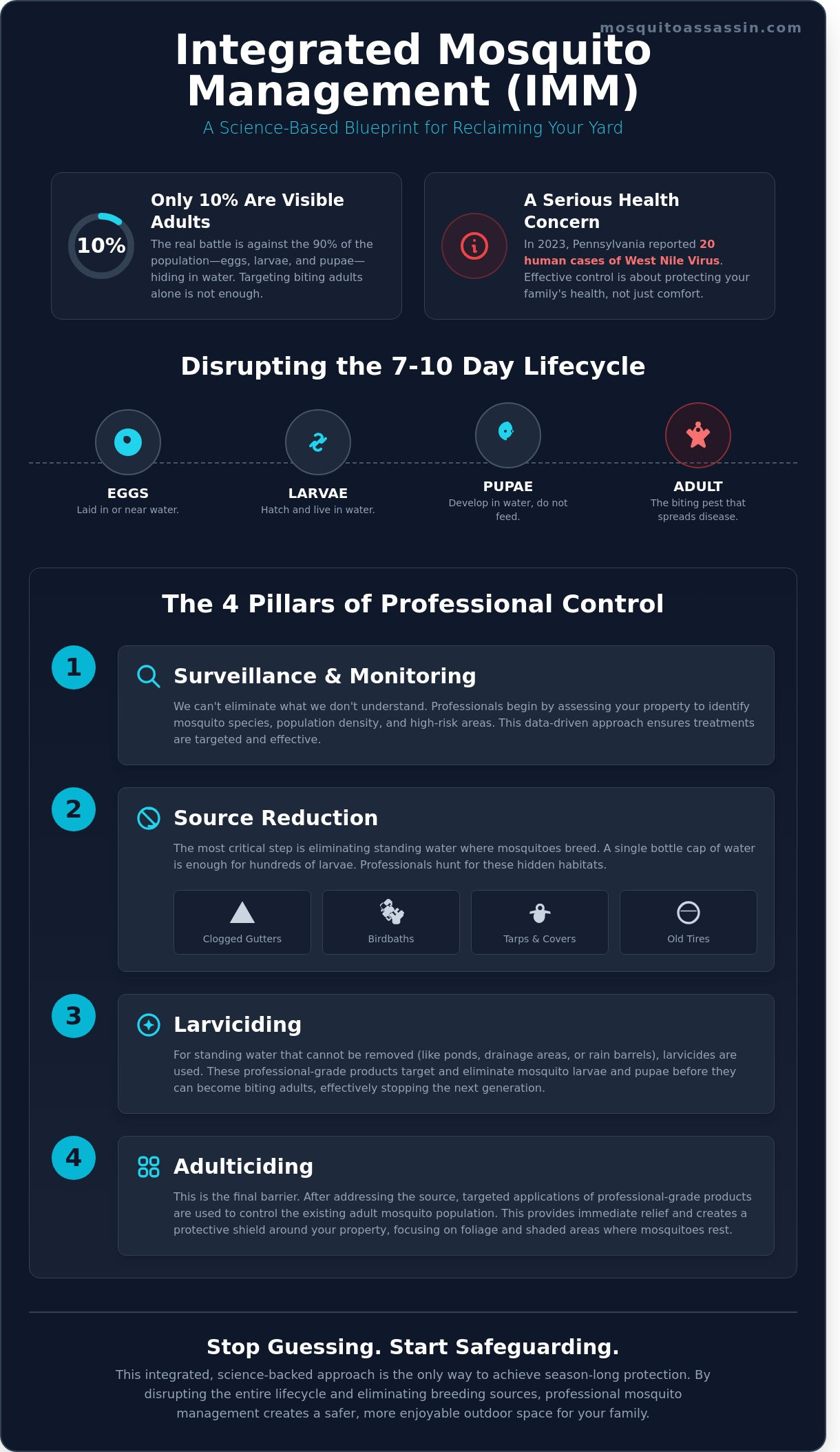
    Comprehensive Mosquito Control Methods for Pennsylvania and Ohio Homeowners

    Source Reduction vs. Professional Treatment: A Balanced Approach

    Effective mosquito control methods start with a tactical strike on breeding grounds. This process is known as source reduction. You can’t rely on sprays alone if your yard is an active nursery for larvae. Homeowners in Erie County or Crawford County often struggle with stagnant water after heavy rains. While DIY efforts are a great first step, they rarely achieve total eradication. Professional intervention uses high-grade equipment that reaches deep into dense foliage where over-the-counter foggers fail.

    Common Breeding Sites in Residential Yards

    Mosquitoes need very little water to multiply. A clogged gutter or a forgotten birdbath becomes a factory for thousands of pests. You must clear debris from drainage systems at least twice a year to prevent standing pools. According to research on mosquito biology and control methods, old tires represent the most significant hazard in regional counties. A single discarded tire can produce over 10,000 mosquitoes in one summer season because the rubber insulates the water and provides a perfect dark environment for eggs. If you have landscape ponds, ensure they have active aeration or stock them with mosquito-eating fish to disrupt the lifecycle.

    When Maintenance Isn’t Enough

    Sometimes your yard is spotless, but the neighbors have a swampy lot or a thick wooded area. Mosquitoes don’t respect property lines. They’ll fly from hundreds of yards away to find a meal. This is where our professional mosquito services

    Practical Yard Management and Personal Protection Strategies

    Effective yard management is the first line of defense in your battle against biting insects. While professional treatments provide the heavy lifting, maintaining your property ensures that mosquitoes don’t find a welcoming habitat between service visits. Our team sees the best results when homeowners combine our professional mosquito control methods with consistent property maintenance. This dual approach creates a hostile environment for pests while safeguarding your family and pets.

    Landscaping for Mosquito Suppression

    Mosquitoes are fragile creatures that dehydrate quickly in the sun. They spend their days hiding in cool, damp, shaded areas. To eliminate these resting sites, keep your grass mowed to a height of 3 inches or less. Overgrown shrubs and tall weeds act as nurseries for adult mosquitoes; trim back foliage at least 12 inches from your home’s foundation to increase sunlight exposure and airflow. This simple step makes your immediate living space much less attractive to invaders.

    Airflow is a natural enemy of the mosquito. Because they are weak fliers, they struggle to navigate in winds exceeding 10 miles per hour. Setting up high-velocity oscillating fans on your deck or patio provides immediate, localized relief. Regarding “mosquito-repelling” plants like citronella or lavender, the reality is less impressive than the marketing. While these plants smell pleasant, they don’t release enough essential oils to protect a yard. You’d need to crush the leaves to see any benefit, so don’t rely on greenery alone to do the job of an assassin.

    Safety Protocols for Professional Applications

    At Mosquito Assassin, we prioritize the health of your family and the local environment in Erie, Crawford, and Ashtabula counties. Our technicians only use EPA-registered products and follow strict manufacturer labels to ensure every application is precise. We focus our treatments on the undersides of leaves and dense brush where pests congregate, rather than broadcast spraying across open areas.

    Safety is our top concern for your children and four-legged friends. We require that pets and family members stay indoors during the application process. Once the treatment has dried, which typically takes 30 to 60 minutes depending on the humidity levels in Pennsylvania and Ohio, the yard is completely ready for play. Our licensed professionals are also trained to protect non-target insects. We intentionally avoid spraying flowering plants where bees and butterflies forage, ensuring we eliminate the pests without harming the local ecosystem.

    For personal protection during peak activity hours at dawn and dusk, wear light-colored clothing and use repellents containing 20 percent DEET or Picaridin. These methods, combined with our targeted treatments, ensure your summer remains itch-free.

    Ready to take back your backyard? Explore our professional mosquito control services and schedule your customized treatment plan today.

    Professional Mosquito Management in Northwest PA and Northeast OH

    Living in Erie, Crawford, or Ashtabula County means dealing with a unique set of environmental factors that pests love. The proximity to Lake Erie and the dense woodlines of Northwest Pennsylvania create a perfect storm for high insect activity. Generic, big-box mosquito control methods often fail because they don’t account for the specific geography of our region. You need a team that lives where you live and understands the pressure these pests put on your daily life. Our “Assassin” approach is designed to eliminate the threat quickly and decisively.

    Our recurring protection plans offer consistent seasonal coverage so you don’t have to worry about the next swarm. We don’t just spray and leave; we analyze your property to identify breeding sites and harborage areas. This local approach ensures our technicians understand whether your backyard is a high-risk zone or simply a nuisance area. Reclaiming your outdoor living space is about more than just comfort. It’s about safety and peace of mind for your kids and pets. When you safeguard your yard, you’re taking back your summer.

    Customized Treatment Plans for Local Homes

    Every property in our tri-county service area is different. A half-acre lot in a suburban Erie neighborhood requires a different strategy than a five-acre estate surrounded by fields in Crawford County. We factor in property size, nearby standing water, and heavy vegetation to build your specific strategy. Choosing a professional pest service with a satisfaction guarantee is the only way to ensure results. If pests return, so do we. We also link mosquito management with other seasonal needs like tick control to provide a comprehensive shield for your entire yard.

    Next Steps for Homeowners

    Timing is everything when you want to stop an infestation. Starting your intervention in April or May provides a much better foundation for summer success. These early-season treatments target the first generation of larvae before they can multiply into a massive problem by July. It’s best to find a local provider with deep roots in the community by checking their location page to see their service range. Professional pest control helps reduce the risk of insect-borne illnesses and drastically improves the quality of your outdoor life. Don’t let pests dictate when you can enjoy your own deck. Call the best of the best and protect your family today.

    Reclaim Your Outdoor Space Today

    Protecting your home from relentless pests requires a strategic shift from reactive swatting to proactive prevention. Successful elimination depends on breaking the lifecycle through Integrated Mosquito Management and consistent source reduction. By removing standing water and utilizing professional mosquito control methods, you create a definitive barrier against infestation. Our licensed and insured technicians serve homeowners across Erie, Crawford, and Ashtabula counties with a proven 4-step process including inspection, customized planning, treatment, and follow-up. We aren’t just a national chain; we’re your neighbors who understand the specific pest pressures of Northwest PA and Northeast OH.

    You don’t have to settle for a yard that’s off-limits to your family and pets. Our local expertise ensures your property receives the exact safeguarding it needs to stay bite-free all season long. If the pests return, so do we. That’s our commitment to your total satisfaction. Take the first step toward a safer, more comfortable summer by partnering with the best of the best. Schedule your professional property inspection today and let us eliminate the threat for good. It’s time to enjoy your backyard with absolute confidence again.

    Frequently Asked Questions

    Is professional mosquito control safe for my pets and children?

    Professional treatments are family-safe and pet-friendly once the product has dried completely. At Mosquito Assassin, we use EPA-registered products that allow your family to return to the yard within 30 to 45 minutes of application. Our technicians follow strict safety protocols to safeguard your home. We prioritize your peace of mind by using specific mosquito control methods that target pests while protecting your loved ones.

    How often should a professional mosquito treatment be applied?

    You should schedule professional treatments every 21 days to maintain a continuous barrier against pests. This 3-week cycle is critical because it disrupts the mosquito life cycle before new larvae can reach adulthood. In Pennsylvania and Ohio, the peak season often requires 7 to 9 applications to ensure total protection from May through September. Consistent application prevents the population from rebounding between our scheduled visits.

    Do mosquito control methods also work on ticks?

    Yes, our comprehensive mosquito control methods effectively eliminate ticks and other biting insects on your property. Since ticks often inhabit the same shaded, brushy areas as mosquitoes, our barrier spray provides dual protection. Research from the CDC indicates that 80 percent of Lyme disease cases are contracted in residential backyards. Our targeted approach safeguards your perimeter against these dangerous hitchhikers throughout the entire season.

    What is the most effective DIY method for reducing mosquitoes?

    The most effective DIY action is the Tip ‘n Toss method to eliminate standing water every 7 days. Mosquitoes can lay up to 300 eggs in a single bottle cap of water, so clearing gutters and emptying birdbaths is essential. While DIY candles or sprays offer temporary relief, they rarely solve the root problem. Professional intervention remains the only way to achieve a 90 percent reduction in the local population.

    Can mosquitoes be completely eliminated from a property?

    No service can promise 100 percent eradication of every single insect, but we can reduce populations by up to 95 percent. Mosquitoes are mobile and can fly in from neighboring properties or wooded areas. However, our “If pests return, so do we” guarantee ensures that we manage the population effectively. We focus on creating a powerful shield that makes your outdoor space livable and comfortable again.

    What happens if it rains shortly after a professional treatment?

    Your treatment remains effective as long as the product has had 30 minutes to dry before the rainfall begins. Once dry, the solution bonds to the underside of leaves and vegetation, making it weather-resistant. If a heavy storm occurs within 24 hours of application and you notice a surge in activity, contact us immediately. We’ll return to your property to re-treat the area at no additional cost.

    Are there natural or organic mosquito control methods available?

    Yes, we offer natural treatment options that utilize essential oils like peppermint, cedarwood, and lemongrass to repel pests. These organic solutions provide an eco-friendly alternative for homeowners who prefer non-synthetic options. While these treatments typically require more frequent application every 14 days, they’re highly effective at safeguarding your yard. Our technicians can customize a plan that fits your specific environmental preferences and safety goals.

    When is the best time of year to start a mosquito control program?

    You should start your mosquito control program in April or May when temperatures consistently stay above 50 degrees Fahrenheit. Starting early allows us to target the first wave of emerging adults before they begin their rapid breeding cycle. In the Ohio Valley and Pennsylvania regions, waiting until June often means you’re fighting an uphill battle against an established infestation. Early intervention ensures a pest-free summer for your family.