Tag: Crawford County

  • Restaurant Pest Control Services in Erie, PA: A Guide to Food Safety and Compliance

    Restaurant Pest Control Services in Erie, PA: A Guide to Food Safety and Compliance

    Last Tuesday, a local bistro owner in downtown Erie watched a health inspector walk through the front door right at the start of the lunch rush. Even with a spotless kitchen, the stress of managing a century-old building means the fear of a surprise visitor is always present. Maintaining high food safety standards in such environments often requires professional restaurant pest control services erie pa to address the unique structural vulnerabilities found near the lakefront.

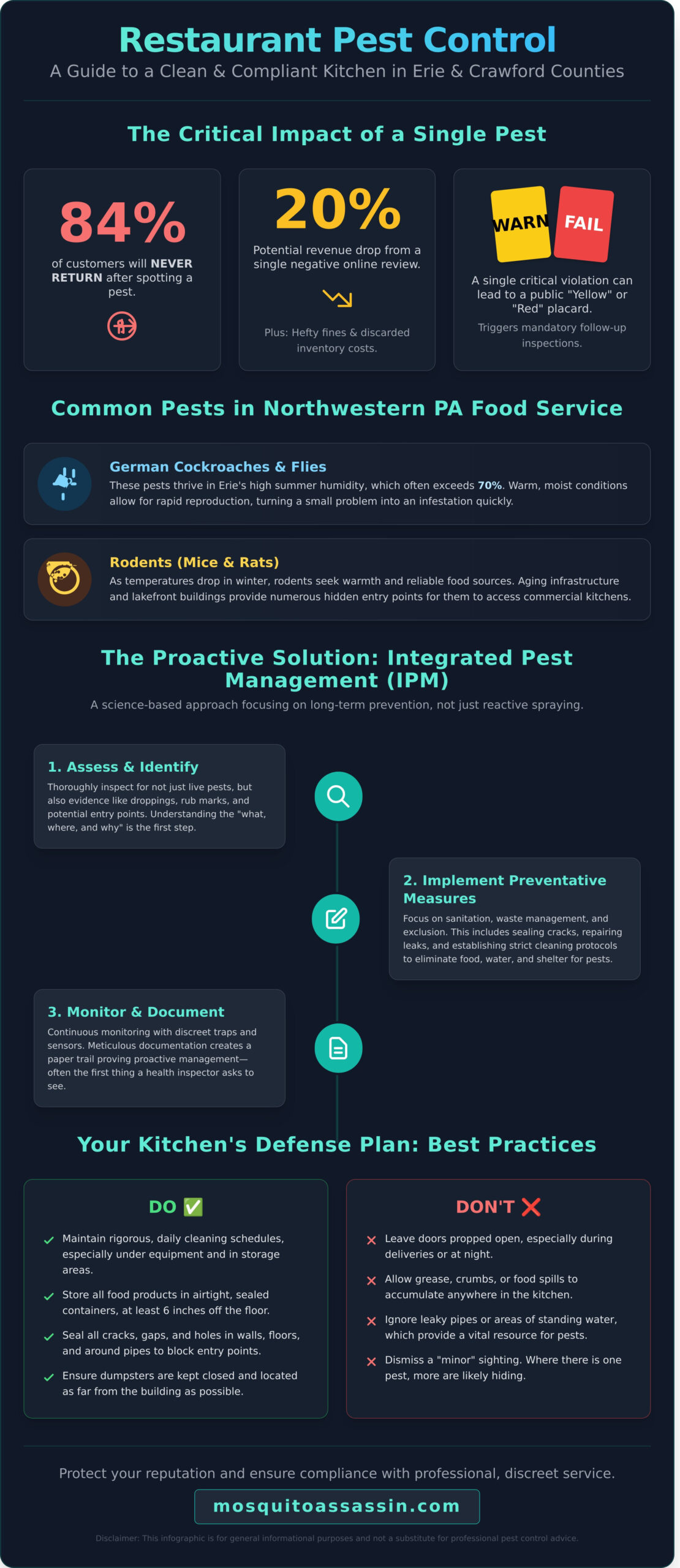
    It’s a fact that 84% of customers will never return to a restaurant after spotting a pest; you likely agree that protecting your reputation is just as important as the food you serve. This guide explains how professional management helps you achieve a clean kitchen and total compliance with local health regulations in Erie and Crawford Counties. You’ll find information on common regional pests, the importance of discreet monitoring, and how to maintain peace of mind during your next surprise inspection.

    Disclaimer: The information provided on this blog is for general informational purposes only and is not intended as professional pest control advice. Conditions vary by property, environment, and location. Reading this content does not create a service agreement. For an inspection or professional recommendations, please contact Mosquito Assassin Pest Control LLC directly.

    Key Takeaways

    • Understand the critical connection between pest activity and health department compliance to safeguard a restaurant’s reputation and customer reviews.
    • Identify how local rodents and insects exploit aging urban infrastructure in downtown Erie and Crawford County to gain entry into food service facilities.
    • Explore the benefits of Integrated Pest Management (IPM), a science-based approach that prioritizes long-term prevention over reactive chemical applications.
    • Learn practical sanitation and waste management strategies designed to eliminate attractants and reduce pest pressure around commercial kitchen perimeters.
    • Discover why specialized restaurant pest control services erie pa provide the local expertise necessary to address the unique environmental challenges of the Great Lakes region.

    The Importance of Professional Pest Management for Erie Restaurants

    Erie restaurants face a unique set of environmental challenges. The proximity to Lake Erie brings high humidity levels that frequently exceed 70% during the summer months. These conditions are ideal for German cockroaches and various fly species to thrive and reproduce rapidly. It isn’t just a seasonal issue. When temperatures drop below freezing in December, rodents seek the warmth and consistent food supplies found in commercial kitchens. Utilizing professional restaurant pest control services erie pa ensures that these biological cycles don’t disrupt daily operations or compromise food safety.

    Local data from the Erie County Health Department indicates that sanitation and pest evidence are among the most cited violations during unannounced inspections. A single critical violation can lead to a “yellow” or “red” placard. This immediately signals a problem to every potential customer walking through the door. Beyond the public embarrassment, the financial consequences of a health code violation are steep. Fines can range from hundreds to thousands of dollars, and the cost of discarded inventory due to contamination can sink a small business’s profit margins for an entire quarter.

    To better understand how these strategies work in a commercial kitchen, watch this helpful video:

    Health Department Standards and Compliance

    The Erie County Health Department inspection criteria are rigorous and focused on identifying active harborages and entry points. Inspectors don’t just look for live insects; they look for evidence like rub marks, gnawings, or droppings. Most professionals utilize Integrated Pest Management (IPM) to address these issues. This method focuses on long term prevention rather than just reactive treatments. It involves detailed documentation that proves a restaurant is following a proactive sanitation plan. This paper trail is often the first thing an inspector asks to see during a visit. Having a “zero tolerance” policy is the only way to ensure compliance, as even a minor sighting can trigger a mandatory follow up inspection within 48 hours.

    Protecting the Brand and Customer Trust

    A restaurant’s reputation is its most valuable asset. In the digital age, a single photo of a pest posted to a review site can cause a 20% drop in revenue within weeks. Modern diners in Erie and Crawford Counties rely on platforms like Yelp and Google Reviews to vet their dining choices. Consistent restaurant pest control services erie pa help maintain the “invisible layer” of protection that keeps the guest experience positive. Discreet service is vital to this process. Technicians usually work during off hours to ensure that pest management activities remain out of the public eye. This maintains the atmosphere while safeguarding the business from the financial ruin of a public relations crisis. When a guest sees a clean, pest free environment, it reinforces their trust in the kitchen’s overall hygiene and food quality.

    Disclaimer: The information provided on this blog is for general informational purposes only and is not intended as professional pest control advice. Conditions vary by property, environment, and location. Reading this content does not create a service agreement. For an inspection or professional recommendations, please contact Mosquito Assassin Pest Control LLC directly.

    Common Pests in Northwestern Pennsylvania Food Service

    Northwestern Pennsylvania’s unique climate and aging urban landscape create specific challenges for food service providers. In Erie and Crawford Counties, the transition from humid summers to harsh winters drives pests indoors, looking for the warmth and steady food supply found in commercial kitchens. Maintaining high standards for hygiene and safety requires a deep understanding of the local pest biology. Adhering to the guidelines set by the FDA Food Code is a baseline requirement for any establishment, as these regulations are designed to prevent the contamination of food and equipment. Effective restaurant pest control services erie pa rely on identifying these threats before they escalate into health department violations.

    Rodent Challenges in Historic Erie Buildings

    Downtown Erie and Meadville are home to many structures built in the late 1800s and early 1900s. While these buildings offer character, they also present significant structural vulnerabilities. Mice only need a gap of 6 millimeters (about 1/4 inch) to enter a facility, while rats can squeeze through an opening the size of a half-dollar. Over time, settling foundations and aging brickwork in Lake Erie coastal properties create these entry points. Rodents often exploit loading docks, utility lines, and basement floor drains to gain access.

    The presence of rodents in a food environment is a critical safety issue. They are known carriers of various pathogens and their droppings, urine, and nesting materials can quickly contaminate dry storage areas. In addition to health risks, rodents pose a fire hazard. They have a constant need to gnaw to keep their incisors sharp, often targeting electrical wiring behind kitchen walls. Implementing consistent restaurant pest control services erie pa ensures that these historic vulnerabilities don’t become permanent liabilities for a business. Identifying these entry points through professional inspections can help reduce the risk of a full-scale infestation.

    Cockroach and Fly Management in Kitchens

    The German cockroach is the most common species found in commercial kitchens in the tri-county area. These pests thrive in the micro-climates created by heavy-duty appliances. They prefer temperatures around 85 degrees Fahrenheit and high humidity, making the space behind reach-in coolers and under dishwashing stations ideal. Their reproduction cycle is incredibly fast; a single female can produce an egg capsule containing 30 to 40 eggs, which can reach maturity in as little as 28 days. This rapid growth means a few hitchhikers on a delivery pallet can become a significant problem within a single month.

    • German Cockroaches: These pests are often introduced via cardboard boxes or food shipments rather than entering from the outdoors.
    • Fruit Flies: Often found near bar areas or produce storage, these flies indicate overripe organic matter or fermenting liquids.
    • Drain Flies: These pests breed in the gelatinous film that builds up inside floor drains, signaling a need for deep cleaning or plumbing maintenance.

    Small flies are frequently more than just a nuisance; they are indicators of underlying sanitation or plumbing issues. While occasional invaders like house flies might enter through an open door, a persistent population of fruit or drain flies suggests that organic debris is accumulating somewhere in the facility. Distinguishing between a one-time visitor and an established infestation is vital for proper management. Professionals look for “hot spots” where moisture and food particles collect, such as the gaskets of refrigeration units or the undersides of prep tables, to address the root cause of the activity.

    Disclaimer: The information provided on this blog is for general informational purposes only and is not intended as professional pest control advice. Conditions vary by property, environment, and location. Reading this content does not create a service agreement. For an inspection or professional recommendations, please contact Mosquito Assassin Pest Control LLC directly.

    Integrated Pest Management (IPM) for Food Safety

    Integrated Pest Management (IPM) is a science-based decision-making process that identifies and reduces risks from pests and pest management strategies. Instead of relying solely on the scheduled application of pesticides, IPM focuses on long-term prevention through a combination of techniques such as biological control, habitat manipulation, and modification of cultural practices. Implementing high-quality restaurant pest control services erie pa involves moving away from reactive treatments and toward a proactive system that prioritizes the structural integrity and cleanliness of the facility.

    Adopting this science-based framework aligns with the 2022 FDA Food Code, which emphasizes the necessity of protecting food from contamination. Statistics from the food service industry indicate that environmental management can resolve up to 90% of recurring pest issues without the immediate need for chemical intervention. This approach is particularly effective in Erie and Crawford Counties, where seasonal temperature shifts drive rodents and insects toward the warmth of commercial kitchens. By managing the environment, restaurant operators create a sustainable defense that protects both their reputation and their customers.

    Success depends on a collaborative relationship between kitchen staff and licensed pest professionals. Technicians provide the expertise to identify vulnerabilities, but the daily habits of employees determine the long-term effectiveness of the program. When staff members understand how their actions impact pest behavior, they become the first line of defense in maintaining a pest-free environment.

    The Four Pillars of a Successful IPM Program

    Effective restaurant pest control services erie pa rely on four foundational pillars to maintain a sterile environment. The first pillar is a comprehensive inspection. Professionals conduct site surveys to find the root cause of activity, looking for entry points as small as 1/16th of an inch for cockroaches or 1/4th of an inch for mice. This data drives the rest of the strategy.

    Sanitation stands as the second pillar. Removing food and water sources is vital for long-term success. Practical prevention strategies often focus on deep cleaning schedules and proper waste management to discourage nesting. Third is exclusion, which involves using physical barriers like door sweeps and silicone sealants to keep pests outside where they belong. Finally, monitoring involves the use of non-toxic tracking tools to detect new activity 24 hours a day, allowing for rapid response before a single sighting becomes a full-blown crisis.

    Documentation and Reporting for Inspectors

    Detailed logbooks are a mandatory component of professional pest management in Pennsylvania. Health inspectors from the Erie County Department of Health specifically look for a chronological record of all pest control activities, including sightings, treatments, and corrective actions taken by the restaurant. A complete logbook proves that the management is exercising due diligence in protecting public health.

    Digital reporting has transformed how managers track trends across their facilities. Modern systems provide data visualization that highlights problem areas, such as a specific floor drain or a loading dock door that stays open too long. When an inspector arrives, having instant access to these records via a digital portal demonstrates a high level of professional oversight. This transparency helps ensure that the restaurant remains compliant with all local and federal food safety regulations while providing peace of mind to the ownership team.

    Disclaimer: The information provided on this blog is for general informational purposes only and is not intended as professional pest control advice. Conditions vary by property, environment, and location. Reading this content does not create a service agreement. For an inspection or professional recommendations, please contact Mosquito Assassin Pest Control LLC directly.
    Practical Prevention Strategies for Commercial Kitchens

    Maintaining a pest-free environment in Erie County requires more than reactive treatments; it demands a daily commitment to rigorous sanitation. Research from the Journal of Food Protection indicates that nearly 85 percent of pest sightings in commercial kitchens correlate directly with sanitation lapses or structural defects. Establishing a strict daily schedule ensures that food debris and grease don’t accumulate in hard-to-reach areas. This proactive approach is a cornerstone of effective restaurant pest control services erie pa, as it removes the primary attractants that draw insects and rodents indoors.

    Waste management plays a vital role in reducing exterior pest pressure. Dumpsters should be located at least 25 feet away from the building’s entrance to prevent pests from migrating inside. Keeping lids tightly closed and scheduling power washing for the dumpster pad every 14 days can reduce fly populations by up to 50 percent. Additionally, managing incoming shipments is critical. German cockroaches and stored product pests often hitchhike into facilities inside corrugated cardboard boxes. Inspecting every delivery on the loading dock before it enters the storage area prevents a localized infestation from becoming a facility-wide crisis.

    Staff members are the first line of defense against infestations. Training employees to spend 10 minutes at the end of each shift looking for early signs of activity (such as small droppings, smear marks along baseboards, or damaged packaging) allows for faster intervention. When employees understand the biology of common pests, they can identify risks before they escalate into health code violations.

    Sanitation Protocols and Moisture Control

    Deep cleaning must extend beyond visible surfaces. Organic buildup in floor drains is a primary breeding ground for small flies; using microbial cleaners can eliminate this “biofilm” where larvae thrive. Addressing plumbing leaks is equally urgent. A single dripping faucet can provide enough water to sustain a rodent colony indefinitely. Eliminating standing water in mop buckets and floor pans reduces the survival rate of pests by removing their most essential resource.

    Structural Exclusion and Maintenance

    Physical barriers are the most permanent form of pest control. Mice can squeeze through gaps as small as 1/4 inch, which is roughly the width of a pencil. Sealing utility penetrations with stainless steel wool and caulk prevents entry. Loading docks should be equipped with heavy-duty door sweeps and air curtains to deter flying insects. Maintaining window screens (using 16-mesh or finer) ensures that ventilation doesn’t become an invitation for flies during the humid summer months in Erie and Crawford Counties.

    Implementing these practical steps creates a hostile environment for pests and protects the reputation of the establishment. For a detailed assessment of a facility’s specific vulnerabilities, professional pest control may help reduce risk by identifying hidden entry points and nesting sites.

    Disclaimer: The information provided on this blog is for general informational purposes only and is not intended as professional pest control advice. Conditions vary by property, environment, and location. Reading this content does not create a service agreement. For an inspection or professional recommendations, please contact Mosquito Assassin Pest Control LLC directly.
    Selecting a Professional Partner in Erie and Crawford Counties

    Selecting a professional partner in Erie and Crawford counties requires more than just picking a name from a list. The unique climate of the Great Lakes region means pests behave differently here than in southern Pennsylvania or central Ohio. Business owners in Erie, Meadville, and Ashtabula must prioritize providers who understand these local variables. Choosing restaurant pest control services erie pa ensures that the unique architectural styles and older infrastructure found in downtown Erie are accounted for during inspections. Older buildings often have hidden entry points that generic, cookie-cutter treatment plans might miss. A customized approach focuses on these structural vulnerabilities and identifies specific risks, such as the 15% increase in rodent activity typically observed during the first frost in late October.

    Evaluating the credentials and licensing of a commercial provider is a non-negotiable step in the selection process. In Pennsylvania, commercial pesticide applicators must hold valid certification in specific categories, such as Category 11 for household and health-related pests. Verifying these licenses ensures that the methods used align with modern Integrated Pest Management (IPM) practices. Professional pest control may help reduce risk for local business owners by providing a layer of documented compliance that health inspectors look for during unannounced visits. This proactive stance protects the reputation of the establishment and ensures the environment remains conducive to food safety.

    What to Look for in a Commercial Service Plan

    A robust plan prioritizes consistency and transparency. High-traffic food service environments usually require monthly or bi-monthly inspections to remain compliant with 2024 regional health standards. It’s vital that a provider delivers written reports after every visit. These documents should detail sightings, sanitation issues, and structural repairs needed to prevent future infestations. Availability of emergency support within 24 hours is another critical factor for businesses that can’t afford downtime. When evaluating restaurant pest control services erie pa, look for a partner that offers detailed service recommendations rather than just a quick application of product.

    The Value of Local Knowledge and Support

    Regional pest cycles dictate the timing of specific treatments. In Northwestern PA, the transition from humid summers to lake-effect snow creates distinct windows for pest migration. Local providers anticipate the surge of cluster flies in the spring or the movement of rats toward heat sources in December. They understand how local health regulations in Crawford and Ashtabula counties might differ slightly in their documentation requirements. For more information on tailored solutions, professional pest control services can provide a comprehensive assessment of these seasonal risks and structural needs.

    Working with a provider who lives and works in the Erie and Crawford county areas ensures a faster response and a deeper understanding of the local environment. This local expertise is the most effective way to safeguard a commercial kitchen against the persistent threat of regional pests. By focusing on data-driven results and local pest behavior, business owners can maintain a clean, safe, and professional environment for their staff and customers throughout the year.

    Disclaimer: The information provided on this blog is for general informational purposes only and is not intended as professional pest control advice. Conditions vary by property, environment, and location. Reading this content does not create a service agreement. For an inspection or professional recommendations, please contact Mosquito Assassin Pest Control LLC directly.

    Maintaining Compliance and Food Safety Standards

    Food safety standards in Northwestern Pennsylvania require constant vigilance to prevent infestations. Small oversights can lead to health code violations. Implementing a comprehensive Integrated Pest Management (IPM) approach helps maintain a sterile environment by focusing on exclusion and sanitation. Licensed and insured technicians who live in the Erie community understand the specific seasonal challenges of the local climate. Choosing professional restaurant pest control services erie pa ensures that a commercial kitchen remains compliant with the latest Pennsylvania Department of Agriculture food safety regulations. It’s a proactive step that protects the investment made into the business and the health of every customer. High standards build long-term trust with the community in Erie and Crawford counties. For those seeking to safeguard their establishment, scheduling a professional inspection for your restaurant through a locally owned provider can identify hidden risks before they become costly problems. Taking action today keeps the focus on serving the local community.

    Disclaimer: The information provided on this blog is for general informational purposes only and is not intended as professional pest control advice. Conditions vary by property, environment, and location. Reading this content does not create a service agreement. For an inspection or professional recommendations, please contact Mosquito Assassin Pest Control LLC directly.
    Frequently Asked Questions

    How often should a restaurant have professional pest control services?

    Most commercial kitchens in Erie, PA, schedule professional inspections at least 12 times per year to maintain compliance with local health codes. High-volume establishments often require bi-weekly visits to monitor traps and maintain sanitation standards. Monthly inspections help identify 100% of potential entry points before they lead to larger infestations.

    Can a pest infestation cause a restaurant to be shut down in Erie, PA?

    Yes, a severe infestation can lead to an immediate closure by the Erie County Department of Health. Inspectors categorize active pest activity as a high-risk violation; this often results in a 48-hour mandatory shutdown until the facility is cleared. Statistics show that roughly 15% of health code failures in commercial kitchens stem from inadequate pest management.

    Are pest control treatments safe to use in food preparation areas?

    Professional treatments are designed for use in food-handling environments when applied by licensed technicians. These experts follow EPA-approved labels that specify application methods, such as crack and void treatments, which keep products away from 100% of food contact surfaces. Integrated Pest Management (IPM) focuses on non-chemical solutions first to ensure the highest level of safety.

    What are the most common signs of rodents in a commercial kitchen?

    The most frequent indicators include droppings, which are typically 3 to 6 millimeters long, and gnaw marks on food packaging. You might also find nesting materials like shredded paper or cardboard tucked into dark corners or behind large appliances. Since a single pair of mice can produce up to 50 offspring in one year, identifying these signs early is critical for restaurant pest control services erie pa.

    How do I get rid of fruit flies in my restaurant bar or kitchen?

    Eliminating fruit flies requires removing their breeding grounds, which are usually fermenting organic matter in drains or under equipment. A single female fruit fly can lay up to 500 eggs in its brief 10-day lifespan. Deep cleaning floor drains with enzymatic cleaners every 7 days helps break the life cycle and reduces the population significantly.

    What documentation do I need for a health department inspection?

    Restaurants must maintain a detailed pest management logbook for health inspectors to review. This folder should contain 3 years of service reports, pesticide application records, and site maps showing the location of all bait stations. Providing these documents proves that the facility follows a consistent schedule for restaurant pest control services erie pa.

    Will professional pest control help with cockroach problems in an old building?

    Professional treatments are effective even in historic buildings where cracks and crevices are common. Since German cockroaches can fit through gaps as narrow as 1.5 millimeters, technicians use specialized baits and dusts that reach deep into wall voids. Regular monitoring helps detect 90% of new activity before it spreads through the plumbing or electrical chases of older structures.

    Does professional pest control offer a guarantee for restaurants?

    Most professional services include a service guarantee that ensures a technician will return if pests appear between scheduled visits. This typically includes a 24-hour response time for emergency sightings of high-risk pests like rodents or cockroaches. While no one can promise 0% pest presence forever, these agreements provide a 100% commitment to resolving issues as they arise.

    For those managing a commercial kitchen, professional pest control may help reduce risk. To request an inspection or learn more about management plans, visit the online booking portal or contact a specialist at www.mosquitoassassin.com/contact-us.

    Disclaimer: The information provided on this blog is for general informational purposes only and is not intended as professional pest control advice. Conditions vary by property, environment, and location. Reading this content does not create a service agreement. For an inspection or professional recommendations, please contact Mosquito Assassin Pest Control LLC directly.

  • 7 Key Signs of Termite Infestation in Crawford County: A Homeowner’s Guide

    7 Key Signs of Termite Infestation in Crawford County: A Homeowner’s Guide

    There’s a silent threat that can compromise the safety and value of your home, working undetected behind your walls and beneath your floors. For homeowners here, knowing the specific signs of termite infestation Crawford County properties are vulnerable to isn’t just helpful-it’s your first line of defense. The fear of hidden, costly damage is real, especially when it’s so easy to mistake a termite swarmer for a flying ant or dismiss subtle wood damage as a minor issue. This uncertainty can leave you feeling powerless to protect your biggest investment.

    This expert guide is designed to eliminate that doubt and give you peace of mind. We will arm you with the professional knowledge to confidently identify the seven most crucial warning signs of a termite problem, from their distinctive mud tubes to discarded wings. You’ll learn exactly what to look for, how to tell termites apart from other common pests, and the immediate steps to take to safeguard your home. It’s time to take control and ensure your property is protected from these destructive invaders.

    Key Takeaways

    • Understand why Crawford County’s specific climate and housing make local homes a prime target for destructive Eastern Subterranean Termites.
    • Learn to spot the most common visible signs of termite infestation Crawford County homeowners often miss, including tell-tale mud tubes and discarded swarmer wings.
    • Go beyond the obvious to identify subtle clues of a hidden problem and confidently distinguish termites from look-alikes like flying ants.
    • Discover the critical first steps to take-and the costly mistakes to avoid-the moment you suspect termites are damaging your property.

    Why Crawford County Homes Are a Prime Target for Termites

    For homeowners in Crawford County, the threat of termites isn’t just a possibility-it’s a reality rooted in our local environment. Our region’s specific climate, with its ample rainfall and seasonal humidity, creates the ideal damp soil conditions that termites need to thrive. Combined with a housing stock rich in wooden structures, basements, and crawl spaces, our properties offer the perfect combination of shelter, moisture, and food for these destructive pests. Understanding these local risk factors is the first step in safeguarding your most valuable asset from silent destruction.

    To help you identify the damage these pests can cause, watch this video overview:

    The Eastern Subterranean Termite: Crawford County’s #1 Threat

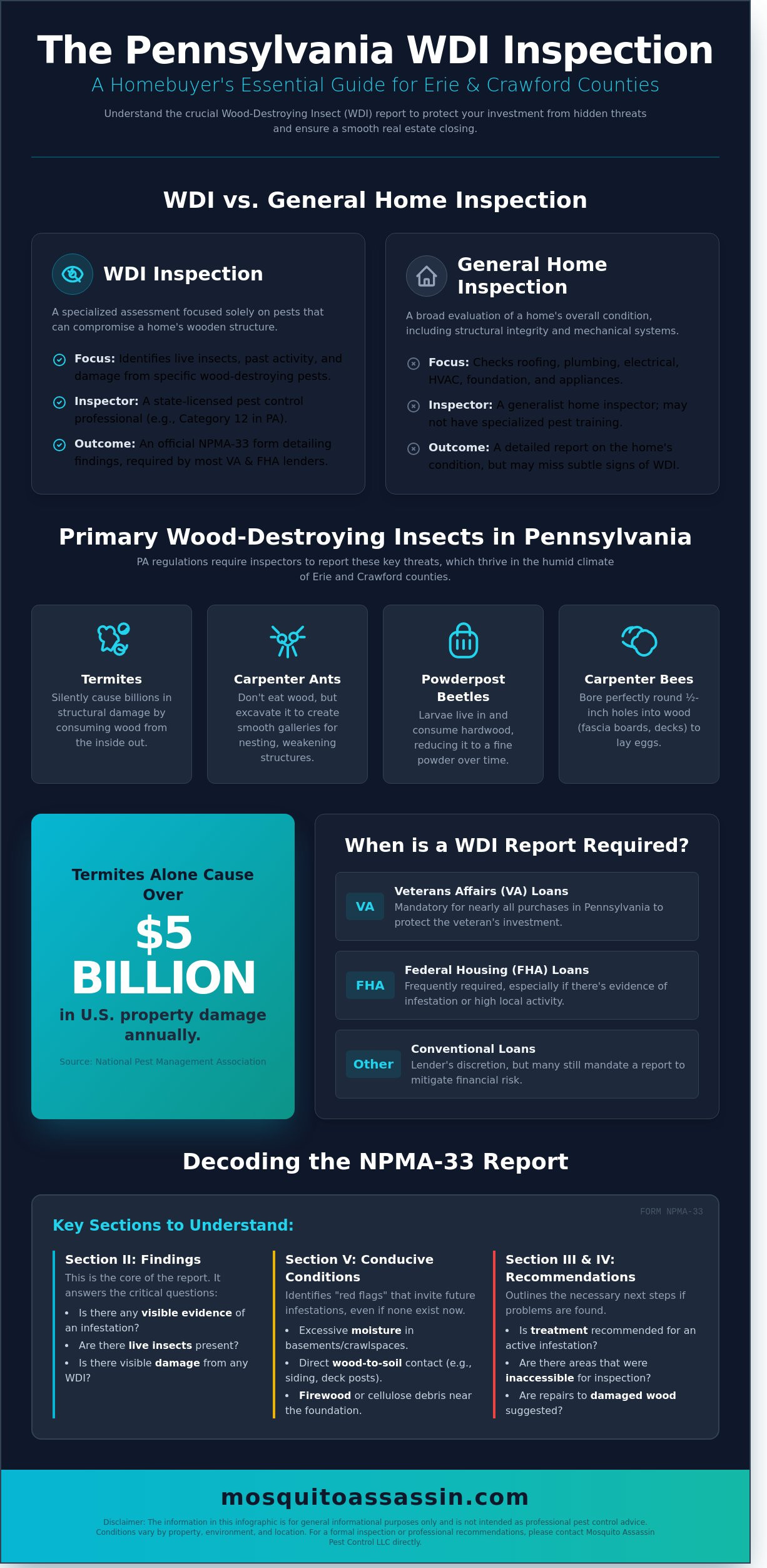
    The primary culprit behind local infestations is the Eastern Subterranean Termite. True to their name, these pests live in massive underground colonies, sometimes numbering in the hundreds of thousands, and travel through the soil in search of food. These social insects, known broadly as Termites, feed on cellulose, a material found in wood, paper backing on drywall, and even books. They can invade your home through foundation cracks no wider than a credit card, working silently for years. Because they operate out of sight, recognizing the subtle signs of termite infestation Crawford County homeowners face often requires a professional eye.

    Local Conditions That Encourage Infestations

    Several common features of Crawford County properties can unintentionally invite termites. Being aware of these vulnerabilities is crucial for effective prevention and protection. Key risk factors include:

    • Moisture: Our humid summers and consistent rainfall create moist soil, which is essential for subterranean termite survival. Leaky pipes, poor drainage, and clogged gutters near the foundation only make matters worse.
    • Wood-to-Ground Contact: Any wooden part of your home touching the ground, like a deck post or porch step, provides a direct highway for termites to enter.
    • Common Landscaping: Piling firewood against the house or using thick layers of wood mulch near the foundation offers termites a convenient food source right next to your home.

    These same risk factors that endanger homes also threaten local businesses. Mosquito Assassin Pest Control LLC provides proven protection for commercial properties with our dedicated commercial pest services, safeguarding your investment and ensuring a pest-free environment.

    The 4 Most Obvious Signs of Termites You Can See

    Termites are masters of stealth, causing extensive damage long before they are ever noticed. However, these silent destroyers do leave behind critical evidence of their presence. For homeowners, learning to spot the most common visual clues is the first line of defense. If you know what to look for, you can catch an infestation early and prevent catastrophic damage to your property. These are the most definitive signs of termite infestation Crawford County residents should be watching for.

    Sign #1: Mud Tubes on Your Foundation

    Subterranean termites, the most common type in our region, build protective tunnels to travel from their underground colony to the wood in your home. These “mud tubes” are like highways for termites, shielding them from the open air and predators.

    • What they look like: Pencil-sized tunnels made of soil, wood particles, and termite saliva, often snaking up foundation walls or support piers.
    • Where to check: Carefully inspect your home’s exterior foundation, interior crawl space walls, support piers, sill plates, and floor joists.
    • Pro Tip: Gently break off a small section of an active-looking tube. If the tube is rebuilt within a few days, you have a live, active termite colony.

    Sign #2: Damaged or Hollow-Sounding Wood

    Termites consume wood from the inside out, leaving a very thin veneer of wood or just the paint on the surface. This means wood that looks perfectly normal on the outside can be completely compromised within. Tapping on wood structures is a simple yet effective test.

    Listen for a dull, hollow thud instead of a solid sound. Visually, infested wood may appear blistered, darkened, or cracked. If you break a piece open, you may see intricate, honeycombed galleries, which are a classic sign of termite damage. Pay close attention to floor joists, window sills, door frames, and structural beams in basements and crawl spaces.

    Sign #3: Termite Swarmers or Discarded Wings

    Perhaps the most alarming sign is a termite swarm. This occurs when a mature colony sends out winged reproductive termites, known as “swarmers” or “alates,” to establish new colonies. In Crawford County, this often happens on a warm day following a spring rain. You might see the swarm itself, or you might find the evidence it leaves behind: piles of discarded wings. These wings are all identical and look like tiny, iridescent fish scales on windowsills, floors, or caught in spider webs. Finding these wings is a definitive sign that a mature termite colony is active in or very near your home.

    Discovering even one of these signs is a clear warning that should not be ignored. A swift response is critical to safeguarding the structural integrity of your home. Understanding these indicators is the first step, but a professional inspection is essential for a complete diagnosis and effective termite prevention and control. Don’t wait for the damage to become obvious; if you see the signs, it’s time to call for backup.

    Hidden Clues: The Subtle Signs of a Termite Problem

    Termite damage doesn’t happen overnight. Long before you see a swarm or find hollowed-out wood, these silent destroyers leave behind subtle clues. Spotting these early indicators is crucial for safeguarding your property from extensive damage. Many of these symptoms are easily mistaken for common household issues like humidity or settling, which is why a professional eye is essential. Understanding these hidden warnings can mean the difference between a simple treatment and a costly structural repair.

    Sign #4: Peeling Paint or Bubbling Drywall

    If you notice paint bubbling or peeling on your walls for no apparent reason, don’t just assume it’s water damage. Subterranean termites bring moisture from the soil into the spaces where they feed. As they consume the paper backing on drywall, this moisture can push paint away from the surface, creating bubbles and blisters that look remarkably similar to a leak. Check walls and ceilings, especially those near your home’s foundation, for this unexplained symptom.

    Sign #5: Tight-Fitting Doors and Sticking Windows

    Has a door that always opened smoothly suddenly started sticking? While high humidity in Crawford County can cause wood to swell, persistent issues can point to a more serious problem. Termites tunnel through wooden frames, compromising their structural integrity and introducing moisture. This damage can cause the wood to warp, making doors and windows difficult to operate. If seasonal changes don’t explain the issue, it’s a critical warning sign that warrants a professional inspection.

    Sign #6: Tiny Pinholes in Drywall

    Small, unexplained holes in your drywall or wallpaper are easy to dismiss but should never be ignored. These tiny pinholes can be exit holes created by termites as they burrow. You might even see a small amount of dirt or frass around the opening. While not the most common of the signs of a subterranean termite infestation, these holes are a definitive red flag. Any breach in your drywall is an open invitation for a professional assessment, as it proves something is happening behind the wall. These are often the most overlooked signs of termite infestation Crawford County residents face.

    Termites vs. Other Pests: Don’t Mistake These Look-Alikes

    One of the biggest challenges for homeowners in Crawford County is correctly identifying the pest causing damage. Winged insects swarming in the spring or strange debris near a windowsill can trigger alarm bells, but it’s not always termites. Misidentification can lead to the wrong treatment and allow a real termite problem to grow unchecked. Knowing the key differences between termites and their common look-alikes-flying ants and carpenter ants-is your first line of defense.

    Termite Swarmers vs. Flying Ants

    During their reproductive phase, termites grow wings and “swarm” to establish new colonies. These swarmers are frequently mistaken for flying ants. A close look, however, reveals clear differences that tell you exactly what you’re dealing with.

    • Body Shape: Termites have a broad, straight waist, giving their body a uniform, capsule-like shape. Ants, in contrast, have a distinctly pinched or “cinched” waist.
    • Antennae: Termite antennae are straight and beaded. Ant antennae are noticeably bent or “elbowed.”
    • Wing Size: This is often the easiest giveaway. A termite swarmer has two pairs of wings that are equal in size and length. A flying ant has a larger pair of front wings and a smaller pair of hind wings.

    Termite Damage vs. Carpenter Ant Damage

    Both termites and carpenter ants damage wood, but for entirely different reasons, leaving behind distinct evidence. Termites consume wood for its cellulose, while carpenter ants excavate it to build their nests. This fundamental difference is clear in the damage they create, and it’s a critical part of identifying the true signs of termite infestation in Crawford County.

    • Wood Galleries: Termite tunnels are rough, jagged, and often packed with mud, soil, and feces (known as spotting). Carpenter ant galleries, however, are smooth and clean, almost like they’ve been sandpapered. They keep their nesting areas tidy.
    • Leftover Debris: Because they excavate wood instead of eating it, carpenter ants push debris out of their nests. This creates small piles of frass-a material that looks like fine sawdust. Subterranean termites consume the wood, so you won’t find these tell-tale shavings.

    If you’ve spotted any of these pests or their unique signs of damage, don’t guess. An incorrect identification can lead to costly delays and further destruction of your property. For a definitive, professional inspection, contact Mosquito Assassin today. We’ll eliminate the threat and safeguard your home with confidence.

    Found a Sign? Your Crawford County Termite Action Plan

    Discovering potential signs of a termite infestation in your Crawford County home is unsettling, but a calm, strategic response is your most powerful weapon. These silent destroyers cause significant damage precisely because they go unnoticed. If you’ve spotted any of the signs we’ve discussed, it’s time to act decisively. Follow this proven plan to safeguard your property.

    Step 1: Don’t Panic and Don’t Disturb the Area

    Your first instinct might be to break open damaged wood or scrape away a mud tube. Resist this urge. Disturbing the evidence can cause termites to retreat and relocate to another part of your home, making a professional assessment more difficult. It’s also crucial to avoid using store-bought sprays; these are ineffective against the hidden colony and can interfere with professional-grade treatments. If you see a swarmer or discarded wings, you can collect a sample in a sealed bag for our technicians to identify.

    Step 2: Document What You’ve Found

    Before you do anything else, grab your phone. Take clear, well-lit photos of the signs you’ve discovered-the mud tubes, the wood damage, or the insects themselves. Make a quick note of the exact location (e.g., “basement, along the west wall” or “under the front porch steps”). This documentation is extremely valuable, providing our experts with crucial information before they even arrive.

    Step 3: Call Your Local Termite Professionals

    The only way to confirm an infestation, identify the termite species, and understand the full extent of the problem is with a professional inspection. When you see the signs of termite infestation Crawford County homeowners fear, you need a reliable expert who understands our local environment and building practices.

    To understand what a comprehensive professional approach looks like, you can find out more about the methods used by industry experts.

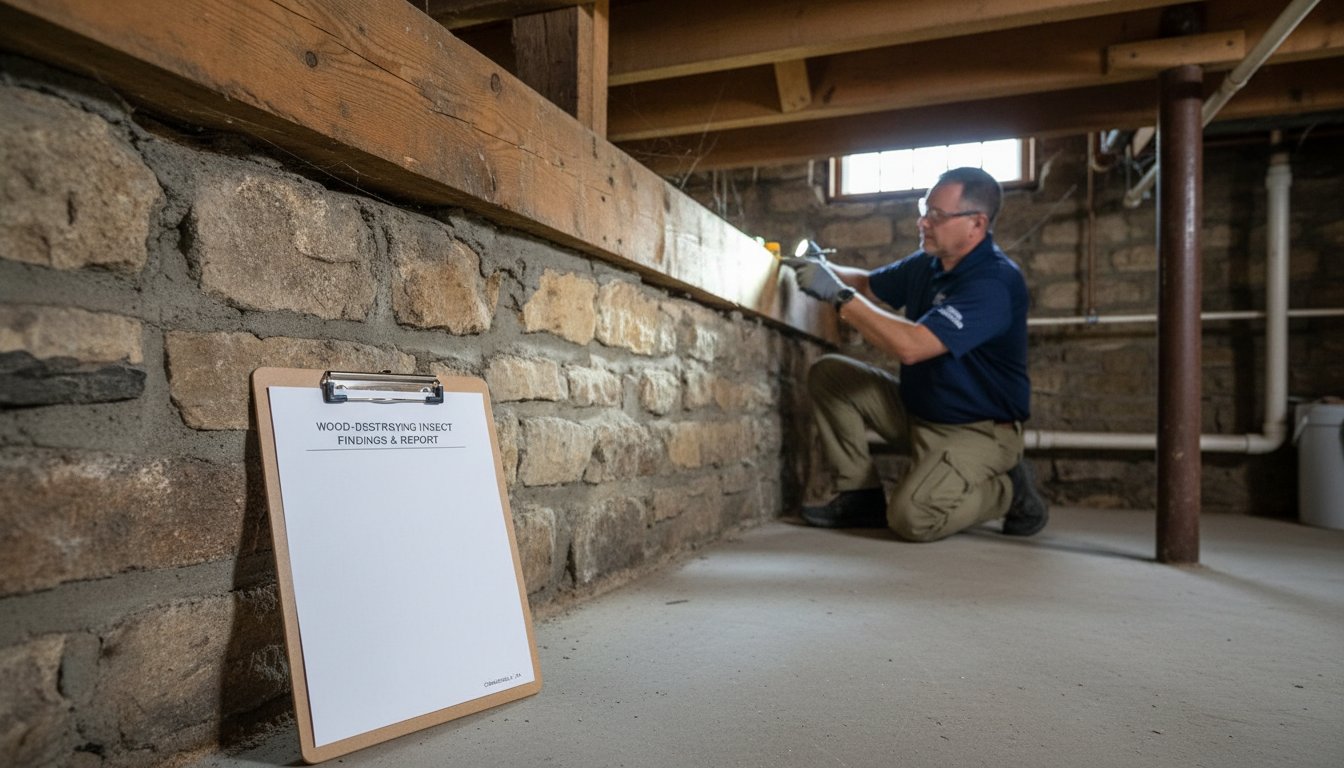
    At Mosquito Assassin, our comprehensive termite inspection is the first step toward complete eradication. A certified technician will meticulously examine your property’s vulnerable areas to provide a clear and honest assessment. As a local company, our team lives in the communities we serve. We know exactly what to look for. Learn more about our local commitment.

    Don’t let termites silently threaten your biggest investment. Protect your home and your peace of mind with a professional, proven solution. Schedule your professional termite inspection in Crawford County today!

    Your Next Step to a Termite-Free Home in Crawford County

    Your home is your most significant investment, and protecting it from the silent destruction of termites is crucial. By now, you know how to identify the critical warnings, from visible mud tubes and discarded wings to more subtle clues like hollow-sounding wood and bubbling paint. Early detection is the key to preventing widespread, costly damage and safeguarding your property’s value.

    If you’ve noticed any potential signs of termite infestation Crawford County homeowners dread, the time for decisive action is now. Don’t let uncertainty lead to costly repairs. As your locally owned and operated, five-star rated neighbors, Mosquito Assassin is here to provide definitive answers and effective solutions. We stand by our work with a powerful Pest-Free Guarantee: If pests return, so do we. Protect your investment and gain total peace of mind. Think you’ve seen the signs? Don’t wait. Schedule a Professional Termite Inspection in Crawford County Now!

    Frequently Asked Questions About Termites in Crawford County

    When is termite season in Crawford County, PA?

    Termites are a year-round threat in Pennsylvania, actively damaging structures even in winter. However, their most visible period is the “swarming season” in spring, typically from March to May. During this time, winged reproductive termites leave the colony to mate and expand. Seeing a swarm is a definitive sign that a mature, destructive colony is already established nearby and requires immediate professional attention to prevent further damage to your property.

    Can I really have termites and not see them?

    Yes, absolutely. Termites are known as “silent destroyers” because they consume wood from the inside out, often within your walls, floors, or crawl spaces. They can cause extensive structural damage for years before any obvious signs become visible. This hidden nature is why you may not see a single termite while a colony is actively weakening your home’s foundation, making professional inspections essential for early detection.

    How often should I have my home inspected for termites?

    We recommend a professional termite inspection for your Crawford County home at least once a year. Annual inspections are the most effective way for a licensed technician to identify the subtle signs of termite infestation in Crawford County before they escalate into a major structural problem. This proactive approach is the best defense for safeguarding your property’s value and ensuring your family’s peace of mind from these destructive pests.

    Is termite damage covered by my homeowner’s insurance?

    Unfortunately, nearly all standard homeowner’s insurance policies do not cover termite damage. Insurance companies consider termite control to be a part of regular home maintenance, making the homeowner responsible for prevention and repair costs. This makes investing in professional termite protection not just a smart choice, but an essential step in protecting your home from potentially thousands of dollars in out-of-pocket repair bills.

    Can I treat termites myself with store-bought products?

    While DIY termite products are available, they are rarely effective for complete eradication. These treatments often only kill a small number of surface-level termites, leaving the hidden queen and the core of the colony untouched and free to continue their destruction. For a problem this serious, only a professional, comprehensive treatment plan can locate the colony and ensure it is fully eliminated. The standards for professional pest control sydney, for example, emphasize complete colony elimination, protecting your home for the long term.

    What does a professional termite treatment from Mosquito Assassin involve?

    Our proven process starts with a comprehensive inspection to identify all entry points and areas of activity. Based on our findings, we create a customized treatment plan using industry-leading, family-safe products to eliminate the entire colony. Our certified technicians apply these treatments strategically to create a protective barrier around your home, ensuring complete eradication. We back our work with a satisfaction guarantee for your total peace of mind.

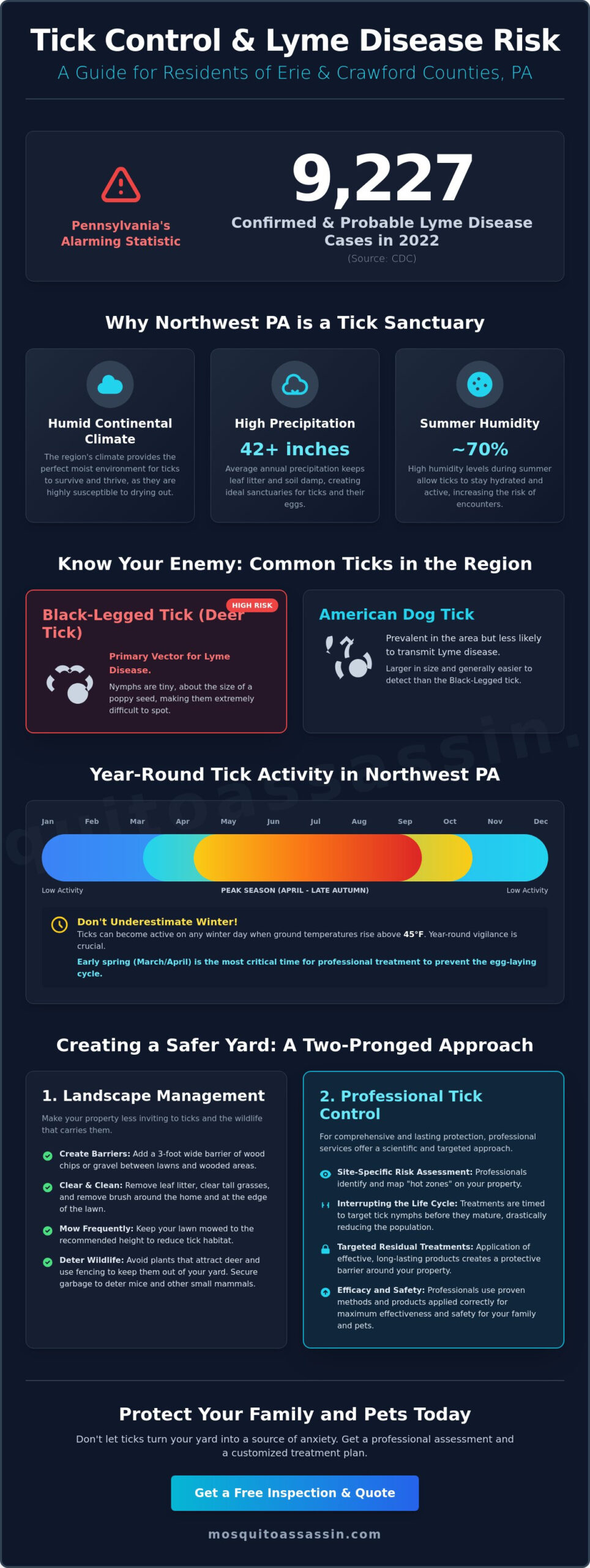
  • Why Are Mosquitoes So Bad in NW PA? A Local Expert Explains

    Why Are Mosquitoes So Bad in NW PA? A Local Expert Explains

    If you’ve ever felt that your backyard in Erie or Crawford County is the unofficial mosquito capital of the world, you’re not just imagining it. That relentless swarm that ruins a perfect summer evening isn’t just bad luck; there are specific, scientific reasons why mosquitoes are worse in NW PA than in many other places. It’s a frustrating battle that can leave you covered in itchy bites, unable to enjoy your own property, and worried about mosquito-borne illnesses like West Nile Virus.

    You deserve to enjoy your outdoor spaces without being a meal. As your local pest control experts, we understand this problem because we live here, too. In this guide, we’ll break down the unique geographical and climate factors that create this perfect storm for mosquito breeding in our region. We won’t just explain the problem-we’ll give you the proven, professional strategies you need to eliminate the threat, safeguard your family, and finally reclaim your yard for good.

    Key Takeaways

    • Discover the “perfect storm” of geography and climate that makes our region a prime breeding ground for mosquitoes.
    • Learn how Lake Erie and our local wetlands create the high-humidity environment where mosquito populations thrive.
    • Understand the specific weather patterns that explain why mosquitoes are worse in NW PA compared to other areas.
    • Find out why professional control is essential for safeguarding your yard against our region’s overwhelming mosquito pressure.

    It’s Not Just You: NW PA’s Perfect Storm for Mosquitoes

    If you live in Erie County, Crawford County, or Ashtabula County, you know the feeling. The moment you step outside on a summer evening, the buzzing begins. It’s a constant battle that can ruin barbecues and keep kids indoors. You’re not imagining it-our region truly is a hotbed for these pests. The reason why mosquitoes are worse in NW PA isn’t a single issue; it’s a perfect storm of environmental factors. Our unique geography, combined with specific weather patterns and high humidity, creates an ideal breeding ground that mosquitoes thrive in.

    To better understand the scale of mosquito monitoring and control in our state, the Pennsylvania DEP provides a closer look at their testing process:

    Meet the Main Culprits: Common Mosquitoes in Our Area

    While dozens of mosquito species exist in Pennsylvania, two are primarily responsible for our summer misery. The Northern House Mosquito (Culex pipiens) is a persistent pest that breeds in stagnant water sources like birdbaths, clogged gutters, and old tires. Equally frustrating is the aggressive Floodwater Mosquito (Aedes vexans), which lays its eggs in dry soil. After a heavy rain, their eggs hatch simultaneously, leading to massive, aggressive swarms that can appear overnight. Understanding the mosquito life cycle, particularly their reliance on water for their larval stage, is the first step in effective control.

    Understanding the NW PA Mosquito Season

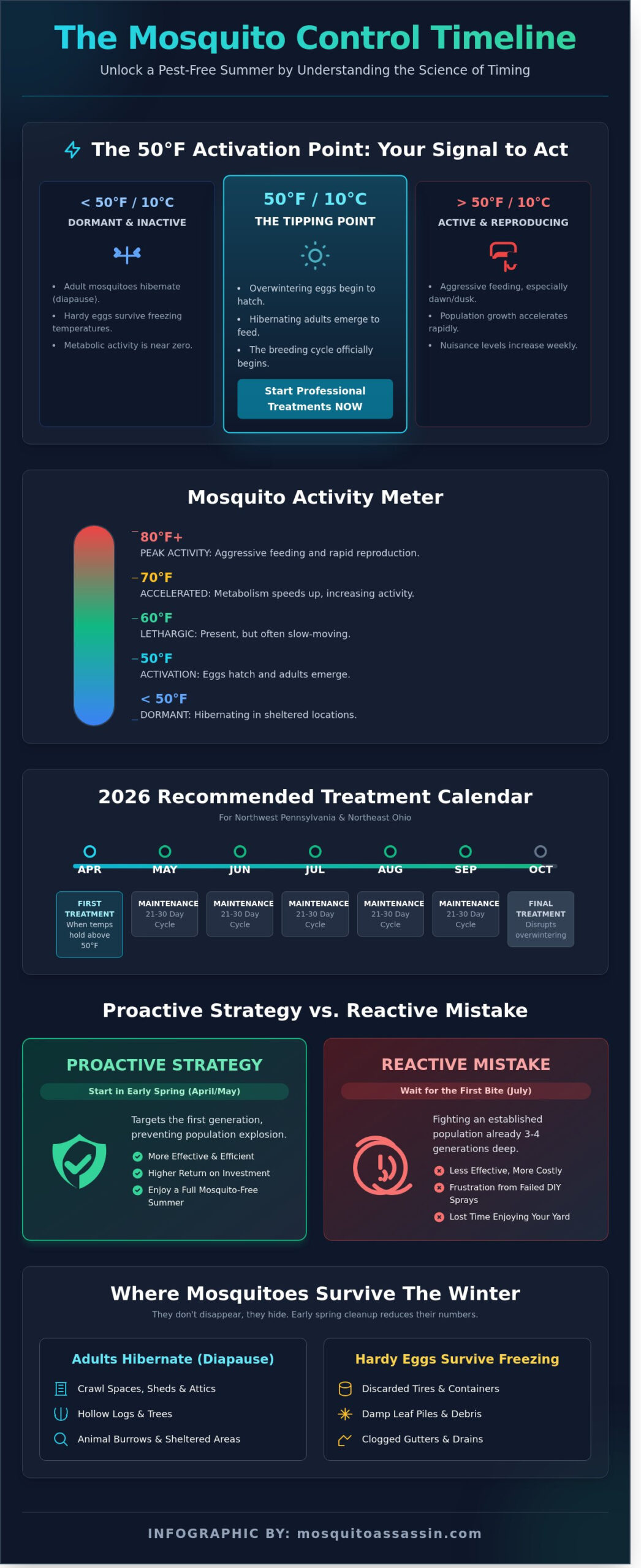
    The local mosquito season typically kicks off in late April and can last well into October. However, the peak of the problem arrives in July and August, when summer heat and oppressive humidity accelerate their breeding cycles. A mild winter or an unusually wet spring can give them a significant head start, leading to larger populations earlier in the year. This combination of a long season and ideal peak conditions is a key part of the answer to why mosquitoes are worse in NW PA, demanding a professional and season-long approach to protection for your family and property.

    The Water Factor: Why Lake Erie and Our Wetlands Are Breeding Grounds

    If you’ve ever felt like you’re in a constant battle with mosquitoes, you’re not imagining it. One of the primary reasons why mosquitoes are worse in NW PA is our unique and powerful relationship with water. From the vast expanse of Lake Erie to the smallest puddle in your yard, our region is a five-star resort for these biting pests, providing the two things they need most to thrive: humidity and breeding grounds.

    Lake Effect Humidity: A Mosquito’s Best Friend

    Mosquitoes are fragile insects that can quickly dry out and die in arid conditions. Our proximity to Lake Erie creates a constant, high level of humidity, especially during the warm summer months. This moist air acts like a protective blanket, allowing mosquitoes to conserve energy, fly further, and hunt for longer periods without the risk of dehydration. It’s why those beautiful summer evenings near the water often come with a swarm of unwelcome guests.

    Our Water-Rich Landscape: A Legacy of Glaciers

    The very ground beneath our feet was shaped by ancient glaciers that carved out our landscape, leaving behind a network of wetlands, ponds, and slow-moving streams. This geological history has blessed us with stunning natural areas like Presque Isle State Park and Conneaut Marsh, but it has also created countless permanent, large-scale mosquito factories. Unlike drier regions, our water-rich environment ensures mosquitoes always have a place to lay their eggs.

    From Marshes to Your Yard: Hidden Water Sources

    While we can’t drain the region’s marshes, the fight against mosquitoes extends directly to your property. The same principles apply on a micro-scale, and your yard can be an even more productive breeding ground than a natural wetland. Eliminating these hidden water sources is crucial; in fact, this strategy is a cornerstone of Pennsylvania’s mosquito control program for reducing pest populations statewide. Be on the lookout for common culprits where water collects:

    • Clogged gutters and downspouts
    • Stagnant water in birdbaths or plant saucers
    • Children’s toys, wagons, or pools left outside
    • Tarps, buckets, or wheelbarrows
    • Old tires or discarded containers

    It’s a startling fact: a female mosquito only needs a bottlecap’s worth of standing water to lay hundreds of eggs. This abundance of micro-habitats, combined with our larger wetlands, creates a perfect storm that explains why mosquitoes are worse in NW PA, turning entire neighborhoods into ideal breeding zones.

    Climate & Weather: The Engine of the Mosquito Population

    Northwest Pennsylvania’s geography gives us beautiful seasons, but our specific weather patterns are also a primary reason why mosquitoes are worse in NW PA. The cycle of heavy spring rains followed by hot, humid summers creates the perfect storm for an explosive mosquito population. A single intense thunderstorm can leave behind millions of new, tiny pools of water-in clogged gutters, forgotten toys, and uneven lawns-turning your property into an ideal breeding ground overnight.

    The Life Cycle on Fast-Forward: Rain + Heat = Explosion

    Mosquitoes go through four distinct life stages: egg, larva, pupa, and adult. In cooler weather, this process can take several weeks. However, when NW PA’s summer heat arrives, the game changes. As detailed by experts on the mosquito species in Pennsylvania at Penn State Extension, warmer water temperatures drastically accelerate this development. A life cycle that once took weeks can be compressed into as little as 4 to 7 days. This is why a sudden heatwave after a rainstorm results in a massive, seemingly overnight surge of biting adults.

    Health Risks: West Nile Virus in Pennsylvania

    While most mosquito bites are merely an itchy nuisance, it’s a serious matter that some can transmit diseases. In our state, the most common mosquito-borne illness is West Nile Virus. While the risk of severe illness is low for most people, the presence of the virus is a documented reality in Pennsylvania. Proactively reducing mosquito populations on your property isn’t just about comfort; it’s a crucial public health measure to safeguard your family and community from potential health risks.

    How Climate Change May Worsen the Problem

    Emerging climate trends suggest that our mosquito season may be getting longer. Warmer temperatures arriving earlier in the spring and lasting later into the fall could extend the breeding season for these pests. This scientific reality is another factor explaining why mosquitoes can feel worse now than in years past. It underscores the need for a consistent, professional control strategy rather than a one-time fix, ensuring your yard remains protected season after season.

    This combination of ideal weather, accelerated life cycles, and a potentially lengthening season makes professional mosquito control more critical than ever. A proactive strategy is the only reliable way to disrupt this cycle and safeguard your outdoor living spaces.

    Reclaiming Your Yard: Why Professional Control is Essential in NW PA

    When you understand why mosquitoes are worse in NW PA, it becomes clear why standard DIY solutions often fail. The sheer scale of the problem, fueled by our region’s unique geography and climate, can quickly overwhelm store-bought fixes. Citronella candles offer a tiny, temporary shield, bug zappers kill more beneficial insects than mosquitoes, and sprays provide only fleeting relief. To truly safeguard your family and enjoy your property, you need a strategic, professional approach that attacks the problem at its source.

    The Mosquito Assassin Difference: A Local Team

    You need a team that knows the local terrain. Our licensed technicians aren’t just experts; they’re your neighbors who live and work in the same communities from Erie to Meadville. This firsthand knowledge allows us to identify specific problem areas unique to our region. Learn more about our commitment to the community on our about page.

    Our Proven Process for Mosquito Elimination

    We don’t just spray and pray. Our proven eradication process is a comprehensive strategy designed for maximum effectiveness and long-lasting results. We attack mosquitoes at every stage of their lifecycle:

    • Thorough Inspection: We identify and address all potential breeding grounds on your property, from clogged gutters to hidden water collection spots.
    • Family-Safe Barrier Treatment: We apply a professional-grade treatment that targets adult mosquitoes where they rest, creating a protective barrier around your yard.
    • Targeted Larvicide Application: We stop the next generation in its tracks by treating standing water with larvicides, disrupting the mosquito lifecycle before they can hatch.

    Comprehensive Pest Solutions for Your Home or Business

    A truly enjoyable yard is free of all nuisance pests. Beyond mosquitoes, our expertise extends to safeguarding your property from other threats. The same conditions that explain why mosquitoes are worse in NW PA can also lead to other pest issues. Our comprehensive pest control services provide guaranteed protection against ticks, wasps, ants, and more, ensuring complete peace of mind for your home or business.

    Don’t let pests win the battle for your backyard. Contact Mosquito Assassin today and let our local experts deliver the pest-free results you deserve.

    Don’t Let Mosquitoes Win: Your NW PA Solution

    It’s clear you’re not just imagining it-the relentless mosquito problem in our region is very real. The combination of abundant standing water from our wetlands and Lake Erie, coupled with our specific weather patterns, creates a perfect storm for breeding. This unique environment is exactly why mosquitoes are worse in NW PA than in many other places. But while you can’t change our local geography, you can absolutely reclaim your own backyard.

    Fighting this seasonal onslaught requires professional expertise. As a Locally Owned and Operated team right here in NW PA, Mosquito Assassin understands the specific challenges our communities face. Our five-star rated service is designed to eliminate these pests effectively and safely. We stand by our work with a powerful Pest-Free Guarantee: If pests return, so do we.

    Tired of the swarm? Don’t spend another summer hiding indoors. Take back your yard with a free estimate from Mosquito Assassin! Enjoy the peace of mind that comes with a professional, local solution.

    Frequently Asked Questions About NW PA Mosquitoes

    What is the most effective way to reduce mosquitoes in my own yard?

    The most effective strategy combines proactive yard maintenance with professional treatment. Start by eliminating all standing water where mosquitoes breed-check clogged gutters, flower pots, birdbaths, and tarps. For complete eradication, a professional barrier spray from Mosquito Assassin is the definitive solution. Our proven process targets adult mosquitoes where they rest in shrubs and under decks, creating a reliable zone of protection for your family.

    Are professional mosquito treatments from Mosquito Assassin safe for my children and pets?

    Absolutely. Your family’s safety is our top priority. We use a professional-grade treatment that is safe for people and pets once it has completely dried. We simply ask that you and your pets remain indoors during the application and for about 30 minutes afterward. Once the product has bonded to the foliage, you can go back to enjoying your yard with peace of mind, knowing your loved ones are protected.

    How often is professional mosquito treatment needed during a typical Erie summer?

    For consistent protection throughout the peak mosquito season in Erie and the surrounding areas, we recommend treatments every 21 days. This schedule is specifically designed to break the mosquito life cycle and maintain a powerful barrier around your property. This regular service is crucial for enjoying an uninterrupted, bite-free summer, especially considering the conditions that make mosquito populations so persistent in our region.

    Besides West Nile Virus, are there other mosquito-borne diseases I should be aware of in Pennsylvania?

    Yes. While West Nile Virus is the most widely known, Pennsylvania has also seen cases of other mosquito-borne illnesses like La Crosse encephalitis and Eastern Equine Encephalitis (EEE). Although these are less common, they can be serious. Proactive, professional mosquito control is the most effective defense for safeguarding your family against these potential health threats by drastically reducing the number of biting mosquitoes on your property.

    Does living right next to a creek or wooded area mean I can never get rid of mosquitoes?

    Not at all. While living near water or woods explains why mosquitoes are worse in NW PA for many homeowners, it doesn’t mean you have to surrender your yard. Our powerful barrier treatment is designed for these high-pressure situations. We create a protective zone that eliminates mosquitoes on contact and repels new ones from entering. This allows you to reclaim your outdoor living space, regardless of your property’s proximity to a major breeding ground.

    Can you treat my property if it’s near Presque Isle State Park or other conservation areas?

    Yes. Our licensed and certified technicians are expertly trained to apply treatments responsibly, even near sensitive areas like Presque Isle. We strictly adhere to all state and local regulations, using targeted application methods that focus only on your property’s foliage and mosquito resting spots. This ensures maximum protection for your family while respecting the beautiful natural environment that makes our community special.