Tag: exterminator services

  • Choosing Between a Local Exterminator and a National Pest Service

    Choosing Between a Local Exterminator and a National Pest Service

    When comparing a local exterminator vs national pest service, neither option is automatically better. The right fit depends on your pest problem, property, and service needs. Local companies may know regional pest patterns, while national providers often use standardized plans. The inspection, treatment approach, and follow-up matter more than company size.

    It’s reasonable to look beyond the first appointment. This comparison explains how local and national pest services can differ in plans, treatment methods, technician continuity, pest expertise, and response times, and what to weigh for your situation.

    You’ll also learn what to look for in a service agreement and how to assess whether a provider’s approach suits your property. Focus on service details and follow-up, not just the company’s size.

    Key Takeaways

    • Compare plan terms and cancellation rules to understand how much flexibility each service provides.
    • Look for a treatment approach that accounts for the pest, the property, and prevention, not just a standard visit.
    • Consider whether technician continuity and service routes support clear follow-up over time.
    • Local knowledge and national systems can each be useful; the better fit depends on your pest concerns and service priorities.
    • Use the decision guide to weigh response needs and explore which pest control services fit your situation.

    Contracts, cancellation, and month-to-month plans

    A service plan may cover recurring visits, a one-time inspection, or treatment for a specific pest. Don’t assume local providers or national services use the same contract terms. Before scheduling, review the written agreement: note its term, visit schedule, covered pests, follow-up conditions, renewal process, and cancellation procedure.

    “Month-to-month” describes a billing or service arrangement, but not every cancellation condition. Check the agreement for required notice, how to cancel, and whether scheduled visits continue during a notice period. A plan might renew automatically, for example, while cancellation instructions appear in another section. The agreement defines the commitment.

    Use the same checklist to compare local and national pest services. Note whether visits are recurring or prompted by a reported pest issue, and whether follow-up is included. Then find out what happens if pests return between visits. Clear written terms distinguish ongoing prevention from a one-time treatment.

    Ask how the treatment plan uses nonchemical measures and avoids unnecessary pesticide use. A provider might discuss sanitation, exclusion, or monitoring alongside targeted treatment. Humane, environmentally conscious pest control depends on the approach for the specific pest and property, not a broad label. Before agreeing to recurring service, ask how treatment and prevention will work.

    Licensing and certification are separate from contract flexibility. Ask about the business’s and assigned technician’s applicable credentials, what each covers, and who will perform the treatment. Certification can indicate specific training, but it doesn’t replace a clear scope of work or explain what a plan includes.

    National pest-control companies often use standardized plans for broad coverage, while local providers may tailor service to regional pest patterns. Neither model alone determines the right fit. Compare the pests covered, inspection process, prevention measures, visit structure, and cancellation terms. A local provider’s familiarity may be useful, while a national company’s defined plan may suit someone who values consistent procedures.

    Option Contract term Cancellation Plan details
    Local provider Review the written term Follow the agreement’s process Compare local pest coverage and visit schedule
    National provider Review the written term Follow the agreement’s process Compare standardized plan scope and follow-up

    Choose an agreement that matches the pest problem, explains recurring visits and follow-up, and sets out clear cancellation terms.

    Mosquito Assassin Pest Control LLC offers month-to-month recurring plans that can be canceled anytime. Those terms give shoppers specific details to compare with other plans’ cancellation processes and monthly costs. Before choosing, confirm which services are covered and how visits are scheduled, since those details determine whether a plan suits the property’s needs.

    Inspection, treatment, and prevention process

    A sound pest-control process connects inspection findings to targeted treatment and prevention. Compare how a provider identifies the pest, explains the plan, and determines follow-up needs.

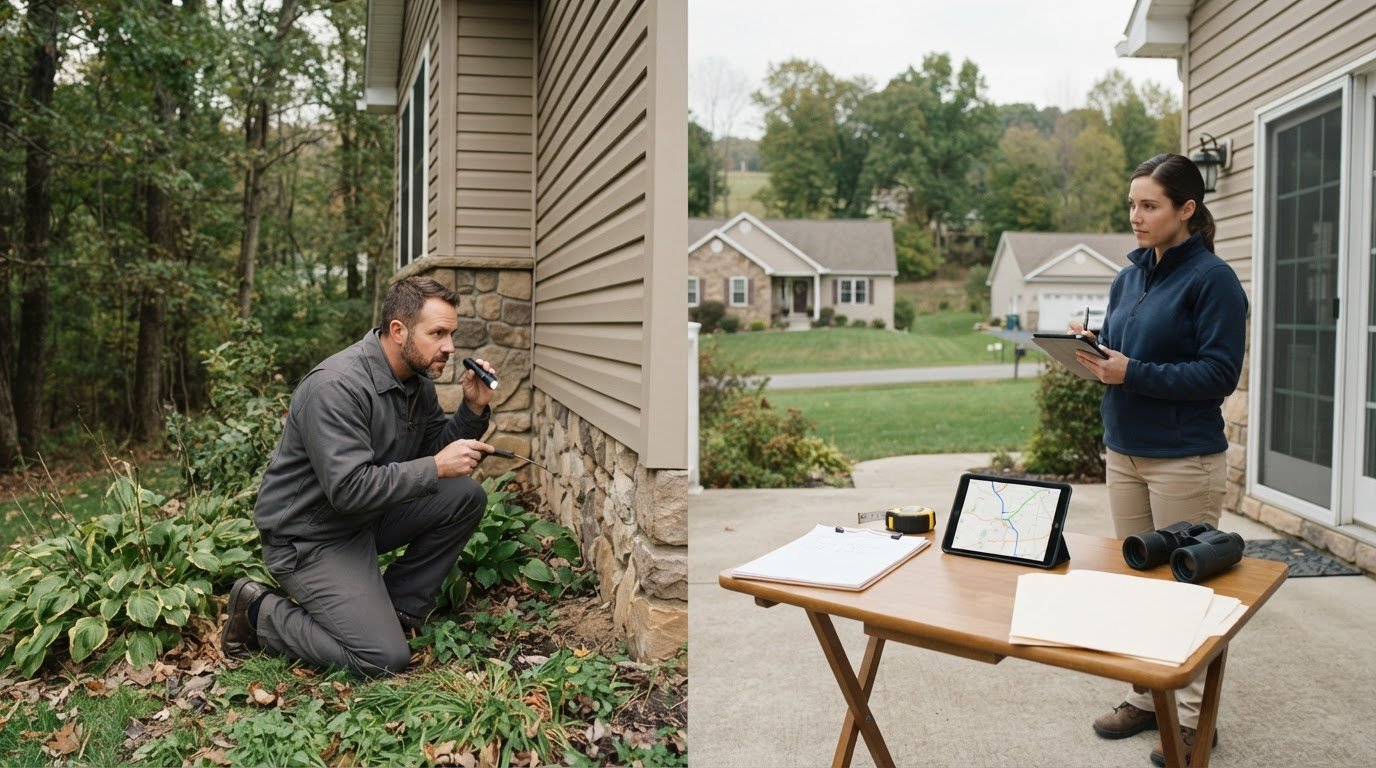
    An inspection should identify the pest, its activity, and conditions that may support it. Ant evidence near a kitchen, for example, differs from signs of rodents in an attic. Findings should shape the treatment plan rather than trigger the same response to every report. Ask which pest is being targeted, where treatment will occur, and what prevention measures are recommended.

    Termite decisions also depend on identification. Subterranean and drywood termites live in different places, so inspection findings affect the treatment approach. A professional assessment should connect the suspected species, visible evidence, and property conditions to the recommended next step. Termite inspections and treatment address this focused concern, while a general pest plan may cover a broader range of common pests.

    Family- and Pet-Conscious Treatments

    Treatment planning that considers families and pets takes into account who uses the space and how. Tell the technician about pets, children, and areas needing special attention before treatment. Ask which areas are included, what precautions apply, and when normal access can resume. This helps shape a plan for your household, rather than focusing only on the pest or treatment method.

    Personalized Treatment Plans

    A personalized plan links inspection results to the pest, its location, and conditions around the property. A bed bug concern, for example, needs a different service scope from recurring ants near entry points. Recommendations may also reflect observed regional conditions. Compare the inspection findings with the proposed treatments and prevention steps.

    Pest coverage should be explicit. A provider may handle ants, rodents, bed bugs, and termites, but the plan determines which are included. Don’t infer coverage from company size or a general pest-control label. Match the named pest to the written service scope, and distinguish routine prevention from specialized treatment. This makes comparisons more useful than relying on a broad list of possible pests.

    A guarantee is meaningful only if its terms explain what qualifies for follow-up, which pests are covered, and whether conditions apply. Review those details alongside the inspection report and treatment scope. A strong process explains its findings, connects treatments to the identified pest, and clearly outlines prevention and follow-up.

    For severe infestations, one response is heat treatment, which raises a room’s temperature to over 120°F for several hours. Ask the provider to explain whether this option fits the inspection findings and what parts of the room or property the treatment would involve. The recommendation should be tied to the identified pest and severity, not presented as an automatic substitute for a targeted plan.

    Before agreeing, clarify what to move or protect, how access will be managed during treatment, and what follow-up to expect. Keep the explanation with the written scope so you can compare the proposed method with the findings and prevention measures. If heat isn’t recommended, ask which alternative addresses the same evidence.

    Choosing Between a Local Exterminator and a National Pest Service

    Technician consistency and service routes

    Warranties, retreatments, and service guarantees depend on the written plan, not simply company size. Compare what qualifies for a return visit, which pests are covered, and whether a separate charge applies.

    Technician continuity can help service notes carry from one visit to the next. A returning technician may recognize where roaches appeared, which entry points were discussed, and which methods were used. A different technician can also work from clear records. Compare how each company documents findings, shares visit notes, and follows up on an active infestation.

    Local and national providers organize routes differently, so don’t assume either model guarantees the same technician each time. Ask how appointments are assigned and whether technicians can review earlier service records. If a technician treated a kitchen and basement on a prior visit, for example, the notes should identify those areas and any changes reported. That continuity can make follow-up more focused.

    Orkin availability depends on whether the address and requested pest service fall within its service area. Use the company’s address lookup or service-area information to check coverage for the property, rather than relying on a broad regional label. Local pest-control providers also have defined service areas. Confirm that the property is covered before comparing appointment options.

    Service-area claims matter most when they cover the actual community, not just a nearby region. If you’re in Erie or Crawford County, Pennsylvania, or Ashtabula County, Ohio, compare coverage for your address and the pest service needed. Coverage in one community doesn’t establish availability in another, even if both are described as part of the same wider area.

    Service agreements also determine what happens after a technician leaves. Compare visit frequency, pest coverage, cancellation terms, and retreatment conditions. If roach activity continues, the agreement sets out how follow-up works. Check whether it explains how to report renewed activity and what information the company records about the visit.

    To check availability efficiently, have the property address and pest concern ready when arranging service. Then compare the appointment options, service scope, and whether the company serves that address. Keep the pest description and any prior treatment details together as a useful source for scheduling. This makes comparing local and national routes more practical than relying on general service-area claims.

    Judge service routes by clarity, not assumptions about company size. Clear records, defined follow-up terms, and coverage for the property explain how recurring visits will work. Choose the agreement that describes how future visits are arranged, how technicians access service history, and what happens if the infestation continues.

    Local provider expertise versus a national franchise

    Local and national providers can both deliver effective pest control. Compare pest-specific expertise, treatment consistency, and how well the service fits your property and region.

    Local Companies and National Chains

    A local company may understand recurring pest patterns in its service area, such as seasonal ant activity or rodents entering buildings. National chains often use standardized plans designed for broader coverage. The key is how each provider applies its methods to your property. Ask how inspection findings, pest behavior, and likely entry points shape the recommended protection.

    Local knowledge matters most when it informs a practical plan. A technician familiar with Erie County homes, for example, may recognize common property conditions that contribute to pest access. National procedures can provide a consistent framework across locations. Compare the actual inspection and prevention recommendations, not just the provider’s size.

    When a National Provider Fits

    A national provider may suit households that value standardized procedures across multiple properties or locations. A business managing sites in different regions, for example, may prefer one service framework and consistent records. Orkin’s national presence may be relevant if its service area covers the property and its plan addresses the pest concern.

    Local expertise may be more useful when regional pest patterns shape the problem. Either way, compare scheduling, visit documentation, and whether the plan addresses your property’s specific entry points. Consistent methods help only when they suit the infestation and site conditions.

    Orkin’s National-Brand Strengths

    Orkin’s national-brand strength is its standardized service structure. National chains commonly use plans intended for broad use, which can make procedures more consistent. That framework may help customers understand what visits cover and how records are organized. It doesn’t replace pest-specific inspection or show, by itself, how well a plan suits a particular home.

    Effective pest control depends on a sound strategy and proper application, not just a product’s brand name. Compare Orkin’s proposed methods with the inspection findings and prevention steps. A clear explanation of how particular treatments address the identified pest is more useful than a broad promise of protection.

    Customer Reviews of Orkin and Local Providers

    Reviews for Orkin and local exterminators vary by location, technician, and pest problem. To compare feedback in your area, focus on comments about the same service, such as rodent control or bed bug treatment, and note whether reviewers mention clear explanations and follow-up.

    Reviews can reveal recurring themes, but they don’t establish which provider is best for every property. Compare comments about communication, scheduling, and visit consistency, then weigh them against the written treatment scope.

    For termites, bed bugs, and rodents, neither a local provider nor Orkin is automatically better. Compare experience with the specific pest and the proposed treatment plan. Wildlife is a separate service category, so don’t assume a general pest-control plan includes wildlife removal.

    Use a practical comparison: match the pest to the provider’s stated expertise, see how inspection findings guide treatment, and check whether prevention addresses entry points. For properties in Erie or Crawford County, Pennsylvania, and Ashtabula County, Ohio, local familiarity may add useful context, while national procedures may suit readers seeking a standardized approach.

    Response times and technician consistency

    Response time partly depends on where a company’s technicians and service routes are based. Local pest-control companies may respond faster because they work within smaller service areas, while Orkin’s coverage can span broader regions.

    For a new infestation, the next available appointment matters, but so does what happens afterward. Compare the scheduling process, how the technician records findings, and whether follow-up visits can build on those records. Notes about activity near a foundation or a gap around a doorway, for example, can help the next technician understand what was observed before.

    Technician consistency isn’t only about seeing the same person each visit. Clear records preserve useful knowledge when routes or personnel change. A service history should identify inspected areas, reported pest activity, and methods used. Without those details, a technician may have less context when assessing whether activity has changed since the previous visit.

    Orkin technician training is another comparison point, but a company name alone doesn’t explain a technician’s knowledge of a specific pest or property. Relevant knowledge includes identifying signs of activity, explaining the treatment plan, and recognizing conditions that allow pest access. A technician assessing rodents, for instance, should consider reported activity and possible entry points, not just the room where evidence was found.

    Local and national providers may differ in route design and scheduling systems. A smaller service area may make local appointments easier to coordinate, while a national operation may use established processes across many locations. Neither structure guarantees a particular response time. Compare how each provider handles the address, pest concern, and follow-up needs in the service area.

    Written quotes also clarify what a proposed visit covers. Compare the inspection scope, target pest, treatment areas, and any stated follow-up conditions. A quote that gives only a general service description is less useful than one that identifies the concern, such as rodent activity near a foundation or insects entering through specific gaps.

    Before choosing, note the earliest appointment offered, how the technician explains the pest issue, and how service records support later visits. Then consider whether the plan addresses likely access points and barriers. These details matter more than assuming a local or national provider will always arrive sooner or offer greater technician continuity.

    For an active infestation, professional pest control can help assess the source and appropriate response. Compare scheduling and follow-up for your specific property, not by making broad assumptions about company size.

    Mosquito Assassin Pest Control LLC: General Pest Control Plans

    Mosquito Assassin Pest Control LLC offers General Pest Control Plans for households seeking ongoing attention to common pest concerns. Its services also include Rodent Control Service and Bed Bug Treatment. The right option depends on the pest and property conditions, so identifying the concern helps clarify what professional support may fit.

    Mosquito Assassin Pest Control LLC serves Erie and Crawford Counties in Pennsylvania and Ashtabula County in Ohio. If your property is in one of these areas and pest activity is affecting your home, contact the company to discuss your needs and a suitable next step.

    Make Your Next Pest Control Decision With Confidence

    The local-exterminator-versus-Orkin decision is more useful when it reflects your property and priorities. Before choosing, note the pest concern, where you’ve noticed activity, and what you need from ongoing service. This gives the conversation a practical starting point and helps keep recommendations focused on your situation.

    For homeowners in Erie and Crawford Counties in Pennsylvania or Ashtabula County in Ohio, Mosquito Assassin Pest Control LLC is a local option for discussing pest concerns. Contact Mosquito Assassin Pest Control LLC to talk through your needs and determine a suitable next step.

    A clear conversation can help you move from comparing names to addressing the problem. When you’re ready, contact Mosquito Assassin Pest Control LLC to discuss your pest concern and next steps.

    Disclaimer: This blog provides general information, not professional pest-control advice. Conditions vary by property, environment, and location. Reading this content does not create a service agreement. For an inspection or professional recommendations, contact Mosquito Assassin Pest Control LLC.

    Frequently Asked Questions

    How can I verify a local exterminator’s license, insurance, and certifications?

    Ask the company for its business and technician license details, proof of insurance, and the exact name of each certification. Verify the details with the issuing agency or organization, and confirm the documents identify the business or technician handling your service. Check that each credential applies to the pest-control work being discussed. Keep the information with your service records for reference if questions arise.
  • Bed Bug Treatment: Compare Service Scope, Process, and Follow-Up

    Bed Bug Treatment: Compare Service Scope, Process, and Follow-Up

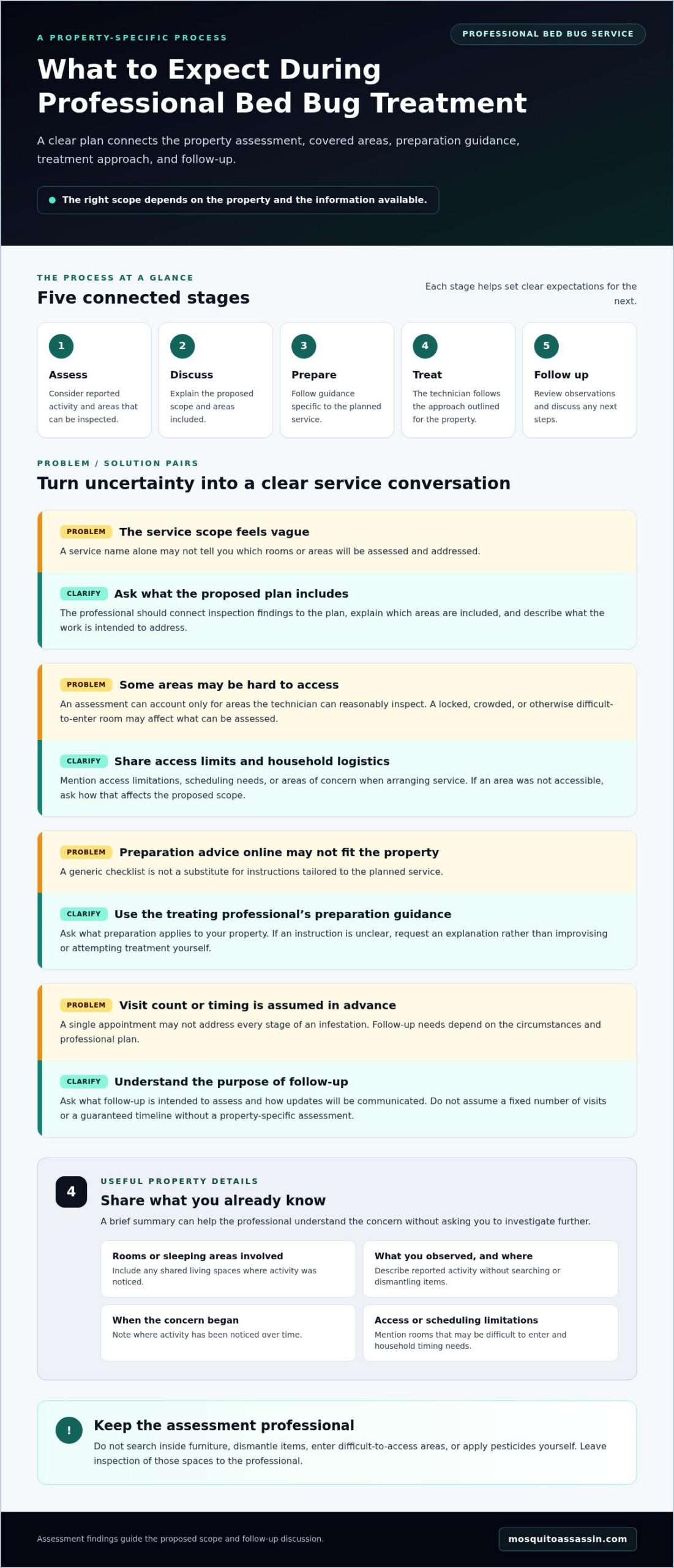
    People searching for professional bed bug treatment cost often want to know what a comprehensive service includes, not just what an appointment is called. A useful comparison starts with the property-specific scope: what will be assessed, which areas are included, what preparation is expected, and how follow-up will be handled. One appointment may not address every stage of an infestation, so follow-up expectations matter as much as the initial service.

    A thorough assessment considers reported activity, the areas that can be inspected, and how far the concern may have spread. The professional should explain how those details inform the proposed treatment plan. Property conditions differ, so the same service scope or visit schedule should not be assumed for every home.

    This article explains the stages of professional bed bug service and the details that can help you compare proposals. You’ll learn what to discuss about inspection, preparation, treatment methods, and follow-up, as well as what property information can help a professional assess the situation. Mosquito Assassin Pest Control LLC provides Bed Bug Treatment in Erie and Crawford Counties in Pennsylvania and Ashtabula County in Ohio.

    Key Takeaways

    • A property-specific assessment helps define which areas need attention and what the treatment plan should address.
    • Compare proposals by their inspection scope, covered areas, preparation guidance, follow-up, and communication.
    • Follow the treating professional’s preparation instructions and share relevant details about the property and reported activity.
    • Follow-up expectations matter because the treatment process may involve more than one visit.
    • Mosquito Assassin provides Bed Bug Treatment in Erie and Crawford Counties, Pennsylvania, and Ashtabula County, Ohio.

    Bed Bug Treatment: Why the Service Scope Depends on the Property

    A bed bug concern can make it difficult to know what to expect next. A clear service plan should explain which areas will be assessed, the treatment approach under consideration, any preparation guidance, and how follow-up communication will work. The appropriate scope depends on the property and the information available, not on a one-size-fits-all assumption.

    Property layout, access to rooms, and reported activity can all shape an inspection and the proposed plan. Only an assessment of the individual property can evaluate those details. An online article can help you prepare useful information, but it cannot confirm an infestation, assess its extent, or determine the treatment a particular home needs.

    Which property details help clarify a bed bug treatment plan?

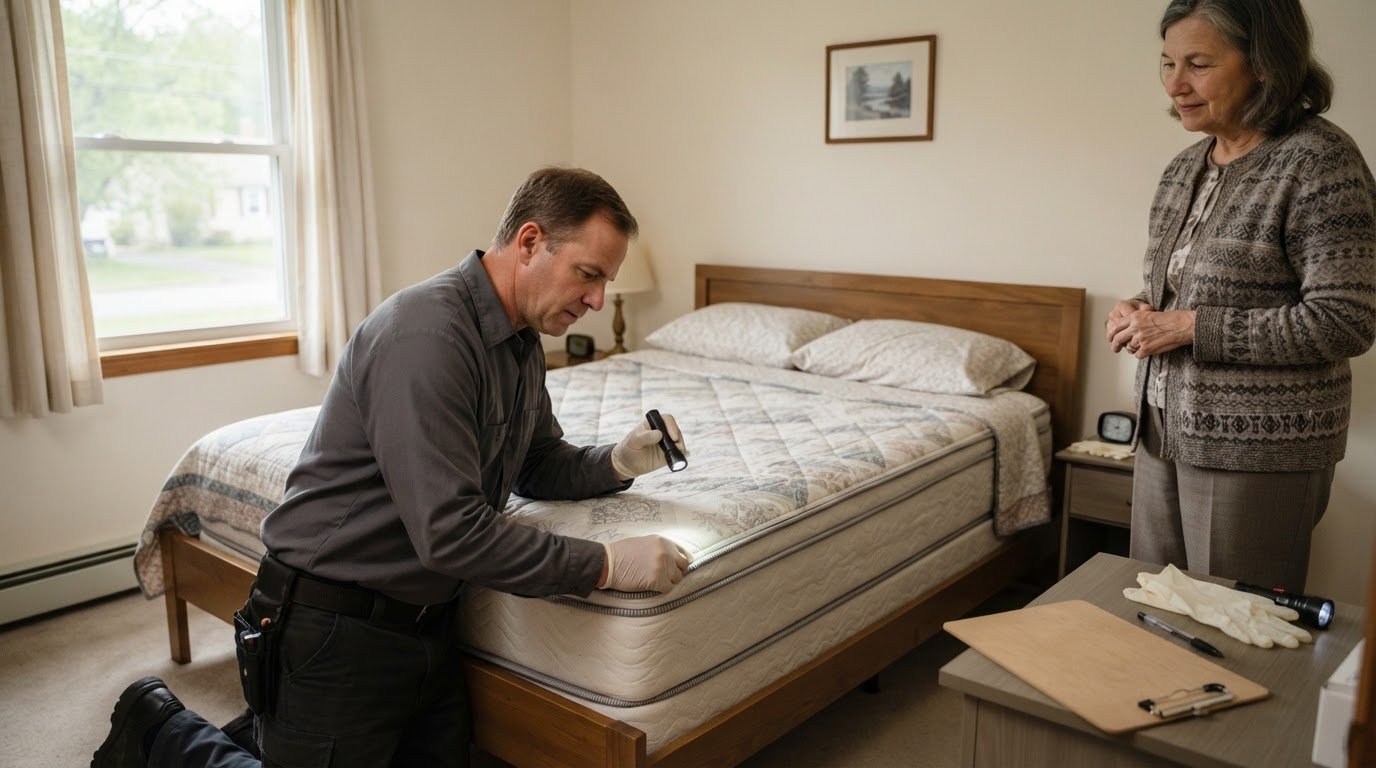
    Share which rooms or sleeping areas are involved and whether activity has been noticed in shared living spaces, such as a sitting room. Describe what you observed and where. Don’t search inside furniture, dismantle items, or enter difficult-to-access areas. Leave inspection of those spaces to the professional.

    Access matters because an assessment can account only for areas the technician can reasonably inspect. If a room is locked, crowded, or otherwise difficult to enter, mention that when arranging the visit so it can be discussed. Note when the concern began and where activity has been noticed over time. A brief record of these observations can help explain the situation without requiring you to investigate further.

    Why infestation severity and service frequency are assessed

    Reported activity gives the professional a starting point, while inspection findings help define the relevant service scope. The locations involved, conditions observed, and areas that can be accessed all inform the discussion. A single detail, such as the number of rooms in a home, does not establish the same plan for every property.

    Follow-up needs also depend on the circumstances and the professional plan. Ask for an explanation of what follow-up is intended to assess and how updates will be communicated. Don’t assume a fixed visit count or timeline without a property-specific assessment.

    Different plans may combine treatment approaches, so it can help to understand the options at a general level. The Bed bug control techniques overview describes chemical and non-chemical methods. The approach for a property should be based on professional findings and explained as part of the service scope, rather than treated as a universal solution.

    Before an assessment, gather the property details you already know: affected rooms, when concerns began, where activity was observed, and any access limitations. This focused summary helps the professional understand the situation without asking you to inspect further or attempt treatment yourself.

    What Happens During a Professional Bed Bug Treatment Process?

    A professional bed bug treatment plan should set out the areas addressed, preparation expectations, treatment approach, and follow-up communication. Recommendations should connect to what the technician observes and what the resident reports, rather than assume every property needs the same plan.

    In broad terms, service involves assessment, discussion of the plan, preparation guidance, treatment, and follow-up. These stages work together. A clear conversation before service helps residents understand what is included, what they need to coordinate, and how the professional will review the situation afterward.

    Inspection and discussion of the treatment plan

    An inspection helps identify relevant areas and consider the concerns reported by the resident. After assessing the property, the professional should explain the proposed scope in plain language, including which areas are addressed and what the plan is intended to do. Share access limitations or household scheduling needs early so they can be considered when coordinating service.

    Before proceeding, make sure you understand how the inspection findings connect to the proposed work. If a room or area was not accessible, ask how that affects the scope. Clear answers help prevent different expectations about which parts of the property are included.

    Service, preparation guidance, and follow-up

    Preparation guidance should be specific to the property and come from the treating professional. Don’t rely on a generic online checklist as a substitute for those instructions. The Environmental Protection Agency’s Preparing for Bed Bug Treatment resource offers general background, but the professional’s directions for the planned service should guide household preparation.

    During service, the technician follows the approach outlined for the property. Ask for clarification about instructions you don’t understand, rather than improvising treatment actions or applying pesticides yourself. If household members need to coordinate access or timing, discuss those logistics with the treating professional.

    Follow-up communication provides an opportunity to review new observations, discuss whether the situation has changed, and understand any next steps in the plan. The need for additional service depends on the findings and circumstances, so don’t assume a fixed number of visits or guaranteed timeline. Keep notes about new activity or questions to make that conversation more specific.

    Before the appointment, prepare a short list of questions: which areas are included, what preparation applies to your property, how to share new observations, and how follow-up will be communicated. These questions make the plan easier to understand without trying to diagnose or treat the issue independently.

    Mosquito Assassin Pest Control LLC provides Bed Bug Treatment. For professional information or to discuss an assessment, visit Mosquito Assassin’s contact page.

    How to Compare Bed Bug Treatment Proposals Without Guesswork

    A proposal is easier to assess when it describes the work, not just the service label. Compare what it explicitly covers: what was inspected, which areas are included, what preparation is expected, and how follow-up will be communicated. These details help show whether recommendations reflect findings at the property or rely on assumptions.

    Use this table to identify what each proposal explains and where you may need clarification. The goal is to understand the scope and expectations for your property.

    Proposal detail What to look for Question to clarify
    Inspection scope Areas assessed and findings that informed the plan. How did the findings shape the proposed service?
    Covered areas Rooms or spaces included in the service. Are the areas where activity was reported addressed?
    Preparation guidance Property-specific expectations explained clearly. Which instructions apply to this property?
    Follow-up How progress or continued concerns will be reviewed. How should new observations be shared?
    Communication How the scope, preparation, and next steps will be explained. How will updates about the plan be communicated?

    What should a bed bug treatment proposal explain?

    Look for a clear description of the inspection and the areas included in the proposed service. Preparation expectations and follow-up communication should be easy to understand, rather than left implied by a broad service description.

    A useful proposal also distinguishes known findings from assumptions. For example, it can separate an area where activity was reported or observed from a space included because it may need attention. That distinction helps explain why each area is part of the scope.

    Questions that clarify scope and follow-up

    Ask which inspection findings led to the proposed service and whether any reported areas could not be assessed. If access was limited, ask how that affects the plan. If a proposal uses a general term such as “treatment,” ask which rooms or spaces it covers.

    Clarify how to share new observations and what follow-up communication is planned. These questions help set practical expectations without assuming a fixed visit schedule or a particular outcome.

    For local information, Bed Bug Treatment and other pest services are part of the service context for a property-specific discussion. Clear documentation and communication can make a proposed plan easier to understand and coordinate.

    Bed Bug Treatment: Compare Service Scope, Process, and Follow-Up

    How to Prepare for a Bed Bug Service Without Taking Treatment Into Your Own Hands

    Preparing for a bed bug service is mainly about sharing useful information and coordinating access. You don’t need to diagnose the problem or begin treating it yourself. A clear record of what you’ve noticed, areas that may be difficult to reach, and household scheduling needs can help the treating professional plan the assessment.

    Preparation directions can differ by property and service plan. Follow the instructions provided by the professional treating the property, and ask for clarification before changing household routines or moving belongings. Avoid improvised pesticide use or unverified home-treatment methods, which may complicate the professional’s assessment or planned service.

    What information should homeowners share before service?

    Keep a brief, factual record. Note when concerns were first noticed, where activity has been reported, and which rooms or furnishings may be involved. Include access limitations, such as a crowded room or furniture that is difficult to reach, rather than attempting to inspect or move it yourself. These details help the professional understand what may affect the visit.

    Household schedules matter, too. Mention timing constraints, shared spaces that need coordination, or other practical needs that could affect access. Clear communication helps the treating professional explain what to expect and identify questions to resolve before service.

    • Record when concerns began and where activity has been noticed.
    • Identify rooms or items that may be difficult to access.
    • Share scheduling needs or household coordination concerns.
    • Write down questions about preparation or the planned service.

    Why professional preparation instructions matter

    Instructions are based on the property and the service planned for it. A general online checklist may not fit those conditions, so use the treating professional’s directions as your guide. If an instruction is unclear or difficult to follow, raise that concern before the appointment. The professional can explain how it relates to the service plan.

    Don’t apply pesticides or try unverified home-treatment methods as a substitute for professional guidance. These actions can affect what the technician observes and how the service is coordinated. Keep questions focused on the instructions you received, the areas that need access, and household arrangements.

    Home routines and property conditions can affect scheduling and which areas are accessible. For example, a shared bedroom, a room used for storage, or limited access to furniture may need to be discussed before the visit. Sharing these details early gives the professional a clearer picture without asking you to move items or investigate potential hiding places.

    Use a short note or checklist to keep details together, especially if more than one household member is coordinating the visit. Include new observations if they arise and share them with the treating professional rather than changing the plan yourself. This keeps communication focused and helps ensure property-specific questions are addressed.

    For an inspection or professional recommendations about bed bug concerns, contact Mosquito Assassin Pest Control.

    Finding Bed Bug Treatment Help in Northwestern Pennsylvania and Northeast Ohio

    Mosquito Assassin Pest Control LLC provides Bed Bug Treatment in Erie and Crawford Counties, Pennsylvania, and Ashtabula County, Ohio. A professional assessment can clarify which areas need attention, what the service scope may involve, and what next steps are relevant to the property. Findings vary from one home to another, so an inspection is more useful than trying to infer a treatment plan from general information alone.

    These county service areas cover the company’s local pest control work. When requesting information, have the property location ready along with a brief summary of the concern. That context helps focus the discussion on the property and the reported activity.

    When to seek a professional bed bug assessment

    Consider a professional assessment if concerns persist, activity has been noticed in more than one area, or it is unclear which rooms may be involved. An inspection can help distinguish reported concerns from findings at the property and inform a scope based on those findings. A general article or assumption cannot establish what a particular home requires.

    Share what you’ve observed without trying to confirm the extent of the issue yourself. The professional can assess relevant areas and explain what the findings mean for the service plan. Outcomes and follow-up needs depend on the circumstances, so avoid relying on promises about timing or results.

    What to include when requesting professional recommendations

    A concise summary helps focus the initial discussion. Include the property’s location, when concerns began, where activity has been reported, and any rooms or areas that are difficult to access. Note scheduling or household coordination needs that may affect an inspection. You don’t need to investigate hard-to-reach spaces before sharing these details.

    Keep the information factual. Distinguish between activity you directly observed and an area you’re concerned about but haven’t inspected. This helps the professional understand what is known and what may need assessment. If you have questions about access or preparation, include them in your request so they can be addressed as part of the discussion.

    Professional guidance can be useful when affected areas are unclear or observations continue. To discuss an inspection or request professional recommendations, contact Mosquito Assassin Pest Control LLC. Sharing the property location and a short description of the concern is a practical starting point.

    Take the Next Step With Clear Information

    Turn what you’ve observed into a focused conversation about your property. Keep notes handy, including where concerns have arisen and any access or scheduling details that may affect an assessment. This gives the professional a practical starting point for discussing what to evaluate and which next steps may fit the situation.

    To discuss bed bug concerns or request professional recommendations, contact Mosquito Assassin Pest Control LLC. Share what you know about the property and the reported activity. You don’t need to have every detail figured out before starting the conversation.

    Frequently Asked Questions

    How do professionals inspect a home for bed bugs?

    A professional assesses reported activity and relevant areas of the property, then uses those observations to inform the proposed service scope. The assessment may consider how rooms are used and which spaces are accessible, so the process can differ between homes. Share what you’ve noticed and where, but don’t treat a self-check or online guide as a complete inspection. An on-site professional is needed to assess the property.

    Can bed bugs return after professional treatment?

    Discuss continued concerns with the treating professional, who can review the property findings and service plan. Keep notes about what you observe, when it occurs, and which area is involved. For example, note whether an observation is in a different room from the areas previously discussed. These details support a useful, property-specific conversation without assuming the same outcome applies to every home.

    What should a bed bug treatment plan include?

    A useful plan should explain what the professional assessed, which areas the service addresses, and what preparation guidance applies to the property. It should also clarify communication expectations and how follow-up concerns will be discussed. Recommendations should reflect findings at that home, rather than rely only on a generic service description. These details help residents understand the proposed work, but no checklist can guarantee a particular outcome.

    Is one professional visit always enough to address bed bugs?

    No single visit schedule applies to every property. Service needs can vary with inspection findings, property conditions, and the scope of the plan. Ask the treating professional how follow-up needs are determined for your situation and what communication to expect after service. If new information changes the plan, request an explanation of what prompted the change and how it affects the next steps.

    What happens if bed bug concerns continue after service?

    Document new observations and contact the treating professional to discuss them. Note the location, timing, and any difference from what you reported before service. The professional can review the original findings, areas addressed, and follow-up plan to discuss appropriate next steps. A remote description alone can’t establish the cause, so avoid assuming that continued concerns indicate a particular cause or guarantee a specific response.

    Can a professional bed bug treatment plan be tailored to a property?

    Yes. Property layout, reported activity, access, and inspection findings can inform the proposed service scope. For example, the assessment may consider which rooms are accessible and where concerns have been reported. Recommendations should reflect those details rather than assume every home needs identical service. The professional can explain the plan and its basis after assessing the property, rather than relying on general guidance alone.

    Disclaimer: The information provided on this blog is for general informational purposes only and is not intended as professional pest control advice. Conditions vary by property, environment, and location. Reading this content does not create a service agreement. For an inspection or professional recommendations, please contact Mosquito Assassin Pest Control LLC directly.

  • Pest Control Service Guarantee: What Homeowners Should Expect in 2026

    Pest Control Service Guarantee: What Homeowners Should Expect in 2026

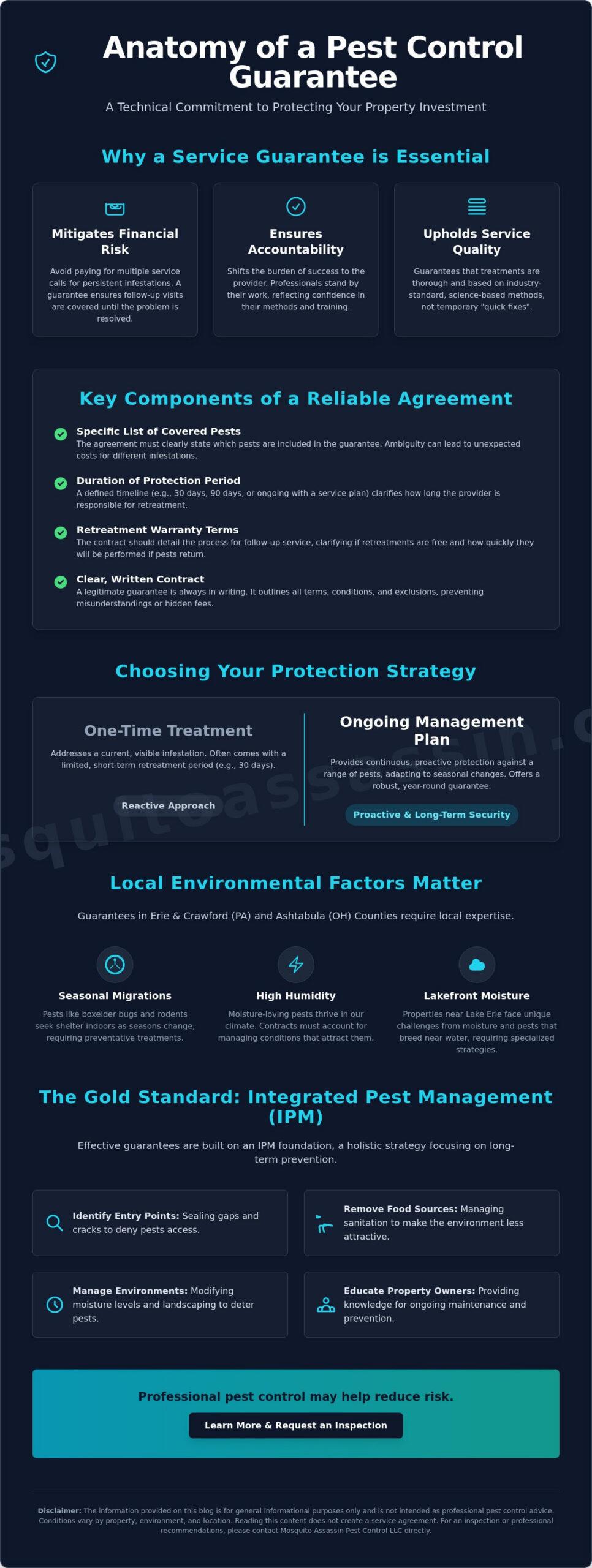
    What if the contract signed after an extermination was actually more powerful than the chemicals used around a property? For many residents in Erie, Crawford, and Ashtabula Counties, the primary concern isn’t just the pests themselves but the risk of wasting money on ineffective treatments that fail to deliver results. A legitimate pest control service guarantee should be viewed as a technical commitment to property protection rather than a vague marketing promise. It provides the necessary assurance that if pests return shortly after a visit, the professional responsibility remains until the infestation is fully addressed.

    Property owners deserve a clear understanding of contract terms to avoid the frustration of hidden fees or recurring infestations. You’ll learn how professional service guarantees protect your property investment and ensure long-term relief from common invaders in 2026. This guide covers what to expect regarding provider accountability, the total elimination of specific pest issues, and how to identify a service agreement that truly prioritizes the security of a household. Professional pest control may help reduce risk when these standards are met.

    Disclaimer: The information provided on this blog is for general informational purposes only and is not intended as professional pest control advice. Conditions vary by property, environment, and location. Reading this content does not create a service agreement. For an inspection or professional recommendations, please contact Mosquito Assassin Pest Control LLC directly.

    Key Takeaways

    • Understand how a professional pest control service guarantee establishes clear accountability and ensures treatments meet industry standards for effectiveness.
    • Learn the differences between retreatment warranties and satisfaction periods to ensure you receive follow-up care if pests persist.
    • Discover why local environmental factors in Erie, Crawford, and Ashtabula Counties require specific contract protections against high humidity and seasonal migrations.
    • Identify the essential components of a reliable service agreement, including the specific list of covered pests and the duration of the protection period.
    • Evaluate why ongoing management plans often provide more robust long-term security compared to one-time reactive treatments.

    Understanding the Value of a Pest Control Service Guarantee

    A pest control service guarantee acts as a formal contract between a property owner and a licensed provider. It signifies that the service isn’t just a one-time transaction but a commitment to a pest-free environment. For residents in Erie and Crawford Counties, where seasonal shifts can trigger sudden infestations, this accountability is vital. It establishes the professional standards that must be met during any intervention, ensuring that the methods used are both thorough and safe for the household. Understanding these standards requires a comprehensive overview of pest control methodologies, which often involve a mix of biological knowledge and precise application techniques.

    To better understand how these assurances work in practice, watch this helpful video:

    One of the most significant benefits of a strong pest control service guarantee is the mitigation of financial risk. Some infestations, like bed bugs or certain rodent species, are notoriously difficult to eradicate in a single visit. Without a clear agreement, homeowners might find themselves paying for multiple service calls without seeing a permanent resolution. A robust guarantee creates a protocol for follow-up visits if pests persist, typically at no additional cost to the client. This shifts the burden of success onto the provider, ensuring they remain accountable for the total elimination of the problem.

    Why Professional Accountability Matters

    Pests don’t follow a schedule. Their behavior is erratic and heavily influenced by moisture levels, local temperature, and structural vulnerabilities. Professional accountability means the provider stands by their work even when nature is unpredictable. It ensures that technicians use science-based methods rather than “quick fixes” that might only mask the problem temporarily. When a provider offers a clear guarantee, it reflects deep confidence in their training and the efficacy of their treatment protocols. It provides peace of mind that the job will be done right, regardless of the complexity of the infestation.

    The Role of Integrated Pest Management (IPM)

    Integrated Pest Management (IPM) is the gold standard in modern pest control. It focuses on long-term prevention by managing the environment to make it less hospitable to invaders. A pest control service guarantee is most effective when it’s part of a broader IPM strategy. This approach includes identifying entry points, removing food sources, and educating the property owner on maintenance. Residents in Ashtabula County, for instance, might need specific advice on managing lakefront moisture to support the success of their plan. Educational resources help residents understand their role in maintaining the conditions necessary for the guarantee to remain in effect.

    Disclaimer: The information provided on this blog is for general informational purposes only and is not intended as professional pest control advice. Conditions vary by property, environment, and location. Reading this content does not create a service agreement. For an inspection or professional recommendations, please contact Mosquito Assassin Pest Control LLC directly.

    Common Types of Pest Control Assurances and Warranties

    Homeowners often face a choice between a quick fix and a long-term strategy. Understanding the nuances of a pest control service guarantee is essential when making this decision. Most professional agreements fall into distinct categories based on the frequency of service and the nature of the pest. For instance, retreatment warranties are the standard for recurring plans. If pests reappear between scheduled visits, the provider returns to address the issue at no extra cost. This differs significantly from satisfaction periods, which typically last between thirty and sixty days and are usually reserved for one-time corrective services.

    When researching how to choose a pest control company, it’s helpful to look for year-round protection plans. These agreements offer continuous coverage for common household invaders. Because pest pressure fluctuates with the seasons in Erie and Crawford Counties, a continuous guarantee ensures that the property remains protected against ants in the spring and rodents in the winter. Specialized warranties are also available for high-stakes pests like termites or bed bugs, where the biological complexity requires a more rigorous follow-up schedule to ensure total removal.

    Retreatment vs. Refund Policies

    A retreatment policy is the industry standard because it focuses on the biological reality of pest management. Pests are living organisms that adapt to their environment; therefore, the goal is persistent intervention until the problem is solved. Refund policies are much rarer and generally only apply to the initial service fee if the provider fails to meet specific contractual obligations. Understanding this distinction helps property owners set realistic expectations. The primary objective is a pest-free home, not just a financial transaction. Professional accountability ensures that the focus remains on the definitive resolution of the infestation.

    Covered Pests and Service Limitations

    Every agreement should include a clearly defined list of covered species. A plan that covers spiders and crickets may not include wood-destroying organisms like termites. It’s also important to recognize that guarantees often have limitations based on property maintenance. For example, a provider might not be able to guarantee results if there are significant structural deficiencies or chronic sanitation issues that provide constant harborage for pests. Reviewing professional pest control plans can help clarify which species are included in a standard agreement. Professional pest control may help reduce risk when these limitations are understood and addressed.

    Disclaimer: The information provided on this blog is for general informational purposes only and is not intended as professional pest control advice. Conditions vary by property, environment, and location. Reading this content does not create a service agreement. For an inspection or professional recommendations, please contact Mosquito Assassin Pest Control LLC directly.

    Pest Control Service Guarantee: What Homeowners Should Expect in 2026

    Evaluating Service Guarantees in Northwest Pennsylvania and Northeast Ohio

    A generic, national guarantee often fails to account for the specific environmental stressors found in the Great Lakes region. In Northwest Pennsylvania and Northeast Ohio, the proximity to Lake Erie creates a microclimate that directly impacts pest behavior and treatment efficacy. A pest control service guarantee is only as strong as the provider’s understanding of these local variables. When high humidity levels persist near the shoreline, certain chemical barriers may degrade faster than they would in a drier, inland environment. Localized expertise allows a provider to adjust their protocols, ensuring that the protection promised in the contract actually holds up against the elements.

    Regional knowledge also extends to the biological traits of local pest populations. In Erie and Ashtabula Counties, certain mosquito and tick populations have shown specific resistance patterns to standard treatments. A provider with deep roots in the community understands these trends and utilizes targeted, science-based interventions that a distant contractor might overlook. This specialized knowledge leads to more accurate and honest guarantee terms. It ensures that the expectations set at the beginning of a service agreement are grounded in the reality of the local ecosystem rather than a corporate template designed for a different climate.

    Seasonal Challenges in Erie and Ashtabula

    The harsh winters characteristic of Northeast Ohio and Western Pennsylvania create a predictable but intense pressure on residential structures. As temperatures drop in Ashtabula, rodents aggressively seek warmth and food, often driving them into crawlspaces and attics. A reliable guarantee for rodent control must include specific provisions for exclusion and monitoring during these peak months. Conversely, the summer months in Erie and Crawford Counties bring significant surges in tick and mosquito activity. The agricultural landscape and rolling terrain of Crawford County create unique corridors for seasonal pest migration from fields to residential structures. Effective intervention during these periods requires a localized strategy that accounts for both the timing of the surge and the specific geography of the property.

    The Importance of Local Expertise

    Technicians who live and work in the same neighborhoods as their clients possess a distinct advantage when identifying vulnerabilities. They are familiar with the common architectural styles of older homes in Erie and the specific structural risks they present for pest entry. This familiarity ensures that the initial treatment is more thorough, reducing the need for the follow-up visits often promised in a pest control service guarantee. Furthermore, local companies are typically more accessible when a retreatment is required. Because they don’t have to dispatch technicians from a distant metropolitan hub, they can honor their service agreements with greater speed and efficiency. Community-based providers rely heavily on their local reputation, which serves as an additional layer of accountability for the homeowner. Professional pest control may help reduce risk when the provider is a trusted neighbor who understands the area’s unique challenges.

    Disclaimer: The information provided on this blog is for general informational purposes only and is not intended as professional pest control advice. Conditions vary by property, environment, and location. Reading this content does not create a service agreement. For an inspection or professional recommendations, please contact Mosquito Assassin Pest Control LLC directly.

    What to Look for in a Professional Service Agreement

    A professional service agreement provides the framework for a reliable pest control service guarantee. It transforms a verbal promise into a technical commitment. Reviewing the contract carefully ensures that the property owner understands the scope of work. Look for a clearly defined list of covered pests. This should include common regional invaders like ants, spiders, and rodents. If a specific species isn’t listed, it’s likely not covered under the standard protection terms. The agreement must also specify the exact duration of the protection period. Whether it’s a thirty-day window for a one-time treatment or a year-round plan, the timeframe should be unambiguous.

    Homeowners should look for a detailed description of how to trigger a follow-up visit. If activity is spotted, the protocol for reporting it should be simple and direct. A professional agreement often includes exclusions based on property maintenance. For instance, if a homeowner fails to seal structural gaps or clear debris as recommended, the provider may not be able to honor the guarantee. These requirements ensure that both parties are working toward a common goal of long-term prevention. Professional pest control may help reduce risk when these contractual expectations are met by both the technician and the client.

    Reading the Fine Print Without the Stress

    Focus on the straightforward language regarding the frequency of scheduled visits. A quarterly plan should detail exactly what happens during each seasonal inspection. Identify any specific requirements for property owners. Sealing entry points or managing moisture levels is often necessary to maintain the efficacy of the treatment. Ensure the agreement includes a clear contact method for reporting new activity. Having a direct line to a local technician in Ashtabula or Crawford County ensures a faster response time when issues arise. You can view professional pest control plans for more details on regional standards.

    Commercial Service Considerations

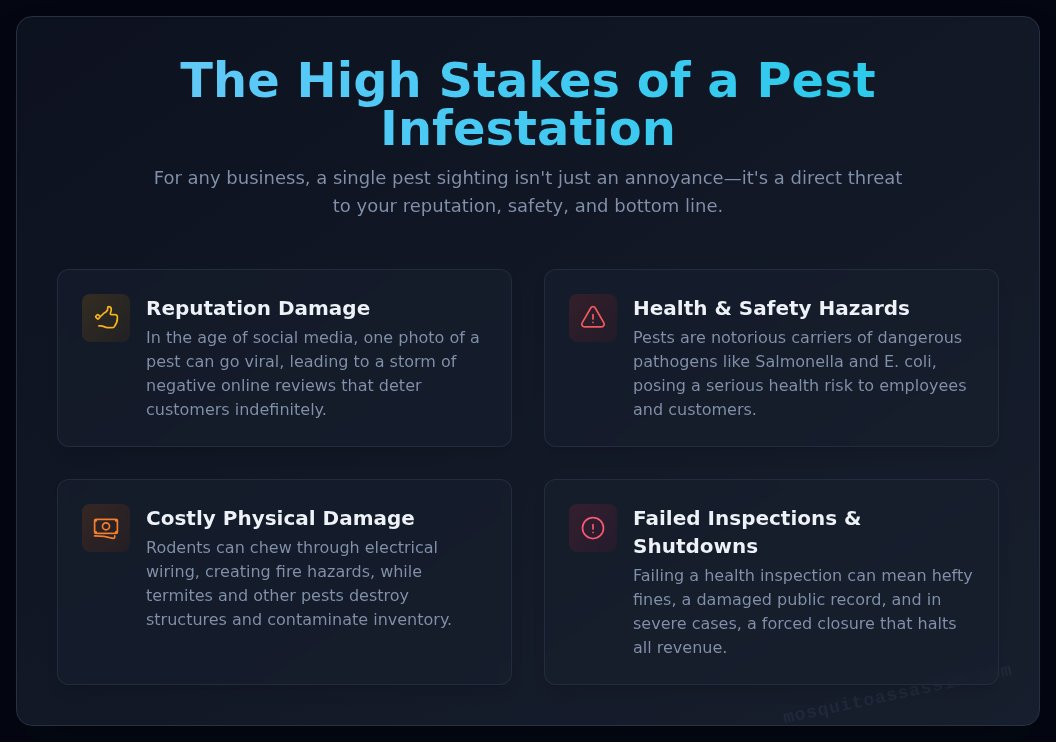
    Businesses in Erie County face different challenges than residential properties. Commercial agreements often require more frequent inspections to maintain guarantees, especially in the food service or hospitality industries. These contracts focus heavily on health code compliance and detailed documentation of every visit. Maintaining a pest-free environment is critical for business reputation and regulatory standing. Learn more about professional commercial services to understand how these specialized agreements support local business operations. Consistent monitoring and professional intervention are the keys to maintaining a healthy commercial environment.

    Disclaimer: The information provided on this blog is for general informational purposes only and is not intended as professional pest control advice. Conditions vary by property, environment, and location. Reading this content does not create a service agreement. For an inspection or professional recommendations, please contact Mosquito Assassin Pest Control LLC directly.

    Long-Term Protection Strategies for Residential and Commercial Properties

    Ongoing management is often more effective than reactive one-time treatments. While a single visit might address an immediate surge in activity, it does not account for the biological cycles of pests that inhabit Northwest Pennsylvania and Northeast Ohio. A year-round protection plan provides a proactive barrier against seasonal migrations. This ensures that a property is fortified before the next wave of activity begins, whether it is the spring emergence of ants or the autumn push of rodents seeking warmth. A pest control service guarantee is most robust when it is part of a continuous, disciplined program rather than a series of disconnected interventions.

    Regular inspections are the cornerstone of a successful long-term strategy. These visits allow for the early detection of wood-destroying insects or rodents, which can cause significant structural damage if left unchecked for months. By identifying these issues in their infancy, property owners can avoid the high costs and stress associated with major infestations. Professional pest control may help reduce risk when implemented as a consistent program. This methodical approach allows technicians to monitor changes in the environment, such as new structural gaps or increased moisture levels, that could invite future problems.

    The Benefits of Recurring Protection

    Consistent monitoring ensures that small issues don’t escalate into crises. When a technician visits a property regularly in Erie or Crawford County, they become familiar with its specific vulnerabilities. This historical knowledge makes the pest control service guarantee more effective because the provider can anticipate problems based on past activity. Recurring plans often provide the most comprehensive guarantee terms for homeowners. They cover a wider range of pests and include scheduled preventative maintenance that one-time services lack. Explore this general pest control guide for more details on how these programs function.

    Taking the Next Step Toward a Pest-Free Property

    Professional recommendations are essential for identifying the specific vulnerabilities of a property. No two structures are identical; factors like landscaping, age, and proximity to Lake Erie all influence pest pressure. Property owners in Ashtabula and surrounding areas should seek a thorough inspection to determine which protection plan best suits their needs. A professional assessment provides the data necessary to build a definitive defense strategy. For more information on available programs, visit www.mosquitoassassin.com/services. Taking a proactive approach today ensures the long-term security and wellbeing of everyone on the property.

    Disclaimer: The information provided on this blog is for general informational purposes only and is not intended as professional pest control advice. Conditions vary by property, environment, and location. Reading this content does not create a service agreement. For an inspection or professional recommendations, please contact Mosquito Assassin Pest Control LLC directly.

    Securing Your Property with Professional Assurance

    A reliable pest control service guarantee is more than a simple promise; it’s a technical framework that ensures long-term property protection. By choosing licensed and insured professionals who understand the unique environmental pressures of Erie, Crawford, and Ashtabula Counties, homeowners can secure their property investment against recurring infestations. These agreements prioritize accountability and rely on detailed multi-step rodent and insect exclusion processes to achieve definitive results. Locally owned and operated expertise ensures that follow-up care is accessible and grounded in the specific needs of the region.

    Transitioning from reactive treatments to proactive, year-round management provides the most consistent security for residential and commercial structures. For an inspection or professional recommendations, please contact Mosquito Assassin Pest Control LLC directly. Professional pest control may help reduce risk and ensure your home remains a safe, comfortable environment for years to come.

    Disclaimer: The information provided on this blog is for general informational purposes only and is not intended as professional pest control advice. Conditions vary by property, environment, and location. Reading this content does not create a service agreement. For an inspection or professional recommendations, please contact Mosquito Assassin Pest Control LLC directly.

    Frequently Asked Questions

    What does a typical pest control guarantee cover?

    A typical guarantee covers the specific species listed in your contract, such as ants, spiders, or common roaches. It ensures that the provider will return to retreat the property if these specific invaders reappear within the designated timeframe. It’s important to note that a general plan may not cover specialized pests like termites or bed bugs unless they are explicitly named in the agreement.

    How long does a pest control warranty usually last?

    The duration of a warranty depends on the type of service performed. For one-time corrective treatments, coverage typically ranges from 30 to 60 days. In contrast, recurring plans provide continuous protection. As long as you maintain a quarterly or monthly service schedule, the pest control service guarantee remains in effect to address any issues that arise between visits.

    What happens if I see pests after my house has been treated?

    You should contact your provider immediately if pests are spotted after the initial window of treatment. Most agreements outline a specific protocol for follow-up inspections and retreatments. It’s common to see a temporary increase in activity for a few days as pests are flushed out of hiding. If the problem persists beyond two weeks, the guarantee ensures a professional returns to resolve the issue.

    Are bed bug treatments usually guaranteed?

    Bed bug treatments are frequently guaranteed, but they often require strict adherence to preparation protocols. Because these pests are highly resilient, a guarantee may be contingent on the property owner following all pre-treatment instructions and participating in scheduled follow-up inspections. These terms ensure that the biological cycle of the infestation is fully broken through a coordinated effort between the technician and the resident.

    Can a guarantee be voided if I do not follow prevention tips?

    A guarantee can be voided if recommended structural or sanitation changes are ignored. Professional pest control is a collaborative process. If a technician identifies a leaking pipe or an unsealed crawlspace that invites infestations, the property owner must address these vulnerabilities. Failure to maintain the property according to these professional standards can make it impossible for even the best treatments to remain effective.

    Is there a difference between a warranty and a service agreement?

    A service agreement is the full contract detailing the scope of work and schedule. A warranty is the specific assurance within that contract regarding results. While the service agreement tells you what the technician will do during a visit, the warranty defines what happens if those actions don’t fully eliminate the target pests. Both components are essential for a transparent professional relationship.

    How soon can I request a follow-up visit under a guarantee?

    Most professionals recommend waiting 10 to 14 days before requesting a follow-up visit. This period allows the materials used to reach their full efficacy and disrupt the pest’s reproductive cycle. If you continue to see live activity after this window, the pest control service guarantee allows you to trigger a retreatment. Contacting the office early helps ensure a technician is dispatched as soon as the waiting period ends.

    Do commercial pest services have different guarantee terms than residential ones?

    Commercial guarantees are typically more complex and focus on regulatory compliance. Businesses in Erie County, especially in the food service sector, often have zero-tolerance policies for pest activity. These agreements may include more frequent inspections and detailed documentation to satisfy health department requirements. The terms are tailored to the high-stakes nature of commercial environments where a single sighting can impact professional reputation.

    Disclaimer: The information provided on this blog is for general informational purposes only and is not intended as professional pest control advice. Conditions vary by property, environment, and location. Reading this content does not create a service agreement. For an inspection or professional recommendations, please contact Mosquito Assassin Pest Control LLC directly.

  • Year-Round Pest Control: The Ultimate Protection Guide

    Year-Round Pest Control: The Ultimate Protection Guide


    Your home is your sanctuary, but a single line of ants or a stray spider can make it feel invaded. Many homeowners hesitate to call for help, wondering what a professional visit entails or if they’ll be pushed into a service they don’t need. The term general exterminating or general pest control can seem vague, leaving you unsure about what’s covered and, more importantly, if the treatments are safe for your family and pets. We believe in clarity and confidence. Your peace of mind is our top priority, and that starts with understanding exactly what you’re getting.

    This ultimate protection guide is designed to eliminate that uncertainty. We’ll pull back the curtain on our professional extermination process, showing you step-by-step what to expect from our expert technicians. You’ll discover what comprehensive pest control truly includes and why our year-round protection plan isn’t just a service—it’s the proven strategy for safeguarding your home and family for good. Get ready to trade anxiety for assurance and finally achieve a permanently pest-free home.

    What is General Pest Control? More Than Just a One-Time Fix

    Many homeowners think of pest control as a frantic call made only after spotting a spider in the shower or ants on the counter. While that’s a reactive solution, professional exterminating is a completely different, proactive strategy. It’s an ongoing service designed to create a powerful, invisible shield around your home, safeguarding your family from pests year-round. This approach isn’t about a single spray; it’s a comprehensive plan to stop infestations before they ever begin.

    The Problem with the ‘Wait and See’ Approach

    Waiting until you have a visible pest problem is a risky gamble. For every one pest you see, dozens or even hundreds could be hiding in your walls, attic, or foundation. Pests multiply with astonishing speed, and a minor issue can quickly become a full-blown infestation that poses health risks to your family and can cause serious structural damage. Emergency exterminations are almost always more disruptive, stressful, and costly than preventative care.

    Core Principles of Integrated Pest Management (IPM)

    At Mosquito Assassin, our general exterminating service is built on the proven principles of Integrated Pest Management (IPM). This modern, intelligent strategy, central to the professional understanding of what pest control is, focuses on long-term prevention and minimal chemical use. It’s a smarter way to protect your home.

    • Long-Term Prevention: We focus on identifying and eliminating the conditions that allow pests to thrive in the first place.
    • Understanding Pest Biology: By knowing pest life cycles and habits, we can disrupt them effectively and stop them from breeding.
    • Targeted, Family-Safe Treatments: We apply professional-grade, family-safe products strategically only where they are needed, rather than blanketing your property unnecessarily.
    • Exclusion and Sanitation: A key part is identifying and sealing potential entry points and advising on how to remove food and water sources that attract pests.

    Common Pests Covered by a General Protection Plan in PA & OH

    Homeowners across Pennsylvania and Ohio know that pest pressure isn’t just a summer problem—it’s a year-round battle. Different seasons bring different invaders, from ants in the spring to spiders in the fall. A comprehensive general exterminating plan is your first line of defense, designed by professionals who understand the specific threats in our local communities. This proactive protection is designed to safeguard your home against a wide spectrum of common household pests.

    Crawling Insects: Ants, Spiders, and Cockroaches

    Some of the most persistent intruders crawl their way inside. A reliable pest control plan is built to eliminate them and prevent their return. Key threats include:

    • Ants: Carpenter ants can cause serious structural damage by chewing through wood, while odorous house ants march into kitchens, contaminating food supplies.
    • Spiders: While most common house spiders are a nuisance, our region is also home to medically significant species like the black widow, whose bite requires immediate medical attention.
    • Cockroaches: These pests are notorious for spreading bacteria and pathogens. Their droppings and shed skin are also significant triggers for asthma and allergies, posing a direct health risk to your family.

    Stinging Insects: Wasps, Hornets, and Yellowjackets

    When stinging insects build nests on or near your property, they pose a serious safety risk. These aggressive pests often nest under eaves, behind siding, or in decks and bushes. A single sting is painful, but a swarm can lead to severe allergic reactions, including life-threatening anaphylaxis. Attempting to remove a nest yourself is extremely dangerous. Professional treatment is the only guaranteed safe way to eliminate the colony and protect your family from harm.

    Overwintering Pests: Stink Bugs, Boxelder Bugs, and Lady Beetles

    As temperatures drop in the fall, hordes of overwintering pests seek warmth and shelter inside your home. While not typically dangerous, they can become a massive nuisance, staining walls and fabrics when crushed. A key part of professional pest control involves proactive strategies that align with the U.S. Environmental Protection Agency’s Integrated Pest Management (IPM) Principles, focusing on creating a protective barrier that prevents these pests from ever getting inside.

    Ultimately, a proven general service provides peace of mind by addressing this full range of threats. It’s not just about reacting to a problem—it’s about establishing year-round protection to keep your home and family safe from unwanted invaders.

    The Professional Extermination Process: Our 4-Step ‘Assassin’ Method

    Effective general exterminating is far more than just spraying chemicals. It’s a precise, strategic operation designed to eliminate current pests and prevent future invasions. To demystify the process and show you exactly what to expect, we’ve perfected our proven 4-Step ‘Assassin’ Method. This systematic approach ensures we safeguard your home with professional, reliable, and long-lasting results.

    Step 1: Comprehensive Property Inspection

    Our process always begins with a thorough investigation. A certified Mosquito Assassin technician will conduct a top-to-bottom inspection of your property to identify not just existing pests, but also potential risks. We meticulously examine:

    • Interior & Exterior Zones: From your basement and attic to the foundation and eaves.
    • Vulnerable Entry Points: Cracks, gaps, and crevices where pests can infiltrate your home.
    • Conducive Conditions: Moisture issues, uncovered food sources, and harborage areas that attract pests.

    Step 2: Customized Treatment Plan

    Based on our inspection, we develop a customized action plan tailored to your home’s specific needs—we don’t believe in one-size-fits-all solutions. Our strategy is built on proven Integrated Pest Management (IPM) principles, which prioritize effective, long-term prevention. We’ll walk you through our findings, explain our recommended treatments, and answer any questions you have about the products we use. You’ll have a clear, transparent plan before any work begins.

    Step 3: Targeted, Family-Safe Treatment

    With your approved plan, we execute the treatment with precision and care. The cornerstone of our general exterminating service is a powerful protective barrier applied around your home’s exterior foundation, stopping pests before they get inside. Interior treatments are used strategically and only when necessary, focusing on cracks, crevices, and other hidden areas. As part of our service, we also remove accessible spider webs and wasp nests to immediately improve your home’s comfort and safety.

    Step 4: Ongoing Monitoring and Follow-Up

    Our commitment doesn’t end after the first visit. True pest control is an ongoing process. We provide scheduled follow-up services to monitor activity and maintain your home’s protective shield, ensuring it remains effective year-round. We stand by our work with the Mosquito Assassin guarantee: If pests return between services, so do we—at no extra cost.

    Ready to secure your home? Schedule your initial inspection today!

    Why Year-Round Protection Beats a One-Time Treatment

    Many homeowners believe a single pest spray will solve their problems for good. While a one-time treatment can handle an immediate infestation, it’s merely a temporary fix. Pests are a persistent, year-round threat, and their activity changes with the seasons. A reactive approach leaves your home vulnerable to the next wave of invaders. True protection comes from a proactive, comprehensive general exterminating plan that safeguards your property 365 days a year.

    Seasonal Pest Activity in Our Region

    Pests don’t disappear in the off-season; they simply change their behavior. As local experts, we know exactly what to expect as the calendar turns. A year-round strategy anticipates and neutralizes these threats before they breach your home’s defenses.

    • Spring: As the ground thaws, ants begin foraging for food and termites start to swarm, posing a direct threat to your home’s structure.
    • Summer: The heat brings peak activity for mosquitoes, ticks, and stinging insects like wasps, turning your yard into a hazardous space.
    • Fall: Rodents, spiders, and other overwintering pests actively seek warmth and shelter, making your home a prime target.
    • Winter: While outdoor activity slows, mice and spiders that have already moved in remain active inside your warm, comfortable home.

    The Long-Term Value of Prevention

    Investing in a continuous pest control plan is one of the smartest decisions you can make for your home and family. It’s not an expense; it’s an investment in security and well-being. A professional general exterminating service is far more cost-effective than paying for emergency treatments and repairing the damage left behind.

    Consider the benefits:

    • Avoid Costly Damage: Proactive treatments prevent destructive pests like termites, carpenter ants, and rodents from causing thousands of dollars in structural damage or chewing through electrical wiring.
    • Protect Your Family’s Health: Ongoing service creates a barrier against pests that carry diseases (ticks, mosquitoes) and trigger allergies or asthma (cockroaches, dust mites).
    • Enjoy Total Peace of Mind: The ultimate benefit is knowing your home is professionally protected. You can enjoy your indoor and outdoor spaces without the constant stress and worry of unwanted guests.

    Don’t wait for an infestation to take action. Safeguard your home with a proven, year-round protection plan from Mosquito Assassin and experience true peace of mind.

    Choosing the Right Exterminator in Erie, Crawford & Ashtabula Counties

    Understanding the products used for pest control is only half the battle. The expertise, reliability, and local knowledge of the company you hire are just as crucial for achieving lasting results. When selecting a provider for general exterminating services in Erie County or surrounding areas, you’re not just buying a treatment; you’re investing in your home’s safety and your family’s peace of mind. Making an informed decision ensures you partner with a professional who understands the unique pest pressures of our region, from the lakefront to the countryside.

    Your Local Pest Control Checklist

    Before you commit to a service, arm yourself with the right questions. A reputable company will be transparent and proud to provide these answers. Use this checklist to vet potential exterminators:

    • Are they licensed and fully insured in PA and OH? This is non-negotiable. Proper licensing protects you and confirms the company meets state standards for safety and professionalism.
    • Do they have proven reviews from local customers? Look for feedback from neighbors in Erie, Meadville, or Ashtabula. Real reviews reflect a company’s track record for dependable results.
    • Do they offer a satisfaction guarantee? A confident exterminator stands behind their work. Look for a clear promise, like our motto: “If pests return, so do we.”
    • Are their technicians certified and knowledgeable? Technicians should be experts on the specific pests that thrive in Northwestern Pennsylvania and Northeastern Ohio, from stink bugs to carpenter ants.

    The Mosquito Assassin Difference

    When it comes to safeguarding homes in our community, local expertise matters most. At Mosquito Assassin, we’re not a faceless national chain. We are your locally owned and operated neighbors, dedicated to providing effective general exterminating solutions tailored specifically to the pests and environmental conditions of NW PA and NE OH. Our team lives here, so we understand the importance of using treatments that are proven to be safe for your family and pets while being tough on unwanted invaders. We combine professional-grade products with a deep commitment to our community’s well-being and a guarantee you can trust.

    Ready for a pest-free home? See why your neighbors choose the ‘Best of the Best’!

    Safeguard Your Home with Erie’s Trusted Exterminators

    Protecting your property from pests isn’t a one-time event—it’s an ongoing commitment to your family’s safety and comfort. As we’ve covered, a proactive, year-round plan is far superior to a reactive fix. A professional approach to general exterminating, like our proven 4-step ‘Assassin’ Method, is the key to not only eliminating current infestations but also creating a lasting barrier against future ones. You deserve total peace of mind, no matter the season.

    As your locally owned and operated neighbors based in Cranesville, PA, Mosquito Assassin is dedicated to safeguarding homes across Erie, Crawford, and Ashtabula counties. Our Five-Star Rated service is backed by our ‘Pest-Free Guarantee’: If pests return, so do we. Don’t settle for anything less than complete, reliable protection from a team that lives in the communities we serve.

    Ready to secure your home? Get Your Free Quote and Reclaim Your Home Today!

    Frequently Asked Questions About General Pest Spraying

    Is general pest control safe for my children and pets?

    Absolutely. Professional exterminators prioritize the safety of your family. We use EPA-approved, family-safe products and apply them strategically in areas inaccessible to children and pets, like wall voids, crawl spaces, and exterior perimeters. Our licensed technicians are trained to follow strict safety protocols, and we advise on simple precautions, such as keeping pets away from treated areas until they are completely dry. Your family’s well-being is our top priority during every service.

    How much does a year-round pest control plan cost?

    The cost of a year-round pest control plan varies based on factors like your home’s size, location, and the specific pests being targeted. On average, homeowners can expect to invest between $400 and $700 annually for a comprehensive quarterly service plan. This investment provides consistent protection and peace of mind, often proving more cost-effective than dealing with a major infestation down the line. We provide a clear, upfront quote after a thorough inspection.

    Do I really need a long-term contract for pest control?

    While a one-time service can address an immediate problem, long-term plans are essential for lasting protection. Pests are a year-round threat, and their life cycles mean new waves can appear with each season. A quarterly plan for general exterminating is designed to be proactive, not just reactive. It establishes and maintains a protective barrier around your home, preventing pests from ever establishing a foothold and ensuring your home remains pest-free.

    What happens if I see pests between my scheduled services?

    Our commitment to you doesn’t end when our truck drives away. Reputable pest control companies stand by their work with a satisfaction guarantee. For our recurring plan customers, this means if you spot pests between your scheduled appointments, we will return to re-treat the affected areas at no additional cost. Our promise is simple and effective: if pests return, so do we. Your peace of mind is guaranteed.

    How long does a typical pest control service visit take?

    Your initial service visit is the most comprehensive and typically takes between 60 to 90 minutes. This allows our technician to conduct a thorough inspection, identify problem areas, and apply the initial treatment. Subsequent quarterly visits are much quicker, usually lasting around 20 to 30 minutes. These follow-up services are focused on maintaining the protective barrier around your property and ensuring continued pest prevention, providing maximum protection with minimal disruption to your day.

    Can’t I just use DIY products from the hardware store?

    While DIY products can offer a temporary fix for a few visible pests, they rarely solve the root problem. Store-bought sprays are often repellents that can scatter pests, making the infestation harder to treat. Professional general exterminating uses commercial-grade, non-repellent products that pests unknowingly carry back to their colony, eliminating the source. A licensed technician has the expertise to identify entry points and apply a proven, comprehensive strategy for lasting results.

  • Commercial Pest Control Services: Protect Your Business & Reputation

    Commercial Pest Control Services: Protect Your Business & Reputation

    It only takes one pest sighting to tarnish a hard-earned reputation. The threat of a negative online review, a failed health inspection, or damaged inventory is a constant worry for business owners across Pennsylvania and Ohio. These aren’t just annoyances; they are direct threats to your bottom line, making professional commercial pest control services an essential investment. Protecting your brand requires a reliable, proactive defense against these unwelcome invaders, one that works discreetly without disrupting your daily operations.

    But what does an effective pest management strategy truly involve for a business like yours? In this guide, we’ll show you how a customized plan does more than just eliminate pests. You will discover how our proven approach safeguards your facility, ensures you remain compliant with all local health codes, and ultimately protects your reputation and assets from costly infestations. It’s time to secure your peace of mind and create a pest-free environment that your customers and employees can trust.

    Why Pest Control is a Critical Investment for Your Business

    In the competitive business world, your reputation is everything. Pests are more than a nuisance; they are a direct threat to your brand, your bottom line, and the health of your employees and customers. Proactive pest management isn’t an expense, it’s a critical investment in safeguarding your business’s future. Failing to partner with professional commercial pest control services exposes you to risks that can undermine years of hard work in an instant.

    A single pest sighting can have devastating and immediate consequences for any commercial operation. The risks are too significant to ignore:

    • Reputation Damage: In the age of social media, one photo of a cockroach or rodent in your establishment can go viral, leading to a storm of negative online reviews that deter customers indefinitely.

    • Health and Safety Hazards: Pests are notorious carriers of dangerous pathogens. Rodents, flies, and cockroaches can transmit diseases like Salmonella and E. coli, posing a serious health risk to anyone on your premises.

    • Costly Physical Damage: Rodents can chew through electrical wiring, creating significant fire hazards, while termites silently destroy your building’s structural integrity. Many pests can also contaminate and ruin thousands of dollars in valuable inventory.

    • Failed Inspections & Shutdowns: For many industries, a failed health inspection means hefty fines, a damaged public record, and, in severe cases, a forced closure that halts all revenue.

    The True Cost of a Pest Infestation

    The financial impact of an infestation goes far beyond the extermination bill. Consider the lost revenue from business disruptions or a temporary shutdown. Add the cost of replacing contaminated stock, repairing gnawed equipment, or fixing structural damage. The most significant cost, however, is the long-term erosion of customer loyalty and trust a price from which many businesses never fully recover.

    Industry-Specific Compliance and Regulations

    Businesses in the food service, hospitality, and healthcare sectors face stringent health codes that demand a zero-tolerance policy for pests. A documented Integrated Pest Management (IPM) strategy is not just best practice; it’s often a regulatory requirement. Professional pest control ensures you have the necessary documentation and proactive measures in place, keeping you perpetually inspection-ready and demonstrating your commitment to safety.

    Customized Pest Solutions for Businesses in PA & OH

    Your business isn’t a generic template, and your pest control shouldn’t be either. Unlike national chains that apply a one-size-fits-all approach, we are a locally owned and operated team that understands the unique pressures and pest challenges facing businesses in Pennsylvania and Ohio. We design our commercial pest control services around your specific industry, facility, and operational needs. Our commitment is to Integrated Pest Management (IPM), a smarter, more sustainable strategy that maximizes results while minimizing chemical use. This proven approach, endorsed by industry leaders like the National Pest Management Association, focuses on long-term prevention and targeted treatments. We safeguard your reputation with discreet service designed for minimal disruption to your employees, customers, and daily operations.

    Pest Control for Restaurants & Foodservice

    Your reputation is on the line with every meal served. A single pest sighting can devastate customer trust. We provide aggressive eradication of common foodservice threats like cockroaches, rodents, and flies that thrive in kitchens and dining areas. Our comprehensive plans go beyond simple treatments to include proactive drain management, sanitation consulting, and exclusion work, ensuring you remain compliant with the strictest local health department codes in Erie and Ashtabula counties.

    Solutions for Offices, Retail & Property Management

    A pest-free environment is crucial for employee productivity and customer satisfaction. We address common invaders like ants, spiders, and rodents by identifying and sealing entry points. For property managers, we create comprehensive, building-wide plans to protect multi-unit properties, ensuring a comfortable and professional atmosphere for all tenants. Our goal is to create an environment where your team can focus on their work and customers can shop in peace.

    Protection for Warehouses & Industrial Facilities

    Your inventory is your investment, and pests are a direct threat to your bottom line. Our industrial-grade commercial pest control services are built to protect it. We focus on:

    • Preventing Stored Product Pests: Safeguarding grains, packaged goods, and raw materials from contamination and damage.

    • Robust Exclusion: Implementing rodent-proofing and bird control measures to fortify your facility’s defenses.

    • Securing Entry Points: Fortifying loading docks, doorways, and other vulnerable areas against persistent invaders.

    Our proactive strategies are designed to stop infestations before they can impact your supply chain.

    Our Strategic Commercial Pest Control Process

    A single pest sighting can damage your reputation and disrupt your operations. That’s why our professional commercial pest control services are built on a strategic, ongoing process, not a one-time fix. We safeguard your business with a proven, multi-step system designed to eliminate pests at their source and provide lasting protection for your facility, employees, and customers.

    Step 1: Comprehensive Site Inspection

    Every successful pest management program begins with a thorough understanding of the environment. Our certified technicians conduct a detailed inspection of your property, identifying current pest pressures, potential entry points, and conditions conducive to infestations. We assess your facility’s unique layout and operational flow to ensure our solution works with your business, not against it. You’ll receive a comprehensive report detailing our findings and initial recommendations.

    Step 2: Customized Treatment & Prevention Plan

    Based on our inspection, we develop a targeted plan that is both aggressive against pests and responsible for your environment. Our certified technicians, trained across various federal commercial applicator certification categories, utilize Integrated Pest Management (IPM) principles. This science-based approach includes:

    • Exclusion: Sealing cracks, gaps, and other entry points to keep pests out for good.

    • Strategic Baiting & Trapping: Placing discreet, targeted solutions in key areas to eliminate pests without disrupting your workflow.

    • Targeted Treatments: Applying professional, low-impact products precisely where needed.

    We schedule all services at times that minimize disruption to your operations, ensuring a seamless and effective process.

    Step 3: Ongoing Monitoring & Documentation

    Our commitment to protecting your business doesn’t end after the initial treatment. We perform regular follow-up visits to monitor for new activity, adjust the plan as needed, and ensure its continued effectiveness. We provide clear, detailed documentation for your records, which is essential for health inspections and compliance audits. Our service is backed by our professional guarantee: If pests return between visits, so do we.

    Ready to protect your business with a proactive pest management strategy? Schedule Your No-Obligation Commercial Inspection Today.

    Commercial Pest Control Services: Protect Your Business & Reputation

    Common Pests That Threaten Local Businesses

    Safeguarding your business in Erie, Crawford, and Ashtabula counties means understanding the unique threats our region faces. The dramatic shift in seasons, from humid summers to frigid winters, drives different pests indoors in search of food, water, and shelter. A minor nuisance can quickly escalate into a full-blown infestation that damages your property, inventory, and reputation. Partnering with professional commercial pest control services is the most effective way to protect your investment.

    Rodents (Mice & Rats)

    As soon as the temperature drops, rodents see your facility as a warm winter getaway. They can squeeze through impossibly small openings to access your walls, storage areas, and kitchens. Once inside, they reproduce quickly, creating a serious and destructive problem.

    - **Key Risks:** Chewing through electrical wiring creating fire hazards, contaminating food supplies and surfaces, and spreading diseases like Hantavirus and Salmonella.
    
    - **Telltale Signs:** Look for small, dark droppings in cabinets or along walls, gnaw marks on packaging or structures, and shredded paper or fabric used for nesting.
    

    Cockroaches

    For any business that handles food, from restaurants and bars to warehouses and grocery stores-cockroaches are a critical threat. They are notoriously resilient and thrive in dark, moist environments, making them a year-round menace that can trigger severe health code violations and permanently damage your reputation.

    - **Key Risks:** Transmitting bacteria like E. coli, triggering allergic reactions and asthma attacks, and leading to failed health inspections or even business closure.
    
    - **Common Hiding Spots:** Check floor drains, beneath sinks and heavy equipment, inside wall voids, and within electrical conduits.
    

    Ants & Flies

    While often seen as a simple nuisance, a persistent presence of ants or flies sends a clear message to customers: this establishment may have sanitation issues. These pests are drawn to crumbs, spills, and garbage, and their appearance can quickly drive patrons away and lead to negative online reviews.

    Effective eradication requires more than just surface sprays. Our expert commercial pest control services are designed to locate and eliminate the source-the colony or breeding site-to ensure they don’t return. We safeguard your business by implementing a proven, customized plan for long-term protection. Contact Mosquito Assassin today to learn how we can defend your facility.

    Why Choose Mosquito Assassin as Your Local Partner

    When you need commercial pest control services, you have a choice: a faceless national chain or a dedicated local partner invested in your success. Mosquito Assassin is proud to be the latter. Our team lives, works, and raises families in the same communities you serve. We understand the local economy, the specific pressures that businesses in our region face, and we’re committed to safeguarding your reputation with dependable pest management.

    Protecting your business requires a swift, effective response. We pride ourselves on providing flexible and reliable service tailored to your operational needs. Our technicians offer fast response times to address issues before they escalate, using proven treatments that are safe for your employees, customers, and inventory. We provide maximum protection with minimal disruption to your daily operations.

    Local Expertise, Guaranteed Results

    Our deep-rooted knowledge of Erie, Crawford, and Ashtabula counties gives us a distinct advantage. We know the specific behaviors and cycles of local pests, from the resilient cockroaches that plague restaurant kitchens to the rodents seeking shelter in warehouse spaces. As a fully licensed and insured provider, we deliver professional solutions that meet the highest industry standards. We back all of our work with our Pest-Free Guarantee: if the pests return, so do we.

    A Partnership for Your Business’s Success

    We believe effective pest control is a collaborative effort. Our service goes beyond simple eradication; we partner with you to create a long-term defensive strategy. This includes educating your staff on best practices for prevention, identifying potential vulnerabilities in your facility, and creating a customized plan that stops pests for good. We’re not just a vendor; we’re a dedicated partner in your business’s long-term health and success. See why local businesses trust Mosquito Assassin. Get your free quote.

    Your Partner in Safeguarding Your Business Reputation

    Protecting your establishment is about more than just eliminating pests; it’s about safeguarding your reputation and ensuring a safe, clean environment for your customers and staff. A single infestation can jeopardize everything you’ve worked to build, making a proactive strategy essential. The right partner delivers a customized defense plan, not just a temporary fix. As your trusted local experts, we understand the unique challenges facing businesses in Pennsylvania and Ohio.

    At Mosquito Assassin, we offer more than just promises. As a five-star rated, locally owned and operated business in Cranesville, PA, we deliver proven results. Our comprehensive commercial pest control services are backed by our unwavering Pest-Free Guarantee: if the pests return, so do we. Don’t leave your investment to chance when professional protection is just a call away.

    Take decisive action to defend your business today. **Protect your business from pests. Schedule your free commercial inspection now! **

    Frequently Asked Questions About Commercial Pest Control

    How much do commercial pest control services cost?

    The cost of our commercial pest control services is tailored to your specific business needs. Factors like the size of your facility, your industry, the severity of the pest issue, and the required frequency of service all influence the price. We provide a comprehensive on-site inspection to assess your unique situation and then deliver a detailed, transparent quote with a customized treatment plan designed for maximum effectiveness and long-term value. Contact us for a no-obligation estimate.

    Are the pest control treatments you use safe for my employees and customers?

    Absolutely. The safety of your employees, customers, and property is our highest priority. We utilize proven Integrated Pest Management (IPM) strategies, focusing on targeted, low-impact treatments. Our certified technicians use EPA-approved products and are expertly trained in application methods that are safe for sensitive commercial environments. We work with you to schedule treatments at times that minimize exposure and ensure complete peace of mind, safeguarding your business and everyone in it.

    How often will you need to service my business?

    The ideal service frequency depends on your industry and specific risk factors. Businesses like restaurants, hotels, and healthcare facilities often require monthly service to meet health codes and prevent infestations. Other commercial properties, such as offices or retail stores, may only need quarterly preventative treatments. Our initial comprehensive inspection will determine the optimal schedule to keep your business protected and compliant. We design a plan that provides reliable, proactive protection year-round.

    Will your services disrupt my daily business operations?

    We understand that you can’t afford downtime. Our professional technicians are trained to be discreet and efficient, minimizing any impact on your daily operations. We offer flexible scheduling, including after-hours and weekend appointments, to perform treatments when it is least disruptive to your staff and customers. Our goal is to provide a seamless service that protects your business without you ever knowing we were there, ensuring your operations continue smoothly and without interruption.

    What happens if I see pests again after a treatment?

    Your satisfaction is our guarantee. We stand by the effectiveness of our commercial pest control programs with our ironclad Pest-Free Guarantee. If you spot pest activity between our regularly scheduled visits, simply give us a call, and we will return to address the issue promptly at no additional charge. Our commitment is simple and proven: if the pests return, so do we. We work relentlessly until the problem is solved and your business is fully protected.

    Why can’t I just use DIY pest control products for my business?

    DIY products often provide only a surface-level fix and fail to eliminate the source of an infestation. Professional technicians are trained to identify specific pests, locate their entry points, and implement a strategic plan for complete eradication. Using the wrong product can be ineffective, hazardous to your staff, and even worsen the problem. A professional approach is more effective, safer, and essential for maintaining health code compliance and protecting your brand reputation.

    Do you offer one-time services or only long-term contracts?

    We offer both one-time treatments for specific, isolated pest issues and ongoing service agreements for long-term protection. While a one-time service can resolve an immediate problem, most businesses benefit from a preventative maintenance plan. These customized programs are the most effective way to safeguard your facility against future infestations, ensure compliance with health regulations, and protect your reputation year-round. We can help you decide which option is best for your situation.