Tag: health inspections

  • Fly Control for Commercial Kitchens: 2026 Buying Guide

    Fly Control for Commercial Kitchens: 2026 Buying Guide

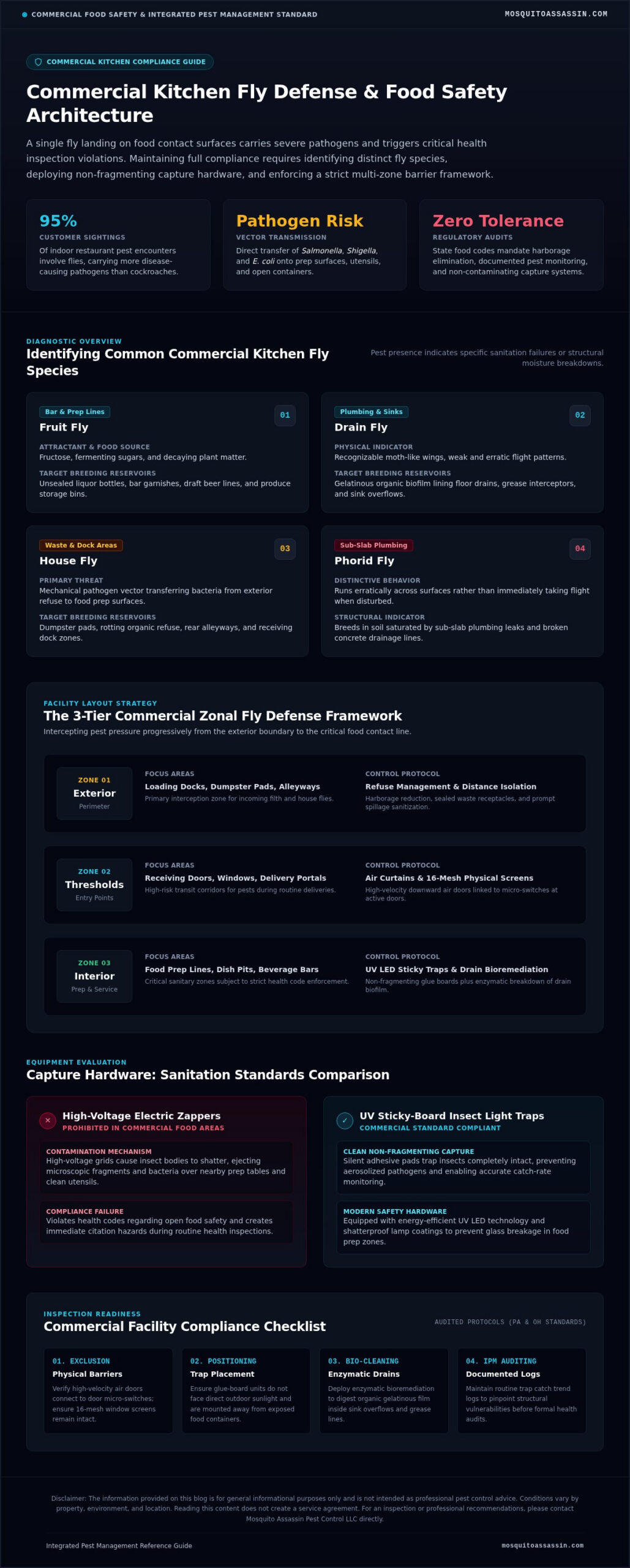
    When restaurant patrons spot a pest indoors, 95% of those sightings involve flies, which carry even more disease-causing pathogens than cockroaches. Retail sprays and hanging sticky ribbons rarely solve the problem, because effective fly control for commercial kitchens requires much more than a temporary fix. A single fly landing on food prep surfaces can jeopardize customer health and trigger critical citations during routine inspections.

    Dealing with drain flies around prep sinks or house flies near delivery doors creates constant stress during service. Kitchen managers often ask what system eliminates flies quickly without risking health code violations or misplacing equipment. True success occurs only when hardware selection and monitoring protocols match specific fly biology and facility zones.

    Discover how to select the right fly control hardware, sanitation protocols, and commercial management strategies to keep food prep environments compliant. This 2026 guide breaks down legal trap positioning, physical exclusion practices, and zone-by-zone defense methods to keep your facility fully inspection-ready all year long.

    Key Takeaways

    • Pinpoint specific fly species to uncover structural moisture issues and hidden organic buildup behind kitchen equipment and floor drains.
    • Select proper fly control for commercial kitchens by choosing glue-board light traps that capture insects without contaminating surrounding food contact surfaces.
    • Implement a zonal defense framework to intercept flies at loading docks and dumpsters before they ever enter interior prep lines.
    • Evaluate trap placement, wattage, and ambient lighting interference using a systematic facility checklist to avoid regulatory citations.
    • Integrate physical exclusion and routine sanitation audits with commercial pest management to maintain continuous health inspection readiness.

    Identifying Common Kitchen Fly Species and Food Safety Risks

    Every commercial food facility faces flying pests, but treating them with a one-size-fits-all approach guarantees failure. Successful fly control for commercial kitchens begins with accurate species identification. Because different flies target distinct food sources and reproductive substrates, the presence of specific insects reveals exactly where sanitation or structural barriers have broken down.

    Fruit Flies and Drain Flies in Preparation Areas

    Small filth flies thrive inside active prep zones and beverage stations:

    • Fruit Flies: Attracted to fructose and fermenting sugars, these pests rapidly colonize unsealed liquor bottles, bar garnishes, draft beer lines, and produce storage.
    • Drain Flies: Recognizable by their moth-like wings, drain flies breed directly inside the gelatinous organic film that accumulates in floor drains, grease interceptors, and sink overflows.

    Buying generic retail fly traps rarely solves these problems. Small indoor flies do not respond well to hardware engineered for agricultural settings, which means kitchen staff must pinpoint the exact moisture reservoirs sustaining the breeding cycle.

    House Flies and Phorid Flies Around Waste Zones

    Loading docks, rear alleyways, and dumpster pads introduce larger and more destructive pests. House flies feed on rotting refuse and transfer severe pathogens like Salmonella, Shigella, and E. coli onto prep tables and clean utensils. Phorid flies present a different hazard. While similar in size to fruit flies, they run erratically across surfaces rather than flying immediately when disturbed. Phorid flies thrive in soil saturated by sub-slab plumbing leaks. Persistent phorid activity often signals broken drainage lines hidden beneath concrete kitchen floors, requiring plumbing intervention alongside sanitation efforts.

    Regulatory Food Safety Standards and Contamination Hazards

    Public health inspectors hold commercial kitchens to strict regulatory criteria. Live insects landing near open food containers constitute high-risk violations that can lower inspection scores or prompt immediate shutdown orders. State food codes in Pennsylvania and Ohio mandate ongoing harborage elimination and documented pest monitoring. Implementing a structured Integrated Pest Management (IPM) program provides the inspection trail required by regulatory bodies. Scheduling professional commercial pest control services helps facilities identify structural vulnerabilities before health audits occur, keeping culinary operations compliant and safe.

    Evaluating Commercial Fly Control Hardware: Traps, Lights, and Air Curtains

    Selecting the right fly control for commercial kitchens requires balancing sanitation standards, guest aesthetics, and capture efficiency. Traditional high-voltage bug zappers have no place in a commercial food facility. When an insect strikes an electric grid, the impact shatters its body, throwing microscopic particles and bacteria across nearby prep counters. Modern commercial code demands non-fragmenting capture devices and active physical barriers.

    Insect Light Traps (ILTs) and UV Sticky Boards

    Glue-board insect light traps capture incoming pests cleanly and silently. By securing insects onto adhesive pads, these units keep flies intact so technicians can monitor catch rates and identify emerging pest trends during inspections. Upgrading to UV LED technology reduces operating energy costs compared to traditional fluorescent tubes while sustaining the specific ultraviolet wavelengths flies seek. Compliant fixtures also require shatterproof lamp coatings (protective plastic sheaths) to prevent broken glass from contaminating open food zones.

    Air Curtains and Physical Exclusion Barriers

    Exclusion hardware stops pests at exterior building thresholds before they reach sensitive prep lines. High-velocity air doors mounted above delivery entrances generate a powerful downward curtain of air that flying insects cannot penetrate. Connecting these units to micro-switches activates the airflow automatically whenever doors open for receiving deliveries. Pairing air curtains with durable 16-mesh window screens creates an unbroken physical boundary that keeps kitchens properly ventilated without admitting pests.

    Bioremediation and Enzymatic Drain Systems

    Surface hardware cannot address larval reproduction occurring deep inside plumbing infrastructure. Enzymatic bioremediation products consume the organic grease and protein biofilms where flies lay their eggs. Automated peristaltic dosing units dispense these biological cleaners directly into floor sinks and grease lines during overnight hours. Foaming delivery equipment expands solutions across the entire inner diameter of pipes, coating inaccessible corners where liquid flushes simply drain away.

    Partnering with licensed specialists for commercial pest control helps facilities choose code-compliant hardware and establish ideal trap placement away from exposed food preparation tables.

    Zonal Fly Defense: Matching Control Methods to Kitchen Layouts

    Dividing a facility into distinct operational zones is essential for effective fly control for commercial kitchens. A trap designed for a rugged loading dock creates immediate safety hazards if installed over a cook line. By mapping equipment to specific facility zones, restaurant operators intercept pests systematically before they reach customer plates.

    Receiving Docks and Waste Disposal Enclosures

    External entryways represent your frontline defense against invading filth flies. Mount industrial-grade light traps on interior walls perpendicular to loading bay doors rather than directly opposite them. Traps positioned directly across from an open bay act as beacons, drawing outdoor insects inside whenever doors cycle open. Outside the building, keep dumpster enclosures sealed. Tight lids, functional dock seals, and scheduled pad degreasing eliminate the intense odor plumes that attract blow flies and house flies to the building exterior.

    Active Food Preparation and Warewashing Lines

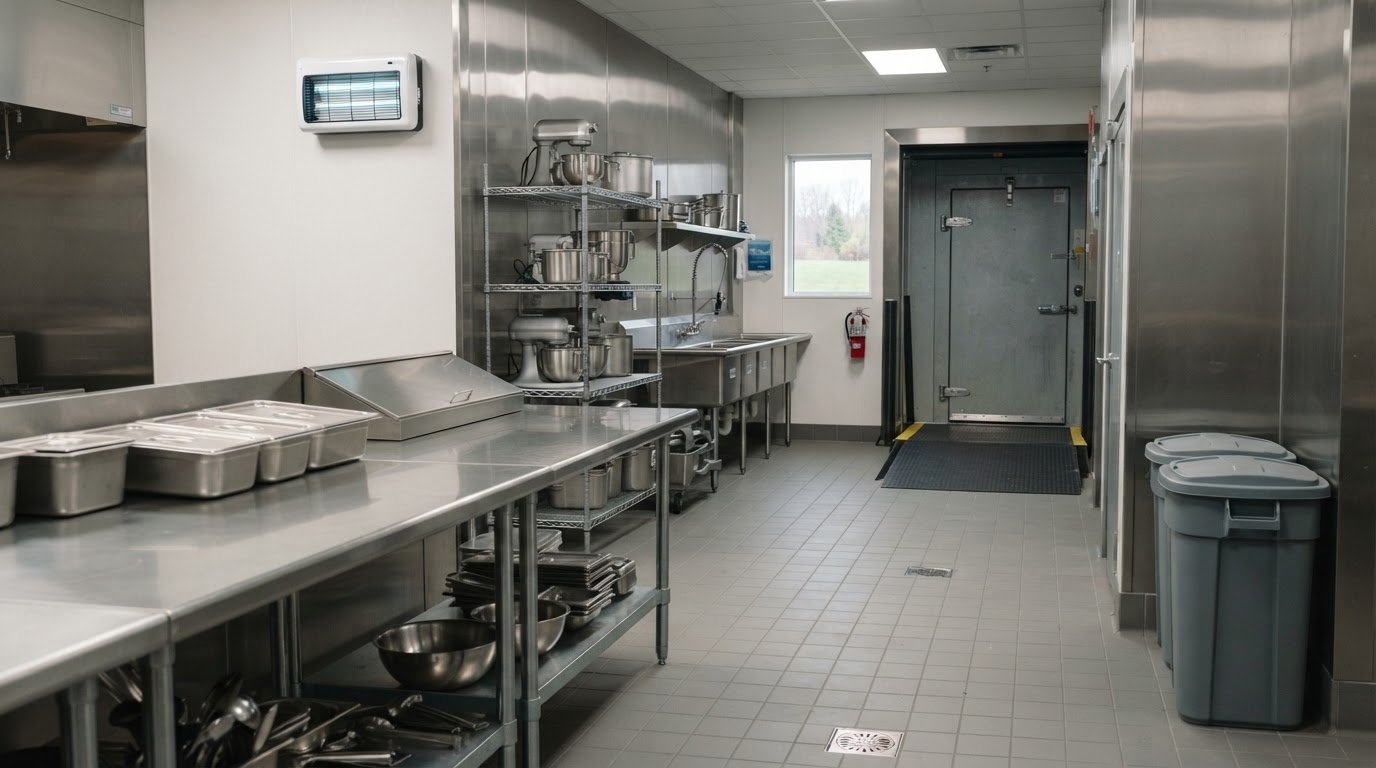
    Interior prep spaces demand careful hardware positioning to satisfy regulatory mandates. Always mount insect light traps at least five feet away from exposed food preparation tables, clean dish storage, and open cooking equipment. Hanging hardware directly above food contact areas violates standard food codes due to the risk of dislodged debris falling into ingredients.

    Lighting competition also dictates capture rates. Position traps away from direct sunlight or intense overhead kitchen illumination, which overpowers ultraviolet attractant lamps. In steamy dishwashing stations, specify splash-resistant hardware built to endure high ambient humidity without short-circuiting. Because fruit flies and phorid flies stay low to the ground, installing traps three to five feet above the floor near problem drains delivers the best catch rates.

    Dining Rooms and Customer Service Counters

    Front-of-house dining areas require complete discretion to protect guest comfort. Commercial wall sconce traps disguise adhesive boards behind attractive decorative facades, keeping captured insects completely hidden from patron view while casting ultraviolet light across seating zones. In bar areas, tuck compact monitoring units beneath service wells and near soda syrup lines. Combining discreet front-of-house traps with robust back-of-house barriers ensures complete coverage without disturbing customer dining experiences.
    Fly Control for Commercial Kitchens: 2026 Buying Guide

    Commercial Kitchen Fly Control Selection Checklist

    Purchasing commercial hardware without an assessment plan leads to wasted investment and recurring health violations. An underpowered light trap cannot protect a large dishwashing room, just as poorly placed sticky boards fail to attract flies away from hot cook lines. Establishing a systematic evaluation checklist ensures that every piece of fly control for commercial kitchens fits the facility layout and satisfies local health department codes.

    Auditing Facility Dimensions and Ambient Light

    Calculate the exact square footage and ceiling height of each room before purchasing hardware. Manufacturers rate insect light traps for specific room volumes, but ambient lighting changes those coverage zones. Competing illumination from prep station heat lamps, bright neon signage, and large exterior dining windows can easily overpower ultraviolet lure bulbs. Check potential mounting sites to ensure traps can be installed horizontally, keeping the UV glow unobstructed throughout the primary flight corridors of target pests.

    Assessing Moisture Sources and Organic Buildup

    Traps only capture flying adults, so staff must audit the physical conditions sustaining pest larvae. Walk through the kitchen to inspect cracked floor tile grout, recessed floor drains, and moisture trapped beneath walk-in refrigeration gaskets. Standard mop water often pushes food starch into wall junctions, creating rich organic breeding zones. Determine whether floor drains require mechanical wire brushing or biological foaming treatments to eliminate structural grease deposits. Enforce nightly kitchen closing routines that eliminate uncovered food waste and empty beverage containers.

    Reviewing Regulatory Compliance and Maintenance Access

    Review municipal regulations to ensure trap styles meet food safety laws. Most jurisdictions strictly prohibit open-grid bug zappers inside food production rooms, requiring shielded glue-board designs with shatterproof bulbs. Verify that all equipment features tool-free latching mechanisms. If staff need screwdrivers to access adhesive boards, monthly glue-board swaps and annual UV lamp replacements will get delayed, causing capture rates to drop quickly.

    Facility managers can review broader facility guidelines in this comprehensive commercial pest control guide. When internal cleaning and hardware upgrades do not resolve ongoing insect issues, professional pest control may help reduce risk. Restaurant operators can request an evaluation through www.mosquitoassassin.com/contact-us to address hidden structural entryways and keep facilities inspection-ready.

    Integrating Professional Management for Total Kitchen Protection

    Hardware traps capture adult insects, but traps alone cannot stop active breeding cycles. Sustainable fly control for commercial kitchens requires an integrated approach that connects physical exclusion, disciplined sanitation, and ongoing professional oversight. Maintaining detailed service logs and trend reports establishes an auditable defense when health inspectors arrive. Ultimately, professional pest control may help reduce risk, protect food safety margins, and preserve hard-earned commercial dining reputations.

    Why Hardware Alone Fails Without Structural Management

    Adhesive boards reflect pest population spikes, but they cannot repair cracked plumbing or degraded slab foundations. Unsealed gaps around beverage conduits and plumbing lines continuously invite exterior filth flies indoors. Without physical exclusion, reproduction outpaces capture rates. Licensed technicians spot subtle harborage zones, tracing hidden moisture issues behind stainless steel walls and underneath tile sub-flooring that routine kitchen closing crews cannot access.

    Sanitation Schedules and Kitchen Staff Protocols

    Daily shift procedures dictate whether flies establish permanent breeding zones. Kitchen managers should enforce structured closing protocols:

    • Scrub floor drains with stiff bristle brushes to eliminate organic biofilm before larvae develop.
    • Hang mops with heads up in ventilated areas rather than leaving wet strands resting inside stagnant mop buckets.
    • Dry standing wash water beneath prep tables, refrigeration motors, and soda fountain equipment nightly.
    • Transfer all fresh produce and open ingredients into airtight containers inside walk-in coolers instead of leaving them out on prep tables.

    Selecting a Licensed Commercial Pest Partner

    Food facilities need service providers versed in regional climate shifts and state sanitation codes. Establishments operating across Northwest Pennsylvania and Northeast Ohio face distinct seasonal surges in fly activity across Erie, Crawford, and Ashtabula counties. Reviewing specialized options through a dedicated commercial services hub ensures facilities receive tailored monitoring routines, documented trap servicing, and expert exclusion guidance. Combining daily staff accountability with professional support delivers reliable fly control for commercial kitchens throughout every season.

    Securing Long-Term Food Safety and Audit Readiness

    Maintaining an audit-ready culinary space requires far more than reactive swatters or random retail traps. Reliable fly control for commercial kitchens relies on a coordinated defense: installing code-compliant glue-board hardware, establishing rigorous floor drain sanitation, and enforcing daily exclusion protocols at delivery bays. When staff consistently eliminate organic residues and seal structural gaps, flies lose the breeding grounds they need to multiply.

    Every commercial facility presents unique layout challenges, especially during seasonal pest surges across Northwest Pennsylvania and Northeast Ohio. Licensed pest professionals apply a methodical multi-step inspection, exclusion, and ongoing monitoring approach to protect commercial food environments. Professional pest control may help reduce risk and protect your hard-earned culinary reputation. For professional facility inspections and customized commercial solutions, contact Mosquito Assassin Pest Control LLC directly to maintain compliance and peace of mind year-round.

    Disclaimer: The information provided on this blog is for general informational purposes only and is not intended as professional pest control advice. Conditions vary by property, environment, and location. Reading this content does not create a service agreement. For an inspection or professional recommendations, please contact Mosquito Assassin Pest Control LLC directly.

    Frequently Asked Questions

    Are bug zappers allowed inside commercial restaurant kitchens?

    No, electrocuting bug zappers are generally prohibited inside food preparation and storage areas. When insects contact high-voltage grids, their bodies shatter, dispersing microscopic fragments and bacteria over nearby prep tables and equipment. Health codes mandate glue-board light traps instead. These silent capture systems secure flying insects intact on adhesive surfaces, eliminating physical airborne contamination while keeping fly control for commercial kitchens compliant with local inspection standards.

    Where should insect light traps be placed in a commercial kitchen?

    Position traps at least five feet away from exposed food prep tables, cooking ranges, and clean warewashing racks. Mount units three to six feet above the floor, matching the natural cruising altitudes of house flies and fruit flies. Avoid placing units near bright exterior windows or competing high-intensity kitchen fixtures. Install traps perpendicular to loading docks and service doors to intercept invading insects before they penetrate interior prep zones.

    How often do commercial kitchen fly trap glue boards and bulbs need replacement?

    Glue boards typically require replacement every 30 days, or sooner if dust and trapped insects saturate the adhesive surface. UV bulbs require annual replacement, even if they still emit visible blue light. The ultraviolet output that attracts flying pests degrades significantly after nine to twelve months of continuous operation. Establishing a routine maintenance schedule ensures traps remain effective during peak warm seasons across Pennsylvania and Ohio.

    Why do fruit flies keep coming back despite deep cleaning the kitchen?

    Fruit flies persist because standard surface sanitation misses microscopic organic buildup hidden inside structural crevices. Adult females lay hundreds of eggs in fermenting sugars trapped behind loose wall cove base, inside damaged tile grout, or under hollow prep table legs. Uncleaned draft beer lines, soda dispenser drip trays, and rotting organic slime within floor drains provide endless breeding resources that everyday floor mops simply cannot reach.

    What is the difference between fruit flies, drain flies, and phorid flies?

    Fruit flies are light tan with red eyes, typically congregating near fermenting produce and sugary bar stations. Drain flies feature fuzzy, moth-like wings and breed specifically within the slimy biofilm lining floor drains and pipes. Phorid flies have a distinctive humpbacked shape and run rapidly across surfaces instead of flying away immediately. Phorid infestations often indicate serious sub-floor sewage leaks under concrete slabs.

    Can air curtains completely prevent flies from entering loading docks?

    Air curtains dramatically lower fly infiltration, but they cannot achieve 100% prevention on their own. Strong exterior wind gusts can disrupt downward airflow velocities, allowing occasional pests to slip through delivery doors. To achieve dependable fly control for commercial kitchens, air doors must be paired with magnetic door sensors, tight weather seals, and interior glue-board traps positioned just inside the bay to intercept stragglers.

    How do commercial drain fly treatments differ from pouring boiling water down drains?

    Pouring boiling water down drains merely washes past the top layer of organic matter, quickly cooling before penetrating thick gelatinous biofilms. Larvae and pupae burrowed inside the slime easily survive hot flushes. Professional treatments use specialized enzymatic foams or bioremediation solutions that cling to vertical pipe walls. These biological formulas digest the grease matrix completely, starving developing larvae and permanently breaking the fly reproductive cycle.

  • Restaurant Pest Control: Strategic Guide for 2026

    Restaurant Pest Control: Strategic Guide for 2026

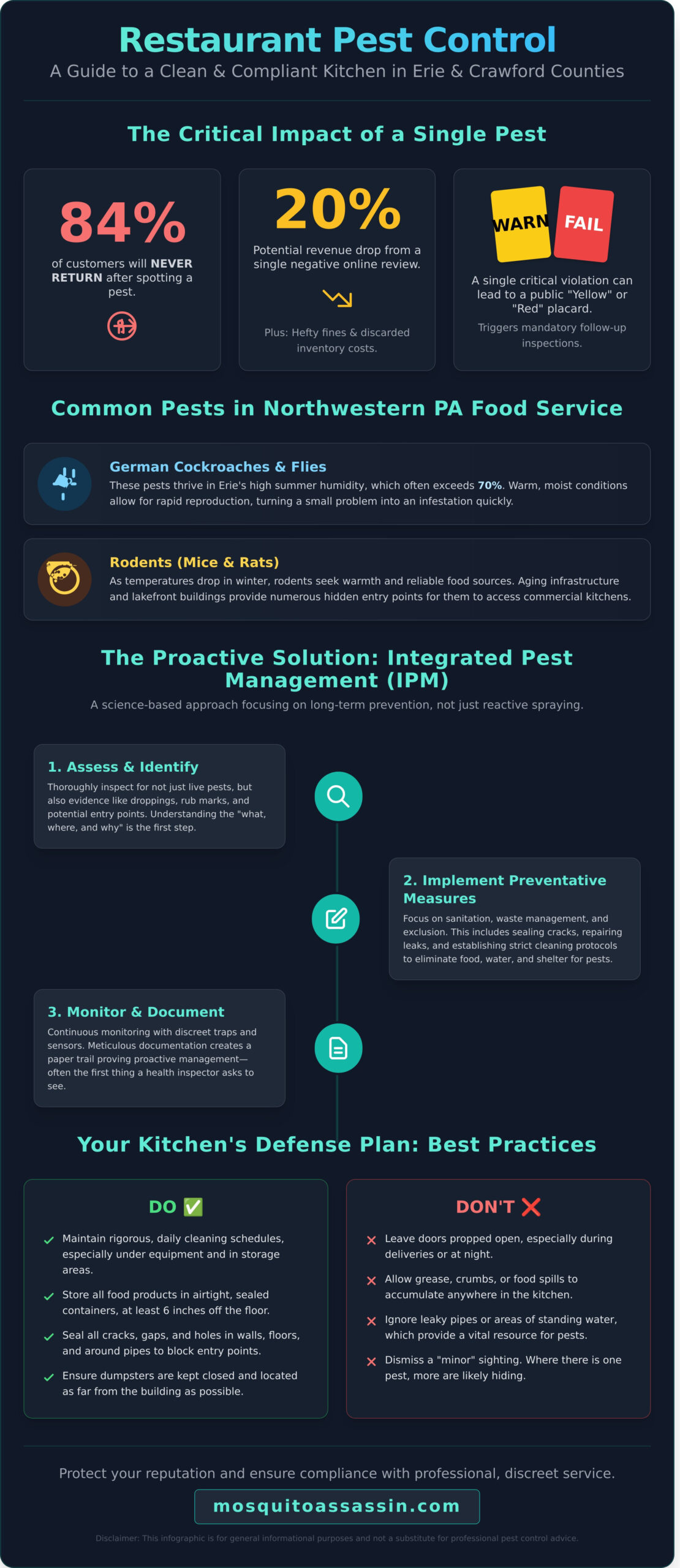
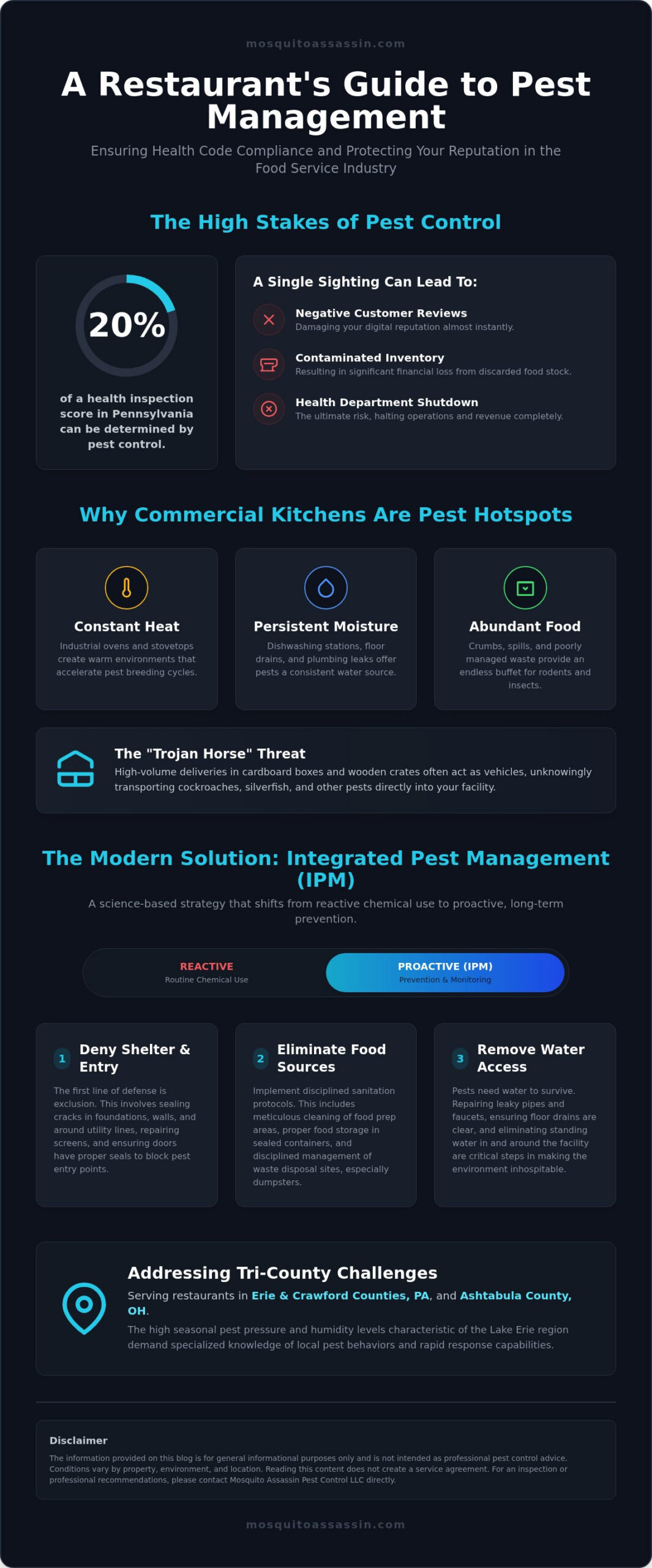
    Did you know that pest control can account for as much as 20% of a health inspection score in Pennsylvania? For a local establishment, the stakes involve more than just a grade on a window. A single rodent sighting can lead to negative customer reviews, contaminated inventory, and the constant fear of a health department shutdown. Professional pest control for restaurants Erie PA is not just a cleaning task, it’s a critical component of risk management for any food service professional.

    Maintaining a sanitary environment requires a proactive strategy that aligns with the 2026 FDA Food Code updates and regional health regulations. This guide provides an educational overview of how specialized management protects a restaurant’s reputation while ensuring strict health code compliance. By focusing on exclusion and consistent maintenance, it’s possible to achieve zero pest sightings in both front-of-house and back-of-house areas. Readers will learn the essential steps for maintaining perfect health inspection scores and protecting property from damage in Erie, Crawford, and Ashtabula counties.

    Disclaimer: The information provided on this blog is for general informational purposes only and is not intended as professional pest control advice. Conditions vary by property, environment, and location. Reading this content does not create a service agreement. For an inspection or professional recommendations, please contact Mosquito Assassin Pest Control LLC directly.

    Key Takeaways

    • Commercial kitchens provide ideal habitats for pests, making it vital to understand how heat, moisture, and high-volume deliveries impact facility safety.
    • Modern food safety relies on Integrated Pest Management (IPM), a science-based approach that prioritizes thorough inspections and long-term prevention over reactive chemical use.
    • Professional pest control for restaurants Erie PA addresses specific local challenges, including the high seasonal pressure and humidity levels characteristic of the Lake Erie region.
    • Implementing disciplined sanitation protocols and managing waste disposal sites are practical ways for managers to significantly reduce the likelihood of food contamination.
    • Selecting a regional partner familiar with Erie and Crawford counties ensures that your business benefits from specialized knowledge of local pest behaviors and rapid response times.

    Why Restaurant Operations Require Specialized Commercial Pest Management

    Commercial kitchens are high-activity hubs that inadvertently serve as sanctuaries for various pests. Several factors contribute to this vulnerability:

    • Constant heat generated by industrial ovens and stovetops.
    • Persistent moisture around dishwashing stations and floor drains.
    • Abundant food sources and prep waste.

    Unlike residential settings, restaurants face a unique challenge: the constant influx of external supplies. High-volume deliveries arrive daily in cardboard boxes and wooden crates, which often act as “Trojan horses” for cockroaches or silverfish. Effective pest control for restaurants Erie PA requires a deep understanding of these operational vulnerabilities and the specific behaviors of local pests.

    To manage these risks, industry professionals utilize The Core of Modern Food Safety: Integrated Pest Management (IPM). This methodology moves away from heavy chemical reliance and focuses on exclusion and sanitation. By sealing entry points and eliminating breeding grounds, businesses can maintain a sanitary environment that meets both local health codes and customer expectations. Since pest control can account for as much as 20% of a health inspection score in Pennsylvania, professional pest control for restaurants Erie PA is a critical component of any compliance strategy.

    Reputation Management and the Digital Age

    A restaurant’s reputation is its most valuable asset, yet it’s also the most fragile. In the current digital landscape, a single pest sighting isn’t just a private incident; it’s a potential viral post. Online reviews frequently use cleanliness as a primary filter for quality. If a customer spots a rodent or insect in the dining area, that experience can reach thousands of people in the local Erie community within hours. This type of negative feedback is difficult to erase and can lead to a significant drop in foot traffic. Consistent monitoring and professional oversight are the only ways to prevent these sightings. Utilizing professional commercial pest control services helps maintain the high standards that patrons expect and keeps the brand’s image untarnished.

    Financial Implications of Inadequate Pest Control

    The financial impact of an infestation extends far beyond the cost of a service visit. Inventory loss is a primary concern for kitchen managers. When pests contaminate food stocks, the entire inventory must be discarded to remain compliant, which directly hits the bottom line. Rodents pose an additional threat to the facility’s physical structure and equipment. They’re known to chew through electrical wiring, which can lead to expensive equipment failure or even fire hazards. Structural repairs to drywall and insulation are also common after an infestation. Choosing a proactive maintenance plan is generally more cost-effective than waiting for an emergency. Reactive treatments often involve higher fees and potential business downtime, whereas regular maintenance keeps operations running smoothly for establishments across Erie, Crawford, and Ashtabula counties.

    The Core of Modern Food Safety: Integrated Pest Management (IPM)

    Modern food safety has shifted from reactive treatments to a structured, scientific discipline. Integrated Pest Management (IPM) serves as the foundation of this shift. It prioritizes long-term prevention by removing the resources pests need to survive: food, water, and shelter. Instead of relying on routine chemical applications, IPM uses monitoring and data to determine when and where intervention is necessary. This approach aligns with federal food safety regulations that mandate effective measures for pest elimination.

    Establishing a comprehensive plan for pest control for restaurants Erie PA involves more than just a monthly visit. It requires a partnership between the facility manager and the service provider to maintain a fortress-like environment. Professional commercial pest management can help identify these structural gaps before they become entry points.

    The Four Pillars of an Effective IPM Program

    A successful IPM strategy is built on four distinct stages that ensure no detail is overlooked. First, a detailed inspection examines high-risk areas like loading docks, floor drains, and dry storage. Second, accurate identification is crucial. Treating a German cockroach requires a different strategy than managing an occasional invader from the Lake Erie shoreline. Third, monitoring stations are placed strategically to track activity levels and identify “hot spots” within the kitchen. Finally, control methods prioritize structural exclusion (sealing cracks or installing door sweeps) and sanitation improvements. Chemical treatments are used as a targeted tool only when monitoring data confirms a specific need.

    Documentation and Regulatory Compliance

    In Pennsylvania and Ohio, maintaining a paper trail is just as important as maintaining a clean kitchen. The Pennsylvania Food Code (7 Pa. Code Chapter 46) requires establishments to be maintained free of pests, and local health inspectors often look for proof of a proactive plan. Under state law (7 Pa. Code § 128.112), pesticide application records for commercial facilities must be kept for a minimum of three years. Technicians performing these services in Pennsylvania must be certified in Category 7B (Structural Pest Control) under the Pennsylvania Pesticide Control Act of 1973. A professional pest management folder should include service logs, monitoring data, and corrective action reports. This documentation provides clear evidence of due diligence during surprise inspections, helping managers secure high health scores and avoid costly violations. Keeping these records organized ensures that a restaurant is always ready for a regulatory review and demonstrates a commitment to high-quality pest control for restaurants Erie PA.

    Common Pest Challenges for Restaurants in Erie, PA and Surrounding Areas

    The unique geography of Northwest Pennsylvania creates specific challenges for food service establishments. The proximity to Lake Erie results in high humidity levels, which acts as a catalyst for pest activity throughout the year. While national chains might treat every location the same, effective pest control for restaurants Erie PA requires an understanding of how the local climate dictates insect and rodent behavior.

    Cockroaches remain a primary threat due to their ability to spread pathogens such as Salmonella and E. coli. In a commercial kitchen, these pests exploit small cracks and the warmth behind refrigeration units. Similarly, small flies, including fruit flies and drain flies, thrive in moist environments. They often breed in the organic film found in floor drains or under heavy equipment, making deep sanitation as vital as professional intervention. Consistent monitoring is the only way to catch these issues before they escalate into a health code violation.

    Seasonal Pest Cycles in the Tri-County Region

    Establishments in Erie, Crawford, and Ashtabula counties experience distinct shifts in pest pressure as the seasons change. Spring and summer months bring a surge in flying insects and stinging pests that can disrupt outdoor dining areas. As the humid summer air transitions into the crisp autumn of Northwest PA, the focus shifts toward the exterior perimeter. This is the period when rodents begin their migration toward the warmth and abundant food sources found inside commercial buildings. During the harsh winter months, pests don’t disappear; they simply move indoors. Winter management focuses on intensive indoor monitoring within heated facilities to ensure that populations don’t establish themselves in out-of-the-way storage areas.

    The Threat of Rodents and Structural Integrity

    Rodents are more than just a sanitation issue; they’re a direct threat to the building’s infrastructure. Mice can squeeze through a gap the size of a dime, while rats only need a hole the size of a quarter. Once inside, their constant need to gnaw leads them to chew through drywall, insulation, and even electrical wiring. This behavior creates significant fire hazards and can cause expensive equipment failures that disrupt service. Exclusion is the first defense.

    Effective rodent removal focuses heavily on structural exclusion. By identifying and sealing these tiny entry points, a restaurant can break the cycle of infestation. Maintaining a secure perimeter is a fundamental part of professional pest control for restaurants Erie PA, ensuring that the local rodent population stays outdoors where it belongs. Professional management ensures these vulnerabilities are addressed before they impact the bottom line.

    Restaurant Pest Control: Strategic Guide for 2026

    Practical Prevention Strategies for Restaurant Staff and Managers

    Daily operations play a decisive role in the efficacy of any professional program. While technicians manage the technical aspects of exclusion and monitoring, restaurant staff maintain the environment that either invites or repels activity. A successful strategy for pest control for restaurants Erie PA relies on this synergy between professional expertise and operational discipline. A strict sanitation schedule for all food preparation and storage areas is non-negotiable. This involves more than just wiping down surfaces; it requires deep cleaning behind heavy equipment and inside refrigeration gaskets where organic debris accumulates over time.

    Managing waste disposal is another critical pillar of prevention. Dumpsters must be kept clean, lids must remain shut, and ideally, these units should be located as far from the building as possible. If dumpsters are neglected, they become a beacon for rodents and flies, drawing them toward the kitchen entrance. Inside the pantry, utilizing a first-in, first-out (FIFO) system for inventory ensures that older stock is used before it can become a potential harborage site for stored product pests. This practice also makes it easier for staff to spot early signs of an issue during routine inventory rotations.

    Back-of-House Sanitation and Maintenance

    Back-of-house maintenance often focuses on what is visible, but the invisible areas are where pests thrive. Floor drains are primary breeding grounds for small flies, such as drain flies and fruit flies. Regularly cleaning these drains to prevent the buildup of organic matter is a vital preventative step. Structural integrity is equally important. Ensuring that all exterior doors have tight-fitting sweeps eliminates the most common entry points for rodents seeking warmth. To facilitate thorough inspections, all food items should be stored at least six inches off the floor and away from walls, leaving no place for pests to hide undetected.

    Employee Engagement and Reporting

    Training employees to recognize early signs of activity, such as droppings or actual sightings, is a powerful defense. Staff should be encouraged to report these findings immediately in a dedicated logbook that is accessible to the management and the pest control technician. Education helps staff understand that simple actions, such as keeping back doors closed during deliveries, are essential for exclusion. Even the breakroom requires attention; maintaining a clean staff area ensures that pests aren’t attracted to non-production zones where they might eventually migrate into the main kitchen. Implementing these daily practices alongside professional commercial pest control may help reduce risk for your establishment.

    Disclaimer: The information provided on this blog is for general informational purposes only and is not intended as professional pest control advice. Conditions vary by property, environment, and location. Reading this content does not create a service agreement. For an inspection or professional recommendations, please contact Mosquito Assassin Pest Control LLC directly.

    Selecting a Local Commercial Pest Control Partner in the Tri-County Area

    Selecting a partner for pest control for restaurants Erie PA is a decision that impacts both food safety and business reputation. While national corporations emphasize their scale, they often lack the granular knowledge of Northwest Pennsylvania’s specific environmental pressures. A local provider understands how the lakefront humidity and seasonal shifts in Crawford County influence pest migration. This regional insight allows for more accurate predictions of activity and more effective exclusion strategies. Consistency is a hallmark of a dedicated local partner. Having professionals who are familiar with a facility’s layout and history ensures that monitoring remains thorough and that small changes in the building’s integrity are caught early.

    Quick response times are vital when a business faces an urgent concern. In the food service industry, waiting days for a technician isn’t an option. Local experts reside in the same communities they serve, allowing for more flexible scheduling and rapid intervention. This neighborly approach builds a rapport based on shared community values and a mutual interest in the success of local businesses.

    The Value of Regional Expertise

    Local expertise goes beyond knowing the pests; it involves understanding the architecture of the region. From the historic buildings in downtown Erie to newer commercial developments in Meadville, each structure has unique vulnerabilities. Professionals who live and work in the same community can identify common structural weaknesses that national technicians might overlook. This familiarity extends to regulatory compliance as well. Local providers are well-versed in the specific documentation requirements and standards of regional health departments in Pennsylvania and Ohio. This knowledge is invaluable during surprise inspections, as it ensures the restaurant’s pest management folder is always audit-ready. Clear communication between the provider and the client ensures that everyone understands their role in maintaining a pest-free facility.

    Next Steps for Protecting Your Restaurant

    Establishing a long-term defense starts with a professional evaluation of the facility. This proactive assessment helps managers identify current risk levels and prioritize necessary structural repairs or sanitation improvements. While one-time treatments might address an immediate sighting, ongoing general pest control plans offer the most reliable protection against future infestations. Sustained management is the only definitive way to remain pest-free throughout the year.

    Professional pest control for restaurants Erie PA may help reduce risk for businesses across Erie, Meadville, and Ashtabula. By choosing a partner that prioritizes exclusion and maintenance, managers can focus on their operations with the confidence that their reputation is protected. Requesting a professional inspection is a practical first step toward maintaining a sanitary environment and achieving perfect health inspection scores.

    Disclaimer: The information provided on this blog is for general informational purposes only and is not intended as professional pest control advice. Conditions vary by property, environment, and location. Reading this content does not create a service agreement. For an inspection or professional recommendations, please contact Mosquito Assassin Pest Control LLC directly.

    Securing the Future of Your Food Service Establishment

    Maintaining a high standard of cleanliness is a continuous commitment that goes beyond passing a single inspection. By adopting Integrated Pest Management (IPM) protocols, businesses move away from reactive treatments and toward a sustainable, science-based model of prevention. This approach prioritizes structural exclusion and rigorous sanitation, ensuring that pests never find a foothold in the first place. Consistency in staff training and documentation remains the most effective way to safeguard a restaurant’s reputation and bottom line.

    Implementing professional pest control for restaurants Erie PA provides the specialized oversight needed to navigate the unique seasonal challenges of the Lake Erie region. Neighborly expertise and a deep understanding of local building styles allow for a level of precision that national providers often miss. For a professional evaluation of your facility, contact Mosquito Assassin Pest Control LLC today. Protecting the health of patrons and the integrity of the facility is a goal that’s entirely achievable with the right regional partner.

    Disclaimer: The information provided on this blog is for general informational purposes only and is not intended as professional pest control advice. Conditions vary by property, environment, and location. Reading this content does not create a service agreement. For an inspection or professional recommendations, please contact Mosquito Assassin Pest Control LLC directly.

    Frequently Asked Questions

    Is commercial pest control different from residential pest control?

    Yes, commercial management focuses on high-traffic environments and strict regulatory compliance. Commercial facilities face higher risks due to large-scale food storage and frequent high-volume deliveries. Unlike residential homes, restaurants must adhere to specific health codes and maintain detailed service documentation. Specialized protocols emphasize exclusion and sanitation in high-heat areas like kitchens, which require a more rigorous and frequent monitoring schedule than a typical household would normally need.

    How often should a restaurant have a professional pest inspection?

    Most restaurants require at least monthly inspections to remain proactive. High-volume facilities or those in older buildings often benefit from bi-weekly visits. Regular monitoring is essential because pest pressure in Northwest Pennsylvania shifts with the seasons. Monthly checks ensure that small issues, like a minor fly breeding site or a new rodent entry point, are identified and resolved before they impact health inspection scores or lead to negative customer reviews.

    Are the treatments used in commercial kitchens safe for employees and guests?

    Licensed professionals prioritize non-chemical methods and targeted applications to ensure the safety of food preparation areas. Integrated Pest Management (IPM) focuses on sanitation and structural exclusion first. When chemical intervention is necessary, products are applied according to strict label instructions and federal safety standards. This methodical approach minimizes exposure while effectively managing pest populations, protecting both the staff and the dining public from potential contamination risks and health hazards.

    Can professional pest control help my restaurant stay compliant with health regulations?

    Professional management is a primary tool for meeting state and local health codes. In Pennsylvania, pest control can account for up to 20% of a health inspection score. A professional partner provides the required documentation, including service logs and pesticide application records, which must be kept for three years. This proof of due diligence demonstrates to inspectors that the facility is actively managing risks and maintaining a sanitary environment for food production.

    What are the most common pests found in restaurants in Erie and Crawford Counties?

    Establishments in this region frequently encounter German cockroaches, rodents, and various species of small flies. The humid climate near Lake Erie creates ideal conditions for fruit flies and drain flies to thrive in moist kitchen areas. During autumn, mice and rats often attempt to enter buildings for warmth. Identifying these specific local behaviors is a core part of effective pest control for restaurants Erie PA, allowing for targeted prevention strategies.

    How can a restaurant prepare for a professional pest control visit?

    Preparation involves clearing clutter and ensuring access to high-risk areas like floor drains and storage rooms. Staff should have the pest sighting logbook ready for the technician to review. It’s helpful to move trash receptacles and clean under heavy equipment before the visit. This allows the professional to conduct a thorough inspection of the facility’s perimeter and interior “hot spots” without obstruction, ensuring the most accurate assessment of the property’s needs.

    Does professional pest control offer discretion for my customers?

    Professional services are designed to be discreet and minimally disruptive to daily operations. Many commercial visits are scheduled during off-peak hours or before the restaurant opens to avoid contact with patrons. Technicians use professional, unmarked equipment and focus on targeted applications that aren’t visible to the public. This ensures that the facility remains protected without drawing unnecessary attention to the pest management activities taking place behind the scenes in the kitchen.

    What happens if pests return between scheduled service visits?

    A dependable local expert provides ongoing support to address activity that occurs between regular visits. Professional pest control for restaurants Erie PA typically includes a response protocol for urgent sightings. Managers should document the location and type of pest in their logbook and notify their provider immediately. This allows for a swift follow-up inspection to identify any new entry points or sanitation lapses that may have contributed to the unexpected activity during the month.

    Disclaimer: The information provided on this blog is for general informational purposes only and is not intended as professional pest control advice. Conditions vary by property, environment, and location. Reading this content does not create a service agreement. For an inspection or professional recommendations, please contact Mosquito Assassin Pest Control LLC directly.

  • Restaurant Pest Control Services in Erie, PA: A Guide to Food Safety and Compliance

    Restaurant Pest Control Services in Erie, PA: A Guide to Food Safety and Compliance

    Last Tuesday, a local bistro owner in downtown Erie watched a health inspector walk through the front door right at the start of the lunch rush. Even with a spotless kitchen, the stress of managing a century-old building means the fear of a surprise visitor is always present. Maintaining high food safety standards in such environments often requires professional restaurant pest control services erie pa to address the unique structural vulnerabilities found near the lakefront.

    It’s a fact that 84% of customers will never return to a restaurant after spotting a pest; you likely agree that protecting your reputation is just as important as the food you serve. This guide explains how professional management helps you achieve a clean kitchen and total compliance with local health regulations in Erie and Crawford Counties. You’ll find information on common regional pests, the importance of discreet monitoring, and how to maintain peace of mind during your next surprise inspection.

    Disclaimer: The information provided on this blog is for general informational purposes only and is not intended as professional pest control advice. Conditions vary by property, environment, and location. Reading this content does not create a service agreement. For an inspection or professional recommendations, please contact Mosquito Assassin Pest Control LLC directly.

    Key Takeaways

    • Understand the critical connection between pest activity and health department compliance to safeguard a restaurant’s reputation and customer reviews.
    • Identify how local rodents and insects exploit aging urban infrastructure in downtown Erie and Crawford County to gain entry into food service facilities.
    • Explore the benefits of Integrated Pest Management (IPM), a science-based approach that prioritizes long-term prevention over reactive chemical applications.
    • Learn practical sanitation and waste management strategies designed to eliminate attractants and reduce pest pressure around commercial kitchen perimeters.
    • Discover why specialized restaurant pest control services erie pa provide the local expertise necessary to address the unique environmental challenges of the Great Lakes region.

    The Importance of Professional Pest Management for Erie Restaurants

    Erie restaurants face a unique set of environmental challenges. The proximity to Lake Erie brings high humidity levels that frequently exceed 70% during the summer months. These conditions are ideal for German cockroaches and various fly species to thrive and reproduce rapidly. It isn’t just a seasonal issue. When temperatures drop below freezing in December, rodents seek the warmth and consistent food supplies found in commercial kitchens. Utilizing professional restaurant pest control services erie pa ensures that these biological cycles don’t disrupt daily operations or compromise food safety.

    Local data from the Erie County Health Department indicates that sanitation and pest evidence are among the most cited violations during unannounced inspections. A single critical violation can lead to a “yellow” or “red” placard. This immediately signals a problem to every potential customer walking through the door. Beyond the public embarrassment, the financial consequences of a health code violation are steep. Fines can range from hundreds to thousands of dollars, and the cost of discarded inventory due to contamination can sink a small business’s profit margins for an entire quarter.

    To better understand how these strategies work in a commercial kitchen, watch this helpful video:

    Health Department Standards and Compliance

    The Erie County Health Department inspection criteria are rigorous and focused on identifying active harborages and entry points. Inspectors don’t just look for live insects; they look for evidence like rub marks, gnawings, or droppings. Most professionals utilize Integrated Pest Management (IPM) to address these issues. This method focuses on long term prevention rather than just reactive treatments. It involves detailed documentation that proves a restaurant is following a proactive sanitation plan. This paper trail is often the first thing an inspector asks to see during a visit. Having a “zero tolerance” policy is the only way to ensure compliance, as even a minor sighting can trigger a mandatory follow up inspection within 48 hours.

    Protecting the Brand and Customer Trust

    A restaurant’s reputation is its most valuable asset. In the digital age, a single photo of a pest posted to a review site can cause a 20% drop in revenue within weeks. Modern diners in Erie and Crawford Counties rely on platforms like Yelp and Google Reviews to vet their dining choices. Consistent restaurant pest control services erie pa help maintain the “invisible layer” of protection that keeps the guest experience positive. Discreet service is vital to this process. Technicians usually work during off hours to ensure that pest management activities remain out of the public eye. This maintains the atmosphere while safeguarding the business from the financial ruin of a public relations crisis. When a guest sees a clean, pest free environment, it reinforces their trust in the kitchen’s overall hygiene and food quality.

    Disclaimer: The information provided on this blog is for general informational purposes only and is not intended as professional pest control advice. Conditions vary by property, environment, and location. Reading this content does not create a service agreement. For an inspection or professional recommendations, please contact Mosquito Assassin Pest Control LLC directly.

    Common Pests in Northwestern Pennsylvania Food Service

    Northwestern Pennsylvania’s unique climate and aging urban landscape create specific challenges for food service providers. In Erie and Crawford Counties, the transition from humid summers to harsh winters drives pests indoors, looking for the warmth and steady food supply found in commercial kitchens. Maintaining high standards for hygiene and safety requires a deep understanding of the local pest biology. Adhering to the guidelines set by the FDA Food Code is a baseline requirement for any establishment, as these regulations are designed to prevent the contamination of food and equipment. Effective restaurant pest control services erie pa rely on identifying these threats before they escalate into health department violations.

    Rodent Challenges in Historic Erie Buildings

    Downtown Erie and Meadville are home to many structures built in the late 1800s and early 1900s. While these buildings offer character, they also present significant structural vulnerabilities. Mice only need a gap of 6 millimeters (about 1/4 inch) to enter a facility, while rats can squeeze through an opening the size of a half-dollar. Over time, settling foundations and aging brickwork in Lake Erie coastal properties create these entry points. Rodents often exploit loading docks, utility lines, and basement floor drains to gain access.

    The presence of rodents in a food environment is a critical safety issue. They are known carriers of various pathogens and their droppings, urine, and nesting materials can quickly contaminate dry storage areas. In addition to health risks, rodents pose a fire hazard. They have a constant need to gnaw to keep their incisors sharp, often targeting electrical wiring behind kitchen walls. Implementing consistent restaurant pest control services erie pa ensures that these historic vulnerabilities don’t become permanent liabilities for a business. Identifying these entry points through professional inspections can help reduce the risk of a full-scale infestation.

    Cockroach and Fly Management in Kitchens

    The German cockroach is the most common species found in commercial kitchens in the tri-county area. These pests thrive in the micro-climates created by heavy-duty appliances. They prefer temperatures around 85 degrees Fahrenheit and high humidity, making the space behind reach-in coolers and under dishwashing stations ideal. Their reproduction cycle is incredibly fast; a single female can produce an egg capsule containing 30 to 40 eggs, which can reach maturity in as little as 28 days. This rapid growth means a few hitchhikers on a delivery pallet can become a significant problem within a single month.

    • German Cockroaches: These pests are often introduced via cardboard boxes or food shipments rather than entering from the outdoors.
    • Fruit Flies: Often found near bar areas or produce storage, these flies indicate overripe organic matter or fermenting liquids.
    • Drain Flies: These pests breed in the gelatinous film that builds up inside floor drains, signaling a need for deep cleaning or plumbing maintenance.

    Small flies are frequently more than just a nuisance; they are indicators of underlying sanitation or plumbing issues. While occasional invaders like house flies might enter through an open door, a persistent population of fruit or drain flies suggests that organic debris is accumulating somewhere in the facility. Distinguishing between a one-time visitor and an established infestation is vital for proper management. Professionals look for “hot spots” where moisture and food particles collect, such as the gaskets of refrigeration units or the undersides of prep tables, to address the root cause of the activity.

    Disclaimer: The information provided on this blog is for general informational purposes only and is not intended as professional pest control advice. Conditions vary by property, environment, and location. Reading this content does not create a service agreement. For an inspection or professional recommendations, please contact Mosquito Assassin Pest Control LLC directly.

    Integrated Pest Management (IPM) for Food Safety

    Integrated Pest Management (IPM) is a science-based decision-making process that identifies and reduces risks from pests and pest management strategies. Instead of relying solely on the scheduled application of pesticides, IPM focuses on long-term prevention through a combination of techniques such as biological control, habitat manipulation, and modification of cultural practices. Implementing high-quality restaurant pest control services erie pa involves moving away from reactive treatments and toward a proactive system that prioritizes the structural integrity and cleanliness of the facility.

    Adopting this science-based framework aligns with the 2022 FDA Food Code, which emphasizes the necessity of protecting food from contamination. Statistics from the food service industry indicate that environmental management can resolve up to 90% of recurring pest issues without the immediate need for chemical intervention. This approach is particularly effective in Erie and Crawford Counties, where seasonal temperature shifts drive rodents and insects toward the warmth of commercial kitchens. By managing the environment, restaurant operators create a sustainable defense that protects both their reputation and their customers.

    Success depends on a collaborative relationship between kitchen staff and licensed pest professionals. Technicians provide the expertise to identify vulnerabilities, but the daily habits of employees determine the long-term effectiveness of the program. When staff members understand how their actions impact pest behavior, they become the first line of defense in maintaining a pest-free environment.

    The Four Pillars of a Successful IPM Program

    Effective restaurant pest control services erie pa rely on four foundational pillars to maintain a sterile environment. The first pillar is a comprehensive inspection. Professionals conduct site surveys to find the root cause of activity, looking for entry points as small as 1/16th of an inch for cockroaches or 1/4th of an inch for mice. This data drives the rest of the strategy.

    Sanitation stands as the second pillar. Removing food and water sources is vital for long-term success. Practical prevention strategies often focus on deep cleaning schedules and proper waste management to discourage nesting. Third is exclusion, which involves using physical barriers like door sweeps and silicone sealants to keep pests outside where they belong. Finally, monitoring involves the use of non-toxic tracking tools to detect new activity 24 hours a day, allowing for rapid response before a single sighting becomes a full-blown crisis.

    Documentation and Reporting for Inspectors

    Detailed logbooks are a mandatory component of professional pest management in Pennsylvania. Health inspectors from the Erie County Department of Health specifically look for a chronological record of all pest control activities, including sightings, treatments, and corrective actions taken by the restaurant. A complete logbook proves that the management is exercising due diligence in protecting public health.

    Digital reporting has transformed how managers track trends across their facilities. Modern systems provide data visualization that highlights problem areas, such as a specific floor drain or a loading dock door that stays open too long. When an inspector arrives, having instant access to these records via a digital portal demonstrates a high level of professional oversight. This transparency helps ensure that the restaurant remains compliant with all local and federal food safety regulations while providing peace of mind to the ownership team.

    Disclaimer: The information provided on this blog is for general informational purposes only and is not intended as professional pest control advice. Conditions vary by property, environment, and location. Reading this content does not create a service agreement. For an inspection or professional recommendations, please contact Mosquito Assassin Pest Control LLC directly.

    Restaurant Pest Control Services in Erie, PA: A Guide to Food Safety and Compliance

    Practical Prevention Strategies for Commercial Kitchens

    Maintaining a pest-free environment in Erie County requires more than reactive treatments; it demands a daily commitment to rigorous sanitation. Research from the Journal of Food Protection indicates that nearly 85 percent of pest sightings in commercial kitchens correlate directly with sanitation lapses or structural defects. Establishing a strict daily schedule ensures that food debris and grease don’t accumulate in hard-to-reach areas. This proactive approach is a cornerstone of effective restaurant pest control services erie pa, as it removes the primary attractants that draw insects and rodents indoors.

    Waste management plays a vital role in reducing exterior pest pressure. Dumpsters should be located at least 25 feet away from the building’s entrance to prevent pests from migrating inside. Keeping lids tightly closed and scheduling power washing for the dumpster pad every 14 days can reduce fly populations by up to 50 percent. Additionally, managing incoming shipments is critical. German cockroaches and stored product pests often hitchhike into facilities inside corrugated cardboard boxes. Inspecting every delivery on the loading dock before it enters the storage area prevents a localized infestation from becoming a facility-wide crisis.

    Staff members are the first line of defense against infestations. Training employees to spend 10 minutes at the end of each shift looking for early signs of activity (such as small droppings, smear marks along baseboards, or damaged packaging) allows for faster intervention. When employees understand the biology of common pests, they can identify risks before they escalate into health code violations.

    Sanitation Protocols and Moisture Control

    Deep cleaning must extend beyond visible surfaces. Organic buildup in floor drains is a primary breeding ground for small flies; using microbial cleaners can eliminate this “biofilm” where larvae thrive. Addressing plumbing leaks is equally urgent. A single dripping faucet can provide enough water to sustain a rodent colony indefinitely. Eliminating standing water in mop buckets and floor pans reduces the survival rate of pests by removing their most essential resource.

    Structural Exclusion and Maintenance

    Physical barriers are the most permanent form of pest control. Mice can squeeze through gaps as small as 1/4 inch, which is roughly the width of a pencil. Sealing utility penetrations with stainless steel wool and caulk prevents entry. Loading docks should be equipped with heavy-duty door sweeps and air curtains to deter flying insects. Maintaining window screens (using 16-mesh or finer) ensures that ventilation doesn’t become an invitation for flies during the humid summer months in Erie and Crawford Counties.

    Implementing these practical steps creates a hostile environment for pests and protects the reputation of the establishment. For a detailed assessment of a facility’s specific vulnerabilities, professional pest control may help reduce risk by identifying hidden entry points and nesting sites.

    Disclaimer: The information provided on this blog is for general informational purposes only and is not intended as professional pest control advice. Conditions vary by property, environment, and location. Reading this content does not create a service agreement. For an inspection or professional recommendations, please contact Mosquito Assassin Pest Control LLC directly.

    Selecting a Professional Partner in Erie and Crawford Counties

    Selecting a professional partner in Erie and Crawford counties requires more than just picking a name from a list. The unique climate of the Great Lakes region means pests behave differently here than in southern Pennsylvania or central Ohio. Business owners in Erie, Meadville, and Ashtabula must prioritize providers who understand these local variables. Choosing restaurant pest control services erie pa ensures that the unique architectural styles and older infrastructure found in downtown Erie are accounted for during inspections. Older buildings often have hidden entry points that generic, cookie-cutter treatment plans might miss. A customized approach focuses on these structural vulnerabilities and identifies specific risks, such as the 15% increase in rodent activity typically observed during the first frost in late October.

    Evaluating the credentials and licensing of a commercial provider is a non-negotiable step in the selection process. In Pennsylvania, commercial pesticide applicators must hold valid certification in specific categories, such as Category 11 for household and health-related pests. Verifying these licenses ensures that the methods used align with modern Integrated Pest Management (IPM) practices. Professional pest control may help reduce risk for local business owners by providing a layer of documented compliance that health inspectors look for during unannounced visits. This proactive stance protects the reputation of the establishment and ensures the environment remains conducive to food safety.

    What to Look for in a Commercial Service Plan

    A robust plan prioritizes consistency and transparency. High-traffic food service environments usually require monthly or bi-monthly inspections to remain compliant with 2024 regional health standards. It’s vital that a provider delivers written reports after every visit. These documents should detail sightings, sanitation issues, and structural repairs needed to prevent future infestations. Availability of emergency support within 24 hours is another critical factor for businesses that can’t afford downtime. When evaluating restaurant pest control services erie pa, look for a partner that offers detailed service recommendations rather than just a quick application of product.

    The Value of Local Knowledge and Support

    Regional pest cycles dictate the timing of specific treatments. In Northwestern PA, the transition from humid summers to lake-effect snow creates distinct windows for pest migration. Local providers anticipate the surge of cluster flies in the spring or the movement of rats toward heat sources in December. They understand how local health regulations in Crawford and Ashtabula counties might differ slightly in their documentation requirements. For more information on tailored solutions, professional pest control services can provide a comprehensive assessment of these seasonal risks and structural needs.

    Working with a provider who lives and works in the Erie and Crawford county areas ensures a faster response and a deeper understanding of the local environment. This local expertise is the most effective way to safeguard a commercial kitchen against the persistent threat of regional pests. By focusing on data-driven results and local pest behavior, business owners can maintain a clean, safe, and professional environment for their staff and customers throughout the year.

    Disclaimer: The information provided on this blog is for general informational purposes only and is not intended as professional pest control advice. Conditions vary by property, environment, and location. Reading this content does not create a service agreement. For an inspection or professional recommendations, please contact Mosquito Assassin Pest Control LLC directly.

    Maintaining Compliance and Food Safety Standards

    Food safety standards in Northwestern Pennsylvania require constant vigilance to prevent infestations. Small oversights can lead to health code violations. Implementing a comprehensive Integrated Pest Management (IPM) approach helps maintain a sterile environment by focusing on exclusion and sanitation. Licensed and insured technicians who live in the Erie community understand the specific seasonal challenges of the local climate. Choosing professional restaurant pest control services erie pa ensures that a commercial kitchen remains compliant with the latest Pennsylvania Department of Agriculture food safety regulations. It’s a proactive step that protects the investment made into the business and the health of every customer. High standards build long-term trust with the community in Erie and Crawford counties. For those seeking to safeguard their establishment, scheduling a professional inspection for your restaurant through a locally owned provider can identify hidden risks before they become costly problems. Taking action today keeps the focus on serving the local community.

    Disclaimer: The information provided on this blog is for general informational purposes only and is not intended as professional pest control advice. Conditions vary by property, environment, and location. Reading this content does not create a service agreement. For an inspection or professional recommendations, please contact Mosquito Assassin Pest Control LLC directly.

    Frequently Asked Questions

    How often should a restaurant have professional pest control services?

    Most commercial kitchens in Erie, PA, schedule professional inspections at least 12 times per year to maintain compliance with local health codes. High-volume establishments often require bi-weekly visits to monitor traps and maintain sanitation standards. Monthly inspections help identify 100% of potential entry points before they lead to larger infestations.

    Can a pest infestation cause a restaurant to be shut down in Erie, PA?

    Yes, a severe infestation can lead to an immediate closure by the Erie County Department of Health. Inspectors categorize active pest activity as a high-risk violation; this often results in a 48-hour mandatory shutdown until the facility is cleared. Statistics show that roughly 15% of health code failures in commercial kitchens stem from inadequate pest management.

    Are pest control treatments safe to use in food preparation areas?

    Professional treatments are designed for use in food-handling environments when applied by licensed technicians. These experts follow EPA-approved labels that specify application methods, such as crack and void treatments, which keep products away from 100% of food contact surfaces. Integrated Pest Management (IPM) focuses on non-chemical solutions first to ensure the highest level of safety.

    What are the most common signs of rodents in a commercial kitchen?

    The most frequent indicators include droppings, which are typically 3 to 6 millimeters long, and gnaw marks on food packaging. You might also find nesting materials like shredded paper or cardboard tucked into dark corners or behind large appliances. Since a single pair of mice can produce up to 50 offspring in one year, identifying these signs early is critical for restaurant pest control services erie pa.

    How do I get rid of fruit flies in my restaurant bar or kitchen?

    Eliminating fruit flies requires removing their breeding grounds, which are usually fermenting organic matter in drains or under equipment. A single female fruit fly can lay up to 500 eggs in its brief 10-day lifespan. Deep cleaning floor drains with enzymatic cleaners every 7 days helps break the life cycle and reduces the population significantly.

    What documentation do I need for a health department inspection?

    Restaurants must maintain a detailed pest management logbook for health inspectors to review. This folder should contain 3 years of service reports, pesticide application records, and site maps showing the location of all bait stations. Providing these documents proves that the facility follows a consistent schedule for restaurant pest control services erie pa.

    Will professional pest control help with cockroach problems in an old building?

    Professional treatments are effective even in historic buildings where cracks and crevices are common. Since German cockroaches can fit through gaps as narrow as 1.5 millimeters, technicians use specialized baits and dusts that reach deep into wall voids. Regular monitoring helps detect 90% of new activity before it spreads through the plumbing or electrical chases of older structures.

    Does professional pest control offer a guarantee for restaurants?

    Most professional services include a service guarantee that ensures a technician will return if pests appear between scheduled visits. This typically includes a 24-hour response time for emergency sightings of high-risk pests like rodents or cockroaches. While no one can promise 0% pest presence forever, these agreements provide a 100% commitment to resolving issues as they arise.

    For those managing a commercial kitchen, professional pest control may help reduce risk. To request an inspection or learn more about management plans, visit the online booking portal or contact a specialist at www.mosquitoassassin.com/contact-us.

    Disclaimer: The information provided on this blog is for general informational purposes only and is not intended as professional pest control advice. Conditions vary by property, environment, and location. Reading this content does not create a service agreement. For an inspection or professional recommendations, please contact Mosquito Assassin Pest Control LLC directly.

  • Restaurant Pest Control: A Complete Guide to Protecting Your Business

    Restaurant Pest Control: A Complete Guide to Protecting Your Business

    A single cockroach scurrying across the floor. A fly buzzing around a customer’s plate. In the restaurant business, your reputation is everything, and nothing destroys it faster than a pest sighting. The anxiety over a surprise health inspection or a viral one-star review is a heavy weight for any owner to carry. This is why a professional restaurant pest control strategy isn’t just a line item in your budget, it’s the armor that safeguards your hard-earned success, your customers’ trust, and your peace of mind.

    You don’t have to operate in a state of constant worry. This complete guide is your new game plan for total pest eradication and prevention. We’ll show you how to implement a comprehensive strategy that protects your business, keeps diners happy, and ensures you pass every health inspection with confidence. It’s time to eliminate the threat and focus on what you do best: creating incredible dining experiences in a safe, clean, and pest-free environment.

    Why One Pest Sighting Can Cost Your Restaurant Everything

    You’ve invested years building your restaurant’s reputation, perfecting recipes, and creating an inviting atmosphere. All that hard work can be destroyed in a single moment by one pest. In the highly competitive food service industry, a clean, pest-free environment isn’t just a goal, it’s a non-negotiable requirement for survival. Viewing professional restaurant pest control as a core operational investment, not a discretionary expense, is the first step to safeguarding your future.

    The Power of a Bad Review

    In the age of the smartphone, every customer is a potential food critic with a global audience. A single photo of a fly in a drink or a cockroach near a baseboard, posted to Google, Yelp, or social media, can go viral in hours. This digital word-of-mouth directly impacts your bottom line, as one negative review can deter hundreds of potential diners, leading to empty tables and devastating revenue loss.

    Navigating Health Department Inspections

    Health inspectors have zero tolerance for pests, and for good reason. The presence of rodents, cockroaches, or flies is considered a critical violation of health codes, indicating an immediate risk to public safety. The consequences are severe and swift: steep fines, forced temporary or permanent closures, and public notices that permanently damage your credibility. A consistently clean inspection record is your best defense and a testament to your professionalism.

    The Hidden Financial Impact

    The damage caused by pests extends far beyond public perception. The unseen costs can cripple a restaurant’s finances and operations from the inside out. Consider the direct financial drain from:

    • Contaminated Inventory: Pests spoil food and ruin dry goods, forcing you to discard thousands of dollars in product.

    • Structural Damage: Rodents gnaw through electrical wiring, plumbing, and insulation, creating fire hazards and leading to expensive repair bills.

    • Staff Morale: An infested workplace is stressful and unsanitary, causing a sharp decline in employee morale, productivity, and retention.

    A proactive defense is the only reliable strategy. A comprehensive approach to restaurant pest control is about more than just reacting to a problem; it’s about creating an environment where pests cannot thrive. This involves a professional partnership built on the principles of Integrated Pest Management, a proven methodology for long-term protection and peace of mind.

    Top 5 Pests That Threaten Restaurants in PA and OH

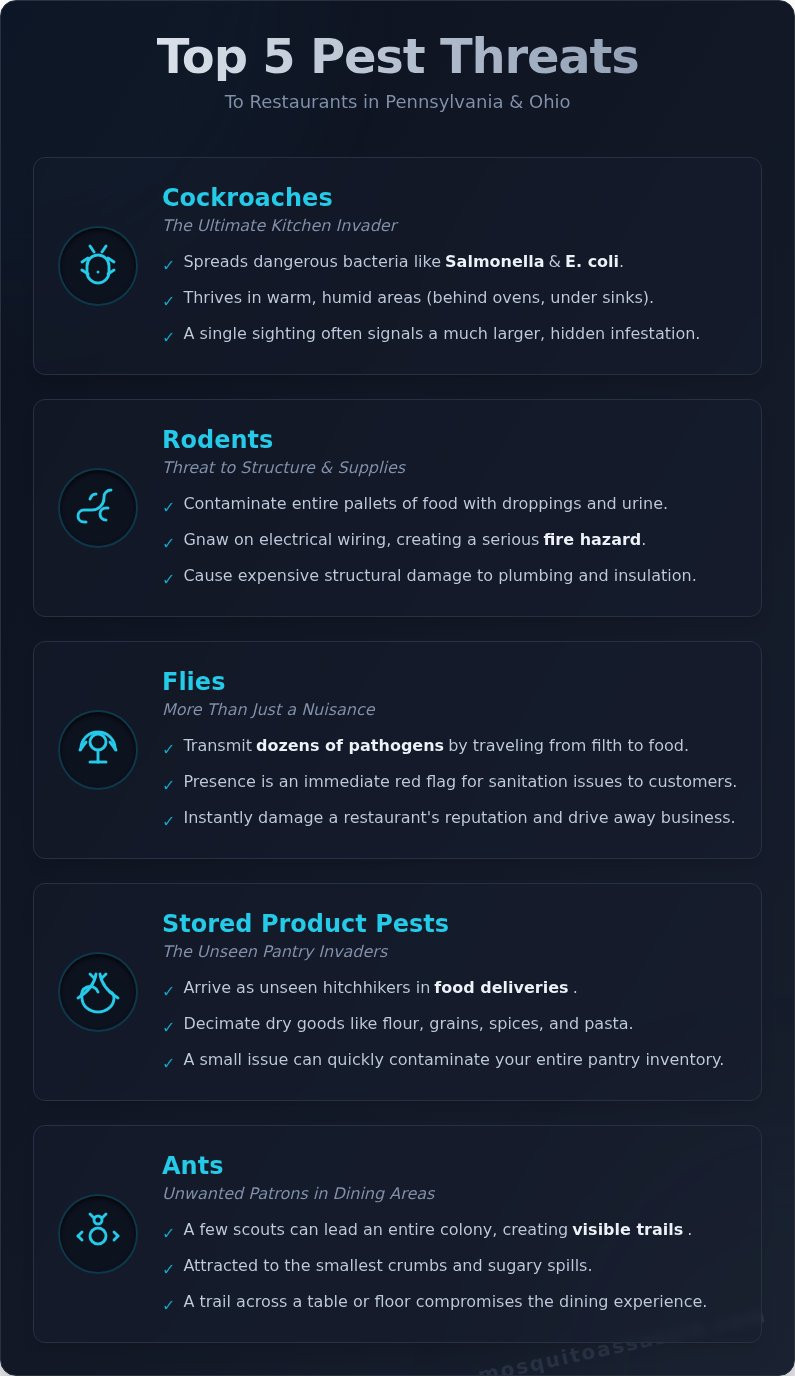
    Knowing your enemy is the first step to victory. For restaurant owners in Pennsylvania and Ohio, the battle against pests is constant due to our region’s specific climate and urban density. These aren’t just minor annoyances; they are significant threats to your reputation, inventory, and compliance. A professional restaurant pest control plan is your best defense against these top five invaders.

    Cockroaches: The Ultimate Kitchen Invader

    The German cockroach is the number one nemesis of commercial kitchens. These pests thrive in the warm, humid environments behind ovens, under sinks, and inside floor drains. They are notorious for spreading dangerous bacteria, including Salmonella and E. coli, directly onto food prep surfaces, utensils, and dishes. A single sighting often signals a much larger, hidden infestation that puts public health at risk.

    Rodents: A Threat to Structure and Supplies

    Mice and rats pose a dual threat of contamination and destruction. Their droppings and urine can contaminate entire pallets of food, leading to significant financial loss. Worse, their constant gnawing can damage structural elements, packaging, and even electrical wiring, creating a serious fire hazard. They often find entry points near dumpster areas or through gaps from adjoining properties, making exterior vigilance critical.

    Flies: More Than Just a Nuisance

    The presence of flies, whether drain flies in the mop sink, fruit flies at the bar, or house flies in the dining room, is an immediate red flag for sanitation issues. These pests travel from filth to food, transmitting dozens of pathogens with every landing. To a customer, a fly buzzing around their table is a clear sign of an unclean environment, instantly damaging your restaurant’s reputation and driving business away.

    Stored Product Pests (Pantry Pests)

    Often arriving as unseen hitchhikers in deliveries, stored product pests like Indian meal moths and weevils can decimate dry goods. An infestation can quickly spread through flour, grains, spices, and pasta, ruining hundreds of dollars in inventory. Discovering webbing in a bag of flour or beetles in a spice container requires immediate action to prevent a small problem from contaminating your entire pantry.

    Ants: Unwanted Patrons in Dining Areas

    While small, ants can create big problems. A few scout ants can quickly lead an entire colony to your establishment, forming visible trails from the kitchen to the dining room. They are drawn to the smallest crumbs and sugary spills, making them a particular nuisance around soda stations and dessert prep areas. An ant trail across a table or floor is a sight no customer wants to see, compromising the dining experience you work so hard to create.

    The Mosquito Assassin Strategy: Integrated Pest Management (IPM)

    Forget the outdated "spray and pray" tactics of the past. Modern, professional restaurant pest control is a science built on a smarter, more sustainable strategy: Integrated Pest Management (IPM). This isn’t a one-time chemical blitz; it’s a comprehensive, long-term partnership designed to safeguard your reputation, protect your inventory, and ensure compliance with health codes. IPM is the gold standard for the foodservice industry because it focuses on proactive prevention and uses targeted, low-impact treatments only when necessary, giving you dependable results and complete peace of mind.

    Step 1: Comprehensive Inspection and Assessment

    Our proven process begins with a meticulous, top-to-bottom inspection of your establishment. A certified Mosquito Assassin technician will identify existing pest pressures, potential entry points, and environmental factors that attract pests. We assess critical vulnerabilities in your sanitation, food storage, and building structure, from tiny cracks in the foundation to drainage issues. This detailed assessment forms the unshakable foundation of your customized protection plan.

    Step 2: A Customized, Targeted Treatment Plan

    Based on our findings, we design a multi-faceted treatment plan tailored specifically to your restaurant’s needs. We believe in using the right tool for the job, combining a range of effective methods like strategic baiting, discreet trapping, and physical exclusion to seal pests out for good. In sensitive areas like kitchens and dining rooms, we prioritize the use of low-impact, food-safe treatments. The plan is engineered for maximum effectiveness while remaining completely discreet to avoid disrupting your operations.

    Step 3: Ongoing Monitoring and Prevention

    Effective pest management is a continuous process, not a single event. Our service includes regular monitoring visits to inspect devices, check for new activity, and ensure your protective barrier remains secure. After each visit, we provide detailed service reports and actionable sanitation recommendations to help your staff be the first line of defense. We stand by our work with a simple, powerful guarantee: If pests return, so do we. Ready to protect your business? Schedule your comprehensive restaurant inspection today.

    Restaurant Pest Control: A Complete Guide to Protecting Your Business

    Creating a Pest-Proof Fortress: A Zone-by-Zone Guide

    A proactive defense is the foundation of effective restaurant pest control. Pests don’t see your business as a single entity; they see a collection of opportunities. By breaking down your restaurant into distinct operational zones, you can identify vulnerabilities and implement targeted strategies to safeguard your reputation, your inventory, and your bottom line.

    The Kitchen and Food Prep Areas

    This is ground zero for pest activity. The constant presence of food, moisture, and warmth makes your kitchen a paradise for cockroaches, flies, and rodents. Eliminating these attractants is non-negotiable. Your team’s daily protocol must include:

    • Deep Cleaning: Scour floor drains, clean grease traps, and pull out heavy equipment to clean underneath. Eradicating the hidden grease and moisture buildup that pests thrive on is critical.

    • Proper Food Storage: Immediately transfer all ingredients from cardboard boxes into sealed, rodent-proof containers made of hard plastic or metal.

    • Structural Sealing: Diligently inspect for and seal any cracks, crevices, or gaps around pipes and utility lines. Every sealed entry point is another victory in denying pests shelter.
      While your team handles daily wipe-downs, achieving the deep sanitation needed to truly deter pests often requires professional help. A commercial cleaning service like AlphaLux Cleaning can tackle the heavy-duty tasks, ensuring that the foundational cleanliness of your kitchen supports your pest prevention goals.

    Dining Rooms, Bars, and Patios

    Your guest experience can be instantly ruined by a single pest sighting. At the bar, fruit flies are a persistent threat; a nightly regimen of cleaning soda gun holsters, drip trays, and floor mats is essential. In dining areas, maintain immaculate floors and regularly clean under booths and tables where crumbs accumulate. For patios, protect your patrons from mosquitoes and flies with professional treatments, strategic lighting, and the elimination of any standing water sources.

    Storage Rooms and Dumpster Areas

    Often overlooked, these exterior and back-of-house areas are critical weak points in any restaurant pest control plan. Keep storerooms impeccably organized, with all goods stored on shelves at least six inches off the floor and away from walls. This simple practice eliminates hiding spots for rodents and makes inspections far more effective. Your dumpster area is a primary beacon for pests; ensure dumpsters have tight-fitting lids, are placed on a cleanable concrete pad, and are positioned as far from building entrances as possible.

    Keeping the dumpster pad and surrounding exterior surfaces free of the grease and food spills that attract pests is a crucial part of this defense. Professional exterior cleaning, like the commercial services offered by Poseidon Power Washing LLC, ensures these high-traffic areas remain sanitary and unattractive to rodents and insects.
    A zone-by-zone defense creates a formidable barrier, but a professional assessment ensures no vulnerability is missed. Contact Mosquito Assassin today to design a customized protection plan for your establishment.

    Choosing the Right Pest Control Partner in Erie and Ashtabula

    Your reputation is your most valuable asset, and your approach to restaurant pest control is only as strong as the partner you choose. While large national chains offer a one-size-fits-all solution, a local expert understands the specific pest pressures and regulatory landscape of Erie and Ashtabula counties. Choosing a dedicated, local partner means investing in a team that is as committed to your success as you are.

    Look for Foodservice Experience and Licensing

    When vetting a commercial pest control provider, expertise is non-negotiable. A general exterminator may not understand the unique challenges and stringent requirements of the foodservice industry. Before signing a contract, ensure your potential partner can provide proof of the following:

    • Proper Credentials: They must be fully licensed, insured, and certified to operate in Pennsylvania or Ohio.

    • Local Restaurant Experience: Ask for examples of their work with other foodservice businesses in the area. A proven track record is your best guarantee of quality.

    • Health Code Knowledge: A knowledgeable technician understands local health codes and provides services designed to help you pass inspections with confidence.

    Demand Discretion and Scheduling Flexibility

    The sight of a pest control truck parked outside your entrance during business hours can damage your reputation before a customer even walks through the door. A true professional understands this. Your partner should offer discreet service, including the use of unmarked vehicles upon request. They must also work around your schedule, performing treatments during off-hours, whether it’s early in the morning, late at night, or on days you are closed-to ensure zero disruption to your operations and dining experience.

    Prioritize Safety and Clear Communication

    Protecting your staff and patrons is paramount. Your pest control partner must use products and methods that are specifically approved and rated for use in sensitive foodservice environments. They should also provide comprehensive documentation after every visit, creating a clear logbook that satisfies health inspectors and demonstrates your commitment to a clean, safe establishment. This commitment to transparency is the foundation of a strong partnership. A true partner provides ongoing advice and support to safeguard your business for the long term. See why local restaurants trust Mosquito Assassin.

    Safeguard Your Reputation with the Right Pest Control Partner

    Your restaurant’s reputation is your most valuable asset, and as we’ve detailed, a single pest sighting can put it all at risk. Lasting protection comes from a proactive, comprehensive strategy, not just reactive treatments. For establishments in the Erie, PA and Ashtabula, OH areas, choosing a partner who understands your unique challenges is non-negotiable.

    At Mosquito Assassin, we are that partner. As a locally owned and operated team, we are experts in the foodservice health and safety regulations critical to your success. Our professional approach to restaurant pest control is designed to eliminate threats and ensure compliance, safeguarding your business from the inside out. We stand by our work with our Pest-Free Guarantee: If pests return, so do we.

    Don’t wait for a pest problem to become a public relations crisis. Take the definitive step toward total protection and peace of mind. ******Protect Your Reputation. Get a Free Restaurant Pest Control Quote Now! **

    Frequently Asked Questions About Restaurant Pest Control

    How often do restaurants need professional pest control services?

    For optimal protection, most restaurants benefit from a monthly or bi-monthly service schedule. Factors like your building’s age, location, and specific pest pressures can influence this frequency. A proactive, consistent plan is the best defense against pests. We conduct a thorough inspection to create a customized service schedule that safeguards your reputation, ensures health code compliance, and keeps your establishment pest-free and protected year-round.

    Are the pest control treatments you use safe for a commercial kitchen?

    Absolutely. The safety of your staff, customers, and kitchen is our highest priority. We utilize EPA-approved, food-safe products and Integrated Pest Management (IPM) techniques specifically designed for sensitive commercial environments. Our certified technicians are experts in precise application, targeting pest harborage areas while meticulously avoiding food contact surfaces. We ensure our methods are fully compliant with health regulations, providing you with effective and safe pest eradication.

    How much does restaurant pest control cost?

    The cost of professional restaurant pest control depends on the size of your facility, the type of pests being targeted, the severity of any current infestation, and the required service frequency. Following a comprehensive inspection, we provide a detailed, transparent quote with no hidden fees. Investing in a professional plan is a crucial measure to protect your business from the costly damage, health code violations, and reputation loss that a pest problem can cause.

    Will my customers know I have a pest control service?

    We operate with the utmost discretion. Our technicians understand the importance of your restaurant’s reputation and arrive in discreetly marked vehicles. We are highly flexible and will schedule our services during your off-peak hours or after closing to ensure there is no disruption to your daily operations or your customers’ dining experience. Our goal is to be your silent partner in maintaining a clean, pest-free environment.

    What can my staff do to help prevent pests between services?

    Your team is your first line of defense. Staff can help by adhering to strict sanitation protocols, including cleaning spills immediately, wiping down all prep surfaces, and ensuring floors are free of food debris. All food ingredients should be stored in sealed, airtight containers. Regularly emptying indoor and outdoor trash receptacles is also critical. Consistent cleanliness is a powerful deterrent that makes your establishment far less attractive to pests.

    Do you offer emergency services if we have a sudden pest sighting?

    Yes. A sudden pest sighting is a critical event for any restaurant, and we treat it with the urgency it deserves. We offer fast-response emergency services to tackle unexpected pest problems swiftly and decisively. Our team is prepared to deploy quickly to assess the situation, eliminate the immediate threat, and help you maintain business continuity. If you have a pest emergency, call us immediately for a rapid solution.