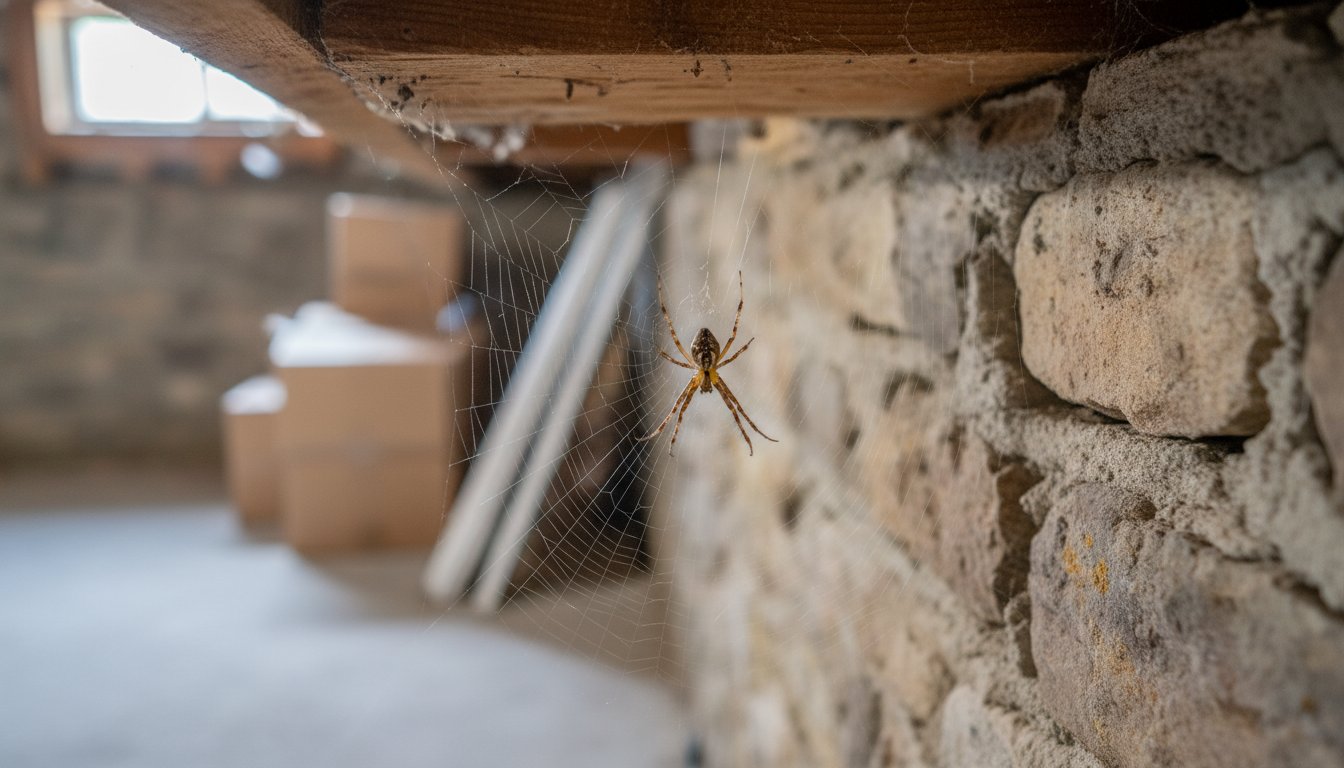
Tag: pennsylvania spiders

  • How to Identify Common House Spiders in PA: A Homeowner’s Guide

    How to Identify Common House Spiders in PA: A Homeowner’s Guide

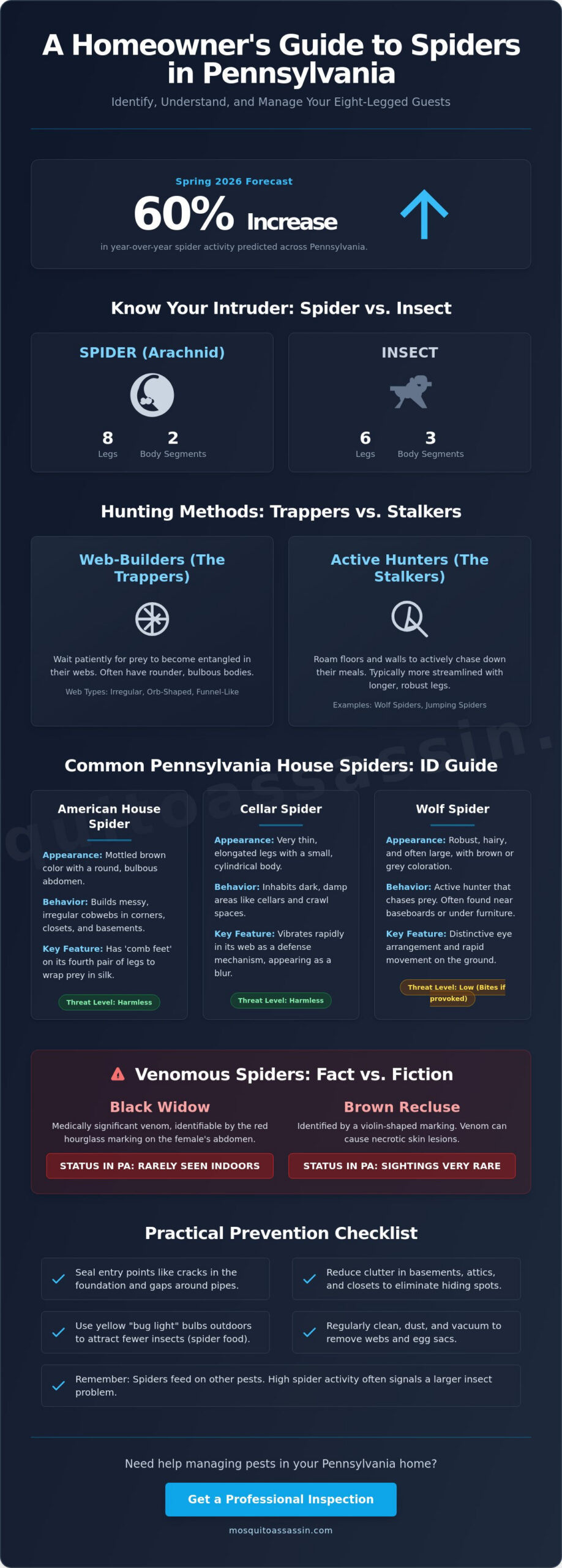
    A spring 2026 pest forecast predicted a 60% year-over-year increase in spider activity across Pennsylvania, meaning you’re more likely than ever to encounter unexpected guests in your living spaces. It’s natural to feel a sense of dread when you spot a dark shape scuttling across the floor, especially when you’re unsure if the intruder poses a legitimate threat to your family. Learning how to identify common house spiders in PA is the first step toward reclaiming your peace of mind and determining whether a sighting is a minor nuisance or a situation that requires expert intervention.

    You likely share the common frustration of clearing away messy cobwebs only to find them rebuilt by morning, paired with the uncertainty of which species are actually dangerous. This guide provides the tools to accurately identify the most frequent eight-legged residents in local homes, from the harmless American House Spider to the rarely seen but medically significant Black Widow. By understanding specific hunting behaviors and physical markers, you’ll gain the knowledge necessary to prevent future sightings and recognize when professional pest control may help reduce risk.

    Disclaimer: The information provided on this blog is for general informational purposes only and is not intended as professional pest control advice. Conditions vary by property, environment, and location. Reading this content does not create a service agreement. For an inspection or professional recommendations, please contact Mosquito Assassin Pest Control LLC directly.
    Key Takeaways

    • Differentiate between common insects and Pennsylvania’s 45 spider species by recognizing key arachnid body segments and leg counts.
    • Master how to identify common house spiders in PA using visual markers like mottled brown coloring or the unique vibrating defense of cellar spiders.
    • Identify why the specific climate of Erie and Crawford Counties makes local basements and attics attractive hunting grounds for various species.
    • Learn to separate fact from fiction regarding venomous spiders, including how to spot a Black Widow and why Brown Recluse sightings are rare in the region.
    • Gain practical prevention strategies to limit indoor populations by modifying storage habits and sealing common entry points around your property.

    Understanding the Common House Spiders of Pennsylvania

    Pennsylvania is home to approximately 45 different spider species, though the vast majority of these arachnids are harmless to humans. Unlike six-legged insects, spiders are characterized by having two body segments and eight legs. Most species encountered inside local residences are either accidental invaders or specialized varieties that have adapted to indoor climates over generations. Learning how to identify common house spiders in PA starts with recognizing that their presence usually signals an underlying population of other insects, which serve as their primary food source. If you see a high volume of webs or active spiders, it’s a sign that your home provides a reliable buffet of smaller pests.

    To better understand this concept, watch this helpful video:

    The Role of Spiders in the Local Ecosystem

    Spiders function as natural pest controllers within the regional environment. By preying on flies, moths, and mosquitoes, they help manage insect populations that might otherwise become overwhelming. In Northwest PA, homeowners often see a surge in spider activity during seasonal transitions, particularly in the spring and fall as temperatures fluctuate. These predators move toward warmth and food sources, making houses in Erie and Crawford Counties prime real estate for opportunistic hunters. Their presence is a biological response to the environment; they go where the food is most abundant. Understanding this predatory nature helps you predict where they might hide, such as near light fixtures or windows where other insects gather.

    Web-Builders vs. Active Hunters

    Identification is easier when you categorize spiders by their hunting methods. Web-builders, such as the Common House Spider (Parasteatoda tepidariorum), typically remain sedentary and wait for prey to become entangled in irregular cobwebs. In contrast, active hunters like wolf spiders don’t rely on webs; they roam floors and baseboards to chase down their meals. You can often identify the species by examining the web pattern, which may be orb-shaped, funnel-like, or a messy tangle. Sedentary species often have rounder, bulbous abdomens designed for storing energy between catches. Active hunters tend to be more streamlined, featuring longer legs and robust bodies to support their constant movement across varied surfaces. Recognizing these physical traits allows you to quickly determine if a spider is a permanent resident or just passing through.

    Disclaimer: The information provided on this blog is for general informational purposes only and is not intended as professional pest control advice. Conditions vary by property, environment, and location. Reading this content does not create a service agreement. For an inspection or professional recommendations, please contact Mosquito Assassin Pest Control LLC directly.
    Key Identification Features: How to Recognize PA Arachnids

    Accurately determining which species has entered your home requires a close look at physical traits and behaviors. When learning how to identify common house spiders in PA, focus first on the body shape and leg structure. The American House Spider is one of the most frequent residents; it features a mottled brown color and distinct ‘comb feet’ on its fourth pair of legs, which are used to wrap prey in silk. In contrast, Cellar Spiders are recognizable by their extremely thin, elongated legs and small, cylindrical bodies. If you disturb their web, these spiders often vibrate rapidly as a defense mechanism, making them appear as a blur to potential predators.

    Wolf spiders are perhaps the most intimidating species due to their robust, hairy bodies and rapid movement. You can distinguish them by their eye arrangement, specifically the two large eyes positioned prominently on the top of their head. While they look formidable, they are nomadic hunters that don’t spin traditional webs. For more detailed images and descriptions of these physical markers, the Penn State Extension guide to PA spiders provides an excellent resource for local property owners. You may also encounter Yellow Garden Spiders, which sport striking bright yellow and black patterns. These are typically found outdoors near windows or porches where sunlight attracts the flying insects they prefer to eat.

    Common Look-Alikes in Pennsylvania Homes

    Many homeowners struggle with species that look nearly identical. For instance, the Grass Spider is frequently mistaken for a Wolf Spider. To tell them apart, check the rear of the abdomen; Grass Spiders have prominent, tail-like spinnerets that Wolf Spiders lack. Similarly, Nursery Web Spiders may resemble these hunters, but they carry their egg sacs in their jaws rather than attached to their spinnerets. Size is often a misleading factor. A large spider isn’t necessarily more dangerous than a small one, and most local species are non-aggressive unless directly handled.

    Identifying Spiders by Their Webs

    Web patterns offer another reliable identification tool when the spider itself remains hidden. Common House Spiders create irregular, messy tangles in corners, under furniture, or in basements. Grass Spiders build flat, sheet-like webs with a distinct funnel-shaped retreat at one end, usually near ground level or in foundation gaps. If you see a classic circular pattern, you’re looking at an orb web, typically spun by garden-dwelling species on porches or eaves. If these sightings become frequent or cause concern, professional pest control may help reduce risk by managing the insect populations that draw spiders into your living space.

    Disclaimer: The information provided on this blog is for general informational purposes only and is not intended as professional pest control advice. Conditions vary by property, environment, and location. Reading this content does not create a service agreement. For an inspection or professional recommendations, please contact Mosquito Assassin Pest Control LLC directly.
    How to Identify Common House Spiders in PA: A Homeowner’s Guide

    Common Hiding Spots in Northwest Pennsylvania Homes

    Spiders are opportunistic survivors that prioritize three things: moisture, safety, and a steady supply of food. In Erie and Crawford Counties, the damp environments found in basements and crawlspaces are particularly attractive. These subterranean areas provide the high humidity levels that Cellar Spiders require to thrive. Because these spaces are often left undisturbed for long periods, they offer a perfect sanctuary for permanent web construction. If you are struggling with how to identify common house spiders in PA, looking in these moisture-rich zones is a logical starting point for your search.

    While some species stay low, others prefer the vertical advantage of attics and ceilings. Jumping spiders and sac spiders are frequently found near crown molding or in the upper corners of rooms. These elevated areas serve as effective hunting grounds where they can intercept flying insects. Similarly, windows and door frames are high-traffic zones. Exterior lighting at night attracts moths, flies, and beetles, creating a concentrated feeding station that draws spiders toward your entry points. Cluttered storage areas, particularly those filled with rarely moved cardboard boxes, provide the narrow crevices spiders use for nesting and protecting egg sacs.

    Seasonal Activity Patterns in the Keystone State

    Weather plays a significant role in when you see arachnids. Spring emergence typically begins as soon as temperatures consistently stay above freezing, as this triggers the hatching of overwintered eggs. Many homeowners believe spiders migrate indoors during the fall to escape the cold. In reality, most house spiders have lived inside your walls year-round. They simply become more visible in autumn because it’s their primary mating season. For visual assistance, a Pennsylvania spider identification guide can help you distinguish between these seasonal visitors. Indoor heating systems also influence behavior; the dry, warm air from a furnace can cause egg sacs to hatch prematurely, leading to sudden mid-winter sightings.

    Outdoor vs. Indoor Habitats

    The vegetation surrounding your home foundation often dictates which species are likely to wander inside. Grass Spiders prefer the shelter of woodpiles and tall grass, but they may accidentally enter through gaps in the siding or foundation. Other species are true indoor specialists that spend their entire life cycle within drywall crevices or behind baseboards. Managing the transition zone between your yard and your home is a key part of long-term prevention. For a broader look at managing various household invaders, you can read more in our guide to General Pest Control. Understanding these habitat preferences is essential for anyone learning how to identify common house spiders in PA and keep them at bay.

    Disclaimer: The information provided on this blog is for general informational purposes only and is not intended as professional pest control advice. Conditions vary by property, environment, and location. Reading this content does not create a service agreement. For an inspection or professional recommendations, please contact Mosquito Assassin Pest Control LLC directly.
    Addressing Safety Concerns: Venomous Spiders in PA

    Understanding how to identify common house spiders in PA involves distinguishing between nuisance pests and those with medical significance. It’s vital to clarify a common scientific distinction: spiders are venomous, not poisonous. Venom is a toxin injected through fangs to submerge prey, whereas poison is harmful only if ingested or touched. For the vast majority of spiders found in Pennsylvania, a bite results in symptoms no more severe than a typical bee sting, including minor redness, localized swelling, and itching. While the sight of a spider can be startling, most species have no interest in human contact and only bite when they feel physically crushed or threatened.

    The Northern Black Widow is the only native species in Pennsylvania with venom considered medically significant. These spiders are easily recognized by their shiny black abdomens and distinct red markings. While the southern variant has a full hourglass, the northern variety often features a split hourglass or a series of red spots along the back. They prefer undisturbed, dark environments such as woodpiles, cluttered sheds, or old garages. When cleaning these areas in Erie County or Crawford County, always wear heavy gloves to prevent accidental contact with a hidden web.

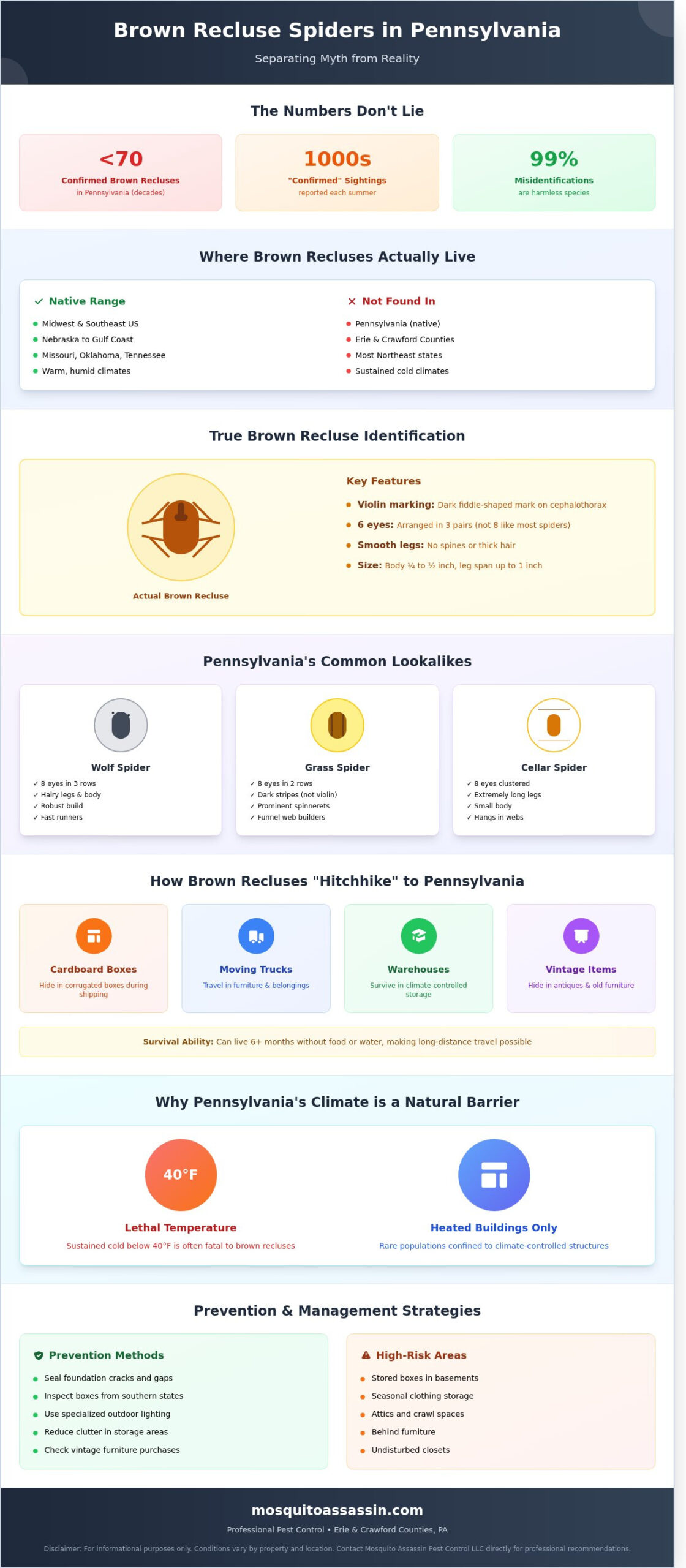
    There is a persistent myth regarding Brown Recluse populations in the Keystone State. These spiders are not native to or established in Pennsylvania. While they occasionally appear as “hitchhikers” in shipments of furniture or boxes from southern states, they do not survive or reproduce well in our local climate. Most reported sightings of Brown Recluse spiders in the region are actually misidentified grass spiders or wolf spiders, which lack the necrotic venom of the recluse.

    When to Seek Professional Insight

    Identifying a single spider is one thing, but recognizing a larger infestation requires a systematic approach. If you notice multiple egg sacs or a high volume of webs appearing in active living areas, it indicates a stable and breeding population. Professional pest control may help reduce risk by eliminating the smaller insects that serve as the spider’s primary food source. If you are uncertain about a specific species in your home or feel overwhelmed by a sudden surge in activity, professional pest control services provide the expertise needed for an accurate risk assessment and a definitive resolution.

    Disclaimer: The information provided on this blog is for general informational purposes only and is not intended as professional pest control advice. Conditions vary by property, environment, and location. Reading this content does not create a service agreement. For an inspection or professional recommendations, please contact Mosquito Assassin Pest Control LLC directly.
    Practical Strategies for Managing Indoor Spider Populations

    Once you’ve mastered how to identify common house spiders in PA, the next step is implementing environmental controls to discourage their presence. Reducing clutter is a high-priority task for any homeowner. Cardboard boxes are notorious for attracting spiders because they provide countless narrow crevices and are often held together with organic glues that some insects find attractive. Replacing these with airtight plastic bins for long-term storage removes these nesting sites immediately and protects your belongings from being used as a habitat. It’s a simple change that yields significant results in storage areas like basements or attics.

    Focusing on exclusion is another professional-grade tactic. Sealing entry points prevents accidental invaders from ever crossing the threshold. Use high-quality caulk to close gaps around window frames, door sills, and where utility lines enter the foundation. Additionally, consider your exterior lighting. Standard white bulbs attract swarms of flying insects, creating a concentrated buffet that draws spiders toward your doorways. Switching to yellow “bug lights” reduces the number of attracted prey insects, making your home a less desirable hunting ground for nomadic species. Routine cleaning also plays a vital role. Vacuuming is one of the most effective ways to disrupt the spider life cycle. You should vacuum webs, the spiders themselves, and any visible egg sacs to prevent the next generation from hatching inside your living space.

    Natural Deterrents and Maintenance

    Managing the internal environment is critical for long-term success. In the damp climates of Erie and Crawford Counties, running a dehumidifier can make basements significantly less hospitable to moisture-loving species like Cellar Spiders. Outside, maintain a clear perimeter around the house. Keep shrubs and tall grass at least one foot away from the foundation to eliminate bridge-like pathways that spiders use to reach your siding. Regular dusting of high corners, behind appliances, and under large furniture prevents colonies from becoming established in the first place. These small habits collectively make your property much less attractive to arachnids.

    The Value of Year-Round Protection

    Successful management relies on addressing the root cause: the food source. Spiders stay where they can eat. By managing the underlying insect populations through Year-Round Protection, you naturally reduce the spider population as well. This proactive approach ensures that seasonal surges in flies, moths, or beetles don’t turn into a secondary spider infestation. The regional expertise found in Erie, Crawford, and Ashtabula Counties allows for a targeted strategy that respects local pest behaviors while securing your property. If you’ve struggled with how to identify common house spiders in PA or are overwhelmed by persistent webs, professional pest control may help reduce risk by creating a comprehensive barrier against all household pests.

    Disclaimer: The information provided on this blog is for general informational purposes only and is not intended as professional pest control advice. Conditions vary by property, environment, and location. Reading this content does not create a service agreement. For an inspection or professional recommendations, please contact Mosquito Assassin Pest Control LLC directly.

    Securing Your Home Against Regional Arachnids

    Maintaining a spider free environment requires a combination of vigilance and practical environmental changes. By prioritizing the removal of clutter and sealing entry points, you disrupt the habits of nomadic hunters and sedentary web builders alike. Accurate knowledge of how to identify common house spiders in PA ensures you can distinguish between a beneficial garden visitor and a species that requires more direct intervention. Most local sightings involve harmless varieties, but recognizing the specific markers of the Northern Black Widow provides an essential layer of safety for your household.

    Licensed professionals serving Erie and Crawford Counties in PA apply a systematic approach to pest management that addresses the root of the problem. This expertise in regional pests of the Keystone State helps property owners achieve long term resolution rather than temporary fixes. If you are concerned about spiders in your home, professional pest control may help reduce risk and restore your peace of mind. With the right prevention strategies in place, you can enjoy a more comfortable and secure living space throughout every season.

    Disclaimer: The information provided on this blog is for general informational purposes only and is not intended as professional pest control advice. Conditions vary by property, environment, and location. Reading this content does not create a service agreement. For an inspection or professional recommendations, please contact Mosquito Assassin Pest Control LLC directly.

    Frequently Asked Questions

    Are there brown recluse spiders in Pennsylvania?

    Brown recluse spiders are not native to Pennsylvania and no established populations exist within the state. While these spiders can occasionally be transported into the region as “hitchhikers” in shipping containers or moving boxes from the South, they don’t survive well in our local climate. Most reported sightings in Northwest PA are actually misidentified wolf spiders or nursery web spiders, which lack the necrotic venom of a recluse.

    How can I tell if a spider in my house is a black widow?

    You can identify a black widow by its shiny, jet-black body and the distinct red marking on the underside of its abdomen. In the Northern Black Widow, which is the variety found in this region, the hourglass is often split into two separate spots or may appear as a row of red dots along the back. These spiders are reclusive and prefer dark, undisturbed areas like woodpiles, crawlspaces, or cluttered sheds.

    What is the most common house spider in PA?

    The American House Spider is the species most frequently encountered by homeowners throughout the state. Learning how to identify common house spiders in PA involves looking for their mottled brown coloring and the messy, tangled webs they build in corners or under furniture. They are harmless to humans and act as natural pest controllers by focusing their hunting efforts on smaller nuisance insects like flies and gnats.

    Do house spiders in PA bite humans while they sleep?

    It is extremely rare for a spider to bite a human while they are sleeping. Spiders don’t feed on human blood and have no biological reason to approach a sleeping person. Most bites occur only as a defensive reaction when a spider is accidentally pressed against skin, such as when someone rolls over on one in bed or puts on a shoe where a spider is hiding.

    Why do I suddenly have so many spiders in my basement?

    A sudden increase in basement spiders usually indicates high humidity levels and a plentiful food source of other insects. The damp foundations common in Erie and Crawford Counties provide the perfect environment for cellar spiders and their prey to thrive. Reducing moisture with a dehumidifier and clearing away cardboard storage boxes can help disrupt these established colonies and make the area less attractive to predators.

    Can professional pest control get rid of spiders permanently?

    No service can guarantee the permanent removal of all spiders because nature is dynamic and new spiders can always wander in from the outdoors. However, professional pest control significantly reduces indoor populations by managing the insects that spiders eat and sealing structural gaps. A systematic approach ensures that the environment remains inhospitable to pests, providing long term relief and security for property owners.

    What do spider egg sacs look like in a house?

    Spider egg sacs typically look like small, silken balls or teardrop shaped pouches hidden in dark corners or suspended within webs. The American House Spider produces a brownish, pear shaped sac, while other species might create white, spherical clusters. Vacuuming these sacs as soon as they are spotted is a practical way to prevent hundreds of new spiderlings from emerging and spreading throughout your living space.

    Are jumping spiders in Pennsylvania dangerous to pets?

    Jumping spiders in Pennsylvania are not dangerous to household pets like cats or dogs. Their venom is highly specialized for paralyzing small insects and isn’t potent enough to cause medical harm to larger animals. These spiders are actually beneficial residents that actively track down and pounce on flies and mosquitoes, helping to keep your home’s internal insect population under control without the use of webs.

    Disclaimer: The information provided on this blog is for general informational purposes only and is not intended as professional pest control advice. Conditions vary by property, environment, and location. Reading this content does not create a service agreement. For an inspection or professional recommendations, please contact Mosquito Assassin Pest Control LLC directly.

  • Are Black Widows in PA? Identifying Pennsylvania’s Medically Significant Spiders

    Are Black Widows in PA? Identifying Pennsylvania’s Medically Significant Spiders

    While many homeowners assume venomous spiders are strictly a concern for southern climates, the northern black widow is a permanent resident of the Keystone State. Pennsylvania is home to over 500 spider species, yet if you’ve wondered are black widows in pa, they remain one of only two species in the region with medically significant venom. It’s natural to feel unease when you spot a dark, spindly shape scuttling across a garage floor or tucked behind storage bins. Most people struggle to tell the difference between a harmless house spider and a species that requires caution.

    This guide provides the specific visual markers you need to identify these spiders with confidence. You’ll learn exactly where these arachnids prefer to hide in Erie and Crawford Counties and discover practical, professional strategies to reduce the risk of an encounter. By understanding their behavior and habitat, you can effectively safeguard your home and family from unwanted guests.

    Disclaimer: The information provided on this blog is for general informational purposes only and is not intended as professional pest control advice. Conditions vary by property, environment, and location. Reading this content does not create a service agreement. For an inspection or professional recommendations, please contact Mosquito Assassin Pest Control LLC directly.

    Key Takeaways

    • Confirm that both Northern and Southern black widow species reside in Pennsylvania and understand their distribution across the Northeast.
    • Learn to identify the distinct red hourglass marking and physical characteristics that separate these spiders from common lookalikes.
    • Identify preferred habitats in Erie and Crawford Counties, including woodpiles and basement corners, to better recognize potential risk areas.
    • Understand the answer to are black widows in pa while exploring how Integrated Pest Management (IPM) strategies can reduce the insect populations that attract spiders.
    • Implement practical safety precautions and protective gear recommendations to prevent bites during routine yard work or home cleaning.

    Understanding Black Widow Populations in Pennsylvania

    When residents ask are black widows in pa, the answer is a definitive yes. Pennsylvania serves as a meeting ground for two specific species within the Latrodectus genus. These spiders are members of the cobweb weaver family, known for their messy, tangled webs rather than the symmetrical designs of garden spiders. While their presence often causes concern, they’re generally reclusive and avoid human interaction. Records from the Penn State Department of Entomology confirm sightings in counties across the Commonwealth, including Erie and Crawford, where local populations have been documented for decades.

    To better understand how these spiders behave and where they live, watch this helpful video:

    The Southern Black Widow in PA

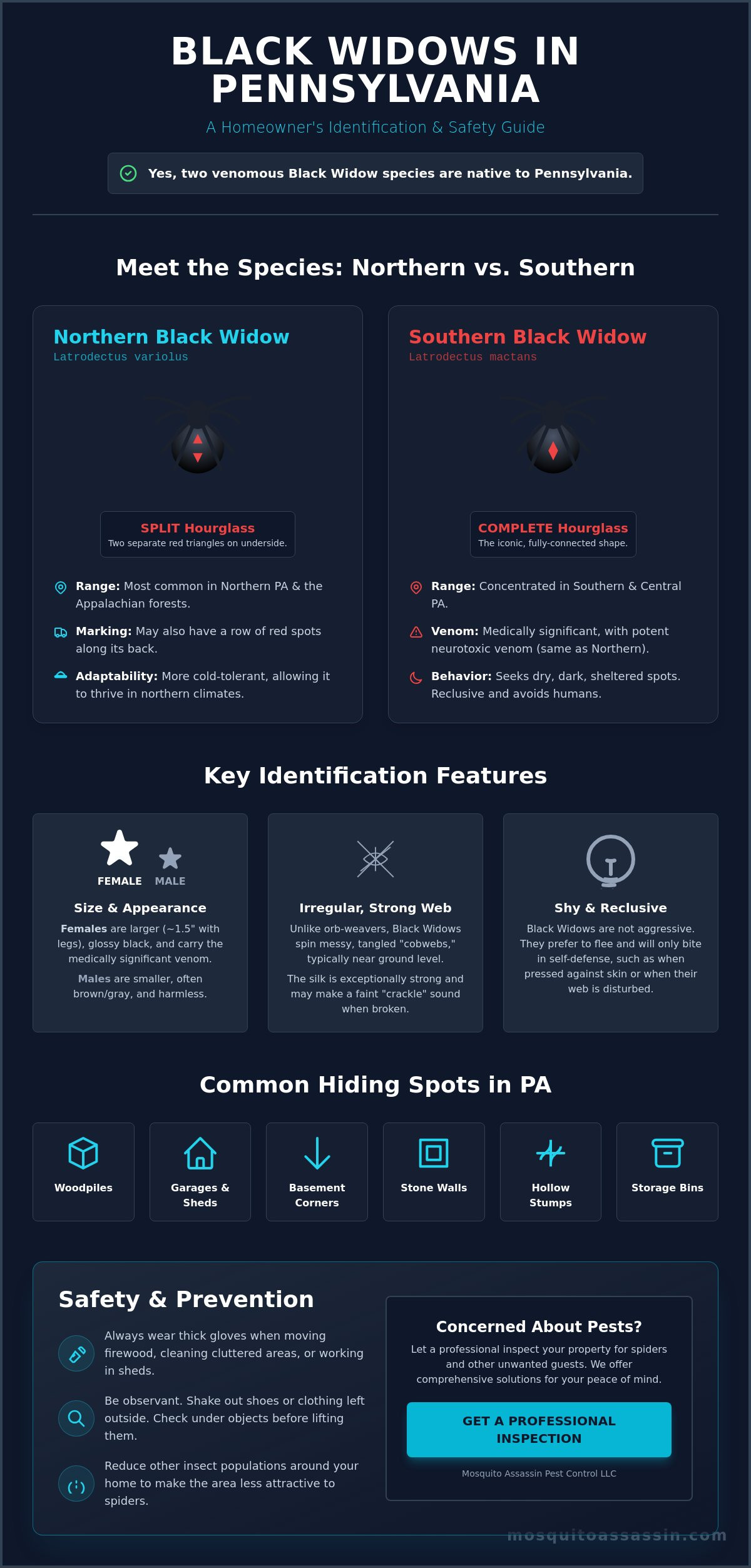
    The Southern black widow (Latrodectus mactans) is the most recognizable member of the genus. These spiders are primarily concentrated in the southern and central regions of the state where temperatures remain slightly warmer. They’re famous for the bright red hourglass mark on the underside of their shiny, jet-black abdomen. The Southern black widow is a medically significant cobweb weaver common in PA. They often seek out dry, sheltered spots like stone walls, hollow stumps, or the dark corners of a garage. Because are black widows in pa, it’s helpful to know how to spot their distinctive webs, which are exceptionally strong and lack a clear pattern.

    The Northern Black Widow and its Range

    The Northern Black Widow (Latrodectus variolus) is the species most likely encountered by residents in the northern counties of Pennsylvania and into Ohio. Unlike the Southern variety, the red marking on the Northern species is often split into two distinct triangles or appears as a row of red spots along the back. This species is more cold-tolerant, allowing it to thrive in the Appalachian forests and rural landscapes of the northern tier. Both spiders possess similar neurotoxic venom, making them a concern if they establish themselves inside a home. Professional pest control may help reduce risk by managing the outdoor environments where these spiders prefer to hide. If you have concerns about spiders on your property, you can find more information at www.mosquitoassassin.com/contact-us.

    Disclaimer: The information provided on this blog is for general informational purposes only and is not intended as professional pest control advice. Conditions vary by property, environment, and location. Reading this content does not create a service agreement. For an inspection or professional recommendations, please contact Mosquito Assassin Pest Control LLC directly.

    How to Identify Black Widows and Common Lookalikes

    Understanding the physical traits of these spiders helps homeowners distinguish between a harmless visitor and a medically significant pest. While many people ask are black widows in pa, the reality is that they’re native to the region but often remain hidden. The mature female is the most recognizable, featuring a glossy, jet-black exoskeleton that reflects light. She typically measures about 1.5 inches in length when her legs are extended; meanwhile, the males are significantly smaller, often appearing brown or gray with white streaks or spots on their backs.

    The most famous marker is the red hourglass on the underside of the abdomen. In the Northern Black Widow (Latrodectus variolus), which is common in the Northeast, this hourglass is often “broken” or split into two distinct triangles. In contrast, the Southern Black Widow (Latrodectus mactans) usually displays a complete, joined hourglass. Their webs are another giveaway; they don’t spin symmetrical, circular patterns. Instead, they create irregular, tangled “cobwebs” made of incredibly strong silk that can even make a faint “crackle” sound when torn or pulled apart.

    Key Identification Markers for Homeowners

    Homeowners should look for the hourglass on the belly of the spider, as it’s rarely visible from the top. These spiders are reclusive and nocturnal; they’ll usually retreat into a corner or crevice if disturbed rather than attacking. Identification also extends to their offspring. A female widow produces smooth, tan, or white pear-shaped egg sacs that are about 0.5 inches in diameter. These sacs are distinct from the spiked or “fluffy” sacs produced by other species. If you find these markers in a garage or crawlspace, professional pest control may help reduce risk by identifying the extent of the activity.

    Common PA Spiders Mistaken for Black Widows

    Mistaken identity is frequent in Erie and Crawford counties. The False Black Widow (Steatoda grossa) is the most common lookalike. While it has a similar bulbous shape and dark color, it lacks the red hourglass and typically has a more purplish-brown or dull black hue. Common House Spiders also cause confusion because they build similar messy webs, but they’re generally smaller and much lighter in color. According to the guide on Commonly Encountered Pennsylvania Spiders, orb weavers are also frequently misidentified due to their dark bodies, though they’re easily distinguished by the large, wheel-shaped webs they build in gardens and near porch lights.

    Disclaimer: The information provided on this blog is for general informational purposes only and is not intended as professional pest control advice. Conditions vary by property, environment, and location. Reading this content does not create a service agreement. For an inspection or professional recommendations, please contact Mosquito Assassin Pest Control LLC directly.

    Are Black Widows in PA? Identifying Pennsylvania’s Medically Significant Spiders

    Typical Habitats and Seasonal Patterns in the Northeast

    While many residents wonder are black widows in pa, the reality is that these spiders are native to the region and thrive in specific, quiet environments. They’re reclusive by nature and prioritize survival by nesting in dark, low traffic areas where they’re unlikely to be stepped on or brushed away. According to the Penn State Extension, both Northern and Southern Black Widows can be found in the state, typically tucked away in spots that offer protection from both predators and the elements.

    Seasonal patterns dictate when sightings become more frequent. In Pennsylvania, activity levels usually rise as temperatures climb in late spring. However, sightings peak during the late summer and early autumn months, specifically between August and October. During this window, adult females are at their most active and their webs are more established. As the weather cools in Northwest Pennsylvania, these spiders don’t necessarily migrate into the center of homes, but they do seek more insulated crevices to survive the winter freeze.

    Outdoor Hiding Spots in PA Landscapes

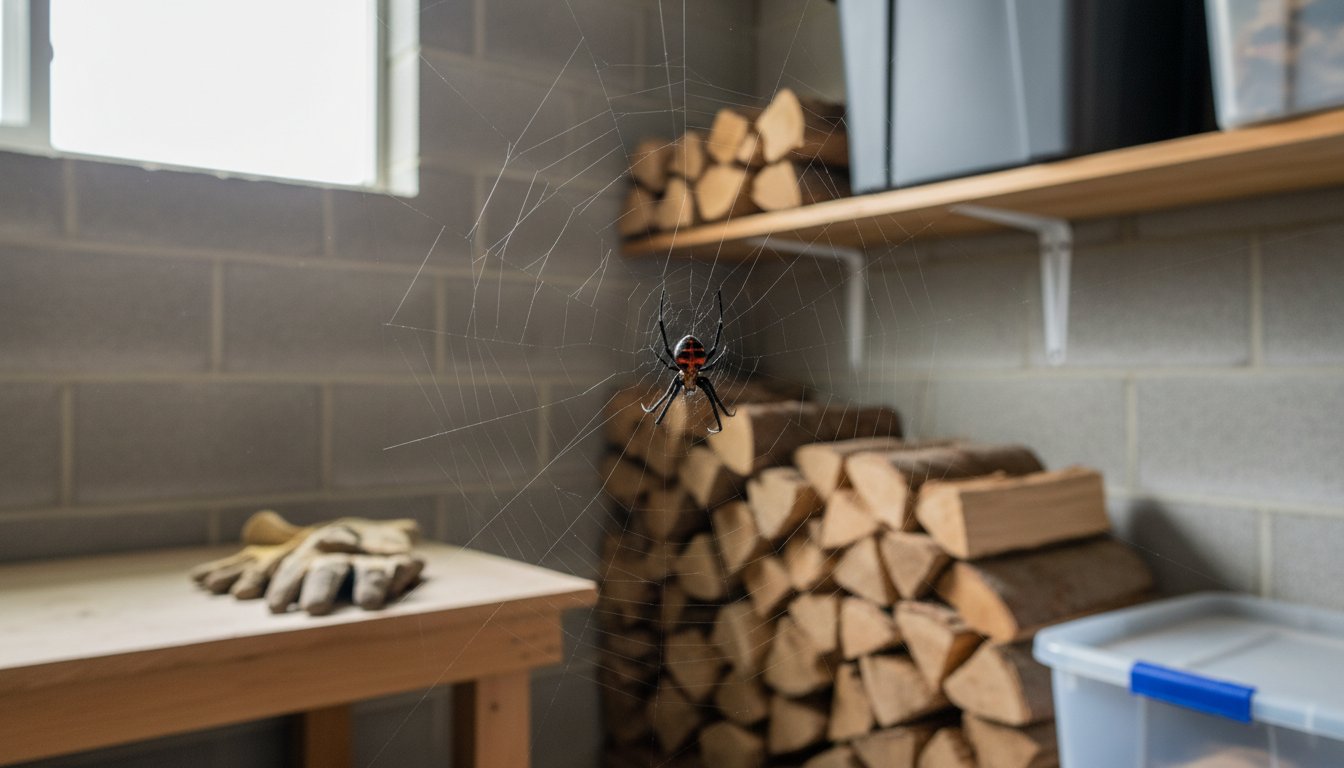
    In the rural and suburban landscapes of Erie and Crawford counties, outdoor structures provide ideal nesting sites. Woodpiles are the most common hazard; spiders often hide in the gaps between logs to stay cool and damp. Stone walls, hollow tree stumps, and the undersides of porch steps also serve as prime real estate. These locations provide the perfect anchor points for their strong, irregular webbing.

    Outbuildings like sheds, barns, and detached garages are particularly attractive because they offer shelter without the constant disruption of a main residence. The climate in Northwest PA, influenced by Lake Erie humidity, provides the moisture these spiders prefer. When moving stored firewood or clearing yard debris, it’s vital to wear heavy gloves. This simple precaution prevents accidental contact with a hidden spider that may be guarding an egg sac.

    Indoor Environments and Prevention

    Understanding that are black widows in pa is just the first step in prevention. These spiders rarely wander into the middle of a kitchen or bedroom. Instead, they’re found in transition zones like garages, basements, and crawl spaces. These areas often house cluttered storage boxes or seasonal equipment that remains untouched for months. Clutter provides the undisturbed environment these reclusive species need to build their tangled webs and hunt for insects.

    Common entry points include gaps under doors, damaged window screens, or utility penetrations. Since these spiders are photophobic (light avoidant), they’re naturally deterred by bright, well lit areas. Increasing natural light in a basement or keeping storage areas organized and off the floor can significantly reduce the likelihood of a widow choosing your home for a nest. If you identify a potential habitat near your living space, professional pest control may help reduce risk.

    Disclaimer: The information provided on this blog is for general informational purposes only and is not intended as professional pest control advice. Conditions vary by property, environment, and location. Reading this content does not create a service agreement. For an inspection or professional recommendations, please contact Mosquito Assassin Pest Control LLC directly.

    Safety Precautions and Bite Prevention Strategies

    Understanding that there are black widows in pa means taking practical steps to safeguard your home and family. These spiders prefer undisturbed, dim locations, which makes garages, basements, and crawl spaces high-risk areas. When you’re cleaning out a storage space or working in the yard, always wear heavy leather gloves and long sleeves. Thin fabric gloves don’t provide enough protection against a spider’s fangs if you accidentally press against one while moving boxes.

    Before reaching into dark corners or moving storage bins, use a bright flashlight to inspect the area. Look for the characteristic messy, tangled webs that indicate a widow’s presence. It’s also vital to shake out any boots, work shoes, or gloves that have been sitting in a garage or mudroom for more than 24 hours. Spiders often crawl into these dark, enclosed spaces for shelter. If you spot a suspected black widow, don’t attempt to handle it or crush it with your hands. Use a vacuum with a long attachment to remove the spider from a safe distance, then dispose of the bag or empty the canister outside immediately.

    Reducing Risk Around the Property

    Managing the exterior of your home is the first line of defense. Keep woodpiles, rock piles, and general debris at least 20 feet away from your foundation. This removes the primary habitat for spiders and the insects they eat. You should also inspect your home’s exterior for entry points. Seal cracks in the foundation with high-quality silicone caulk and ensure door sweeps are tight against the threshold. Implementing general pest control strategies helps by reducing the population of crickets, beetles, and other insects that serve as the black widow’s food source.

    Understanding Black Widow Behavior

    While their reputation is fearsome, black widows are actually shy and non-aggressive. They spend most of their lives hanging upside down in their webs waiting for prey to stumble into their silk. Bites typically occur when a spider is accidentally squeezed or if a person reaches into a web without looking. However, a female guarding an egg sac becomes significantly more defensive. These sacs are usually round and papery, appearing white or tan. If you see one, stay away. Because children and small pets are more sensitive to venom due to their lower body mass, keeping these areas clear is a priority for household safety. Professional pest control inspections can help identify these hidden nesting sites before an accidental encounter occurs.

    Disclaimer: The information provided on this blog is for general informational purposes only and is not intended as professional pest control advice. Conditions vary by property, environment, and location. Reading this content does not create a service agreement. For an inspection or professional recommendations, please contact Mosquito Assassin Pest Control LLC directly.

    Long-Term Management and Professional Pest Control

    Integrated Pest Management (IPM) is the gold standard for maintaining a home free of medically significant pests. This method doesn’t rely on a single treatment; instead, it focuses on long-term prevention by altering the environment that attracts spiders. Spiders are opportunistic predators that thrive where food is abundant. If a garage or basement has a steady supply of crickets, flies, or moths, spiders will naturally gravitate toward those areas. Reducing the general insect population by 80% to 90% through consistent habitat modification is often the most effective way to manage spider activity. While it’s true that there are black widows in PA, they typically prefer undisturbed locations like woodpiles or dark corners of outbuildings where prey is plentiful.

    Seeking professional assistance is advisable when residents notice multiple egg sacs or see spiders in high-traffic areas of the home. Professional pest control may help reduce risk by providing a comprehensive assessment of the property’s exterior and interior. Technicians look for specific environmental triggers, such as moisture issues or structural gaps, that homeowners might overlook. Identifying the exact species is the first step in a successful management plan, as the behavior of a common house spider differs significantly from that of a northern black widow.

    Benefits of Professional Monitoring

    Consistent monitoring helps identify potential issues before they escalate into larger infestations. Professional pest control may help reduce risk through scheduled inspections that track pest activity over time. Technicians are trained to identify high-risk areas in Erie and Ashtabula counties, focusing on crawlspaces, attic eaves, and foundation perimeters. In Pennsylvania, where researchers have documented over 500 different spider species, distinguishing a harmless orb weaver from a medically significant spider requires specialized knowledge. Expert inspections provide peace of mind by confirming exactly what’s living on the property and ensuring that exclusion methods are working effectively.

    Maintaining a Pest-Free Environment

    Pennsylvania’s weather patterns significantly influence pest pressure throughout the year. High humidity levels, which often exceed 70% during the summer months in Erie and Crawford counties, create ideal breeding grounds for the insects that spiders hunt. Ongoing protection plans account for these seasonal shifts, addressing pests as they migrate indoors during cooler autumn temperatures. Proactive maintenance is a vital component of this process. Homeowners should focus on several key tasks:

    • Sealing gaps larger than 1/16th of an inch around windows, doors, and utility lines to block entry points.
    • Removing heavy mulch or dense vegetation that sits directly against the home’s foundation.
    • Using yellow “bug lights” for exterior lighting to reduce the number of flying insects attracted to the home at night.
    • Managing indoor humidity with dehumidifiers to make basements less attractive to moisture-loving prey.

    Taking a proactive approach to home maintenance ensures the property remains a less hospitable environment for pests. For a professional evaluation of your property, you can visit the online booking portal to schedule an inspection. Understanding that there are black widows in PA is the first step in staying vigilant, but consistent management is what keeps a home safe and comfortable year-round.

    Disclaimer: The information provided on this blog is for general informational purposes only and is not intended as professional pest control advice. Conditions vary by property, environment, and location. Reading this content does not create a service agreement. For an inspection or professional recommendations, please contact Mosquito Assassin Pest Control LLC directly.

    Securing Your Property Against Medically Significant Spiders

    Understanding spider behavior and identifying potential risks is the first step toward a safer home environment. While many homeowners ask are black widows in pa, these spiders are native to the state but generally avoid human activity, preferring dark, undisturbed areas like crawl spaces or woodpiles. Proper identification prevents unnecessary panic, but it also signals when professional intervention is necessary to manage a population. Focusing on long-term prevention strategies, such as sealing entry points and reducing clutter, helps minimize the chances of an encounter.

    Expertise matters when dealing with spiders that pose a health risk. Licensed and insured local professionals provide thorough inspections and reliable management plans for residents throughout Erie, Crawford, and Ashtabula Counties. Choosing a five-star rated local service ensures the job is done with precision and care for the surrounding environment. For a professional inspection or recommendations, contact Mosquito Assassin Pest Control LLC directly. Taking these practical steps today provides peace of mind for everyone in the household.

    Disclaimer: The information provided on this blog is for general informational purposes only and is not intended as professional pest control advice. Conditions vary by property, environment, and location. Reading this content does not create a service agreement. For an inspection or professional recommendations, please contact Mosquito Assassin Pest Control LLC directly.

    Frequently Asked Questions

    Are black widow spiders common in Pennsylvania?

    Black widow spiders are native to the region, and it’s a reality that are black widows in pa. While they’re present throughout the state, they aren’t as common as standard cellar spiders or wolf spiders. Residents in Erie and Crawford Counties typically encounter the Northern variety, which prefers outdoor woodpiles or undisturbed sheds over active living areas.

    How can I tell the difference between a Northern and Southern black widow?

    You should look at the hourglass marking on the belly to distinguish between these two species. A Southern black widow has a solid, connected red hourglass, while the Northern black widow has an hourglass that’s split in the middle. Northern widows also frequently display a row of red dots or white lines along the top of their abdomen, which the Southern variety lacks.

    What should I do if I find a black widow spider in my house?

    Don’t attempt to handle the spider or crush it with your bare hands. If you spot one, keep pets and children clear of the room to prevent accidental contact. Professional pest control may help reduce risk by identifying the nesting site and implementing a safe removal plan. For an expert inspection, visit https://portal.gorilladesk.com/mosquitoassassin to book a consultation.

    Are black widow spiders aggressive toward humans?

    Black widows are timid creatures that prefer flight over fight when they encounter humans. They only bite as a last resort if they’re pinched, squeezed, or stepped on. Data from the American Association of Poison Control Centers shows that while 2,500 bites are reported in the U.S. annually, the majority of these incidents occur when humans accidentally disturb a spider’s dark hiding spot.

    Where do black widows hide during the winter in PA?

    These spiders seek out dry, insulated voids to survive the freezing temperatures in Western Pennsylvania. They often tuck themselves into rock walls, wood heaps, or the gaps around a home’s foundation. In areas like Ashtabula County, they’ve been known to overwinter in barn lofts or under the siding of houses where they stay protected from snow and wind during the coldest months.

    Can black widow spiders live in garages and basements?

    Garages and basements are common spots where you might find these pests, proving that are black widows in pa is a concern even in indoor storage areas. These spiders thrive in cluttered, low-traffic zones where they can build webs near the floor. They’re often found behind stacked boxes or under heavy workbenches in Erie County homes where other insects are plentiful.

    Do black widows have any lookalike spiders in Pennsylvania?

    The False Black Widow is the most frequent lookalike found in the state. It shares the same rounded abdomen and dark color, but it doesn’t have the bright red hourglass. You might also mistake a common cobweb spider for a widow because their webs look similar, but the cobweb spider is usually smaller and lacks the glossy, jet-black finish of a true widow.

    Disclaimer: The information provided on this blog is for general informational purposes only and is not intended as professional pest control advice. Conditions vary by property, environment, and location. Reading this content does not create a service agreement. For an inspection or professional recommendations, please contact Mosquito Assassin Pest Control LLC directly.

  • Brown Recluse in PA: Identification, Facts, and Common Lookalikes

    Brown Recluse in PA: Identification, Facts, and Common Lookalikes

    Despite the thousands of “confirmed” sightings posted to community groups every summer, arachnologists at Penn State University have documented fewer than 70 actual brown recluse spiders in Pennsylvania over the last several decades. It’s completely natural to feel a surge of anxiety when you spot a fast, tan spider scurrying across your basement floor. The fear of a necrotizing bite is a heavy burden for any homeowner, especially when conflicting information on social media makes every house spider look like a threat.

    You’ll gain the clarity needed to accurately identify the brown recluse in PA by focusing on specific physical traits, like their unique eye pattern, while distinguishing them from common local species. This guide explores the actual risk level for residents in Erie and Crawford Counties and provides practical steps to reduce spider presence in your living spaces. Learning these distinctions helps separate myth from reality so you can regain your peace of mind.

    Disclaimer: The information provided on this blog is for general informational purposes only and is not intended as professional pest control advice. Conditions vary by property, environment, and location. Reading this content does not create a service agreement. For an inspection or professional recommendations, please contact Mosquito Assassin Pest Control LLC directly.

    Key Takeaways

    • Understand why the brown recluse in pa is rarely encountered in the wild and how to identify its unique violin-shaped marking.
    • Distinguish true recluses from common native lookalikes, such as wolf spiders and grass spiders, by examining leg patterns and body hair.
    • Learn about the reclusive nature of these arachnids and identify high-risk hiding spots like stored boxes and seasonal clothing.
    • Discover effective prevention techniques, such as sealing foundation cracks and using specialized outdoor lighting, to reduce spider activity around the home.

    The Reality of Brown Recluse Spiders in Pennsylvania

    The brown recluse (Loxosceles reclusa) isn’t a native resident of the Commonwealth of Pennsylvania. Despite frequent online reports and social media rumors, the species doesn’t naturally occur in the local ecosystem. Most reported sightings of a brown recluse in pa, particularly in northern areas like Erie and Crawford Counties, turn out to be common house spiders, wolf spiders, or grass spiders. Identifying these arachnids accurately is the first step in managing home safety and reducing unnecessary fear within the community.

    To better understand the distribution and identification of these arachnids, watch this helpful video:

    Brown recluses are widely known as “hitchhikers” because of their tendency to hide in dark, undisturbed spaces. They often travel across state lines inside corrugated cardboard boxes, moving blankets, or heavy machinery shipped from southern regions. A 2018 study highlighted that while individual spiders can be transported, they rarely establish breeding populations in the Northeast. Finding a brown recluse in pa is statistically unlikely unless the spider was recently introduced through commerce or interstate travel. These spiders can survive for six months or longer without food or water, which makes them resilient travelers during long-distance moves from the South or Midwest.

    Geographic Range and Climate Limitations

    The native range of the Brown recluse spider is centered in the Midwest and Southeast, spanning from Nebraska and Kansas down to the Gulf Coast. Pennsylvania’s climate serves as a natural barrier to their expansion. Sustained temperatures below 40 degrees Fahrenheit are often lethal to these spiders when they lack access to heated structures. Because they’re sensitive to cold, any rare established populations are strictly confined to climate-controlled buildings like warehouses or older homes. Successful breeding in the Northeast remains a biological anomaly. Most isolated cases involve homeowners who recently moved from states like Missouri, Oklahoma, or Tennessee.

    Why Misidentification is Common in the Northeast

    Public anxiety often fuels the belief that every brown spider is a dangerous threat. This confirmation bias leads residents to see the famous fiddle-back mark on spiders that don’t actually possess it. Many native species, like the cellar spider or the common nursery web spider, share similar tan or light brown color palettes. Grass spiders, which are abundant in Erie and Crawford Counties, feature dark stripes that people frequently mistake for the recluse violin pattern. Penn State Extension reports that nearly 99 percent of recluse samples submitted by the public are actually harmless native species. One key identifier is the eye pattern; a recluse has six eyes arranged in three pairs, whereas most other spiders have eight eyes. Utilizing local educational resources helps lower community stress levels. If you’re concerned about a spider in your home, professional pest control may help reduce risk and provide an accurate identification.

    Disclaimer: The information provided on this blog is for general informational purposes only and is not intended as professional pest control advice. Conditions vary by property, environment, and location. Reading this content does not create a service agreement. For an inspection or professional recommendations, please contact Mosquito Assassin Pest Control LLC directly.

    Identifying a True Brown Recluse Spider

    Misidentification is the most frequent issue when homeowners encounter spiders in Erie or Crawford Counties. Many common house spiders, such as the wolf spider or the nursery web spider, share a similar brownish hue; this often leads to unnecessary alarm. However, a genuine brown recluse in pa possesses a specific set of physical characteristics that distinguish it from harmless local species. Accuracy is essential because these spiders aren’t native to our region; they typically arrive through hitchhiking in moving boxes, shipping containers, or vintage furniture. Identification requires a close look at several distinct body features rather than just a quick glance at its color.

    The Violin Marking and Body Coloration

    The most famous identifier is the dark, violin-shaped mark located on the cephalothorax, which is the front portion of the spider where the legs attach. This “fiddle” is usually darker than the rest of the body, with the neck of the violin pointing toward the spider’s abdomen. While this mark is a strong indicator, it isn’t always foolproof. Younger spiders may have a lighter, less distinct marking, and some other species have similar patterns. To confirm an identification, you must look at the rest of the body. A true recluse has a solid color on its legs and abdomen. There are no stripes, bands, or mottling on the legs. According to The Reality of Brown Recluse Spiders in Pennsylvania, these spiders are often confused with more common species that lack these specific solid-color traits.

    The abdomen of the recluse is also a key feature. It is uniformly colored, ranging from light tan to dark brown, and it’s covered in very fine, short hairs. This gives the spider a soft, velvety texture rather than a shiny or spiked appearance. If you see a spider with a patterned abdomen or long, thick spines on its legs, it’s almost certainly not a brown recluse. The legs are smooth and lack the prominent bristles found on many other common Pennsylvania spiders.

    The Six-Eye Pattern: A Definitive Marker

    While the violin mark is famous, the eye arrangement is the most reliable feature used by professionals to confirm the species. Most spiders have eight eyes arranged in two rows of four. The brown recluse is different; it has only six eyes. These eyes are arranged in three distinct pairs, known as dyads, which form a semi-circle on the front of the head. There is one pair in the center and one pair on each side. Because these spiders are small, usually between 0.25 and 0.5 inches in body length, seeing the eyes clearly often requires a magnifying glass or a high-resolution photograph. If you’re unsure about a spider found in your home, professional pest control may help reduce risk by providing an accurate identification.

    Size is another factor to consider. Many people assume these spiders are large, but the body of an adult is rarely larger than a half-inch. With their legs extended, they might reach the size of a United States quarter. If the spider you’ve found is the size of a silver dollar or larger, you’re likely looking at a wolf spider or a common fishing spider rather than a brown recluse in pa. Understanding these minute details ensures that homeowners can react appropriately without panic. Professional technicians in Ashtabula and surrounding areas rely on these specific morphological markers to develop targeted management plans for local properties and ensure the safety of residents.

    Disclaimer: The information provided on this blog is for general informational purposes only and is not intended as professional pest control advice. Conditions vary by property, environment, and location. Reading this content does not create a service agreement. For an inspection or professional recommendations, please contact Mosquito Assassin Pest Control LLC directly.

    Common Pennsylvania Spiders Often Mistaken for the Brown Recluse

    Identifying a brown recluse in pa is frequently a case of mistaken identity. Pennsylvania is home to several native arachnids that share similar colors or sizes but lack the medically significant venom associated with the recluse. Misidentifying these spiders often leads to unnecessary anxiety for homeowners in Erie and Crawford counties. Most spiders encountered in local basements or garages are actually beneficial hunters that pose no threat to humans.

    Wolf Spiders vs. Brown Recluse

    Wolf spiders (Lycosidae) are perhaps the most common source of concern for residents. They’re large, hairy, and move with a startling level of speed and aggression when they’re disturbed. Unlike the shy, reclusive nature of the brown recluse, wolf spiders are active hunters that don’t spin webs to catch prey. You’ll often find them scurrying across basement floors or near baseboards in search of insects. A primary physical difference lies in their eyes. Wolf spiders have eight eyes arranged in three distinct rows, while a recluse has only six eyes arranged in three pairs (dyads). Utilizing professional pest control services can help property owners accurately identify these common basement dwellers and implement effective exclusion strategies to keep them outside where they belong.

    The Grass Spider Confusion

    In regions like Crawford and Ashtabula counties, grass spiders (Agelenidae) are frequently spotted near home foundations and in low-lying shrubs. These spiders are often confused with the brown recluse because of their brownish-tan hue and similar size. However, grass spiders possess two prominent, dark longitudinal stripes running down the cephalothorax (the head and thorax region). They also have notably long, visible spinnerets at the rear of their abdomen, which the brown recluse does not have. Their web style is another clear differentiator; grass spiders build neat, horizontal, funnel-shaped webs to catch prey. In contrast, a recluse creates a messy, irregular web in dry, undisturbed locations. Understanding Habitat, Behavior, and Potential Arrival Methods is essential for distinguishing between these species, especially since grass spiders are far more likely to be encountered in Pennsylvania landscapes.

    Nursery web spiders are another frequent imposter found inside Pennsylvania homes. They share a similar tan or light brown color palette with the recluse, which leads to many false reports. These spiders are usually larger and lack the distinct dark violin shape on their back. They’re commonly seen in high-moisture areas or near windows during the warmer months of June and July. While they can be intimidating due to their size, they’re not a danger to families or pets.

    Cellar spiders (Pholcidae) are ubiquitous in Erie County basements and crawlspaces. They have exceptionally long, thin legs and small, cylindrical bodies. While some people mistakenly call them daddy longlegs, their tan color sometimes causes alarm. Cellar spiders are harmless to humans and actually help control other indoor pests like flies or ants. They’re typically found hanging upside down in messy webs in dark corners. This behavior is quite different from the ground-dwelling and hiding habits typically seen with a brown recluse in pa. If you find a spider hanging in a web in the middle of a room, it’s almost certainly not a recluse.

    Disclaimer: The information provided on this blog is for general informational purposes only and is not intended as professional pest control advice. Conditions vary by property, environment, and location. Reading this content does not create a service agreement. For an inspection or professional recommendations, please contact Mosquito Assassin Pest Control LLC directly.

    Habitat, Behavior, and Potential Arrival Methods

    The brown recluse is defined by its avoidant behavior. Unlike many common house spiders that spin conspicuous webs to catch flying insects, this species is a hunter that prefers to stay out of sight. They are nocturnal, meaning they remain stationary during daylight hours and emerge only when the environment is dark and quiet. This reclusive nature is why most homeowners in Erie and Crawford Counties only encounter them during late-night hours or when disturbing long-forgotten storage areas. Because they avoid human activity, they rarely bite unless they are physically pressed against skin, such as when someone reaches into a box or puts on an old shoe.

    Temperature and humidity play a massive role in where these spiders settle. They prefer environments that stay between 70 and 80 degrees Fahrenheit, though they are remarkably resilient to fluctuations. In Pennsylvania, this often leads them to seek out the interior of man-made structures where the climate is controlled. Finding a brown recluse in pa is relatively uncommon compared to the Midwest, but when they do appear, they gravitate toward dark, undisturbed zones. Attics, crawlspaces, and wall voids provide the perfect low-traffic environment for them to thrive without interruption. These areas offer protection from predators and consistent temperatures, allowing the spiders to establish small, localized populations within a building.

    Arrival methods are almost always tied to human movement rather than natural migration. These spiders don’t travel long distances on their own. Instead, they are expert hitchhikers. Research indicates that approximately 90% of accidental spider introductions occur through interstate shipping or residential moves. When furniture, electronics, or bulk goods are shipped from infested regions in the South or Midwest into Ashtabula County or Western Pennsylvania, the spiders remain tucked inside the packaging. They can easily hide in the corrugated fluting of cardboard boxes or within the machinery of household appliances, making them difficult to spot during a move.

    Indoor Hiding Spots and Survival

    Once inside a home, these spiders seek out tight, compressed spaces. They often hide in the folds of linens, behind baseboards, or inside the crevices of wooden furniture. Their biological hardiness is a significant factor in their survival; a brown recluse can survive for up to 180 days without food or water in temperate conditions. This allows them to persist in vacant properties or seasonal cabins for months. Understanding local pest behavior is essential for identifying these harborages before they become a larger issue. Regular inspections of guest rooms and linen closets can help catch a stray spider before it establishes a presence.

    The Role of Clutter in Spider Presence

    Clutter is the primary invitation for any spider infestation. Cardboard is a particularly attractive material because its texture mimics the rough bark of trees where these spiders naturally hide in the wild. Basements filled with stacked boxes provide thousands of tiny crevices for a brown recluse in pa to exploit. Reducing this storage clutter is a practical way to limit hiding places. Replacing cardboard boxes with airtight plastic bins can reduce the available habitat by 75% or more. Cleaning undisturbed corners and vacuuming behind heavy furniture every 30 days disrupts their environment and deters them from settling permanently. Keeping floors clear of clothing and shoes also removes the most common locations for accidental bites.

    If you suspect these spiders have entered your home through a recent shipment or move, professional pest control may help reduce risk through a detailed inspection and targeted strategy.

    Disclaimer: The information provided on this blog is for general informational purposes only and is not intended as professional pest control advice. Conditions vary by property, environment, and location. Reading this content does not create a service agreement. For an inspection or professional recommendations, please contact Mosquito Assassin Pest Control LLC directly.

    Professional Management and Home Prevention Strategies

    Effective management of the brown recluse in pa requires a multi-layered approach centered on exclusion and habitat modification. Spiders enter homes looking for two primary resources: food and shelter. By removing these incentives, homeowners can significantly decrease the likelihood of an encounter. This process begins with a thorough inspection of the building’s exterior to identify potential entry points.

    Foundations often settle over time, creating hairline fractures that provide easy access for pests. Sealing these gaps with high-quality masonry caulk prevents entry. Windows and doors should also be inspected for gaps in the casing. A gap as small as 2 millimeters is enough for a juvenile spider to squeeze through. Using weather stripping and silicone-based sealants ensures these common entry points remain secure against unwanted visitors.

    Lighting choices play a massive role in the local ecosystem around a home. Standard white outdoor lights act as a beacon for moths, beetles, and flies. These insects serve as the primary food source for spiders. Switching to yellow “bug lights” or sodium vapor lamps reduces the volume of attracted insects by approximately 75 percent. When there’s less food near the home’s perimeter, fewer spiders are drawn to the area. This simple change creates a less hospitable environment for the entire pest food chain.

    Maintaining a dry environment is another critical factor. While the brown recluse is known for its ability to survive in dry conditions, its prey thrives in damp areas. Basements and crawlspaces with humidity levels exceeding 60 percent are prime breeding grounds for silverfish and crickets. Utilizing a dehumidifier to maintain a consistent 45 percent humidity level discourages these insects. A dry home is a less attractive home for predators looking for an easy meal.

    Exclusion Techniques for Homeowners

    Installing heavy-duty door sweeps on all exterior doors is one of the most effective ways to block pests. These sweeps must be tight enough that no light is visible from the outside when the door is closed. Homeowners should also repair any damaged window screens immediately. Utility penetrations, where pipes or wires enter the home, are often overlooked. Sealing these openings with expandable foam or copper mesh prevents spiders from using them as highways into the living space. Professional pest control may help reduce risk by eliminating the spiders’ food source through targeted perimeter treatments.

    When to Contact a Licensed Professional

    Accurate identification is the foundation of any successful pest management strategy. In Pennsylvania, many harmless species like the nursery web spider are frequently misidentified as a brown recluse in pa. If a resident finds three or more suspicious spiders within a 30-day period, it’s time to seek expert help. Professionals have the tools to conduct deep inspections in wall voids and attics where spiders hide. For those seeking information on regional pest expertise, Mosquito Assassin Pest Control LLC provides resources for residents in Erie and Crawford Counties. Licensed technicians can provide a definitive identification and develop a customized plan to safeguard the property.

    Disclaimer: The information provided on this blog is for general informational purposes only and is not intended as professional pest control advice. Conditions vary by property, environment, and location. Reading this content does not create a service agreement. For an inspection or professional recommendations, please contact Mosquito Assassin Pest Control LLC directly.

    Protecting Your Property Through Accurate Identification

    Identifying a brown recluse in pa is often difficult because several common species, such as the wolf spider or nursery web spider, share similar brown coloring. A true brown recluse is distinguished by its six eyes arranged in three pairs and a dark, violin-shaped marking on its cephalothorax. While established populations aren’t native to Pennsylvania, these spiders sometimes reach Erie or Crawford Counties via transported goods or long-distance moves. Maintaining a clean, clutter-free environment in basements and garages remains a practical strategy for reducing spider activity. Professional pest control may help reduce risk by providing an expert assessment of potential entry points and nesting sites. This locally owned and operated service is licensed and insured in PA and OH, offering five-star rated local service for homeowners seeking clarity. For a professional inspection or recommendations, contact Mosquito Assassin Pest Control LLC directly. Understanding the behavior of local pests is the first step toward a more secure home.

    Disclaimer: The information provided on this blog is for general informational purposes only and is not intended as professional pest control advice. Conditions vary by property, environment, and location. Reading this content does not create a service agreement. For an inspection or professional recommendations, please contact Mosquito Assassin Pest Control LLC directly.

    Frequently Asked Questions

    Are brown recluse spiders common in Pennsylvania?

    Brown recluse spiders aren’t native to Pennsylvania and sightings remain extremely rare. Research from Penn State Extension indicates that fewer than 10 confirmed specimens have been collected in the state over the last 50 years. While a brown recluse in pa might arrive via shipping containers or travel, they don’t have established breeding populations in Erie or Crawford Counties. Most reports of these spiders actually involve misidentified local species like the wolf spider.

    What does a brown recluse bite look like?

    A bite typically begins with a small red mark that may develop a white center or blister within 2 to 8 hours. Over the next 12 to 24 hours, the site often turns purple or blue as tissue damage occurs. While 90 percent of bites heal without medical intervention, some can lead to necrotic lesions. If you suspect a bite, seek medical attention immediately rather than attempting home remedies or waiting for symptoms to worsen.

    Can a brown recluse spider survive a PA winter?

    These spiders cannot survive sustained freezing temperatures outdoors in Pennsylvania winters. They typically require temperatures above 40 degrees Fahrenheit to remain active and healthy. However, if a brown recluse in pa finds its way into a climate controlled basement or attic, it can survive year round. Their survival depends entirely on finding a warm, undisturbed indoor environment during the colder months in Erie and Crawford Counties.

    How do I get rid of spiders in my basement safely?

    Reducing clutter is the most effective way to manage spiders, as removing cardboard boxes can eliminate 70 percent of potential nesting sites. Use a vacuum to remove webs and egg sacs from corners and floor joists regularly. Sealing cracks larger than 1/16th of an inch around foundations helps prevent entry. If activity persists, professional pest control may help reduce risk without using unnecessary household chemicals. You can book an inspection at https://portal.gorilladesk.com/mosquitoassassin.

    What is the most common spider mistaken for a brown recluse in PA?

    The wolf spider is the species most frequently confused with a recluse in Pennsylvania. These spiders share a similar brown color and size, but they lack the distinct violin shaped marking on their cephalothorax. Nursery web spiders and cellar spiders are also common culprits for mistaken identity. Unlike the recluse, these species are very common in Erie and Crawford Counties and don’t possess medically significant venom.

    Do brown recluse spiders jump or chase people?

    Brown recluse spiders don’t jump; nor do they chase humans. They’re reclusive by nature and typically run away from light or vibration. Most bites occur as a defensive reaction when the spider is accidentally trapped against a person’s skin in clothing or bedding. These spiders prefer to stay hidden in dark, quiet areas where they won’t be disturbed by human activity. They’re much more likely to hide than to interact with people.

    What should I do if I find a suspicious spider in my home?

    If you spot a suspicious spider, try to capture it in a clear glass jar for professional identification. Don’t handle the spider directly; instead, place the jar over it and slide a piece of stiff paper underneath. You can take a clear photo of the spider’s eyes and markings to show a professional. Contacting a specialist at www.mosquitoassassin.com/contact-us can provide clarity on whether the specimen is a cause for concern in your home.

    How can I tell the difference between a house spider and a recluse?

    A brown recluse has 6 eyes arranged in three pairs, whereas most common house spiders have 8 eyes. Recluses also have a uniform color on their legs and abdomen, lacking the stripes or mottling found on common house spiders. The most famous identifier is the dark, violin shaped mark on its back. If the spider has long hairs or spines on its legs, it’s likely a common house spider rather than a recluse.

    Disclaimer: The information provided on this blog is for general informational purposes only and is not intended as professional pest control advice. Conditions vary by property, environment, and location. Reading this content does not create a service agreement. For an inspection or professional recommendations, please contact Mosquito Assassin Pest Control LLC directly.

  • Spider Identification Pennsylvania: A Complete Guide with Pictures

    Spider Identification Pennsylvania: A Complete Guide with Pictures

    That moment of panic when you spot an eight-legged intruder in your home is all too familiar. You immediately wonder: Is it dangerous? Is it a threat to my family or pets? For homeowners across the Keystone State, having a reliable resource for spider identification in Pennsylvania is the first step toward peace of mind. Guesswork isn’t a strategy when it comes to safeguarding your home, and you shouldn’t have to be an expert to know if you’re dealing with a harmless nuisance or a potential threat.

    This comprehensive guide is designed to eliminate that uncertainty. Using clear pictures and straightforward descriptions, we’ll help you quickly identify the most common spiders found in Pennsylvania homes and gardens. You will learn to confidently distinguish between a harmless cellar spider and a medically significant species like the black widow. More importantly, we’ll provide proven, professional tips to keep them out for good, putting you back in control and ensuring your home is a safe, spider-free zone.

    Common Spiders Found Inside Pennsylvania Homes

    When you live in Pennsylvania, sharing your home with a few eight-legged residents is almost inevitable. From dusty attics to quiet basement corners, certain spiders are experts at cohabitating with humans. While an unexpected encounter can be startling, understanding who you’re dealing with is the first step in safeguarding your home. Proper spider identification pennsylvania homeowners can perform helps distinguish a helpful, pest-eating houseguest from a potential threat.

    To get a better sense of these common arachnids, this video provides a helpful visual guide:

    Most indoor spiders fall into two main categories: passive web-builders and active hunters. Web-builders create webs to trap prey like flies and ants, while hunters actively stalk them. While the variety of Spiders of the United States is vast, only a handful are common indoors. Let’s meet the most frequent visitors you’re likely to find in your home.

    Common House Spider (Parasteatoda tepidariorum)

    You’ll recognize this spider by its small, brownish body and a bulbous, mottled abdomen. They are masters of finding unused spaces-high corners, window frames, and beneath furniture-where they spin their classic tangled cobwebs. These messy webs are often the most obvious sign of their presence. Danger Level: Harmless. Bites are incredibly rare and pose no medical threat, making them more of a nuisance than a danger.

    Long-bodied Cellar Spider (Pholcus phalangioides)

    Often misidentified as ‘daddy long-legs,’ these spiders have a tiny body and exceptionally long, delicate legs. They thrive in dark, damp environments like cellars, basements, and crawl spaces. Their irregular, stringy webs are built in corners, and they famously vibrate them when disturbed to ward off threats. Danger Level: Harmless. A common myth claims they are highly venomous, but their fangs are too small and weak to pierce human skin.

    Jumping Spiders (Family Salticidae)

    These are the daytime hunters of the spider world. Jumping spiders are compact, often fuzzy or iridescently colored, with large front eyes that give them excellent vision. Instead of building webs to catch prey, they actively stalk insects on sunny walls, windowsills, and curtains. Their quick, jerky movements make them easy to spot. Danger Level: Harmless. They are curious but non-aggressive, and their bite is extremely mild and rare.

    Common Spiders in Your Pennsylvania Yard & Garden

    Before you worry about spiders inside your home, it’s important to recognize the allies working for you right outside your door. Your yard and garden are a complex ecosystem, and spiders are a crucial part of its natural pest control system. Proper spider identification in Pennsylvania helps distinguish these beneficial arachnids from the few that might wander indoors. Many of these outdoor species are expert predators, safeguarding your plants by preying on nuisance insects like aphids, caterpillars, and even mosquitoes. According to the Common Pennsylvania Spiders guide from Penn State Extension, the vast majority of spiders you encounter are harmless to humans and play a positive environmental role.

    Wolf Spiders (Family Lycosidae)

    Often startling due to their size, Wolf Spiders are athletic hunters, not web-builders. You can identify these ground-dwellers by their large, hairy bodies, typically brown or gray with complex patterns that provide camouflage. They prefer to live in leaf litter, under rocks, or in garden beds, where they actively hunt for prey at night. While they look intimidating, Wolf Spiders are harmless. They may bite if trapped or provoked, but their venom is not medically significant and is less painful than a bee sting.

    Orb-Weaver Spiders (Family Araneidae)

    Orb-Weavers are the architects of the classic, wheel-shaped webs you often see glistening with morning dew in gardens, fields, and on the eaves of houses. Their intricate webs are engineering marvels designed to trap flying insects. The spiders themselves come in various shapes and colors, but it’s their iconic web that makes them easy to identify. These spiders are completely non-aggressive and harmless to people. If you disturb their web, their first instinct is to flee or drop to the ground, not to attack.

    Grass Spiders (Genus Agelenopsis)

    If you’ve seen a dense, sheet-like web with a funnel at one end blanketing your lawn or shrubs, you’ve found the home of a Grass Spider. These arachnids are brownish with distinctive dark stripes near their head and noticeable tail-like spinnerets at their rear. They wait patiently in their funnel retreat for an insect to land on the web sheet. Grass Spiders are extremely shy and incredibly fast. Their goal is always to escape a potential threat, and their bite is weak and poses no danger to humans.

    Venomous Spiders in Pennsylvania: Separating Fact from Fiction

    The fear of a venomous spider bite is a common concern for homeowners across Pennsylvania. While it’s wise to be cautious, the good news is that the vast majority of spiders you’ll encounter are completely harmless. The key to safeguarding your family is knowing the difference between a nuisance and a genuine threat. Accurate spider identification pennsylvania is the first step in eliminating fear and taking the right action.

    Let’s cut through the myths and focus on the facts. Out of hundreds of spider species in the state, only one is considered medically significant. Understanding its appearance and habits is your best defense.

    The Northern Black Widow (Latrodectus variolus)

    This is the primary spider of medical concern in Pennsylvania. While its bite is potent, the Northern Black Widow is shy and reclusive, preferring to avoid human contact. Bites are rare and typically only happen when the spider is accidentally trapped or pressed against the skin.

    • Identification: Look for a compact, glossy black body. The female’s most famous feature is a red or orange hourglass-shaped marking on the underside of her abdomen. Sometimes this marking can appear as two separate dots.

    • Habitat: They thrive in dark, undisturbed areas. Be cautious around woodpiles, stone walls, sheds, and cluttered basements or garages.

    • Web: Their webs are messy, irregular, and tangled, usually built close to the ground.

    • Danger Level: Medically Significant. A bite requires immediate medical attention.

    The Brown Recluse Myth in Pennsylvania

    It’s time to set the record straight: the Brown Recluse spider is not native to Pennsylvania and does not have an established population here. Confirmed sightings are exceptionally rare and almost always involve a single spider that has been accidentally transported from its native range (the South and Midwest) in a shipping box or luggage. Many harmless local species, like the wolf spider or funnel weaver, are brown and frequently misidentified. Rather than worrying about a spider that doesn’t live here, it’s more practical to identify what you do see. A comprehensive guide for Pennsylvania Insect and Spider Identification can be a valuable tool for distinguishing common local arachnids from rare outliers.

    If you’re dealing with a spider problem that makes you feel uneasy, don’t leave it to chance. The certified technicians at Mosquito Assassin Pest Control LLC provide professional spider identification pennsylvania and proven treatment plans to eliminate infestations and give you lasting peace of mind. Contact us today to safeguard your home and family.

    How to Keep Spiders Out: Prevention Tips for PA Homeowners

    Now that you’re more confident with spider identification pennsylvania, the next step is safeguarding your home to prevent these eight-legged intruders from moving in. While most common house spiders are harmless, no one wants to share their living space with them. The most effective strategy is a proactive one: make your home an unattractive place for spiders by eliminating their entry points and food sources.

    You can significantly reduce spider populations by following a few proven pest control principles. These simple, actionable steps focus on exclusion and sanitation to create a less hospitable environment for spiders and the insects they prey on.

    Seal Up Your Home

    The best defense is a good offense. Spiders can squeeze through the tiniest openings, so sealing your home’s exterior is the first critical step. A thorough inspection can reveal vulnerabilities you never knew you had. Focus on these key areas:

    • Foundation and Siding: Carefully inspect your home’s foundation for cracks and gaps. Use caulk or sealant to fill any openings where pipes, wires, or faucets enter the house.

    • Windows and Doors: Ensure all window and door screens are in good repair, free of rips or holes. Install weather stripping around doors and use door sweeps to eliminate gaps at the bottom.

    Clean and Declutter

    Spiders love dark, undisturbed places to hide and build their webs. By maintaining a clean and clutter-free environment, you eliminate their preferred habitats. This also helps control other common insects, cutting off the spiders’ primary food supply.

    • Inside: Vacuum and sweep regularly, paying close attention to corners, behind furniture, and inside closets and basements. Store items in sealed plastic containers instead of cardboard boxes.

    • Outside: Keep firewood, rock piles, and other debris stacked well away from your home’s foundation. Trim back shrubs and tree branches that touch your house, as these act as bridges for pests.

    When to Call a Professional

    DIY prevention is a powerful tool, but sometimes an infestation requires professional intervention. If you consistently see a large number of spiders, or if your efforts don’t seem to be making a difference, it’s time to call for backup. This is especially true if you suspect you’re dealing with a medically significant species like a black widow. A professional service goes beyond simple spider identification pennsylvania; they provide a comprehensive treatment plan to eliminate the current problem and establish a protective barrier around your home for year-round peace of mind.

    For a definitive solution that protects your family and your home, don’t wait for the problem to get worse. Tired of spiders? Let the Assassins handle it!

    From Identification to Elimination: Your Pennsylvania Spider Solution

    Navigating the world of spiders in your home and yard can feel overwhelming, but it doesn’t have to be. Armed with the right knowledge, you can now confidently distinguish harmless arachnids from the rare few that warrant caution. This guide has equipped you with the core essentials for spider identification pennsylvania, from recognizing common house spiders to understanding the facts about black widows. Remember that simple prevention-sealing cracks, clearing clutter, and managing outdoor lighting-is your most powerful first line of defense.

    When prevention isn’t enough and you’re facing a persistent spider problem, you don’t have to handle it alone. For complete peace of mind and a definitive, professional solution, Mosquito Assassin is here to safeguard your home. As a locally owned and operated company proudly serving Erie, Crawford, and Ashtabula Counties, we are your neighbors. We provide proven, family-safe treatments designed to eliminate spiders and keep them from returning, guaranteed.

    Don’t let spiders take over your space. Take the next step toward a pest-free home today. ****

    [Get a Free Quote for Professional Spider Control in PA and OH!

    ](https://www.mosquitoassassin.com/contact-us)

    Frequently Asked Questions About House Spiders

    Are brown recluse spiders common in Pennsylvania?

    No, brown recluse spiders are not native to Pennsylvania or Ohio and are extremely rare in our region. While it’s possible for one to be transported here in boxes or furniture from southern states, they do not have established populations. Most suspected sightings are actually harmless brown spiders, like the wolf spider or funnel weaver. Our professional technicians can help you correctly identify any spider you’re concerned about, ensuring your family’s peace of mind.

    What is the most common spider found in houses in PA?

    The American House Spider (Parasteatoda tepidariorum) is one of the most common spiders you’ll find indoors. These are the spiders responsible for creating classic cobwebs in the corners of rooms, basements, and garages. They are generally small, brownish, and reclusive. While they are the most frequent visitor, proper spider identification in Pennsylvania is key, as you may also encounter cellar spiders, wolf spiders, and jumping spiders in your home, all of which are harmless.

    How can you tell if a spider bite is dangerous?

    Most spider bites are harmless, causing only minor irritation like a mosquito bite. However, seek immediate medical attention if you experience severe symptoms. Warning signs include intense pain spreading from the bite, a growing ulcer or lesion, muscle cramps, fever, or nausea. In Pennsylvania and Ohio, the only medically significant spider is the Northern Black Widow, and bites are very rare. When in doubt, always consult a healthcare professional for a reliable diagnosis.

    Should I kill the spiders I find in my home?

    While alarming to see, most house spiders are beneficial predators that help control other pests like flies, mosquitoes, and ants. For a single spider, safely relocating it outside is a good option. However, if you are seeing a large number of spiders, it may indicate a more significant infestation of either the spiders themselves or the insects they are feeding on. In these cases, professional treatment is the most effective way to eliminate the problem and safeguard your home.

    What is the difference between a cellar spider and a wolf spider?

    These two common spiders have very distinct appearances. Cellar spiders, often called "daddy long-legs," have extremely long, thin legs and small, delicate bodies. They build messy, irregular webs in undisturbed corners. In contrast, wolf spiders are robust, athletic hunters with stout bodies and thick, hairy legs. They do not build webs to catch prey but actively hunt on the ground. Their large, reflective eyes are a key identifying feature, often seen shining in flashlight beams.

    When is it necessary to call a pest control professional for spiders?

    It’s time to call a professional when you notice a recurring or large-scale spider problem. Seeing numerous spiders, webs, or egg sacs is a clear sign of an active infestation that DIY methods won’t solve. You should also call for expert help if you suspect a medically significant spider, like a black widow, is on your property. A certified technician can provide a comprehensive treatment plan to eliminate the current issue and prevent future infestations, ensuring your home is safe.