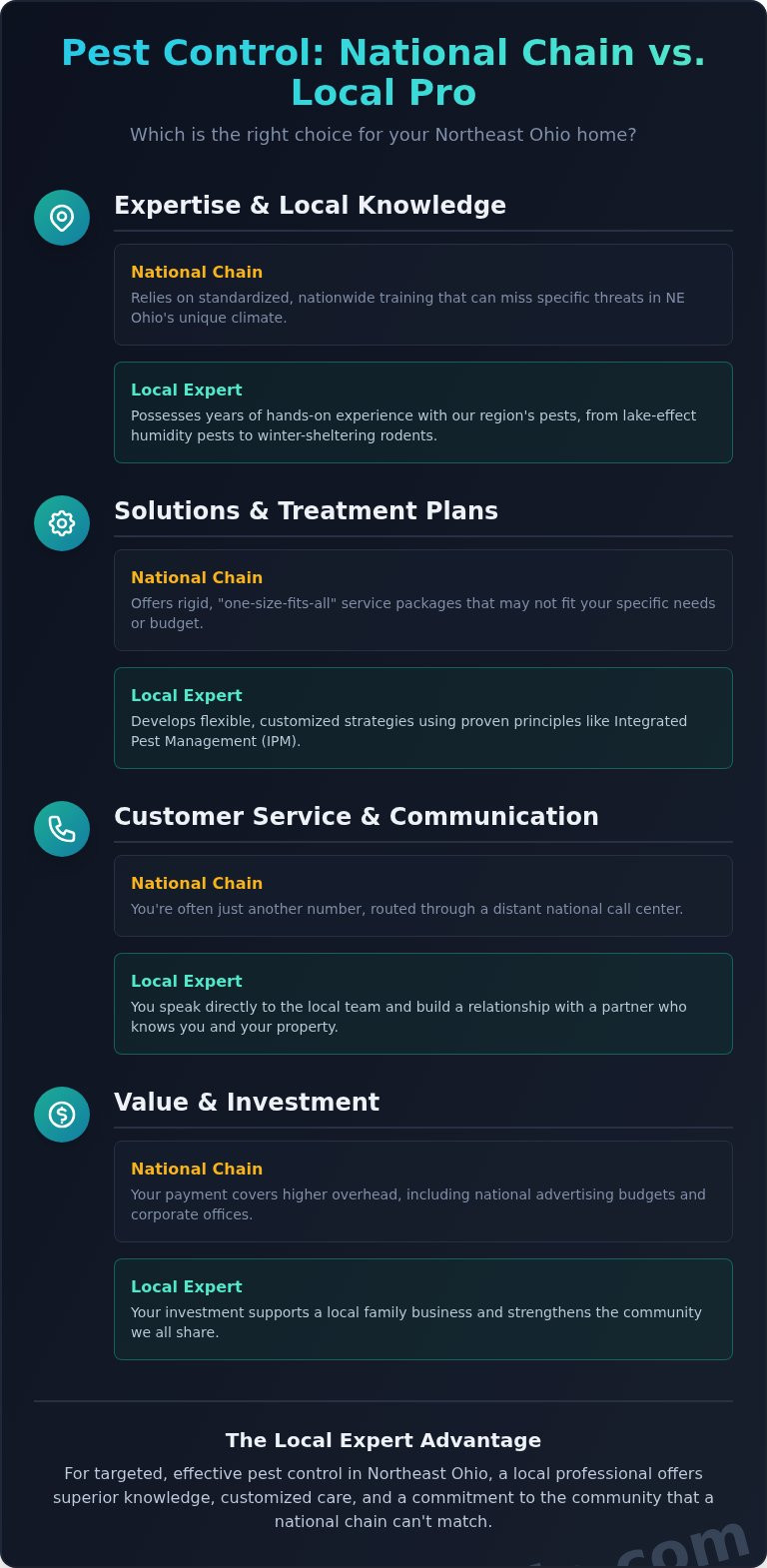
A national pest control company isn’t automatically the better choice. In a Mosquito Assassin Pest Control LLC-versus-local-pro comparison, the right fit depends on the pest, the service plan, and how clearly the provider explains its terms. Compare the work included and cancellation conditions, not just brand recognition.
When pests disrupt your home, dependable help and clear expectations matter. This guide explains how to compare service costs without relying on a single quote, what to look for in customer feedback, and how local knowledge may help address pest activity in your area. It also covers differences in service and cancellation terms, with a practical guide to choosing between a national provider and a local one.
Key Takeaways
- Compare the service plan, visit schedule, and follow-up process, not just the company name.
- Read customer feedback for patterns in communication, reliability, and how concerns are handled.
- Review cancellation terms and contract length so you understand your options before enrolling.
- Local knowledge can help connect pest activity to neighborhood conditions and seasonal patterns.
- Consider the service’s fit over time, including the pest problem, property needs, and level of ongoing support.
Customer feedback and cancellation concerns
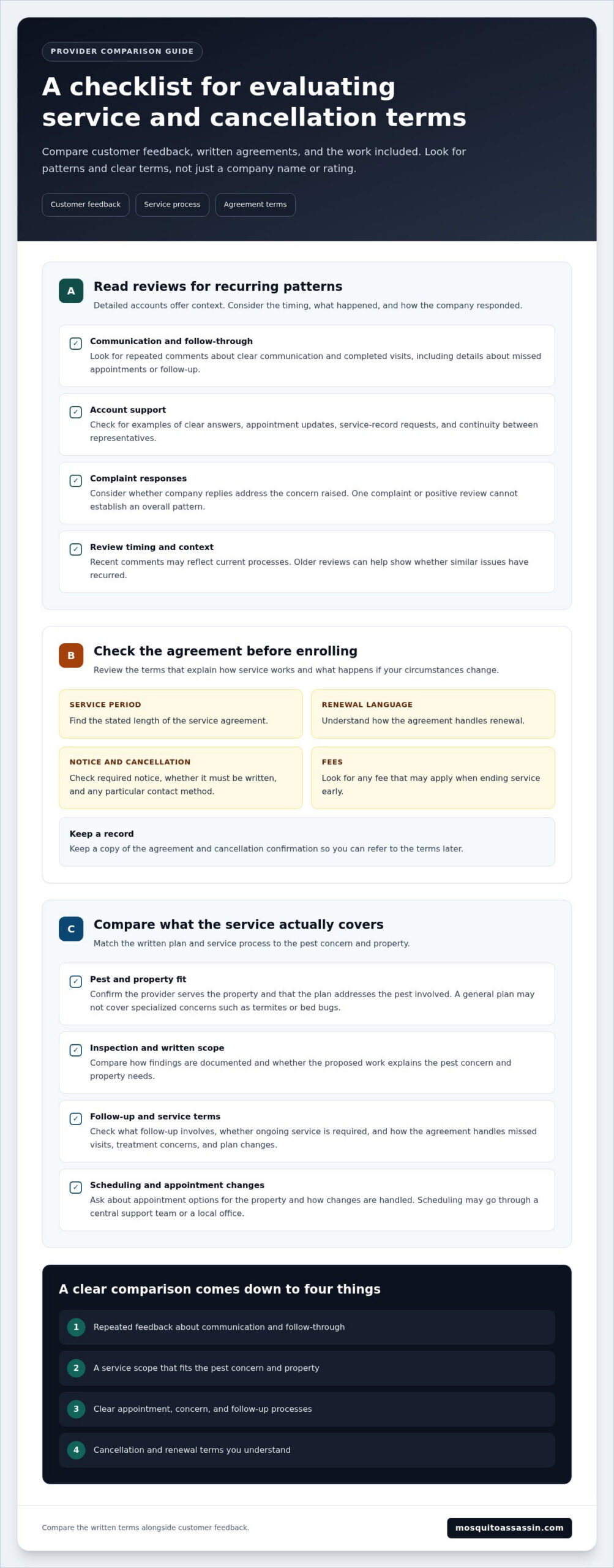
Customer feedback can show how a pest control company handles scheduling, follow-up, account questions, and service concerns. Look for themes across multiple reviews, then compare them with the written agreement. Specific accounts are most useful, such as a review describing a missed appointment or how staff responded to continued pest activity.
Customer Reviews and Service Reliability
Reviews can help you assess whether customers report clear communication and completed visits. Prioritize detailed accounts that explain the context, such as whether a technician arrived as scheduled or clarified what a follow-up visit would cover. Check the dates, too. Recent comments may reflect current processes, while older reviews can show whether similar issues have recurred.
Account Management and Customer Support
Account support affects how easily customers manage appointments, request service records, or raise concerns. Look for examples of clear answers, appointment updates, and continuity between representatives. A detailed review might explain whether the company clarified a scheduling change. These practical details help you assess account management without treating one review as representative of every customer.
Customer Ratings and Complaint Records
A rating summarizes customer opinions, but written comments provide context. Look for recurring issues and whether company responses address the concern raised. Complaint records offer another perspective, particularly when they point to repeated service or communication problems. Consider the subject, timing, and response together. One complaint or positive review cannot establish the overall pattern.
Review cancellation terms separately. Check the agreement for its service period, renewal language, required notice, and any fee for ending service early. See whether cancellation requires written notice or a particular contact method. Keep a copy of the agreement and cancellation confirmation so you can refer to the terms later.
Agreements can differ in how they handle missed visits, treatment concerns, and plan changes. Find the section explaining each process before you enroll. For example, note whether appointment changes go through a central support team or a local office. Clear instructions make it easier to manage service if your circumstances change.
Use the same review criteria for each company you consider:
| Criteria | What to look for |
|---|---|
| Service feedback | Repeated comments about communication and follow-through |
| Account support | Examples of clear answers and appointment updates |
| Complaint response | Whether replies address the stated concern |
| Cancellation terms | Notice requirements, renewal terms, and applicable fees |
Choose an agreement and service process you understand, including how the company handles concerns and cancellations.
National and Local Pest Control Service Differences
National and local pest control providers may differ in service structure, coverage, and inspection practices. Compare the written plan with the pest concern and your property’s needs.
Across the United States, available services depend on the address, pest, and local service offerings. A company’s broad reach doesn’t mean every location has the same appointments or pest treatments.
Inspection and Service Guarantees
An inspection should identify the pest, evidence of activity, and conditions that may support it. Providers may differ in how they document findings and explain proposed work. A service guarantee is defined by its written terms. Check which pests and treatments it covers, what follow-up involves, and whether ongoing service is required. Compare those details, not just the guarantee’s name.
Response Times and Technician Availability
Response times and technician availability depend on the address, route schedule, staffing, and pest concern. Neither a national structure nor local ownership guarantees a particular arrival time. Ask about appointment options for your property and how scheduling changes are handled. A rodent concern indoors, for example, may call for a different visit than mosquito activity outdoors.
Availability can also vary within a provider’s service area. A larger company may coordinate through a local branch, while a smaller provider may schedule directly through its office. The appointment window and follow-up process matter more than the business model. Compare them for your address and pest problem.
Licensing and Insurance
Whether a provider and its technicians are licensed and insured depends on the state, service, and business. Don’t assume either status based on company size or local ownership. Review documentation relevant to the work and clarify how insurance applies to the service. This helps you understand who will do the work and what coverage the company has.
For homeowners, start by confirming that the provider serves the property and treats the pest involved. A general plan may not cover specialized concerns such as termites or bed bugs. Read the service description alongside the inspection findings to see whether the proposed work addresses the problem at home.
A company’s history provides context, but it doesn’t establish how a particular technician will inspect or treat your property. Focus on the team responsible for the visit, the scope of work, and follow-up terms. If you’ve seen a rodent, for example, ask how the inspection will assess activity locations and possible entry points.
Compare the inspection process, written service scope, appointment options, and follow-up terms of providers that serve your address.
Advantages and limitations of local providers
A local pest control provider may know nearby property types and recurring pest conditions. That knowledge is most useful when the inspection links a specific concern, such as ants entering through a foundation gap, to a practical service plan. Local knowledge alone doesn’t determine the right treatment, so compare the inspection findings, proposed work, and follow-up terms.
Access to a nearby office can make it easier to discuss a property’s service history with the same team. For example, a technician who has seen recurring activity around a detached garage can use that context on a later visit. A local exterminator may have a narrower service area, which matters if you manage properties in different regions.
Service breadth matters, too. One company may focus on common household pests, while another may treat rodents, bed bugs, or termites. A provider’s name or local status doesn’t tell you which pests its plan covers. Compare the written scope with the issue, such as signs of mice in an attic or mosquitoes near outdoor living areas.
Specialized work may require a different inspection and treatment approach. Termite treatment, for example, can involve assessing structural conditions and discussing whether bait stations or another method suits the property. Don’t assume a general pest plan includes termite work. Separate service descriptions clarify what an inspection covers and what needs its own plan.
Local operations can have practical limits. A smaller team may have fewer appointment routes or serve a narrower area than a national company. That doesn’t mean the service is poorer, but it can affect scheduling and the ability to cover multiple properties. Compare service areas and appointment options for each address instead of judging by company size.
- Match the pest to the scope: Check whether the proposed plan addresses the identified pest, its location, and relevant access points.
- Separate specialized services: Confirm that termite work, bed bug treatment, or rodent control appears in the service description when needed.
- Consider property coverage: For homes in different towns, compare whether one provider’s service area includes every address.
- Review follow-up terms: Look for the stated process if activity continues after the initial visit.
These criteria show where local knowledge and communication may help, while also revealing gaps in coverage or service scope. Focused local service may suit a single home with a clearly identified problem. For a portfolio spread across distant areas, consistent geographic coverage may matter more. The better fit depends on the pest, property, and documented plan, not simply the “local” label.
When choosing between a national provider and a local one, weigh neighborhood familiarity against clear documentation and consistent service. Local knowledge may help with recurring activity, while a broader network can matter when managing homes far apart. Choose the provider whose observations, explanation, and proposed plan fit the pest problem.
Local technicians and neighborhood expertise
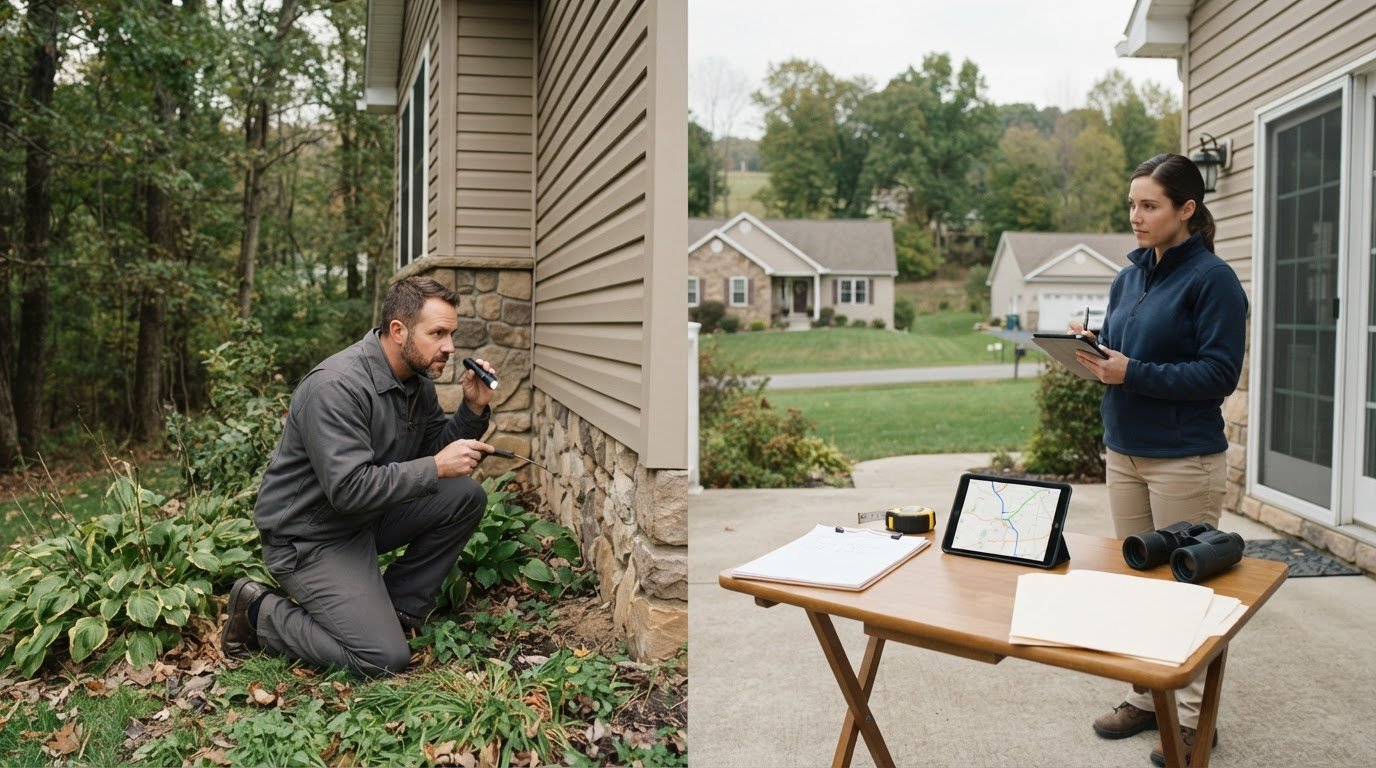
A technician familiar with nearby properties may recognize patterns that help guide an inspection. In Erie County, for example, a home’s foundation, attached garage, and surrounding vegetation can inform questions about pest activity. Local knowledge adds context, but the inspection should identify evidence at the property before a control plan is proposed.
Local expertise is most useful when it improves observation and communication. A technician who regularly works in an area may recognize recurring conditions, such as gaps around utility lines or pests entering near a basement window. Those observations can guide the inspection, but they don’t replace examining the home itself. Nearby properties can differ in construction, maintenance, and pest access.
Property history matters, too. If a technician has visited before, earlier notes can help track changes in activity and location. Renewed rodent signs near a garage, for example, may draw attention to the same entry area and changes around stored materials. A new technician can build that context by reviewing service records and listening to the homeowner’s observations.
National providers may use standardized processes across branches, while local companies may know a defined service area better. Neither structure automatically ensures a thorough inspection. Look for a technician who explains observations, distinguishes evidence from assumptions, and connects proposed removal or prevention measures to the identified pest.
Make a local inspection more useful by sharing specific observations. Note where and when you saw activity and whether it keeps appearing in the same place. A brief record of repeated sightings near a pantry, crawl space, or patio gives the technician a clearer starting point than a general report of pests throughout the house.
- Identify locations: Point out where you saw pest activity, such as a basement corner or window frame.
- Describe changes: Mention recent repairs, stored items, or changes in how a room is used.
- Ask about evidence: Request an explanation of the signs that support the inspection findings.
- Connect findings to the plan: Check that the control plan addresses the pest and location discussed.
Local expertise should show in the technician’s reasoning, not just the company’s address. A useful inspection links an observation, such as droppings near a utility opening, to clear next steps. This helps you understand what the service addresses and which property conditions may continue to attract pests.
For the Terminix-versus-local-pro decision, weigh neighborhood familiarity against documentation and consistent service. A local technician’s knowledge may help with recurring activity, while an established process can organize inspections across multiple homes. The best fit is the provider whose observations, explanation, and proposed plan match the pest problem.
Five-year cost of ownership
A five-year comparison should include every scheduled visit, initial treatment, follow-up, and contract term. A low starting quote may cover a narrower treatment plan, while a broader plan may include recurring visits. Compare the same pest and service period across providers, then check what each written estimate includes.
For general pest control, service frequency affects the total commitment. A monthly plan means more scheduled visits than a quarterly plan over five years. That difference matters only if both plans cover comparable pests and follow-up. Check whether routine visits, additional treatments, and appointment changes are included or billed separately.
Compare termite protection separately. Bait-station systems and liquid-barrier treatments have different installation and monitoring needs. Check how the plan describes initial work, ongoing monitoring, and retreatment. Compare those details over the full five-year period, rather than treating an initial inspection or installation as the total cost of ownership.
One-time services also affect long-term planning. Bed bug treatment may need a plan tailored to the affected property, while rodent control may include identifying access points alongside service visits. Mosquito service follows a different schedule. Don’t compare unlike services, such as a single targeted treatment and recurring general pest control.
Build a consistent comparison by recording these items for Terminix and each local provider:
- Service scope: List the pests and areas included in the plan.
- Visit schedule: Note whether visits are monthly, quarterly, or arranged for a specific issue.
- Initial work: Separate inspection and installation from recurring service.
- Follow-up: Record how continued activity is addressed under the written terms.
- Contract details: Include renewal periods, cancellation conditions, and required notice.
For example, if you’re comparing quarterly general pest service with termite protection, assess each service on its own before considering a combined program. Treatment methods, monitoring needs, and visit schedules differ. Include customer service in the comparison: clear records and timely explanations help you understand what each visit covered and what comes next.
Use the same five-year worksheet for every estimate. Compare total costs against the service scope, frequency, and follow-up terms, not just a promotional starting offer. If a recurring infestation changes the work required, compare the revised plan with the original scope and timeline.
For an inspection or professional recommendations about a specific pest concern, contact Mosquito Assassin Pest Control.
Use local price ranges to check your worksheet, not as a substitute for comparing the service scope.
Separate recurring service costs from installation and monitoring when reviewing written estimates.
Mosquito Assassin Pest Control: General Pest Control Plans
Mosquito Assassin Pest Control LLC offers General Pest Control Plans for property owners seeking ongoing help with common household pests. A plan may suit recurring activity or ongoing prevention needs. For specific concerns, the company also offers Mosquito Control Service, Rodent Control Service, and Bed Bug Treatment.
For residents of Erie and Crawford Counties in Pennsylvania and Ashtabula County in Ohio, describe the pest activity and affected areas to get started. This helps match the concern to an appropriate service and professional recommendations. Since a general plan may not cover every specialized problem, the pest and property conditions matter.
Contact Mosquito Assassin Pest Control LLC to discuss an inspection or professional recommendations.
Make Your Next Pest Control Decision With Confidence
Use your next conversation with a provider to turn uncertainty into a clear plan. Describe the pest activity, where you’ve seen it, and what you want addressed. Then consider whether the proposed service fits your property and provides clear next steps. That practical approach makes choosing between Terminix and a local pro less about reputation and more about the support you need.
For professional recommendations about pest concerns in your home, contact Mosquito Assassin Pest Control. A clear description of the problem is a useful place to begin, and informed decisions can help you move forward with greater confidence.
Disclaimer: This blog provides general information, not professional pest control advice. Conditions vary by property, environment, and location. Reading this content does not create a service agreement. Contact Mosquito Assassin Pest Control LLC for an inspection or professional recommendations.
Frequently Asked Questions
What should I check before choosing a pest control company, including cancellation fees and pesticide safety?
Review the written agreement for cancellation fees, required notice, renewal terms, and the process for ending service. For pesticide safety, ask which product is planned, where it will be applied, and what preparation or re-entry instructions apply to people and pets. Read the product information and follow the technician’s directions. If treatment is planned near a pet’s feeding area, for example, clarify how that area will be handled before service begins.
What are Terminix’s typical pest control prices and contract terms?
Review the agreement for its service period, renewal terms, required notice, and any early-cancellation fee.
How do Terminix and local providers handle termite inspections, treatment, and warranties?
A termite inspection should assess structural conditions. Treatment may involve bait stations or another approach suited to the property. Compare the written guarantee’s coverage and follow-up terms, including whether continued service is required.