Tag: Seasonal Pests

  • How Long Does Pest Control Treatment Last? A Professional Guide

    How Long Does Pest Control Treatment Last? A Professional Guide

    Seeing a spider scurry across the floor just days after a professional service doesn’t mean the treatment failed; it often means the product is working exactly as intended. It’s natural to feel a sense of frustration when pests reappear, especially when there’s a concern that professional interventions might only be a temporary fix. Most homeowners want to know exactly how long does pest control treatment last before they need to consider a follow up visit. Understanding the timeline of effectiveness is the first step toward safeguarding a property against persistent seasonal invaders.

    This guide provides a clear understanding of the expected duration of professional pest treatments and the environmental factors that influence long-term protection. You’ll learn why certain pests might reappear shortly after a technician leaves and how to distinguish between a failed treatment and a normal biological response. The following sections explore how the unique weather patterns in Erie and Crawford Counties in Pennsylvania, as well as Ashtabula County in Ohio, can impact the residual life of professional products. By the end, you’ll have the knowledge needed to maintain a pest-free home while managing expectations for seasonal pest returns.

    Disclaimer: The information provided on this blog is for general informational purposes only and is not intended as professional pest control advice. Conditions vary by property, environment, and location. Reading this content does not create a service agreement. For an inspection or professional recommendations, please contact Mosquito Assassin Pest Control LLC directly.

    Key Takeaways

    • General professional treatments typically provide a residual barrier that remains effective for 60 to 90 days.
    • Environmental factors such as heavy rainfall and UV radiation in Erie and Crawford Counties influence how long does pest control treatment last.
    • Increased pest activity immediately following a service is often a result of the flushing effect, which indicates the treatment is working correctly.
    • The specific life cycle and biology of different pests dictate the necessary frequency of professional visits to maintain long-term protection.
    • Combining structural exclusion and proper sanitation helps extend the life of a professional treatment barrier by removing attractants.

    Understanding the Standard Timeline for Pest Control Effectiveness

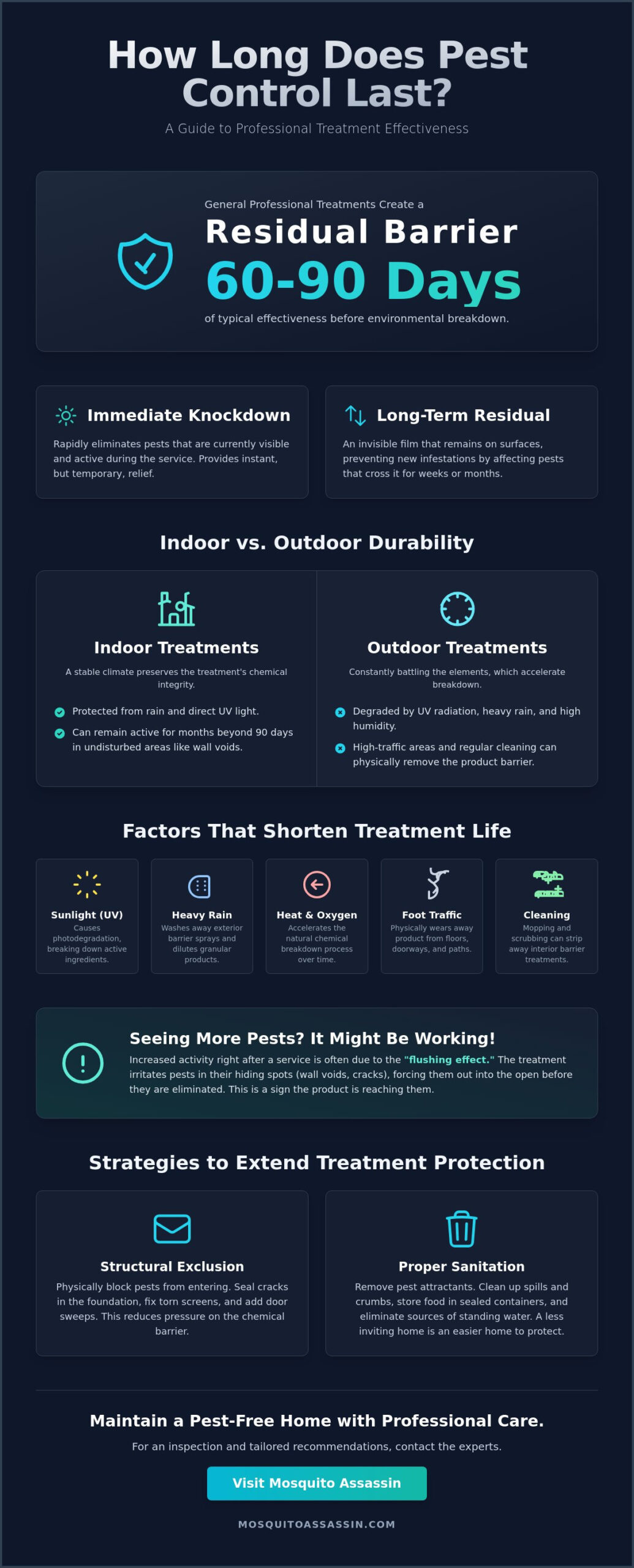
    Professional pest control isn’t a single event but a cycle of protection. Most general treatments provide a protective residual barrier that stays active for 60 to 90 days. This timeline isn’t a guess; it reflects the actual biological breakdown of active ingredients when they’re exposed to the environment. When homeowners ask how long does pest control treatment last, they’re usually looking for the duration of this invisible shield.

    There’s a clear distinction between the immediate knockdown effect and long-term residual protection. Knockdown refers to the rapid elimination of pests currently visible, while the residual barrier works in the background to prevent new infestations. Modern strategies rely on Integrated Pest Management (IPM) to ensure these barriers are applied precisely where pests travel, maximizing the effectiveness of every application.

    To better understand the practical side of treatment timelines, watch this helpful video:

    Application sites dictate how long a product remains effective. Interior treatments in undisturbed areas like wall voids can sometimes remain active for months beyond the standard 90 day window. Conversely, exterior foundation sprays face a constant battle with the elements. High traffic areas such as doorways, kitchen floors, and mudrooms often require more frequent attention because regular cleaning and physical foot traffic strip the product from the surface. Many professional pest control services focus on these vulnerable points to maintain a consistent barrier.

    The Residual Life of Professional Grade Products

    Professional grade products are engineered to bind to surfaces for extended periods. Liquid residuals are applied to baseboards or foundations, drying into a thin, invisible film that affects pests upon contact. Granular formulations are often used in mulch beds or lawns, designed to release active ingredients slowly as they encounter moisture. However, even the most robust formulas lose potency as they encounter oxygen and heat, which is why how long does pest control treatment last is always a variable range rather than a fixed date.

    Indoor vs. Outdoor Durability Expectations

    Indoor environments offer a stable climate that preserves treatment life. Without the interference of rain or extreme temperature swings, an interior treatment often maintains its integrity much longer than an exterior one. In regions like Erie and Crawford Counties in Pennsylvania, heavy rainfall and high humidity can accelerate the degradation of exterior perimeter barriers. Sunlight is another major factor; ultraviolet (UV) radiation breaks down chemical bonds on a molecular level. Shaded areas of a home’s exterior may retain protection longer than south facing walls that receive direct sun exposure throughout the day.

    Environmental Factors That Influence Treatment Longevity

    While professional products are chemically engineered for durability, environmental stressors are the primary reason for barrier degradation. Homeowners often ask how long does pest control treatment last when they notice a sudden change in local weather. The reality is that the answer depends heavily on external exposure. Ultraviolet (UV) radiation from the sun is a major culprit. Photodegradation occurs when intense sunlight breaks the chemical bonds of the active ingredients. This process effectively neutralizes the treatment over time, particularly on south facing walls that receive the most direct exposure throughout the day.

    Weather and UV Degradation in the Great Lakes Region

    In areas like Erie and Crawford Counties, humidity levels often exceed 70% during the summer months. This moisture doesn’t just make the air uncomfortable; it creates a challenging environment for surface treatments. However, modern professional products are specifically formulated to bind to surfaces once they’ve dried. This rain-fast quality means that a typical afternoon thunderstorm in Northwest Pennsylvania won’t immediately wash away a perimeter barrier. Licensed professionals use a common sense approach to pest control by timing applications around local weather patterns to ensure the product has sufficient time to bond properly.

    Material Porosity and Product Absorption

    The substrate of a home significantly impacts product stability. Porous materials like unpainted wood, brick, or concrete act like a sponge. They draw liquid treatments deep into the material where pests may not come into contact with them. These surfaces often require more frequent attention or specialized formulations to maintain an effective exterior shield. In contrast, smooth, non-porous surfaces like vinyl siding or painted metal allow the product to sit on the surface. This creates a more consistent and accessible barrier for crawling insects. Regular maintenance helps account for these environmental variables. Those concerned about local weather impacts may find that local pest control experts can provide more tailored advice for regional conditions.

    Seasonal temperature fluctuations also play a role in how long does pest control treatment last. Extreme heat can accelerate the evaporation of certain liquid carriers, while the harsh winters in Ashtabula County can cause some products to become less effective over several months of snow cover. Additionally, the accumulation of dust and dirt on treated surfaces can create a physical shield for pests. When bugs walk over a layer of grime rather than the treated surface itself, the effectiveness of the application is compromised. Understanding these local factors allows for a more realistic expectation of when a follow up service might be necessary to reinforce the home’s defenses.

    Disclaimer: The information provided on this blog is for general informational purposes only and is not intended as professional pest control advice. Conditions vary by property, environment, and location. Reading this content does not create a service agreement. For an inspection or professional recommendations, please contact Mosquito Assassin Pest Control LLC directly.

    How Long Does Pest Control Treatment Last? A Professional Guide

    Why You Might See More Pests Immediately After Treatment

    Seeing an increase in insect activity shortly after a professional application can be unsettling. It’s common for homeowners to question how long does pest control treatment last when they spot a cockroach or spider in the middle of a room just 48 hours after a technician leaves. This sudden visibility is actually a biological response known as the flushing effect. Instead of indicating a failed service, this spike in activity confirms that the active ingredients are successfully reaching the areas where pests hide.

    The flushing effect occurs because professional grade products are designed to irritate the sensory organs and nervous systems of target pests. When insects encounter the treated barrier, the irritation forces them out of deep nesting sites like wall voids, cracks, and crevices. Once they’re flushed out, they’re exposed to a lethal dose of the residual product. Seeing dead or dying pests on the floor is a primary indicator that the treatment is performing exactly as intended. It’s a necessary step in the transition from an active infestation to a pest-free environment.

    The Flushing Effect and Pest Irritation

    Nocturnal pests, such as German cockroaches, typically avoid light and human activity at all costs. However, the irritation caused by professional residuals can disrupt their natural biological cycles, leading them to appear in the open during daylight hours. It’s vital that residents don’t use over the counter DIY sprays during this phase. Consumer products often act as repellents, which can drive pests into untreated areas or interfere with the professional products already in place. A focus on long-term prevention of pests requires patience while the initial application works through the population.

    The 14-Day Observation Window

    Most professional treatments require a 14 day window to achieve a significant reduction in a pest population. This period is essential for determining how long does pest control treatment last in a specific residential environment. This timeline allows enough time for insects to travel through the residual barrier and return to their colonies. For pests like ants, the process involves complex baiting cycles where workers must carry the product back to the queen to eliminate the source of the infestation. Eradication is a methodical process; it isn’t an instant event. For more information on setting realistic expectations for your home, you can consult a guide on general pest control to understand the full scope of the process.

    If activity continues to increase or shows no sign of slowing after 21 days, it may indicate a persistent infestation that requires specialized follow up. However, in the communities of Erie and Crawford Counties, most standard calls follow this predictable 14 day curve. Understanding this biological response helps homeowners remain calm while the treatment takes full effect.

    Disclaimer: The information provided on this blog is for general informational purposes only and is not intended as professional pest control advice. Conditions vary by property, environment, and location. Reading this content does not create a service agreement. For an inspection or professional recommendations, please contact Mosquito Assassin Pest Control LLC directly.
    Longevity Variations Based on Specific Pest Types

    The biology and reproductive habits of a target pest are the most significant factors in determining how long does pest control treatment last. While a general residual barrier might stay active on a surface for up to 90 days, the effective protection period varies because different insects interact with that barrier in unique ways. A single application might be sufficient for a localized spider problem, but it won’t be enough to manage pests with rapid breeding cycles or those that travel through the air rather than crawling across treated surfaces.

    Crawling Insects vs. Seasonal Flying Pests

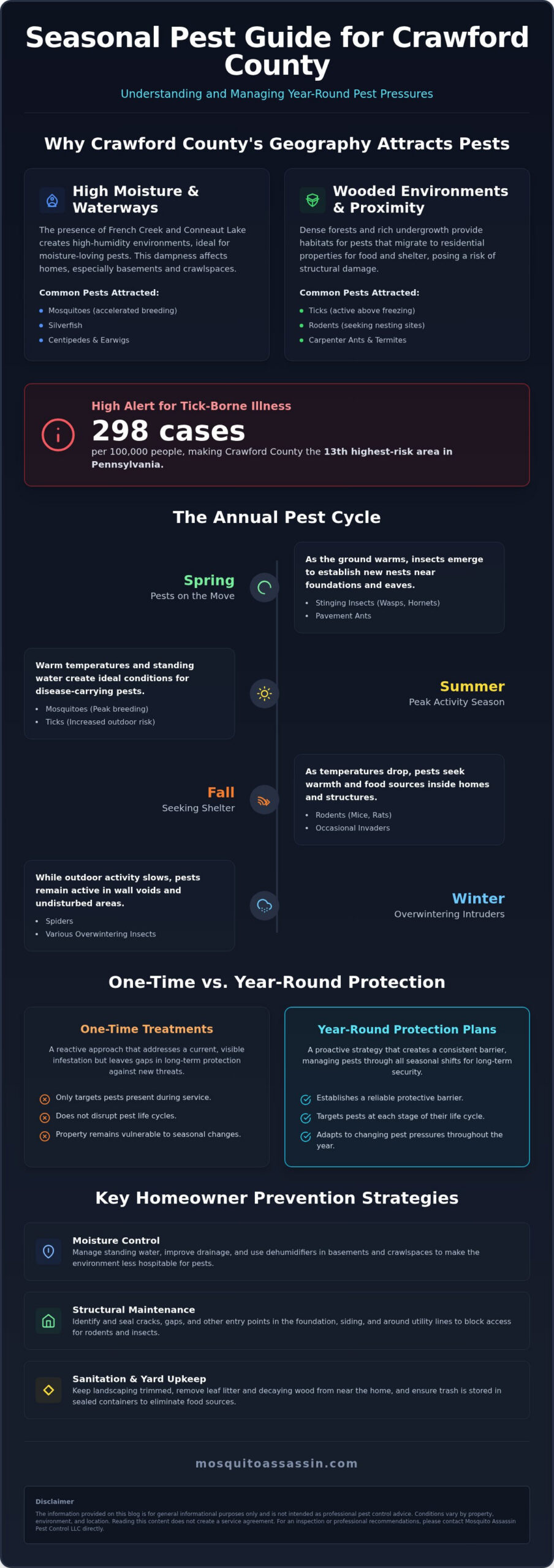
    Flying pests like mosquitoes and houseflies spend very little time on treated walls or foundations, which limits their exposure to residual products. Effective protection for these insects requires a more frequent service interval. For instance, a professional mosquito control program typically operates on a 21 to 30 day cycle. This frequency ensures that new generations of mosquitoes are addressed before they can reproduce, maintaining a consistent level of suppression throughout the humid summer months in Northwest Pennsylvania.

    Crawling insects like ants and spiders often see longer periods of control from a single application. Spiders are relatively sedentary; they tend to stay in corners or under eaves where products remain undisturbed. However, ants are highly social and mobile. During peak foraging months, ant colonies may send out thousands of workers to find food. If the colony is large, the sheer volume of ants can physically deplete a chemical barrier or find small gaps in the protection. In these cases, reinforcing the perimeter every 60 days is often necessary to keep foraging trails from reaching the interior of the home.

    The Unique Persistence of Bed Bug and Termite Solutions

    Specialized pests like bed bugs and termites require a different standard of persistence. Bed bug treatments are not about a one time barrier but about breaking a specific 14 day reproductive cycle. Because bed bug eggs are resistant to many standard residuals, professional services often involve multiple visits spaced exactly two weeks apart. This ensures that newly hatched nymphs are eliminated before they reach maturity. This methodical approach is the only way to ensure total eradication of the population.

    Termite protection offers the longest duration in the industry but utilizes a different mechanism than standard sprays. While a liquid soil treatment for termites may last for several years, modern baiting systems provide ongoing, long-term monitoring. These systems stay in place year round, providing a permanent defensive line that traditional sprays cannot match. This distinction between the residual life of a spray and the longevity of a baiting system is critical for homeowners to understand. Homeowners seeking long-term protection can schedule a professional pest inspection to determine the best frequency for their specific property and pest pressure.

    Disclaimer: The information provided on this blog is for general informational purposes only and is not intended as professional pest control advice. Conditions vary by property, environment, and location. Reading this content does not create a service agreement. For an inspection or professional recommendations, please contact Mosquito Assassin Pest Control LLC directly.
    Strategies for Extending the Life of Professional Treatments

    Extending the effectiveness of a professional application requires a partnership between the property owner and the technician. While homeowners often focus on how long does pest control treatment last, the answer is frequently tied to how well the property is maintained between visits. A professional treatment provides a robust defensive line, but its longevity is significantly enhanced when the environment is managed to discourage pest activity. Sanitation is the most critical factor in this process. By removing food sources and standing water, you force pests to travel further and interact more frequently with the treated barrier, leading to faster elimination.

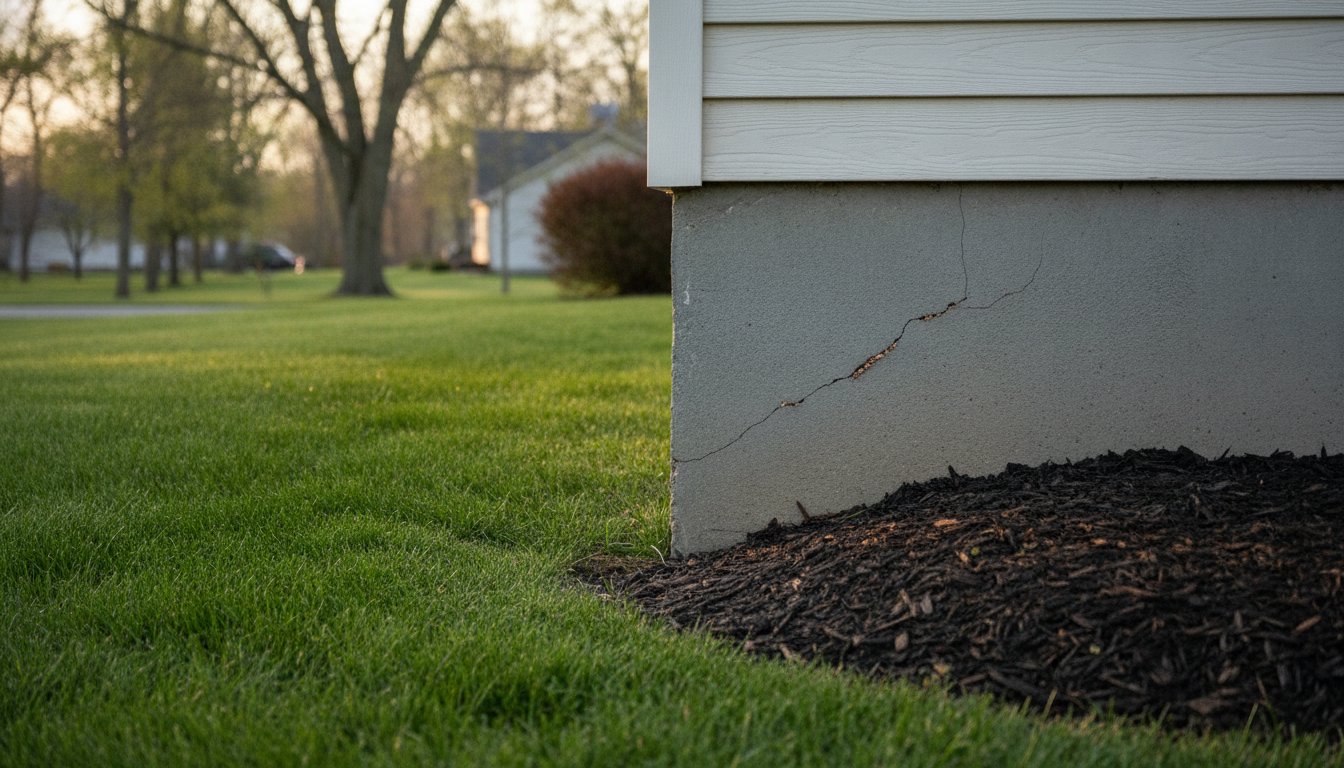
    Structural exclusion is another vital strategy that supports the chemical barrier. This involves sealing cracks, crevices, and gaps around utility penetrations or door frames. When physical entry points are blocked, the chemical treatment doesn’t have to work as hard to repel mass invasions. Instead, it acts as a secondary fail-safe. Combining homeowner diligence with professional pest control may help reduce risk and ensure that the home remains a fortress against seasonal invaders. This proactive approach is far more effective than waiting for an infestation to become visible before calling for assistance.

    Home Maintenance and Sanitation Best Practices

    Moisture management is essential for preserving the integrity of professional products. High humidity and standing water in basements or crawlspaces can accelerate the chemical breakdown of residuals. Additionally, exterior maintenance plays a significant role. Mulch should be kept at least 12 inches away from the foundation, and tree branches should be trimmed so they don’t touch the roof or siding. These steps prevent pests from bypassing the treated ground barrier. You can learn more about us and how local experts integrate these maintenance tips into a comprehensive protection strategy.

    The Role of Recurring Protection Plans

    There’s a significant difference in how long does pest control treatment last when comparing one-time reactive sprays to year-round maintenance. Reactive services only address the pests present at that moment. In contrast, recurring plans provide a consistent, overlapping shield. While a quarterly plan is effective for many residential properties, homes with high pest pressure often benefit from bi-monthly maintenance to ensure the barrier never fully degrades. Professional pest control in Erie, Crawford, and Ashtabula Counties often requires seasonal adjustments. These adjustments account for the specific biological shifts that occur as Northwest Pennsylvania moves from the damp spring into the harsh winter months, ensuring that the protection remains stable regardless of the outside temperature.

    Disclaimer: The information provided on this blog is for general informational purposes only and is not intended as professional pest control advice. Conditions vary by property, environment, and location. Reading this content does not create a service agreement. For an inspection or professional recommendations, please contact Mosquito Assassin Pest Control LLC directly.
    Maintaining Your Home’s Protective Barrier

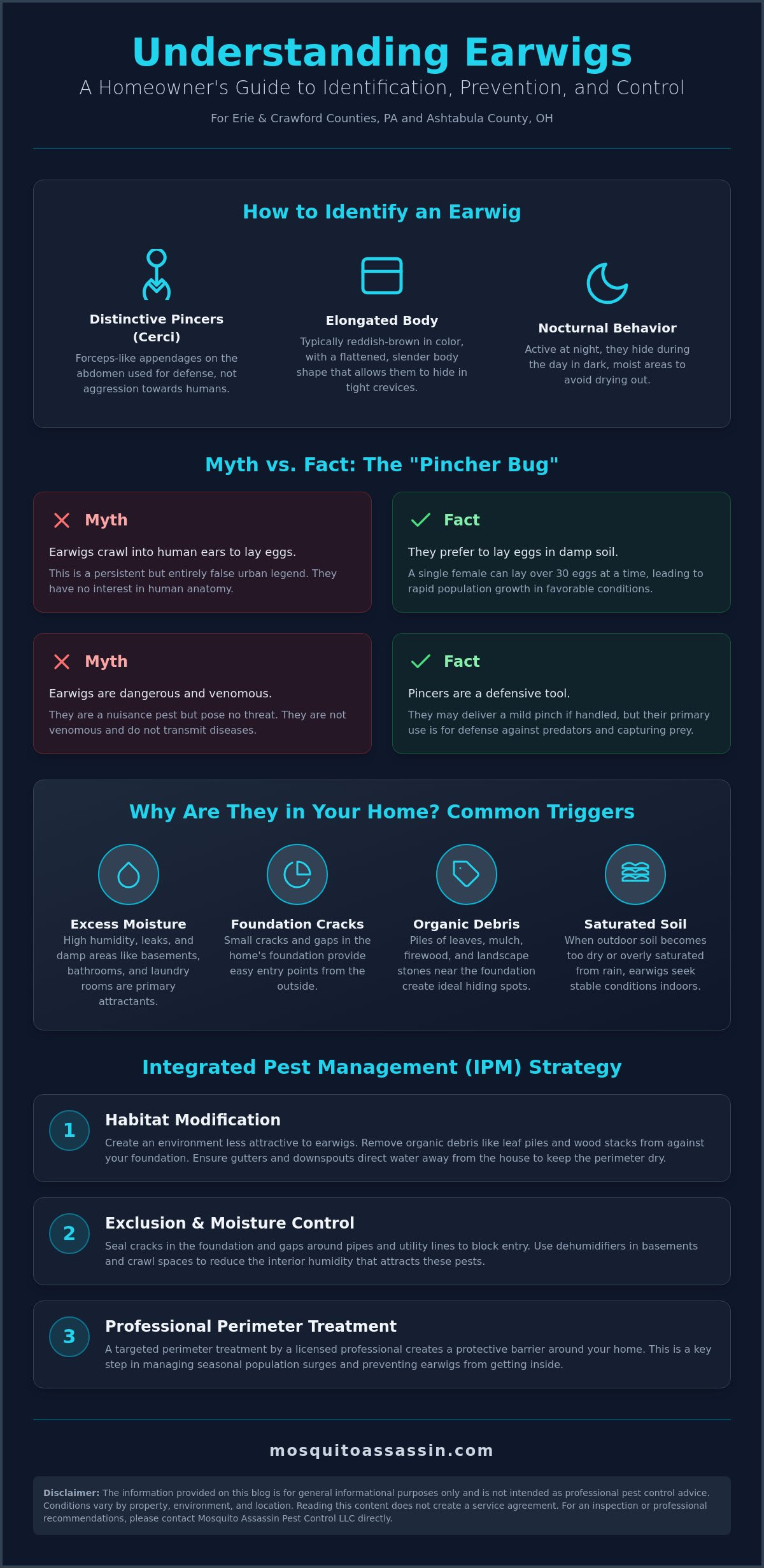
    Effective pest management is a continuous process that relies on high quality residuals and a deep understanding of local pest biology. While a professional application typically provides a shield for 60 to 90 days; variables like heavy rainfall in Erie County and UV exposure in Ashtabula County can alter the timeline. Understanding how long does pest control treatment last helps you set realistic expectations for your property’s defense. Licensed and insured professional technicians bring specialized local knowledge of Erie, Crawford, and Ashtabula County pests to every visit. This expertise ensures that every barrier is applied with precision using family safe treatment protocols.

    Combining structural maintenance with recurring inspections is the most reliable way to prevent seasonal infestations before they start. For an inspection or professional recommendations, please contact Mosquito Assassin Pest Control LLC directly. Taking a proactive stance today ensures your home remains a safe and comfortable environment for the long term.

    Disclaimer: The information provided on this blog is for general informational purposes only and is not intended as professional pest control advice. Conditions vary by property, environment, and location. Reading this content does not create a service agreement. For an inspection or professional recommendations, please contact Mosquito Assassin Pest Control LLC directly.
    Frequently Asked Questions

    Is it normal to see bugs after a pest control treatment?

    It is completely normal and expected to see an increase in pest activity for up to 14 days following a professional service. This occurs because the active ingredients irritate the pests and flush them out of their hiding spots in wall voids and crevices. Seeing dead or sluggish insects is a clear sign that the treatment is successfully eliminating the population on your property.

    How long should I wait to clean my house after a professional spray?

    You should wait at least 48 hours before performing any deep cleaning or mopping near treated baseboards and corners. This window allows the residual barrier to fully dry and bond to the surface for maximum effectiveness. Avoiding harsh detergents or steam cleaning on these specific areas helps preserve the integrity of the application and impacts how long does pest control treatment last in your home.

    Will rain wash away the pest control treatment on my home?

    Professional products are designed to be rain-fast once they have completely dried, which typically takes between 30 and 60 minutes. Once the product has bonded to the foundation or siding, it won’t wash away during standard rainstorms in Erie or Crawford Counties. Technicians monitor local weather patterns to ensure that exterior applications are timed for optimal drying and long-term durability.

    How many treatments are usually needed for a heavy ant infestation?

    A heavy ant infestation usually requires an initial treatment to address the active foragers followed by a reinforcement visit 14 to 21 days later. This second visit is vital for ensuring the baiting cycle has reached the queen and addressed any remaining satellite colonies. Because ants are highly social, a recurring maintenance plan is often the best strategy for preventing new colonies from moving into the area.

    Can I use store-bought bug spray after a professional has treated my home?

    You should avoid using any over the counter sprays after a professional treatment because they can interfere with the specialized products already in place. Many DIY sprays act as repellents, which can drive pests into untreated areas or cause them to avoid professional baits entirely. This interference often complicates the eradication process and can lead to a resurgence of the pest population within a few weeks.

    How long do I need to stay out of the house after a treatment?

    Occupants and pets should remain out of the treated areas until the product has completely dried, which usually takes 2 to 4 hours. This timeline can vary based on the humidity levels in Northwest Pennsylvania and the specific application method used. Always follow the exact re-entry instructions provided by your licensed technician to ensure the safety of your family and pets during the drying phase.

    Does pest control last longer in the winter months?

    Interior treatments often maintain their potency longer during the winter because they aren’t exposed to extreme heat or UV radiation. However, the harsh winters in Ashtabula County can cause exterior barriers to degrade more quickly due to heavy snow cover and freezing cycles. While many pests are less active in the cold, winter services are essential for managing rodents and insects like spiders that seek warmth inside.

    What should I do if I still see pests after two weeks?

    If you continue to see active, healthy pests after the 14 day observation window, you should contact your professional provider for a follow up inspection. This continued activity might indicate a hidden nesting site or a high level of regional pest pressure that requires a specialized adjustment to your plan. Tracking these observations helps your technician determine how long does pest control treatment last on your specific property and adjust the service frequency accordingly.

    Disclaimer: The information provided on this blog is for general informational purposes only and is not intended as professional pest control advice. Conditions vary by property, environment, and location. Reading this content does not create a service agreement. For an inspection or professional recommendations, please contact Mosquito Assassin Pest Control LLC directly.
  • The 2026 Seasonal Pest Control Schedule for Pennsylvania and Ohio Homes

    The 2026 Seasonal Pest Control Schedule for Pennsylvania and Ohio Homes

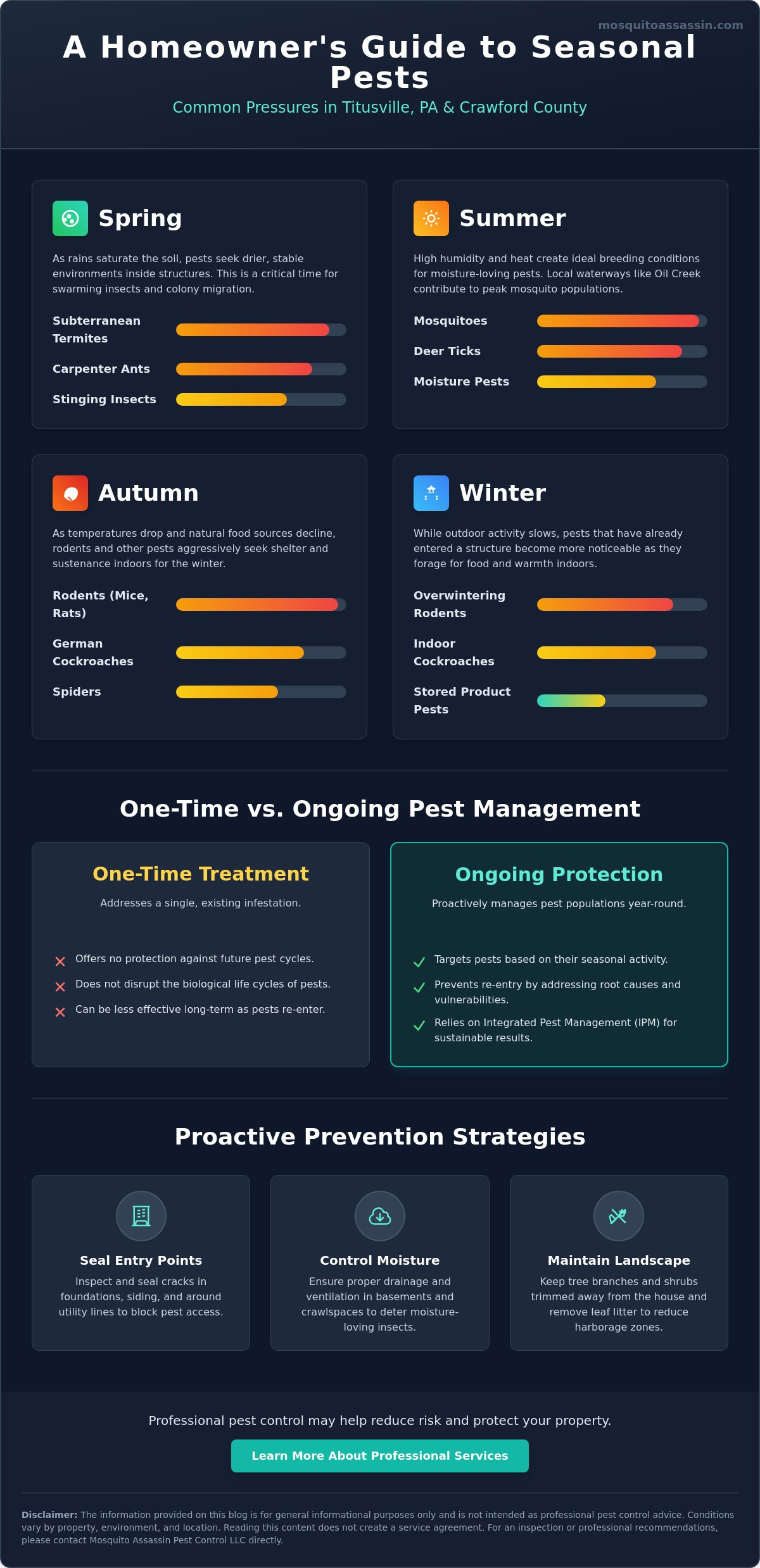
    Waiting for the first ant to crawl across the kitchen counter in May is often the exact moment a homeowner has already lost the battle against spring infestations. While many people believe pest control is a reactive response to a visible problem, the most effective strategy is actually a biological race against temperature and moisture. With the National Pest Management Association predicting an early start to the 2026 season due to a mild winter and erratic temperatures, sticking to a proactive seasonal pest control schedule is more critical than ever for residents in Erie, Crawford, and Ashtabula counties.

    It is exhausting to face recurring ant problems every spring or to worry about ticks every time the dog comes inside. This article explains the specific biological cycles of pests in the tri-state area and how a structured timeline prevents these issues from taking root. Readers will gain a clear understanding of when to expect specific threats, from summer stinging insects to winter rodents, and receive a preventative maintenance checklist designed to provide year-round peace of mind.

    Key Takeaways

    • Understand how temperature and degree days trigger the emergence of pests in early spring to stay ahead of the curve.
    • Identify the early signs of ant activity and the critical timing for tick prevention in wooded or grassy areas as temperatures rise.
    • Discover how a proactive seasonal pest control schedule targets stinging insects and spiders before they reach peak populations in late summer.
    • Learn why winter is the most effective time for interior inspections and exclusion tactics to manage indoor pests like silverfish.
    • Explore how Integrated Pest Management (IPM) provides long-term protection by focusing on pest biology rather than just reactive treatments.

    Understanding the Biological Drivers of a Seasonal Pest Schedule

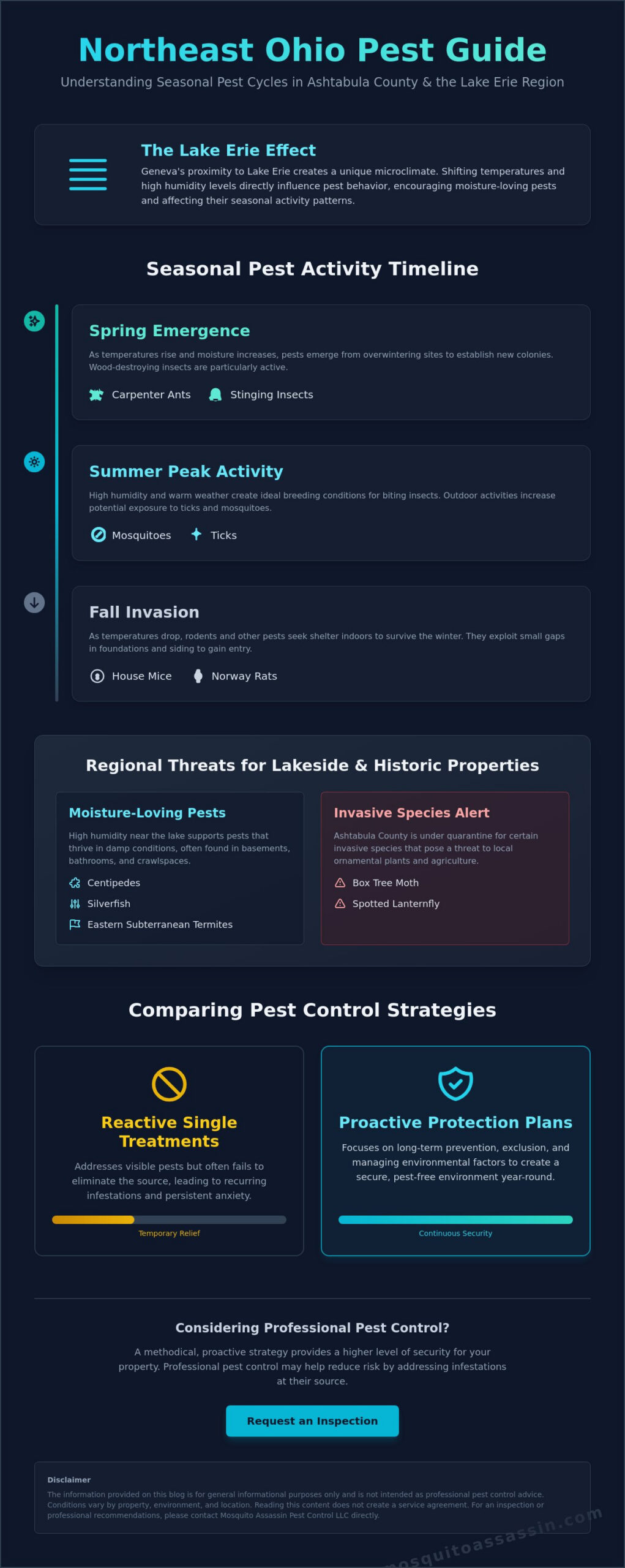
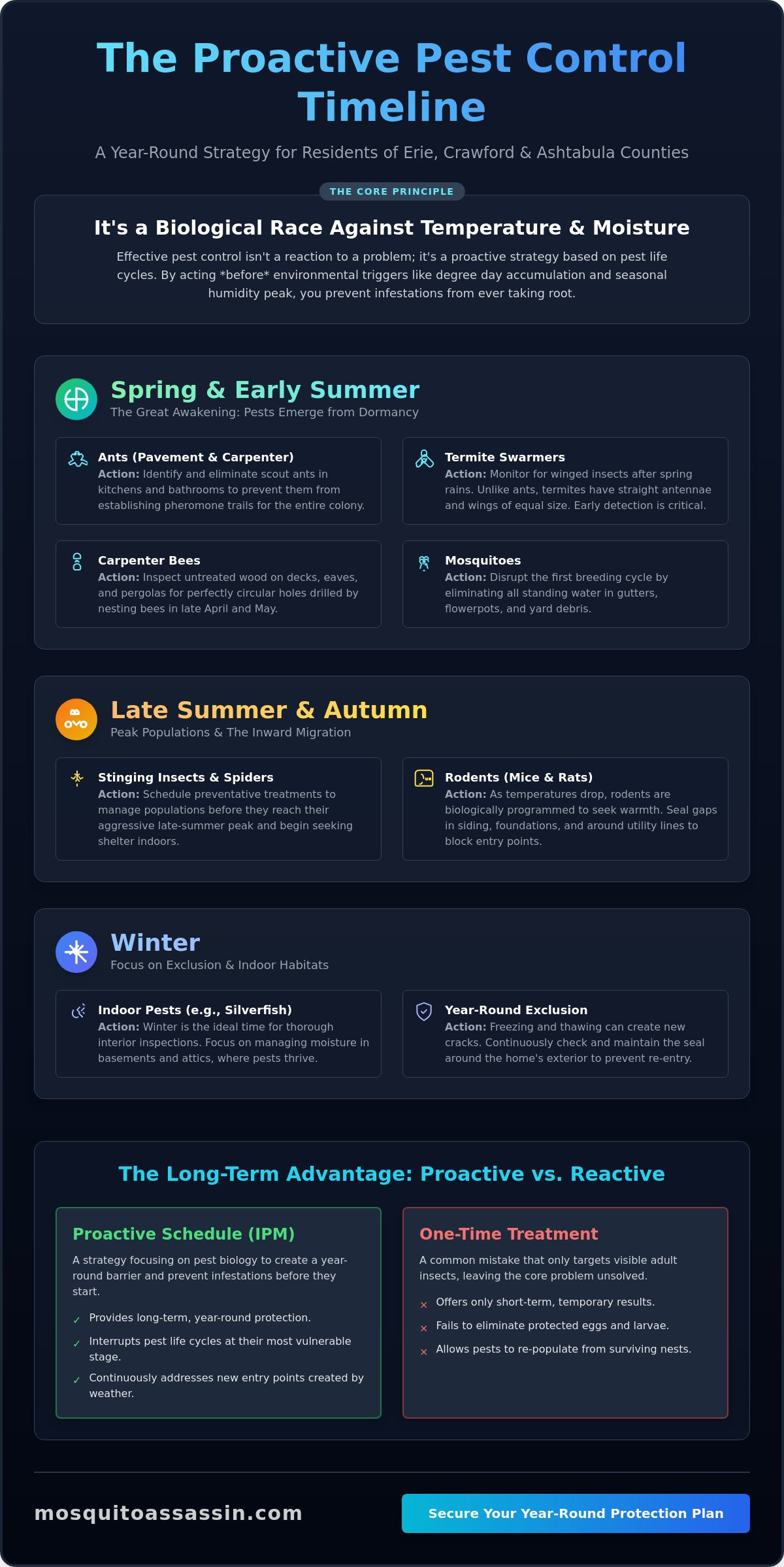
    Pest control is often misunderstood as a “see a bug, spray a bug” service. Effective protection relies on a seasonal pest control schedule that targets pests before they reach maturity. This proactive approach focuses on the Biological Drivers of a Seasonal Pest Schedule, which are the environmental factors that dictate when insects hatch, feed, and reproduce. Instead of waiting for an infestation to become visible, a scheduled strategy interrupts these life cycles at their most vulnerable stages.

    The primary trigger for pest activity isn’t the date on a calendar; it’s the accumulation of degree days, which is the measure of heat over time. For example, the National Pest Management Association (NPMA) predicts that the mild winter of 2025 and the warm start to 2026 will cause termites and ants to emerge weeks earlier than in previous years. While reactive extermination attempts to eliminate an existing population, preventative management ensures that a protective barrier is already in place before these biological triggers occur.

    To better understand why timing is everything in pest management, watch this helpful video:

    The Impact of the Great Lakes Climate on Local Pests

    Residents in Erie and Crawford counties experience unique pest pressures due to the Lake Erie effect. The lake acts as a massive thermal regulator; it often delays the first spring thaw, but it also creates intense localized humidity. In Ashtabula County and Northeast Ohio, this high moisture level is a primary driver for mosquito and tick populations, which thrive in damp environments. As the first frosts typically arrive in late September or October, the sudden drop in temperature signals a biological migration for rodents. Mice and rats don’t just happen to find your basement; they’re biologically programmed to seek the thermal heat of your home the moment the ground begins to freeze.

    Why One-Time Treatments Often Fail Long-Term

    A common mistake is assuming a single treatment can solve a pest problem. Most one-time applications only target adult insects, leaving behind hundreds of eggs or larvae that are protected by protective casings or hidden in deep wall voids. Without a consistent seasonal pest control schedule, these survivors will simply repopulate within weeks. Additionally, the extreme temperature fluctuations in Pennsylvania and Ohio cause building materials like wood and vinyl siding to expand and contract. This physical movement creates new gaps and entry points throughout the year. Maintaining a year-round barrier is the only way to ensure these new openings aren’t immediately exploited by opportunistic pests.

    Spring and Early Summer: Managing the Seasonal Awakening

    Spring in the tri-state area triggers a surge in biological activity as pests emerge from winter dormancy. For homeowners in Erie and Crawford counties, this represents the most critical window in a seasonal pest control schedule. The first signs often appear indoors as tiny pavement ants or larger carpenter ants scout for moisture in kitchens and bathrooms. Identifying these scouts early prevents them from establishing the pheromone trails that lead the rest of the colony into living spaces.

    Beyond ants, homeowners should monitor for termite swarmers. These winged insects often emerge on warm, humid days following spring rains. They are frequently mistaken for flying ants, but their straight antennae and uniform wing size are key identifiers. According to resources on Pennsylvania Pest Management, early detection of wood-destroying organisms is essential to preventing long-term structural issues. Carpenter bees also become active in late April and May, drilling perfectly circular holes into untreated wood on decks, pergolas, and eaves.

    Standing water is another priority during the seasonal awakening. Even a small amount of water in a clogged gutter or a forgotten flowerpot can host thousands of mosquito larvae. Emptying these containers early disrupts the first breeding cycle of the year. This significantly reduces the local population before the intense heat of July arrives.

    Foundational Protection for the Year Ahead

    The winter freeze-thaw cycles in Northeast Ohio and Western Pennsylvania are brutal on home foundations. These shifts create hairline cracks that serve as highways for insects. Inspecting the perimeter and sealing these gaps is a vital first step in home maintenance. Clearing debris from gutters is equally important; trapped organic matter holds moisture against the roofline, attracting silverfish and other moisture-loving pests. Implementing a professional general pest control plan during this time creates a durable barrier that keeps the spring awakening outside where it belongs.

    Tick and Mosquito Prevention Strategies

    Ticks become active as soon as temperatures consistently stay above 45 degrees Fahrenheit. Early season applications are often more effective than waiting until mid-summer because they target pests before they reach peak reproductive capacity. Homeowners can assist by trimming tall grass and managing leaf litter, which removes the cool, damp habitats these pests prefer. Strategic mosquito control programs focus on these early biological windows to ensure outdoor spaces remain usable throughout the summer. If you noticed high pest activity on your property last year, professional pest control may help reduce risk by identifying breeding sites you might have missed.

    The 2026 Seasonal Pest Control Schedule for Pennsylvania and Ohio Homes

    Late Summer and Autumn: Peak Populations and Indoor Migration

    As the calendar turns toward August and September, the biological activity that began in the spring reaches its maximum intensity. This period represents the peak of the seasonal pest control schedule because insect colonies have had months to grow to their full size. Homeowners in Erie, Crawford, and Ashtabula counties will notice a significant increase in spider activity as these predators follow the abundance of smaller insects like flies and gnats. Simultaneously, invasive species such as the brown marmorated stink bug and multicolored Asian lady beetles begin congregating on the sun-facing exterior walls of homes, searching for small openings to overwinter inside wall voids.

    The drop in evening temperatures during late September acts as a biological alarm clock for rodents. Mice and rats begin scouting for reliable heat sources and nesting sites, often following the scent of food or the warm air escaping from gaps as small as a quarter inch. Addressing these issues before the first hard frost is essential for maintaining a pest-free environment throughout the colder months. Establishing a defensive perimeter during this transition prevents these opportunistic pests from claiming your attic or basement as their winter shelter.

    Stinging Insect Safety and Prevention

    By late summer, social insect colonies like yellowjackets and bald-faced hornets have thousands of members. Their behavior becomes increasingly aggressive as their natural food sources, such as nectar and other insects, begin to dwindle. It is vital to distinguish between ground-nesting yellowjackets, which often build nests in abandoned rodent burrows, and aerial hornets that construct large, paper-like nests in trees or under eaves. DIY nest removal is hazardous; stinging insects are highly protective of their colonies and can swarm if they perceive a threat. Professional intervention is the safest way to manage these risks, particularly for nests located near high-traffic areas like decks or entryways.

    The Fall Exclusion Phase

    The most effective way to prevent autumn infestations is through the application of Integrated Pest Management (IPM) principles, which emphasize physical barriers over reactive chemicals. This exclusion phase involves sealing gaps around utility lines, dryer vents, and door sweeps. Professional rodent removal should be prioritized if signs of activity, such as droppings or chewed insulation, are found in the attic or crawlspace. Checking these areas in early October allows for the identification of nesting sites before populations expand under the protection of your home’s heating system.

    Winter Pest Management: Focus on Exclusion and Indoor Habitats

    While the sub-zero temperatures of a Pennsylvania or Ohio winter might seem like a natural deterrent, they actually drive pests deeper into the structural voids of a home. Pests like silverfish and cockroaches don’t hibernate; they thrive in the 68 to 72-degree temperatures of a climate-controlled environment. This makes the winter months a vital phase of a seasonal pest control schedule. During this time, the focus shifts from the exterior perimeter to deep-interior inspections and exclusion tactics. Because outdoor activity is limited, it’s the ideal window to identify and seal the tiny entry points that pests exploit to reach warmth and food sources.

    Basements and crawlspaces are particularly vulnerable during the winter. These areas often harbor excess moisture from melting snow or plumbing condensation, providing the perfect habitat for centipedes and spiders. Homeowners should also remain vigilant when bringing items into the home. Firewood stored outside can harbor wood-boring beetles or carpenter ants, while holiday decorations kept in garages or sheds often contain hitchhiking rodents or spiders. Inspecting these items before they cross the threshold prevents accidental introductions of new pest populations.

    Indoor Vigilance Checklist

    Maintaining a pest-free home in the winter requires a methodical approach to indoor monitoring. Focus on these three areas to catch problems early:

    • Step 1: Inspect dark, undisturbed areas. Use a flashlight to check under kitchen sinks, behind heavy appliances, and around water heaters for signs of silverfish or cockroach activity.
    • Step 2: Monitor for signs of mice. Look for gnaw marks on baseboards or small, dark droppings in the corners of pantries and utility rooms.
    • Step 3: Check pantry items. Inspect flour, grains, and birdseed for stored product pests like Indian meal moths, which can be introduced via contaminated packaging.

    Why Winter Service is Critical for Year-Round Success

    The primary goal of winter service is to eliminate overwintering populations before they have the chance to breed in the spring. If a small rodent population or a cockroach colony is allowed to establish itself in December, it will reach peak numbers by the time the first spring thaw occurs. Maintaining the integrity of the home’s exterior barrier is also essential; even in the middle of a snowstorm, opportunistic pests will follow the thermal heat escaping from unsealed vents or gaps in the siding. This proactive approach is equally important for local businesses, as commercial pest control services often use the winter months to reinforce exclusion zones and monitor sensitive areas without the interference of high summer foot traffic. Homeowners looking to secure their property before the spring awakening can professional pest control may help reduce risk by identifying hidden nesting sites.

    Implementing a Year-Round Pest Prevention Strategy

    Adopting a comprehensive strategy is the most effective way to manage the biological pressures unique to Erie, Crawford, and Ashtabula counties. A consistent seasonal pest control schedule relies on the principles of Integrated Pest Management (IPM). This scientific approach prioritizes long-term prevention by combining thorough inspections, habitat modification, and targeted treatments. Instead of relying solely on reactive applications, IPM focuses on why a pest is present in the first place, addressing the root causes like moisture, food access, and entry points.

    Professional inspections are the cornerstone of this strategy. A licensed technician can identify subtle signs of activity, such as early-stage termite mud tubes or pheromone trails from scouting ants, long before a homeowner notices a problem. This early intervention is particularly important for maintaining a healthy home environment. By using family-safe treatments and focusing on the exterior perimeter, professionals can keep the interior of the home free from unnecessary products while still providing a high level of protection against invasive species.

    Proactive vs. Reactive Maintenance

    There is a significant difference between reactive extermination and proactive maintenance. Reactive services often involve higher costs due to the need for emergency visits or the repair of structural damage caused by wood-destroying insects or rodents. When evaluating the prices of pest control, recurring services generally prove more cost-effective over time. Regular visits allow for the maintenance of a continuous protective barrier, which actually reduces the total amount of product required annually. Because the population is never allowed to reach peak levels, the treatments can be more localized and less intensive, providing consistent peace of mind that the property is safeguarded.

    Next Steps for Homeowners in PA and OH

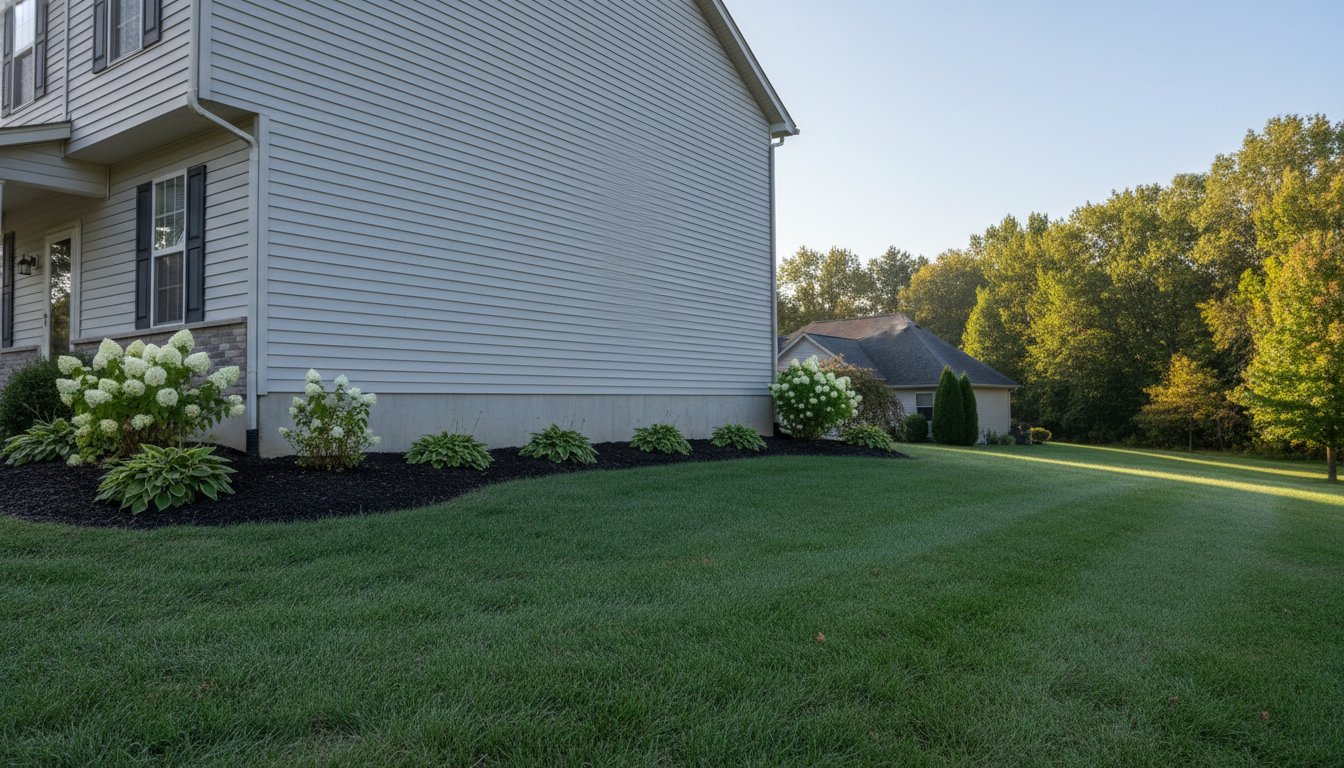
    Homeowners can begin their prevention journey by conducting a self-audit of the property exterior. Look for areas where mulch touches the siding, check for gaps around utility penetrations, and ensure that gutters are directing water at least three feet away from the foundation. While these steps are helpful, consulting with a licensed professional for a customized property assessment ensures that no hidden vulnerabilities are overlooked. A professional can provide a tailored seasonal pest control schedule based on the specific environment of your lot, whether it is a wooded area in Crawford County or a lakeside property in Ashtabula. Taking these steps early in the year ensures that you stay ahead of the biological cycles of local pests. Ultimately, professional pest control may help reduce risk and safeguard your property against the evolving threats of the 2026 season.

    Disclaimer: The information provided on this blog is for general informational purposes only and is not intended as professional pest control advice. Conditions vary by property, environment, and location. Reading this content does not create a service agreement. For an inspection or professional recommendations, please contact Mosquito Assassin Pest Control LLC directly.
    Securing Your Home for the Year Ahead

    Effective pest management is a year-round commitment that adapts to the biological rhythms of the tri-state area. By following a seasonal pest control schedule, homeowners move away from reactive treatments and toward a model of consistent protection. Success depends on understanding the early spring awakening triggered by heat accumulation and the critical late-autumn exclusion window before rodents seek warmth. Maintaining these physical and chemical barriers ensures that pests are addressed at their most vulnerable life stages before they can establish indoor colonies.

    As a locally owned and operated business based in Cranesville, PA, Mosquito Assassin understands the specific climate pressures facing Erie, Crawford, and Ashtabula counties. Professional technicians provide family-safe treatment options and are fully licensed and insured in both Pennsylvania and Ohio. Taking a proactive step now prevents the stress of a full-scale infestation later in the year. To begin safeguarding your property, you may schedule a professional inspection for your property today. Consistent vigilance is the most reliable way to maintain a healthy, comfortable home environment for your family.

    Disclaimer: The information provided on this blog is for general informational purposes only and is not intended as professional pest control advice. Conditions vary by property, environment, and location. Reading this content does not create a service agreement. For an inspection or professional recommendations, please contact Mosquito Assassin Pest Control LLC directly.

    Frequently Asked Questions

    Why is pest control necessary in the winter if I do not see bugs?

    Winter pest control is necessary because most pests don’t die off; they seek the thermal heat of your home’s interior. Rodents, cockroaches, and silverfish thrive in climate-controlled environments even when outdoor temperatures drop below freezing. A winter service visit focuses on deep-interior inspections and sealing entry points. By destroying indoor nesting sites during the cold months, you significantly reduce the risk of a massive population surge when spring arrives.

    When is the best time to start a seasonal pest control program?

    Implementing a seasonal pest control schedule in early spring, typically by late March, is the most effective strategy. This proactive approach allows technicians to establish a protective barrier before the first cycle of insect emergence begins. By targeting pests during their initial reproductive phase, you prevent the exponential population growth that usually occurs in July and August. Early intervention is the key to maintaining a pest-free home throughout the entire year.

    How often should a professional pest control service visit my home?

    Quarterly visits are generally recommended for homes in the tri-state area to align with seasonal biological shifts. Each visit addresses specific threats, such as spring ants or autumn rodents. According to industry data, 70% of residential pest problems are prevented through these regular maintenance cycles. While some properties with heavy foliage may benefit from monthly service, a four-visit annual plan provides the foundational protection needed for most Pennsylvania and Ohio homes.

    Can I manage seasonal pests myself using DIY products?

    DIY products often provide only temporary relief because they fail to reach the heart of the colony. Most store-bought aerosols are contact killers that don’t have the residual strength to eliminate hidden larvae or eggs. Licensed professionals use specialized equipment and integrated strategies that target pest biology. This approach is more effective than the “see a bug, spray a bug” method common with over-the-counter products.

    What pests are most active in Erie and Crawford Counties during the spring?

    Ants and wood-destroying insects are the primary concerns in Erie and Crawford counties during the spring. Pavement ants often appear in kitchens after the first significant rain, while termite swarmers emerge once soil temperatures hit 50 degrees Fahrenheit. Carpenter bees also begin drilling into wooden structures during late April. Identifying these pests early is essential for preventing structural damage and maintaining the integrity of your home’s exterior during the spring awakening.

    Is professional pest control safe for my children and pets?

    Professional pest control is safe for families and pets when performed by trained technicians following EPA-approved labels. Modern methods prioritize low-impact, targeted applications in areas that are inaccessible to children. By focusing on cracks, crevices, and the exterior perimeter, professionals minimize product exposure while maximizing effectiveness. This methodical approach ensures your home remains a safe environment while still being completely protected from the health risks associated with pests.

    What should I do if I see pests between scheduled service visits?

    You should notify your pest control provider immediately if you notice activity between your scheduled visits. Seeing pests can mean a new entry point has opened or a specific environmental factor has triggered a local surge. Most professional service agreements include follow-up treatments at no additional cost to address these issues. Prompt reporting allows the technician to adjust your customized plan and reinforce the barrier before a minor sighting becomes an infestation.

    How does the weather in Ohio and Pennsylvania affect pest activity?

    The unique climate of the Great Lakes region dictates the timing of local infestations. High humidity in Ashtabula County and Erie County creates ideal conditions for moisture-loving pests like mosquitoes and silverfish. Additionally, the rapid shift from a frozen winter to a wet spring in Pennsylvania triggers immediate biological responses in wood-destroying insects. Weather patterns are the primary driver of the seasonal pest control schedule, making local expertise vital for effective treatment.

    Disclaimer: The information provided on this blog is for general informational purposes only and is not intended as professional pest control advice. Conditions vary by property, environment, and location. Reading this content does not create a service agreement. For an inspection or professional recommendations, please contact Mosquito Assassin Pest Control LLC directly.
  • How to Get Rid of Stink Bugs: A Professional Guide to Prevention and Removal

    How to Get Rid of Stink Bugs: A Professional Guide to Prevention and Removal

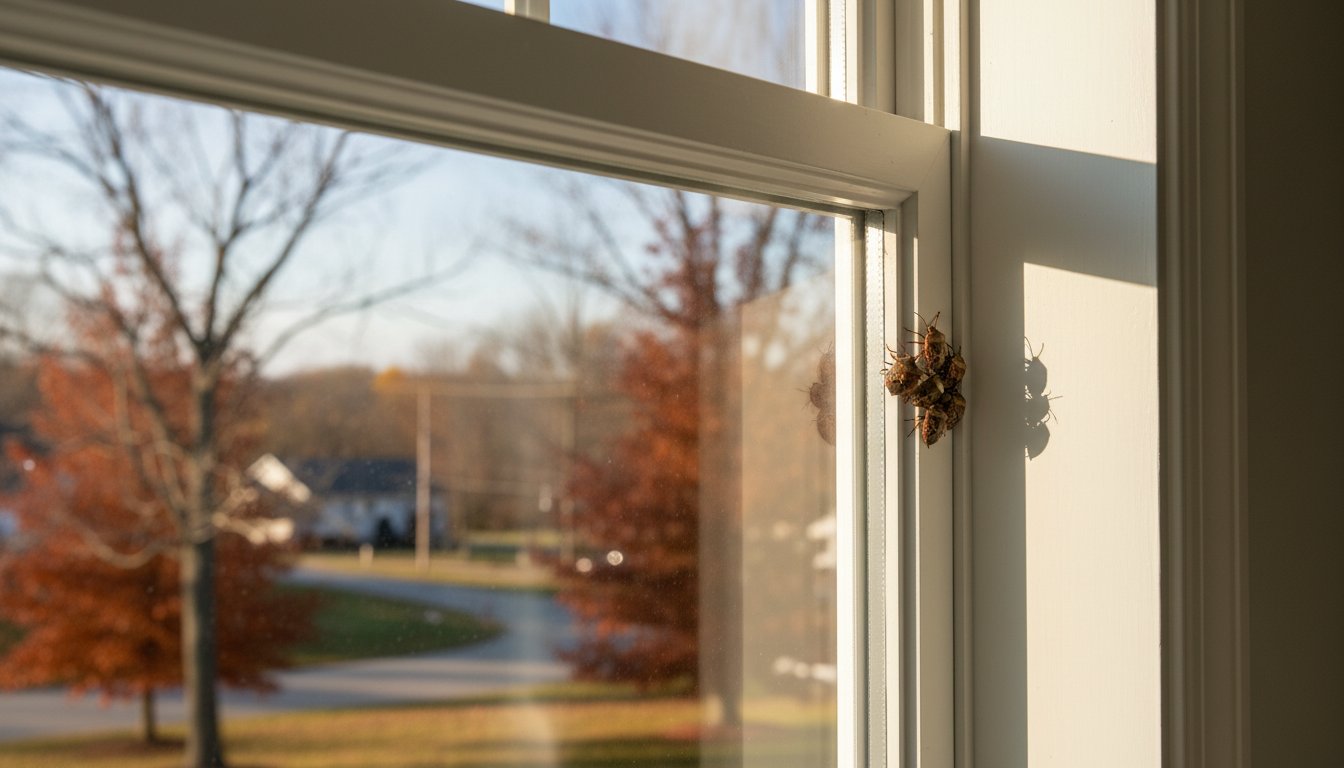
    On a crisp afternoon in October, a resident in Ashtabula County pulled back their bedroom curtains only to find 45 shield-shaped insects clustered near the window frame. It’s a common sight across Erie and Crawford Counties as temperatures drop and pests seek warmth. It’s understandable to feel frustrated by the lingering, pungent odor and confused about why these invaders keep appearing despite a spotless home.

    Finding a permanent solution for how to get rid of stink bugs requires more than a simple vacuum; it demands a professional approach to exclusion and removal. This guide provides science-based strategies to help identify entry points and secure the home’s exterior against seasonal threats. You’ll learn effective removal techniques and understand when a licensed technician is necessary to safeguard the property from a massive indoor invasion. Professional pest control may help reduce risk and ensure long-term protection for the household.

    Disclaimer: The information provided on this blog is for general informational purposes only and is not intended as professional pest control advice. Conditions vary by property, environment, and location. Reading this content does not create a service agreement. For an inspection or professional recommendations, please contact Mosquito Assassin Pest Control LLC directly.

    Key Takeaways

    • Identify the Brown Marmorated Stink Bug and its distinct shield-shaped appearance common in Pennsylvania and Ohio homes.
    • Understand the science behind diapause and aggregation pheromones that cause hundreds of insects to gather in a single location.
    • Explore effective, non-lethal strategies for how to get rid of stink bugs without using messy foggers or triggering their defensive odors.
    • Learn how to implement structural exclusion by sealing utility pipe penetrations and loose siding to prevent future seasonal invasions.
    • Determine the specific threshold where DIY methods are insufficient and a professional Integrated Pest Management approach is necessary for long-term control.

    Understanding Stink Bug Behavior in Pennsylvania and Ohio

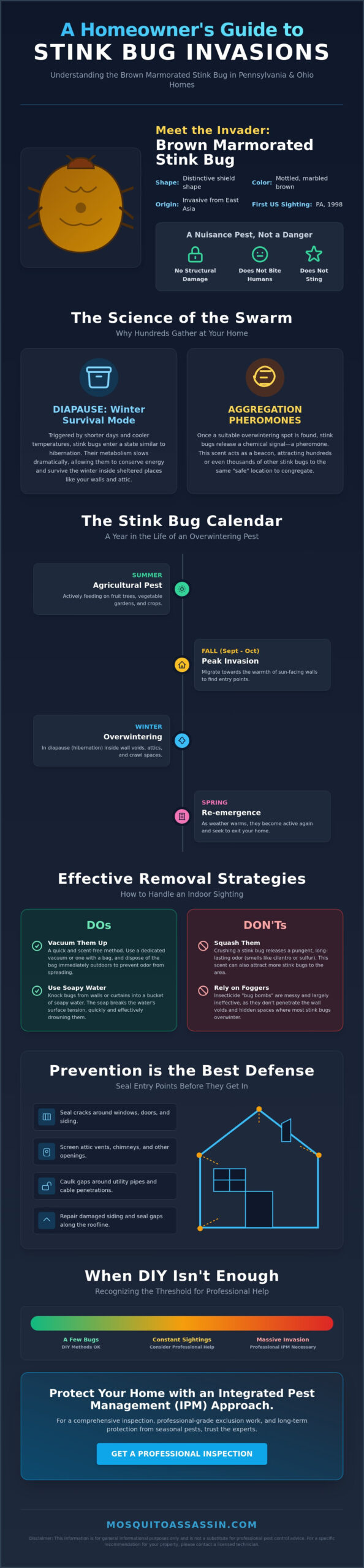
    The primary invasive species causing concern for homeowners in the tristate area is the Brown Marmorated Stink Bug (Halyomorpha halys). These insects are easily identified by their distinct shield shape and mottled brown, marbled appearance. While their prehistoric look can be intimidating, it is important to understand that these pests are strictly a nuisance. They do not bite humans, they do not sting, and they do not cause structural damage to your home like termites or carpenter ants. Instead, they seek shelter in residential structures to survive the winter months.

    Residents in Erie and Crawford counties in Pennsylvania, as well as Ashtabula County in Ohio, see high concentrations of these insects due to the region’s unique blend of agricultural land and wooded residential areas. As temperatures drop in late September and October, these bugs migrate from crops and trees toward the warmth of sun-facing walls. Understanding this seasonal migration is the first step for those researching how to get rid of stink bugs effectively before they find their way into attic spaces and wall voids.

    The Invasive History of the Brown Marmorated Stink Bug

    The Brown Marmorated Stink Bug is not native to North America; it was introduced from East Asia. The first documented sighting in the United States occurred in Allentown, Pennsylvania, in September 1998. Without natural predators to check their population growth, they spread rapidly across the Northeast and Midwest. By 2007, they were officially detected in Ohio, where they quickly became a major agricultural threat to fruit and vegetable crops. In residential areas, their presence has become a predictable seasonal event, as thousands of bugs can swarm a single property during a peak flight period.

    Why Stink Bugs Emit a Foul Odor

    The most defining characteristic of this insect is its chemical defense mechanism. When the bug feels threatened or is physically crushed, it releases a pungent liquid from specialized scent glands located on its abdomen. This odor serves to deter predators like birds or lizards. Many people describe the smell as similar to strong cilantro, sulfur, or even rotting fruit.

    Homeowners looking for how to get rid of stink bugs should avoid squashing them inside the home. Crushing the insect triggers a concentrated release of these pheromones, which can linger in a room for hours. Additionally, these scent markers may signal to other stink bugs that the area is a safe location for congregating. Using a vacuum or gentle relocation methods is often more effective than physical force. If an infestation becomes overwhelming, professional pest control may help reduce risk and manage the population before the insects enter their dormant phase.

    Disclaimer: The information provided on this blog is for general informational purposes only and is not intended as professional pest control advice. Conditions vary by property, environment, and location. Reading this content does not create a service agreement. For an inspection or professional recommendations, please contact Mosquito Assassin Pest Control LLC directly.
    The Lifecycle and Seasonal Patterns of Overwintering Pests

    The Brown Marmorated Stink Bug (BMSB) follows a specific biological clock that dictates its movement into residential structures. During the summer months, these insects act as agricultural pests, feeding on fruit trees and vegetable gardens. As daylight hours shorten and temperatures drop, they enter a state called diapause. This is a period of suspended development, similar to hibernation, where their metabolism slows down significantly to survive the winter. To ensure survival, they utilize an “aggregation pheromone.” This chemical signal acts like a beacon, attracting hundreds or even thousands of bugs to a single location. Understanding this stink bug life cycle is essential when determining how to get rid of stink bugs before they become a permanent fixture in your home.

    Fall Infiltration: Seeking Warmth for Winter

    In the Great Lakes region, including Erie County and Ashtabula County, the peak months for activity are September and October. Stink bugs are attracted to the thermal mass of buildings. They often cluster on south-facing, sun-warmed walls where stone or siding retains heat long after sunset. From these surfaces, they seek out tiny gaps, often less than 1/8th of an inch, to enter wall voids, attics, and crawlspaces. Reflective surfaces and bright exterior lights also draw them toward residential structures. Once they find a suitable crevice, the aggregation pheromone ensures their peers follow, leading to large clusters hidden within the home’s infrastructure. Effective strategies on how to get rid of stink bugs often focus on identifying these structural vulnerabilities before the first frost.

    Spring Emergence: Why They Appear in Your Living Room

    Homeowners in Crawford County often notice a secondary surge of activity during February or March. As the sun begins to warm the exterior of the house, it also warms the wall voids where the insects are resting. This temperature shift wakes up the pests prematurely. Instead of heading outside, they often follow heat trails deeper into the interior of the home, emerging through light fixtures, crown molding, or baseboards. It’s a common misconception that these insects are breeding or laying eggs inside during the winter. They’re simply trying to find a way back to the outdoors to begin their summer feeding cycle. If you find yourself overwhelmed by these seasonal invaders, professional pest control may help reduce risk in your home.

    Disclaimer: The information provided on this blog is for general informational purposes only and is not intended as professional pest control advice. Conditions vary by property, environment, and location. Reading this content does not create a service agreement. For an inspection or professional recommendations, please contact Mosquito Assassin Pest Control LLC directly.

    How to Get Rid of Stink Bugs: A Professional Guide to Prevention and Removal

    Effective Methods for Removing Stink Bugs From Living Spaces

    Finding a shield-shaped intruder on your curtains is a common frustration for residents in Erie County and Crawford County during the cooler months. When deciding how to get rid of stink bugs inside the home, the primary goal is removal without triggering their defensive odor. Homeowners should avoid using bug bombs or total release foggers. These chemical treatments rarely penetrate the deep wall voids or attic crevices where the insects congregate. Instead, they leave unnecessary residue on furniture and floors while the pests remain protected behind drywall. Professional standards prioritize physical removal and exclusion over broadcast indoor chemical applications for these specific pests.

    The Soapy Water Method

    The soapy water trap is a highly effective, low-cost strategy for localized infestations. By mixing approximately two tablespoons of liquid dish soap into a gallon of water, you create a solution that breaks the surface tension of the liquid. When a stink bug falls into the mixture, it can no longer stay afloat and quickly drowns. This is a mechanical solution that avoids the use of harsh chemical aerosols, which often cause the insect to release its pungent scent before expiring.

    • Light Attraction: Place a wide, shallow pan of soapy water under a small desk lamp in a dark room overnight.
    • Placement: Position the light roughly 6 to 10 inches above the water surface to draw insects from nearby walls.
    • Safety: This method is significantly safer for households with pets or children compared to leaving chemical residues on surfaces.

    Using Vacuums and Shop-Vacs Safely

    Using a standard upright vacuum can lead to a lingering problem. The internal fan often crushes the bugs, venting their foul odor through the exhaust and throughout the entire house. For a safer approach, use a dedicated shop-vac or a vacuum equipped with a HEPA filter and a sealed bag system. These filters are designed to trap particles as small as 0.3 microns, which helps contain both the insects and the microscopic droplets of their defensive spray.

    A practical trick involves inserting a knee-high nylon stocking into the vacuum hose and securing the end around the outside of the nozzle with a rubber band. This catches the bugs in the mesh “pouch” before they ever enter the vacuum canister or bag. Once you have finished collecting the insects, carefully remove the stocking, tie it shut, and dispose of it in an outdoor trash receptacle immediately. Prompt disposal ensures that any surviving insects do not crawl back out or continue to smell up the storage area. While these manual tactics work for occasional sightings, persistent indoor activity often indicates a larger entry point issue. In these cases, professional pest control may help reduce risk by identifying where the population is overwintering. For more information on protecting your home in Ashtabula County or Western Pennsylvania, you can visit our location page for regional details.

    Disclaimer: The information provided on this blog is for general informational purposes only and is not intended as professional pest control advice. Conditions vary by property, environment, and location. Reading this content does not create a service agreement. For an inspection or professional recommendations, please contact Mosquito Assassin Pest Control LLC directly.
    Structural Exclusion: Preventing Stink Bug Entry Points

    Exclusion is the most effective long-term strategy for pest management. Instead of reacting to an infestation after it occurs, homeowners can proactively block entry by creating a physical barrier. Stink bugs are remarkably thin, which allows them to squeeze through gaps as small as 1/8 inch. Identifying and sealing entry points like utility pipe penetrations and loose siding is the first step in learning how to get rid of stink bugs effectively.

    Timing is critical for residents in Crawford County and Ashtabula County. Exclusion work must be completed before the first significant temperature drop in autumn. Once the cooling begins, these insects move toward the warmth of structural walls to find a place for overwintering. Minor repairs made in July or August can reduce the risk of future infestations by 90 percent. A thorough inspection of the home’s exterior often reveals dozens of potential access points that require attention.

    Sealing the Exterior Envelope

    Using high-quality silicone or acrylic latex caulk is recommended for sealing cracks and crevices. These materials remain flexible during the harsh freeze-thaw cycles common in the Great Lakes region, ensuring the seal doesn’t crack over time. Homeowners should focus on often-overlooked areas such as chimney flashings, fascia boards, and the points where different siding materials meet. It’s also vital to inspect and repair window screens that have even minor tears. Door sweeps should be checked to ensure they sit flush against the threshold (if light is visible under the door, a stink bug can easily crawl through).

    Ventilation and Attic Protection

    Attic vents and soffits provide easy access for pests looking for a high vantage point. Installing fine-mesh screening, specifically 20×20 mesh or smaller, prevents entry while maintaining necessary airflow for the home. Crawlspace entries must also be secured with tight-fitting covers to prevent pests from harboring underneath the structure. Because these insects are experts at finding microscopic gaps, professional pest control may help reduce risk by identifying hidden entry points that are frequently missed during DIY inspections. Taking these steps is a core part of a comprehensive plan on how to get rid of stink bugs before they become a nuisance inside the living space.

    For a detailed assessment of structural vulnerabilities, homeowners can schedule an inspection through the online booking portal.

    Disclaimer: The information provided on this blog is for general informational purposes only and is not intended as professional pest control advice. Conditions vary by property, environment, and location. Reading this content does not create a service agreement. For an inspection or professional recommendations, please contact Mosquito Assassin Pest Control LLC directly.
    When Professional Pest Management Becomes Necessary

    Understanding how to get rid of stink bugs often involves recognizing the limit of DIY solutions. While a vacuum can handle a few stray insects, it doesn’t address the root of a seasonal infestation. When homeowners observe more than 10 insects per day inside living spaces during the late fall or early spring, it usually indicates a significant aggregation within the home’s structure. Large-scale clusters often hide in wall voids, attics, or crawl spaces where standard household cleaners and sprays cannot reach.

    Professional technicians utilize Integrated Pest Management (IPM) to solve these issues. This methodology focuses on long-term prevention and suppression rather than just reactive spraying. For large-scale aggregations in wall voids, professionals apply specialized materials that penetrate deep into the structural gaps where insects congregate. These methods are more effective than over-the-counter foggers, which often fail to reach the center of a cluster and can leave behind messy residues. Common signs that professional intervention is required include:

    • Persistent sightings in multiple rooms despite sealing visible cracks.
    • Large numbers of dead insects accumulating in light fixtures or window sills.
    • A noticeable pungent odor that lingers in specific areas of the home.
    • Visible staining on walls or curtains from insect excrement.

    The Role of Perimeter Treatments

    Professional applications create a protective barrier on the exterior of a home. This barrier stops insects before they find entry points like soffit vents, window casings, or gaps in the siding. Timing is critical for these treatments. Applying a perimeter shield during the specific fall window, typically between late August and October, is the most effective way to manage how to get rid of stink bugs before they enter dormancy. Many general pest control plans include seasonal adjustments to account for these regional pest migrations. It’s a proactive approach that targets the exterior surfaces where the bugs land to sun themselves before seeking shelter inside.

    Finding Local Support in PA and OH

    Homeowners in Erie, Crawford, and Ashtabula Counties face unique challenges due to the proximity to Lake Erie and local agricultural patterns. Seeking local experts who understand the climate in these regions ensures that treatments are timed correctly for the local lifecycle of the Brown Marmorated Stink Bug. Learning more about our local team can provide insight into how community-wide pest trends affect individual properties. For an assessment of a property, contact a professional technician to discuss preventative strategies and property inspections.

    Disclaimer: The information provided on this blog is for general informational purposes only and is not intended as professional pest control advice. Conditions vary by property, environment, and location. Reading this content does not create a service agreement. For an inspection or professional recommendations, please contact Mosquito Assassin Pest Control LLC directly.
    Protecting Your Property From Seasonal Pest Intrusions

    Managing these pests requires a proactive strategy that begins well before the first frost hits the region. Homeowners in Erie and Crawford Counties in Pennsylvania and Ashtabula County in Ohio often see activity increase as temperatures drop below 50 degrees Fahrenheit. Identifying entry points like loose siding or gaps around utility lines is essential for long-term control. While vacuuming provides a temporary fix for individual insects, understanding how to get rid of stink bugs effectively involves a combination of structural exclusion and professional monitoring.

    Professional intervention provides a comprehensive approach to pest management. Licensed and insured technicians in PA and OH utilize family and pet-safe treatments to address overwintering patterns. Because Mosquito Assassin is locally owned and operated, the team understands the specific seasonal behaviors of pests in the tri-county area. Taking these steps ensures a more comfortable living environment throughout the winter months. Schedule a professional inspection for your home to safeguard your property this season. Protecting your home is a manageable process with the right expert guidance.

    Disclaimer: The information provided on this blog is for general informational purposes only and is not intended as professional pest control advice. Conditions vary by property, environment, and location. Reading this content does not create a service agreement. For an inspection or professional recommendations, please contact Mosquito Assassin Pest Control LLC directly.

    Frequently Asked Questions

    Do stink bugs bite humans or pets?

    Stink bugs don’t bite humans or pets because their mouthparts are designed for piercing plant tissue rather than skin. They use a straw-like proboscis to suck juices from more than 170 host plants, including fruit trees and garden vegetables. While they aren’t dangerous, they can be a major nuisance in Erie and Crawford Counties during the fall. If they land on your skin, they might produce a foul odor, but they won’t cause physical injury.

    Why do I have so many stink bugs in my house all of a sudden?

    Stink bugs enter homes in large numbers during the fall to seek shelter from freezing temperatures. They transition into a state called diapause, which is similar to hibernation. Learning how to get rid of stink bugs often starts with sealing exterior gaps larger than 0.125 inches. Research from the USDA indicates that these pests are attracted to the warmth and light reflected from southern and western facing walls during the afternoon.

    Can stink bugs cause damage to my home or furniture?

    Stink bugs don’t cause structural damage to wood, drywall, or electrical wiring like termites or rodents do. The primary risk to your home is cosmetic staining from their defensive secretions. These yellowish fluids contain chemicals like trans-2-octenal, which can leave permanent marks on white curtains or light-colored upholstery. Professional pest control may help reduce risk to your interior belongings by managing populations before they enter the structure.

    What is the best way to get rid of the smell if I accidentally squash one?

    The most effective way to remove the smell of a squashed stink bug is by using warm, soapy water or a mild enzymatic cleaner. The odor is caused by chemical compounds like trans-2-decenal released from glands on the insect’s thorax. Scrubbing the area immediately helps break down these pungent oils. To prevent future odors, use a vacuum with a HEPA filter to collect live bugs instead of crushing them, then dispose of the bag outside.

    Will stink bugs lay eggs or multiply inside my walls during the winter?

    Stink bugs won’t lay eggs or reproduce inside your walls during the winter months. They are sexually immature during their overwintering phase and require specific environmental triggers to mate. According to entomological studies, they need at least 14 hours of daylight and consistent temperatures above 70 degrees Fahrenheit to begin their reproductive cycle. They simply wait in wall voids until the spring thaw arrives in Ashtabula County.

    Are there any natural scents that repel stink bugs effectively?

    Some studies suggest that high concentrations of essential oils like mint, clove, or garlic can act as temporary deterrents. A 2014 study published in the Journal of Applied Entomology noted that certain botanical oils showed repellency in controlled environments. However, these natural scents dissipate quickly and rarely provide long-term protection for an entire house. Sealing cracks remains the most reliable prevention method for homeowners in the tri-county area.

    Is it safe to use chemical sprays inside my bedroom for stink bugs?

    Applying chemical sprays inside a bedroom isn’t recommended for homeowners due to safety concerns and limited effectiveness against dormant pests. Most over-the-counter sprays only kill the bugs you see, leaving hundreds hidden inside wall voids. When considering how to get rid of stink bugs, focus on mechanical exclusion like caulking window frames. For persistent issues, professional pest control may help reduce risk through targeted exterior perimeter treatments. You can visit www.mosquitoassassin.com/contact-us for more information on professional exclusion techniques.

    How long do stink bugs typically live once they are inside a home?

    Stink bugs can live for several months inside a home if they remain in a dormant state, but they often die within days if they enter active living spaces. The dry, heated air found in modern homes during Pennsylvania winters dehydrates them quickly. While an adult’s total lifespan is typically 6 to 8 months, those that wander into your kitchen or living room usually succumb to low humidity levels within a week.

    Disclaimer: The information provided on this blog is for general informational purposes only and is not intended as professional pest control advice. Conditions vary by property, environment, and location. Reading this content does not create a service agreement. For an inspection or professional recommendations, please contact Mosquito Assassin Pest Control LLC directly.

  • Common Pests in Western PA: A Homeowner Guide to Local Species

    Common Pests in Western PA: A Homeowner Guide to Local Species

    According to the National Pest Management Association, termites cause over $5 billion in property damage annually in the United States. For residents in Erie and Crawford Counties, this figure highlights the real risk that silent invaders pose to local property values. It’s natural to feel a sense of unease when discovering a tick after a hike or hearing the telltale signs of rodents in the attic. Dealing with common pests in western PA is a year-round challenge that demands both vigilance and local expertise.

    This guide identifies the most frequent seasonal pests encountered in Western Pennsylvania and Ashtabula County, Ohio, while outlining professional prevention strategies to protect your home. You’ll gain a clear understanding of how to recognize local species and implement practical steps to reduce common attractants. By learning about pest behavior and environmental triggers, you can better decide when professional intervention is required to safeguard your family and property.

    Disclaimer: The information provided on this blog is for general informational purposes only and is not intended as professional pest control advice. Conditions vary by property, environment, and location. Reading this content does not create a service agreement. For an inspection or professional recommendations, please contact Mosquito Assassin Pest Control LLC directly.

    Key Takeaways

    • Learn how the humid continental climate and proximity to Lake Erie influence the activity levels and breeding patterns of local species throughout the year.
    • Identify the specific habitats of health-risk insects, such as black-legged ticks in wooded areas and mosquitoes in stagnant water, to better protect your household.
    • Understand the differences between structural threats like Eastern subterranean termites and carpenter ants, which are among the most common pests in western PA and Northeast Ohio.
    • Discover practical home maintenance strategies, including gutter clearing and proper soil grading, to eliminate the moisture sources that attract local pests.
    • Explore the benefits of Integrated Pest Management (IPM) for achieving long-term protection through consistent monitoring and professional prevention techniques.

    Understanding Common Pests in Western PA and the Seasonal Cycle

    Western Pennsylvania presents a unique environment for homeowners because the region’s biodiversity means that common household pests often consist of a varied mix of urban, agricultural, and woodland species. Residents in Erie and Crawford Counties frequently deal with pressure from both industrial areas and the surrounding timberlands. The humid continental climate, heavily influenced by the moisture coming off Lake Erie, creates high humidity levels that sustain large insect populations throughout the warmer months.

    Seasonal transitions act as a primary driver for pest activity. Spring thaws wake dormant colonies, while autumn frosts signal a desperate search for warmth inside residential structures. Understanding these cycles is the first step in protecting a property. The common pests in western PA generally fall into three main categories: stinging insects, wood-destroying organisms, and rodents. Each group responds differently to the local weather patterns and regional topography.

    To see how local weather and agricultural shifts impact specific species, watch this report on seasonal pest trends:

    Spring and Summer: The Peak of Insect Activity

    As soil temperatures rise above 50 degrees Fahrenheit, odorous house ants and pavement ants begin their search for food. These colonies often expand rapidly during the humid months of June and July. Stinging insects like yellowjackets and hornets follow a fast-paced lifecycle, reaching peak population density by late August. In Crawford County, high summer humidity levels often drive moisture-loving pests like house centipedes into cooler, damp areas of the home, such as crawlspaces or bathrooms, to avoid desiccation.

    Fall and Winter: The Search for Warmth

    When the first hard frost hits, typically in late October or early November, the behavior of common pests in western PA shifts toward survival. Overwintering pests, specifically the brown marmorated stink bug, seek cracks in siding to enter attic spaces. Rodents also move indoors during this time, as they require stable temperatures to survive the harsh winters of the Great Lakes region. While many insects go dormant, spiders and silverfish often remain active in basement environments, where humidity levels stay high enough to support their needs throughout the winter.

    If you notice signs of an infestation, professional pest control may help reduce risk. More information is available at our location page or through the online booking portal.

    Disclaimer: The information provided on this blog is for general informational purposes only and is not intended as professional pest control advice. Conditions vary by property, environment, and location. Reading this content does not create a service agreement. For an inspection or professional recommendations, please contact Mosquito Assassin Pest Control LLC directly.

    Health-Risk Pests: Mosquitoes, Ticks, and Stinging Insects

    Biological threats from local wildlife often peak during the humid summer months in the Tri-County area. Homeowners frequently encounter various common pests in western PA that carry pathogens or possess aggressive defensive behaviors. Understanding the lifecycle and habitat of these species is the first step in maintaining a safe residential environment. Professional monitoring remains a standard recommendation because these specific pests require precise identification to manage effectively without disrupting the local ecosystem.

    Ticks and Mosquitoes in the Tri-County Area

    Black-legged ticks, also known as deer ticks, are prevalent throughout the wooded corridors of Northwest PA and Ashtabula County. These arachnids thrive in the leaf litter and tall grass found at the edges of residential properties. According to data from the Pennsylvania Department of Health, tick populations in Erie and Crawford counties have shown a consistent presence of Borrelia burgdorferi, the bacterium responsible for Lyme disease. For help with identification, homeowners can refer to this Penn State guide to common household insects to distinguish between different tick species and other yard invaders.

    Mosquitoes present a different set of challenges, particularly in the Lake Erie lowlands where drainage can be slow. Species like the Culex mosquito are active from May through September, with peak activity occurring during the low-light hours of dawn and dusk. These insects utilize even the smallest amounts of stagnant water for breeding. Common attractants include:

    • Clogged gutters that retain moisture and organic debris.
    • Overturned flowerpots or equipment that collects rainfall.
    • Dense vegetation and tall grass that provide cool, shaded resting spots during the day.

    Stinging Insect Identification and Safety

    As the season progresses into late summer and early fall, the behavior of stinging insects becomes more territorial. Ground-nesting yellowjackets are particularly aggressive during this window as their colony size reaches its peak and natural food sources become scarce. These are among the most hazardous common pests in western PA because their nests are often hidden beneath the soil, making them easy to disturb while mowing or gardening.

    It’s vital to distinguish between beneficial pollinators and aggressive hornets. While honeybees and bumblebees generally avoid conflict, bald-faced hornets will strike repeatedly if they perceive a threat to their aerial nests. Another concern for homeowners is the carpenter bee. Unlike hornets, carpenter bees aren’t typically aggressive, but they pose a structural risk. They drill half-inch diameter holes into wooden decks, eaves, and fascia boards to lay eggs. Over several years, this activity can lead to significant wood decay and moisture intrusion.

    When a nest is discovered on a property, safety should be the priority. Homeowners should avoid approaching or spraying nests with over-the-counter products, as this can trigger a swarm response. If you notice high levels of activity near your home, professional pest control may help reduce risk by identifying the species and implementing a targeted management plan. For an evaluation of your property, you may reach out through the online booking portal.

    Disclaimer: The information provided on this blog is for general informational purposes only and is not intended as professional pest control advice. Conditions vary by property, environment, and location. Reading this content does not create a service agreement. For an inspection or professional recommendations, please contact Mosquito Assassin Pest Control LLC directly.

    Common Pests in Western PA: A Homeowner Guide to Local Species

    Structural and Nuisance Pests: Termites, Ants, and Rodents

    Older homes in Erie and Crawford Counties face a persistent, hidden threat from Eastern subterranean termites. These insects are often called silent destroyers because they can consume structural wood for years without being detected. In Western PA, where many residential properties feature aged timber and damp basements, termites find ideal conditions to thrive. They typically enter through the soil, building protective mud tubes to reach the wooden components of a house. Homeowners often miss the early signs of an infestation, only realizing there is a problem when they find discarded wings or hollowed-out wood during a renovation.

    Identifying the difference between wood-destroying insects is critical for effective management. While termites consume wood for nutrition, carpenter ants simply use it as a nesting site. These ants prefer wood that has been softened by moisture or decay. You can often tell the difference by the debris they leave behind. Carpenter ants produce “frass,” a substance resembling sawdust that contains wood fragments and insect parts. Termites, conversely, leave the wood looking layered or shredded. Following established guidelines for urban pest prevention and control helps manage these risks through integrated strategies that address moisture and entry points.

    Wood-Destroying Organisms in PA and OH

    In the regional climate of Ashtabula County and surrounding areas, wood-destroying organisms are a constant concern. Termite activity is most visible during “swarming” events in the spring, where winged reproductives emerge to start new colonies. Look for mud tubes on foundation walls, which look like dried veins of earth. Professional inspections are necessary to identify these subtle signs before structural degradation becomes a safety hazard or a major financial burden. Because carpenter ants don’t stop once a nest is established, professional intervention is often the only way to ensure a colony is fully neutralized.

    The Challenge of Rodent Exclusion

    The house mouse is one of the most prolific common pests in western PA. These rodents are capable of producing up to eight litters per year, meaning a small entry point can lead to a massive population in just a few months. Mice can squeeze through gaps as small as a dime in a home’s foundation, siding, or utility lines. Once inside, they pose significant health risks by contaminating food and surfaces with droppings and urine. Effective rodent removal requires a methodical three-step process:

    • Removal: Eliminating the current population using professional-grade methods.
    • Maintenance: Monitoring the property to ensure no new activity occurs.
    • Exclusion: Sealing every possible entry point with durable materials like steel wool or metal flashing.

    Managing these common pests in western PA requires a proactive approach. While DIY traps might catch a single mouse, they don’t address the root cause of the infestation. Professional pest control is frequently necessary for persistent ant colonies and rodent issues because it addresses the biological behaviors and entry patterns specific to local species.

    Disclaimer: The information provided on this blog is for general informational purposes only and is not intended as professional pest control advice. Conditions vary by property, environment, and location. Reading this content does not create a service agreement. For an inspection or professional recommendations, please contact Mosquito Assassin Pest Control LLC directly.

    Practical Prevention Strategies for Local Homeowners

    Safeguarding a property against common pests in western PA requires a proactive approach. Homeowners can reduce the likelihood of infestations by making the environment less hospitable to local species. Moisture control is a primary defense. Termites, carpenter ants, and silverfish thrive in damp environments. Gutters should be cleaned at least twice a year, typically in late spring and late fall, to prevent water from pooling near the foundation. Soil should be graded to slope away from the house at a rate of one inch per foot for the first six to ten feet to ensure proper drainage and keep the crawl space or basement dry.

    Sanitation habits are equally important. Many common pests in western PA, such as rodents and pavement ants, are attracted to accessible food sources. Storing pantry items in airtight glass or heavy plastic containers removes the olfactory triggers that draw these animals inside. Trash should be kept in bins with tight-fitting lids and emptied regularly to prevent odors from lingering. Sealing external gaps is the final step in basic exclusion. Using silicone-based caulk for small cracks and hardware cloth for larger vents or crawl space openings creates a physical barrier that pests cannot easily penetrate.

    Hardening the Home Exterior

    Pests often enter through damaged door sweeps or torn window screens. Homeowners don’t always realize that a gap of just 1/16th of an inch is enough for many insects to gain entry. Firewood should be stored at least 20 feet away from the home and elevated on a metal rack. This prevents wood-boring insects from migrating directly into the structure. Professional exclusion services provide a comprehensive long-term barrier by identifying hidden entry points that residents might overlook during a standard inspection.

    Landscaping and Yard Maintenance

    Vegetation acts as a natural bridge for ants and spiders. Trimming tree branches and shrubs so they remain at least 24 inches away from the siding prevents pests from bypassing ground-level treatments. Mulch depth should not exceed two to three inches. Excessive mulch retains moisture and provides a perfect nesting ground for earwigs and millipedes. Simple yard modifications, such as removing standing water in clogged drains or low spots, help with a mosquito control program by eliminating potential breeding sites.

    If you’ve identified potential entry points or persistent activity, professional pest control may help reduce risk.

    Disclaimer: The information provided on this blog is for general informational purposes only and is not intended as professional pest control advice. Conditions vary by property, environment, and location. Reading this content does not create a service agreement. For an inspection or professional recommendations, please contact Mosquito Assassin Pest Control LLC directly.

    The Role of Professional Pest Management

    Managing common pests in western PA effectively involves a shift from reactive treatments to proactive strategies. Integrated Pest Management (IPM) serves as the foundation for this approach. It’s a science-based process that prioritizes long-term prevention over temporary fixes. Instead of simply applying products when a bug is spotted, professionals analyze the ecosystem of the property. They look for food sources, moisture issues, and structural gaps that allow pests to thrive. This methodical approach ensures that the root cause of an infestation is addressed, not just the symptoms. According to industry standards, nearly 80 percent of effective pest management involves exclusion and sanitation rather than chemical application alone.

    Customized treatment plans are significantly more effective than generic retail products. Big-box store sprays are often broad-spectrum and don’t account for the specific biological resistance or behavioral patterns of local species. Professionals use targeted applications that focus on the biology of the specific pest. This precision ensures a higher success rate while prioritizing family-safe treatments. These methods are designed to be used around children and pets, focusing on low-impact solutions that maintain the well-being of the household residents.

    Comprehensive Protection for Every Season

    The climate in Erie and Crawford Counties creates distinct pest pressures during different times of the year. Quarterly inspections are essential because they catch infestations in their early stages before they become a major financial burden. A professional’s knowledge of general pest control ensures that treatments are timed to the specific life cycles of local insects. Local providers with deep roots in the locations they serve understand how regional factors, such as Lake Erie’s humidity or local agricultural cycles, influence pest movement. This regional expertise allows for a level of protection that national chains often struggle to replicate.

    Taking the Next Step for a Pest-Free Home

    It’s common for homeowners to start with DIY efforts, but these often fall short when dealing with established colonies. Transitioning to professional assistance is a practical step when pests persist despite home remedies. Experts provide a satisfaction guarantee; if pests return between scheduled visits, the professionals return to address the issue. This creates a level of accountability and peace of mind that retail products cannot provide. Professional pest control may help reduce risk by creating a consistent barrier against the common pests in western PA. For residents in Ashtabula, Erie, or Crawford Counties, professional guidance is available through the online booking portal to help maintain a healthy, pest-free environment.

    Disclaimer: The information provided on this blog is for general informational purposes only and is not intended as professional pest control advice. Conditions vary by property, environment, and location. Reading this content does not create a service agreement. For an inspection or professional recommendations, please contact Mosquito Assassin Pest Control LLC directly.

    Securing Your Property Against Local Infestations

    Managing common pests in western PA requires a proactive approach that shifts with the local seasons. According to the Pennsylvania Department of Health, the state frequently reports some of the highest numbers of Lyme disease cases in the country, making tick prevention a top priority for local families. Beyond health risks, structural pests like termites cause an estimated $5 billion in property damage across the United States each year, often going unnoticed until significant issues arise.

    Effective prevention involves maintaining a 12-inch clear zone between mulch and your home’s foundation and ensuring all window screens are free of holes. While DIY methods offer temporary relief, a professional strategy provides a more durable solution. As a locally owned and operated company, Mosquito Assassin brings a five-star rated service to every property. The team is fully licensed and insured in PA and OH, offering expertise that helps homeowners maintain a comfortable environment. Professional pest control may help reduce risk, and for an inspection or professional recommendations, contact Mosquito Assassin Pest Control LLC directly. Taking small, consistent steps now will help keep your home secure all year long.

    Disclaimer: The information provided on this blog is for general informational purposes only and is not intended as professional pest control advice. Conditions vary by property, environment, and location. Reading this content does not create a service agreement. For an inspection or professional recommendations, please contact Mosquito Assassin Pest Control LLC directly.

    Frequently Asked Questions

    What are the most common pests in Western PA during the winter?

    Mice and spiders are the most common pests in western PA during the winter months. Rodents like the house mouse seek warmth when temperatures drop below 45 degrees Fahrenheit; they can enter through gaps as small as 1/4 inch. You’ll also frequently find cellar spiders or wolf spiders that have established themselves in basements or attics to escape the frost. These pests utilize the structural protection of your home to survive the harsh regional winters.

    How do I identify a termite swarm in Pennsylvania?

    Termite swarms in Pennsylvania typically occur on warm days following spring rain when temperatures reach approximately 70 degrees. You can identify these insects by their straight antennae, uniform waist, and four wings of equal length. Often, homeowners only find the discarded wings on windowsills or near light sources after the swarm has ended. These events are a primary indicator of an active colony nearby that requires a professional evaluation to prevent structural damage.

    Are the spiders found in Western PA dangerous?

    Most spiders found in Western PA aren’t medically significant to humans and don’t pose a serious health risk. The Northern Black Widow is the only native species with potentially dangerous venom, but they’re rarely encountered in living spaces. While species like the yellow sac spider or wolf spider can bite if they’re provoked, their venom typically causes only minor localized irritation. Professional identification is recommended if you’re concerned about a specific specimen found in your home.

    When is mosquito and tick season in the Erie and Ashtabula area?

    Mosquito and tick season in Erie, Crawford, and Ashtabula counties typically runs from April through October. Ticks become active whenever temperatures rise above 45 degrees, which can happen even during mid-winter thaws in our region. Mosquito activity peaks when nighttime temperatures consistently stay above 50 degrees. Local records indicate that the highest population densities for these pests usually occur between June and August.

    Why do I have so many stink bugs in my house every fall?

    Brown Marmorated Stink Bugs enter homes in the fall to find a protected place to overwinter. They’re attracted to the reflective surfaces and warmth of south-facing walls during the cooling months. Research shows these insects release a pheromone that attracts other stink bugs to the same location once they’ve found a suitable spot. Sealing gaps around windows and doors before September can help reduce the number of insects that successfully enter your living space.

    Can professional pest control help with carpenter bee damage?

    Professional pest control is an effective way to manage carpenter bee damage and prevent future nesting in your home’s exterior. These bees drill holes approximately 1/2 inch in diameter into untreated wood to create brood chambers for their young. Over several seasons, these tunnels can weaken structural components like fascia boards and deck joists. A technician can apply targeted treatments to active galleries and advise on long-term exclusion strategies to safeguard your property.

    What is the difference between a house mouse and a deer mouse?

    The primary difference between a house mouse and a deer mouse is their coloration and tail appearance. House mice are usually a solid light brown or gray with a hairless tail that’s the same color as their body. Deer mice have a distinct white underbelly and white feet, with a bi-colored tail that’s dark on top and light on the bottom. While house mice prefer living indoors year-round, deer mice often enter homes in rural areas during the fall.

    Is it possible to be totally pest-free in a wooded area?

    Achieving a totally pest-free environment in a wooded area is generally not possible due to the high natural biodiversity of the forest. However, professional management can significantly reduce the frequency of common pests in western PA entering your home. Maintaining a 12-inch gravel or mulch barrier around the foundation and keeping vegetation trimmed 2 feet away from the structure are proven methods to limit pest pressure. Professional pest control may help reduce risk even in high-pressure environments. For more information, visit www.mosquitoassassin.com/contact-us.

    Disclaimer: The information provided on this blog is for general informational purposes only and is not intended as professional pest control advice. Conditions vary by property, environment, and location. Reading this content does not create a service agreement. For an inspection or professional recommendations, please contact Mosquito Assassin Pest Control LLC directly.

  • Pest Management in Erie and Ashtabula County Around the Clock

    Pest Management in Erie and Ashtabula County Around the Clock

    Waiting until a pest is visible to take action often means an infestation is already well-established within the wall voids or foundation of a building. Most property owners in Erie and Crawford Counties recognize the frustration of recurring infestations that return every spring or fall. It’s common to feel that the variable Northeast Ohio climate, which can swing 40 degrees in a single day, makes it difficult to protect homes in Erie and Ashtabula County around the clock. Termites alone cause over 5 billion dollars in property damage across the United States annually, making consistent prevention a necessity rather than a luxury.

    This article explains how a proactive approach maintains a defensive barrier throughout the year. Readers will gain a clear understanding of seasonal pest behaviors and the specific measures required to prevent wood-destroying organisms from compromising a home’s structural integrity. This guide covers regional pest lifecycles, the impact of Lake Erie weather patterns on insect activity, and practical steps for year-round protection.

    Disclaimer: The information provided on this blog is for general informational purposes only and is not intended as professional pest control advice. Conditions vary by property, environment, and location. Reading this content does not create a service agreement. For an inspection or professional recommendations, please contact Mosquito Assassin Pest Control LLC directly.

    Key Takeaways

    • Understand the difference between reactive treatments and proactive maintenance strategies that protect homes in Erie and Ashtabula County around the clock.
    • Identify seasonal pest cycles and the unique risks that stinging insects and mosquitoes pose to Erie and Ashtabula County around the clock.
    • Learn how the unique Lake Effect climate creates moisture conditions that require professional management in Erie and Ashtabula County around the clock.
    • Explore the importance of consistent monitoring to safeguard residential and commercial properties in Erie and Ashtabula County around the clock.
    • Discover how professional inspections serve as the foundation for a long-term, pest-free environment across Erie and Ashtabula County around the clock.

    Defining Year-Round Pest Protection in Ashtabula County

    Year-round pest management is more than a seasonal response to visible bugs. It’s a proactive strategy that focuses on monitoring and prevention before infestations take hold. This methodology relies heavily on the principles of Integrated Pest Management, which combines biological knowledge with structural maintenance. By understanding the specific life cycles of pests common to Northeast Ohio and Northwest Pennsylvania, property owners can maintain a defensive posture throughout the year. Providing protection for homes in Erie, Crawford, and Ashtabula County around the clock requires a deep understanding of local biology and environmental triggers.

    To better understand this concept, watch this helpful video:

    Professional monitoring is essential for identifying vulnerabilities in the building envelope during every season. Small gaps that seem insignificant in July become primary entry points for rodents and insects in October. Effective management targets the biological clocks of local pests. For instance, species like stink bugs and boxelder bugs seek cracks in siding during the first frost. Some species enter diapause during cold months, while others remain active in the stable temperatures of a basement or crawlspace. Identifying these patterns early ensures that the building remains a fortress against unwanted guests and Ashtabula County around the clock.

    The Importance of Continuous Vigilance

    Pests don’t disappear when the temperature drops; many seek the warmth of heated structures to survive the winter. Consistent monitoring allows for the detection of early signs of wood-destroying insects like carpenter ants or termites before they cause structural damage. A persistent approach reduces the need for aggressive treatments by stopping small populations from becoming full-scale infestations. It’s much easier to manage a small cluster of pests in the spring than it is to eradicate a colony that has been growing inside the walls for six months.

    Local Service Areas and Coverage

    Properties in Erie and Crawford Counties face challenges similar to those found in Ashtabula. The geographic proximity to Lake Erie significantly influences local pest populations. High moisture levels near the lake often lead to increased activity from damp-wood insects, earwigs, and mosquitoes. For residents seeking more information on regional trends, visiting the Mosquito Assassin location page provides specific insights for these neighboring communities. Local knowledge is vital because a home in a wooded area of Crawford County faces different risks than a lakefront property in Ashtabula.

    Disclaimer: The information provided on this blog is for general informational purposes only and is not intended as professional pest control advice. Conditions vary by property, environment, and location. Reading this content does not create a service agreement. For an inspection or professional recommendations, please contact Mosquito Assassin Pest Control LLC directly.

    The Seasonal Pest Clock: A Guide for Ashtabula County

    Pest behavior in Northern Ohio is dictated by a strict biological calendar tied to the region’s fluctuating Great Lakes climate. Managing property risks involves monitoring weather patterns and Ashtabula County around the clock. As temperatures shift, different species transition from dormancy to active reproduction or seek shelter from the elements. Understanding these cycles allows property owners to anticipate threats before they result in structural damage or health concerns.

    Spring and Summer Activity Peaks

    When spring temperatures consistently reach 50 degrees Fahrenheit, subterranean termites and carpenter ants begin their swarming phase. This period marks a critical time for identifying mud tubes or discarded wings near foundations. Stinging insects also emerge during this time. Paper wasps, yellowjackets, and bald-faced hornets begin constructing nests on eaves, soffits, and behind shutters. Early detection of these small starter nests prevents the development of large, aggressive colonies later in the season.

    As summer humidity increases, mosquito and tick populations surge. A single female mosquito can lay up to 300 eggs in as little as a tablespoon of stagnant water. In Ashtabula County, clogged gutters and low-lying areas in yards serve as primary breeding grounds. Ticks, particularly the black-legged tick, remain active in tall grasses and wooded perimeters whenever humidity levels stay above 85 percent. Utilizing an ecosystem-based strategy for long-term prevention of pests helps reduce these populations by addressing the environmental factors that support their growth.

    Fall and Winter Ingress Prevention

    The arrival of the first frost signals a shift in pest behavior from outdoor foraging to indoor seeking. Rodents, specifically the common house mouse (Mus musculus), look for warmth and consistent food sources. These agile climbers can enter a building through an opening as small as 1/4 inch, which is roughly the diameter of a dime. Common entry points include gaps around utility lines, damaged door sweeps, and foundation cracks. Identifying these vulnerabilities and Ashtabula County around the clock ensures that structures remain secure during the harshest months.

    • Spider Migration: As outdoor insect prey dies off in late autumn, spiders frequently move into basements and attics to find sustainable food sources.
    • Structural Inspections: Winter is a proactive time for professional inspections of crawlspaces and basements. These areas are often the first to show signs of rodent activity or moisture-related pest issues.
    • Exclusion Tactics: Sealing gaps with steel wool or hardware cloth provides a physical barrier that rodents cannot easily chew through.

    Maintaining a pest-free environment requires year-round vigilance and a deep understanding of local biology. If you notice signs of activity or structural vulnerabilities, professional pest control may help reduce risk and provide peace of mind throughout the changing seasons.

    Disclaimer: The information provided on this blog is for general informational purposes only and is not intended as professional pest control advice. Conditions vary by property, environment, and location. Reading this content does not create a service agreement. For an inspection or professional recommendations, please contact Mosquito Assassin Pest Control LLC directly.

    Comparing Reactive Treatments with Proactive Maintenance

    Reactive pest control typically occurs after a property owner identifies a visible infestation, such as a line of ants in a kitchen or structural damage from wood-destroying insects. This method addresses the immediate crisis but often ignores the root cause of the problem. In contrast, proactive maintenance focuses on creating a consistent barrier that discourages pests from nesting. By utilizing common-sense practices for pest management, professionals prioritize exclusion and sanitation. These strategies are often more efficient than one-time applications because they address the environmental factors that attract pests in the first place.

    Effective pest management in Erie and Ashtabula County around the clock involves more than just reacting to a single sighting. Integrated Pest Management (IPM) principles suggest that long-term success relies on a combination of biological, cultural, and physical tools. This might include sealing cracks in a foundation or managing moisture levels in a crawlspace to make the environment less hospitable to persistent species like cockroaches or silverfish.

    The Limitations of One-Time Applications

    Single treatments often fail to eliminate an entire colony because they don’t reach eggs or larvae hidden deep within wall voids. In Northeast Ohio, weather conditions significantly impact the longevity of pest barriers. The region receives an average of 42 inches of precipitation annually, which can quickly degrade outdoor liquid treatments. Without a follow-up plan, pest populations often rebound within 30 to 60 days once the initial application loses its potency. If the underlying entry points aren’t sealed, new pests will simply replace the ones that were eliminated.

    Benefits of Ongoing Management Plans

    Ongoing management plans provide consistent oversight, which is vital for maintaining properties in Erie and Ashtabula County around the clock. Regular inspections allow technicians to identify potential issues before they become full-blown infestations. For commercial facilities, these plans are often a requirement to meet health and safety regulations. Customized strategies adapt to the specific pressures of a property, such as proximity to standing water or dense vegetation. Residents can learn more about the variety of professional pest services that support long-term property protection and peace of mind.

    Disclaimer: The information provided on this blog is for general informational purposes only and is not intended as professional pest control advice. Conditions vary by property, environment, and location. Reading this content does not create a service agreement. For an inspection or professional recommendations, please contact Mosquito Assassin Pest Control LLC directly.

    Environmental Factors Unique to Ashtabula County Properties

    Ashtabula County’s geography creates a specific set of challenges for property owners. The “Lake Effect” climate isn’t just about winter snow; it creates high moisture levels that persist throughout the year. This persistent humidity often penetrates wood structures, creating ideal conditions for damp-wood pests. Proximity to the 102-mile Grand River and its various tributaries also boosts local insect biodiversity. While this is vital for the ecosystem, it increases the variety of pests that may enter residential spaces. Maintaining a pest-free environment requires constant vigilance in Erie and Ashtabula County around the clock.

    Agricultural density also plays a major role in local pest pressure. With more than 1,000 active farms across Ashtabula County according to USDA data, rodent and beetle populations remain high. Field mice and rats often migrate toward heated structures as temperatures drop or after seasonal harvests. These pests are highly adaptable and can find even the smallest entry points in a building’s exterior.

    Moisture Management and Pest Attraction

    High humidity levels near Lake Erie often lead to fungal growth on wooden supports. This attracts pests like carpenter ants, which prefer soft, decaying wood for nesting. Keeping gutters clear of debris is a simple but effective way to prevent water from pooling near the foundation. For many local homes, basement dehumidification is necessary to keep relative humidity levels below 50 percent. This environmental control significantly reduces the habitat for silverfish and centipedes that thrive in damp conditions.

    Structural Vulnerabilities in Local Buildings

    Ashtabula County is known for its historic architecture, but older homes often have stone foundations with natural gaps. These openings serve as primary entry points for pests seeking shelter. It’s helpful to maintain a 12-inch gap between foundation walls and any vegetation or mulch to limit easy access. Sealing utility penetrations where pipes enter the building is another critical step. Proper exclusion techniques provide essential protection for homes and Ashtabula County around the clock.

    Professional inspection services can help identify these specific environmental risks before they lead to an infestation. Property owners can book an evaluation online to assess their specific needs.

    Disclaimer: The information provided on this blog is for general informational purposes only and is not intended as professional pest control advice. Conditions vary by property, environment, and location. Reading this content does not create a service agreement. For an inspection or professional recommendations, please contact Mosquito Assassin Pest Control LLC directly.

    Implementing a Professional Protection Strategy

    A thorough professional inspection serves as the foundation for any successful pest management plan. Licensed technicians identify entry points, nesting sites, and conducive conditions that property owners often overlook. Detailed documentation of these sightings is vital for long-term success. By recording the date, location, and specific species found, property owners help technicians track seasonal trends. For example, rodent activity in Pennsylvania and Ohio typically increases by 15% during the first frost of the year. Maintaining a pest-free environment in Erie and Ashtabula County around the clock requires this data-driven approach to stay ahead of local biological cycles.

    Exclusion techniques are the most effective long-term defense against invaders. Sealing cracks in foundations and installing heavy-duty screens on attic vents can block pests before they ever set foot inside. Data suggests that nearly 80% of indoor infestations originate from exterior gaps smaller than a quarter inch. Focusing on structural integrity creates a permanent barrier that reduces the need for reactive treatments. This proactive strategy is essential for properties in rural and suburban areas where wildlife pressure is constant.

    Residential vs. Commercial Requirements

    Commercial entities, particularly those in the food service or hospitality sectors, face strict regulatory standards and sanitation requirements. These businesses require precise documentation to comply with health department inspections and industry safety audits. Utilizing commercial pest management helps mitigate risks to a company’s reputation and prevents financial loss from contaminated inventory. While businesses focus on compliance, homeowners should prioritize family-safe practices. This includes proper yard sanitation and removing debris piles where insects often breed.

    Next Steps for Property Owners

    Property owners should develop a seasonal maintenance checklist to support prevention efforts. Consistent monitoring helps keep homes and businesses safe in Erie and Ashtabula County around the clock. Key steps include:

    • Inspect window seals and door sweeps every six months for wear.
    • Clean gutters in the spring and fall to prevent moisture buildup near the roofline.
    • Store firewood at least 20 feet away from the main structure.
    • Keep tree branches trimmed back 10 feet from the siding and roof.

    Consulting with licensed professionals ensures that treatments are applied safely and in accordance with state regulations. Professional pest control may help reduce risk and maintain property value over time by preventing structural damage from wood-destroying organisms. Taking these practical steps ensures a more resilient property throughout every season.

    Disclaimer: The information provided on this blog is for general informational purposes only and is not intended as professional pest control advice. Conditions vary by property, environment, and location. Reading this content does not create a service agreement. For an inspection or professional recommendations, please contact Mosquito Assassin Pest Control LLC directly.

    Establishing Long-Term Property Resilience

    Effective pest management requires a shift from emergency responses to a consistent, proactive strategy. Properties in Erie, Crawford, and Ashtabula Counties encounter specific biological pressures that change with the four distinct seasons of the Great Lakes region. Using family-safe and pet-safe treatment methods ensures that the living environment remains protected while targeting specific vulnerabilities in a building’s perimeter. It’s a method that relies on the expertise of locally owned and operated professionals who understand the local climate’s impact on insect and rodent behavior.

    Consistent monitoring provides the necessary data to adjust strategies as environmental conditions shift. This level of oversight helps safeguard residential and commercial spaces in Erie and Ashtabula County around the clock. For an inspection or professional recommendations, please contact Mosquito Assassin Pest Control LLC directly. Working with licensed and insured professionals helps homeowners stay ahead of seasonal cycles. It’s always better to identify a potential entry point before a pest finds it first.

    Disclaimer: The information provided on this blog is for general informational purposes only and is not intended as professional pest control advice. Conditions vary by property, environment, and location. Reading this content does not create a service agreement. For an inspection or professional recommendations, please contact Mosquito Assassin Pest Control LLC directly.

    Frequently Asked Questions

    Is pest control in Ashtabula County necessary during the winter?

    Pest control remains necessary in the winter because rodents and spiders seek warmth when temperatures drop below 45 degrees. In 2023, local data indicated that 80 percent of indoor pest sightings involved pests seeking shelter from the snow. Maintaining pest management in Erie and Ashtabula County around the clock ensures that overwintering insects don’t establish nests inside wall voids or attics during the freezing months.

    How often should a professional inspect my home for pests?

    Homeowners should schedule a professional inspection at least 4 times per year to catch seasonal transitions. Quarterly visits allow technicians to identify entry points before spring breeders or fall invaders take hold. Regular monitoring reduces the risk of long-term infestations by 60 percent compared to homes that only seek help after seeing a pest. Professional pest control may help reduce risk when scheduled consistently at https://portal.gorilladesk.com/mosquitoassassin.

    Can pests cause structural damage to my property in Ohio?

    Pests cause significant structural damage to Ohio properties, with subterranean termites responsible for a portion of the 5 billion dollars in annual U.S. property losses. Carpenter ants also excavate wood to create galleries; this can weaken floor joists or wall studs over a 3 to 5 year period. Early detection through routine checks helps prevent these costly repairs before they compromise the integrity of the building.

    Are year-round pest management plans safe for households with pets?

    Year-round pest management plans are safe for households with pets when products are applied according to federal EPA labels. Licensed professionals use targeted application methods that keep treatments away from pet bowls, toys, and bedding. Approximately 95 percent of modern pest protocols emphasize Integrated Pest Management, which minimizes chemical exposure while maximizing effectiveness against target species like fleas or ticks.

    What are the most common pests found in Ashtabula and Erie Counties?

    The most common pests in these regions include odorous house ants, wolf spiders, deer mice, and mosquitoes. Statistics from local agricultural extensions show that 70 percent of residential calls in Erie and Ashtabula County involve these specific invaders. Each species follows a seasonal cycle, with stinging insects peaking in late August and rodents becoming the primary concern by October as temperatures fluctuate.

    How does the proximity to Lake Erie affect pest activity?

    Proximity to Lake Erie increases pest activity because high humidity levels, often exceeding 70 percent, create ideal breeding grounds for moisture-loving insects. Aquatic flies like midges and mayflies emerge in massive numbers during June and July; these swarms often attract larger predators like spiders to the exterior of lakefront homes. Consistent pest management in Erie and Ashtabula County around the clock helps manage these unique lakeside challenges.

    What can I do to prevent rodents from entering my home in the fall?

    Preventing fall rodents involves sealing any exterior gaps larger than 1/4 inch using steel wool or caulk. Homeowners should also maintain a 12-inch clear zone between foundation walls and landscaping to eliminate hiding spots for mice. Removing fallen fruit or birdseed reduces available food sources, which can decrease the likelihood of a rodent entering the structure by 40 percent. For an assessment of entry points, visit www.mosquitoassassin.com/contact-us.

    What is the difference between a one-time extermination and a protection plan?

    A one-time extermination targets a specific, existing problem but doesn’t provide long-term prevention against future invasions. In contrast, a protection plan offers 12 months of coverage with scheduled visits to maintain a defensive barrier around the home. Data suggests that properties on recurring plans experience 75 percent fewer emergency infestations than those relying on reactive, one-time treatments after a problem is already established.

    Disclaimer: The information provided on this blog is for general informational purposes only and is not intended as professional pest control advice. Conditions vary by property, environment, and location. Reading this content does not create a service agreement. For an inspection or professional recommendations, please contact Mosquito Assassin Pest Control LLC directly.

  • Pest Control in Crawford County: A Guide to Local Management

    Pest Control in Crawford County: A Guide to Local Management

    Last October, a homeowner near Conneaut Lake discovered that a single family of rodents caused $600 in structural damage to their crawl space in just 72 hours. It’s a common story for residents in Crawford County, where the transition from humid summers to freezing winters creates a constant cycle of pest pressure. You likely already know that keeping a home secure against local wildlife is a year-round battle. Dealing with mosquitoes or the threat of ticks in rural areas shouldn’t be the price you pay for living in a beautiful area.

    This guide provides the knowledge you need to identify seasonal threats, from Pennsylvania mosquitoes to rodents seeking warmth. You’ll learn how to implement effective prevention strategies that reduce health risks and protect your property. This article explores local pest behaviors and helps you determine when professional pest control may help reduce risk.

    Disclaimer: The information provided on this blog is for general informational purposes only and is not intended as professional pest control advice. Conditions vary by property, environment, and location. Reading this content does not create a service agreement. For an inspection or professional recommendations, please contact Mosquito Assassin Pest Control LLC directly.

    Key Takeaways

    • Learn how the humid continental climate and proximity to Lake Erie influence seasonal pest activity in Northwest Pennsylvania.
    • Identify the specific health and property risks posed by mosquitoes, ticks, and rodents common in Crawford County.
    • Discover practical exclusion and sanitation techniques to help protect your home from unwanted intruders year-round.
    • Understand how licensed professionals use Integrated Pest Management (IPM) to prioritize family and pet safety.
    • Gain insights into the distinct seasonal cycles of local pests to better time your home maintenance and prevention efforts.

    Understanding the Pest Landscape in Crawford County

    Crawford County spans over 1,000 square miles of diverse terrain, including the wetlands of Pymatuning and the dense woodlots near Meadville. This varied environment supports a high density of biological life. While this biodiversity is a hallmark of Northwest Pennsylvania, it often results in high populations of insects and rodents that frequently interact with human structures. Local pest activity isn’t random; it follows a predictable timeline dictated by the distinct four-season climate of the region. Property owners often see a 25% increase in activity reports during transitional months as pests seek new sources of food or shelter.

    The Seasonal Cycle of Pests in Northwest Pennsylvania

    Spring in the region marks the end of dormancy. As temperatures consistently hit 50 degrees Fahrenheit, stinging insects like yellow jackets and paper wasps begin establishing new colonies. This is also when mosquito larvae emerge in standing water left by spring rains. By mid-summer, tick activity reaches its peak. Wooded areas and tall grasses become high-risk zones for black-legged ticks. Data suggests that June and July are the most active months for these pests in the area. Common seasonal threats include:

    • Spring: Emergence of carpenter ants and early mosquito breeding in stagnant water.
    • Summer: Peak activity for ticks, fleas, and stinging insect colonies.
    • Fall: Stink bugs and lady beetles congregating on sun-warmed siding.
    • Winter: Rodents seeking warmth inside crawlspaces, basements, and attics.

    When temperatures drop in late September, the focus shifts toward indoor protection. Rodents like house mice and Norway rats begin their search for overwintering sites. A single mouse can squeeze through a gap the size of a dime, making exclusion tactics vital before the first frost hits the ground.

    Why Local Knowledge Matters for Effective Management

    Effective pest management requires more than general knowledge. It demands an understanding of how regional migration patterns and local weather events impact insect behavior. For example, a particularly wet spring in the French Creek watershed can lead to a localized explosion in the mosquito population later in the year. Targeted strategies depend on identifying the specific species native to the area. Professional pest control services provide this specialized expertise tailored to the Crawford environment. Using methods based on regional data ensures that management remains effective without relying on guesswork. Predictive modeling helps property owners stay ahead of infestations rather than just reacting to them after damage occurs.

    Disclaimer: The information provided on this blog is for general informational purposes only and is not intended as professional pest control advice. Conditions vary by property, environment, and location. Reading this content does not create a service agreement. For an inspection or professional recommendations, please contact Mosquito Assassin Pest Control LLC directly.

    Primary Pest Concerns for Crawford County Residents

    Crawford County’s diverse landscape, ranging from glacial lakes to dense hardwood forests, creates a thriving environment for various pests. Residents often face seasonal surges that threaten both property integrity and family comfort. Mosquitoes and ticks represent the most significant seasonal health concerns for families, particularly during the humid summer months. These pests thrive in the local climate, requiring proactive management to keep outdoor spaces usable.

    Beyond seasonal insects, rodents such as mice and rats cause significant property damage if left unchecked. These mammals are persistent and can breach small openings to access food and warmth. Additionally, ants and spiders frequently infiltrate homes seeking shelter from the elements, while stinging insects like wasps and hornets pose increased risks during the late summer as colonies reach peak size.

    Mosquito and Tick Activity in Rural Areas

    Crawford contains extensive wetlands and wooded areas that serve as primary breeding grounds. Ticks in Pennsylvania are known carriers of Lyme disease and other pathogens, with the state consistently reporting high case numbers annually. In 2022 alone, Pennsylvania documented thousands of tick-borne illness cases, highlighting the need for vigilance. Reducing standing water in gutters and low-lying yard spots is a critical step in managing local mosquito populations. Homeowners concerned about local activity might find that professional pest control helps reduce these environmental risks.

    Common Rodents and Structural Pests

    When temperatures drop below 40 degrees Fahrenheit, house mice and deer mice become the most frequent winter intruders. These rodents can chew through electrical wiring and insulation, creating potential fire hazards and efficiency losses. Carpenter ants also present a long-term threat to structural integrity. These insects don’t eat wood but excavate it to build nests, often targeting damp or decaying sections of a home. Identifying signs of activity early, such as small piles of sawdust-like frass, can prevent large-scale infestations and costly repairs.

    Geographic Hotspots for Activity

    Pest pressures vary significantly across the region based on local geography. Areas near Meadville and Titusville often see different pest pressures than rural farms, with urban environments more prone to pavement ants and cockroaches. Properties near Crawford County service locations may face unique challenges based on proximity to water sources like French Creek or Conneaut Lake. Consistent monitoring is recommended for all property types in the region to ensure that small pest sightings don’t turn into established colonies.

    Disclaimer: The information provided on this blog is for general informational purposes only and is not intended as professional pest control advice. Conditions vary by property, environment, and location. Reading this content does not create a service agreement. For an inspection or professional recommendations, please contact Mosquito Assassin Pest Control LLC directly.

    Environmental Factors Affecting Crawford County Homes

    Crawford County experiences a humid continental climate, characterized by significant seasonal temperature swings and high moisture levels. Because the county is situated near Lake Erie, local humidity often exceeds 70 percent during summer months. These conditions are ideal for pests that thrive in damp environments. Beyond the weather, the local geography plays a major role. Crawford contains roughly 230,000 acres of agricultural land, providing a massive food source and habitat for rodents and insects. Additionally, the region’s historic architecture, with many homes built before 1940, presents unique challenges. Older foundations often settle over time; this creates gaps as small as a quarter inch that allow mice or spiders to enter crawlspaces and living areas.

    Humidity and Moisture Management

    Basements and crawlspaces in Northwest Pennsylvania are prone to excessive dampness. When indoor humidity levels stay above 60 percent, it creates a sanctuary for silverfish and house centipedes. These pests rely on moisture to survive and reproduce. Homeowners can mitigate these risks by ensuring gutters direct water at least six feet away from the foundation. In many cases, it’s a vital step to implement professional dehumidification to keep sub-levels dry. Maintaining a dry perimeter helps deter subterranean pests, such as termites, that seek out softened or water-damaged wood.

    The Impact of Local Vegetation

    The lush landscape of Crawford County is a double-edged sword for property owners. Dense vegetation near a structure acts as a bridge for unwanted visitors. Proper landscape management is a primary defense against seasonal invaders.

    • Tree Canopies: Branches hanging within six feet of a roofline allow squirrels and carpenter ants easy access to attics and soffits.
    • Tick Habitats: Ticks thrive in tall grass and leaf litter. Keeping lawn growth under four inches significantly reduces their presence in high-traffic residential areas.
    • Perimeter Barriers: A 12-inch gravel or mulch-free border around the foundation makes it harder for insects to transition from the soil to the house siding.

    Managing these environmental factors is a practical way to reduce pest pressure throughout the year. If these conditions lead to an active infestation, professional pest control may help reduce risk. More information on specialized treatments can be found at https://mosquitoassassin.com/services.

    Disclaimer: The information provided on this blog is for general informational purposes only and is not intended as professional pest control advice. Conditions vary by property, environment, and location. Reading this content does not create a service agreement. For an inspection or professional recommendations, please contact Mosquito Assassin Pest Control LLC directly.

    Practical Prevention Methods for Year-Round Protection

    Effective pest management in Crawford requires a proactive strategy that addresses the root causes of infestations. Instead of reacting to a visible problem, property owners can implement a multi layered approach to reduce the likelihood of insects and rodents taking up residence. This method focuses on changing the environment to make it less hospitable to common local pests. Preventing access to food, water, and shelter is the most reliable way to maintain a pest free environment.

    • Exclusion: This involves physically blocking entry points. A mouse can squeeze through a hole as small as 1/4 inch, which is roughly the width of a standard pencil eraser. Sealing these small openings is vital for long term success.
    • Sanitation: Removing food and water sources eliminates the primary reasons pests enter a building. Even small crumbs or a leaky pipe can sustain a colony for weeks.
    • Landscaping: Overhanging branches and dense ground cover act as bridges for ants and spiders. Keeping vegetation at least 12 inches away from the foundation creates a buffer zone that discourages pests from crossing.
    • Regular Inspections: Professional assessments can identify up to 85% of potential vulnerabilities before they result in a full scale infestation.

    Home Maintenance and Exclusion Tactics

    Maintaining the structural integrity of a house is a critical step in exclusion. Doors and windows often develop gaps as a house settles. Installing heavy duty weather stripping can eliminate these light leaks that attract nocturnal insects. For utility penetrations, such as where pipes or wires enter the home, using a combination of steel wool and silicone caulk provides a durable barrier that rodents cannot easily chew through. It’s also necessary to inspect attic vents and crawl space screens for tears; even a 1/2 inch hole can allow bats or squirrels to enter.

    Commercial Property Considerations

    Businesses in Crawford face unique challenges, especially those in the food service or hospitality industries. Maintaining high health and safety standards is mandatory to avoid regulatory penalties. Professional commercial pest control focuses on high traffic areas and loading docks where pests are frequently introduced via shipments. Proper waste management is equally important. Dumpsters should be located at least 50 feet away from building entrances and cleaned weekly to prevent fly and rodent attractants from building up.

    Developing a consistent prevention routine is the most effective way to safeguard a property. For those who need assistance identifying specific entry points, scheduling a professional inspection may help reduce the risk of future infestations.

    Disclaimer: The information provided on this blog is for general informational purposes only and is not intended as professional pest control advice. Conditions vary by property, environment, and location. Reading this content does not create a service agreement. For an inspection or professional recommendations, please contact Mosquito Assassin Pest Control LLC directly.

    Professional Standards for Crawford County Pest Control

    Professional pest management in Crawford relies on the core principles of Integrated Pest Management (IPM). This science-based approach prioritizes long-term prevention by focusing on habitat modification and structural repairs rather than relying solely on chemical applications. By identifying the root cause of an infestation, technicians can implement solutions that are both effective and sustainable. This methodology ensures that safety for families and pets remains the primary consideration in every treatment plan.

    Local expertise is essential for maintaining compliance with the specific regulations set by the Pennsylvania and Ohio Departments of Agriculture. Technicians must stay updated on changing laws regarding application distances from water sources and the protection of local pollinator populations. Adhering to these professional standards doesn’t just protect the environment; it also shields homeowners from the liability of improper pesticide use. Engaging a professional service helps reduce the risk of significant property damage and potential health issues associated with pests like rodents or stinging insects.

    The Importance of Licensing and Certification

    Certified technicians undergo rigorous training and must pass state-administered exams to demonstrate their knowledge of pest biology and material safety. This education ensures that every application is precise and targeted. Insurance and bonding provide an additional layer of peace of mind, protecting the homeowner’s assets during the service process. It’s helpful to spend time about local professionals to understand the specific qualifications and local experience a team brings to the job. In a field where technology and products evolve rapidly, continuous education is a hallmark of a reputable provider.

    What to Expect During a Professional Inspection

    A professional inspection is a comprehensive process that goes far beyond a simple walkthrough. Technicians perform a detailed evaluation of the property’s perimeter, looking for entry points as small as one-quarter of an inch. Inside the home, they focus on high-moisture areas and dark corners where pests often hide. This step is critical because identifying the specific species determines the entire course of action. Once the assessment is complete, the technician develops a customized management plan tailored to the property’s unique layout and environmental factors. This plan often includes practical recommendations for the homeowner to help maintain a pest-free environment.

    Professional pest control may help reduce risk of property damage and health issues. For further inquiries or to schedule a property evaluation, visit the contact page.

    Disclaimer: The information provided on this blog is for general informational purposes only and is not intended as professional pest control advice. Conditions vary by property, environment, and location. Reading this content does not create a service agreement. For an inspection or professional recommendations, please contact Mosquito Assassin Pest Control LLC directly.

    Securing Your Home Against Local Pests

    Maintaining a pest-free environment requires a combination of vigilance and strategic prevention. Residents in Crawford County deal with specific environmental pressures, including an average annual rainfall of 43 inches that contributes to high local humidity. Effective management starts with year-round habits like moisture control and regular structural maintenance to eliminate entry points. Since its inception, licensed and insured professionals have served these 2 counties by prioritizing family-safe and pet-safe management practices. These established protocols focus on 365 days of protection rather than temporary fixes. While individual prevention efforts are vital, they don’t always address the root cause of an infestation. Utilizing the four-step professional process ensures that treatment plans remain targeted and effective for the specific needs of Pennsylvania homeowners. Professional pest control may help reduce risk. Contact us for an inspection. Consistent attention to these details helps keep your living space comfortable and secure throughout every season.

    Disclaimer: The information provided on this blog is for general informational purposes only and is not intended as professional pest control advice. Conditions vary by property, environment, and location. Reading this content does not create a service agreement. For an inspection or professional recommendations, please contact Mosquito Assassin Pest Control LLC directly.

    Frequently Asked Questions

    What are the most common pests found in Crawford County?

    In Crawford County, approximately 60% of residential service calls involve carpenter ants, house spiders, or rodents. Carpenter ants are particularly active during the spring thaw, while house mice often seek indoor shelter when temperatures drop below 50 degrees Fahrenheit in the autumn. Stinging insects like yellow jackets become a primary concern for homeowners during the late summer months of August and September.

    When is the peak season for ticks in Northwest Pennsylvania?

    Tick activity in Northwest Pennsylvania peaks twice a year, first from April to June and again from October to November. Black-legged ticks, which are known to carry Lyme disease, remain active whenever the ground isn’t frozen and temperatures exceed 32 degrees Fahrenheit. Pennsylvania reported 10,208 cases of Lyme disease in 2021, emphasizing the importance of year-round awareness for residents in wooded or grassy areas.

    How can I prevent mosquitoes from breeding in my yard?

    Eliminate all sources of standing water because mosquitoes can lay up to 300 eggs in a single teaspoon of liquid. Property owners should clear debris from gutters, tip over empty flowerpots, and change the water in birdbaths every 48 hours. Trimming dense vegetation also helps because it removes the shaded resting spots that adult mosquitoes use during the heat of the day.

    Are professional pest control treatments safe for children and pets?

    Professional treatments are safe for children and pets once the applied products have dried completely. Technicians focus on targeted applications in cracks, crevices, and entry points where pests hide but residents rarely touch. Most modern treatments require a 60-minute drying period before the area is ready for normal activity, and professional pest control may help reduce risk of exposure to pest-borne illnesses.

    How often should a home in Crawford County be inspected for pests?

    Property owners in Crawford should schedule a professional inspection at least once every 12 months to identify early signs of activity. Quarterly visits are often recommended to address the specific pests that emerge during each season, such as spring ants or fall rodents. Regular monitoring helps detect 90% of potential infestations before they cause structural damage or become difficult to manage.

    What should I do if I find signs of rodents in my crawlspace?

    Homeowners should immediately inspect the area for entry points as small as 0.25 inches, which is roughly the size of a dime. Rodents can damage 15% of a home’s electrical wiring if left unchecked, creating a potential fire hazard. Sealing gaps with durable materials and removing contaminated insulation are necessary steps to restore a healthy environment. For a professional assessment, visit https://portal.gorilladesk.com/mosquitoassassin.

    Do I need different pest services for a commercial building?

    Commercial buildings require specialized plans that often involve 12 monthly inspections to comply with local health regulations and industry standards. While residential services focus on common household nuisances, commercial programs prioritize sanitation and public safety in high-traffic environments. Maintaining a detailed log of pest activity is a requirement for 90% of food-handling businesses to pass mandatory audits and inspections.

    How does the weather in Crawford County affect pest activity?

    Crawford County averages 42 inches of rain annually, which frequently forces ground-dwelling pests like ants and centipedes into homes. Cold snaps with temperatures below 20 degrees Fahrenheit also drive rodents to seek warmth in attics and crawlspaces. Understanding these local climate shifts helps in timing preventative treatments to create a more effective barrier against seasonal invasions throughout the year.

    Disclaimer: The information provided on this blog is for general informational purposes only and is not intended as professional pest control advice. Conditions vary by property, environment, and location. Reading this content does not create a service agreement. For an inspection or professional recommendations, please contact Mosquito Assassin Pest Control LLC directly.

  • Pest Prevention Tips for Homeowners: The 2026 Essential Defense Guide

    Pest Prevention Tips for Homeowners: The 2026 Essential Defense Guide

    That faint scratching in the walls at night. The relentless line of ants marching toward your kitchen counter. The nagging worry about ticks every time your family enjoys the yard. Your home is your sanctuary, but it can feel like a fortress under constant siege when pests invade. Reclaiming your peace of mind starts not with panic, but with a powerful, proactive strategy. This guide delivers the essential pest prevention tips for homeowners needed to build an impenetrable defense against unwanted invaders, ensuring your home remains a safe haven for your family.

    Forget temporary fixes and ineffective store-bought sprays. We’re unlocking the professional secrets to safeguarding your property from the inside out. You’ll learn practical, low-cost methods to seal entry points, eliminate common attractants, and create an environment where pests simply can’t thrive. Master these defensive tactics to fortify your home, and discover exactly when a strategic strike is necessary-and it’s time to call in the Assassins for a swift, decisive victory. Your pest-free home is within reach.

    Key Takeaways

    • Master the “Pest Triangle” principle by systematically eliminating the food, water, and shelter sources that attract invaders to your property.
    • Fortify your home’s exterior with our step-by-step checklist for finding and sealing the tiny cracks and gaps pests use as hidden entry points.
    • Get exclusive pest prevention tips for homeowners tailored to the unique seasonal pest cycles and humidity challenges in Pennsylvania and Ohio.
    • Recognize the critical signs that a pest issue requires professional-grade, family-safe treatments for guaranteed eradication.

    Understanding Pest Prevention: More Than Just a Clean House

    Effective pest prevention is about safeguarding your home through proactive management, not just reactive cleaning. While a tidy house helps, true protection involves understanding what attracts pests in the first place. Every unwanted invader-from ants to rodents-is searching for three simple things: food, water, and shelter. This “Pest Triangle” is the foundation of nearly every infestation. By strategically removing their access to these resources, you can make your home an undesirable target. These foundational pest prevention tips for homeowners are about creating an environment that naturally repels insects and wildlife.

    To see these principles in action, watch this helpful overview for new homeowners:

    It’s crucial to distinguish between surface cleaning and deep-sanitation prevention. Wiping down counters is a daily task, but pulling out your refrigerator to clean up food debris or fixing a slow drip under the sink are the actions that eliminate critical resources for pests. This comprehensive mindset is the core of modern pest control. The gold standard for 2026 and beyond is a proven, science-based philosophy known as Integrated Pest Management (IPM), which combines environmental management, physical barriers, and targeted treatments for a sustainable, long-term solution.

    This IPM approach is adopted by leading experts globally. For example, even in Australia, the principles remain the same, as demonstrated by the comprehensive services offered by ABC Pest Control Sydney to protect local homes and businesses.

    The Psychology of a Pest: Why They Chose Your Home

    Pests are not a sign that your home is “dirty”-they are opportunistic survivalists hardwired to find resources. The first scout that finds a crumb trail or water source leaves a pheromone signal for others to follow, quickly turning a single intruder into a full-blown infestation. Common “invitation” signals you might be sending include exterior lights that attract flying insects, pet food left out overnight, or firewood stacked directly against your foundation, which provides ideal shelter for rodents and termites.

    Prevention vs. Eradication: Knowing the Difference

    Think of prevention as proactively locking your doors and windows. Eradication is the process of removing an intruder who has already broken in. While DIY pest prevention tips for homeowners are excellent for keeping your home secure, they often fail once an active nest is established. At that point, you are no longer just cleaning up-you are fighting an entrenched colony. For active infestations, the most reliable and efficient solution is to enlist professional services to eliminate the problem at its source and restore your home’s defenses.

    The Three Pillars of Home Pest Defense

    Effective, long-term pest control isn’t about just spraying chemicals; it’s about strategic environmental control. At Mosquito Assassin, our professional approach is built on safeguarding your home by systematically eliminating the three things every pest needs to survive: food, water, and shelter. By disrupting this survival triangle, you transform your property from a welcoming haven into a hostile environment for invaders. Mastering these core principles is the foundation of all effective pest prevention tips for homeowners.

    Starving the Enemy: Advanced Food Storage

    Pests are opportunistic feeders, and your home can be an all-you-can-eat buffet if you’re not careful. It goes far beyond just pantry crumbs. To truly eliminate food sources, you must think like a pest and cut off every potential meal.

    • Ditch the Cardboard: Shipping boxes and cereal packaging are not just containers; they are food and nesting material for cockroaches, silverfish, and rodents. Transfer grains, cereals, and pastas into airtight glass or hard plastic containers immediately.
    • Pet Food Protocols: A pet food bowl left out overnight is a guaranteed attractant for ants, roaches, and even rodents. For homeowners in Erie or Crawford County, it’s crucial to pick up bowls after feeding and store pet food in a sealed, chew-proof container.
    • Garbage Management: Your trash can is a primary target. Always use cans with tight-fitting lids, both indoors and out. Regularly wash your bins to remove odorous residue that signals a feast to nearby pests.

    Moisture Management: Drying Out the Invaders

    Water is life, especially for pests like termites, cockroaches, and carpenter ants that thrive in damp conditions. Controlling moisture is a non-negotiable step in safeguarding your home from these destructive and unsanitary invaders.

    • Fix Leaks Immediately: A slow drip from a pipe in your basement or under a sink creates a permanent watering hole for rodents and insects. Regular inspections and prompt repairs are critical.
    • Control Humidity: The damp crawl spaces and basements common in our PA/OH climate are ideal for pests. A dehumidifier is a powerful tool to make these areas inhospitable.
    • Maintain Your Gutters: We find that clogged gutters are the #1 cause of carpenter ant infestations. When water overflows, it soaks the fascia boards and siding, creating soft, rotted wood that is perfect for nesting.

    Finally, you must address shelter by modifying the habitat around your home. Your yard can act as a staging ground for pests preparing to invade. Create a defensive perimeter by trimming shrubs away from your foundation, clearing away leaf litter, and removing large debris. An old vehicle, for instance, is a prime nesting spot for rodents and insects. If you need to clear out an old car, a service like Cash For Junk Cars Michigan can be a useful resource. These foundational steps, detailed in nearly every professional home pest management guide, deny pests the cover they need to approach your house. When you eliminate their food, water, and shelter in tandem, you create a powerful, pest-free fortress.

    Generic advice doesn’t cut it in the Tri-State area. The “lake effect” from Lake Erie creates a unique microclimate with higher humidity, accelerating pest breeding cycles and creating distinct seasonal challenges. Effective pest prevention tips for homeowners in our region must account for these unique shifts. From the spring thaw in Erie County to the first frost in Ashtabula, pests follow a predictable, yet formidable, calendar of invasion.

    Spring and Summer: The Mosquito and Tick Surge

    As temperatures rise, our area experiences a population explosion of mosquitoes and ticks. With vector-borne diseases becoming more prevalent, peak season-typically May through September-demands proactive defense. In our location, this means focusing on eliminating breeding grounds and creating hostile environments for these dangerous pests.

    • The “Tip and Toss” Method: Once a week, walk your property and empty any standing water from buckets, tarps, birdbaths, and clogged gutters. A mosquito can breed in a bottle cap of water.
    • Landscaping for Tick Prevention: To combat the black-legged ticks common in Crawford County, create a three-foot-wide barrier of gravel or woodchips between your lawn and wooded areas. This deters ticks from migrating into your yard.

    Fall and Winter: The Great Rodent Migration

    The moment the temperature drops in Northwest PA, a different threat emerges. Rodents like mice and rats begin their relentless search for warmth, food, and shelter inside your home. They are joined by overwintering pests like stink bugs and lady beetles, which gather on sunny walls before finding their way inside. Sealing your home is the most critical step in preventing this migration.

    • The “Dime-Sized” Rule: A mouse can squeeze through an opening the size of a dime. Meticulously inspect your foundation, siding, and utility entry points for even the smallest gaps. For a comprehensive guide on finding these vulnerabilities, Clemson’s Pest Prevention Checklist offers expert-level detail.

    Understanding this seasonal cycle is why year-round protection is no longer optional. With climate projections for 2026 indicating milder winters and earlier springs, the pest activity window is expanding. This makes constant vigilance one of the most important pest prevention tips for homeowners looking to safeguard their property now and in the future.

    The Ultimate Homeowner’s Exclusion Checklist

    Your home’s first and most effective line of defense against pests is physical exclusion. By sealing entry points, you create a fortress that keeps unwanted invaders out. Following this checklist is one of the most crucial pest prevention tips for homeowners, safeguarding your family and property from infestation before it begins.

    Step 1: The Perimeter Walk. Grab a pencil and walk the exterior of your home. Your mission is to identify every crack, gap, or hole larger than the pencil’s eraser-that’s all a mouse needs to squeeze through. Pay close attention to the foundation, where siding meets brick, and around window frames.

    Step 2: Seal the Envelope. Once you’ve identified the weak points, it’s time to seal them with the right materials. Don’t just rely on a single solution; a professional approach layers defenses:

    • Caulk: Use high-quality silicone caulk for sealing small cracks and gaps.
    • Copper Mesh & Steel Wool: For larger holes, stuff them tightly with copper mesh or steel wool, as rodents cannot chew through these materials. Then, seal over them for a permanent fix.

    Step 3: Door and Window Fortification. Check all exterior doors for worn-out weatherstripping or damaged door sweeps. A tight seal not only keeps pests out but also improves energy efficiency. Meticulously inspect every window and door screen for even the smallest tears and repair or replace them immediately.

    Step 4: Utility Entry Point Defense. Pests often use utility lines as a highway into your home. Inspect where pipes, electrical wiring, and HVAC lines enter the structure. Seal any gaps around these entry points to shut down these common pest pathways.

    Professional Sealing Techniques

    While DIY efforts are a great start, professional techniques offer guaranteed protection. Many homeowners reach for expanding foam, but rodents can and will chew right through it. A true pest professional will pack a void with chew-proof steel wool before sealing. For plumbing lines under sinks, decorative escutcheon plates provide a clean, tight seal. We also recommend screening attic vents and installing chimney caps to block entry for wildlife like squirrels and wasps.

    Landscaping for Exclusion

    Your yard can either invite pests or deter them. Keep vegetation trimmed at least 18 inches away from your foundation to eliminate hiding spots and moisture buildup. While wood mulch looks nice, it’s a playground for termites and ants; consider using stone or rubber mulch near your home. Finally, trim back tree branches that touch or overhang your roofline-these act as a bridge for rodents and insects to gain access to your attic.

    Managing large trees to ensure they don’t serve as bridges for pests is often a job for specialists. Professional arborists, like the team at We Love Trees, can help maintain a safe distance between branches and your home, which is a critical part of any pest exclusion plan.

    Implementing these pest prevention tips for homeowners is a powerful step. For a comprehensive inspection and professional exclusion services guaranteed to fortify your home, contact the experts at Mosquito Assassin today.

    When DIY Isn’t Enough: The Mosquito Assassin Advantage

    While the right DIY strategies are a great first line of defense, some pest infestations require a more definitive, professional approach. When you’ve exhausted your options, it’s time to call in a specialist. The Mosquito Assassin philosophy isn’t just about spraying chemicals; it’s about systematic eradication. We use professional-grade tools and a proven methodology to eliminate pests at their source, safeguarding your home and family.

    The principle of relying on a specialist for guaranteed results applies to many areas of life, not just pest control. For travelers, ensuring a timely and professional airport transfer is crucial, which is why services like MSP Car Service are so valued in their region. In the same way, we provide that expert-level assurance for protecting your home.

    Our Four-Step Systematic Process

    Our confidence comes from a methodical process designed for total pest elimination. We leave nothing to chance:

    • Deep Inspection: Our certified technicians identify the root of the problem, uncovering nesting sites and entry points that DIYers almost always miss.
    • Customized Treatment: We don’t use a one-size-fits-all solution. We design a targeted plan for your specific Erie or Ashtabula pest profile.
    • Execution (The Assassination): We implement the plan with precision, using advanced, family-safe treatments for a rapid knockdown of active pest populations.
    • Follow-up & Guarantee: Our job isn’t done after the first visit. We ensure the treatment is effective, backed by our simple promise: “If pests return, so do we.”

    Many homeowners worry that “family-safe” means “weak.” Modern pest control has evolved. Our targeted treatments are engineered to be highly effective against specific pests while being safe for use around your children and pets. We focus on eliminating the threat without compromising your family’s well-being.

    For true peace of mind, the most effective of all pest prevention tips for homeowners is proactive, year-round protection. Our Platinum Year-Round Protection plan is designed to stop infestations before they start, creating a permanent barrier around your property. It’s the ultimate investment in a consistently pest-free home.

    Protecting Your Family and Your Investment

    Ignoring a pest problem can lead to costly structural damage from termites, health risks from rodents, and endless stress. As your neighbors, we understand the unique challenges local pests present because we live where we work. Don’t let a small issue become a major crisis. Schedule your professional inspection with Mosquito Assassin today and take the first, definitive step toward a pest-free 2026.

    Your Ultimate Defense: From Prevention to Professional Protection

    You now have a powerful arsenal of strategies for safeguarding your home. From understanding the three pillars of defense-exclusion, sanitation, and maintenance-to implementing a detailed exclusion checklist, you’re better equipped than ever to stop pests before they start. Mastering these pest prevention tips for homeowners is the crucial first step in maintaining a secure, comfortable living space.

    However, even the most diligent homeowner can face a persistent invasion. When DIY measures fall short, or for guaranteed year-round peace of mind, it’s time to call in the professionals. The team at Mosquito Assassin is ready to provide the ultimate backup. As a 5-Star Rated local service with licensed and insured technicians, we deliver professional, family-safe solutions you can trust. We stand by our work with our signature “If Pests Return, So Do We” Guarantee. Take the final step in securing your home.

    Get Your Free Pest Protection Quote from the Best of the Best

    Your pest-free home is just a click away.

    Frequently Asked Questions About Pest Prevention

    Is professional pest control safe for my kids and pets?

    Absolutely. Your family’s safety is our number one priority. We use proven, family-safe treatments and Integrated Pest Management (IPM) techniques to minimize material use. Our certified technicians are experts at applying products strategically in areas inaccessible to children and pets, like wall voids and crawl spaces. We provide clear instructions after treatment to ensure a safe environment for everyone, giving you complete peace of mind while we safeguard your home from unwanted intruders.

    How often should a homeowner perform a pest prevention check?

    We recommend performing a thorough pest prevention check at least seasonally, especially in the spring and fall when pest activity changes. Walk your property to inspect for foundation cracks, check the seals around windows and doors, and ensure gutters are clean and directing water away from your home. Following these proactive pest prevention tips for homeowners is a crucial first step in creating a defensive barrier and keeping your home protected year-round from common invaders.

    What are the most common pests in the Erie and Ashtabula regions?

    As a locally owned and operated team, we know exactly what our neighbors in Erie County and Ashtabula County are up against. The most common pests we eliminate include carpenter ants, which can cause significant structural damage, as well as spiders, stinging insects like wasps and hornets, and rodents such as mice and rats. Our comprehensive plans are designed specifically to target and control the pests that are most prevalent right here in our community.

    Can I really get rid of mice on my own without a professional?

    While DIY traps might catch an occasional mouse, they rarely solve the entire problem. A single mouse often indicates a larger, hidden infestation. Professional technicians are trained to identify all entry points mice use to get inside and will implement a comprehensive eradication plan to eliminate the entire colony. Relying on a professional ensures the problem is handled completely, protecting your home from the property damage and health risks associated with a lingering rodent infestation.

    How much does a year-round pest protection plan cost?

    The cost of a year-round protection plan is tailored to your specific needs. Pricing depends on several factors, including the size of your home and property, the type of pests being targeted, and the level of existing infestation. We provide a comprehensive inspection to create a customized treatment plan that offers the most effective and affordable solution. Contact us today for a free, no-obligation quote to see how we can safeguard your home all year long.

    What should I do if I find a tick on my property?

    Finding a single tick often signals a larger population is hiding on your property. Due to the health risks associated with ticks, such as Lyme disease, it’s critical to take immediate action. Avoid DIY sprays, which can be ineffective. The most reliable solution is a professional yard treatment. Our technicians target tick habitats like tall grass, shrubs, and wooded areas, effectively eliminating them and providing lasting protection for your family and pets.

    Does a clean house guarantee I won’t get pests?

    A clean house is certainly less attractive to pests, but it is not a guarantee of protection. Pests need only three things to survive: food, water, and shelter. Even the most spotless home provides these resources. Pests can enter through tiny cracks in the foundation, gaps under doors, or even on packages brought inside. True protection combines a clean environment with professional pest control services that create a barrier to stop pests before they get in.

    What happens if the pests come back after a professional treatment?

    Our commitment to you is simple: if the pests return, so do we. We stand behind our work with a 100% satisfaction guarantee. If you see any pest activity between your regularly scheduled service visits, just give us a call. A certified technician will return to your home at no additional charge to assess the situation and provide further treatment. Your peace of mind is our mission, and we won’t stop until the problem is solved for good.

  • What Bugs Are Seasonal in NW PA? A Year-Round Pest Guide

    What Bugs Are Seasonal in NW PA? A Year-Round Pest Guide

    As a homeowner in Northwest Pennsylvania, you face a relentless, rotating army of pests. Just when you’ve dealt with the spring ants marching across your counters, the summer wasps arrive to ruin your cookout. Then, as the leaves fall, spiders and rodents start looking for a warm place to spend the winter-inside your walls. It’s an overwhelming cycle that can leave you questioning if you have a serious infestation or just a temporary nuisance.

    Understanding what bugs are seasonal in NW PA is the first, most crucial step to taking back control of your property. This comprehensive guide is your year-round battle plan. We’ll arm you with a clear pest calendar, proven prevention strategies for every season, and the expert knowledge to identify when a seasonal pest becomes a serious threat. Get ready to eliminate the guesswork, safeguard your home, and enjoy total peace of mind, no matter the season.

    Key Takeaways

    • Prepare for the shift from spring’s foraging ants to summer’s aggressive stinging insects by understanding their unique seasonal behaviors.
    • Learn how dropping temperatures in the fall trigger an invasion as pests like rodents and spiders seek shelter inside your home to survive the winter.
    • Understanding what bugs are seasonal in NW PA is the first step toward creating a proactive, year-round defense plan for your property.
    • Discover why pest control isn’t just a summer issue; even in the coldest months, certain pests thrive and multiply within your heated home.

    Spring Awakening: Pests to Watch For in NW PA (March – May)

    As the last of the snow melts across Erie and Crawford counties, a hidden world awakens. The pests that survived the harsh Pennsylvania winter through various fascinating strategies are now emerging, hungry and ready to multiply. Understanding the science behind how insects survive winter helps explain why this spring surge is so predictable. Increased moisture from the thaw and budding plants create the perfect environment for these dormant pests to become active, forage for food, and search for new places to build their nests.

    To see exactly how these pests make it through the cold, watch this brief video:

    This makes spring a critical time for homeowners. Taking decisive, preventative action now is the key to safeguarding your property before a minor nuisance escalates into a full-blown infestation. When you know what bugs are seasonal in NW PA, you can prepare your defenses. Many of the most destructive pests are focused on establishing new colonies in March, April, and May, making early detection and elimination essential.

    Common Spring Intruders

    As temperatures rise, be on high alert for these pests making their move. They are driven to find food, water, and shelter to establish their new homes for the season.

    • Ants: Carpenter ants can begin excavating nests in damp wood, while odorous house ants often invade kitchens in long trails, searching for sugary spills.
    • Termites: The appearance of winged termite “swarmers” is a definitive sign of a nearby colony looking to expand. This is a major threat to your home’s structural integrity.
    • Stinging Insects: Queen wasps, hornets, and yellow jackets emerge from overwintering to build new nests in sheltered spots like roof eaves, porch ceilings, and decks.
    • Carpenter Bees: These large bees bore perfectly round, half-inch holes into unpainted wood siding, railings, and fascia boards to lay their eggs.

    Proactive Prevention Tips for Spring

    A strong defense is your best offense. Securing your home’s perimeter can eliminate the easy entry points that pests rely on to get inside.

    • Seal cracks and crevices in your foundation, siding, and around utility pipes.
    • Trim back tree branches and overgrown shrubs that touch your house.
    • Ensure your gutters are clean and downspouts direct water away from the foundation.
    • Remove and replace any water-damaged or rotting wood on your property.

    When a Nuisance Becomes a Threat

    Some pest sightings are more than just an annoyance-they are a red alert that demands immediate, professional action to protect your family and property.

    • Seeing winged ‘swarmer’ termites indoors is a sign of an active, mature infestation that requires professional eradication.
    • A persistent, heavy trail of ants inside your home suggests a well-established colony is living within your walls or foundation.
    • A wasp or hornet nest forming near a doorway, window, or high-traffic area poses a direct safety and sting risk.

    Summer Invasion: Bugs Thriving in the Erie Heat (June – August)

    As the long-awaited summer sun warms up Erie and the surrounding NW PA region, the heat and humidity create the perfect breeding ground for a host of invasive pests. This warmth accelerates their life cycles, leading to population explosions that can quickly overrun your property. With families spending more time outdoors at cookouts, parties, and evenings on the deck, encounters with biting and stinging insects become unavoidable. The focus for homeowners and businesses alike shifts from simple prevention to active defense, safeguarding your family and reclaiming your yard from these unwelcome guests.

    This is the peak season for some of our area’s most notorious pests, and understanding the threat is the first step toward effective elimination.

    Peak Summer Pests in NW PA

    If you’re asking what bugs are seasonal in NW PA during the summer, the answer is dominated by insects that thrive in the heat and can ruin outdoor activities. Our certified technicians are experts at identifying and eliminating these specific threats:

    • Mosquitoes: These biting pests are more than just an annoyance; they are a public health risk, capable of transmitting diseases like West Nile Virus. They breed in any standing water, turning your backyard into an unbearable swamp.
    • Ticks: Found lurking in tall grass, leaf litter, and wooded areas, ticks pose a significant threat, carrying Lyme disease and other dangerous pathogens.
    • Spiders: While beneficial in gardens, their populations swell in summer, leading to a network of unsightly webs on porches, decks, and around the exterior of your home.
    • House Flies & Cluster Flies: These insects become a major nuisance at any outdoor gathering and inevitably find their way indoors. As some of the most common household insects in Pennsylvania, their numbers skyrocket in the summer, creating unsanitary conditions.

    How to Reclaim Your Yard

    Don’t let pests dictate how you spend your summer. Taking decisive, preventative action is key to enjoying a peaceful, pest-free yard. Start with these proven steps:

    • Eliminate all sources of standing water where mosquitoes breed, such as in birdbaths, clogged gutters, old tires, and children’s toys.
    • Keep your lawn mowed and trim back overgrown vegetation and landscaping to reduce the cool, damp areas where ticks hide.
    • Inspect and repair any holes or tears in window and door screens to create a solid barrier against indoor invaders.
    • For guaranteed, season-long relief, consider our professional pest control services. Our family-safe treatments are designed to eliminate pests so you can enjoy your property with peace of mind.

    Protecting Local Businesses and Events

    For local businesses in Erie County, Crawford County, and Ashtabula County, summer pests are bad for the bottom line. Mosquitoes and flies can quickly ruin the customer experience at outdoor restaurants, wineries, parks, and special event venues. Mosquito Assassin provides reliable, seasonal pest management to ensure your patrons remain comfortable and your reputation stays pristine. Ask about our effective commercial pest services to safeguard your property all season long.

    Fall Retreat: Pests Seeking Shelter Indoors (September – November)

    As the crisp autumn air settles across Northwest Pennsylvania, many pests begin a relentless search for warmth and shelter to survive the coming winter. Unfortunately, your home provides the perfect five-star resort. This instinct-driven migration, known as overwintering, is why fall is the most common season for homeowners to discover unwelcome guests like mice in the attic or an increase in spiders in the basement. Safeguarding your property during these months is all about proactive defense and exclusion.

    Understanding what bugs are seasonal in NW PA during the fall is the first step to effective protection. While summer pests may be fading, a new group is ready to move in.

    Common Autumn Intruders

    As temperatures drop, your home’s exterior walls become a beacon for pests. The warmth radiating from inside signals a safe haven from the cold. The most common invaders you’ll encounter include:

    • Rodents: Mice and rats can squeeze through dime-sized holes to access your walls, attic, and basement. Once inside, they seek out food sources and build nests, posing a risk to your wiring and insulation.
    • Spiders: While many spiders have been outside all summer, the changing season drives them indoors in search of mates and shelter, leading to more frequent and unnerving sightings.
    • Stink Bugs & Boxelder Bugs: These insects are notorious for congregating in large numbers on the sunny sides of homes. They exploit tiny cracks and gaps to get inside, where they’ll hide until spring.
    • Cockroaches: The cooler, wetter weather can drive resilient pests like cockroaches from their outdoor hiding spots into the warmth and consistent moisture of your kitchen or bathroom.

    Fortify Your Home for Fall

    The single most effective strategy to prevent a fall infestation is exclusion-physically blocking pests from getting inside. Just as the National Pest Management Association provides a seasonal pest forecast that helps predict pest pressure, the autumn invasion is an equally predictable event that you can prepare for. A thorough inspection and a few key actions can make all the difference.

    • Seal Every Gap: Carefully inspect your home’s foundation and exterior. Use caulk or steel wool to seal any cracks or holes around utility pipes, vents, and wiring.
    • Secure Doors & Windows: Install door sweeps on all exterior doors to close the gap at the threshold. Repair or replace any torn or damaged window screens.
    • Check HVAC Penetrations: Gaps around the pipes and vents for your heating and cooling system are common highways for pests. For a professional inspection and tune-up that includes sealing these vulnerable spots, consider contacting a specialist like RMI Heating and Air Conditioning.
    • Manage Your Yard: Store firewood at least 20 feet away from the house and on a raised platform. Trim back tree branches and overgrown shrubs that touch your home, as these act as bridges for pests.
    • Eliminate Food Sources: Keep your kitchen immaculate. Store all food, including pet food, in airtight containers and promptly clean up any crumbs or spills.

    Taking these preventative measures is crucial for a pest-free fall and winter. For a professional evaluation to ensure every entry point is identified and secured, trust the local experts. Contact Mosquito Assassin for a comprehensive home protection plan.

    Winter Holdouts: The Pests That Don’t Disappear (December – February)

    As the snow falls across Northwest Pennsylvania, many homeowners breathe a sigh of relief, believing pest season is over. This is a dangerous misconception. While outdoor insect activity plummets, your warm, sheltered home becomes a prime target for pests seeking refuge. Your heated walls and stocked pantry provide the perfect environment not just for survival, but for breeding, turning a minor issue into a major infestation.

    Understanding what bugs are seasonal in NW PA also means knowing which ones never take a break. Winter is a critical and strategic time to address pest problems, eliminating indoor threats without the pressure of new pests constantly migrating from outside.

    Pests Active During a NW PA Winter

    While you’re cozying up by the fire, these pests are making themselves at home. Keep a vigilant eye out for these year-round threats that thrive indoors during our cold winters:

    • Rodents: Mice and rats are a significant problem as they invade homes for warmth and food. Once inside, they nest in walls, attics, and basements, chewing through wiring and contaminating surfaces.
    • Cockroaches: These resilient pests multiply rapidly in the warmth and humidity of kitchens and bathrooms. An infestation can grow exponentially before you even see a single roach.
    • Bed Bugs: Unaffected by outdoor temperatures, bed bugs are a year-round nightmare. They are expert hitchhikers and can be brought into your home at any time.
    • Spiders: Common house spiders that have already established themselves indoors will remain active throughout the winter, and their webs can become a constant nuisance.

    Why Winter is Critical for Pest Control

    Discovering a pest problem in January often means the infestation has been growing silently for months. Taking decisive action during the winter is your best defense against a population explosion come spring. This is the ideal time for a professional technician to perform a comprehensive inspection, identify and seal entry points like cracks in the foundation or gaps around pipes, and implement a targeted treatment plan. By tackling the problem now, you safeguard your home and prevent a much larger, more expensive issue later.

    The Case for Year-Round Protection

    As this guide demonstrates, pest threats in our region don’t disappear-they simply change with the seasons. A proactive, year-round pest protection plan is always more effective and affordable than dealing with full-blown infestations reactively. Continuous monitoring and preventative treatments ensure your home’s defenses are never down. Learn about our company’s unwavering commitment to keeping local families safe from pests 365 days a year. A comprehensive plan from a trusted local expert is the only way to guarantee your peace of mind, no matter the weather.

    Year-Round Pest Protection for Your NW PA Home

    As we’ve seen, pest activity in Northwest Pennsylvania doesn’t stop when the weather cools. From the spring awakening of ants to the fall retreat of rodents seeking shelter, each season presents a new challenge for homeowners. Understanding what bugs are seasonal in NW PA is the crucial first step in creating a proactive defense for your property.

    You don’t have to face these invaders alone. For comprehensive, year-round defense, trust the experts at Mosquito Assassin. As a Locally Owned & Operated company, we pride ourselves on our Five-Star Rated Service and commitment to using effective, Family-Safe Treatments. We’re so confident in our ability to eliminate pests that we back every service with our powerful Pest-Free Guarantee.

    Don’t Wait for an Infestation. Protect Your Home All Year with Mosquito Assassin! Take control today and enjoy the peace of mind that comes with a pest-free home, no matter the season.

    Frequently Asked Questions About Seasonal Pests

    Are seasonal bugs in Erie and Crawford County different from the rest of PA?

    Yes, to some extent. While many pest species are found statewide, the unique “lake effect” climate of Erie and Crawford counties influences their behavior and activity cycles. When considering what bugs are seasonal in NW PA, factors like higher humidity and heavy snowfall create distinct conditions. As local experts, we tailor our proven treatments to these specific regional challenges, ensuring effective pest elimination for our neighbors right here at home.

    When is mosquito and tick season officially over in Northwest PA?

    While mosquito and tick activity drops significantly after the first hard frost, typically in October, the season is never truly “over.” Some hardy tick species can remain active on warmer winter days, posing a year-round threat. True relief from mosquitoes only comes with consistent freezing temperatures. For total peace of mind, ongoing vigilance and professional perimeter treatments are the most reliable way to safeguard your family and pets from these dangerous pests.

    Why do I see so many more spiders and stink bugs in the fall?

    This common autumn invasion is driven by a survival instinct called overwintering. As temperatures begin to fall, pests like spiders, stink bugs, and boxelder bugs actively seek warm, sheltered locations to survive the harsh NW PA winter. Your home provides the perfect refuge from the cold. A preventative exterior treatment in late summer or early fall is the most effective way to create a protective barrier and stop these invaders before they get inside.

    Can rodents like mice cause serious damage to my home during the winter?

    Absolutely. Rodents are far more than a simple nuisance; they are a serious threat to your property and health. Mice and rats chew through electrical wiring, creating significant fire hazards, and shred insulation, which drives up your energy bills. They also contaminate food and surfaces with urine and droppings, spreading dangerous diseases. Swift and professional eradication is critical to protecting your home and family from the costly damage these pests cause.

    How can I tell the difference between swarming termites and flying ants in the spring?

    There are three key visual differences. Termites have straight antennae, a thick waist, and two pairs of wings that are equal in size. In contrast, flying ants have elbowed (bent) antennae, a distinctly pinched waist, and a front pair of wings that is longer than the back pair. Because a termite infestation can cause devastating structural damage, a professional inspection is the safest way to get a definitive identification and a customized treatment plan.

    Is a year-round pest control plan really necessary in a climate with cold winters?

    Yes, a year-round plan is the most effective way to guarantee your home is protected. Pests don’t vanish in the winter; they either move indoors to find warmth or hibernate within your walls. Our comprehensive plans proactively address what bugs are seasonal in NW PA by stopping autumn invaders, eliminating winter rodent threats, and preventing the inevitable explosion of insect activity in the spring. It’s about maintaining a constant defense, not just reacting to an infestation.