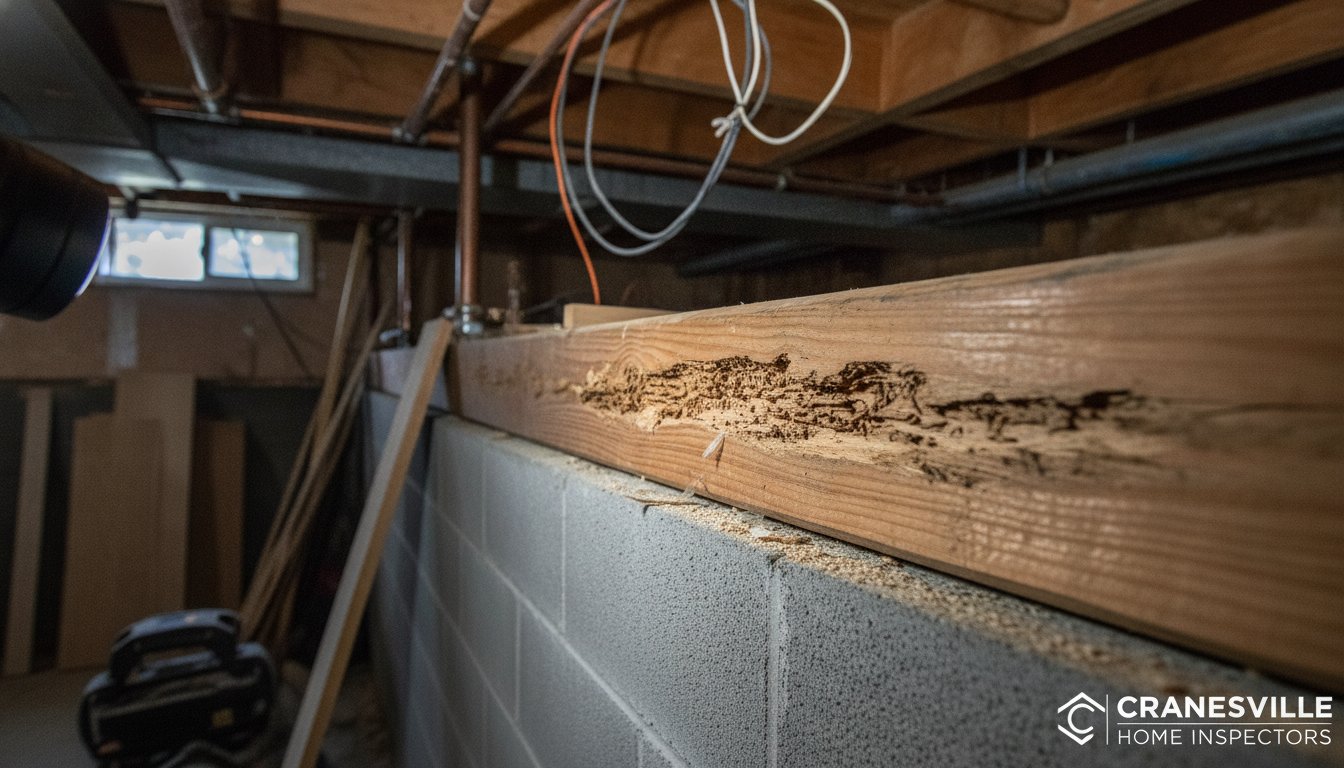
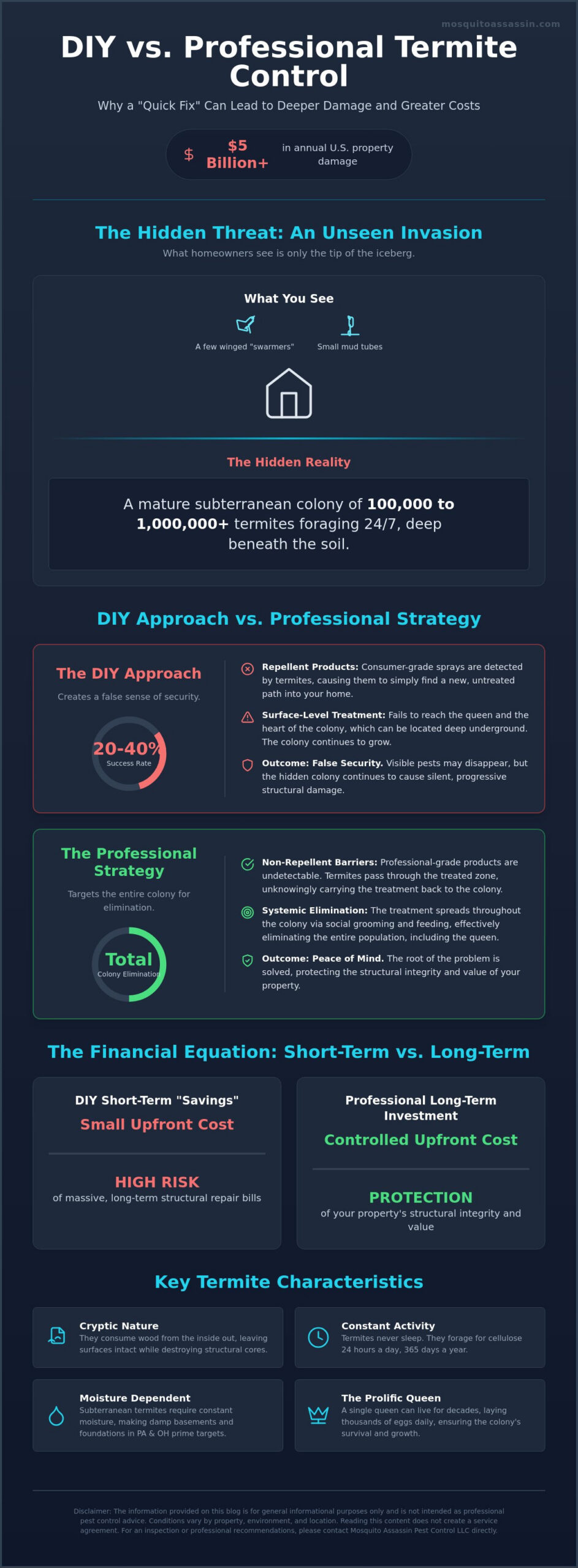
Termites cause over $5 billion in property damage across the United States every year, yet university studies show that DIY treatments often have a success rate as low as 20 to 40 percent. When property owners in Erie, Crawford, or Ashtabula counties discover signs of wood damage, the immediate question is often: can I get rid of termites myself? It’s completely understandable to want to avoid high repair costs while feeling concerned about the types of chemicals used in your living space or the confusion of identifying flying ants versus actual pests.
You deserve to understand the structural risks and technical challenges of DIY termite control to make an informed decision for your property. This guide explores the behavior of Eastern Subterranean Termites and why surface-level treatments often fail to reach the heart of a colony. By learning the realities of termite management, you can protect your home from long-term damage and ensure the safety of your household.
Key Takeaways
- Discover why the common question “can I get rid of termites myself” often leads to temporary solutions that fail to address the massive subterranean colonies hidden beneath the soil.
- Learn how the foraging behavior of Eastern Subterranean Termites allows them to remain cryptic while causing significant structural damage over time.
- Understand the technical limitations of consumer-grade products compared to professional-grade non-repellent barriers that target the entire colony.
- Recognize the financial risks of ineffective treatments, which can drive termites deeper into a structure and lead to higher repair bills.
- Identify why regional climate factors in Pennsylvania and Ohio make regular professional inspections a critical component of property maintenance.
The Reality of DIY Termite Control and Structural Integrity
Termites are often described as “cryptic” pests because they spend the vast majority of their lives hidden from human sight. They thrive in the dark, damp environments found within soil or deep inside the structural beams of your home. By the time a homeowner asks, “can I get rid of termites myself,” the damage is often already underway. Unlike a line of ants on a kitchen counter, termites don’t leave obvious trails. They consume wood from the inside out, leaving the exterior paint or veneer completely intact while the core becomes hollow and brittle.
Understanding termite biology and behavior is essential for any property owner in Northwest Pennsylvania or Northeast Ohio. These are social insects with a highly organized caste system. When you see a few winged “swarmers” or a single worker in a piece of mulch, you aren’t looking at a stray bug. You’re seeing evidence of a mature subterranean colony that could contain hundreds of thousands of individuals. Attempting to kill only the insects you see is like trying to stop a flood by mopping up a single puddle.
To better understand the scale of this challenge and how these insects operate, watch this helpful video regarding DIY attempts:
What Makes Termites Different from Other Household Pests?
A termite colony functions as a single superorganism. A queen can live for decades, producing thousands of eggs daily, while workers forage relentlessly for food. Most household pests are seasonal nuisances. Mosquitoes disappear in the winter; wasps die off after the first frost. Termites don’t follow these rules. They remain active 24 hours a day, 365 days a year. Their sole focus is the consumption of cellulose, which they find in the framing, flooring, and even the drywall of your property. Because they never sleep and their population is constantly growing, the stakes are much higher than dealing with common ants or spiders.
The Concept of the False Sense of Security
The biggest danger of a DIY approach is the false sense of security it creates. If you use a retail spray on a visible cluster of insects, they will die. However, this doesn’t stop the infestation. It simply alerts the rest of the colony to avoid that specific area. They will retreat and find a new, even more hidden path into your home. Homeowners often assume the problem is solved because they no longer see the bugs. In reality, the termites are just feeding elsewhere, often moving deeper into the structure where they are harder to detect.
Professional management focuses on total colony elimination rather than just killing the insects you happen to see. This involves methodical monitoring to verify that the entire population, including the queen, is neutralized. Without this scientific approach, you’re essentially gambling with the structural integrity of your largest investment. In regions like Erie and Crawford counties, where moisture levels are high, the risk of a persistent, hidden infestation is even greater. Deciding “can I get rid of termites myself” involves weighing the cost of a retail bottle of spray against the potential for thousands of dollars in structural repairs later on.
Why Termite Colonies are Difficult to Eliminate for Non-Professionals
Eliminating a termite infestation requires more than just a surface level treatment. It demands a deep understanding of how these pests interact with their environment. Most homeowners asking can I get rid of termites myself are surprised to learn that a single colony of Eastern Subterranean Termites can span multiple properties. These colonies aren’t just small nests; they are sprawling underground networks that can contain hundreds of thousands of workers. Because the queen is located deep beneath the frost line, standard retail products rarely reach the source of the problem. Even if you kill the workers near your foundation, the queen continues to produce new members to replace them.
The Biology of Subterranean Termites
Subterranean termites are highly dependent on moisture to survive. They build elaborate mud tubes (small tunnels made of soil and saliva) to travel from the ground into your home without drying out. These tubes also provide protection from predators. Once a scout finds a food source, it leaves a pheromone trail that guides thousands of other workers to the site. According to the EPA guide to termite control, this social structure makes them incredibly resilient. A mature colony can consume wood at a steady rate, and their reproductive capacity allows them to expand their territory quickly throughout your home’s structural framing.
Access and Detection Challenges
The biggest obstacle to effective DIY treatment is access. Termites don’t feed in the open. They prefer the dark, humid spaces inside floor joists, behind drywall, or under concrete slabs. By the time a homeowner notices a problem, the termites have likely been active for several years. Human vision is limited when it comes to seeing through solid walls, and termites can enter a structure through cracks as thin as a credit card (approximately 1/16th of an inch). Professional detection often involves specialized tools that identify heat signatures or moisture patterns that the naked eye simply cannot see.
Many homeowners attempt to use retail bait stations, but these often fail due to improper placement. Termites are foragers; if a bait station isn’t placed exactly where they are already traveling, they will simply bypass it. They are also sensitive to environmental changes. If a DIY application is too aggressive or uses repellent chemicals, it may cause the colony to split (a process called budding), which effectively doubles your problem. Understanding these complexities is why professional termite inspections and treatment are often necessary to ensure the entire colony is neutralized. Attempting to solve the issue without a scientific approach usually results in the pests moving deeper into the structure where they are even harder to reach.
Comparing Consumer-Grade Products and Professional Strategies
Many homeowners visiting hardware stores in Erie or Ashtabula wonder, can I get rid of termites myself by using the sprays available on retail shelves? The primary difference lies in the chemistry of the products. Most consumer-grade sprays are repellents. These chemicals create a perimeter that termites can sense. While this might seem helpful, it often backfires. Termites simply move along the barrier until they find a microscopic gap or a different entry point into the structure. Professional strategies rely on non-repellent liquid technology. These materials are undetectable to the insects, allowing them to pass through the treated zone and unknowingly transfer the product back to the rest of the colony. This transfer effect is essential for total population control.
Professional management also utilizes specialized equipment that is unavailable for rent or purchase by the general public. Sub-slab injectors are required to treat the soil beneath basement floors and concrete porches without compromising the home’s foundation. Technicians also use moisture meters and thermal sensors to pinpoint activity behind finished walls. These high-concentration materials are strictly regulated. Because they are designed for long-term durability, a professional barrier can remain effective for years, whereas retail sprays often break down within a few weeks of exposure to the elements.
The Role of Specialized Training in Pest Management
A professional termite inspection is about more than just finding bugs. It’s an assessment of the property’s unique vulnerabilities. Licensed professionals in Pennsylvania and Ohio must complete ongoing education to stay current on pest biology and local soil conditions. For instance, the clay-heavy soil found in Crawford County requires different saturation levels than the sandier soils near the lake. Understanding these nuances ensures the treatment reaches the correct depth to intercept foraging workers. Without this technical training, a DIY attempt is likely to miss the primary entry points that termites use to bypass the foundation.
The Limitations of Over-the-Counter Solutions
Spot treatments are a common pitfall for those attempting to solve the problem alone. Treating only the area where you see damage doesn’t address the hidden colony. Consumer products are often formulated with lower concentrations to reduce the risk of accidental exposure, but this also reduces their efficacy against mature infestations. As highlighted in this homeowner termite control guide, improper application of these chemicals can lead to environmental contamination or groundwater runoff. Professional-grade materials are designed to bind tightly to the soil, providing a stable and lasting shield that protects the entire footprint of the building rather than just a single corner.
Potential Consequences of Ineffective DIY Termite Attempts
Choosing to gamble on the question can I get rid of termites myself often leads to a costly false sense of security. While a bottle of retail spray might cost very little upfront, the financial fallout of a failed application is staggering. National data for 2026 indicates that while professional treatment typically ranges from $700 to $2,000, the cost of repairing a severe infestation can easily exceed $9,300. Because termites are hidden, an ineffective DIY attempt doesn’t just fail to solve the problem; it allows the colony to move deeper into the structural core of the building. This migration makes future professional intervention more difficult and expensive.
Standard homeowner’s insurance policies in Pennsylvania and Ohio rarely cover termite damage. Most carriers classify wood destruction as a preventable maintenance issue. This means property owners are often left to pay for structural repairs entirely out of pocket. Attempting uncertified DIY work can also void existing home warranties or termite bonds. Without a documented service record from a licensed professional, you lack the evidence needed to prove the property has been properly maintained and protected.
Structural Risks and Wood Integrity
Termites are capable of hollowing out load-bearing beams while leaving the exterior surface looking perfectly healthy. This hidden destruction compromises the very foundation of your home. A mature colony can cause significant structural loss in a surprisingly short amount of time, contributing to the roughly $5 billion in damage caused annually in the United States. The risk is even higher when termites are present alongside moisture problems or rodent removal needs. These overlapping issues create an environment where wood decays faster, making the home more vulnerable to long term damage.
Impact on Real Estate Transactions
In counties like Erie, Crawford, and Ashtabula, real estate transactions depend heavily on professional inspections. Most mortgage lenders require a Wood-Destroying Insect (WDI) report before approving a loan. If a professional inspector finds evidence of past activity but no record of professional treatment, it can stall or even kill a home sale. DIY fixes are easily flagged during these inspections. Sellers are legally required to disclose known infestations; failing to provide a professional treatment history can drastically reduce a property’s resale value and buyer confidence.
Ensuring your home remains structurally sound requires a scientific approach to colony elimination. To protect your investment and maintain your property’s market value, professional termite inspections and treatment may help reduce risk.
Disclaimer: The information provided on this blog is for general informational purposes only and is not intended as professional pest control advice. Conditions vary by property, environment, and location. Reading this content does not create a service agreement. For an inspection or professional recommendations, please contact Mosquito Assassin Pest Control LLC directly.
Professional Termite Management in Northwest PA and Northeast OH
Property owners in Northwest Pennsylvania and Northeast Ohio face unique environmental challenges that make termite management a complex task. While the question can I get rid of termites myself is common, the technical reality in our region often requires a localized, scientific approach. A professional evaluation in Erie, Crawford, or Ashtabula counties involves a systematic review of the property’s foundation, soil moisture levels, and structural vulnerabilities. Professional pest control may help reduce risk to the home’s value by ensuring that infestations are not just suppressed, but entirely neutralized at the colony level.
Integrating termite monitoring into general pest control plans provides a proactive shield for your property. These plans often include regular inspections that catch “cryptic” activity before it escalates into a structural crisis. In a region where older homes and wooden structures are prevalent, having a consistent record of professional oversight is a significant asset during real estate appraisals and home inspections.
Regional Factors Affecting Termite Activity
The climate in the Tri-State area directly influences how Eastern Subterranean Termites behave. In Erie, PA, and surrounding lakefront communities, heavy snowfall provides a layer of insulation for the soil, allowing termites to remain active closer to the surface even during cold months. High soil moisture from lake-effect precipitation creates ideal foraging conditions. Swarming season in our region typically occurs in the spring, often following a warm rain. Additionally, the common construction style of homes in Northwest Pennsylvania (featuring deep basements and crawlspaces) provides numerous hidden entry points through foundation cracks or utility penetrations that are difficult for an untrained eye to locate.
The Path to Long-Term Protection
Achieving long term protection requires moving beyond reactive “spot treatments” and toward a comprehensive management strategy. Year-round protection plans are designed to maintain a pest-free environment by addressing seasonal shifts in insect behavior. Licensed firms provide the detailed documentation and service records necessary for maintaining property value and satisfying lender requirements. These records serve as proof of professional maintenance, which is vital if you ever decide to sell your home. For those seeking local assistance in Northwest Pennsylvania and Northeast Ohio, visiting the contact page to schedule a professional evaluation is a practical first step toward securing your investment.
Disclaimer: The information provided on this blog is for general informational purposes only and is not intended as professional pest control advice. Conditions vary by property, environment, and location. Reading this content does not create a service agreement. For an inspection or professional recommendations, please contact Mosquito Assassin Pest Control LLC directly.
Secure Your Home Against Hidden Threats
Termites are a relentless force that can cause thousands of dollars in structural damage while remaining completely invisible to the naked eye. While the question can I get rid of termites myself is rooted in a desire to protect your property, retail solutions often provide a false sense of security that allows infestations to migrate deeper into your foundation. Relying on surface level sprays ignores the massive subterranean colonies that require specialized, non-repellent technology for total elimination.
Professional pest control may help reduce risk to your home’s value and structural integrity. Mosquito Assassin Pest Control LLC is locally owned and operated in Cranesville; serving Erie and Crawford Counties in Pennsylvania and Ashtabula County in Ohio. Being licensed and insured in both PA and OH, the team follows specialized termite inspection and treatment protocols designed for the specific construction styles of our region. For a professional evaluation or recommendations, contact Mosquito Assassin Pest Control LLC directly. Taking a proactive approach today ensures your home remains a safe and secure investment for years to come.
Disclaimer: The information provided on this blog is for general informational purposes only and is not intended as professional pest control advice. Conditions vary by property, environment, and location. Reading this content does not create a service agreement. For an inspection or professional recommendations, please contact Mosquito Assassin Pest Control LLC directly.
Frequently Asked Questions
Is it possible to permanently get rid of termites without a professional?
Permanent elimination is extremely difficult for homeowners because termites are social insects living in massive underground colonies. DIY methods typically only kill the visible workers, leaving the queen and the rest of the colony intact. This leads to re-infestations as the colony replenishes its numbers. Professional strategies use non-repellent technology to target the entire superorganism, which is why many wonder, “can I get rid of termites myself” before realizing the technical complexity involved.
How can I tell the difference between a flying ant and a termite swarmer?
You can distinguish them by looking at their wings, waist, and antennae. Termites have four wings of equal length, straight antennae, and a thick, uniform waist. Flying ants have wings of unequal length, elbowed antennae, and a pinched, “wasp-like” waist. Swarmers are often the first sign of a mature colony nearby; identifying them correctly is the first step in determining the appropriate management strategy for your property.
Will homeowners insurance cover termite damage if I tried to fix it myself?
Most standard homeowners insurance policies do not cover termite damage, regardless of whether you attempted a DIY fix or not. Insurance companies generally view termite activity as a preventable maintenance issue. If you attempt uncertified repairs or treatments, you may also risk voiding home warranties or termite bonds. Maintaining a record of professional inspections and treatments is often required to prove the property has been properly cared for during a sale.
Are the termite bait stations sold at hardware stores effective?
Retail bait stations often have limited effectiveness because they require precise placement and frequent monitoring to be successful. Termites are foragers and may simply bypass a station that isn’t located directly in their path. Professional-grade baiting systems use different active ingredients and are part of a larger, methodical management plan. Homeowners asking can I get rid of termites myself often find that improperly placed retail baits provide a false sense of security while damage continues.
How often should a home in the Erie or Ashtabula area be inspected for termites?
Homes in Northwest Pennsylvania and Northeast Ohio should ideally be inspected at least once a year. The high soil moisture and construction styles common in Erie and Ashtabula create favorable conditions for Eastern Subterranean Termites. Annual inspections allow for early detection before significant structural damage occurs. This is especially important for older homes with basements or crawlspaces where activity is often hidden behind finished walls or foundation cracks.
What are the first signs of termites that a homeowner can look for?
Common signs include mud tubes on foundation walls, discarded wings from swarmers, and wood that sounds hollow when tapped. You might also notice small holes in drywall or “bubbling” paint that looks like water damage. Because termites feed from the inside out, these signs often appear only after a colony has been active for several years. Catching these early indicators is vital for protecting the structural integrity of your property.
Can termites come back after a professional treatment?
While professional treatments are designed for long-term protection, termites can return if the protective barrier is disturbed or if new colonies move into the area. This is why ongoing monitoring and maintenance are essential components of any pest management plan. Soil disruption from landscaping or new construction can create gaps in a liquid barrier. Regular professional follow-ups ensure that the protection remains intact and any new activity is addressed immediately.
Is professional termite treatment safe for my family and pets?
Licensed professionals follow strict EPA regulations and application protocols designed to prioritize the safety of household members and animals. Modern non-repellent treatments are applied in specific locations, such as the soil around the foundation or inside specialized bait stations, to minimize contact with residents. Professional applicators are trained to use the precise amount of product needed to neutralize the colony while adhering to official safety standards and environmental guidelines.
Disclaimer: The information provided on this blog is for general informational purposes only and is not intended as professional pest control advice. Conditions vary by property, environment, and location. Reading this content does not create a service agreement. For an inspection or professional recommendations, please contact Mosquito Assassin Pest Control LLC directly.