Tag: home maintenance

  • What is Integrated Pest Management (IPM)? A Comprehensive Guide

    What is Integrated Pest Management (IPM)? A Comprehensive Guide

    Why does a kitchen that was just treated for ants still have scouts appearing on the counters just 48 hours later? It’s a common frustration for property owners in Erie, Crawford, and Ashtabula Counties who find themselves trapped in a cycle of recurring infestations. Many people believe that simply applying more chemicals is the answer, but relying solely on reactive treatments often fails to address why the pests arrived in the first place. This is where understanding what is integrated pest management (IPM) becomes essential for achieving lasting results.

    It’s understandable to feel concerned about the over-application of chemicals, especially when the pests seem to return regardless of the effort. This guide explains how science-based IPM principles provide sustainable, long-term protection for homes and businesses. This article examines the specific steps of the IPM process, including how environmental modifications can prevent pests from returning. By the end, you’ll have the knowledge to choose professional methods that prioritize safety and effectiveness over temporary fixes.

    Key Takeaways

    • Learn the core principles of what is integrated pest management (IPM) and how it shifts the focus from reactive extermination to proactive, long-term prevention strategies.
    • Understand the systematic four-step workflow that helps define what is integrated pest management (IPM) when creating customized plans tailored to unique environmental needs.
    • Discover the hierarchy of control methods central to what is integrated pest management (IPM), prioritizing cultural and physical barriers over invasive chemical applications.
    • Identify how seasonal pest behaviors in Erie, Crawford, and Ashtabula Counties influence the specific tactics used when applying what is integrated pest management (IPM).
    • Recognize the importance of professional expertise in navigating the complexities of what is integrated pest management (IPM) as a science-based program.

    Understanding the Principles of Integrated Pest Management (IPM)

    When homeowners ask what is integrated pest management (IPM), they’re often surprised to learn it isn’t a single product or service. Instead, Integrated pest management (IPM) is a science-based decision-making process that identifies and manages pest populations while minimizing risks to people, pets, and the environment. This method represents a major shift in the industry, moving away from reactive extermination toward a proactive, long-term strategy. Rather than simply treating a symptom, this approach manages the entire ecosystem of a property to prevent pests from finding food, water, or shelter in the first place.

    The Environmental Protection Agency (EPA) emphasizes that IPM relies on a combination of common-sense practices. By using comprehensive information on the life cycles of pests and their interaction with the environment, professionals can manage pest damage by the most economical means. This strategy focuses on long-term prevention through a mix of techniques such as biological control, habitat manipulation, and the use of resistant varieties. It’s about working with nature to keep populations at manageable levels without relying solely on chemical intervention.

    To better understand this concept, watch this helpful video:

    The Core Philosophy of Sustainable Pest Control

    The priority of a modern pest strategy is identifying the root cause of an infestation. Traditional “calendar-based” spraying methods, which were common in the mid-20th century, involved applying pesticides on a set schedule regardless of whether pests were actually present. IPM replaces this outdated model with regular monitoring and precise intervention. Professionals look for entry points, moisture issues, or food sources that attract insects and rodents. By balancing economic factors, public health, and environmental safety, this philosophy ensures that treatments are only applied when necessary and targeted exactly where they’ll be most effective.

    Why IPM is the Standard for Modern Property Protection

    For residential properties in Erie and Crawford counties, this approach builds a more resilient environment. Local weather patterns in Northwest Pennsylvania and Northeast Ohio often drive pests indoors during seasonal shifts. A proactive plan helps homeowners safeguard their structures before these migrations occur. This standard is equally critical for commercial pest control services, where maintaining a pest-free reputation is vital for business continuity. Using these methods reduces the likelihood of recurring infestations by addressing the environmental factors that allowed the pests to thrive initially. Professional pest control may help reduce risk and provide peace of mind for property owners in the Ashtabula County area.

    Disclaimer: The information provided on this blog is for general informational purposes only and is not intended as professional pest control advice. Conditions vary by property, environment, and location. Reading this content does not create a service agreement. For an inspection or professional recommendations, please contact Mosquito Assassin Pest Control LLC directly.

    The Four Essential Steps of an IPM Program

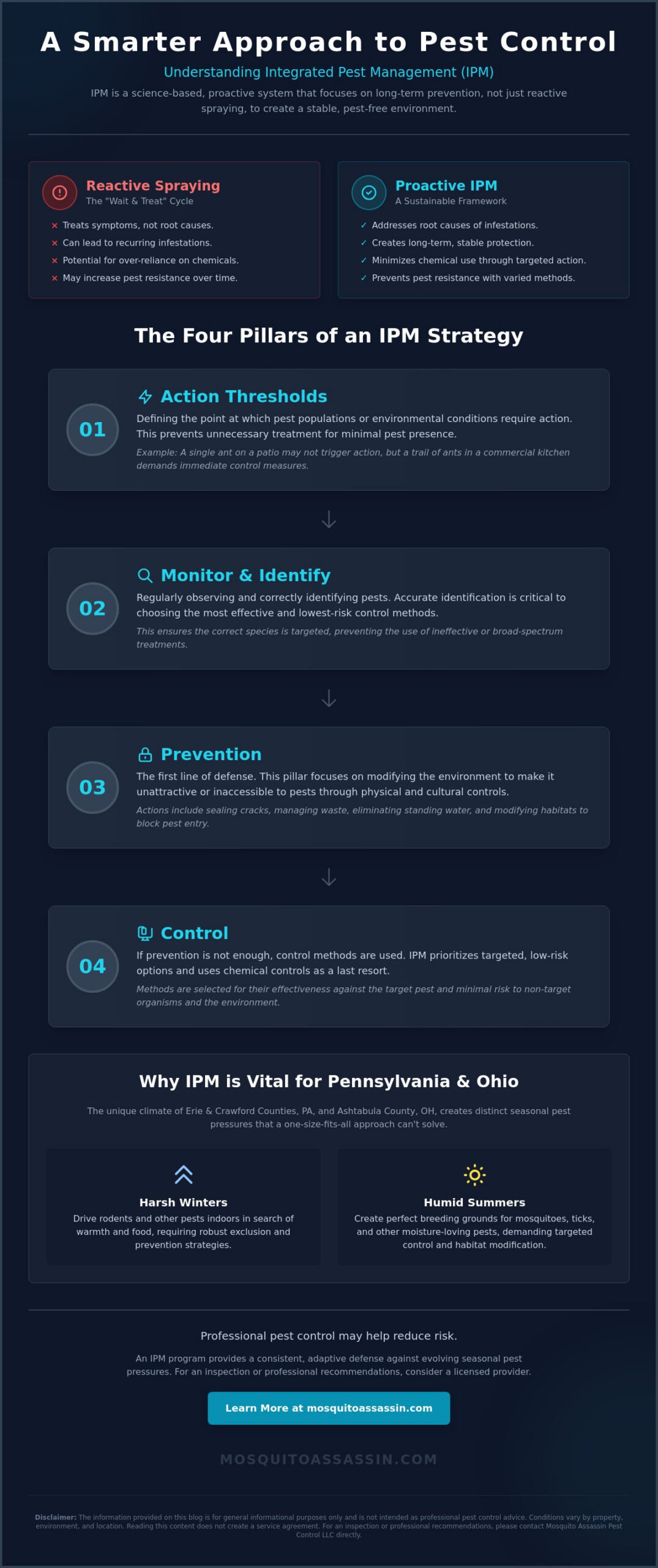
    Understanding what is integrated pest management (IPM) begins with recognizing that it’s a systematic process, not a random application of products. Every property in Erie and Crawford Counties has a unique ecosystem, meaning a cookie-cutter approach won’t work. Success depends on a customized plan that adapts to the specific structure and surrounding environment of the home. This method shifts the focus from a “one and done” mindset to an ongoing cycle of evaluation. Professional documentation is a key part of this workflow. It allows for tracking population trends over several months and identifying if a specific strategy needs adjustment based on real-time data.

    The Environmental Protection Agency outlines the four essential steps of an IPM program to ensure long-term results. By following these established stages, property owners can address the root causes of infestations rather than just treating the visible symptoms. This structured approach ensures that interventions are only used when truly necessary, focusing on long-term prevention and sustainability.

    Monitoring and Accurate Pest Identification

    Effective control starts with knowing exactly what’s crawling in the walls. Misidentifying a pest often leads to wasted time and ineffective treatments because different species respond to different baits or exclusion methods. Monitoring tools, such as glue boards or pheromone traps, act as early warning systems. These tools help determine where pests are traveling and how many are present in a specific area. Understanding pest life cycles is equally important for timing. For instance, knowing that a certain species of cockroach produces an egg case every 20 to 25 days allows a professional to time follow-up visits perfectly to break the reproductive cycle. Without accurate identification, it’s impossible to implement a truly effective management plan.

    Setting Action Thresholds for Intervention

    Properly implementing what is integrated pest management (IPM) involves setting an action threshold. This is the specific point where pest activity becomes a nuisance, a health hazard, or an economic threat. It’s the moment when a response is required. Finding a single ant in a kitchen doesn’t always require immediate chemical intervention; it might just mean a crumb needs to be swept up or a window seal needs a small repair. However, thresholds change based on the environment. A residential home in Ashtabula County may have a higher tolerance for occasional insects than a commercial food facility. In food processing, strict regulations often mandate a zero-tolerance policy for certain pests to ensure public safety. Establishing these levels helps prevent the unnecessary use of treatments while ensuring that action is taken before an infestation becomes unmanageable.

    When these thresholds are met, professional pest control may help reduce risk by implementing targeted, science-based solutions.

    Disclaimer: The information provided on this blog is for general informational purposes only and is not intended as professional pest control advice. Conditions vary by property, environment, and location. Reading this content does not create a service agreement. For an inspection or professional recommendations, please contact Mosquito Assassin Pest Control LLC directly.

    What is Integrated Pest Management (IPM)? A Comprehensive Guide

    The IPM Toolbox: Four Types of Control Methods

    Understanding what is integrated pest management (IPM) requires viewing it as a tiered hierarchy of defense. Rather than jumping straight to chemical solutions, this framework utilizes a diverse toolbox to address the root causes of an infestation. This systematic approach ensures that interventions are effective, sustainable, and tailored to the specific environment of a home. By combining multiple strategies, technicians create a comprehensive barrier that is far more resilient than any single method used in isolation. Professional general pest control relies on this multi-layered strategy to protect properties in Erie and Crawford Counties from recurring issues.

    Cultural and Physical Controls

    Cultural controls are the first line of defense and focus on modifying human behavior to make a property less attractive to invaders. This involves strict sanitation practices, such as removing standing water or ensuring food is stored in airtight containers. Since many pests are opportunistic, removing their survival resources can drastically reduce population growth. Statistics from the Environmental Protection Agency (EPA) indicate that effective IPM programs can reduce the need for pesticides by 50 to 90 percent through these preventative measures alone.

    Physical controls involve mechanical barriers that block entry or remove pests directly. Technicians prioritize exclusion tactics, such as installing door sweeps or using high-quality caulk to seal gaps. For larger intruders, professional rodent removal often starts with identifying and sealing every opening larger than 1/4 inch. Moisture control also plays a vital role here; maintaining gutters and fixing leaky pipes removes the damp environments where termites and silverfish thrive. Proper landscape maintenance, such as keeping mulch at least 12 inches away from the foundation, further eliminates the “bridges” pests use to enter a home.

    Biological and Chemical Control Options

    Biological control involves the use of natural enemies, such as predators, parasites, or pathogens, to manage pest populations. While this is more common in large-scale agricultural settings, it remains a core component of the broader definition of what is integrated pest management (IPM). In a residential context, this might include encouraging natural local predators or using specific microbial products that target larvae without affecting other beneficial insects.

    Chemical control is the final tier of the IPM hierarchy. It’s used judiciously and only when other methods fail to keep a pest population below an acceptable threshold. When chemicals are necessary, professionals select targeted, low-toxicity options that minimize risk to residents and pets. Licensed technicians in Ashtabula County apply these treatments to specific cracks and crevices rather than performing broad, unnecessary sprays. This precision ensures that the “assassin” approach to pest management remains both definitive and responsible, safeguarding the home while effectively eradicating the threat.

    Disclaimer: The information provided on this blog is for general informational purposes only and is not intended as professional pest control advice. Conditions vary by property, environment, and location. Reading this content does not create a service agreement. For an inspection or professional recommendations, please contact Mosquito Assassin Pest Control LLC directly.
    Implementing IPM for Common Pests in Pennsylvania and Ohio

    The humid continental climate of Northwest Pennsylvania and Northeast Ohio creates unique pest pressures for homeowners. In regions like Erie and Ashtabula, seasonal shifts dictate pest behavior with precision. When temperatures consistently rise above 50 degrees Fahrenheit, typically in late March or early April, biological activity for many species begins to accelerate. Understanding what is integrated pest management (IPM) helps residents adapt to these changes by focusing on long-term prevention rather than reactive measures. Local environmental factors, such as the high moisture levels near Lake Erie and the dense foliage of Crawford County, directly influence how pests move and reproduce. For residents looking to understand how these factors affect their specific community, the Mosquito Assassin location page provides context on the regional service area.

    Managing Seasonal Mosquito and Tick Populations

    Effective IPM for biting insects starts with source reduction. This process involves removing standing water where mosquitoes deposit eggs. A single discarded tire or a clogged gutter can host over 100 larvae in less than a cup of water. A science-based mosquito control program uses biological knowledge to disrupt these life cycles before insects reach the flying adult stage. For ticks, vegetation management is the primary defense. Keeping grass mowed to a height of 3 inches or less reduces the humid microclimates ticks need to survive. Creating a 3 foot wide barrier of wood chips or gravel between lawns and wooded areas serves as a physical deterrent that limits tick migration into high-traffic yard zones.

    Long-Term Rodent Exclusion and Prevention

    Older residential structures across the tri-county area often have foundation gaps or settling cracks that serve as entry points. A house mouse can squeeze through an opening as small as 0.25 inches, which is roughly the width of a pencil. A professional IPM strategy for rodents follows a rigorous three-step process: population removal, ongoing maintenance, and permanent exclusion. Exclusion involves sealing gaps with durable materials like steel wool or hardware cloth that pests cannot chew through. Sanitation is the most powerful tool in this process. By storing birdseed in metal bins and cleaning kitchen surfaces daily, homeowners reduce the environmental “carrying capacity,” making the property less attractive to scavengers. When physical barriers and cleanliness are prioritized, the reliance on chemical baits is significantly reduced.

    Professional inspections and online booking for pest evaluations can help identify structural vulnerabilities before they lead to an infestation.

    Disclaimer: The information provided on this blog is for general informational purposes only and is not intended as professional pest control advice. Conditions vary by property, environment, and location. Reading this content does not create a service agreement. For an inspection or professional recommendations, please contact Mosquito Assassin Pest Control LLC directly.

    The Role of Professional Expertise in IPM Success

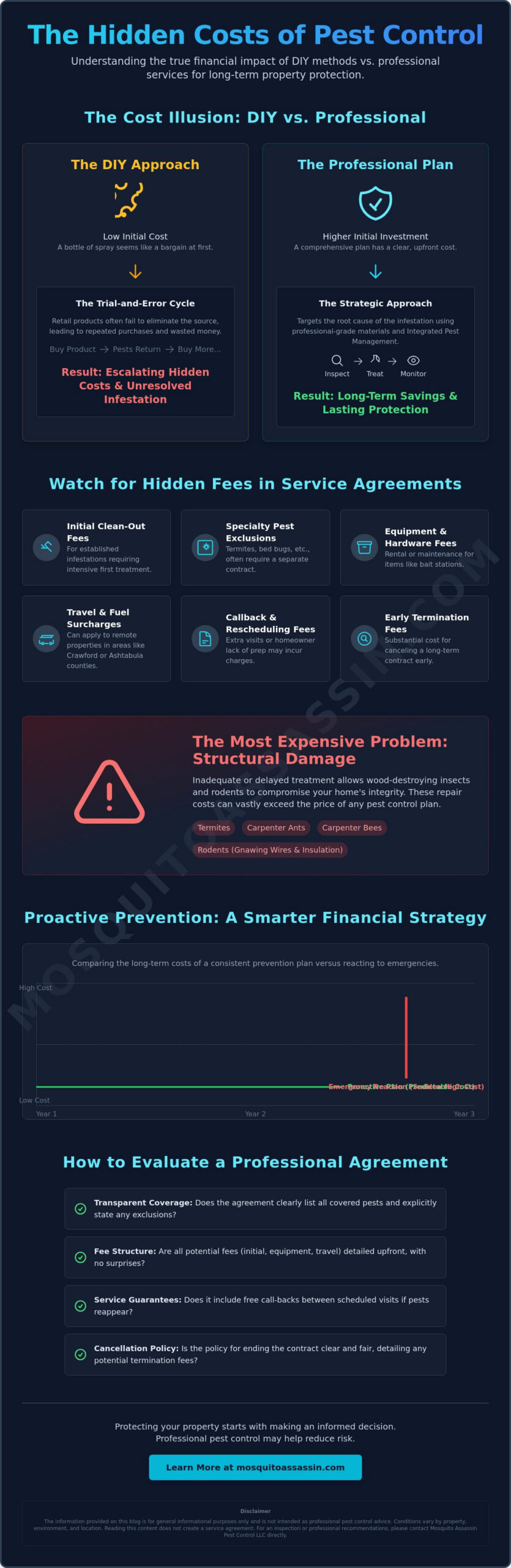
    While many homeowners attempt to handle pests independently, DIY methods often focus on reactive measures rather than the systematic approach required by what is integrated pest management (IPM). Professional expertise bridges the gap between temporary relief and long-term prevention. Licensed technicians utilize commercial-grade equipment and specialized knowledge that isn’t available to the general public. This ensures that treatments are applied precisely where they’re needed, reducing unnecessary exposure and maximizing effectiveness. Comprehensive pest management services provide the technical foundation for a successful IPM strategy by addressing the root causes of infestations.

    Why Professional Inspections are Vital

    A professional inspection is the cornerstone of any IPM program. Trained eyes can identify subtle indicators of pest activity that often go unnoticed by residents. For instance, a technician might spot specialized fecal spotting from bed bugs or the specific “kick-out” holes of wood-boring insects. Beyond spotting the pests themselves, professionals evaluate structural vulnerabilities. This includes identifying gaps in foundations or moisture-damaged wood that invite infestations. According to the National Pest Management Association, pests cause billions in property damage annually, much of which begins with undetected entry points. Based on inspection findings, a customized plan is developed. This plan addresses the unique biology of the pest and the specific layout of the property, rather than relying on a one-size-fits-all solution.

    Maintaining Pest-Free Environments Year-Round

    Pest activity changes with the seasons, especially in regions like Erie and Crawford Counties in Pennsylvania or Ashtabula County in Ohio. A successful application of what is integrated pest management (IPM) requires ongoing monitoring and adjustments. Follow-up visits allow professionals to track the success of previous interventions and detect new threats before they become full-blown infestations. Professional-grade monitoring tools can detect activity behind walls or in crawlspaces that homeowners rarely access. Consistent management is the most reliable way to ensure a home remains a protected environment throughout the year. For those seeking an inspection or professional recommendations, contacting a local professional is a practical next step to secure a property against seasonal invaders.

    Disclaimer: The information provided on this blog is for general informational purposes only and is not intended as professional pest control advice. Conditions vary by property, environment, and location. Reading this content does not create a service agreement. For an inspection or professional recommendations, please contact Mosquito Assassin Pest Control LLC directly.

    Achieving Long Term Protection Through IPM

    Successful pest control relies on a systematic approach rather than a single application. Understanding what is integrated pest management (IPM) allows property owners to utilize a scientific, four-step management process that combines inspection, monitoring, and diverse control methods. This strategy effectively reduces pest populations while minimizing environmental impact through biological, cultural, and physical interventions. By focusing on the root causes of an infestation, this method provides a sustainable alternative to traditional reactive treatments.

    In regions like Erie and Crawford Counties in Pennsylvania, or Ashtabula County in Ohio, local conditions dictate specific pest pressures. Licensed and insured experts from locally owned operations in Cranesville, Pennsylvania, provide the professional oversight needed to execute these complex plans. Taking proactive steps today can prevent significant property damage and health risks in the future. To begin securing a property, residents can schedule a professional property inspection via the online portal at mosquitoassassin.com. Professional expertise is a reliable way to maintain a comfortable, pest-free environment throughout the year.

    Disclaimer: The information provided on this blog is for general informational purposes only and is not intended as professional pest control advice. Conditions vary by property, environment, and location. Reading this content does not create a service agreement. For an inspection or professional recommendations, please contact Mosquito Assassin Pest Control LLC directly.
    Frequently Asked Questions

    Is Integrated Pest Management (IPM) the same as organic pest control?

    Integrated Pest Management (IPM) is not the same as organic pest control, though they share common goals regarding environmental safety. While organic control relies strictly on naturally derived products, what is integrated pest management (IPM) is a comprehensive strategy that uses biological, cultural, physical, and chemical tools. It prioritizes the least toxic methods first but allows for synthetic treatments when they’re necessary to protect a structure from damage or health risks.

    Does IPM mean that pesticides are never used on my property?

    Pesticides are still a component of an IPM strategy, but they aren’t the first or only line of defense. In an IPM framework, professionals only apply pesticides when monitoring shows that pest populations have reached a specific action threshold. These applications are targeted to specific areas rather than being used as broad, calendar-based sprays. This approach ensures that chemicals are used efficiently and only when other methods like exclusion or sanitation fail.

    How long does it take for an IPM program to show results?

    Most homeowners see a noticeable reduction in pest activity within 7 to 14 days of implementing an IPM plan. Because this method addresses the root causes of an infestation, such as food sources or entry points, it may take longer than traditional sprays to achieve total elimination. However, the results are more sustainable. Research from the Environmental Protection Agency (EPA) suggests that long-term IPM programs can reduce pest complaints by up to 90 percent.

    Can I implement Integrated Pest Management on my own without a pro?

    Homeowners can perform the foundational steps of IPM, such as sealing gaps and managing waste. Success often starts with simple tasks like installing door sweeps or fixing leaky pipes that provide water to insects. While DIY efforts are helpful for prevention, complex infestations in Erie and Crawford Counties often require professional expertise to accurately identify species. Professional pest control may help reduce risk, and more information is available at https://portal.gorilladesk.com/mosquitoassassin.

    Is Integrated Pest Management safer for my children and pets?

    IPM is designed to minimize risks to human health and the environment by reducing unnecessary chemical exposure. By focusing on non-chemical methods like trapping and exclusion, the amount of pesticide residue in living spaces is significantly lowered. The strategy involves applying products in cracks, crevices, or bait stations where pets and children cannot easily reach them. This targeted approach aligns with safety guidelines while still effectively managing pest populations in the home.

    Why is pest identification so important in the IPM process?

    Accurate identification is the most critical step because different pests require vastly different management strategies. For example, treating a carpenter ant infestation requires a different approach than managing nuisance pavement ants. Identifying the specific species ensures that the chosen control method is effective, which prevents the waste of resources and unnecessary chemical applications. Understanding what is integrated pest management (IPM) involves recognizing that every pest has a unique biology and set of behaviors.

    What are some examples of cultural controls I can use at home?

    Cultural controls are practices that reduce pest survival and reproduction by changing the environment. Examples include keeping firewood at least 20 feet away from the foundation and ensuring that mulch is not touching the siding of the house. Inside the home, storing food in airtight containers and cleaning crumbs from under appliances are effective cultural controls. These simple adjustments remove the resources that pests need to thrive, making the property less attractive to invaders.

    How often should a property be monitored under an IPM plan?

    Properties should generally be monitored on a monthly or quarterly basis. This frequency helps catch potential issues before they become full-blown infestations. Seasonal changes in Pennsylvania and Ohio often trigger new pest behaviors, making regular checks essential. Monitoring involves checking traps, inspecting entry points, and looking for signs of activity like droppings. Consistent oversight allows for small adjustments to the plan, ensuring the home remains protected throughout the year.

    Disclaimer: The information provided on this blog is for general informational purposes only and is not intended as professional pest control advice. Conditions vary by property, environment, and location. Reading this content does not create a service agreement. For an inspection or professional recommendations, please contact Mosquito Assassin Pest Control LLC directly.
  • Identifying the Signs of Rats in Walls: A Homeowner Guide

    Identifying the Signs of Rats in Walls: A Homeowner Guide

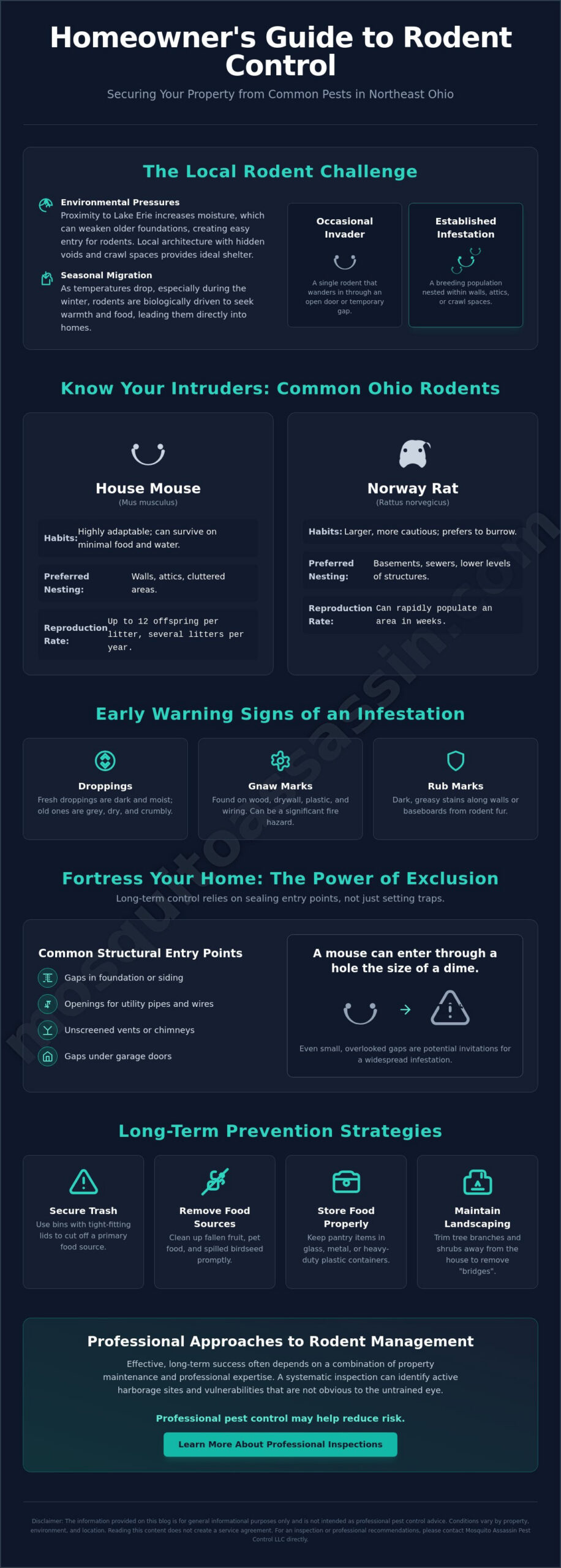
    Last Tuesday, a homeowner in Erie County lay awake at 2:00 AM, listening to a rhythmic scratching sound echoing from behind the bedroom headboard. It wasn’t just the house settling; it was one of the primary signs of rats in walls that signals a growing problem. You likely share the same worries about chewed electrical wires or the transmission of bacteria, and that anxiety can keep any family awake at night. It’s stressful to feel like your sanctuary is being invaded by pests you can’t see.

    Identifying these indicators early is the most effective way to prevent structural damage and protect your household before an issue becomes a full-blown infestation. This guide explains how to interpret auditory clues, physical markings, and structural changes to confirm a rodent presence. You’ll learn to distinguish between common household noises and actual pest activity, providing a clear path toward reclaiming your home. From Ashtabula to Crawford County, understanding these sensory clues helps residents take professional-grade steps to ensure their property remains a safe, rodent-free environment.

    Disclaimer: The information provided on this blog is for general informational purposes only and is not intended as professional pest control advice. Conditions vary by property, environment, and location. Reading this content does not create a service agreement. For an inspection or professional recommendations, please contact Mosquito Assassin Pest Control LLC directly.
    Key Takeaways

    • Understand the environmental factors, such as dropping temperatures during local winters, that drive rodents to seek shelter and food inside wall cavities.
    • Learn to identify specific nocturnal sounds like rhythmic gnawing and scurrying that serve as early signs of rats in walls.
    • Discover how to spot physical indicators of activity, including grease rub marks along baseboards and droppings near utility junctions.
    • Distinguish between rat activity and other common pests by observing noise patterns and the specific location of the activity within the home.
    • Explore professional exclusion strategies, such as sealing structural gaps with rodent-proof materials, to help maintain a secure and pest-free environment.

    Understanding Why Rats Infiltrate Wall Cavities

    Rats don’t just enter homes for food; they seek a strategic advantage. Wall voids offer a high level of protection from predators like hawks or neighborhood cats while providing a climate-controlled sanctuary. In the Erie and Crawford County regions, where January temperatures often drop to an average low of 18 degrees Fahrenheit, the internal warmth of a home is a primary attractant. Homeowners often ignore the subtle signs of rats in walls until the infestation becomes a major structural concern. These cavities serve as secluded breeding grounds where rodents can raise offspring away from human disruption.

    The internal structure of a house acts as a private highway system. Rats use the space between studs to travel from the basement to the attic without ever stepping into a lived-in room. This allows them to stay undetected while they scout for resources. Insulation, whether it’s fiberglass batts or blown-in cellulose, provides the perfect nesting medium. It’s easily shaped into burrows and retains the body heat of the colony, which is essential for the survival of hairless pups during a Pennsylvania winter.

    The Appeal of Wall Voids for Rodents

    Structural warmth is a significant factor in rodent behavior. Home heating systems radiate heat into the wall gaps, creating a microclimate that stays far above freezing. This environment is particularly attractive to nesting females. Beyond warmth, walls provide immediate access to critical utilities. Rats often follow plumbing lines to find moisture from condensation or small leaks. They also target electrical lines; their teeth grow continuously, and the resistance of plastic wire jacketing provides the perfect material for gnawing. This behavior isn’t just a nuisance; it’s a leading cause of residential electrical fires in older structures.

    Common Entry Points in Local Residential Structures

    Older homes, which make up approximately 42% of the housing stock in Ashtabula County, often have architectural vulnerabilities. Rats can squeeze through an opening the size of a quarter, roughly 1 inch in diameter. Common entry points include:

    • Foundation Gaps: Small cracks in fieldstone foundations or gaps where the sill plate meets the masonry.
    • Utility Penetrations: Unsealed spaces around HVAC lines, outdoor faucets, or cable entries.
    • Roof and Soffit Vulnerabilities: Gaps in the fascia board or damaged soffit vents that allow access to the top of the wall plate.

    Recognizing the signs of rats in walls is the first step in protecting the home’s infrastructure. When entry points are left unaddressed, the local rodent population will continue to exploit these structural weaknesses. If you suspect an infestation, seeking professional pest control may help reduce risk and prevent further damage to your property.

    Disclaimer: The information provided on this blog is for general informational purposes only and is not intended as professional pest control advice. Conditions vary by property, environment, and location. Reading this content does not create a service agreement. For an inspection or professional recommendations, please contact Mosquito Assassin Pest Control LLC directly.
    Recognizing Auditory and Sensory Signs of Activity

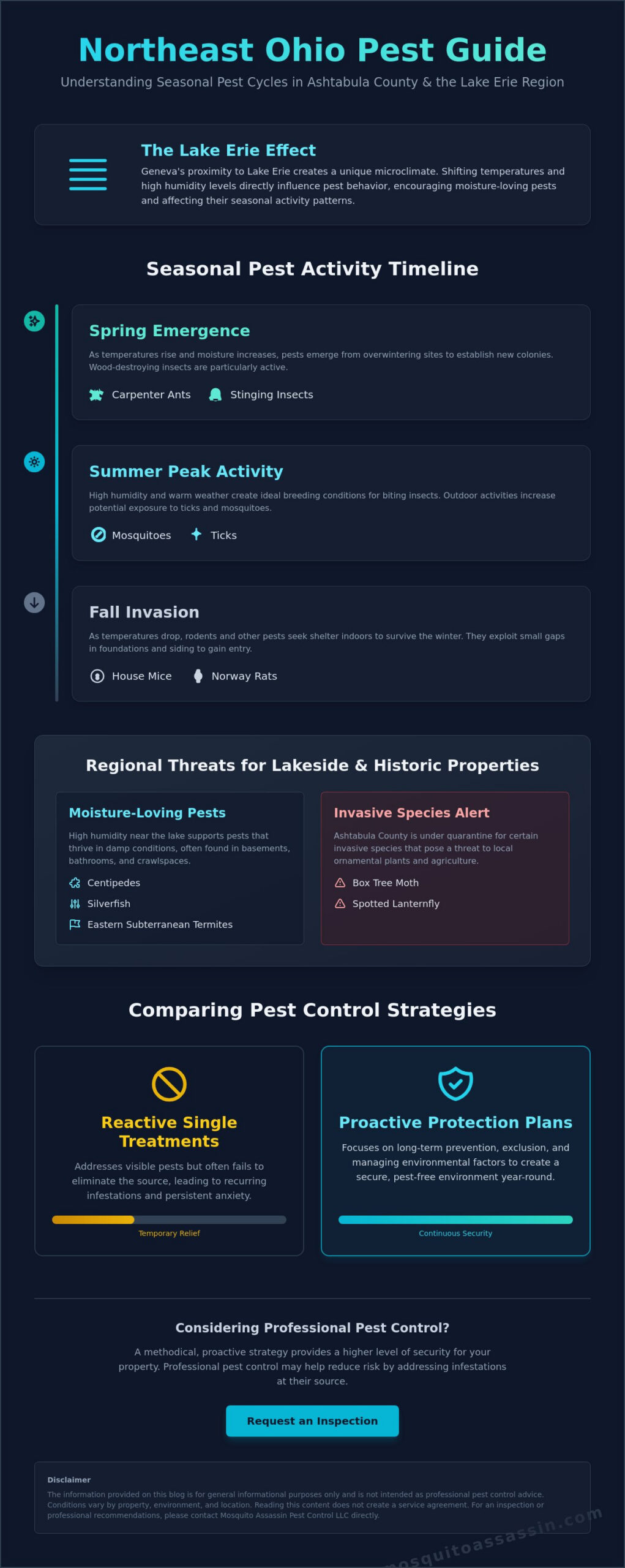
    Rats are nocturnal creatures, meaning their peak activity occurs while residents are asleep. Between the hours of 10:00 PM and 4:00 AM, the hollow spaces inside wall voids become echo chambers for rodent movement. Homeowners often report scratching or scurrying sounds that seem to travel vertically or horizontally through the framing. These noises are primary signs of rats in walls, indicating that the rodents are navigating between nesting sites and food sources.

    Interpreting Scurrying and Gnawing Sounds

    Identifying the specific type of noise helps determine the size of the infestation. Mice typically produce a light pitter-patter, while rats create heavier, rhythmic thumping sounds. Because rats have teeth that grow up to 5 inches per year, they must constantly gnaw on hard materials. You might hear a distinct grinding sound, known as bruxing, as they sharpen their incisors on wooden studs, PVC pipes, or electrical wiring. Tracking where these sounds are most consistent helps identify high-traffic runways. If noises persist in a single area for more than 48 hours, a nest is likely nearby.

    Identifying Unusual Odors and Pet Reactions

    Domestic animals often detect rodents long before human residents notice a problem. Dogs and cats have olfactory systems significantly more sensitive than humans, allowing them to hear high-frequency vocalizations and smell pheromones. If a pet consistently paws at a specific baseboard or stares intently at a wall section in a home in Erie County or Ashtabula County, it’s often a reaction to movement behind the drywall. This persistent interest is a reliable indicator that an inspection is necessary.

    Odors also provide critical clues. A single rat can produce up to 25,000 droppings per year, leading to a concentrated buildup of waste. The progression of these smells follows a predictable pattern:

    • Faint Musk: Early stages of activity often produce a stale, mousy smell that lingers in closets or cupboards.
    • Strong Ammonia: As a colony grows, accumulated urine creates a sharp, stinging ammonia scent that is hard to ignore.
    • Humidity Impact: Odors often intensify when humidity levels rise above 50 percent, as moisture traps scent molecules and circulates them through the home.

    In poorly ventilated areas like basements or crawlspaces in Crawford County, these smells can become overwhelming and move through the HVAC system. If you notice these sensory changes, professional pest control may help reduce risk before structural damage occurs. Recognizing these signs of rats in walls early is the best way to safeguard the integrity of your property.

    Disclaimer: The information provided on this blog is for general informational purposes only and is not intended as professional pest control advice. Conditions vary by property, environment, and location. Reading this content does not create a service agreement. For an inspection or professional recommendations, please contact Mosquito Assassin Pest Control LLC directly.

    Identifying the Signs of Rats in Walls: A Homeowner Guide

    Physical Evidence and Structural Damage Indicators

    Identifying the signs of rats in walls requires a keen eye for subtle changes in the home environment. Because rats are nocturnal and secretive, homeowners in Erie County, Pennsylvania, or Ashtabula County, Ohio, often discover physical evidence long before they see a live rodent. Recognizing these indicators early can prevent minor issues from escalating into significant structural concerns.

    Analyzing Rub Marks and Droppings

    Rats possess poor eyesight and rely on their whiskers and sense of touch to navigate. They tend to follow the same paths repeatedly, usually hugging the edges of walls and baseboards. Over time, the oils and dirt in their fur leave behind dark, greasy streaks known as rub marks. These stains are frequently found near entry holes or along the junctions where walls meet the floor. If a smudge appears fresh and smears when touched (using gloves), it likely indicates an active travel route.

    Droppings are another definitive piece of evidence. Homeowners should look for the following characteristics to identify rat activity:

    • Size and Shape: Rat droppings are typically blunt-ended and measure between 0.5 and 0.75 inches in length, making them significantly larger than mouse droppings.
    • Location: Waste is often concentrated in utility closets, crawl spaces, or near wall voids where the rodents nest.
    • Texture: Fresh droppings are dark and moist. Within 48 to 72 hours, they become dull, gray, and crumbly, which helps determine if the infestation is current or historical.

    Assessing Damage to Insulation and Wiring

    Structural damage is one of the most concerning signs of rats in walls. Rodents have incisors that never stop growing, gaining approximately 4 to 5 inches in length every year. To manage this growth, they must constantly gnaw on hard materials. This behavior leads to visible damage on wooden studs, floorboards, and plastic PVC piping. Entry holes into wall voids are typically roughly the size of a quarter or larger, often featuring jagged edges from persistent chewing.

    Inside the walls, rats frequently destroy insulation to create nesting galleries. They shred fiberglass, cellulose, and foam board, creating “tunnels” that compromise the home’s thermal envelope. This destruction can lead to a measurable decrease in energy efficiency. Perhaps more dangerously, rats often strip the plastic coating from electrical wiring. According to data from the National Fire Protection Association (NFPA), rodents chewing on wires are a known factor in house fires where the cause is listed as undetermined or electrical failure.

    If you observe shredded insulation or teeth marks on household structures, professional pest control may help reduce risk. You can reach out for assistance at www.mosquitoassassin.com/contact-us or through the online booking portal.

    Disclaimer: The information provided on this blog is for general informational purposes only and is not intended as professional pest control advice. Conditions vary by property, environment, and location. Reading this content does not create a service agreement. For an inspection or professional recommendations, please contact Mosquito Assassin Pest Control LLC directly.
    Differentiating Rats from Other Common Household Pests

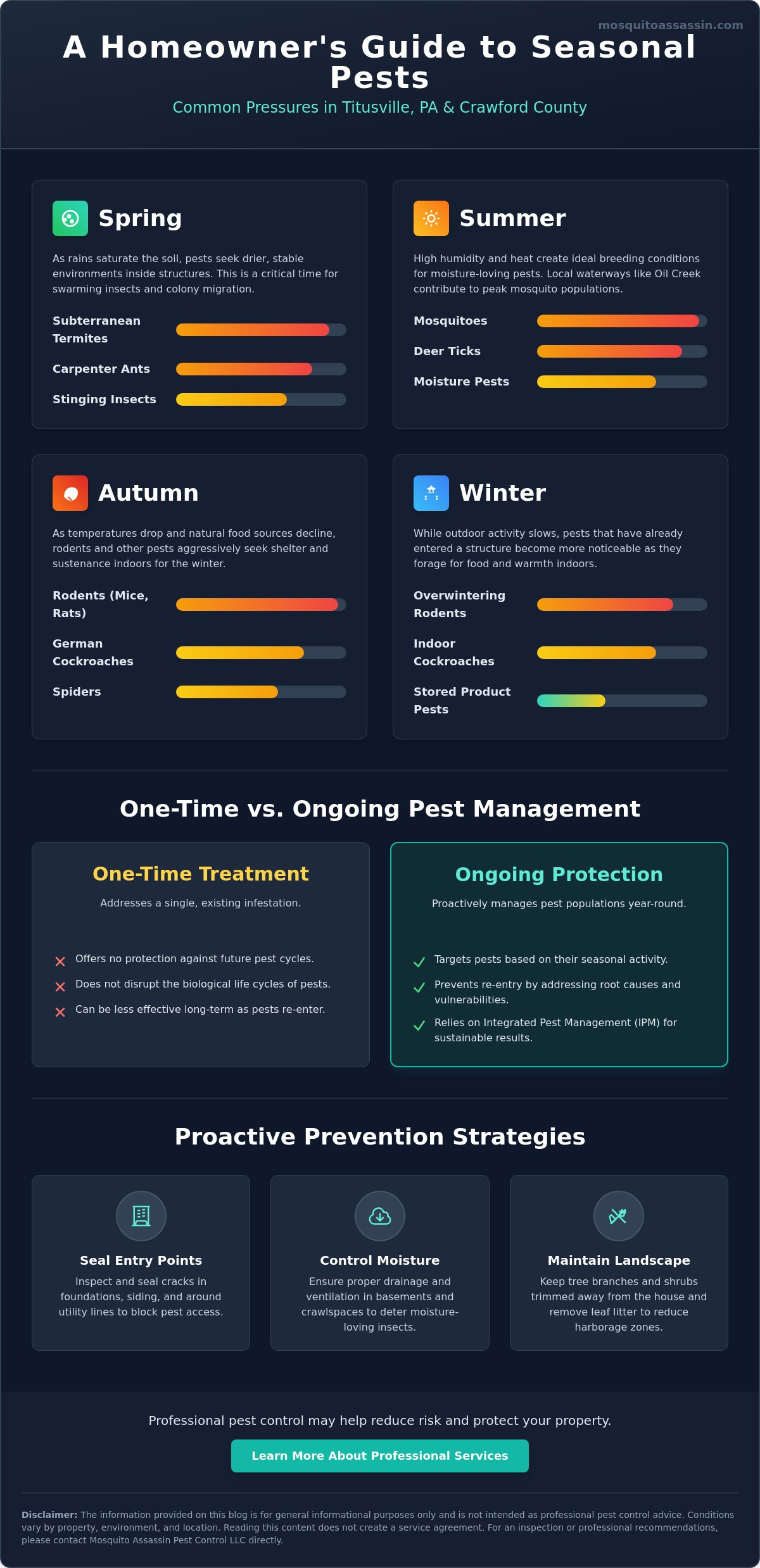
    Homeowners in Erie County and Ashtabula County often mistake one scratching sound for another when pests invade their property. It’s easy to feel a sense of urgency when you hear movement behind the drywall, but identifying the specific intruder is the first step toward a solution. The strategies for rodent removal change significantly depending on whether you’re facing a ten-ounce rat or a fifteen-pound raccoon. Misidentifying the pest can lead to ineffective trapping or exclusion methods that fail to secure the home structure.

    Rats vs. Mice: Size and Sound Differences

    Mice are tiny, usually weighing less than one ounce. Their movement sounds like a light, rapid pitter-patter that moves quickly across a ceiling or down a wall. Rats are much heavier and produce louder, more rhythmic thumping or dragging noises. Identifying the signs of rats in walls requires a keen ear for the volume and frequency of the noise. While mice are constant explorers that move frequently, rat sounds are often more intermittent but much more forceful.

    Physical capabilities also set these two apart. Rats possess a bite force of roughly 7,000 pounds per square inch. This immense strength allows them to gnaw through materials that easily stop mice, such as heavy plastic, aluminum siding, or even poorly cured concrete. If you notice signs of rats in walls near the floorboards or foundation, you’re likely dealing with a Norway rat. Mice are more agile climbers and are frequently found in higher wall voids or near attic insulation where their lighter frames allow them to navigate fiberglass without making much noise.

    Squirrels and Raccoons: Timing and Location

    Timing is the most reliable way to rule out a rat infestation. Squirrels are diurnal, which means they’re active during the day. If you hear frantic scratching or jumping at 10:00 AM or 2:00 PM, you’re likely dealing with a squirrel rather than a rodent. Rats are nocturnal and usually wait until at least thirty minutes after sunset to begin their activity. In Crawford County, squirrels frequently enter through roof vents and focus their activity in the upper sections of walls near the eave line.

    Raccoons are also nocturnal, but their size makes them easy to distinguish from rats. A mature raccoon can weigh between 10 and 20 pounds. Their movement creates heavy thumping sounds that can mimic a human walking in the attic or leaning against a wall. They also produce distinct vocalizations, such as chattering, hissing, or growling, which rats don’t do. Effective general pest control plans must account for these behavioral differences to ensure the right exclusion methods are used for the specific animal.

    If you’re unsure which pest is behind your drywall, scheduling a professional inspection can provide the clarity needed to protect your home.

    Disclaimer: The information provided on this blog is for general informational purposes only and is not intended as professional pest control advice. Conditions vary by property, environment, and location. Reading this content does not create a service agreement. For an inspection or professional recommendations, please contact Mosquito Assassin Pest Control LLC directly.

    Professional Strategies for Rodent Exclusion and Management

    Once a homeowner identifies the clear signs of rats in walls, the next step involves a systematic approach to removal and future prevention. Professional pest control services prioritize integrated management. This methodology moves beyond simple trapping by addressing the root cause of the infestation. It’s a strategy that focuses on long term solutions rather than temporary fixes, ensuring the structural integrity of the home remains intact while removing the incentive for rodents to return.

    The Importance of a Comprehensive Inspection

    A thorough evaluation is the foundation of any successful management plan. Technicians examine the exterior perimeter in locations like Erie and Ashtabula for structural gaps as small as 0.25 inches. These gaps often appear near utility lines, roof eaves, or foundation cracks. Local topography, such as the proximity to Lake Erie or the wooded landscapes in Crawford County, creates specific hot spots where rodents are more likely to seek shelter during seasonal temperature shifts. Evaluating the severity of the infestation helps determine if the population is limited to a single nest or represents a larger structural issue within the wall voids.

    Exclusion involves sealing these identified gaps with rodent proof materials. Heavy duty steel mesh and hardware cloth are necessary because rats can chew through plastic, wood, and even soft metals like aluminum. Sanitation and attractant removal are equally critical for success. This includes securing trash bins, removing fallen fruit from yards, and ensuring pet food is stored in airtight containers. Without removing these incentives, new rodents will eventually find a way inside, regardless of how many traps are set.

    Long-Term Prevention through Structural Exclusion

    Many homeowners attempt to use expanding foam or wood fillers to close holes. These materials are ineffective against determined rats. Because a rat’s teeth grow continuously, they’re capable of gnawing through most common building materials to regain access to a warm nesting site. A rat can exert a bite pressure of up to 7,000 pounds per square inch, making short term DIY repairs nearly useless against a persistent pest.

    Professional pest control may help reduce risk of future infestations by identifying new vulnerabilities before they become entry points. Ongoing monitoring is vital to ensure the home remains rodent free, especially in older structures where foundations may settle or building materials may degrade over time. Consistent maintenance and professional oversight are the most reliable ways to manage the signs of rats in walls and prevent their return. For an inspection or professional recommendations, please contact the team through the online booking portal.

    Disclaimer: The information provided on this blog is for general informational purposes only and is not intended as professional pest control advice. Conditions vary by property, environment, and location. Reading this content does not create a service agreement. For an inspection or professional recommendations, please contact Mosquito Assassin Pest Control LLC directly.

    Protecting the Home from Structural Infestations

    Recognizing the signs of rats in walls early is essential for preventing structural damage and electrical hazards. Rats enter wall cavities seeking nesting sites, and they’ve been known to destroy insulation or chew through wiring. Identifying auditory cues like scratching or spotting physical evidence such as droppings provides the necessary information to take action. Professional exclusion techniques focus on sealing entry points to ensure rodents can’t return once they’re removed.

    Effective rodent management requires a methodical approach that prioritizes property safety. Mosquito Assassin Pest Control LLC is a locally owned and operated company serving Erie and Crawford Counties in Pennsylvania and Ashtabula County in Ohio. As a licensed and insured provider, they provide a pest-free guarantee for residents seeking reliable results. Professional pest control may help reduce risk, and for an inspection or recommendations, contact Mosquito Assassin Pest Control LLC directly. Taking proactive steps ensures the home remains a safe and secure space for everyone.

    Disclaimer: The information provided on this blog is for general informational purposes only and is not intended as professional pest control advice. Conditions vary by property, environment, and location. Reading this content does not create a service agreement. For an inspection or professional recommendations, please contact Mosquito Assassin Pest Control LLC directly.
    Frequently Asked Questions

    What do rats in walls sound like at night?

    Rats in walls typically produce scratching, scurrying, and gnawing sounds that are most audible during the night. Since rats are nocturnal, they spend 75% of their active hours after sunset navigating through wall voids. You might also hear a dull thumping if they’re moving larger items or fighting; these noises are often louder than mouse activity due to the rat’s larger body size and heavier weight.

    Can rats chew through the drywall in my home?

    Rats can easily chew through drywall, wood, and even soft metals like lead or aluminum. Their incisors grow 4 to 5 inches per year, requiring constant gnawing to keep them filed down. A rat can exert a biting pressure of 12,000 pounds per square inch, allowing them to create a hole large enough to enter a room in less than 24 hours. Identifying these entry points is one of the key signs of rats in walls.

    Will rats eventually leave the walls on their own?

    Rats won’t typically leave a wall cavity on their own once they’ve established a nest near a food source. Because a single pair of brown rats can produce 1,200 offspring in a 12 month period, an infestation will only grow larger over time. They remain in protected spaces to avoid predators and stay close to consistent water and food supplies found in residential kitchens.

    How can I tell the difference between a mouse and a rat in the wall?

    You can distinguish between a mouse and a rat by the size of the sounds and the debris they leave behind. Rat droppings are typically 0.5 to 0.75 inches long with blunt ends, whereas mouse droppings are closer to 0.25 inches with pointed ends. Additionally, the gnaw marks left by rats are roughly 2 millimeters wide, which is significantly larger than the tiny marks left by mice.

    Are the smells in my house related to a rodent problem?

    Persistent odors in a home often indicate a significant rodent presence, especially in confined spaces like wall voids. Rats produce 40 to 50 droppings daily and frequently urinate to mark their trails. This creates a distinct, pungent ammonia smell that becomes more concentrated as the population grows. If you notice a sudden, foul odor that smells like rotting organic matter, it may indicate a deceased animal within the structure.

    What should I do if I suspect a dead rat is in my wall?

    If a rat dies inside a wall, the resulting odor can persist for 3 to 8 weeks depending on the temperature and humidity. Professional pest control may help reduce risk by locating the carcass or using industrial odor neutralizers. It’s important to avoid cutting into drywall blindly, as this can damage electrical wiring or plumbing located within the wall cavity.

    How do rats get into the walls of a house in the first place?

    Rats enter wall systems through gaps as small as 0.5 inches, which is roughly the size of a quarter. Common entry points include damaged vent covers, gaps around utility pipes, and cracks in the foundation of homes in Erie and Crawford Counties. They are excellent climbers and can use overhanging tree branches to reach roof lines or attic vents. Noticing these exterior vulnerabilities is one of the first signs of rats in walls.

    Is it safe to use DIY traps for rats inside wall cavities?

    Using DIY traps inside walls is often difficult because the space is inaccessible and traps are hard to monitor. If a rat is trapped and dies in an unreachable area, the resulting odor and fly issues can last for over 21 days. Professional pest control may help reduce risk for homeowners in Ashtabula County and surrounding areas. For more information on professional recommendations, visit www.mosquitoassassin.com/contact-us.

    Disclaimer: The information provided on this blog is for general informational purposes only and is not intended as professional pest control advice. Conditions vary by property, environment, and location. Reading this content does not create a service agreement. For an inspection or professional recommendations, please contact Mosquito Assassin Pest Control LLC directly.
  • What Do Exterminators Use for Spiders? A Professional Guide

    What Do Exterminators Use for Spiders? A Professional Guide

    Last Tuesday, a homeowner in Erie County spent hours clearing spider webs from their porch, only to find the exact same intricate patterns rebuilt by Thursday morning. It’s a common frustration for many residents in the tri-county area who find that retail bug sprays often fail to provide lasting relief. You likely agree that seeing a recurring infestation, especially with the potential presence of venomous species like the Northern Black Widow, creates an unsettling environment. Homeowners often ask, what do exterminators use for spiders that makes their treatments so much more effective than over-the-counter options? According to the Penn State Extension, Pennsylvania is home to over 500 spider species, making professional identification and targeted strategy vital for peace of mind.

    This professional guide explores the specialized products and strategic methods licensed experts utilize to manage spider populations effectively in residential and commercial settings. You’ll learn about the science behind residual barriers, professional web removal techniques, and how a customized approach helps maintain a spider-free property throughout Crawford and Ashtabula Counties. This overview provides the knowledge needed to prevent future infestations and understand the value of professional intervention.

    Disclaimer: The information provided on this blog is for general informational purposes only and is not intended as professional pest control advice. Conditions vary by property, environment, and location. Reading this content does not create a service agreement. For an inspection or professional recommendations, please contact Mosquito Assassin Pest Control LLC directly.

    Key Takeaways

    • Learn why spider management requires a specialized approach compared to other crawling insects, focusing on thorough inspections to identify harborages and entry points.
    • Understand what do exterminators use for spiders by exploring the science behind professional-grade residual insecticides and how they remain effective over time.
    • Discover the strategic “three-foot up and three-foot out” application method used to create a comprehensive perimeter barrier around a home’s foundation.
    • Explore Integrated Pest Management (IPM) strategies, including how managing outdoor lighting can significantly reduce the insect populations that attract spiders.
    • Gain insights into the unique seasonal spider challenges faced by residents in Erie, Crawford, and Ashtabula counties due to the specific climate of the Lake Erie region.

    The Professional Approach to Spider Management

    Spider control requires a specialized strategy because these arachnids behave differently than common household pests. Many homeowners ask what do exterminators use for spiders when standard sprays fail to produce results. The answer starts with a shift in perspective. Instead of just treating surfaces, professionals look at the entire environment. A thorough inspection is the foundation of any successful plan. Technicians identify entry points and harborages where spiders congregate. This process often reveals that spiders are a symptom of a larger insect presence. By identifying these factors, a targeted strategy can be developed to address the root cause rather than just the visible webs.

    To better understand how professionals select their tools, watch this helpful video:

    Physical removal of webs is a critical first step in professional service. Removing webs isn’t just about aesthetics; it disrupts the spider’s ability to hunt and removes egg sacs. A single egg sac from a common house spider can contain up to 250 eggs, so manual removal prevents a future population explosion. Professionals also focus on the spiders’ food source. If a home has a high population of flies or moths, spiders will thrive. Reducing these secondary pests is a critical step in achieving lasting results.

    Understanding Spider Biology and Behavior

    Spiders possess a unique anatomy that makes them resistant to many traditional treatments. They walk on the tips of their legs, known as tarsal claws. This minimal surface contact means they rarely absorb enough residual product to be effective. Unlike ants or cockroaches, spiders don’t groom themselves with their mouths. This lack of grooming behavior prevents them from ingesting baits left on surfaces. In homes across Erie County, Crawford County, and Ashtabula County, spiders frequently seek out secluded areas like dark basements, cluttered attics, and exterior eaves.

    Why DIY Methods Often Fall Short

    Store-bought contact sprays usually only kill the spiders they hit directly. These products lack the residual strength needed for long-term control. When used incorrectly, these sprays can actually push spiders deeper into wall voids or inaccessible crawlspaces. Professional equipment is necessary to reach high peaks and deep crevices that standard hand-pump sprayers can’t touch. Understanding what do exterminators use for spiders involves recognizing the importance of high-reach dusting tools and specialized micro-encapsulated formulas that stick to the spider’s legs more effectively than standard liquids.

    For those concerned about persistent infestations, professional pest control may help reduce risk. Addressing the environmental factors that attract spiders is the only way to ensure a home remains clear over time.

    Disclaimer: The information provided on this blog is for general informational purposes only and is not intended as professional pest control advice. Conditions vary by property, environment, and location. Reading this content does not create a service agreement. For an inspection or professional recommendations, please contact Mosquito Assassin Pest Control LLC directly.

    Active Ingredients and Professional-Grade Formulations

    Understanding what do exterminators use for spiders requires a look at the molecular science of pest control. Licensed professionals don’t rely on the temporary solutions found in big-box stores. Instead, they utilize advanced chemical families designed for high-impact knockdown and long-term residual protection. The goal is to create a defensive perimeter that remains lethal to arachnids for 60 to 90 days, even when exposed to the unpredictable weather of Erie and Crawford Counties.

    Modern spider management relies heavily on synthetic pyrethroids. These compounds are engineered versions of natural pyrethrins found in chrysanthemum flowers. While natural pyrethrins break down within hours of sunlight exposure, professional-grade pyrethroids are photostable. This means they maintain their chemical integrity under intense UV radiation, ensuring the barrier stays active on the exterior of a home. Professionals select these formulations because spiders have high-clearance bodies and small footprints, requiring a product that is easily picked up by their tarsal claws as they move across a surface.

    Pyrethroids and Residual Insecticides

    Common active ingredients like Bifenthrin, Cypermethrin, and Deltamethrin serve as the backbone of professional spider treatments. These ingredients work by disrupting the spider’s nervous system upon contact. Technicians often choose between repellent and non-repellent barriers based on the severity of the infestation. Repellent barriers discourage spiders from approaching the structure, while non-repellent options allow the spider to cross the treated zone without detection, eventually leading to its elimination. In regions like Ashtabula County, where lake-effect moisture is common, professionals prioritize formulations that bond tightly to surfaces to prevent rain wash-off.

    Surface Material and Microencapsulated Technology

    The material of a home’s exterior dictates the choice of formulation. Porous surfaces like brick and wood can absorb liquid insecticides, rendering them ineffective. To solve this, professionals use microencapsulated technology. This process suspends the active ingredient in microscopic polymer “bubbles” that sit on top of the surface rather than soaking in. When a spider crawls over these capsules, they burst or stick to the spider’s legs. This technology extends the life of the treatment and ensures the product remains accessible to the pest. For those managing persistent issues, professional pest control may help reduce risk by matching the right formulation to the specific siding material of the home.

    Dusts and Specialized Application Tools

    Spiders often hide in areas where liquid sprays cannot reach. Licensed technicians use insecticidal dusts for long-term protection in wall voids, electrical outlets, and crawl spaces. Unlike liquids, these dusts don’t evaporate and can remain effective for several months if they stay dry. For immediate results during a heavy infestation, professionals might use aerosolized pyrethrins. These provide a 100% knockdown rate on contact, clearing out active webs in garages or basements. Specialized equipment, such as long-reach dusters and high-pressure sprayers, ensures even coverage in hard-to-reach peaks and soffits where spiders frequently congregate.

    Disclaimer: The information provided on this blog is for general informational purposes only and is not intended as professional pest control advice. Conditions vary by property, environment, and location. Reading this content does not create a service agreement. For an inspection or professional recommendations, please contact Mosquito Assassin Pest Control LLC directly.

    What Do Exterminators Use for Spiders? A Professional Guide

    Strategic Application Methods for Long-Term Control

    Effective spider management depends as much on the application technique as it does on the specific products chosen. Professional technicians don’t just spray randomly; they follow a systematic plan to disrupt the life cycle and movement of arachnids. When evaluating what do exterminators use for spiders, it’s vital to understand that the goal is creating a multi-layered defense. This begins with a comprehensive perimeter barrier designed to stop spiders before they ever cross the threshold of a home in Erie County or Crawford County.

    A standard industry practice is the “three-foot up and three-foot out” rule for exterior foundation treatments. This involves applying a liquid residual product three feet up the side of the structure and three feet out into the soil or mulch. This six-foot zone of protection catches spiders as they crawl toward the building. Technicians also target specific architectural features that serve as primary nesting sites. Soffits, shutters, and porch ceilings are common areas where spiders spin webs to catch flying insects attracted to outdoor lights. Treating these high-up areas requires specialized equipment to ensure even coverage without excessive runoff.

    Exterior Perimeter Barriers

    The foundation is the first line of defense, but window frames and door thresholds require equal attention. Spiders often utilize the small gaps around these entry points to find warmth or prey. Managing the environment around the structure is just as important as the chemical barrier. Mulch beds and heavy vegetation that touch the foundation provide a damp, protected highway for pests. Keeping plants trimmed at least 12 inches away from the siding improves the effectiveness of any treatment. Weather conditions in the tri-county area, including heavy rain and UV exposure, typically cause exterior barriers to degrade over 60 to 90 days, making regular maintenance essential for year-round protection.

    Targeted Interior Treatments

    Interior strategies have shifted away from broad broadcast applications toward precision spot treatments. When homeowners ask what do exterminators use for spiders inside the home, the answer involves targeting specific harborages like baseboards, corners, and the dark spaces behind large appliances. These areas are where spiders naturally congregate to avoid human activity. Moisture-prone zones like utility rooms, crawlspaces, and basements are also prioritized since they attract the smaller insects that spiders eat.

    A professional general pest control plan addresses multiple pests simultaneously. By eliminating the food source (ants, flies, and beetles), the home becomes much less attractive to spiders. This integrated approach ensures that the interior remains a hostile environment for pests while maintaining a focus on family safety. Consistent monitoring in areas like Ashtabula County helps technicians identify new activity before a few spiders turn into a full-scale infestation.

    Disclaimer: The information provided on this blog is for general informational purposes only and is not intended as professional pest control advice. Conditions vary by property, environment, and location. Reading this content does not create a service agreement. For an inspection or professional recommendations, please contact Mosquito Assassin Pest Control LLC directly.

    Integrated Pest Management and Prevention Strategies

    Integrated Pest Management (IPM) is a science-based approach that focuses on long-term prevention by addressing the root causes of an infestation. In Erie and Crawford Counties, spiders often seek shelter indoors as temperatures drop in late September. While homeowners frequently ask what do exterminators use for spiders to eliminate them on contact, professional results rely on combining biological, physical, and cultural controls. This holistic method ensures that the property doesn’t just see a temporary reduction in arachnids but becomes less hospitable to them over time.

    Outdoor lighting is a significant factor in spider populations near entry points. Standard incandescent bulbs emit wavelengths that attract night-flying insects, effectively creating a buffet for web-building spiders. Switching to yellow LED bug lights or motion-activated lighting can reduce insect attraction by approximately 75% according to entomological research. Additionally, managing humidity levels in basements and crawl spaces is vital. Spiders like the American House Spider thrive in damp environments where their prey lives. Maintaining indoor humidity below 50% helps deter both the spiders and the insects they eat.

    Eliminating the Primary Food Source

    Spiders are opportunistic hunters that stay where food is plentiful. If a home has an active population of ants, flies, or moths, spiders will naturally follow. Controlling these prey insects is often more effective than targeting the spiders alone. There is a clear synergy between a professional mosquito control program and reduced spider activity. By eliminating the flying insects that get caught in webs, homeowners remove the primary incentive for spiders to establish nests. Identifying specific prey insects, such as fungus gnats from overwatered plants or cluster flies in Ashtabula County attics, is a key step in this process.

    Physical Exclusion Techniques

    Permanent spider control requires durable physical barriers. Professional-grade silicone or acrylic latex caulk is used to seal gaps around plumbing stacks, utility lines, and dryer vents. Even a gap as small as 1/16th of an inch provides enough space for a common house spider to enter. It’s also necessary to maintain 20-mesh screens on all windows and attic vents to block flying prey. Reducing clutter in storage areas like garages and basements eliminates the dark, undisturbed nesting sites spiders prefer. Replacing cardboard boxes with airtight plastic bins removes the textured surfaces that many species use for egg sacs. For help identifying these entry points, professional pest control may help reduce risk.

    Disclaimer: The information provided on this blog is for general informational purposes only and is not intended as professional pest control advice. Conditions vary by property, environment, and location. Reading this content does not create a service agreement. For an inspection or professional recommendations, please contact Mosquito Assassin Pest Control LLC directly.

    Professional Protection in Pennsylvania and Ohio

    The climate near Lake Erie creates a unique environment for arachnids. Residents in Erie, Crawford, and Ashtabula counties often see significant spider activity during the transition from spring to summer. Humidity levels from the lake provide an ideal breeding ground for insects, which serves as a primary food source for local spiders. Understanding what do exterminators use for spiders involves recognizing that professional-grade products are designed to withstand these specific regional weather patterns. Local expertise is vital because a technician who lives in the community understands the seasonal surges that occur when temperatures fluctuate. Choosing a locally owned and operated provider ensures the service is tailored to the specific needs of the Great Lakes region.

    Regional Spider Species to Watch For

    While common house spiders are mostly a nuisance, other species require more attention. The Northern Black Widow is found in Pennsylvania and Ohio; it’s a medically significant species that often hides in dark, undisturbed areas like woodpiles or crawlspaces. In the tri-county area, Wolf Spiders and Fishing Spiders are frequently spotted near lakefront properties. These large, active hunters don’t build traditional webs, making them harder to manage with DIY methods. If sightings become frequent or involve potentially venomous species, a professional inspection can help identify entry points and nesting sites.

    The Importance of Consistent Management

    Spiders are resilient. A single treatment rarely provides a permanent solution because new individuals can migrate from surrounding vegetation. Bi-monthly or quarterly services are the standard for maintaining a reliable residual barrier around the home’s perimeter. These scheduled visits ensure that the products used remain active despite rain or snow. When homeowners ask what do exterminators use for spiders, the answer includes a combination of liquid residuals and dusts applied to cracks and crevices. Follow-up visits are essential to address the life cycle of the spider, ensuring that newly hatched spiderlings are managed before they can reproduce. Consulting the services page provides a better understanding of how comprehensive protection plans address these local challenges.

    A consistent management plan reduces the likelihood of indoor infestations and keeps the property’s exterior clear of unsightly webs. Professional pest control may help reduce risk and provide peace of mind for families throughout the year. For those ready to establish a barrier against seasonal pests, professional recommendations are available through the online booking portal.

    Disclaimer: The information provided on this blog is for general informational purposes only and is not intended as professional pest control advice. Conditions vary by property, environment, and location. Reading this content does not create a service agreement. For an inspection or professional recommendations, please contact Mosquito Assassin Pest Control LLC directly.

    Maintaining a Spider-Free Environment

    Effective spider management relies on more than just reactive treatments. It requires a combination of professional-grade formulations and strategic environmental modifications to disrupt the pest’s lifecycle. Understanding what do exterminators use for spiders reveals a process rooted in Integrated Pest Management (IPM), which prioritizes long-term prevention over temporary fixes. For residents in the 3 counties of Erie, Crawford, and Ashtabula, professional intervention ensures that treatments are applied safely and effectively according to state regulations.

    Licensed and insured technicians provide a layer of expertise that DIY methods often lack. These professionals implement comprehensive Year-Round Protection Plans to address seasonal shifts in pest activity across Northwest Pennsylvania and Northeast Ohio. By focusing on entry points and nesting habits, a locally owned and operated team can safeguard a property against persistent infestations. For a comprehensive property evaluation, professional pest control may help reduce risk. Taking these proactive steps helps maintain a comfortable and secure living space throughout every season.

    Disclaimer: The information provided on this blog is for general informational purposes only and is not intended as professional pest control advice. Conditions vary by property, environment, and location. Reading this content does not create a service agreement. For an inspection or professional recommendations, please contact Mosquito Assassin Pest Control LLC directly.

    Frequently Asked Questions About Professional Spider Control

    Is professional spider control safe for my children and pets?

    Professional spider control is safe for households when products are applied according to the Environmental Protection Agency (EPA) approved label instructions. Licensed technicians apply targeted treatments to specific areas where spiders hide, such as baseboards and corners. Residents and pets should stay out of the treated area for 30 to 60 minutes until the product has completely dried.

    When considering what do exterminators use for spiders, it is important to know they prioritize low-toxicity residuals. These products are designed to bind to surfaces, which reduces the risk of accidental contact once the application is dry. This methodical approach ensures a high level of safety for families in Erie and Crawford Counties.

    How long does it take for a spider treatment to start working?

    A professional spider treatment begins working immediately upon contact, but total population reduction typically takes 7 to 10 days. Spiders don’t groom themselves like insects, so they must walk directly over treated surfaces to absorb the product. This means you might see a slight increase in activity for 48 hours as spiders are flushed out of their hiding spots.

    The residual barriers established during a service remain effective for approximately 60 to 90 days. Because spiders have long legs that keep their bodies off the ground, the specialized formulations used by professionals are designed to stick to their legs and mouthparts. This ensures the treatment remains effective even after the technician leaves the property.

    Do I need to leave my house during a professional spider treatment?

    You generally don’t need to vacate your entire home for a standard exterior or perimeter treatment. If an interior application is necessary, residents and pets should remain in a different room or leave the house for 2 to 4 hours. This timeframe allows the liquid applications to dry completely and ensures the air has settled before you return to the space.

    Technicians often focus on the exterior foundation to prevent spiders from entering. If you live in Ashtabula County and require an interior service, opening windows for 15 minutes after the drying period can help with ventilation. Always follow the specific instructions provided by the licensed professional during the initial inspection.

    How often should I have an exterminator come out for spiders?

    A quarterly service schedule every 90 days is the standard recommendation for maintaining a spider-free environment. This frequency accounts for the natural breakdown of protective barriers caused by UV light and rain. Regular visits are especially important in the Great Lakes region where seasonal shifts trigger spider migrations into homes.

    Maintaining a consistent schedule prevents the spider life cycle from restarting. Since spider eggs can hatch hundreds of spiderlings at once, a 3 month treatment interval ensures that new generations are neutralized before they can establish a colony. Routine maintenance is the most effective way to manage long-term infestations.

    Can exterminators get rid of spiders in my yard or just inside the house?

    Exterminators treat both the interior and the immediate exterior perimeter of the home to create a comprehensive shield. This involves applying a liquid barrier 3 feet up the foundation and 3 feet out into the yard or landscaping. This zone is where most spiders congregate before attempting to enter a structure through cracks or windows.

    Treatment in the yard focuses on high-traffic areas like mulch beds, woodpiles, and deck supports. By addressing the population outside, professionals reduce the number of spiders that ever make it indoors. This dual-zone approach is a core part of what do exterminators use for spiders to provide lasting results.

    What is the difference between a one-time spray and a protection plan?

    A one-time spray is a reactive service designed to kill the spiders currently visible in the home, while a protection plan is a proactive strategy. One-time treatments lack the long-term residual strength to stop future egg sacs from hatching. Most one-time applications only provide a temporary solution that lasts about 30 days before the barrier degrades.

    Protection plans involve 4 scheduled visits per year to reinforce the chemical barriers and adapt to changing pest pressures. These plans often include a guarantee where the technician returns at no cost if spiders reappear between visits. This ongoing maintenance is more cost-effective for homeowners in Pennsylvania and Ohio who want year-round peace of mind.

    Will the exterminator remove the spider webs for me?

    Most professional pest control services include the physical removal of spider webs and egg sacs from the exterior of the home. Technicians use specialized telescopic brushes to reach eaves, soffits, and corners up to 20 feet high. Removing the webs isn’t just for aesthetics; it also removes the egg sacs that contain hundreds of future spiders.

    De-webbing forces spiders to move and interact with the treated surfaces when they attempt to rebuild. It also allows the technician to inspect for structural gaps that may need sealing. This physical removal is a vital step in the integrated pest management process used by licensed professionals.

    What should I do to prepare my home for a spider treatment?

    Preparation involves clearing the perimeter of your home and tidying up interior spaces to allow the technician easy access. You should move furniture and stored items at least 12 inches away from the walls. On the exterior, ensure that the 3 foot zone around the foundation is clear of toys, gardening tools, or pet bowls.

    Vacuuming existing webs and dust from corners before the technician arrives can help the treatment adhere better to the surfaces. If you’re in Erie County, ensure that all pets are secured in a crate or a room that isn’t being treated. Taking these steps helps the professional work efficiently and ensures the treatment is applied to the most critical areas. For an inspection or professional recommendations, please contact professional pest control services at https://portal.gorilladesk.com/mosquitoassassin.

    Disclaimer: The information provided on this blog is for general informational purposes only and is not intended as professional pest control advice. Conditions vary by property, environment, and location. Reading this content does not create a service agreement. For an inspection or professional recommendations, please contact Mosquito Assassin Pest Control LLC directly.

  • Erie PA Mice Exterminator: A Complete Guide to Rodent Control in 2026

    Erie PA Mice Exterminator: A Complete Guide to Rodent Control in 2026

    Imagine waking up on a cold January morning in Erie to find the corner of a cereal box shredded or hearing a persistent scratching behind the drywall. You aren’t alone in this frustration; data from 2024 indicates that nearly 30% of households in the Great Lakes region experience rodent activity when temperatures drop below 32 degrees Fahrenheit. It’s a stressful situation, especially when concerns about electrical fires from chewed wires or the spread of diseases like Hantavirus start to weigh on your mind. If traditional traps haven’t solved the problem, consulting an erie pa mice exterminator can provide the professional insight needed to protect your property.

    You deserve the peace of mind that comes with a secure, mouse-free home. This guide explains how to identify common entry points specific to the unique architecture of Erie and Crawford counties, while also offering practical management strategies. You’ll learn about the biology of local rodent species and the most effective ways to prevent them from returning. The following sections cover everything from initial identification to long-term exclusion techniques that account for the local climate, ensuring your home remains a sanctuary throughout the year.

    Disclaimer: The information provided on this blog is for general informational purposes only and is not intended as professional pest control advice. Conditions vary by property, environment, and location. Reading this content does not create a service agreement. For an inspection or professional recommendations, please contact Mosquito Assassin Pest Control LLC directly.

    Key Takeaways

    • Understand how the unique climate of Northwest Pennsylvania triggers seasonal rodent migrations into residential structures.
    • Identify the specific structural risks and health concerns associated with unchecked mouse activity in local homes.
    • Evaluate the effectiveness of DIY methods compared to the comprehensive approach used by a professional Erie PA mice exterminator.
    • Learn to locate and seal common entry points (such as foundation gaps and utility penetrations) found in regional architecture.
    • Discover long-term management strategies and cleaning habits that help prevent future infestations throughout the year.

    Understanding Mouse Infestations in Erie, PA

    Erie residents face unique pest challenges because of the region’s specific geography and historical housing. Identifying the signs of an infestation is the first step in effective management. When searching for a qualified erie pa mice exterminator, homeowners often find that local environmental factors dictate the severity of the problem. It’s not just about a single mouse; it’s about understanding how the local ecosystem interacts with residential properties.

    To better understand this concept, watch this helpful video:

    Common Rodent Species in the Region

    The House Mouse (Mus musculus) is the most frequent indoor invader in urban Erie neighborhoods. These rodents typically nest near food sources and can fit through gaps as small as a quarter inch. In more rural parts of Erie County, the Deer Mouse is common. Unlike the House Mouse, the Deer Mouse is often associated with the transmission of Hantavirus. Distinguishing between a single invader and an established colony is critical. An established infestation usually involves multiple nesting sites and visible droppings. Utilizing professional Pest control methods helps identify these species accurately to ensure the right mitigation strategy is applied.

    Seasonal Patterns and the Lake Effect

    The Lake Erie climate dictates rodent behavior through distinct seasonal shifts. As temperatures drop in late September or October, rodents begin an immediate search for warmth, often moving from fields into residential crawlspaces or attics. The humid Erie summers also play a role, as high moisture levels support larger outdoor populations by providing ample vegetation.

    • Fall Temperature Drops: A sudden 20 degree dip in temperature can trigger a mass migration of rodents toward heated structures.
    • Lake Effect Snow: Heavy snow accumulation, which can exceed 100 inches annually in parts of the snowbelt, insulates the ground. This forces rodents to seek higher, drier ground inside human dwellings.
    • Spring Thaw: As snow melts, flooding in low lying areas can push rodents into basements and garages.

    Erie’s architectural landscape also impacts rodent access. Many homes in the city were constructed between 1900 and 1950; these older structures often feature stone foundations or settled wooden frames that have developed small entry points over time. A professional erie pa mice exterminator understands that these historical building techniques require specific exclusion strategies. Local knowledge is essential because pest behavior in the Great Lakes region differs from that in drier or warmer climates. Professional intervention focuses on long term prevention by addressing these structural vulnerabilities. For those seeking assistance, visiting https://mosquitoassassin.com/location can provide more information on regional service areas.

    Disclaimer: The information provided on this blog is for general informational purposes only and is not intended as professional pest control advice. Conditions vary by property, environment, and location. Reading this content does not create a service agreement. For an inspection or professional recommendations, please contact Mosquito Assassin Pest Control LLC directly.

    The Risks of Unchecked Rodent Activity in Pennsylvania Homes

    A mouse infestation in Northwest Pennsylvania is more than a minor annoyance; it’s a significant threat to property integrity and family safety. In regions like Erie and Crawford counties, the drop in temperature during late autumn drives rodents into residential spaces seeking warmth and food. When homeowners delay contacting an erie pa mice exterminator, the damage quickly compounds. Mice possess incisors that grow continuously, necessitating constant gnawing on hard materials to keep them filed down. This biological drive leads to the destruction of various household components that are often expensive and difficult to replace.

    Rodents are opportunistic and will utilize any available material to establish their territory. Finding an erie pa mice exterminator early can prevent the structural decay that occurs when rodents are left to their own devices for months at a time. Because mice are nocturnal and secretive, the damage they cause is often hidden behind walls or under floorboards until the situation becomes critical.

    Property and Structural Damage

    Mice frequently target attic and wall insulation to create soft nesting environments. Research indicates that rodent activity can degrade insulation efficiency by up to 25% in affected areas, which directly increases home heating costs during harsh Pennsylvania winters. Beyond insulation, rodents regularly chew through PVC plumbing pipes and wooden floor joists. The most severe hazard involves electrical systems. By stripping the plastic coating off wires, mice create short circuits that are difficult to detect. The National Fire Protection Association has estimated that rodents are responsible for approximately 20% to 25% of fires where the cause is otherwise unknown. Replacing damaged wiring behind drywall often requires extensive demolition and high labor costs. Drywall itself is also at risk, as mice chew through it to create corridors between rooms.

    Health Risks and Sanitation Issues

    The presence of rodents introduces serious biological hazards into the home environment. Mice contaminate food preparation areas and storage pantries through their droppings, urine, and hair. This behavior facilitates the spread of Salmonellosis, a bacterial infection that causes severe gastrointestinal distress. Another concern is Hantavirus, which can be transmitted when people breathe in dust contaminated by rodent waste. Indoor air quality suffers as droppings dry out and become airborne particles, often aggravating respiratory conditions like asthma or allergies.

    Mice don’t stay in one place; they traverse countertops, silverware drawers, and food containers, leaving behind invisible pathogens. Professional sanitation is necessary after an infestation to ensure these pathogens are neutralized safely without spreading them further into the air. Consulting with a professional may help reduce these risks. Homeowners can schedule an inspection online to evaluate their property’s safety and identify potential entry points.

    Disclaimer: The information provided on this blog is for general informational purposes only and is not intended as professional pest control advice. Conditions vary by property, environment, and location. Reading this content does not create a service agreement. For an inspection or professional recommendations, please contact Mosquito Assassin Pest Control LLC directly.

    Erie PA Mice Exterminator: A Complete Guide to Rodent Control in 2026

    Professional Mouse Extermination vs. DIY Methods

    Homeowners often turn to hardware store shelves when they first spot a mouse. While over-the-counter snap traps or glue boards can catch individual rodents, they rarely eliminate a colony. A single female mouse can produce up to 60 offspring annually; catching one or two mice per week doesn’t keep pace with their reproductive cycle. This is why many residents in Erie and Crawford counties find themselves in a cycle of constant trapping without seeing real results. Most retail traps are designed for convenience rather than total eradication.

    Electronic ultrasonic repellents are another popular DIY choice, yet research from institutions like the University of Nebraska-Lincoln shows that rodents often habituate to these sounds within days. Similarly, home remedies like peppermint oil or mothballs lack the longevity to deter a hungry mouse. These methods provide a false sense of security while the underlying infestation grows within the wall voids and insulation. Relying on these fixes often allows a small problem to become a structural crisis.

    The Problem with Temporary Fixes

    DIY rodent control focuses on the symptoms rather than the root cause. If a homeowner kills a mouse but leaves a 1/4 inch gap under a door or around a utility pipe, another mouse will simply take its place. This creates a revolving door effect. Common mistakes include placing traps in open areas where mice don’t travel and using too few traps for the size of the population. A professional erie pa mice exterminator understands that placement is as critical as the tool itself. Effective control requires sealing entry points with gnaw-proof materials like steel wool or hardware cloth, something simple trapping ignores.

    The Professional Integrated Pest Management Approach

    Professional management uses a systematic process to find hidden nests that are often located in crawlspaces or behind appliances. Technicians perform detailed inspections to identify structural vulnerabilities specific to older homes in the Great Lakes region. This approach includes ongoing monitoring to ensure that new populations don’t establish themselves during the harsh winter months. For homeowners seeking a broader shield against various invaders, general pest control strategies provide a comprehensive layer of protection for the entire property. Relying on an erie pa mice exterminator ensures that the focus remains on long-term exclusion rather than just temporary removal.

    The long-term cost analysis often favors professional intervention. While a bag of traps is inexpensive, the cumulative cost of contaminated food, damaged electrical wiring, and ruined attic insulation quickly exceeds the price of a professional service plan. Addressing the problem early prevents these expensive structural repairs and maintains the value of the property.

    Disclaimer: The information provided on this blog is for general informational purposes only and is not intended as professional pest control advice. Conditions vary by property, environment, and location. Reading this content does not create a service agreement. For an inspection or professional recommendations, please contact Mosquito Assassin Pest Control LLC directly.

    Identifying and Sealing Common Entry Points in Erie Homes

    Mice are opportunistic survivors that only need a gap of 1/4 inch, roughly the size of a dime, to enter a structure. In Erie, Pennsylvania, where older architecture is common, these small vulnerabilities are frequently found around the building envelope. Effective rodent control relies on a systematic approach to exclusion, which involves identifying and sealing every potential doorway into the living space. A professional erie pa mice exterminator typically begins this process with a detailed exterior inspection, focusing on areas where different building materials meet.

    Foundation and Ground-Level Vulnerabilities

    Many homes in Erie County and Crawford County feature historical fieldstone foundations. Over time, the mortar between these stones can crumble or settle, creating small tunnels that lead directly into the basement or crawlspace. It’s vital to inspect the entire perimeter at the ground level for these structural weaknesses. Door sweeps and garage door seals are also common failure points. If light is visible under a door during the day, the gap is large enough for a mouse to squeeze through. Additionally, maintaining a 12 inch clear zone between the foundation and any vegetation is a standard practice. Overgrown shrubs or stacked firewood near the home provide the necessary cover for rodents to work on entry points without being seen by predators.

    Upper-Level and Structural Entry Points

    Rodents are skilled climbers. They easily scale brick walls, downspouts, or overhanging tree branches to reach the roofline. Architectural gaps where different siding materials meet, such as the transition from stone veneer to vinyl siding, are prime entry spots. Chimneys and roof vents require heavy-duty galvanized hardware cloth to prevent access while still allowing for proper ventilation. Soffit gaps and warped fascia boards often provide a direct route into the attic. Identifying these high-level vulnerabilities is a core part of what an erie pa mice exterminator looks for during a comprehensive assessment. Mice often use these upper entries to nest in insulation, away from the high-traffic areas of the home.

    For long-term results, the materials used for exclusion must be durable. Mice can chew through wood, plastic, and standard expanding foam. Professionals utilize specific materials to ensure the seals remain intact:

    • 1/4 inch galvanized steel hardware cloth: This is used for covering vents and larger gaps where airflow is still required.
    • Stainless steel wool or copper mesh: These materials are packed into small holes before being sealed with a weather-resistant sealant.
    • Professional-grade caulk and mortar: These are used to finish the exclusion work, preventing moisture from entering and hiding the repair visually.

    Identifying every potential entry point on a large property can be challenging for homeowners. If you suspect your home has structural gaps, scheduling a professional inspection may help identify these hidden risks.

    Disclaimer: The information provided on this blog is for general informational purposes only and is not intended as professional pest control advice. Conditions vary by property, environment, and location. Reading this content does not create a service agreement. For an inspection or professional recommendations, please contact Mosquito Assassin Pest Control LLC directly.

    Long-Term Rodent Management and Prevention Strategies

    Long-term rodent control requires a shift from reactive trapping to proactive exclusion. While a local erie pa mice exterminator can address an immediate crisis, maintaining a rodent-free home involves consistent environmental management. Rodents are opportunistic creatures. They seek three primary resources: food, water, and shelter. Removing these elements significantly reduces the likelihood of a recurring infestation. Consistency is the most effective tool in any prevention strategy.

    Environmental Modification Tips

    Small changes to a property often yield the most significant results. Pet food and birdseed are high-calorie attractants that can support a colony of 20 or more mice if left in original paper bags. It’s best to use metal or heavy-duty plastic containers with airtight seals to block scent and access. Outside the home, woodpiles should sit at least 20 feet from the foundation. Piles of debris or stacked firewood provide ideal nesting sites for mice before they attempt to enter the structure. Moisture is another critical factor. Keeping humidity levels in basements and crawlspaces below 50 percent makes the environment less hospitable for rodents and the insects they prey upon.

    The Value of Professional Monitoring

    Professional oversight provides a layer of defense that standard DIY methods lack. Regular inspections catch structural vulnerabilities, such as a quarter-inch gap near a utility line, before it becomes a primary entry point. This level of detail is especially vital for commercial properties in Erie where health codes and business reputations are at stake. Hiring an erie pa mice exterminator for annual or quarterly monitoring ensures that the strategy evolves with the seasons.

    A professional plan adapts to changing environmental pressures. In the autumn, the focus remains on sealing entry points as temperatures drop. During the spring, the strategy shifts to managing outdoor populations before they expand. For homeowners currently facing an active problem, seeking professional rodent removal can provide the necessary expertise to clear the structure safely and effectively.

    Residents in Erie, Crawford, and Ashtabula counties deal with unique environmental pressures, including harsh winters that drive rodents indoors. Professional pest control may help reduce risk and ensure the property remains secure throughout the year. For an inspection or to discuss long-term prevention strategies, reaching out to a local professional is a practical next step. Information regarding service options is available at https://mosquitoassassin.com/services.

    Disclaimer: The information provided on this blog is for general informational purposes only and is not intended as professional pest control advice. Conditions vary by property, environment, and location. Reading this content does not create a service agreement. For an inspection or professional recommendations, please contact Mosquito Assassin Pest Control LLC directly.

    Securing Your Erie Home Against Rodent Infestations

    Maintaining a rodent-free environment in Pennsylvania requires a proactive approach that combines structural exclusion with professional monitoring. Data from the National Pest Management Association suggests that a single pair of mice can produce up to 60 offspring in a 12 month period, making early detection vital for homeowners. Effective management involves identifying entry points as small as 0.25 inches and implementing long-term prevention strategies tailored to the local climate. These rodents frequently chew through electrical wiring, which presents a significant risk to residential structures.

    Homeowners in the region often find that professional intervention provides more consistent results than temporary DIY fixes. When seeking a qualified erie pa mice exterminator, it’s important to choose a provider with deep local roots. Mosquito Assassin is a locally owned and operated company based in Cranesville, PA. Licensed and insured technicians provide professional oversight throughout Erie, Crawford, and Ashtabula counties. Professional pest control may help reduce the risk of rodent infestations. For an inspection, visit mosquitoassassin.com. Taking these steps today helps ensure a safer, more comfortable living space for the future.

    Disclaimer: The information provided on this blog is for general informational purposes only and is not intended as professional pest control advice. Conditions vary by property, environment, and location. Reading this content does not create a service agreement. For an inspection or professional recommendations, please contact Mosquito Assassin Pest Control LLC directly.

    Frequently Asked Questions

    How much does a mice exterminator cost in Erie, PA?

    Professional rodent control costs in Pennsylvania typically range from $200 to $600 for an initial service visit. This price variation depends on 3 main factors: the size of the infestation, the square footage of the home, and the extent of exclusion repairs needed. Hiring an Erie PA mice exterminator involves a detailed inspection to determine the specific scope of work required for a property.

    Can mice get into a house through the roof in Pennsylvania?

    Mice frequently enter Pennsylvania homes through roof lines by climbing nearby trees, siding, or utility lines. These rodents can squeeze through gaps as small as 6 millimeters, which are common near soffits, chimneys, and roof vents. Research shows that deer mice can jump 30 centimeters vertically, allowing them to reach low-hanging gutters or shingles with ease during the winter months.

    How do I know if I have mice in my walls or just a noisy house?

    Audible scratching or scurrying sounds between 10 PM and 6 AM often indicate a rodent presence rather than standard house settling. Homeowners should look for 3 to 6 millimeter dark droppings or grease marks along baseboards to confirm an infestation. An Erie PA mice exterminator uses these physical signs to differentiate between structural noises and active rodent nesting sites within the wall voids.

    Are mouse treatments safe for my pets and children?

    Licensed professionals use tamper-resistant bait stations designed to keep children and pets from accessing rodenticides. These heavy-duty containers are locked and often secured to the ground to prevent movement or accidental opening. Technicians follow strict EPA guidelines to ensure that all materials are placed in areas inaccessible to non-target animals, such as crawlspaces, attics, or behind heavy appliances.

    How long does it take for a professional to get rid of mice?

    Most residential rodent infestations are successfully eliminated within 14 to 21 days of the initial treatment. The first 7 days typically see a significant reduction in activity as mice interact with the professional treatment plan. Complete eradication requires this multi-week window to account for the life cycle of the rodents and to ensure every member of the colony is addressed.

    What is the best way to prevent mice from returning in the winter?

    Sealing every exterior opening larger than 6 millimeters with steel wool or hardware cloth is the most effective prevention strategy. Homeowners should focus on the foundation, utility entrances, and door sweeps before temperatures drop below 45 degrees Fahrenheit. Maintaining a 12-inch gravel border around the home perimeter also discourages rodents from nesting near the foundation during the snowy season.

    Do I need to leave my home during a rodent treatment?

    Residents don’t usually need to vacate their homes during a standard professional rodent treatment. Since technicians primarily use localized baiting, trapping, and exclusion techniques, there’s no airborne risk that requires evacuation. If a specific situation requires a different approach, a professional technician will provide specific instructions at least 24 hours before the service begins to ensure resident comfort.

    Is it possible to totally mouse-proof an older Erie home?

    Achieving a mouse-proof status in older Erie homes is possible through comprehensive exclusion and consistent structural maintenance. Many houses built before 1950 have stone foundations or settling gaps that require professional-grade sealants and metal flashing to secure. While challenging, identifying and closing every 1/4-inch gap ensures that rodents cannot find a way inside when seeking warmth. Professional pest control may help reduce risk.

    Disclaimer: The information provided on this blog is for general informational purposes only and is not intended as professional pest control advice. Conditions vary by property, environment, and location. Reading this content does not create a service agreement. For an inspection or professional recommendations, please contact Mosquito Assassin Pest Control LLC directly.

  • Attic Mouse Removal in Erie, PA: A Professional Guide to Rodent-Free Living

    Attic Mouse Removal in Erie, PA: A Professional Guide to Rodent-Free Living

    Imagine it’s 2:00 AM on a cold November night in Erie, and instead of sleep, you’re focused on the rhythmic scratching sounds coming from directly above your bed. For many residents in Erie and Crawford Counties, this is the first sign that a rodent population has moved into the attic insulation. When investigating the need for attic mouse removal erie pa, the concern isn’t just the noise; it’s the reality that a single mouse can produce between 50 and 75 droppings every 24 hours, quickly compromising your home’s air quality and safety.

    It’s understandable to feel a sense of anxiety when you consider that mice can chew through plastic, wood, and even electrical wiring, which causes approximately 25 percent of all house fires of unknown origin in the United States. You deserve the peace of mind that comes with a quiet, rodent-free home. This guide outlines the professional steps for identifying an infestation, removing the intruders safely, and sealing entry points to prevent a recurrence. You’ll gain the knowledge needed to protect your attic’s insulation and ensure your family remains safe from the risks associated with rodent contamination.

    Disclaimer: The information provided on this blog is for general informational purposes only and is not intended as professional pest control advice. Conditions vary by property, environment, and location. Reading this content does not create a service agreement. For an inspection or professional recommendations, please contact Mosquito Assassin Pest Control LLC directly.

    Key Takeaways

    • Understand why Northwest Pennsylvania winters drive mice into attic spaces and how to identify common entry points like roof vents and fascia gaps.
    • Recognize the serious structural and safety risks posed by rodents, including the fire hazards created when mice gnaw on attic electrical wiring.
    • Learn why professional attic mouse removal erie pa is more effective than DIY trapping by addressing the root causes of an infestation.
    • Discover the importance of professional exclusion strategies that identify and seal entry points as small as a quarter inch (the size of a dime).
    • Explore how long-term prevention plans and regular assessments can protect homes in Erie County from recurring rodent issues throughout the year.

    Understanding Attic Mouse Infestations in Northwest Pennsylvania

    Erie, Pennsylvania, experiences some of the most demanding winter weather in the Great Lakes region. When the first frost hits in October, local rodent populations begin a desperate search for stable heat sources. Attics are the primary target because heat rises from the living spaces below, creating a microclimate that allows rodents to survive even during sub-zero temperatures. For homeowners considering attic mouse removal erie pa, understanding the biology of these pests is the first step toward a permanent solution.

    The House mouse (Mus musculus) is a small, agile mammal that weighs less than an ounce. Its physical structure allows it to compress its body and squeeze through gaps as narrow as 1/4 inch, which is roughly the diameter of a standard pencil. In Erie County, housing styles ranging from Victorian-era builds to mid-century ranches often have vulnerabilities in the roofline. Common entry points include warped fascia boards, gaps where the soffit meets the siding, and unprotected ridge vents. Once inside, mice quickly establish nests within the insulation to maintain their body temperature.

    To better understand the process of identifying and addressing these issues, watch this helpful video:

    Seasonal Migration Patterns in the Great Lakes Region

    Rodent activity in Northwest Pennsylvania follows a predictable seasonal cycle. While mice are active year-round, the peak period for residential entry occurs between late October and early December. Lake-effect weather patterns often bring sudden drops in temperature and heavy snow, which eliminates natural food sources and outdoor nesting sites. This environmental pressure forces mice into human structures. Once they’ve settled into fiberglass or cellulose insulation, they can thrive throughout the winter. The insulation provides an R-value that keeps them warm, while the lack of human foot traffic in the attic ensures their survival remains undisturbed for months.

    Signs of Mice in the Attic and Walls

    Identifying an infestation early is critical for effective attic mouse removal erie pa. Homeowners should listen for specific auditory cues. Mice are nocturnal, so scratching or scurrying sounds are most common between dusk and dawn. These sounds are often localized in the ceiling or behind drywall as mice move through wall voids. Unlike larger wildlife like squirrels or raccoons, which make heavy thumping noises, mice produce light, rapid pitter-patter sounds. Physical evidence includes:

    • Droppings: Small, dark pellets about the size of a grain of rice, typically found in clusters near the eaves or chimney chase.
    • Nesting Material: Shredded paper, cardboard, or clumps of insulation gathered in dark corners.
    • Pet Reactions: Dogs or cats may paw at baseboards or stare intently at specific spots on the ceiling.
    • Odors: A distinct, musty ammonia scent that becomes more pronounced as the population grows.

    If these signs are present, professional pest control may help reduce risk. Early detection prevents the accumulation of waste and damage to electrical wiring or structural components.

    Disclaimer: The information provided on this blog is for general informational purposes only and is not intended as professional pest control advice. Conditions vary by property, environment, and location. Reading this content does not create a service agreement. For an inspection or professional recommendations, please contact Mosquito Assassin Pest Control LLC directly.

    The Structural and Health Risks of Rodents in the Attic

    Rodents in the attic represent more than a simple noise nuisance. They’re a direct threat to the structural integrity and safety of a home. Mice possess incisors that grow continuously, at a rate of approximately 4 to 5 inches per year. To manage this growth, they have a biological compulsion to gnaw on hard materials. In a typical attic, this often includes structural timber, PVC piping, and electrical wiring. When mice strip the plastic insulation from wires, they create exposed “hot” spots. In the dry, dusty environment of an attic, these exposed wires are a leading cause of house fires. According to the National Fire Protection Association, rodents are suspected in 20% to 25% of fires where the cause is never officially determined.

    Homeowners seeking attic mouse removal in Erie, PA, often discover that the damage extends to the very air they breathe. As mice move through the space, they leave behind a trail of urine, feces, and nesting debris. Over time, these waste products dry out and break down into microscopic particles. Because many HVAC systems and ventilation ducts run through the attic, these airborne pathogens can be pulled into the home’s living areas, compromising the indoor air quality for everyone inside.

    Damage to Attic Insulation and R-Value

    Mice don’t just live on top of insulation; they destroy it from the inside out. They tunnel through fiberglass batts and cellulose, which causes the material to compress. This compression significantly reduces the “R-value,” or the thermal resistance, of the insulation. A 20% reduction in insulation efficiency can lead to noticeable drafts and a 15% increase in seasonal heating costs during harsh Pennsylvania winters. Professional assessments frequently reveal that once insulation is heavily contaminated with pheromones and waste, a partial or full replacement is the only way to restore energy efficiency and eliminate lingering odors. Identifying these issues early through a professional inspection can prevent long-term financial loss.

    Health Concerns and Food Safety

    The health risks associated with a rodent infestation are documented and serious. Mice are known carriers of Salmonellosis, a bacterial infection transmitted through contact with their waste. Beyond direct diseases, rodents bring secondary “hitchhiker” pests into the home, including fleas, ticks, and mites. These parasites can migrate from the attic into bedrooms and living spaces, creating a multi-layered infestation. Maintaining a clean and secure environment is vital for family safety. This is why professional general pest control is a critical component of home maintenance in Erie and Crawford Counties. Licensed experts focus on breaking the reproductive cycle of these pests to ensure the home remains a healthy place to live.

    Disclaimer: The information provided on this blog is for general informational purposes only and is not intended as professional pest control advice. Conditions vary by property, environment, and location. Reading this content does not create a service agreement. For an inspection or professional recommendations, please contact Mosquito Assassin Pest Control LLC directly.

    Attic Mouse Removal in Erie, PA: A Professional Guide to Rodent-Free Living

    Evaluating Removal Methods: Trapping vs. Integrated Management

    Effective attic mouse removal erie pa requires more than just setting a few wooden traps near a chimney or crawl space. Most homeowners discover that DIY efforts provide only a short reprieve before the scratching sounds return. Professional pest control focuses on long term results by moving beyond simple lethal control to a comprehensive management strategy.

    The Problem with Temporary Fixes

    Mice are prolific breeders. A single female can produce up to ten litters in a calendar year, meaning a small entry point can quickly lead to a full scale infestation. Standard snap traps often fail to keep pace with this reproductive cycle. Additionally, mice are naturally suspicious of new objects, a trait known as neophobia. Smart rodents often learn to avoid traps after seeing others caught, leading to a lingering population that refuses to take the bait.

    Relying on deterrents like ultrasonic plug-ins or peppermint oil is another common pitfall. Scientific studies show these methods have limited efficacy. Ultrasonic waves don’t penetrate solid objects; they’re easily blocked by attic insulation, wooden beams, and storage boxes. Scent based deterrents lose their potency within hours or days, making them unreliable for a 24/7 defense. Without physical exclusion, trapping creates a revolving door where new mice simply move in to occupy the space vacated by those removed.

    Integrated Pest Management (IPM) for Rodents

    The most effective strategy for lasting success is rodent removal through Integrated Pest Management. This scientific approach focuses on the biology and behavior of the pest. It prioritizes environmental modifications to make the home less attractive to rodents. This involves identifying and eliminating food sources, water access, and nesting materials that encourage mice to settle in Erie and Crawford County attics.

    A professional three step process ensures the attic mouse removal erie pa is permanent. This includes:

    • Removal: Utilizing professional grade equipment to eliminate the current population quickly.
    • Exclusion: Sealing every gap, crack, or hole larger than one quarter of an inch with rodent proof materials like steel mesh or specialized sealants.
    • Maintenance: Regular monitoring and inspections to ensure that new entry points haven’t developed due to house settling or weather damage.

    Professional monitoring is essential because mice leave behind pheromone trails. These chemical markers act as a map for other rodents in the neighborhood, signaling that the attic is a safe place to nest. Only a systematic approach that combines population reduction with total structural sealing can break this cycle and protect the home’s value.

    Disclaimer: The information provided on this blog is for general informational purposes only and is not intended as professional pest control advice. Conditions vary by property, environment, and location. Reading this content does not create a service agreement. For an inspection or professional recommendations, please contact Mosquito Assassin Pest Control LLC directly.

    Professional Exclusion Strategies for Erie Homes

    Effective attic mouse removal erie pa depends on extreme precision. A common house mouse only needs a gap the size of a dime, which is roughly one-quarter of an inch, to enter a structure. Professionals perform an exhaustive exterior inspection that begins at the foundation and extends all the way to the highest roofline. This process identifies every structural vulnerability that allows rodents to bypass a home’s exterior envelope. Without a total seal, any removal efforts will only provide temporary relief before new rodents discover the same entry points.

    Critical Entry Points in Local Architecture

    Homes in the Erie and Crawford County areas often feature older architectural details like fieldstone foundations or traditional wood siding. These materials can settle or warp over time, creating tiny openings that mice easily exploit. In many local neighborhoods, mature trees have branches that hang within 4 to 6 feet of the roofline. Mice are excellent climbers and use these branches as natural bridges to reach the eaves and gutters. Once they reach the roof, they look for gaps in the soffits or around chimney flashings.

    Utility lines represent another major vulnerability in local homes. Gaps where cable, gas, and electricity lines enter the structure are frequently overlooked. If these holes aren’t filled with the right materials, they become permanent doorways for pests. Professionals focus on several key areas during the inspection:

    • Roof vents and attic fans that lack heavy-duty screening
    • Gaps in the mortar of older brick or stone foundations
    • Unsecured chimney caps that allow easy access to the flue
    • Loose trim boards or rotted fascia along the roofline

    The Exclusion Process Step-by-Step

    Success requires more than just blocking a hole; it involves a systematic approach to fortify the entire building. Professionals start by cleaning and disinfecting known entry areas to neutralize pheromone trails. These chemical scents act as a beacon, attracting other rodents to the same spot even after the original inhabitants are gone. Eliminating these trails is a vital step in long-term attic mouse removal erie pa.

    After cleaning, durable barriers are installed using professional-grade materials. Rodents can easily chew through wood, plastic, or standard expanding foam. Instead, experts use stainless steel mesh, copper wool, and specialized industrial sealants that pests cannot penetrate. Every seal is verified through a follow-up inspection to ensure the integrity of the barrier remains intact. This methodical sealing of roof vents, chimney caps, and foundation gaps creates a permanent shield against future intrusions.

    If you suspect rodents have found a way into your home, professional pest control may help reduce the risk of a growing infestation. You can learn more about securing your property by visiting the Mosquito Assassin booking portal.

    Disclaimer: The information provided on this blog is for general informational purposes only and is not intended as professional pest control advice. Conditions vary by property, environment, and location. Reading this content does not create a service agreement. For an inspection or professional recommendations, please contact Mosquito Assassin Pest Control LLC directly.

    Long-Term Prevention and Professional Assessment in Erie County

    Successful attic mouse removal in Erie PA requires more than just trapping existing rodents; it demands a strategy to keep them out permanently. Ongoing maintenance is the foundation of a rodent-free home. Mice are opportunistic and can squeeze through openings as small as a quarter-inch, which is roughly the size of a pencil. In the Erie region, where lake-effect weather causes significant temperature swings, building materials naturally expand and contract. This process often creates new gaps in siding, soffits, and rooflines that rodents quickly exploit. Homeowners who prioritize regular inspections of these vulnerable areas can often stop an infestation before it begins.

    Year-round protection plans are the most effective strategy for local residents. While many people only think about rodents when the temperature drops in October, mice are a constant presence in Pennsylvania. A consistent management plan ensures that potential entry points are identified and sealed during every season. This proactive approach reduces the “rodent pressure” on a home, making it less likely that a wandering mouse will find a way into the insulation. Utilizing professional pest control services provides peace of mind by ensuring that every corner of the property is monitored by those trained to spot the subtle signs of activity.

    Maintaining a Rodent-Resistant Property

    Managing the exterior environment is a critical step in long-term prevention. Vegetation should be trimmed back at least 6 to 10 feet from the house to eliminate natural bridges to the roof. Bird feeders and outdoor pet food bowls should be secured or removed, as these provide easy calories that sustain local populations. Additionally, addressing moisture issues is vital. A leaky outdoor spigot or a clogged gutter can provide the small amount of water a mouse needs to thrive near your foundation. Keeping the perimeter dry and clear of debris reduces the reasons for a mouse to linger near the structure.

    Choosing a Local Expert

    Working with a company that understands the specific Erie and Crawford County environment is invaluable. Local experts know the common construction styles of the region and where mice typically hide in older Erie homes. A professional inspection should be comprehensive, covering the basement, crawlspace, and attic to identify the full scope of the problem. If a homeowner suspects an attic infestation, the next step is to seek a professional assessment. Professional technicians can develop a customized plan that focuses on exclusion and sanitation rather than just temporary fixes. For those ready to take action, visiting an online booking portal at https://portal.gorilladesk.com/mosquitoassassin or using a contact form at www.mosquitoassassin.com/contact-us can help start the process of reclaiming the home.

    Disclaimer: The information provided on this blog is for general informational purposes only and is not intended as professional pest control advice. Conditions vary by property, environment, and location. Reading this content does not create a service agreement. For an inspection or professional recommendations, please contact Mosquito Assassin Pest Control LLC directly.

    Maintaining a Rodent-Free Home in Erie County

    Securing an attic against mice requires more than just setting a few traps. In Northwest Pennsylvania, rodents often seek shelter as temperatures drop, leading to chewed wiring and contaminated insulation that can result in significant repair costs. Effective attic mouse removal erie pa relies on a specialized three-step rodent process that combines thorough inspection, strategic removal, and permanent exclusion. By sealing entry points as small as 0.25 inches, homeowners can prevent recurring infestations and safeguard their property’s structural integrity. Because a single female mouse can produce up to 10 litters per year, addressing an infestation early is vital to maintaining a healthy living environment. Professional pest control may help reduce the risk of property damage and provide long-term peace of mind for families. Using a licensed and insured provider in PA and OH ensures the work meets industry standards. For an inspection, contact a professional today. Taking proactive steps now ensures your home remains a safe, rodent-free sanctuary through every season.

    Disclaimer: The information provided on this blog is for general informational purposes only and is not intended as professional pest control advice. Conditions vary by property, environment, and location. Reading this content does not create a service agreement. For an inspection or professional recommendations, please contact Mosquito Assassin Pest Control LLC directly.

    Frequently Asked Questions

    How much does attic mouse removal cost in Erie, PA?

    Professional rodent exclusion and removal costs typically range from $200 to $600 for a standard residential property in Pennsylvania. This price varies based on the house size, the severity of the infestation, and the amount of sealing work required to close entry points. Larger homes or those requiring extensive sanitation and insulation repair can see higher totals depending on the specific labor hours involved.

    How do I know if the scratching in my attic is from mice or a larger animal?

    Listen for the volume and frequency of the sounds to distinguish between species. Mice produce light, rapid pitter-patter noises and scratching sounds that are most active between 10:00 PM and 2:00 AM. Larger animals like raccoons or squirrels create heavy thuds, loud dragging sounds, or vocalizations. You can also check for droppings; mice leave waste about 1/4 inch long with pointed ends, while larger pests leave significantly bigger deposits.

    Can mice in the attic cause an electrical fire?

    Mice pose a documented fire risk because their incisors grow continuously, forcing them to gnaw on hard surfaces like electrical wiring. They often strip the plastic insulation from wires inside attic walls, which can lead to short circuits and sparks. Industry data suggests that rodents are responsible for approximately 25% of house fires where the cause is listed as unknown in the United States.

    Will mice eventually leave my attic on their own during the summer?

    Mice don’t leave a stable environment once they’ve established a nest and a food source. While they might spend more time foraging outdoors during 90-degree Pennsylvania summer days, they return to the attic for safety from predators. Without professional intervention, a single pair of mice can produce up to 10 litters in a year, causing the population to grow regardless of the season.

    Is professional rodent control safe for my pets and children?

    Licensed professionals use Integrated Pest Management (IPM) strategies that prioritize the safety of all residents. Technicians place treatments in tamper-resistant stations or in areas like wall voids and attics where children and pets cannot reach them. Using these targeted methods ensures that the rodent population is managed without exposing family members to the materials used during the process.

    How small of a hole can a mouse fit through to get into an attic?

    A mouse can squeeze through a gap as small as 1/4 inch, which is roughly the diameter of a standard ink pen. Their flexible skeletal structure allows them to enter any opening that accommodates their head. This physical capability makes professional attic mouse removal erie pa necessary, as every tiny crack in the foundation or roofline must be identified and sealed with chew-proof materials.

    What is the most common entry point for mice in Pennsylvania homes?

    The most frequent entry points are gaps where different building materials meet, such as the roofline, soffit vents, and corner trim. In Erie County, mice often use overgrown tree branches to access the roof, where they find openings in fascia boards or ridge vents. They also commonly enter through utility penetrations where pipes or wires pass through the exterior walls.

    Should I replace my attic insulation after a mouse infestation?

    Replacement is recommended if the insulation has been contaminated by urine, droppings, or nesting debris. Soiled insulation loses its R-value and can trap pheromones that attract future rodents to the space. Removing the damaged material and sanitizing the attic floor is a critical step in comprehensive attic mouse removal erie pa to ensure the home remains healthy and energy efficient.

    Disclaimer: The information provided on this blog is for general informational purposes only and is not intended as professional pest control advice. Conditions vary by property, environment, and location. Reading this content does not create a service agreement. For an inspection or professional recommendations, please contact Mosquito Assassin Pest Control LLC directly.

  • Carpenter Ant Treatment in Meadville, PA: A Comprehensive Guide

    Carpenter Ant Treatment in Meadville, PA: A Comprehensive Guide

    If you spot a single large black ant on your kitchen counter in Meadville, it’s rarely a scout looking for crumbs; it’s often a sign that a colony of up to 10,000 workers is already excavating the structural beams of your home. Most homeowners in Crawford County find it incredibly frustrating when DIY sprays provide only temporary relief while the sound of rustling inside the walls continues. It’s common to worry about the high costs of structural repairs, especially when these pests are easily confused with termites. By understanding the unique biology of these wood-destroying insects, you can secure the right carpenter ant treatment Meadville PA to stop the destruction before it requires a contractor.

    This guide explores identification techniques, the limitations of over-the-counter solutions, and professional strategies to ensure the entire colony is neutralized. You’ll learn how to protect your property investment and gain peace of mind through proven prevention methods tailored for the Northwest Pennsylvania climate. Understanding these behaviors is the first step toward safeguarding your home from long-term damage.

    Disclaimer: The information provided on this blog is for general informational purposes only and is not intended as professional pest control advice. Conditions vary by property, environment, and location. Reading this content does not create a service agreement. For an inspection or professional recommendations, please contact Mosquito Assassin Pest Control LLC directly.

    Key Takeaways

    • Identify the physical characteristics of Pennsylvania carpenter ants, including their large size and dull black appearance.
    • Understand the relationship between outdoor parent colonies and indoor satellite nests to better locate the source of structural damage.
    • Differentiate between carpenter ants and termites by comparing their dietary habits and the cleanliness of their nesting galleries.
    • Implement effective prevention strategies, such as managing moisture levels and eliminating wood-to-ground contact around the foundation.
    • Discover why Integrated Pest Management (IPM) provides a systematic approach to carpenter ant treatment Meadville PA homeowners can use for long-term protection.

    Identifying Carpenter Ants in Meadville and Crawford County

    Carpenter ants, belonging to the genus Camponotus, represent one of the largest and most structurally significant ant species in Pennsylvania. These insects are distinguished by their dull black coloration and polymorphic size variations. Within a single colony, workers can range from small minors to large majors, creating a diverse workforce dedicated to nest expansion. Recognizing these physical traits is essential for homeowners considering the necessity of carpenter ant treatment Meadville PA requires to protect local properties from wood-boring pests.

    The activity cycle in Northwest Pennsylvania follows a predictable seasonal timeline. As the spring thaw begins and ground temperatures rise above 50 degrees Fahrenheit, dormant colonies become active. This period often brings the appearance of reproductive swarmers. These winged ants are frequently confused with termites; however, they’re identified by their elbowed antennae, pinched waists, and unequal wing lengths. Seeing these swarmers indoors often indicates a mature colony is already established within the structure.

    Common Species in Northwest Pennsylvania

    The Black Carpenter Ant is the most frequent invader in Crawford County residential areas. These ants typically measure between 0.25 inches and 0.55 inches in length. Unlike other common house ants, they possess a single, distinct node between the thorax and the abdomen. Their thorax also features a continuous, rounded curve when viewed from the side, a detail that helps professionals distinguish them from other wood-boring insects. They thrive in the moisture-rich environments found near local woodlands and aging timber.

    Signs of an Active Infestation

    Identifying an active infestation is the first step toward determining if a professional carpenter ant treatment Meadville PA protocol is necessary. Early detection helps mitigate potential structural damage. Homeowners should watch for specific behavioral and physical markers that indicate a nesting site is nearby. Professional pest control may help reduce risk when these signs are present:

    • Evening Activity: Observing large, dark ants in moisture-prone areas like kitchens, bathrooms, or laundry rooms during late-night hours when they’re most active.
    • Presence of Frass: Finding piles of sawdust-like material near baseboards or windowsills. This “frass” often contains insect parts and insulation debris, as the ants don’t consume the wood but rather excavate it to create galleries.
    • Audible Sounds: Hearing faint rustling or clicking noises coming from behind drywall or within structural beams, particularly when the house is quiet at night.

    Disclaimer: The information provided on this blog is for general informational purposes only and is not intended as professional pest control advice. Conditions vary by property, environment, and location. Reading this content does not create a service agreement. For an inspection or professional recommendations, please contact Mosquito Assassin Pest Control LLC directly.

    Understanding Carpenter Ant Nesting and Structural Impact

    Carpenter ants are among the most misunderstood pests in Crawford County. Unlike termites, these insects don’t eat wood for food. They use their powerful mandibles to excavate galleries, carving out smooth tunnels to house their growing colonies. This biological distinction is critical because it changes how homeowners should approach a potential infestation. Identifying the specific nesting habits of these ants is the first step toward a successful carpenter ant treatment Meadville PA residents need to protect their property.

    Parent vs. Satellite Colony Dynamics

    A carpenter ant infestation usually involves a network of nests rather than a single location. The parent colony, which contains the queen and young larvae, typically stays outdoors in high-moisture environments like decaying tree stumps, fallen logs, or stacks of firewood. When the population grows, workers establish satellite nests inside nearby structures. These indoor nests house older larvae and pupae; they don’t require the high humidity levels the queen needs to survive. This is why satellite nests are often found in dry areas like wall voids, attic insulation, or behind appliances. For a permanent solution, the connection between these two locations must be broken.

    Moisture plays a dual role in how these ants select a home. Initially, they target wood that’s been softened by leaks or fungal decay. Common entry points in Meadville homes include window sills, door frames, and roof eaves where water may collect. Once the ants have established a satellite nest in damp wood, they can easily expand their galleries into sound, dry structural timber. This expansion is what leads to long term damage if the colony isn’t addressed quickly. If you suspect an active nest, professional pest control may help reduce risk to your home’s infrastructure.

    Potential Structural Consequences

    While carpenter ants work slower than subterranean termites, their impact is cumulative and dangerous. A mature colony can consist of thousands of workers constantly chewing through support beams. Over several years, this “honeycombing” effect hollows out the wood from the inside, often leaving the exterior surface looking perfectly normal. Specific risks include:

    • Weakened Load-Bearing Beams: Continuous excavation can reduce the weight-bearing capacity of floor joists.
    • Window and Door Misalignment: As frames are hollowed out, they may warp or sag, making it difficult to open or close windows.
    • Secondary Infestations: Abandoned galleries can become homes for other pests or trap moisture, leading to mold growth.

    The presence of multiple satellite nests within a single structure accelerates this damage. Because Meadville’s climate provides plenty of moisture during the spring and summer, carpenter ant treatment Meadville PA homeowners seek should focus on both the immediate indoor threat and the outdoor source to prevent the cycle from repeating.

    Disclaimer: The information provided on this blog is for general informational purposes only and is not intended as professional pest control advice. Conditions vary by property, environment, and location. Reading this content does not create a service agreement. For an inspection or professional recommendations, please contact Mosquito Assassin Pest Control LLC directly.

    Carpenter Ants vs. Termites: Key Differences for Homeowners

    Distinguishing between carpenter ants and termites is a critical first step for property owners in Crawford County. While both pests damage structures, they do so in fundamentally different ways. Termites are detritivores that consume cellulose found in wood, turning the structural beams of a home into a food source. Carpenter ants don’t eat wood; they simply excavate it to create nesting galleries. These ants forage outside the nest for proteins and sugars, often trailing toward kitchens or trash bins. Because their biology and habits differ, effective general pest control requires specialized strategies tailored to each species. Applying a termite-specific solution to an ant infestation rarely yields results.

    Physical characteristics provide the most reliable identification. Carpenter ants have a distinct, pinched waist with one or two nodes. Their antennae are elbowed, or bent, and their back is rounded. Termites have a broad, rectangular waist and straight antennae that look like tiny beads. Professional carpenter ant treatment Meadville PA focuses on these biological markers to ensure the correct protocols are used. Misidentifying these pests can lead to unnecessary damage if the wrong treatment is applied.

    Identifying Wood Damage

    Homeowners can often identify the culprit by inspecting the texture of the damaged wood. Carpenter ant galleries are remarkably clean and smooth, appearing as if they’ve been finished with fine-grit sandpaper. These ants are tidy and remove all debris from their tunnels. This debris, known as frass, consists of wood shavings, bits of soil, and dead insect parts. It’s often pushed out through small “kick out holes,” forming small piles that resemble sawdust. Termite damage is the opposite. Their galleries are typically filled with a gritty mixture of soil and mud, as subterranean termites use mud tubes to maintain moisture levels while they feed. These tubes are often found along foundation walls or floor joists.

    Swarmer Identification

    Identifying winged “swarmers” is common during the spring months in Meadville, typically between March and June. Ant swarmers have two pairs of wings that are unequal in length; the front wings are significantly larger than the hind wings. Termite swarmers also have four wings, but all four are the same length and often twice as long as their bodies. While termite wings break off easily and are often found in piles on windowsills, ant wings remain attached more firmly. Accurate identification during these swarming events is vital for securing the right carpenter ant treatment Meadville PA. Professional inspection is recommended when swarmers are found indoors, as this often indicates a mature colony is nesting within the structure.

    Disclaimer: The information provided on this blog is for general informational purposes only and is not intended as professional pest control advice. Conditions vary by property, environment, and location. Reading this content does not create a service agreement. For an inspection or professional recommendations, please contact Mosquito Assassin Pest Control LLC directly.

    Prevention Strategies for Meadville Properties

    Effective carpenter ant treatment Meadville PA starts with proactive prevention. Because these pests are attracted to moisture and decaying wood, maintaining a dry environment is the most critical step for local homeowners. Crawford County experiences an average of 43 inches of rainfall annually, which can lead to saturated foundations and hidden rot if not managed correctly. Reducing moisture levels around the foundation and within crawlspaces prevents the wood from softening, making it less attractive to nesting queens.

    Environmental Modifications

    Moisture control is the foundation of long term prevention. Leaking pipes under sinks or in crawlspaces should be repaired immediately; even a small drip creates the softened wood these ants prefer for nesting. It’s vital to ensure gutters are clear and downspouts direct water at least six feet away from the structure. When wood becomes water damaged or shows signs of decay, it should be replaced with pressure treated alternatives or synthetic materials to remove the primary attractant. Sealing cracks in the foundation and gaps around utility penetrations (such as where cable lines or pipes enter the home) prevents easy access for foraging scouts looking for new nesting sites.

    Landscaping Best Practices

    Landscaping choices often dictate how easily pests can reach a home. Many Meadville properties feature heavy mulch, which retains moisture and provides a perfect habitat for satellite colonies. Maintaining a 12 to 18 inch gravel or stone border between the lawn and the foundation significantly reduces the likelihood of ants crossing into the siding. Proper yard maintenance is a key component of comprehensive carpenter ant treatment Meadville PA strategies.

    Crawford County’s dense vegetation, including mature oaks and maples, often provides “bridges” for ants to bypass ground level defenses. Trimming tree branches and shrubs so they don’t touch the roofline or siding is essential. Additionally, homeowners should remove old stumps and decaying logs from the yard, as these serve as primary nesting sites for parent colonies. Firewood must be stored at least 20 feet away from the main structure and elevated off the ground to prevent it from becoming an easy entry point for wood destroying insects.

    If you suspect an active infestation, professional pest control may help reduce risk and protect your property.

    Disclaimer: The information provided on this blog is for general informational purposes only and is not intended as professional pest control advice. Conditions vary by property, environment, and location. Reading this content does not create a service agreement. For an inspection or professional recommendations, please contact Mosquito Assassin Pest Control LLC directly.

    Professional Management and Integrated Pest Management (IPM)

    Managing wood-destroying insects requires more than just reactive measures. Integrated Pest Management (IPM) offers a sustainable alternative to traditional broad-spectrum spraying. While older methods often rely on heavy chemical applications that only address visible ants, IPM focuses on understanding the biology and behavior of the pest. This method prioritizes long-term prevention by combining biological, physical, and targeted tactics. Effective carpenter ant treatment Meadville PA relies on this precision to ensure the entire colony, including the queen, is addressed rather than just the foragers seen on a kitchen counter.

    Regional expertise is vital because the climate in Crawford and Erie counties presents unique challenges. Localized pest control in Erie, PA and Meadville requires an understanding of how high humidity levels and seasonal temperature shifts affect wood-boring insects. Professionals in this region recognize that local architecture, often featuring older timber frames and specific crawl space designs, provides vulnerabilities that national chains might overlook. Knowledge of local tree species, such as the common black cherry or oak, also helps identify where outdoor parent colonies might be nesting.

    The Inspection Process

    A systematic evaluation is the foundation of any successful management plan. Professionals conduct a thorough walkthrough of the perimeter, attic, and basement to identify active trails. Since these ants are often nocturnal, technicians use non-invasive techniques to find hidden galleries without damaging the home’s structure. Documentation of moisture issues is a critical step; data from university extension offices suggests that nearly 90 percent of indoor carpenter ant nests are located near wood with a moisture content above 20 percent. Identifying these leaks or drainage problems is essential for a permanent resolution.

    Long-Term Protection Plans

    One-time applications rarely provide a permanent solution for established colonies. Incorporating monitoring into a broader year-round pest control strategy ensures that new queens don’t re-establish themselves in the same area. Follow-up visits are necessary to confirm the parent colony, which may be located outdoors in a nearby stump or landscape timber, is completely neutralized. Without this comprehensive approach, satellite colonies inside the home can survive and continue to cause structural damage. Professional carpenter ant treatment Meadville PA provides the oversight needed to maintain a pest-free environment throughout the changing seasons.

    Professional pest control may help reduce risk and protect the structural integrity of your property. For more information, please visit the online booking portal.

    Disclaimer: The information provided on this blog is for general informational purposes only and is not intended as professional pest control advice. Conditions vary by property, environment, and location. Reading this content does not create a service agreement. For an inspection or professional recommendations, please contact Mosquito Assassin Pest Control LLC directly.

    Protecting Meadville Homes from Structural Damage

    Maintaining a sound structure in Crawford County requires constant vigilance against wood-destroying insects. Unlike termites that consume cellulose, carpenter ants excavate smooth galleries to create satellite nests, often targeting structural timber with a moisture content exceeding 20 percent. Effective management relies on identifying these nesting sites and addressing the underlying environmental conditions, such as overgrown vegetation or leaking gutters, that attract them. Utilizing detailed Integrated Pest Management (IPM) protocols ensures that every carpenter ant treatment Meadville PA property owners receive is targeted and follows 2024 industry standards for effectiveness.

    For homeowners in Northwest Pennsylvania, working with a licensed and insured professional service provides a methodical approach to pest eradication. A locally owned and operated provider in the region understands the specific climate challenges, including the high humidity levels common in the Great Lakes basin, that lead to increased pest activity. Accessing a professional inspection helps identify early signs of structural compromise before they lead to significant repair costs. To address an active infestation or establish a preventative strategy, schedule a professional inspection through the online portal at mosquitoassassin.com. Taking proactive steps today helps safeguard the long-term integrity of a home against wood-destroying pests.

    Disclaimer: The information provided on this blog is for general informational purposes only and is not intended as professional pest control advice. Conditions vary by property, environment, and location. Reading this content does not create a service agreement. For an inspection or professional recommendations, please contact Mosquito Assassin Pest Control LLC directly.

    Frequently Asked Questions

    How can I tell if I have carpenter ants or regular house ants?

    Carpenter ants are significantly larger than common nuisance ants, typically measuring between 0.5 and 1 inch in length. While most house ants are about 0.125 inches long, carpenter ants have a distinct single node on their waist and a perfectly rounded thorax when viewed from the side. Finding coarse sawdust, known as frass, near wood structures is a 100 percent certain sign of carpenter ant activity rather than regular house ants.

    Do carpenter ants actually eat the wood in my Meadville home?

    Carpenter ants don’t eat wood for nutrition like termites do. Instead, they use their powerful mandibles to excavate galleries for nesting, which removes 100 percent of the wood in those specific channels. This process creates smooth tunnels that compromise the structural integrity of the timber over time. Because they don’t digest the material, they push the debris out of the nest, creating visible piles of wood shavings.

    Why do I see large black ants in my house even in the winter?

    Seeing active ants inside a Crawford County home during winter months usually means a colony is already nesting within the walls. When outdoor temperatures drop below 50 degrees Fahrenheit, local ants typically go into a dormant state. However, the internal heat of a home allows an established colony to remain active 365 days a year, foraging for food and water in kitchens or bathrooms.

    Can I get rid of a carpenter ant colony using store bought sprays?

    Store bought contact sprays generally only eliminate the 10 percent of the colony that is currently foraging outside the nest. These products often act as repellents, which can cause a colony to “bud” or split into 2 or 3 smaller colonies deeper in the structure. Effective carpenter ant treatment Meadville PA requires non-repellent materials that workers carry back to the queen for total colony elimination.

    What attracts carpenter ants to a specific house in Crawford County?

    Moisture is the primary attractant, as these ants prefer to nest in wood with a moisture content of 20 percent or higher. Leaking roof shingles, clogged gutters, or poor drainage around the foundation create the damp conditions they need. Properties with firewood stacked within 5 feet of the exterior walls or tree branches touching the roofline are at a significantly higher risk for infestation.

    Are carpenter ant treatments safe for my children and pets?

    Professional treatments utilize products registered by the EPA specifically for use in residential environments. Licensed technicians apply these materials in targeted areas like wall voids and crevices where pests hide but children and pets cannot easily reach. Residents are typically asked to stay off treated liquid surfaces for 2 to 4 hours until the application is completely dry to ensure safety.

    How long does it typically take to eliminate a carpenter ant infestation?

    Complete elimination of a colony usually takes between 14 and 21 days from the initial application. While homeowners often see a 90 percent reduction in ant activity within the first 48 hours, the remaining time is necessary for the bait to circulate through the entire population. This slow-acting process is vital because it ensures the queen is reached, preventing the colony from rebounding.

    Is a professional inspection necessary if I only see one or two ants?

    Seeing just 1 or 2 ants often indicates the presence of a much larger parent colony that can contain over 3,000 workers. These “scout” ants are sent out to find food sources for the rest of the group hidden inside the structure. Identifying the nesting site early can prevent structural damage that costs thousands of dollars to repair, making a professional assessment a practical step for long-term protection.

    Disclaimer: The information provided on this blog is for general informational purposes only and is not intended as professional pest control advice. Conditions vary by property, environment, and location. Reading this content does not create a service agreement. For an inspection or professional recommendations, please contact Mosquito Assassin Pest Control LLC directly.

  • Pest Management in Erie and Ashtabula County Around the Clock

    Pest Management in Erie and Ashtabula County Around the Clock

    Waiting until a pest is visible to take action often means an infestation is already well-established within the wall voids or foundation of a building. Most property owners in Erie and Crawford Counties recognize the frustration of recurring infestations that return every spring or fall. It’s common to feel that the variable Northeast Ohio climate, which can swing 40 degrees in a single day, makes it difficult to protect homes in Erie and Ashtabula County around the clock. Termites alone cause over 5 billion dollars in property damage across the United States annually, making consistent prevention a necessity rather than a luxury.

    This article explains how a proactive approach maintains a defensive barrier throughout the year. Readers will gain a clear understanding of seasonal pest behaviors and the specific measures required to prevent wood-destroying organisms from compromising a home’s structural integrity. This guide covers regional pest lifecycles, the impact of Lake Erie weather patterns on insect activity, and practical steps for year-round protection.

    Disclaimer: The information provided on this blog is for general informational purposes only and is not intended as professional pest control advice. Conditions vary by property, environment, and location. Reading this content does not create a service agreement. For an inspection or professional recommendations, please contact Mosquito Assassin Pest Control LLC directly.

    Key Takeaways

    • Understand the difference between reactive treatments and proactive maintenance strategies that protect homes in Erie and Ashtabula County around the clock.
    • Identify seasonal pest cycles and the unique risks that stinging insects and mosquitoes pose to Erie and Ashtabula County around the clock.
    • Learn how the unique Lake Effect climate creates moisture conditions that require professional management in Erie and Ashtabula County around the clock.
    • Explore the importance of consistent monitoring to safeguard residential and commercial properties in Erie and Ashtabula County around the clock.
    • Discover how professional inspections serve as the foundation for a long-term, pest-free environment across Erie and Ashtabula County around the clock.

    Defining Year-Round Pest Protection in Ashtabula County

    Year-round pest management is more than a seasonal response to visible bugs. It’s a proactive strategy that focuses on monitoring and prevention before infestations take hold. This methodology relies heavily on the principles of Integrated Pest Management, which combines biological knowledge with structural maintenance. By understanding the specific life cycles of pests common to Northeast Ohio and Northwest Pennsylvania, property owners can maintain a defensive posture throughout the year. Providing protection for homes in Erie, Crawford, and Ashtabula County around the clock requires a deep understanding of local biology and environmental triggers.

    To better understand this concept, watch this helpful video:

    Professional monitoring is essential for identifying vulnerabilities in the building envelope during every season. Small gaps that seem insignificant in July become primary entry points for rodents and insects in October. Effective management targets the biological clocks of local pests. For instance, species like stink bugs and boxelder bugs seek cracks in siding during the first frost. Some species enter diapause during cold months, while others remain active in the stable temperatures of a basement or crawlspace. Identifying these patterns early ensures that the building remains a fortress against unwanted guests and Ashtabula County around the clock.

    The Importance of Continuous Vigilance

    Pests don’t disappear when the temperature drops; many seek the warmth of heated structures to survive the winter. Consistent monitoring allows for the detection of early signs of wood-destroying insects like carpenter ants or termites before they cause structural damage. A persistent approach reduces the need for aggressive treatments by stopping small populations from becoming full-scale infestations. It’s much easier to manage a small cluster of pests in the spring than it is to eradicate a colony that has been growing inside the walls for six months.

    Local Service Areas and Coverage

    Properties in Erie and Crawford Counties face challenges similar to those found in Ashtabula. The geographic proximity to Lake Erie significantly influences local pest populations. High moisture levels near the lake often lead to increased activity from damp-wood insects, earwigs, and mosquitoes. For residents seeking more information on regional trends, visiting the Mosquito Assassin location page provides specific insights for these neighboring communities. Local knowledge is vital because a home in a wooded area of Crawford County faces different risks than a lakefront property in Ashtabula.

    Disclaimer: The information provided on this blog is for general informational purposes only and is not intended as professional pest control advice. Conditions vary by property, environment, and location. Reading this content does not create a service agreement. For an inspection or professional recommendations, please contact Mosquito Assassin Pest Control LLC directly.

    The Seasonal Pest Clock: A Guide for Ashtabula County

    Pest behavior in Northern Ohio is dictated by a strict biological calendar tied to the region’s fluctuating Great Lakes climate. Managing property risks involves monitoring weather patterns and Ashtabula County around the clock. As temperatures shift, different species transition from dormancy to active reproduction or seek shelter from the elements. Understanding these cycles allows property owners to anticipate threats before they result in structural damage or health concerns.

    Spring and Summer Activity Peaks

    When spring temperatures consistently reach 50 degrees Fahrenheit, subterranean termites and carpenter ants begin their swarming phase. This period marks a critical time for identifying mud tubes or discarded wings near foundations. Stinging insects also emerge during this time. Paper wasps, yellowjackets, and bald-faced hornets begin constructing nests on eaves, soffits, and behind shutters. Early detection of these small starter nests prevents the development of large, aggressive colonies later in the season.

    As summer humidity increases, mosquito and tick populations surge. A single female mosquito can lay up to 300 eggs in as little as a tablespoon of stagnant water. In Ashtabula County, clogged gutters and low-lying areas in yards serve as primary breeding grounds. Ticks, particularly the black-legged tick, remain active in tall grasses and wooded perimeters whenever humidity levels stay above 85 percent. Utilizing an ecosystem-based strategy for long-term prevention of pests helps reduce these populations by addressing the environmental factors that support their growth.

    Fall and Winter Ingress Prevention

    The arrival of the first frost signals a shift in pest behavior from outdoor foraging to indoor seeking. Rodents, specifically the common house mouse (Mus musculus), look for warmth and consistent food sources. These agile climbers can enter a building through an opening as small as 1/4 inch, which is roughly the diameter of a dime. Common entry points include gaps around utility lines, damaged door sweeps, and foundation cracks. Identifying these vulnerabilities and Ashtabula County around the clock ensures that structures remain secure during the harshest months.

    • Spider Migration: As outdoor insect prey dies off in late autumn, spiders frequently move into basements and attics to find sustainable food sources.
    • Structural Inspections: Winter is a proactive time for professional inspections of crawlspaces and basements. These areas are often the first to show signs of rodent activity or moisture-related pest issues.
    • Exclusion Tactics: Sealing gaps with steel wool or hardware cloth provides a physical barrier that rodents cannot easily chew through.

    Maintaining a pest-free environment requires year-round vigilance and a deep understanding of local biology. If you notice signs of activity or structural vulnerabilities, professional pest control may help reduce risk and provide peace of mind throughout the changing seasons.

    Disclaimer: The information provided on this blog is for general informational purposes only and is not intended as professional pest control advice. Conditions vary by property, environment, and location. Reading this content does not create a service agreement. For an inspection or professional recommendations, please contact Mosquito Assassin Pest Control LLC directly.

    Comparing Reactive Treatments with Proactive Maintenance

    Reactive pest control typically occurs after a property owner identifies a visible infestation, such as a line of ants in a kitchen or structural damage from wood-destroying insects. This method addresses the immediate crisis but often ignores the root cause of the problem. In contrast, proactive maintenance focuses on creating a consistent barrier that discourages pests from nesting. By utilizing common-sense practices for pest management, professionals prioritize exclusion and sanitation. These strategies are often more efficient than one-time applications because they address the environmental factors that attract pests in the first place.

    Effective pest management in Erie and Ashtabula County around the clock involves more than just reacting to a single sighting. Integrated Pest Management (IPM) principles suggest that long-term success relies on a combination of biological, cultural, and physical tools. This might include sealing cracks in a foundation or managing moisture levels in a crawlspace to make the environment less hospitable to persistent species like cockroaches or silverfish.

    The Limitations of One-Time Applications

    Single treatments often fail to eliminate an entire colony because they don’t reach eggs or larvae hidden deep within wall voids. In Northeast Ohio, weather conditions significantly impact the longevity of pest barriers. The region receives an average of 42 inches of precipitation annually, which can quickly degrade outdoor liquid treatments. Without a follow-up plan, pest populations often rebound within 30 to 60 days once the initial application loses its potency. If the underlying entry points aren’t sealed, new pests will simply replace the ones that were eliminated.

    Benefits of Ongoing Management Plans

    Ongoing management plans provide consistent oversight, which is vital for maintaining properties in Erie and Ashtabula County around the clock. Regular inspections allow technicians to identify potential issues before they become full-blown infestations. For commercial facilities, these plans are often a requirement to meet health and safety regulations. Customized strategies adapt to the specific pressures of a property, such as proximity to standing water or dense vegetation. Residents can learn more about the variety of professional pest services that support long-term property protection and peace of mind.

    Disclaimer: The information provided on this blog is for general informational purposes only and is not intended as professional pest control advice. Conditions vary by property, environment, and location. Reading this content does not create a service agreement. For an inspection or professional recommendations, please contact Mosquito Assassin Pest Control LLC directly.

    Environmental Factors Unique to Ashtabula County Properties

    Ashtabula County’s geography creates a specific set of challenges for property owners. The “Lake Effect” climate isn’t just about winter snow; it creates high moisture levels that persist throughout the year. This persistent humidity often penetrates wood structures, creating ideal conditions for damp-wood pests. Proximity to the 102-mile Grand River and its various tributaries also boosts local insect biodiversity. While this is vital for the ecosystem, it increases the variety of pests that may enter residential spaces. Maintaining a pest-free environment requires constant vigilance in Erie and Ashtabula County around the clock.

    Agricultural density also plays a major role in local pest pressure. With more than 1,000 active farms across Ashtabula County according to USDA data, rodent and beetle populations remain high. Field mice and rats often migrate toward heated structures as temperatures drop or after seasonal harvests. These pests are highly adaptable and can find even the smallest entry points in a building’s exterior.

    Moisture Management and Pest Attraction

    High humidity levels near Lake Erie often lead to fungal growth on wooden supports. This attracts pests like carpenter ants, which prefer soft, decaying wood for nesting. Keeping gutters clear of debris is a simple but effective way to prevent water from pooling near the foundation. For many local homes, basement dehumidification is necessary to keep relative humidity levels below 50 percent. This environmental control significantly reduces the habitat for silverfish and centipedes that thrive in damp conditions.

    Structural Vulnerabilities in Local Buildings

    Ashtabula County is known for its historic architecture, but older homes often have stone foundations with natural gaps. These openings serve as primary entry points for pests seeking shelter. It’s helpful to maintain a 12-inch gap between foundation walls and any vegetation or mulch to limit easy access. Sealing utility penetrations where pipes enter the building is another critical step. Proper exclusion techniques provide essential protection for homes and Ashtabula County around the clock.

    Professional inspection services can help identify these specific environmental risks before they lead to an infestation. Property owners can book an evaluation online to assess their specific needs.

    Disclaimer: The information provided on this blog is for general informational purposes only and is not intended as professional pest control advice. Conditions vary by property, environment, and location. Reading this content does not create a service agreement. For an inspection or professional recommendations, please contact Mosquito Assassin Pest Control LLC directly.

    Implementing a Professional Protection Strategy

    A thorough professional inspection serves as the foundation for any successful pest management plan. Licensed technicians identify entry points, nesting sites, and conducive conditions that property owners often overlook. Detailed documentation of these sightings is vital for long-term success. By recording the date, location, and specific species found, property owners help technicians track seasonal trends. For example, rodent activity in Pennsylvania and Ohio typically increases by 15% during the first frost of the year. Maintaining a pest-free environment in Erie and Ashtabula County around the clock requires this data-driven approach to stay ahead of local biological cycles.

    Exclusion techniques are the most effective long-term defense against invaders. Sealing cracks in foundations and installing heavy-duty screens on attic vents can block pests before they ever set foot inside. Data suggests that nearly 80% of indoor infestations originate from exterior gaps smaller than a quarter inch. Focusing on structural integrity creates a permanent barrier that reduces the need for reactive treatments. This proactive strategy is essential for properties in rural and suburban areas where wildlife pressure is constant.

    Residential vs. Commercial Requirements

    Commercial entities, particularly those in the food service or hospitality sectors, face strict regulatory standards and sanitation requirements. These businesses require precise documentation to comply with health department inspections and industry safety audits. Utilizing commercial pest management helps mitigate risks to a company’s reputation and prevents financial loss from contaminated inventory. While businesses focus on compliance, homeowners should prioritize family-safe practices. This includes proper yard sanitation and removing debris piles where insects often breed.

    Next Steps for Property Owners

    Property owners should develop a seasonal maintenance checklist to support prevention efforts. Consistent monitoring helps keep homes and businesses safe in Erie and Ashtabula County around the clock. Key steps include:

    • Inspect window seals and door sweeps every six months for wear.
    • Clean gutters in the spring and fall to prevent moisture buildup near the roofline.
    • Store firewood at least 20 feet away from the main structure.
    • Keep tree branches trimmed back 10 feet from the siding and roof.

    Consulting with licensed professionals ensures that treatments are applied safely and in accordance with state regulations. Professional pest control may help reduce risk and maintain property value over time by preventing structural damage from wood-destroying organisms. Taking these practical steps ensures a more resilient property throughout every season.

    Disclaimer: The information provided on this blog is for general informational purposes only and is not intended as professional pest control advice. Conditions vary by property, environment, and location. Reading this content does not create a service agreement. For an inspection or professional recommendations, please contact Mosquito Assassin Pest Control LLC directly.

    Establishing Long-Term Property Resilience

    Effective pest management requires a shift from emergency responses to a consistent, proactive strategy. Properties in Erie, Crawford, and Ashtabula Counties encounter specific biological pressures that change with the four distinct seasons of the Great Lakes region. Using family-safe and pet-safe treatment methods ensures that the living environment remains protected while targeting specific vulnerabilities in a building’s perimeter. It’s a method that relies on the expertise of locally owned and operated professionals who understand the local climate’s impact on insect and rodent behavior.

    Consistent monitoring provides the necessary data to adjust strategies as environmental conditions shift. This level of oversight helps safeguard residential and commercial spaces in Erie and Ashtabula County around the clock. For an inspection or professional recommendations, please contact Mosquito Assassin Pest Control LLC directly. Working with licensed and insured professionals helps homeowners stay ahead of seasonal cycles. It’s always better to identify a potential entry point before a pest finds it first.

    Disclaimer: The information provided on this blog is for general informational purposes only and is not intended as professional pest control advice. Conditions vary by property, environment, and location. Reading this content does not create a service agreement. For an inspection or professional recommendations, please contact Mosquito Assassin Pest Control LLC directly.

    Frequently Asked Questions

    Is pest control in Ashtabula County necessary during the winter?

    Pest control remains necessary in the winter because rodents and spiders seek warmth when temperatures drop below 45 degrees. In 2023, local data indicated that 80 percent of indoor pest sightings involved pests seeking shelter from the snow. Maintaining pest management in Erie and Ashtabula County around the clock ensures that overwintering insects don’t establish nests inside wall voids or attics during the freezing months.

    How often should a professional inspect my home for pests?

    Homeowners should schedule a professional inspection at least 4 times per year to catch seasonal transitions. Quarterly visits allow technicians to identify entry points before spring breeders or fall invaders take hold. Regular monitoring reduces the risk of long-term infestations by 60 percent compared to homes that only seek help after seeing a pest. Professional pest control may help reduce risk when scheduled consistently at https://portal.gorilladesk.com/mosquitoassassin.

    Can pests cause structural damage to my property in Ohio?

    Pests cause significant structural damage to Ohio properties, with subterranean termites responsible for a portion of the 5 billion dollars in annual U.S. property losses. Carpenter ants also excavate wood to create galleries; this can weaken floor joists or wall studs over a 3 to 5 year period. Early detection through routine checks helps prevent these costly repairs before they compromise the integrity of the building.

    Are year-round pest management plans safe for households with pets?

    Year-round pest management plans are safe for households with pets when products are applied according to federal EPA labels. Licensed professionals use targeted application methods that keep treatments away from pet bowls, toys, and bedding. Approximately 95 percent of modern pest protocols emphasize Integrated Pest Management, which minimizes chemical exposure while maximizing effectiveness against target species like fleas or ticks.

    What are the most common pests found in Ashtabula and Erie Counties?

    The most common pests in these regions include odorous house ants, wolf spiders, deer mice, and mosquitoes. Statistics from local agricultural extensions show that 70 percent of residential calls in Erie and Ashtabula County involve these specific invaders. Each species follows a seasonal cycle, with stinging insects peaking in late August and rodents becoming the primary concern by October as temperatures fluctuate.

    How does the proximity to Lake Erie affect pest activity?

    Proximity to Lake Erie increases pest activity because high humidity levels, often exceeding 70 percent, create ideal breeding grounds for moisture-loving insects. Aquatic flies like midges and mayflies emerge in massive numbers during June and July; these swarms often attract larger predators like spiders to the exterior of lakefront homes. Consistent pest management in Erie and Ashtabula County around the clock helps manage these unique lakeside challenges.

    What can I do to prevent rodents from entering my home in the fall?

    Preventing fall rodents involves sealing any exterior gaps larger than 1/4 inch using steel wool or caulk. Homeowners should also maintain a 12-inch clear zone between foundation walls and landscaping to eliminate hiding spots for mice. Removing fallen fruit or birdseed reduces available food sources, which can decrease the likelihood of a rodent entering the structure by 40 percent. For an assessment of entry points, visit www.mosquitoassassin.com/contact-us.

    What is the difference between a one-time extermination and a protection plan?

    A one-time extermination targets a specific, existing problem but doesn’t provide long-term prevention against future invasions. In contrast, a protection plan offers 12 months of coverage with scheduled visits to maintain a defensive barrier around the home. Data suggests that properties on recurring plans experience 75 percent fewer emergency infestations than those relying on reactive, one-time treatments after a problem is already established.

    Disclaimer: The information provided on this blog is for general informational purposes only and is not intended as professional pest control advice. Conditions vary by property, environment, and location. Reading this content does not create a service agreement. For an inspection or professional recommendations, please contact Mosquito Assassin Pest Control LLC directly.

  • Pest Control in Crawford County: A Guide to Local Management

    Pest Control in Crawford County: A Guide to Local Management

    Last October, a homeowner near Conneaut Lake discovered that a single family of rodents caused $600 in structural damage to their crawl space in just 72 hours. It’s a common story for residents in Crawford County, where the transition from humid summers to freezing winters creates a constant cycle of pest pressure. You likely already know that keeping a home secure against local wildlife is a year-round battle. Dealing with mosquitoes or the threat of ticks in rural areas shouldn’t be the price you pay for living in a beautiful area.

    This guide provides the knowledge you need to identify seasonal threats, from Pennsylvania mosquitoes to rodents seeking warmth. You’ll learn how to implement effective prevention strategies that reduce health risks and protect your property. This article explores local pest behaviors and helps you determine when professional pest control may help reduce risk.

    Disclaimer: The information provided on this blog is for general informational purposes only and is not intended as professional pest control advice. Conditions vary by property, environment, and location. Reading this content does not create a service agreement. For an inspection or professional recommendations, please contact Mosquito Assassin Pest Control LLC directly.

    Key Takeaways

    • Learn how the humid continental climate and proximity to Lake Erie influence seasonal pest activity in Northwest Pennsylvania.
    • Identify the specific health and property risks posed by mosquitoes, ticks, and rodents common in Crawford County.
    • Discover practical exclusion and sanitation techniques to help protect your home from unwanted intruders year-round.
    • Understand how licensed professionals use Integrated Pest Management (IPM) to prioritize family and pet safety.
    • Gain insights into the distinct seasonal cycles of local pests to better time your home maintenance and prevention efforts.

    Understanding the Pest Landscape in Crawford County

    Crawford County spans over 1,000 square miles of diverse terrain, including the wetlands of Pymatuning and the dense woodlots near Meadville. This varied environment supports a high density of biological life. While this biodiversity is a hallmark of Northwest Pennsylvania, it often results in high populations of insects and rodents that frequently interact with human structures. Local pest activity isn’t random; it follows a predictable timeline dictated by the distinct four-season climate of the region. Property owners often see a 25% increase in activity reports during transitional months as pests seek new sources of food or shelter.

    The Seasonal Cycle of Pests in Northwest Pennsylvania

    Spring in the region marks the end of dormancy. As temperatures consistently hit 50 degrees Fahrenheit, stinging insects like yellow jackets and paper wasps begin establishing new colonies. This is also when mosquito larvae emerge in standing water left by spring rains. By mid-summer, tick activity reaches its peak. Wooded areas and tall grasses become high-risk zones for black-legged ticks. Data suggests that June and July are the most active months for these pests in the area. Common seasonal threats include:

    • Spring: Emergence of carpenter ants and early mosquito breeding in stagnant water.
    • Summer: Peak activity for ticks, fleas, and stinging insect colonies.
    • Fall: Stink bugs and lady beetles congregating on sun-warmed siding.
    • Winter: Rodents seeking warmth inside crawlspaces, basements, and attics.

    When temperatures drop in late September, the focus shifts toward indoor protection. Rodents like house mice and Norway rats begin their search for overwintering sites. A single mouse can squeeze through a gap the size of a dime, making exclusion tactics vital before the first frost hits the ground.

    Why Local Knowledge Matters for Effective Management

    Effective pest management requires more than general knowledge. It demands an understanding of how regional migration patterns and local weather events impact insect behavior. For example, a particularly wet spring in the French Creek watershed can lead to a localized explosion in the mosquito population later in the year. Targeted strategies depend on identifying the specific species native to the area. Professional pest control services provide this specialized expertise tailored to the Crawford environment. Using methods based on regional data ensures that management remains effective without relying on guesswork. Predictive modeling helps property owners stay ahead of infestations rather than just reacting to them after damage occurs.

    Disclaimer: The information provided on this blog is for general informational purposes only and is not intended as professional pest control advice. Conditions vary by property, environment, and location. Reading this content does not create a service agreement. For an inspection or professional recommendations, please contact Mosquito Assassin Pest Control LLC directly.

    Primary Pest Concerns for Crawford County Residents

    Crawford County’s diverse landscape, ranging from glacial lakes to dense hardwood forests, creates a thriving environment for various pests. Residents often face seasonal surges that threaten both property integrity and family comfort. Mosquitoes and ticks represent the most significant seasonal health concerns for families, particularly during the humid summer months. These pests thrive in the local climate, requiring proactive management to keep outdoor spaces usable.

    Beyond seasonal insects, rodents such as mice and rats cause significant property damage if left unchecked. These mammals are persistent and can breach small openings to access food and warmth. Additionally, ants and spiders frequently infiltrate homes seeking shelter from the elements, while stinging insects like wasps and hornets pose increased risks during the late summer as colonies reach peak size.

    Mosquito and Tick Activity in Rural Areas

    Crawford contains extensive wetlands and wooded areas that serve as primary breeding grounds. Ticks in Pennsylvania are known carriers of Lyme disease and other pathogens, with the state consistently reporting high case numbers annually. In 2022 alone, Pennsylvania documented thousands of tick-borne illness cases, highlighting the need for vigilance. Reducing standing water in gutters and low-lying yard spots is a critical step in managing local mosquito populations. Homeowners concerned about local activity might find that professional pest control helps reduce these environmental risks.

    Common Rodents and Structural Pests

    When temperatures drop below 40 degrees Fahrenheit, house mice and deer mice become the most frequent winter intruders. These rodents can chew through electrical wiring and insulation, creating potential fire hazards and efficiency losses. Carpenter ants also present a long-term threat to structural integrity. These insects don’t eat wood but excavate it to build nests, often targeting damp or decaying sections of a home. Identifying signs of activity early, such as small piles of sawdust-like frass, can prevent large-scale infestations and costly repairs.

    Geographic Hotspots for Activity

    Pest pressures vary significantly across the region based on local geography. Areas near Meadville and Titusville often see different pest pressures than rural farms, with urban environments more prone to pavement ants and cockroaches. Properties near Crawford County service locations may face unique challenges based on proximity to water sources like French Creek or Conneaut Lake. Consistent monitoring is recommended for all property types in the region to ensure that small pest sightings don’t turn into established colonies.

    Disclaimer: The information provided on this blog is for general informational purposes only and is not intended as professional pest control advice. Conditions vary by property, environment, and location. Reading this content does not create a service agreement. For an inspection or professional recommendations, please contact Mosquito Assassin Pest Control LLC directly.

    Environmental Factors Affecting Crawford County Homes

    Crawford County experiences a humid continental climate, characterized by significant seasonal temperature swings and high moisture levels. Because the county is situated near Lake Erie, local humidity often exceeds 70 percent during summer months. These conditions are ideal for pests that thrive in damp environments. Beyond the weather, the local geography plays a major role. Crawford contains roughly 230,000 acres of agricultural land, providing a massive food source and habitat for rodents and insects. Additionally, the region’s historic architecture, with many homes built before 1940, presents unique challenges. Older foundations often settle over time; this creates gaps as small as a quarter inch that allow mice or spiders to enter crawlspaces and living areas.

    Humidity and Moisture Management

    Basements and crawlspaces in Northwest Pennsylvania are prone to excessive dampness. When indoor humidity levels stay above 60 percent, it creates a sanctuary for silverfish and house centipedes. These pests rely on moisture to survive and reproduce. Homeowners can mitigate these risks by ensuring gutters direct water at least six feet away from the foundation. In many cases, it’s a vital step to implement professional dehumidification to keep sub-levels dry. Maintaining a dry perimeter helps deter subterranean pests, such as termites, that seek out softened or water-damaged wood.

    The Impact of Local Vegetation

    The lush landscape of Crawford County is a double-edged sword for property owners. Dense vegetation near a structure acts as a bridge for unwanted visitors. Proper landscape management is a primary defense against seasonal invaders.

    • Tree Canopies: Branches hanging within six feet of a roofline allow squirrels and carpenter ants easy access to attics and soffits.
    • Tick Habitats: Ticks thrive in tall grass and leaf litter. Keeping lawn growth under four inches significantly reduces their presence in high-traffic residential areas.
    • Perimeter Barriers: A 12-inch gravel or mulch-free border around the foundation makes it harder for insects to transition from the soil to the house siding.

    Managing these environmental factors is a practical way to reduce pest pressure throughout the year. If these conditions lead to an active infestation, professional pest control may help reduce risk. More information on specialized treatments can be found at https://mosquitoassassin.com/services.

    Disclaimer: The information provided on this blog is for general informational purposes only and is not intended as professional pest control advice. Conditions vary by property, environment, and location. Reading this content does not create a service agreement. For an inspection or professional recommendations, please contact Mosquito Assassin Pest Control LLC directly.

    Practical Prevention Methods for Year-Round Protection

    Effective pest management in Crawford requires a proactive strategy that addresses the root causes of infestations. Instead of reacting to a visible problem, property owners can implement a multi layered approach to reduce the likelihood of insects and rodents taking up residence. This method focuses on changing the environment to make it less hospitable to common local pests. Preventing access to food, water, and shelter is the most reliable way to maintain a pest free environment.

    • Exclusion: This involves physically blocking entry points. A mouse can squeeze through a hole as small as 1/4 inch, which is roughly the width of a standard pencil eraser. Sealing these small openings is vital for long term success.
    • Sanitation: Removing food and water sources eliminates the primary reasons pests enter a building. Even small crumbs or a leaky pipe can sustain a colony for weeks.
    • Landscaping: Overhanging branches and dense ground cover act as bridges for ants and spiders. Keeping vegetation at least 12 inches away from the foundation creates a buffer zone that discourages pests from crossing.
    • Regular Inspections: Professional assessments can identify up to 85% of potential vulnerabilities before they result in a full scale infestation.

    Home Maintenance and Exclusion Tactics

    Maintaining the structural integrity of a house is a critical step in exclusion. Doors and windows often develop gaps as a house settles. Installing heavy duty weather stripping can eliminate these light leaks that attract nocturnal insects. For utility penetrations, such as where pipes or wires enter the home, using a combination of steel wool and silicone caulk provides a durable barrier that rodents cannot easily chew through. It’s also necessary to inspect attic vents and crawl space screens for tears; even a 1/2 inch hole can allow bats or squirrels to enter.

    Commercial Property Considerations

    Businesses in Crawford face unique challenges, especially those in the food service or hospitality industries. Maintaining high health and safety standards is mandatory to avoid regulatory penalties. Professional commercial pest control focuses on high traffic areas and loading docks where pests are frequently introduced via shipments. Proper waste management is equally important. Dumpsters should be located at least 50 feet away from building entrances and cleaned weekly to prevent fly and rodent attractants from building up.

    Developing a consistent prevention routine is the most effective way to safeguard a property. For those who need assistance identifying specific entry points, scheduling a professional inspection may help reduce the risk of future infestations.

    Disclaimer: The information provided on this blog is for general informational purposes only and is not intended as professional pest control advice. Conditions vary by property, environment, and location. Reading this content does not create a service agreement. For an inspection or professional recommendations, please contact Mosquito Assassin Pest Control LLC directly.

    Professional Standards for Crawford County Pest Control

    Professional pest management in Crawford relies on the core principles of Integrated Pest Management (IPM). This science-based approach prioritizes long-term prevention by focusing on habitat modification and structural repairs rather than relying solely on chemical applications. By identifying the root cause of an infestation, technicians can implement solutions that are both effective and sustainable. This methodology ensures that safety for families and pets remains the primary consideration in every treatment plan.

    Local expertise is essential for maintaining compliance with the specific regulations set by the Pennsylvania and Ohio Departments of Agriculture. Technicians must stay updated on changing laws regarding application distances from water sources and the protection of local pollinator populations. Adhering to these professional standards doesn’t just protect the environment; it also shields homeowners from the liability of improper pesticide use. Engaging a professional service helps reduce the risk of significant property damage and potential health issues associated with pests like rodents or stinging insects.

    The Importance of Licensing and Certification

    Certified technicians undergo rigorous training and must pass state-administered exams to demonstrate their knowledge of pest biology and material safety. This education ensures that every application is precise and targeted. Insurance and bonding provide an additional layer of peace of mind, protecting the homeowner’s assets during the service process. It’s helpful to spend time about local professionals to understand the specific qualifications and local experience a team brings to the job. In a field where technology and products evolve rapidly, continuous education is a hallmark of a reputable provider.

    What to Expect During a Professional Inspection

    A professional inspection is a comprehensive process that goes far beyond a simple walkthrough. Technicians perform a detailed evaluation of the property’s perimeter, looking for entry points as small as one-quarter of an inch. Inside the home, they focus on high-moisture areas and dark corners where pests often hide. This step is critical because identifying the specific species determines the entire course of action. Once the assessment is complete, the technician develops a customized management plan tailored to the property’s unique layout and environmental factors. This plan often includes practical recommendations for the homeowner to help maintain a pest-free environment.

    Professional pest control may help reduce risk of property damage and health issues. For further inquiries or to schedule a property evaluation, visit the contact page.

    Disclaimer: The information provided on this blog is for general informational purposes only and is not intended as professional pest control advice. Conditions vary by property, environment, and location. Reading this content does not create a service agreement. For an inspection or professional recommendations, please contact Mosquito Assassin Pest Control LLC directly.

    Securing Your Home Against Local Pests

    Maintaining a pest-free environment requires a combination of vigilance and strategic prevention. Residents in Crawford County deal with specific environmental pressures, including an average annual rainfall of 43 inches that contributes to high local humidity. Effective management starts with year-round habits like moisture control and regular structural maintenance to eliminate entry points. Since its inception, licensed and insured professionals have served these 2 counties by prioritizing family-safe and pet-safe management practices. These established protocols focus on 365 days of protection rather than temporary fixes. While individual prevention efforts are vital, they don’t always address the root cause of an infestation. Utilizing the four-step professional process ensures that treatment plans remain targeted and effective for the specific needs of Pennsylvania homeowners. Professional pest control may help reduce risk. Contact us for an inspection. Consistent attention to these details helps keep your living space comfortable and secure throughout every season.

    Disclaimer: The information provided on this blog is for general informational purposes only and is not intended as professional pest control advice. Conditions vary by property, environment, and location. Reading this content does not create a service agreement. For an inspection or professional recommendations, please contact Mosquito Assassin Pest Control LLC directly.

    Frequently Asked Questions

    What are the most common pests found in Crawford County?

    In Crawford County, approximately 60% of residential service calls involve carpenter ants, house spiders, or rodents. Carpenter ants are particularly active during the spring thaw, while house mice often seek indoor shelter when temperatures drop below 50 degrees Fahrenheit in the autumn. Stinging insects like yellow jackets become a primary concern for homeowners during the late summer months of August and September.

    When is the peak season for ticks in Northwest Pennsylvania?

    Tick activity in Northwest Pennsylvania peaks twice a year, first from April to June and again from October to November. Black-legged ticks, which are known to carry Lyme disease, remain active whenever the ground isn’t frozen and temperatures exceed 32 degrees Fahrenheit. Pennsylvania reported 10,208 cases of Lyme disease in 2021, emphasizing the importance of year-round awareness for residents in wooded or grassy areas.

    How can I prevent mosquitoes from breeding in my yard?

    Eliminate all sources of standing water because mosquitoes can lay up to 300 eggs in a single teaspoon of liquid. Property owners should clear debris from gutters, tip over empty flowerpots, and change the water in birdbaths every 48 hours. Trimming dense vegetation also helps because it removes the shaded resting spots that adult mosquitoes use during the heat of the day.

    Are professional pest control treatments safe for children and pets?

    Professional treatments are safe for children and pets once the applied products have dried completely. Technicians focus on targeted applications in cracks, crevices, and entry points where pests hide but residents rarely touch. Most modern treatments require a 60-minute drying period before the area is ready for normal activity, and professional pest control may help reduce risk of exposure to pest-borne illnesses.

    How often should a home in Crawford County be inspected for pests?

    Property owners in Crawford should schedule a professional inspection at least once every 12 months to identify early signs of activity. Quarterly visits are often recommended to address the specific pests that emerge during each season, such as spring ants or fall rodents. Regular monitoring helps detect 90% of potential infestations before they cause structural damage or become difficult to manage.

    What should I do if I find signs of rodents in my crawlspace?

    Homeowners should immediately inspect the area for entry points as small as 0.25 inches, which is roughly the size of a dime. Rodents can damage 15% of a home’s electrical wiring if left unchecked, creating a potential fire hazard. Sealing gaps with durable materials and removing contaminated insulation are necessary steps to restore a healthy environment. For a professional assessment, visit https://portal.gorilladesk.com/mosquitoassassin.

    Do I need different pest services for a commercial building?

    Commercial buildings require specialized plans that often involve 12 monthly inspections to comply with local health regulations and industry standards. While residential services focus on common household nuisances, commercial programs prioritize sanitation and public safety in high-traffic environments. Maintaining a detailed log of pest activity is a requirement for 90% of food-handling businesses to pass mandatory audits and inspections.

    How does the weather in Crawford County affect pest activity?

    Crawford County averages 42 inches of rain annually, which frequently forces ground-dwelling pests like ants and centipedes into homes. Cold snaps with temperatures below 20 degrees Fahrenheit also drive rodents to seek warmth in attics and crawlspaces. Understanding these local climate shifts helps in timing preventative treatments to create a more effective barrier against seasonal invasions throughout the year.

    Disclaimer: The information provided on this blog is for general informational purposes only and is not intended as professional pest control advice. Conditions vary by property, environment, and location. Reading this content does not create a service agreement. For an inspection or professional recommendations, please contact Mosquito Assassin Pest Control LLC directly.

  • Identifying and Managing Active Rodent Problems in Your Home

    Identifying and Managing Active Rodent Problems in Your Home

    On October 12, a resident in Ashtabula County heard a persistent scratching inside their bedroom wall that stopped every time they tapped on the plaster. It’s incredibly unsettling to live with the suspicion that pests are moving through your home, and many homeowners struggle to tell if they’re looking at old signs or active rodent problems. It’s natural to worry about family health and the structural damage caused when pests chew through wiring or insulation.

    You’ll learn how to distinguish between historical evidence and a current infestation to get the answers you need. This article explains pest behaviors and the professional methods used to identify entry points. The following sections outline indicators of a current problem and the systematic approach required to restore your sense of security. Professional pest control may help reduce risk; visiting the online booking portal for an assessment is a practical next step for residents in Erie, Crawford, and Ashtabula Counties.

    Disclaimer: The information provided on this blog is for general informational purposes only and is not intended as professional pest control advice. Conditions vary by property, environment, and location. Reading this content does not create a service agreement. For an inspection or professional recommendations, please contact Mosquito Assassin Pest Control LLC directly.

    Key Takeaways

    • Recognize the subtle indicators of a current infestation to help prevent rapid population growth through early detection.
    • Understand how rodents utilize their nocturnal behavior and physical capabilities to enter homes through openings as small as a dime.
    • Identify the health implications and secondary pest risks, such as ticks and fleas, associated with active rodent problems.
    • Learn how sanitation and environmental modifications serve as primary tools for discouraging rodent activity on a property.
    • Discover why a professional framework of removal, maintenance, and exclusion is the industry standard for resolving established colonies.

    Identifying Active Rodent Problems in Residential Spaces

    An active rodent problem refers to current, ongoing activity from mice or rats within a home or building. It’s distinct from a historic infestation where only old, dried debris remains. Detecting these pests early is essential because a single pair of mice can produce between five and ten litters in a single year, leading to a population explosion if left unaddressed. In Erie and Crawford Counties in Pennsylvania, and Ashtabula County in Ohio, homeowners primarily encounter the House Mouse, the Deer Mouse, and the Norway Rat. While spotting a live rodent is a definitive sign, most people identify active rodent problems through secondary evidence left behind during the night.

    Visual Indicators of Current Activity

    Fresh droppings are the most reliable indicator of current activity. New droppings appear dark, moist, and have a soft consistency; old droppings turn grey, dusty, and crumble when disturbed. Homeowners should also look for fresh gnaw marks on baseboards, utility lines, or food packaging. These marks often leave behind light-colored wood shavings or small plastic fragments that haven’t yet gathered dust. Active nesting sites are typically tucked away in wall voids or behind large appliances. These nests are constructed from shredded insulation, fabric, or paper, and will often feel warm to the touch if they’ve been recently occupied.

    Auditory and Behavioral Clues

    Rodents are nocturnal, which means scratching, gnawing, or scurrying sounds inside ceilings and walls are most audible after sunset. Domestic pets often detect these movements long before humans do. If a dog or cat persistently paws at a specific wall section or stares intensely at a gap under a kitchen cabinet, it often indicates a rodent is moving behind the surface. Additionally, a distinct, stale odor similar to ammonia may persist in enclosed areas like pantries, closets, or crawlspaces. This smell is caused by accumulated urine and signifies a concentrated area of activity. Identifying these signs early allows for a faster response before the population spreads to other areas of the structure.

    If you suspect an infestation, professional pest control may help reduce risk. You can find more information at mosquitoassassin.com/services or book an inspection through the online booking portal.

    Disclaimer: The information provided on this blog is for general informational purposes only and is not intended as professional pest control advice. Conditions vary by property, environment, and location. Reading this content does not create a service agreement. For an inspection or professional recommendations, please contact Mosquito Assassin Pest Control LLC directly.

    Understanding Rodent Behavior and Seasonal Entry Points

    Rodents are remarkably discreet. Most homeowners don’t realize they have active rodent problems until a population has already established itself. Because mice and rats are nocturnal, they spend daylight hours nesting in wall voids, crawlspaces, or attic insulation. They typically emerge only when the house is quiet and dark. A single “scout” rodent often enters a structure first to assess safety and food availability. If the scout identifies a reliable heat source and accessible crumbs, it leaves pheromone trails that guide the rest of the colony directly into the home.

    These pests possess incredible physical flexibility. A house mouse can squeeze through a hole just 0.25 inches wide, which is roughly the diameter of a standard pencil. Larger Norway rats only need an opening of 0.5 inches to gain entry. Their ribs are hinged at the spine, allowing them to collapse their ribcages and pass through any gap large enough for their skull. This physical capability makes every small crack a potential gateway for an infestation.

    Common Access Points in the Home

    • Utility Penetrations: Gaps around plumbing stacks, gas lines, and HVAC refrigerant lines are primary targets.
    • The Roofline: Gaps in the soffit or fascia boards allow rodents to enter attics, especially if tree branches hang within 3 feet of the gutters.
    • Attached Garages: These areas often serve as the first point of entry because garage doors rarely create a perfect seal against the pavement.
    • Foundation Cracks: Even a hairline fracture in a concrete block can be gnawed into a larger opening by a determined rat.

    The Impact of Local Climate on Infestations

    In Erie and Crawford Counties, the arrival of the first frost typically triggers a massive indoor migration. As temperatures drop below 40 degrees Fahrenheit, rodents seek the consistent 70-degree warmth of human dwellings. Fall food sources, such as fallen apples or birdseed from feeders, often draw them toward the foundation initially. During humid Ohio summers in Ashtabula County, rodents may enter homes specifically searching for water, targeting leaky pipes or condensation under kitchen sinks. Identifying these environmental triggers may help homeowners secure their properties before the weather shifts.

    Disclaimer: The information provided on this blog is for general informational purposes only and is not intended as professional pest control advice. Conditions vary by property, environment, and location. Reading this content does not create a service agreement. For an inspection or professional recommendations, please contact Mosquito Assassin Pest Control LLC directly.

    Health Risks and Property Damage Associated with Infestations

    Active rodent problems pose more than just a nuisance; they represent a significant threat to the safety of residents in Erie County and surrounding areas. Direct contact with rodent waste, including urine and saliva, can lead to serious health complications for humans and domestic animals. Beyond direct contact, these pests act as biological vehicles, carrying secondary hitchhikers like ticks, fleas, and mites into living spaces. These parasites can quickly transition to pets and family members, creating a multi-layered infestation that requires comprehensive attention. Professional pest control may help reduce risk to families and pets by identifying these hidden hazards before they spread.

    Diseases Spread by Rodents

    Rodents are known carriers of over 35 diseases worldwide according to the Centers for Disease Control and Prevention. Salmonellosis is frequently spread through contaminated food or surfaces, while Leptospirosis can be contracted through contact with water or soil contaminated by rodent urine. A particularly dangerous risk is Hantavirus Pulmonary Syndrome. This respiratory disease is transmitted when people inhale dust contaminated by rodent droppings or nesting materials. Because of these airborne risks, professional cleaning is often necessary after a significant infestation is resolved to ensure all microscopic pathogens are safely removed from the environment.

    Structural and Fire Hazards

    The physical damage caused by rodents is often expensive and dangerous. Because their incisors never stop growing, rodents must gnaw on hard materials to keep them filed down. This behavior frequently targets electrical wiring inside walls and attics. The National Fire Protection Association estimates that rodents are responsible for approximately 20% of fires labeled with undetermined causes annually. Addressing active rodent problems before they escalate can prevent these catastrophic events.

    In addition to fire risks, rodents frequently destroy attic insulation to create nesting sites. This damage can reduce a home’s energy efficiency by 15% to 25%, leading to higher utility bills for homeowners in Crawford or Ashtabula counties. Their burrowing behavior also compromises the integrity of building materials like drywall, wood, and even soft metals. Professional pest control may help reduce risk by locating entry points and stopping the cycle of destruction. For more information on identifying these risks, residents can visit the contact page to speak with a professional.

    Disclaimer: The information provided on this blog is for general informational purposes only and is not intended as professional pest control advice. Conditions vary by property, environment, and location. Reading this content does not create a service agreement. For an inspection or professional recommendations, please contact Mosquito Assassin Pest Control LLC directly.

    Environmental Modifications to Discourage Rodent Activity

    Eliminating the resources rodents need to survive is the most effective way to address active rodent problems. When a property provides easy access to food, water, and shelter, it becomes a target for local populations in Erie and Crawford Counties. Sanitation isn’t just about cleanliness; it’s a strategic method of integrated pest management that makes your home less hospitable to intruders. By removing attractants, you force rodents to look elsewhere for their survival needs.

    Interior Sanitation and Food Storage

    Rodents possess incredibly sharp incisors that can easily penetrate cardboard boxes or thin plastic bags. To protect your supplies, store all pantry items in airtight glass or heavy plastic containers. This prevents the scent of food from attracting pests and denies them a meal if they do manage to enter. Deep cleaning is also vital for long-term management. In roughly 80% of residential kitchens, grease and crumbs accumulate behind stoves and refrigerators, providing enough calories to sustain a small colony for weeks. Additionally, homeowners should eliminate standing water in basements or under sinks. Even a small leak provides the hydration necessary for a rodent to thrive.

    Exterior Exclusion and Yard Maintenance

    Securing the perimeter is a primary step in preventing new arrivals from entering your living space. Mice can fit through an opening as small as 1/4 inch, which is roughly the width of a standard pencil. Seal these small gaps with steel wool and caulk; rodents cannot easily chew through metallic fibers. Maintaining the yard is equally important for long-term protection in the Ashtabula County area.

    • Trim Vegetation: Keep tree branches and shrubs at least 3 feet away from the roofline to remove “natural bridges” that allow roof rats access to your attic.
    • Manage Storage: Keep firewood stacks at least 20 feet away from the foundation and elevated off the ground to eliminate easy nesting sites.
    • Control Feeders: Bird feeders and outdoor pet bowls are major attractants. Spilled seeds can attract dozens of rodents to a yard in a single night.

    If you suspect your property has structural vulnerabilities, professional pest control may help reduce risk by identifying entry points you might’ve missed. Taking these practical steps creates a formidable barrier against active rodent problems and helps safeguard your family’s environment.

    Disclaimer: The information provided on this blog is for general informational purposes only and is not intended as professional pest control advice. Conditions vary by property, environment, and location. Reading this content does not create a service agreement. For an inspection or professional recommendations, please contact Mosquito Assassin Pest Control LLC directly.

    The Professional Framework for Resolving Active Infestations

    Resolving active rodent problems requires more than a few hardware store traps. Professionals follow a rigorous three-step protocol: removal, maintenance, and exclusion. This framework is the industry standard because it addresses the biology of the pest, not just the visible symptoms. DIY methods frequently fail because they don’t account for the rapid reproductive rate of a colony. For example, a single female mouse can produce up to 10 litters per year. Without a comprehensive strategy, the population grows faster than a homeowner can set individual traps. Licensed experts provide the necessary oversight to break this cycle effectively.

    The Inspection and Removal Phase

    Licensed technicians use specialized tools, such as high-intensity UV lights and borescopes, to find nests tucked deep inside wall voids. These areas are usually inaccessible to residents without professional equipment. During this phase, experts deploy strategic mechanical controls to rapidly thin the population. This isn’t a one-size-fits-all approach. Instead, professional pest control services develop customized plans based on the specific species and the layout of the structure. This data-driven method ensures that traps are placed in high-traffic runways where rodents feel safest; this increases the success rate by nearly 75% compared to random placement by an amateur.

    Maintenance and Long-Term Exclusion

    Exclusion is the most critical step for permanent relief. A mouse can squeeze through a hole the size of a dime, which is approximately 0.25 inches. Professionals identify these tiny gaps in foundations, soffits, and rooflines that the untrained eye often misses. Ongoing maintenance prevents active rodent problems from recurring after the initial clean-out. This is especially important because rodent pressure changes with the seasons.

    Local pest control experts understand that in regions like Erie and Crawford Counties, the drop in temperature during October triggers a massive migration of rodents into heated crawlspaces. To learn more about the team’s history and commitment to these communities, readers can visit the about page. Consistent monitoring ensures that if a new entry point develops due to house settling or weathering, it’s sealed before a new colony can establish itself.

    Disclaimer: The information provided on this blog is for general informational purposes only and is not intended as professional pest control advice. Conditions vary by property, environment, and location. Reading this content does not create a service agreement. For an inspection or professional recommendations, please contact Mosquito Assassin Pest Control LLC directly.

    Securing Your Property Against Future Infestations

    Rodents don’t need much space to cause significant trouble; a hole the size of a dime is often enough for a mouse to gain entry. Since a single pair of rats can produce up to 1,250 descendants in one year, ignoring early warning signs isn’t an option. Effective management of active rodent problems requires a combination of structural repairs and strategic environmental changes. Homeowners in Erie and Crawford Counties, Pennsylvania, and Ashtabula County, Ohio, can rely on professional standards to safeguard their property. Licensed and insured in both PA and OH, this five-star rated local service utilizes family-safe treatment approaches to address infestations at the source. Taking these steps protects against the 20 percent of house fires with undetermined causes that are often linked to rodent-gnawed wires. For a professional inspection or recommendations regarding this issue, please contact Mosquito Assassin Pest Control LLC directly. Maintaining a pest-free home is an achievable goal with the right professional guidance.

    Disclaimer: The information provided on this blog is for general informational purposes only and is not intended as professional pest control advice. Conditions vary by property, environment, and location. Reading this content does not create a service agreement. For an inspection or professional recommendations, please contact Mosquito Assassin Pest Control LLC directly.

    Frequently Asked Questions

    How can I tell if a mouse dropping is new or old?

    New droppings are dark and moist, while old ones appear gray, dull, and crumbly to the touch. Fresh droppings often look like black grains of rice and will glisten under a flashlight for the first 24 hours. If you find soft, pliable droppings in your Erie County home, it’s a clear indicator of active rodent problems that require immediate attention.

    Can rodents actually chew through electrical wires in the walls?

    Rodents frequently chew through electrical wires because their incisors grow about 4 to 5 inches per year and must be worn down constantly. This behavior causes roughly 20% to 25% of fires with undetermined causes in the United States every year. They target the plastic insulation on wiring in walls and attics, which can lead to short circuits or total power failure in specific rooms.

    What is the fastest way to stop rodents from entering my home?

    Sealing every exterior gap larger than 1/4 inch with steel wool and silicone caulk is the most immediate way to block access. Focus on areas where utility pipes enter the siding, as these are common bypasses for pests. While traps can remove individuals, permanent exclusion is the only way to ensure active rodent problems don’t continue through the winter months in Ashtabula County.

    Is it possible to have an active rodent problem without ever seeing a mouse?

    Yes, it’s common to have an infestation without ever seeing a live rodent because they’re nocturnal and naturally avoid humans. You’re more likely to find secondary signs like 3 to 5 millimeter grease marks along baseboards or chewed food packaging. In a typical infestation, for every one mouse seen during the day, there may be 10 to 12 others hiding nearby in wall voids.

    What diseases are most commonly spread by rodents in the United States?

    Rodents in the United States most commonly spread Hantavirus, Leptospirosis, and Salmonellosis through their waste. The CDC tracks these illnesses, noting that Hantavirus is often transmitted through the inhalation of dust contaminated with rodent urine. Maintaining a clean environment in Crawford County helps reduce the risk of the 35 different diseases that rodents can carry or spread to humans.

    How small of a hole can a rat or mouse actually fit through?

    A house mouse can squeeze through a hole the size of a dime, which is approximately 0.25 inches in diameter. Rats are larger but can still fit through any opening the size of a quarter, or about 0.5 inches wide. If a rodent can fit its skull through a gap, its flexible rib cage allows the rest of its body to follow through the opening easily.

    Why do I hear scratching noises in my walls only at night?

    You hear scratching at night because mice and rats are nocturnal, meaning their peak activity occurs between dusk and dawn. They use the cover of darkness to forage for food and gather nesting materials within wall cavities or floor joists. These sounds are often amplified by the hollow space between studs, making a single 20-gram mouse sound like a much larger animal.

    What are the most common entry points for rodents in a typical garage?

    The most frequent entry point in a garage is the bottom corners of the overhead door where the rubber weather stripping has worn away. Gaps as small as 1/4 inch allow easy access for pests seeking shelter from the cold. Other common spots include the threshold of the side entry door and unsealed holes for electrical conduits or irrigation lines that pass through the garage walls.

    Disclaimer: The information provided on this blog is for general informational purposes only and is not intended as professional pest control advice. Conditions vary by property, environment, and location. Reading this content does not create a service agreement. For an inspection or professional recommendations, please contact Mosquito Assassin Pest Control LLC directly.

  • How to Keep Mice Out of Your House: A Professional Guide to Exclusion

    How to Keep Mice Out of Your House: A Professional Guide to Exclusion

    Last Tuesday, a homeowner in Erie County discovered that a single pair of mice can produce up to 60 offspring in a single year, explaining why their store-bought traps weren’t solving the problem. It’s a common frustration for many residents in Crawford and Ashtabula Counties who find that catching a few rodents doesn’t stop the cycle of infestation. If you’ve spent weeks setting bait only to hear scratching in the walls at 2 AM, you’re likely searching for how to keep mice out of your house once and for all.

    It’s exhausting to deal with the constant worry of chewed wires or contaminated pantries, especially when DIY methods seem to fail. This guide provides the professional methods used to secure a home, from sealing structural vulnerabilities to removing the subtle attractants that draw rodents inside. You will learn which professional-grade materials actually stop teeth and how to maintain a rodent-free environment year-round. This overview covers structural exclusion, sanitation protocols, and long-term maintenance strategies.

    Disclaimer: The information provided on this blog is for general informational purposes only and is not intended as professional pest control advice. Conditions vary by property, environment, and location. Reading this content does not create a service agreement. For an inspection or professional recommendations, please contact Mosquito Assassin Pest Control LLC directly.

    Key Takeaways

    • Understand the biological drivers that attract rodents to a property and how their unique physiology allows them to enter through openings as small as a quarter-inch.
    • Learn how to conduct a professional-grade exterior audit to identify common structural vulnerabilities frequently found in Pennsylvania and Ohio homes.
    • Discover why professional exclusion materials like copper mesh and steel wool are more effective than expandable foam for blocking rodent entry points.
    • Identify sanitation and landscaping strategies that explain how to keep mice out of your house by reducing the availability of food and nesting sites.
    • Explore the benefits of Integrated Pest Management (IPM), a systematic approach that combines detailed inspections with long-term maintenance to prevent recurring infestations.

    Understanding Why Mice Target Your Property

    Mice do not enter homes by accident or out of simple curiosity. They are driven by powerful biological imperatives that prioritize survival above all else. In the Great Lakes region, specifically across Erie and Crawford Counties in Pennsylvania and Ashtabula County in Ohio, this behavior follows a predictable seasonal rhythm. As temperatures begin to fluctuate in late October and early November, the local rodent population experiences a massive shift in habitat. When the ground freezes and natural food sources like seeds and insects disappear, your home becomes the most viable survival pod in the area. Understanding these motivations is the first step in learning how to keep mice out of your house effectively.

    A common mistake homeowners make is assuming a single sighting is an isolated event. Biology suggests otherwise. A female House mouse can give birth to a new litter every 21 days, with each litter containing up to six pups. Because these rodents are nocturnal and naturally avoid open spaces, seeing one during daylight hours often signals that the internal nesting sites within your walls or attic have reached maximum capacity. This forced migration into living areas means a colony is likely already well established within the structure.

    The Driving Forces: Warmth and Sustenance

    Rodents are highly sensitive to thermal gradients. During the late autumn temperature drops, heat signatures leaking from a home act as a beacon. Dryer vents, gaps around outdoor faucets, and poorly sealed basement windows release plumes of warm air that rodents follow directly to the source. Once a single mouse finds a way inside, it leaves behind a pheromone trail. This chemical “roadmap” is composed of urine and body oils that guide other mice to the exact same entry point, even months later. Inside, they seek out calorie-dense resources. A single pound of spilled birdseed or an unsealed bag of dog food can sustain a colony of 15 mice for several weeks, providing the energy they need to reproduce through the winter months.

    The Physical Capabilities of the Common House Mouse

    The physical anatomy of a mouse is designed for infiltration. Their skeletons are remarkably flexible; specifically, their rib cages are collapsible. If a mouse can fit its skull through an opening, the rest of the body will follow. This means any gap larger than one-quarter inch, roughly the width of a standard pencil, is a potential doorway. They don’t require a clear path on the ground to enter, either. Mice are exceptional climbers that can scale vertical surfaces with significant texture, such as brick, wood siding, or stucco.

    Their teeth are another formidable tool. A mouse’s incisors grow at a rate of roughly 0.3 millimeters per day, requiring them to constantly gnaw on hard materials to keep the teeth at a functional length. They will instinctively target soft spots in a home’s exterior, such as weather stripping, plastic vent covers, or aging wood trim, to enlarge small crevices into functional tunnels. This combination of persistence and physical agility is why how to keep mice out of your house requires a comprehensive, structural approach rather than just setting a few traps. Professional pest control may help reduce risk by identifying these subtle vulnerabilities before the winter migration begins.

    Disclaimer: The information provided on this blog is for general informational purposes only and is not intended as professional pest control advice. Conditions vary by property, environment, and location. Reading this content does not create a service agreement. For an inspection or professional recommendations, please contact Mosquito Assassin Pest Control LLC directly.

    Conducting a Comprehensive Professional Rodent Audit

    A successful strategy for how to keep mice out of your house begins with a 360-degree inspection of the property. This process starts at the lowest point of the foundation and moves upward. In regions like Erie and Crawford Counties, older homes often feature fieldstone or stacked stone foundations. These materials naturally shift over time, creating small voids that serve as open invitations for rodents. A professional audit uses a high-lumen flashlight to hunt for “light gaps” or shadows that indicate a breach in the home’s envelope. The “pencil test” remains a gold standard for verification; if a standard #2 pencil can slide into a gap, a juvenile mouse can pass through that same space with ease. Technicians look for these openings not just at eye level, but also behind overgrown vegetation and beneath low-hanging decks where mice feel most secure.

    Exterior Vulnerabilities: The First Line of Defense

    The sill plate, which is the point where the wooden house frame meets the masonry foundation, is a primary entry zone. In Pennsylvania and Ohio, fluctuating seasonal temperatures cause building materials to expand and contract, often pulling vinyl or wood siding away from the foundation. Utility penetrations for gas lines, AC conduits, and electrical wires are frequently overlooked by homeowners. A gap of just 0.25 inches around a pipe is enough for a rodent to enter. Garage doors are another significant weak point. If the bottom weather stripping is brittle or the corner posts have even minor wood rot, mice will exploit the opening within 24 hours of discovery. Corner posts on houses with “J-channel” siding often act as hollow ladders, allowing mice to climb directly from the ground into the soffits.

    Interior Hotspots: Where Mice Hide and Travel

    Once inside, mice prioritize areas with proximity to food and nesting material. Auditing the kitchen requires looking behind heavy appliances like stoves and dishwashers where heat and crumbs accumulate. Sink cabinets often have unfinished gaps around plumbing that lead directly into wall voids. In the attic and crawl space, look for compressed or tunneled insulation. Basement rim joists provide a hidden corridor for mice to travel the perimeter of the home unseen. Floor drains without secure covers also provide access from subterranean levels. Understanding Integrated Pest Management for house mice helps clarify that these interior spaces must be addressed alongside exterior exclusion to be effective. Identifying these travel paths is a vital step in how to keep mice out of your house permanently.

    Identifying Signs of Active Infestation

    Distinguishing between an old problem and a current threat is vital for an accurate audit. Fresh droppings are dark, moist, and have the consistency of putty, while old evidence is gray, dry, and crumbles when touched. “Rub marks” are another key indicator; these are dark, oily stains left by the sebum in mouse fur as they squeeze through tight spots or run along baseboards. Professionals also look for “picket fencing,” which is a pattern of droppings along a specific trail. Nesting materials like shredded paper, bits of fiberglass insulation, or gathered string indicate a female may be preparing for a litter. If these signs are present, scheduling a professional evaluation can provide clarity on the extent of the activity. Active entry points will often have a “clean” look from frequent use, whereas old, unused gaps may be filled with cobwebs or dust.

    Disclaimer: The information provided on this blog is for general informational purposes only and is not intended as professional pest control advice. Conditions vary by property, environment, and location. Reading this content does not create a service agreement. For an inspection or professional recommendations, please contact Mosquito Assassin Pest Control LLC directly.

    Professional Exclusion Techniques and Materials

    Success in understanding how to keep mice out of your house depends entirely on the durability of the materials used. Many homeowners reach for cans of expandable spray foam, but this is rarely a permanent solution. While foam fills a void, it lacks structural integrity. Mice can chew through standard polyurethane foam in less than 60 seconds once they detect a heat signature from inside. Professional exclusion requires materials that provide a physical deterrent to gnawing rather than just a visual plug.

    Copper mesh and stainless steel wool are the industry standards for blocking small entry points. Unlike standard steel wool, which rusts and degrades when exposed to the moisture of Erie County winters, copper mesh maintains its integrity for years. When packed tightly into a crevice, the sharp fibers irritate a rodent’s mouth, causing them to abandon the entry attempt. For the best results, these materials should be paired with high-quality, weather-resistant sealants. In the Great Lakes region, temperatures can fluctuate from -10°F in January to 90°F in July. This requires elastomeric sealants that can expand and contract up to 25% without cracking or pulling away from the substrate.

    Sealing Small Gaps and Crevices

    Mice can compress their bodies to fit through openings as small as 1/4 inch, which is roughly the diameter of a standard ink pen. Focus efforts on the utility penetrations where plumbing pipes, gas lines, or electrical conduits enter the home. Behind toilets and under kitchen sinks are common hotspots. Pack these gaps with copper mesh until they’re dense, then finish with a layer of silicone caulk. In older homes across Crawford County, pay close attention to gaps where floorboards meet the baseboards.

    Securing Larger Openings and Vents

    Larger architectural gaps require 1/4 inch galvanized hardware cloth. This heavy-duty wire mesh is essential for covering crawl space vents and attic soffits. Standard plastic vent covers are easily bypassed by determined rodents. Installing 23-gauge steel mesh ensures that even the most persistent mice can’t chew their way inside. Implementing these physical barriers is a critical step in how to keep mice out of your house during the colder months. Don’t forget to inspect the roofline for damaged fascia boards.

    The Necessity of Durable Door and Window Seals

    The garage door is often the weakest link in a home’s defense. Standard rubber bottom seals become brittle and crack over time, leaving gaps at the corners. Replace these with nylon brush seals or rodent-resistant gaskets reinforced with steel fabric. Basement windows and bulkhead doors also require tight-fitting weatherstripping to eliminate light and scent cues that attract pests. While DIY efforts are a great start, professional pest control may help reduce risk by identifying obscure entry points that are easily missed by the untrained eye.

    Disclaimer: The information provided on this blog is for general informational purposes only and is not intended as professional pest control advice. Conditions vary by property, environment, and location. Reading this content does not create a service agreement. For an inspection or professional recommendations, please contact Mosquito Assassin Pest Control LLC directly.

    How to Keep Mice Out of Your House: A Professional Guide to Exclusion

    Sanitation and Habitat Modification Strategies

    Reducing the carrying capacity of a structure is a fundamental principle in professional pest management. A home’s carrying capacity is the maximum population of rodents the environment can sustain based on available food, water, and shelter. By strictly managing these resources, homeowners can significantly lower the chances of an infestation. Understanding how to keep mice out of your house starts with viewing the property through the lens of a scavenger. Mice only need about three grams of food per day to survive, which means even small lapses in sanitation can support a growing colony.

    Eliminating Indoor Food Sources

    Dry goods stored in original cardboard packaging are highly vulnerable; mice can gnaw through paper and thin plastic in seconds. Transferring flour, cereal, and grains into airtight glass or metal containers removes the scent and prevents access. Pet food is another primary attractant that is often overlooked. Storing large bags of kibble in sealed galvanized steel bins is a proven method to reduce rodent pressure. Homeowners should also pull out the stove and refrigerator at least twice a year. Crumbs and grease spills often accumulate in these hidden areas, providing enough calories to support several mice for weeks. In garages or mudrooms, spilled birdseed or grass seed should be swept up immediately, as these high-protein sources are favorites for local mice.

    Exterior Habitat Management

    The transition from the yard to the foundation is a critical zone for pest prevention. Maintaining a 12-inch pest-free perimeter by replacing organic mulch with crushed stone or gravel discourages mice from nesting directly against the house. Vegetation should be trimmed so no branches or shrubs touch the siding or roofline, as these act as natural bridges. Woodpiles and debris piles are common nesting sites and should be relocated at least 20 feet away from the foundation. Additionally, clogged gutters create moisture pockets that attract rodents looking for a water source. Ensuring downspouts direct water away from the crawlspace or basement helps keep the perimeter dry and less inviting. These simple changes are essential steps in how to keep mice out of your house over the long term.

    Waste Management Best Practices

    Standard plastic trash cans often fail to stop determined rodents. Using heavy-duty bins with locking, tight-fitting lids is essential for managing waste near the home. Outdoor bins require regular cleaning with a mild soap or degreaser to remove lingering food odors that act as beacons for local wildlife. Recycling bins should also be rinsed, as soda and juice residue are significant attractants. Composting is another factor; open compost piles can increase local rodent activity by over 35 percent in residential areas. Using elevated, fully enclosed tumblers is a safer alternative for those who wish to compost without providing a buffet for the local mouse population.

    In regions like Erie and Crawford Counties in Pennsylvania or Ashtabula County in Ohio, seasonal shifts drive mice toward human structures in search of warmth. Professional residential services focus on these environmental factors during a comprehensive inspection. Technicians identify specific habitat risks that a homeowner might overlook, such as birdseed spills in a garage or gaps near utility lines. Addressing these root causes is more effective than reactive measures alone. For those seeking a detailed evaluation of their property’s vulnerabilities, scheduling a professional pest inspection may help reduce the risk of future infestations.

    Disclaimer: The information provided on this blog is for general informational purposes only and is not intended as professional pest control advice. Conditions vary by property, environment, and location. Reading this content does not create a service agreement. For an inspection or professional recommendations, please contact Mosquito Assassin Pest Control LLC directly.

    The Role of Professional Integrated Pest Management

    DIY methods often hit a wall when dealing with established colonies. A single female mouse can produce up to 10 litters in a year, with each litter containing five to six pups. This rapid reproduction means trapping alone rarely solves the root problem. Professional Integrated Pest Management (IPM) focuses on a multi-step strategy. This includes a deep inspection, structural exclusion, and long term maintenance. In regions like Erie and Crawford Counties, the changing seasons drive rodents indoors for warmth. Local experts at Mosquito Assassin Pest Control LLC understand these regional patterns and provide solutions tailored to the specific construction of Pennsylvania and Ohio homes. Professional intervention shifts the focus from temporary fixes to a permanent barrier.

    The Limitations of Trapping Without Exclusion

    Mice are persistent and can squeeze through gaps as small as a pencil. If a homeowner sets traps but ignores a 1/4 inch gap under a garage door, the cycle continues indefinitely. Trapping only removes the mice currently inside; it doesn’t address how to keep mice out of your house in the future. Professional exclusion involves sealing these entry points with gnaw-proof materials like steel wool or specialized metal mesh. This ensures the structure stays vacated after the initial removal. Without these physical barriers, new rodents will simply follow the pheromone trails left by previous inhabitants. A professional ensures the house is sealed before the population outpaces the capacity of a few plastic traps.

    Benefits of Ongoing Pest Management Plans

    Homes are dynamic structures that change with the weather. Foundations settle and wood expands or contracts, creating new vulnerabilities over time. A 2023 study by the National Pest Management Association found that rodents are a top concern for 21 percent of homeowners. Regular monitoring identifies these new gaps before a full infestation starts. These plans often provide early detection for other common invaders like carpenter ants or spiders. Proactive safeguarding offers a level of security that reactionary DIY efforts cannot match. Consistent checkups by a technician familiar with the local climate in Ashtabula County can stop a problem before it requires expensive remediation.

    Taking the Next Step for a Mouse-Free Home

    It’s time to seek professional assistance when sightings persist despite active trapping or when you find signs of nesting in multiple rooms. A customized plan addresses the specific environmental pressures of the tri-state area. Professional pest control may help reduce risk and protect property value by preventing structural damage to insulation and electrical wiring. Rodents are known to chew through plastic coated wires, which creates a fire hazard. For those ready to secure their property, visiting the online booking portal is a practical first step. Expert intervention provides a comprehensive answer to the question of how to keep mice out of your house permanently. Protecting a home requires a combination of vigilance and professional grade materials that stand up to the elements.

    Disclaimer: The information provided on this blog is for general informational purposes only and is not intended as professional pest control advice. Conditions vary by property, environment, and location. Reading this content does not create a service agreement. For an inspection or professional recommendations, please contact Mosquito Assassin Pest Control LLC directly.

    Protecting Your Property From Rodent Intrusion

    Effective rodent exclusion requires a systematic approach that addresses both the physical structure and the surrounding environment. Professionals often cite the 0.25-inch rule; the National Pest Management Association (NPMA) notes that if a gap is large enough for a pencil to fit, a house mouse can likely enter. Understanding how to keep mice out of your house involves sealing these entry points with durable materials like 19-gauge hardware cloth or specialized metal sealants that resist persistent gnawing. It’s also vital to maintain a clean perimeter by removing debris and managing food waste, which reduces the biological cues that attract rodents. Licensed and insured technicians in Pennsylvania and Ohio follow a specialized rodent exclusion process to identify vulnerabilities that are often missed during casual inspections. For an evaluation of property vulnerabilities, contact Mosquito Assassin Pest Control LLC directly. Taking proactive steps today helps ensure a more secure and comfortable living environment for everyone in the home.

    Disclaimer: The information provided on this blog is for general informational purposes only and is not intended as professional pest control advice. Conditions vary by property, environment, and location. Reading this content does not create a service agreement. For an inspection or professional recommendations, please contact Mosquito Assassin Pest Control LLC directly.

    Frequently Asked Questions

    How much space does a mouse need to get into a house?

    A mouse can squeeze through a gap as small as 0.25 inches (6 millimeters), which is roughly the diameter of a standard number two pencil. Their skulls are the only rigid part of their bodies; if the head fits, the rest of the body follows easily. Homeowners in Erie County should inspect foundation vents and utility penetrations for any opening exceeding 0.25 inches to understand how to keep mice out of your house effectively.

    Will peppermint oil or mothballs keep mice away?

    Research from the University of Arizona indicates that peppermint oil and mothballs don’t provide long-term protection against rodent infestations. While the scent of peppermint is strong initially, it dissipates within 24 to 48 hours and loses its deterrent effect. Mothballs contain naphthalene, which is a registered pesticide that shouldn’t be used as a repellent, as it requires high concentrations to affect mice and can pose risks to indoor air quality.

    Why do I keep getting mice even though I set traps?

    Traps only address the mice already inside and don’t stop new individuals from entering through existing gaps. A single female mouse can produce up to 10 litters per year, with 5 to 6 pups per litter, leading to rapid population growth. If the exterior entry points remain unsealed, the scent of previous inhabitants often attracts new mice, making it difficult to learn how to keep mice out of your house without structural exclusion.

    Can mice climb up the sides of a house?

    Mice are excellent climbers and can scale vertical surfaces like brick, stucco, and wood siding that have even slight textures. They can jump up to 12 inches vertically and use downspouts or overhanging tree branches within 3 feet of the roofline to access upper levels. This agility allows them to enter through attic vents or gaps in the soffit that are 20 feet above the ground, making roofline inspections necessary.

    What is the best material to plug mouse holes?

    The most effective materials for sealing entry points are 19-gauge hardware cloth, stainless steel wool, or copper mesh. Mice can’t chew through these metal barriers, unlike wood, plastic, or expanding foam. For a permanent seal, professionals often pack the metal mesh into gaps and secure it with a high-quality silicone caulk or weather-resistant sealant to prevent the material from being pulled out by persistent rodents or weather conditions.

    How do I know if the mice are finally gone?

    A home is typically considered mouse-free when no new droppings, gnaw marks, or scratching sounds are detected for 14 consecutive days. You can monitor activity by placing non-toxic tracking powder or small amounts of flour in suspected travel paths to check for footprints. If no tracks or fresh 3-to-6-millimeter droppings appear after 2 weeks, the localized population has likely been eliminated. Professional pest control may help reduce risk if activity persists.

    Is it possible to mouse-proof an older home?

    It’s entirely possible to mouse-proof an older home, though structures built before 1950 often require more extensive sealing of stone foundations and sill plates. Focusing on the bottom 3 feet of the structure is critical, as this is where 80 percent of entries occur. For residents in Crawford and Ashtabula Counties, identifying structural vulnerabilities is the first step. For an inspection or professional recommendations, please contact Mosquito Assassin Pest Control LLC at www.mosquitoassassin.com/contact-us.

    Disclaimer: The information provided on this blog is for general informational purposes only and is not intended as professional pest control advice. Conditions vary by property, environment, and location. Reading this content does not create a service agreement. For an inspection or professional recommendations, please contact Mosquito Assassin Pest Control LLC directly.