Tag: Home Pest Control

  • Terminix or a Local Pest Control Provider: Which to Choose

    Terminix or a Local Pest Control Provider: Which to Choose

    A national pest control company isn’t automatically the better choice. In a Mosquito Assassin Pest Control LLC-versus-local-pro comparison, the right fit depends on the pest, the service plan, and how clearly the provider explains its terms. Compare the work included and cancellation conditions, not just brand recognition.

    When pests disrupt your home, dependable help and clear expectations matter. This guide explains how to compare service costs without relying on a single quote, what to look for in customer feedback, and how local knowledge may help address pest activity in your area. It also covers differences in service and cancellation terms, with a practical guide to choosing between a national provider and a local one.

    Key Takeaways

    • Compare the service plan, visit schedule, and follow-up process, not just the company name.
    • Read customer feedback for patterns in communication, reliability, and how concerns are handled.
    • Review cancellation terms and contract length so you understand your options before enrolling.
    • Local knowledge can help connect pest activity to neighborhood conditions and seasonal patterns.
    • Consider the service’s fit over time, including the pest problem, property needs, and level of ongoing support.

    Customer feedback and cancellation concerns

    Customer feedback can show how a pest control company handles scheduling, follow-up, account questions, and service concerns. Look for themes across multiple reviews, then compare them with the written agreement. Specific accounts are most useful, such as a review describing a missed appointment or how staff responded to continued pest activity.

    Customer Reviews and Service Reliability

    Reviews can help you assess whether customers report clear communication and completed visits. Prioritize detailed accounts that explain the context, such as whether a technician arrived as scheduled or clarified what a follow-up visit would cover. Check the dates, too. Recent comments may reflect current processes, while older reviews can show whether similar issues have recurred.

    Account Management and Customer Support

    Account support affects how easily customers manage appointments, request service records, or raise concerns. Look for examples of clear answers, appointment updates, and continuity between representatives. A detailed review might explain whether the company clarified a scheduling change. These practical details help you assess account management without treating one review as representative of every customer.

    Customer Ratings and Complaint Records

    A rating summarizes customer opinions, but written comments provide context. Look for recurring issues and whether company responses address the concern raised. Complaint records offer another perspective, particularly when they point to repeated service or communication problems. Consider the subject, timing, and response together. One complaint or positive review cannot establish the overall pattern.

    Review cancellation terms separately. Check the agreement for its service period, renewal language, required notice, and any fee for ending service early. See whether cancellation requires written notice or a particular contact method. Keep a copy of the agreement and cancellation confirmation so you can refer to the terms later.

    Agreements can differ in how they handle missed visits, treatment concerns, and plan changes. Find the section explaining each process before you enroll. For example, note whether appointment changes go through a central support team or a local office. Clear instructions make it easier to manage service if your circumstances change.

    Use the same review criteria for each company you consider:

    Criteria What to look for
    Service feedback Repeated comments about communication and follow-through
    Account support Examples of clear answers and appointment updates
    Complaint response Whether replies address the stated concern
    Cancellation terms Notice requirements, renewal terms, and applicable fees

    Choose an agreement and service process you understand, including how the company handles concerns and cancellations.

    National and Local Pest Control Service Differences

    National and local pest control providers may differ in service structure, coverage, and inspection practices. Compare the written plan with the pest concern and your property’s needs.

    Across the United States, available services depend on the address, pest, and local service offerings. A company’s broad reach doesn’t mean every location has the same appointments or pest treatments.

    Inspection and Service Guarantees

    An inspection should identify the pest, evidence of activity, and conditions that may support it. Providers may differ in how they document findings and explain proposed work. A service guarantee is defined by its written terms. Check which pests and treatments it covers, what follow-up involves, and whether ongoing service is required. Compare those details, not just the guarantee’s name.

    Response Times and Technician Availability

    Response times and technician availability depend on the address, route schedule, staffing, and pest concern. Neither a national structure nor local ownership guarantees a particular arrival time. Ask about appointment options for your property and how scheduling changes are handled. A rodent concern indoors, for example, may call for a different visit than mosquito activity outdoors.

    Availability can also vary within a provider’s service area. A larger company may coordinate through a local branch, while a smaller provider may schedule directly through its office. The appointment window and follow-up process matter more than the business model. Compare them for your address and pest problem.

    Licensing and Insurance

    Whether a provider and its technicians are licensed and insured depends on the state, service, and business. Don’t assume either status based on company size or local ownership. Review documentation relevant to the work and clarify how insurance applies to the service. This helps you understand who will do the work and what coverage the company has.

    For homeowners, start by confirming that the provider serves the property and treats the pest involved. A general plan may not cover specialized concerns such as termites or bed bugs. Read the service description alongside the inspection findings to see whether the proposed work addresses the problem at home.

    A company’s history provides context, but it doesn’t establish how a particular technician will inspect or treat your property. Focus on the team responsible for the visit, the scope of work, and follow-up terms. If you’ve seen a rodent, for example, ask how the inspection will assess activity locations and possible entry points.

    Compare the inspection process, written service scope, appointment options, and follow-up terms of providers that serve your address.

    Advantages and limitations of local providers

    A local pest control provider may know nearby property types and recurring pest conditions. That knowledge is most useful when the inspection links a specific concern, such as ants entering through a foundation gap, to a practical service plan. Local knowledge alone doesn’t determine the right treatment, so compare the inspection findings, proposed work, and follow-up terms.

    Access to a nearby office can make it easier to discuss a property’s service history with the same team. For example, a technician who has seen recurring activity around a detached garage can use that context on a later visit. A local exterminator may have a narrower service area, which matters if you manage properties in different regions.

    Service breadth matters, too. One company may focus on common household pests, while another may treat rodents, bed bugs, or termites. A provider’s name or local status doesn’t tell you which pests its plan covers. Compare the written scope with the issue, such as signs of mice in an attic or mosquitoes near outdoor living areas.

    Specialized work may require a different inspection and treatment approach. Termite treatment, for example, can involve assessing structural conditions and discussing whether bait stations or another method suits the property. Don’t assume a general pest plan includes termite work. Separate service descriptions clarify what an inspection covers and what needs its own plan.

    Local operations can have practical limits. A smaller team may have fewer appointment routes or serve a narrower area than a national company. That doesn’t mean the service is poorer, but it can affect scheduling and the ability to cover multiple properties. Compare service areas and appointment options for each address instead of judging by company size.

    • Match the pest to the scope: Check whether the proposed plan addresses the identified pest, its location, and relevant access points.
    • Separate specialized services: Confirm that termite work, bed bug treatment, or rodent control appears in the service description when needed.
    • Consider property coverage: For homes in different towns, compare whether one provider’s service area includes every address.
    • Review follow-up terms: Look for the stated process if activity continues after the initial visit.

    These criteria show where local knowledge and communication may help, while also revealing gaps in coverage or service scope. Focused local service may suit a single home with a clearly identified problem. For a portfolio spread across distant areas, consistent geographic coverage may matter more. The better fit depends on the pest, property, and documented plan, not simply the “local” label.

    When choosing between a national provider and a local one, weigh neighborhood familiarity against clear documentation and consistent service. Local knowledge may help with recurring activity, while a broader network can matter when managing homes far apart. Choose the provider whose observations, explanation, and proposed plan fit the pest problem.

    Terminix or a Local Pest Control Provider: Which to Choose

    Local technicians and neighborhood expertise

    A technician familiar with nearby properties may recognize patterns that help guide an inspection. In Erie County, for example, a home’s foundation, attached garage, and surrounding vegetation can inform questions about pest activity. Local knowledge adds context, but the inspection should identify evidence at the property before a control plan is proposed.

    Local expertise is most useful when it improves observation and communication. A technician who regularly works in an area may recognize recurring conditions, such as gaps around utility lines or pests entering near a basement window. Those observations can guide the inspection, but they don’t replace examining the home itself. Nearby properties can differ in construction, maintenance, and pest access.

    Property history matters, too. If a technician has visited before, earlier notes can help track changes in activity and location. Renewed rodent signs near a garage, for example, may draw attention to the same entry area and changes around stored materials. A new technician can build that context by reviewing service records and listening to the homeowner’s observations.

    National providers may use standardized processes across branches, while local companies may know a defined service area better. Neither structure automatically ensures a thorough inspection. Look for a technician who explains observations, distinguishes evidence from assumptions, and connects proposed removal or prevention measures to the identified pest.

    Make a local inspection more useful by sharing specific observations. Note where and when you saw activity and whether it keeps appearing in the same place. A brief record of repeated sightings near a pantry, crawl space, or patio gives the technician a clearer starting point than a general report of pests throughout the house.

    • Identify locations: Point out where you saw pest activity, such as a basement corner or window frame.
    • Describe changes: Mention recent repairs, stored items, or changes in how a room is used.
    • Ask about evidence: Request an explanation of the signs that support the inspection findings.
    • Connect findings to the plan: Check that the control plan addresses the pest and location discussed.

    Local expertise should show in the technician’s reasoning, not just the company’s address. A useful inspection links an observation, such as droppings near a utility opening, to clear next steps. This helps you understand what the service addresses and which property conditions may continue to attract pests.

    For the Terminix-versus-local-pro decision, weigh neighborhood familiarity against documentation and consistent service. A local technician’s knowledge may help with recurring activity, while an established process can organize inspections across multiple homes. The best fit is the provider whose observations, explanation, and proposed plan match the pest problem.

    Five-year cost of ownership

    A five-year comparison should include every scheduled visit, initial treatment, follow-up, and contract term. A low starting quote may cover a narrower treatment plan, while a broader plan may include recurring visits. Compare the same pest and service period across providers, then check what each written estimate includes.

    For general pest control, service frequency affects the total commitment. A monthly plan means more scheduled visits than a quarterly plan over five years. That difference matters only if both plans cover comparable pests and follow-up. Check whether routine visits, additional treatments, and appointment changes are included or billed separately.

    Compare termite protection separately. Bait-station systems and liquid-barrier treatments have different installation and monitoring needs. Check how the plan describes initial work, ongoing monitoring, and retreatment. Compare those details over the full five-year period, rather than treating an initial inspection or installation as the total cost of ownership.

    One-time services also affect long-term planning. Bed bug treatment may need a plan tailored to the affected property, while rodent control may include identifying access points alongside service visits. Mosquito service follows a different schedule. Don’t compare unlike services, such as a single targeted treatment and recurring general pest control.

    Build a consistent comparison by recording these items for Terminix and each local provider:

    • Service scope: List the pests and areas included in the plan.
    • Visit schedule: Note whether visits are monthly, quarterly, or arranged for a specific issue.
    • Initial work: Separate inspection and installation from recurring service.
    • Follow-up: Record how continued activity is addressed under the written terms.
    • Contract details: Include renewal periods, cancellation conditions, and required notice.

    For example, if you’re comparing quarterly general pest service with termite protection, assess each service on its own before considering a combined program. Treatment methods, monitoring needs, and visit schedules differ. Include customer service in the comparison: clear records and timely explanations help you understand what each visit covered and what comes next.

    Use the same five-year worksheet for every estimate. Compare total costs against the service scope, frequency, and follow-up terms, not just a promotional starting offer. If a recurring infestation changes the work required, compare the revised plan with the original scope and timeline.

    For an inspection or professional recommendations about a specific pest concern, contact Mosquito Assassin Pest Control.

    Use local price ranges to check your worksheet, not as a substitute for comparing the service scope.

    Separate recurring service costs from installation and monitoring when reviewing written estimates.

    Mosquito Assassin Pest Control: General Pest Control Plans

    Mosquito Assassin Pest Control LLC offers General Pest Control Plans for property owners seeking ongoing help with common household pests. A plan may suit recurring activity or ongoing prevention needs. For specific concerns, the company also offers Mosquito Control Service, Rodent Control Service, and Bed Bug Treatment.

    For residents of Erie and Crawford Counties in Pennsylvania and Ashtabula County in Ohio, describe the pest activity and affected areas to get started. This helps match the concern to an appropriate service and professional recommendations. Since a general plan may not cover every specialized problem, the pest and property conditions matter.

    Contact Mosquito Assassin Pest Control LLC to discuss an inspection or professional recommendations.

    Make Your Next Pest Control Decision With Confidence

    Use your next conversation with a provider to turn uncertainty into a clear plan. Describe the pest activity, where you’ve seen it, and what you want addressed. Then consider whether the proposed service fits your property and provides clear next steps. That practical approach makes choosing between Terminix and a local pro less about reputation and more about the support you need.

    For professional recommendations about pest concerns in your home, contact Mosquito Assassin Pest Control. A clear description of the problem is a useful place to begin, and informed decisions can help you move forward with greater confidence.

    Disclaimer: This blog provides general information, not professional pest control advice. Conditions vary by property, environment, and location. Reading this content does not create a service agreement. Contact Mosquito Assassin Pest Control LLC for an inspection or professional recommendations.

    Frequently Asked Questions

    What should I check before choosing a pest control company, including cancellation fees and pesticide safety?

    Review the written agreement for cancellation fees, required notice, renewal terms, and the process for ending service. For pesticide safety, ask which product is planned, where it will be applied, and what preparation or re-entry instructions apply to people and pets. Read the product information and follow the technician’s directions. If treatment is planned near a pet’s feeding area, for example, clarify how that area will be handled before service begins.

    What are Terminix’s typical pest control prices and contract terms?

    Review the agreement for its service period, renewal terms, required notice, and any early-cancellation fee.

    How do Terminix and local providers handle termite inspections, treatment, and warranties?

    A termite inspection should assess structural conditions. Treatment may involve bait stations or another approach suited to the property. Compare the written guarantee’s coverage and follow-up terms, including whether continued service is required.
  • Choosing Between a Local Exterminator and a National Pest Service

    Choosing Between a Local Exterminator and a National Pest Service

    When comparing a local exterminator vs national pest service, neither option is automatically better. The right fit depends on your pest problem, property, and service needs. Local companies may know regional pest patterns, while national providers often use standardized plans. The inspection, treatment approach, and follow-up matter more than company size.

    It’s reasonable to look beyond the first appointment. This comparison explains how local and national pest services can differ in plans, treatment methods, technician continuity, pest expertise, and response times, and what to weigh for your situation.

    You’ll also learn what to look for in a service agreement and how to assess whether a provider’s approach suits your property. Focus on service details and follow-up, not just the company’s size.

    Key Takeaways

    • Compare plan terms and cancellation rules to understand how much flexibility each service provides.
    • Look for a treatment approach that accounts for the pest, the property, and prevention, not just a standard visit.
    • Consider whether technician continuity and service routes support clear follow-up over time.
    • Local knowledge and national systems can each be useful; the better fit depends on your pest concerns and service priorities.
    • Use the decision guide to weigh response needs and explore which pest control services fit your situation.

    Contracts, cancellation, and month-to-month plans

    A service plan may cover recurring visits, a one-time inspection, or treatment for a specific pest. Don’t assume local providers or national services use the same contract terms. Before scheduling, review the written agreement: note its term, visit schedule, covered pests, follow-up conditions, renewal process, and cancellation procedure.

    “Month-to-month” describes a billing or service arrangement, but not every cancellation condition. Check the agreement for required notice, how to cancel, and whether scheduled visits continue during a notice period. A plan might renew automatically, for example, while cancellation instructions appear in another section. The agreement defines the commitment.

    Use the same checklist to compare local and national pest services. Note whether visits are recurring or prompted by a reported pest issue, and whether follow-up is included. Then find out what happens if pests return between visits. Clear written terms distinguish ongoing prevention from a one-time treatment.

    Ask how the treatment plan uses nonchemical measures and avoids unnecessary pesticide use. A provider might discuss sanitation, exclusion, or monitoring alongside targeted treatment. Humane, environmentally conscious pest control depends on the approach for the specific pest and property, not a broad label. Before agreeing to recurring service, ask how treatment and prevention will work.

    Licensing and certification are separate from contract flexibility. Ask about the business’s and assigned technician’s applicable credentials, what each covers, and who will perform the treatment. Certification can indicate specific training, but it doesn’t replace a clear scope of work or explain what a plan includes.

    National pest-control companies often use standardized plans for broad coverage, while local providers may tailor service to regional pest patterns. Neither model alone determines the right fit. Compare the pests covered, inspection process, prevention measures, visit structure, and cancellation terms. A local provider’s familiarity may be useful, while a national company’s defined plan may suit someone who values consistent procedures.

    Option Contract term Cancellation Plan details
    Local provider Review the written term Follow the agreement’s process Compare local pest coverage and visit schedule
    National provider Review the written term Follow the agreement’s process Compare standardized plan scope and follow-up

    Choose an agreement that matches the pest problem, explains recurring visits and follow-up, and sets out clear cancellation terms.

    Mosquito Assassin Pest Control LLC offers month-to-month recurring plans that can be canceled anytime. Those terms give shoppers specific details to compare with other plans’ cancellation processes and monthly costs. Before choosing, confirm which services are covered and how visits are scheduled, since those details determine whether a plan suits the property’s needs.

    Inspection, treatment, and prevention process

    A sound pest-control process connects inspection findings to targeted treatment and prevention. Compare how a provider identifies the pest, explains the plan, and determines follow-up needs.

    An inspection should identify the pest, its activity, and conditions that may support it. Ant evidence near a kitchen, for example, differs from signs of rodents in an attic. Findings should shape the treatment plan rather than trigger the same response to every report. Ask which pest is being targeted, where treatment will occur, and what prevention measures are recommended.

    Termite decisions also depend on identification. Subterranean and drywood termites live in different places, so inspection findings affect the treatment approach. A professional assessment should connect the suspected species, visible evidence, and property conditions to the recommended next step. Termite inspections and treatment address this focused concern, while a general pest plan may cover a broader range of common pests.

    Family- and Pet-Conscious Treatments

    Treatment planning that considers families and pets takes into account who uses the space and how. Tell the technician about pets, children, and areas needing special attention before treatment. Ask which areas are included, what precautions apply, and when normal access can resume. This helps shape a plan for your household, rather than focusing only on the pest or treatment method.

    Personalized Treatment Plans

    A personalized plan links inspection results to the pest, its location, and conditions around the property. A bed bug concern, for example, needs a different service scope from recurring ants near entry points. Recommendations may also reflect observed regional conditions. Compare the inspection findings with the proposed treatments and prevention steps.

    Pest coverage should be explicit. A provider may handle ants, rodents, bed bugs, and termites, but the plan determines which are included. Don’t infer coverage from company size or a general pest-control label. Match the named pest to the written service scope, and distinguish routine prevention from specialized treatment. This makes comparisons more useful than relying on a broad list of possible pests.

    A guarantee is meaningful only if its terms explain what qualifies for follow-up, which pests are covered, and whether conditions apply. Review those details alongside the inspection report and treatment scope. A strong process explains its findings, connects treatments to the identified pest, and clearly outlines prevention and follow-up.

    For severe infestations, one response is heat treatment, which raises a room’s temperature to over 120°F for several hours. Ask the provider to explain whether this option fits the inspection findings and what parts of the room or property the treatment would involve. The recommendation should be tied to the identified pest and severity, not presented as an automatic substitute for a targeted plan.

    Before agreeing, clarify what to move or protect, how access will be managed during treatment, and what follow-up to expect. Keep the explanation with the written scope so you can compare the proposed method with the findings and prevention measures. If heat isn’t recommended, ask which alternative addresses the same evidence.

    Choosing Between a Local Exterminator and a National Pest Service

    Technician consistency and service routes

    Warranties, retreatments, and service guarantees depend on the written plan, not simply company size. Compare what qualifies for a return visit, which pests are covered, and whether a separate charge applies.

    Technician continuity can help service notes carry from one visit to the next. A returning technician may recognize where roaches appeared, which entry points were discussed, and which methods were used. A different technician can also work from clear records. Compare how each company documents findings, shares visit notes, and follows up on an active infestation.

    Local and national providers organize routes differently, so don’t assume either model guarantees the same technician each time. Ask how appointments are assigned and whether technicians can review earlier service records. If a technician treated a kitchen and basement on a prior visit, for example, the notes should identify those areas and any changes reported. That continuity can make follow-up more focused.

    Orkin availability depends on whether the address and requested pest service fall within its service area. Use the company’s address lookup or service-area information to check coverage for the property, rather than relying on a broad regional label. Local pest-control providers also have defined service areas. Confirm that the property is covered before comparing appointment options.

    Service-area claims matter most when they cover the actual community, not just a nearby region. If you’re in Erie or Crawford County, Pennsylvania, or Ashtabula County, Ohio, compare coverage for your address and the pest service needed. Coverage in one community doesn’t establish availability in another, even if both are described as part of the same wider area.

    Service agreements also determine what happens after a technician leaves. Compare visit frequency, pest coverage, cancellation terms, and retreatment conditions. If roach activity continues, the agreement sets out how follow-up works. Check whether it explains how to report renewed activity and what information the company records about the visit.

    To check availability efficiently, have the property address and pest concern ready when arranging service. Then compare the appointment options, service scope, and whether the company serves that address. Keep the pest description and any prior treatment details together as a useful source for scheduling. This makes comparing local and national routes more practical than relying on general service-area claims.

    Judge service routes by clarity, not assumptions about company size. Clear records, defined follow-up terms, and coverage for the property explain how recurring visits will work. Choose the agreement that describes how future visits are arranged, how technicians access service history, and what happens if the infestation continues.

    Local provider expertise versus a national franchise

    Local and national providers can both deliver effective pest control. Compare pest-specific expertise, treatment consistency, and how well the service fits your property and region.

    Local Companies and National Chains

    A local company may understand recurring pest patterns in its service area, such as seasonal ant activity or rodents entering buildings. National chains often use standardized plans designed for broader coverage. The key is how each provider applies its methods to your property. Ask how inspection findings, pest behavior, and likely entry points shape the recommended protection.

    Local knowledge matters most when it informs a practical plan. A technician familiar with Erie County homes, for example, may recognize common property conditions that contribute to pest access. National procedures can provide a consistent framework across locations. Compare the actual inspection and prevention recommendations, not just the provider’s size.

    When a National Provider Fits

    A national provider may suit households that value standardized procedures across multiple properties or locations. A business managing sites in different regions, for example, may prefer one service framework and consistent records. Orkin’s national presence may be relevant if its service area covers the property and its plan addresses the pest concern.

    Local expertise may be more useful when regional pest patterns shape the problem. Either way, compare scheduling, visit documentation, and whether the plan addresses your property’s specific entry points. Consistent methods help only when they suit the infestation and site conditions.

    Orkin’s National-Brand Strengths

    Orkin’s national-brand strength is its standardized service structure. National chains commonly use plans intended for broad use, which can make procedures more consistent. That framework may help customers understand what visits cover and how records are organized. It doesn’t replace pest-specific inspection or show, by itself, how well a plan suits a particular home.

    Effective pest control depends on a sound strategy and proper application, not just a product’s brand name. Compare Orkin’s proposed methods with the inspection findings and prevention steps. A clear explanation of how particular treatments address the identified pest is more useful than a broad promise of protection.

    Customer Reviews of Orkin and Local Providers

    Reviews for Orkin and local exterminators vary by location, technician, and pest problem. To compare feedback in your area, focus on comments about the same service, such as rodent control or bed bug treatment, and note whether reviewers mention clear explanations and follow-up.

    Reviews can reveal recurring themes, but they don’t establish which provider is best for every property. Compare comments about communication, scheduling, and visit consistency, then weigh them against the written treatment scope.

    For termites, bed bugs, and rodents, neither a local provider nor Orkin is automatically better. Compare experience with the specific pest and the proposed treatment plan. Wildlife is a separate service category, so don’t assume a general pest-control plan includes wildlife removal.

    Use a practical comparison: match the pest to the provider’s stated expertise, see how inspection findings guide treatment, and check whether prevention addresses entry points. For properties in Erie or Crawford County, Pennsylvania, and Ashtabula County, Ohio, local familiarity may add useful context, while national procedures may suit readers seeking a standardized approach.

    Response times and technician consistency

    Response time partly depends on where a company’s technicians and service routes are based. Local pest-control companies may respond faster because they work within smaller service areas, while Orkin’s coverage can span broader regions.

    For a new infestation, the next available appointment matters, but so does what happens afterward. Compare the scheduling process, how the technician records findings, and whether follow-up visits can build on those records. Notes about activity near a foundation or a gap around a doorway, for example, can help the next technician understand what was observed before.

    Technician consistency isn’t only about seeing the same person each visit. Clear records preserve useful knowledge when routes or personnel change. A service history should identify inspected areas, reported pest activity, and methods used. Without those details, a technician may have less context when assessing whether activity has changed since the previous visit.

    Orkin technician training is another comparison point, but a company name alone doesn’t explain a technician’s knowledge of a specific pest or property. Relevant knowledge includes identifying signs of activity, explaining the treatment plan, and recognizing conditions that allow pest access. A technician assessing rodents, for instance, should consider reported activity and possible entry points, not just the room where evidence was found.

    Local and national providers may differ in route design and scheduling systems. A smaller service area may make local appointments easier to coordinate, while a national operation may use established processes across many locations. Neither structure guarantees a particular response time. Compare how each provider handles the address, pest concern, and follow-up needs in the service area.

    Written quotes also clarify what a proposed visit covers. Compare the inspection scope, target pest, treatment areas, and any stated follow-up conditions. A quote that gives only a general service description is less useful than one that identifies the concern, such as rodent activity near a foundation or insects entering through specific gaps.

    Before choosing, note the earliest appointment offered, how the technician explains the pest issue, and how service records support later visits. Then consider whether the plan addresses likely access points and barriers. These details matter more than assuming a local or national provider will always arrive sooner or offer greater technician continuity.

    For an active infestation, professional pest control can help assess the source and appropriate response. Compare scheduling and follow-up for your specific property, not by making broad assumptions about company size.

    Mosquito Assassin Pest Control LLC: General Pest Control Plans

    Mosquito Assassin Pest Control LLC offers General Pest Control Plans for households seeking ongoing attention to common pest concerns. Its services also include Rodent Control Service and Bed Bug Treatment. The right option depends on the pest and property conditions, so identifying the concern helps clarify what professional support may fit.

    Mosquito Assassin Pest Control LLC serves Erie and Crawford Counties in Pennsylvania and Ashtabula County in Ohio. If your property is in one of these areas and pest activity is affecting your home, contact the company to discuss your needs and a suitable next step.

    Make Your Next Pest Control Decision With Confidence

    The local-exterminator-versus-Orkin decision is more useful when it reflects your property and priorities. Before choosing, note the pest concern, where you’ve noticed activity, and what you need from ongoing service. This gives the conversation a practical starting point and helps keep recommendations focused on your situation.

    For homeowners in Erie and Crawford Counties in Pennsylvania or Ashtabula County in Ohio, Mosquito Assassin Pest Control LLC is a local option for discussing pest concerns. Contact Mosquito Assassin Pest Control LLC to talk through your needs and determine a suitable next step.

    A clear conversation can help you move from comparing names to addressing the problem. When you’re ready, contact Mosquito Assassin Pest Control LLC to discuss your pest concern and next steps.

    Disclaimer: This blog provides general information, not professional pest-control advice. Conditions vary by property, environment, and location. Reading this content does not create a service agreement. For an inspection or professional recommendations, contact Mosquito Assassin Pest Control LLC.

    Frequently Asked Questions

    How can I verify a local exterminator’s license, insurance, and certifications?

    Ask the company for its business and technician license details, proof of insurance, and the exact name of each certification. Verify the details with the issuing agency or organization, and confirm the documents identify the business or technician handling your service. Check that each credential applies to the pest-control work being discussed. Keep the information with your service records for reference if questions arise.

  • Pest Control in Ashtabula, Ohio: How to Compare Your Options

    Pest Control in Ashtabula, Ohio: How to Compare Your Options

    If you’re searching for local pest management alternatives in Ashtabula Ohio, compare the services and follow-up that fit your property rather than relying on name recognition. The right option depends on the pests you’re seeing, whether activity recurs, and the kind of service that addresses the concern.

    A plan for recurring ant activity, for example, may differ from targeted rodent control or bed bug treatment. Before choosing, look at which pests are covered, how visits are scheduled, and what follow-up applies if activity continues or returns.

    This guide explains practical ways to compare service scope, treatment information, technician credentials, and ongoing support. Mosquito Assassin Pest Control LLC serves Ashtabula County with general pest control, targeted treatments, rodent control, and scheduled pest protection plans.

    Key Takeaways

    • Start with the property’s pest concerns, then compare service coverage and follow-up rather than relying on brand recognition.
    • Compare named pest coverage, visit frequency, technician credentials, and communication to understand how service options differ.
    • Local ownership and national scale describe different operating models, but neither alone establishes service quality.
    • Note the pest, whether the activity recurs, and the property’s needs before considering targeted service or an ongoing plan.
    • Mosquito Assassin serves Ashtabula County, Ohio, and Erie and Crawford Counties in Pennsylvania, with general pest control, rodent and mouse control, mosquito control, and targeted treatments.

    Choosing Pest Control in Ashtabula, Ohio: Start With the Property’s Needs

    A recognizable name can make a provider easy to find, but it doesn’t tell you whether its service fits your home. Start with details that affect your property: which pests are covered, what type of service is described, how follow-up works, and whether the company serves your area. A useful comparison is about fit and clear expectations, not brand size alone.

    First, define the concern. Is pest activity recurring, limited to a particular room or structure, or mainly outdoors? Ants in a kitchen call for a different service discussion than signs of rodents, bed bugs, or possible termite activity. Separate the immediate concern from the longer-term goal, such as addressing recurring activity or reducing conditions that attract pests. This helps clarify whether targeted service, an ongoing plan, or professional recommendations are relevant.

    Which pest concerns should shape the comparison?

    Record what you’ve observed and where, such as insects near a window, droppings in a storage area, or mosquito activity in the yard. These observations can help a professional understand the concern, but they aren’t a diagnosis. General household pest services may address different concerns than bed bug treatment, termite inspections, rodent control, or stinging-insect removal. For broader context on pest-management approaches, see Understanding Pest Control.

    A general pest control guide can also help you describe common household concerns. Focus on what you’ve observed rather than trying to diagnose or treat the issue yourself. If activity persists or the pest is uncertain, professional assessment can help determine an appropriate service scope.

    What does local coverage mean for an Ashtabula property?

    Coverage should be specific, not just described as “local.” Confirm that a provider serves Ashtabula County and look for information about which services address your concern. Practical details include how scheduled visits work, what follow-up is available, and how the provider communicates about service coverage. Local knowledge is most useful when it connects to clear services and support, rather than standing alone as a broad claim.

    Mosquito Assassin Pest Control LLC serves Ashtabula County, Ohio, as well as Erie and Crawford Counties, Pennsylvania. Use location information alongside the listed pest services and follow-up terms to assess whether the company’s offerings fit your property.

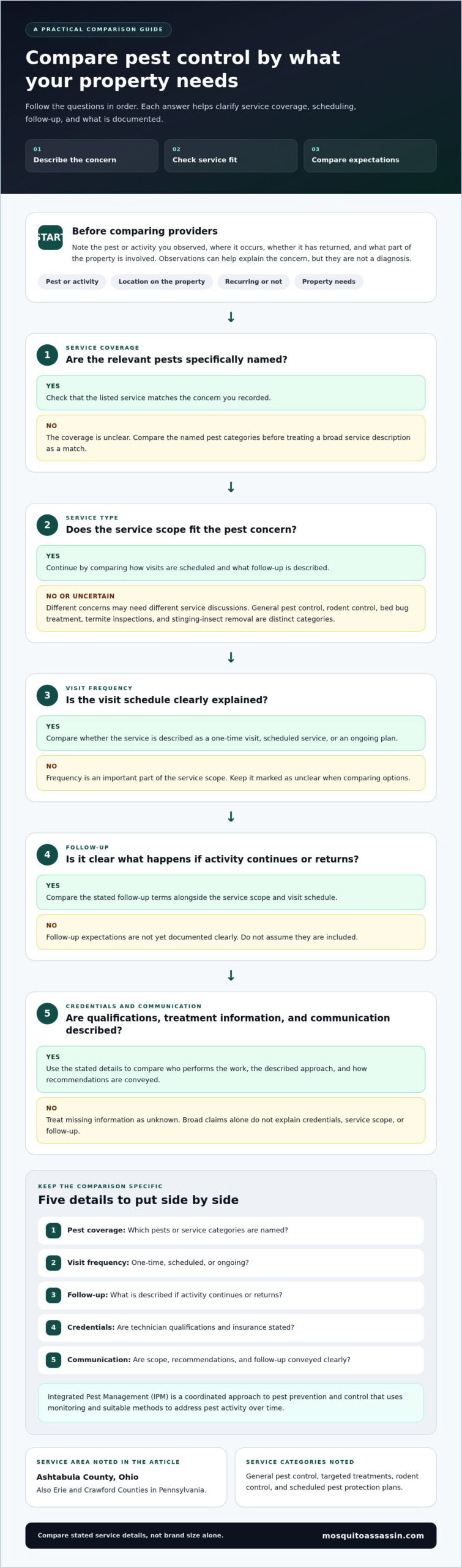
    Before deciding, write down the pest concern, where activity occurs, whether it has returned, and what you want to address or monitor. Then use the same criteria to compare service information: Are the relevant pests named? Is the scope understandable? Are technician credentials stated? Is follow-up explained? These points help distinguish specific service details from general claims about effectiveness or customer experience.

    A practical comparison comes down to whether the stated coverage and service expectations match your property’s needs. That may mean addressing a specific infestation or considering scheduled support for a recurring pattern. A focused review helps set realistic expectations before service begins.

    Compare Pest Control Providers by Service Scope, Methods, and Credentials

    A useful comparison starts with specific service information, not broad claims about results or customer experience. Note what each service covers, how visits are scheduled, what follow-up is described, and which technician credentials are stated. This makes it easier to see whether a general plan matches an ongoing concern or a targeted service is more relevant.

    Integrated Pest Management (IPM) is a coordinated approach to pest prevention and control that uses monitoring and suitable methods to address pest activity over time. Treatment descriptions should explain the general approach without suggesting that a product or method is risk-free or guarantees a particular result.

    How can homeowners compare service scope?

    Check whether a general plan addresses the pests involved or whether the concern calls for a specific service. Rodent control, bed bug treatment, and termite inspections address different issues and aren’t interchangeable. Mosquito Assassin Pest Control’s pest control services include general pest control plans and targeted options, illustrating how service categories can be clearly identified.

    A simple comparison list can keep the details organized:

    • Pest coverage: Which pests or service categories are specifically named?
    • Visit frequency: Does the service describe a one-time visit, scheduled service, or an ongoing plan?
    • Follow-up: Is it clear what happens if activity continues or returns?
    • Credentials: Are technician qualifications and insurance clearly stated?
    • Communication: Is it clear how service scope, recommendations, and follow-up are conveyed?

    Keep documented details separate from words such as “effective” or “comprehensive.” Those descriptions don’t explain which pests are covered, how service is scheduled, or what support follows. A clearly stated scope gives you a more practical basis for comparing options.

    Which credentials and treatment details matter?

    Credentials and treatment information help explain who performs the work and how the company describes its approach. Mosquito Assassin states that its technicians are licensed, insured, and certified, and that its products are EPA-approved. These are specific details about the company’s technicians and products, not a promise that treatment has zero risk or will produce the same outcome at every property.

    Look for direct descriptions rather than assumptions. A statement that products are EPA-approved does not, by itself, explain which treatment is appropriate for a particular pest or property. Credentials should also be described accurately, without implying expertise beyond what is stated. Mosquito Assassin provides professional recommendations based on the pest concern and property.

    Use the comparison to focus on what matters for your situation: a service category that matches the pest, an understandable visit schedule, relevant credentials, and clear follow-up. These details provide a more useful basis for assessing fit than broad assurances alone.

    Local Pest Control or National Service Model: Compare the Practical Differences

    Local ownership and national scale describe how a company operates, not how well it will address a particular property. A larger service network may suit someone who values a broad organizational footprint. A locally owned provider may appeal to someone who prefers a business rooted in the region. Neither model alone proves service quality. Compare the practical details that shape your experience: how service is scheduled, how questions are handled, and what follow-up is described.

    Consider your priorities. If the concern needs recurring attention, a clear schedule and an understandable process for reporting continuing activity may matter most. If continuity is important, look for a stated approach to technician assignments rather than assuming it from company size. For either model, clear service terms and communication help set expectations.

    What can a local provider’s service process tell you?

    Look for details about visit frequency, communication, and what happens if pests return. Mosquito Assassin describes priority scheduling within its Bi-Monthly Pest Protection Plans. This is a feature of those plans, not a general promise about response speed or availability. The company’s about the company page provides context on its locally owned operating model.

    Use those details to assess fit, not to assume a particular outcome. A scheduled plan may suit someone looking for recurring service, while another property owner may prioritize a clearly defined response to a specific pest issue. Consider whether the stated schedule, communication process, and follow-up match your needs. Don’t infer technician continuity or faster service unless those terms are expressly described.

    How should homeowners interpret guarantees?

    Read the written conditions. Guarantees can differ in what triggers follow-up, what remedy is offered, and when the promise applies. Mosquito Assassin’s Pest-Free Guarantee provides a no-cost return if pests return between scheduled visits. Its 100% satisfaction guarantee applies after at least two applications, with retreatment at no expense. These terms have specific conditions and don’t promise the same outcome for every pest issue.

    As you compare service models, keep a short record of details that matter to your household:

    • Contact: Is the way to report a concern clear?
    • Scheduling: Are visit frequency and any priority scheduling described?
    • Continuity: Does the provider state how technician assignments work?
    • Follow-up: Are the steps or terms for returning pest activity explained?
    • Guarantee terms: Are conditions and remedies stated plainly?

    These criteria are more useful than assumptions about local or national providers. The right operating model depends on the property, the pest concern, and the service priorities you value. Clear, documented expectations give you a sound basis for deciding which arrangement fits.

    Pest Control in Ashtabula, Ohio: How to Compare Your Options

    Match an Ashtabula Pest Control Plan to the Property and Pest Pattern

    A suitable service arrangement depends on whether the concern is isolated or keeps returning. A one-time sighting may call for an assessment and targeted recommendation, while repeated activity or ongoing outdoor pest pressure may make scheduled protection relevant. Match the service scope to the pattern, not to a plan label alone.

    Use this decision process to organize the information about the property:

    1. Identify the pest concern. Note what you’ve observed and where. If the pest is uncertain, describe the signs rather than attempting to diagnose it.
    2. Assess recurrence. Consider whether this is a new, isolated concern or a pattern that has returned over time or across different areas of the property.
    3. Choose the service scope. Consider whether targeted service or a general plan is more relevant to the stated pest concern and property.
    4. Clarify follow-up. Review the visit schedule and what follow-up applies if activity continues or returns.

    This framework turns a vague concern into specific points about coverage, timing, and ongoing support. Professional recommendations can help determine which service category fits the situation. A year-round pest control guide can also provide broader context about recurring protection and scheduled service.

    When might a targeted treatment fit better?

    Some concerns call for a service focused on a particular pest or structure. Bed bugs, termites, and carpenter bees may require different assessments and service categories than general household pest concerns. A professional assessment can help determine what the signs indicate and which service scope is relevant. These pest categories are not interchangeable.

    For instance, possible termite activity is different from recurring activity by common household pests. Describing the location and pattern of what you’ve observed gives a professional useful context for making a recommendation. The assessment, rather than a guess based on a single sign, should guide the service discussion.

    When might scheduled protection be relevant?

    Scheduled protection may suit a property owner looking for recurring exterior service rather than a response limited to one concern. Mosquito Assassin’s Bi-Monthly Pest Protection Plans provide scheduled exterior protection. Plan fit depends on the property’s pest concerns and desired service frequency, not on a plan name alone.

    The Bronze Plan includes four exterior treatments per year, and the Silver Plan includes six exterior treatments per year. The Gold Plan adds exterior rodent bait stations and monitoring to the Silver Plan. The Platinum Plan adds seasonal mosquito treatments and In2Care stations to the Gold Plan. The Titanium Plan includes four exterior treatments plus up to eight mosquito service visits per season. Compare each plan’s stated inclusions and schedule with the property’s needs.

    For professional recommendations about a property’s pest concerns, contact Mosquito Assassin Pest Control.

    Mosquito Assassin Pest Control in Ashtabula County: Services and Next Steps

    A useful comparison brings the property’s pest concern together with the services offered, technician credentials, scheduled visits, and follow-up terms. Mosquito Assassin Pest Control LLC serves Ashtabula County, Ohio, as well as Erie and Crawford Counties in Pennsylvania. Its service options include General Pest Control, Rodent and Mouse Control, Mosquito Control, and targeted pest treatments.

    For readers comparing alternatives to Orkin in Ashtabula, focus on the named services and the stated inclusions of each plan. Mosquito Assassin states that its technicians are licensed, insured, and certified. Those details, along with service schedules and written follow-up conditions, give homeowners practical points for comparison without assuming that any particular model guarantees a specific outcome.

    What service details can readers compare with confidence?

    Compare service names and stated inclusions with the pest concern at your property. General Pest Control may address a different need than Rodent and Mouse Control, Mosquito Control, or a targeted treatment. The company’s pest control service options provide more information about its service categories.

    Mosquito Assassin’s Bi-Monthly Pest Protection Plans provide scheduled exterior protection. The Titanium Plan includes four exterior treatments plus up to eight mosquito service visits per season. The Bronze, Silver, Gold, and Platinum Plans have distinct stated inclusions. Compare each plan’s services and schedule rather than inferring coverage from its name.

    Follow-up terms are another useful comparison point. The company’s Pest-Free Guarantee provides a no-cost return if pests return between scheduled visits. Its 100% satisfaction guarantee applies after at least two applications, with retreatment at no expense. These conditions should be understood as written, not as a promise that every pest concern will have the same result.

    Where can Ashtabula County residents take the next step?

    A professional assessment can help clarify a pest concern and identify relevant service options for the property. Before an inspection, note what you’ve observed, where activity appears, and whether it has returned. This information can help focus the discussion on service scope and follow-up expectations.

    For an inspection or professional recommendations, contact Mosquito Assassin Pest Control. Clear information about the concern and property can help make the discussion about service options more useful.

    Take the Next Step With Clear Service Expectations

    Choosing among alternatives to Orkin in Ashtabula, Ohio, becomes easier when you can describe what you need from pest control. Note the pest concern, where you’ve seen activity, whether it has returned, and what kind of follow-up would help you stay informed. These details can make a professional conversation more focused and connect the property’s needs with an appropriate service scope.

    You don’t need to diagnose the pest or determine a treatment method on your own. An inspection and professional recommendations can help clarify the concern and relevant options. Clear information about coverage, scheduling, and follow-up can also set practical expectations before service begins.

    For guidance specific to your property, request an inspection or professional recommendations from Mosquito Assassin Pest Control LLC.

    Frequently Asked Questions

    Does Mosquito Assassin Pest Control serve Ashtabula County, Ohio?

    Yes. Mosquito Assassin Pest Control LLC serves Ashtabula County, Ohio, as well as Erie and Crawford Counties in Pennsylvania. Along with confirming that the property is in the service area, compare the company’s listed services with the pest concern. Location alone doesn’t explain which pests a plan covers or what follow-up applies.

    What should I compare when choosing pest control in Ashtabula?

    Compare service scope, treatment information, technician credentials, visit schedule, and written follow-up conditions. If activity is limited to one room, for example, look for a service relevant to the pest and situation rather than assuming a general plan covers every issue. Specific details are more useful than broad statements about effectiveness because they explain what a service includes and how it may fit the property.

    Is ongoing pest control different from a one-time treatment?

    Yes. A one-time treatment generally addresses a specific concern, while an ongoing plan schedules recurring service. The appropriate arrangement depends on the pest and whether activity returns. Mosquito Assassin’s Bi-Monthly Pest Protection Plans have different inclusions, including scheduled exterior treatments and, in some plans, mosquito service visits. A professional assessment can help clarify whether targeted service or scheduled protection is relevant.

    What pests does Mosquito Assassin treat in Ashtabula County?

    Mosquito Assassin lists services for ants, spiders, yellowjackets, wasps, hornets, bed bugs, termites, rodents, mosquitoes, ticks, German cockroaches, fleas, and carpenter bees, as well as General Pest Control. These pests can require different service categories. Bed bug concerns, for example, differ from routine household pest activity. Compare the named service for the pest rather than assuming a general plan includes every treatment.

    What does the Mosquito Assassin Pest-Free Guarantee cover?

    The company states that it will return at no cost if pests return between scheduled visits. Separately, its 100% satisfaction guarantee applies after at least two applications, with retreatment at no expense. These are distinct conditions. Read the wording that applies to the service and plan, and don’t assume a guarantee covers every pest, service type, or circumstance in the same way.

    Are pest control treatments guaranteed to be safe for families and pets?

    No pest control treatment should be described as risk-free or as guaranteeing health or safety. Mosquito Assassin describes its treatments as family-safe, low-toxicity treatments and states that technicians use EPA-approved products. Those descriptions don’t establish zero risk or determine what is appropriate for every property. Follow service-specific instructions and discuss household or pet concerns with a licensed pest control professional before service.

    Does Mosquito Assassin offer pest control for businesses near Ashtabula?

    Yes. Mosquito Assassin provides Commercial Pest Control Services for businesses and properties, including restaurants, retail, manufacturing, healthcare, education, hospitality, and property management. A restaurant and a warehouse, for example, have different uses and pest-management priorities. Consider the property’s operations and pest concerns when reviewing service scope. The commercial pest control services page provides details about business-focused offerings.

    Disclaimer: The information provided on this blog is for general informational purposes only and is not intended as professional pest control advice. Conditions vary by property, environment, and location. Reading this content does not create a service agreement. For an inspection or professional recommendations, please contact Mosquito Assassin Pest Control LLC directly.

  • How to Prepare Your House for Flea Treatment: A Practical Checklist

    How to Prepare Your House for Flea Treatment: A Practical Checklist

    Preparing for flea treatment doesn’t mean emptying your home or scrubbing every surface. Knowing how to prepare your house for flea treatment starts with identifying the rooms and belongings that need attention, then following the instructions for your scheduled service.

    Conflicting advice can make it hard to know whether you’re doing too little or taking preparation too far. Pets and household belongings add practical concerns, but a focused plan can keep the work manageable. This checklist covers ways to organize the home without turning preparation into a full-house cleanout.

    You’ll find guidance on clearing floors, handling pet bedding, and coordinating household and pet arrangements. You’ll also learn what to clarify before treatment day and how to avoid common mistakes, such as moving belongings unnecessarily or assuming every room needs the same preparation.

    Key Takeaways

    • Use the instructions for your scheduled treatment to decide which rooms and belongings need attention.
    • Organize access to the service areas, and focus on loose items and floors where directed.
    • Before bagging, moving, or discarding belongings, check whether the instructions call for it.
    • Coordinate household and pet arrangements using the directions for your appointment.
    • Keep a short list of questions so you can get clear, property-specific guidance.

    Why preparing your house for flea treatment matters

    Getting ready for flea treatment can bring up practical questions. Should you move furniture, clear every closet, or pack away belongings? The answer depends on the service areas and the instructions for your appointment. Preparation is about making the relevant areas accessible, not doing a full-house cleanout or guessing what a technician needs.

    Each home has a different layout, use of space, and mix of belongings. A carpeted room may need different access arrangements from a room with mostly hard flooring. A pet bed in one room is a different preparation question from bedding and blankets used in several rooms. General information about flea treatment approaches is available in Flea treatment, but your appointment instructions should guide the tasks for your home.

    What does preparing for flea treatment involve?

    Preparation means completing relevant household tasks before the scheduled service. Depending on the instructions, that may include clearing loose items from floors, organizing pet belongings, or making certain areas accessible. The goal is to prepare the service areas without moving or discarding more than necessary.

    Preparation is household organization, not pesticide application or treatment instructions. Keep questions about the treatment, service areas, or a specific household concern for the professional handling the service. A general checklist can help you organize, but it cannot replace instructions for your property.

    Why does the checklist vary from home to home?

    Room use and furniture placement affect what needs to be organized. A room used for storage may need more attention to loose belongings than an open living area. Flooring, rugs, and the location of pet resting areas also differ from home to home. That’s why another household’s checklist may not match your situation.

    The scheduled service and the areas involved matter, too. A task that applies to one appointment may not be necessary for another. Search results for how to prepare your house for flea treatment can provide a starting point, but they should not be treated as universal instructions.

    Use the directions for your appointment to decide what applies. If a direction is unclear, or a particular item makes it difficult to follow, ask the professional handling the service before making assumptions. Doing extra work does not necessarily resolve uncertainty. A clear plan helps you focus on the tasks that matter and leave treatment-specific decisions to the professional.

    How to prepare your house for flea treatment: the main checklist

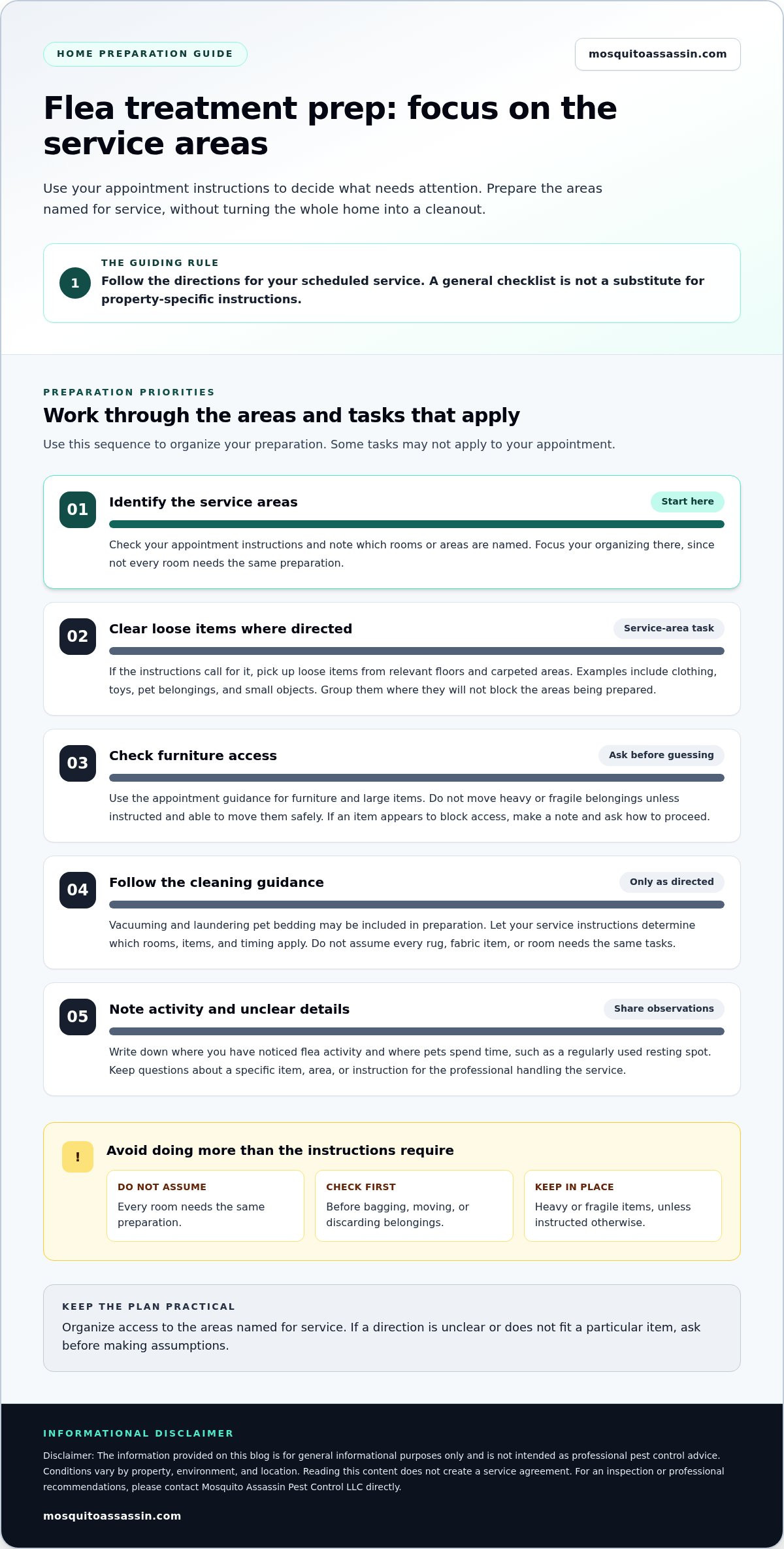
    Start by identifying the rooms and areas named in your appointment instructions. Then work through those spaces and note any access issues or belongings that are not covered by the directions. The checklist below describes common preparation tasks, not universal requirements. Follow the instructions for your service and complete only the tasks that apply.

    Which rooms and household items should you organize?

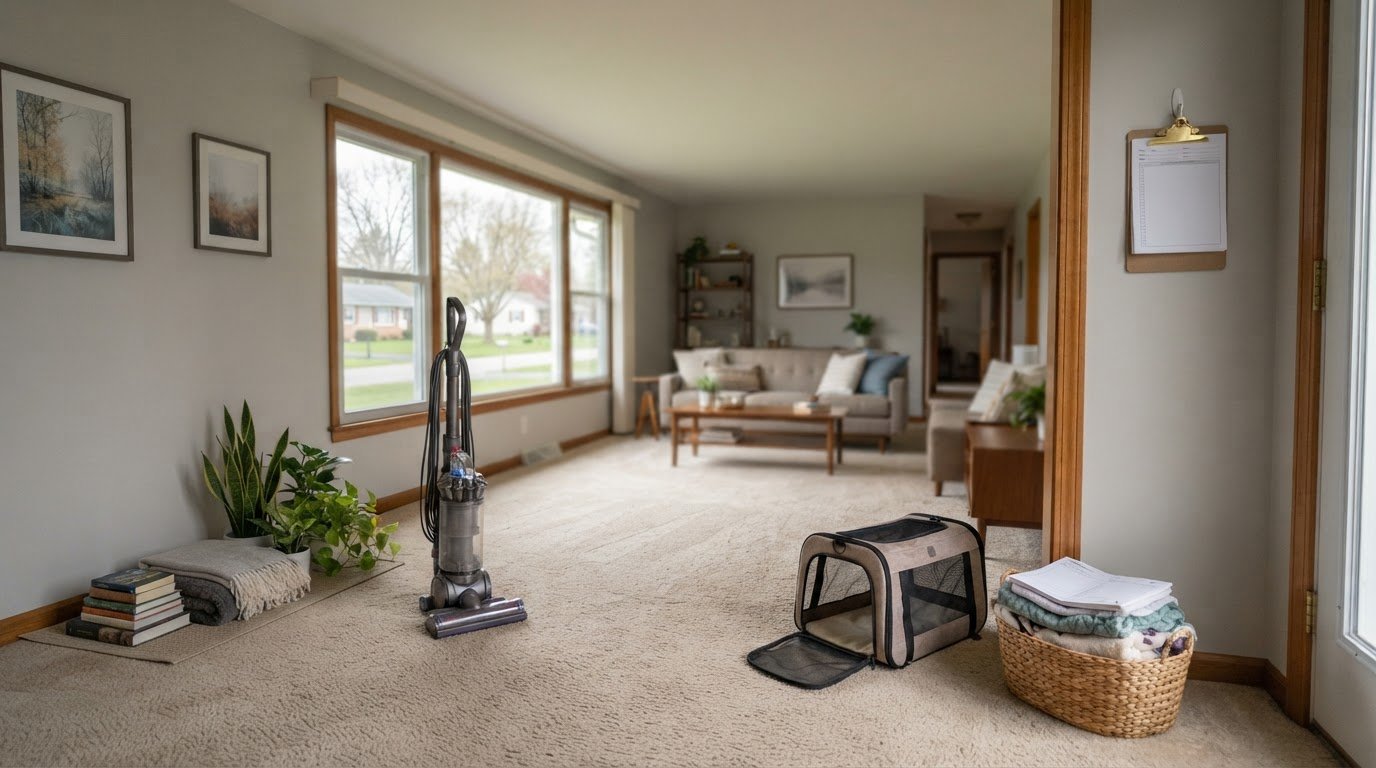
    Focus first on the service areas. Where directed, clear loose items from floors and carpeted areas. These might include clothing, toys, pet belongings, or small objects that make an area difficult to access. Group items together in a place that does not block the areas being prepared. Avoid moving belongings from room to room unless the instructions call for it.

    For furniture and other large items, follow the appointment guidance. Do not move heavy or fragile belongings unless you have been instructed to do so and can move them safely. If something appears to block access, make a note of it and ask how to proceed rather than forcing it or guessing.

    A useful practical step is to write down where you have noticed flea activity and where pets spend time, such as a regularly used resting spot. Share those observations with the professional handling the service. This helps make the conversation specific without asking you to diagnose the source or decide how treatment should be carried out.

    What cleaning tasks are commonly included in preparation?

    Vacuuming is often mentioned in general flea preparation guidance, but the rooms to vacuum and the timing should come from your service instructions. Laundering pet bedding may also be included or recommended. Do not assume every rug, fabric item, or room needs the same preparation.

    The CDC’s Getting Rid of Fleas guidance discusses household sanitation alongside pet care and home treatment. For your appointment, use the professional’s instructions to determine which cleaning tasks apply. That keeps preparation focused on the scheduled service instead of adding work without clear direction.

    • Review the service areas. Identify the rooms named in your instructions and focus your organizing there.
    • Pick up loose items where directed. Clear the relevant floors and carpeted areas without packing away the entire room.
    • Check furniture access. Leave heavy or fragile items in place unless you have been instructed to move them and can do so safely.
    • Follow the cleaning guidance. Vacuum and launder pet bedding only as directed for your appointment.
    • Flag anything unclear. Note an item or area that does not fit the instructions and ask how it should be handled.

    A useful flea-treatment checklist organizes the areas and belongings named in your appointment instructions, with vacuuming or bedding care included only when directed. That’s the practical approach to how to prepare your house for flea treatment: follow the property-specific plan rather than a one-size-fits-all cleanout. For an overview of professional options, see professional pest control services.

    Preparing pets, bedding, and personal belongings without overdoing it

    A scheduled flea treatment does not automatically mean you need to discard a sofa, bag every item of clothing, or empty your closets. Moving belongings unnecessarily can create extra work and may shift items into rooms that are not part of the service. Before bagging, relocating, covering, or disposing of anything, follow the instructions for your appointment.

    Pet arrangements need separate attention. Discuss your pet’s care with its veterinarian, and ask the professional handling the service about household arrangements connected to the appointment. These are different parts of the plan. If you are unsure how a pet’s routine or belongings fit the instructions, raise the question before treatment day.

    How should you handle pet bedding and everyday fabrics?

    Washing pet bedding is a common preparation example, but whether it applies and how to handle the item should come from your appointment instructions. Separate washable bedding from delicate, large, or non-washable belongings that may need individual guidance. Do not assume every blanket, rug, cushion, or fabric item requires the same handling.

    Keep preparation to the household tasks specified by the professional. Do not apply pesticides to pets, bedding, clothing, or household surfaces based on general advice. If the instructions do not address a particular fabric or pet item, ask the professional handling the service before deciding what to do.

    Do you need to remove or throw away belongings?

    There is no blanket disposal rule just because treatment is scheduled. Furniture, toys, clothing, and stored items may need different consideration depending on the room and service plan. Move or protect belongings only as the appointment instructions direct. If an item is difficult to move, valuable, fragile, or used every day, do not guess about its handling.

    A short sorting process can make decisions more manageable:

    • Identify pet-used items. Note bedding and fabrics your pet regularly rests on, then check whether the instructions say they need attention.
    • Set aside items needing clarification. Make a brief list of belongings whose care is not covered by the directions.
    • Leave disposal decisions out of the preparation plan. Do not throw away usable belongings unless you have a separate reason to do so.

    This measured approach is useful for how to prepare your house for flea treatment: coordinate pet care, handle bedding according to the appointment guidance, and avoid turning preparation into a whole-home purge. Household routines and property conditions can also shape a broader pest-management plan.

    How to Prepare Your House for Flea Treatment: A Practical Checklist

    What to confirm before flea treatment day

    A final review helps separate the tasks that apply to your appointment from general advice that may not fit your home. Keep the written or digital instructions nearby and use them to check access, household arrangements, and any pet-related directions. If something is unclear, ask the professional handling the appointment instead of filling in the gaps with assumptions.

    Which appointment details should you clarify?

    Check which rooms and areas are included, then compare that list with the tasks you have completed. If the instructions do not address a specific item, room, or household need, ask how it should be handled. Questions about the treatment or a particular product should go to the professional responsible for the appointment, since general guidance cannot account for every property-specific concern.

    It can help to group questions by topic before getting in touch:

    • Access: Which rooms or areas need to be accessible, and are there specific arrangements for the visit?
    • Household: What arrangements should people in the home follow before, during, or after the service?
    • Pets: How should pet arrangements coordinate with the appointment, and which care questions should go to the pet’s veterinarian?
    • Belongings: How should you handle an item or preparation task that is not covered in the instructions?

    Keep questions specific. Instead of asking whether you should “clear everything,” name the room and item you are unsure about. For example, explain that a large piece of furniture is difficult to move or that a pet rests on bedding in several rooms. A clear question helps the professional respond to the actual situation without turning a small uncertainty into extra work.

    How can you make the home ready for the scheduled visit?

    Use the appointment instructions as your final reference, not a checklist from another property or a general online guide. Review the requested tasks, complete the ones that apply, and make the stated areas accessible. If something prevents you from following a direction, tell the professional handling the service before the visit.

    Before the appointment, make sure household and pet arrangements match the instructions. Keep the written or digital directions on your phone or somewhere easy to find. Do not assume a re-entry time, treatment method, or restriction unless it appears in the instructions provided for your appointment.

    A simple final review can make how to prepare your house for flea treatment feel less like guesswork:

    1. Read the appointment instructions from beginning to end.
    2. Check that requested access and household arrangements are in place.
    3. Note unanswered questions about rooms, belongings, pets, or the treatment.
    4. Ask the professional handling the service for clarification and keep the response with your instructions.

    For help interpreting preparation guidance or professional recommendations for your home, contact Mosquito Assassin Pest Control LLC.

    When professional flea control may help with preparation

    Preparation instructions should fit the scheduled service and the home. Professional guidance can help when the directions are unclear, an item or room is not addressed, or you are unsure how to coordinate household and pet arrangements. You do not need to guess or add extra tasks because another home followed a different checklist.

    When should a homeowner ask for professional guidance?

    Ask the professional handling the appointment about details that affect the service, such as which areas need access or how to handle an item not mentioned in the instructions. For questions about your pet’s care, coordinate with both the professional and your pet’s veterinarian. Recommendations can be specific to the service and property, so general advice should not replace appointment instructions.

    Professional input can also help if you cannot complete a requested task as written. A large item may be difficult to move, or a household routine may make an arrangement challenging. Explain the specific issue and ask what applies to your appointment. A flea concern does not automatically mean every home needs the same treatment or preparation.

    How can local service information help?

    Mosquito Assassin Pest Control LLC provides Flea Control in Erie and Crawford Counties in Pennsylvania and Ashtabula County in Ohio. The flea control service details provide information about the professional service, while the directions for your appointment remain the reference for preparing your home.

    Keep preparation focused: use your instructions, complete the relevant household tasks, and raise unanswered questions with the professional handling the appointment. If you need an inspection or professional recommendations about flea activity and preparation, contact Mosquito Assassin Pest Control LLC.

    Take the next step with a clear plan

    A manageable preparation plan is not about doing as much as possible. It is about understanding what applies to your home and making decisions with the appointment instructions in hand. If you are still unsure how to prepare your house for flea treatment, pause before moving or discarding belongings and get property-specific guidance.

    Questions about access, household arrangements, or pet-related preparation are reasonable. An inspection or professional recommendations may help clarify what makes sense for your situation. Contact Mosquito Assassin Pest Control LLC for an inspection or professional recommendations about flea concerns and next steps.

    With clear guidance, you can focus on the tasks that matter and leave unnecessary cleanouts behind. Use the instructions for your home as your guide, and work through the relevant tasks one at a time.

    Frequently Asked Questions

    How long before flea treatment should I prepare my house?

    There is no universal lead time. The appointment directions and requested tasks determine when to begin. Review them once the appointment is arranged, then allow time for practical tasks such as laundry or arranging help with a difficult item. For how to prepare your house for flea treatment, do not infer a deadline from another household’s experience. Ask the professional handling the service if the instructions do not say when a particular task should be done.

    Do I need to vacuum before flea treatment?

    Vacuuming is commonly mentioned in general flea preparation guidance, but follow the directions for your appointment. If they name floors but do not mention stairs, rugs, or upholstered seating, do not assume those areas are included or excluded. Ask which surfaces to cover and when to vacuum, especially if preparing every room would take considerable time. This gives you a clear scope instead of leaving you to guess.

    Should I wash my pet’s bedding before flea treatment?

    Washing pet bedding appears in common preparation guidance, but your appointment instructions should determine whether it is needed. If your pet rests on several items, such as a blanket on the sofa and a bed in another room, ask which ones are relevant to the scheduled service. For questions involving your pet’s care or veterinary treatment, coordinate with the professional handling the service and your pet’s veterinarian.

    Do I need to leave my house during flea treatment?

    Whether you need to leave depends on the scheduled service and its specific directions. Confirm what applies to everyone in the household, including children, visitors, and pets, rather than making separate assumptions for each person. Get instructions about leaving and returning directly from the professional handling the appointment. If transportation or another household commitment makes the arrangements difficult, raise that before the service date.

    Do I have to throw away furniture or carpets before flea treatment?

    No. A scheduled treatment alone does not mean furniture or carpets must be discarded. If you are concerned about a particular item, identify it when asking the professional, such as a large rug that is difficult to move or a sofa that cannot be shifted. That is more useful than making a whole-room decision based on general advice. Do not dispose of belongings unless you have a separate reason to do so.

    What should I do if I still have questions after preparing for flea treatment?

    Keep a short list of unresolved questions and share the details with the professional handling the appointment. Include anything that has changed since you reviewed the directions, such as a room becoming inaccessible or a pet’s usual arrangement changing. Ask for clarification about those specific circumstances and keep the response with your appointment information. Avoid trying to resolve uncertainty by adding treatment steps or using pesticides yourself.

    Disclaimer: The information provided on this blog is for general informational purposes only and is not intended as professional pest control advice. Conditions vary by property, environment, and location. Reading this content does not create a service agreement. For an inspection or professional recommendations, please contact Mosquito Assassin Pest Control LLC directly.

  • Preventing Pests in Your Garage: Practical Steps for a Pest-Resistant Space

    Preventing Pests in Your Garage: Practical Steps for a Pest-Resistant Space

    What if the boxes, food odors, or small gaps in your garage are doing more to attract pests than you realize? It’s easy to overlook how everyday storage and maintenance habits can create shelter, moisture, and access for rodents and insects. Preventing pests in your garage starts with identifying these conditions and making practical changes.

    A pest-resistant space doesn’t depend on one fix. It takes a combination of reducing food and water sources, limiting hiding places, and closing off potential entry points. In this guide, you’ll learn what to check, from trash and pet food storage to clutter, leaks, door seals, and gaps around pipes. You’ll also find out which signs may suggest pest activity is recurring rather than an isolated sighting. If evidence continues despite prevention habits, a professional assessment may help identify contributing conditions and appropriate next steps.

    Key Takeaways

    • Preventing pests in your garage means addressing access, shelter, and attractants together, rather than relying on a single change.
    • Check garage doors, windows, utility openings, and foundation edges for gaps that could let pests inside.
    • Choose storage and tidying habits that limit hiding places, and address moisture or food sources that may draw pests.
    • Use pest clues to guide prevention habits, then keep up simple visual checks during routine garage tidying.
    • Repeated signs, suspected nesting, or ongoing damage may warrant a professional assessment of property-specific conditions.

    Why garages attract pests, and what to notice first

    Garage pest prevention means reducing the access, shelter, and attractants that can support pest activity. The goal isn’t to make a garage perfectly sealed or free of every occasional insect. It’s to notice conditions that could invite pests and address them before signs become a pattern.

    Attached garages may have openings that connect to the house, while detached garages can provide shelter on their own. Doors that don’t close tightly, gaps around utility lines, and items stored against walls can create routes or hiding places. A garage may also contain rubbish, crumbs, or pet food that pests can reach. A general Pest Control Overview describes prevention as one part of managing pest activity. In practice, preventing pests in your garage starts with understanding what the space offers them.

    Prevention means reducing the conditions that give pests access to food, moisture, and undisturbed shelter. That simple idea helps focus an inspection on the garage’s surroundings and contents, not just on the pest itself.

    What makes a garage appealing to pests?

    Stored belongings can create quiet spaces behind boxes, beneath shelving, and inside seldom-opened containers. Cardboard, paper, and fabric may provide places to hide or materials that some pests can damage. Food residue, open pet food, and rubbish with lingering odors can also draw activity. Damp corners, condensation, or an unnoticed leak may make an area more favorable to pests that seek moisture.

    Attached or detached, the pattern is similar: a pest can take advantage of a gap, then remain out of sight where stored items are rarely moved. Look beyond the center of the floor. Pay attention to wall edges, the base of shelving, corners near doors, and the areas around stored food or waste.

    Which signs deserve a closer look?

    A single insect sighting doesn’t always mean there’s an established problem. Repeated sightings, activity in different parts of the garage, or several kinds of evidence together call for closer attention. Look for clues such as:

    • Droppings or gnaw marks near walls, stored goods, or door edges.
    • Nesting material, shed insect parts, or damaged packaging.
    • Repeated sightings in the same location or at similar times.

    Note where and when you see signs, and whether they appear again. A brief written record or photo from a distance can help you compare changes over time. Don’t handle unknown droppings, nesting material, or insect remains. If evidence keeps appearing, the location and pattern may help clarify what conditions need attention.

    Look for context before drawing conclusions. A torn package near pet food, for example, may point to an accessible attractant, while repeated droppings along a wall may suggest activity is following a consistent route. Observations aren’t a diagnosis, but they can help distinguish an isolated encounter from a recurring pattern and guide the next prevention checks.

    How to reduce garage entry points, clutter, and moisture

    A practical prevention routine works best when you move through the garage in a clear sequence: inspect openings, improve storage, remove attractants, then monitor for changes. This helps you address conditions that may be contributing to pest activity instead of focusing on just one visible clue. The Integrated Pest Management approach also emphasizes prevention and monitoring as part of managing pests.

    Exclusion means limiting pest access by identifying and addressing suitable openings in a structure. Gaps around doors, windows, utility penetrations, and foundations can provide routes into a garage. Even small spaces may deserve attention if they connect the outdoors with sheltered storage areas.

    Check doors, windows, and other openings

    Start with a visual check around the garage door, including its edges and visible weatherstripping. Look at window frames, corners where walls meet the floor, and places where pipes or wires pass through walls. Notice daylight or visible gaps around closed doors, damaged seals, and cracks along the foundation. These observations can help you identify locations that may need appropriate repair.

    Keep the inspection within what you can safely see and reach. Repairs involving structural components or electrical connections are best handled by qualified help. Don’t disturb wiring or attempt a repair that’s beyond your experience. Addressing a damaged seal or gap can reduce access, but it won’t remove other attractants or hiding spots, so include the rest of the garage in your check.

    Make storage and moisture less inviting

    Once you’ve noted potential openings, organize items so you can see the floor and walls more easily. Store belongings in closed containers rather than exposed cardboard when practical. Keep containers stable and raised off the floor where feasible, especially in areas where dampness has occurred. Leave enough space to inspect behind stored items without shifting the entire garage.

    Next, contain food, pet supplies, and rubbish. Keep lids on containers, clear away food spills, and check that packaging hasn’t been damaged. Remove unused cardboard and other accumulated materials that make it harder to spot changes. These simple adjustments support a cleaner, more observable storage area.

    Look for puddles, damp patches, condensation, or signs of a leak. Address water sources when possible, and improve airflow where practical to help areas dry. If moisture keeps returning, consider whether a leak or ventilation issue needs attention. Preventing pests in your garage is more manageable when access, food, shelter, and moisture are considered together.

    After making changes, revisit the same spots during routine tidying. Note any new gaps, dampness, damaged packaging, or pest clues, and whether the pattern changes. If signs continue despite these prevention habits, professional pest control services may help assess conditions specific to the property.

    Match garage prevention habits to the pests you notice

    Different clues can point to different conditions worth checking, but indirect evidence rarely identifies a pest with certainty. Droppings, damaged packaging, or shed insect parts can be difficult to interpret without seeing the pest itself. Use observations to guide environmental changes, not to assume that one sighting proves an infestation or confirms a particular species.

    The comparison below connects common signs with prevention checks. These are starting points, not a diagnosis. Notice whether evidence recurs and where it appears, then focus on reducing the conditions that may be supporting activity.

    Pest group Clues to notice Prevention habits to consider
    Rodents Droppings, gnaw marks, disturbed belongings, or damaged packaging Contain food and rubbish, organize stored items, and check visible openings
    Ants Repeated trails or activity near food residue or damp areas Clean spills, contain food, and address persistent moisture
    Spiders Webs or sightings around undisturbed storage and other insects Reduce clutter and inspect corners during regular tidying
    Stinging insects Repeated insect activity near a possible nest or entry point Observe from a distance and avoid disturbing nests

    Rodents: reduce shelter, food access, and unnoticed entry

    Droppings, gnawing, or stored items that appear disturbed are reasons to inspect the surrounding area and note whether signs recur. Keep food and pet supplies contained, rubbish covered, and belongings arranged so you can see along walls and around stored goods. Check visible gaps near doors and utility openings. Don’t handle droppings, nesting material, or trapped animals; indirect signs alone may not show what is present or how extensive activity is.

    Ants, spiders, and stinging insects: reduce conditions they use

    Ant activity may be associated with accessible food or moisture, though a trail alone doesn’t confirm the species or its source. Spiders may be easier to spot in quiet corners where insects and undisturbed hiding places are present. Clear away food residue and make storage easier to inspect. If you see a nest or an insect you can’t identify confidently, don’t disturb or handle it.

    Use patterns to choose what to check next. Repeated activity near a damp area suggests looking for moisture, while recurring signs along a wall make nearby storage and openings worth inspecting. A lone insect may have entered by chance, but continued sightings or multiple types of evidence deserve closer observation. For preventing pests in your garage, adjust the relevant conditions and keep track of whether signs return.

    Preventing Pests in Your Garage: Practical Steps for a Pest-Resistant Space

    Build a simple garage pest-prevention routine

    A routine works best when it fits naturally into garage tidying. Rather than setting a rigid inspection schedule, use moments when you’re already putting things away to scan for changes. A quick visual check can help you notice a loose seal, a damp patch, or new signs before those details get lost among stored belongings.

    A quick check during regular garage upkeep

    As you tidy, scan the garage in a consistent direction, such as from the door inward. Check door seals and visible gaps, then look over stored food, rubbish, and areas where moisture could collect. Notice any new damage, droppings, nesting material, or repeated insect activity. Don’t handle unknown material. Return belongings to their usual organized places and keep walkways clear so the floor and wall edges remain easy to observe.

    • Look for changes around doors, windows, and visible openings.
    • Check that food, pet supplies, and rubbish remain contained.
    • Notice damp areas, leaks, or water that wasn’t present before.
    • Scan visible surfaces for new damage or recurring pest clues.

    The value is in noticing change, not inspecting every stored item each time. If a stack of boxes blocks a wall or a spill is hidden beneath belongings, make a note to revisit that area when it’s accessible. Keeping items in predictable places makes it easier to spot what’s new and may help you identify where prevention habits need attention.

    What to review when seasons or storage change

    Use transitions as a cue for a more focused look. Before bringing seasonal belongings out of long-term storage, check the items and their containers for damage or signs of activity. After deliveries, remove packaging promptly and notice whether anything has been disturbed. Changes in weather or regular door use can also reveal worn seals or gaps that weren’t obvious during an earlier check.

    Compare new observations with what you’ve already seen. A single mark may have several possible explanations, so avoid assuming the cause from one clue. Brief notes can help: record the date or general timing, location, and type of sign, such as activity by the side door or damage near a storage shelf. Photos taken without disturbing the area can also make changes easier to compare.

    If the same signs return, or you notice continued damage despite making practical prevention changes, professional pest control may help assess conditions specific to the property. Request a professional pest assessment for recurring garage concerns.

    When recurring garage pest signs call for professional help

    Prevention habits can make a garage less appealing to pests, but they can’t always explain or resolve recurring activity. A single sighting may be incidental. Repeated evidence, suspected nesting, or damage that continues after you’ve addressed visible attractants and openings deserves a closer look. The concern is not just what appeared, but whether signs keep returning or show up in more than one area.

    Recognize when prevention alone may not be enough

    Consider professional assessment if droppings or gnaw marks reappear, stored items keep getting damaged, or pest activity is showing up in separate parts of the garage. A nest or repeated movement near a wall or doorway may also indicate a persistent issue. These clues don’t reliably identify a pest on their own, so avoid assuming a cause based only on indirect evidence.

    Don’t disturb a suspected nest or handle unknown pests, droppings, or nesting material. Keep a record of where signs appear and whether they recur, and share those observations during an assessment. General prevention can reduce favorable conditions, but it can’t replace a property-specific evaluation when signs persist. A professional can help interpret the evidence and recommend next steps based on the conditions present.

    What professional assessment can add

    An assessment can consider the signs alongside the garage’s layout, storage, moisture, and potential access routes. That broader view may help distinguish an isolated clue from an ongoing pattern and identify conditions that routine tidying may not make obvious. Recommendations should reflect the property and the evidence, rather than relying on a guess about the pest.

    For rodents, control may involve removal, maintenance, and exclusion, which addresses activity and the conditions that could allow access to continue. General pest control services can also provide information about professional support when prevention alone hasn’t resolved recurring signs.

    Mosquito Assassin Pest Control LLC serves Erie and Crawford Counties, Pennsylvania, and Ashtabula County, Ohio. If activity continues despite practical prevention habits, professional pest control may help assess property-specific conditions and reduce risk. The aim is to understand what the evidence suggests and which contributing conditions may need attention, not to promise that one observation or change will resolve every pest concern.

    Make your next garage check count

    Prevention is an ongoing habit, not a one-time project. As you continue preventing pests in your garage, let new signs guide your next check rather than trying to predict every possible pest. A brief note about what changed and where can help you decide whether another adjustment is enough or whether the pattern needs a closer assessment.

    If evidence keeps returning or damage continues, professional recommendations can help clarify what may be contributing to the activity. Request an inspection or professional recommendations to discuss persistent concerns. Small, steady observations can make the next step clearer, and practical changes can help you maintain a more pest-resistant space.

    Disclaimer: The information provided on this blog is for general informational purposes only and is not intended as professional pest control advice. Conditions vary by property, environment, and location. Reading this content does not create a service agreement. For an inspection or professional recommendations, please contact Mosquito Assassin Pest Control LLC directly.

    Frequently Asked Questions

    What attracts mice to a garage?

    Mice may explore a garage while searching for food, shelter, or a route through a building. The specific attractant can vary, so consider recent changes, such as bringing in stored supplies or leaving a garage door open during frequent loading. A mouse sighting alone doesn’t establish where it came from. Look for a pattern over time, and avoid moving items around any area with suspected nesting activity.

    Can cardboard boxes attract pests in a garage?

    Cardboard isn’t equally attractive to every pest, but its layers and folded edges can provide places for insects to hide. Boxes may also carry pests in from another storage location, so inspect them before bringing them into a new area. If a box is torn, damp, or shows unexplained residue, keep it separate from clean belongings while you decide how to handle the contents.

    How do I keep bugs from getting under my garage door?

    First consider whether insects are entering while the door is open, rather than passing beneath it when closed. Note when sightings occur, such as during unloading or after the door has been raised for a while. Check that the threshold isn’t obstructed and observe whether the closed door sits evenly. If the entry point remains unclear or the door appears damaged, a qualified repair professional can assess it.

    Why do I keep finding spiders in my garage?

    Some spiders wander indoors while searching for a place to settle, so an occasional sighting may not point to a persistent problem. The location can offer clues: repeated webs in the same sheltered spot suggest that area is being used regularly. You don’t need to identify a spider from a distance to make a useful observation. Note where it appears, and avoid handling one you can’t confidently identify.

    Should I use pesticides to prevent garage pests?

    Pesticides aren’t a universal preventive measure, because the right approach depends on what pest is present and why it’s appearing. Don’t choose a product based only on an uncertain identification or use one simply because a pest was seen once. If you’re unsure whether a pesticide is appropriate, seek professional guidance. Prevention begins with understanding the situation, and this FAQ isn’t a substitute for product-specific directions or professional recommendations.

    When should I call a pest control professional about my garage?

    Professional input can be useful when you can’t confidently identify the pest, when activity seems to come from an inaccessible area, or when you’re unsure which conditions need attention. Before seeking recommendations, note what you observed and where, without disturbing the area. That context can help distinguish a one-time encounter from a concern that needs a closer, property-specific assessment.

    Can pests enter a garage through small gaps?

    Yes, some pests can pass through openings that may be easy to overlook, but the significance of a gap depends on the pest and the structure. A visible opening doesn’t prove that it’s being used, and an unseen route may also be involved. Note where signs appear in relation to possible openings rather than assuming the nearest gap is the source. A professional assessment can help evaluate the pattern.

    Disclaimer: The information provided on this blog is for general informational purposes only and is not intended as professional pest control advice. Conditions vary by property, environment, and location. Reading this content does not create a service agreement. For an inspection or professional recommendations, please contact Mosquito Assassin Pest Control LLC directly.

  • How to Inspect Furniture for Bed Bugs: A Systematic Guide

    How to Inspect Furniture for Bed Bugs: A Systematic Guide

    According to the Professional Pest Management Alliance, 73 percent of Americans do not know how to inspect furniture for bed bugs properly. This gap in knowledge is particularly concerning in regional travel corridors like Erie and Crawford Counties in Pennsylvania and Ashtabula County in Ohio, where the circulation of secondhand goods increases the risk of introduction. Overlooking early warning signs often allows a minor issue to become a widespread infestation before it is even noticed.

    It is natural to feel anxious when you cannot distinguish between common household lint and potential pest activity. This systematic guide provides professional methods for identifying bed bug behavior in household furniture to protect your property and restore your peace of mind. By following a disciplined, evidence-based approach, you can confirm the presence or absence of these pests with total confidence.

    You will discover the essential tools required for a thorough inspection, including high-lumen flashlights and magnification. This overview covers the specific physical indicators to watch for, such as fecal spotting and cast skins, while detailing the most common hiding spots in upholstered and hard furniture. Understanding these technical details ensures you know exactly when a situation requires professional intervention.

    Key Takeaways

    • Identify physical indicators like live insects and dark fecal spotting to distinguish bed bugs from common household debris.
    • Mastering how to inspect furniture for bed bugs requires specific tools like high-lumen flashlights and magnification to find eggs in deep crevices.
    • Follow a systematic approach for upholstered items by checking cushion seams, zipper folds, and the undersides of furniture frames.
    • Examine hard surfaces by inspecting screw holes, drawer tracks, and joint connections where pests often find refuge.
    • Understand why isolating suspected items and seeking professional guidance is more effective than attempting unguided treatments.

    Identifying the Key Signs of Bed Bugs on Furniture

    Successful identification is the foundation of effective pest management. Adult bed bugs are reddish brown insects, typically measuring 4 to 5 millimeters, which is roughly the size of an apple seed. Younger nymphs are much smaller and can appear translucent or pale yellow. Because they’re nocturnal and avoid light, you may not always see the insects themselves during the day. Instead, you must look for the physical evidence they leave behind, such as fecal spotting, shed skins, and egg clusters.

    To see these signs in a real-world setting, watch this helpful visual guide:

    Visual Indicators of an Infestation

    Fecal spotting is often the most visible sign when learning how to inspect furniture for bed bugs. These spots appear as small, dark, ink-like dots that resemble a felt-tip marker bleed on fabric. If you find a suspicious spot on a hard surface, wipe it with a damp cloth. Bed bug excrement consists of digested blood and will often leave a rusty smear. You might also find exuviae, which are translucent, yellowish exoskeletons cast off as the insects grow. For a deeper understanding of these life stages, researching bed bug biology and behavior can help you distinguish between active pests and harmless household debris like lint or dust. In cases of significant activity, a distinct musty odor, often described as sweet or similar to coriander, may be present.

    Where Bed Bugs Prefer to Hide

    Bed bugs are experts at concealment. They prefer tight, dark spaces that offer security. They don’t typically live on the open surfaces of a sofa or chair. Instead, they retreat into crevices where their flat bodies can remain protected. While they’re most common in mattresses and bed frames, they readily inhabit any piece of furniture where people remain stationary for long periods, such as recliners or office chairs. These pests are not limited to fabric. They frequently colonize solid materials, including:

    • Screw holes and furniture joints
    • The undersides of wooden drawer slides
    • Decorative carvings or trim on headboards
    • Gaps in the backing of dressers or nightstands

    Focusing your efforts on these high-probability areas near sleeping or sitting zones increases the likelihood of a successful detection. Professional pest control may help reduce risk if you identify these signs in multiple locations throughout your home.

    Essential Tools for a Thorough Furniture Inspection

    Using the right equipment is the difference between a successful detection and a missed infestation. Professionals rely on specific, accessible items to uncover pests that hide deep within furniture. When learning how to inspect furniture for bed bugs, your primary tool is a high-powered LED flashlight. This allows you to see into dark joints and crevices where ambient room light cannot reach. High lumen output is necessary because bed bugs often retreat into the deepest recesses of a furniture frame.

    Supplement your flashlight with a magnifying glass to identify small eggs and translucent nymphs. According to this EPA guide on finding bed bugs, identifying physical evidence like shed skins and eggs is critical for a complete assessment. A 10x magnifying glass is usually sufficient to see the pearl white eggs, which are only about one millimeter long. These eggs are often glued to surfaces, making them difficult to see with the naked eye against light colored wood or fabric.

    Preparing the Inspection Area

    Clear a space around the furniture to allow for 360 degree access. In homes across Erie and Crawford Counties, this often means moving heavy sofas or recliners away from walls and other furniture pieces. This step prevents pests from escaping into nearby harborages during the disturbance. Ensure the room has strong overhead lighting to supplement your flashlight. It is also helpful to have a vacuum cleaner with a hose attachment nearby. If you encounter active insects, you can immediately contain them to prevent further spread throughout the property.

    Using Probing Tools Effectively

    A thin plastic card, such as an expired credit card, serves as an excellent probe. Slide the card into deep seams, welt cords, and fabric folds to dislodge hidden bugs or debris. Use your flashlight at a low angle across the surface of the material. This technique, known as side lighting, creates shadows that reveal the textures of eggs or fecal spotting that might be invisible under direct light. A magnifying glass is particularly critical when checking the grain of unpainted wood, where eggs can blend into the natural texture of the surface.

    Collecting debris on a piece of white paper or a light colored cloth makes it easier to inspect the samples under a magnifier. If your search reveals signs of activity, professional bed bug treatment can help manage the situation effectively and prevent the infestation from growing.

    Step-by-Step Inspection Process for Upholstered Pieces

    Upholstered furniture provides an ideal environment for bed bugs because of the numerous hiding spots created by fabric folds and internal padding. A successful search requires moving beyond a simple visual scan. You must physically manipulate the furniture to reveal hidden harborages. Begin by removing all detachable cushions. Inspect every side of these cushions, paying close attention to the welt cords (the raised piping) and the fabric surrounding the zippers. Even if the cushions appear clean, the interior of the zipper tracks can hide eggs or small nymphs that are easily missed.

    The main frame of the furniture requires the most focus. Bed bugs often congregate in the deep crevices where the arms meet the back and seat. Use your flashlight to peer into these dark recesses, using your plastic card to probe the gaps. If the furniture has a dust cover (the thin, usually black fabric stapled to the bottom) look for small holes, tears, or dark spotting. These indicators often suggest that pests are living inside the internal frame or among the springs of the piece. If you find evidence in these deep areas, professional pest control may help reduce risk by containing the infestation before it spreads.

    Inspecting Seams and Piping

    Fabric folds and piping are primary hiding spots because they offer tight, protected spaces. Use your probing tool to pull back these folds and look for clusters of insects or translucent shed skins. Decorative elements like buttons, tufts, and trim also provide shelter. It is important to follow a documented MSU Extension furniture inspection protocol to ensure no area is overlooked. This includes checking the interior of zipper tracks and the undersides of any decorative skirts or fringes that hang near the floor.

    Checking the Underside and Legs

    Flipping the furniture over is a necessary step when learning how to inspect furniture for bed bugs effectively. The wooden or metal frame on the underside provides a stable, dark environment for colonies to grow. Examine the points where the legs attach to the main body, as the joints and screw holes are common harborages. If your furniture has felt pads or floor protectors on the bottom of the legs, check them carefully. Bed bugs can easily hide between the pad and the leg or within the fibers of the felt itself. This systematic approach ensures that every potential harborage is evaluated, protecting your property and providing peace of mind.

    How to Inspect Furniture for Bed Bugs: A Systematic Guide

    Examining Hard Furniture and Wood Items

    While many homeowners focus exclusively on mattresses and sofas, solid wood items often serve as critical secondary harborages. Understanding how to inspect furniture for bed bugs requires looking beyond soft fabrics and into the rigid structures of your home. Hard furniture provides stable, dark, and undisturbed environments where pests can thrive in close proximity to their hosts. To conduct a thorough check, start by completely emptying all drawers from dressers, nightstands, and desks. Inspect the back, bottom, and interior tracks of each drawer, as these areas offer the tight, protected spaces bed bugs prefer.

    Examine the main frame of the piece, particularly the back panel. These panels are often made of thin plywood or fiberboard and are stapled to the frame, creating tiny gaps that are perfect for concealment. Don’t overlook the underside of tables and desks. If you have an extendable dining table, check the wooden tracks and the metal hinges of the leaf mechanisms. These moving parts contain numerous small crevices where eggs can be deposited without being disturbed by daily use. If you discover activity during your inspection, professional bed bug treatment is the most effective way to address the problem before it spreads to other rooms.

    Nightstands and Dressers

    Nightstands and dressers are high risk items because they are typically located within a few feet of the bed. Bed bugs are attracted to the carbon dioxide humans exhale, so they often settle in the nearest available crevice. Focus your flashlight on the gaps between the drawer and the cabinet frame. Inspect the underside of the top surface and the floor facing base of the unit. In many homes across Erie and Crawford Counties, these pieces have decorative carvings or recessed panels. Use your plastic probing card to check every joint and screw hole within these details, as even a hole the size of a pinhead can house several insects.

    Bookshelves and Electronics

    Bookshelves and electronics near sleeping areas are often overlooked during a DIY check. Bed bugs can hide within the spines of hardcover books or between the pages of items stored on lower shelves. Inspect the ventilation holes, ports, and battery compartments of alarm clocks, lamps, and televisions located on nightstands. The warmth generated by these devices can actually attract pests in some environments. Additionally, check the joints of picture frames and mirrors hanging on the walls near furniture. Bed bugs frequently hide behind the paper backing of frames or in the narrow space between the glass and the wood. Professional pest control may help reduce risk if you find signs of activity in these unexpected locations.

    Managing Findings and Professional Consultation

    If your systematic check reveals active pests or physical evidence, immediate containment is necessary. Do not drag infested items through the home. This movement often scatters insects into hallways and other rooms, which effectively expands the footprint of the infestation. Instead, isolate the piece of furniture by keeping it in place and limiting traffic to that specific area. When evidence is found, take clear, high resolution photographs of the insects, fecal spotting, or eggs before disturbing the area further. This documentation is invaluable for a professional assessment. It serves as proof of activity and helps identify the primary harborages within the room. It is also vital to avoid using over-the-counter sprays. Many of these products act as repellents that drive bed bugs deeper into wall voids or adjacent furniture, making the eventual professional resolution much more difficult.

    When to Seek Professional Help

    While mastering how to inspect furniture for bed bugs is a valuable skill for any property owner, visual inspections have inherent limitations. Bed bugs are biologically adapted to hide in areas unreachable by standard flashlights or plastic cards. They may reside inside the hollow metal frames of recliners, behind baseboards, or within the internal components of electronics near sleeping areas. Professionals bring years of field experience and technical proficiency to detect deep-seated infestations that a standard DIY check might overlook. Early intervention remains the most effective way to manage a population before it spreads throughout multiple rooms or neighboring properties.

    Next Steps for Property Owners

    For residents in Erie, Crawford, and Ashtabula counties, professional pest control may help reduce risk by providing a methodical assessment of the entire structure. Documenting findings allows a licensed expert to confirm the species and assess the biological activity level within your home. You can find broad prevention tips and strategies in this comprehensive guide on general pest control. If you have confirmed activity or remain concerned about a potential infestation, contact Mosquito Assassin Pest Control LLC for a professional inspection and recommendations tailored to the specific needs of your property.

    Protecting Your Property Through Proactive Detection

    A systematic approach is the most effective way to identify a potential infestation before it expands throughout your home. By utilizing high-powered lighting and magnification to examine deep seams and wooden joints, you can uncover evidence that a simple visual scan would overlook. Mastering how to inspect furniture for bed bugs empowers you to maintain a secure environment and provides the clarity needed to make informed decisions about your property’s health. Identifying these signs early is the first step toward a definitive resolution.

    For residents in Erie, Crawford, and Ashtabula counties, professional-grade detection methods offer a level of precision that DIY checks cannot match. Utilizing a disciplined operational approach ensures that no harborage is ignored, from the internal frames of upholstered seating to the back panels of bedroom furniture. If you’ve identified activity or require a comprehensive assessment to restore your peace of mind, Contact Mosquito Assassin Pest Control LLC for a professional inspection. Taking decisive action now helps secure your household and ensures a swift return to comfort.

    Disclaimer: The information provided on this blog is for general informational purposes only and is not intended as professional pest control advice. Conditions vary by property, environment, and location. Reading this content does not create a service agreement. For an inspection or professional recommendations, please contact Mosquito Assassin Pest Control LLC directly.

    Frequently Asked Questions

    Can bed bugs live on wood furniture or only on mattresses?

    Bed bugs definitely inhabit wood furniture. They are attracted to dark, undisturbed crevices such as screw holes, joint connections, and the unpainted undersides of drawer slides. While mattresses provide easy access to a host, wood frames and nightstands offer stable harborages. When learning how to inspect furniture for bed bugs, you must check every rigid surface near sleeping areas. These pests are experts at squeezing into gaps as thin as a credit card.

    How do I know if the spots on my furniture are from bed bugs?

    Fecal spotting appears as small, dark, ink-like dots. They resemble a felt-tip marker bleed on fabric. You can confirm these are from bed bugs by wiping the spot with a damp cloth. If the spot smears into a rusty or reddish-brown color, it is digested blood. This indicates active or past infestation. This is a primary sign to look for when you determine how to inspect furniture for bed bugs.

    What should I do if I find bed bugs on a piece of used furniture I just bought?

    Isolate the item immediately to prevent pests from migrating. For homeowners in Erie, Crawford, or Ashtabula counties, leave the furniture in a garage or porch. Do not bring it inside. Document evidence with clear photographs for a professional. Avoid using unguided over-the-counter sprays. These often cause insects to scatter into deeper crevices. Professional pest control may help reduce risk by assessing the item and providing targeted recommendations.

    Is it possible to see bed bug eggs with the naked eye?

    Yes, you can see bed bug eggs with the naked eye. They are very small. They measure approximately one millimeter in length, which is about the size of a pinhead. The eggs are pearl white. They are often found in clusters, glued firmly to surfaces within seams or joints. While visible, using a 10x magnifying glass makes it much easier to distinguish them from household dust or salt-like debris.

    How long can bed bugs survive on furniture that is not being used?

    Bed bugs are remarkably resilient. They can survive for several months without a blood meal. In typical room temperatures of about 70 degrees Fahrenheit, adults can live for approximately two to three months without feeding. In cooler environments, their metabolism slows down. This potentially extends their survival time. It is dangerous to assume that leaving furniture in storage for a short period will resolve an infestation.

    Do I need to throw away furniture if it has bed bugs?

    Throwing away furniture is often unnecessary. It can actually spread the infestation if items are moved through the house without being wrapped. Most furniture can be successfully salvaged through professional-grade detection methods. If an item is heavily infested, it might be discarded. This should only be done after the item is sealed in plastic. This prevents insects from falling off during removal.

    Why is it so hard to find bed bugs in a sofa or recliner?

    Sofas and recliners have complex internal structures. These offer thousands of potential hiding spots. Between the wooden frame, metal springs, and various fabric folds, there are countless areas where a flashlight cannot reach. Recliners are particularly difficult. Their mechanical parts provide hollow metal tubes and joints where bugs find safety. Professional expertise is often required to navigate these intricate pieces and identify deep-seated harborages that a standard DIY check misses.

    Disclaimer: The information provided on this blog is for general informational purposes only and is not intended as professional pest control advice. Conditions vary by property, environment, and location. Reading this content does not create a service agreement. For an inspection or professional recommendations, please contact Mosquito Assassin Pest Control LLC directly.

  • Bed Bug Treatment in Erie PA: A Professional Eradication Guide

    Bed Bug Treatment in Erie PA: A Professional Eradication Guide

    What if the one place you should feel safest, your own bed, becomes a source of constant anxiety and sleepless nights? For many residents in Northwest Pennsylvania, this isn’t just a hypothetical fear but a stressful reality. It’s natural to feel overwhelmed by the social stigma of an infestation or frustrated by conflicting DIY advice that often fails to deliver results. Finding a professional bed bug treatment Erie PA homeowners can depend on is the first step toward reclaiming a sense of security and health within the home.

    This guide provides a clear, professional path toward total eradication and the peace of mind that comes with a restful night. You’ll learn how to accurately identify these resilient pests, prepare your property for intervention, and implement strategies to prevent future occurrences. By understanding the biology of infestations in Erie and Crawford Counties, as well as Ashtabula County, property owners can move from a state of concern to a state of resolution. The following sections examine the specific, methodical steps licensed professionals use to ensure these pests are removed safely and thoroughly.

    Key Takeaways

    • Identify the common entry points for bed bugs in Northwest Pennsylvania and understand the parasitic behavior of these resilient pests.
    • Learn why modern pesticide resistance makes professional bed bug treatment Erie PA more effective than over-the-counter DIY solutions.
    • Master the essential preparation steps, such as heat-treating linens and managing laundry, to ensure the success of a professional eradication plan.
    • Verify the importance of state-mandated pesticide application licenses and local expertise when selecting a pest control provider in Erie or Ashtabula.
    • Establish long-term prevention strategies, including travel protocols and used furniture inspections, to maintain a pest-free home environment.

    Understanding Bed Bug Infestations in Northwest Pennsylvania

    Bed bugs, scientifically known as Cimex lectularius, are small, parasitic insects that feed exclusively on the blood of humans and animals while they sleep. Unlike many other pests that are attracted to specific food sources or poor sanitation, Bed Bugs are opportunistic hitchhikers. They thrive in any environment where they have access to a host. In Erie and Crawford Counties, these pests are a year-round concern. Our indoor heating systems provide the stable, warm climate they need to survive the harsh Pennsylvania winters. They don’t hibernate. They stay active as long as a host is nearby.

    They typically enter local residences through travel, infested used furniture, or by moving between units in multi-family housing. Because they’re thin and elusive, they can hide in the smallest crevices of luggage or upholstery. The psychological toll of an infestation is often as severe as the physical one. Residents frequently report intense anxiety, sleep deprivation, and a fear of social stigma. It’s a heavy emotional burden. This stress is why seeking a professional bed bug treatment Erie PA is vital. Professional intervention provides the scientific approach needed to restore both a home’s safety and the owner’s peace of mind.

    Early Signs of Bed Bugs in Local Residences

    Identifying an infestation early is the best way to prevent a massive outbreak. Homeowners should look for rust-colored spots on mattresses or sheets. These are actually fecal stains. Other signs include tiny, translucent eggs and pale yellow shed skins left behind as the insects grow. While many people first notice itchy welts on their skin, bed bug bites are often confused with those of mosquitoes or spiders. However, bed bugs typically bite in a linear pattern on exposed skin like arms or shoulders. This pattern is a key indicator for local residents. They’re hard to spot. Careful inspection is the only way to be sure.

    Why Erie Housing Stock Presents Unique Challenges

    The specific architecture of Northwest Pennsylvania and Ashtabula County presents unique obstacles for eradication. Many older wood-frame homes in Erie feature intricate baseboards, crown molding, and lath-and-plaster walls. These offer countless deep hiding spots. These insects can also travel through wall voids and along insulation. This makes it easy for them to move from one room to another undetected. In multi-family dwellings near local universities, high tenant turnover creates a constant risk of introduction. These structural factors make professional bed bug treatment Erie PA essential. Licensed technicians understand how to navigate the complexities of local housing stock to reach every hidden pocket of the infestation.

    Professional Eradication Methods vs. DIY Risks

    Eradicating bed bugs requires more than just a trip to the local hardware store. Modern populations have developed a significant biological resistance to common over-the-counter pesticides. This evolution makes traditional retail sprays largely ineffective for a full infestation. When homeowners rely on bug bombs or foggers, they often inadvertently worsen the problem. These products rarely penetrate the deep structural crevices where bed bugs harbor. Instead, the irritating chemicals often trigger a scatter response. This causes the insects to retreat deeper into wall voids or move into adjacent rooms, spreading the infestation throughout an Erie County home.

    A professional bed bug treatment Erie PA utilizes high-grade equipment and specialized knowledge to reach these hidden areas. Integrated Pest Management (IPM) is the gold standard for long-term success. This method combines biological understanding with mechanical and chemical controls. It’s particularly effective in Northwest Pennsylvania, where older housing stock requires a multi-faceted approach rather than a single spray application. Professional pest control may help reduce risk by addressing these complexities directly.

    Common Pitfalls of At-Home Bed Bug Treatments

    One of the most frequent mistakes is the use of non-approved or agricultural chemicals indoors. These substances can pose serious health risks to household members and pets. While essential oils like peppermint or lavender are popular home remedies, they typically act only as mild repellents. They lack the residual power needed to eliminate a breeding population. The EPA provides extensive resources on Do-it-yourself Bed Bug Control, which highlights why these complex pests are so difficult for untrained individuals to manage. Relying on unproven methods often leads to a cycle of temporary relief followed by a more intense resurgence.

    The Professional Multi-Step Process

    A systematic approach is necessary for total eradication. This begins with a meticulous inspection of all potential harborages. Professionals don’t just look at mattresses; they examine baseboards, electrical outlets, and furniture joints. Targeted application techniques then prioritize the safety of the household while delivering lethal results to the pests. Because bed bug eggs are highly resilient to many treatments, follow-up visits are a standard requirement. These return visits ensure that any newly hatched nymphs are eliminated before they can reach reproductive age. This disciplined, multi-step strategy is the most reliable way to achieve a pest-free environment.

    Evaluating Bed Bug Treatment Companies in Erie and Ashtabula

    Choosing a service provider during a pest crisis is a high-stakes decision that requires careful vetting. In Northwest Pennsylvania and Northeast Ohio, the law is clear about who can perform these services. According to the Pennsylvania Pesticide Control Act of 1973, any commercial application for bed bugs must be performed by a professional licensed by the Pennsylvania Department of Agriculture. Similarly, Ohio Code 921.06 requires licensed commercial applicators for multi-unit dwellings. Verifying these credentials ensures that the technician has the mandatory training to handle the complex Pesticides to Control Bed Bugs safely and effectively.

    Beyond legal requirements, the best results often come from technicians who understand regional pest patterns. A provider familiar with the specific housing challenges in Erie and Ashtabula will be better equipped to locate harborages in local architecture. Transparent communication is another hallmark of a quality service. Property owners deserve a clear explanation of the findings, the proposed plan, and the expected timeline for eradication. While some may seek a one-time bed bug treatment Erie PA, many find that integrating this service into year-round protection plans offers better long-term security against various seasonal pests.

    Questions to Ask a Prospective Exterminator

    Before hiring a company, it’s helpful to ask specific questions to gauge their expertise and commitment to safety. Consider inquiring about their direct experience with bed bug eradication in residential settings. It’s also important to understand the safety protocols they have in place for households with children and pets. A reputable company should be able to provide details on their regional service history and explain how they handle the resilient nature of modern infestations. For those seeking specialized care, more information on service areas is available at mosquitoassassin.com/location.

    The Benefit of Local Ownership

    Local ownership brings a level of accountability and responsiveness that national chains often struggle to match. Experts based in communities like Cranesville or Meadville have a vested interest in maintaining a strong local reputation. They aren’t just contractors; they’re neighbors who understand the specific environmental factors of Crawford and Erie counties. This local knowledge translates to more precise inspections and more effective treatment strategies. Community-rooted businesses prioritize the well-being of their service area, ensuring that every client receives the methodical attention required to achieve a pest-free home.

    Bed Bug Treatment in Erie PA: A Professional Eradication Guide

    Preparing Your Home for Professional Bed Bug Treatment

    Preparation isn’t just a suggestion; it’s the foundation of a successful eradication. Even the most advanced bed bug treatment Erie PA professionals use can be undermined by excessive clutter or untreated fabrics. High heat is one of the most effective tools for killing all life stages, including eggs. Homeowners should wash all linens, clothing, and curtains in hot water and dry them on the highest heat setting for at least 30 minutes. Once clean, these items must be sealed in airtight plastic bags to prevent re-infestation during the process.

    De-cluttering is equally vital. Bed bugs thrive in the small gaps provided by stacks of paper, cardboard boxes, and crowded closets. By removing these items, residents eliminate harborages and allow the treatment to reach the insects directly. Electronics like televisions or computers require careful handling. While they can be hiding spots, they shouldn’t be sprayed with liquid pesticides. Instead, consult with a professional about specialized methods for sensitive items. For more detailed guidance, residents can visit mosquitoassassin.com to learn about specific residential protocols.

    Room-by-Room Preparation Checklist

    A systematic approach ensures no area is overlooked. In the older housing stock common throughout Erie, pay special attention to the gaps between floorboards and wall moldings. Following a strict checklist helps maximize the efficacy of the intervention:

    • Strip all beds and place linens directly into plastic bags before moving them to the laundry area.
    • Clear the floor area in every room, including under beds and inside closets.
    • Move furniture at least 12 to 18 inches away from walls to provide access to baseboards.
    • Vacuum all floors and furniture thoroughly, paying close attention to seams and crevices. Discard the vacuum bag or empty the canister into a sealed trash bag and remove it from the home immediately.

    Post-Treatment Guidelines for Homeowners

    After the application is complete, residents must typically remain out of the treated area for a few hours. This allows the products to dry and settle completely. Professionals will provide a specific timeframe based on the products used for when it’s safe to re-occupy the home and resume normal activities. Monitoring is essential in the weeks following the initial visit. While a professional bed bug treatment Erie PA is highly effective, seeing a stray insect shortly after treatment doesn’t always indicate failure; it may be a pest emerging from a deep hiding spot to come into contact with the residual product. Consistent monitoring helps confirm the total elimination of the population.

    Long-Term Prevention and Reclaiming Your Peace of Mind

    A successful bed bug treatment Erie PA resolves the immediate threat, but long-term success depends on a defensive mindset. Total eradication is a victory, but staying pest-free requires ongoing vigilance. These insects don’t just appear out of nowhere; they’re introduced. In Northwest Pennsylvania, one of the most common ways infestations restart is through used furniture or curbside finds. While a vintage chair in an Erie alley might look like a treasure, it often harbors hidden eggs or nymphs. Avoiding these high-risk items is a simple but effective way to protect your home. Reclaiming your peace of mind means moving beyond the initial crisis and establishing a permanent defensive perimeter around your living space.

    Regular inspections serve as an essential early warning system. Catching a new introduction before it becomes a full-blown infestation saves time, money, and significant emotional stress. Integrating specific bed bug monitoring into a broader pest management plan ensures that your home remains a sanctuary. This proactive approach is much more efficient than waiting for physical signs to reappear. Professional pest control may help reduce risk by identifying vulnerabilities in a property’s structure or lifestyle habits that might invite future hitchhikers.

    Travel Safety Tips for Erie Residents

    Whether you’re visiting family in Pittsburgh or taking a weekend trip to Cleveland, travel remains the primary spreader of these insects. Always inspect hotel rooms in popular PA and OH travel destinations before unpacking. Check the mattress seams and headboard for the rust-colored stains discussed in previous sections. Keep luggage on elevated racks rather than the floor or bed. Upon returning to Erie, Crawford, or Ashtabula County, immediately wash all travel clothing in hot water and dry on high heat. Professional pest control may help reduce risk of future infestations by providing specialized preventative advice tailored to your family’s travel frequency.

    Establishing a Year-Round Protection Strategy

    A holistic approach to pest management addresses the entire ecosystem of a property. For homes in high-risk areas or multi-unit dwellings, ongoing maintenance provides a layer of security that a single intervention cannot match. Licensed technicians can monitor for changes and apply preventative measures that keep your environment hostile to invaders. This year-round strategy isn’t just about chemicals; it’s about education and exclusion. For those interested in maintaining a secure environment, exploring professional pest control services can provide the necessary framework for long-term protection.

    Disclaimer: The information provided on this blog is for general informational purposes only and is not intended as professional pest control advice. Conditions vary by property, environment, and location. Reading this content does not create a service agreement. For an inspection or professional recommendations, please contact Mosquito Assassin Pest Control LLC directly.

    Securing Your Home and Peace of Mind

    Regaining control of your home from a bed bug infestation is a systematic process that requires patience and professional precision. As explored throughout this guide, combining high-heat laundry protocols with meticulous de-cluttering creates the necessary environment for successful eradication. Because modern pests have developed significant resistance to retail chemicals, a professional bed bug treatment Erie PA remains the most reliable method for achieving total removal. Specialized experts serving Erie, Crawford, and Ashtabula Counties understand the unique architectural challenges of our region and use methodical approaches to reach every hidden pocket.

    Property owners don’t have to face the stress and social stigma of an infestation alone. Transitioning from a state of anxiety to a state of resolution is possible with the right local support. For residents seeking to reclaim their comfort and secure a good night’s sleep, request a professional inspection and consultation to begin the process. Taking proactive steps today ensures a safer, more comfortable living environment for your entire household.

    Disclaimer: The information provided on this blog is for general informational purposes only and is not intended as professional pest control advice. Conditions vary by property, environment, and location. Reading this content does not create a service agreement. For an inspection or professional recommendations, please contact Mosquito Assassin Pest Control LLC directly.

    Frequently Asked Questions

    How much does bed bug treatment typically cost in Erie PA?

    Pricing for professional intervention varies based on the size of the property and the severity of the infestation. A localized bed bug treatment Erie PA residents seek involves a detailed inspection to determine the scope of work. Factors like the number of rooms, the type of housing, and the level of preparation required influence the final quote. It’s best to request an on-site evaluation for an accurate estimate tailored to your specific environment.

    Can I get rid of bed bugs on my own using store-bought sprays?

    Relying on over-the-counter sprays is often ineffective due to the widespread pesticide resistance in modern bed bug populations. These retail products typically lack the residual strength to eliminate eggs or insects hidden deep within structural gaps. In many cases, DIY attempts cause the pests to scatter, making the eventual professional eradication more complex. Licensed professionals use specialized equipment and high-grade products that are not available to the general public for safety reasons.

    Are professional bed bug treatments safe for my children and pets?

    Professional treatments are conducted with strict adherence to safety protocols designed to protect vulnerable household members. Technicians use targeted application methods and provide clear instructions on how long residents and animals should remain out of the treated area. Once the products have completely dried, the home is safe for re-entry. Always discuss any specific health concerns with your provider to ensure the plan is customized for your family’s unique well-being and security.

    How long does a professional bed bug treatment take to work?

    The timeline for total eradication depends on the methodology used and the biology of the pest. While many active insects are eliminated upon contact, it often takes several weeks to ensure all life stages, including newly hatched eggs, are fully addressed. Most professional plans include follow-up visits to monitor activity and apply additional treatments if necessary. Consistency and following all preparation guidelines are the most important factors in achieving a swift and definitive resolution.

    Do I need to throw away my mattress if I have bed bugs?

    It is rarely necessary to discard your mattress or furniture if you have an infestation. Most mattresses can be successfully treated and then protected with high-quality, bed bug-proof encasements. These encasements trap any remaining insects inside and prevent new ones from entering the seams. Discarding furniture without proper precautions can actually spread the pests to other areas of your home or neighborhood. Consult with a professional before moving any large items from the home.

    What should I do if I find bed bugs in my apartment in Erie?

    If you find pests in an Erie apartment, notify your landlord or property manager immediately. In Pennsylvania, the responsibility for treatment often depends on local municipal codes and the terms of your lease. Because bed bugs travel easily through wall voids and electrical outlets, multi-unit buildings require a coordinated response. A professional bed bug treatment Erie PA service can inspect adjacent units to ensure the infestation is not spreading through the entire building complex.

    How do I know if the bed bug treatment was successful?

    The most reliable sign of success is the complete absence of new bites and physical evidence over a period of several weeks. You should monitor your sleeping area for fresh blood spots, fecal stains, or live insects. Many professionals use specialized monitoring traps or interceptors placed under bed legs to catch any remaining activity. If no signs are detected after the final follow-up visit, the infestation is typically considered resolved and the property safe for normal use.

    Can bed bugs travel between houses in my neighborhood?

    Bed bugs do not travel between houses by crawling across lawns like some other pests, but they are expert hitchhikers. They move between properties by clinging to clothing, bags, or furniture during social visits or moves. In high-density areas or multi-family dwellings, they can migrate through shared walls and utility lines. Maintaining awareness during travel and avoiding used furniture finds are the best ways to prevent them from moving into your specific neighborhood or home.

    Disclaimer: The information provided on this blog is for general informational purposes only and is not intended as professional pest control advice. For an inspection or professional recommendations, please contact Mosquito Assassin Pest Control LLC directly.

  • Bed Bug Treatment in Crawford County PA: A Professional Eradication Guide

    Bed Bug Treatment in Crawford County PA: A Professional Eradication Guide

    What if the most stressful part of a bed bug infestation isn’t the bites themselves, but the fear of accidentally carrying them into a loved one’s home? For many residents in Northwest Pennsylvania, the discovery of a single bug can trigger immediate anxiety about the complexity of remediation and the safety of their family. Finding an effective bed bug treatment Crawford County PA relies on moving past the panic and focusing on a methodical, professional approach.

    It’s understandable to feel overwhelmed by the technical requirements of a successful cleanup, yet total eradication is achievable with the right strategy. This guide provides the essential steps for identifying these elusive pests and preparing a property for professional management. Readers will learn how to distinguish bites from other irritants, why professional-grade tools outperform retail products, and how to reclaim peace of mind through a systematic plan tailored to the local climate. By following these practical insights, homeowners can protect their household and stop the spread of an infestation before it travels further.

    Key Takeaways

    • Learn to recognize the specific patterns of bed bug bites and visual indicators, such as spotting on bedding, to confirm an infestation early.
    • Understand why professional bed bug treatment Crawford County PA is necessary to overcome the increasing pesticide resistance found in local insect populations.
    • Discover why common retail solutions, such as bug bombs, often fail and can actually push pests deeper into the structural voids of a home.
    • Explore the Integrated Pest Management (IPM) protocols that licensed specialists use to ensure thorough, methodical, and lasting eradication.
    • Gain practical strategies for inspecting travel accommodations and second-hand items to prevent future infestations from entering a property.

    Understanding Bed Bug Infestations in Crawford County PA

    Bed bugs are nocturnal parasitic insects that feed exclusively on human blood. While many people believe these pests only thrive in neglected properties, this is a pervasive myth. These insects are attracted to the carbon dioxide and heat emitted by humans, meaning any home in Northwest Pennsylvania is a potential target regardless of its cleanliness. The local climate in Crawford County plays a role in their behavior. While outdoor temperatures drop significantly in the winter, the consistent heat inside modern homes allows bed bugs to remain active and reproductive throughout the year.

    For a comprehensive overview of bed bugs, scientific research confirms that they have adapted specifically to live alongside humans in climate-controlled spaces. Understanding this biology is the first step toward effective management. These pests don’t distinguish between a luxury hotel and a modest apartment; they simply seek a host and a place to hide. Because they are so small and flat, they can fit into the narrowest cracks in furniture or walls, remaining undetected for weeks.

    The Hitchhiking Nature of Modern Bed Bugs

    Bed bugs move across vast distances by hitchhiking on personal belongings. They frequently enter Crawford County homes via luggage, backpacks, and clothing after a resident travels or visits a high-traffic area. Meadville’s position near regional transit hubs and its mix of student and high-turnover housing creates many opportunities for these pests to relocate. Another common entry point is through the purchase of second-hand mattresses or upholstered furniture. If an item is infested, the bugs will quickly migrate to nearby sleeping areas. Because they are so adept at hiding in seams and folds, many people don’t realize they’ve brought a “hitchhiker” home until a colony is already established. Obtaining a professional bed bug treatment Crawford County PA is the most reliable way to address these hidden invaders before they spread.

    Biological Traits That Make Eradication Difficult

    Eradication is difficult due to the insect’s unique biological defenses. Bed bugs are masters of survival; they can endure months without a blood meal by slowing their metabolism. This makes “starving them out” an impossible task for homeowners. Additionally, their reproduction cycle is incredibly fast. A single fertile female can trigger a massive infestation within weeks, as eggs hatch quickly and nymphs begin feeding immediately. When they sense standard cleaning products, they instinctively retreat into deep structural voids like electrical outlets or baseboards. Effective bed bug treatment Crawford County PA requires a deep understanding of these biological traits to ensure that all life stages are neutralized. Seeking professional pest control services is the best way to address these hidden harborages.

    Disclaimer: The information provided on this blog is for general informational purposes only and is not intended as professional pest control advice. Conditions vary by property, environment, and location. Reading this content does not create a service agreement. For an inspection or professional recommendations, please contact Mosquito Assassin Pest Control LLC directly.

    Signs and Symptoms of a Bed Bug Problem

    Identifying the presence of these pests requires a keen eye for subtle clues left behind in sleeping areas. Bites are often the first indicator, though they can be mistaken for other skin irritations or allergic reactions. Bed bug bites typically appear in small clusters or straight lines, a pattern often described as “breakfast, lunch, and dinner.” Beyond physical reactions, homeowners should look for physical evidence on linens and furniture. This evidence is a more reliable indicator of an infestation than bites alone, as some individuals do not react to the insect’s saliva at all.

    Visual evidence often includes small reddish-brown spots on mattresses or sheets; these are fecal deposits left by the insects after feeding. As nymphs grow, they shed their translucent exoskeletons to accommodate their increasing size. Finding these papery, amber colored shed skins near bed frames or baseboards confirms an active population. In cases of significant infestations, a distinct sweet and musty odor, produced by the insects’ scent glands, may be detectable. If these signs are present, securing a professional bed bug treatment Crawford County PA is the most effective way to address the issue before the population grows exponentially.

    Common Hiding Spots in Crawford County Homes

    Because these insects are photophobic, they spend daylight hours in dark, narrow recesses. Key areas to inspect include mattress seams, piping, and tufts, as well as the underside of box springs and behind headboards. They also frequently hide in gaps behind baseboards, inside electrical outlets, and behind light switch plates. Don’t overlook living areas; upholstered chairs, sofas, and the pleats of curtains are common harborages for hitchhiking bugs that have moved beyond the bedroom. A professional pest inspection can help locate these hidden colonies in areas that are difficult for homeowners to access.

    Distinguishing Bed Bugs from Other Local Pests

    Misidentification is a common hurdle for residents. For example, carpet beetle larvae are frequently mistaken for bed bugs due to their similar size and the skin irritation caused by their hairs. In Northwest Pennsylvania, bat bugs are also a significant concern. These look nearly identical to bed bugs but are usually associated with bats nesting in attics or chimneys. Because treatment strategies vary wildly between species, professional confirmation is essential. While the EPA provides resources on Do-it-yourself Bed Bug Control, identifying the species correctly is the prerequisite for any successful intervention. Relying on an expert ensure that the bed bug treatment Crawford County PA is actually targeting the correct insect.

    Disclaimer: The information provided on this blog is for general informational purposes only and is not intended as professional pest control advice. Conditions vary by property, environment, and location. Reading this content does not create a service agreement. For an inspection or professional recommendations, please contact Mosquito Assassin Pest Control LLC directly.

    The Challenges of Self-Treatment for Bed Bugs

    Many homeowners in Northwest Pennsylvania attempt to resolve infestations using retail products before seeking professional bed bug treatment Crawford County PA. While the desire for a quick fix is understandable, the biology of modern bed bugs makes self-treatment notoriously difficult. A primary factor is the widespread development of pesticide resistance. Research across Pennsylvania indicates that many bed bug populations have evolved to withstand common pyrethroids, which are the active ingredients in most hardware store sprays. This means that even if the insects are directly hit, they may not die, allowing the infestation to persist and grow.

    Total release foggers, commonly known as bug bombs, are particularly problematic for residential use. These devices fail to penetrate the deep crevices where bed bugs hide during the day. Instead, the irritating chemicals often cause the colony to scatter. This “flushing” effect drives the insects into wall voids, electrical outlets, or neighboring rooms. This makes the eventual professional eradication more complex and time consuming. Additionally, while vacuuming is a helpful part of home preparation, standard household vacuums lack the specialized attachments and suction power to remove eggs. Bed bug eggs are coated in a cement-like substance that adheres them firmly to surfaces like mattress seams and wooden frames, making them nearly impossible to dislodge without professional intervention.

    The False Sense of Security from DIY Sprays

    Surface-level sprays often provide a false sense of security because they only kill the insects they touch directly. They leave hidden nesting sites untouched. Missing a single egg cluster or one pregnant female allows the population to rebound within weeks. Home remedies, such as essential oils or rubbing alcohol, are often dangerous or entirely ineffective at a systemic level. Improperly applying chemicals in sleeping areas also poses health risks to residents and pets. Relying on professional pest control ensures that the methods used are both safe and effective for sensitive environments.

    Structural Barriers to Successful Eradication

    Successful eradication requires reaching pests inside complex structural barriers. Bed bugs utilize the gaps behind floorboards and within wall voids to avoid surface-level treatments. They also harbor inside electronics, picture frames, and decorative items where liquid sprays cannot be applied safely. Professional-grade tools, including specialized dusts and precision application equipment, are necessary for deep penetration into these harborages. Without these tools, a bed bug treatment Crawford County PA is unlikely to reach the entire population, leading to a cycle of re-infestation.

    Disclaimer: The information provided on this blog is for general informational purposes only and is not intended as professional pest control advice. Conditions vary by property, environment, and location. Reading this content does not create a service agreement. For an inspection or professional recommendations, please contact Mosquito Assassin Pest Control LLC directly.

    Bed Bug Treatment in Crawford County PA: A Professional Eradication Guide

    Professional Bed Bug Treatment Protocols

    Professional protocols begin with a thorough evaluation of the property. A licensed specialist must determine the extent of the infestation before any application begins. This initial inspection targets primary harborages like bed frames and secondary sites like upholstered furniture or baseboards. By mapping the population, a technician can deploy Integrated Pest Management (IPM) strategies. IPM is a science-based approach that combines physical removal, monitoring, and targeted chemical applications. This methodical process ensures that the bed bug treatment Crawford County PA is as precise as possible, minimizing chemical exposure while maximizing results in residential sleeping areas.

    Chemical options used by professionals are specifically registered for use in sensitive environments. These products are designed to provide a residual barrier that continues to work after the initial application. However, a single visit is rarely sufficient. Because bed bug eggs are highly resistant to many treatments, follow-up visits are essential. These scheduled inspections allow professionals to neutralize nymphs that have hatched since the first treatment, ensuring total elimination of the colony. For those facing a suspected infestation, reaching out for professional bed bug treatment is the most reliable way to secure a home.

    Homeowner Preparation Checklist

    Success depends on a partnership between the resident and the pest control professional. Residents must complete specific tasks to ensure the treatment reaches every hiding spot. Key preparation steps include:

    • Laundering: Wash all bedding, clothing, and curtains in hot water and dry them on the highest heat setting for at least 30 minutes. High heat is one of the few things that reliably kills all life stages, including eggs.
    • Clutter Reduction: Clear items from floors and under beds. Reducing clutter removes potential harborages that can shield pests from the treatment process.
    • Access: Pull furniture at least 12 inches away from walls. This allows technicians to treat baseboards and the back of furniture pieces where bugs often hide.

    The Role of Specialized Equipment

    Professionals utilize tools that are far more effective than standard household items. High-powered vacuums equipped with HEPA filtration are used for immediate physical removal of live bugs and debris. This step reduces the population instantly without scattering the insects. Technicians also apply residual dusts into wall voids and electrical crevices (areas where liquid sprays cannot reach safely) to provide long term protection. Post-treatment, specialized monitoring devices are often placed in high-risk areas. These traps provide real-time data on insect activity, confirming that the eradication is complete before the service is finalized.

    Disclaimer: The information provided on this blog is for general informational purposes only and is not intended as professional pest control advice. Conditions vary by property, environment, and location. Reading this content does not create a service agreement. For an inspection or professional recommendations, please contact Mosquito Assassin Pest Control LLC directly.

    Prevention Strategies for Crawford County Residents

    Prevention is the most cost-effective defense against a recurring infestation. In Northwest Pennsylvania, many infestations originate from travel or the introduction of used items into the home. Implementing a proactive strategy helps residents avoid the need for emergency bed bug treatment Crawford County PA. When traveling, it’s essential to inspect hotel rooms immediately upon arrival. Check the seams of the mattress and the headboard for small dark spots or live insects. Keeping luggage on a raised rack rather than the floor or the bed reduces the chance of hitchhikers returning with you.

    Second-hand furniture, especially upholstered items, should be treated with extreme caution. Before bringing a used sofa or chair into the home, perform a detailed inspection of all crevices and seams. High-quality mattress and box spring encasements are another vital tool. These specialized covers trap any existing bugs inside and prevent new ones from nesting in the mattress fibers. Integrating these steps into a general pest control plan provides a layer of security for the household.

    Maintaining a Pest-Free Environment

    Reducing indoor clutter is a simple yet effective way to limit potential hiding spots. When a home is organized, it’s much easier to spot the early signs of an infestation. Regular vacuuming, particularly around baseboards and pet bedding, can help remove stray insects before a colony establishes itself. For high-risk properties, such as multi-family housing or homes where residents travel frequently, scheduling annual inspections can identify issues in their infancy. This methodical approach ensures that any necessary bed bug treatment Crawford County PA is localized and manageable rather than property-wide.

    When to Contact a Professional

    Early intervention is the key to preventing a minor issue from becoming a complex structural problem. If a single bug is found or a suspicious bite pattern appears, professional pest control may help reduce risk. Licensed specialists have the diagnostic tools to confirm the species and determine if a full-scale treatment is required. For more details on localized support, residents can review Crawford County service information to understand the resources available in Meadville and surrounding areas. Prompt action protects both the home and the peace of mind of the family.

    Disclaimer: The information provided on this blog is for general informational purposes only and is not intended as professional pest control advice. Conditions vary by property, environment, and location. Reading this content does not create a service agreement. For an inspection or professional recommendations, please contact Mosquito Assassin Pest Control LLC directly.

    Reclaiming Your Home from Bed Bugs

    Managing a bed bug infestation requires moving beyond the initial panic and implementing a disciplined, scientific strategy. Success depends on recognizing early signs, avoiding the pitfalls of ineffective retail products, and following professional preparation protocols. Because modern pests have developed significant resistance to standard chemicals, a professional bed bug treatment Crawford County PA is the most dependable path to total eradication. Choosing a local provider ensures that the technicians are familiar with the specific pest pressures of Northwest Pennsylvania.

    Licensed and insured professionals in both Pennsylvania and Ohio bring specialized expertise directly to your doorstep. These technicians reside in the same communities they serve, providing a neighborly level of care combined with professional results. By combining physical removal with targeted applications, experts provide the year-round protection necessary for a healthy home environment. If you suspect an infestation, early intervention is the best way to safeguard your property and your family’s wellbeing. Residents can request a professional inspection through the online booking portal to begin the process of reclaiming their space. Taking action today provides the peace of mind that comes with a professionally managed, pest-free home.

    Disclaimer: The information provided on this blog is for general informational purposes only and is not intended as professional pest control advice. Conditions vary by property, environment, and location. Reading this content does not create a service agreement. For an inspection or professional recommendations, please contact Mosquito Assassin Pest Control LLC directly.

    Frequently Asked Questions

    Are bed bug treatments in Crawford County PA safe for children and pets?

    Professional bed bug treatment Crawford County PA utilizes products specifically registered by the Environmental Protection Agency for residential use. Licensed technicians prioritize safety by applying treatments in targeted areas where children and pets are unlikely to have direct contact. Residents are provided with clear instructions regarding the necessary time to remain out of the home. Adhering to these professional guidelines ensures that the environment remains secure for all household members while effectively neutralizing the infestation.

    How long does a professional bed bug treatment usually take?

    The duration of a service depends on the size of the home and the severity of the infestation. Typically, a thorough initial treatment takes between two and five hours. This time allows the technician to inspect every potential harborage and apply precision treatments to furniture, baseboards, and structural voids. Larger properties or those with significant clutter may require additional time. Following the professional preparation checklist helps ensure the process is completed efficiently and effectively.

    Do I need to throw away my mattress if I have bed bugs?

    It’s rarely necessary to discard a mattress or box spring during a professional eradication program. Most mattresses can be successfully treated and then sealed within high-quality, bite-proof encasements. These encasements trap any remaining insects inside and prevent new ones from entering the mattress fibers. Discarding furniture without professional guidance can actually spread the infestation to other areas of the home or to neighbors if the items are moved through hallways improperly.

    Can bed bugs travel through walls in apartment buildings?

    Bed bugs are capable of moving between units in multi-family dwellings by traveling through wall voids and along shared utility lines. They often use electrical outlets, plumbing pipes, and gaps under baseboards to navigate between rooms or apartments. This is why a comprehensive bed bug treatment Crawford County PA often includes inspecting adjacent units. Identifying and sealing these structural pathways is a critical component of a professional Integrated Pest Management strategy to prevent re-infestation.

    What is the most common way bed bugs enter a home?

    Hitchhiking on personal belongings is the primary way these pests enter new environments. They are frequently picked up in high-turnover locations like hotels, public transit, or dormitories and carried home in luggage or clothing. Another common entry point is through the introduction of second-hand furniture or used electronics. Because they are flat and adept at hiding, they often go unnoticed until a colony has established itself in the new location after travel.

    Why are bed bugs so difficult to kill with store-bought products?

    Retail products often fail because many bed bug populations have developed a high level of resistance to pyrethroid-based sprays. Additionally, many over-the-counter solutions act as repellents rather than lethal agents, causing the insects to scatter into deep structural recesses like wall voids. This makes the infestation harder to reach. Professional technicians use specialized equipment and a rotation of professional-grade products that aren’t available to the general public to overcome these biological defenses.

    How soon can I return home after a professional treatment?

    Residents can typically return to their property once the liquid applications have completely dried. This period usually lasts about four hours, though it can vary based on the humidity levels in Northwest Pennsylvania and the specific products used. Technicians provide a specific re-entry time at the conclusion of the service. Returning too early can interfere with the drying process, so it’s essential to wait for the professional’s clearance to ensure maximum safety for everyone.

    What should I do if I find a bed bug after the first treatment?

    Seeing a few bed bugs shortly after the initial service is a normal part of the eradication process. Treatments are designed to draw insects out of hiding, and eggs that were previously laid may hatch into nymphs. This is exactly why professional protocols include scheduled follow-up visits. Residents should document the location of any sightings but avoid applying their own sprays, as this can disrupt the residual barrier established by the professional technician during the initial visit.

    Disclaimer: The information provided on this blog is for general informational purposes only and is not intended as professional pest control advice. Conditions vary by property, environment, and location. Reading this content does not create a service agreement. For an inspection or professional recommendations, please contact Mosquito Assassin Pest Control LLC directly.

  • Centipede and Millipede Exterminator: A Guide to Professional Control

    Centipede and Millipede Exterminator: A Guide to Professional Control

    Finding a multi-legged intruder darting across the basement floor isn’t just a startling surprise; it’s a clear signal that a home’s environment has shifted in favor of pests. Most homeowners in Northwest Pennsylvania and Northeast Ohio feel an immediate sense of unease when encountering the frantic movement of a house centipede or the coiled presence of a millipede. It’s natural to worry about potential bites or the skin irritation some species can cause, especially when sightings become frequent in damp crawlspaces. When these pests move indoors, consulting a professional centipede and millipede exterminator is often the most efficient way to address the root cause of the invasion.

    It’s understandable to want these startling guests gone quickly. This guide provides the knowledge needed to accurately identify these different species, understand the moisture issues that draw them inside, and implement effective exclusion strategies to keep them out. You’ll gain a clear overview of professional management techniques and prevention steps tailored for properties in Erie, Crawford, and Ashtabula counties.

    Disclaimer: The information provided on this blog is for general informational purposes only and is not intended as professional pest control advice. Conditions vary by property, environment, and location. Reading this content does not create a service agreement. For an inspection or professional recommendations, please contact Mosquito Assassin Pest Control LLC directly.

    Key Takeaways

    • Learn to distinguish between flat-bodied centipedes and cylindrical millipedes by identifying their leg counts and physical structures.
    • Understand how the high humidity levels of the Lake Erie region, particularly in Erie and Ashtabula counties, create ideal conditions for these pests to thrive.
    • Discover how a professional centipede and millipede exterminator uses targeted barrier treatments and property assessments to stop migration into the home.
    • Identify the importance of long-term moisture management and exclusion strategies to secure crawlspaces and basements against future infestations.
    • Gain insights into managing the pest food chain to reduce the presence of predatory centipedes through year-round monitoring and maintenance.

    Understanding Centipede and Millipede Activity in the Tri-County Area

    While many property owners refer to them as “bugs,” centipedes and millipedes are not actually insects. They are land-dwelling arthropods, a group that also includes spiders and crustaceans. In the Lake Erie region, specifically across Erie and Ashtabula counties, these pests are heavily attracted to high-moisture environments. Sightings typically increase during seasonal transitions in the spring and fall when outdoor temperatures fluctuate, driving them to find more stable climates. These pests are moisture-dependent arthropods that seek refuge in human structures when their natural habitats become too saturated or too dry.

    To better understand how these pests behave and the challenges they present, watch this helpful video:

    The Role of Centipedes as Predatory Indicators

    House centipedes function as predatory indicators within a residential or commercial building. Because they are strictly carnivorous, they spend their time hunting other common household pests such as ants, spiders, and silverfish. If you see them frequently, it usually means there is a robust food source already established behind your walls or under your floors. A professional centipede and millipede exterminator doesn’t just look for the centipedes; they assess the property for the underlying infestations that are drawing these predators inside. Understanding specific Centipede characteristics, such as their speed and nocturnal hunting habits, is essential for effective management. Professional pest control strategies focus on removing both the predators and the secondary pests to ensure a long-term solution.

    Millipedes and the Decomposition Cycle

    Millipedes play a very different role in the local ecosystem compared to centipedes. They are scavengers that primarily feed on decaying organic matter, making them a vital part of the natural decomposition cycle. You’ll often find large populations congregating near mulch beds, leaf piles, or damp wood located near a home’s foundation. In Crawford County, where basements and crawlspaces often retain excess moisture, millipedes may migrate indoors in massive numbers. This migration is typically triggered by weather extremes. When heavy rains soak the soil or drought conditions dry out their mulch habitats, they move toward the damp, dark recesses of a building’s lower levels. Managing the exterior environment is a critical step for any centipede and millipede exterminator to prevent these seasonal invasions.

    Disclaimer: The information provided on this blog is for general informational purposes only and is not intended as professional pest control advice. Conditions vary by property, environment, and location. Reading this content does not create a service agreement. For an inspection or professional recommendations, please contact Mosquito Assassin Pest Control LLC directly.

    Identifying the Difference Between Centipedes and Millipedes

    Distinguishing between these two multi-legged intruders is the first priority for any property owner in Northwest Pennsylvania or Northeast Ohio. While they both favor the damp environments found in Erie and Crawford counties, their biological structures and behaviors are vastly different. A professional centipede and millipede exterminator relies on these specific traits to determine the most effective strategy for your home. Proper identification ensures that the root cause of the infestation, whether it is decaying organic matter or a secondary pest population, is addressed correctly.

    The most obvious physical difference lies in their body shapes. Centipedes possess flat, elongated bodies that allow them to squeeze into incredibly tight crevices. Millipedes are cylindrical and resemble small, armored worms. Their leg configuration is another definitive marker. If you look closely, centipedes have exactly one pair of long legs per body segment. Millipedes have two pairs of shorter legs per segment, except for the first three segments which feature only one pair each. This structural difference dictates how they move through a basement or crawlspace.

    Centipede Physical Traits and Behavior

    Centipedes are built for speed and aggression. Their long, delicate legs extend outward from the body, enabling rapid bursts of movement to chase down prey. They are equipped with venom glands located in their first pair of appendages, which they use to paralyze small insects. While this makes them formidable hunters in the insect world, they are rarely harmful to humans. You’ll typically find them in dark, secluded areas like wall voids, floor drains, or behind baseboards. Because they are active hunters, effective pest management strategies must account for their high mobility and the presence of their food sources.

    Millipede Physical Traits and Defense Mechanisms

    Millipedes move with a slow, rhythmic, wave-like motion. Their legs are short and positioned directly underneath their bodies. Unlike the predatory centipede, the millipede is a scavenger that consumes decaying plant matter. When they feel threatened, they don’t run; instead, they coil into a tight spiral to protect their soft undersides. Some species can also secrete a foul-smelling fluid to deter predators. In areas like Ashtabula County, heavy rainfall often triggers mass migrations. They may wander into basements in large groups seeking higher ground, though they usually die quickly if they cannot find a moisture source. Understanding these behaviors helps in selecting the right general pest control plans to secure your property.

    Disclaimer: The information provided on this blog is for general informational purposes only and is not intended as professional pest control advice. Conditions vary by property, environment, and location. Reading this content does not create a service agreement. For an inspection or professional recommendations, please contact Mosquito Assassin Pest Control LLC directly.

    Why These Pests Invade Pennsylvania and Ohio Homes

    The Lake Erie region experiences specific environmental pressures that make homes in Erie and Ashtabula counties particularly vulnerable to arthropod invasions. High humidity levels near the lakefront create ideal breeding grounds for moisture-seeking pests. Inland, the heavy soils of Crawford County often lead to basements and crawlspaces that retain excess moisture for long periods. Because these pests are so sensitive to dehydration, the local climate in Northwest Pennsylvania necessitates professional moisture management as a core component of any effective pest strategy.

    Structural vulnerabilities also play a significant role in these invasions. Many homes in this region feature older foundations with small cracks or gaps that developed as the structures settled over time. These openings provide easy entry points for leggy intruders. When property owners struggle with recurring sightings, a centipede and millipede exterminator can identify these subtle access points that a typical homeowner might overlook during a routine inspection.

    The Impact of Local Moisture and Humidity

    Damp foundations and sump pump areas act as primary attractants for millipedes, which require high humidity to survive. Inside the home, condensation on cold water pipes provides the necessary hydration for house centipedes. Utilizing professional general pest control helps property owners identify these specific moisture hotspots before they become major issues. According to the University of California guide to centipedes and millipedes, managing the environment is often more effective than chemical application alone. Addressing these damp areas reduces the overall hospitality of the home to multi-legged pests.

    Seasonal Migration Patterns in the Region

    The transition between seasons is the most common time for infestations to peak in the Tri-County area. In the fall, sharp temperature drops push arthropods toward the warmth of heated foundations. Conversely, heavy spring rains often flood outdoor habitats in mulch beds or leaf litter; this forces pests into the lower levels of homes to escape drowning. Identifying these regional patterns is key to establishing year-round protection. By understanding when these migrations occur, a centipede and millipede exterminator can apply preventative barriers at the most critical times to block entry before the pests settle indoors.

    Disclaimer: The information provided on this blog is for general informational purposes only and is not intended as professional pest control advice. Conditions vary by property, environment, and location. Reading this content does not create a service agreement. For an inspection or professional recommendations, please contact Mosquito Assassin Pest Control LLC directly.

    Centipede and Millipede Exterminator: A Guide to Professional Control

    Professional Strategies for Effective Extermination and Exclusion

    Professional intervention transforms a home from a vulnerable target into a fortified structure. While understanding biology and moisture is a vital first step, definitive control requires a methodical approach that addresses both the pests currently inside and those waiting to enter. A professional centipede and millipede exterminator begins by conducting a high-level assessment to map out specific species activity and identify the structural entry points unique to the property. This evaluation determines whether the infestation is a localized moisture issue or a broader structural vulnerability that requires professional expertise to resolve.

    The Three-Step Process: Removal, Maintenance, and Exclusion

    Effective pest management follows a disciplined three-step operational approach designed for the specific needs of properties in Erie, Crawford, and Ashtabula counties. Initial removal focuses on eliminating active populations found in lower levels, crawlspaces, or behind baseboards where dampness persists. Once the internal population is managed, maintenance plans establish a protective perimeter barrier around the foundation to intercept new arrivals from mulch beds or leaf litter. The final and most critical step is exclusion. This involves sealing the ‘highway’ that pests use to enter the living space. Technicians focus on sealing hairline cracks in masonry, gaps around basement windows, and voids where utility lines penetrate the foundation. By securing the sill plates and door thresholds, the structural integrity of the pest barrier is maintained year-round.

    Why DIY Methods Often Fail

    Many property owners attempt to resolve infestations using over-the-counter sprays, but these products rarely provide lasting results. These treatments often fail to reach pests hiding deep within wall voids, under heavy insulation, or inside floor drains. While using a dehumidifier is a helpful step for managing the internal environment, it does not address the external structural gaps that allow pests to return during the next heavy rain or temperature drop. Professional pest control may help reduce risk by utilizing advanced application methods and specialized materials that provide more durable protection than retail alternatives. Engaging a centipede and millipede exterminator ensures that the treatment is applied where it is most effective, reaching the hidden voids where these arthropods thrive. For a definitive resolution to multi-legged pest problems, property owners can request a professional assessment to secure their property and restore peace of mind.

    Disclaimer: The information provided on this blog is for general informational purposes only and is not intended as professional pest control advice. Conditions vary by property, environment, and location. Reading this content does not create a service agreement. For an inspection or professional recommendations, please contact Mosquito Assassin Pest Control LLC directly.

    Maintaining a Pest-Free Environment Year-Round

    Establishing a property as a fortress against multi-legged intruders requires more than a single visit. Continuous monitoring is the most effective way to prevent small, occasional sightings from escalating into large scale infestations. Because homes in Northwest Pennsylvania and Northeast Ohio are subject to heavy seasonal shifts, the structural and environmental conditions of a basement or crawlspace can change within a few months. Regular inspections allow property owners to stay ahead of these changes, identifying new moisture issues or foundation settling before pests find a way inside. A professional centipede and millipede exterminator provides the specialized oversight needed to maintain these defenses throughout the year.

    One of the most critical aspects of long-term control is managing the “pest food chain.” Predatory centipedes are attracted to properties where other insects like ants, spiders, or silverfish are already established. By implementing comprehensive insect control, you remove the primary reason these predators enter your living space. In many cases, professional rodent removal and general insect management work together to create a total protection strategy. When the food source is gone, the centipedes have no reason to stay.

    The Importance of Perimeter Protection

    Treating the exterior foundation serves as your property’s first line of defense. This barrier intercepts millipedes and centipedes before they reach the cracks and crevices of your home’s exterior. Homeowners can support these professional efforts by reducing mulch depth to less than two inches and clearing leaf debris or damp wood piles away from the foundation. These simple steps limit the high-moisture habitats where millipedes congregate in massive numbers. For business owners in the Tri-County area, these same principles apply; you can learn more about commercial pest control services to protect your professional reputation and property value.

    Securing Your Home for the Long Term

    Consistent service plans are the only true way to remain totally pest-free as the seasons change. In Erie and Crawford counties, the transition from a wet spring to a humid summer often brings different pest pressures. A professional mosquito control program can often be integrated with general pest services to provide a holistic shield for both the interior and exterior of the home. This multi-layered approach ensures that whether the threat is crawling in the basement or flying in the yard, the property remains secure. For an inspection or professional recommendations, it’s best to contact a local expert who understands the specific environmental challenges of the Lake Erie region. Engaging a centipede and millipede exterminator for regular maintenance ensures that your home remains a dry, hostile environment for pests and a comfortable sanctuary for your family.

    Disclaimer: The information provided on this blog is for general informational purposes only and is not intended as professional pest control advice. Conditions vary by property, environment, and location. Reading this content does not create a service agreement. For an inspection or professional recommendations, please contact Mosquito Assassin Pest Control LLC directly.

    Securing Your Property Against Future Infestations

    Managing centipede and millipede activity requires a strategic focus on the environmental factors that draw them indoors. By addressing the high humidity levels common in Northwest Pennsylvania and Northeast Ohio and sealing the structural gaps in older foundations, property owners can disrupt the pest life cycle. Professional exclusion services provide a definitive solution by blocking entry points that DIY methods often overlook. Comprehensive year-round protection plans ensure that as seasonal transitions occur, your home remains a fortified environment.

    Identifying the root cause of moisture and the secondary pests that attract predators is essential for success. If sightings persist in your basement or crawlspace, consulting a professional centipede and millipede exterminator can help restore the security of your living area. This locally owned and operated team understands the unique climate challenges of Erie, Crawford, and Ashtabula counties. To safeguard your home, schedule a professional pest inspection for your home to receive expert recommendations tailored to your property. Proactive measures today prevent small moisture issues from becoming significant pest problems tomorrow.

    Disclaimer: The information provided on this blog is for general informational purposes only and is not intended as professional pest control advice. Conditions vary by property, environment, and location. Reading this content does not create a service agreement. For an inspection or professional recommendations, please contact Mosquito Assassin Pest Control LLC directly.

    Frequently Asked Questions

    Are centipedes or millipedes dangerous to my family or pets?

    They are primarily considered nuisance pests and aren’t dangerous to your family or pets. Millipedes don’t bite or sting, though some species can secrete a fluid that irritates sensitive skin. Centipedes use venom to paralyze prey, but they rarely bite humans unless handled. When a bite does occur, the sensation is usually comparable to a mild bee sting. These arthropods don’t carry diseases or cause structural damage to your home.

    Why do I keep seeing centipedes in my bathroom or basement?

    These areas provide the high moisture and darkness these arthropods need to survive. Bathrooms and basements often have floor drains, pipe condensation, or sump pumps that create damp environments. Frequent sightings in these lower levels often indicate an underlying population of other small insects, such as spiders or silverfish, that serve as a consistent food source for predatory house centipedes.

    How do centipedes and millipedes get into my home?

    They enter through small cracks in the foundation, gaps around basement windows, and voids where utility lines pass through walls. Because centipedes have flat bodies, they can squeeze through very narrow openings. Millipedes often crawl under door thresholds or through weep holes in brickwork during seasonal migrations or after heavy rain saturates the soil outside, seeking higher and drier ground.

    Can a dehumidifier get rid of a centipede infestation?

    A dehumidifier helps reduce the moisture that attracts them, but it rarely eliminates an established infestation on its own. While it makes the environment less hospitable, it doesn’t address the structural entry points or the existing food chain. A professional centipede and millipede exterminator combines moisture control with exclusion and targeted treatments for a definitive result that addresses the root cause of the problem.

    What do centipedes and millipedes eat?

    Their diets are completely different, consisting of either living insects or decaying plant matter. Centipedes are carnivorous hunters that eat spiders, ants, silverfish, and other small household pests. Millipedes are scavengers that primarily feed on decaying organic matter like damp wood, leaf litter, and mulch. Understanding these dietary preferences helps professionals identify the specific environmental factors that are attracting each pest to your property.

    When should I call a professional exterminator for these pests?

    You should seek professional help if sightings become frequent or if you discover large numbers of millipedes congregating in your basement. Engaging a centipede and millipede exterminator is the best course of action when you can’t identify the entry points or the food source sustaining the population. Professional pest control may help reduce risk by identifying structural vulnerabilities and implementing a long-term exclusion strategy.

    Do centipedes bite humans?

    Yes, centipedes can bite if they are handled or feel threatened, but such incidents are rare. Their “bite” is actually delivered by a pair of modified front legs that function like fangs to inject venom into prey. For most people, a centipede bite causes localized pain and swelling similar to a wasp sting. They don’t seek out humans and typically prefer to run away when discovered in a home.

    How can I prevent millipedes from entering my house after it rains?

    Reducing the amount of organic debris near your foundation is the most effective preventative step. Clear away wet leaves and keep mulch depth below two inches. Ensure that downspouts direct water away from the house. In Northwest Pennsylvania and Northeast Ohio, sealing gaps in masonry and installing tight door sweeps can also block their path when they migrate toward your foundation after heavy summer rains.

    Disclaimer: The information provided on this blog is for general informational purposes only and is not intended as professional pest control advice. Conditions vary by property, environment, and location. Reading this content does not create a service agreement. For an inspection or professional recommendations, please contact Mosquito Assassin Pest Control LLC directly.

  • Pest Control for Fleas in the House: A Complete Professional Guide

    Pest Control for Fleas in the House: A Complete Professional Guide

    An estimated 40% of all dogs are affected by flea allergy dermatitis, which means that even a minor infestation can quickly become a health crisis for your pets. It is incredibly frustrating to deal with persistent itching and bites on your family, especially when homeowners find that standard DIY treatments fail to provide lasting pest control for fleas in the house. Many residents in Erie and Crawford Counties in Pennsylvania, along with those in Ashtabula County in Ohio, feel overwhelmed by the confusion of the flea life cycle and the constant cleaning required to keep up.

    This guide provides the professional strategies and biological insights required to eliminate persistent infestations from your home for good. You will gain a clear understanding of why previous attempts failed and how to establish a successful plan for professional intervention. By focusing on the science of flea behavior, this article explores the necessary steps to transition from a state of anxiety to a completely flea-free environment.

    Key Takeaways

    • Learn why adult fleas represent only five percent of an infestation and where the remaining eggs and larvae hide in your flooring.
    • Understand why standard over-the-counter foggers often fail to penetrate the “pupae window” and why professional pest control for fleas in the house is required for total elimination.
    • Discover the essential preparation steps, including how high-heat washing and daily vacuuming stimulate flea emergence for more effective treatment results.
    • Identify how professional-grade adulticides and growth regulators work together to break the reproductive cycle and provide immediate relief from biting.
    • Explore strategies for year-round protection in the PA and OH region to prevent seasonal re-infestation from outdoor environments.

    Understanding the Flea Life Cycle and Indoor Infestations

    Achieving total pest control for fleas in the house requires a scientific approach to their biology. Most residents only notice the adult fleas biting their legs or pets, yet these visible pests represent a mere 5 percent of the total population. The remaining 95 percent of the infestation exists as eggs, larvae, and pupae hidden throughout the home. Understanding the Flea Life Cycle reveals why surface-level cleaning is rarely sufficient for eradication.

    These microscopic eggs are smooth and lack any adhesive properties. They fall off the host animal almost immediately, settling into the deepest recesses of carpet fibers, floor cracks, and pet bedding. Because they are translucent and microscopic, these eggs often go unnoticed until they hatch into the next stage of development.

    To better understand this concept, watch this helpful video:

    The Four Stages of Flea Development

    The larval stage typically begins within two to twelve days of the eggs being laid. Flea larvae are highly sensitive to light and instinctively move away from open spaces. They seek the dark, humid environment found under furniture or inside rug piles, creating an environmental reservoir. They survive by consuming “flea dirt,” which is dried blood excreted by adult fleas, making pet sleeping areas prime locations for their growth.

    The pupae stage represents the most significant challenge for homeowners. Inside a sticky, protective cocoon, the flea is shielded from many environmental factors and standard cleaning products. This resistance creates what is often called the “pupae window,” a period where new adults continue to emerge even after an initial treatment. These pupae can remain dormant for several months, waiting for the heat and vibrations of a passing host to trigger their final emergence.

    How Fleas Enter the House

    Pets serve as the primary transport system, picking up adult fleas from the yard or during interactions with other animals. In regions like Erie and Crawford Counties in Pennsylvania and Ashtabula County in Ohio, wildlife such as raccoons, opossums, and stray cats often carry fleas near home foundations. These pests can easily transition from a wild host to a domestic pet or even hop through gaps in doorways.

    While less common, humans can also introduce fleas into a residence. Hitchhiking adults may cling to clothing after a walk in tall grass, or eggs may be brought in on used furniture and rugs. Identifying these entry points is a critical part of professional pest control for fleas in the house, as it helps prevent future re-infestation after the initial population is removed.

    Why DIY Flea Control Often Fails in Residential Settings

    Many homeowners begin their battle against infestations with a trip to the local hardware store. While over-the-counter solutions seem convenient, they frequently lead to a cycle of temporary relief followed by a renewed surge of biting pests. Effective pest control for fleas in the house requires more than just killing the adults you see today; it requires addressing the resilient environmental reservoir that DIY products simply cannot reach. For families in Erie and Crawford Counties in Pennsylvania, or Ashtabula County in Ohio, the frustration of a failed DIY attempt is a common reason for seeking expert help.

    One of the most common reasons for failure is the lack of Insect Growth Regulators (IGRs) in standard consumer products. While a store-bought spray might kill adult fleas on contact, it often does nothing to prevent larvae from maturing or eggs from hatching. Without these specialized chemicals, the infestation continues to regenerate in the background, even if you don’t see jumping adults for a few days.

    The Limitation of Consumer Foggers

    Aerosol bug bombs or foggers are a popular choice, but they are fundamentally flawed for flea management. These devices release a fine mist that travels upward and settles on top of furniture and countertops. Unfortunately, flea larvae and eggs are located deep within carpet fibers, behind baseboards, and under heavy furniture. The mist rarely penetrates these hot spots, leaving the majority of the population untouched. This often results in a false sense of security while the next generation develops undisturbed.

    Improper application also poses safety risks. Over-applying these chemicals can create hazardous residues without actually solving the primary issue. In some cases, the irritating nature of the fogger can cause fleas to scatter further into wall voids or floor joists, making the eventual resolution more complex. Following proper Homeowner Preparation and Sanitation Steps is vital, but even the best cleaning cannot compensate for a product that fails to reach the target areas.

    The Resilience of the Flea Cocoon

    The pupae stage is the ultimate defense mechanism for this pest. Encased in a silk-like cocoon, the developing flea is biologically shielded from almost all contact insecticides available to the public. DIY methods typically lack the residual efficacy needed to wait out this stage, which can last for weeks or even months. When the cocoon finally opens, the cycle begins all over again.

    Professional strategies utilize specialized, long-lasting products that remain active on surfaces. When a new adult finally emerges from its cocoon, it immediately contacts the treatment. Without this residual barrier, homeowners find themselves in a constant loop of re-infestation. If your efforts have stalled, a professional inspection and treatment may be necessary to break the cycle. This methodical approach ensures that no areas behind baseboards or under large appliances are missed, providing the comprehensive coverage required for a flea-free home.

    The Professional Process for Eradicating Fleas

    The transition from frustration to resolution begins with a systematic approach that addresses every stage of the flea life cycle. While DIY attempts often only scratch the surface, the Professional Flea Eradication Process involves a multi-layered strategy designed for total elimination. This method ensures that the biting adults are neutralized while simultaneously halting the development of the next generation. For residents in Erie and Crawford Counties in Pennsylvania, or Ashtabula County in Ohio, this methodical intervention provides the security and peace of mind that random spraying cannot achieve.

    Initial Inspection and Identification

    A successful outcome depends on a thorough assessment of the property. Professionals identify “hot spots” where pets spend the majority of their time, such as rug borders, basements, and crawl spaces. These areas serve as the primary larval habitats. It’s also vital to distinguish between species; for instance, flea activity is often confused with bed bug infestations by the untrained eye. Identifying the correct pest ensures the right treatment protocol is deployed. Professional pest control may help reduce risk when hotspots are correctly identified, preventing the spread of the population to previously unaffected rooms.

    Integrated Pest Management (IPM) Strategies

    A modern approach to pest control for fleas in the house relies on Integrated Pest Management (IPM). This strategy combines the application of professional-grade adulticides with the strategic use of advanced Insect Growth Regulators (IGRs). Adulticides provide immediate relief by reducing the biting population. Meanwhile, IGRs act as a form of “birth control” for the infestation, preventing eggs from hatching and larvae from pupating. This dual action is necessary because killing only the adults leaves the environmental reservoir of eggs and larvae untouched.

    Treatment isn’t limited to carpets. Professionals apply residuals to hard flooring, ensuring that cracks and crevices where eggs settle are thoroughly covered. These residual products remain active for several weeks, creating a defensive barrier. Because the pupae stage is so resilient, follow-up visits are a standard part of a professional plan. These visits address the emerging population as they exit their protective cocoons and contact the treated surfaces. This sustained pressure is the only way to ensure the infestation doesn’t return. Combining these chemical applications with mechanical sanitation creates a comprehensive plan for a flea-free home. For more information on identifying your specific needs, visiting a local service page can provide regional context for these treatments.

    Pest Control for Fleas in the House: A Complete Professional Guide

    Essential Homeowner Preparation and Sanitation Steps

    Successful pest control for fleas in the house is a partnership between the property owner and the professional. While expert treatments provide the necessary chemical intervention, homeowners must create an environment that allows those products to work at peak efficiency. This coordination ensures that the environmental reservoir of eggs and larvae is fully exposed and neutralized. Residents in Northwest PA and Northeast OH should prioritize these logistics before and after a service visit to maximize results.

    The Role of Vacuuming in Flea Control

    Daily vacuuming is perhaps the most critical task a homeowner can perform during an infestation. Beyond simple cleaning, the mechanical vibrations of a vacuum cleaner serve a biological purpose. These vibrations trick dormant pupae into believing a host is nearby, stimulating them to emerge from their protective cocoons. Once they exit, they come into direct contact with the professional residuals applied to the floor. Without this stimulation, pupae can remain shielded and inactive for months, leading to a resurgence long after the initial treatment.

    Consistency is key to this process. Focus specifically on wall-to-wall carpet edges, rug borders, and the dark zones under heavy furniture where larvae congregate. It’s vital to discard vacuum bags or empty canisters into an outdoor trash receptacle immediately after every session. This prevents captured fleas from crawling back out and re-infesting the living space. For those looking to establish a broader defense, learning more about general pest control can provide a foundation for comprehensive home protection.

    Laundry and Pet Care Coordination

    Treating the physical structure of the home without addressing the host animal is a recipe for immediate failure. Coordination with a veterinarian is essential to ensure all household pets receive a professional-grade flea preventative simultaneously. This removes the transport system that brings new pests into the house. While the pets are being cared for, homeowners should clear all floor areas of clutter, including toys and shoes, to allow the technician total access to every square inch of the flooring.

    Sanitation extends to fabrics as well. All pet bedding, linens, and throw rugs should be laundered in high heat. Research indicates that water temperatures must reach at least 140 degrees Fahrenheit to effectively kill all life stages of the flea. Following this with a high-heat drying cycle provides an extra layer of protection. If you are struggling with a persistent infestation, reviewing a professional pest control service plan can help you organize these preparation steps effectively. These combined efforts ensure the treatment penetrates the deepest fibers of the home, leading to a swift and definitive resolution.

    Long-Term Prevention and Regional Pest Management

    Achieving a flea-free home is a significant milestone, but maintaining that status requires a shift from eradication to prevention. Long-term success depends on a year-round management strategy that accounts for the unique environmental pressures of the Great Lakes region. Effective pest control for fleas in the house involves more than interior treatments; it requires a proactive approach to the property’s exterior and structural integrity. By addressing the root causes of re-infestation, homeowners can avoid the stress of a recurring population surge.

    Climate Factors in Pennsylvania and Ohio

    The Great Lakes climate plays a major role in flea activity. The high humidity levels common in Erie and Ashtabula during the summer months create ideal conditions for rapid flea reproduction. Many residents fall victim to the “winter lull” misconception, assuming that the harsh Pennsylvania and Ohio winters will naturally eliminate the problem. However, adult fleas and pupae easily survive the cold by nesting in the fur of local wildlife or by taking refuge in the warmth of a centrally heated home. In Crawford County and surrounding areas, wildlife like raccoons and opossums are frequent carriers that bring fleas to the very edge of your living space.

    Establishing a Protective Barrier

    Managing the outdoor environment is the first line of defense. Fleas are sensitive to desiccation and prefer shady, moist areas with tall grass. By keeping the lawn manicured and removing leaf litter, homeowners can reduce the areas where fleas congregate. Furthermore, excluding wildlife from porches, decks, and crawl spaces prevents these animals from depositing flea eggs near entry points. Because rodents are also significant carriers, it is often beneficial to explore professional rodent removal to address these secondary flea sources before they become a household issue.

    Establishing a protective barrier through bi-monthly or quarterly professional maintenance ensures that residual treatments are always active. These regular visits allow for the identification of new entry points or changes in pest pressure. Sealing cracks in the foundation and ensuring window screens are intact further fortifies the home against intruders. This methodical, year-round approach provides the most reliable protection for families and pets in the PA and OH region. For residents seeking a permanent resolution, professional pest control may help reduce risk by stopping infestations before they start.

    Disclaimer: The information provided on this blog is for general informational purposes only and is not intended as professional pest control advice. Conditions vary by property, environment, and location. Reading this content does not create a service agreement. For an inspection or professional recommendations, please contact Mosquito Assassin Pest Control LLC directly.

    Restoring Comfort to Your Home

    Eradicating an infestation requires a disciplined approach that targets every stage of the life cycle. Success depends on recognizing that adult fleas are only a small fraction of the total population and that the resilient pupae stage requires specialized, long-term residuals. By combining rigorous homeowner sanitation with expert methodology, property owners can finally break the cycle of re-infestation. Addressing the environmental reservoir hidden in carpets and floorboards is the only way to ensure a lasting resolution.

    Licensed professionals in Pennsylvania and Ohio bring specialized expertise in residential pest management to Erie, Crawford, and Ashtabula Counties. Professional pest control for fleas in the house may help reduce risk and restore the security of your living environment. To begin the process of total elimination, you can schedule a professional inspection for your home. Taking this decisive step allows for a thorough assessment of your property and the implementation of a methodical plan to protect your family and pets.

    Disclaimer: The information provided on this blog is for general informational purposes only and is not intended as professional pest control advice. Conditions vary by property, environment, and location. Reading this content does not create a service agreement. For an inspection or professional recommendations, please contact Mosquito Assassin Pest Control LLC directly.

    Frequently Asked Questions

    How long does it take for professional flea treatment to work?

    It typically takes six to eight weeks to achieve complete eradication of a flea infestation. While professional grade adulticides reduce the biting population almost immediately, the entire life cycle must run its course. New adults will continue to emerge from their protective pupae cocoons over several weeks and must contact the residual treatment to be neutralized.

    Do I need to leave my house during a flea treatment?

    Residents and pets must vacate the property for a specified period, usually several hours, during and after the application. this vacancy allows the treatment to dry completely and ensures the safety of all household members. A licensed technician will provide specific instructions regarding the necessary timeframe based on the products used and the size of your residence.

    Why am I still seeing fleas after the first professional visit?

    Seeing fleas shortly after a visit is a normal part of the eradication process known as the pupae window. These pests were protected inside their cocoons during the initial application and are now emerging as adults. As they move across treated surfaces like carpets and baseboards, they will encounter the active residuals and eventually perish before they can reproduce.

    Can fleas live in hardwood or laminate flooring?

    Fleas can easily thrive in the small cracks and crevices found in hardwood, laminate, or tile flooring. Eggs and larvae often fall into the gaps between floorboards or settle under baseboards where they are shielded from light. Comprehensive pest control for fleas in the house must include these hard surfaces to ensure the environmental reservoir is fully addressed.

    Is professional flea control safe for my children and pets?

    Professional treatments are applied according to strict EPA label instructions to prioritize the safety of your family and animals. Once the application has dried thoroughly, the risk of exposure is significantly minimized. Licensed professionals use specialized products designed for residential use, providing a methodical solution that balances effectiveness with the wellbeing of the household.

    How many follow-up treatments are typically required for fleas?

    Most moderate to severe infestations require at least one follow-up visit scheduled approximately 10 to 14 days after the initial service. This secondary application is vital for breaking the reproductive cycle. It targets the wave of new adults emerging from the pupae stage, ensuring they are neutralized before they have the opportunity to lay a new generation of eggs.

    Can fleas survive the winter in Pennsylvania or Ohio?

    Fleas successfully survive the winter in the PA and OH region by taking refuge in centrally heated homes or on wild hosts. While they cannot survive extreme outdoor freezing, your home provides the warmth and humidity they need to remain active year-round. Wildlife like raccoons or opossums can also carry them in fur, keeping the population alive near your foundation during cold months.

    What should I do with my vacuum bag after cleaning a flea-infested area?

    You must discard the vacuum bag or empty the canister into an outdoor trash receptacle immediately after every cleaning session. Fleas and eggs captured by the vacuum can survive inside the machine and eventually crawl back out into your living space. Removing them from the building is a critical step in supporting the success of professional pest control for fleas in the house.

    Disclaimer: The information provided on this blog is for general informational purposes only and is not intended as professional pest control advice. Conditions vary by property, environment, and location. Reading this content does not create a service agreement. For an inspection or professional recommendations, please contact Mosquito Assassin Pest Control LLC directly.