
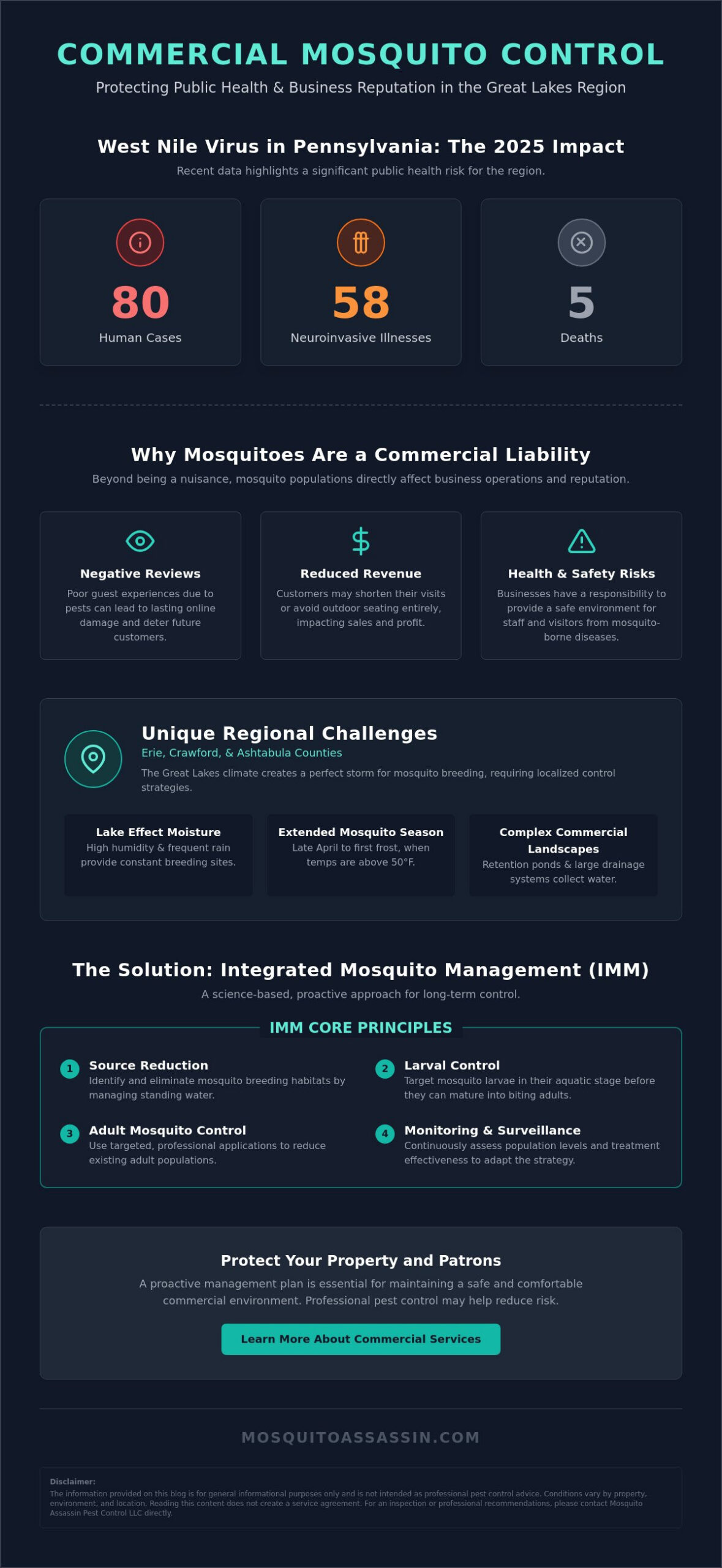
Pennsylvania recorded 80 human cases of West Nile virus in 2025, which resulted in five deaths and 58 neuroinvasive illnesses. For business owners in Northwest Pennsylvania and Northeast Ohio, these figures represent more than just health data; they represent a significant liability and a threat to daily operations. Effective commercial mosquito control is no longer just an amenity for outdoor seating, but a necessary strategy to prevent negative customer reviews and protect the public from rising health risks.
It’s understandable to feel frustrated when DIY treatments fail to cover large acreages or keep pests away during peak hours. This guide demonstrates how professional management protects reputations and ensures long-term customer comfort across Erie, Crawford, and Ashtabula counties. You’ll gain insights into Integrated Mosquito Management, regional disease trends, and practical prevention strategies that help maintain a safe, professional environment for every visitor.
Disclaimer: The information provided on this blog is for general informational purposes only and is not intended as professional pest control advice. Conditions vary by property, environment, and location. Reading this content does not create a service agreement. For an inspection or professional recommendations, please contact Mosquito Assassin Pest Control LLC directly.
Key Takeaways
- Understand why Great Lakes properties face unique pest pressures and how mosquito populations directly impact business reputation and public health.
- Learn the science behind Integrated Mosquito Management and why effective commercial mosquito control prioritizes proactive prevention over reactive treatments.
- Discover how to customize management strategies for diverse environments, ranging from high-traffic outdoor seating to sensitive locations like daycares or healthcare facilities.
- Identify practical steps property managers can take to reduce breeding sites and enhance the results of professional monitoring and maintenance.
The Importance of Commercial Mosquito Control in the Great Lakes Region
The Great Lakes region presents unique challenges for property management. High humidity levels and frequent rainfall near Lake Erie create ideal breeding grounds that can quickly overwhelm a business without a plan. For local enterprises, managing these pests isn’t just about comfort; it’s a critical operational requirement. Professional commercial mosquito control addresses the specific needs of large-scale properties that standard residential solutions simply cannot handle. Because commercial spaces often have higher foot traffic and larger footprints, the stakes for effective management are significantly higher.
To better understand this concept, watch this helpful video:
Commercial properties often feature complex landscapes, such as retention ponds, extensive parking lot drainage, and large manicured green spaces. These areas collect water differently than a standard backyard. When thousands of customers or employees move through these spaces daily, the risk of bites and the transmission of mosquito-borne illnesses increases. Effective Mosquito control strategies involve more than just reactive spraying; they require a deep understanding of how water moves across a specific commercial site. Proactive management ensures that these areas remain usable and safe throughout the season.
Protecting Your Business Reputation
In the age of instant feedback, a single negative experience can linger online for years. For the hospitality and outdoor dining sectors in Erie and Ashtabula, mosquitoes are more than a nuisance; they’re a threat to the bottom line. If guests are constantly swatting away pests, they aren’t enjoying their meal or the atmosphere. This often leads to shorter visit times and lower average checks. Beyond comfort, health is a major factor. With Pennsylvania reporting 80 human cases of West Nile virus in 2025, businesses have a responsibility to provide a safe environment for their staff and visitors. A professional environment is one where pests don’t dictate the customer experience.
Regional Challenges: Erie, Crawford, and Ashtabula Counties
The climate in Northwest Pennsylvania and Northeast Ohio dictates a specific mosquito window. Typically, activity begins as soon as temperatures consistently stay above 50 degrees, usually in late April or early May, and continues until the first hard frost. The lake effect moisture provides a steady supply of breeding sites even during drier summer months. Understanding these local patterns is essential for effective commercial mosquito control. Timing a treatment based on a generic national calendar won’t work in this specific region. Localized knowledge ensures that interventions happen before populations reach a breaking point, providing a consistent shield throughout the peak season.
Disclaimer: The information provided on this blog is for general informational purposes only and is not intended as professional pest control advice. Conditions vary by property, environment, and location. Reading this content does not create a service agreement. For an inspection or professional recommendations, please contact Mosquito Assassin Pest Control LLC directly.
Understanding Integrated Mosquito Management (IMM)
Successful commercial mosquito control relies on a methodology known as Integrated Mosquito Management (IMM). This is a science-based framework that combines multiple strategies to achieve long-term suppression of pest populations. Instead of simply reacting to an infestation after it occurs, IMM focuses on understanding the life cycle of the mosquito and intervening at the most vulnerable stages. It follows the principles of integrated pest management (IPM), which balances biological, physical, and chemical control methods to protect public health while minimizing environmental impact.
Many business owners make the mistake of waiting until customers complain before seeking help. Reactive spraying only addresses the adults currently in the air; it does nothing to stop the next generation from emerging. Professional management provides a distinct advantage over DIY methods because it involves comprehensive surveillance and a deep understanding of local regulations. In Pennsylvania and Ohio, commercial pesticide applicators must maintain specific licenses and follow strict environmental guidelines. Licensed professionals have the expertise to identify subtle breeding sites on large acreages that a property manager might overlook.
Larval Control: Stopping the Cycle
Identifying and treating breeding sites is the most effective way to manage populations. This process often begins with source reduction, which involves clearing blocked drainage systems or correcting grading issues that cause standing water. When water cannot be drained, targeted treatments are necessary. Larvicide is a targeted treatment for mosquito larvae. By neutralizing mosquitoes before they reach the adult stage, businesses can significantly reduce the overall pest pressure on their property.
Adulticide and Barrier Treatments
While larval control is vital, adulticide treatments provide the immediate relief necessary for customer comfort. Professional barrier treatments involve applying a residual spray to the foliage where adult mosquitoes rest during the day. This creates a protective perimeter around high-traffic areas like patios or entryways. Timing these applications is critical; they must be performed when pests are active but when human presence is minimal to avoid operational disruptions. For businesses managing complex landscapes, consulting with a professional for an initial property assessment may help reduce risk more effectively than off-the-shelf products.
Disclaimer: The information provided on this blog is for general informational purposes only and is not intended as professional pest control advice. Conditions vary by property, environment, and location. Reading this content does not create a service agreement. For an inspection or professional recommendations, please contact Mosquito Assassin Pest Control LLC directly.
Tailoring Mosquito Control to Different Commercial Environments
Effective commercial mosquito control requires a strategy that mirrors the specific activity and footprint of the business. A golf course in Crawford County faces different biological pressures than an industrial warehouse in Ashtabula. For large-scale recreational areas, the focus often shifts toward managing vast acreages of turf and wooded borders where mosquitoes rest during the heat of the day. In contrast, industrial sites must prioritize drainage maintenance around loading docks and flat roof systems where standing water frequently accumulates unnoticed. A “one size fits all” approach fails because it doesn’t account for how people and pests interact within a specific space.
Industrial and warehouse environments often struggle with micro-habitats. These include discarded equipment, clogged gutters, and poorly graded gravel lots that hold water after a Great Lakes storm. Because these sites are often active 24/7, treatments must be coordinated to avoid interrupting logistics chains. For healthcare facilities, the focus is on protecting vulnerable populations. This involves a rigorous inspection of HVAC condensation lines and ornamental water features that could harbor larvae. Professionals must evaluate the unique topography of every site to ensure that interventions are both effective and non-disruptive to daily operations.
Hospitality and Outdoor Dining
For restaurants and hotels, the priority is maintaining an invisible shield that doesn’t interfere with the guest experience. Strategic treatment focuses on patios, decks, and outdoor waiting areas where guests are most vulnerable. Scheduling these services during off-hours ensures that there is no contact between customers and the application process. Many business owners find that integrating these efforts with comprehensive commercial pest control services provides a more holistic defense against a variety of regional pests. This combined approach helps maintain the high standards expected in the hospitality industry while protecting the establishment’s reputation from negative online reviews.
Educational and Recreational Facilities
Facilities that serve children or the public, such as daycares and municipal parks, require the highest level of care and transparency. Safety and compliance with local regulations are the primary drivers in these environments. Management teams typically focus on playgrounds, sports fields, and common gathering areas. Following a strict Integrated Pest Management (IPM) protocol allows these facilities to reduce mosquito populations while adhering to best practices for sensitive sites. Clear communication with parents and community stakeholders regarding treatment schedules is essential for maintaining trust. It ensures everyone is informed about the property’s health and safety measures without causing unnecessary alarm.
Disclaimer: The information provided on this blog is for general informational purposes only and is not intended as professional pest control advice. Conditions vary by property, environment, and location. Reading this content does not create a service agreement. For an inspection or professional recommendations, please contact Mosquito Assassin Pest Control LLC directly.
Preparing Your Property for Professional Treatment
Professional commercial mosquito control works best when it’s a collaborative effort between the property manager and the service team. While technicians provide the technical expertise and specialized equipment, on-site preparation ensures those treatments reach their full potential. Success in Northwest Pennsylvania and Northeast Ohio depends on a proactive approach. By focusing on habitat modification, businesses can significantly extend the efficacy of their management plan. This partnership creates a more resilient environment that is less attractive to pests.
Preparation begins with a thorough walkthrough of the exterior grounds. Large commercial sites often contain hidden water reservoirs that go unnoticed during daily operations. These micro-habitats can undermine even the most rigorous treatment schedules if left unaddressed. Access is key. If a technician can’t reach a utility yard or a fenced storage area, those zones become safe havens for pests. Clear paths and unlocked gates allow for a comprehensive application across the entire footprint of the business.
Eliminating Breeding Sites
Source reduction is the most sustainable way to lower pest pressure on a large acreage. Property managers should prioritize the inspection of flat roofs, clogged gutters, and loading dock drains where water frequently stagnates. Discarded equipment, such as old tires or plastic tarps, can collect enough rainfall to support hundreds of larvae. In parking lots, sunken catch basins or poorly graded gravel areas often hold water for days after a Great Lakes storm. Removing standing water is the most effective form of physical control. Managing these runoff issues prevents the property from serving as a nursery for the next generation of mosquitoes.
Logistics and Scheduling
Coordination with other facility teams is essential for a seamless experience. Landscape contractors should be informed of the treatment schedule to avoid heavy pruning or leaf blowing immediately after an application. It’s also vital to manage automatic irrigation systems. Watering the lawn or ornamental beds right after a treatment can wash away residual products before they have time to bond with the foliage. Most professionals suggest a dry time of at least 30 to 60 minutes for optimal results. Reviewing the specific details of your mosquito control program helps align these logistical needs with your operational hours.
Effective communication with staff is the final step. Informing employees about upcoming activities ensures they don’t enter treated areas while products are still wet. This transparency builds trust and maintains a professional atmosphere. For businesses looking to establish a robust defense, investing in professional commercial mosquito control may help reduce risk and improve overall property comfort.
Disclaimer: The information provided on this blog is for general informational purposes only and is not intended as professional pest control advice. Conditions vary by property, environment, and location. Reading this content does not create a service agreement. For an inspection or professional recommendations, please contact Mosquito Assassin Pest Control LLC directly.
The Value of Professional Monitoring and Maintenance
Relying on a single treatment to last an entire season is a common misconception that can leave a business vulnerable. Mosquitoes can progress from egg to adult in as little as seven to ten days depending on the heat and humidity levels of the Great Lakes region. Because of this rapid life cycle, one-time interventions provide only temporary relief. Effective commercial mosquito control requires ongoing monitoring to ensure that protective barriers remain intact and that new breeding sites are identified before they can produce a new generation of pests.
Consistent management leads to predictable results. When a property is maintained on a regular schedule, the cumulative effect of larval control and adulticide treatments creates a significantly lower baseline population. This stability is vital for businesses that host outdoor events or provide patio dining. Instead of oscillating between pest-free days and sudden infestations, a professional program keeps activity at a manageable level throughout the peak months. This reliability allows management to focus on daily operations rather than managing customer complaints about pests.
Surveillance and Data-Driven Adjustments
Surveillance is the backbone of a successful long-term strategy. It involves more than just scheduled visits; it requires a detailed analysis of how local conditions affect pest behavior. For businesses in Erie and Crawford Counties, weather patterns can shift rapidly. Heavy rainfall or unseasonable heat spikes can trigger sudden population surges that require immediate attention. Professionals use regular property inspections to identify these changing pressures and adjust treatment frequencies or methods accordingly. Working with experts who are familiar with the specific climate of Northwest Pennsylvania and Northeast Ohio ensures that your management plan is responsive to the actual risks present on your acreage.
Conclusion and Next Steps
Protecting a commercial reputation requires a shift from reactive problem-solving to proactive management. The data from 2025, which saw 80 human West Nile virus cases in Pennsylvania, underscores the public health importance of these efforts. A comprehensive approach that includes Integrated Mosquito Management, source reduction, and professional monitoring provides the best defense for employees and customers alike. It’s about creating a safe, professional environment where visitors feel comfortable and protected from seasonal pests. For property managers looking to secure their grounds, professional pest control may help reduce risk and improve property comfort. To discuss a tailored strategy for your facility, contacting a professional for an initial property assessment is an effective first step.
Disclaimer: The information provided on this blog is for general informational purposes only and is not intended as professional pest control advice. Conditions vary by property, environment, and location. Reading this content does not create a service agreement. For an inspection or professional recommendations, please contact Mosquito Assassin Pest Control LLC directly.
Securing Your Property for the Season Ahead
Effective commercial mosquito control requires more than a reactive spray; it demands a disciplined, science-based approach tailored to the unique topography of Northwest Pennsylvania and Northeast Ohio. By prioritizing Integrated Mosquito Management (IMM) and maintaining consistent monitoring, property managers protect their reputations and ensure customer comfort. Identifying hidden breeding sites and coordinating with landscape teams creates a resilient environment that discourages pest populations before they peak.
Utilizing a licensed and insured professional service provides the localized expertise needed to navigate regional disease trends and environmental regulations. A comprehensive approach ensures that every loading dock, patio, and green space remains a safe, professional environment. For an inspection or professional recommendations, please contact Mosquito Assassin Pest Control LLC directly. Taking a proactive stance on pest management is the most effective way to maintain property standards throughout the Great Lakes summer.
Disclaimer: The information provided on this blog is for general informational purposes only and is not intended as professional pest control advice. Conditions vary by property, environment, and location. Reading this content does not create a service agreement. For an inspection or professional recommendations, please contact Mosquito Assassin Pest Control LLC directly.
Frequently Asked Questions
Is commercial mosquito control effective for very large properties?
Professional methods are highly effective for large acreages because they utilize specialized equipment and comprehensive surveillance. Technicians identify breeding sites across vast properties, such as retention ponds or drainage ditches, that standard residential tools often miss. By combining larval control with adulticide barriers, commercial mosquito control provides a scalable solution for golf courses, parks, and industrial complexes.
How often should a commercial property be treated for mosquitoes?
Most commercial properties require treatment every 21 to 30 days during the active season. This frequency ensures that the protective barrier remains strong and interrupts the mosquito life cycle before new adults emerge. In regions like Erie and Crawford Counties, treatments usually begin in late spring and continue through the first hard frost of autumn.
Is professional mosquito control safe for areas where food is served?
Professional treatments are designed for use around outdoor dining areas when applied according to strict safety protocols. Technicians focus on the surrounding foliage and resting areas rather than the tables or food preparation surfaces. Scheduling these applications during off-hours ensures that the product is dry before guests arrive, maintaining a professional and safe environment for patrons.
Can mosquito treatments be scheduled to avoid business hours?
Coordination with business hours is a standard part of professional service. Most providers offer early morning or late evening appointments to ensure treatments occur when customers and employees are not present. This minimizes operational disruption and allows the product sufficient time to dry before the property reopens for daily traffic.
What is the difference between residential and commercial mosquito services?
Commercial services address more complex environments than residential yards, focusing on large-scale drainage, parking lot runoff, and high-traffic liability. Commercial mosquito control also involves more rigorous documentation and compliance with state regulations in Pennsylvania and Ohio. While residential service focuses on a single backyard, commercial management looks at the entire ecosystem of a business footprint.
How long does a professional mosquito treatment last on a commercial site?
A professional treatment typically provides effective residual control for approximately three to four weeks. Environmental factors like heavy Great Lakes rainfall or extreme UV exposure can impact this duration. Ongoing monitoring allows technicians to adjust the schedule if population spikes occur between regular visits, ensuring consistent protection.
Does commercial mosquito control also help with ticks?
Yes, the barrier treatments used for mosquitoes are often effective against ticks as well. By treating the woodlines and tall grasses where both pests reside, businesses can reduce the risk of multiple pest-borne illnesses. This dual protection is particularly valuable for recreational facilities, schools, and businesses with large wooded borders.
What happens if it rains shortly after a professional treatment?
Most professional products are rain-fast once they have had 30 to 60 minutes to dry and bond with the foliage. If a light rain occurs after this window, the treatment remains effective and won’t wash away. If a significant storm occurs immediately after application, a professional provider will typically monitor the site and re-treat if the protective barrier was compromised.
Disclaimer: The information provided on this blog is for general informational purposes only and is not intended as professional pest control advice. Conditions vary by property, environment, and location. Reading this content does not create a service agreement. For an inspection or professional recommendations, please contact Mosquito Assassin Pest Control LLC directly.