
What if the lowest quote you receive for pest management this year is actually the most expensive mistake you’ll make for your home’s long-term health? With over 80% of homeowners in the United States reporting pest issues in a single calendar year, according to industry surveys from 2023, many are searching for clarity on pest control prices 2026 to avoid financial surprises. It’s common to feel a sense of dread when you spot a line of ants in your kitchen or hear a rustle in the attic, especially when you’re worried about hidden fees or the safety of treatments used around your family. You want a solution that works so you don’t have to worry about the well-being of your children or pets.
This guide provides a clear understanding of the specific variables that influence professional service costs. It explores how service frequency and modern integrated pest management techniques impact the total value of professional protection in Erie County, Crawford County, and Ashtabula County. This overview breaks down the technical factors local providers use to build service models, safeguarding your home while providing the knowledge you need to prevent future infestations and maintain a healthy environment.
Disclaimer: The information provided on this blog is for general informational purposes only and is not intended as professional pest control advice. Conditions vary by property, environment, and location. Reading this content does not create a service agreement. For an inspection or professional recommendations, please contact Mosquito Assassin Pest Control LLC directly.
Key Takeaways
- Discover how modern pest management prioritizes property protection and public health through sustainable, science-based methodologies.
- Learn how structural characteristics, including property square footage and architectural accessibility, influence the allocation of professional resources.
- Understand the distinction between emergency remediations and recurring maintenance plans to better evaluate pest control prices 2026 for residential properties.
- Identify how regional environmental factors and proximity to Lake Erie affect pest pressures specifically in Erie, Crawford, and Ashtabula counties.
- Verify essential professional standards by checking state-issued licenses, insurance coverage, and local community reputations.
Understanding the Value of Professional Pest Management in 2026
Professional pest management in 2026 is a sophisticated intersection of biology and building science. Homeowners in Erie County or Ashtabula County aren’t just paying for a technician to spray a baseboard; they’re investing in a comprehensive health and property protection service. Effective Pest control methods now rely on data-driven insights rather than the broad-spectrum applications common decades ago. This shift ensures that treatments are precise and effective while minimizing unnecessary chemical exposure.
Understanding pest control prices 2026 requires looking at the total value of these advanced methodologies. Modern intervention is more than just applying a product to a surface. It involves a deep understanding of pest life cycles and how they interact with the specific climate of the Great Lakes region.
The Evolution of Pest Management Standards
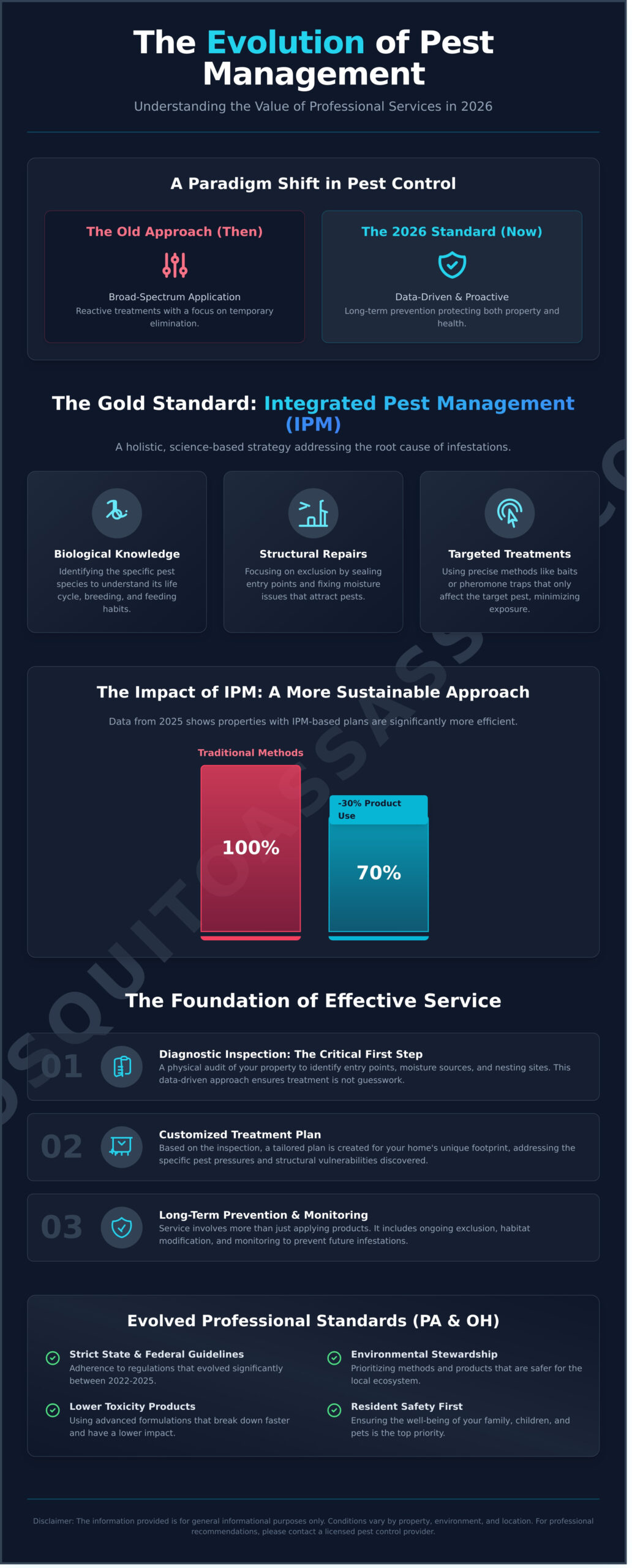
By 2026, industry standards have moved away from temporary elimination tactics. Modern protocols prioritize long-term prevention. Licensed professionals in Pennsylvania and Ohio must adhere to strict state and federal guidelines that evolved significantly between 2022 and 2025. These regulations emphasize environmental stewardship and safety for residents. Professionals now use products with lower toxicity profiles that break down faster in the environment. This evolution means that a service visit in 2026 involves more time spent on exclusion and habitat modification than on applying liquids. Hiring a licensed professional ensures these updated safety standards are met on your property.
Why Professionals Use Integrated Pest Management
Integrated Pest Management (IPM) is the gold standard for 2026. It’s a holistic strategy that combines biological knowledge with structural repairs and targeted treatments. This approach is highly effective because it addresses the root causes of an infestation. Components of a standard IPM plan include:
- Biological Knowledge: Identifying the specific species to understand its breeding and feeding habits.
- Structural Repairs: Sealing entry points and fixing moisture issues that attract pests.
- Targeted Treatments: Using baits or pheromone traps that only affect the target pest.
IPM reduces the need for frequent chemical applications over time. In fact, data from 2025 indicates that properties utilizing IPM-based plans often require 30 percent fewer product applications than those using traditional methods. This approach focuses on the “why” of an infestation, not just the “what.”
Everything starts with the diagnostic inspection. This is the most critical part of the process and a key factor in determining pest control prices 2026 for a specific property. It’s a physical audit where technicians look for entry points, moisture sources, and nesting sites. In Crawford County, for example, an inspection might reveal that a damp basement is the primary driver of a centipede problem. Without this diagnostic step, any treatment is just guesswork. The inspection determines the necessary scope of work and ensures the treatment plan is customized for your home’s unique footprint.
Professional pest control may help reduce risk for homeowners seeking to protect their investment and their family’s health. For an assessment of your property, you can visit the online booking portal to schedule a consultation with a local expert.
Factors That Influence Professional Pest Control Service Models
Professional service models are built on the specific needs of a structure, and they’ve evolved to be highly data-driven. A technician doesn’t simply arrive and apply product; they calculate the necessary resources based on the property’s unique profile. Total square footage remains the primary metric for resource allocation. For instance, a property exceeding 3,500 square feet typically requires 45% more inspection time than a standard 1,500-square-foot residential unit. This isn’t just about the interior living space. Technicians must evaluate the entire perimeter, including detached garages and sheds, which often serve as primary nesting sites for wood-destroying organisms.
Architectural style and age significantly dictate accessibility and labor intensity. Older homes in Erie County often feature fieldstone foundations or complex rooflines that create hidden voids. If a home has a crawl space with less than 18 inches of clearance, the difficulty of the job increases. Technicians may spend an additional 40 minutes navigating these tight quarters to identify termite mud tubes or moisture-related vulnerabilities. Identifying these entry points is a critical step in long-term prevention. Adhering to EPA Pest Control Guidelines ensures that these structural interventions are handled with professional standards of safety and efficacy. When evaluating pest control prices 2026, homeowners should recognize that these labor-intensive inspections are what prevent costly structural damage later.
Property Size and Structural Complexity
Larger properties or multi-unit buildings in Ashtabula County require more extensive monitoring because of the increased number of “micro-climates” within the structure. A multi-story home has more plumbing penetrations and wall voids than a single-story slab home. Crawl spaces, attics, and basements are high-traffic areas for pests seeking shelter from the Great Lakes climate. Outdoor structures like decks and sheds also expand the service area. A deck with low ground clearance can harbor thousands of insects, necessitating specialized equipment to reach the soil beneath the boards. Homeowners in Crawford County seeking a professional assessment can schedule an inspection online to identify these specific property risks.
Target Species and Infestation Severity
The biology of the target species is a major driver of service complexity. Common household pests like nuisance ants require different strategies than wood-destroying organisms like termites or carpenter ants. Termites, for example, require specialized liquid barriers or baiting systems that involve drilling into concrete or trenching around the foundation. Established infestations are more difficult to manage than preventative accounts. In 2024, data indicated that remediating a heavy German cockroach infestation takes three times as many man-hours as a standard preventative treatment. Specialized equipment, such as high-heat systems for bed bugs or borescope cameras for wall inspections, is often necessary for these intensive remediations. Understanding these variables helps clarify why pest control prices 2026 are tailored to the biological reality of the infestation rather than a flat rate.
Service frequency also plays a role in maintaining a pest-free environment. Most professional models utilize quarterly or bi-monthly visits to break the reproductive cycles of common pests. Consistent monitoring allows technicians to catch structural vulnerabilities, such as weather-stripping failure or new cracks in the foundation, before they become entry points for local wildlife. This proactive approach is the industry standard for minimizing the need for heavy chemical applications.
Disclaimer: The information provided on this blog is for general informational purposes only and is not intended as professional pest control advice. Conditions vary by property, environment, and location. Reading this content does not create a service agreement. For an inspection or professional recommendations, please contact Mosquito Assassin Pest Control LLC directly.
One-Time Remediation vs. Ongoing Protection Plans
Choosing between a single service and a recurring plan is a primary decision for homeowners in Erie and Crawford Counties. One-time treatments target immediate, visible threats, while recurring plans focus on long-term exclusion and monitoring. Understanding how service frequency affects pest control prices 2026 is essential for long-term budgeting. While a single visit might seem cost-effective initially, it often fails to address the underlying environmental factors that invite pests into a structure.
The Logistics of One-Time Treatments
A one-time service is appropriate for isolated, acute issues. A common example is the discovery of a bald-faced hornet nest attached to a second-story eave or a yellow jacket colony in a flower bed. These situations require a specific, localized response to eliminate an immediate safety hazard. However, reactive treatments have significant limitations. Approximately 65% of residential pest issues stem from recurring environmental pressures rather than isolated incidents. A single visit addresses the active pests but rarely impacts the eggs or larvae hidden within wall voids or crawlspaces.
Reactive calls often focus on the symptoms rather than the root cause. If a homeowner in Ashtabula County requests a one-time spray for ants, the treatment may kill the foragers but leave the queen and the colony intact deep underground. Without a follow-up, the infestation typically rebounds within 30 to 45 days. Furthermore, emergency service calls often carry a higher per-visit cost because they require rapid dispatch and intensive labor to handle a full-blown infestation that has likely been growing for months.
Benefits of Year-Round Protection Programs
Ongoing protection programs shift the strategy from “search and destroy” to “monitor and prevent.” Professional services utilize Integrated Pest Management (IPM) to create a hostile environment for invaders through non-chemical and targeted chemical means. This approach relies on a deep understanding of pest biology and seasonal behavior. In Western Pennsylvania and Northeast Ohio, pests follow a predictable calendar. Spring brings the emergence of ants and stinging insects, while the cooling temperatures of October drive rodents toward the warmth of home foundations.
A quarterly protection plan ensures a technician inspects the property every 90 days. This frequency is critical because it aligns with the life cycles of most common household pests. Consistent monitoring allows for the identification of early warning signs that a one-time visitor would miss, such as the small mud tubes of subterranean termites or the distinctive frass left by carpenter ants. Professional pest control may help reduce risk for homeowners by reinforcing the exterior perimeter barrier before these pests can establish a foothold inside the living space.
The predictability of scheduled visits offers a logistical advantage over reactive calls. Homeowners can budget for a fixed annual cost rather than facing the uncertainty of emergency remediation fees. While emergency calls address immediate fears, the structure of pest control prices 2026 usually favors the consistency of a protection plan. These programs often include re-treatment guarantees, meaning if pests appear between scheduled visits, the technician returns to resolve the issue at no additional cost. This provides a level of financial and operational security that one-time services cannot match.
Disclaimer: The information provided on this blog is for general informational purposes only and is not intended as professional pest control advice. Conditions vary by property, environment, and location. Reading this content does not create a service agreement. For an inspection or professional recommendations, please contact Mosquito Assassin Pest Control LLC directly.
Regional Considerations for Pennsylvania and Ohio Homeowners
The unique geography of Erie and Crawford counties in Pennsylvania, alongside Ashtabula County in Ohio, creates specific challenges for property owners. Proximity to Lake Erie acts as a primary driver for insect and rodent activity. High humidity levels, which frequently peak above 80% during July and August, provide an ideal breeding ground for moisture-reliant pests. When researching pest control prices 2026, it’s vital to account for these localized environmental factors that influence the frequency of necessary treatments.
Moisture-loving pests like earwigs, silverfish, and centipedes thrive in the damp basements and crawlspaces common to this region. The lake effect also contributes to sudden temperature shifts. A rapid 15-degree drop in late September often serves as a biological trigger for rodents to seek shelter indoors. Understanding these patterns is a hallmark of effective pest control in local areas, as generic national strategies often miss these subtle, climate-driven cues that dictate pest behavior in the Great Lakes region.
Seasonal Pest Pressures in the Tri-County Area
The transition from winter to spring in Northwest Pennsylvania typically brings a surge in carpenter ant activity. As soil temperatures rise above 50 degrees, these insects begin foraging for food and moisture within residential structures. By mid-summer, stinging insects like yellow jackets and bald-faced hornets reach peak colony size, often requiring professional intervention in suburban backyards. Autumn shifts the focus toward exclusion. In Northeast Ohio, house mice can enter through gaps as small as a quarter-inch (6 millimeters), making structural seals a priority before the first frost hits in October.
Environmental Factors in PA and OH
Soil composition varies significantly across the Tri-County area. The sandy soils near the Lake Erie shoreline facilitate different subterranean termite movement patterns compared to the heavy clay found further inland in Crawford County. Dense vegetation and wooded lots, which cover approximately 58% of rural Pennsylvania land, also contribute to high tick population densities. Local expertise is superior to national approaches because it accounts for these specific ecological niches. Understanding the variables that impact pest control prices 2026 helps homeowners budget for year-round protection that addresses these specific environmental triggers.
Homeowners often find that proactive monitoring is the most cost-effective way to manage these regional pressures. Detailed inspections can identify vulnerabilities before they become expensive infestations. For those seeking more information on protecting their property, scheduling a professional inspection can provide clarity on current pest activity levels.
Evaluating Professional Standards and Service Quality
Selecting a provider based only on the lowest quote often leads to recurring infestations and unexpected expenses. When analyzing pest control prices 2026, property owners should weigh the total cost against the technician’s specialized training and the company’s legal standing. A suspiciously low price point might indicate a lack of proper insurance or shortcutting essential safety protocols. High-quality service is defined by total transparency; this starts at the initial inspection and continues through the final follow-up. Hiring an uncertified individual carries significant financial and physical risks for a household. In Pennsylvania and Ohio, licensed technicians undergo rigorous testing and continuing education to handle pesticides safely and effectively. Data from 2024 indicates that roughly 15 percent of residential property damage claims related to pest work involve unlicensed services. This is why professional standards matter more than a bargain price.
Verifying Licensing and Insurance
A reputable local pest control company will readily provide proof of their state-issued license and comprehensive liability insurance. This documentation ensures the property owner isn’t held responsible for accidental damage or injuries occurring during the treatment process. Professional certification also guarantees that the applicator adheres to Integrated Pest Management (IPM) standards, prioritizing long-term prevention over temporary chemical fixes.
Assessing Service Guarantees and Reviews
Service-based guarantees are more reliable than “money-back” claims, which often include complex fine print that makes a refund difficult to secure. If pests return within 21 to 30 days, the company should return to re-treat the area at no additional charge. To get an accurate baseline for a specific property, contact a licensed professional for a formal assessment of the biological pressure on the home.
A written service agreement is a non-negotiable part of professional pest management. This document should clearly outline the specific pests being targeted, the frequency of visits, and the specific methods used. Professional technicians don’t just apply product and leave; they provide a detailed explanation of the process. They identify conducive conditions, such as clogged gutters or wood-to-soil contact, that contribute to the infestation. Clear communication is the primary hallmark of a quality provider. If a technician can’t explain the life cycle of the pest or why a specific treatment was chosen, the service quality is likely insufficient. Detailed reporting and clear communication justify a higher price point because they focus on total eradication rather than just temporary suppression. In areas like Erie, Crawford, and Ashtabula counties, localized expertise is what ensures pest control prices 2026 translate into long-term property protection. This methodical approach separates professional services from basic, ineffective applications.
Securing Property Health through Proactive Management
Effective pest management in 2026 relies on a data-driven approach to identify risks before they escalate into costly infestations. Homeowners in Erie and Crawford counties in Pennsylvania, along with those in Ashtabula County, Ohio, benefit most from service models that prioritize long-term prevention over reactive treatments. Industry data suggests that proactive Integrated Pest Management programs can reduce pest-related property damage by over 40% compared to reactive measures. Evaluating pest control prices 2026 involves balancing the initial service cost against the substantial value of safeguarding a home’s integrity. Professionals who are licensed and insured in PA and OH provide essential expertise while using family-safe methods that align with modern environmental standards. Choosing a locally owned and operated provider ensures that treatments are tailored to the specific climate and pest pressures of the tri-state region. Professional pest control may help reduce risk. For an inspection, visit mosquitoassassin.com. Maintaining a pest-free environment is an achievable goal with the right professional guidance.
Disclaimer: The information provided on this blog is for general informational purposes only and is not intended as professional pest control advice. Conditions vary by property, environment, and location. Reading this content does not create a service agreement. For an inspection or professional recommendations, please contact Mosquito Assassin Pest Control LLC directly.
Frequently Asked Questions
Is professional pest control worth the investment in 2026?
Professional pest control remains a vital investment for property protection because it prevents long-term structural damage that DIY methods often miss. In 2026, homeowners face evolving pest pressures that can lead to significant repair bills. For instance, termites alone cause over 5 billion dollars in property damage across the United States every year. Investing in pest control prices 2026 ensures that a licensed professional identifies vulnerabilities before they become expensive emergencies.
How often should a home receive professional pest inspections?
Most residential properties benefit from a professional inspection at least 4 times per year to catch infestations in their early stages. Quarterly visits allow technicians to monitor seasonal shifts in insect behavior and apply preventative barriers. This frequency is especially important in older homes where small cracks or foundational shifts occur more frequently. Regular monitoring helps maintain a consistent defensive perimeter around the home’s exterior throughout the changing seasons.
What factors determine the cost of a pest control plan?
Total costs are primarily determined by the square footage of the structure and the specific biological needs of the target pest. A standard 2,000 square foot home requires different resources than a smaller apartment or a larger estate. The severity of the infestation also plays a role; a localized issue is less resource-intensive than a multi-room colony. Technicians evaluate these physical variables to create a strategy that addresses the unique environment of the property.
Are professional treatments safe for households with children and pets?
Professional treatments are designed with the safety of children and pets as a primary priority by utilizing Integrated Pest Management (IPM) techniques. Licensed technicians use EPA-registered products and apply them in targeted areas where family members and animals don’t typically roam. This scientific approach minimizes exposure while maximizing the impact on the target pests. It’s always best to follow the specific re-entry instructions provided by the technician after an application is completed.
Does property size affect the frequency of pest services?
Property size generally affects the duration of each service visit rather than the frequency of the treatments themselves. A technician might spend 60 minutes treating a large acreage property compared to 30 minutes for a smaller suburban lot. Regardless of the home’s footprint, the biological life cycles of pests like ants or spiders remain the same. Service frequency is typically scheduled to disrupt these specific reproductive cycles to ensure long-term control.
Why do some pests require specialized treatment protocols?
Specialized protocols are necessary because different species have unique nesting habits, diets, and survival instincts. For example, there are over 12,000 species of ants globally; a treatment for pavement ants won’t necessarily work for carpenter ants. Some pests, like bed bugs, require high-heat treatments or specific chemical rotations to overcome physiological resistances. A one-size-fits-all approach fails to account for these biological differences, making specialized knowledge essential for successful eradication.
Can seasonal weather changes in PA and OH impact service needs?
Weather patterns in Erie and Crawford Counties in PA, as well as Ashtabula County in OH, significantly influence when pests seek shelter indoors. When temperatures drop below 32 degrees Fahrenheit, rodents and overwintering insects look for warmth inside wall voids and attics. Conversely, heavy spring rains in the tri-county area often flush subterranean pests like ants toward higher ground. Understanding these local climate shifts allows for proactive adjustments to pest control prices 2026 and service timing.
Disclaimer: The information provided on this blog is for general informational purposes only and is not intended as professional pest control advice. Conditions vary by property, environment, and location. Reading this content does not create a service agreement. For an inspection or professional recommendations, please contact Mosquito Assassin Pest Control LLC directly.