
The first itchy bite isn’t the signal to start your defense; it’s a sign that you’ve already lost the first battle of the season. Many homeowners in Erie and Crawford counties wait until the humidity peaks in July to take action, but finding the best time for mosquito yard treatment starts much earlier. It’s common to feel frustrated after spending money on hardware store sprays that don’t seem to work, or to feel a sense of anxiety when your children can’t play in the grass without being swarmed by pests.
You deserve a backyard that’s a sanctuary, not a hazard zone. This guide reveals the precise 50 degree temperature threshold and early spring windows required to effectively disrupt the mosquito life cycle before it gains momentum. By understanding professional timing, you can ensure a higher return on your investment and maintain a mosquito free yard for the duration of the 2026 summer. This overview examines the specific biological triggers for local species in Northwest Pennsylvania and Northeast Ohio to help you set clear expectations for treatment frequency.
Disclaimer: The information provided on this blog is for general informational purposes only and is not intended as professional pest control advice. Conditions vary by property, environment, and location. Reading this content does not create a service agreement. For an inspection or professional recommendations, please contact Mosquito Assassin Pest Control LLC directly.
Key Takeaways
- Learn why 50 degrees Fahrenheit is the critical biological trigger for activity and how this temperature dictates the start of the season in Pennsylvania and Ohio.
- Understand the specific April through October window for Erie and Crawford Counties, including how the Lake Erie shoreline influences local hatching schedules.
- Identify the 21 to 30 day maintenance cycle required to sustain protection, helping homeowners determine the best time for mosquito yard treatment throughout the summer.
- Discover the science behind peak feeding times at dawn and dusk and how professional application methods ensure coverage during various environmental conditions.
- Explore the benefits of Integrated Pest Management (IPM) and why consistent seasonal protection plans are more effective than one-time applications.
Understanding the Mosquito Life Cycle and Temperature Thresholds
Mosquito activity isn’t a matter of luck; it’s a biological process driven by the thermometer. For residents in Erie and Crawford Counties in Pennsylvania and Ashtabula County in Ohio, the spring thaw marks the beginning of a complex biological countdown. Understanding the mosquito life cycle reveals that these pests don’t just appear out of nowhere when summer hits. Instead, they wait for specific environmental triggers to emerge from their winter slumber.
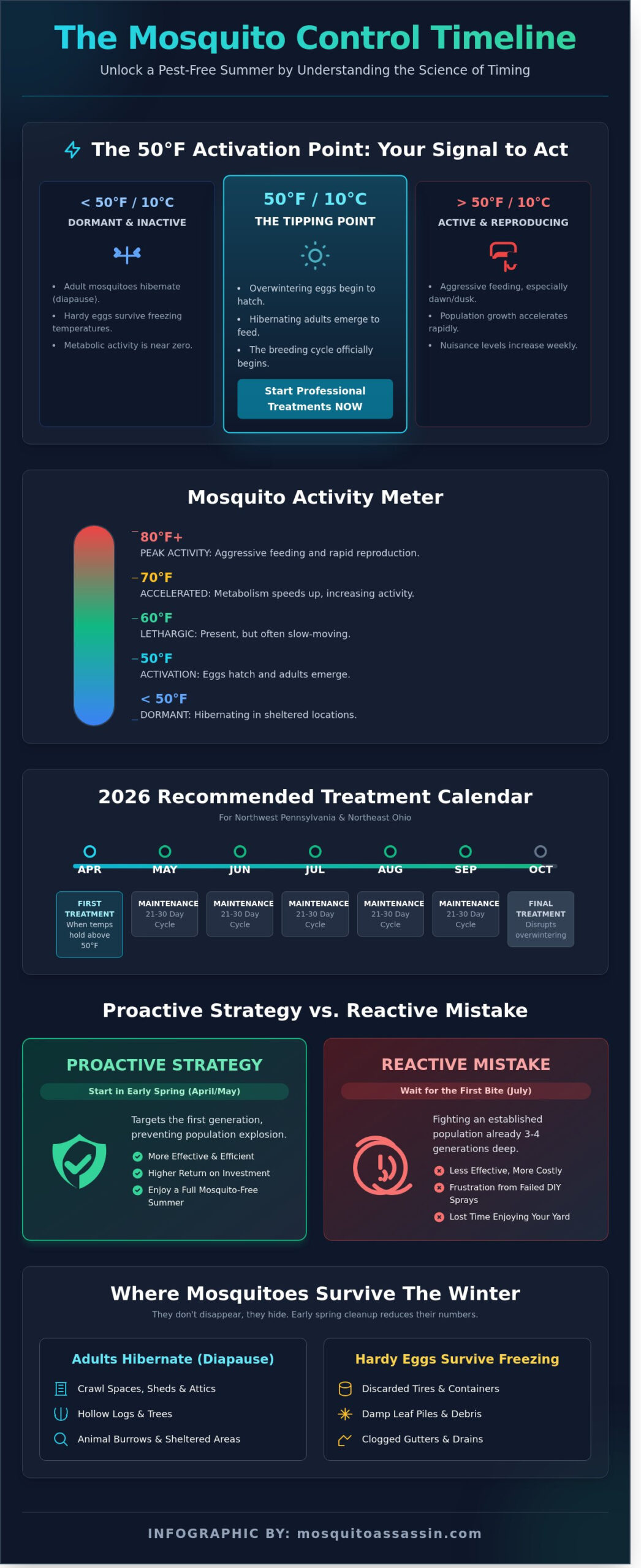
Professional pest control experts identify 50 degrees Fahrenheit as the critical tipping point for insect metabolic activity. Once the thermometer stays at or above this mark for several consecutive days, dormant eggs begin to hatch and adults emerge from hibernation. Determining the best time for mosquito yard treatment requires tracking these local weather patterns rather than following a fixed date on the calendar.
To better understand this concept, watch this helpful video:
The Role of Temperature in Mosquito Activity
Temperature acts as a throttle for mosquito behavior and development. When the air stays around 60 degrees, mosquitoes often appear lethargic and slow-moving; they’re present but not yet at peak nuisance levels. However, once temperatures climb to a consistent 70 degrees, their metabolism accelerates, leading to aggressive feeding and rapid reproduction cycles. Overnight lows are equally important, as sustained warmth after dark allows eggs in standing water to hatch without interruption. Professional technicians view a consistent 50-degree daily average as the definitive signal to begin seasonal property protection.
Overwintering and Diapause: Why Pests Return
Mosquitoes have evolved sophisticated survival mechanisms to endure the harsh winters of Western Pennsylvania and Northeast Ohio. Many species, such as those in the Culex genus, enter a state called diapause, which is a form of hibernation where their metabolism slows to a crawl. They seek shelter in hollow logs, animal burrows, or even the crawl spaces of homes. Other species, like the aggressive Asian Tiger mosquito, leave behind hardy eggs that can survive freezing temperatures by nesting in damp leaf litter or the microscopic film of water inside a discarded tire. These eggs are incredibly resilient, often requiring only a small amount of moisture and a few warm days to activate.
Early season yard maintenance is a practical step that supports professional efforts. Clearing out heavy leaf piles and refreshing mulch can remove the insulating layers that protect these dormant populations. Waiting until the first bite occurs usually means the population is already three or four generations deep. Proactive timing ensures that the best time for mosquito yard treatment happens before the first major hatch of the season saturates the local environment. Addressing larvae in stagnant water sources during the early spring is significantly more efficient than trying to manage a massive cloud of flying adults in July.
For an evaluation of your property, professional pest control may help reduce risk. You can find more information or request a visit at https://portal.gorilladesk.com/mosquitoassassin.
Disclaimer: The information provided on this blog is for general informational purposes only and is not intended as professional pest control advice. Conditions vary by property, environment, and location. Reading this content does not create a service agreement. For an inspection or professional recommendations, please contact Mosquito Assassin Pest Control LLC directly.
Seasonal Timing: When to Schedule the First Treatment in PA and OH
Residents in Erie and Crawford Counties often see the first mosquito activity as early as mid-April. This window marks the best time for mosquito yard treatment because the average daily temperature consistently reaches 50 degrees Fahrenheit. At this specific thermal threshold, mosquito eggs that have overwintered in the soil or stagnant water begin the process of hatching. If treatments start after the population has already surged, property owners are forced into a reactive cycle rather than a preventive one.
The Lake Erie shoreline creates a unique microclimate for properties in Ashtabula and Erie. The lake acts as a massive heat sink, often keeping shoreline temperatures 5 to 8 degrees cooler than inland areas like Meadville during the early spring. This temperature variance can delay the first hatch by 7 to 10 days for lakeside homes. Conversely, as the water warms in late summer, it retains heat, extending the mosquito season well into October for those same coastal properties.
Professional monitoring accounts for the fluctuating spring weather common in Northwest Pennsylvania and Northeast Ohio. A single warm weekend in March isn’t enough to trigger a full hatch; it requires sustained warmth and specific moisture levels. Licensed technicians track these local weather patterns to ensure the initial application occurs at the precise moment when it will be most effective against emerging larvae.
The Importance of Pre-Season Prevention
Targeting the initial hatch is a strategic move that dictates the comfort of a yard for the rest of the year. A single female mosquito can lay up to 300 eggs at a time, and those offspring can reach maturity in as little as 7 days during peak conditions. By disrupting the breeding cycle in April or May, the total seasonal volume of pests is drastically reduced. Following CDC mosquito control guidelines helps property owners identify and eliminate these early breeding sites before they become unmanageable.
This proactive approach relies on the “knockdown” effect. This term refers to the immediate reduction of the adult population that survived the winter or emerged during the first spring thaw. Eliminating these “colonizer” mosquitoes prevents them from establishing a permanent presence on the property. Professional pest control may help reduce risk during these critical transition months. For those looking to establish a schedule, the online booking portal provides options for early-season inspections.
Regional Climate Factors for Lake Erie Counties
Climate determines the end-of-season schedule just as much as the beginning. The typical first hard frost in Erie and Crawford Counties usually occurs between October 1st and October 15th. Until a sustained frost happens, mosquitoes remain biologically active and capable of biting. This means the best time for mosquito yard treatment actually spans a full six or seven months, depending on the year’s specific weather trends.
Local landmarks and environments also dictate treatment urgency. Properties near wooded areas in Conneaut Lake or the wetlands surrounding Geneva-on-the-Lake often require earlier attention. These environments retain moisture and provide more insulation for overwintering pests than open suburban lots. Identifying these high-risk zones early in the spring allows for a more customized and effective treatment plan that addresses the specific biology of the local environment.
Daily and Environmental Factors for Treatment Effectiveness
Mosquitoes follow a strict biological clock. Most species are crepuscular, meaning they’re most active during the low-light hours of dawn and dusk. During the heat of a 90-degree summer afternoon, these insects seek shelter to avoid desiccation. They hide in tall grass, dense brush, and the underside of broad-leafed plants. This behavior is a primary reason why many homeowners believe evening is the only best time for mosquito yard treatment. While DIY foggers often require timing with active flight periods, professional-grade equipment changes the strategy. High-powered mist blowers create a fine spray that penetrates deep into thick foliage, reaching the cool, damp resting sites where mosquitoes spend 90% of their day.
Environmental conditions dictate the success of any application. Wind speeds exceeding 10 miles per hour can cause product drift, moving the treatment away from the targeted harborage areas and toward non-target zones. Humidity also plays a role. High humidity levels, common in Erie and Ashtabula counties, actually help some products adhere to leaf surfaces, though excessive moisture from heavy dew or fog can dilute the solution before it dries on the plant.
Best Time of Day for Professional Application
Professional technicians prioritize the areas where mosquitoes rest. By focusing on the underside of leaves and shaded perimeters, treatments remain effective regardless of whether the insects are currently flying. This targeted approach also protects beneficial insects. Technicians avoid spraying active blooms where bees and butterflies forage during midday. This careful timing ensures the treatment hits the pests while keeping the local ecosystem safe.
A Backyard Mosquito Control Guide emphasizes that understanding these resting patterns is key to long-term reduction. Because mosquitoes are weak fliers, they stay close to these treated zones. When they land on the underside of a leaf to escape the sun, they come into contact with the residual product, leading to a significant drop in the local population within 24 to 48 hours.
Weather Considerations: Rain and Wind
Precipitation is the most common disruptor of a treatment schedule. Most professional products require a rainfast window of 30 to 60 minutes. Once the product has completely dried on the foliage, it’s typically resistant to light or moderate rainfall. If a heavy thunderstorm hits within minutes of application, the product may wash away before it can bond to the plant surfaces. Professionals monitor local radar closely to ensure every application has sufficient time to set.
Wind is equally critical. Steady winds above 10 mph or gusts above 15 mph make it difficult to control the direction of the mist. Applying during high winds isn’t just inefficient; it’s irresponsible. After a major storm event, residents often see a surge in mosquito numbers. Heavy rains trigger the hatching of floodwater mosquito eggs that have been dormant in the soil. This sudden explosion in the population often requires a follow-up inspection to ensure the perimeter remains secure.
Ultimately, the best time for mosquito yard treatment depends on a balance of biological activity and meteorological stability. Professional scheduling accounts for these variables to maximize the impact on the mosquito population in Crawford and Erie counties.
Maintaining Protection: Frequency and Consistency Throughout the Year
Effective mosquito control is not a one-time event; it’s a seasonal commitment. The 21-to-30-day rule serves as the foundation for modern pest management because professional-grade barrier treatments are designed to provide residual protection for roughly three to four weeks. After 21 days, the active ingredients begin to lose their potency. UV radiation from the sun is a primary culprit, as it breaks down chemical bonds through a process called photodegradation. Additionally, heavy rainfall in regions like Erie County can physically erode the protective layer on the underside of leaves and shrubs where mosquitoes rest. Without a follow-up application, the yard becomes vulnerable to new migrations from neighboring properties within days of the product’s expiration.
There’s a significant compound effect when treatments are applied on a strict, back-to-back schedule. Each visit targets adult mosquitoes while also introducing growth regulators that prevent larvae from maturing into biting adults. By staying ahead of the reproductive cycle, which can be as short as 7 to 10 days when temperatures exceed 80 degrees, the local population is systematically suppressed. This cumulative impact means the best time for mosquito yard treatment is actually a sequence of dates that prevents the population from ever rebounding to its original levels. Skipping a single month can undo the progress made during the previous two visits.
Mid-summer represents the most critical window for maintaining this schedule. In July and August, overnight temperatures in Crawford County often remain above 70 degrees, creating the perfect environment for rapid breeding. During these peak months, mosquito activity can increase by 200 percent if the barrier protection is allowed to lapse. Maintaining a rigid 21-day cycle during this heat ensures that the property remains a hostile environment for pests during their most active biological phase.
How Often Should a Yard Be Treated?
For residential properties in the Northeast, including Ashtabula County, a 21-day interval is the standard recommendation for optimal results. Properties with dense foliage, such as thick woodlines or heavy ornamental landscaping, provide more shaded resting spots and may require more frequent attention. High moisture levels from nearby wetlands or poor drainage also demand a strict schedule to counteract the constant influx of new pests. Consistent treatment is the only way to sustain a pest-free environment.
Addressing Mid-Season Surges and Breeding Sites
Summer storms frequently create new breeding grounds that were not present during the spring. A single discarded container or a sagging tarp can hold enough water to host 100 mosquito larvae in less than a week. Professional technicians perform detailed inspections during every visit to identify these evolving risks. They check for clogged gutters, drainage issues, and hidden water collectors that appear after heavy rains. Utilizing professional pest control services ensures that these changing yard conditions are managed proactively before a surge occurs. This ongoing monitoring identifies the best time for mosquito yard treatment adjustments based on the specific weather patterns of the season.
To learn more about establishing a consistent protection plan for your property, visiting the online booking portal can help you secure a schedule that fits your needs.
Disclaimer: The information provided on this blog is for general informational purposes only and is not intended as professional pest control advice. Conditions vary by property, environment, and location. Reading this content does not create a service agreement. For an inspection or professional recommendations, please contact Mosquito Assassin Pest Control LLC directly.
Professional Strategies for Long-Term Mosquito Management
Long-term mosquito management relies on the principles of Integrated Pest Management (IPM). This scientific approach focuses on more than just active pests; it targets the entire life cycle. Professionals use IPM to evaluate property-specific risks like drainage issues and dense vegetation. While a single spray might help for a weekend barbecue, it won’t stop the 3,000 eggs a single female can lay during her lifespan. Effective management requires a seasonal approach that breaks the breeding cycle permanently. This cycle usually begins when overnight temperatures consistently stay above 50 degrees Fahrenheit. In Pennsylvania and Ohio, the best time for mosquito yard treatment starts in late spring to catch the first hatch before populations explode in July.
A primary difference between DIY efforts and professional strategies is the consistency of application. One-time event sprays provide temporary relief, but they don’t address the larvae developing in nearby brush or gutters. Seasonal protection plans involve scheduled visits every 21 to 30 days. This frequency ensures that the protective barrier remains strong even after heavy rain or high heat. It’s a proactive method rather than a reactive one. By maintaining a regular schedule, property owners can enjoy their outdoor spaces without checking the forecast for pest activity levels every afternoon.
Property owners should understand that mosquito behavior changes as the season progresses. Early in the year, pests are focused on establishing breeding sites. By mid-August, they are more aggressive and mobile. A professional strategy adapts to these shifts. Licensed technicians identify specific resting sites, such as the undersides of leaves or shaded areas under decks, where mosquitoes hide during the brightest parts of the day. Identifying the best time for mosquito yard treatment for a specific lot depends on these micro-climates and the surrounding environment.
Residential vs. Commercial Timing Needs
Public venues and businesses face higher stakes when it comes to pest management. A 2023 industry survey indicated that 75% of diners won’t return to a restaurant if they encounter pests while eating outdoors. This makes commercial pest control a critical business necessity. These properties often require more aggressive timing than a standard backyard. High-traffic areas like outdoor patios or public parks might need treatments every 14 days during peak summer humidity. Reliability and documentation are vital for business owners who must maintain health standards and positive customer reviews. Professional logs provide proof of service and ensure that no treatment window is missed during the busy season.
Selecting a Local Professional Strategy
Regional expertise is non-negotiable for effective control. Professionals familiar with Erie and Crawford Counties understand how Lake Erie affects local humidity and pest emergence dates. This lake-effect moisture often means mosquitoes stay active longer into the autumn than they do in drier regions. Choosing a local provider ensures the strategy accounts for these specific weather patterns. A quality professional strategy should include a satisfaction guarantee; if pests return before the next scheduled visit, the technician should return to address the issue. Consulting with licensed professionals for property-specific recommendations is the most effective way to reclaim an outdoor space. For more information on professional recommendations, property owners may visit https://portal.gorilladesk.com/mosquitoassassin or www.mosquitoassassin.com/contact-us.
Disclaimer: The information provided on this blog is for general informational purposes only and is not intended as professional pest control advice. Conditions vary by property, environment, and location. Reading this content does not create a service agreement. For an inspection or professional recommendations, please contact Mosquito Assassin Pest Control LLC directly.
Secure Your Outdoor Space Before the 50-Degree Threshold
Success in seasonal pest management depends on precise timing rather than guesswork. Mosquitoes in Erie and Crawford Counties in Pennsylvania, and Ashtabula County in Ohio, typically become active once temperatures consistently remain above 50 degrees Fahrenheit. For most properties in this region, this biological trigger occurs between April 15 and May 1. Identifying the best time for mosquito yard treatment allows for the disruption of the first breeding cycle, preventing thousands of larvae from reaching adulthood. Professional pest control may help reduce risk by addressing standing water and resting sites during these critical windows. It’s essential to maintain a consistent schedule, usually every 21 to 30 days, to ensure continuous protection through the humid summer months.
Relying on a five-star rated local service ensures the treatment plan accounts for specific regional weather patterns. As a licensed and insured provider locally owned and operated in Cranesville, the team understands the unique environmental factors of the local area. For an inspection or professional recommendations, please contact Mosquito Assassin Pest Control LLC directly. Taking action before the first major hatch helps ensure your yard remains a comfortable space for family activities all season long.
Disclaimer: The information provided on this blog is for general informational purposes only and is not intended as professional pest control advice. Conditions vary by property, environment, and location. Reading this content does not create a service agreement. For an inspection or professional recommendations, please contact Mosquito Assassin Pest Control LLC directly.
Frequently Asked Questions
Is it too early to spray for mosquitoes in March?
March is typically too early for mosquito treatments in Erie and Crawford Counties because temperatures rarely stay above the 50 degree Fahrenheit threshold required for mosquito activity. If a product is applied before the ground consistently warms, it may degrade before the first 1,000 larvae even begin to hatch. Monitoring local soil temperatures is a more effective way to determine the best time for mosquito yard treatment than simply following the calendar.
How long does a mosquito yard treatment actually last?
A standard professional barrier treatment remains effective for 21 to 30 days under normal environmental conditions. Over the course of 3 or 4 weeks, factors like UV sunlight and heavy rainfall naturally break down the active ingredients. Consistent applications every 21 days help disrupt the 10 day life cycle of common local species, ensuring that new generations don’t reach adulthood.
Can I mow my lawn immediately after a mosquito treatment?
Property owners should wait at least 24 hours after a treatment before mowing the lawn. Mowing too soon can physically remove the product from the grass blades or blow treated clippings away before the solution has fully bonded. Waiting a full day ensures the treatment remains on the foliage where 80 percent of adult mosquitoes rest during the daylight hours.
What happens if it rains shortly after my yard is treated?
If the treatment has 30 to 60 minutes to dry completely, it’s generally rain-fast and won’t wash away during a standard shower. However, if a heavy downpour occurs within 15 minutes of the application, the product’s efficacy might decrease by 40 percent or more. Licensed professionals in Ashtabula County typically monitor radar data to avoid applying products immediately before a significant storm system arrives.
Is professional mosquito control safe for my children and pets?
Professional treatments are designed with family safety as a priority, provided that residents and pets stay off the treated areas until the product is completely dry. This drying process usually takes 45 to 60 minutes depending on the humidity levels in the region. Once the liquid has bonded to the vegetation, children and pets can return to the backyard without concerns about direct contact with wet product.
Do I need to be home when the technician treats my yard?
It’s not necessary for a homeowner to be present for the application as long as the technician has unobstructed access to the entire property. Gates should be left unlocked and pets must be kept indoors during the 20 to 30 minute treatment window. After the service is finished, the technician will typically leave a digital or physical notification to confirm the work is complete.
How soon after treatment can we use the backyard again?
Families can resume outdoor activities approximately 60 minutes after the technician finishes the application. The primary safety requirement is that the treatment has dried on the leaves and grass surfaces. A simple way to check is to touch a blade of grass; if it’s dry to the touch, the yard is ready for use by guests or children.
Will a one-time spray work for a graduation party or wedding?
A single event treatment is highly effective when it’s scheduled 24 to 48 hours before the gathering begins. This specific timing allows the product to eliminate the existing adult population and creates a temporary barrier for the 4 or 5 hour duration of the event. For the best time for mosquito yard treatment before a wedding, choosing a window two days prior ensures the yard is dry and the pest population is at its lowest point.
Professional pest control may help reduce risk. For more information, visit www.mosquitoassassin.com/contact-us or the online booking portal at https://portal.gorilladesk.com/mosquitoassassin.
Disclaimer: The information provided on this blog is for general informational purposes only and is not intended as professional pest control advice. Conditions vary by property, environment, and location. Reading this content does not create a service agreement. For an inspection or professional recommendations, please contact Mosquito Assassin Pest Control LLC directly.