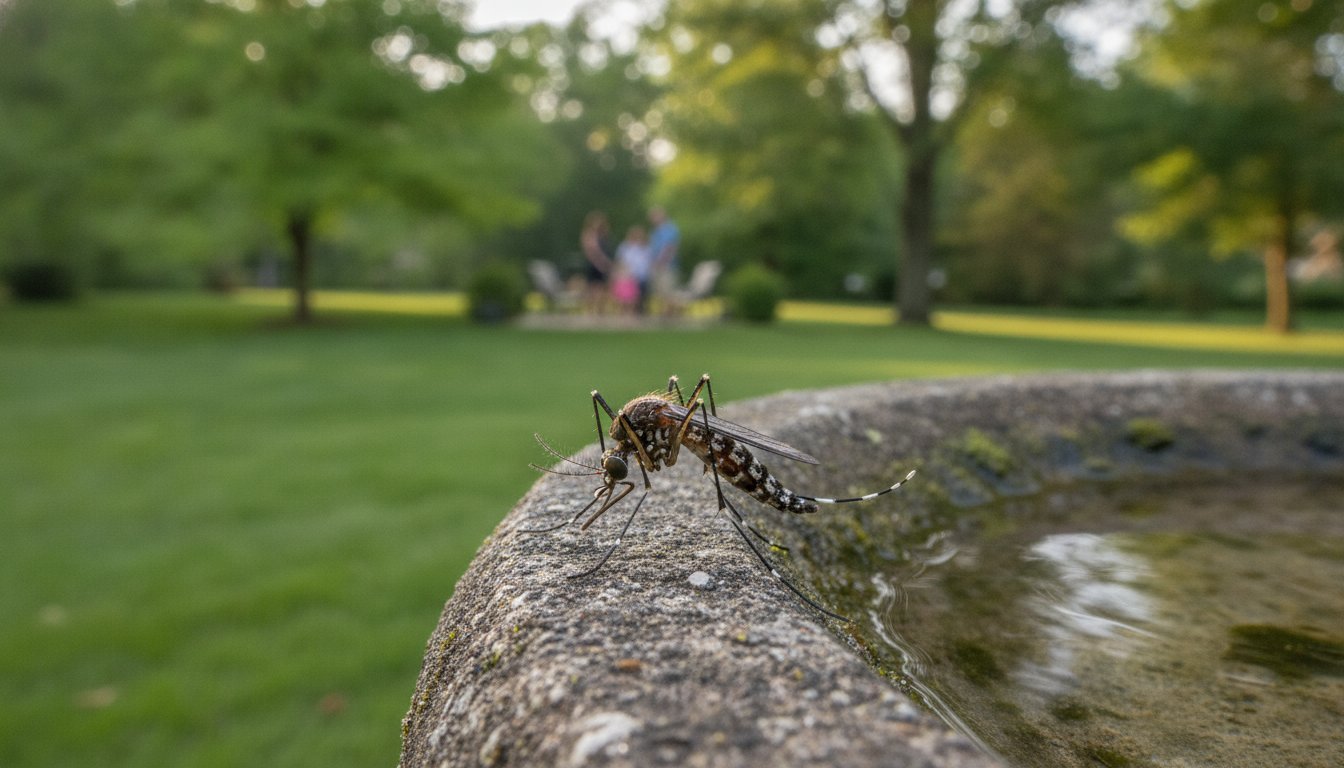
Tag: mosquito prevention

  • When to Start Mosquito Control in PA: A Seasonal Timing Guide

    When to Start Mosquito Control in PA: A Seasonal Timing Guide

    While many homeowners wait until they are already swatting away swarms to take action, the biological clock for mosquitoes begins ticking long before the first bite occurs. It’s frustrating to watch a beautiful evening in Erie, Crawford, or Ashtabula County ruined because the yard feels like a no-fly zone. You’ve likely experienced the disappointment of DIY solutions that fail to provide lasting relief, particularly when concerns about mosquito-borne illnesses are a priority. Understanding when to start mosquito control in PA is the most effective way to stop a population explosion before it starts.

    This guide explores the precise 50-degree Fahrenheit temperature threshold and the seasonal triggers that signal the start of activity in Pennsylvania. You’ll discover the science behind mosquito timing to help protect your property more effectively. By the end of this article, you’ll know how to maintain a bite-free yard and when professional pest control may help reduce risk.

    Disclaimer: The information provided on this blog is for general informational purposes only and is not intended as professional pest control advice. Conditions vary by property, environment, and location. Reading this content does not create a service agreement. For an inspection or professional recommendations, please contact Mosquito Assassin Pest Control LLC directly.
    Key Takeaways

    • Learn why the 50-degree Fahrenheit threshold is the critical marker for mosquito emergence and why consistent nighttime temperatures matter more than a single warm day.
    • Discover how the Lake Erie effect creates unique climate variations for residents in Erie and Crawford counties, delaying activity compared to southern Pennsylvania.
    • Identify how mosquitoes survive local winters through diapause and where they hide eggs in stagnant water or damp soil on your property.
    • Establish a proactive seasonal strategy by learning when to start mosquito control in PA to address larvae before they reach the biting adult stage.
    • Explore essential early-season prevention steps, including the “Tip and Toss” method and gutter maintenance, to eliminate potential breeding habitats.

    Understanding the Pennsylvania Mosquito Lifecycle and Overwintering

    Mosquitoes do not simply vanish when the temperatures drop in Erie and Crawford Counties. Instead, these resilient insects utilize a biological process called diapause, which is essentially a state of suspended animation. During a typical Pennsylvania winter, local mosquito populations enter this dormant phase to survive freezing temperatures. While many residents assume a harsh winter will naturally thin the population, the reality is that mosquitoes have evolved sophisticated survival mechanisms that make spring resurgence inevitable.

    The survival of these pests often depends on their specific species. Some mosquitoes survive as adults by seeking shelter in hollow logs, animal burrows, or even the crawlspaces of homes. Others leave behind hardy eggs that are specifically designed to withstand sub-zero conditions. Citing Understanding the Pennsylvania Mosquito Lifecycle is helpful for recognizing that these eggs can remain viable for several years, waiting for the perfect environmental triggers to hatch.

    To better understand how these pests interact with the local environment, watch this helpful video:

    The Biology of the Pennsylvania Mosquito

    The primary catalyst for mosquito activity in the spring is the combination of rising temperatures and increased moisture. As the ground thaws in late March or early April, dormant eggs submerged in damp soil or stagnant water begin their developmental cycle. Larval development typically accelerates once consistent temperatures reach 50 degrees Fahrenheit. This biological clock is a critical factor in determining when to start mosquito control in PA. Early spring rains provide the necessary standing water for these larvae to thrive, turning a quiet backyard into a breeding ground within days of the first thaw.

    Common Species in the Keystone State

    Pennsylvania is home to approximately 60 different mosquito species, but the Aedes and Culex genera cause the most concern for homeowners. Aedes mosquitoes are often categorized as floodwater species, laying eggs in damp soil that eventually floods. Culex mosquitoes prefer container environments, such as clogged gutters, birdbaths, or discarded tires. In regions like Ashtabula County and the Pennsylvania lake shore, the local geography (including marshy lowlands and high water tables) influences which species dominate. Understanding these habits is essential for identifying when to start mosquito control in PA, as different species may emerge at slightly different intervals depending on the local microclimate. You can learn more about how geography impacts pest pressure on our location page

    The 50-Degree Rule: Temperature and Mosquito Activity

    Mosquitoes are ectothermic, meaning their internal body temperature is regulated by the air around them. In Pennsylvania, the biological alarm clock for these pests is 50 degrees Fahrenheit. Below this threshold, most mosquito species remain in a state of diapause, a form of dormancy similar to hibernation. Once the thermometer consistently hits 50 degrees, their metabolism accelerates and the quest for a blood meal begins. This temperature mark is the primary indicator for homeowners in Erie and Crawford Counties to determine when to start mosquito control in PA.

    Why 50 Degrees is the Magic Number

    At 50 degrees, the physiological processes required for flight and reproduction activate. Mosquitoes progress through four distinct stages: egg, larva, pupa, and adult. Warmth acts as the catalyst for this progression. If temperatures stay low, the eggs or larvae remain stagnant. However, sustained warmth triggers a rapid transition to the biting adult stage. The 50-degree rule is the industry standard for starting control because it targets the first generation of the season before they can reproduce. As temperatures climb toward 80 degrees, the entire lifecycle can shrink from several weeks to just 7 to 10 days.

    The Impact of Fluctuating Spring Weather

    Spring weather in the Great Lakes region is notoriously unpredictable. A single 60-degree afternoon in late March doesn’t mean the season has officially started. Professional pest control relies on consistent nighttime temperatures rather than daytime peaks. A “false spring” often sees a spike in warmth followed by a hard frost. While a frost may kill some active adults, it rarely affects larvae protected in water or eggs buried in the soil. In fact, late-season snowfalls in Ashtabula or Erie Counties often provide insulating moisture that keeps eggs viable for the coming thaw. Understanding these local fluctuations is essential when deciding when to start mosquito control in PA to ensure treatments aren’t applied too early or too late.

    Waiting for a massive swarm to appear before taking action is a common mistake. By the time the population reaches a visible peak, thousands of eggs have already been deposited in standing water. Monitoring local weather patterns for a stretch of 3 to 5 days where temperatures remain above 50 degrees is the most effective way to predict the first surge. For those looking to get ahead of the curve, scheduling a professional inspection can help identify early breeding sites before the first major hatch. Starting measures early prevents the population from compounding exponentially as the summer heat intensifies.

    Disclaimer: The information provided on this blog is for general informational purposes only and is not intended as professional pest control advice. Conditions vary by property, environment, and location. Reading this content does not create a service agreement. For an inspection or professional recommendations, please contact Mosquito Assassin Pest Control LLC directly.

    When to Start Mosquito Control in PA: A Seasonal Timing Guide

    Regional Variations: Northwest PA and the Lake Erie Effect

    Geography plays a critical role in determining the ideal start date for pest management. While residents in Southern Pennsylvania might see activity in early April, the climate in Erie and Crawford Counties is heavily influenced by Lake Erie. This massive body of water acts as a thermal regulator, keeping the immediate shoreline and surrounding areas significantly cooler during the initial spring months. This cooling influence, often called the “lake effect,” typically delays the consistent 50 degree temperatures required for mosquito eggs to hatch and larvae to develop.

    Deciding when to start mosquito control in PA depends on these local temperature shifts. In Northwest PA, the season often trails the southern part of the state by 10 to 14 days. Understanding this delay prevents premature applications that might be less effective before the insects are truly active. Professional strategies must account for these regional nuances to ensure that treatments align with the actual biological emergence of the pests rather than a generic calendar date.

    Timing for Erie and Crawford Counties

    Historically, Pennsylvania’s mosquito season runs from April through October. However, in the Northwest region, emergence windows are more likely to align with late April or early May. While Harrisburg or Philadelphia may experience high activity levels by mid-April, local residents in a specific location near the lake should monitor local soil temperatures. Moisture from late-season lake-effect snow and heavy spring rain creates abundant breeding grounds in low-lying areas, making it essential to time the first intervention just as the ground begins to thaw and sustain warmth.

    Topography and Mosquito Hotspots

    The rolling hills and varied topography of Crawford County create unique drainage challenges. Water often pools in basins, wetlands, and woodlots, providing perfect nurseries for larvae. Property owners should identify specific micro-climates where temperatures and moisture levels might vary from the regional average:

    • South-facing slopes: These areas catch more sunlight and warm up faster in the morning, leading to earlier mosquito activity.
    • Dense woodlots: These features retain moisture and shield mosquitoes from the wind, allowing them to thrive even on breezy days.
    • Shaded lakefronts: In these spots, cooler air lingers longer, which can actually harbor mosquitoes later into the fall months compared to inland areas.

    Professional pest control may help reduce risk by identifying these specific hotspots and adjusting the timing of treatments to match local biological cycles. For a detailed property assessment or to discuss regional timing, contacting a professional at www.mosquitoassassin.com/contact-us is a practical way to prepare for the season.

    Disclaimer: The information provided on this blog is for general informational purposes only and is not intended as professional pest control advice. Conditions vary by property, environment, and location. Reading this content does not create a service agreement. For an inspection or professional recommendations, please contact Mosquito Assassin Pest Control LLC directly.

    Early Season Prevention and Habitat Mitigation

    Understanding when to start mosquito control in PA involves more than just scheduling a spray. True suppression begins with habitat mitigation during the transitional weeks of late March and early April. During this window, property owners should implement the “Tip and Toss” method. This strategy focuses on identifying and emptying any objects that have collected winter snowmelt or early spring rain. Because many species overwinter as eggs, removing this water before temperatures consistently hit 50 degrees prevents the first major hatch of the season.

    Cleaning gutters and downspouts is equally critical. In Erie and Crawford Counties, heavy spring debris often clogs drainage systems, creating stagnant, nutrient-rich pools high above the ground. These elevated breeding sites are often overlooked but can produce thousands of mosquitoes before summer even begins. Addressing these areas, along with clearing leaf piles and brush where adults hide, is the most effective way to reduce the local population early. Managing yard drainage issues before the heavy rains arrive in May ensures that low-lying spots don’t become permanent nurseries for larvae.

    Managing Standing Water Sources

    Mosquitoes are opportunistic breeders. A single bottle cap of stagnant water can support the development of 30 or more larvae. Property owners should use a systematic checklist to inspect their grounds every few days. Common culprits include:

    • Birdbaths and pet water bowls (should be changed every 48 hours).
    • Planter bases and empty flower pots.
    • Clogged area drains and plastic tarps.
    • Old tires or children’s toys left in the yard.

    For permanent water features like ornamental ponds or persistent low spots in the lawn, professionals often recommend aeration. Moving water prevents female mosquitoes from successfully depositing eggs. If a property in Ashtabula County or Western PA has chronic drainage issues, professional general pest control strategies can help identify long-term environmental modifications to keep the area dry.

    Landscape Maintenance for Pest Reduction

    The physical state of the landscape directly impacts how many adult mosquitoes choose to stay on a property. Keeping grass cut to a height of three inches or less is a simple but effective deterrent. Tall grass provides the shade and humidity adult mosquitoes need to survive the heat of the day. By keeping the lawn short, you remove these vital resting sites.

    Thinning out dense vegetation and heavy undergrowth also helps. This practice improves airflow and allows more sunlight to reach the ground. Increased light and air movement help dry out the soil faster after a rainstorm, which naturally limits the window for larval development. For those wondering when to start mosquito control in PA, these physical changes should ideally be completed before the lush growth of late spring takes over. If you need a detailed assessment of your property’s specific risks, visiting the contact page to request a professional inspection may help reduce seasonal risk.

    Disclaimer: The information provided on this blog is for general informational purposes only and is not intended as professional pest control advice. Conditions vary by property, environment, and location. Reading this content does not create a service agreement. For an inspection or professional recommendations, please contact Mosquito Assassin Pest Control LLC directly.

    Professional Strategies for Long-Term Control

    Maintaining a mosquito-free yard requires more than a single visit. A comprehensive mosquito control program provides a layer of defense that evolves with the Pennsylvania seasons. Because local mosquito species like Aedes vexans can lay 200 eggs at a time, missing even one treatment window can lead to a population surge. Knowing when to start mosquito control in PA is the first step, but consistency ensures those efforts aren’t wasted. Professional services typically run from late spring through the first frost to manage these overlapping generations.

    Professional inspections identify hidden risks that homeowners often overlook. Technicians examine clogged gutters, tarp folds, and even specific types of dense foliage where adults rest during the day. Barrier treatments then create a protective zone along property boundaries. These treatments focus on the perimeter to intercept mosquitoes migrating from neighboring areas. This systematic approach is necessary because a single female mosquito can produce up to 3,000 eggs in her lifetime. Breaking the breeding cycle early prevents the exponential growth often seen in July and August.

    Integrated Pest Management (IPM) Approach

    IPM focuses on long-term prevention by combining habitat reduction with targeted professional applications. It’s not just about treatment; it’s about altering the environment to make it less hospitable for pests. Monitoring is a core component. Licensed professionals track local weather patterns and pest activity in Erie and Crawford Counties to adjust treatment schedules. This ensures that applications happen exactly when they’re most effective. Professional expertise helps determine the right timing for each unique property. For example, a shaded lot in Ashtabula County may require a different strategy than a sunny, open field due to moisture retention differences.

    Enjoying the Outdoors Safely

    Homeowners often find that a structured protection plan changes how they use their property. Instead of reaching for personal repellents every time they step outside, residents can enjoy their decks and lawns with significantly less biting pressure. This environmental control provides peace of mind for families and pet owners who want to spend time outdoors without the constant nuisance of swarms. While no method can eliminate every single insect, professional pest control may help reduce risk and enhance the overall outdoor experience. Establishing this routine is the most reliable way to maintain a comfortable backyard throughout the summer.

    Disclaimer: The information provided on this blog is for general informational purposes only and is not intended as professional pest control advice. Conditions vary by property, environment, and location. Reading this content does not create a service agreement. For an inspection or professional recommendations, please contact Mosquito Assassin Pest Control LLC directly.

    Securing Your Outdoor Space for the Coming Season

    Managing mosquito populations effectively requires a strategy based on local climate data and biological cycles. Success often begins when daytime temperatures reach the 50-degree Fahrenheit threshold for at least three consecutive days, as this marks the end of dormancy for species like Aedes and Culex. In regions like Erie and Crawford counties, the Lake Erie effect can shift these timelines by up to 14 days, making local observation critical. Addressing standing water and heavy vegetation before the first spring hatch reduces the overall population density throughout the summer months. Understanding when to start mosquito control in PA allows property owners to implement preventative measures before infestations become difficult to manage.

    Professional expertise in Erie, Crawford, and Ashtabula counties ensures that mitigation efforts account for these specific regional weather patterns. Service providers who are licensed and insured in PA and OH bring a methodical approach to property assessments. It’s often beneficial to utilize a five-star rated professional service to identify breeding sites that homeowners don’t always spot during a casual walk-through. For more information on protecting your property, professional pest control may help reduce risk. Taking proactive steps today helps ensure the yard is ready for the peak of summer activity.

    Disclaimer: The information provided on this blog is for general informational purposes only and is not intended as professional pest control advice. Conditions vary by property, environment, and location. Reading this content does not create a service agreement. For an inspection or professional recommendations, please contact Mosquito Assassin Pest Control LLC directly.

    Frequently Asked Questions

    When is mosquito season officially over in Pennsylvania?

    Mosquito season in Pennsylvania typically ends after the first hard frost, which usually occurs between October 15 and November 1 in the Erie region. A hard frost is defined as temperatures dropping below 28 degrees Fahrenheit for at least four consecutive hours. While some species die off, others enter a state of diapause, a form of hibernation, once temperatures consistently stay below 50 degrees Fahrenheit for several days.

    Can mosquitoes survive a frost after they have emerged in the spring?

    Most adult mosquitoes cannot survive a sudden frost once they’ve emerged, as their bodies are sensitive to freezing temperatures. However, a single night of frost rarely eliminates a local population because eggs and larvae are often protected in water or soil. If temperatures rise back above 50 degrees Fahrenheit within 24 hours, remaining adults can become active again and continue their life cycle without interruption.

    How often should a yard be treated for mosquitoes in PA?

    For consistent protection, a yard should be treated every 21 to 30 days during the peak season. This timeframe matches the typical breakdown of professional barrier sprays and the reproductive cycle of common Pennsylvania species. Establishing a routine schedule ensures there aren’t gaps in coverage, as a single female mosquito can lay up to 300 eggs at a time. Knowing when to start mosquito control in PA helps maintain this cycle.

    Does heavy rain wash away professional mosquito treatments?

    Professional treatments don’t wash away once they’ve had 30 to 60 minutes to dry completely on foliage. Most modern products include binding agents that help the solution adhere to the underside of leaves where mosquitoes rest. While a light misting won’t impact efficacy, local rainfall exceeding 2 inches within a 24 hour period might necessitate a follow up application to maintain the barrier’s strength and ensure long-term effectiveness.

    Are there specific plants that help keep mosquitoes away in Pennsylvania?

    Plants like lavender, marigolds, and lemon balm are often used in Pennsylvania gardens, but their effectiveness is limited to the immediate area where oils are released. Research from the University of Arizona suggests that simply planting these won’t provide a “no-fly zone” for a whole yard. They work best when leaves are crushed to release aromatic compounds; however, they shouldn’t be relied upon as a primary method for population control.

    What is the best month to start a mosquito control program in Erie, PA?

    The best month to start a mosquito control program in Erie, PA, is typically late April or early May. Ground temperatures usually reach 50 degrees Fahrenheit during this window, triggering the first hatch of the season. Knowing when to start mosquito control in PA allows for targeting the initial generation, which prevents the population from exploding during the humid summer months of July and August when activity peaks.

    Do mosquitoes bite more during certain times of the day in the summer?

    Mosquitoes are most active and likely to bite during the dawn and dusk hours when the sun is low and humidity is higher. Direct sunlight and high heat can dehydrate these insects, so they spend the middle of the day resting in tall grass or under leaves. However, certain invasive species like the Asian Tiger mosquito are known to bite throughout the daylight hours, making all day protection necessary in many Pennsylvania backyards.

    Professional pest control may help reduce risk for homeowners in Crawford and Erie Counties. For an inspection or professional recommendations, please contact the team through the online booking portal at https://portal.gorilladesk.com/mosquitoassassin.

    Disclaimer: The information provided on this blog is for general informational purposes only and is not intended as professional pest control advice. Conditions vary by property, environment, and location. Reading this content does not create a service agreement. For an inspection or professional recommendations, please contact Mosquito Assassin Pest Control LLC directly.

  • How to Get Rid of Mosquitoes in Your Yard: A Professional Guide for Homeowners

    How to Get Rid of Mosquitoes in Your Yard: A Professional Guide for Homeowners

    Last July, a family in Crawford County had to move their entire anniversary dinner indoors because a swarm of mosquitoes made the patio unbearable within minutes. It’s a common story for homeowners in Erie and Ashtabula Counties who find their summer plans sidelined by constant itching and the underlying anxiety of mosquito-borne illnesses. Understanding how to get rid of mosquitoes in yard environments is the first step toward reclaiming your outdoor living space from these aggressive pests.

    It’s frustrating when store-bought solutions don’t provide the relief they promise on the label. You’ve probably spent countless evenings swatting away insects instead of relaxing with friends and family. This professional guide offers evidence-based strategies to reduce mosquito activity and help you understand the specific factors on your property that attract them. You’ll learn how to identify hidden breeding grounds and establish a manageable seasonal prevention plan. We’ll cover everything from environmental modifications to the reasons why professional pest control may help reduce risk during the peak summer months.

    Disclaimer: The information provided on this blog is for general informational purposes only and is not intended as professional pest control advice. Conditions vary by property, environment, and location. Reading this content does not create a service agreement. For an inspection or professional recommendations, please contact Mosquito Assassin Pest Control LLC directly.

    Key Takeaways

    • Identify why the humidity of the Great Lakes region creates unique challenges for homeowners in Erie, Crawford, and Ashtabula counties.
    • Master the “Tip and Toss” philosophy to eliminate breeding grounds in common household items and garden features.
    • Explore how proper mowing and pruning serve as effective strategies for how to get rid of mosquitoes in yard by removing preferred resting areas.
    • Recognize the signs that a property requires professional management to address hidden hot spots and heavy infestations.
    • Establish a seasonal protection timeline to ensure your outdoor space remains comfortable throughout the warmer months.

    Understanding Mosquito Behavior and Habitat in the Great Lakes Region

    Understanding mosquito behavior is the first step in learning how to get rid of mosquitoes in yard spaces effectively. In the Great Lakes region, specifically Erie and Crawford Counties in Pennsylvania and Ashtabula County in Ohio, the environment provides a perfect storm for mosquito populations. High humidity from Lake Erie and frequent summer rainfall create a moist atmosphere where these pests thrive. A mosquito’s life cycle moves from egg to adult in as little as 7 to 10 days when temperatures consistently stay above 70 degrees Fahrenheit.

    Mosquitoes are biological hunters. They use specialized sensors to detect carbon dioxide plumes from human breath from up to 100 feet away. Once they’re closer, they switch to thermal sensors to find heat signatures. This makes backyard gatherings a primary target for female mosquitoes seeking the blood meal necessary for egg production. Knowing where they hide and how they hunt is essential for any homeowner.

    Common Mosquito Species in PA and OH

    The Culex mosquito is a frequent resident in Pennsylvania and Ohio. It prefers stagnant, organic-rich water found in neglected birdbaths or clogged gutters. In contrast, the Aedes albopictus (Asian Tiger Mosquito) is an aggressive daytime feeder that thrives in residential areas. These pests remain active from late May until the first hard frost, which usually occurs in October for the Erie and Ashtabula regions. Their ability to lay eggs in tiny amounts of water makes them difficult to manage without consistent effort.

    Why Your Yard Specifically Attracts Mosquitoes

    Property owners often struggle with how to get rid of mosquitoes in yard areas because of “harbors.” These are cool, shaded spots with low airflow, such as the underside of a deck or dense ivy along a fence line. While breeding happens in water, mosquitoes spend roughly 90% of their time resting in these microclimates to avoid dehydration. Specific factors that increase local populations include:

    • Dense Vegetation: Overgrown shrubs and tall grass trap moisture and block the wind.
    • Poor Drainage: Low spots in the lawn that hold water for more than 48 hours after a storm.
    • Microclimates: Shaded areas under stairs or crawl spaces that stay damp even during dry spells.

    Local rainfall patterns play a massive role in population spikes. In Crawford County, a single heavy rain event can trigger the hatching of thousands of dormant eggs. Professional pest control may help reduce risk by identifying these specific pressure points on a property.

    Disclaimer: The information provided on this blog is for general informational purposes only and is not intended as professional pest control advice. Conditions vary by property, environment, and location. Reading this content does not create a service agreement. For an inspection or professional recommendations, please contact Mosquito Assassin Pest Control LLC directly.

    Eliminating Breeding Grounds: The Source Reduction Strategy

    Effective mosquito control begins with a strategy known as source reduction. This process focuses on removing the specific environments where larvae develop. Most homeowners don’t realize that a single female mosquito can lay up to 200 eggs at a time. These eggs only need a tiny amount of moisture to thrive. Even a discarded bottle cap or a crumpled snack wrapper can hold enough rainwater to support a new generation of pests. Adopting a “Tip and Toss” philosophy is a primary step when learning how to get rid of mosquitoes in yard spaces.

    In Ashtabula County, the humid summer climate can accelerate the mosquito life cycle. The transition from egg to adult often takes as little as 7 to 10 days. This rapid progression makes daily vigilance essential for property owners. Beyond obvious containers, it’s vital to check the bases of outdoor umbrellas and the hollow legs of plastic patio chairs. These small spaces often collect moisture that remains trapped for weeks, providing a perfect nursery for larvae away from the sun.

    A Checklist for Standing Water Removal

    Regular inspections are necessary to identify hidden reservoirs. Homeowners in Erie and Crawford Counties often face heavy seasonal rains that leave standing water in unexpected places. Use this checklist to safeguard the property:

    • Empty flower pot saucers, children’s plastic toys, and pet water bowls every 24 hours.
    • Shake out tarps covering woodpiles, boats, or patio furniture to prevent sagging pockets of water.
    • Clear debris from lawn depressions where drainage issues occur after heavy storms.
    • Clean gutters at least twice a year; clogged downspouts create elevated breeding sites that are difficult to see from the ground.

    Managing Larger Water Features

    You don’t have to remove beautiful garden features to maintain a pest-free environment. Managing these areas requires a proactive approach to keep water from becoming stagnant. Mosquitoes prefer still water for egg-laying, so physical disruption is a powerful deterrent.

    • Install fountains or bubblers in decorative ponds. Constant surface agitation prevents mosquitoes from successfully landing and laying eggs.
    • Apply biological larvicides (such as BTI) to water that cannot be drained. These specialized tablets target larvae without harming fish, birds, or plants.
    • Maintain swimming pools and hot tubs with proper chlorine levels and functional filtration systems. An untended pool can produce thousands of mosquitoes in less than two weeks.

    Identifying these sources is a foundational part of property maintenance. If breeding sites persist despite these efforts, professional pest control may help reduce risk by addressing areas that are difficult to reach or manage manually.

    Disclaimer: The information provided on this blog is for general informational purposes only and is not intended as professional pest control advice. Conditions vary by property, environment, and location. Reading this content does not create a service agreement. For an inspection or professional recommendations, please contact Mosquito Assassin Pest Control LLC directly.

    Landscaping and Physical Barriers for Long-Term Defense

    Mosquitoes spend roughly 90 percent of their adult lives resting in cool, damp areas to avoid dehydration. They aren’t strong fliers and rely on dense vegetation to shield them from the sun and wind. Homeowners in Erie and Crawford Counties often find that unmanaged foliage acts as a nursery for these pests. Understanding how to get rid of mosquitoes in yard environments requires a focus on removing these environmental advantages. By altering the physical landscape, you can make a property significantly less hospitable to local populations.

    Vegetation Management for Better Airflow

    Airflow is a natural deterrent for mosquitoes. Thinning out the interior of dense shrubs, such as boxwoods or privets, allows the wind to penetrate the foliage. This lowers the humidity levels where mosquitoes hide during the day. It’s best to keep your lawn mowed to a height of 2.5 to 3 inches. Taller grass traps moisture at the soil level, which creates a perfect habitat for resting adults. Removing invasive groundcovers like English Ivy is also beneficial; these plants create thick mats that hold stagnant air and provide excessive cover. Property owners in Ashtabula County should focus on these specific areas:

    • Pruning low-hanging tree branches to at least 18 inches above the ground.
    • Clearing leaf litter and organic debris from under decks and porches.
    • Replacing dense, moisture-retaining mulch with cedar chips or gravel in problem areas.

    Creating Mosquito-Free Zones on Patios and Decks

    Mechanical barriers provide immediate relief for outdoor living spaces. High-velocity fans are one of the most effective tools for decks and patios. Since mosquitoes are weak fliers, they struggle to navigate in wind speeds exceeding 10 miles per hour. Positioning a fan to blow across a seating area creates a reliable “no-fly zone.” For permanent structures, ensure window and door screens are 18×16 mesh or finer to prevent entry. It’s also helpful to replace standard white incandescent bulbs with yellow LED “bug lights.” These lights emit a wavelength above 550 nanometers, which is far less attractive to nocturnal insects than traditional lighting.

    Many homeowners invest in “mosquito-repelling plants” like citronella geraniums or lavender. However, research from several university entomology departments shows these plants don’t provide protection simply by growing in a pot. The essential oils must be released by crushing or burning the foliage to have any measurable effect. Relying on plants alone is rarely a successful strategy for how to get rid of mosquitoes in yard spaces. Physical barriers and moisture control remain the professional standard for long-term reduction.

    Disclaimer: The information provided on this blog is for general informational purposes only and is not intended as professional pest control advice. Conditions vary by property, environment, and location. Reading this content does not create a service agreement. For an inspection or professional recommendations, please contact Mosquito Assassin Pest Control LLC directly.

    The Role of Professional Mosquito Management

    While DIY methods like candles or retail sprays might offer temporary relief on a small patio, they often fall short on larger properties. If you’re looking for how to get rid of mosquitoes in yard areas exceeding half an acre, professional management is usually the most effective route. Licensed experts possess the equipment and specialized training to address heavy infestations that standard consumer products simply can’t touch. They understand that a one size fits all approach doesn’t work for the diverse landscapes found in our region.

    What to Expect from a Professional Inspection

    A thorough inspection is the foundation of any successful management plan. Professionals evaluate the unique topography of properties in Erie and Crawford Counties, looking for subtle drainage issues. A slight 2% dip in a lawn can collect enough water to breed thousands of larvae after a single rainstorm. They also identify off-property sources, such as a neighbor’s neglected birdbath or a nearby wooded lot in Ashtabula County, which may be the primary source of the problem impacting your home. This assessment leads to long-term habitat modification recommendations that go beyond just spraying.

    The Benefits of Scheduled Barrier Treatments

    Barrier treatments work by targeting specific mosquito biology. These insects spend roughly 90% of their daylight hours clinging to the underside of broad-leafed vegetation to stay hydrated. Professionals apply residual treatments to these specific "hot spots" to create an active perimeter around the home. This method ensures that professional pest control may help reduce risk for families throughout the peak summer months when mosquito activity is at its highest.

    Safety remains a primary concern during every application. Licensed technicians follow strict federal and state guidelines to ensure treatments don’t impact beneficial pollinators. By avoiding flowering plants and using precise, low-pressure spray patterns, they protect local bee populations while eliminating target pests. Most professional treatments typically dry within 45 minutes, making the yard safe for pets and children to return to play. This precision provides a level of consistency that’s difficult to achieve with over-the-counter foggers or handheld misters.

    For more information on maintaining a comfortable outdoor space, you can schedule a professional assessment online.

    Disclaimer: The information provided on this blog is for general informational purposes only and is not intended as professional pest control advice. Conditions vary by property, environment, and location. Reading this content does not create a service agreement. For an inspection or professional recommendations, please contact Mosquito Assassin Pest Control LLC directly.
    Creating a Seasonal Protection Plan for PA and OH Homes

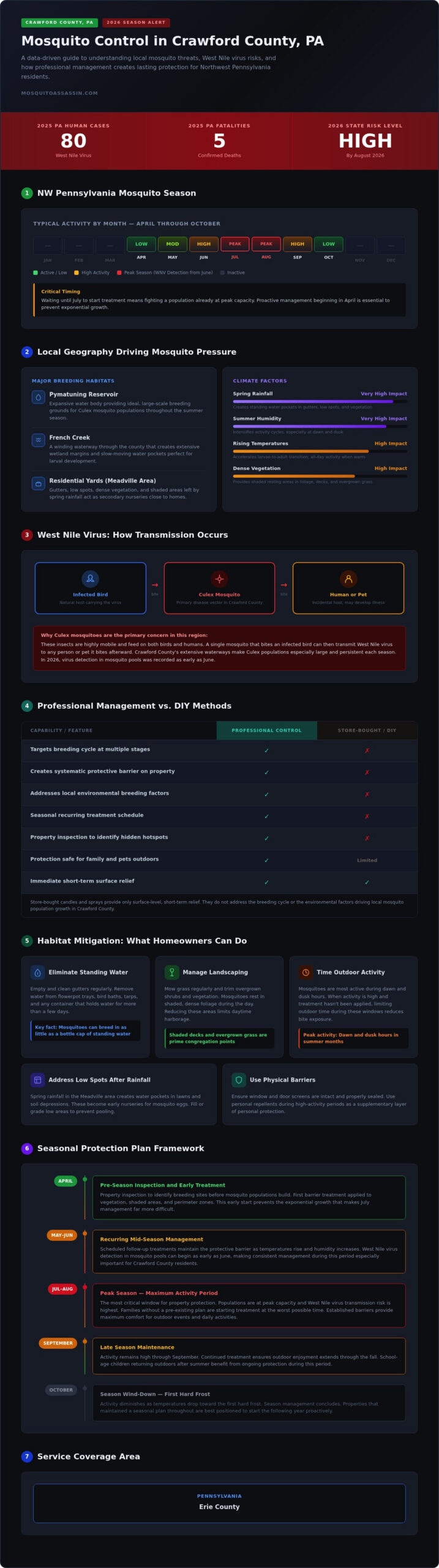
    Effective mosquito management in Northwest Pennsylvania and Northeast Ohio requires a proactive calendar. Waiting until the first bite in June is usually too late to establish control. Mosquito activity typically begins when consistent overnight temperatures reach 50 degrees Fahrenheit, which often occurs by mid-April in Erie and Crawford counties. Understanding how to get rid of mosquitoes in yard spaces involves a season-long commitment rather than a one-time fix. A structured plan helps disrupt the life cycle before populations explode during the humid summer months.

    Spring and Summer Maintenance Schedule

    A successful defense starts with a yard deep clean in April. Homeowners should focus on clearing leaf litter and cleaning gutters where eggs may have overwintered. During the peak heat of July and August, mosquito larvae can develop into adults in as little as 7 days. Routine checks of low-lying areas and containers are vital during these high-growth months. By September, a fall surge often occurs as certain species become more aggressive before the first hard frost, requiring continued vigilance through late October. Key tasks include:

    • April: Remove debris from drainage systems and refresh gravel in low spots.
    • June-August: Inspect property every 7 days for standing water after heavy rainfall.
    • September: Maintain lawn height and clear brush to reduce resting sites for adult mosquitoes.

    Finding Local Support in Your County

    Local expertise is critical because weather patterns near Lake Erie directly influence pest cycles. Homeowners looking for locations in Northwest Pennsylvania and Northeast Ohio benefit from professionals who track local rainfall and humidity levels. Since many mosquito species can fly up to 3 miles from their breeding site, encouraging neighbors to practice source reduction creates a protective buffer for the entire street. Effective management often overlaps with tick prevention, as both pests thrive in tall grass and damp perimeter brush. Integrating these efforts ensures the yard remains hospitable for outdoor activities. If local populations remain high despite DIY efforts, professional pest control may help reduce risk.

    Establishing a routine that targets both breeding sites and adult resting areas is the most reliable way to maintain a comfortable outdoor space. For property-specific guidance, homeowners can visit the online booking portal to schedule a professional assessment of their land. Consistent action throughout the year is the best strategy for learning how to get rid of mosquitoes in yard environments effectively.

    Disclaimer: The information provided on this blog is for general informational purposes only and is not intended as professional pest control advice. Conditions vary by property, environment, and location. Reading this content does not create a service agreement. For an inspection or professional recommendations, please contact Mosquito Assassin Pest Control LLC directly.

    Take Control of Your Outdoor Space

    Maintaining a comfortable backyard in the Great Lakes region requires a proactive strategy that targets the specific biology of local pests. Effective source reduction involves removing standing water, as even a single tablespoon of liquid can host over 200 mosquito larvae during the peak breeding months of June through August. Homeowners in Erie and Crawford Counties in Pennsylvania, along with Ashtabula County in Ohio, don’t have to tackle these seasonal challenges alone. Understanding how to get rid of mosquitoes in yard environments involves a combination of removing breeding sites and implementing physical barriers. Professional management provides an additional layer of defense through regional expertise and specialized knowledge of local species. Mosquito Assassin Pest Control LLC is a locally owned and operated firm, licensed and insured in both PA and OH to assist with these environmental factors. For an inspection or professional recommendations, please contact Mosquito Assassin Pest Control LLC directly. Taking these steps now helps ensure your outdoor areas remain functional and pleasant for your family throughout the season.
    Disclaimer: The information provided on this blog is for general informational purposes only and is not intended as professional pest control advice. Conditions vary by property, environment, and location. Reading this content does not create a service agreement. For an inspection or professional recommendations, please contact Mosquito Assassin Pest Control LLC directly.

    Frequently Asked Questions

    What is the most effective way to get rid of mosquitoes in my yard?

    The most effective strategy involves a combination of source reduction and professional barrier treatments. Homeowners should eliminate all standing water where larvae develop, as even a small bottle cap can host 200 eggs. Combining these efforts with targeted applications on the underside of leaves creates a comprehensive defense. This multi-layered approach is the professional standard for how to get rid of mosquitoes in yard spaces effectively.

    Do mosquito-repelling plants like citronella or lavender actually work?

    Mosquito-repelling plants like citronella or lavender have very limited effectiveness in an open outdoor setting. While these plants contain natural oils that repel insects, the scent is rarely strong enough to protect a whole yard unless the leaves are crushed or the oils are extracted. Research from the Journal of Insect Science indicates that these plants often fail to provide a significant barrier against hungry female mosquitoes seeking a blood meal.

    How long do professional mosquito yard treatments typically last?

    Professional mosquito yard treatments typically provide protection for 21 to 30 days. The residual effect of the treatment depends on weather conditions like heavy rainfall or intense sunlight, which can break down active ingredients. Most property owners in Pennsylvania and Ohio schedule reapplications every three weeks during the peak season between May and September to maintain a consistent barrier against new arrivals.

    Can mosquitoes breed in wet grass or just in standing water?

    Mosquitoes cannot breed in wet grass; they require stagnant, standing water to complete their life cycle. However, tall, damp grass serves as a primary resting site for adult mosquitoes during the heat of the day. Keeping a lawn mowed to a height of 3 inches or less reduces the humidity and shade that these pests need to survive between feedings, making the environment less hospitable.

    Is it possible to completely eliminate mosquitoes from an outdoor space?

    It’s not possible to completely eliminate every mosquito from an outdoor space because they’re mobile insects that fly across property lines. Professional treatments aim for an 85% to 90% reduction in the local population. Maintaining realistic expectations is key, as a single female can lay 3,000 eggs during her short lifespan, making total eradication a biological impossibility in an open environment.

    How often should I check my yard for standing water after it rains?

    You should check your yard for standing water at least once every 7 days after it rains. This timeframe is critical because the transition from egg to biting adult can happen in just one week during the summer months when temperatures exceed 80 degrees. Focus on cleaning gutters, emptying flower pot saucers, and tipping over plastic toys where water collects to disrupt the breeding cycle.

    Are professional mosquito treatments safe for my children and dogs?

    Professional treatments are generally considered safe for children and dogs once the product has completely dried. This drying process usually takes between 30 and 60 minutes depending on the temperature and humidity. Licensed technicians follow strict EPA label instructions to ensure applications are targeted and minimize exposure to non-target areas like vegetable gardens, play sets, or neighboring properties.

    Why are mosquitoes worse in Erie and Ashtabula than in drier regions?

    Mosquitoes are more prevalent in Erie, Crawford, and Ashtabula counties because of the high humidity and abundant water sources near Lake Erie. The region’s heavy clay soil often retains water longer than sandy soils, leading to more persistent puddles. These environmental factors, combined with an average of 35 to 45 inches of annual precipitation, provide the perfect habitat for large mosquito populations to thrive.

    Disclaimer: The information provided on this blog is for general informational purposes only and is not intended as professional pest control advice. Conditions vary by property, environment, and location. Reading this content does not create a service agreement. For an inspection or professional recommendations, please contact Mosquito Assassin Pest Control LLC directly.

  • Best Time for Mosquito Yard Treatment: A Professional Timing Guide for 2026

    Best Time for Mosquito Yard Treatment: A Professional Timing Guide for 2026

    The first itchy bite isn’t the signal to start your defense; it’s a sign that you’ve already lost the first battle of the season. Many homeowners in Erie and Crawford counties wait until the humidity peaks in July to take action, but finding the best time for mosquito yard treatment starts much earlier. It’s common to feel frustrated after spending money on hardware store sprays that don’t seem to work, or to feel a sense of anxiety when your children can’t play in the grass without being swarmed by pests.

    You deserve a backyard that’s a sanctuary, not a hazard zone. This guide reveals the precise 50 degree temperature threshold and early spring windows required to effectively disrupt the mosquito life cycle before it gains momentum. By understanding professional timing, you can ensure a higher return on your investment and maintain a mosquito free yard for the duration of the 2026 summer. This overview examines the specific biological triggers for local species in Northwest Pennsylvania and Northeast Ohio to help you set clear expectations for treatment frequency.

    Disclaimer: The information provided on this blog is for general informational purposes only and is not intended as professional pest control advice. Conditions vary by property, environment, and location. Reading this content does not create a service agreement. For an inspection or professional recommendations, please contact Mosquito Assassin Pest Control LLC directly.

    Key Takeaways

    • Learn why 50 degrees Fahrenheit is the critical biological trigger for activity and how this temperature dictates the start of the season in Pennsylvania and Ohio.
    • Understand the specific April through October window for Erie and Crawford Counties, including how the Lake Erie shoreline influences local hatching schedules.
    • Identify the 21 to 30 day maintenance cycle required to sustain protection, helping homeowners determine the best time for mosquito yard treatment throughout the summer.
    • Discover the science behind peak feeding times at dawn and dusk and how professional application methods ensure coverage during various environmental conditions.
    • Explore the benefits of Integrated Pest Management (IPM) and why consistent seasonal protection plans are more effective than one-time applications.

    Understanding the Mosquito Life Cycle and Temperature Thresholds

    Mosquito activity isn’t a matter of luck; it’s a biological process driven by the thermometer. For residents in Erie and Crawford Counties in Pennsylvania and Ashtabula County in Ohio, the spring thaw marks the beginning of a complex biological countdown. Understanding the mosquito life cycle reveals that these pests don’t just appear out of nowhere when summer hits. Instead, they wait for specific environmental triggers to emerge from their winter slumber.

    Professional pest control experts identify 50 degrees Fahrenheit as the critical tipping point for insect metabolic activity. Once the thermometer stays at or above this mark for several consecutive days, dormant eggs begin to hatch and adults emerge from hibernation. Determining the best time for mosquito yard treatment requires tracking these local weather patterns rather than following a fixed date on the calendar.

    To better understand this concept, watch this helpful video:

    The Role of Temperature in Mosquito Activity

    Temperature acts as a throttle for mosquito behavior and development. When the air stays around 60 degrees, mosquitoes often appear lethargic and slow-moving; they’re present but not yet at peak nuisance levels. However, once temperatures climb to a consistent 70 degrees, their metabolism accelerates, leading to aggressive feeding and rapid reproduction cycles. Overnight lows are equally important, as sustained warmth after dark allows eggs in standing water to hatch without interruption. Professional technicians view a consistent 50-degree daily average as the definitive signal to begin seasonal property protection.

    Overwintering and Diapause: Why Pests Return

    Mosquitoes have evolved sophisticated survival mechanisms to endure the harsh winters of Western Pennsylvania and Northeast Ohio. Many species, such as those in the Culex genus, enter a state called diapause, which is a form of hibernation where their metabolism slows to a crawl. They seek shelter in hollow logs, animal burrows, or even the crawl spaces of homes. Other species, like the aggressive Asian Tiger mosquito, leave behind hardy eggs that can survive freezing temperatures by nesting in damp leaf litter or the microscopic film of water inside a discarded tire. These eggs are incredibly resilient, often requiring only a small amount of moisture and a few warm days to activate.

    Early season yard maintenance is a practical step that supports professional efforts. Clearing out heavy leaf piles and refreshing mulch can remove the insulating layers that protect these dormant populations. Waiting until the first bite occurs usually means the population is already three or four generations deep. Proactive timing ensures that the best time for mosquito yard treatment happens before the first major hatch of the season saturates the local environment. Addressing larvae in stagnant water sources during the early spring is significantly more efficient than trying to manage a massive cloud of flying adults in July.

    For an evaluation of your property, professional pest control may help reduce risk. You can find more information or request a visit at https://portal.gorilladesk.com/mosquitoassassin.

    Disclaimer: The information provided on this blog is for general informational purposes only and is not intended as professional pest control advice. Conditions vary by property, environment, and location. Reading this content does not create a service agreement. For an inspection or professional recommendations, please contact Mosquito Assassin Pest Control LLC directly.
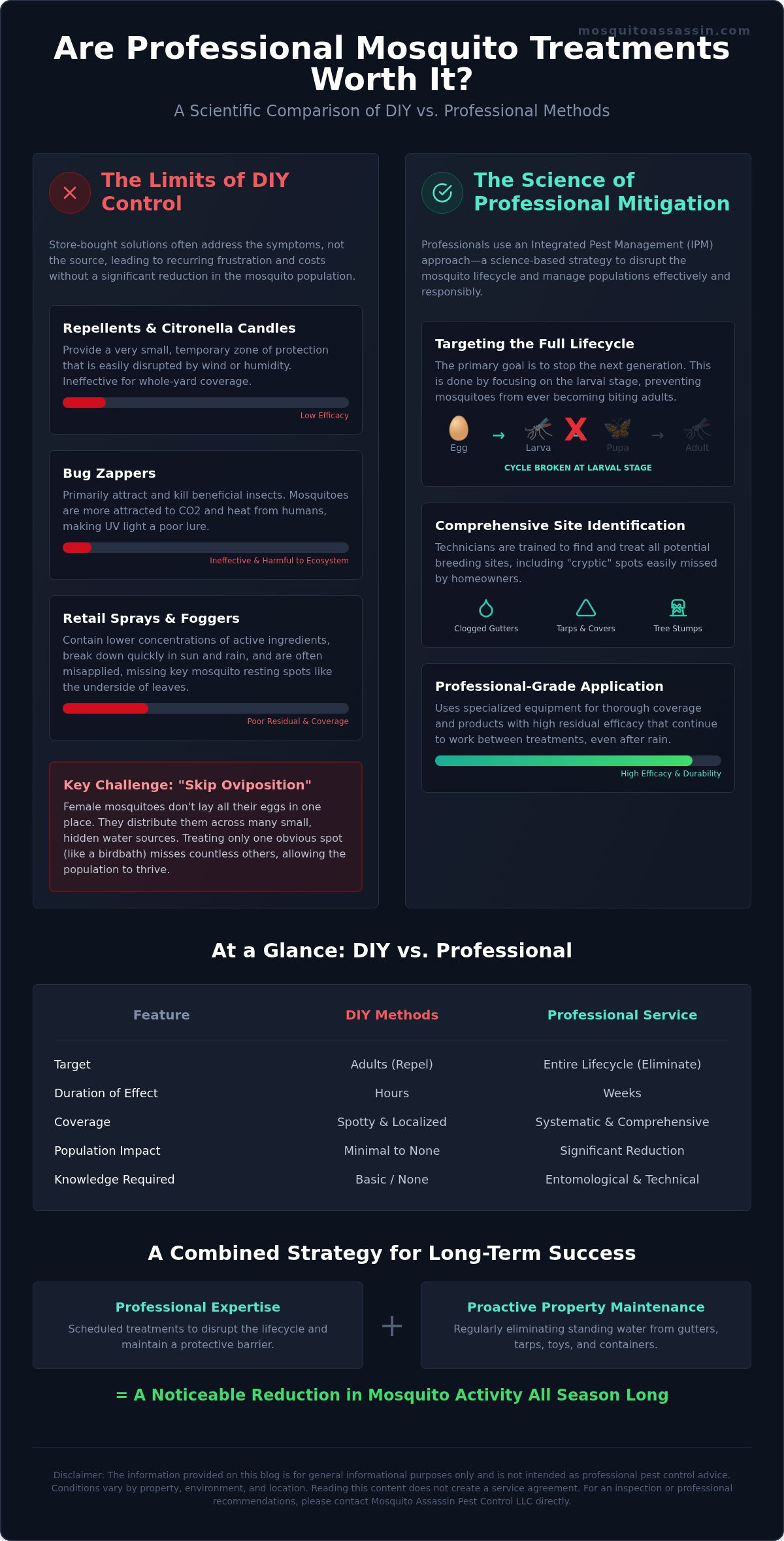
    Seasonal Timing: When to Schedule the First Treatment in PA and OH

    Residents in Erie and Crawford Counties often see the first mosquito activity as early as mid-April. This window marks the best time for mosquito yard treatment because the average daily temperature consistently reaches 50 degrees Fahrenheit. At this specific thermal threshold, mosquito eggs that have overwintered in the soil or stagnant water begin the process of hatching. If treatments start after the population has already surged, property owners are forced into a reactive cycle rather than a preventive one.

    The Lake Erie shoreline creates a unique microclimate for properties in Ashtabula and Erie. The lake acts as a massive heat sink, often keeping shoreline temperatures 5 to 8 degrees cooler than inland areas like Meadville during the early spring. This temperature variance can delay the first hatch by 7 to 10 days for lakeside homes. Conversely, as the water warms in late summer, it retains heat, extending the mosquito season well into October for those same coastal properties.

    Professional monitoring accounts for the fluctuating spring weather common in Northwest Pennsylvania and Northeast Ohio. A single warm weekend in March isn’t enough to trigger a full hatch; it requires sustained warmth and specific moisture levels. Licensed technicians track these local weather patterns to ensure the initial application occurs at the precise moment when it will be most effective against emerging larvae.

    The Importance of Pre-Season Prevention

    Targeting the initial hatch is a strategic move that dictates the comfort of a yard for the rest of the year. A single female mosquito can lay up to 300 eggs at a time, and those offspring can reach maturity in as little as 7 days during peak conditions. By disrupting the breeding cycle in April or May, the total seasonal volume of pests is drastically reduced. Following CDC mosquito control guidelines helps property owners identify and eliminate these early breeding sites before they become unmanageable.

    This proactive approach relies on the “knockdown” effect. This term refers to the immediate reduction of the adult population that survived the winter or emerged during the first spring thaw. Eliminating these “colonizer” mosquitoes prevents them from establishing a permanent presence on the property. Professional pest control may help reduce risk during these critical transition months. For those looking to establish a schedule, the online booking portal provides options for early-season inspections.

    Regional Climate Factors for Lake Erie Counties

    Climate determines the end-of-season schedule just as much as the beginning. The typical first hard frost in Erie and Crawford Counties usually occurs between October 1st and October 15th. Until a sustained frost happens, mosquitoes remain biologically active and capable of biting. This means the best time for mosquito yard treatment actually spans a full six or seven months, depending on the year’s specific weather trends.

    Local landmarks and environments also dictate treatment urgency. Properties near wooded areas in Conneaut Lake or the wetlands surrounding Geneva-on-the-Lake often require earlier attention. These environments retain moisture and provide more insulation for overwintering pests than open suburban lots. Identifying these high-risk zones early in the spring allows for a more customized and effective treatment plan that addresses the specific biology of the local environment.

    Disclaimer: The information provided on this blog is for general informational purposes only and is not intended as professional pest control advice. Conditions vary by property, environment, and location. Reading this content does not create a service agreement. For an inspection or professional recommendations, please contact Mosquito Assassin Pest Control LLC directly.

    Daily and Environmental Factors for Treatment Effectiveness

    Mosquitoes follow a strict biological clock. Most species are crepuscular, meaning they’re most active during the low-light hours of dawn and dusk. During the heat of a 90-degree summer afternoon, these insects seek shelter to avoid desiccation. They hide in tall grass, dense brush, and the underside of broad-leafed plants. This behavior is a primary reason why many homeowners believe evening is the only best time for mosquito yard treatment. While DIY foggers often require timing with active flight periods, professional-grade equipment changes the strategy. High-powered mist blowers create a fine spray that penetrates deep into thick foliage, reaching the cool, damp resting sites where mosquitoes spend 90% of their day.

    Environmental conditions dictate the success of any application. Wind speeds exceeding 10 miles per hour can cause product drift, moving the treatment away from the targeted harborage areas and toward non-target zones. Humidity also plays a role. High humidity levels, common in Erie and Ashtabula counties, actually help some products adhere to leaf surfaces, though excessive moisture from heavy dew or fog can dilute the solution before it dries on the plant.

    Best Time of Day for Professional Application

    Professional technicians prioritize the areas where mosquitoes rest. By focusing on the underside of leaves and shaded perimeters, treatments remain effective regardless of whether the insects are currently flying. This targeted approach also protects beneficial insects. Technicians avoid spraying active blooms where bees and butterflies forage during midday. This careful timing ensures the treatment hits the pests while keeping the local ecosystem safe.

    A Backyard Mosquito Control Guide emphasizes that understanding these resting patterns is key to long-term reduction. Because mosquitoes are weak fliers, they stay close to these treated zones. When they land on the underside of a leaf to escape the sun, they come into contact with the residual product, leading to a significant drop in the local population within 24 to 48 hours.

    Weather Considerations: Rain and Wind

    Precipitation is the most common disruptor of a treatment schedule. Most professional products require a rainfast window of 30 to 60 minutes. Once the product has completely dried on the foliage, it’s typically resistant to light or moderate rainfall. If a heavy thunderstorm hits within minutes of application, the product may wash away before it can bond to the plant surfaces. Professionals monitor local radar closely to ensure every application has sufficient time to set.

    Wind is equally critical. Steady winds above 10 mph or gusts above 15 mph make it difficult to control the direction of the mist. Applying during high winds isn’t just inefficient; it’s irresponsible. After a major storm event, residents often see a surge in mosquito numbers. Heavy rains trigger the hatching of floodwater mosquito eggs that have been dormant in the soil. This sudden explosion in the population often requires a follow-up inspection to ensure the perimeter remains secure.

    Ultimately, the best time for mosquito yard treatment depends on a balance of biological activity and meteorological stability. Professional scheduling accounts for these variables to maximize the impact on the mosquito population in Crawford and Erie counties.

    Disclaimer: The information provided on this blog is for general informational purposes only and is not intended as professional pest control advice. Conditions vary by property, environment, and location. Reading this content does not create a service agreement. For an inspection or professional recommendations, please contact Mosquito Assassin Pest Control LLC directly.

    Maintaining Protection: Frequency and Consistency Throughout the Year

    Effective mosquito control is not a one-time event; it’s a seasonal commitment. The 21-to-30-day rule serves as the foundation for modern pest management because professional-grade barrier treatments are designed to provide residual protection for roughly three to four weeks. After 21 days, the active ingredients begin to lose their potency. UV radiation from the sun is a primary culprit, as it breaks down chemical bonds through a process called photodegradation. Additionally, heavy rainfall in regions like Erie County can physically erode the protective layer on the underside of leaves and shrubs where mosquitoes rest. Without a follow-up application, the yard becomes vulnerable to new migrations from neighboring properties within days of the product’s expiration.

    There’s a significant compound effect when treatments are applied on a strict, back-to-back schedule. Each visit targets adult mosquitoes while also introducing growth regulators that prevent larvae from maturing into biting adults. By staying ahead of the reproductive cycle, which can be as short as 7 to 10 days when temperatures exceed 80 degrees, the local population is systematically suppressed. This cumulative impact means the best time for mosquito yard treatment is actually a sequence of dates that prevents the population from ever rebounding to its original levels. Skipping a single month can undo the progress made during the previous two visits.

    Mid-summer represents the most critical window for maintaining this schedule. In July and August, overnight temperatures in Crawford County often remain above 70 degrees, creating the perfect environment for rapid breeding. During these peak months, mosquito activity can increase by 200 percent if the barrier protection is allowed to lapse. Maintaining a rigid 21-day cycle during this heat ensures that the property remains a hostile environment for pests during their most active biological phase.

    How Often Should a Yard Be Treated?

    For residential properties in the Northeast, including Ashtabula County, a 21-day interval is the standard recommendation for optimal results. Properties with dense foliage, such as thick woodlines or heavy ornamental landscaping, provide more shaded resting spots and may require more frequent attention. High moisture levels from nearby wetlands or poor drainage also demand a strict schedule to counteract the constant influx of new pests. Consistent treatment is the only way to sustain a pest-free environment.

    Addressing Mid-Season Surges and Breeding Sites

    Summer storms frequently create new breeding grounds that were not present during the spring. A single discarded container or a sagging tarp can hold enough water to host 100 mosquito larvae in less than a week. Professional technicians perform detailed inspections during every visit to identify these evolving risks. They check for clogged gutters, drainage issues, and hidden water collectors that appear after heavy rains. Utilizing professional pest control services ensures that these changing yard conditions are managed proactively before a surge occurs. This ongoing monitoring identifies the best time for mosquito yard treatment adjustments based on the specific weather patterns of the season.

    To learn more about establishing a consistent protection plan for your property, visiting the online booking portal can help you secure a schedule that fits your needs.

    Disclaimer: The information provided on this blog is for general informational purposes only and is not intended as professional pest control advice. Conditions vary by property, environment, and location. Reading this content does not create a service agreement. For an inspection or professional recommendations, please contact Mosquito Assassin Pest Control LLC directly.

    Professional Strategies for Long-Term Mosquito Management

    Long-term mosquito management relies on the principles of Integrated Pest Management (IPM). This scientific approach focuses on more than just active pests; it targets the entire life cycle. Professionals use IPM to evaluate property-specific risks like drainage issues and dense vegetation. While a single spray might help for a weekend barbecue, it won’t stop the 3,000 eggs a single female can lay during her lifespan. Effective management requires a seasonal approach that breaks the breeding cycle permanently. This cycle usually begins when overnight temperatures consistently stay above 50 degrees Fahrenheit. In Pennsylvania and Ohio, the best time for mosquito yard treatment starts in late spring to catch the first hatch before populations explode in July.

    A primary difference between DIY efforts and professional strategies is the consistency of application. One-time event sprays provide temporary relief, but they don’t address the larvae developing in nearby brush or gutters. Seasonal protection plans involve scheduled visits every 21 to 30 days. This frequency ensures that the protective barrier remains strong even after heavy rain or high heat. It’s a proactive method rather than a reactive one. By maintaining a regular schedule, property owners can enjoy their outdoor spaces without checking the forecast for pest activity levels every afternoon.

    Property owners should understand that mosquito behavior changes as the season progresses. Early in the year, pests are focused on establishing breeding sites. By mid-August, they are more aggressive and mobile. A professional strategy adapts to these shifts. Licensed technicians identify specific resting sites, such as the undersides of leaves or shaded areas under decks, where mosquitoes hide during the brightest parts of the day. Identifying the best time for mosquito yard treatment for a specific lot depends on these micro-climates and the surrounding environment.

    Residential vs. Commercial Timing Needs

    Public venues and businesses face higher stakes when it comes to pest management. A 2023 industry survey indicated that 75% of diners won’t return to a restaurant if they encounter pests while eating outdoors. This makes commercial pest control a critical business necessity. These properties often require more aggressive timing than a standard backyard. High-traffic areas like outdoor patios or public parks might need treatments every 14 days during peak summer humidity. Reliability and documentation are vital for business owners who must maintain health standards and positive customer reviews. Professional logs provide proof of service and ensure that no treatment window is missed during the busy season.

    Selecting a Local Professional Strategy

    Regional expertise is non-negotiable for effective control. Professionals familiar with Erie and Crawford Counties understand how Lake Erie affects local humidity and pest emergence dates. This lake-effect moisture often means mosquitoes stay active longer into the autumn than they do in drier regions. Choosing a local provider ensures the strategy accounts for these specific weather patterns. A quality professional strategy should include a satisfaction guarantee; if pests return before the next scheduled visit, the technician should return to address the issue. Consulting with licensed professionals for property-specific recommendations is the most effective way to reclaim an outdoor space. For more information on professional recommendations, property owners may visit https://portal.gorilladesk.com/mosquitoassassin or www.mosquitoassassin.com/contact-us.

    Disclaimer: The information provided on this blog is for general informational purposes only and is not intended as professional pest control advice. Conditions vary by property, environment, and location. Reading this content does not create a service agreement. For an inspection or professional recommendations, please contact Mosquito Assassin Pest Control LLC directly.

    Secure Your Outdoor Space Before the 50-Degree Threshold

    Success in seasonal pest management depends on precise timing rather than guesswork. Mosquitoes in Erie and Crawford Counties in Pennsylvania, and Ashtabula County in Ohio, typically become active once temperatures consistently remain above 50 degrees Fahrenheit. For most properties in this region, this biological trigger occurs between April 15 and May 1. Identifying the best time for mosquito yard treatment allows for the disruption of the first breeding cycle, preventing thousands of larvae from reaching adulthood. Professional pest control may help reduce risk by addressing standing water and resting sites during these critical windows. It’s essential to maintain a consistent schedule, usually every 21 to 30 days, to ensure continuous protection through the humid summer months.

    Relying on a five-star rated local service ensures the treatment plan accounts for specific regional weather patterns. As a licensed and insured provider locally owned and operated in Cranesville, the team understands the unique environmental factors of the local area. For an inspection or professional recommendations, please contact Mosquito Assassin Pest Control LLC directly. Taking action before the first major hatch helps ensure your yard remains a comfortable space for family activities all season long.

    Disclaimer: The information provided on this blog is for general informational purposes only and is not intended as professional pest control advice. Conditions vary by property, environment, and location. Reading this content does not create a service agreement. For an inspection or professional recommendations, please contact Mosquito Assassin Pest Control LLC directly.

    Frequently Asked Questions

    Is it too early to spray for mosquitoes in March?

    March is typically too early for mosquito treatments in Erie and Crawford Counties because temperatures rarely stay above the 50 degree Fahrenheit threshold required for mosquito activity. If a product is applied before the ground consistently warms, it may degrade before the first 1,000 larvae even begin to hatch. Monitoring local soil temperatures is a more effective way to determine the best time for mosquito yard treatment than simply following the calendar.

    How long does a mosquito yard treatment actually last?

    A standard professional barrier treatment remains effective for 21 to 30 days under normal environmental conditions. Over the course of 3 or 4 weeks, factors like UV sunlight and heavy rainfall naturally break down the active ingredients. Consistent applications every 21 days help disrupt the 10 day life cycle of common local species, ensuring that new generations don’t reach adulthood.

    Can I mow my lawn immediately after a mosquito treatment?

    Property owners should wait at least 24 hours after a treatment before mowing the lawn. Mowing too soon can physically remove the product from the grass blades or blow treated clippings away before the solution has fully bonded. Waiting a full day ensures the treatment remains on the foliage where 80 percent of adult mosquitoes rest during the daylight hours.

    What happens if it rains shortly after my yard is treated?

    If the treatment has 30 to 60 minutes to dry completely, it’s generally rain-fast and won’t wash away during a standard shower. However, if a heavy downpour occurs within 15 minutes of the application, the product’s efficacy might decrease by 40 percent or more. Licensed professionals in Ashtabula County typically monitor radar data to avoid applying products immediately before a significant storm system arrives.

    Is professional mosquito control safe for my children and pets?

    Professional treatments are designed with family safety as a priority, provided that residents and pets stay off the treated areas until the product is completely dry. This drying process usually takes 45 to 60 minutes depending on the humidity levels in the region. Once the liquid has bonded to the vegetation, children and pets can return to the backyard without concerns about direct contact with wet product.

    Do I need to be home when the technician treats my yard?

    It’s not necessary for a homeowner to be present for the application as long as the technician has unobstructed access to the entire property. Gates should be left unlocked and pets must be kept indoors during the 20 to 30 minute treatment window. After the service is finished, the technician will typically leave a digital or physical notification to confirm the work is complete.

    How soon after treatment can we use the backyard again?

    Families can resume outdoor activities approximately 60 minutes after the technician finishes the application. The primary safety requirement is that the treatment has dried on the leaves and grass surfaces. A simple way to check is to touch a blade of grass; if it’s dry to the touch, the yard is ready for use by guests or children.

    Will a one-time spray work for a graduation party or wedding?

    A single event treatment is highly effective when it’s scheduled 24 to 48 hours before the gathering begins. This specific timing allows the product to eliminate the existing adult population and creates a temporary barrier for the 4 or 5 hour duration of the event. For the best time for mosquito yard treatment before a wedding, choosing a window two days prior ensures the yard is dry and the pest population is at its lowest point.

    Professional pest control may help reduce risk. For more information, visit www.mosquitoassassin.com/contact-us or the online booking portal at https://portal.gorilladesk.com/mosquitoassassin.

    Disclaimer: The information provided on this blog is for general informational purposes only and is not intended as professional pest control advice. Conditions vary by property, environment, and location. Reading this content does not create a service agreement. For an inspection or professional recommendations, please contact Mosquito Assassin Pest Control LLC directly.

  • Professional Mosquito Spray for Yard: A Guide to Effective Control

    Professional Mosquito Spray for Yard: A Guide to Effective Control

    The familiar buzz of a mosquito is often the sound that sends families running indoors on a perfect summer evening. After spending money on citronella candles and store-bought foggers that offer little relief, it’s easy to feel like your own backyard is off-limits. Beyond the irritating bites, valid concerns over mosquito-borne illnesses can make homeowners seek a more reliable solution. For many, a professional mosquito spray for yard treatments has become the key to reclaiming their outdoor living spaces from these persistent pests.

    But how exactly do these treatments work, and what makes them more effective than DIY methods? This guide breaks down the science behind professional mosquito control. You will discover the methodology trained technicians use, the importance of timing and frequency for lasting results, and key considerations for finding a dependable local service. Understanding these elements empowers you to make an informed decision for a more comfortable, enjoyable backyard all season long.

    Key Takeaways

    • Learn the difference between contact insecticides and the long-lasting residual barrier treatments used by professionals.
    • Understand why targeting specific mosquito resting areas, like the undersides of leaves, is critical for effective control.
    • Discover how a professional mosquito spray for yard can be more cost-effective than DIY methods when accounting for product efficacy and time.
    • See how local climate factors in Pennsylvania and Ohio directly impact the length and severity of the mosquito season.

    Understanding Professional Mosquito Spray for Residential Yards

    When homeowners seek lasting relief from persistent mosquito problems, they often encounter the term “barrier spray.” A professional mosquito spray for yard is fundamentally different from a typical retail insect fogger. It involves the targeted application of a high-residual insecticide to the foliage, shaded areas, and exterior surfaces where mosquitoes land and rest during the day, creating a protective zone around the property.

    To better understand how different yard sprays perform, this video offers a helpful overview:

    The core principle of a professional barrier treatment is longevity. Unlike contact-only insecticides that only eliminate pests they directly touch, residual formulas are engineered to remain effective for weeks. These products are often combined with surfactants, which are special agents that help the solution adhere securely to surfaces, including the critical undersides of leaves where mosquitoes shelter from the sun. This approach is a key part of comprehensive mosquito control strategies that target mosquitoes where they live and rest.

    The Chemistry of Professional Control

    Professional treatments rely on advanced chemistry for both effectiveness and durability. Many use synthetic pyrethroids, which are man-made versions of pyrethrins (natural insecticides found in chrysanthemum flowers). To extend their life, these active ingredients are often protected by microencapsulation technology, a process that wraps them in a protective polymer coating. This allows for a slow, controlled release and shields the product from environmental breakdown. For residential use, it is critical that all products are registered with the Environmental Protection Agency (EPA).

    Knockdown vs. Residual Effects

    A quality treatment delivers a two-part punch. First is the “knockdown” effect, which provides an immediate reduction in the active adult mosquito population. More importantly, however, is the “residual” effect. This long-lasting barrier continues to eliminate new mosquitoes that land on treated surfaces for approximately 21 to 30 days. Professional-grade formulations are specifically designed to resist degradation from rain and UV light far better than most consumer-grade alternatives, ensuring more consistent protection throughout the treatment cycle.

    The Science of Application: Why Professional Methodology Matters

    Effective mosquito control is a science that goes far beyond simply spraying a product around a property. While DIY methods often involve broad, indiscriminate spraying, a professional mosquito spray for yard services relies on a precise methodology rooted in mosquito biology. The goal is not to saturate the environment, but to strategically target the specific areas where mosquitoes live, rest, and breed.

    Licensed technicians understand that adult mosquitoes avoid direct sunlight and heat, spending their days resting in cool, damp, shaded locations. Common harborage sites include the undersides of leaves on shrubs, dense ground cover, and under decks. To reach these hidden areas, professionals use specialized equipment like high-powered backpack misters. This technology generates a fine, targeted mist with an ideal droplet size that can penetrate deep into dense foliage. The mist clings to the vegetation, creating a protective barrier without causing excessive runoff, ensuring a more thorough and responsible application. This targeted application uses specific professional mosquito control insecticides, known as adulticides, which are formulated to be effective when applied as a fine mist.

    Source Reduction and Larvicides

    A comprehensive strategy must also address the mosquito life cycle at its source. Since mosquitoes lay their eggs in or near standing water, eliminating breeding grounds is critical for long-term reduction. Professional inspections can identify less obvious water sources like clogged gutters, forgotten containers, or uneven patches in the lawn. For water that cannot be removed, technicians may apply larvicides containing BTI (Bacillus thuringiensis israelensis), a naturally occurring bacterium that specifically targets and eliminates mosquito larvae before they can become biting adults.

    The Integrated Pest Management (IPM) Approach

    The most effective professional mosquito spray for yard programs operates on the principles of Integrated Pest Management (IPM). This is a sustainable, multi-faceted strategy that combines physical, biological, and chemical controls. IPM prioritizes source reduction and larval control first, using adulticide treatments as a necessary tool for immediate suppression. Throughout the season, ongoing monitoring helps inform adjustments to the treatment plan, ensuring a responsive and highly effective approach to safeguarding your outdoor space.

    Professional Spraying vs. DIY Home Remedies

    When battling mosquitoes, homeowners often weigh the benefits of do-it-yourself products against hiring a licensed service. While store-bought solutions may seem convenient, a professional mosquito spray for yard provides distinct advantages in effectiveness, safety, and long-term value. The differences lie not just in the products used but in the equipment, training, and strategic approach of a certified technician.

    Commercially available insecticides are formulated for general consumer use and are typically less concentrated than professional-grade products. A licensed pest control provider has access to and is trained to use more potent, longer-lasting formulations that are not sold in retail stores. While the initial cost of a DIY approach may seem lower, factoring in the price of sprayers, protective gear, and the need for frequent re-application often makes professional management more cost-effective. Furthermore, untrained handling of chemicals can lead to improper mixing or application, posing unnecessary risks to family, pets, and the surrounding environment.

    Many homeowners also explore “natural” remedies like citronella candles or essential oil sprays. These products primarily function as short-term repellents, creating a temporary barrier rather than reducing the mosquito population. Their effectiveness diminishes quickly and is often completely negated by wind or rain, requiring constant re-application to maintain any level of protection.

    Equipment and Calibration

    Standard garden sprayers lack the power to penetrate the dense foliage of shrubs and trees where adult mosquitoes rest during the day. Professional technicians use high-powered mist blowers designed to reach these harborages effectively. This specialized equipment is meticulously calibrated to apply the precise amount of product needed, ensuring comprehensive coverage without over-saturating the area. Proper maintenance and safety checks are standard protocol for professional gear.

    Environmental Stewardship and Pollinator Safety

    A key advantage of professional service is the focus on responsible application. Technicians are trained to identify and avoid treating blooming flowers and other plants that attract beneficial pollinators like bees and butterflies. This targeted approach aligns with the principles of Integrated Pest Management (IPM), a strategy also used by Pennsylvania’s mosquito control program to protect public health while minimizing environmental impact. A targeted professional mosquito spray for yard has a smaller ecological footprint than broad, indiscriminate DIY misting.

    Local Factors Impacting Mosquito Control in PA and OH

    Effective mosquito management in Northwest Pennsylvania and Northeast Ohio requires a localized approach. The unique climate, influenced by Lake Erie, creates specific challenges for homeowners in Erie, Crawford, and Ashtabula counties. Factors like high humidity, regional weather patterns, and common landscape features directly impact mosquito populations and the effectiveness of control strategies.

    Seasonal Timing and Weather Patterns

    In the Tri-state area, mosquito activity typically begins when temperatures consistently stay above 50°F, usually in late April or early May. This is the ideal time to implement a control strategy. Heavy spring rains can saturate the ground and fill countless containers, creating perfect breeding conditions that lead to an early-season population boom. As the summer progresses, residents should also prepare for a late-summer surge, when mosquito numbers often peak in August and September.

    Habitat Management for Local Properties

    Properties in this region often feature wooded borders, mature trees, and dense landscaping. While beautiful, these features can unfortunately harbor mosquitoes. A professional mosquito spray for yard treatment plan is most effective when combined with proactive habitat management. Key areas to address include:

    • Leaf Litter and Drainage: Thick layers of damp leaves and poor drainage create persistent breeding sites.
    • Tall Grass and Brush: Unmanaged vegetation offers shaded resting spots for adult mosquitoes during the day.

    The area is also home to several specific species, such as the Northern House mosquito (Culex pipiens), which thrives in stagnant water, and the aggressive, day-biting Asian Tiger mosquito (Aedes albopictus). The Asian Tiger mosquito can reproduce in very small amounts of water, making the removal of items like toys, tarps, and clogged gutters especially important.

    Understanding these local factors is the first step toward effective mosquito reduction. For a property-specific assessment to identify unique vulnerabilities, consulting a licensed pest control provider may help reduce risk. You can find more information about professional assessments at www.mosquitoassassin.com/contact-us.

    Selecting a Professional Mosquito Management Plan

    Choosing the right partner for a professional mosquito spray for yard is a critical step in reclaiming your outdoor space. A well-chosen management plan delivers not just immediate relief but also long-term protection. To make an informed decision, homeowners should focus on a provider’s expertise, treatment philosophy, and service structure to find the best fit for their property’s unique needs.

    Evaluating Licensing and Expertise

    Always verify that a company holds the necessary state-mandated pesticide applicator licenses. This certification ensures technicians are properly trained in safe and effective application methods. Furthermore, local experience is invaluable. A provider familiar with the specific pest pressures and environmental conditions in Erie and Crawford counties can develop more targeted and effective strategies. Companies that offer comprehensive services for various pests often possess a deeper understanding of integrated pest management principles.

    Long-Term Prevention vs. One-Time Treatments

    While a single treatment is a popular solution for special events like graduations or outdoor parties, a recurring management plan offers more sustainable results. Ongoing, scheduled treatments are designed to consistently interrupt the mosquito life cycle, which significantly reduces their population over an entire season. This proactive approach allows for more targeted applications and can help manage the overall pest pressure on your property more effectively than infrequent, reactive treatments.

    Service Guarantees and Integrated Management

    Understanding a company’s follow-up policies is essential. Inquire about their service guarantee and what steps are taken if mosquito activity persists between scheduled visits. Because mosquitoes and ticks often thrive in similar environments, such as shaded, damp areas with dense vegetation, an integrated approach that addresses both pests is often the most efficient solution. Bundling services can provide broader protection for your family and simplify your property’s pest management. For a customized assessment, consulting with a pest control professional is a recommended step.

    Take Back Your Yard with Professional Mosquito Control

    Ultimately, reclaiming your outdoor space from mosquitoes is an achievable goal. The key takeaway is that professional methodology far surpasses the limitations of DIY solutions by addressing the complete mosquito lifecycle with precision and expertise. A successful treatment plan considers unique local factors, from the climate in Pennsylvania and Ohio to your property’s specific landscape features, ensuring a targeted and effective approach.

    Choosing a professional mosquito spray for yard service means investing in a comprehensive strategy for lasting relief. For homeowners seeking a dependable solution, partnering with a licensed, insured, and five-star rated local expert is the most effective path forward. A thorough property inspection can identify problem areas and lead to a customized plan that helps safeguard your family and pets.

    To further enhance your evenings outdoors, you can also add custom lighting. Creating the right ambiance is another key part of making your yard a true extension of your home. For those interested in professional outdoor lighting design, you can learn more about LED Artistry.

    Once your pest problem is under control, you can further enhance your evenings outdoors with custom lighting. Creating the right ambiance is another key part of making your yard a true extension of your home. For those interested in professional outdoor lighting design, you can learn more about LED Artistry.

    Take the first step toward a more comfortable and enjoyable outdoor season. For a professional property inspection and customized recommendations, contact Mosquito Assassin Pest Control LLC directly.

    Disclaimer: The information provided on this blog is for general informational purposes only and is not intended as professional pest control advice. Conditions vary by property, environment, and location. Reading this content does not create a service agreement. For an inspection or professional recommendations, please contact Mosquito Assassin Pest Control LLC directly.

    Frequently Asked Questions About Mosquito Yard Spray

    Is professional mosquito spray safe for my children and pets?

    Licensed pest control technicians use products registered by the Environmental Protection Agency (EPA) and apply them according to strict label directions. When these protocols are followed, the risk to people and pets is minimized. The most important safety measure is to keep children and pets off the treated areas until the application has completely dried. This simple step significantly reduces the potential for direct contact with the product, ensuring the yard is ready for enjoyment.

    How long does a professional mosquito treatment last in the yard?

    A typical professional mosquito treatment provides effective control for approximately 21 to 30 days. The longevity of the application can be influenced by environmental factors such as heavy rainfall, which may reduce its residual effect over time. Properties with high mosquito pressure or significant breeding grounds nearby may also benefit from more frequent applications to maintain a consistent level of protection throughout the peak mosquito season.

    What happens if it rains shortly after the yard has been sprayed?

    For a mosquito treatment to be effective, it needs adequate time to dry and bond to the treated surfaces, such as foliage. This process typically takes about 30 to 60 minutes. If a heavy downpour occurs before the product has fully dried, it can wash away the application and reduce its effectiveness. Reputable pest control providers often monitor weather forecasts and may reschedule the service if significant rain is imminent to ensure proper results.

    Does professional mosquito spraying kill bees and other beneficial insects?

    Professional technicians are trained to minimize the impact on beneficial insects like bees and butterflies. They achieve this by strategically applying treatments to areas where mosquitoes rest, such as the underside of leaves in shady, dense vegetation, and avoiding flowering plants or blooming trees that pollinators frequent. This targeted approach used in a professional mosquito spray for yard application helps control the mosquito population while protecting the local ecosystem.

    How soon can we use the yard after the professional application is complete?

    It is standard practice to wait until the mosquito spray application has completely dried before allowing people or pets back into the treated area. Depending on temperature and humidity, this usually takes between 30 and 60 minutes. Following this guideline ensures that the product has properly adhered to the foliage and minimizes any potential for direct contact. The technician performing the service can provide the most accurate re-entry time based on current weather conditions.

    Do I need to be home when the professional mosquito treatment is applied?

    For exterior-only mosquito treatments, homeowners typically do not need to be present. As long as the technician has safe and unobstructed access to the entire yard, the service can be completed efficiently. It is important to ensure any gates are unlocked and that pets are secured indoors before the scheduled appointment time. This allows the professional to perform a thorough application without any interruptions or safety concerns.

    Can professional spraying completely eliminate every mosquito on my property?

    While professional treatments are highly effective at reducing the mosquito population, complete elimination is not a realistic goal. The objective is to create a protective barrier that significantly lowers the number of mosquitoes resting and breeding on the property. New mosquitoes can still fly in from neighboring areas. Consistent treatments throughout the season are the most effective strategy for maintaining control and making the outdoor space more comfortable.

    What is the best time of year to start professional mosquito treatments in Pennsylvania?

    In Pennsylvania, the ideal time to begin professional mosquito treatments is typically in late spring, around April or May. Mosquito activity begins once temperatures consistently stay above 50 degrees Fahrenheit, which is when they emerge and start breeding. Starting treatments early in the season helps to disrupt their life cycle before populations can grow to nuisance levels. Continuing service through early fall, often until the first frost, provides the most comprehensive protection.

  • Mosquito Life Cycle and Control in Erie, PA: A Homeowner’s Guide

    Mosquito Life Cycle and Control in Erie, PA: A Homeowner’s Guide

    The sun sets over Presque Isle Bay, painting the sky in brilliant colors. It should be the perfect time to enjoy your backyard, but instead, you’re driven inside by a relentless swarm of mosquitoes. If you’re tired of citronella candles that don’t work and sprays that offer only a few minutes of peace, you’re not alone. The frustrating truth is that you’re only fighting the final stage of a much larger invasion. To truly reclaim your outdoor space and protect your family from annoying bites and potential diseases, you need a proven strategy that addresses the complete mosquito life cycle and control Erie PA homeowners deserve.

    This guide is your first step toward lasting relief. We’ll break down the four stages of a mosquito’s life, from egg to bloodthirsty adult, and reveal exactly why our local Erie environment is a perfect breeding ground. Most importantly, you’ll learn the professional-grade strategies needed to interrupt this cycle and eliminate mosquitoes at their source. It’s time to stop swatting and start enjoying your summer evenings again. Let’s get started.

    Key Takeaways

    • Mosquitoes can complete their entire life cycle in as little as one week, highlighting the need for a swift and continuous control strategy.
    • Learn how Erie’s unique “Lake Effect” climate and local geography create a perfect storm for mosquito breeding right in your backyard.
    • Effective mosquito life cycle and control in Erie PA requires targeting all four stages, a critical step often missed by store-bought products.
    • Discover proven strategies to disrupt the breeding cycle on your property and reclaim your outdoor living space this summer.

    The 4 Stages of the Mosquito Life Cycle Explained

    To win the battle against mosquitoes, you must first understand the enemy. Effective mosquito life cycle and control in Erie, PA, begins with knowing how these pests develop. In the warm, humid summers we experience, a mosquito can complete its entire life cycle-from egg to biting adult-in as little as a week. This rapid development is why populations can explode after a rainstorm. Critically, all mosquitoes require standing water to reproduce, exposing a major vulnerability we can exploit for professional control.

    To see this process in action, watch this helpful video from our local experts at Penn State Extension:

    Stage 1: The Egg

    A single female mosquito can lay hundreds of eggs at a time, often in clusters that look like tiny rafts floating on the water’s surface. They target birdbaths, clogged gutters, and any container holding stagnant water. Some species native to our area lay eggs on damp soil, which can lie dormant for months, waiting for the next rainfall or snowmelt to trigger a hatch. This incredible resilience is why the first step in control is always eliminating standing water.

    Stage 2: The Larva (Wrigglers)

    Once hatched, mosquito eggs become larvae, commonly known as ‘wrigglers’ for their distinct swimming motion. They live entirely in the water, feeding on algae and microorganisms. While they live underwater, larvae must frequently come to the surface to breathe through a small siphon tube. This aquatic stage, which lasts about 5 to 14 days depending on the water temperature, is a prime target for larvicide treatments that stop development before they can fly.

    Stage 3: The Pupa (Tumblers)

    The larva transforms into a pupa, or ‘tumbler.’ This is a non-feeding, resting stage, much like a butterfly’s chrysalis. Although they don’t eat, pupae are mobile and will tumble deeper into the water to escape potential threats. Inside the pupal case, the insect undergoes a remarkable transformation over several days, reorganizing into the adult mosquito form. This is the final aquatic stage before it becomes an airborne threat.

    Stage 4: The Adult

    The adult mosquito finally emerges from its pupal case on the water’s surface. It will rest briefly to allow its body and wings to dry and harden before taking its first flight. This complex transformation, which you can read more about in this overview of the mosquito life cycle, culminates in the pest that ruins outdoor activities. It’s crucial to remember that only female mosquitoes bite; they require the protein from a blood meal to develop their eggs. Males, conversely, feed harmlessly on plant nectar.

    Why Erie, PA is a Perfect Storm for Mosquitoes

    Ever feel like your yard is the unofficial headquarters for every mosquito in Erie County? You’re not imagining it. Our unique location on the shores of Lake Erie creates a perfect storm of conditions that allow mosquito populations to thrive. The combination of our local geography and weather patterns makes our region a prime breeding ground. Understanding these factors is the first critical step in a successful plan for the mosquito life cycle and control Erie PA homeowners face each year.

    The Lake Erie Climate Effect

    The famous “Lake Effect” isn’t just for snow. In the summer, Lake Erie provides a constant source of moisture, blanketing the region in high humidity. This warm, damp air is exactly what mosquitoes need. It prevents standing water from evaporating quickly, giving their eggs and larvae more time to mature. This humid environment accelerates their entire life cycle, allowing populations to explode rapidly. Add in the sprawling natural habitats of Presque Isle and surrounding marshlands, and you have a recipe for a relentless mosquito season.

    Common Breeding Hotspots in Erie County Yards

    Your property can unknowingly host dozens of mosquito nurseries. These pests don’t need a pond to reproduce; any standing water will do. Eliminating these sources is a foundational step in any effective Pennsylvania mosquito control strategy, but it requires constant vigilance. Pay close attention to these common culprits:

    • Clogged Gutters: Debris traps water, creating a hidden mosquito highway along your roofline.
    • Forgotten Containers: Old tires, buckets, wheelbarrows, and planters are notorious for collecting rainwater.
    • Children’s Toys & Yard Items: Plastic toys, playsets, tarps, and even birdbaths can hold enough water for mosquitoes to lay eggs.

    It’s crucial to remember that even a single bottle cap of stagnant water is enough for hundreds of mosquito larvae to hatch. Diligent inspection is your best defense.

    The Mosquito Season Timeline in Northwest PA

    Knowing your enemy’s schedule is key to winning the war. In our corner of Northwest PA, the mosquito season follows a predictable timeline. Activity typically begins as temperatures consistently rise in late April or early May. The population then builds, reaching its peak during the hottest and most humid months of July and August. These summer invaders don’t give up easily and can remain a nuisance well into September or even October, only disappearing after the first hard frost finally arrives.

    Breaking the Cycle: A Multi-Stage Mosquito Control Strategy

    To effectively reclaim your yard from mosquitoes, you must think beyond simply swatting the ones you see. A successful control plan is a strategic assault that targets multiple stages of the mosquito life cycle. Relying on swatting adult mosquitoes is a losing battle; for every one you eliminate, hundreds more are developing in nearby standing water. The most effective strategies focus on preventing the next generation from ever taking flight.

    A proven combination of source reduction and targeted professional treatments is essential for disrupting the breeding cycle and providing lasting relief for your family.

    Targeting Eggs & Larvae: Source Reduction

    The most crucial step any Erie homeowner can take is eliminating mosquito breeding grounds. This proactive approach, known as source reduction, stops mosquitoes at their weakest point. This focus on habitat control is a core component of effective pest management, echoing the strategies used by Pennsylvania’s mosquito control program to protect public health. Start by diligently inspecting your property weekly:

    • Empty Standing Water: Tip over anything that holds water, including buckets, planters, tarps, toys, and birdbaths.
    • Clean Gutters: Clogged gutters are a prime breeding spot. Ensure they are clean and drain properly away from your foundation.
    • Use Larvicides: For water that cannot be drained, like ornamental ponds or rain barrels, use Bti-based larvicides (commonly sold as “mosquito dunks”) to safely kill larvae before they mature.

    Targeting Adult Mosquitoes: Barrier Treatments

    While source reduction is critical, it doesn’t address adult mosquitoes that fly in from neighboring properties. This is where professional barrier sprays provide immediate and powerful protection. Our certified technicians apply a family-safe treatment to the foliage, shrubs, and trees around your property-exactly where adult mosquitoes rest during the heat of the day. This application creates a protective shield that eliminates mosquitoes on contact and continues working for weeks, significantly reducing the number of biting adults in your yard and allowing you to enjoy your outdoor spaces again.

    The Importance of an Integrated Approach

    The ultimate solution for mosquito life cycle and control Erie PA residents can depend on is an integrated strategy. Combining your diligent source reduction efforts with our professional barrier treatments delivers comprehensive, long-lasting results. During every visit, our technicians not only apply treatment but also identify potential breeding sites you may have missed. This two-pronged attack breaks the life cycle from every angle, safeguarding your family from nuisance bites and mosquito-borne diseases. See how our professional pest control services offer a complete, guaranteed solution.

    Why Professional Mosquito Control is the Winning Strategy in Erie

    While dumping standing water and lighting citronella candles are helpful first steps, they rarely provide the lasting relief Erie families deserve. Store-bought sprays and foggers offer a temporary fix but fail to disrupt the breeding cycle, allowing new generations of mosquitoes to emerge just days later. For a truly effective solution, you need a professional strategy that targets every stage of the pest’s development. A comprehensive approach to the mosquito life cycle and control Erie PA requires professional-grade products and proven expertise.

    The Mosquito Assassin Process

    Our proven, methodical approach is designed to eliminate mosquitoes and keep them from coming back. We don’t just spray and pray; we execute a strategic plan for total eradication:

    • Thorough Inspection: We start by identifying all potential breeding sites on your property, from clogged gutters and birdbaths to hidden pools of standing water.
    • Dual-Action Treatment: Our technicians apply targeted treatments that eliminate adult mosquitoes where they rest and larvicides that stop larvae from ever maturing.
    • Family-Safe Application: Your family’s safety is our top priority. We use family-safe products applied by licensed and trained professionals who know how to protect your loved ones and pets.
    • Continuous Protection: We schedule regular treatments throughout the mosquito season to maintain a protective barrier around your home, ensuring your yard remains a no-fly zone.

    Expertise You Can Trust

    As a locally owned and operated company, we’re not just serving customers-we’re protecting our neighbors. Our team lives in the Erie area and understands the specific pest pressures our region faces each season. We are committed to providing reliable solutions backed by our Pest-Free Guarantee: if the pests return, so do we. Learn more about Mosquito Assassin and our dedication to the communities we serve.

    Beyond Residential: Protecting Local Businesses

    Mosquitoes don’t just ruin backyard barbecues; they can drive customers away from your business. From restaurant patios and outdoor event venues to parks and community pools, a swarm of biting pests can ruin an experience. We offer tailored commercial pest control services to create a comfortable, pest-free environment for your patrons and employees, safeguarding your reputation and your bottom line.

    Don’t let another beautiful Erie summer be ruined by mosquitoes. Take back your yard with a professional partner who understands what complete mosquito life cycle and control Erie PA requires. Contact Mosquito Assassin today for a free quote and discover the difference our expertise makes.

    Eliminate Mosquitoes and Reclaim Your Erie Yard for Good

    Understanding the four-stage mosquito life cycle is the key to realizing why Erie’s humid summers create such a relentless pest problem. While DIY methods can offer temporary relief, they often fail to disrupt the constant breeding cycle, turning your yard into a frustrating battleground. For a lasting solution, you need a professional strategy that targets these pests at every stage of their development, from egg to adult.

    When it comes to comprehensive mosquito life cycle and control in Erie PA, you need a proven process designed specifically for our local conditions. As a locally owned and operated company in NW Pennsylvania, the Mosquito Assassin team understands the unique challenges our region faces. We are your five-star rated neighbors, committed to safeguarding your family with effective, reliable treatments.

    We stand behind our work with our unbeatable Pest-Free Guarantee: If pests return, so do we. Stop swatting and start enjoying your outdoor living space again. Reclaim your yard! Get a free quote from your local Erie experts today. Your peaceful, bite-free summer is just a click away.

    Frequently Asked Questions About Mosquito Control

    When is mosquito season in Erie, PA?

    Mosquito season in Erie, PA, typically starts in late May when temperatures consistently stay above 50°F and can last well into September or even early October, depending on the first frost. The peak activity occurs during the warmest and most humid months of June, July, and August. Our region’s proximity to Lake Erie and other water sources creates ideal breeding conditions, making proactive control essential for enjoying your summer.

    Are the treatments used by Mosquito Assassin safe for my children and pets?

    Yes, your family’s well-being is our highest priority. We use professional-grade, EPA-approved solutions applied by certified technicians. Our treatments are designed to be safe for children and pets once they have completely dried. We recommend keeping family members and pets inside during the application and for approximately 30-60 minutes afterward. Once dry, your yard is ready for you to enjoy worry-free.

    What diseases do mosquitoes carry in Pennsylvania?

    While most mosquito bites are just an itchy annoyance, some can transmit dangerous diseases. In Pennsylvania, the primary concern is West Nile Virus, which is the most common mosquito-borne illness in the state. Though less common, other potential threats include Eastern Equine Encephalitis (EEE) and La Crosse encephalitis. Effective mosquito control is your best defense against these vector-borne diseases, safeguarding your family’s health.

    How often do I need my yard treated for mosquitoes?

    For optimal protection throughout the season, we recommend our barrier spray treatment every 21 days. This schedule is strategically designed to break the pest reproductive cycle. Consistent applications ensure that as new mosquitoes hatch or migrate into your yard, they are swiftly eliminated. This regular service is fundamental to the mosquito life cycle and control Erie PA homeowners need for lasting relief and a peaceful outdoor space.

    Can you completely eliminate every mosquito from my yard?

    While no service can promise 100% eradication-as new mosquitoes can fly in from neighboring properties-our professional treatments create a powerful barrier that eliminates the vast majority of them. We guarantee a dramatic reduction in the mosquito population, typically by 85-95%. This significant decrease allows you and your family to reclaim your yard and enjoy your outdoor living spaces without the constant nuisance and threat of bites.

    What’s the difference between a mosquito and a crane fly?

    This is a very common question! Crane flies are often mistaken for giant mosquitoes but are completely harmless. The easiest way to tell them apart is by their size and mouthparts. Crane flies are much larger, have very long legs, are clumsy flyers, and do not bite or feed on blood. Mosquitoes are smaller, more agile fliers, and the females have a distinct needle-like proboscis they use to bite.

  • Why Are Mosquitoes So Bad in NW PA? A Local Expert Explains

    Why Are Mosquitoes So Bad in NW PA? A Local Expert Explains

    If you’ve ever felt that your backyard in Erie or Crawford County is the unofficial mosquito capital of the world, you’re not just imagining it. That relentless swarm that ruins a perfect summer evening isn’t just bad luck; there are specific, scientific reasons why mosquitoes are worse in NW PA than in many other places. It’s a frustrating battle that can leave you covered in itchy bites, unable to enjoy your own property, and worried about mosquito-borne illnesses like West Nile Virus.

    You deserve to enjoy your outdoor spaces without being a meal. As your local pest control experts, we understand this problem because we live here, too. In this guide, we’ll break down the unique geographical and climate factors that create this perfect storm for mosquito breeding in our region. We won’t just explain the problem-we’ll give you the proven, professional strategies you need to eliminate the threat, safeguard your family, and finally reclaim your yard for good.

    Key Takeaways

    • Discover the “perfect storm” of geography and climate that makes our region a prime breeding ground for mosquitoes.
    • Learn how Lake Erie and our local wetlands create the high-humidity environment where mosquito populations thrive.
    • Understand the specific weather patterns that explain why mosquitoes are worse in NW PA compared to other areas.
    • Find out why professional control is essential for safeguarding your yard against our region’s overwhelming mosquito pressure.

    It’s Not Just You: NW PA’s Perfect Storm for Mosquitoes

    If you live in Erie County, Crawford County, or Ashtabula County, you know the feeling. The moment you step outside on a summer evening, the buzzing begins. It’s a constant battle that can ruin barbecues and keep kids indoors. You’re not imagining it-our region truly is a hotbed for these pests. The reason why mosquitoes are worse in NW PA isn’t a single issue; it’s a perfect storm of environmental factors. Our unique geography, combined with specific weather patterns and high humidity, creates an ideal breeding ground that mosquitoes thrive in.

    To better understand the scale of mosquito monitoring and control in our state, the Pennsylvania DEP provides a closer look at their testing process:

    Meet the Main Culprits: Common Mosquitoes in Our Area

    While dozens of mosquito species exist in Pennsylvania, two are primarily responsible for our summer misery. The Northern House Mosquito (Culex pipiens) is a persistent pest that breeds in stagnant water sources like birdbaths, clogged gutters, and old tires. Equally frustrating is the aggressive Floodwater Mosquito (Aedes vexans), which lays its eggs in dry soil. After a heavy rain, their eggs hatch simultaneously, leading to massive, aggressive swarms that can appear overnight. Understanding the mosquito life cycle, particularly their reliance on water for their larval stage, is the first step in effective control.

    Understanding the NW PA Mosquito Season

    The local mosquito season typically kicks off in late April and can last well into October. However, the peak of the problem arrives in July and August, when summer heat and oppressive humidity accelerate their breeding cycles. A mild winter or an unusually wet spring can give them a significant head start, leading to larger populations earlier in the year. This combination of a long season and ideal peak conditions is a key part of the answer to why mosquitoes are worse in NW PA, demanding a professional and season-long approach to protection for your family and property.

    The Water Factor: Why Lake Erie and Our Wetlands Are Breeding Grounds

    If you’ve ever felt like you’re in a constant battle with mosquitoes, you’re not imagining it. One of the primary reasons why mosquitoes are worse in NW PA is our unique and powerful relationship with water. From the vast expanse of Lake Erie to the smallest puddle in your yard, our region is a five-star resort for these biting pests, providing the two things they need most to thrive: humidity and breeding grounds.

    Lake Effect Humidity: A Mosquito’s Best Friend

    Mosquitoes are fragile insects that can quickly dry out and die in arid conditions. Our proximity to Lake Erie creates a constant, high level of humidity, especially during the warm summer months. This moist air acts like a protective blanket, allowing mosquitoes to conserve energy, fly further, and hunt for longer periods without the risk of dehydration. It’s why those beautiful summer evenings near the water often come with a swarm of unwelcome guests.

    Our Water-Rich Landscape: A Legacy of Glaciers

    The very ground beneath our feet was shaped by ancient glaciers that carved out our landscape, leaving behind a network of wetlands, ponds, and slow-moving streams. This geological history has blessed us with stunning natural areas like Presque Isle State Park and Conneaut Marsh, but it has also created countless permanent, large-scale mosquito factories. Unlike drier regions, our water-rich environment ensures mosquitoes always have a place to lay their eggs.

    From Marshes to Your Yard: Hidden Water Sources

    While we can’t drain the region’s marshes, the fight against mosquitoes extends directly to your property. The same principles apply on a micro-scale, and your yard can be an even more productive breeding ground than a natural wetland. Eliminating these hidden water sources is crucial; in fact, this strategy is a cornerstone of Pennsylvania’s mosquito control program for reducing pest populations statewide. Be on the lookout for common culprits where water collects:

    • Clogged gutters and downspouts
    • Stagnant water in birdbaths or plant saucers
    • Children’s toys, wagons, or pools left outside
    • Tarps, buckets, or wheelbarrows
    • Old tires or discarded containers

    It’s a startling fact: a female mosquito only needs a bottlecap’s worth of standing water to lay hundreds of eggs. This abundance of micro-habitats, combined with our larger wetlands, creates a perfect storm that explains why mosquitoes are worse in NW PA, turning entire neighborhoods into ideal breeding zones.

    Climate & Weather: The Engine of the Mosquito Population

    Northwest Pennsylvania’s geography gives us beautiful seasons, but our specific weather patterns are also a primary reason why mosquitoes are worse in NW PA. The cycle of heavy spring rains followed by hot, humid summers creates the perfect storm for an explosive mosquito population. A single intense thunderstorm can leave behind millions of new, tiny pools of water-in clogged gutters, forgotten toys, and uneven lawns-turning your property into an ideal breeding ground overnight.

    The Life Cycle on Fast-Forward: Rain + Heat = Explosion

    Mosquitoes go through four distinct life stages: egg, larva, pupa, and adult. In cooler weather, this process can take several weeks. However, when NW PA’s summer heat arrives, the game changes. As detailed by experts on the mosquito species in Pennsylvania at Penn State Extension, warmer water temperatures drastically accelerate this development. A life cycle that once took weeks can be compressed into as little as 4 to 7 days. This is why a sudden heatwave after a rainstorm results in a massive, seemingly overnight surge of biting adults.

    Health Risks: West Nile Virus in Pennsylvania

    While most mosquito bites are merely an itchy nuisance, it’s a serious matter that some can transmit diseases. In our state, the most common mosquito-borne illness is West Nile Virus. While the risk of severe illness is low for most people, the presence of the virus is a documented reality in Pennsylvania. Proactively reducing mosquito populations on your property isn’t just about comfort; it’s a crucial public health measure to safeguard your family and community from potential health risks.

    How Climate Change May Worsen the Problem

    Emerging climate trends suggest that our mosquito season may be getting longer. Warmer temperatures arriving earlier in the spring and lasting later into the fall could extend the breeding season for these pests. This scientific reality is another factor explaining why mosquitoes can feel worse now than in years past. It underscores the need for a consistent, professional control strategy rather than a one-time fix, ensuring your yard remains protected season after season.

    This combination of ideal weather, accelerated life cycles, and a potentially lengthening season makes professional mosquito control more critical than ever. A proactive strategy is the only reliable way to disrupt this cycle and safeguard your outdoor living spaces.

    Reclaiming Your Yard: Why Professional Control is Essential in NW PA

    When you understand why mosquitoes are worse in NW PA, it becomes clear why standard DIY solutions often fail. The sheer scale of the problem, fueled by our region’s unique geography and climate, can quickly overwhelm store-bought fixes. Citronella candles offer a tiny, temporary shield, bug zappers kill more beneficial insects than mosquitoes, and sprays provide only fleeting relief. To truly safeguard your family and enjoy your property, you need a strategic, professional approach that attacks the problem at its source.

    The Mosquito Assassin Difference: A Local Team

    You need a team that knows the local terrain. Our licensed technicians aren’t just experts; they’re your neighbors who live and work in the same communities from Erie to Meadville. This firsthand knowledge allows us to identify specific problem areas unique to our region. Learn more about our commitment to the community on our about page.

    Our Proven Process for Mosquito Elimination

    We don’t just spray and pray. Our proven eradication process is a comprehensive strategy designed for maximum effectiveness and long-lasting results. We attack mosquitoes at every stage of their lifecycle:

    • Thorough Inspection: We identify and address all potential breeding grounds on your property, from clogged gutters to hidden water collection spots.
    • Family-Safe Barrier Treatment: We apply a professional-grade treatment that targets adult mosquitoes where they rest, creating a protective barrier around your yard.
    • Targeted Larvicide Application: We stop the next generation in its tracks by treating standing water with larvicides, disrupting the mosquito lifecycle before they can hatch.

    Comprehensive Pest Solutions for Your Home or Business

    A truly enjoyable yard is free of all nuisance pests. Beyond mosquitoes, our expertise extends to safeguarding your property from other threats. The same conditions that explain why mosquitoes are worse in NW PA can also lead to other pest issues. Our comprehensive pest control services provide guaranteed protection against ticks, wasps, ants, and more, ensuring complete peace of mind for your home or business.

    Don’t let pests win the battle for your backyard. Contact Mosquito Assassin today and let our local experts deliver the pest-free results you deserve.

    Don’t Let Mosquitoes Win: Your NW PA Solution

    It’s clear you’re not just imagining it-the relentless mosquito problem in our region is very real. The combination of abundant standing water from our wetlands and Lake Erie, coupled with our specific weather patterns, creates a perfect storm for breeding. This unique environment is exactly why mosquitoes are worse in NW PA than in many other places. But while you can’t change our local geography, you can absolutely reclaim your own backyard.

    Fighting this seasonal onslaught requires professional expertise. As a Locally Owned and Operated team right here in NW PA, Mosquito Assassin understands the specific challenges our communities face. Our five-star rated service is designed to eliminate these pests effectively and safely. We stand by our work with a powerful Pest-Free Guarantee: If pests return, so do we.

    Tired of the swarm? Don’t spend another summer hiding indoors. Take back your yard with a free estimate from Mosquito Assassin! Enjoy the peace of mind that comes with a professional, local solution.

    Frequently Asked Questions About NW PA Mosquitoes

    What is the most effective way to reduce mosquitoes in my own yard?

    The most effective strategy combines proactive yard maintenance with professional treatment. Start by eliminating all standing water where mosquitoes breed-check clogged gutters, flower pots, birdbaths, and tarps. For complete eradication, a professional barrier spray from Mosquito Assassin is the definitive solution. Our proven process targets adult mosquitoes where they rest in shrubs and under decks, creating a reliable zone of protection for your family.

    Are professional mosquito treatments from Mosquito Assassin safe for my children and pets?

    Absolutely. Your family’s safety is our top priority. We use a professional-grade treatment that is safe for people and pets once it has completely dried. We simply ask that you and your pets remain indoors during the application and for about 30 minutes afterward. Once the product has bonded to the foliage, you can go back to enjoying your yard with peace of mind, knowing your loved ones are protected.

    How often is professional mosquito treatment needed during a typical Erie summer?

    For consistent protection throughout the peak mosquito season in Erie and the surrounding areas, we recommend treatments every 21 days. This schedule is specifically designed to break the mosquito life cycle and maintain a powerful barrier around your property. This regular service is crucial for enjoying an uninterrupted, bite-free summer, especially considering the conditions that make mosquito populations so persistent in our region.

    Besides West Nile Virus, are there other mosquito-borne diseases I should be aware of in Pennsylvania?

    Yes. While West Nile Virus is the most widely known, Pennsylvania has also seen cases of other mosquito-borne illnesses like La Crosse encephalitis and Eastern Equine Encephalitis (EEE). Although these are less common, they can be serious. Proactive, professional mosquito control is the most effective defense for safeguarding your family against these potential health threats by drastically reducing the number of biting mosquitoes on your property.

    Does living right next to a creek or wooded area mean I can never get rid of mosquitoes?

    Not at all. While living near water or woods explains why mosquitoes are worse in NW PA for many homeowners, it doesn’t mean you have to surrender your yard. Our powerful barrier treatment is designed for these high-pressure situations. We create a protective zone that eliminates mosquitoes on contact and repels new ones from entering. This allows you to reclaim your outdoor living space, regardless of your property’s proximity to a major breeding ground.

    Can you treat my property if it’s near Presque Isle State Park or other conservation areas?

    Yes. Our licensed and certified technicians are expertly trained to apply treatments responsibly, even near sensitive areas like Presque Isle. We strictly adhere to all state and local regulations, using targeted application methods that focus only on your property’s foliage and mosquito resting spots. This ensures maximum protection for your family while respecting the beautiful natural environment that makes our community special.

  • Mosquito Control Program: How It Works & Why You Need One

    Mosquito Control Program: How It Works & Why You Need One

    The citronella candles are smoking, the bug zapper is crackling, but you’re still swatting away relentless mosquitoes. It’s a frustrating scene played out in backyards every summer: being driven indoors when you should be enjoying your patio, pool, or a simple family barbecue. You’re tired of the constant buzzing, the itchy bites, and the serious worry about mosquito-borne illnesses like West Nile virus. If your DIY defenses have failed, it’s not your fault. True protection requires a professional strategy, which is why so many homeowners turn to a reliable mosquito control program to finally eliminate the threat.

    But what does a professional service actually do? This guide pulls back the curtain. We will show you precisely how a season-long treatment plan works to break the mosquito life cycle, targeting these pests from egg to adult. You’ll learn how our proven process is designed to safeguard your family and pets, transforming your yard into the safe, enjoyable oasis it was meant to be. Get ready to understand the process, see the value, and discover how to reclaim your summer for good.

    What is a Mosquito Control Program? (And Why One-Time Sprays Fail)

    When mosquitoes ruin your outdoor enjoyment, it’s tempting to grab a quick-fix solution. However, a single DIY spray or a citronella candle only offers a fleeting moment of peace. A professional mosquito control program is not a one-time event; it’s a comprehensive, season-long strategy engineered to dismantle the entire mosquito population in your yard. The core mission is to break their life cycle completely, providing consistent and reliable protection that a single treatment can never achieve.

    Unlike reactive, temporary measures, a true program is a proactive defense. It anticipates and eliminates threats before they mature into biting adults. Effective mosquito control strategies must account for the entire pest lifecycle, adapting as weather conditions and mosquito pressure change throughout the summer. A one-time spray only targets mosquitoes on the wing, leaving behind the next generation, which is already developing in your yard.

    The Mosquito Life Cycle: The Enemy We Fight

    To eliminate mosquitoes, you must understand their four-stage life cycle: egg, larva, pupa, and adult. Female mosquitoes lay hundreds of eggs in or near standing water. Crucially, these eggs can lie dormant for months, waiting for rain to hatch. This is why a single treatment fails-it kills the adults, but a new wave hatches days later. A proven program must target both the aquatic larvae and the flying adults to stop the cycle of infestation.

    Program vs. One-Time Treatment: A Clear Comparison

    The difference between a sustained program and a single spray is the difference between lasting peace and temporary relief. Here’s how they stack up:

    Feature Professional Mosquito Control Program One-Time Spray
    Target All life stages: eggs, larvae, and adults. Only active, flying adults.
    Relief Duration Season-long, consistent protection. Temporary relief for a few days to a week.
    Approach Proactive & Preventative: Stops new generations from hatching. Reactive: Only addresses the current adult problem.

    Our Proven Process: The Mosquito Assassin Program Step-by-Step

    Effective mosquito elimination isn’t about guesswork-it’s about a proven, methodical strategy. Our Mosquito Assassin Program is a comprehensive mosquito control program designed specifically for the unique challenges faced by homeowners in Pennsylvania and Ohio. Running from the first signs of spring through the last warm days of fall, our approach guarantees results. Our technicians are not just certified; they are local experts who live in the communities we serve and understand regional mosquito behavior. It’s all backed by our simple, powerful Pest-Free Guarantee: If pests return, so do we.

    Step 1: Comprehensive Property Inspection

    Our process begins with a thorough inspection. A certified Mosquito Assassin technician will meticulously survey your property to identify and map out mosquito hotspots. We hunt for hidden breeding grounds in places like clogged gutters, forgotten planters, and children’s toys, while also pinpointing where adult mosquitoes rest during the day, such as in dense shrubs, under decks, and in other cool, shaded areas.

    Step 2: Targeted Barrier Spray Application

    Once we’ve identified the key zones, we apply a family-safe, professional-grade treatment. This creates an invisible barrier on foliage and other resting surfaces. When adult mosquitoes land on these treated areas, they are eliminated on contact. Our application is precise, focusing on property perimeters, landscaping, and shaded structures to maximize effectiveness while safeguarding your family and pets.

    Step 3: Larvicide and Source Reduction

    Simply spraying for adults isn’t enough. We attack mosquitoes at their source by treating standing water that cannot be removed-like ponds or drainage areas-with targeted larvicides. This crucial step, a key part of the CDC mosquito control guidelines, stops larvae from maturing into biting adults. We’ll also provide you with actionable recommendations to eliminate other potential breeding sites around your home.

    Step 4: Season-Long Monitoring & Re-Treatment

    Mosquitoes are persistent, and so are we. Our technicians return every few weeks from spring through fall to re-apply the barrier treatment, ensuring your protection never lapses. This ongoing monitoring allows us to adapt to changing conditions on your property, address any new breeding sites that may appear, and guarantee your yard remains a no-fly zone for mosquitoes all season long.

    Key Benefits: Reclaim Your Yard and Peace of Mind

    A professional mosquito treatment plan does more than just get rid of bugs; it gives you back your property and your summer. Imagine hosting barbecues, watching your kids play in the grass, and relaxing on your patio during a warm evening without the constant swatting and slapping. Our proven process is designed to eliminate these pests, allowing you to enjoy your outdoor spaces all season long.

    Choosing a professional mosquito control program means you can finally stop the endless cycle of ineffective sprays, candles, and traps. It’s about investing in a comprehensive solution that delivers dependable results, safeguarding your family and your summer plans from these relentless pests.

    Health and Safety for Your Family

    Mosquitoes are not just an annoyance; they are a significant health risk. In our region, mosquitoes can be vectors for dangerous illnesses like West Nile virus. Creating a protective barrier around your property is the most effective way to reduce this threat. Our family-safe treatments establish a safer environment for children and pets to play freely. As an added benefit, our applications are also effective at controlling tick populations, another major health threat lurking in your yard.

    Cost-Effective and Hassle-Free

    Stop wasting money and time on DIY products that offer minimal, short-lived relief. A professional mosquito control program is a predictable, budgeted expense that provides consistent protection throughout the entire season. There’s no guesswork and no repeated trips to the store. Our licensed technicians handle all the work, from initial inspection to scheduled treatments, so you can simply relax and enjoy your pest-free property.

    Ready for a Mosquito-Free Summer?

    Don’t let mosquitoes dictate when you can and can’t use your own yard. The Mosquito Assassin team is ready to build a customized protection plan to eliminate pests and restore your peace of mind. Take the first step toward reclaiming your outdoor oasis.

    **Get Your Free Quote from a Local Expert Today! **

    Are Mosquito Control Programs Safe for Kids and Pets?

    This is the single most important question for any homeowner, and we take it very seriously. The answer is a definitive yes-when the treatment is applied correctly by licensed and trained professionals. The safety of your family, including your two-legged and four-legged members, is the foundation of our entire service. We are committed to safeguarding your yard, not just from pests, but with treatments you can trust.

    Our approach is built on using the most effective and responsible products available. We use a synthetic form of pyrethroids, which are derived from a natural insecticide found in chrysanthemum flowers. This allows us to eliminate mosquitoes effectively while using a product specifically designed for residential environments. Our expert technicians are trained assassins, applying treatments with precision only to the areas where mosquitoes live and breed, ensuring a targeted attack that protects what matters most.

    Our Family-Safe Treatment Approach

    Our professional mosquito control program is designed with multiple layers of safety to ensure your complete peace of mind. We don’t believe in careless, widespread spraying. Instead, we follow a strict, methodical process:

    • EPA-Registered Products: We exclusively use products that are registered with the Environmental Protection Agency (EPA) and are labeled for residential use.

    • Targeted Application: The treatment is applied to the foliage of trees and shrubs where adult mosquitoes rest during the day. We avoid open lawn areas, swing sets, and other places where your kids and pets play.

    • Protecting Sensitive Areas: Our technicians are meticulously trained to avoid vegetable gardens, flowering plants frequented by pollinators like bees, and any fish ponds or water features on your property.

    Simple Safety Precautions on Treatment Day

    On the day of your service, we ask you to follow a few simple guidelines to guarantee maximum safety and effectiveness. Once these steps are followed, your yard is ready for your family to enjoy again.

    • We ask that all people and pets remain indoors during the application and for a short period afterward.

    • Allow the product to dry completely before re-entering the treated areas. In most weather conditions, this takes only 30 to 60 minutes.

    • Once dry, the treatment binds to the foliage and will not transfer to you, your children, or your pets. Your yard is officially reclaimed!

    Choosing the Right Program for Your Erie or Ashtabula Home

    When it comes to safeguarding your family from mosquitoes, not all pest control services are created equal. With a long and persistent mosquito season in Northwest Pennsylvania and Northeast Ohio-typically lasting from April through October-selecting the right company is the most important step in reclaiming your yard. Choosing an inexperienced or unlicensed provider can lead to ineffective treatments and potential safety risks. A truly professional mosquito control program is more than a generic spray; it’s a customized, strategic defense designed specifically for our unique regional challenges.

    To ensure you’re investing in dependable and safe protection for your home in Erie, Meadville, or Ashtabula, it’s essential to vet any potential provider. A professional company will be transparent, knowledgeable, and fully committed to your satisfaction and peace of mind.

    What to Ask a Potential Provider

    Before you commit to a service, arm yourself with the right questions. Any reputable pest control expert should provide clear, confident answers that build your trust. Be sure to ask:

    • Are you fully licensed and insured to operate in Pennsylvania and Ohio? This is a non-negotiable baseline for professionalism. It protects your property and ensures the company adheres to strict state and federal regulations for pesticide application.

    • What specific products do you use, and are they EPA-approved? Your family’s safety is paramount. Insist on knowing what will be applied to your yard. We exclusively use proven, EPA-approved treatments designed to be tough on mosquitoes but safe for people and pets.

    • What is your satisfaction guarantee? A confident provider will stand behind their work. At Mosquito Assassin, our promise is simple and powerful: if the pests return between scheduled treatments, so do we, at no extra charge.

    Why Local Expertise Matters

    A national chain with a one-size-fits-all approach can’t match the dedicated knowledge of a local expert. Our technicians are your neighbors-we live in the communities we serve, from the shores of Erie to the neighborhoods of Meadville and Ashtabula. We possess firsthand experience with the specific mosquito species, like the aggressive Aedes mosquitoes, that thrive near Lake Erie and its surrounding wetlands. We understand the unique breeding grounds and pest pressures of our region, allowing us to create a more effective, targeted mosquito control program that delivers lasting results. Don’t trust your family’s comfort to an out-of-towner. Trust your local assassins to get the job done right.

    Reclaim Your Erie & Ashtabula Yard for Good

    Don’t let mosquitoes dictate your outdoor plans any longer. As we’ve covered, one-time sprays offer only fleeting relief, but a professional mosquito control program is the only proven way to eliminate these pests and take back your property for the entire season. It’s about more than just swatting bugs; it’s about creating a safe haven where your kids and pets can play freely, giving you total peace of mind.

    At Mosquito Assassin, we deliver that promise. As a locally owned and operated team right here in Cranesville, PA, we understand the unique challenges our Erie and Ashtabula neighbors face. We stand by our work with our ironclad ‘Pest-Free Guarantee’-if they come back, so do we! You can trust our powerful, family-safe treatments to get the job done right, every time.

    Ready to stop swatting and start relaxing? **Reclaim Your Yard! Get Your Free Estimate Today. ** Your pest-free summer is waiting.

    Frequently Asked Questions

    How often are treatments applied in a mosquito control program?

    For maximum effectiveness, treatments are applied by a certified technician approximately every 21 days. This proven schedule is designed to break the mosquito life cycle, eliminating adult pests and preventing new larvae from hatching. Consistent application is the key to safeguarding your yard and ensuring dependable results all summer long, allowing you to reclaim your outdoor space from these relentless pests.

    How much does a professional mosquito control program cost?

    The cost of professional mosquito control is customized to your specific needs. Pricing depends on factors like the size of your property and the density of the foliage that requires treatment. We believe in transparent, fair pricing, which is why we offer a fast, free, and no-obligation quote. A licensed technician will assess your yard to provide you with a precise estimate for a comprehensive treatment plan that fits your budget.

    When is the best time to start a mosquito program in Pennsylvania or Ohio?

    For homeowners in Pennsylvania and Ohio, the best time to start a mosquito program is in the spring, typically late April or early May. We recommend beginning treatments when temperatures consistently stay above 50°F, as this is when mosquitoes become active and begin to breed. Starting early allows our technicians to establish a protective barrier and eliminate populations before they can explode into a summer-long nuisance.

    What happens if it rains right after a mosquito treatment?

    Our treatments are designed to be weather-resistant. The product only needs about 30-60 minutes of dry time to properly bond to foliage. If a light rain occurs after that window, the treatment remains effective. In the rare case of a heavy downpour immediately after application, we stand by our Pest-Free Guarantee. If you see a return of mosquito activity, just give us a call-if pests return, so do we.

    Does a mosquito program also get rid of ticks and other pests?

    Yes, our comprehensive mosquito control program is also highly effective at eliminating ticks. The treatment is applied to the same areas where both mosquitoes and ticks hide, such as shrubs, tall grasses, and wooded perimeters. This dual-action approach provides a powerful barrier that safeguards your family and pets from the dangerous diseases that both of these pests can carry, creating a safer, more enjoyable backyard environment.

    Is your mosquito control program effective against the Asian tiger mosquito?

    Absolutely. Our professional-grade treatments are specifically formulated to eliminate all common mosquito species found in our region, including the aggressive, day-biting Asian tiger mosquito. Our certified technicians are trained to identify and target the specific low-lying, shady vegetation where this invasive species prefers to rest. This targeted approach ensures our program is highly effective at reducing their populations and protecting your family.