
Blog

  • Lyme Disease Prevention in Crawford County: 2026 Guide

    Lyme Disease Prevention in Crawford County: 2026 Guide

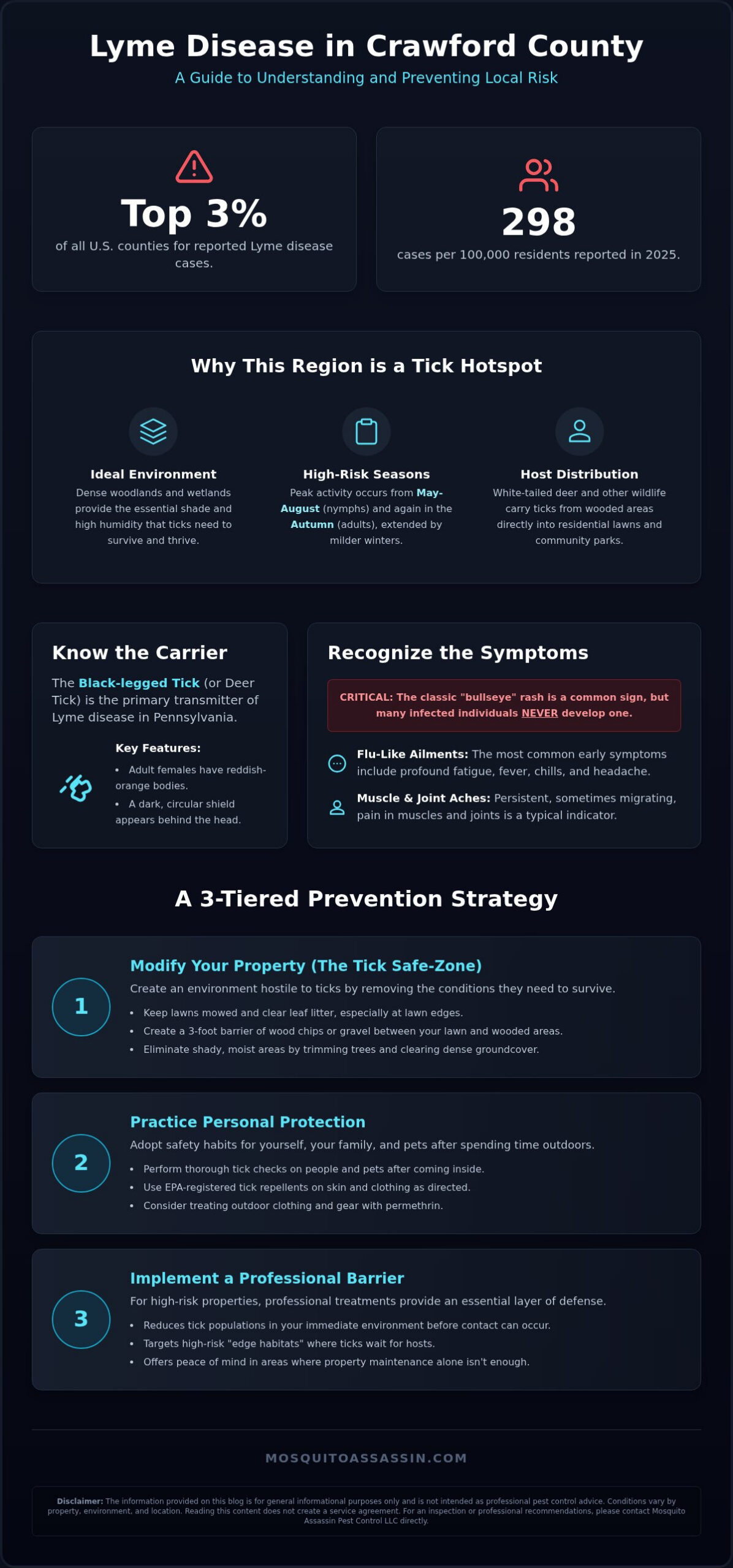
    Crawford County ranks in the top 3% of all United States counties for reported Lyme disease cases, according to 2025 CDC data. With a rate of approximately 298 cases per 100,000 residents, the local environment requires a vigilant and informed approach to safety. It’s natural to feel a sense of unease when family members or pets head outdoors, particularly when DIY methods seem unreliable or local tick species remain a mystery. Experts recognize that the black-legged tick is firmly established in Northwest Pennsylvania, making consistent protection a necessity rather than an option.

    This 2026 guide delivers a clear, professional path forward for lyme disease prevention crawford county, focusing on strategies that protect property and provide peace of mind. Residents will gain a thorough understanding of local risks and the specific behaviors of regional tick populations. The following sections outline actionable steps to transform a yard into a safer zone and provide the technical confidence needed to identify and remove ticks correctly. Readers can expect to learn about effective barrier methods and property maintenance habits that prioritize the wellbeing of every household member.

    Disclaimer: The information provided on this blog is for general informational purposes only and is not intended as professional pest control advice. Conditions vary by property, environment, and location. Reading this content does not create a service agreement. For an inspection or professional recommendations, please contact Mosquito Assassin Pest Control LLC directly.
    Key Takeaways

    • Understand why the Crawford County landscape supports high tick densities and how local awareness serves as the first step in family safety.
    • Identify the visual markers of the black-legged tick at various life stages and recognize early physical symptoms that may follow an encounter.
    • Discover proven strategies for lyme disease prevention crawford county by modifying backyard habitats to eliminate the shade and humidity ticks need to survive.
    • Learn practical personal protection habits and strategic landscaping choices that create a safer environment for children and pets.
    • Recognize how professional barrier treatments provide an essential layer of protection for high-risk zones where traditional maintenance often falls short.

    The Growing Risk of Lyme Disease in Crawford County

    Lyme disease is a bacterial infection typically caused by the bacterium Borrelia burgdorferi. It’s transmitted to humans through the bite of infected black-legged ticks, also known as deer ticks. For a comprehensive Lyme disease overview, it’s helpful to understand that this condition can affect various systems in the body if left unaddressed. In Northwest Pennsylvania, the geography creates an ideal environment for these parasites. Crawford County features a mix of dense woodlands, wetlands, and sprawling residential properties that provide the shade and moisture ticks require to thrive. Unlike some pests that prefer open sunlight, ticks are highly sensitive to desiccation (drying out), making the humid climate of our region a perfect sanctuary.

    The transition zones where manicured lawns meet wooded edges represent the highest risk areas for local families. These “edge habitats” allow ticks to wait in tall grass or leaf litter for a passing host. Recent climate trends in 2026 have exacerbated this issue. Mild winters in Northwest Pennsylvania have led to higher survival rates for tick populations during their dormant stages. When spring arrives earlier, as seen with the unseasonably warm weather in March and April 2026, tick activity begins weeks ahead of schedule. This extended season increases the window of time for potential encounters, making lyme disease prevention crawford county a year-round priority for property owners.

    Understanding the Crawford County Environment

    Local wildlife plays a massive role in the distribution of ticks throughout the county. White-tailed deer act as primary hosts for adult ticks, transporting them into residential backyards and community parks. Because Crawford County sits within the Great Lakes region, the consistent humidity levels support tick activity even during the peak of summer. While encounters can happen anytime temperatures are above freezing, the highest risk months in Pennsylvania typically span from May through August, when nymph-stage ticks are most active, and again in the autumn when adults emerge. Identifying these high-traffic zones on a property is the first step toward effective management.

    Why Prevention is Critical in 2026

    The stakes for lyme disease prevention crawford county are higher than ever. In 2025, Crawford County reported approximately 298 cases per 100,000 people, placing it among the top 3% of counties nationwide for reported infections. Untreated Lyme disease can lead to long-term health complications, including chronic joint pain, heart palpitations, and neurological issues. Taking a proactive approach is far more effective than reacting after a bite has occurred. Professional tick management serves as a critical layer of protection, reducing the population in your immediate environment before these pests can make contact with your family or pets.

    Disclaimer: The information provided on this blog is for general informational purposes only and is not intended as professional pest control advice. Conditions vary by property, environment, and location. Reading this content does not create a service agreement. For an inspection or professional recommendations, please contact Mosquito Assassin Pest Control LLC directly.

    Identifying the Black-legged Tick and Lyme Disease Symptoms

    The black-legged tick (Ixodes scapularis) is the primary carrier of Lyme disease in Northwest Pennsylvania. Accurate identification is the first line of defense for local families. Adult females are recognizable by their reddish-orange bodies and a dark, circular shield located behind the head. Symptoms of an infection typically manifest as flu-like ailments, including profound fatigue, fever, and persistent muscle aches. While the bullseye rash (Erythema migrans) is a frequent indicator, many infected individuals never develop this visible sign. Relying solely on the presence of a rash can lead to dangerous delays in treatment. Differentiating between a standard tick bite, which often results in a small, static red bump, and an infection involves watching for an expanding redness or the onset of systemic symptoms. Effective lyme disease prevention crawford county requires a high level of awareness regarding tick appearance and behavior.

    The Two-Year Life Cycle of a Tick

    Ticks undergo a complex life cycle consisting of four stages: egg, larva, nymph, and adult. In Crawford County, the nymphal stage is particularly hazardous to humans. These ticks are active during the late spring and early summer, and their tiny size, comparable to a poppy seed, makes them nearly impossible to detect without a thorough inspection. Adults typically resurface in the fall and remain active whenever temperatures are above freezing. In the humid environment of Northwest Pennsylvania, these life stages often overlap, creating a continuous threat throughout the warmer months. Adhering to CDC Lyme disease prevention guidelines during these high-activity windows is a vital part of a safety plan.

    What to Do After a Tick Bite

    Proper removal is essential to reduce the risk of pathogen transmission. Use fine-tipped tweezers to grasp the tick as close to the skin as possible. Pull upward with steady pressure. Avoid using heat, oils, or “painting” the tick with nail polish, as these methods can cause the tick to regurgitate fluids into the bite site. After removal, clean the area thoroughly with soap and water or rubbing alcohol. Monitoring your health for several weeks is necessary to ensure no symptoms develop. While individual vigilance is necessary, implementing lyme disease prevention crawford county through professional property management helps stop the problem before it reaches your door.

    Disclaimer: The information provided on this blog is for general informational purposes only and is not intended as professional pest control advice. For an inspection or professional recommendations, please contact Mosquito Assassin Pest Control LLC directly.
    Analyzing Tick Habitats in Northwest Pennsylvania

    Ticks are biological opportunists that rely on specific environmental conditions to survive. In Northwest Pennsylvania, the primary threat to their survival isn’t the cold, but rather desiccation (drying out). Because they breathe through pores in their exoskeleton, they require environments with high humidity, typically above 80 percent. This makes shady, moisture-rich areas of a Crawford County backyard far more dangerous than open, sun-drenched lawns. Understanding these micro-habitats is a cornerstone of effective lyme disease prevention crawford county. Leaf litter, for instance, serves as a thermal blanket that protects ticks during the winter, allowing them to emerge as soon as the ground thaws. Ground covers and ornamental plants, while aesthetically pleasing, often inadvertently create the cool, damp conditions these parasites crave.

    Common Residential Tick Hotspots

    Most tick encounters don’t happen deep in the forest. They occur in the transition zones of a residential property. Tall grass and brushy areas at the edge of a lawn act as staging grounds where ticks wait for a host to pass by. Wood piles and stone walls are also significant risks, as they provide ideal nesting sites for the rodents that carry ticks. Shady garden beds with thick layers of organic mulch are another concern. These areas trap moisture and provide a protected environment for ticks to hide during the heat of the day. Property owners can reduce risk by keeping these areas clear and creating physical barriers between wooded edges and active play zones.

    The Role of Host Animals

    Host animals are the invisible drivers of tick distribution across local properties. While white-tailed deer are often associated with the spread of ticks, small mammals like white-footed mice and chipmunks are the primary reservoirs for the Lyme bacteria. These rodents thrive in the same stone walls and wood piles that provide shelter for ticks. As deer move through Crawford County properties, they drop adult ticks that then lay thousands of eggs, restarting the cycle. Official guidance on Pennsylvania Lyme disease prevention emphasizes managing property boundaries to discourage wildlife entry. Removing bird feeders that attract rodents and installing deer-resistant fencing can help break the link between wildlife and tick populations in your yard.

    Professional pest management can target these specific hotspots where traditional lawn care often fails. By focusing on the perimeter and known nesting sites, it’s possible to significantly lower the tick pressure on a property. For those looking to secure their outdoor spaces, professional tick control services provide a necessary layer of defense.

    Disclaimer: The information provided on this blog is for general informational purposes only and is not intended as professional pest control advice. For an inspection or professional recommendations, please contact Mosquito Assassin Pest Control LLC directly.
    Lyme Disease Prevention in Crawford County: 2026 Guide

    Practical Steps for Personal and Home Tick Prevention

    Creating a tick-safe zone is a foundational part of lyme disease prevention crawford county. While the natural landscape of Northwest Pennsylvania provides a haven for these pests, residential properties don’t have to follow suit. By establishing a clear transition zone between wooded areas and managed lawns, you significantly reduce the likelihood of ticks migrating into active play spaces. Consistency is the key to success. Property owners who maintain their yards with tick behavior in mind create an environment that is far less hospitable to these parasites and the rodents that carry them.

    Yard Modification Strategies

    Simple changes to your landscaping can have a profound impact on tick populations. Keeping the grass mowed short is one of the most effective ways to lower humidity at the ground level. Ticks are extremely sensitive to moisture loss, so a dry, sun-exposed lawn acts as a natural deterrent. Removing leaf litter promptly is equally important, as these piles provide the insulation ticks need to survive the winter months. Piles of leaves and brush also attract mice and other small mammals that serve as hosts for immature ticks.

    Installing a three-foot wide barrier of wood chips or gravel along the perimeter of your yard creates a physical boundary that ticks are unlikely to cross. This barrier serves as a “no-man’s land” that separates the high-risk wooded edge from your manicured lawn. Additionally, pruning low-hanging branches allows more sunlight to penetrate the yard, further reducing the damp, shady conditions that ticks prefer. For those needing assistance with comprehensive property management, professional tick control services can help identify and treat these specific habitat zones effectively.

    Personal Protection Best Practices

    Personal habits are just as vital as property maintenance. When engaging in outdoor activities in Crawford County, use EPA-registered repellents containing DEET or picaridin. These substances are proven to discourage ticks from latching onto skin. For extended periods outdoors, treating clothing and gear with permethrin offers a durable layer of protection that lasts through multiple washes. This is especially helpful for gardening or hiking gear that frequently comes into contact with tall grass.

    The simplest physical defense is often the most effective. Tucking pants into socks prevents ticks from crawling up the inside of a pant leg. Once back inside, immediately place outdoor clothing in a dryer on high heat for at least ten minutes to kill any hitchhiking ticks. Conduct a thorough tick check on every family member, including pets. Focus on warm, dark areas like the backs of knees, the waistline, and the hairline. Finding a tick before it has a chance to attach is the best way to prevent the transmission of bacteria. If you’re concerned about the level of risk on your property, professional pest control may help reduce risk in these high-traffic areas.

    Disclaimer: The information provided on this blog is for general informational purposes only and is not intended as professional pest control advice. For an inspection or professional recommendations, please contact Mosquito Assassin Pest Control LLC directly.

    Professional Tick Management and Long-Term Prevention

    Professional barrier treatments represent a decisive intervention in a comprehensive safety strategy. While personal habits and yard maintenance provide a foundation, professional-grade methods target the biological vulnerabilities of ticks across their entire life cycle. These treatments focus on the high-risk perimeter zones where wooded areas meet managed lawns, creating a defensive shield that standard lawn care cannot replicate. For effective lyme disease prevention crawford county, integrating a professional management plan ensures that the most dangerous habitats on a property are systematically addressed.

    The Value of Local Professional Expertise

    Local expertise is vital. Tick activity in Northwest Pennsylvania is dictated by regional weather patterns and the specific ecology of the Great Lakes region. A professional inspection identifies specific property vulnerabilities, such as hidden rodent nesting sites or drainage issues that maintain the high humidity ticks require to survive. Professional-grade barrier methods differ significantly from over-the-counter products in their concentration, application precision, and residual effectiveness. For residents seeking lyme disease prevention crawford county, understanding the specific timing of the Pennsylvania climate is essential to stop populations before they peak.

    Creating a Year-Round Protection Plan

    Ongoing management is consistently more effective than isolated, one-time applications. Because ticks are constantly reintroduced to properties by local wildlife, a seasonal protection plan maintains a consistent level of defense throughout the high-risk months. This proactive approach is equally important for commercial spaces and public areas in Crawford County, where high foot traffic increases the potential for human-tick encounters. A professional approach typically includes several key benefits:

    • Targeted Perimeter Protection: Focusing on the transition zones where ticks are most likely to wait for hosts.
    • Hotspot Identification: Treating specific areas like thick mulch beds and stone walls where ticks seek shelter.
    • Residual Efficacy: Utilizing professional methods that remain active against ticks for extended periods.
    • Lifecycle Interruption: Targeting ticks at various stages of development to reduce the overall population density over time.

    Strategic management of outdoor spaces helps maintain community safety and reduces the overall tick pressure in the region. Ultimately, professional pest control may help reduce risk by providing a scientific, methodical layer of security for local families and businesses. Combining these professional services with the personal habits discussed in previous sections creates the most robust defense possible against tick-borne illnesses.

    Disclaimer: The information provided on this blog is for general informational purposes only and is not intended as professional pest control advice. For an inspection or professional recommendations, please contact Mosquito Assassin Pest Control LLC directly.
    Securing Your Property and Peace of Mind

    Protecting your household from tick-borne illnesses requires a multi-layered strategy that addresses both personal habits and environmental risks. By understanding the specific behaviors of the black-legged tick in Northwest Pennsylvania, you can take active steps to eliminate the shade and moisture they need to survive. Successful lyme disease prevention crawford county relies on the combination of routine tick checks, strategic landscaping, and professional intervention. Managing the transition zones where wooded areas meet your lawn is a critical step in reducing the presence of these parasites near your family and pets.

    Professional pest control plans provide the technical expertise needed to identify vulnerabilities that traditional lawn care might miss. Specialized mosquito and tick control services are designed to target hotspots while ensuring the security of your outdoor spaces. If you’re ready to take a definitive step toward a safer backyard, you can Request a professional inspection for your property. Serving Erie and Crawford Counties, these methodical approaches prioritize the wellbeing of the community. With the right information and a proactive plan, you can enjoy the Crawford County outdoors with confidence and security.

    Disclaimer: The information provided on this blog is for general informational purposes only and is not intended as professional pest control advice. For an inspection or professional recommendations, please contact Mosquito Assassin Pest Control LLC directly.

    Frequently Asked Questions

    Are ticks active in Crawford County during the winter?

    Black-legged ticks remain active whenever the temperature is above freezing. They do not die off during the winter months but instead enter a state of dormancy when the ground is frozen. If a mid-winter thaw occurs and temperatures reach at least 35 degrees Fahrenheit, they can emerge to search for a host. This biological resilience makes year-round awareness and lyme disease prevention crawford county a necessity for those living near wooded areas.

    Can my dog bring ticks into my house?

    Pets frequently transport unattached ticks into living spaces after spending time in tall grass or leaf litter. While a tick may not bite the animal immediately, it can crawl off the fur and onto furniture, rugs, or household members. Using veterinarian-approved preventatives is a vital first step, but manual checks after every outdoor excursion are also necessary. Ticks often hide in the thick fur around a dog’s neck, ears, and paws.

    How long does a tick need to be attached to transmit Lyme disease?

    A tick typically must be attached for 36 to 48 hours before the Lyme disease bacterium is successfully transmitted to a human host. This delay occurs because the bacteria must migrate from the tick’s midgut to its salivary glands before entering the bite site. Performing thorough daily tick checks significantly reduces the risk of infection. If a tick is found and removed within the first 24 hours, the probability of transmission is very low.

    What is the best way to remove a tick from my skin?

    Use fine-tipped tweezers to grasp the tick as close to the skin’s surface as possible. Pull upward with steady, even pressure without twisting or jerking, which can cause the mouthparts to break off and remain in the skin. After removal, clean the bite area and your hands with rubbing alcohol or soap and water. Never use heat, petroleum jelly, or other home remedies to smother the tick, as these methods can increase infection risks.

    Does every Black-legged tick carry Lyme disease?

    Not every black-legged tick is infected with the Borrelia burgdorferi bacterium. Infection rates vary by year and specific location within Northwest Pennsylvania. Larval ticks are born without the bacteria and must acquire it by feeding on an infected host, usually a small rodent like a white-footed mouse. While not every bite leads to illness, the high prevalence of the bacteria in local wildlife makes lyme disease prevention crawford county a critical priority for all residents.

    Are there other tick-borne illnesses in Pennsylvania besides Lyme?

    Pennsylvania residents face risks from several other tick-borne pathogens, including Anaplasmosis, Babesiosis, and Powassan virus. Anaplasmosis is currently the second most reported tick-borne disease in the state. These illnesses are transmitted by the same black-legged ticks that carry Lyme disease. Because a single tick can carry multiple pathogens simultaneously, a proactive approach to property management is the most effective way to limit exposure to these various health concerns throughout the year.

    How can I tell the difference between a dog tick and a deer tick?

    Size and markings are the primary differentiators between these species. The black-legged tick (deer tick) is significantly smaller than the American dog tick and has a dark, solid-colored shield. In contrast, the American dog tick often features white or silver markings on its shield and is generally more visible to the naked eye. While both can bite humans, only the black-legged tick transmits the bacteria responsible for Lyme disease in the Crawford County region.

    Is professional tick spraying safe for my garden plants?

    Professional barrier treatments are designed to target specific areas where ticks reside without harming established garden plants. Licensed professionals apply these treatments to the perimeter of the property, focusing on leaf litter, tall grass, and wooded edges rather than directly on vegetable gardens or delicate flowers. These methods prioritize the safety of the household while effectively reducing the tick population. Following the specific re-entry instructions provided after an application ensures the wellbeing of family members and pets.

    Disclaimer: The information provided on this blog is for general informational purposes only and is not intended as professional pest control advice. For an inspection or professional recommendations, please contact Mosquito Assassin Pest Control LLC directly.

  • Where Do Mice Hide During the Day? Common Nesting Spots

    Where Do Mice Hide During the Day? Common Nesting Spots

    Why is it that you can hear the distinct sound of scratching inside your walls at midnight, yet your home appears completely empty the moment the sun comes up? For many property owners in Erie and Crawford Counties, Pennsylvania, and Ashtabula County, Ohio, wondering exactly where do mice hide during the day is a source of constant frustration. It’s unsettling to find droppings in a kitchen drawer or notice chewed insulation without ever catching a glimpse of the pest responsible. This behavior often leads to a growing sense of anxiety about the extent of hidden damage occurring behind the scenes.

    Understanding these daytime retreats is essential for an effective management plan. These rodents are experts at utilizing the structural vulnerabilities of a building to stay out of sight while they rest and reproduce. This article explores the biological reasons why mice avoid daylight and identifies the most common nesting spots, including wall voids, attic spaces, and areas behind large appliances. By learning the signs of a daytime nesting site, you can better understand the scope of the problem and move toward a permanent, professional exclusion strategy.

    Disclaimer: The information provided on this blog is for general informational purposes only and is not intended as professional pest control advice. Conditions vary by property, environment, and location. Reading this content does not create a service agreement. For an inspection or professional recommendations, please contact Mosquito Assassin Pest Control LLC directly.

    Key Takeaways

    • Understand how the nocturnal instincts of the house mouse (Mus musculus) help them avoid detection by remaining dormant during daylight hours.
    • Pinpoint the specific structural vulnerabilities in your home, such as wall voids and attic spaces, to determine exactly where do mice hide during the day.
    • Discover why the kitchen is a primary target for nesting and how to inspect the hidden areas behind large household appliances.
    • Learn to identify the subtle signs of active nesting, including the difference between fresh droppings and the grease stains known as rub marks.
    • Explore the professional three-step approach of removal, maintenance, and exclusion as the most reliable method for long-term rodent management in the local regional climate.

    Understanding Mouse Behavior and Nocturnal Instincts

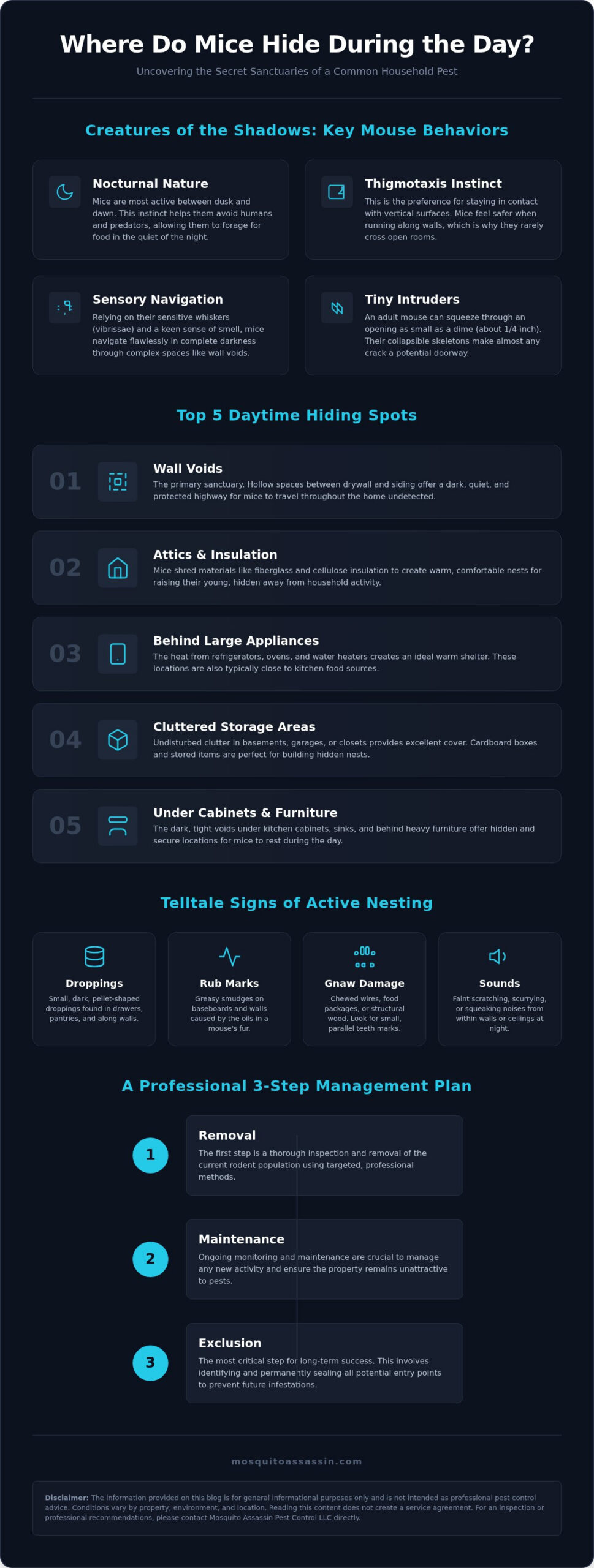
    The house mouse, scientifically known as Mus musculus, is a creature of the shadows. As a primarily nocturnal species, their entire biological system is designed to function in low-light environments. It’s a survival tactic that serves as a critical defense mechanism against predators. By remaining inactive when larger animals and humans are awake, they significantly reduce the risk of being spotted. Property owners who want to know where do mice hide during the day must first recognize that House mouse behavior is centered on survival through invisibility.

    While humans rely heavily on vision, rodents navigate using a sophisticated combination of smell and touch. Their whiskers, or vibrissae, act as high-sensitivity sensors that detect air currents and physical obstacles in total darkness. This allows them to move through narrow wall voids or cluttered basements with precision. In residential settings, peak activity typically occurs between dusk and dawn. During these hours, the house is usually quiet, providing the security they need to forage for food. If you’re hearing noises at 2:00 AM, you’re witnessing their natural peak performance window.

    The Role of Thigmotaxis in Hiding

    One of the most important concepts in rodent biology is thigmotaxis. This is an innate preference for remaining in contact with solid surfaces. It explains where do mice hide during the day and why they rarely run across the center of a room. When a mouse feels a wall against its whiskers or fur, its brain registers a sense of safety. Tight, enclosed spaces provide the physical security they need to rest without fear of being ambushed from above or behind. This instinct leads them to squeeze into gaps as small as a quarter-inch; making wall interiors and the undersides of cabinets ideal sanctuaries.

    Environmental Triggers for Daytime Seclusion

    Several factors dictate exactly when and where a mouse will hunker down. Light sensitivity is a major driver; bright, artificial lights or direct sunlight are overstimulating and signal danger. Household noise levels also play a significant role. In busy homes across Erie or Ashtabula Counties, the sound of footsteps or appliances will keep rodents deep within their nests. Finally, warmth and proximity to food are the ultimate deciding factors. A hiding spot that is near a heat-producing appliance, such as a water heater or refrigerator, is far more attractive than a cold, drafty corner of a garage.

    Disclaimer: The information provided on this blog is for general informational purposes only and is not intended as professional pest control advice. Conditions vary by property, environment, and location. Reading this content does not create a service agreement. For an inspection or professional recommendations, please contact Mosquito Assassin Pest Control LLC directly.

    Common Indoor Hiding Spots in Residential Properties

    Northwest Pennsylvania and Northeast Ohio experience significant seasonal shifts, often driving rodents indoors as temperatures drop. When homeowners ask where do mice hide during the day, the answer usually lies within the very structure of the building. Residential properties provide a variety of undisturbed zones that offer the silence and security these pests require. Because mice can compress their bodies to fit through gaps the size of a pencil, almost any hollow space is a potential nesting site.

    Most modern and historic homes in Erie and Crawford counties contain hollow spaces between the interior drywall and exterior siding. These wall voids are the primary daytime sanctuaries for mice. They are virtually inaccessible to humans and pets, providing a perfect buffer against household noise. Mice often enter these voids through small gaps around utility pipes, dryer vents, or foundation cracks. Once inside, they can move vertically through the house without ever being seen or disturbed.

    Insulation and Wall Voids

    Mice don’t just hide in walls; they actively modify the environment to suit their needs. Fiberglass and cellulose insulation are favored nesting materials because they are easy to shred and provide excellent heat retention for litters. These pests often follow electrical wire runs or plumbing stacks, which act as internal highways between the basement and the upper floors. Spotting Signs of Active Mouse Nesting, such as tunneled insulation or chewed wire coatings, is a clear indicator of a hidden infestation within the walls.

    Attics and Upper Level Seclusion

    Attics are perhaps the most ideal environment for a mouse colony to grow unchecked. These spaces are rarely visited, filled with nesting materials like stored cardboard boxes, and often contain seasonal decorations that offer additional cover. Undisturbed corners allow for rapid population growth since there is little threat of discovery. Mice typically reach these upper levels by climbing exterior brickwork or using overhanging tree branches to access roof lines, fascia boards, and soffit vents. This is why where do mice hide during the day often includes the highest points of the home.

    The lowest levels of a home serve as both entry points and secondary hiding zones. Crawl spaces with dirt floors or unfinished basements provide easy access to the home’s structural framing. Because these areas are often damp and dark, they mimic the natural burrows mice use in the wild. If you suspect an infestation, rodent control service may help identify these hidden entry points and nesting sites before the population spreads to living areas.

    Disclaimer: The information provided on this blog is for general informational purposes only and is not intended as professional pest control advice. For an inspection or professional recommendations, please contact Mosquito Assassin Pest Control LLC directly.

    Hidden Areas Within Kitchens and Living Spaces

    Kitchens are the most high-risk areas in any residential property due to the constant availability of food, water, and heat. When property owners in Erie or Ashtabula investigate where do mice hide during the day, they should prioritize areas that offer both concealment and immediate proximity to these essential resources. Unlike attics or basements, kitchen hiding spots allow mice to forage with minimal travel, significantly reducing their exposure to open spaces and potential threats.

    Behind and Under Appliances

    Large household appliances are ideal daytime sanctuaries because they generate consistent warmth. Refrigerator and freezer motor housings are prime locations; the heat from condenser coils provides a stable environment for nesting even in cold Northwest Pennsylvania winters. Similarly, the space beneath a dishwasher often contains fiberglass insulation and residual moisture from plumbing, creating a high-quality habitat for a developing colony.

    Voids under ovens and stoves are equally problematic for homeowners. These areas often accumulate grease and food crumbs that are difficult to reach with standard cleaning tools, providing a built-in food supply for nesting rodents. Mice frequently utilize the space behind kickplates, the recessed panels at the base of cabinets, as a protected thoroughfare to move between different appliances without ever being seen by the residents.

    Cabinetry and Pantry Voids

    The structural design of modern cabinetry often leaves narrow gaps between the back of the cabinet box and the actual wall surface. These spaces are just wide enough for a house mouse to navigate and rest. Hollow bases of kitchen islands are another common hiding spot; they are often constructed as empty boxes that provide a large, undisturbed volume for nesting material to accumulate. Identifying where do mice hide during the day in these areas requires a close inspection of the following:

    • The corners of lower cabinets for shredded paper or plastic packaging.
    • Gaps where plumbing pipes enter the wall under the kitchen sink.
    • Small piles of cached seeds or pet food hidden behind stored pantry goods.
    • Gnaw marks on wooden baseboards or the edges of cabinet liners.

    Living rooms also provide overlooked opportunities for concealment. Upholstered furniture, particularly the dark underside of sofas and the internal mechanisms of recliners, offers a soft and quiet environment for daytime rest. Because these heavy items are rarely moved, a mouse can remain undisturbed for long periods. Professional rodent control service can help identify these non-traditional nesting sites and ensure that every potential hiding spot is addressed.

    Disclaimer: The information provided on this blog is for general informational purposes only and is not intended as professional pest control advice. For an inspection or professional recommendations, please contact Mosquito Assassin Pest Control LLC directly.

    Where Do Mice Hide During the Day? Common Nesting Spots

    Identifying Signs of Active Mouse Nesting Sites

    Finding the answer to where do mice hide during the day requires a methodical inspection for physical evidence. Because mice are elusive, property owners must learn to distinguish between historic activity and a current, active threat. One of the most reliable indicators is the condition of rodent droppings. Fresh droppings are dark in color and have a soft, putty-like texture. If the droppings are gray, dry, and crumble when touched, they likely represent an old nesting site that has been abandoned. Identifying fresh waste is the first step in confirming that a colony is currently residing within your walls.

    Another distinct sign is the presence of rub marks along baseboards or near structural gaps. These are dark, greasy stains caused by the sebum (natural oils) and dirt in a mouse’s fur. Because rodents follow the same paths daily to maintain a sense of security, these stains accumulate over time. If you find these marks near a small opening in the drywall or a gap in a kitchen cabinet, you have likely identified a primary entry point to their daytime sanctuary. Fresh gnaw marks on wood or plastic also indicate active nesting; newer marks are lighter in color, while older ones darken as they are exposed to the air.

    Visual Evidence and Waste

    In areas with high activity, you may encounter urine pillars. These are small mounds composed of a mixture of urine, grease, and dirt. They serve as a sophisticated communication tool for rodents, but for homeowners, they are a clear sign of a long-standing infestation. You should also look for piles of shredded material, such as fiberglass insulation, paper, or fabric bits, which are used to construct nests. A strong, musty smell of ammonia is another dead giveaway that a nesting site is nearby, as mice use urine to mark their territory and navigate in the dark.

    Auditory and Behavioral Clues

    The sounds you hear can reveal a lot about where do mice hide during the day and how they move through your home. Scurrying sounds typically indicate travel through horizontal wall voids or ceiling joists. In contrast, persistent scratching in a localized area often suggests a mouse is actively gnawing on structural elements or expanding a nest. If your pets, especially cats or dogs, are fixated on a specific section of a wall or the base of an appliance, they are likely detecting the scent or ultrasonic sounds of a hidden rodent that is remaining out of your sight.

    While mice are nocturnal, seeing one during daylight hours is a serious warning sign for property owners in Erie and Crawford Counties. This usually indicates that the population has grown so large that the primary hiding spots are overcrowded, forcing lower-ranking individuals to forage when it is less safe. If you notice these indicators, seeking a professional rodent control service can help confirm the extent of the activity and locate hidden nests before the damage becomes extensive.

    Disclaimer: The information provided on this blog is for general informational purposes only and is not intended as professional pest control advice. For an inspection or professional recommendations, please contact Mosquito Assassin Pest Control LLC directly.

    Professional Rodent Management and Exclusion Strategies

    Identifying exactly where do mice hide during the day is only the first stage of a successful remediation plan. While retail traps might catch a few individuals, they rarely reach the deep nesting sites located in wall voids or attic insulation. Professional management is required to address the root of the infestation through a methodical three-step process: removal, maintenance, and exclusion. This approach ensures that current populations are managed while simultaneously preventing new rodents from exploiting the same structural vulnerabilities that led to the initial problem.

    The Removal and Maintenance Phase

    A professional assessment is the only way to accurately map out the extent of a rodent problem. Licensed technicians look beyond the surface to find the primary nesting sites identified in previous sections. By analyzing the patterns of fresh droppings and rub marks, they can determine the most effective locations for equipment placement. Maintenance involves regular inspections to monitor activity levels and ensure that no new colonies are establishing themselves in overlooked corners of the property. Regular maintenance visits allow for the adjustment of strategies based on seasonal changes and rodent behavior, preventing pests from finding new ways into the living space as the building settles.

    Exclusion: Sealing the Home for Good

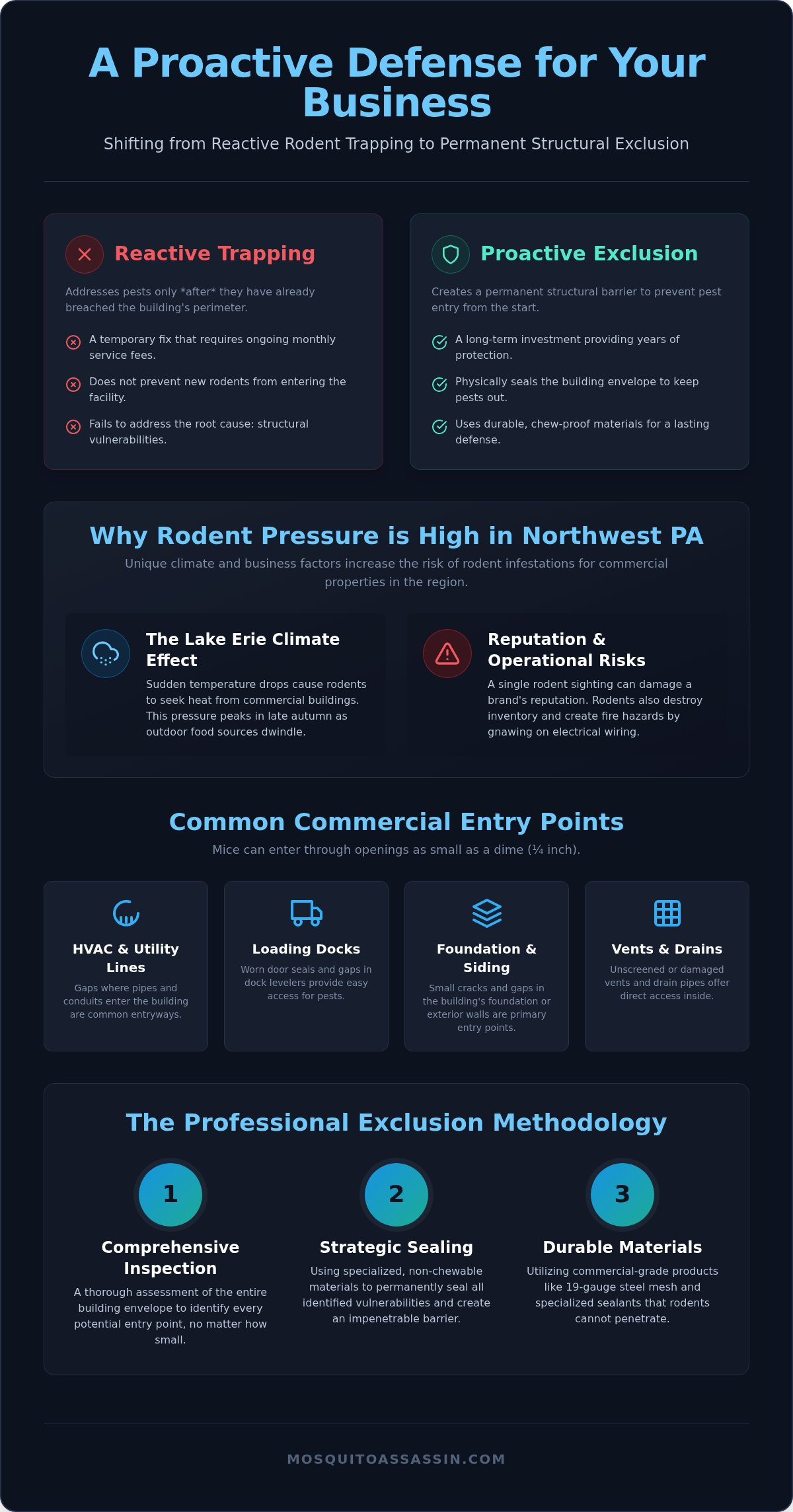
    Exclusion is the most critical step for achieving a permanent solution. It involves identifying and sealing every possible entry point, such as weep holes in brickwork, gaps around utility pipes, and cracks in the foundation. Because mice can chew through many common building materials, professionals utilize durable substances like steel wool or copper mesh that rodents cannot penetrate. Exclusion doesn’t just stop mice; it also helps reduce the risk of other pests entering the home by closing off hidden pathways. Investing in professional rodent removal and exclusion provides the long-term peace of mind that comes from knowing your home is structurally secure against future invaders.

    In the unique climate of Erie and Crawford Counties in Pennsylvania and Ashtabula County in Ohio, rodent pressure is a year-round concern. The harsh winters drive pests inward, while the milder months allow populations to thrive outdoors. Consistent protection is necessary to maintain a rodent-free environment. Seeking a professional rodent control service helps homeowners understand where do mice hide during the day and provides the technical expertise needed to keep them out for good.

    Disclaimer: The information provided on this blog is for general informational purposes only and is not intended as professional pest control advice. For an inspection or professional recommendations, please contact Mosquito Assassin Pest Control LLC directly.

    Reclaiming Your Home from Hidden Rodents

    Mice are masters of concealment, utilizing everything from wall voids to kitchen appliance motors to remain undisturbed. Understanding exactly where do mice hide during the day allows property owners to look beyond the surface and identify the true scope of a nesting problem. By recognizing fresh physical signs like rub marks and soft droppings, you can pinpoint active sites before structural damage escalates.

    Licensed professionals in Pennsylvania and Ohio utilize a specialized three-step process of removal, maintenance, and exclusion to secure properties in Erie, Crawford, and Ashtabula Counties. Professional pest control may help reduce the risk of a rodent infestation. For an inspection, visit the online booking portal or learn more at mosquitoassassin.com. Taking decisive action today ensures a safer, quieter environment for your household tomorrow.

    Disclaimer: The information provided on this blog is for general informational purposes only and is not intended as professional pest control advice. For an inspection or professional recommendations, please contact Mosquito Assassin Pest Control LLC directly.

    Frequently Asked Questions

    Can mice hide in my bed or bedroom during the day?

    Yes, though it’s less common than walls or attics. They prefer undisturbed areas like under the bed frame, inside box springs, or in cluttered closets. Bedroom hiding spots are usually chosen for proximity to warmth or soft nesting materials like clothing and linens. If you find droppings or chewed fabric in your bedroom, it indicates they’ve found a secure daytime sanctuary within that specific room.

    How many mice are usually in a house if I see one during the day?

    Seeing a mouse during the day typically indicates a significant population or a lack of available hiding space. Because they are nocturnal, they only venture out in daylight when their primary nests are overcrowded or food competition is high. While it’s impossible to give an exact number without an inspection, one visible mouse often suggests a colony of a dozen or more is nesting nearby.

    Will keeping the lights on keep mice from coming out?

    Keeping the lights on is rarely an effective deterrent for a mouse infestation. While they prefer darkness to avoid predators, they are driven by hunger and will eventually venture into lit areas if they feel safe enough. They rely on their whiskers and sense of smell more than vision. Instead of light, focus on professional exclusion to address the structural gaps that allow them to enter your living spaces.

    Do mice hide in air ducts or heating vents?

    Yes, air ducts and heating vents are common thoroughfares and nesting sites. These systems provide warmth, protection from humans, and easy access to every room in the house. Mice often use the insulation surrounding the ducts as nesting material. If you hear scratching or scurrying sounds coming from your vents, it is a strong indicator of an active population using the HVAC system as a primary daytime retreat.

    What is the most common place for a mouse nest?

    The most common nesting sites are wall voids and attic insulation. These areas provide the quiet, dark, and warm environment necessary for reproduction. In the kitchen, the voids behind and under large appliances like refrigerators and stoves are also high-risk zones. Homeowners often ask where do mice hide during the day, and the answer is almost always a structural hollow that is inaccessible to people and pets.

    How do I find a mouse nest in my house?

    Finding a nest requires looking for specific physical indicators in undisturbed areas. Start by checking for shredded materials like paper, string, or insulation in the corners of cabinets, basements, or attics. Follow the trail of fresh droppings or look for greasy rub marks along the baseboards. These signs usually lead back to a small opening in the drywall or a gap in the flooring where the primary nest is located.

    Why do mice prefer to hide in the walls?

    Walls provide a perfect combination of safety and mobility. The hollow space between studs allows mice to move between floors without being seen, and the presence of insulation offers warmth and nesting material. Walls also house electrical wires and plumbing, which rodents use as navigational guides. This structural seclusion makes it difficult for homeowners to identify where do mice hide during the day without a professional assessment of the property.

    Do mice leave their hiding spots every day?

    Most mice will leave their hiding spots at least once every 24 hours to forage for food and water. While they are highly cautious, their fast metabolism requires frequent feeding. They usually emerge shortly after the house becomes quiet at night. If food sources are readily available within their nest area, such as a pantry with unsealed containers, they may not need to travel far from their daytime sanctuary.

    Disclaimer: The information provided on this blog is for general informational purposes only and is not intended as professional pest control advice. For an inspection or professional recommendations, please contact Mosquito Assassin Pest Control LLC directly.

  • West Nile Virus and Mosquito Activity in Ohio: 2026 Guide

    West Nile Virus and Mosquito Activity in Ohio: 2026 Guide

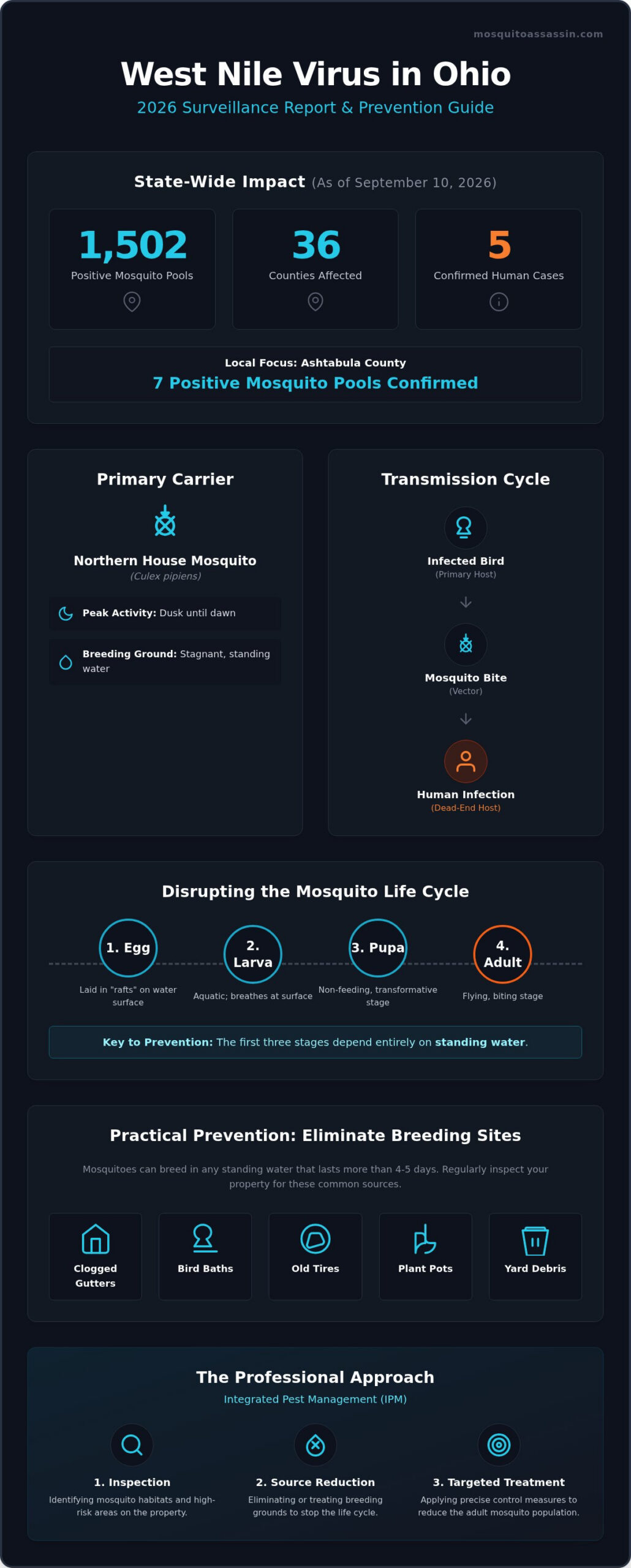
    As of September 10, 2026, 1,502 mosquito pools across 36 Ohio counties have tested positive for West Nile virus, showing a significant spike in activity compared to earlier in the season. For residents in Ashtabula County, where seven positive pools have already been identified, these numbers represent more than just data; they represent a valid concern for family safety and outdoor comfort. Understanding the prevalence of west nile virus mosquitoes ohio homeowners encounter is the first step toward reclaiming your yard from these persistent pests.

    It is frustrating to deal with conflicting news reports or ineffective DIY solutions that fail to provide real peace of mind. This 2026 guide provides the clarity you need by detailing the actual risk levels and offering science-based strategies to reduce mosquito populations on your property. You will learn to identify specific breeding sites and explore professional risk reduction methods used throughout Northeast Ohio and Northwest Pennsylvania. By the end of this article, you will have a clear plan to help safeguard your household and enjoy your outdoor space again.

    Key Takeaways

    • Review the latest 2026 surveillance data from the Ohio Department of Health to understand current regional risk levels and infection trends.
    • Identify the Northern House Mosquito as the primary vector for west nile virus mosquitoes ohio homeowners should monitor during the peak activity season.
    • Compare the distinct risks of West Nile virus with other regional concerns like La Crosse Encephalitis, which often impacts different demographic groups.
    • Discover practical methods to locate and eliminate common breeding sites around the home to disrupt the mosquito life cycle effectively.
    • Learn how professional integrated pest management provides a methodical, scientific approach to reducing mosquito activity on residential and commercial properties.

    West Nile virus is a complex mosquito-borne illness that cycles primarily between birds and mosquitoes. Humans and other mammals become infected through the bite of an infected mosquito. Because the virus doesn’t develop high enough levels in the human bloodstream to be passed back to other mosquitoes, humans are considered “dead-end” hosts. In 2026, the Ohio Department of Health surveillance data regarding west nile virus mosquitoes ohio shows a significant increase in viral activity across the state. As of September 10, teams identified 1,502 positive mosquito pools across 36 counties. While only five human cases have been confirmed so far, the high volume of infected mosquitoes indicates a broad regional risk.

    Understanding the prevalence of west nile virus mosquitoes ohio residents face requires looking at the data behind the headlines. High pool counts often signal that the virus is well-established in local bird populations. To better understand how these trends impact local communities, watch this report on viral discovery in the region:

    The 2026 Surveillance Landscape

    State agencies utilize specialized equipment like gravid traps to monitor viral activity throughout the summer months. These traps specifically target female mosquitoes looking for a place to lay eggs, which provides a clear picture of local infection rates. The Zoonotic Disease Program manages this data, providing weekly updates every Friday at noon. This monitoring season typically begins in mid-May and continues through the end of September. Even when human cases remain low, a high density of positive pools suggests that the virus is actively circulating. Surveillance data helps professionals identify when and where the risk is highest, allowing for more precise intervention strategies.

    West Nile Virus in Northeast Ohio

    Residents in Ashtabula County face specific geographic risks, as seven positive mosquito pools were confirmed in the area by early September 2026. Local health departments often coordinate with professional pest control services to manage these populations and reduce public exposure. It is a known pattern in vector-borne disease tracking that virus detection in local bird populations or mosquito pools often precedes the first human cases in a specific region. This early warning system allows homeowners to take proactive steps before the risk peaks. Professional pest control in Ashtabula and surrounding areas can help mitigate these environmental risks through targeted management. These professional strategies focus on reducing the population of adult mosquitoes while simultaneously addressing the larval stages in standing water. Local expertise is vital because mosquito behavior varies based on the specific terrain and climate of Northeast Ohio.

    The Biology of Transmission: How Mosquitoes Spread the Virus

    Culex pipiens, commonly known as the Northern House Mosquito, serves as the primary vector for west nile virus mosquitoes ohio homeowners face. This species maintains the virus through a cycle involving local bird populations. When a mosquito feeds on an infected bird, the virus enters its system and eventually migrates to the salivary glands. Humans are considered dead-end hosts. This means that while a mosquito can pass the virus to a person, that person cannot pass the virus back to other mosquitoes. The cycle effectively stops with the human infection.

    These mosquitoes are primarily nocturnal and exhibit peak activity from dusk until dawn. Environmental factors in Ohio play a significant role in how quickly the virus spreads. High summer temperatures and periods of heavy rain followed by humidity accelerate viral replication within the mosquito’s body. When heat index values rise, the time it takes for a mosquito to become infectious after feeding on a bird shortens significantly. Stagnant water combined with consistent heat creates a high-pressure environment for viral transmission.

    The Culex Life Cycle

    The life cycle consists of four distinct stages: egg, larva, pupa, and adult. Standing water is the essential requirement for the first three stages of development. Female Culex mosquitoes lay rafts of eggs directly on the surface of stagnant water. During a typical humid Ohio summer, a population can explode in as little as seven to ten days. Stagnant water in clogged gutters, neglected birdbaths, or discarded containers provides the perfect nursery for thousands of larvae to thrive and mature into biting adults.

    Feeding Habits and Viral Transmission

    Only female mosquitoes bite because they require the protein found in blood to produce eggs. Male mosquitoes don’t possess the mouthparts necessary to pierce skin; they feed exclusively on flower nectar. According to the OSU Extension mosquito safety guide, the virus must reach a specific concentration in the mosquito’s salivary glands before it can be transmitted. Fortunately, not every bite from an infected mosquito leads to illness. Many variables, including the mosquito’s viral load and the person’s individual health, determine the outcome of an exposure.

    Understanding these biological patterns helps in identifying when your property is most at risk. Implementing a professional mosquito control service can disrupt this cycle by targeting mosquitoes where they rest and breed. This methodical approach reduces the overall population and limits the opportunities for transmission to occur near your home and family.

    Comparing West Nile with Other Ohio Mosquito Threats

    While much of the public health focus remains on west nile virus mosquitoes ohio residents encounter, it isn’t the only viral threat circulating in the region. Ohio actually leads the nation in reported cases of La Crosse virus, another serious mosquito-borne illness. In 2025, the state recorded 53 cases, significantly higher than the annual average of 20. Managing a property effectively requires understanding that different mosquito species carry different risks and require specific intervention strategies. Professional pest management is designed to address these multiple species simultaneously, providing a comprehensive shield for your household.

    La Crosse Encephalitis vs. West Nile

    The primary difference between these two threats lies in their vectors, breeding habits, and target demographics. West Nile virus typically poses the greatest risk to older adults (the median age for the five Ohio cases in 2026 is 72 years). In contrast, La Crosse virus primarily impacts children and adolescents. The breeding habits of the vectors also differ significantly. While the Culex species associated with West Nile prefers stagnant water in containers or clogged gutters, the Eastern Treehole Mosquito (Aedes triseriatus) breeds in water-filled cavities of trees or discarded tires.

    Seasonal peaks and activity times also vary. West Nile activity usually intensifies in late August and September, while La Crosse cases can appear throughout the summer. Additionally, the La Crosse vector is an aggressive daytime biter, which stands in stark contrast to the nocturnal habits of Culex mosquitoes. Because of these variations, a broad-spectrum approach to pest control is necessary. It ensures that both daytime and nighttime threats are mitigated through a combination of environmental management and targeted applications.

    Travel-Related Mosquito Concerns

    Diseases like Zika, Dengue, Malaria, or Yellow Fever are not currently established in Ohio’s local mosquito populations. However, travelers frequently bring these infections back from tropical regions to local counties. This creates a potential risk for secondary transmission. If a local mosquito bites an infected traveler, it could theoretically spread the disease to others in the community. Local surveillance programs are vital because they monitor these travel-related cases to prevent outbreaks from taking root in the local ecosystem.

    Maintaining a professional mosquito control service plan is a practical way to keep overall mosquito populations low. By reducing the number of potential vectors on your property, you decrease the likelihood of any mosquito-borne disease, whether locally acquired or travel-related, affecting your family. This proactive stance is the most effective way to ensure long-term outdoor safety in Northeast Ohio and Northwest Pennsylvania.

    Disclaimer: The information provided on this blog is for general informational purposes only and is not intended as professional pest control advice. Conditions vary by property, environment, and location. Reading this content does not create a service agreement. For an inspection or professional recommendations, please contact Mosquito Assassin Pest Control LLC directly.

    West Nile Virus and Mosquito Activity in Ohio: 2026 Guide

    Practical Strategies for Reducing Mosquito Populations

    Managing the environment is the first and most critical step in comprehensive pest control. By altering the conditions that allow pests to thrive, homeowners can significantly lower the local population. This systematic approach is often called Integrated Pest Management (IPM). It involves monitoring activity, identifying the pest (such as the west nile virus mosquitoes ohio residents encounter in late summer), and using a combination of physical, cultural, and professional methods to manage the risk. It is a methodical way to reclaim your yard without relying solely on a single solution.

    Physical barriers provide a primary line of defense before insects even reach your skin. Ensure that window and door screens are tightly fitted and free of holes or tears. When spending time outdoors during peak activity hours, wearing long sleeves and light-colored clothing can reduce the surface area available for biting. These simple steps, combined with environmental management, form a solid foundation for protecting your household during the height of the season.

    Eliminating Standing Water

    The Culex mosquito is highly opportunistic and can breed in remarkably small amounts of water. A single discarded bottle cap or a small fold in a plastic tarp can support dozens of larvae. Homeowners should conduct weekly property inspections to identify and address these sources. Consistency is vital because the transition from egg to adult can happen quickly in humid conditions. Focus on these common breeding sites around the home:

    • Clear clogged rain gutters: These are a primary breeding ground because they collect organic debris and stagnant water high above the ground, often going unnoticed.
    • Refresh bird baths: Change the water at least twice a week to disrupt the egg-to-adult cycle.
    • Manage old tires: Drill holes in tire swings or remove old tires from the property, as they are notorious for holding water and heat.
    • Tighten pool covers: Ensure water doesn’t pool in the center of the cover after a rainstorm, as even a thin layer of water is enough for breeding.

    Landscaping for Mosquito Suppression

    Adult mosquitoes spend their daylight hours resting in cool, humid, and shaded areas. Overgrown vegetation and tall grass create a microclimate that protects them from the dehydrating effects of the sun. Keeping grass mowed short and thinning out dense brush or ornamental shrubs removes these resting sites. Removing leaf litter and cleaning up woodpiles also reduces the damp environments where mosquitoes congregate during the day.

    While these DIY steps are essential, they are often most effective when combined with a systematic treatment plan. Professional pest control may help reduce risk by reaching the areas that are difficult for homeowners to manage alone, such as the underside of dense foliage or high-canopy resting spots. For a comprehensive property assessment, you can schedule a professional mosquito control inspection to identify high-risk zones on your property.

    Disclaimer: The information provided on this blog is for for general informational purposes only and is not intended as professional pest control advice. Conditions vary by property, environment, and location. Reading this content does not create a service agreement. For an inspection or professional recommendations, please contact Mosquito Assassin Pest Control LLC directly.
    The Role of Professional Integrated Pest Management

    Professional integrated pest management (IPM) provides a systematic framework for managing the west nile virus mosquitoes ohio residents face during the warmer months. Unlike general property maintenance, professional suppression involves specialized equipment and a deep understanding of insect biology. Licensed professionals are trained to identify the specific environmental triggers that lead to population spikes in Erie, Crawford, and Ashtabula counties. By focusing on the entire life cycle, including both aquatic larvae and flying adults, these services offer a more thorough resolution than traditional methods.

    Effective management requires more than just reactive measures. It involves ongoing protection plans, such as bi-monthly services, that maintain a consistent barrier against incoming pests. This proactive approach ensures that populations don’t have the opportunity to recover between treatments. Local expertise is particularly valuable in the tri-county area, where regional weather patterns can create unique humidity pockets that favor mosquito development. Professionals understand how to adjust strategies based on current surveillance data and seasonal shifts.

    Why Professional Monitoring Matters

    Professional monitoring is essential because mosquitoes are experts at finding obscure breeding locations. While a homeowner might clear their gutters, a professional can identify hidden sites like hollow tree stumps, clogged drainage tiles, or specific types of dense ground cover that hold moisture. Professionals utilize professional-grade products designed for long-term suppression, which provide a residual effect that continues to work long after the initial application. These services are specifically engineered to safeguard outdoor spaces, allowing families to utilize their decks, patios, and yards with a greater sense of security.

    Long-Term Protection for Your Property

    Total property security often depends on year-round awareness and seasonal timing. Regional knowledge of Ohio and Pennsylvania weather patterns allows professionals to time treatments perfectly, ensuring that protection is at its peak when viral activity is highest. For those looking to establish a more permanent defense, you can learn more about professional mosquito control services and how they integrate into a broader pest management strategy.

    Maintaining a consistent schedule is the most effective way to manage the risks associated with west nile virus mosquitoes ohio. When treatments are applied at the correct intervals, the cumulative effect reduces the overall population density over time. This scientific approach prioritizes the safety of household members and animals while delivering decisive results. By relying on a dependable local expert, property owners can move from a state of concern to a state of resolution.

    Disclaimer: The information provided on this blog is for general informational purposes only and is not intended as professional pest control advice. For an inspection or professional recommendations, please contact Mosquito Assassin Pest Control LLC directly.

    Taking Proactive Steps for Outdoor Safety

    Understanding the biological factors driving mosquito activity is essential for property owners in the tri-county area. By identifying breeding sites and recognizing the peak activity times of Culex species, you can take meaningful steps to reduce the presence of west nile virus mosquitoes ohio homeowners encounter. Managing stagnant water and maintaining landscaping are foundational habits that disrupt the life cycle of these pests before they become a significant nuisance. These efforts create a safer environment for your family and animals.

    Professional integrated pest management offers a higher level of security through specialized equipment and regional expertise. Licensed pest control professionals serving Erie, Crawford, and Ashtabula counties understand the local climate necessary for effective suppression. You don’t have to manage these risks alone. To move from concern to resolution, professional pest control may help reduce risk on your property. Taking these proactive steps ensures your yard remains a place for relaxation rather than worry.

    Disclaimer: The information provided on this blog is for general informational purposes only and is not intended as professional pest control advice. For an inspection or professional recommendations, please contact Mosquito Assassin Pest Control LLC directly.

    Frequently Asked Questions

    How common is West Nile virus in Ohio?

    West Nile virus is present throughout the state, with 1,502 positive mosquito pools identified across 36 counties as of September 10, 2026. While human cases are relatively rare, with only five reported so far this year, the high concentration of the virus in local populations increases the risk for residents. Monitoring these trends is crucial for understanding the prevalence of west nile virus mosquitoes ohio homeowners may encounter during the late summer months.

    When is mosquito season in Ohio?

    Mosquito season in the region typically spans from mid-May through the end of September, depending on temperature and rainfall. Activity peaks during the hot, humid months of July, August, and September when environmental conditions accelerate the life cycle. Surveillance programs actively monitor viral activity during this window to provide early warnings. Residents should remain vigilant until the first hard frost, which naturally reduces the adult mosquito population for the winter.

    Can West Nile virus be spread from person to person?

    No, West Nile virus cannot be spread through casual person-to-person contact such as touching, kissing, or coughing. The virus is primarily transmitted through the bite of an infected mosquito that has previously fed on an infected bird. Because humans do not develop high enough levels of the virus in their blood to pass it back to other mosquitoes, they are considered dead-end hosts. Infection only occurs through the vector-host cycle.

    Do all mosquitoes in Ohio carry West Nile virus?

    Only a small percentage of mosquitoes actually carry the virus. In Ohio, the Culex pipiens (Northern House Mosquito) is the primary vector responsible for transmission. While there are dozens of mosquito species in the tri-county area, most are nuisances rather than disease carriers. However, because it is impossible to distinguish an infected mosquito from a non-infected one by sight, reducing the overall population on your property is the most effective safeguard for your family.

    What are the most common breeding sites for mosquitoes in a typical yard?

    Mosquitoes require stagnant water to complete their life cycle, and even small amounts can support hundreds of larvae. Common breeding sites include clogged rain gutters, neglected bird baths, old tires, and depressions in pool covers. Other often-overlooked areas include flowerpot saucers, hollow tree stumps, and folds in plastic tarps. Regularly inspecting your property to drain these water sources is a vital step in managing the west nile virus mosquitoes ohio homeowners face.

    How can I protect my family from mosquito bites during outdoor activities?

    Protection involves a combination of physical barriers and behavioral changes. Wear long-sleeved shirts and long pants when outdoors, especially during the dawn and dusk hours when Culex mosquitoes are most active. Ensure that all window and door screens are in good repair to keep insects out of the home. Using light-colored clothing can also make you less attractive to certain species. These simple precautions significantly reduce the likelihood of being bitten while enjoying your yard.

    Is professional mosquito control effective against West Nile carriers?

    Professional management is highly effective because it utilizes an integrated approach targeting both larvae and adult mosquitoes. Licensed professionals use specialized equipment and professional-grade products that provide a residual barrier on resting sites like dense foliage. By focusing on the specific biology of Culex mosquitoes, these services reduce the local population more thoroughly than standard DIY methods. Ongoing protection plans ensure that your property remains a low-risk environment throughout the entire peak activity season.

    What should I do if I find a dead bird on my property in Ohio?

    If you find a dead bird, especially a crow or blue jay, avoid touching it with your bare hands. Use gloves or a plastic bag to dispose of it, or contact your local health department for guidance on reporting and testing. Since West Nile virus cycles between birds and mosquitoes, dead birds can be an early indicator of viral presence in a neighborhood. Reporting these findings helps state agencies track and manage regional health risks more effectively.

    Disclaimer: The information provided on this blog is for general informational purposes only and is not intended as professional pest control advice. For an inspection or professional recommendations, please contact Mosquito Assassin Pest Control LLC directly.

  • Bed Bug Treatment in Erie PA: A Professional Eradication Guide

    Bed Bug Treatment in Erie PA: A Professional Eradication Guide

    What if the one place you should feel safest, your own bed, becomes a source of constant anxiety and sleepless nights? For many residents in Northwest Pennsylvania, this isn’t just a hypothetical fear but a stressful reality. It’s natural to feel overwhelmed by the social stigma of an infestation or frustrated by conflicting DIY advice that often fails to deliver results. Finding a professional bed bug treatment Erie PA homeowners can depend on is the first step toward reclaiming a sense of security and health within the home.

    This guide provides a clear, professional path toward total eradication and the peace of mind that comes with a restful night. You’ll learn how to accurately identify these resilient pests, prepare your property for intervention, and implement strategies to prevent future occurrences. By understanding the biology of infestations in Erie and Crawford Counties, as well as Ashtabula County, property owners can move from a state of concern to a state of resolution. The following sections examine the specific, methodical steps licensed professionals use to ensure these pests are removed safely and thoroughly.

    Key Takeaways

    • Identify the common entry points for bed bugs in Northwest Pennsylvania and understand the parasitic behavior of these resilient pests.
    • Learn why modern pesticide resistance makes professional bed bug treatment Erie PA more effective than over-the-counter DIY solutions.
    • Master the essential preparation steps, such as heat-treating linens and managing laundry, to ensure the success of a professional eradication plan.
    • Verify the importance of state-mandated pesticide application licenses and local expertise when selecting a pest control provider in Erie or Ashtabula.
    • Establish long-term prevention strategies, including travel protocols and used furniture inspections, to maintain a pest-free home environment.

    Understanding Bed Bug Infestations in Northwest Pennsylvania

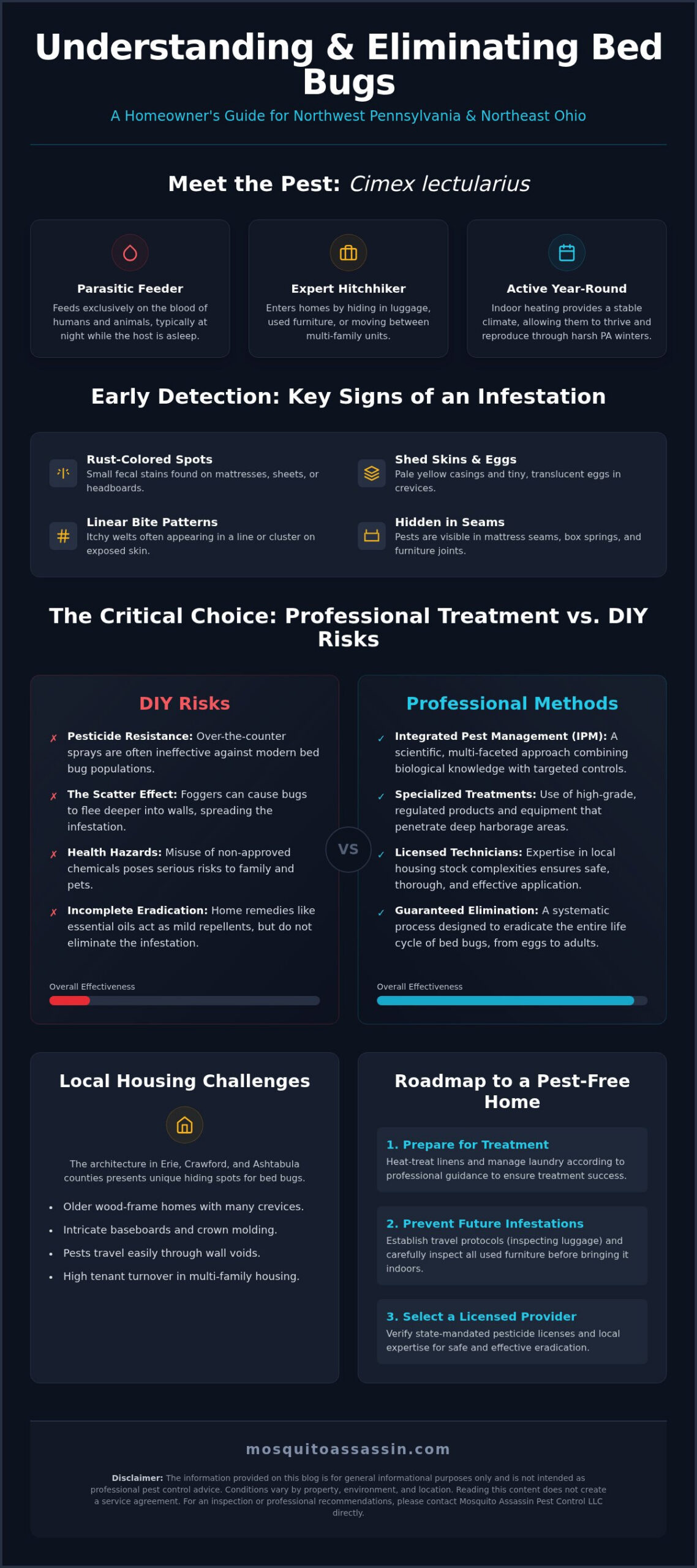
    Bed bugs, scientifically known as Cimex lectularius, are small, parasitic insects that feed exclusively on the blood of humans and animals while they sleep. Unlike many other pests that are attracted to specific food sources or poor sanitation, Bed Bugs are opportunistic hitchhikers. They thrive in any environment where they have access to a host. In Erie and Crawford Counties, these pests are a year-round concern. Our indoor heating systems provide the stable, warm climate they need to survive the harsh Pennsylvania winters. They don’t hibernate. They stay active as long as a host is nearby.

    They typically enter local residences through travel, infested used furniture, or by moving between units in multi-family housing. Because they’re thin and elusive, they can hide in the smallest crevices of luggage or upholstery. The psychological toll of an infestation is often as severe as the physical one. Residents frequently report intense anxiety, sleep deprivation, and a fear of social stigma. It’s a heavy emotional burden. This stress is why seeking a professional bed bug treatment Erie PA is vital. Professional intervention provides the scientific approach needed to restore both a home’s safety and the owner’s peace of mind.

    Early Signs of Bed Bugs in Local Residences

    Identifying an infestation early is the best way to prevent a massive outbreak. Homeowners should look for rust-colored spots on mattresses or sheets. These are actually fecal stains. Other signs include tiny, translucent eggs and pale yellow shed skins left behind as the insects grow. While many people first notice itchy welts on their skin, bed bug bites are often confused with those of mosquitoes or spiders. However, bed bugs typically bite in a linear pattern on exposed skin like arms or shoulders. This pattern is a key indicator for local residents. They’re hard to spot. Careful inspection is the only way to be sure.

    Why Erie Housing Stock Presents Unique Challenges

    The specific architecture of Northwest Pennsylvania and Ashtabula County presents unique obstacles for eradication. Many older wood-frame homes in Erie feature intricate baseboards, crown molding, and lath-and-plaster walls. These offer countless deep hiding spots. These insects can also travel through wall voids and along insulation. This makes it easy for them to move from one room to another undetected. In multi-family dwellings near local universities, high tenant turnover creates a constant risk of introduction. These structural factors make professional bed bug treatment Erie PA essential. Licensed technicians understand how to navigate the complexities of local housing stock to reach every hidden pocket of the infestation.

    Professional Eradication Methods vs. DIY Risks

    Eradicating bed bugs requires more than just a trip to the local hardware store. Modern populations have developed a significant biological resistance to common over-the-counter pesticides. This evolution makes traditional retail sprays largely ineffective for a full infestation. When homeowners rely on bug bombs or foggers, they often inadvertently worsen the problem. These products rarely penetrate the deep structural crevices where bed bugs harbor. Instead, the irritating chemicals often trigger a scatter response. This causes the insects to retreat deeper into wall voids or move into adjacent rooms, spreading the infestation throughout an Erie County home.

    A professional bed bug treatment Erie PA utilizes high-grade equipment and specialized knowledge to reach these hidden areas. Integrated Pest Management (IPM) is the gold standard for long-term success. This method combines biological understanding with mechanical and chemical controls. It’s particularly effective in Northwest Pennsylvania, where older housing stock requires a multi-faceted approach rather than a single spray application. Professional pest control may help reduce risk by addressing these complexities directly.

    Common Pitfalls of At-Home Bed Bug Treatments

    One of the most frequent mistakes is the use of non-approved or agricultural chemicals indoors. These substances can pose serious health risks to household members and pets. While essential oils like peppermint or lavender are popular home remedies, they typically act only as mild repellents. They lack the residual power needed to eliminate a breeding population. The EPA provides extensive resources on Do-it-yourself Bed Bug Control, which highlights why these complex pests are so difficult for untrained individuals to manage. Relying on unproven methods often leads to a cycle of temporary relief followed by a more intense resurgence.

    The Professional Multi-Step Process

    A systematic approach is necessary for total eradication. This begins with a meticulous inspection of all potential harborages. Professionals don’t just look at mattresses; they examine baseboards, electrical outlets, and furniture joints. Targeted application techniques then prioritize the safety of the household while delivering lethal results to the pests. Because bed bug eggs are highly resilient to many treatments, follow-up visits are a standard requirement. These return visits ensure that any newly hatched nymphs are eliminated before they can reach reproductive age. This disciplined, multi-step strategy is the most reliable way to achieve a pest-free environment.

    Evaluating Bed Bug Treatment Companies in Erie and Ashtabula

    Choosing a service provider during a pest crisis is a high-stakes decision that requires careful vetting. In Northwest Pennsylvania and Northeast Ohio, the law is clear about who can perform these services. According to the Pennsylvania Pesticide Control Act of 1973, any commercial application for bed bugs must be performed by a professional licensed by the Pennsylvania Department of Agriculture. Similarly, Ohio Code 921.06 requires licensed commercial applicators for multi-unit dwellings. Verifying these credentials ensures that the technician has the mandatory training to handle the complex Pesticides to Control Bed Bugs safely and effectively.

    Beyond legal requirements, the best results often come from technicians who understand regional pest patterns. A provider familiar with the specific housing challenges in Erie and Ashtabula will be better equipped to locate harborages in local architecture. Transparent communication is another hallmark of a quality service. Property owners deserve a clear explanation of the findings, the proposed plan, and the expected timeline for eradication. While some may seek a one-time bed bug treatment Erie PA, many find that integrating this service into year-round protection plans offers better long-term security against various seasonal pests.

    Questions to Ask a Prospective Exterminator

    Before hiring a company, it’s helpful to ask specific questions to gauge their expertise and commitment to safety. Consider inquiring about their direct experience with bed bug eradication in residential settings. It’s also important to understand the safety protocols they have in place for households with children and pets. A reputable company should be able to provide details on their regional service history and explain how they handle the resilient nature of modern infestations. For those seeking specialized care, more information on service areas is available at mosquitoassassin.com/location.

    The Benefit of Local Ownership

    Local ownership brings a level of accountability and responsiveness that national chains often struggle to match. Experts based in communities like Cranesville or Meadville have a vested interest in maintaining a strong local reputation. They aren’t just contractors; they’re neighbors who understand the specific environmental factors of Crawford and Erie counties. This local knowledge translates to more precise inspections and more effective treatment strategies. Community-rooted businesses prioritize the well-being of their service area, ensuring that every client receives the methodical attention required to achieve a pest-free home.

    Bed Bug Treatment in Erie PA: A Professional Eradication Guide

    Preparing Your Home for Professional Bed Bug Treatment

    Preparation isn’t just a suggestion; it’s the foundation of a successful eradication. Even the most advanced bed bug treatment Erie PA professionals use can be undermined by excessive clutter or untreated fabrics. High heat is one of the most effective tools for killing all life stages, including eggs. Homeowners should wash all linens, clothing, and curtains in hot water and dry them on the highest heat setting for at least 30 minutes. Once clean, these items must be sealed in airtight plastic bags to prevent re-infestation during the process.

    De-cluttering is equally vital. Bed bugs thrive in the small gaps provided by stacks of paper, cardboard boxes, and crowded closets. By removing these items, residents eliminate harborages and allow the treatment to reach the insects directly. Electronics like televisions or computers require careful handling. While they can be hiding spots, they shouldn’t be sprayed with liquid pesticides. Instead, consult with a professional about specialized methods for sensitive items. For more detailed guidance, residents can visit mosquitoassassin.com to learn about specific residential protocols.

    Room-by-Room Preparation Checklist

    A systematic approach ensures no area is overlooked. In the older housing stock common throughout Erie, pay special attention to the gaps between floorboards and wall moldings. Following a strict checklist helps maximize the efficacy of the intervention:

    • Strip all beds and place linens directly into plastic bags before moving them to the laundry area.
    • Clear the floor area in every room, including under beds and inside closets.
    • Move furniture at least 12 to 18 inches away from walls to provide access to baseboards.
    • Vacuum all floors and furniture thoroughly, paying close attention to seams and crevices. Discard the vacuum bag or empty the canister into a sealed trash bag and remove it from the home immediately.

    Post-Treatment Guidelines for Homeowners

    After the application is complete, residents must typically remain out of the treated area for a few hours. This allows the products to dry and settle completely. Professionals will provide a specific timeframe based on the products used for when it’s safe to re-occupy the home and resume normal activities. Monitoring is essential in the weeks following the initial visit. While a professional bed bug treatment Erie PA is highly effective, seeing a stray insect shortly after treatment doesn’t always indicate failure; it may be a pest emerging from a deep hiding spot to come into contact with the residual product. Consistent monitoring helps confirm the total elimination of the population.

    Long-Term Prevention and Reclaiming Your Peace of Mind

    A successful bed bug treatment Erie PA resolves the immediate threat, but long-term success depends on a defensive mindset. Total eradication is a victory, but staying pest-free requires ongoing vigilance. These insects don’t just appear out of nowhere; they’re introduced. In Northwest Pennsylvania, one of the most common ways infestations restart is through used furniture or curbside finds. While a vintage chair in an Erie alley might look like a treasure, it often harbors hidden eggs or nymphs. Avoiding these high-risk items is a simple but effective way to protect your home. Reclaiming your peace of mind means moving beyond the initial crisis and establishing a permanent defensive perimeter around your living space.

    Regular inspections serve as an essential early warning system. Catching a new introduction before it becomes a full-blown infestation saves time, money, and significant emotional stress. Integrating specific bed bug monitoring into a broader pest management plan ensures that your home remains a sanctuary. This proactive approach is much more efficient than waiting for physical signs to reappear. Professional pest control may help reduce risk by identifying vulnerabilities in a property’s structure or lifestyle habits that might invite future hitchhikers.

    Travel Safety Tips for Erie Residents

    Whether you’re visiting family in Pittsburgh or taking a weekend trip to Cleveland, travel remains the primary spreader of these insects. Always inspect hotel rooms in popular PA and OH travel destinations before unpacking. Check the mattress seams and headboard for the rust-colored stains discussed in previous sections. Keep luggage on elevated racks rather than the floor or bed. Upon returning to Erie, Crawford, or Ashtabula County, immediately wash all travel clothing in hot water and dry on high heat. Professional pest control may help reduce risk of future infestations by providing specialized preventative advice tailored to your family’s travel frequency.

    Establishing a Year-Round Protection Strategy

    A holistic approach to pest management addresses the entire ecosystem of a property. For homes in high-risk areas or multi-unit dwellings, ongoing maintenance provides a layer of security that a single intervention cannot match. Licensed technicians can monitor for changes and apply preventative measures that keep your environment hostile to invaders. This year-round strategy isn’t just about chemicals; it’s about education and exclusion. For those interested in maintaining a secure environment, exploring professional pest control services can provide the necessary framework for long-term protection.

    Disclaimer: The information provided on this blog is for general informational purposes only and is not intended as professional pest control advice. Conditions vary by property, environment, and location. Reading this content does not create a service agreement. For an inspection or professional recommendations, please contact Mosquito Assassin Pest Control LLC directly.

    Securing Your Home and Peace of Mind

    Regaining control of your home from a bed bug infestation is a systematic process that requires patience and professional precision. As explored throughout this guide, combining high-heat laundry protocols with meticulous de-cluttering creates the necessary environment for successful eradication. Because modern pests have developed significant resistance to retail chemicals, a professional bed bug treatment Erie PA remains the most reliable method for achieving total removal. Specialized experts serving Erie, Crawford, and Ashtabula Counties understand the unique architectural challenges of our region and use methodical approaches to reach every hidden pocket.

    Property owners don’t have to face the stress and social stigma of an infestation alone. Transitioning from a state of anxiety to a state of resolution is possible with the right local support. For residents seeking to reclaim their comfort and secure a good night’s sleep, request a professional inspection and consultation to begin the process. Taking proactive steps today ensures a safer, more comfortable living environment for your entire household.

    Disclaimer: The information provided on this blog is for general informational purposes only and is not intended as professional pest control advice. Conditions vary by property, environment, and location. Reading this content does not create a service agreement. For an inspection or professional recommendations, please contact Mosquito Assassin Pest Control LLC directly.

    Frequently Asked Questions

    How much does bed bug treatment typically cost in Erie PA?

    Pricing for professional intervention varies based on the size of the property and the severity of the infestation. A localized bed bug treatment Erie PA residents seek involves a detailed inspection to determine the scope of work. Factors like the number of rooms, the type of housing, and the level of preparation required influence the final quote. It’s best to request an on-site evaluation for an accurate estimate tailored to your specific environment.

    Can I get rid of bed bugs on my own using store-bought sprays?

    Relying on over-the-counter sprays is often ineffective due to the widespread pesticide resistance in modern bed bug populations. These retail products typically lack the residual strength to eliminate eggs or insects hidden deep within structural gaps. In many cases, DIY attempts cause the pests to scatter, making the eventual professional eradication more complex. Licensed professionals use specialized equipment and high-grade products that are not available to the general public for safety reasons.

    Are professional bed bug treatments safe for my children and pets?

    Professional treatments are conducted with strict adherence to safety protocols designed to protect vulnerable household members. Technicians use targeted application methods and provide clear instructions on how long residents and animals should remain out of the treated area. Once the products have completely dried, the home is safe for re-entry. Always discuss any specific health concerns with your provider to ensure the plan is customized for your family’s unique well-being and security.

    How long does a professional bed bug treatment take to work?

    The timeline for total eradication depends on the methodology used and the biology of the pest. While many active insects are eliminated upon contact, it often takes several weeks to ensure all life stages, including newly hatched eggs, are fully addressed. Most professional plans include follow-up visits to monitor activity and apply additional treatments if necessary. Consistency and following all preparation guidelines are the most important factors in achieving a swift and definitive resolution.

    Do I need to throw away my mattress if I have bed bugs?

    It is rarely necessary to discard your mattress or furniture if you have an infestation. Most mattresses can be successfully treated and then protected with high-quality, bed bug-proof encasements. These encasements trap any remaining insects inside and prevent new ones from entering the seams. Discarding furniture without proper precautions can actually spread the pests to other areas of your home or neighborhood. Consult with a professional before moving any large items from the home.

    What should I do if I find bed bugs in my apartment in Erie?

    If you find pests in an Erie apartment, notify your landlord or property manager immediately. In Pennsylvania, the responsibility for treatment often depends on local municipal codes and the terms of your lease. Because bed bugs travel easily through wall voids and electrical outlets, multi-unit buildings require a coordinated response. A professional bed bug treatment Erie PA service can inspect adjacent units to ensure the infestation is not spreading through the entire building complex.

    How do I know if the bed bug treatment was successful?

    The most reliable sign of success is the complete absence of new bites and physical evidence over a period of several weeks. You should monitor your sleeping area for fresh blood spots, fecal stains, or live insects. Many professionals use specialized monitoring traps or interceptors placed under bed legs to catch any remaining activity. If no signs are detected after the final follow-up visit, the infestation is typically considered resolved and the property safe for normal use.

    Can bed bugs travel between houses in my neighborhood?

    Bed bugs do not travel between houses by crawling across lawns like some other pests, but they are expert hitchhikers. They move between properties by clinging to clothing, bags, or furniture during social visits or moves. In high-density areas or multi-family dwellings, they can migrate through shared walls and utility lines. Maintaining awareness during travel and avoiding used furniture finds are the best ways to prevent them from moving into your specific neighborhood or home.

    Disclaimer: The information provided on this blog is for general informational purposes only and is not intended as professional pest control advice. For an inspection or professional recommendations, please contact Mosquito Assassin Pest Control LLC directly.

  • Wasp Nest Removal in Erie PA: Professional Safety and Prevention Guide

    Wasp Nest Removal in Erie PA: Professional Safety and Prevention Guide

    You step onto your back porch on a warm afternoon, only to be met by a low, rhythmic hum echoing from the doorframe. As several yellowjackets dart past your head, that relaxing weekend quickly turns into a stressful situation for your family and pets. It is completely natural to feel a sense of urgency and anxiety when aggressive stinging insects take up residence right where you live and play. Most property owners want the problem handled immediately, yet they often feel stuck between the fear of being stung and the confusion of identifying exactly what is flying around their eaves.

    Understanding the risks is the first step toward a resolution. This guide provides the essential information needed for safe wasp nest removal Erie PA homeowners require to reclaim their outdoor spaces without the threat of a swarm. You will learn how to distinguish between beneficial honey bees and aggressive local wasps, why DIY removal attempts often lead to emergency room visits, and which professional strategies effectively prevent future infestations. Whether the property is in Erie, Crawford, or Ashtabula County, establishing a secure environment starts with local expertise and a methodical approach to pest management.

    Key Takeaways

    • Learn to distinguish between aggressive yellowjackets and aerial bald-faced hornet nests to determine the specific risk level on your property.
    • Understand the seasonal lifecycle of Northwest Pennsylvania wasps to identify and address infestations during the critical spring emergence phase.
    • Discover why professional wasp nest removal Erie PA services are necessary to avoid the dangers of swarm attacks, pheromone triggers, and ladder accidents.
    • Identify the immediate safety steps to take once a nest is discovered, including how to protect children and pets from accidental provocation.
    • Explore how transitioning to proactive year-round protection plans can stop future nesting cycles in Erie, Crawford, and Ashtabula counties.

    Identifying Common Wasp and Hornet Species in Erie PA

    Correct identification is the foundation of any pest management plan. In Northwest Pennsylvania, residents often encounter several different species, each with unique behaviors and nesting habits. Misidentifying a pest can lead to ineffective treatments or, worse, unnecessary danger to the property owner. For instance, while honey bees are vital pollinators that should be relocated by specialists, common North American wasps like yellowjackets require a more decisive intervention due to their aggressive nature. Identifying the specific insect involved allows for a safer and more methodical approach to removal.

    Ground-Nesting Wasps and Their Risks

    Yellowjackets are perhaps the most notorious pests in Erie and Crawford counties. These insects typically build their colonies in abandoned rodent burrows or cavities within the soil. A ground nest can house thousands of workers by late summer, creating a high-risk zone for anyone walking across the lawn. Mowing the grass is a primary trigger for attacks; the vibration from a mower engine often signals a threat to the colony, resulting in a coordinated swarm. Property owners should watch for small holes in the soil with constant, heavy insect traffic. Discovering these entrance points early is vital, as a hidden nest in a yard can lead to multiple stings for unsuspecting children or pets. When these subterranean colonies are found, professional wasp nest removal Erie PA services are often necessary to ensure the entire population is addressed safely.

    Aerial Nests: Hornets and Paper Wasps

    Bald-faced hornets and paper wasps prefer elevated locations, though their nest structures differ significantly in appearance and risk level. Bald-faced hornets construct large, grey, paper-like structures that often resemble a football. These nests are frequently found high in trees or attached to the eaves of homes in Ashtabula and Erie. Because these hornets are highly protective of their space, nests located near doorways or walkways pose a constant threat to residents. Their stings are particularly painful and they can be much more aggressive than other species when their territory is breached.

    Paper wasps build smaller, open-faced nests that look like an inverted umbrella. While they are generally less aggressive than hornets, they frequently choose high-traffic areas like porch ceilings, window frames, or deck railings. Distinguishing between these species helps determine the level of urgency for a property. A large hornet nest near a primary entrance requires immediate attention, whereas a single paper wasp nest in a remote corner of an attic might be managed during a routine service visit. Correct identification ensures that the response is appropriate for the specific species present on the property.

    The Seasonal Cycle of Wasps in Northwest Pennsylvania

    Northwest Pennsylvania’s climate creates a distinct timeline for stinging insects. While the cold winters provide a temporary reprieve, the warming temperatures in April and May trigger the start of a new lifecycle. The proximity to Lake Erie often results in fluctuating spring starts and potentially longer autumns, which directly impacts the timing of wasp nest removal Erie PA. Understanding this progression helps property owners identify when their risk is highest and why certain months require more vigilance than others.

    Spring Queen Emergence and Nest Initiation

    As temperatures consistently reach the 50s, hibernating queens emerge to find new nesting sites. Unlike the massive swarms seen in August, spring activity is often solitary. A single queen is responsible for selecting a site, building the initial cells, and raising the first generation of workers. Common spots in Erie and Crawford counties include attic rafters, garage eaves, and sheltered corners of porches. Catching a nest at this stage is significantly more manageable than waiting until the colony grows to hundreds or thousands of individuals. It’s the most effective time for proactive measures before the population explodes.

    Late Summer Aggression and Food Scarcity

    By late July and August, the colony reaches its peak population. During this phase, the biological focus of the nest shifts. Workers no longer prioritize feeding larvae and instead seek out sugar-rich food sources for themselves. This is why wasps become persistent nuisances at outdoor events like the Erie County Fair or backyard barbecues in Ashtabula. Their aggressive behavior increases as natural food sources dwindle and they become more protective of the now-massive colony. According to research on wasp species in Pennsylvania, a single yellowjacket nest can contain several thousand workers by September.

    The “lake effect” climate plays a subtle but important role in local pest pressures. The moisture and moderated temperatures near the shore can allow colonies to remain active later into the fall compared to inland areas. If a warm October occurs, the window for stings remains open well past the typical frost date. Consistent monitoring of property boundaries during these seasonal transitions is a core part of professional pest control that helps reduce the risk of a dangerous late-season surprise. Maintaining a clear perimeter during these peak months is essential for the safety of everyone on the property.

    Why Professional Removal is Essential for Safety

    Attempting a DIY intervention often triggers a biological defense mechanism that property owners are unprepared to handle. Social wasps are highly protective of their colonies. When a nest is disturbed, the insects release alarm pheromones that signal a coordinated mass attack. Unlike honey bees, a single wasp or hornet can sting multiple times without dying. This means an individual facing a swarm could receive dozens of stings in a matter of seconds. Professional wasp nest removal Erie PA ensures that these pheromone triggers are managed correctly to prevent aggressive swarming during the extraction process.

    Physical hazards also play a significant role in the dangers of amateur removal. Many nests in Northwest Pennsylvania are located high in trees or attached to the second-story eaves of homes. Using a ladder while being swarmed by stinging insects is a recipe for disaster. Instinctive movements to swat away wasps can lead to falls, which often result in more severe injuries than the stings themselves. Additionally, over-the-counter sprays frequently lack the pressure or volume needed to reach the core of a large colony, leaving the most aggressive workers active and agitated inside the structure.

    The Reality of Stinging Insect Allergies

    Medical safety is a primary concern for residents in Erie and Crawford counties. Many people are unaware they have a life-threatening allergy to venom until they are stung. Even for those without a known history of anaphylaxis, the cumulative effect of multiple stings from a large colony can cause severe systemic reactions. According to the University of Kentucky, Controlling Wasps, Hornets, and Yellowjackets requires an understanding of their defensive biology and the medical risks involved. Professional pest control may help reduce risk for sensitive individuals by removing the threat without exposing the household to active swarms.

    Equipment and Training Standards

    Licensed professionals utilize specialized tools and protective gear that the average homeowner does not have access to. Heavy-duty bee suits, veils, and gloves provide a complete barrier against stings, allowing technicians to work directly at the nest site. Beyond personal protection, professional training involves specific application techniques that ensure the colony is neutralized without causing damage to the property. This methodical approach is essential when dealing with aggressive species that have nested inside wall voids or complex structural areas. Using the right equipment and following established safety protocols ensures the problem is resolved definitively and safely.

    Wasp Nest Removal in Erie PA: Professional Safety and Prevention Guide

    Immediate Steps After Finding a Nest on Your Property

    Finding a nest attached to your siding or hidden in the garden can be alarming. The most important action to take is to remain calm and maintain a distance of at least 15 to 20 feet. Rapid movements or swatting at individual insects can be interpreted as a threat, potentially triggering the defensive behaviors discussed in previous sections. Keeping children and pets indoors is the highest priority until the area is secured. Because pets are often curious, they may accidentally disturb a ground nest, leading to a dangerous situation for the animal and anyone nearby.

    Observe the nest from a safe vantage point, such as through a window. Note the flight patterns and the specific entry points. This information is invaluable for a professional inspection. Avoid using bright flashlights near the nest at night. Many species are attracted to light sources and may fly toward the beam, which can lead to accidental stings in the dark. This behavior is a common reason why DIY attempts after sunset often fail and result in injury.

    Securing the Area

    Close any nearby windows or doors immediately. Wasps can easily find their way inside through small gaps or damaged screens if they feel the colony is under pressure. If a nest is located in the ground or tall grass, mark the general area with a lawn ornament or a bright bucket placed several feet away. This prevents family members from accidentally stepping on or mowing over the entrance. If the nest is located near a property line, inform your neighbors so they can keep their households away from the shared boundary until the situation is resolved. Clear communication with those nearby is a vital part of community safety in residential areas of Crawford and Erie counties.

    When to Contact a Professional in Erie PA

    Certain situations demand immediate attention from experts in wasp nest removal Erie PA. If a nest is located directly above a primary entryway, inside a wall void, or if you notice a high volume of activity near play areas, professional intervention is necessary. Licensed technicians can identify the specific species and determine the safest method for extraction without putting the household at risk. For residents seeking local expertise, contacting Mosquito Assassin Pest Control LLC ensures that the property is evaluated by neighbors who understand the regional pest pressures of Northwest Pennsylvania. Professional pest control may help reduce risk and restore safety to your outdoor living spaces. For a thorough evaluation or to schedule a service, visit mosquitoassassin.com.

    Long-Term Wasp Prevention and Year-Round Protection

    Emergency interventions provide immediate relief, but relying solely on reactive treatments leaves a property vulnerable to the next cycle of infestation. A strategic shift toward proactive management is the most effective way to maintain a safe outdoor environment. While one-time wasp nest removal Erie PA addresses the current colony, it doesn’t prevent a new queen from selecting the same eaves or porch corners the following spring. Regular monitoring ensures that potential nesting sites are identified and treated before they can develop into major safety hazards.

    Integrating stinging insect management into a comprehensive general pest control plan provides a layered defense. This approach focuses on the biological habits of wasps and hornets throughout their active seasons in Northwest Pennsylvania and Northeast Ohio. By maintaining a consistent presence on the property, technicians can spot early-season activity that most homeowners might overlook. Early detection is especially critical in high-traffic areas where a growing nest could quickly become a liability for the household.

    The Platinum Year-Round Protection Strategy

    A consistent maintenance schedule is the cornerstone of effective pest management. The Platinum Year-Round Protection plan utilizes bi-monthly service visits to establish and maintain a protective barrier around the structure. This frequency is specifically designed to coincide with the rapid reproduction cycles of common social wasps. These visits involve more than just treatment; they include a thorough evaluation of the property for new activity and the implementation of exclusion techniques. Sealing entry points in siding, soffits, and window frames reduces the likelihood of wasps finding a foothold inside wall voids or attics.

    Local Expertise and Neighborhood Reliability

    Property owners in Erie, Meadville, and Ashtabula benefit from working with a provider deeply rooted in the local community. Based in Cranesville, PA, Mosquito Assassin Pest Control LLC understands the specific environmental factors that drive pest pressures in the Great Lakes region. This local knowledge allows for more accurate predictions of when activity will peak and which areas of a property are most likely to attract nesting queens. Professional pest control services can provide lasting peace of mind by ensuring that safety is managed by neighbors who share the same community values. For those interested in proactive management, professional pest control may help reduce risk. More information on protection plans is available at mosquitoassassin.com/services.

    Disclaimer: The information provided on this blog is for general informational purposes only and is not intended as professional pest control advice. Conditions vary by property, environment, and location. Reading this content does not create a service agreement. For an inspection or professional recommendations, please contact Mosquito Assassin Pest Control LLC directly.

    Secure Your Property with Professional Management

    Managing stinging insects in Northwest Pennsylvania requires a balance of immediate safety and long-term prevention. Correctly identifying aggressive species is the first step toward a secure property. Attempting to handle a colony without specialized equipment often results in dangerous swarm attacks and medical risks. Professional wasp nest removal Erie PA provides a methodical solution that prioritizes the wellbeing of your family and pets.

    Transitioning to comprehensive year-round protection plans allows property owners in Erie, Crawford, and Ashtabula counties to stop the cycle of annual infestations. Locally owned expertise ensures your home is monitored by neighbors who understand regional pest pressures. Taking these proactive steps lets you enjoy your outdoor spaces without the threat of stings. Establishing a pest-free environment provides the lasting peace of mind every homeowner deserves.

    Request a professional inspection from Mosquito Assassin Pest Control LLC to begin securing your property today.

    Disclaimer: The information provided on this blog is for general informational purposes only and is not intended as professional pest control advice. Conditions vary by property, environment, and location. Reading this content does not create a service agreement. For an inspection or professional recommendations, please contact Mosquito Assassin Pest Control LLC directly.

    Frequently Asked Questions

    Is it safe to remove a wasp nest myself at night?

    Attempting to remove a nest at night is not recommended for homeowners. While wasps are generally less active after sunset, they can still perceive threats and respond aggressively. A major risk involves using a flashlight; wasps are attracted to light and may fly directly toward the person holding the beam. This often leads to stings in the dark where visibility is limited and escape routes are harder to navigate safely.

    How can I tell the difference between a wasp and a honey bee?

    Identification depends on physical characteristics and nesting habits. Honey bees are typically fuzzy with rounder bodies and play a vital role in pollination. In contrast, wasps and hornets have smooth, shiny bodies with narrow waists. While honey bees only sting once and are generally docile unless provoked, social wasps can sting multiple times and are much more protective of their colonies. Observing these traits from a distance helps determine the necessary management approach.

    What should I do if a wasp nest is inside my wall?

    If you suspect a nest is inside a wall void, do not seal the exterior entrance hole. Closing the exit often forces the insects to find an alternative way out, which frequently leads them into the living spaces of your home. Professional wasp nest removal Erie PA technicians use specialized equipment to treat the colony within the structure safely. This ensures the population is neutralized without causing unnecessary damage or driving aggressive insects indoors.

    Will wasps return to the same nesting spot next year?

    Social wasps don’t reuse the same physical nest from a previous season. However, if a location provided ideal shelter and protection, new queens may be attracted to the same area the following spring. This is why exclusion techniques and regular monitoring are essential. Sealing gaps in siding and eaves after a nest is removed helps prevent future colonies from establishing themselves in the exact same high-traffic spots on your property.

    How quickly can a professional remove a nest in Erie PA?

    Response times for professional services in Erie, Crawford, and Ashtabula counties vary based on seasonal demand. Most local experts prioritize nests located near primary entryways or play areas due to the higher safety risk. The actual removal process is often completed within a single visit once the technician evaluates the species and nest location. Ongoing protection plans can further reduce the need for emergency removals by identifying nests during their initial spring development.

    Are the treatments used for wasp removal safe for my pets?

    Licensed professionals follow strict safety protocols to protect household members and animals. Technicians use targeted application methods that minimize exposure to non-target areas. It’s standard practice to keep pets and children indoors during the active treatment and until any applied products have completely dried. Following these professional recommendations ensures that the stinging insect threat is eliminated while maintaining a secure environment for all residents of the household.

    Can wasps damage the structure of my home?

    Most social wasps don’t cause direct structural damage like termites or carpenter ants. However, they can cause secondary issues when nesting in wall voids or attics. Some species chew weathered wood to create the paper pulp used for their nests, which can lead to minor cosmetic wear on decks or siding. The primary concern remains the safety of the residents rather than the integrity of the building materials themselves in most residential cases.

    What attracts wasps to build nests on certain properties?

    Several factors make a property attractive to nesting queens. Abundant food sources, such as flowering plants, unsealed trash bins, or fallen fruit, provide the energy needed for colony growth. Properties with plenty of sheltered areas like deep eaves, porch ceilings, or hollow trees offer ideal protection from the elements. Identifying these attractants is a core part of long-term prevention. Professional wasp nest removal Erie PA services often include recommendations for reducing these environmental draws.

    Disclaimer: The information provided on this blog is for general informational purposes only and is not intended as professional pest control advice. For an inspection or professional recommendations, please contact Mosquito Assassin Pest Control LLC directly.

  • Tick Treatment in Erie, PA: A Comprehensive Guide to Yard Protection

    Tick Treatment in Erie, PA: A Comprehensive Guide to Yard Protection

    Nearly 28% of the 141,000 ticks submitted to the Pennsylvania Tick Research Lab tested positive for at least one vector-borne disease. In Erie and Crawford Counties, these pests are more than a nuisance; they’re a persistent threat to the safety of your backyard. Securing effective tick treatment Erie PA homeowners can rely on is the first step in reclaiming your outdoor living space from these invasive arachnids.

    It’s frustrating to feel like a prisoner on your own patio because of the risk of Lyme disease or other illnesses. Many residents find that DIY foggers and hardware store pellets don’t offer the comprehensive protection required for the dense vegetation and humid climate of the Great Lakes region.

    This guide explains how to identify specific local tick risks and implement professional-grade suppression strategies to safeguard your Northwest Pennsylvania property. You’ll learn to move beyond temporary fixes toward a long-term solution for yard protection.

    The following sections cover the behavior of common species like the blacklegged tick, environmental modifications that reduce habitat, and the benefits of a methodical, year-round management plan.

    Key Takeaways

    • Understand how the humid climate of the Lake Erie region and shifting seasonal patterns contribute to increased tick activity throughout Northwest Pennsylvania.
    • Identify the specific behaviors of the Black-legged tick and American Dog tick, which are the most prevalent species found in Erie and Crawford Counties.
    • Discover why professional tick treatment Erie PA residents utilize provides deeper penetration into thick vegetation compared to standard consumer-grade sprays.
    • Learn practical landscaping modifications, such as removing leaf litter and maintaining manicured lawn edges, to eliminate tick hiding spots on your property.
    • Explore the benefits of Integrated Pest Management (IPM), which focuses on long-term suppression through professional inspections and identifying specific risk zones.

    Ticks are becoming a year-round concern in Northwest Pennsylvania. Shifting weather patterns in 2026 have led to an early start to the season, with activity spiking as soon as temperatures consistently remain above freezing. The Lake Erie region’s high humidity levels provide a perfect incubator for survival and reproduction. For a comprehensive overview of ticks, it’s helpful to look at how their life cycle depends on these environmental factors. Securing professional tick treatment Erie PA homeowners can rely on is often the most effective way to address these rising populations before they establish a foothold in residential yards.

    To better understand the local impact of these pests, watch this helpful video regarding regional prevention efforts:

    Regional Risk Factors in Erie County

    Property owners in Erie County face specific geographic challenges. Properties bordering wooded areas or featuring tall ornamental grasses are especially vulnerable to infestation. Local wildlife, particularly white-tailed deer and small rodents, serve as primary hosts. These animals transport ticks from the woods directly into suburban landscapes. As residential development expands into rural areas of Crawford County and Ashtabula County, the boundary between nature and the backyard blurs. This suburban expansion has brought tick populations closer to children and pets than in previous decades. Professional pest control may help reduce the risk of these encounters by creating a managed barrier around the home.

    Seasonal Peaks for Tick Encounters

    Timing is critical for effective suppression. Spring and fall represent the highest activity periods for adult ticks in Northwest Pennsylvania. However, the summer months of June and July are when nymphal ticks are most active. These nymphs are extremely small and difficult to detect. Because Pennsylvania reported nearly 19,000 Lyme disease cases in 2025, being proactive during these peak windows is a priority for many families. Professional monitoring ensures that suppression strategies align with these specific biological cycles. This approach targets ticks when they are most likely to be searching for a host, providing a higher level of protection than reactive, one-time sprays.

    Common Tick Species Found in Erie and Crawford Counties

    Identifying the specific pests on your property is the foundation of a successful suppression plan. Different species behave differently, and understanding these nuances allows for a more targeted approach. For instance, the blacklegged tick remains the most prevalent threat across Pennsylvania, while the American dog tick is frequently encountered in the more open landscapes of Crawford County. According to the Penn State Extension resource on Common Ticks in Pennsylvania, these species account for the majority of local encounters. Recently, health officials have also noted the expansion of the lone star tick into the region, particularly along the border of Ashtabula County. Because each species has unique environmental preferences, a professional inspection is essential to determine the best strategy for tick treatment Erie PA homeowners should implement.

    The Black-legged Tick Lifecycle

    The blacklegged tick, often called the deer tick, follows a complex two-year lifecycle. It progresses through four distinct stages: egg, larva, nymph, and adult. This species is remarkably resilient; it doesn’t disappear during the first frost. Instead, adults remain active whenever the ground isn’t frozen and temperatures stay above freezing. This persistence is a major reason why property owners often find ticks on their pets even in November or December. Because the nymphal stage is active during summer and is roughly the size of a poppy seed, detection is incredibly difficult without professional oversight. Understanding this multi-year cycle is vital for long-term suppression, as it ensures treatments target multiple generations of the population simultaneously.

    American Dog Ticks and Grassy Habitats

    Unlike the deer tick, which thrives in the damp leaf litter of wooded edges, the American dog tick prefers open, sunny areas. You’ll often find them along paths, walkways, and in tall grasses with minimal tree cover. They are significantly larger than deer ticks, making them easier to spot on light-colored clothing after a walk. When managing a yard, professional strategies focus heavily on transition zones. These are the areas where a manicured lawn meets taller brush or meadows. By targeting these perimeters, it’s possible to intercept ticks before they migrate toward high-traffic areas like patios or swing sets. Understanding these habitat preferences helps in creating a more secure environment for your family. For those concerned about specific risk zones on their property, checking local service availability can provide a starting point for professional management.

    Effective tick treatment Erie PA residents rely on must account for the fact that these species often overlap. A property might have deer ticks in the wooded backyard and dog ticks in the front meadow. A comprehensive plan addresses both environments to ensure the entire property is protected throughout the changing seasons.

    Comparing Professional Tick Treatment with DIY Yard Methods

    Many property owners in Northwest Pennsylvania attempt to manage pests using store-bought canisters or garden hose attachments. While these solutions might offer temporary relief, professional tick treatment Erie PA residents utilize involves a more systematic approach to yard safety. Data from Pennsylvania’s tick surveillance program highlights the high density of infected ticks across the state, making the choice between DIY and professional methods a matter of significant concern for families and pet owners. Understanding the difference in chemistry and application technique is the first step in establishing a truly secure outdoor environment.

    Efficacy of Commercial Grade Suppression

    Consumer-grade sprays often break down quickly when exposed to sunlight or the heavy rainfall common in the Lake Erie region. Professionals utilize specialized formulations designed for long-term residual activity. These products remain effective for several weeks, creating a reliable barrier that doesn’t wash away after a single storm. Treatment timing is also a critical factor that DIY methods often ignore. Professional applications are calculated based on the specific biology of local ticks and current weather patterns in Erie and Crawford Counties. Breaking the breeding cycle requires consistent, well-timed interventions that a standard hardware store schedule can’t replicate.

    Benefits of Professional Equipment

    The primary limitation of DIY methods is the inability to reach where ticks actually hide. Standard garden sprayers produce large droplets that sit on the surface of grass blades. In contrast, professional high-pressure misting equipment creates a fine vapor that penetrates deep into thick vegetation and the underside of leaves. This is where ticks wait for hosts. Thorough contact with leaf litter is essential, as this humid layer is the primary habitat for nymphal ticks. Licensed technicians are trained to identify these specific micro-habitats, ensuring that the application is targeted. This precision reduces the impact on non-target areas of the property while maximizing the defensive perimeter around high-use zones like patios and play sets.

    Professional management includes regular inspections to identify hidden breeding grounds that a homeowner might overlook. By identifying areas of standing water, dense brush, or rodent activity, technicians can address the root causes of an infestation. This proactive oversight provides a level of security that temporary, one-size-fits-all DIY sprays simply can’t match. Relying on professional-grade tools and training ensures that the suppression strategy is as thorough as it is effective.

    Tick Treatment in Erie, PA: A Comprehensive Guide to Yard Protection

    Creating a Tick-Resistant Landscape for Your Erie Property

    Environmental modification is a powerful tool in the fight against ticks. While barrier sprays are essential, changing the physical layout of a property makes it less attractive to these pests in the first place. In Northwest Pennsylvania, where humidity from the lake keeps vegetation damp, a few specific landscaping adjustments can significantly lower the local population. These efforts are most effective when integrated with a professional tick treatment Erie PA homeowners use to maintain a secure perimeter.

    Vegetation Management Strategies

    A manicured lawn is the first line of defense. Ticks are highly sensitive to desiccation, meaning they dry out and die in sunny, low-humidity environments. Keeping grass mowed to a height of three inches or less exposes the soil to more sunlight and airflow. Pruning low-hanging tree branches and thinning out dense shrubbery further increases solar penetration, making the yard less hospitable. It’s also vital to clear tall weeds and brush from the edges of the property. These overgrown areas serve as staging grounds where ticks wait to quest for a host. By pushing back the “wild” parts of the yard, property owners create a larger safety zone for their families.

    Physical Barriers and Host Management

    Creating a physical boundary between wooded areas and the lawn is a proven strategy. A three-foot-wide barrier of wood chips or gravel serves as a dry, hot “no-man’s-land” that ticks are reluctant to cross. This buffer also reminds residents where the managed lawn ends and the higher-risk areas begin. Placement of outdoor living features is equally important. Keep playground equipment, patios, and decks away from yard edges and overhanging trees to minimize contact with questing ticks.

    Managing the animals that carry ticks is another essential component. White-tailed deer are the primary transporters of adult deer ticks in Erie and Crawford Counties. Installing fencing or using deer-resistant plants can help exclude these hosts from the property. Additionally, woodpiles should be stacked neatly in dry, sunny locations away from the house. Messy woodpiles are a favorite nesting site for rodents, which are the primary hosts for larval and nymphal ticks. By removing rodent habitats, the local tick population often drops naturally. To begin securing your yard, professional pest control may help reduce risk by addressing these environmental factors alongside targeted suppression.

    Integrated Pest Management for Seasonal Tick Suppression

    Integrated Pest Management (IPM) is a comprehensive approach that prioritizes long-term prevention and suppression over reactive measures. In the context of tick treatment Erie PA, this means understanding the local environment and using a combination of biological, physical, and chemical tools to manage populations effectively. Rather than relying on a single application, IPM focuses on ongoing monitoring and environmental adjustments to keep properties secure throughout the year. It’s a methodical system that doesn’t just look at the current population but addresses the root causes of infestations.

    The Professional Inspection Process

    A thorough inspection is the cornerstone of any IPM strategy. Licensed technicians evaluate a property for specific risk factors, such as excessive moisture, deep shade, and evidence of host activity from deer or rodents. Because every yard in Northwest Pennsylvania has a unique geography, a one-size-fits-all approach is rarely effective. These inspections allow for the development of customized plans that target the specific micro-habitats where ticks thrive. For those looking to start this process, exploring local pest control services can provide insights into how regional expertise applies to your neighborhood’s unique terrain.

    Long-term Suppression Strategies

    Consistency is the key to maintaining a protective barrier. Ticks are persistent, and their lifecycle spans multiple years, requiring a sustained effort to break the breeding cycle. Regular treatments throughout the peak activity months ensure that new generations are addressed before they can establish a presence. Coordinating these efforts with a comprehensive mosquito control program often maximizes the enjoyment of outdoor spaces. Many of the humid, shaded areas that harbor ticks also serve as breeding grounds for mosquitoes, so addressing both simultaneously is a practical strategy for local homeowners.

    By utilizing a consistent schedule for tick treatment Erie PA families can rest easier knowing their property is being monitored by experts who understand the local ecosystem. While professional pest control may help reduce risk, property owners should remain vigilant by performing regular tick checks on pets and family members after outdoor activities. Combining professional-grade suppression with the landscaping modifications mentioned earlier creates a multi-layered defense system. This integrated approach offers the most reliable way to assess risk and maintain a yard that is both beautiful and secure for everyone in the household. Contacting a professional for an inspection is the most effective way to evaluate your property’s specific needs and develop a sustainable management plan.

    Disclaimer: The information provided on this blog is for general informational purposes only and is not intended as professional pest control advice. Conditions vary by property, environment, and location. Reading this content does not create a service agreement. For an inspection or professional recommendations, please contact Mosquito Assassin Pest Control LLC directly.

    Securing Your Outdoor Space for the Seasons Ahead

    Maintaining a tick-free yard requires a disciplined combination of environmental management and professional-grade suppression. By reducing moisture through landscaping and creating physical barriers, property owners can significantly disrupt the habitats where local ticks thrive. Because the humid climate and specific pest cycles of Northwest Pennsylvania present unique challenges, professional tick treatment Erie PA residents rely on is the most effective way to establish a long-term defense.

    As a family-owned business rooted in Erie, Crawford, and Ashtabula counties, Mosquito Assassin Pest Control LLC understands these regional risks. Licensed in Pennsylvania and Ohio, the team focuses on methodical inspections that identify specific vulnerability zones. Implementing a proactive management plan ensures that your family can enjoy the backyard without constant anxiety. To learn more about assessing your property, professional pest control may help reduce risk. Reclaiming your outdoor space provides the peace of mind every homeowner deserves.

    Disclaimer: The information provided on this blog is for general informational purposes only and is not intended as professional pest control advice. Conditions vary by property, environment, and location. Reading this content does not create a service agreement. For an inspection or professional recommendations, please contact Mosquito Assassin Pest Control LLC directly.

    Frequently Asked Questions

    How often should a yard be treated for ticks in Erie, PA?

    Most properties require treatment every 30 to 60 days during the active season to maintain a consistent barrier. In Northwest Pennsylvania, tick activity persists from early spring through late fall. Consistent application is necessary because commercial-grade products naturally break down over time. Ongoing protection plans, such as bi-monthly services, ensure that the defensive perimeter remains strong against new generations of ticks migrating from nearby wooded areas.

    Can professional tick treatments help protect my pets?

    Professional treatments significantly reduce the environmental population of ticks, which directly lowers the chance of these pests latching onto pets in the backyard. While yard suppression is a vital layer of defense, it doesn’t replace the need for veterinary-prescribed preventatives. By targeting the humid leaf litter and tall grasses where ticks quest, professional tick treatment Erie PA residents utilize helps create a safer outdoor environment for dogs and cats to play.

    What is the best time of year to start tick treatments?

    The best time to begin treatments is in early spring, specifically as soon as ground temperatures remain above freezing. In the Lake Erie region, adult blacklegged ticks become active quite early, often in March or April. Starting early targets the first wave of adults and helps suppress the nymphal population that emerges in early summer. Waiting until mid-summer allows populations to establish, making suppression more difficult throughout the remainder of the season.

    Do tick treatments also work on mosquitoes?

    Many professional applications target the same shaded, damp micro-habitats preferred by both ticks and mosquitoes. While the formulations and specific application techniques may vary, a comprehensive mosquito and tick control program provides overlapping benefits. This dual approach is particularly effective in Erie and Crawford Counties, where high humidity levels support large populations of both pests. Integrated plans allow families to maximize their outdoor enjoyment by addressing multiple seasonal threats simultaneously.

    Are professional yard treatments safe for my family?

    Licensed technicians are trained to apply products according to strict safety standards and label instructions. Once the applied treatment has completely dried, typically within one to two hours depending on weather conditions, the yard is ready for use by children and pets. Professional management focuses on targeted applications to minimize drift and ensure that products are placed only where pests harbor, such as property perimeters and dense vegetation.

    How long does a tick treatment last after application?

    A single professional application typically provides residual protection for approximately 30 to 60 days. Factors like heavy rainfall in the Northwest Pennsylvania region or intense sun exposure can influence how quickly products degrade. This is why year-round protection plans are the most effective method for maintaining a secure barrier. Regular intervals ensure that the suppression remains active even as environmental conditions change throughout the spring, summer, and fall months.

    Should I treat my yard even if I do not see any ticks?

    Ticks are often invisible to the naked eye, especially during the nymphal stage when they are roughly the size of a poppy seed. Pennsylvania reported nearly 19,000 Lyme disease cases in 2025, and many of those encounters occurred in residential yards where owners hadn’t noticed an infestation. Proactive tick treatment Erie PA homeowners implement serves as a preventative measure. It’s much easier to maintain a barrier than to eliminate a large, established population.

    Disclaimer: The information provided on this blog is for general informational purposes only and is not intended as professional pest control advice. For an inspection or professional recommendations, please contact Mosquito Assassin Pest Control LLC directly.

  • Commercial Pest Control in Ashtabula, Ohio: A Professional Management Guide

    Commercial Pest Control in Ashtabula, Ohio: A Professional Management Guide

    Can a single health department violation or a negative online review regarding a pest sighting permanently derail years of hard work in the Ashtabula business community? For local entrepreneurs, the fear of an unexpected infestation is a persistent stressor that threatens both the bottom line and public trust. Maintaining a professional, hygienic environment is a non-negotiable requirement for success, yet inconsistent results from DIY methods or cut-rate services often leave properties vulnerable. This is why securing professional commercial pest control Ashtabula Ohio is a critical step for any business looking to protect its assets and its image.

    This guide explores how professional management protects businesses from the risks of health department penalties while ensuring compliance with Ohio Department of Agriculture regulations. By understanding the specific behaviors of local pests and the unique climate of Northeast Ohio, property owners can move from reactive treatments to a state of long-term resolution. Readers will learn about the essential components of a professional management plan, including seasonal exclusion techniques and the importance of a methodical, science-based approach to pest prevention.

    Disclaimer: The information provided on this blog is for general informational purposes only and is not intended as professional pest control advice. Conditions vary by property, environment, and location. Reading this content does not create a service agreement. For an inspection or professional recommendations, please contact Mosquito Assassin Pest Control LLC directly.

    Key Takeaways

    • Professional Integrated Pest Management (IPM) focuses on proactive environmental controls rather than reactive treatments, which provides a more stable and effective solution for businesses.
    • Securing professional commercial pest control Ashtabula Ohio ensures compliance with Ohio Department of Agriculture licensing standards and local health department regulations.
    • Different industries face unique risks, such as rodent pressure in warehousing or strict sanitation requirements in hospitality, which require customized management strategies.
    • The Northeast Ohio climate creates distinct seasonal pest patterns that professional services address through specialized exclusion and year-round monitoring.
    • Long-term success depends on a partnership that includes staff education on sanitation practices and the early identification of potential pest entry points.

    Common Commercial Pest Challenges in Ashtabula County

    Managing a business in Northeast Ohio requires a deep understanding of how the local environment dictates pest behavior. Proximity to Lake Erie creates micro-climates that influence everything from insect hatch dates to rodent migration patterns. Effective commercial pest control Ashtabula Ohio relies on identifying these specific regional triggers rather than applying generic, one-size-fits-all solutions. Local geography, ranging from the industrial docks to the retail centers of downtown Ashtabula, presents unique entry points and harborage risks for various species.

    To better understand the systematic approach required for business environments, watch this helpful video:

    Ashtabula’s landscape features a mix of high-traffic commercial zones and sensitive agricultural areas. This diversity allows pests to move easily between environments. Professionals utilize Integrated Pest Management (IPM) to address these movements. This framework emphasizes understanding the life cycles of pests and their interaction with the environment. For instance, the 2026 expansion of the Box Tree Moth quarantine into Ashtabula County and the statewide Spotted Lanternfly quarantine require vigilant, localized monitoring. Businesses moving regulated products must now adhere to specific compliance agreements to prevent the spread of these invasive species.

    Rodents and Structural Integrity

    Rodents seek shelter in commercial structures as temperatures drop along the lakeshore. Common signs of mice and rats include dark rub marks along baseboards, droppings near food sources, and damaged packaging in storage areas. These pests pose severe risks to structural integrity by chewing through electrical wiring, which is a leading cause of electrical fires. They also contaminate inventory with pathogens. Basic traps often fail because they don’t address the root cause. Professional commercial services focus on a three-step process: removal, ongoing maintenance, and permanent exclusion to seal entry points.

    Seasonal Pressures: Mosquitoes and Ticks

    Outdoor hospitality and retail spaces face intense pressure during the warmer months. Seasonal pests like mosquitoes and ticks thrive in the humid conditions near Lake Erie, often driving customers away from outdoor seating areas. Protecting employees and customers in these high-traffic zones is essential for maintaining a positive reputation. Consistent monitoring during peak Ohio pest seasons helps identify breeding sites and reduce population spikes. Professional management ensures these outdoor areas remain usable and safe, mitigating the risks associated with public health pests throughout the year.

    Disclaimer: The information provided on this blog is for general informational purposes only and is not intended as professional pest control advice. Conditions vary by property, environment, and location. Reading this content does not create a service agreement. For an inspection or professional recommendations, please contact Mosquito Assassin Pest Control LLC directly.

    The Integrated Pest Management Framework for Businesses

    Professional pest management has evolved beyond simple reactive treatments. Today, the industry standard is Integrated Pest Management (IPM), a strategic approach that prioritizes long-term prevention over temporary fixes. For businesses seeking commercial pest control Ashtabula Ohio, this framework is essential for maintaining a safe and compliant environment. Instead of relying solely on chemical applications, IPM focuses on managing the environment to make it less hospitable to pests. This shift from reactive spraying to proactive management reduces the risk of infestations before they can impact business operations.

    A central benefit of this framework is the detailed documentation it provides. In a commercial setting, record-keeping is not just for internal use; it is a critical component of regulatory compliance. When health department inspectors review a facility, a professional pest management log serves as evidence of a proactive sanitation program. Following EPA’s IPM Principles, these logs track pest sightings, identify trends, and document the specific non-chemical interventions used to secure the property. This level of transparency builds trust with regulators and protects the business reputation.

    Inspection and Identification

    The foundation of any successful IPM plan is a comprehensive site evaluation. Professionals must accurately identify the specific species present and the environmental factors contributing to their survival. Commercial facilities often have unique attractants, such as large-scale waste disposal areas, loading docks, or complex HVAC systems, that require specialized attention. By using data to track activity levels over time, a management plan can be adjusted to meet the changing needs of the facility. This data-driven approach ensures that interventions are targeted and effective, rather than generalized.

    The Three-Step Process: Removal, Maintenance, and Exclusion

    A professional management strategy typically follows a disciplined three-step process to ensure a pest-free status. First, professional removal establishes a clean slate by eliminating any existing populations within the structure. Once the immediate threat is addressed, ongoing maintenance schedules are implemented to monitor for new activity and prevent infestations from taking root. Finally, structural exclusion techniques are used to seal the building against future entry. This includes installing heavy-duty door sweeps, sealing utility penetrations, and repairing screens. Implementing these commercial services creates a permanent barrier that protects the facility from the outside in.

    Disclaimer: The information provided on this blog is for general informational purposes only and is not intended as professional pest control advice. For an inspection or professional recommendations, please contact Mosquito Assassin Pest Control LLC directly.

    Industry-Specific Pest Risks and Regulatory Standards

    Every commercial sector in Northeast Ohio operates under a unique set of biological pressures and regulatory requirements. A retail storefront in downtown Ashtabula faces different challenges than a manufacturing plant near the Lake Erie shoreline. Effective commercial pest control Ashtabula Ohio must be tailored to these specific operational environments to ensure both the safety of the facility and the protection of the business reputation. The regulatory landscape in Ohio involves overlapping jurisdictions, including the Ohio Department of Agriculture and local health departments, making professional oversight a necessity for compliance.

    In the professional office environment, the focus is on maintaining a clean, distraction-free atmosphere for both clients and staff. While these spaces typically lack the high-volume food sources found in other industries, they are still susceptible to nuisance pests like ants or spiders that can compromise a professional image. Property managers face the added complexity of protecting multi-unit reputations. Managing pests in shared structures requires a consistent protocol to prevent activity from spreading through common walls, utility lines, or ventilation systems.

    Food Service and Public Health

    Commercial kitchens and hospitality venues are high-risk zones where pest activity can lead to immediate health department citations. Flies and cockroaches are significant public health concerns because they act as vectors for various pathogens. Adhering to Integrated Pest Management (IPM) principles is the professional standard for these facilities. This approach prioritizes sanitation and structural repairs, such as sealing gaps around plumbing and maintaining grease traps, to eliminate attractants. Professional management ensures that customer-facing dining areas remain hygienic, helping businesses pass strict Ohio health inspections and maintain public trust.

    Logistics and Large-Scale Facilities

    Warehousing and logistics centers deal with intense rodent pressure, particularly in facilities with high-volume shipping and receiving zones. Loading docks that remain open for extended periods provide easy entry for rats and mice, which can contaminate inventory and cause physical damage to stored goods. Coordinating commercial services across large-scale facilities requires a systematic approach to monitoring and exclusion. These hubs are also on the front lines of invasive species management. With the 2026 expansion of the Box Tree Moth quarantine into Ashtabula County and the statewide Spotted Lanternfly quarantine, logistics businesses must maintain strict compliance agreements to ensure regulated products remain pest-free during transport.

    Disclaimer: The information provided on this blog is for general informational purposes only and is not intended as professional pest control advice. For an inspection or professional recommendations, please contact Mosquito Assassin Pest Control LLC directly.

    Commercial Pest Control in Ashtabula, Ohio: A Professional Management Guide

    Selecting a Commercial Pest Management Partner in Northeast Ohio

    Choosing a service provider for a business property is a decision that impacts long-term operational stability. Property owners often weigh the perceived scale of national chains against the specialized knowledge of local experts. In Northeast Ohio, a partner with deep roots in the community often provides a higher level of accountability. These professionals understand the specific environmental stressors of the region, such as the high humidity near Lake Erie and the resulting pest cycles. Effective commercial pest control Ashtabula Ohio requires more than just a standard checklist; it demands a partner who is physically present in the same zip codes as the businesses they protect.

    Accountability also extends to reporting and communication. A professional partner provides clear, actionable data after every visit. This documentation is vital for businesses that must demonstrate a proactive sanitation program to external auditors or health inspectors. Instead of generic service slips, look for providers who offer detailed insights into pest activity trends and structural vulnerabilities. This level of transparency ensures that the business owner is always informed about the status of their facility. For an inspection or professional recommendations, professional pest control may help reduce risk.

    Licensing and Insurance Requirements

    Professional licensing is a non-negotiable standard for commercial liability. In Ohio, any business performing pest control for hire must hold a Pesticide Business License issued by the Ohio Department of Agriculture. Additionally, the work must be performed or supervised by an individual holding a Commercial Pesticide Applicator License. These regulations ensure that technicians are trained in the latest Integrated Pest Management (IPM) best practices and safety protocols. Verified general liability insurance, which requires at least $300,000 per occurrence in Ohio, protects the business property in the event of unforeseen issues. Working with a provider who maintains these standards ensures that the facility remains compliant with state law.

    Customization and Scalability

    A one-size-fits-all approach rarely succeeds in complex commercial environments. A retail shop has different risk levels than a food processing plant, and service frequency should reflect these specific needs. Professional plans adapt to the shifting pressures of the Ohio climate, increasing monitoring during peak activity months. This scalability ensures that resources are allocated where they are most effective, preventing minor issues from becoming full-scale infestations. Dedicated account management provides a single point of contact for coordinating services across multiple locations, ensuring consistency in both results and reporting.

    Disclaimer: The information provided on this blog is for general informational purposes only and is not intended as professional pest control advice. For an inspection or professional recommendations, please contact Mosquito Assassin Pest Control LLC directly.

    Long-Term Protection Strategies for Ashtabula Businesses

    Securing effective commercial pest control Ashtabula Ohio is most successful when viewed as a long-term partnership rather than a series of emergency visits. Maintaining a pest-free status in Northeast Ohio is not a seasonal task; it’s a year-round commitment that requires a proactive mindset. Businesses that treat pest management as a continuous operational priority find that they’re better equipped to handle the shifting biological pressures of the Lake Erie region. This ongoing effort involves a combination of professional intervention and internal vigilance. Staff education plays a vital role in this strategy. When employees are trained to recognize early signs of activity, such as rub marks or scattered debris, they become the first line of defense. Proper sanitation protocols, including the immediate cleanup of spills and the organized storage of inventory, significantly reduce the attractants that draw pests into a facility.

    Facility Maintenance and Sanitation

    The physical condition of a building is directly linked to its vulnerability. External perimeter care, such as keeping vegetation trimmed and dumpsters located away from entry points, discourages pests from nesting near the structure. Addressing moisture issues is equally important, as leaking pipes or poorly drained gutters create ideal breeding grounds for insects and rodents.

    Exclusion is the physical sealing of a structure to prevent pest entry.

    The Value of Continuous Monitoring

    While some property owners may consider one-time treatments for immediate issues, these reactive measures rarely provide lasting results in a commercial environment. The constant movement of goods and people provides frequent opportunities for pests to re-enter a facility. Continuous monitoring allows for the early detection of these breaches before they escalate into a crisis that threatens business reputation. Investing in consistent commercial pest control Ashtabula Ohio reduces long-term operational costs by preventing inventory damage and avoiding expensive health department fines. Next steps for businesses seeking commercial pest control services include establishing a reliable partnership to ensure peace of mind. Professional expertise provides the security needed to focus on daily operations without the distraction of potential infestations.

    Disclaimer: The information provided on this blog is for general informational purposes only and is not intended as professional pest control advice. For an inspection or professional recommendations, please contact Mosquito Assassin Pest Control LLC directly.

    Securing Your Business Future in Northeast Ohio

    Protecting a commercial property requires a transition from reactive treatments to a disciplined, year-round management strategy. Professional Integrated Pest Management (IPM) ensures that local businesses meet strict Ohio health codes while addressing the unique seasonal shifts of the Lake Erie shoreline. Local expertise matters. By prioritizing structural exclusion and consistent monitoring, property owners can safeguard their inventory and reputation from the risks of infestation. Licensed experts serving Ashtabula, Erie, and Crawford Counties provide the specialized knowledge necessary to navigate these regional challenges. Implementing a comprehensive commercial pest control Ashtabula Ohio plan is a strategic investment in long-term operational stability. Professional oversight allows staff to focus on daily success without the threat of unexpected health department violations. To ensure your facility remains compliant and secure, request professional pest management recommendations today. A proactive approach is the most effective way to maintain a clean and professional environment for clients and employees alike.

    Disclaimer: The information provided on this blog is for general informational purposes only and is not intended as professional pest control advice. For an inspection or professional recommendations, please contact Mosquito Assassin Pest Control LLC directly.

    Frequently Asked Questions

    Why is commercial pest control necessary for businesses in Ashtabula?

    Professional management protects business reputations and ensures compliance with local health regulations. In Ashtabula, the proximity to Lake Erie and industrial hubs creates high pest pressure that can lead to health department violations. Maintaining a professional, hygienic environment is a non-negotiable requirement for success. Professional services safeguard the physical structure from damage caused by rodents or insects, which is essential for long-term asset protection and public trust.

    How often should a business in Ohio receive professional pest inspections?

    Most commercial facilities benefit from monthly or bi-monthly inspections, though high-risk industries like food service often require more frequent monitoring. The specific frequency depends on the type of business, the history of pest activity, and the surrounding environment. Regular inspections are the foundation of a year-round protection plan. They allow professionals to identify structural vulnerabilities and address them before they escalate into significant infestations that disrupt daily operations.

    Is professional pest management safe for restaurants and food service?

    Professional management is designed to be safe and compliant with strict food safety standards. Licensed technicians use targeted application methods and non-chemical barriers to manage pests without compromising food preparation areas. Utilizing an Integrated Pest Management (IPM) framework allows for the effective control of flies and cockroaches while prioritizing the health of both employees and customers. This methodical approach ensures that dining areas remain hygienic and meet all regulatory requirements.

    What is the difference between residential and commercial pest control?

    Commercial pest control Ashtabula Ohio involves higher stakes and more complex regulatory requirements than residential services. While homes focus on the comfort of a single family, businesses must protect large-scale inventories and comply with health department mandates. Commercial plans typically involve more rigorous documentation and a focus on structural exclusion. This is necessary to handle the constant movement of goods and people across multiple facility entry points throughout the year.

    Can professional pest control help a business pass health inspections?

    A professional management plan is a critical asset for passing health inspections by providing documented evidence of proactive sanitation and monitoring. Inspectors look for signs of pest activity and the presence of a professional management log. By maintaining a clean environment and addressing structural vulnerabilities, professional services help businesses meet the standards set by the Ohio Department of Agriculture. This proactive oversight reduces the risk of citations and protects the business’s legal standing.

    How does the climate in Ashtabula affect commercial pest risks?

    The humid climate near Lake Erie and the distinct seasonal shifts in Northeast Ohio create specific pest cycles that businesses must manage. Warmer months bring intense pressure from mosquitoes and flies, while the onset of winter drives rodents toward the warmth of commercial structures. Professional plans adapt to these changes by increasing monitoring during peak activity periods. They focus on exclusion techniques that address the unique nesting habits of local pests during every season.

    What should a business do if they see a rodent on the premises?

    If a rodent is sighted, the business should immediately document the location and contact a professional service for a thorough evaluation. Avoid attempting DIY trapping, as these methods often fail to address the root cause of the entry. A professional will implement a three-step process involving removal, ongoing maintenance, and structural exclusion. Sealing the building is the only way to prevent future infestations from taking root and damaging the company’s inventory.

    What are the most common pests found in Northeast Ohio commercial buildings?

    Common pests in the region include rodents like mice and rats, cockroaches, ants, and stinging insects such as wasps or hornets. Seasonal pests like mosquitoes and ticks also impact businesses with outdoor spaces. Additionally, invasive species like the Spotted Lanternfly and Box Tree Moth are increasingly significant concerns for businesses in Ashtabula County. These pests require specialized compliance agreements and vigilant monitoring to prevent their spread through regional logistics and shipping networks.

    Disclaimer: The information provided on this blog is for general informational purposes only and is not intended as professional pest control advice. For an inspection or professional recommendations, please contact Mosquito Assassin Pest Control LLC directly.

  • Professional Mosquito Yard Treatment vs DIY: A Comprehensive Comparison

    Professional Mosquito Yard Treatment vs DIY: A Comprehensive Comparison

    With West Nile Virus detected in Ashtabula County mosquito pools during the 2026 season, choosing between professional mosquito yard treatment vs DIY methods has become a matter of health as much as comfort. It’s frustrating to invest in retail foggers and backyard candles only to be driven indoors by pests just hours later. Many residents in Erie, Crawford, and Ashtabula counties find that DIY products often fail to address the root of the infestation, leading to wasted money and continued bites. It is common to feel that reclaiming a backyard from aggressive mosquitoes is a losing battle when using standard retail equipment.

    This comparison reveals the technical differences between retail chemicals and the methodical approach used by licensed experts. Readers will gain a clear understanding of the cost-to-effectiveness ratio and learn how property-specific inspections target local breeding habits. This guide explains why professional-grade applications provide a higher level of protection for family gatherings, ensuring that summer evenings are spent enjoying the property rather than fighting off mosquitoes.

    Disclaimer: The information provided on this blog is for general informational purposes only and is not intended as professional pest control advice. Conditions vary by property, environment, and location. Reading this content does not create a service agreement. For an inspection or professional recommendations, please contact Mosquito Assassin Pest Control LLC directly.

    Key Takeaways

    • Understand how the high humidity of the Great Lakes region accelerates breeding for the dozens of mosquito species found in Pennsylvania and Ohio.
    • Learn why retail products like citronella candles and handheld foggers often fail to provide lasting relief against aggressive daytime biters.
    • Analyze the technical differences of professional mosquito yard treatment vs DIY by comparing droplet size, coverage, and the use of specialized surfactants.
    • Identify common mosquito breeding sites on local properties, including clogged gutters and hidden standing water in Erie and Crawford counties.
    • Discover how recurring service programs break the mosquito lifecycle to provide consistent, long-term protection for outdoor living spaces.

    The Mosquito Challenge in Pennsylvania and Ohio

    Proximity to Lake Erie creates a high-humidity environment that acts as a catalyst for mosquito populations. In Erie and Crawford Counties, as well as Ashtabula County, property owners often find themselves overwhelmed by the sheer volume of pests. When evaluating professional mosquito yard treatment vs DIY, it’s vital to recognize that our regional climate provides nearly perfect conditions for rapid reproduction. Retail products often struggle to provide lasting relief because they aren’t formulated to withstand the frequent lake-effect rain and high moisture levels characteristic of our summers. This results in a cycle where homeowners spend significant time and money on temporary fixes that fail to address the underlying pressure.

    Regional Climate Factors and Pest Activity

    Heavy spring rains common in Northwest Pennsylvania and Northeast Ohio create stagnant pools that serve as primary nurseries for larvae. Crawford County’s extensive woodlots offer shaded, humid resting spots where mosquitoes can survive the heat of the day. Local mosquito surges typically begin once overnight temperatures consistently stay above 50 degrees Fahrenheit. High humidity levels prevent the natural desiccation of eggs, allowing populations to explode within days of a rainfall event. Property owners often struggle with DIY efforts in this climate because store-bought sprays lack the durability required for the Lake Erie shoreline. The rapid evaporation of retail-grade mist and the lack of professional-grade surfactants mean that a single rain shower can wash away hours of work.

    The Biology of Local Mosquito Species

    Pennsylvania and Ohio are home to approximately 60 different species, each with unique behaviors. Container-breeding mosquitoes like the Asian Tiger thrive in small amounts of water found in flowerpots or tires, while floodwater species emerge in massive numbers after heavy storms. Most common local species have a flight range of one to three miles, meaning pests from neighboring properties can easily migrate into your yard. The mosquito lifecycle progresses from egg to larva and pupa before emerging as a flying adult. Effective Mosquito control strategies must account for these biological differences to be successful. Without a professional understanding of where these specific species rest and breed, homeowners often spray areas that have no impact on the overall population.

    Disclaimer: The information provided on this blog is for general informational purposes only and is not intended as professional pest control advice. Conditions vary by property, environment, and location. Reading this content does not create a service agreement. For an inspection or professional recommendations, please contact Mosquito Assassin Pest Control LLC directly.

    Limitations of DIY Mosquito Control Methods

    Many property owners in Northwest Pennsylvania and Northeast Ohio begin their summer by purchasing retail foggers, coils, and candles. While these products promise immediate relief, they often fail to deliver a long-term solution for a persistent infestation. When comparing professional mosquito yard treatment vs DIY, the primary difference lies in the reach and duration of the application. Citronella candles and spatial repellents depend on a completely still atmosphere to function; even a slight breeze off Lake Erie can disperse the repellent, leaving guests unprotected within minutes.

    Retail Product Efficacy and Reach

    Consumer-grade pesticides typically have a very short residual life. Most retail sprays are designed for an immediate contact kill but lack the staying power to handle new mosquitoes arriving from neighboring woodlots in Crawford or Ashtabula counties. Additionally, store-bought handheld equipment often produces large, heavy droplets. These droplets fall quickly to the ground rather than drifting into the dense foliage where mosquitoes actually rest. Without the ability to coat the undersides of leaves, DIY efforts miss the primary habitat of the Asian Tiger and Northern House mosquito, leading to a quick return of the problem.

    • Spatial repellents are easily neutralized by light winds common in coastal regions.
    • Retail foggers lack the pressure required to penetrate deep into thick brush.
    • Consumer products often require frequent reapplication, which increases overall costs over time.

    The Risk of Improper Application

    Improper application is a common pitfall for homeowners. Many people over-apply chemicals to their lawns, which is rarely where mosquitoes reside during the day. This leads to unnecessary environmental runoff without solving the pest problem. Misidentifying breeding sites, such as clogged gutters or hidden low spots on the property, results in wasted effort and continued bites. While DIY products are accessible, professional mosquito control techniques focus on integrated pest management to target the source of the population rather than just the flying adults.

    Professional pest control may help reduce risk by utilizing specialized equipment that ensures thorough coverage of resting areas. For those who have spent significant money on ineffective retail solutions, seeking an inspection of your property’s specific vulnerabilities can prevent further frustration and wasted resources. Licensed professionals understand the biology of local species and can identify exactly where treatments will be most effective.

    Disclaimer: The information provided on this blog is for general informational purposes only and is not intended as professional pest control advice.

    Professional Treatment vs DIY: A Technical Comparison

    The core difference between professional mosquito yard treatment vs DIY lies in the engineering of the equipment and the chemistry of the products used. Most homeowners rely on manual pump sprayers or low-pressure handheld foggers that produce large, heavy droplets. These droplets lack the velocity to penetrate deep into thick ornamental shrubs or the underside of leaves where mosquitoes hide during the day. In contrast, professional technicians use high-pressure mist blowers that atomize the solution into micron-sized droplets. This creates a turbulent air current that flips leaves, ensuring the product coats the exact resting sites that DIY methods consistently miss.

    Equipment and Application Science

    Professional motorized blowers operate at significantly higher PSI than standard consumer equipment. This power allows for a reach of 20 to 30 feet, covering the tall canopy of trees where certain species frequent. Micron-sized droplets are light enough to stay suspended in the air longer, providing a thorough mist that settles into every crack and crevice of a property. Professional residual barriers provide consistent protection by adhering to foliage through rain and humidity. This durability is achieved through professional-grade surfactants and stickers that are not available in retail formulations. These additives prevent the active ingredients from washing away during the frequent lake-effect rain showers common in Erie and Crawford counties.

    Knowledge of Integrated Pest Management

    Technical superiority extends beyond equipment to the methodology of Integrated Pest Management (IPM). While a DIY approach usually involves spraying the entire lawn, professional technicians conduct a methodical property inspection to identify cryptic breeding grounds. These may include drainage pipes, hollow tree stumps, or specific types of vegetation that hold water. The EPA on Mosquito Misting Systems highlights that automated or broad-spectrum DIY systems often fall short of the precision required for effective control. Professional monitoring ensures that treatments are adjusted based on the current mosquito lifecycle and local environmental changes. Cryptic breeding grounds, such as the catch basins of leaf-filled gutters, require specific larvicides that DIY users often overlook. For those seeking a comprehensive strategy, exploring professional mosquito control solutions can provide a more disciplined operational approach than store-bought alternatives.

    Disclaimer: The information provided on this blog is for general informational purposes only and is not intended as professional pest control advice.

    Professional Mosquito Yard Treatment vs DIY: A Comprehensive Comparison

    Assessing Your Property for Mosquito Vulnerabilities

    Identifying the specific vulnerabilities of a property is a critical step in effective pest management. When weighing the benefits of professional mosquito yard treatment vs DIY, the inspection phase is often where the most significant differences emerge. While a homeowner might notice a bucket of water or a visible puddle, a professional eye looks for the structural and environmental factors that allow mosquito populations to persist despite surface-level treatments. Identifying these hidden nurseries is essential for breaking the reproductive cycle.

    Common Breeding Sites in PA and OH Yards

    In Erie and Crawford counties, clogged gutters are a primary source of persistent infestations. These debris-filled channels act as elevated breeding nurseries, protected from wind and many natural predators. Because they are high above the ground, they often go completely untreated during standard DIY applications. Additionally, the heavy clay soils prevalent in Northwest Pennsylvania and Northeast Ohio create unique drainage challenges. Low-lying areas in the lawn can hold standing water for several days after a lake-effect storm, providing more than enough time for a new generation of larvae to emerge. Ornamental ponds, birdbaths, and even the saucers under flowerpots also require constant vigilance. Without consistent circulation or targeted management, these features become high-density breeding zones that can produce thousands of mosquitoes weekly.

    Reducing Harborage through Landscape Management

    Mosquitoes spend the majority of their adult lives resting rather than flying. They seek out cool, damp areas to avoid the midday sun, making dense vegetation and tall grass ideal harborage sites. Thinning out thick brush and clearing undergrowth improves airflow and allows sunlight to reach the ground, which naturally dries out potential resting spots. Proper lawn height is also a significant factor; keeping grass short reduces the humidity trapped near the soil. Professional inspections often reveal less obvious sites that homeowners miss, such as hollow tree trunks, corrugated drainage pipes, or the space beneath low-slung decks. Property owners can learn more about how a comprehensive mosquito control program works to address these specific vulnerabilities through a multi-step approach.

    Identifying these risks is the first step toward a more comfortable outdoor space. For a thorough evaluation of your property’s specific needs, contact a local professional for a property inspection to ensure no breeding sites are overlooked. Professional pest control may help reduce risk by addressing these environmental factors systematically.

    Disclaimer: The information provided on this blog is for general informational purposes only and is not intended as professional pest control advice.

    Securing Long-Term Protection for Your Yard

    Reclaiming an outdoor space from persistent pests requires more than a single application. When evaluating professional mosquito yard treatment vs DIY, it’s important to understand that mosquitoes are prolific breeders capable of producing a new generation in as little as seven to ten days. A one-time retail spray might offer a few days of relief, but it cannot address the continuous influx of new adults emerging from hidden larvae. Securing long-term protection involves a strategic, recurring program that systematically breaks the mosquito lifecycle and maintains a protective barrier throughout the high-pressure summer months in Northwest Pennsylvania and Northeast Ohio.

    A recurring mosquito control service ensures that active ingredients are replenished before they degrade due to UV exposure or lake-effect weather. This consistency is vital for maintaining a pest-free environment, especially when properties are adjacent to the dense woodlots of Crawford County or the humid shorelines of Ashtabula County. Integrating mosquito control with general pest control plans can provide a comprehensive shield against a variety of seasonal invaders, ensuring that the property remains a sanctuary for family gatherings.

    To prepare for a professional service visit, property owners should follow a simple checklist to ensure the application is as effective as possible:

    • Mow the lawn 24 to 48 hours before the scheduled appointment to reduce resting heights.
    • Clear the yard of pet toys, water bowls, and children’s play equipment.
    • Ensure all windows and doors are closed during the application process.
    • Keep pets and family members indoors until the treatment has completely dried (usually 30 to 60 minutes).
    • Identify any specific areas of concern, such as new ornamental features or drainage changes, to the technician.

    The Value of Consistent Monitoring

    A single application is rarely sufficient for a full season because environmental factors are constantly shifting. Professional technicians monitor local weather patterns and adjust their methods accordingly. If heavy rains are forecasted for Erie or Ashtabula, a professional may utilize specialized stickers to ensure the product remains adhered to the foliage. This level of oversight is a hallmark of a reliable pest management strategy. Ongoing management is a dependable way to maintain a pest-free environment, as it allows for the early detection of new breeding sites that may develop after spring thaws or summer storms.

    Next Steps for Property Owners

    Selecting a local service provider involves looking for licensed professionals who understand the specific pest pressures of the tri-county region. A dependable expert should prioritize property-specific inspections over a one-size-fits-all approach. For those ready to move beyond the frustrations of retail products, scheduling a professional inspection is the most effective way to identify the unique vulnerabilities of a yard. Property owners can access professional assistance through the online booking portal to begin the process of securing their outdoor living spaces. Professional pest control may help reduce risk and provide the peace of mind needed to enjoy summer evenings without the constant threat of mosquito-borne illnesses.

    Disclaimer: The information provided on this blog is for general informational purposes only and is not intended as professional pest control advice.

    Reclaiming Your Outdoor Sanctuary

    Choosing between professional mosquito yard treatment vs DIY often comes down to the desired level of protection and the technical thoroughness of the application. While retail products offer a temporary reprieve, they rarely address the deep-seated breeding sites found in the heavy clay soils or clogged gutters of local properties. Licensed professionals in Pennsylvania and Ohio bring a specialized focus on regional mosquito biology, ensuring that every treatment is tailored to the specific humidity and environmental factors of the Lake Erie shoreline.

    Local technicians serving Erie, Crawford, and Ashtabula counties provide a methodical approach that breaks the reproductive cycle rather than just managing flying adults. Professional pest control may help reduce risk and restore the comfort of your backyard for the entire season. For an inspection or professional recommendations, please contact Mosquito Assassin Pest Control LLC directly. It’s time to stop fighting a losing battle with ineffective foggers and start enjoying summer evenings with the help of dependable local experts.

    Disclaimer: The information provided on this blog is for general informational purposes only and is not intended as professional pest control advice.

    Frequently Asked Questions

    Is professional mosquito treatment more effective than store-bought sprays?

    Professional applications are significantly more effective because they utilize motorized mist blowers to achieve micron-sized droplets that penetrate deep into thick foliage. Store-bought sprays often lack the pressure and the specialized surfactants required to withstand the high humidity and frequent rain common near Lake Erie. Professional-grade products provide a durable residual effect, targeting mosquitoes where they rest during the day rather than just offering a temporary contact kill of flying adults.

    How often does a yard need professional mosquito treatment in Pennsylvania?

    Treatments are typically scheduled every three to four weeks during the active season to maintain a protective barrier. In Northwest Pennsylvania, the mosquito season usually begins once overnight temperatures consistently stay above 50 degrees Fahrenheit. Because a mosquito’s lifecycle is short, consistent applications are necessary to break the breeding cycle. Ongoing monitoring allows technicians to adjust the frequency based on local rainfall levels and temperature surges in Erie and Crawford counties.

    Can I enjoy my yard immediately after a professional mosquito treatment?

    Property owners should wait until the application is completely dry before returning to the yard for any activity. This process usually takes between 30 and 60 minutes depending on the current temperature and humidity levels in the area. Once the product has dried on the foliage, it is safe for family members and pets to resume outdoor activities. Technicians prioritize the security of household members by providing clear instructions regarding re-entry times.

    What happens if it rains shortly after a professional mosquito application?

    Professional-grade products include specialized surfactants or stickers that help the treatment adhere to leaves even during light rain showers. If the product has had sufficient time to dry, which is typically 30 to 60 minutes, it will remain effective against pests. However, if a heavy lake-effect storm occurs immediately after an application before it has dried, a follow-up service may be necessary to ensure the protective barrier remains intact throughout the property.

    Are professional mosquito treatments safe for my garden and landscaping?

    Professional treatments are designed to be applied directly to the foliage of ornamental plants and shrubs where mosquitoes hide. Technicians are trained to avoid flowering plants that attract pollinators and focus on the dense, shaded areas of the landscape. By utilizing integrated pest management principles, professionals target specific harborage sites while minimizing the impact on the broader garden environment. This methodical approach ensures that your landscaping remains healthy while reducing the pest population.

    Why do mosquitoes keep coming back even after I spray my yard myself?

    DIY efforts often fail because they only target flying adults and ignore cryptic breeding grounds on the property. When comparing professional mosquito yard treatment vs DIY, store-bought products lack the residual durability to handle new mosquitoes migrating from neighboring woodlots. DIY equipment also cannot reach the undersides of leaves or high tree canopies. Professionals identify and treat the source of the infestation, such as clogged gutters, to prevent new generations from emerging.

    How do professionals find mosquito breeding sites that I might miss?

    Licensed technicians conduct a comprehensive property inspection to identify less obvious water sources that act as nurseries. They look for cryptic sites such as corrugated drainage pipes, hollow tree stumps, and the saucers under flowerpots that homeowners often overlook. In Crawford and Erie counties, professionals also inspect elevated areas like gutters. This methodical process ensures that every potential breeding zone is addressed with larvicides or source reduction recommendations to break the lifecycle.

    Do professional mosquito treatments also help with tick control in Ohio?

    The methods used for mosquito control are often effective against ticks because technicians target the perimeter and transition zones of the property. In Ashtabula County, Ohio, integrated pest management strategies address both pests simultaneously to protect families. Professional mosquito yard treatment vs DIY comparisons often highlight this dual benefit, as professional-grade products are formulated to control multiple types of biting insects in a single application, providing a more comprehensive shield for the yard.

    Disclaimer: The information provided on this blog is for general informational purposes only and is not intended as professional pest control advice.

  • Identifying Common Mosquito Breeding Grounds in Erie, PA and Surrounding Regions

    Identifying Common Mosquito Breeding Grounds in Erie, PA and Surrounding Regions

    Did you know that a single discarded bottle cap or a crumpled tarp can produce hundreds of mosquitoes in less than a week? It’s a startling reality for property owners who struggle to locate the mosquito breeding grounds Erie PA weather patterns help create. Many residents across Erie, Crawford, and Ashtabula counties feel a deep sense of frustration when traditional DIY efforts fail to stop the swarms, leading to genuine anxiety about mosquito-borne illnesses like West Nile Virus. It’s common to feel confused about why these pests persist even after a basic yard cleanup.

    This article provides a clear roadmap to uncovering and eliminating the hidden water-retention areas that attract mosquitoes to your property. By learning how local humidity and rainfall patterns influence the lifecycle of these pests, you’ll gain the knowledge needed to take decisive action. The following sections detail common breeding sites, the role of the regional environment, and actionable prevention steps to help restore security and comfort to your outdoor living spaces. Understanding these specific local factors is the first step toward effectively managing the population on your property.

    Disclaimer: The information provided on this blog is for general informational purposes only and is not intended as professional pest control advice. Conditions vary by property, environment, and location. Reading this content does not create a service agreement. For an inspection or professional recommendations, please contact Mosquito Assassin Pest Control LLC directly.

    Key Takeaways

    • Understand that mosquitoes require standing or stagnant water for the first three stages of their four stage lifecycle.
    • Identify common water retention items like birdbaths, pet bowls, and unused containers that require frequent maintenance to prevent larval growth.
    • Learn to locate hidden mosquito breeding grounds Erie PA residents often overlook, including clogged rain gutters and corrugated downspout extensions.
    • Discover how regional factors, such as Lake Erie humidity and Crawford County wetlands, contribute to high mosquito pressure in the local area.
    • Implement source reduction as a primary long term strategy and consider professional property inspections to find breeding sites after heavy rainfall.

    Understanding Mosquito Biology and Breeding Habits

    Mosquitoes don’t just appear out of thin air; they follow a rigid biological process that depends entirely on specific environmental conditions. Understanding Mosquito Biology reveals that these insects undergo a four stage lifecycle consisting of the egg, larva, pupa, and adult stages. For property owners in Northwest Pennsylvania and Northeast Ohio, identifying the potential mosquito breeding grounds Erie PA weather patterns help create starts with recognizing that the first three stages of development must occur in standing or stagnant water. Without a water source, the cycle is broken and the population cannot sustain itself.

    A female mosquito doesn’t require a large pond or a lake to start a colony. In fact, she can lay hundreds of eggs in a container as small as a discarded bottle cap or a single upturned leaf. Stagnant water is essential because it collects the microscopic organic matter and microorganisms that larvae, often called wigglers, need for nutrition during their development. This stagnant environment provides a stable, nutrient-rich “soup” that allows the larvae to grow rapidly before transitioning into the pupal stage. If the water dries up or is flushed away, the larvae cannot survive.

    To better understand this concept, watch this helpful video:

    The Role of Stagnant Water in the Lifecycle

    Eggs are typically deposited directly on the surface of the water or in damp areas prone to seasonal flooding. Once these eggs hatch, the larvae must remain submerged to breathe and feed. The pupal stage is particularly fragile and requires the absolute stillness of stagnant water to complete its transformation. Unlike moving streams or rivers, stagnant water lacks the current that would otherwise wash away these developing insects or disrupt their ability to reach the surface for air. This is why mosquitoes thrive in quiet, undisturbed corners of a backyard where water has sat for more than a few days.

    Temperature and Humidity Factors

    The unique climate of the Great Lakes region plays a significant role in how quickly these pests develop. Warmer summer temperatures in Erie and Crawford counties accelerate the biological clock, significantly shortening the time it takes for an egg to become a biting adult. High humidity levels, which are a constant feature near Lake Erie and the wetlands of Ashtabula, prevent mosquito eggs from drying out (desiccating) before they have a chance to hatch. Generally, mosquito activity and breeding intensity spike once overnight temperatures consistently stay above 50 degrees Fahrenheit. This temperature threshold marks the beginning of the most active breeding season for local residents.

    Common Residential Breeding Grounds in Your Yard

    Most property owners focus on large ponds or swampy areas, but the majority of infestations start much closer to home. Identifying the specific mosquito breeding grounds Erie PA landscapes provide requires a detailed look at everyday objects. It’s a common mistake to overlook small items; any object that can hold water for more than four days is a potential nursery. Common culprits include:

    • Unused containers: Buckets, flower pots, and discarded tires are primary sites because they trap water and provide protection from the wind.
    • Pet bowls and birdbaths: These require refreshing every 48 hours to prevent larvae from reaching the pupal stage.
    • Children’s play equipment: Sandboxes, plastic slides, and even the small cups on play kitchens often collect pockets of stagnant water.
    • Tarps: Plastic covers over woodpiles, boats, or grills frequently have folds that trap significant amounts of rain.

    Outdoor Containers and Decorations

    Decorative elements often harbor hidden risks. For instance, saucers under potted plants are frequently overlooked but can produce hundreds of mosquitoes weekly. Ornamental ponds that lack proper filtration or predatory fish quickly become stagnant havens. Following principles of environmentally-friendly mosquito control can help manage these areas without harming the local ecosystem. Even hollow fence posts or decorative lawn ornaments can collect water internally, providing a secluded spot for eggs to hatch undisturbed.

    Recreational Equipment and Storage

    In the Erie region, watercraft storage is a significant factor. Uncovered boats or jet skis sitting in driveways collect gallons of water in their hulls or seating areas. Similarly, recycling bins and trash cans with clogged drainage holes trap moisture at the bottom. Pool covers are another major offender; even small depressions in the plastic can hold enough warm water to support a massive colony. If you find that mosquitoes continue to swarm despite your best efforts, a professional mosquito control assessment can help identify the high-risk zones you might have missed.

    Disclaimer: The information provided on this blog is for general informational purposes only and is not intended as professional pest control advice. Conditions vary by property, environment, and location. Reading this content does not create a service agreement. For an inspection or professional recommendations, please contact Mosquito Assassin Pest Control LLC directly.

    Hidden Breeding Sites Homeowners Often Overlook

    While visible containers like buckets are easy to spot, many of the most productive mosquito breeding grounds Erie PA properties harbor are completely out of sight. High elevation areas and dense vegetation often serve as the primary source of an infestation that seems to persist despite surface level cleaning. Identifying these cryptic locations requires a more methodical approach to property maintenance and an understanding of how water behaves in a residential environment.

    Structural and Drainage Issues

    Clogged rain gutters are a leading cause of mosquito activity near the roofline. When leaves and twigs block the flow of water, they create a nutrient rich soup that is ideal for mosquito larvae. This elevated water source is often missed during standard yard inspections. Similarly, flat roofs with poor drainage can hold several inches of water for weeks, creating a massive, hidden nursery. Corrugated plastic downspout extensions are another frequent offender; their ridged design is specifically built to hold water in every single fold, providing a protected environment for development.

    Even modern home systems can contribute to the problem. A/C condenser lines that drip continuously into the soil create permanent damp spots, even during dry spells. These micro habitats are sufficient to sustain a breeding cycle. If these structural issues aren’t addressed, the population will continue to rebound regardless of other control efforts. Regular maintenance of these drainage systems is essential for long term relief.

    Natural Landscape Features

    The geography of the Great Lakes region presents unique challenges for yard drainage. Erie’s heavy clay soil often results in low spots in the lawn that remain damp for days after a storm. Unlike sandy soils that drain quickly, these clay depressions hold water long enough for larvae to reach adulthood. Natural features like tree holes or rotting stumps can also act as reservoirs, holding enough water to support a small colony for an entire season.

    Vegetation choice and density also play a role in pest persistence. Broad leafed plants such as Hostas can trap water at the base of their stems, while dense groundcovers like English Ivy create a humid carpet that traps moisture against the earth. These areas don’t just provide potential breeding sites; they offer the cool, dark shade that adult mosquitoes require to survive the heat of the day. Thinning out dense shrubs can improve airflow and reduce the attractiveness of these resting spots.

    Disclaimer: The information provided on this blog is for general informational purposes only and is not intended as professional pest control advice. For an inspection or professional recommendations, please contact Mosquito Assassin Pest Control LLC directly.

    Identifying Common Mosquito Breeding Grounds in Erie, PA and Surrounding Regions

    Regional Environmental Factors in PA and OH

    The Great Lakes region possesses a unique climate that directly impacts pest lifecycles. High ambient humidity from Lake Erie sustains populations that might otherwise struggle in drier climates. This moisture is a critical component for the mosquito breeding grounds Erie PA residents encounter each season. Beyond the lake, the regional landscape includes diverse habitats, from the extensive wetlands and marshy areas of Crawford County to the agricultural drainage ditches common throughout Ashtabula County. These large scale features provide a constant source of new insects that can migrate into residential neighborhoods.

    Early in the year, the spring snowmelt in Northwest Pennsylvania creates hundreds of temporary vernal pools. These shallow, standing bodies of water are ideal for early season breeding before the heat of summer arrives. While some of these pools dry up, many persist long enough to launch the first major wave of the season. Understanding these regional cycles is essential for effective property management.

    The Great Lakes Influence

    Living near the water changes the daily behavior of these pests. Lake effect rain showers provide frequent, localized refills for small containers and low spots in the yard, ensuring that breeding sites don’t dry out. The lake also acts as a thermal buffer; moderate evening temperatures near the shore extend the daily activity window, allowing mosquitoes to remain active later into the night. Additionally, strong winds from the lake can carry mosquitoes several miles inland from larger, natural breeding sites, bringing pests into yards that appear to be well-maintained.

    Soil Composition and Drainage in Erie

    The earth beneath your feet is just as important as the air above it. High clay content in local soil is a hallmark of the Erie region, leading to poor drainage and persistent puddling after even minor rain events. This soil doesn’t absorb water quickly, which means low spots in a lawn can remain wet for the five to seven days required for a mosquito to develop. Roadside ditches in rural areas of Erie and Crawford counties are also major producers, as they often collect stagnant water and organic debris.

    Identifying these specific land features on your property is a technical task. Seeking pest control in Erie, PA can help identify these environmental risks before they become a major problem. For a thorough evaluation of your yard’s unique drainage patterns, consider a professional mosquito control service to pinpoint hidden hotspots and reduce the overall population around your home.

    Disclaimer: The information provided on this blog is for general informational purposes only and is not intended as professional pest control advice. For an inspection or professional recommendations, please contact Mosquito Assassin Pest Control LLC directly.

    Prevention Strategies and Professional Assistance

    Source reduction remains the cornerstone of any effective integrated pest management strategy. By systematically removing the stagnant water that serves as mosquito breeding grounds Erie PA residents can significantly decrease the local population. Regular property inspections are vital, especially after the frequent lake effect rain showers that characterize Northwest Pennsylvania. Beyond water removal, maintaining a short lawn height and thinning out dense vegetation removes the humid resting spots adult mosquitoes prefer during the day. Comprehensive mosquito control programs go beyond surface level cleaning by targeting both the aquatic larvae and the flying adults to provide a more definitive resolution.

    Actionable DIY Prevention Steps

    The “Tip ‘n Toss” method is a simple yet powerful routine that every property owner should adopt. This involves walking the property every five to seven days to empty any standing water from containers, toys, or tarps. This timeframe is critical because it interrupts the mosquito development cycle before larvae can reach adulthood. Additionally, rain barrels should be fitted with fine mesh screens to prevent adult entry while still allowing for water collection. It’s also important to clear debris from drainage swales and roadside ditches to ensure that runoff moves off the property rather than pooling in stagnant pockets.

    When to Seek Professional Help

    Sometimes, the source of a persistent infestation is beyond a homeowner’s immediate control. If large scale breeding sites, such as neighboring wetlands, municipal drainage issues, or thick marshy areas are present, professional intervention becomes necessary. Licensed technicians possess the technical proficiency to identify hidden hotspots and apply specialized products to stagnant water that cannot be physically drained (such as permanent ponds or structural low spots).

    Professional pest control may help reduce risk through the use of comprehensive barrier treatments. these treatments create a protective zone around outdoor living areas, allowing families to enjoy their yards with greater peace of mind. For a detailed assessment of your property and expert recommendations, consider contacting a specialist via the GorillaDesk portal. A methodical, scientific approach is often the most dependable way to address complex infestations in the Great Lakes climate.

    Disclaimer: The information provided on this blog is for general informational purposes only and is not intended as professional pest control advice. For an inspection or professional recommendations, please contact Mosquito Assassin Pest Control LLC directly.

    Securing Your Outdoor Space Against Mosquitoes

    Effective mosquito management requires a scientific understanding of both pest biology and local geography. By addressing the specific mosquito breeding grounds Erie PA weather patterns create, property owners can significantly reduce the risk of persistent infestations. Success often depends on a combination of diligent source reduction, such as the “Tip ‘n Toss” method, and the structural maintenance of drainage systems like gutters and downspout extensions. These actions break the reproductive cycle and prevent new swarms from emerging.

    When local environmental factors like high clay soil or nearby wetlands make DIY efforts difficult, professional intervention provides a more definitive resolution. Mosquito Assassin Pest Control LLC is locally owned and operated in Cranesville, providing specialized knowledge of Northwest Pennsylvania’s unique environmental challenges. Being licensed and insured in both Pennsylvania and Ohio ensures that professional standards are maintained while safeguarding the wellbeing of household members and pets. This regional expertise is vital for navigating the humid Great Lakes climate.

    To identify hidden hotspots and develop a tailored management plan, request a professional property inspection and mosquito assessment today. Taking these proactive steps helps restore the comfort and security of your outdoor living space for the entire season. You can reclaim your yard and enjoy the outdoors with confidence.

    Disclaimer: The information provided on this blog is for general informational purposes only and is not intended as professional pest control advice. For an inspection or professional recommendations, please contact Mosquito Assassin Pest Control LLC directly.

    Frequently Asked Questions

    How long does it take for mosquito eggs to hatch in Erie?

    In the Northwest Pennsylvania climate, mosquito eggs usually hatch within 24 to 48 hours after being submerged in water. The entire transformation from egg to biting adult can take as little as seven to ten days when summer temperatures are high. This rapid development is why weekly property inspections are so important. If stagnant water isn’t addressed quickly, several generations of pests can emerge in a single month.

    Can mosquitoes breed in swimming pools?

    Mosquitoes can certainly breed in swimming pools if the water is not properly circulated and chemically treated. While a well-maintained pool with active filtration and chlorine is generally safe, abandoned pools or those with broken pumps become massive nurseries. Even small amounts of rainwater collecting on top of a pool cover can support thousands of larvae. Regular maintenance and ensuring covers are pulled taut to prevent sagging are essential prevention steps.

    What is the mosquito season in Pennsylvania and Ohio?

    The typical mosquito season in Pennsylvania and Ohio runs from May through October, though activity is closely tied to overnight temperatures. These pests become active once temperatures consistently stay above 50 degrees Fahrenheit. Peak breeding usually occurs during the humid months of July and August. Residents in Erie and Crawford counties should remain vigilant throughout this window, as late season rainfall can trigger sudden population spikes before the first hard frost.

    Do mosquitoes breed in moving water like creeks or streams?

    No, mosquitoes generally do not breed in moving water like active creeks or streams. The larvae and pupae are fragile and require the stillness of stagnant water to reach the surface for air. If the water has a noticeable current, it will wash the developing insects away or drown them. Mosquitoes will readily use the still, stagnant pockets of water that form along the banks or in overflow areas after a heavy rain.

    Can mosquitoes breed in my grass if it is wet?

    Mosquitoes don’t breed in the grass blades themselves, but they will use the persistent puddles that form in low spots of a lawn. Because of the high clay content in local soil, water often sits for days after a storm. This creates temporary mosquito breeding grounds Erie PA property owners must monitor. Additionally, tall grass provides the cool, humid shade that adult mosquitoes need to survive during the heat of the day.

    Why are there so many mosquitoes in Erie County?

    Erie County has high mosquito pressure due to a combination of lake effect humidity and poor soil drainage. The proximity to Lake Erie keeps the air moist, which prevents eggs and adults from drying out. The region’s heavy clay soil also traps rainwater on the surface rather than allowing it to soak in quickly. When combined with the extensive natural wetlands and marshlands in the surrounding areas, these factors create an ideal environment for population growth.

    How much water do mosquitoes actually need to lay eggs?

    A female mosquito needs a surprisingly small amount of water to deposit her eggs. Some species can successfully breed in as little as a tablespoon of stagnant water, which is roughly the volume of a discarded bottle cap or a small upturned leaf. This minimal requirement is why hidden sites like clogged gutters or the ridges of downspout extensions are so problematic. Any object that can hold even a tiny pocket of water for a week is a risk.

    Will a professional treatment eliminate all breeding grounds?

    Professional treatments are highly effective at reducing populations, but they work best when combined with source reduction. Licensed technicians target adult resting areas and apply specialized products to water that cannot be drained. New mosquito breeding grounds Erie PA can form after every rainstorm. While professional service provides a significant barrier and targets existing larvae, homeowners should continue to eliminate standing water to achieve the most dependable, long term results.

    Disclaimer: The information provided on this blog is for general informational purposes only and is not intended as professional pest control advice. For an inspection or professional recommendations, please contact Mosquito Assassin Pest Control LLC directly.

  • Rodent Exclusion for Erie PA Businesses: Defense Guide

    Rodent Exclusion for Erie PA Businesses: Defense Guide

    A monthly baiting program that never ends isn’t a pest control strategy; it’s a recurring expense that ignores the actual holes in your building’s foundation. For many local companies, the constant cycle of setting traps and replacing bait feels like a losing battle against nature. Professional rodent exclusion for businesses Erie PA offers a decisive shift from reactive trapping to a permanent structural defense. By sealing the microscopic gaps that mice and rats use to enter, property owners can finally stop paying for temporary fixes and start investing in long-term security.

    It’s understandable to feel frustrated when monthly service fees don’t result in a rodent-free facility. Most business owners recognize that protecting inventory, electrical wiring, and health department reputations requires more than just a few plastic boxes in the corner. This guide provides a comprehensive look at how professional exclusion creates an impenetrable barrier for your facility. You will discover the specific structural vulnerabilities common in Pennsylvania and Ohio commercial properties, the regulatory standards enforced by the Erie County Department of Health, and the methodical steps required to secure a building for the long term.

    Key Takeaways

    • Learn how the Lake Erie effect and regional temperature shifts drive pests toward commercial heat signatures, requiring a specialized approach to seasonal defense.
    • Understand why professional rodent exclusion for businesses Erie PA is more effective than reactive trapping, as it focuses on securing the building envelope to prevent initial entry.
    • Identify common facility vulnerabilities, including loading docks and HVAC utility penetrations, that provide easy access for rodents if left unsealed.
    • Discover how structural exclusion helps local enterprises maintain compliance with the 2018 International Property Maintenance Code and regional health department standards.
    • See why a comprehensive facility inspection is the essential first step in creating a sustainable defense plan that accounts for the unique pest pressures of Erie and Crawford Counties.

    Understanding Rodent Pressure in Northwest Pennsylvania

    Rodent exclusion is the process of physically sealing a building to prevent pest entry. In cities like Erie and Meadville, this structural defense is the only way to stop recurring infestations. Unlike standard trapping, rodent exclusion for businesses Erie PA targets the building envelope to keep mice and rats outside where they belong. The urban corridors and industrial zones of Northwest Pennsylvania are particularly prone to high-pressure environments. These areas provide ample food sources and nesting sites, making commercial properties a prime target for local rodent populations. When a building’s exterior is porous, it essentially invites pests to take up residence in warehouses, storefronts, and office complexes.

    The Impact of the Lake Erie Climate

    The Lake Erie climate creates unique challenges for property managers. When the “Lake Erie effect” brings sudden, sharp temperature drops, rodents instinctively seek the heat signatures emitted by large commercial facilities. Rodent pressure is defined as the external force of pest populations seeking entry into a structure. During late autumn, this pressure peaks as temperatures plummet and food sources outdoors become scarce. Once inside, mice reproduce at staggering rates. A single pair can lead to dozens of offspring in just a few months when they’re protected from the harsh Pennsylvania winter. Effective pest control methods must account for this seasonal surge by reinforcing the building before the first frost hits. This regional pressure is a constant reality for businesses in Erie, Crawford, and Ashtabula counties.

    Risks to Local Business Reputation

    A single rodent sighting can devastate a business’s reputation, especially in the retail or food service sectors. In the age of online reviews, a customer spotting a mouse can lead to a public relations crisis that takes years to repair. Beyond the loss of customer trust, rodents cause physical damage that impacts the bottom line. They frequently gnaw through expensive inventory, contaminate food supplies, and destroy structural components like insulation. Even worse, their habit of chewing on electrical wiring creates a significant fire hazard that can lead to total property loss. Maintaining a pest-free environment is also a matter of employee safety and workplace morale. For local enterprises, implementing rodent exclusion for businesses Erie PA is a far more cost-effective strategy than dealing with the fallout of a failed health inspection or a damaged brand image. Securing the facility is a fundamental part of maintaining commercial services standards in the region.

    The Methodology of Professional Rodent Exclusion

    Professional rodent exclusion for businesses Erie PA shifts the focus from the interior of the building to the exterior shell. Many facility managers rely on bait stations and snap traps, but these are reactive measures. They address pests that have already breached the perimeter. In contrast, exclusion is a proactive structural investment. It turns the building itself into a barrier. This approach aligns with UC IPM’s definition of Integrated Pest Management, which emphasizes long-term prevention through physical changes to the environment. In Northwest Pennsylvania, the high volume of industrial activity makes the exterior building envelope a critical point of failure if not properly addressed.

    Structural Sealing vs. Reactive Trapping

    A common mistake involves using standard hardware store materials like expandable foam or rubber weather stripping to seal gaps. Rubber weather stripping is not enough. Rodents possess an incredible ability to gnaw through soft materials, including plastic, wood, and aluminum. Professional exclusion utilizes commercial-grade components designed for extreme durability. For example, 19-gauge or heavier hardware cloth with a 1/4-inch mesh is used to cover vents and drains, effectively blocking even the smallest mice from entering the facility.

    Bait stations and chemical solutions require monthly visits and constant refills. They don’t stop new rodents from entering. A properly sealed foundation provides years of protection by addressing the root cause of the infestation. Using non-chewable materials, such as galvanized steel mesh and specialized sealants, ensures that the structural integrity of the barrier remains intact over time. This reduces the need for constant reactive treatments inside the building.

    The Three-Step Professional Approach

    Achieving a rodent-free environment usually requires a methodical transition through three distinct phases. First, existing populations inside the building must be removed using mechanical means. Second, the structural defense is installed to prevent new entry. Finally, maintenance plans ensure the barrier remains intact despite building settling or wear. Maintenance plans involve regular inspections to check for new holes or damage caused by environmental factors like ice or shifting soil. This ongoing vigilance ensures that the initial investment in exclusion continues to pay off year after year. This systematic approach is essential for protecting commercial properties from the persistent pressure of the Northwest Pennsylvania climate. Professional pest control may help reduce risk by identifying these vulnerabilities before they lead to a major infestation.

    Identifying Vulnerabilities in Erie Commercial Properties

    Commercial facilities in Northwest Pennsylvania often feature aging infrastructure or complex industrial layouts that provide hidden pathways for pests. Effective rodent exclusion for businesses Erie PA begins with a systematic audit of these structural weaknesses. While research shows a house mouse can enter through a gap as small as 1/4 inch (6 mm) and a Norway rat through 1/2 inch (13 mm), finding these gaps in a large warehouse or retail space requires specialized knowledge of building anatomy. Identifying these entry points is the first step toward creating a permanent barrier that moves beyond the limitations of interior trapping.

    Ground-Level Entry Points

    Loading docks and bay doors are the most common breach points. Frequent use and heavy traffic often lead to warped tracks or damaged brush seals, leaving significant threshold gaps that rodents exploit. Beyond the doors, expansion joints and masonry cracks in older Erie architecture provide easy access to the interior. Utility penetrations for water, gas, or electrical lines are frequently left unsealed or filled with insufficient materials like expandable foam, which rodents can easily chew through.

    Rodents also utilize external factors for cover. Overgrown landscaping or debris piled near the foundation allows them to approach the building unseen. Once they reach the perimeter, they follow the scent of climate-controlled air escaping through unsealed pipe penetrations. Professional exclusion focuses on sealing these gaps with 24-gauge galvanized sheet metal or heavy-duty door sweeps to ensure a permanent barrier. These materials provide the durability needed to withstand both the elements and the persistent gnawing of determined pests.

    Upper-Level and Rooftop Vulnerabilities

    It’s a common misconception that rodents only enter at ground level. Norway rats are excellent climbers and often utilize overhanging trees in Erie and Crawford counties to reach rooflines. Once on the roof, they target unsealed vents, exhaust fans, and soffit gaps. These upper-level entries are frequently overlooked during standard inspections in industrial zones. Rats can easily scale brick walls or follow utility lines to find these hidden openings.

    Rooftop HVAC units require specific exclusion attention because they often have large internal cavities and unsealed ductwork penetrations that lead directly into the building’s ceiling void. Securing these high-altitude vulnerabilities is a critical component of professional commercial services. Without addressing the roofline, the facility remains open to agile pests that can easily bypass ground-level defenses. Ensuring that all exhaust fans are screened with 16-mesh material as required by regional codes helps maintain the structural integrity of the entire building envelope.

    Rodent Exclusion for Erie PA Businesses: Defense Guide

    Compliance and Long-Term Value for Local Enterprises

    Adhering to local health regulations isn’t just a suggestion; it’s a legal necessity for operating any commercial facility in Northwest Pennsylvania. The Erie County Department of Health oversees more than 1,600 retail food facilities, conducting regular inspections to enforce the Pennsylvania Food Code. Under these regulations, the presence of rodents or their droppings is classified as a Priority violation. These infractions often require documented correction within a 24-hour window to avoid further penalties or potential closure. Investing in rodent exclusion for businesses Erie PA provides the structural verification needed to satisfy these rigorous oversight standards and keep operations running smoothly.

    Meeting Health and Safety Standards

    Building security is governed by specific legal frameworks like the 2018 International Property Maintenance Code, which has been adopted within Erie city limits. This code mandates that all structures be maintained in a rodent-proof condition. State regulations are even more specific, requiring that openings to the outside be protected with tight-fitting doors or effective screening. To meet these standards, any screening material used must not be less than 16 mesh per inch. Professional exclusion ensures that every bay door, vent, and utility penetration meets these precise measurements. Documenting these physical improvements is also a major advantage during third-party audits for food processing or logistics companies. It proves a commitment to prevention that goes beyond temporary chemical applications.

    Calculating the ROI of Prevention

    Many property managers view pest management as a recurring operating expense, but structural exclusion is better categorized as a one-time capital improvement. By sealing the building envelope, a company reduces its reliance on monthly baiting programs and emergency service calls. This proactive stance significantly lowers the long-term costs associated with pest management. There is also the critical issue of risk mitigation. Rodents frequently target electrical wiring, creating significant fire hazards that can lead to catastrophic property loss. Protecting the building’s wiring and insulation preserves the appraisal value of the commercial real estate asset. A facility that is structurally sound and pest-free is always more attractive to potential tenants or buyers. Professional commercial pest control strategies help local enterprises transform their pest defense into a long-term financial asset.

    Establishing a Sustainable Rodent Defense Plan

    Establishing a long-term defense against rodent populations requires a shift from reactive thinking to a structured, sustainable plan. Professional rodent exclusion for businesses Erie PA is not a one-time event but a strategic framework for facility maintenance. This process begins with a comprehensive inspection that evaluates the entire structure from foundation to roofline. By identifying the specific needs of a facility early, property managers can avoid the high costs associated with recurring infestations and emergency treatments. A successful plan integrates physical barriers with a deep understanding of local environmental factors.

    What to Expect During a Professional Inspection

    A technician’s walkthrough involves a meticulous examination of the property’s perimeter. They look for subtle signs that indicate pest pressure, such as grease marks along walls or disturbed soil near the foundation. Interior evidence of activity often serves as a map to locate external breaches that might otherwise be overlooked in a large commercial space. Professional recommendations are essential because every building has a unique footprint. A brick-and-mortar storefront in downtown Meadville presents different exclusion challenges than a sprawling logistics center in Ashtabula County. Technicians analyze how employees use the building, noting if certain doors are left propped open or if waste management areas are positioned too close to the main structure.

    Choosing a Local Partner

    Expertise in the specific regional pest pressures of Northwest Pennsylvania and Northeast Ohio is a vital asset for any business owner. Choosing a local partner ensures that the service team understands how the Lake Erie climate affects rodent migration patterns throughout the year. Neighborly service from professionals who reside in the same communities they serve creates a level of accountability and trust that distant contractors cannot replicate. These experts are familiar with the local architecture and the common structural vulnerabilities found in the region. To build a more secure facility, property managers should consult with specialists in commercial pest control services to develop a customized prevention strategy. Ongoing monitoring ensures that as the building ages and settles, new vulnerabilities are identified and sealed before they can be exploited by pests.

    Disclaimer: The information provided on this blog is for general informational purposes only and is not intended as professional pest control advice. Conditions vary by property, environment, and location. Reading this content does not create a service agreement. For an inspection or professional recommendations, please contact Mosquito Assassin Pest Control LLC directly.

    Securing Your Facility Against Seasonal Pressures

    Protecting a commercial facility in Northwest Pennsylvania requires a shift from temporary fixes to a permanent structural defense. By prioritizing the building envelope and sealing entry points with commercial-grade materials, property owners can end the cycle of recurring infestations. Rodent exclusion for businesses Erie PA is more than a service; it’s a long-term investment in the safety of inventory, the integrity of electrical systems, and the reputation of the enterprise.

    Maintaining compliance with the 2018 International Property Maintenance Code and regional health standards ensures that operations remain uninterrupted. Local expertise in Erie and Crawford Counties provides the necessary insight to combat the specific pressures of the Lake Erie climate. Professional structural defense methodology remains the most effective way to secure a building against mice and rats. Business owners are encouraged to request an inspection for your business today to identify vulnerabilities before the next seasonal shift. Taking proactive steps now protects your facility for years to come.

    Disclaimer: The information provided on this blog is for general informational purposes only and is not intended as professional pest control advice. Conditions vary by property, environment, and location. Reading this content does not create a service agreement. For an inspection or professional recommendations, please contact Mosquito Assassin Pest Control LLC directly.

    Frequently Asked Questions

    What is the difference between rodent control and rodent exclusion?

    Rodent control is a broad term that includes reactive measures like trapping or baiting to manage an existing population. Exclusion is a specific structural practice that focuses on physical barriers to prevent entry. It involves sealing the building envelope to keep pests outside. While control deals with pests already inside, exclusion is a proactive investment that addresses the root cause of infestations by closing access points permanently.

    How long does a commercial rodent exclusion project typically last?

    The timeline for a project depends on the facility size and the number of identified vulnerabilities. A small retail storefront might be secured in one day; however, a large industrial warehouse can take several days of work. Technicians must meticulously inspect the entire perimeter, seal utility penetrations, and install heavy-duty door sweeps. A thorough schedule ensures that every 1/4-inch gap is identified and permanently closed with commercial-grade materials.

    Can rodents chew through the materials used in professional exclusion?

    Professional exclusion utilizes non-chewable materials like 24-gauge galvanized sheet metal and 19-gauge hardware cloth. While rodents can easily destroy wood, rubber, or expandable foam, they can’t penetrate these industrial-grade metals. Using the correct materials is essential for rodent exclusion for businesses Erie PA because regional species like Norway rats have powerful teeth. These durable barriers provide a permanent solution that softer consumer-grade materials simply cannot offer.

    Is exclusion necessary if I do not currently see any mice in my business?

    Preventive exclusion is the most effective way to avoid a future infestation. Rodents in Northwest Pennsylvania instinctively seek shelter during the late autumn as temperatures drop. Just because pests haven’t entered yet doesn’t mean the building is secure. Sealing gaps in the foundation and roofline before activity begins prevents the significant costs associated with inventory damage, electrical fires, and the stress of a failed health inspection.

    How does the Erie PA climate affect the success of rodent prevention?

    The Lake Erie climate creates extreme seasonal pressure as cold weather drives pests toward heated commercial structures. Successful prevention must account for the temperature shifts caused by the Lake Erie effect. Barriers must be installed using materials that can withstand heavy snow, ice, and shifting soil. Local expertise ensures that the defense plan is built to survive the harsh winters typical of Erie, Crawford, and Ashtabula counties.

    What are the most common entry points for rats in commercial buildings?

    Rats frequently enter through loading dock levelers, unsealed utility penetrations, and damaged floor drains. They are also capable climbers that utilize overhanging trees to reach roof vents and soffit gaps. Norway rats only need a 1/2-inch opening to breach a facility. Professional rodent exclusion for businesses Erie PA targets these specific high-traffic areas to ensure the building envelope remains impenetrable from the ground level to the rooftop vents.

    Will rodent exclusion help my business pass health inspections?

    Physical exclusion is a primary requirement for maintaining a rodent-free status under the Pennsylvania Food Code. The Erie County Department of Health looks for structural integrity during inspections of retail food facilities. Documenting the use of tight-fitting doors and 16-mesh screening shows a proactive commitment to safety. This structural defense helps prevent Priority violations that can lead to expensive fines or the temporary closure of a local business.

    Can I perform rodent exclusion myself using products from a hardware store?

    DIY efforts often fail because consumer-grade products like plastic mesh or standard foam are not rodent-proof. Mice and rats can chew through these materials in a single night. Professional exclusion requires specialized tools and industrial materials like galvanized steel mesh. Licensed professionals also have the training to identify hidden entry points in complex commercial architecture that an untrained eye might miss during a standard building walkthrough.

    Disclaimer: The information provided on this blog is for general informational purposes only and is not intended as professional pest control advice. For an inspection or professional recommendations, please contact Mosquito Assassin Pest Control LLC directly.