
Blog

  • Can Bed Bugs Live in Your Car? What Drivers Need to Know

    Can Bed Bugs Live in Your Car? What Drivers Need to Know

    A bed bug in your car is a clue to investigate, not proof that the vehicle is infested. So, can bed bugs live in your car? Yes. They can hitchhike inside on luggage, clothing, or other belongings and hide in places such as seat seams or under seats. Finding one can be unsettling, especially if you’re worried about carrying pests home, but a single sighting doesn’t tell the whole story.

    It makes sense to want a clear answer before taking action. Bed bugs can persist in a vehicle, though changing temperatures and the lack of a consistent resting host can make a car less suitable than a home. A bug or mark could also be misidentified, so don’t assume there’s an infestation based on one clue.

    This guide explains how bed bugs may enter and hide in a car, what evidence to look for, and how to inspect without spreading the problem. You’ll also learn which signs add context and when professional identification or assessment may help clarify what’s happening.

    Key Takeaways

    • Yes, bed bugs can be transported into a vehicle, but a temporary presence is not the same as an established infestation.
    • Check potential hiding areas such as seat seams, gaps, and undisturbed spaces. These are places to inspect, not proof of bed bugs.
    • A single suspected insect doesn’t confirm an infestation. Identification and the surrounding evidence matter.
    • If you spot a possible bed bug, document what you see and avoid moving belongings unnecessarily while you assess the situation.
    • Repeated sightings, a confirmed identification, or related signs at home may be reasons to seek professional assessment in Erie or Crawford County, Pennsylvania, or Ashtabula County, Ohio.

    Can bed bugs live in your car? How they get there

    Finding a suspected bed bug in a vehicle can be unsettling, especially if you’re concerned about carrying it home. The direct answer is yes: bed bugs can be transported into a car and hide in its interior. But one encounter doesn’t automatically mean they’re established there. A bug may have arrived recently in a bag or on clothing, while an infestation suggests a more persistent presence supported by additional evidence.

    A bed bug sighting is a clue, not confirmation of a vehicle infestation. Identification and context matter. Bed bugs are hitchhikers, not insects that typically live on people or pets. A passenger can unknowingly carry one without serving as its host.

    The following video discusses bed bugs in vehicles. Treat any removal suggestions as general information, not a substitute for an assessment of your situation.

    How bed bugs may enter a vehicle

    Bed bugs can move with belongings. An infested bag, clothing, furniture, or another item brought into a car may carry a hitchhiker into the vehicle. A person may transport one without realizing it, then leave it behind when getting out. These are possible routes, not proof of how a particular bug arrived. Without evidence, it’s not possible to identify its source with certainty.

    Can a car support bed bugs over time?

    A vehicle’s interior can offer places to hide, but conditions vary. Bed bugs may shelter in tucked-away areas and avoid notice, while temperature changes and access to a host can affect whether the vehicle remains suitable for them. A car is generally less stable than a home as a habitat, but that doesn’t rule out their presence. Survival time depends on conditions, so don’t rely on a fixed timeline to decide whether a vehicle is clear.

    Think of an encounter as a reason to look for context, not a reason to assume the worst. Where the insect was found, whether it can be identified, and whether there are recurring signs can help distinguish a temporary hitchhiker from a more established problem.

    Where bed bugs may hide inside a car

    If you’re checking your vehicle, focus on tucked-away areas rather than assuming every speck is a sign of bed bugs. Possible hiding places are simply areas to inspect, not evidence of an infestation. Seams, narrow gaps, and undisturbed spaces can conceal insects more easily than exposed surfaces, so a quick look across the seats may not tell the whole story.

    Vehicle areas to examine visually

    Check accessible areas carefully, including seams and narrow gaps. Possible places to look include:

    • Seat seams, folds, and crevices around seat structures
    • Spaces beneath seats and gaps near seat tracks
    • Floor mats, carpeting edges, and nearby crevices
    • Bags or other belongings that have been left in the vehicle
    • Gaps around the center console or glove compartment

    Small seams and crevices can make a visual check incomplete because they’re harder to see than open surfaces. That doesn’t mean bed bugs are present in every hidden area. These are locations to check carefully, not proof of an infestation.

    What possible bed bug evidence can look like

    A live insect or a shed skin may be worth documenting, but a vague description alone isn’t enough to identify a pest. Dark marks can be confused with dirt, lint, or other debris, while small eggs may be difficult to distinguish from particles caught in upholstery. Other insects can also be mistaken for bed bugs.

    If you find something suspicious, take a clear photograph and note where you saw it. Avoid treating a mark or an uncertain insect as confirmation. When identification remains unclear, a professional assessment may help make sense of the evidence. The U.S. Environmental Protection Agency’s information on non-chemical methods of killing bed bugs discusses control approaches, but it doesn’t identify what you’ve found in your car or determine which response fits your situation.

    Careful identification matters because asking can bed bugs live in your car is different from asking whether a particular speck or insect is a bed bug. If concerns persist or signs recur, information about professional pest control services can help you understand when professional input may be useful.

    Does finding one bed bug mean your car is infested?

    No. One suspected insect, even in a car, doesn’t by itself confirm an established infestation. It could be a hitchhiker, or it could be an insect that was misidentified. At the same time, a confirmed bed bug deserves attention. A single finding can’t establish how long it was there or whether others are present, so consider it alongside other signs and the circumstances around the sighting.

    There’s no reliable conclusion from a count alone. Repeated sightings, evidence of different life stages, or related signs in the vehicle or home may raise more concern than one isolated observation. They still need to be interpreted carefully, rather than treated as automatic proof.

    Clues that add context to a sighting

    Consider whether the insect has appeared more than once and whether anyone recently traveled, stayed overnight, or brought potentially infested belongings into the car. These details may help explain possible exposure, but they don’t prove where a bug came from. Bed bugs and lookalike insects can be difficult to distinguish, so a qualified identification can provide useful context. A photo may help document what you saw, but it shouldn’t be treated as a definitive diagnosis.

    When a professional assessment may help

    Consider asking a pest professional for guidance if suspected sightings recur, an insect has been identified as a bed bug, or credible signs remain uncertain. An assessment can consider the vehicle alongside relevant context, such as where and when the insect was found and whether there are related signs at home. This broader view can help avoid drawing a conclusion from one clue alone.

    If you’re still asking, “can bed bugs live in your car,” remember that possibility and confirmation are different questions. Keep a record of sightings and where they occurred, then share that context when asking for guidance. You can review professional pest services to learn about available service categories. Professional assessment may be especially useful when the evidence is unclear or sightings continue.

    Can Bed Bugs Live in Your Car? What Drivers Need to Know

    What to do after spotting a possible bed bug in your car

    A possible sighting can be stressful, but you don’t need to assume the whole vehicle is infested or start moving everything out. First, focus on what you observed. A clear record can help distinguish a confirmed insect from an uncertain identification and give a professional useful context if you seek advice.

    Record the observation without spreading assumptions

    Note where and when you saw the insect, whether it was moving, and whether you’ve noticed anything similar before. If you can do so safely, take a clear photo or preserve the specimen for identification. Avoid handling it unnecessarily. For now, keep belongings in place rather than carrying potentially affected items into your home or another area before getting appropriate guidance.

    Stick to what you know. For example, record “small insect on the rear seat” rather than labeling it a bed bug if you’re uncertain. This keeps the observation useful without turning a suspicion into a conclusion.

    Decide whether expert identification is appropriate

    Professional input may help if sightings recur, you’re unsure what the insect is, or other credible signs appear. A pest professional can consider where the insect was found, any repeat observations, and whether there are related concerns at home. If you’ve noticed signs in both places, mention them together. The vehicle and home context may be connected, and assessing only one part of the picture could leave important details out.

    There isn’t one action that confirms or resolves every situation. Avoid relying on an uncertain identification, and don’t assume that one suspected insect proves a vehicle infestation. If you’re asking, “can bed bugs live in your car,” remember that possibility alone doesn’t establish what’s happening in your vehicle. A measured response starts with documenting the evidence and getting appropriate guidance when uncertainty remains.

    For bed bug concerns in Erie or Crawford Counties in Pennsylvania, or Ashtabula County in Ohio, contact a pest professional for guidance about whether an assessment may be appropriate.

    When to seek bed bug help for a car in Pennsylvania or Ohio

    A single uncertain sighting may not establish an infestation, but some situations are worth discussing with a pest professional. Consider asking for guidance if you see suspected bed bugs repeatedly, get a credible identification, or notice related evidence at home. The goal is to assess the available clues, not jump from one observation to a conclusion.

    For readers in Erie or Crawford County, Pennsylvania, or Ashtabula County, Ohio, check the service area information for local availability. Bed bug concerns in a vehicle may involve different circumstances than concerns inside a home, so ask what assessment or recommendations are appropriate for your situation.

    What to share when asking for guidance

    Keep the information factual and concise. Describe where and when you saw the insect, whether you’ve seen anything similar again, and whether you’ve noticed related signs at home. If you have a clear photo or specimen, mention that as well. You don’t need to identify the insect yourself or assume that the vehicle is infested before seeking advice.

    These details help provide context, but they don’t confirm a diagnosis on their own. A professional can consider the circumstances and advise whether further assessment is appropriate.

    How professional input fits into the next steps

    Professional pest control may help assess suspected bed bug activity, particularly when sightings recur or the identification remains uncertain. If there are concerns in both the car and the home, share both sets of observations so they can be considered together. Mosquito Assassin Pest Control LLC provides bed bug treatment in its stated service area, but the appropriate recommendations depend on the situation and assessment.

    If you’re still wondering, “can bed bugs live in your car,” the possibility alone doesn’t tell you whether your vehicle has an infestation. Clear observations and qualified guidance can help you decide what to do next. For inspection or professional recommendations, use the contact page for bed bug guidance.

    Take a measured next step if you’re concerned

    Yes, can bed bugs live in your car? They can be carried into a vehicle and hide there, but a single suspected insect doesn’t confirm an infestation. Focus on what you can verify: where and when it appeared, whether sightings recur, and whether there are related signs at home. If identification remains uncertain or evidence repeats, professional assessment may help clarify the situation.

    Mosquito Assassin Pest Control LLC lists bed bug treatment among its specialized services in Erie and Crawford Counties, Pennsylvania, and Ashtabula County, Ohio. For an inspection or professional recommendations, contact Mosquito Assassin Pest Control. A calm, evidence-based next step can help you move forward with greater clarity.

    Disclaimer: The information provided on this blog is for general informational purposes only and is not intended as professional pest control advice. Conditions vary by property, environment, and location. Reading this content does not create a service agreement. For an inspection or professional recommendations, please contact Mosquito Assassin Pest Control LLC directly.


    Frequently Asked Questions

    Can bed bugs live in your car permanently?

    Bed bugs can hide in a vehicle, but a sighting alone doesn’t establish a permanent infestation. Whether they persist depends on conditions inside the car and access to a host. Avoid relying on a fixed survival period, since vehicle conditions vary. If sightings recur or an insect is confirmed as a bed bug, professional identification or assessment can help clarify what may be happening.

    How do bed bugs get into a car?

    Bed bugs can hitchhike into a car on belongings such as bags, clothing, or used furniture. A person may unknowingly transport one without the insect living on their body. Travel or an infested item can offer useful context when assessing a sighting, but neither proves where a particular bug came from. Consider what was recently carried in or out, while keeping in mind that the source may remain uncertain.

    Where do bed bugs hide in a car?

    Possible places to check include seat seams and folds, carpet edges, and small gaps around vehicle interiors. These are inspection areas, not proof that bed bugs are present. Insects tucked into concealed spaces can be missed during a visual check, so an apparently clear surface doesn’t confirm the entire vehicle is clear. If you find a suspected bug or related evidence, seek professional identification rather than relying on appearance alone.

    Can one bed bug in a car start an infestation?

    One confirmed bed bug could be a hitchhiker, and it doesn’t prove an established vehicle infestation. Still, take a confirmed sighting seriously because bed bugs can be transported to other locations. Consider whether there have been repeat sightings or related evidence in the car or home. If the insect’s identity is uncertain, or you’re concerned about further activity, qualified guidance is more useful than drawing a conclusion from one observation.

    Can bed bugs survive hot or cold temperatures in a car?

    Vehicle temperatures can change substantially, but a hot or cold car shouldn’t be treated as a reliable way to eliminate bed bugs. Survival depends on factors such as the temperature reached in hiding places and how long exposure lasts. Those conditions need to be checked against authoritative pest-management sources. Weather and parking conditions alone don’t confirm that bed bugs have been killed, so don’t rely on them as a control method.

    Should I drive my car if I think it has bed bugs?

    A suspected sighting alone doesn’t confirm that your car is infested, so it can’t determine what’s appropriate for every situation. Avoid moving potentially affected belongings unnecessarily while you seek identification or advice. If sightings recur or there’s confirmed evidence, ask a pest professional for recommendations based on the circumstances. This isn’t a blanket instruction about whether to drive; the available evidence and your situation matter.

    When should I call a pest professional about bed bugs in my car?

    Ask a pest professional for guidance if a bed bug is identified, sightings recur, or related evidence appears in the vehicle or home. An assessment can help interpret the clues and consider what next steps fit the situation. Mosquito Assassin Pest Control LLC provides bed bug treatment in Erie and Crawford Counties, Pennsylvania, and Ashtabula County, Ohio. The stated service area doesn’t imply availability beyond those counties.

    Disclaimer: The information provided on this blog is for general informational purposes only and is not intended as professional pest control advice. Conditions vary by property, environment, and location. Reading this content does not create a service agreement. For an inspection or professional recommendations, please contact Mosquito Assassin Pest Control LLC directly.

  • What to Throw Away After Bed Bugs: A Comprehensive Disposal Checklist

    What to Throw Away After Bed Bugs: A Comprehensive Disposal Checklist

    Dragging your mattress straight to the curb might seem like the fastest way to reclaim your home, but it’s often the exact opposite of what you should do. When faced with an infestation, many homeowners in Erie County or Ashtabula County immediately panic and wonder what to throw away after bed bugs invade their living spaces. The truth is that a panic-driven purge rarely solves the problem, and it can actually spread these resilient pests into other rooms or neighboring properties.

    Dealing with bugs brings immense emotional stress over losing personal belongings, a constant fear of re-infestation, and deep concerns about the high cost of replacing furniture. Fortunately, the vast majority of your possessions don’t need to go to the landfill. This guide outlines which items can be safely salvaged and how to properly dispose of ruined belongings without worsening the infestation. By understanding specific safety protocols and following a clear breakdown of salvageable goods, property owners can build a confident remediation plan to eliminate the threat completely.

    Key Takeaways

    • Most household items can be saved through professional treatment, meaning you rarely need to purge your entire home during an infestation.
    • Use specific criteria like the age and material of an item to determine if the cost of treatment outweighs the value of replacement.
    • Learn exactly what to throw away after bed bugs by identifying high-risk items that are too damaged or infested to salvage safely.
    • Follow strict safety protocols, including sealing items in airtight plastic, to prevent spreading pests during the removal process to the curb.
    • A professional inspection can identify precisely where pests are hiding, often revealing that expensive furniture is still treatable through heat remediation.

    The Reality of Bed Bug Infestations and Your Belongings

    Discovering an infestation often triggers an immediate fight-or-flight response. The urge to drag every piece of furniture to the curb is understandable but usually counterproductive. Property owners in Erie and Crawford Counties frequently worry about what to throw away after bed bugs are found, fearing that every fabric and crevice is permanently compromised. It’s a stressful situation, but the goal of professional management is total eradication without excessive property loss.

    Bed bugs are distinct from other pests because they don’t burrow into solid materials like wood or plastic. They are hitchhikers that prefer to hide in tight crevices, seams, and dark corners near their host. Because they live on the surface rather than inside your belongings, most items are salvageable. Maintaining a calm, methodical approach is vital to ensuring the infestation doesn’t spread through panicked movement.

    To better understand how to manage your home after a professional intervention, watch this helpful video:

    Why Tossing Everything Is Not Always Necessary

    Modern bed bug control techniques have shifted away from total disposal toward targeted remediation. Professional heat treatments can reach lethal temperatures that penetrate seams and cracks where insects hide, effectively cleaning items in place. When you compare the cost of professional remediation to the expense of replacing a bedroom set, living room furniture, and a full wardrobe, keeping your belongings makes significant financial sense. Professional pest control services focus on saving your property rather than filling landfills.

    The Risks of Premature Item Disposal

    Prematurely tossing furniture can actually backfire. As you drag a mattress or chair through your home, you risk dropping eggs or live bugs into hallways and clean rooms. Additionally, leaving infested items on the street in Ashtabula or Meadville without proper labeling invites others to take them, continuing the cycle of infestation in the community. Professional guidance should always precede any major furniture removal to ensure the process doesn’t inadvertently expand the problem. Before deciding what to throw away after bed bugs appear, wait for a thorough inspection to determine which items are truly beyond repair.

    Criteria for Deciding What to Keep or Discard

    Deciding what stays and what goes requires a systematic evaluation of your belongings. Instead of letting emotional stress dictate your choices, you can use objective criteria to determine if an object is worth saving. Property owners must balance the item’s age, physical condition, material composition, and overall sentimental or monetary value against the effort required to treat it. A methodical inspection helps clarify what to throw away after bed bugs have been detected, ensuring you do not waste energy on ruined goods or prematurely discard expensive furniture.

    Assessing the Level of Infestation

    Determining the severity of the insects’ presence on a specific item is the first critical step. Look closely at the seams, tufts, and zippers for clear evidence of activity, including:

    • Dark brown or black fecal spotting that resembles small marker dots.
    • Translucent, empty egg casings left behind by growing nymphs.
    • Live bugs clustered together in tight, dark recesses.

    Surface-level activity on a mattress seam is highly treatable, whereas a deep structural infestation inside a torn box spring or broken sofa frame may indicate the item is beyond saving. When an object suffers from severe physical damage or contains extreme nesting throughout its interior cavities, disposal becomes a practical necessity. For a definitive assessment of an item’s condition, a professional bed bug treatment inspection can provide clarity before you start hauling items away.

    Material Porosity and Structural Integrity

    The composition of your belongings plays a major role in how easily they can be cleared of pests. Solid wood, metal, and hard plastic items are the easiest to salvage because they lack deep, hidden voids. These non-porous surfaces allow for straightforward physical cleaning and targeted professional applications. Conversely, upholstered furniture features thick padding, fabric layers, and complex internal springs that require intensive professional intervention to ensure heat or treatments penetrate completely. According to official EPA bed bug control guidance, treating these complex items requires careful planning, and items made from cheap particle board or those with inaccessible, hollow voids are often the primary candidates for disposal if the structural integrity is already compromised.

    Category Specific Disposal Checklist

    Managing an infestation requires a clear understanding of which household goods are truly compromised. Homeowners often struggle to categorize their belongings, leading to unnecessary financial loss. By separating your items into distinct groups, you can easily determine what to throw away after bed bugs are discovered and what can be safely preserved. While a comprehensive general pest control assessment is always the safest first step, this checklist provides a practical breakdown for common bedroom and living area items.

    Clothing, bedding, and curtains are rarely candidates for the dumpster. These fabric items can be entirely decontaminated using standard household appliances. Washing them in hot water and drying them on a high heat cycle for at least 30 minutes effectively destroys all life stages of the insect, including resilient eggs.

    Furniture and Large Household Items

    Large furniture items represent the highest replacement costs, making careful evaluation essential. Consider the following guidelines for major household pieces:

    • Mattresses and Box Springs: Discarding these is rarely required. Investing in high quality, tear resistant, bed bug proof encasements seals any remaining pests inside, starving them over time while protecting the exterior.
    • Couches and Recliners: Professional heat remediation is highly effective for upholstered seating, meaning treatment is almost always preferred over disposal.
    • Nightstands and Bed Frames: Because hard wood, metal, and plastic surfaces lack deep internal padding, they are low risk and easily sanitized through physical cleaning and targeted professional applications.

    If a piece of furniture is structurally ruined or too heavily infested to save, following Purdue’s furniture disposal protocol ensures you wrap, seal, and deface the item to prevent others from bringing it back into the community.

    Personal Belongings and Electronics

    Small personal items require a different approach since they cannot simply be tossed into a washing machine. Books, magazines, and loose paperwork can sometimes harbor pests in their bindings or pages, but they can be treated successfully using specialized professional heat chambers. Electronics such as televisions, desktop computers, or laptops are rarely infested because they do not provide a viable food source. However, they should still be inspected by a professional if they were located immediately next to a heavily infested bed. For children’s toys and plush animals, a simple trip through a high heat dryer cycle for 30 to 45 minutes is usually enough to salvage them safely without causing damage.

    What to Throw Away After Bed Bugs: A Comprehensive Disposal Checklist

    Best Practices for Safe Disposal and Removal

    Once you’ve decided what to throw away after bed bugs have damaged an item beyond repair, the physical removal process must be handled with extreme care. Moving an infested dresser or mattress through your home without a plan is a major risk factor for spreading the problem to previously clean areas. Residents in Erie, PA and Ashtabula, OH should prioritize containment above all else during the transition from the bedroom to the curb. Proper disposal prevents a localized issue from becoming a neighborhood-wide infestation.

    Bagging and Labeling Contaminated Items

    Use heavy duty plastic bags that are at least 3 mil thick for all smaller items and clothing destined for the trash. Standard kitchen bags are too thin and can easily puncture, allowing pests to escape. Once filled, seal these bags tightly with duct tape rather than simple twist-ties. For larger furniture, wrap the entire piece in heavy plastic sheeting and secure it completely. You must explicitly label every item with “Bed Bugs” or “Infested” using a bold permanent marker. This warning is a critical safety step that protects waste management workers and prevents neighbors from unknowingly bringing infested goods into their own homes.

    Preventing Community Spread in the Tri-County Area

    Preventing the spread of pests throughout your neighborhood is a shared responsibility. Before placing a couch or chair at the curb, use a utility knife to slash the upholstery or damage the frame. This ensures the item cannot be salvaged by others who might see it as a free find. If you live in an apartment complex, never leave infested items in shared hallways, laundry rooms, or common areas; take them directly to the dumpster or a designated pickup zone. In Pennsylvania, remember that the Covered Device Recycling Act bans electronics like televisions from landfills, so these must be taken to a dedicated recycler even if they are infested. Coordinating with your local waste management provider for a scheduled bulk pickup can also reduce the time infested items spend sitting outside.

    If you are unsure about the safety of your belongings, professional bed bug treatment can often save your property and eliminate the need for disposal.

    Professional Remediation vs Total Replacement

    Choosing between throwing away your furniture and investing in professional remediation is a critical turning point. Many property owners operate under the assumption that a total replacement is the only way to ensure a clean home. However, a thorough inspection by a licensed professional reveals that most items are fully salvageable. Instead of guessing what to throw away after bed bugs have entered a room, relying on expert identification clarifies the exact state of your belongings. This prevents the unnecessary loss of expensive assets.

    How Professional Heat Treatments Save Belongings

    Professional heat treatments provide a definitive solution that eliminates the need for mass disposal. Ambient heat safely penetrates deep into the complex seams, tufts, and hidden structural voids that standard sprays or DIY methods simply cannot reach. This methodology is entirely safe for the vast majority of household items when executed by trained technicians. When you evaluate the overall financial impact, the cost of a single professional treatment is far lower than the price of replacing an entire room of bedroom or living room furniture. For a deeper look at how these systems work alongside other eradication methods, consult the comprehensive bed bug guide.

    Integrating Disposal into a Long Term Protection Plan

    Discarding furniture alone rarely solves an infestation because these insects frequently harbor inside baseboards, electrical outlets, and wall voids. If you throw away a mattress but leave the surrounding structure untreated, the new bed will likely become infested within weeks. Selective disposal must be part of a broader, professional strategy to achieve true success.

    Long-term protection plans from Mosquito Assassin Pest Control LLC focus on thorough monitoring and multi-step management. Regular follow-up inspections are highly recommended in Erie and Crawford counties to confirm that all life stages, including hidden eggs, are completely gone. Knowing what to throw away after bed bugs are treated depends entirely on these follow-up assessments. Ultimately, professional pest control may help reduce risk of future occurrences and provide lasting peace of mind.

    Disclaimer: The information provided on this blog is for general informational purposes only and is not intended as professional pest control advice. Conditions vary by property, environment, and location. Reading this content does not create a service agreement. For an inspection or professional recommendations, please contact Mosquito Assassin Pest Control LLC directly.
    Reclaim Your Home and Protect Your Property

    Managing an infestation is an exhausting experience, but you don’t have to face it alone or lose your valuable belongings in the process. Determining what to throw away after bed bugs are found is a tactical decision that should be based on professional evidence rather than panic. By utilizing specialized bed bug remediation expertise, property owners can often save their mattresses, couches, and personal items through targeted heat treatments that outperform DIY methods. Containment and proper labeling remain the most effective ways to protect your neighbors and prevent the spread of pests throughout your community.

    Serving Erie, Crawford, and Ashtabula Counties, the focus remains on providing definitive solutions and year-round protection plans that keep your household secure. For a professional inspection or recommendations, please contact Mosquito Assassin Pest Control LLC today. With a methodical approach and the right local experts by your side, you can move forward with confidence and a pest-free home.

    Disclaimer: The information provided on this blog is for general informational purposes only and is not intended as professional pest control advice. Conditions vary by property, environment, and location. Reading this content does not create a service agreement. For an inspection or professional recommendations, please contact Mosquito Assassin Pest Control LLC directly.

    Frequently Asked Questions

    Do I have to throw away my mattress if I have bed bugs?

    You don’t have to throw away your mattress in most cases. Most mattresses are salvageable with professional heat treatment and the application of high-quality, tear-resistant encasements. These specialized covers trap any remaining insects inside, preventing them from feeding or escaping. You should only consider disposal if the mattress has significant physical damage, such as large internal tears that allow for deep nesting that treatment cannot reach.

    Can bed bugs live in electronics like my TV or computer?

    Bed bugs can occasionally hide in the vents or ports of electronics like TVs and computers, but they don’t live inside them as a primary habitat. These devices don’t provide a food source or ideal nesting material. If an electronic device was located very close to a heavy infestation, a professional inspection is necessary. Specialized heat chambers can often clear these sensitive items without damaging the delicate internal circuitry.

    How do I safely throw away a couch infested with bed bugs?

    To safely discard an infested couch, you must contain the pests before moving the item through your home. Wrap the entire piece in heavy plastic sheeting and seal all edges tightly with duct tape. Before placing it at the curb, use a utility knife to slash the cushions or damage the frame. This prevents others from salvaging the furniture and spreading the infestation elsewhere in your local neighborhood.

    Is it possible to save books and papers after an infestation?

    It is possible to save books and papers using specific professional decontamination methods. Because you can’t wash these items, professional pest control services often use portable heat chambers that maintain a lethal temperature without damaging the paper or bindings. For non-essential documents, sealing them in airtight plastic bags for at least a year is another option, as this ensures any trapped insects eventually die from a lack of food.

    Will a regular trash pickup take bed bug infested furniture?

    Regular trash pickup in areas like Erie or Ashtabula often requires special arrangements for bulk items. Most waste management companies will take infested furniture, but only if it is properly wrapped in plastic and labeled. Knowing what to throw away after bed bugs in Pennsylvania or Ohio involves contacting your local waste department to schedule a specific bulk pickup day. Never leave items out without a scheduled pickup.

    Should I throw away my clothes if I find bed bugs in my room?

    You shouldn’t throw away your clothes because high-heat laundering is incredibly effective at killing all life stages of these pests. Wash your garments in hot water and dry them on a high-heat setting for at least 30 minutes. Once clean, place them in sealed plastic bags or bins to prevent re-infestation while the rest of your home is being treated by a professional remediation team.

    How can I tell if an item is too infested to save?

    Determining what to throw away after bed bugs depends on the item’s condition and the depth of the infestation. An item is usually too infested to save if it has deep structural damage, such as hollow furniture legs or torn upholstery that allows for massive internal nesting. If the physical labor and cost required to clean a low-value or heavily damaged item exceed its replacement price, disposal is the more practical choice.

    What is the best way to label infested items for the trash?

    The best way to label infested items is to use a bold, permanent marker directly on the plastic wrapping. Write “BED BUGS” or “INFESTED” in large, clear capital letters on multiple sides of the package. This warning protects sanitation workers and discourages people from bringing the items back into the community. Clear communication is a vital part of a responsible disposal and remediation plan for your property.

    Disclaimer: The information provided on this blog is for general informational purposes only and is not intended as professional pest control advice. For an inspection or professional recommendations, please contact Mosquito Assassin Pest Control LLC directly.
  • Fly Control for Commercial Kitchens: 2026 Buying Guide

    Fly Control for Commercial Kitchens: 2026 Buying Guide

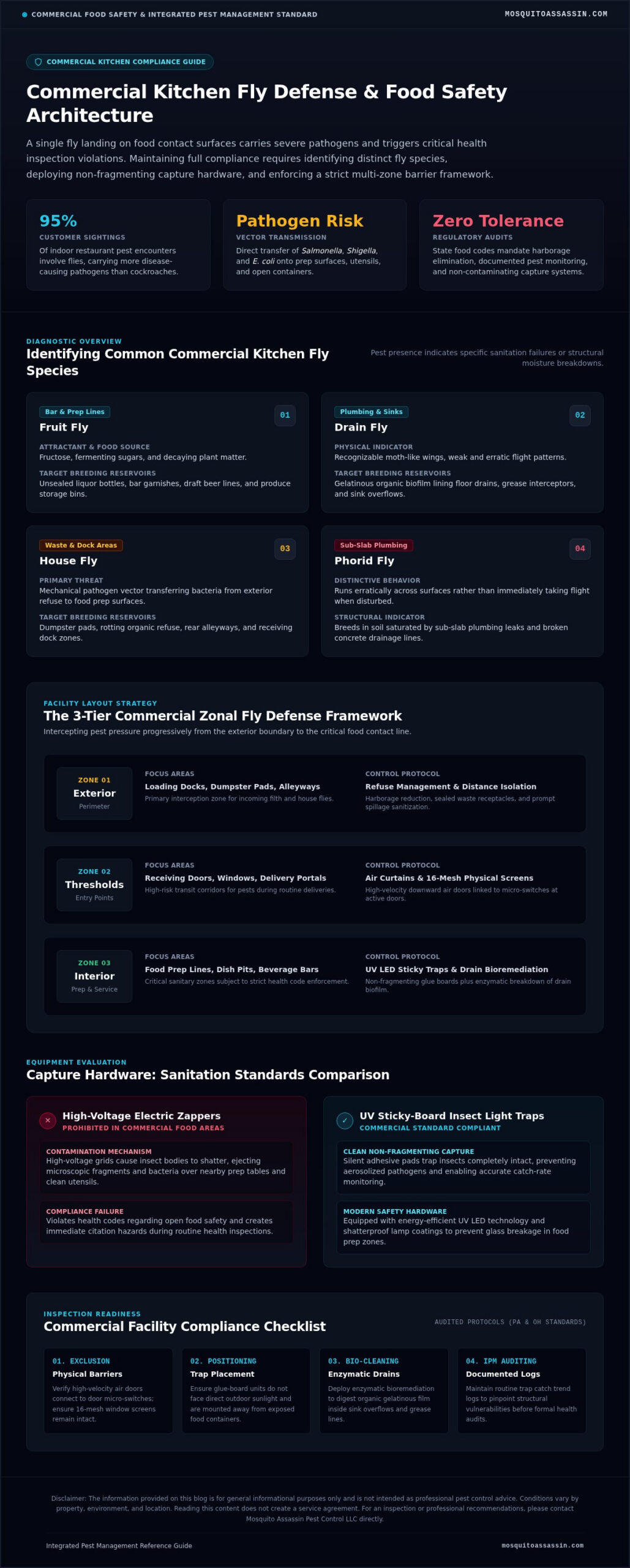
    When restaurant patrons spot a pest indoors, 95% of those sightings involve flies, which carry even more disease-causing pathogens than cockroaches. Retail sprays and hanging sticky ribbons rarely solve the problem, because effective fly control for commercial kitchens requires much more than a temporary fix. A single fly landing on food prep surfaces can jeopardize customer health and trigger critical citations during routine inspections.

    Dealing with drain flies around prep sinks or house flies near delivery doors creates constant stress during service. Kitchen managers often ask what system eliminates flies quickly without risking health code violations or misplacing equipment. True success occurs only when hardware selection and monitoring protocols match specific fly biology and facility zones.

    Discover how to select the right fly control hardware, sanitation protocols, and commercial management strategies to keep food prep environments compliant. This 2026 guide breaks down legal trap positioning, physical exclusion practices, and zone-by-zone defense methods to keep your facility fully inspection-ready all year long.

    Key Takeaways

    • Pinpoint specific fly species to uncover structural moisture issues and hidden organic buildup behind kitchen equipment and floor drains.
    • Select proper fly control for commercial kitchens by choosing glue-board light traps that capture insects without contaminating surrounding food contact surfaces.
    • Implement a zonal defense framework to intercept flies at loading docks and dumpsters before they ever enter interior prep lines.
    • Evaluate trap placement, wattage, and ambient lighting interference using a systematic facility checklist to avoid regulatory citations.
    • Integrate physical exclusion and routine sanitation audits with commercial pest management to maintain continuous health inspection readiness.

    Identifying Common Kitchen Fly Species and Food Safety Risks

    Every commercial food facility faces flying pests, but treating them with a one-size-fits-all approach guarantees failure. Successful fly control for commercial kitchens begins with accurate species identification. Because different flies target distinct food sources and reproductive substrates, the presence of specific insects reveals exactly where sanitation or structural barriers have broken down.

    Fruit Flies and Drain Flies in Preparation Areas

    Small filth flies thrive inside active prep zones and beverage stations:

    • Fruit Flies: Attracted to fructose and fermenting sugars, these pests rapidly colonize unsealed liquor bottles, bar garnishes, draft beer lines, and produce storage.
    • Drain Flies: Recognizable by their moth-like wings, drain flies breed directly inside the gelatinous organic film that accumulates in floor drains, grease interceptors, and sink overflows.

    Buying generic retail fly traps rarely solves these problems. Small indoor flies do not respond well to hardware engineered for agricultural settings, which means kitchen staff must pinpoint the exact moisture reservoirs sustaining the breeding cycle.

    House Flies and Phorid Flies Around Waste Zones

    Loading docks, rear alleyways, and dumpster pads introduce larger and more destructive pests. House flies feed on rotting refuse and transfer severe pathogens like Salmonella, Shigella, and E. coli onto prep tables and clean utensils. Phorid flies present a different hazard. While similar in size to fruit flies, they run erratically across surfaces rather than flying immediately when disturbed. Phorid flies thrive in soil saturated by sub-slab plumbing leaks. Persistent phorid activity often signals broken drainage lines hidden beneath concrete kitchen floors, requiring plumbing intervention alongside sanitation efforts.

    Regulatory Food Safety Standards and Contamination Hazards

    Public health inspectors hold commercial kitchens to strict regulatory criteria. Live insects landing near open food containers constitute high-risk violations that can lower inspection scores or prompt immediate shutdown orders. State food codes in Pennsylvania and Ohio mandate ongoing harborage elimination and documented pest monitoring. Implementing a structured Integrated Pest Management (IPM) program provides the inspection trail required by regulatory bodies. Scheduling professional commercial pest control services helps facilities identify structural vulnerabilities before health audits occur, keeping culinary operations compliant and safe.

    Evaluating Commercial Fly Control Hardware: Traps, Lights, and Air Curtains

    Selecting the right fly control for commercial kitchens requires balancing sanitation standards, guest aesthetics, and capture efficiency. Traditional high-voltage bug zappers have no place in a commercial food facility. When an insect strikes an electric grid, the impact shatters its body, throwing microscopic particles and bacteria across nearby prep counters. Modern commercial code demands non-fragmenting capture devices and active physical barriers.

    Insect Light Traps (ILTs) and UV Sticky Boards

    Glue-board insect light traps capture incoming pests cleanly and silently. By securing insects onto adhesive pads, these units keep flies intact so technicians can monitor catch rates and identify emerging pest trends during inspections. Upgrading to UV LED technology reduces operating energy costs compared to traditional fluorescent tubes while sustaining the specific ultraviolet wavelengths flies seek. Compliant fixtures also require shatterproof lamp coatings (protective plastic sheaths) to prevent broken glass from contaminating open food zones.

    Air Curtains and Physical Exclusion Barriers

    Exclusion hardware stops pests at exterior building thresholds before they reach sensitive prep lines. High-velocity air doors mounted above delivery entrances generate a powerful downward curtain of air that flying insects cannot penetrate. Connecting these units to micro-switches activates the airflow automatically whenever doors open for receiving deliveries. Pairing air curtains with durable 16-mesh window screens creates an unbroken physical boundary that keeps kitchens properly ventilated without admitting pests.

    Bioremediation and Enzymatic Drain Systems

    Surface hardware cannot address larval reproduction occurring deep inside plumbing infrastructure. Enzymatic bioremediation products consume the organic grease and protein biofilms where flies lay their eggs. Automated peristaltic dosing units dispense these biological cleaners directly into floor sinks and grease lines during overnight hours. Foaming delivery equipment expands solutions across the entire inner diameter of pipes, coating inaccessible corners where liquid flushes simply drain away.

    Partnering with licensed specialists for commercial pest control helps facilities choose code-compliant hardware and establish ideal trap placement away from exposed food preparation tables.

    Zonal Fly Defense: Matching Control Methods to Kitchen Layouts

    Dividing a facility into distinct operational zones is essential for effective fly control for commercial kitchens. A trap designed for a rugged loading dock creates immediate safety hazards if installed over a cook line. By mapping equipment to specific facility zones, restaurant operators intercept pests systematically before they reach customer plates.

    Receiving Docks and Waste Disposal Enclosures

    External entryways represent your frontline defense against invading filth flies. Mount industrial-grade light traps on interior walls perpendicular to loading bay doors rather than directly opposite them. Traps positioned directly across from an open bay act as beacons, drawing outdoor insects inside whenever doors cycle open. Outside the building, keep dumpster enclosures sealed. Tight lids, functional dock seals, and scheduled pad degreasing eliminate the intense odor plumes that attract blow flies and house flies to the building exterior.

    Active Food Preparation and Warewashing Lines

    Interior prep spaces demand careful hardware positioning to satisfy regulatory mandates. Always mount insect light traps at least five feet away from exposed food preparation tables, clean dish storage, and open cooking equipment. Hanging hardware directly above food contact areas violates standard food codes due to the risk of dislodged debris falling into ingredients.

    Lighting competition also dictates capture rates. Position traps away from direct sunlight or intense overhead kitchen illumination, which overpowers ultraviolet attractant lamps. In steamy dishwashing stations, specify splash-resistant hardware built to endure high ambient humidity without short-circuiting. Because fruit flies and phorid flies stay low to the ground, installing traps three to five feet above the floor near problem drains delivers the best catch rates.

    Dining Rooms and Customer Service Counters

    Front-of-house dining areas require complete discretion to protect guest comfort. Commercial wall sconce traps disguise adhesive boards behind attractive decorative facades, keeping captured insects completely hidden from patron view while casting ultraviolet light across seating zones. In bar areas, tuck compact monitoring units beneath service wells and near soda syrup lines. Combining discreet front-of-house traps with robust back-of-house barriers ensures complete coverage without disturbing customer dining experiences.

    Fly Control for Commercial Kitchens: 2026 Buying Guide

    Commercial Kitchen Fly Control Selection Checklist

    Purchasing commercial hardware without an assessment plan leads to wasted investment and recurring health violations. An underpowered light trap cannot protect a large dishwashing room, just as poorly placed sticky boards fail to attract flies away from hot cook lines. Establishing a systematic evaluation checklist ensures that every piece of fly control for commercial kitchens fits the facility layout and satisfies local health department codes.

    Auditing Facility Dimensions and Ambient Light

    Calculate the exact square footage and ceiling height of each room before purchasing hardware. Manufacturers rate insect light traps for specific room volumes, but ambient lighting changes those coverage zones. Competing illumination from prep station heat lamps, bright neon signage, and large exterior dining windows can easily overpower ultraviolet lure bulbs. Check potential mounting sites to ensure traps can be installed horizontally, keeping the UV glow unobstructed throughout the primary flight corridors of target pests.

    Assessing Moisture Sources and Organic Buildup

    Traps only capture flying adults, so staff must audit the physical conditions sustaining pest larvae. Walk through the kitchen to inspect cracked floor tile grout, recessed floor drains, and moisture trapped beneath walk-in refrigeration gaskets. Standard mop water often pushes food starch into wall junctions, creating rich organic breeding zones. Determine whether floor drains require mechanical wire brushing or biological foaming treatments to eliminate structural grease deposits. Enforce nightly kitchen closing routines that eliminate uncovered food waste and empty beverage containers.

    Reviewing Regulatory Compliance and Maintenance Access

    Review municipal regulations to ensure trap styles meet food safety laws. Most jurisdictions strictly prohibit open-grid bug zappers inside food production rooms, requiring shielded glue-board designs with shatterproof bulbs. Verify that all equipment features tool-free latching mechanisms. If staff need screwdrivers to access adhesive boards, monthly glue-board swaps and annual UV lamp replacements will get delayed, causing capture rates to drop quickly.

    Facility managers can review broader facility guidelines in this comprehensive commercial pest control guide. When internal cleaning and hardware upgrades do not resolve ongoing insect issues, professional pest control may help reduce risk. Restaurant operators can request an evaluation through www.mosquitoassassin.com/contact-us to address hidden structural entryways and keep facilities inspection-ready.

    Integrating Professional Management for Total Kitchen Protection

    Hardware traps capture adult insects, but traps alone cannot stop active breeding cycles. Sustainable fly control for commercial kitchens requires an integrated approach that connects physical exclusion, disciplined sanitation, and ongoing professional oversight. Maintaining detailed service logs and trend reports establishes an auditable defense when health inspectors arrive. Ultimately, professional pest control may help reduce risk, protect food safety margins, and preserve hard-earned commercial dining reputations.

    Why Hardware Alone Fails Without Structural Management

    Adhesive boards reflect pest population spikes, but they cannot repair cracked plumbing or degraded slab foundations. Unsealed gaps around beverage conduits and plumbing lines continuously invite exterior filth flies indoors. Without physical exclusion, reproduction outpaces capture rates. Licensed technicians spot subtle harborage zones, tracing hidden moisture issues behind stainless steel walls and underneath tile sub-flooring that routine kitchen closing crews cannot access.

    Sanitation Schedules and Kitchen Staff Protocols

    Daily shift procedures dictate whether flies establish permanent breeding zones. Kitchen managers should enforce structured closing protocols:

    • Scrub floor drains with stiff bristle brushes to eliminate organic biofilm before larvae develop.
    • Hang mops with heads up in ventilated areas rather than leaving wet strands resting inside stagnant mop buckets.
    • Dry standing wash water beneath prep tables, refrigeration motors, and soda fountain equipment nightly.
    • Transfer all fresh produce and open ingredients into airtight containers inside walk-in coolers instead of leaving them out on prep tables.

    Selecting a Licensed Commercial Pest Partner

    Food facilities need service providers versed in regional climate shifts and state sanitation codes. Establishments operating across Northwest Pennsylvania and Northeast Ohio face distinct seasonal surges in fly activity across Erie, Crawford, and Ashtabula counties. Reviewing specialized options through a dedicated commercial services hub ensures facilities receive tailored monitoring routines, documented trap servicing, and expert exclusion guidance. Combining daily staff accountability with professional support delivers reliable fly control for commercial kitchens throughout every season.

    Securing Long-Term Food Safety and Audit Readiness

    Maintaining an audit-ready culinary space requires far more than reactive swatters or random retail traps. Reliable fly control for commercial kitchens relies on a coordinated defense: installing code-compliant glue-board hardware, establishing rigorous floor drain sanitation, and enforcing daily exclusion protocols at delivery bays. When staff consistently eliminate organic residues and seal structural gaps, flies lose the breeding grounds they need to multiply.

    Every commercial facility presents unique layout challenges, especially during seasonal pest surges across Northwest Pennsylvania and Northeast Ohio. Licensed pest professionals apply a methodical multi-step inspection, exclusion, and ongoing monitoring approach to protect commercial food environments. Professional pest control may help reduce risk and protect your hard-earned culinary reputation. For professional facility inspections and customized commercial solutions, contact Mosquito Assassin Pest Control LLC directly to maintain compliance and peace of mind year-round.

    Disclaimer: The information provided on this blog is for general informational purposes only and is not intended as professional pest control advice. Conditions vary by property, environment, and location. Reading this content does not create a service agreement. For an inspection or professional recommendations, please contact Mosquito Assassin Pest Control LLC directly.
    Frequently Asked Questions

    Are bug zappers allowed inside commercial restaurant kitchens?

    No, electrocuting bug zappers are generally prohibited inside food preparation and storage areas. When insects contact high-voltage grids, their bodies shatter, dispersing microscopic fragments and bacteria over nearby prep tables and equipment. Health codes mandate glue-board light traps instead. These silent capture systems secure flying insects intact on adhesive surfaces, eliminating physical airborne contamination while keeping fly control for commercial kitchens compliant with local inspection standards.

    Where should insect light traps be placed in a commercial kitchen?

    Position traps at least five feet away from exposed food prep tables, cooking ranges, and clean warewashing racks. Mount units three to six feet above the floor, matching the natural cruising altitudes of house flies and fruit flies. Avoid placing units near bright exterior windows or competing high-intensity kitchen fixtures. Install traps perpendicular to loading docks and service doors to intercept invading insects before they penetrate interior prep zones.

    How often do commercial kitchen fly trap glue boards and bulbs need replacement?

    Glue boards typically require replacement every 30 days, or sooner if dust and trapped insects saturate the adhesive surface. UV bulbs require annual replacement, even if they still emit visible blue light. The ultraviolet output that attracts flying pests degrades significantly after nine to twelve months of continuous operation. Establishing a routine maintenance schedule ensures traps remain effective during peak warm seasons across Pennsylvania and Ohio.

    Why do fruit flies keep coming back despite deep cleaning the kitchen?

    Fruit flies persist because standard surface sanitation misses microscopic organic buildup hidden inside structural crevices. Adult females lay hundreds of eggs in fermenting sugars trapped behind loose wall cove base, inside damaged tile grout, or under hollow prep table legs. Uncleaned draft beer lines, soda dispenser drip trays, and rotting organic slime within floor drains provide endless breeding resources that everyday floor mops simply cannot reach.

    What is the difference between fruit flies, drain flies, and phorid flies?

    Fruit flies are light tan with red eyes, typically congregating near fermenting produce and sugary bar stations. Drain flies feature fuzzy, moth-like wings and breed specifically within the slimy biofilm lining floor drains and pipes. Phorid flies have a distinctive humpbacked shape and run rapidly across surfaces instead of flying away immediately. Phorid infestations often indicate serious sub-floor sewage leaks under concrete slabs.

    Can air curtains completely prevent flies from entering loading docks?

    Air curtains dramatically lower fly infiltration, but they cannot achieve 100% prevention on their own. Strong exterior wind gusts can disrupt downward airflow velocities, allowing occasional pests to slip through delivery doors. To achieve dependable fly control for commercial kitchens, air doors must be paired with magnetic door sensors, tight weather seals, and interior glue-board traps positioned just inside the bay to intercept stragglers.

    How do commercial drain fly treatments differ from pouring boiling water down drains?

    Pouring boiling water down drains merely washes past the top layer of organic matter, quickly cooling before penetrating thick gelatinous biofilms. Larvae and pupae burrowed inside the slime easily survive hot flushes. Professional treatments use specialized enzymatic foams or bioremediation solutions that cling to vertical pipe walls. These biological formulas digest the grease matrix completely, starving developing larvae and permanently breaking the fly reproductive cycle.

  • Employee Training for Pest Prevention: Workplace Guide

    Employee Training for Pest Prevention: Workplace Guide

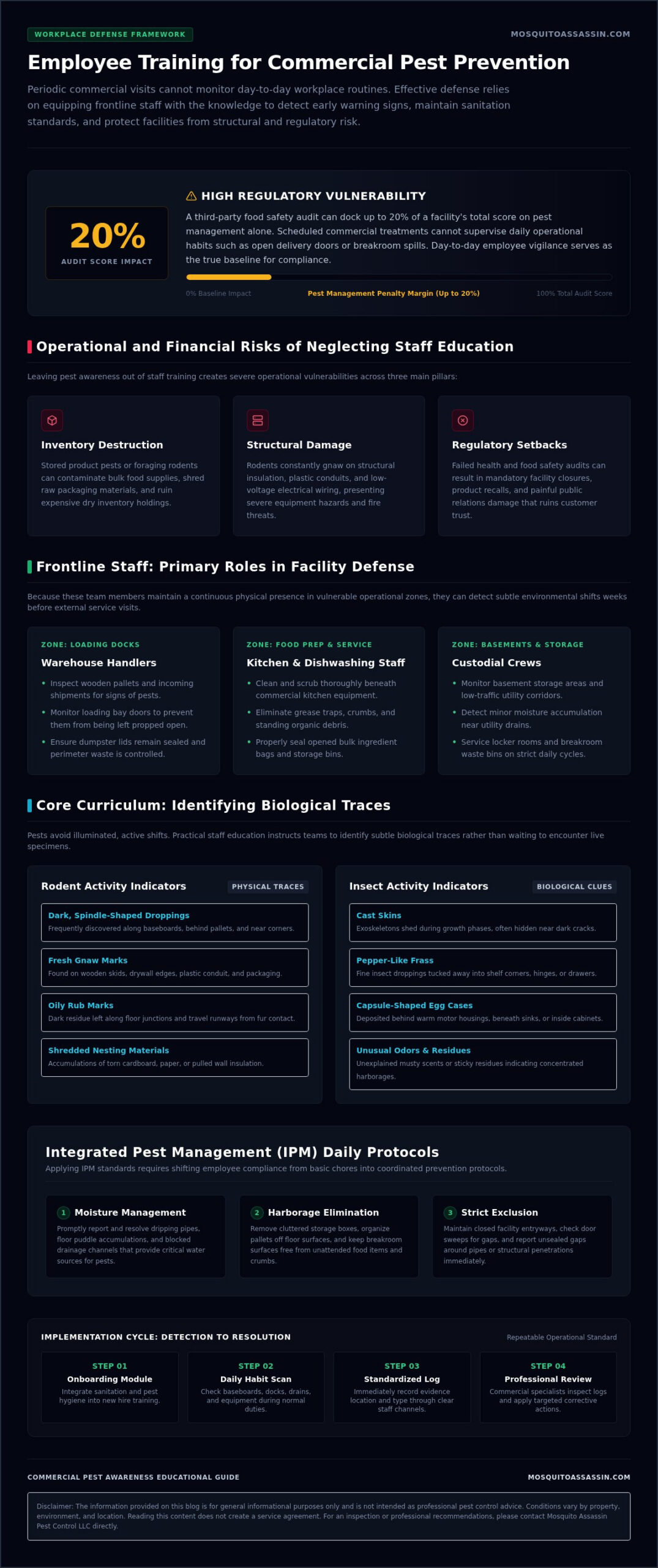
    A third-party food safety audit can dock up to 20% of a facility’s total score on pest management alone, yet scheduled commercial visits cannot monitor day-to-day workplace habits. Real pest defense relies on daily staff vigilance, not just periodic treatments. Most supervisors already know the frustration of sticky breakroom counters, propped delivery doors, and employees who walk past early warning signs simply because they don’t know what to look for. Without structured employee training for pest prevention, minor sanitation lapses quickly escalate into disruptive infestations that jeopardize compliance and business reputation.

    You can eliminate that vulnerability by turning your workforce into an active first line of defense. Discover how targeted training stops pest issues before they impact daily operations, inventory, or health inspections. This guide delivers a simple, repeatable staff training checklist, rapid reporting channels that minimize property risks, and year-round sanitation standards that keep commercial facilities secure.

    Key Takeaways

    • Establishing structured employee training for pest prevention equips frontline staff to detect subtle warning signs long before scheduled service visits.
    • Effective workplace curricula teach teams to identify physical evidence such as droppings, gnaw marks, and moisture buildup rather than waiting to spot live pests.
    • Standardized logging channels ensure staff observations reach facility managers immediately, minimizing inventory losses and preventing audit penalties.
    • Integrating practical hygiene modules into new hire onboarding creates consistent, year-round sanitation habits across breakrooms and storage areas.
    • Combining daily workplace vigilance with recurring commercial pest control provides comprehensive defense and regulatory protection.

    The Essential Role of Employee Training for Pest Prevention

    Pest activity rarely starts as a full-blown crisis. It begins quietly with overlooked crumbs beneath breakroom lockers, a delivery door propped open during a shift change, or minor moisture accumulation near a utility drain. While routine inspections from commercial providers establish critical defense lines, periodic visits cannot supervise daily workplace habits. Structured employee training for pest prevention bridges this operational gap. It teaches staff to recognize initial environmental attractants, log physical evidence immediately, and prevent infestations from taking root.

    Modern commercial standards view sanitation as an active defense mechanism rather than basic housekeeping. Applying the core principles of Integrated Pest Management (IPM) requires workplace personnel to minimize pest risks by managing moisture, eliminating harborage sites, and maintaining strict exclusion protocols. When team members understand how everyday routines directly influence pest biology, staff compliance shifts from reluctant chore work into coordinated facility protection.

    To better understand how frontline education safeguards business facilities, watch this helpful overview:

    Why Frontline Staff Serve as the First Line of Defense

    Frontline workers occupy the areas pests target most. Warehouse handlers inspect wooden pallets on loading docks, dishwashers scrub beneath commercial kitchen equipment, and custodial crews service basement storage zones every single day. Because these employees maintain continuous physical presence in vulnerable areas, they can detect subtle environmental changes weeks before an external technician arrives. Training empowers them to eliminate accidental attractants, such as unsealed snack boxes or loose dumpster lids, cutting off resources before pests establish nesting zones.

    Operational and Financial Risks of Neglecting Staff Education

    Leaving pest control out of staff onboarding creates severe operational vulnerabilities. The consequences of uninformed personnel extend far beyond dirty surfaces:

    • Inventory Destruction: Stored product pests or foraging rodents can contaminate bulk food supplies, shred raw packaging materials, and ruin expensive dry inventory.
    • Physical Structural Damage: Rodents constantly gnaw on structural insulation, plastic conduits, and low-voltage electrical wiring, presenting severe fire and equipment hazards.
    • Severe Regulatory and Financial Setbacks: Failed health audits can result in mandatory facility closures, product recalls, and painful public relations damage that ruins customer trust.

    Relying on informal assumptions leaves commercial facilities exposed. Establishing formalized commercial pest control procedures backed by continuous employee training for pest prevention stops small oversights from evolving into severe, costly infestations.

    Core Curriculum: Key Topics for Workplace Pest Awareness

    A successful defense plan requires practical instruction rather than vague reminders to keep areas tidy. Rather than waiting for someone to spot a live insect skittering across a hallway, comprehensive employee training for pest prevention teaches staff to detect subtle biological traces and eliminate survival resources. Much like the food safety modules emphasized in programs like the ServSafe Food Safety Certification, commercial pest awareness curriculum must link daily operating duties directly to pest biology across warehouses, office suites, and retail spaces.

    Recognizing Early Warning Signs of Common Pests

    Insects and rodents avoid open, illuminated spaces during active shifts. Training should focus on the physical signatures left behind during quiet periods:

    • Rodent Indicators: Dark, spindle-shaped droppings along baseboards, fresh gnaw marks on wooden skids or drywall, oily rub marks along floor junctions, and shredded cardboard or paper.
    • Insect Evidence: Cast skins from molting cockroaches, tiny pepper-like frass tucked into shelf corners, capsule-shaped egg cases (oothecae), and pinhole exits in paper dry goods packaging.
    • Environmental Odors: Distinct, oily, or musty smells that linger in enclosed storage closets, server rooms, or ceiling plenums, often signaling an established population.

    Workplace Sanitation and Eliminating Attractants

    Starving pests of sustenance and moisture stops colonization before it starts. Training must outline strict sanitation rules for shared spaces:

    • Refuse Management: Bagging all operational trash, wiping down interior bin liners, and ensuring outdoor dumpster lids remain shut tightly to deter foraging flies and rats.
    • Breakroom Standards: Banning unsealed snack boxes in personal desks, enforcing the daily cleanup of microwave splatters, and clearing out refrigerator bins weekly.
    • Moisture Mitigation: Reporting plumbing leaks immediately, clearing organic slime from floor drains, and eliminating standing water beneath ice machines or water coolers.

    Facility Inspection and Exclusion Awareness

    Rodents can slip through gaps as small as a quarter of an inch (roughly the diameter of a dime). Receiving personnel should carefully inspect incoming wooden pallets and corrugated shipping boxes for exterior tunneling or live stowaways before bringing inventory into core storage bays. Meanwhile, maintenance and warehouse teams need to monitor exterior doors for damaged weatherstripping, inspect foundation vents for missing mesh, and report unsealed wall penetrations around newly installed plumbing or electrical conduit lines.

    While structured daily routines dramatically limit exposure, combining these habits with regular commercial inspections provides property owners with reliable, continuous perimeter security.

    Establishing Clear Reporting and Documentation Procedures

    Even the sharpest eye provides little defense if an employee spots droppings and tells no one. Without a standardized pathway for communication, critical sightings get lost in shift handoffs or casual verbal remarks. Effective employee training for pest prevention must establish an intuitive, frictionless reporting mechanism. When staff members know exactly where and how to record their observations, facility managers can intervene before a localized issue turns into an operational disruption.

    Designing an Actionable Pest Sighting Log

    Vague notifications like “saw a bug in the back” waste valuable investigative time. Standardized logs turn casual sightings into actionable intelligence. Facility logs should capture specific parameters that reveal nesting zones and travel corridors:

    • Exact Timestamp and Specific Location: Note the date, precise hour, and distinct room, column, or rack identifier rather than broad department names.
    • Activity Classification: Record whether the discovery involved a live pest, a dead specimen, or biological traces like chew marks, droppings, or sawdust-like frass.
    • Quantity and Trajectory: Document how many pests were observed and where they fled, which pinpoints nearby wall voids or unsealed floor gaps.

    Make reporting tools readily accessible across all work shifts. While digital portals work well for administrative staff, physical binder logs mounted near loading bays, custodial closets, and breakroom exits ensure frontline workers log observations immediately without disrupting their shift duties.

    Designating Responsibility and Internal Communication Chains

    Data collection only works when paired with designated oversight. Facilities should appoint a sanitation supervisor or shift safety coordinator to audit sighting logs every morning. If an entry involves urgent risks, such as rodent activity near packaging lines or live insects in food preparation zones, internal protocols should trigger immediate supervisor escalation rather than waiting for scheduled maintenance reviews.

    Equally critical is cultivating a non-punitive reporting environment. Workers shouldn’t fear that logging pest activity in their work area reflects poorly on their personal work habits. Acknowledging staff submissions and sharing corrective steps reinforces employee training for pest prevention across the entire team. These organized internal records also provide licensed specialists with vital diagnostic trends during subsequent commercial inspections, enabling targeted interventions right at the source.

    Employee Training for Pest Prevention: Workplace Guide

    How to Implement an Effective Staff Training Program

    Executing an operational shift requires an actionable framework, not just good intentions. Handing an employee a lengthy binder on their first afternoon rarely leads to long-term vigilance. Building an impactful program for employee training for pest prevention involves integrating foundational sanitation habits into standard operational routines through structured, bite-sized steps.

    1. Integrate modules into onboarding: Introduce sanitation basics and pest reporting procedures during an employee’s first week of work.
    2. Display high-visibility visual aids: Mount pest identification charts and reminder notices in breakrooms, loading bays, and janitorial stations.
    3. Conduct hands-on facility walkthroughs: Walk new hires past high-risk exterior doors, trash compactors, and utility lines to point out real-world exclusion risks.
    4. Schedule seasonal refreshers: Hold brief reviews twice a year to align staff vigilance with regional weather shifts.
    5. Audit internal incident logs quarterly: Review logged sightings and sanitation lapses to spot recurring patterns and address training gaps.

    Onboarding Modules Versus Continuous Education

    Initial onboarding sets expectations early. New hires should learn waste management rules, designated eating zones, and prompt spill cleanup during their primary facility orientation. However, a single session doesn’t create lasting retention. Brief ten-minute refresher talks during scheduled quarterly safety meetings keep standards top of mind. In spring, focus training on ants and foraging flies emerging as outdoor temperatures rise. In late autumn, shift attention toward rodents seeking indoor harborage away from freezing outdoor conditions.

    Engaging Visual Aids and Practical Exercises

    Visual memory drives faster recognition than abstract policies. Laminated wall charts showing high-resolution photos of regional insects and rodent droppings help workers identify species immediately. Pairing visuals with interactive drills produces the best results. Lead warehouse teams on practical storage audits, teaching them to stack inventory six inches away from exterior walls and off the bare floor on pallets. Encourage staff to take quick smartphone photos of suspected damage or unusual insects, attaching them directly to digital internal communication channels for instant supervisor verification.

    Proactive internal education transforms day-to-day operations, but outside professional expertise ensures complete property defense. To support your company’s internal protocols, scheduling an evaluation with commercial pest control specialists helps identify subtle architectural vulnerabilities that daily cleaning cannot resolve.

    Partnering With Professional Pest Management Services

    Daily sanitation and internal vigilance build a powerful first line of defense, but basic workplace routines cannot replace specialized pest management. Frontline personnel manage the environment to deter biological attractants, whereas certified specialists deliver technical interventions, structural sealing, and ongoing regulatory documentation. Aligning internal employee training for pest prevention with regular commercial service creates a dual-layer strategy that keeps properties compliant, sanitary, and structurally secure year-round.

    When to Escalate From Employee Reporting to Professional Service

    Routine custodial cleanup handles occasional crumb buildup, but certain discoveries demand rapid escalation to technical specialists. Facility leadership should bring in licensed professionals whenever employees document critical indicators:

    • Structural or Material Damage: Discovering chewed electrical wiring, shredded wall insulation, or hollowed wooden framework requires immediate diagnostic intervention.
    • Persistent Pest Sightings: Repeatedly finding insects or rodent droppings in identical zones indicates established breeding harborage hidden deep within building voids.
    • Contamination in Sensitive Areas: Pests observed near packaging lines, raw goods storage, or food preparation areas present severe public health hazards that require targeted remediation.

    Partnering with commercial pest control services provides businesses with targeted perimeter defense, specialized baiting infrastructure, and detailed service records necessary for third-party facility audits.

    Regional Pest Pressures in Pennsylvania and Ohio

    Commercial facilities face distinct operational hurdles dictated by local climate patterns. During late autumn and early winter, dropping temperatures across Erie and Crawford Counties drive rodents to seek indoor warmth, moving directly toward heated loading bays and warehouse utility chases. Conversely, elevated summer humidity throughout Ashtabula County accelerates insect activity along building perimeters, driving perimeter invaders toward unsealed doorways and foundation vents.

    Addressing these seasonal shifts requires deep familiarity with regional climate patterns and local pest behavior. Property managers can learn more about Mosquito Assassin Pest Control LLC to discover how local industry experience shapes targeted commercial protection strategies. Reviewing regional service locations helps businesses confirm localized coverage options throughout Northwest Pennsylvania and Northeast Ohio.

    When staff members actively log early warning signs, external technicians can deploy precise countermeasures without costly operational delays. Routine employee training for pest prevention transforms your workforce into reliable partners alongside certified commercial specialists, ensuring comprehensive protection across every shift.

    Strengthen Your Facility Defense Through Staff Vigilance

    Protecting a commercial facility requires consistent daily action rather than periodic, reactive treatments. Structured employee training for pest prevention empowers frontline teams to recognize early biological traces, maintain strict sanitation standards, and log observations before minor issues escalate into costly audit penalties or physical property damage. When staff actively participate in daily prevention, workplace hygiene becomes a continuous operational shield.

    Pairing internal vigilance with professional expertise ensures complete, year-round perimeter security. Backed by extensive local pest control experience across Northwest Pennsylvania and Northeast Ohio, dedicated regional technicians understand county health standards and local seasonal cycles. For professional facility inspections and customized commercial plans, contact Mosquito Assassin Pest Control LLC to keep your commercial property secure across every shift.

    Disclaimer: The information provided on this blog is for general informational purposes only and is not intended as professional pest control advice. Conditions vary by property, environment, and location. Reading this content does not create a service agreement. For an inspection or professional recommendations, please contact Mosquito Assassin Pest Control LLC directly.
    Frequently Asked Questions

    Why is employee training for pest prevention necessary if a company has pest control?

    Professional technicians visit periodically, but daily staff habits directly determine whether pests find food, water, and shelter between scheduled service calls. Even comprehensive commercial treatment plans struggle if exterior doors remain propped open or interior spills sit uncleaned. Structured employee training for pest prevention creates ongoing workplace vigilance, ensuring staff eliminate attractants and catch subtle warning signs before an infestation establishes itself inside walls or storage areas.

    What are the most common pests employees should be trained to identify?

    Commercial employees should be trained to spot mice, rats, cockroaches, flies, and stored-product pests like beetles or moths. Training should focus on local risks, such as house mice seeking warm interior shelter during cold Pennsylvania and Ohio winters, or filth flies congregating near outdoor dumpsters during humid summers. Staff should also recognize subtle evidence like droppings, chewed packaging, and shed insect casings rather than expecting to see live pests in the open.

    How often should commercial staff receive pest prevention training?

    Facilities should provide baseline pest training during new hire onboarding, followed by brief refresher sessions twice a year. Semi-annual sessions align smoothly with regional seasonal transitions, such as spring insect emergence and autumn rodent migrations seeking indoor warmth. Incorporating brief five-minute reviews during quarterly safety meetings also reinforces proper waste handling and prompt reporting protocols, keeping prevention top of mind without pulling employees away from daily operations.

    What should be included in an employee pest sighting log?

    An actionable pest sighting log should record the precise date, time, specific location, pest type, estimated quantity, and observed direction of travel. Noting whether the discovery was a live pest, dead specimen, or biological sign like droppings helps licensed technicians pinpoint nesting zones. Keeping physical log binders in accessible breakrooms alongside digital submission forms guarantees immediate entries from all shifts, providing maintenance teams with reliable data to guide targeted interventions.

    How do employee sanitation habits influence commercial pest infestations?

    Daily employee sanitation habits directly control the food, water, and harborage resources that allow pests to survive indoors. Leaving crumbs in breakroom microwaves, storing snacks in unsealed desk drawers, or failing to report a dripping utility sink creates ideal conditions for cockroaches and rodents. Consistent sanitation protocols starve opportunistic pests, making exterior barriers more effective and significantly reducing the likelihood that foraging pests will settle inside commercial buildings.

    Can employee pest training help businesses pass health and safety audits?

    Yes, structured employee training directly supports audit success because pest control documentation and facility sanitation account for significant portions of third-party facility evaluations. Modern regulatory frameworks, including FDA standards, expect commercial facilities to demonstrate proactive prevention rather than reactive pest extermination. Implementing comprehensive employee training for pest prevention ensures clean storage bays, documented sighting logs, and prompt structural repairs, giving inspectors clear proof of active managerial control and compliant pest management.

  • Protecting Your Business From Bad Reviews Due to Pests: A Commercial Guide

    Protecting Your Business From Bad Reviews Due to Pests: A Commercial Guide

    Online reputation defense begins with physical facility exclusion, not reactive public relations damage control. Every commercial operator dreads the sudden alert of a one-star rating accompanied by a customer’s high-resolution photo of an insect or rodent on Google Maps. Successfully protecting your business from bad reviews due to pests requires eliminating risks before patrons ever encounter them. With research from BrightLocal confirming that 77% of consumers avoid establishments with negative reviews, a single sighting can instantly unravel years of hard-earned community goodwill.

    Keeping dining rooms, retail floors, and commercial facilities spotless doesn’t happen by accident. In this guide, discover how proactive commercial pest management safeguards brand reputation, prevents public customer complaints, and ensures regulatory health compliance. You will explore practical structural exclusion protocols, proven staff de-escalation strategies for unexpected pest encounters, and scheduled commercial defense routines that keep your property compliant and customer confidence high.

    Key Takeaways

    • Discover why high-resolution customer photos on digital map platforms inflict severe, lasting reputational damage compared to standard operational complaints.
    • Identify high-risk property vulnerabilities and pest pressures that immediately trigger guest panic and municipal health scrutiny.
    • Learn how proactive Integrated Pest Management (IPM) provides structural defense, making facility exclusion fundamental to protecting your business from bad reviews due to pests.
    • Establish internal reporting workflows and staff interception protocols to de-escalate customer concerns before complaints reach public review networks.
    • Understand the criteria for selecting licensed commercial pest control partners compliant with regulatory standards across Pennsylvania and Ohio.

    A customer sighting a pest triggers an immediate visceral reaction that public relations messaging cannot solve. Unlike slow service or cold food, insects and rodents represent a direct violation of baseline sanitation trust. Treating pest-related complaints as simple communication errors ignores the reality of commercial facility hygiene. Relying on an Integrated Pest Management (IPM) framework addresses physical structural vulnerabilities before pests ever cross paths with customers. Physical exclusion, rather than online reputation management, remains the foundation for protecting your business from bad reviews due to pests.

    Customer Psychology and the Reaction to Commercial Pests

    Pest sightings bypass rational consumer patience. Modern smartphones allow visitors to capture high-definition photos or video clips within seconds, publishing them to community platforms before management can step in. According to a hospitality survey by CleanLink, 55% of patrons avoid commercial facilities entirely if they encounter online rumors or reports of pests. Search engine algorithms index words like “bug,” “fly,” or “droppings” in prominent profile tags, turning an isolated incident into an enduring digital billboard that scares off prospective local patrons.

    The Tangible Financial Impact of Dropping Star Ratings

    Public pest reports inflict immediate financial damage. Customer acquisition costs spike while baseline revenue declines across multiple fronts:

    • Direct Revenue Contraction: Research from Harvard Business School demonstrates that a one-star rating shift correlates with a 5% to 9% swing in revenue for commercial dining establishments.
    • Customer Abandonment: Data from ConsumerAffairs indicates that 80.2% of consumers abandon a planned visit or purchase after reading negative online feedback.
    • Search Platform Demotion: Local search algorithms prioritize top-rated facilities, burying businesses with falling scores beneath cleaner, highly rated competitors.

    Regaining public trust requires months of defensive marketing, sanitization audits, and customer outreach. Enlisting scheduled commercial pest control prevents sanitation oversights from materializing on digital feeds. Proactive facility defense remains the most dependable method for protecting your business from bad reviews due to pests while maintaining steady foot traffic.

    High-Risk Pest Vulnerabilities That Trigger Public Complaints

    Different pests provoke distinct customer reactions, ranging from mild irritation to visceral disgust. While an occasional ant might escape notice, certain species instantly signal systemic neglect to discerning patrons. Aligning daily facility routines with the EPA’s Integrated Pest Management principles establishes concrete action thresholds, helping managers eliminate activity before it reaches guest view. Proactive monitoring remains an essential step toward protecting your business from bad reviews due to pests across retail, healthcare, and hospitality settings.

    Front-of-House Nuisances: Flies, Wasps, and Spiders

    Front-of-house pests disrupt guest comfort and ruin dining experiences within seconds. Small fruit flies hovering near bar taps or drain flies emerging from restroom sinks create an immediate impression of dirty lines and poor beverage hygiene. On outdoor dining patios, aggressive yellowjackets and paper wasps disrupt patrons during peak afternoon hours, frequently driving guests indoors before orders are finished. Even visible cobwebs gathered around entryway light fixtures or ceiling rafters suggest careless housekeeping to arriving visitors, prompting quick complaints on local community forums.

    Back-of-House Disasters: Rodents and Cockroaches

    Back-of-house intruders present direct health risks that compromise regulatory standing and inventory safety. Commercial operations face intense exposure from two primary invaders:

    • German Cockroaches: These insects shelter in the warm motor housings of commercial coolers, prep tables, and dishwashers, multiplying quickly and crawling onto prep surfaces after dark.
    • Commensal Rodents: Mice and rats gnaw cardboard packaging, contaminate dry goods with urine trails, and leave droppings along storage perimeter walls. Reviewing structural containment steps in this guide on professional rodent removal can assist facility teams with early detection.

    Under Section 6-501.111 of the U.S. FDA Model Food Code, documented evidence of insect or rodent activity constitutes a major inspection violation that can trigger mandatory operational suspensions. When staff spot signs of nesting or droppings, arranging a commercial pest control assessment may help reduce risk, keeping preparation areas compliant and protecting your business from bad reviews due to pests.

    Building an Integrated Pest Management Strategy for Reputation Defense

    Relying on spot spraying after customers notice bugs guarantees continuous reputational crisis. True brand security demands a proactive framework that blocks pests at exterior boundaries. Implementing structured EPA’s Integrated Pest Management principles allows commercial facilities across Erie, Crawford, and Ashtabula counties to eliminate pest attractants before populations take hold. This methodical, multi-tiered strategy serves as the core operational barrier for protecting your business from bad reviews due to pests.

    Step 1: Structural Exclusion and Entry Point Sealing

    Physical exclusion denies pests access to interior dining, retail, or patient zones. Loading docks, delivery entries, and utility conduits represent primary entry corridors:

    • Install heavy-duty nylon brush sweeps along exterior entrance doors and overhead dock levelers, eliminating visible light gaps.
    • Seal exterior pipe penetrations, mortar gaps, and electrical feed lines using commercial silicone sealants paired with copper mesh or stainless steel wool.
    • Fit exhaust louvers, commercial kitchen hood vents, and openable windows with fine-mesh wire screens to block flying insects during seasonal transitions.

    Step 2: Commercial Sanitation and Moisture Control

    Insects and rodents enter facilities hunting for dependable food and water reservoirs. Managing environmental attractants removes the biological fuel necessary for infestations to persist:

    • Scrub floor drains, soda fountain sumps, and dishwashing runoff pans daily with bio-enzymatic cleaners to eliminate organic debris and drain fly breeding zones.
    • Position outdoor dumpsters at least 50 feet away from customer entrances, maintaining tight-fitting lids and washing surrounding pads weekly.
    • Elevate dry storage goods at least six inches off the floor on wire metal racks, storing bulk ingredients inside airtight polycarbonate containers.

    Step 3: Scheduled Professional Auditing and Monitoring

    Passive monitoring detects early perimeter breaches before visible outbreaks occur. Tamper-resistant bait stations and non-toxic glue boards positioned along non-public pathways, crawl spaces, and equipment lines capture early seasonal invaders. Maintaining detailed trend analysis logs allows maintenance teams to spot pest pressure spikes during humid Lake Erie summers or late-autumn cold snaps. Reviewing tailored programs through commercial pest control services helps operators establish rigid inspection intervals, protecting your business from bad reviews due to pests through continuous professional oversight.

    Protecting Your Business From Bad Reviews Due to Pests: A Commercial Guide

    Train Staff to Intercept Pest Issues Before Customers Post

    Public reviews often appear when customers feel ignored on-site. When patrons spot an insect and receive indifferent service from employees, frustration quickly turns into an online complaint with photos attached. Front-line team members serve as an essential operational buffer, catching building issues early and managing guest concerns with care. Equipping employees with structured response protocols plays a pivotal role in protecting your business from bad reviews due to pests.

    Establishing an Internal Pest Reporting Protocol

    Pest activity rarely begins in plain sight of dining areas or customer checkout counters. It develops silently in utility rooms, dish pits, and delivery corridors. Creating a reliable reporting workflow ensures small warning signs don’t escalate into customer-facing incidents:

    • Maintain a centralized physical logbook or digital channel where employees log the date, time, specific location, and pest type observed.
    • Train opening and closing crews to inspect high-risk vulnerabilities, including underneath heavy refrigeration coils, along floor drains, and around exterior trash doors during scheduled cleaning shifts.
    • Empower shift leads to temporarily close an impacted section or quarantine affected dry inventory without needing upper management approval first.

    De-escalating Customer Encounters Professionally

    A calm, empathetic staff response can resolve an unexpected pest encounter before the guest leaves the building. If a customer points out a pest, employees should never argue, minimize the concern, or blame the weather. Instead, staff should immediately acknowledge the patron’s discomfort, apologize sincerely, and relocate the party to a completely different section of the facility. Managers should swiftly comp the guest’s meal or purchase and explain that licensed pest management professionals are scheduled to inspect the facility.

    Under the Federal Trade Commission Rule on Consumer Reviews (16 CFR Part 465), businesses cannot suppress honest negative feedback through legal threats or intimidation. Resolving issues on-site through genuine customer care remains the lawful, effective path to reputation defense. For facilities seeking structured defense against recurring pest activity, partnering with certified professionals for commercial pest control helps identify hidden nesting zones, supporting staff efforts and protecting your business from bad reviews due to pests over the long term.

    Selecting the Right Commercial Pest Control Partner in PA and OH

    Standard residential spraying routines fall short of commercial operational needs. Enterprise facilities require tailored inspection schedules, regulatory documentation, and strategic service visits scheduled outside of normal operating hours. Choosing an experienced regional contractor is fundamental to protecting your business from bad reviews due to pests across Northwest Pennsylvania and Northeast Ohio.

    Essential Criteria: Licensing, Documentation, and Response Time

    Commercial facilities operate under strict state oversight. In Pennsylvania, structural pest contractors must maintain a valid Pesticide Business License with certified applicators in Category 7B (General Pest Control) under the Pennsylvania Department of Agriculture. In Ohio, businesses must fulfill Ohio Department of Agriculture requirements under Category 10a.

    Beyond licensing, facility managers must demand rigorous service documentation. Quality providers log every monitoring trap result, structural vulnerability, and sanitary risk observed during an inspection. These detailed audit trails prove compliance during surprise county health department inspections. Clear communication channels and rapid response times also guarantee that if an unexpected pest appears, a certified professional investigates before customers notice.

    Regional Environmental Factors in Erie, Crawford, and Ashtabula

    Properties situated near Lake Erie encounter shifting environmental challenges that inland protocols rarely accommodate. Lake-effect moisture accelerates seasonal fly and insect breeding cycles from spring through late summer. When temperatures plummet in late autumn, field mice and rats migrate away from rural edges directly toward warm commercial foundations and loading bays.

    Managing these persistent regional shifts requires customized commercial plans rather than generic treatments. Business operators can evaluate targeted programs by reviewing dedicated commercial services built for local enterprise requirements. To evaluate your property’s exterior perimeter and interior vulnerabilities, contact licensed pest specialists to establish an ongoing inspection routine. Structured professional prevention remains the most dependable method for protecting your business from bad reviews due to pests year-round.

    Strengthen Your Facility Defense and Safeguard Customer Trust

    A pristine commercial reputation relies on proactive structural defense rather than reactive digital crisis control. Enforcing strict sanitation standards, sealing perimeter vulnerabilities, and empowering staff with de-escalation protocols stops pest encounters before they become public complaints. Shifting focus from damage control to prevention ensures business operators maintain consistent operational control.

    Working with licensed commercial technicians across Erie and Crawford counties in Pennsylvania and Ashtabula County in Ohio ensures verifiable audit documentation for routine health inspections. Systematic monitoring and physical exclusion remain the most dependable strategy for protecting your business from bad reviews due to pests. Consulting with professional pest control services may help reduce risk and protect your facility reputation, giving patrons complete confidence every time they walk through your doors.

    Disclaimer: The information provided on this blog is for general informational purposes only and is not intended as professional pest control advice. Conditions vary by property, environment, and location. Reading this content does not create a service agreement. For an inspection or professional recommendations, please contact Mosquito Assassin Pest Control LLC directly.

    Frequently Asked Questions

    How quickly can a pest-related bad review damage a commercial business?

    The damage occurs almost instantaneously once a review goes live. Search engines index new user content within minutes, frequently tagging words like “mice” or “cockroaches” at the top of business profiles. Prospective customers filtering for nearby services see those highlighted terms immediately. In highly competitive sectors like food service and hospitality, an unaddressed negative post can visibly reduce weekend foot traffic and reservation volume within hours.

    Can a business legally remove a negative review about pests on Google?

    Google only removes reviews that violate explicit platform policies, such as spam, hate speech, or proven fake engagement from competitors. Genuine negative reviews describing authentic customer experiences cannot be forcibly removed. Under the FTC Rule on Consumer Reviews (16 CFR Part 465), attempting to suppress honest feedback through intimidation or baseless legal threats carries federal penalties. The only lawful resolution is addressing the underlying sanitation problem directly.

    What should a manager do immediately if a customer reports a pest indoors?

    The manager should immediately validate the customer’s concern with empathy and avoid making defensive excuses. Move the customer to a separate area, void their bill or offer compensation according to company policy, and assure them the matter is being investigated. Logging the sighting details immediately and calling licensed commercial technicians prevents further guest exposure, which is critical for protecting your business from bad reviews due to pests.

    How often should commercial properties receive professional pest control inspections?

    High-traffic commercial facilities, particularly restaurants, grocery stores, and food processing plants, typically require monthly or bi-monthly professional inspections. Lower-risk retail or office spaces may operate on quarterly schedules. Because seasonal weather shifts around Lake Erie drive structural pest migrations throughout spring and autumn, consistent service visits ensure exterior bait stations and monitoring traps remain fully functional year-round before populations migrate inside.

    Does regular deep cleaning eliminate the need for commercial pest management?

    Deep cleaning removes food attractants, but sanitation alone cannot stop commercial pest infestations. Insects and rodents enter through tiny foundation gaps, delivery cartons, and utility penetrations that scrubbing cannot resolve. Pests also harbor inside equipment motor housings, hollow walls, and subfloors where cleaning crews never reach. Comprehensive reputation security requires combining thorough daily sanitation with professional exclusion and scheduled pest monitoring.

    What documentation do health inspectors require regarding commercial pest control?

    County health inspectors expect a complete on-site pest management binder during unannounced operational audits. Required documentation typically includes the commercial service contract, applicator license verification, detailed service tickets, SDS sheets for all materials used, and a facility trap map. Inspectors review technician trend notes to confirm that past activity was identified and corrected systematically under state sanitation regulations.

    Why is DIY pest control unsuitable for commercial reputation protection?

    Over-the-counter retail sprays often repel pests deeper into walls rather than eliminating the breeding population, leading to sudden re-emergence in public dining or shopping areas. DIY attempts also lack the regulatory documentation demanded by health inspectors and expose businesses to contamination liability. Choosing certified commercial management remains the only defensible method for protecting your business from bad reviews due to pests and passing official health audits.

  • Field Mouse vs House Mouse: Key Differences and Identification Guide

    Field Mouse vs House Mouse: Key Differences and Identification Guide

    A structural gap as small as one quarter of an inch (roughly the width of a pencil) is all a rodent needs to compromise the safety of a home. For property owners in Erie and Crawford Counties in Pennsylvania or Ashtabula County in Ohio, discovering a small, furry intruder often leads to immediate anxiety about structural damage and disease transmission. It is frustrating to sort through conflicting identification tips when you simply want to know if your family is at risk or how the intruder entered.

    Understanding the field mouse vs house mouse distinction is the first step in implementing a successful exclusion strategy. While they may look similar at a glance, these species have different nesting habits and carry different pathogens, such as hantavirus or lymphocytic choriomeningitis virus. This guide provides the clear, fact-based criteria needed to accurately identify common local rodents and understand the unique threats each species presents to your property.

    By learning the physical markers (such as the two-toned fur of a white-footed mouse compared to the uniform gray of a house mouse) you can better protect your household. The following sections detail specific behavioral traits, regional risks in the tri-state area, and professional standards for long-term prevention and exclusion.

    Disclaimer: The information provided on this blog is for general informational purposes only and is not intended as professional pest control advice. Conditions vary by property, environment, and location. Reading this content does not create a service agreement. For an inspection or professional recommendations, please contact Mosquito Assassin Pest Control LLC directly.
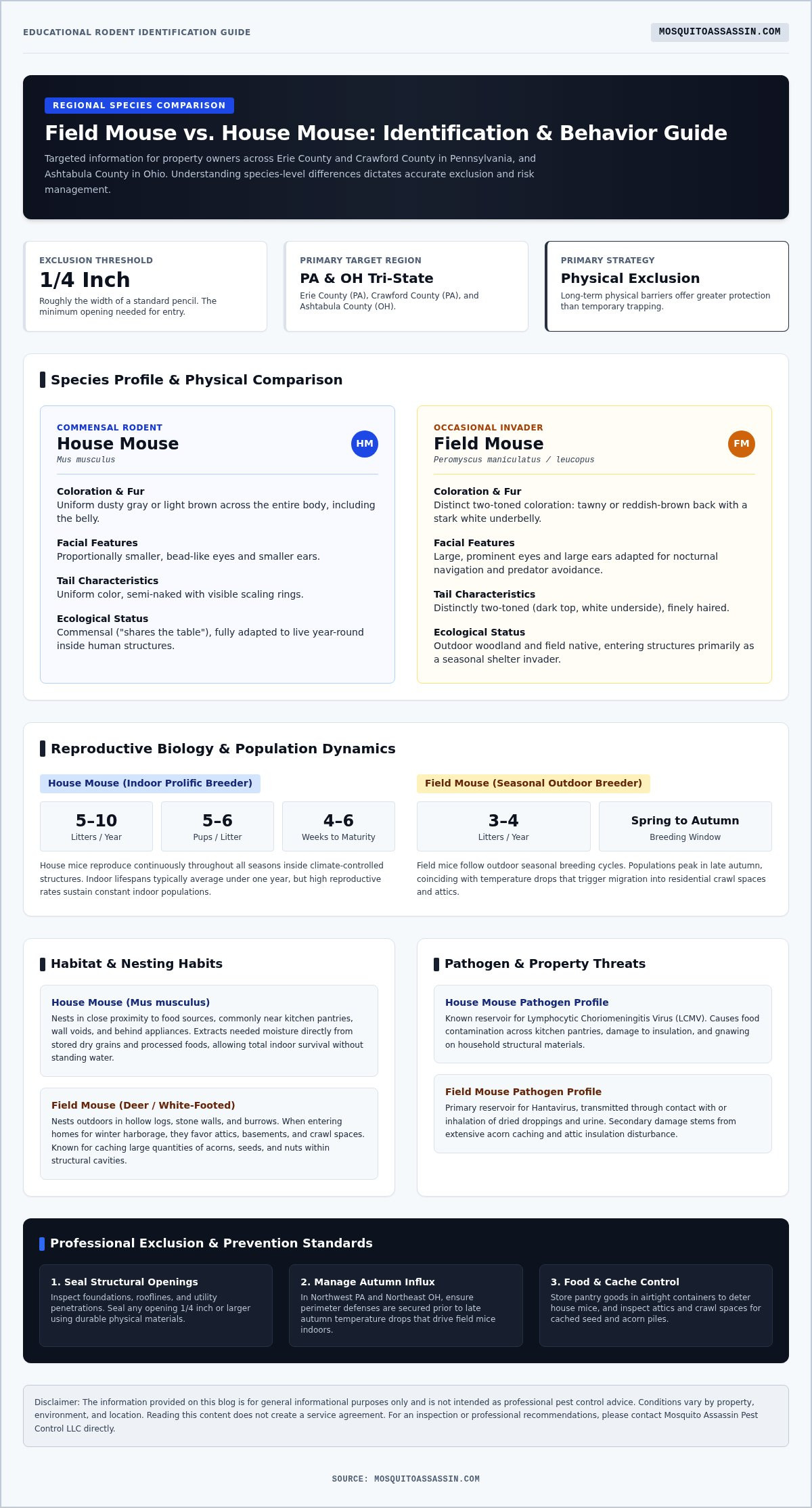
    Key Takeaways

    • Distinguish between species by observing fur coloration and tail texture to determine if you are facing a two-toned field mouse or a uniformly gray house mouse.
    • Understand how the field mouse vs house mouse comparison dictates your health risks, as each rodent serves as a reservoir for different serious pathogens.
    • Learn why seasonal shifts in Pennsylvania and Ohio cause specific field mouse species to migrate into attics and crawl spaces while house mice remain year-round residents.
    • Discover the critical exclusion threshold of 1/4 inch and why physical barriers are more effective than temporary trapping for long-term protection.
    • Identify the different ways these rodents damage property, from the large acorn caches of white-footed mice to the nesting habits of house mice near kitchen pantries.

    Understanding the Basics: What Defines a Field Mouse and a House Mouse?

    Distinguishing between the field mouse vs house mouse begins with understanding that these are entirely different biological families with unique survival strategies. In Northwest Pennsylvania and Northeast Ohio, homeowners frequently encounter both. While the house mouse is a specific species (Mus musculus), the term “field mouse” is a local catch-all used for the deer mouse (Peromyscus maniculatus) or the white-footed mouse (Peromyscus leucopus).

    Identifying which rodent has entered a structure is critical. Their nesting habits, food preferences, and the specific pathogens they carry vary significantly. A strategy that works for a resident house mouse might not address the seasonal intrusion of a field mouse searching for winter harborage. Because these rodents respond differently to environmental changes, professional identification is the foundation of any long-term exclusion plan.

    The Biology of the House Mouse

    The house mouse is categorized as a commensal rodent, a term meaning “to share the table.” Having evolved alongside human civilization, these rodents are uniquely adapted to live inside climate-controlled structures. Their biology allows them to thrive without a constant source of standing water, as they can extract necessary moisture from the grains and processed foods found in residential pantries. This ability to survive entirely indoors makes them a year-round threat in Erie and Ashtabula.

    According to house mouse biology and characteristics, these rodents are prolific breeders. A single female can produce between 5 and 10 litters every year, with each litter averaging 5 to 6 pups. Because they reach sexual maturity in roughly 4 to 6 weeks, an indoor population can multiply exponentially regardless of the weather outside. In a residential setting, their lifespan is often less than a year, but their rapid reproduction ensures the population remains stable.

    The Biology of the Field Mouse

    Unlike their commensal counterparts, field mice are primarily outdoor animals adapted for survival in the woodlands and fields of Crawford County. The deer mouse and white-footed mouse have large eyes and ears, features that help them navigate nocturnal environments and avoid predators. They are highly skilled at surviving harsh winters by caching seeds and nuts in hollow logs, stone walls, or underground burrows. Their physical adaptations are geared toward the wild rather than the kitchen cabinet.

    These rodents are considered occasional invaders. They typically do not seek out human homes for food but rather for shelter when temperatures drop in the autumn. While they might nest in a crawl space or attic, they often maintain a connection to the outdoors to forage. Their reproductive cycle is also more seasonal than the house mouse, usually producing 3 to 4 litters between spring and late autumn. Understanding these distinctions is the first step in effective rodent control services.

    Identification Guide: Comparing Physical Traits and Behaviors

    Spotting a rodent darting across a room in the middle of the night makes identification difficult. However, observing specific physical markers is the most reliable way to settle the field mouse vs house mouse debate. Homeowners in Erie and Crawford Counties should look for distinct coloration and anatomical proportions rather than relying on size alone, as juveniles of one species can easily be mistaken for adults of another.

    Visual Markers and Coloration

    Coloration provides the most immediate clue for identification. A house mouse typically maintains a uniform, dusty gray or light brown color across its entire body, including its belly. In contrast, the field mouse (specifically the deer mouse and white-footed mouse) displays a sharp contrast between its tawny or reddish-brown back and its stark white underbelly. Deer mice exhibit a trait called counter-shading, where the dark upper body meets the white underside in a clean, straight line.

    • Feet: Field mice have noticeably white feet, whereas house mouse feet match their gray or brown body color.
    • Tail: A house mouse tail is scaly and nearly hairless. A field mouse tail is bicolored (dark on top, white on bottom) and covered in fine, short hairs.

    Size and Proportions

    The facial features of these rodents have evolved for different lifestyles. Field mice possess large, bulging eyes and rounded ears that appear oversized for their heads, adaptations for nocturnal life in the wooded areas of Pennsylvania and Ohio. House mice have much smaller, beady eyes and ears that are more proportional to their head size. Adult house mice typically measure between 5 and 7.5 inches in total length, while adult field mice are slightly larger, ranging from 5.5 to 8 inches from nose to tail.

    Accurate identification is not just a matter of curiosity; it’s a safety requirement. The white-footed mouse is a primary reservoir for pathogens, and understanding CDC hantavirus transmission risks is essential for anyone cleaning up nesting sites. If you aren’t sure which species has moved in, professional rodent control service can help confirm the intruder’s identity and assess the risk level to your property. Beyond visual traits, homeowners can look at droppings. House mouse droppings are roughly 1/4 inch long with pointed ends, often found near human food sources. Field mouse droppings are similar in size but are frequently found near the seed caches they build in attics or crawl spaces.

    Habitat and Nesting: Where These Rodents Live and Hide

    In the Lake Erie region, where rural woodlands meet residential neighborhoods, understanding the field mouse vs house mouse habitat is the first step in effective exclusion. House mice are specialists in human environments, rarely venturing far from the warmth and food provided by a structure. Field mice, including the white-footed and deer mice common in Ashtabula and Erie, are primarily outdoor creatures that only utilize homes as a refuge from the elements. Identifying these hiding spots helps property owners target their prevention efforts where they matter most.

    Indoor Nesting Preferences

    House mice prefer nesting within 10 to 30 feet of a consistent food source. They often choose dark, secluded areas like wall voids, attic insulation, or the spaces behind kitchen appliances. These rodents are opportunistic builders, using shredded paper, fabric, and insulation to construct soft, ball-shaped nests. According to the EPA’s guidelines on identifying and preventing rodent infestations, signs of an established nest include concentrated droppings, gnaw marks on nearby surfaces, and a distinct musky odor in basements or crawlspaces. Because they reproduce so quickly, a single nest can lead to a significant population in a short time.

    The Impact of Lake Effect Winters

    For residents in Northwest Pennsylvania and Northeast Ohio, the onset of fall brings more than just cooler temperatures. The intense cold of Lake Effect winters forces field mice to abandon their preferred outdoor habitats, such as hollow logs, abandoned bird nests, or underground burrows. As natural food sources like seeds and acorns become scarce, these rodents transition from garden areas to garages, sheds, and eventually the interior of homes. They aren’t looking for your pantry as much as they are looking for a way to survive the freeze.

    This seasonal migration reaches its peak in late September and October. Field mice exploit gaps in foundations or poorly sealed utility lines to enter. While a house mouse might live its entire life cycle within your walls, a field mouse is often a temporary visitor driven by survival. Professional rodent control service focuses on these specific regional behaviors to ensure properties remain secure against both resident and seasonal pests. Sealing these entry points before the first frost is the most effective way to prevent a winter infestation.

    Field Mouse vs House Mouse: Key Differences and Identification Guide

    Health Risks and Property Damage: Why Identification Matters

    Identifying the specific rodent in your home is a matter of public health. While both creatures are unsanitary, the field mouse vs house mouse distinction dictates the specific pathogens present in your living space. In rural and suburban areas of Crawford County and Ashtabula County, the risks vary based on which species has secured entry. Knowing your intruder allows you to implement the correct safety protocols for cleanup and protection.

    Species-Specific Pathogens

    Field mice, particularly the white-footed mouse and the deer mouse, are the primary reservoirs for hantaviruses that cause Hantavirus Pulmonary Syndrome (HPS). This respiratory disease is transmitted when humans breathe in air contaminated with the virus through the aerosolization of rodent droppings, urine, or nesting materials. It is critical to never sweep or vacuum dry droppings in areas like attics or sheds where field mice have nested, as this can launch infectious particles into the air. Professional standards require wetting these materials with disinfectant before removal to prevent illness.

    In contrast, the house mouse is the primary natural reservoir for Lymphocytic Choriomeningitis Virus (LCMV). They are also frequent carriers of Salmonella and Leptospirosis, which are spread through the contamination of food surfaces and kitchen pantries. Because house mice live in closer proximity to human food preparation areas, the risk of digestive illness is significantly higher. Accurate identification ensures that homeowners follow the correct decontamination protocols for the specific threat they face.

    Structural and Electrical Damage

    Beyond health concerns, both species pose a severe threat to structural integrity. Rodents possess incisors that grow continuously throughout their lives, necessitating constant gnawing to keep them at a manageable length. This biological drive leads them to chew through various materials, regardless of whether they are edible. This behavior often results in high-stakes damage to critical home systems.

    • Electrical wiring: Stripped insulation in attics or wall voids creates a significant fire hazard that can remain hidden for months.
    • HVAC systems: Nesting in ductwork or chewing through control boards can lead to system failure and poor indoor air quality.
    • Insulation: Urine and droppings saturate fiberglass or cellulose, destroying its thermal properties and requiring expensive replacement.

    If you discover signs of activity, professional rodent control services can help mitigate these risks before they escalate into costly repairs or health emergencies. Addressing the problem early prevents the exponential growth of the population and the cumulative damage to your property.

    Disclaimer: The information provided on this blog is for general informational purposes only and is not intended as professional pest control advice. Conditions vary by property, environment, and location. Reading this content does not create a service agreement. For an inspection or professional recommendations, please contact Mosquito Assassin Pest Control LLC directly.

    Prevention Strategies: Keeping Rodents Out of Your Home

    Effective prevention requires a dual strategy that addresses the unique behaviors of both species. While sanitation is the primary defense against a resident house mouse population, physical exclusion is the only way to stop the seasonal migration of field mice. In Erie, Crawford, and Ashtabula counties, the goal is to create a structural fortress that rodents cannot penetrate. Understanding the field mouse vs house mouse dynamic helps you prioritize which areas of your property require the most attention before the first frost arrives.

    Exclusion and Sealing Techniques

    The most critical rule of rodent prevention is the 1/4 inch threshold. Any gap, crack, or hole larger than the diameter of a standard pencil is a potential doorway for an intruder. Because rodents can compress their bodies to fit through incredibly small openings, sealing these points is more effective than any temporary trapping method. Property owners should conduct a thorough walk-around inspection of the foundation and siding to identify vulnerabilities.

    • Block Entry Points: Use a combination of steel wool and high-quality silicone caulk to fill gaps around utility lines, pipes, and vents. Rodents cannot chew through the steel mesh.
    • Door and Window Integrity: Install heavy-duty door sweeps on all exterior doors, including the garage. Repair or replace torn window screens immediately to prevent easy access.
    • Foundation Maintenance: Inspect the area where the siding meets the foundation. Seal any visible cracks in the masonry with cement or specialized sealants.

    Landscape and Perimeter Management

    Field mice, particularly the white-footed mice common in Crawford County, are attracted to properties that provide ample cover and easy food sources. Managing the exterior environment reduces the likelihood that these rodents will congregate near your home’s foundation. A clean perimeter acts as a buffer zone, making your house a less attractive target for seasonal invaders seeking warmth.

    Start by maintaining a clear zone of at least 12 to 18 inches between any vegetation and the house foundation. Keep grass trimmed short and remove debris piles, such as leaf litter or stacked firewood, which serve as ideal nesting sites. Additionally, manage outdoor food sources by using rodent-proof bird feeders and never leaving pet food outside overnight. These simple sanitation steps significantly decrease the local rodent pressure on your structure.

    While DIY efforts provide a strong baseline, professional rodent control services may help reduce risk through systematic management and expert exclusion. Addressing the problem through a multi-step process of removal and maintenance is the most reliable way to ensure long-term protection. If you suspect an active infestation, contacting a professional for an inspection is a prudent next step. You can reach out for assistance at www.mosquitoassassin.com/contact-us to discuss your property’s specific needs.

    Disclaimer: The information provided on this blog is for general informational purposes only and is not intended as professional pest control advice. For an inspection or professional recommendations, please contact Mosquito Assassin Pest Control LLC directly.

    Securing Your Property Against Rodent Intrusions

    Accurate identification is the first step in reclaiming your home from pests. Understanding the field mouse vs house mouse distinction allows you to address specific health risks and implement effective structural defenses. Whether you are dealing with the year-round persistence of the house mouse or the seasonal migration of white-footed mice, physical exclusion remains the most reliable long-term solution. Sealing entry points as small as one quarter of an inch prevents these rodents from compromising your wiring, insulation, and air quality. Property owners in Northwest Pennsylvania and Northeast Ohio face unique seasonal pressures, but a methodical approach to sanitation and sealing keeps families safe.

    Maintaining a rodent-free environment requires diligence and regional expertise. Professional rodent control may help reduce risk by identifying hidden vulnerabilities. For a thorough inspection of your property, contact Mosquito Assassin Pest Control LLC today. Licensed and insured technicians provide specialized rodent removal and exclusion to ensure your home remains a secure sanctuary. Taking action now prevents the exponential growth of populations and protects your structural investment from costly damage.

    Disclaimer: The information provided on this blog is for general informational purposes only and is not intended as professional pest control advice. For an inspection or professional recommendations, please contact Mosquito Assassin Pest Control LLC directly.

    Frequently Asked Questions

    Do field mice and house mice ever live together in the same house?

    Yes, it is possible for both species to occupy the same structure, though they typically inhabit different areas. House mice prefer nesting near consistent food sources like kitchens and pantries. Field mice generally stick to secluded zones such as attics, crawl spaces, or basements. In Erie and Crawford Counties, a property may face a resident house mouse population while simultaneously experiencing a seasonal intrusion of field mice searching for winter shelter.

    Can a field mouse survive for long periods inside a home?

    Field mice are primarily outdoor rodents and usually do not survive indefinitely indoors without access to natural food sources like seeds and nuts. They often treat residential structures as temporary refuges from the cold. However, if they successfully cache food in wall voids or insulation, or find a steady supply in a garage, they can persist for several months. Their long-term survival depends entirely on their ability to secure resources.

    Is it possible for a house mouse to live entirely outdoors?

    House mice are commensal rodents that have evolved to live in close association with human environments. While they can survive outdoors during the warm summer months in Ohio and Pennsylvania, they lack the specialized adaptations required for true wild survival. When temperatures drop, house mice almost always migrate toward the warmth and steady food supplies found inside residential or commercial buildings to ensure their continued reproduction and survival.

    How can I tell the difference between mouse droppings and rat droppings?

    Size is the primary indicator used to distinguish between these types of waste. Mouse droppings are small, measuring roughly 1/4 inch long, and typically feature pointed ends. Rat droppings are significantly larger, often reaching 1/2 to 3/4 of an inch in length, and have blunt or rounded ends. Finding any droppings is a clear sign of activity that requires immediate professional attention to prevent the contamination of food surfaces.

    Why do mice seem more active in my home during the winter months?

    Rodents are not necessarily more active in the winter, but they are more concentrated within indoor spaces. In our region, the field mouse vs house mouse dynamic shifts in the autumn as field mice migrate indoors to escape freezing temperatures. House mice, which remain inside year-round, also become more noticeable as they forage more aggressively when natural outdoor resources disappear. This seasonal pressure makes infestations much more apparent to homeowners.

    What is the most effective way to prevent mice from entering a basement?

    Professional exclusion is the most effective strategy for basement protection. This process involves sealing every structural gap larger than 1/4 inch, which is roughly the diameter of a standard pencil. Property owners should use durable materials like steel wool and silicone caulk to block entry points around utility lines and foundation cracks. Ensuring that all basement windows and doors have tight-fitting seals further reduces the risk of an intrusion.

    Are field mice more aggressive toward humans than house mice?

    Neither species is naturally aggressive; both are timid and prefer to avoid human contact. However, field mice, such as deer mice and white-footed mice, may be more likely to bite if they are cornered or handled because they are wild animals unaccustomed to humans. The primary threat from any rodent is not physical aggression, but the transmission of serious pathogens through their droppings, urine, and contaminated nesting materials.

    What should I do if I find a mouse nest in my attic?

    Do not disturb the nest with a vacuum or broom, as this can aerosolize dangerous pathogens. The safest protocol is to thoroughly wet the nesting material and droppings with a disinfectant before carefully removing them with disposable gloves. Because a nest indicates an established population, professional rodent control service is often required to ensure all entry points are sealed and the population is managed through a systematic removal and maintenance process.

    Disclaimer: The information provided on this blog is for general informational purposes only and is not intended as professional pest control advice. For an inspection or professional recommendations, please contact Mosquito Assassin Pest Control LLC directly.
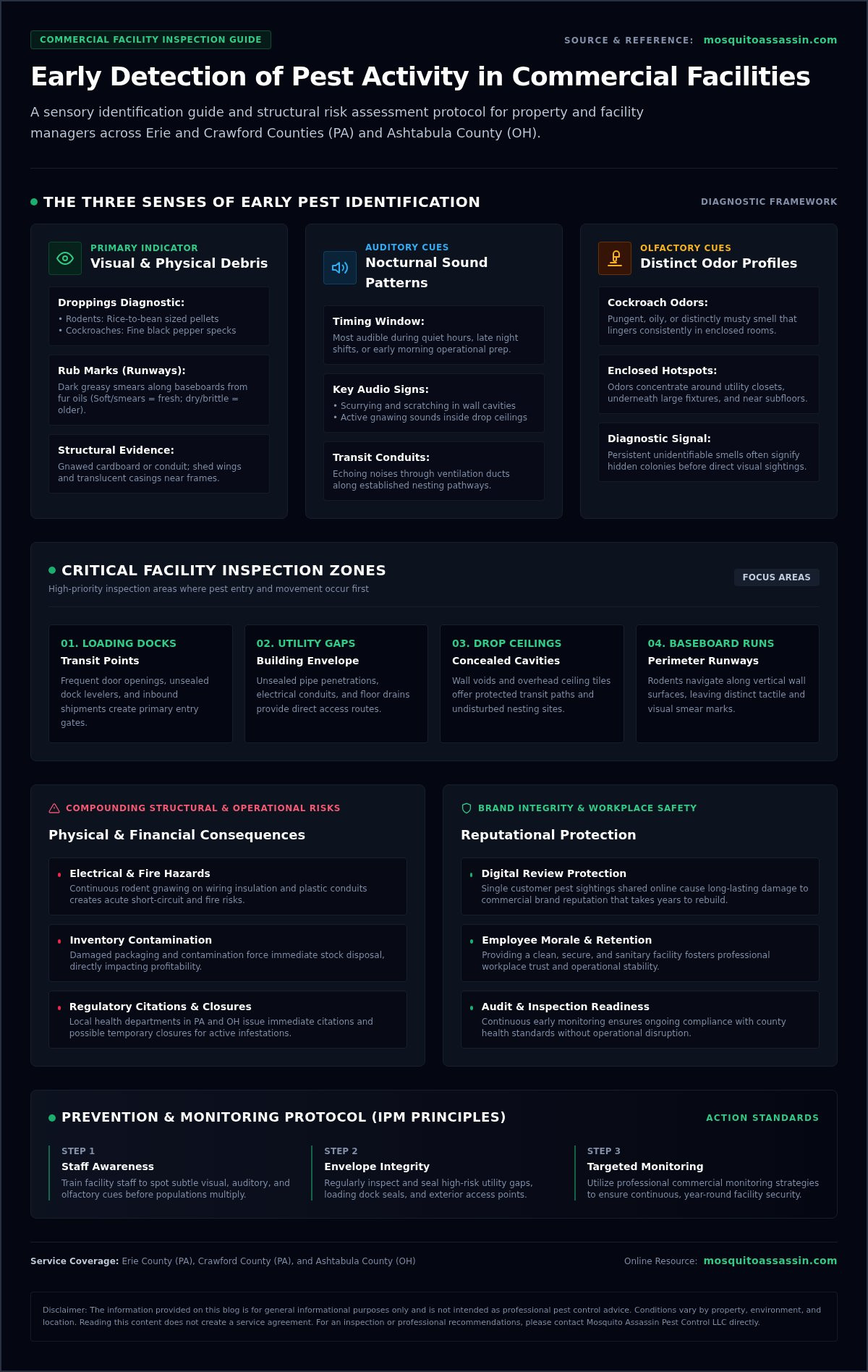
  • Financial Impact of a Pest Infestation: A 2026 Analysis for Homeowners and Businesses

    Financial Impact of a Pest Infestation: A 2026 Analysis for Homeowners and Businesses

    Did you know that wood-destroying insects inflict nearly 7 billion dollars in property damage and control costs across the United States every single year? For property owners in Erie and Crawford Counties in Pennsylvania, or Ashtabula County in Ohio, these figures aren’t just national trends; they represent real risks to local equity. The financial impact of a pest infestation often extends far beyond the initial sighting, hitting bank accounts through structural repairs, contaminated insulation, and even potential medical liabilities.

    It’s natural to feel overwhelmed when realizing that standard homeowners insurance policies typically exclude damage from rodents or insects, classifying these issues as preventable maintenance. Property owners work hard to build value in a home or business, and seeing that equity threatened by unseen forces is a significant source of anxiety. This analysis provides a clear path forward by uncovering the hidden and long-term financial consequences of pest activity. Discover how proactive management protects property value and why the cost of prevention is a fraction of the price of emergency remediation. This guide examines the specific risks facing the region and provides actionable steps to help minimize financial exposure while securing a property for the future.

    Key Takeaways

    • Understand how wood-destroying insects like termites and carpenter bees compromise structural integrity and negatively affect real estate appraisals.
    • Learn about the hidden costs associated with food contamination in commercial pantries and the potential medical expenses linked to pest-borne illnesses.
    • Evaluate the long-term financial impact of a pest infestation by comparing the high cost of emergency remediation against the stability of year-round protection plans.
    • Identify specific regional risks in Northwest Pennsylvania and Northeast Ohio, including seasonal rodent incursions and high-humidity environments that attract wood-decaying pests.
    • Discover how an integrated pest management approach and property exclusion techniques serve as a vital risk mitigation strategy for property owners.

    The Visible and Invisible Costs of Structural Damage

    Structural damage isn’t always obvious at first glance. It often starts in the dark corners of a crawlspace or deep within the framework of a wall. For property owners in Erie, Crawford, and Ashtabula counties, the financial impact of a pest infestation is most heavily felt during real estate appraisals. When an inspector identifies compromised floor joists or hollowed-out support beams, the property’s market value can drop significantly. Unaddressed damage often leads to failed inspections, stalled closings, and mandatory repair credits that favor the buyer. The longer an infestation remains undetected, the more the remediation costs escalate, as the damage moves from cosmetic trim to load-bearing components.

    To better understand how hidden damage can escalate, watch this real-world breakdown of termite destruction:

    Wood-Destroying Organisms and Property Equity

    Wood-destroying organisms represent a primary threat to the structural integrity of residential and commercial buildings. In Pennsylvania and Ohio, sellers must legally disclose any history of termite activity or structural repairs. Failing to manage these pests proactively can lead to legal liability long after the sale is finalized. While termites target the internal skeleton of the home, carpenter bees often focus on the exterior. They tunnel into fascia boards, decks, and trim, creating entry points for moisture that accelerates rot. National data for 2026 indicates that wood-destroying insects cause between 5 billion and 6.8 billion dollars in annual property damage. Professional pest control services can identify these threats before they reach a critical stage.

    Rodent Activity and Utility Infrastructure

    Rodents present a different but equally severe financial risk. They have a biological need to gnaw, often targeting the plastic insulation on electrical wiring. This behavior is linked to approximately 20 to 25 percent of structural fires where the cause is undetermined. Beyond fire risks, rodents frequently nest in HVAC ductwork and attic insulation. Replacing contaminated insulation and sanitizing utility runs requires specialized labor that adds to the overall financial impact of a pest infestation. Standard homeowners insurance policies typically classify this type of destruction as a maintenance issue rather than a sudden loss, meaning the costs for structural remediation and wiring replacement must be paid out of pocket.

    Adopting an Integrated Pest Management framework helps property owners transition from reactive repairs to a strategy of exclusion and monitoring. This proactive stance is essential for maintaining the long-term equity of local homes and businesses in Northwest Pennsylvania and Northeast Ohio. By sealing entry points and addressing moisture issues, you can protect your utility infrastructure from costly seasonal incursions.

    Disclaimer: The information provided on this blog is for general informational purposes only and is not intended as professional pest control advice. Conditions vary by property, environment, and location. Reading this content does not create a service agreement. For an inspection or professional recommendations, please contact Mosquito Assassin Pest Control LLC directly.

    Secondary Financial Consequences: Health and Resources

    Beyond the visible structural decay discussed previously, the secondary financial impact of a pest infestation hits property owners through resource loss and medical liabilities. These costs are often more immediate than long-term structural rot, affecting monthly utility bills and daily operational expenses. For businesses, a single contamination event can trigger mandatory disposal of entire inventory lots. Understanding these hidden burdens is essential for property managers in Northwest Pennsylvania and Northeast Ohio who want to protect their bottom line.

    Contamination and Consumption Loss

    Pests such as rodents, cockroaches, and pantry beetles target dry goods, grains, and processed foods. In commercial environments, including grocery stores and restaurants in Erie and Ashtabula counties, the financial stakes are high. The EPA and USDA have established a national initiative to reduce food waste by 50 percent by 2030, putting pressure on commercial establishments to maintain strict sanitation standards. A single rodent sighting in a storage area can lead to the total disposal of contaminated products to comply with food safety audits. Small businesses often face significant replacement costs and the expense of professional sanitation to restore operational status. Residential kitchens aren’t immune to these losses. Families often discard hundreds of dollars in groceries after discovering an infestation in a pantry. Following EPA’s pest prevention guidelines helps establish action thresholds that prevent these minor issues from becoming major financial drains.

    Pest-Borne Health Risks and Economic Impact

    The Great Lakes region faces persistent pressure from ticks and mosquitoes, which are vectors for Lyme disease and West Nile virus. The economic burden of these illnesses includes the cost of medical consultations, diagnostic testing, and long-term treatment protocols. For homeowners, protecting outdoor living spaces is a form of risk mitigation. Professional pest management in Crawford County may help reduce the risk of exposure to these pathogens on your property.

    Another hidden expense is the loss of energy efficiency. Rodents frequently tunnel through attic insulation, compressing the material and reducing its R-value. This leads to higher heating and cooling costs as your HVAC system works harder to maintain temperatures. For commercial facilities, the financial impact also includes property downtime. If a facility must close for remediation, the lost revenue and potential damage to reputation can be devastating. Research from Harvard Business School indicates that a one-star decline on review sites due to pest issues can result in a 5 to 9 percent drop in annual revenue for hospitality businesses. Scheduling a professional evaluation for your business can help prevent these reputation damaging events.

    Disclaimer: The information provided on this blog is for general informational purposes only and is not intended as professional pest control advice. Conditions vary by property, environment, and location. Reading this content does not create a service agreement. For an inspection or professional recommendations, please contact Mosquito Assassin Pest Control LLC directly.
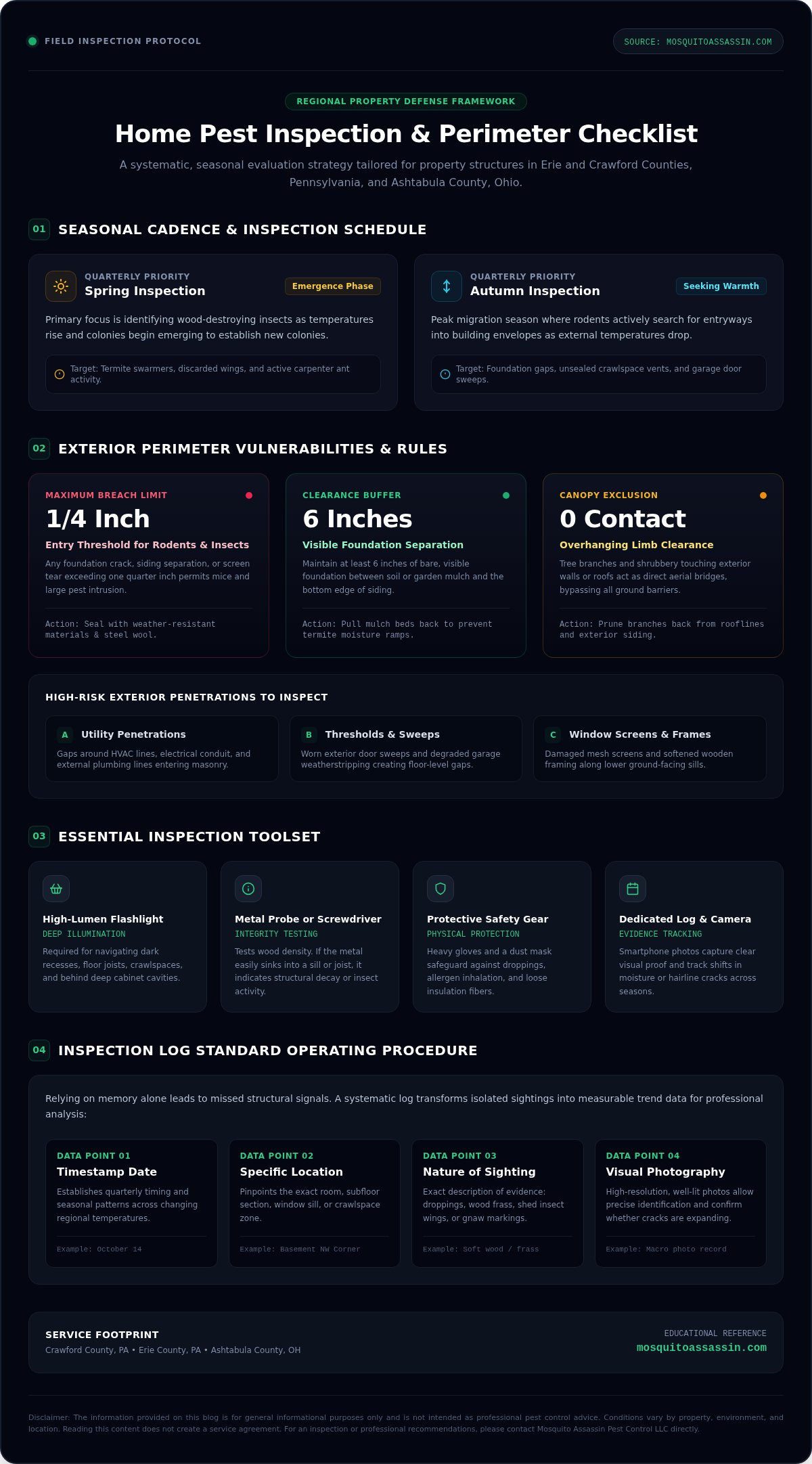
    Comparing the Costs: Prevention vs. Reactive Treatment

    The financial impact of a pest infestation is often determined by the speed and nature of the response. Many property owners view pest management as an elective expense until a crisis occurs, but the economic reality favors a proactive approach. Investing in consistent, year-round management serves as a financial hedge against the volatile costs of structural repairs and emergency interventions. By shifting from a reactive mindset to one focused on prevention, homeowners and businesses can stabilize their maintenance budgets and protect their long-term equity. The cost difference between a routine inspection and a full-scale structural remediation is significant.

    The ROI of Professional Management

    Regular inspections act as an early warning system, identifying vulnerabilities before they manifest as costly damage. For instance, Penn State Extension research on subterranean termites highlights that these pests can remain undetected for years, quietly compromising the wooden supports of a building. A general pest control plan focuses on exclusion and monitoring, which is much more cost-effective than replacing load-bearing beams or subflooring. While it’s helpful to understand pest control prices for context, the true value lies in the thousands of dollars saved by avoiding major remediation. Professional termite inspections and treatment provide a layer of security that one-time, reactive efforts simply cannot match. Catching a termite colony in its infancy prevents the financial impact of a pest infestation from spiraling into a five-figure structural repair bill.

    Emergency Remediation and Hidden Fees

    Reactive treatments often address symptoms rather than the root cause. When an infestation reaches an emergency level, the costs multiply quickly. Urgent removals for bed bugs or severe rodent incursions often carry a price premium due to the intensive labor and specialized equipment required. Beyond the service itself, hidden fees can include the cost of temporary relocation. For example, bed bug heat therapy or comprehensive structural fumigation may require residents or staff to vacate the premises for several days, leading to lost wages or hotel expenses. In commercial settings, this downtime results in immediate revenue loss that can never be recovered. These high-stakes scenarios are largely preventable through routine perimeter maintenance and the sealing of entry points before pests establish a foothold. Choosing prevention ensures that property owners aren’t forced to make rushed financial decisions during a high-stress crisis.

    Disclaimer: The information provided on this blog is for general informational purposes only and is not intended as professional pest control advice. For an inspection or professional recommendations, please contact Mosquito Assassin Pest Control LLC directly.

    Financial Impact of a Pest Infestation: A 2026 Analysis for Homeowners and Businesses

    Regional Risk Factors for Erie, Crawford, and Ashtabula

    The climate of Northwest Pennsylvania and Northeast Ohio presents unique challenges that directly influence the financial impact of a pest infestation. While national statistics provide a broad overview, property owners in Erie, Crawford, and Ashtabula counties face specific environmental triggers. The combination of high humidity from Lake Erie and the dense vegetation of rural Crawford County creates a high-pressure environment for wood-destroying insects and disease vectors. Local building styles, including many historic homes with stone foundations or crawlspaces, offer numerous entry points that require specialized knowledge to identify and secure.

    Winter Rodent Pressure in the Tri-State Area

    As the first frost arrives in late autumn, local rodent populations begin a search for warmth and shelter. This seasonal influx creates an immediate financial risk for homeowners. Mice can penetrate gaps as small as a dime, often targeting the attic insulation and electrical systems discussed earlier. To mitigate this risk, a methodical rodent removal strategy is essential. This process involves a three-step approach: removal of the current population, ongoing maintenance to monitor activity, and structural exclusion to prevent future incursions. Managing the financial impact of a pest infestation requires an understanding of how these local weather patterns drive rodent behavior into our living spaces.

    Seasonal Outdoor Risks and Property Use

    The proximity to Lake Erie and the Pymatuning region brings significant mosquito and tick pressure during the warmer months. These pests do more than just cause discomfort; they can significantly reduce the usable value of outdoor living spaces. For homeowners, a backyard that’s unusable due to heavy pest activity represents a loss of property enjoyment and potential resale appeal. Local businesses, particularly those with outdoor seating or recreational facilities, face even greater stakes. A persistent mosquito or tick problem can drive customers away, leading to a direct decrease in seasonal revenue. Utilizing commercial pest control services tailored to the regional climate helps business owners maintain a safe and inviting environment for their patrons. Addressing these outdoor risks is a vital component of a comprehensive risk mitigation strategy. If you’re concerned about the security of your property, scheduling a professional pest evaluation may help reduce your long-term financial exposure.

    Disclaimer: The information provided on this blog is for general informational purposes only and is not intended as professional pest control advice. For an inspection or professional recommendations, please contact Mosquito Assassin Pest Control LLC directly.
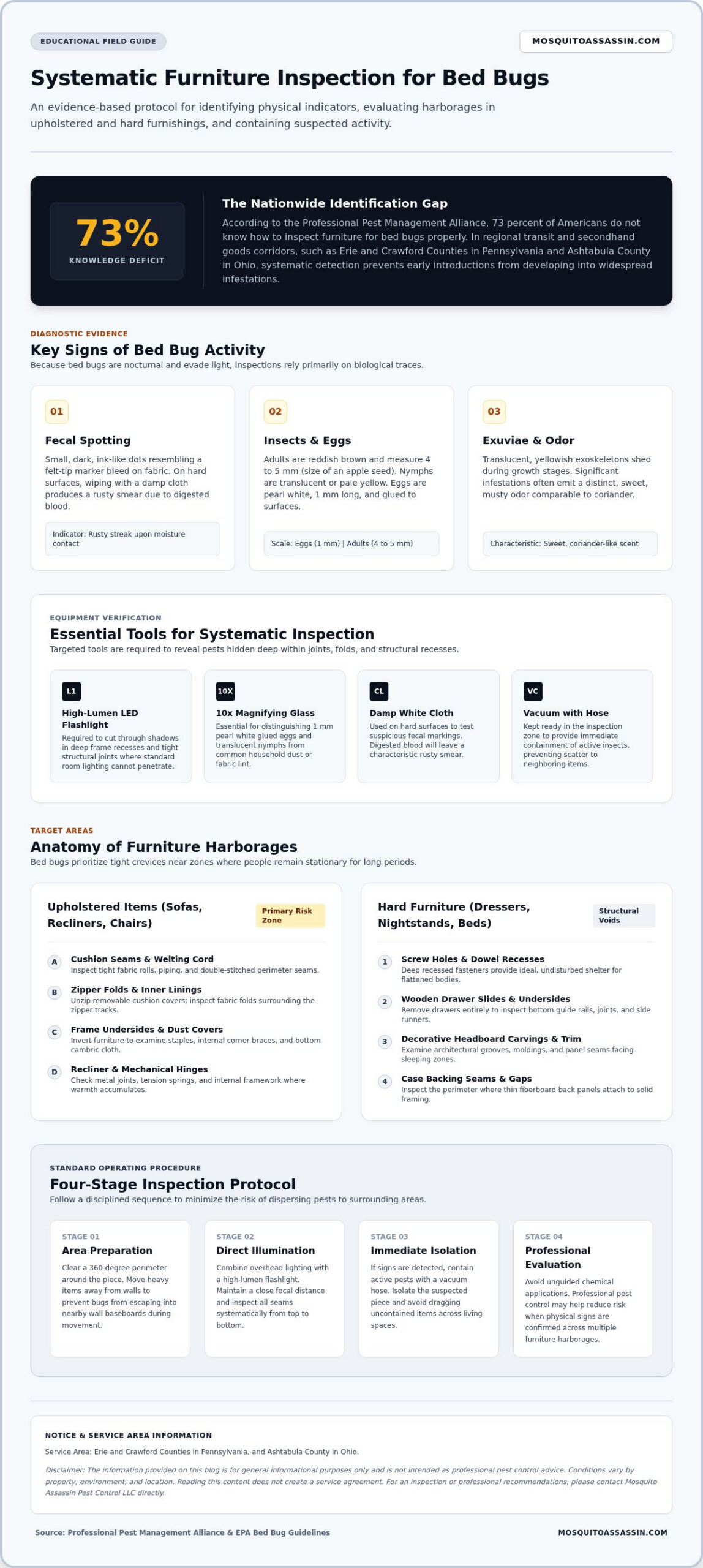
    Strategies for Mitigating Long-Term Financial Risks

    Mitigating the long-term financial impact of a pest infestation requires a shift from emergency response to a disciplined, multi-layered strategy. This approach prioritizes physical barriers and environmental modifications to discourage pest activity before it begins. By addressing the root causes of infestations, property owners in Erie, Crawford, and Ashtabula counties can avoid the compounding costs of structural remediation and resource loss. Professional pest control may help reduce risk by providing the technical expertise needed to identify subtle vulnerabilities that are often missed during a standard walkthrough.

    Proactive Property Maintenance

    Landscaping plays a vital role in protecting a property’s foundation and reducing the financial impact of a pest infestation. Keeping mulch or heavy vegetation at least 12 inches away from the exterior walls reduces the moisture levels that attract subterranean termites and carpenter ants. Since the high humidity near the Lake Erie coastline can accelerate wood decay, maintaining functional gutters and downspouts is a critical financial safeguard. Property owners should also prioritize regular debris removal. Eliminating leaf litter, fallen branches, and woodpiles removes the harborage sites that rodents and ticks use to establish a foothold near the home. These simple maintenance tasks serve as the first line of defense, significantly lowering the probability of a high-cost incursion.

    Selecting a Professional Management Partner

    When choosing a service provider in Pennsylvania or Ohio, property owners should prioritize licensed and insured professionals who understand regional environmental pressures. A qualified partner should offer a comprehensive assessment of entry points and moisture issues rather than just providing temporary relief. For many residents, implementing a mosquito control program provides essential protection during the peak summer months when outdoor activity is highest. This proactive management prevents the seasonal loss of property use and helps mitigate health-related risks for families and customers.

    Education is also a key component of long-term risk mitigation. Training employees or family members to recognize the early signs of pest activity, such as droppings, wood shavings, or exit holes, can prevent a minor issue from escalating into a full-scale crisis. Early detection is the most effective way to protect property equity and maintain a stable maintenance budget. For an inspection or professional recommendations, please contact a qualified professional who can tailor a plan to the specific needs of your location.

    Disclaimer: The information provided on this blog is for general informational purposes only and is not intended as professional pest control advice. For an inspection or professional recommendations, please contact Mosquito Assassin Pest Control LLC directly.

    Securing Long-Term Property Value Through Proactive Management

    The hidden financial impact of a pest infestation can manifest as compromised structural integrity, lost inventory, or reduced real estate appraisals. Property owners in Northwest Pennsylvania and Northeast Ohio face unique seasonal pressures, from winter rodent incursions to lakefront moisture that attracts wood-destroying organisms. Understanding that prevention is significantly more cost-effective than emergency remediation allows for better financial planning and peace of mind. By prioritizing specialized exclusion techniques and consistent monitoring, you can shield your home or business from the compounding liabilities of unaddressed pest activity.

    Maintaining a secure perimeter is a vital investment in your property’s future. Licensed and insured professionals serving Erie, Crawford, and Ashtabula Counties can provide the technical expertise needed to identify and seal vulnerabilities before they escalate into major expenses. Taking these proactive steps ensures that your equity remains protected and your environment stays safe. For an inspection or professional recommendations, please contact Mosquito Assassin Pest Control LLC directly. Professional pest control may help reduce risk and ensure your property remains a secure asset.

    Disclaimer: The information provided on this blog is for general informational purposes only and is not intended as professional pest control advice. For an inspection or professional recommendations, please contact Mosquito Assassin Pest Control LLC directly.

    Frequently Asked Questions

    How much does a typical pest infestation decrease home value?

    Properties with documented unaddressed pest damage or a history of wood-destroying insect issues often sell for 3 to 5 percent below comparable market valuations. In the regional markets of Erie and Crawford counties, these transactions frequently stall during buyer mortgage inspections. Sellers are legally required to disclose known infestations, meaning that ignoring a problem now can lead to significant price concessions or lost sales during the closing process.

    Does homeowners insurance cover damage caused by termites or rodents?

    Standard homeowners insurance policies universally classify termite, insect, and rodent damage as preventable maintenance issues rather than sudden and accidental losses. Consequently, costs for structural remediation, insulation replacement, and extermination are entirely excluded from dwelling coverage. Property owners must absorb these expenses out of pocket. This lack of coverage highlights why proactive management is essential for protecting a property’s financial health and long-term equity.

    What are the most expensive pests to remediate in Pennsylvania and Ohio?

    Subterranean termites and carpenter bees are among the most expensive pests to manage due to the extensive structural repairs they necessitate. In the Tri-State area, rodents also present a high financial risk because they often target electrical wiring and attic insulation. Replacing load-bearing beams or contaminated HVAC ductwork requires specialized labor and materials, which quickly compounds the total bill. These costs represent a major part of the financial impact of a pest infestation.

    Is a year-round pest control plan more cost-effective than one-time treatments?

    Recurring management plans are generally more cost-effective because they prioritize exclusion and early detection. One-time emergency treatments focus on the immediate population but often leave the property vulnerable to a return of the problem. By maintaining a consistent perimeter and monitoring for activity, property owners can avoid the high price premiums associated with urgent remediation. A proactive approach stabilizes maintenance budgets and prevents the need for expensive structural or utility repairs later.

    Can a pest infestation lead to business closure or legal fines?

    Commercial establishments in Pennsylvania and Ohio are subject to strict food safety compliance and waste audits. A severe infestation can lead to mandatory product disposal, health department fines, or even temporary business closure. Beyond legal penalties, the damage to a business’s reputation can be devastating. Research shows that a one-star decline on consumer review sites due to pest issues can result in a 5 to 9 percent drop in annual revenue.

    How do rodents impact the energy efficiency and utility costs of a home?

    Rodents frequently tunnel through and nest in attic insulation, which compresses the material and significantly reduces its R-value. This loss of insulation efficiency allows heat to escape during harsh Northwest Pennsylvania winters and causes homes to stay warmer during the summer. As a result, HVAC systems must run longer to maintain comfortable temperatures, leading to a noticeable increase in monthly utility bills and premature wear on heating and cooling equipment.

    What is the financial risk of DIY pest control versus professional services?

    DIY methods often rely on over-the-counter products that may not reach the root of a deep-seated infestation. This leads to a cycle of recurring activity and wasted money on ineffective supplies. Furthermore, improper application can drive pests deeper into the structure, making eventual professional remediation more complex and expensive. The financial risk of DIY is primarily the delay in effective treatment, which allows structural or resource damage to continue unchecked.

    How soon after seeing a pest should I seek professional advice to avoid financial loss?

    Professional advice should be sought as soon as a single pest is spotted. Many pests, particularly termites and rodents, are experts at staying hidden while they cause damage behind walls or under floors. A single sighting is often a sign that a colony or nest has already established a presence. Early intervention is the most effective way to minimize the financial impact of a pest infestation and protect the property’s long-term value.

    Disclaimer: The information provided on this blog is for general informational purposes only and is not intended as professional pest control advice. For an inspection or professional recommendations, please contact Mosquito Assassin Pest Control LLC directly.

  • 7 Early Signs of Pest Activity: A Guide for Managers

    7 Early Signs of Pest Activity: A Guide for Managers

    A single sighting of a pest in your facility is rarely the start of a problem; it’s often the signal that an infestation is already well-established. For managers in Erie, Crawford, and Ashtabula counties, the stakes are high. A failed health inspection or a string of negative customer reviews can cause lasting damage to a brand’s reputation that takes years to rebuild.

    It’s natural to feel anxious about the hidden corners of a commercial property, especially during the peak rodent months in Pennsylvania and Ohio. You want to ensure your facility remains a safe and professional environment for both employees and guests. By learning how to identify the subtle signs of pest activity in a business, you can take control before property damage or regulatory issues arise.

    This guide offers a practical checklist of early indicators to monitor. You’ll learn which high-risk areas require the most attention and how to move toward a professional resolution that secures your building for the long term.

    Key Takeaways

    • Recognize how early detection protects your business reputation and ensures compliance with local health inspections.
    • Learn to identify the signs of pest activity in a business through subtle visual, auditory, and olfactory cues before they become obvious.
    • Pinpoint high-risk entry points such as loading docks and utility gaps to stop infestations at the source.
    • Distinguish between the unique indicators left by rodents and cockroaches to better understand the specific threats to your facility.
    • Implement a long-term prevention strategy through professional monitoring and staff awareness programs to maintain a secure environment.

    Why Early Detection of Pest Activity is Critical for Your Business

    Identifying the initial signs of pest activity in a business acts as the first line of defense for any commercial facility. Small indicators, such as a single dropping or a smudge along a baseboard, are rarely isolated incidents. They are early warnings that, if ignored, can rapidly evolve into a full-scale infestation. For businesses in Northwest Pennsylvania and Northeast Ohio, where seasonal shifts drive pests indoors, proactive monitoring is the most effective way to maintain a safe and professional environment.

    Compliance with local health department standards is another non-negotiable factor. Regulatory bodies in Erie, Crawford, or Ashtabula counties prioritize public health, and evidence of pests can lead to immediate citations. Beyond the legal requirements, a clean facility ensures that inventory remains uncontaminated and the building remains structurally sound. Professional oversight helps identify vulnerabilities in the building envelope before pests can exploit them.

    The Financial Impact of Delayed Action

    Ignoring pest activity leads to compounding costs. Rodents, which are particularly active in Pennsylvania during winter months, are notorious for gnawing on electrical wiring and insulation. This behavior can lead to expensive structural repairs or even fire hazards. Additionally, contaminated stock must be discarded, representing a direct hit to the bottom line. Understanding pest control methods and identification helps managers recognize these threats before they require extensive intervention. Regulatory fines and temporary closures due to health violations can further drain resources and disrupt operations.

    Protecting Your Brand Reputation

    In a digital-first world, a single customer sighting of a pest can go viral in minutes. Negative online reviews or social media mentions regarding sanitation can permanently stain a brand’s image. This loss of trust is often harder to repair than the physical building itself. Furthermore, a pest-free workplace is essential for employee morale. Staff members deserve a clean, secure space to perform their duties without the stress of an unsanitary environment. Establishing a routine through commercial pest control strategies ensures that the business remains a reputable pillar of the local community. Professional monitoring provides the peace of mind that the brand’s integrity is protected year-round.

    The Three Senses of Pest Identification: Sight, Sound, and Smell

    Pest identification is a sensory discipline that requires more than just a passing glance at a facility. While a direct sighting is the most obvious indicator, it’s often the last one to manifest before a population grows out of control. To protect your facility, you must use a combination of sight, sound, and smell to detect the earliest signs of pest activity in a business.

    Visual Indicators and Physical Debris

    Visual evidence is usually the most concrete way to confirm signs of pest activity in a business. Droppings are a primary indicator; rodent droppings are typically the size of a grain of rice or a bean, while cockroach droppings resemble small specks of black pepper. Gnaw marks on cardboard packaging or plastic conduits are another red flag, as rodents must chew constantly to manage their teeth. You might also find discarded wings or translucent casings near window sills or door frames, which suggest an established colony nearby.

    Tactile evidence is equally telling for managers who know where to look. Rodents often follow the same paths along baseboards, leaving behind dark, greasy smear marks known as rub marks. These are caused by the oils and dirt in their fur. Fresh rub marks feel soft and smear easily, while older ones are brittle and dry, helping you determine how recent the activity is. Following Integrated Pest Management principles, identifying these visual and physical cues allows for targeted intervention rather than broad chemical application.

    Auditory and Olfactory Cues

    The sounds of an infestation are often most audible during the quiet hours of the night or early morning. Scurrying, scratching, or gnawing sounds coming from wall voids, drop ceilings, or crawlspaces are classic indicators of rodent activity. In the quiet of a closed office or warehouse, these noises can be surprisingly loud, echoing through ventilation ducts. These sounds are rarely random; they usually follow a pattern as pests move between nesting sites and food sources.

    Odors provide another layer of diagnostic information that many managers overlook. Cockroaches produce a distinct, musty, or oily smell that lingers in damp or poorly ventilated areas like basements and breakrooms. In contrast, an established rodent infestation often creates a sharp, pungent, ammonia-like odor caused by accumulated urine. If you detect these smells in your facility, professional pest control may help reduce risk and restore a sanitary environment. If you suspect your property is at risk, reaching out for commercial pest management can provide a definitive solution for your business in Erie, Crawford, or Ashtabula counties.

    Differentiating Signs Between Common Commercial Pests

    Understanding the specific signs of pest activity in a business allows managers to communicate clearly with professionals and implement the right exclusion strategies. While many pests seek the same basic needs (food, water, and shelter), the evidence they leave behind is distinct. Misidentifying a pest can lead to ineffective self-treatment or delayed professional intervention, which only allows the population to grow and the damage to worsen.

    Rodent Activity in PA and OH Businesses

    In Northwest Pennsylvania and Northeast Ohio, rodent behavior is heavily influenced by the climate. During the colder months in Erie and Crawford Counties, mice and rats aggressively seek entry into heated commercial buildings to escape the freezing temperatures. You’ll often find nesting materials like shredded paper, cardboard, or insulation tucked away in quiet corners of warehouses or storage rooms. These nests are frequently located near heat sources like water heaters or motor housings.

    Beyond nests, look for evidence of tampering with food storage in employee breakrooms. A chewed corner on a snack bag or scattered crumbs is a clear signal of an intruder. Travel paths are also telling. Rodents are creatures of habit, often hugging walls and leaving dark grease stains known as rub marks. These marks help differentiate their activity from smaller crawling insects that don’t leave such heavy residue. Identifying these paths is crucial for effective rodent exclusion and maintenance.

    Indicators of Small Crawling Insects

    Small crawling insects like cockroaches and ants leave different but equally concerning marks. Cockroaches prefer damp, dark areas such as under commercial sinks or behind large appliances. They leave behind small, pepper-like specks of excrement and egg cases, known as oothecae. These cases are often found wedged into cracks or crevices and indicate an active breeding population. They’re often translucent or dark brown, depending on the species, and are a major red flag for health inspectors.

    Ants and flies also leave specific clues that point toward sanitation or structural issues:

    • Ant Trails: Pheromone trails serve as a roadmap, attracting more pests to food or moisture sources. Unlike the random movement of some insects, ants move in a disciplined line, often leading back to a gap in the masonry.
    • Drain Flies: In commercial kitchens, the presence of flies often points to a breakdown in sanitation, specifically in floor drains or organic waste bins. They’re attracted to fermenting organic matter and indicate moisture control issues.
    • Odor Markers: Many crawling insects leave behind chemical scents that signal to others that your facility is a viable home.

    Recognizing these specific indicators is the first step toward a professional resolution. For comprehensive support, commercial pest control plans help manage these diverse threats effectively throughout the year.

    7 Early Signs of Pest Activity: A Guide for Managers

    High-Risk Areas: Where to Look for Pest Activity in Commercial Spaces

    Pests don’t wander aimlessly through a commercial building. They concentrate in areas that provide easy access to food, water, warmth, and seclusion. For managers, knowing exactly where to look for signs of pest activity in a business is the difference between a minor cleanup and a costly remediation project. In the regional climate of Northwest Pennsylvania and Northeast Ohio, these high-risk zones change with the seasons, requiring a vigilant eye on the building’s interior and exterior perimeter.

    Employee breakrooms and kitchens are often the primary source of attraction. Even small amounts of standing water under a sink or food residue behind a vending machine can support a growing population. Similarly, loading docks and delivery bays act as open invitations. These areas are frequently high-traffic zones where doors remain open for extended periods, allowing rodents and insects to slip inside unnoticed. Once inside, they often migrate toward utility closets and boiler rooms, which offer the consistent warmth they need during the harsh winters in Erie and Crawford counties.

    Sanitation and Food Prep Zones

    Regular inspections of food preparation areas must go beyond the countertops. Moisture is a major driver of infestations, so checking under industrial sinks and behind refrigeration units is essential. Floor drains are another common hotspot; if they aren’t cleaned regularly, they become breeding grounds for flies. Managers should also verify that all trash receptacles have tight-fitting lids and are emptied at the end of every shift to remove overnight food sources. Maintaining these standards is a critical part of commercial pest control and ensures your facility remains compliant with local health regulations.

    Structural Vulnerabilities and Entry Points

    The physical structure of your building often provides the very gaps pests use to enter. Utility penetrations for pipes and electrical lines are notorious for having small openings that mice or cockroaches can exploit. A gap as small as a quarter-inch is enough for a young mouse to squeeze through. Weather stripping on warehouse doors or exterior entries often wears down over time, creating a ground-level entry point that is easily overlooked. Storage areas filled with cardboard boxes are particularly dangerous, as cardboard provides both insulation for nests and a food source for certain insects. Identifying these vulnerabilities early allows for effective rodent exclusion and maintenance before a population becomes established. If you suspect your facility has been breached, professional pest control may help reduce risk.

    Establishing a Professional Monitoring and Prevention Strategy

    Transitioning from reactive identification to a proactive prevention strategy is the most effective way to safeguard a commercial facility. While recognizing the signs of pest activity in a business is a vital skill for any manager, it’s only the first step. A comprehensive approach focuses on building resilience through professional oversight, structural maintenance, and staff engagement. In regions like Erie and Crawford counties, where seasonal shifts dictate pest behavior, a consistent monitoring plan ensures that a building remains secure against local threats year-round.

    Effective prevention also requires a commitment to exclusion techniques. This involves sealing the building envelope to deny pests entry in the first place. By addressing the gaps around utility lines or repairing worn weather stripping, you remove the physical invitation that many pests are looking for. When these structural improvements are combined with routine professional monitoring, the likelihood of a significant infestation drops dramatically.

    The Role of Professional Inspections

    Professional inspections go far beyond a visual sweep of common areas. Technicians use specialized tools to examine inaccessible wall voids, high shelving, and complex machinery where pests often hide. These assessments form the basis of a customized Integrated Pest Management (IPM) plan, which prioritizes long-term prevention over temporary fixes. By identifying structural vulnerabilities early, professional pest control may help reduce risk and prevent the financial fallout of a failed health inspection. This methodical approach is essential for maintaining the professional standards expected in Northwest Pennsylvania and Northeast Ohio.

    Employee Training and Reporting

    A successful prevention strategy relies on the eyes and ears of the people who work in the building every day. Employee education programs empower staff to recognize early signs of pest activity in a business, such as unusual odors or physical debris, before they become obvious to customers. Encouraging a culture of cleanliness in shared breakrooms and storage zones significantly reduces the resources that attract pests in the first place. Managers should implement a simple internal log for reporting sightings, ensuring that potential issues are communicated immediately to the maintenance team.

    Consistent reporting allows for rapid intervention, which is far more cost-effective than remediating a large-scale infestation. To ensure your facility remains protected, you can Contact a professional for a commercial assessment to identify specific risks unique to your property. Combining professional expertise with a vigilant staff creates a multi-layered defense that protects both the building and the brand’s reputation.

    Disclaimer: The information provided on this blog is for general informational purposes only and is not intended as professional pest control advice. Conditions vary by property, environment, and location. Reading this content does not create a service agreement. For an inspection or professional recommendations, please contact Mosquito Assassin Pest Control LLC directly.

    Securing Your Business Against Hidden Threats

    Identifying early signs of pest activity in a business is a fundamental part of effective facility management. By focusing on sensory cues like unusual odors or scratching sounds and regularly inspecting high-risk zones like loading docks and breakrooms, you can stop infestations before they impact your professional brand. Proactive monitoring ensures your property remains compliant with local health inspections and protects your bottom line from the costs of structural damage or contaminated inventory.

    Understanding regional pest behavior is essential, especially given the intense rodent activity in Erie, Crawford, and Ashtabula counties during the colder months. Maintaining a clean work environment and a culture of immediate reporting helps keep your facility resilient against seasonal shifts. A methodical approach to exclusion and consistent monitoring is the most reliable path toward a secure operation. Professional pest control may help reduce risk and provide the peace of mind that your building envelope is thoroughly protected. Take the first step toward safeguarding your reputation by choosing a strategy rooted in local expertise and comprehensive protection.

    Request a professional inspection for your business

    Disclaimer: The information provided on this blog is for general informational purposes only and is not intended as professional pest control advice. Conditions vary by property, environment, and location. Reading this content does not create a service agreement. For an inspection or professional recommendations, please contact Mosquito Assassin Pest Control LLC directly.

    Frequently Asked Questions

    What are the most common signs of rodents in an office building?

    The most frequent indicators include dark, rice-sized droppings found in desk drawers or utility closets and gnaw marks on electrical cords. Rodents are a major concern in Northwest Pennsylvania, especially during the winter months when they migrate indoors for warmth. You might also notice greasy rub marks along the baseboards where they travel. Recognizing these signs of pest activity in a business early prevents a small intrusion from becoming a full-blown infestation that threatens employee health.

    How can I tell if my business has a cockroach problem before I see one?

    You can identify a cockroach presence by looking for small, black, pepper-like specks of excrement and translucent brown egg cases hidden behind large appliances. These pests also produce a distinct, musty odor that lingers in damp areas like breakroom sinks or basements. Since cockroaches are nocturnal and highly secretive, these sensory cues are often the first warnings you’ll receive before actually spotting an insect. Professional monitoring is the most effective way to confirm their presence.

    Are there specific pests that target retail stores in Pennsylvania?

    Retail stores in Erie and Crawford counties frequently deal with mice, ants, and spiders, which are attracted to the shelter and food sources provided by stockrooms. Rodent activity peaks in Pennsylvania during the winter as they seek refuge from the cold, often nesting in cardboard shipping materials. Ants are also common in retail spaces that have employee breakrooms or sell snacks, creating visible trails toward moisture sources. Regular inspections help identify these local threats before they reach the sales floor.

    What should I do if a customer reports seeing a pest?

    If a customer reports a sighting, you should immediately document the location and time in an internal log and contact a professional for a commercial assessment. Prompt action is critical to protect your brand reputation and prevent negative online reviews. An inspection can determine if the sighting was an isolated incident or a symptom of a larger problem. Proactive reporting shows a commitment to sanitation and helps maintain a professional environment that satisfies local health department standards.

    Can pests in a business cause structural damage?

    Yes, pests can cause significant structural damage by gnawing on essential building components or compromising wooden supports. Rodents are notorious for chewing through electrical insulation and wiring, which can create fire hazards or lead to expensive equipment failures. Termites and carpenter bees also pose risks to the integrity of wooden structures if left untreated. Identifying the signs of pest activity in a business early is the best way to avoid these compounding repair costs and protect your property.

    How often should a commercial property be inspected for pests?

    Most commercial properties benefit from routine bi-monthly inspections to ensure that prevention strategies remain effective across changing seasons. In the local climate of Northeast Ohio and Northwest Pennsylvania, pest pressures shift significantly between the humid summer and the freezing winter. Ongoing monitoring through a year-round protection plan is the only way to catch vulnerabilities before they are exploited. This consistent schedule allows for the maintenance of exclusion seals and the adjustment of monitoring tools as needed.

    What is the most common entry point for pests in a warehouse?

    Loading docks and delivery bays are the most common entry points because they are frequently left open for extended periods during shipments. Pests also exploit small gaps around utility pipe penetrations and electrical lines that enter the building. Worn weather stripping on large warehouse doors provides another easy path for rodents and crawling insects. Sealing these structural vulnerabilities is a core component of a professional exclusion strategy designed to keep a facility secure and protect your inventory from contamination.

    Disclaimer: The information provided on this blog is for general informational purposes only and is not intended as professional pest control advice. For an inspection or professional recommendations, please contact Mosquito Assassin Pest Control LLC directly.

  • Home Pest Inspection Checklist: A Room-by-Room Prevention Guide

    Home Pest Inspection Checklist: A Room-by-Room Prevention Guide

    How much of your home’s structural integrity is currently being compromised by pests you can’t even see? For property owners in Erie and Crawford Counties in Pennsylvania or Ashtabula County in Ohio, seeing a single stray insect often leads to a deeper fear of hidden damage lurking behind the drywall. It’s natural to feel uncertain when you’re trying to distinguish between a harmless visitor and a wood-destroying intruder. By implementing a systematic home pest inspection checklist, you can transform that uncertainty into a proactive defense strategy.

    This guide provides a professional-grade framework to identify early signs of infestations and secure your property. You’ll learn how to spot rodent activity, recognize warning signs of wood-destroying insects, and understand when a situation requires professional intervention. This room-by-room process provides the confidence to protect your investment and maintain a secure environment.

    Disclaimer: The information provided on this blog is for general informational purposes only and is not intended as professional pest control advice. Conditions vary by property, environment, and location. Reading this content does not create a service agreement. For an inspection or professional recommendations, please contact Mosquito Assassin Pest Control LLC directly.

    Key Takeaways

    • Establish a seasonal routine using a comprehensive home pest inspection checklist to identify vulnerabilities before they become costly infestations.
    • Secure the exterior perimeter by inspecting foundation cracks and window screens for entry points larger than a quarter inch.
    • Monitor high-risk interior areas like kitchens and basements for moisture accumulation and hidden signs of nesting.
    • Learn to differentiate between common regional threats, such as identifying the distinct droppings left by rodents or the wings of termite swarmers.
    • Recognize when DIY methods are insufficient and professional-grade exclusion or treatment is necessary to protect structural integrity.

    Preparing for Your Home Pest Inspection

    Regular property monitoring serves as the primary defense against structural damage and health risks. In the variable climates of Erie and Crawford Counties in Pennsylvania and Ashtabula County in Ohio, pests react sharply to seasonal changes. A proactive approach allows homeowners to detect vulnerabilities before they escalate into full-scale infestations. While reactive treatments address an existing problem, a consistent home pest inspection checklist provides the peace of mind that comes from knowing your property is secure.

    Experts generally recommend performing these checks at least once per season. Spring is critical for identifying wood-destroying insects as they emerge, while autumn is the peak time for rodents seeking warmth. Understanding different pest control methods and prevention strategies helps in recognizing that exclusion is often more effective than late-stage intervention. Before beginning, prioritize safety. When entering confined areas like attics or crawlspaces, check for stable footing and be mindful of low clearance or exposed nails. Professional pest control may help reduce risk if these areas are difficult to access safely.

    Essential Tools for a Thorough Search

    A professional-grade inspection requires more than just a quick glance. A high-lumen flashlight is the most important tool in your kit for illuminating dark corners, floor joists, and the recesses of cabinets where pests hide. You should also carry a small flathead screwdriver or a metal probe. This allows you to test the integrity of wood surfaces; if the metal sinks easily into a windowsill or joist, it may indicate rot or insect damage. Finally, wear protective gear like heavy gloves and a dust mask to guard against allergens, insulation fibers, or droppings found in secluded areas.

    Creating an Inspection Log

    Documentation is a vital component of a successful home pest inspection checklist. Don’t rely on memory alone to track where you saw a suspicious mark or a stray insect. Maintain a dedicated log that records the date, the specific room, and the exact nature of the sighting. Use a smartphone to take clear, well-lit photos of any pests or damage you find. These images are invaluable for professional identification and help track environmental changes over time, such as new moisture stains or shifting foundation cracks. Consistent records make it easier to determine if a problem is growing or if past prevention efforts are holding steady. Reviewing details on general pest control plans can provide further context on what to track for long-term protection.

    Disclaimer: The information provided on this blog is for general informational purposes only and is not intended as professional pest control advice. Conditions vary by property, environment, and location. Reading this content does not create a service agreement. For an inspection or professional recommendations, please contact Mosquito Assassin Pest Control LLC directly.

    Exterior Perimeter and Foundation Checklist

    The exterior of a property serves as the first line of defense against invasive species. For residents in Crawford and Erie Counties, the changing seasons mean pests are constantly looking for a way inside. A thorough home pest inspection checklist starts with a close examination of the foundation. Any crack or gap larger than a quarter inch is a potential gateway for mice or large insects. These openings should be sealed with weather-resistant materials to maintain the structural barrier and prevent unwanted guests from gaining a foothold.

    Property owners should also evaluate the transition between the ground and the siding. Soil or mulch that rests directly against the siding creates a moisture-rich environment that invites termites and carpenter ants. Maintaining a six-inch clearance of visible foundation helps prevent these wood-destroying insects from finding an easy path into the structure. Additionally, overhanging tree branches often act as bridges. When limbs touch the roof or walls, they allow ants and rodents to bypass ground-level defenses entirely. Regular pruning ensures that landscaping does not compromise your home’s security.

    Exclusion Points and Entryways

    Entry points are often found where utility lines penetrate the exterior walls. Gaps around plumbing, electrical conduits, or HVAC lines are frequently overlooked but are primary targets for pests. These areas require durable sealants or steel wool to prevent entry. It’s also vital to check the integrity of door sweeps and window screens. A worn sweep can leave a gap wide enough for a rodent to squeeze through. Examine wooden door frames for signs of gnawing, which indicates active attempts by pests to widen existing holes. Ensuring that dryer vents and chimney caps have proper screening is another core component of EPA Integrated Pest Management principles, as these vents provide direct access to the home’s interior.

    Landscaping and Moisture Management

    Proper drainage is essential for long-term prevention. Clogged gutters and poor downspout drainage lead to water pooling near the foundation, which attracts mosquitoes and ticks. Standing water serves as a breeding ground, especially during the humid summers in Ashtabula County. Assess the grade of the yard to ensure water flows away from the structure rather than toward it. Wood piles and organic debris should be stored at least 20 feet away from the home, as these provide ideal nesting sites for rodents and spiders. If these environmental factors are difficult to manage alone, professional pest control may help reduce risk by identifying hidden moisture traps that homeowners might miss during a standard walkthrough.

    Disclaimer: The information provided on this blog is for general informational purposes only and is not intended as professional pest control advice. For an inspection or professional recommendations, please contact Mosquito Assassin Pest Control LLC directly.

    Interior Room-by-Room Inspection Points

    Once the exterior is secure, the focus shifts to the interior environment. A thorough home pest inspection checklist must prioritize areas where food, water, and shelter intersect. In the living areas of homes throughout Erie and Ashtabula Counties, look for subtle debris on window sills or along floorboards. Small piles of sawdust or discarded wings are often the first indicators of an internal issue that hasn’t yet become visible in high-traffic areas. If you find evidence in these areas, reviewing general pest control plans can help determine the next steps for mitigation.

    The Kitchen and Pantry Focus

    The kitchen is a primary site for pest activity due to the abundance of resources. Inspect the areas behind large appliances and under sinks where moisture can accumulate from small leaks. Check the back of cabinets for crumbs or spills that serve as food sources. It’s also important to examine food packaging in the pantry for small holes or gnawing marks that indicate rodent entry. Monitoring plumbing voids is a critical step in Integrated Pest Management principles, as these gaps provide hidden highways for cockroaches and other moisture-seeking insects.

    Basement and Attic Vulnerabilities

    Secluded areas like basements and attics offer the quiet, undisturbed environments that pests prefer. In the basement or crawlspace, look for dampness on the walls or floor joists. Musty odors are a strong indicator of moisture issues or the presence of nesting pests. Search for spider webs in corners and along joists; a high concentration of spiders often suggests a steady supply of other insect prey nearby. In the attic, look for disturbed insulation or gathered materials like shredded paper and fabric, which signal nesting activity. During daylight hours, check for light leaks coming through the roof or eaves. These small shafts of light reveal entry points where pests can bypass your home’s defenses. When these interior signs are detected, professional pest control may help reduce risk.

    Disclaimer: The information provided on this blog is for general informational purposes only and is not intended as professional pest control advice. For an inspection or professional recommendations, please contact Mosquito Assassin Pest Control LLC directly.

    Home Pest Inspection Checklist: A Room-by-Room Prevention Guide

    Identifying Specific Pest Red Flags

    Developing a sharp eye for biological markers is the most critical skill for any property owner. While seeing a live insect is a clear signal, most infestations remain hidden during daylight hours. A comprehensive home pest inspection checklist must focus on the subtle traces left behind by pests as they move through your home. Understanding the difference between a nuisance visitor and a genuine structural threat allows for a faster, more effective response. In the regional climates of Erie and Ashtabula Counties, certain signs like scratching sounds in the ceiling or “sawdust” on a porch railing require immediate attention to prevent long-term damage.

    Signs of Rodent Activity

    Rodents are creatures of habit that leave behind distinct physical evidence along their travel routes. Identifying the size and shape of droppings is the first step in determining the species. Mouse droppings are typically the size of a grain of rice with pointed ends, while rat droppings are larger and more capsule-shaped. You should also look for greasy rub marks along baseboards. These dark streaks are caused by the oils and dirt in a rodent’s fur as they consistently brush against walls. Gnaw marks on wooden trim, plastic storage bins, or even electrical wiring are another urgent red flag. Fresh gnawing often appears lighter in color and indicates an active, ongoing issue that needs to be addressed before safety risks increase.

    Wood-Destroying Insect Markers

    Structural threats often present as subtle changes in wood texture or the appearance of specialized structures. Termite swarmers are frequently confused with flying ants, but they have distinct differences. Termites possess straight antennae and a thick waist, while ants have elbowed antennae and a pinched midsection. On foundation walls or floor joists, look for mud tubes. These pencil-sized tunnels allow termites to travel between the soil and your home without drying out. Carpenter bees leave behind pin-sized entry holes in exterior wood, often accompanied by piles of frass, which looks like fresh sawdust. If you tap on a wooden beam and it produces a hollow, paper-like sound, it likely indicates internal galleries created by these insects. If you identify these markers, professional termite inspections and treatment can help secure your property’s structural integrity.

    Other red flags include signs of bed bug activity, such as small rusty spots on mattresses or linens, which are often found in sleeping areas. Additionally, listen for the sounds of activity within walls or ceilings during the quiet evening hours. Faint scratching or scurrying often confirms the presence of rodents or larger insects that have bypassed exterior defenses. Monitoring these points consistently ensures that your prevention efforts remain effective throughout the year.

    Disclaimer: The information provided on this blog is for general informational purposes only and is not intended as professional pest control advice. For an inspection or professional recommendations, please contact Mosquito Assassin Pest Control LLC directly.

    Transitioning from DIY to Professional Protection

    A comprehensive home pest inspection checklist provides a solid foundation for property maintenance, yet there are moments when a DIY approach reaches its limit. While identifying surface-level entry points is achievable for most property owners, structural threats often remain invisible to the untrained eye. Professional pest control may help reduce risk by utilizing advanced detection methods that go beyond visual checks. This transition from self-monitoring to expert intervention ensures that deep-seated issues, such as established colonies or structural vulnerabilities, are addressed before they cause irreparable damage.

    Year-round protection plans offer the most consistent defense against the seasonal shifts in Erie and Crawford Counties. These plans move the burden of monitoring from the homeowner to a local expert, providing a steady cadence of inspections that adapt to the specific pest pressures of the Pennsylvania and Ohio climate. Safety is another critical factor; dealing with aggressive stinging insects or large rodent populations carries inherent risks that require specialized protective equipment and handling techniques. Pests don’t wait for a convenient time to invade, and having a professional partner ensures you aren’t caught off guard.

    The Complexity of Specialized Treatments

    Certain infestations demand a level of technical proficiency that standard household products cannot provide. Bed bug and termite issues require specialized knowledge of biology and behavior to achieve total removal. For example, professional-grade exclusion materials, such as heavy-duty steel mesh and industrial sealants, offer a more permanent solution for rodent control than temporary DIY fixes. It’s important to evaluate the effectiveness of ongoing pest management strategies based on long-term results rather than just immediate relief. A methodical, scientific approach is the only way to ensure that a property remains truly secure from re-infestation.

    Next Steps for Homeowners

    If your personal inspection reveals red flags, the first step is to consolidate your findings. Gather your log of dates, locations, and photos taken during your walkthrough to provide a clear picture for a professional consultation. Researching local pest control services in Erie and Ashtabula will help you find a partner with deep roots in the community who understands the specific environmental challenges of the region. For an inspection or professional recommendations, please contact Mosquito Assassin Pest Control LLC directly through the online booking portal. Taking decisive action now protects the wellbeing of your household and the value of your property.

    Disclaimer: The information provided on this blog is for general informational purposes only and is not intended as professional pest control advice. For an inspection or professional recommendations, please contact Mosquito Assassin Pest Control LLC directly.

    Secure Your Property with Year-Round Vigilance

    Maintaining a secure home requires a disciplined approach to monitoring and exclusion. By consistently applying a home pest inspection checklist, you can identify vulnerabilities in your foundation and interior spaces before they compromise your structural integrity. Recognizing specific biological markers, such as the distinct signs of wood-destroying insects or rodent rub marks, allows for much faster intervention. While DIY efforts are an excellent first step, professional pest control may help reduce risk when dealing with complex infestations or hard-to-reach crawlspaces. Consistent monitoring is the only way to ensure your property remains protected throughout the changing seasons.

    For those who require a more detailed evaluation, you can request a professional inspection through the online portal to ensure your property remains secure. Mosquito Assassin Pest Control LLC provides deep expertise in year-round residential protection across Erie, Crawford, and Ashtabula Counties. Their comprehensive three-step rodent control process is designed to address existing issues while securing your home against future entry. Taking these proactive steps today ensures a safer, more comfortable environment for your household and long-term peace of mind.

    Disclaimer: The information provided on this blog is for general informational purposes only and is not intended as professional pest control advice. For an inspection or professional recommendations, please contact Mosquito Assassin Pest Control LLC directly.

    Frequently Asked Questions

    How often should I perform a home pest inspection?

    Perform a comprehensive home pest inspection checklist walkthrough at least four times a year. Seasonal shifts in Pennsylvania and Ohio drive different pest behaviors; spring is the time for emerging insects, while fall is for rodents seeking warmth. Quarterly checks allow you to catch entry points before they become major structural issues. Professional pest control may help reduce risk by providing consistent monitoring through a year-round protection plan.

    What are the most common signs of a rodent infestation?

    Rodents leave behind physical evidence like capsule-shaped droppings, greasy rub marks along baseboards, and gnaw marks on wood or plastic. You might also hear scratching sounds in the walls or ceilings during the night. Fresh droppings are typically dark and moist, indicating an active population. If you find these signs, a three-step process of removal, maintenance, and exclusion is the standard professional approach for total eradication.

    Can I perform my own termite inspection effectively?

    While homeowners can identify surface-level signs like mud tubes or hollow-sounding wood, a professional termite inspection is necessary for a definitive assessment. Termites often hide deep within structural timbers or behind finished walls where they aren’t visible. DIY checks are useful for early detection, but they don’t replace the specialized tools and knowledge required to identify hidden galleries. Professional pest control may help reduce risk by evaluating hard-to-reach areas.

    What tools do I need for a basic home pest sweep?

    A thorough search requires a high-lumen flashlight to illuminate dark corners, a small screwdriver to probe for soft wood, and protective gloves. Using these tools as part of a home pest inspection checklist helps you identify moisture pockets and structural gaps. You should also keep a dedicated log or use a smartphone to document any suspicious findings. Documentation is vital for tracking environmental changes in your home over several months.

    How do I tell the difference between flying ants and termites?

    Flying ants have elbowed antennae, pinched waists, and two pairs of wings with different lengths. In contrast, termite swarmers have straight antennae, thick waists, and four wings of equal length. Identifying these differences is critical because their treatment methods vary significantly. If you see swarming activity near your foundation or windowsills, it’s a strong indicator of a nearby colony that requires immediate professional evaluation to protect your property’s integrity.

    What should I do if I find pest activity in my attic?

    If you discover nesting materials or disturbed insulation in your attic, avoid direct contact with any droppings or debris. These areas often harbor allergens or pathogens that require protective gear like masks and gloves. Document the location of entry points where light leaks through the roof or eaves. Professional pest control may help reduce risk by identifying the specific species and implementing a safe, effective removal and exclusion strategy.

    Are there specific pests common to Northwest Pennsylvania and Northeast Ohio?

    This region frequently deals with carpenter bees, ticks, mosquitoes, and rodents due to the humid summers and harsh winters. Carpenter bees often peak during the spring in Erie, damaging exterior wood structures. Ticks and mosquitoes are significant seasonal problems in Crawford and Ashtabula Counties. Year-round protection plans are designed to address these specific regional threats, providing a defensive barrier that adapts to the local climate and pest life cycles.

    Why is professional exclusion better than just using traps?

    Traps only address the pests already inside your home, while professional exclusion seals the entry points to prevent future invasions. Exclusion involves using durable materials like industrial sealants and steel mesh to close gaps around utility lines and foundation cracks. This proactive approach is a core component of Integrated Pest Management. It provides a long-term solution that reduces the need for repeated treatments by physically barring pests from entering the structure.

    Disclaimer: The information provided on this blog is for general informational purposes only and is not intended as professional pest control advice. For an inspection or professional recommendations, please contact Mosquito Assassin Pest Control LLC directly.

  • How to Inspect Furniture for Bed Bugs: A Systematic Guide

    How to Inspect Furniture for Bed Bugs: A Systematic Guide

    According to the Professional Pest Management Alliance, 73 percent of Americans do not know how to inspect furniture for bed bugs properly. This gap in knowledge is particularly concerning in regional travel corridors like Erie and Crawford Counties in Pennsylvania and Ashtabula County in Ohio, where the circulation of secondhand goods increases the risk of introduction. Overlooking early warning signs often allows a minor issue to become a widespread infestation before it is even noticed.

    It is natural to feel anxious when you cannot distinguish between common household lint and potential pest activity. This systematic guide provides professional methods for identifying bed bug behavior in household furniture to protect your property and restore your peace of mind. By following a disciplined, evidence-based approach, you can confirm the presence or absence of these pests with total confidence.

    You will discover the essential tools required for a thorough inspection, including high-lumen flashlights and magnification. This overview covers the specific physical indicators to watch for, such as fecal spotting and cast skins, while detailing the most common hiding spots in upholstered and hard furniture. Understanding these technical details ensures you know exactly when a situation requires professional intervention.

    Key Takeaways

    • Identify physical indicators like live insects and dark fecal spotting to distinguish bed bugs from common household debris.
    • Mastering how to inspect furniture for bed bugs requires specific tools like high-lumen flashlights and magnification to find eggs in deep crevices.
    • Follow a systematic approach for upholstered items by checking cushion seams, zipper folds, and the undersides of furniture frames.
    • Examine hard surfaces by inspecting screw holes, drawer tracks, and joint connections where pests often find refuge.
    • Understand why isolating suspected items and seeking professional guidance is more effective than attempting unguided treatments.

    Identifying the Key Signs of Bed Bugs on Furniture

    Successful identification is the foundation of effective pest management. Adult bed bugs are reddish brown insects, typically measuring 4 to 5 millimeters, which is roughly the size of an apple seed. Younger nymphs are much smaller and can appear translucent or pale yellow. Because they’re nocturnal and avoid light, you may not always see the insects themselves during the day. Instead, you must look for the physical evidence they leave behind, such as fecal spotting, shed skins, and egg clusters.

    To see these signs in a real-world setting, watch this helpful visual guide:

    Visual Indicators of an Infestation

    Fecal spotting is often the most visible sign when learning how to inspect furniture for bed bugs. These spots appear as small, dark, ink-like dots that resemble a felt-tip marker bleed on fabric. If you find a suspicious spot on a hard surface, wipe it with a damp cloth. Bed bug excrement consists of digested blood and will often leave a rusty smear. You might also find exuviae, which are translucent, yellowish exoskeletons cast off as the insects grow. For a deeper understanding of these life stages, researching bed bug biology and behavior can help you distinguish between active pests and harmless household debris like lint or dust. In cases of significant activity, a distinct musty odor, often described as sweet or similar to coriander, may be present.

    Where Bed Bugs Prefer to Hide

    Bed bugs are experts at concealment. They prefer tight, dark spaces that offer security. They don’t typically live on the open surfaces of a sofa or chair. Instead, they retreat into crevices where their flat bodies can remain protected. While they’re most common in mattresses and bed frames, they readily inhabit any piece of furniture where people remain stationary for long periods, such as recliners or office chairs. These pests are not limited to fabric. They frequently colonize solid materials, including:

    • Screw holes and furniture joints
    • The undersides of wooden drawer slides
    • Decorative carvings or trim on headboards
    • Gaps in the backing of dressers or nightstands

    Focusing your efforts on these high-probability areas near sleeping or sitting zones increases the likelihood of a successful detection. Professional pest control may help reduce risk if you identify these signs in multiple locations throughout your home.

    Essential Tools for a Thorough Furniture Inspection

    Using the right equipment is the difference between a successful detection and a missed infestation. Professionals rely on specific, accessible items to uncover pests that hide deep within furniture. When learning how to inspect furniture for bed bugs, your primary tool is a high-powered LED flashlight. This allows you to see into dark joints and crevices where ambient room light cannot reach. High lumen output is necessary because bed bugs often retreat into the deepest recesses of a furniture frame.

    Supplement your flashlight with a magnifying glass to identify small eggs and translucent nymphs. According to this EPA guide on finding bed bugs, identifying physical evidence like shed skins and eggs is critical for a complete assessment. A 10x magnifying glass is usually sufficient to see the pearl white eggs, which are only about one millimeter long. These eggs are often glued to surfaces, making them difficult to see with the naked eye against light colored wood or fabric.

    Preparing the Inspection Area

    Clear a space around the furniture to allow for 360 degree access. In homes across Erie and Crawford Counties, this often means moving heavy sofas or recliners away from walls and other furniture pieces. This step prevents pests from escaping into nearby harborages during the disturbance. Ensure the room has strong overhead lighting to supplement your flashlight. It is also helpful to have a vacuum cleaner with a hose attachment nearby. If you encounter active insects, you can immediately contain them to prevent further spread throughout the property.

    Using Probing Tools Effectively

    A thin plastic card, such as an expired credit card, serves as an excellent probe. Slide the card into deep seams, welt cords, and fabric folds to dislodge hidden bugs or debris. Use your flashlight at a low angle across the surface of the material. This technique, known as side lighting, creates shadows that reveal the textures of eggs or fecal spotting that might be invisible under direct light. A magnifying glass is particularly critical when checking the grain of unpainted wood, where eggs can blend into the natural texture of the surface.

    Collecting debris on a piece of white paper or a light colored cloth makes it easier to inspect the samples under a magnifier. If your search reveals signs of activity, professional bed bug treatment can help manage the situation effectively and prevent the infestation from growing.

    Step-by-Step Inspection Process for Upholstered Pieces

    Upholstered furniture provides an ideal environment for bed bugs because of the numerous hiding spots created by fabric folds and internal padding. A successful search requires moving beyond a simple visual scan. You must physically manipulate the furniture to reveal hidden harborages. Begin by removing all detachable cushions. Inspect every side of these cushions, paying close attention to the welt cords (the raised piping) and the fabric surrounding the zippers. Even if the cushions appear clean, the interior of the zipper tracks can hide eggs or small nymphs that are easily missed.

    The main frame of the furniture requires the most focus. Bed bugs often congregate in the deep crevices where the arms meet the back and seat. Use your flashlight to peer into these dark recesses, using your plastic card to probe the gaps. If the furniture has a dust cover (the thin, usually black fabric stapled to the bottom) look for small holes, tears, or dark spotting. These indicators often suggest that pests are living inside the internal frame or among the springs of the piece. If you find evidence in these deep areas, professional pest control may help reduce risk by containing the infestation before it spreads.

    Inspecting Seams and Piping

    Fabric folds and piping are primary hiding spots because they offer tight, protected spaces. Use your probing tool to pull back these folds and look for clusters of insects or translucent shed skins. Decorative elements like buttons, tufts, and trim also provide shelter. It is important to follow a documented MSU Extension furniture inspection protocol to ensure no area is overlooked. This includes checking the interior of zipper tracks and the undersides of any decorative skirts or fringes that hang near the floor.

    Checking the Underside and Legs

    Flipping the furniture over is a necessary step when learning how to inspect furniture for bed bugs effectively. The wooden or metal frame on the underside provides a stable, dark environment for colonies to grow. Examine the points where the legs attach to the main body, as the joints and screw holes are common harborages. If your furniture has felt pads or floor protectors on the bottom of the legs, check them carefully. Bed bugs can easily hide between the pad and the leg or within the fibers of the felt itself. This systematic approach ensures that every potential harborage is evaluated, protecting your property and providing peace of mind.

    How to Inspect Furniture for Bed Bugs: A Systematic Guide

    Examining Hard Furniture and Wood Items

    While many homeowners focus exclusively on mattresses and sofas, solid wood items often serve as critical secondary harborages. Understanding how to inspect furniture for bed bugs requires looking beyond soft fabrics and into the rigid structures of your home. Hard furniture provides stable, dark, and undisturbed environments where pests can thrive in close proximity to their hosts. To conduct a thorough check, start by completely emptying all drawers from dressers, nightstands, and desks. Inspect the back, bottom, and interior tracks of each drawer, as these areas offer the tight, protected spaces bed bugs prefer.

    Examine the main frame of the piece, particularly the back panel. These panels are often made of thin plywood or fiberboard and are stapled to the frame, creating tiny gaps that are perfect for concealment. Don’t overlook the underside of tables and desks. If you have an extendable dining table, check the wooden tracks and the metal hinges of the leaf mechanisms. These moving parts contain numerous small crevices where eggs can be deposited without being disturbed by daily use. If you discover activity during your inspection, professional bed bug treatment is the most effective way to address the problem before it spreads to other rooms.

    Nightstands and Dressers

    Nightstands and dressers are high risk items because they are typically located within a few feet of the bed. Bed bugs are attracted to the carbon dioxide humans exhale, so they often settle in the nearest available crevice. Focus your flashlight on the gaps between the drawer and the cabinet frame. Inspect the underside of the top surface and the floor facing base of the unit. In many homes across Erie and Crawford Counties, these pieces have decorative carvings or recessed panels. Use your plastic probing card to check every joint and screw hole within these details, as even a hole the size of a pinhead can house several insects.

    Bookshelves and Electronics

    Bookshelves and electronics near sleeping areas are often overlooked during a DIY check. Bed bugs can hide within the spines of hardcover books or between the pages of items stored on lower shelves. Inspect the ventilation holes, ports, and battery compartments of alarm clocks, lamps, and televisions located on nightstands. The warmth generated by these devices can actually attract pests in some environments. Additionally, check the joints of picture frames and mirrors hanging on the walls near furniture. Bed bugs frequently hide behind the paper backing of frames or in the narrow space between the glass and the wood. Professional pest control may help reduce risk if you find signs of activity in these unexpected locations.

    Managing Findings and Professional Consultation

    If your systematic check reveals active pests or physical evidence, immediate containment is necessary. Do not drag infested items through the home. This movement often scatters insects into hallways and other rooms, which effectively expands the footprint of the infestation. Instead, isolate the piece of furniture by keeping it in place and limiting traffic to that specific area. When evidence is found, take clear, high resolution photographs of the insects, fecal spotting, or eggs before disturbing the area further. This documentation is invaluable for a professional assessment. It serves as proof of activity and helps identify the primary harborages within the room. It is also vital to avoid using over-the-counter sprays. Many of these products act as repellents that drive bed bugs deeper into wall voids or adjacent furniture, making the eventual professional resolution much more difficult.

    When to Seek Professional Help

    While mastering how to inspect furniture for bed bugs is a valuable skill for any property owner, visual inspections have inherent limitations. Bed bugs are biologically adapted to hide in areas unreachable by standard flashlights or plastic cards. They may reside inside the hollow metal frames of recliners, behind baseboards, or within the internal components of electronics near sleeping areas. Professionals bring years of field experience and technical proficiency to detect deep-seated infestations that a standard DIY check might overlook. Early intervention remains the most effective way to manage a population before it spreads throughout multiple rooms or neighboring properties.

    Next Steps for Property Owners

    For residents in Erie, Crawford, and Ashtabula counties, professional pest control may help reduce risk by providing a methodical assessment of the entire structure. Documenting findings allows a licensed expert to confirm the species and assess the biological activity level within your home. You can find broad prevention tips and strategies in this comprehensive guide on general pest control. If you have confirmed activity or remain concerned about a potential infestation, contact Mosquito Assassin Pest Control LLC for a professional inspection and recommendations tailored to the specific needs of your property.

    Protecting Your Property Through Proactive Detection

    A systematic approach is the most effective way to identify a potential infestation before it expands throughout your home. By utilizing high-powered lighting and magnification to examine deep seams and wooden joints, you can uncover evidence that a simple visual scan would overlook. Mastering how to inspect furniture for bed bugs empowers you to maintain a secure environment and provides the clarity needed to make informed decisions about your property’s health. Identifying these signs early is the first step toward a definitive resolution.

    For residents in Erie, Crawford, and Ashtabula counties, professional-grade detection methods offer a level of precision that DIY checks cannot match. Utilizing a disciplined operational approach ensures that no harborage is ignored, from the internal frames of upholstered seating to the back panels of bedroom furniture. If you’ve identified activity or require a comprehensive assessment to restore your peace of mind, Contact Mosquito Assassin Pest Control LLC for a professional inspection. Taking decisive action now helps secure your household and ensures a swift return to comfort.

    Disclaimer: The information provided on this blog is for general informational purposes only and is not intended as professional pest control advice. Conditions vary by property, environment, and location. Reading this content does not create a service agreement. For an inspection or professional recommendations, please contact Mosquito Assassin Pest Control LLC directly.

    Frequently Asked Questions

    Can bed bugs live on wood furniture or only on mattresses?

    Bed bugs definitely inhabit wood furniture. They are attracted to dark, undisturbed crevices such as screw holes, joint connections, and the unpainted undersides of drawer slides. While mattresses provide easy access to a host, wood frames and nightstands offer stable harborages. When learning how to inspect furniture for bed bugs, you must check every rigid surface near sleeping areas. These pests are experts at squeezing into gaps as thin as a credit card.

    How do I know if the spots on my furniture are from bed bugs?

    Fecal spotting appears as small, dark, ink-like dots. They resemble a felt-tip marker bleed on fabric. You can confirm these are from bed bugs by wiping the spot with a damp cloth. If the spot smears into a rusty or reddish-brown color, it is digested blood. This indicates active or past infestation. This is a primary sign to look for when you determine how to inspect furniture for bed bugs.

    What should I do if I find bed bugs on a piece of used furniture I just bought?

    Isolate the item immediately to prevent pests from migrating. For homeowners in Erie, Crawford, or Ashtabula counties, leave the furniture in a garage or porch. Do not bring it inside. Document evidence with clear photographs for a professional. Avoid using unguided over-the-counter sprays. These often cause insects to scatter into deeper crevices. Professional pest control may help reduce risk by assessing the item and providing targeted recommendations.

    Is it possible to see bed bug eggs with the naked eye?

    Yes, you can see bed bug eggs with the naked eye. They are very small. They measure approximately one millimeter in length, which is about the size of a pinhead. The eggs are pearl white. They are often found in clusters, glued firmly to surfaces within seams or joints. While visible, using a 10x magnifying glass makes it much easier to distinguish them from household dust or salt-like debris.

    How long can bed bugs survive on furniture that is not being used?

    Bed bugs are remarkably resilient. They can survive for several months without a blood meal. In typical room temperatures of about 70 degrees Fahrenheit, adults can live for approximately two to three months without feeding. In cooler environments, their metabolism slows down. This potentially extends their survival time. It is dangerous to assume that leaving furniture in storage for a short period will resolve an infestation.

    Do I need to throw away furniture if it has bed bugs?

    Throwing away furniture is often unnecessary. It can actually spread the infestation if items are moved through the house without being wrapped. Most furniture can be successfully salvaged through professional-grade detection methods. If an item is heavily infested, it might be discarded. This should only be done after the item is sealed in plastic. This prevents insects from falling off during removal.

    Why is it so hard to find bed bugs in a sofa or recliner?

    Sofas and recliners have complex internal structures. These offer thousands of potential hiding spots. Between the wooden frame, metal springs, and various fabric folds, there are countless areas where a flashlight cannot reach. Recliners are particularly difficult. Their mechanical parts provide hollow metal tubes and joints where bugs find safety. Professional expertise is often required to navigate these intricate pieces and identify deep-seated harborages that a standard DIY check misses.

    Disclaimer: The information provided on this blog is for general informational purposes only and is not intended as professional pest control advice. Conditions vary by property, environment, and location. Reading this content does not create a service agreement. For an inspection or professional recommendations, please contact Mosquito Assassin Pest Control LLC directly.