
Blog

  • Hidden Costs of Pest Control: A Homeowner’s Guide to Avoiding Surprise Expenses

    Hidden Costs of Pest Control: A Homeowner’s Guide to Avoiding Surprise Expenses

    Could the inexpensive bottle of insecticide from the local hardware store actually be the most expensive purchase you make for your home this year? It’s a common frustration for homeowners in Erie and Crawford Counties in Pennsylvania, and Ashtabula County in Ohio, who want to resolve a pest issue quickly and effectively. While a DIY approach seems like a bargain, the hidden costs of pest control often emerge when those temporary fixes fail to address the root of the problem. Many property owners find themselves trapped in a cycle of buying ineffective sprays while an undetected infestation continues to compromise their home’s structural integrity.

    You likely agree that protecting your family and your investment is a top priority, but navigating complex service agreements and fine print can feel overwhelming. This guide is designed to clarify the financial risks of inadequate treatments and show you how to avoid surprise expenses. You’ll discover what a standard, professional service plan should include and how to find a transparent local provider who prioritizes your property’s long-term health. By understanding these overlooked factors, you can prevent costly repairs and ensure your home remains a secure environment for everyone inside.

    Key Takeaways

    • Identify common fees excluded from standard rates, such as the initial clean-out charges necessary for established infestations.
    • Understand the hidden costs of pest control that accumulate during the trial-and-error cycle of using ineffective retail products.
    • Recognize the long-term financial impact of structural damage caused by wood-destroying insects and rodents.
    • Develop a framework for evaluating professional agreements to ensure they provide transparent coverage for specific pests.
    • See how proactive prevention plans offer a more cost-effective approach than responding to emergency pest situations.

    Common Hidden Fees in Pest Control Contracts

    When you sign a service agreement, the number you see in bold is rarely the final amount you’ll pay over a year. Many homeowners define the hidden costs of pest control as any expense that isn’t clearly highlighted in the primary monthly or per-visit rate. These surprises often start with the very first visit. An initial setup fee, sometimes called a clean-out fee, is a standard industry practice for properties with established infestations. This charge covers the extra time and intensive materials required to achieve the total removal of a high population of pests before transitioning the property to a maintenance schedule.

    To better understand the financial impact of infestations, watch this helpful video:

    Beyond the initial visit, specialty pest exclusions are a frequent source of confusion. A standard plan might cover common ants and spiders but exclude bed bugs or termites. These wood-destroying organisms or blood-feeding pests often require separate, specialized agreements because the treatment methods are significantly more complex. It’s also vital to check for equipment fees. If a professional installs rodent bait stations or monitoring devices, there may be a rental or maintenance cost attached to that hardware. These devices are essential for long-term protection, but they aren’t always included in the basic service rate. Understanding that pest control prices fluctuate based on these fine-print details will help you set a realistic budget for home protection.

    Understanding Service Limitations and Exclusions

    A standard plan typically focuses on general household pests. It’s a common mistake to assume this includes wood-destroying organisms like termites or carpenter bees. To manage these effectively, professionals often use an Integrated Pest Management strategy that combines biological and chemical controls. If your contract doesn’t explicitly include call-backs or extra visits between scheduled services, you might face additional charges every time you see a stray bug. Additionally, review the cancellation policy. Early termination fees in long-term contracts can be substantial, often requiring you to pay back any initial discounts you received. These clauses ensure the company recovers the high cost of the initial treatment over the life of the agreement.

    Administrative and Environmental Surcharges

    Living in rural parts of Crawford County or Ashtabula County can sometimes lead to fuel or travel surcharges. These fees help cover the logistics of reaching remote properties. You should also consider the cost of your own time and preparation. Many treatments require extensive prep work, such as moving heavy furniture, emptying kitchen cabinets, or laundering linens, before a technician can begin. If a homeowner fails to complete these steps, some companies may charge a rescheduling fee. Additionally, if the property requires specialized exclusion hardware, such as heavy-duty metal mesh to block rodent entry points, expect to see maintenance or installation fees for that durable equipment.

    Disclaimer: The information provided on this blog is for general informational purposes only and is not intended as professional pest control advice. Conditions vary by property, environment, and location. Reading this content does not create a service agreement. For an inspection or professional recommendations, please contact Mosquito Assassin Pest Control LLC directly.
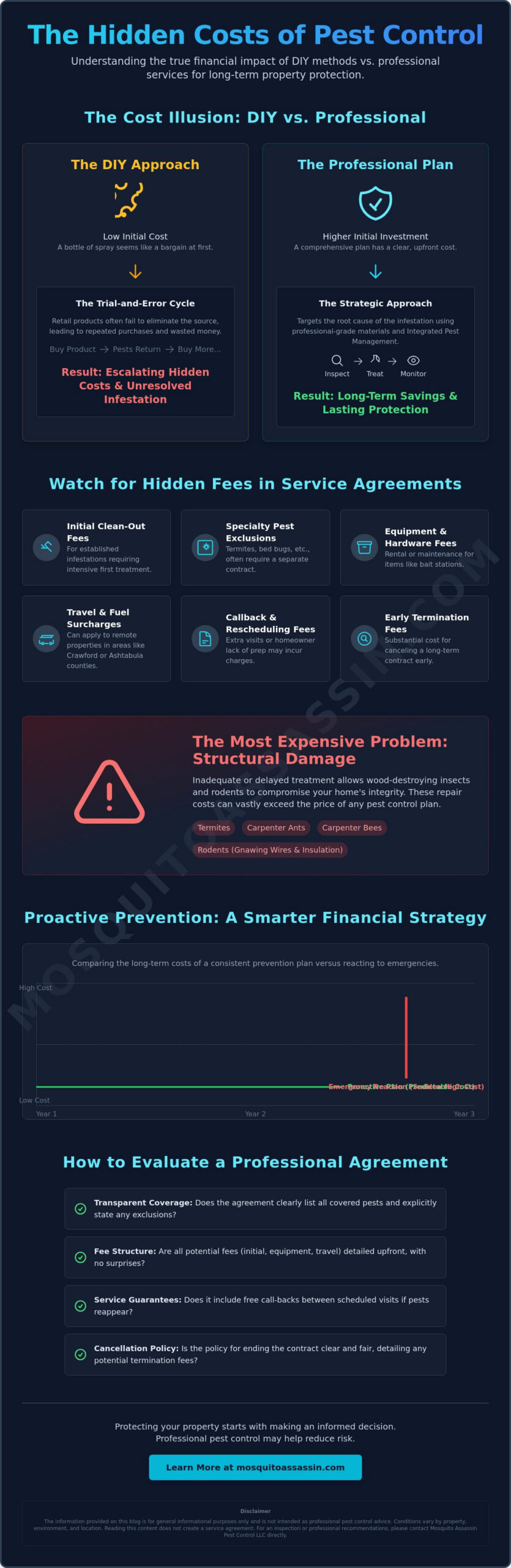
    The Financial Drain of DIY Pest Control Methods

    The “immediate cost illusion” is a primary reason many homeowners in Erie and Crawford counties attempt to resolve infestations on their own. At first glance, a twenty dollar bottle of retail spray appears significantly more affordable than a professional service plan. However, this initial savings often marks the beginning of the hidden costs of pest control. Retail products are generally formulated with lower concentrations of active ingredients compared to professional-grade materials. This means they often fail to eliminate the entire colony, leading to a frustrating trial and error cycle. Homeowners frequently find themselves returning to the store every few weeks to purchase different brands or stronger baits, quickly accumulating expenses that rival or exceed the cost of a decisive professional intervention.

    Beyond the cost of the products themselves, there is a substantial risk of property contamination and material waste. Without professional training, it’s easy to over-apply pesticides or place them in areas where they are ineffective. This misuse not only wastes money but can also lead to the contamination of living spaces or the accidental exposure of non-target animals. Professional technicians utilize specialized equipment designed for precision application, ensuring that materials reach the deep crevices where pests actually harbor. The general public simply does not have access to these high-stakes tools or the technical knowledge required to apply them with scientific accuracy.

    The Cost of Recurrent Infestations

    One of the most expensive mistakes in DIY pest control is focusing only on visible insects. Many store-bought treatments act as a repellent, which may seem effective initially but actually causes the colony to scatter and relocate to deeper, harder-to-reach areas of the home. This “budding” effect can turn a localized problem into a whole-house infestation. Effective general pest control requires identifying and sealing entry points rather than just treating the symptoms. When a DIY attempt fails, the eventual professional treatment often becomes more complex and labor-intensive, driving up the total investment required to secure the property.

    Time Investment and Opportunity Costs

    Your time has a tangible financial value. The hours spent researching pest behaviors, driving to hardware stores, and applying repetitive treatments represent a significant hidden expense. For many residents in Ashtabula County, the stress and mental load of managing an unresolved infestation can be overwhelming. A professional service provides more than just materials; it offers a warranty that ensures return visits are covered if pests persist. This protection eliminates the financial uncertainty of recurring problems. Choosing professional pest control allows property owners to delegate these high-stakes tasks to experts, ensuring the job is done correctly the first time.

    Disclaimer: The information provided on this blog is for general informational purposes only and is not intended as professional pest control advice. Conditions vary by property, environment, and location. Reading this content does not create a service agreement. For an inspection or professional recommendations, please contact Mosquito Assassin Pest Control LLC directly.

    Hidden Costs of Pest Control: A Homeowner’s Guide to Avoiding Surprise Expenses

    Structural Damage and the Price of Inadequate Treatment

    The most devastating hidden costs of pest control often involve the physical destruction of your home’s infrastructure. While a monthly service fee is predictable, the cost of replacing structural beams or floor joists is not. Wood-destroying insects like termites and carpenter bees can operate silently for years before the damage becomes visible. In regions like Erie and Crawford counties, where older wooden structures are common, these pests can compromise the integrity of a porch or foundation. Research indicates the average cost to repair termite damage is approximately $3,000, but major structural interventions can easily exceed $10,000. Inadequate treatment that fails to reach the core of a colony allows this erosion of home equity to continue unchecked.

    Rodents present a different but equally expensive set of risks. Mice and rats have a biological need to gnaw on hard materials, and they frequently target electrical wiring behind walls. This behavior creates significant fire hazards and requires expensive electrical repairs to ensure the property remains up to code. Additionally, a rodent infestation can destroy attic insulation through nesting and contamination. Professional rodent removal is a multi-step process that must include detailed exclusion work. By sealing entry points and repairing damaged barriers, property owners can prevent the recurring financial losses associated with repetitive infestations and contaminated insulation remediation.

    Impact on Property Value and Resale

    A history of untreated or poorly managed pest issues can severely complicate a home sale. During a standard home inspection in Ashtabula County, evidence of past wood-destroying insect activity can stall a closing or force a significant price reduction. Buyers and lenders often require professional documentation, such as termite clearances, to prove a structure is sound. Beyond the hidden structural elements, pests can cause aesthetic damage to cabinetry, expensive hardwood flooring, and custom furniture. These repairs are rarely covered by standard homeowner’s insurance, leaving the property owner to cover the full cost of restoration before a sale can proceed.

    Health-Related Financial Risks

    The financial impact of pests extends into the household budget through health-related expenses and property loss. Many common pests trigger allergies or asthma, potentially leading to medical bills or missed work days. A single rodent or insect breach in a pantry can result in the immediate loss of hundreds of dollars in contaminated food items. Professional pest control may help reduce risk to the household environment by maintaining a sanitary perimeter. By investing in a methodical, professional approach, homeowners protect both their physical health and their financial stability from the unpredictable costs of a major infestation.

    Disclaimer: The information provided on this blog is for general informational purposes only and is not intended as professional pest control advice. Conditions vary by property, environment, and location. Reading this content does not create a service agreement. For an inspection or professional recommendations, please contact Mosquito Assassin Pest Control LLC directly.

    How to Evaluate a Professional Pest Control Agreement

    Selecting a provider is a significant decision for your property’s long-term health. To avoid the hidden costs of pest control, homeowners must move beyond comparing simple price points. A comprehensive agreement should serve as a clear roadmap for protection, detailing exactly what is being treated and how often. When evaluating a contract, look for a structured framework that defines the scope of work. A professional agreement must clearly list the frequency of visits and the specific pests covered under the base rate. If an agreement is vague about whether it covers common regional invaders like carpenter ants or spiders, you may face unexpected charges later for “add-on” services that you assumed were included.

    Liability protection is another critical factor often overlooked in the fine print. Always verify that a provider maintains current licensing and comprehensive insurance. This isn’t just a regulatory requirement; it’s a safeguard for the property owner. If an uninsured individual is injured on your property or causes accidental damage during a treatment, you could be held financially responsible. Beyond the technical scope, prioritize companies that offer a clear service guarantee or re-treatment policy. A reputable professional stands by their work. If pests return between scheduled visits, the agreement should specify that the provider will return to address the issue at no additional cost to you, protecting your budget from recurring visit fees.

    Key Questions for Potential Providers

    Before signing any document, request a written list of every pest included in the protection plan. Some contracts focus only on a narrow range of insects, leaving you vulnerable to others. Inquire about the “clean-out” process and whether the initial visit carries a different fee structure than subsequent maintenance visits. It’s also vital to ask if the company provides detailed written reports after every inspection. These reports should document findings, treatments applied, and any structural recommendations to prevent future breaches. Transparent documentation is the hallmark of a disciplined, professional service that values your home’s integrity.

    Reviewing the Service Area and Local Reputation

    Regional expertise is invaluable when managing pests in Erie and Crawford counties in Pennsylvania, or Ashtabula County in Ohio. A provider rooted in these communities understands the specific environmental pressures and seasonal behaviors of local pests. Check community-based reviews for mentions of transparency and professional conduct. Look for a provider that emphasizes education and prevention as part of their professional pest control services. Companies that focus on sealing entry points and reducing attractants often provide better long-term value than those that rely solely on repetitive chemical applications without addressing the root cause of the infestation.

    Disclaimer: The information provided on this blog is for general informational purposes only and is not intended as professional pest control advice. Conditions vary by property, environment, and location. Reading this content does not create a service agreement. For an inspection or professional recommendations, please contact Mosquito Assassin Pest Control LLC directly.
    Long-Term Prevention as a Financial Strategy

    Adopting a proactive approach to property management is the most effective way to eliminate the hidden costs of pest control. Many homeowners wait until they see a visible infestation before calling for help, but emergency one-time treatments are often more expensive and less effective than year-round protection. Regular inspections allow a technician to identify early warning signs, such as small entry points or minor nesting activity, before they escalate into a crisis requiring specialty interventions. By maintaining a consistent perimeter, you prevent pests from establishing a foothold, which protects your home’s structural integrity and your family’s wellbeing.

    Integrated Pest Management (IPM) serves as a sustainable and budget-friendly framework for this long-term strategy. Rather than relying solely on repetitive chemical applications, IPM focuses on understanding pest biology and modifying the environment to discourage activity. This methodical approach might include sealing cracks in the foundation or managing moisture levels around the property. From a financial perspective, the benefit of predictable monthly or bi-monthly billing is significant. It’s much easier to budget for a standard maintenance plan than it is to face a sudden, multi-thousand dollar repair bill for structural damage or electrical failure caused by undetected pests.

    Seasonal Protection in PA and OH

    In the tri-county area of Erie, Crawford, and Ashtabula, seasonal shifts bring specific financial risks. Summer surges in mosquitoes and ticks can limit the use of your outdoor space and increase health-related concerns, while the onset of winter drives rodents toward the warmth of your home. Proactive winter rodent exclusion is a vital part of a maintenance strategy. By securing the home in the fall, you avoid the high cost of spring cleanup and insulation remediation. It’s helpful to view professional pest control as an essential form of home maintenance, similar to servicing your HVAC system or inspecting your roof. Consistent care extends the life of these systems and prevents minor issues from becoming major liabilities.

    Conclusion and Next Steps

    Transparency and prevention are the most reliable tools for avoiding hidden pest control costs. When you understand the limitations of DIY methods and the true value of a professional agreement, you can make informed decisions that protect your investment. While the “immediate cost illusion” of store-bought products is tempting, the long-term data shows that professional pest control may help reduce risk and preserve property value over time. For an inspection or professional recommendations tailored to your home’s specific needs, contact a local professional to discuss a comprehensive protection plan.

    Disclaimer: The information provided on this blog is for general informational purposes only and is not intended as professional pest control advice. Conditions vary by property, environment, and location. Reading this content does not create a service agreement. For an inspection or professional recommendations, please contact Mosquito Assassin Pest Control LLC directly.

    Secure Your Home Against Unseen Financial Risks

    Protecting your property requires moving beyond the initial price tag to consider the long-term health of your home. As explored throughout this guide, the hidden costs of pest control often stem from failed DIY attempts and the high price of repairing structural damage. By choosing transparent year-round protection plans, you replace unpredictable emergency expenses with a manageable maintenance schedule. Licensed and insured professionals in Erie, Crawford, and Ashtabula Counties provide the technical expertise needed to identify vulnerabilities before they become major liabilities. This proactive strategy is far more cost-effective than responding to a full-scale infestation after it’s already taken hold.

    A disciplined approach to prevention ensures your living environment remains secure and your home equity is preserved. Professional pest control may help reduce risk by addressing the root causes of infestations rather than just treating visible symptoms. For homeowners who value clarity and effectiveness, taking a proactive stance is the most sustainable financial choice. To get started with a detailed assessment of your property, Request a Professional Inspection and Quote today. Taking this step helps ensure your home remains a safe haven for your family and provides the peace of mind that comes with expert oversight.

    Disclaimer: The information provided on this blog is for general informational purposes only and is not intended as professional pest control advice. Conditions vary by property, environment, and location. Reading this content does not create a service agreement. For an inspection or professional recommendations, please contact Mosquito Assassin Pest Control LLC directly.
    Frequently Asked Questions

    What is usually excluded from a general pest control plan?

    Standard protection plans typically focus on common crawling insects like ants, spiders, and crickets. Specialized pests such as bed bugs, wood-destroying termites, and carpenter bees are usually excluded because they require intensive, distinct treatment methodologies. Wildlife removal is also treated as a separate category that isn’t included in a general household pest agreement.

    Why is there often an initial setup fee for pest services?

    The first visit is significantly more labor-intensive than subsequent maintenance visits. This “clean-out” phase requires a thorough inspection and a higher volume of materials to eliminate an established population. Once the initial infestation is under control, the property transitions to a maintenance schedule which requires fewer materials and less time to manage.

    Can DIY pest control actually cost more than hiring a professional?

    Attempting to resolve an infestation with store-bought products often leads to higher total expenses. Data suggests that the combined cost of failed DIY attempts and the eventual professional service is typically 20% to 40% more than hiring a professional from the start. This is due to the repetitive purchase of ineffective materials and the continued growth of the infestation during the trial-and-error period.

    How much does structural damage from termites typically cost to repair?

    Repairing termite damage is a significant financial burden that averages around $3,000 per household. While minor cosmetic repairs might cost between $300 and $2,000, major structural damage to foundations or support beams can reach $5,000 to $15,000 or more. These expenses are rarely covered by standard homeowner’s insurance policies because they are classified as maintenance issues.

    Are there extra charges for rodent bait stations or traps?

    Equipment fees for monitoring devices and bait stations are common hidden costs of pest control that aren’t always reflected in the base rate. Some service agreements treat this hardware as a rental, while others include it in the plan. It’s essential to clarify if you’ll be billed for the installation or ongoing maintenance of these specialized tools before signing a contract.

    What should I look for in a pest control service guarantee?

    A reliable service guarantee should include a clear re-treatment policy that covers the cost of return visits. If pests persist or reappear between your regularly scheduled maintenance appointments, a professional provider should return to your property at no additional charge. This ensures that the financial risk of a persistent infestation remains with the service provider rather than the homeowner.

    Is year-round pest protection worth the monthly cost?

    Year-round plans are a strategic financial investment because they prioritize prevention over emergency response. Regular inspections allow professionals to catch issues like rodent entries or wood-destroying insect activity before they cause expensive structural or electrical damage. Predictable monthly billing also helps homeowners avoid the sudden, large repair bills associated with undetected infestations.

    Do pest control companies charge for travel to rural areas?

    Travel or fuel surcharges are common for properties located in more remote parts of Crawford or Ashtabula counties. These fees help cover the logistics and time required for a technician to reach rural sites. When requesting a quote, always verify if your specific location triggers any geographic surcharges to ensure your final bill matches your expectations.

    Disclaimer: The information provided on this blog is for general informational purposes only and is not intended as professional pest control advice. Conditions vary by property, environment, and location. Reading this content does not create a service agreement. For an inspection or professional recommendations, please contact Mosquito Assassin Pest Control LLC directly.

  • Tick Treatment for Inside the House: A Professional Management Guide

    Tick Treatment for Inside the House: A Professional Management Guide

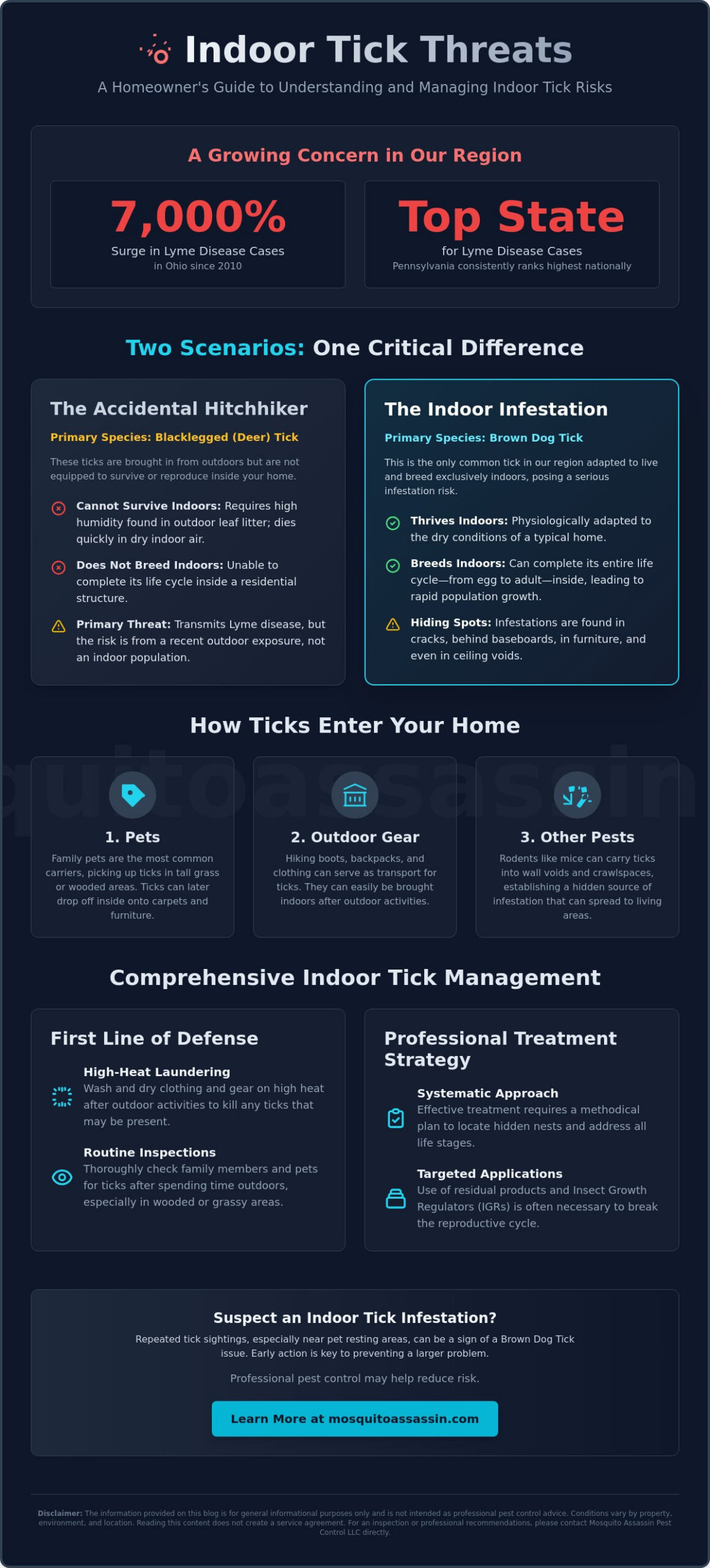
    With Lyme disease cases in Ohio surging by 7,000 percent since 2010 and Pennsylvania consistently ranking at the top of national lists, finding a tick in your living room is no longer a rare occurrence. It’s natural to feel a sense of immediate anxiety when you spot a tick crawling on a child’s clothing, especially when you’re unsure if you need professional tick treatment for inside the house. The risk of tick-borne illnesses like Lyme or anaplasmosis makes the presence of these pests feel like a direct threat to the safety of your family and pets.

    Transitioning from a state of worry to a state of resolution requires a clear, fact-based plan. This guide provides a professional management framework to help you identify how these pests entered your home and whether you’re dealing with an accidental hitchhiker or a species capable of breeding indoors. You’ll learn the specific behaviors of ticks common in Erie, Crawford, and Ashtabula counties, along with the methodical steps required to achieve a secure, tick-free environment.

    Key Takeaways

    • Differentiate between accidental deer tick hitchhikers and the brown dog tick, which is the primary species capable of establishing a breeding population inside residential structures.
    • Understand why professional tick treatment for inside the house requires a systematic approach, often involving residual products and insect growth regulators to break the reproductive cycle.
    • Learn how high-heat laundering and routine post-outdoor inspections serve as the first line of defense for homeowners in Erie, Crawford, and Ashtabula counties.
    • Identify the specific signs that an indoor infestation has moved beyond simple prevention and requires a professional inspection to locate hidden nests.

    Understanding Tick Infestations Inside the Home

    Effective tick treatment for inside the house is rarely a matter of a single application or a quick cleaning session. It requires a systematic, professional approach to identify how these arachnids arrived and whether they’ve established a residency. While most ticks found indoors are accidental hitchhikers that cannot survive long in the low humidity of a home, certain species are adapted for indoor life. Understanding the biological nuances of these pests is the first step toward reclaiming your living space. For those interested in the scientific background of these parasites, a comprehensive overview of ticks details their complex life cycles and their status as significant disease vectors.

    Property owners in Erie and Crawford Counties often encounter ticks after outdoor activities, but the problem becomes complex when sightings occur repeatedly in areas where pets sleep or children play. This suggests a transition from a simple “hitchhiker” scenario to a potential infestation. Standard household cleaning, while helpful for general hygiene, often misses the deep crevices and baseboard gaps where ticks hide during their molting stages. To better understand the mechanics of an infestation, watch this helpful video:

    Common Entry Points for Ticks

    Ticks don’t fly or jump; they rely on passive transport to enter your home. Family pets are the most frequent vehicles, as ticks latch onto fur during walks in tall grass or wooded areas and later drop off onto carpets or furniture. Outdoor gear, such as hiking boots, gardening gloves, and backpacks, also serves as a primary transport method. Additionally, rodents like mice can carry tick larvae into crawlspaces and wall voids, creating a secondary entry point that is often overlooked until the population spreads into the main living areas of the house.

    The Risks of Unmanaged Indoor Ticks

    The presence of ticks indoors carries significant health implications, particularly in the Northeast United States. With Pennsylvania reporting 16,624 cases of Lyme disease in 2024 and Ohio seeing a massive 7,000 percent increase in cases since 2010, the stakes for effective management are high. Beyond the physical risks of pathogens like anaplasmosis or Rocky Mountain Spotted Fever, the psychological impact of seeing ticks in private living areas causes substantial anxiety for homeowners. Certain species, like the brown dog tick, can complete their entire life cycle indoors, leading to rapid population growth if the environment is not professionally managed. Addressing these risks early through professional pest control may help reduce risk and restore peace of mind.

    Identifying Tick Species Common in Pennsylvania and Ohio

    Accurate identification is the cornerstone of an effective management plan. While many homeowners assume any tick found indoors is a deer tick, the specific species determines whether you are facing a solitary hitchhiker or a localized breeding population. This distinction is critical when selecting a tick treatment for inside the house. In Erie, Crawford, and Ashtabula counties, residents primarily encounter four species: the blacklegged (deer) tick, the American dog tick, the Lone star tick, and the brown dog tick. Each has distinct behaviors and habitat preferences that dictate how a professional will approach the situation.

    The brown dog tick is the most significant threat regarding indoor infestations. Unlike other regional species that require the high humidity of leaf litter to survive, the brown dog tick is physiologically adapted to thrive in the drier conditions of a residential home. Guidance from the EPA on Controlling Fleas and Ticks Around Your Home highlights that understanding these species-specific traits is vital for successful intervention. While deer ticks are frequently associated with Lyme disease and are prevalent in the wooded areas of Erie County, they rarely survive more than a few days inside a climate-controlled building unless they remain attached to a host.

    The Brown Dog Tick Life Cycle

    This species is unique because it can complete its entire life cycle without ever stepping foot outdoors. They are notorious for hiding in structural cracks, behind baseboards, and even within dropped ceiling tiles. A single female can lay thousands of eggs in these hidden household locations. Homeowners should pay close attention to pet bedding areas, as these are primary sites for egg clusters. Because these ticks can hide so effectively, a professional inspection is often necessary to locate the source of a persistent indoor problem.

    Regional Tick Activity Patterns

    Peak tick activity in Crawford and Ashtabula counties typically spans from May through September, but milder winters have led to earlier starts in recent years. Ticks are often confused with other small, dark pests such as spider beetles. You can distinguish a tick by its eight legs (in adult stages) and its lack of antennae. Spider beetles, by contrast, have long antennae that can look like an extra pair of legs and a more rounded, bulbous abdomen. If you find a tick that appears silver or has ornate white markings, it is likely an American dog tick or a Lone star tick, both of which are common regional hitchhikers that usually enter the home on clothing or pets after a walk in the brush.

    Tick Treatment for Inside the House: A Professional Management Guide

    Evaluating Tick Treatment Methods for Indoor Spaces

    Selecting the right tick treatment for inside the house involves more than just picking a product from a retail shelf. It requires a deep understanding of how different chemical classes interact with a pest’s biology. Residual insecticides play a primary role in this process because they remain active on treated surfaces long after the initial application. This longevity is essential for managing ticks, which often remain hidden for weeks between life stages. While liquid residuals provide a consistent barrier along floor-to-wall junctions, specialized dusts are frequently utilized in wall voids and behind electrical outlets where liquid applications aren’t suitable.

    Insect Growth Regulators (IGRs) represent the most critical component of a professional strategy. While standard adulticides target the ticks you can see, IGRs act as a form of population control. These compounds disrupt the hormonal balance of larvae and nymphs, preventing them from molting into reproductive adults. Many over the counter foggers or “bug bombs” lack these sophisticated components. These aerosol bombs often fail because they only coat horizontal surfaces, leaving ticks safe in the vertical cracks, crevices, and deep carpet fibers where they actually reside. Improper use of these products can even cause pests to disperse deeper into the home’s structure.

    Professional Grade vs. Consumer Products

    Licensed technicians in Pennsylvania and Ohio utilize EPA-registered products formulated for higher efficacy and longer residual life than standard retail options. A major risk of DIY applications is the unintended dispersal of the infestation. If a homeowner uses an irritating but non-lethal chemical, the ticks may simply migrate into wall voids or attic spaces, making them harder to reach. Professional protocols prioritize safety, ensuring that treatments are applied in a targeted manner that protects children and pets while maximizing impact on the infestation. Professional pest control may help reduce risk by using these specialized tools effectively.

    Targeted Application Zones

    A thorough management plan doesn’t involve treating every square inch of a home. Instead, it focuses on biological “hot zones” where ticks are most likely to congregate. These include baseboards, door frames, and the edges of wall-to-wall carpeting. Since ticks often stay near where their hosts spend time, upholstered furniture and pet resting areas require specific attention. In Crawford and Ashtabula counties, professional inspections often extend to attics and crawlspaces. These areas can harbor rodents that act as secondary hosts, fueling a cycle of re-infestation that surface-level cleaning cannot reach.

    Comprehensive Indoor Tick Prevention and Management Strategy

    Prevention is the most effective form of tick treatment for inside the house. While professional applications eliminate active populations, environmental management ensures that new hitchhikers don’t become permanent residents. Establishing a strict routine for post-outdoor inspections is the first line of defense. Ticks often crawl for several hours before attaching, giving you a window of opportunity to remove them before they bite. When returning from wooded areas in Crawford or Ashtabula counties, place all clothing directly into the dryer on high heat for at least ten minutes. This high-heat cycle is more effective at killing ticks than a standard wash cycle, as the dry heat causes rapid desiccation of the pest.

    Long-term success relies on creating a hostile environment within the home. Ticks require high humidity to survive; most species will perish within 24 hours in an environment with less than 90 percent humidity. Managing indoor moisture levels through dehumidification can significantly reduce the longevity of accidental intruders. This environmental control should be part of a broader general pest control plan that addresses all potential entry points and seasonal vulnerabilities. For properties with recurring issues, a professional inspection can help identify specific structural weaknesses.

    Sanitation and Home Maintenance

    Rigorous sanitation disrupts the life cycle of ticks that may have dropped off a host. Vacuuming is a powerful tool. Focus on baseboards, under furniture, and in carpeted areas where pets spend time. This physical removal targets larvae and unhatched eggs that are often resistant to surface cleanings. After vacuuming, immediately dispose of the bag or empty the canister into a sealed outdoor bin. Homeowners should also focus on sealing structural gaps. Small cracks in foundations or gaps around door frames allow ticks to enter from the exterior, especially if rodents are nesting near the home’s perimeter.

    Pet Health and Tick Management

    Pets are the primary bridge between the outdoors and your living room. Coordinating with a veterinarian for year-round flea and tick preventatives is essential. The milder winters in the Northeast have extended the active season for many species. Regular grooming and daily inspections, especially around the ears, paws, and neck, help catch ticks before they drop off into the home. Rotating and cleaning pet bedding weekly in hot water followed by high-heat drying removes potential harborages. If you notice signs of a persistent problem, professional pest control may help reduce risk by treating the areas where your pets are most vulnerable.

    When to Seek Professional Tick Control Services

    Determining when a few accidental hitchhikers have transitioned into a localized infestation is the most critical step in protecting your household. While finding a single tick after a hike is common, seeing multiple ticks of varying sizes over several days often indicates an established indoor population. This is typically the point where standard cleaning and retail sprays fail to provide relief. If you continue to find ticks in areas where pets don’t frequent, or if sightings persist after a deep cleaning of bedding and carpets, a more technical approach is required. Professional tick treatment for inside the house is designed to reach the hidden structural voids that household tools simply can’t access.

    Local expertise is vital because tick activity in Erie, Crawford, and Ashtabula counties is influenced by specific regional climate shifts. With milder winters becoming more frequent, the traditional “off season” for ticks has shortened significantly. This means that a tick brought inside in late autumn could potentially survive and remain active throughout the winter months if the indoor environment provides enough warmth and a host. Professional pest control may help reduce the risk of these pests establishing a permanent presence in your living areas.

    The Professional Inspection Process

    A licensed technician utilizes specialized lighting and diagnostic tools to locate tick larvae and nymphs, which are often no larger than a poppy seed and nearly impossible for a homeowner to spot. These inspections go beyond surface-level checks. They involve a methodical examination of structural crevices, baseboard gaps, and even the wall voids behind electrical outlets where brown dog ticks are known to hide. A critical part of this process is identifying secondary pest issues. Since rodents often carry tick larvae into crawlspaces and attics, identifying a hidden mouse problem is frequently the key to solving a persistent tick issue. A customized plan is then developed based on your home’s unique architecture.

    Securing Your Home with Mosquito Assassin

    Choosing a dependable local expert ensures that your management plan is informed by the specific pest trends of the Pennsylvania and Ohio border region. Our approach emphasizes the safety and wellbeing of your family through disciplined, science-based application methods. By focusing on the biological “hot zones” identified during an inspection, we provide a definitive resolution to the problem rather than a temporary fix. Year-round protection plans are particularly effective in our community, as they mitigate the impact of seasonal spikes and prevent new introductions from becoming established. To begin the process of reclaiming your home, you can contact a professional for an inspection at mosquitoassassin.

    Disclaimer: The information provided on this blog is for general informational purposes only and is not intended as professional pest control advice. Conditions vary by property, environment, and location. Reading this content does not create a service agreement. For an inspection or professional recommendations, please contact Mosquito Assassin Pest Control LLC directly.
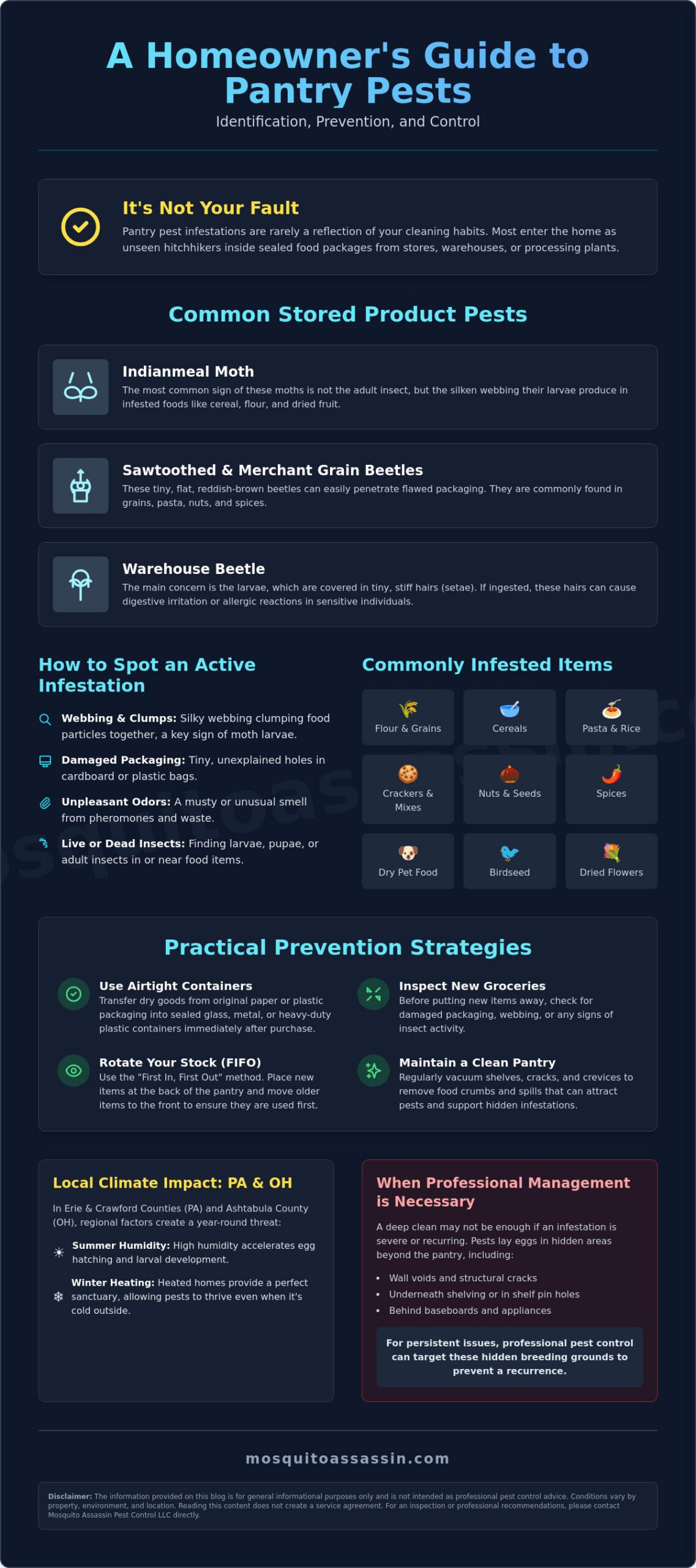
    Securing Your Home Against Indoor Tick Threats

    Managing a pest issue effectively requires a shift from reactive cleaning to a systematic, professional strategy. Success begins with accurately identifying whether you are dealing with a solitary hitchhiker or a species like the brown dog tick that is capable of breeding within your walls. While sanitation and high-heat laundering provide a strong foundation, specialized tick treatment for inside the house is often the only way to reach deep-seated harborages and break the reproductive cycle.

    Property owners in Erie, Crawford, and Ashtabula counties benefit from local expertise that understands regional climate shifts and pest behavior. Being licensed and insured in both Pennsylvania and Ohio, Mosquito Assassin utilizes specialized tick and mosquito management protocols to restore security to your living environment. Professional pest control may help reduce risk by addressing the root causes of an infestation. To take the next step toward a pest-free environment, you can Schedule a professional inspection for your home. Reclaiming your peace of mind is possible with a methodical approach and a dependable local partner.

    Disclaimer: The information provided on this blog is for general informational purposes only and is not intended as professional pest control advice. Conditions vary by property, environment, and location. Reading this content does not create a service agreement. For an inspection or professional recommendations, please contact Mosquito Assassin Pest Control LLC directly.

    Frequently Asked Questions

    Can ticks live and breed inside a house?

    Yes, certain species like the brown dog tick are capable of completing their entire life cycle indoors. While most ticks brought into homes in Erie or Crawford Counties are accidental hitchhikers that require high humidity to survive, the brown dog tick thrives in the drier conditions of a residential structure. They can lay eggs in cracks, crevices, or behind baseboards, leading to a localized infestation that persists without outdoor intervention.

    How long can a tick survive indoors without a host?

    Survival time depends heavily on the species and indoor humidity levels. Most common regional species, such as the blacklegged (deer) tick, will typically die within 24 to 48 hours in a climate-controlled home because they cannot tolerate low humidity. However, a brown dog tick can survive for several months without a blood meal. This biological resilience makes professional tick treatment for inside the house necessary if they have established a presence.

    What is the best indoor tick killer for carpets?

    The most effective solution for carpets involves a combination of a residual insecticide and an Insect Growth Regulator (IGR). While retail sprays might kill adult ticks on contact, they often fail to reach larvae or eggs buried deep in carpet fibers. A professional application ensures that the treatment remains active over time, breaking the reproductive cycle and providing long-term management that vacuuming alone cannot achieve for established populations.

    Are indoor tick treatments safe for dogs and cats?

    Professional indoor treatments are designed to be used in homes with pets when applied according to strict safety protocols. It is standard practice to keep dogs and cats out of the treated area until the product has completely dried. Licensed technicians prioritize the safety of vulnerable household members by using targeted applications rather than broad, unnecessary spraying, ensuring a secure environment for your animals while effectively managing the pest problem.

    How do I know if I have a tick infestation in my house?

    Identifying an infestation involves looking for repeated sightings of ticks, especially in various life stages like tiny larvae or nymphs. If you find ticks crawling on walls, curtains, or in areas where pets do not spend time, it may indicate a breeding population. Finding multiple ticks over several days after you’ve already checked your pets and gear suggests that the pests have established themselves within the home’s structure.

    Does vacuuming help get rid of ticks?

    Vacuuming is a helpful supplemental strategy that physically removes active ticks, larvae, and some eggs from carpets and upholstery. It is particularly effective along baseboards and under furniture where ticks often hide. Vacuuming cannot reach into the structural cracks or deep crevices where breeding populations reside. It should be integrated into a broader professional management plan to ensure that all life stages are addressed across the entire property.

    Can I get Lyme disease from a tick found inside my home?

    It is possible to contract Lyme disease if an infected blacklegged (deer) tick is brought inside on a pet or clothing and subsequently attaches to a human host. Ticks found crawling on furniture or floors are still seeking a blood meal and can pose a health risk. This is why routine inspections and immediate tick treatment for inside the house are important for residents in high-risk areas like Ashtabula County.

    Should I use a bug bomb for ticks in my house?

    Bug bombs or total release foggers are generally ineffective for tick management and are not recommended. These products only coat horizontal surfaces and fail to penetrate the vertical cracks and deep carpet fibers where ticks actually hide. The irritating chemicals in foggers can cause ticks to scatter deeper into wall voids. This makes a professional inspection and targeted treatment much more difficult to execute once the pests have dispersed.

    Disclaimer: The information provided on this blog is for general informational purposes only and is not intended as professional pest control advice. Conditions vary by property, environment, and location. Reading this content does not create a service agreement. For an inspection or professional recommendations, please contact Mosquito Assassin Pest Control LLC directly.

  • How to Pass a Restaurant Health Inspection: A Comprehensive 2026 Guide

    How to Pass a Restaurant Health Inspection: A Comprehensive 2026 Guide

    With approximately 48 million people in the United States affected by foodborne illnesses every year, the stakes for commercial kitchens have never been higher. It’s natural to feel a sense of dread when an inspector walks through the door, especially when you are trying to figure out how to pass a restaurant health inspection amidst the 2026 FDA Food Code updates and new requirements for allergens like sesame. Managing staff consistency and complex local regulations in Erie, Crawford, or Ashtabula County can feel like a constant battle against potential violations. You deserve the peace of mind that comes with a high public-facing health score and a kitchen that operates at peak safety standards every day.

    Mastering food safety is not about a frantic one-day cleaning spree; it’s about building sustainable systems that make compliance automatic. This guide breaks down the core pillars of sanitation and standardized training procedures to help you achieve zero critical violations. Protect your reputation and ensure your establishment remains a safe, dependable fixture in the community by implementing these professional standards. Explore the essential protocols and documentation required to master the latest regulatory shifts and maintain a disciplined, pest-free environment.

    Disclaimer: The information provided on this blog is for general informational purposes only and is not intended as professional pest control advice. Conditions vary by property, environment, and location. Reading this content does not create a service agreement. For an inspection or professional recommendations, please contact Mosquito Assassin Pest Control LLC directly.

    Key Takeaways

    • Understand that health inspections are scientific assessments focused on protecting public safety and preventing foodborne illness.
    • Learn how to pass a restaurant health inspection by mastering the core pillars of compliance, such as temperature control and employee hygiene.
    • Identify why pest activity is classified as a critical priority violation and how rigorous cleaning protocols eliminate common environmental attractants.
    • Move toward a sustainable inspection readiness culture by implementing daily checklist systems and regular internal audits.
    • Discover the benefits of professional commercial pest control services and how Integrated Pest Management (IPM) supports long-term regulatory success.

    Understanding the Restaurant Health Inspection Process

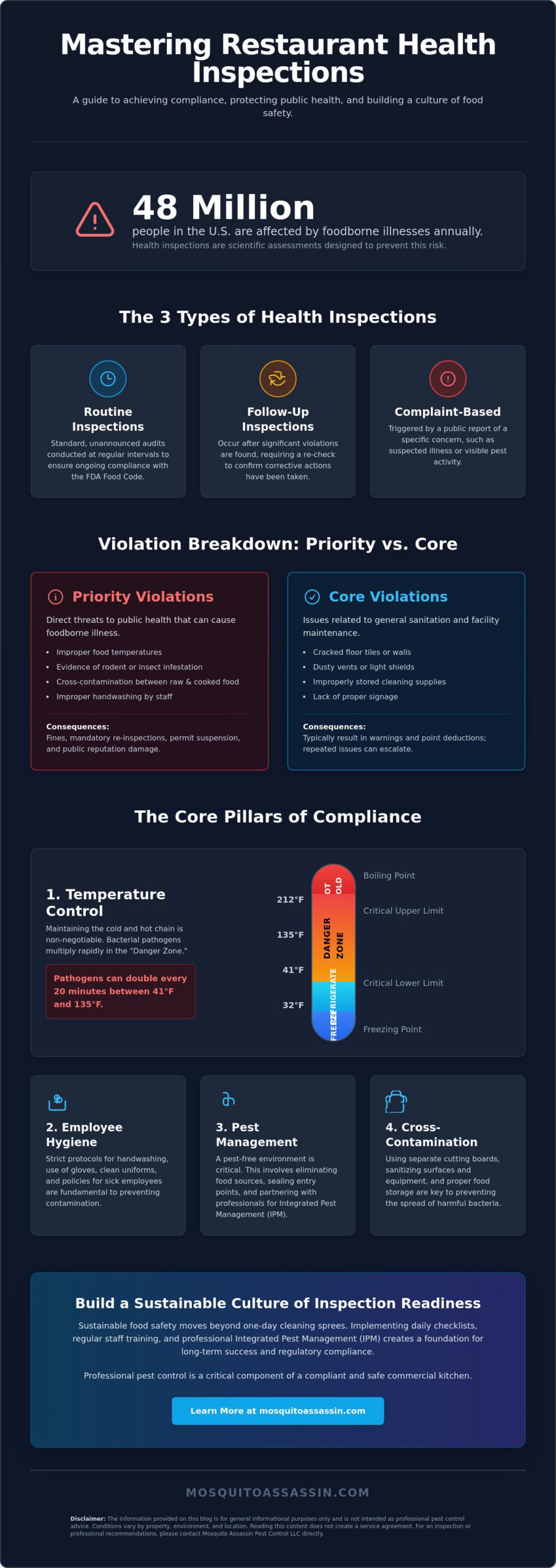
    A restaurant health inspection is a rigorous, unannounced regulatory assessment designed to evaluate how well an establishment adheres to established food safety principles. The primary objective is to protect public health by identifying and correcting behaviors that lead to foodborne illness. Understanding this process is the first step in learning how to pass a restaurant health inspection with a perfect score. Inspectors focus on high-risk factors like food temperature, cross-contamination, and personal hygiene to mitigate the risk of the 48 million foodborne illness cases reported annually in the United States.

    Establishments typically face three types of visits. Routine inspections are the standard, unannounced audits conducted at regular intervals. Follow-up inspections occur if an inspector identifies significant issues that require a re-check to confirm compliance. Complaint-based inspections are triggered when a member of the public reports a specific concern, such as a suspected illness or visible pest activity. In Erie and Crawford Counties in Pennsylvania, as well as Ashtabula County in Ohio, the frequency of these visits depends on the facility’s risk category, which is based on the complexity of the menu and the volume of customers served.

    Who Conducts the Inspections?

    In our region, the authority behind these audits varies by state. In Erie County, the Erie County Health Department manages inspections. In Crawford County, the Pennsylvania Department of Agriculture often takes the lead unless a local health department is established. Across the border in Ashtabula County, the local Health District enforces Ohio’s uniform food safety code. While the specific agency might change, all these bodies use the FDA Food Code as their scientific baseline. The 2026 FDA Food Code updates have introduced stricter requirements for allergen management and traceability, making it essential for operators to stay current on new regulations. When an inspector arrives, they will present credentials and ask to speak with the person in charge.

    Types of Violations and Their Impact

    Inspectors categorize findings into two main groups: priority violations and core violations. Priority violations (formerly called critical violations) are direct threats to health, such as improper cooling temperatures or evidence of a rodent infestation. Core violations relate to general maintenance and sanitation, like a cracked floor tile or a dusty vent. Accumulating priority violations can lead to immediate consequences, including heavy fines, mandatory re-inspections, or the temporary suspension of your operating permit. Beyond legal penalties, health scores are public records. A poor grade can cause lasting damage to your business reputation, as modern consumers frequently check online databases before deciding where to eat. Learning how to pass a restaurant health inspection is a vital business strategy to ensure long-term stability and community trust.

    Disclaimer: The information provided on this blog is for general informational purposes only and is not intended as professional pest control advice. Conditions vary by property, environment, and location. Reading this content does not create a service agreement. For an inspection or professional recommendations, please contact Mosquito Assassin Pest Control LLC directly.

    Core Compliance Pillars: Food Temperature and Employee Hygiene

    Maintaining the cold chain is a non-negotiable requirement for any commercial kitchen in Erie, Crawford, or Ashtabula County. Inspectors prioritize refrigeration because temperature abuse is a leading cause of bacterial growth. Your refrigerators must consistently hold food at 41°F or below, while freezers should keep products frozen solid. Understanding how to pass a restaurant health inspection starts with recognizing that these numbers aren’t suggestions; they are scientific safeguards. When food enters the “Danger Zone” between 41°F and 135°F, pathogens can double in number in as little as 20 minutes. Monitoring these levels requires a disciplined approach and reliable equipment.

    Proper cooking temperatures are equally vital. Different proteins require specific internal heat levels to ensure safety, such as 165°F for poultry and 155°F for ground meats. Beyond the stove, hygiene remains the most visible indicator of a kitchen’s safety culture. Standardized handwashing protocols require staff to scrub for at least 20 seconds using warm water and soap. This must only occur at dedicated hand sinks, which must be stocked with paper towels and soap at all times. If an inspector sees a staff member using a prep sink to wash their hands, it’s an immediate red flag. Maintaining a clean environment is a team effort, and professional commercial pest control can help support these sanitation goals by identifying structural gaps that lead to contamination.

    Time and Temperature Control

    Consistency relies on the use of calibrated thermometers. Staff should check and log temperatures multiple times per shift to provide a paper trail of compliance. The FDA Food Code outlines specific cooling procedures for hot foods, known as the two-stage method. Food must drop from 135°F to 70°F within two hours, and then down to 41°F within the next four hours. Thawing also requires care. Never thaw food at room temperature; use the refrigerator, cold running water, or the microwave as part of the cooking process to keep the product safe.

    Personal Hygiene and Staff Habits

    Employee habits can make or break an audit. Bare-hand contact with ready-to-eat foods is prohibited; gloves or utensils must be used instead. Staff should wear effective hair restraints and clean uniforms while avoiding most jewelry, except for a plain wedding band. It’s also critical to have a clear employee health policy. Management must exclude staff from the kitchen if they exhibit symptoms like vomiting, diarrhea, or jaundice. This protects your customers and ensures you are following the best practices of a professional food service operation.

    Disclaimer: The information provided on this blog is for general informational purposes only and is not intended as professional pest control advice. Conditions vary by property, environment, and location. Reading this content does not create a service agreement. For an inspection or professional recommendations, please contact Mosquito Assassin Pest Control LLC directly.

    How to Pass a Restaurant Health Inspection: A Comprehensive 2026 Guide

    Managing Pest Control Requirements for Health Inspections

    Pest activity is frequently classified as a critical priority violation because pests are biological vectors for dangerous pathogens. If an inspector finds live cockroaches, rodent droppings, or flies in food preparation areas, the facility faces immediate penalties. Understanding how to pass a restaurant health inspection requires a proactive approach to pest management that goes beyond simple reactive measures. A single sighting can lead to a failed audit, making it essential to treat pest prevention as a daily operational requirement.

    Sanitation is your most powerful defense. Pests are attracted to food sources like accumulated grease behind fryers or standing water in poorly maintained floor drains. By eliminating these attractants, you remove the primary reason pests enter your kitchen in the first place. Exclusion strategies are equally important for long term success. This includes installing heavy duty door sweeps, sealing gaps around utility lines, and ensuring windows have tight fitting screens. A professional pest management plan is a necessity for any commercial facility to maintain these high standards and protect public health.

    The Pest Control Logbook

    In Erie and Crawford Counties, as well as Ashtabula County, inspectors expect to see a comprehensive pest control logbook on the premises. This is not just a folder; it’s a living record of your safety commitment. It should contain detailed reports of all sightings, actions taken, and current service reports. You must also keep pesticide application records on-site for immediate review. Ensure your service provider is properly licensed in Pennsylvania or Ohio to perform commercial work. While Florida’s restaurant inspection process provides a clear example of how these records are audited at the state level, local health departments in our region follow similar rigorous documentation standards.

    Common Pest Hotspots in Commercial Kitchens

    Early detection is vital for long term compliance. Focus your internal audits on hotspots like floor drains, the areas behind heavy refrigeration units, and inside motor housings where warmth attracts insects. Dumpster areas and external waste disposal sites must be managed carefully to minimize attraction from the perimeter. Regular professional inspections help identify early signs of activity before they become a violation on a public report. Utilizing commercial pest control ensures that these vulnerable areas are monitored by experts who understand the specific pressures of the food service industry. By identifying risks before the inspector arrives, you maintain control over your establishment’s reputation.

    Disclaimer: The information provided on this blog is for general informational purposes only and is not intended as professional pest control advice. Conditions vary by property, environment, and location. Reading this content does not create a service agreement. For an inspection or professional recommendations, please contact Mosquito Assassin Pest Control LLC directly.
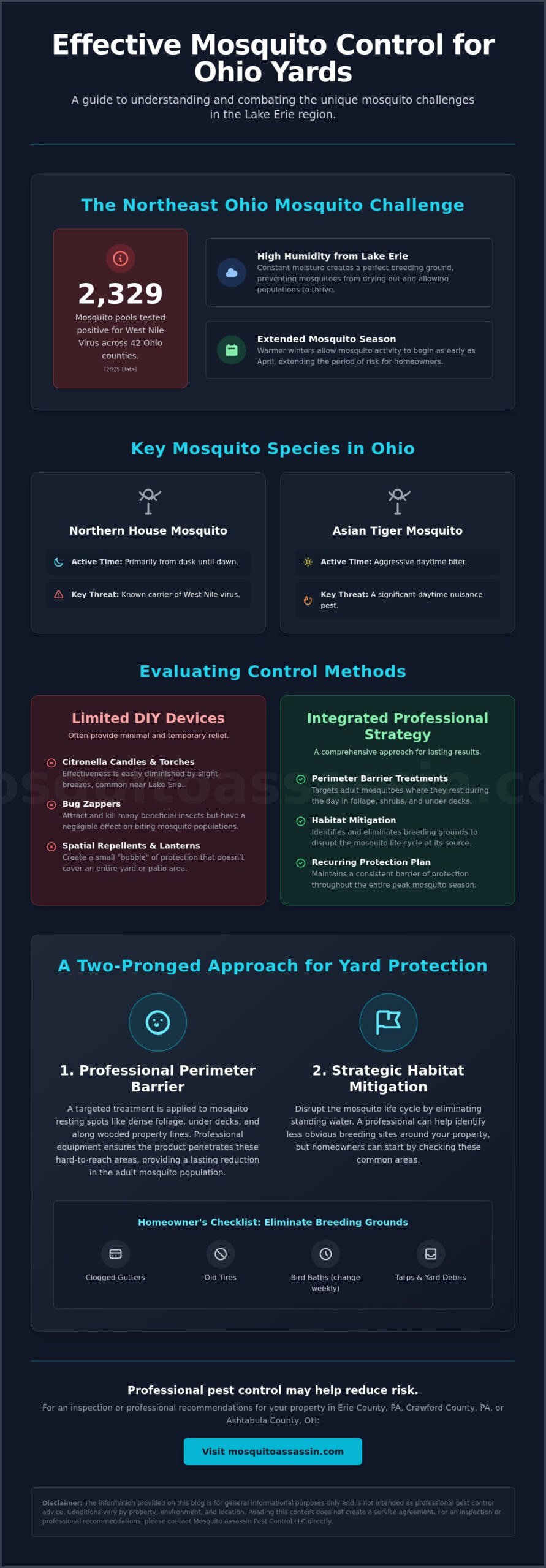
    Creating a Sustainable Inspection Readiness Culture

    Many kitchen managers fall into the trap of “crisis cleaning” the moment they hear an inspector is in the neighborhood. This reactive approach is exhausting and frequently leads to overlooked details that result in priority violations. Learning how to pass a restaurant health inspection is actually about shifting your mindset from a single event to a daily operational standard. When food safety becomes a core part of your team’s identity, compliance becomes an automatic byproduct of your workflow rather than a source of panic. This cultural shift requires clear expectations and a commitment to standardized training across all shifts in your Erie, Crawford, or Ashtabula County establishment.

    Empowerment is the foundation of this culture. Instead of micromanaging every task, give your staff ownership over their specific stations. When a line cook understands that they are the primary guardian of their station’s temperature logs and sanitation buckets, they take more pride in the results. Ongoing education is also vital. Encouraging or requiring food safety certifications like ServSafe ensures that every team member understands the scientific reasons behind the rules. This technical knowledge helps staff recognize risks, such as cross-contamination or improper storage, before they escalate into significant safety issues.

    The Daily and Weekly Checklist

    Consistency relies on written systems. opening and closing checklists should be non-negotiable for every shift. These lists must include verifying that all food is properly labeled and dated using the First In, First Out (FIFO) method to prevent spoilage. While daily cleaning covers the surfaces, your weekly schedule must address less accessible areas. Vents, grease filters, and floor drains require deep cleaning to prevent the buildup of organic matter that attracts pests and creates fire hazards. If you need support in maintaining a sanitary, compliant environment, commercial pest control can help you identify and manage the environmental factors that inspectors watch for most closely.

    Training for the Unexpected

    Staff should be trained on how to interact professionally with health inspectors from the moment they walk through the door. A professional, calm demeanor demonstrates confidence in your food safety systems. Every team member should know exactly where to find essential documentation, including Safety Data Sheets (SDS), employee health policies, and temperature logs. Conduct a mock inspection once a month to simulate the pressure of a real audit. These simulations allow you to identify weaknesses in your training and correct them in a low stakes environment, ensuring your team is ready for the real thing at any time.

    Disclaimer: The information provided on this blog is for general informational purposes only and is not intended as professional pest control advice. Conditions vary by property, environment, and location. Reading this content does not create a service agreement. For an inspection or professional recommendations, please contact Mosquito Assassin Pest Control LLC directly.
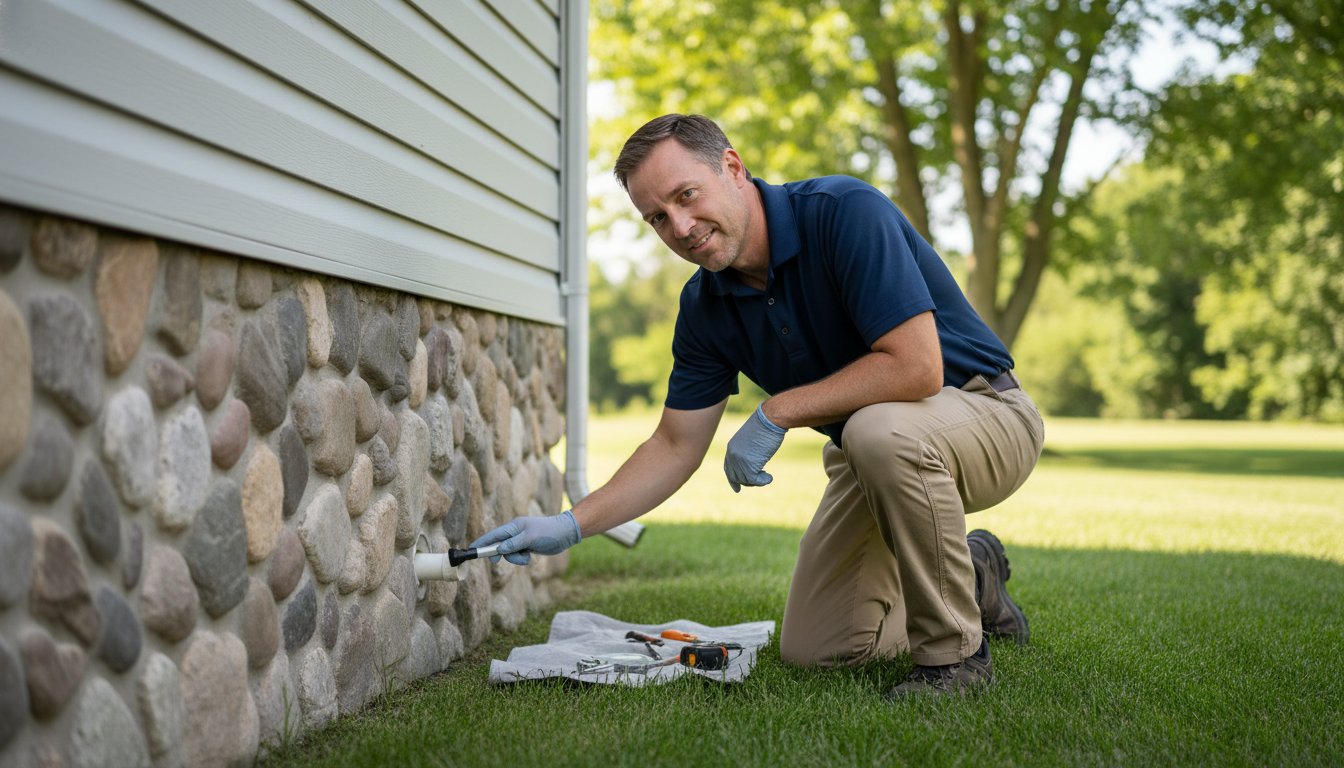
    Partnering with Professionals for Long-Term Compliance

    Achieving a high health score requires more than just internal diligence; it often involves strategic partnerships with experts who understand the scientific and regulatory landscape. Utilizing commercial pest control services provides a layer of protection that internal cleaning alone cannot match. Professionals bring technical proficiency to identify structural deficiencies, such as microscopic entry points or sanitation gaps in hard to reach motor housings. In regions like Erie, Meadville, and Ashtabula, local health inspectors look for evidence of a comprehensive plan rather than reactive measures. A proactive partnership ensures your facility is prepared for scrutiny from the Pennsylvania Department of Agriculture or Ohio health districts at any moment.

    Integrated Pest Management (IPM) is the gold standard for food service environments because it aligns perfectly with health department goals. Unlike basic “spraying” methods often discussed in casual forums, IPM focuses on long term prevention through sanitation, exclusion, and monitoring. This methodology reduces the reliance on chemical applications while maximizing the effectiveness of every intervention. By addressing the root causes of pest attraction, such as moisture in floor drains or grease buildup, professional services help you understand how to pass a restaurant health inspection by maintaining a fundamentally sound environment. This systematic approach transforms pest control from a recurring anxiety into a controlled, documented business process.

    The Role of Documentation in Passing

    Documentation is the bridge between doing the work and proving it to an inspector. Professional service records serve as tangible evidence of your proactive approach to food safety. These logs must show regular monitoring, identified risks, and the corrective actions taken to mitigate them. High standards in professional pest control may help reduce risk by providing the exact paper trail that local health departments require. When an inspector sees a well maintained logbook with current service reports, it signals that the establishment is managed with discipline and professional oversight.

    Selecting a Local Provider

    Choosing a provider with deep roots in Northwest Pennsylvania and Northeast Ohio is a strategic advantage. Different regions face unique pest pressures, and a local expert will be familiar with the specific behaviors of pests common to the Great Lakes area. It’s essential to verify that any partner holds the correct commercial licenses and can provide the detailed reporting necessary for modern health audits. Learning more about local pest management standards can help you select a partner that prioritizes the same community values and safety goals as your own business. A dependable expert will not only treat the property but also educate your staff on maintaining the highest levels of sanitation between visits.

    Disclaimer: The information provided on this blog is for general informational purposes only and is not intended as professional pest control advice. Conditions vary by property, environment, and location. Reading this content does not create a service agreement. For an inspection or professional recommendations, please contact Mosquito Assassin Pest Control LLC directly.
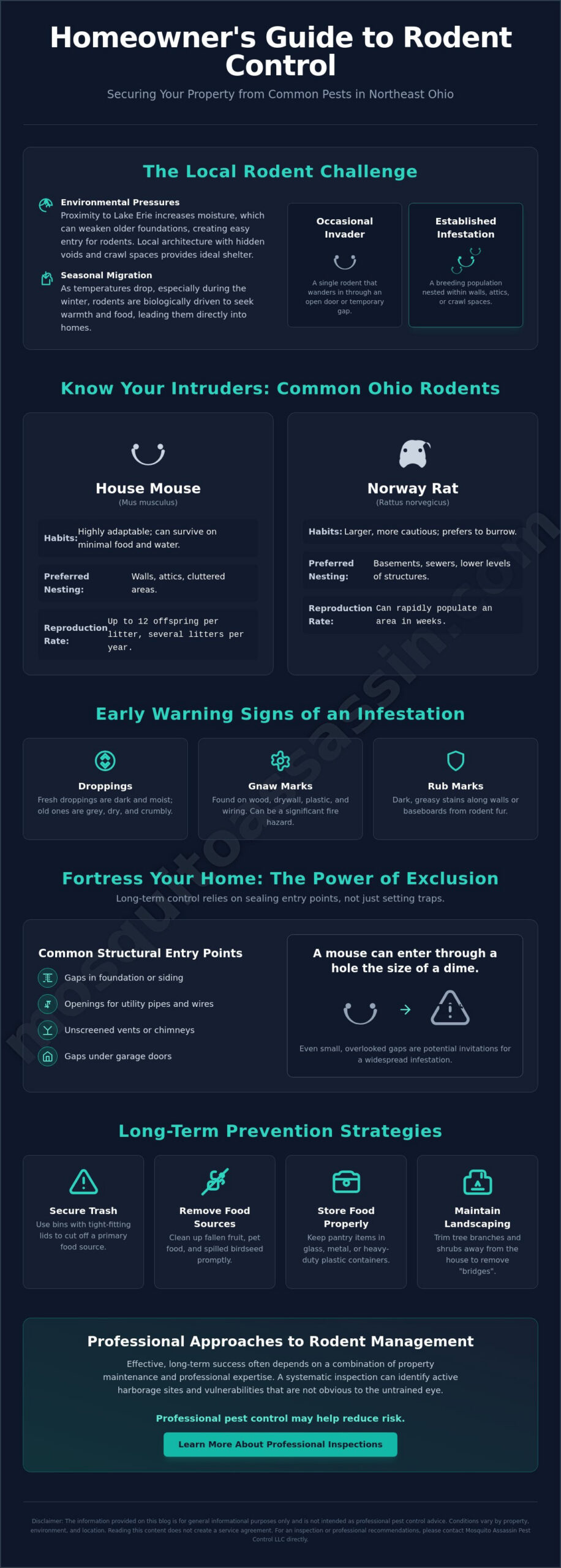
    Securing Your Reputation and Compliance

    Mastering the 2026 FDA Food Code is only half the battle. Long-term success relies on moving away from reactive cleaning and toward a disciplined culture of daily readiness. By focusing on core pillars like precise temperature monitoring and rigorous employee hygiene, you ensure your kitchen meets the highest scientific standards. Understanding how to pass a restaurant health inspection is a continuous process that protects your customers and your business reputation throughout Northwest Pennsylvania and Northeast Ohio.

    Professional support simplifies this journey by addressing structural vulnerabilities and providing the necessary paper trail for health department logs. Licensed and insured in PA and OH, Mosquito Assassin Pest Control LLC offers deep experience with regional commercial compliance standards and provides detailed documentation for every visit. To strengthen your facility’s defenses, consult with a professional regarding your commercial pest management needs. Maintaining a safe, compliant environment is entirely achievable with the right systems and expert guidance in place.

    Disclaimer: The information provided on this blog is for general informational purposes only and is not intended as professional pest control advice. Conditions vary by property, environment, and location. Reading this content does not create a service agreement. For an inspection or professional recommendations, please contact Mosquito Assassin Pest Control LLC directly.

    Frequently Asked Questions

    What is the most common reason for failing a health inspection?

    Priority violations related to time and temperature control are the leading causes of failed audits. When food stays in the Danger Zone for too long, it creates a high risk of foodborne illness. Poor employee handwashing and bare-hand contact with ready-to-eat foods also rank high. Consistent training and daily monitoring of these core pillars are the most effective ways to ensure your establishment remains compliant during an unannounced visit.

    Can a restaurant stay open if it has a pest sighting during an inspection?

    A single sighting of a non-critical pest, like a housefly, usually results in a core violation. However, evidence of a priority pest infestation, such as live cockroaches or rodent droppings, can lead to an immediate suspension of your operating permit. In Erie or Ashtabula County, inspectors prioritize public safety above all else. If an infestation is discovered, the facility must typically close until the problem is resolved and a follow-up inspection is passed.

    How often should a restaurant conduct its own self-inspections?

    Establishments should conduct comprehensive internal self-inspections at least once a month. This practice helps managers identify and correct issues before an official audit occurs. Daily checklists for opening and closing shifts provide the baseline for sanitation, but a deeper monthly review allows for a thorough assessment of equipment maintenance and structural integrity. Learning how to pass a restaurant health inspection requires this level of proactive, disciplined oversight to prevent small issues from becoming critical violations.

    What documents must be readily available for a health inspector?

    Inspectors expect to see several key documents immediately upon arrival. These include current food manager certifications, employee health policies, and daily temperature logs for refrigeration and cooking. You must also provide a detailed pest control logbook containing recent service reports and pesticide application records. Keeping these files organized in a central location demonstrates a professional commitment to safety and allows the inspection to proceed smoothly without unnecessary delays or confusion.

    Is a professional pest control contract required by law for restaurants?

    While specific local laws in Pennsylvania and Ohio may not always mandate a signed contract, they do require every food service facility to remain entirely pest-free. Having a professional commercial pest control plan is the industry standard for proving you have taken the necessary preventive measures. Professional documentation shows the inspector that you are proactive rather than reactive. This level of oversight is often the difference between a minor observation and a critical priority violation.

    What should a manager do if they disagree with an inspector’s findings?

    If you disagree with a finding, the best approach is to discuss the concern professionally during the exit interview. Ask the inspector to clarify the specific section of the food code that applies to the observation. If the issue remains unresolved, you have the right to contact a supervisor at the local health department to request a formal review. Maintaining a respectful and cooperative relationship with your inspector is vital for long-term regulatory success.

    How does the FIFO method help with health inspection compliance?

    The First In, First Out (FIFO) method ensures that older inventory is used before newer shipments, which prevents food from expiring or spoiling on the shelf. This system directly supports compliance with labeling and dating requirements. Inspectors look for clear date markings on all prepared and opened foods to confirm they are discarded within the seven-day safety window. Implementing FIFO as a standardized staff habit significantly reduces the risk of core violations related to food storage.

    Are unannounced inspections legal in Pennsylvania and Ohio?

    Yes, unannounced inspections are the legal standard in Pennsylvania and Ohio. Health departments in Erie, Crawford, and Ashtabula Counties have the authority to enter any licensed food establishment during normal business hours. This allows regulators to observe the kitchen’s true daily operations rather than a staged environment. Being prepared at all times is the only reliable strategy for how to pass a restaurant health inspection and protect the reputation of your establishment.

    Disclaimer: The information provided on this blog is for general informational purposes only and is not intended as professional pest control advice. Conditions vary by property, environment, and location. Reading this content does not create a service agreement. For an inspection or professional recommendations, please contact Mosquito Assassin Pest Control LLC directly.
  • Pest Control Contract for Business: A Comprehensive Guide to Commercial Agreements

    Pest Control Contract for Business: A Comprehensive Guide to Commercial Agreements

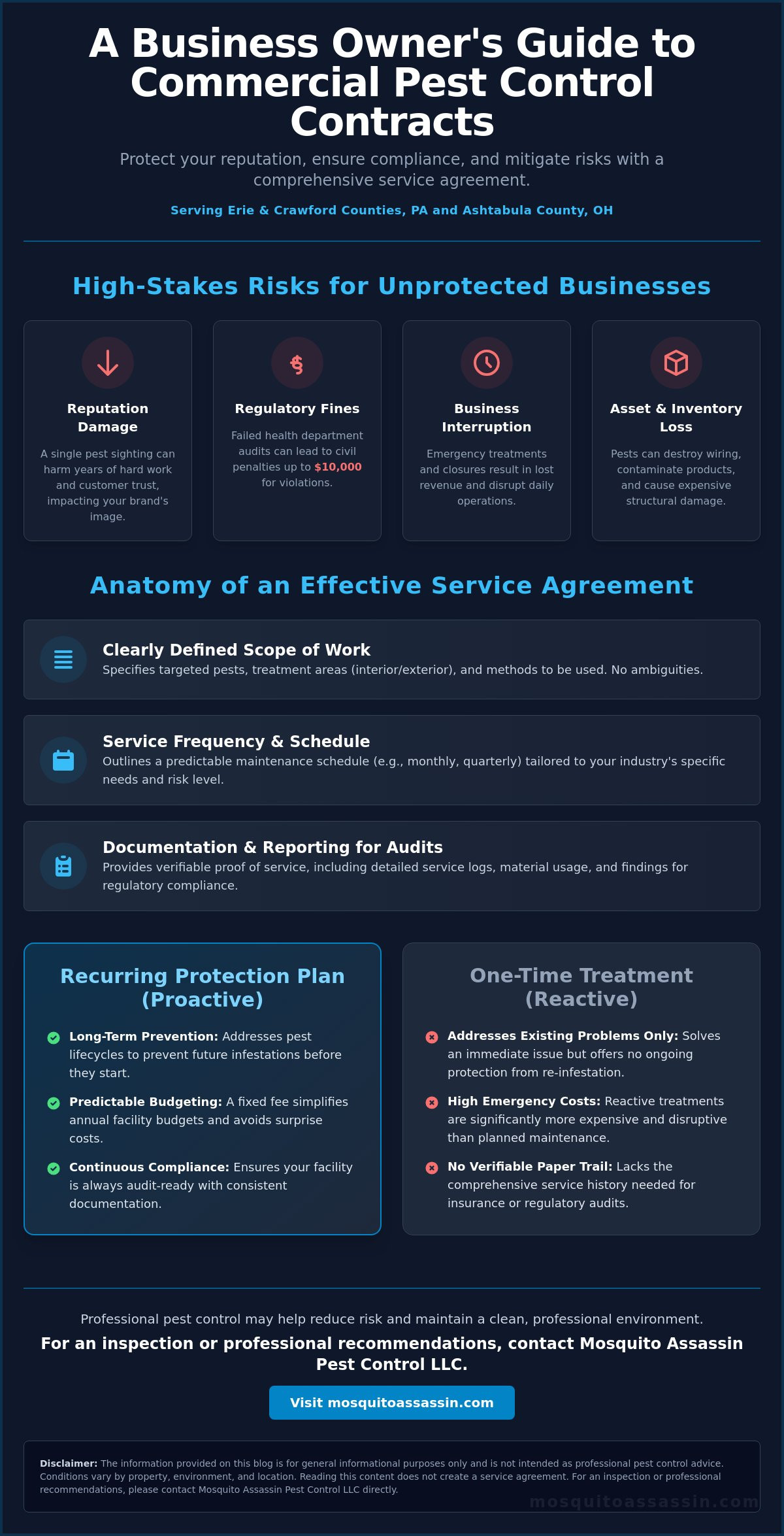
    What if a single health department inspection could jeopardize years of hard work simply because of a missing signature on a service log? For property owners in Erie and Crawford counties in Pennsylvania and Ashtabula County in Ohio, the threat of pest-related reputation damage is a genuine concern that causes significant anxiety. It’s understandable to feel overwhelmed by complex service terms or the fear of a surprise audit, especially when civil penalties for regulatory violations can reach $10,000. Securing a comprehensive pest control contract for business is not just about addressing an immediate infestation; it’s a vital strategy for business continuity and professional protection.

    This guide clarifies the critical elements of a commercial agreement so business owners can move forward with confidence. Readers will learn how to define a clear scope of service, establish a predictable maintenance schedule, and maintain the precise documentation required for state audits. This overview provides a practical roadmap for protecting a professional reputation and ensuring a facility remains compliant and secure. Professional pest control may help reduce risk and maintain a clean, professional environment for employees and customers alike.

    Disclaimer: The information provided on this blog is for general informational purposes only and is not intended as professional pest control advice. Conditions vary by property, environment, and location. Reading this content does not create a service agreement. For an inspection or professional recommendations, please contact Mosquito Assassin Pest Control LLC directly.

    Key Takeaways

    • Understand why a formal pest control contract for business is a necessary continuity tool that differs from standard residential services by addressing high-stakes commercial risks.
    • Identify the essential elements of a service agreement, including a clearly defined scope of work and a treatment frequency tailored to specific industry requirements.
    • Learn why recurring protection plans are more effective than one-time visits by addressing the biological lifecycles of pests and preventing future infestations.
    • Navigate local regulatory requirements in Pennsylvania and Ohio to ensure service providers meet state licensure standards and maintain proper documentation for audits.
    • Discover how to integrate pest management into daily operations through effective communication protocols and proactive facility maintenance.

    Understanding the Role of Pest Control Contracts for Businesses

    A professional pest control contract for business is a formal, legally binding agreement that outlines a strategic approach to managing infestations within a commercial facility. Unlike residential services, which often focus on individual comfort or seasonal issues, a commercial agreement addresses high-stakes protection for entire operations. It defines the specific scope of work, the frequency of service visits, and the precise pests targeted to keep the property safe. Relying on verbal agreements is a significant risk for any modern enterprise. Without a written document, there is no verifiable proof of service for insurance claims or mandatory regulatory inspections.

    Modern facility management frequently utilizes the principles of Integrated Pest Management (IPM) to maintain a sanitary and secure environment. This methodical approach prioritizes long-term prevention over reactive chemical applications. A written contract serves as the foundation for this strategy, providing a clear roadmap for both the provider and the client. This documentation is essential for passing third-party audits and maintaining a positive brand reputation in a competitive marketplace. Clear records show that a business is proactive rather than reactive.

    To better understand the value and structure of these agreements, watch this helpful video:

    Risk Mitigation and Liability Protection

    Protecting physical assets and inventory is a primary function of a commercial agreement. Rodents can destroy expensive wiring or structural components, while insects can contaminate entire batches of product, leading to massive financial losses. Beyond property damage, businesses must mitigate the risk of employee or customer exposure to pest-borne pathogens. A formal pest control contract for business establishes a definitive paper trail. This documentation is critical when dealing with local regulatory bodies in Erie and Crawford counties in Pennsylvania or Ashtabula County in Ohio. If a health department inspector requests proof of preventative measures, a documented service history provides immediate verification of compliance. This reduces the likelihood of facing civil penalties, which can reach up to $10,000 for certain violations.

    Long-Term Cost Predictability

    Emergency pest treatments are notoriously expensive and often disrupt daily operations. A fixed-fee contract allows business owners to avoid these high costs by investing in scheduled maintenance. This approach makes annual facility budgeting much simpler. It’s easier to account for a predictable monthly fee than a sudden, large expense for a massive infestation. The financial impact of a pest-related business closure or a public health violation can be devastating. By maintaining a consistent service schedule, businesses protect their bottom line from the unpredictable costs of neglect. Professional commercial pest control may help reduce risk and ensure that small issues don’t escalate into catastrophic financial burdens. Maintaining structural integrity and sanitation is a shared responsibility that begins with a solid agreement.

    Key Components of a Comprehensive Commercial Service Agreement

    A professional pest control contract for business serves as a definitive blueprint for long-term facility protection. It must be highly specific to be effective. Generalities often lead to gaps in coverage that pests will eventually exploit. A robust agreement clarifies exactly what is being protected, which pests are included, and how often a technician will be on-site. This level of detail ensures that both the business owner and the service provider have a shared understanding of expectations and responsibilities. It’s a foundational document that supports business continuity and operational safety.

    Defining the Scope of Service

    Identifying target pests is the first step in building an effective agreement. Standard contracts typically cover common invaders such as ants and rodents. High-impact pests, including bed bugs or termites, often require specialized addendums because their management involves more intensive methodologies. The contract should also specify the physical boundaries of the property. This includes defining interior treatment zones and exterior perimeters. A key distinction in modern commercial agreements is the shift from purely reactive treatments to proactive exclusion. This involves identifying and sealing potential entry points to prevent infestations before they begin. Professional commercial pest control agreements should clearly outline these preventative measures.

    Service frequency is determined by the specific risks of the industry. A food service establishment might require monthly visits to maintain sanitation standards, while a low-traffic warehouse might find a quarterly schedule sufficient. The agreement must also include provisions for emergency call-backs. If a pest sighting occurs between scheduled maintenance visits, the protocol for a swift response must be clearly defined to ensure the problem is resolved without delay.

    Documentation and Reporting Standards

    Accurate record-keeping is the backbone of regulatory compliance and successful facility management. Every service visit must generate a detailed report or service ticket. Following EPA’s IPM Principles, these reports should go beyond simply listing chemical applications. They should highlight structural deficiencies, such as gaps under loading dock doors or moisture issues, that could lead to future infestations. Addressing these root causes is essential for maintaining a pest-free environment.

    Inspectors in Erie and Crawford counties in Pennsylvania, as well as Ashtabula County in Ohio, look for consistency and detail in these service logs. Digital reporting systems allow facility managers to access this history instantly during an unannounced audit. This transparency builds trust with local authorities and provides a clear paper trail for third-party auditors. Reviewing the specifics of a pest control contract for business can help clarify these documentation requirements and ensure the facility remains in good standing. Establishing clear communication between the provider and staff is the final piece of a successful management plan.

    Disclaimer: The information provided on this blog is for general informational purposes only and is not intended as professional pest control advice. Conditions vary by property, environment, and location. Reading this content does not create a service agreement. For an inspection or professional recommendations, please contact Mosquito Assassin Pest Control LLC directly.

    Pest Control Contract for Business: A Comprehensive Guide to Commercial Agreements

    Comparing One-Time Treatments and Recurring Protection Plans

    Business owners often face a choice between requesting a one-time service to resolve an immediate problem or investing in a long-term strategy. While a single visit might seem cost-effective, it often fails to address the root cause of an infestation. Pests are biological entities with complex lifecycles. A single application may eliminate adult insects, but it rarely accounts for eggs that hatch days or weeks later. Without a follow-up visit, the population quickly rebounds, leading to a cycle of recurring issues. A formal pest control contract for business shifts the focus from reactive “firefighting” to proactive prevention through the principles of Integrated Pest Management (IPM).

    The annual cost of reactive services often exceeds the price of a maintenance plan. Emergency visits are frequently more intensive and can lead to higher chemical usage because the population has already reached a critical level. Proactive services, on the other hand, allow for consistent monitoring and smaller, targeted interventions. This approach makes annual facility budgeting more predictable and prevents the sudden, large expenses associated with massive infestations or health department fines. When researching providers, resources like Choosing a Qualified Pest Management Company from Penn State Extension can help business owners understand the professional standards required for effective long-term care.

    The Limitations of Reactive Treatments

    Relying on emergency-only service creates significant risks for a company’s reputation. If a customer or health inspector spots a pest, the damage to the brand is already done. Reactive treatments usually happen after a problem is visible, meaning structural gaps or sanitation issues have already been ignored for too long. These gaps provide a constant invitation for new pests to enter. Furthermore, emergency treatments can disrupt daily operations, potentially requiring temporary closures or staff displacement. A comprehensive pest control contract for business ensures that these vulnerabilities are identified and sealed before they become public liabilities.

    Advantages of Year-Round Protection

    Continuous protection is essential for managing seasonal threats in Erie and Crawford counties in Pennsylvania and Ashtabula County in Ohio. Pests don’t disappear in the winter; they simply change their behavior, often seeking warmth inside commercial structures. Year-round plans maintain a constant barrier against invaders like rodents in the colder months and mosquitoes or ticks during the summer. Continuous monitoring allows technicians to catch rodent activity early, often before the animals can damage inventory or wiring. Understanding the core General Pest Control principles for businesses helps managers create a safer environment for both employees and clients. Professional pest control may help reduce risk by providing a steady, documented defense against local pest pressures.

    Disclaimer: The information provided on this blog is for general informational purposes only and is not intended as professional pest control advice. Conditions vary by property, environment, and location. Reading this content does not create a service agreement. For an inspection or professional recommendations, please contact Mosquito Assassin Pest Control LLC directly.

    Evaluating Professional Standards and Local Compliance in PA and OH

    Selecting a provider for a pest control contract for business is a decision that impacts legal standing and operational safety. In the Great Lakes region, regulatory requirements are specific and non-negotiable. A provider must demonstrate a deep understanding of both Pennsylvania and Ohio state laws to ensure the facility remains compliant during surprise inspections. Working with a local entity ensures that the technicians are not just distant contractors; they are neighbors who understand the specific environmental challenges of the area. This local integration is essential for maintaining a high standard of service that aligns with community values and regional expectations.

    Professional standards are defined by rigorous adherence to safety protocols and chemical management. A dependable provider prioritizes the well-being of staff and customers by following established guidelines for every application. Utilizing commercial pest control services that emphasize documented compliance helps businesses avoid the severe consequences of unlicensed activity. In Pennsylvania and Ohio, the stakes are high. It’s a matter of protecting the brand from legal and financial ruin while ensuring a pest-free environment.

    Licensing and Regulatory Requirements

    State-specific licensure is the first thing a business owner should verify. In Pennsylvania, a pesticide business must maintain comprehensive general liability insurance of at least $100,000 for bodily injury and $100,000 for property damage per occurrence. Ohio regulations are equally strict, requiring a $35 fee for business and applicator licenses. Failure to follow these mandates is costly. Unlicensed commercial pesticide application can result in civil penalties of up to $10,000 per violation. A formal pest control contract for business should clearly state that the provider meets all state requirements and will provide the necessary documentation for health department reporting. This paper trail is the best defense during a regulatory audit.

    Regional Expertise and Seasonal Pests

    Local climate factors, particularly the lake effect weather patterns near Lake Erie, significantly influence pest behavior. The high humidity and rapid temperature shifts in Meadville or Ashtabula create unique breeding conditions for specific threats. Seasonal pests like Carpenter Bees and ticks require a provider who knows exactly when and where they emerge. A company with local roots understands how a wet spring in Crawford County might lead to increased rodent pressure in the fall. This geographic specialization allows for more precise interventions compared to a generic, national approach. Professional pest control may help reduce risk by anticipating these regional shifts before they impact the facility. For a detailed assessment of your property’s specific needs, contact a local professional for an inspection.

    Disclaimer: The information provided on this blog is for general informational purposes only and is not intended as professional pest control advice. Conditions vary by property, environment, and location. Reading this content does not create a service agreement. For an inspection or professional recommendations, please contact Mosquito Assassin Pest Control LLC directly.

    Integrating Pest Management into Business Operations

    A successful pest control contract for business is a collaborative partnership rather than a standalone service. While a professional technician provides the expertise and intervention, the daily operations of a facility play a decisive role in the long-term effectiveness of the program. Establishing clear communication protocols is the first step. Designating a specific staff member as the primary point of contact ensures that pest sightings are reported immediately and that service recommendations are addressed without delay. This proactive exchange of information prevents minor issues from escalating into major operational disruptions.

    Preparing a facility for the initial service is critical for a thorough assessment. Business owners should ensure that technicians have unobstructed access to utility rooms, loading docks, and storage areas. Providing a history of previous pest activity and identifying known structural vulnerabilities helps the provider tailor the approach to the specific needs of the building. This initial groundwork sets the stage for a methodical and disciplined operational strategy that protects the business reputation and ensures safety for everyone on-site.

    Staff Education and Sanitation

    Employees are often the first to notice early signs of pest activity. Training staff to identify and report evidence, such as droppings or structural gnawing, creates an internal monitoring network that supports professional efforts. Proper waste management is equally vital. Ensuring that outdoor bins are sealed and that indoor trash is removed daily eliminates primary attractants. Food storage areas must be kept clean, with inventory stored in airtight containers and kept off the floor whenever possible. Professional pest control may help reduce risk when combined with rigorous sanitation practices and consistent facility maintenance. These shared responsibilities form the backbone of a resilient defense against local infestations in Erie, Crawford, and Ashtabula counties.

    Long-Term Partnership and Evaluation

    The needs of a business can change rapidly. An annual review of pest activity logs and treatment efficacy is necessary to ensure the pest control contract for business remains aligned with current operations. If a facility expands, changes its inventory types, or experiences a shift in local environmental pressures, the contract should be updated to reflect these new realities. A dependable provider acts as a consultant, helping managers understand how structural changes might impact pest behavior. Maintaining this long-term perspective ensures that the facility remains compliant and secure year after year. For those seeking a reliable maintenance schedule, professional pest control may help reduce risk for your facility.

    Disclaimer: The information provided on this blog is for general informational purposes only and is not intended as professional pest control advice. Conditions vary by property, environment, and location. Reading this content does not create a service agreement. For an inspection or professional recommendations, please contact Mosquito Assassin Pest Control LLC directly.

    Securing Your Professional Future with Strategic Pest Management

    Establishing a formal pest control contract for business is a decisive step toward long-term operational security. It moves a facility from a state of constant anxiety over potential health department violations to a state of documented compliance and predictable maintenance. By prioritizing specialized commercial protection plans over reactive treatments, property owners in Erie, Crawford, and Ashtabula counties ensure their reputation remains intact regardless of seasonal pest pressures. Licensed and insured professionals bring the methodical approach necessary to identify structural vulnerabilities before they lead to costly infestations. Integrating these strategies into daily operations creates a resilient environment where employees and customers feel secure.

    Taking action now prevents small issues from becoming public liabilities. For those looking to establish a reliable defense, professional pest control may help reduce risk for your business. Maintaining a safe and sanitary environment is a shared goal that pays dividends in customer trust and business longevity. Strategic prevention is always more effective than emergency intervention.

    Disclaimer: The information provided on this blog is for general informational purposes only and is not intended as professional pest control advice. Conditions vary by property, environment, and location. Reading this content does not create a service agreement. For an inspection or professional recommendations, please contact Mosquito Assassin Pest Control LLC directly.

    Frequently Asked Questions

    What is the typical duration of a commercial pest control contract?

    Commercial agreements typically last for one year to provide consistent protection through all four seasons. This duration allows technicians to address the changing biological pressures of pests as the weather shifts in the Great Lakes region. Most contracts include an auto-renewal clause. However, business owners should review the terms annually to ensure the service still meets their facility’s evolving needs and operational changes.

    Can a business cancel a pest control agreement if service is unsatisfactory?

    Most agreements include a cancellation clause that allows termination if service standards are not met. Typically, this requires a formal written notice period, often ranging from 30 to 60 days. It’s essential to review these terms before signing a pest control contract for business to understand the specific requirements for ending the partnership and any potential associated notice fees.

    Are between-service visits usually included in a professional contract?

    Comprehensive commercial plans often include emergency call-backs or between-service visits at no additional cost. These visits address sudden pest sightings that occur between scheduled maintenance appointments. Including these provisions ensures that a facility remains protected and that any immediate threats to sanitation are resolved quickly by a professional technician before they can impact customer perceptions or health audits.

    Does a standard contract cover all types of pests (like termites or bed bugs)?

    Standard contracts usually focus on common pests like ants, spiders, and rodents that frequent commercial properties. Specialized pests, such as termites or bed bugs, typically require separate inspections and service addendums due to the intensive nature of their treatment. Business owners should verify exactly which pests are covered in their initial scope of work to avoid gaps in their facility’s protection.

    How often should a professional pest control contract be reviewed or updated?

    A professional agreement should be reviewed at least once every twelve months to ensure it remains effective. It’s also wise to update the contract whenever significant changes occur, such as building expansions, changes in inventory types, or modifications to food handling areas. Regular reviews ensure the service scope remains adequate for the current operational risks and structural condition of the facility.

    What kind of documentation should a business expect after each service visit?

    Facility managers should receive a detailed service report after every visit from their provider. This documentation typically includes the date of service, specific areas inspected, pests identified, and any structural recommendations for prevention. These records are vital for maintaining compliance with health department standards in Erie and Crawford counties or Ashtabula County and serve as proof of proactive management.

    Is professional pest control safe for businesses with food handling requirements?

    Professional treatments are safe for food handling environments when following Integrated Pest Management (IPM) principles. Technicians prioritize non-chemical methods, such as exclusion and sanitation, to manage pests. Any necessary applications are performed according to strict EPA guidelines to ensure the safety of employees and customers while maintaining a sanitary workspace that meets all local health department requirements.

    How do local PA and OH regulations affect commercial pest control agreements?

    State regulations in Pennsylvania and Ohio mandate specific licensing and insurance requirements for all commercial providers. Pennsylvania requires businesses to carry liability insurance for bodily injury and property damage per occurrence. Adhering to these local mandates in a pest control contract for business is critical, as unlicensed pesticide application can lead to civil penalties reaching up to $10,000 per violation in these jurisdictions.

    Disclaimer: The information provided on this blog is for general informational purposes only and is not intended as professional pest control advice. Conditions vary by property, environment, and location. Reading this content does not create a service agreement. For an inspection or professional recommendations, please contact Mosquito Assassin Pest Control LLC directly.

  • Pantry Pest Identification: A Homeowner Guide to Stored Product Insects

    Pantry Pest Identification: A Homeowner Guide to Stored Product Insects

    What if the insects in your flour didn’t crawl in from the backyard, but actually arrived inside your grocery bags? Finding tiny beetles or moths in your dry goods is incredibly frustrating, often making a spotless kitchen feel “dirty” and causing immediate anxiety about the rest of your home. It’s a common problem for homeowners in Erie and Crawford Counties in Pennsylvania and Ashtabula County in Ohio, but it doesn’t mean your cleaning habits are to blame. Effective pantry pest identification is the first step toward reclaiming your kitchen and stopping the waste of expensive groceries.

    You’re not alone in feeling overwhelmed by these persistent intruders. This guide will help you accurately identify the specific pests in your cupboards while providing a practical plan to clean and secure your food supply. You’ll learn the difference between common species like Indianmeal moths and sawtoothed grain beetles, discover how to prevent future infestations, and understand when the situation requires professional intervention to protect your property. By the end of this article, you’ll have the technical knowledge and a clear path forward to ensure your pantry remains a safe, insect-free zone.

    Disclaimer: The information provided on this blog is for general informational purposes only and is not intended as professional pest control advice. Conditions vary by property, environment, and location. Reading this content does not create a service agreement. For an inspection or professional recommendations, please contact Mosquito Assassin Pest Control LLC directly.

    Key Takeaways

    • Learn why pantry infestations are common in residential kitchens and why they are rarely a reflection of your personal cleaning standards.
    • Master pantry pest identification by distinguishing between common invaders like the Indianmeal moth and various stored product beetles.
    • Discover how to spot the subtle signs of an active infestation, such as silk webbing in dry goods or tiny holes in cardboard packaging.
    • Implement practical prevention strategies including the use of airtight glass or metal containers and the “First In, First Out” food rotation method.
    • Understand when a deep clean isn’t enough and how professional pest control can address eggs hidden in structural cracks to prevent a recurrence.

    Understanding Pantry Pests and Their Impact on the Home

    Stored product insects, commonly known as pantry pests, are opportunistic creatures that thrive in environments where food is plentiful and undisturbed. Discovering these insects in your kitchen is often a source of significant stress, leading many to worry that their home is “dirty” or poorly maintained. However, an infestation rarely reflects your cleaning habits. Most of these pests enter the home as hitchhikers inside sealed food packages from grocery stores, warehouses, or processing plants. Once inside, they can quickly spread from one container to another, making early pantry pest identification vital for protecting your household resources.

    The impact of these insects goes beyond the simple “gross factor” of seeing a bug in your cereal. They contaminate food supplies with droppings, cast skins, and pheromone secretions that can alter the taste and smell of dry goods. Some species, like the Indianmeal moth, produce extensive silken webbing that clumps food particles together. A more serious concern involves the warehouse beetle; its larvae possess tiny, stiff hairs called setae. If these hairs are ingested via contaminated flour or grain, they can cause irritation in the human digestive tract or even trigger allergic reactions in sensitive individuals.

    To better understand this concept, watch this helpful video:

    Why pantry pests are a common concern in PA and OH

    Regional environmental factors play a large role in how these pests behave in our local area. In Erie and Crawford Counties in Pennsylvania, along with Ashtabula County in Ohio, high humidity levels during the summer months can significantly accelerate the life cycles of stored product insects. Warm, moist air allows eggs to hatch faster and larvae to develop more rapidly. While outdoor pests might disappear when the temperature drops, our heated homes provide a perfect sanctuary during the winter. This internal climate control keeps pantry pests active year-round, allowing a small population brought in during a holiday grocery run to grow into a full-scale infestation by mid-winter.

    Common foods at risk in the kitchen

    Virtually any dry organic matter can serve as a food source for these insects. Standard kitchen staples like flour, cereal, pasta, and crackers are the most frequent targets. However, pantry pest identification efforts should also extend to less obvious items. Dry pet food and birdseed are high-protein sources that frequently harbor beetle larvae. Many species are capable of chewing through thin plastic film and cardboard packaging to reach a food source. Homeowners should also inspect “forgotten” items, such as ornamental Indian corn, dried flower arrangements, or even bean bags and heat packs filled with grain, as these can serve as hidden breeding grounds for months before the insects move into the main pantry.

    Disclaimer: The information provided on this blog is for general informational purposes only and is not intended as professional pest control advice. Conditions vary by property, environment, and location. Reading this content does not create a service agreement. For an inspection or professional recommendations, please contact Mosquito Assassin Pest Control LLC directly.

    Identifying Common Stored Product Pests in the Northeast

    Proper pantry pest identification requires looking past the “little brown bug” label to understand the specific biology of the intruder. In the Northeast, specifically across the Lake Erie region, homeowners typically encounter two distinct groups: moths and beetles. These are further categorized by how they interact with food. Internal feeders, such as weevils, spend their larval stage inside a single grain or seed. External feeders, which are more common in Pennsylvania and Ohio kitchens, feed on the outside of processed goods like flour, cornmeal, or processed cereals.

    It’s the larvae, not the adults, that do the most damage. These small, worm-like creatures can appear white, pinkish, or even greenish depending on what they’ve been eating. While the adults are often the first sign of trouble, they usually don’t feed at all; their only job is to reproduce and find new food sources for their offspring. If you’re struggling to tell these species apart, local experts in the Tri-State area can provide clarity on what is nesting in your kitchen.

    Indian meal moths: the most common kitchen flyer

    The Indianmeal moth is the primary flying threat in our region. Adults are easily recognized by their wings, which are grayish-white near the body but transition into a striking reddish-brown or copper color at the tips. At night, they exhibit erratic flight patterns around kitchen lights or television screens. According to the University of California IPM, the most telling sign of their presence isn’t the moth itself, but the silken webbing the larvae spin throughout a bag of flour or cereal. This webbing causes the food to clump together and is a definitive marker of an active infestation.

    Pantry beetles: sawtoothed, flour, and drugstore varieties

    Beetles are more diverse and often harder to see. The sawtoothed grain beetle is named for the six saw-like teeth on its thorax; it has a very flat body that allows it to crawl into seemingly sealed boxes. Flour beetles are slightly larger and reddish-brown, often found in the bottom of bags where fine dust collects. Drugstore beetles are unique because they can chew through tough materials, including aluminum foil and thick plastic, to reach spices or even prescription medications. Most of these beetles are only 2 to 3 millimeters long (roughly the thickness of a nickel), making them easy to miss during a quick glance. Because these pests are so small and hide in structural cracks, professional pest control may help reduce risk of a recurring problem.

    Disclaimer: The information provided on this blog is for general informational purposes only and is not intended as professional pest control advice. Conditions vary by property, environment, and location. Reading this content does not create a service agreement. For an inspection or professional recommendations, please contact Mosquito Assassin Pest Control LLC directly.

    Pantry Pest Identification: A Homeowner Guide to Stored Product Insects

    How to Spot an Active Infestation Before It Spreads

    Early detection is the most effective way to prevent a minor nuisance from becoming a full-scale kitchen crisis. While seeing an adult insect is a clear sign, the most damaging evidence is often hidden inside your food containers. One of the most reliable methods for pantry pest identification is looking for “clumping” in fine-grained products like flour, cornmeal, or cake mixes. This occurs because larvae spin silken threads as they feed, which binds the food particles together into small, sticky masses. If your flour looks lumpy or has “strings” attached to the side of the bag, it’s likely contaminated.

    You should also inspect the exterior of your packaging for structural damage. Many beetles are capable of chewing through paper, cardboard, and even thin plastic films. Look for tiny, pinhead-sized holes that look like they were made with a needle. These exit or entry points are a definitive sign that Pantry Pests have breached the container. You might also notice a fine, dust-like substance at the bottom of your pantry shelves. This is known as “frass,” a combination of insect excrement and chewed food debris that indicates an active feeding site.

    Visual signs in food packaging

    To confirm your suspicions, don’t just peek into the top of the bag. Pour the dry goods into a clear glass bowl and sift through them with a spoon. This makes it easier to spot small, cream-colored larvae or pupae cases that often hide in the dark folds of the packaging. In some cases, a large population of beetles can produce a distinct “off” or slightly minty odor that wasn’t there before. If a recently opened bag of grain smells sour or musty, it’s best to discard it immediately rather than risking a wider spread.

    Behavioral clues: where pests hide

    Success in pantry pest identification also depends on knowing where these insects retreat when they aren’t feeding. Check the cracks and crevices of your shelving, especially in the corners where spilled flour or sugar tends to accumulate. Larvae often crawl away from their food source to pupate; if you see small worms on your kitchen walls or near the ceiling, the source is nearby. In our region, it’s particularly important to check pet food storage in mudrooms or garages. Large bags of kibble or birdseed are prime breeding grounds that can sustain a population for months before the insects migrate into your main kitchen cabinets. If you find pests in these secondary areas, professional pest control may help reduce risk of the infestation reaching your primary food supply.

    Disclaimer: The information provided on this blog is for general informational purposes only and is not intended as professional pest control advice. Conditions vary by property, environment, and location. Reading this content does not create a service agreement. For an inspection or professional recommendations, please contact Mosquito Assassin Pest Control LLC directly.

    Practical Prevention Strategies for a Pest-Free Kitchen

    Moving from pantry pest identification to active prevention is the most effective way to secure your kitchen and stop the cycle of food waste. Most infestations start at the grocery store, but they persist because of how dry goods are stored at home. Thin plastic bags and original cardboard boxes are essentially open doors for beetles and moths. Instead, transfer all dry goods, including flour, grains, and pet food, into airtight containers made of glass, metal, or heavy plastic. These materials are impenetrable to chewing mouthparts and prevent odors from escaping and attracting new intruders.

    Implementing a “First In, First Out” (FIFO) rotation ensures that older products aren’t pushed to the back of the shelf where they can become a breeding ground. Every six months, perform a deep clean of your storage areas. Use a vacuum with a hose attachment to remove fine dust and spilled flour from the corners of shelves, as even a small amount of debris can sustain a larvae population. While these steps protect your food, general pest control provides a broader shield for your property, preventing other seasonal invaders from entering your living spaces.

    Proper food storage techniques

    Many homeowners don’t realize that eggs may already be present in grain products when they leave the store. To break the life cycle before it begins, place new bags of flour, rice, or cornmeal in the freezer for 72 hours. This cold treatment kills potential eggs and larvae without affecting the quality of the food. Additionally, manage spills immediately. A small dusting of cornmeal on a shelf might seem harmless, but it acts as a beacon for opportunistic insects. Wipe down surfaces with soap and water regularly, ensuring that the cracks between shelves are completely clear of organic matter.

    Inspection routines for new groceries

    Prevention starts in the grocery aisle. Before placing an item in your cart, check the packaging for any signs of damage, such as small punctures, frayed corners, or taped-up leaks. Be especially cautious with bulk bin items; while cost-effective, these open containers are more susceptible to contamination than factory-sealed goods. In areas like Ashtabula, Ohio, where seasonal temperature shifts drive pests indoors looking for warmth and food, sanitation is your best defense. Consistent pantry pest identification during your weekly grocery restock can stop an infestation before it ever enters your home. If you’ve followed these steps and still notice recurring issues, professional pest management can help identify structural vulnerabilities in your kitchen.

    Disclaimer: The information provided on this blog is for general informational purposes only and is not intended as professional pest control advice. Conditions vary by property, environment, and location. Reading this content does not create a service agreement. For an inspection or professional recommendations, please contact Mosquito Assassin Pest Control LLC directly.

    When Professional Management is Necessary for Stored Product Pests

    Standard cleaning often falls short of a total resolution. Many property owners assume that discarding a single infested box of crackers ends the problem, but insects are rarely confined to one package. Effective pantry pest identification reveals that these species are highly mobile during their larval and adult stages. While you might clear the shelves, microscopic eggs often remain tucked away in structural crevices, shelf peg holes, or behind baseboards. Professional pest control may help reduce risk of these hidden populations rebounding and causing a secondary wave of contamination weeks after the initial cleanup.

    Ongoing management is typically more effective than reactive, one-time DIY attempts because it addresses the changing seasonal pressures that drive insect behavior. While a homeowner can manage surface sanitation, a professional approach targets the biology of the pest to break the reproductive cycle. This is especially important for insects like the warehouse beetle or various flour beetles that can survive on microscopic amounts of organic debris for months. If you find yourself repeatedly throwing away groceries despite your best efforts, it’s a clear signal that the infestation has moved beyond the food and into the structure of your kitchen.

    The limitations of DIY cleaning

    Household vacuums and surface wipes are helpful for daily maintenance, but they lack the technical reach required to eliminate an established population. Microscopic eggs can survive in the deepest cracks of a kitchen cabinet where standard suction cannot reach. Additionally, DIY attempts frequently overlook secondary infestation sources. In regional homes across Pennsylvania and Ohio, it’s common to find pests breeding in a forgotten bag of birdseed in the garage or bulk pet food stored in a mudroom. These areas act as reservoirs, allowing insects to migrate back into the kitchen even after a thorough cleaning. Utilizing professional pest control services ensures a more comprehensive inspection that accounts for these hidden bypasses.

    Year-round protection in Pennsylvania and Ohio

    The climate in Erie and Crawford Counties, along with Ashtabula County, creates unique challenges for food storage. High humidity in the summer accelerates pest development, while the transition to heated interiors in the winter keeps them active when they would otherwise go dormant. A licensed professional can identify structural gaps, such as unsealed utility lines or gaps in cabinetry, that allow pests to move between rooms. For homeowners dealing with persistent issues, visiting the Mosquito Assassin location page can help find regional support tailored to these specific environmental conditions. Seeking a professional inspection is the most reliable way to secure your home against the long-term threat of stored product insects and ensure your food supply remains protected.

    Disclaimer: The information provided on this blog is for general informational purposes only and is not intended as professional pest control advice. Conditions vary by property, environment, and location. Reading this content does not create a service agreement. For an inspection or professional recommendations, please contact Mosquito Assassin Pest Control LLC directly.

    Securing Your Kitchen Against Stored Product Insects

    Managing a kitchen infestation requires a combination of vigilance and systematic action. By mastering pantry pest identification, you can distinguish between a simple grocery hitchhiker and a deep-seated structural issue. Remember that transferring dry goods to airtight containers and maintaining a strict cleaning schedule are your strongest tools for long-term prevention. While these proactive steps stop many problems before they start, some infestations require the specialized tools and expertise of a licensed professional to fully resolve.

    Licensed pest control professionals provide the technical expertise needed to identify hidden breeding sites and establish year-round protection for homes throughout Erie, Crawford, and Ashtabula Counties. If you’re struggling with persistent insects that keep returning despite your best efforts, professional pest control may help reduce risk to your food supply. For a professional inspection or recommendations, please contact Mosquito Assassin Pest Control LLC directly. Taking decisive action today ensures your home remains a safe and secure environment for your family.

    Disclaimer: The information provided on this blog is for general informational purposes only and is not intended as professional pest control advice. Conditions vary by property, environment, and location. Reading this content does not create a service agreement. For an inspection or professional recommendations, please contact Mosquito Assassin Pest Control LLC directly.

    Frequently Asked Questions

    What are the most common pantry pests in Pennsylvania?

    The Indianmeal moth and several species of beetles, such as the sawtoothed grain beetle and flour beetle, are the most frequent invaders in Pennsylvania and Ohio. These insects thrive in the humid summers of Erie and Crawford Counties. They are often found in flour, cereal, and dry pet food. If you see small moths flying in a zigzag pattern or tiny brown beetles in your grains, you likely have an infestation.

    How do I get rid of bugs in my pantry without using chemicals?

    Eliminating these pests without chemicals involves rigorous sanitation and the total removal of all contaminated food sources. Start by inspecting every package in your pantry and discarding anything with signs of activity. Vacuum the shelves, focusing on the corners and peg holes where eggs often hide. Wipe down all surfaces with warm, soapy water. This physical removal is the most effective way to disrupt their life cycle and protect your home.

    Are pantry pests harmful to my health if I accidentally eat them?

    Accidentally ingesting pantry pests is generally not considered a medical emergency, though it is certainly unpleasant. Most species don’t carry diseases that affect humans. However, the larvae of the warehouse beetle have tiny hairs called setae that can cause digestive irritation or allergic reactions in some people. While the health risk is low, the presence of webbing and droppings makes the food unsanitary and it should always be discarded immediately.

    Can pantry pests eat through plastic bags and sealed containers?

    Many stored product insects can easily chew through thin plastic bags, wax paper, and cardboard boxes. Drugstore beetles and warehouse beetles have strong mouthparts specifically designed to breach packaging. To ensure your food is safe, transfer all dry goods into airtight containers made of glass, metal, or heavy-duty plastic with secure seals. These materials provide a physical barrier that most common kitchen pests simply cannot penetrate, ensuring your food stays protected.

    Where do pantry pests come from if my house is clean?

    A clean home doesn’t prevent an infestation because these insects typically enter your kitchen inside infested grocery packages. Pantry pest identification often reveals that the problem began at a processing plant or warehouse before the food even reached the store. Even the most spotless kitchens in Ashtabula County can face this issue. Once a single infested bag of flour is brought inside, the insects can quickly spread to other nearby items.

    How do you know if you have a pantry pest infestation versus just a stray bug?

    A stray bug is usually a solitary find, whereas an infestation is marked by multiple insects, webbing, or larvae in a concentrated area. Look for silken threads that cause flour to clump together or tiny, pinhead-sized holes in packaging. If you consistently see moths flying near your ceiling or find small, worm-like larvae crawling on your walls, you are likely dealing with an active population rather than an isolated incident.

    Do pantry pests spread to other parts of the house like bedrooms?

    Pantry pests generally remain near their primary food sources, but they can occasionally be found in other rooms. Larvae often crawl away from food to find a dark, quiet place to pupate, which might include the tracks of sliding doors or the corners of a nearby dining room. While they won’t infest your bedding like bed bugs, they can survive in decorative items like dried flower arrangements or bean-filled heating pads.

    How long does it take to get rid of a pantry pest infestation completely?

    Completing the eradication process can take anywhere from a few weeks to several months depending on the species and the extent of the spread. You must break the entire life cycle, which includes eggs that may hatch after your initial cleaning. Consistent monitoring and proper food storage are essential during this time. If the problem persists after several weeks of thorough sanitation, professional pest control may help reduce risk of recurrence.

    Disclaimer: The information provided on this blog is for general informational purposes only and is not intended as professional pest control advice. Conditions vary by property, environment, and location. Reading this content does not create a service agreement. For an inspection or professional recommendations, please contact Mosquito Assassin Pest Control LLC directly.

  • Signs of Termites in Basement: A Homeowner’s Identification Guide

    Signs of Termites in Basement: A Homeowner’s Identification Guide

    With termites causing an estimated $5 billion to $6.8 billion in property damage across the United States every year, your home’s foundation is under a constant, invisible threat. For residents in Erie and Crawford Counties in Pennsylvania and Ashtabula County in Ohio, the basement is often the primary gateway for these destructive pests. Identifying the early signs of termites in basement is the only way to stop a colony before it compromises the structural integrity of your property.

    It’s completely normal to feel a sense of dread when you spot a mysterious mark on a floor joist or a pile of what looks like sawdust near a window sill. You might find yourself wondering if you’re looking at harmless mold, simple wood rot, or a massive repair bill in the making. This guide provides the clarity you need to distinguish between common basement issues and active infestations. You’ll learn to identify mud tubes, recognize the sound of hollowed timber, and understand the behavior of swarming insects so you can protect your home’s value and your family’s safety.

    Key Takeaways

    • Learn why the damp, dark environment of a basement provides the ideal conditions for subterranean termites to thrive.
    • Identify the most common signs of termites in basement areas, including the presence of mud tubes on foundation walls and damaged floor joists.
    • Recognize the difference between harmless insects and reproductive swarmers to confirm the presence of a nearby colony.
    • Use a structured inspection checklist to evaluate critical entry points along the exterior foundation and interior sill plates.
    • Understand the importance of a professional assessment when dealing with complex structural infestations that require specialized detection tools.

    Understanding Termite Activity in the Basement Environment

    In the Eastern United States, subterranean termites represent the primary threat to residential structures. These pests live in massive colonies deep within the soil, where they maintain the moisture levels necessary for their survival. Your basement serves as the critical intersection where the earth meets your home’s skeleton. By Understanding Termite Biology, it’s easier to see why your foundation is the most vulnerable point of entry. Termites are relentless foragers. Your basement provides the perfect dark, damp environment they crave.

    Identifying the signs of termites in basement early is essential for protecting your investment. Because subterranean termites can remain hidden for years, the damage they cause is often extensive by the time it becomes visible on upper floors. Catching them at the foundation level can save you from the staggering costs of replacing load-bearing beams or floor joists. Termites cause an estimated $5 billion to $6.8 billion in property damage in the United States each year, making the basement the most important area for regular monitoring.

    To better understand how these pests operate and what to look for, watch this helpful video:

    Why Subterranean Termites Target Your Basement

    Your basement is a natural target because of its proximity to the ground. Termites use foundation cracks or gaps around utility pipes to transition from the soil into your wood framing. High humidity levels, common in basements throughout Crawford and Erie counties in Pennsylvania and Ashtabula County in Ohio, provide the moisture these insects need to stay hydrated while they feed. The sill plate is often the first point of contact. Since this wood sits directly on the foundation, it’s the easiest meal for a colony moving upward from the earth.

    The Difference Between Active and Old Infestations

    Homeowners often find remnants of past activity and wonder if the danger has passed. Active mud tubes are typically moist to the touch and darker in color. If you find live insects while pulling back drywall or moving storage boxes, the infestation is immediate and requires attention. Old, abandoned tubes feel dry and will crumble into dust with very little pressure. Don’t assume a dry tube means the problem solved itself. Termites are experts at finding new routes; an “inactive” sign often points to a colony that has simply moved to a more secluded part of your basement. Professional pest control may help reduce risk and provide a definitive answer.

    Disclaimer: The information provided on this blog is for general informational purposes only and is not intended as professional pest control advice. Conditions vary by property, environment, and location. Reading this content does not create a service agreement. For an inspection or professional recommendations, please contact Mosquito Assassin Pest Control LLC directly.

    Physical Signs of Termite Damage on Basement Structures

    The structural components of a basement are often the first to suffer when a colony moves in from the surrounding soil. While these insects are notoriously secretive, they leave behind distinct physical calling cards that a vigilant homeowner can identify. Knowing exactly where to look along your foundation walls, support beams, and utility penetrations is the first step in uncovering a hidden infestation before it spreads to the upper levels of your home.

    Identifying Subterranean Mud Tubes

    Mud tubes are perhaps the most recognizable signs of termites in basement environments. These earthy, pencil-sized tunnels are constructed from soil and saliva to protect the insects from predators and dehydration as they travel between their colony and their food source. You’ll typically find them climbing up concrete blocks, support piers, or along plumbing lines and electrical conduits. To determine if a tube is currently in use, you can perform a “break test” by carefully removing a small section of the tunnel. If the insects repair the gap within a day or two, the infestation is active. For more detailed identification tips, this University of California guide to termites explains how these structures facilitate colony movement and survival.

    Termite Damage vs. Wood Rot

    It’s easy to confuse termite damage with standard wood rot, especially in damp basements found throughout Erie and Crawford Counties. Subterranean termites specifically hollow out galleries that follow the grain of the wood, leaving a “honeycomb” appearance inside the timber while the exterior remains seemingly intact. In contrast, wood rot usually results in a soft, spongy, or crumbly texture that often smells musty. In many Pennsylvania and Ohio homes, these two issues occur simultaneously because the same moisture that causes decay also attracts pests. If you tap a sill plate or floor joist and it sounds hollow or feels brittle, it’s a major indicator of internal structural compromise.

    Buckling and Blistering Surfaces

    Damage isn’t always limited to the main support beams. Termites often eat the paper backing of drywall, which causes the paint on the surface to bubble or blister. This can look remarkably like water damage from a leaky pipe. You might also notice sunken, winding lines in wallpaper or wood paneling that indicate tunnels just beneath the surface. Keep an eye out for “frass,” which is termite excrement that often resembles small piles of sawdust or sand. These debris piles frequently collect on windowsills or along the floor where the wall meets the foundation. Detecting these subtle changes early is the best way to prevent long-term structural failure. If you’re unsure about what you’ve found, a professional termite inspection can provide the necessary confirmation.

    Disclaimer: The information provided on this blog is for general informational purposes only and is not intended as professional pest control advice. Conditions vary by property, environment, and location. Reading this content does not create a service agreement. For an inspection or professional recommendations, please contact Mosquito Assassin Pest Control LLC directly.

    Signs of Termites in Basement: A Homeowner’s Identification Guide

    Biological Indicators: Swarmers and Wings in the Basement

    While mud tubes provide structural evidence of an infestation, the sudden appearance of winged insects offers a clear biological confirmation of a colony’s presence. These reproductive members, known as swarmers or alates, emerge from mature colonies to mate and establish new nesting sites. Finding these insects within the lower levels of your home is one of the most undeniable signs of termites in basement structures. It signifies that a colony is not just nearby in the exterior soil, but has likely already breached the foundation and is thriving within the house itself.

    In the specific regional climate of Erie and Crawford Counties in Pennsylvania, and Ashtabula County in Ohio, swarming typically occurs during the spring months. These events usually follow the first few warm rains of the season when humidity levels are high. Because these insects are relatively weak fliers, they rely on light and air currents to guide them. Identifying these signs of termites in basement areas is critical during this window, as a swarm inside a building almost always indicates an existing infestation that requires professional attention.

    According to the EPA guide on termite control, proper identification is the essential first step in managing these pests. Homeowners often mistake swarmers for flying ants, which can lead to a false sense of security or the wrong treatment approach.

    Termite Swarmers vs. Flying Ants

    Distinguishing between these two pests is a common challenge. Termites have a thick, straight waist, while ants possess a clearly defined, pinched waist. Their antennae also differ; termites feature straight, bead like antennae, whereas ants have elbowed ones. Most noticeably, termite wings are equal in length and significantly longer than their bodies. Ant wings are unequal in size, with the front pair being larger than the back pair. If the wings are uniform and the body is straight, you are likely looking at a termite.

    Where to Find Discarded Wings

    After a brief flight, swarmers shed their wings to begin the next stage of their life cycle. These translucent, vein filled wings are often found in piles near basement windowsills or light fixtures. Finding a large accumulation of wings indoors is a strong indicator that a colony is active within the structure. While a single wing might blow in from an open door, a cluster in a subterranean space almost always points to an internal source. Professional pest control may help reduce risk once these biological markers are identified.

    Disclaimer: The information provided on this blog is for general informational purposes only and is not intended as professional pest control advice. Conditions vary by property, environment, and location. Reading this content does not create a service agreement. For an inspection or professional recommendations, please contact Mosquito Assassin Pest Control LLC directly.

    A Step-by-Step Basement Termite Inspection Checklist

    Performing a systematic walkthrough is the most effective way to catch an infestation before it leads to structural failure. Subterranean termites are masters of camouflage, but they cannot hide their entry points if you know where to look. By following a logical sequence, you can evaluate your home’s vulnerability and identify the signs of termites in basement areas. This process is especially important for residents in Erie and Crawford Counties in Pennsylvania and Ashtabula County in Ohio, where damp soil conditions often encourage colony growth near residential foundations.

    The Pencil and Screwdriver Test

    Physical probing is essential for identifying internal wood damage that isn’t visible on the surface. Use a flathead screwdriver or a heavy pencil to tap along the length of structural beams and floor joists. A healthy beam should produce a solid thud; wood infested by termites will sound hollow or thin. If you encounter a soft spot, gently press the tool into the timber. If it sinks in easily or reveals layered galleries, you’ve likely found an active feeding site. Document these locations clearly so you can share them during a professional termite inspection and treatment assessment.

    Critical Basement Areas to Monitor

    Focus your attention on three main zones that serve as the primary targets for foraging colonies:

    • Sill Plates: This is the horizontal wood that rests directly on top of your foundation wall. It’s the most common entry point for termites moving up from the soil.
    • Rim Joists: These form the perimeter of your floor framing. Because they’re often located near the exterior ground level, they’re highly susceptible to moisture and pest activity.
    • Support Columns: Pay close attention to wooden posts that rest directly on concrete floors. If the concrete has even a hairline crack, termites can move straight from the earth into the base of the post.

    External Basement Entry Points

    Your inspection shouldn’t stay strictly indoors. Walk the exterior foundation line and look for areas where the soil or mulch sits too high against the house. Any gap larger than 1/16th of an inch in your concrete or brickwork is wide enough for a termite to enter. Be particularly vigilant around basement windows and vents, as these often have wooden frames that sit close to the ground. If you find mud-like blockages around utility pipes where they enter the wall, it’s a definitive sign that a colony has established a highway into your structure. Searching for these signs of termites in basement levels twice a year can prevent long-term structural damage.

    Disclaimer: The information provided on this blog is for general informational purposes only and is not intended as professional pest control advice. Conditions vary by property, environment, and location. Reading this content does not create a service agreement. For an inspection or professional recommendations, please contact Mosquito Assassin Pest Control LLC directly.

    Next Steps: When to Seek Professional Pest Assessment

    Identifying the signs of termites in basement levels often triggers an immediate desire to solve the problem quickly. While the initial instinct might be to reach for a store-bought spray, basement infestations present unique technical challenges that typical retail products cannot address. Because subterranean termites live deep within the soil and utilize the foundation as a bridge, a surface-level approach rarely reaches the source of the colony. Professional intervention is necessary to ensure that the entire population is addressed rather than just the visible workers.

    The Limitations of DIY Basement Treatments

    Retail pesticides are generally formulated for surface contact. They might kill the few insects you see on a sill plate, but they do nothing to stop the thousands of workers still active behind concrete blocks or deep under the floor slab. Missing even a single entry point allows the colony to reroute and continue its destruction undetected. Professional pest control may help reduce risk to the home’s structure by utilizing specialized equipment designed for foundation injections. These tools allow for the precise placement of termiticides in areas where the insects actually travel, ensuring a more comprehensive barrier than any DIY method could provide. Without professional-grade delivery systems, reaching the heart of a subterranean colony is nearly impossible.

    What a Professional Termite Inspection Includes

    A licensed professional does more than just confirm the presence of pests. A thorough assessment includes detailed mapping of the infestation to identify exactly where the colony has breached the foundation. This process involves evaluating moisture levels and other conducive conditions, such as poor drainage or wood-to-ground contact, that make your basement an attractive target. By understanding the specific behavior of the colony, an expert can provide recommendations for exclusion and long-term prevention strategies that go beyond a simple one-time application. This methodical approach ensures that every potential highway into your home is accounted for and secured.

    Protecting Your Investment in PA and OH

    The regional climate in Erie, Crawford, and Ashtabula counties creates a high-pressure environment for wood-destroying organisms. Local expertise is vital because the specific soil types and construction styles in this area dictate how termites move through the earth. Comprehensive general pest control plans provide peace of mind by ensuring that your home’s most vulnerable areas remain under constant supervision. If you have identified suspicious mud tubes or damaged wood, taking swift action is the best way to safeguard your property’s value. For an inspection or professional recommendations, please contact us to secure your home’s foundation and prevent future structural compromise.

    Disclaimer: The information provided on this blog is for general informational purposes only and is not intended as professional pest control advice. Conditions vary by property, environment, and location. Reading this content does not create a service agreement. For an inspection or professional recommendations, please contact Mosquito Assassin Pest Control LLC directly.

    Securing Your Home Against Subterranean Threats

    Protecting your property starts with a vigilant eye on the foundation. By recognizing the early signs of termites in basement areas, such as the appearance of mud tubes or discarded wings, you can intervene before structural damage becomes irreversible. Remember that subterranean termites are persistent foragers that require specialized detection methods to fully eradicate. Licensed and insured professionals possess the technical expertise to map out entry points and implement effective barriers that DIY products simply can’t match. Relying on local experts who understand the specific pest pressures of our region is the most reliable way to maintain a secure household.

    Serving Erie, Crawford, and Ashtabula Counties, Mosquito Assassin Pest Control LLC provides specialized termite detection and treatment to keep your foundation sound. Taking proactive steps today ensures the long-term safety and value of your home. For an inspection or professional recommendations, please contact Mosquito Assassin Pest Control LLC directly. You don’t have to face these pests alone; expert help is just a click away to restore your peace of mind.

    Disclaimer: The information provided on this blog is for general informational purposes only and is not intended as professional pest control advice. Conditions vary by property, environment, and location. Reading this content does not create a service agreement. For an inspection or professional recommendations, please contact Mosquito Assassin Pest Control LLC directly.

    Frequently Asked Questions

    Is it termites or just wood rot in my basement?

    Termites create hollow, layered tunnels that follow the wood grain, while wood rot results in soft, crumbling fibers. In the high humidity basements of Erie and Crawford Counties, these issues often coexist. Termites are naturally attracted to wood that has already been softened by moisture or fungal decay. If the damaged wood contains soil or mud like material, it is a clear sign of pest activity rather than simple rot.

    What do termite mud tubes in a basement look like?

    Mud tubes look like narrow, earthy veins climbing up foundation walls or support piers. These structures are roughly the diameter of a pencil and are made from a mixture of soil, saliva, and fecal matter. Homeowners often find them in the dark corners of a basement or hidden behind fiberglass insulation. They provide the moisture rich environment subterranean termites need to survive while traveling from the soil to your floor joists.

    Can termites live in or eat through concrete basement walls?

    Termites cannot eat through concrete, but they are experts at navigating the smallest fissures within it. Any crack in a basement wall wider than 1/16th of an inch provides enough space for a termite to pass through. They often use the interior voids of hollow concrete blocks to move upward undetected. This makes the signs of termites in basement walls difficult to spot without a professional’s specialized detection tools.

    Should I be worried if I find swarmers in my basement?

    Finding swarmers indoors is a serious concern that indicates a mature colony is already established within or very close to your structure. These winged insects emerge specifically to mate and start new colonies. Because they are attracted to light, you will often find them or their discarded wings near basement windows and light fixtures. A swarm inside a basement is rarely an accidental entry; it’s a primary biological indicator of an active infestation.

    How fast can termites cause structural damage to a basement?

    Significant structural damage usually takes three to five years to become catastrophic, but the destruction begins the moment the colony arrives. A single colony can consume several pounds of wood per year. In a basement, this feeding often targets critical load bearing members like sill plates and rim joists. While the collapse won’t happen overnight, the silent nature of the damage means the costs of repairs grow every day the infestation remains untreated.

    Can I treat a termite infestation in my basement myself?

    Treating a basement infestation yourself is highly ineffective because retail products cannot penetrate deep foundation cracks or reach the subterranean nest. DIY sprays may kill a few workers on contact, but they often cause the colony to relocate to a different part of the home. Professional pest control may help reduce risk by using specialized pressurized equipment to inject liquid barriers directly into the soil and foundation voids where termites live.

    Where are the most common places for termites to enter a basement?

    The most frequent entry points include expansion joints, utility pipe penetrations, and the cold joint where the basement floor meets the wall. Termites also exploit gaps around basement window frames that sit close to the exterior soil line. Identifying these signs of termites in basement entry zones is the first step in a successful exclusion strategy. Any area where wood is within six inches of the soil is considered a high risk zone.

    Does homeowner’s insurance cover termite damage in the basement?

    Most standard homeowner’s insurance policies do not cover termite damage or treatment costs. Insurance companies typically classify termite infestations as a preventable maintenance issue rather than a sudden, accidental event like a fire or storm. This means the financial burden for both the treatment and the structural repairs usually falls entirely on the property owner. Regular inspections are the most cost effective way to avoid these massive out of pocket expenses.

    Disclaimer: The information provided on this blog is for general informational purposes only and is not intended as professional pest control advice. Conditions vary by property, environment, and location. Reading this content does not create a service agreement. For an inspection or professional recommendations, please contact Mosquito Assassin Pest Control LLC directly.

  • Professional Tick Prevention for Yards: A Comprehensive Guide to Property Protection

    Professional Tick Prevention for Yards: A Comprehensive Guide to Property Protection

    In April 2026, the Centers for Disease Control and Prevention (CDC) reported that weekly emergency room visits for tick bites reached their highest levels for that time of year since 2017. For homeowners in Erie and Crawford Counties in Pennsylvania and Ashtabula County in Ohio, the simple act of letting a dog outside or hosting a summer barbecue has become a source of significant anxiety. It’s frustrating to rely on store bought sprays that don’t seem to work, leaving you to perform constant, stressful tick checks on your family and pets. Professional tick prevention for yards offers a more definitive solution by combining biological habitat disruption with specialized barrier applications.

    This article provides a comprehensive look at how a scientifically backed prevention plan can significantly reduce tick populations on your property. You’ll discover the specific methods used by licensed professionals to create a protective perimeter, allowing you to regain confidence in your outdoor living spaces. From understanding tick behavior to implementing long-term property management strategies, this guide covers the essential steps for maintaining a safer environment for your household. Professional pest control may help reduce risk and ensure your yard remains a place for relaxation rather than worry.

    Disclaimer: The information provided on this blog is for general informational purposes only and is not intended as professional pest control advice. Conditions vary by property, environment, and location. Reading this content does not create a service agreement. For an inspection or professional recommendations, please contact Mosquito Assassin Pest Control LLC directly.

    Key Takeaways

    • Identify the specific “Tick Zone” on your property where lawn meets wooded areas to target prevention efforts where they matter most.
    • Understand why professional tick prevention for yards offers superior residual control compared to standard store bought foggers or pump sprayers.
    • Learn how physical landscaping barriers, such as wood chips or gravel, can create a dry transition zone that ticks are unlikely to cross.
    • Discover the role of specialized barrier treatments in maintaining a protective perimeter around your outdoor living spaces all season long.
    • Recognize the necessity of consistent professional monitoring to address tick populations as environmental conditions change throughout the year.

    Understanding Tick Habitats in Pennsylvania and Ohio

    The border region of Pennsylvania and Ohio provides a perfect environment for tick populations to flourish. In Erie and Crawford Counties, along with Ashtabula County, the proximity to Lake Erie creates a consistently humid atmosphere. This moisture is vital for survival during the tick life cycle, as these arachnids are highly susceptible to dehydration. Most encounters don’t happen in the center of a manicured lawn; instead, they occur in the “Tick Zone.” This is the transitional area where a managed yard meets woods, tall brush, or ornamental ground cover.

    Understanding these specific micro-habitats is the foundation of effective professional tick prevention for yards. Ticks rely on the insulation provided by leaf litter and dense vegetation to survive the winter and stay cool during the summer heat. Without this protection, they would quickly perish. Identifying these zones allows for a more targeted approach to property management and barrier applications.

    To better understand this concept, watch this helpful video:

    Common Tick Species in the Tri-County Area

    The primary threats in our region are the Black-legged tick, often called the Deer tick, and the American Dog tick. The Black-legged tick is particularly concerning because it’s the primary vector for Lyme disease. In 2024, Pennsylvania reported 16,624 cases of Lyme disease. The state’s Department of Environmental Protection has confirmed infected ticks in all 67 counties. These pests are active whenever temperatures are above freezing. This means the risk begins in early spring and lasts until the first hard frost. Professional identification of these species helps determine the specific timing and placement of treatments.

    Why Ticks Thrive in Residential Yards

    Residential properties often provide an ideal mix of shade, moisture, and host availability. Ticks don’t jump or fly. They use a behavior called “questing,” where they climb to the tips of tall grass or low hanging branches and wait for a host to brush past. Overgrown perimeter vegetation acts as a highway for these pests to move closer to your home. Local wildlife also plays a significant role. Mice and deer frequently carry larval and nymphal ticks into yards, dropping them into the leaf litter where they can molt and wait for their next meal. Eliminating these harborages through property management is a key component of professional tick prevention for yards.

    Disclaimer: The information provided on this blog is for general informational purposes only and is not intended as professional pest control advice. Conditions vary by property, environment, and location. Reading this content does not create a service agreement. For an inspection or professional recommendations, please contact Mosquito Assassin Pest Control LLC directly.

    The Science of Professional Tick Barrier Management

    Effective tick control isn’t just about the product used; it’s about the methodology and science behind the application. Many homeowners try store bought solutions only to find ticks returning days later. Professional tick prevention for yards relies on creating a long lasting barrier that interrupts the tick’s environment. This involves more than a simple surface spray. It requires reaching the micro-habitats where ticks congregate during the heat of the day. Professionals understand the biology of these pests and target the specific areas where they are most vulnerable, ensuring the treatment is applied where it will have the greatest impact.

    This scientific approach focuses on the areas where ticks are known to quest and hide. By understanding the local landscape in Pennsylvania and Ohio, professionals can identify high risk zones that are often overlooked by the untrained eye. Creating a defensive perimeter is a technical process that requires the right tools and the right timing to be successful.

    Specialized Equipment and Application Techniques

    Professionals use motorized mist blowers that create a fine, high velocity fog. This equipment is essential for penetrating dense brush and the thick ground cover common in our region. Unlike standard pump sprayers that produce large droplets that simply roll off leaves, mist blowers ensure the treatment reaches the undersides of foliage. Ticks often cling to the bottom of leaves to avoid desiccation, or drying out, from direct sunlight. Achieving total coverage on these vertical and hidden surfaces is what separates a professional application from a DIY attempt. Precise calibration ensures that the correct volume of treatment is dispersed across the property. This discipline provides maximum impact without the risks associated with improper dosing or incomplete coverage.

    The Importance of Residual Protection

    A critical factor in successful tick suppression is residual control. This refers to the ability of a treatment to remain active and effective on surfaces for an extended period. Professional grade concentrates are formulated with advanced surfactants that help them bond to vegetation. This allows them to withstand UV degradation and light rainfall, which often wash away consumer grade products. These applications are strategically placed to form a curtain of protection around high traffic areas like decks, play sets, and patios. Following established tick management tips, professionals also monitor local weather patterns in Erie and Crawford Counties to ensure the timing of each application maximizes this residual window. This proactive monitoring is vital for maintaining a protective perimeter throughout the humid summer months. This methodical approach transforms a yard from a high risk area into a secure outdoor living space. If you’re looking for a comprehensive plan, exploring professional pest control services can help provide the consistent coverage needed for peace of mind.

    Disclaimer: The information provided on this blog is for general informational purposes only and is not intended as professional pest control advice. Conditions vary by property, environment, and location. Reading this content does not create a service agreement. For an inspection or professional recommendations, please contact Mosquito Assassin Pest Control LLC directly.

    Professional Tick Prevention for Yards: A Comprehensive Guide to Property Protection

    Comparing DIY Methods to Professional Tick Prevention

    Many homeowners reach for store bought foggers or plastic pump sprayers when they first spot a tick in the yard. These tools seem convenient; however, they often fail to address the core of the problem. Professional tick prevention for yards differs significantly in both the chemistry used and the precision of the application. While DIY methods might provide a temporary reduction in sightings, they rarely achieve the thorough coverage necessary to disrupt the tick population permanently. The goal of a professional approach is to create a hostile environment for ticks while maintaining the integrity of your outdoor living space.

    Technical knowledge is the primary divider between a successful treatment and a failed one. Professionals don’t just spray the grass; they analyze the property to find where ticks are actually living. This includes identifying specific harborages in stone walls, wood piles, and dense ground cover that DIY enthusiasts often overlook. By targeting these specific biological needs, a professional plan provides a level of security that off the shelf products cannot match.

    Efficacy and Residual Power

    Consumer grade products are frequently formulated for immediate knockdown rather than long term suppression. This results in a cycle of frequent re-applications that can become more expensive and time consuming than a professional plan. Handheld pump sprayers lack the pressure needed to penetrate the deep thatch of a lawn or the dense interior of ornamental shrubs. Ticks often hide in these protected spots to stay moist. Professionals understand that managing the population requires addressing every stage of the life cycle. They use high volume equipment to ensure treatments reach the soil level where larvae and nymphs reside. This deep penetration is essential for breaking the reproductive cycle and ensuring the yard remains clear throughout the season.

    Safety Standards and Environmental Considerations

    Using professional services ensures that all applications adhere to strict EPA guidelines. Licensed technicians are trained to identify specific risks on a property, such as proximity to vegetable gardens or local waterways. They apply treatments with precision to minimize impact on non-target beneficial insects like bees and butterflies. This targeted approach is safer for the local ecosystem than the broad, uncalibrated spraying common with DIY attempts. Incorporating specific landscaping techniques to reduce ticks can further enhance these results without relying solely on chemical intervention. A professional assessment helps balance the need for protection with environmental responsibility. Over the long term, a managed plan is often more cost effective because it prevents the need for reactive, heavy handed treatments later in the year.

    Disclaimer: The information provided on this blog is for general informational purposes only and is not intended as professional pest control advice. Conditions vary by property, environment, and location. Reading this content does not create a service agreement. For an inspection or professional recommendations, please contact Mosquito Assassin Pest Control LLC directly.

    Landscaping Strategies to Reduce Tick Populations

    Physical modifications to your property serve as a primary defense that complements professional barrier treatments. In the humid climate of Erie, Crawford, and Ashtabula counties, moisture management is the most effective way to make a yard inhospitable to pests. Ticks are highly sensitive to dry conditions and will actively avoid areas where they risk dehydration. Professional tick prevention for yards is significantly more effective when the landscape is designed to eliminate these damp micro-habitats. By altering the environment, you force ticks to remain in the wooded perimeter rather than migrating toward your home.

    Lawn maintenance plays a crucial role in this strategy. Keeping grass mowed to a height of three inches or less reduces the questing height for ticks, making it harder for them to latch onto passing hosts. Additionally, selecting deer resistant plants can reduce the frequency of large host animals entering the property. When deer visit a yard, they often drop engorged female ticks that can lay thousands of eggs, leading to a localized population surge.

    The 3-Foot Buffer Zone Rule

    One of the most impactful changes a property owner can make is installing a three foot wide buffer zone. This border should consist of wood chips, bark mulch, or gravel placed between the lawn and any wooded or brushy areas. This creates a dry “no man’s land” that ticks are reluctant to cross because it lacks the shade and moisture they need to survive. This barrier also serves as a visual reminder for family members to stay within the safe zone of the managed lawn. For maximum protection, play sets, patios, and outdoor furniture should be placed at least ten feet away from the yard’s edge and in sunny locations whenever possible. Maintaining clear sightlines by thinning out low hanging branches also helps increase sunlight penetration to the ground level, further drying out potential tick harborages.

    Host Management and Exclusion

    Ticks don’t travel long distances on their own; they rely on hosts like mice, chipmunks, and deer for transportation. Managing these hosts is essential for long term suppression. Woodpiles and stone walls are common nesting sites for white footed mice, which are the primary reservoir for Lyme disease bacteria. Moving woodpiles away from the house and keeping stone walls clear of overgrown vegetation reduces the likelihood of rodents living near high traffic areas. Bird feeders can also be a hidden risk, as the spilled seed attracts mice and squirrels that carry larval ticks into the yard. Professional tick prevention for yards integrates these physical modifications with targeted applications to address the entire ecosystem. To see how these strategies can be applied to your property, you can explore professional pest control plans that target these specific habitat risks.

    Disclaimer: The information provided on this blog is for general informational purposes only and is not intended as professional pest control advice. Conditions vary by property, environment, and location. Reading this content does not create a service agreement. For an inspection or professional recommendations, please contact Mosquito Assassin Pest Control LLC directly.

    Long-Term Protection and Professional Monitoring

    Achieving a tick-free environment isn’t a one-time event; it’s an ongoing process that requires seasonal vigilance. While a single barrier application provides immediate relief, it rarely offers sufficient protection for the entire year. Ticks have complex life cycles that span multiple seasons, and new populations can be introduced to your property at any time by local wildlife. Professional tick prevention for yards focuses on maintaining a consistent defensive perimeter that adapts to these changing pressures. For homeowners in Erie, Crawford, and Ashtabula counties, this means recognizing that the threat persists from the first thaw of spring through the late autumn frosts.

    Consistency is the foundation of property security. When treatments are spaced correctly, they ensure that the residual barrier remains active even after heavy rains or periods of intense UV exposure. This long-term approach also allows for the integration of tick suppression into a broader general pest control strategy. By addressing multiple pests simultaneously, you create a more comprehensive shield for your household and pets. Professional monitoring ensures that as your landscape matures or environmental conditions shift, your prevention plan evolves to meet those new challenges.

    The Seasonal Treatment Cycle

    The timing of applications is just as important as the products used. Early spring treatments are critical because they target emerging nymphs. These tiny ticks are responsible for a large percentage of disease transmission because they’re extremely difficult to spot on the skin. As the season progresses into the humid summer months, the focus shifts to maintaining the barrier during peak questing activity. In the fall, adult ticks become highly active again as they seek a final blood meal before winter. A professional evaluation of your property during each visit helps identify new risks, such as a neighbor’s overgrown brush or a new woodpile, allowing for immediate adjustments to the treatment zone.

    Next Steps for Property Owners

    Taking the first step toward a safer yard begins with a professional property inspection. This assessment identifies the specific “Tick Zones” unique to your landscape and determines the most effective application schedule. To prepare for a visit, homeowners should ensure the lawn is mowed and any pet toys or children’s equipment are moved away from the perimeter. Clear communication with a licensed technician helps establish a plan tailored to your property’s specific needs. Exploring professional pest control services can help provide the technical expertise and specialized equipment necessary for consistent, high-level protection. Professional pest control may help reduce risk, giving you the confidence to enjoy your outdoor living spaces without the constant worry of tick encounters.

    Disclaimer: The information provided on this blog is for general informational purposes only and is not intended as professional pest control advice. Conditions vary by property, environment, and location. Reading this content does not create a service agreement. For an inspection or professional recommendations, please contact Mosquito Assassin Pest Control LLC directly.

    Secure Your Outdoor Living Space

    Protecting your property from the risks associated with tick-borne illnesses requires a disciplined, multi-layered approach. By combining physical landscaping modifications like the three-foot buffer zone with scientific barrier treatments, you can significantly reduce the presence of these pests. Professional tick prevention for yards provides the technical expertise and high-pressure equipment necessary to reach the deep harborages where ticks hide, offering a level of security that consumer-grade products simply can’t match. Maintaining this protection throughout the peak activity periods of spring, summer, and autumn ensures your yard remains a place for relaxation rather than worry.

    Licensed and insured professionals are ready to help homeowners in Erie, Crawford, and Ashtabula Counties establish customized year-round protection plans. These strategies are designed to adapt to the specific environmental pressures of the local region, providing consistent results as conditions change. For an inspection or professional recommendations, please visit the Mosquito Assassin booking portal. Taking proactive steps today allows you to reclaim your yard with confidence and peace of mind.

    Disclaimer: The information provided on this blog is for general informational purposes only and is not intended as professional pest control advice. Conditions vary by property, environment, and location. Reading this content does not create a service agreement. For an inspection or professional recommendations, please contact Mosquito Assassin Pest Control LLC directly.

    Frequently Asked Questions

    How often should a yard be treated for professional tick prevention?

    A consistent schedule typically involves treatments every 21 to 30 days throughout the active season. This frequency ensures that the residual barrier remains strong enough to disrupt the tick life cycle as new generations emerge. In the specific climate of Pennsylvania and Ohio, maintaining this cadence from early spring through the first hard frost provides the most reliable protection. Professional monitoring allows for adjustments based on current pest pressure and environmental changes.

    Is professional tick control safe for my dogs and cats?

    Most professional treatments are safe for pets once the application has completely dried. Technicians follow strict EPA approved labels to ensure products are applied correctly to the perimeter and transitional zones where pests congregate. It’s recommended to keep dogs and cats indoors during the application and for approximately 30 to 60 minutes afterward. This duration varies based on weather conditions but ensures the barrier has properly bonded to the vegetation.

    Can I mow my lawn immediately after a professional tick treatment?

    It’s best to wait at least 24 hours before mowing your lawn after a professional application has been performed. Mowing immediately can remove the treated tips of the grass blades before the product has had sufficient time to dry and adhere properly. Waiting a full day ensures that the barrier remains intact and effective against questing ticks that reside in the lower thatch. This simple delay helps maintain the integrity of the protective perimeter.

    Do professional tick treatments also help with mosquito control?

    Yes, many of the barrier techniques used in professional tick prevention for yards also effectively target mosquito populations. Since both pests thrive in similar damp, shaded environments, a comprehensive application to the perimeter of your property often provides dual protection. This integrated approach helps reduce the presence of both biting insects, creating a more comfortable and secure outdoor environment for your family throughout the humid summer months.

    What happens if it rains shortly after a professional application?

    Professional grade products are formulated with specialized surfactants that help them become rainfast once they have dried. If the treatment has had about 30 to 60 minutes to dry, a light rain will generally not impact its efficacy. However, if a heavy downpour occurs immediately after the application before it has dried, the barrier may be compromised. In these instances, a professional assessment is needed to determine if a re-application is necessary to ensure continued protection.

    Can ticks still enter my yard if I have a professional barrier in place?

    Ticks can still be brought into a yard by wildlife hosts like deer, mice, or birds, even with a professional barrier. While the barrier won’t stop a host from walking onto the property, the ticks that drop off into treated zones will likely be eliminated before finding a new host. Combining professional tick prevention for yards with host management strategies, such as moving woodpiles or bird feeders, further reduces the likelihood of these accidental introductions.

    When is the best time of year to start a tick prevention program in PA or OH?

    The best time to begin a prevention program in the Erie and Ashtabula regions is early spring, typically in March or April. This timing allows for the targeting of emerging nymphs as they become active following the winter thaw. Starting early ensures a protective barrier is established before the peak activity periods of summer. This proactive approach provides more consistent suppression of the local tick population throughout the entire growing season.

    Does professional tick prevention eliminate the need for personal tick checks?

    Professional treatments significantly reduce the risk of encounters, but they do not replace the need for personal tick checks. It’s still a best practice to inspect yourself, your children, and your pets after spending time outdoors, especially in wooded or transitional areas. A multi-layered strategy that includes both professional barrier management and personal vigilance offers the highest level of protection. This combination is essential for maintaining safety in regions with high tick activity.

    Disclaimer: The information provided on this blog is for general informational purposes only and is not intended as professional pest control advice. Conditions vary by property, environment, and location. Reading this content does not create a service agreement. For an inspection or professional recommendations, please contact Mosquito Assassin Pest Control LLC directly.

  • Best Mosquito Control for Yards in Ohio: 2026 Homeowner Guide

    Best Mosquito Control for Yards in Ohio: 2026 Homeowner Guide

    With 2,329 mosquito pools testing positive for West Nile virus across 42 Ohio counties in 2025, finding the best mosquito control for yards in Ohio is a priority for families in Ashtabula County and the surrounding region. You’ve likely spent many humid summer evenings swatting away pests while your citronella candles and bug zappers fail to make a real dent. It’s frustrating to invest in products that don’t deliver, especially when the high humidity from Lake Erie creates a perfect environment for mosquito populations to thrive. You deserve to enjoy your outdoor space without constant worry about itchy bites or regional health concerns.

    This article explores effective mosquito control methods tailored for the unique climate and environment of Northeast Ohio. You’ll gain a deeper understanding of how professional perimeter barriers and strategic habitat mitigation work together to address pest activity. By focusing on fact-based prevention strategies and the science of mosquito behavior, you can better protect your property. This guide breaks down the most reliable approaches for the 2026 season, helping you move from a state of concern to a state of resolution.

    Disclaimer: The information provided on this blog is for general informational purposes only and is not intended as professional pest control advice. Conditions vary by property, environment, and location. Reading this content does not create a service agreement. For an inspection or professional recommendations, please contact Mosquito Assassin Pest Control LLC directly.

    Key Takeaways

    • Understand how the high humidity of the Lake Erie region and the local climate accelerate mosquito activity in Northeast Ohio.
    • Discover why the best mosquito control for yards in ohio requires a combination of perimeter barrier treatments and active habitat mitigation rather than simple localized gadgets.
    • Learn about the technical advantages of professional-grade equipment for penetrating dense foliage where mosquitoes rest during peak daylight hours.
    • Identify common but overlooked breeding sites around the property, such as clogged gutters and hidden water reservoirs, to naturally reduce pest populations.
    • Explore the benefits of establishing a recurring protection plan to maintain consistent results throughout the peak Ohio mosquito season.

    Why Ohio Yards Face Unique Mosquito Challenges

    Northeast Ohio presents a specific set of challenges for property owners trying to maintain a comfortable outdoor space. The proximity to Lake Erie keeps humidity levels consistently high. This moisture is the primary fuel for mosquito reproduction. In Ashtabula County, the damp air creates a dense atmosphere where pests thrive without the risk of drying out. Finding the best mosquito control for yards in ohio requires understanding that our local environment acts as a massive incubator during the summer months.

    Seasonal rainfall in the spring often leads to standing water in low-lying areas and wooded sections of the yard. This water serves as the starting point for breeding cycles that can explode in population within days. In 2026, mosquito activity was noted as early as April due to a warmer winter. This shift moved the traditional timeline for property protection much earlier than in previous years. To better understand how these pests interact with your environment, watch this helpful video:

    Environmental Factors in Northeast Ohio

    Wooded boundaries and tall ornamental grasses provide the perfect harborages for adult mosquitoes to rest during the heat of the day. Even if your lawn is mowed short, these shaded areas offer the protection they need to survive. Effective mosquito control methods must account for these micro-climates within your landscape. Transitions between seasons are particularly volatile. Rapid temperature spikes combined with Lake Erie’s influence can trigger massive hatches that overwhelm standard yard maintenance.

    Common Local Mosquito Species

    There are approximately 59 different species of mosquitoes in Ohio, but only a few cause the majority of the trouble for homeowners. The Northern House Mosquito is a frequent nuisance. It’s most active from dusk until dawn and is a known carrier of the West Nile virus. The Asian Tiger mosquito has also become more prevalent in residential areas across the region. This species is an aggressive daytime biter. It doesn’t wait for the sun to go down to begin its search for a meal. Identifying these behaviors is a critical step in determining the best mosquito control for yards in ohio and ensuring your protection plan covers both daytime and evening activity.

    Disclaimer: The information provided on this blog is for general informational purposes only and is not intended as professional pest control advice. Conditions vary by property, environment, and location. Reading this content does not create a service agreement. For an inspection or professional recommendations, please contact Mosquito Assassin Pest Control LLC directly.

    Evaluating Mosquito Control Methods: Devices vs. Treatments

    Homeowners often begin their search for the best mosquito control for yards in ohio by browsing the shelves of local hardware stores for quick fixes. They find an array of portable lanterns, citronella candles, and ultrasonic devices. While these items promise immediate relief for a backyard barbecue, their effectiveness is often restricted by the specific environmental conditions of a Northeast Ohio landscape. Choosing between a localized gadget and a comprehensive treatment requires an understanding of how these different methods interact with the local climate.

    Localized Gear and Spatial Repellents

    Portable gear typically relies on creating a localized bubble of protection using heat-activated repellents. These devices can offer temporary relief for a small patio or a compact deck, but they struggle in open environments. Even a slight breeze from Lake Erie can easily disperse the repellent cloud, leaving the area unprotected within seconds. Citronella candles face similar challenges; they often fail in large yards because the active ingredients don’t reach far enough to deter pests from entering the space. The cost of disposable refills and batteries also accumulates quickly, often making them less cost-effective than a professional plan over a full season.

    Professional Perimeter Barrier Treatments

    Professional treatments utilize a more methodical approach to yard protection. Unlike localized gadgets that only address a few square feet, barrier sprays are engineered to bond directly to the underside of leaves and within dense foliage. This creates a lasting residual effect that targets mosquitoes where they rest during the day. Systematic surveillance and data collection, such as the efforts seen in the Cuyahoga County mosquito control program, demonstrate that treating these specific harborages is essential for significant population reduction.

    In Ohio, professional barrier spray treatments can reduce mosquito populations in the treated area by 85% to 90%. This level of coverage is far superior to the limited radius provided by a lantern or candle. To maintain this protection throughout the humid summer months, applications are typically required every 21 to 30 days. This frequency ensures that the barrier remains strong even after periods of seasonal rainfall. Reviewing the structure of a mosquito control program helps property owners understand why a property-wide strategy is more reliable for long-term enjoyment. For those looking to secure their yard against infestations, professional mosquito control service may help reduce risk.

    Disclaimer: The information provided on this blog is for general informational purposes only and is not intended as professional pest control advice. Conditions vary by property, environment, and location. Reading this content does not create a service agreement. For an inspection or professional recommendations, please contact Mosquito Assassin Pest Control LLC directly.

    Best Mosquito Control for Yards in Ohio: 2026 Homeowner Guide

    The Role of Professional Mosquito Control in Ohio

    Achieving a significant reduction in pest activity requires more than just a surface level application. Professional mosquito control services utilize high pressure misting equipment that creates a fine fog, allowing treatments to penetrate deep into the dense foliage of Ashtabula County properties. This technology is a critical component of the best mosquito control for yards in ohio because it ensures the product reaches the underside of leaves where mosquitoes rest during the day. Standard pump sprayers often lack the force to push through the outer canopy, leaving the interior of shrubs and wooded borders as safe havens for pests.

    Beyond equipment, the success of professional intervention lies in the residual effect of the products used. Professional grade treatments are designed to withstand local weather conditions, providing a protective barrier that remains active for weeks. This approach is part of a broader Integrated Pest Management (IPM) strategy. IPM focuses on long term prevention by combining professional applications with property owner efforts to manage standing water. According to the Ohio State University Extension, these combined efforts are the most effective way to manage mosquito populations in residential areas.

    Advanced Application Technology

    Uniform coverage is essential for large properties in Northeast Ohio. High pressure mist blowers ensure that every leaf in a target area is coated, which is something manual DIY methods rarely achieve. This level of precision is vital for creating a true perimeter. Licensed professionals are trained to identify specific harborages, such as the shaded areas under decks or the thick brush along property lines, ensuring no resting site is overlooked. This systematic approach results in a more thorough treatment that addresses the problem at its source.

    Safety and Environmental Standards

    In Ohio, any person applying pesticides for hire must have a Commercial Pesticide Applicator License issued by the Ohio Department of Agriculture. This involves rigorous training and a commitment to continuing education; five hours of recertification training is required every three years to maintain high professional standards. These regulations ensure that treatments are applied responsibly and in accordance with EPA guidelines. Professionals use targeted techniques to protect beneficial insects like bees by avoiding the flowering plants where pollinators forage. For those seeking comprehensive protection, professional pest control services may help reduce risk while maintaining the health of the local ecosystem.

    Disclaimer: The information provided on this blog is for general informational purposes only and is not intended as professional pest control advice. Conditions vary by property, environment, and location. Reading this content does not create a service agreement. For an inspection or professional recommendations, please contact Mosquito Assassin Pest Control LLC directly.

    Practical Yard Maintenance to Reduce Mosquito Breeding

    While professional treatments provide a robust perimeter, a property owner’s maintenance routine is the second pillar of an effective Integrated Pest Management strategy. The best mosquito control for yards in ohio combines expert barrier applications with the systematic removal of breeding grounds. In Northeast Ohio, the heavy clay soil often complicates drainage, leading to persistent puddles that remain long after a rainstorm has passed. Addressing these drainage issues is vital because mosquitoes can complete their life cycle in as little as a bottle cap’s worth of water.

    Gutters are one of the most frequently overlooked reservoirs for mosquito larvae. When leaves and debris clog the channels, they trap stagnant water high above the ground, creating an ideal nursery that is difficult to see from the lawn. Regular cleaning ensures that water moves away from the foundation and doesn’t provide a sanctuary for pests. For property owners looking to optimize their outdoor space, professional mosquito control service can complement these efforts by identifying specific problem areas during an inspection.

    Eliminating Standing Water Sources

    After a typical Ohio rainstorm, it’s essential to patrol the property for hidden water collectors. Common items that require attention include:

    • Tarps and Covers: Folds in grill covers or woodpile tarps can hold gallons of water.
    • Children’s Toys: Plastic wagons, buckets, and playsets often have small crevices where water pools.
    • Flower Pots: Saucers under planters should be emptied regularly to prevent stagnant buildup.
    • AC Condensation Lines: Ensure the area where your air conditioner drains is properly graded so water doesn’t collect near the unit.

    Birdbaths and small water features should be refreshed at least once a week. Natural solutions, such as keeping water moving with a small pump or fountain, can also prevent mosquitoes from laying eggs in these features.

    Landscaping for Pest Reduction

    The way a yard is landscaped directly affects how many mosquitoes it can support. Keeping grass mowed to a recommended height of three to four inches helps reduce the excess moisture that accumulates in taller blades. Airflow is another critical factor. Pruning dense shrubs and thinning out overgrown wooded borders allows sunlight to reach the ground and wind to move through the foliage. This dries out the environment and removes the stagnant, humid air that mosquitoes prefer. Additionally, removing leaf litter and organic debris from the property perimeter eliminates the damp harborages where pests hide during the hottest parts of the day.

    Disclaimer: The information provided on this blog is for general informational purposes only and is not intended as professional pest control advice. Conditions vary by property, environment, and location. Reading this content does not create a service agreement. For an inspection or professional recommendations, please contact Mosquito Assassin Pest Control LLC directly.

    Establishing a Long-Term Protection Plan

    Homeowners often wonder if a single treatment is enough for a graduation party or a summer wedding. While one-time applications provide a temporary reprieve, they don’t address the continuous hatching cycles of local species. Establishing a long-term plan is the most effective way to maintain the best mosquito control for yards in ohio throughout the entire season. This approach transitions the property from a state of constant infestation to a managed environment where outdoor activities are no longer dictated by pest activity. Proactive management is always more effective than reactive spraying after populations have already peaked.

    Consistency and Timing

    Because mosquito activity in 2026 began as early as April, timing has become more critical than ever. Starting treatments early in the spring prevents the first generation of mosquitoes from establishing a foothold on the property. Each subsequent application reinforces the previous one, creating a cumulative barrier that grows stronger as the humid months of July and August arrive. Scheduling recurring visits every 21 to 30 days ensures that the protection remains intact even during periods of heavy seasonal rainfall. This consistent schedule prevents gaps in coverage that would otherwise allow new larvae to mature and re-infest the yard.

    Selecting Local Support

    When evaluating providers in Northeast Ohio, property owners should prioritize those with deep roots in the community. Local experts understand the specific environmental pressures of Erie and Crawford Counties in Pennsylvania and Ashtabula County in Ohio. It’s essential to verify that any professional is licensed by the Ohio Department of Agriculture, ensuring they meet the state’s rigorous safety and technical standards. You can find local support in our Ashtabula and Erie service areas to ensure your property receives specialized attention. For those ready to begin their seasonal plan, professional recommendations can be found at mosquitoassassin.com.

    A comprehensive plan often addresses more than just mosquitoes. Many professional treatments also target ticks, which share similar harborages in wooded borders and tall grasses. Integrating mosquito management with general pest control plans creates a safer environment for pets and family members. By taking a proactive stance before the peak of the season, homeowners can reclaim their yards and reduce the anxieties associated with regional health concerns. Professional pest control may help reduce risk, allowing families to enjoy their outdoor spaces with confidence.

    Disclaimer: The information provided on this blog is for general informational purposes only and is not intended as professional pest control advice. Conditions vary by property, environment, and location. Reading this content does not create a service agreement. For an inspection or professional recommendations, please contact Mosquito Assassin Pest Control LLC directly.

    Securing Your Outdoor Space for the 2026 Season

    Managing mosquito populations in Northeast Ohio requires a disciplined strategy that balances professional perimeter treatments with consistent property maintenance. By identifying hidden water reservoirs and utilizing high-pressure application technology, you can significantly reduce pest density even in the high humidity of the Lake Erie region. The best mosquito control for yards in ohio isn’t a single event; it’s a seasonal commitment to a comprehensive Integrated Pest Management approach that prioritizes long-term results over temporary fixes. This systematic method addresses pests at their source while creating a durable barrier around your living space.

    Licensed professionals in both Ohio and Pennsylvania bring specialized knowledge of regional climate challenges to every inspection. This methodical approach ensures that your property is treated with technical precision while protecting the local ecosystem and beneficial insects. For an inspection or professional recommendations, please contact Mosquito Assassin Pest Control LLC directly. Taking these proactive steps today ensures a more comfortable and secure environment for your family throughout the warmest months of the year. You don’t have to let pests dictate how you enjoy your property.

    Disclaimer: The information provided on this blog is for general informational purposes only and is not intended as professional pest control advice. Conditions vary by property, environment, and location. Reading this content does not create a service agreement. For an inspection or professional recommendations, please contact Mosquito Assassin Pest Control LLC directly.

    Frequently Asked Questions

    What is the most effective mosquito control for a large yard in Ohio?

    Professional barrier treatments are the most effective solution for large properties in the region. High pressure misting technology allows the product to penetrate deep into wooded boundaries and thick vegetation where mosquitoes hide. This comprehensive approach is widely considered the best mosquito control for yards in ohio because it addresses the vast resting sites found on larger acreage. It provides a level of coverage that localized devices simply cannot match.

    When does mosquito season typically end in Northeast Ohio?

    Mosquito activity in Northeast Ohio typically subsides in late October. The season ends definitively when the region experiences its first sustained hard frost. However, pests can remain active as long as daytime temperatures consistently stay above 50 degrees Fahrenheit. Property owners should monitor local weather patterns rather than relying on a fixed date, as late season warmth can extend the breeding cycle into early November if temperatures remain mild.

    Are professional mosquito treatments safe for my pets and children?

    Professional treatments are designed for use in residential environments when applied according to strict label requirements. Licensed technicians target specific foliage and resting areas while avoiding high traffic zones like play sets or patio furniture. Once the application has completely dried, which usually takes about 30 to 60 minutes, the yard is ready for use. Professional pest control may help reduce risk while ensuring the wellbeing of all household members and animals.

    How often should a yard be treated for mosquitoes in Ashtabula County?

    A yard in Ashtabula County should be treated every 21 to 30 days to maintain an effective barrier. The high humidity levels near the lakefront can cause products to break down more quickly than in drier climates. Consistent reapplications ensure that the protective layer remains strong throughout the peak months of July and August. This frequency is essential for achieving the best mosquito control for yards in ohio during periods of heavy seasonal rainfall.

    Do mosquito misting systems or barrier sprays work better?

    Barrier sprays are typically more effective for residential yards because they target specific resting sites throughout the landscape. While misting systems are permanent fixtures, they are often restricted to a small radius and can be rendered ineffective by the wind. Barrier treatments are applied manually by technicians who can adjust their technique based on the unique layout of your landscaping. This allows for better coverage in dense foliage and along property perimeters.

    Can landscaping changes really help reduce mosquito populations?

    Strategic landscaping changes are a highly effective way to naturally lower pest density on your property. Improving the drainage of Ohio’s heavy clay soil prevents the formation of stagnant puddles that serve as breeding grounds. Thinning out overgrown shrubs and keeping the lawn mowed also increases airflow and sunlight. These changes dry out the environment, making your yard much less attractive to mosquitoes looking for a damp place to rest during the day.

    What should I look for in a local Ohio mosquito control company?

    Homeowners should prioritize companies with a Pesticide Business License and a Commercial Pesticide Applicator License from the Ohio Department of Agriculture. It is also beneficial to choose a provider that is deeply familiar with the unique climate of Northeast Ohio. A local company with technicians who live in the same community will have a better understanding of how Lake Erie humidity affects pest behavior on your specific property.

    Disclaimer: The information provided on this blog is for general informational purposes only and is not intended as professional pest control advice. Conditions vary by property, environment, and location. Reading this content does not create a service agreement. For an inspection or professional recommendations, please contact Mosquito Assassin Pest Control LLC directly.

  • Rodent Control in Conneaut, OH: Prevention and Management Guide

    Rodent Control in Conneaut, OH: Prevention and Management Guide

    Setting a few snap traps in the kitchen won’t stop a local infestation if the structural entry points remain wide open. Under the City of Conneaut Nuisance Ordinance, a property can be declared a public nuisance if it’s found to be vermin or rat infested, which makes effective rodent control conneaut oh a priority for any homeowner. It’s completely normal to feel a sense of dread when you discover chewed insulation or droppings near your food storage. You want your home to be a sanctuary, not a health hazard for your family.

    This article shows you how to secure your property through professional exclusion and sanitation strategies rather than relying on temporary fixes. You’ll learn how to identify the specific behaviors of local pests like the White-Footed Deer Mouse and why long-term management requires a proactive approach to structural maintenance. By understanding how these animals exploit tiny gaps in your foundation or siding, you can move toward a rodent-free environment and lasting peace of mind.

    Key Takeaways

    • Learn to identify early warning signs of rodent activity to prevent significant damage to your home’s insulation and wiring.
    • Understand the importance of structural exclusion and how sealing small entry points provides a long-term solution against recurring infestations.
    • Discover how Integrated Pest Management (IPM) strategies can reduce the environmental factors that attract rodents to your property.
    • Effective rodent control conneaut oh relies on a combination of professional expertise and property maintenance to ensure long-term success.
    • Gain a clearer understanding of the seasonal behaviors of local rodent species near Lake Erie and how they exploit structural weaknesses as temperatures drop.

    Understanding the Rodent Challenge in Conneaut, OH

    Conneaut’s position along the Lake Erie shoreline creates a unique environment for rodents. While the lake provides scenic views, it also contributes to higher humidity levels and specific migratory patterns for small mammals. Property owners often struggle with rodent control conneaut oh because the city’s diverse architecture, ranging from historic lakefront cottages to modern suburban homes, offers a variety of hidden voids and crawl spaces. These structures provide perfect harborage for rodents seeking shelter from the elements.

    As the 2026 winter season approaches, the drop in temperature triggers a biological drive in rodents to find warmth. This indoor migration isn’t just a nuisance; it’s a survival tactic. Understanding the behavior of these pests is the first step in protecting your property. To better understand this concept, watch this helpful video:

    It’s vital to distinguish between an occasional invader, like a single mouse that wandered in through an open door, and an established infestation. An infestation involves a breeding population that has successfully nested within the walls or attic. Utilizing modern pest control methods focuses on identifying these harborage sites before the population explodes.

    Common Rodent Species in Ashtabula County

    The House Mouse (Mus musculus) is the most frequent visitor in Northeast Ohio. These small mammals are highly adaptable and can survive on minimal food and water. In contrast, the Norway Rat is larger and prefers the lower levels of a structure, such as basements or sewers. Effective rodent control conneaut oh requires knowing that both species share a terrifying reproductive capacity. A single female can produce several litters per year, with each litter potentially containing up to a dozen offspring. This rapid cycle means a small problem can become a major crisis in just a few weeks.

    Why Local Environmental Factors Impact Rodent Activity

    Conneaut’s proximity to Lake Erie means higher moisture levels, which can lead to wood rot in older foundations. These soft spots are easily exploited by rodents. Additionally, the local area provides abundant natural food sources, such as fallen fruit, birdseed, and unsecured trash, that draw animals toward residential zones. The 2026 winter season is projected to drive more pests indoors as natural food sources become scarce. For residents looking for more specific details on regional trends, you can learn more about the local service area to see how these factors affect your neighborhood.

    Disclaimer: The information provided on this blog is for general informational purposes only and is not intended as professional pest control advice. Conditions vary by property, environment, and location. Reading this content does not create a service agreement. For an inspection or professional recommendations, please contact Mosquito Assassin Pest Control LLC directly.

    Identifying the Signs of a Rodent Infestation

    Identifying a rodent problem early is the best way to prevent expensive structural damage to your property. Since these pests are primarily nocturnal, you’ll rarely see a mouse or rat during the day. You must rely on the evidence they leave behind to understand the scope of the issue. Professional rodent control conneaut oh involves a systematic search for active markers rather than just waiting for a visual sighting. If you wait until you see a rodent in your living room, the population has likely already grown significantly.

    Differentiating between old signs and a current infestation is vital for effective management. Fresh droppings are dark, soft, and moist, whereas older ones appear grey, dry, and crumbly. You should also check for rub marks, which are dark grease stains left by rodent fur as they travel along walls or baseboards. If you find these indicators, a professional pest control inspection might help determine the extent of the activity and pinpoint nesting sites.

    Conducting a basic perimeter check is a practical step for any homeowner in Ashtabula County. Walk slowly around the foundation and look for gaps where pipes or wires enter the siding. Mice only need a hole the size of a dime to enter a structure. Check for burrow holes in the soil near the foundation or gaps in the garage door weather stripping. These physical openings are the primary pathways for rodents to move from the Lake Erie environment into your living space. For residents in the area, scheduling a professional assessment is often the first step toward a secure home.

    Visual and Auditory Indicators

    Rodent droppings are the most common sign of an active problem. A single mouse can produce dozens of droppings daily, so the volume you find often reflects the population size. Look for gnaw marks on wood, plastic, or food packaging. Fresh gnawing shows light-colored material underneath, while older marks turn dark. You might also hear scratching or scurrying sounds in the ceiling or walls during the night. Utilizing principles from Integrated Pest Management for rats and mice can help you understand these behavioral patterns and identify high-activity zones.

    Potential Risks to Property and Safety

    Rodents pose a genuine threat to your property’s integrity. They frequently nest in attic insulation, compressing the material and contaminating it with waste, which significantly reduces your home’s energy efficiency. The most dangerous habit is their need to chew on hard surfaces, including electrical wiring. This behavior is a leading cause of house fires in the United States. Additionally, the White-Footed Deer Mouse, common in Northeast Ohio, is a known carrier of Hantavirus, making their presence a public health concern. Maintaining a general pest control plan helps manage these risks by identifying vulnerabilities before they become hazardous.

    Disclaimer: The information provided on this blog is for general informational purposes only and is not intended as professional pest control advice. Conditions vary by property, environment, and location. Reading this content does not create a service agreement. For an inspection or professional recommendations, please contact Mosquito Assassin Pest Control LLC directly.

    Rodent Control in Conneaut, OH: Prevention and Management Guide

    The Science of Rodent Exclusion and Entry Points

    Trapping is a reactive measure that handles the current intruder but does nothing to stop the next one from entering. Effective rodent control conneaut oh transitions from temporary trapping to permanent structural modification. This process is known as exclusion. It involves the scientific identification and sealing of every potential entry point to create a rodent-proof envelope around a property. Without exclusion, a home remains a revolving door for local wildlife, regardless of how many traps are set inside.

    Mice are biological contortionists. Their lack of a rigid collarbone allows them to squeeze through any opening that accommodates their head. Following official rodent identification and prevention tips ensures that property owners look beyond the kitchen pantry and focus on the exterior envelope. While a mouse needs only a quarter-inch gap, a rat requires about a half-inch of space. Maintaining structural integrity is the only way to ensure these small mammals stay in their natural habitat rather than your attic.

    Identifying Vulnerable Entry Points

    Many homes in Conneaut have specific vulnerabilities that rodents exploit. Utility pipes for gas, water, and electricity often have gaps where they pass through the foundation or siding. Vents for dryers and stoves are also common targets if they lack proper screening. In older Conneaut neighborhoods, settling foundations can create hairline cracks or gaps in the sill plate where the wood frame meets the concrete. These shifts are natural, but they provide a direct path for pests. Garage door seals are another frequent failure point; if you can see light under the door, a rodent can certainly get inside.

    The Role of Professional Exclusion

    Professional sealing requires materials that rodents cannot chew through. Standard expanding foam or wood filler is insufficient, as mice can easily gnaw through these soft substances. Professionals use a combination of heavy-duty steel mesh (hardware cloth), copper wool, and specialized pest-resistant sealants to block openings. This systematic approach focuses on closing any exterior opening larger than a quarter inch. This is why professional rodent removal relies on these structural fixes to ensure the problem doesn’t return the moment a technician leaves. By focusing on exclusion as part of a comprehensive rodent control conneaut oh strategy, you address the root cause of the infestation rather than just the symptoms.

    Disclaimer: The information provided on this blog is for general informational purposes only and is not intended as professional pest control advice. Conditions vary by property, environment, and location. Reading this content does not create a service agreement. For an inspection or professional recommendations, please contact Mosquito Assassin Pest Control LLC directly.

    Best Practices for Long-Term Rodent Prevention

    Effective rodent control conneaut oh isn’t just about sealing holes; it’s about removing the resources that draw pests to your property in the first place. This strategy is known as Integrated Pest Management (IPM). It’s a scientific approach that focuses on making your home inhospitable to rodents by addressing environmental factors. Instead of simply reacting to an intruder, IPM creates a proactive defense that reduces the need for intensive treatments. By understanding the relationship between your home and the surrounding landscape, you can stop infestations before they start.

    Consistency is the backbone of any prevention plan. A clean kitchen and a tidy yard only work if they are maintained year-round. Rodents are opportunistic and will exploit any lapse in your maintenance routine. While these steps are effective for prevention, established populations often require a professional approach to fully resolve. For a comprehensive strategy tailored to your property, a professional rodent control service can provide the necessary expertise to protect your home.

    Sanitation and Food Storage Strategies

    Food sources are the primary driver for rodent activity. Pet food left in open bags or bowls is an open invitation for a hungry mouse. Switching to airtight plastic or metal containers is a simple but critical step for every homeowner. Birdseed is another major attractant; ensure feeders are placed far from the house and that spilled seed is cleaned up daily. Trash management is equally important. Use heavy-duty bins with locking lids to prevent rats from foraging near your foundation. Inside, managing moisture in crawlspaces or basements is essential. Rodents require a reliable water source to survive. Damp basements or leaky pipes in a crawlspace provide the perfect habitat for a nesting colony. Fixing these leaks and using a dehumidifier reduces the overall attractiveness of the structure.

    Landscaping and Exterior Maintenance

    Exterior maintenance directly impacts interior pest pressure. Overhanging branches act as bridges, allowing rodents to bypass ground-level defenses and enter through roof vents or attic gaps. Trim all vegetation at least three to five feet away from the structure. Remove leaf litter and woodpiles from the immediate perimeter of the foundation. These provide perfect hiding spots for rodents to gather before attempting to enter your home. Proper drainage is also a major factor. Standing water or soft, saturated soil near the foundation makes it easier for Norway Rats to burrow. By keeping the perimeter dry and clear, you remove the cover these animals need to thrive. Maintaining a clear 18-inch gravel or mulch-free border around the foundation is a proven way to deter rodents from approaching the walls of your home.

    Disclaimer: The information provided on this blog is for general informational purposes only and is not intended as professional pest control advice. Conditions vary by property, environment, and location. Reading this content does not create a service agreement. For an inspection or professional recommendations, please contact Mosquito Assassin Pest Control LLC directly.

    Professional Approaches to Rodent Management

    When an infestation becomes established within the walls or crawlspaces of a home, standard store-bought solutions often fall short. Professional intervention is necessary because a licensed technician understands the biological drivers behind rodent behavior, such as neophobia (the fear of new objects) and their specific nesting requirements. Effective rodent control conneaut oh isn’t just about setting a trap; it’s about a scientific assessment of the entire property to disrupt the breeding cycle and remove the population safely. A professional plan provides a comprehensive strategy that addresses the immediate crisis while preparing the structure for long-term resistance.

    Relying on simple baiting alone can lead to secondary issues, such as rodents dying in inaccessible areas or surviving due to bait shyness. Professionals use their expertise to identify high-traffic runways and nesting hubs that the average homeowner might miss. This methodical approach ensures that the resolution is definitive rather than temporary. Transitioning to a professional management plan gives you peace of mind, knowing that your home’s safety is being handled by an expert who lives and works in the same Northeast Ohio climate.

    The Three-Step Process: Removal, Maintenance, and Exclusion

    The first step in any professional plan is the efficient removal of existing rodents. Technicians use professional-grade methods that are strategically placed based on tracking cues like rub marks and droppings. Once the active population is reduced, the process moves into ongoing maintenance. This is where many DIY attempts fail. Maintenance involves regular monitoring to ensure no new individuals have moved into the vacated territory. The final and most critical step is comprehensive exclusion. This involves sealing the structure with specialized materials to ensure that once the rodents are gone, they stay out. By following this three-step cycle, the root cause of the infestation is addressed alongside the symptoms.

    Year-Round Protection Strategies

    In the Conneaut area, rodent pressure doesn’t disappear when the snow melts. While winter drives pests indoors for warmth, the breeding seasons in spring and summer create a constant influx of new individuals looking for territory. Scheduled inspections are a major benefit of year-round protection, as they allow a technician to catch structural vulnerabilities before a mouse exploits them. Adapting the management plan to these changing seasonal pressures is the most effective way to maintain a secure environment. Professional pest control may help reduce risk for Conneaut residents by providing a consistent shield against local wildlife. You can explore service options to find a management strategy that fits your property’s specific needs.

    Disclaimer: The information provided on this blog is for general informational purposes only and is not intended as professional pest control advice. Conditions vary by property, environment, and location. Reading this content does not create a service agreement. For an inspection or professional recommendations, please contact Mosquito Assassin Pest Control LLC directly.

    Securing Your Conneaut Property Against Rodents

    Protecting your home from infestations requires a shift from reactive trapping to a focus on structural integrity and environmental management. By prioritizing exclusion and strict sanitation, property owners can disrupt the cycle of infestation that often plagues the Northeast Ohio shoreline. Effective rodent control conneaut oh is built on the foundation of identifying tiny entry points and removing the food sources that attract these pests in the first place.

    For established populations, a specialized 3-step rodent eradication process ensures that current intruders are removed while the structure is sealed against future invaders. Licensed in both Pennsylvania and Ohio, professional expertise is available across Ashtabula, Erie, and Crawford Counties to help residents maintain a healthy living space. Taking proactive steps today protects your property from the risks of structural damage and potential health hazards. If you are concerned about activity in your home, professional pest control may help reduce risk. Protecting your sanctuary is a manageable goal with the right strategy in place.

    Disclaimer: The information provided on this blog is for general informational purposes only and is not intended as professional pest control advice. Conditions vary by property, environment, and location. Reading this content does not create a service agreement. For an inspection or professional recommendations, please contact Mosquito Assassin Pest Control LLC directly.

    Frequently Asked Questions

    How do mice usually enter homes in Conneaut, OH?

    Mice typically enter homes through gaps as small as a dime, often found where utility pipes penetrate the foundation or near settling sills. In Conneaut, older structures frequently have small cracks in the concrete or gaps under garage doors that provide direct access to the interior. These pests are excellent climbers and can also find entry points through roof vents or gaps in the soffit.

    What are the most common signs of a rat infestation?

    Common signs include dark, spindle shaped droppings that are significantly larger than mouse droppings, along with oily rub marks along baseboards. Norway rats in Ashtabula County also leave distinct burrow holes in the soil near the foundation or under porches. You may also notice large gnaw marks on plastic trash bins or wooden structures, which indicate a more established population.

    Can rodents cause damage to my home’s electrical system?

    Rodents frequently damage electrical systems because their incisors never stop growing, which requires them to gnaw on hard materials like wire insulation. This behavior exposes copper wiring and creates a significant fire hazard within walls and attics. Over time, this chewing can lead to short circuits, power failures, or even catastrophic house fires if the damage occurs near flammable insulation.

    What is rodent exclusion and why is it important?

    Rodent exclusion is the process of structurally sealing a building using materials like steel mesh and specialized sealants to block all potential entry points. It’s the most important step in rodent control conneaut oh because it provides a permanent barrier that trapping alone cannot achieve. By focusing on the structure’s envelope, you stop the cycle of new rodents replacing those that have been removed.

    Are rodents more active during the winter months in Ohio?

    Rodents are more noticeable during the winter because they migrate indoors to escape the freezing temperatures and heavy snow near Lake Erie. While they remain active year-round, the pressure on residential structures increases significantly as natural food sources disappear and the ground freezes. This seasonal shift drives them to seek the consistent warmth and shelter provided by crawlspaces and attics.

    How long does a professional rodent management plan take to show results?

    A professional management plan typically shows initial results within a few days as the active population is reduced through strategic methods. However, achieving a completely rodent-free home requires several weeks to ensure all exclusion work is successful and no new individuals have found alternative entries. Consistency in monitoring is vital during this period to confirm that the breeding cycle has been fully disrupted.

    Why are DIY traps often insufficient for a mouse problem?

    DIY traps are often insufficient because they only address the rodents already inside without stopping new ones from entering the structure. Since a single female mouse can produce dozens of offspring in a year, the rate of reproduction often outpaces the effectiveness of scattered snap traps. Without professional grade exclusion and a systematic approach, trapping becomes a temporary fix rather than a long-term solution.

    What should I do if I find rodent droppings in my attic?

    If you find droppings in your attic, you should avoid sweeping or vacuuming them, as this can release potentially harmful airborne pathogens into your living space. The safest approach is to keep the area undisturbed and consult a professional to identify the species and determine if the activity is current. A professional inspection can also reveal if your insulation has been contaminated or compromised by nesting activity.

    Disclaimer: The information provided on this blog is for general informational purposes only and is not intended as professional pest control advice. Conditions vary by property, environment, and location. Reading this content does not create a service agreement. For an inspection or professional recommendations, please contact Mosquito Assassin Pest Control LLC directly.

  • Choosing a Professional Exterminator in Geneva, Ohio: A Homeowner’s Guide

    Choosing a Professional Exterminator in Geneva, Ohio: A Homeowner’s Guide

    The warming temperatures in Northeast Ohio mean that common household pests no longer wait for summer to arrive; they are active and looking for entry points earlier than ever before. It’s frustrating to spend weekends on DIY treatments only to see rodents or insects return just days later. Most homeowners want a living space that feels secure and protected from the structural damage termites or rodents can cause, yet recurring infestations often create persistent anxiety. When looking for a qualified exterminator geneva ohio residents often realize that local expertise and decisive intervention are the most critical factors in achieving total removal.

    This guide explains how to identify local threats, implement seasonal prevention strategies, and manage infestations through professional expertise. You’ll learn about the specific pest cycles of the region and how to select a service provider that prioritizes the long-term security of your property. By moving from reactive treatments to a proactive, methodical strategy, it’s possible to maintain a comfortable, pest-free environment throughout the year.

    Disclaimer: The information provided on this blog is for general informational purposes only and is not intended as professional pest control advice. Conditions vary by property, environment, and location. Reading this content does not create a service agreement. For an inspection or professional recommendations, please contact Mosquito Assassin Pest Control LLC directly.

    Key Takeaways

    • Recognize the unique environmental factors in Ashtabula County and near Lake Erie that contribute to recurring pest activity.
    • Understand the biological reasons behind pest behavior to better recognize the early signs of an infestation.
    • Evaluate the efficacy of proactive protection plans versus reactive treatments when selecting a professional exterminator geneva ohio.
    • Identify the essential criteria for selecting a local expert who understands the seasonal pest cycles unique to Northeast Ohio.
    • Learn how professional exclusion techniques and methodical defense strategies provide a higher level of security for your property.

    Common Pest Challenges in Geneva, Ohio and Ashtabula County

    Geneva’s unique position on the shores of Lake Erie creates a specific set of environmental pressures for homeowners. The lake influences local humidity levels and temperature shifts, which directly impact the behavior of insects and rodents. When residents search for a dependable exterminator geneva ohio, they’re often responding to pests that thrive in this moist, temperate microclimate. Identifying these invaders early is the most effective way to prevent structural damage or health risks before they escalate into full-scale infestations.

    Property owners in Ashtabula County face a diverse range of threats, from wood-destroying organisms to invasive species like the spotted lanternfly. Understanding the biological drivers behind these pests helps in maintaining a secure home environment. To see what a professional approach looks like in the field, watch this helpful video:

    Recognizing the early signs of activity is vital. Small piles of sawdust, localized grease marks along baseboards, or unusual sounds in the walls are clear indicators that a professional inspection is necessary. Using a strategy rooted in Integrated Pest Management (IPM) ensures that the response is both methodical and effective. This approach focuses on long-term prevention and the reduction of pest-friendly conditions around your property.

    Seasonal Pest Cycles in Northeast Ohio

    Northeast Ohio experiences sharp seasonal transitions that trigger predictable pest movements. Spring brings the emergence of ants and stinging insects. Carpenter ants are particularly active during this time, seeking out moisture-compromised wood to establish colonies. As summer progresses, mosquito and tick activity peaks in residential yards, driven by the humid air off Lake Erie. Once temperatures drop in the fall, rodents like the common house mouse or Norway rat begin their migration into heated structures. They seek the security of your attic or crawlspace to survive the harsh winter. For those needing comprehensive protection, exploring general pest control plans can help manage these recurring cycles.

    Pests Common to Lakeside and Historic Properties

    The geography of Geneva presents specific challenges for older and lakeside homes. High humidity near the water encourages moisture-loving pests such as silverfish, centipedes, and the Eastern Subterranean Termite. These termites are the most prevalent species in Ohio and can cause significant structural damage if left unchecked. Historic homes often have established structural vulnerabilities, including small foundation gaps or aging wood, that invite wood-destroying organisms. Additionally, Ashtabula County is currently under quarantine for the Box Tree Moth, an invasive species that targets ornamental shrubs. A local exterminator geneva ohio understands these specific regional threats and the regulatory requirements involved in managing them effectively. Consistent monitoring is the best defense against these persistent lakeside pressures.

    Disclaimer: The information provided on this blog is for general informational purposes only and is not intended as professional pest control advice. Conditions vary by property, environment, and location. Reading this content does not create a service agreement. For an inspection or professional recommendations, please contact Mosquito Assassin Pest Control LLC directly.

    Understanding Pest Behavior and Environmental Factors

    Pests don’t enter a home by accident. Their movements are dictated by biological imperatives: the search for food, water, and stable temperatures. In Northeast Ohio, these drivers are amplified by the local climate. A professional exterminator geneva ohio analyzes these biological factors to predict where pests will strike next. This scientific approach moves beyond simple surface treatments and addresses the root cause of an infestation. By understanding the lifecycle and habits of local species, a methodical defense can be established before problems become unmanageable.

    Property maintenance plays a decisive role in whether a home becomes a target. Pests are opportunistic; they thrive where resources are abundant and shelter is accessible. Debris piles, unmanaged mulch, and overgrown shrubbery create ideal harborage areas right next to the foundation. When these external conditions are ignored, the pressure on a home’s exterior increases. Professional knowledge of pest biology allows a technician to see the property through the eyes of the invader. They don’t just look for where the pests are; they look for why they are there. This methodical approach is what separates a temporary fix from a definitive resolution.

    The Role of Lake Erie Proximity in Pest Activity

    Living near Lake Erie means dealing with a unique lake-effect microclimate. This environment provides high humidity and consistent moisture, which are ideal for the breeding cycles of many insects. Wind patterns off the lake can also aid in the dispersal of winged pests, pushing them further inland toward residential neighborhoods. According to the Ohio State University Extension, localized weather events often trigger sudden spikes in pest activity across the state. This regional ecosystem supports a higher density of moisture-loving organisms, making lakeside properties more susceptible to recurring issues.

    How Structural Vulnerabilities Lead to Infestations

    The architecture common to Geneva often includes features that can invite unwanted guests. Stone foundations, older wood siding, and vented crawlspaces frequently present gaps that rodents and insects exploit. Professional pest management starts with structural awareness. Identifying “conducive conditions” is a critical first step for any homeowner. These conditions include:

    • Standing water in gutters or near the foundation.
    • Wood-to-ground contact that provides a bridge for termites.
    • Unsealed utility penetrations or cracks in masonry.

    Addressing these vulnerabilities is why proactive general pest control is more effective than reactive measures. By eliminating the pathways into the structure, you reduce the overall pressure on the home’s interior. A qualified exterminator geneva ohio can provide a detailed assessment of these vulnerabilities, ensuring that your defense strategy is tailored to the specific needs of your property. For residents looking to secure their environment, a local property evaluation is a reliable starting point.

    Disclaimer: The information provided on this blog is for general informational purposes only and is not intended as professional pest control advice. Conditions vary by property, environment, and location. Reading this content does not create a service agreement. For an inspection or professional recommendations, please contact Mosquito Assassin Pest Control LLC directly.

    Choosing a Professional Exterminator in Geneva, Ohio: A Homeowner’s Guide

    Comparing Single Treatments to Year-Round Protection Plans

    Homeowners often face a choice between calling an exterminator geneva ohio for a single problem or investing in a year-round protection plan. While a one-time service might address an immediate crisis, it rarely provides a definitive resolution to the underlying environmental factors. Pest management is not a singular event; it’s a continuous process of monitoring and intervention. A single application of product begins to degrade the moment it’s applied. Factors like UV exposure, heavy rainfall near the lake, and temperature fluctuations cause residual barriers to break down over several weeks. Without a scheduled re-application, the property becomes vulnerable to new waves of activity.

    Decisive pest control requires a strategy that outlasts the lifecycle of the target species. Many common invaders, such as ants or cockroaches, have complex colonial structures that a single treatment cannot reach. If the queen or the main nest remains protected deep within a wall void, the population will simply rebound. Ongoing management addresses these root causes by maintaining a consistent level of protection that prevents the establishment of new colonies. This systematic approach ensures that your home remains a secure environment regardless of the season.

    The Limitations of Reactive Extermination

    Reactive treatments focus on the symptoms rather than the source. A one-time spray might eliminate the visible insects in a kitchen, but it often fails to reach the primary colony hidden deep within the structure. This leads to a cycle of re-infestation where pests return once the initial product has worn off. Consumer-grade solutions often exacerbate this by only killing a small percentage of the population, causing the survivors to scatter and establish new satellite colonies. This makes future management more difficult and expensive for the property owner.

    Benefits of Proactive Integrated Pest Management

    A proactive strategy utilizes the principles of Integrated Pest Management to maintain a secure perimeter around the home. Regular inspections allow a professional to identify potential entry points or breeding sites before they are exploited. According to the EPA’s guide to selecting a pest control service, choosing a provider that emphasizes long-term prevention is a key step in protecting your property. For instance, professional rodent removal isn’t just about trapping; it requires sustained exclusion efforts and ongoing monitoring to ensure that new populations don’t find a way inside. Managing the root causes of infestations, such as moisture control and structural sealing, provides a level of security that a single treatment cannot match. For residents seeking long-term peace of mind, exploring general pest control plans offers a methodical and disciplined approach to home protection.

    Disclaimer: The information provided on this blog is for general informational purposes only and is not intended as professional pest control advice. Conditions vary by property, environment, and location. Reading this content does not create a service agreement. For an inspection or professional recommendations, please contact Mosquito Assassin Pest Control LLC directly.

    How to Evaluate a Professional Exterminator in Geneva

    Choosing a qualified partner to protect your home requires a methodical evaluation of their standards and local expertise. A reputable exterminator geneva ohio won’t just provide a quote over the phone; they’ll insist on a detailed property assessment. This inspection should be thorough, covering potential entry points in the foundation, moisture levels in crawlspaces, and signs of structural vulnerabilities in the attic. A professional approach prioritizes Integrated Pest Management (IPM), which focuses on the biological and environmental factors driving the infestation rather than just applying a temporary chemical fix.

    During the evaluation, look for a provider that explains the science behind their recommendations. A disciplined technician will identify conducive conditions, such as wood-to-ground contact or poor drainage, and suggest corrective actions. While traditional extermination focuses on the immediate elimination of visible pests, IPM is a multi-step process that combines physical, cultural, and chemical controls to achieve total removal. This approach is especially important for managing invasive species like the spotted lanternfly or the box tree moth, which are currently under quarantine in Ashtabula County. Finding a trustworthy service provider is the first step toward a pest-free home environment.

    Verifying Licensing and Insurance in Ohio

    In Ohio, the Ohio Department of Agriculture (ODA) oversees the regulation and licensing of commercial pesticide applicators. Every technician visiting your home should hold a valid license issued by the ODA, which requires passing a rigorous examination. These commercial applicators must renew their licenses annually, either by retaking the exam or completing five hours of continuing education. Verification of insurance is equally critical. It protects both the homeowner and the property in the event of accidental damage. Always ask to see proof of these credentials before any work begins on your property.

    Assessing Local Expertise and Community Reputation

    Local knowledge is an invaluable asset when managing pests in Northeast Ohio. A provider deeply rooted in Ashtabula County understands how the Lake Erie climate influences breeding cycles and dispersal patterns. When evaluating reviews and testimonials from neighbors, look for mentions of reliability and professional standards. Choosing a company with a strong regional identity ensures they are familiar with the specific pressures facing Geneva homes. Because professional pest control may help reduce risk when chosen carefully, it’s essential to select a team that views themselves as your neighbor. For a comprehensive review of your property’s needs, scheduling a local inspection is a practical next step.

    Disclaimer: The information provided on this blog is for general informational purposes only and is not intended as professional pest control advice. Conditions vary by property, environment, and location. Reading this content does not create a service agreement. For an inspection or professional recommendations, please contact Mosquito Assassin Pest Control LLC directly.

    Implementing a Comprehensive Pest Defense Strategy

    A definitive resolution to pest infestations requires a multi-step, disciplined strategy. It isn’t enough to simply eliminate the pests currently inside; the environment must be modified to prevent new populations from establishing themselves. Professional pest management involves a systematic cycle of inspection, intervention, and ongoing monitoring. By focusing on the structural and environmental factors that support pest survival, a homeowner can achieve a secure and protected living space. Relying on a local exterminator geneva ohio ensures that these exclusion methods are applied with an understanding of the specific materials and architectural styles found in Ashtabula County.

    Sanitation and habitat modification are critical components of this process. Removing accessible food sources and eliminating standing water reduces the overall attraction of the property. Habitat modification might include thinning out heavy vegetation or moving woodpiles away from the foundation. When these practical steps are combined with professional expertise, the result is a long-term defense that addresses the root causes of pest pressure. Following professional recommendations regarding yard maintenance and interior cleanliness is vital for long-term success.

    Exclusion Techniques for Long-Term Prevention

    Exclusion serves as the primary line of defense against both insects and rodents. A qualified exterminator geneva ohio identifies and seals the small gaps that pests exploit to gain entry. This process often includes several specific actions:

    • Applying high-quality caulking to cracks in the siding, masonry, or foundation.
    • Installing heavy-duty screening over attic vents, crawlspace openings, and chimneys.
    • Attaching durable door sweeps to eliminate gaps at entry points.

    These physical barriers are essential for preventing rodent entry, as mice can squeeze through openings as small as a dime. Structural repairs, such as fixing leaky pipes or replacing rotted wood, complement professional treatments by removing the moisture that attracts termites and carpenter ants. A home that is physically sealed is significantly less likely to face recurring infestations.

    Professional Monitoring and Maintenance Protocols

    Monitoring is a continuous process that ensures the defense strategy remains effective over time. Professional monitoring stations are strategically placed around the property to identify shifts in pest pressure before an infestation becomes severe. These tools provide data that a technician uses to adjust the management plan as seasons change. Regular follow-ups are especially necessary for high-risk pests like bed bugs or termites, where total removal requires a methodical, multi-phase approach. Consulting a location specialist for site-specific advice allows for a tailored plan that accounts for the unique challenges of your property. Professional pest control may help reduce risk by maintaining these disciplined protocols year-round.

    Disclaimer: The information provided on this blog is for general informational purposes only and is not intended as professional pest control advice. Conditions vary by property, environment, and location. Reading this content does not create a service agreement. For an inspection or professional recommendations, please contact Mosquito Assassin Pest Control LLC directly.

    Securing Your Geneva Home for the Long Term

    Effectively managing local pest pressures requires a transition from reactive treatments to a disciplined, proactive strategy. Understanding how the Lake Erie climate and specific structural vulnerabilities influence pest behavior is the foundation of a secure property. By implementing methodical exclusion techniques and consistent monitoring, it’s possible to address the root causes of infestations before they escalate. A home that is physically sealed and professionally monitored remains far more resilient against the changing seasonal threats of Northeast Ohio.

    When you need a reliable exterminator geneva ohio offers several options, but the most effective choice is a licensed and insured professional service with specialized knowledge of Ashtabula County pest cycles. These experts provide customized protection plans for residential properties that prioritize long-term security over temporary fixes. Taking these steps ensures your home remains a safe and comfortable sanctuary for your family throughout every season. To begin your property assessment, professional pest control may help reduce risk.

    Disclaimer: The information provided on this blog is for general informational purposes only and is not intended as professional pest control advice. Conditions vary by property, environment, and location. Reading this content does not create a service agreement. For an inspection or professional recommendations, please contact Mosquito Assassin Pest Control LLC directly.

    Frequently Asked Questions

    What are the most common pests found in Geneva, Ohio homes?

    The most frequent invaders in Geneva include the Eastern Subterranean Termite, German cockroaches, and various stinging insects. Proximity to Lake Erie significantly increases the prevalence of mosquitoes and ticks during the summer months. Additionally, invasive species such as the spotted lanternfly and box tree moth are currently under quarantine in Ashtabula County. Identifying these pests early is essential for preventing significant property damage.

    Is professional pest control safe for children and pets?

    Professional pest control is designed to be safe for household members when applied by licensed technicians according to federal label requirements. Professionals prioritize the security of children and pets by using targeted application methods that minimize exposure. Following the specific re-entry instructions provided after a treatment is a critical part of maintaining a safe home environment. This methodical approach ensures effective results without compromising safety.

    How often should a home in Ashtabula County be inspected for pests?

    Homes in Ashtabula County should receive a professional inspection at least once per year. However, many property owners choose quarterly visits to manage the sharp seasonal transitions common in Northeast Ohio. These regular assessments allow for the early detection of wood-destroying organisms and seasonal invaders like rodents. Consistent monitoring is the most effective way to identify potential vulnerabilities before they lead to a full-scale infestation.

    What is the difference between an exterminator and a pest control professional?

    Traditional exterminators typically focus on the immediate, reactive elimination of visible pests. A modern exterminator geneva ohio employs Integrated Pest Management (IPM), which is a more scientific and thorough approach. IPM focuses on long-term prevention by addressing the biological and environmental factors that attract pests. This strategy includes structural repairs, sanitation improvements, and targeted treatments to ensure a definitive resolution to the problem.

    Can I handle a rodent infestation on my own using DIY methods?

    While DIY traps and baits are available, they rarely provide a definitive resolution for a rodent infestation. Rodents are highly adaptable and often bypass consumer-grade products once they’ve established a nest. Professional management is necessary to identify all entry points and implement effective exclusion techniques. A methodical approach ensures that the entire population is removed and that new individuals cannot gain entry in the future.

    What should I do to prepare my home for a professional pest service?

    Preparation typically involves clearing clutter from the areas where pest activity has been observed. Homeowners should move furniture and appliances away from the walls to allow technicians clear access to baseboards and corners. It’s also helpful to clean floors and ensure that food items are sealed in airtight containers. Providing a clear path to utility penetrations and crawlspaces helps ensure a more thorough and effective inspection.

    How long does a typical professional pest treatment take to work?

    The timeline for results depends on the specific pest and the treatment method used. While some contact treatments provide immediate reduction, baiting systems for ants or cockroaches may take several days to eliminate the entire colony. Rodent exclusion often requires a week or more to ensure all individuals have been removed from the structure. A professional will provide a specific timeline based on the complexity of your property’s infestation.

    What are the signs that I need a professional exterminator in Geneva?

    Key indicators include seeing droppings, hearing scratching sounds in the walls, or finding gnaw marks on food packaging. You might also notice grease marks along baseboards or find discarded wings from swarming termites. If you encounter these signs, consulting an exterminator geneva ohio is the most reliable way to assess the situation. Persistent activity despite your own efforts is a decisive signal that professional intervention is necessary for your property.

    Disclaimer: The information provided on this blog is for general informational purposes only and is not intended as professional pest control advice. Conditions vary by property, environment, and location. Reading this content does not create a service agreement. For an inspection or professional recommendations, please contact Mosquito Assassin Pest Control LLC directly.