
With pest incidence rates surging to 50% in early 2026, one in every two households is currently facing some form of biological invasion. It’s a startling statistic that highlights why identifying the signs you need to call an exterminator is more critical than ever for homeowners in Pennsylvania and Ohio. You’ve likely felt that spike of anxiety after spotting a single cockroach or finding mysterious sawdust near your baseboards, wondering if it’s a fluke or a symptom of a much larger structural problem.
It’s common to feel frustrated when store-bought sprays fail to deliver results, especially when the health of your family and the integrity of your property are at stake. This guide provides clear, fact-based criteria to help you distinguish between a minor nuisance and a structural threat. You’ll learn to recognize subtle indicators of activity, understand the limitations of DIY treatments, and gain the clarity needed to protect your home before damage becomes irreversible. This professional overview offers a framework for evaluating your property’s safety and knowing exactly when expert intervention is the most responsible choice for your household.
Key Takeaways
- Understand why a single pest sighting often represents a much larger hidden population nesting within the structure of your home.
- Identify the physical signs you need to call an exterminator by distinguishing between superficial wear and structural damage caused by wood-destroying organisms.
- Learn to recognize the distinct olfactory signatures and acoustic clues that reveal hidden pests before they cause significant property damage.
- Discover why surface-level DIY treatments can trigger colony (budding) and why the specific climate of Northwest Pennsylvania and Northeast Ohio requires a year-round management strategy.
Visible Pest Sightings: When One Bug Signals a Larger Problem
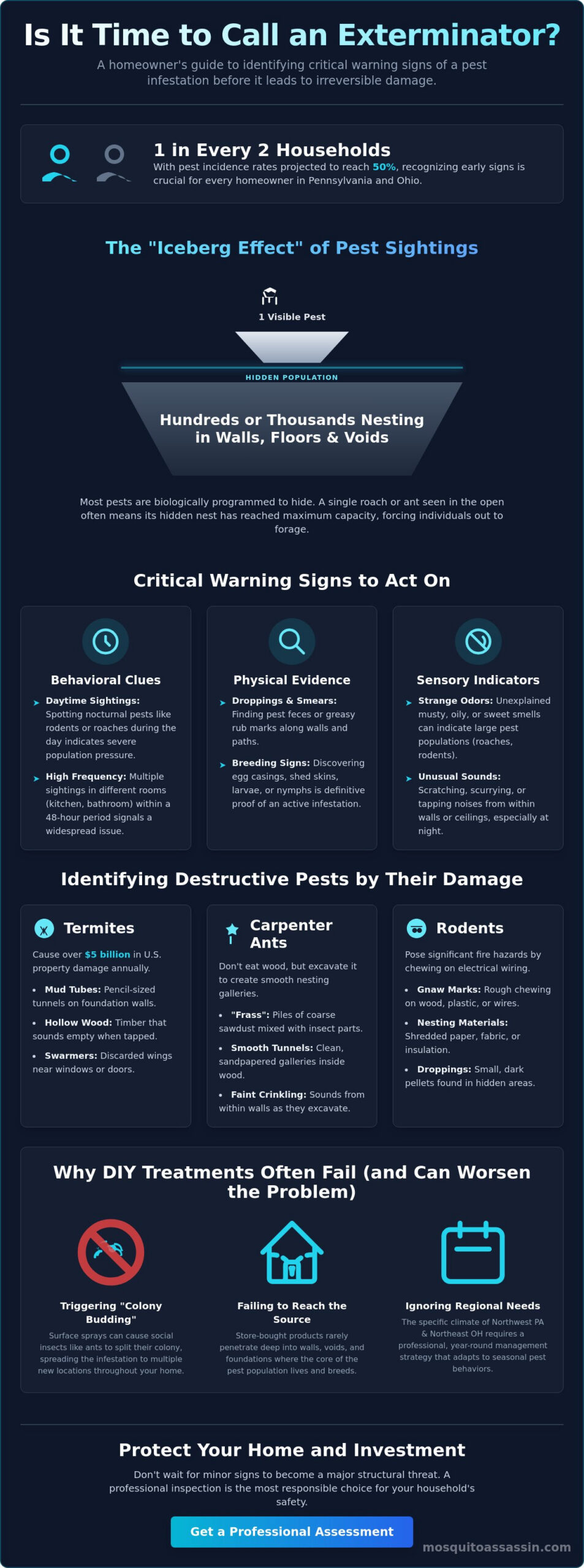
Finding a single insect in your home often feels like a minor inconvenience, but in the professional field of Pest control, a lone sighting is frequently viewed as the “iceberg effect.” Most common household pests are biologically programmed to remain hidden in dark, tight spaces. When you see one individual out in the open, it’s rarely an isolated traveler. Instead, it’s often a sign that the nesting sites behind your walls or under your floors have reached maximum capacity. This is especially true for social insects like ants or cockroaches, where a single visible worker suggests an established colony of hundreds or thousands nearby.
It’s important to distinguish between occasional invaders and residential colonies. An occasional invader, like a lone beetle that flew in through an open door, doesn’t necessarily indicate an infestation. However, identifying juvenile stages such as larvae, nymphs, or egg casings is definitive evidence of active breeding. When pests are reproducing within the structure, it’s one of the most reliable signs you need to call an exterminator to address the root of the biological invasion before it spreads further into the property.
To better understand this concept, watch this helpful video:
Nocturnal Pests and Daytime Activity
Most high-risk pests, including rodents and cockroaches, are nocturnal. They’ve evolved to forage in the safety of darkness to avoid predators. If you spot a mouse or a roach during the middle of the day, it indicates severe biological pressure. This usually happens because the population density has become so high that subordinate members are forced to forage during high-risk daylight hours just to find food. The population threshold is the point at which a pest colony exceeds its hidden nesting capacity, forcing individual members into human living spaces to compete for resources.
Frequency and Location of Sightings
The scale of an infestation can often be determined by tracking sightings over a 48 hour period. If you see multiple pests in different rooms (especially sanitary areas like kitchens or bathrooms) within two days, the infestation has likely moved past the initial entry phase. Pay close attention to utility penetrations under sinks or foundation cracks in the basement. These are primary highways for pests. Consistent activity in these zones is among the clear signs you need to call an exterminator to safeguard your home’s hygiene and structural integrity.
Property Damage: Identifying the Physical Signs of Infestation
Property damage is often the first tangible evidence of an infestation that homeowners notice. While seeing a pest is concerning, finding physical destruction is one of the most definitive signs you need to call an exterminator. Distinguishing between different types of damage is essential for identifying the culprit. Rodent gnaw marks, for example, are typically rough and found on hard surfaces like wood, plastic, or even soft metals. In contrast, insect-related wood damage is usually more internal and structural, often remaining hidden until the integrity of the material is compromised.
Structural Wood and Foundation Damage
Termites are among the most destructive wood-destroying organisms, contributing to over $5 billion in property damage in the United States annually. A primary indicator of their presence is the discovery of mud tubes on foundation walls. These pencil-sized tunnels provide termites with the moisture and protection they need to travel from the soil into your home’s wooden framework. Carpenter ants present a different challenge; they don’t eat wood but instead excavate it to create nesting galleries. You can identify their activity by finding “frass,” which looks like coarse sawdust and consists of wood shavings mixed with insect parts. Recognizing these specific indicators is a vital part of general pest control and long-term structural protection.
Beyond structural timber, pests pose significant risks to a home’s infrastructure. Rodents have incisors that never stop growing, forcing them to gnaw on hard materials to keep their teeth at a manageable length. They frequently target the plastic insulation on electrical wiring hidden inside walls. This behavior creates a severe fire hazard that often goes unnoticed until an electrical failure occurs. If you suspect activity, seeking professional pest control may help reduce risk to your home’s vital systems.
Damage to Personal Belongings and Food Supplies
Pests don’t restrict their activity to the skeleton of your home. They often target personal belongings and food stores. Pantry pests, such as weevils or Indian meal moths, leave behind webbing or tiny holes in the packaging of dry goods like flour, grains, and cereal. If you find irregular holes in natural fiber rugs, wool sweaters, or silk clothing, you might be dealing with carpet beetles or clothes moths. It’s also helpful to Identify and Prevent Rodent Infestations by looking for grease marks. These “rub marks” are dark, oily stains left along baseboards and floorboards as rodents travel the same paths every night. Finding these marks along with chewed packaging is a clear signal that the infestation has moved into your living spaces.
- Gnaw Marks: Found on baseboards, cabinets, and electrical wires.
- Wood Damage: Hollow-sounding timber or perfectly round exit holes from carpenter bees.
- Fabric Damage: Holes in natural fibers like wool, silk, or fur.
- Pantry Signs: Small holes in cardboard boxes or silk-like webbing in containers.
Sensory Indicators: Detecting Pests Through Smell, Sound, and Pets
Visible sightings are often the final stage of a biological invasion, but your senses can detect an infestation much earlier. Pests leave behind distinct biological markers that often bypass our eyes but trigger our sense of smell or hearing. Recognizing these sensory signs you need to call an exterminator can prevent a localized issue from becoming a property-wide crisis. Humans often miss these subtle changes. In many cases, these indicators are strongest in quiet, enclosed areas like attics, crawlspaces, or behind kitchen cabinetry.
Olfactory Signals: What Different Pests Smell Like
Large pest populations produce concentrated pheromones, waste, and decaying matter that create unique olfactory signatures. A sweet yet musty odor, often compared to rotting raspberries or coriander, is frequently associated with bed bug harborages. If you notice an oily, pungent, or musky scent in the kitchen or bathroom, it may indicate a high-density cockroach population. Established rodent nesting sites produce a sharp, unmistakable ammonia smell caused by accumulated urine. These odors are rarely detectable when only a few pests are present. This means a noticeable scent usually points to an established colony that requires professional pest control intervention.
Acoustic Indicators and Pet Behavior
Acoustic clues often become apparent during the quiet hours of the night. You might hear scratching, scurrying, or gnawing sounds emanating from wall voids or ceilings. While larger rodents produce audible thumps or squeaks, certain wood-destroying insects like termites produce faint clicking or tapping sounds as they feed. It’s also vital to monitor the behavior of domestic animals. Pets know first. Domestic cats and dogs possess an acute sensitivity to high-frequency sounds and pheromones, allowing them to detect movement within wall voids long before it becomes audible to humans. If a pet consistently stares at a specific section of a wall or paws at a baseboard, it’s often responding to the ultrasonic frequencies of hidden pests.
Beyond smell and sound, physical evidence often accumulates in hidden corners. Look for these specific indicators:
- Droppings: Rodent droppings are spindle-shaped, while cockroach droppings resemble black pepper or coffee grounds.
- Nesting Materials: Finding piles of shredded paper, fabric, or attic insulation in dark corners suggests rodents are preparing for reproduction.
- Discarded Wings: Piles of small, uniform wings near windowsills or doors are a primary indicator of a recent termite swarm.
Identifying these sensory markers early provides the peace of mind that comes from taking proactive steps. If your home exhibits any of these biological signatures, professional pest control may help reduce risk to your property and health.
Assessing DIY Limitations: When to Seek Professional Intervention
The immediate reaction to finding a pest is often a trip to the local hardware store for a can of spray. While these products might provide a sense of control, they frequently fail to address the biological reality of an infestation. Surface-level sprays are designed to kill on contact, but they rarely reach the deep, protected nesting sites where the majority of the population resides. This creates a false sense of security. You might stop seeing a few foragers, but the colony remains active and continues to grow behind your walls or under your foundation.
One of the most significant risks of DIY chemical application is a biological phenomenon known as “budding.” Certain species, particularly Pharaoh ants and some types of stinging insects, perceive over the counter chemicals as a threat to the colony’s survival. Instead of dying off, the colony reacts by splitting into multiple smaller colonies that scatter to different areas of the home. This defensive mechanism effectively turns a localized problem into a widespread structural issue. Understanding these complex behaviors is one of the key signs you need to call an exterminator before a manageable situation escalates.
The Cycle of Recurring Infestations
Pests often return to the same locations even after a seemingly successful DIY treatment. This happens because of pheromone trails. These invisible chemical roadmaps are left behind by foragers to guide the rest of the colony to food and nesting sites. Most consumer grade cleaners and sprays don’t eliminate these trails, meaning the “pathway” into your home remains open. Breaking this cycle requires more than just chemicals; it involves precise exclusion techniques. You can learn more about sealing your home’s perimeter in this guide to professional rodent removal, which highlights why structural barriers are as important as eradication.
Biological resilience also plays a major role in DIY failure. In early 2026, research continues to show that pests like bed bugs have developed significant resistance to pyrethroids, the active ingredient in most retail pesticides. When these products are used, they often just irritate the pests, causing them to move deeper into the structure or into adjacent rooms. If you’re facing a persistent or growing population, professional pest control may help reduce risk to your property by utilizing advanced, non-repellent formulations.
Safety and Environmental Considerations
Safety is a primary concern when homeowners attempt to handle infestations alone. Off-label use of pesticides, such as applying outdoor chemicals inside or using higher dosages than recommended, can lead to lingering indoor air quality issues. There’s also the risk of secondary poisoning. This occurs when non-target wildlife or domestic pets encounter baits or treated pests. Licensed professionals utilize Integrated Pest Management (IPM), a methodical approach that prioritizes inspection, sanitation, and physical barriers. This strategy ensures that chemical applications are used as a last resort and are targeted with precision equipment, significantly reducing the overall chemical footprint within your living environment.
Professional Strategy: Long-Term Pest Management in PA and OH
The environmental conditions in Northwest Pennsylvania and Northeast Ohio create unique biological pressures that dictate how pests behave throughout the year. Recognizing the signs you need to call an exterminator is just the first step in a larger regional strategy. In this specific geographic corridor, pest activity is not merely a seasonal nuisance but a year-round challenge influenced by the proximity to Lake Erie and the varying terrain of the Tri-County area. Transitioning from reactive “emergency” calls to a proactive, year-round management plan is the most effective way to maintain property value and ensure the structural integrity of a residence.
Seasonal Migration Patterns in the Tri-County Area
The harsh Lake Erie winters play a significant role in local pest behavior. As temperatures drop, rodents and overwintering insects seek the thermal stability provided by residential basements, crawlspaces, and attics. This winter migration often goes unnoticed until the population density increases in the spring. For residents in Erie, Crawford, and Ashtabula counties, the spring thaw brings a surge in moisture-seeking pests and wood-destroying organisms like termites and carpenter ants. Preparing for these surges involves more than just interior treatments. Utilizing professional pest services to establish a defensive perimeter around the home’s exterior can prevent these pests from ever crossing the threshold.
Developing a Comprehensive Protection Plan
A professional approach to pest management follows a methodical four-step process: inspection, customized planning, targeted treatment, and consistent follow-up. This system is designed to identify vulnerabilities in the home’s envelope before they are exploited. While one-time treatments may resolve a visible sighting, they rarely address the underlying environmental factors that attracted the pests in the first place. Ongoing monitoring is significantly more effective at breaking the life cycle of persistent species and preventing re-infestation. Professional assistance may help resolve persistent issues that DIY methods cannot reach. For those seeking expert validation of their property’s status, visiting the Mosquito Assassin contact page provides a direct path to professional recommendations.
The ultimate goal of long-term management is peace of mind. By understanding the regional signs you need to call an exterminator and implementing a defensive strategy, homeowners can protect their families from the health risks and property damage associated with local infestations. Professional inspections serve as an early warning system, ensuring that minor biological entries do not escalate into costly structural repairs or health concerns for children and pets.
Disclaimer: The information provided on this blog is for general informational purposes only and is not intended as professional pest control advice. Conditions vary by property, environment, and location. Reading this content does not create a service agreement. For an inspection or professional recommendations, please contact Mosquito Assassin Pest Control LLC directly.
Safeguarding Your Property and Peace of Mind
Protecting a residence from biological invasions requires a shift from reactive measures to a proactive defensive strategy. Recognizing the signs you need to call an exterminator, such as the subtle clicking of wood-destroying insects or the distinct olfactory signatures of established colonies, is the first step in preventing structural damage. Visible sightings are often just the tip of the iceberg; DIY attempts can inadvertently spread the infestation deeper into the home’s voids.
Homeowners in Northwest PA and Northeast OH face unique challenges due to the Lake Erie climate, making year-round protection plans essential. Licensed and insured professionals ensure that treatments are targeted and safe for families. For an inspection or professional recommendations, schedule an evaluation through the online portal. Choosing a locally owned and operated expert provides neighborly care combined with a methodical approach to eradication. Taking action today establishes a permanent safeguard for your property’s value and your family’s health.
Disclaimer: The information provided on this blog is for general informational purposes only and is not intended as professional pest control advice. Conditions vary by property, environment, and location. Reading this content does not create a service agreement. For an inspection or professional recommendations, please contact Mosquito Assassin Pest Control LLC directly.
Frequently Asked Questions
How do I know if I have an infestation or just a few stray bugs?
An infestation is confirmed when you see multiple life stages, such as larvae or nymphs, or pests in areas far from entry points. A single bug near a door might be a stray, but finding insects in a pantry or bathroom indicates an active breeding population. This is one of the clear signs you need to call an exterminator to address the root cause rather than just the visible symptoms.
What does a cockroach infestation smell like in a home?
A cockroach infestation produces a distinct oily or musky scent that becomes more pungent as the population grows. This odor is caused by pheromones and waste products concentrated in dark, damp areas like under sinks or behind appliances. If a room has a lingering, unpleasant smell that persists after cleaning, it’s often a sign of a high-density colony hidden within the structural voids of the home.
Why can I hear scratching sounds in my walls at night?
Scratching sounds in walls at night are typically caused by the nocturnal foraging of rodents or large insects moving through wall voids. These sounds are most audible during quiet hours when pests are active and searching for food or nesting materials. While rodents produce scurrying noises, wood-destroying insects may create faint clicking sounds as they tunnel through structural timber, signaling a need for an inspection.
What are the most common signs of a rodent problem in Pennsylvania?
Common indicators of rodents in Pennsylvania include spindle-shaped droppings, chewed electrical insulation, and dark grease marks along baseboards. In the Lake Erie region, these signs often increase during late autumn as temperatures drop and rodents seek warmth indoors. Finding shredded paper or insulation in corners is another strong signal that a nesting site has been established and requires professional intervention to prevent property damage.
When is a pest sighting considered an emergency for a homeowner?
A sighting becomes an emergency when nocturnal pests like cockroaches or mice are seen during daylight hours, suggesting the population has exceeded its hidden nesting capacity. The presence of wood-destroying organisms like termites or carpenter ants also requires immediate attention to prevent structural failure. Sightings in food preparation areas are particularly concerning due to the risk of contamination and the potential for rapid population growth.
Why do pests keep returning after I use store-bought sprays?
Store-bought sprays often fail because they don’t eliminate the invisible pheromone trails that lead pests back to your home. Many consumer products act as repellents that merely scatter the colony, leading to “budding” where a single nest splits into several new ones. Professional pest control utilizing non-repellent formulations is necessary to reach the core of the population and prevent the recurring activity that DIY methods often miss.
What are the early signs of bed bugs in a clean house?
Early signs of bed bugs include tiny rust-colored spots on mattresses, discarded translucent skins, and a sweet, musty odor. Even in a clean house, these pests can be introduced through travel or used furniture. Check the seams of mattresses and behind headboards for small, dark clusters of spotting, which is definitive evidence of their presence regardless of the home’s cleanliness or the frequency of household maintenance.
How often should a home be inspected for pests in the Ohio and Pennsylvania region?
Homes in the Ohio and Pennsylvania region should be inspected at least once or twice a year to account for seasonal migration patterns. A professional inspection in the spring can identify early signs you need to call an exterminator before the summer surge of stinging insects and wood-destroying pests. Regular monitoring helps maintain a defensive perimeter against the environmental pressures unique to the Erie, Crawford, and Ashtabula county areas.
Disclaimer: The information provided on this blog is for general informational purposes only and is not intended as professional pest control advice. Conditions vary by property, environment, and location. Reading this content does not create a service agreement. For an inspection or professional recommendations, please contact Mosquito Assassin Pest Control LLC directly.