Tag: pest control

  • Seeking a Second Opinion on Termite Damage: A Homeowner’s Guide

    Seeking a Second Opinion on Termite Damage: A Homeowner’s Guide

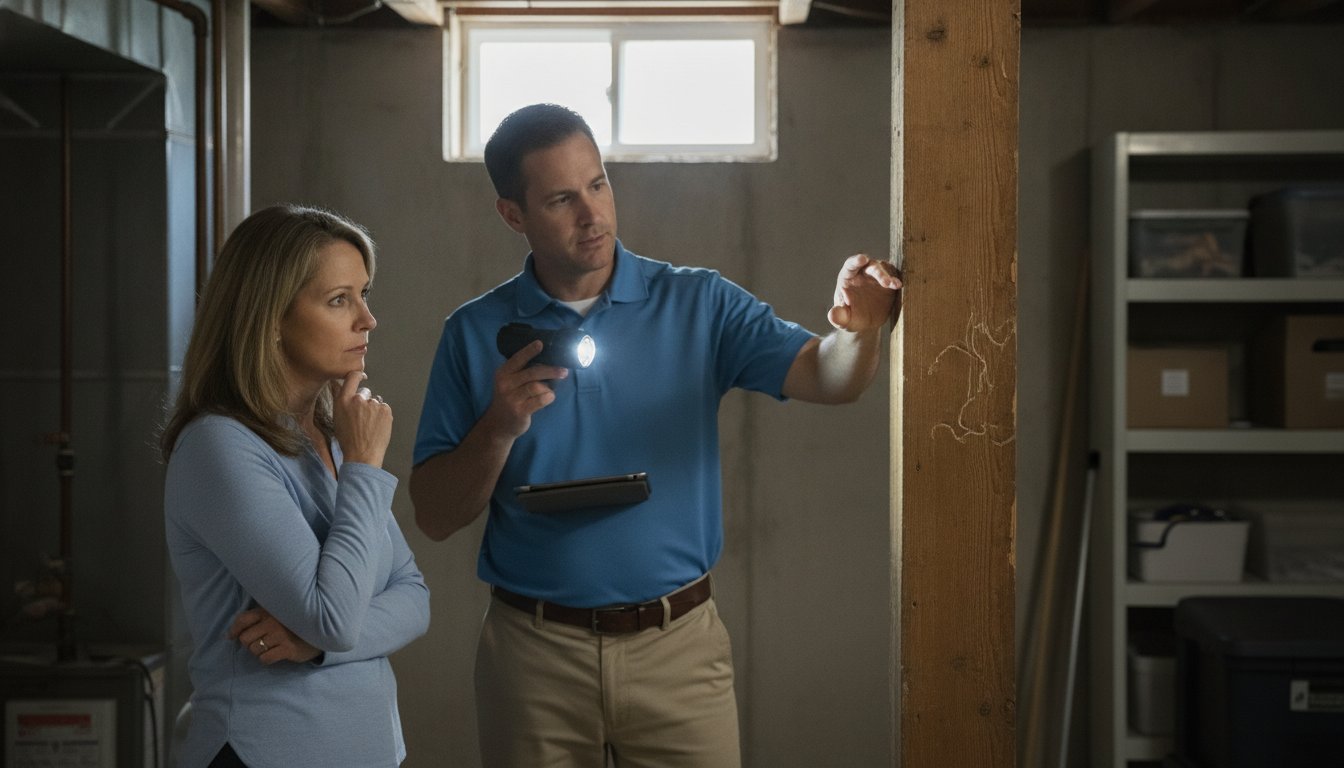
    Could a single inspection report be the only thing standing between you and thousands of dollars in structural repairs? For many property owners in Erie and Crawford Counties in Pennsylvania or Ashtabula County in Ohio, the discovery of wood-destroying organisms brings immediate anxiety. It’s common to feel overwhelmed when a technician points out damage you can’t see, especially if the proposed solution feels rushed or overly expensive. Getting a second opinion on termite damage isn’t just about saving money; it’s about ensuring the structural integrity of your home is assessed with total accuracy.

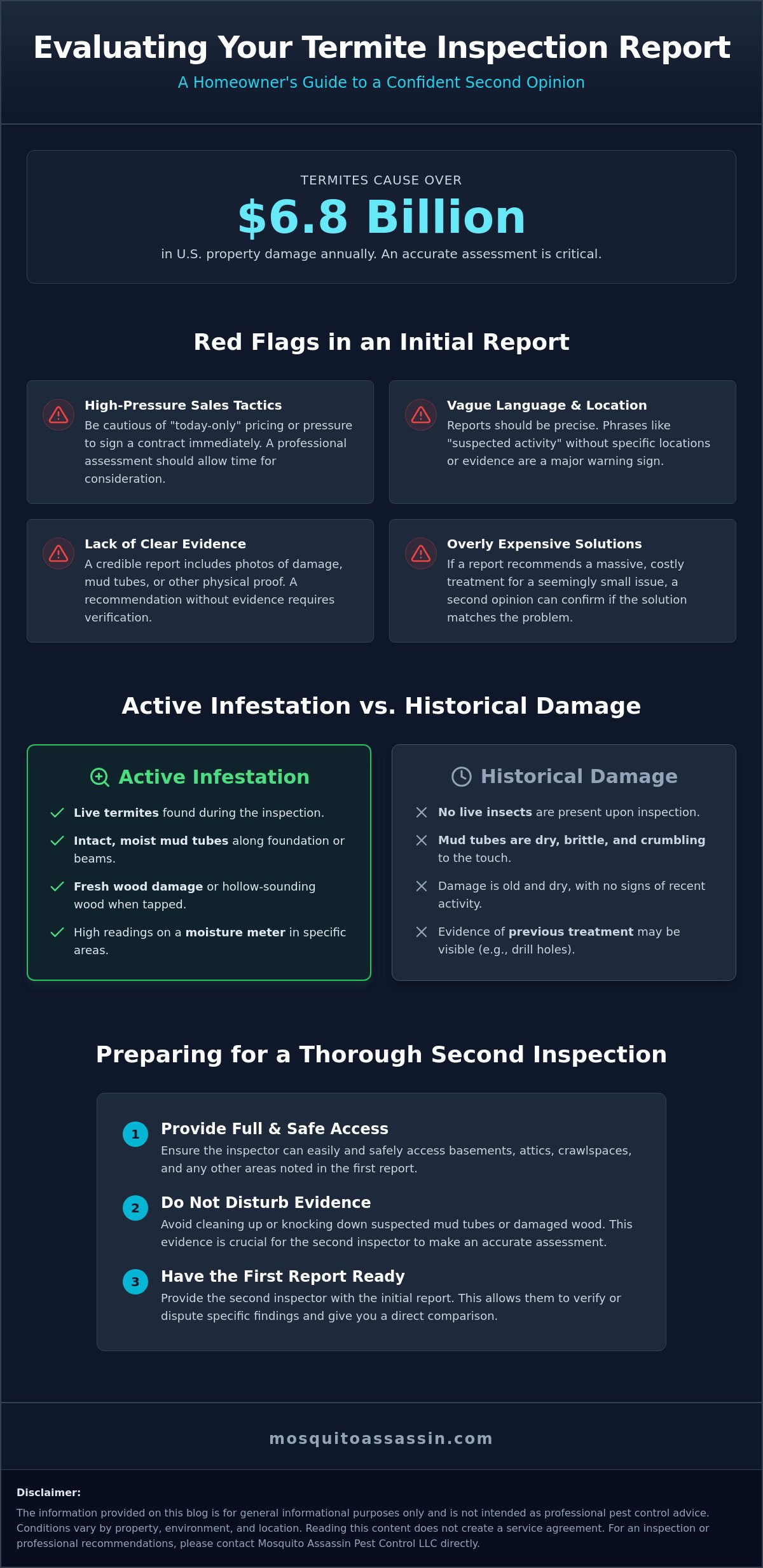
    You’ve likely felt the pressure to act quickly to prevent your home from being eaten away. While termites cause over $6.8 billion in property damage across the U.S. annually, rushing into a treatment plan without a clear understanding of the situation can lead to more confusion. This guide will show you how to verify professional findings and distinguish between active colonies and inactive, historical damage. By the end of this article, you’ll have a clear framework for evaluating inspection reports and the peace of mind that comes from a neutral, expert assessment.

    Disclaimer: The information provided on this blog is for general informational purposes only and is not intended as professional pest control advice. Conditions vary by property, environment, and location. Reading this content does not create a service agreement. For an inspection or professional recommendations, please contact Mosquito Assassin Pest Control LLC directly.
    Key Takeaways

    • Understand why termite assessments can be subjective and how a neutral perspective removes the pressure of an initial sales pitch.
    • Learn to identify common red flags in inspection reports, such as vague damage locations or aggressive pricing tactics.
    • Discover the critical differences between active infestations and old damage when getting a second opinion on termite damage to avoid unnecessary treatments.
    • Prepare for a thorough follow-up inspection by ensuring full access to basements and attics without disturbing existing evidence like mud tubes.
    • Gain clarity on how to compare multiple professional reports and prioritize fixing conditions that attract pests to your property.

    Why Homeowners Seek a Second Opinion on Termite Damage

    Property owners often find that termite inspections aren’t as black and white as they’d hope. An assessment is frequently based on the individual inspector’s years of field experience and their specific eye for detail. This subjectivity means that two different professionals might walk through the same crawlspace and come to different conclusions about the severity of a colony’s impact. In regions like Erie and Crawford Counties in Pennsylvania or Ashtabula County in Ohio, high lake-effect moisture levels can create damp conditions that mimic or mask pest activity. For a comprehensive overview of termites and their behavior, understanding their reliance on moisture is a critical first step.

    Getting a second opinion on termite damage provides a neutral perspective that’s essential for making a sound decision. When an initial report suggests thousands of dollars in structural repairs or intensive chemical treatments, homeowners often feel a high degree of skepticism regarding high-pressure sales tactics. A secondary look allows you to verify those findings without the immediate pressure of a “today-only” discount.

    To better understand this concept, watch this helpful video:

    The Complexity of Subterranean Termite Detection

    Subterranean termites are the most common species found throughout Pennsylvania and Ohio. They live underground and enter structures through tiny cracks in the foundation or mud tubes. Because they often remain hidden deep within wall voids, inspectors rely on specialized tools. Moisture meters can detect the high humidity levels termites need to survive, while acoustic sensors pick up the faint sound of soldiers alerting the colony. However, these tools aren’t infallible. Intermittent activity means a colony might be dormant in one area during the first visit but detectable a week later. A second inspection helps catch what might have been missed during a single walkthrough.

    Validating High-Cost Treatment Recommendations

    If an inspector recommends a full-scale liquid barrier or a complex baiting system, it’s standard practice to seek a comparative view. You need to know if the proposed treatment is appropriate for the actual infestation level. Professional pest control may help reduce risk, but over-treating a property is an unnecessary expense. A second professional can confirm if the damage is current or if you’re looking at historical remnants from a colony that was eliminated years ago. This verification is essential when estimated repair costs are significant, ensuring you don’t pay for solutions that don’t match the problem.

    Disclaimer: The information provided on this blog is for general informational purposes only and is not intended as professional pest control advice. Conditions vary by property, environment, and location. Reading this content does not create a service agreement. For an inspection or professional recommendations, please contact Mosquito Assassin Pest Control LLC directly.
    Identifying Red Flags in an Initial Termite Report

    Receiving a termite report should provide clarity, not more questions. If a document uses vague language like “suspected activity” or “potential damage” without pointing to specific evidence, you’re likely looking at a generic sales template. Professional reports must be precise and evidence-based. High-pressure tactics, such as insisting on a signature for “today-only” pricing, are major warning signs. These strategies are designed to bypass your critical thinking and force a quick sale. If you feel pushed into a decision without a clear explanation of the findings, getting a second opinion on termite damage is the best way to regain control and ensure your home is actually at risk.

    A quality assessment doesn’t just list problems; it explains the environment that allowed them to happen. Many homeowners in Erie, Crawford, or Ashtabula counties deal with regional moisture issues that attract wood-destroying organisms. A reputable professional will provide resources on termite prevention and management to help you understand how to protect your investment long term. If your current report fails to distinguish between termites and other pests, like carpenter ants or wood-boring bees, the proposed treatment might be entirely ineffective for the actual problem at hand.

    Essential Components of a Professional Inspection Report

    A professional report should include a detailed graph or map of your property. This diagram must pinpoint exactly where activity was found and where treatment is proposed. Documentation of “conducive conditions,” such as wood-to-ground contact, soil levels that are too high, or leaking gutters, is non-negotiable. For real estate transactions, a Wood Destroying Insect (WDI) report is a standardized document used to disclose findings to lenders and buyers; it should be filled out completely with no missing sections. Seeking a thorough evaluation through professional pest control may help reduce risk and clarify your next steps.

    Warning Signs of an Incomplete Assessment

    Be wary of any inspector who avoids the “dirty work.” If they don’t enter the crawlspace or fail to walk the entire exterior perimeter of the foundation, the assessment is incomplete. A report that identifies “damage” but can’t identify the specific species involved lacks the technical depth needed for a targeted treatment plan. Getting a second opinion on termite damage ensures that no area of your home is overlooked, especially when an initial inspector seems rushed. Transparency regarding the limitations of the inspection, such as inaccessible wall voids or heavy storage blocking a basement wall, should always be clearly stated in the final document.

    Disclaimer: The information provided on this blog is for general informational purposes only and is not intended as professional pest control advice. Conditions vary by property, environment, and location. Reading this content does not create a service agreement. For an inspection or professional recommendations, please contact Mosquito Assassin Pest Control LLC directly.
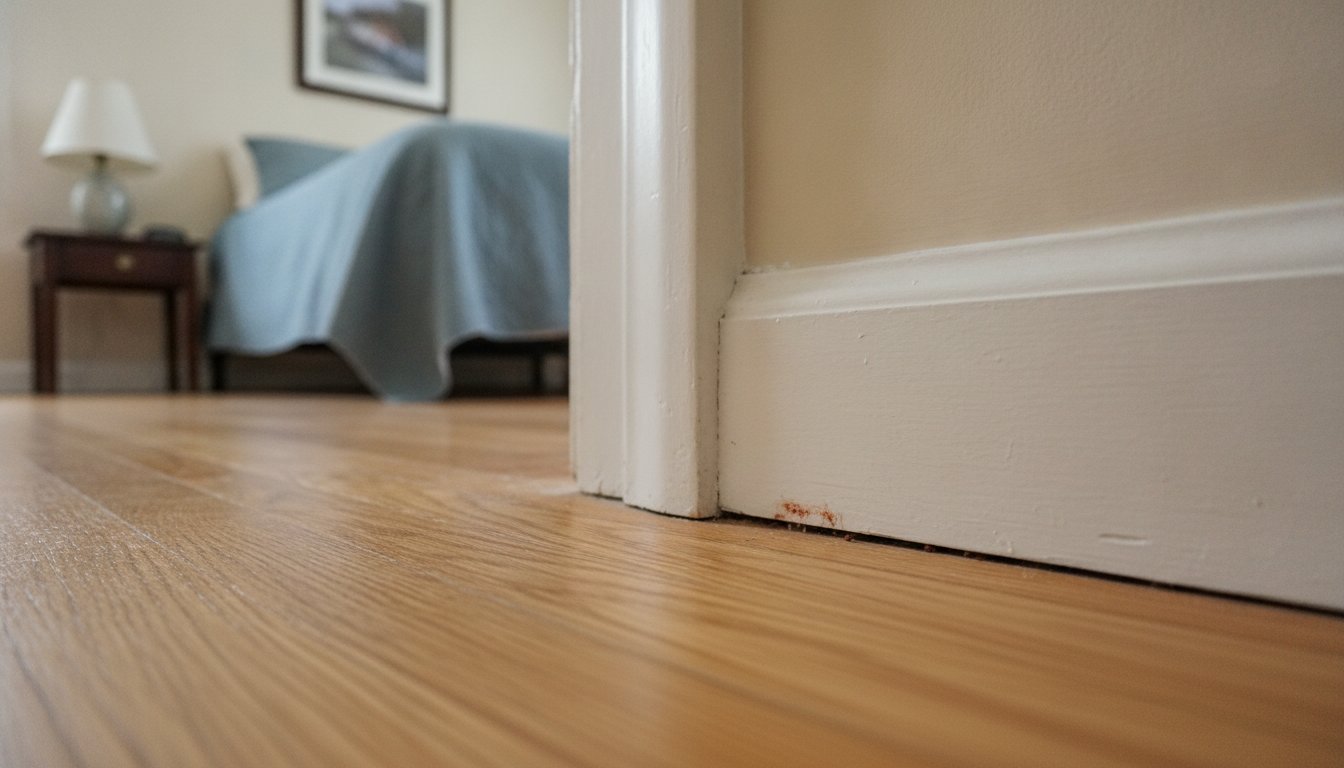
    Evaluating Active Infestations Versus Historical Termite Damage

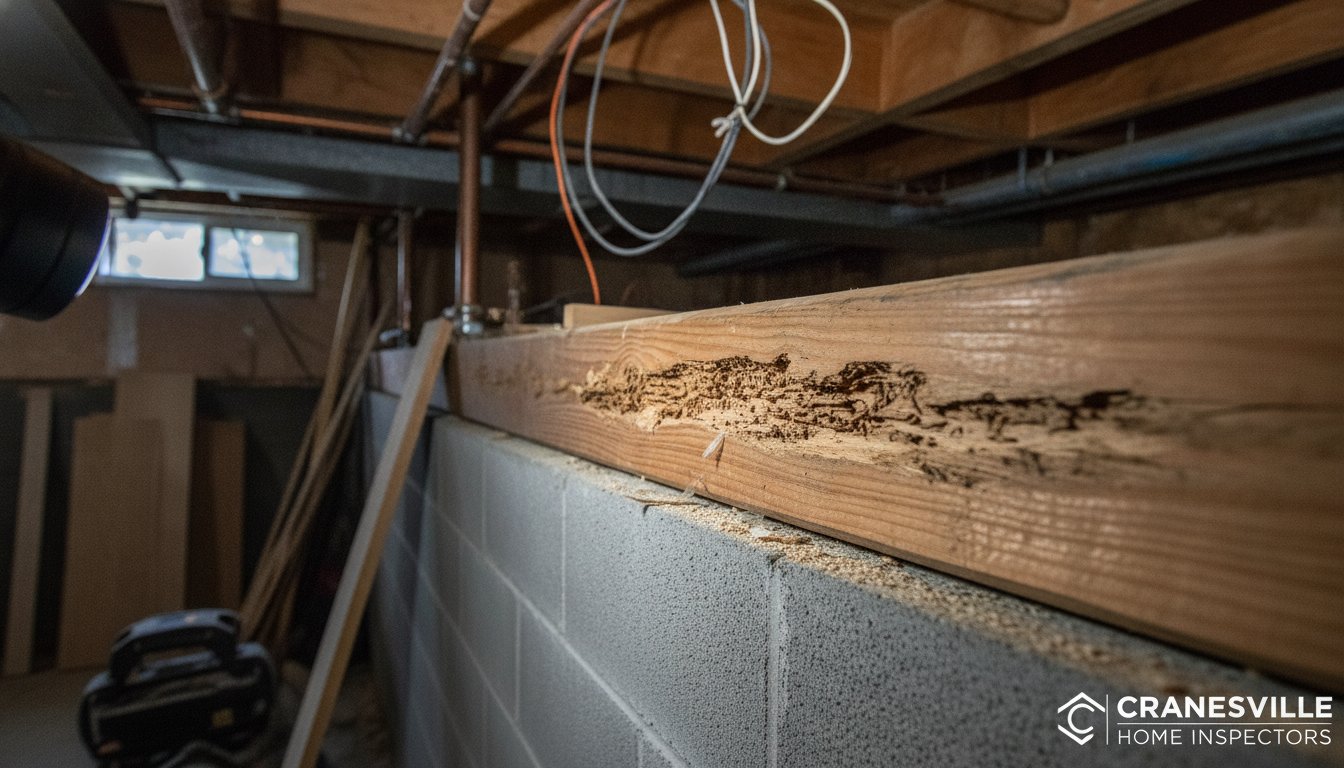
    Discovering wood that looks like Swiss cheese is a terrifying experience for any homeowner. However, finding damage doesn’t always mean you have a current problem. Termites are destructive, but they’re also highly sensitive to environmental changes. Sometimes, a colony dies off naturally or moves to a better food source, leaving behind empty galleries. Getting a second opinion on termite damage is vital because it helps distinguish between an ongoing threat and historical remnants that may be decades old. Treating a “ghost” infestation is a common mistake that leads to unnecessary chemical applications and wasted repair budgets.

    In our region, specifically across Erie and Crawford Counties in Pennsylvania and Ashtabula County in Ohio, older homes often have multiple layers of historical activity. A technician might see old galleries in a floor joist and immediately recommend an expensive treatment plan. Without verifying if the insects are still present, you could be paying for a solution to a problem that’s already gone. A neutral assessment focuses on finding live “workers,” which are small, white, soft-bodied insects, or fresh mud that indicates a thriving colony.

    The Role of Mud Tubes in Activity Verification

    Mud tubes are the protective highways subterranean termites build to travel between the soil and your home’s framing. These structures are made of soil and saliva, designed specifically to lock in moisture. When an inspector finds these tubes, the first step is to determine if they’re currently in use. A professional will often break a small portion of the tube to see if the workers return to repair the breach within 24 to 48 hours. If the tube remains dry and brittle without any repairs, it’s likely an abandoned path. While abandoned tubes are a sign of past activity, they don’t always indicate a current threat that requires immediate chemical intervention.

    Determining the Age of Wood Damage

    Structural wood doesn’t “heal” itself, so damage remains visible long after the termites have left. To date the activity, professionals look for specific markers within the wood galleries. Fresh damage typically appears clean and light in color, often containing moist soil or live insects. Older damage frequently shows darker staining from long-term exposure to the air or debris that has settled in the galleries over years. Historical damage should always be noted in your property records for future sales, but it may not require an active eradication plan. Getting a second opinion on termite damage ensures your treatment plan is based on current biological facts rather than past history.

    Disclaimer: The information provided on this blog is for general informational purposes only and is not intended as professional pest control advice. Conditions vary by property, environment, and location. Reading this content does not create a service agreement. For an inspection or professional recommendations, please contact Mosquito Assassin Pest Control LLC directly.
    Seeking a Second Opinion on Termite Damage: A Homeowner’s Guide

    How to Facilitate a Thorough Secondary Termite Inspection

    Getting a second opinion on termite damage requires active participation from the homeowner. While the professional brings the technical expertise, you provide the necessary access to the structure’s most vulnerable points. To ensure the most accurate results, you shouldn’t clear away any evidence found by the first inspector. This includes mud tubes, discarded wings, or wood debris. If you scrub away these markers, the second technician loses valuable biological clues that help determine the scale and age of the infestation. Preserving the site allows for a direct comparison of findings between two independent experts.

    Preparation is key to a successful walkthrough. You should prepare a list of every specific area where activity was noted previously or where you have personal concerns. Ensure the inspector you choose is licensed to operate in Pennsylvania or Ohio, as state regulations require specific certifications for wood-destroying insect inspections. Verifying these credentials protects your property and ensures the final report is legally sound for real estate or insurance purposes.

    Access Requirements for a Complete Property Review

    A thorough inspection is only as good as the areas the technician can actually see. You should clear any clutter or heavy storage from around the interior and exterior foundation walls. In Erie and Crawford counties, basements are often damp or used for long-term storage, which can create significant blind spots. Move items at least two feet away from the walls to allow for a full perimeter check. Pay special attention to high-risk zones like water heaters, floor drains, and where plumbing penetrations enter the slab. These areas provide the moisture and entry points termites crave. If an attic or crawlspace is sealed, provide safe entry before the professional arrives.

    Sharing Previous Reports (Pros and Cons)

    One of the biggest questions homeowners face is whether to show the first report to the second inspector immediately. Providing the report upfront allows the second professional to specifically investigate or debunk the first company’s claims. However, a “blind” second opinion is often more objective. By not sharing the initial findings until after the second walkthrough is complete, you ensure the technician isn’t subconsciously biased by the previous inspector’s conclusions. Once both reports are in hand, you can compare the diagrams and proposed treatment zones to find commonalities. If you are unsure about the findings in your initial report, professional pest control may help reduce risk by providing a clear, evidence-based second look.

    Disclaimer: The information provided on this blog is for general informational purposes only and is not intended as professional pest control advice. Conditions vary by property, environment, and location. Reading this content does not create a service agreement. For an inspection or professional recommendations, please contact Mosquito Assassin Pest Control LLC directly.

    Moving Forward with Professional Termite Management

    Once you’ve finished getting a second opinion on termite damage, you’ll likely have two separate reports to compare. Start by identifying the commonalities between them. If both inspectors flagged the same damp crawlspace or a specific section of damaged rim joist, you’ve found a confirmed priority area. Professional recommendations in our region are heavily influenced by local environmental risks. The high humidity levels found in Erie, Crawford, and Ashtabula counties mean that moisture management is just as important as chemical intervention. You shouldn’t view termite management as a one-time event. Effective protection requires a long-term plan that evolves with your property’s needs.

    Prioritizing the removal of conducive conditions is your first line of defense. Termites are attracted to easy meals and reliable moisture. If your reports mention leaking pipes, clogged gutters, or mulch piled against your siding, address these issues immediately. Removing the bridge between the soil and your home’s wood siding can stop a colony before it ever finds an entry point. A professional assessment will help you rank these repairs based on which ones pose the highest risk to your home’s structural integrity.

    Resolving Conflicting Inspection Results

    It’s possible for two experts to disagree, especially if one identifies “active” termites while the other classifies the damage as “old.” When this happens, focus strictly on the physical evidence presented. Ask the inspector to show you live workers, fresh mud, or moisture meter readings that support an active diagnosis. If the conflict remains unresolved and the repair costs are high, a third “tie-breaker” inspection can provide the necessary clarity. This third professional should be a neutral party who can review the existing evidence without a pre-existing bias. Base your final decision on the most thorough documentation rather than the lowest price or the most aggressive sales pitch.

    Long-Term Prevention and Maintenance

    Protecting your property value is a continuous process. Ongoing pest management is a standard practice for homeowners who want to avoid the $6.8 billion in annual damage termites cause across the country. Many property owners find that general pest control plans provide a foundational layer of security that complements termite-specific strategies. By maintaining a clean, dry, and monitored perimeter, you reduce the likelihood of a future infestation. If you’re ready to verify a previous report or need a professional assessment in the Erie or Ashtabula regions, contact Mosquito Assassin Pest Control LLC to discuss your property’s specific needs.

    Disclaimer: The information provided on this blog is for general informational purposes only and is not intended as professional pest control advice. Conditions vary by property, environment, and location. Reading this content does not create a service agreement. For an inspection or professional recommendations, please contact Mosquito Assassin Pest Control LLC directly.
    Securing Your Property’s Structural Integrity

    Deciding how to address wood-destroying organisms is a high-stakes choice that impacts both your safety and your finances. By identifying red flags in initial reports and learning to distinguish between active infestations and historical remnants, you can avoid unnecessary treatments. Getting a second opinion on termite damage provides the clarity needed to move forward with a verified plan rather than one based on sales pressure. Professional assessments focus on physical evidence and local environmental factors specific to Erie and Crawford Counties in Pennsylvania and Ashtabula County in Ohio.

    Licensed and professional pest management ensures that your home is evaluated using industry best practices for local wood-destroying insect behavior. If you’re uncertain about a previous inspection or need a neutral, expert perspective, Contact Mosquito Assassin Pest Control LLC for a professional assessment. Taking this step helps confirm the actual extent of any damage and provides the peace of mind that comes from a thorough, local evaluation. Protecting your investment starts with accurate information.

    Disclaimer: The information provided on this blog is for general informational purposes only and is not intended as professional pest control advice. Conditions vary by property, environment, and location. Reading this content does not create a service agreement. For an inspection or professional recommendations, please contact Mosquito Assassin Pest Control LLC directly.

    Frequently Asked Questions

    Is a second opinion on termite damage worth the cost?

    A second opinion is a valuable tool when a homeowner feels pressured or skeptical about a high-cost treatment plan. It provides a neutral perspective that can save you from investing in unnecessary chemical barriers. By getting a second opinion on termite damage, you ensure that the proposed solution matches the actual biological threat. This verification is a standard practice in structural maintenance and provides significant peace of mind regarding your home’s safety.

    How much does a professional termite inspection typically cost in PA or OH?

    Fees for wood-destroying insect inspections vary based on the size of the structure and the depth of the review. While some companies might include an inspection as part of a larger service agreement, standalone professional assessments generally reflect the time and specialized tools required for a thorough check. Homeowners in the Erie and Ashtabula regions should expect a fee that covers a full perimeter, crawlspace, and attic evaluation by a licensed technician.

    Can termite damage be old and not require treatment?

    Yes, wood can retain the appearance of damage for decades after a colony has moved on or died out. Old damage is typically dry, brittle, and lacks the fresh mud or moisture associated with active subterranean termites. If there are no live insects or fresh mud tubes, the structure may not require an immediate chemical treatment plan. A second look helps confirm if you’re looking at history or a current threat.

    What are the most common signs of active termites that an inspector looks for?

    Inspectors primarily look for live worker termites, which are small, translucent insects, and active mud tubes. These tubes are made of soil and saliva; they feel moist to the touch when they’re currently in use. Other signs include discarded wings from swarmers or hollow-sounding wood. In Pennsylvania and Ohio, subterranean termites are the primary concern, so the presence of moisture is a major indicator of an active colony.

    How long does a thorough termite inspection take?

    A comprehensive inspection typically takes between 45 and 90 minutes for a standard residential property. The technician needs enough time to probe accessible wood members and navigate tight spaces like crawlspaces or attics. If an inspection is completed in less than 30 minutes, it likely missed critical areas. A thorough review is essential for getting a second opinion on termite damage that you can actually trust for your property’s security.

    Should I tell the second inspector about the first company’s findings?

    It’s usually best to let the second professional complete their walkthrough before sharing the initial report. This approach ensures the second assessment is entirely objective and not influenced by the previous company’s conclusions. Once the second inspection is finished, you can compare the two diagrams and findings. If both professionals identify the same high-risk areas, you’ll have a much clearer path forward for your home’s protection.

    What happens if two termite inspectors give different opinions?

    Conflicting reports are often resolved by examining the physical evidence each inspector provided. Ask each professional to show you the specific locations of active mud or live insects found during their walkthrough. If one report identifies active termites while the other claims the damage is old, the presence of moisture is often the deciding factor. In rare, high-stakes cases, a third inspection can serve as a definitive tie-breaker.

    Are termite inspections required for home sales in Erie, PA?

    While not always a state-level mandate for every transaction, most lenders for FHA and VA loans require a Wood Destroying Insect (WDI) report before closing a sale in Erie, PA. It’s a standard part of the due diligence process for regional real estate. Buyers and sellers alike benefit from these inspections, as they disclose any existing damage or conducive conditions that could affect the property’s long-term value and structural safety.

    Disclaimer: The information provided on this blog is for general informational purposes only and is not intended as professional pest control advice. Conditions vary by property, environment, and location. Reading this content does not create a service agreement. For an inspection or professional recommendations, please contact Mosquito Assassin Pest Control LLC directly.
  • Can I Get Rid of Termites Myself? Risks and Realities for Homeowners

    Can I Get Rid of Termites Myself? Risks and Realities for Homeowners

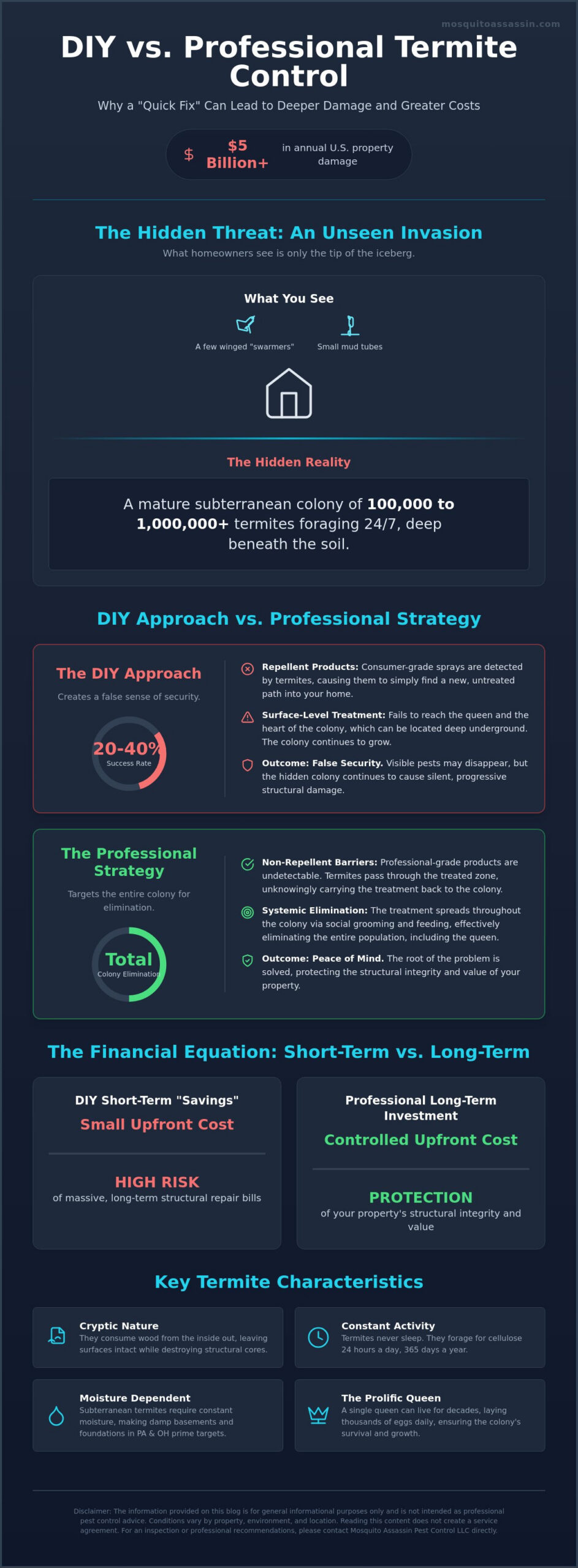
    Termites cause over $5 billion in property damage across the United States every year, yet university studies show that DIY treatments often have a success rate as low as 20 to 40 percent. When property owners in Erie, Crawford, or Ashtabula counties discover signs of wood damage, the immediate question is often: can I get rid of termites myself? It’s completely understandable to want to avoid high repair costs while feeling concerned about the types of chemicals used in your living space or the confusion of identifying flying ants versus actual pests.

    You deserve to understand the structural risks and technical challenges of DIY termite control to make an informed decision for your property. This guide explores the behavior of Eastern Subterranean Termites and why surface-level treatments often fail to reach the heart of a colony. By learning the realities of termite management, you can protect your home from long-term damage and ensure the safety of your household.

    Key Takeaways

    • Discover why the common question “can I get rid of termites myself” often leads to temporary solutions that fail to address the massive subterranean colonies hidden beneath the soil.
    • Learn how the foraging behavior of Eastern Subterranean Termites allows them to remain cryptic while causing significant structural damage over time.
    • Understand the technical limitations of consumer-grade products compared to professional-grade non-repellent barriers that target the entire colony.
    • Recognize the financial risks of ineffective treatments, which can drive termites deeper into a structure and lead to higher repair bills.
    • Identify why regional climate factors in Pennsylvania and Ohio make regular professional inspections a critical component of property maintenance.

    The Reality of DIY Termite Control and Structural Integrity

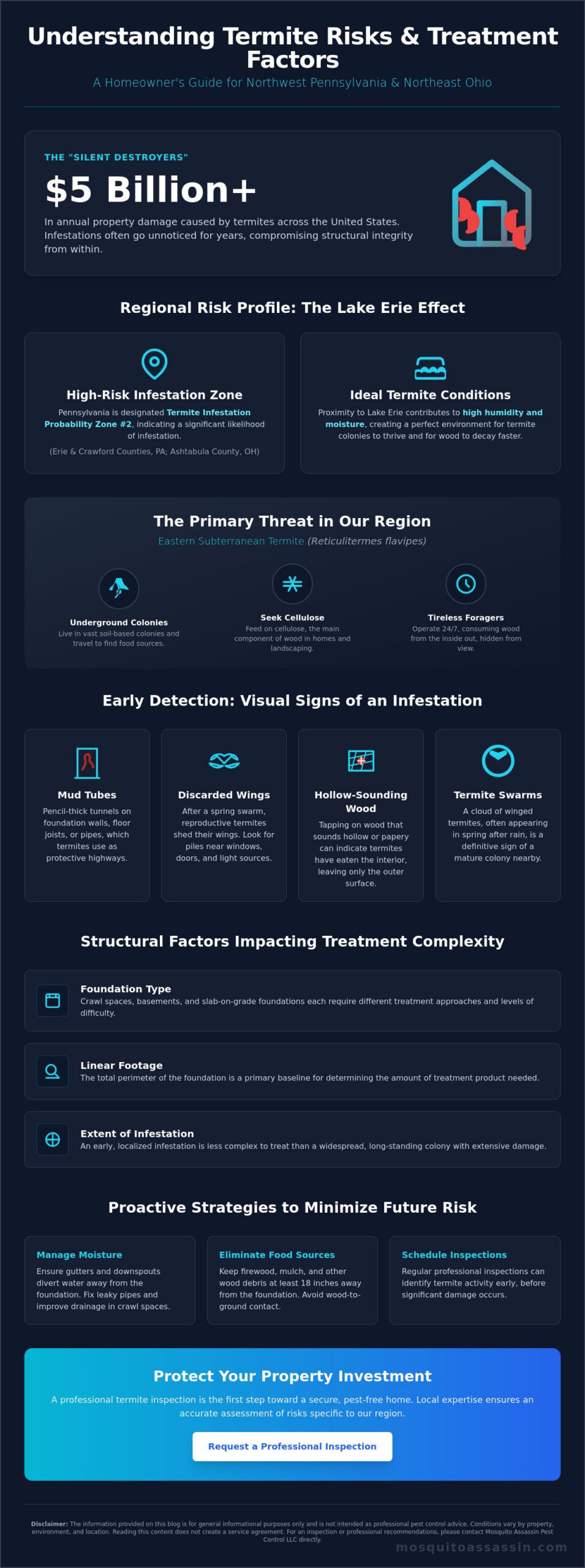
    Termites are often described as “cryptic” pests because they spend the vast majority of their lives hidden from human sight. They thrive in the dark, damp environments found within soil or deep inside the structural beams of your home. By the time a homeowner asks, “can I get rid of termites myself,” the damage is often already underway. Unlike a line of ants on a kitchen counter, termites don’t leave obvious trails. They consume wood from the inside out, leaving the exterior paint or veneer completely intact while the core becomes hollow and brittle.

    Understanding termite biology and behavior is essential for any property owner in Northwest Pennsylvania or Northeast Ohio. These are social insects with a highly organized caste system. When you see a few winged “swarmers” or a single worker in a piece of mulch, you aren’t looking at a stray bug. You’re seeing evidence of a mature subterranean colony that could contain hundreds of thousands of individuals. Attempting to kill only the insects you see is like trying to stop a flood by mopping up a single puddle.

    To better understand the scale of this challenge and how these insects operate, watch this helpful video regarding DIY attempts:

    What Makes Termites Different from Other Household Pests?

    A termite colony functions as a single superorganism. A queen can live for decades, producing thousands of eggs daily, while workers forage relentlessly for food. Most household pests are seasonal nuisances. Mosquitoes disappear in the winter; wasps die off after the first frost. Termites don’t follow these rules. They remain active 24 hours a day, 365 days a year. Their sole focus is the consumption of cellulose, which they find in the framing, flooring, and even the drywall of your property. Because they never sleep and their population is constantly growing, the stakes are much higher than dealing with common ants or spiders.

    The Concept of the False Sense of Security

    The biggest danger of a DIY approach is the false sense of security it creates. If you use a retail spray on a visible cluster of insects, they will die. However, this doesn’t stop the infestation. It simply alerts the rest of the colony to avoid that specific area. They will retreat and find a new, even more hidden path into your home. Homeowners often assume the problem is solved because they no longer see the bugs. In reality, the termites are just feeding elsewhere, often moving deeper into the structure where they are harder to detect.

    Professional management focuses on total colony elimination rather than just killing the insects you happen to see. This involves methodical monitoring to verify that the entire population, including the queen, is neutralized. Without this scientific approach, you’re essentially gambling with the structural integrity of your largest investment. In regions like Erie and Crawford counties, where moisture levels are high, the risk of a persistent, hidden infestation is even greater. Deciding “can I get rid of termites myself” involves weighing the cost of a retail bottle of spray against the potential for thousands of dollars in structural repairs later on.

    Why Termite Colonies are Difficult to Eliminate for Non-Professionals

    Eliminating a termite infestation requires more than just a surface level treatment. It demands a deep understanding of how these pests interact with their environment. Most homeowners asking can I get rid of termites myself are surprised to learn that a single colony of Eastern Subterranean Termites can span multiple properties. These colonies aren’t just small nests; they are sprawling underground networks that can contain hundreds of thousands of workers. Because the queen is located deep beneath the frost line, standard retail products rarely reach the source of the problem. Even if you kill the workers near your foundation, the queen continues to produce new members to replace them.

    The Biology of Subterranean Termites

    Subterranean termites are highly dependent on moisture to survive. They build elaborate mud tubes (small tunnels made of soil and saliva) to travel from the ground into your home without drying out. These tubes also provide protection from predators. Once a scout finds a food source, it leaves a pheromone trail that guides thousands of other workers to the site. According to the EPA guide to termite control, this social structure makes them incredibly resilient. A mature colony can consume wood at a steady rate, and their reproductive capacity allows them to expand their territory quickly throughout your home’s structural framing.

    Access and Detection Challenges

    The biggest obstacle to effective DIY treatment is access. Termites don’t feed in the open. They prefer the dark, humid spaces inside floor joists, behind drywall, or under concrete slabs. By the time a homeowner notices a problem, the termites have likely been active for several years. Human vision is limited when it comes to seeing through solid walls, and termites can enter a structure through cracks as thin as a credit card (approximately 1/16th of an inch). Professional detection often involves specialized tools that identify heat signatures or moisture patterns that the naked eye simply cannot see.

    Many homeowners attempt to use retail bait stations, but these often fail due to improper placement. Termites are foragers; if a bait station isn’t placed exactly where they are already traveling, they will simply bypass it. They are also sensitive to environmental changes. If a DIY application is too aggressive or uses repellent chemicals, it may cause the colony to split (a process called budding), which effectively doubles your problem. Understanding these complexities is why professional termite inspections and treatment are often necessary to ensure the entire colony is neutralized. Attempting to solve the issue without a scientific approach usually results in the pests moving deeper into the structure where they are even harder to reach.

    Comparing Consumer-Grade Products and Professional Strategies

    Many homeowners visiting hardware stores in Erie or Ashtabula wonder, can I get rid of termites myself by using the sprays available on retail shelves? The primary difference lies in the chemistry of the products. Most consumer-grade sprays are repellents. These chemicals create a perimeter that termites can sense. While this might seem helpful, it often backfires. Termites simply move along the barrier until they find a microscopic gap or a different entry point into the structure. Professional strategies rely on non-repellent liquid technology. These materials are undetectable to the insects, allowing them to pass through the treated zone and unknowingly transfer the product back to the rest of the colony. This transfer effect is essential for total population control.

    Professional management also utilizes specialized equipment that is unavailable for rent or purchase by the general public. Sub-slab injectors are required to treat the soil beneath basement floors and concrete porches without compromising the home’s foundation. Technicians also use moisture meters and thermal sensors to pinpoint activity behind finished walls. These high-concentration materials are strictly regulated. Because they are designed for long-term durability, a professional barrier can remain effective for years, whereas retail sprays often break down within a few weeks of exposure to the elements.

    The Role of Specialized Training in Pest Management

    A professional termite inspection is about more than just finding bugs. It’s an assessment of the property’s unique vulnerabilities. Licensed professionals in Pennsylvania and Ohio must complete ongoing education to stay current on pest biology and local soil conditions. For instance, the clay-heavy soil found in Crawford County requires different saturation levels than the sandier soils near the lake. Understanding these nuances ensures the treatment reaches the correct depth to intercept foraging workers. Without this technical training, a DIY attempt is likely to miss the primary entry points that termites use to bypass the foundation.

    The Limitations of Over-the-Counter Solutions

    Spot treatments are a common pitfall for those attempting to solve the problem alone. Treating only the area where you see damage doesn’t address the hidden colony. Consumer products are often formulated with lower concentrations to reduce the risk of accidental exposure, but this also reduces their efficacy against mature infestations. As highlighted in this homeowner termite control guide, improper application of these chemicals can lead to environmental contamination or groundwater runoff. Professional-grade materials are designed to bind tightly to the soil, providing a stable and lasting shield that protects the entire footprint of the building rather than just a single corner.

    Can I Get Rid of Termites Myself? Risks and Realities for Homeowners

    Potential Consequences of Ineffective DIY Termite Attempts

    Choosing to gamble on the question can I get rid of termites myself often leads to a costly false sense of security. While a bottle of retail spray might cost very little upfront, the financial fallout of a failed application is staggering. National data for 2026 indicates that while professional treatment typically ranges from $700 to $2,000, the cost of repairing a severe infestation can easily exceed $9,300. Because termites are hidden, an ineffective DIY attempt doesn’t just fail to solve the problem; it allows the colony to move deeper into the structural core of the building. This migration makes future professional intervention more difficult and expensive.

    Standard homeowner’s insurance policies in Pennsylvania and Ohio rarely cover termite damage. Most carriers classify wood destruction as a preventable maintenance issue. This means property owners are often left to pay for structural repairs entirely out of pocket. Attempting uncertified DIY work can also void existing home warranties or termite bonds. Without a documented service record from a licensed professional, you lack the evidence needed to prove the property has been properly maintained and protected.

    Structural Risks and Wood Integrity

    Termites are capable of hollowing out load-bearing beams while leaving the exterior surface looking perfectly healthy. This hidden destruction compromises the very foundation of your home. A mature colony can cause significant structural loss in a surprisingly short amount of time, contributing to the roughly $5 billion in damage caused annually in the United States. The risk is even higher when termites are present alongside moisture problems or rodent removal needs. These overlapping issues create an environment where wood decays faster, making the home more vulnerable to long term damage.

    Impact on Real Estate Transactions

    In counties like Erie, Crawford, and Ashtabula, real estate transactions depend heavily on professional inspections. Most mortgage lenders require a Wood-Destroying Insect (WDI) report before approving a loan. If a professional inspector finds evidence of past activity but no record of professional treatment, it can stall or even kill a home sale. DIY fixes are easily flagged during these inspections. Sellers are legally required to disclose known infestations; failing to provide a professional treatment history can drastically reduce a property’s resale value and buyer confidence.

    Ensuring your home remains structurally sound requires a scientific approach to colony elimination. To protect your investment and maintain your property’s market value, professional termite inspections and treatment may help reduce risk.

    Disclaimer: The information provided on this blog is for general informational purposes only and is not intended as professional pest control advice. Conditions vary by property, environment, and location. Reading this content does not create a service agreement. For an inspection or professional recommendations, please contact Mosquito Assassin Pest Control LLC directly.
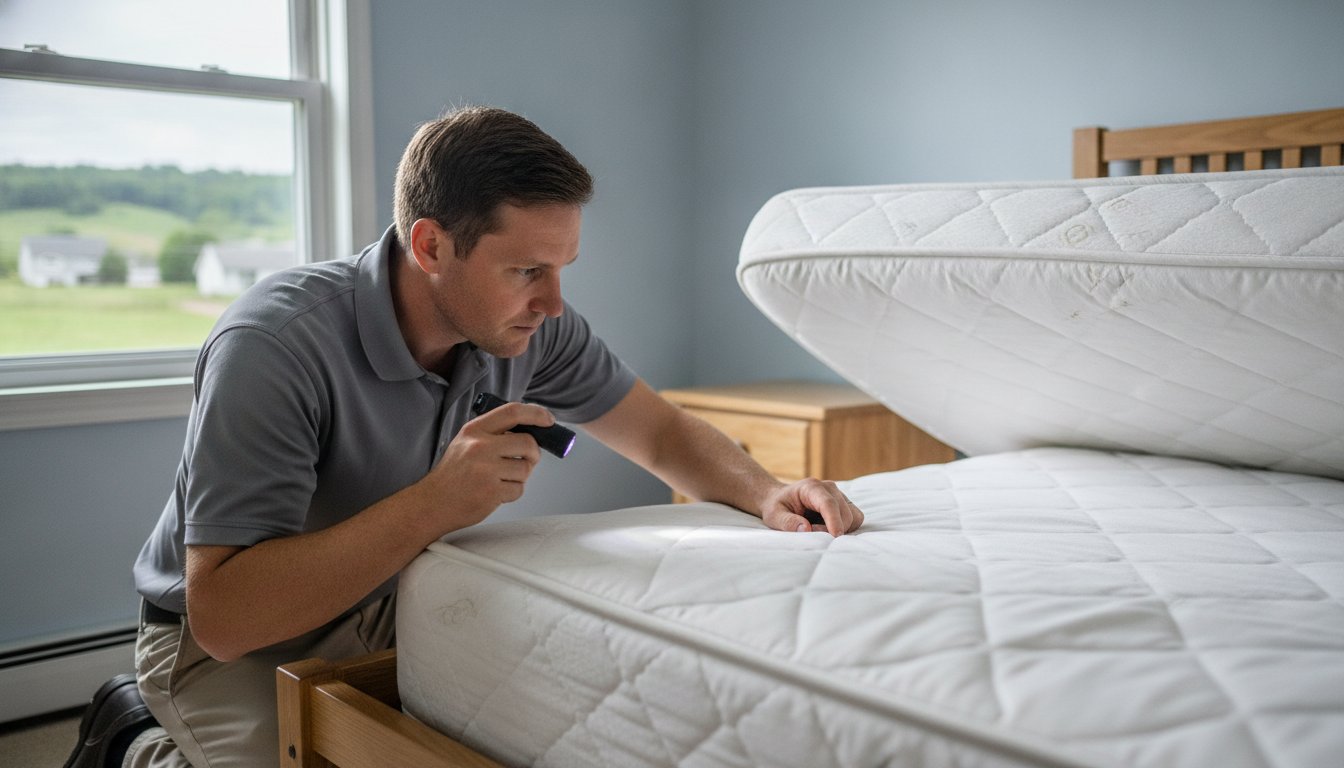
    Professional Termite Management in Northwest PA and Northeast OH

    Property owners in Northwest Pennsylvania and Northeast Ohio face unique environmental challenges that make termite management a complex task. While the question can I get rid of termites myself is common, the technical reality in our region often requires a localized, scientific approach. A professional evaluation in Erie, Crawford, or Ashtabula counties involves a systematic review of the property’s foundation, soil moisture levels, and structural vulnerabilities. Professional pest control may help reduce risk to the home’s value by ensuring that infestations are not just suppressed, but entirely neutralized at the colony level.

    Integrating termite monitoring into general pest control plans provides a proactive shield for your property. These plans often include regular inspections that catch “cryptic” activity before it escalates into a structural crisis. In a region where older homes and wooden structures are prevalent, having a consistent record of professional oversight is a significant asset during real estate appraisals and home inspections.

    Regional Factors Affecting Termite Activity

    The climate in the Tri-State area directly influences how Eastern Subterranean Termites behave. In Erie, PA, and surrounding lakefront communities, heavy snowfall provides a layer of insulation for the soil, allowing termites to remain active closer to the surface even during cold months. High soil moisture from lake-effect precipitation creates ideal foraging conditions. Swarming season in our region typically occurs in the spring, often following a warm rain. Additionally, the common construction style of homes in Northwest Pennsylvania (featuring deep basements and crawlspaces) provides numerous hidden entry points through foundation cracks or utility penetrations that are difficult for an untrained eye to locate.

    The Path to Long-Term Protection

    Achieving long term protection requires moving beyond reactive “spot treatments” and toward a comprehensive management strategy. Year-round protection plans are designed to maintain a pest-free environment by addressing seasonal shifts in insect behavior. Licensed firms provide the detailed documentation and service records necessary for maintaining property value and satisfying lender requirements. These records serve as proof of professional maintenance, which is vital if you ever decide to sell your home. For those seeking local assistance in Northwest Pennsylvania and Northeast Ohio, visiting the contact page to schedule a professional evaluation is a practical first step toward securing your investment.

    Disclaimer: The information provided on this blog is for general informational purposes only and is not intended as professional pest control advice. Conditions vary by property, environment, and location. Reading this content does not create a service agreement. For an inspection or professional recommendations, please contact Mosquito Assassin Pest Control LLC directly.
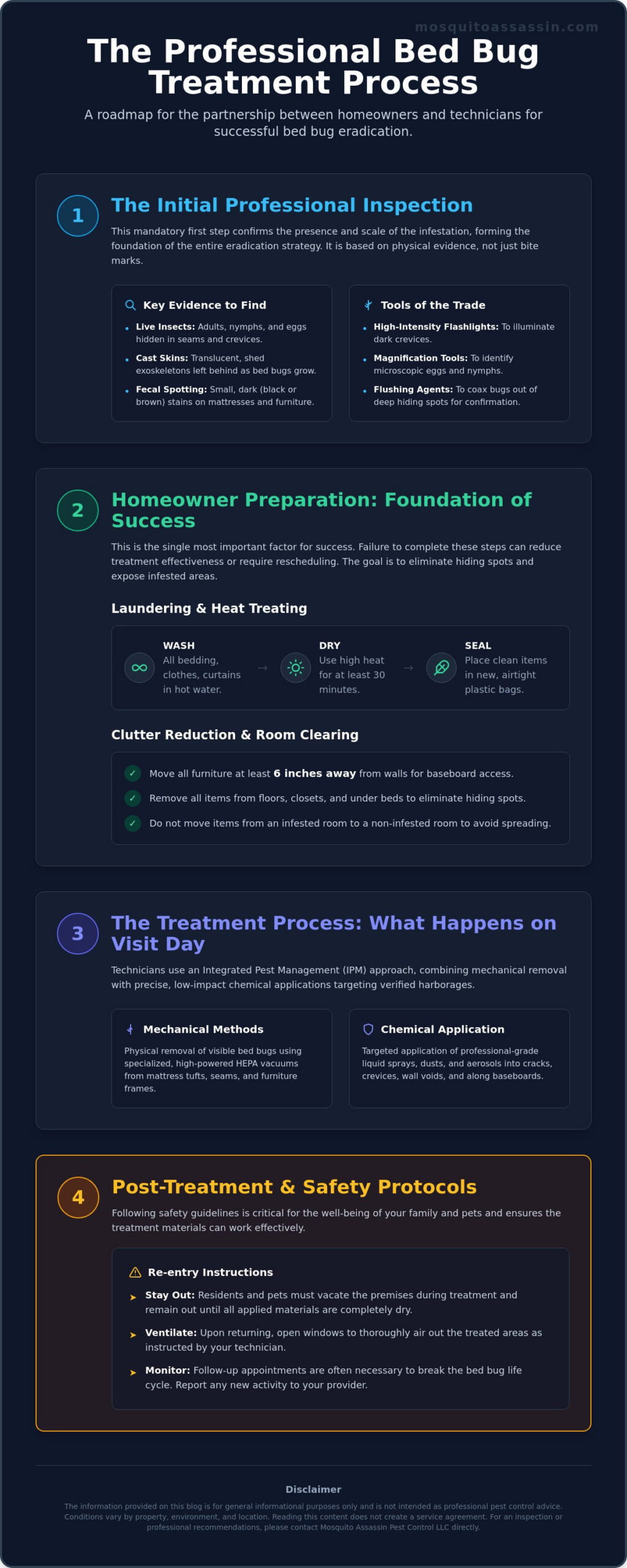
    Secure Your Home Against Hidden Threats

    Termites are a relentless force that can cause thousands of dollars in structural damage while remaining completely invisible to the naked eye. While the question can I get rid of termites myself is rooted in a desire to protect your property, retail solutions often provide a false sense of security that allows infestations to migrate deeper into your foundation. Relying on surface level sprays ignores the massive subterranean colonies that require specialized, non-repellent technology for total elimination.

    Professional pest control may help reduce risk to your home’s value and structural integrity. Mosquito Assassin Pest Control LLC is locally owned and operated in Cranesville; serving Erie and Crawford Counties in Pennsylvania and Ashtabula County in Ohio. Being licensed and insured in both PA and OH, the team follows specialized termite inspection and treatment protocols designed for the specific construction styles of our region. For a professional evaluation or recommendations, contact Mosquito Assassin Pest Control LLC directly. Taking a proactive approach today ensures your home remains a safe and secure investment for years to come.

    Disclaimer: The information provided on this blog is for general informational purposes only and is not intended as professional pest control advice. Conditions vary by property, environment, and location. Reading this content does not create a service agreement. For an inspection or professional recommendations, please contact Mosquito Assassin Pest Control LLC directly.
    Frequently Asked Questions

    Is it possible to permanently get rid of termites without a professional?

    Permanent elimination is extremely difficult for homeowners because termites are social insects living in massive underground colonies. DIY methods typically only kill the visible workers, leaving the queen and the rest of the colony intact. This leads to re-infestations as the colony replenishes its numbers. Professional strategies use non-repellent technology to target the entire superorganism, which is why many wonder, “can I get rid of termites myself” before realizing the technical complexity involved.

    How can I tell the difference between a flying ant and a termite swarmer?

    You can distinguish them by looking at their wings, waist, and antennae. Termites have four wings of equal length, straight antennae, and a thick, uniform waist. Flying ants have wings of unequal length, elbowed antennae, and a pinched, “wasp-like” waist. Swarmers are often the first sign of a mature colony nearby; identifying them correctly is the first step in determining the appropriate management strategy for your property.

    Will homeowners insurance cover termite damage if I tried to fix it myself?

    Most standard homeowners insurance policies do not cover termite damage, regardless of whether you attempted a DIY fix or not. Insurance companies generally view termite activity as a preventable maintenance issue. If you attempt uncertified repairs or treatments, you may also risk voiding home warranties or termite bonds. Maintaining a record of professional inspections and treatments is often required to prove the property has been properly cared for during a sale.

    Are the termite bait stations sold at hardware stores effective?

    Retail bait stations often have limited effectiveness because they require precise placement and frequent monitoring to be successful. Termites are foragers and may simply bypass a station that isn’t located directly in their path. Professional-grade baiting systems use different active ingredients and are part of a larger, methodical management plan. Homeowners asking can I get rid of termites myself often find that improperly placed retail baits provide a false sense of security while damage continues.

    How often should a home in the Erie or Ashtabula area be inspected for termites?

    Homes in Northwest Pennsylvania and Northeast Ohio should ideally be inspected at least once a year. The high soil moisture and construction styles common in Erie and Ashtabula create favorable conditions for Eastern Subterranean Termites. Annual inspections allow for early detection before significant structural damage occurs. This is especially important for older homes with basements or crawlspaces where activity is often hidden behind finished walls or foundation cracks.

    What are the first signs of termites that a homeowner can look for?

    Common signs include mud tubes on foundation walls, discarded wings from swarmers, and wood that sounds hollow when tapped. You might also notice small holes in drywall or “bubbling” paint that looks like water damage. Because termites feed from the inside out, these signs often appear only after a colony has been active for several years. Catching these early indicators is vital for protecting the structural integrity of your property.

    Can termites come back after a professional treatment?

    While professional treatments are designed for long-term protection, termites can return if the protective barrier is disturbed or if new colonies move into the area. This is why ongoing monitoring and maintenance are essential components of any pest management plan. Soil disruption from landscaping or new construction can create gaps in a liquid barrier. Regular professional follow-ups ensure that the protection remains intact and any new activity is addressed immediately.

    Is professional termite treatment safe for my family and pets?

    Licensed professionals follow strict EPA regulations and application protocols designed to prioritize the safety of household members and animals. Modern non-repellent treatments are applied in specific locations, such as the soil around the foundation or inside specialized bait stations, to minimize contact with residents. Professional applicators are trained to use the precise amount of product needed to neutralize the colony while adhering to official safety standards and environmental guidelines.

    Disclaimer: The information provided on this blog is for general informational purposes only and is not intended as professional pest control advice. Conditions vary by property, environment, and location. Reading this content does not create a service agreement. For an inspection or professional recommendations, please contact Mosquito Assassin Pest Control LLC directly.
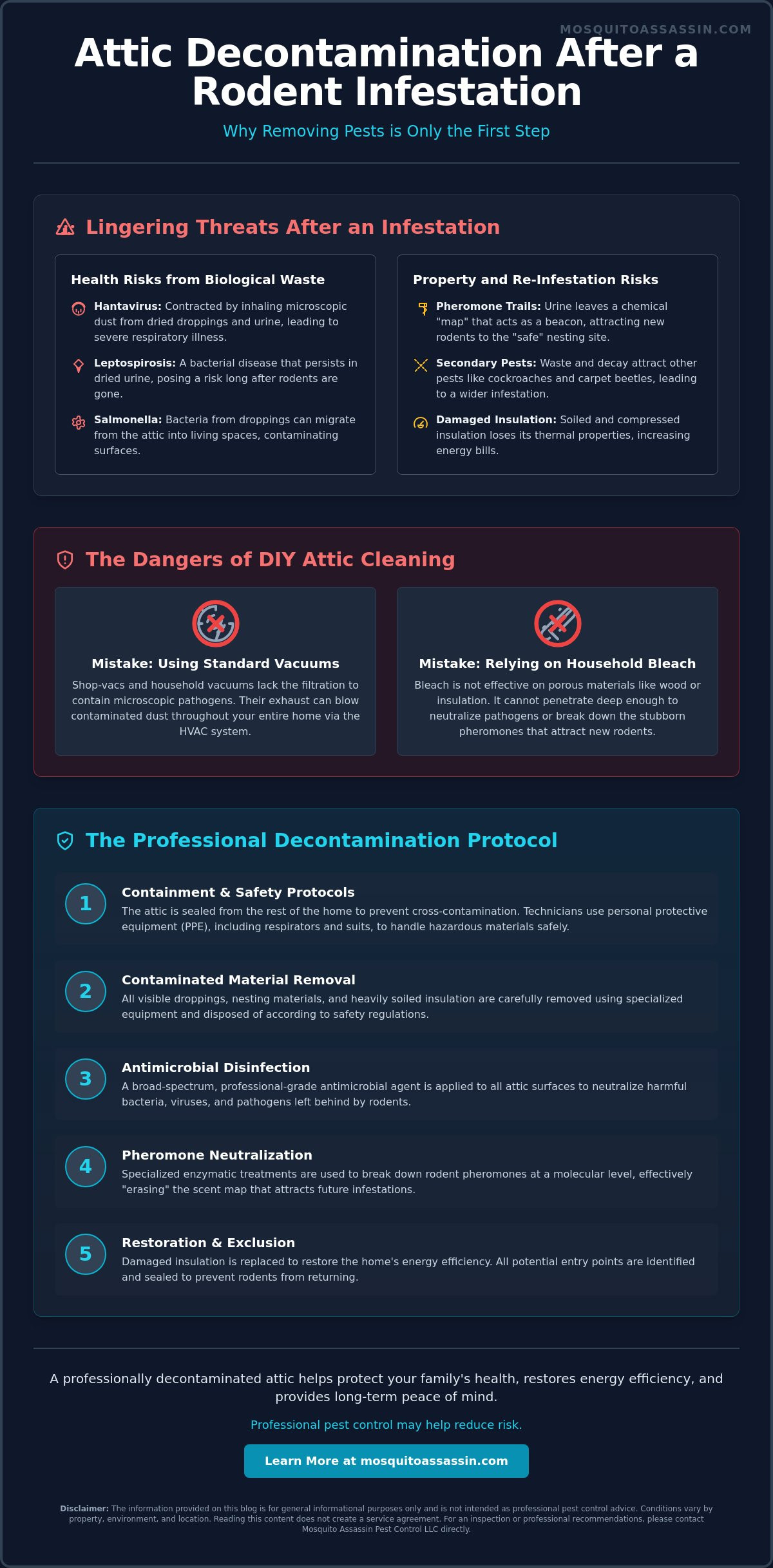
  • The Hidden Risks of DIY Bed Bug Treatment: Why Home Remedies Often Fail

    The Hidden Risks of DIY Bed Bug Treatment: Why Home Remedies Often Fail

    That $20 can of bug spray or the “miracle” home remedy found online might actually be the most expensive mistake you ever make when dealing with an infestation. It’s completely understandable why many homeowners in Erie, Crawford, and Ashtabula Counties reach for DIY solutions first. The intense anxiety of sleeping in a bed that feels unsafe, combined with concerns over the cost of professional intervention, makes any quick fix look like a lifeline. You want your home back, and you want it back now.

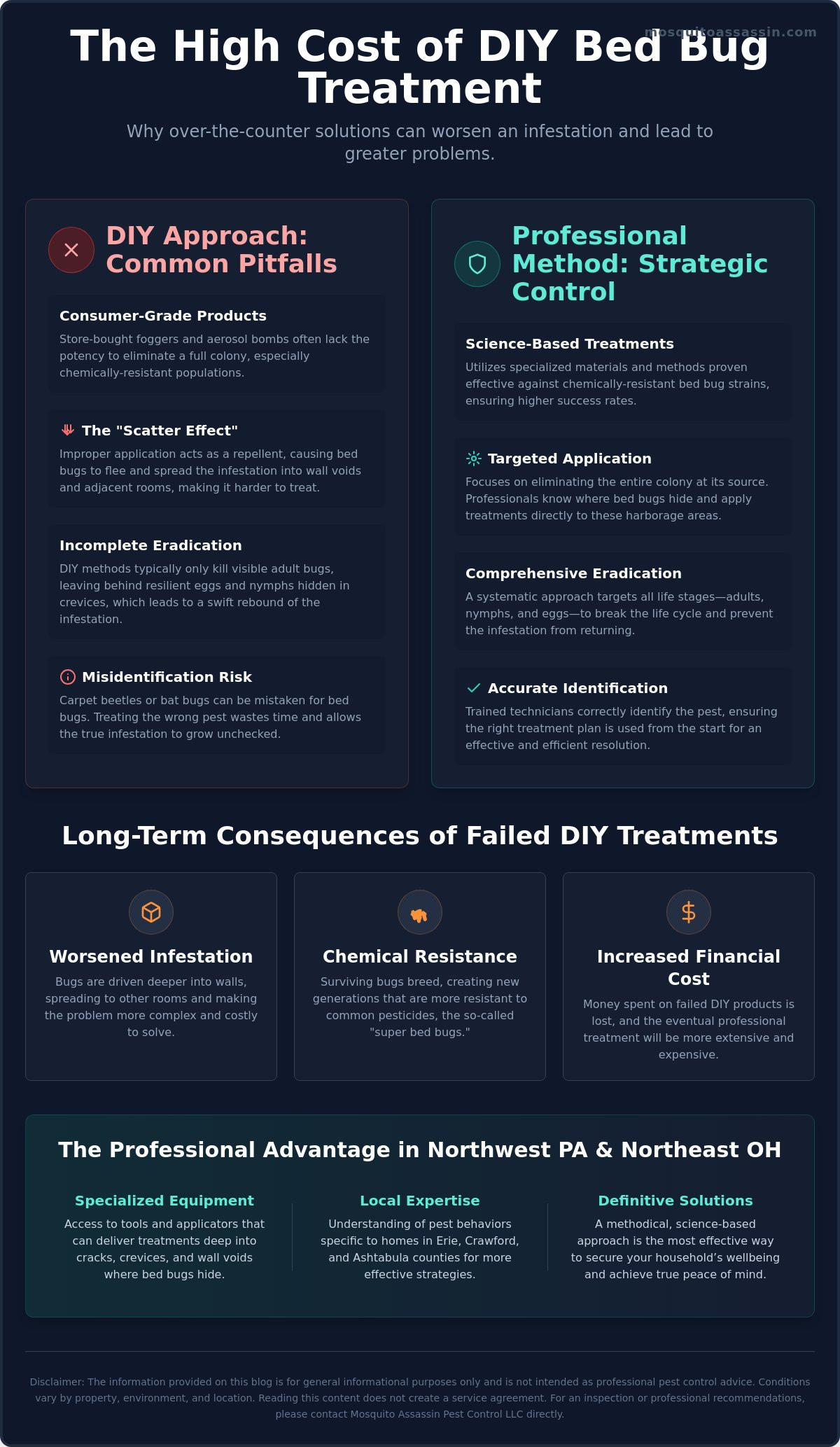
    However, the hidden risks of DIY bed bug treatment often outweigh any temporary relief. Many consumer-grade products and home methods are not only ineffective against modern, resistant bed bug populations, but they can also be counter-productive. Attempting to treat these pests without professional help often triggers a survival mechanism that causes the colony to scatter, spreading the infestation into wall voids and adjacent rooms. This guide explains why common home remedies fail, the structural and health complications that can arise from improper applications, and how a methodical, science-based approach is the most effective way to truly secure your household’s wellbeing.

    Key Takeaways

    • Understand how improper chemical application triggers a dispersal effect that drives pests deeper into wall voids.
    • Learn why common consumer foggers and aerosol bombs fail to reach the hidden nesting sites of resilient bed bug colonies.
    • Identify the hidden financial and structural risks of DIY bed bug treatment that can lead to unnecessary property damage.
    • Discover how specialized professional equipment and local expertise provide a more definitive solution for homeowners in Northwest Pennsylvania and Northeast Ohio.

    What Are the Risks of DIY Bed Bug Treatment?

    The primary risks of DIY bed bug treatment involve more than just a waste of money on store-bought sprays. When a homeowner attempts to tackle an infestation without professional training, they often inadvertently worsen the problem by driving the insects deeper into the structure of the building. Unlike ants or cockroaches that might be drawn to a specific bait, bed bugs are biological specialists that survive solely on blood. For a comprehensive overview of bed bugs and their unique behaviors, it’s helpful to understand that these pests have evolved to hide in the tiniest crevices of a home, making them incredibly difficult to reach with standard consumer products. This resilience makes them one of the most challenging pests to manage in residential properties across Erie and Crawford Counties.

    Choosing a “wait and see” approach while testing various home remedies is a significant strategic error. Every day an infestation remains active, the population grows. This delay doesn’t just impact your wallet; it takes a massive psychological toll on everyone in the household. The constant fear of being bitten while sleeping leads to chronic insomnia and extreme anxiety, turning your sanctuary into a source of dread. It’s a high-stakes situation that requires a decisive response rather than experimental methods that might only provide a false sense of security.

    To better understand the potential hazards of improper methods, watch this helpful video:

    The Problem of Incomplete Eradication

    Many people believe they’ve won the battle because they no longer see live bugs on their mattress. This is a dangerous assumption. Bed bugs are masters of concealment, and killing the visible adults is only a small fraction of the solution. A colony’s survival depends on its eggs and nymphs, which are often tucked away in electrical outlets, behind baseboards, or inside furniture joints. Professional bed bug treatment inspections use systematic methods to locate these hidden life stages that a simple visual check by a homeowner will almost certainly miss. Without addressing the eggs, the infestation will simply reboot itself within a few weeks.

    Why Identification Errors Lead to Failed Treatments

    It’s surprisingly easy to mistake other insects for bed bugs. Carpet beetles, bat bugs, and spider beetles share similar physical traits or leave behind signs that mimic a bed bug presence. Applying a treatment designed for one species to another is often useless. Misidentifying the pest at the start of the process wastes critical time that allows a small, manageable problem to explode into a full-scale infestation. Property owners in Ashtabula County and neighboring areas should ensure they know exactly what they’re fighting before taking any action.

    Disclaimer: The information provided on this blog is for general informational purposes only and is not intended as professional pest control advice. Conditions vary by property, environment, and location. Reading this content does not create a service agreement. For an inspection or professional recommendations, please contact Mosquito Assassin Pest Control LLC directly.
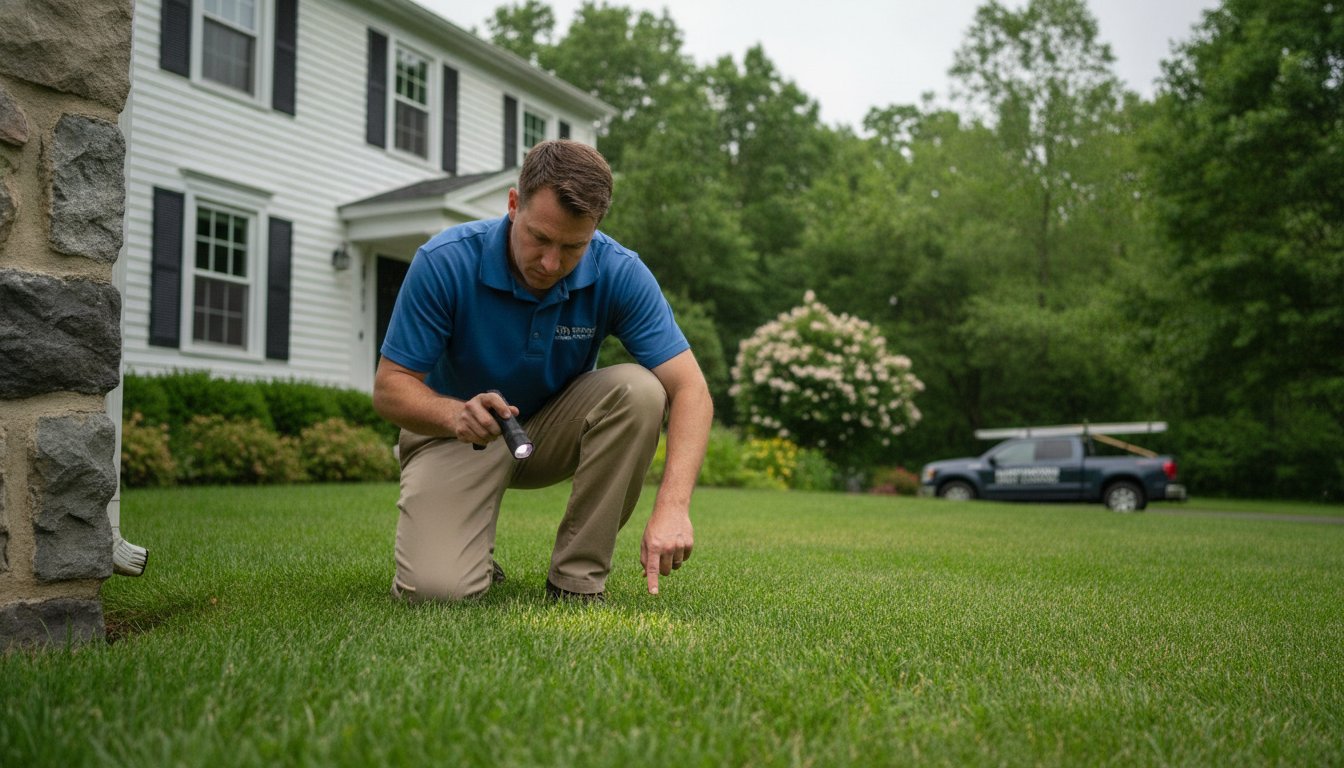
    Biological and Behavioral Risks of Improper Treatment

    One of the most significant risks of DIY bed bug treatment is the biological backlash that occurs when these pests encounter low-grade chemicals. While many retail sprays promise total elimination, they often lack the potency to finish the job. Instead of a swift resolution, homeowners often witness a worsening of the situation as the surviving population adapts to the threat. This biological warfare isn’t just about survival; it’s about the evolution of the colony within your own walls.

    Understanding Chemical Resistance

    Modern bed bug populations are not the same as those from decades ago. Over time, they have developed a formidable defense against common pyrethroid-based consumer products found in big-box stores. These “super bed bugs” have physically thicker exoskeletons that prevent toxins from penetrating their systems. When you apply a retail spray, you might kill a few visible bugs, but you’re actually performing an accidental experiment in natural selection. Only the strongest individuals survive. These survivors then breed, creating a new generation that is even more resistant to the products available at the local hardware store. The EPA provides a detailed guide on Do-it-yourself Bed Bug Control that highlights these complexities. Professional strategies often rely on non-repellents that the bugs cannot detect, ensuring they don’t have the chance to adapt or hide.

    The Danger of Scattering and Dispersal

    The most counter-productive result of DIY attempts is a phenomenon known as dispersal. Most over-the-counter sprays contain repellent agents. While this sounds effective, it actually triggers a survival instinct in the colony. When bed bugs detect these irritants, they don’t just sit there; they flee. They scurry away from the treated area and seek refuge in places that are nearly impossible to reach. They move through electrical outlets, behind baseboards, and along plumbing lines to reach adjacent rooms. What started as a minor issue in a single bedroom can quickly transform into a whole-house infestation because of a single misplaced application of a “bug bomb.”

    Once bed bugs have entered wall voids or subflooring, the difficulty of the project increases exponentially. They can remain dormant in these protected areas for months without a blood meal, waiting for the chemical scent to fade before returning to feed. This is why a methodical, professional bed bug treatment is often necessary to ensure the entire structure is properly evaluated and secured. If you’ve already tried spraying and noticed the bugs appearing in new areas, professional pest control may help reduce risk of further spread.

    Disclaimer: The information provided on this blog is for general informational purposes only and is not intended as professional pest control advice. Conditions vary by property, environment, and location. Reading this content does not create a service agreement. For an inspection or professional recommendations, please contact Mosquito Assassin Pest Control LLC directly.
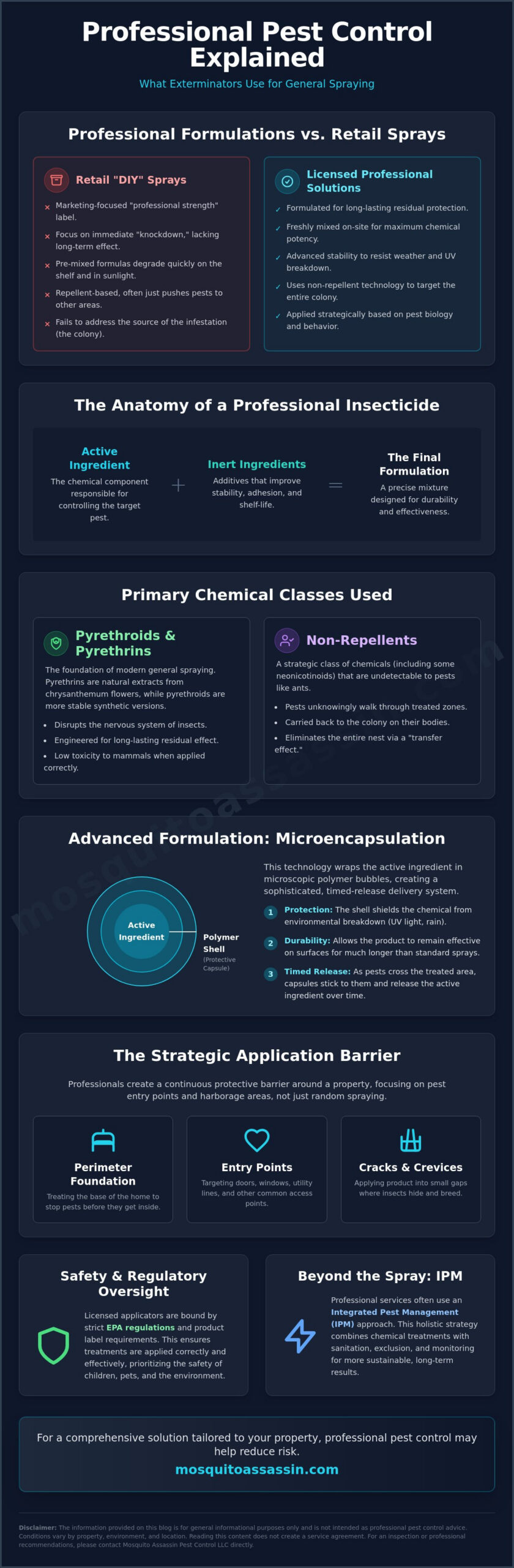
    The Failure of Common Consumer Products

    Walk into any hardware store in Erie or Ashtabula, and you’ll find an entire aisle dedicated to pest control. It’s tempting to think these brightly colored cans hold the secret to a bug-free home. However, the risks of DIY bed bug treatment often stem from a fundamental misunderstanding of how these products work. Most consumer-grade items are designed for insects that roam in the open, not for a pest that spends the majority of its life hidden in microscopic gaps. Relying on retail solutions often gives the infestation more time to grow while providing a false sense of security.

    Why Bug Bombs Are Counter-Productive

    Total release foggers, commonly known as bug bombs, are perhaps the most misused tool in the homeowner’s arsenal. These devices release a fine mist that travels upward and then settles on horizontal surfaces like tables and floors. Bed bugs, however, hide deep within mattress seams, behind picture frames, and inside bed frames. The insecticide never reaches these sanctuaries. Instead, you end up contaminating your bed sheets, toys, and kitchen counters with chemicals that the bugs never even touch. Bug bombs often act as a “warning bell” that tells bed bugs to hide elsewhere. This pushes them into deeper, more protected areas of the home, making future professional bed bug treatment significantly more difficult.

    The Limitations of Over-the-Counter Sprays

    Many retail sprays are marketed as “contact killers.” While they may indeed kill a bug if you spray it directly, they offer almost no residual protection. Once the liquid dries, it typically loses its potency. This is a critical failure because bed bugs are cryptic pests that emerge only when it’s safe to feed. If the treatment isn’t active when the bug comes out of hiding, it’s useless. This EPA guide to DIY bed bug control explains that effective management requires more than just a quick spray. Professionals use specialized application techniques to ensure products reach the “voids” where bugs reside, whereas untrained homeowners often only treat the perimeter of a room, leaving the core of the colony untouched.

    Clutter presents another physical barrier that DIY liquids cannot overcome. Piles of clothing, books, or papers provide a shield that prevents sprays from reaching the target. Desperate homeowners sometimes turn to dangerous home remedies like rubbing alcohol to bypass these issues. Rubbing alcohol is highly flammable and has caused numerous house fires when used as a DIY pesticide. Natural or essential oil-based sprays are equally problematic; while they might smell pleasant, they rarely provide the long-term protection needed to break the bed bug life cycle. Relying on these methods often leads to a cycle of temporary relief followed by a renewed, more aggressive infestation.

    Disclaimer: The information provided on this blog is for general informational purposes only and is not intended as professional pest control advice. Conditions vary by property, environment, and location. Reading this content does not create a service agreement. For an inspection or professional recommendations, please contact Mosquito Assassin Pest Control LLC directly.

    The Hidden Risks of DIY Bed Bug Treatment: Why Home Remedies Often Fail

    Financial and Structural Consequences of Failed DIY

    Many property owners view professional extermination as a last resort because of the perceived expense. However, this logic ignores the cumulative cost of repeated, failed attempts. When you add up the price of multiple cases of aerosol foggers, specialized laundry additives, and various retail sprays, the total often approaches the cost of a targeted professional intervention. The “sunk cost” of these products is only the beginning of the financial burden. One of the primary risks of DIY bed bug treatment is that it essentially buys the colony more time to entrench itself in your home’s structure while you spend money on ineffective tools.

    The True Cost of Postponing Professional Help

    A single female bed bug can lay hundreds of eggs in her lifetime. This exponential growth means that a localized infestation in one bedroom can spread to every room in a house within a few months. The longer you wait, the more complex the eradication process becomes. Treating a single room is a relatively straightforward task for a pro, but treating an entire residence requires significantly more labor, equipment, and time. Understanding pest control prices helps put these long-term expenses into perspective. When DIY methods fail, they don’t just waste your initial investment; they increase the final bill by allowing the problem to reach a critical mass.

    Damage to Personal Property

    Panic often drives people to drag mattresses and upholstered furniture to the curb. In the vast majority of cases, this is an unnecessary expense. Professional methods can often salvage furniture that looks “ruined.” Also, throwing away items can actually spread the bugs through the hallways of an apartment building or into your vehicle during transport. Improper chemical application can also leave permanent stains on delicate fabrics or damage the finish on wooden bed frames. The emotional stress of losing cherished belongings adds a heavy burden to an already difficult situation. Instead of disposing of your property, seeking a professional bed bug treatment may help you save your furniture and your sanity.

    For those living in multi-unit housing in areas like Ashtabula or Erie, failed DIY attempts can lead to serious legal complications. Many leases require tenants to report infestations immediately to management. If a landlord discovers that a tenant tried to self-treat and inadvertently spread the infestation to neighboring units, the tenant could be held financially liable for the remediation costs of the entire building. In extreme cases, improper use of flammable liquids or excessive moisture in DIY attempts can even lead to structural damage or mold issues within wall voids. Taking a methodical, professional approach is the best way to protect both your finances and your legal standing as a resident.

    Disclaimer: The information provided on this blog is for general informational purposes only and is not intended as professional pest control advice. Conditions vary by property, environment, and location. Reading this content does not create a service agreement. For an inspection or professional recommendations, please contact Mosquito Assassin Pest Control LLC directly.
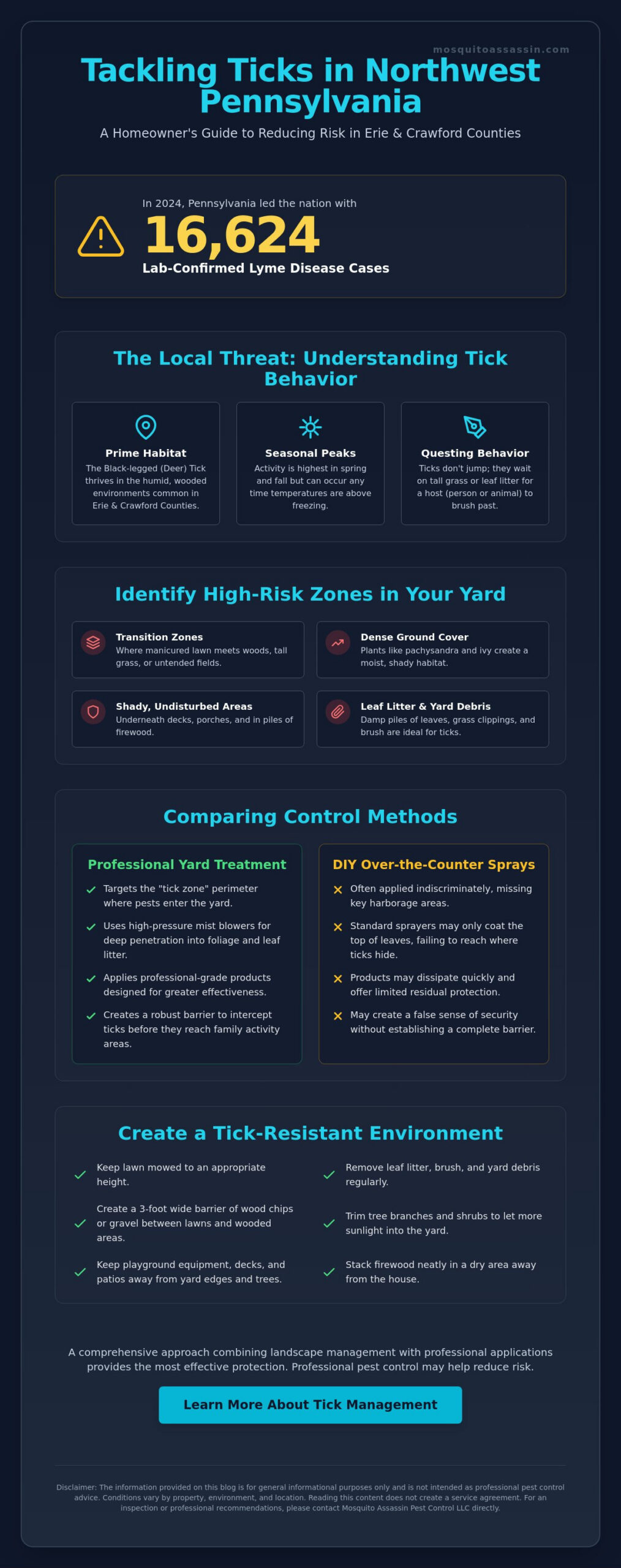
    The Professional Advantage for Regional Homeowners

    Professional intervention provides a decisive resolution that home remedies simply cannot achieve. While the risks of DIY bed bug treatment include accidental colony dispersal and the development of chemical resistance, professional methods utilize physics and biology to ensure total removal. The use of specialized equipment, such as industrial-grade steam and high-heat systems, allows for the penetration of materials that liquid sprays cannot reach. High-efficiency particulate air (HEPA) vacuums are also employed to physically remove live insects, cast skins, and allergens from the environment, providing immediate relief and a cleaner living space.

    A systematic approach is necessary because bed bugs are resilient and cryptic. Professional services involve a multi-step process that includes thorough removal, ongoing maintenance, and exclusion strategies to prevent future entries. This disciplined operational method ensures that every life stage, from eggs to adults, is addressed. By choosing professional assistance, property owners can avoid the cycle of failed attempts and finally restore the security and wellbeing of their household members.

    Integrated Pest Management (IPM) in Practice

    Integrated Pest Management is the standard for modern, effective eradication. This strategy combines non-chemical methods, such as mechanical removal and temperature control, with targeted, professional-grade chemical applications. This balanced approach minimizes the volume of products used while maximizing the impact on the pest population. A critical component of IPM is the follow-up inspection. Since research indicates that most infestations require multiple visits to ensure total eradication, professionals schedule secondary checks to confirm that no hidden eggs have hatched. This methodical oversight is a core part of general pest control services and is essential for long-term success.

    Localized Expertise in Erie, Crawford, and Ashtabula

    Regional climate factors and local housing styles play a significant role in pest behavior. In Northwest Pennsylvania and Northeast Ohio, older home constructions often feature lath and plaster walls, intricate woodwork, and crawl spaces that provide ideal hiding spots for bed bugs. Neighbors who understand these local architectural nuances are better equipped to identify potential harborages that an outsider might overlook. Working with a local entity rooted in Erie, Crawford, and Ashtabula Counties ensures that the service team is familiar with the specific environmental challenges of the area.

    Restoring peace of mind starts with a professional evaluation of the property. If you are facing a suspected infestation, professional pest control may help reduce risk and provide a definitive path forward. To begin a methodical inspection and receive expert recommendations, please contact Mosquito Assassin Pest Control LLC through the online booking portal.

    Disclaimer: The information provided on this blog is for general informational purposes only and is not intended as professional pest control advice. Conditions vary by property, environment, and location. Reading this content does not create a service agreement. For an inspection or professional recommendations, please contact Mosquito Assassin Pest Control LLC directly.
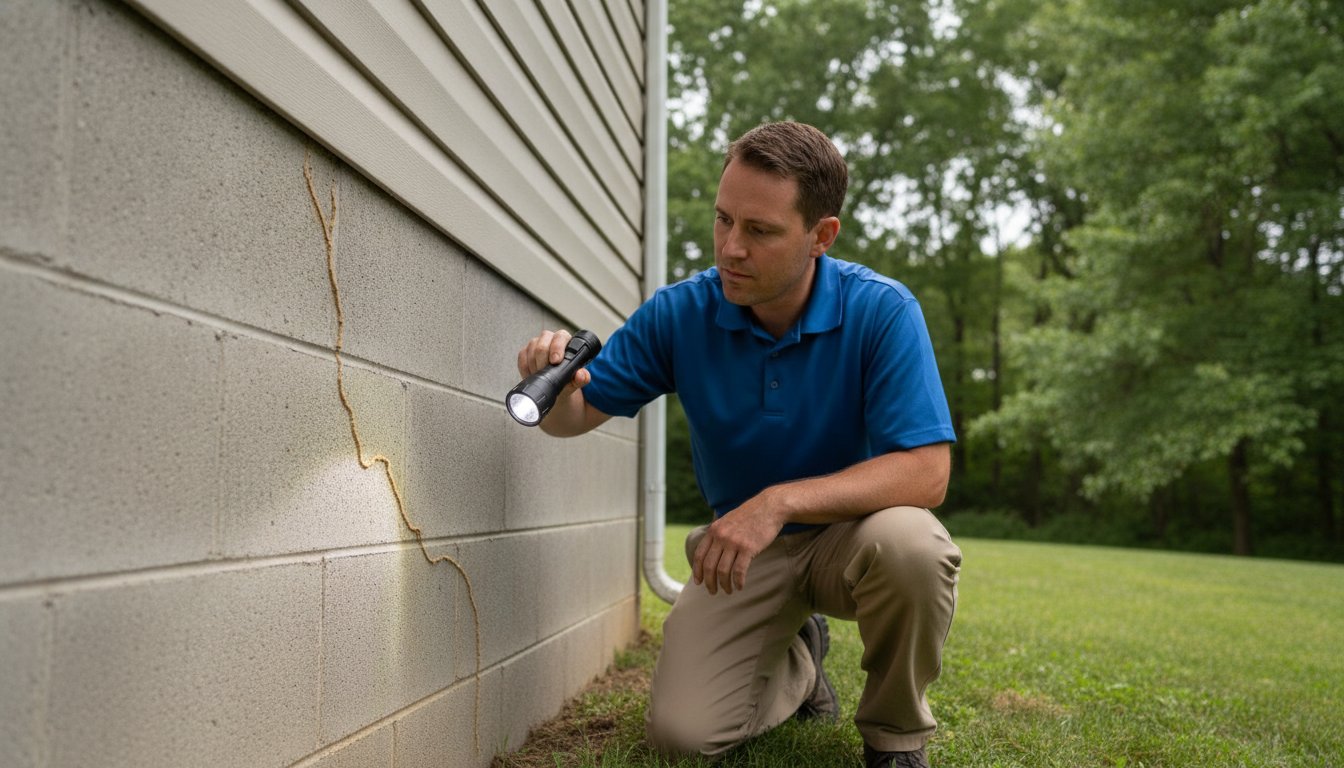
    Secure Your Home with Professional Intervention

    Bed bugs are biological specialists that require a methodical, scientific response. Attempting to manage an infestation with store-bought foggers or unproven home remedies often leads to the very outcomes you want to avoid. The primary risks of DIY bed bug treatment include driving pests deeper into your walls and allowing the population to reach a critical, more expensive mass. A professional approach utilizing Integrated Pest Management (IPM) is the most reliable way to break the life cycle and secure your household.

    Licensed and insured professionals understand the unique challenges of local housing in Erie, Crawford, and Ashtabula counties. By prioritizing the safety of your family and the structural integrity of your home, expert intervention replaces anxiety with a definitive resolution. You don’t have to face this challenge alone. To protect your property and restore your peace of mind, you can request an inspection for professional bed bug management today. Your home should be a sanctuary, and a systematic treatment plan ensures it stays that way.

    Disclaimer: The information provided on this blog is for general informational purposes only and is not intended as professional pest control advice. Conditions vary by property, environment, and location. Reading this content does not create a service agreement. For an inspection or professional recommendations, please contact Mosquito Assassin Pest Control LLC directly.
    Frequently Asked Questions

    Can I get rid of bed bugs on my own with retail products?

    Eradicating an entire colony with retail products is extremely difficult because these insects hide in areas that sprays cannot reach. Most store-bought items only kill the bugs you see, leaving the eggs and nymphs tucked away in wall voids or furniture joints. This leads to a cycle of re-infestation that can last for months. One of the primary risks of DIY bed bug treatment is that it provides a false sense of security while the population continues to grow.

    Why did my bed bug problem get worse after using a bug bomb?

    Bug bombs are often counter-productive because they release a repellent mist that triggers the insects’ survival instinct to flee. Instead of dying, the bed bugs scurry away from the mist and seek refuge inside electrical outlets, behind baseboards, and into adjacent rooms. This dispersal turns a localized problem into a whole-house infestation. The mist also settles on surfaces where you live and sleep without ever reaching the deep crevices where the pests actually hide.

    Is it safe to use rubbing alcohol to kill bed bugs?

    Using rubbing alcohol is highly dangerous and poses a significant fire hazard to your home. While alcohol can kill a bed bug on contact, it evaporates almost instantly and offers no long-term protection. Numerous house fires have been documented after homeowners sprayed excessive amounts of this flammable liquid near beds or electrical outlets. It’s much safer to rely on professional methods that use non-flammable, registered products designed for residential environments.

    How long can a bed bug infestation last if not treated professionally?

    A bed bug infestation can last indefinitely without professional intervention because these pests are highly resilient. Adult bed bugs can survive for several months without a blood meal in certain conditions, allowing them to wait out temporary treatments. Their rapid reproduction rate means that even a few survivors can reboot a colony in a matter of weeks. Without a methodical approach that targets every life stage, the infestation will likely persist and expand throughout the structure.

    What is the most common mistake people make with DIY bed bug treatment?

    The most common mistake is relying solely on contact-kill sprays while ignoring the cryptic nature of the pest. Many people assume that if they don’t see live bugs, the problem is solved, but they fail to address the eggs hidden in microscopic gaps. This oversight is among the major risks of DIY bed bug treatment, as it allows the colony to recover. Successful eradication requires a combination of mechanical removal, heat or steam, and residual products that remain active over time.

    Do I need to throw away my mattress if I have bed bugs?

    You rarely need to dispose of your mattress; in fact, doing so can accidentally spread the insects to other parts of your property. Professional treatments involving specialized steam or heat can effectively penetrate the mattress and box spring to kill all life stages. Once treated, high-quality bed bug encasements can be used to trap any potential survivors and prevent new bugs from entering. This approach saves you the significant expense and stress of replacing expensive furniture.

    Can bed bugs move from one room to another if I spray only one area?

    Bed bugs will actively move to adjacent rooms if they detect repellent chemicals in their current environment. These insects are fast runners and can easily travel through wall voids, along plumbing lines, or under door frames to reach a “safer” area. If you only treat the bedroom where you first noticed them, you may inadvertently push the colony into the living room or guest rooms. This is why professional inspections cover the entire home to ensure no hiding spot is overlooked.

    How do professionals treat bed bugs differently than homeowners?

    Professionals use Integrated Pest Management (IPM) to combine multiple specialized tools that are unavailable to the general public. This includes industrial-grade steam, high-output heat systems, and non-repellent chemicals that the bugs cannot detect. Unlike the surface-level applications common in DIY attempts, professional techniques focus on the structural voids and deep harborages where the colony resides. This comprehensive strategy ensures that the root of the infestation is eliminated rather than just the visible insects.

    Disclaimer: The information provided on this blog is for general informational purposes only and is not intended as professional pest control advice. Conditions vary by property, environment, and location. Reading this content does not create a service agreement. For an inspection or professional recommendations, please contact Mosquito Assassin Pest Control LLC directly.

  • How Effective Is Professional Mosquito Control? A Comprehensive Guide for 2026

    How Effective Is Professional Mosquito Control? A Comprehensive Guide for 2026

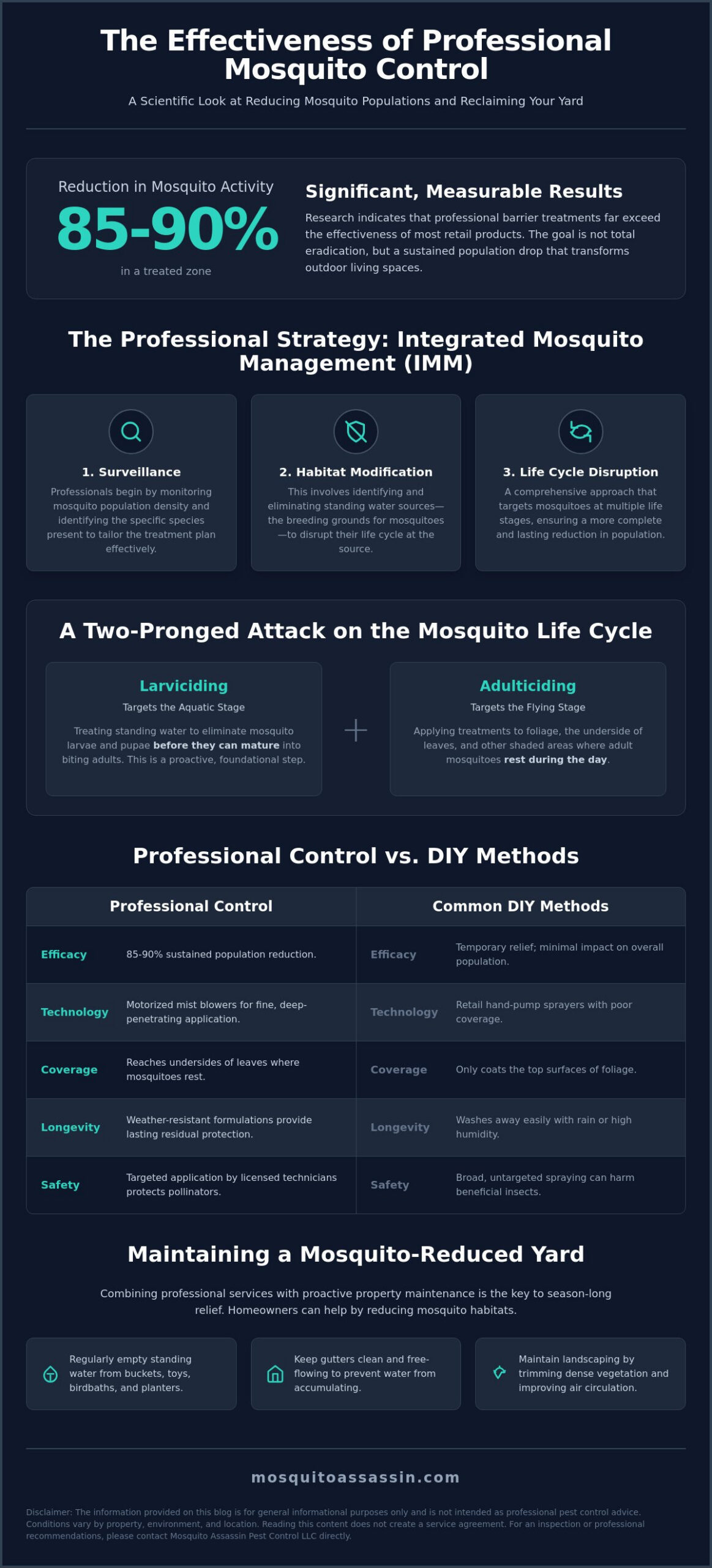
    Research indicates that professional barrier sprays can reduce mosquito activity by 85% to 90% in a treated zone, a figure that far exceeds the results of most retail products. It’s exhausting to deal with itchy bites that ruin outdoor family time, especially when you’ve already spent money on traps or candles that didn’t work. If you are wondering how effective is professional mosquito control, it’s important to look at the science rather than the marketing. This guide provides a clear look at how professional treatments work, what the results look like for properties in Erie and Crawford Counties in Pennsylvania and Ashtabula County in Ohio, and why a licensed approach is different from DIY.

    Discover the scientific reality behind modern treatments, explaining how efficacy is measured and what property owners should realistically expect from a licensed service. You’ll learn about the integrated management strategies used by experts to create a safer outdoor environment for your children and pets. This guide also provides practical knowledge on how to keep the population down all season long through 2026, ensuring your yard remains a place for relaxation rather than a source of stress.

    Disclaimer: The information provided on this blog is for general informational purposes only and is not intended as professional pest control advice. Conditions vary by property, environment, and location. Reading this content does not create a service agreement. For an inspection or professional recommendations, please contact Mosquito Assassin Pest Control LLC directly.

    Key Takeaways

    • Understand why Integrated Mosquito Management (IMM) is the scientific standard for achieving a significant, measurable reduction in local pest populations.
    • Learn how regional environmental factors like high humidity and dense vegetation in Pennsylvania and Ohio dictate the success of professional treatments.
    • Evaluate how effective is professional mosquito control compared to retail traps and foggers that often lack the residual power needed for long term relief.
    • Discover how licensed technicians use targeted application methods to protect pollinators and beneficial insects while managing mosquito activity.
    • Gain practical strategies for maintaining a mosquito free yard by combining professional services with proactive source reduction at home.

    Defining the Effectiveness of Professional Mosquito Management

    Efficacy in mosquito management is often misunderstood as the total eradication of every insect on a property. In reality, a successful program is defined by a significant and measurable reduction in the local population. Industry data shows that professional barrier treatments can reduce mosquito activity by 85% to 90% in a treated area. If you’ve been asking how effective is professional mosquito control, the answer lies in the transition from temporary relief to a sustained population drop. This results from a scientific approach known as Integrated Mosquito Management (IMM). This methodology moves beyond simple spraying to include surveillance, habitat modification, and life cycle disruption.

    Measuring this success involves tracking population density and understanding the biology of the target species. Licensed professionals utilize commercial-grade equipment that produces a much finer mist than retail hand-pump sprayers. These specialized motorized blowers use high-velocity air to move foliage, ensuring the product reaches the undersides of leaves where pests congregate. By using comprehensive Mosquito control strategies, technicians can address the problem at its source. This creates a protective environment that retail products simply cannot replicate.

    To better understand this concept, watch this helpful video:

    The Two-Pronged Attack: Larvicides vs. Adulticides

    A common mistake in DIY efforts is focusing only on the insects that are already biting. Professional mosquito control services utilize a two-pronged strategy that targets different life stages. Larviciding involves treating standing water to stop mosquitoes in their aquatic stage before they ever develop wings. Adulticiding targets the mature insects resting in your landscape. Treating only one stage is significantly less effective because new adults will constantly emerge to replace those that were eliminated. A combined approach ensures the population is suppressed from the ground up.

    The Role of Residual Protection

    The longevity of a treatment is just as important as the initial knockdown. Professional formulations are engineered to provide residual protection by adhering to the underside of leaves and other shaded resting areas. This is critical because mosquitoes spend the majority of their time resting in these cool spots to avoid dehydration. Modern products are also designed to be weather-resistant. While a heavy downpour might require a follow-up, these formulations typically maintain their efficacy through light rainfall and high humidity, which are common conditions in Erie and Crawford counties in Pennsylvania and Ashtabula County in Ohio.

    Disclaimer: The information provided on this blog is for general informational purposes only and is not intended as professional pest control advice. Conditions vary by property, environment, and location. Reading this content does not create a service agreement. For an inspection or professional recommendations, please contact Mosquito Assassin Pest Control LLC directly.

    Key Factors That Determine Treatment Success in the Great Lakes Region

    The success of any pest management program in the Great Lakes region depends heavily on localized environmental variables. In Erie and Crawford counties, along with Ashtabula County, the proximity to Lake Erie creates a unique microclimate characterized by high humidity and frequent moisture. These conditions are ideal for rapid mosquito breeding. When property owners ask how effective is professional mosquito control, they must consider that pest pressure varies significantly based on their specific surroundings. A property bordering a marsh or a wooded area will naturally face a higher volume of incoming insects than a manicured suburban lot.

    Vegetation density also plays a critical role. Thick foliage provides more surface area for mosquitoes to hide, meaning more product and specialized application techniques are required to achieve full coverage. Timing is another non-negotiable factor. For maximum efficacy, treatments should ideally begin in early spring, before the first major hatch of the season occurs. This proactive approach prevents the population from reaching unmanageable levels during the peak heat of summer. Understanding these regional nuances is key to maintaining a comfortable outdoor space. For more information on local conditions, reviewing a service area map can help determine specific needs.

    Impact of Rainfall and Temperature

    Weather is the primary driver of treatment longevity. While modern, professional formulations are designed to be weather-resistant, extreme environmental shifts can influence results. Sustained temperatures above 90 degrees Fahrenheit can accelerate the breakdown of certain active ingredients, necessitating more frequent monitoring. Conversely, while light rain is manageable and often does not disrupt the residual barrier, torrential downpours present a wash-off threshold. Licensed technicians monitor these thresholds closely, ensuring that protective barriers are reinforced if a significant weather event occurs.

    Property Size and Neighboring Habitats

    The perceived effectiveness of a treatment can be influenced by migration from adjacent, untreated properties. Mosquitoes are mobile; they don’t respect property lines. This is why establishing a larger treated buffer zone is essential for long term relief. Professional applications focus on harborage areas like tall grass, dense shrubs, and the dark spaces under decks where pests rest during the day. These areas require meticulous attention to break the cycle of infestation.

    Responsible application also accounts for the surrounding ecosystem. Licensed professionals are trained to minimize drift to protect the impact on pollinators like bees and butterflies. By targeting specific resting sites rather than using broad, indiscriminate spraying, the treatment remains effective against mosquitoes while respecting beneficial insects. This disciplined operational approach ensures that your yard remains a safe environment for your family and the local environment alike.

    Disclaimer: The information provided on this blog is for general informational purposes only and is not intended as professional pest control advice. Conditions vary by property, environment, and location. Reading this content does not create a service agreement. For an inspection or professional recommendations, please contact Mosquito Assassin Pest Control LLC directly.

    Comparing Professional Efficacy Against Common DIY Mosquito Methods

    Many homeowners spend hundreds of dollars on retail solutions only to find themselves still swatting away pests during every backyard gathering. When evaluating how effective is professional mosquito control, the comparison with DIY methods highlights a significant gap in both product chemistry and application technique. Retail foggers and aerosol sprays provide an immediate knockdown effect, but they often lack the residual power necessary to keep the population from returning within hours. Similarly, citronella candles and torches create a very small, temporary zone of protection that is easily disrupted by a slight breeze or a change in humidity.

    Mechanical traps and CO2 magnets are other popular choices, yet they often fail to lower the overall population density of a yard. While these devices may catch thousands of insects, research suggests they can actually attract more mosquitoes to the property than they successfully remove. A professional approach focuses on total population management rather than simply trapping individuals. Licensed technicians are trained to identify cryptic breeding sites that are frequently overlooked; these include clogged gutters, corrugated drain pipes, and specific types of dense vegetation common in the Great Lakes region.

    Equipment and Product Quality Differences

    The tools used in professional applications are vastly superior to standard garden sprayers or handheld foggers. Motorized backpack blowers use high velocity air to move foliage, ensuring the product reaches the undersides of leaves where 90% of mosquitoes spend their day. Additionally, commercial grade products are often micro encapsulated. This technology allows the active ingredients to be released slowly over several weeks, maintaining a consistent barrier against new arrivals. DIY applications typically miss these critical resting sites, leaving the majority of the population untouched and free to continue breeding.

    The Cost of Ineffective DIY Attempts

    The financial burden of DIY mosquito control often goes unnoticed until the end of the season. Repeatedly purchasing cans of spray, refills for heat activated repellent devices, and expensive traps adds up quickly without solving the underlying infestation. Beyond the monetary expense, there is the frustration of lost time and ruined outdoor events. Understanding pest control prices helps put the value of a professional service into perspective. A comprehensive plan provides a measurable reduction in activity, saving property owners in Erie, Crawford, and Ashtabula counties from the cycle of ineffective retail spending.

    Disclaimer: The information provided on this blog is for general informational purposes only and is not intended as professional pest control advice. Conditions vary by property, environment, and location. Reading this content does not create a service agreement. For an inspection or professional recommendations, please contact Mosquito Assassin Pest Control LLC directly.

    How Effective Is Professional Mosquito Control? A Comprehensive Guide for 2026

    Addressing the Impact on Pollinators and Beneficial Insects

    A significant concern for many property owners is whether managing pests comes at the cost of harming the local ecosystem. When discussing how effective is professional mosquito control, it’s vital to address the balance between human comfort and environmental stewardship. Responsible management isn’t about broadcast spraying everything in sight. Instead, it relies on targeted application techniques that focus on where mosquitoes actually live, rather than where beneficial insects forage. This precision ensures that the treatment remains effective against target pests while minimizing the footprint on the surrounding environment.

    Technicians are trained to identify and avoid flowering plants where bees and butterflies are most active. By focusing on the interior of dense shrubs and the undersides of non-flowering leaves, professionals hit the target pests while leaving pollinators alone. Timing also plays a crucial role in these efforts. Most applications occur during the early morning or late evening when pollinators are less active, significantly reducing the risk of direct contact. According to research cited by the American Mosquito Control Association, mosquitoes are 100 times more susceptible to the pesticides used in ultra-low volume (ULV) applications than honey bees are, allowing for effective control at very low concentrations.

    Targeted Application Techniques

    Precision is what separates a professional service from a generic DIY attempt. Technicians establish no-spray buffer zones around vegetable gardens, fruit trees, and active pollinator habitats. The formulations used are designed to dry quickly, which minimizes the window for non-target exposure. By treating the harborage areas mentioned in previous sections, such as the deep shade under decks or the center of thick hedges, the treatment remains localized where mosquitoes rest during the heat of the day. This methodical approach ensures the yard is protected without disrupting the natural foraging patterns of beneficial insects.

    Professional Standards and Licensing

    In Erie and Crawford Counties in Pennsylvania and Ashtabula County in Ohio, licensed applicators must adhere to strict EPA-approved label instructions. These regulations ensure that products are used in a way that prioritizes the safety of the household and the surrounding environment. Professional pest control may help reduce risk to families while respecting the delicate balance of the local Great Lakes ecosystem. Consulting with a dependable local expert ensures that your plan is customized to the specific layout and environmental needs of your property.

    Disclaimer: The information provided on this blog is for general informational purposes only and is not intended as professional pest control advice. Conditions vary by property, environment, and location. Reading this content does not create a service agreement. For an inspection or professional recommendations, please contact Mosquito Assassin Pest Control LLC directly.

    Strategies for Sustaining a Mosquito-Free Outdoor Space

    The longevity of a pest free yard relies on a collaborative effort between the property owner and the service provider. While earlier sections established how effective is professional mosquito control at knocking down adult populations, sustaining those results through the humid months in Erie, Crawford, and Ashtabula counties requires proactive source reduction. Eliminating standing water is the single most important action a homeowner can take to assist the professional process. Because mosquitoes can develop from egg to adult in as little as seven to ten days, removing breeding habitats prevents new generations from emerging between scheduled visits.

    Regular property maintenance is equally essential for long term success. Tall grass and overgrown brush provide the shaded harborage areas where pests rest during the heat of the day. By keeping the lawn trimmed and the landscape manicured, you reduce the available real estate for mosquitoes to congregate. Ongoing protection plans are significantly more effective than one-time treatments for seasonal pests because they provide consistent surveillance and barrier reinforcement throughout the entire breeding season. Professional pest control may help reduce risk by maintaining these barriers before population spikes occur.

    Homeowner Checklist for Source Reduction

    To maximize the impact of professional treatments, property owners should perform a weekly sweep of their grounds. Focus on these common, often overlooked problem areas:

    • Check for stagnant water in clogged gutters and corrugated drainage pipe extensions.
    • Invert wheelbarrows, buckets, and empty plant saucers immediately after every rain event.
    • Ensure pool covers are pulled tight and do not collect pockets of stagnant water.
    • Change the water in birdbaths and outdoor pet bowls at least twice a week.
    • Inspect children’s toys, tarps, and tire swings for hidden water reservoirs.

    The Value of a Professional Partnership

    A comprehensive mosquito control program offers more than just application; it provides consistent surveillance throughout the season. Technicians can identify emerging issues, such as new drainage problems or shifts in local pest pressure, before they become full blown infestations. For property owners looking for a long term population decline, professional recommendations for property modifications are invaluable. To learn more about protecting your property and the specific options available for your land, visit services. A disciplined operational approach ensures your outdoor space remains a place for relaxation rather than a source of stress.

    Disclaimer: The information provided on this blog is for general informational purposes only and is not intended as professional pest control advice. Conditions vary by property, environment, and location. Reading this content does not create a service agreement. For an inspection or professional recommendations, please contact Mosquito Assassin Pest Control LLC directly.

    Achieving Long Term Relief for Your Outdoor Space

    Reclaiming your backyard from persistent pests requires more than just luck; it demands a scientific approach. Property owners often ask how effective is professional mosquito control when compared to retail alternatives. The answer lies in the 85% to 90% reduction in activity that only a comprehensive, integrated approach can provide. By combining larval disruption with targeted adult treatments, you can break the cycle of infestation and enjoy your yard again. Success in our local Great Lakes climate depends on consistent protection schedules and proactive source reduction around the home.

    Licensed and insured professionals serving Erie, Crawford, and Ashtabula counties provide the expertise needed to manage these populations safely and effectively. Customized Integrated Mosquito Management plans tailored to local property needs ensure that every treatment is precise and impactful. It’s time to stop wasting money on ineffective traps and start investing in a proven solution that prioritizes your family’s comfort. To get started, you can request an inspection or professional recommendations from Mosquito Assassin today. You don’t have to let mosquitoes dictate your summer plans.

    Disclaimer: The information provided on this blog is for general informational purposes only and is not intended as professional pest control advice. Conditions vary by property, environment, and location. Reading this content does not create a service agreement. For an inspection or professional recommendations, please contact Mosquito Assassin Pest Control LLC directly.

    Frequently Asked Questions

    How long does a professional mosquito treatment typically last?

    A professional treatment generally provides protection for approximately three to four weeks. The residual products are engineered to adhere to the underside of vegetation, where they remain active between visits. Environmental factors like extreme heat or heavy rain can impact this timeline; however, most property owners see consistent results with a 21 to 30 day schedule. This frequency ensures the barrier remains strong enough to manage new arrivals.

    Is professional mosquito control safe for my pets and children?

    Professional applications are performed using EPA approved products that are safe for pets and children once the treatment has completely dried. This typically takes 30 to 60 minutes depending on the humidity levels in the Great Lakes area. Licensed technicians prioritize the wellbeing of your household by following strict application protocols and ensuring that all residents stay indoors during the actual spray process to prevent direct exposure.

    Can mosquitoes fly over from my neighbor’s yard after you spray?

    Yes, mosquitoes can migrate from neighboring properties; however, the professional barrier is designed to address this. Because mosquitoes must rest frequently to avoid dehydration, they will land on the treated foliage in your yard. The residual barrier eliminates them upon contact, preventing them from establishing a presence on your property even if your neighbors do not have a service plan in place.

    What happens if it rains immediately after a mosquito treatment?

    Light rain does not typically compromise a treatment once it has had time to dry. Modern formulations are designed to be weather resistant and adhere firmly to plant surfaces. If a torrential downpour occurs immediately after an application before it has dried, the effectiveness may be reduced. Professionals monitor local weather patterns in Pennsylvania and Ohio to ensure treatments are applied during optimal, dry conditions.

    Do professional mosquito sprays kill bees and butterflies?

    Targeted application techniques are used to protect beneficial insects like bees and butterflies. Technicians are trained to avoid flowering plants where pollinators forage and focus instead on the dense, non flowering vegetation where mosquitoes rest. This precision is a key factor when evaluating how effective is professional mosquito control compared to indiscriminate DIY fogging, which often lacks the control needed to protect the local ecosystem.

    How many treatments are needed for a full mosquito season in Ohio and Pennsylvania?

    A full mosquito season in the Great Lakes region typically requires seven to eight treatments. This schedule usually begins in late April or early May and continues through September or October. Consistent applications are necessary to maintain the residual barrier and disrupt the mosquito life cycle throughout the peak breeding months when humidity and temperatures are highest. Skipping treatments can allow the population to rebound quickly.

    Will professional mosquito control eliminate 100% of the mosquitoes?

    No professional service can realistically promise 100% elimination of all mosquitoes. The goal of a high quality program is a significant reduction of 85% to 90% in the local population. This level of control makes the outdoor environment comfortable for families and pets while acknowledging that mosquitoes are mobile insects that can occasionally fly in from untreated areas or nearby marshes before contacting the barrier.

    Is a one-time mosquito spray effective for a special event?

    One time treatments are highly effective for providing immediate knockdown of adult mosquitoes before a special event like a wedding or graduation. This type of service focuses on clearing the area of biting insects for a specific window of time. While it provides a temporary zone of comfort, it does not offer the long term population suppression achieved through a seasonal Integrated Mosquito Management plan that targets larvae.

    Disclaimer: The information provided on this blog is for general informational purposes only and is not intended as professional pest control advice. Conditions vary by property, environment, and location. Reading this content does not create a service agreement. For an inspection or professional recommendations, please contact Mosquito Assassin Pest Control LLC directly.

  • Follow Up After Pest Control Service: A Complete Homeowner Guide

    Follow Up After Pest Control Service: A Complete Homeowner Guide

    Why are there suddenly more pests in the kitchen than there were before the technician arrived? While it feels counterintuitive, seeing an uptick in activity is often a sign that the treatment is successfully disrupting nesting sites and forcing insects into the open. It’s completely normal to feel a sense of uncertainty regarding the safety of your family or the longevity of the application. You might worry about accidentally washing away the barrier during a routine cleaning or wonder if it’s truly safe for your pets to roam the living room. Understanding the proper follow up after pest control service is the most effective way to turn that initial anxiety into long-term peace of mind.

    By following a few professional best practices, you can ensure your home remains a fortress against future infestations without compromising household safety. This guide outlines the essential actions every homeowner should take to maximize the results of a professional treatment. You will discover how to handle cleaning schedules, what to expect regarding pest behavior, and how to maintain the integrity of the treatment zones. Whether you live in Erie, Crawford, or Ashtabula County, these practical steps will help you achieve a pest-free environment and a clear understanding of the results timeline.

    Key Takeaways

    • Understand the critical two to four hour drying window required for liquid treatments to become effective and safe for household contact.
    • Learn why seeing more insects immediately after a visit is a sign of success known as the flushing effect.
    • Identify how to safely re-introduce pets and children to treated areas once professional products have completely dried.
    • Discover why a consistent follow up after pest control service is necessary to address the specific breeding and egg cycles of common pests.
    • Identify structural entry points like foundation cracks and siding gaps that require maintenance to support professional exclusion efforts.

    Immediate Post-Treatment Protocols and Wait Times

    A thorough follow up after pest control service begins the moment the technician departs your property. After a professional application, the first few hours are the most critical for ensuring the treatment works as intended. Most liquid residual products require a drying period of approximately two to four hours before it’s safe for residents to re-enter the treated space. This window allows the active ingredients to bond with surfaces, creating a protective barrier that pests must cross to be eliminated. It’s essential to keep children and pets away from treated areas until they are completely dry to the touch.

    If your service included specialized treatments like foggings or aerosols, proper ventilation is a mandatory step. Open windows or use fans once the initial re-entry period has passed to ensure fresh air circulation. Maintaining the integrity of these barriers is a core component of Integrated Pest Management (IPM), which focuses on long-term prevention rather than just temporary fixes. For homeowners in Erie and Crawford Counties in Pennsylvania and Ashtabula County in Ohio, understanding these initial steps is the first move toward a pest-free home.

    To better understand this concept, watch this helpful video:

    Guidelines for Cleaning and Sanitation

    Homeowners often feel an urge to deep clean after a technician leaves, but this can actually neutralize the professional application. Avoid mopping or scrubbing near baseboards, as these are primary zones for residual barriers. It’s best to stick to localized cleaning in the center of rooms where products weren’t applied. Using strong detergents or steam cleaners can break down the treatment prematurely. For the best results, wait at least 3 to 5 days before resuming a full-scale floor cleaning routine. This delay ensures the product remains potent enough to address the pest population effectively.

    Handling Food and Personal Items

    Safety is the top priority during any follow up after pest control service. While professionals take care to avoid food contact areas, you should still inspect kitchen counters and food preparation surfaces. If any items were accidentally left exposed, wash them thoroughly with warm, soapy water. Porous items, such as paper plates, napkins, or open cardboard trash, should be discarded if they appear dampened by the treatment. If you have questions about specific items, checking with a professional pest control service can provide additional clarity based on the products used.

    Disclaimer: The information provided on this blog is for general informational purposes only and is not intended as professional pest control advice. Conditions vary by property, environment, and location. Reading this content does not create a service agreement. For an inspection or professional recommendations, please contact Mosquito Assassin Pest Control LLC directly.

    Interpreting Pest Activity and the Flushing Effect

    Seeing a sudden surge of cockroaches or ants on your kitchen counter just days after a professional treatment can be alarming. However, this is a standard biological response known in the industry as the flushing effect. Professional grade pesticides are designed to irritate pests in their nesting sites, forcing them out of the shadows and into treated areas. This increased visibility doesn’t mean the treatment failed; it means the products are actively disrupting the infestation. A successful follow up after pest control service requires patience during this initial phase.

    Typically, homeowners should expect to see a gradual decline in activity within 7 to 10 days. During this window, resist the urge to use over the counter DIY sprays. These retail products often act as repellents, which can drive pests deeper into wall voids or interfere with the specialized baits applied by your technician. Following basic pesticide safety tips for your home ensures that the professional application remains the primary force of elimination. If activity persists beyond two weeks, a professional inspection or general pest control plan adjustment might be necessary.

    Monitoring Different Pest Responses

    Different species react uniquely to treatment. Stinging insects like wasps or hornets may appear disoriented near their former nest sites for a day or two. Crawling insects like spiders and ants often wander more frequently as they encounter the residual barrier. Even rodent activity can briefly shift; as exclusion work seals their usual entry points, they may explore new, more visible areas of the home. Documenting these sightings, including the time and specific location, provides invaluable data for your technician. This record keeping is a vital part of a comprehensive follow up after pest control service in regions like Erie and Crawford Counties.

    The Role of Professional Baits

    Professional baits are often superior to “contact kill” sprays because they utilize delayed action chemistry. Social insects like ants consume the bait and carry it back to the heart of the colony, leading to total eradication rather than just killing a few workers. For this process to work, you must eliminate “bait competition.” Keep surfaces free of crumbs, grease, and spills that might distract pests from the professional bait stations. This methodical approach ensures the pests prioritize the treatment, accelerating the path to a pest free home.

    Disclaimer: The information provided on this blog is for general informational purposes only and is not intended as professional pest control advice. Conditions vary by property, environment, and location. Reading this content does not create a service agreement. For an inspection or professional recommendations, please contact Mosquito Assassin Pest Control LLC directly.

    Safety Guidelines for Households with Pets and Children

    Ensuring the safety of your family and pets is the most significant priority during a follow up after pest control service. Modern professional products are designed to be highly targeted and effective. Once a liquid treatment has completely dried, it’s generally considered safe for household contact. This drying process typically takes between two and four hours depending on humidity levels. Until this period has passed, keep everyone out of the treated zones to prevent accidental contact with wet products.

    Re-introducing pets requires a methodical approach. Start by allowing dogs and cats back into treated rooms only after you’ve verified the floor and baseboard surfaces are dry. For sensitive companions like birds, fish, or reptiles, air quality is a major concern. These animals have unique respiratory systems or environments that can be affected by airborne particles. If you moved these pets before the treatment, wait until you’ve thoroughly ventilated the home before bringing them back. Don’t forget about pet toys or bedding. If these items were left in a treatment zone, wash them with hot water and soap. This simple step eliminates any residue and provides peace of mind. Following these professional pest control services standards ensures your home remains a safe sanctuary.

    Protecting Vulnerable Residents

    Homes with crawling infants or residents with respiratory sensitivities require extra vigilance. Crawling babies are in constant contact with floor surfaces, so ensuring the drying period is strictly followed is essential. Always adhere to the specific re-entry instructions provided by your technician. Use natural ventilation strategies, such as opening windows on opposite sides of the house, to flush out any lingering odors and maintain optimal indoor air quality. Implementing Structural Pest Control measures often reduces the need for heavy internal applications over time by focusing on the building’s integrity.

    Environmental Awareness in the Service Area

    For residents in Erie and Crawford counties, outdoor safety is just as important as indoor protocols. If your service included treatments for garden beds or near play sets, ensure these areas are dry before allowing children to play. Local weather patterns in Northwest PA, especially heavy rain, can impact the longevity of outdoor residual barriers. If a heavy downpour occurs immediately after an application, monitor the area for signs of pests. A proper follow up after pest control service should take these regional environmental factors into account to maintain a consistent protective shield around your property. Keeping a close eye on the exterior perimeter helps you understand when the next scheduled visit might be most effective.

    Disclaimer: The information provided on this blog is for general informational purposes only and is not intended as professional pest control advice. Conditions vary by property, environment, and location. Reading this content does not create a service agreement. For an inspection or professional recommendations, please contact Mosquito Assassin Pest Control LLC directly.

    Follow Up After Pest Control Service: A Complete Homeowner Guide

    Structural Maintenance to Support Professional Treatments

    Professional treatment is the hammer, but structural maintenance is the shield. An effective follow up after pest control service includes a strategy called exclusion. Exclusion is a primary pillar of Integrated Pest Management (IPM). It focuses on closing the doors pests use to enter your living space. In regions like Erie and Crawford Counties, the freezing and thawing cycles of winter often cause foundation cracks or gaps in siding. These tiny openings are invitations for pests seeking stable temperatures during the shifting seasons of Northwest Pennsylvania and Northeast Ohio.

    Moisture is another major attractant that homeowners must manage. Leaky pipes, dripping faucets, or high humidity in basements provide the water source pests need to survive and thrive. By fixing a small leak, you’re removing a vital resource that could otherwise sustain a growing colony. This proactive approach ensures that the professional treatment remains the final word in pest management. A thorough follow up after pest control service isn’t just about watching for activity; it’s about building a better defense through consistent property care.

    Sealing the Perimeter

    Check your home’s exterior for any opening larger than a pencil eraser. Use high quality silicone caulk for small gaps and copper mesh for larger holes. Copper mesh is particularly effective for rodent removal because mice and rats cannot easily chew through the material. Don’t overlook window screens and door sweeps. Seasonal pests in Ashtabula County often hitchhike through torn mesh or gaps under doors. Replacing a worn door sweep is a simple task that significantly reduces the risk of crawling insects entering your home.

    Moisture and Debris Management

    Exterior maintenance is your first line of defense against re-infestation. Ticks and spiders thrive in leaf litter and wood piles, which are common in suburban and rural yards. Keep wood piles at least 20 feet away from your home’s foundation. Clear your gutters regularly to ensure they flow freely. Clogged gutters lead to standing water, which is a primary breeding ground for mosquitoes. For more property management tips, review a comprehensive mosquito control program. Maintaining a clean yard removes the habitat pests need to re-establish themselves.

    If you’ve identified structural gaps or moisture issues during your follow up after pest control service, professional pest control may help reduce risk by identifying specific vulnerabilities.

    Disclaimer: The information provided on this blog is for general informational purposes only and is not intended as professional pest control advice. Conditions vary by property, environment, and location. Reading this content does not create a service agreement. For an inspection or professional recommendations, please contact Mosquito Assassin Pest Control LLC directly.

    Establishing a Long-Term Management and Monitoring Schedule

    Many property owners assume that a single technician visit will permanently resolve an infestation. In reality, biology often dictates otherwise. One-time treatments frequently fail to address the resilient egg cycles of common pests like German cockroaches or bed bugs. Most professional products cannot penetrate protective egg cases; therefore, a follow up after pest control service is necessary to eliminate the next generation as it emerges. Without a scheduled intervention to break this reproductive cycle, a dormant population can quickly rebound and reclaim your living space.

    Establishing a bi-monthly or quarterly protection plan creates a consistent chemical and physical barrier around your home. These recurring visits allow technicians to refresh residual treatments that naturally degrade over time due to environmental exposure. Professional monitoring stations for rodents or termites also play a vital role in this long-term strategy. These tools serve as an early warning system, providing data on pest pressure before insects or rodents actually breach your home’s interior. As a homeowner, you remain the primary observer. Reporting any new activity between scheduled visits allows for rapid adjustments to the management plan.

    Evaluating Service Effectiveness

    Success in pest management is measured by a steady downward trend in activity rather than an instantaneous disappearance of every insect. After the initial flushing effect subsides, you should see significantly fewer pests. Professionals determine if a re-treatment is necessary based on the species’ life cycle and the level of activity recorded in monitoring stations. Understanding these benchmarks helps manage expectations and ensures the treatment remains on track. For a deeper look at what to expect during the recovery phase, consult this general pest control guide.

    The Value of Year-Round Protection

    Pest threats are not static; they shift with the seasons in Erie, Crawford, and Ashtabula Counties. While spring brings ants and spiders, the onset of a harsh Northwest Pennsylvania winter drives rodents to seek the warmth of your crawlspace or attic. Maintaining a year-round schedule is far more cost-effective than paying for emergency eradication services every time a new seasonal pest appears. Prevention keeps the pressure off your home’s structure and protects your family’s wellbeing. If you are noticing persistent issues, professional pest control may help reduce risk by providing a consistent shield against local invaders.

    Disclaimer: The information provided on this blog is for general informational purposes only and is not intended as professional pest control advice. Conditions vary by property, environment, and location. Reading this content does not create a service agreement. For an inspection or professional recommendations, please contact Mosquito Assassin Pest Control LLC directly.

    Securing Your Home for the Long Term

    Professional treatment is a decisive strike against infestations, but the days following the application determine the final outcome. By respecting the initial drying periods and understanding that a temporary increase in pest activity is a sign of success, you can navigate the recovery phase with confidence. Integrating structural maintenance and consistent monitoring ensures that the protective barrier remains impenetrable against shifting seasonal threats. A diligent follow up after pest control service transforms a single intervention into a permanent solution for your property.

    As licensed and insured professionals serving PA and OH, the focus is always on customized Integrated Pest Management (IPM) strategies. Being a member of the local community in Erie and Crawford Counties means understanding the specific challenges neighbors face with regional pests. To ensure your property remains a safe haven, schedule a professional inspection or consultation at the online booking portal. Professional pest control may help reduce risk, and you don’t have to face these challenges alone. Expert support is ready to help you reclaim your space today.

    Disclaimer: The information provided on this blog is for general informational purposes only and is not intended as professional pest control advice. Conditions vary by property, environment, and location. Reading this content does not create a service agreement. For an inspection or professional recommendations, please contact Mosquito Assassin Pest Control LLC directly.

    Frequently Asked Questions

    How long should I stay out of my house after pest control sprays?

    Stay out of the home for at least two to four hours until all liquid applications are completely dry. This timeframe allows the treatment to bond with surfaces and ensures it’s safe for residents to return. High humidity levels in regions like Ashtabula County may slightly extend this drying window.

    Is it normal to see more bugs after a professional pest control service?

    Yes, seeing an increase in activity is a standard biological response called the flushing effect. Professional products irritate pests in their hiding spots, forcing them into the open where they encounter the treatment. This surge typically subsides within a few days as the population declines.

    Can I mop my floors after the exterminator leaves?

    Avoid mopping or scrubbing near the perimeter of your rooms for at least 3 to 5 days. Cleaning too close to baseboards can neutralize the residual barrier that’s essential for a successful follow up after pest control service. Stick to cleaning the center of the floors during this initial period.

    What happens if it rains immediately after an outdoor pest treatment?

    Most professional outdoor products are rain-fast once they have dried to the touch. If a heavy downpour occurs before the product has a chance to dry, the protective barrier may be compromised. In these cases, a technician should evaluate the exterior to determine if a re-application is necessary.

    How long does it take for professional pest control to start working?

    Treatment begins working on contact, but you should allow 7 to 10 days to see a significant reduction in the pest population. This window accounts for the time required for social insects, like ants, to share baits with the rest of their colony for total eradication.

    Should I clean my kitchen cabinets after a pest control treatment?

    You don’t need to clean your cabinets unless there was a specific spill or accidental exposure during the service. Wiping down treated surfaces removes the active ingredients that prevent pests from returning to your food storage areas. If you must clean, use only mild soap and water.

    What should I do if I see a live pest two weeks after my service?

    Contact your service provider immediately if live activity persists beyond 14 days. This two-week mark is the standard evaluation period for a follow up after pest control service. It helps technicians determine if a specialized re-treatment is required to address a stubborn or deep-seated infestation.

    Are the chemicals used in professional pest control safe for my pets?

    Professional products are considered safe for pets once the application has dried completely. For sensitive species like birds or reptiles, it’s a best practice to keep them in a separate, well-ventilated room or off-site until any odors have fully dissipated. Always follow the specific re-entry guidelines provided by your technician.

    Disclaimer: The information provided on this blog is for general informational purposes only and is not intended as professional pest control advice. Conditions vary by property, environment, and location. Reading this content does not create a service agreement. For an inspection or professional recommendations, please contact Mosquito Assassin Pest Control LLC directly.

  • What to Expect During a Professional Bed Bug Treatment

    What to Expect During a Professional Bed Bug Treatment

    The most decisive weapon against a bed bug infestation isn’t just a treatment method; it’s a meticulously coordinated partnership between a property owner and a trained technician. For residents in Erie and Crawford Counties in Pennsylvania or Ashtabula County in Ohio, discovering these pests often triggers immediate anxiety about chemical safety and the overwhelming task of preparation. It’s a heavy burden to carry alone, and the fear that a treatment might fail can make the situation feel impossible.

    Understanding exactly what to expect during a bed bug treatment is the first step toward reclaiming your peace of mind and your home. This guide provides a professional roadmap of the entire process, from the precision of the initial inspection to the critical post-treatment protocols required for success. You’ll learn about the timeline of the treatment day and the specific role you play in ensuring these pests are removed for good. By following a methodical, expert-led approach, you can move forward with confidence that a bug-free environment is within reach.

    Key Takeaways

    • Professional inspections identify hidden harborages in mattress seams and furniture, ensuring no nesting sites are overlooked during the assessment.
    • Eradication success depends heavily on homeowner preparation; following a detailed prep sheet is the essential foundation of a professional plan.
    • Understanding what to expect during a bed bug treatment helps you navigate the integrated approach of mechanical and chemical applications used by technicians.
    • Safety protocols require residents and pets to stay out of the treated area until all materials have dried and the space is properly ventilated.
    • Long term protection involves identifying how these pests hitchhike into the home and why ongoing monitoring is the best defense against future infestations.

    The Initial Professional Bed Bug Inspection

    A professional inspection isn’t just a suggestion; it’s the mandatory foundation for any successful eradication plan. Property owners in Erie and Crawford Counties in Pennsylvania, alongside those in Ashtabula County, Ohio, should prepare for a meticulous walkthrough of all sleeping and lounging areas. This initial visit confirms the presence of pests and determines the scale of the problem. While itchy welts are often what first alert a resident to an issue, technicians don’t rely on bite patterns alone. Bites can look like many other insect reactions or skin conditions. Instead, the focus remains on physical evidence like live insects, translucent cast skins, and dark fecal spotting found in mattress seams, headboards, and upholstered furniture.

    Tools of the Trade

    Professionals rely on a specific toolkit to uncover hidden populations. High-intensity flashlights are essential for spotting tiny nymphs and eggs tucked into dark crevices where ambient light doesn’t reach. Magnification tools help identify microscopic signs of activity that the naked eye might miss. In some cases, technicians use flushing agents (a specialized aerosol that irritates the insects) to coax them out of deep cracks and crevices for visual confirmation. These bed bug control techniques ensure that the assessment is based on hard data rather than guesswork. Technicians also look behind picture frames, inside electrical outlets, and along baseboards to ensure no harborage point is overlooked during the evaluation.

    Defining the Scope of Treatment

    The results of the inspection dictate the entire strategy. The level of infestation determines the specific treatment method and the number of follow-up visits required to break the life cycle. It’s common for technicians to inspect rooms adjacent to the primary area of activity, even if no bites or sightings have been reported there. Bed bugs move easily through wall voids and electrical outlets; verifying the perimeter is vital for total removal. Following the walkthrough, the property owner receives detailed documentation outlining the findings. This report provides a clear explanation of what to expect during a bed bug treatment moving forward, including the specific areas targeted and the intensity of the infestation. Understanding this scope helps residents in the tri-county area prepare for the next steps in the process with realistic expectations.

    Homeowner Preparation: The Foundation of Success

    Preparation is the single most important factor in determining the success of a professional intervention. While the technician brings the expertise and materials, the property owner provides the necessary access. Licensed professionals typically provide a detailed prep sheet that must be completed before the technician arrives at your home in Erie or Ashtabula County. Failure to follow these instructions can lead to the postponement of service or a significant reduction in the efficacy of the application. The primary objective is to expose as many hiding spots as possible. When you understand what to expect during a bed bug treatment, you realize that a technician cannot treat what they cannot reach. A home that hasn’t been properly prepared acts as a shield for the infestation, allowing survivors to linger and rebuild their population.

    Laundering and Heat Treating

    Heat serves as a non-chemical ally in the eradication process. You should wash all bedding, curtains, and clothing in the hottest water the fabric can safely tolerate. After washing, dry these items on a high heat setting for at least 30 minutes. This step is non-negotiable because the high temperature is what actually neutralizes the insects and their eggs. Immediately after drying, seal the clean items in airtight plastic bags. This prevents hitchhikers from re-entering your clean laundry. For delicate items like shoes, stuffed animals, or dry-clean-only fabrics, check with your provider for specific instructions. Guidance on EPA bed bug control suggests that while heat is effective, it must be applied consistently to work. Handling delicate items might involve specialized solutions such as dry cleaning, heat boxes, or careful manual inspection.

    Clutter Reduction and Room Clearing

    Technicians need a clear path to every corner of the room. You must move all furniture at least six inches away from the walls to provide unobstructed access to the baseboards. This gap is where bed bugs frequently hide and where many treatment materials are applied. Additionally, remove all items from under beds and the floor of closets. Clutter reduction is the removal of unnecessary hiding spots like cardboard boxes and old newspapers. These porous materials are favorite harborages for bed bugs and make it difficult for treatments to penetrate. By clearing the floor and perimeter, you ensure that the professional application reaches the insects directly. Following these steps through professional bed bug services transforms your home from a maze of hiding spots into a targeted zone for eradication.

    The Treatment Process: What Happens During the Visit

    When a technician arrives at a property in Erie, Crawford, or Ashtabula County, they follow a systematic workflow designed for total elimination. Understanding what to expect during a bed bug treatment visit helps alleviate the stress of the process. The visit typically begins with a final check of the preparation work before moving into a combination of mechanical and chemical interventions. This integrated approach is more effective than relying on a single method alone. It focuses on the specific biology of the pest to ensure no life stage is overlooked. By combining physical removal with targeted applications, professionals create a hostile environment for bed bugs while maintaining a high standard of safety for the household.

    Mechanical Removal Methods

    Mechanical methods provide immediate results by physically reducing the insect population. High-efficiency particulate air (HEPA) vacuuming is a primary tool used during the visit. This specialized equipment allows technicians to physically remove live bugs, cast skins, and eggs from mattress seams, carpet edges, and furniture crevices. Following vacuuming, steam treatment may be applied to mattresses, box springs, and upholstered furniture. The high temperature of the steam kills eggs and nymphs on contact, reaching into areas where liquids might not penetrate. To finish the mechanical phase, mattress encasements are often installed. These serve as a permanent barrier, trapping any remaining insects inside where they cannot feed or reproduce, while simultaneously preventing new ones from nesting in the fabric. These Purdue University bed bug control strategies highlight the importance of non-chemical steps in a comprehensive plan.

    Targeted Professional Applications

    Once mechanical removal is complete, the technician moves to targeted professional applications. This phase involves the precise placement of residual materials to baseboards, bed frames, and furniture joints. These areas are known harborage points where bed bugs rest between feedings. Additionally, dust formulations may be injected into wall voids or behind electrical outlet plates. These dusts are particularly effective because they remain active in undisturbed areas for an extended period. Modern professional materials are designed for long-term control rather than just an immediate knockdown effect. This means the treatment remains active to neutralize insects that may emerge from hidden spots days or weeks after the initial visit. This methodical approach ensures that the treatment reaches the smallest cracks and crevices where bed bugs hide. Safety protocols are strictly followed throughout the process to ensure the environment is prepared for re-entry once the materials have dried. Residents in the local service area can rest assured that the process is disciplined and focused on results.

    What to Expect During a Professional Bed Bug Treatment

    Post-Treatment Protocols and Re-entry

    The completion of the application marks a turning point, but the work isn’t finished once the technician leaves. For families in Erie, Crawford, and Ashtabula counties, understanding the rules for returning home is a vital part of what to expect during a bed bug treatment. Safety remains the priority. Homeowners must remain out of the treated area until all materials have completely dried. While the professional has completed the application, the environment must settle before it’s ready for occupancy. This waiting period allows the residual materials to bond to the surfaces, creating a long-term barrier against the infestation.

    Re-entry Safety Guidelines

    Standard re-entry times typically range from two to four hours, though this can vary based on the specific materials used and the humidity levels in the home. It’s essential to verify the exact timeframe with the professional on-site before you leave the property. Upon re-entry, opening windows to ensure fresh air circulation is often recommended. This simple step helps the home feel more comfortable and speeds up the final drying process. Keep children and pets away from treated surfaces, such as baseboards and furniture joints, until they’re confirmed dry to the touch. A critical rule for success is to avoid using any DIY sprays or foggers after a professional treatment. These over-the-counter products often act as repellents that can interfere with professional residual materials, causing bed bugs to scatter into untreated areas and complicating the eradication process.

    The Follow-Up Schedule

    It’s common to see a few bed bugs in the days following the initial service. This is actually a sign that the treatment is working. As the insects emerge from their harborages to seek a meal, they come into contact with the residual materials applied to the bed frame and perimeter. Most infestations require at least one follow-up visit ten to fourteen days after the initial service. This specific timeline is based on the bed bug life cycle. Follow-up visits ensure that any newly hatched nymphs are eliminated before they reach maturity and begin to reproduce. Learn more about professional pest services to understand how these layered visits create a definitive resolution for your property.

    Success depends on following specific post-treatment instructions regarding cleaning and furniture placement. Avoid deep cleaning or mopping right against the baseboards for a few weeks; this could prematurely remove the protective barrier. By maintaining this discipline, you protect the investment made in your home’s security. For homeowners in the tri-county area, professional pest control may help reduce risk and ensure the eradication is successful.

    Long-Term Prevention and Protection Plans

    Bed bugs are opportunistic hitchhikers that enter the home through travel, public transportation, or used furniture. Unlike many other pests, their presence isn’t an indicator of sanitation levels; they simply go where people go. For residents in Ashtabula, Ohio, and the surrounding regions, long-term security requires a transition from reactive treatment to proactive defense. Beyond knowing what to expect during a bed bug treatment, it’s vital to implement a strategy that prevents a single hitchhiker from becoming a full-blown infestation again. Ongoing monitoring is the most effective way to catch a re-infestation before it becomes widespread and costly to manage.

    Proactive Monitoring Strategies

    The use of passive interceptors is a highly effective method for early detection. These small, plastic dishes are placed under the legs of beds and upholstered furniture to trap insects as they attempt to climb up or down. Because bed bugs are nocturnal and expert hiders, these traps often provide the first physical evidence of a new problem. Additionally, routine inspections of luggage and clothing after returning from travel are essential. Heat treating clothes in a dryer on high heat for 30 minutes after a trip can neutralize any hidden travelers. For business owners and multi-unit managers, protecting your property with commercial services ensures that professional eyes are regularly checking for signs of activity in high-traffic areas.

    The Value of Year-Round Management

    General pest management provides a proactive shield against a variety of household invaders. While bed bug treatments are specialized, regular service visits allow a professional to identify potential entry points and harborage areas for multiple pests. This consistent oversight is often more cost-effective than reactive emergency treatments. A technician familiar with your property can spot subtle changes in pest activity that an untrained eye might miss. Understanding the broader context of household protection is helpful for any property owner. You can explore this further in General Pest Control: The Complete Guide for Homeowners.

    Residents in Erie and Crawford Counties benefit from this disciplined, professional oversight. By maintaining a clean, clutter-free environment and utilizing professional monitoring, you reduce the likelihood of a major infestation taking hold. Professional pest control may help reduce risk by ensuring that your home remains a fortress against pests throughout the changing seasons. When you know what to expect during a bed bug treatment and follow up with a solid prevention plan, you secure the long-term comfort and safety of your household.

    Disclaimer: The information provided on this blog is for general informational purposes only and is not intended as professional pest control advice. Conditions vary by property, environment, and location. Reading this content does not create a service agreement. For an inspection or professional recommendations, please contact Mosquito Assassin Pest Control LLC directly.

    Reclaiming Your Home and Peace of Mind

    Eradicating bed bugs requires a disciplined approach. Success depends on a partnership between your careful preparation and a technician’s professional precision. By understanding what to expect during a bed bug treatment, you can navigate each stage from the initial walkthrough to the final follow-up with confidence. Licensed professionals serving Erie, Crawford, and Ashtabula Counties utilize a methodical multi-step eradication process that prioritizes your family’s safety and education at every turn. This systematic strategy ensures that every hidden harborage is addressed and the insect’s life cycle is broken for good.

    Consistency is the key to maintaining a pest-free environment long after the initial visit. Implementing proactive monitoring and considering year-round protection plans will help shield your property from future invaders. If you suspect an infestation, professional pest control may help reduce risk. You don’t have to face this challenge alone. With the right expert guidance and a clear plan of action, your home can once again be the secure sanctuary you deserve.

    Disclaimer: The information provided on this blog is for general informational purposes only and is not intended as professional pest control advice. Conditions vary by property, environment, and location. Reading this content does not create a service agreement. For an inspection or professional recommendations, please contact Mosquito Assassin Pest Control LLC directly.

    Frequently Asked Questions

    How long does a professional bed bug treatment take?

    A single room treatment typically requires between 45 minutes and two hours, while a whole-home service often takes a full business day. The exact duration depends on the level of clutter and the severity of the infestation in your Erie or Ashtabula County property. Technicians must work methodically to inspect every small crevice. Missing even one nesting site can lead to a resurgence; therefore, thoroughness is more important than speed.

    Do I have to throw away my mattress if I have bed bugs?

    You generally don’t need to discard your mattress after an infestation is discovered. High-quality, bed-bug-proof encasements effectively salvage your bed by trapping remaining insects inside where they eventually perish. These covers also prevent new bugs from nesting in the mattress seams. Disposal is usually only recommended in cases of extreme physical damage or heavy soiling that prevents effective treatment or poses a separate hygiene risk.

    Is the bed bug treatment safe for my pets?

    Professional treatments are safe for pets when strict safety protocols are followed by licensed technicians. All animals must be removed from the home during the application and can return once every treated surface is completely dry. If you have fish tanks or exotic pets, you should take specific precautions like covering the tank or temporary relocation. Understanding what to expect during a bed bug treatment helps ensure the safety of every household member.

    Can I stay in my house during the treatment?

    Occupants are required to leave the home for the entire duration of the treatment and the subsequent drying period. This protocol ensures you don’t come into contact with materials while they’re being applied and gives the technician unobstructed access to every room. Most families can safely return to their property after two to four hours. This window allows for proper ventilation and ensures all materials have bonded to the target surfaces.

    How many treatments are needed to get rid of bed bugs?

    Most professional protocols require at least two separate treatments spaced approximately ten to fourteen days apart. This specific timeline is designed to break the bed bug life cycle by eliminating newly hatched nymphs before they reach maturity and begin laying eggs. Severe or widespread infestations in the tri-county area may require additional follow-up visits to ensure total eradication. Knowing what to expect during a bed bug treatment ensures you understand why a single visit is rarely sufficient.

    Will I see bed bugs after the first treatment?

    It’s normal to see bed bugs in the days following the initial service as they emerge from their hiding spots. The treatment process disrupts their harborages and forces them to move across treated surfaces where they contact residual materials. These insects are in the process of being eliminated. If you continue to see significant activity after two weeks, a follow-up inspection is necessary to assess the situation and prepare for the next application.

    Disclaimer: The information provided on this blog is for general informational purposes only and is not intended as professional pest control advice. Conditions vary by property, environment, and location. Reading this content does not create a service agreement. For an inspection or professional recommendations, please contact Mosquito Assassin Pest Control LLC directly.

  • Attic Decontamination After Rats: A Professional Safety and Sanitation Guide

    Attic Decontamination After Rats: A Professional Safety and Sanitation Guide

    The real danger of a rodent infestation doesn’t leave when the pests do; it lingers in the very air you breathe. For homeowners in Erie and Crawford Counties in Pennsylvania or Ashtabula County in Ohio, discovering a nest is stressful, but the biological aftermath is where the true risk lies. It’s common to feel overwhelmed by persistent foul odors or the fear of respiratory illnesses caused by disturbed droppings. You deserve a home that’s safe, and you likely want your energy efficiency restored after insulation has been soiled or damaged.

    This guide outlines the essential steps for thorough attic decontamination after rats to help you safely neutralize biohazards and restore your living space. You’ll learn how professional sanitation protocols address biological signals that attract future pests, the importance of proper safety equipment, and how to handle contaminated insulation according to modern standards. By following professional best practices, property owners can transition from a state of anxiety to a state of resolution, ensuring the health and security of everyone under their roof.

    Disclaimer: The information provided on this blog is for general informational purposes only and is not intended as professional pest control advice. Conditions vary by property, environment, and location. Reading this content does not create a service agreement. For an inspection or professional recommendations, please contact Mosquito Assassin Pest Control LLC directly.

    Key Takeaways

    • Understand why removing rodents is only the first step and how pathogens in droppings can remain active and dangerous long after the infestation ends.
    • Learn the critical risks associated with DIY cleaning, including how improper vacuuming during attic decontamination after rats can spread airborne contaminants through your home’s HVAC system.
    • Discover the professional standards for sanitation that involve containment strategies and the use of specialized antimicrobial agents to neutralize biological signals.
    • Identify why soiled or compressed insulation must be replaced to protect indoor air quality and maintain energy efficiency during harsh Pennsylvania and Ohio winters.
    • Get practical tips for long-term maintenance and monitoring to ensure your attic remains a clean, rodent-free environment year-round.

    Why Attic Decontamination is Essential After a Rat Infestation

    Removing the rodents is only the first half of the battle. The mess they leave behind is a biological hazard that continues to impact a home long after the traps are removed. Attic decontamination after rats is the specific process of removing biohazards and neutralizing the odors rodents use to communicate. It’s a critical safety protocol because rat droppings and urine contain pathogens that remain active and infectious even after the animals themselves are gone. Without professional intervention, these materials dry out and crumble, allowing microscopic particles to circulate through the home.

    To better understand this concept, watch this helpful video:

    Leaving an attic in a contaminated state often invites secondary problems. Decaying organic matter and waste act as a food source for other pests. It isn’t uncommon for homeowners in Erie or Ashtabula to deal with sudden outbreaks of cockroaches or carpet beetles following a rodent issue. These insects are drawn to the protein and oils found in rodent waste, turning a single pest problem into a multi-species infestation that affects the entire structure.

    Health Risks Associated with Rodent Waste

    The primary driver for professional cleaning is the mitigation of serious health risks like Hantavirus. This respiratory illness can be contracted by simply inhaling dust that has been contaminated with rodent urine or droppings. Other threats include Leptospirosis, which can persist in dried urine trapped within insulation layers for extended periods. Because many attics have air gaps around light fixtures or plumbing stacks, bacteria like Salmonella can easily migrate from the attic into the main living areas, potentially contaminating surfaces where families eat and sleep.

    The Role of Pheromones in Re-infestation

    Rats don’t just leave a mess; they leave a map. They use urine trails to mark safe paths and designate nesting sites for their colony. These pheromones act as a powerful chemical beacon for other rodents in the neighborhood. Even if every entry point is sealed, new rats may be relentlessly driven to chew through wood or siding to reach the established “safe” scent of a previous nest. Simple household cleaners don’t have the chemical properties to break down these deep-seated pheromones. Professional attic decontamination after rats requires specialized enzymatic treatments that neutralize these signals at a molecular level, effectively “deleting” the map and preventing future colonies from being drawn to the property.

    Disclaimer: The information provided on this blog is for general informational purposes only and is not intended as professional pest control advice. Conditions vary by property, environment, and location. Reading this content does not create a service agreement. For an inspection or professional recommendations, please contact Mosquito Assassin Pest Control LLC directly.

    The Dangers of DIY Attic Cleaning and Common Mistakes

    Many property owners in Erie and Crawford Counties assume that a shop vac and a bottle of bleach are sufficient to handle the aftermath of an infestation. This is a dangerous misconception. Attempting attic decontamination after rats without professional grade equipment often causes more harm than the rodents did themselves. Standard household vacuums, including those marketed with basic HEPA filters, are not designed to contain microscopic viral pathogens. Instead of removing the hazard, the vacuum’s exhaust vent can blast these particles directly into the air of your living space, contaminating rooms far away from the attic.

    Another common error is the over-reliance on household bleach. While bleach is an effective surface disinfectant for non-porous materials, it fails to penetrate the porous surfaces found in most attics. Wooden rafters, joists, and fiberglass insulation are highly absorbent. Bleach often sits on the surface while the bacteria and pheromones remain deeply embedded within the material. This leaves the biological hazard intact and the chemical signals for re-infestation active.

    The Hazard of Aerosolization

    Aerosolization occurs when dried, microscopic waste particles become airborne. This happens instantly when you sweep or vacuum dry droppings. These particles are incredibly light and can remain suspended in the air for several hours. Once airborne, they are easily pulled into the home’s HVAC system and circulated through every vent. Following public health guidance on rodent control requires misting all waste with a disinfectant solution to dampen it before any movement occurs. This saturation prevents dust from rising and keeps pathogens trapped in the liquid until they can be safely removed.

    Inadequate Protective Gear

    A simple paper dust mask provides zero protection against the viral pathogens found in rodent waste. Professional attic decontamination after rats requires P100 or N95 respirators that are specifically fitted to the user to ensure a perfect seal. Without this, you are breathing in concentrated biohazards. Proper protection also includes:

    • Full-body Tyvek suits: These prevent contaminants from clinging to your clothing and being tracked into your car or living areas.
    • Non-porous gloves: Standard work gloves absorb urine and bacteria; professionals use chemical-resistant, disposable layers.
    • Eye protection: Pathogens can enter the body through the mucous membranes of the eyes if contaminated dust is disturbed.

    Protecting your family from these invisible risks is a priority. If you’re concerned about the safety of your home, consulting a professional rodent control service can provide a safe and definitive path toward a healthy environment.

    Disclaimer: The information provided on this blog is for general informational purposes only and is not intended as professional pest control advice. Conditions vary by property, environment, and location. Reading this content does not create a service agreement. For an inspection or professional recommendations, please contact Mosquito Assassin Pest Control LLC directly.

    The Professional Attic Decontamination Process

    The industry standard for professional attic decontamination after rats is a systematic, multi-stage protocol that utilizes industrial-grade, EPA-approved antimicrobial agents specifically formulated to neutralize rodent-borne pathogens and pheromones. This process is far more rigorous than a standard household cleaning; it is a technical restoration designed to return the attic to a sanitary, pre-infestation state. By following a disciplined sequence of containment, removal, and sterilization, property owners can ensure that invisible biological threats are fully eliminated from the structure.

    Containment and Preparation

    Before any waste is disturbed, a secure physical barrier must be established. Professionals use heavy-duty plastic sheeting to seal the attic entrance, creating a vestibule that prevents cross-contamination with the rest of the home. To maintain air quality, negative air machines equipped with HEPA filtration are often deployed. These machines pull air out of the attic and vent it safely outside, ensuring that any microscopic dust disturbed during the process cannot migrate into living areas. Additionally, every HVAC vent and plumbing stack is sealed to prevent pathogens from entering the home’s climate control system.

    Once the environment is stabilized, the removal of large-scale waste begins. This includes the extraction of heavily soiled insulation, nesting materials, and any rodent carcasses. Removing the bulk of the contaminated material is essential, as these items often harbor the highest concentration of pathogens. Following the bulk removal, a fine-cleaning phase involves the use of specialized HEPA vacuums. Unlike standard equipment, these vacuums are designed to capture 99.97 percent of particles as small as 0.3 microns, effectively stripping away the fine dust that settles on joists and floorboards.

    Professional Sanitization Methods

    The final and most critical phase of attic decontamination after rats is the application of antimicrobial treatments. While surface sprays are used for accessible areas, thermal fogging is often necessary to reach deep into wall voids, crevices, and tight corners where liquid sprays cannot penetrate. This fogging process suspends disinfectant particles in the air, allowing them to settle on every square inch of the attic’s interior surfaces.

    Enzyme-based cleaners are the preferred choice for this stage because they are engineered to break down the specific proteins found in rodent urine and feces. By dissolving these proteins, the cleaners effectively neutralize the pheromone trails that would otherwise attract new colonies. It is vital that the disinfectant used is specifically labeled for rodent-borne pathogens to ensure the environment is truly sanitized. This methodical approach provides a level of security that simple cleaning cannot match, protecting the long-term health of households in Erie and Crawford Counties.

    Disclaimer: The information provided on this blog is for general informational purposes only and is not intended as professional pest control advice. Conditions vary by property, environment, and location. Reading this content does not create a service agreement. For an inspection or professional recommendations, please contact Mosquito Assassin Pest Control LLC directly.

    Attic Decontamination After Rats: A Professional Safety and Sanitation Guide

    Insulation Replacement and Rodent Exclusion

    Completing the decontamination phase is a victory for your home’s hygiene, but the physical restoration of the attic space is what ensures long term safety. Soiled insulation cannot simply be vacuumed or “refreshed” with a spray. Because fiberglass and cellulose are highly porous, they act like a sponge for rodent urine and fecal matter. Even after the pathogens are neutralized, the physical degradation of the material remains. Replacing these materials is the only way to fully remove the biological load and the lingering odors that can permeate through your ceiling and into your living areas.

    The structural damage caused by rodents also has a direct impact on your wallet. During the harsh winters in Erie and Crawford Counties in Pennsylvania or Ashtabula County in Ohio, your attic insulation is your primary defense against heat loss. Rats are notorious for tunneling through batts and compressing blown-in insulation to create nesting chambers. This activity destroys the R-value (the measure of thermal resistance) of the material. When insulation is flattened or filled with air pockets from tunneling, your heating system has to work significantly harder to maintain a comfortable temperature.

    Identifying Damaged Insulation

    When assessing the state of your attic, look for visible urine “spotting” which often appears as dark or yellowish discolorations on the top of the insulation. You may also find shredded paper, cardboard, or bits of plastic that rodents have carried in to build nests. These materials are fire hazards and signs of a compromised thermal barrier. Installing new, pest-resistant insulation materials after a thorough attic decontamination after rats provides a fresh start for your home’s energy profile and air quality. It also allows for a clear view of the attic floor to ensure no entry points were missed during the initial inspection.

    Permanent Exclusion Strategies

    A professional cleanup is only as good as the barriers that prevent a repeat infestation. This process, known as exclusion, involves sealing every potential gap in your roofline, soffits, and gable vents. It is essential to use chew-proof materials like steel mesh or hardware cloth. Many homeowners make the mistake of using expanding foam, which rats can chew through in seconds. Proper attic ventilation must be maintained during this process to prevent moisture buildup, which can lead to mold and attract other pests. For a deeper look at how to secure your property, you can read this rodent removal guide for more on exclusion.

    Securing your home requires a methodical approach that addresses both the mess and the entry points. If you are dealing with the aftermath of an infestation, a professional rodent control service can help you reclaim your space and restore your peace of mind.

    Disclaimer: The information provided on this blog is for general informational purposes only and is not intended as professional pest control advice. Conditions vary by property, environment, and location. Reading this content does not create a service agreement. For an inspection or professional recommendations, please contact Mosquito Assassin Pest Control LLC directly.

    Maintaining a Pest-Free and Sanitized Attic

    Once the biological hazards are removed and the physical structure is restored, the focus shifts to long term prevention. In Western Pennsylvania and Northeast Ohio, the sharp drop in temperature during late September and October triggers a massive migration of rodents toward heated structures. An attic that has undergone attic decontamination after rats is a clean slate, but it remains a target if the exterior of the home isn’t properly maintained. Keeping tree branches trimmed at least six feet away from the roofline is a simple yet effective way to eliminate “rodent highways” that lead directly to your gutters and soffits.

    Homeowners should also stay vigilant by monitoring for any signs of new activity. This includes looking for fresh droppings, which will appear dark and moist compared to old, gray waste, or new gnaw marks on wooden supports and electrical wiring. If you notice these signs, it’s a signal that the exclusion barriers may have been compromised by house settling or environmental wear. Year-round protection plans provide the necessary oversight to catch these issues before they escalate into a repeat infestation.

    Seasonal Inspection Checkpoints

    Autumn is the most critical time for a proactive checkup. Before the first hard frost hits Crawford County, conduct a thorough perimeter check of the attic’s interior. Focus specifically on utility penetrations where pipes or wires enter the siding, as these are common failure points. You should also inspect the chimney flashing and ensure that all attic fans or vents remain covered with heavy-duty, intact screening. Small gaps can easily develop over time due to the intense freeze-thaw cycles common in the Erie and Ashtabula regions, providing a perfect entry point for opportunistic pests.

    When to Seek Professional Assistance

    While routine visual checks are a great habit, some vulnerabilities are invisible to the untrained eye. If you discover a breach or feel uncomfortable navigating the tight spaces of your attic, seeking professional help is the safest course of action. Recognizing when an infestation has exceeded the limits of safe DIY intervention protects your health and prevents costly structural damage. A professional general pest control assessment can identify hidden nesting sites and weak points in your home’s exterior that you might have missed.

    Professional pest control may help reduce risk and ensure your home remains a healthy environment for your family. For a detailed evaluation of your property or to address any concerns about your attic’s condition, visit mosquitoassassin.com/contact-us for an inspection.

    Disclaimer: The information provided on this blog is for general informational purposes only and is not intended as professional pest control advice. Conditions vary by property, environment, and location. Reading this content does not create a service agreement. For an inspection or professional recommendations, please contact Mosquito Assassin Pest Control LLC directly.

    Reclaiming Your Home and Health

    Securing your home from the biological aftermath of a rodent infestation is a critical step in protecting your family’s health and your property’s value. Effective attic decontamination after rats requires a methodical approach that combines industrial-grade sanitation with permanent exclusion strategies. By replacing soiled insulation and sealing structural gaps, you neutralize the pheromone trails that invite future colonies and restore the energy efficiency of your home. It’s a task that demands technical expertise and the right protective equipment to avoid aerosolizing dangerous pathogens.

    Licensed pest control professionals utilize a comprehensive three-step rodent control process to ensure every biohazard is addressed safely. Serving Erie and Crawford Counties in Pennsylvania and Ashtabula County in Ohio, these local experts understand the specific seasonal challenges of the region. Taking decisive action now prevents the spread of illness and provides long term peace of mind for your household. You don’t have to face these risks alone.

    For an inspection or professional recommendations, please contact Mosquito Assassin Pest Control LLC directly. Reclaiming your attic is the final step in ensuring your home remains a safe, secure sanctuary for years to come.

    Disclaimer: The information provided on this blog is for general informational purposes only and is not intended as professional pest control advice. Conditions vary by property, environment, and location. Reading this content does not create a service agreement. For an inspection or professional recommendations, please contact Mosquito Assassin Pest Control LLC directly.

    Frequently Asked Questions

    Is it safe to go into my attic if I know rats were there?

    Entering a contaminated attic without professional grade personal protective equipment is generally unsafe. Disturbing dried droppings or nesting materials can cause microscopic pathogens to become airborne instantly. Once these particles are suspended in the air, you risk inhaling them, which is a primary transmission route for several serious respiratory illnesses.

    Can I just use bleach to clean up rat droppings?

    Bleach is an ineffective solution for the porous materials typically found in an attic, such as wooden joists and fiberglass insulation. While it may kill surface bacteria, bleach cannot penetrate deep enough to neutralize embedded pathogens or pheromones. Additionally, bleach doesn’t break down the organic proteins in rodent waste, leaving behind the chemical signals that attract new pests.

    How long do rat pheromones stay in an attic?

    Rodent pheromones are incredibly resilient and can persist for several years if they aren’t chemically neutralized. These scent markers act as a permanent map for other rodents in the neighborhood, signaling that your attic is a safe nesting site. Professional attic decontamination after rats involves using enzymatic cleaners that specifically dissolve these protein based markers to prevent future infestations.

    Should I remove all the insulation after a rat infestation?

    Heavily soiled, compressed, or tunneled insulation should always be removed and replaced. Because insulation is highly absorbent, it’s impossible to fully sanitize it once it has been contaminated with urine or feces. Removing the material is the only way to ensure the biological load is gone and to restore the thermal efficiency of your home in Pennsylvania or Ohio.

    What kind of respirator do I need for cleaning rat droppings?

    A fit-tested N95 or P100 respirator is the minimum requirement for safely handling rodent waste. Standard paper dust masks do not provide a tight enough seal and aren’t designed to filter out microscopic viral pathogens. Using the wrong mask can provide a false sense of security while still allowing you to breathe in concentrated, hazardous dust particles.

    How much does professional attic decontamination typically cost?

    The cost of attic decontamination after rats depends on several factors, including the square footage of the space and the severity of the biological damage. Other variables include the type of insulation being removed and the amount of structural exclusion work required to seal entry points. A professional inspection is necessary to provide an accurate assessment based on your property’s specific conditions.

    Can rat droppings in the attic make me sick downstairs?

    Pathogens from the attic can migrate into your main living areas through air gaps around light fixtures, plumbing stacks, and attic hatches. When dust from dried droppings is disturbed by air movement, it can also be pulled into the HVAC system and circulated through every room. This cross contamination makes it possible for an attic problem to impact the air quality of the entire home.

    What is the best disinfectant for rodent urine and feces?

    The professional standard involves using EPA-approved, broad-spectrum disinfectants that are specifically labeled for rodent-borne pathogens. These specialized formulas are often paired with enzymatic cleaners that break down organic matter at a molecular level. Unlike household cleaners, these industrial grade solutions are designed to neutralize both the health hazards and the pheromones that lead to re-infestation.

    Disclaimer: The information provided on this blog is for general informational purposes only and is not intended as professional pest control advice. Conditions vary by property, environment, and location. Reading this content does not create a service agreement. For an inspection or professional recommendations, please contact Mosquito Assassin Pest Control LLC directly.

  • What Do Exterminators Use for General Spraying? A Professional Overview

    What Do Exterminators Use for General Spraying? A Professional Overview

    The “professional strength” label on a retail pesticide bottle is often more of a marketing tactic than a reflection of true chemical potency. Many property owners in Erie and Crawford Counties in Pennsylvania, as well as Ashtabula County in Ohio, find themselves trapped in a cycle of buying ineffective DIY sprays that fail to solve the underlying infestation. It’s completely natural to feel frustrated by these recurring pests or anxious about how various chemicals might affect your children and pets. You deserve a solution that works the first time without the guesswork of retail trial and error.

    Understanding exactly what do exterminators use for general spraying is the first step toward gaining confidence in your pest management strategy. This overview provides a comprehensive look at the specialized product classes and precision methods that define modern, professional-grade protection. You will discover how licensed experts move beyond simple sprays to utilize a scientific approach focused on long-term prevention, ensuring your home remains a secure environment for everyone inside. By the end of this guide, the terminology and technology behind professional services will be clear and accessible.

    Key Takeaways

    • Learn the science behind active and inert ingredients that allow professional products to target pests while maintaining stability.
    • Discover why professional formulations withstand weather and UV light better than standard retail sprays through advanced technology like microencapsulation.
    • Understand what do exterminators use for general spraying to establish a strategic perimeter barrier and targeted crack and crevice protection.
    • Gain confidence in the safety of professional services by learning about the strict EPA regulations and label requirements that licensed applicators must follow.
    • Explore how chemical treatments work alongside Integrated Pest Management (IPM) techniques for a more holistic and long-term approach to pest control.

    Understanding the Chemistry of Professional Pest Control

    For homeowners in Erie and Crawford Counties, general spraying is the professional application of liquid insecticides designed to create a protective barrier around a property. It targets common invaders like ants, spiders, and crickets before they can establish a presence indoors. When property owners ask what do exterminators use for general spraying, they’re often surprised to learn that the liquid in the tank is a complex mixture of active and inert ingredients. The active ingredient is the chemical responsible for controlling the pest; the inert ingredients are additives that improve the product’s shelf life, help it adhere to surfaces, or ensure it mixes properly with water.

    When investigating what do exterminators use for general spraying, it’s vital to recognize that professional formulations are built for durability. Licensed experts select specific products based on the unique biology of the target pest. They don’t rely on a one size fits all approach. While retail sprays often focus on immediate knockdown (killing a bug on contact), professional products emphasize residual protection. These chemicals are designed to remain active on surfaces for extended periods, providing a continuous shield against new arrivals for weeks or even months.

    To better understand this concept, watch this helpful video:

    Pyrethroids and Pyrethrins: The Foundation of Modern Spraying

    The most common chemical class used in general pest control includes pyrethrins and pyrethroids. Pyrethrins are natural compounds extracted from chrysanthemum flowers. Because natural pyrethrins break down quickly in sunlight, chemists developed Pyrethroids, which are synthetic versions engineered for greater stability and longer lasting results. These compounds work by disrupting the nervous systems of insects like ants and spiders. When applied according to the strict federal label, they offer a high level of efficacy while maintaining low toxicity for mammals, making them a staple for residential protection.

    Neonicotinoids and Non-Repellent Liquid Treatments

    Another critical category involves non-repellent treatments, which represent a significant shift in how professionals manage social insects. Standard repellent sprays act like a “keep out” sign; pests can sense the chemical and simply find a different way into the home. Non-repellent chemicals, including certain neonicotinoids, are undetectable to pests. Ants or cockroaches can walk directly through the treated area without realizing they’ve come into contact with the product. They then carry the chemical back to the colony, sharing it with other members through grooming and feeding. This “transfer effect” allows for the total elimination of the nest rather than just killing individual workers found on the kitchen counter.

    Why Professionals Choose Specific Formulations Over DIY Products

    A common myth found on online forums is that professional pest control relies simply on higher concentrations of the same chemicals found in hardware stores. In reality, the answer to what do exterminators use for general spraying involves advanced chemical engineering that retail products can’t match. Professional concentrates are designed for stability and precision. While a pre-mixed retail bottle begins to degrade the moment it’s manufactured; professional products are mixed fresh on-site to ensure maximum potency and chemical integrity.

    One of the most effective tools in a professional’s arsenal is microencapsulation (CS). This technology wraps the active ingredient in microscopic polymer bubbles. These capsules protect the chemical from environmental breakdown and provide a timed-release effect. As pests walk across treated surfaces, they pick up these tiny capsules, which then burst or wear down, delivering a lethal dose over time. This sophisticated delivery system is a primary reason why hired services are more effective than DIY attempts.

    Residual Life and Environmental Stability

    Chemical engineers specifically design these products to adhere to diverse surfaces like vinyl siding, porous brick, or treated wood. In regions like Erie, PA, where high humidity and frequent rain are common, retail sprays often wash away within days. Professional-grade formulations are built to withstand UV light and precipitation, often providing a reliable barrier for 60 to 90 days. This durability is maintained by adhering to Federal certification standards, which ensure that applicators understand the environmental impact and longevity of the materials they use. Utilizing a general pest control plan can help maintain this protective shield throughout the changing seasons.

    Targeted Modes of Action

    Professional pest management moves beyond just killing adult insects. When considering what do exterminators use for general spraying, you must include Insect Growth Regulators (IGRs). These specialized compounds don’t kill the insect immediately; instead, they mimic juvenile hormones to prevent larvae from reaching reproductive maturity. By disrupting the life cycle, professionals can stop an infestation from growing. This targeted approach is far superior to the “one size fits all” strategy of retail products, as it allows for specific treatments based on whether the target is in the egg, larval, or adult stage.

    The equipment used to apply these products matters just as much as the chemistry. Professional sprayers are calibrated to produce a consistent droplet size. This ensures even coverage across every crack and crevice, preventing the pooling or drifting common with low-quality hand-pump sprayers. Consistent application ensures that the chemical remains exactly where it’s needed to protect the structure.

    The Strategic Application: Where and How Professionals Spray

    Professional pest control is a discipline of precision. While many people assume that “spraying” means treating every square inch of a property, modern experts prioritize targeted applications. This shift away from broadcast spraying (treating large, open areas) is a hallmark of responsible pest management. It ensures that products are placed exactly where pests travel and hide, minimizing environmental impact while maximizing results. When property owners ask what do exterminators use for general spraying, they’re often referring to a multi-layered defense strategy that begins at the foundation and extends to the smallest interior gaps.

    Strategic application relies on a deep understanding of pest highways. Pests don’t wander aimlessly across a kitchen floor; they follow baseboards, utility lines, and structural seams. By focusing on these specific zones, professionals can intercept pests before they become a visible problem. This methodical approach is particularly important in regions like Ashtabula County and Crawford County, where seasonal shifts drive different types of insects toward the warmth and shelter of human structures.

    Perimeter Barriers and Foundation Treatments

    The primary line of defense for any home is the perimeter barrier. This involves applying a liquid treatment to the exterior foundation to stop pests from migrating from the soil into the house. A professional barrier typically covers a zone approximately two to three feet up the foundation wall and two to three feet out onto the adjacent soil or mulch. This creates a continuous “dead zone” that insects must cross to enter the building. In Crawford County, these treatments are often adjusted during the spring and fall to account for the increased activity of moisture-seeking pests like earwigs or overwintering invaders like boxelder bugs.

    Crack and Crevice vs. Spot Treatments

    Indoor protection is even more refined. Professionals use a technique known as crack and crevice treatment. Rather than applying product to open surfaces where residents or pets might come into contact with it, the applicator uses specialized fine-tipped wands to inject the product into the tiny gaps where pests actually live. These areas include:

    • The spaces behind baseboards and crown molding.
    • Gaps around plumbing penetrations under sinks.
    • Expansion joints in the foundation or basement walls.
    • The voids behind electrical outlets and switch plates.

    This method is highly effective because it places the product directly into the pest’s nesting and harborage sites. It also significantly reduces the risk of human or pet exposure, as the product is hidden deep within the structure’s anatomy. When considering what do exterminators use for general spraying, it’s clear that the precision of the application is just as vital as the active ingredient itself. This level of accuracy is why professional pest control may help reduce risk more effectively than standard retail methods.

    Disclaimer: The information provided on this blog is for general informational purposes only and is not intended as professional pest control advice. Conditions vary by property, environment, and location. Reading this content does not create a service agreement. For an inspection or professional recommendations, please contact Mosquito Assassin Pest Control LLC directly.

    What Do Exterminators Use for General Spraying? A Professional Overview

    Safety and Regulatory Oversight of Professional Pesticides

    A primary concern for property owners in Erie and Crawford Counties involves the safety of the chemicals applied around their families and pets. When asking what do exterminators use for general spraying, it’s essential to look beyond the active ingredients to the federal oversight that governs their use. In the United States, every professional-grade pesticide must undergo a rigorous registration process with the Environmental Protection Agency (EPA). This process involves years of testing to evaluate potential risks to human health and the environment before a product is ever cleared for residential use. The EPA frequently updates these standards; for instance, new rules regarding pesticide residue tolerances took effect on February 20, 2026, and April 22, 2026, reflecting the agency’s ongoing commitment to public health.

    Professional pest control may help reduce risk because licensed applicators are trained to prioritize safety through precision. Modern formulations are designed to be highly effective against target pests while maintaining a profile that, when applied according to the label, allows for residential occupancy shortly after treatment. The focus is always on minimizing exposure through the strategic methods discussed in previous sections, such as crack and crevice applications. This methodical approach ensures that the products remain where they are needed and away from common contact surfaces.

    EPA Registration and the Pesticide Label

    In the pest control industry, the phrase “the label is the law” is a literal legal standard. The EPA-approved label on every professional product is a legally binding document that dictates exactly where, how, and how much of a product can be used. It includes specific instructions for protecting non-target animals and ensuring the safety of household members. Professional training ensures that every application in Ashtabula County adheres to these strict legal requirements. Misuse of these products by an unlicensed individual isn’t just ineffective; it can carry significant legal and safety risks. To ensure your home is treated according to these rigorous federal standards, you can view the available general pest control plans for your property.

    Low-Impact and Green Alternatives

    For residents who prefer a different approach, botanical-based sprays offer a viable alternative. These products often utilize concentrated essential oils like rosemary, peppermint, or geraniol to manage pests. While these green options are derived from natural sources, they work differently than traditional chemistry. They typically provide immediate knockdown but lack the long-term residual life of the microencapsulated products professionals often use for general spraying. Experts often use these in sensitive environments or as part of a more frequent service cycle. Understanding these limitations is key to choosing the right strategy for your specific property. If you have questions about which method fits your home, you can check the local service details to see what options are best for your area.

    Disclaimer: The information provided on this blog is for general informational purposes only and is not intended as professional pest control advice. Conditions vary by property, environment, and location. Reading this content does not create a service agreement. For an inspection or professional recommendations, please contact Mosquito Assassin Pest Control LLC directly.

    Beyond the Spray: Integrated Pest Management (IPM)

    Professional pest control is more than a simple chemical application. It’s a comprehensive strategy known as Integrated Pest Management (IPM). This holistic approach views chemical treatments as just one tool in a much larger kit. When people ask what do exterminators use for general spraying, they should realize that the spray is most effective when it’s part of a broader plan that includes biological and structural considerations. For property owners in Erie and Crawford Counties, this means that a technician won’t just arrive and start spraying. They’ll first evaluate the ecosystem of the home to determine why pests are attracted to the structure in the first place. In an IPM framework, chemicals are used as a targeted intervention rather than a broad, repetitive solution.

    This methodical approach ensures that the products are used responsibly and only when necessary. By focusing on the root cause of an infestation, professionals can achieve long-term results that a single spray cannot provide. Ongoing monitoring is a standard part of professional services in our region, allowing for adjustments as weather patterns change and new pests emerge throughout the year.

    Inspection and Identification: The Critical First Steps

    Accurate identification is the foundation of any successful treatment. Different species require different active ingredients and application methods. For example, a treatment designed for pavement ants might be completely ineffective against carpenter ants. Professionals look for “conducive conditions” such as standing water, wood-to-soil contact, or overgrown vegetation that provides a bridge to the siding. Understanding these factors is a key part of general pest control for homeowners. By identifying the specific threat, the applicator can select the precise chemical class needed, ensuring that the intervention is as targeted as possible before any product is applied.

    Exclusion and Sanitation Strategies

    A professional spray creates a vital barrier, but physical exclusion and sanitation maintain it. Pests are constantly searching for food, water, and shelter. Removing debris from near the foundation and keeping gutters clear reduces the pressure on the chemical barrier. Professionals often provide specific recommendations on sealing cracks around windows or installing door sweeps to block entry points. These professional pest control services near me often involve these consultative elements to help residents preserve the integrity of their property. When you understand what do exterminators use for general spraying, it becomes clear that the liquid barrier works best when it’s supported by a clean, well-sealed home environment. This partnership between the professional and the homeowner is the most effective way to keep homes in Ashtabula County pest-free.

    Disclaimer: The information provided on this blog is for general informational purposes only and is not intended as professional pest control advice. Conditions vary by property, environment, and location. Reading this content does not create a service agreement. For an inspection or professional recommendations, please contact Mosquito Assassin Pest Control LLC directly.

    Securing Your Property with Scientific Precision

    Professional pest management is a precision-engineered science that far exceeds the capabilities of retail solutions. Gaining a clear understanding of what do exterminators use for general spraying reveals a sophisticated world of microencapsulated formulations and insect growth regulators designed to break the pest life cycle at the source. These advanced products, combined with strategic application methods, provide a durable barrier that withstands the unique environmental challenges found throughout Northwest PA and Northeast Ohio. By adhering to strict Integrated Pest Management (IPM) standards, licensed experts prioritize long-term prevention and structural integrity over temporary fixes.

    Customized protection plans for residential and commercial properties ensure that every treatment is tailored to the specific biology of the target pest. This methodical approach provides confidence that the property is secure and household members remain protected. Professional pest control may help reduce risk. For a detailed inspection and expert recommendations, contact Mosquito Assassin Pest Control LLC. Taking a proactive stance today prevents minor sightings from becoming major infestations tomorrow.

    Disclaimer: The information provided on this blog is for general informational purposes only and is not intended as professional pest control advice. Conditions vary by property, environment, and location. Reading this content does not create a service agreement. For an inspection or professional recommendations, please contact Mosquito Assassin Pest Control LLC directly.

    Frequently Asked Questions

    Is the spray used by exterminators harmful to my pets?

    Professional sprays are applied with pet safety in mind, following strict EPA guidelines. Once the application has completely dried, it’s safe for cats and dogs to return to the treated area. The active ingredients are typically applied in such low concentrations that they don’t pose a significant risk to mammals when used according to the label instructions.

    How long do I need to stay out of the house after a general spray treatment?

    Most treatments require residents and pets to remain outside for approximately two to four hours. This window allows the liquid to dry and bond to surfaces. Drying times can vary based on humidity levels in Ashtabula County, so it’s best to wait until the surfaces are no longer damp to the touch before re-entering.

    Will the rain wash away the outdoor pest control spray?

    Rain won’t wash away a professional treatment once it has had time to dry. Modern formulations use microencapsulation technology to bond with surfaces like brick, wood, and vinyl. These products are engineered to remain effective even after exposure to the heavy rain and snow common in Northwest Pennsylvania.

    Do exterminators spray the same chemicals inside and outside?

    Applicators often use different products for indoor and outdoor environments. Outdoor treatments focus on creating a durable perimeter barrier that can withstand the elements. Indoor applications are much more targeted, focusing on cracks and crevices where pests hide. The choice of what do exterminators use for general spraying depends entirely on the specific location and the target pest species.

    Can I buy professional-grade pest control sprays at a retail store?

    Professional-grade concentrates are not available in retail stores. Retail products are often pre-mixed and have a much shorter shelf life. Licensed professionals have access to specialized formulations that are regulated by the EPA and require specific certification to purchase and apply safely, ensuring higher stability and efficacy.

    How often should general spraying be performed for the best results?

    Quarterly applications provide the most consistent protection against seasonal pest migrations. Each season in Crawford County brings different threats, from spring ants to fall spiders. Regular service ensures that the protective barrier is replenished before the previous treatment begins to break down, maintaining a pest-free environment year-round.

    What should I do to prepare my home before the exterminator arrives?

    Preparing for a visit involves clearing baseboards and moving pet food bowls away from the walls. It’s helpful to pick up toys and clutter from the floor to allow the technician easy access to the perimeter. For outdoor treatments, ensure that gates are unlocked and any debris is cleared from the foundation area.

    Does professional spraying kill pests instantly or over time?

    While some products provide immediate results, most professional sprays are designed to work over several days. This delayed action allows pests to carry the product back to their colony, leading to total nest elimination through a transfer effect. This strategy is a key part of what do exterminators use for general spraying to ensure long-term control rather than a temporary fix.

    Disclaimer: The information provided on this blog is for general informational purposes only and is not intended as professional pest control advice. Conditions vary by property, environment, and location. Reading this content does not create a service agreement. For an inspection or professional recommendations, please contact Mosquito Assassin Pest Control LLC directly.

  • Professional Tick Yard Treatment in Erie, PA: A Complete Homeowner Guide

    Professional Tick Yard Treatment in Erie, PA: A Complete Homeowner Guide

    In 2024, Pennsylvania recorded 16,624 lab-confirmed cases of Lyme disease, a statistic that places the state at the forefront of the national tick crisis. For many residents in Erie and Crawford Counties, the arrival of warmer weather brings a familiar anxiety about the safety of children and pets playing in the backyard. You likely want to enjoy your outdoor space without the constant worry of tick-borne illnesses, yet the complexity of managing these pests can feel overwhelming. Implementing a professional tick yard treatment in Erie PA serves as a vital component in reducing these risks and reclaiming your property from invasive pests.

    This guide explains how professional yard treatments and strategic environmental management help disrupt the tick life cycle to protect families in Northwest Pennsylvania. You will gain insight into the behavior of local ticks, the importance of professional-grade applications, and practical steps for modifying your landscape to discourage infestations. By understanding the science-based methods used by licensed pest control experts, you can move from a state of concern to a state of resolution. This comprehensive approach ensures that your backyard remains a secure environment for relaxation and play throughout the season.

    Disclaimer: The information provided on this blog is for general informational purposes only and is not intended as professional pest control advice. Conditions vary by property, environment, and location. Reading this content does not create a service agreement. For an inspection or professional recommendations, please contact Mosquito Assassin Pest Control LLC directly.

    Key Takeaways

    • Understand why Erie and Crawford Counties experience high tick activity and how seasonal shifts affect your property’s risk level.
    • Discover why a professional tick yard treatment in Erie PA offers more thorough coverage than typical over-the-counter sprays.
    • Learn how to identify and modify tick harborages in your landscape to discourage pests from settling in your backyard.
    • Identify the differences between professional application techniques and DIY methods to help ensure your family can use outdoor spaces comfortably.
    • Explore the importance of consistent management plans to address the persistent nature of tick populations in Northwest Pennsylvania.

    Understanding Tick Risks in Erie and Crawford Counties

    Northwest Pennsylvania is a prime habitat for the Black-legged tick, commonly known as the deer tick. These pests thrive in our regional climate, particularly in the humid, wooded environments found throughout Erie and Crawford Counties. While many homeowners associate ticks with the height of summer, the Erie region actually sees significant activity peaks during the spring and fall. Ticks remain active whenever temperatures are above freezing, making year-round awareness essential for property owners. Understanding these patterns is the first step in determining the necessity of a professional intervention.

    To better understand how seasonal management works, watch this helpful video:

    Ticks don’t fall from trees; they wait in tall grass and leaf litter for a host to pass by. This behavior, known as questing, is highly effective in the thick underbrush common in our area. Local wildlife plays a major role in this cycle. White-tailed deer and white-footed mice act as the primary transport systems, bringing ticks from the deep woods directly into residential backyards. This is why a comprehensive tick yard treatment in Erie PA is often necessary to break the cycle of reintroduction from visiting animals.

    Tick-Borne Illnesses in Northwest Pennsylvania

    Pennsylvania consistently leads the nation in reported Lyme disease cases. In 2024, the state recorded 16,624 lab-confirmed cases, though the actual number of infections is estimated to be significantly higher due to underreporting. Beyond Lyme, residents must also be aware of common tick-borne diseases like Anaplasmosis, which has seen cases nearly double annually over the last five years. Powassan virus, while rarer, remains a serious concern due to its rapid transmission time. Professional pest control may help reduce these health risks by targeting tick populations before they can interact with your family.

    Identifying High-Risk Zones in Your Backyard

    Not every part of your yard carries the same level of risk. Ticks are highly sensitive to dehydration and seek out shady, moist areas to survive. The most dangerous spots are often the transition zones where a manicured lawn meets wooded edges or tall weeds. Other high-risk areas include dense ground cover plants like pachysandra, shady spaces under decks, and piles of damp leaf litter. Identifying these specific areas allows for a more strategic tick yard treatment in Erie PA, focusing efforts where pests are most likely to harbor rather than applying products indiscriminately.

    Disclaimer: The information provided on this blog is for general informational purposes only and is not intended as professional pest control advice. Conditions vary by property, environment, and location. Reading this content does not create a service agreement. For an inspection or professional recommendations, please contact Mosquito Assassin Pest Control LLC directly.

    How Professional Yard Treatments Manage Tick Populations

    Professional intervention focuses on disrupting the tick habitat through precision application rather than indiscriminate spraying. A high-quality tick yard treatment in Erie PA prioritizes the “tick zone,” which is the perimeter of the property where wooded areas or tall brush meet the maintained lawn. Professionals utilize specialized equipment, such as high-pressure mist blowers, to ensure the product reaches the underside of foliage and deep into leaf litter where ticks congregate. This targeted approach creates a robust perimeter barrier that intercepts ticks as they attempt to move into active areas where families spend their time.

    Unlike basic over-the-counter applications that may dissipate quickly, professional-grade products are formulated with specific residual properties. These treatments are designed to bind to organic matter, providing extended protection even after typical Northwest Pennsylvania rainfall. This long-term management strategy is essential because high humidity can otherwise degrade lower-quality solutions. By focusing on the specific biology of the pest, professionals ensure the treatment remains effective exactly where ticks are most likely to quest for a host.

    The Science of Tick Life Cycle Interruption

    Effective management requires understanding that ticks progress through four distinct life stages. Nymphs are particularly concerning for homeowners because they’re roughly the size of a poppy seed and extremely difficult to detect. Professional treatments target these pests during their most active questing periods in the spring and fall. By using products that adhere to the environment, professionals can interrupt the life cycle at multiple stages. Timing these applications to coincide with the specific climate patterns of Erie and Crawford Counties ensures the highest level of population reduction.

    Safety Standards for Residential Treatments

    Safety is a primary concern for homeowners, yet information regarding professional applications is often vague. All commercial pesticide applications must adhere to strict EPA regulations and state licensing requirements. Licensed professionals are trained to apply products in a manner that minimizes drift and focuses exclusively on tick harborages. According to the Pennsylvania Department of Health, reducing tick populations in the home environment is a key step in preventing disease. When scheduling a tick yard treatment in Erie PA, it’s important to choose providers who follow these rigorous standards.

    To protect the local ecosystem, professionals follow best practices to avoid non-target insects. This includes avoiding applications on flowering plants where pollinators like bees and butterflies are active. For residential properties, the standard guideline for re-entry is once the application has completely dried, which typically takes between 30 to 60 minutes depending on weather conditions. If you’re looking for a comprehensive strategy to reclaim your backyard, professional pest control may help reduce risk through a customized management plan.

    Disclaimer: The information provided on this blog is for general informational purposes only and is not intended as professional pest control advice. Conditions vary by property, environment, and location. Reading this content does not create a service agreement. For an inspection or professional recommendations, please contact Mosquito Assassin Pest Control LLC directly.

    Comparing DIY Tick Control vs. Professional Services

    Many homeowners in Erie and Crawford Counties initially attempt to manage pests using retail products. While these items are accessible at local hardware stores, they often fall short of the results provided by a professional tick yard treatment in Erie PA. Over-the-counter sprays and granular applications frequently lack the concentration and residual longevity required to withstand our regional weather patterns. A single heavy rainstorm in Northwest Pennsylvania can often wash away a DIY application, leaving the property vulnerable just days after treatment.

    Equipment plays a decisive role in the efficacy of the application. Most DIYers rely on hand-pump sprayers or hose-end attachments. These tools produce large, heavy droplets that primarily coat the top surface of grass or foliage. Ticks are biologically programmed to avoid direct sunlight and dehydration, meaning they hide on the underside of leaves and deep within the thatch layer. Professional technicians utilize high-velocity mist blowers. This equipment creates a fine, turbulent fog that swirls around plants, ensuring the product reaches the hidden harborages where ticks actually reside.

    Common Challenges with DIY Yard Treatments

    Achieving the correct balance of product dilution and application timing is a significant hurdle for most residents. Applying a treatment too early in the spring or during a period of high heat can render the product ineffective. There’s also the persistent issue of safety. Handling concentrated pesticides requires specific knowledge of storage, mixing, and personal protective equipment. Improper handling increases the risk of accidental exposure to family members or pets. Additionally, DIY attempts often focus on the center of the lawn, which is generally too dry for ticks, while neglecting the shaded perimeter zones where the pests are most concentrated.

    Advantages of Professional Management Plans

    A structured management plan removes the guesswork from property protection. Professionals conduct thorough inspections to identify environmental factors, such as drainage issues or overgrown brush, that contribute to tick activity. These services often function as a component of general pest control strategies, creating a comprehensive shield for the home. By maintaining a consistent schedule, professionals ensure there are no gaps in protection during the peak activity months of May, June, and October. This methodical approach is often more cost-effective than repeated, unsuccessful DIY attempts. Investing in a professional tick yard treatment in Erie PA provides the expertise needed to address the specific challenges of our local environment.

    Disclaimer: The information provided on this blog is for general informational purposes only and is not intended as professional pest control advice. Conditions vary by property, environment, and location. Reading this content does not create a service agreement. For an inspection or professional recommendations, please contact Mosquito Assassin Pest Control LLC directly.

    Professional Tick Yard Treatment in Erie, PA: A Complete Homeowner Guide

    Creating a Tick-Resistant Environment in Your Yard

    While a professional tick yard treatment in Erie PA provides a critical defensive layer, homeowners can significantly enhance these results through strategic landscape modifications. Ticks are highly sensitive to environmental conditions, particularly humidity and shade. By altering the physical characteristics of your property, you create a hostile environment for these pests. This integrated approach ensures that even if ticks are introduced by local wildlife, they’re less likely to survive or establish a population in the areas your family uses most. Consistent yard maintenance remains one of the most effective ways to support professional management efforts.

    Landscaping for Tick Prevention

    One of the most effective modifications is the installation of a physical barrier. A three-foot wide strip of wood chips, gravel, or mulch placed between the lawn and wooded areas serves as a buffer zone. These dry materials create a heat barrier that ticks generally won’t cross because they risk dehydration. Furthermore, keeping grass mowed to a height of three inches or less allows more sunlight to reach the soil. This exposure dries out the moisture ticks need to survive and quest for hosts.

    Removing specific invasive species is also crucial for long-term protection. Research has shown that Japanese Barberry (Berberis thunbergii) creates a humid microclimate that supports significantly higher tick densities than native vegetation. Clearing these plants from your property removes a primary refuge for questing ticks and helps maintain a safer perimeter. Focus your efforts on these high-risk vegetation zones to maximize the impact of your yard work.

    Wildlife Management Strategies

    Ticks rely on hosts like white-tailed deer and white-footed mice for transportation and blood meals. Discouraging these animals from lingering on your property is a key prevention strategy. Switching to deer-resistant plant varieties can make your yard less attractive to these large hosts, reducing the number of adult ticks dropped on your lawn. Physical barriers like fencing can also help keep larger hosts out of designated play areas and backyard living spaces.

    Rodent management is often overlooked but remains essential. Mice are the primary reservoir for many tick-borne bacteria. Secure all trash lids and consider removing bird feeders, as spilled seed attracts the very rodents that carry larval and nymphal ticks into your immediate environment. For those who want a comprehensive assessment of their property’s specific risk factors, professional pest control may help reduce risk through expert evaluation and targeted intervention.

    Disclaimer: The information provided on this blog is for general informational purposes only and is not intended as professional pest control advice. Conditions vary by property, environment, and location. Reading this content does not create a service agreement. For an inspection or professional recommendations, please contact Mosquito Assassin Pest Control LLC directly.

    The Importance of Ongoing Protection in Erie, PA

    A common misconception among property owners is that a single application provides a permanent solution to tick activity. In reality, tick pressure is a season-long challenge that requires a consistent management strategy. A one-time tick yard treatment in Erie PA may eliminate active adults present at the time of application, but it cannot account for the continuous reintroduction of pests by wandering wildlife or the emergence of new life stages from the soil. Maintaining a defensive perimeter requires a rhythmic approach that aligns with the biological cycles of the pests and the specific climate patterns of Northwest Pennsylvania.

    Erie and Crawford Counties experience unique environmental stressors, including high lake-effect humidity and sudden temperature fluctuations. These conditions can impact the longevity of even the most robust professional products. Ongoing management allows for the replenishment of residual barriers before they degrade, ensuring the property remains protected during peak questing periods. This continuity is a core component of a comprehensive year-round protection plan, which addresses various seasonal pests as they become active.

    Professional monitoring serves as an early warning system for homeowners. During regular visits, technicians identify new risks that may have escalated since the previous treatment, such as a neighbor’s overgrown brush pile or a new rodent nesting site near the home. Catching these environmental changes early prevents a minor presence from turning into a full-scale infestation. This proactive stance is essential for maintaining a yard where children and pets can play with a reduced sense of anxiety.

    Seasonal Expectations for Tick Management

    Effective protection follows the calendar. Early spring treatments are vital for targeting nymphs as they emerge from their winter leaf-litter harborages. These tiny pests are responsible for a significant portion of disease transmission because they’re so difficult to spot on the skin. As the humid summer months arrive, maintaining the integrity of the perimeter barrier becomes the priority. Finally, autumn treatments target adult ticks that remain active well into November. These late-season pests are often seeking a final blood meal before the ground freezes, making October a critical month for a final tick yard treatment in Erie PA.

    Professional Recommendations for Erie Homeowners

    Every property in the Erie region has a unique ecological profile. Consulting with local experts allows for a customized treatment schedule that accounts for specific factors like proximity to state game lands or the density of backyard vegetation. Many residents find that combining tick management with a mosquito control program provides the most thorough coverage for outdoor living spaces. Taking the next step toward a managed property is a practical way to reclaim your backyard. Professional pest control may help reduce risk by providing the specialized equipment and expertise necessary for long-term success.

    Disclaimer: The information provided on this blog is for general informational purposes only and is not intended as professional pest control advice. Conditions vary by property, environment, and location. Reading this content does not create a service agreement. For an inspection or professional recommendations, please contact Mosquito Assassin Pest Control LLC directly.

    Reclaiming Your Backyard for the Season

    Protecting your family from tick-borne illnesses requires a dual approach of professional intervention and strategic yard maintenance. While landscaping modifications like barrier zones create a hostile environment for pests, a professional tick yard treatment in Erie pa provides the precision and residual coverage necessary to disrupt the tick life cycle. These methods are far more reliable than retail products that often fail to reach hidden harborages or withstand our regional humidity. By combining environmental changes with expert applications, you create a robust defense for your property.

    Licensed and insured professional technicians bring a systematic multi-step process to pest management, identifying risks before they escalate. Being deeply rooted in the Erie, Crawford, and Ashtabula communities, these experts understand the specific local challenges that homeowners face. To ensure your outdoor space remains a secure environment for relaxation, request an inspection or professional recommendations from Mosquito Assassin Pest Control LLC today. You don’t have to face the threat of ticks alone when dependable local resources are available. Reclaim your yard and enjoy the outdoors with confidence once again.

    Disclaimer: The information provided on this blog is for general informational purposes only and is not intended as professional pest control advice. Conditions vary by property, environment, and location. Reading this content does not create a service agreement. For an inspection or professional recommendations, please contact Mosquito Assassin Pest Control LLC directly.

    Frequently Asked Questions

    Is professional tick yard treatment safe for my dogs and cats?

    Professional treatments utilize EPA-registered products applied by licensed technicians according to strict label instructions. You should keep pets indoors during the application and remain inside until the product has completely dried. Once dry, the treated areas are accessible for normal use. Technicians focus on perimeter harborages rather than open lawn areas where pets spend most of their time, which further reduces the potential for direct contact.

    How often should my yard be treated for ticks in Erie, PA?

    For consistent protection in Northwest Pennsylvania, treatments are typically scheduled every 21 to 30 days. This frequency addresses the 30-day residual life of professional-grade products. Because Erie experiences high humidity and frequent rainfall, maintaining a steady schedule is necessary to prevent gaps in the defensive barrier. A single tick yard treatment in Erie pa is rarely enough to provide protection for the entire season.

    Can I still get ticks in my yard if I keep my grass short?

    Yes, ticks can still inhabit your property even with a well-manicured lawn. While short grass reduces the moisture and heat protection ticks need to survive, they primarily reside in the “tick zone” at the yard’s edge. This includes shaded areas, ground cover, and leaf litter. Ticks are also frequently reintroduced to short-grass areas by visiting wildlife like deer and mice that pass through your yard.

    What is the best time of year to start tick treatments in Pennsylvania?

    The ideal time to begin treatments in Pennsylvania is early spring, typically in April. This timing targets the emergence of nymphal ticks as temperatures consistently rise above 45 degrees Fahrenheit. Starting early helps suppress the population before the peak activity months of May and June. A late-season application in October is also recommended to address adult ticks as they quest for a final host before the winter freeze.

    Do yard treatments for ticks also kill mosquitoes?

    Many professional tick treatments are effective against mosquitoes because both pests utilize similar shady, damp harborages. When a technician applies a barrier treatment to perimeter brush and foliage, it often addresses both populations simultaneously. However, specific mosquito management might require targeting additional areas like the underside of large-leafed plants or stagnant water sources that aren’t primary tick habitats. Integrating these services provides a more comprehensive shield for your outdoor space.

    What should I do if I find a tick on my pet after the yard has been treated?

    If you find a tick on your pet, remove it immediately using fine-tipped tweezers and consult your veterinarian if you have concerns. Even with a professional tick yard treatment in Erie pa, pets can still encounter ticks in untreated areas or from wildlife passing through. Treatments significantly reduce the local population but don’t create an impenetrable bubble. Always check your animals after they spend time near wooded edges or tall grass.

    How long do I need to wait to go outside after the yard is sprayed?

    You should wait until the liquid application has completely dried before entering the treated area. Depending on the temperature, humidity, and sunlight, this drying process typically takes between 30 and 60 minutes. Once the product is dry, it binds to the organic matter in the yard and is safe for children and pets to resume their normal outdoor activities. Your technician can provide a more specific estimate based on the day’s weather.

    Are there natural or organic options for tick yard treatment?

    Professional pest control providers often offer botanical-based treatments as an alternative to synthetic products. These options typically use essential oils like cedarwood or peppermint to repel and eliminate ticks on contact. While these products are effective, they generally have a shorter residual life than synthetic alternatives. This means they may require more frequent applications to maintain a consistent level of protection throughout the humid Erie summer months.

    Disclaimer: The information provided on this blog is for general informational purposes only and is not intended as professional pest control advice. Conditions vary by property, environment, and location. Reading this content does not create a service agreement. For an inspection or professional recommendations, please contact Mosquito Assassin Pest Control LLC directly.

  • Understanding Termite Treatment Cost Factors in Erie PA: 2026 Guide

    Understanding Termite Treatment Cost Factors in Erie PA: 2026 Guide

    Termites cause more than $5 billion in property damage across the United States every year, often operating as “silent destroyers” for years before a homeowner notices the first sign of trouble. If you’ve discovered mud tubes along your foundation or hollow-sounding wood in the basement, it’s natural to feel a surge of anxiety regarding the potential termite treatment cost Erie PA property owners must navigate. Pennsylvania sits in a high-risk infestation zone, and most neighbors in Northwest Pennsylvania share your fear of structural collapse and the frustration of trying to distinguish between a basic inspection and a comprehensive remediation strategy.

    It’s stressful to realize your largest investment is under attack by pests that thrive in our local climate. This 2026 guide clarifies the specific variables that influence remediation expenses in Erie, Crawford, and Ashtabula Counties, allowing you to protect your property investment with total confidence. You’ll learn how your home’s unique construction, the specific behavior of the Eastern Subterranean Termite, and the importance of proactive monitoring systems dictate the scope of a professional response. Understanding these drivers is the first step toward a secure, pest-free home.

    Disclaimer: The information provided on this blog is for general informational purposes only and is not intended as professional pest control advice. Conditions vary by property, environment, and location. Reading this content does not create a service agreement. For an inspection or professional recommendations, please contact Mosquito Assassin Pest Control LLC directly.

    Key Takeaways

    • Discover how your home’s foundation type and total linear footage directly influence the termite treatment cost Erie PA homeowners can expect for professional remediation.
    • Understand why the high humidity of the Lake Erie region makes Eastern subterranean termites a persistent threat to property investments in Northwest Pennsylvania.
    • Learn practical landscaping and grading techniques that minimize wood-to-ground contact and moisture buildup to help prevent future termite activity.
    • Identify the differences between a standard termite assessment and a formal Wood Destroying Insect (WDI) report required for regional property transactions.
    • Gain insights into why local knowledge regarding Erie and Crawford County building codes and soil conditions ensures a more accurate and effective risk assessment.

    Termite Activity and Structural Risks in the Lake Erie Region

    Property owners in Northwest Pennsylvania face a specific set of environmental challenges not found in drier parts of the state. The eastern subterranean termite is the most prevalent and destructive wood-destroying insect in Erie and Crawford counties. These pests live in underground colonies and forage tirelessly for cellulose, the organic compound found in structural lumber and landscaping materials. Because Pennsylvania is classified in Termite Infestation Probability Zone 2, homeowners live in a region where infestation is a significant statistical likelihood.

    To better understand the factors that drive professional remediation and the overall termite treatment cost Erie PA property owners navigate, watch this helpful video:

    The proximity to Lake Erie plays a massive role in local pest pressure. High humidity levels and frequent lake-effect moisture create ideal conditions for colony expansion and rapid wood decay. When wood stays damp, it becomes softer and more attractive to foraging termites. These insects often remain undetected for years, operating behind drywall, inside floor joists, or within dark crawl spaces. By the time visible signs appear, the structural damage can already be extensive, potentially compromising the safety and resale value of your property. Professional termite inspections and treatment can help identify these hidden risks before they escalate.

    The Biology of Termites in Northwest Pennsylvania

    Termite colonies in our region are highly organized. They rely on local soil moisture to survive and build protective tunnels to reach food sources above ground. In the spring, usually following a warm rain, mature colonies produce swarms of winged reproductives. These swarms are often the first clear indicator of an active infestation nearby. The unique moisture profile of the Lake Erie shoreline accelerates the breakdown of cellulose, making local homes particularly vulnerable to these silent foragers.

    Signs of Activity Homeowners Should Monitor

    Early detection is the best way to manage long term expenses. Homeowners should regularly inspect foundation walls and floor joists for mud tubes, which are pencil-thick tunnels made of soil and saliva. You might also find discarded wings near windowsills or entry points after a spring swarm. While several factors influence the total termite treatment cost Erie PA residents pay, the level of existing damage is often the most significant. It’s vital to distinguish between termite damage and standard wood rot. While rot is caused by fungi in wet wood, termite damage often looks like galleries or tunnels carved along the grain of the wood, frequently filled with bits of soil.

    Disclaimer: The information provided on this blog is for general informational purposes only and is not intended as professional pest control advice. Conditions vary by property, environment, and location. Reading this content does not create a service agreement. For an inspection or professional recommendations, please contact Mosquito Assassin Pest Control LLC directly.

    Structural Factors That Impact Termite Treatment Complexity

    While many property owners assume that home size is the only factor in determining expenses, the architectural reality of Northwest Pennsylvania homes tells a different story. The total linear footage of your foundation perimeter is the primary baseline for liquid treatments, but the technical difficulty of the application often dictates the final termite treatment cost Erie PA residents encounter. A larger home with easy foundation access may actually be less complex to treat than a smaller, historic residence with a stone foundation and a finished basement.

    Foundation type is arguably the most significant variable in labor and equipment requirements. Slab-on-grade homes, common in newer developments, often require specialized drilling through concrete floors to create a continuous chemical barrier in the soil beneath. In contrast, homes with full basements or crawl spaces present different challenges. The soil composition in Erie and Crawford counties, which can be heavy in clay or rock, influences how effectively liquid termiticides move through the earth. This makes a thorough understanding of how to identify and control termites essential for any remediation plan.

    Foundation Types and Remediation Challenges

    Older homes in the Lake Erie region frequently feature stone or brick foundations. These porous materials provide numerous tiny entry points for termites to bypass traditional barriers. Treating these structures requires a methodical approach to ensure every potential gallery is addressed. Crawl space clearance also impacts the professional labor needed; tight, low-clearance areas require more time and specialized protective gear for technicians to navigate safely. If you’re concerned about the integrity of your foundation, professional termite inspections and treatment can clarify the specific needs of your property.

    Severity and Scope of the Infestation

    The scope of the problem also dictates the technical difficulty. While a localized spot treatment might address a visible mud tube, it doesn’t provide the comprehensive protection of a full-perimeter barrier. If an inspection reveals multiple colonies or activity in several areas of the home, the scope of work increases significantly. Identifying structural damage before beginning any chemical application is a best practice. It ensures that the treatment reaches the heart of the infestation rather than just the surface. Professional assessments prioritize finding every hidden colony, especially in finished basements where drywall and flooring can mask the pests mentioned previously.

    Disclaimer: The information provided on this blog is for general informational purposes only and is not intended as professional pest control advice. Conditions vary by property, environment, and location. Reading this content does not create a service agreement. For an inspection or professional recommendations, please contact Mosquito Assassin Pest Control LLC directly.

    Comparing Local Inspection Types and Remediation Strategies

    Selecting the right path for property protection requires a clear distinction between a basic assessment and a formal regulatory report. Many homeowners feel anxious when they realize a standard visual check isn’t the same as a comprehensive Wood Destroying Insect (WDI) inspection. While a standard assessment focuses on identifying active colonies and immediate risk factors, a WDI report is a specialized legal document. These reports are often mandatory for real estate transactions in Northwest Pennsylvania, particularly for those utilizing FHA or VA loans.

    WDI Inspections for Erie Real Estate

    Lenders and buyers rely on WDI reports to verify the structural integrity of a home before a sale is finalized. A certified inspector must document evidence of past or present infestations, including termites, carpenter ants, and wood-boring beetles. It’s important to understand that a routine general pest control visit differs significantly from a WDI inspection. While general plans manage common household pests, a WDI inspection is a rigorous, point-by-point examination of the entire structure. Professional documentation ensures that all parties in a real estate transaction have a transparent view of the property’s history.

    Professional Treatment Methods

    Determining the final termite treatment cost Erie PA property owners pay often starts with selecting the right remediation strategy. There are two primary approaches used by licensed professionals: liquid soil barriers and baiting systems. Liquid barriers involve applying a termiticide to the soil around the foundation, creating a continuous zone of protection. This method provides immediate results by preventing insects from entering the structure from the ground. Because Eastern subterranean termite behavior involves constant foraging, a liquid barrier is a highly effective way to intercept them before they reach the wood.

    Baiting technology offers a different, targeted approach. Professionals install monitoring stations around the perimeter of the property. When termites find the bait, they share it with the rest of the colony, eventually leading to the elimination of the entire nest. This method is often preferred for properties where drilling into concrete or stone foundations is difficult. Ongoing professional monitoring plans are essential for both methods. These plans help detect new activity early and prevent re-infestation, protecting your long-term investment. Choosing between these strategies depends on your home’s construction and the specific level of termite pressure in your neighborhood.

    Disclaimer: The information provided on this blog is for general informational purposes only and is not intended as professional pest control advice. Conditions vary by property, environment, and location. Reading this content does not create a service agreement. For an inspection or professional recommendations, please contact Mosquito Assassin Pest Control LLC directly.

    Understanding Termite Treatment Cost Factors in Erie PA: 2026 Guide

    Proactive Strategies to Minimize Future Infestation Expenses

    Investing in preventative maintenance is the most effective way to manage the long term termite treatment cost Erie PA property owners face. While structural factors and foundation types dictate the price of active remediation, specific home maintenance habits can significantly reduce the likelihood of a colony ever establishing itself. Termites are attracted to moisture and accessible cellulose; by removing these attractants, you create a less hospitable environment for foraging pests. Regular attention to your home’s exterior and foundation can save thousands of dollars in future repair and treatment bills.

    Maintaining proper grading is a fundamental step in property protection. Soil should always slope away from the foundation to ensure that rainwater flows toward the yard rather than pooling against the basement walls. Saturated soil near the structure provides the perfect high-moisture highway for subterranean colonies to reach your floor joists. Additionally, any wood-to-ground contact, such as wooden deck posts or porch lattices resting directly on the dirt, acts as a bridge for insects to bypass soil treatments and enter the home undetected.

    Moisture Management in Northwest Pennsylvania

    The Lake Erie region’s high humidity and frequent precipitation make moisture control a top priority. Clogged gutters and misdirected downspouts are common culprits for soil saturation. When water overflows from a gutter, it dumps directly at the base of the foundation, creating a localized damp zone that termites love. Using dehumidifiers in basements and crawl spaces also helps keep structural wood dry and less appealing to pests. Understanding how pest control prices are influenced by the state of your property highlights the value of these simple, low-cost maintenance tasks. Keeping your home dry is a scientific approach to pest prevention.

    Landscaping and Exterior Maintenance

    Your landscaping choices directly impact the risk of infestation. Mulch is a popular choice for Erie gardens, but when it’s piled against the siding, it provides both food and moisture for termites. It’s better to keep a six-inch gap of bare soil or gravel between your mulch beds and the foundation. Similarly, firewood should never be stacked against the house; store it on a raised rack at least twenty feet away. Trimming shrubs and trees ensures adequate airflow around the structure, which helps the foundation dry out after rain. Avoid using untreated wood for garden borders or fence posts, as these materials will quickly rot and attract colonies to your yard. For those who want to verify their property’s risk level, professional termite inspections and treatment may help identify hidden vulnerabilities before they become expensive problems.

    Disclaimer: The information provided on this blog is for general informational purposes only and is not intended as professional pest control advice. Conditions vary by property, environment, and location. Reading this content does not create a service agreement. For an inspection or professional recommendations, please contact Mosquito Assassin Pest Control LLC directly.

    The Value of Local Expertise in Erie and Crawford Counties

    Choosing a professional who understands the specific environmental demands of Northwest Pennsylvania is vital for long term property security. Local experts possess a deep understanding of regional building codes and the unique soil types found throughout Erie and Crawford counties. Whether dealing with the heavy clay near the lake or the rocky terrain further inland, these factors influence how remediation is applied. While structural variables often dictate the termite treatment cost Erie PA residents face, the value of a professional who recognizes regional termite pressure cannot be overstated. These specialists provide more accurate risk assessments because they live and work in the same neighborhoods they protect.

    Ongoing protection plans offer essential peace of mind for high risk properties in Zone 2. Professional pest control may help reduce the risk of significant structural loss by identifying activity before it compromises the integrity of the home. Relying on a neighborly expert ensures that the service is tailored to the specific behavior of local colonies rather than a generic national template. Scientific methods combined with regional experience allow for a more disciplined and effective operational approach to termite management.

    Selecting a Qualified Professional

    Verifying state licensing and insurance is a non-negotiable step when choosing a provider for termite remediation. A qualified professional should provide a detailed service agreement that clearly outlines the scope of work and the specific methods used. Clear communication regarding the multi step service procedure helps alleviate the anxiety often associated with hidden infestations. Community-rooted companies often offer better insights into local pest trends because they track colony movements across specific regional territories over several seasons. This historical data is an invaluable tool for preventing future outbreaks.

    Next Steps for Property Protection

    Preparing your home for a professional termite assessment ensures the most thorough results. It’s helpful to clear a path around the interior basement walls and the exterior foundation so the inspector can check for mud tubes or wood damage. Understanding the timeline for a comprehensive treatment plan is also important; while some barriers are established quickly, baiting systems require a steady, methodical approach to eliminate a colony entirely. For an inspection or professional recommendations, please visit the Mosquito Assassin contact page. Taking proactive steps today is the most reliable way to secure your property investment for the years ahead.

    Disclaimer: The information provided on this blog is for general informational purposes only and is not intended as professional pest control advice. Conditions vary by property, environment, and location. Reading this content does not create a service agreement. For an inspection or professional recommendations, please contact Mosquito Assassin Pest Control LLC directly.

    Securing Your Property Against Northwest Pennsylvania Termite Pressure

    Managing the termite treatment cost Erie PA homeowners face starts with understanding that structural integrity depends on proactive maintenance and local expertise. Foundation type and moisture levels are the most significant variables in any remediation plan. Professionals who are licensed and insured in Pennsylvania and Ohio bring specialized knowledge of Erie and Crawford county soil conditions to every inspection. It’s essential to remember that structural complexity, such as finished basements or stone foundations, dictates the technical scope of work more than simple square footage.

    Comprehensive year-round protection plans are available to help monitor for early activity and prevent the silent destruction often associated with subterranean species. Addressing moisture issues and maintaining proper landscaping grading are the most effective ways to lower your long term risk. Professional pest control may help reduce risk and preserve your property’s value for the long term. To secure your investment, request a professional termite inspection for your property and gain clarity on your home’s current risk level.

    Disclaimer: The information provided on this blog is for general informational purposes only and is not intended as professional pest control advice. Conditions vary by property, environment, and location. Reading this content does not create a service agreement. For an inspection or professional recommendations, please contact Mosquito Assassin Pest Control LLC directly.

    Frequently Asked Questions

    How often should I have my Erie home inspected for termites?

    Annual inspections are recommended for properties in Northwest Pennsylvania. Because Erie is in a high risk infestation zone, yearly checks help catch activity before it becomes a major expense. Regular monitoring is the best way to manage your long term termite treatment cost Erie PA by preventing extensive structural damage before it starts. This proactive approach is especially important for homes near the lake where moisture levels are high.

    Does homeowners insurance cover the cost of termite treatment?

    Standard homeowners insurance policies typically don’t cover termite treatment or the resulting structural damage. Insurance companies view termite activity as a preventable maintenance issue rather than a sudden, accidental event. This makes proactive inspections and professional treatment plans a vital investment for protecting your home’s equity. It’s best to verify your specific policy details with your insurance provider to understand your coverage limitations.

    Is a WDI report different from a standard home inspection?

    A Wood Destroying Insect (WDI) report is a specialized document that focuses exclusively on termites, carpenter ants, and wood boring beetles. While a standard home inspection covers general systems like plumbing and electrical, it doesn’t provide the rigorous, point by point examination required for WDI certification. Lenders often require this specific report before approving real estate transactions to ensure the structural integrity of the property.

    Can I treat a termite infestation myself with store-bought products?

    DIY products rarely reach the heart of a subterranean colony located deep in the soil. While store-bought sprays might kill a few visible insects, they don’t address the queen or the larger nest structure. Professional remediation involves specialized equipment and training to ensure a continuous barrier is established around the foundation. Attempting to manage a colony alone often leads to hidden damage that increases future repair expenses.

    How long does a professional termite treatment typically last?

    A professional liquid soil treatment typically provides protection for five to ten years depending on soil conditions and environmental factors. Baiting systems require ongoing maintenance and monitoring to remain effective over time. Factors like heavy rain or significant soil disruption can impact how long a barrier remains fully intact. Annual professional assessments help ensure that the protective zone hasn’t been compromised by landscaping or construction changes.

    What happens if termites return after a professional treatment?

    If termites are detected after a professional application, the service team will typically return to address the specific area of activity. Professional service agreements often include provisions for re-treatment if new colonies are discovered within a certain timeframe. This ensures your property remains protected and provides peace of mind for the homeowner. It’s a standard practice that reflects the methodical and disciplined operational approach of licensed experts.

    Are termite treatments safe for my family and pets?

    Modern termite treatments are designed for targeted application and are safe for households when applied by licensed professionals. Technicians follow strict guidelines to ensure products are placed exactly where they’re needed, often deep in the soil or inside specialized bait stations. Professional pest control focuses on the safety of all residents, including children and pets, while effectively eliminating the infestation. This scientific approach minimizes exposure while maximizing the efficacy of the treatment.

    What is the most common time of year for termites to swarm in Pennsylvania?

    Termites in Pennsylvania most commonly swarm during the spring months, typically between March and May. These swarms usually occur on warm days following a period of rainfall. Recognizing these winged insects near your foundation or windowsills is a clear signal that a nearby colony is mature and actively expanding. If you see a swarm, it’s a good time to request a professional assessment to determine if your structure is at risk.

    Disclaimer: The information provided on this blog is for general informational purposes only and is not intended as professional pest control advice. Conditions vary by property, environment, and location. Reading this content does not create a service agreement. For an inspection or professional recommendations, please contact Mosquito Assassin Pest Control LLC directly.