That $20 can of bug spray or the “miracle” home remedy found online might actually be the most expensive mistake you ever make when dealing with an infestation. It’s completely understandable why many homeowners in Erie, Crawford, and Ashtabula Counties reach for DIY solutions first. The intense anxiety of sleeping in a bed that feels unsafe, combined with concerns over the cost of professional intervention, makes any quick fix look like a lifeline. You want your home back, and you want it back now.
However, the hidden risks of DIY bed bug treatment often outweigh any temporary relief. Many consumer-grade products and home methods are not only ineffective against modern, resistant bed bug populations, but they can also be counter-productive. Attempting to treat these pests without professional help often triggers a survival mechanism that causes the colony to scatter, spreading the infestation into wall voids and adjacent rooms. This guide explains why common home remedies fail, the structural and health complications that can arise from improper applications, and how a methodical, science-based approach is the most effective way to truly secure your household’s wellbeing.
Key Takeaways
- Understand how improper chemical application triggers a dispersal effect that drives pests deeper into wall voids.
- Learn why common consumer foggers and aerosol bombs fail to reach the hidden nesting sites of resilient bed bug colonies.
- Identify the hidden financial and structural risks of DIY bed bug treatment that can lead to unnecessary property damage.
- Discover how specialized professional equipment and local expertise provide a more definitive solution for homeowners in Northwest Pennsylvania and Northeast Ohio.
What Are the Risks of DIY Bed Bug Treatment?
The primary risks of DIY bed bug treatment involve more than just a waste of money on store-bought sprays. When a homeowner attempts to tackle an infestation without professional training, they often inadvertently worsen the problem by driving the insects deeper into the structure of the building. Unlike ants or cockroaches that might be drawn to a specific bait, bed bugs are biological specialists that survive solely on blood. For a comprehensive overview of bed bugs and their unique behaviors, it’s helpful to understand that these pests have evolved to hide in the tiniest crevices of a home, making them incredibly difficult to reach with standard consumer products. This resilience makes them one of the most challenging pests to manage in residential properties across Erie and Crawford Counties.
Choosing a “wait and see” approach while testing various home remedies is a significant strategic error. Every day an infestation remains active, the population grows. This delay doesn’t just impact your wallet; it takes a massive psychological toll on everyone in the household. The constant fear of being bitten while sleeping leads to chronic insomnia and extreme anxiety, turning your sanctuary into a source of dread. It’s a high-stakes situation that requires a decisive response rather than experimental methods that might only provide a false sense of security.
To better understand the potential hazards of improper methods, watch this helpful video:
The Problem of Incomplete Eradication
Many people believe they’ve won the battle because they no longer see live bugs on their mattress. This is a dangerous assumption. Bed bugs are masters of concealment, and killing the visible adults is only a small fraction of the solution. A colony’s survival depends on its eggs and nymphs, which are often tucked away in electrical outlets, behind baseboards, or inside furniture joints. Professional bed bug treatment inspections use systematic methods to locate these hidden life stages that a simple visual check by a homeowner will almost certainly miss. Without addressing the eggs, the infestation will simply reboot itself within a few weeks.
Why Identification Errors Lead to Failed Treatments
It’s surprisingly easy to mistake other insects for bed bugs. Carpet beetles, bat bugs, and spider beetles share similar physical traits or leave behind signs that mimic a bed bug presence. Applying a treatment designed for one species to another is often useless. Misidentifying the pest at the start of the process wastes critical time that allows a small, manageable problem to explode into a full-scale infestation. Property owners in Ashtabula County and neighboring areas should ensure they know exactly what they’re fighting before taking any action.
Disclaimer: The information provided on this blog is for general informational purposes only and is not intended as professional pest control advice. Conditions vary by property, environment, and location. Reading this content does not create a service agreement. For an inspection or professional recommendations, please contact Mosquito Assassin Pest Control LLC directly.
Biological and Behavioral Risks of Improper Treatment
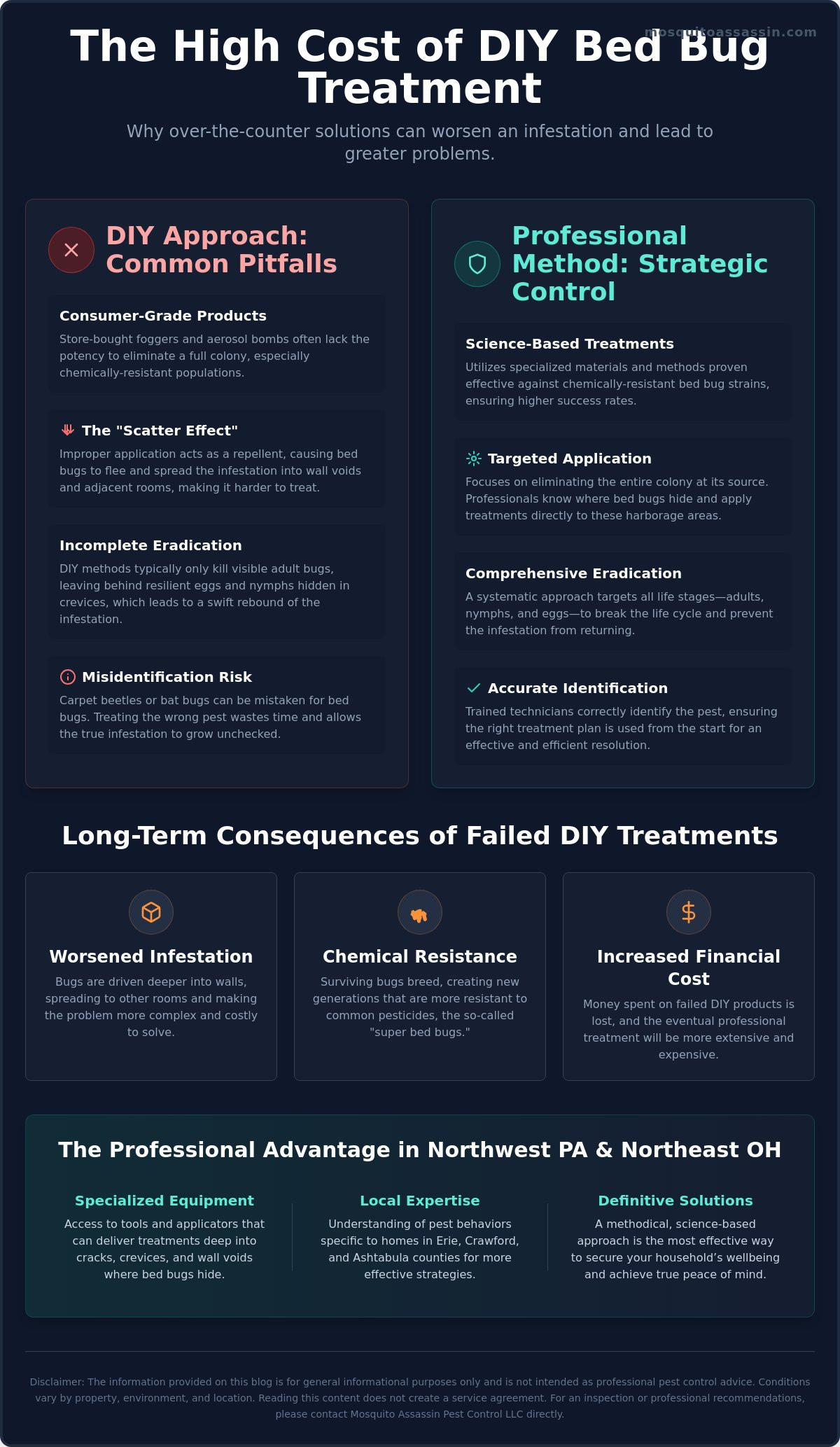
One of the most significant risks of DIY bed bug treatment is the biological backlash that occurs when these pests encounter low-grade chemicals. While many retail sprays promise total elimination, they often lack the potency to finish the job. Instead of a swift resolution, homeowners often witness a worsening of the situation as the surviving population adapts to the threat. This biological warfare isn’t just about survival; it’s about the evolution of the colony within your own walls.
Understanding Chemical Resistance
Modern bed bug populations are not the same as those from decades ago. Over time, they have developed a formidable defense against common pyrethroid-based consumer products found in big-box stores. These “super bed bugs” have physically thicker exoskeletons that prevent toxins from penetrating their systems. When you apply a retail spray, you might kill a few visible bugs, but you’re actually performing an accidental experiment in natural selection. Only the strongest individuals survive. These survivors then breed, creating a new generation that is even more resistant to the products available at the local hardware store. The EPA provides a detailed guide on Do-it-yourself Bed Bug Control that highlights these complexities. Professional strategies often rely on non-repellents that the bugs cannot detect, ensuring they don’t have the chance to adapt or hide.
The Danger of Scattering and Dispersal
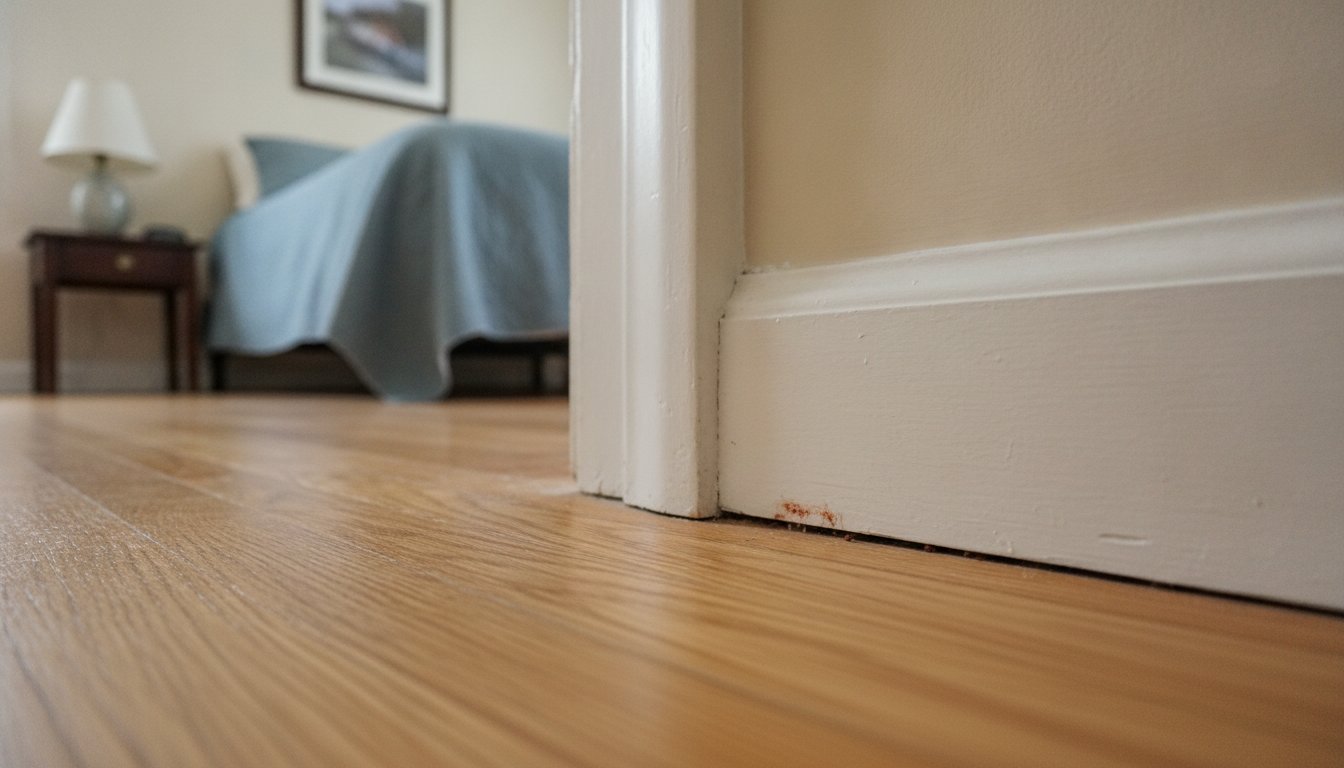
The most counter-productive result of DIY attempts is a phenomenon known as dispersal. Most over-the-counter sprays contain repellent agents. While this sounds effective, it actually triggers a survival instinct in the colony. When bed bugs detect these irritants, they don’t just sit there; they flee. They scurry away from the treated area and seek refuge in places that are nearly impossible to reach. They move through electrical outlets, behind baseboards, and along plumbing lines to reach adjacent rooms. What started as a minor issue in a single bedroom can quickly transform into a whole-house infestation because of a single misplaced application of a “bug bomb.”
Once bed bugs have entered wall voids or subflooring, the difficulty of the project increases exponentially. They can remain dormant in these protected areas for months without a blood meal, waiting for the chemical scent to fade before returning to feed. This is why a methodical, professional bed bug treatment is often necessary to ensure the entire structure is properly evaluated and secured. If you’ve already tried spraying and noticed the bugs appearing in new areas, professional pest control may help reduce risk of further spread.
Disclaimer: The information provided on this blog is for general informational purposes only and is not intended as professional pest control advice. Conditions vary by property, environment, and location. Reading this content does not create a service agreement. For an inspection or professional recommendations, please contact Mosquito Assassin Pest Control LLC directly.
The Failure of Common Consumer Products
Walk into any hardware store in Erie or Ashtabula, and you’ll find an entire aisle dedicated to pest control. It’s tempting to think these brightly colored cans hold the secret to a bug-free home. However, the risks of DIY bed bug treatment often stem from a fundamental misunderstanding of how these products work. Most consumer-grade items are designed for insects that roam in the open, not for a pest that spends the majority of its life hidden in microscopic gaps. Relying on retail solutions often gives the infestation more time to grow while providing a false sense of security.
Why Bug Bombs Are Counter-Productive
Total release foggers, commonly known as bug bombs, are perhaps the most misused tool in the homeowner’s arsenal. These devices release a fine mist that travels upward and then settles on horizontal surfaces like tables and floors. Bed bugs, however, hide deep within mattress seams, behind picture frames, and inside bed frames. The insecticide never reaches these sanctuaries. Instead, you end up contaminating your bed sheets, toys, and kitchen counters with chemicals that the bugs never even touch. Bug bombs often act as a “warning bell” that tells bed bugs to hide elsewhere. This pushes them into deeper, more protected areas of the home, making future professional bed bug treatment significantly more difficult.
The Limitations of Over-the-Counter Sprays
Many retail sprays are marketed as “contact killers.” While they may indeed kill a bug if you spray it directly, they offer almost no residual protection. Once the liquid dries, it typically loses its potency. This is a critical failure because bed bugs are cryptic pests that emerge only when it’s safe to feed. If the treatment isn’t active when the bug comes out of hiding, it’s useless. This EPA guide to DIY bed bug control explains that effective management requires more than just a quick spray. Professionals use specialized application techniques to ensure products reach the “voids” where bugs reside, whereas untrained homeowners often only treat the perimeter of a room, leaving the core of the colony untouched.
Clutter presents another physical barrier that DIY liquids cannot overcome. Piles of clothing, books, or papers provide a shield that prevents sprays from reaching the target. Desperate homeowners sometimes turn to dangerous home remedies like rubbing alcohol to bypass these issues. Rubbing alcohol is highly flammable and has caused numerous house fires when used as a DIY pesticide. Natural or essential oil-based sprays are equally problematic; while they might smell pleasant, they rarely provide the long-term protection needed to break the bed bug life cycle. Relying on these methods often leads to a cycle of temporary relief followed by a renewed, more aggressive infestation.
Disclaimer: The information provided on this blog is for general informational purposes only and is not intended as professional pest control advice. Conditions vary by property, environment, and location. Reading this content does not create a service agreement. For an inspection or professional recommendations, please contact Mosquito Assassin Pest Control LLC directly.
Financial and Structural Consequences of Failed DIY
Many property owners view professional extermination as a last resort because of the perceived expense. However, this logic ignores the cumulative cost of repeated, failed attempts. When you add up the price of multiple cases of aerosol foggers, specialized laundry additives, and various retail sprays, the total often approaches the cost of a targeted professional intervention. The “sunk cost” of these products is only the beginning of the financial burden. One of the primary risks of DIY bed bug treatment is that it essentially buys the colony more time to entrench itself in your home’s structure while you spend money on ineffective tools.
The True Cost of Postponing Professional Help
A single female bed bug can lay hundreds of eggs in her lifetime. This exponential growth means that a localized infestation in one bedroom can spread to every room in a house within a few months. The longer you wait, the more complex the eradication process becomes. Treating a single room is a relatively straightforward task for a pro, but treating an entire residence requires significantly more labor, equipment, and time. Understanding pest control prices helps put these long-term expenses into perspective. When DIY methods fail, they don’t just waste your initial investment; they increase the final bill by allowing the problem to reach a critical mass.
Damage to Personal Property
Panic often drives people to drag mattresses and upholstered furniture to the curb. In the vast majority of cases, this is an unnecessary expense. Professional methods can often salvage furniture that looks “ruined.” Also, throwing away items can actually spread the bugs through the hallways of an apartment building or into your vehicle during transport. Improper chemical application can also leave permanent stains on delicate fabrics or damage the finish on wooden bed frames. The emotional stress of losing cherished belongings adds a heavy burden to an already difficult situation. Instead of disposing of your property, seeking a professional bed bug treatment may help you save your furniture and your sanity.
For those living in multi-unit housing in areas like Ashtabula or Erie, failed DIY attempts can lead to serious legal complications. Many leases require tenants to report infestations immediately to management. If a landlord discovers that a tenant tried to self-treat and inadvertently spread the infestation to neighboring units, the tenant could be held financially liable for the remediation costs of the entire building. In extreme cases, improper use of flammable liquids or excessive moisture in DIY attempts can even lead to structural damage or mold issues within wall voids. Taking a methodical, professional approach is the best way to protect both your finances and your legal standing as a resident.
Disclaimer: The information provided on this blog is for general informational purposes only and is not intended as professional pest control advice. Conditions vary by property, environment, and location. Reading this content does not create a service agreement. For an inspection or professional recommendations, please contact Mosquito Assassin Pest Control LLC directly.
The Professional Advantage for Regional Homeowners
Professional intervention provides a decisive resolution that home remedies simply cannot achieve. While the risks of DIY bed bug treatment include accidental colony dispersal and the development of chemical resistance, professional methods utilize physics and biology to ensure total removal. The use of specialized equipment, such as industrial-grade steam and high-heat systems, allows for the penetration of materials that liquid sprays cannot reach. High-efficiency particulate air (HEPA) vacuums are also employed to physically remove live insects, cast skins, and allergens from the environment, providing immediate relief and a cleaner living space.
A systematic approach is necessary because bed bugs are resilient and cryptic. Professional services involve a multi-step process that includes thorough removal, ongoing maintenance, and exclusion strategies to prevent future entries. This disciplined operational method ensures that every life stage, from eggs to adults, is addressed. By choosing professional assistance, property owners can avoid the cycle of failed attempts and finally restore the security and wellbeing of their household members.
Integrated Pest Management (IPM) in Practice
Integrated Pest Management is the standard for modern, effective eradication. This strategy combines non-chemical methods, such as mechanical removal and temperature control, with targeted, professional-grade chemical applications. This balanced approach minimizes the volume of products used while maximizing the impact on the pest population. A critical component of IPM is the follow-up inspection. Since research indicates that most infestations require multiple visits to ensure total eradication, professionals schedule secondary checks to confirm that no hidden eggs have hatched. This methodical oversight is a core part of general pest control services and is essential for long-term success.
Localized Expertise in Erie, Crawford, and Ashtabula
Regional climate factors and local housing styles play a significant role in pest behavior. In Northwest Pennsylvania and Northeast Ohio, older home constructions often feature lath and plaster walls, intricate woodwork, and crawl spaces that provide ideal hiding spots for bed bugs. Neighbors who understand these local architectural nuances are better equipped to identify potential harborages that an outsider might overlook. Working with a local entity rooted in Erie, Crawford, and Ashtabula Counties ensures that the service team is familiar with the specific environmental challenges of the area.
Restoring peace of mind starts with a professional evaluation of the property. If you are facing a suspected infestation, professional pest control may help reduce risk and provide a definitive path forward. To begin a methodical inspection and receive expert recommendations, please contact Mosquito Assassin Pest Control LLC through the online booking portal.
Disclaimer: The information provided on this blog is for general informational purposes only and is not intended as professional pest control advice. Conditions vary by property, environment, and location. Reading this content does not create a service agreement. For an inspection or professional recommendations, please contact Mosquito Assassin Pest Control LLC directly.
Secure Your Home with Professional Intervention
Bed bugs are biological specialists that require a methodical, scientific response. Attempting to manage an infestation with store-bought foggers or unproven home remedies often leads to the very outcomes you want to avoid. The primary risks of DIY bed bug treatment include driving pests deeper into your walls and allowing the population to reach a critical, more expensive mass. A professional approach utilizing Integrated Pest Management (IPM) is the most reliable way to break the life cycle and secure your household.
Licensed and insured professionals understand the unique challenges of local housing in Erie, Crawford, and Ashtabula counties. By prioritizing the safety of your family and the structural integrity of your home, expert intervention replaces anxiety with a definitive resolution. You don’t have to face this challenge alone. To protect your property and restore your peace of mind, you can request an inspection for professional bed bug management today. Your home should be a sanctuary, and a systematic treatment plan ensures it stays that way.
Disclaimer: The information provided on this blog is for general informational purposes only and is not intended as professional pest control advice. Conditions vary by property, environment, and location. Reading this content does not create a service agreement. For an inspection or professional recommendations, please contact Mosquito Assassin Pest Control LLC directly.
Frequently Asked Questions
Can I get rid of bed bugs on my own with retail products?
Eradicating an entire colony with retail products is extremely difficult because these insects hide in areas that sprays cannot reach. Most store-bought items only kill the bugs you see, leaving the eggs and nymphs tucked away in wall voids or furniture joints. This leads to a cycle of re-infestation that can last for months. One of the primary risks of DIY bed bug treatment is that it provides a false sense of security while the population continues to grow.
Why did my bed bug problem get worse after using a bug bomb?
Bug bombs are often counter-productive because they release a repellent mist that triggers the insects’ survival instinct to flee. Instead of dying, the bed bugs scurry away from the mist and seek refuge inside electrical outlets, behind baseboards, and into adjacent rooms. This dispersal turns a localized problem into a whole-house infestation. The mist also settles on surfaces where you live and sleep without ever reaching the deep crevices where the pests actually hide.
Is it safe to use rubbing alcohol to kill bed bugs?
Using rubbing alcohol is highly dangerous and poses a significant fire hazard to your home. While alcohol can kill a bed bug on contact, it evaporates almost instantly and offers no long-term protection. Numerous house fires have been documented after homeowners sprayed excessive amounts of this flammable liquid near beds or electrical outlets. It’s much safer to rely on professional methods that use non-flammable, registered products designed for residential environments.
How long can a bed bug infestation last if not treated professionally?
A bed bug infestation can last indefinitely without professional intervention because these pests are highly resilient. Adult bed bugs can survive for several months without a blood meal in certain conditions, allowing them to wait out temporary treatments. Their rapid reproduction rate means that even a few survivors can reboot a colony in a matter of weeks. Without a methodical approach that targets every life stage, the infestation will likely persist and expand throughout the structure.
What is the most common mistake people make with DIY bed bug treatment?
The most common mistake is relying solely on contact-kill sprays while ignoring the cryptic nature of the pest. Many people assume that if they don’t see live bugs, the problem is solved, but they fail to address the eggs hidden in microscopic gaps. This oversight is among the major risks of DIY bed bug treatment, as it allows the colony to recover. Successful eradication requires a combination of mechanical removal, heat or steam, and residual products that remain active over time.
Do I need to throw away my mattress if I have bed bugs?
You rarely need to dispose of your mattress; in fact, doing so can accidentally spread the insects to other parts of your property. Professional treatments involving specialized steam or heat can effectively penetrate the mattress and box spring to kill all life stages. Once treated, high-quality bed bug encasements can be used to trap any potential survivors and prevent new bugs from entering. This approach saves you the significant expense and stress of replacing expensive furniture.
Can bed bugs move from one room to another if I spray only one area?
Bed bugs will actively move to adjacent rooms if they detect repellent chemicals in their current environment. These insects are fast runners and can easily travel through wall voids, along plumbing lines, or under door frames to reach a “safer” area. If you only treat the bedroom where you first noticed them, you may inadvertently push the colony into the living room or guest rooms. This is why professional inspections cover the entire home to ensure no hiding spot is overlooked.
How do professionals treat bed bugs differently than homeowners?
Professionals use Integrated Pest Management (IPM) to combine multiple specialized tools that are unavailable to the general public. This includes industrial-grade steam, high-output heat systems, and non-repellent chemicals that the bugs cannot detect. Unlike the surface-level applications common in DIY attempts, professional techniques focus on the structural voids and deep harborages where the colony resides. This comprehensive strategy ensures that the root of the infestation is eliminated rather than just the visible insects.
Disclaimer: The information provided on this blog is for general informational purposes only and is not intended as professional pest control advice. Conditions vary by property, environment, and location. Reading this content does not create a service agreement. For an inspection or professional recommendations, please contact Mosquito Assassin Pest Control LLC directly.