
What if a single health department inspection could cost your Ashtabula County business more than a year of professional maintenance? It’s a reality that surfaced in 2023 health audit reports, where improper pest documentation led to immediate operational setbacks for local establishments. Most professionals understand that a single rodent sighting doesn’t just mean a fine; it can damage a brand’s reputation permanently. Implementing effective pest control for businesses in Ohio is a non-negotiable requirement for staying compliant with state health codes and protecting your facility from structural damage.
This guide provides the essential strategies and regulatory insights needed to maintain a pest-free commercial environment in Northeast Ohio. You’ll learn how to move from reactive treatments to a reliable prevention framework that aligns with Ohio’s safety standards. By understanding local pest behaviors and implementing professional management practices, businesses can focus on growth instead of health department violations. Professional pest control may help reduce risk for your facility.
Disclaimer: The information provided on this blog is for general informational purposes only and is not intended as professional pest control advice. Conditions vary by property, environment, and location. Reading this content does not create a service agreement. For an inspection or professional recommendations, please contact Mosquito Assassin Pest Control LLC directly.
Key Takeaways
- Understand how systematic risk mitigation strategies protect brand reputation and maintain customer trust in commercial environments.
- Identify the specific threats rodents and cockroaches pose to the structural integrity and hygiene of facilities in Northeast Ohio.
- Learn about the stringent regulatory requirements and zero-tolerance policies governing the food service, hospitality, and healthcare industries.
- Discover how Integrated Pest Management (IPM) serves as a proactive framework for professional pest control for businesses in ohio.
- Gain insights on evaluating commercial partnerships by verifying state licensing and sector-specific experience for licensed applicators.
The Role of Professional Pest Management in Ohio Business Operations
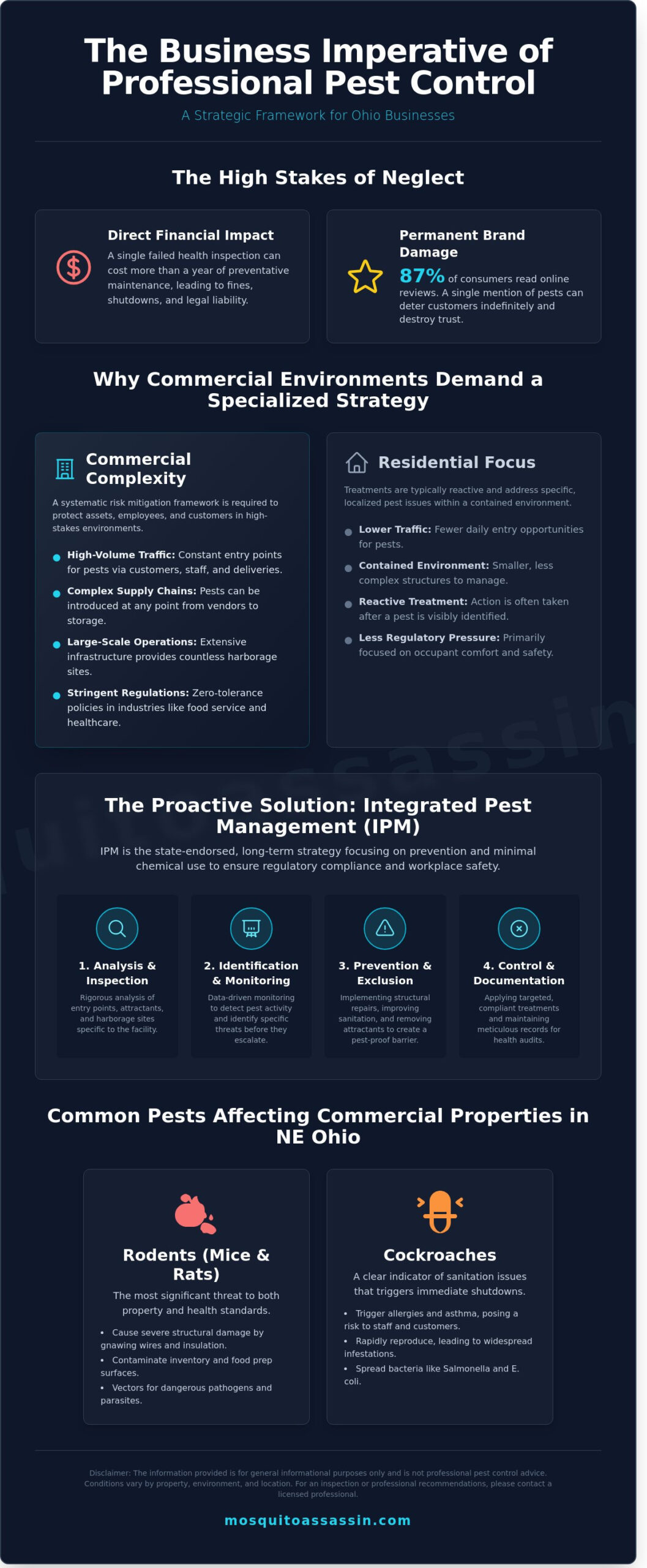
Commercial pest management functions as a systematic framework for risk mitigation. It isn’t merely a reactive service; it’s a proactive strategy to protect physical assets and operational continuity. For a company, a pest infestation represents more than a nuisance. It is a direct threat to the structural integrity of the building and the safety of the inventory. Professional pest control for businesses in ohio focuses on creating a barrier between the enterprise and external biological threats. This involves a rigorous analysis of entry points, attractants, and harborage sites specific to the local climate in areas like Ashtabula County.
Commercial environments require strategies that differ significantly from residential protocols. While a homeowner might prioritize the removal of a specific visible pest, a business must account for high-volume foot traffic, complex supply chains, and large-scale waste management. Residential treatments often address localized issues. In contrast, commercial strategies must account for the daily movement of goods and people, which provides constant opportunities for pests to hitchhike into a facility. Effective pest control for businesses in ohio utilizes data-driven monitoring to detect activity before it becomes a public-facing problem.
Protecting Business Reputation and Revenue
A single pest sighting can trigger a cascade of financial losses. In an era where 87% of consumers read online reviews before visiting a local business, a mention of rodents or insects can be devastating. Negative feedback spreads rapidly across social media and review platforms. This often results in a measurable decline in foot traffic and immediate revenue loss. Maintaining high sanitation standards is directly correlated with customer retention; shoppers and diners expect a sterile environment as a baseline for their patronage.
Utilizing professional commercial services provides a critical layer of protection against public relations crises. It demonstrates a commitment to quality that reassures both customers and employees. When a business invests in a professional management plan, they’re essentially purchasing insurance for their brand equity. Consistent monitoring ensures that small issues don’t escalate into headline-grabbing infestations that could force a temporary or permanent closure.
Regulatory Compliance and Health Standards
The Ohio Department of Agriculture (ODA) maintains strict standards for commercial properties, particularly regarding pesticide application and environmental safety. Compliance isn’t optional. Businesses that fail to meet these health codes face heavy fines, legal liability, and the potential revocation of operating licenses. Licensed professionals follow the principles of Integrated Pest Management (IPM) to ensure that treatments are both effective and compliant with state regulations. This methodology focuses on long-term prevention and minimizes the use of chemicals through improved sanitation and structural repairs.
Workplace safety is another primary driver for professional pest management. Pests are known vectors for various pathogens that can cause respiratory issues or allergic reactions among staff. In properties with high foot traffic, the risk of disease transmission increases. Managing these risks involves more than just spraying; it requires a comprehensive understanding of pest biology and behavior. Professional intervention helps maintain a healthy environment for employees, which reduces sick leave and improves overall morale. Following ODA guidelines ensures that the property remains a safe space for the public and the workforce alike.
Common Pests Affecting Commercial Properties in Northeast Ohio
Commercial properties in Northeast Ohio face a diverse range of pest pressures that fluctuate with the seasons. Rodents, specifically mice and rats, represent the most significant threat to both structural integrity and hygiene standards. A Norway rat can exert up to 24,000 pounds of pressure per square inch with its teeth, allowing it to chew through wood, plastic, and even soft metals. This behavior often leads to damaged electrical wiring and compromised insulation. In commercial kitchens and food service environments, cockroach infestations are a primary concern. A single female German cockroach and her subsequent offspring can produce more than 30,000 individuals within a single year if left unchecked. This rapid colonization makes consistent pest control for businesses in ohio essential for meeting health department regulations and maintaining a professional reputation.
Warehouses and food processing facilities often encounter stored product pests like Indian meal moths and saw-toothed grain beetles. These insects can contaminate entire shipments of dry goods, leading to significant financial losses. Outside the facility, flies and stinging insects create immediate issues for entryways and outdoor dining areas. Filth flies are known to carry more than 100 different pathogens, including Salmonella and E. coli, which they transfer to surfaces upon landing. Effective management often involves following Integrated Pest Management (IPM) principles to address the root causes of these infestations rather than relying solely on reactive measures.
Rodent Pressures in Urban and Rural Ohio Settings
The behavior of rodents varies significantly between urban centers and rural commercial sites. In urban areas, Norway rats are common near loading docks and waste disposal zones. These rats are burrowers and often enter buildings through utility gaps or damaged floor drains. House mice are more prevalent in rural settings, though they’re found in nearly every commercial environment. A mouse only requires a gap of 1/4 inch (about the size of a dime) to gain access to a structure. The Northeast Ohio climate plays a decisive role in rodent activity; as temperatures drop in October and November, rodents aggressively seek indoor shelter and food sources to survive the winter months.
Nuisance and Health-Hazard Insects
Insects in a business context are categorized by the specific risks they pose. Filth flies originate from decaying organic matter and represent a high health risk, while fruit flies are typically drawn to fermenting liquids in bars or breakrooms. In Ashtabula County, Odorous house ants are a frequent spring nuisance, often entering buildings in large numbers following heavy rains. For businesses with outdoor amenities, seasonal pressures from mosquitoes and ticks are a major concern from May through September. Black-legged ticks are particularly active in properties with high grass or wooded borders. Implementing professional pest control may help reduce risk for employees and customers alike. Facility managers seeking an evaluation of their property can visit the Mosquito Assassin contact page for further information.
Disclaimer: The information provided on this blog is for general informational purposes only and is not intended as professional pest control advice. Conditions vary by property, environment, and location. Reading this content does not create a service agreement. For an inspection or professional recommendations, please contact Mosquito Assassin Pest Control LLC directly.
Industry-Specific Pest Control Requirements
Commercial pest management isn’t a one-size-fits-all solution. Different sectors face unique biological threats and regulatory pressures that dictate how treatments are applied. In warehousing and logistics hubs throughout Ashtabula County, the primary concern involves preventing the transport of pests through complex supply chains. A 2023 industry report indicated that 24% of warehouse infestations originate from incoming shipments rather than local environmental factors. Technicians must focus on high-traffic loading docks and pallet storage areas where hitchhiking pests like German cockroaches or stored product beetles often hide.
Multi-unit housing and office complexes present a different challenge: pest migration. In buildings with shared walls and utility lines, a localized issue can quickly become a building-wide crisis. Research shows that if one apartment in a complex has a cockroach infestation, there’s a 60% chance the adjacent units will also be affected within 14 days. Effective management requires a holistic approach that addresses structural gaps and common areas to prevent pests from moving between units. For those evaluating a professional partnership, Ohio State University’s Pesticide Safety Education Program provides essential resources on the standards required for commercial applicators to handle these complex environments safely.
Food Safety and Restaurant Standards
Food service establishments operate under a zero-tolerance policy for pests. According to the 2022 FDA Food Code, even a single sighting of a rodent or cockroach can lead to immediate facility closure. Management must maintain detailed service logs for health inspectors to prove consistent monitoring. Focusing on waste disposal areas is critical; 75% of restaurant pest entries begin at poorly maintained dumpsters or grease traps. Proper exclusion and sanitation are the primary defenses in these high-risk zones.
Healthcare and Sensitive Environments
Hospitals, clinics, and assisted living facilities require sterile environments where traditional chemical applications are often restricted. Pest management in these spaces prioritizes low-impact, non-disruptive schedules to protect patient health and comfort. Utilizing localized pest control for businesses in Ohio ensures that service providers are familiar with regional health department regulations and the specific needs of Ohio healthcare facilities. Technicians focus on Integrated Pest Management (IPM) techniques, emphasizing structural repairs and monitoring over broad-spectrum sprays. This approach safeguards vulnerable populations while maintaining the high hygiene standards necessary for medical certification. Precise pest control for businesses in Ohio helps facility managers stay compliant with state-specific healthcare safety audits while keeping sensitive areas free of biological contaminants.
Implementing Integrated Pest Management (IPM) for Long-Term Protection
Integrated Pest Management (IPM) is a science-based approach that focuses on long-term prevention rather than just reacting to infestations. It’s a strategy that prioritizes the least hazardous methods first. Effective pest control for businesses in ohio relies on this methodology to ensure that commercial environments remain compliant with health codes and safety standards. According to a 2022 report from the National Pest Management Association, proactive IPM strategies can reduce the need for intensive chemical applications by up to 90% in commercial settings. The process follows five distinct steps that work together to create a hostile environment for pests.
- Step 1: Comprehensive facility inspection. A thorough walkthrough identifies structural vulnerabilities. This includes checking loading docks, utility penetrations, and employee breakrooms where crumbs often accumulate.
- Step 2: Identification of specific pest species. Knowing the biology of the pest is vital. For instance, treating for a German cockroach requires a different strategy than managing an American cockroach due to their different nesting habits and reproductive cycles.
- Step 3: Implementation of non-chemical measures. This involves physical changes to the building. It’s about removing the food, water, and shelter that pests need to survive.
- Step 4: Targeted treatment only when necessary. If pests persist after exclusion, professionals apply treatments to specific areas. This minimizes exposure and ensures the most effective results.
- Step 5: Ongoing monitoring and documentation. Keeping a detailed log of sightings and trap counts allows for data-driven decisions. It’s not enough to solve the problem once; it’s about maintaining a barrier.
The Science of Exclusion and Sanitation
Exclusion is the first line of defense in any commercial facility. Small gaps are significant risks; a mouse can fit through a hole the size of a dime, which is roughly 0.7 inches. Sealing cracks with weather-resistant caulk and installing heavy-duty door sweeps prevents these intruders from gaining access. Moisture control is equally vital. Leaky pipes or poorly graded landscaping in Erie or Ashtabula Counties can create standing water that attracts flies and mosquitoes. Employee training is the final piece of this puzzle. When staff members understand how to properly store food and dispose of waste, the risk of an internal infestation drops significantly. This collective effort is a core component of sustainable pest control for businesses in ohio.
Monitoring and Reporting Systems
Modern pest management utilizes advanced monitoring tools to catch problems before they escalate. Pheromone traps are used to detect stored product pests in warehouses, while digital bait stations can alert managers to rodent activity in real-time. These systems provide 24/7 surveillance that manual inspections might miss. Digital reporting provides facility managers with a transparent trail of data for audits and health inspections. Regular services allow for adjustments based on seasonal pest activity, ensuring the strategy evolves as the weather changes. Monitoring ensures that every action taken is based on current, site-specific evidence rather than guesswork.
For facility managers in Crawford County or surrounding areas, understanding these protocols is the first step toward a cleaner workspace. While many factors influence pest behavior, professional pest control may help reduce risk and protect a company’s reputation.
Evaluating Professional Pest Control Partnerships in Ohio
Selecting the right partner for securing reliable pest control for businesses in ohio requires more than a quick online search. Verification of credentials is the first essential step. The Ohio Department of Agriculture (ODA) regulates all commercial pesticide applications in the state. Business owners should confirm that a provider holds a valid commercial applicator license and maintains at least $300,000 in general liability insurance. This coverage protects the physical assets of the facility and ensures the provider meets state-mandated safety standards. Checking these documents annually helps maintain a high standard of safety for employees and customers alike.
Experience in specific commercial sectors is just as vital as licensing. A technician who understands the strict sanitation requirements of a food processing plant may not have the same approach as one specializing in multi-unit housing. Effective pest control for businesses in ohio relies on sector-specific knowledge to address unique vulnerabilities. For example, a 50,000-square-foot warehouse has different entry points and nesting risks than a retail storefront. Professional partners should demonstrate a history of managing similar environments, as this reduces the risk of overlooked infestations.
Communication protocols define the success of a long-term partnership. Clear channels for reporting sightings and a guaranteed response time, often within 24 hours for urgent issues, prevent minor problems from becoming full-scale infestations. Documentation is the backbone of this communication. In 2023, data from regional health inspections showed that nearly 35% of pest-related citations were linked to inadequate record-keeping rather than the presence of pests themselves. Audit-ready reporting must include detailed pesticide usage logs, comprehensive site maps, and trend analysis reports that show the history of the facility’s pest activity.
Local Expertise vs. National Chains
Local knowledge of regional pest cycles is a major advantage for businesses in Ashtabula County. The Lake Erie climate creates specific humidity levels that influence when insects like carpenter ants or cluster flies emerge. A provider with about ten years of experience in the local area understands these seasonal shifts better than a national corporation using a one-size-fits-all strategy. Local teams often provide faster response times during extreme weather events, such as heavy spring rains, which can drive pests indoors across the region.
Questions to Ask Potential Service Providers
When interviewing a potential partner, specific questions help reveal their level of expertise and commitment to professional standards. Business owners don’t have to guess about the quality of service if they ask the right technical questions during the consultation phase. Use these points to evaluate their capabilities:
- Can you provide examples of Integrated Pest Management (IPM) strategies used in facilities similar to mine? Genuine IPM focuses on prevention and structural repairs rather than just chemical application.
- What is your experience with specific industry audits like SQF, AIB, or GFSI? Providers should be familiar with the documentation requirements of these third-party auditors.
- How do you handle emergency call-outs between scheduled visits? Confirm if there are additional fees for these visits and what the expected arrival time is.
- Will I receive digital documentation immediately after every site visit? Real-time reporting ensures that management can address structural recommendations or sanitation issues without delay.
A professional partnership is an investment in the reputation and operational continuity of a company. By focusing on licensing, sector experience, and clear documentation, business owners can safeguard their property against the financial and physical risks of pests. Professional pest control may help reduce risk and ensure long-term compliance with state and local health regulations.
Protecting Your Business Reputation and Infrastructure
Maintaining a pest-free environment is a critical component of successful business operations in the Great Lakes region. Implementing specialized commercial Integrated Pest Management protocols allows facility managers to address vulnerabilities before they escalate into infestations. These methods prioritize long-term prevention and structural integrity over temporary fixes. Because regulations for commercial properties are strict, working with a provider that’s licensed and insured in Ohio and Pennsylvania is essential for maintaining industry standards. A locally owned and operated partner understands the specific seasonal pressures facing Erie, Crawford, and Ashtabula Counties.
Consistency is the foundation of effective pest control for businesses in Ohio. It’s important to establish a routine that includes regular inspections and data-driven monitoring to safeguard inventory and staff. Effective management requires understanding the specific biological cycles of regional pests like rodents or flies. Taking these proactive steps helps maintain a professional atmosphere and protects the bottom line from costs associated with property damage or health code violations. Professional pest control may help reduce risk and ensure compliance. By focusing on prevention today, business owners invest in the continued success and safety of their commercial space.
Disclaimer: The information provided on this blog is for general informational purposes only and is not intended as professional pest control advice. Conditions vary by property, environment, and location. Reading this content does not create a service agreement. For an inspection or professional recommendations, please contact Mosquito Assassin Pest Control LLC directly.
Frequently Asked Questions
What are the legal requirements for pest control in Ohio businesses?
Ohio Administrative Code 3701-21-02 requires food service operations to stay free of insects and rodents. Commercial facilities must adhere to standards set by the Ohio Department of Agriculture for safe pesticide application. 100% of food-handling businesses must keep detailed records of all pest management activities to satisfy local health department inspections. Professional pest control may help reduce risk for these establishments.
How often should a commercial property in Ohio be inspected for pests?
Most commercial properties in Ohio benefit from monthly inspections to identify vulnerabilities before they lead to an infestation. High-risk facilities like restaurants or warehouses often schedule weekly visits, while standard retail spaces might only require 4 inspections per year. Consistent monitoring prevents 90% of pest-related structural damage and ensures the property remains in good standing.
What is Integrated Pest Management (IPM) and why is it used for businesses?
Integrated Pest Management is a strategic approach that prioritizes sanitation and structural repairs over chemical applications. It’s the preferred method for pest control for businesses in ohio because it reduces chemical usage by 70% while maintaining high efficacy. This science-based system focuses on the biology of pests to create long-term solutions that don’t rely solely on reactive treatments.
Can a business stay open during a professional pest control treatment?
Most businesses can continue operations during a professional treatment, especially when technicians use non-volatile baits and traps. If a liquid application is necessary, it’s often scheduled during the 8 to 12 hours the business is closed. When treatments occur during business hours, technicians focus on secluded areas to ensure zero disruption for customers. It’s important to coordinate with professionals to determine the best timing.
What should a business do if they fail a health inspection due to pests?
A business that fails an inspection should immediately secure a professional evaluation to address the specific violations cited. The Ohio Department of Health usually schedules a re-inspection within 10 days to confirm that the issues are resolved. Implementing corrective actions like sealing entry points can fix 85% of common pest-related health code failures. Professional pest control may help reduce risk of future failures.
Are commercial pest treatments safe for employees and customers?
Professional treatments are safe for people when applied by licensed technicians following EPA-approved label instructions. These applications target specific pest harborages like cracks and wall voids rather than open surfaces. 100% of modern commercial-grade products are chosen for their effectiveness and low impact on the indoor environment. Technicians ensure that no one is exposed to unnecessary risks during the process.
How do seasonal changes in Ohio affect commercial pest management?
Pest activity in Ohio fluctuates with the 4 distinct seasons, requiring different strategies throughout the year. For instance, 80% of ant infestations occur when spring temperatures reach 50 degrees, while rodents migrate indoors when the ground freezes in November. Effective pest control for businesses in ohio involves adjusting prevention tactics every 90 days to stay ahead of these biological shifts.
What documentation does a business need to provide to health inspectors regarding pest control?
Business owners should maintain a logbook containing service reports, pesticide labels, and safety data sheets. Inspectors also look for a site map showing the location of all 20 or 30 bait stations on the property. Keeping 100% of these records organized ensures the business remains compliant with the Ohio Food Code during unannounced audits. For more information, please visit www.mosquitoassassin.com/contact-us.
Disclaimer: The information provided on this blog is for general informational purposes only and is not intended as professional pest control advice. Conditions vary by property, environment, and location. Reading this content does not create a service agreement. For an inspection or professional recommendations, please contact Mosquito Assassin Pest Control LLC directly.